
<?xml version="1.0" encoding="UTF-8"?>
<!DOCTYPE article PUBLIC "-//NLM//DTD Journal Publishing DTD v2.3 20070202//EN" "journalpublishing.dtd">
<article xmlns:xlink="http://www.w3.org/1999/xlink" xml:lang="en" article-type="research-article">
<front>
<journal-meta>
<journal-id journal-id-type="publisher-id">ijms</journal-id>
<journal-title>International Journal of Molecular Sciences</journal-title>
<abbrev-journal-title>Int. J. Mol. Sci.</abbrev-journal-title>
<issn pub-type="epub">1422-0067</issn>
<publisher>
<publisher-name>Molecular Diversity Preservation International (MDPI)</publisher-name></publisher></journal-meta>
<article-meta>
<article-id pub-id-type="doi">10.3390/ijms130810410</article-id>
<article-id pub-id-type="publisher-id">ijms-13-10410</article-id>
<article-categories>
<subj-group>
<subject>Article</subject></subj-group></article-categories>
<title-group>
<article-title>Identification of Tillering Node Proteins Differentially Accumulated in Barley Recombinant Inbred Lines with Different Juvenile Growth Habits</article-title></title-group>
<contrib-group>
<contrib contrib-type="author">
<name><surname>Kuczyńska</surname><given-names>Anetta</given-names></name><xref ref-type="corresp" rid="c1-ijms-13-10410">*</xref></contrib>
<contrib contrib-type="author">
<name><surname>Kosmala</surname><given-names>Arkadiusz</given-names></name></contrib>
<contrib contrib-type="author">
<name><surname>Surma</surname><given-names>Maria</given-names></name></contrib>
<contrib contrib-type="author">
<name><surname>Adamski</surname><given-names>Tadeusz</given-names></name></contrib>
<aff id="af1-ijms-13-10410">Institute of Plant Genetics, Polish Academy of Sciences, Strzeszynska Str. 34, Poznan 60-479, Poland; E-Mails: <email>akos@igr.poznan.pl</email> (A.K.); <email>msur@igr.poznan.pl</email> (M.S.); <email>tada@igr.poznan.pl</email> (T.A.)</aff></contrib-group>
<author-notes>
<corresp id="c1-ijms-13-10410">
<label>*</label>Author to whom correspondence should be addressed; E-Mail: <email>akuc@igr.poznan.pl</email>; Tel.: +48-61-65-50-224; Fax: +48-61-65-50-301.</corresp></author-notes>
<pub-date pub-type="collection">
<year>2012</year></pub-date>
<pub-date pub-type="epub">
<day>21</day>
<month>08</month>
<year>2012</year></pub-date>
<volume>13</volume>
<issue>8</issue>
<fpage>10410</fpage>
<lpage>10423</lpage>
<history>
<date date-type="rev-recd">
<day>08</day>
<month>08</month>
<year>2012</year></date>
<date date-type="accepted">
<day>14</day>
<month>08</month>
<year>2012</year></date></history>
<permissions>
<copyright-statement>© 2012 by the authors; licensee Molecular Diversity Preservation International, Basel, Switzerland.</copyright-statement>
<copyright-year>2012</copyright-year>
<license license-type="open-access" xlink:href="http://creativecommons.org/licenses/by/3.0">
<p>This article is an open-access article distributed under the terms and conditions of the Creative Commons Attribution license (http://creativecommons.org/licenses/by/3.0/).</p></license></permissions>
<abstract>
<p>Barley (<italic>Hordeum vulgare</italic> L.) is an important cereal crop grown for both the feed and malting industries. The allelic dwarfing gene <italic>sdw1/denso</italic> has been used throughout the world to develop commercial barley varieties. Proteomic analysis offers a new approach to identify a broad spectrum of genes that are expressed in the living system. Two-dimensional electrophoresis and mass spectrometry were applied to investigate changes in protein abundance associated with different juvenile growth habit as effect of the <italic>denso</italic> locus in barley homozygous lines derived from a Maresi × Pomo cross combination. A total of 31 protein spots were revealed that demonstrate quantitative differences in protein abundance between the analyzed plants with different juvenile growth habit, and these protein spots were selected to be identified by mass spectrometry. Identification was successful for 27 spots, and functional annotations of proteins revealed that most of them are involved in metabolism and disease/defense-related processes. Functions of the identified proteins and their probable influence on the growth habit in barley are discussed.</p></abstract>
<kwd-group>
<kwd>spring barley</kwd>
<kwd>dwarfing gene</kwd>
<kwd><italic>denso</italic></kwd>
<kwd>2-D electrophoresis</kwd>
<kwd>mass spectrometry</kwd>
<kwd>protein abundance</kwd></kwd-group></article-meta></front>
<body>
<sec sec-type="intro">
<title>1. Introduction</title>
<p>Semidwarf genes have been extensively explored in barley breeding programs to reduce plant height and improve the resistance to lodging. Successful use of a dwarfing gene is critical for developing dwarf cultivars [<xref ref-type="bibr" rid="b1-ijms-13-10410">1</xref>,<xref ref-type="bibr" rid="b2-ijms-13-10410">2</xref>]. In barley, more than 30 types of dwarfs or semidwarfs have been found. However, only a few of them have successfully been used in barley breeding programs. The dwarfing gene <italic>uzu</italic> on the chromosome 3HL has widely been used for barley breeding in Asia [<xref ref-type="bibr" rid="b3-ijms-13-10410">3</xref>]. The dwarfing gene <italic>sdw1</italic> (previously named as <italic>sdw</italic>) and <italic>denso</italic> (which has been shown to be allelic to the <italic>sdw1</italic>) have been used for feed barley breeding in North America and Australia [<xref ref-type="bibr" rid="b4-ijms-13-10410">4</xref>], and in malting barley breeding in Europe [<xref ref-type="bibr" rid="b5-ijms-13-10410">5</xref>], respectively. Recessive alleles at the <italic>denso</italic> locus confer prostrate and dominant alleles-erect growth habit at the juvenile stage, providing an effective morphological marker of this gene. <italic>Denso</italic> dwarfing gene (= <italic>sdw1</italic>) has been localized on the long arm of chromosome 3H [<xref ref-type="bibr" rid="b6-ijms-13-10410">6</xref>]. The <italic>sdw1/denso</italic> gene in barley is most likely the ortholog of <italic>sd1</italic> in rice. Comparative genomic analysis revealed that the <italic>sdw1/denso</italic> gene was located in the syntenic region of the rice semidwarf gene <italic>sd1</italic> on chromosome 1. The <italic>sd1</italic> gene encodes a gibberellic acid (GA)-20 oxidase enzyme that controls a step in gibberellin biosynthetic pathway. The barley and rice genes showed a similar gene structure and both share 88.3% genomic sequence similarity and 89% amino acid sequence identity. A single nucleotide mutation was identified in intron 2 and single nucleotide polymorphism (SNP) marker was mapped to chromosome 3H. Quantitative trait locus analysis revealed that plant height cosegregated with this SNP [<xref ref-type="bibr" rid="b7-ijms-13-10410">7</xref>].</p>
<p>Influence of the <italic>denso</italic> locus on several agronomic and physiological characteristics was observed in numerous studies. Some QTLs for heading date, grain yield, thousand grain weight and plant height were localized in the <italic>denso</italic> region [<xref ref-type="bibr" rid="b8-ijms-13-10410">8</xref>,<xref ref-type="bibr" rid="b9-ijms-13-10410">9</xref>]. In addition to reduced plant height, semidwarf plants were observed to have an increased time to heading, late maturity, decreased thousand grain weight and a high level of beta-glucan [<xref ref-type="bibr" rid="b10-ijms-13-10410">10</xref>]. There are some studies which have identified QTL for disease resistance as being associated with <italic>sdw1</italic> in particular, and dwarfing genes in general, through their influence on the GA signal transduction pathway [<xref ref-type="bibr" rid="b11-ijms-13-10410">11</xref>,<xref ref-type="bibr" rid="b12-ijms-13-10410">12</xref>]. Thus, many different QTLs mapped at the same position as the <italic>denso</italic> locus may indicate a pleiotropy of this gene or a tight linkage between genes conditioning the observed traits [<xref ref-type="bibr" rid="b13-ijms-13-10410">13</xref>,<xref ref-type="bibr" rid="b14-ijms-13-10410">14</xref>]. In practice, it is difficult to distinguish between pleiotropy and tight linkage [<xref ref-type="bibr" rid="b15-ijms-13-10410">15</xref>]; however, it is possible to assess the relative contribution of pleiotropy and linkage disequilibrium in the control of the characters.</p>
<p>Anatomical effects of the <italic>denso</italic> gene were studied by Kuczynska and Wyka [<xref ref-type="bibr" rid="b14-ijms-13-10410">14</xref>]. Their observations showed a coordinated dwarfing effect of the <italic>denso</italic> locus on cellular, tissue and whole organ level. Leaves of plants having the <italic>denso</italic> gene were smaller and this was reflected by smaller dimensions of some categories of epidermal cells, indicating a restriction to cellular growth. Since fully mature leaves were sampled and blade expansion had at that time terminated, observed differences could not have been caused by differences in developmental timing [<xref ref-type="bibr" rid="b13-ijms-13-10410">13</xref>] and were rather due to gene effect on cell production rate, cellular growth, or both.</p>
<p>The classical approach for separating protein mixtures is 2-dimensional gel electrophoresis (2D GE), in conjunction with mass spectrometry (MS) for protein identification [<xref ref-type="bibr" rid="b16-ijms-13-10410">16</xref>]. Proteomics has become one of the main tools in genetical genomics approaches, as shown in previous studies on different crops, where variation in protein abundance was used to map loci on the genome controlling its expression [<xref ref-type="bibr" rid="b17-ijms-13-10410">17</xref>,<xref ref-type="bibr" rid="b18-ijms-13-10410">18</xref>]. Proteome analysis has been used to assess natural variation among potato genotypes [<xref ref-type="bibr" rid="b19-ijms-13-10410">19</xref>], Arabidopsis ecotypes [<xref ref-type="bibr" rid="b20-ijms-13-10410">20</xref>] and barley cultivars differing in malting quality [<xref ref-type="bibr" rid="b21-ijms-13-10410">21</xref>]. Segregation of protein spots on 2D gels in a doubled haploid population was used to find markers for anther culturability in barley [<xref ref-type="bibr" rid="b22-ijms-13-10410">22</xref>]. A large genetic variability was revealed at the proteome accumulation level, which raised the possibility to predict phenotypic performance on the basis of gene product variability. This approach yielded limited results, but could be re-created by extensive identification of proteins now allowed by mass spectrometry. The dissection of the genetic basis of the variation of individual protein amounts is a very powerful tool to select “candidate” proteins, physiologically relevant for a given phenotypical trait.</p>
<p>In barley proteome studies, several authors mainly focused either on a more descriptive overview of occurring proteins [<xref ref-type="bibr" rid="b23-ijms-13-10410">23</xref>–<xref ref-type="bibr" rid="b25-ijms-13-10410">25</xref>] or they investigated the changes in protein synthesis during seed development [<xref ref-type="bibr" rid="b26-ijms-13-10410">26</xref>]. Süle <italic>et al.</italic> [<xref ref-type="bibr" rid="b27-ijms-13-10410">27</xref>] investigated the influence of short-term heat stress on the protein accumulation levels in barley. They used heat-tolerant and heat-susceptible cultivars and attempted to analyze the differentially displayed proteins after heat-shock treatment of both cultivars, in order to identify proteins responsible for heat tolerance. Such proteins are thought to be potential markers for heat tolerance of barley cultivars in breeding programs.</p>
<p>The comparison of 2-D protein profiles in different juvenile growth habits as an effect of the <italic>denso</italic> locus in barley recombinant inbred lines, and further MS analyses of differentially accumulated proteins, could be an efficient way for the identification of significant proteins involved in dwarfing effects on plant.</p>
<p>The aim of the studies was to identify proteins involved in barley semi-dwarfness. Comprehensive analysis at the physiological and proteomic levels included: (1) the selection of plants in different juvenile growth habit, (2) the analyses of protein accumulation profiles using 2-D electrophoresis, and (3) MS identification of proteins which were differentially accumulated between the selected plants.</p></sec>
<sec sec-type="results|discussion">
<title>2. Results and Discussion</title>
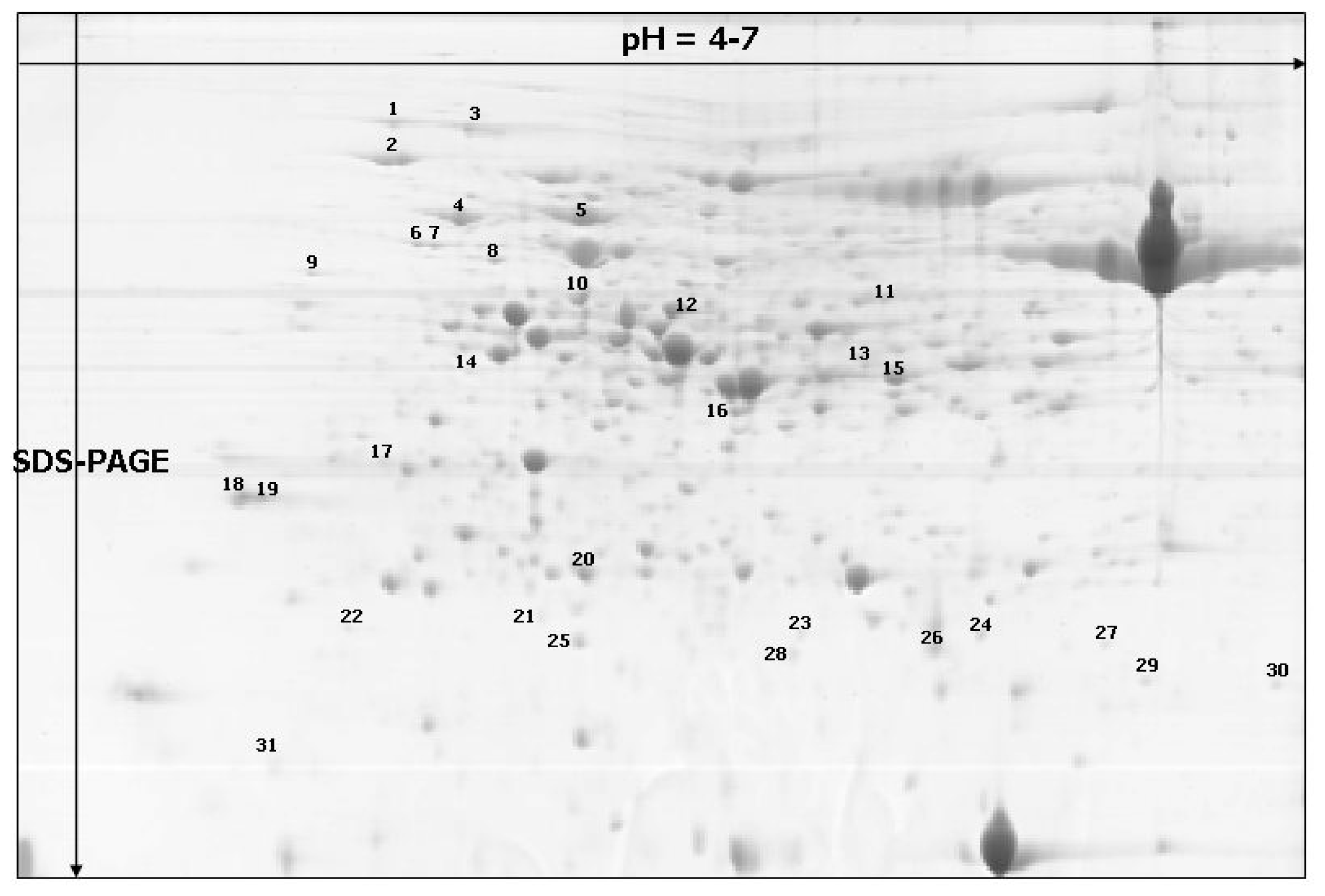
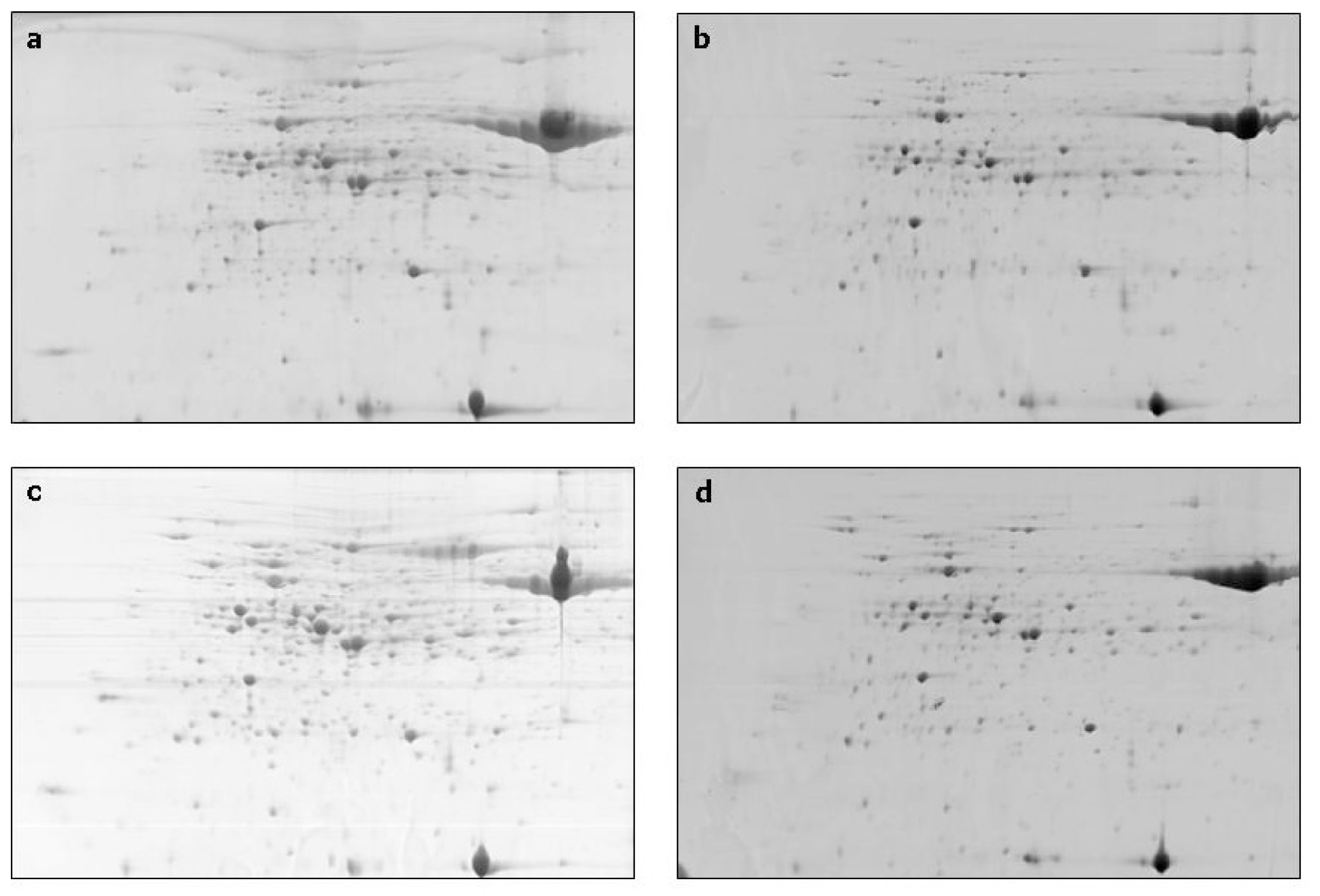
<p>All the 2-D patterns within pH 4–7 range were shown to be well-resolved protein maps (<xref ref-type="fig" rid="f1-ijms-13-10410">Figure 1</xref>).</p>
<p>Only the spots which were detected within two replicate gels were included in the analyses. Based on the statistical analyses of the results obtained, proper protein spots (31) were selected for further identification (<xref ref-type="fig" rid="f2-ijms-13-10410">Figure 2</xref>).</p>
<p>The proteins with the highest Multidimensional Protein Identification Technology (MudPIT) scores were selected and presented in <xref ref-type="table" rid="t1-ijms-13-10410">Table 1</xref>.</p>
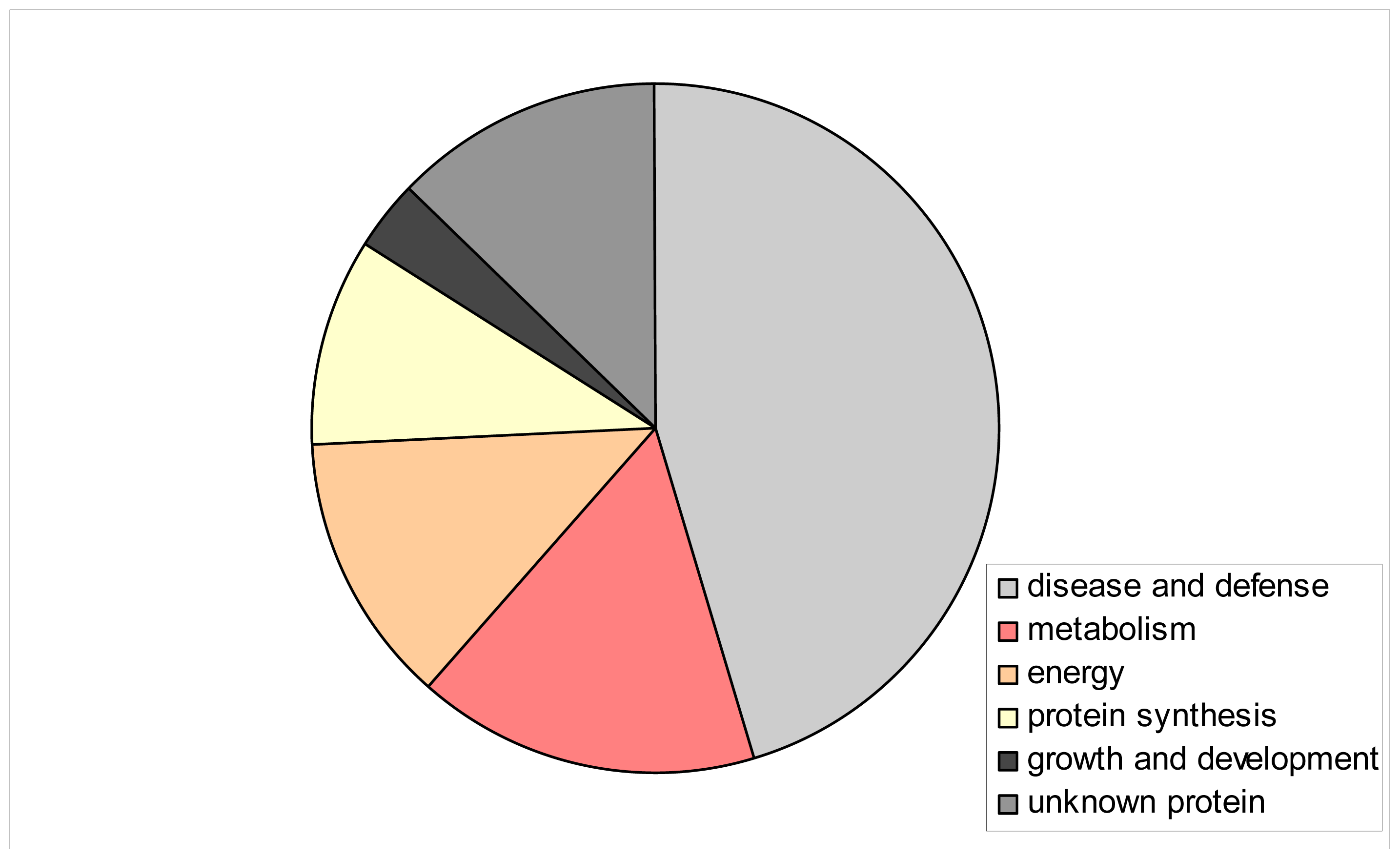
<p>The sequence of homologs of the identified proteins is shown as <xref ref-type="supplementary-material" rid="s1-ijms-13-10410">Supplementary results (Figure S1)</xref>. Finally, it was possible to identify 27 out of 31 protein spots. Their functional annotations revealed that most proteins are involved in disease/defense-related processes and metabolism (<xref ref-type="table" rid="t1-ijms-13-10410">Table 1</xref>, <xref ref-type="fig" rid="f3-ijms-13-10410">Figure 3</xref>). This classification was made according to the suggestion Witzel <italic>et al.</italic> [<xref ref-type="bibr" rid="b18-ijms-13-10410">18</xref>]. Nearly 50% of the differently accumulated proteins appeared to be defense- and disease-related proteins. This may be a result of co-segregating genes involved in plant disease resistance with <italic>sdw1</italic> gene, because many QTLs, <italic>inter alia</italic> QTLs for disease resistance, were found to be associated with the <italic>sdw1</italic> gene [<xref ref-type="bibr" rid="b11-ijms-13-10410">11</xref>,<xref ref-type="bibr" rid="b12-ijms-13-10410">12</xref>].</p>
<p>Protein spots nos. 1, 2 and 3 were identified as heat-shock proteins (HSPs). In barley lines with prostrate growth habit, a significantly higher HSPs abundance was detected at the tillering stage, compared to the three-leaves stage. HSPs are associated with protein folding, protein translocation across membranes, assembly of oligomeric proteins, modulation of receptor activities, mRNA protection, prevention of enzyme—especially photosynthesizing—denaturation and their stress-induced aggregation, and with post-stress ubiquitin and chaperonin-aided repair. Based on these functions, HSPs have been termed “molecular chaperones” [<xref ref-type="bibr" rid="b28-ijms-13-10410">28</xref>]. Apart from being synthesized as heat shock protein, HSPs are also accumulated in plants in response to a large number of other stress factors such as arsenite, ethanol, heavy metals, drought, light, wounding, salinity, chilling, and anoxic conditions [<xref ref-type="bibr" rid="b29-ijms-13-10410">29</xref>].</p>
<p>In the present studies, protein spots, nos. 4, 5, 6, 7, 11, 14 and 29 were identified as proteins with homology to a large RuBisCO subunit-binding protein from <italic>Triticum aestivum</italic> or <italic>Secale cereale</italic> (<xref ref-type="table" rid="t1-ijms-13-10410">Table 1</xref>). Rubisco is a very abundant bifunctional oligomer chloroplast enzyme which catalyzes photosynthetic carboxylation or oxygenation in plant leaves [<xref ref-type="bibr" rid="b30-ijms-13-10410">30</xref>]. In barley plants of prostrate juvenile growth habit, an increased abundance of that enzyme was detected at the tillering stage for the majority of spots (nos. 4, 5, 6, 7, 11 and 14). In the case of protein spot no. 29, a higher protein abundance was observed at the seedling stage. In lines with erect growth habit (with exception of spots nos. 6, 7, 11), a higher accumulation level of RuBisCO large subunit-binding protein was noticed at the tillering stage. It is proposed that, under various growth conditions, part of the investment in Rubisco may be viewed as a nitrogen store, bringing additional marginal advantages with respect to photosynthetic rate and water use efficiency. A change in the rate of photosynthesis did not automatically translate into a change in the growth rate. Several factors were identified, which contribute to this buffering of growth against a changed photosynthetic rate [<xref ref-type="bibr" rid="b31-ijms-13-10410">31</xref>].</p>
<p>Protein spot no. 12 was identified as chloroplast translational elongation factor. It is an essential component for protein synthesis that functions by binding aminoacylated tRNAs to the ribosome-mRNA complex. Protein spots, nos. 18 and 19 were identified as nucleic acid-binding proteins cp31BHv. These proteins significantly increased their abundance in barley plants of both growth habits at the later stage.</p>
<p>In barley with the prostrate growth habit, we observed a higher level of the protein derived from spot no. 22 at the three-leaves stage. During tillering, the protein accumulation level decreased and was as much as twice lower, compared to the level observed at the corresponding stage in erect growth habit lines. It was identified as ES2A protein (gibberellic acid inducible protein). Gibberellic acid (GA) is an important signaling molecule that participates in many aspects of plant growth and development [<xref ref-type="bibr" rid="b32-ijms-13-10410">32</xref>]. While the importance of this hormone is clear, the transcriptional regulatory networks involved are still being characterized. Bioactive GAs are plant hormones that promote uniform growth through cell elongation. GAs represent a large group of cyclic diterpene compounds that promote stem elongation. Mutants in GA synthesis or signaling show dwarf phenotypes [<xref ref-type="bibr" rid="b33-ijms-13-10410">33</xref>]. In fact, mutations in GA-related genes are responsible for the semi-dwarf habit. Fundamental research has revealed that most of the dwarfing genes were involved in the GA biosynthetic and signal transduction pathway in cereals. It is well known that the <italic>sdw1/denso</italic> mutants reduced plant height and were sensitive to gibberellic acid [<xref ref-type="bibr" rid="b34-ijms-13-10410">34</xref>]. The <italic>sdw1/denso</italic> in barley is most likely the ortholog gene of the <italic>sd1</italic> in rice which carries the mutation in the gene (<italic>Os20ox2</italic>), encoding an oxidase enzyme (<italic>GA20ox-2</italic>) involved in gibberellin biosynthesis [<xref ref-type="bibr" rid="b35-ijms-13-10410">35</xref>,<xref ref-type="bibr" rid="b36-ijms-13-10410">36</xref>]. Although the gene function of GA20-oxidase in barley is uncertain, their ortholog genes in rice have been studied extensively. The <italic>OsGA20ox2</italic> (<italic>sd1</italic>) gene controls the step from GA<sub>53</sub> to GA<sub>44</sub>, resulting in the levels of GA<sub>44</sub>, GA<sub>19</sub>, GA<sub>20</sub>, GA<sub>1</sub> and GA<sub>29</sub> [<xref ref-type="bibr" rid="b37-ijms-13-10410">37</xref>,<xref ref-type="bibr" rid="b38-ijms-13-10410">38</xref>]. Therefore, the level of GA<sub>1</sub> is reduced which results in the dwarf phenotype. Based on earlier research in rice, the <italic>sd1</italic> orthologs gene <italic>Hv20ox2</italic> (barley) is predicted to control the step from GA<sub>53</sub> to GA<sub>44</sub>. Jia <italic>et al.</italic> [<xref ref-type="bibr" rid="b39-ijms-13-10410">39</xref>] indicated that high yield is associated with lower expression levels of <italic>Hv20ox2</italic>. They postulated that reduced expression of <italic>Hv20ox2</italic> in the semi-dwarfing mutants results in lower GA levels in the apical meristem, which inhibits apical growth, internode length, plant height, and promotes the development of more tillers. The temporal GA<sub>3</sub>-responsive expression of the ES2A transcript has been recorded only in a dwarf barley mutant [<xref ref-type="bibr" rid="b32-ijms-13-10410">32</xref>]. In the present study, ES2A displayed an increased protein synthesis in barley lines with the prostrate growth habit at the early developmental stage—three leaves. For the same barley lines during tillering, a decrease of ES2A protein synthesis was noticed and their growth habit could be partially due to the reduced amount of this protein.</p>
<p>Germin-like protein 1 (GLP) was identified in a single spot: no. 26. We observed increased synthesis of the spot 26 protein in barley plants with the prostrate and erect growth habit at the three-leaves stage, and its accumulation level decreased during tillering. GLPs are encoded in plants by a gene family with proposed functions in plant development and defense. Germins are accumulated in expanding shoots of developing seedlings and young barley leaves. Remodeling of the plant cell walls during pathogen attack or abiotic stress is associated with the expression of GLPs [<xref ref-type="bibr" rid="b40-ijms-13-10410">40</xref>]. It is the possible explanation of lower accumulation level of that protein during tillering in barley analyzed lines.</p>
<p>We also found a protein (spot no. 31) identified as huntingtin interacting protein K, which showed a significant increase in abundance for barley plants with both growth habits at the later stage. In-depth analysis of this protein will be necessary in order to better understand its role in relation to growth habit in barley.</p>
<p>In our study, in several cases, the same protein was identified in more than one spot. In fact, it was proved that not only post-translational modifications (phosphorylation, methylation and glycosylation), but also the presence of different signals and targeting sequences, <italic>in vivo</italic> proteolysis or <italic>in vitro</italic> protein degradation during sample preparation, can be a source of “new extra spots”, representing the same protein, with different positions (different molecular masses and isoelectric points) on the 2-D maps. Such multi-spot proteins often complicate the interpretation of the obtained results. The protein abundance in cells cannot be regarded as a direct reflection of the corresponding gene activity. The relationship between the transcriptome and the proteome has a complex nature and this relationship is often disturbed mainly by the post-transcriptional steps of gene expression, involving the level of proteolysis [<xref ref-type="bibr" rid="b41-ijms-13-10410">41</xref>]. However, for the same reasons, the proteome seems to be a better indicator of cell metabolism, compared to the transcriptome.</p></sec>
<sec>
<title>3. Experimental Section</title>
<p>Material for the study included 270 spring barley (<italic>Hordeum vulgare</italic> L.) derived from the Maresi × Pomo (MP) hybrid: 197 lines obtained by the single seed descent (SSD) technique (F<sub>6/8</sub>) and 73 doubled-haploid lines (DH) produced by the <italic>Hordeum bulbosum</italic> method (F1DH) [<xref ref-type="bibr" rid="b42-ijms-13-10410">42</xref>]. Out of 270 studied lines, 130 carried the semi-dwarfing <italic>denso</italic> gene. Maresi is a two-rowed, hulled, brewing cultivar, whereas Pomo is a six-rowed, hulled, fodder cultivar. The segregation in locus <italic>denso</italic> in both SSD and DH populations was in the ratio of 1:1, and we decided to analyze DH and SSD lines altogether.</p>
<p>Plant material for proteomic analyses was randomly collected from experimental plots at the Institute of Plant Genetics, Polish Academy of Sciences, Poznan, Poland. The experiment was established in a complete blocks design in two replications on plots of 2 m<sup>2</sup>, with a row spacing of 20 cm. Sampling was conducted at two developmental stages: three leaves (stage 1.3 according to Feekes scale) and tillering (3 on Feekes scale) [<xref ref-type="bibr" rid="b43-ijms-13-10410">43</xref>]. In each stage, leaves of plants of prostrate and erect growth habit were bulked into two samples. Thus, four variants of plant samples, each one containing all lines in two replicates, were analyzed: (<italic>i</italic>) prostrate growth habit at the stage of three leaves, (<italic>ii</italic>) prostrate growth habit during tillering, (<italic>iii</italic>) erect growth habit at the stage 1.3 of three leaves, (<italic>iv</italic>) erect growth habit at the stage of tillering.</p>
<p>The protocol for proteomic research performed herein, including two-dimensional electrophoresis to analyze differences in protein accumulation levels between barley lines and mass spectrometry to identify differentially accumulated proteins, was the same as that described in detail by Kosmala <italic>et al.</italic> [<xref ref-type="bibr" rid="b44-ijms-13-10410">44</xref>] and Bocian <italic>et al.</italic> [<xref ref-type="bibr" rid="b45-ijms-13-10410">45</xref>]. Protein extraction was performed according to the method described by Hurkman and Tanaka [<xref ref-type="bibr" rid="b46-ijms-13-10410">46</xref>], and protein concentration was determined by using the 2-D Quant Kit (GE Healthcare, Buckinghamshire, UK). In the first dimension, isoelectrofocusing (IEF), 24 cm Immobiline DryStrip gels with linear pH range 4–7 were used to focus the aliquots of proteins (0.5 mg) extracted from 100 mg of barley tissues. In the second dimension (sodium dodecyl sulfate-polyacrylamide gel electrophoresis), the proteins were separated using 13% polyacrylamide gels (1.5 × 255 × 196 mm). Following electrophoresis, the gels were stained with colloidal Coomassie Brilliant Blue G-250, using the modified method of Neuhoff <italic>et al.</italic> [<xref ref-type="bibr" rid="b47-ijms-13-10410">47</xref>]. Total separated protein spots on the gels were scanned by ImageScanner III (GE Healthcare) and subjected to LabScan 6.0 program (GE Healthcare) processing. Spot detection and image analyses (normalization, spot matching and protein quantification) were performed with Image Master 2-D Platinum software (GE Healthcare). To compensate for subtle differences in sample loading, gel staining and destaining, the abundance of each protein spot was normalized as a relative volume (% vol). Percent volume of each spot was automatically calculated by Image Master software as a ratio of the volume of particular spot to the total volume of all the spots present on the gel. The extraction procedure and electrophoretic separation were performed twice; thereafter, % vol for the spots from the two replicated gels was used to calculate means and standard deviations. The spots with at least 2-fold differences (<italic>p</italic> ≤ 0.05) in protein abundance (quantitative differences between gels) between at least two different plant variants, were subjected to MS analyses and protein identification.</p>
<p>Protein spots were excised from the gel and analyzed by liquid chromatography, coupled to the mass spectrometer in the Laboratory of Mass Spectrometry, Institute of Biochemistry and Biophysics, Polish Academy of Sciences, Warsaw, Poland. Samples were concentrated and desalted on a RP-C18 trap-column (Waters: Milford, MA, USA), and further peptide separation was conducted on a nano-Ultra Performance Liquid Chromatography (UPLC) RP-C18 column (Waters, BEH130 C18 column, 75 μm i.d., 250 mm long) of a nanoACQUITY UPLC system, using a linear acetonitrile gradient in the range of 5%–30% in 45 min. Column outlet was directly coupled to the Electrospray ionization (ESI) ion source of Orbitrap type mass spectrometer (Thermo), working in the regime of data-dependent MS to MS/MS switch. An electrospray voltage of 2 kV was used. Raw data files were pre-processed with Mascot Distiller software (version 2.3.2.0, MatrixScience: London, UK). The peptide masses obtained and fragmentation spectra were matched to the National Center Biotechnology Information (NCBI) non-redundant database with a <italic>Viridiplantae</italic> filter (884942 sequences), using the Mascot search engine (Mascot Daemon version 2.3.0, Mascot Server version 2.2.03, MatrixScience: London, UK). The following search parameters were applied: enzyme specificity was set to trypsin, peptide mass tolerance to ± 40 ppm and fragment mass tolerance to ± 0.8 Da. The protein mass was left as unrestricted, and mass values as monoisotopic with one missed cleavage being allowed. Alkylation of cysteine by carbamidomethylation as fixed, and oxidation of methionine was set as a variable modification. Protein identification was performed using the Mascot search probability-based Mowse score. Ion score was −10 log(<italic>p</italic>), where <italic>p</italic> was the probability that the observed match was a random event. Mascot defined threshold which indicated identity or extensive homology (<italic>p</italic> &lt; 0.05) was 40 or less, therefore ion score 40 was taken as a threshold for analysis. When the protein was selected as the predicted protein, the sequence of the predicted protein was blasted using blastp algorithm. The protein with the highest score was then selected as the functional homolog of “the predicted protein” (presented in <xref ref-type="table" rid="t1-ijms-13-10410">Table 1</xref>).</p></sec>
<sec sec-type="conclusions">
<title>4. Conclusions</title>
<p>2-DE coupled with MS led to the identification of various proteins, which may be involved in the phenotypic effect of the <italic>denso</italic> locus in barley. Identified proteins were revealed to show quantitative differences in their abundance between the analyzed plants with prostrate and erect growth habit at the juvenile stage. Most of these proteins are involved in metabolism and disease/defense-related processes. ES2A protein (expression of the gene coding this protein is GA<sub>3</sub>-responsive and GA-related genes are responsible for the semi-dwarf habit) displayed an increased protein synthesis in barley lines with the prostrate growth habit at the three-leaves stage. For the same barley lines, a decrease in ES2A protein synthesis was noticed during tillering and their growth habit could be partially due to the reduced amount of this protein.</p>
<p>This experiment is the first proteome analysis on tillering node proteins in different juvenile growth habits as an effect of the <italic>denso</italic> locus in barley recombinant inbred lines. In addition to providing new information, the present study offers opportunities to pursue analysis with <italic>sdw1/denso</italic> associated physiological characters, determining yield, to effectively use this gene in a breeding program.</p></sec>
<sec sec-type="supplementary-material">
<title>Supplementary Materials</title>
<supplementary-material id="s1-ijms-13-10410" content-type="local-data">
<media xlink:href="ijms-13-10410-s001.pdf" mimetype="application" mime-subtype="pdf"/></supplementary-material></sec></body>
<back>
<ref-list>
<title>References</title>
<ref id="b1-ijms-13-10410"><label>1</label><citation citation-type="journal"><person-group person-group-type="author"><name><surname>Zhang</surname><given-names>J.</given-names></name><name><surname>Zhang</surname><given-names>W.X.</given-names></name></person-group><article-title>Tracing sources of dwarfing genes in barley breeding in China</article-title><source>Euphytica</source><year>2003</year><volume>131</volume><fpage>285</fpage><lpage>192</lpage><pub-id pub-id-type="doi">10.1023/A:1024032732443</pub-id></citation></ref>
<ref id="b2-ijms-13-10410"><label>2</label><citation citation-type="journal"><person-group person-group-type="author"><name><surname>Cloupek</surname><given-names>O.</given-names></name><name><surname>Forster</surname><given-names>B.P.</given-names></name><name><surname>Thomas</surname><given-names>W.T.B.</given-names></name></person-group><article-title>The effect of semi-dwarf genes on root system size in field-grown barley</article-title><source>Theor. Appl. Genet</source><year>2006</year><volume>112</volume><fpage>779</fpage><lpage>786</lpage><pub-id pub-id-type="doi">10.1007/s00122-005-0147-4</pub-id><pub-id pub-id-type="pmid">16425022</pub-id></citation></ref>
<ref id="b3-ijms-13-10410"><label>3</label><citation citation-type="journal"><person-group person-group-type="author"><name><surname>Saisho</surname><given-names>D.</given-names></name><name><surname>Tanno</surname><given-names>K.</given-names></name><name><surname>Chono</surname><given-names>M.</given-names></name><name><surname>Honda</surname><given-names>I.</given-names></name><name><surname>Kitano</surname><given-names>H.</given-names></name><name><surname>Takeda</surname><given-names>K.</given-names></name></person-group><article-title>Spontaneous brassinolide-insensitive barley mutants “uzu”adapted to east Asia</article-title><source>Breed. Sci</source><year>2004</year><volume>54</volume><fpage>409</fpage><lpage>416</lpage><pub-id pub-id-type="doi">10.1270/jsbbs.54.409</pub-id></citation></ref>
<ref id="b4-ijms-13-10410"><label>4</label><citation citation-type="journal"><person-group person-group-type="author"><name><surname>Hellewell</surname><given-names>K.B.</given-names></name><name><surname>Rasmusson</surname><given-names>D.C.</given-names></name><name><surname>Meagher</surname><given-names>M.G.</given-names></name></person-group><article-title>Enhancing yield of semidwarf barley</article-title><source>Crop Sci</source><year>2000</year><volume>40</volume><fpage>352</fpage><lpage>358</lpage><pub-id pub-id-type="doi">10.2135/cropsci2000.402352x</pub-id></citation></ref>
<ref id="b5-ijms-13-10410"><label>5</label><citation citation-type="journal"><person-group person-group-type="author"><name><surname>Sears</surname><given-names>R.G.</given-names></name><name><surname>Kronsztad</surname><given-names>W.E.</given-names></name><name><surname>Metzger</surname><given-names>R.J.</given-names></name></person-group><article-title>Inheritance of dwarf and semidwarf plant height in barley</article-title><source>Crop Sci</source><year>1981</year><volume>21</volume><fpage>828</fpage><lpage>833</lpage><pub-id pub-id-type="doi">10.2135/cropsci1981.0011183X002100060008x</pub-id></citation></ref>
<ref id="b6-ijms-13-10410"><label>6</label><citation citation-type="journal"><person-group person-group-type="author"><name><surname>Barua</surname><given-names>U.M.</given-names></name><name><surname>Chalmers</surname><given-names>K.J.</given-names></name><name><surname>Thomas</surname><given-names>W.T.B.</given-names></name><name><surname>Hackett</surname><given-names>C.A.</given-names></name><name><surname>Lea</surname><given-names>V.</given-names></name><name><surname>Jack</surname><given-names>P.</given-names></name><name><surname>Forster</surname><given-names>B.P.</given-names></name><name><surname>Waugh</surname><given-names>R.</given-names></name><name><surname>Powell</surname><given-names>W.</given-names></name></person-group><article-title>Molecular mapping of genes determining height; time to heading; and growth habit in barley (<italic>Hordeum vulgare</italic>)</article-title><source>Genome</source><year>1993</year><volume>36</volume><fpage>1080</fpage><lpage>1087</lpage><pub-id pub-id-type="doi">10.1139/g93-143</pub-id><pub-id pub-id-type="pmid">18470049</pub-id></citation></ref>
<ref id="b7-ijms-13-10410"><label>7</label><citation citation-type="journal"><person-group person-group-type="author"><name><surname>Jia</surname><given-names>Q.</given-names></name><name><surname>Zhang</surname><given-names>J.</given-names></name><name><surname>Westcott</surname><given-names>S.</given-names></name><name><surname>Zhang</surname><given-names>X.Q.</given-names></name><name><surname>Bellgard</surname><given-names>M.</given-names></name><name><surname>Lance</surname><given-names>R.</given-names></name><name><surname>Li</surname><given-names>C.</given-names></name></person-group><article-title>GA-20 oxidase as a candidate for the semidwarf gene <italic>sdw1/denso</italic> in barley</article-title><source>Funct. Integr. Genomics</source><year>2009</year><volume>9</volume><fpage>255</fpage><lpage>262</lpage><pub-id pub-id-type="doi">10.1007/s10142-009-0120-4</pub-id><pub-id pub-id-type="pmid">19280236</pub-id></citation></ref>
<ref id="b8-ijms-13-10410"><label>8</label><citation citation-type="journal"><person-group person-group-type="author"><name><surname>Ren</surname><given-names>X.</given-names></name><name><surname>Sun</surname><given-names>D.</given-names></name><name><surname>Guan</surname><given-names>W.</given-names></name><name><surname>Sun</surname><given-names>G.</given-names></name><name><surname>Li</surname><given-names>C.</given-names></name></person-group><article-title>Inheritance and identification of molecular markers associated with a novel dwarfing gene in barley</article-title><source>Genetics</source><year>2010</year><volume>11</volume><fpage>89</fpage><pub-id pub-id-type="pmid">20932313</pub-id></citation></ref>
<ref id="b9-ijms-13-10410"><label>9</label><citation citation-type="journal"><person-group person-group-type="author"><name><surname>Wang</surname><given-names>J.</given-names></name><name><surname>Yang</surname><given-names>J.</given-names></name><name><surname>McNeil</surname><given-names>D.L.</given-names></name><name><surname>Zhou</surname><given-names>M.</given-names></name></person-group><article-title>Identification and molecular mapping of a dwarfing gene in barley (<italic>Hordeum vulgare</italic> L.) and its correlation with other agronomic traits</article-title><source>Euphytica</source><year>2010</year><volume>175</volume><fpage>331</fpage><lpage>342</lpage><pub-id pub-id-type="doi">10.1007/s10681-010-0175-2</pub-id></citation></ref>
<ref id="b10-ijms-13-10410"><label>10</label><citation citation-type="journal"><person-group person-group-type="author"><name><surname>Thomas</surname><given-names>W.T.B.</given-names></name><name><surname>Powell</surname><given-names>W.</given-names></name><name><surname>Swanston</surname><given-names>J.S.</given-names></name></person-group><article-title>The effects of major genes on quantitatively varying characters in barley. 4. The <italic>GPert</italic> and <italic>denso</italic> loci and quality characters</article-title><source>Heredity</source><year>1991</year><volume>66</volume><fpage>381</fpage><lpage>389</lpage><pub-id pub-id-type="doi">10.1038/hdy.1991.48</pub-id></citation></ref>
<ref id="b11-ijms-13-10410"><label>11</label><citation citation-type="confproc"><person-group person-group-type="author"><name><surname>Thomas</surname><given-names>W.T.B.</given-names></name><name><surname>Newton</surname><given-names>A.C.</given-names></name><name><surname>Wilson</surname><given-names>A.</given-names></name><name><surname>Meyer</surname><given-names>R.C.</given-names></name><name><surname>Young</surname><given-names>G.R.</given-names></name><name><surname>Lawrence</surname><given-names>P.E.</given-names></name></person-group><article-title>QTLs for Disease Resistance Mapped in Derkado x B83-12/21/5</article-title><conf-name>Barley genetics VIII, Proceedings of the 8th International Barley Genetics Symposium</conf-name><conf-loc>Adelaide, Australia</conf-loc><conf-date>22–27 October 2010</conf-date><fpage>186</fpage><lpage>188</lpage></citation></ref>
<ref id="b12-ijms-13-10410"><label>12</label><citation citation-type="journal"><person-group person-group-type="author"><name><surname>Saville</surname><given-names>R.J.</given-names></name><name><surname>Gosman</surname><given-names>N.</given-names></name><name><surname>Burt</surname><given-names>C.J.</given-names></name><name><surname>Makepeace</surname><given-names>J.</given-names></name><name><surname>Steed</surname><given-names>A.</given-names></name><name><surname>Corbitt</surname><given-names>M.</given-names></name><name><surname>Chandler</surname><given-names>E.</given-names></name><name><surname>Brown</surname><given-names>J.K.</given-names></name><name><surname>Boulton</surname><given-names>M.I.</given-names></name><name><surname>Nicholson</surname><given-names>P.</given-names></name></person-group><article-title>The “Green Revolution” dwarfing genes play a role in disease resistance in <italic>Triticum aestivum</italic> and <italic>Hordeum vulgare</italic></article-title><source>J. Exp. Bot</source><year>2011</year><volume>63</volume><fpage>1271</fpage><lpage>1283</lpage><pub-id pub-id-type="pmid">22090435</pub-id></citation></ref>
<ref id="b13-ijms-13-10410"><label>13</label><citation citation-type="journal"><person-group person-group-type="author"><name><surname>Yin</surname><given-names>X.</given-names></name><name><surname>Stam</surname><given-names>P.</given-names></name><name><surname>Dourleijn</surname><given-names>C.J.</given-names></name><name><surname>Kropff</surname><given-names>M.J.</given-names></name></person-group><article-title>AFLP mapping of quantitative trait loci for yield-determining physiological characters inspring barley</article-title><source>Theor. Appl. Genetics</source><year>1999</year><volume>99</volume><fpage>244</fpage><lpage>253</lpage><pub-id pub-id-type="doi">10.1007/s001220051230</pub-id></citation></ref>
<ref id="b14-ijms-13-10410"><label>14</label><citation citation-type="journal"><person-group person-group-type="author"><name><surname>Kuczynska</surname><given-names>A.</given-names></name><name><surname>Wyka</surname><given-names>T.</given-names></name></person-group><article-title>The effect of the <italic>denso</italic> dwarfing gene on morpho-anatomical characters in barley recombinant inbred lines</article-title><source>Breed. Sci</source><year>2011</year><volume>61</volume><fpage>275</fpage><lpage>280</lpage><pub-id pub-id-type="doi">10.1270/jsbbs.61.275</pub-id></citation></ref>
<ref id="b15-ijms-13-10410"><label>15</label><citation citation-type="journal"><person-group person-group-type="author"><name><surname>Lande</surname><given-names>R.</given-names></name></person-group><article-title>The genetic correlation between characters maintained by selection, linkage and inbreeding</article-title><source>Genetic Res</source><year>1984</year><volume>44</volume><fpage>309</fpage><lpage>320</lpage><pub-id pub-id-type="doi">10.1017/S0016672300026549</pub-id></citation></ref>
<ref id="b16-ijms-13-10410"><label>16</label><citation citation-type="journal"><person-group person-group-type="author"><name><surname>Rabilloud</surname><given-names>T.</given-names></name></person-group><article-title>Two-dimensional gel electrophoresis in proteomics: Old; old fashioned; but it still climbs up the mountains</article-title><source>Proteomics</source><year>2002</year><volume>2</volume><fpage>3</fpage><lpage>10</lpage><pub-id pub-id-type="doi">10.1002/1615-9861(200201)2:1&lt;3::AID-PROT3&gt;3.0.CO;2-R</pub-id><pub-id pub-id-type="pmid">11890150</pub-id></citation></ref>
<ref id="b17-ijms-13-10410"><label>17</label><citation citation-type="journal"><person-group person-group-type="author"><name><surname>Consoli</surname><given-names>L.</given-names></name><name><surname>Lefèvre</surname><given-names>A.</given-names></name><name><surname>Zivy</surname><given-names>M.</given-names></name><name><surname>de Viennie</surname><given-names>D.</given-names></name><name><surname>Damerval</surname><given-names>C.</given-names></name></person-group><article-title>QTL analysis of proteome and transcriptome variations for dissecting the genetic architecture of complex traits in maize</article-title><source>Plant Mol. Biol</source><year>2002</year><volume>48</volume><fpage>575</fpage><lpage>581</lpage><pub-id pub-id-type="doi">10.1023/A:1014840810203</pub-id><pub-id pub-id-type="pmid">11999835</pub-id></citation></ref>
<ref id="b18-ijms-13-10410"><label>18</label><citation citation-type="journal"><person-group person-group-type="author"><name><surname>Witzel</surname><given-names>K.</given-names></name><name><surname>Pietsch</surname><given-names>C.</given-names></name><name><surname>Strickert</surname><given-names>M.</given-names></name><name><surname>Matros</surname><given-names>A.</given-names></name><name><surname>Röder</surname><given-names>M.S.</given-names></name><name><surname>Weschke</surname><given-names>W.</given-names></name><name><surname>Wobus</surname><given-names>U.</given-names></name><name><surname>Mock</surname><given-names>H.P.</given-names></name></person-group><article-title>Mapping of quantitative trait loci associated with protein expression variation in barley grains</article-title><source>Mol. Breed</source><year>2011</year><volume>27</volume><fpage>301</fpage><lpage>314</lpage><pub-id pub-id-type="doi">10.1007/s11032-010-9432-2</pub-id></citation></ref>
<ref id="b19-ijms-13-10410"><label>19</label><citation citation-type="journal"><person-group person-group-type="author"><name><surname>Lahesranta</surname><given-names>S.J.</given-names></name><name><surname>Davies</surname><given-names>H.V.</given-names></name><name><surname>Shepherd</surname><given-names>L.V.T.</given-names></name><name><surname>Numan</surname><given-names>N.</given-names></name><name><surname>McNicol</surname><given-names>J.W.</given-names></name><name><surname>Auriola</surname><given-names>S.</given-names></name><name><surname>Koistinen</surname><given-names>K.M.</given-names></name><name><surname>Suomalainen</surname><given-names>S.</given-names></name><name><surname>Kokko</surname><given-names>H.I.</given-names></name><name><surname>Karenlampi</surname><given-names>S.O.</given-names></name></person-group><article-title>Comparison of tuber proteomes of potato varieties; landraces; and genetically modified lines</article-title><source>Plant Physiol</source><year>2005</year><volume>138</volume><fpage>1690</fpage><lpage>1699</lpage><pub-id pub-id-type="doi">10.1104/pp.105.060152</pub-id><pub-id pub-id-type="pmid">15951487</pub-id></citation></ref>
<ref id="b20-ijms-13-10410"><label>20</label><citation citation-type="journal"><person-group person-group-type="author"><name><surname>Ruebelt</surname><given-names>M.C.</given-names></name><name><surname>Lipp</surname><given-names>M.</given-names></name><name><surname>Reynolds</surname><given-names>T.M.</given-names></name><name><surname>Astwood</surname><given-names>J.D.</given-names></name><name><surname>Engel</surname><given-names>K.H.</given-names></name><name><surname>Jany</surname><given-names>K.D.</given-names></name></person-group><article-title>Application of two-dimensional gel electrophoresis to interrogate alterations in the proteome of genetically altered crops. 2. Assessing natural variability</article-title><source>J. Agric. Food Chem</source><year>2006</year><volume>54</volume><fpage>2162</fpage><lpage>2168</lpage><pub-id pub-id-type="doi">10.1021/jf052357y</pub-id><pub-id pub-id-type="pmid">16536591</pub-id></citation></ref>
<ref id="b21-ijms-13-10410"><label>21</label><citation citation-type="journal"><person-group person-group-type="author"><name><surname>Görg</surname><given-names>A.</given-names></name><name><surname>Postel</surname><given-names>W.</given-names></name><name><surname>Weiss</surname><given-names>W.</given-names></name></person-group><article-title>Detection of polypeptides and amylase isoenzyme modifications related to malting quality during malting process of barley by 2-dimensional electrophoresis and isoelectric-focussing with immobilized pH gradients</article-title><source>Electrophoresis</source><year>1992</year><volume>13</volume><fpage>759</fpage><lpage>770</lpage><pub-id pub-id-type="doi">10.1002/elps.11501301166</pub-id><pub-id pub-id-type="pmid">1281094</pub-id></citation></ref>
<ref id="b22-ijms-13-10410"><label>22</label><citation citation-type="journal"><person-group person-group-type="author"><name><surname>Devaux</surname><given-names>P.</given-names></name><name><surname>Zivy</surname><given-names>M.</given-names></name></person-group><article-title>Protein markers for anther culturability in barley</article-title><source>Theor. Appl. Genetics</source><year>1994</year><volume>88</volume><fpage>701</fpage><lpage>706</lpage><pub-id pub-id-type="doi">10.1007/BF01253973</pub-id></citation></ref>
<ref id="b23-ijms-13-10410"><label>23</label><citation citation-type="journal"><person-group person-group-type="author"><name><surname>Kristoffersen</surname><given-names>H.E.</given-names></name><name><surname>Flengsrud</surname><given-names>R.</given-names></name></person-group><article-title>Separation and characterization of basic barley seed proteins</article-title><source>Electrophoresis</source><year>2000</year><volume>21</volume><fpage>3693</fpage><lpage>3700</lpage><pub-id pub-id-type="doi">10.1002/1522-2683(200011)21:17&lt;3693::AID-ELPS3693&gt;3.0.CO;2-I</pub-id><pub-id pub-id-type="pmid">11271488</pub-id></citation></ref>
<ref id="b24-ijms-13-10410"><label>24</label><citation citation-type="journal"><person-group person-group-type="author"><name><surname>Finnie</surname><given-names>C.</given-names></name><name><surname>Svensson</surname><given-names>B.</given-names></name></person-group><article-title>Feasibility study of a tissue-specific approach to barley proteome analysis: Aleurone layer; endosperm; embryo and single seeds</article-title><source>J. Cereal Sci</source><year>2003</year><volume>38</volume><fpage>217</fpage><lpage>227</lpage><pub-id pub-id-type="doi">10.1016/S0733-5210(03)00033-X</pub-id></citation></ref>
<ref id="b25-ijms-13-10410"><label>25</label><citation citation-type="journal"><person-group person-group-type="author"><name><surname>Finnie</surname><given-names>C.</given-names></name><name><surname>Bagge</surname><given-names>M.</given-names></name><name><surname>Steenholdt</surname><given-names>T.</given-names></name><name><surname>Østergaard</surname><given-names>O.</given-names></name><name><surname>Bak-Jensen</surname><given-names>K.S.</given-names></name><name><surname>Backes</surname><given-names>G.</given-names></name><name><surname>Jensen</surname><given-names>A.</given-names></name><name><surname>Giese</surname><given-names>H.</given-names></name><name><surname>Larsen</surname><given-names>J.</given-names></name><name><surname>Roepstorff</surname><given-names>P.</given-names></name><etal/></person-group><article-title>Integration of the barley genetic and seed proteome maps for chromosome 1H; 2H; 3H; 5H and 7 H</article-title><source>Funct. Integr. Genomics</source><year>2009</year><volume>9</volume><fpage>135</fpage><lpage>143</lpage><pub-id pub-id-type="doi">10.1007/s10142-008-0101-z</pub-id><pub-id pub-id-type="pmid">19009312</pub-id></citation></ref>
<ref id="b26-ijms-13-10410"><label>26</label><citation citation-type="journal"><person-group person-group-type="author"><name><surname>Østergaard</surname><given-names>O.</given-names></name><name><surname>Finnie</surname><given-names>C.</given-names></name><name><surname>Laugesen</surname><given-names>S.</given-names></name><name><surname>Roepstorff</surname><given-names>P.</given-names></name><name><surname>Svensson</surname><given-names>B.</given-names></name></person-group><article-title>Proteome analysis of barley seeds: Identification of major proteins from two-dimensional gels (pI 4–7)</article-title><source>Proteomics</source><year>2004</year><volume>4</volume><fpage>2437</fpage><lpage>2447</lpage><pub-id pub-id-type="doi">10.1002/pmic.200300753</pub-id><pub-id pub-id-type="pmid">15274138</pub-id></citation></ref>
<ref id="b27-ijms-13-10410"><label>27</label><citation citation-type="journal"><person-group person-group-type="author"><name><surname>Süle</surname><given-names>A.</given-names></name><name><surname>Vanrobaeys</surname><given-names>F.</given-names></name><name><surname>Hajós</surname><given-names>Gy.</given-names></name><name><surname>van Beeumen</surname><given-names>J.</given-names></name><name><surname>Devreese</surname><given-names>B.</given-names></name></person-group><article-title>Proteomic analysis of small heat shock protein isoforms in barley shoots</article-title><source>Phytochemistry</source><year>2004</year><volume>65</volume><fpage>1853</fpage><lpage>1863</lpage><pub-id pub-id-type="doi">10.1016/j.phytochem.2004.03.030</pub-id><pub-id pub-id-type="pmid">15276443</pub-id></citation></ref>
<ref id="b28-ijms-13-10410"><label>28</label><citation citation-type="journal"><person-group person-group-type="author"><name><surname>Leone</surname><given-names>A.</given-names></name><name><surname>Piro</surname><given-names>G.</given-names></name><name><surname>Leucci</surname><given-names>M.R.</given-names></name><name><surname>Zacheo</surname><given-names>G.</given-names></name><name><surname>Dalessandro</surname><given-names>G.</given-names></name></person-group><article-title>Embrane-cell wall-associated heat shock proteins in two genotypes of barley seedlings</article-title><source>Plant Biosyst</source><year>2000</year><volume>134</volume><fpage>171</fpage><lpage>178</lpage><pub-id pub-id-type="doi">10.1080/11263500012331358434</pub-id></citation></ref>
<ref id="b29-ijms-13-10410"><label>29</label><citation citation-type="journal"><person-group person-group-type="author"><name><surname>Sabehat</surname><given-names>A.</given-names></name><name><surname>Lurie</surname><given-names>S.</given-names></name><name><surname>Weiss</surname><given-names>D.</given-names></name></person-group><article-title>Expression of small heat-shock proteins at low temperatures</article-title><source>Plant Physiol</source><year>1998</year><volume>117</volume><fpage>651</fpage><lpage>658</lpage><pub-id pub-id-type="doi">10.1104/pp.117.2.651</pub-id><pub-id pub-id-type="pmid">9625718</pub-id></citation></ref>
<ref id="b30-ijms-13-10410"><label>30</label><citation citation-type="journal"><person-group person-group-type="author"><name><surname>Ecochard</surname><given-names>R.</given-names></name><name><surname>Cavalie</surname><given-names>G.</given-names></name><name><surname>Nicco</surname><given-names>C.</given-names></name><name><surname>Piquemal</surname><given-names>M.</given-names></name><name><surname>Sarrafi</surname><given-names>A.</given-names></name></person-group><article-title>Rubisco content and specific activity in barley (<italic>Hordeum vulgare</italic> L.)</article-title><source>J. Exp. Bot</source><year>1991</year><volume>42</volume><fpage>39</fpage><lpage>43</lpage><pub-id pub-id-type="doi">10.1093/jxb/42.1.39</pub-id></citation></ref>
<ref id="b31-ijms-13-10410"><label>31</label><citation citation-type="journal"><person-group person-group-type="author"><name><surname>Stitt</surname><given-names>M.</given-names></name><name><surname>Schulze</surname><given-names>D.</given-names></name></person-group><article-title>Does Rubisco control the rate of photosynthesis and plant growth? An exercise in molecular ecophysiology</article-title><source>Plant Cell Environ</source><year>2006</year><volume>17</volume><fpage>465</fpage><lpage>487</lpage></citation></ref>
<ref id="b32-ijms-13-10410"><label>32</label><citation citation-type="journal"><person-group person-group-type="author"><name><surname>Speulman</surname><given-names>E.</given-names></name><name><surname>Salamini</surname><given-names>F.</given-names></name></person-group><article-title>GA<sub>3</sub>-regulated cDNAs from <italic>Hordeum vulgare</italic> leaves</article-title><source>Plant Mol. Biol</source><year>1995</year><volume>28</volume><fpage>915</fpage><lpage>926</lpage><pub-id pub-id-type="doi">10.1007/BF00042075</pub-id><pub-id pub-id-type="pmid">7640362</pub-id></citation></ref>
<ref id="b33-ijms-13-10410"><label>33</label><citation citation-type="journal"><person-group person-group-type="author"><name><surname>Gubler</surname><given-names>F.</given-names></name><name><surname>Chandler</surname><given-names>P.M.</given-names></name><name><surname>White</surname><given-names>R.G.</given-names></name><name><surname>Llewellyn</surname><given-names>D.J.</given-names></name><name><surname>Jacobsen</surname><given-names>J.V.</given-names></name></person-group><article-title>Gibberellin signaling in barley aleurone cells. Control of SLN1 and GAMYB expression</article-title><source>Plant Physiol</source><year>2002</year><volume>129</volume><fpage>191</fpage><lpage>200</lpage><pub-id pub-id-type="doi">10.1104/pp.010918</pub-id><pub-id pub-id-type="pmid">12011350</pub-id></citation></ref>
<ref id="b34-ijms-13-10410"><label>34</label><citation citation-type="journal"><person-group person-group-type="author"><name><surname>Franckowiak</surname><given-names>J.D.</given-names></name><name><surname>Pecio</surname><given-names>A.</given-names></name></person-group><article-title>Coordinator’s report: A listing of genetic stocks</article-title><source>Barley Genet. Newsl</source><year>1992</year><volume>21</volume><fpage>116</fpage><lpage>126</lpage></citation></ref>
<ref id="b35-ijms-13-10410"><label>35</label><citation citation-type="journal"><person-group person-group-type="author"><name><surname>Sasaki</surname><given-names>A.</given-names></name><name><surname>Ashikari</surname><given-names>M.</given-names></name><name><surname>Ueguchi-Tanaka</surname><given-names>M.</given-names></name><name><surname>Itoh</surname><given-names>H.</given-names></name><name><surname>Nishimura</surname><given-names>A.</given-names></name><name><surname>Swapan</surname><given-names>D.</given-names></name><name><surname>Ishiyama</surname><given-names>K.</given-names></name><name><surname>Saito</surname><given-names>T.</given-names></name><name><surname>Kobayashi</surname><given-names>M.</given-names></name><name><surname>Khush</surname><given-names>G.S.</given-names></name></person-group><article-title>Green revolution: A mutant gibberellin-synthesis gene in rice</article-title><source>Nature</source><year>2002</year><volume>416</volume><fpage>701</fpage><lpage>702</lpage><pub-id pub-id-type="doi">10.1038/416701a</pub-id><pub-id pub-id-type="pmid">11961544</pub-id></citation></ref>
<ref id="b36-ijms-13-10410"><label>36</label><citation citation-type="journal"><person-group person-group-type="author"><name><surname>Spielmeyer</surname><given-names>W.</given-names></name><name><surname>Ellis</surname><given-names>M.H.</given-names></name><name><surname>Chandler</surname><given-names>P.M.</given-names></name></person-group><article-title>Semidwarf (<italic>sd-1</italic>); green revolution rice; contains a defective gibberellin 20-oxidase gene</article-title><source>Proc. Natl. Acad. Sci. USA</source><year>2002</year><volume>99</volume><fpage>9043</fpage><lpage>9048</lpage><pub-id pub-id-type="doi">10.1073/pnas.132266399</pub-id><pub-id pub-id-type="pmid">12077303</pub-id></citation></ref>
<ref id="b37-ijms-13-10410"><label>37</label><citation citation-type="journal"><person-group person-group-type="author"><name><surname>Sakamoto</surname><given-names>T.</given-names></name><name><surname>Miura</surname><given-names>K.</given-names></name><name><surname>Itoh</surname><given-names>H.</given-names></name><name><surname>Tatsumi</surname><given-names>T.</given-names></name><name><surname>Ueguchi-Tanaka</surname><given-names>M.</given-names></name><name><surname>Ishiyama</surname><given-names>K.</given-names></name><name><surname>Kobayashi</surname><given-names>M.</given-names></name><name><surname>Agrawal</surname><given-names>G.K.</given-names></name><name><surname>Takeda</surname><given-names>S.</given-names></name><name><surname>Abe</surname><given-names>K.</given-names></name><etal/></person-group><article-title>An overview of gibberellin metabolism enzyme genes and their related mutants in rice</article-title><source>Plant Physiol</source><year>2004</year><volume>134</volume><fpage>1</fpage><lpage>12</lpage><pub-id pub-id-type="doi">10.1104/pp.900099</pub-id></citation></ref>
<ref id="b38-ijms-13-10410"><label>38</label><citation citation-type="journal"><person-group person-group-type="author"><name><surname>Spielmeyer</surname><given-names>W.</given-names></name><name><surname>Ellis</surname><given-names>M.</given-names></name><name><surname>Robertson</surname><given-names>M.</given-names></name><name><surname>Ali</surname><given-names>S.</given-names></name><name><surname>Lenton</surname><given-names>J.R.</given-names></name><name><surname>Chandler</surname><given-names>P.M.</given-names></name></person-group><article-title>Isolation of gibberelic metabolic pathway genes from barley and comparative mapping in barley; wheat and rice</article-title><source>Theor. Appl. Genetics</source><year>2004</year><volume>109</volume><fpage>847</fpage><lpage>855</lpage><pub-id pub-id-type="doi">10.1007/s00122-004-1689-6</pub-id></citation></ref>
<ref id="b39-ijms-13-10410"><label>39</label><citation citation-type="journal"><person-group person-group-type="author"><name><surname>Jia</surname><given-names>Q.</given-names></name><name><surname>Zhang</surname><given-names>X.Q.</given-names></name><name><surname>Westcott</surname><given-names>S.</given-names></name><name><surname>Broughton</surname><given-names>S.</given-names></name><name><surname>Cakir</surname><given-names>M.</given-names></name><name><surname>Yang</surname><given-names>J.</given-names></name><name><surname>Lance</surname><given-names>R.</given-names></name><name><surname>Li</surname><given-names>C.</given-names></name></person-group><article-title>Expression level of a gibberellin 20-oxidase gene is associated with multiple agronomic and quality traits in barley</article-title><source>Theor. Appl. Genet</source><year>2011</year><volume>122</volume><fpage>1451</fpage><lpage>1460</lpage><pub-id pub-id-type="doi">10.1007/s00122-011-1544-5</pub-id><pub-id pub-id-type="pmid">21318371</pub-id></citation></ref>
<ref id="b40-ijms-13-10410"><label>40</label><citation citation-type="journal"><person-group person-group-type="author"><name><surname>Manosalva</surname><given-names>P.M.</given-names></name><name><surname>Davidson</surname><given-names>R.M.</given-names></name><name><surname>Liu</surname><given-names>B.</given-names></name><name><surname>Zhu</surname><given-names>X.</given-names></name><name><surname>Hulbert</surname><given-names>S.H.</given-names></name><name><surname>Leung</surname><given-names>H.</given-names></name><name><surname>Leach</surname><given-names>J.E.</given-names></name></person-group><article-title>A germin-like protein gene family functions as a complex quantitative trait locus conferring broad-spectrum disease resistance in rice</article-title><source>Plant Physiol</source><year>2009</year><volume>149</volume><fpage>286</fpage><lpage>296</lpage><pub-id pub-id-type="doi">10.1104/pp.108.128348</pub-id><pub-id pub-id-type="pmid">19011003</pub-id></citation></ref>
<ref id="b41-ijms-13-10410"><label>41</label><citation citation-type="journal"><person-group person-group-type="author"><name><surname>Canovas</surname><given-names>F.M.</given-names></name><name><surname>Dumas-Gaudot</surname><given-names>E.</given-names></name><name><surname>Recorbet</surname><given-names>G.</given-names></name><name><surname>Jorrin</surname><given-names>J.</given-names></name><name><surname>Mock</surname><given-names>H.P.</given-names></name><name><surname>Rossignol</surname><given-names>M.</given-names></name></person-group><article-title>Plant proteome analysis</article-title><source>Proteomics</source><year>2004</year><volume>4</volume><fpage>285</fpage><lpage>298</lpage><pub-id pub-id-type="doi">10.1002/pmic.200300602</pub-id><pub-id pub-id-type="pmid">14760698</pub-id></citation></ref>
<ref id="b42-ijms-13-10410"><label>42</label><citation citation-type="journal"><person-group person-group-type="author"><name><surname>Kasha</surname><given-names>K.J.</given-names></name><name><surname>Kao</surname><given-names>K.N.</given-names></name></person-group><article-title>High frequency haploid production in barley (<italic>Horedeum vulgare</italic> L.)</article-title><source>Nature</source><year>1970</year><volume>225</volume><fpage>874</fpage><lpage>876</lpage><pub-id pub-id-type="doi">10.1038/225874a0</pub-id><pub-id pub-id-type="pmid">16056782</pub-id></citation></ref>
<ref id="b43-ijms-13-10410"><label>43</label><citation citation-type="journal"><person-group person-group-type="author"><name><surname>Large</surname><given-names>E.C.</given-names></name></person-group><article-title>Growth stages in cereals illustration of the Feekes scale</article-title><source>Plant Pathol</source><year>1954</year><volume>3</volume><fpage>128</fpage><lpage>129</lpage><pub-id pub-id-type="doi">10.1111/j.1365-3059.1954.tb00716.x</pub-id></citation></ref>
<ref id="b44-ijms-13-10410"><label>44</label><citation citation-type="journal"><person-group person-group-type="author"><name><surname>Kosmala</surname><given-names>A.</given-names></name><name><surname>Bocian</surname><given-names>A.</given-names></name><name><surname>Rapacz</surname><given-names>M.</given-names></name><name><surname>Jurczyk</surname><given-names>B.</given-names></name><name><surname>Zwierzykowski</surname><given-names>Z.</given-names></name></person-group><article-title>Identification of leaf proteins differentially accumulated during cold acclimation between <italic>Festuca pratensis</italic> plants with distinct levels of frost tolerance</article-title><source>J. Exp. Bot</source><year>2009</year><volume>60</volume><fpage>3595</fpage><lpage>3609</lpage><pub-id pub-id-type="doi">10.1093/jxb/erp205</pub-id><pub-id pub-id-type="pmid">19553368</pub-id></citation></ref>
<ref id="b45-ijms-13-10410"><label>45</label><citation citation-type="journal"><person-group person-group-type="author"><name><surname>Bocian</surname><given-names>A.</given-names></name><name><surname>Kosmala</surname><given-names>A.</given-names></name><name><surname>Rapacz</surname><given-names>M.</given-names></name><name><surname>Jurczyk</surname><given-names>B.</given-names></name><name><surname>Marczak</surname><given-names>Ł.</given-names></name><name><surname>Zwierzykowski</surname><given-names>Z.</given-names></name></person-group><article-title>Differences in leaf proteome response to cold acclimation between <italic>Lolium perenne</italic> plants with distinct levels of frost tolerance</article-title><source>J. Plant Physiol.</source><year>2011</year><volume>168</volume><fpage>1271</fpage><lpage>1279</lpage><pub-id pub-id-type="doi">10.1016/j.jplph.2011.01.029</pub-id><pub-id pub-id-type="pmid">21489653</pub-id></citation></ref>
<ref id="b46-ijms-13-10410"><label>46</label><citation citation-type="journal"><person-group person-group-type="author"><name><surname>Hurkman</surname><given-names>W.J.</given-names></name><name><surname>Tanaka</surname><given-names>C.K.</given-names></name></person-group><article-title>Solubilization of plant membrane proteins for analysis by two-dimensional gel electrophoresis</article-title><source>Plant Physiol</source><year>1986</year><volume>81</volume><fpage>802</fpage><lpage>806</lpage><pub-id pub-id-type="doi">10.1104/pp.81.3.802</pub-id><pub-id pub-id-type="pmid">16664906</pub-id></citation></ref>
<ref id="b47-ijms-13-10410"><label>47</label><citation citation-type="journal"><person-group person-group-type="author"><name><surname>Neuhoff</surname><given-names>V.</given-names></name><name><surname>Arold</surname><given-names>N.</given-names></name><name><surname>Taube</surname><given-names>D.</given-names></name><name><surname>Ehrhardt</surname><given-names>W.</given-names></name></person-group><article-title>Improved staining of proteins in polyacrylamide gels including isoelectric focusing gels with clear background at nanogram sensitivity using Coomassie Brilliant Blue G-250 and R-250</article-title><source>Electrophoresis</source><year>1988</year><volume>9</volume><fpage>255</fpage><lpage>262</lpage><pub-id pub-id-type="doi">10.1002/elps.1150090603</pub-id><pub-id pub-id-type="pmid">2466658</pub-id></citation></ref></ref-list>
<sec sec-type="display-objects">
<title>Figures and Table</title>
<fig id="f1-ijms-13-10410" position="float">
<label>Figure 1</label>
<caption>
<p>Examples of single replicates of 2-DE gels for prostrate growth habit at stage 1.3 (<bold>a</bold>) erect growth habit at stage 1.3; (<bold>b</bold>) prostrate growth habit at stage 3; (<bold>c</bold>) and erect growth habit at stage 3; (<bold>d</bold>) <italic>Hordeum vulgare</italic> lines. These “raw” images are not suitable to reveal the protein accumulation level, as normally the normalized volumes of spots are used for protein quantification and comparisons between gels (see in the manuscript text).</p></caption>
<graphic xlink:href="ijms-13-10410f1.gif"/></fig>
<fig id="f2-ijms-13-10410" position="float">
<label>Figure 2</label>
<caption>
<p>A representative 2-D protein map (based on a “raw” single replicate gel) obtained for the prostrate and erect growth habit at stage 3 barley lines. Thirty one differentially accumulated proteins are numbered on the gel.</p></caption>
<graphic xlink:href="ijms-13-10410f2.gif"/></fig>
<fig id="f3-ijms-13-10410" position="float">
<label>Figure 3</label>
<caption>
<p>Functional classification of 31 protein spots detected in the analyzed barley recombinant inbred lines. A complete list of identified proteins is provided in <xref ref-type="table" rid="t1-ijms-13-10410">Table 1</xref>.</p></caption>
<graphic xlink:href="ijms-13-10410f3.gif"/></fig>
<table-wrap id="t1-ijms-13-10410" position="float">
<label>Table 1</label>
<caption>
<p>The results of MS analysis performed on proteins differentially accumulated between distinct juvenile growth habits of barley.</p></caption>
<table frame="hsides" rules="groups">
<thead>
<tr>
<th align="left" valign="middle" rowspan="3">Spot no. <xref ref-type="table-fn" rid="tfn1-ijms-13-10410">a</xref></th>
<th colspan="4" align="left" valign="middle">% Vol</th>
<th align="left" valign="middle" rowspan="3">Accession <xref ref-type="table-fn" rid="tfn7-ijms-13-10410">f</xref></th>
<th align="left" valign="middle" rowspan="3">Identified protein <xref ref-type="table-fn" rid="tfn8-ijms-13-10410">g</xref></th>
<th align="left" valign="middle" rowspan="3">Score <xref ref-type="table-fn" rid="tfn9-ijms-13-10410">h</xref></th>
<th align="left" valign="middle" rowspan="3">Coverage (%) <xref ref-type="table-fn" rid="tfn10-ijms-13-10410">i</xref></th>
<th align="left" valign="middle" rowspan="3">Classification</th></tr>
<tr>
<th colspan="4" align="left" valign="middle">
<hr/></th></tr>
<tr>
<th align="left" valign="middle">1.3 p <xref ref-type="table-fn" rid="tfn3-ijms-13-10410">b</xref></th>
<th align="left" valign="middle">3 p <xref ref-type="table-fn" rid="tfn4-ijms-13-10410">c</xref></th>
<th align="left" valign="middle">1.3 e <xref ref-type="table-fn" rid="tfn5-ijms-13-10410">d</xref></th>
<th align="left" valign="middle">3 e <xref ref-type="table-fn" rid="tfn6-ijms-13-10410">e</xref></th></tr></thead>
<tbody>
<tr>
<td align="left" valign="top">1 <xref ref-type="table-fn" rid="tfn2-ijms-13-10410">*</xref></td>
<td align="left" valign="top">0.1203</td>
<td align="left" valign="top">0.4296</td>
<td align="left" valign="top">0.1818</td>
<td align="left" valign="top">0.1977</td>
<td align="left" valign="top">CAA82945</td>
<td align="left" valign="top">Heat-shock protein, <italic>S. cereal</italic></td>
<td align="left" valign="top">3526</td>
<td align="left" valign="top">47</td>
<td align="left" valign="top">disease and defense</td></tr>
<tr>
<td align="left" valign="top">2 <xref ref-type="table-fn" rid="tfn2-ijms-13-10410">*</xref></td>
<td align="left" valign="top">0.5020</td>
<td align="left" valign="top">1.0492</td>
<td align="left" valign="top">0.5464</td>
<td align="left" valign="top">0.7669</td>
<td align="left" valign="top">ACT65562</td>
<td align="left" valign="top">70 kDa heat shock protein, <italic>T. aestivum</italic></td>
<td align="left" valign="top">2581</td>
<td align="left" valign="top">38</td>
<td align="left" valign="top">disease and defense</td></tr>
<tr>
<td align="left" valign="top">3 <xref ref-type="table-fn" rid="tfn2-ijms-13-10410">*</xref></td>
<td align="left" valign="top">0.3994</td>
<td align="left" valign="top">0.5682</td>
<td align="left" valign="top">0.6887</td>
<td align="left" valign="top">0.8340</td>
<td align="left" valign="top">CAA47948</td>
<td align="left" valign="top">Heat shock protein 70, <italic>O. sativa</italic></td>
<td align="left" valign="top">5974</td>
<td align="left" valign="top">58</td>
<td align="left" valign="top">disease and defense</td></tr>
<tr>
<td align="left" valign="top">4</td>
<td align="left" valign="top">0.1899</td>
<td align="left" valign="top">0.5595</td>
<td align="left" valign="top">0.4675</td>
<td align="left" valign="top">1.0772</td>
<td align="left" valign="top">PO8823</td>
<td align="left" valign="top">RuBisCO large subunit-binding protein subunit alfa, chloroplastic (60 kDa chaperonin subunit alfa), <italic>T.aestivum</italic></td>
<td align="left" valign="top">15416</td>
<td align="left" valign="top">58</td>
<td align="left" valign="top">disease and defense</td></tr>
<tr>
<td align="left" valign="top">5</td>
<td align="left" valign="top">0.5488</td>
<td align="left" valign="top">1.1695</td>
<td align="left" valign="top">0.8930</td>
<td align="left" valign="top">1.3915</td>
<td align="left" valign="top">Q43831</td>
<td align="left" valign="top">RuBisCO large subunit-binding protein subunit beta, chloroplastic (60 kDa chaperonin subunit beta), <italic>S. cereal</italic></td>
<td align="left" valign="top">11239</td>
<td align="left" valign="top">65</td>
<td align="left" valign="top">disease and defense</td></tr>
<tr>
<td align="left" valign="top">6</td>
<td align="left" valign="top">0.0487</td>
<td align="left" valign="top">0.1235</td>
<td align="left" valign="top">0.1173</td>
<td align="left" valign="top">0.1244</td>
<td align="left" valign="top">Q43831</td>
<td align="left" valign="top">RuBisCO large subunit-binding protein subunit beta, chloroplastic (60 kDa chaperonin subunit beta), <italic>S. cereal</italic></td>
<td align="left" valign="top">4325</td>
<td align="left" valign="top">55</td>
<td align="left" valign="top">disease and defense</td></tr>
<tr>
<td align="left" valign="top">7</td>
<td align="left" valign="top">0.0577</td>
<td align="left" valign="top">0.0970</td>
<td align="left" valign="top">0.1091</td>
<td align="left" valign="top">0.1279</td>
<td align="left" valign="top">Q43831</td>
<td align="left" valign="top">RuBisCO large subunit-binding protein subunit beta, chloroplastic (60 kDa chaperonin subunit beta), <italic>S. cereal</italic></td>
<td align="left" valign="top">2326</td>
<td align="left" valign="top">37</td>
<td align="left" valign="top">disease and defense</td></tr>
<tr>
<td align="left" valign="top">8 <xref ref-type="table-fn" rid="tfn2-ijms-13-10410">*</xref></td>
<td align="left" valign="top">0.0474</td>
<td align="left" valign="top">0.0878</td>
<td align="left" valign="top">0.0676</td>
<td align="left" valign="top">0.1043</td>
<td align="left" valign="top">Unknown</td>
<td align="left" valign="top">2492</td>
<td align="left" valign="top">28</td>
<td align="left" valign="top">-</td></tr>
<tr>
<td align="left" valign="top">9</td>
<td align="left" valign="top">0.0243</td>
<td align="left" valign="top">0.0706</td>
<td align="left" valign="top">0.0465</td>
<td align="left" valign="top">0.0469</td>
<td align="left" valign="top">NP_001056601</td>
<td align="left" valign="top">Os06go114000–hypothetical protein similar to 60 kDa chaperonin (Protein Cpn60), <italic>O. sativa</italic></td>
<td align="left" valign="top">2136</td>
<td align="left" valign="top">20</td>
<td align="left" valign="top">disease and defense</td></tr>
<tr>
<td align="left" valign="top">10</td>
<td align="left" valign="top">0.2498</td>
<td align="left" valign="top">0.3715</td>
<td align="left" valign="top">0.1788</td>
<td align="left" valign="top">0.2889</td>
<td align="left" valign="top">Q40073</td>
<td align="left" valign="top">Ribulase bisphosphate carboxylase/oxygenase activase A, chloroplastic; (RuBisCO activase A), <italic>H. vulgare</italic></td>
<td align="left" valign="top">4802</td>
<td align="left" valign="top">49</td>
<td align="left" valign="top">metabolism</td></tr>
<tr>
<td align="left" valign="top">11</td>
<td align="left" valign="top">0.0359</td>
<td align="left" valign="top">0.0984</td>
<td align="left" valign="top">0.0654</td>
<td align="left" valign="top">0.0511</td>
<td align="left" valign="top">Q43831</td>
<td align="left" valign="top">RuBisCO large subunit-binding protein subunit beta, chloroplastic; (60 kDa chaperonin subunit beta), <italic>S. cereale</italic></td>
<td align="left" valign="top">1048</td>
<td align="left" valign="top">26</td>
<td align="left" valign="top">disease and defense</td></tr>
<tr>
<td align="left" valign="top">12</td>
<td align="left" valign="top">0.2444</td>
<td align="left" valign="top">0.5373</td>
<td align="left" valign="top">0.2588</td>
<td align="left" valign="top">0.5118</td>
<td align="left" valign="top">AAF15312</td>
<td align="left" valign="top">Chloroplast translational elongation factor Tu, <italic>O. sativa</italic></td>
<td align="left" valign="top">1269</td>
<td align="left" valign="top">22</td>
<td align="left" valign="top">protein synthesis</td></tr>
<tr>
<td align="left" valign="top">13</td>
<td align="left" valign="top">0.0888</td>
<td align="left" valign="top">0.1296</td>
<td align="left" valign="top">0.0531</td>
<td align="left" valign="top">0.0681</td>
<td align="left" valign="top">AAF71272</td>
<td align="left" valign="top">Ribulose bisphosphate carboxylase activase B, <italic>T. aestivum</italic></td>
<td align="left" valign="top">1735</td>
<td align="left" valign="top">29</td>
<td align="left" valign="top">metabolism</td></tr>
<tr>
<td align="left" valign="top">14</td>
<td align="left" valign="top">0.0280</td>
<td align="left" valign="top">0.0582</td>
<td align="left" valign="top">0.0183</td>
<td align="left" valign="top">0.0477</td>
<td align="left" valign="top">Q43831</td>
<td align="left" valign="top">RuBisCO large subunit-binding protein subunit beta, chloroplastic (60 kDa chaperonin subunit beta), <italic>S. cereale</italic></td>
<td align="left" valign="top">1075</td>
<td align="left" valign="top">19</td>
<td align="left" valign="top">disease and defense</td></tr>
<tr>
<td align="left" valign="top">15 <xref ref-type="table-fn" rid="tfn2-ijms-13-10410">*</xref></td>
<td align="left" valign="top">0.6958</td>
<td align="left" valign="top">1.0498</td>
<td align="left" valign="top">0.5114</td>
<td align="left" valign="top">0.5135</td>
<td align="left" valign="top">Unknown</td>
<td align="left" valign="top">3733</td>
<td align="left" valign="top">44</td>
<td align="left" valign="top">-</td></tr>
<tr>
<td align="left" valign="top">16</td>
<td align="left" valign="top">0.0787</td>
<td align="left" valign="top">0.1996</td>
<td align="left" valign="top">0.0753</td>
<td align="left" valign="top">0.0834</td>
<td align="left" valign="top">CAD30025</td>
<td align="left" valign="top">Ferredoxin-NADP (H) oxidoreductase B, <italic>T. aestivum</italic></td>
<td align="left" valign="top">1976</td>
<td align="left" valign="top">33</td>
<td align="left" valign="top">energy</td></tr>
<tr>
<td align="left" valign="top">17 <xref ref-type="table-fn" rid="tfn2-ijms-13-10410">*</xref></td>
<td align="left" valign="top">0.0726</td>
<td align="left" valign="top">0.1294</td>
<td align="left" valign="top">0.0472</td>
<td align="left" valign="top">0.0697</td>
<td align="left" valign="top">Unknown</td>
<td align="left" valign="top">1011</td>
<td align="left" valign="top">36</td>
<td align="left" valign="top">-</td></tr>
<tr>
<td align="left" valign="top">18</td>
<td align="left" valign="top">0.1338</td>
<td align="left" valign="top">0.2438</td>
<td align="left" valign="top">0.0697</td>
<td align="left" valign="top">0.2215</td>
<td align="left" valign="top">CAA11893</td>
<td align="left" valign="top">cp31BHv (nucleic acid-binding protein), <italic>H. vulgare</italic></td>
<td align="left" valign="top">1081</td>
<td align="left" valign="top">29</td>
<td align="left" valign="top">metabolism</td></tr>
<tr>
<td align="left" valign="top">19</td>
<td align="left" valign="top">0.1001</td>
<td align="left" valign="top">0.2228</td>
<td align="left" valign="top">0.1023</td>
<td align="left" valign="top">0.1851</td>
<td align="left" valign="top">CAA11893</td>
<td align="left" valign="top">cp31BHv (nucleic acid-binding protein), <italic>H. vulgare</italic></td>
<td align="left" valign="top">1170</td>
<td align="left" valign="top">36</td>
<td align="left" valign="top">metabolism</td></tr>
<tr>
<td align="left" valign="top">20 <xref ref-type="table-fn" rid="tfn2-ijms-13-10410">*</xref></td>
<td align="left" valign="top">0.1431</td>
<td align="left" valign="top">0.2969</td>
<td align="left" valign="top">0.1893</td>
<td align="left" valign="top">0.2896</td>
<td align="left" valign="top">ACG41110.1</td>
<td align="left" valign="top">chaperonin, <italic>Z. mays</italic></td>
<td align="left" valign="top">3114</td>
<td align="left" valign="top">85</td>
<td align="left" valign="top">disease and defense</td></tr>
<tr>
<td align="left" valign="top">21 <xref ref-type="table-fn" rid="tfn2-ijms-13-10410">*</xref></td>
<td align="left" valign="top">0.1516</td>
<td align="left" valign="top">0.0367</td>
<td align="left" valign="top">0.0957</td>
<td align="left" valign="top">0.0683</td>
<td align="left" valign="top">Unknown</td>
<td align="left" valign="top">348</td>
<td align="left" valign="top">29</td>
<td align="left" valign="top">-</td></tr>
<tr>
<td align="left" valign="top">22</td>
<td align="left" valign="top">0.1540</td>
<td align="left" valign="top">0.0357</td>
<td align="left" valign="top">0.0207</td>
<td align="left" valign="top">0.0720</td>
<td align="left" valign="top">CAA55976</td>
<td align="left" valign="top">ES2A (gibberellic acid (GA3) inducible), <italic>H. vulgare</italic></td>
<td align="left" valign="top">987</td>
<td align="left" valign="top">74</td>
<td align="left" valign="top">growth and development</td></tr>
<tr>
<td align="left" valign="top">23 <xref ref-type="table-fn" rid="tfn2-ijms-13-10410">*</xref></td>
<td align="left" valign="top">0.0456</td>
<td align="left" valign="top">0.0386</td>
<td align="left" valign="top">0.0141</td>
<td align="left" valign="top">0.0352</td>
<td align="left" valign="top">ACG41110.1</td>
<td align="left" valign="top">Chaperonin, <italic>Z. mays</italic></td>
<td align="left" valign="top">230</td>
<td align="left" valign="top">22</td>
<td align="left" valign="top">disease and defense</td></tr>
<tr>
<td align="left" valign="top">24 <xref ref-type="table-fn" rid="tfn2-ijms-13-10410">*</xref></td>
<td align="left" valign="top">0.0321</td>
<td align="left" valign="top">0.0706</td>
<td align="left" valign="top">0.0309</td>
<td align="left" valign="top">0.0465</td>
<td align="left" valign="top">BAD22518.1</td>
<td align="left" valign="top">glycolipid transfer protein-like, <italic>O. sativa</italic></td>
<td align="left" valign="top">113</td>
<td align="left" valign="top">14</td>
<td align="left" valign="top">energy</td></tr>
<tr>
<td align="left" valign="top">25 <xref ref-type="table-fn" rid="tfn2-ijms-13-10410">*</xref></td>
<td align="left" valign="top">0.0974</td>
<td align="left" valign="top">0.1335</td>
<td align="left" valign="top">0.0580</td>
<td align="left" valign="top">0.0311</td>
<td align="left" valign="top">YP_874661.1</td>
<td align="left" valign="top">ribulose 1,5-bisphosphate carboxylase/oxygenase large subunit, <italic>H. vulgare</italic></td>
<td align="left" valign="top">708</td>
<td align="left" valign="top">10</td>
<td align="left" valign="top">energy</td></tr>
<tr>
<td align="left" valign="top">26</td>
<td align="left" valign="top">0.5010</td>
<td align="left" valign="top">0.4965</td>
<td align="left" valign="top">0.7231</td>
<td align="left" valign="top">0.3582</td>
<td align="left" valign="top">BAA74702</td>
<td align="left" valign="top">Germin-like protein 1, <italic>O. sativa</italic></td>
<td align="left" valign="top">2249</td>
<td align="left" valign="top">15</td>
<td align="left" valign="top">disease and defense</td></tr>
<tr>
<td align="left" valign="top">27</td>
<td align="left" valign="top">0.0109</td>
<td align="left" valign="top">0.0421</td>
<td align="left" valign="top">0.0114</td>
<td align="left" valign="top">0.0260</td>
<td align="left" valign="top">AAT40531.1</td>
<td align="left" valign="top">ATP synthase D chain, mitochondrial, putative, <italic>S. demissum</italic></td>
<td align="left" valign="top">161</td>
<td align="left" valign="top">20</td>
<td align="left" valign="top">metabolism</td></tr>
<tr>
<td align="left" valign="top">28</td>
<td align="left" valign="top">0.1267</td>
<td align="left" valign="top">0.0516</td>
<td align="left" valign="top">0.0519</td>
<td align="left" valign="top">0.0479</td>
<td align="left" valign="top">AAZ95171</td>
<td align="left" valign="top">Eukaryotic translation initiation factor 5A1</td>
<td align="left" valign="top">447</td>
<td align="left" valign="top">26</td>
<td align="left" valign="top">protein synthesis</td></tr>
<tr>
<td align="left" valign="top">29</td>
<td align="left" valign="top">0.1315</td>
<td align="left" valign="top">0.0455</td>
<td align="left" valign="top">0.0695</td>
<td align="left" valign="top">Q43831</td>
<td align="left" valign="top">RuBisCO large subunit-binding protein subunit beta, chloroplastic; (60 kDa chaperonin subunit beta), <italic>S. cereale</italic></td>
<td align="left" valign="top">1069</td>
<td align="left" valign="top">14</td>
<td align="left" valign="top">disease and defense</td></tr>
<tr>
<td align="left" valign="top">30 <xref ref-type="table-fn" rid="tfn2-ijms-13-10410">*</xref></td>
<td align="left" valign="top">0.0650</td>
<td align="left" valign="top">0.0589</td>
<td align="left" valign="top">0.0351</td>
<td align="left" valign="top">0.0929</td>
<td align="left" valign="top">AAP44537.1</td>
<td align="left" valign="top">cyclophilin-like protein, <italic>T. aestivum</italic></td>
<td align="left" valign="top">567</td>
<td align="left" valign="top">30</td>
<td align="left" valign="top">protein synthesis</td></tr>
<tr>
<td align="left" valign="top">31</td>
<td align="left" valign="top">0.0373</td>
<td align="left" valign="top">0.1243</td>
<td align="left" valign="top">0.0530</td>
<td align="left" valign="top">0.1459</td>
<td align="left" valign="top">ACG36699</td>
<td align="left" valign="top">Huntingtin interacting protein K, <italic>Z. mays</italic></td>
<td align="left" valign="top">142</td>
<td align="center" valign="top">22</td>
<td align="left" valign="top">energy</td></tr></tbody></table>
<table-wrap-foot><fn id="tfn1-ijms-13-10410">
<label>a</label>
<p>Spot numbering was the same as in <xref ref-type="fig" rid="f2-ijms-13-10410">Figure 2</xref>.</p></fn><fn id="tfn2-ijms-13-10410">
<label>*</label>
<p>the protein identity was established after using the blastp algorithm as described in the text;</p></fn><fn id="tfn3-ijms-13-10410">
<label>b</label>
<p>The mean of spot relative volumes (% vol) for plants represent prostrate growth habit at stage 1.3 according to Feekes scale;</p></fn><fn id="tfn4-ijms-13-10410">
<label>c</label>
<p>The mean of spot relative volumes (% vol) for plants represent prostrate growth habit at stage 3 according to Feekes scale;</p></fn><fn id="tfn5-ijms-13-10410">
<label>d</label>
<p>The mean of spot relative volumes (% vol) for plants represent erect growth habit at stage 1.3 according to Feekes scale;</p></fn><fn id="tfn6-ijms-13-10410">
<label>e</label>
<p>The mean of spot relative volumes (% vol) for plants represent erect growth habit at stage 3 according to Feekes scale;</p></fn><fn id="tfn7-ijms-13-10410">
<label>f</label>
<p>Database accession (according to NCBInr) of a homologous protein;</p></fn><fn id="tfn8-ijms-13-10410">
<label>g</label>
<p>Homologous protein and organism from which it originates;</p></fn><fn id="tfn9-ijms-13-10410">
<label>h</label>
<p>Mascot MudPIT (Multidimensional Protein Identification Technology) score;</p></fn><fn id="tfn10-ijms-13-10410">
<label>i</label>
<p>Amino acid sequence coverage for the identified proteins. The full sequence of the homologs of the identified proteins is shown in <xref ref-type="supplementary-material" rid="s1-ijms-13-10410">Supplementary results (Figure S1)</xref>.</p></fn></table-wrap-foot></table-wrap></sec></back></article>