
<?xml version="1.0" encoding="UTF-8"?>
<!DOCTYPE article PUBLIC "-//NLM//DTD Journal Publishing DTD v2.3 20070202//EN" "journalpublishing.dtd">
<article xmlns:xlink="http://www.w3.org/1999/xlink" xml:lang="en" article-type="research-article">
<front>
<journal-meta>
<journal-id journal-id-type="publisher-id">ijms</journal-id>
<journal-title>International Journal of Molecular Sciences</journal-title>
<abbrev-journal-title>Int. J. Mol. Sci.</abbrev-journal-title>
<issn pub-type="epub">1422-0067</issn>
<publisher>
<publisher-name>Molecular Diversity Preservation International (MDPI)</publisher-name></publisher></journal-meta>
<article-meta>
<article-id pub-id-type="doi">10.3390/ijms13078740</article-id>
<article-id pub-id-type="publisher-id">ijms-13-08740</article-id>
<article-categories>
<subj-group>
<subject>Article</subject></subj-group></article-categories>
<title-group>
<article-title>Sampling Strategy and Potential Utility of Indels for DNA Barcoding of Closely Related Plant Species: A Case Study in <italic>Taxus</italic></article-title></title-group>
<contrib-group>
<contrib contrib-type="author">
<name><surname>Liu</surname><given-names>Jie</given-names></name><xref ref-type="aff" rid="af1-ijms-13-08740">1</xref><xref ref-type="aff" rid="af2-ijms-13-08740">2</xref></contrib>
<contrib contrib-type="author">
<name><surname>Provan</surname><given-names>Jim</given-names></name><xref ref-type="aff" rid="af3-ijms-13-08740">3</xref></contrib>
<contrib contrib-type="author">
<name><surname>Gao</surname><given-names>Lian-Ming</given-names></name><xref ref-type="aff" rid="af1-ijms-13-08740">1</xref><xref ref-type="corresp" rid="c1-ijms-13-08740">*</xref></contrib>
<contrib contrib-type="author">
<name><surname>Li</surname><given-names>De-Zhu</given-names></name><xref ref-type="aff" rid="af1-ijms-13-08740">1</xref><xref ref-type="aff" rid="af2-ijms-13-08740">2</xref><xref ref-type="corresp" rid="c1-ijms-13-08740">*</xref></contrib></contrib-group>
<aff id="af1-ijms-13-08740">
<label>1</label>Key Laboratory of Biodiversity and Biogeography, Kunming Institute of Botany, Chinese Academy of Sciences, Kunming 650201, China; E-Mail: <email>liujie@mail.kib.ac.cn</email></aff>
<aff id="af2-ijms-13-08740">
<label>2</label>Plant Germplasm and Genomics Center, Germplasm Bank of Wild Species, Kunming Institute of Botany, Chinese Academy of Sciences, Kunming 650201, China</aff>
<aff id="af3-ijms-13-08740">
<label>3</label>School of Biological Sciences, Queen’s University Belfast, 97 Lisburn Road, Belfast, BT9 7BL, UK; E-Mail: <email>j.provan@qub.ac.uk</email></aff>
<author-notes>
<corresp id="c1-ijms-13-08740">
<label>*</label>Authors to whom correspondence should be addressed; E-Mails: <email>gaolm@mail.kib.ac.cn</email> (L.-M.G.); <email>dzl@mail.kib.ac.cn</email> (D.-Z.L.); Tel.: +86-871-5223505 (L.-M.G.); +86-871-5223503 (D.-Z.L.); Fax: +86-871-5217791 (D.-Z.L.).</corresp></author-notes>
<pub-date pub-type="collection">
<year>2012</year></pub-date>
<pub-date pub-type="epub">
<day>13</day>
<month>07</month>
<year>2012</year></pub-date>
<volume>13</volume>
<issue>7</issue>
<fpage>8740</fpage>
<lpage>8751</lpage>
<history>
<date date-type="received">
<day>08</day>
<month>02</month>
<year>2012</year></date>
<date date-type="rev-recd">
<day>23</day>
<month>06</month>
<year>2012</year></date>
<date date-type="accepted">
<day>27</day>
<month>06</month>
<year>2012</year></date></history>
<permissions>
<copyright-statement>© 2012 by the authors; licensee Molecular Diversity Preservation International, Basel, Switzerland.</copyright-statement>
<copyright-year>2012</copyright-year>
<license license-type="open-access" xlink:href="http://creativecommons.org/licenses/by/3.0">
<p>This article is an open-access article distributed under the terms and conditions of the Creative Commons Attribution license (http://creativecommons.org/licenses/by/3.0/).</p></license></permissions>
<abstract>
<p>Although DNA barcoding has become a useful tool for species identification and biodiversity surveys in plant sciences, there remains little consensus concerning appropriate sampling strategies and the treatment of indels. To address these two issues, we sampled 39 populations for nine <italic>Taxus</italic> species across their entire ranges, with two to three individuals per population randomly sampled. We sequenced one core DNA barcode (<italic>mat</italic>K) and three supplementary regions (<italic>trn</italic>H-<italic>psb</italic>A, <italic>trn</italic>L-<italic>trn</italic>F and ITS) for all samples to test the effects of sampling design and the utility of indels. Our results suggested that increasing sampling within-population did not change the clustering of individuals, and that meant within-population <italic>P</italic>-distances were zero for most populations in all regions. Based on the markers tested here, comparison of methods either including or excluding indels indicated that discrimination and nodal support of monophyletic groups were significantly increased when indels were included. Thus we concluded that one individual per population was adequate to represent the within-population variation in these species for DNA barcoding, and that intra-specific sampling was best focused on representing the entire ranges of certain taxa. We also found that indels occurring in the chloroplast <italic>trn</italic>L<italic>-trn</italic>F and <italic>trn</italic>H-<italic>psb</italic>A regions were informative to differentiate among for closely related taxa barcoding, and we proposed that indel-coding methods should be considered for use in future for closed related plant species DNA barcoding projects on or below generic level.</p></abstract>
<kwd-group>
<kwd>DNA barcoding</kwd>
<kwd>indel (gap) coding</kwd>
<kwd>sampling strategy</kwd>
<kwd>noncoding chloroplast regions</kwd>
<kwd><italic>Taxus</italic></kwd></kwd-group></article-meta></front>
<body>
<sec sec-type="intro">
<title>1. Introduction</title>
<p>DNA barcoding is a technique to identify species by using standardized DNA sequences [<xref ref-type="bibr" rid="b1-ijms-13-08740">1</xref>]. It is regarded as a complementary tool to conventional taxonomic methods, and has been widely applied in fields including biodiversity inventory [<xref ref-type="bibr" rid="b2-ijms-13-08740">2</xref>], forensic analyses [<xref ref-type="bibr" rid="b3-ijms-13-08740">3</xref>], community phylogeny [<xref ref-type="bibr" rid="b4-ijms-13-08740">4</xref>] and diet analysis [<xref ref-type="bibr" rid="b5-ijms-13-08740">5</xref>]. The mitochondrial cytochrome oxidase subunit I gene (COI) is a widely used barcoding region in a range of animal groups, but is unsuitable for plant barcoding due to its low substitution rate and frequent intra-molecular recombination of the mitochondrial genome in land plants [<xref ref-type="bibr" rid="b6-ijms-13-08740">6</xref>–<xref ref-type="bibr" rid="b8-ijms-13-08740">8</xref>]. Although many studies have already compared the performance of a range of candidate DNA loci as barcodes in different plant taxa (e.g., [<xref ref-type="bibr" rid="b6-ijms-13-08740">6</xref>,<xref ref-type="bibr" rid="b7-ijms-13-08740">7</xref>,<xref ref-type="bibr" rid="b9-ijms-13-08740">9</xref>]), the optimal choice of DNA regions adopted for plant barcoding has not yet achieved consensus [<xref ref-type="bibr" rid="b8-ijms-13-08740">8</xref>,<xref ref-type="bibr" rid="b10-ijms-13-08740">10</xref>,<xref ref-type="bibr" rid="b11-ijms-13-08740">11</xref>]. Several noncoding chloroplast regions, such as <italic>trn</italic>H-<italic>psb</italic>A [<xref ref-type="bibr" rid="b6-ijms-13-08740">6</xref>,<xref ref-type="bibr" rid="b12-ijms-13-08740">12</xref>] and <italic>trn</italic>L-<italic>trn</italic>F [<xref ref-type="bibr" rid="b13-ijms-13-08740">13</xref>], were proposed as DNA barcodes. Based on a comprehensive evaluation of seven candidate DNA regions on a large dataset, the Consortium for the Barcode of Life (CBOL) Plant Working Group [<xref ref-type="bibr" rid="b11-ijms-13-08740">11</xref>] recommended the two-marker combination of the chloroplast <italic>mat</italic>K + <italic>rbc</italic>L genes as the core barcode for land plants, and suggested <italic>trn</italic>H<italic>-psb</italic>A and ITS as supplementary DNA barcodes. Recently, the China Plant BOL Group has also suggested that the nuclear internal transcribed spacer (ITS) of the ribosomal DNA should be incorporated into the core barcode for seed plants together with <italic>mat</italic>K and <italic>rbc</italic>L [<xref ref-type="bibr" rid="b9-ijms-13-08740">9</xref>].</p>
<p>Although many studies on barcoding in plants have been carried out to identify useful barcoding markers [<xref ref-type="bibr" rid="b6-ijms-13-08740">6</xref>,<xref ref-type="bibr" rid="b7-ijms-13-08740">7</xref>,<xref ref-type="bibr" rid="b9-ijms-13-08740">9</xref>,<xref ref-type="bibr" rid="b11-ijms-13-08740">11</xref>,<xref ref-type="bibr" rid="b14-ijms-13-08740">14</xref>] and to test/apply these markers in selected groups of interest (e.g., [<xref ref-type="bibr" rid="b15-ijms-13-08740">15</xref>–<xref ref-type="bibr" rid="b17-ijms-13-08740">17</xref>]), depth of intraspecific sampling in such studies is usually sacrificed in favor of greater taxonomic coverage [<xref ref-type="bibr" rid="b18-ijms-13-08740">18</xref>,<xref ref-type="bibr" rid="b19-ijms-13-08740">19</xref>]. This is a potentially important aspect of DNA barcoding, since insufficient taxon sampling may hinder the accurate assignment of query sequences with distance-based methods due to incomplete or geographically restricted sampling [<xref ref-type="bibr" rid="b19-ijms-13-08740">19</xref>,<xref ref-type="bibr" rid="b20-ijms-13-08740">20</xref>]. Conversely, excessive sampling for DNA barcoding may result in a waste of effort and increased cost. Thus, the appropriate number of individuals per population and populations per species required for reliable plant DNA barcoding needs to be investigated further. Although sample sizes of 5–10 specimens per species are suggested in the DNA barcoding database (<ext-link xlink:href="http://www.barcodinglife.org/views/login.php" ext-link-type="uri">http://www.barcodinglife.org/views/login.php</ext-link>), how good a representation this is of intraspecific variation remains unclear [<xref ref-type="bibr" rid="b21-ijms-13-08740">21</xref>].</p>
<p>Indel characters have been shown to be phylogenetically informative (e.g., [<xref ref-type="bibr" rid="b22-ijms-13-08740">22</xref>–<xref ref-type="bibr" rid="b24-ijms-13-08740">24</xref>]), with the potential to increase the resolution of evolutionary relationships among taxa [<xref ref-type="bibr" rid="b23-ijms-13-08740">23</xref>]. Among plant candidate DNA barcoding regions, non-coding regions, such as the chloroplast markers <italic>trn</italic>H-<italic>psb</italic>A and <italic>trn</italic>L<italic>-trn</italic>F, and the nuclear ITS usually exhibit high levels of variation, including indel polymorphism [<xref ref-type="bibr" rid="b25-ijms-13-08740">25</xref>], and provide good capacity for species identification [<xref ref-type="bibr" rid="b6-ijms-13-08740">6</xref>,<xref ref-type="bibr" rid="b8-ijms-13-08740">8</xref>,<xref ref-type="bibr" rid="b13-ijms-13-08740">13</xref>]. Although indels are often considered as a severe limitation in using such DNA regions for plant barcoding at higher taxonomic levels [<xref ref-type="bibr" rid="b11-ijms-13-08740">11</xref>], they can be potentially useful for discriminating between closely related taxa [<xref ref-type="bibr" rid="b12-ijms-13-08740">12</xref>]. However, very few studies have evaluated the extent of indel utilization in DNA barcoding (e.g., [<xref ref-type="bibr" rid="b26-ijms-13-08740">26</xref>,<xref ref-type="bibr" rid="b27-ijms-13-08740">27</xref>]). Different treatments of indels have been performed in plant DNA barcoding studies, from treating them as missing data [<xref ref-type="bibr" rid="b14-ijms-13-08740">14</xref>], as a fifth character [<xref ref-type="bibr" rid="b28-ijms-13-08740">28</xref>], and various methods of indel coding [<xref ref-type="bibr" rid="b26-ijms-13-08740">26</xref>] to complete removal. As the proposed DNA barcoding regions for land plants generally exhibit relatively low levels of sequence variation, it is important to assess how to use the information associated with indels when attempting to discriminate between closely related or relatively recently evolved species [<xref ref-type="bibr" rid="b28-ijms-13-08740">28</xref>].</p>
<p>In a previous study of DNA barcoding for Eurasian <italic>Taxus</italic> species based on five DNA regions (<italic>rbc</italic>L, <italic>mat</italic>K, <italic>trn</italic>L<italic>-trn</italic>F, <italic>trn</italic>H-<italic>psb</italic>A and ITS), eleven species were clearly identified [<xref ref-type="bibr" rid="b29-ijms-13-08740">29</xref>]. Among them, seven species (<italic>T. baccata</italic>, <italic>T. fauna</italic>, <italic>T. wallichiana</italic>, <italic>T. chinensis</italic>, <italic>T. mairei</italic>, <italic>T. cuspidata</italic> and <italic>T. sumatrana</italic>) corresponded to known extant species, whilst the other four indicated unnamed cryptic species (Qinling type, Emei type, Hengduan type and Tonkin type), which were confirmed by morphological evidence [<xref ref-type="bibr" rid="b30-ijms-13-08740">30</xref>]. Despite being closely related, all the species possessed clearly defined distribution ranges and are treated as separate species in this study. The <italic>trn</italic>L-<italic>trn</italic>F region was identified as a good candidate DNA barcode for delimitation of these <italic>Taxus</italic> species, whilst the <italic>trn</italic>H-<italic>psb</italic>A region exhibited a relative low species identification success. However, both regions contained many indels, and thus in the present study we attempted to use <italic>Taxus</italic> as a model to test sampling strategy and indel treatment methods in plant DNA barcoding for closely related taxa based on an enlarged sampling at population level. The main aims of the present study were: (1) to identify optimal sample sizes of population/species in DNA barcoding of <italic>Taxus</italic>; and (2) to compare whether different treatments of indels could improve species identification success for closely related taxa of <italic>Taxus</italic>. We hope that the findings here can provide some useful guidelines for other similar plant barcoding studies.</p></sec>
<sec sec-type="materials|methods">
<title>2. Materials and Methods</title>
<sec>
<title>2.1. Sampling Strategy</title>
<p>To evaluate the effect of intraspecific sampling size on DNA barcoding, two to three individuals per population, and three to eight populations for each species were collected representing its entire distribution range. In total, 103 individuals from 39 populations of nine species of Eurasian yews identified in Liu <italic>et al.</italic> [<xref ref-type="bibr" rid="b29-ijms-13-08740">29</xref>] (with the exception of <italic>T. sumatrana</italic> and the Emei type, for which no population samples were available.), were used in the present study (<xref ref-type="supplementary-material" rid="s1-ijms-13-08740">Supplementary Information, Table S1</xref>). Among the 103 individuals, 156 sequences from 39 individuals were based on Liu <italic>et al.</italic> [<xref ref-type="bibr" rid="b29-ijms-13-08740">29</xref>], and 256 sequences from 64 individuals were newly sequenced in the present study (<xref ref-type="supplementary-material" rid="s1-ijms-13-08740">Supplementary Information, Table S1</xref>). Voucher specimens were deposited in the herbaria of Kunming Institute of Botany (KUN) and/or Royal Botanic Garden Edinburgh (E).</p></sec>
<sec>
<title>2.2. DNA Extraction, PCR and Sequencing</title>
<p>Total genomic DNA was isolated using a modified 4 × CTAB method [<xref ref-type="bibr" rid="b31-ijms-13-08740">31</xref>] from silica-gel dried leaf materials. PCR amplification and sequencing of the <italic>mat</italic>K, <italic>trn</italic>L<italic>-trn</italic>F, <italic>trn</italic>H-<italic>psb</italic>A and ITS regions were performed as described by Liu <italic>et al.</italic> [<xref ref-type="bibr" rid="b29-ijms-13-08740">29</xref>].</p></sec>
<sec sec-type="methods">
<title>2.3. Data Analysis</title>
<p>Sequences were assembled and edited using SeqMan (DNA STAR package, DNAStar Inc., Madison, WI, USA). Each DNA region was aligned using CLUSTAL × 2.0 with default parameters [<xref ref-type="bibr" rid="b32-ijms-13-08740">32</xref>], and the alignment modified manually where required under EditPlus Text Editor 3.20 [<xref ref-type="bibr" rid="b33-ijms-13-08740">33</xref>]. Sequences were checked against those in GenBank using the BLAST algorithm. All sequences have been submitted to GenBank (<xref ref-type="supplementary-material" rid="s1-ijms-13-08740">Supplementary Information, Table S1</xref>).</p>
<p>For the sampling strategy, we used three criteria to identify the optimal intraspecific sampling. The first was the genetic distance at the population and species level; the second was the haplotype diversity of given species, and the last was clustering of the accessions using a tree building approach. Inter- and intra-specific <italic>P</italic>-distances for each locus were calculated using MEGA 4.0 [<xref ref-type="bibr" rid="b34-ijms-13-08740">34</xref>] at both the population and species levels. Populations WX and KV were excluded from the intra-population analyses due to only a single individual being sequenced successfully. The number of haplotypes per locus per species was determined using MEGA 4.0. The neighbor-joining (NJ) trees were constructed with the <italic>P</italic>-distance model in MEGA 4.0. Bootstrap value for all clades was assessed with 5000 bootstrap replicates. The optimal sampling strategy for DNA barcoding was identified as the point where increasing the numbers of individuals at the population or species level did not change further the genetic distance, and clustering relationships of the given species. Of course, we also considered the number of haplotypes found in each species when we defined the idea sampling strategy.</p>
<p>Alignment of the two non-coding chloroplast regions (<italic>trn</italic>L<italic>-trn</italic>F and <italic>trn</italic>H-<italic>psb</italic>A) revealed the occurrence of many indels. Thus, we used these two data sets to test the utility of the indels for barcoding closely related species by using four different indel treatments, (1) complete deletion (abbreviated hereafter as CD), sites containing alignment were removed prior to the analysis; (2) pairwise deletion (PWD), in which indels were removed during the analysis as the need arises (e.g., pairwise distance computation); (3) simple indel coding (SIC), which was implemented by coding all indels that have different 5′ and/or 3′ termini as separate presence/absence characters; in this method, whenever a gap from one sequence contains a smaller gap in another sequence, the longer, completely overlapping gap is coded as inapplicable (<xref ref-type="fig" rid="f1-ijms-13-08740">Figure 1</xref> in [<xref ref-type="bibr" rid="b22-ijms-13-08740">22</xref>]); (4) modified complex indel coding (MCIC), which not only corrected costs downwards compared to the complex indel coding method by Simmons and Ochoterena [<xref ref-type="bibr" rid="b22-ijms-13-08740">22</xref>], but also maintained symmetry for all step matrices, and treated overlapping indels as multistate characters [<xref ref-type="bibr" rid="b35-ijms-13-08740">35</xref>]. To compare these four indel treating schemes, we used a tree-building method to identify the species identification success by assessing bootstrap values as described by Liu <italic>et al</italic>. [<xref ref-type="bibr" rid="b29-ijms-13-08740">29</xref>]. If all of the individuals of the given species were clustered in a clade with a nodal support value of greater than 50%, we considered this as successful sequence identification. NJ trees were constructed using the <italic>P</italic>-distance model in MEGA 4.0 as described above. Numbers of variable sites and parsimony-informative sites for each region were also estimated with MEGA 4.0.</p></sec></sec>
<sec sec-type="results">
<title>3. Results</title>
<sec>
<title>3.1. Sequence Characters of the Four Loci</title>
<p>The <italic>mat</italic>K alignment was 1533 bp in length, with no length variation in any of the sampled individuals (<xref ref-type="table" rid="t1-ijms-13-08740">Table 1</xref>). Length variation was observed in the <italic>trn</italic>L<italic>-trn</italic>F, <italic>trn</italic>H-<italic>psb</italic>A and ITS sequences (<xref ref-type="table" rid="t1-ijms-13-08740">Table 1</xref>), which ranged from 797 bp to 852 bp, 532 bp to 981 bp and 1135 bp to 1141 bp, respectively. The aligned matrix of <italic>trn</italic>L<italic>-trn</italic>F was 869 characters in length with 11 indels which ranged from 1 to 41 bp. The length of <italic>trn</italic>H-<italic>psb</italic>A matrix had 1321 characters including 13 indels, ranging from 1 to 474 bp in length. The length of ITS aligned matrix was 1143 with 5 mononucleotide indels.</p></sec>
<sec>
<title>3.2. Genetic Distance and Clustering Relationship</title>
<p>Mean interspecific and intraspecific <italic>P</italic>-distances differed among the four regions (<xref ref-type="table" rid="t1-ijms-13-08740">Table 1</xref>). Seven of the nine species exhibited no intra-specific variation for <italic>mat</italic>K, whilst four and five species lacked intra-specific variation for both the <italic>trn</italic>L<italic>-trn</italic>F and <italic>trn</italic>H-<italic>psb</italic>A regions (<xref ref-type="table" rid="t2-ijms-13-08740">Table 2</xref>). For ITS, three species showed no intra-specific variation (<xref ref-type="table" rid="t2-ijms-13-08740">Table 2</xref>). One to three haplotypes per species were found in the <italic>mat</italic>K region, and one to eight, one to ten and one to six were found for <italic>trn</italic>L-<italic>trn</italic>F, <italic>trn</italic>H-<italic>psb</italic>A and ITS, respectively (<xref ref-type="table" rid="t2-ijms-13-08740">Table 2</xref>). Among the 37 multiple-sampled populations of the nine species, only one population of <italic>T. fuana</italic> (GL) exhibited polymorphism for <italic>mat</italic>K, eight populations were polymorphic for <italic>trn</italic>H-<italic>psb</italic>A, and eleven for both <italic>trn</italic>L<italic>-trn</italic>F and ITS (<xref ref-type="supplementary-material" rid="s1-ijms-13-08740">Supplementary Information, Table S2</xref>). For the polymorphic populations within each species for the four regions, intra-population <italic>P</italic>-distances were generally less than inter-population and intra-specific <italic>P</italic>-distances (<xref ref-type="table" rid="t2-ijms-13-08740">Table 2</xref>).</p>
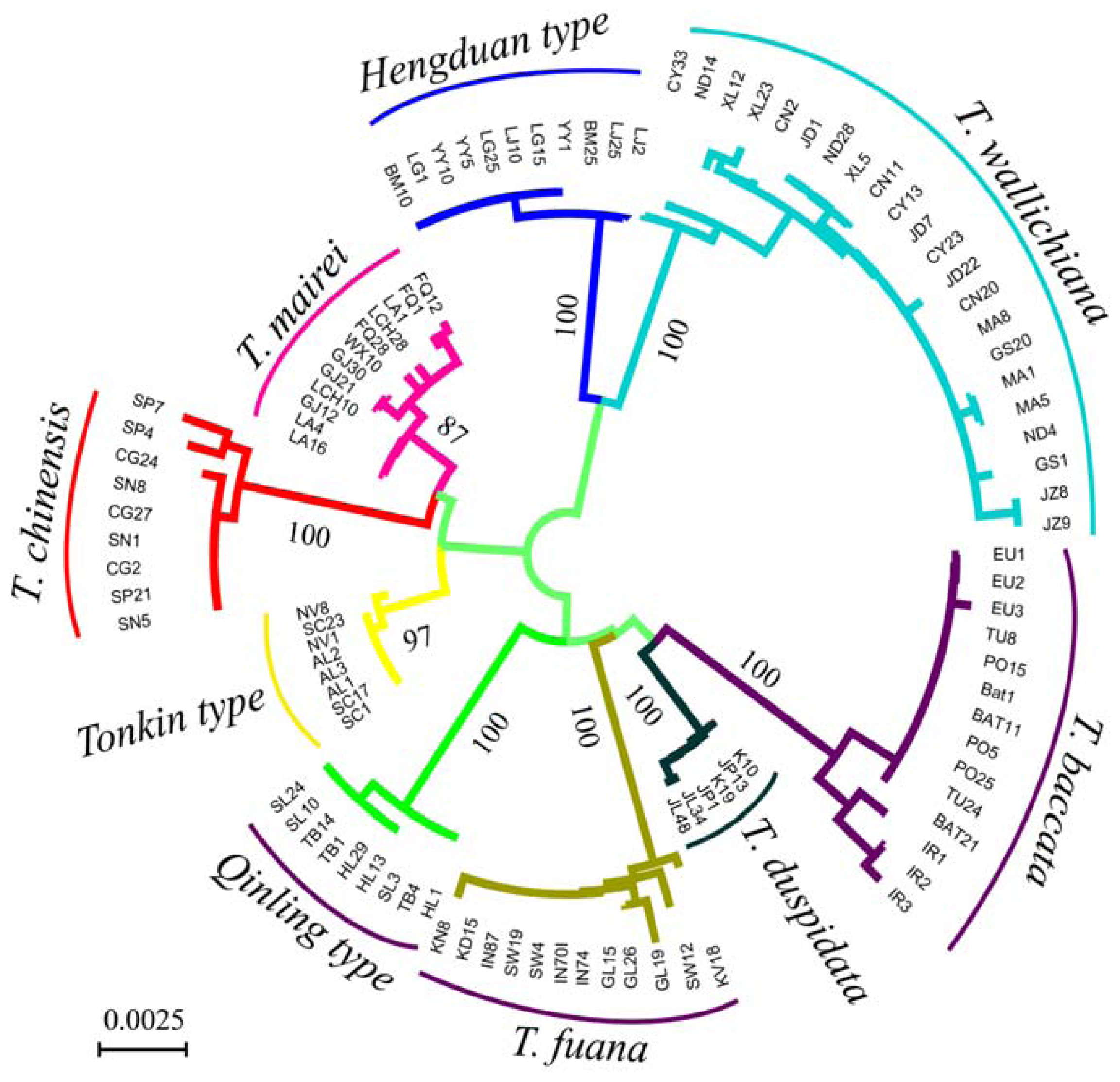
<p>The NJ tree of the nine species based on combination of the four DNA regions is shown in <xref ref-type="fig" rid="f1-ijms-13-08740">Figure 1</xref>. All the 103 individuals fell into distinct clades with high bootstrap support values corresponding to the nine species. The clustering relationships of the species were similar to those found by Liu <italic>et al</italic>. [<xref ref-type="bibr" rid="b29-ijms-13-08740">29</xref>], which utilized smaller sample sizes for each species.</p></sec>
<sec>
<title>3.3. Indel-Treating Method Comparison</title>
<p>The numbers of variable and parsimony-informative characters varied between the two indel coding approaches (SIC and MCIC) for <italic>trn</italic>L<italic>-trn</italic>F and <italic>trn</italic>H-<italic>psb</italic>A (<xref ref-type="table" rid="t1-ijms-13-08740">Table 1</xref>). The variable sites and parsimony-informative characters ranged from 2.88% to 4.09% with MCIC, and 2.53% to 3.30% with SIC for <italic>trn</italic>L<italic>-trn</italic>F, and ranged from 1.29% to 2.75% and 0.98% to 1.97% with MCIC and SIC for <italic>trn</italic>H-<italic>psb</italic>A, respectively (<xref ref-type="table" rid="t1-ijms-13-08740">Table 1</xref>). When comparing numbers of the variable sites and parsimony-informative characters, CD = PWD &lt; MCIC &lt; SIC. Indel-coding increased the numbers of variable and parsimony-informative characters, and SIC generally resulted in more variable and parsimony-informative sites than MCIC (<xref ref-type="table" rid="t1-ijms-13-08740">Table 1</xref>).</p>
<p>NJ trees for each region were constructed with different indel treatments by MEGA 4.0. Clades were recovered for each species and nodal support values are shown in <xref ref-type="table" rid="t3-ijms-13-08740">Table 3</xref>. Nodal support values base on SIC and MCIC were always higher than those using CD and PWD in the <italic>trn</italic>L<italic>-trn</italic>F NJ tree, except for <italic>T. cuspidata</italic> which had the highest bootstrap support with PWD. All the nodal support values for each clade were over 70% except for a value of 58% in the Qinling type. Seven out of the nine species were identified with CD and PWD, eight with SIC, and all nine species with MCIC. For <italic>trn</italic>H-<italic>psb</italic>A, PWD, SIC, MCIC all performed better than CD on species resolution and nodal support. Only one of the nine species was discriminated with CD, and three with PWD. SIC and MCIC provided matching species discriminatory power, identifying four of the nine species (44%) (<xref ref-type="table" rid="t3-ijms-13-08740">Table 3</xref>). It is of note that two and one of the nine species could be distinguished using the <italic>trn</italic>L-<italic>trn</italic>F and <italic>trn</italic>H<italic>-psb</italic>A regions respectively when considering only indels variation (<xref ref-type="table" rid="t3-ijms-13-08740">Table 3</xref>).</p></sec></sec>
<sec sec-type="discussion">
<title>4. Discussion</title>
<sec>
<title>4.1. Sampling Size of Population/Species for Plant Barcoding</title>
<p>The number of individuals required to create a reliable reference for valid species identification has been one of the basic issues considered since the beginning of the DNA barcoding initiative [<xref ref-type="bibr" rid="b18-ijms-13-08740">18</xref>,<xref ref-type="bibr" rid="b21-ijms-13-08740">21</xref>]. Generally, the depth of individuals per species sampled for barcoding is usually sacrificed in favor of greater taxonomic coverage [<xref ref-type="bibr" rid="b36-ijms-13-08740">36</xref>]. In the present study, levels of sequence divergence within and between species differed among the four DNA regions in this study, most likely as a result of different evolutionary processes/levels of functional constraint. Little or no intraspecific sequence divergence was observed in <italic>mat</italic>K, indicating that 2–3 individuals from different populations would be representative of the genetic diversity of each species (<xref ref-type="table" rid="t2-ijms-13-08740">Table 2</xref>). For more quickly evolving regions, such as <italic>trn</italic>H<italic>-psb</italic>A, <italic>trn</italic>L-<italic>trn</italic>F and ITS, high levels of intraspecific sequence divergence mean that more individuals (a maximum of 10, 8 and 6) from different populations are required to represent the majority of the genetic variation at these loci (<xref ref-type="table" rid="t2-ijms-13-08740">Table 2</xref>). Although a sample size of 12 individuals per species was proposed for barcoding animals by Matz &amp; Nielsen [<xref ref-type="bibr" rid="b18-ijms-13-08740">18</xref>], a study based on simulated data and real data from the <italic>mt</italic>DNA COI region for the skipper butterfly [<xref ref-type="bibr" rid="b21-ijms-13-08740">21</xref>] suggested that much larger sample sizes were required to be representative of the total genetic diversity. Based on the results in this study and those from a separate phylogeographic study of <italic>Taxus</italic> (Liu <italic>et al.</italic>, unpublished data), 8–10 individuals per species from the entire geographic distribution of the species analysed appear to be sufficient for plant DNA barcoding. Nevertheless, more detailed studies on this issue are required using simulated data and real data on a large sample scale in future.</p>
<p>In our study, intraspecific sampling was conducted in a hierarchical fashion to elucidate whether variation between populations could influence sampling strategies for barcoding. Most of the populations studied for multiple individuals were monomorphic for all four DNA regions (<xref ref-type="supplementary-material" rid="s1-ijms-13-08740">Supplementary Information, Table S2</xref>). Intra-population sequence divergence was usually less than that observed between populations within species (<xref ref-type="table" rid="t2-ijms-13-08740">Table 2</xref>), and mean interspecific distances (<xref ref-type="table" rid="t1-ijms-13-08740">Table 1</xref>) and clustering relationships of the species in the NJ tree (<xref ref-type="fig" rid="f1-ijms-13-08740">Figure 1</xref>) were similar to a previous study which only considered a single individual per population [<xref ref-type="bibr" rid="b29-ijms-13-08740">29</xref>]. Thus, increasing numbers of individuals within populations does not influence barcoding accuracy, and one individual per population is likely to be adequate for the majority of plant DNA barcoding projects, especially for the closely related taxa. Most of the variation within species is generally due to differences between geographically distant populations. Thus it is more important to randomly sample multiple individuals across the whole geographical distribution of a species, a similar finding to that from a previous study [<xref ref-type="bibr" rid="b21-ijms-13-08740">21</xref>].</p></sec>
<sec>
<title>4.2. Utility of Indels for Barcoding and Effect of Different Indel Treatments</title>
<p>As methods for coding indels have become more sophisticated, the inclusion of indels as characters in phylogenetic analyses has gained increasing popularity [<xref ref-type="bibr" rid="b37-ijms-13-08740">37</xref>]. Many studies concluded that gaps should be included, in some way, in order to provide additional phylogenetic information (e.g., [<xref ref-type="bibr" rid="b23-ijms-13-08740">23</xref>,<xref ref-type="bibr" rid="b24-ijms-13-08740">24</xref>,<xref ref-type="bibr" rid="b28-ijms-13-08740">28</xref>]). In plant DNA barcoding studies, indels have generally not been taken into account due to the lack of a standard approach to the utilization of such regions. Studies have generally treated indels as missing data [<xref ref-type="bibr" rid="b6-ijms-13-08740">6</xref>,<xref ref-type="bibr" rid="b11-ijms-13-08740">11</xref>,<xref ref-type="bibr" rid="b12-ijms-13-08740">12</xref>], in a few cases, as a fifth character [<xref ref-type="bibr" rid="b28-ijms-13-08740">28</xref>] or as some indel coding method [<xref ref-type="bibr" rid="b26-ijms-13-08740">26</xref>].</p>
<p>Length variation as a result of mononucleotide repeat expansion and contraction in the chloroplast genome has frequently been utilized as a marker system in population genetic studies [<xref ref-type="bibr" rid="b38-ijms-13-08740">38</xref>]. The bidirectional nature of the mutational processes operating at these regions, however, leads to homoplasy, particularly above the species level, and thus they are not generally considered as informative in phylogenetic studies, or even in phylogeographic studies across large geographic scales, e.g., [<xref ref-type="bibr" rid="b39-ijms-13-08740">39</xref>]. In the present study, as in previous other studies, e.g., [<xref ref-type="bibr" rid="b40-ijms-13-08740">40</xref>], similarly, polymorphic mononucleotide regions have been identified in the nuclear ITS. Given that these result from the same mutational mechanisms as their chloroplast counterparts, they are unlikely to provide stable information for inter-specific barcoding studies.</p>
<p>Rapidly evolving non-coding plant DNA regions, such as <italic>trn</italic>H-<italic>psb</italic>A and <italic>trn</italic>L<italic>-trn</italic>F, usually exhibit length variation due to the occurrence of indels, e.g., [<xref ref-type="bibr" rid="b7-ijms-13-08740">7</xref>,<xref ref-type="bibr" rid="b41-ijms-13-08740">41</xref>]. Where such length variation makes it difficult to unambiguously align sequences, this represents a disadvantage in DNA barcoding [<xref ref-type="bibr" rid="b11-ijms-13-08740">11</xref>], although this is primarily a problem in distantly related taxa. Conversely, the potentially diagnostic nature of indels for closely related species is highlighted in the present study, as well as in previous barcoding researches [<xref ref-type="bibr" rid="b6-ijms-13-08740">6</xref>,<xref ref-type="bibr" rid="b12-ijms-13-08740">12</xref>,<xref ref-type="bibr" rid="b42-ijms-13-08740">42</xref>]. Our study shows that some species have private intraspecific indels that distinguish them from other closely related species. For instance, <italic>T. chinensis</italic> has a specific insertion at 514 position in <italic>trn</italic>H-<italic>psb</italic>A matrix which differentiated it from the other species studied. Likewise, <italic>T. mairei</italic> can only be distinguished from the ‘Tonkin type’ by a private indel in the <italic>trn</italic>L<italic>-trn</italic>F region.</p>
<p>Given that indels are known to provide some level of information for phylogenetic studies, e.g., [<xref ref-type="bibr" rid="b24-ijms-13-08740">24</xref>,<xref ref-type="bibr" rid="b37-ijms-13-08740">37</xref>], we utilised four different methods of indel treatment to test their performance in DNA barcoding analysis. Based on our results, the two gap coding methods (SIC or MCIC) performed better in species discrimination and nodal support than CD and PWD, and both approaches usually obtained similar species resolution and nodal support values. A comparison of the CD and PWD approaches revealed that they performed similarly in <italic>trn</italic>L<italic>-trn</italic>F, but that PWD performed better in species identification than CD in <italic>trn</italic>H-<italic>psb</italic>A. Overall, the CD method showed the lowest species discrimination and nodal support. Using this approach, where indels were effectively treated as missing data, the resulting phylogentic trees were less accurate than those obtained using gap coding treatments [<xref ref-type="bibr" rid="b24-ijms-13-08740">24</xref>]. In general, gap coding methods of SIC and MCIC increased the number of variable and parsimony-informative sites, which gave more accurate clustering relationships and a stronger nodal support value. Where the indel was a species-specific diagnostic character, this always led to the accessions of the species forming a clade and subsequent species identification success. Thus, for the barcoding of the closely related species of <italic>Taxus</italic> examined in this study, it was preferable to use a gap-coding method (SIC or MCIC) rather than the CD approach.</p>
<p>The findings of the study confirm the potential utility of indels in plant barcoding studies, as previously suggested in other species [<xref ref-type="bibr" rid="b42-ijms-13-08740">42</xref>]. Considering that the rate of base pair substitutions in the chloroplast genome is fairly low [<xref ref-type="bibr" rid="b43-ijms-13-08740">43</xref>,<xref ref-type="bibr" rid="b44-ijms-13-08740">44</xref>], longer stretches of DNA may be required to generate sufficient barcoding information, which will in turn increase the cost of such ventures. Given the high frequency of indels, particularly in the two regions studied here, and their phylogenetic utility in species discrimination, we suggest that with the appropriate treatment, they may provide a valuable addition to many plant barcoding studies.</p></sec></sec>
<sec sec-type="supplementary-material">
<title>Supplementary Information</title>
<supplementary-material id="s1-ijms-13-08740" content-type="local-data">
<media xlink:href="ijms-13-08740-s001.pdf" mimetype="application" mime-subtype="pdf"/></supplementary-material></sec></body>
<back>
<ack>
<title>Acknowledgements</title>
<p>We are grateful to the two anonymous reviewers for their critical and constructive comments. We also thank Jun-Bo Yang, Zeng-Yuan Wu and Ram Chandra Poudel of Kunming Institute of Botany, Chinese Academy of Sciences (CAS), for their help with laboratory work or data analysis. This study was supported by the Research Fund for the Large-scale Scientific Facilities of the Chinese Academy of Sciences (2009-LSF-GBOWS-01), the National Natural Science Foundation of China (30700042), the West Light Programme of CAS (9223111W1) and the talent project of Yunnan province (2008YP064).</p></ack>
<ref-list>
<title>References</title>
<ref id="b1-ijms-13-08740"><label>1</label><citation citation-type="journal"><person-group person-group-type="author"><name><surname>Hebert</surname><given-names>P.D.N</given-names></name><name><surname>Cywinska</surname><given-names>A</given-names></name><name><surname>Ball</surname><given-names>S.L</given-names></name><name><surname>deWaard</surname><given-names>J.R.</given-names></name></person-group><article-title>Biological identifications through DNA barcodes</article-title><source>Proc. R. Soc. Biol. Sci. Ser. B</source><year>2003</year><volume>270</volume><fpage>313</fpage><lpage>321</lpage><pub-id pub-id-type="doi">10.1098/rspb.2002.2218</pub-id></citation></ref>
<ref id="b2-ijms-13-08740"><label>2</label><citation citation-type="journal"><person-group person-group-type="author"><name><surname>Lahaye</surname><given-names>R</given-names></name><name><surname>van der Bank</surname><given-names>M</given-names></name><name><surname>Bogarin</surname><given-names>D</given-names></name><name><surname>Warner</surname><given-names>J</given-names></name><name><surname>Pupulin</surname><given-names>F</given-names></name><name><surname>Gigot</surname><given-names>G</given-names></name><name><surname>Maurin</surname><given-names>O</given-names></name><name><surname>Duthoit</surname><given-names>S</given-names></name><name><surname>Barraclough</surname><given-names>T.G</given-names></name><name><surname>Savolainen</surname><given-names>V.</given-names></name></person-group><article-title>DNA barcoding the floras of biodiversity hotspots</article-title><source>Proc. Natl. Acad. Sci. USA</source><year>2008</year><volume>105</volume><fpage>2923</fpage><lpage>2928</lpage><pub-id pub-id-type="doi">10.1073/pnas.0709936105</pub-id><pub-id pub-id-type="pmid">18258745</pub-id></citation></ref>
<ref id="b3-ijms-13-08740"><label>3</label><citation citation-type="journal"><person-group person-group-type="author"><name><surname>Dalton</surname><given-names>D.L</given-names></name><name><surname>Kotze</surname><given-names>A.</given-names></name></person-group><article-title>DNA barcoding as a tool for species identification in three forensic wildlife cases in South Africa</article-title><source>Forensic Sci. Int</source><year>2011</year><volume>207</volume><fpage>e51</fpage><lpage>e54</lpage><pub-id pub-id-type="doi">10.1016/j.forsciint.2010.12.017</pub-id><pub-id pub-id-type="pmid">21277124</pub-id></citation></ref>
<ref id="b4-ijms-13-08740"><label>4</label><citation citation-type="journal"><person-group person-group-type="author"><name><surname>Kress</surname><given-names>W.J</given-names></name><name><surname>Erickson</surname><given-names>D.L</given-names></name><name><surname>Jones</surname><given-names>F.A</given-names></name><name><surname>Swenson</surname><given-names>N.G</given-names></name><name><surname>Perez</surname><given-names>R</given-names></name><name><surname>Sanjur</surname><given-names>O</given-names></name><name><surname>Bermingham</surname><given-names>E.</given-names></name></person-group><article-title>Plant DNA barcodes and a community phylogeny of a tropical forest dynamics plot in Panama</article-title><source>Proc. Natl. Acad. Sci. USA</source><year>2009</year><volume>106</volume><fpage>18621</fpage><lpage>18626</lpage><pub-id pub-id-type="doi">10.1073/pnas.0909820106</pub-id><pub-id pub-id-type="pmid">19841276</pub-id></citation></ref>
<ref id="b5-ijms-13-08740"><label>5</label><citation citation-type="journal"><person-group person-group-type="author"><name><surname>Valentini</surname><given-names>A</given-names></name><name><surname>Pompanon</surname><given-names>F</given-names></name><name><surname>Taberlet</surname><given-names>P.</given-names></name></person-group><article-title>DNA barcoding for ecologists</article-title><source>Trends Ecol. Evol</source><year>2009</year><volume>24</volume><fpage>110</fpage><lpage>117</lpage><pub-id pub-id-type="doi">10.1016/j.tree.2008.09.011</pub-id><pub-id pub-id-type="pmid">19100655</pub-id></citation></ref>
<ref id="b6-ijms-13-08740"><label>6</label><citation citation-type="journal"><person-group person-group-type="author"><name><surname>Kress</surname><given-names>W.J</given-names></name><name><surname>Wurdack</surname><given-names>K.J</given-names></name><name><surname>Zimmer</surname><given-names>E.A</given-names></name><name><surname>Weigt</surname><given-names>L.A</given-names></name><name><surname>Janzen</surname><given-names>D.H.</given-names></name></person-group><article-title>Use of DNA barcodes to identify flowering plants</article-title><source>Proc. Natl. Acad. Sci. USA</source><year>2005</year><volume>102</volume><fpage>8369</fpage><lpage>8374</lpage><pub-id pub-id-type="doi">10.1073/pnas.0503123102</pub-id><pub-id pub-id-type="pmid">15928076</pub-id></citation></ref>
<ref id="b7-ijms-13-08740"><label>7</label><citation citation-type="journal"><person-group person-group-type="author"><name><surname>Fazekas</surname><given-names>A.J</given-names></name><name><surname>Burgess</surname><given-names>K.S</given-names></name><name><surname>Kesanakurti</surname><given-names>P.R</given-names></name><name><surname>Graham</surname><given-names>S.W</given-names></name><name><surname>Newmaster</surname><given-names>S.G</given-names></name><name><surname>Husband</surname><given-names>B.C</given-names></name><name><surname>Percy</surname><given-names>D.M</given-names></name><name><surname>Hajibabaei</surname><given-names>M</given-names></name><name><surname>Barrett</surname><given-names>S.C.</given-names></name></person-group><article-title>Multiple multilocus DNA barcodes from the plastid genome discriminate plant species equally well</article-title><source>PLoS One</source><year>2008</year><volume>3</volume><fpage>e2802</fpage><pub-id pub-id-type="doi">10.1371/journal.pone.0002802</pub-id><pub-id pub-id-type="pmid">18665273</pub-id></citation></ref>
<ref id="b8-ijms-13-08740"><label>8</label><citation citation-type="journal"><person-group person-group-type="author"><name><surname>Hollingsworth</surname><given-names>P.M</given-names></name><name><surname>Graham</surname><given-names>S.W</given-names></name><name><surname>Little</surname><given-names>D.P.</given-names></name></person-group><article-title>Choosing and using a plant DNA barcode</article-title><source>PLoS One</source><year>2011</year><volume>6</volume><fpage>e19254</fpage><pub-id pub-id-type="doi">10.1371/journal.pone.0019254</pub-id><pub-id pub-id-type="pmid">21637336</pub-id></citation></ref>
<ref id="b9-ijms-13-08740"><label>9</label><citation citation-type="journal"><collab>China Plant BOL Group</collab><article-title>Comparative analysis of a large dataset indicates that internal transcribed spacer (ITS) should be incorporated into the core barcode for seed plants</article-title><source>Proc. Natl. Acad. Sci. USA</source><year>2011</year><volume>108</volume><fpage>19641</fpage><lpage>19646</lpage><pub-id pub-id-type="doi">10.1073/pnas.1104551108</pub-id><pub-id pub-id-type="pmid">22100737</pub-id></citation></ref>
<ref id="b10-ijms-13-08740"><label>10</label><citation citation-type="journal"><person-group person-group-type="author"><name><surname>Pennisi</surname><given-names>E.</given-names></name></person-group><article-title>Wanted: A barcode for plants</article-title><source>Science</source><year>2007</year><volume>318</volume><fpage>190</fpage><lpage>191</lpage><pub-id pub-id-type="doi">10.1126/science.318.5848.190</pub-id><pub-id pub-id-type="pmid">17932267</pub-id></citation></ref>
<ref id="b11-ijms-13-08740"><label>11</label><citation citation-type="journal"><collab>CBOL Plant Working Group</collab><article-title>A DNA barcode for land plants</article-title><source>Proc. Natl. Acad. Sci. USA</source><year>2009</year><volume>106</volume><fpage>12794</fpage><lpage>12797</lpage><pub-id pub-id-type="doi">10.1073/pnas.0905845106</pub-id><pub-id pub-id-type="pmid">19666622</pub-id></citation></ref>
<ref id="b12-ijms-13-08740"><label>12</label><citation citation-type="journal"><person-group person-group-type="author"><name><surname>Kress</surname><given-names>W.J</given-names></name><name><surname>Erickson</surname><given-names>D.L.</given-names></name></person-group><article-title>A two-locus global DNA barcode for land plants: The coding <italic>rbc</italic>L gene complements the non-coding <italic>trn</italic>H-psbA spacer region</article-title><source>PloS One</source><year>2007</year><volume>2</volume><fpage>e508</fpage><pub-id pub-id-type="doi">10.1371/journal.pone.0000508</pub-id><pub-id pub-id-type="pmid">17551588</pub-id></citation></ref>
<ref id="b13-ijms-13-08740"><label>13</label><citation citation-type="journal"><person-group person-group-type="author"><name><surname>T Taberlet</surname><given-names>P</given-names></name><name><surname>Coissac</surname><given-names>E</given-names></name><name><surname>Pompanon</surname><given-names>F</given-names></name><name><surname>Gielly</surname><given-names>L</given-names></name><name><surname>Miquel</surname><given-names>C</given-names></name><name><surname>Valentini</surname><given-names>A</given-names></name><name><surname>Vermat</surname><given-names>T</given-names></name><name><surname>Corthier</surname><given-names>G</given-names></name><name><surname>Brochmann</surname><given-names>C</given-names></name><name><surname>Willerslev</surname><given-names>E.</given-names></name></person-group><article-title>Power and limitations of the chloroplast <italic>trn</italic>L (UAA) intron for plant DNA barcoding</article-title><source>Nucleic Acids Res</source><year>2007</year><volume>35</volume><fpage>e14</fpage><pub-id pub-id-type="doi">10.1093/nar/gkl938</pub-id><pub-id pub-id-type="pmid">17169982</pub-id></citation></ref>
<ref id="b14-ijms-13-08740"><label>14</label><citation citation-type="journal"><person-group person-group-type="author"><name><surname>Hollingsworth</surname><given-names>M.L</given-names></name><name><surname>Clark</surname><given-names>A.A</given-names></name><name><surname>Forrest</surname><given-names>L.L</given-names></name><name><surname>Richardson</surname><given-names>J</given-names></name><name><surname>Pennington</surname><given-names>R.T</given-names></name><name><surname>Long</surname><given-names>D.G</given-names></name><name><surname>Cowan</surname><given-names>R</given-names></name><name><surname>Chase</surname><given-names>M.W</given-names></name><name><surname>Gaudeul</surname><given-names>M</given-names></name><name><surname>Hollingsworth</surname><given-names>P.M.</given-names></name></person-group><article-title>Selecting barcoding loci for plants: Evaluation of seven candidate loci with species-level sampling in three divergent groups of land plants</article-title><source>Mol. Ecol. Resour</source><year>2009</year><volume>9</volume><fpage>439</fpage><lpage>457</lpage><pub-id pub-id-type="doi">10.1111/j.1755-0998.2008.02439.x</pub-id><pub-id pub-id-type="pmid">21564673</pub-id></citation></ref>
<ref id="b15-ijms-13-08740"><label>15</label><citation citation-type="journal"><person-group person-group-type="author"><name><surname>Gonzalez</surname><given-names>M.A</given-names></name><name><surname>Baraloto</surname><given-names>C</given-names></name><name><surname>Engel</surname><given-names>J</given-names></name><name><surname>Mori</surname><given-names>S.A</given-names></name><name><surname>Pétronelli</surname><given-names>P</given-names></name><name><surname>Riéra</surname><given-names>B</given-names></name><name><surname>Roger</surname><given-names>A</given-names></name><name><surname>Thébaud</surname><given-names>C</given-names></name><name><surname>Chave</surname><given-names>J.</given-names></name></person-group><article-title>Identification of Amazonian trees with DNA barcodes</article-title><source>PLoS One</source><year>2009</year><volume>4</volume><fpage>e7483</fpage><pub-id pub-id-type="doi">10.1371/journal.pone.0007483</pub-id><pub-id pub-id-type="pmid">19834612</pub-id></citation></ref>
<ref id="b16-ijms-13-08740"><label>16</label><citation citation-type="journal"><person-group person-group-type="author"><name><surname>Bruni</surname><given-names>I</given-names></name><name><surname>de Mattia</surname><given-names>F</given-names></name><name><surname>Galimberti</surname><given-names>A</given-names></name><name><surname>Galasso</surname><given-names>G</given-names></name><name><surname>Banfi</surname><given-names>E</given-names></name><name><surname>Casiraghi</surname><given-names>M</given-names></name><name><surname>Labra</surname><given-names>M.</given-names></name></person-group><article-title>Identification of poisonous plants by DNA barcoding approach</article-title><source>Int. J. Leg. Med</source><year>2010</year><volume>124</volume><fpage>595</fpage><lpage>603</lpage><pub-id pub-id-type="doi">10.1007/s00414-010-0447-3</pub-id></citation></ref>
<ref id="b17-ijms-13-08740"><label>17</label><citation citation-type="journal"><person-group person-group-type="author"><name><surname>Muellner</surname><given-names>A.N</given-names></name><name><surname>Schaefer</surname><given-names>H</given-names></name><name><surname>Lahaye</surname><given-names>R.</given-names></name></person-group><article-title>Evaluation of candidate DNA barcoding loci for economically important timber species of the mahogany family (Meliaceae)</article-title><source>Mol. Ecol. Resour</source><year>2011</year><volume>11</volume><fpage>450</fpage><lpage>460</lpage><pub-id pub-id-type="doi">10.1111/j.1755-0998.2011.02984.x</pub-id><pub-id pub-id-type="pmid">21481203</pub-id></citation></ref>
<ref id="b18-ijms-13-08740"><label>18</label><citation citation-type="journal"><person-group person-group-type="author"><name><surname>Matz</surname><given-names>M.V</given-names></name><name><surname>Nielsen</surname><given-names>R.</given-names></name></person-group><article-title>A likelihood ratio test for species membership based on DNA sequence data</article-title><source>Philos. Trans. R Soc. Lond. B Biol. Sci</source><year>2005</year><volume>360</volume><fpage>1969</fpage><lpage>1974</lpage><pub-id pub-id-type="doi">10.1098/rstb.2005.1728</pub-id><pub-id pub-id-type="pmid">16214754</pub-id></citation></ref>
<ref id="b19-ijms-13-08740"><label>19</label><citation citation-type="journal"><person-group person-group-type="author"><name><surname>Meyer</surname><given-names>C.P</given-names></name><name><surname>Paulay</surname><given-names>G.</given-names></name></person-group><article-title>DNA barcoding: Error rates based on comprehensive sampling</article-title><source>PLoS Biol</source><year>2005</year><volume>3</volume><fpage>2229</fpage><lpage>2238</lpage></citation></ref>
<ref id="b20-ijms-13-08740"><label>20</label><citation citation-type="journal"><person-group person-group-type="author"><name><surname>Wiemers</surname><given-names>M</given-names></name><name><surname>Fiedler</surname><given-names>K.</given-names></name></person-group><article-title>Does the DNA barcoding gap exist?—A case study in blue butterflies (Lepidoptera: Lycaenidae)</article-title><source>Front. Zool</source><year>2007</year><volume>4</volume><fpage>8</fpage><pub-id pub-id-type="doi">10.1186/1742-9994-4-8</pub-id><pub-id pub-id-type="pmid">17343734</pub-id></citation></ref>
<ref id="b21-ijms-13-08740"><label>21</label><citation citation-type="journal"><person-group person-group-type="author"><name><surname>Zhang</surname><given-names>A.B</given-names></name><name><surname>He</surname><given-names>L.J</given-names></name><name><surname>Crozier</surname><given-names>R.H</given-names></name><name><surname>Muster</surname><given-names>C</given-names></name><name><surname>Zhu</surname><given-names>C.D.</given-names></name></person-group><article-title>Estimating sample sizes for DNA barcoding</article-title><source>Mol. Phylogenet. Evol</source><year>2010</year><volume>54</volume><fpage>1035</fpage><lpage>1039</lpage><pub-id pub-id-type="doi">10.1016/j.ympev.2009.09.014</pub-id><pub-id pub-id-type="pmid">19761856</pub-id></citation></ref>
<ref id="b22-ijms-13-08740"><label>22</label><citation citation-type="journal"><person-group person-group-type="author"><name><surname>Simmons</surname><given-names>M.P</given-names></name><name><surname>Ochoterena</surname><given-names>H.</given-names></name></person-group><article-title>Gaps as characters in sequence-based phylogenetic analyses</article-title><source>Syst. Biol</source><year>2000</year><volume>49</volume><fpage>369</fpage><lpage>381</lpage><pub-id pub-id-type="pmid">12118412</pub-id></citation></ref>
<ref id="b23-ijms-13-08740"><label>23</label><citation citation-type="journal"><person-group person-group-type="author"><name><surname>Simmons</surname><given-names>M.P</given-names></name><name><surname>Muller</surname><given-names>K</given-names></name><name><surname>Norton</surname><given-names>A.P.</given-names></name></person-group><article-title>The relative performance of indel-coding methods in simulations</article-title><source>Mol. Phylogenet. Evol</source><year>2007</year><volume>44</volume><fpage>724</fpage><lpage>740</lpage><pub-id pub-id-type="doi">10.1016/j.ympev.2007.04.001</pub-id><pub-id pub-id-type="pmid">17512758</pub-id></citation></ref>
<ref id="b24-ijms-13-08740"><label>24</label><citation citation-type="journal"><person-group person-group-type="author"><name><surname>Dwivedi</surname><given-names>B</given-names></name><name><surname>Gadagkar</surname><given-names>S.R.</given-names></name></person-group><article-title>Phylogenetic inference under varying proportions of indel-induced alignment gaps</article-title><source>BMC Evol. Biol</source><year>2009</year><volume>9</volume><fpage>211</fpage><pub-id pub-id-type="doi">10.1186/1471-2148-9-211</pub-id><pub-id pub-id-type="pmid">19698168</pub-id></citation></ref>
<ref id="b25-ijms-13-08740"><label>25</label><citation citation-type="journal"><person-group person-group-type="author"><name><surname>Graham</surname><given-names>S.W</given-names></name><name><surname>Reeves</surname><given-names>P.A</given-names></name><name><surname>Burns</surname><given-names>A.C.E</given-names></name><name><surname>Olmstead</surname><given-names>R.G.</given-names></name></person-group><article-title>Microstructural changes in noncoding chloroplast DNA: Interpretation, evolution, and utility of indels and inversions in basal angiosperm phylogenetic inference</article-title><source>Int. J. Plant Sci.</source><year>2000</year><volume>161</volume><fpage>S83</fpage><lpage>S96</lpage><pub-id pub-id-type="doi">10.1086/317583</pub-id></citation></ref>
<ref id="b26-ijms-13-08740"><label>26</label><citation citation-type="journal"><person-group person-group-type="author"><name><surname>Farrington</surname><given-names>L</given-names></name><name><surname>MacGillivray</surname><given-names>P</given-names></name><name><surname>Faast</surname><given-names>R</given-names></name><name><surname>Austin</surname><given-names>A.</given-names></name></person-group><article-title>Investigating DNA barcoding options for the identification of <italic>Caladenia</italic> (Orchidaceae) species</article-title><source>Aust. J. Bot</source><year>2009</year><volume>57</volume><fpage>276</fpage><lpage>286</lpage><pub-id pub-id-type="doi">10.1071/BT08138</pub-id></citation></ref>
<ref id="b27-ijms-13-08740"><label>27</label><citation citation-type="journal"><person-group person-group-type="author"><name><surname>Monaghan</surname><given-names>M.T</given-names></name><name><surname>Balke</surname><given-names>M</given-names></name><name><surname>Pons</surname><given-names>J</given-names></name><name><surname>Vogler</surname><given-names>A.P.</given-names></name></person-group><article-title>Beyond barcodes: Complex DNA taxonomy of a South Pacific Island radiation</article-title><source>Proc. R. Soc. Biol. Sci. Ser. B</source><year>2006</year><volume>273</volume><fpage>887</fpage><lpage>893</lpage><pub-id pub-id-type="doi">10.1098/rspb.2005.3391</pub-id></citation></ref>
<ref id="b28-ijms-13-08740"><label>28</label><citation citation-type="journal"><person-group person-group-type="author"><name><surname>Newmaster</surname><given-names>S.G</given-names></name><name><surname>Fazekas</surname><given-names>A.J</given-names></name><name><surname>Steeves</surname><given-names>R.A.D</given-names></name><name><surname>Janovec</surname><given-names>J.</given-names></name></person-group><article-title>Testing candidate plant barcode regions in the Myristicaceae</article-title><source>Mol. Ecol. Resour</source><year>2008</year><volume>8</volume><fpage>480</fpage><lpage>490</lpage><pub-id pub-id-type="doi">10.1111/j.1471-8286.2007.02002.x</pub-id><pub-id pub-id-type="pmid">21585825</pub-id></citation></ref>
<ref id="b29-ijms-13-08740"><label>29</label><citation citation-type="journal"><person-group person-group-type="author"><name><surname>Liu</surname><given-names>J</given-names></name><name><surname>Möller</surname><given-names>M</given-names></name><name><surname>Gao</surname><given-names>L.M</given-names></name><name><surname>Zhang</surname><given-names>D.Q</given-names></name><name><surname>Li</surname><given-names>D.Z.</given-names></name></person-group><article-title>DNA barcoding for the discrimination of Eurasian yews (Taxus L., Taxaceae) and the discovery of cryptic species</article-title><source>Mol. Ecol. Resour</source><year>2011</year><volume>11</volume><fpage>89</fpage><lpage>100</lpage><pub-id pub-id-type="doi">10.1111/j.1755-0998.2010.02907.x</pub-id><pub-id pub-id-type="pmid">21429104</pub-id></citation></ref>
<ref id="b30-ijms-13-08740"><label>30</label><citation citation-type="journal"><person-group person-group-type="author"><name><surname>Möller</surname><given-names>M</given-names></name><name><surname>Gao</surname><given-names>L.M</given-names></name><name><surname>Mill</surname><given-names>R.R</given-names></name><name><surname>Li</surname><given-names>D.Z</given-names></name><name><surname>Hollingsworth</surname><given-names>M.L</given-names></name><name><surname>Gibby</surname><given-names>M.</given-names></name></person-group><article-title>Morphometric analysis of the <italic>Taxus wallichiana</italic> complex (Taxaceae) based on herbarium material</article-title><source>Bot. J. Linn. Soc.</source><year>2007</year><volume>155</volume><fpage>307</fpage><lpage>335</lpage><pub-id pub-id-type="doi">10.1111/j.1095-8339.2007.00697.x</pub-id></citation></ref>
<ref id="b31-ijms-13-08740"><label>31</label><citation citation-type="journal"><person-group person-group-type="author"><name><surname>Liu</surname><given-names>J</given-names></name><name><surname>Gao</surname><given-names>L.M.</given-names></name></person-group><article-title>Comparative analysis of three different methods of total DNA extraction used in <italic>Taxus</italic></article-title><source>Guihaia</source><year>2011</year><volume>31</volume><fpage>244</fpage><lpage>249</lpage></citation></ref>
<ref id="b32-ijms-13-08740"><label>32</label><citation citation-type="journal"><person-group person-group-type="author"><name><surname>Larkin</surname><given-names>M.A</given-names></name><name><surname>Blackshields</surname><given-names>G</given-names></name><name><surname>Brown</surname><given-names>N.P</given-names></name><name><surname>Chenna</surname><given-names>R</given-names></name><name><surname>McGettigan</surname><given-names>P.A</given-names></name><name><surname>McWilliam</surname><given-names>H</given-names></name><name><surname>Valentin</surname><given-names>F</given-names></name><name><surname>Wallace</surname><given-names>I.M</given-names></name><name><surname>Wilm</surname><given-names>A</given-names></name><name><surname>Lopez</surname><given-names>R</given-names></name><etal/></person-group><article-title>Clustal W and clustal X version 2.0</article-title><source>Bioinformatics</source><year>2007</year><volume>23</volume><fpage>2947</fpage><lpage>2948</lpage><pub-id pub-id-type="doi">10.1093/bioinformatics/btm404</pub-id><pub-id pub-id-type="pmid">17846036</pub-id></citation></ref>
<ref id="b33-ijms-13-08740"><label>33</label><citation citation-type="web"><article-title>ES-Computing</article-title><source>EditPlus Text Editor 3.20</source><comment>Available online: <ext-link xlink:href="http://www.editplus.com" ext-link-type="uri">http://www.editplus.com</ext-link></comment><access-date>accessed on 12 July 2012</access-date></citation></ref>
<ref id="b34-ijms-13-08740"><label>34</label><citation citation-type="journal"><person-group person-group-type="author"><name><surname>Tamura</surname><given-names>K</given-names></name><name><surname>Dudley</surname><given-names>J</given-names></name><name><surname>Nei</surname><given-names>M</given-names></name><name><surname>Kumar</surname><given-names>S.</given-names></name></person-group><article-title>MEGA4: Molecular evolutionary genetics analysis (MEGA) software version 4.0</article-title><source>Mol. Biol. Evol</source><year>2007</year><volume>24</volume><fpage>1596</fpage><lpage>1599</lpage><pub-id pub-id-type="doi">10.1093/molbev/msm092</pub-id><pub-id pub-id-type="pmid">17488738</pub-id></citation></ref>
<ref id="b35-ijms-13-08740"><label>35</label><citation citation-type="journal"><person-group person-group-type="author"><name><surname>Müller</surname><given-names>K.</given-names></name></person-group><article-title>Incorporating information from length-mutational events into phylogenetic analysis</article-title><source>Mol. Phylogenet. Evol</source><year>2006</year><volume>38</volume><fpage>667</fpage><lpage>676</lpage><pub-id pub-id-type="doi">10.1016/j.ympev.2005.07.011</pub-id><pub-id pub-id-type="pmid">16129628</pub-id></citation></ref>
<ref id="b36-ijms-13-08740"><label>36</label><citation citation-type="journal"><person-group person-group-type="author"><name><surname>Nielsen</surname><given-names>R</given-names></name><name><surname>Matz</surname><given-names>M.</given-names></name></person-group><article-title>Statistical approaches for DNA barcoding</article-title><source>Syst. Biol</source><year>2006</year><volume>55</volume><fpage>162</fpage><lpage>169</lpage><pub-id pub-id-type="doi">10.1080/10635150500431239</pub-id><pub-id pub-id-type="pmid">16507534</pub-id></citation></ref>
<ref id="b37-ijms-13-08740"><label>37</label><citation citation-type="journal"><person-group person-group-type="author"><name><surname>Egan</surname><given-names>A.N</given-names></name><name><surname>Crandall</surname><given-names>K.A.</given-names></name></person-group><article-title>Incorporating gaps as phylogenetic characters across eight DNA regions: Ramifications for North American Psoraleeae (Leguminosae)</article-title><source>Mol. Phylogenet. Evol</source><year>2008</year><volume>46</volume><fpage>532</fpage><lpage>546</lpage><pub-id pub-id-type="doi">10.1016/j.ympev.2007.10.006</pub-id><pub-id pub-id-type="pmid">18039582</pub-id></citation></ref>
<ref id="b38-ijms-13-08740"><label>38</label><citation citation-type="journal"><person-group person-group-type="author"><name><surname>Provan</surname><given-names>J</given-names></name><name><surname>Powell</surname><given-names>W</given-names></name><name><surname>Hollingsworth</surname><given-names>P.M.</given-names></name></person-group><article-title>Chloroplast microsatellites: New tools for studies in plant ecology and evolution</article-title><source>Trends Ecol. Evol</source><year>2001</year><volume>16</volume><fpage>142</fpage><lpage>147</lpage><pub-id pub-id-type="doi">10.1016/S0169-5347(00)02097-8</pub-id><pub-id pub-id-type="pmid">11179578</pub-id></citation></ref>
<ref id="b39-ijms-13-08740"><label>39</label><citation citation-type="journal"><person-group person-group-type="author"><name><surname>Beatty</surname><given-names>G.E</given-names></name><name><surname>Provan</surname><given-names>J.</given-names></name></person-group><article-title>Refugial persistence and postglacial recolonization of North America by the cold-tolerant herbaceous plant</article-title><source>Orthilia secunda. Mol. Ecol</source><year>2010</year><volume>19</volume><fpage>5009</fpage><lpage>5021</lpage><pub-id pub-id-type="doi">10.1111/j.1365-294X.2010.04859.x</pub-id></citation></ref>
<ref id="b40-ijms-13-08740"><label>40</label><citation citation-type="journal"><person-group person-group-type="author"><name><surname>Beatty</surname><given-names>G.E</given-names></name><name><surname>Provan</surname><given-names>J.</given-names></name></person-group><article-title>Phylogeographic analysis of North American populations of the parasitic herbaceous plant <italic>Monotropa hypopitys</italic> L. reveals a complex history of range expansion from multiple late glacial refugia</article-title><source>J. Biogeogr</source><year>2011</year><volume>38</volume><fpage>1585</fpage><lpage>1599</lpage><pub-id pub-id-type="doi">10.1111/j.1365-2699.2011.02513.x</pub-id></citation></ref>
<ref id="b41-ijms-13-08740"><label>41</label><citation citation-type="journal"><person-group person-group-type="author"><name><surname>Yu</surname><given-names>W.B</given-names></name><name><surname>Huang</surname><given-names>P.H</given-names></name><name><surname>Ree</surname><given-names>R.H</given-names></name><name><surname>Liu</surname><given-names>M.L</given-names></name><name><surname>Li</surname><given-names>D.Z</given-names></name><name><surname>Wang</surname><given-names>H.</given-names></name></person-group><article-title>DNA barcoding of <italic>Pedicularis</italic> L. (Orobanchaceae): Evaluating four universal barcode loci in a large and hemiparasitic genus</article-title><source>J. Syst. Evol</source><year>2011</year><volume>49</volume><fpage>425</fpage><lpage>437</lpage><pub-id pub-id-type="doi">10.1111/j.1759-6831.2011.00154.x</pub-id></citation></ref>
<ref id="b42-ijms-13-08740"><label>42</label><citation citation-type="journal"><person-group person-group-type="author"><name><surname>Nicolè</surname><given-names>S</given-names></name><name><surname>Erickson</surname><given-names>D.L</given-names></name><name><surname>Ambrosi</surname><given-names>D</given-names></name><name><surname>Bellucci</surname><given-names>E</given-names></name><name><surname>Lucchin</surname><given-names>M</given-names></name><name><surname>Papa</surname><given-names>R</given-names></name><name><surname>Kress</surname><given-names>W.J</given-names></name><name><surname>Barcaccia</surname><given-names>G.</given-names></name></person-group><article-title>Biodiversity studies in Phaseolus species by DNA barcoding</article-title><source>Genome</source><year>2011</year><volume>54</volume><fpage>529</fpage><lpage>545</lpage><pub-id pub-id-type="doi">10.1139/g11-018</pub-id><pub-id pub-id-type="pmid">21777058</pub-id></citation></ref>
<ref id="b43-ijms-13-08740"><label>43</label><citation citation-type="journal"><person-group person-group-type="author"><name><surname>Wolfe</surname><given-names>K.H</given-names></name><name><surname>Li</surname><given-names>W.H</given-names></name><name><surname>Sharp</surname><given-names>P.M.</given-names></name></person-group><article-title>Rates of nucleotide substitution vary greatly among plant mitochondrial, chloroplast, and nuclear DNAs</article-title><source>Proc. Natl. Acad. Sci. USA</source><year>1987</year><volume>84</volume><fpage>9054</fpage><lpage>9058</lpage><pub-id pub-id-type="doi">10.1073/pnas.84.24.9054</pub-id><pub-id pub-id-type="pmid">3480529</pub-id></citation></ref>
<ref id="b44-ijms-13-08740"><label>44</label><citation citation-type="journal"><person-group person-group-type="author"><name><surname>Drouin</surname><given-names>G</given-names></name><name><surname>Daoud</surname><given-names>H</given-names></name><name><surname>Xia</surname><given-names>J.</given-names></name></person-group><article-title>Relative rates of synonymous substitutions in the mitochondrial, chloroplast and nuclear genomes of seed plants</article-title><source>Mol. Phylogenet. Evol</source><year>2008</year><volume>49</volume><fpage>827</fpage><lpage>831</lpage><pub-id pub-id-type="doi">10.1016/j.ympev.2008.09.009</pub-id><pub-id pub-id-type="pmid">18838124</pub-id></citation></ref></ref-list>
<sec sec-type="display-objects">
<title>Figure and Tables</title>
<fig id="f1-ijms-13-08740" position="float">
<label>Figure 1</label>
<caption>
<p>Unrooted neighbour-joining (NJ) tree based on the <italic>P</italic>-distance of the five DNA barcoding loci used. Bootstrap values are shown along the branch for each clade. Scale bar represents base substitutions per site.</p></caption>
<graphic xlink:href="ijms-13-08740f1.gif"/></fig>
<table-wrap id="t1-ijms-13-08740" position="float">
<label>Table 1</label>
<caption>
<p>Summary of data sets by indel coding scheme for alignment and analyses.</p></caption>
<table frame="hsides" rules="groups">
<thead>
<tr>
<th align="center" valign="middle">Data set</th>
<th align="center" valign="middle">Indel treating method</th>
<th align="center" valign="middle">No. of indel</th>
<th align="center" valign="middle">Aligned length</th>
<th align="center" valign="middle">No. (%)<break/>VC</th>
<th align="center" valign="middle">No. (%)<break/>PIC</th>
<th align="center" valign="middle">Mean interspecific distance</th>
<th align="center" valign="middle">Mean intraspecific distance</th></tr></thead>
<tbody>
<tr>
<td align="center" valign="top"><italic>mat</italic>K</td>
<td align="center" valign="top">-</td>
<td align="center" valign="top">0</td>
<td align="center" valign="top">1533</td>
<td align="center" valign="top">15 (0.98)</td>
<td align="center" valign="top">0.0027 (0.00065–0.0046)</td>
<td align="center" valign="top">0.00006 (0–0.00024)</td></tr>
<tr>
<td align="center" valign="top"><italic>trn</italic>L-<italic>trn</italic>F</td>
<td align="center" valign="top">-</td>
<td align="center" valign="top">11</td>
<td align="center" valign="top">869</td>
<td align="center" valign="top">25 (2.88)</td>
<td align="center" valign="top">22 (2.53)</td>
<td align="center" valign="top">0.0063 (0.00083–0.0063)</td>
<td align="center" valign="top">0.00034 (0–0.0011)</td></tr>
<tr>
<td align="center" valign="top"/>
<td align="center" valign="top">SIC</td>
<td align="center" valign="top"/>
<td align="center" valign="top">880</td>
<td align="center" valign="top">36 (4.09)</td>
<td align="center" valign="top">29 (3.30)</td>
<td align="center" valign="top">-</td>
<td align="center" valign="top"/></tr>
<tr>
<td align="center" valign="top"/>
<td align="center" valign="top">MCIC</td>
<td align="center" valign="top"/>
<td align="center" valign="top">874</td>
<td align="center" valign="top">30 (3.43)</td>
<td align="center" valign="top">26 (2.98)</td>
<td align="center" valign="top">-</td>
<td align="center" valign="top"/></tr>
<tr>
<td align="center" valign="top"><italic>trn</italic>H-<italic>psb</italic>A</td>
<td align="center" valign="top">-</td>
<td align="center" valign="top">13</td>
<td align="center" valign="top">1321</td>
<td align="center" valign="top">17 (1.29)</td>
<td align="center" valign="top">13 (0.98)</td>
<td align="center" valign="top">0.0075 (0–0.013)</td>
<td align="center" valign="top">0.00046 (0–0.0014)</td></tr>
<tr>
<td align="center" valign="top"/>
<td align="center" valign="top">SIC</td>
<td align="center" valign="top"/>
<td align="center" valign="top">1334</td>
<td align="center" valign="top">30 (2.25)</td>
<td align="center" valign="top">22 (1.65)</td>
<td align="center" valign="top">-</td>
<td align="center" valign="top"/></tr>
<tr>
<td align="center" valign="top"/>
<td align="center" valign="top">MCIC</td>
<td align="center" valign="top"/>
<td align="center" valign="top">1330</td>
<td align="center" valign="top">26 (1.96)</td>
<td align="center" valign="top">21 (1.57)</td>
<td align="center" valign="top">-</td>
<td align="center" valign="top"/></tr>
<tr>
<td align="center" valign="top">ITS</td>
<td align="center" valign="top">-</td>
<td align="center" valign="top">5</td>
<td align="center" valign="top">1143</td>
<td align="center" valign="top">51 (4.46)</td>
<td align="center" valign="top">44 (3.85)</td>
<td align="center" valign="top">0.010 (0.0046–0.015)</td>
<td align="center" valign="top">0.00042 (0–0.00096)</td></tr></tbody></table>
<table-wrap-foot><fn id="tfn2-ijms-13-08740">
<p>Notes: Char, character; PIC, parsimony-informative character; VC, variable character; SIC, simple indel coding; MCIC, modified complex indel coding. All data sets have 103 taxa.</p></fn></table-wrap-foot></table-wrap>
<table-wrap id="t2-ijms-13-08740" position="float">
<label>Table 2</label>
<caption>
<p>Estimates of average evolutionary divergence over sequence pairs within population and between population levels, and mean intraspecific distance.</p></caption>
<table frame="hsides" rules="groups">
<thead>
<tr>
<th align="center" valign="bottom"/>
<th colspan="4" align="center" valign="bottom"><italic>mat</italic>K</th>
<th colspan="4" align="center" valign="bottom"><italic>trn</italic>L-<italic>trn</italic>F</th>
<th colspan="4" align="center" valign="bottom"><italic>trn</italic>H-<italic>psb</italic>A</th>
<th colspan="4" align="center" valign="bottom">ITS</th></tr>
<tr>
<th align="center" valign="middle"/>
<th colspan="16" align="left" valign="middle">
<hr/></th></tr>
<tr>
<th align="center" valign="middle">Lineage</th>
<th align="center" valign="middle"><italic>N</italic></th>
<th align="center" valign="middle"><italic>N</italic><sub>H</sub></th>
<th align="center" valign="middle">Within population distance</th>
<th align="center" valign="middle">Between population distance</th>
<th align="center" valign="middle">Intraspecific distance</th>
<th align="center" valign="middle"><italic>N</italic><sub>H</sub></th>
<th align="center" valign="middle">Within population distance</th>
<th align="center" valign="middle">Between population distance</th>
<th align="center" valign="middle">Intraspecific distance</th>
<th align="center" valign="middle"><italic>N</italic><sub>H</sub></th>
<th align="center" valign="middle">Within population distance</th>
<th align="center" valign="middle">Between population distance</th>
<th align="center" valign="middle">Intraspecific distance</th>
<th align="center" valign="middle"><italic>N</italic><sub>H</sub></th>
<th align="center" valign="middle">Within population distance</th>
<th align="center" valign="middle">Between population distance</th>
<th align="center" valign="middle">Intraspecific distance</th></tr></thead>
<tbody>
<tr>
<td align="center" valign="top">Hengduan type</td>
<td align="center" valign="top">11</td>
<td align="center" valign="top">1</td>
<td align="center" valign="top">0</td>
<td align="center" valign="top">1</td>
<td align="center" valign="top">0</td>
<td align="center" valign="top">1</td>
<td align="center" valign="top">0</td>
<td align="center" valign="top">2</td>
<td align="center" valign="top">0–0.00088</td>
<td align="center" valign="top">0.00038</td></tr>
<tr>
<td align="center" valign="top">Qinling type</td>
<td align="center" valign="top">9</td>
<td align="center" valign="top">1</td>
<td align="center" valign="top">0</td>
<td align="center" valign="top">1</td>
<td align="center" valign="top">0</td>
<td align="center" valign="top">3</td>
<td align="center" valign="top">0–0.00188</td>
<td align="center" valign="top">0.00094</td>
<td align="center" valign="top">1</td>
<td align="center" valign="top">0</td>
<td align="center" valign="top">0</td></tr>
<tr>
<td align="center" valign="top"><italic>Taxus baccata</italic></td>
<td align="center" valign="top">14</td>
<td align="center" valign="top">3</td>
<td align="center" valign="top">0</td>
<td align="center" valign="top">0–0.00067</td>
<td align="center" valign="top">0.00024</td>
<td align="center" valign="top">4</td>
<td align="center" valign="top">0–0.00124</td>
<td align="center" valign="top">0–0.00369</td>
<td align="center" valign="top">0.00095</td>
<td align="center" valign="top">2</td>
<td align="center" valign="top">0</td>
<td align="center" valign="top">0–0.0387</td>
<td align="center" valign="top">0.0014</td>
<td align="center" valign="top">2</td>
<td align="center" valign="top">0–0.00351</td>
<td align="center" valign="top">0–0.00357</td>
<td align="center" valign="top">0.00050</td></tr>
<tr>
<td align="center" valign="top"><italic>T. chinensis</italic></td>
<td align="center" valign="top">9</td>
<td align="center" valign="top">1</td>
<td align="center" valign="top">0</td>
<td align="center" valign="top">1</td>
<td align="center" valign="top">0</td>
<td align="center" valign="top">1</td>
<td align="center" valign="top">0</td>
<td align="center" valign="top">4</td>
<td align="center" valign="top">0–0.00527</td>
<td align="center" valign="top">0.0019</td></tr>
<tr>
<td align="center" valign="top"><italic>T. cuspidata</italic></td>
<td align="center" valign="top">6</td>
<td align="center" valign="top">1</td>
<td align="center" valign="top">0</td>
<td align="center" valign="top">1</td>
<td align="center" valign="top">0</td>
<td align="center" valign="top">1</td>
<td align="center" valign="top">0</td>
<td align="center" valign="top">2</td>
<td align="center" valign="top">0</td>
<td align="center" valign="top">0–0.00088</td>
<td align="center" valign="top">0.00047</td></tr>
<tr>
<td align="center" valign="top"><italic>T. fuana</italic></td>
<td align="center" valign="top">12</td>
<td align="center" valign="top">3</td>
<td align="center" valign="top">0–0.00065</td>
<td align="center" valign="top">0–0.00130</td>
<td align="center" valign="top">0.00031</td>
<td align="center" valign="top">2</td>
<td align="center" valign="top">0–0.00249</td>
<td align="center" valign="top">0.00041</td>
<td align="center" valign="top">3</td>
<td align="center" valign="top">0–0.00376</td>
<td align="center" valign="top">0–0.00564</td>
<td align="center" valign="top">0.00094</td>
<td align="center" valign="top">1</td>
<td align="center" valign="top">0</td>
<td align="center" valign="top">0</td></tr>
<tr>
<td align="center" valign="top"><italic>T. mairei</italic></td>
<td align="center" valign="top">12</td>
<td align="center" valign="top">1</td>
<td align="center" valign="top">0</td>
<td align="center" valign="top">3</td>
<td align="center" valign="top">0–0.00125</td>
<td align="center" valign="top">0.00060</td>
<td align="center" valign="top">1</td>
<td align="center" valign="top">0</td>
<td align="center" valign="top">6</td>
<td align="center" valign="top">0–0.00264</td>
<td align="center" valign="top">0.00096</td></tr>
<tr>
<td align="center" valign="top"><italic>T. wallichiana</italic></td>
<td align="center" valign="top">22</td>
<td align="center" valign="top">1</td>
<td align="center" valign="top">0</td>
<td align="center" valign="top">8</td>
<td align="center" valign="top">0–0.00124</td>
<td align="center" valign="top">0–0.00369</td>
<td align="center" valign="top">0.0011</td>
<td align="center" valign="top">10</td>
<td align="center" valign="top">0–0.00362</td>
<td align="center" valign="top">0–0.00519</td>
<td align="center" valign="top">0.00084</td>
<td align="center" valign="top">3</td>
<td align="center" valign="top">0–0.00176</td>
<td align="center" valign="top">0.00026</td></tr>
<tr>
<td align="center" valign="top">Tonkin type</td>
<td align="center" valign="top">8</td>
<td align="center" valign="top">1</td>
<td align="center" valign="top">0</td>
<td align="center" valign="top">2</td>
<td align="center" valign="top">0</td>
<td align="center" valign="top">1</td>
<td align="center" valign="top">0</td>
<td align="center" valign="top">1</td>
<td align="center" valign="top">0</td>
<td align="center" valign="top">0</td></tr></tbody></table>
<table-wrap-foot><fn id="tfn3-ijms-13-08740">
<p>Notes: <italic>N</italic>, number of individuals; <italic>N</italic><sub>H</sub>, number of haplotypes.</p></fn></table-wrap-foot></table-wrap>
<table-wrap id="t3-ijms-13-08740" position="float">
<label>Table 3</label>
<caption>
<p>Bootstrap values (%) of different lineages based on different indel coding approaches conducted in MEGA 4.0.</p></caption>
<table frame="hsides" rules="groups">
<thead>
<tr>
<th align="center" valign="middle">Region</th>
<th align="center" valign="middle">Indel coding schemes</th>
<th align="center" valign="middle">Hengduan type</th>
<th align="center" valign="middle">Qinling type</th>
<th align="center" valign="middle"><italic>T. baccata</italic></th>
<th align="center" valign="middle"><italic>T. chinensis</italic></th>
<th align="center" valign="middle"><italic>T. cuspidata</italic></th>
<th align="center" valign="middle"><italic>T. fuana</italic></th>
<th align="center" valign="middle"><italic>T. mairei</italic></th>
<th align="center" valign="middle"><italic>T. wallichiana</italic></th>
<th align="center" valign="middle">Tonkin type</th>
<th align="center" valign="middle">Resolution (%)</th></tr></thead>
<tbody>
<tr>
<td align="left" valign="top"><italic>trn</italic>L-<italic>trn</italic>F</td>
<td align="center" valign="top">CD</td>
<td align="center" valign="top">77</td>
<td align="center" valign="top">n.d.</td>
<td align="center" valign="top">97</td>
<td align="center" valign="top">83</td>
<td align="center" valign="top">76</td>
<td align="center" valign="top">n.d.</td>
<td align="center" valign="top">87</td>
<td align="center" valign="top">77</td>
<td align="center" valign="top">77.8 (7/9)</td></tr>
<tr>
<td align="left" valign="top"/>
<td align="center" valign="top">PWD</td>
<td align="center" valign="top">80</td>
<td align="center" valign="top">n.d.</td>
<td align="center" valign="top">98</td>
<td align="center" valign="top">84</td>
<td align="center" valign="top">90</td>
<td align="center" valign="top">79</td>
<td align="center" valign="top">n.d.</td>
<td align="center" valign="top">86</td>
<td align="center" valign="top">73</td>
<td align="center" valign="top">77.8 (7/9)</td></tr>
<tr>
<td align="left" valign="top"/>
<td align="center" valign="top">SIC</td>
<td align="center" valign="top">79</td>
<td align="center" valign="top">58</td>
<td align="center" valign="top">98</td>
<td align="center" valign="top">94</td>
<td align="center" valign="top">74</td>
<td align="center" valign="top">84</td>
<td align="center" valign="top">n.d.</td>
<td align="center" valign="top">91</td>
<td align="center" valign="top">81</td>
<td align="center" valign="top">88.9 (8/9)</td></tr>
<tr>
<td align="left" valign="top"/>
<td align="center" valign="top">MCIC</td>
<td align="center" valign="top">72</td>
<td align="center" valign="top">77</td>
<td align="center" valign="top">99</td>
<td align="center" valign="top">97</td>
<td align="center" valign="top">80</td>
<td align="center" valign="top">86</td>
<td align="center" valign="top">40</td>
<td align="center" valign="top">91</td>
<td align="center" valign="top">89</td>
<td align="center" valign="top">100 (9/9)</td></tr>
<tr>
<td align="left" valign="top"><italic>trn</italic>H-<italic>psb</italic>A</td>
<td align="center" valign="top">CD</td>
<td align="center" valign="top">n.d.</td>
<td align="center" valign="top">62</td>
<td align="center" valign="top">n.d.</td>
<td align="center" valign="top">11.1 (1/9)</td></tr>
<tr>
<td align="left" valign="top"/>
<td align="center" valign="top">PWD</td>
<td align="center" valign="top">n.d.</td>
<td align="center" valign="top">64</td>
<td align="center" valign="top">95</td>
<td align="center" valign="top">n.d.</td>
<td align="center" valign="top">93</td>
<td align="center" valign="top">n.d.</td>
<td align="center" valign="top">33.3 (3/9)</td></tr>
<tr>
<td align="left" valign="top"/>
<td align="center" valign="top">SIC</td>
<td align="center" valign="top">58</td>
<td align="center" valign="top">n.d.</td>
<td align="center" valign="top">64</td>
<td align="center" valign="top">96</td>
<td align="center" valign="top">n.d.</td>
<td align="center" valign="top">93</td>
<td align="center" valign="top">n.d.</td>
<td align="center" valign="top">44.4 (4/9)</td></tr>
<tr>
<td align="left" valign="top"/>
<td align="center" valign="top">MCIC</td>
<td align="center" valign="top">55</td>
<td align="center" valign="top">n.d.</td>
<td align="center" valign="top">64</td>
<td align="center" valign="top">96</td>
<td align="center" valign="top">n.d.</td>
<td align="center" valign="top">98</td>
<td align="center" valign="top">n.d.</td>
<td align="center" valign="top">44.4 (4/9)</td></tr></tbody></table>
<table-wrap-foot><fn id="tfn1-ijms-13-08740">
<p>CD, complete deletion; PWD, pairwise deletion. Note: n.d., “taxa” not distinguished.</p></fn></table-wrap-foot></table-wrap></sec></back></article>