<?xml version="1.0" encoding="UTF-8"?>
<!DOCTYPE article PUBLIC "-//NLM//DTD Journal Publishing DTD v2.3 20070202//EN" "journalpublishing.dtd">
<article xmlns:xlink="http://www.w3.org/1999/xlink" xml:lang="en" article-type="review-article">
<front>
<journal-meta>
<journal-id journal-id-type="publisher-id">ijms</journal-id>
<journal-title>International Journal of Molecular Sciences</journal-title>
<abbrev-journal-title>Int. J. Mol. Sci.</abbrev-journal-title>
<issn pub-type="epub">1422-0067</issn>
<publisher>
<publisher-name>Molecular Diversity Preservation International (MDPI)</publisher-name></publisher></journal-meta>
<article-meta>
<article-id pub-id-type="doi">10.3390/ijms13078338</article-id>
<article-id pub-id-type="publisher-id">ijms-13-08338</article-id>
<article-categories>
<subj-group>
<subject>Review</subject></subj-group></article-categories>
<title-group>
<article-title>Role of Endoplasmic Reticulum Aminopeptidases in Health and Disease: from Infection to Cancer</article-title></title-group>
<contrib-group>
<contrib contrib-type="author">
<name><surname>Cifaldi</surname><given-names>Loredana</given-names></name><xref ref-type="aff" rid="af1-ijms-13-08338">1</xref></contrib>
<contrib contrib-type="author">
<name><surname>Romania</surname><given-names>Paolo</given-names></name><xref ref-type="aff" rid="af1-ijms-13-08338">1</xref></contrib>
<contrib contrib-type="author">
<name><surname>Lorenzi</surname><given-names>Silvia</given-names></name><xref ref-type="aff" rid="af1-ijms-13-08338">1</xref></contrib>
<contrib contrib-type="author">
<name><surname>Locatelli</surname><given-names>Franco</given-names></name><xref ref-type="aff" rid="af1-ijms-13-08338">1</xref><xref ref-type="aff" rid="af2-ijms-13-08338">2</xref></contrib>
<contrib contrib-type="author">
<name><surname>Fruci</surname><given-names>Doriana</given-names></name><xref ref-type="aff" rid="af1-ijms-13-08338">1</xref><xref ref-type="corresp" rid="c1-ijms-13-08338">*</xref></contrib></contrib-group>
<aff id="af1-ijms-13-08338">
<label>1</label>Paediatric Haematology/Oncology Department, Bambino Gesù Children’s Hospital IRCCS, Piazza S. Onofrio 4, Rome 00165, Italy; E-Mails: <email>loredana.cifaldi@opbg.net</email> (L.C.); <email>paolo.romania@opbg.net</email> (P.R.); <email>silvia.lorenzi@opbg.net</email> (S.L.); <email>franco.locatelli@opbg.net</email> (F.L.)</aff>
<aff id="af2-ijms-13-08338">
<label>2</label>University of Pavia, Corso Strada Nuova 65, Pavia I-27100, Italy</aff>
<author-notes>
<corresp id="c1-ijms-13-08338">
<label>*</label>Author to whom correspondence should be addressed; E-Mail: <email>doriana.fruci@opbg.net</email>; Tel.: +39-6-68592657; Fax: +39-6-68592904.</corresp></author-notes>
<pub-date pub-type="collection">
<year>2012</year></pub-date>
<pub-date pub-type="epub">
<day>04</day>
<month>07</month>
<year>2012</year></pub-date>
<volume>13</volume>
<issue>7</issue>
<fpage>8338</fpage>
<lpage>8352</lpage>
<history>
<date date-type="received">
<day>01</day>
<month>06</month>
<year>2012</year></date>
<date date-type="rev-recd">
<day>27</day>
<month>06</month>
<year>2012</year></date>
<date date-type="accepted">
<day>29</day>
<month>06</month>
<year>2012</year></date></history>
<permissions>
<copyright-statement>© 2012 by the authors; licensee Molecular Diversity Preservation International, Basel, Switzerland.</copyright-statement>
<copyright-year>2012</copyright-year>
<license license-type="open-access" xlink:href="http://creativecommons.org/licenses/by/3.0">
<p>This article is an open-access article distributed under the terms and conditions of the Creative Commons Attribution license (http://creativecommons.org/licenses/by/3.0/).</p></license></permissions>
<abstract>
<p>Endoplasmic reticulum (ER) aminopeptidases ERAP1 and ERAP2 (ERAPs) are essential for the maturation of a wide spectrum of proteins involved in various biological processes. In the ER, these enzymes work in concert to trim peptides for presentation on MHC class I molecules. Loss of ERAPs function substantially alters the repertoire of peptides presented by MHC class I molecules, critically affecting recognition of both NK and CD8<sup>+</sup> T cells. In addition, these enzymes are involved in the modulation of inflammatory responses by promoting the shedding of several cytokine receptors, and in the regulation of both blood pressure and angiogenesis. Recent genome-wide association studies have identified common variants of ERAP1 and ERAP2 linked to several human diseases, ranging from viral infections to autoimmunity and cancer. More recently, inhibition of ER peptide trimming has been shown to play a key role in stimulating innate and adaptive anti-tumor immune responses, suggesting that inhibition of ERAPs might be exploited for the establishment of innovative therapeutic approaches against cancer. This review summarizes data currently available for ERAP enzymes in ER peptide trimming and in other immunological and non-immunological functions, paying attention to the emerging role played by these enzymes in human diseases.</p></abstract>
<kwd-group>
<kwd>endoplasmic reticulum aminopeptidases</kwd>
<kwd>MHC class I</kwd>
<kwd>antigen processing</kwd>
<kwd>autoimmunity</kwd>
<kwd>viral infection</kwd>
<kwd>cancer</kwd>
<kwd>cancer immunotherapy</kwd></kwd-group></article-meta></front>
<body>
<sec sec-type="intro">
<title>1. Introduction</title>
<p>The endoplasmic reticulum (ER) aminopeptidase 1 (ERAP1) and the closely related ER aminopeptidase ERAP2 are zinc-metallopeptidases of the oxytocinase M1 subfamily, which share consensus zinc-binding motifs essential for their enzymatic activity [<xref ref-type="bibr" rid="b1-ijms-13-08338">1</xref>]. The human ERAP1 and ERAP2 genes are located on chromosome 5q15 in the opposite orientation, likely to share regulatory elements. Human ERAP2 has no analogues in rodents (e.g., mouse, rat, rabbit and guinea pig) and evolution studies suggest that it originates from a relatively recent duplication of ERAP1 [<xref ref-type="bibr" rid="b2-ijms-13-08338">2</xref>]. These enzymes are normally present in many tissues and are strongly induced after stimulation with type I and type II interferons (IFNs) [<xref ref-type="bibr" rid="b3-ijms-13-08338">3</xref>–<xref ref-type="bibr" rid="b6-ijms-13-08338">6</xref>] and tumor necrosis factor-alpha (TNF-α) [<xref ref-type="bibr" rid="b7-ijms-13-08338">7</xref>].</p>
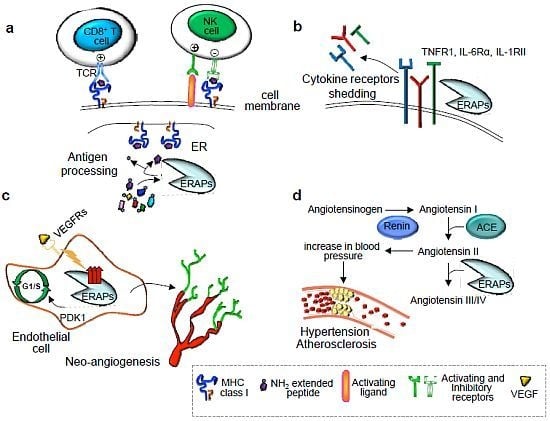
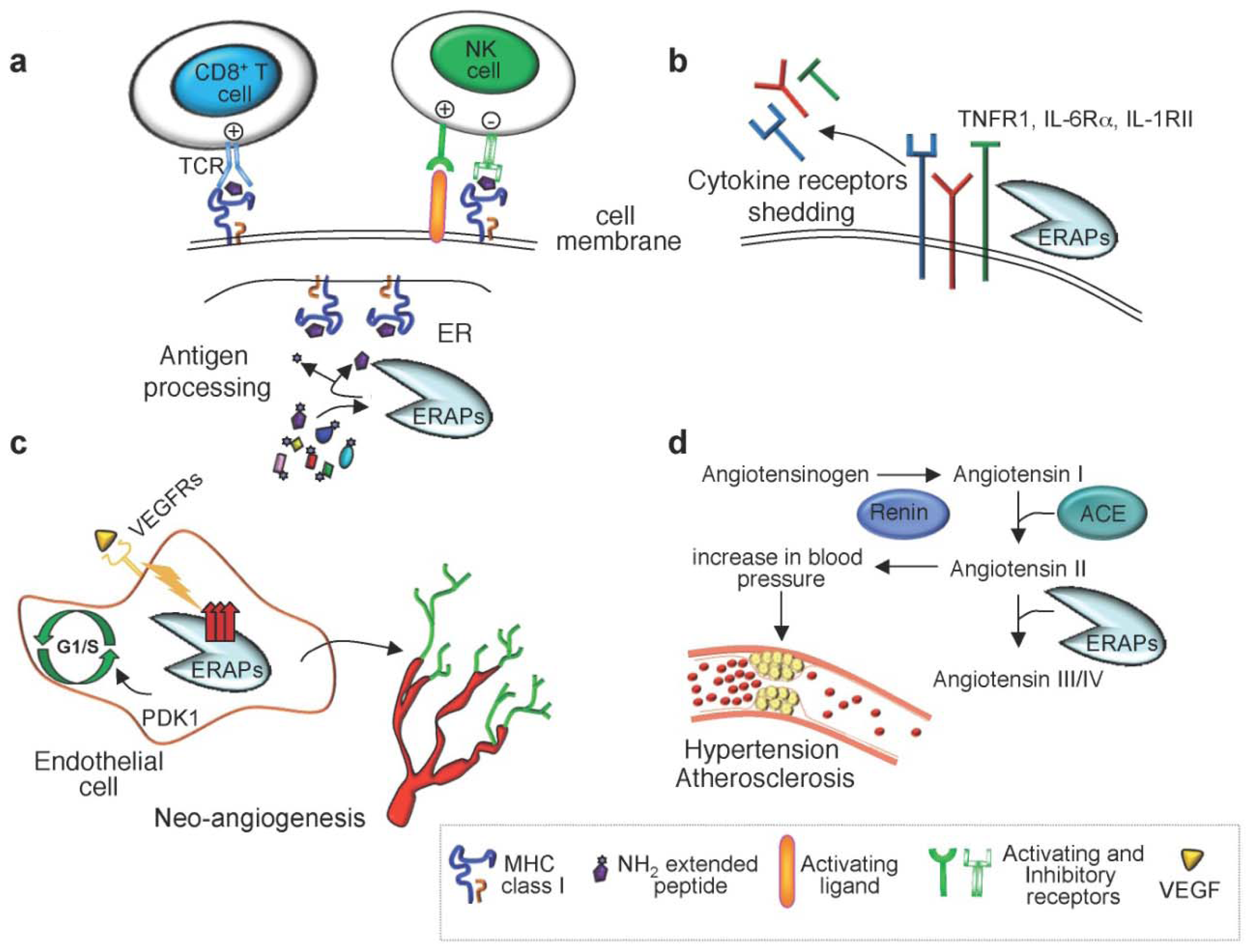
<p>ERAP enzymes trim amino acid residues from the NH<sub>2</sub> terminus of polypeptides playing an important role in various biological processes (<xref ref-type="fig" rid="f1-ijms-13-08338">Figure 1</xref>). In the ER, ERAP1 and ERAP2 cleave precursors to generate or destroy MHC class I binding peptides [<xref ref-type="bibr" rid="b5-ijms-13-08338">5</xref>,<xref ref-type="bibr" rid="b8-ijms-13-08338">8</xref>,<xref ref-type="bibr" rid="b9-ijms-13-08338">9</xref>]. ERAP1 has also been involved in regulation of innate immune and inflammatory responses by increasing the shedding of cytokine receptors [<xref ref-type="bibr" rid="b10-ijms-13-08338">10</xref>–<xref ref-type="bibr" rid="b12-ijms-13-08338">12</xref>]. In addition to these immunological functions, ERAP1 and ERAP2 have been implicated in the regulation of angiogenesis and blood pressure [<xref ref-type="bibr" rid="b6-ijms-13-08338">6</xref>,<xref ref-type="bibr" rid="b13-ijms-13-08338">13</xref>,<xref ref-type="bibr" rid="b14-ijms-13-08338">14</xref>]. According to these multifunctional properties, ERAP1 is also termed endoplasmic reticulum aminopeptidase associated with antigen processing (ERAAP), adipocyte-derived leucine aminopeptidase (A-LAP), puromycin-insensitive leucine-specific aminopeptidase (PILS-AP), or aminopeptidase regulating type I TNF receptor (TNFR1) shedding (ARTS-1), whereas ERAP2 is known as leukocyte-derived arginine aminopeptidase (L-RAP). The terms ERAP1 and ERAP2, approved by the Human Genome Organization Nomenclature Committee, will be used in this review.</p></sec>
<sec>
<title>2. Immunological Functions of ER Aminopeptidases</title>
<p>MHC class I binding peptides are generated by the antigen-processing pathway through a series of sequential steps [<xref ref-type="bibr" rid="b15-ijms-13-08338">15</xref>]. In the first step, endogenous proteins are degraded in the cytosol through the proteasome, a multicatalytic complex that generates fragments with hydrophobic or positively charged COOH-terminal anchor residues. Most of these fragments are further processed by cytosolic aminopeptidases, tripeptidyl peptidase II [<xref ref-type="bibr" rid="b16-ijms-13-08338">16</xref>–<xref ref-type="bibr" rid="b18-ijms-13-08338">18</xref>], leucine aminopeptidase [<xref ref-type="bibr" rid="b19-ijms-13-08338">19</xref>,<xref ref-type="bibr" rid="b20-ijms-13-08338">20</xref>], bleomycin hydrolase and puromycin-sensitive aminopeptidase [<xref ref-type="bibr" rid="b21-ijms-13-08338">21</xref>,<xref ref-type="bibr" rid="b22-ijms-13-08338">22</xref>], or directly translocated into the ER lumen by the transporter associated with antigen processing (TAP), an ATP-driven transporter well adapted for the transfer of these precursor peptides [<xref ref-type="bibr" rid="b23-ijms-13-08338">23</xref>]. In the ER, the NH<sub>2</sub> terminus of these peptides is further trimmed by ER aminopeptidases, <italic>i.e.</italic>, ERAP1 in mice and ERAP1 and ERAP2 in humans, to the proper length for binding to MHC class I molecules and presentation on the cell surface for recognition by NK cells and specific CD8<sup>+</sup> T cells (<xref ref-type="fig" rid="f1-ijms-13-08338">Figure 1a</xref>) [<xref ref-type="bibr" rid="b5-ijms-13-08338">5</xref>,<xref ref-type="bibr" rid="b8-ijms-13-08338">8</xref>,<xref ref-type="bibr" rid="b9-ijms-13-08338">9</xref>].</p>
<sec>
<title>2.1. Trimming of Antigenic Peptides by ER Aminopeptidases</title>
<p>ERAP1 efficiently trims peptides of 9–16 amino acids, the length of peptides efficiently transported into the ER by TAP, but spares the longer ones [<xref ref-type="bibr" rid="b24-ijms-13-08338">24</xref>]. Of note, its activity is substantially reduced for peptides with proline at position 2 (X-P-X<sub>n</sub>) [<xref ref-type="bibr" rid="b5-ijms-13-08338">5</xref>,<xref ref-type="bibr" rid="b25-ijms-13-08338">25</xref>], or for peptides with a size of 8 or 9 amino acids, the optimal length for binding to MHC class I molecules [<xref ref-type="bibr" rid="b24-ijms-13-08338">24</xref>]. ERAP1 shows a strong preference for peptides with large hydrophobic COOH-terminal residues [<xref ref-type="bibr" rid="b24-ijms-13-08338">24</xref>]. ERAP1 activity appears to be also affected by the nature of the internal residues of peptides. In particular, positions 2, 5 and 7 (with position 1 defined as the N-terminal residue of the peptide) were found to be the most important for the peptide sensitivity to ERAP1 degradation [<xref ref-type="bibr" rid="b26-ijms-13-08338">26</xref>]. Based on the analogies with TAP and MHC class I preferences, Chang <italic>et al.</italic> proposed the “molecular ruler” model for ERAP1 [<xref ref-type="bibr" rid="b24-ijms-13-08338">24</xref>], that suggests its role in facilitating antigen processing and presentation by trimming precursors transported by TAP to MHC class I binding peptides.</p>
<p>ERAP2 has been shown to cooperate with ERAP1 to trim a large variety of precursor peptides to generate mature epitopes for binding to MHC class I molecules [<xref ref-type="bibr" rid="b9-ijms-13-08338">9</xref>]. ERAP2 was found to have distinct specificities for the N-terminal residue of the peptide substrates and to physically associate with ERAP1. This complex is expected to be more efficient than single enzymes in dealing the large number of precursor peptides. To date, there are few studies regarding ERAP2 function.</p>
<p>The substantial contribution of ER peptide trimming to MHC class I antigen processing and presentation has been confirmed in mice lacking ERAP1 generated independently in four laboratories [<xref ref-type="bibr" rid="b27-ijms-13-08338">27</xref>–<xref ref-type="bibr" rid="b30-ijms-13-08338">30</xref>]. Although loss of ERAP1 had a relatively modest effect on the cell surface expression of most MHC class I molecules (a reduction of 20–40% for K<sup>b</sup> and D<sup>b</sup> class I molecules) [<xref ref-type="bibr" rid="b31-ijms-13-08338">31</xref>], immunization of ERAP1<sup>−/−</sup> mice with wild-type (wt) cells or <italic>vice versa</italic>, resulted in potent CD8<sup>+</sup> T cell responses, suggesting that loss of ERAP1 alters the peptide-MHC (pMHC) class I repertoire not only quantitatively but also qualitatively [<xref ref-type="bibr" rid="b27-ijms-13-08338">27</xref>]. Analysis of the individual peptides displayed on the cell surface with a panel of peptide-specific CD8<sup>+</sup> T cell hybridomas showed that ERAP1 deficiency left some peptides unaffected, whereas others were either absent or dramatically up-regulated [<xref ref-type="bibr" rid="b5-ijms-13-08338">5</xref>,<xref ref-type="bibr" rid="b27-ijms-13-08338">27</xref>–<xref ref-type="bibr" rid="b32-ijms-13-08338">32</xref>]. Consistent with these findings, mass spectrometry analysis of natural and viral peptides processed in mice lacking ERAP1, revealed that ERAP1 deficiency causes a marked increase in the length of peptides normally presented by MHC class I molecules [<xref ref-type="bibr" rid="b33-ijms-13-08338">33</xref>]. Thus, ERAP1 proteolysis determines the characteristic length, as well as the composition of MHC class I binding peptide in the ER.</p>
<p>In addition to classical MHC class I molecules, ERAP1<sup>−/−</sup> mice also exhibited defects in the surface expression of nonclassical MHC class I molecules Qa-2 and Qa-1<sup>b</sup>, which serve as ligands in both the innate and adaptive immune responses [<xref ref-type="bibr" rid="b28-ijms-13-08338">28</xref>]. Yan and collaborators found a significant reduction of the nonclassical class I molecules Qa-2 in ERAP1-deficient splenocytes and dendritic cells as compared with wt cells. Although ERAP1 did not significantly affect the surface expression of Qa-1 molecules, presentation of Qdm, an epitope derived from the signal sequence of classical MHC class I molecules, to Qa-1-restricted CTLs was impaired, suggesting that ERAP1 activity is required for the generation of this epitope. Thus, it is conceivable that reduced ERAP1 function may represent a rate-limiting step in presenting Qdm peptide to Qa-1<sup>b</sup>-restricted CD8<sup>+</sup> T cells or NK cells expressing CD94/NKG2 receptors.</p>
<p>More recently, a new naturally processed Qa-1<sup>b</sup> epitope (FL9) derived from the Fam49b protein, has been identified in cells lacking ERAP1 activity by Shastri and colleagues [<xref ref-type="bibr" rid="b34-ijms-13-08338">34</xref>]. Unlike the Qa-1<sup>b</sup>-Qdm complex, Qa-1<sup>b</sup>-FL9 is an immunodominant ligand recognized by CD8<sup>+</sup> T cells derived from wt mice immunized with ERAP1 deficient cells. The authors found an abundant fraction of CD8<sup>+</sup> T cells specific for the Qa-1<sup>b</sup>-FL9 complex in naive wt mice able to proliferate and efficiently eliminate ERAP1-deficient cells.</p></sec>
<sec>
<title>2.2. Cytokine Receptor Shedding</title>
<p>In addition to antigen processing, ERAP1 has been shown to promote the cleavage of several cytokine cell surface receptors (<xref ref-type="fig" rid="f1-ijms-13-08338">Figure 1b</xref>) [<xref ref-type="bibr" rid="b10-ijms-13-08338">10</xref>–<xref ref-type="bibr" rid="b12-ijms-13-08338">12</xref>]. Cui <italic>et al.</italic> demonstrated that ERAP1 binds to the extracellular domain of the TNFR1, facilitating TNFR1 shedding through the formation of a TNFR1/ERAP1 complex. The authors showed that overexpression of ERAP1 produces soluble TNFR1 that competes with cell-surface TNF receptors, thereby attenuating TNFα bioactivity when the levels are elevated, and reconstituting TNFα when the levels have declined [<xref ref-type="bibr" rid="b10-ijms-13-08338">10</xref>]. However, several evidences demonstrated that ERAP1 is not required to be catalytically active for this function. Coimmunoprecipitation experiments revealed that ERAP1 can bind to, but not cleave TNFR1. Moreover, ERAP1 does not possess endopeptidase activity and overexpression of ERAP1 catalytic mutants results in an increased TNFR1 shedding. Thus, ERAP1 does not directly catalyze TNFR1 shedding, but may instead promote the activity of a TNFR1 sheddase.</p>
<p>Subsequently, the same authors showed that ERAP1 modulates the proteolytic cleavage of two other cytokine receptors, the type I IL-6 cytokine receptor (IL-6Rα) [<xref ref-type="bibr" rid="b12-ijms-13-08338">12</xref>] and the type II IL-1 decoy receptor (IL-1RII) [<xref ref-type="bibr" rid="b11-ijms-13-08338">11</xref>]. Based on these functions, ERAP1 has been proposed to play an important role in regulating innate and inflammatory immune responses by increasing the shedding of these cytokine receptors.</p></sec></sec>
<sec>
<title>3. Nonimmunological Functions of ER Aminopeptidases</title>
<p>ERAP1 and ERAP2 are thought to play a role in the regulation of blood pressure through their involvement in the renin-angiotensin system (<xref ref-type="fig" rid="f1-ijms-13-08338">Figure 1d</xref>). <italic>In vitro</italic> studies using Chinese Hamster Ovary cells demonstrated that ERAP1 efficiently cleaves angiotensin II to angiotensin III and IV [<xref ref-type="bibr" rid="b14-ijms-13-08338">14</xref>], while ERAP2 cleaves angiotensin III to angiotensin IV [<xref ref-type="bibr" rid="b6-ijms-13-08338">6</xref>]. In the same system, both enzymes were shown to convert kallidin to bradykinin [<xref ref-type="bibr" rid="b6-ijms-13-08338">6</xref>,<xref ref-type="bibr" rid="b14-ijms-13-08338">14</xref>].</p>
<p>In addition, ERAP1 has been reported to control post-natal neo-angiogenesis, a physiological process involving the growth of new blood vessels from pre-existing microvessels, by regulating the proliferation and migration of endothelial cells (EC) (<xref ref-type="fig" rid="f1-ijms-13-08338">Figure 1c</xref>) [<xref ref-type="bibr" rid="b35-ijms-13-08338">35</xref>–<xref ref-type="bibr" rid="b39-ijms-13-08338">39</xref>]. Functional studies revealed that ERAP1 is expressed in ECs during differentiation <italic>in vitro</italic> and at the site of angiogenesis <italic>in vivo</italic> upon stimulation with vascular endothelial growth factor (VEGF) [<xref ref-type="bibr" rid="b35-ijms-13-08338">35</xref>]. Suppression of ERAP1 expression in ECs inhibited VEGF-stimulated proliferation, migration and vessel network formation <italic>in vitro</italic> and angiogenesis <italic>in vivo</italic> [<xref ref-type="bibr" rid="b35-ijms-13-08338">35</xref>]. The authors also demonstrated that ERAP1 regulates VEGF-stimulated G1/S transition during EC proliferation by binding to phosphatidylinositol-dependent kinase 1 (PDK1). Formation of the ERAP1-PDK1-S6 kinase complex resulted in activation of cyclin-dependent kinase (CDK) 4/6 by phosphorylated S6K that promotes G1/S-phase transition leading to EC proliferation [<xref ref-type="bibr" rid="b37-ijms-13-08338">37</xref>]. It was also demonstrated that ERAP1 controls the spreading of ECs by activating endothelial integrins and focal adhesion kinase [<xref ref-type="bibr" rid="b36-ijms-13-08338">36</xref>], increasing EC adhesion to the extracellular matrix via RhoA activation [<xref ref-type="bibr" rid="b38-ijms-13-08338">38</xref>]. More recently, ERAP1 has also been shown to bind pigpen, a nuclear coiled body component protein involved in angiogenesis [<xref ref-type="bibr" rid="b39-ijms-13-08338">39</xref>,<xref ref-type="bibr" rid="b40-ijms-13-08338">40</xref>]. However, how pigpen interacts with ERAP1 to promote angiogenesis and whether pigpen is a substrate for ERAP1 remain to be established.</p></sec>
<sec>
<title>4. Alteration of ERAP Functions in Human Diseases</title>
<p>ERAP1 and ERAP2 are highly polymorphic genes. Naturally occurring single nucleotide polymorphisms (SNPs) have been found to correlate with several pathological conditions [<xref ref-type="bibr" rid="b41-ijms-13-08338">41</xref>–<xref ref-type="bibr" rid="b43-ijms-13-08338">43</xref>]. Because of the role of these enzymes in MHC class I antigen presentation and in all other biological processes, it is conceivable that variations impairing the presentation of pathogen-derived peptides might lead to inadequate immune responses and development of disease. Recent studies that investigated the possible role of ER aminopeptidases in human diseases are summarized below.</p>
<sec>
<title>4.1. Hypertension</title>
<p>By screening for 33 polymorphisms in the human ERAP1 gene, Yamamoto <italic>et al.</italic> identified the association of ERAP1 variant rs30187 (K528R) with essential hypertension and hypothesized that the R528 form of ERAP1 was less active than the K528 form, leading to hypertension due to reduced bradykinin formation and/or lower inactivation of angiotensin II (<xref ref-type="fig" rid="f1-ijms-13-08338">Figure 1d</xref>) [<xref ref-type="bibr" rid="b43-ijms-13-08338">43</xref>]. This variant was shown to reduce by 60% the efficiency of ERAP1 to cleave angiotensin II to angiotensin III and by 70% to convert kallidin into bradykinin [<xref ref-type="bibr" rid="b44-ijms-13-08338">44</xref>]. The ERAP1 rs30187 variant was also found to determine the degree of regression of left ventricular hypertrophy during anti-hypertensive treatment in patients with essential hypertension [<xref ref-type="bibr" rid="b45-ijms-13-08338">45</xref>]. The same variant was also associated with haemolytic uremic syndrome (HUS), a disorder characterized by thrombotic microangiopathy frequently caused by gastrointestinal infections with <italic>Escherichia coli</italic> that produce verotoxins or Shiga toxins [<xref ref-type="bibr" rid="b42-ijms-13-08338">42</xref>].</p>
<p>More recently, variants of ERAP1 and ERAP2 have been found to be associated with an increased risk of preeclampsia, a heritable pregnancy specific disorder characterized by new-onset hypertension and proteinuria [<xref ref-type="bibr" rid="b46-ijms-13-08338">46</xref>,<xref ref-type="bibr" rid="b47-ijms-13-08338">47</xref>]. Of note, ERAP2 expression was previously found altered in first trimester placentas of women prone to develop preeclampsia [<xref ref-type="bibr" rid="b48-ijms-13-08338">48</xref>].</p></sec>
<sec>
<title>4.2. Bacterial and Viral Infections</title>
<p>The first evidence demonstrating that ERAP1 can act as a “susceptibility factor” for an infectious organism derived from the observation that ERAP1-deficient mice are not able to process the immunodominant decapeptide HF10 of <italic>Toxoplasma gondii</italic> and die from overwhelming infection when challenged with this pathogen [<xref ref-type="bibr" rid="b49-ijms-13-08338">49</xref>].</p>
<p>ERAP1 plays an important role in immune response to viruses, either enhancing or reducing CD8<sup>+</sup> T-cell responses to particular viral epitopes. ERAP1-deficient or wt mice infected with lymphocytic choriomeningitis virus (LCMV) showed profound differences in the frequency of CD8<sup>+</sup> T cells specific for particular LCMV peptides [<xref ref-type="bibr" rid="b30-ijms-13-08338">30</xref>]. In wt mice the magnitude of T-cell responses to different LCMV epitopes followed a hierarchy of immunodominance that is markedly changed in the ERAP1-deficient mice [<xref ref-type="bibr" rid="b30-ijms-13-08338">30</xref>].</p>
<p>Draenert <italic>et al.</italic> reported the first evidence that escape mutations arising in flanking regions of a human immunodeficiency virus (HIV) epitope alter antigen processing mediated by ERAP1 [<xref ref-type="bibr" rid="b50-ijms-13-08338">50</xref>]. The authors showed that in HLA-B57<sup>+</sup>-HIV infected individuals, immune selection pressure leads to a mutation from alanine to proline at residue 146 of HIV Gag protein immediately before the NH<sub>2</sub> terminus of a dominant HLA-B57-restricted CTL epitope. This mutation was found to prevent the NH<sub>2</sub>-terminal cleavage by ERAP1, resulting in decreased CTL responses [<xref ref-type="bibr" rid="b50-ijms-13-08338">50</xref>]. Of note, it was demonstrated that antigen processing shapes CTL response hierarchies, and that HIV evolution modifies cleavage patterns influencing proteasomal cleavage and, hence, the likelihood of CTL responses toward all epitopes [<xref ref-type="bibr" rid="b51-ijms-13-08338">51</xref>]. Interestingly, some variants in ERAP2 have been shown to confer resistance to HIV-1 infection possibly via the presentation of a distinctive peptide repertoire to CD8<sup>+</sup> T cells [<xref ref-type="bibr" rid="b52-ijms-13-08338">52</xref>].</p>
<p>Similarly, in cervical carcinoma induced by persistent infection and malignant transformation of the uterine cervical epithelium by human papillomavirus (HPV), increased cancer metastasis and decreased survival have been reported to be associated with several variants of ERAP1. In this case, down-regulation of ERAP1 may lead to the preferential loading and presentation of non tumor-associated or non HPV-associated peptides, thereby yielding a less immunogenic phenotype and facilitating tumor growth and progression [<xref ref-type="bibr" rid="b53-ijms-13-08338">53</xref>].</p>
<p>Recently, ERAP1 has been identified as a host target of human cytomegalovirus (HCMV) microRNA miR-US4–1, demonstrating a previously unknown miRNA-based immunoevasion strategy [<xref ref-type="bibr" rid="b54-ijms-13-08338">54</xref>]. Viral miR-US4–1 interferes with MHC class I-mediated antigen presentation by targeting ERAP1, thereby influencing the production of many HCMV-derived antigenic peptides during viral infection, which results in immunoevasion of the recognition of viral antigen by CD8<sup>+</sup> T cells during the host immune response [<xref ref-type="bibr" rid="b54-ijms-13-08338">54</xref>].</p></sec>
<sec>
<title>4.3. Autoimmune Diseases</title>
<p>Recent genome-wide association studies (GWAS) have proven the importance of ERAP1 and ERAP2 genes in conferring susceptibility of individuals to different autoimmune diseases and their linkage with particular MHC class I alleles [<xref ref-type="bibr" rid="b41-ijms-13-08338">41</xref>].</p>
<p>The first GWAS realized by the Wellcome Trust Case Control Consortium and the Austro-Anglo-American Spondylitis Consortium has revealed that 26% of the overall risk to develop ankylosing spondylitis (AS) is accounted for by ERAP1 [<xref ref-type="bibr" rid="b55-ijms-13-08338">55</xref>]. The association between AS and ERAP1 variants has been subsequently replicated in other GWAS and several case-control independent studies in Caucasian and Mongolian populations [<xref ref-type="bibr" rid="b56-ijms-13-08338">56</xref>–<xref ref-type="bibr" rid="b59-ijms-13-08338">59</xref>]. More recently the association with the variant rs30187 has been exclusively found in the cohort of HLA-B27-positive AS patients [<xref ref-type="bibr" rid="b60-ijms-13-08338">60</xref>,<xref ref-type="bibr" rid="b61-ijms-13-08338">61</xref>]. Of note, the disease-associated ERAP1 variant rs30187 (K528) had faster rate of trimming of peptide precursors than protective ERAP1 variant [<xref ref-type="bibr" rid="b60-ijms-13-08338">60</xref>,<xref ref-type="bibr" rid="b62-ijms-13-08338">62</xref>]. Taken together, these findings support a model in which aberrant peptide trimming by ERAP1 and, as consequence, impaired peptide presentation by HLA-B27 are involved in the AS pathogenesis [<xref ref-type="bibr" rid="b60-ijms-13-08338">60</xref>].</p>
<p>Of note, the functional ERAP1 variant (rs30187) linked to AS, hypertension and HUS was associated with type 1 diabetes and multiple sclerosis [<xref ref-type="bibr" rid="b63-ijms-13-08338">63</xref>,<xref ref-type="bibr" rid="b64-ijms-13-08338">64</xref>]. No evidence for an interaction between ERAP1 and MHC class I was observed in diabetic patients [<xref ref-type="bibr" rid="b63-ijms-13-08338">63</xref>]. Two other recent GWAS identified ERAP1 as a new psoriasis susceptibility locus and evidence of an interaction between <italic>HLA-C*06:02</italic> and <italic>ERAP1</italic> was reported [<xref ref-type="bibr" rid="b65-ijms-13-08338">65</xref>,<xref ref-type="bibr" rid="b66-ijms-13-08338">66</xref>]. Both studied revealed that ERAP1 influences psoriasis susceptibility only in individuals carrying the <italic>HLA-C</italic> risk allele. A recent meta-analysis of six Crohn’s disease GWAS identified ERAP2 as one of the most interesting candidate genes [<xref ref-type="bibr" rid="b67-ijms-13-08338">67</xref>].</p></sec>
<sec>
<title>4.4. Cancer</title>
<p>The expression and tissue distribution of ERAP1 and ERAP2 have been evaluated in a large number of tumor cells of lymphoid and non-lymphoid origin compared to their normal counterparts [<xref ref-type="bibr" rid="b68-ijms-13-08338">68</xref>–<xref ref-type="bibr" rid="b71-ijms-13-08338">71</xref>]. We found that ERAP1 and ERAP2 were expressed in essentially all tumor cell lines examined (melanomas, leukemia-lymphomas and carcinomas of breast, colon, lung, chorion, skin, prostate, cervix, kidney and bladder) at highly variable levels and independently of each other [<xref ref-type="bibr" rid="b68-ijms-13-08338">68</xref>]. MHC class I surface expression was significantly correlated with ERAP1, but not with ERAP2, suggesting that ERAP1 has a dominant role in the generation of MHC class I epitopes [<xref ref-type="bibr" rid="b68-ijms-13-08338">68</xref>]. In a subsequent study, ERAP1 and ERAP2 were investigated in a large panel of surgically removed normal and neoplastic tissues. In approximately 150 neoplastic lesions, the expression of either or both enzymes was lost, acquired or retained as compared to the normal counterparts, depending on the tumor histotype [<xref ref-type="bibr" rid="b69-ijms-13-08338">69</xref>]. Down-regulation of ERAP1 and/or ERAP2 expression was mainly detected in ovary, breast and lung carcinomas, whereas an up-regulation of these enzymes was observed in colon and thyroid carcinomas [<xref ref-type="bibr" rid="b69-ijms-13-08338">69</xref>]. Of note, ERAP1 and MHC class I were co-ordinately expressed in normal and, to a lesser extent, neoplastic lesions. As expected, the altered expression of ERAPs results in abnormal cell surface expression of MHC class I molecules in tumor cell lines [<xref ref-type="bibr" rid="b68-ijms-13-08338">68</xref>]. In the most aggressive type of neuroblastoma cells, ERAP1, ERAP2 as well as MHC class I molecules were expressed at very low levels as consequence of a poor constitutive NF-kB nuclear activity [<xref ref-type="bibr" rid="b7-ijms-13-08338">7</xref>].</p>
<p>In a recent study, heterogeneous expression of ERAP1 and ERAP2, ranging from high to very low levels, was detected in 28 melanoma cell lines as compared to primary melanocytes [<xref ref-type="bibr" rid="b70-ijms-13-08338">70</xref>]. In most cases, expression of these genes was enhanced by IFN-γ treatment, suggesting that it is under control of regulatory mechanisms and that only in rare cases to abnormalities in their sequences [<xref ref-type="bibr" rid="b70-ijms-13-08338">70</xref>].</p>
<p>Expression of ERAP1 has been detected in 64% of endometrial carcinomas and correlated with CA-125 levels, suggesting a role of this enzyme in endometrial cancer cell growth and differentiation [<xref ref-type="bibr" rid="b71-ijms-13-08338">71</xref>–<xref ref-type="bibr" rid="b73-ijms-13-08338">73</xref>]. The authors also showed that ERAP1 suppresses angiogenesis and endothelial cell migration in human endometrial carcinoma by regulating the angiotensin II concentration [<xref ref-type="bibr" rid="b72-ijms-13-08338">72</xref>].</p>
<p>As stated before, variants of ERAP1 have been associated with decreased survival in cervical carcinoma, with ERAP1 loss being an independent predictor for survival, possibly due to the role of ERAP1 as a key determinant of the repertoire of MHC class I-presented peptides [<xref ref-type="bibr" rid="b53-ijms-13-08338">53</xref>,<xref ref-type="bibr" rid="b74-ijms-13-08338">74</xref>].</p>
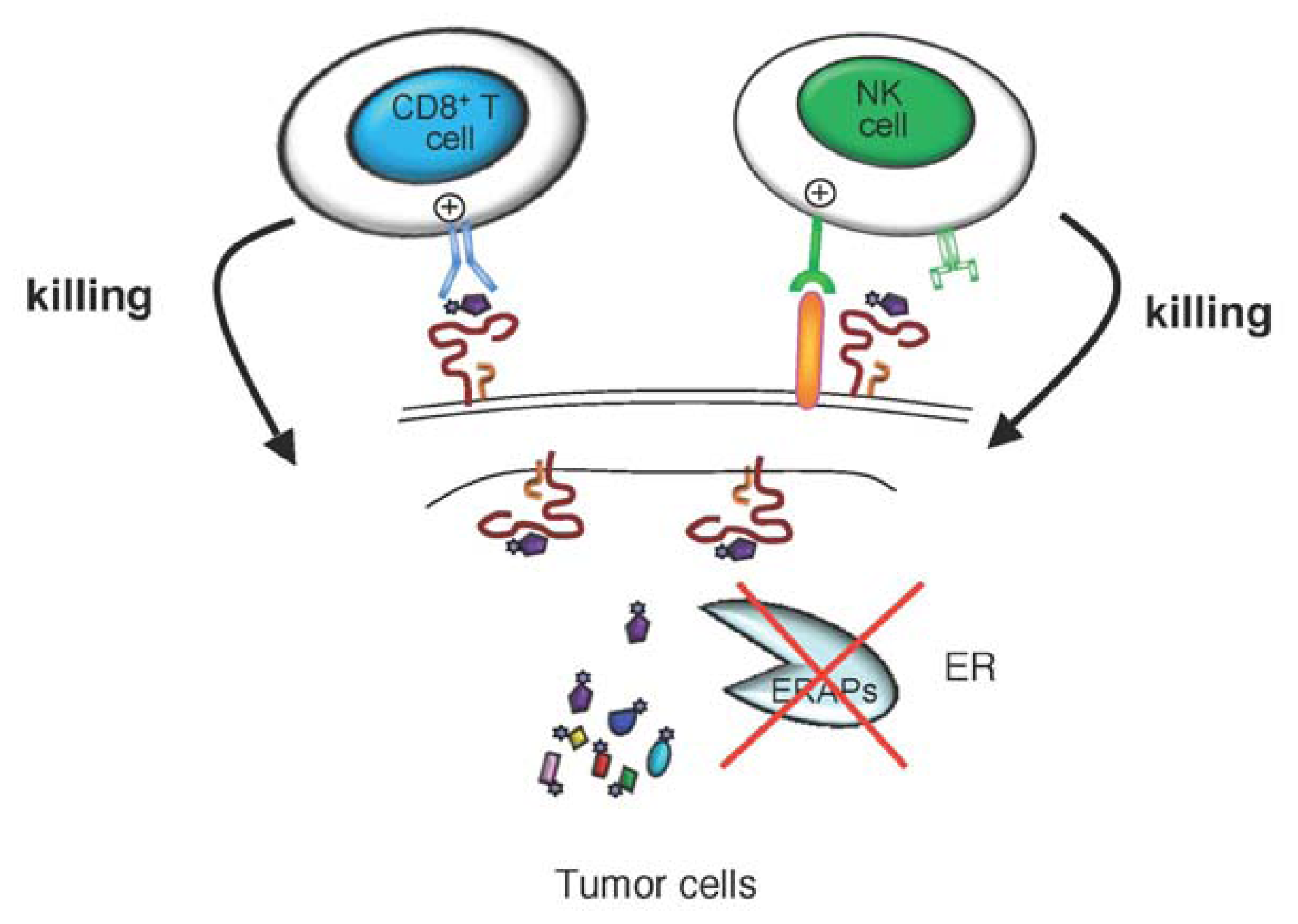
<p>All these findings suggest that aberrant expression of ERAP1 may contribute to escape from immune surveillance. To evaluate the relevance of the ER peptide trimming inhibition on tumorigenicity, we stably reduced ERAP1 expression in a murine T-cell lymphoma by ERAP1-targeted small interfering RNA. We demonstrated that interfering with ERAP1 expression ultimately leads to tumor rejection in syngeneic animals by boosting NK cell-, and subsequently T cell-mediated cytolysis (<xref ref-type="fig" rid="f2-ijms-13-08338">Figure 2</xref>) [<xref ref-type="bibr" rid="b75-ijms-13-08338">75</xref>]. This rejection was mainly due to NK cell response and depends on the MHC class I peptides presented by ERAP1-silenced tumor cells, because replacement of the endogenous peptides with high-affinity peptides was sufficient to restore an NK protective effect of MHC class I through the NK inhibitory receptor Ly49C/I. In spite of the relatively modest impact on overall MHC class I expression, we demonstrated that ERAP1 inhibition was able to shift the balance between activating and inhibitory signals towards NK cell activation resulting in target cell killing [<xref ref-type="bibr" rid="b75-ijms-13-08338">75</xref>]. Thus, this was the first demonstration that tampering with ERAP1 activity via reduction of its expression can result in increased tumor immunogenicity <italic>in vivo</italic>, and may represent a novel pathway for anti-cancer therapeutic exploitation.</p></sec></sec>
<sec sec-type="conclusions">
<title>5. Conclusions</title>
<p>In this review, we have briefly summarized the recent knowledge on the biology of ERAP1 and ERAP2 enzymes and their possible links to human diseases.</p>
<p>In autoimmune diseases, association with HLA-class I risk alleles and their interaction with ERAP1 implicates aberrant ER peptide trimming leading to altered peptide presentation as the pathogenic mechanism. Additional functional studies are necessary in order to provide evidence on how ERAPs variants can affect disease predisposition and pathogenesis.</p>
<p>Loss of ERAP1 function has also been shown to substantially affect the presentation of epitopes by classical and nonclassical MHC class I molecules, probably contributing in some cases to the maintenance of chronic infection. In tumor cells, inhibition of ERAP1 expression has been shown to modify tumor immunogenicity by shifting the balance of activating and inhibitory signals towards NK cell activation resulting in target cell killing [<xref ref-type="bibr" rid="b75-ijms-13-08338">75</xref>]. In contrast, the same mechanism was not shown in healthy cells lacking NK cell activating ligands such as splenocytes [<xref ref-type="bibr" rid="b34-ijms-13-08338">34</xref>]. Based on these findings, it will be of interest to determine whether in humans, as previously shown in mice, manipulation of ERAPs could induce immune-mediated control of cancer. Thus, the possibility of targeting ERAPs through pharmacological or genetic modifications should be considered in order to provide novel anti-tumor immunotherapies.</p></sec></body>
<back>
<ack>
<title>Acknowledgments</title>
<p>This work was supported by the IG grant AIRC (Associazione Italiana per la Ricerca sul Cancro) to D.F. and partly supported by the special project 5 × 1000 from AIRC to F.L.</p></ack>
<ref-list>
<title>References</title>
<ref id="b1-ijms-13-08338"><label>1</label><citation citation-type="journal"><person-group person-group-type="author"><name><surname>Hattori</surname><given-names>A.</given-names></name><name><surname>Matsumoto</surname><given-names>H.</given-names></name><name><surname>Mizutani</surname><given-names>S.</given-names></name><name><surname>Tsujimoto</surname><given-names>M.</given-names></name></person-group><article-title>Molecular cloning of adipocyte-derived leucine aminopeptidase highly related to placental leucine aminopeptidase/oxytocinase</article-title><source>J. Biochem</source><year>1999</year><volume>125</volume><fpage>931</fpage><lpage>938</lpage><pub-id pub-id-type="doi">10.1093/oxfordjournals.jbchem.a022371</pub-id><pub-id pub-id-type="pmid">10220586</pub-id></citation></ref>
<ref id="b2-ijms-13-08338"><label>2</label><citation citation-type="web"><person-group person-group-type="author"><name><surname>Andres</surname><given-names>A.M.</given-names></name><name><surname>Dennis</surname><given-names>M.Y.</given-names></name><name><surname>Kretzschmar</surname><given-names>W.W.</given-names></name><name><surname>Cannons</surname><given-names>J.L.</given-names></name><name><surname>Lee-Lin</surname><given-names>S.Q.</given-names></name><name><surname>Hurle</surname><given-names>B.</given-names></name><name><surname>Schwartzberg</surname><given-names>P.L.</given-names></name><name><surname>Williamson</surname><given-names>S.H.</given-names></name><name><surname>Bustamante</surname><given-names>C.D.</given-names></name><name><surname>Nielsen</surname><given-names>R.</given-names></name><etal/></person-group><article-title>Balancing selection maintains a form of ERAP2 that undergoes nonsense-mediated decay and affects antigen presentation</article-title><source>PLoS Genet</source><year>2010</year><volume>6</volume><fpage>e1001157</fpage><comment>Available online: <ext-link xlink:href="http://www.plosgenetics.org/article/info%3Adoi%2F10.1371%2Fjournal.pgen.1001157" ext-link-type="uri">http://www.plosgenetics.org/article/info%3Adoi%2F10.1371%2Fjournal.pgen.1001157</ext-link></comment><access-date>accessed on 29 June 2012</access-date></citation></ref>
<ref id="b3-ijms-13-08338"><label>3</label><citation citation-type="journal"><person-group person-group-type="author"><name><surname>Saric</surname><given-names>T.</given-names></name><name><surname>Chang</surname><given-names>S.C.</given-names></name><name><surname>Hattori</surname><given-names>A.</given-names></name><name><surname>York</surname><given-names>I.A.</given-names></name><name><surname>Markant</surname><given-names>S.</given-names></name><name><surname>Rock</surname><given-names>K.L.</given-names></name><name><surname>Tsujimoto</surname><given-names>M.</given-names></name><name><surname>Goldberg</surname><given-names>A.L.</given-names></name></person-group><article-title>An IFN-gamma-induced aminopeptidase in the ER, ERAP1, trims precursors to MHC class I-presented peptides</article-title><source>Nat. Immunol</source><year>2002</year><volume>3</volume><fpage>1169</fpage><lpage>1176</lpage><pub-id pub-id-type="doi">10.1038/ni859</pub-id><pub-id pub-id-type="pmid">12436109</pub-id></citation></ref>
<ref id="b4-ijms-13-08338"><label>4</label><citation citation-type="journal"><person-group person-group-type="author"><name><surname>Shin</surname><given-names>E.C.</given-names></name><name><surname>Seifert</surname><given-names>U.</given-names></name><name><surname>Urban</surname><given-names>S.</given-names></name><name><surname>Truong</surname><given-names>K.T.</given-names></name><name><surname>Feinstone</surname><given-names>S.M.</given-names></name><name><surname>Rice</surname><given-names>C.M.</given-names></name><name><surname>Kloetzel</surname><given-names>P.M.</given-names></name><name><surname>Rehermann</surname><given-names>B.</given-names></name></person-group><article-title>Proteasome activator and antigen-processing aminopeptidases are regulated by virus-induced type I interferon in the hepatitis C virus-infected liver</article-title><source>J. Interferon Cytokine Res</source><year>2007</year><volume>27</volume><fpage>985</fpage><lpage>990</lpage><pub-id pub-id-type="pmid">18184038</pub-id></citation></ref>
<ref id="b5-ijms-13-08338"><label>5</label><citation citation-type="journal"><person-group person-group-type="author"><name><surname>Serwold</surname><given-names>T.</given-names></name><name><surname>Gonzalez</surname><given-names>F.</given-names></name><name><surname>Kim</surname><given-names>J.</given-names></name><name><surname>Jacob</surname><given-names>R.</given-names></name><name><surname>Shastri</surname><given-names>N.</given-names></name></person-group><article-title>ERAAP customizes peptides for MHC class I molecules in the endoplasmic reticulum</article-title><source>Nature</source><year>2002</year><volume>419</volume><fpage>480</fpage><lpage>483</lpage><pub-id pub-id-type="doi">10.1038/nature01074</pub-id><pub-id pub-id-type="pmid">12368856</pub-id></citation></ref>
<ref id="b6-ijms-13-08338"><label>6</label><citation citation-type="journal"><person-group person-group-type="author"><name><surname>Tanioka</surname><given-names>T.</given-names></name><name><surname>Hattori</surname><given-names>A.</given-names></name><name><surname>Masuda</surname><given-names>S.</given-names></name><name><surname>Nomura</surname><given-names>Y.</given-names></name><name><surname>Nakayama</surname><given-names>H.</given-names></name><name><surname>Mizutani</surname><given-names>S.</given-names></name><name><surname>Tsujimoto</surname><given-names>M.</given-names></name></person-group><article-title>Human leukocyte-derived arginine aminopeptidase. The third member of the oxytocinase subfamily of aminopeptidases</article-title><source>J. Biol. Chem</source><year>2003</year><volume>278</volume><fpage>32275</fpage><lpage>32283</lpage><pub-id pub-id-type="doi">10.1074/jbc.M305076200</pub-id><pub-id pub-id-type="pmid">12799365</pub-id></citation></ref>
<ref id="b7-ijms-13-08338"><label>7</label><citation citation-type="journal"><person-group person-group-type="author"><name><surname>Forloni</surname><given-names>M.</given-names></name><name><surname>Albini</surname><given-names>S.</given-names></name><name><surname>Limongi</surname><given-names>M.Z.</given-names></name><name><surname>Cifaldi</surname><given-names>L.</given-names></name><name><surname>Boldrini</surname><given-names>R.</given-names></name><name><surname>Nicotra</surname><given-names>M.R.</given-names></name><name><surname>Giannini</surname><given-names>G.</given-names></name><name><surname>Natali</surname><given-names>P.G.</given-names></name><name><surname>Giacomini</surname><given-names>P.</given-names></name><name><surname>Fruci</surname><given-names>D.</given-names></name></person-group><article-title>NF-kappaB, and not MYCN, regulates MHC class I and endoplasmic reticulum aminopeptidases in human neuroblastoma cells</article-title><source>Cancer Res</source><year>2010</year><volume>70</volume><fpage>916</fpage><lpage>924</lpage><pub-id pub-id-type="doi">10.1158/0008-5472.CAN-09-2582</pub-id><pub-id pub-id-type="pmid">20103633</pub-id></citation></ref>
<ref id="b8-ijms-13-08338"><label>8</label><citation citation-type="journal"><person-group person-group-type="author"><name><surname>York</surname><given-names>I.A.</given-names></name><name><surname>Chang</surname><given-names>S.C.</given-names></name><name><surname>Saric</surname><given-names>T.</given-names></name><name><surname>Keys</surname><given-names>J.A.</given-names></name><name><surname>Favreau</surname><given-names>J.M.</given-names></name><name><surname>Goldberg</surname><given-names>A.L.</given-names></name><name><surname>Rock</surname><given-names>K.L.</given-names></name></person-group><article-title>The ER aminopeptidase ERAP1 enhances or limits antigen presentation by trimming epitopes to 8–9 residues</article-title><source>Nat. Immunol</source><year>2002</year><volume>3</volume><fpage>1177</fpage><lpage>1184</lpage><pub-id pub-id-type="doi">10.1038/ni860</pub-id><pub-id pub-id-type="pmid">12436110</pub-id></citation></ref>
<ref id="b9-ijms-13-08338"><label>9</label><citation citation-type="journal"><person-group person-group-type="author"><name><surname>Saveanu</surname><given-names>L.</given-names></name><name><surname>Carroll</surname><given-names>O.</given-names></name><name><surname>Lindo</surname><given-names>V.</given-names></name><name><surname>Del Val</surname><given-names>M.</given-names></name><name><surname>Lopez</surname><given-names>D.</given-names></name><name><surname>Lepelletier</surname><given-names>Y.</given-names></name><name><surname>Greer</surname><given-names>F.</given-names></name><name><surname>Schomburg</surname><given-names>L.</given-names></name><name><surname>Fruci</surname><given-names>D.</given-names></name><name><surname>Niedermann</surname><given-names>G.</given-names></name><etal/></person-group><article-title>Concerted peptide trimming by human ERAP1 and ERAP2 aminopeptidase complexes in the endoplasmic reticulum</article-title><source>Nat. Immunol</source><year>2005</year><volume>6</volume><fpage>689</fpage><lpage>697</lpage><pub-id pub-id-type="pmid">15908954</pub-id></citation></ref>
<ref id="b10-ijms-13-08338"><label>10</label><citation citation-type="journal"><person-group person-group-type="author"><name><surname>Cui</surname><given-names>X.</given-names></name><name><surname>Hawari</surname><given-names>F.</given-names></name><name><surname>Alsaaty</surname><given-names>S.</given-names></name><name><surname>Lawrence</surname><given-names>M.</given-names></name><name><surname>Combs</surname><given-names>C.A.</given-names></name><name><surname>Geng</surname><given-names>W.</given-names></name><name><surname>Rouhani</surname><given-names>F.N.</given-names></name><name><surname>Miskinis</surname><given-names>D.</given-names></name><name><surname>Levine</surname><given-names>S.J.</given-names></name></person-group><article-title>Identification of ARTS-1 as a novel TNFR1-binding protein that promotes TNFR1 ectodomain shedding</article-title><source>J. Clin. Invest</source><year>2002</year><volume>110</volume><fpage>515</fpage><lpage>526</lpage><pub-id pub-id-type="pmid">12189246</pub-id></citation></ref>
<ref id="b11-ijms-13-08338"><label>11</label><citation citation-type="journal"><person-group person-group-type="author"><name><surname>Cui</surname><given-names>X.</given-names></name><name><surname>Rouhani</surname><given-names>F.N.</given-names></name><name><surname>Hawari</surname><given-names>F.</given-names></name><name><surname>Levine</surname><given-names>S.J.</given-names></name></person-group><article-title>Shedding of the type II IL-1 decoy receptor requires a multifunctional aminopeptidase, aminopeptidase regulator of TNF receptor type 1 shedding</article-title><source>J. Immunol</source><year>2003</year><volume>171</volume><fpage>6814</fpage><lpage>6819</lpage><pub-id pub-id-type="pmid">14662887</pub-id></citation></ref>
<ref id="b12-ijms-13-08338"><label>12</label><citation citation-type="journal"><person-group person-group-type="author"><name><surname>Cui</surname><given-names>X.</given-names></name><name><surname>Rouhani</surname><given-names>F.N.</given-names></name><name><surname>Hawari</surname><given-names>F.</given-names></name><name><surname>Levine</surname><given-names>S.J.</given-names></name></person-group><article-title>An aminopeptidase, ARTS-1, is required for interleukin-6 receptor shedding</article-title><source>J. Biol. Chem</source><year>2003</year><volume>278</volume><fpage>28677</fpage><lpage>28685</lpage><pub-id pub-id-type="doi">10.1074/jbc.M300456200</pub-id><pub-id pub-id-type="pmid">12748171</pub-id></citation></ref>
<ref id="b13-ijms-13-08338"><label>13</label><citation citation-type="journal"><person-group person-group-type="author"><name><surname>Sato</surname><given-names>Y.</given-names></name></person-group><article-title>Role of aminopeptidase in angiogenesis</article-title><source>Biol. Pharm. Bull</source><year>2004</year><volume>27</volume><fpage>772</fpage><lpage>776</lpage><pub-id pub-id-type="doi">10.1248/bpb.27.772</pub-id><pub-id pub-id-type="pmid">15187415</pub-id></citation></ref>
<ref id="b14-ijms-13-08338"><label>14</label><citation citation-type="journal"><person-group person-group-type="author"><name><surname>Hattori</surname><given-names>A.</given-names></name><name><surname>Kitatani</surname><given-names>K.</given-names></name><name><surname>Matsumoto</surname><given-names>H.</given-names></name><name><surname>Miyazawa</surname><given-names>S.</given-names></name><name><surname>Rogi</surname><given-names>T.</given-names></name><name><surname>Tsuruoka</surname><given-names>N.</given-names></name><name><surname>Mizutani</surname><given-names>S.</given-names></name><name><surname>Natori</surname><given-names>Y.</given-names></name><name><surname>Tsujimoto</surname><given-names>M.</given-names></name></person-group><article-title>Characterization of recombinant human adipocyte-derived leucine aminopeptidase expressed in Chinese hamster ovary cells</article-title><source>J. Biochem</source><year>2000</year><volume>128</volume><fpage>755</fpage><lpage>762</lpage><pub-id pub-id-type="doi">10.1093/oxfordjournals.jbchem.a022812</pub-id><pub-id pub-id-type="pmid">11056387</pub-id></citation></ref>
<ref id="b15-ijms-13-08338"><label>15</label><citation citation-type="journal"><person-group person-group-type="author"><name><surname>Neefjes</surname><given-names>J.</given-names></name><name><surname>Jongsma</surname><given-names>M.L.</given-names></name><name><surname>Paul</surname><given-names>P.</given-names></name><name><surname>Bakke</surname><given-names>O.</given-names></name></person-group><article-title>Towards a systems understanding of MHC class I and MHC class II antigen presentation</article-title><source>Nat. Rev. Immunol</source><year>2011</year><volume>11</volume><fpage>823</fpage><lpage>836</lpage><pub-id pub-id-type="pmid">22076556</pub-id></citation></ref>
<ref id="b16-ijms-13-08338"><label>16</label><citation citation-type="journal"><person-group person-group-type="author"><name><surname>Kloetzel</surname><given-names>P.M.</given-names></name></person-group><article-title>Generation of major histocompatibility complex class I antigens: Functional interplay between proteasomes and TPPII</article-title><source>Nat. Immunol</source><year>2004</year><volume>5</volume><fpage>661</fpage><lpage>669</lpage><pub-id pub-id-type="doi">10.1038/ni1090</pub-id><pub-id pub-id-type="pmid">15224091</pub-id></citation></ref>
<ref id="b17-ijms-13-08338"><label>17</label><citation citation-type="journal"><person-group person-group-type="author"><name><surname>Reits</surname><given-names>E.</given-names></name><name><surname>Neijssen</surname><given-names>J.</given-names></name><name><surname>Herberts</surname><given-names>C.</given-names></name><name><surname>Benckhuijsen</surname><given-names>W.</given-names></name><name><surname>Janssen</surname><given-names>L.</given-names></name><name><surname>Drijfhout</surname><given-names>J.W.</given-names></name><name><surname>Neefjes</surname><given-names>J.</given-names></name></person-group><article-title>A major role for TPPII in trimming proteasomal degradation products for MHC class I antigen presentation</article-title><source>Immunity</source><year>2004</year><volume>20</volume><fpage>495</fpage><lpage>506</lpage><pub-id pub-id-type="doi">10.1016/S1074-7613(04)00074-3</pub-id><pub-id pub-id-type="pmid">15084277</pub-id></citation></ref>
<ref id="b18-ijms-13-08338"><label>18</label><citation citation-type="journal"><person-group person-group-type="author"><name><surname>Seifert</surname><given-names>U.</given-names></name><name><surname>Maranon</surname><given-names>C.</given-names></name><name><surname>Shmueli</surname><given-names>A.</given-names></name><name><surname>Desoutter</surname><given-names>J.F.</given-names></name><name><surname>Wesoloski</surname><given-names>L.</given-names></name><name><surname>Janek</surname><given-names>K.</given-names></name><name><surname>Henklein</surname><given-names>P.</given-names></name><name><surname>Diescher</surname><given-names>S.</given-names></name><name><surname>Andrieu</surname><given-names>M.</given-names></name><name><surname>de la Salle</surname><given-names>H.</given-names></name><etal/></person-group><article-title>An essential role for tripeptidyl peptidase in the generation of an MHC class I epitope</article-title><source>Nat. Immunol</source><year>2003</year><volume>4</volume><fpage>375</fpage><lpage>379</lpage><pub-id pub-id-type="doi">10.1038/ni905</pub-id><pub-id pub-id-type="pmid">12598896</pub-id></citation></ref>
<ref id="b19-ijms-13-08338"><label>19</label><citation citation-type="journal"><person-group person-group-type="author"><name><surname>Beninga</surname><given-names>J.</given-names></name><name><surname>Rock</surname><given-names>K.L.</given-names></name><name><surname>Goldberg</surname><given-names>A.L.</given-names></name></person-group><article-title>Interferon-gamma can stimulate post-proteasomal trimming of the N terminus of an antigenic peptide by inducing leucine aminopeptidase</article-title><source>J. Biol. Chem</source><year>1998</year><volume>273</volume><fpage>18734</fpage><lpage>18742</lpage><pub-id pub-id-type="doi">10.1074/jbc.273.30.18734</pub-id><pub-id pub-id-type="pmid">9668046</pub-id></citation></ref>
<ref id="b20-ijms-13-08338"><label>20</label><citation citation-type="journal"><person-group person-group-type="author"><name><surname>Paz</surname><given-names>P.</given-names></name><name><surname>Brouwenstijn</surname><given-names>N.</given-names></name><name><surname>Perry</surname><given-names>R.</given-names></name><name><surname>Shastri</surname><given-names>N.</given-names></name></person-group><article-title>Discrete proteolytic intermediates in the MHC class I antigen processing pathway and MHC I-dependent peptide trimming in the ER</article-title><source>Immunity</source><year>1999</year><volume>11</volume><fpage>241</fpage><lpage>251</lpage><pub-id pub-id-type="doi">10.1016/S1074-7613(00)80099-0</pub-id><pub-id pub-id-type="pmid">10485659</pub-id></citation></ref>
<ref id="b21-ijms-13-08338"><label>21</label><citation citation-type="journal"><person-group person-group-type="author"><name><surname>Stoltze</surname><given-names>L.</given-names></name><name><surname>Nussbaum</surname><given-names>A.K.</given-names></name><name><surname>Sijts</surname><given-names>A.</given-names></name><name><surname>Emmerich</surname><given-names>N.P.</given-names></name><name><surname>Kloetzel</surname><given-names>P.M.</given-names></name><name><surname>Schild</surname><given-names>H.</given-names></name></person-group><article-title>The function of the proteasome system in MHC class I antigen processing</article-title><source>Immunol. Today</source><year>2000</year><volume>21</volume><fpage>317</fpage><lpage>319</lpage><pub-id pub-id-type="doi">10.1016/S0167-5699(00)01665-0</pub-id><pub-id pub-id-type="pmid">10950502</pub-id></citation></ref>
<ref id="b22-ijms-13-08338"><label>22</label><citation citation-type="journal"><person-group person-group-type="author"><name><surname>Stoltze</surname><given-names>L.</given-names></name><name><surname>Schirle</surname><given-names>M.</given-names></name><name><surname>Schwarz</surname><given-names>G.</given-names></name><name><surname>Schroter</surname><given-names>C.</given-names></name><name><surname>Thompson</surname><given-names>M.W.</given-names></name><name><surname>Hersh</surname><given-names>L.B.</given-names></name><name><surname>Kalbacher</surname><given-names>H.</given-names></name><name><surname>Stevanovic</surname><given-names>S.</given-names></name><name><surname>Rammensee</surname><given-names>H.G.</given-names></name><name><surname>Schild</surname><given-names>H.</given-names></name></person-group><article-title>Two new proteases in the MHC class I processing pathway</article-title><source>Nat. Immunol</source><year>2000</year><volume>1</volume><fpage>413</fpage><lpage>418</lpage><pub-id pub-id-type="doi">10.1038/80852</pub-id><pub-id pub-id-type="pmid">11062501</pub-id></citation></ref>
<ref id="b23-ijms-13-08338"><label>23</label><citation citation-type="journal"><person-group person-group-type="author"><name><surname>Lauvau</surname><given-names>G.</given-names></name><name><surname>Kakimi</surname><given-names>K.</given-names></name><name><surname>Niedermann</surname><given-names>G.</given-names></name><name><surname>Ostankovitch</surname><given-names>M.</given-names></name><name><surname>Yotnda</surname><given-names>P.</given-names></name><name><surname>Firat</surname><given-names>H.</given-names></name><name><surname>Chisari</surname><given-names>F.V.</given-names></name><name><surname>van Endert</surname><given-names>P.M.</given-names></name></person-group><article-title>Human transporters associated with antigen processing (TAPs) select epitope precursor peptides for processing in the endoplasmic reticulum and presentation to T cells</article-title><source>J. Exp. Med</source><year>1999</year><volume>190</volume><fpage>1227</fpage><lpage>1240</lpage><pub-id pub-id-type="doi">10.1084/jem.190.9.1227</pub-id><pub-id pub-id-type="pmid">10544195</pub-id></citation></ref>
<ref id="b24-ijms-13-08338"><label>24</label><citation citation-type="journal"><person-group person-group-type="author"><name><surname>Chang</surname><given-names>S.C.</given-names></name><name><surname>Momburg</surname><given-names>F.</given-names></name><name><surname>Bhutani</surname><given-names>N.</given-names></name><name><surname>Goldberg</surname><given-names>A.L.</given-names></name></person-group><article-title>The ER aminopeptidase, ERAP1, trims precursors to lengths of MHC class I peptides by a “molecular ruler” mechanism</article-title><source>Proc. Natl. Acad. Sci. USA</source><year>2005</year><volume>102</volume><fpage>17107</fpage><lpage>17112</lpage><pub-id pub-id-type="doi">10.1073/pnas.0500721102</pub-id><pub-id pub-id-type="pmid">16286653</pub-id></citation></ref>
<ref id="b25-ijms-13-08338"><label>25</label><citation citation-type="journal"><person-group person-group-type="author"><name><surname>Serwold</surname><given-names>T.</given-names></name><name><surname>Gaw</surname><given-names>S.</given-names></name><name><surname>Shastri</surname><given-names>N.</given-names></name></person-group><article-title>ER aminopeptidases generate a unique pool of peptides for MHC class I molecules</article-title><source>Nat. Immunol</source><year>2001</year><volume>2</volume><fpage>644</fpage><lpage>651</lpage><pub-id pub-id-type="pmid">11429550</pub-id></citation></ref>
<ref id="b26-ijms-13-08338"><label>26</label><citation citation-type="journal"><person-group person-group-type="author"><name><surname>Evnouchidou</surname><given-names>I.</given-names></name><name><surname>Momburg</surname><given-names>F.</given-names></name><name><surname>Papakyriakou</surname><given-names>A.</given-names></name><name><surname>Chroni</surname><given-names>A.</given-names></name><name><surname>Leondiadis</surname><given-names>L.</given-names></name><name><surname>Chang</surname><given-names>S.C.</given-names></name><name><surname>Goldberg</surname><given-names>A.L.</given-names></name><name><surname>Stratikos</surname><given-names>E.</given-names></name></person-group><article-title>The internal sequence of the peptide-substrate determines its N-terminus trimming by ERAP1</article-title><source>PLoS One</source><year>2008</year><volume>3</volume><fpage>e3658</fpage><pub-id pub-id-type="doi">10.1371/journal.pone.0003658</pub-id><pub-id pub-id-type="pmid">18987748</pub-id></citation></ref>
<ref id="b27-ijms-13-08338"><label>27</label><citation citation-type="journal"><person-group person-group-type="author"><name><surname>Hammer</surname><given-names>G.E.</given-names></name><name><surname>Gonzalez</surname><given-names>F.</given-names></name><name><surname>James</surname><given-names>E.</given-names></name><name><surname>Nolla</surname><given-names>H.</given-names></name><name><surname>Shastri</surname><given-names>N.</given-names></name></person-group><article-title>In the absence of aminopeptidase ERAAP, MHC class I molecules present many unstable and highly immunogenic peptides</article-title><source>Nat. Immunol</source><year>2007</year><volume>8</volume><fpage>101</fpage><lpage>108</lpage><pub-id pub-id-type="pmid">17128277</pub-id></citation></ref>
<ref id="b28-ijms-13-08338"><label>28</label><citation citation-type="journal"><person-group person-group-type="author"><name><surname>Yan</surname><given-names>J.</given-names></name><name><surname>Parekh</surname><given-names>V.V.</given-names></name><name><surname>Mendez-Fernandez</surname><given-names>Y.</given-names></name><name><surname>Olivares-Villagomez</surname><given-names>D.</given-names></name><name><surname>Dragovic</surname><given-names>S.</given-names></name><name><surname>Hill</surname><given-names>T.</given-names></name><name><surname>Roopenian</surname><given-names>D.C.</given-names></name><name><surname>Joyce</surname><given-names>S.</given-names></name><name><surname>van Kaer</surname><given-names>L.</given-names></name></person-group><article-title><italic>In vivo</italic> role of ER-associated peptidase activity in tailoring peptides for presentation by MHC class Ia and class Ib molecules</article-title><source>J. Exp. Med</source><year>2006</year><volume>203</volume><fpage>647</fpage><lpage>659</lpage><pub-id pub-id-type="doi">10.1084/jem.20052271</pub-id><pub-id pub-id-type="pmid">16505142</pub-id></citation></ref>
<ref id="b29-ijms-13-08338"><label>29</label><citation citation-type="journal"><person-group person-group-type="author"><name><surname>Firat</surname><given-names>E.</given-names></name><name><surname>Saveanu</surname><given-names>L.</given-names></name><name><surname>Aichele</surname><given-names>P.</given-names></name><name><surname>Staeheli</surname><given-names>P.</given-names></name><name><surname>Huai</surname><given-names>J.</given-names></name><name><surname>Gaedicke</surname><given-names>S.</given-names></name><name><surname>Nil</surname><given-names>A.</given-names></name><name><surname>Besin</surname><given-names>G.</given-names></name><name><surname>Kanzler</surname><given-names>B.</given-names></name><name><surname>van Endert</surname><given-names>P.</given-names></name><etal/></person-group><article-title>The role of endoplasmic reticulum-associated aminopeptidase 1 in immunity to infection and in cross-presentation</article-title><source>J. Immunol</source><year>2007</year><volume>178</volume><fpage>2241</fpage><lpage>2248</lpage><pub-id pub-id-type="pmid">17277129</pub-id></citation></ref>
<ref id="b30-ijms-13-08338"><label>30</label><citation citation-type="journal"><person-group person-group-type="author"><name><surname>York</surname><given-names>I.A.</given-names></name><name><surname>Brehm</surname><given-names>M.A.</given-names></name><name><surname>Zendzian</surname><given-names>S.</given-names></name><name><surname>Towne</surname><given-names>C.F.</given-names></name><name><surname>Rock</surname><given-names>K.L.</given-names></name></person-group><article-title>Endoplasmic reticulum aminopeptidase 1 (ERAP1) trims MHC class I-presented peptides <italic>in vivo</italic> and plays an important role in immunodominance</article-title><source>Proc. Natl. Acad. Sci. USA</source><year>2006</year><volume>103</volume><fpage>9202</fpage><lpage>9207</lpage><pub-id pub-id-type="doi">10.1073/pnas.0603095103</pub-id><pub-id pub-id-type="pmid">16754858</pub-id></citation></ref>
<ref id="b31-ijms-13-08338"><label>31</label><citation citation-type="journal"><person-group person-group-type="author"><name><surname>Hammer</surname><given-names>G.E.</given-names></name><name><surname>Gonzalez</surname><given-names>F.</given-names></name><name><surname>Champsaur</surname><given-names>M.</given-names></name><name><surname>Cado</surname><given-names>D.</given-names></name><name><surname>Shastri</surname><given-names>N.</given-names></name></person-group><article-title>The aminopeptidase ERAAP shapes the peptide repertoire displayed by major histocompatibility complex class I molecules</article-title><source>Nat. Immunol</source><year>2006</year><volume>7</volume><fpage>103</fpage><lpage>112</lpage><pub-id pub-id-type="doi">10.1038/ni1286</pub-id><pub-id pub-id-type="pmid">16299505</pub-id></citation></ref>
<ref id="b32-ijms-13-08338"><label>32</label><citation citation-type="journal"><person-group person-group-type="author"><name><surname>Blanchard</surname><given-names>N.</given-names></name><name><surname>Shastri</surname><given-names>N.</given-names></name></person-group><article-title>Coping with loss of perfection in the MHC class I peptide repertoire</article-title><source>Curr. Opin. Immunol</source><year>2008</year><volume>20</volume><fpage>82</fpage><lpage>88</lpage><pub-id pub-id-type="doi">10.1016/j.coi.2007.12.004</pub-id><pub-id pub-id-type="pmid">18243675</pub-id></citation></ref>
<ref id="b33-ijms-13-08338"><label>33</label><citation citation-type="journal"><person-group person-group-type="author"><name><surname>Blanchard</surname><given-names>N.</given-names></name><name><surname>Kanaseki</surname><given-names>T.</given-names></name><name><surname>Escobar</surname><given-names>H.</given-names></name><name><surname>Delebecque</surname><given-names>F.</given-names></name><name><surname>Nagarajan</surname><given-names>N.A.</given-names></name><name><surname>Reyes-Vargas</surname><given-names>E.</given-names></name><name><surname>Crockett</surname><given-names>D.K.</given-names></name><name><surname>Raulet</surname><given-names>D.H.</given-names></name><name><surname>Delgado</surname><given-names>J.C.</given-names></name><name><surname>Shastri</surname><given-names>N.</given-names></name></person-group><article-title>Endoplasmic reticulum aminopeptidase associated with antigen processing defines the composition and structure of MHC class I peptide repertoire in normal and virus-infected cells</article-title><source>J. Immunol</source><year>2010</year><volume>184</volume><fpage>3033</fpage><lpage>3042</lpage><pub-id pub-id-type="doi">10.4049/jimmunol.0903712</pub-id><pub-id pub-id-type="pmid">20173027</pub-id></citation></ref>
<ref id="b34-ijms-13-08338"><label>34</label><citation citation-type="journal"><person-group person-group-type="author"><name><surname>Nagarajan</surname><given-names>N.A.</given-names></name><name><surname>Gonzalez</surname><given-names>F.</given-names></name><name><surname>Shastri</surname><given-names>N.</given-names></name></person-group><article-title>Nonclassical MHC class Ib-restricted cytotoxic T cells monitor antigen processing in the endoplasmic reticulum</article-title><source>Nat. Immunol</source><year>2012</year><volume>13</volume><fpage>579</fpage><lpage>586</lpage><pub-id pub-id-type="pmid">22522492</pub-id></citation></ref>
<ref id="b35-ijms-13-08338"><label>35</label><citation citation-type="journal"><person-group person-group-type="author"><name><surname>Miyashita</surname><given-names>H.</given-names></name><name><surname>Yamazaki</surname><given-names>T.</given-names></name><name><surname>Akada</surname><given-names>T.</given-names></name><name><surname>Niizeki</surname><given-names>O.</given-names></name><name><surname>Ogawa</surname><given-names>M.</given-names></name><name><surname>Nishikawa</surname><given-names>S.</given-names></name><name><surname>Sato</surname><given-names>Y.</given-names></name></person-group><article-title>A mouse orthologue of puromycin-insensitive leucyl-specific aminopeptidase is expressed in endothelial cells and plays an important role in angiogenesis</article-title><source>Blood</source><year>2002</year><volume>99</volume><fpage>3241</fpage><lpage>3249</lpage><pub-id pub-id-type="doi">10.1182/blood.V99.9.3241</pub-id><pub-id pub-id-type="pmid">11964289</pub-id></citation></ref>
<ref id="b36-ijms-13-08338"><label>36</label><citation citation-type="journal"><person-group person-group-type="author"><name><surname>Akada</surname><given-names>T.</given-names></name><name><surname>Yamazaki</surname><given-names>T.</given-names></name><name><surname>Miyashita</surname><given-names>H.</given-names></name><name><surname>Niizeki</surname><given-names>O.</given-names></name><name><surname>Abe</surname><given-names>M.</given-names></name><name><surname>Sato</surname><given-names>A.</given-names></name><name><surname>Satomi</surname><given-names>S.</given-names></name><name><surname>Sato</surname><given-names>Y.</given-names></name></person-group><article-title>Puromycin insensitive leucyl-specific aminopeptidase (PILSAP) is involved in the activation of endothelial integrins</article-title><source>J. Cell Physiol</source><year>2002</year><volume>193</volume><fpage>253</fpage><lpage>262</lpage><pub-id pub-id-type="doi">10.1002/jcp.10169</pub-id><pub-id pub-id-type="pmid">12385003</pub-id></citation></ref>
<ref id="b37-ijms-13-08338"><label>37</label><citation citation-type="journal"><person-group person-group-type="author"><name><surname>Yamazaki</surname><given-names>T.</given-names></name><name><surname>Akada</surname><given-names>T.</given-names></name><name><surname>Niizeki</surname><given-names>O.</given-names></name><name><surname>Suzuki</surname><given-names>T.</given-names></name><name><surname>Miyashita</surname><given-names>H.</given-names></name><name><surname>Sato</surname><given-names>Y.</given-names></name></person-group><article-title>Puromycin-insensitive leucyl-specific aminopeptidase (PILSAP) binds and catalyzes PDK1, allowing VEGF-stimulated activation of S6K for endothelial cell proliferation and angiogenesis</article-title><source>Blood</source><year>2004</year><volume>104</volume><fpage>2345</fpage><lpage>52</lpage><pub-id pub-id-type="doi">10.1182/blood-2003-12-4260</pub-id><pub-id pub-id-type="pmid">15187024</pub-id></citation></ref>
<ref id="b38-ijms-13-08338"><label>38</label><citation citation-type="journal"><person-group person-group-type="author"><name><surname>Suzuki</surname><given-names>T.</given-names></name><name><surname>Abe</surname><given-names>M.</given-names></name><name><surname>Miyashita</surname><given-names>H.</given-names></name><name><surname>Kobayashi</surname><given-names>T.</given-names></name><name><surname>Sato</surname><given-names>Y.</given-names></name></person-group><article-title>Puromycin insensitive leucyl-specific aminopeptidase (PILSAP) affects RhoA activation in endothelial cells</article-title><source>J. Cell Physiol</source><year>2007</year><volume>211</volume><fpage>708</fpage><lpage>715</lpage><pub-id pub-id-type="doi">10.1002/jcp.20980</pub-id><pub-id pub-id-type="pmid">17385722</pub-id></citation></ref>
<ref id="b39-ijms-13-08338"><label>39</label><citation citation-type="journal"><person-group person-group-type="author"><name><surname>Yoshida</surname><given-names>T.</given-names></name><name><surname>Sato</surname><given-names>Y.</given-names></name><name><surname>Morita</surname><given-names>I.</given-names></name><name><surname>Abe</surname><given-names>M.</given-names></name></person-group><article-title>Pigpen, a nuclear coiled body component protein, is involved in angiogenesis</article-title><source>Cancer Sci</source><year>2010</year><volume>101</volume><fpage>1170</fpage><lpage>1176</lpage><pub-id pub-id-type="doi">10.1111/j.1349-7006.2010.01494.x</pub-id><pub-id pub-id-type="pmid">20148893</pub-id></citation></ref>
<ref id="b40-ijms-13-08338"><label>40</label><citation citation-type="journal"><person-group person-group-type="author"><name><surname>Abe</surname><given-names>M.</given-names></name><name><surname>Sato</surname><given-names>Y.</given-names></name></person-group><article-title>Puromycin insensitive leucyl-specific aminopeptidase (PILSAP) is required for the development of vascular as well as hematopoietic system in embryoid bodies</article-title><source>Genes. Cells</source><year>2006</year><volume>11</volume><fpage>719</fpage><lpage>729</lpage><pub-id pub-id-type="doi">10.1111/j.1365-2443.2006.00978.x</pub-id><pub-id pub-id-type="pmid">16824192</pub-id></citation></ref>
<ref id="b41-ijms-13-08338"><label>41</label><citation citation-type="journal"><person-group person-group-type="author"><name><surname>Fierabracci</surname><given-names>A.</given-names></name><name><surname>Milillo</surname><given-names>A.</given-names></name><name><surname>Locatelli</surname><given-names>F.</given-names></name><name><surname>Fruci</surname><given-names>D</given-names></name></person-group><article-title>The putative role of endoplasmic reticulum aminopeptidases in autoimmunity: Insights from genomic-wide association studies</article-title><source>Autoimmun. Rev</source><year>2012</year><comment>in press</comment></citation></ref>
<ref id="b42-ijms-13-08338"><label>42</label><citation citation-type="journal"><person-group person-group-type="author"><name><surname>Taranta</surname><given-names>A.</given-names></name><name><surname>Gianviti</surname><given-names>A.</given-names></name><name><surname>Palma</surname><given-names>A.</given-names></name><name><surname>De Luca</surname><given-names>V.</given-names></name><name><surname>Mannucci</surname><given-names>L.</given-names></name><name><surname>Procaccino</surname><given-names>M.A.</given-names></name><name><surname>Ghiggeri</surname><given-names>G.M.</given-names></name><name><surname>Caridi</surname><given-names>G.</given-names></name><name><surname>Fruci</surname><given-names>D.</given-names></name></person-group><article-title>Genetic risk factors in typical haemolytic uraemic syndrome</article-title><source>Nephrol. Dial. Transplant</source><year>2009</year><volume>24</volume><fpage>1851</fpage><lpage>1857</lpage><pub-id pub-id-type="doi">10.1093/ndt/gfn720</pub-id><pub-id pub-id-type="pmid">19110485</pub-id></citation></ref>
<ref id="b43-ijms-13-08338"><label>43</label><citation citation-type="journal"><person-group person-group-type="author"><name><surname>Yamamoto</surname><given-names>N.</given-names></name><name><surname>Nakayama</surname><given-names>J.</given-names></name><name><surname>Yamakawa-Kobayashi</surname><given-names>K.</given-names></name><name><surname>Hamaguchi</surname><given-names>H.</given-names></name><name><surname>Miyazaki</surname><given-names>R.</given-names></name><name><surname>Arinami</surname><given-names>T.</given-names></name></person-group><article-title>Identification of 33 polymorphisms in the adipocyte-derived leucine aminopeptidase (ALAP) gene and possible association with hypertension</article-title><source>Hum. Mutat</source><year>2002</year><volume>19</volume><fpage>251</fpage><lpage>257</lpage><pub-id pub-id-type="doi">10.1002/humu.10047</pub-id><pub-id pub-id-type="pmid">11857741</pub-id></citation></ref>
<ref id="b44-ijms-13-08338"><label>44</label><citation citation-type="journal"><person-group person-group-type="author"><name><surname>Goto</surname><given-names>Y.</given-names></name><name><surname>Hattori</surname><given-names>A.</given-names></name><name><surname>Ishii</surname><given-names>Y.</given-names></name><name><surname>Mizutani</surname><given-names>S.</given-names></name><name><surname>Tsujimoto</surname><given-names>M.</given-names></name></person-group><article-title>Enzymatic properties of human aminopeptidase A. Regulation of its enzymatic activity by calcium and angiotensin IV</article-title><source>J. Biol. Chem</source><year>2006</year><volume>281</volume><fpage>23503</fpage><lpage>23513</lpage><pub-id pub-id-type="doi">10.1074/jbc.M603191200</pub-id><pub-id pub-id-type="pmid">16790432</pub-id></citation></ref>
<ref id="b45-ijms-13-08338"><label>45</label><citation citation-type="journal"><person-group person-group-type="author"><name><surname>Hallberg</surname><given-names>P.</given-names></name><name><surname>Lind</surname><given-names>L.</given-names></name><name><surname>Michaelsson</surname><given-names>K.</given-names></name><name><surname>Kurland</surname><given-names>L.</given-names></name><name><surname>Kahan</surname><given-names>T.</given-names></name><name><surname>Malmqvist</surname><given-names>K.</given-names></name><name><surname>Ohman</surname><given-names>K.P.</given-names></name><name><surname>Nystrom</surname><given-names>F.</given-names></name><name><surname>Liljedahl</surname><given-names>U.</given-names></name><name><surname>Syvanen</surname><given-names>A.C.</given-names></name><etal/></person-group><article-title>Adipocyte-derived leucine aminopeptidase genotype and response to antihypertensive therapy</article-title><source>BMC Cardiovasc. Disord</source><year>2003</year><volume>3</volume><fpage>11</fpage><pub-id pub-id-type="doi">10.1186/1471-2261-3-11</pub-id><pub-id pub-id-type="pmid">13678427</pub-id></citation></ref>
<ref id="b46-ijms-13-08338"><label>46</label><citation citation-type="journal"><person-group person-group-type="author"><name><surname>Hill</surname><given-names>L.D.</given-names></name><name><surname>Hilliard</surname><given-names>D.D.</given-names></name><name><surname>York</surname><given-names>T.P.</given-names></name><name><surname>Srinivas</surname><given-names>S.</given-names></name><name><surname>Kusanovic</surname><given-names>J.P.</given-names></name><name><surname>Gomez</surname><given-names>R.</given-names></name><name><surname>Elovitz</surname><given-names>M.A.</given-names></name><name><surname>Romero</surname><given-names>R.</given-names></name><name><surname>Strauss</surname><given-names>J.F.</given-names></name></person-group><article-title>Fetal ERAP2 variation is associated with preeclampsia in African Americans in a case-control study</article-title><source>BMC Med. Genet</source><year>2011</year><volume>12</volume><fpage>64</fpage><pub-id pub-id-type="pmid">21569342</pub-id></citation></ref>
<ref id="b47-ijms-13-08338"><label>47</label><citation citation-type="journal"><person-group person-group-type="author"><name><surname>Johnson</surname><given-names>M.P.</given-names></name><name><surname>Roten</surname><given-names>L.T.</given-names></name><name><surname>Dyer</surname><given-names>T.D.</given-names></name><name><surname>East</surname><given-names>C.E.</given-names></name><name><surname>Forsmo</surname><given-names>S.</given-names></name><name><surname>Blangero</surname><given-names>J.</given-names></name><name><surname>Brennecke</surname><given-names>S.P.</given-names></name><name><surname>Austgulen</surname><given-names>R.</given-names></name><name><surname>Moses</surname><given-names>E.K.</given-names></name></person-group><article-title>The ERAP2 gene is associated with preeclampsia in Australian and Norwegian populations</article-title><source>Hum. Genet</source><year>2009</year><volume>126</volume><fpage>655</fpage><lpage>666</lpage><pub-id pub-id-type="doi">10.1007/s00439-009-0714-x</pub-id><pub-id pub-id-type="pmid">19578876</pub-id></citation></ref>
<ref id="b48-ijms-13-08338"><label>48</label><citation citation-type="journal"><person-group person-group-type="author"><name><surname>Founds</surname><given-names>S.A.</given-names></name><name><surname>Conley</surname><given-names>Y.P.</given-names></name><name><surname>Lyons-Weiler</surname><given-names>J.F.</given-names></name><name><surname>Jeyabalan</surname><given-names>A.</given-names></name><name><surname>Hogge</surname><given-names>W.A.</given-names></name><name><surname>Conrad</surname><given-names>K.P.</given-names></name></person-group><article-title>Altered global gene expression in first trimester placentas of women destined to develop preeclampsia</article-title><source>Placenta</source><year>2009</year><volume>30</volume><fpage>15</fpage><lpage>24</lpage><pub-id pub-id-type="pmid">19027158</pub-id></citation></ref>
<ref id="b49-ijms-13-08338"><label>49</label><citation citation-type="journal"><person-group person-group-type="author"><name><surname>Blanchard</surname><given-names>N.</given-names></name><name><surname>Gonzalez</surname><given-names>F.</given-names></name><name><surname>Schaeffer</surname><given-names>M.</given-names></name><name><surname>Joncker</surname><given-names>N.T.</given-names></name><name><surname>Cheng</surname><given-names>T.</given-names></name><name><surname>Shastri</surname><given-names>A.J.</given-names></name><name><surname>Robey</surname><given-names>E.A.</given-names></name><name><surname>Shastri</surname><given-names>N.</given-names></name></person-group><article-title>Immunodominant, protective response to the parasite Toxoplasma gondii requires antigen processing in the endoplasmic reticulum</article-title><source>Nat. Immunol</source><year>2008</year><volume>9</volume><fpage>937</fpage><lpage>944</lpage><pub-id pub-id-type="doi">10.1038/ni.1629</pub-id><pub-id pub-id-type="pmid">18587399</pub-id></citation></ref>
<ref id="b50-ijms-13-08338"><label>50</label><citation citation-type="journal"><person-group person-group-type="author"><name><surname>Draenert</surname><given-names>R.</given-names></name><name><surname>Le Gall</surname><given-names>S.</given-names></name><name><surname>Pfafferott</surname><given-names>K.J.</given-names></name><name><surname>Leslie</surname><given-names>A.J.</given-names></name><name><surname>Chetty</surname><given-names>P.</given-names></name><name><surname>Brander</surname><given-names>C.</given-names></name><name><surname>Holmes</surname><given-names>E.C.</given-names></name><name><surname>Chang</surname><given-names>S.C.</given-names></name><name><surname>Feeney</surname><given-names>M.E.</given-names></name><name><surname>Addo</surname><given-names>M.M.</given-names></name><etal/></person-group><article-title>Immune selection for altered antigen processing leads to cytotoxic T lymphocyte escape in chronic HIV-1 infection</article-title><source>J. Exp. Med</source><year>2004</year><volume>199</volume><fpage>905</fpage><lpage>915</lpage><pub-id pub-id-type="doi">10.1084/jem.20031982</pub-id><pub-id pub-id-type="pmid">15067030</pub-id></citation></ref>
<ref id="b51-ijms-13-08338"><label>51</label><citation citation-type="journal"><person-group person-group-type="author"><name><surname>Tenzer</surname><given-names>S.</given-names></name><name><surname>Wee</surname><given-names>E.</given-names></name><name><surname>Burgevin</surname><given-names>A.</given-names></name><name><surname>Stewart-Jones</surname><given-names>G.</given-names></name><name><surname>Friis</surname><given-names>L.</given-names></name><name><surname>Lamberth</surname><given-names>K.</given-names></name><name><surname>Chang</surname><given-names>C.H.</given-names></name><name><surname>Harndahl</surname><given-names>M.</given-names></name><name><surname>Weimershaus</surname><given-names>M.</given-names></name><name><surname>Gerstoft</surname><given-names>J.</given-names></name></person-group><article-title>Antigen processing influences HIV-specific cytotoxic T lymphocyte immunodominance</article-title><source>Nat. Immunol</source><year>2009</year><volume>10</volume><fpage>636</fpage><lpage>646</lpage><pub-id pub-id-type="doi">10.1038/ni.1728</pub-id><pub-id pub-id-type="pmid">19412183</pub-id></citation></ref>
<ref id="b52-ijms-13-08338"><label>52</label><citation citation-type="journal"><person-group person-group-type="author"><name><surname>Cagliani</surname><given-names>R.</given-names></name><name><surname>Riva</surname><given-names>S.</given-names></name><name><surname>Biasin</surname><given-names>M.</given-names></name><name><surname>Fumagalli</surname><given-names>M.</given-names></name><name><surname>Pozzoli</surname><given-names>U.</given-names></name><name><surname>Lo Caputo</surname><given-names>S.</given-names></name><name><surname>Mazzotta</surname><given-names>F.</given-names></name><name><surname>Piacentini</surname><given-names>L.</given-names></name><name><surname>Bresolin</surname><given-names>N.</given-names></name><name><surname>Clerici</surname><given-names>M.</given-names></name><etal/></person-group><article-title>Genetic diversity at endoplasmic reticulum aminopeptidases is maintained by balancing selection and is associated with natural resistance to HIV-1 infection</article-title><source>Hum. Mol. Genet</source><year>2010</year><volume>19</volume><fpage>4705</fpage><lpage>4714</lpage><pub-id pub-id-type="doi">10.1093/hmg/ddq401</pub-id><pub-id pub-id-type="pmid">20843824</pub-id></citation></ref>
<ref id="b53-ijms-13-08338"><label>53</label><citation citation-type="journal"><person-group person-group-type="author"><name><surname>Mehta</surname><given-names>A.M.</given-names></name><name><surname>Jordanova</surname><given-names>E.S.</given-names></name><name><surname>Corver</surname><given-names>W.E.</given-names></name><name><surname>van Wezel</surname><given-names>T.</given-names></name><name><surname>Uh</surname><given-names>H.W.</given-names></name><name><surname>Kenter</surname><given-names>G.G.</given-names></name><name><surname>Fleuren</surname><given-names>G.J.</given-names></name></person-group><article-title>Single nucleotide polymorphisms in antigen processing machinery component ERAP1 significantly associate with clinical outcome in cervical carcinoma</article-title><source>Genes. Chromosomes Cancer</source><year>2009</year><volume>48</volume><fpage>410</fpage><lpage>418</lpage><pub-id pub-id-type="doi">10.1002/gcc.20648</pub-id><pub-id pub-id-type="pmid">19202550</pub-id></citation></ref>
<ref id="b54-ijms-13-08338"><label>54</label><citation citation-type="journal"><person-group person-group-type="author"><name><surname>Kim</surname><given-names>S.</given-names></name><name><surname>Lee</surname><given-names>S.</given-names></name><name><surname>Shin</surname><given-names>J.</given-names></name><name><surname>Kim</surname><given-names>Y.</given-names></name><name><surname>Evnouchidou</surname><given-names>I.</given-names></name><name><surname>Kim</surname><given-names>D.</given-names></name><name><surname>Kim</surname><given-names>Y.K.</given-names></name><name><surname>Kim</surname><given-names>Y.E.</given-names></name><name><surname>Ahn</surname><given-names>J.H.</given-names></name><name><surname>Riddell</surname><given-names>S.R.</given-names></name><etal/></person-group><article-title>Human cytomegalovirus microRNA miR-US4–1 inhibits CD8<sup>(+)</sup> T cell responses by targeting the aminopeptidase ERAP1</article-title><source>Nat. Immunol</source><year>2011</year><volume>12</volume><fpage>984</fpage><lpage>991</lpage><pub-id pub-id-type="doi">10.1038/ni.2097</pub-id><pub-id pub-id-type="pmid">21892175</pub-id></citation></ref>
<ref id="b55-ijms-13-08338"><label>55</label><citation citation-type="journal"><person-group person-group-type="author"><name><surname>Burton</surname><given-names>P.R.</given-names></name><name><surname>Clayton</surname><given-names>D.G.</given-names></name><name><surname>Cardon</surname><given-names>L.R.</given-names></name><name><surname>Craddock</surname><given-names>N.</given-names></name><name><surname>Deloukas</surname><given-names>P.</given-names></name><name><surname>Duncanson</surname><given-names>A.</given-names></name><name><surname>Kwiatkowski</surname><given-names>D.P.</given-names></name><name><surname>McCarthy</surname><given-names>M.I.</given-names></name><name><surname>Ouwehand</surname><given-names>W.H.</given-names></name><name><surname>Samani</surname><given-names>N.J.</given-names></name><etal/></person-group><article-title>Association scan of 14,500 nonsynonymous SNPs in four diseases identifies autoimmunity variants</article-title><source>Nat. Genet</source><year>2007</year><volume>39</volume><fpage>1329</fpage><lpage>1337</lpage><pub-id pub-id-type="doi">10.1038/ng.2007.17</pub-id><pub-id pub-id-type="pmid">17952073</pub-id></citation></ref>
<ref id="b56-ijms-13-08338"><label>56</label><citation citation-type="journal"><person-group person-group-type="author"><name><surname>Maksymowych</surname><given-names>W.P.</given-names></name><name><surname>Inman</surname><given-names>R.D.</given-names></name><name><surname>Gladman</surname><given-names>D.D.</given-names></name><name><surname>Reeve</surname><given-names>J.P.</given-names></name><name><surname>Pope</surname><given-names>A.</given-names></name><name><surname>Rahman</surname><given-names>P.</given-names></name></person-group><article-title>Association of a specific ERAP1/ARTS1 haplotype with disease susceptibility in ankylosing spondylitis</article-title><source>Arthritis Rheum</source><year>2009</year><volume>60</volume><fpage>1317</fpage><lpage>1323</lpage><pub-id pub-id-type="doi">10.1002/art.24467</pub-id><pub-id pub-id-type="pmid">19404951</pub-id></citation></ref>
<ref id="b57-ijms-13-08338"><label>57</label><citation citation-type="journal"><person-group person-group-type="author"><name><surname>Davidson</surname><given-names>S.I.</given-names></name><name><surname>Wu</surname><given-names>X.</given-names></name><name><surname>Liu</surname><given-names>Y.</given-names></name><name><surname>Wei</surname><given-names>M.</given-names></name><name><surname>Danoy</surname><given-names>P.A.</given-names></name><name><surname>Thomas</surname><given-names>G.</given-names></name><name><surname>Cai</surname><given-names>Q.</given-names></name><name><surname>Sun</surname><given-names>L.</given-names></name><name><surname>Duncan</surname><given-names>E.</given-names></name><name><surname>Wang</surname><given-names>N.</given-names></name></person-group><article-title>Association of ERAP1, but not IL23R, with ankylosing spondylitis in a Han Chinese population</article-title><source>Arthritis Rheum</source><year>2009</year><volume>60</volume><fpage>3263</fpage><lpage>3268</lpage><pub-id pub-id-type="doi">10.1002/art.24933</pub-id><pub-id pub-id-type="pmid">19877036</pub-id></citation></ref>
<ref id="b58-ijms-13-08338"><label>58</label><citation citation-type="journal"><person-group person-group-type="author"><name><surname>Choi</surname><given-names>C.B.</given-names></name><name><surname>Kim</surname><given-names>T.H.</given-names></name><name><surname>Jun</surname><given-names>J.B.</given-names></name><name><surname>Lee</surname><given-names>H.S.</given-names></name><name><surname>Shim</surname><given-names>S.C.</given-names></name><name><surname>Lee</surname><given-names>B.</given-names></name><name><surname>Pope</surname><given-names>A.</given-names></name><name><surname>Uddin</surname><given-names>M.</given-names></name><name><surname>Rahman</surname><given-names>P.</given-names></name><name><surname>Inman</surname><given-names>R.D.</given-names></name></person-group><article-title>ARTS1 polymorphisms are associated with ankylosing spondylitis in Koreans</article-title><source>Ann. Rheum. Dis</source><year>2010</year><volume>69</volume><fpage>582</fpage><lpage>584</lpage><pub-id pub-id-type="doi">10.1136/ard.2008.105296</pub-id><pub-id pub-id-type="pmid">19414429</pub-id></citation></ref>
<ref id="b59-ijms-13-08338"><label>59</label><citation citation-type="journal"><person-group person-group-type="author"><name><surname>Harvey</surname><given-names>D.</given-names></name><name><surname>Pointon</surname><given-names>J.J.</given-names></name><name><surname>Evans</surname><given-names>D.M.</given-names></name><name><surname>Karaderi</surname><given-names>T.</given-names></name><name><surname>Farrar</surname><given-names>C.</given-names></name><name><surname>Appleton</surname><given-names>L.H.</given-names></name><name><surname>Sturrock</surname><given-names>R.D.</given-names></name><name><surname>Stone</surname><given-names>M.A.</given-names></name><name><surname>Oppermann</surname><given-names>U.</given-names></name><name><surname>Brown</surname><given-names>M.A.</given-names></name><name><surname>Wordsworth</surname><given-names>B.P.</given-names></name><etal/></person-group><article-title>Investigating the genetic association between ERAP1 and ankylosing spondylitis</article-title><source>Hum. Mol. Genet</source><year>2009</year><volume>18</volume><fpage>4204</fpage><lpage>4212</lpage><pub-id pub-id-type="doi">10.1093/hmg/ddp371</pub-id><pub-id pub-id-type="pmid">19692350</pub-id></citation></ref>
<ref id="b60-ijms-13-08338"><label>60</label><citation citation-type="journal"><person-group person-group-type="author"><name><surname>Evans</surname><given-names>D.M.</given-names></name><name><surname>Spencer</surname><given-names>C.C.</given-names></name><name><surname>Pointon</surname><given-names>J.J.</given-names></name><name><surname>Su</surname><given-names>Z.</given-names></name><name><surname>Harvey</surname><given-names>D.</given-names></name><name><surname>Kochan</surname><given-names>G.</given-names></name><name><surname>Oppermann</surname><given-names>U.</given-names></name><name><surname>Dilthey</surname><given-names>A.</given-names></name><name><surname>Pirinen</surname><given-names>M.</given-names></name><name><surname>Stone</surname><given-names>M.A.</given-names></name></person-group><article-title>Interaction between ERAP1 and HLA-B27 in ankylosing spondylitis implicates peptide handling in the mechanism for HLA-B27 in disease susceptibility</article-title><source>Nat. Genet</source><year>2011</year><volume>43</volume><fpage>761</fpage><lpage>767</lpage><pub-id pub-id-type="doi">10.1038/ng.873</pub-id><pub-id pub-id-type="pmid">21743469</pub-id></citation></ref>
<ref id="b61-ijms-13-08338"><label>61</label><citation citation-type="journal"><person-group person-group-type="author"><name><surname>Pazar</surname><given-names>B.</given-names></name><name><surname>Safrany</surname><given-names>E.</given-names></name><name><surname>Gergely</surname><given-names>P.</given-names></name><name><surname>Szanto</surname><given-names>S.</given-names></name><name><surname>Szekanecz</surname><given-names>Z.</given-names></name><name><surname>Poor</surname><given-names>G.</given-names></name></person-group><article-title>Association of ARTS1 gene polymorphisms with ankylosing spondylitis in the Hungarian population: the rs27044 variant is associated with HLA-B*2705 subtype in Hungarian patients with ankylosing spondylitis</article-title><source>J. Rheumatol</source><year>2010</year><volume>37</volume><fpage>379</fpage><lpage>384</lpage><pub-id pub-id-type="doi">10.3899/jrheum.090806</pub-id><pub-id pub-id-type="pmid">20032103</pub-id></citation></ref>
<ref id="b62-ijms-13-08338"><label>62</label><citation citation-type="journal"><person-group person-group-type="author"><name><surname>Evnouchidou</surname><given-names>I.</given-names></name><name><surname>Kamal</surname><given-names>R.P.</given-names></name><name><surname>Seregin</surname><given-names>S.S.</given-names></name><name><surname>Goto</surname><given-names>Y.</given-names></name><name><surname>Tsujimoto</surname><given-names>M.</given-names></name><name><surname>Hattori</surname><given-names>A.</given-names></name><name><surname>Voulgari</surname><given-names>P.V.</given-names></name><name><surname>Drosos</surname><given-names>A.A.</given-names></name><name><surname>Amalfitano</surname><given-names>A.</given-names></name><name><surname>York</surname><given-names>I.A.</given-names></name><etal/></person-group><article-title>Cutting Edge: Coding single nucleotide polymorphisms of endoplasmic reticulum aminopeptidase 1 can affect antigenic peptide generation <italic>in vitro</italic> by influencing basic enzymatic properties of the enzyme</article-title><source>J. Immunol</source><year>2011</year><volume>186</volume><fpage>1909</fpage><lpage>1913</lpage><pub-id pub-id-type="doi">10.4049/jimmunol.1003337</pub-id><pub-id pub-id-type="pmid">21242517</pub-id></citation></ref>
<ref id="b63-ijms-13-08338"><label>63</label><citation citation-type="journal"><person-group person-group-type="author"><name><surname>Fung</surname><given-names>E.Y.</given-names></name><name><surname>Smyth</surname><given-names>D.J.</given-names></name><name><surname>Howson</surname><given-names>J.M.</given-names></name><name><surname>Cooper</surname><given-names>J.D.</given-names></name><name><surname>Walker</surname><given-names>N.M.</given-names></name><name><surname>Stevens</surname><given-names>H.</given-names></name><name><surname>Wicker</surname><given-names>L.S.</given-names></name><name><surname>Todd</surname><given-names>J.A.</given-names></name></person-group><article-title>Analysis of 17 autoimmune disease-associated variants in type 1 diabetes identifies 6q23/TNFAIP3 as a susceptibility locus</article-title><source>Genes. Immun</source><year>2009</year><volume>10</volume><fpage>188</fpage><lpage>191</lpage><pub-id pub-id-type="doi">10.1038/gene.2008.99</pub-id><pub-id pub-id-type="pmid">19110536</pub-id></citation></ref>
<ref id="b64-ijms-13-08338"><label>64</label><citation citation-type="journal"><person-group person-group-type="author"><name><surname>Guerini</surname><given-names>F.R.</given-names></name><name><surname>Cagliani</surname><given-names>R.</given-names></name><name><surname>Forni</surname><given-names>D.</given-names></name><name><surname>Agliardi</surname><given-names>C.</given-names></name><name><surname>Caputo</surname><given-names>D.</given-names></name><name><surname>Cassinotti</surname><given-names>A.</given-names></name><name><surname>Galimberti</surname><given-names>D.</given-names></name><name><surname>Fenoglio</surname><given-names>C.</given-names></name><name><surname>Biasin</surname><given-names>M.</given-names></name><name><surname>Asselta</surname><given-names>R.</given-names></name><etal/></person-group><article-title>A functional variant in ERAP1 predisposes to multiple sclerosis</article-title><source>PLoS One</source><year>2012</year><volume>7</volume><fpage>e29931</fpage><pub-id pub-id-type="doi">10.1371/journal.pone.0029931</pub-id><pub-id pub-id-type="pmid">22253828</pub-id></citation></ref>
<ref id="b65-ijms-13-08338"><label>65</label><citation citation-type="journal"><person-group person-group-type="author"><name><surname>Strange</surname><given-names>A.</given-names></name><name><surname>Capon</surname><given-names>F.</given-names></name><name><surname>Spencer</surname><given-names>C.C.</given-names></name><name><surname>Knight</surname><given-names>J.</given-names></name><name><surname>Weale</surname><given-names>M.E.</given-names></name><name><surname>Allen</surname><given-names>M.H.</given-names></name><name><surname>Barton</surname><given-names>A.</given-names></name><name><surname>Band</surname><given-names>G.</given-names></name><name><surname>Bellenguez</surname><given-names>C.</given-names></name><name><surname>Bergboer</surname><given-names>J.G.</given-names></name><etal/></person-group><article-title>A genome-wide association study identifies new psoriasis susceptibility loci and an interaction between HLA-C and ERAP1</article-title><source>Nat. Genet</source><year>2010</year><volume>42</volume><fpage>985</fpage><lpage>990</lpage><pub-id pub-id-type="doi">10.1038/ng.694</pub-id><pub-id pub-id-type="pmid">20953190</pub-id></citation></ref>
<ref id="b66-ijms-13-08338"><label>66</label><citation citation-type="journal"><person-group person-group-type="author"><name><surname>Sun</surname><given-names>L.D.</given-names></name><name><surname>Cheng</surname><given-names>H.</given-names></name><name><surname>Wang</surname><given-names>Z.X.</given-names></name><name><surname>Zhang</surname><given-names>A.P.</given-names></name><name><surname>Wang</surname><given-names>P.G.</given-names></name><name><surname>Xu</surname><given-names>J.H.</given-names></name><name><surname>Zhu</surname><given-names>Q.X.</given-names></name><name><surname>Zhou</surname><given-names>H.S.</given-names></name><name><surname>Ellinghaus</surname><given-names>E.</given-names></name><name><surname>Zhang</surname><given-names>F.R.</given-names></name><etal/></person-group><article-title>Association analyses identify six new psoriasis susceptibility loci in the Chinese population</article-title><source>Nat. Genet</source><year>2010</year><volume>42</volume><fpage>1005</fpage><lpage>1009</lpage><pub-id pub-id-type="doi">10.1038/ng.690</pub-id><pub-id pub-id-type="pmid">20953187</pub-id></citation></ref>
<ref id="b67-ijms-13-08338"><label>67</label><citation citation-type="journal"><person-group person-group-type="author"><name><surname>Franke</surname><given-names>A.</given-names></name><name><surname>McGovern</surname><given-names>D.P.</given-names></name><name><surname>Barrett</surname><given-names>J.C.</given-names></name><name><surname>Wang</surname><given-names>K.</given-names></name><name><surname>Radford-Smith</surname><given-names>G.L.</given-names></name><name><surname>Ahmad</surname><given-names>T.</given-names></name><name><surname>Lees</surname><given-names>C.W.</given-names></name><name><surname>Balschun</surname><given-names>T.</given-names></name><name><surname>Lee</surname><given-names>J.</given-names></name><name><surname>Roberts</surname><given-names>R.</given-names></name><etal/></person-group><article-title>Genome-wide meta-analysis increases to 71 the number of confirmed Crohn’s disease susceptibility loci</article-title><source>Nat. Genet</source><year>2010</year><volume>42</volume><fpage>1118</fpage><lpage>1125</lpage><pub-id pub-id-type="doi">10.1038/ng.717</pub-id><pub-id pub-id-type="pmid">21102463</pub-id></citation></ref>
<ref id="b68-ijms-13-08338"><label>68</label><citation citation-type="journal"><person-group person-group-type="author"><name><surname>Fruci</surname><given-names>D.</given-names></name><name><surname>Ferracuti</surname><given-names>S.</given-names></name><name><surname>Limongi</surname><given-names>M.Z.</given-names></name><name><surname>Cunsolo</surname><given-names>V.</given-names></name><name><surname>Giorda</surname><given-names>E.</given-names></name><name><surname>Fraioli</surname><given-names>R.</given-names></name><name><surname>Sibilio</surname><given-names>L.</given-names></name><name><surname>Carroll</surname><given-names>O.</given-names></name><name><surname>Hattori</surname><given-names>A.</given-names></name><name><surname>van Endert</surname><given-names>P.M.</given-names></name><etal/></person-group><article-title>Expression of endoplasmic reticulum aminopeptidases in EBV-B cell lines from healthy donors and in leukemia/lymphoma, carcinoma, and melanoma cell lines</article-title><source>J. Immunol</source><year>2006</year><volume>176</volume><fpage>4869</fpage><lpage>4879</lpage><pub-id pub-id-type="pmid">16585582</pub-id></citation></ref>
<ref id="b69-ijms-13-08338"><label>69</label><citation citation-type="journal"><person-group person-group-type="author"><name><surname>Fruci</surname><given-names>D.</given-names></name><name><surname>Giacomini</surname><given-names>P.</given-names></name><name><surname>Nicotra</surname><given-names>M.R.</given-names></name><name><surname>Forloni</surname><given-names>M.</given-names></name><name><surname>Fraioli</surname><given-names>R.</given-names></name><name><surname>Saveanu</surname><given-names>L.</given-names></name><name><surname>van Endert</surname><given-names>P.</given-names></name><name><surname>Natali</surname><given-names>P.G.</given-names></name></person-group><article-title>Altered expression of endoplasmic reticulum aminopeptidases ERAP1 and ERAP2 in transformed non-lymphoid human tissues</article-title><source>J. Cell Physiol</source><year>2008</year><volume>216</volume><fpage>742</fpage><lpage>749</lpage><pub-id pub-id-type="doi">10.1002/jcp.21454</pub-id><pub-id pub-id-type="pmid">18393273</pub-id></citation></ref>
<ref id="b70-ijms-13-08338"><label>70</label><citation citation-type="journal"><person-group person-group-type="author"><name><surname>Kamphausen</surname><given-names>E.</given-names></name><name><surname>Kellert</surname><given-names>C.</given-names></name><name><surname>Abbas</surname><given-names>T.</given-names></name><name><surname>Akkad</surname><given-names>N.</given-names></name><name><surname>Tenzer</surname><given-names>S.</given-names></name><name><surname>Pawelec</surname><given-names>G.</given-names></name><name><surname>Schild</surname><given-names>H.</given-names></name><name><surname>van Endert</surname><given-names>P.</given-names></name><name><surname>Seliger</surname><given-names>B.</given-names></name></person-group><article-title>Distinct molecular mechanisms leading to deficient expression of ER-resident aminopeptidases in melanoma</article-title><source>Cancer Immunol. Immunother</source><year>2010</year><volume>59</volume><fpage>1273</fpage><lpage>1284</lpage><pub-id pub-id-type="doi">10.1007/s00262-010-0856-7</pub-id><pub-id pub-id-type="pmid">20419298</pub-id></citation></ref>
<ref id="b71-ijms-13-08338"><label>71</label><citation citation-type="journal"><person-group person-group-type="author"><name><surname>Kazeto</surname><given-names>H.</given-names></name><name><surname>Nomura</surname><given-names>S.</given-names></name><name><surname>Ito</surname><given-names>N.</given-names></name><name><surname>Ito</surname><given-names>T.</given-names></name><name><surname>Watanabe</surname><given-names>Y.</given-names></name><name><surname>Kajiyama</surname><given-names>H.</given-names></name><name><surname>Shibata</surname><given-names>K.</given-names></name><name><surname>Ino</surname><given-names>K.</given-names></name><name><surname>Tamakoshi</surname><given-names>K.</given-names></name><name><surname>Hattori</surname><given-names>A.</given-names></name><etal/></person-group><article-title>Expression of adipocyte-derived leucine aminopeptidase in endometrial cancer. Association with tumor grade and CA-125</article-title><source>Tumour. Biol</source><year>2003</year><volume>24</volume><fpage>203</fpage><lpage>208</lpage><pub-id pub-id-type="doi">10.1159/000074431</pub-id><pub-id pub-id-type="pmid">14654715</pub-id></citation></ref>
<ref id="b72-ijms-13-08338"><label>72</label><citation citation-type="journal"><person-group person-group-type="author"><name><surname>Watanabe</surname><given-names>Y.</given-names></name><name><surname>Shibata</surname><given-names>K.</given-names></name><name><surname>Kikkawa</surname><given-names>F.</given-names></name><name><surname>Kajiyama</surname><given-names>H.</given-names></name><name><surname>Ino</surname><given-names>K.</given-names></name><name><surname>Hattori</surname><given-names>A.</given-names></name><name><surname>Tsujimoto</surname><given-names>M.</given-names></name><name><surname>Mizutani</surname><given-names>S.</given-names></name></person-group><article-title>Adipocyte-derived leucine aminopeptidase suppresses angiogenesis in human endometrial carcinoma via renin-angiotensin system</article-title><source>Clin. Cancer Res</source><year>2003</year><volume>9</volume><fpage>6497</fpage><lpage>6503</lpage><pub-id pub-id-type="pmid">14695154</pub-id></citation></ref>
<ref id="b73-ijms-13-08338"><label>73</label><citation citation-type="journal"><person-group person-group-type="author"><name><surname>Shibata</surname><given-names>K.</given-names></name><name><surname>Kikkawa</surname><given-names>F.</given-names></name><name><surname>Mizokami</surname><given-names>Y.</given-names></name><name><surname>Kajiyama</surname><given-names>H.</given-names></name><name><surname>Ino</surname><given-names>K.</given-names></name><name><surname>Nomura</surname><given-names>S.</given-names></name><name><surname>Mizutani</surname><given-names>S.</given-names></name></person-group><article-title>Possible involvement of adipocyte-derived leucine aminopeptidase via angiotensin II in endometrial carcinoma</article-title><source>Tumour. Biol</source><year>2005</year><volume>26</volume><fpage>9</fpage><lpage>16</lpage><pub-id pub-id-type="doi">10.1159/000084181</pub-id><pub-id pub-id-type="pmid">15741767</pub-id></citation></ref>
<ref id="b74-ijms-13-08338"><label>74</label><citation citation-type="journal"><person-group person-group-type="author"><name><surname>Mehta</surname><given-names>A.M.</given-names></name><name><surname>Jordanova</surname><given-names>E.S.</given-names></name><name><surname>Kenter</surname><given-names>G.G.</given-names></name><name><surname>Ferrone</surname><given-names>S.</given-names></name><name><surname>Fleuren</surname><given-names>G.J.</given-names></name></person-group><article-title>Association of antigen processing machinery and HLA class I defects with clinicopathological outcome in cervical carcinoma</article-title><source>Cancer Immunol. Immunother</source><year>2008</year><volume>57</volume><fpage>197</fpage><lpage>206</lpage><pub-id pub-id-type="pmid">17622526</pub-id></citation></ref>
<ref id="b75-ijms-13-08338"><label>75</label><citation citation-type="journal"><person-group person-group-type="author"><name><surname>Cifaldi</surname><given-names>L.</given-names></name><name><surname>Lo Monaco</surname><given-names>E.</given-names></name><name><surname>Forloni</surname><given-names>M.</given-names></name><name><surname>Giorda</surname><given-names>E.</given-names></name><name><surname>Lorenzi</surname><given-names>S.</given-names></name><name><surname>Petrini</surname><given-names>S.</given-names></name><name><surname>Tremante</surname><given-names>E.</given-names></name><name><surname>Pende</surname><given-names>D.</given-names></name><name><surname>Locatelli</surname><given-names>F.</given-names></name><name><surname>Giacomini</surname><given-names>P.</given-names></name><etal/></person-group><article-title>Natural killer cells efficiently reject lymphoma silenced for the endoplasmic reticulum aminopeptidase associated with antigen processing</article-title><source>Cancer Res</source><year>2011</year><volume>71</volume><fpage>1597</fpage><lpage>1606</lpage><pub-id pub-id-type="doi">10.1158/0008-5472.CAN-10-3326</pub-id><pub-id pub-id-type="pmid">21252114</pub-id></citation></ref></ref-list>
<sec sec-type="display-objects">
<title>Figures</title>
<fig id="f1-ijms-13-08338" position="float">
<label>Figure 1</label>
<caption>
<p>Schematic representation of the multifunctional properties of endoplasmic reticulum (ER) aminopeptidase 1 (ERAP1) and ERAP2. ERAP1 and ERAP2 (ERAPs) are involved in a variety of biological processes including (<bold>a</bold>) the final trimming of peptides in the endoplasmic reticulum (ER) for presentation on MHC class I molecules; (<bold>b</bold>) shedding of several cytokine receptors; (<bold>c</bold>) post-natal angiogenesis; (<bold>d</bold>) regulation of blood pressure. For details see text.</p></caption>
<graphic xlink:href="ijms-13-08338f1.gif"/></fig>
<fig id="f2-ijms-13-08338" position="float">
<label>Figure 2</label>
<caption>
<p>ERAPs inhibition: a possible novel strategy for anticancer immunotherapy. Antigenic peptides are generated in the cytosol and further trimmed at the NH<sub>2</sub>-terminus in the endoplasmic reticulum (ER) by ERAP1 and ERAP2 (ERAPs) aminopeptidases before being loaded onto MHC class I molecules. Peptide-MHC (pMHC) class I complexes are presented on the plasma membrane to be recognized by T cell antigen receptor on CD8<sup>+</sup> T cells and by inhibitory receptors on NK cells. In the absence of ERAPs, a distinct repertoire of unstable pMHC class I complexes is produced and exported to the plasma membrane. These unstable complexes are sufficiently conformed to present antigens to CD8<sup>+</sup> T cells but not enough to inhibit NK cells resulting in tumor-cell killing.</p></caption>
<graphic xlink:href="ijms-13-08338f2.gif"/></fig></sec></back></article>