
<?xml version="1.0" encoding="UTF-8"?>
<!DOCTYPE article PUBLIC "-//NLM//DTD Journal Publishing DTD v2.3 20070202//EN" "journalpublishing.dtd">
<article xmlns:mml="http://www.w3.org/1998/Math/MathML" xmlns:xlink="http://www.w3.org/1999/xlink" xml:lang="en" article-type="research-article">
<front>
<journal-meta>
<journal-id journal-id-type="publisher-id">ijms</journal-id>
<journal-title>International Journal of Molecular Sciences</journal-title>
<abbrev-journal-title>Int. J. Mol. Sci.</abbrev-journal-title>
<issn pub-type="epub">1422-0067</issn>
<publisher>
<publisher-name>Molecular Diversity Preservation International (MDPI)</publisher-name></publisher></journal-meta>
<article-meta>
<article-id pub-id-type="doi">10.3390/ijms13077952</article-id>
<article-id pub-id-type="publisher-id">ijms-13-07952</article-id>
<article-categories>
<subj-group>
<subject>Article</subject></subj-group></article-categories>
<title-group>
<article-title>Artificial Intelligence Techniques to Optimize the EDC/NHS-Mediated Immobilization of Cellulase on Eudragit L-100</article-title></title-group>
<contrib-group>
<contrib contrib-type="author">
<name><surname>Zhang</surname><given-names>Yu</given-names></name></contrib>
<contrib contrib-type="author">
<name><surname>Xu</surname><given-names>Jing-Liang</given-names></name><xref ref-type="corresp" rid="c1-ijms-13-07952">*</xref></contrib>
<contrib contrib-type="author">
<name><surname>Yuan</surname><given-names>Zhen-Hong</given-names></name></contrib>
<contrib contrib-type="author">
<name><surname>Qi</surname><given-names>Wei</given-names></name></contrib>
<contrib contrib-type="author">
<name><surname>Liu</surname><given-names>Yun-Yun</given-names></name></contrib>
<contrib contrib-type="author">
<name><surname>He</surname><given-names>Min-Chao</given-names></name></contrib>
<aff id="af1-ijms-13-07952">Key Laboratory of Renewable Energy and Gas Hydrate &amp; Guangzhou Institute of Energy Conversion, Chinese Academy of Sciences, Guangzhou 510640, China; E-Mails: <email>zhangyu@ms.giec.ac.cn</email> (Y.Z.); <email>yuanzh@ms.giec.ac.cn</email> (Z.-H.Y.); <email>qiwei@ms.giec.ac.cn</email> (W.Q.); <email>liuyun@ms.giec.ac.cn</email> (Y.-Y.L.); <email>hemc@ms.giec.ac.cn</email> (M.-C.H.)</aff></contrib-group>
<author-notes>
<corresp id="c1-ijms-13-07952">
<label>*</label>Author to whom correspondence should be addressed; E-Mail: <email>xjl@ms.giec.ac.cn</email>; Tel.: +86-20-8705-7735; Fax: +86-20-8705-7737.</corresp></author-notes>
<pub-date pub-type="collection">
<year>2012</year></pub-date>
<pub-date pub-type="epub">
<day>26</day>
<month>06</month>
<year>2012</year></pub-date>
<volume>13</volume>
<issue>7</issue>
<fpage>7952</fpage>
<lpage>7962</lpage>
<history>
<date date-type="received">
<day>09</day>
<month>04</month>
<year>2012</year></date>
<date date-type="rev-recd">
<day>21</day>
<month>05</month>
<year>2012</year></date>
<date date-type="accepted">
<day>19</day>
<month>06</month>
<year>2012</year></date></history>
<permissions>
<copyright-statement>© 2012 by the authors; licensee Molecular Diversity Preservation International, Basel, Switzerland.</copyright-statement>
<copyright-year>2012</copyright-year>
<license license-type="open-access" xlink:href="http://creativecommons.org/licenses/by/3.0">
<p>This article is an open-access article distributed under the terms and conditions of the Creative Commons Attribution license (http://creativecommons.org/licenses/by/3.0/).</p></license></permissions>
<abstract>
<p>Two artificial intelligence techniques, namely artificial neural network (ANN) and genetic algorithm (GA) were combined to be used as a tool for optimizing the covalent immobilization of cellulase on a smart polymer, Eudragit L-100. 1-Ethyl-3-(3-dimethyllaminopropyl) carbodiimide (EDC) concentration, <italic>N</italic>-hydroxysuccinimide (NHS) concentration and coupling time were taken as independent variables, and immobilization efficiency was taken as the response. The data of the central composite design were used to train ANN by back-propagation algorithm, and the result showed that the trained ANN fitted the data accurately (correlation coefficient <italic>R</italic><italic><sup>2</sup></italic> = 0.99). Then a maximum immobilization efficiency of 88.76% was searched by genetic algorithm at a EDC concentration of 0.44%, NHS concentration of 0.37% and a coupling time of 2.22 h, where the experimental value was 87.97 ± 6.45%. The application of ANN based optimization by GA is quite successful.</p></abstract>
<kwd-group>
<kwd>immobilized enzyme</kwd>
<kwd>cellulase</kwd>
<kwd>artificial intelligence based optimization</kwd>
<kwd>smart biocatalyst</kwd>
<kwd>carbodiimide coupling</kwd></kwd-group></article-meta></front>
<body>
<sec sec-type="intro">
<title>1. Introduction</title>
<p>Cellulase plays an important role in the conversion of lignocellulosic biomass to biochemicals, biomaterials and bioenergy. In order to recover the enzyme after reaction for possible re-use, cellulase has always been immobilized on insoluble matrices as opposed to soluble matrices in the past. However, poor contact during reaction is a consequence of such an immobilization [<xref ref-type="bibr" rid="b1-ijms-13-07952">1</xref>–<xref ref-type="bibr" rid="b4-ijms-13-07952">4</xref>], especially when an insoluble cellulosic biomass was used as the enzymatic substrate [<xref ref-type="bibr" rid="b5-ijms-13-07952">5</xref>]. Using S-IS (soluble-insoluble) matrices to immobilize cellulase could help in this respect by providing a smart biocatalyst [<xref ref-type="bibr" rid="b6-ijms-13-07952">6</xref>,<xref ref-type="bibr" rid="b7-ijms-13-07952">7</xref>]. The smart biocatalyst is not only a homogeneous catalyst for reducing mass transfer resistance during the reaction, but also a heterogeneous catalyst for easy recovery after the reaction.</p>
<p>As a common smart polymer, Eudragit L-100 has been used to immobilize cellulase by carbodiimide coupling. Eudragit L-100 is a copolymer of methacrylic acid and methyl methacrylate, and contains many carboxyl groups (<xref ref-type="fig" rid="f1-ijms-13-07952">Figure 1</xref>). Carbodiimide was able to activate the carboxyl groups, and then cellulase was bonded to the activated Eudragit L-100. However, the immobilization is non-covalent due to the existence of acetate (acetate also contains many carboxyl groups), therefore, the activity yield was relatively low and the reusability was unsatisfactory [<xref ref-type="bibr" rid="b8-ijms-13-07952">8</xref>]. To address this the problem, cellulase was immobilized on Eudragit L-100 in the absence of acetate, and <italic>N</italic>-hydroxysuccinimide (NHS) was added to enhance the carbodiimide coupling [<xref ref-type="bibr" rid="b9-ijms-13-07952">9</xref>,<xref ref-type="bibr" rid="b10-ijms-13-07952">10</xref>]. However, our preliminary experiments showed that immobilized cellulase with a high activity (for filter paper) did not show a correspondingly strong ability to hydrolyze lignocellulosic biomass such as straw, grass and wood. This may be attributed to the structure and composition difference of enzymatic substrates. Lignocellulosic biomass consists of lignin, cellulose and hemicellulose, while filter paper is just like pure cellulose. In a practical application, the enzymatic substrate is a lignocellulosic biomass and not pure cellulose. So in this study, glucose produced from the hydrolysis of a lignocellulosic biomass by immobilized cellulase was used as the response to optimize the immobilization conditions. The more glucose was produced, the larger the hydrolytic ability of immobilized cellulase and the higher the immobilization efficiency.</p>
<p>Model based optimization techniques have been gaining much popularity because they cannot only examine the combined interaction of each factor, but also are labor-saving compared to one-factor-at-a-time approaches. Response surface methodology (RSM) is such a frequently used model and has achieved much progress in optimizing multi-factor process, especially for three-factor processes [<xref ref-type="bibr" rid="b11-ijms-13-07952">11</xref>,<xref ref-type="bibr" rid="b12-ijms-13-07952">12</xref>]. However, RSM has a limitation in simulating the data of an irregular experimental domain and can only exhibit a low-order non-linear behavior to a regular experimental region. In contrast, another model, namely artificial neural network (ANN), does not suffer from the limitation of the experimental design, and the efficient simulation requires relatively fewer experiments [<xref ref-type="bibr" rid="b13-ijms-13-07952">13</xref>]. Recently, ANN showed a significantly higher simulation and prediction accuracy than RSM in simulating and predicting many biochemical reactions [<xref ref-type="bibr" rid="b9-ijms-13-07952">9</xref>,<xref ref-type="bibr" rid="b14-ijms-13-07952">14</xref>–<xref ref-type="bibr" rid="b21-ijms-13-07952">21</xref>]. Moreover, a higher and more accurate optimized value is always obtained from ANN (combined with genetic algorithm (GA)) than RSM [<xref ref-type="bibr" rid="b9-ijms-13-07952">9</xref>,<xref ref-type="bibr" rid="b15-ijms-13-07952">15</xref>,<xref ref-type="bibr" rid="b17-ijms-13-07952">17</xref>–<xref ref-type="bibr" rid="b19-ijms-13-07952">19</xref>,<xref ref-type="bibr" rid="b21-ijms-13-07952">21</xref>,<xref ref-type="bibr" rid="b22-ijms-13-07952">22</xref>]. GA is another artificial intelligence tool that uses evolutionary natural selection processes, where selection results in species that fit the best.</p>
<p>Like our previous report [<xref ref-type="bibr" rid="b9-ijms-13-07952">9</xref>], two artificial intelligence techniques (ANN and GA) were used to optimize cellulase immobilization.</p></sec>
<sec sec-type="results|discussion">
<title>2. Results and Discussion</title>
<sec>
<title>2.1. ANN based Simulation and Prediction</title>
<p>After limited trials, the training goal was achieved, and the ANN was built successfully. The fitted immobilization efficiency by ANN is listed in <xref ref-type="table" rid="t1-ijms-13-07952">Table 1</xref>. The table shows that the experimental values were almost identical to the fitted values. The mean absolute/relative error, root-mean-square error and variance that were used to evaluate the ANN based simulation performance were 0.74, 1.18%, 0.99 and 0.98, respectively. The values are very smaller, which also shows that the fit accuracy is very high. Similar results were obtained for other bioprocesses when using ANN based fit [<xref ref-type="bibr" rid="b23-ijms-13-07952">23</xref>–<xref ref-type="bibr" rid="b25-ijms-13-07952">25</xref>]. The analysis of variance (ANOVA) is given in <xref ref-type="table" rid="t2-ijms-13-07952">Table 2</xref>. According to the <italic>F</italic>-value and <italic>P</italic>-value, it is outlined that the ANN is a significant model. The correlation coefficient of the two sets of data (experimental and simulated values) is more than 0.99. The value is very close to 1, which further demonstrates that the fit is rather perfect.</p>
<p>In order to validate the trained ANN, three more experiments were carried out (trial 21–23 in <xref ref-type="table" rid="t1-ijms-13-07952">Table 1</xref>). The result shows that the experimental values are rather close to the ANN based prediction. All the relative errors between experimental and predicted values are within 3.0%. Both fit and prediction results show the training of the ANN is quite successful. So, the trained ANN could be considered as the desirability function between immobilization efficiency and the three factors.</p></sec>
<sec>
<title>2.2. ANN based Optimization by GA</title>
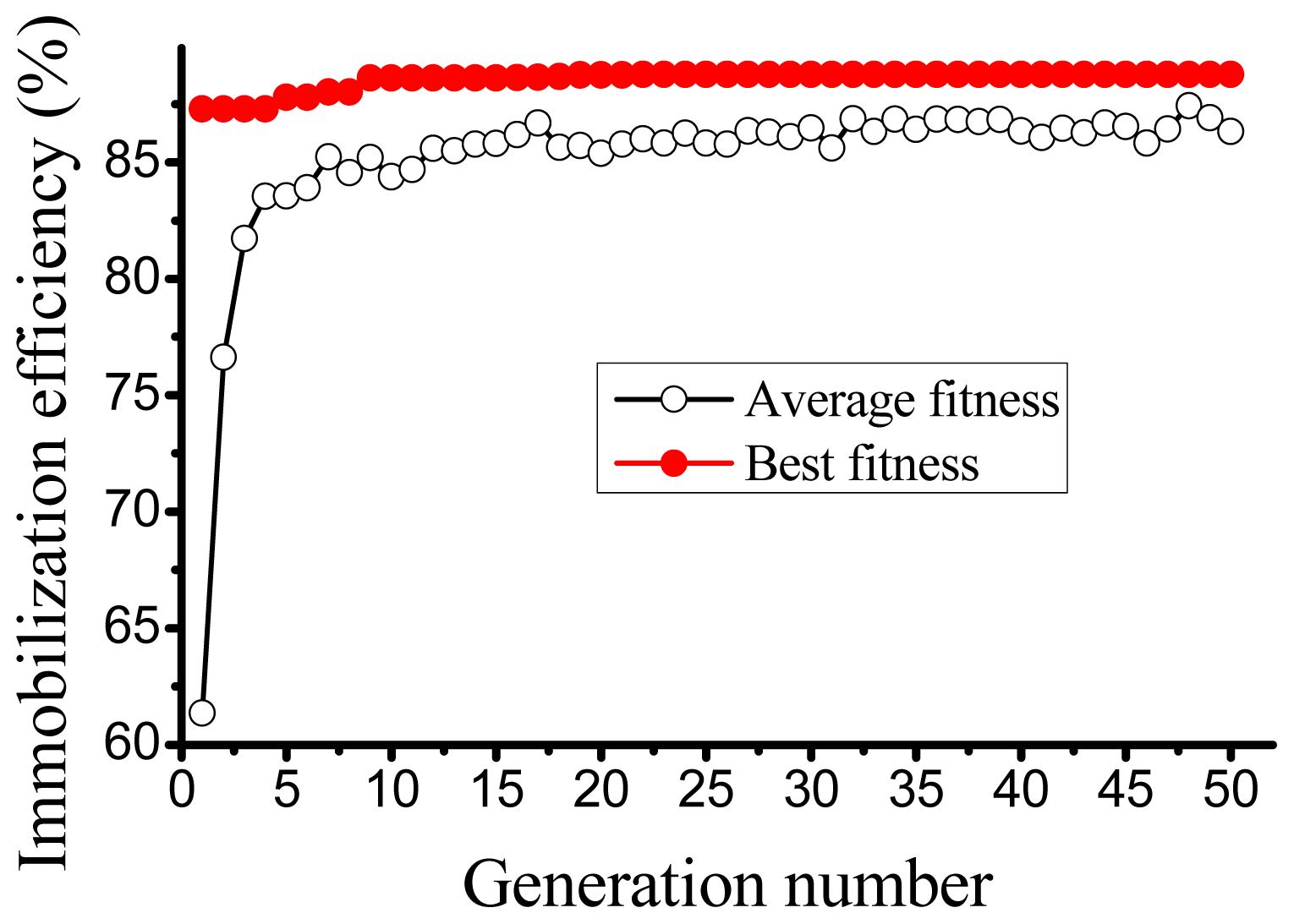
<p>Once the ANN was built successfully, GA was used to search the maximum output. Results of 50 stochastic runs show that the range of maximum, minimum and average objective function is from 84.23% to 89.76%, from 40.28% to 48.96% and from 78.23% to 80.99%, respectively. The average value of maximum objective function is calculated as 88.76%, and the value can be considered as the optimized value by artificial intelligence techniques (ANN-GA). Correspondingly, the optimized condition is a EDC concentration of 0.44%, a NHS concentration of 0.37% and a coupling time of 2.22 h, where the experimentally determined immobilization efficiency was 87.97 ± 6.45%. This shows a perfect agreement with the ANN based optimization (less than 1% derivation). Similar results were obtained for other bioprocesses [<xref ref-type="bibr" rid="b24-ijms-13-07952">24</xref>,<xref ref-type="bibr" rid="b26-ijms-13-07952">26</xref>,<xref ref-type="bibr" rid="b27-ijms-13-07952">27</xref>]. <xref ref-type="fig" rid="f2-ijms-13-07952">Figure 2</xref> shows the evolution of the algorithm with successive generations. Starting from 61.36%, the average immobilization efficiency apparently increases until the 7th generation and is 86.33% at the end of 50 generations. The maximum immobilization efficiency also apparently increases for the first few generations and reached 88.76% at the 22th generation, then remains unchanged.</p>
<p>Compared to frequently used RSM, artificial intelligence represents superior non-linearity, more accurate simulation and prediction, so a better optimization could always be obtained [<xref ref-type="bibr" rid="b28-ijms-13-07952">28</xref>]. Besides, artificial intelligence does not suffer from the limitation of experimental design, and the efficient simulation requires relative fewer experiments. Of course, the accuracy would be higher when a large number of experiments are used to create the non-linear behavior [<xref ref-type="bibr" rid="b29-ijms-13-07952">29</xref>]. Thus, in case of artificial intelligence, a more liberal search space can be chosen, although the correlation in that search space is more complex than the equation of higher degree [<xref ref-type="bibr" rid="b30-ijms-13-07952">30</xref>].</p></sec>
<sec>
<title>2.3. Reusability</title>
<p>Immobilized cellulase was mixed with insoluble substrate at stirring. After the reaction, the undegraded substrate was filtered or precipitated by centrifugation. Then, the pH of the obtained supernatant was lowered and centrifuged. The obtained precipitation was the recycled immobilized cellulase, which could be used for the next hydrolysis. As our previous reports [<xref ref-type="bibr" rid="b9-ijms-13-07952">9</xref>,<xref ref-type="bibr" rid="b10-ijms-13-07952">10</xref>] state, there is more than 50% productivity after five re-uses.</p></sec></sec>
<sec>
<title>3. Experimental Section</title>
<sec sec-type="materials">
<title>3.1. Materials</title>
<p>Eudragit L-100 was obtained from Degussa Ltd. (Shenzhen, China). The polymer is completely soluble at pH &gt; 4.3 in aqueous solution, and the critical soluble pH changes to 5.0 via coupling with cellulase (<xref ref-type="fig" rid="f1-ijms-13-07952">Figure 1</xref>) [<xref ref-type="bibr" rid="b8-ijms-13-07952">8</xref>]. EDC and NHS were purchased from Sigma-Aldrich Co., Ltd. (Shanghai, China). Crude cellulase powder from <italic>Trichoderma viride</italic> was provided by Shanghai Bio Life Science &amp; Technology Co., Ltd. (Shanghai, China). The activity is 74.07 FPU/g (FPU is the activity unit of cellulase when filter paper is used as the enzymatic substrate), assayed by the description of IUPAC [<xref ref-type="bibr" rid="b31-ijms-13-07952">31</xref>]. Wheat straw was obtained from a local farm and pretreated by alkali as Carrillo <italic>et al.</italic> described [<xref ref-type="bibr" rid="b32-ijms-13-07952">32</xref>].</p></sec>
<sec>
<title>3.2. Immobilization of Cellulase on Eudragit L-100</title>
<p>Cellulase was covalently immobilized on Eudragit L-100 by carbodiimide coupling in the presence of NHS following protocol. Fifty milliliters of solution of Eudragit L-100 (2%, w/v) was prepared as Sardar <italic>et al.</italic> described [<xref ref-type="bibr" rid="b33-ijms-13-07952">33</xref>]. To activate the polymer, NHS (0.08%–0.48%, w/v) and EDC (0.06%–0.74%, w/v) were added in turn. After mixing for 15 min, some crude cellulase containing 100 mg protein was added and stirred for 0.48 to 5.52 h. The choice of time range was based on our previous study, where the optimum coupling time in the absence of NHS was about 3 h. The pH of the mixture was reduced to 3.6 with glacial acetic acid. Precipitates were separated by centrifugation (6800 × <italic>g</italic>, 10 min) at 4.0 °C and washed three times with 0.02 mol/L acetic acid. At last, the precipitations were re-dissolved in 50 mL acetate buffers (0.2 mol/L, pH 5.0) and used as immobilized cellulase for further hydrolytic experiments.</p></sec>
<sec sec-type="methods">
<title>3.3. Central Composite Design</title>
<p>Eudragit L-100 is a copolymer of methacrylic acid and methyl methacrylate, which contains many carboxyl groups. These carboxyl groups are inevitably used as preferred functional groups to couple cellulase. EDC could help with this. EDC is generally utilized as a carboxyl-activating agent for amide bonding with primary amines and NHS could enhance the coupling. Besides EDC (coupling agent) and NHS (enhancer), the coupling time is also an important factor that can affect the coupling between Eudragit L-100 and cellulase. Less time can result in the cellulase not being coupled to Eudragit L-100 in time; more time might bring an excess coupling that negatively affects the active site of cellulase. So in this study, EDC concentration X<sub>1</sub>, NHS concentration X<sub>2</sub> and coupling time X<sub>3</sub> were applied as independent variables (inputs of ANN). A central composite design (CCD) for the three factors was applied to train ANN. The range and levels of each factor is shown in <xref ref-type="table" rid="t3-ijms-13-07952">Table 3</xref>. The CCD with 20 trials (six central points) was a 2<sup>3</sup> full factorial design at a distance 1.68 from the origin (Trials 1–20 in <xref ref-type="table" rid="t1-ijms-13-07952">Table 1</xref>).</p></sec>
<sec>
<title>3.4. Artificial Neural Network</title>
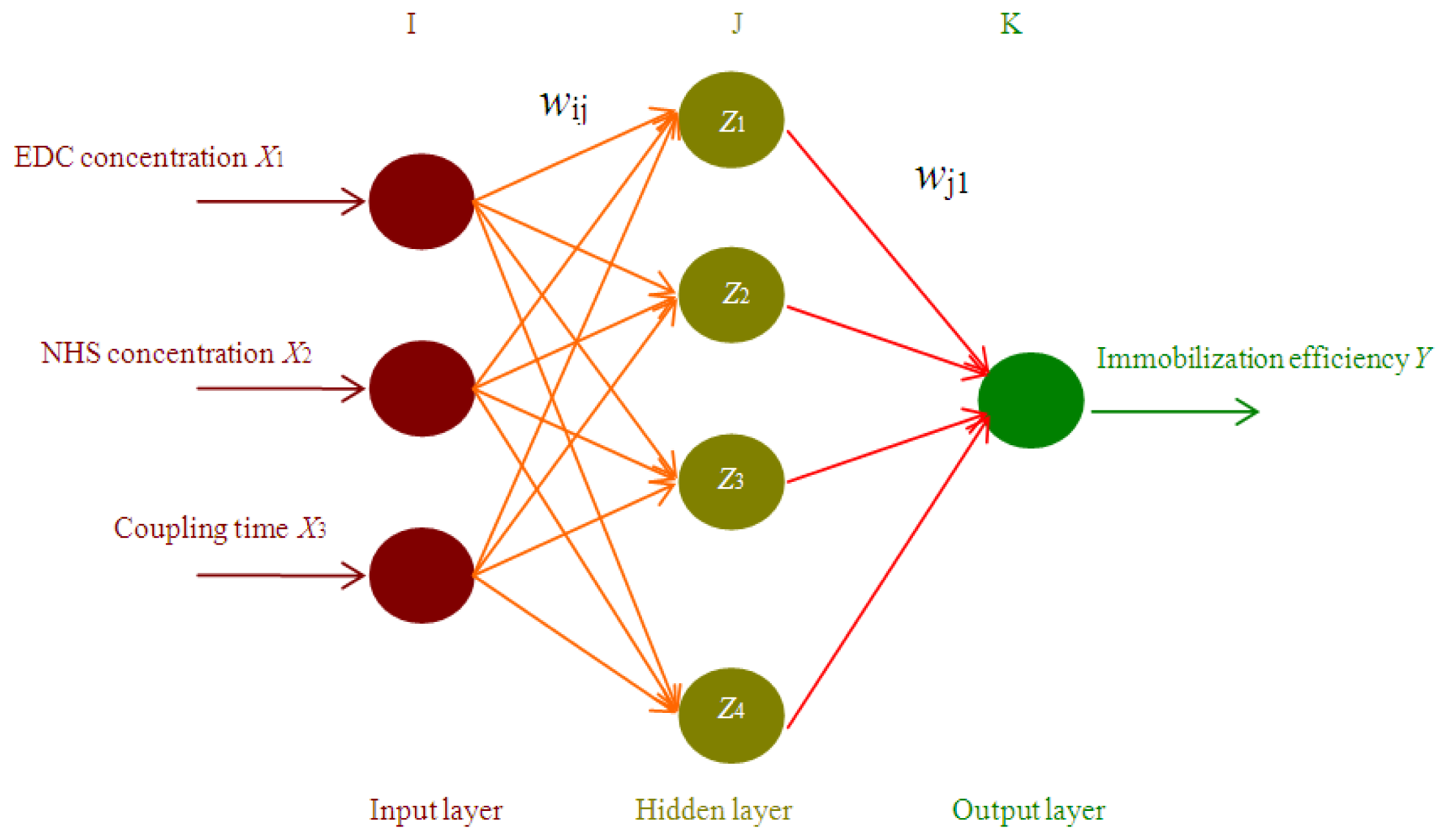
<p>ANN is a computer program architecture capable of non-linear computations in certain configurations, such as the multi-layer perceptron (MLP). It can identify arbitrary discriminant functions directly from experimental data [<xref ref-type="bibr" rid="b28-ijms-13-07952">28</xref>,<xref ref-type="bibr" rid="b34-ijms-13-07952">34</xref>]. In our experiment, the ANN architecture consists of three neurons (EDC concentration X<sub>1</sub>, NHS concentration X<sub>2</sub> and coupling time X<sub>3</sub>) in the input layer, four neurons in the hidden layer, and one neuron (immobilization efficiency) in the output layer (<xref ref-type="fig" rid="f3-ijms-13-07952">Figure 3</xref>). This is a typical neural network architecture [<xref ref-type="bibr" rid="b34-ijms-13-07952">34</xref>]. In order to receive equal attention during the training process [<xref ref-type="bibr" rid="b26-ijms-13-07952">26</xref>], all the data (input and output ones) of the CCD (trial 1–20 in <xref ref-type="table" rid="t2-ijms-13-07952">Table 2</xref>) were scaled as follows (<xref rid="FD1" ref-type="disp-formula">Equation (1)</xref>):</p>
<disp-formula id="FD1">
<label>(1)</label>
<mml:math id="mm1" display="block">
<mml:semantics id="sm1">
<mml:mtable columnalign="left">
<mml:mtr>
<mml:mtd>
<mml:mtext>Input layer</mml:mtext>
<mml:mo>:</mml:mo>
<mml:mi> </mml:mi>
<mml:mi> </mml:mi>
<mml:mi> </mml:mi>
<mml:msup>
<mml:mrow>
<mml:msub>
<mml:mrow>
<mml:mi>X</mml:mi></mml:mrow>
<mml:mtext>i</mml:mtext></mml:msub></mml:mrow>
<mml:mo>*</mml:mo></mml:msup>
<mml:mo>=</mml:mo>
<mml:mn>2</mml:mn>
<mml:mfrac>
<mml:mrow>
<mml:msub>
<mml:mrow>
<mml:mi>X</mml:mi></mml:mrow>
<mml:mtext>i</mml:mtext></mml:msub>
<mml:mo>-</mml:mo>
<mml:msub>
<mml:mrow>
<mml:mi>X</mml:mi></mml:mrow>
<mml:mrow>
<mml:mtext>i</mml:mtext>
<mml:mo>,</mml:mo>
<mml:mtext>min</mml:mtext></mml:mrow></mml:msub></mml:mrow>
<mml:mrow>
<mml:msub>
<mml:mrow>
<mml:mi>X</mml:mi></mml:mrow>
<mml:mrow>
<mml:mtext>i</mml:mtext>
<mml:mo>,</mml:mo>
<mml:mtext>max</mml:mtext></mml:mrow></mml:msub>
<mml:mo>-</mml:mo>
<mml:msub>
<mml:mrow>
<mml:mi>X</mml:mi></mml:mrow>
<mml:mrow>
<mml:mtext>i</mml:mtext>
<mml:mo>,</mml:mo>
<mml:mtext>min</mml:mtext></mml:mrow></mml:msub></mml:mrow></mml:mfrac>
<mml:mo>-</mml:mo>
<mml:mn>1</mml:mn></mml:mtd></mml:mtr>
<mml:mtr>
<mml:mtd>
<mml:mtext>Output layer</mml:mtext>
<mml:mo>:</mml:mo>
<mml:mi> </mml:mi>
<mml:mi> </mml:mi>
<mml:mi> </mml:mi>
<mml:msup>
<mml:mrow>
<mml:mi>Y</mml:mi></mml:mrow>
<mml:mo>*</mml:mo></mml:msup>
<mml:mo>=</mml:mo>
<mml:mfrac>
<mml:mrow>
<mml:mi>Y</mml:mi>
<mml:mo>-</mml:mo>
<mml:mn>0</mml:mn></mml:mrow>
<mml:mrow>
<mml:mn>100</mml:mn>
<mml:mo>-</mml:mo>
<mml:mn>0</mml:mn></mml:mrow></mml:mfrac></mml:mtd></mml:mtr></mml:mtable></mml:semantics></mml:math></disp-formula>
<p>where, <italic>X</italic><sub>i</sub>* and <italic>Y</italic>* are the new scaled data of input and output layers.</p>
<p>As the most frequent algorithm, the back-propagation algorithm was used to train a random ANN model by feeding the newly scaled data. The algorithm includes forward propagation of signal and back propagation of error. Forward propagation of signal was carried out as follows: Hidden layer:</p>
<disp-formula id="FD2">
<label>(2)</label>
<mml:math id="mm2" display="block">
<mml:semantics id="sm2">
<mml:mtable columnalign="center">
<mml:mtr>
<mml:mtd>
<mml:mtext>Hidden layer</mml:mtext>
<mml:mo>:</mml:mo>
<mml:mi> </mml:mi>
<mml:msub>
<mml:mrow>
<mml:mi>Z</mml:mi></mml:mrow>
<mml:mi>j</mml:mi></mml:msub>
<mml:mo>=</mml:mo>
<mml:mi>f</mml:mi>
<mml:mrow>
<mml:mo>(</mml:mo>
<mml:mrow>
<mml:munderover>
<mml:mo>∑</mml:mo>
<mml:mrow>
<mml:mi>i</mml:mi>
<mml:mo>=</mml:mo>
<mml:mn>1</mml:mn></mml:mrow>
<mml:mi>I</mml:mi></mml:munderover>
<mml:mrow>
<mml:msub>
<mml:mrow>
<mml:mi>w</mml:mi></mml:mrow>
<mml:mrow>
<mml:mi>i</mml:mi>
<mml:mi>j</mml:mi></mml:mrow></mml:msub>
<mml:msubsup>
<mml:mrow>
<mml:mi>X</mml:mi></mml:mrow>
<mml:mi>i</mml:mi>
<mml:mo>*</mml:mo></mml:msubsup></mml:mrow></mml:mrow>
<mml:mo>)</mml:mo></mml:mrow></mml:mtd></mml:mtr>
<mml:mtr>
<mml:mtd>
<mml:mtext>Output layer</mml:mtext>
<mml:mo>:</mml:mo>
<mml:mi> </mml:mi>
<mml:msup>
<mml:mrow>
<mml:mi>Y</mml:mi></mml:mrow>
<mml:mo>*</mml:mo></mml:msup>
<mml:mo>=</mml:mo>
<mml:mi>f</mml:mi>
<mml:mrow>
<mml:mo>(</mml:mo>
<mml:mrow>
<mml:munderover>
<mml:mo>∑</mml:mo>
<mml:mrow>
<mml:mi>j</mml:mi>
<mml:mo>=</mml:mo>
<mml:mn>1</mml:mn></mml:mrow>
<mml:mi>J</mml:mi></mml:munderover>
<mml:mrow>
<mml:msub>
<mml:mrow>
<mml:mi>w</mml:mi></mml:mrow>
<mml:mi>j</mml:mi></mml:msub>
<mml:msub>
<mml:mrow>
<mml:mi>Z</mml:mi></mml:mrow>
<mml:mi>j</mml:mi></mml:msub></mml:mrow></mml:mrow>
<mml:mo>)</mml:mo></mml:mrow></mml:mtd></mml:mtr></mml:mtable></mml:semantics></mml:math></disp-formula>
<p>where, <italic>Z</italic><sub>k</sub> are the data of hidden layer, respectively; <italic>w</italic><sub>ij</sub> and <italic>w</italic><sub>j</sub> are connecting weights from <italic>X</italic><sub>i</sub>* to <italic>Z</italic><sub>j</sub> and <italic>Z</italic><sub>j</sub> to <italic>Y</italic>*, respectively, and f() is the transfer function.</p>
<p>The transfer functions in the hidden and output layers of the ANN were tangent sigmoid and pure linear functions, respectively. The mean squared error between the results of the output neurons and the actual outputs is calculated and propagated backward through the network. Then the algorithm adjusts the weight of each. Once the mean square error reached 1e–4, the training was over and the corresponding ANN was built. All the procedures were carried out by Matlab 7.1.</p></sec>
<sec>
<title>3.5. Genetic Algorithm</title>
<p>Using the trained ANN as the fitness function, a genetic algorithm (GA) was coupled to search the maximum immobilization efficiency. The objective function is to find a decision variable, <italic>i.e.</italic>, ANN input neurons (<italic>X</italic><sub>i</sub>), so that it maximizes the objective function, <italic>i.e</italic>., ANN output. Working parameters namely the total number of generations, population size, number of binary coded variables, cross over probability and mutation probability are 50, 20, 3, 0.4 and 0.005, respectively.</p>
<p>Genetic algorithm uses evolutionary natural selection processes, where selection results in species that fit the best. A population of individuals is maintained at each generation, and each individual in the population represents a possible solution to the problem [<xref ref-type="bibr" rid="b27-ijms-13-07952">27</xref>]. The individual chosen in this study was a set of EDC concentration <italic>X</italic><sub>1</sub>, NHS concentration <italic>X</italic><sub>2</sub> and coupling time <italic>X</italic><sub>3</sub>. The GA-based search for an optimal solution vector, <italic>X</italic><sub>i</sub>, begins with a randomly initialized population of probable (candidate) solutions. The candidates are referred to as strings or chromosomes. Each chromosome is evaluated to measure its fitness using the ANN-based model. The steps involved in GA-based optimization algorithm are as follows:</p>
<p>Randomly generate a population of individuals and assign a fitness value to each individual to guide the search by specific fitness function. Select individuals with higher fitness values and let them undergo genetic operation, including crossover and mutation. Use the newly generated child population as the parent population for the next generation and treat them with the same evolutional process continuously until a stop criterion has been satisfied [<xref ref-type="bibr" rid="b20-ijms-13-07952">20</xref>,<xref ref-type="bibr" rid="b27-ijms-13-07952">27</xref>]. The algorithm was run 50 times in this study. All the procedures were carried out by Matlab 7.1.</p></sec>
<sec>
<title>3.6. Determination of Immobilization Efficiency</title>
<p>Before and after immobilization, 100 mg cellulase protein was incubated with 2.5 g pretreated wheat straw at pH 5.0, 50 °C and 120 rpm. The solid loading was 5% (v/w). After 12 h, a sample solution was taken out, and centrifuged at 4000 rpm and 4 °C for 5 min. The obtained supernatant was kept at 80 °C for 10 min and then used for glucose assay. Immobilization efficiency was calculated as follows:</p>
<disp-formula id="FD3">
<label>(3)</label>
<mml:math id="mm3" display="block">
<mml:semantics id="sm3">
<mml:mrow>
<mml:mtext>Immobilization efficiency </mml:mtext>
<mml:mo stretchy="false">(</mml:mo>
<mml:mo>%</mml:mo>
<mml:mo stretchy="false">)</mml:mo>
<mml:mo>=</mml:mo>
<mml:mfrac>
<mml:mrow>
<mml:mtext>Glucose produced by immobilized cellulase</mml:mtext></mml:mrow>
<mml:mrow>
<mml:mtext>Glucose produced by free cellulase</mml:mtext></mml:mrow></mml:mfrac>
<mml:mo>×</mml:mo>
<mml:mn>100</mml:mn></mml:mrow></mml:semantics></mml:math></disp-formula></sec>
<sec>
<title>3.7. HPLC Method</title>
<p>Glucose was determined by the HPLC Waters 2695 system consisting of Waters 600E system controller, Waters 717 automatic sampler, Waters 2414 differential refractometer, Shodex sugar SP-0810 column. The mobile phase was distilled water at a flow rate of 0.6 mL/min. The column temperature was 80 °C. The injected sample volume was 10 μL. Standard samples and hydrolyzed samples were filtrated by a 0.45 μm filter before analysis.</p></sec></sec>
<sec sec-type="conclusions">
<title>4. Conclusions</title>
<p>Cellulase, via immobilization, was converted to a smart biocatalyst that could be used as a homogeneous catalyst during the reaction and recovered easily after the reaction for possible re-use. It is self-evident that the immobilization could improve the economy of cellulase utilization in its related industries. In this study, the artificial intelligence based optimization is quite successful, and 87.97% of immobilization efficiency is obtained. It is believed that artificial intelligence based optimization technique could be applied in more and more complicated biochemical systems due to its advanced non-linear analysis and mechanistic independence shown in modeling and predicting these systems.</p></sec></body>
<back>
<ack>
<title>Acknowledgment</title>
<p>This work was funded by the National Key Technology R &amp; D Program (2011BAD22B01) and Knowledge Innovation Program of the Chinese Academy of Sciences (KSCX-YW-11-A3).</p></ack>
<ref-list>
<title>References</title>
<ref id="b1-ijms-13-07952"><label>1</label><citation citation-type="journal"><person-group person-group-type="author"><name><surname>Sheldon</surname><given-names>R.A.</given-names></name></person-group><article-title>Enzyme immobilization: The quest for optimum performance</article-title><source>Adv. Synth. Catal</source><year>2007</year><volume>349</volume><fpage>1289</fpage><lpage>1307</lpage><pub-id pub-id-type="doi">10.1002/adsc.200700082</pub-id></citation></ref>
<ref id="b2-ijms-13-07952"><label>2</label><citation citation-type="journal"><person-group person-group-type="author"><name><surname>Tischer</surname><given-names>W.</given-names></name><name><surname>Wedekind</surname><given-names>F.</given-names></name></person-group><article-title>Immobilized enzymes: Methods and applications</article-title><source>Top. Curr. Chem</source><year>1999</year><volume>200</volume><fpage>95</fpage><lpage>126</lpage></citation></ref>
<ref id="b3-ijms-13-07952"><label>3</label><citation citation-type="journal"><person-group person-group-type="author"><name><surname>Wang</surname><given-names>Y.H.</given-names></name><name><surname>Zhang</surname><given-names>J.C.</given-names></name><name><surname>Yin</surname><given-names>J.M.</given-names></name></person-group><article-title>Progress of enzyme immobilization and its potential application</article-title><source>Desalin. Water Treat</source><year>2009</year><volume>1</volume><fpage>151</fpage><lpage>171</lpage></citation></ref>
<ref id="b4-ijms-13-07952"><label>4</label><citation citation-type="journal"><person-group person-group-type="author"><name><surname>Mateo</surname><given-names>C.</given-names></name><name><surname>Palomo</surname><given-names>J.M.</given-names></name><name><surname>Fernandez-Lorente</surname><given-names>G.</given-names></name><name><surname>Guisan</surname><given-names>J.M.</given-names></name><name><surname>Fernandez-Lafuente</surname><given-names>R.</given-names></name></person-group><article-title>Improvement of enzyme activity, stability and selectivity via immobilization techniques</article-title><source>Enzyme Microb. Technol</source><year>2007</year><volume>40</volume><fpage>1451</fpage><lpage>1463</lpage><pub-id pub-id-type="doi">10.1016/j.enzmictec.2007.01.018</pub-id></citation></ref>
<ref id="b5-ijms-13-07952"><label>5</label><citation citation-type="journal"><person-group person-group-type="author"><name><surname>Woodward</surname><given-names>J.</given-names></name></person-group><article-title>Immobilized cellulases for cellulose utilization</article-title><source>J. Biotechnol</source><year>1989</year><volume>11</volume><fpage>299</fpage><lpage>312</lpage><pub-id pub-id-type="doi">10.1016/0168-1656(89)90015-1</pub-id></citation></ref>
<ref id="b6-ijms-13-07952"><label>6</label><citation citation-type="book"><person-group person-group-type="author"><name><surname>Galaev</surname><given-names>I.</given-names></name><name><surname>Mattiasson</surname><given-names>B</given-names></name></person-group><source>Smart Polymers for Bioseparation and Bioprocessing</source><edition>1st ed</edition><publisher-name>Taylor &amp; Francis Inc.</publisher-name><publisher-loc>New York, NY, USA</publisher-loc><year>2002</year></citation></ref>
<ref id="b7-ijms-13-07952"><label>7</label><citation citation-type="journal"><person-group person-group-type="author"><name><surname>Roy</surname><given-names>I.</given-names></name><name><surname>Sharma</surname><given-names>S.</given-names></name><name><surname>Gupta</surname><given-names>M.N.</given-names></name></person-group><article-title>Smart biocatalysts: Design and applications</article-title><source>Adv. Biochem. Eng. Biotechnol</source><year>2004</year><volume>86</volume><fpage>159</fpage><lpage>189</lpage><pub-id pub-id-type="pmid">15088765</pub-id></citation></ref>
<ref id="b8-ijms-13-07952"><label>8</label><citation citation-type="journal"><person-group person-group-type="author"><name><surname>Taniguchi</surname><given-names>M.</given-names></name><name><surname>Kobayashi</surname><given-names>M.</given-names></name><name><surname>Fujii</surname><given-names>M.</given-names></name></person-group><article-title>Properties of a reversible soluble insoluble cellulase and its application to repeated hydrolysis of crystalline cellulose</article-title><source>Biotechnol. Bioeng</source><year>1989</year><volume>34</volume><fpage>1092</fpage><lpage>1097</lpage><pub-id pub-id-type="doi">10.1002/bit.260340810</pub-id><pub-id pub-id-type="pmid">18588203</pub-id></citation></ref>
<ref id="b9-ijms-13-07952"><label>9</label><citation citation-type="journal"><person-group person-group-type="author"><name><surname>Zhang</surname><given-names>Y.</given-names></name><name><surname>Xu</surname><given-names>J.L.</given-names></name><name><surname>Yuan</surname><given-names>Z.H.</given-names></name><name><surname>Xu</surname><given-names>H.J.</given-names></name><name><surname>Yu</surname><given-names>Q.</given-names></name></person-group><article-title>Artificial neural network-genetic algorithm based optimization for the immobilization of cellulase on the smart polymer Eudragit L-100</article-title><source>Bioresour. Technol</source><year>2010</year><volume>101</volume><fpage>3153</fpage><lpage>3158</lpage><pub-id pub-id-type="doi">10.1016/j.biortech.2009.12.080</pub-id><pub-id pub-id-type="pmid">20064711</pub-id></citation></ref>
<ref id="b10-ijms-13-07952"><label>10</label><citation citation-type="journal"><person-group person-group-type="author"><name><surname>Zhang</surname><given-names>Y.</given-names></name><name><surname>Xu</surname><given-names>J.L.</given-names></name><name><surname>Li</surname><given-names>D.</given-names></name><name><surname>Yuan</surname><given-names>Z.H.</given-names></name></person-group><article-title>Preparation and properties of an immobilized cellulase on the reversibly soluble matrix Eudragit L-100</article-title><source>Biocatal. Biotransform</source><year>2010</year><volume>28</volume><fpage>313</fpage><lpage>319</lpage><pub-id pub-id-type="doi">10.3109/10242422.2010.516391</pub-id></citation></ref>
<ref id="b11-ijms-13-07952"><label>11</label><citation citation-type="journal"><person-group person-group-type="author"><name><surname>Bezerra</surname><given-names>M.A.</given-names></name><name><surname>Santelli</surname><given-names>R.E.</given-names></name><name><surname>Oliveira</surname><given-names>E.P.</given-names></name><name><surname>Villar</surname><given-names>L.S.</given-names></name><name><surname>Escaleira</surname><given-names>L.A.</given-names></name></person-group><article-title>Response surface methodology (RSM) as a tool for optimization in analytical chemistry</article-title><source>Talanta</source><year>2008</year><volume>76</volume><fpage>965</fpage><lpage>977</lpage><pub-id pub-id-type="doi">10.1016/j.talanta.2008.05.019</pub-id><pub-id pub-id-type="pmid">18761143</pub-id></citation></ref>
<ref id="b12-ijms-13-07952"><label>12</label><citation citation-type="journal"><person-group person-group-type="author"><name><surname>Bas</surname><given-names>D.</given-names></name><name><surname>Boyaci</surname><given-names>I.H.</given-names></name></person-group><article-title>Modeling and optimization I: Usability of response surface methodology</article-title><source>J. Food Eng</source><year>2007</year><volume>78</volume><fpage>836</fpage><lpage>845</lpage><pub-id pub-id-type="doi">10.1016/j.jfoodeng.2005.11.024</pub-id></citation></ref>
<ref id="b13-ijms-13-07952"><label>13</label><citation citation-type="journal"><person-group person-group-type="author"><name><surname>Lakshminarayanan</surname><given-names>A.K.</given-names></name><name><surname>Balasubramanian</surname><given-names>V.</given-names></name></person-group><article-title>Comparison of RSM with ANN in predicting tensile strength of friction stir welded AA7039 aluminium alloy joints</article-title><source>T. Nonferr. Metal. Soc</source><year>2009</year><volume>19</volume><fpage>9</fpage><lpage>18</lpage><pub-id pub-id-type="doi">10.1016/S1003-6326(08)60221-6</pub-id></citation></ref>
<ref id="b14-ijms-13-07952"><label>14</label><citation citation-type="journal"><person-group person-group-type="author"><name><surname>Zhang</surname><given-names>Y.</given-names></name><name><surname>Xu</surname><given-names>J.L.</given-names></name><name><surname>Yuan</surname><given-names>Z.H.</given-names></name><name><surname>Zhuang</surname><given-names>X.S.</given-names></name><name><surname>Lu</surname><given-names>P.M.</given-names></name></person-group><article-title>Kinetic model study on enzymatic hydrolysis of cellulose using artificial neural networks</article-title><source>Chin. J. Catal</source><year>2009</year><volume>30</volume><fpage>355</fpage><lpage>358</lpage></citation></ref>
<ref id="b15-ijms-13-07952"><label>15</label><citation citation-type="journal"><person-group person-group-type="author"><name><surname>Guo</surname><given-names>Y.</given-names></name><name><surname>Xu</surname><given-names>J.L.</given-names></name><name><surname>Zhang</surname><given-names>Y.</given-names></name><name><surname>Xu</surname><given-names>H.J.</given-names></name><name><surname>Yuan</surname><given-names>Z.H.</given-names></name><name><surname>Li</surname><given-names>D.</given-names></name></person-group><article-title>Medium optimization for ethanol production with <italic>Clostridium autoethanogenum</italic> with carbon monoxide as sole carbon source</article-title><source>Bioresour. Technol</source><year>2010</year><volume>101</volume><fpage>8784</fpage><lpage>8789</lpage><pub-id pub-id-type="doi">10.1016/j.biortech.2010.06.072</pub-id><pub-id pub-id-type="pmid">20619639</pub-id></citation></ref>
<ref id="b16-ijms-13-07952"><label>16</label><citation citation-type="journal"><person-group person-group-type="author"><name><surname>Schubert</surname><given-names>M.</given-names></name><name><surname>Mourad</surname><given-names>S.</given-names></name><name><surname>Schwarze</surname><given-names>F.</given-names></name></person-group><article-title>Radial basis function neural networks for modeling growth rates of the basidiomycetes <italic>Physisporinus vitreus</italic> and <italic>Neolentinus lepideus</italic></article-title><source>Appl. Microbiol. Biotechnol</source><year>2010</year><volume>85</volume><fpage>703</fpage><lpage>712</lpage><pub-id pub-id-type="doi">10.1007/s00253-009-2185-3</pub-id><pub-id pub-id-type="pmid">19697017</pub-id></citation></ref>
<ref id="b17-ijms-13-07952"><label>17</label><citation citation-type="journal"><person-group person-group-type="author"><name><surname>Marchitan</surname><given-names>N.</given-names></name><name><surname>Cojocaru</surname><given-names>C.</given-names></name><name><surname>Mereuta</surname><given-names>A.</given-names></name><name><surname>Duca</surname><given-names>G.</given-names></name><name><surname>Cretescu</surname><given-names>I.</given-names></name><name><surname>Gonta</surname><given-names>M.</given-names></name></person-group><article-title>Modeling and optimization of tartaric acid reactive extraction from aqueous solutions: A comparison between response surface methodology and artificial neural network</article-title><source>Sep. Purif. Technol</source><year>2010</year><volume>75</volume><fpage>273</fpage><lpage>285</lpage><pub-id pub-id-type="doi">10.1016/j.seppur.2010.08.016</pub-id></citation></ref>
<ref id="b18-ijms-13-07952"><label>18</label><citation citation-type="journal"><person-group person-group-type="author"><name><surname>Pal</surname><given-names>M.P.</given-names></name><name><surname>Vaidya</surname><given-names>B.K.</given-names></name><name><surname>Desai</surname><given-names>K.M.</given-names></name><name><surname>Joshi</surname><given-names>R.M.</given-names></name><name><surname>Nene</surname><given-names>S.N.</given-names></name><name><surname>Kulkarni</surname><given-names>B.D.</given-names></name></person-group><article-title>Media optimization for biosurfactant production by <italic>Rhodococcus erythropolis</italic> MTCC 2794: Artificial intelligence versus a statistical approach</article-title><source>J. Ind. Microbiol. Biotechnol</source><year>2009</year><volume>36</volume><fpage>747</fpage><lpage>756</lpage><pub-id pub-id-type="doi">10.1007/s10295-009-0547-6</pub-id><pub-id pub-id-type="pmid">19283419</pub-id></citation></ref>
<ref id="b19-ijms-13-07952"><label>19</label><citation citation-type="journal"><person-group person-group-type="author"><name><surname>Singh</surname><given-names>A.</given-names></name><name><surname>Majumder</surname><given-names>A.</given-names></name><name><surname>Goyal</surname><given-names>A.</given-names></name></person-group><article-title>Artificial intelligence based optimization of exocellular glucansucrase production from <italic>Leuconostoc dextranicum</italic> NRRL B-1146</article-title><source>Bioresour. Technol</source><year>2008</year><volume>99</volume><fpage>8201</fpage><lpage>8206</lpage><pub-id pub-id-type="doi">10.1016/j.biortech.2008.03.038</pub-id><pub-id pub-id-type="pmid">18440808</pub-id></citation></ref>
<ref id="b20-ijms-13-07952"><label>20</label><citation citation-type="journal"><person-group person-group-type="author"><name><surname>He</surname><given-names>L.</given-names></name><name><surname>Xu</surname><given-names>Y.Q.</given-names></name><name><surname>Zhang</surname><given-names>X.H.</given-names></name></person-group><article-title>Medium factor optimization and fermentation kinetics for phenazine-1-carboxylic acid production by <italic>Pseudomonas</italic> sp M18G</article-title><source>Biotechnol. Bioeng</source><year>2008</year><volume>100</volume><fpage>250</fpage><lpage>259</lpage><pub-id pub-id-type="doi">10.1002/bit.21767</pub-id><pub-id pub-id-type="pmid">18078294</pub-id></citation></ref>
<ref id="b21-ijms-13-07952"><label>21</label><citation citation-type="journal"><person-group person-group-type="author"><name><surname>Chaibakhsh</surname><given-names>N.</given-names></name><name><surname>Rahman</surname><given-names>M.B.A.</given-names></name><name><surname>Vahabzadeh</surname><given-names>F.</given-names></name><name><surname>Abd-Aziz</surname><given-names>S.</given-names></name><name><surname>Basri</surname><given-names>M.</given-names></name><name><surname>Salleh</surname><given-names>A.B.</given-names></name></person-group><article-title>Optimization of operational conditions for adipate ester synthesis in a stirred tank reactor</article-title><source>Biotechnol. Bioprocess Eng</source><year>2010</year><volume>15</volume><fpage>846</fpage><lpage>853</lpage><pub-id pub-id-type="doi">10.1007/s12257-010-0001-7</pub-id></citation></ref>
<ref id="b22-ijms-13-07952"><label>22</label><citation citation-type="journal"><person-group person-group-type="author"><name><surname>Gurunathan</surname><given-names>B.</given-names></name><name><surname>Sahadevan</surname><given-names>R.</given-names></name></person-group><article-title>Design of experiments and artificial neural network linked genetic algorithm for modeling and optimization of l-asparaginase production by <italic>Aspergillus terreus</italic> MTCC 1782</article-title><source>Biotechnol. Bioprocess Eng</source><year>2011</year><volume>16</volume><fpage>50</fpage><lpage>58</lpage><pub-id pub-id-type="doi">10.1007/s12257-010-0119-7</pub-id></citation></ref>
<ref id="b23-ijms-13-07952"><label>23</label><citation citation-type="journal"><person-group person-group-type="author"><name><surname>Li</surname><given-names>Y.</given-names></name><name><surname>Du</surname><given-names>X.L.</given-names></name><name><surname>Yuan</surname><given-names>Q.P.</given-names></name><name><surname>Lv</surname><given-names>X.H.</given-names></name></person-group><article-title>Development and validation of a new PCR optimization method by combining experimental design and artificial neural network</article-title><source>Appl. Biochem. Biotechnol</source><year>2010</year><volume>160</volume><fpage>269</fpage><lpage>279</lpage><pub-id pub-id-type="doi">10.1007/s12010-009-8581-4</pub-id><pub-id pub-id-type="pmid">19266318</pub-id></citation></ref>
<ref id="b24-ijms-13-07952"><label>24</label><citation citation-type="journal"><person-group person-group-type="author"><name><surname>Sivapathasekaran</surname><given-names>C.</given-names></name><name><surname>Mukherjee</surname><given-names>S.</given-names></name><name><surname>Ray</surname><given-names>A.</given-names></name><name><surname>Gupta</surname><given-names>A.</given-names></name><name><surname>Sen</surname><given-names>R.</given-names></name></person-group><article-title>Artificial neural network modeling and genetic algorithm based medium optimization for the improved production of marine biosurfactant</article-title><source>Bioresour. Technol</source><year>2010</year><volume>101</volume><fpage>2884</fpage><lpage>2887</lpage><pub-id pub-id-type="doi">10.1016/j.biortech.2009.09.093</pub-id><pub-id pub-id-type="pmid">19914826</pub-id></citation></ref>
<ref id="b25-ijms-13-07952"><label>25</label><citation citation-type="journal"><person-group person-group-type="author"><name><surname>Rahman</surname><given-names>M.B.A.</given-names></name><name><surname>Chaibakhsh</surname><given-names>N.</given-names></name><name><surname>Basri</surname><given-names>M.</given-names></name><name><surname>Salleh</surname><given-names>A.B.</given-names></name><name><surname>Rahman</surname><given-names>R.N.Z.R.A.</given-names></name></person-group><article-title>Application of artificial neural network for yield prediction of lipase-catalyzed synthesis of dioctyl adipate</article-title><source>Appl. Biochem. Biotechnol</source><year>2009</year><volume>158</volume><fpage>722</fpage><lpage>735</lpage><pub-id pub-id-type="doi">10.1007/s12010-008-8465-z</pub-id><pub-id pub-id-type="pmid">19132557</pub-id></citation></ref>
<ref id="b26-ijms-13-07952"><label>26</label><citation citation-type="journal"><person-group person-group-type="author"><name><surname>Wang</surname><given-names>J.L.</given-names></name><name><surname>Wan</surname><given-names>W.</given-names></name></person-group><article-title>Application of desirability function based on neural network for optimizing biohydrogen production process</article-title><source>Int. J. Hydrog. Energy</source><year>2009</year><volume>34</volume><fpage>1253</fpage><lpage>1259</lpage><pub-id pub-id-type="doi">10.1016/j.ijhydene.2008.11.055</pub-id></citation></ref>
<ref id="b27-ijms-13-07952"><label>27</label><citation citation-type="journal"><person-group person-group-type="author"><name><surname>Izadifar</surname><given-names>M.</given-names></name><name><surname>Jahromi</surname><given-names>M.Z.</given-names></name></person-group><article-title>Application of genetic algorithm for optimization of vegetable oil hydrogenation process</article-title><source>J. Food Eng</source><year>2007</year><volume>78</volume><fpage>1</fpage><lpage>8</lpage><pub-id pub-id-type="doi">10.1016/j.jfoodeng.2005.08.044</pub-id></citation></ref>
<ref id="b28-ijms-13-07952"><label>28</label><citation citation-type="journal"><person-group person-group-type="author"><name><surname>Almeida</surname><given-names>J.S.</given-names></name></person-group><article-title>Predictive non-linear modeling of complex data by artificial neural networks</article-title><source>Curr. Opin. Biotechnol</source><year>2002</year><volume>13</volume><fpage>72</fpage><lpage>76</lpage><pub-id pub-id-type="doi">10.1016/S0958-1669(02)00288-4</pub-id><pub-id pub-id-type="pmid">11849962</pub-id></citation></ref>
<ref id="b29-ijms-13-07952"><label>29</label><citation citation-type="journal"><person-group person-group-type="author"><name><surname>Balkin</surname><given-names>S.D.</given-names></name><name><surname>Lin</surname><given-names>D.K.J.</given-names></name></person-group><article-title>A neural network approach to response surface methodology</article-title><source>Commun. Stat. Theory Methods</source><year>2000</year><volume>29</volume><fpage>2215</fpage><lpage>2227</lpage><pub-id pub-id-type="doi">10.1080/03610920008832604</pub-id></citation></ref>
<ref id="b30-ijms-13-07952"><label>30</label><citation citation-type="journal"><person-group person-group-type="author"><name><surname>Desai</surname><given-names>K.M.</given-names></name><name><surname>Survase</surname><given-names>S.A.</given-names></name><name><surname>Saudagar</surname><given-names>P.S.</given-names></name><name><surname>Lele</surname><given-names>S.S.</given-names></name><name><surname>Singhal</surname><given-names>R.S.</given-names></name></person-group><article-title>Comparison of artificial neural network (ANN) and response surface methodology (RSM) in fermentation media optimization: Case study of fermentative production of scleroglucan</article-title><source>Biochem. Eng. J</source><year>2008</year><volume>41</volume><fpage>266</fpage><lpage>273</lpage><pub-id pub-id-type="doi">10.1016/j.bej.2008.05.009</pub-id></citation></ref>
<ref id="b31-ijms-13-07952"><label>31</label><citation citation-type="journal"><person-group person-group-type="author"><name><surname>Ghose</surname><given-names>T.K.</given-names></name></person-group><article-title>Measurements of cellulase activities</article-title><source>Pure Appl. Chem</source><year>1987</year><volume>2</volume><fpage>257</fpage><lpage>268</lpage></citation></ref>
<ref id="b32-ijms-13-07952"><label>32</label><citation citation-type="journal"><person-group person-group-type="author"><name><surname>Carrillo</surname><given-names>F.</given-names></name><name><surname>Lis</surname><given-names>M.J.</given-names></name><name><surname>Colom</surname><given-names>X.</given-names></name><name><surname>Lopez-Mesas</surname><given-names>M.</given-names></name><name><surname>Valldeperas</surname><given-names>J.</given-names></name></person-group><article-title>Effect of alkali pretreatment on cellulase hydrolysis of wheat straw: Kinetic study</article-title><source>Process Biochem</source><year>2005</year><volume>40</volume><fpage>3360</fpage><lpage>3364</lpage><pub-id pub-id-type="doi">10.1016/j.procbio.2005.03.003</pub-id></citation></ref>
<ref id="b33-ijms-13-07952"><label>33</label><citation citation-type="journal"><person-group person-group-type="author"><name><surname>Sardar</surname><given-names>M.</given-names></name><name><surname>Roy</surname><given-names>I.</given-names></name><name><surname>Gupta</surname><given-names>M.N.</given-names></name></person-group><article-title>Simultaneous purification and immobilization of <italic>Aspergillus niger</italic> xylanase on the reversibly soluble polymer Eudragit™ L-100</article-title><source>Enzyme Microb. Technol</source><year>2000</year><volume>27</volume><fpage>672</fpage><lpage>679</lpage><pub-id pub-id-type="doi">10.1016/S0141-0229(00)00257-X</pub-id><pub-id pub-id-type="pmid">11064049</pub-id></citation></ref>
<ref id="b34-ijms-13-07952"><label>34</label><citation citation-type="journal"><person-group person-group-type="author"><name><surname>Tompos</surname><given-names>A.</given-names></name><name><surname>Margitfalvi</surname><given-names>J.L.</given-names></name><name><surname>Tfirst</surname><given-names>E.</given-names></name><name><surname>Heberger</surname><given-names>K.</given-names></name></person-group><article-title>Predictive performance of “highly complex” artificial neural networks</article-title><source>Appl. Catal. A</source><year>2007</year><volume>324</volume><fpage>90</fpage><lpage>93</lpage><pub-id pub-id-type="doi">10.1016/j.apcata.2007.02.052</pub-id></citation></ref></ref-list>
<sec sec-type="display-objects">
<title>Figures and Tables</title>
<fig id="f1-ijms-13-07952" position="float">
<label>Figure 1</label>
<caption>
<p>The chemical structure and reversible soluble mechanism of Eudragit L-100.</p></caption>
<graphic xlink:href="ijms-13-07952f1.gif"/></fig>
<fig id="f2-ijms-13-07952" position="float">
<label>Figure 2</label>
<caption>
<p>Evolution of the best and average fitness (immobilization efficiency) over the 50 generations in the genetic algorithm.</p></caption>
<graphic xlink:href="ijms-13-07952f2.gif"/></fig>
<fig id="f3-ijms-13-07952" position="float">
<label>Figure 3</label>
<caption>
<p>Schematic representation of ANN modeling the relationship between immobilization efficiency and three factors (EDC concentration, NHS concentration and coupling time). The factors <italic>w</italic><sub>ij</sub> and <italic>w</italic><sub>j1</sub> are the connecting weights from <italic>X</italic><sub>i</sub>* to <italic>Z</italic><sub>j</sub> and <italic>Z</italic><sub>j</sub> to <italic>Y</italic>*, respectively.</p></caption>
<graphic xlink:href="ijms-13-07952f3.gif"/></fig>
<table-wrap id="t1-ijms-13-07952" position="float">
<label>Table 1</label>
<caption>
<p>Experimental design matrix of three factors and the experimental immobilization efficiency versus artificial neural network (ANN) simulated/predicted values. Data are means ± SD of triplicates.</p></caption>
<table frame="hsides" rules="groups">
<thead>
<tr>
<th align="center" valign="middle" rowspan="3">Trials</th>
<th align="center" valign="middle" rowspan="3">X<sub>1</sub></th>
<th align="center" valign="middle" rowspan="3">X<sub>2</sub></th>
<th align="center" valign="middle" rowspan="3">X<sub>3</sub></th>
<th colspan="2" align="left" valign="top">Immobilization efficiency (%)</th></tr>
<tr>
<th colspan="2" align="left" valign="top">
<hr/></th></tr>
<tr>
<th align="left" valign="top">Experimental</th>
<th align="left" valign="top">ANN</th></tr></thead>
<tbody>
<tr>
<td colspan="6" align="left" valign="top"><bold>Data for ANN simulation (CCD)</bold>
<hr/></td></tr>
<tr>
<td align="left" valign="top">1</td>
<td align="left" valign="top">−1.00</td>
<td align="left" valign="top">76.29 ± 5.25</td>
<td align="left" valign="top">77.69</td></tr>
<tr>
<td align="left" valign="top">2</td>
<td align="left" valign="top">+1.00</td>
<td align="left" valign="top">−1.00</td>
<td align="left" valign="top">46.53 ± 3.14</td>
<td align="left" valign="top">46.85</td></tr>
<tr>
<td align="left" valign="top">3</td>
<td align="left" valign="top">−1.00</td>
<td align="left" valign="top">+1.00</td>
<td align="left" valign="top">−1.00</td>
<td align="left" valign="top">45.64 ± 3.52</td>
<td align="left" valign="top">45.53</td></tr>
<tr>
<td align="left" valign="top">4</td>
<td align="left" valign="top">+1.00</td>
<td align="left" valign="top">−1.00</td>
<td align="left" valign="top">67.12 ± 4.94</td>
<td align="left" valign="top">68.28</td></tr>
<tr>
<td align="left" valign="top">5</td>
<td align="left" valign="top">−1.00</td>
<td align="left" valign="top">+1.00</td>
<td align="left" valign="top">59.45 ± 4.15</td>
<td align="left" valign="top">59.58</td></tr>
<tr>
<td align="left" valign="top">6</td>
<td align="left" valign="top">+1.00</td>
<td align="left" valign="top">−1.00</td>
<td align="left" valign="top">+1.00</td>
<td align="left" valign="top">48.80 ± 3.88</td>
<td align="left" valign="top">49.40</td></tr>
<tr>
<td align="left" valign="top">7</td>
<td align="left" valign="top">−1.00</td>
<td align="left" valign="top">+1.00</td>
<td align="left" valign="top">61.89 ± 4.68</td>
<td align="left" valign="top">64.31</td></tr>
<tr>
<td align="left" valign="top">8</td>
<td align="left" valign="top">+1.00</td>
<td align="left" valign="top">73.77 ± 5.01</td>
<td align="left" valign="top">74.10</td></tr>
<tr>
<td align="left" valign="top">9</td>
<td align="left" valign="top">−1.68</td>
<td align="left" valign="top">0.00</td>
<td align="left" valign="top">54.74 ± 4.21</td>
<td align="left" valign="top">52.89</td></tr>
<tr>
<td align="left" valign="top">10</td>
<td align="left" valign="top">+1.68</td>
<td align="left" valign="top">0.00</td>
<td align="left" valign="top">64.84 ± 4.52</td>
<td align="left" valign="top">63.87</td></tr>
<tr>
<td align="left" valign="top">11</td>
<td align="left" valign="top">0.00</td>
<td align="left" valign="top">−1.68</td>
<td align="left" valign="top">0.00</td>
<td align="left" valign="top">45.73 ± 3.57</td>
<td align="left" valign="top">47.18</td></tr>
<tr>
<td align="left" valign="top">12</td>
<td align="left" valign="top">0.00</td>
<td align="left" valign="top">+1.68</td>
<td align="left" valign="top">0.00</td>
<td align="left" valign="top">63.49 ± 4.36</td>
<td align="left" valign="top">62.75</td></tr>
<tr>
<td align="left" valign="top">13</td>
<td align="left" valign="top">0.00</td>
<td align="left" valign="top">−1.68</td>
<td align="left" valign="top">55.12 ± 3.89</td>
<td align="left" valign="top">54.17</td></tr>
<tr>
<td align="left" valign="top">14</td>
<td align="left" valign="top">0.00</td>
<td align="left" valign="top">+1.68</td>
<td align="left" valign="top">48.25 ± 3.31</td>
<td align="left" valign="top">48.00</td></tr>
<tr>
<td align="left" valign="top">15</td>
<td align="left" valign="top">0.00</td>
<td align="left" valign="top">77.01 ± 5.15</td>
<td align="left" valign="top">76.86</td></tr>
<tr>
<td align="left" valign="top">16</td>
<td align="left" valign="top">0.00</td>
<td align="left" valign="top">77.33 ± 5.07</td>
<td align="left" valign="top">76.86</td></tr>
<tr>
<td align="left" valign="top">17</td>
<td align="left" valign="top">0.00</td>
<td align="left" valign="top">77.22 ± 5.20</td>
<td align="left" valign="top">76.86</td></tr>
<tr>
<td colspan="6" align="left" valign="top">
<hr/></td></tr>
<tr>
<td colspan="6" align="left" valign="top"><bold>Data for ANN simulation (CCD)</bold></td></tr>
<tr>
<td colspan="6" align="left" valign="top">
<hr/></td></tr>
<tr>
<td align="left" valign="top">18</td>
<td align="left" valign="top">0.00</td>
<td align="left" valign="top">77.06 ± 5.19</td>
<td align="left" valign="top">76.86</td></tr>
<tr>
<td align="left" valign="top">19</td>
<td align="left" valign="top">0.00</td>
<td align="left" valign="top">77.30 ± 5.09</td>
<td align="left" valign="top">76.86</td></tr>
<tr>
<td align="left" valign="top">20</td>
<td align="left" valign="top">0.00</td>
<td align="left" valign="top">77.28 ± 5.08</td>
<td align="left" valign="top">76.86</td></tr>
<tr>
<td colspan="6" align="left" valign="top">
<hr/></td></tr>
<tr>
<td colspan="6" align="left" valign="top"><bold>Data for ANN prediction (random)</bold></td></tr>
<tr>
<td colspan="6" align="left" valign="top">
<hr/></td></tr>
<tr>
<td align="left" valign="top">21</td>
<td align="left" valign="top">−1.68</td>
<td align="left" valign="top">0.00</td>
<td align="left" valign="top">+1.00</td>
<td align="left" valign="top">76.22 ± 4.77</td>
<td align="left" valign="top">78.17</td></tr>
<tr>
<td align="left" valign="top">22</td>
<td align="left" valign="top">−1.00</td>
<td align="left" valign="top">+1.00</td>
<td align="left" valign="top">0.00</td>
<td align="left" valign="top">71.31 ± 3.98</td>
<td align="left" valign="top">69.38</td></tr>
<tr>
<td align="left" valign="top">23</td>
<td align="left" valign="top">0.00</td>
<td align="left" valign="top">+1.68</td>
<td align="left" valign="top">57.59 ± 2.56</td>
<td align="left" valign="top">56.87</td></tr></tbody></table></table-wrap>
<table-wrap id="t2-ijms-13-07952" position="float">
<label>Table 2</label>
<caption>
<p>Analysis of variance (ANOVA) for neural network model ANN.</p></caption>
<table frame="hsides" rules="groups">
<thead>
<tr>
<th align="left" valign="middle"/>
<th align="center" valign="middle">DF</th>
<th align="center" valign="middle">SS</th>
<th align="center" valign="middle">MS</th>
<th align="center" valign="middle"><italic>F</italic>-value</th>
<th align="center" valign="middle"><italic>p</italic>-value</th>
<th align="left" valign="middle"><italic>R</italic><italic><sup>2</sup></italic></th></tr></thead>
<tbody>
<tr>
<td align="left" valign="top">Model</td>
<td align="left" valign="top">1</td>
<td align="left" valign="top">2909.454</td>
<td align="left" valign="top">2865.166</td>
<td align="left" valign="top">2.68E–21</td>
<td align="left" valign="top">0.9938</td></tr>
<tr>
<td align="left" valign="top">Residual</td>
<td align="left" valign="top">18</td>
<td align="left" valign="top">18.27823</td>
<td align="left" valign="top">1.015457</td>
<td align="left" valign="top"/>
<td align="left" valign="top"/></tr>
<tr>
<td align="left" valign="top">Total</td>
<td align="left" valign="top">19</td>
<td align="left" valign="top">2927.732</td>
<td align="left" valign="top"/>
<td align="left" valign="top"/></tr></tbody></table></table-wrap>
<table-wrap id="t3-ijms-13-07952" position="float">
<label>Table 3</label>
<caption>
<p>Experimental levels and range of each factor.</p></caption>
<table frame="hsides" rules="groups">
<thead>
<tr>
<th align="left" valign="middle" rowspan="3">Factors</th>
<th align="left" valign="middle" rowspan="3">Symbols</th>
<th colspan="5" align="center" valign="middle">Ranges and levels</th></tr>
<tr>
<th colspan="5" align="left" valign="top">
<hr/></th></tr>
<tr>
<th align="left" valign="middle">−1.68</th>
<th align="left" valign="middle">−1.00</th>
<th align="left" valign="middle">0</th>
<th align="left" valign="middle">1.00</th>
<th align="left" valign="middle">1.68</th></tr></thead>
<tbody>
<tr>
<td align="left" valign="top">EDC concentration</td>
<td align="left" valign="top">X<sub>1</sub></td>
<td align="left" valign="top">0.06</td>
<td align="left" valign="top">0.20</td>
<td align="left" valign="top">0.40</td>
<td align="left" valign="top">0.60</td>
<td align="left" valign="top">0.74</td></tr>
<tr>
<td align="left" valign="top">NHS concentration</td>
<td align="left" valign="top">X<sub>2</sub></td>
<td align="left" valign="top">0.08</td>
<td align="left" valign="top">0.16</td>
<td align="left" valign="top">0.28</td>
<td align="left" valign="top">0.40</td>
<td align="left" valign="top">0.48</td></tr>
<tr>
<td align="left" valign="top">Coupling time</td>
<td align="left" valign="top">X<sub>3</sub></td>
<td align="left" valign="top">0.48</td>
<td align="left" valign="top">1.50</td>
<td align="left" valign="top">3.00</td>
<td align="left" valign="top">4.50</td>
<td align="left" valign="top">5.52</td></tr></tbody></table></table-wrap></sec></back></article>