
<?xml version="1.0" encoding="UTF-8"?>
<!DOCTYPE article PUBLIC "-//NLM//DTD Journal Publishing DTD v2.3 20070202//EN" "journalpublishing.dtd">
<article xmlns:mml="http://www.w3.org/1998/Math/MathML" xmlns:xlink="http://www.w3.org/1999/xlink" xml:lang="en" article-type="research-article">
<front>
<journal-meta>
<journal-id journal-id-type="publisher-id">ijms</journal-id>
<journal-title>International Journal of Molecular Sciences</journal-title>
<abbrev-journal-title>Int. J. Mol. Sci.</abbrev-journal-title>
<issn pub-type="epub">1422-0067</issn>
<publisher>
<publisher-name>Molecular Diversity Preservation International (MDPI)</publisher-name></publisher></journal-meta>
<article-meta>
<article-id pub-id-type="doi">10.3390/ijms13067788</article-id>
<article-id pub-id-type="publisher-id">ijms-13-07788</article-id>
<article-categories>
<subj-group>
<subject>Article</subject></subj-group></article-categories>
<title-group>
<article-title>Plasma Depolymerization of Chitosan in the Presence of Hydrogen Peroxide</article-title></title-group>
<contrib-group>
<contrib contrib-type="author">
<name><surname>Ma</surname><given-names>Fengming</given-names></name><xref ref-type="aff" rid="af1-ijms-13-07788">1</xref><xref ref-type="aff" rid="af2-ijms-13-07788">2</xref></contrib>
<contrib contrib-type="author">
<name><surname>Wang</surname><given-names>Zhenyu</given-names></name><xref ref-type="aff" rid="af1-ijms-13-07788">1</xref><xref ref-type="aff" rid="af2-ijms-13-07788">2</xref><xref ref-type="corresp" rid="c1-ijms-13-07788">*</xref></contrib>
<contrib contrib-type="author">
<name><surname>Zhao</surname><given-names>Haitian</given-names></name><xref ref-type="aff" rid="af1-ijms-13-07788">1</xref></contrib>
<contrib contrib-type="author">
<name><surname>Tian</surname><given-names>Shuangqi</given-names></name><xref ref-type="aff" rid="af1-ijms-13-07788">1</xref></contrib></contrib-group>
<aff id="af1-ijms-13-07788">
<label>1</label>School of Food Science and Engineering, Harbin Institute of Technology, 73 Huanghe Road, Nangang District, Harbin 150090, China; E-Mails: <email>mfm88492800@163.com</email> (F.M.); <email>zhaoht9999@163.com</email> (H.Z.); <email>tianshuangqi2002@163.com</email> (S.T.)</aff>
<aff id="af2-ijms-13-07788">
<label>2</label>College of Forestry, Northeast Forestry University, 26 Hexing Road Xiangfang District, Harbin 150040, China</aff>
<author-notes>
<corresp id="c1-ijms-13-07788">
<label>*</label>Author to whom correspondence should be addressed; E-Mail: <email>wzy219001@yahoo.com.cn</email>; Tel.: +86-451-86283022; Fax: +86-451-86282909.</corresp></author-notes>
<pub-date pub-type="collection">
<year>2012</year></pub-date>
<pub-date pub-type="epub">
<day>21</day>
<month>06</month>
<year>2012</year></pub-date>
<volume>13</volume>
<issue>6</issue>
<fpage>7788</fpage>
<lpage>7797</lpage>
<history>
<date date-type="received">
<day>23</day>
<month>04</month>
<year>2012</year></date>
<date date-type="rev-recd">
<day>16</day>
<month>06</month>
<year>2012</year></date>
<date date-type="accepted">
<day>18</day>
<month>06</month>
<year>2012</year></date></history>
<permissions>
<copyright-statement>© 2012 by the authors; licensee Molecular Diversity Preservation International, Basel, Switzerland.</copyright-statement>
<copyright-year>2012</copyright-year>
<license license-type="open-access" xlink:href="http://creativecommons.org/licenses/by/3.0">
<p>This article is an open-access article distributed under the terms and conditions of the Creative Commons Attribution license (http://creativecommons.org/licenses/by/3.0/).</p></license></permissions>
<abstract>
<p>The depolymerization of chitosan by plasma in the presence of hydrogen peroxide (H<sub>2</sub>O<sub>2</sub>) was investigated. The efficiency of the depolymerization was demonstrated by means of determination of viscosity-average molecular weight and gel permeation chromatography (GPC). The structure of the depolymerized chitosan was characterized by Fourier-transform infrared spectra (FT-IR), ultraviolet spectra (UV) and X-ray diffraction (XRD). The results showed that chitosan can be effectively degradated by plasma in the presence of H<sub>2</sub>O<sub>2</sub>. The chemical structure of the depolymerized chitosan was not obviously modified. The combined plasma/H<sub>2</sub>O<sub>2</sub> method is significantly efficient for scale-up manufacturing of low molecular weight chitosan.</p></abstract>
<kwd-group>
<kwd>gas discharge</kwd>
<kwd>plasma</kwd>
<kwd>H<sub>2</sub>O<sub>2</sub></kwd>
<kwd>depolymerization</kwd>
<kwd>chitosan</kwd></kwd-group></article-meta></front>
<body>
<sec sec-type="intro">
<title>1. Introduction</title>
<p>Chitin is the second most abundant natural polysaccharide in nature after cellulose. Chitosan, produced by deacetylation of chitin, has been found to be non-toxic, biodegradable, biofunctional, and biocompatible. It also has strong antimicrobial, hypocholesterolemic, immunity-enhancing and antitumor effects. Chitosan has been applied in many diverse fields, such as food, drug delivery, and biotechnology [<xref ref-type="bibr" rid="b1-ijms-13-07788">1</xref>–<xref ref-type="bibr" rid="b4-ijms-13-07788">4</xref>]. However, the high molecular weight chitosan (DD &gt; 50%) shows poor solubility in neutral pH aqueous solutions and high viscosity of its solution, which limits its applications [<xref ref-type="bibr" rid="b5-ijms-13-07788">5</xref>–<xref ref-type="bibr" rid="b7-ijms-13-07788">7</xref>]. In order to improve its solubility and biological, chemical and physical properties, a variety of depolymerization technologies are usually used to prepare low molecular weight chitosan. Therefore, scientists worldwide are focusing on reducing the molecular weight of chitosan without changing its chemical structure by different hydrolysis methods, such as acid [<xref ref-type="bibr" rid="b8-ijms-13-07788">8</xref>], hydrogen peroxide [<xref ref-type="bibr" rid="b9-ijms-13-07788">9</xref>,<xref ref-type="bibr" rid="b10-ijms-13-07788">10</xref>], enzyme [<xref ref-type="bibr" rid="b11-ijms-13-07788">11</xref>], ultraviolet light [<xref ref-type="bibr" rid="b12-ijms-13-07788">12</xref>], ozone [<xref ref-type="bibr" rid="b13-ijms-13-07788">13</xref>], ultrasound [<xref ref-type="bibr" rid="b14-ijms-13-07788">14</xref>], radiation [<xref ref-type="bibr" rid="b15-ijms-13-07788">15</xref>–<xref ref-type="bibr" rid="b17-ijms-13-07788">17</xref>], and so on. In recent years, novel electrotechnologies have been used successfully to prepare low molecular weight chitosan. The effect of pulsed electric fields (PEF) and electrolysis with Ti/TiO<sub>2</sub>-RuO<sub>2</sub> on the depolymerization of chitosan was demonstrated [<xref ref-type="bibr" rid="b18-ijms-13-07788">18</xref>,<xref ref-type="bibr" rid="b19-ijms-13-07788">19</xref>].</p>
<p>Non-thermal plasma has emerged as a great prospect for the cold process [<xref ref-type="bibr" rid="b20-ijms-13-07788">20</xref>]. Due to its advantages, including operation at atmospheric pressure, no presence of toxic substances, low-temperature, long operative duration, and economical and simple systems [<xref ref-type="bibr" rid="b21-ijms-13-07788">21</xref>], the plasma has been applied for various applications, such as pollution control [<xref ref-type="bibr" rid="b22-ijms-13-07788">22</xref>], and sterilization [<xref ref-type="bibr" rid="b23-ijms-13-07788">23</xref>]. The plasma is generated by electrical discharges in liquid or air. The discharges can produce oxidizing species radicals (H•, O•, OH•, <italic>etc.</italic>) and molecules (H<sub>2</sub>O<sub>2</sub>, O<sub>3</sub>, <italic>etc.</italic>), in addition to shock waves and UV light. These reactive species and physical conditions have sufficient energy levels to break chemical bonds of organic and inorganic substrates, and play a very important role to degrade organic compounds rapidly and efficiently [<xref ref-type="bibr" rid="b24-ijms-13-07788">24</xref>–<xref ref-type="bibr" rid="b27-ijms-13-07788">27</xref>]. In this paper, the potential of depolymerizing chitosan by plasma from gas discharge of alternating current circuit (AC) is investigated. The synergetic effect of plasma of 0.3% chitosan solution in the presence of H<sub>2</sub>O<sub>2</sub> (1% and 2%) on the depolymerization of chitosan was studied. In addition, the structure of the depolymerized chitosan was characterized by gel permeation chromatography (GPC), Fourier-transform infrared spectra (FT-IR), UV and X-ray spectra.</p></sec>
<sec sec-type="results|discussion">
<title>2. Results and Discussion</title>
<sec>
<title>2.1. Synergetic Effect of Plasma and H<sub>2</sub>O<sub>2</sub> on Depolymerization of Chitosan</title>
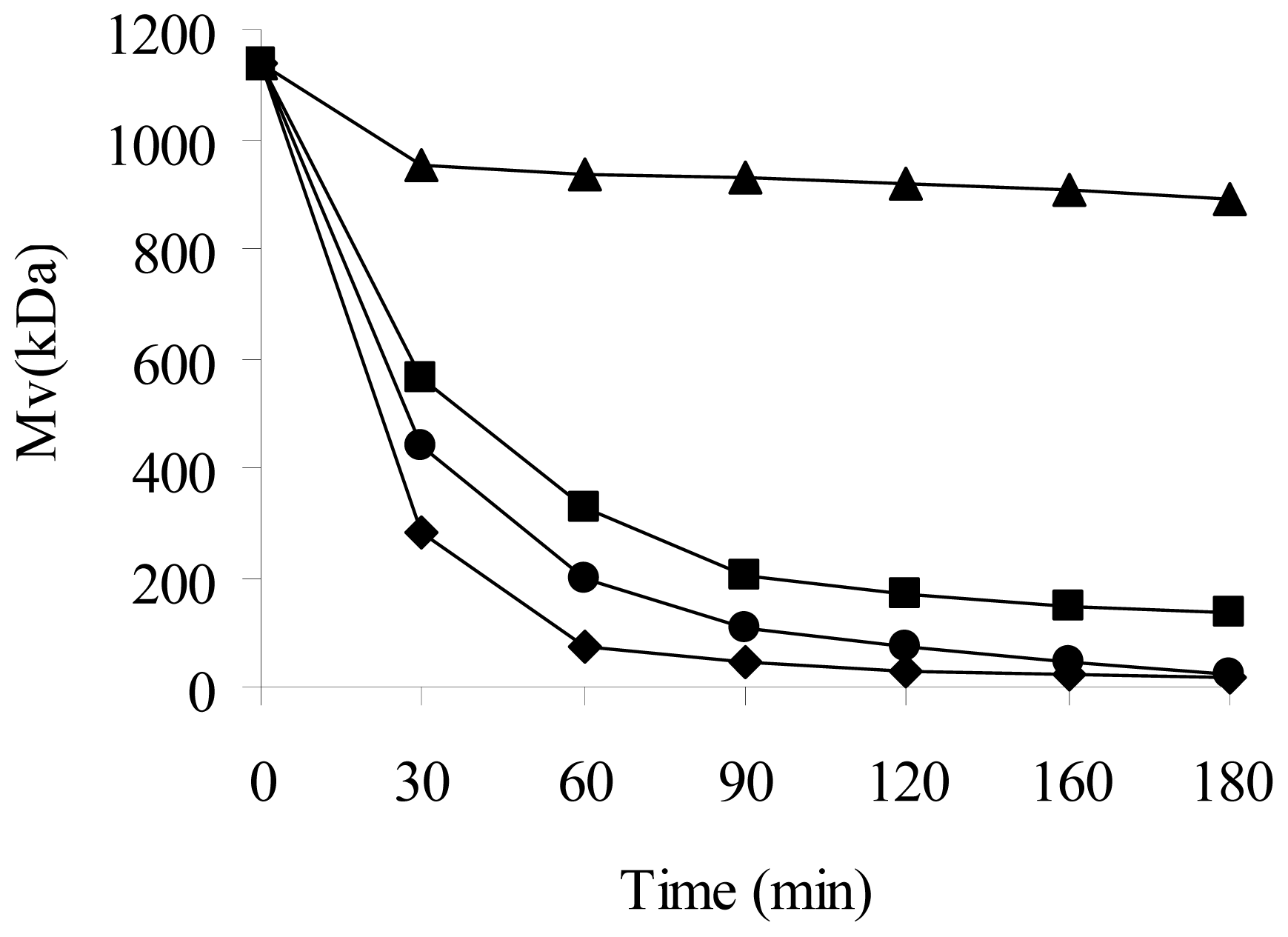
<p>In order to investigate the synergetic efficiency of plasma and H<sub>2</sub>O<sub>2</sub> on depolymerization of chitosan, two different H<sub>2</sub>O<sub>2</sub> concentrations, 1% and 2%, were used in the presence of plasma treatment. <xref ref-type="fig" rid="f1-ijms-13-07788">Figure 1</xref> shows that the combined treatment by plasma and H<sub>2</sub>O<sub>2</sub> could significantly enhance the depolymerization of chitosan compared to treatment with plasma or H<sub>2</sub>O<sub>2</sub> alone at room temperature. The higher the concentration of H<sub>2</sub>O<sub>2</sub>, the greater the reduction of the M<sub>v</sub> occurred at the same treatment time.</p>
<p>When the original chitosan was only exposed to plasma radiation, the M<sub>v</sub> decreased effectively from 1138.11 ± 0.20 to 134.80 ± 0.23 kDa in 180 min. The rate of the depolymerization of chitosan in the M<sub>v</sub> was 88.15%.</p>
<p>When the original chitosan was treated with only H<sub>2</sub>O<sub>2</sub> at room temperature, the M<sub>v</sub> decreased from 1138.11 ± 0.20 to 888.89 ± 0.18 kDa in 180 min. The corresponding rate of decrease in M<sub>v</sub> was only 21.90%.</p>
<p>When the original chitosan was treated with plasma combined with H<sub>2</sub>O<sub>2</sub> (2%), the corresponding M<sub>v</sub> of chitosan decreased from 1138.11 ± 0.20 to 16.25 ± 0.58 kDa in 180 min. The rate of decrease in M<sub>v</sub> was 98.57%.</p>
<p><xref ref-type="fig" rid="f1-ijms-13-07788">Figure 1</xref> also shows that the M<sub>v</sub> dropped sharply in the first 60 min and then decreased slowly (60–180 min). This suggests that the high molecular weight chitosans were preferentially depolymerized over the low-molecular-weight chitosans. The depolymerization of chitosan increased with increasing H<sub>2</sub>O<sub>2</sub> concentration. When H<sub>2</sub>O<sub>2</sub> concentration was 1% and 2%, the M<sub>v</sub> in 60 min was 199.72 ± 0.15 and 72.44 ± 0.31 kDa, respectively. The rate of decrease in the M<sub>v</sub> of chitosan was 82.45% and 93.64%, respectively.</p>
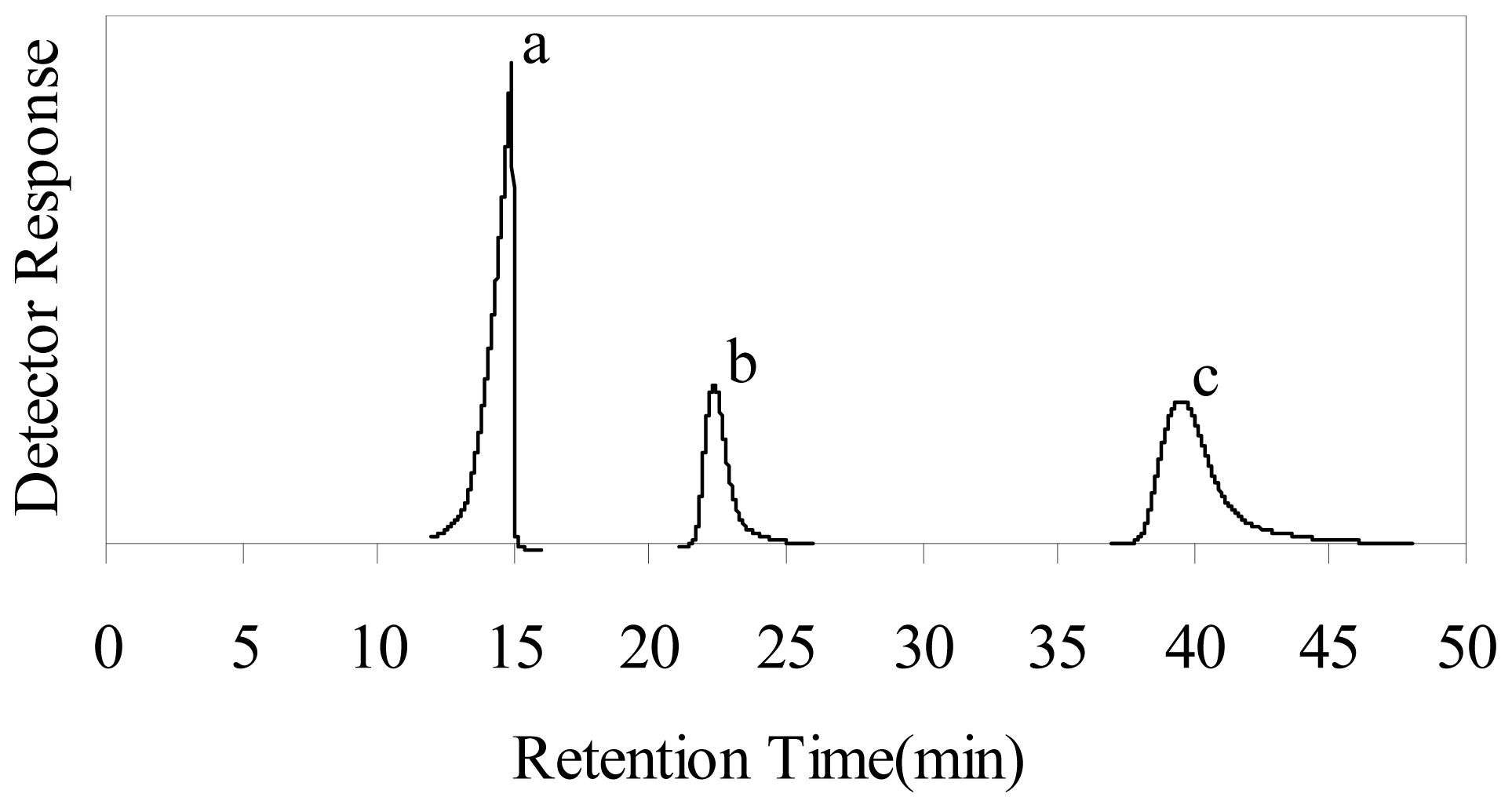
<p>To further confirm the effect of plasma depolymerization of chitosan, GPC was used for qualitative evaluation of the reduction in molecular weight of chitosan and its distribution. <xref ref-type="fig" rid="f2-ijms-13-07788">Figure 2</xref> shows the GPC elution curves of original chitosan and plasma chitosan in the presence of 2% H<sub>2</sub>O<sub>2</sub> after 60 and 180 min. The large molecular weight molecules of large size appeared at low retention time and the lower molecular weight molecules of small size appeared at high retention time. This observation implies that some depolymerization had already occurred. Such a change is reckoned with the expected dominance of chain scission events in the depolymerization of chitosan. The plasma also causes a broadening of the overall distribution, which is diagnostic of the increase of the polydispersity. Therefore, the GPC chromatograms in <xref ref-type="fig" rid="f2-ijms-13-07788">Figure 2</xref> confirmed the depolymerization effect of plasma on chitosan in the presence of H<sub>2</sub>O<sub>2</sub>.</p></sec>
<sec sec-type="methods">
<title>2.2. FT-IR Spectral Analysis</title>
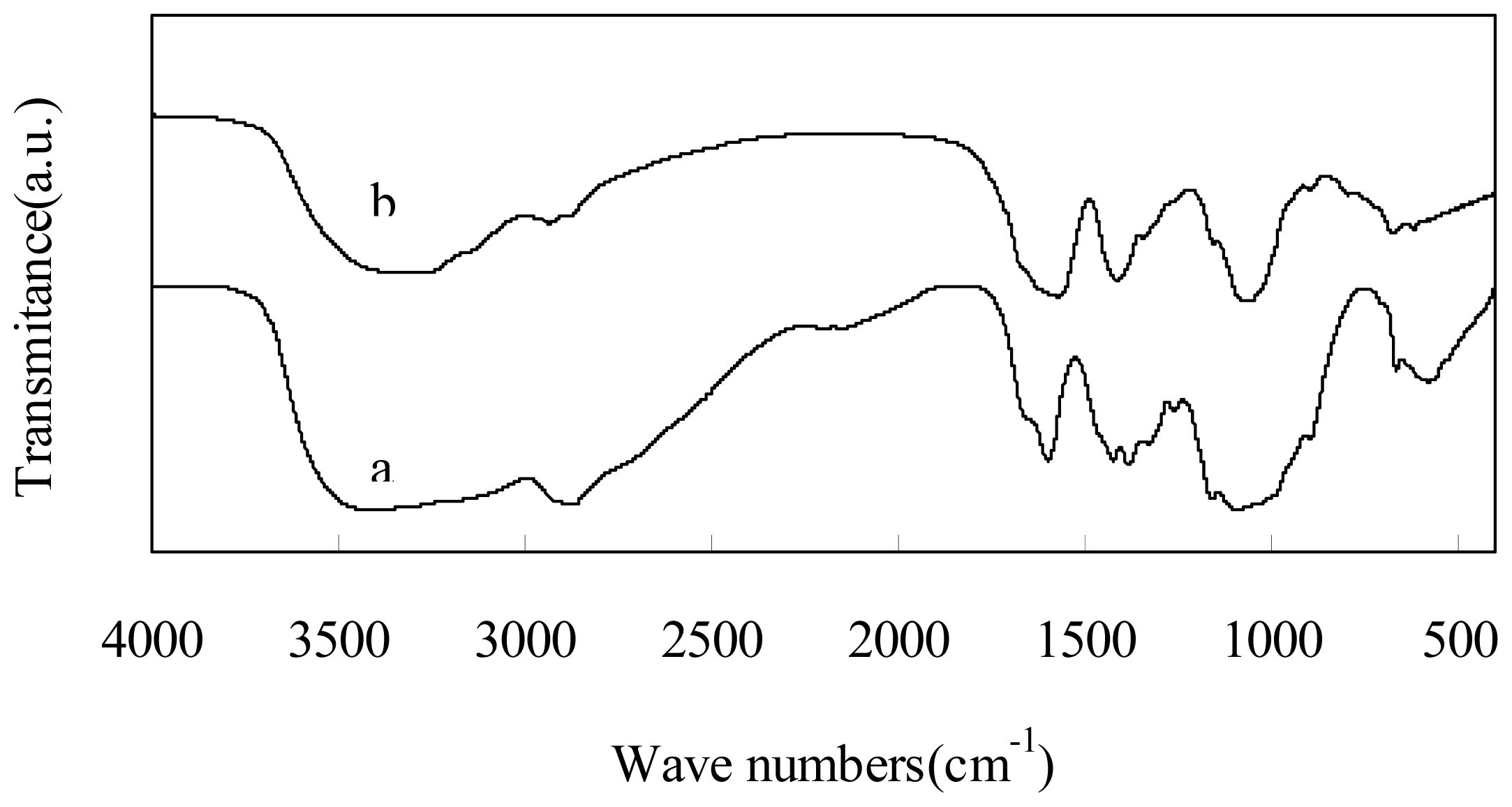
<p><xref ref-type="fig" rid="f3-ijms-13-07788">Figure 3</xref> shows the FT-IR spectra of the original chitosan and depolymerized chitosan by plasma treatment with 2% H<sub>2</sub>O<sub>2</sub> after 180 min. The spectrum of the depolymerized chitosan was similar to that of the original one. The broad absorbent band centered at 3396 cm<sup>−1</sup> was characteristic of the stretching vibration of –OH and –NH<sub>2</sub> [<xref ref-type="bibr" rid="b28-ijms-13-07788">28</xref>]. The band near 2960–2850 cm<sup>−1</sup> corresponds to C–H stretching of the alkyl substituent [<xref ref-type="bibr" rid="b29-ijms-13-07788">29</xref>]. The bands at 1597 and 599 cm<sup>−1</sup> were attributed to the binding vibrations of the amido groups [<xref ref-type="bibr" rid="b30-ijms-13-07788">30</xref>]. The bands in the range 1158–895 cm<sup>−1</sup> are assigned to the characteristics of β-D-(1→4) glycosidic bond in chitosan [<xref ref-type="bibr" rid="b31-ijms-13-07788">31</xref>,<xref ref-type="bibr" rid="b32-ijms-13-07788">32</xref>]. The result of FT-IR spectra suggested that there was no significant difference between the chemical structure of the depolymerized and original chitosan. In addition, the band at 1735 cm<sup>−1</sup>, which assigned to the carboxyl group, was not obvious, indicating that the carboxyl group of chitosan was not formed during depolymerization. In conclusion, the original monomeric structure of chitosan is retained in the depolymerized chitosan.</p></sec>
<sec sec-type="methods">
<title>2.3. UV Spectral Analysis</title>
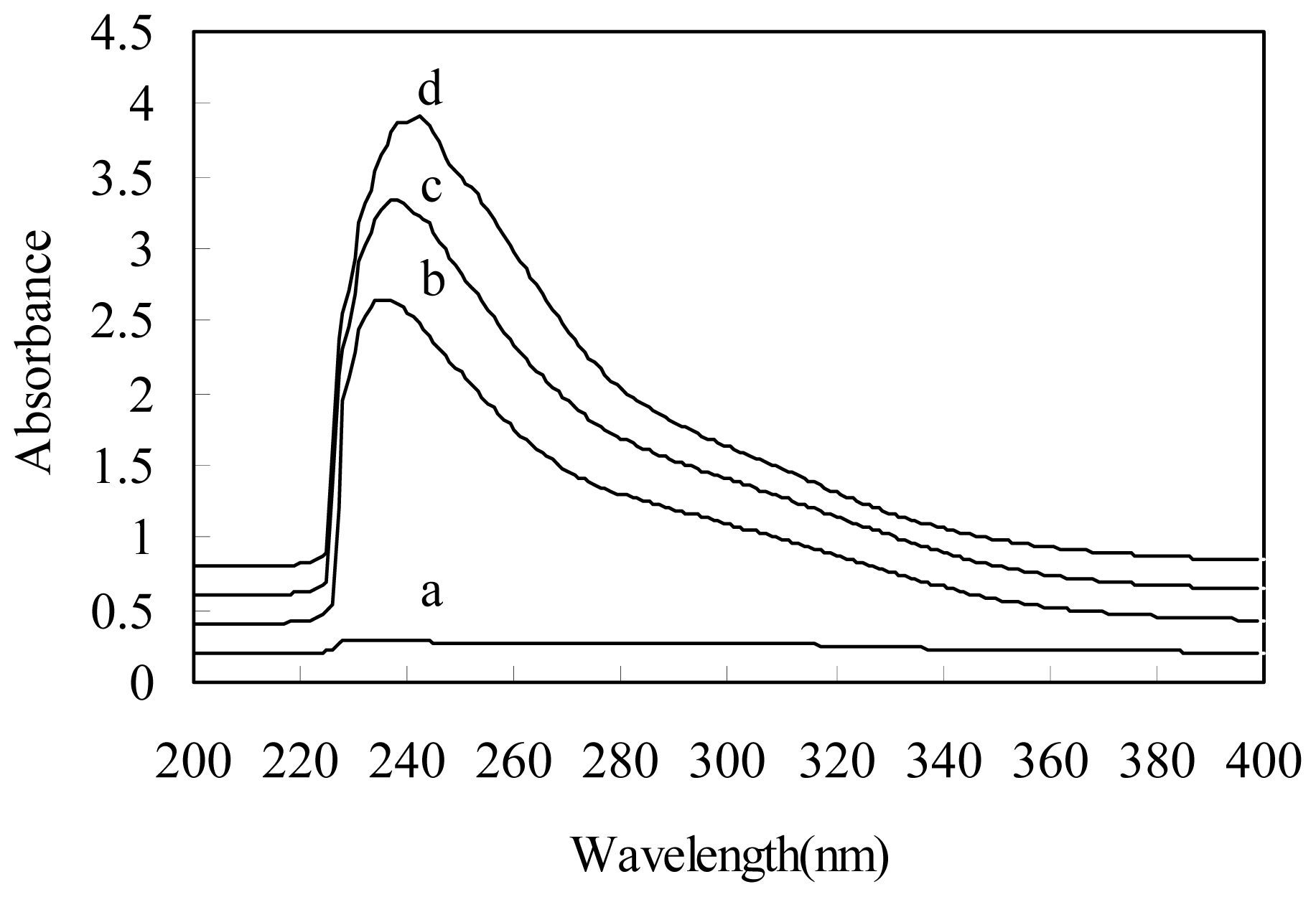
<p>We studied the stability of the depolymerized chitosan by investigating the UV spectra. <xref ref-type="fig" rid="f4-ijms-13-07788">Figure 4</xref> shows the UV spectra of the original chitosan and depolymerized chitosan after plasma treatment with 2% H<sub>2</sub>O<sub>2</sub> at different times. For the treated chitosans, a new absorption band at 240 nm was observed, which was ascribed to carbonyl groups [<xref ref-type="bibr" rid="b19-ijms-13-07788">19</xref>,<xref ref-type="bibr" rid="b33-ijms-13-07788">33</xref>]. The relative absorption intensity of the peaks increased with increasing treatment time. This result indicates that the carbonyl groups might be formed during depolymerization.</p></sec>
<sec sec-type="methods">
<title>2.4. X-ray Analysis</title>
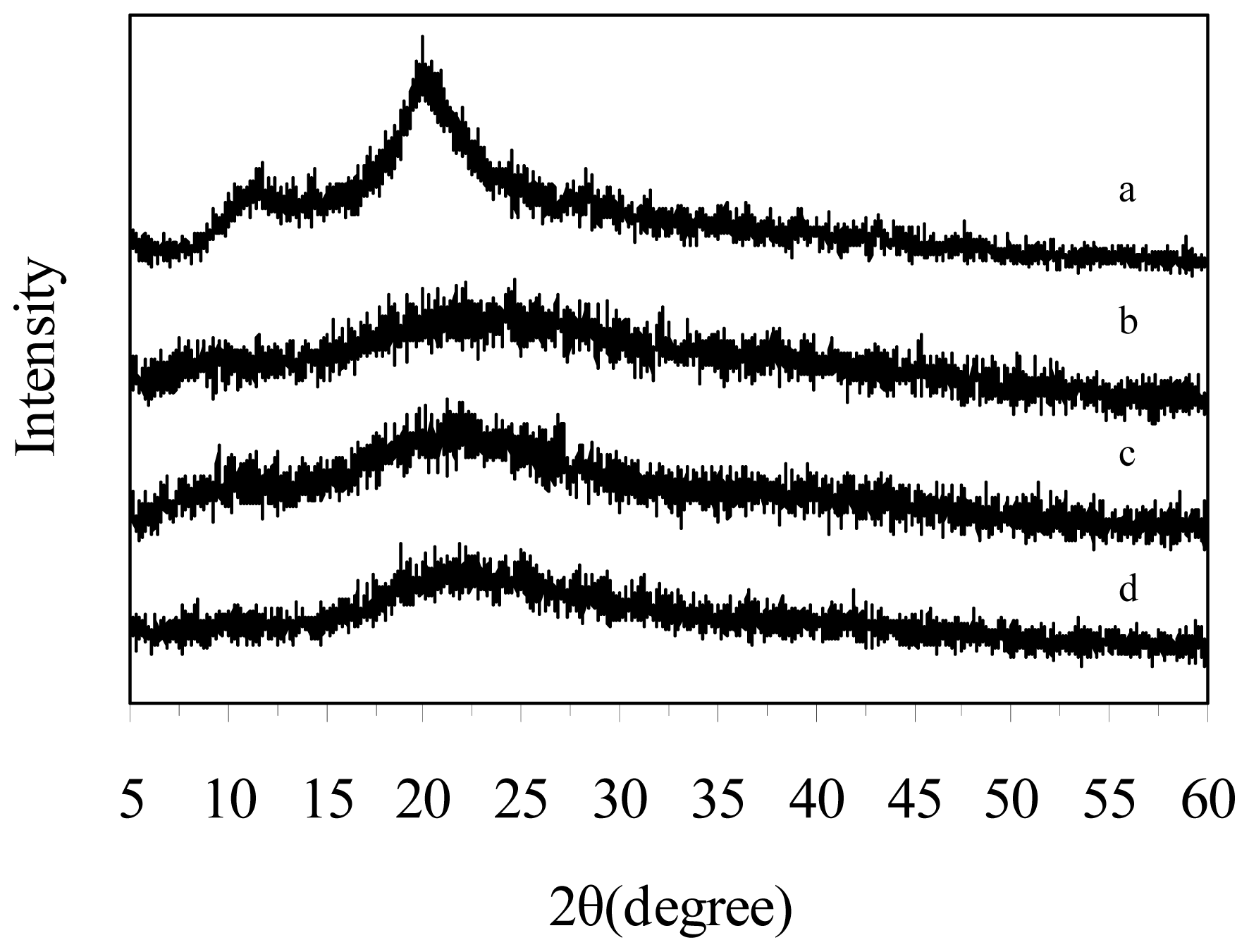
<p><xref ref-type="fig" rid="f5-ijms-13-07788">Figure 5</xref> shows the X-ray diffraction patterns of original chitosan and depolymerized chitosan (60 min, 120 min, 180 min). For the original chitosan, the treatment conditions were the same as the depolymerized chitosan except for the plasma; there were two characteristic peaks at 10.42 and 19.6. Compared with the original chitosan, the depolymerized chitosan sample prepared by plasma combined with H<sub>2</sub>O<sub>2</sub> had only the peak at 19.6 with less intensity and became amorphous. The present results indicate that the synergistic depolymerization of chitosan by plasma/H<sub>2</sub>O<sub>2</sub> caused destruction of the crystal structure.</p></sec></sec>
<sec>
<title>3. Experimental Section</title>
<sec sec-type="materials">
<title>3.1. Materials</title>
<p>Chitosan was supplied by Sinopharm Chemical Reagent Co., Ltd, China. The degree of deacetylation (DD) of chitosan was not less than 90%. The viscosity-average molecular weight (M<sub>v</sub>) was about 1138.11 ± 0.20 kDa. All other chemicals, including H<sub>2</sub>O<sub>2</sub>, acetic acid (CH<sub>3</sub>COOH), sodium acetate (CH<sub>3</sub>COONa), NaOH and ethyl alcohol were of reagent grade obtained from Sinopharm Chemical Reagent Co., Ltd, China. All solutions were prepared using distilled water.</p></sec>
<sec>
<title>3.2. Plasma Treatment Experiments</title>
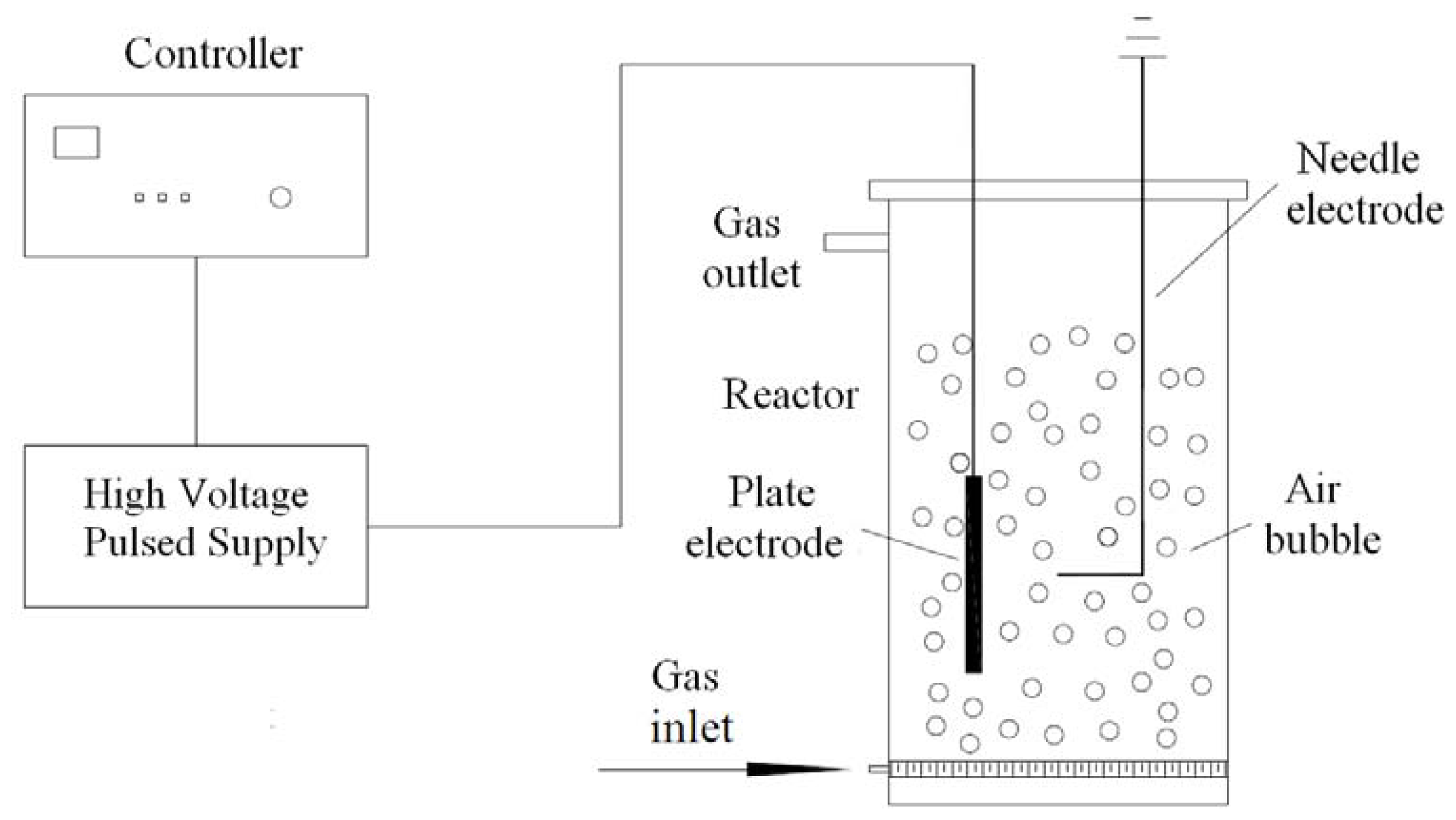
<p>A home built apparatus for the plasma treatment, as shown in <xref ref-type="fig" rid="f6-ijms-13-07788">Figure 6</xref>, includes a pulsed high voltage generator with AC and a treatment chamber (100 mL) with needle-plate electrodes. The needle electrode was a stainless steel needle (diameter 1 mm). The plate electrode was a stainless disk (diameter 40 mm). The high voltage pulse generator provided a discharge for a few microseconds. During the treatment, the peak pulse voltage is 60 KV, the power is 350 W, the distance between the electrodes is 2 mm and the treatment time is 180 min. When the pulsed power system was activated, the generator supplied the electrical discharges, which established an electric field across the sparged liquid. Thus the dispersed air bubbles in the liquid are ionized, and the plasma is obtained.</p></sec>
<sec>
<title>3.3. Preparation of Depolymerized Chitosan</title>
<p>Chitosan powder was dissolved into 1% (<italic>v</italic>/<italic>v</italic>) acetic acid aqueous solution. The final concentration of chitosan was 0.3 (wt.%). The 80 mL chitosan solution was treated by plasma in the presence of H<sub>2</sub>O<sub>2</sub> at room temperature.</p></sec>
<sec>
<title>3.4. Separation (Fractionation) of Water-Soluble Chitosan</title>
<p>After depolymerization, the solution was neutralized with 2 M NaOH solution to pH ~7.5, and then twice the volume of the solution of absolute ethanol was added to precipitate chitosan molecules from dispersions, and then the solid product was filtrated, and washed with ethanol. Finally, the solid product was dried in an oven at 60 °C and the powder of water soluble chitosan was obtained.</p></sec>
<sec>
<title>3.5. Characterization</title>
<p>The molecular weight of chitosan was determined by the viscometric method [<xref ref-type="bibr" rid="b31-ijms-13-07788">31</xref>]. The relative viscosity, <italic>η</italic><italic><sub>r</sub></italic>, of chitosan was measured using an Ubbelohde capillary viscometer (Shanghai Longtuo Instrument Co., Ltd., China) in a constant-temperature water bath at 25 ± 0.5 °C as the mean of three replicates from the same chitosan solution. The intrinsic viscosity, [<italic>η</italic>], was calculated according to <xref rid="FD1" ref-type="disp-formula">Equation (1)</xref>:</p>
<disp-formula id="FD1">
<label>(1)</label>
<mml:math id="mm1" display="block">
<mml:semantics id="sm1">
<mml:mrow>
<mml:mo stretchy="false">[</mml:mo>
<mml:mi>η</mml:mi>
<mml:mo stretchy="false">]</mml:mo>
<mml:mo>=</mml:mo>
<mml:mfrac>
<mml:mrow>
<mml:mrow>
<mml:mo>(</mml:mo>
<mml:mrow>
<mml:msub>
<mml:mrow>
<mml:mi>η</mml:mi></mml:mrow>
<mml:mrow>
<mml:mi>s</mml:mi>
<mml:mi>p</mml:mi></mml:mrow></mml:msub>
<mml:mo>+</mml:mo>
<mml:mn>3</mml:mn>
<mml:mi> </mml:mi>
<mml:mtext>ln </mml:mtext>
<mml:msub>
<mml:mrow>
<mml:mi>η</mml:mi></mml:mrow>
<mml:mi>r</mml:mi></mml:msub></mml:mrow>
<mml:mo>)</mml:mo></mml:mrow></mml:mrow>
<mml:mrow>
<mml:mn>4</mml:mn>
<mml:mi>c</mml:mi></mml:mrow></mml:mfrac></mml:mrow></mml:semantics></mml:math></disp-formula>
<p>where <italic>η</italic><italic><sub>sp</sub></italic> is the incremental viscosity, <italic>η</italic><italic><sub>sp</sub></italic> = <italic>η</italic><italic><sub>r</sub></italic> − 1, <italic>c</italic> is the concentration of chitosan (g/mL). Then, the M<sub>v</sub> of chitosan was calculated based on the Mark–Houwink <xref rid="FD2" ref-type="disp-formula">Equation (2</xref>:</p>
<disp-formula id="FD2">
<label>(2)</label>
<mml:math id="mm2" display="block">
<mml:semantics id="sm2">
<mml:mrow>
<mml:mo stretchy="false">[</mml:mo>
<mml:mi>η</mml:mi>
<mml:mo stretchy="false">]</mml:mo>
<mml:mo>=</mml:mo>
<mml:mi>k</mml:mi>
<mml:mo>×</mml:mo>
<mml:msup>
<mml:mrow>
<mml:mrow>
<mml:mo stretchy="false">(</mml:mo>
<mml:msub>
<mml:mrow>
<mml:mi>M</mml:mi></mml:mrow>
<mml:mi>v</mml:mi></mml:msub>
<mml:mo stretchy="false">)</mml:mo></mml:mrow></mml:mrow>
<mml:mi>a</mml:mi></mml:msup></mml:mrow></mml:semantics></mml:math></disp-formula>
<p>The value of <italic>k</italic> and <italic>α</italic> is 6.589 × 10<sup>−3</sup> and 0.88, respectively [<xref ref-type="bibr" rid="b34-ijms-13-07788">34</xref>].</p>
<p>GPC was used for qualitative evaluation of the reduction in molecular weight of chitosan on a GPC instrument (Agilent 1100) equipped with a refractive index detector. GPC measurement was carried out at 30 °C using connected columns (79911GF-083 and 79911GF-084) with 0.2 M CH<sub>3</sub>COOH/0.1 M CH<sub>3</sub>COONa solution as an eluent at a flow rate of 1 mL/min.</p>
<p>FT-IR spectrum was measured in powder form on Bruker Vector 22 spectrophotometer (Germany) using KBr pellets in the range of 400–4000 cm<sup>−1</sup>.</p>
<p>UV-Vis spectrum was taken on a TU-1810 (Beijing Purkinje General Instrument Co., Ltd., China) in the range of 200 to 400 nm.</p>
<p>X-ray powder diffraction (XRD) patterns of the depolymerized chitosan fraction were measured on a Rigaku D/max-2200 X-ray diffractometer using a CuKα target at 30 KV and 30 mA at 25 °C. The relative intensity was recorded in the range (2<italic>θ</italic>) of 5–60° with a scanning rate of 0.02°/s.</p></sec></sec>
<sec sec-type="conclusions">
<title>4. Conclusions</title>
<p>Chitosan was efficiently depolymerized by plasma treatment in the presence of H<sub>2</sub>O<sub>2</sub>.The results of GPC analysis showed that the molecular weight of chitosan decreased with the increase of the treatment time. The FT-IR spectra indicated no obvious modification of chemical structure of chitosan before and after depolymerization. The UV spectra suggested that carbonyl groups might be formed during the depolymerization. The results of XRD confirmed this claim that the reduction in molecular weight of the resulting chitosan led to the transformation of the crystal structure. Therefore, plasma treatment in the presence of H<sub>2</sub>O<sub>2</sub> is a potentially applicable technique for the production of low-molecular-weight chitosan.</p></sec></body>
<back>
<ref-list>
<title>References</title>
<ref id="b1-ijms-13-07788"><label>1</label><citation citation-type="journal"><person-group person-group-type="author"><name><surname>Kean</surname><given-names>T.</given-names></name><name><surname>Thanou</surname><given-names>M.</given-names></name></person-group><article-title>Biodegradation, biodistribution and toxicity of chitosan</article-title><source>Adv. Drug Deliv. Rev</source><year>2010</year><volume>62</volume><fpage>3</fpage><lpage>11</lpage><pub-id pub-id-type="doi">10.1016/j.addr.2009.09.004</pub-id><pub-id pub-id-type="pmid">19800377</pub-id></citation></ref>
<ref id="b2-ijms-13-07788"><label>2</label><citation citation-type="journal"><person-group person-group-type="author"><name><surname>Xia</surname><given-names>W.</given-names></name><name><surname>Liu</surname><given-names>P.</given-names></name><name><surname>Zhang</surname><given-names>J.</given-names></name><name><surname>Chen</surname><given-names>J.</given-names></name></person-group><article-title>Biological activities of chitosan and Chitooligosaccharides</article-title><source>Food Hydrocolloid</source><year>2011</year><volume>25</volume><fpage>170</fpage><lpage>179</lpage><pub-id pub-id-type="doi">10.1016/j.foodhyd.2010.03.003</pub-id></citation></ref>
<ref id="b3-ijms-13-07788"><label>3</label><citation citation-type="journal"><person-group person-group-type="author"><name><surname>Aider</surname><given-names>M.</given-names></name></person-group><article-title>Chitosan application for active bio-based films production and potential in the food industry: Review</article-title><source>LWT Food Sci. Technol</source><year>2010</year><volume>43</volume><fpage>837</fpage><lpage>842</lpage><pub-id pub-id-type="doi">10.1016/j.lwt.2010.01.021</pub-id></citation></ref>
<ref id="b4-ijms-13-07788"><label>4</label><citation citation-type="journal"><person-group person-group-type="author"><name><surname>Sajomsang</surname><given-names>W.</given-names></name></person-group><article-title>Synthetic methods and applications of chitosan containing pyridylmethyl moiety and its quaternized derivatives: A review</article-title><source>Carbohydr. Polym</source><year>2010</year><volume>80</volume><fpage>631</fpage><lpage>647</lpage><pub-id pub-id-type="doi">10.1016/j.carbpol.2009.12.037</pub-id></citation></ref>
<ref id="b5-ijms-13-07788"><label>5</label><citation citation-type="journal"><person-group person-group-type="author"><name><surname>Xia</surname><given-names>W.</given-names></name><name><surname>Liu</surname><given-names>P.</given-names></name><name><surname>Liu</surname><given-names>J.</given-names></name></person-group><article-title>Advance in chitosan hydrolysis by non-specific cellulases</article-title><source>Bioresour. Technol</source><year>2008</year><volume>99</volume><fpage>6751</fpage><lpage>6762</lpage><pub-id pub-id-type="doi">10.1016/j.biortech.2008.01.011</pub-id><pub-id pub-id-type="pmid">18328693</pub-id></citation></ref>
<ref id="b6-ijms-13-07788"><label>6</label><citation citation-type="journal"><person-group person-group-type="author"><name><surname>Aiba</surname><given-names>S.</given-names></name></person-group><article-title>Studies on chitosan: 3. Evidence for the presence of random and block copolymer structures in partially Nacetylated chitosans</article-title><source>Int. J. Biol. Macromol</source><year>1991</year><volume>13</volume><fpage>40</fpage><lpage>44</lpage><pub-id pub-id-type="doi">10.1016/0141-8130(91)90008-I</pub-id><pub-id pub-id-type="pmid">2059582</pub-id></citation></ref>
<ref id="b7-ijms-13-07788"><label>7</label><citation citation-type="journal"><person-group person-group-type="author"><name><surname>Rinaudo</surname><given-names>M.</given-names></name></person-group><article-title>Chitin and chitosan: Properties and applications</article-title><source>Prog. Polym. Sci</source><year>2006</year><volume>31</volume><fpage>603</fpage><lpage>632</lpage><pub-id pub-id-type="doi">10.1016/j.progpolymsci.2006.06.001</pub-id></citation></ref>
<ref id="b8-ijms-13-07788"><label>8</label><citation citation-type="journal"><person-group person-group-type="author"><name><surname>Rege</surname><given-names>P.R.</given-names></name><name><surname>Block</surname><given-names>L.H.</given-names></name></person-group><article-title>Chitosan processing: Influence of process parameters during acidic and alkaline hydrolysis and effect of the processing sequence on the resultant chitosans properties</article-title><source>Carbohydr. Res</source><year>1999</year><volume>321</volume><fpage>235</fpage><lpage>245</lpage><pub-id pub-id-type="doi">10.1016/S0008-6215(99)00172-X</pub-id></citation></ref>
<ref id="b9-ijms-13-07788"><label>9</label><citation citation-type="journal"><person-group person-group-type="author"><name><surname>Qin</surname><given-names>C.Q.</given-names></name><name><surname>Du</surname><given-names>Y.M.</given-names></name><name><surname>Xiao</surname><given-names>L.</given-names></name></person-group><article-title>Effect of hydrogen peroxide treatment on the molecular weight and structure of chitosan</article-title><source>Polym. Degrad. Stabil</source><year>2002</year><volume>76</volume><fpage>211</fpage><lpage>218</lpage><pub-id pub-id-type="doi">10.1016/S0141-3910(02)00016-2</pub-id></citation></ref>
<ref id="b10-ijms-13-07788"><label>10</label><citation citation-type="journal"><person-group person-group-type="author"><name><surname>Huang</surname><given-names>Q.Z.</given-names></name><name><surname>Meng</surname><given-names>Z.H.</given-names></name><name><surname>Feng</surname><given-names>Y.Q.</given-names></name><name><surname>Shi</surname><given-names>H.Z.</given-names></name></person-group><article-title>Study on the heterogeneous degradation of chitosan with H<sub>2</sub>O<sub>2</sub> catalyzed by a new supermolecular assembly crystal: [C<sub>6</sub>H<sub>8</sub>N<sub>2</sub>]6H<sub>3</sub>[PW<sub>12</sub>O<sub>40</sub>] · 2H<sub>2</sub>O</article-title><source>Carbohyd. Res</source><year>2010</year><volume>345</volume><fpage>115</fpage><lpage>119</lpage><pub-id pub-id-type="doi">10.1016/j.carres.2009.09.027</pub-id></citation></ref>
<ref id="b11-ijms-13-07788"><label>11</label><citation citation-type="journal"><person-group person-group-type="author"><name><surname>Xie</surname><given-names>Y.</given-names></name><name><surname>Hu</surname><given-names>J.</given-names></name><name><surname>Wei</surname><given-names>Y.</given-names></name><name><surname>Hong</surname><given-names>X.</given-names></name></person-group><article-title>Preparation of chitooligosaccharides by the enzymatic hydrolysis of chitosan</article-title><source>Polym. Degrad. Stabil</source><year>2009</year><volume>94</volume><fpage>1895</fpage><lpage>1899</lpage><pub-id pub-id-type="doi">10.1016/j.polymdegradstab.2009.06.021</pub-id></citation></ref>
<ref id="b12-ijms-13-07788"><label>12</label><citation citation-type="journal"><person-group person-group-type="author"><name><surname>Wang</surname><given-names>S.M.</given-names></name><name><surname>Huang</surname><given-names>Q.Z.</given-names></name><name><surname>Wang</surname><given-names>Q.S.</given-names></name></person-group><article-title>Study on the synergetic degradation of chitosan with ultraviolet light and hydrogen peroxide</article-title><source>Carbohyd. Res</source><year>2005</year><volume>340</volume><fpage>1143</fpage><lpage>1147</lpage><pub-id pub-id-type="doi">10.1016/j.carres.2005.02.009</pub-id></citation></ref>
<ref id="b13-ijms-13-07788"><label>13</label><citation citation-type="journal"><person-group person-group-type="author"><name><surname>Yue</surname><given-names>W.</given-names></name><name><surname>Yao</surname><given-names>P.</given-names></name><name><surname>Wei</surname><given-names>Y.</given-names></name><name><surname>Mo</surname><given-names>H.</given-names></name></person-group><article-title>Synergetic effect of ozone and ultrasonic radiation on degradation of chitosan</article-title><source>Polym. Degrad. Stabil</source><year>2008</year><volume>93</volume><fpage>1814</fpage><lpage>1821</lpage><pub-id pub-id-type="doi">10.1016/j.polymdegradstab.2008.07.010</pub-id></citation></ref>
<ref id="b14-ijms-13-07788"><label>14</label><citation citation-type="journal"><person-group person-group-type="author"><name><surname>Taghizadeh</surname><given-names>M.T.</given-names></name><name><surname>Abdollahi</surname><given-names>R.</given-names></name></person-group><article-title>Sonolytic, sonocatalytic and sonophotocatalytic degradation of chitosan in the presence of TiO<sub>2</sub> nanoparticles</article-title><source>Ultrason. Sonochem</source><year>2011</year><volume>18</volume><fpage>149</fpage><lpage>157</lpage><pub-id pub-id-type="doi">10.1016/j.ultsonch.2010.04.004</pub-id><pub-id pub-id-type="pmid">20466578</pub-id></citation></ref>
<ref id="b15-ijms-13-07788"><label>15</label><citation citation-type="journal"><person-group person-group-type="author"><name><surname>Shen</surname><given-names>K.</given-names></name><name><surname>Hu</surname><given-names>Q.L.</given-names></name><name><surname>Wamg</surname><given-names>Z.K.</given-names></name><name><surname>Qu</surname><given-names>J.</given-names></name></person-group><article-title>Effect of 60Co irradiation on the properties of chitosan rod</article-title><source>Mater. Sci. Eng. C</source><year>2011</year><volume>31</volume><fpage>866</fpage><lpage>872</lpage><pub-id pub-id-type="doi">10.1016/j.msec.2011.02.002</pub-id></citation></ref>
<ref id="b16-ijms-13-07788"><label>16</label><citation citation-type="journal"><person-group person-group-type="author"><name><surname>Abd El-Rehim</surname><given-names>H.A.</given-names></name><name><surname>El-Sawy</surname><given-names>N.M.</given-names></name><name><surname>Hegazy</surname><given-names>el-S.A.</given-names></name><name><surname>Soliman</surname><given-names>el-S.A.</given-names></name><name><surname>Elbarbary</surname><given-names>A.M.</given-names></name></person-group><article-title>Improvement of antioxidant activity of chitosan by chemical treatment and ionizing radiation</article-title><source>Int. J. Biol. Macromol</source><year>2012</year><volume>50</volume><fpage>403</fpage><lpage>413</lpage><pub-id pub-id-type="doi">10.1016/j.ijbiomac.2011.12.021</pub-id><pub-id pub-id-type="pmid">22222149</pub-id></citation></ref>
<ref id="b17-ijms-13-07788"><label>17</label><citation citation-type="journal"><person-group person-group-type="author"><name><surname>Nguyen Ngoc</surname><given-names>D.</given-names></name><name><surname>Dang Van</surname><given-names>P.</given-names></name><name><surname>Nguyen Tue</surname><given-names>A.</given-names></name><name><surname>Nguyen Quoc</surname><given-names>H.</given-names></name></person-group><article-title>Synergistic degradation to prepare oligochitosan by r-irradiation of chitosan solution in the presence of hydrogen peroxide</article-title><source>Phys. Chem</source><year>2011</year><volume>80</volume><fpage>848</fpage><lpage>853</lpage></citation></ref>
<ref id="b18-ijms-13-07788"><label>18</label><citation citation-type="journal"><person-group person-group-type="author"><name><surname>Luo</surname><given-names>W.B.</given-names></name><name><surname>Han</surname><given-names>Z.</given-names></name><name><surname>Zeng</surname><given-names>X.A.</given-names></name><name><surname>Yu</surname><given-names>S.J.</given-names></name><name><surname>Kennedy</surname><given-names>F.</given-names></name></person-group><article-title>Study on the degradation of chitosan by pulsed electric fields treatment</article-title><source>Innovat. Food Sci. Emerg</source><year>2010</year><volume>11</volume><fpage>587</fpage><lpage>591</lpage><pub-id pub-id-type="doi">10.1016/j.ifset.2010.04.002</pub-id></citation></ref>
<ref id="b19-ijms-13-07788"><label>19</label><citation citation-type="journal"><person-group person-group-type="author"><name><surname>Cai</surname><given-names>Q.</given-names></name><name><surname>Gu</surname><given-names>Z.</given-names></name><name><surname>Chen</surname><given-names>Y.</given-names></name><name><surname>Han</surname><given-names>W.</given-names></name><name><surname>Fu</surname><given-names>T.</given-names></name><name><surname>Song</surname><given-names>H.</given-names></name><name><surname>Li</surname><given-names>F.</given-names></name></person-group><article-title>Degradation of chitosan by an electro-chemical process</article-title><source>Carbohydr. Polymer</source><year>2010</year><volume>79</volume><fpage>783</fpage><lpage>785</lpage><pub-id pub-id-type="doi">10.1016/j.carbpol.2009.08.022</pub-id></citation></ref>
<ref id="b20-ijms-13-07788"><label>20</label><citation citation-type="journal"><person-group person-group-type="author"><name><surname>Gweon</surname><given-names>B.</given-names></name><name><surname>Kim</surname><given-names>D.B.</given-names></name><name><surname>Moon</surname><given-names>S.Y.</given-names></name><name><surname>Choe</surname><given-names>W.</given-names></name></person-group><article-title><italic>Escherichia coli</italic> deactivation Study controlling the atmospheric pressure plasma discharge conditions</article-title><source>Curr. Appl. Phys</source><year>2009</year><volume>9</volume><fpage>625</fpage><lpage>628</lpage><pub-id pub-id-type="doi">10.1016/j.cap.2008.06.001</pub-id></citation></ref>
<ref id="b21-ijms-13-07788"><label>21</label><citation citation-type="journal"><person-group person-group-type="author"><name><surname>Hu</surname><given-names>M.</given-names></name><name><surname>Guo</surname><given-names>Y.</given-names></name></person-group><article-title>The sterilization of <italic>Escherichia coli</italic> by dielectric-barrier discharge plasma at atmospheric pressure</article-title><source>Appl. Surf. Sci</source><year>2011</year><volume>257</volume><fpage>7065</fpage><lpage>7070</lpage><pub-id pub-id-type="doi">10.1016/j.apsusc.2011.03.014</pub-id></citation></ref>
<ref id="b22-ijms-13-07788"><label>22</label><citation citation-type="journal"><person-group person-group-type="author"><name><surname>Jolibois</surname><given-names>J.</given-names></name><name><surname>Takashima</surname><given-names>K.</given-names></name><name><surname>Mizuno</surname><given-names>A.</given-names></name></person-group><article-title>Application of a non-thermal surface plasma discharge in wet condition for gas exhaust treatment: NOx removal</article-title><source>J. Electrostat</source><year>2012</year><volume>70</volume><fpage>300</fpage><lpage>308</lpage><pub-id pub-id-type="doi">10.1016/j.elstat.2012.03.011</pub-id></citation></ref>
<ref id="b23-ijms-13-07788"><label>23</label><citation citation-type="journal"><person-group person-group-type="author"><name><surname>Fernández</surname><given-names>A.</given-names></name><name><surname>Thompson</surname><given-names>A.</given-names></name></person-group><article-title>The inactivation of Salmonella by cold atmospheric plasma treatment</article-title><source>Food Res. Int</source><year>2012</year><volume>45</volume><fpage>678</fpage><lpage>684</lpage><pub-id pub-id-type="doi">10.1016/j.foodres.2011.04.009</pub-id></citation></ref>
<ref id="b24-ijms-13-07788"><label>24</label><citation citation-type="journal"><person-group person-group-type="author"><name><surname>Acda</surname><given-names>M.N.</given-names></name><name><surname>Devera</surname><given-names>E.E.</given-names></name><name><surname>Cabangon</surname><given-names>R.J.</given-names></name><name><surname>Ramos</surname><given-names>H.J.</given-names></name></person-group><article-title>Effects of plasma modification on adhesion properties of wood</article-title><source>Int. J. Adhes</source><year>2012</year><volume>32</volume><fpage>70</fpage><lpage>75</lpage></citation></ref>
<ref id="b25-ijms-13-07788"><label>25</label><citation citation-type="journal"><person-group person-group-type="author"><name><surname>Ryu</surname><given-names>S.M.</given-names></name><name><surname>Hong</surname><given-names>E.J.</given-names></name><name><surname>Seok</surname><given-names>D.C.</given-names></name><name><surname>Yoo</surname><given-names>S.R.</given-names></name><name><surname>Kim</surname><given-names>Y.J.</given-names></name><name><surname>Lho</surname><given-names>T.</given-names></name><name><surname>Lee</surname><given-names>B.J.</given-names></name></person-group><article-title>Characteristics of discharged sea water generated by underwater plasma system</article-title><source>Curr. Appl. Phys</source><year>2011</year><fpage>1</fpage><lpage>7</lpage></citation></ref>
<ref id="b26-ijms-13-07788"><label>26</label><citation citation-type="journal"><person-group person-group-type="author"><name><surname>Magureanu</surname><given-names>M.</given-names></name><name><surname>Piroi</surname><given-names>D.</given-names></name><name><surname>Mandache</surname><given-names>N.B.</given-names></name><name><surname>David</surname><given-names>V.</given-names></name><name><surname>Medvedovici</surname><given-names>A.</given-names></name><name><surname>Bradu</surname><given-names>C.</given-names></name><name><surname>Parvulescu</surname><given-names>V.I.</given-names></name></person-group><article-title>Degradation of antibiotics in water by non-thermal plasma treatment</article-title><source>Water Res</source><year>2011</year><volume>45</volume><fpage>3407</fpage><lpage>3416</lpage><pub-id pub-id-type="doi">10.1016/j.watres.2011.03.057</pub-id><pub-id pub-id-type="pmid">21514950</pub-id></citation></ref>
<ref id="b27-ijms-13-07788"><label>27</label><citation citation-type="journal"><person-group person-group-type="author"><name><surname>Marsilia</surname><given-names>L.</given-names></name><name><surname>Espieb</surname><given-names>S.</given-names></name><name><surname>Andersona</surname><given-names>J.G.</given-names></name><name><surname>MacGregor</surname><given-names>S.J.</given-names></name></person-group><article-title>Plasma inactivation of food-related microorganisms in liquids</article-title><source>Radiat. Phys. Chem</source><year>2002</year><volume>65</volume><fpage>507</fpage><lpage>513</lpage><pub-id pub-id-type="doi">10.1016/S0969-806X(02)00367-5</pub-id></citation></ref>
<ref id="b28-ijms-13-07788"><label>28</label><citation citation-type="journal"><person-group person-group-type="author"><name><surname>Li</surname><given-names>S.D.</given-names></name><name><surname>Zhang</surname><given-names>C.H.</given-names></name><name><surname>Dong</surname><given-names>J.J.</given-names></name><name><surname>Qu</surname><given-names>C.Y.</given-names></name><name><surname>Quan</surname><given-names>W.Y.</given-names></name><name><surname>Yang</surname><given-names>L.</given-names></name><name><surname>She</surname><given-names>X.D.</given-names></name></person-group><article-title>Effect of cupric ion on thermal degradation of quaternized chitosan</article-title><source>Carbohydr. Polymer</source><year>2010</year><volume>81</volume><fpage>182</fpage><lpage>187</lpage><pub-id pub-id-type="doi">10.1016/j.carbpol.2010.02.049</pub-id></citation></ref>
<ref id="b29-ijms-13-07788"><label>29</label><citation citation-type="journal"><person-group person-group-type="author"><name><surname>de Britto</surname><given-names>D.</given-names></name><name><surname>de Assis</surname><given-names>O.B.</given-names></name></person-group><article-title>Synthesis and mechanical properties of quaternary salts of chitosan-based films for food application</article-title><source>Int. J. Biol. Macromol</source><year>2007</year><volume>41</volume><fpage>198</fpage><lpage>203</lpage><pub-id pub-id-type="doi">10.1016/j.ijbiomac.2007.02.005</pub-id><pub-id pub-id-type="pmid">17399783</pub-id></citation></ref>
<ref id="b30-ijms-13-07788"><label>30</label><citation citation-type="journal"><person-group person-group-type="author"><name><surname>Huang</surname><given-names>Q.Z.</given-names></name><name><surname>Wan</surname><given-names>S.M.</given-names></name><name><surname>Huang</surname><given-names>J.F.</given-names></name><name><surname>Zhuo</surname><given-names>L.H.</given-names></name><name><surname>Guo</surname><given-names>Y.C.</given-names></name></person-group><article-title>Study on the heterogeneous degradation of chitosan with hydrogen peroxide under the catalysis of phosphotungstic acid</article-title><source>Carbohydr. Polymer</source><year>2007</year><volume>68</volume><fpage>761</fpage><lpage>765</lpage><pub-id pub-id-type="doi">10.1016/j.carbpol.2006.08.015</pub-id></citation></ref>
<ref id="b31-ijms-13-07788"><label>31</label><citation citation-type="journal"><person-group person-group-type="author"><name><surname>Chen</surname><given-names>R.H.</given-names></name><name><surname>Hwa</surname><given-names>H.D.</given-names></name></person-group><article-title>Effect of molecular weight of chitosan with the same degree of deacetylation on the thermal, mechanical, and permeability properties of the prepared membrane</article-title><source>Carbohydr. Polym</source><year>1996</year><volume>29</volume><fpage>353</fpage><lpage>358</lpage><pub-id pub-id-type="doi">10.1016/S0144-8617(96)00007-0</pub-id></citation></ref>
<ref id="b32-ijms-13-07788"><label>32</label><citation citation-type="journal"><person-group person-group-type="author"><name><surname>Peniche</surname><given-names>C.</given-names></name><name><surname>Waldo</surname><given-names>A.M.</given-names></name><name><surname>Davidenko</surname><given-names>N.</given-names></name><name><surname>Sastre</surname><given-names>R.</given-names></name><name><surname>Gallardo</surname><given-names>A.</given-names></name><name><surname>Roman</surname><given-names>J.S.</given-names></name></person-group><article-title>Self-curing membranes of chitosan/PAA IPNs obtained by radical polymerization: Preparation, characterization and interpolymer complexation</article-title><source>Biomaterials</source><year>1999</year><volume>20</volume><fpage>1869</fpage><lpage>1878</lpage><pub-id pub-id-type="doi">10.1016/S0142-9612(99)00048-4</pub-id><pub-id pub-id-type="pmid">10514063</pub-id></citation></ref>
<ref id="b33-ijms-13-07788"><label>33</label><citation citation-type="journal"><person-group person-group-type="author"><name><surname>Czechowska-Biskup</surname><given-names>R.</given-names></name><name><surname>Rokita</surname><given-names>B.</given-names></name><name><surname>Lotfy</surname><given-names>S.</given-names></name><name><surname>Ulanski</surname><given-names>P.</given-names></name><name><surname>Rosiak</surname><given-names>J.M.</given-names></name></person-group><article-title>Degradation of chitosan and starch by 360-kHz ultrasound</article-title><source>Carbohydr. Polym</source><year>2005</year><volume>60</volume><fpage>175</fpage><lpage>184</lpage><pub-id pub-id-type="doi">10.1016/j.carbpol.2004.12.001</pub-id></citation></ref>
<ref id="b34-ijms-13-07788"><label>34</label><citation citation-type="journal"><person-group person-group-type="author"><name><surname>Wang</surname><given-names>W.</given-names></name><name><surname>Bo</surname><given-names>S.</given-names></name><name><surname>Li</surname><given-names>S.</given-names></name><name><surname>Qin</surname><given-names>W.</given-names></name></person-group><article-title>Determination of the Mark-Houwink equation for chitosans with different degrees of deacetylation</article-title><source>Int. J. Biol. Macromol</source><year>1991</year><volume>13</volume><fpage>281</fpage><lpage>285</lpage><pub-id pub-id-type="doi">10.1016/0141-8130(91)90027-R</pub-id><pub-id pub-id-type="pmid">1801901</pub-id></citation></ref></ref-list>
<sec sec-type="display-objects">
<title>Figures</title>
<fig id="f1-ijms-13-07788" position="float">
<label>Figure 1</label>
<caption>
<p>Effect of plasma and H<sub>2</sub>O<sub>2</sub> on the molecular weight of chitosan. ■: plasma alone; ▲: 2% H<sub>2</sub>O<sub>2</sub> alone; ●: plasma in the presence of H<sub>2</sub>O<sub>2</sub> (1%); ♦: plasma in the presence of H<sub>2</sub>O<sub>2</sub> (2%).</p></caption>
<graphic xlink:href="ijms-13-07788f1.gif"/></fig>
<fig id="f2-ijms-13-07788" position="float">
<label>Figure 2</label>
<caption>
<p>Gel permeation chromatography (GPC) chromatograms of the original chitosan and depolymerized chitosan (depolymerized by plasma in the presence of 2% H<sub>2</sub>O<sub>2</sub> for different times): (<bold>a</bold>) original chitosan; (<bold>b</bold>) 60 min; (<bold>c</bold>) 180 min.</p></caption>
<graphic xlink:href="ijms-13-07788f2.gif"/></fig>
<fig id="f3-ijms-13-07788" position="float">
<label>Figure 3</label>
<caption>
<p>Fourier-transform infrared spectra (FT-IR) spectra of chitosan: (<bold>a</bold>) original chitosan; (<bold>b</bold>) depolymerized chitosan by means of plasma in the presence of 2% H<sub>2</sub>O<sub>2</sub> after 180 min.</p></caption>
<graphic xlink:href="ijms-13-07788f3.gif"/></fig>
<fig id="f4-ijms-13-07788" position="float">
<label>Figure 4</label>
<caption>
<p>UV spectra of the original chitosan and depolymerized chitosan (depolymerized by plasma in the presence of 2% H<sub>2</sub>O<sub>2</sub> for different times): (<bold>a</bold>) original chitosan; (<bold>b</bold>) 60 min; (<bold>c</bold>) 120min; (<bold>d</bold>) 180 min.</p></caption>
<graphic xlink:href="ijms-13-07788f4.gif"/></fig>
<fig id="f5-ijms-13-07788" position="float">
<label>Figure 5</label>
<caption>
<p>X-ray diffraction (XRD) patterns of the original chitosan and depolymerized chitosan (depolymerized by plasma in the presence of 2% H<sub>2</sub>O<sub>2</sub> for different times): (<bold>a</bold>) original chitosan; (<bold>b</bold>) 180 min; (<bold>c</bold>) 120 min; (<bold>d</bold>) 60 min.</p></caption>
<graphic xlink:href="ijms-13-07788f5.gif"/></fig>
<fig id="f6-ijms-13-07788" position="float">
<label>Figure 6</label>
<caption>
<p>The schematic of plasma experimental apparatus.</p></caption>
<graphic xlink:href="ijms-13-07788f6.gif"/></fig></sec></back></article>