
Comparative Study of Essential Oils Extracted from Algerian Myrtus communis L. Leaves Using Microwaves and Hydrodistillation

Abstract
:1. Introduction
2. Results and Discussion
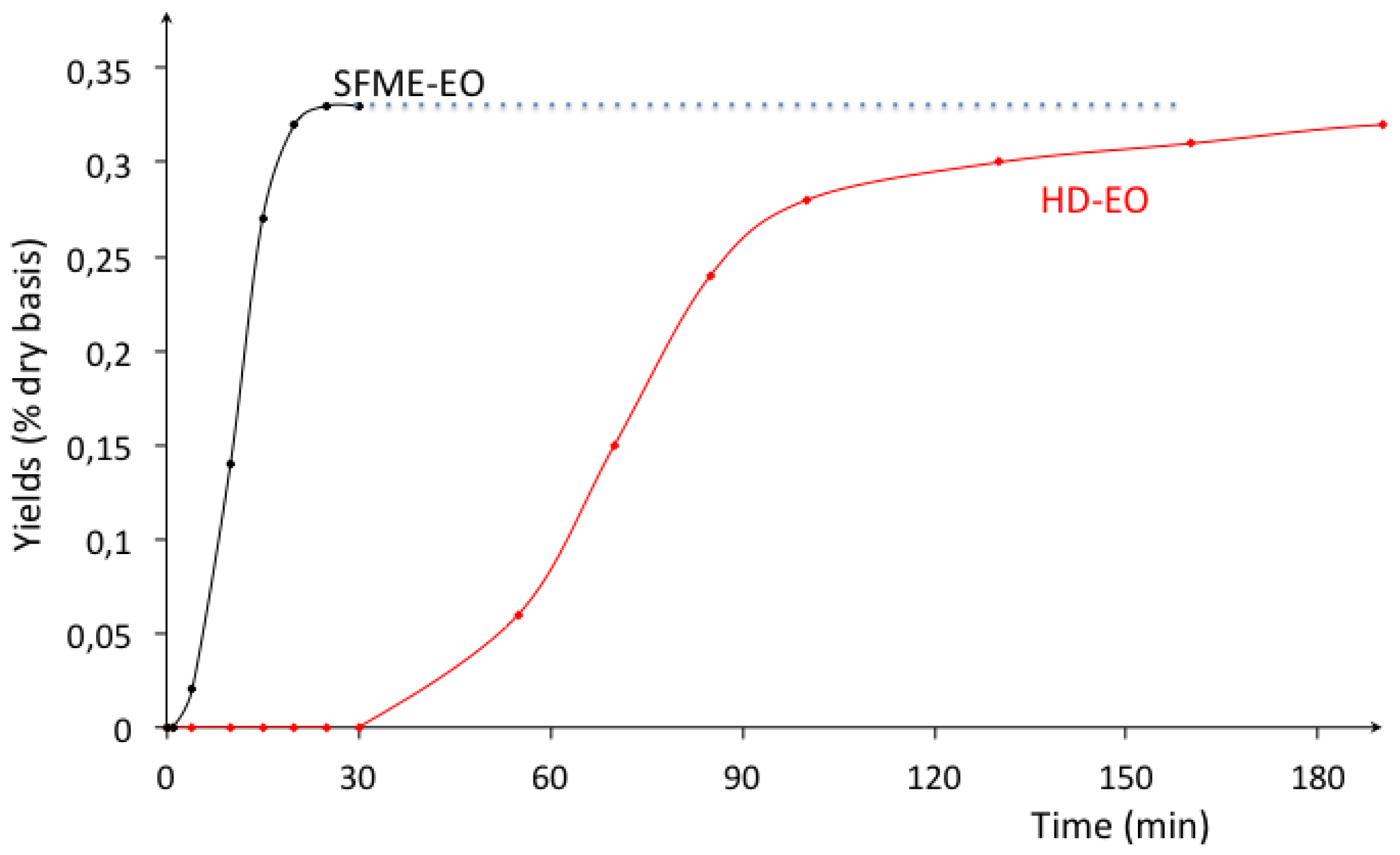
2.1. Kinetics of Hydrodistillation and Microwave Extraction
2.2. Physical Characteristics of Essential Oils
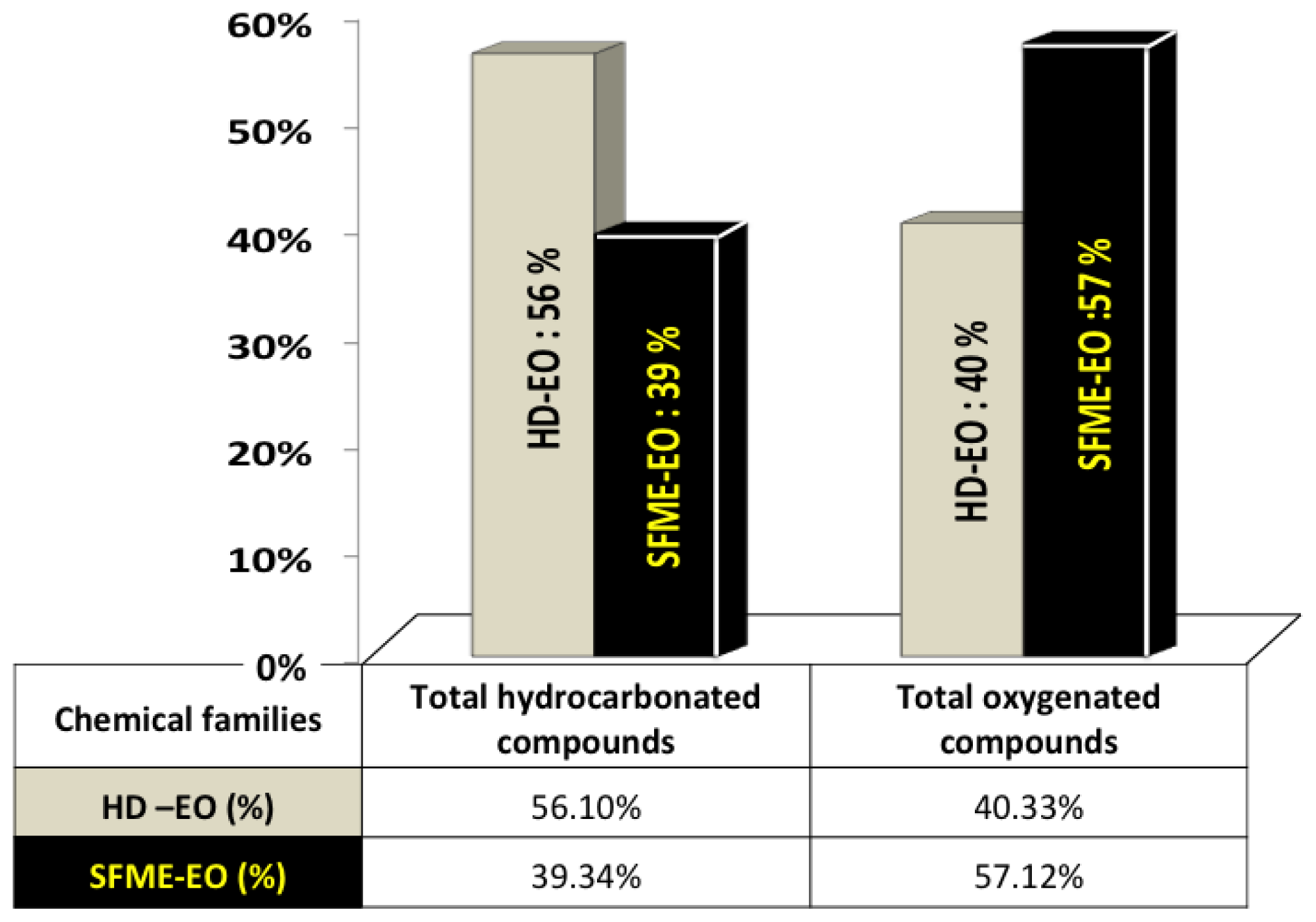
2.3. Analysis of HD-EO and SFME-EO
2.3.1. Analyses of HE Obtained by Hydrodistillation
2.3.2. Solvent-Free-Microwave-Extraction SFME
2.4. Impact of Extraction HD and SFME on the Cell Structure
2.5. Results of the Antioxidant Activities
2.6. Results of Antimicrobial Activity
3. Fundamental
3.1. Paradox of Coupled Heat and Vapor Transfers
3.2. Thermal Effect of Electromagnetic Field
4. Materials and Methods
4.1. Reagents and Chemicals
4.2. Reagents and Chemicals
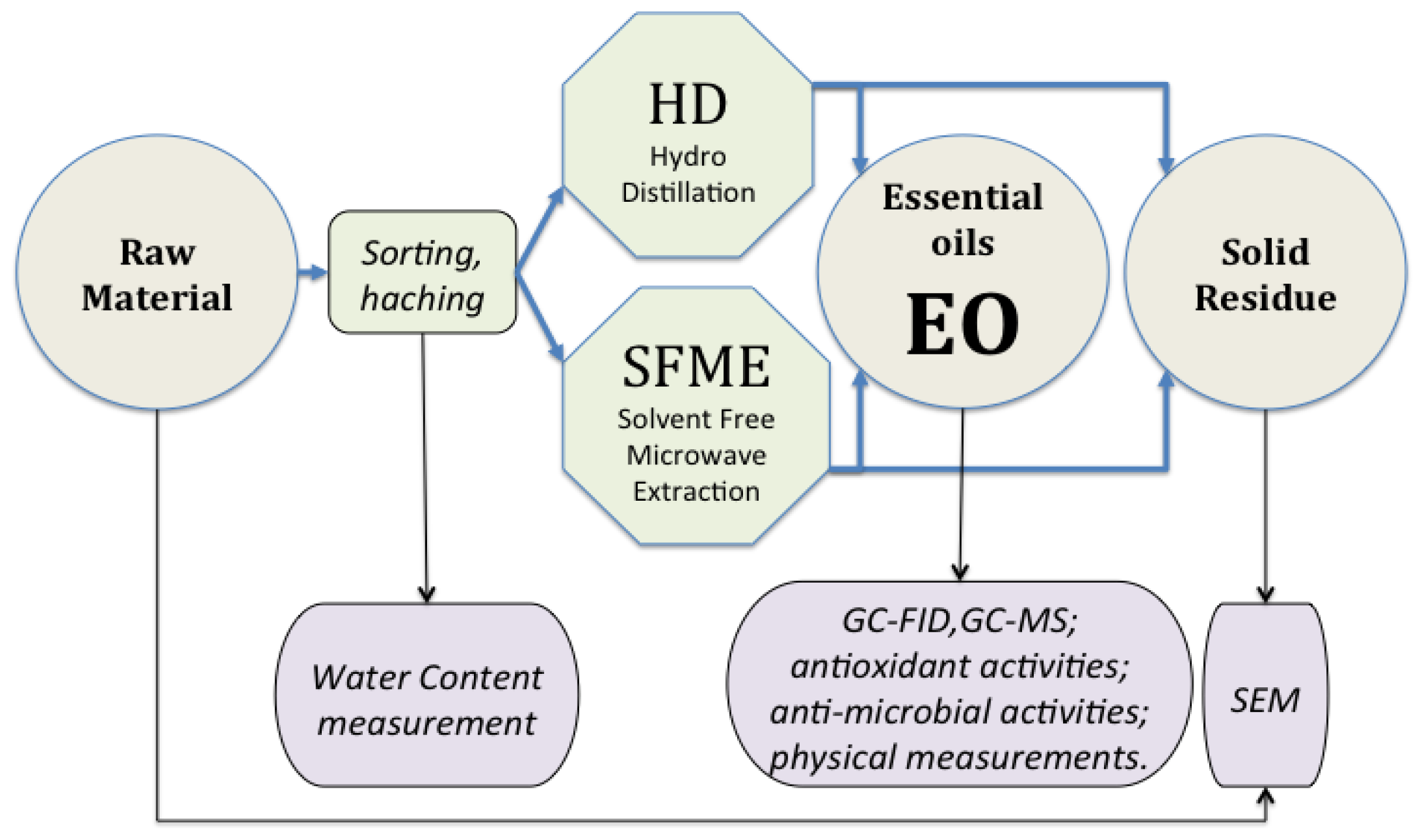
4.3. Processing Protocol
4.3.1. Determination of the Initial Moisture
4.3.2. Hydrodistillation
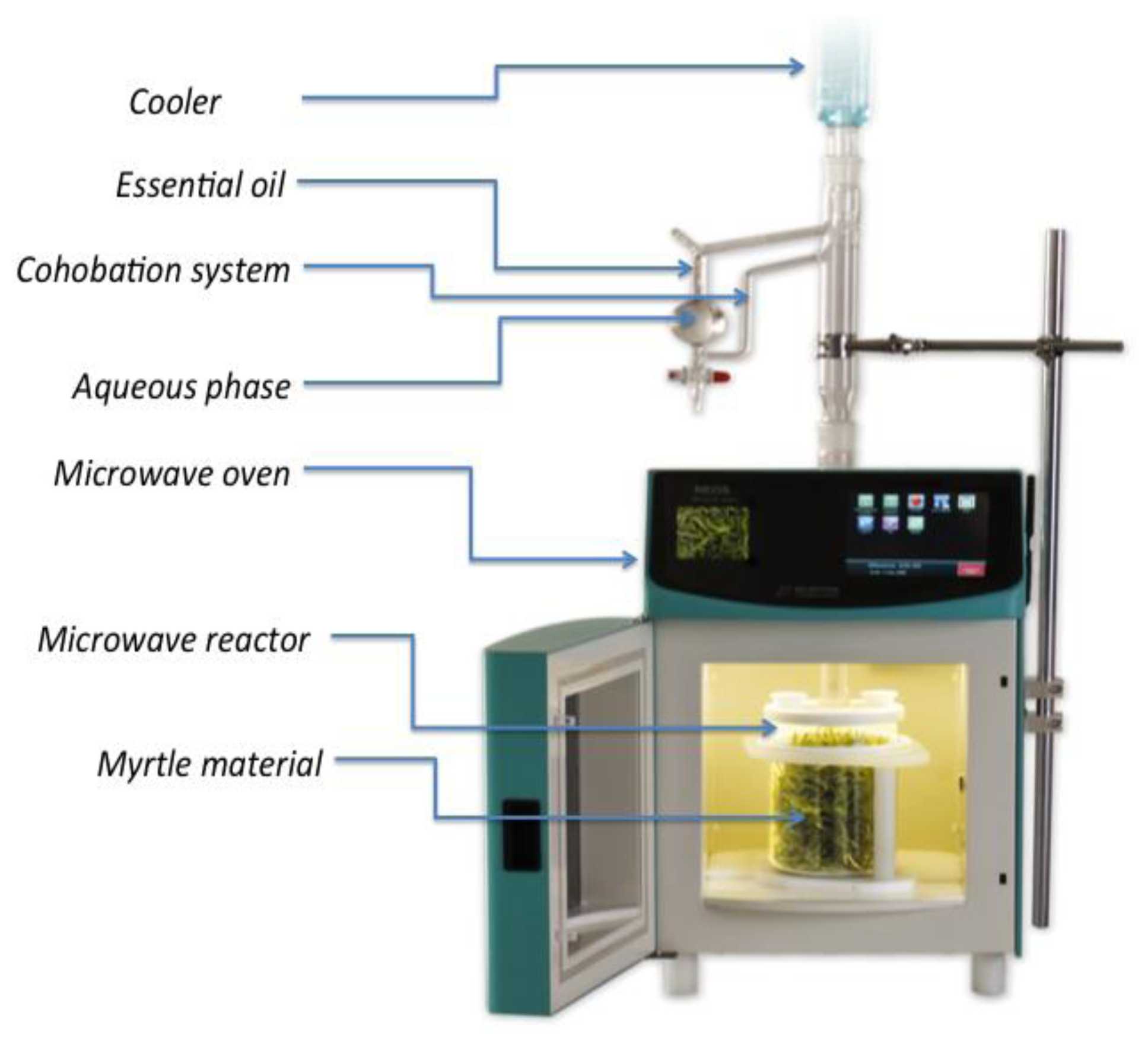
4.3.3. Solvent Free Microwave Extraction (SFME)
4.4. Experimental Assessments
4.4.1. Scanning Electron Microscope
4.4.2. Characterization of Physical and Functional Properties of Myrtle Leaf Essential Oils Extracted by HD and SFME
4.4.2.1. Measurement of Antioxidant Activity
4.4.2.2. Measurement of Antimicrobial Activity
4.4.3. Analysis by GC and GC-MS
5. Conclusion
Acknowledgements
References
- Snow, N.; McFadden, J.; Evans, T.M.; Salywon, A.M.; Wojciechowski, M.F.; Wilson, P.G. Morphological and molecular evidence of polyphyly in rhodomyrtus (Myrtaceae: Myrteae). Syst. Bot 2011, 36, 390–404. [Google Scholar]
- Barboni, T.; Venturini, N.; Paolini, J.; Desjobert, J.M.; Chiaramonti, N.; Costa, J. Characterisation of volatiles and polyphenols for quality assessment of alcoholic beverages prepared from Corsican Myrtus communis berries. Food Chem 2010, 122, 1304–1312. [Google Scholar]
- Özek, T.; Demirci, B.; Baser, K.H.C. Chemical composition of tukish myrtle oil. J. Essent. Oil Res 2000, 12, 541–544. [Google Scholar]
- Berka-Zougali, B.; Hassani, A.; Besombes, C.; Allaf, K. Extraction of essential oils from Algerian myrtle leaves using instant controlled pressure drop technology. J. Chromatogr. A 2010, 1217, 6134–6142. [Google Scholar]
- Aydin, C.; Özcan, M.M. Determination of nutritional and physical properties of myrtle (Myrtus communis L.) fruits growing wild in Turkey. J. Food Eng 2007, 79, 453–458. [Google Scholar]
- Flamini, G.; Cioni, P.L.; Morelli, I.; Maccioni, S.; Baldini, R. Phytochemical typologies in some populations of Myrtus communis L. On Caprione Promontory (East Liguria, Italy). Food Chem 2004, 85, 599–604. [Google Scholar]
- Gardeli, C.; Papageorgiou, V.; Mallouchos, A.; Theodosis, K.; Komaitis, M. Essential oil composition of Pistacia lentiscus L. and Myrtus communis L.: Evaluation of antioxidant capacity of methanolic extracts. Food Chem 2008, 107, 1120–1130. [Google Scholar]
- Uehleke, H.; Brinkschulte-Freitas, M. Oral toxicity of an essential oil from myrtle and adaptive liver stimulation. Toxicology 1979, 12, 335–342. [Google Scholar]
- Nassar, M.; Aboutabl, E.A.; Ahmed, R.F.; El-Khrisy, E.D.A.; Ibrahim, K.M.; Sleem, A.A. Secondary metabolites and bioactivities of Myrtus communis. Pharmacognosy Res 2010, 2, 325–329. [Google Scholar]
- Owlia, P.; Saderi, H.; Rasooli, I.; Sefidkon, F. Antimicrobial characteristics of some herbal Oils on Pseudomonas aeruginosa with special reference to their chemical compositions. Iran. J. Pharm. Res 2009, 8, 107–114. [Google Scholar]
- Aidi Wannes, W.; Mhamdi, B; Sriti, J.; Ben Jemia, M.; Ouchikh, O.; Hamdaoui, G.; Kchouk, M.E.; Marzouk, B. Antioxidant activities of the essential oils and methanol extracts from myrtle (Myrtus communis var. italica L.) leaf, stem and flower. Food Chem. Toxicol 2010, 48, 1362–1370. [Google Scholar]
- Chalchat, J.C.; Garry, R.P.; Michet, A. Essential oils of Myrtle (Myrtus communis L.) of the Miterranean littoral. J. Essent. Oil Res 1998, 10, 613–617. [Google Scholar]
- Jerkovic, I.; Radonic, A.; Borcic, I. Comparative study of leaf, fruit and flower essential oils from Croatian Myrtus communis L. during a one-year vegetative cycle. J. Essent. Oil Res 2002, 14, 266–270. [Google Scholar]
- Boelens, M.H.; Jimènez, R. The chemical composition of Spanish myrtle oils. Part II. J. Essent. Oil Res 1992, 4, 349–353. [Google Scholar]
- Asllani, U. Chemical composition of albanian myrtle oil. J. Essent. Oil Res 2000, 12, 140–142. [Google Scholar]
- Gauthier, R.; Gourai, M.; Bellakhdar, J. A propos de l’huile essentielle de Myrtus communis L. var.italica et var.baetica récolté au Maroc: II. Rendements et compositions selon le mode d’extraction; comparaison avec diverses sources. Al biruniya. Rev. Mar. Pharm 1988, 4, 117–132. [Google Scholar]
- Ghasemi, E.; Raofie, F.; Mashkouri-Najafi, N. Application of response surface methodology and central composite design for the optimisation of supercritical fluid extraction of essential oils from Myrtus communis L. leaves. Food Chem 2010, 126, 1449–1453. [Google Scholar]
- Bousbia, N.; Abert-Vian, M.; Ferhat, M.A.; Petitcolas, E.; Meklati, B.Y.; Chemat, F. Comparison of two isolation methods for essential oil from rosemary leaves; Hydrodistillation and microwave hydrodiffusion and gravity. Food Chem 2009, 114, 355–362. [Google Scholar]
- Khajeh, M.; Yamini, Y.; Bahramifar, N.; Sefidkon, F.; Pirmoradei, M.R. Comparison of essential oils compositions of Ferula assa-foetida obtained by supercritical carbon dioxide extraction and hydrodistillation methods. Food Chem 2005, 91, 639–644. [Google Scholar]
- Guan, W.; Li, S.; Yan, R.; Tang, S.; Quan, C. Comparison of essential oils of clove buds extracted with supercritical carbon dioxide and other three traditional extraction methods. Food Chem 2007, 101, 1558–1564. [Google Scholar]
- Mounir, S.; Schuck, P.; Allaf, K. Structure and attribute modifications of spray dried skim milk powder treated by DIC (Instant controlled pressure drop) technology. Dairy Sci. Technol 2010, 90, 301–320. [Google Scholar]
- Besombes, C.; Berka-Zougali, B.; Allaf, K. Instant controlled pressure drop extraction of lavandin essential oils; Fundamentals and experimental studies. J. Chromatogr. A 2010, 1217, 6807–6815. [Google Scholar]
- Allaf, K.; Besombes, C.; Kristiawan, M.; Sobolik, V. Extraction of Essential oils by instant controlled pressure drop DIC. In Essential Oils and Aromas Green Extraction and Applications; Arvinder Singh Bhalla (JEOBP): Dehra Dun, India, 2009. [Google Scholar]
- Kristiawan, M.; Sobolik, V.; Allaf, K. Isolation of Indonesian cananga oil using multi-cycle pressure drop process. J. Chromatogr. A 2008, 1192, 306–318. [Google Scholar]
- Loupy, A. Microwave in Organic Synthesis; Wiley-VCH: Weinheim, Germany, 2002. [Google Scholar]
- Ferhat, M.A.; Meklati, B.Y.; Smadja, J.; Chemat, F. An improved microwave Clevenger apparatus for distillation of essential oils from orange peel. J. Chromatogr. A 2006, 1112, 121–126. [Google Scholar]
- Boelens, M.H.; Jimènez, R. The chemical composition of spanisch myrtle leaf oils. Part I. J. Essent. Oil Res 1991, 3, 173–177. [Google Scholar]
- Shikhiev, A.S.; Abbasov, R.M.; Mamedova, Z.A. Composition of the essential oil of Myrtus Communis. Chem. Nat. Compd 1978, 14, 455–456. [Google Scholar]
- Yadegarinia, D.; Gachkar, L.; Rezaei, M.B.; Taghizadeh, M.; Astaneh, S.A.; Rasooli, I. Biochemical activities of Iranian Mentha piperita L. and Myrtus communis L. essential oils. Phytochemistry 2006, 67, 1249–1255. [Google Scholar]
- Jukić, M.; Miloš, M. Catalytic oxidation properties of thyme essential oils (Thymus Vulgarae L.). Croat. Chem. Acta 2005, 78, 105–110. [Google Scholar]
- Pereira, P.C.; Cebola, M.J.; Bernardo-Gil, M.G. Evolution of the yields and composition of essential oil from portuguese myrtle (Myrtus communis L.) through the Vegetative Cycle. Molecules 2009, 14, 3094–3105. [Google Scholar]
- Alma, M.H.; Mavi, A.; Yildirim, A.; Digrak, M.; Hirata, T. Screening chemical composition and in vitro antioxidant and antimicrobial activities of the essential oils from Origanum Syriacum L. growing in Turkey. Biol. Pharm. Bull 2003, 26, 1725–1729. [Google Scholar]
- Kordali, S.; Kotan, R.; Mavi, A.; Cakir, A.; Ala, A.; Yildirim, A. Determination of the chemical composition and antioxidant activity of the essential oil of Artemisia dracunculus and of the antifungal and antibacterial activities of Turkish Artemisia absinthium, A. drancunculus, Artemisia santonicum, and Artemisia spicigera essential oils. J. Agric. Food Chem 2005, 53, 9452–9458. [Google Scholar]
- Mimica-Dukic, N.; Božin, B.; Sokovic, M.; Simin, N. Antimicrobial and antioxidant activities of Melissa officinalis L. (Lamiaceae) essential oil. J. Agric. Food Chem 2004, 52, 2485–2489. [Google Scholar]
- Basile, A.; Senatore, F.; Gargano, R.; Sorbo, S.; Del Pezzo, M.; Lavitola, A.; Ritieni, A.; Bruno, M.; Spatuzzi, D.; Rigano, D.; Vuotto, M.L. Antibacterial and antioxidant activities in Sideritis italic (Miller) Greuter et Burdet essential oils. J. Ethnopharmacol 2006, 107, 240–248. [Google Scholar]
- Bozin, B.; Mimika-Dukic, N.; Simin, N.; Anackov, G. Characterization of the volatile composition of essential oils of some Lamiaceae spices and the antimicrobial and antioxidant activities of the entire oils. J. Agric. Food Chem 2006, 54, 1822–1828. [Google Scholar]
- Ozcelik, B.; Lee, J.H.; Min, D.B. Effects of light, oxygen, and pH on the absorbance of 2,2-diphenyl-1-picrylhydrazyl. J. Food Sci 2003, 68, 487–490. [Google Scholar]
- Bekhechi, C.; Atik-Bekkara, F.; Abdelouahid, D.-E. Composition et activité antibactérienne des huiles essentielles d’Origanum glandulosum d’Algérie. Phytothérapie 2008, 6, 153–159. [Google Scholar]
- Sipailiene, A.; Venskutonis, P.R.; Baranauskiene, R.; Sarkinas, A. Antimicrobial activity of commercial Samples of Thyme and Marjoram Oils. J. Essent. Oil Res 2006, 18, 698–703. [Google Scholar]
- Kokoska, L.; Polesny, Z.; Rada, V.; Nepovim, A.; Vanek, T. Screening of some Siberian medicinal plants for antimicrobial activity. J. Ethnopharmacol 2002, 82, 51–53. [Google Scholar]
- Inouye, S.; Yamaguchi, H.; Takizawa, T. Screening of the antibacterial effects of variety of essential oils on respiratory tract pathogens, using a modified dilution assay method. J. Infect. Chemother 2001, 7, 251–254. [Google Scholar]
- Allaf, K.; Allaf, T. Instant Controlled Pressure Drop DIC: From Fundamental to Industrial Applications; Springer: Heidelberg, Germany, 2011. [Google Scholar]
- Allaf, K. Transfer Phenomena and Industrial Applications; Lebanese University, Faculty of Science: Fanar, Beirut, Lebanon, 1982. [Google Scholar]
- Brand-Williams, W.; Cuvelier, M.E.; Berset, C. Use of free radical method to evaluate antioxidant activity. Lebensm. Wiss. Technol 1995, 28, 25–30. [Google Scholar]
- Oki, T.; Tenmyo, O.; Hirano, M.; Tomatsu, K.; Kamei, H. Pradimicins A, B and C: New antifungal antibiotics. II. In vitro and In vivo biological activities. J. Antibiot 1990, 43, 763–770. [Google Scholar]
- Jennings, W.; Shibamoto, T. Qualitative Analysis of Flavors and Fragrance Volatiles by Glass Capillary Gas Chromatography; Academic Press: New York, NY, USA, 1980. [Google Scholar]
- Davies, N.-W. Gas chromatographic retention indices of monoterpenes and sesquiterpenes on methyl silicone and carbowax 20M phases. J. Chromatogr. A 1990, 503, 1–24. [Google Scholar]
- Arctander, S. Perfume and Flavor Chemicals; Allured Publishing Corporation: Carol Stream, IL, USA, 1994. [Google Scholar]
- Adams, R.P. Identification of Essential Oils Components by Gas Chromatography/Mass Spectrometry, 4th ed; Allured Publishing Corporation: Carol Stream, IL, USA, 2007. [Google Scholar]

| Physical characteristics | HD-EO | SFME-EO |
|---|---|---|
| Relative density at 20 °C (d) | 0.9051 ± 0.0342 | 0.9047 ± 0.0536 |
| Refractive index at 20 °C (α) | 1.470 ± 0.021 | 1.471 ± 0.012 |
| Optical rotation at 20 °C (θ) | 1.54 ± 0.13° | 1.86 ± 0.09° |
| N° | Compounds a | RI b | RI c | HD-EO (%) | SFME-EO (%) |
|---|---|---|---|---|---|
| Monoterpene hydrocarbons | 51.36 | 36.30 | |||
| 1 | α-Thujene | 930 | 1,030 | 0.10 | 0.12 |
| 2 | α-Pinene | 939 | 1,028 | 44.62 | 30.65 |
| 3 | Sabinene | 978 | 1,128 | tr d | 0.10 |
| Monoterpene hydrocarbons | 51.36 | 36.30 | |||
| 4 | β-Pinene | 979 | 1,116 | 0.45 | 0.60 |
| 5 | β-Myrcene | 994 | 1,162 | 0.22 | 0.18 |
| 6 | α-Phellandrene | 1,004 | 1,175 | 0.22 | 0.37 |
| 7 | δ 3-Carene | 1,011 | 1,146 | 0.51 | 0.58 |
| 8 | α-Terpinene | 1,020 | 1,178 | 0.16 | 0.15 |
| 9 | p-Cymene | 1,024 | 1,281 | 0.25 | 0.22 |
| 10 | Limonene | 1,029 | 1,208 | 3.71 | 2.22 |
| 11 | (Z)-β-Ocimene | 1,043 | 1,236 | 0.40 | 0.40 |
| 12 | γ-terpinene | 1,059 | 1,263 | 0.30 | 0.30 |
| 13 | α-Terpinolene | 1,088 | 1,290 | 0.42 | 0.41 |
| Oxygenated monoterpenes | 37.47 | 55.23 | |||
| 14 | 1.8-cineole | 1,032 | 1,216 | 25.46 | 32.12 |
| 15 | β-Linalool | 1,098 | 1,552 | 2.07 | 2.90 |
| 17 | trans-PinoCarveol | 1,139 | 1,665 | tr d | 0.24 |
| 18 | Borneol | 1,168 | 1,717 | tr d | 0.51 |
| 19 | Terpinen–4–ol | 1,177 | 1,610 | 1.33 | 2.89 |
| 20 | α-Terpineol | 1,192 | 1,711 | 2.16 | 3.01 |
| 21 | Geraniol | 1,256 | 1,849 | 0.42 | 0.70 |
| 22 | Linalyl acetate | 1,257 | 1,556 | 0.37 | 0.85 |
| 23 | Methyl citronellate | 1,261 | 1,570 | 0.11 | 0.68 |
| 24 | Exo-2-hydroxycineole acetate | 1,343 | 1,765 | 0.21 | 0.17 |
| 25 | α-Terpinyl acetate | 1,352 | 1,707 | 0.72 | 1.61 |
| 26 | Eugenol | 1,360 | 2,164 | tr d | 0.21 |
| 27 | Neryl acetate | 1,361 | 1,723 | tr d | 0.11 |
| 28 | Geranyl acetate | 1,380 | 1,761 | 2.23 | 3.10 |
| 29 | Methyl eugenol | 1,397 | 2,030 | 2.22 | 6.02 |
| 30 | (E)-Methyl isoeugenol | 1,492 | 2,196 | 0.17 | 0.11 |
| Sesquiterpene hydrocarbons | 4.74 | 3.04 | |||
| 31 | β-Elemene | 1,390 | 1,600 | 0.21 | 0.29 |
| 32 | β-Caryophyllene | 1,419 | 1,612 | 0.40 | 0.33 |
| 33 | γ-Elemene | 1,436 | 1,637 | 0.10 | 0.10 |
| 34 | α-Humulene | 1,454 | 1,676 | 0.34 | 0.32 |
| 35 | β-Chamigrene | 1,477 | 1,741 | 0.25 | 0.19 |
| 36 | β-Selinene | 1,490 | 1,727 | 0.88 | 0.27 |
| 37 | α-Selinene | 1,498 | 1,729 | 0.84 | 0.47 |
| 38 | δ-Cadinene | 1,523 | 1,763 | 0.37 | 0.10 |
| 39 | Cadina-1.4-diene | 1,534 | 1,789 | 0.20 | 0.11 |
| 40 | Selina-3.7 (11) -diene | 1,542 | 1,786 | 0.37 | 0.31 |
| 41 | Germacrene B | 1,558 | 1,846 | 0.78 | 0.55 |
| Oxygenated sesquiterpenes | 2.86 | 1.89 | |||
| 42 | Spathulenol | 1,578 | 2,146 | 0.10 | 0.12 |
| 43 | Caryophyllene oxide | 1,583 | 2,008 | 0.26 | 0.27 |
| 44 | Globulol | 1,582 | 2,098 | 0.88 | 0.91 |
| 45 | Cubenol | 1,646 | 2,074 | 0.18 | tr d |
| 46 | β-Eudesmol | 1,650 | 2,246 | 0.24 | 0.15 |
| 47 | α-Bisabobol | 1,685 | 2,228 | 0.28 | tr d |
| 48 | Juniper camphor | 1,698 | 2,275 | 0.92 | 0.44 |
| Other compounds | 0.96 | 1.25 | |||
| 49 | (Z)-3-Hexenol | 856 | 1,389 | 0.64 | 0.67 |
| 50 | Isobutyl isobutyrate | 896 | 1,086 | 0.32 | 0.21 |
| 51 | Isoamyl 2-Methyl butyrate | 1,099 | 1,296 | tr d | 0.37 |
| Total hydrocarbonated compounds | 56.10 | 39.34 | |||
| Total Oxygenated compounds | 40.33 | 57.12 | |||
| Other compounds | 0.96 | 1.25 | |||
| Total identified compounds | 97.39 | 97.71 | |||
| Italy | Greece | Croatia | Spain | Algeria | Marocco | Egypt | Iran | Tunisia | Corsica | Azerbaijan | Yougoslavia | Lebanon | Iran | Albania | Turkish | Portugal | |||
|---|---|---|---|---|---|---|---|---|---|---|---|---|---|---|---|---|---|---|---|
| [6] | [7] | [13] | [14] | [4] | [12] | [9] | [10] | [12] | [12] | [30] | [12] | [12] | [17] | [15] | [3] | [31] | |||
| Compounds (%) | HD | HD | HD | HD | HD | DIC | HD | SD | HD | HD | HD | SD | HD | HD | HD | CO2 | HD | HD | HD |
| α-pinene | 28.9–41.6 | 10.1–11.6 | 6.6–16.4 | 8.9 | 50.8 | 23.3 | 18.5–25.0 | 25.5 | 29.4 | 51.1–52.9 | 53.5–56.7 | 14.5 | 23.8–24.8 | 32.1 | 31.8 | 38.6 | 19.4–20.3 | 6.4–9.0 | 10.4–21.5 |
| p-cymene | 0–1.8 | 1.7–1.8 | 1.0 | 1.8 | 1.7 | 1.0–1.3 | 0.8–1.3 | ||||||||||||
| limonene | 5.2–9.5 | 7.6 | 2.6 | 2.2 | 8.9–11.0 | 1.6 | 21.2 | 6.1–7.3 | 5.19 | 23.4 | 12.0–12.7 | 19.0 | 14.8 | 17.7 | 10.9–12.3 | 20.0–39.5 | |||
| 1.8-cineole | 24.2–25.5 | 12.7–19.6 | 12.6–29.8 | 29.2 | 24.3 | 21.8 | 32.5–37.5 | 27.2 | 18.0 | 24.2–24.6 | 18.9 | 11.6 | 21.6–23.0 | 26.3 | 24.6 | 29.1 | 21.8–16.6 | 10.5–18.2 | |
| α-terpinolene | 4.8 | ||||||||||||||||||
| β-linalool | 2.9–11.7 | 7.0–15.8 | 10.8–18.3 | 1.3 | 2.9 | 1.7–2.3 | 11.8 | 10.6 | 2.3–2.5 | 2.83 | 20.2 | 7.5–7.6 | 6.8 | 8.3 | 5.5 | 8.8–13.4 | 16.3–18.6 | ||
| p-menth-1-enol | 7.0 | ||||||||||||||||||
| α-terpineol | 2.8–3.6 | 1.6–2.9 | 3.9–6.6 | 4.2 | 2.5 | 5.7 | 3.1 | 1.1 | 2.1–2.9 | 4.3–6.5 | 2.7–5.2 | ||||||||
| myrtenol | 0.8–3.5 | 0.8–2.9 | |||||||||||||||||
| methyl chavicol | 1.2–1.4 | ||||||||||||||||||
| geraniol | 0.0 | 1.48 | 1.1 | 1.3–1.9 | |||||||||||||||
| linalyl acetate | 0.7–2.9 | 2.5–6.0 | 2.7–7.0 | 3.4 | 4.6 | 1.8–2.0 | 2.2 | 3.4 | 2.5 | 2.6–2.8 | 5.5–6.8 | ||||||||
| myrtenyl acetate | 23.7–39.0 | 13.5–30.7 | 35.9 | 14.8–21.1 | 4.2 | 14.0–15.2 | 2.0 | 11.4–12.3 | 10.8–14.5 | 7.0–37.6 | |||||||||
| bornyl acetate | 2.2 | ||||||||||||||||||
| α-terpinyl acetate | 1.1–1.6 | 0.9 | 1.2 | 3.7–4.4 | 1.4 | 1.3 | 1.7–1.9 | 1.87 | 2.0–2.1 | 1.6 | 1.0 | 0.8–2.6 | |||||||
| eugenol | 0.0 | 4.1 | |||||||||||||||||
| neryl acetate | 0.4–3.1 | ≤1.6 | 2.9 | 0.8–1.1 | |||||||||||||||
| geranyl acetate | 0.3–1.8 | 1.4–5.3 | 1.7 | 2.1 | 3.8 | 1.8–2.2 | 1.7–2.1 | 1.4 | 2.2–2.9 | 1.0 | 0.9–1.3 | 4.2–5.5 | |||||||
| methyl eugenol | 0.8–1.1 | 0.7–2.3 | 2.3 | 5.4 | 1.6 | 1.6–1.9 | 1.3–1.8 | 1.7–4.3 | |||||||||||
| eugenyl methyl ether | 2.3 | ||||||||||||||||||
| β-caryophyllene | 0.9 | 1.9 | 1.7–2.9 | ||||||||||||||||
| Samples | IC50 (μg/mL) |
|---|---|
| HD-EO | 768 ± 83 |
| SFME-EO | 693 ± 92 |
| BHT | 8 ± 2 |
| Quercetin | 3 ± 1 |
| Gallic acid | 1.1 ± 0.8 |
| Microorganism-tests | minimum inhibitory concentration (MIC) (μL/mL) Bainem Algerian fresh myrtle leaf essential oils (100 mg/mL) | |
|---|---|---|
| HD-EO | SFME-EO | |
| Gram-positive Bacteria | ||
| Bacillus subtilis (ATCC 6633) | 20 | 10 |
| Staphylococcus aureus (CIP 7625) | 30 | 20 |
| Listeria monocytogenes (CIP 82110) | 30 | 30 |
| Gram-negative Bacteria | ||
| Klebsiella pneumoniae (E40) | 30 | 20 |
| Escherichia coli (E52) | 30 | 10 |
| Salmonella enterica (E32) | 30 | 20 |
| Enterobacter cloacea (E13) | 30 | 20 |
| Pseudomonas aeruginosa (CIP A22) | 30 | 20 |
| Yeast | ||
| Candida albicans (IPA 200) | 50 | 50 |
| Fungi | ||
| Aspergillus flavus | 50 | 20 |
| Aspergillus ochraceus | 30 | 10 |
| Fusarium culmorum | 30 | 10 |
© 2012 by the authors; licensee Molecular Diversity Preservation International, Basel, Switzerland. This article is an open-access article distributed under the terms and conditions of the Creative Commons Attribution license (http://creativecommons.org/licenses/by/3.0/).
Share and Cite
Berka-Zougali, B.; Ferhat, M.-A.; Hassani, A.; Chemat, F.; Allaf, K.S. Comparative Study of Essential Oils Extracted from Algerian Myrtus communis L. Leaves Using Microwaves and Hydrodistillation. Int. J. Mol. Sci. 2012, 13, 4673-4695. https://doi.org/10.3390/ijms13044673
Berka-Zougali B, Ferhat M-A, Hassani A, Chemat F, Allaf KS. Comparative Study of Essential Oils Extracted from Algerian Myrtus communis L. Leaves Using Microwaves and Hydrodistillation. International Journal of Molecular Sciences. 2012; 13(4):4673-4695. https://doi.org/10.3390/ijms13044673
Chicago/Turabian StyleBerka-Zougali, Baya, Mohamed-Amine Ferhat, Aicha Hassani, Farid Chemat, and Karim S. Allaf. 2012. "Comparative Study of Essential Oils Extracted from Algerian Myrtus communis L. Leaves Using Microwaves and Hydrodistillation" International Journal of Molecular Sciences 13, no. 4: 4673-4695. https://doi.org/10.3390/ijms13044673