
<?xml version="1.0" encoding="UTF-8"?>
<!DOCTYPE article PUBLIC "-//NLM//DTD Journal Publishing DTD v2.3 20070202//EN" "journalpublishing.dtd">
<article xmlns:mml="http://www.w3.org/1998/Math/MathML" xmlns:xlink="http://www.w3.org/1999/xlink" xml:lang="en" article-type="research-article">
<front>
<journal-meta>
<journal-id journal-id-type="publisher-id">ijms</journal-id>
<journal-title>International Journal of Molecular Sciences</journal-title>
<abbrev-journal-title>Int. J. Mol. Sci.</abbrev-journal-title>
<issn pub-type="epub">1422-0067</issn>
<publisher>
<publisher-name>Molecular Diversity Preservation International (MDPI)</publisher-name></publisher></journal-meta>
<article-meta>
<article-id pub-id-type="doi">10.3390/ijms13044623</article-id>
<article-id pub-id-type="publisher-id">ijms-13-04623</article-id>
<article-categories>
<subj-group>
<subject>Article</subject></subj-group></article-categories>
<title-group>
<article-title>Optical Properties of Bismuth Tellurite Based Glass</article-title></title-group>
<contrib-group>
<contrib contrib-type="author">
<name><surname>Oo</surname><given-names>Hooi Ming</given-names></name></contrib>
<contrib contrib-type="author">
<name><surname>Mohamed-Kamari</surname><given-names>Halimah</given-names></name><xref ref-type="corresp" rid="c1-ijms-13-04623">*</xref></contrib>
<contrib contrib-type="author">
<name><surname>Wan-Yusoff</surname><given-names>Wan Mohd Daud</given-names></name></contrib>
<aff id="af1-ijms-13-04623">Physics Department, Faculty of Science, University Putra Malaysia, 43400 UPM Serdang, Selangor, Malaysia; E-Mails: <email>hooimingoo@gmail.com</email> (H.M.O.); <email>wmdaud@science.upm.edu.my</email> (W.M.D.W.-Y.)</aff></contrib-group>
<author-notes>
<corresp id="c1-ijms-13-04623">
<label>*</label>Author to whom correspondence should be addressed; E-Mail: <email>halimah@science.upm.edu.my</email>; Tel.: +603-89466657; Fax: +603-89454454.</corresp></author-notes>
<pub-date pub-type="collection">
<year>2012</year></pub-date>
<pub-date pub-type="epub">
<day>11</day>
<month>4</month>
<year>2012</year></pub-date>
<volume>13</volume>
<issue>4</issue>
<fpage>4623</fpage>
<lpage>4631</lpage>
<history>
<date date-type="received">
<day>16</day>
<month>2</month>
<year>2012</year></date>
<date date-type="rev-recd">
<day>26</day>
<month>3</month>
<year>2012</year></date>
<date date-type="accepted">
<day>26</day>
<month>3</month>
<year>2012</year></date></history>
<permissions>
<copyright-statement>© 2012 by the authors; licensee Molecular Diversity Preservation International, Basel, Switzerland.</copyright-statement>
<copyright-year>2012</copyright-year>
<license license-type="open-access" xlink:href="http://creativecommons.org/licenses/by/3.0">
<p>This article is an open-access article distributed under the terms and conditions of the Creative Commons Attribution license (http://creativecommons.org/licenses/by/3.0/).</p></license></permissions>
<abstract>
<p>A series of binary tellurite based glasses (Bi<sub>2</sub>O<sub>3</sub>)<italic><sub>x</sub></italic> (TeO<sub>2</sub>)<sub>100−</sub><italic><sub>x</sub></italic> was prepared by melt quenching method. The density, molar volume and refractive index increase when bismuth ions Bi<sup>3+</sup> increase, this is due to the increased polarization of the ions Bi<sup>3+</sup> and the enhanced formation of non-bridging oxygen (NBO). The Fourier transform infrared spectroscopy (FTIR) results show the bonding of the glass sample and the optical band gap, <italic>E</italic><sub>opt</sub> decreases while the refractive index increases when the ion Bi<sup>3+</sup> content increases.</p></abstract>
<kwd-group>
<kwd>tellurite glass</kwd>
<kwd>optical band gap</kwd>
<kwd>optical properties</kwd></kwd-group></article-meta></front>
<body>
<sec sec-type="intro">
<title>1. Introduction</title>
<p>Tellurite glass is a good material used in lasers and nonlinear applications, photonic applications and communication applications [<xref ref-type="bibr" rid="b1-ijms-13-04623">1</xref>]. Tellurite glass is often used because it is stable at room temperature, has good thermal, optical and electric properties [<xref ref-type="bibr" rid="b2-ijms-13-04623">2</xref>,<xref ref-type="bibr" rid="b3-ijms-13-04623">3</xref>]. This glass has a low photon energy, a high linear and non-linear refractive index, and it also can be used in photorefractive materials, nonlinear devices, up-conversion lasers and optical amplifiers [<xref ref-type="bibr" rid="b4-ijms-13-04623">4</xref>–<xref ref-type="bibr" rid="b6-ijms-13-04623">6</xref>]. Metal oxides such as Bi<sub>2</sub>O<sub>3</sub>, Sb<sub>2</sub>O<sub>3</sub>, MoO<sub>3</sub> and Nb<sub>2</sub>O<sub>5</sub> have been added to the tellurite glass system in order to enhance the optical behavior [<xref ref-type="bibr" rid="b7-ijms-13-04623">7</xref>,<xref ref-type="bibr" rid="b8-ijms-13-04623">8</xref>]. Many studies on tertiary tellurite based glass have been done by various authors [<xref ref-type="bibr" rid="b9-ijms-13-04623">9</xref>–<xref ref-type="bibr" rid="b16-ijms-13-04623">16</xref>]. For example, Tiefeng <italic>et al</italic>. (2011) [<xref ref-type="bibr" rid="b14-ijms-13-04623">14</xref>] studied the optical non linear properties of TeO<sub>2</sub>–Bi<sub>2</sub>O<sub>3</sub>–BaO glass, and was found that an increase of the ion bismuth content and a decrease of ion barium content increased the non linear properties of the glass as bismuth dissolved in the tellurite glass matrix.</p>
<p>Bismuth (iii) oxide is used in optical fiber and ceramic materials because it can provide a high refractive index and low temperatures [<xref ref-type="bibr" rid="b17-ijms-13-04623">17</xref>]. In addition, it is also used in the electronic field due to it having a high valence cation of low field strength and high polarizability [<xref ref-type="bibr" rid="b18-ijms-13-04623">18</xref>]. In this paper, the optical and physical properties were determined with different ion bismuth contents of tellurite base glass. Optical properties such as the optical band gap and refractive index of binary bismuth tellurite glass were studied. In addition, the density and molar volume of a tellurite glass system was determined.</p></sec>
<sec sec-type="results|discussion">
<title>2. Results and Discussion</title>
<sec>
<title>2.1. XRD</title>
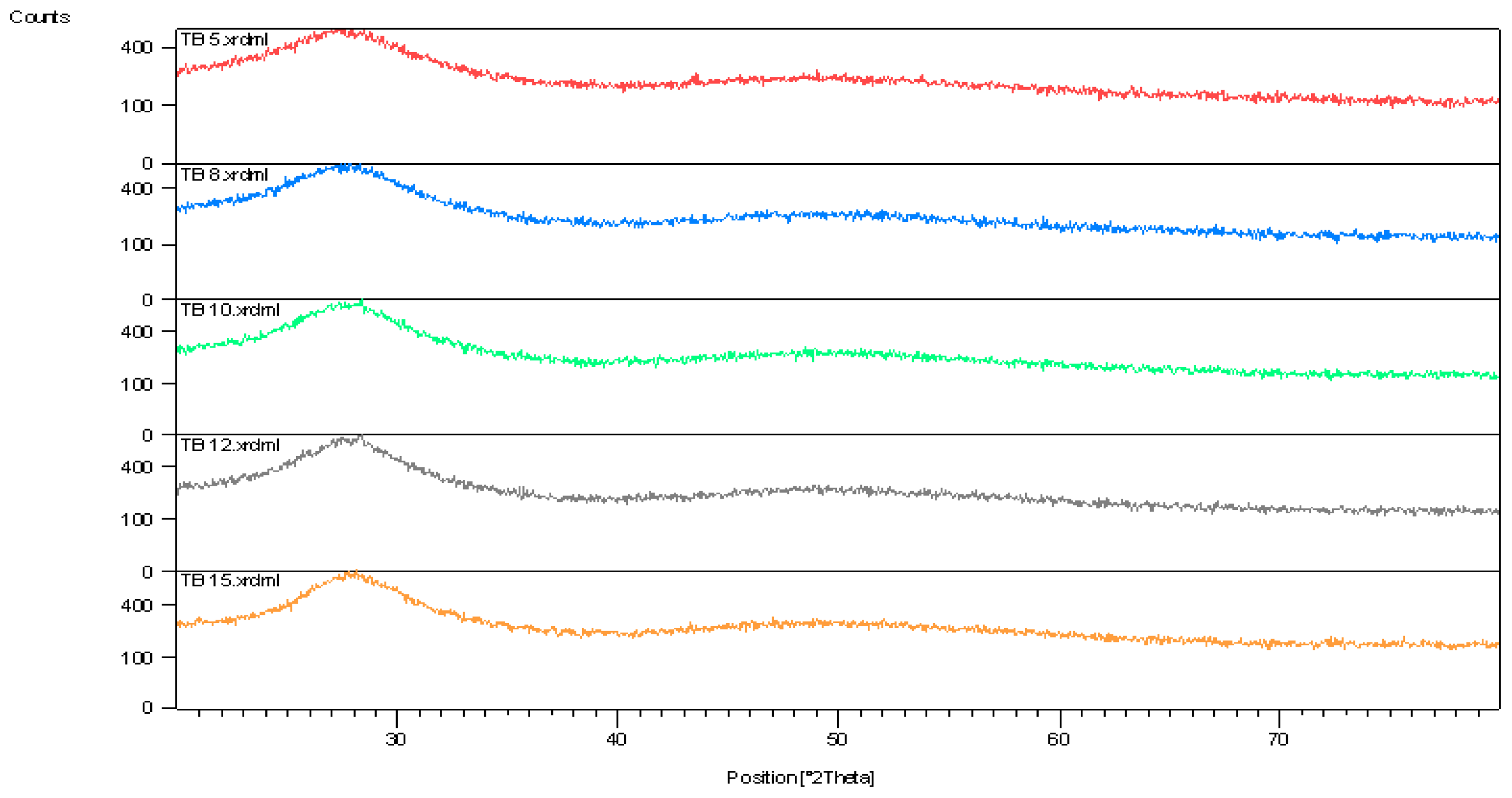
<p>The XRD results (<xref ref-type="fig" rid="f1-ijms-13-04623">Figure 1</xref>) show that the bismuth tellurite glass is in an amorphous phase. Sample TB 5 (refer to <xref ref-type="table" rid="t1-ijms-13-04623">Table 1</xref>) is a transparent glass of a dark orange color, while TB 8, TB10, TB12 and TB15 are transparent glasses of a yellow color.</p></sec>
<sec>
<title>2.2. Density and Molar Volume</title>
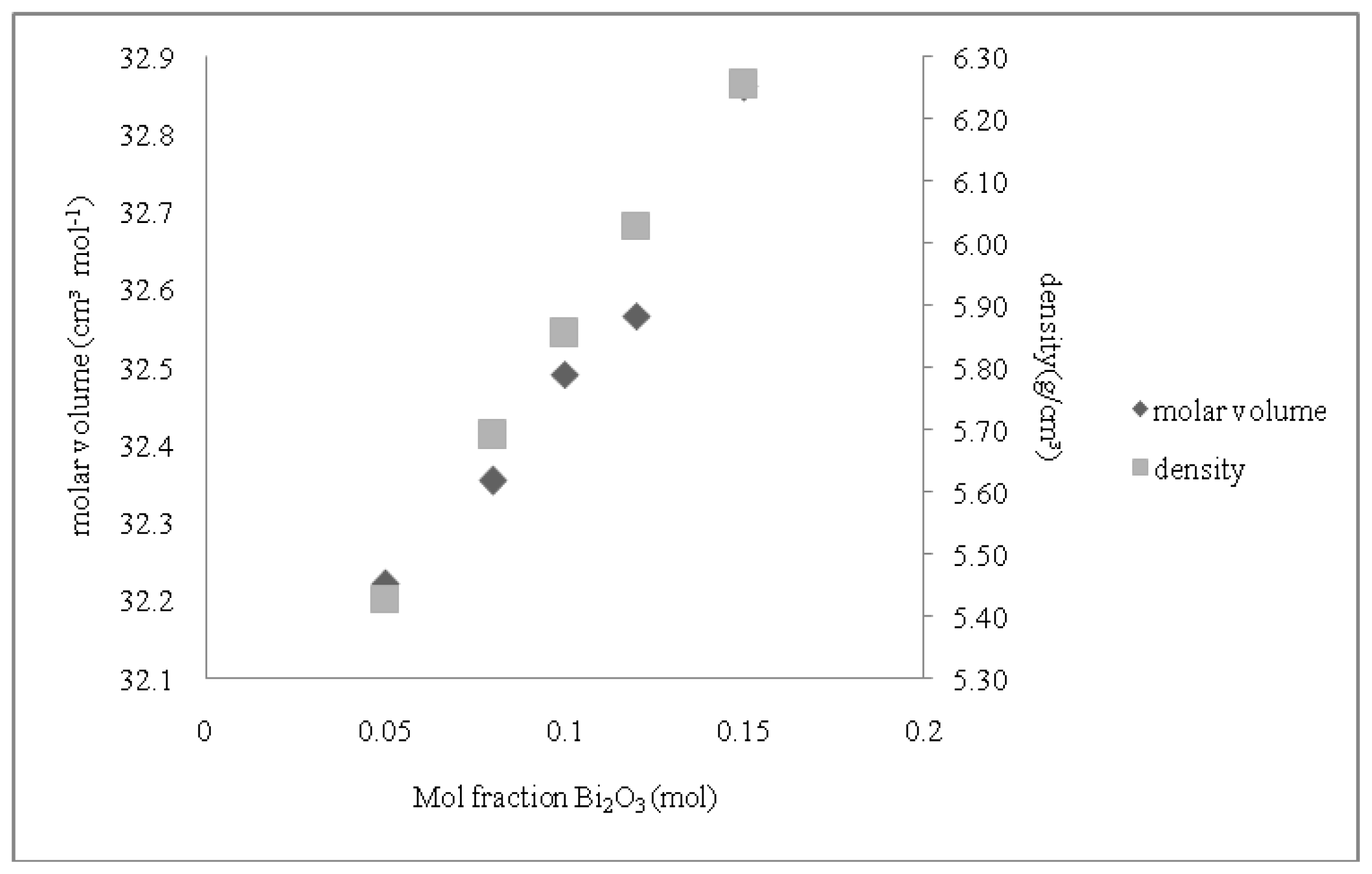
<p>The density of the glass samples increases as the bismuth content increases. The densities of the bismuth tellurite glasses range from 5.43 g/cm<sup>3</sup> to 6.26 g/cm<sup>3</sup>, as shown in <xref ref-type="table" rid="t1-ijms-13-04623">Table 1</xref>. <xref ref-type="fig" rid="f2-ijms-13-04623">Figure 2</xref> shows the molar volume and the density increase proportional to the bismuth content. The molar mass of the bismuth (iii) oxide (465.96 g/mol) is heavier than the molar mass of tellurite oxide (159.60 g/mol) and hence, the glass matrix becomes more dense when Bi<sup>3+</sup> ions are added into the glass network [<xref ref-type="bibr" rid="b19-ijms-13-04623">19</xref>]. In addition, the increase in molar volume is due to the atomic radius of Bi<sup>3+</sup> (1.70 Å ) which is higher than that of tellurite (1.60 Å ). Usually, the density of the glass changes in the inverse direction of the molar volume, but in this study, the density and molar volume increase with the bismuth contents, this anomaly was also found by Saddek <italic>et al</italic>. (2007) and Halimah <italic>et al</italic>. (2010) [<xref ref-type="bibr" rid="b20-ijms-13-04623">20</xref>,<xref ref-type="bibr" rid="b21-ijms-13-04623">21</xref>].</p></sec>
<sec sec-type="results">
<title>2.3. FTIR Results</title>
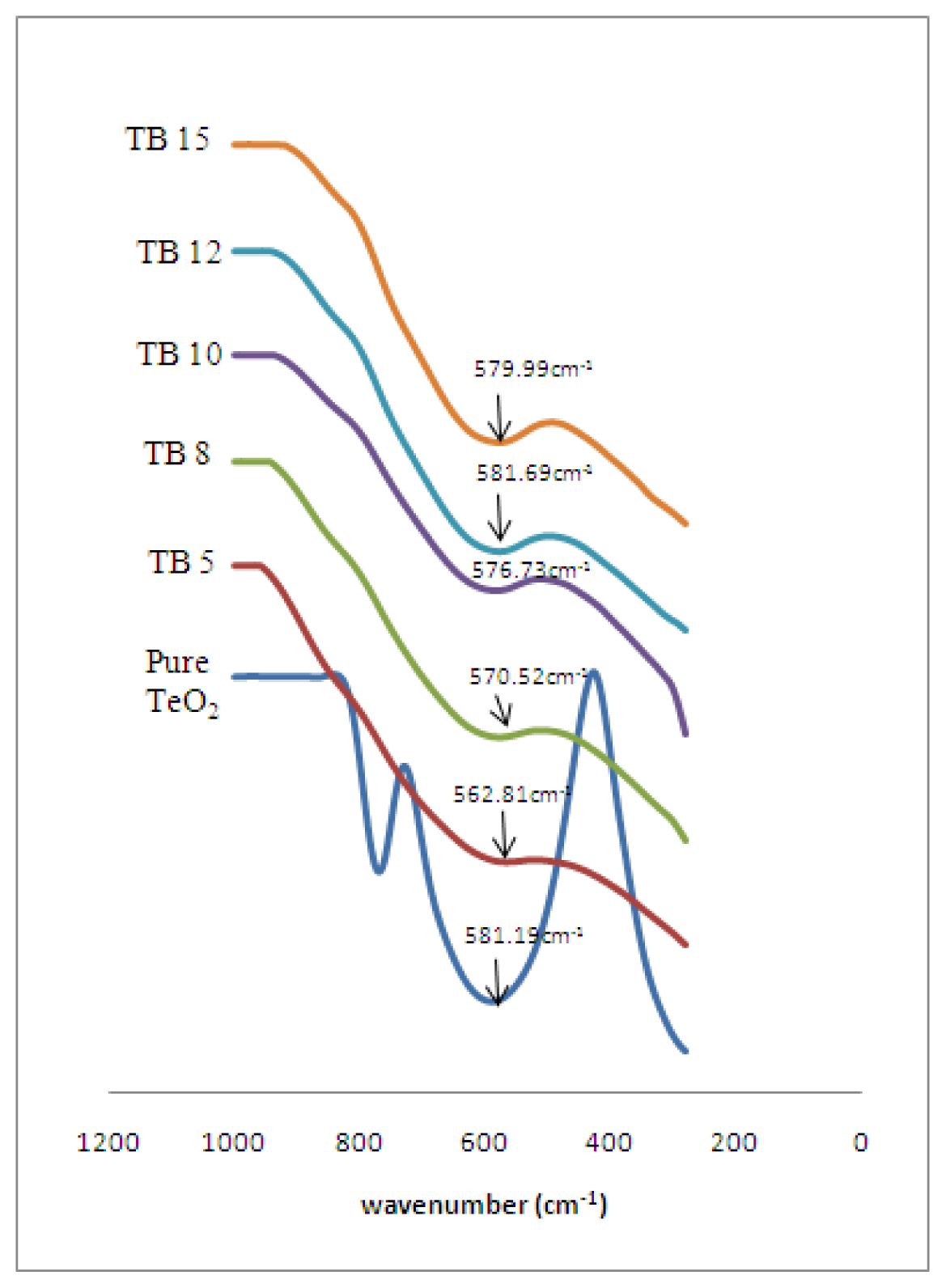
<p>As shown in <xref ref-type="fig" rid="f3-ijms-13-04623">Figure 3</xref>, the FTIR analysis shows that the TeO<sub>2</sub> is the framework former while Bi<sub>2</sub>O<sub>3</sub> is the glass modifier in the bismuth tellurite glasses system. <xref ref-type="table" rid="t2-ijms-13-04623">Table 2</xref> shows the ranges of the wave numbers for difference mode. The wave number for the bismuth tellurite glass system is slightly shifted to the lower wave numbers when the ion Bi<sup>3+</sup> concentration is increased. There is a diffuse band in the range of 500–600 cm<sup>−1</sup>, due to the disordered structure; this is considered as the vibration modes of both the TeO<sub>3</sub> and the TeO<sub>4</sub> entities [<xref ref-type="bibr" rid="b22-ijms-13-04623">22</xref>]. The vibration modes of the bonds for TeO<sub>3+1</sub> polyhedra is also found at bands around 580 cm<sup>−1</sup> where the TeO<sub>3+1</sub> polyhedra consists of an intermediate coordination of the tellurium atoms between 3 and 4 [<xref ref-type="bibr" rid="b17-ijms-13-04623">17</xref>], this is found in the all glass samples. On the other hand, the shoulder form in the range of 800–900 cm<sup>−1</sup> in TB8, TB10, TB12 and TB15 is due to the symmetrical stretching vibration of the Bi–O bonds in BiO<sub>3</sub> units. This band is not observed in the TB5 because the Bi<sup>3+</sup> ions present in this glass sample contain non-bridging oxygen in the form of [BiO]<sup>−</sup> defects. As the ion Bi<sup>3+</sup> content increases, bismuth oxide as the network modifier ion modifies the glass structure and enhances the breaking of axial Te–O–Te linkages in the trigonal bipyramids [TeO<sub>4</sub>] (tbp) and creates the formation of trigonal pyramid [TeO<sub>3</sub>] (tp) units and non-bridging oxygen.</p></sec>
<sec>
<title>2.4. Refractive Index and Optical Absorption</title>
<p>When the bismuth content increases, the refractive index measured at the wavelength of 632.8 nm increases from 1.97 to 2.12. The refractive index increase is due to the ion Bi<sup>3+</sup> which has a high polarity that can break the bridging oxygen [BO] to non-bridging oxygen [NBO]. In addition, non-bridging oxygen also has an effect on the refractive index, because of the polarity of non-bridging oxygen (NBO) is higher than that of bridging oxygen [<xref ref-type="bibr" rid="b29-ijms-13-04623">29</xref>]. As a result, Bi<sub>2</sub>O<sub>3</sub> will affect the TeO<sub>2</sub> based glasses and forms highly polarized non-bridging oxygen ions at the terminals of Te–O bonds.</p>
<p>The optical absorption spectra were taken in the ranges of 350 to 500 nm. For the optical band gap in this bismuth tellurite glass system, the optical band gap energy, <italic>E</italic><sub>opt</sub> decreases when the ion bismuth content increases as shown in <xref ref-type="table" rid="t3-ijms-13-04623">Table 3</xref>.</p>
<p>The optical band gap energy is determined by using the following equation [<xref ref-type="bibr" rid="b30-ijms-13-04623">30</xref>]</p>
<disp-formula id="FD1">
<label>(1)</label>
<mml:math id="mm1" display="block">
<mml:semantics id="sm1">
<mml:mrow>
<mml:mi>α</mml:mi>
<mml:mi>h</mml:mi>
<mml:mi>v</mml:mi>
<mml:mo>=</mml:mo>
<mml:mi>A</mml:mi>
<mml:msup>
<mml:mrow>
<mml:mrow>
<mml:mo stretchy="false">(</mml:mo>
<mml:mi>h</mml:mi>
<mml:mi>v</mml:mi>
<mml:mo>-</mml:mo>
<mml:msub>
<mml:mrow>
<mml:mi>E</mml:mi></mml:mrow>
<mml:mrow>
<mml:mtext>opt</mml:mtext></mml:mrow></mml:msub>
<mml:mo stretchy="false">)</mml:mo></mml:mrow></mml:mrow>
<mml:mi>n</mml:mi></mml:msup></mml:mrow></mml:semantics></mml:math></disp-formula>
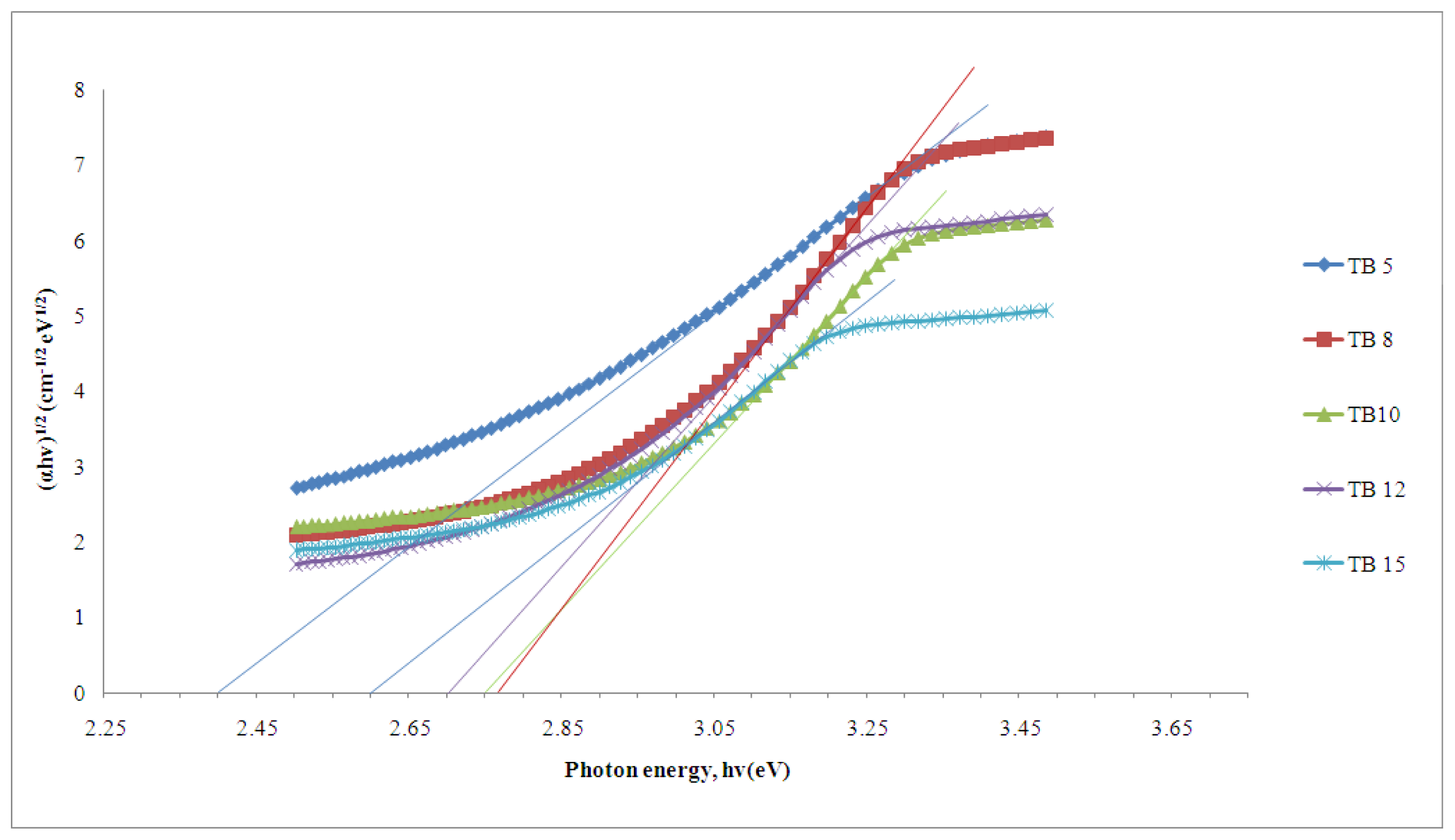
<p>where <italic>α</italic> is the absorption coefficient, <italic>hv</italic> is the incident photon energy, <italic>A</italic> is a constant and <italic>E</italic><sub>opt</sub> is the optical band gap. Values of <italic>n</italic> are 2 and 1/2 for direct and indirect transitions, respectively. The indirect band gap as a function of photon energy for (Bi<sub>2</sub>O<sub>3</sub>)<italic><sub>x</sub></italic>(TeO<sub>2</sub>)<sub>100−</sub><italic><sub>x</sub></italic> glass system is plotted and shown in <xref ref-type="fig" rid="f4-ijms-13-04623">Figure 4</xref>.</p>
<p>According to Sayed (2005), amorphous or glassy materials consist of a band tailing in the forbidden energy band gap. The band tailing might arise from random fluctuations of the internal disorder in the amorphous materials. So it can be estimated using the Urbach equation shown as follows [<xref ref-type="bibr" rid="b31-ijms-13-04623">31</xref>]</p>
<disp-formula id="FD2">
<label>(2)</label>
<mml:math id="mm2" display="block">
<mml:semantics id="sm2">
<mml:mrow>
<mml:mi>α</mml:mi>
<mml:mo stretchy="false">(</mml:mo>
<mml:mi>v</mml:mi>
<mml:mo stretchy="false">)</mml:mo>
<mml:mo>=</mml:mo>
<mml:mi>B</mml:mi>
<mml:mi> </mml:mi>
<mml:mi>e</mml:mi>
<mml:mi>x</mml:mi>
<mml:mi>p</mml:mi>
<mml:mi> </mml:mi>
<mml:mo stretchy="false">(</mml:mo>
<mml:mi>h</mml:mi>
<mml:mi>v</mml:mi>
<mml:mo>/</mml:mo>
<mml:mi mathvariant="normal">Δ</mml:mi>
<mml:msub>
<mml:mrow>
<mml:mi>E</mml:mi></mml:mrow>
<mml:mi>g</mml:mi></mml:msub>
<mml:mo stretchy="false">)</mml:mo></mml:mrow></mml:semantics></mml:math></disp-formula>
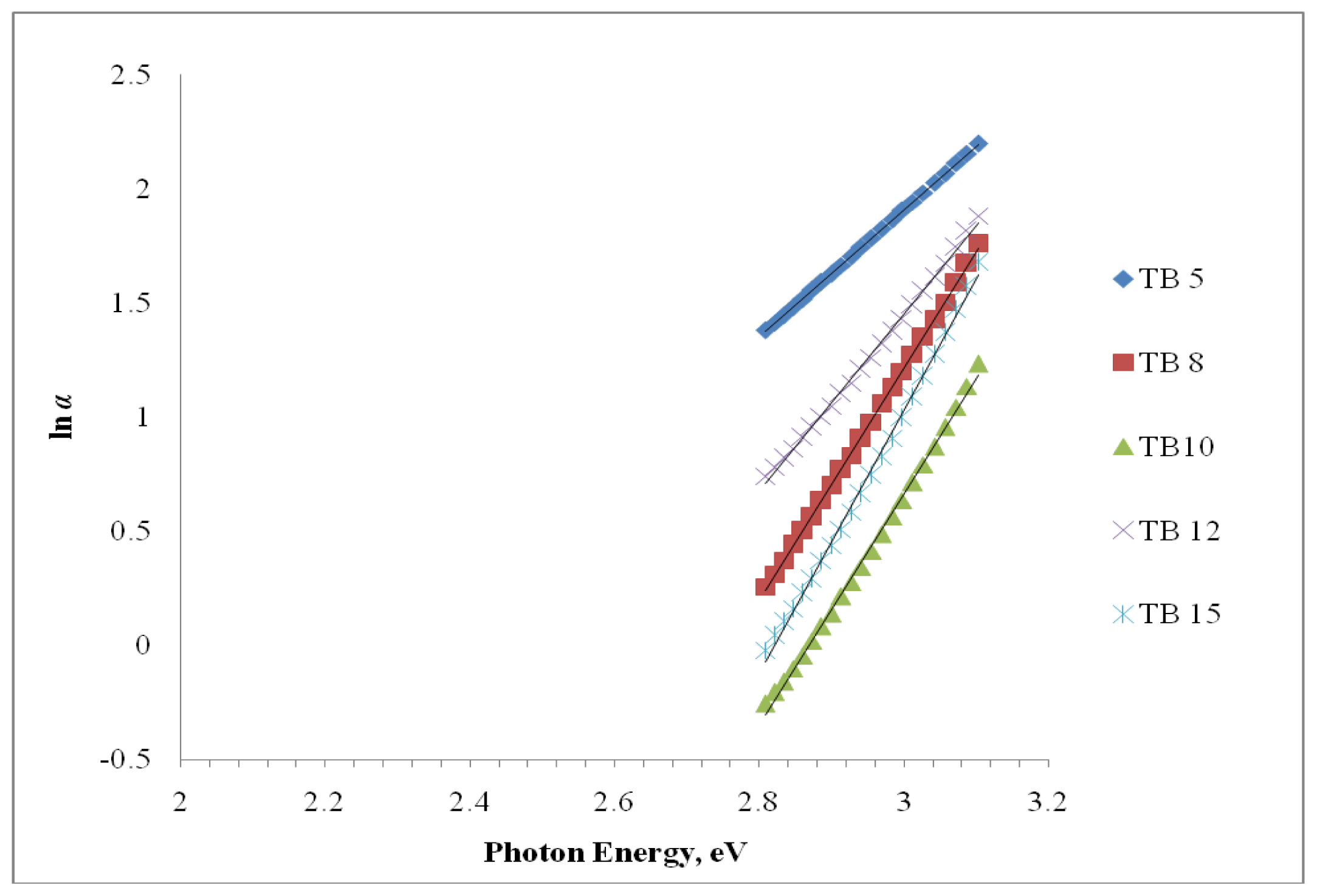
<p>where <italic>B</italic> is a constant and Δ<italic>E</italic> is the width of the band tail of the electron states. From <xref ref-type="fig" rid="f5-ijms-13-04623">Figure 5</xref>, Urbach energy, <italic>E</italic><sub>g</sub> is determined from the slope of plot ln (<italic>α</italic>) <italic>versus hv</italic>.</p>
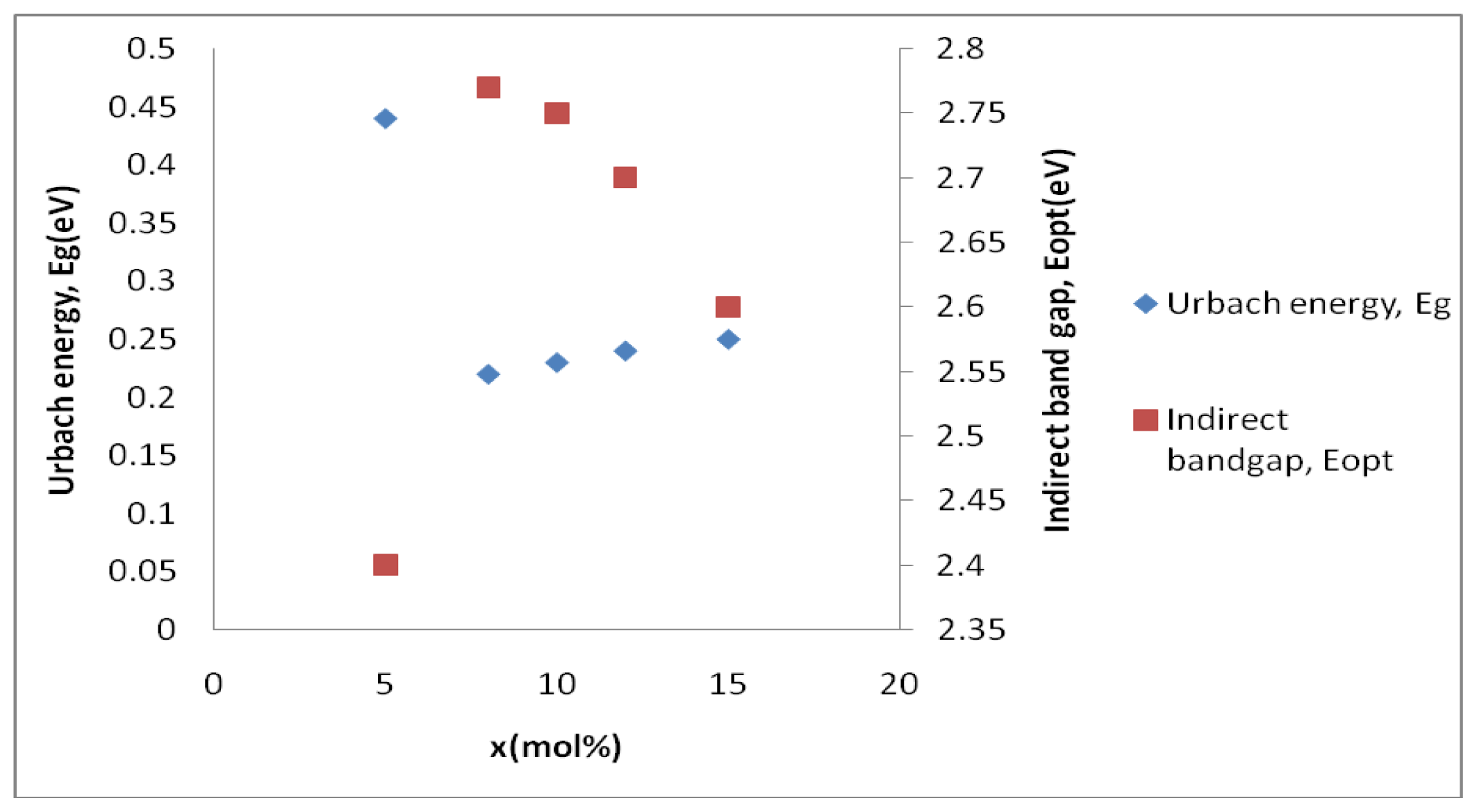
<p>The range of the indirect optical band gap decreases from 2.40 eV to 2.60 eV and 3.00 eV to 3.02 eV for the direct band gap as the concentration of ion Bi<sup>3+</sup> increases in the bismuth tellurite glass system. However, sample TB5 has a low bismuth content and a low energy band gap because of the formation of TeO<sub>2</sub> linkages in Te–O where bridging oxygen is more frequent than non-bridging oxygen. Shifting of the absorption band to a lower energy can be related to the formation of non-bridging oxygen (NBO) which binds exited electrons of non-bridging oxygen less tightly than bridging oxygen [<xref ref-type="bibr" rid="b10-ijms-13-04623">10</xref>], and this cause the glass network to become less rigid (Rajendan, 2003) [<xref ref-type="bibr" rid="b27-ijms-13-04623">27</xref>]. Another possibility is due to the high polarizability of the Bi<sup>3+</sup> ions which can be attributed to the empty d orbitals of the corresponding cations and also their high coordination number towards oxide ions. The coordination number of TeO<sub>2</sub> changes from 4 to 3 while the coordination number of Bi<sub>2</sub>O<sub>3</sub> changes from 3 to 6, which then forms a BiO<sub>6</sub> octaherdal structural unit with the addition of Bi<sub>2</sub>O<sub>3</sub> into the glass system. According to Yanfei (2008) [<xref ref-type="bibr" rid="b16-ijms-13-04623">16</xref>], less tight oxygen anions were allowed when the amount of non-bridging oxygen increased, This was because of an increase in Lewis basicity of oxide ions, which form stronger covalent Te–O bonds in TeO<sub>3</sub> units, and so allow less tight oxygen anions in the glass network. Hence the more the Bi<sub>2</sub>O<sub>3</sub> content increases, the fewer tightly bound oxygen anions (valence electrons) are found and the greater the decrease of the optical band gap energies.</p>
<p>The optical band gap energy is opposite to the Urbach energy, which can be attributed to the formation of non-bridging oxygen (<xref ref-type="fig" rid="f6-ijms-13-04623">Figure 6</xref>). The optical band gap energy and Urbach energy values for glass systems are found to lie between 3.10–3.00 eV and 0.25–0.44 eV, respectively. Rajendran (2003) [<xref ref-type="bibr" rid="b27-ijms-13-04623">27</xref>] reported that the addition of Bi<sub>2</sub>O<sub>3</sub> glass modifier would make the glass network more loosely packed (breaking the O–Te–O chains to form TeO<sub>3</sub> units and non-bridging oxygen) and therefore produce unstable glass. When the concentration of ion Bi<sup>3+</sup> is increased, the appearance of TeO<sub>3</sub> units and non-bridging oxygen in the glass networks increases. As the concentration of the ion modifier Bi<sup>3+</sup> increases, non-bridging oxygen and TeO<sub>3</sub> units in the glass structure increase and as a result, the Urbach energy for this glass system also increases.</p></sec></sec>
<sec>
<title>3. Experimental</title>
<p>The raw materials of tellurium dioxide, TeO<sub>2</sub> (Aldrich 99.5%), and bismuth (iii) oxide Bi<sub>2</sub>O<sub>3</sub> (Aldrich 99.0%) were used to synthesize the glass sample. The glass sample was prepared by using a melt quenching method [<xref ref-type="bibr" rid="b32-ijms-13-04623">32</xref>,<xref ref-type="bibr" rid="b33-ijms-13-04623">33</xref>]. The bismuth (iii) oxide, <italic>x</italic> = 5, 8, 10, 12, 15 in mol% was added into the tellurite oxide and was weighed using a digital weighing machine with an accuracy of ±0.01 g and then mixed together by using a mortar and pestle. The mixture was poured into an alumina crucible and put into an electric furnace set at 100 °C for a period of 30 min. The alumina crucible was used because it can withstand high temperatures and does not react with the raw materials during the melting process as opposed to porcelain crucibles. The temperature was then increased by 10 °C/min until 900 °C and the then maintained for 2 h. When the melting process was completed, the molten liquid was cast into a stainless steel cylindrical shape mould which had been preheated at 400 °C for 30 min. The sample was annealed at 400 °C in a second furnace for 1 h, then the furnace was turned off. The glass sample was cut at a thickness of about 2 mm for the required measurements [<xref ref-type="bibr" rid="b33-ijms-13-04623">33</xref>].</p>
<p>The density of the glass samples was measured using the Archimedes principle, and distilled water was used as the immersion liquid. The optical properties such as refractive indices (<italic>n</italic>) were determined by using EL X-02C high precision ellipsometer. The structure of the bismuth tellurite glass was investigated using X-ray diffraction (XRD) and Fourier transform infrared spectroscopy (FTIR). The optical absorption of the bismuth tellurite glass was measured using UV visible spectroscopy and powder BaSO<sub>4</sub> was used as the reference for the UV visible spectroscopy. The wavelength was set from 2600 nm to 220 nm, and the internal spacing was 0.2 nm, using a medium scan speed for glass samples.</p></sec>
<sec sec-type="conclusions">
<title>4. Conclusions</title>
<p>The density and molar volume of the glass sample increase due to the fact that the atomic mass of bismuth ions is higher than that of tellurite ions, and that the atomic radius of bismuth is also greater than that of tellurite ions. Additionally, the refractive index increases due to the increase of polarity of the Bi<sup>3+</sup> ion content in tellurite based glasses. In addition, based on the FTIR results, the TeO<sub>2</sub> is the glass former while Bi<sub>2</sub>O<sub>3</sub> is the glass modifier in bismuth tellurite glass systems, and the wave number shifts to a low frequency when the bismuth content increases. The optical band gap shifts to a low energy while the Urbach energy shifts to high energy when non-bridging oxygen (NBO) increases as bismuth content increases.</p></sec></body>
<back>
<ack>
<title>Acknowledgments</title>
<p>The authors appreciate the financial support for the work from the Ministry of Higher Education of Malaysia through RUGS (9199837).</p></ack>
<ref-list>
<title>References</title>
<ref id="b1-ijms-13-04623"><label>1</label><citation citation-type="journal"><person-group person-group-type="author"><name><surname>Vijaya Prakash</surname><given-names>G.</given-names></name><name><surname>Narayana Rao</surname><given-names>D.</given-names></name><name><surname>Bhatnagar</surname><given-names>A.K.</given-names></name></person-group><article-title>Linear optical properties of niobium based tellurite glasses</article-title><source>Solid State Commun</source><year>2001</year><volume>119</volume><fpage>39</fpage><lpage>44</lpage><pub-id pub-id-type="doi">10.1016/S0038-1098(01)00195-8</pub-id></citation></ref>
<ref id="b2-ijms-13-04623"><label>2</label><citation citation-type="journal"><person-group person-group-type="author"><name><surname>Mohamed</surname><given-names>N.B.</given-names></name><name><surname>Yahya</surname><given-names>A.K.</given-names></name><name><surname>Deni</surname><given-names>M.S.M.</given-names></name><name><surname>Mohamed</surname><given-names>S.N.</given-names></name><name><surname>Halimah</surname><given-names>M.K.</given-names></name><name><surname>Sidek</surname><given-names>H.A.A.</given-names></name></person-group><article-title>Effects of concurrent TeO<sub>2</sub> reduction and ZnO addition on elastic and structural properties of (90–<italic>x</italic>)TeO<sub>2</sub>–10Nb<sub>2</sub>O<sub>5</sub>–(<italic>x</italic>)ZnO glass</article-title><source>J. Non-Cryst. Solids</source><year>2010</year><volume>356</volume><fpage>1626</fpage><lpage>1630</lpage><pub-id pub-id-type="doi">10.1016/j.jnoncrysol.2010.06.031</pub-id></citation></ref>
<ref id="b3-ijms-13-04623"><label>3</label><citation citation-type="journal"><person-group person-group-type="author"><name><surname>Foldvari</surname><given-names>I.</given-names></name><name><surname>Peter</surname><given-names>A.</given-names></name></person-group><article-title>Basic spectroscopic properties of bismuth tellurium oxide, Bi<sub>2</sub>TeO<sub>5</sub></article-title><source>J. Mater. Sci</source><year>1992</year><volume>27</volume><fpage>750</fpage><lpage>754</lpage><pub-id pub-id-type="doi">10.1007/BF02403891</pub-id></citation></ref>
<ref id="b4-ijms-13-04623"><label>4</label><citation citation-type="journal"><person-group person-group-type="author"><name><surname>Udovic</surname><given-names>M.</given-names></name><name><surname>Valant</surname><given-names>M.</given-names></name><name><surname>Suvorov</surname><given-names>D.</given-names></name></person-group><article-title>Phase formation and dielectric characterization of the Bi<sub>2</sub>O<sub>3</sub>–TeO<sub>2</sub> system prepared in an oxygen atmosphere</article-title><source>J. Am. Ceram. Soc</source><year>2004</year><volume>87</volume><fpage>591</fpage><lpage>597</lpage><pub-id pub-id-type="doi">10.1111/j.1551-2916.2004.00591.x</pub-id></citation></ref>
<ref id="b5-ijms-13-04623"><label>5</label><citation citation-type="journal"><person-group person-group-type="author"><name><surname>Ozdanova</surname><given-names>J.</given-names></name><name><surname>Ticha</surname><given-names>H.</given-names></name><name><surname>Tichy</surname><given-names>L.</given-names></name></person-group><article-title>Optical band gap and Raman spectra in some (Bi<sub>2</sub>O<sub>3</sub>)<italic><sub>x</sub></italic>(WO<sub>3</sub>)<italic><sub>y</sub></italic>(TeO<sub>2</sub>)<sub>100−</sub><italic><sub>x</sub></italic><sub>−</sub><italic><sub>y</sub></italic> and (PbO)<italic><sub>x</sub></italic>(WO<sub>3</sub>)<italic><sub>y</sub></italic>(TeO<sub>2</sub>)<sub>100−</sub><italic><sub>x</sub></italic><sub>−</sub><italic><sub>y</sub></italic> glasses</article-title><source>J. Non-Cryst. Solids</source><year>2009</year><volume>355</volume><fpage>2318</fpage><lpage>2322</lpage><pub-id pub-id-type="doi">10.1016/j.jnoncrysol.2009.07.004</pub-id></citation></ref>
<ref id="b6-ijms-13-04623"><label>6</label><citation citation-type="journal"><person-group person-group-type="author"><name><surname>Boyer</surname><given-names>J.C.</given-names></name><name><surname>Vetrone</surname><given-names>F.</given-names></name><name><surname>Capobianco</surname><given-names>J.A.</given-names></name></person-group><article-title>Optical transitions and upconversion properties of Ho<sup>3+</sup> doped ZnO–TeO<sub>2</sub> glass</article-title><source>J. Appl. Phys</source><year>2003</year><volume>93</volume><fpage>9460</fpage><lpage>9465</lpage><pub-id pub-id-type="doi">10.1063/1.1577817</pub-id></citation></ref>
<ref id="b7-ijms-13-04623"><label>7</label><citation citation-type="journal"><person-group person-group-type="author"><name><surname>Mori</surname><given-names>H.</given-names></name><name><surname>Kitami</surname><given-names>T.</given-names></name><name><surname>Sakata</surname><given-names>H.</given-names></name></person-group><article-title>Electrical conductivity of W<sub>2</sub>O<sub>5</sub>–Sb<sub>2</sub>O<sub>3</sub>–TeO<sub>2</sub> glasses</article-title><source>J. Non-Cryst. Solids</source><year>1994</year><volume>168</volume><fpage>157</fpage><lpage>166</lpage><pub-id pub-id-type="doi">10.1016/0022-3093(94)90132-5</pub-id></citation></ref>
<ref id="b8-ijms-13-04623"><label>8</label><citation citation-type="journal"><person-group person-group-type="author"><name><surname>Szu</surname><given-names>S.P.</given-names></name><name><surname>Chang</surname><given-names>F.-S.</given-names></name></person-group><article-title>Impedance study of V<sub>2</sub>O<sub>5</sub>–TeO<sub>2</sub>–BaO glasses</article-title><source>Solid State Ion</source><year>2005</year><volume>176</volume><fpage>2695</fpage><lpage>2699</lpage><pub-id pub-id-type="doi">10.1016/j.ssi.2005.09.004</pub-id></citation></ref>
<ref id="b9-ijms-13-04623"><label>9</label><citation citation-type="journal"><person-group person-group-type="author"><name><surname>Ayuni</surname><given-names>J.N.</given-names></name><name><surname>Halimah</surname><given-names>M.K.</given-names></name><name><surname>Talib</surname><given-names>Z.A.</given-names></name><name><surname>Sidek</surname><given-names>H.A.A.</given-names></name><name><surname>Daud</surname><given-names>W.M.</given-names></name><name><surname>Zaidan</surname><given-names>A.W.</given-names></name><name><surname>Khamirul</surname><given-names>A.M.</given-names></name></person-group><article-title>Optical properties of ternary TeO<sub>2</sub>–B<sub>2</sub>O<sub>3</sub>–ZnO glass system</article-title><source>Mater. Sci. Eng</source><year>2011</year><volume>17</volume><pub-id pub-id-type="doi">10.1088/1757-899X/17/1/012027</pub-id></citation></ref>
<ref id="b10-ijms-13-04623"><label>10</label><citation citation-type="journal"><person-group person-group-type="author"><name><surname>Mohamed</surname><given-names>N.B.</given-names></name><name><surname>Yahya</surname><given-names>A.K.</given-names></name><name><surname>Deni</surname><given-names>M.S.M.</given-names></name><name><surname>Mohamed</surname><given-names>S.N.</given-names></name><name><surname>Halimah</surname><given-names>M.K.</given-names></name><name><surname>Sidek</surname><given-names>H.A.A.</given-names></name></person-group><article-title>Effects of concurrent TeO<sub>2</sub> reduction and ZnO addition on elastic and structural Properties of (90–x)TeO<sub>2</sub>–10Nb<sub>2</sub>O<sub>5</sub>–(x)ZnO glass</article-title><source>J. Non-Cryst. Solids</source><year>2010</year><volume>356</volume><fpage>1626</fpage><lpage>1630</lpage><pub-id pub-id-type="doi">10.1016/j.jnoncrysol.2010.06.031</pub-id></citation></ref>
<ref id="b11-ijms-13-04623"><label>11</label><citation citation-type="journal"><person-group person-group-type="author"><name><surname>Boris</surname><given-names>L.S.</given-names></name><name><surname>Petrov</surname><given-names>T.</given-names></name><name><surname>Yoneda</surname><given-names>H.</given-names></name><name><surname>Rositsa</surname><given-names>T.</given-names></name><name><surname>Boriana</surname><given-names>M.</given-names></name></person-group><article-title>Synthesis and nonlinear optical properties of TeO<sub>2</sub>–Bi<sub>2</sub>O<sub>3</sub>–GeO<sub>2</sub> glasses</article-title><source>Scr. Mater</source><year>2009</year><volume>61</volume><fpage>493</fpage><lpage>496</lpage><pub-id pub-id-type="doi">10.1016/j.scriptamat.2009.05.006</pub-id></citation></ref>
<ref id="b12-ijms-13-04623"><label>12</label><citation citation-type="journal"><person-group person-group-type="author"><name><surname>Durga</surname><given-names>D.K.</given-names></name><name><surname>Veeraiah</surname><given-names>N.</given-names></name></person-group><article-title>Dielectric dispersion in ZnF<sub>2</sub>–Bi<sub>2</sub>O<sub>3</sub>–TeO<sub>2</sub> glass system</article-title><source>J. Mater. Sci</source><year>2001</year><volume>36</volume><fpage>5625</fpage><lpage>5632</lpage><pub-id pub-id-type="doi">10.1023/A:1012521817440</pub-id></citation></ref>
<ref id="b13-ijms-13-04623"><label>13</label><citation citation-type="journal"><person-group person-group-type="author"><name><surname>Yousef</surname><given-names>E.S.S.</given-names></name></person-group><article-title>Characterization of oxyfluoride tellurite glasses through thermal, optical and ultrasonic measurements</article-title><source>J. Phys. D Appl. Phys</source><year>2005</year><volume>38</volume><fpage>3970</fpage><lpage>3975</lpage><pub-id pub-id-type="doi">10.1088/0022-3727/38/21/022</pub-id></citation></ref>
<ref id="b14-ijms-13-04623"><label>14</label><citation citation-type="journal"><person-group person-group-type="author"><name><surname>Xu</surname><given-names>T.</given-names></name><name><surname>Chen</surname><given-names>F.</given-names></name><name><surname>Dai</surname><given-names>S.</given-names></name><name><surname>Shen</surname><given-names>X.</given-names></name><name><surname>Wang</surname><given-names>X.</given-names></name><name><surname>Nie</surname><given-names>Q.</given-names></name><name><surname>Liu</surname><given-names>C.</given-names></name></person-group><article-title>Glass formation and third-order optical nonlinear properties within TeO<sub>2</sub>–Bi<sub>2</sub>O<sub>3</sub>–BaO pseudo-ternary system</article-title><source>J. Non-Cryst. Solids</source><year>2011</year><volume>357</volume><fpage>2219</fpage><lpage>2222</lpage><pub-id pub-id-type="doi">10.1016/j.jnoncrysol.2010.12.007</pub-id></citation></ref>
<ref id="b15-ijms-13-04623"><label>15</label><citation citation-type="journal"><person-group person-group-type="author"><name><surname>Senthil Murugan</surname><given-names>G.</given-names></name><name><surname>Fargin</surname><given-names>E.</given-names></name><name><surname>Rodriguez</surname><given-names>V.</given-names></name><name><surname>Adamietz</surname><given-names>F.</given-names></name><name><surname>Couzi</surname><given-names>M.</given-names></name><name><surname>Buffeteau</surname><given-names>T.</given-names></name><name><surname>Le Coustumer</surname><given-names>P.</given-names></name></person-group><article-title>Temperature-assisted electrical poling of TeO<sub>2</sub>–Bi<sub>2</sub>O<sub>3</sub>–ZnO glasses for non-linear optical application</article-title><source>J. Non-Cryst. Solids</source><year>2004</year><volume>344</volume><fpage>158</fpage><lpage>166</lpage><pub-id pub-id-type="doi">10.1016/j.jnoncrysol.2004.06.017</pub-id></citation></ref>
<ref id="b16-ijms-13-04623"><label>16</label><citation citation-type="journal"><person-group person-group-type="author"><name><surname>Wang</surname><given-names>Y.</given-names></name><name><surname>Dai</surname><given-names>S.</given-names></name><name><surname>Chen</surname><given-names>F.</given-names></name><name><surname>Xu</surname><given-names>T.</given-names></name><name><surname>Nie</surname><given-names>Q.</given-names></name></person-group><article-title>Physical properties and optical band gap of new tellurite glasses within the TeO<sub>2</sub>–Nb<sub>2</sub>O<sub>5</sub>–Bi<sub>2</sub>O<sub>3</sub> system</article-title><source>Mater. Chem. Phys</source><year>2009</year><volume>113</volume><fpage>407</fpage><lpage>411</lpage><pub-id pub-id-type="doi">10.1016/j.matchemphys.2008.07.117</pub-id></citation></ref>
<ref id="b17-ijms-13-04623"><label>17</label><citation citation-type="book"><person-group person-group-type="author"><name><surname>El-Mallawany</surname><given-names>R.A.H.</given-names></name></person-group><source>Tellurite Glasses Handbook</source><publisher-name>CRC Press Inc</publisher-name><publisher-loc>Boca Raton, FL, USA</publisher-loc><year>2002</year></citation></ref>
<ref id="b18-ijms-13-04623"><label>18</label><citation citation-type="journal"><person-group person-group-type="author"><name><surname>El-Mallawanny</surname><given-names>R.</given-names></name><name><surname>Dirar Abdalla</surname><given-names>M.</given-names></name><name><surname>Abbas Ahmed</surname><given-names>I.</given-names></name></person-group><article-title>New tellurite glass: Optical properties</article-title><source>Mater. Chem. Phys</source><year>2008</year><volume>109</volume><fpage>291</fpage><lpage>296</lpage><pub-id pub-id-type="doi">10.1016/j.matchemphys.2007.11.040</pub-id></citation></ref>
<ref id="b19-ijms-13-04623"><label>19</label><citation citation-type="journal"><person-group person-group-type="author"><name><surname>Sidek</surname><given-names>H.A.A.</given-names></name><name><surname>Rosmawati</surname><given-names>S.</given-names></name><name><surname>Talib</surname><given-names>Z.A.</given-names></name><name><surname>Halimah</surname><given-names>M.K.</given-names></name><name><surname>Daud</surname><given-names>W.M.</given-names></name></person-group><article-title>Synthesis and optical properties of ZnO–TeO<sub>2</sub> glass system</article-title><source>Am. J. Appl. Sci</source><year>2009</year><volume>6</volume><fpage>1489</fpage><lpage>1494</lpage><pub-id pub-id-type="doi">10.3844/ajassp.2009.1489.1494</pub-id></citation></ref>
<ref id="b20-ijms-13-04623"><label>20</label><citation citation-type="journal"><person-group person-group-type="author"><name><surname>Saddeek</surname><given-names>Y.B.</given-names></name><name><surname>Yasser</surname><given-names>B.</given-names></name><name><surname>Afifi</surname><given-names>H.A.</given-names></name><name><surname>Abd El-Aal</surname><given-names>N.S.</given-names></name></person-group><article-title>Interpretation of mechanical properties and structure of TeO<sub>2</sub>–Li<sub>2</sub>O–B<sub>2</sub>O<sub>3</sub> glasses</article-title><source>Phys. B</source><year>2007</year><volume>398</volume><fpage>1</fpage><lpage>7</lpage><pub-id pub-id-type="doi">10.1016/j.physb.2007.04.011</pub-id></citation></ref>
<ref id="b21-ijms-13-04623"><label>21</label><citation citation-type="journal"><person-group person-group-type="author"><name><surname>Halimah</surname><given-names>M.K.</given-names></name><name><surname>Sidek</surname><given-names>H.A.A.</given-names></name><name><surname>Daud</surname><given-names>W.M.</given-names></name><name><surname>Zainal</surname><given-names>A.S.</given-names></name><name><surname>Mansor</surname><given-names>H.</given-names></name><name><surname>Khamirul</surname><given-names>A.M.</given-names></name></person-group><article-title>Physical properties of binary tellurite glass system</article-title><source>Solid State Sci. Tech</source><year>2010</year><volume>18</volume><fpage>364</fpage><lpage>370</lpage></citation></ref>
<ref id="b22-ijms-13-04623"><label>22</label><citation citation-type="journal"><person-group person-group-type="author"><name><surname>Munoz-Matin</surname><given-names>D.</given-names></name><name><surname>Villegas</surname><given-names>M.A.</given-names></name><name><surname>Gonzalo</surname><given-names>J.</given-names></name><name><surname>Fernandez-Navarro</surname><given-names>J.M.</given-names></name></person-group><article-title>Characterisation of glasses in the TeO<sub>2</sub>–WO<sub>3</sub>–PbO system</article-title><source>J. Eur. Ceram. Soc</source><year>2009</year><volume>29</volume><fpage>2903</fpage><lpage>2913</lpage><pub-id pub-id-type="doi">10.1016/j.jeurceramsoc.2009.04.018</pub-id></citation></ref>
<ref id="b23-ijms-13-04623"><label>23</label><citation citation-type="journal"><person-group person-group-type="author"><name><surname>Doweidar</surname><given-names>H.</given-names></name><name><surname>Saddeek</surname><given-names>Y.B.</given-names></name></person-group><article-title>FTIR and Ultrasonic investigations on modified bismuth borate glasses</article-title><source>J. Non-Cryst. Solids</source><year>2009</year><volume>355</volume><fpage>348</fpage><lpage>354</lpage><pub-id pub-id-type="doi">10.1016/j.jnoncrysol.2008.12.008</pub-id></citation></ref>
<ref id="b24-ijms-13-04623"><label>24</label><citation citation-type="journal"><person-group person-group-type="author"><name><surname>Wanga</surname><given-names>G.</given-names></name><name><surname>Zhanga</surname><given-names>J.</given-names></name><name><surname>Daia</surname><given-names>S.</given-names></name><name><surname>Wena</surname><given-names>L.</given-names></name><name><surname>Yanga</surname><given-names>J.</given-names></name><name><surname>Jianga</surname><given-names>Z.</given-names></name></person-group><article-title>Structural investigation on TeO<sub>2</sub>–BiCl<sub>3</sub> glassy system</article-title><source>J. Mol. Struct</source><year>2005</year><volume>750</volume><fpage>1</fpage><lpage>6</lpage><pub-id pub-id-type="doi">10.1016/j.molstruc.2005.04.004</pub-id></citation></ref>
<ref id="b25-ijms-13-04623"><label>25</label><citation citation-type="journal"><person-group person-group-type="author"><name><surname>Ok</surname><given-names>K.M.</given-names></name><name><surname>Bhuvanesh</surname><given-names>N.S.P.</given-names></name><name><surname>Shiv Halasyamani</surname><given-names>P.</given-names></name></person-group><article-title>Bi<sub>2</sub>TeO<sub>5</sub>: Synthesis, structure, and powder second harmonic generation properties</article-title><source>Inorg. Chem</source><year>2001</year><volume>40</volume><fpage>1978</fpage><lpage>1980</lpage><pub-id pub-id-type="doi">10.1021/ic001224l</pub-id><pub-id pub-id-type="pmid">11312758</pub-id></citation></ref>
<ref id="b26-ijms-13-04623"><label>26</label><citation citation-type="journal"><person-group person-group-type="author"><name><surname>Pascuta</surname><given-names>P.</given-names></name><name><surname>Culea</surname><given-names>E.</given-names></name></person-group><article-title>FTIR spectroscopic study of some bismuth germinate glasses containing gadolinium ions</article-title><source>Mater. Lett</source><year>2008</year><volume>62</volume><fpage>4127</fpage><lpage>4129</lpage><pub-id pub-id-type="doi">10.1016/j.matlet.2008.06.015</pub-id></citation></ref>
<ref id="b27-ijms-13-04623"><label>27</label><citation citation-type="journal"><person-group person-group-type="author"><name><surname>Rajendran</surname><given-names>V.</given-names></name><name><surname>Palanivelu</surname><given-names>N.</given-names></name><name><surname>Chaudhuri</surname><given-names>B.K.</given-names></name><name><surname>Goswami</surname><given-names>K.</given-names></name></person-group><article-title>Characterisation of semiconducting V<sub>2</sub>O<sub>5</sub>–Bi<sub>2</sub>O<sub>3</sub>–TeO<sub>2</sub> glasses through ultrasonic measurements</article-title><source>J. Non-Cryst. Solids</source><year>2003</year><volume>320</volume><fpage>195</fpage><lpage>209</lpage><pub-id pub-id-type="doi">10.1016/S0022-3093(03)00018-8</pub-id></citation></ref>
<ref id="b28-ijms-13-04623"><label>28</label><citation citation-type="journal"><person-group person-group-type="author"><name><surname>Halimah</surname><given-names>M.K.</given-names></name><name><surname>Daud</surname><given-names>W.M.</given-names></name><name><surname>Sidek</surname><given-names>H.A.A.</given-names></name><name><surname>Zaidan</surname><given-names>A.W.</given-names></name><name><surname>Zainal</surname><given-names>A.S.</given-names></name></person-group><article-title>Optical properties of ternary tellurite glasses</article-title><source>Mater. Sci. Pol</source><year>2010</year><volume>28</volume><fpage>173</fpage><lpage>180</lpage></citation></ref>
<ref id="b29-ijms-13-04623"><label>29</label><citation citation-type="journal"><person-group person-group-type="author"><name><surname>Chen</surname><given-names>Y.</given-names></name><name><surname>Nie</surname><given-names>Q.</given-names></name><name><surname>Xu</surname><given-names>T.</given-names></name><name><surname>Dai</surname><given-names>S.</given-names></name><name><surname>Wang</surname><given-names>X.</given-names></name><name><surname>Shen</surname><given-names>X.</given-names></name></person-group><article-title>A study of nonlinear optical properties in Bi<sub>2</sub>O<sub>3</sub>–WO<sub>3</sub>–TeO<sub>2</sub> glasses</article-title><source>J. Non-Cryst. Solids</source><year>2008</year><volume>354</volume><fpage>3468</fpage><lpage>3472</lpage><pub-id pub-id-type="doi">10.1016/j.jnoncrysol.2008.03.005</pub-id></citation></ref>
<ref id="b30-ijms-13-04623"><label>30</label><citation citation-type="book"><person-group person-group-type="author"><name><surname>Tauc</surname><given-names>J</given-names></name></person-group><source>Amorphous and Liqiud Semiconductors</source><publisher-name>Plenum</publisher-name><publisher-loc>New York, NY, USA</publisher-loc><year>1974</year></citation></ref>
<ref id="b31-ijms-13-04623"><label>31</label><citation citation-type="journal"><person-group person-group-type="author"><name><surname>Urbach</surname><given-names>F</given-names></name></person-group><article-title>The long-wavelenght edge of photographic sensitivity and of the electronic absorption of solids</article-title><source>Phys Rev</source><year>1953</year><volume>92</volume><pub-id pub-id-type="doi">10.1103/PhysRev.92.1324</pub-id></citation></ref>
<ref id="b32-ijms-13-04623"><label>32</label><citation citation-type="journal"><person-group person-group-type="author"><name><surname>Doweidar</surname><given-names>H.</given-names></name><name><surname>Yasser</surname><given-names>B.S.</given-names></name></person-group><article-title>FTIR and ultrasonic investigations on modified bismuth borate glasses</article-title><source>J. Non-Cryst. Solids</source><year>2009</year><volume>355</volume><fpage>348</fpage><lpage>354</lpage><pub-id pub-id-type="doi">10.1016/j.jnoncrysol.2008.12.008</pub-id></citation></ref>
<ref id="b33-ijms-13-04623"><label>33</label><citation citation-type="journal"><person-group person-group-type="author"><name><surname>Sidek</surname><given-names>H.A.A.</given-names></name><name><surname>Rosmawati</surname><given-names>S.</given-names></name><name><surname>Talib</surname><given-names>Z.A.</given-names></name><name><surname>Halimah</surname><given-names>M.K.</given-names></name><name><surname>Halim</surname><given-names>S.A.</given-names></name></person-group><article-title>Effect of zinc on the elastic behaviour of (TeO<sub>2</sub>)<sub>90</sub>(AlF<sub>3</sub>)<sub>10−</sub><italic><sub>x</sub></italic>(ZnO)<italic><sub>x</sub></italic> glass system</article-title><source>Int. J. Basic Appl. Sci</source><year>2010</year><volume>9</volume><fpage>401</fpage><lpage>407</lpage></citation></ref></ref-list>
<sec sec-type="display-objects">
<title>Figures and Tables</title>
<fig id="f1-ijms-13-04623" position="float">
<label>Figure 1</label>
<caption>
<p>X-ray diffraction (XRD) analysis of the (Bi<sub>2</sub>O<sub>3</sub>)<italic><sub>x</sub></italic>(TeO<sub>2</sub>)<sub>100−</sub><italic><sub>x</sub></italic> glass system.</p></caption>
<graphic xlink:href="ijms-13-04623f1.gif"/></fig>
<fig id="f2-ijms-13-04623" position="float">
<label>Figure 2</label>
<caption>
<p>Density and molar volume with mole fraction of bismuth (iii) oxide of the (Bi<sub>2</sub>O<sub>3</sub>)<italic><sub>x</sub></italic>(TeO<sub>2</sub>)<sub>100−</sub><italic><sub>x</sub></italic> glass system.</p></caption>
<graphic xlink:href="ijms-13-04623f2.gif"/></fig>
<fig id="f3-ijms-13-04623" position="float">
<label>Figure 3</label>
<caption>
<p>FTIR analysis of (Bi<sub>2</sub>O<sub>3</sub>)<italic><sub>x</sub></italic>(TeO<sub>2</sub>)<sub>100−</sub><italic><sub>x</sub></italic> glass system.</p></caption>
<graphic xlink:href="ijms-13-04623f3.gif"/></fig>
<fig id="f4-ijms-13-04623" position="float">
<label>Figure 4</label>
<caption>
<p>Plot of (αhv)<sup>1/2</sup> <italic>versus hv</italic> for indirect band gap of (Bi<sub>2</sub>O<sub>3</sub>)<italic><sub>x</sub></italic>(TeO<sub>2</sub>)<sub>100</sub><bold><sub>−</sub></bold><italic><sub>x</sub></italic> glass system.</p></caption>
<graphic xlink:href="ijms-13-04623f4.gif"/></fig>
<fig id="f5-ijms-13-04623" position="float">
<label>Figure 5</label>
<caption>
<p>Plot of ln (<italic>α</italic>) <italic>versus hv</italic> for Urbach energy of (Bi<sub>2</sub>O<sub>3</sub>)<italic><sub>x</sub></italic>(TeO<sub>2</sub>)<sub>100</sub><bold><sub>−</sub></bold><italic><sub>x</sub></italic> glass system.</p></caption>
<graphic xlink:href="ijms-13-04623f5.gif"/></fig>
<fig id="f6-ijms-13-04623" position="float">
<label>Figure 6</label>
<caption>
<p>The optical band gap energy, <italic>E</italic><sub>opt</sub> and Urbach energy, <italic>E</italic><sub>g</sub> of (Bi<sub>2</sub>O<sub>3</sub>)<italic><sub>x</sub></italic>(TeO<sub>2</sub>)<sub>100−</sub><italic><sub>x</sub></italic> glass system.</p></caption>
<graphic xlink:href="ijms-13-04623f6.gif"/></fig>
<table-wrap id="t1-ijms-13-04623" position="float">
<label>Table 1</label>
<caption>
<p>Molar mass, density and molar volume of the (Bi<sub>2</sub>O<sub>3</sub>)<sub>x</sub>(TeO<sub>2</sub>)<sub>100−x</sub> glass system.</p></caption>
<table frame="hsides" rules="groups">
<thead>
<tr>
<th align="left" valign="bottom">Samples</th>
<th align="center" valign="bottom"><italic>x</italic> (mol%)</th>
<th align="center" valign="bottom">Molar mass (g/mol)</th>
<th align="center" valign="bottom">Density (g/cm<sup>3</sup>)</th>
<th align="center" valign="bottom">Molar Volume (cm<sup>3</sup>/mol)</th></tr></thead>
<tbody>
<tr>
<td align="left" valign="top">TB5</td>
<td align="right" valign="top">5</td>
<td align="center" valign="top">174.92</td>
<td align="center" valign="top">5.43</td>
<td align="center" valign="top">32.22</td></tr>
<tr>
<td align="left" valign="top">TB8</td>
<td align="right" valign="top">8</td>
<td align="center" valign="top">184.11</td>
<td align="center" valign="top">5.69</td>
<td align="center" valign="top">32.35</td></tr>
<tr>
<td align="left" valign="top">TB10</td>
<td align="right" valign="top">10</td>
<td align="center" valign="top">190.23</td>
<td align="center" valign="top">5.85</td>
<td align="center" valign="top">32.49</td></tr>
<tr>
<td align="left" valign="top">TB12</td>
<td align="right" valign="top">12</td>
<td align="center" valign="top">196.36</td>
<td align="center" valign="top">6.03</td>
<td align="center" valign="top">32.56</td></tr>
<tr>
<td align="left" valign="top">TB15</td>
<td align="right" valign="top">15</td>
<td align="center" valign="top">205.55</td>
<td align="center" valign="top">6.26</td>
<td align="center" valign="top">32.86</td></tr></tbody></table></table-wrap>
<table-wrap id="t2-ijms-13-04623" position="float">
<label>Table 2</label>
<caption>
<p>The ranges of the wave numbers for difference mode.</p></caption>
<table frame="hsides" rules="groups">
<thead>
<tr>
<th align="center" valign="bottom">Wavenumber(cm<sup>−1</sup>)</th>
<th align="center" valign="bottom">Mode</th></tr></thead>
<tbody>
<tr>
<td align="center" valign="top">400–600</td>
<td align="center" valign="top">Bi–O–Bi + Bi–O in BiO<sub>6</sub> octahedral [<xref ref-type="bibr" rid="b23-ijms-13-04623">23</xref>]</td></tr>
<tr>
<td align="center" valign="top">650–660</td>
<td align="center" valign="top">Te–Oax in [TeO<sub>4</sub>] [<xref ref-type="bibr" rid="b24-ijms-13-04623">24</xref>,<xref ref-type="bibr" rid="b25-ijms-13-04623">25</xref>]</td></tr>
<tr>
<td align="center" valign="top">775</td>
<td align="center" valign="top">Te–Oeq in [TeO<sub>4</sub>] [<xref ref-type="bibr" rid="b26-ijms-13-04623">26</xref>,<xref ref-type="bibr" rid="b27-ijms-13-04623">27</xref>]</td></tr>
<tr>
<td align="center" valign="top">633, 695</td>
<td align="center" valign="top">(shoulders) Te-O<sup>−</sup> [<xref ref-type="bibr" rid="b10-ijms-13-04623">10</xref>]</td></tr>
<tr>
<td align="center" valign="top">600–610</td>
<td align="center" valign="top">Bi–O<sup>−</sup> stretch in BiO<sub>6</sub> units [<xref ref-type="bibr" rid="b28-ijms-13-04623">28</xref>]</td></tr>
<tr>
<td align="center" valign="top">860–865</td>
<td align="center" valign="top">Bi–O vibration in distorted BiO<sub>6</sub> units [<xref ref-type="bibr" rid="b11-ijms-13-04623">11</xref>]</td></tr></tbody></table></table-wrap>
<table-wrap id="t3-ijms-13-04623" position="float">
<label>Table 3</label>
<caption>
<p>Direct optical bandgap, indirect optical bandgap and Urbach energy of (Bi<sub>2</sub>O<sub>3</sub>)<sub>x</sub>(TeO<sub>2</sub>)<sub>100−x</sub> glass system.</p></caption>
<table frame="hsides" rules="groups">
<thead>
<tr>
<th align="center" valign="middle">Sample glass</th>
<th align="center" valign="middle">Indirect bandgap, <italic>E</italic><sub>opt</sub> (eV)</th>
<th align="center" valign="middle">Direct bandgap (eV)</th>
<th align="center" valign="middle">Urbach energy, <italic>E</italic><sub>g</sub> (eV)</th>
<th align="center" valign="middle">Refractive index in wavelength 632.8 nm, <italic>n</italic></th></tr></thead>
<tbody>
<tr>
<td align="center" valign="top">TB 5</td>
<td align="center" valign="top">2.40</td>
<td align="center" valign="top">3.02</td>
<td align="center" valign="top">0.44</td>
<td align="center" valign="top">1.97</td></tr>
<tr>
<td align="center" valign="top">TB 8</td>
<td align="center" valign="top">2.77</td>
<td align="center" valign="top">3.10</td>
<td align="center" valign="top">0.22</td>
<td align="center" valign="top">1.99</td></tr>
<tr>
<td align="center" valign="top">TB 10</td>
<td align="center" valign="top">2.75</td>
<td align="center" valign="top">3.08</td>
<td align="center" valign="top">0.23</td>
<td align="center" valign="top">2.02</td></tr>
<tr>
<td align="center" valign="top">TB 12</td>
<td align="center" valign="top">2.70</td>
<td align="center" valign="top">3.04</td>
<td align="center" valign="top">0.24</td>
<td align="center" valign="top">2.07</td></tr>
<tr>
<td align="center" valign="top">TB 15</td>
<td align="center" valign="top">2.60</td>
<td align="center" valign="top">3.00</td>
<td align="center" valign="top">0.25</td>
<td align="center" valign="top">2.12</td></tr></tbody></table></table-wrap></sec></back></article>