
<?xml version="1.0" encoding="UTF-8"?>
<!DOCTYPE article PUBLIC "-//NLM//DTD Journal Publishing DTD v2.3 20070202//EN" "journalpublishing.dtd">
<article xmlns:xlink="http://www.w3.org/1999/xlink" xml:lang="en" article-type="research-article">
<front>
<journal-meta>
<journal-id journal-id-type="publisher-id">ijms</journal-id>
<journal-title>International Journal of Molecular Sciences</journal-title>
<abbrev-journal-title>Int. J. Mol. Sci.</abbrev-journal-title>
<issn pub-type="epub">1422-0067</issn>
<publisher>
<publisher-name>Molecular Diversity Preservation International (MDPI)</publisher-name></publisher></journal-meta>
<article-meta>
<article-id pub-id-type="doi">10.3390/ijms13044508</article-id>
<article-id pub-id-type="publisher-id">ijms-13-04508</article-id>
<article-categories>
<subj-group>
<subject>Article</subject></subj-group></article-categories>
<title-group>
<article-title>Enhancement of Mechanical and Thermal Properties of Polycaprolactone/Chitosan Blend by Calcium Carbonate Nanoparticles</article-title></title-group>
<contrib-group>
<contrib contrib-type="author">
<name><surname>Abdolmohammadi</surname><given-names>Sanaz</given-names></name><xref ref-type="aff" rid="af1-ijms-13-04508">1</xref><xref ref-type="corresp" rid="c1-ijms-13-04508">*</xref></contrib>
<contrib contrib-type="author">
<name><surname>Siyamak</surname><given-names>Samira</given-names></name><xref ref-type="aff" rid="af1-ijms-13-04508">1</xref></contrib>
<contrib contrib-type="author">
<name><surname>Ibrahim</surname><given-names>Nor Azowa</given-names></name><xref ref-type="aff" rid="af1-ijms-13-04508">1</xref><xref ref-type="corresp" rid="c1-ijms-13-04508">*</xref></contrib>
<contrib contrib-type="author">
<name><surname>Yunus</surname><given-names>Wan Md Zin Wan</given-names></name><xref ref-type="aff" rid="af2-ijms-13-04508">2</xref></contrib>
<contrib contrib-type="author">
<name><surname>Rahman</surname><given-names>Mohamad Zaki Ab</given-names></name><xref ref-type="aff" rid="af1-ijms-13-04508">1</xref></contrib>
<contrib contrib-type="author">
<name><surname>Azizi</surname><given-names>Susan</given-names></name><xref ref-type="aff" rid="af1-ijms-13-04508">1</xref></contrib>
<contrib contrib-type="author">
<name><surname>Fatehi</surname><given-names>Asma</given-names></name><xref ref-type="aff" rid="af1-ijms-13-04508">1</xref></contrib></contrib-group>
<aff id="af1-ijms-13-04508">
<label>1</label>Department of Chemistry, Faculty of Science, University Putra Malaysia, 43400 UPM Serdang, Selangor, Malaysia; E-Mails: <email>sam.siyamak@gmail.com</email> (S.S.); <email>mzaki53@gmail.com</email> (M.Z.A.R.); <email>susanazizi@yahoo.com</email> (S.A.); <email>a_fatehi_chem@yahoo.com</email> (A.F.)</aff>
<aff id="af2-ijms-13-04508">
<label>2</label>Department of Chemistry, Centre For Defence Foundation Studies, National Defence University of Malaysia, Sungai Besi Camp, 57000, Kuala Lumpur, Malaysia; E-Mail: <email>wanmdzin@upnm.edu.my</email></aff>
<author-notes>
<corresp id="c1-ijms-13-04508">
<label>*</label>Authors to whom correspondence should be addressed; E-Mails: <email>s.abdolmohammadi@yahoo.com</email> (S.A.); <email>norazowa@science.upm.edu.my</email> (N.A.I.); Tel.:+ 601-23403938 (S.A.); +603-89466602 (N.A.I.); Fax: +603-89432508 (N.A.I.)</corresp></author-notes>
<pub-date pub-type="collection">
<year>2012</year></pub-date>
<pub-date pub-type="epub">
<day>10</day>
<month>4</month>
<year>2012</year></pub-date>
<volume>13</volume>
<issue>4</issue>
<fpage>4508</fpage>
<lpage>4522</lpage>
<history>
<date date-type="received">
<day>31</day>
<month>1</month>
<year>2012</year></date>
<date date-type="rev-recd">
<day>24</day>
<month>2</month>
<year>2012</year></date>
<date date-type="accepted">
<day>19</day>
<month>3</month>
<year>2012</year></date></history>
<permissions>
<copyright-statement>© 2012 by the authors; licensee Molecular Diversity Preservation International, Basel, Switzerland.</copyright-statement>
<copyright-year>2012</copyright-year>
<license license-type="open-access" xlink:href="http://creativecommons.org/licenses/by/3.0">
<p>This article is an open-access article distributed under the terms and conditions of the Creative Commons Attribution license (http://creativecommons.org/licenses/by/3.0/).</p></license></permissions>
<abstract>
<p>This study investigates the effects of calcium carbonate (CaCO<sub>3</sub>) nanoparticles on the mechanical and thermal properties and surface morphology of polycaprolactone (PCL)/chitosan nanocomposites. The nanocomposites of PCL/chitosan/CaCO<sub>3</sub> were prepared using a melt blending technique. Transmission electron microscopy (TEM) results indicate the average size of nanoparticles to be approximately 62 nm. Tensile measurement results show an increase in the tensile modulus with CaCO<sub>3</sub> nanoparticle loading. Tensile strength and elongation at break show gradual improvement with the addition of up to 1 wt% of nano-sized CaCO<sub>3</sub>. Decreasing performance of these properties is observed for loading of more than 1 wt% of nano-sized CaCO<sub>3</sub>. The thermal stability was best enhanced at 1 wt% of CaCO<sub>3</sub> nanoparticle loading. The fractured surface morphology of the PCL/chitosan blend becomes more stretched and homogeneous in PCL/chitosan/CaCO<sub>3</sub> nanocomposite. TEM micrograph displays good dispersion of CaCO<sub>3</sub> at lower nanoparticle loading within the matrix.</p></abstract>
<kwd-group>
<kwd>nanocomposites</kwd>
<kwd>calcium carbonate nanoparticles</kwd>
<kwd>polycaprolactone</kwd>
<kwd>chitosan</kwd>
<kwd>mechanical properties</kwd>
<kwd>thermal properties</kwd></kwd-group></article-meta></front>
<body>
<sec sec-type="intro">
<title>1. Introduction</title>
<p>Nanocomposites are an attractive class of materials providing novel performance. Due to some of their remarkable properties at low filler loading (less than 10 wt%), they are being increasingly adopted by industry whilst displacing the use of conventional filler materials. A variety of nanoscale fillers, including layered silicates and nanoparticles, are capable of enhancing mechanical and thermal properties of nanocomposites, including modulus, strength, impact performance, and heat resistance [<xref ref-type="bibr" rid="b1-ijms-13-04508">1</xref>–<xref ref-type="bibr" rid="b3-ijms-13-04508">3</xref>].</p>
<p>Among nanoparticles, CaCO<sub>3</sub> is one of the most common and inexpensive inorganic fillers that has been used in the nanocomposite preparation process. Fine grade nano-sized precipitated CaCO<sub>3</sub> (NPCC) has the potential to be an important functional filler in polymer systems such as polypropylene composites, poly (vinyl chloride) composites and poly (ethylene terephthalate) composites that are being produced [<xref ref-type="bibr" rid="b4-ijms-13-04508">4</xref>–<xref ref-type="bibr" rid="b7-ijms-13-04508">7</xref>]. It is a common practice to coat the surface of the NPCC with fatty acids such as stearic acid to reduce moisture absorption and particle agglomeration as well as to enhance dispersibility of the polar filler when incorporated into non-polar polymer melts [<xref ref-type="bibr" rid="b8-ijms-13-04508">8</xref>].</p>
<p>Extensive studies on the reinforcing effect of nano- and micro-sized CaCO<sub>3</sub> particles have been carried out in different polymer matrices, such as high density polyethylene (HDPE), nylon, polypropylene (PP), polylactide, acrylonitrile butadiene styrene (ABS), and thermoplastic polyurethane (TPU). Using nano-CaCO<sub>3</sub> particles significantly improved the mechanical properties as well as the surface smoothness of nanocomposites [<xref ref-type="bibr" rid="b9-ijms-13-04508">9</xref>–<xref ref-type="bibr" rid="b12-ijms-13-04508">12</xref>].</p>
<p>Poly (ɛ-caprolactone) (PCL) is a biodegradable aliphatic polyester regularly prepared through ring opening of ɛ-caprolactone in the presence of metal alkoxides (aluminum isopropoxide, tin octoate, <italic>etc.</italic>) [<xref ref-type="bibr" rid="b13-ijms-13-04508">13</xref>]. Some particular features of PCL include flexibility, low Tg (−61 °C), and low melting point (65 °C), comparatively high price, and a fairly long biodegradability cycle [<xref ref-type="bibr" rid="b14-ijms-13-04508">14</xref>,<xref ref-type="bibr" rid="b15-ijms-13-04508">15</xref>].</p>
<p>Based on its biodegradable characteristics, PCL is broadly applied in environmental (e.g., soft compostable packaging) and biomedical (e.g., blood bags and catheters) applications [<xref ref-type="bibr" rid="b16-ijms-13-04508">16</xref>].</p>
<p>To overcome some of the PCL properties’ drawbacks, such as high price and long biodegradability cycles, in some cases PCL is blended with a cheaper biodegradable natural polymer, such as starch, cellulous, or chitin and chitosan [<xref ref-type="bibr" rid="b15-ijms-13-04508">15</xref>–<xref ref-type="bibr" rid="b21-ijms-13-04508">21</xref>].</p>
<p>Chitosan is a polysaccharide, composed mainly of b-(1,4)-linked 2-deoxy-2-amino-D-glucopyranose units, which is the deacetylated product of chitin (poly (<italic>N</italic>-acetyl-D-glucopyranose)), being the second most plentiful natural based biopolymer after cellulose [<xref ref-type="bibr" rid="b22-ijms-13-04508">22</xref>–<xref ref-type="bibr" rid="b25-ijms-13-04508">25</xref>]. A waste product, chitosan is an antibacterial, non-toxic, biocompatible, and edible biodegradable polymer with good mechanical properties, biocompatibility and biodegradability, and has been widely used for several decades in different fields of studies, such as water engineering as part of a filtration process (removing phosphorus, heavy minerals, and oils from the water), food packaging film (edible coatings or films used for extending the shelf life of foodstuffs of, for example, fruit, meat, and fish and seafood), artificial skin and bone substitutes [<xref ref-type="bibr" rid="b26-ijms-13-04508">26</xref>,<xref ref-type="bibr" rid="b27-ijms-13-04508">27</xref>].</p>
<p>Chitosan, due to its antibacterial and biodegradable properties, mixed with PCL, a flexible material, can be broadly used for antibacterial packaging purposes.</p>
<p>However, PCL and chitosan are immiscible, because PCL is a hydrophobic polyester, whereas chitosan is a hydrophilic polysaccharide. Consequently, their blends suffer from some weaknesses in thermal and mechanical properties, making them uncompetitive for many applications [<xref ref-type="bibr" rid="b28-ijms-13-04508">28</xref>].</p>
<p>Many studies have focused on improving the compatibility between these two phases, either by adding a third component or by stimulating a chemical reaction leading to a modification of the polymer interface. Wu has investigated the effect of grafting acrylic acid onto PCL on the properties of PCL/chitosan blend [<xref ref-type="bibr" rid="b16-ijms-13-04508">16</xref>]. Liu <italic>et al.</italic> used chemical reaction to prepare the biosynthetic graft copolymers of chitosan with PCL, a product applicable in a variety of purposes [<xref ref-type="bibr" rid="b29-ijms-13-04508">29</xref>].</p>
<p>So far, no study has been undertaken to investigate the use of CaCO<sub>3</sub> nanoparticles in polycaprolactone/chitosan composites. The principal goal of this research is to improve the mechanical and thermal properties of PCL/chitosan composites by adding CaCO<sub>3</sub> nanoparticles as a nano-filler.</p></sec>
<sec sec-type="results|discussion">
<title>2. Results and Discussion</title>
<sec sec-type="results">
<title>2.1. Results of Nanoparticle Characterization</title>
<sec sec-type="methods">
<title>2.1.1. Electron Microscopic Analysis</title>
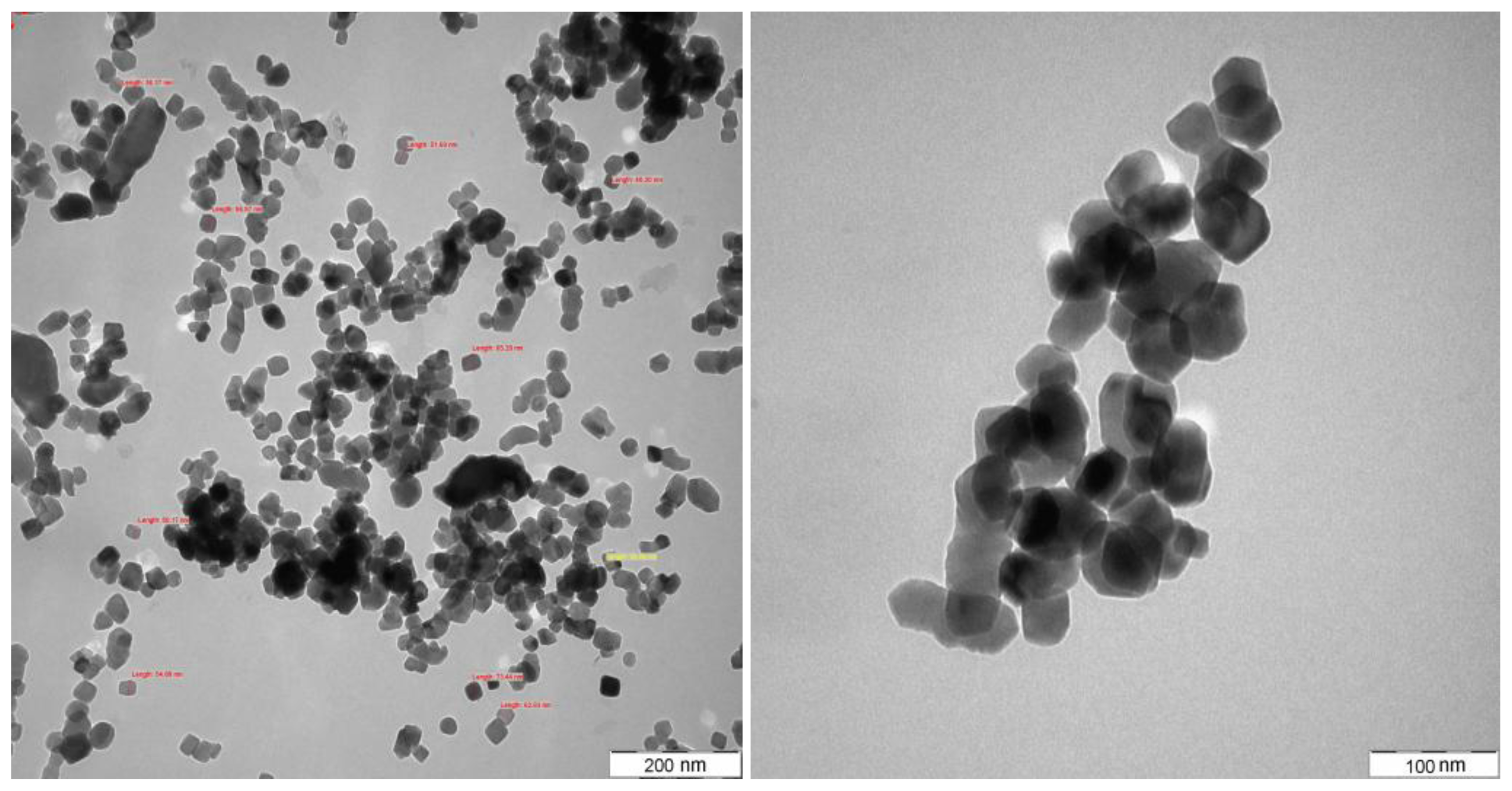
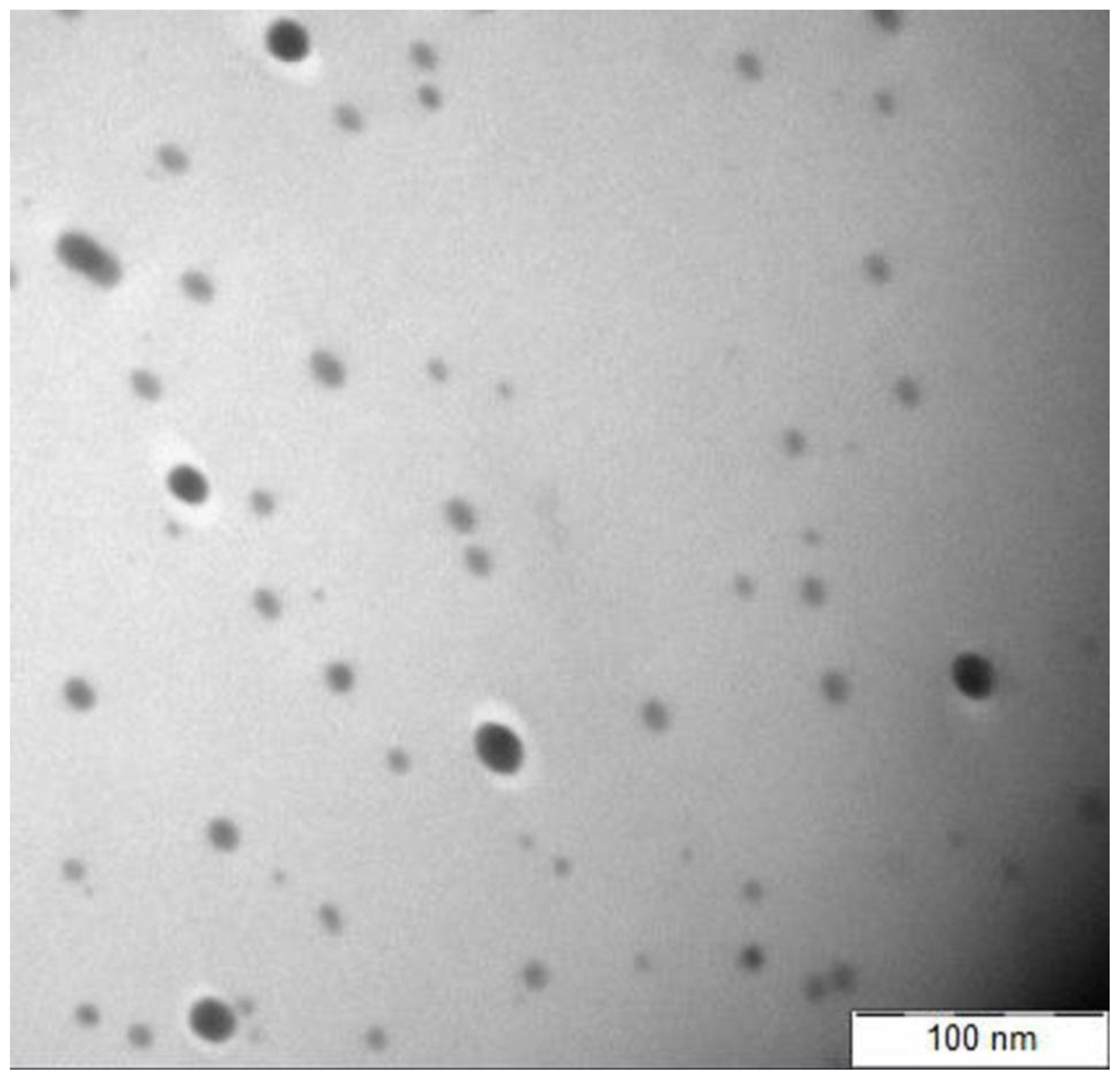
<p>A TEM micrograph of CaCO<sub>3</sub> nanoparticles is shown in <xref ref-type="fig" rid="f1-ijms-13-04508">Figure 1</xref>. As illustrated in <xref ref-type="fig" rid="f1-ijms-13-04508">Figure 1</xref>, nanoparticles have cubic shape with an average size of 62 nm calculated from the size of 10 randomly chosen particles.</p></sec>
<sec>
<title>2.1.2. Fourier Transform Infrared Characterization (FTIR)</title>
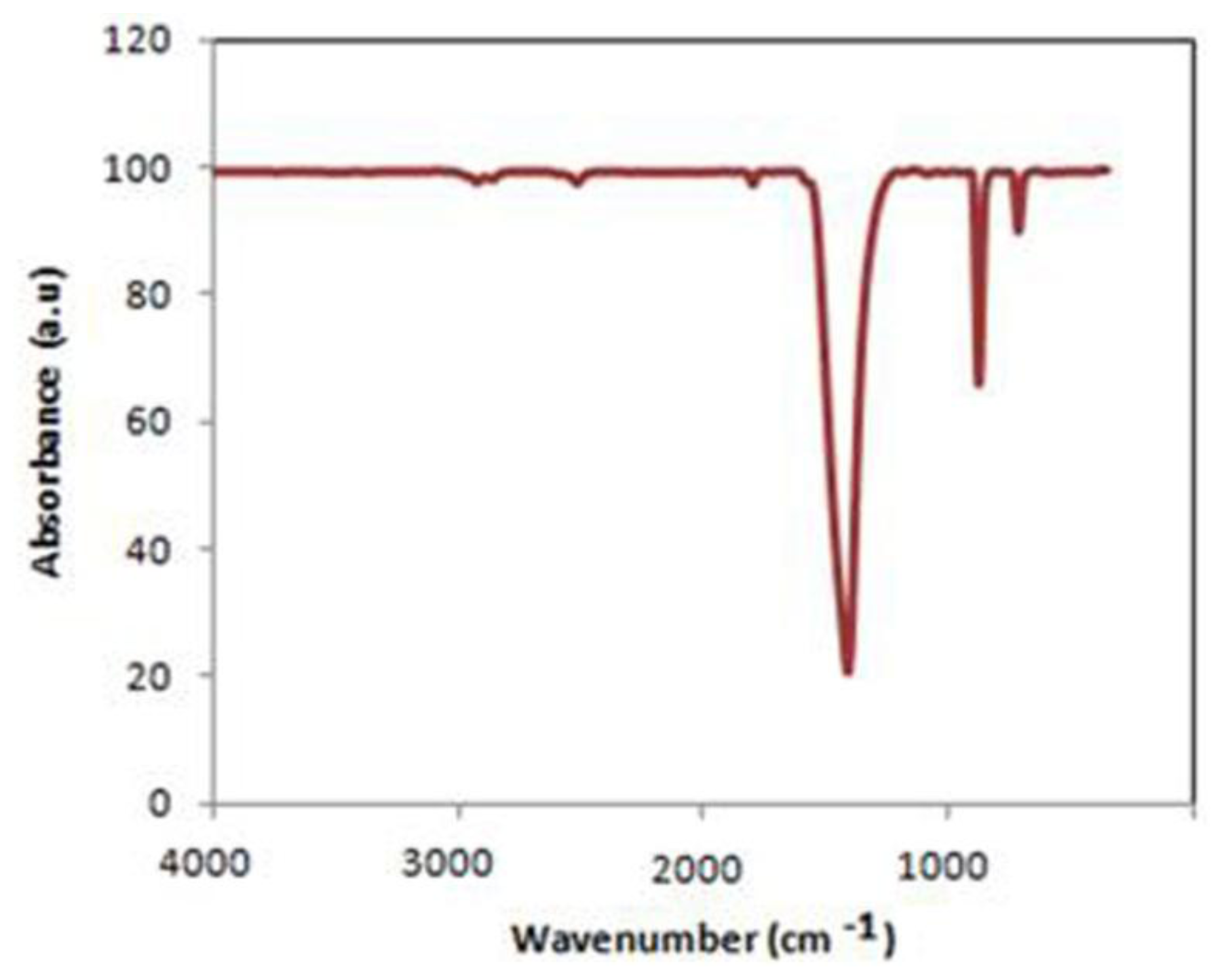
<p>From the FTIR spectrum of CaCO<sub>3</sub> nanoparticles illustrated in <xref ref-type="fig" rid="f2-ijms-13-04508">Figure 2</xref>, it can be seen that the nano CaCO<sub>3</sub> had adsorption bands at 2950–2840 cm<sup>−1</sup>, corresponding to the vibration mode of C–H of stearic acid, and also 707, 873 and 1418 cm<sup>−1</sup> corresponding to the in-, out-plane bending and asymmetrical stretching vibration peaks of O-C-O, respectively. They all are characteristic peaks in calcite [<xref ref-type="bibr" rid="b30-ijms-13-04508">30</xref>,<xref ref-type="bibr" rid="b31-ijms-13-04508">31</xref>].</p></sec>
<sec sec-type="methods">
<title>2.1.3. Thermogravimetric Analysis</title>
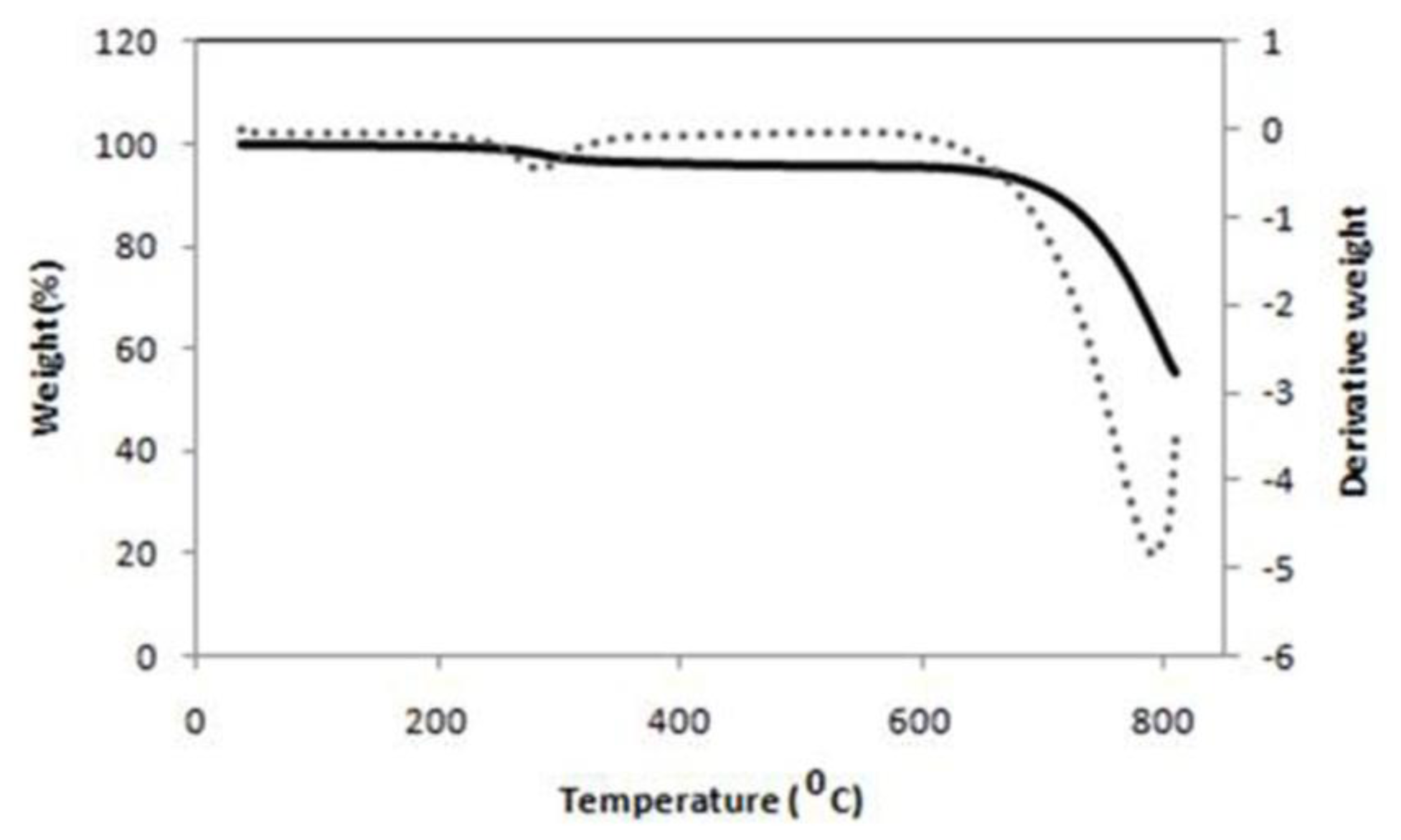
<p>The weight loss and derivative weight of nanoparticles as a function of temperature are shown in <xref ref-type="fig" rid="f3-ijms-13-04508">Figure 3</xref>; two stages of degradation of nano-sized CaCO<sub>3</sub> are displayed. The first stage accruing at 260 °C belongs to degradation of stearic acid, and the second stage at 720 °C corresponds to the decomposition of CaCO<sub>3</sub> itself [<xref ref-type="bibr" rid="b31-ijms-13-04508">31</xref>]. This result specifies that processing temperature for melt blending PCL/chitosan/nano CaCO<sub>3</sub> should be lower than 260 °C.</p></sec></sec>
<sec sec-type="results">
<title>2.2. Results of Nanocomposites Characterization</title>
<sec>
<title>2.2.1. Mechanical Properties of Nanocomposites</title>
<p>As illustrated in <xref ref-type="table" rid="t1-ijms-13-04508">Table 1</xref>, by increasing the amount of CaCO<sub>3</sub> nanoparticles, tensile modulus increases. The increase in tensile modulus must be caused by rigidity of the filler and strong interaction between the polymer and filler due to the large interfacial area between particles [<xref ref-type="bibr" rid="b32-ijms-13-04508">32</xref>,<xref ref-type="bibr" rid="b33-ijms-13-04508">33</xref>]. The enhanced composite modulus as a result of nanofiller loading has also been reported by several research groups [<xref ref-type="bibr" rid="b34-ijms-13-04508">34</xref>,<xref ref-type="bibr" rid="b35-ijms-13-04508">35</xref>].</p>
<p>Increasing CaCO<sub>3</sub> nanoparticle content enhances the tensile strength and peaks at 1 wt% of nano-sized CaCO<sub>3</sub> loading, due to good dispersion of nanoparticles into the matrix, yielding a higher reinforcement effect. Acting similarly to a compatibilizing agent, nanoparticles enhance the dispersion of materials and the interfacial adhesion within the matrix. By further loading of nano-sized CaCO<sub>3</sub>, the tensile strength gradually decreases as a result of the agglomeration of filler particles at higher amounts [<xref ref-type="bibr" rid="b36-ijms-13-04508">36</xref>]. Particle agglomeration flaws the material’s surface, which restrains stress movement, and eventually results in decreased tensile strength [<xref ref-type="bibr" rid="b35-ijms-13-04508">35</xref>].</p>
<p>By loading different amounts of nano-sized CaCO<sub>3</sub>, the elongation at break decreases except for 0.5 and 1 wt% of nano CaCO<sub>3</sub>. The higher elongation at break at lower nano-sized CaCO<sub>3</sub> loading is due to the good dispersion of nanoparticles within the matrix [<xref ref-type="bibr" rid="b37-ijms-13-04508">37</xref>]. However, at higher filler loading, a large amount of agglomeration was more apparent, due to the high surface energy of nanoparticles, thus contributing to the lower elongation at break [<xref ref-type="bibr" rid="b38-ijms-13-04508">38</xref>,<xref ref-type="bibr" rid="b39-ijms-13-04508">39</xref>].</p>
<p>The tensile results imply a good dispersion of the CaCO<sub>3</sub> nanoparticles at 1 wt% in the matrix; the finding is also approved by SEM image.</p></sec>
<sec>
<title>2.2.2. Thermal Properties of Nanocomposites</title>
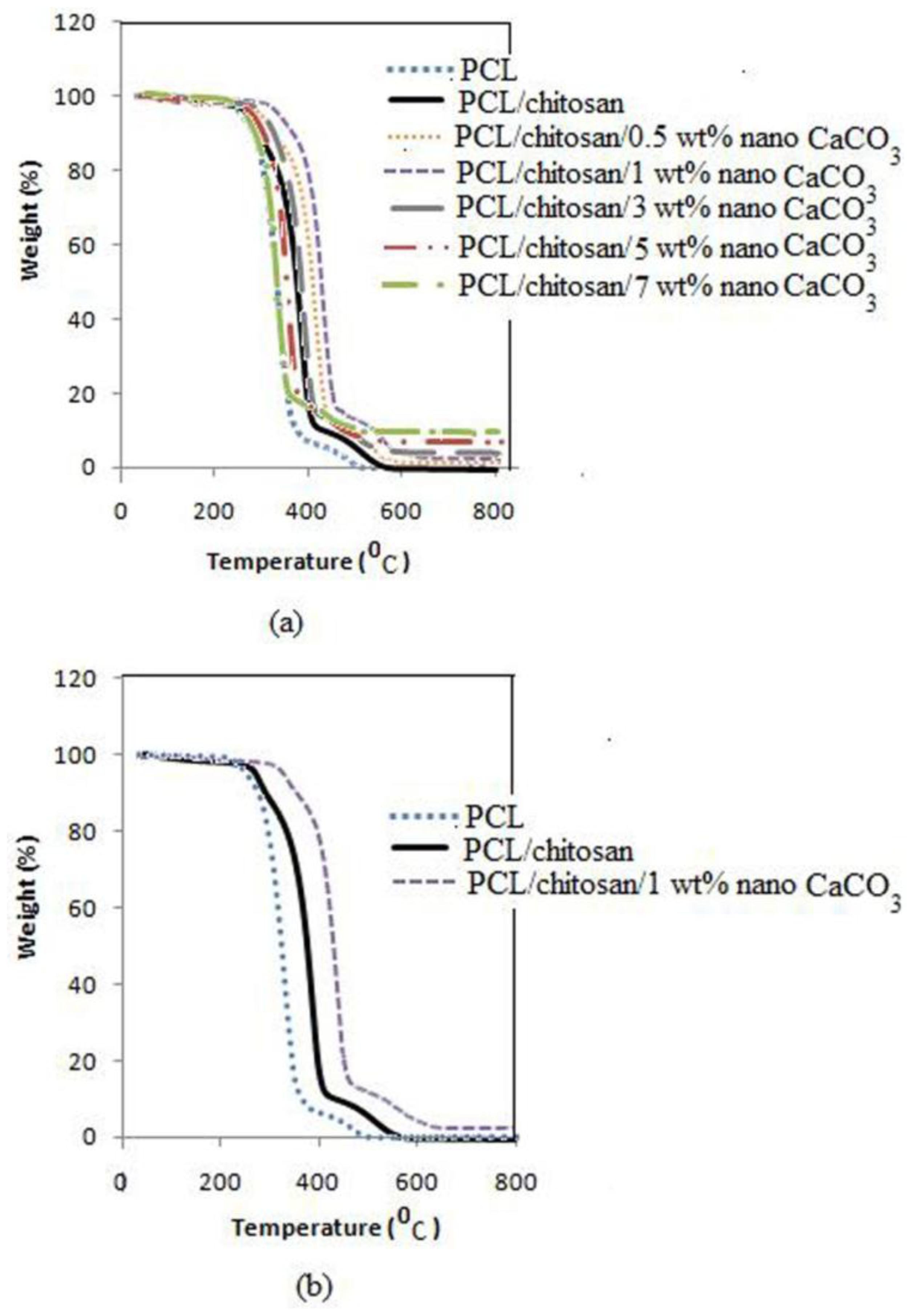
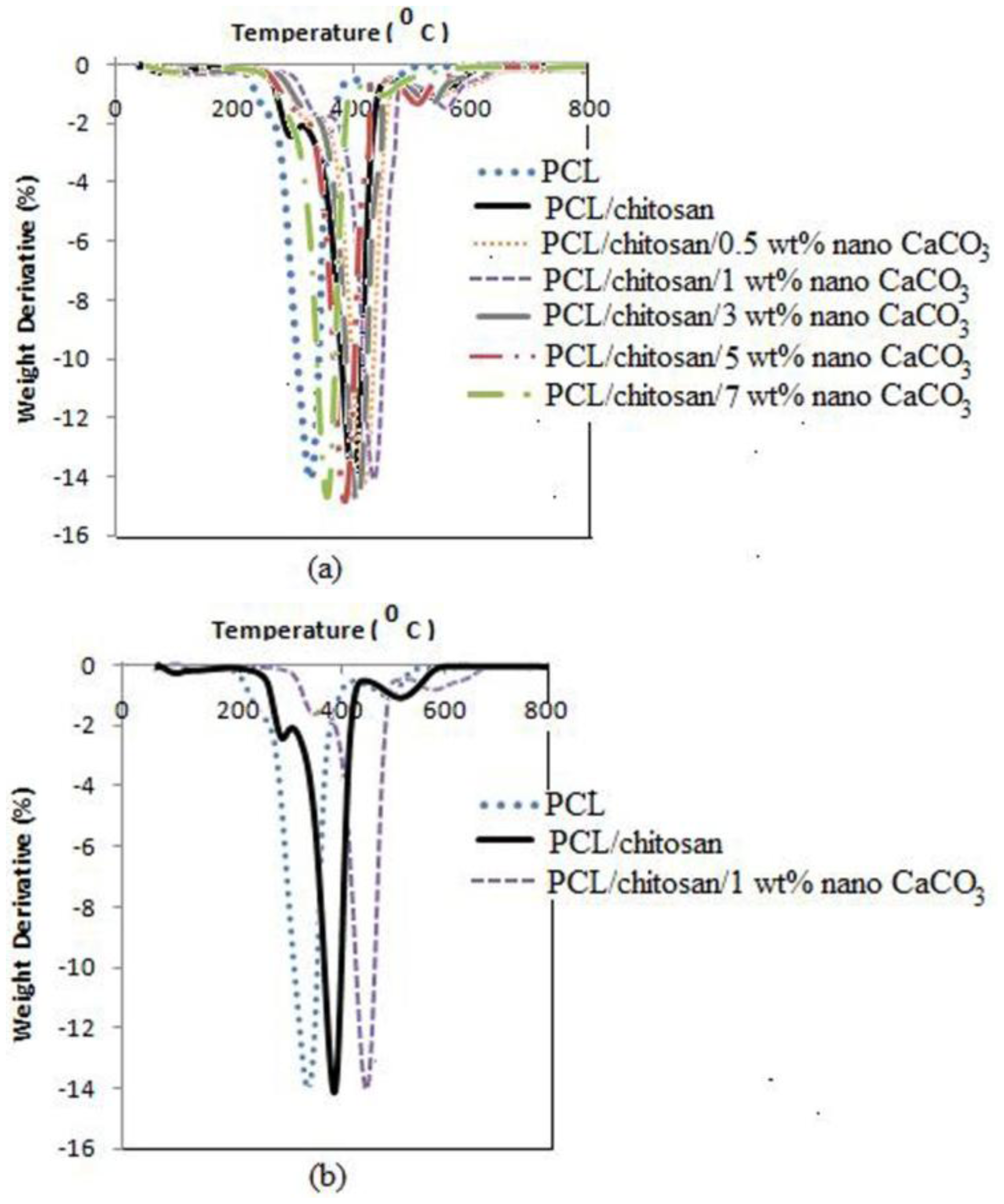
<p>TGA and DTG thermograms of PCL, PCL/chitosan blend and its nanocomposites are displayed in <xref ref-type="fig" rid="f4-ijms-13-04508">Figures 4</xref> and <xref ref-type="fig" rid="f5-ijms-13-04508">5</xref>, respectively. <xref ref-type="fig" rid="f4-ijms-13-04508">Figure 4</xref> illustrates samples weight losses as the temperature increases. CaCO<sub>3</sub> nanoparticles raise the temperature at which the degradation process initiates. As shown in <xref ref-type="fig" rid="f4-ijms-13-04508">Figure 4b</xref>, the onset decomposition temperature of 223 °C for PCL and 231.45 °C for PCL/chitosan composite increases to 258.76 °C by loading 1 wt% nano-sized CaCO<sub>3</sub>. <xref ref-type="fig" rid="f5-ijms-13-04508">Figure 5b</xref> exhibits two stages of degradation of the PCL/chitosan blend. The first stage at T<sub>max 1</sub> = 283 °C corresponds to chitosan backbone degradation resulting from saccharide ring dehydration, and the second stage at T<sub>max 2</sub> = 382 °C corresponds to PCL decomposition [<xref ref-type="bibr" rid="b28-ijms-13-04508">28</xref>].</p>
<p><xref ref-type="fig" rid="f5-ijms-13-04508">Figure 5b</xref> shows that the second stage occurring at T<sub>max 2</sub> increases considerably from 382.89 °C for the PCL/chitosan composite to 446.87 °C after the addition of 1 wt% CaCO<sub>3</sub> nanoparticles. The nanocomposites possess higher thermal stability compared to the PCL/chitosan composite, due to better adhesion between reinforced CaCO<sub>3</sub> nanoparticles and matrix and the hindered diffusion of volatile decomposition products resulting from homogeneous dispersion of nanoparticles within the nanocomposites [<xref ref-type="bibr" rid="b31-ijms-13-04508">31</xref>,<xref ref-type="bibr" rid="b32-ijms-13-04508">32</xref>].</p></sec>
<sec>
<title>2.2.3. Morphology Observation</title>
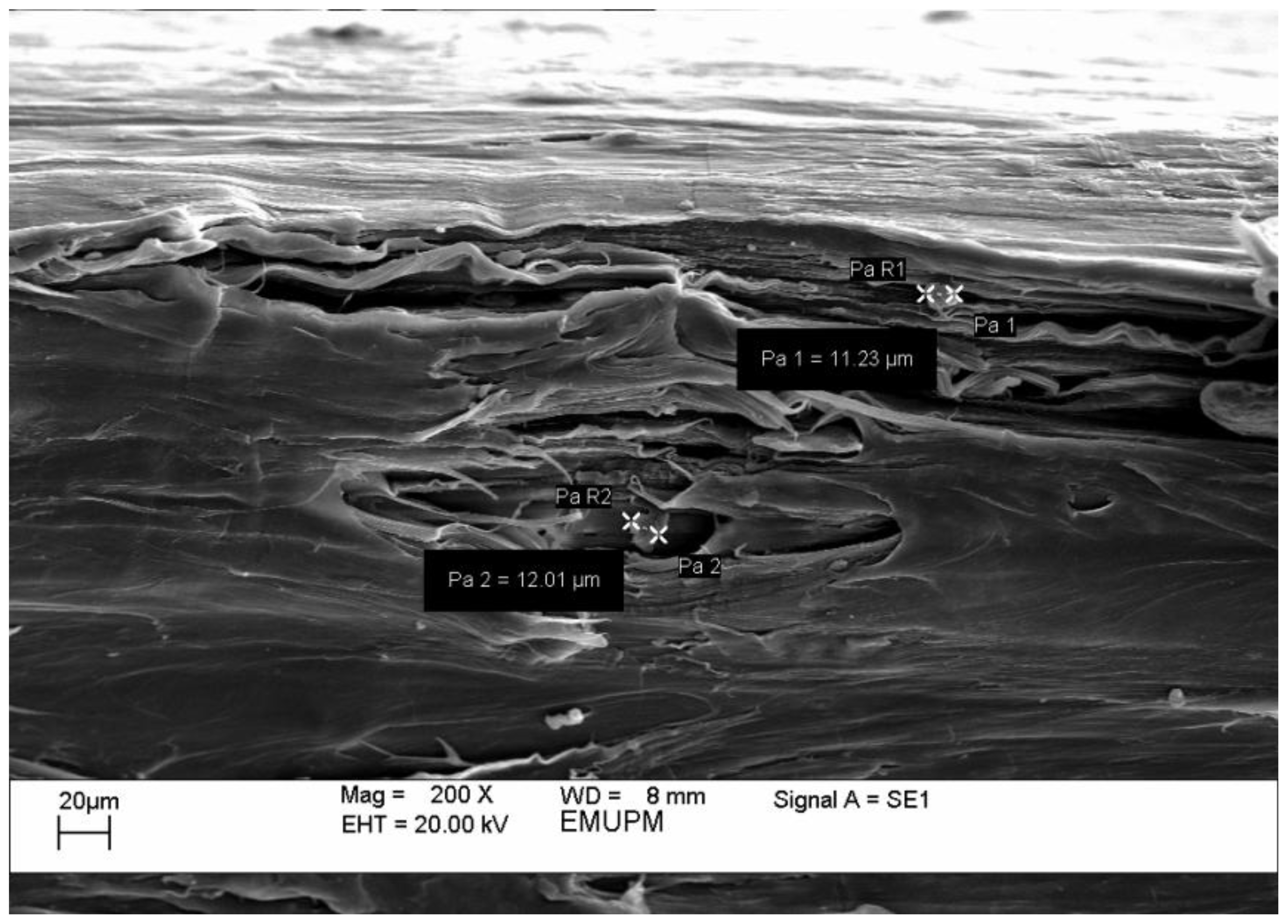
<p>Fractured surface morphology of the PCL/chitosan blend, as well as its nanocomposite, was studied by SEM.</p>
<p><xref ref-type="fig" rid="f6-ijms-13-04508">Figure 6</xref> shows that the PCL/chitosan composite possesses a stretched and porous surface. The low interaction between the two components and the lack of interfacial adhesion are the underlying reasons. The unmixed chitosan particles sizing (11.23, 12.01 μm) are illustrated in the <xref ref-type="fig" rid="f6-ijms-13-04508">Figure 6</xref>.</p>
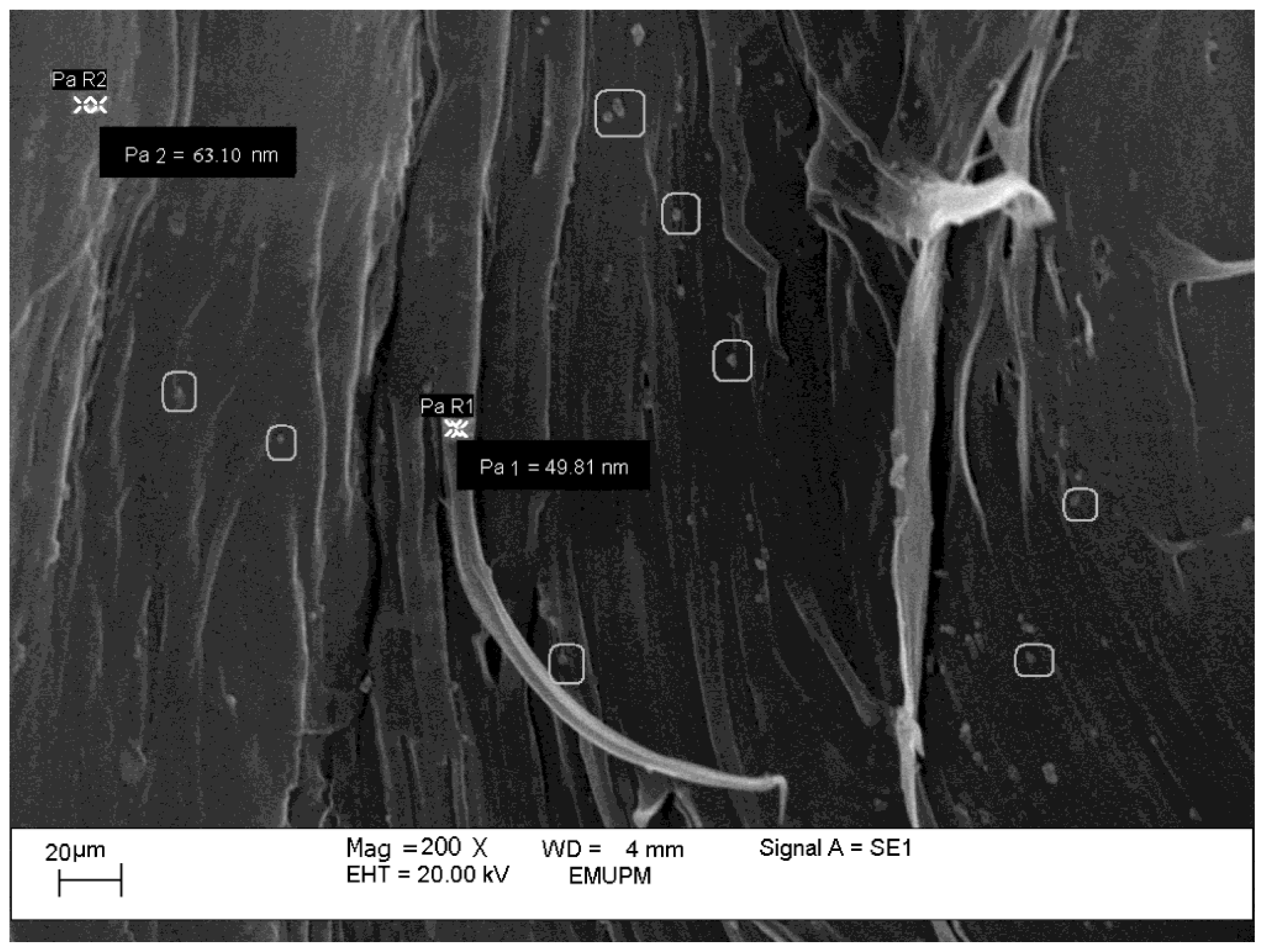
<p>A large number of small discrete nanoparticles on the fractured surface of the PCL/chitosan/CaCO<sub>3</sub> nanocomposite are exhibited in the <xref ref-type="fig" rid="f7-ijms-13-04508">Figure 7</xref>. The sizes of the randomly selected CaCO<sub>3</sub> nanoparticle in PCL/chitosan/CaCO<sub>3</sub>, as displayed in <xref ref-type="fig" rid="f7-ijms-13-04508">Figure 7</xref>, are 49.81 and 63.10 nm. This observation compared to the average of 10 solely CaCO<sub>3</sub> nanoparticle measured size of 62 nm and shown in <xref ref-type="fig" rid="f1-ijms-13-04508">Figure 1</xref>, confirming that the particles highlighted in <xref ref-type="fig" rid="f7-ijms-13-04508">Figure 7</xref> are CaCO<sub>3</sub> nanoparticles. As shown in the <xref ref-type="fig" rid="f7-ijms-13-04508">Figure 7</xref> by adding 1 wt% nano-sized CaCO<sub>3</sub> the surface becomes smoother, the dispersion of the nanoparticle is improved and the interfacial interaction between nanoparticles and matrix becomes stronger [<xref ref-type="bibr" rid="b39-ijms-13-04508">39</xref>].</p>
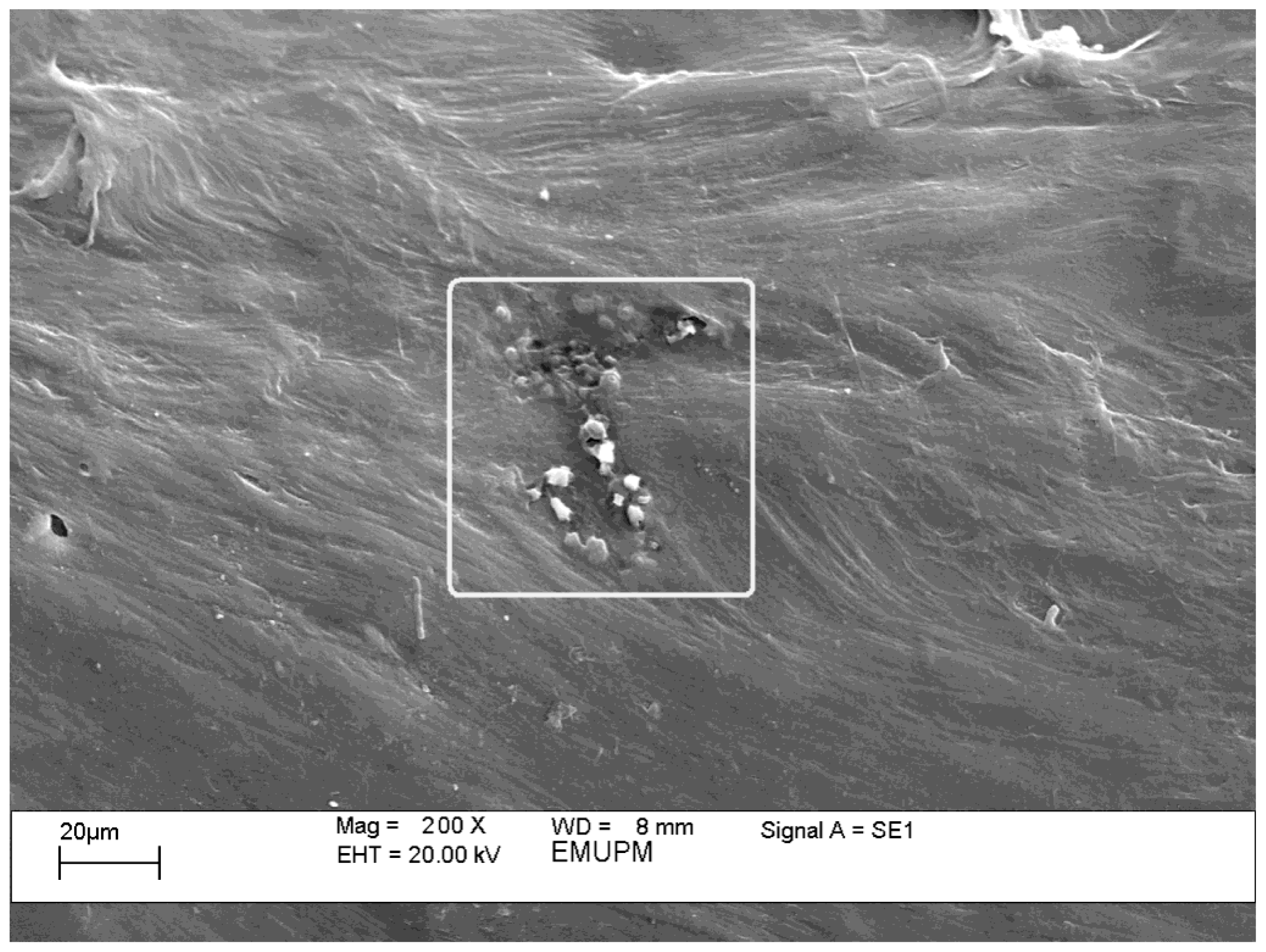
<p>As <xref ref-type="fig" rid="f8-ijms-13-04508">Figure 8</xref> shows, at a higher rate of filler loading (about 5 wt%), a higher rate of agglomeration occurs, lowering the tensile strength. These results are in line with measured mechanical results.</p>
<p>TEM was applied to investigate the dispersion of nanoparticles within the matrix. <xref ref-type="fig" rid="f9-ijms-13-04508">Figure 9</xref> shows good dispersion of 1 wt% of nano CaCO<sub>3</sub>; however, <xref ref-type="fig" rid="f10-ijms-13-04508">Figure 10</xref> displays the higher rate of agglomeration which is predominantly formed at nanometer scale by increasing the nanoparticle’s content to 5 wt%. This is due to the fact that the distance between nanoparticles shrinks at higher filler loadings, making it more likely for nanoparticles to reunite and, as a consequence, reduce the dispersion of the CaCO<sub>3</sub> particles, resulting in more aggregation.</p></sec></sec></sec>
<sec>
<title>3. Experimental Section</title>
<sec sec-type="materials">
<title>3.1. Materials</title>
<p>Commercial grade poly (ɛ-caprolactone) (CAPA6500) was supplied from Solvay, Warrington, UK. Chitosan with a degree of deacetylation of 85% and average molecular weight of 345,500 g·mol<sup>−1</sup> was obtained by the Malaysian Nuclear Agency and dried at 50 °C for 3 days. Calcium carbonate nanoparticles with surface coating of stearic acid were purchased from Malaysian Nuclear Agency.</p></sec>
<sec>
<title>3.2. Preparation of Nanocomposites</title>
<p>PCL/chitosan nanocomposites were carried out by a melt blending method using a Brabender Plastograph D28033 Berman with a rotor speed of 50 rpm, reaction time of 20 min and mixing temperature of 100 °C. PCL pellets were first added to the mixing chamber, which had been heated and stabilized at 100 °C. Then, after 2 min of heating, chitosan was added in four equal portions at 2-min intervals to the molten PCL. This was followed by the additions of 0.5, 1, 3, 5, or 7 wt% of CaCO<sub>3</sub> nanoparticles into the PCL/chitosan (90/10 wt%). The CaCO<sub>3</sub> nanoparticles were added slowly over a period of 10 min into the chamber to give well dispersed ternary composites.</p>
<p>To prepare a sheet of composite with a thickness of 1mm, compression molding was carried out by hot pressing of 1.08 × 10<sup>7</sup> Pa at 100 °C for 5 min, and then cold pressing at room temperature for 5 min under the same pressure.</p>
<p>As shown in <xref ref-type="table" rid="t2-ijms-13-04508">Table 2</xref>, by increasing the amount of chitosan beyond 10 wt%, tensile strength and elongation at break decrease, while the tensile modulus increases, making the composite stiff and rigid. Therefore, PCL/chitosan (90/10 wt%) was chosen as the optimum ratio with the tensile strength, flexibility and elongation at break most in line with the composite’s potential application in packaging.</p></sec>
<sec>
<title>3.3. Characterizations</title>
<p>The infrared spectra of samples were recorded on a Perkin-Elmer FTIR (model spectrum 100 series). FTIR spectra tests were run at ambient temperature using a KBr disk method at wave number range of 400 to 4000 cm<sup>−1</sup>, resolution of 4 cm<sup>−1</sup>.</p>
<p>TEM micrographs were obtained by a Hitachi H-7100 at an accelerating voltage of 200 kV. The nano CaCO<sub>3</sub>-acetone suspension was prepared and diluted to the correct concentration in an ultrasonic bath for 10 min and then air dried by dropping onto the TEM sample copper grid, and ultrathin sections of nanocomposite sample were prepared at −120 °C using a microtome equipped with a diamond knife, and then placed on a copper grid.</p>
<p>Tensile tests were performed with an Instron Universal Testing Machine (4302 series IX, type V) according to the guidelines of ASTM Standard Method D638-5. The dumbbell-shaped specimens were prepared by a hydraulic cutter. A load cell of 1.0 kN was applied at a constant crosshead speed of 5 mm/min at room temperature. The average of five measurements of tensile determination was calculated.</p>
<p>Thermogravimetric analysis was carried out using a Perkin Elmer Thermal Analyzer model TGA7, on 8–10 mg weight samples in temperature range of 35–800 °C with heating rate of 10 °C/min, under nitrogen atmosphere with a flow rate of 20 mL/min.</p>
<p>Scanning electron microscopy (SEM) was carried out using Leo 1455 VP SEM. The samples were coated with gold by Bal-Tec SDC005 sputter coater.</p></sec></sec>
<sec sec-type="conclusions">
<title>4. Conclusions</title>
<p>PCL/chitosan nanocomposites with various amounts of CaCO<sub>3</sub> nanoparticles were successfully prepared by a melt intercalation method. The tensile modulus increases by adding CaCO<sub>3</sub> nanoparticles into the composite. The increase in the modulus must be caused by the rigidity of the filler and strong interactions between the polymer and filler due to the large interfacial area between particles. The tensile strength and elongation at break increase by loading up to 1 wt% of nano-sized CaCO<sub>3</sub>, and then decrease with the increase of nanoparticle content. This incident occurred due to optimal dispersion of nanoparticles within the matrix and intercalation of nanoparticles by PCL/chitosan at low filler content. However, at high filler loading, due to the agglomeration of nanoparticles into the matrix, the elongation at break decreases.</p>
<p>TGA characterization shows significantly improved thermal stability of PCL/chitosan/nano-CaCO<sub>3</sub> compared to that of PCL/chitosan composite. Compared to that of the pristine composite, thermal degradation temperature increases up to 64 °C at 1 wt% of nano-sized CaCO<sub>3</sub> content in PCL/chitosan nanocomposite. The nanocomposites possess higher thermal stability compared to the PCL/chitosan composite due to better adhesion between reinforced CaCO<sub>3</sub> nanoparticles and matrix and the hindered diffusion of volatile decomposition products resulting from homogeneous dispersion of nanoparticles within the nanocomposites. SEM micrographs show that the nanocomposite becomes more homogeneous than the former composite. However, at higher filler loadings, a higher rate of nanoparticle agglomeration occurs, lowering the tensile strength. Good dispersion of CaCO<sub>3</sub> nanoparticles into the matrix results in increased interfacial adhesion and a smoother surface in PCL/chitosan/nano-CaCO<sub>3</sub> nanocomposite.</p>
<p>TEM micrographs show good dispersion of nanoparticles within the matrix at 1 wt% nano CaCO<sub>3</sub>, whereas at higher nanoparticle CaCO<sub>3</sub> loading (5 wt%), due to the decrease in distance between nanoparticles, the dispersion of the CaCO<sub>3</sub> reduced, hence increasing agglomeration.</p></sec></body>
<back>
<ack>
<title>Acknowledgments</title>
<p>The authors would like to appreciate the Chemistry Department of University Putra Malaysia, especially Mansor Bin Ahmad, and also to extend special thanks to S. Amiri and S. Wood for their great support.</p></ack>
<ref-list>
<title>References</title>
<ref id="b1-ijms-13-04508"><label>1</label><citation citation-type="journal"><person-group person-group-type="author"><name><surname>Fu</surname><given-names>X.</given-names></name><name><surname>Qutubuddin</surname><given-names>S.</given-names></name></person-group><article-title>Polymer-clay nanocomposites: Exfoliation of organophilic montmorillonite nanolayers in polystyrene</article-title><source>Polymer</source><year>2001</year><volume>42</volume><fpage>807</fpage><lpage>813</lpage><pub-id pub-id-type="doi">10.1016/S0032-3861(00)00385-2</pub-id></citation></ref>
<ref id="b2-ijms-13-04508"><label>2</label><citation citation-type="journal"><person-group person-group-type="author"><name><surname>Zhang</surname><given-names>W.</given-names></name><name><surname>Chen</surname><given-names>D.</given-names></name><name><surname>Zhao</surname><given-names>Q.</given-names></name><name><surname>Fang</surname><given-names>Y.</given-names></name></person-group><article-title>Different vinyl acetate content on the morphology and properties of eva/clay nanocomposites</article-title><source>Polymer</source><year>2003</year><volume>44</volume><fpage>7953</fpage><lpage>7961</lpage><pub-id pub-id-type="doi">10.1016/j.polymer.2003.10.046</pub-id></citation></ref>
<ref id="b3-ijms-13-04508"><label>3</label><citation citation-type="journal"><person-group person-group-type="author"><name><surname>Ma</surname><given-names>C.G.</given-names></name><name><surname>Mai</surname><given-names>Y.L.</given-names></name><name><surname>Rong</surname><given-names>M.Z.</given-names></name><name><surname>Ruan</surname><given-names>W.H.</given-names></name><name><surname>Zhang</surname><given-names>M.Q.</given-names></name></person-group><article-title>Phase structure and mechanical properties of ternary polypropylene/elastomer/nano-CaCO<sub>3</sub> composites</article-title><source>Compos. Sci. Technol</source><year>2007</year><volume>67</volume><fpage>2997</fpage><lpage>3005</lpage><pub-id pub-id-type="doi">10.1016/j.compscitech.2007.05.022</pub-id></citation></ref>
<ref id="b4-ijms-13-04508"><label>4</label><citation citation-type="journal"><person-group person-group-type="author"><name><surname>Gorna</surname><given-names>K.</given-names></name><name><surname>Hund</surname><given-names>M.</given-names></name><name><surname>Vucak</surname><given-names>M.</given-names></name><name><surname>Gröhn</surname><given-names>F.</given-names></name><name><surname>Wegner</surname><given-names>G.</given-names></name></person-group><article-title>Amorphous calcium carbonate in form of spherical nanosized particles and its application as fillers for polymers</article-title><source>Mater. Sci. Eng. A</source><year>2008</year><volume>477</volume><fpage>217</fpage><lpage>225</lpage><pub-id pub-id-type="doi">10.1016/j.msea.2007.05.045</pub-id></citation></ref>
<ref id="b5-ijms-13-04508"><label>5</label><citation citation-type="journal"><person-group person-group-type="author"><name><surname>Liang</surname><given-names>J.Z.</given-names></name></person-group><article-title>Evaluation of dispersion of nano-CaCO<sub>3</sub> particles in polypropylene matrix based on fractal method</article-title><source>Compos. Part A</source><year>2007</year><volume>38</volume><fpage>1502</fpage><lpage>1506</lpage><pub-id pub-id-type="doi">10.1016/j.compositesa.2007.01.011</pub-id></citation></ref>
<ref id="b6-ijms-13-04508"><label>6</label><citation citation-type="journal"><person-group person-group-type="author"><name><surname>Xie</surname><given-names>X.L.</given-names></name><name><surname>Liu</surname><given-names>Q.X.</given-names></name><name><surname>Li</surname><given-names>R.K.Y.</given-names></name><name><surname>Zhou</surname><given-names>X.P.</given-names></name><name><surname>Zhang</surname><given-names>Q.X.</given-names></name><name><surname>Yu</surname><given-names>Z.Z.</given-names></name><name><surname>Mai</surname><given-names>Y.W.</given-names></name></person-group><article-title>Rheological and mechanical properties of PVC/CaCO<sub>3</sub> nanocomposites prepared by in situ polymerization</article-title><source>Polymer</source><year>2004</year><volume>45</volume><fpage>6665</fpage><lpage>6673</lpage><pub-id pub-id-type="doi">10.1016/j.polymer.2004.07.045</pub-id></citation></ref>
<ref id="b7-ijms-13-04508"><label>7</label><citation citation-type="journal"><person-group person-group-type="author"><name><surname>Di Lorenzo</surname><given-names>M.L.</given-names></name><name><surname>Errico</surname><given-names>M.E.</given-names></name><name><surname>Avella</surname><given-names>M.</given-names></name></person-group><article-title>Thermal and morphological characterization of poly (ethylene terephthalate)/calcium carbonate nanocomposites</article-title><source>J. Mater. Sci</source><year>2002</year><volume>37</volume><fpage>2351</fpage><lpage>2358</lpage><pub-id pub-id-type="doi">10.1023/A:1015358425449</pub-id></citation></ref>
<ref id="b8-ijms-13-04508"><label>8</label><citation citation-type="book"><person-group person-group-type="author"><name><surname>Gilbert</surname><given-names>M</given-names></name></person-group><article-title>Surface Treatments for Particulate Fillers in Plastics</article-title><source>Plastics Additives: An A–Z Reference</source><person-group person-group-type="editor"><name><surname>Pritchard</surname><given-names>G.</given-names></name></person-group><publisher-name>Chapman and Hall</publisher-name><publisher-loc>London, UK</publisher-loc><year>1998</year><fpage>590</fpage><lpage>603</lpage></citation></ref>
<ref id="b9-ijms-13-04508"><label>9</label><citation citation-type="journal"><person-group person-group-type="author"><name><surname>Bartczak</surname><given-names>Z.</given-names></name><name><surname>Argon</surname><given-names>A.S.</given-names></name><name><surname>Cohen</surname><given-names>R.E.</given-names></name><name><surname>Weinberg</surname><given-names>M.</given-names></name></person-group><article-title>Toughness mechanism in semicrystalline polymer blends: II. High-density polyethylene toughened with calcium carbonate filler particles</article-title><source>Polymer</source><year>1999</year><volume>40</volume><fpage>2347</fpage><lpage>2365</lpage><pub-id pub-id-type="doi">10.1016/S0032-3861(98)00444-3</pub-id></citation></ref>
<ref id="b10-ijms-13-04508"><label>10</label><citation citation-type="journal"><person-group person-group-type="author"><name><surname>Zuiderduin</surname><given-names>W.C.J.</given-names></name><name><surname>Westzaan</surname><given-names>C.</given-names></name><name><surname>Huétink</surname><given-names>J.</given-names></name><name><surname>Gaymans</surname><given-names>R.J.</given-names></name></person-group><article-title>Toughening of polypropylene with calcium carbonate particles</article-title><source>Polymer</source><year>2003</year><volume>44</volume><fpage>261</fpage><lpage>275</lpage><pub-id pub-id-type="doi">10.1016/S0032-3861(02)00769-3</pub-id></citation></ref>
<ref id="b11-ijms-13-04508"><label>11</label><citation citation-type="journal"><person-group person-group-type="author"><name><surname>Jiang</surname><given-names>L.</given-names></name><name><surname>Zhang</surname><given-names>J.</given-names></name><name><surname>Wolcott</surname><given-names>M.P.</given-names></name></person-group><article-title>Comparison of polylactide/nano-sized calcium carbonateand polylactide/montmorillonite composites: Reinforcing effects and toughening mechanisms</article-title><source>Polymer</source><year>2007</year><volume>48</volume><fpage>7632</fpage><lpage>7644</lpage><pub-id pub-id-type="doi">10.1016/j.polymer.2007.11.001</pub-id></citation></ref>
<ref id="b12-ijms-13-04508"><label>12</label><citation citation-type="journal"><person-group person-group-type="author"><name><surname>Jiang</surname><given-names>L.</given-names></name><name><surname>Lam</surname><given-names>Y.C.</given-names></name><name><surname>Tam</surname><given-names>K.C.</given-names></name><name><surname>Chua</surname><given-names>T.H.</given-names></name><name><surname>Sim</surname><given-names>G.W.</given-names></name><name><surname>Ang</surname><given-names>L.S.</given-names></name></person-group><article-title>Strengthening acrylonitrile-butadiene-styrene (ABS) with nano-sized and micron-sized calcium carbonate</article-title><source>Polymer</source><year>2005</year><volume>46</volume><fpage>243</fpage><lpage>252</lpage><pub-id pub-id-type="doi">10.1016/j.polymer.2004.11.001</pub-id></citation></ref>
<ref id="b13-ijms-13-04508"><label>13</label><citation citation-type="journal"><person-group person-group-type="author"><name><surname>Okada</surname><given-names>M.</given-names></name></person-group><article-title>Chemical syntheses of biodegradable polymers</article-title><source>Prog. Polym. Sci</source><year>2002</year><volume>27</volume><fpage>87</fpage><lpage>133</lpage><pub-id pub-id-type="doi">10.1016/S0079-6700(01)00039-9</pub-id></citation></ref>
<ref id="b14-ijms-13-04508"><label>14</label><citation citation-type="journal"><person-group person-group-type="author"><name><surname>Cao</surname><given-names>A.</given-names></name><name><surname>Okamura</surname><given-names>T.</given-names></name><name><surname>Ishiguro</surname><given-names>C.</given-names></name><name><surname>Nakayama</surname><given-names>K.</given-names></name><name><surname>Inoue</surname><given-names>Y.</given-names></name><name><surname>Masuda</surname><given-names>T.</given-names></name></person-group><article-title>Studies on synthesis and physical characterization of biodegradable aliphatic poly (butylene succinate-co-ɛ-caprolactone)s</article-title><source>Polymer</source><year>2002</year><volume>43</volume><fpage>671</fpage><lpage>679</lpage><pub-id pub-id-type="doi">10.1016/S0032-3861(01)00658-9</pub-id></citation></ref>
<ref id="b15-ijms-13-04508"><label>15</label><citation citation-type="journal"><person-group person-group-type="author"><name><surname>Wu</surname><given-names>C.S.</given-names></name></person-group><article-title>Physical properties and biodegradability of maleated-polycaprolactone/starch composite</article-title><source>Polym. Degrad. Stab</source><year>2003</year><volume>80</volume><fpage>127</fpage><lpage>134</lpage><pub-id pub-id-type="doi">10.1016/S0141-3910(02)00393-2</pub-id></citation></ref>
<ref id="b16-ijms-13-04508"><label>16</label><citation citation-type="journal"><person-group person-group-type="author"><name><surname>Wu</surname><given-names>C.S.</given-names></name></person-group><article-title>A comparison of the structure, thermal properties, and biodegradability of polycaprolactone/chitosan and acrylic acid grafted polycaprolactone/chitosan</article-title><source>Polymer</source><year>2005</year><volume>46</volume><fpage>147</fpage><lpage>155</lpage><pub-id pub-id-type="doi">10.1016/j.polymer.2004.11.013</pub-id></citation></ref>
<ref id="b17-ijms-13-04508"><label>17</label><citation citation-type="journal"><person-group person-group-type="author"><name><surname>Averous</surname><given-names>L.</given-names></name><name><surname>Moro</surname><given-names>L.</given-names></name><name><surname>Dole</surname><given-names>P.</given-names></name><name><surname>Fringant</surname><given-names>C.</given-names></name></person-group><article-title>Properties of thermoplastic blends: starch-polycaprolactone</article-title><source>Polymer</source><year>2000</year><volume>41</volume><fpage>4157</fpage><lpage>4167</lpage><pub-id pub-id-type="doi">10.1016/S0032-3861(99)00636-9</pub-id></citation></ref>
<ref id="b18-ijms-13-04508"><label>18</label><citation citation-type="journal"><person-group person-group-type="author"><name><surname>Ikejima</surname><given-names>T.</given-names></name><name><surname>Inoue</surname><given-names>Y.</given-names></name></person-group><article-title>Crystallization behavior and environmental biodegradability of the blend films of poly (3-hydroxybutyric acid) with chitin and chitosan</article-title><source>Carbohydr. Polym</source><year>2000</year><volume>41</volume><fpage>351</fpage><lpage>356</lpage><pub-id pub-id-type="doi">10.1016/S0144-8617(99)00105-8</pub-id></citation></ref>
<ref id="b19-ijms-13-04508"><label>19</label><citation citation-type="journal"><person-group person-group-type="author"><name><surname>Then</surname><given-names>Y.Y.</given-names></name><name><surname>Ibrahim</surname><given-names>N.A.</given-names></name><name><surname>Wan Yunus</surname><given-names>W.M.Z.</given-names></name></person-group><article-title>Enhancement of tensile strength and flexibility of polycaprolactone/tapioca starch blends by octadecylamine modified clay</article-title><source>J. Polym. Environ</source><year>2011</year><volume>19</volume><fpage>535</fpage><lpage>539</lpage><pub-id pub-id-type="doi">10.1007/s10924-011-0284-6</pub-id></citation></ref>
<ref id="b20-ijms-13-04508"><label>20</label><citation citation-type="journal"><person-group person-group-type="author"><name><surname>Wan</surname><given-names>Y.</given-names></name><name><surname>Lu</surname><given-names>X.</given-names></name><name><surname>Dalai</surname><given-names>S.</given-names></name><name><surname>Zhang</surname><given-names>J.</given-names></name></person-group><article-title>Thermophysical properties of polycaprolactone/chitosan blend membranes</article-title><source>Thermochim. Acta</source><year>2009</year><volume>487</volume><fpage>33</fpage><lpage>38</lpage><pub-id pub-id-type="doi">10.1016/j.tca.2009.01.007</pub-id></citation></ref>
<ref id="b21-ijms-13-04508"><label>21</label><citation citation-type="journal"><person-group person-group-type="author"><name><surname>Calil</surname><given-names>M.R.</given-names></name><name><surname>Gaboardi</surname><given-names>F.</given-names></name><name><surname>Guedes</surname><given-names>C.G.F.</given-names></name><name><surname>Rosa</surname><given-names>D.S.</given-names></name></person-group><article-title>Comparison of the biodegradation of poly (ɛ-caprolactone), cellulose acetate and their blends by the Sturm test and selected cultured fungi</article-title><source>Polym. Test</source><year>2006</year><volume>25</volume><fpage>597</fpage><lpage>604</lpage><pub-id pub-id-type="doi">10.1016/j.polymertesting.2006.01.019</pub-id></citation></ref>
<ref id="b22-ijms-13-04508"><label>22</label><citation citation-type="journal"><person-group person-group-type="author"><name><surname>Rao</surname><given-names>S.B.</given-names></name><name><surname>Sharma</surname><given-names>C.P.</given-names></name></person-group><article-title>Use of chitosan as a biomaterial: Studies on its safety and hemostatic potential</article-title><source>J. Biomed. Mater. Res</source><year>1997</year><volume>34</volume><fpage>21</fpage><lpage>28</lpage><pub-id pub-id-type="doi">10.1002/(SICI)1097-4636(199701)34:1&lt;21::AID-JBM4&gt;3.0.CO;2-P</pub-id><pub-id pub-id-type="pmid">8978649</pub-id></citation></ref>
<ref id="b23-ijms-13-04508"><label>23</label><citation citation-type="journal"><person-group person-group-type="author"><name><surname>Ray</surname><given-names>S.S.</given-names></name><name><surname>Bousmina</surname><given-names>M.</given-names></name></person-group><article-title>Biodegradable polymers and their layered silicate nanocomposites: In greening the 21st century materials world</article-title><source>Prog. Polym. Sci</source><year>2005</year><volume>50</volume><fpage>962</fpage><lpage>1079</lpage></citation></ref>
<ref id="b24-ijms-13-04508"><label>24</label><citation citation-type="journal"><person-group person-group-type="author"><name><surname>Wang</surname><given-names>S.F.</given-names></name><name><surname>Shen</surname><given-names>L.</given-names></name><name><surname>Tong</surname><given-names>Y.J.</given-names></name><name><surname>Chen</surname><given-names>L.</given-names></name><name><surname>Phang</surname><given-names>I.Y.</given-names></name><name><surname>Lim</surname><given-names>P.Q.</given-names></name><name><surname>Liu</surname><given-names>T.X.</given-names></name></person-group><article-title>Biopolymer chitosan/montmorillonite nanocomposites: Preparation and characterization</article-title><source>Polym. Degrad. Stab</source><year>2005</year><volume>90</volume><fpage>123</fpage><lpage>131</lpage><pub-id pub-id-type="doi">10.1016/j.polymdegradstab.2005.03.001</pub-id></citation></ref>
<ref id="b25-ijms-13-04508"><label>25</label><citation citation-type="journal"><person-group person-group-type="author"><name><surname>Casariego</surname><given-names>A.</given-names></name><name><surname>Souza</surname><given-names>B.W.S.</given-names></name><name><surname>Cerqueira</surname><given-names>M.A.</given-names></name><name><surname>Teixeira</surname><given-names>J.A.</given-names></name><name><surname>Cruz</surname><given-names>L.</given-names></name><name><surname>Díaz</surname><given-names>R.</given-names></name><name><surname>Vicente</surname><given-names>A.A.</given-names></name></person-group><article-title>Chitosan/clay films’ properties as affected by biopolymer and clay micro/nanoparticles’ concentrations</article-title><source>Food Hydrocolloids</source><year>2009</year><volume>23</volume><fpage>1895</fpage><lpage>1902</lpage><pub-id pub-id-type="doi">10.1016/j.foodhyd.2009.02.007</pub-id></citation></ref>
<ref id="b26-ijms-13-04508"><label>26</label><citation citation-type="journal"><person-group person-group-type="author"><name><surname>Sarasam</surname><given-names>A.</given-names></name><name><surname>Madihally</surname><given-names>S.V.</given-names></name></person-group><article-title>Characterization of chitosan-polycaprolactone blends for tissue engineering applications</article-title><source>Biomaterials</source><year>2005</year><volume>26</volume><fpage>5500</fpage><lpage>5508</lpage><pub-id pub-id-type="doi">10.1016/j.biomaterials.2005.01.071</pub-id><pub-id pub-id-type="pmid">15860206</pub-id></citation></ref>
<ref id="b27-ijms-13-04508"><label>27</label><citation citation-type="journal"><person-group person-group-type="author"><name><surname>Ahmad</surname><given-names>M.B.</given-names></name><name><surname>Tay</surname><given-names>M.Y.</given-names></name><name><surname>Shameli</surname><given-names>K.</given-names></name><name><surname>Hussein</surname><given-names>M.Z.</given-names></name><name><surname>Lim</surname><given-names>J.J.</given-names></name></person-group><article-title>Green synthesis and characterization of silver/chitosan/polyethylene glycol nanocomposites without any reducing agent</article-title><source>Int. J. Mol. Sci</source><year>2011</year><volume>12</volume><fpage>4872</fpage><lpage>4884</lpage><pub-id pub-id-type="doi">10.3390/ijms12084872</pub-id><pub-id pub-id-type="pmid">21954331</pub-id></citation></ref>
<ref id="b28-ijms-13-04508"><label>28</label><citation citation-type="journal"><person-group person-group-type="author"><name><surname>Abdolmohammadi</surname><given-names>S.</given-names></name><name><surname>Wan Yunus</surname><given-names>W.M.Z.</given-names></name><name><surname>Rahman</surname><given-names>M.Z.</given-names></name><name><surname>Ibrahim</surname><given-names>N.A.</given-names></name></person-group><article-title>Effect of organoclay on mechanical and thermal properties of polycaprolactone/chitosan/montmorillonite nanocomposites</article-title><source>J. Reinf. Plast. Compos</source><year>2011</year><volume>30</volume><fpage>1045</fpage><lpage>1054</lpage><pub-id pub-id-type="doi">10.1177/0731684411410338</pub-id></citation></ref>
<ref id="b29-ijms-13-04508"><label>29</label><citation citation-type="journal"><person-group person-group-type="author"><name><surname>Liu</surname><given-names>L.</given-names></name><name><surname>Li</surname><given-names>Y.</given-names></name><name><surname>Liu</surname><given-names>H.</given-names></name><name><surname>Fang</surname><given-names>Y.</given-names></name></person-group><article-title>Synthesis and characterization of chitosan-graftpolycaprolactone copolymers</article-title><source>Eur. Polym. J</source><year>2004</year><volume>40</volume><fpage>2739</fpage><lpage>2744</lpage><pub-id pub-id-type="doi">10.1016/j.eurpolymj.2004.07.016</pub-id></citation></ref>
<ref id="b30-ijms-13-04508"><label>30</label><citation citation-type="journal"><person-group person-group-type="author"><name><surname>Shan</surname><given-names>D.</given-names></name><name><surname>Wang</surname><given-names>S.</given-names></name><name><surname>Xue</surname><given-names>H.</given-names></name><name><surname>Cosnier</surname><given-names>S.</given-names></name></person-group><article-title>Direct electrochemistry and electrocatalysis of hemoglobin entrapped in composite matrix based on chitosan and CaCO<sub>3</sub> nanoparticles</article-title><source>Electrochem. Commun</source><year>2007</year><volume>9</volume><fpage>529</fpage><lpage>534</lpage><pub-id pub-id-type="doi">10.1016/j.elecom.2006.10.032</pub-id></citation></ref>
<ref id="b31-ijms-13-04508"><label>31</label><citation citation-type="journal"><person-group person-group-type="author"><name><surname>Gao</surname><given-names>Y.</given-names></name><name><surname>Liu</surname><given-names>L.</given-names></name><name><surname>Zhang</surname><given-names>Z.</given-names></name></person-group><article-title>Mechanical performance of nano-CaCO<sub>3</sub> filled polystyrene composites</article-title><source>Acta Mech. Solida Sin</source><year>2009</year><volume>22</volume><fpage>555</fpage><lpage>562</lpage></citation></ref>
<ref id="b32-ijms-13-04508"><label>32</label><citation citation-type="journal"><person-group person-group-type="author"><name><surname>Chan</surname><given-names>C.M.</given-names></name><name><surname>Wu</surname><given-names>J.</given-names></name><name><surname>Li</surname><given-names>J.X.</given-names></name><name><surname>Cheung</surname><given-names>Y.K.</given-names></name></person-group><article-title>Polypropylene/calcium carbonate nanocomposites</article-title><source>Polymer</source><year>2002</year><volume>43</volume><fpage>2981</fpage><lpage>2992</lpage><pub-id pub-id-type="doi">10.1016/S0032-3861(02)00120-9</pub-id></citation></ref>
<ref id="b33-ijms-13-04508"><label>33</label><citation citation-type="journal"><person-group person-group-type="author"><name><surname>Chen</surname><given-names>N.</given-names></name><name><surname>Wan</surname><given-names>C.</given-names></name><name><surname>Zhang</surname><given-names>Y.</given-names></name><name><surname>Zhang</surname><given-names>Y.</given-names></name></person-group><article-title>Effect of nano-CaCO<sub>3</sub> on mechanical properties of PVC and PVC Blendex blend</article-title><source>Polym. Test</source><year>2004</year><volume>23</volume><fpage>169</fpage><lpage>174</lpage><pub-id pub-id-type="doi">10.1016/S0142-9418(03)00076-X</pub-id></citation></ref>
<ref id="b34-ijms-13-04508"><label>34</label><citation citation-type="journal"><person-group person-group-type="author"><name><surname>Reynaud</surname><given-names>E.</given-names></name><name><surname>Jouen</surname><given-names>T.</given-names></name><name><surname>Gauthier</surname><given-names>C.</given-names></name><name><surname>Vigier</surname><given-names>G.</given-names></name><name><surname>Varlett</surname><given-names>J.</given-names></name></person-group><article-title>Nanofillers in polymeric matrix: A study on silica reinforced PA</article-title><source>Polymer</source><year>2001</year><volume>42</volume><fpage>8759</fpage><lpage>8768</lpage><pub-id pub-id-type="doi">10.1016/S0032-3861(01)00446-3</pub-id></citation></ref>
<ref id="b35-ijms-13-04508"><label>35</label><citation citation-type="journal"><person-group person-group-type="author"><name><surname>Zhang</surname><given-names>Q.X.</given-names></name><name><surname>Yu</surname><given-names>Z.Z.</given-names></name><name><surname>Xie</surname><given-names>X.L.</given-names></name><name><surname>Mai</surname><given-names>Y.W.</given-names></name></person-group><article-title>Crystallization and impact energy of polypropylene/CaCO<sub>3</sub> nanocomposites with nonionic modifier</article-title><source>Polymer</source><year>2004</year><volume>45</volume><fpage>5985</fpage><lpage>5994</lpage><pub-id pub-id-type="doi">10.1016/j.polymer.2004.06.044</pub-id></citation></ref>
<ref id="b36-ijms-13-04508"><label>36</label><citation citation-type="journal"><person-group person-group-type="author"><name><surname>Baskaran</surname><given-names>R.</given-names></name><name><surname>Sarojadevi</surname><given-names>M.</given-names></name><name><surname>Vijayakumar</surname><given-names>C.T.</given-names></name></person-group><article-title>Mechanical and thermal properties of unsaturated polyester/calcium carbonate nanocomposites</article-title><source>J. Reinf. Plast. Compos</source><year>2011</year><volume>30</volume><fpage>1549</fpage><lpage>1556</lpage><pub-id pub-id-type="doi">10.1177/0731684411424630</pub-id></citation></ref>
<ref id="b37-ijms-13-04508"><label>37</label><citation citation-type="journal"><person-group person-group-type="author"><name><surname>Shimpi</surname><given-names>N.G.</given-names></name><name><surname>Verma</surname><given-names>J.</given-names></name><name><surname>Mishra</surname><given-names>S.</given-names></name></person-group><article-title>Dispersion of nano CaCO<sub>3</sub> on PVC and its influence on mechanical and thermal properties</article-title><source>J. Compos. Mater</source><year>2010</year><volume>44</volume><fpage>211</fpage><lpage>219</lpage><pub-id pub-id-type="doi">10.1177/0021998309344637</pub-id></citation></ref>
<ref id="b38-ijms-13-04508"><label>38</label><citation citation-type="journal"><person-group person-group-type="author"><name><surname>Fuad</surname><given-names>M.Y.A.</given-names></name><name><surname>Hanim</surname><given-names>H.</given-names></name><name><surname>Zarina</surname><given-names>R.</given-names></name><name><surname>Ishak</surname><given-names>Z.A.M.</given-names></name><name><surname>Hassan</surname><given-names>A.</given-names></name></person-group><article-title>Polypropylene/calcium carbonate nanocomposites—Effects of processing techniques and maleated polypropylene compatibiliser</article-title><source>eXPRESS Polym. Lett</source><year>2010</year><volume>4</volume><fpage>611</fpage><lpage>620</lpage><pub-id pub-id-type="doi">10.3144/expresspolymlett.2010.76</pub-id></citation></ref>
<ref id="b39-ijms-13-04508"><label>39</label><citation citation-type="journal"><person-group person-group-type="author"><name><surname>Yang</surname><given-names>K.</given-names></name><name><surname>Yang</surname><given-names>Q.</given-names></name><name><surname>Li</surname><given-names>G.</given-names></name><name><surname>Sun</surname><given-names>Y.</given-names></name><name><surname>Feng</surname><given-names>D.</given-names></name></person-group><article-title>Morphology and mechanical properties of polypropylene/calcium carbonate nanocomposites</article-title><source>Mater. Lett</source><year>2006</year><volume>60</volume><fpage>805</fpage><lpage>809</lpage><pub-id pub-id-type="doi">10.1016/j.matlet.2005.10.020</pub-id></citation></ref></ref-list>
<sec sec-type="display-objects">
<title>Figures and Tables</title>
<fig id="f1-ijms-13-04508" position="float">
<label>Figure 1</label>
<caption>
<p>TEM micrographs of CaCO<sub>3</sub> nanoparticles.</p></caption>
<graphic xlink:href="ijms-13-04508f1.gif"/></fig>
<fig id="f2-ijms-13-04508" position="float">
<label>Figure 2</label>
<caption>
<p>FTIR spectrum of the nano CaCO<sub>3</sub>.</p></caption>
<graphic xlink:href="ijms-13-04508f2.gif"/></fig>
<fig id="f3-ijms-13-04508" position="float">
<label>Figure 3</label>
<caption>
<p>TGA and DTG (Thermal degradation properties) curve of CaCO<sub>3</sub> nanoparticles.</p></caption>
<graphic xlink:href="ijms-13-04508f3.gif"/></fig>
<fig id="f4-ijms-13-04508" position="float">
<label>Figure 4</label>
<caption>
<p>TGA curves of: (<bold>a</bold>) PCL, and PCL/chitosan with different amount of CaCO<sub>3</sub> nanoparticles; (<bold>b</bold>) pristine composite (PCL/chitosan) and nanocomposite with highest thermal stability.</p></caption>
<graphic xlink:href="ijms-13-04508f4.gif"/></fig>
<fig id="f5-ijms-13-04508" position="float">
<label>Figure 5</label>
<caption>
<p>DTG curves of: (<bold>a</bold>) PCL, and PCL/chitosan with different amounts of CaCO<sub>3</sub> nanoparticles; (<bold>b</bold>) pristine composite (PCL/chitosan) and nanocomposite with highest thermal stability.</p></caption>
<graphic xlink:href="ijms-13-04508f5.gif"/></fig>
<fig id="f6-ijms-13-04508" position="float">
<label>Figure 6</label>
<caption>
<p>SEM micrograph of PCL/chitosan composite.</p></caption>
<graphic xlink:href="ijms-13-04508f6.gif"/></fig>
<fig id="f7-ijms-13-04508" position="float">
<label>Figure 7</label>
<caption>
<p>SEM micrograph of PCL/chitosan/1 wt% CaCO<sub>3</sub> nanoparticles.</p></caption>
<graphic xlink:href="ijms-13-04508f7.gif"/></fig>
<fig id="f8-ijms-13-04508" position="float">
<label>Figure 8</label>
<caption>
<p>SEM micrograph of PCL/chitosan/5 wt% CaCO<sub>3</sub> nanoparticles.</p></caption>
<graphic xlink:href="ijms-13-04508f8.gif"/></fig>
<fig id="f9-ijms-13-04508" position="float">
<label>Figure 9</label>
<caption>
<p>TEM micrograph of PCL/chitosan/1 wt% CaCO<sub>3</sub> nanoparticles.</p></caption>
<graphic xlink:href="ijms-13-04508f9.gif"/></fig>
<fig id="f10-ijms-13-04508" position="float">
<label>Figure 10</label>
<caption>
<p>TEM micrograph of PCL/chitosan/5 wt% CaCO<sub>3</sub> nanoparticles.</p></caption>
<graphic xlink:href="ijms-13-04508f10.gif"/></fig>
<table-wrap id="t1-ijms-13-04508" position="float">
<label>Table 1</label>
<caption>
<p>Tensile properties of PCL/chitosan composite with different amounts of nano CaCO<sub>3</sub>.</p></caption>
<table frame="hsides" rules="groups">
<thead>
<tr>
<th align="left" valign="middle">Composite</th>
<th align="center" valign="middle">Tensile Strength (MPa)</th>
<th align="center" valign="middle">Elongation at Break (%)</th>
<th align="center" valign="middle">Modulus (MPa)</th></tr></thead>
<tbody>
<tr>
<td align="left" valign="top">PCL/chitosan</td>
<td align="center" valign="top">15.05 ± 0.84</td>
<td align="center" valign="top">848.00 ± 6.87</td>
<td align="center" valign="top">160.26 ± 4.15</td></tr>
<tr>
<td align="left" valign="top">PCL/chitosan/0.5 wt% nano CaCO<sub>3</sub></td>
<td align="center" valign="top">17.31 ± 0.92</td>
<td align="center" valign="top">915.00 ± 7.84</td>
<td align="center" valign="top">190.58 ± 3.20</td></tr>
<tr>
<td align="left" valign="top">PCL/chitosan/1 wt% nano CaCO<sub>3</sub></td>
<td align="center" valign="top">20.18 ± 0.96</td>
<td align="center" valign="top">1215.00 ± 8.35</td>
<td align="center" valign="top">214.91 ± 3.53</td></tr>
<tr>
<td align="left" valign="top">PCL/chitosan/3 wt% nano CaCO<sub>3</sub></td>
<td align="center" valign="top">14.65 ± 0.73</td>
<td align="center" valign="top">751.00 ± 6.54</td>
<td align="center" valign="top">231.80 ± 3.89</td></tr>
<tr>
<td align="left" valign="top">PCL/chitosan/5 wt% nano CaCO<sub>3</sub></td>
<td align="center" valign="top">12.16 ± 0.67</td>
<td align="center" valign="top">460.00 ± 5.31</td>
<td align="center" valign="top">247.21 ± 5.36</td></tr>
<tr>
<td align="left" valign="top">PCL/chitosan/7 wt% nano CaCO<sub>3</sub></td>
<td align="center" valign="top">9.18 ± 0.54</td>
<td align="center" valign="top">124.00 ± 4.57</td>
<td align="center" valign="top">278.60 ± 4.53</td></tr></tbody></table></table-wrap>
<table-wrap id="t2-ijms-13-04508" position="float">
<label>Table 2</label>
<caption>
<p>Tensile properties of PCL/chitosan composite with different proportion.</p></caption>
<table frame="hsides" rules="groups">
<thead>
<tr>
<th align="left" valign="bottom">PCL/Chitosan</th>
<th align="left" valign="bottom">100/0</th>
<th align="left" valign="bottom">90/10</th>
<th align="left" valign="bottom">80/20</th>
<th align="left" valign="bottom">70/30</th>
<th align="left" valign="bottom">60/40</th>
<th align="left" valign="bottom">50/50</th></tr></thead>
<tbody>
<tr>
<td align="left" valign="top"><bold>Tensile Strength</bold></td>
<td align="left" valign="top">20.59</td>
<td align="left" valign="top">15.05</td>
<td align="left" valign="top">13.23</td>
<td align="left" valign="top">10.80</td>
<td align="left" valign="top">8.50</td>
<td align="left" valign="top">4.89</td></tr>
<tr>
<td align="left" valign="top"><bold>Elongation at break (%)</bold></td>
<td align="left" valign="top">1300.00</td>
<td align="left" valign="top">848.60</td>
<td align="left" valign="top">505.47</td>
<td align="left" valign="top">320.10</td>
<td align="left" valign="top">208.12</td>
<td align="left" valign="top">87.34</td></tr>
<tr>
<td align="left" valign="top"><bold>Tensile Modulus</bold></td>
<td align="left" valign="top">130.26</td>
<td align="left" valign="top">160.26</td>
<td align="left" valign="top">168.50</td>
<td align="left" valign="top">178.32</td>
<td align="left" valign="top">186.64</td>
<td align="left" valign="top">195.10</td></tr></tbody></table></table-wrap></sec></back></article>