<?xml version="1.0" encoding="UTF-8"?>
<!DOCTYPE article PUBLIC "-//NLM//DTD Journal Publishing DTD v2.3 20070202//EN" "journalpublishing.dtd">
<article xmlns:xlink="http://www.w3.org/1999/xlink" xml:lang="en" article-type="research-article">
<front>
<journal-meta>
<journal-id journal-id-type="publisher-id">ijms</journal-id>
<journal-title>International Journal of Molecular Sciences</journal-title>
<abbrev-journal-title>Int. J. Mol. Sci.</abbrev-journal-title>
<issn pub-type="epub">1422-0067</issn>
<publisher>
<publisher-name>Molecular Diversity Preservation International (MDPI)</publisher-name></publisher></journal-meta>
<article-meta>
<article-id pub-id-type="doi">10.3390/ijms13044396</article-id>
<article-id pub-id-type="publisher-id">ijms-13-04396</article-id>
<article-categories>
<subj-group>
<subject>Article</subject></subj-group></article-categories>
<title-group>
<article-title>High Genetic Diversity and Low Differentiation of <italic>Michelia coriacea</italic> (Magnoliaceae), a Critically Endangered Endemic in Southeast Yunnan, China</article-title></title-group>
<contrib-group>
<contrib contrib-type="author">
<name><surname>Zhao</surname><given-names>Xingfeng</given-names></name><xref ref-type="aff" rid="af1-ijms-13-04396">1</xref><xref ref-type="aff" rid="af2-ijms-13-04396">2</xref><xref ref-type="author-notes" rid="fn1-ijms-13-04396">†</xref></contrib>
<contrib contrib-type="author">
<name><surname>Ma</surname><given-names>Yongpeng</given-names></name><xref ref-type="aff" rid="af1-ijms-13-04396">1</xref><xref ref-type="author-notes" rid="fn1-ijms-13-04396">†</xref></contrib>
<contrib contrib-type="author">
<name><surname>Sun</surname><given-names>Weibang</given-names></name><xref ref-type="aff" rid="af1-ijms-13-04396">1</xref><xref ref-type="corresp" rid="c1-ijms-13-04396">*</xref></contrib>
<contrib contrib-type="author">
<name><surname>Wen</surname><given-names>Xiangying</given-names></name><xref ref-type="aff" rid="af3-ijms-13-04396">3</xref></contrib>
<contrib contrib-type="author">
<name><surname>Milne</surname><given-names>Richard</given-names></name><xref ref-type="aff" rid="af4-ijms-13-04396">4</xref></contrib></contrib-group>
<aff id="af1-ijms-13-04396">
<label>1</label>Kunming Botanical Garden, Kunming Institute of Botany, Chinese Academy of Sciences, Kunming 650204, China; E-Mails: <email>xingfengzhao@ffichina.org</email> (X.Z.); <email>mayongpeng@mail.kib.ac.cn</email> (Y.M.)</aff>
<aff id="af2-ijms-13-04396">
<label>2</label>Fauna &amp; Flora International China Programme, Beijing 100101, China</aff>
<aff id="af3-ijms-13-04396">
<label>3</label>South China Botanical Garden, Chinese Academy of Sciences, Guangzhou 510650, China; E-Mail: <email>xiangyingwen@mail.scib.ac.cn</email></aff>
<aff id="af4-ijms-13-04396">
<label>4</label>Institute of Molecular Plant Sciences, University of Edinburgh, Edinburgh EH9 3JH, UK; E-Mail: <email>r.milne@ed.ac.uk</email></aff>
<author-notes>
<corresp id="c1-ijms-13-04396">
<label>*</label>Author to whom correspondence should be addressed; E-Mail: <email>wbsun@mail.kib.ac.cn</email>; Tel.: +86-871-5223622; Fax: +86-871-5223622.</corresp><fn id="fn1-ijms-13-04396">
<label>†</label>
<p>These authors contributed equally to this work.</p></fn></author-notes>
<pub-date pub-type="collection">
<year>2012</year></pub-date>
<pub-date pub-type="epub">
<day>10</day>
<month>4</month>
<year>2012</year></pub-date>
<volume>13</volume>
<issue>4</issue>
<fpage>4396</fpage>
<lpage>4411</lpage>
<history>
<date date-type="received">
<day>20</day>
<month>1</month>
<year>2012</year></date>
<date date-type="rev-recd">
<day>14</day>
<month>3</month>
<year>2012</year></date>
<date date-type="accepted">
<day>15</day>
<month>3</month>
<year>2012</year></date></history>
<permissions>
<copyright-statement>© 2012 by the authors; licensee Molecular Diversity Preservation International, Basel, Switzerland.</copyright-statement>
<copyright-year>2012</copyright-year>
<license license-type="open-access" xlink:href="http://creativecommons.org/licenses/by/3.0">
<p>This article is an open-access article distributed under the terms and conditions of the Creative Commons Attribution license (http://creativecommons.org/licenses/by/3.0/).</p></license></permissions>
<abstract>
<p><italic>Michelia coriacea</italic>, a critically endangered tree, has a restricted and fragmented distribution in Southeast Yunnan Province, China. The genetic diversity, genetic structure and gene flow in the three extant populations of this species were detected by 10 inter-simple sequence repeat (ISSR) markers and 11 simple sequence repeat (SSR) markers. Examination of genetic diversity revealed that the species maintained a relatively high level of genetic diversity at the species level (percentage of polymorphic bands) PPB = 96.36% from ISSRs; PPL (percentage of polymorphic loci) = 95.56% from SSRs, despite several fragmental populations. Low levels of genetic differentiation among the populations of <italic>M. coriacea</italic> were detected by Nei’s <italic>G</italic><sub>st</sub> = 0.187 for ISSR and Wright’s <italic>F</italic><sub>st</sub> = 0.090 for SSR markers, which is further confirmed by Bayesian model-based STRUCTURE and PCoA analysis that could not reveal a clear separation between populations, although YKP was differentiated to other two populations by ISSR markers. Meanwhile, AMOVA analysis also indicated that 22.84% and 13.90% of genetic variation existed among populations for ISSRs and SSRs, respectively. The high level of genetic diversity, low genetic differentiation, and the population, structure imply that the fragmented habitat and the isolated population of <italic>M. coriacea</italic> may be due to recent over-exploitation. Conservation and management of <italic>M. coriacea</italic> should concentrate on maintaining the high level of genetic variability through both <italic>in</italic> and <italic>ex-situ</italic> conservation actions.</p></abstract>
<kwd-group>
<kwd><italic>Michelia coriacea</italic></kwd>
<kwd>genetic diversity</kwd>
<kwd>critically endangered plant</kwd>
<kwd>ISSR markers</kwd>
<kwd>SSR markers</kwd></kwd-group></article-meta></front>
<body>
<sec sec-type="intro">
<title>1. Introduction</title>
<p>The ultimate goal of conservation biology is to maintain the evolutionary potential of species by maintaining natural levels of genetic diversity [<xref ref-type="bibr" rid="b1-ijms-13-04396">1</xref>–<xref ref-type="bibr" rid="b4-ijms-13-04396">4</xref>]. To achieve this goal, understanding of the species’ genetic diversity and genetic structure is necessary [<xref ref-type="bibr" rid="b5-ijms-13-04396">5</xref>]. Within a species, genetic diversity of plant populations is largely determined by factors such as mating system, gene flow, genetic drift, evolutionary and life history [<xref ref-type="bibr" rid="b6-ijms-13-04396">6</xref>–<xref ref-type="bibr" rid="b8-ijms-13-04396">8</xref>]. Compared with widespread taxa, many rare and endangered species may become genetically depressed because of their small population size [<xref ref-type="bibr" rid="b9-ijms-13-04396">9</xref>]. Habitat fragmentation exacerbates these problems, and has therefore been recognized as one of the greatest threats to the survival of many species in small and/or isolated populations [<xref ref-type="bibr" rid="b10-ijms-13-04396">10</xref>]. Knowledge of genetic diversity and population age structure in rare plants not only enhances our understanding of population dynamics, adaptation and evolution, but also provides useful information for biological conservation [<xref ref-type="bibr" rid="b11-ijms-13-04396">11</xref>,<xref ref-type="bibr" rid="b12-ijms-13-04396">12</xref>].</p>
<p>The recently described <italic>Michelia coriacea</italic> (Magnoliaceae) is a critically endangered species, restricted to karst areas of Southeast Yunnan Province, China, bordering northern Vietnam [<xref ref-type="bibr" rid="b13-ijms-13-04396">13</xref>–<xref ref-type="bibr" rid="b15-ijms-13-04396">15</xref>]. This area has exceptionally high species diversity, and has been recognized as one of the most important biodiversity hotspots in China [<xref ref-type="bibr" rid="b16-ijms-13-04396">16</xref>,<xref ref-type="bibr" rid="b17-ijms-13-04396">17</xref>], but has been severely affected by habitat fragmentation due to human activities, causing populations of rare plants to become isolated from each other.</p>
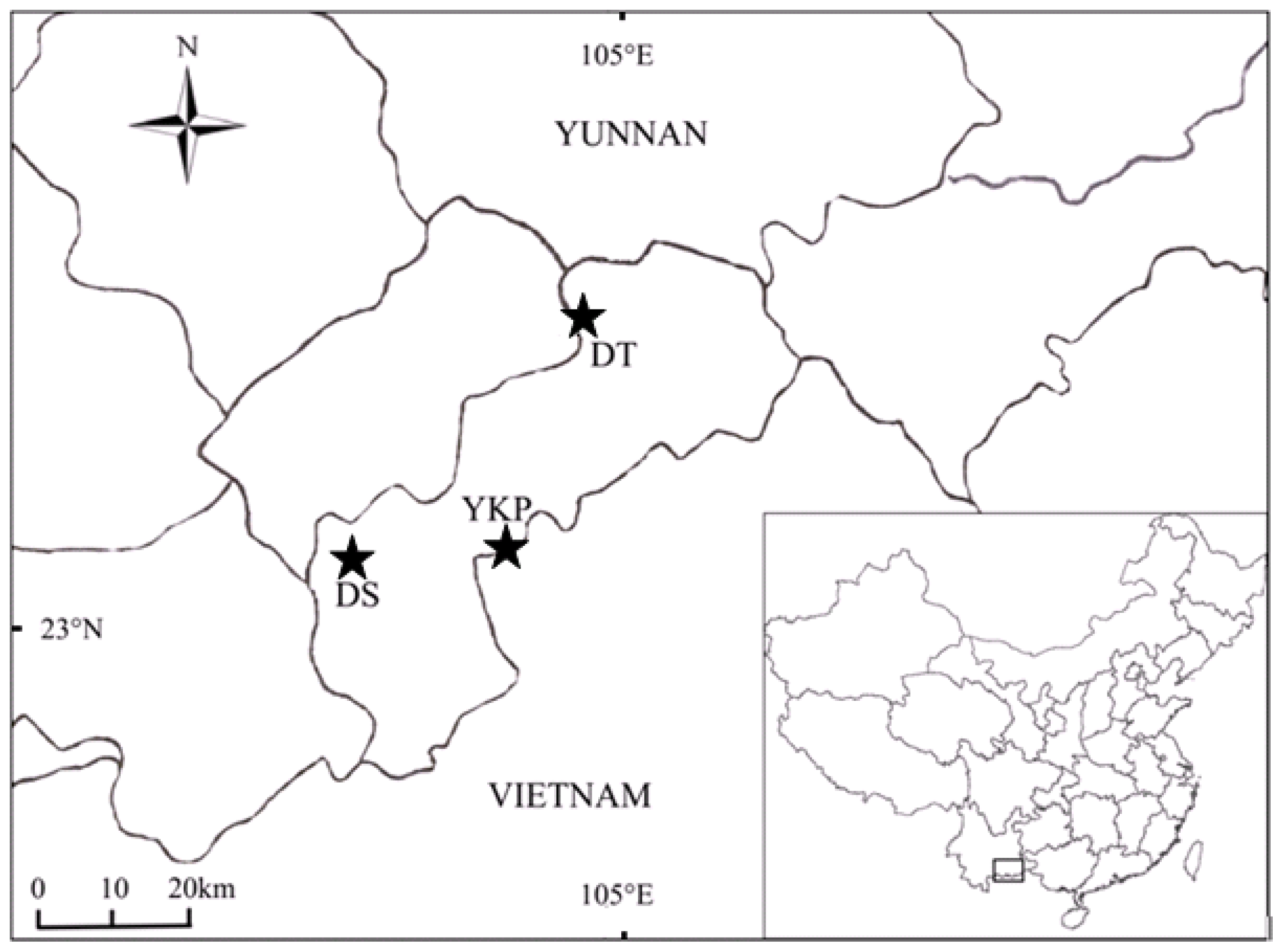
<p>Currently, <italic>M. coriacea</italic> occurs as scattered individuals in evergreen woods on limestone slopes or roadsides at altitude of 1300–1600 m, and has a potential distribution range of approximate 4190 km<sup>2</sup> [<xref ref-type="bibr" rid="b18-ijms-13-04396">18</xref>]. These individuals are distributed across only three extant populations: Daping and Shipen, Dongma and Tiechang, and Yang-Kai-Ping (defined as populations of DS, DT and YKP in this paper) (<xref ref-type="fig" rid="f1-ijms-13-04396">Figure 1</xref>). In DS population, some individuals of <italic>M. coriacea</italic> are over 100 years old, having been protected as symbols of “good fortune” by local villagers; however, they are surrounded and isolated by farmland and villages. In DT population, the maximum age of sampled trees was less than 30 years, and in YKP population the average tree age was 10–50 years [<xref ref-type="bibr" rid="b19-ijms-13-04396">19</xref>]. All individuals in these populations are in habitats that have been degraded and fragmented due to heavy logging and vegetation destruction. Undoubtedly, an understanding of the genetic diversity of the critically endangered <italic>M. coriacea</italic> is urgently needed for planning its conservation action.</p>
<p>The use of molecular analysis as an integral component in the conservation of rare and endangered species is becoming more widely used [<xref ref-type="bibr" rid="b5-ijms-13-04396">5</xref>,<xref ref-type="bibr" rid="b11-ijms-13-04396">11</xref>,<xref ref-type="bibr" rid="b20-ijms-13-04396">20</xref>]. The molecular markers best suited for detecting genetic diversity should be relatively easy and inexpensive to detect and these markers should have evolved rapidly enough to be variable within populations. Inter-simple sequence repeats (ISSRs) and simple sequence repeats (SSRs) have been successfully employed and recognized as useful molecular markers in the analysis of a population’s genetic variation, and for other purposes in various species [<xref ref-type="bibr" rid="b21-ijms-13-04396">21</xref>,<xref ref-type="bibr" rid="b22-ijms-13-04396">22</xref>]. In order to achieve valuable and comprehensive information on the genetic diversity and population differentiation of <italic>M. coriacea</italic>, we employed ISSR and SSR markers to address the key issue: what are the levels of genetic diversity and differentiation within, and among, populations of <italic>M. coriacea</italic>? In addition, implications for conserving this critically endangered species are discussed.</p></sec>
<sec sec-type="results">
<title>2. Results</title>
<sec>
<title>2.1. Genetic Diversity and Genetic Structure Investigated by ISSR Markers</title>
<p>A total of 110 bands were presented from the 10 selected primers among 58 individuals of the three populations. Of these, 106 (96.36%) were polymorphic (<xref ref-type="table" rid="t1-ijms-13-04396">Table 1</xref>). At the population level, the percentage of polymorphic bands (PPB) within each population ranged from 60.00% (DS) to 81.82% (DT) with an average of 72.73% (<xref ref-type="table" rid="t2-ijms-13-04396">Table 2</xref>). Populations YKP, DT and DS contained nine, eight and zero private bands respectively. Assuming Hardy-Weinberg equilibrium, the mean Nei’s gene diversity (<italic>H</italic>) was estimated to be 0.226 within populations and 0.283 at the species level, and the average Shannon information index (<italic>H</italic><sub>pop</sub>) within populations and species levels was 0.345 and 0.436, respectively (<xref ref-type="table" rid="t2-ijms-13-04396">Table 2</xref>).</p>
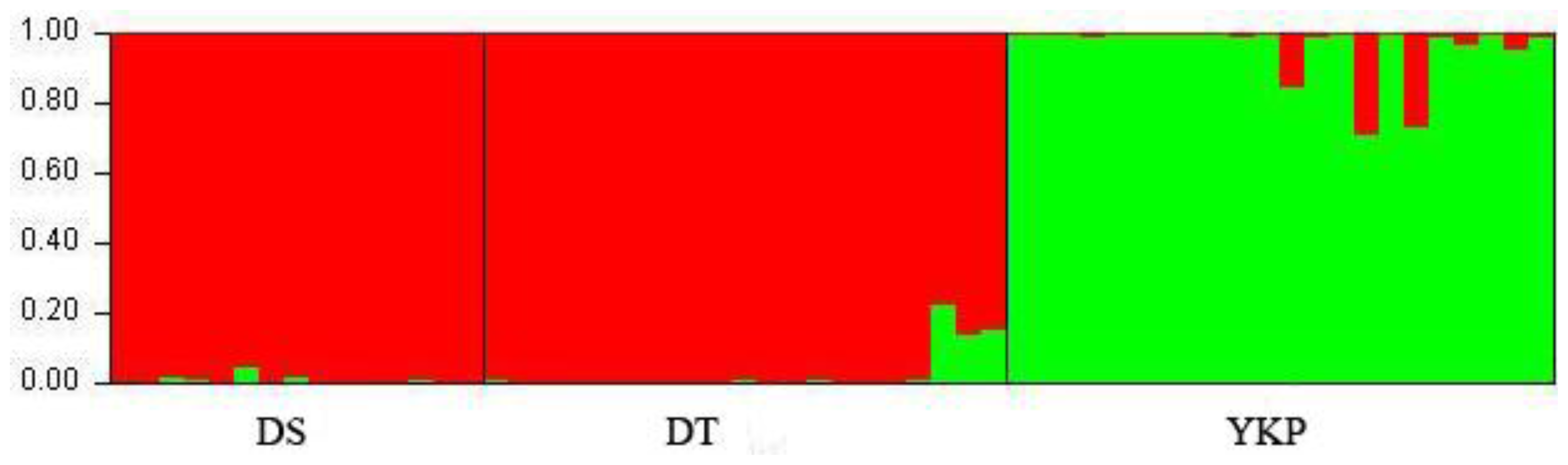
<p>In the STRUCTURE analysis of ISSR data, the value of Δ<italic>K</italic> was 903.1 for <italic>K</italic> = 2, 412.9 and 233.5 for <italic>K</italic> = 3 and <italic>K</italic> = 4, respectively, and &lt;155 for all values of <italic>K</italic> higher than 4. Therefore <italic>K</italic> = 2 best represents the data. Structure analysis run with <italic>K</italic> = 2 showed a clear separation between YKP and the other two populations (<xref ref-type="fig" rid="f2-ijms-13-04396">Figure 2</xref>).</p>
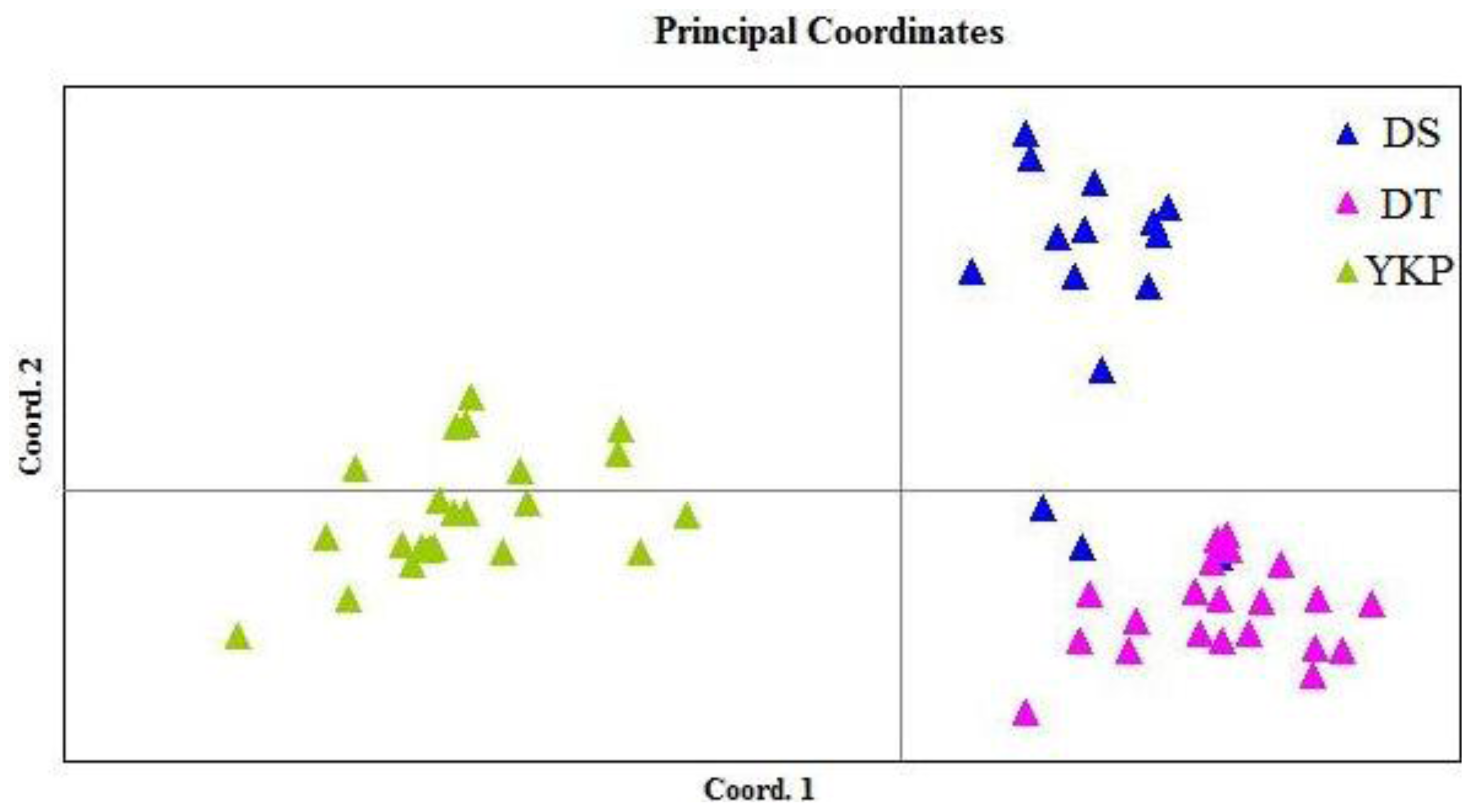
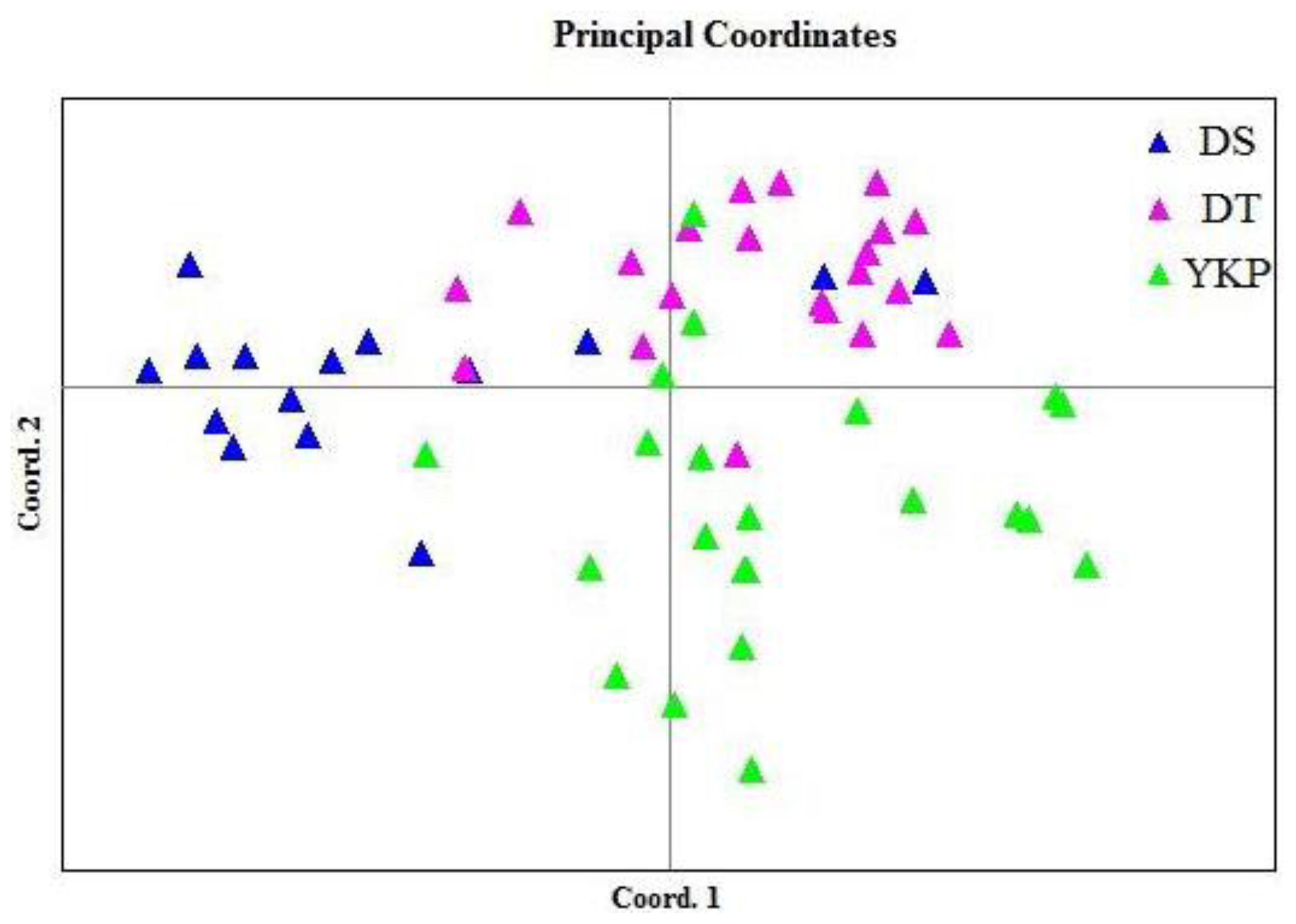
<p>The two-dimensional PCoA plot (<xref ref-type="fig" rid="f3-ijms-13-04396">Figure 3</xref>) shows that the first principal coordinate accounts for 39.59% of total variation and separates the YKP population from the DS and DT populations. The second principal coordinate (18.88% of total variation) separated most individuals from DS from those of DT, but there was some overlap, with certain individuals from DS grouping with those from DT. AMOVA analysis among populations showed that 77.16% variation occurred within populations (<xref ref-type="table" rid="t3-ijms-13-04396">Table 3</xref>). Deduced from the <italic>G</italic><sub>st</sub> value, the level of gene flow (<italic>N</italic><sub>m</sub>) was estimated at 1.086 (<italic>N</italic><sub>m</sub> &gt; 1), indicating no differentiation among populations.</p></sec>
<sec>
<title>2.2. Genetic Diversity and Genetic Divergence Based on SSR Markers</title>
<p>A total of 45 alleles at 11 SSR loci were revealed across 58 individuals of <italic>M. coriacea</italic>. The number of alleles per locus ranged from 2 at locus MC64 to 7 at locus MC49, with an average of 4.091 per locus (<xref ref-type="table" rid="t4-ijms-13-04396">Table 4</xref>). At species level, the percentage of polymorphic loci was 95%. Values for observed heterozygosity (<italic>H</italic><sub>o</sub>) ranged from 0.172 at locus MC45 to 0.759 locus MC8 (average 0.412), and for expected heterozygosity (<italic>H</italic><sub>e</sub>) from 0.247 at locus MC45 to 0.782 at locus MC8 (average 0.505). PIC values ranged from 0.417 to 0.750, with an average value of 0.502 per locus (<xref ref-type="table" rid="t4-ijms-13-04396">Table 4</xref>).</p>
<p>At the population level, the percentage of polymorphic loci per population ranged from 72.73% (DS) to 91.90% (DT) with an average of 82.15%. The average value for <italic>H</italic><sub>o</sub> was 0.425 (ranging from 0.335 to 0.533) and that for <italic>H</italic><sub>e</sub> was 0.470 (ranging from 0.429 to 0.498). Unlike private bands detected from ISSRs, private SSR alleles were present in all three populations: DS, DT and YKP contained 2, 3, and 2 private alleles respectively (<xref ref-type="table" rid="t5-ijms-13-04396">Table 5</xref>). The estimated genetic differentiation among populations (<italic>F</italic><sub>st</sub>) was 0.090 and the estimated level of gene flow (<italic>N</italic><sub>m</sub>) among populations was 2.543. AMOVA analysis showed that 13.90% of the variance existed among populations (<xref ref-type="table" rid="t3-ijms-13-04396">Table 3</xref>).</p>
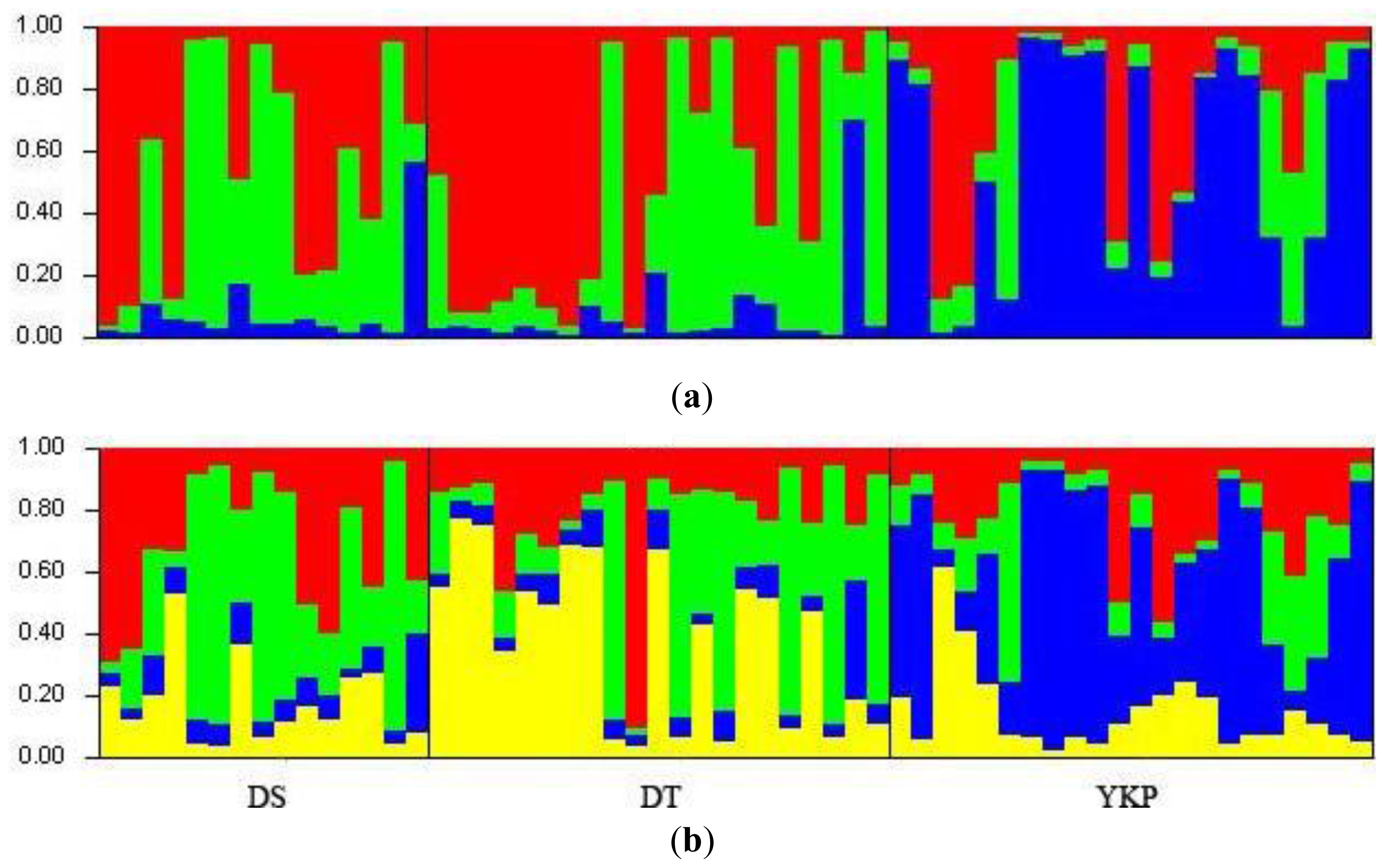
<p>In the STRUCTURE analysis of SSR data, the value of Δ<italic>K</italic> was 61.2 for <italic>K</italic> = 3, 59.3 for <italic>K</italic> = 4, and &lt;51 for all values of other <italic>K</italic>. The scores for <italic>K</italic> = 3 and <italic>K</italic> = 4 were very similar; therefore we performed runs with each <italic>K</italic> value. However, results either from <italic>K</italic> = 3 or <italic>K</italic> = 4 failed to differentiate between populations (<xref ref-type="fig" rid="f4-ijms-13-04396">Figure 4a,b</xref>).</p>
<p>Similarly, PCoA analysis did not clearly separate the populations. Individuals from DS tended to score lower for coordinate 1 (accounting for 25.57% of total variation), whereas individuals from DT and YKP tended to have higher and lower scores respectively for coordinate 2 (accounting for 19.84% of total variation). However, all three populations overlapped for both coordinates, meaning that discrimination based on this data and PCoA analysis of this data was not possible (<xref ref-type="fig" rid="f5-ijms-13-04396">Figure 5</xref>).</p>
<p>Within each population, certain individuals appeared highly distinct from certain others, according to the STRUCTURE analysis of SSR data. In population DS, individuals DS1 and DS2 were highly distinct from DS5, DS6, DS8, and DS14; in DT population, DT2, DT3, DT4, DT5, DT6, DT7 and DT10 were most distinct from DT9, DT12, DT14, DT17, DT19 and DT21; in YKP population YKP1, YKP2, YKP7, YKP8, YKP9, YKP10, YKP12, YKP15, YKP16, YKP17, YKP21 and YKP22 were most distinct from YKP3, YKP4, and YKP6 (<xref ref-type="fig" rid="f4-ijms-13-04396">Figure 4a</xref>).</p></sec></sec>
<sec sec-type="discussion">
<title>3. Discussion</title>
<sec>
<title>3.1. Genetic Diversity in M. coriacea</title>
<p>The known distribution of <italic>M. coriacea</italic> is very narrow and fragmented, but it retains high levels of genetic diversity, mostly at the within-population level. The genetic diversity in the species overall (PPB = 96.36%, <italic>H</italic> = 0.283, for ISSR markers; PPL = 95.56%, <italic>H</italic><sub>e</sub> = 0.505, and <italic>H</italic><sub>o</sub> = 0.412 for SSR markers) is higher than that of its relatives <italic>Manglietia deciduas</italic> (PPB = 17.28%, <italic>H</italic> = 0.0637; [<xref ref-type="bibr" rid="b23-ijms-13-04396">23</xref>]) and <italic>Magnolia sieboldii</italic> (<italic>H</italic><sub>e</sub> = 0.366, <italic>H</italic><sub>o</sub> = 0.366; [<xref ref-type="bibr" rid="b24-ijms-13-04396">24</xref>]). In general, species with small geographic ranges tend to maintain less genetic diversity than geographically widespread species. However, exceptions are not uncommon [<xref ref-type="bibr" rid="b11-ijms-13-04396">11</xref>,<xref ref-type="bibr" rid="b20-ijms-13-04396">20</xref>,<xref ref-type="bibr" rid="b25-ijms-13-04396">25</xref>,<xref ref-type="bibr" rid="b26-ijms-13-04396">26</xref>]. Genetic diversity within populations is influenced by historical factors (e.g., founder effects, bottlenecks, extended time periods with low numbers of individuals and gene flow rates), and thus present-day population sizes may not be a reliable indication of genetic diversity.</p>
<p>High genetic diversity can be maintained in rare plants that are adapted to an existence comprising small isolated populations (<italic>i.e.</italic>, are naturally rare; [<xref ref-type="bibr" rid="b26-ijms-13-04396">26</xref>]). However, high genetic diversity within very small populations can also be observed if very recent population size reduction has occurred, especially where that reduction has occurred within a generation or two for the species concerned; in such cases the surviving individuals are effectively samples from the larger population that existed before [<xref ref-type="bibr" rid="b11-ijms-13-04396">11</xref>,<xref ref-type="bibr" rid="b20-ijms-13-04396">20</xref>,<xref ref-type="bibr" rid="b27-ijms-13-04396">27</xref>,<xref ref-type="bibr" rid="b28-ijms-13-04396">28</xref>]. In such cases, unlike naturally rare plants, a dramatic loss of diversity in future generations is to be expected via genetic drift.</p>
<p>Habitat destruction appears to be recent for <italic>M. coriacea,</italic> as evidenced both by witness accounts of local people and the literature record. The species was first discovered in 1986 and then described as a new species in 1987 [<xref ref-type="bibr" rid="b29-ijms-13-04396">29</xref>]. Initially, it was known from four localities in SE Yunnan, <italic>i.e.</italic>, DS, DT, YKP and a fourth, Guangnan [<xref ref-type="bibr" rid="b29-ijms-13-04396">29</xref>]. Despite repeated searches of the Guangnan area between 2004 and 2006, we could not find any plants of <italic>M. coriacea</italic>, indicating its extinction from Guangnan within the last 30 years. However, there is no evidence for range contraction during the same period for the three extant populations of <italic>M. coriacea</italic> in this study. In addition, our molecular data clearly indicated apparently high levels of gene flow for <italic>M. coriacea</italic> (<italic>N</italic><sub>m</sub> = 1.086 for ISSR data, and 2.543 for SSRs), which would account for low differentiation between populations (<italic>F</italic><sub>st</sub> = 0.090 for SSRs and <italic>G</italic><sub>st</sub> = 0.187 for ISSRs). It should be noted that indirect estimates of Nm values must be interpreted with caution [<xref ref-type="bibr" rid="b30-ijms-13-04396">30</xref>,<xref ref-type="bibr" rid="b31-ijms-13-04396">31</xref>], and this data therefore should be viewed as general indicators of the magnitude of genetic exchange.</p>
<p>Low genetic differentiation and high gene flow between populations can result from long-distance gene dispersal either by pollen or by seed [<xref ref-type="bibr" rid="b10-ijms-13-04396">10</xref>]. Long range seed dispersal has been implicated in maintaining links between populations in the rare <italic>Michelia formosana</italic> [<xref ref-type="bibr" rid="b32-ijms-13-04396">32</xref>]. <italic>M. coriacea</italic> also has animal-dispersed seeds, and insect pollination may also have contributed to gene flow over distance in this species. However, seed or pollen flow appears unlikely between the modern, isolated populations. Therefore, gene flow between plants at the three extant sites via seeds and/or pollen was probably extensive and relatively unhindered in the past, before the populations became isolated.</p></sec>
<sec>
<title>3.2. Variation Between Populations</title>
<p>Populations DT (PPB = 81.82%, PPL = 91.90%) and YKP (PPB = 76.36%, PPL = 81.82%) contained relatively higher genetic diversity than did population DS (PPB = 65%, PPL = 72.73%). Because trees at DS are usually &gt;100 years old, whereas those at DT and YKP are &lt; 50 years old [<xref ref-type="bibr" rid="b19-ijms-13-04396">19</xref>], range contraction within the past 50 years can be eliminated as a cause for this difference. Instead, patterns of gene flow, migration and population structure prior to range contraction can impact on modern populations [<xref ref-type="bibr" rid="b10-ijms-13-04396">10</xref>], and may explain differences in genetic diversity between these <italic>M. coriacea</italic> populations. The fact that heterozygosity for SSR alleles was slightly higher in DS than the other two populations indicates that lower diversity here had not yet brought about inbreeding when the current generation was founded. However, the absence of seedlings from all three populations has prevented us from assessing whether range contraction will lead to an immediate inbreeding effect in the next generation.</p>
<p>It should be noted that there are some discrepancies between the results (e.g., levels of examined population’s heterozygosity, STRUCTURE and PCoA clusterings) from different markers, suggesting that the manner of polymorphism differs because of marker specificity. Contrasting patterns are commonly found when multiple markers are used to detect genetic structure, as for example in soybean [<xref ref-type="bibr" rid="b33-ijms-13-04396">33</xref>], cashew [<xref ref-type="bibr" rid="b34-ijms-13-04396">34</xref>], olive [<xref ref-type="bibr" rid="b35-ijms-13-04396">35</xref>] and <italic>Ficus carica</italic> [<xref ref-type="bibr" rid="b36-ijms-13-04396">36</xref>]. Such contrasts between markers could be due to any or all of the following causes: (1) these two marker systems sample genomic regions with different evolutionary modes; (2) ISSR is based on consensus markers, whereas the microsatellite markers used in this study were specifically developed for <italic>M. coriacea</italic>; and (3) ISSR and SSR have different modes of inheritance (<italic>i.e.</italic>, dominant <italic>versus</italic> codominant). In addition, some marker loci could be under selection, or tightly linked to loci under selection, meaning that a small minority of markers for either system might not be truly neutral, although neutrality of both ISSR and SSR markers is often assumed. To test directly for these possibilities is beyond the scope of the current study, but using two types of marker, and interpreting results of each with a degree of caution, can give a reasonable assessment of the true genetic situation for the examined populations. In the current study, population YKP was clearly separable from the other populations based on ISSR, but not SSR, markers. Hence, YKP might be the most distinct population, but SSR data indicates that this conclusion must be treated with caution.</p></sec>
<sec>
<title>3.3. Conservation</title>
<p>The maintenance of a maximal amount of genetic diversity is one of the major objectives for conserving endangered and threatened species [<xref ref-type="bibr" rid="b11-ijms-13-04396">11</xref>], and the loss of genetic variation may largely limit adaptability to changing environments [<xref ref-type="bibr" rid="b37-ijms-13-04396">37</xref>,<xref ref-type="bibr" rid="b38-ijms-13-04396">38</xref>]. In the case of <italic>M. coriacea</italic>, AMOVA results shows that each of the three examined populations currently maintains a high level of within-population genetic diversity. Therefore, the endangered status of this species currently reflects a small number of extant individuals and very poor natural regeneration. Conservation measures should therefore focus on establishing large numbers of seedlings, both <italic>in</italic> and <italic>ex situ</italic>, involving many different individuals as parents, to preserve as much as possible of the existing genetic diversity in subsequent generations. Given the current lack of recruitment, establishing seedlings <italic>in situ</italic> will require management and co-operation from local communities.</p>
<p>In addition, the observed high diversity among relatively few adult trees also places a conservation value on each individual adult tree as a mini-reservoir of genetic diversity, in a way that would not apply for genetically depauperate, relict populations. Hence, conservation efforts to preserve each existing tree would also have a value in maintaining genetic diversity.</p>
<p>Conservation strategies may differ between sites. In DS, the oldest trees are protected by villagers as good luck symbols [<xref ref-type="bibr" rid="b19-ijms-13-04396">19</xref>], so encouraging the locals to grow seedlings from these trees to bring luck to future generations might be effective. This is, however, the least diverse population. Individuals from DT and YKP occur in secondary vegetation and enjoy no protection of any kind [<xref ref-type="bibr" rid="b19-ijms-13-04396">19</xref>]. Of these two populations, YKP might be the most distinct and hence of higher conservation value deduced from ISSR results.</p>
<p>Within each population, however, SSR data also indicated clusters of individuals more similar to one another than they were to others. For example, individuals DS1 and DS2 were genetically highly distinct from others is DS, and likewise YKP3, YKP4 and YKP6 were genetically distinct from others in YKP. Therefore, seedlings with a higher degree of heterozygosity could be generated by crossing individuals that, according to our results, are genetically dissimilar.</p>
<p>In the short term, conservation priorities must be to preserve as many as possible of the surviving individuals. In the medium term, new generations must be ensured, and in the long term, genetic health must be maintained. Therefore, <italic>in-situ</italic> efforts to conserve remaining habitats need to be combined with <italic>ex-situ</italic> research on seed propagation, with a view to establishing a new generation of plants both in cultivation and the wild. Should <italic>in-situ</italic> conservation be more successful at one site than others, then seedlings from all three sites could be established at the protected site.</p></sec></sec>
<sec sec-type="materials|methods">
<title>4. Materials and Methods</title>
<sec sec-type="methods">
<title>4.1. The Study Species and Sampling Procedures</title>
<p><italic>Michelia coriacea</italic> is diploid (2<italic>n</italic> = 38) [<xref ref-type="bibr" rid="b39-ijms-13-04396">39</xref>]. The mature trees can reach up to 20–30 m in height and 50–60 cm in diameter [<xref ref-type="bibr" rid="b18-ijms-13-04396">18</xref>,<xref ref-type="bibr" rid="b19-ijms-13-04396">19</xref>,<xref ref-type="bibr" rid="b40-ijms-13-04396">40</xref>], and live for at least 100 years. The species bears scented whitish or creamy yellow flowers with 6–7 tepals which are in anthesis from February to April [<xref ref-type="bibr" rid="b13-ijms-13-04396">13</xref>,<xref ref-type="bibr" rid="b14-ijms-13-04396">14</xref>].</p>
<p>The plant sampling and material collection were carried out in March and July 2007, and in August 2008. Prior to this, comprehensive field surveys had located only 15, 33 and 53 individuals at DS, DT and YKP, respectively [<xref ref-type="bibr" rid="b19-ijms-13-04396">19</xref>]. It should be noted that seedling regeneration is not good, because no seedlings were detected in DS, and only a few seedlings were found in the other two populations. Therefore, we sampled all 15 mature individuals in DS, whereas 21 and 22 mature individuals were sampled from DT and YKP respectively (<xref ref-type="fig" rid="f1-ijms-13-04396">Figure 1</xref> and <xref ref-type="table" rid="t6-ijms-13-04396">Table 6</xref>). Healthy, young leaves were collected from each sampled individual, and dried in silica gel for subsequent DNA extraction.</p></sec>
<sec>
<title>4.2. DNA Extraction and PCR Amplification</title>
<p>Total DNA was extracted from the dried leaves following the modified CTAB method described by Doyle [<xref ref-type="bibr" rid="b41-ijms-13-04396">41</xref>]. The purified total DNA was quantified by gel electrophoresis and its quality verified by spectrophotometry. DNA samples were stored at −20 °C.</p>
<p>One hundred ISSR primers from the University of British Columbia (UBC) were initially screened on eight randomly selected individuals for PCR. Of these, ten primers which consistently amplified well, and produced polymorphic bands, were selected for analyzing (<xref ref-type="table" rid="t1-ijms-13-04396">Table 1</xref>). To ensure repeatability of amplification and scoring, all loci were amplified 2 times independently and run on separate gels. PCR reactions were performed in a reaction volume of 15 μL, containing 9.92 μL ddH<sub>2</sub>O, 0.4 μL formamide, 1.5 μL 10× PCR buffer (Mg<sup>2+</sup> Plus), 0.25 mM of each dNTP, 0.9 U Taq polymerase, 0.6 μM primers, 0.6 μL template DNA (approximate 50 ng). Cycling conditions consisted of an initial denaturation step at 97 °C for 4 min, followed by 35 cycles of denaturation at 94 °C for 1 min, annealing temperature for 1 min (<xref ref-type="table" rid="t1-ijms-13-04396">Table 1</xref>), extension at 72 °C for 1.5 min, and finally 10 min at 72 °C for final extension. Amplification products were detected by using 1.6% agarose gel stained with 0.5 pg/mL ethidium bromide, and were electrophoresed in 1× Tris-borate-EDTA (TBE) buffer (pH 8.0) at 85 V for 2 h. The bands were visualized under UV light.</p>
<p>SSR genotyping was performed according to the methods described in Zhao <italic>et al.</italic> [<xref ref-type="bibr" rid="b40-ijms-13-04396">40</xref>] at loci MC2, MC3, MC8, MC34, MC35, MC41, MC45, MC48, MC49, MC64, and MC66 (<xref ref-type="table" rid="t2-ijms-13-04396">Table 2</xref>). Briefly, SSR loci were amplified by PCR in a final volume of 15 μL containing 7.5 μL 2× Taq PCR MasterMix (Tiangen; 0.1 U Taq Polymerase/μL, 0.5 mM dNTP each, 20 mM Tris-HCl, 100 mM KCl, 3 mM MgCl<sub>2</sub>), 20–50 ng genomic DNA. The amplification profiles included initial denaturation at 94 °C for 3 min; followed by 35–40 cycles of 30 s at 94 °C, 30 s at 54–68 °C and 1 min at 72 °C (<xref ref-type="table" rid="t2-ijms-13-04396">Table 2</xref>); then final extension at 72 °C for 7 min. The amplified product was then separated on 6% denaturing polyacrylamide sequencing gels using silver staining. A 20 bp DNA ladder standard (Fermentas) was used as standard for scoring.</p></sec>
<sec sec-type="methods">
<title>4.3. Data Analysis</title>
<sec sec-type="methods">
<title>4.3.1. ISSR Data</title>
<p>Amplified ISSR fragments showing consistent amplification were scored manually as present (1) or absent (0) for each sample to form a binary matrix. The POPGENE program Version 1.31 [<xref ref-type="bibr" rid="b42-ijms-13-04396">42</xref>] was employed, assuming Hardy-Weinberg equilibrium, to obtain the genetic diversity parameters within each population: percentage of polymorphic bands (PPB), private bands (referring to bands found only within one population), observed allele number per locus (<italic>A</italic><sub>o</sub>), effective allele number per locus (<italic>A</italic><sub>e</sub>), Nei’s gene diversity (<italic>H</italic>) and Shannon index of diversity (H<sub>pop</sub>) [<xref ref-type="bibr" rid="b31-ijms-13-04396">31</xref>]. Genetic diversity parameters were also calculated both at species and population levels.</p>
<p>Genetic differentiation among populations was analyzed using Nei’s gene diversity statistics [<xref ref-type="bibr" rid="b27-ijms-13-04396">27</xref>]. The gene flow was estimated by using the equation <italic>N</italic><sub>m</sub> = (1 − <italic>G</italic><sub>st</sub>)/4<italic>G</italic><sub>st</sub>, where <italic>N</italic><sub>m</sub> is the number of migrants per generation [<xref ref-type="bibr" rid="b43-ijms-13-04396">43</xref>]. To infer population structure and assign individuals to populations, the program STRUCTURE version 2.3.1 was used [<xref ref-type="bibr" rid="b44-ijms-13-04396">44</xref>], following the methods described by Ma <italic>et al</italic>. [<xref ref-type="bibr" rid="b45-ijms-13-04396">45</xref>]. We adopted the admixture model with correlated allele frequencies. No prior knowledge of the species was included in the analyzed data set. To determine the optimal number of groups (<italic>K</italic>), we ran STRUCTURE with <italic>K</italic> varying from 1 to 10, with five runs for each <italic>K</italic> value. Previous studies have found that, in many cases, the posterior probability for a given <italic>K</italic> increases slightly, even after the real <italic>K</italic> is reached [<xref ref-type="bibr" rid="b46-ijms-13-04396">46</xref>]. Therefore, we used an <italic>ad hoc</italic> statistic, Δ<italic>K</italic>, to determine the true value of <italic>K</italic> [<xref ref-type="bibr" rid="b47-ijms-13-04396">47</xref>]. Our parameters were 100,000 burn-in periods and 10,000 MCMC repetitions after burn-in. Furthermore, principal co-ordinate analysis (PCoA) in GenAlEx 6.0 was employed to examine further the genetic relationships among detected populations on the basis of the same ISSR data [<xref ref-type="bibr" rid="b48-ijms-13-04396">48</xref>].</p>
<p>The AMOVA (analysis of molecular variance) was performed through Arlequin 3.0 program [<xref ref-type="bibr" rid="b49-ijms-13-04396">49</xref>] to describe variance components and their significance levels for variation among individuals within and among the populations.</p></sec>
<sec sec-type="methods">
<title>4.3.2. SSR Data</title>
<p>To estimate overall genetic diversity, the following measures were calculated for each SSR primer locus and each population using POPGENE program Version 1.31 [<xref ref-type="bibr" rid="b42-ijms-13-04396">42</xref>]: observed allele number per locus (<italic>A</italic><sub>o</sub>), effective allele number per locus (<italic>A</italic><sub>e</sub>), observed heterozygosity (<italic>H</italic><sub>o</sub>), expected heterozygosity (<italic>H</italic><sub>e</sub>), and the number of private loci, <italic>i.e.</italic>, those found only in a single population. The same program was used to test for deviations from Hardy-Weinberg equilibrium (HWE) and pair-wise linkage disequilibrium (LD). To measure the marker polymorphism, the polymorphism information content (PIC) for each SSR Marker was calculated according to the formula PIC = 1 − ∑<italic>P</italic><italic><sub>i</sub></italic> <sup>2</sup>, where <italic>P</italic><italic><sub>i</sub></italic> is the frequency of the allele for each SSR marker locus [<xref ref-type="bibr" rid="b50-ijms-13-04396">50</xref>].</p>
<p>Wright’s <italic>F</italic><sub>st</sub> was estimated by a weighted analysis of variance with the GENEPOP 4.0 program [<xref ref-type="bibr" rid="b51-ijms-13-04396">51</xref>]. In addition, the amount of gene flow (<italic>N</italic><sub>m</sub>) among populations was estimated by an indirect genetic differentiation method based on <italic>F</italic><sub>st</sub> value, <italic>N</italic><sub>m</sub> = (1 − <italic>F</italic><sub>st</sub>)/4<italic>F</italic><sub>st</sub>. Partitioning of genetic variation within and among populations was further performed by analysis of molecular variance using the Arlequin 3.0 program [<xref ref-type="bibr" rid="b49-ijms-13-04396">49</xref>]. For these SSR data, genetic relationships among three populations were also examined using STRUCTURE and GenAlEx 6.0 with the same methods described as ISSR markers above.</p></sec></sec></sec>
<sec sec-type="conclusions">
<title>5. Conclusions</title>
<p>In summary, our results from both ISSR and SSR markers show that a relatively high level of genetic diversity and low levels of genetic differentiation among populations exist in the critically endangered plant <italic>Michelia coriacea</italic>. Furthermore, Bayesian model-based STRUCTURE and PCoA analysis could not reveal a clear separation between populations, although YKP was differentiated from the other two populations by ISSR markers. We therefore presume that the fragmented habitat and the isolated populations of <italic>M. coriacea</italic> may be due to very recent contraction of its range. Based on this data, conservation strategies for this critically endangered species were also proposed.</p></sec></body>
<back>
<ack>
<title>Acknowledgements</title>
<p>We are grateful to the associate editor and two anonymous reviewers for some highly constructive comments. We sincerely thank Cindy Q. Tang, Xiao Bo and Zhu Daiqing for their assistance in field observation and sample collecting. We also sincerely thank Wang Jianxiu and Qian Qin for their enthusiastic assistance in data analysis. We would like to express our gratitude to Yang Junbo, Meng Jing and Ai Honglian for their help with the ISSR work. This study was supported by the special fund of China’s Yunnan government for young and middle-aged qualified scientists and technicians (grant number 2006PY-48 to W. Sun) and the generous support of Botanic Gardens Conservation International (BGCI) (grant number 6206/R4331 to W. Sun).</p></ack>
<ref-list>
<title>References</title>
<ref id="b1-ijms-13-04396"><label>1</label><citation citation-type="book"><person-group person-group-type="author"><name><surname>Frankel</surname><given-names>O.H.</given-names></name><name><surname>Soulé</surname><given-names>M.E.</given-names></name></person-group><source>Conservation and Evolution</source><publisher-name>Cambridge University Press</publisher-name><publisher-loc>Cambridge, UK</publisher-loc><year>1981</year></citation></ref>
<ref id="b2-ijms-13-04396"><label>2</label><citation citation-type="journal"><person-group person-group-type="author"><name><surname>Kingston</surname><given-names>N.</given-names></name><name><surname>Waldren</surname><given-names>S.</given-names></name><name><surname>Smyth</surname><given-names>N.</given-names></name></person-group><article-title>Conservation genetics and ecology of <italic>Angiopteris chauliodonta</italic> Copel. (Marattiaceae), a critically endangered fern from Pitcairn Island, South Central Pacific Ocean</article-title><source>Biol. Conserv</source><year>2004</year><volume>117</volume><fpage>309</fpage><lpage>319</lpage><pub-id pub-id-type="doi">10.1016/j.biocon.2003.11.019</pub-id></citation></ref>
<ref id="b3-ijms-13-04396"><label>3</label><citation citation-type="book"><person-group person-group-type="author"><name><surname>Lande</surname><given-names>R.</given-names></name><name><surname>Barrowclough</surname><given-names>G.F.</given-names></name></person-group><article-title>Effective Population Size, Genetic Variation, and Their Use in Population Management</article-title><source>Viable Populations for Conservation</source><person-group person-group-type="editor"><name><surname>Soulé</surname><given-names>M.E.</given-names></name></person-group><publisher-name>Cambridge University Press</publisher-name><publisher-loc>Cambridge, UK</publisher-loc><year>1987</year><fpage>87</fpage><lpage>123</lpage></citation></ref>
<ref id="b4-ijms-13-04396"><label>4</label><citation citation-type="journal"><person-group person-group-type="author"><name><surname>Rossetto</surname><given-names>M.</given-names></name><name><surname>Weaver</surname><given-names>P.K.</given-names></name><name><surname>Dixon</surname><given-names>K.W.</given-names></name></person-group><article-title>Use of RAPD analysis in devising conservation strategies for the rare and endangered <italic>Grevillea scapigera</italic></article-title><source>Mol. Ecol</source><year>1995</year><volume>4</volume><fpage>321</fpage><lpage>329</lpage><pub-id pub-id-type="doi">10.1111/j.1365-294X.1995.tb00225.x</pub-id><pub-id pub-id-type="pmid">7663751</pub-id></citation></ref>
<ref id="b5-ijms-13-04396"><label>5</label><citation citation-type="journal"><person-group person-group-type="author"><name><surname>Godt</surname><given-names>M.J.W.</given-names></name><name><surname>Caplow</surname><given-names>F.</given-names></name><name><surname>Hamrick</surname><given-names>J.L.</given-names></name></person-group><article-title>Allozyme diversity in the federally threatened olden paintbrush, <italic>Castilleya levisecta</italic> (Scrophulariaceae)</article-title><source>Conserv. Genet</source><year>2005</year><volume>6</volume><fpage>87</fpage><lpage>99</lpage><pub-id pub-id-type="doi">10.1007/s10592-004-7746-5</pub-id></citation></ref>
<ref id="b6-ijms-13-04396"><label>6</label><citation citation-type="journal"><person-group person-group-type="author"><name><surname>Dong</surname><given-names>Y.H.</given-names></name><name><surname>Chen</surname><given-names>J.M.</given-names></name><name><surname>Gituru</surname><given-names>R.W.</given-names></name><name><surname>Wang</surname><given-names>Q.F.</given-names></name></person-group><article-title>Gene flow in populations of the endangered aquatic fern <italic>Ceratopteris pteridoides</italic> in China as revealed by ISSR markers</article-title><source>Aquat. Bot</source><year>2007</year><volume>87</volume><fpage>69</fpage><lpage>74</lpage><pub-id pub-id-type="doi">10.1016/j.aquabot.2007.03.006</pub-id></citation></ref>
<ref id="b7-ijms-13-04396"><label>7</label><citation citation-type="journal"><person-group person-group-type="author"><name><surname>Hamrick</surname><given-names>J.L.</given-names></name><name><surname>Godt</surname><given-names>M.J.</given-names></name></person-group><article-title>Effects of life history traits on genetic diversity in plant species</article-title><source>Philos. Trans. R. Soc. Lond. Ser. B</source><year>1996</year><volume>351</volume><fpage>1291</fpage><lpage>1298</lpage><pub-id pub-id-type="doi">10.1098/rstb.1996.0112</pub-id></citation></ref>
<ref id="b8-ijms-13-04396"><label>8</label><citation citation-type="journal"><person-group person-group-type="author"><name><surname>Loveless</surname><given-names>M.D.</given-names></name><name><surname>Hamrick</surname><given-names>J.L.</given-names></name></person-group><article-title>Ecological determinants of genetic structure of plant populations</article-title><source>Annu. Rev. Ecol. Syst</source><year>1984</year><volume>15</volume><fpage>65</fpage><lpage>95</lpage><pub-id pub-id-type="doi">10.1146/annurev.es.15.110184.000433</pub-id></citation></ref>
<ref id="b9-ijms-13-04396"><label>9</label><citation citation-type="journal"><person-group person-group-type="author"><name><surname>Bauert</surname><given-names>M.R.</given-names></name><name><surname>Kalin</surname><given-names>M.</given-names></name><name><surname>Baltisberger</surname><given-names>M.</given-names></name><name><surname>Edwards</surname><given-names>P.J.</given-names></name></person-group><article-title>No genetic variation detected within isolated relic populations of <italic>Saxifraga cernua</italic> in the Alps using RAPD markers</article-title><source>Mol. Ecol</source><year>1998</year><volume>7</volume><fpage>1519</fpage><lpage>1527</lpage><pub-id pub-id-type="doi">10.1046/j.1365-294x.1998.00470.x</pub-id></citation></ref>
<ref id="b10-ijms-13-04396"><label>10</label><citation citation-type="journal"><person-group person-group-type="author"><name><surname>Yao</surname><given-names>X.H.</given-names></name><name><surname>Ye</surname><given-names>Q.G.</given-names></name><name><surname>Kang</surname><given-names>M.</given-names></name><name><surname>Huang</surname><given-names>H.W.</given-names></name></person-group><article-title>Microsatellite analysis reveals interpopulation differention and gene flow in endangered tree <italic>Changiostyrax dolichocarpa</italic> (Styracaceae) with fragmented distribution in central China</article-title><source>New Phytol</source><year>2007</year><volume>176</volume><fpage>472</fpage><lpage>480</lpage><pub-id pub-id-type="doi">10.1111/j.1469-8137.2007.02175.x</pub-id><pub-id pub-id-type="pmid">17888124</pub-id></citation></ref>
<ref id="b11-ijms-13-04396"><label>11</label><citation citation-type="journal"><person-group person-group-type="author"><name><surname>Luan</surname><given-names>S.S.</given-names></name><name><surname>Chiang</surname><given-names>T.Y.</given-names></name><name><surname>Gong</surname><given-names>X.</given-names></name></person-group><article-title>High genetic diversity <italic>vs</italic>. low genetic differentiation in <italic>Nouelia insignis</italic> (Asteraceae), a narrowly distributed and endemic species in China, revealed by ISSR fingerprinting</article-title><source>Ann. Bot</source><year>2006</year><volume>98</volume><fpage>583</fpage><lpage>589</lpage><pub-id pub-id-type="doi">10.1093/aob/mcl129</pub-id><pub-id pub-id-type="pmid">16807255</pub-id></citation></ref>
<ref id="b12-ijms-13-04396"><label>12</label><citation citation-type="book"><person-group person-group-type="author"><name><surname>Schaal</surname><given-names>B.A.</given-names></name><name><surname>Leverich</surname><given-names>W.J.</given-names></name><name><surname>Rogstad</surname><given-names>S.H.</given-names></name></person-group><article-title>Comparison of Methods for Assessing Genetic Variation in Plant Conservation Biology</article-title><source>Genetics and Conservation of Rare Plants</source><person-group person-group-type="editor"><name><surname>Falk</surname><given-names>D.A.</given-names></name><name><surname>Holsinger</surname><given-names>K.E.</given-names></name></person-group><publisher-name>Oxford University Press</publisher-name><publisher-loc>New York, NY, USA</publisher-loc><year>1991</year><fpage>123</fpage><lpage>134</lpage></citation></ref>
<ref id="b13-ijms-13-04396"><label>13</label><citation citation-type="book"><person-group person-group-type="author"><name><surname>Cicuzza</surname><given-names>D.</given-names></name><name><surname>Newton</surname><given-names>A.</given-names></name><name><surname>Oldfield</surname><given-names>S</given-names></name></person-group><source>The Red List of Magnoliaceae</source><publisher-name>Fauna &amp; Flora International</publisher-name><publisher-loc>Cambridge, UK</publisher-loc><year>2007</year><fpage>20</fpage></citation></ref>
<ref id="b14-ijms-13-04396"><label>14</label><citation citation-type="journal"><person-group person-group-type="author"><name><surname>Sun</surname><given-names>W.B.</given-names></name><name><surname>Zhou</surname><given-names>Y.</given-names></name><name><surname>Yan</surname><given-names>L.</given-names></name><name><surname>Magin</surname><given-names>G.</given-names></name></person-group><article-title>Chinese magnolias—It’s mostly as bad as we thought</article-title><source>Oryx</source><year>2007</year><volume>41</volume><fpage>427</fpage><lpage>433</lpage></citation></ref>
<ref id="b15-ijms-13-04396"><label>15</label><citation citation-type="journal"><person-group person-group-type="author"><name><surname>Chen</surname><given-names>B.L.</given-names></name></person-group><article-title>Four new species of <italic>Michelia</italic> from Yunnan</article-title><source>Acta Sci. Nat. Univ. Sunyatseni</source><year>1987</year><volume>3</volume><fpage>86</fpage><lpage>91</lpage></citation></ref>
<ref id="b16-ijms-13-04396"><label>16</label><citation citation-type="book"><person-group person-group-type="author"><name><surname>Wu</surname><given-names>C.Y.</given-names></name><name><surname>Zhu</surname><given-names>Y.C.</given-names></name><name><surname>Jiang</surname><given-names>H.C.</given-names></name></person-group><source>The Vegetation of Yunnan</source><publisher-name>Science Press</publisher-name><publisher-loc>Beijing, China</publisher-loc><year>1987</year></citation></ref>
<ref id="b17-ijms-13-04396"><label>17</label><citation citation-type="book"><person-group person-group-type="author"><name><surname>Shui</surname><given-names>Y.M.</given-names></name><name><surname>Cheng</surname><given-names>Y.H.</given-names></name></person-group><source>The Plants of Honghe Region, Yunnan</source><publisher-name>Science Press</publisher-name><publisher-loc>Beijing, China</publisher-loc><year>2003</year></citation></ref>
<ref id="b18-ijms-13-04396"><label>18</label><citation citation-type="book"><person-group person-group-type="author"><name><surname>Sun</surname><given-names>W.B.</given-names></name><name><surname>Yan</surname><given-names>Lu.</given-names></name></person-group><source>Unpublished Report on Global Tree Compaign Fieldwork in China</source><publisher-name>FFI</publisher-name><publisher-loc>Cambridge, UK</publisher-loc><year>2006</year></citation></ref>
<ref id="b19-ijms-13-04396"><label>19</label><citation citation-type="thesis"><person-group person-group-type="author"><name><surname>Zhao</surname><given-names>X.F.</given-names></name></person-group><article-title>Conservation Biology of the Critically Endangered Plant, <italic>Michelia coriacea</italic></article-title><person-group person-group-type="editor"><name><surname>Chang</surname></name><name><surname>Chen</surname><given-names>B.L.</given-names></name></person-group><source>Master Thesis</source><publisher-name>The Graduate School of Chinese Academy of Sciences</publisher-name><publisher-loc>Beijing, China</publisher-loc><year>2008</year></citation></ref>
<ref id="b20-ijms-13-04396"><label>20</label><citation citation-type="journal"><person-group person-group-type="author"><name><surname>Zawko</surname><given-names>G.</given-names></name><name><surname>Krauss</surname><given-names>S.L.</given-names></name><name><surname>Dixon</surname><given-names>K.W.</given-names></name><name><surname>Sivasithamparam</surname><given-names>K.</given-names></name></person-group><article-title>Conservation genetics of the rare and endangered <italic>Leucopogon obtectus</italic> (Ericaceae)</article-title><source>Mol. Ecol</source><year>2001</year><volume>10</volume><fpage>2389</fpage><lpage>2396</lpage><pub-id pub-id-type="doi">10.1046/j.0962-1083.2001.01378.x</pub-id><pub-id pub-id-type="pmid">11742543</pub-id></citation></ref>
<ref id="b21-ijms-13-04396"><label>21</label><citation citation-type="journal"><person-group person-group-type="author"><name><surname>Budak</surname><given-names>H.</given-names></name><name><surname>Pedraza</surname><given-names>F.</given-names></name><name><surname>Baenziger</surname><given-names>P.S.</given-names></name><name><surname>Cregan</surname><given-names>P.B.</given-names></name><name><surname>Dweikat</surname><given-names>I.</given-names></name></person-group><article-title>Development and utilization of SSR to estimate genetic diversity in a collection of pearl millet germplasm</article-title><source>Crop Sci</source><year>2003</year><volume>43</volume><fpage>2284</fpage><lpage>2290</lpage><pub-id pub-id-type="doi">10.2135/cropsci2003.2284</pub-id></citation></ref>
<ref id="b22-ijms-13-04396"><label>22</label><citation citation-type="journal"><person-group person-group-type="author"><name><surname>Nybom</surname><given-names>H.</given-names></name></person-group><article-title>Comparison of different nuclear DNA markers for estimating intraspecific genetic diversity in plants</article-title><source>Mol. Ecol</source><year>2004</year><volume>13</volume><fpage>1143</fpage><lpage>1150</lpage><pub-id pub-id-type="doi">10.1111/j.1365-294X.2004.02141.x</pub-id><pub-id pub-id-type="pmid">15078452</pub-id></citation></ref>
<ref id="b23-ijms-13-04396"><label>23</label><citation citation-type="journal"><person-group person-group-type="author"><name><surname>Liao</surname><given-names>W.F.</given-names></name><name><surname>Xia</surname><given-names>N.H.</given-names></name><name><surname>Deng</surname><given-names>Y.F.</given-names></name><name><surname>Zheng</surname><given-names>Q.Y.</given-names></name></person-group><article-title>Study on genetic diversity of <italic>Manglietia deciduas</italic> (Magnoliaceae)</article-title><source>Acta Bot. Yunnanica</source><year>2004</year><volume>26</volume><fpage>58</fpage><lpage>64</lpage></citation></ref>
<ref id="b24-ijms-13-04396"><label>24</label><citation citation-type="journal"><person-group person-group-type="author"><name><surname>Kikuchi</surname><given-names>S.</given-names></name><name><surname>Ysagi</surname><given-names>Y.</given-names></name></person-group><article-title>SSR genetic variation in small and isolated populations of <italic>Magnolia sieboldii</italic> spp. <italic>japonica</italic></article-title><source>Heredity</source><year>2002</year><volume>88</volume><fpage>313</fpage><lpage>321</lpage><pub-id pub-id-type="doi">10.1038/sj.hdy.6800047</pub-id><pub-id pub-id-type="pmid">11920141</pub-id></citation></ref>
<ref id="b25-ijms-13-04396"><label>25</label><citation citation-type="journal"><person-group person-group-type="author"><name><surname>Wang</surname><given-names>Z.F.</given-names></name><name><surname>Hamrick</surname><given-names>J.L.</given-names></name><name><surname>Godt</surname><given-names>M.J.W.</given-names></name></person-group><article-title>High genetic diversity in <italic>Sarracenia leucophylla</italic> (Sarraceniaceae), a carnivorous wetland herb</article-title><source>J. Hered</source><year>2004</year><volume>95</volume><fpage>234</fpage><lpage>243</lpage><pub-id pub-id-type="doi">10.1093/jhered/esh043</pub-id><pub-id pub-id-type="pmid">15220390</pub-id></citation></ref>
<ref id="b26-ijms-13-04396"><label>26</label><citation citation-type="journal"><person-group person-group-type="author"><name><surname>Qiao</surname><given-names>Q.</given-names></name><name><surname>Zhang</surname><given-names>C.Q.</given-names></name><name><surname>Milne</surname><given-names>R.I.</given-names></name></person-group><article-title>Population genetics and breeding system of <italic>Tupistra pingbianensis</italic> (Liliaceae), a naturally rare plant endemic to SW China</article-title><source>J. Syst. Evol</source><year>2010</year><volume>48</volume><fpage>47</fpage><lpage>57</lpage><pub-id pub-id-type="doi">10.1111/j.1759-6831.2009.00064.x</pub-id></citation></ref>
<ref id="b27-ijms-13-04396"><label>27</label><citation citation-type="journal"><person-group person-group-type="author"><name><surname>Chiang</surname><given-names>Y.C.</given-names></name><name><surname>Hung</surname><given-names>K.H.</given-names></name><name><surname>Schaal</surname><given-names>B.A.</given-names></name><name><surname>Ge</surname><given-names>X.J.</given-names></name><name><surname>Hsu</surname><given-names>T.W.</given-names></name><name><surname>Chaing</surname><given-names>T.Y.</given-names></name></person-group><article-title>Contrasting phylogeographical patterns between mainland and island taxa of the <italic>Pinus luchuensis</italic> complex</article-title><source>Mol. Ecol</source><year>2006</year><volume>15</volume><fpage>765</fpage><lpage>779</lpage><pub-id pub-id-type="doi">10.1111/j.1365-294X.2005.02833.x</pub-id><pub-id pub-id-type="pmid">16499701</pub-id></citation></ref>
<ref id="b28-ijms-13-04396"><label>28</label><citation citation-type="journal"><person-group person-group-type="author"><name><surname>Maguire</surname><given-names>T.L.</given-names></name><name><surname>Sedgley</surname><given-names>M.</given-names></name></person-group><article-title>Genetic diversity in <italic>Banksia</italic> and <italic>Dryandra</italic> (Proteaceae) with emphasis on <italic>Banksia cuneata</italic>, a rare and endangered species</article-title><source>Heredity</source><year>1997</year><volume>79</volume><fpage>394</fpage><lpage>401</lpage><pub-id pub-id-type="doi">10.1038/hdy.1997.173</pub-id></citation></ref>
<ref id="b29-ijms-13-04396"><label>29</label><citation citation-type="book"><person-group person-group-type="author"><name><surname>Liu</surname><given-names>Y.H.</given-names></name><name><surname>Wu</surname><given-names>R.F.</given-names></name></person-group><source>Magnoliaceae. Flora Popularis Reipublicea Sinicae</source><publisher-name>Science Press</publisher-name><publisher-loc>Beijing, China</publisher-loc><year>1996</year></citation><citation citation-type="journal"><source>Tomus</source><volume>30</volume><issue>1</issue><fpage>175</fpage><lpage>335</lpage></citation></ref>
<ref id="b30-ijms-13-04396"><label>30</label><citation citation-type="journal"><person-group person-group-type="author"><name><surname>Neigel</surname><given-names>J.E.</given-names></name></person-group><article-title>Is Fst obsolete?</article-title><source>Conserv. Genet</source><year>2002</year><volume>3</volume><fpage>167</fpage><lpage>173</lpage></citation></ref>
<ref id="b31-ijms-13-04396"><label>31</label><citation citation-type="journal"><person-group person-group-type="author"><name><surname>Nei</surname><given-names>M.</given-names></name></person-group><article-title>Analysis of gene diversity in subdivided populations</article-title><source>Proc. Natl. Acad. Sci. USA</source><year>1973</year><volume>70</volume><fpage>3321</fpage><lpage>3323</lpage><pub-id pub-id-type="doi">10.1073/pnas.70.12.3321</pub-id><pub-id pub-id-type="pmid">4519626</pub-id></citation></ref>
<ref id="b32-ijms-13-04396"><label>32</label><citation citation-type="journal"><person-group person-group-type="author"><name><surname>Lu</surname><given-names>S.Y.</given-names></name><name><surname>Hong</surname><given-names>K.H.</given-names></name><name><surname>Liu</surname><given-names>S.L.</given-names></name><name><surname>Cheng</surname><given-names>Y.P.</given-names></name><name><surname>Wu</surname><given-names>W.L.</given-names></name><name><surname>Chiang</surname><given-names>T.Y.</given-names></name></person-group><article-title>Genetic variation and population differentiation of <italic>Michelia formosana</italic> (Magnoliaceae) based on cpDNA variation and RAPD fingerprints: Relevance to post-Pleistocene recolonization</article-title><source>J. Plant Res</source><year>2002</year><volume>115</volume><fpage>203</fpage><lpage>216</lpage><pub-id pub-id-type="pmid">12579370</pub-id></citation></ref>
<ref id="b33-ijms-13-04396"><label>33</label><citation citation-type="journal"><person-group person-group-type="author"><name><surname>Powell</surname><given-names>W.</given-names></name><name><surname>Morgante</surname><given-names>M.</given-names></name><name><surname>Andre</surname><given-names>C.</given-names></name><name><surname>Hanafey</surname><given-names>M.</given-names></name><name><surname>Vogel</surname><given-names>J.</given-names></name><name><surname>Tingey</surname><given-names>S.</given-names></name><name><surname>Rafalski</surname><given-names>A.</given-names></name></person-group><article-title>The comparison of RFLP, RAPD, AFLP and microsatellite (SSR) markers for germplasm analysis</article-title><source>Mol. Breed</source><year>1996</year><volume>2</volume><fpage>225</fpage><lpage>238</lpage></citation></ref>
<ref id="b34-ijms-13-04396"><label>34</label><citation citation-type="journal"><person-group person-group-type="author"><name><surname>Archak</surname><given-names>S.</given-names></name><name><surname>Gaikwad</surname><given-names>A.B.</given-names></name><name><surname>Gautam</surname><given-names>D.E.</given-names></name><name><surname>Rao</surname><given-names>V.V.B.</given-names></name><name><surname>Swamy</surname><given-names>K.R.M.</given-names></name><name><surname>Karihaloo</surname><given-names>J.L.</given-names></name></person-group><article-title>Comparative assessment of DNA fingerprinting techniques (RAPD, ISSR and AFLP) for genetic analysis of cashew (<italic>Anacardium occidentale</italic> L.) accessions of India</article-title><source>Genome</source><year>2003</year><volume>46</volume><fpage>362</fpage><lpage>369</lpage><pub-id pub-id-type="pmid">12834051</pub-id></citation></ref>
<ref id="b35-ijms-13-04396"><label>35</label><citation citation-type="journal"><person-group person-group-type="author"><name><surname>Belaj</surname><given-names>A.</given-names></name><name><surname>Satovic</surname><given-names>Z.</given-names></name><name><surname>Cipriani</surname><given-names>G.</given-names></name><name><surname>Baldoni</surname><given-names>L.</given-names></name><name><surname>Testolin</surname><given-names>R.</given-names></name><name><surname>Rallo</surname><given-names>L.</given-names></name><name><surname>Trujillo</surname><given-names>I.</given-names></name></person-group><article-title>Comparative study of the discriminating capacity of RAPD, AFLP and SSR markers and of their effectiveness in establishing genetic relationships in olive</article-title><source>Theor. Appl. Genet</source><year>2003</year><volume>107</volume><fpage>736</fpage><lpage>744</lpage><pub-id pub-id-type="pmid">12819908</pub-id></citation></ref>
<ref id="b36-ijms-13-04396"><label>36</label><citation citation-type="journal"><person-group person-group-type="author"><name><surname>Ikegami</surname><given-names>H.</given-names></name><name><surname>Nogata</surname><given-names>H.</given-names></name><name><surname>Hirashima</surname><given-names>K.</given-names></name><name><surname>Awamura</surname><given-names>M.</given-names></name><name><surname>Nakahara</surname><given-names>T.</given-names></name></person-group><article-title>Analysis of genetic diversity among European and Asian fig varieties (<italic>Ficus carica</italic> L.) using ISSR, RAPD, and SSR markers</article-title><source>Genet. Resour. Crop Evol</source><year>2009</year><volume>56</volume><fpage>201</fpage><lpage>209</lpage></citation></ref>
<ref id="b37-ijms-13-04396"><label>37</label><citation citation-type="journal"><person-group person-group-type="author"><name><surname>Zhou</surname><given-names>H.T.</given-names></name><name><surname>Dong</surname><given-names>S.S.</given-names></name><name><surname>Li</surname><given-names>S.</given-names></name><name><surname>Zhao</surname><given-names>G.F.</given-names></name></person-group><article-title>Genetic structure within and among populations of <italic>Saruma henryi</italic>, an endangered plant endemic to China</article-title><source>Biochem. Genet</source><year>2012</year><volume>50</volume><fpage>146</fpage><lpage>158</lpage><pub-id pub-id-type="doi">10.1007/s10528-011-9488-7</pub-id><pub-id pub-id-type="pmid">22210543</pub-id></citation></ref>
<ref id="b38-ijms-13-04396"><label>38</label><citation citation-type="journal"><person-group person-group-type="author"><name><surname>Ge</surname><given-names>X.J.</given-names></name><name><surname>Zhou</surname><given-names>X.L.</given-names></name><name><surname>Li</surname><given-names>Z.C.</given-names></name><name><surname>Hsu</surname><given-names>T.W.</given-names></name><name><surname>Schaal</surname><given-names>B.A.</given-names></name><name><surname>Tzen-Yuh</surname><given-names>C.</given-names></name></person-group><article-title>Low genetic diversity and significant population structuring in the relict <italic>Amentotaxus argotaenia</italic> complex (Taxaceae) base on ISSR fingerprinting</article-title><source>J. Plant Res</source><year>2005</year><volume>118</volume><fpage>415</fpage><lpage>422</lpage><pub-id pub-id-type="pmid">16247653</pub-id></citation></ref>
<ref id="b39-ijms-13-04396"><label>39</label><citation citation-type="journal"><person-group person-group-type="author"><name><surname>Zhang</surname><given-names>X.H.</given-names></name><name><surname>Xia</surname><given-names>N.H.</given-names></name></person-group><article-title>Chromosome numbers of five species and one hybrid in Magnoliaceae</article-title><source>J. Trop. Subtrop. Bot</source><year>2005</year><volume>13</volume><fpage>516</fpage><lpage>518</lpage></citation></ref>
<ref id="b40-ijms-13-04396"><label>40</label><citation citation-type="journal"><person-group person-group-type="author"><name><surname>Zhao</surname><given-names>X.F.</given-names></name><name><surname>Sun</surname><given-names>W.B.</given-names></name><name><surname>Yang</surname><given-names>J.B.</given-names></name><name><surname>Meng</surname><given-names>J.</given-names></name></person-group><article-title>Isolation and characterization of 12 microsatellite loci for <italic>Michelia coriacea</italic>, (Magnoliaceae), a critically endangered endemic in China</article-title><source>Conserv. Genet</source><year>2009</year><volume>10</volume><fpage>1583</fpage><lpage>1585</lpage></citation></ref>
<ref id="b41-ijms-13-04396"><label>41</label><citation citation-type="book"><person-group person-group-type="author"><name><surname>Doyle</surname><given-names>T.M.</given-names></name><name><surname>Wolfe</surname><given-names>A.D.</given-names></name></person-group><article-title>DNA Protocols for Plants-CTAB Total DNA Isolation</article-title><source>Molecular Techniques in Taxonomy</source><person-group person-group-type="editor"><name><surname>Hewitt</surname><given-names>G.M.</given-names></name><name><surname>Johnston</surname><given-names>A.</given-names></name></person-group><publisher-name>Springer</publisher-name><publisher-loc>Berlin, Germany</publisher-loc><year>1991</year><fpage>283</fpage><lpage>293</lpage></citation></ref>
<ref id="b42-ijms-13-04396"><label>42</label><citation citation-type="book"><person-group person-group-type="author"><name><surname>Yeh</surname><given-names>F.C.</given-names></name><name><surname>Yang</surname><given-names>R.C.</given-names></name><name><surname>Boyle</surname><given-names>T</given-names></name></person-group><source>POPGENE. Microsoft Windows-Based Freeware for Population Genetic Analysis, Release 1.31</source><publisher-loc>Edmonton</publisher-loc><publisher-name>University of Alberta, Edmonton, Alberta, Canada</publisher-name><year>1999</year></citation></ref>
<ref id="b43-ijms-13-04396"><label>43</label><citation citation-type="journal"><person-group person-group-type="author"><name><surname>Whitlock</surname><given-names>M.C.</given-names></name><name><surname>McCauley</surname><given-names>D.E.</given-names></name></person-group><article-title>Indirect measures of gene flow and migration: <italic>F</italic><sub>ST</sub> ≠ 1/(4<italic>N</italic>m + 1)</article-title><source>Heredity</source><year>1999</year><volume>82</volume><fpage>117</fpage><lpage>125</lpage><pub-id pub-id-type="pmid">10098262</pub-id></citation></ref>
<ref id="b44-ijms-13-04396"><label>44</label><citation citation-type="journal"><person-group person-group-type="author"><name><surname>Pritchard</surname><given-names>J.K.</given-names></name><name><surname>Stephens</surname><given-names>M.</given-names></name><name><surname>Donnelly</surname><given-names>P.</given-names></name></person-group><article-title>Inference of population structure from multilocus genotype data</article-title><source>Genetics</source><year>2000</year><volume>155</volume><fpage>945</fpage><lpage>959</lpage><pub-id pub-id-type="pmid">10835412</pub-id></citation></ref>
<ref id="b45-ijms-13-04396"><label>45</label><citation citation-type="journal"><person-group person-group-type="author"><name><surname>Ma</surname><given-names>Y.P.</given-names></name><name><surname>Milne</surname><given-names>R.I.</given-names></name><name><surname>Zhang</surname><given-names>C.Q.</given-names></name><name><surname>Yang</surname><given-names>J.B.</given-names></name></person-group><article-title>Unusual patterns of hybridization involving a narrow endemic <italic>Rhododendron</italic> species in Yunnan (Ericaceae), China</article-title><source>Am. J. Bot</source><year>2010</year><volume>97</volume><fpage>1749</fpage><lpage>1757</lpage><pub-id pub-id-type="doi">10.3732/ajb.1000018</pub-id><pub-id pub-id-type="pmid">21616807</pub-id></citation></ref>
<ref id="b46-ijms-13-04396"><label>46</label><citation citation-type="journal"><person-group person-group-type="author"><name><surname>Dan</surname><given-names>T.</given-names></name><name><surname>Ikeda</surname><given-names>H.</given-names></name><name><surname>Mitsui</surname><given-names>Y.</given-names></name><name><surname>Isagi</surname><given-names>Y.</given-names></name><name><surname>Setoguchi</surname><given-names>H.</given-names></name></person-group><article-title>Genetic structure of refugial populations of the temperate plant <italic>Shortia rotundifolia</italic> (Diapensiaceae) on a subtropical island</article-title><source>Conserv. Genet</source><year>2009</year><volume>10</volume><fpage>859</fpage><lpage>867</lpage></citation></ref>
<ref id="b47-ijms-13-04396"><label>47</label><citation citation-type="journal"><person-group person-group-type="author"><name><surname>Evanno</surname><given-names>G.</given-names></name><name><surname>Regnaut</surname><given-names>S.</given-names></name><name><surname>Goudet</surname><given-names>J.</given-names></name></person-group><article-title>Detecting the number of clusters of individuals using the software STRUCTURE: A simulation study</article-title><source>Mol. Ecol</source><year>2005</year><volume>14</volume><fpage>2611</fpage><lpage>2620</lpage><pub-id pub-id-type="pmid">15969739</pub-id></citation></ref>
<ref id="b48-ijms-13-04396"><label>48</label><citation citation-type="journal"><person-group person-group-type="author"><name><surname>Peakall</surname><given-names>R.</given-names></name><name><surname>Smouse</surname><given-names>P.E.</given-names></name></person-group><article-title>GENALEX 6: Genetic analysis in Excel. Population genetic software for teaching and research</article-title><source>Mol. Ecol. Notes</source><year>2006</year><volume>6</volume><fpage>288</fpage><lpage>295</lpage><pub-id pub-id-type="doi">10.1111/j.1471-8286.2005.01155.x</pub-id></citation></ref>
<ref id="b49-ijms-13-04396"><label>49</label><citation citation-type="journal"><person-group person-group-type="author"><name><surname>Excoffier</surname><given-names>L.G.L.</given-names></name><name><surname>Schneider</surname><given-names>S.</given-names></name></person-group><article-title>Arlequin ver. 3.0: An integrated software package for population genetics data analysis</article-title><source>Evol. Bioinform</source><year>2005</year><volume>1</volume><fpage>47</fpage><lpage>50</lpage></citation></ref>
<ref id="b50-ijms-13-04396"><label>50</label><citation citation-type="journal"><person-group person-group-type="author"><name><surname>Benor</surname><given-names>S.</given-names></name><name><surname>Zhang</surname><given-names>M.Y.</given-names></name><name><surname>Wang</surname><given-names>Z.F.</given-names></name><name><surname>Zhang</surname><given-names>H.S.</given-names></name></person-group><article-title>Assessment of genetic variation in tomato (<italic>Solanum lycopersicum</italic> L.) inbred lines using SSR molecular markers</article-title><source>J. Genet. Genomics</source><year>2008</year><volume>35</volume><fpage>373</fpage><lpage>379</lpage><pub-id pub-id-type="pmid">18571126</pub-id></citation></ref>
<ref id="b51-ijms-13-04396"><label>51</label><citation citation-type="book"><person-group person-group-type="author"><name><surname>Raymond</surname><given-names>M.</given-names></name><name><surname>Rousset</surname><given-names>F</given-names></name></person-group><source>GENEPOP: Population genetics software for exact tests and ecumenicism</source></citation></ref></ref-list>
<sec sec-type="display-objects">
<title>Figures and Tables</title>
<fig id="f1-ijms-13-04396" position="float">
<label>Figure 1</label>
<caption>
<p>Map of the three extant <italic>Michelia coriacea</italic> populations in Southeast Yunnan, China. Populations are DS: Daping-Shipen; YKP: Yang-Kai-Ping; and DT: Dongma-Tiechang.</p></caption>
<graphic xlink:href="ijms-13-04396f1.gif"/></fig>
<fig id="f2-ijms-13-04396" position="float">
<label>Figure 2</label>
<caption>
<p>Bayesian model-based clustering STRUCTURE analysis as inferred at <italic>K</italic> = 2 based on ISSR data. The genotype of each individual accession is represented by a vertical line divided into colored segments, the lengths of which indicate the proportions of the genome attributed to the inferred clusters.</p></caption>
<graphic xlink:href="ijms-13-04396f2.gif"/></fig>
<fig id="f3-ijms-13-04396" position="float">
<label>Figure 3</label>
<caption>
<p>A two-dimensional plot of the Principal Coordinate Analysis (PCoA) of ISSR data showing the clustering of populations of <italic>M. coriacea</italic>. The first and second principal coordinates account for 39.59% and 18.88% of total variation respectively.</p></caption>
<graphic xlink:href="ijms-13-04396f3.gif"/></fig>
<fig id="f4-ijms-13-04396" position="float">
<label>Figure 4</label>
<caption>
<p>Bayesian model-based clustering STRUCTURE analysis as inferred at <italic>K</italic> = 3 (<bold>a</bold>) and <italic>K</italic> = 4 (<bold>b</bold>) based on SSR data. The genotype of each individual accession is represented by a vertical line divided into colored segments, the lengths of which indicate the proportions of the genome attributed to the inferred clusters.</p></caption>
<graphic xlink:href="ijms-13-04396f4.gif"/></fig>
<fig id="f5-ijms-13-04396" position="float">
<label>Figure 5</label>
<caption>
<p>A two-dimensional plot of the Principal Coordinate Analysis (PCoA) of SSR data showing the clustering of populations of <italic>M. coriacea</italic>.</p></caption>
<graphic xlink:href="ijms-13-04396f5.gif"/></fig>
<table-wrap id="t1-ijms-13-04396" position="float">
<label>Table 1</label>
<caption>
<p>ISSR primers used for DNA amplifications, PCR annealing temperature (<italic>T</italic><sub>a</sub>), number of bands per primer, number and percentage of polymorphic bands.</p></caption>
<table frame="hsides" rules="groups">
<thead>
<tr>
<th align="center" valign="middle">Primer code</th>
<th align="center" valign="middle">Primer sequence (5′–3′)</th>
<th align="center" valign="middle"><italic>T</italic><sub>a</sub> (°C)</th>
<th align="center" valign="middle">No. of bands per primer</th>
<th align="center" valign="middle">No. of polymorphic bands</th>
<th align="center" valign="middle">Polymorphism (%)</th></tr></thead>
<tbody>
<tr>
<td align="center" valign="top">17</td>
<td align="center" valign="top">(AG)<sub>8</sub>TC</td>
<td align="center" valign="top">52</td>
<td align="right" valign="top">10</td>
<td align="right" valign="top">100.00</td></tr>
<tr>
<td align="center" valign="top">815</td>
<td align="center" valign="top">(CT)<sub>8</sub>G</td>
<td align="center" valign="top">52</td>
<td align="right" valign="top">13</td>
<td align="right" valign="top">12</td>
<td align="right" valign="top">92.31</td></tr>
<tr>
<td align="center" valign="top">824</td>
<td align="center" valign="top">(TC)<sub>8</sub>G</td>
<td align="center" valign="top">50</td>
<td align="right" valign="top">8</td>
<td align="right" valign="top">7</td>
<td align="right" valign="top">87.50</td></tr>
<tr>
<td align="center" valign="top">834</td>
<td align="center" valign="top">(AG)<sub>8</sub>YT</td>
<td align="center" valign="top">52</td>
<td align="right" valign="top">9</td>
<td align="right" valign="top">100.00</td></tr>
<tr>
<td align="center" valign="top">836</td>
<td align="center" valign="top">(AT)<sub>8</sub>YA</td>
<td align="center" valign="top">50</td>
<td align="right" valign="top">7</td>
<td align="right" valign="top">100.00</td></tr>
<tr>
<td align="center" valign="top">840</td>
<td align="center" valign="top">(GA)<sub>8</sub>YT</td>
<td align="center" valign="top">52</td>
<td align="right" valign="top">15</td>
<td align="right" valign="top">100.00</td></tr>
<tr>
<td align="center" valign="top">846</td>
<td align="center" valign="top">(CA)<sub>8</sub>RT</td>
<td align="center" valign="top">52</td>
<td align="right" valign="top">8</td>
<td align="right" valign="top">100.00</td></tr>
<tr>
<td align="center" valign="top">848</td>
<td align="center" valign="top">(CA)<sub>8</sub>RG</td>
<td align="center" valign="top">52</td>
<td align="right" valign="top">15</td>
<td align="right" valign="top">100.00</td></tr>
<tr>
<td align="center" valign="top">866</td>
<td align="center" valign="top">(CTC)<sub>5</sub></td>
<td align="center" valign="top">52</td>
<td align="right" valign="top">13</td>
<td align="right" valign="top">100.00</td></tr>
<tr>
<td align="center" valign="top">895</td>
<td align="center" valign="top">AGA GTT GGT<break/>AGC TCT TGA TC</td>
<td align="center" valign="top">52</td>
<td align="right" valign="top">12</td>
<td align="right" valign="top">10</td>
<td align="right" valign="top">83.33</td></tr>
<tr>
<td align="center" valign="top">Total</td>
<td align="center" valign="top"/>
<td align="right" valign="top">110</td>
<td align="right" valign="top">106</td>
<td align="right" valign="top">96.36</td></tr></tbody></table>
<table-wrap-foot><fn id="tfn1-ijms-13-04396">
<p>Y = (C, T); R = (A, G).</p></fn></table-wrap-foot></table-wrap>
<table-wrap id="t2-ijms-13-04396" position="float">
<label>Table 2</label>
<caption>
<p>Genetic diversity within the <italic>Michelia coriacea</italic> populations as indicated by ISSR markers.</p></caption>
<table frame="hsides" rules="groups">
<thead>
<tr>
<th align="center" valign="middle" rowspan="3">Population</th>
<th colspan="3" align="center" valign="middle">Polymorphic bands</th>
<th align="center" valign="middle" rowspan="3"><italic>A</italic><sub>o</sub></th>
<th align="center" valign="middle" rowspan="3"><italic>A</italic><sub>e</sub></th>
<th align="center" valign="middle" rowspan="3"><italic>H</italic></th>
<th align="center" valign="middle" rowspan="3"><italic>H</italic><sub>pop</sub></th></tr>
<tr>
<th colspan="3" align="left" valign="middle">
<hr/></th></tr>
<tr>
<th align="center" valign="middle">No.</th>
<th align="center" valign="middle">%</th>
<th align="center" valign="middle">PrB</th></tr></thead>
<tbody>
<tr>
<td align="left" valign="top">DS</td>
<td align="center" valign="top">66</td>
<td align="left" valign="top">60</td>
<td align="left" valign="top">0</td>
<td align="center" valign="top">1.600 (0.492)</td>
<td align="center" valign="top">1.309 (0.349)</td>
<td align="center" valign="top">0.188 (0.189)</td>
<td align="center" valign="top">0.286 (0.271)</td></tr>
<tr>
<td align="left" valign="top">DT</td>
<td align="center" valign="top">90</td>
<td align="left" valign="top">81.82</td>
<td align="left" valign="top">9</td>
<td align="center" valign="top">1.818 (0.388)</td>
<td align="center" valign="top">1.386 (0.352)</td>
<td align="center" valign="top">0.234 (0.179)</td>
<td align="center" valign="top">0.363 (0.245)</td></tr>
<tr>
<td align="left" valign="top">YKP</td>
<td align="center" valign="top">84</td>
<td align="left" valign="top">76.36</td>
<td align="left" valign="top">8</td>
<td align="center" valign="top">1.764 (0.427)</td>
<td align="center" valign="top">1.430 (0.357)</td>
<td align="center" valign="top">0.256 (0.184)</td>
<td align="center" valign="top">0.387 (0.258)</td></tr>
<tr>
<td align="left" valign="top">Average</td>
<td align="center" valign="top">80</td>
<td align="left" valign="top">72.73</td>
<td align="left" valign="top">5.67</td>
<td align="center" valign="top">1.727 (0.436)</td>
<td align="center" valign="top">1.375 (0.353)</td>
<td align="center" valign="top">0.226 (0.184)</td>
<td align="center" valign="top">0.345 (0.258)</td></tr>
<tr>
<td align="left" valign="top">Species level</td>
<td align="center" valign="top">106</td>
<td align="left" valign="top">96.36</td>
<td align="left" valign="top"/>
<td align="center" valign="top">1.964 (0.188)</td>
<td align="center" valign="top">1.460 (0.315)</td>
<td align="center" valign="top">0.283 (0.156)</td>
<td align="center" valign="top">0.436 (0.204)</td></tr></tbody></table>
<table-wrap-foot><fn id="tfn2-ijms-13-04396">
<p>PrB: private bands; <italic>A</italic><sub>o</sub>: observed allele number per locus; <italic>A</italic><sub>e</sub>: effective allele number per locus; <italic>H</italic>: Nei’s gene diversity; <italic>H</italic><sub>pop</sub>: Shannon’s information index; Values in brackets are standard deviations.</p></fn></table-wrap-foot></table-wrap>
<table-wrap id="t3-ijms-13-04396" position="float">
<label>Table 3</label>
<caption>
<p>Analyses of molecular variance (AMOVA) for <italic>Michelia coriacea</italic> by ISSR and SSR markers.</p></caption>
<table frame="hsides" rules="groups">
<thead>
<tr>
<th align="center" valign="middle">Source of variation</th>
<th align="center" valign="middle">d.f.</th>
<th align="center" valign="middle">Sum of squares</th>
<th align="center" valign="middle">Variance component</th>
<th align="center" valign="middle">Percentage of variance</th>
<th align="center" valign="middle"><italic>p</italic> value</th></tr></thead>
<tbody>
<tr>
<td colspan="6" align="left" valign="top"><bold>ISSRs</bold></td></tr>
<tr>
<td align="left" valign="top">Among population</td>
<td align="right" valign="top">2</td>
<td align="right" valign="top">165.176</td>
<td align="right" valign="top">3.676</td>
<td align="center" valign="top">22.839</td>
<td align="center" valign="top">&lt;0.01</td></tr>
<tr>
<td align="left" valign="top">Within population</td>
<td align="right" valign="top">55</td>
<td align="right" valign="top">683.134</td>
<td align="right" valign="top">12.421</td>
<td align="center" valign="top">77.161</td>
<td align="center" valign="top">&lt;0.01</td></tr>
<tr>
<td colspan="6" align="left" valign="top">
<hr/></td></tr>
<tr>
<td colspan="6" align="left" valign="top"><bold>SSRs</bold></td></tr>
<tr>
<td align="left" valign="top">Among population</td>
<td align="right" valign="top">2</td>
<td align="right" valign="top">46.160</td>
<td align="right" valign="top">0.913</td>
<td align="center" valign="top">13.900</td>
<td align="center" valign="top">&lt;0.01</td></tr>
<tr>
<td align="left" valign="top">Within population</td>
<td align="right" valign="top">55</td>
<td align="right" valign="top">311.099</td>
<td align="right" valign="top">5.656</td>
<td align="center" valign="top">86.100</td>
<td align="center" valign="top">&lt;0.01</td></tr></tbody></table></table-wrap>
<table-wrap id="t4-ijms-13-04396" position="float">
<label>Table 4</label>
<caption>
<p>SSR primers used for DNA amplifications, locus, repeat motif, primer size (bp), PCR annealing temperature (<italic>T</italic><sub>a</sub>), number of alleles (<italic>A</italic>), observed heterozygosity (<italic>H</italic><sub>o</sub>), excepted heterozygosity (<italic>H</italic><sub>e</sub>) and polymorphism information content (PIC).</p></caption>
<table frame="hsides" rules="groups">
<thead>
<tr>
<th align="left" valign="middle">Locus</th>
<th align="left" valign="middle">Repeat motif</th>
<th align="center" valign="middle">Size range (bp)</th>
<th align="center" valign="middle"><italic>T</italic><sub>a</sub> (°C)</th>
<th align="center" valign="middle"><italic>A</italic></th>
<th align="center" valign="middle"><italic>H</italic><sub>o</sub></th>
<th align="center" valign="middle"><italic>H</italic><sub>e</sub></th>
<th align="center" valign="middle">PIC</th></tr></thead>
<tbody>
<tr>
<td align="left" valign="top">MC2</td>
<td align="left" valign="top">(CA)<sub>8</sub></td>
<td align="center" valign="top">192–206</td>
<td align="center" valign="top">60</td>
<td align="left" valign="top">3</td>
<td align="center" valign="top">0.535</td>
<td align="center" valign="top">0.582</td>
<td align="center" valign="top">0.517</td></tr>
<tr>
<td align="left" valign="top">MC3</td>
<td align="left" valign="top">(CT)<sub>16</sub></td>
<td align="center" valign="top">292–306</td>
<td align="center" valign="top">68</td>
<td align="left" valign="top">3</td>
<td align="center" valign="top">0.500</td>
<td align="center" valign="top">0.624</td>
<td align="center" valign="top">0.553</td></tr>
<tr>
<td align="left" valign="top">MC8</td>
<td align="left" valign="top">(TC)<sub>15</sub></td>
<td align="center" valign="top">189–211</td>
<td align="center" valign="top">58</td>
<td align="left" valign="top">6</td>
<td align="center" valign="top">0.759</td>
<td align="center" valign="top">0.782</td>
<td align="center" valign="top">0.750</td></tr>
<tr>
<td align="left" valign="top">MC34</td>
<td align="left" valign="top">(TC)<sub>4</sub>T<sub>3</sub>(TC)<sub>3</sub>-(TC)<sub>4</sub></td>
<td align="center" valign="top">156–160</td>
<td align="center" valign="top">62</td>
<td align="left" valign="top">4</td>
<td align="center" valign="top">0.621</td>
<td align="center" valign="top">0.638</td>
<td align="center" valign="top">0.584</td></tr>
<tr>
<td align="left" valign="top">MC35</td>
<td align="left" valign="top">(CT)<sub>3</sub>-(CT)<sub>4</sub>-(CT)<sub>3</sub></td>
<td align="center" valign="top">375–381</td>
<td align="center" valign="top">62</td>
<td align="left" valign="top">3</td>
<td align="center" valign="top">0.276</td>
<td align="center" valign="top">0.439</td>
<td align="center" valign="top">0.489</td></tr>
<tr>
<td align="left" valign="top">MC41</td>
<td align="left" valign="top">(TTTC)<sub>4</sub>-(CT)<sub>10</sub></td>
<td align="center" valign="top">216–232</td>
<td align="center" valign="top">60</td>
<td align="left" valign="top">3</td>
<td align="center" valign="top">0.603</td>
<td align="center" valign="top">0.497</td>
<td align="center" valign="top">0.440</td></tr>
<tr>
<td align="left" valign="top">MC45</td>
<td align="left" valign="top">(CT)<sub>10</sub>T<sub>2</sub>(CT)<sub>2</sub></td>
<td align="center" valign="top">116–124</td>
<td align="center" valign="top">62</td>
<td align="left" valign="top">3</td>
<td align="center" valign="top">0.172</td>
<td align="center" valign="top">0.247</td>
<td align="center" valign="top">0.433</td></tr>
<tr>
<td align="left" valign="top">MC48</td>
<td align="left" valign="top">(TC)<sub>8</sub>-(TC)<sub>5</sub>-(TC)<sub>6</sub></td>
<td align="center" valign="top">137–157</td>
<td align="center" valign="top">58</td>
<td align="left" valign="top">5</td>
<td align="center" valign="top">0.328</td>
<td align="center" valign="top">0.496</td>
<td align="center" valign="top">0.417</td></tr>
<tr>
<td align="left" valign="top">MC49</td>
<td align="left" valign="top">(TC)<sub>8</sub></td>
<td align="center" valign="top">140–158</td>
<td align="center" valign="top">64</td>
<td align="left" valign="top">7</td>
<td align="center" valign="top">0.224</td>
<td align="center" valign="top">0.531</td>
<td align="center" valign="top">0.480</td></tr>
<tr>
<td align="left" valign="top">MC64</td>
<td align="left" valign="top">(CT)<sub>4</sub>-(CT)<sub>4</sub>-(CT)<sub>2</sub></td>
<td align="center" valign="top">248–252</td>
<td align="center" valign="top">60</td>
<td align="left" valign="top">2</td>
<td align="center" valign="top">0.259</td>
<td align="center" valign="top">0.274</td>
<td align="center" valign="top">0.436</td></tr>
<tr>
<td align="left" valign="top">MC66</td>
<td align="left" valign="top">(CT)<sub>8</sub></td>
<td align="center" valign="top">295–305</td>
<td align="center" valign="top">54</td>
<td align="left" valign="top">6</td>
<td align="center" valign="top">0.257</td>
<td align="center" valign="top">0.449</td>
<td align="center" valign="top">0.421</td></tr>
<tr>
<td align="left" valign="top">Mean</td>
<td align="left" valign="top"/>
<td align="center" valign="top"/>
<td align="left" valign="top">4.091</td>
<td align="center" valign="top">0.412</td>
<td align="center" valign="top">0.505</td>
<td align="center" valign="top">0.502</td></tr>
<tr>
<td align="left" valign="top">St. Dev</td>
<td align="left" valign="top"/>
<td align="center" valign="top"/>
<td align="left" valign="top">1.640</td>
<td align="center" valign="top">0.197</td>
<td align="center" valign="top">0.157</td>
<td align="center" valign="top"/></tr></tbody></table></table-wrap>
<table-wrap id="t5-ijms-13-04396" position="float">
<label>Table 5</label>
<caption>
<p>Genetic diversity within the <italic>Michelia coriacea</italic> populations by SSR markers.</p></caption>
<table frame="hsides" rules="groups">
<thead>
<tr>
<th align="left" valign="middle">Population</th>
<th align="center" valign="middle">PPL (%)</th>
<th align="center" valign="middle">PrA</th>
<th align="center" valign="middle"><italic>A</italic><sub>o</sub></th>
<th align="center" valign="middle"><italic>A</italic><sub>e</sub></th>
<th align="center" valign="middle"><italic>H</italic><sub>o</sub></th>
<th align="center" valign="middle"><italic>H</italic><sub>e</sub></th></tr></thead>
<tbody>
<tr>
<td align="left" valign="top">DS</td>
<td align="center" valign="top">72.73</td>
<td align="left" valign="top">2</td>
<td align="center" valign="top">3.455 (1.214)</td>
<td align="center" valign="top">2.170 (0.630)</td>
<td align="center" valign="top">0.533 (0.257)</td>
<td align="center" valign="top">0.498 (0.168)</td></tr>
<tr>
<td align="left" valign="top">DT</td>
<td align="center" valign="top">91.90</td>
<td align="left" valign="top">3</td>
<td align="center" valign="top">3.455 (1.036)</td>
<td align="center" valign="top">1.946 (0.604)</td>
<td align="center" valign="top">0.335 (0.207)</td>
<td align="center" valign="top">0.429 (0.210)</td></tr>
<tr>
<td align="left" valign="top">YKP</td>
<td align="center" valign="top">81.82</td>
<td align="left" valign="top">2</td>
<td align="center" valign="top">3.455 (1.036)</td>
<td align="center" valign="top">2.236 (0.962)</td>
<td align="center" valign="top">0.407 (0.234)</td>
<td align="center" valign="top">0.485 (0.190)</td></tr>
<tr>
<td align="left" valign="top">Average</td>
<td align="center" valign="top">82.15</td>
<td align="left" valign="top">2.33</td>
<td align="center" valign="top">3.455 (1.095)</td>
<td align="center" valign="top">2.117 (0.732)</td>
<td align="center" valign="top">0.425 (0.232)</td>
<td align="center" valign="top">0.470 (0.189)</td></tr></tbody></table>
<table-wrap-foot><fn id="tfn3-ijms-13-04396">
<p>PPL: percentage of polymorphic loci; PrA: private allele for population; <italic>A</italic><sub>o</sub>: observed allele number per locus; <italic>A</italic><sub>e</sub>: effective allele number per locus; <italic>H</italic><sub>e</sub>: expected heterozygosity; <italic>H</italic><sub>o</sub>: observed heterozygosity; Values in brackets are standard deviations.</p></fn></table-wrap-foot></table-wrap>
<table-wrap id="t6-ijms-13-04396" position="float">
<label>Table 6</label>
<caption>
<p>Known populations of <italic>Michelia coriacea</italic> examined for ISSR and SSR analyses with population code, locality, altitude, location coordinates, numbers of individuals sampled, sample code and voucher numbers.</p></caption>
<table frame="hsides" rules="groups">
<thead>
<tr>
<th align="left" valign="middle">Code</th>
<th align="left" valign="middle">Locality</th>
<th align="center" valign="middle">Altitude (m)</th>
<th align="center" valign="middle">Latitude (N)</th>
<th align="center" valign="middle">Longitude (E)</th>
<th align="center" valign="middle"><italic>N</italic> (sample code)</th>
<th align="center" valign="middle">Voucher number</th></tr></thead>
<tbody>
<tr>
<td align="left" valign="middle">DS</td>
<td align="left" valign="middle">Daping-Shipen, Malipo, Yunnan, China</td>
<td align="center" valign="middle">1504–1600</td>
<td align="center" valign="middle">23°5′–23°7′</td>
<td align="center" valign="middle">104°35′–104°40′</td>
<td align="center" valign="middle">15 (DS1-DS15)</td>
<td align="center" valign="middle">Z-005–007, Z-036–042, Z-051–053.</td></tr>
<tr>
<td align="left" valign="middle">DT</td>
<td align="left" valign="middle">Dongma-Tiechang, Xicou and Malipo, Yunnan, China</td>
<td align="center" valign="middle">1413–1496</td>
<td align="center" valign="middle">23°2′–23°25′</td>
<td align="center" valign="middle">104°54′–104°57′</td>
<td align="center" valign="middle">21 (DT1-DT21)</td>
<td align="center" valign="middle">Z-003–004, Z-009–25, Z-049.</td></tr>
<tr>
<td align="left" valign="middle">YKP</td>
<td align="left" valign="middle">Yang-Kai-Ping, Malipo, Yunnan, China</td>
<td align="center" valign="middle">1289–1305</td>
<td align="center" valign="middle">23°7′–23°8′</td>
<td align="center" valign="middle">104°51′</td>
<td align="center" valign="middle">22 (YKP1-YKP22)</td>
<td align="center" valign="middle">Z-YKP-01–22.</td></tr></tbody></table>
<table-wrap-foot><fn id="tfn4-ijms-13-04396">
<p>All vouchers are deposited at KUN (Herbarium of Kunming Institute of Botany, CAS).</p></fn></table-wrap-foot></table-wrap></sec></back></article>