<?xml version="1.0" encoding="UTF-8"?>
<!DOCTYPE article PUBLIC "-//NLM//DTD Journal Publishing DTD v2.3 20070202//EN" "journalpublishing.dtd">
<article xmlns:xlink="http://www.w3.org/1999/xlink" xml:lang="en" article-type="review-article">
<front>
<journal-meta>
<journal-id journal-id-type="publisher-id">ijms</journal-id>
<journal-title>International Journal of Molecular Sciences</journal-title>
<abbrev-journal-title>Int. J. Mol. Sci.</abbrev-journal-title>
<issn pub-type="epub">1422-0067</issn>
<publisher>
<publisher-name>Molecular Diversity Preservation International (MDPI)</publisher-name></publisher></journal-meta>
<article-meta>
<article-id pub-id-type="doi">10.3390/ijms13044168</article-id>
<article-id pub-id-type="publisher-id">ijms-13-04168</article-id>
<article-categories>
<subj-group>
<subject>Review</subject></subj-group></article-categories>
<title-group>
<article-title>Congenital Diarrheal Disorders: An Updated Diagnostic Approach</article-title></title-group>
<contrib-group>
<contrib contrib-type="author">
<name><surname>Terrin</surname><given-names>Gianluca</given-names></name><xref ref-type="aff" rid="af1-ijms-13-04168">1</xref></contrib>
<contrib contrib-type="author">
<name><surname>Tomaiuolo</surname><given-names>Rossella</given-names></name><xref ref-type="aff" rid="af2-ijms-13-04168">2</xref><xref ref-type="aff" rid="af3-ijms-13-04168">3</xref><xref ref-type="aff" rid="af4-ijms-13-04168">4</xref></contrib>
<contrib contrib-type="author">
<name><surname>Passariello</surname><given-names>Annalisa</given-names></name><xref ref-type="aff" rid="af5-ijms-13-04168">5</xref></contrib>
<contrib contrib-type="author">
<name><surname>Elce</surname><given-names>Ausilia</given-names></name><xref ref-type="aff" rid="af2-ijms-13-04168">2</xref><xref ref-type="aff" rid="af3-ijms-13-04168">3</xref></contrib>
<contrib contrib-type="author">
<name><surname>Amato</surname><given-names>Felice</given-names></name><xref ref-type="aff" rid="af2-ijms-13-04168">2</xref><xref ref-type="aff" rid="af3-ijms-13-04168">3</xref></contrib>
<contrib contrib-type="author">
<name><surname>Di Costanzo</surname><given-names>Margherita</given-names></name><xref ref-type="aff" rid="af5-ijms-13-04168">5</xref></contrib>
<contrib contrib-type="author">
<name><surname>Castaldo</surname><given-names>Giuseppe</given-names></name><xref ref-type="aff" rid="af2-ijms-13-04168">2</xref><xref ref-type="aff" rid="af3-ijms-13-04168">3</xref></contrib>
<contrib contrib-type="author">
<name><surname>Canani</surname><given-names>Roberto Berni</given-names></name><xref ref-type="aff" rid="af5-ijms-13-04168">5</xref><xref ref-type="aff" rid="af6-ijms-13-04168">6</xref><xref ref-type="corresp" rid="c1-ijms-13-04168">*</xref></contrib></contrib-group>
<aff id="af1-ijms-13-04168">
<label>1</label>Department of Gynecology-Obstetrics and Perinatal Medicine, University of Rome “La Sapienza”, Viale del Policlinico 1, Rome 00161, Italy; E-Mail: <email>gianluca.terrin@uniroma1.it</email></aff>
<aff id="af2-ijms-13-04168">
<label>2</label>CEINGE-Advanced Biotechnology, Via Comunale Margherita, Naples 80131, Italy; E-Mails: <email>tomaiuolo@dbbm.unina.it</email> (R.T.); <email>elce@dbbm.unina.it</email> (A.E.); <email>amato@ceinge.unina.it</email> (F.A.); <email>castaldo@dbbm.unina.it</email> (G.C.)</aff>
<aff id="af3-ijms-13-04168">
<label>3</label>Department of Biochemistry and Biotechnology, University of Naples “Federico II”, Via Pansini 5, Naples 80131, Italy</aff>
<aff id="af4-ijms-13-04168">
<label>4</label>Biotechnology Science, University of Naples “Federico II”, Via De Amicis, Naples 80131, Italy</aff>
<aff id="af5-ijms-13-04168">
<label>5</label>Department of Pediatrics, University of Naples “Federico II”, Via Pansini 5, Naples 80131, Italy; E-Mails: <email>annalisa.passariello@unina.it</email> (A.P.); <email>mara.dicostanzo@live.it</email> (M.D.C.)</aff>
<aff id="af6-ijms-13-04168">
<label>6</label>European Laboratory for the Investigation of Food Induced Diseases, University of Naples “Federico II”, Via Pansini 5, Naples 80131, Italy</aff>
<author-notes>
<corresp id="c1-ijms-13-04168">
<label>*</label>Author to whom correspondence should be addressed; E-Mail: <email>berni@unina.it</email>; Tel./Fax: +39-0817462680.</corresp></author-notes>
<pub-date pub-type="collection">
<year>2012</year></pub-date>
<pub-date pub-type="epub">
<day>29</day>
<month>3</month>
<year>2012</year></pub-date>
<volume>13</volume>
<issue>4</issue>
<fpage>4168</fpage>
<lpage>4185</lpage>
<history>
<date date-type="received">
<day>18</day>
<month>2</month>
<year>2012</year></date>
<date date-type="rev-recd">
<day>2</day>
<month>3</month>
<year>2012</year></date>
<date date-type="accepted">
<day>19</day>
<month>3</month>
<year>2012</year></date></history>
<permissions>
<copyright-statement>© 2012 by the authors; licensee Molecular Diversity Preservation International, Basel, Switzerland.</copyright-statement>
<copyright-year>2012</copyright-year>
<license license-type="open-access" xlink:href="http://creativecommons.org/licenses/by/3.0">
<p>This article is an open-access article distributed under the terms and conditions of the Creative Commons Attribution license (http://creativecommons.org/licenses/by/3.0/).</p></license></permissions>
<abstract>
<p>Congenital diarrheal disorders (CDDs) are a group of inherited enteropathies with a typical onset early in the life. Infants with these disorders have frequently chronic diarrhea of sufficient severity to require parenteral nutrition. For most CDDs the disease-gene is known and molecular analysis may contribute to an unequivocal diagnosis. We review CDDs on the basis of the genetic defect, focusing on the significant contribution of molecular analysis in the complex, multistep diagnostic work-up.</p></abstract>
<kwd-group>
<kwd>molecular analysis</kwd>
<kwd>osmotic diarrhea</kwd>
<kwd>secretory diarrhea</kwd>
<kwd>defects of digestion</kwd>
<kwd>absorption and transport of nutrients and electrolytes</kwd>
<kwd>defects of enterocyte differentiation and polarization</kwd>
<kwd>defects of enteroendocrine cells differentiation</kwd>
<kwd>defects of modulation of intestinal immune response</kwd></kwd-group></article-meta></front>
<body>
<sec sec-type="intro">
<title>1. Introduction</title>
<p>Congenital diarrheal disorders (CDDs) are a group of inherited enteropathies with a typical onset early in the life [<xref ref-type="bibr" rid="b1-ijms-13-04168">1</xref>–<xref ref-type="bibr" rid="b3-ijms-13-04168">3</xref>]. Most CDDs display similar clinical presentation despite different outcomes. For many of these conditions, severe chronic diarrhea represents the main clinical manifestation, while in others, diarrhea is only a component of a more complex multiorgan or systemic disease. In the vast majority of cases appropriate therapy must be started immediately to prevent dehydration and long term, and sometimes life-threatening, complications [<xref ref-type="bibr" rid="b2-ijms-13-04168">2</xref>]. Milder forms of CDDs, with less severe clinical picture that remain undiagnosed until later ages, have been described. The less severe outcome may depend on a milder effect of mutations in the disease gene [<xref ref-type="bibr" rid="b1-ijms-13-04168">1</xref>–<xref ref-type="bibr" rid="b3-ijms-13-04168">3</xref>]. In most cases of CDDs the disease-gene is known [<xref ref-type="bibr" rid="b4-ijms-13-04168">4</xref>]. Thus, molecular analysis has become a major advantage in the difficult diagnostic approach to a patient with suspected CDDs [<xref ref-type="bibr" rid="b5-ijms-13-04168">5</xref>]. We recently proposed a CDDs classification in four groups: (i) defects of digestion, absorption and transport of nutrients and electrolytes; (ii) defects of enterocyte differentiation and polarization; (iii) defects of enteroendocrine cell differentiation; (iv) defects of modulation of intestinal immune response [<xref ref-type="bibr" rid="b3-ijms-13-04168">3</xref>]. This classification could be adopted as practical starting point for the complex diagnostic approach to patients with CDDs. This article is mainly focused on the updated diagnostic work up for these conditions pointing out the contribution of molecular analysis.</p></sec>
<sec sec-type="methods">
<title>2. The Contribution of Epidemiological Data to the Diagnostic Approach</title>
<p>The exact incidence of most CDDs remains to be established, but in some cases data are available (<xref ref-type="table" rid="t1-ijms-13-04168">Tables 1</xref>–<xref ref-type="table" rid="t4-ijms-13-04168">4</xref>). The knowledge of the incidence of CDDs in specific countries and ethnic groups could help the physician. Some CDDs are more frequent in ethnic groups where consanguineous marriages are usual, or in some geographic areas due to founder effect [<xref ref-type="bibr" rid="b1-ijms-13-04168">1</xref>–<xref ref-type="bibr" rid="b3-ijms-13-04168">3</xref>,<xref ref-type="bibr" rid="b6-ijms-13-04168">6</xref>]. For example, congenital lactase deficiency (LD) is particularly frequent in Finland [<xref ref-type="bibr" rid="b3-ijms-13-04168">3</xref>,<xref ref-type="bibr" rid="b4-ijms-13-04168">4</xref>]; lysinuric protein intolerance (LPI) has a higher incidence either in Finland and in Japan due to founder effect, and a single mutation is typically found in each of the two ethnic groups; also in southern Italy there are several affected patients [<xref ref-type="bibr" rid="b7-ijms-13-04168">7</xref>]; congenital sucrose-isomaltase deficiency (SID) may affect up to 5% of the populations in Greenland, Alaska and Canada [<xref ref-type="bibr" rid="b8-ijms-13-04168">8</xref>]. Similarly, congenital chloride diarrhea (CCD) is sporadic worldwide and a large genetic heterogeneity has been reported in about 150 patients described so far [<xref ref-type="bibr" rid="b9-ijms-13-04168">9</xref>–<xref ref-type="bibr" rid="b11-ijms-13-04168">11</xref>], while in some ethnics CCD has a higher frequency due to founder effect in Finland, Saudi Arabia, Kuwait and Poland.</p></sec>
<sec>
<title>3. The Initial Steps of Diagnostic Work Up</title>
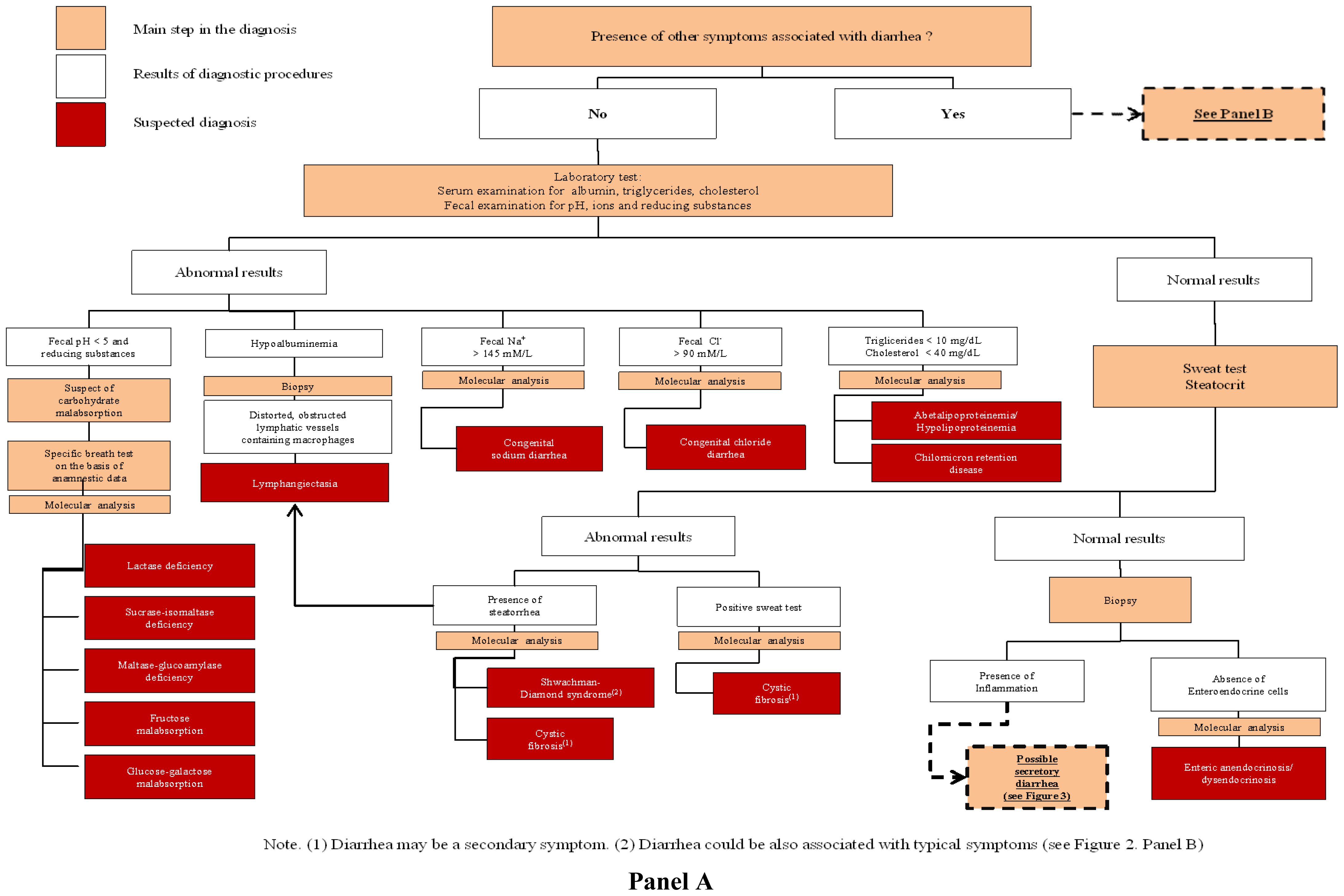
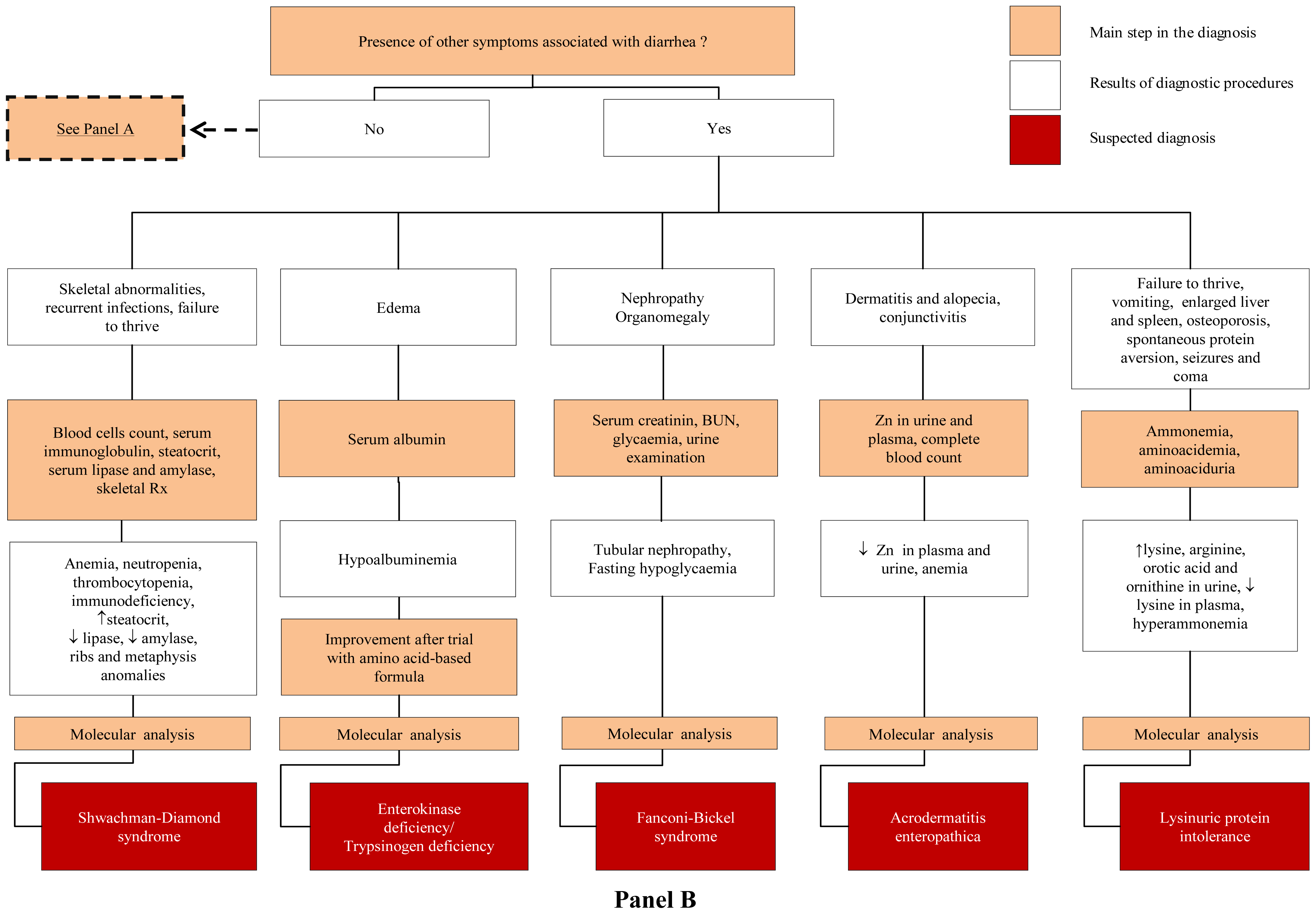
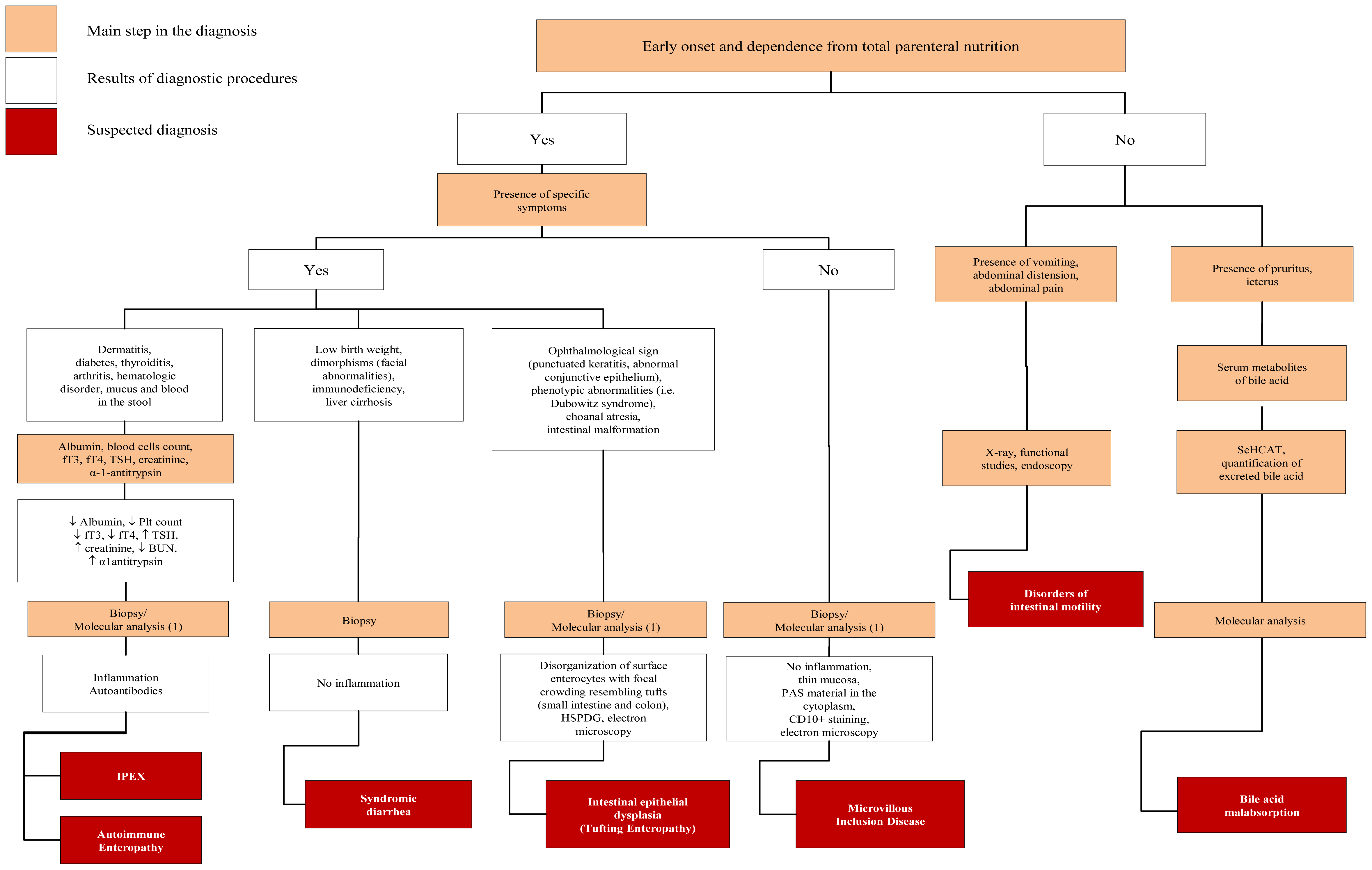
<p>The diagnostic approach to CDDs is a multistep process that includes the careful evaluation of the anamnesis and clinical data, results of common laboratory and instrumental procedures and molecular analysis (<xref ref-type="fig" rid="f1-ijms-13-04168">Figures 1</xref>–<xref ref-type="fig" rid="f3-ijms-13-04168">3</xref>). Positive familiar history of early onset chronic diarrhea, polyhydramnios and/or dilated bowel loops at ultrasound examination during pregnancy are highly suggestive of CDDs. Frequently CDDs dates to early neonatal period [<xref ref-type="bibr" rid="b2-ijms-13-04168">2</xref>,<xref ref-type="bibr" rid="b3-ijms-13-04168">3</xref>]. However in the approach to a newborn or infant with suspected CDDs it is important to remember that also at this particular age, infections and food allergy are frequent causes of chronic diarrhea [<xref ref-type="bibr" rid="b6-ijms-13-04168">6</xref>], and that these conditions together with malformations of gastrointestinal tract should be considered as primary hypothesis [<xref ref-type="bibr" rid="b2-ijms-13-04168">2</xref>,<xref ref-type="bibr" rid="b3-ijms-13-04168">3</xref>].</p>
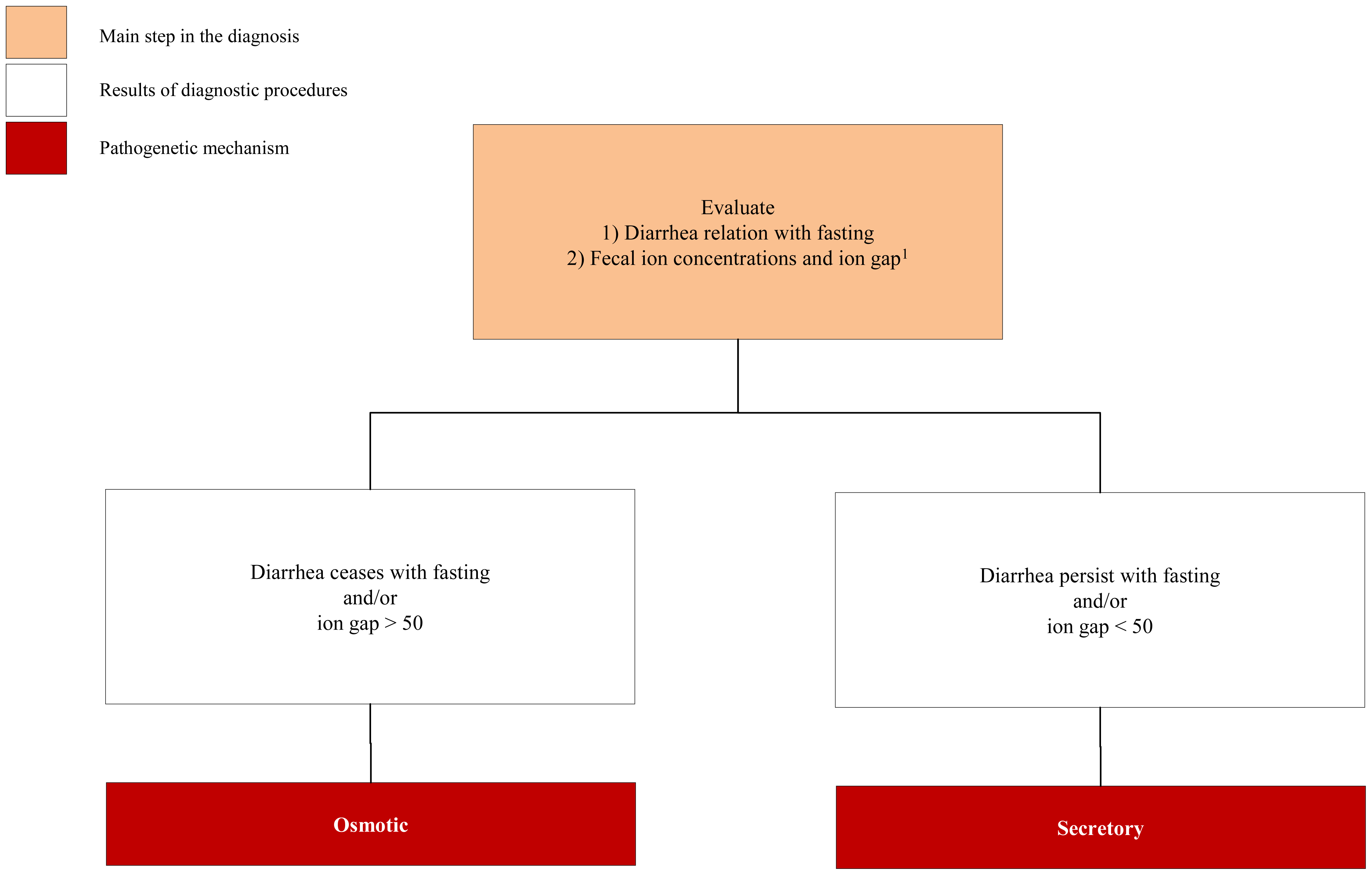
<p>Once suspected, the fundamental step in the diagnostic process of CDDs is the identification of an osmotic or secretory mechanism leading to diarrhea (<xref ref-type="fig" rid="f1-ijms-13-04168">Figure 1</xref>). In osmotic diarrhea unabsorbed luminal substances are responsible for accumulation of fluids in intestinal lumen and diarrhea significantly improves during fasting, whereas in secretory diarrhea fluids are actively secreted in the intestinal lumen and diarrhea continues during fasting [<xref ref-type="bibr" rid="b12-ijms-13-04168">12</xref>]. Furthermore, the determination of stool electrolyte concentration and fecal ion gap are important to discriminate the two mechanisms responsible of CDDs (<xref ref-type="fig" rid="f1-ijms-13-04168">Figure 1</xref>).</p>
<p>If ion gap is &gt;50 fecal osmolarity derived from ingested osmotically active nutrient or non measured ion (<italic>i.e.</italic>, Cl<sup>−</sup>, Mg<sup>2+</sup>). In contrast a low osmotic gap (&lt;50) is typically observed in secretory diarrhea. It is also important to measure Cl<sup>−</sup> concentration in the stool to rule out CCD, characterized by low ion gap due to high Cl<sup>−</sup> fecal loss (&gt;90 mmol/L) [<xref ref-type="bibr" rid="b13-ijms-13-04168">13</xref>]. When an osmotic mechanism is suspected the next step of laboratory investigation includes blood gas, blood glucose, ammonium, albumin, triglycerides and cholesterol, aminoaciduria and the search of reducing substances in the stools, steatocrit and sweat test (<xref ref-type="fig" rid="f2-ijms-13-04168">Figure 2</xref>). Finally, intestinal biopsy with hystologic examination is crucial for the diagnosis of most CDDs, more frequently for secretory forms; even if molecular analysis, when available, could limit invasive procedures (<xref ref-type="fig" rid="f2-ijms-13-04168">Figures 2</xref> and <xref ref-type="fig" rid="f3-ijms-13-04168">3</xref>).</p>
<sec>
<title>3.1. Congenital Osmotic Diarrheal Disorders</title>
<p>The main conditions included in this subgroup are characterized by carbohydrate malabsorption with subsequent bacteria fermentation and increased lactic acid concentration in stools [<xref ref-type="bibr" rid="b14-ijms-13-04168">14</xref>]. The detection of fecal reducing substances by Clinitest (normal value &lt; 0.5%) may suggest carbohydrate malabsorption. A stool pH between 5 and 6 is indicative but, finally, unreliable screening test for the diagnosis of sugar malabsorption. Breath test and diet trials are used to address clinical suspect. Small bowel disaccharidase activity measurement on intestinal biopsy could be avoided especially when molecular analysis is available (<xref ref-type="fig" rid="f2-ijms-13-04168">Figure 2</xref>). In the absence of carbohydrate malabsorption in a patient with osmotic diarrhea, it is essential to determine if steatorrhea is present. Although diarrhea alone may be responsible for an increase fat excretion, and generalized malabsorptive diseases may induce steatorrhea, greater rates of fat malabsorption can be explained only by one or more defects in fat digestion and absorption [<xref ref-type="bibr" rid="b2-ijms-13-04168">2</xref>,<xref ref-type="bibr" rid="b3-ijms-13-04168">3</xref>]. Fat malabsorption can be divided into three broad categories: intraluminal maldigestion (pancreatic insufficiency), mucosal malabsorption, and post-mucosal malabsorption related to lymphatic obstruction [<xref ref-type="bibr" rid="b15-ijms-13-04168">15</xref>,<xref ref-type="bibr" rid="b16-ijms-13-04168">16</xref>].</p>
<p>Low triglycerides and cholesterol serum levels are typically observed in children with a- or hypo-betalipoproteinemia (ALP/HLP). Biopsy is useful to confirm diagnosis of ALP/HLP. However, molecular diagnosis may be used at this point of diagnostic work up to avoid invasive procedures. Bile salts are particularly important in lipids digestion and absorption. However, in primary bile acid malabsorption (PBAM) diarrhea is generally secretory in nature (persist while fasting) and is exacerbated by the addition of dietary fats (see also <xref ref-type="fig" rid="f3-ijms-13-04168">Figure 3</xref>). Among osmothic CDDs, the onset of symptoms after ingestion of specific food or the presence of extraintestinal symptoms could help the diagnosis. Fructose malabsorption should be suspected when consumption of fruit juices that contain a high proportion of fructose to glucose or an excessive amount of the non-absorbable carbohydrate sorbitol are associated with diarrhea and abdominal pain [<xref ref-type="bibr" rid="b17-ijms-13-04168">17</xref>]. Disorders of protein digestion are unusual but should be considered when evaluating a patient with suspected CDDs. The best characterized disorder of specific protein malabsorption is the enterokinase deficiency (EKD) [<xref ref-type="bibr" rid="b18-ijms-13-04168">18</xref>]. Individuals with EKD present diarrhea and hypoproteinemic edema when on diet with intact proteins, while symptoms resolve on an amino acids-based diet. The presence of diarrhea associated with tubular nephropathy, hepatomegaly and abnormal glycogen accumulation, and fasting hypoglycemia suggest the presence of Fanconi-Bickel Syndrome (FBS) [<xref ref-type="bibr" rid="b19-ijms-13-04168">19</xref>]. The vesciculus bullous dermatitis, located on the hands, feet, perirectal and oral region, and alopecia are a consequence of Zn<sup>2+</sup> deficiency that could be due to excessive fecal losses of Zn<sup>2+</sup> observed in acrodermatitis enteropathica (ADE) [<xref ref-type="bibr" rid="b20-ijms-13-04168">20</xref>]. Severe Zn<sup>2+</sup> deficiency can present also with anorexia, failure to thrive, immunodeficiency and neurologic features (mental lethargy and neurosensory abnormalities) associated with chronic diarrhea. A particular form of osmotic diarrhea genetically determined is the enteric anendocrinosis (or congenital malabsorptive diarrhea, CMD) [<xref ref-type="bibr" rid="b21-ijms-13-04168">21</xref>]. The salient pathological fact is that the mucosa of the small intestine is essentially normal, except for the absence of enteroendocrine cells and of the enteric hormones. The number of patients described so far is too small to draw reliable conclusions about the typical clinical picture of CMD. However, the diarrhea in this condition is undoubtedly of osmotic nature. While water is well tolerated, glucose-based oral rehydration solution leads to diarrhea and the patients continue to experience diarrhea while on carbohydrate-free cow’s milk or amino-acids based formulas. These infants may be optimally managed with life-long parenteral nutrition and limited enteral nutrition [<xref ref-type="bibr" rid="b21-ijms-13-04168">21</xref>].</p></sec>
<sec>
<title>3.2. Congenital Secretory Diarrheal Disorders</title>
<p>In the approach to the infant presenting with early onset secretive chronic diarrhea intestinal biopsy is generally considered useful to identify the major forms of CDDs included in this subgroup (<italic>i.e.</italic>, enterocytes differentiation and polarization and modulation of intestinal immune response), but also in these cases molecular diagnosis may help to limit invasive approaches (<xref ref-type="fig" rid="f3-ijms-13-04168">Figure 3</xref>). When villous atrophy is not accompanied by an inflammatory infiltrate, defect of enterocyte differentiation and polarization including microvillous inclusion disease (MVID) and congenital tufting enteropathy (CTE) are plausible [<xref ref-type="bibr" rid="b22-ijms-13-04168">22</xref>]. For MVID and CTE, pregnancy and delivery are uneventful, and polyhydramnios is unusual. In these conditions severe diarrhea occurs within the first weeks of life and rapidly requires total parenteral nutrition. Several cases of CTE have been reported as being associated with phenotypic abnormalities including dysmorphic facial features, choanal atresia, esophageal atresia, and keratitis. Molecular diagnosis may be an option to avoid radiological exposure [<xref ref-type="bibr" rid="b2-ijms-13-04168">2</xref>,<xref ref-type="bibr" rid="b3-ijms-13-04168">3</xref>]. Immune dysfunction, polyendocrinopathy X-linked syndrome (IPEX) appears as a secretory diarrhea of inflammatory nature associated with dermatitis, diabetes mellitus, thyroiditis, and hematologic disorders [<xref ref-type="bibr" rid="b23-ijms-13-04168">23</xref>–<xref ref-type="bibr" rid="b25-ijms-13-04168">25</xref>]. Most patients develop a protein-loosing enteropathy with α-1-antitrypsin loss in stools, and hypoalbuminemia [<xref ref-type="bibr" rid="b2-ijms-13-04168">2</xref>]. Diarrhea often starts within 3 months of life; however a later onset has occasionally been described [<xref ref-type="bibr" rid="b3-ijms-13-04168">3</xref>].</p></sec></sec>
<sec>
<title>4. Genetic Basis of CDDs</title>
<p>Most CDDs are transmitted as an autosomal recessive trait even if with some exceptions. Below, we report the main genetic characteristics of the 4 groups of CDDs.</p>
<sec>
<title>4.1. Defects of Digestion, Absorption and Transport of Nutrients and Electrolytes</title>
<p>This group can be further divided in various subgroups on the basis of the specific gene defect. The first subgroup includes the deficiency of brush border enzymes, and in particular congenital LD due to mutations within the gene encoding the protein with either lactase and phlorizin hydrolase activities [<xref ref-type="bibr" rid="b26-ijms-13-04168">26</xref>]; congenital SID, due to mutations in the gene encoding the protein with both sucrase and isomaltase activity [<xref ref-type="bibr" rid="b8-ijms-13-04168">8</xref>], and congenital maltase-glucoamylase deficiency (MGD), putatively due to the maltase-glucoamylase (MGAM) gene defect [<xref ref-type="bibr" rid="b8-ijms-13-04168">8</xref>], even if some patients with the disease do not bear pathogenetic mutations in such gene. In fact, cases in which MGD was associated to the deficiency of other brush border enzymes were described, and it has been postulated that a pleiotropic regulator factor of such genes may be impaired in these patients [<xref ref-type="bibr" rid="b27-ijms-13-04168">27</xref>].</p>
<p>A large subgroup derives from mutations of genes encoding members of the super-family of solute carriers (SLC). These genes are structurally related and originated by mechanisms of duplication, but despite the homology of the gene sequence and the similarity of the protein architecture, the clinical picture and the outcome of these CDDs is heterogeneous. Most proteins encoded by SLC genes are expressed at intestinal level, thus the disease typically appears with diarrhea and selective malabsorption. In other cases the carrier is expressed also in other organs (<italic>i.e.</italic>, the aminoacid transporter involved in LPI is expressed also in other tissues) and thus the disease could involves other organs or be systemic [<xref ref-type="bibr" rid="b7-ijms-13-04168">7</xref>]. For some CDDs disease-genes are still unknown or more genes may be involved. For example, the disease gene for fructose malabsorption is still undefined [<xref ref-type="bibr" rid="b8-ijms-13-04168">8</xref>,<xref ref-type="bibr" rid="b17-ijms-13-04168">17</xref>,<xref ref-type="bibr" rid="b28-ijms-13-04168">28</xref>]. There remains insufficient evidence that glucose transporter (GLUT) 5 represents the main fructose facilitative carrier in the intestine [<xref ref-type="bibr" rid="b17-ijms-13-04168">17</xref>,<xref ref-type="bibr" rid="b28-ijms-13-04168">28</xref>]. Recent studies have identified GLUT7 as a high affinity glucose and fructose carrier on the brush border membrane of the enterocyte located in the distal intestine. Other studies suggest also a role of GLUT2 in the absorption of large amount of fructose across the enterocyte of the rats. In particular, the disease-gene for congenital sodium diarrhea (CSD) is unknown [<xref ref-type="bibr" rid="b3-ijms-13-04168">3</xref>], and a study based on the candidate gene approach failed to identify the responsible among the 6 known isoforms of sodium-proton exchangers (NHE) 1 to 6. However, in addition to classic CSD characterized by perinatal onset of severe diarrhea there is a syndromic form of the disease. The disease gene of the syndromic CSD is serine protease inhibitor (SPINT) 2 [<xref ref-type="bibr" rid="b29-ijms-13-04168">29</xref>], which encodes a serine-protease inhibitor, recently identified using genome-wide single nucleotide polymorphism (SNP) linkage analysis in a large family. Mutations of the gene were identified in all other four syndromic patients studied. On the contrary, no mutations were identified in patients bearing the classic form of the disease [<xref ref-type="bibr" rid="b29-ijms-13-04168">29</xref>,<xref ref-type="bibr" rid="b30-ijms-13-04168">30</xref>]. A third subgroup involves genes encoding specific enzymes like the congenital absence of pancreatic lipase (APL) [<xref ref-type="bibr" rid="b31-ijms-13-04168">31</xref>], that is a rare disease associated to malabsorption, steatorrhea and severe diarrhea. Also included in this group are hereditary pancreatitis (HP) [<xref ref-type="bibr" rid="b32-ijms-13-04168">32</xref>]. However, it could be important to underline that some cases of chronic hereditary pancreatitis derive from mutations in the cystic fibrosis transmembrane regulator (CFTR) gene [<xref ref-type="bibr" rid="b33-ijms-13-04168">33</xref>].</p>
<p>A fourth subgroup of rare and congenital disorders of lipoprotein metabolism can appear with chronic diarrhea. Familial ALP is due to mutations in microsomal triglyceride transfer protein (MTTP) gene which encodes the MTT protein involved in the synthesis of beta lipoproteins [<xref ref-type="bibr" rid="b34-ijms-13-04168">34</xref>,<xref ref-type="bibr" rid="b35-ijms-13-04168">35</xref>]. Familial HLP is a relatively mild disease that may appear with chronic diarrhea and fatty liver [<xref ref-type="bibr" rid="b36-ijms-13-04168">36</xref>]. It depends on co-dominant mutations in the ApoB gene, but in some cases a linkage to chromosome 3 (3p21) was found [<xref ref-type="bibr" rid="b37-ijms-13-04168">37</xref>].</p>
<p>The last subgroup includes CDDs deriving from mutations of genes encoding ribosomial proteins. The SDS is a systemic disease due to mutations in the SBDS gene that encodes a protein whose function is still largely obscure [<xref ref-type="bibr" rid="b38-ijms-13-04168">38</xref>,<xref ref-type="bibr" rid="b39-ijms-13-04168">39</xref>]. Most of these mutations cause exchange of genetic material (gene conversion) between SBDS and a close pseudogene.</p></sec>
<sec>
<title>4.2. Defect of Enterocyte Differentiation and Polarization</title>
<p>CDDs due to defects of enterocyte differentiation and polarization include three rare and severe forms. Congenital microvillous inclusion disease (MVID, DIAR2) is one of the most frequent cause of CDDs in neonates [<xref ref-type="bibr" rid="b40-ijms-13-04168">40</xref>]. The disease is due to a loss of function of Myosin5B, a protein involved in the recycling of endosomes, encoded by the MYO5B gene. Molecular analysis can be performed, thus reducing the need of invasive approaches and electronic microscopy [<xref ref-type="bibr" rid="b4-ijms-13-04168">4</xref>,<xref ref-type="bibr" rid="b40-ijms-13-04168">40</xref>], but some MVID patients have been described with one or none mutations in such gene [<xref ref-type="bibr" rid="b4-ijms-13-04168">4</xref>,<xref ref-type="bibr" rid="b40-ijms-13-04168">40</xref>]. Congenital tufting enteropathy is a rare, early onset (first days after birth), diarrheal disease [<xref ref-type="bibr" rid="b41-ijms-13-04168">41</xref>], due to mutations in the gene encoding the epithelial cellular adhesion molecule (EpCAM). The reduced activity of such protein causes the lack of lateral interactions and desmosomal alterations typical of CTE. Also in such disease, the availability of molecular analysis reduced the need of invasive approaches and of electronic microscopy. Finally, the Tricho-Hepato-Enteric (THE) syndrome, is a rare and poorly tractable chronic diarrhea associated to facial dysmorphism and immunological alterations [<xref ref-type="bibr" rid="b42-ijms-13-04168">42</xref>]. In addition to this, for such diseases, molecular analysis will help to obtain unambiguous and rapid diagnosis, thus reducing the need for invasive approaches (<xref ref-type="fig" rid="f2-ijms-13-04168">Figure 2</xref>).</p></sec>
<sec>
<title>4.3. Defects of Enteroendocrine Cells Differentiation</title>
<p>This group includes CMD (DIAR4) and proprotein convertase 1/3 deficiency (PCD). The CMD is very uncommon [<xref ref-type="bibr" rid="b43-ijms-13-04168">43</xref>]; it appears with a very severe diarrhea since the first days of life and is characterized by the dysgenesis of enteroendocrine cells (the first name of the disease was enteric anendocrinosis). In some CMD patients molecular analysis revealed mutations in the NEUROG 3 gene that encodes neurogenin 3, a transcriptional factor strongly expressed in endocrine cells and necessary for the development of such cells at intestinal and pancreatic level. CMD patients may develop early onset diabetes [<xref ref-type="bibr" rid="b44-ijms-13-04168">44</xref>,<xref ref-type="bibr" rid="b45-ijms-13-04168">45</xref>]. Going to PCD, the few cases reported so far had a different age at onset and severity of the disease, which usually appears with small intestine dysfunction and a variable polyendocrinopathy. The disease is due to mutations in the proprotein convertase 1/3 (PCD) gene that encodes a hormone processing enzyme [<xref ref-type="bibr" rid="b46-ijms-13-04168">46</xref>].</p></sec>
<sec>
<title>4.4. Defects of Modulation of Intestinal Immune Response</title>
<p>Defects of the modulation of the intestinal immune response includes some well codified entities like IPEX and APS1, and the not well defined IPEX-like syndrome. The IPEX syndrome, a rare X-linked disease, bears to the group of autoimmune polyglandular syndromes and is also known with a long series of acronyms [<xref ref-type="bibr" rid="b47-ijms-13-04168">47</xref>,<xref ref-type="bibr" rid="b48-ijms-13-04168">48</xref>]. The disease gene (<italic>i.e.</italic>, FOXP3) encodes a protein involved in embryonic development. Molecular analysis contributes to diagnosis, and has been used also for prenatal diagnosis [<xref ref-type="bibr" rid="b49-ijms-13-04168">49</xref>], but about one third of symptomatic patients are negative to molecular analysis (they are now indicated as IPEX-like syndrome, see below). APS1 is another of the three codified autoimmune polyglandular syndromes with an autosomal recessive inheritance (even if a family with a dominant transmission was described) [<xref ref-type="bibr" rid="b47-ijms-13-04168">47</xref>]. APS1 may be easily diagnosed searching for mutations in the autoimmune regulator (AIRE) gene encoding an autoimmune regulator (AIRE) protein [<xref ref-type="bibr" rid="b50-ijms-13-04168">50</xref>,<xref ref-type="bibr" rid="b51-ijms-13-04168">51</xref>]. To be noted that quite all affected patients have anti-interferon antibodies in serum. Finally, the IPEX-like syndrome (not X-linked despite the name) is a not well-defined disease, which includes patients with IPEX symptoms with no mutations in FOXP3 gene. In one of these patients a deficiency of CD25 due to a recessive mutation in the interleukin-2 (IL-2) receptor subunit CD25 was found [<xref ref-type="bibr" rid="b52-ijms-13-04168">52</xref>].</p></sec></sec>
<sec>
<title>5. Molecular Diagnosis</title>
<p>In the majority of cases genes responsible for CDDs are not particularly large. This permit to use scanning techniques like the gene sequencing for molecular analysis, in order to reduce diagnostic errors. Furthermore, some CDDs in specific ethnic groups are caused by a single mutation due to the founder effect, while the same diseases in other ethnic groups may be due to myriad of different mutations. Among all the diseases listed in the <xref ref-type="table" rid="t1-ijms-13-04168">Tables 1</xref>–<xref ref-type="table" rid="t4-ijms-13-04168">4</xref> only in a few cases molecular diagnosis cannot be routinely performed. They include: (i) congenital MGD, because no mutations have been identified so far in the putative disease gene MGAM in affected patients, suggesting that the disease may depend on other regulatory genes [<xref ref-type="bibr" rid="b27-ijms-13-04168">27</xref>]; (ii) FM, in which more genes encoding fructose carriers may be involved [<xref ref-type="bibr" rid="b17-ijms-13-04168">17</xref>]; (iii) CSD, in which only syndromic forms have mutations in the SPINT2 gene [<xref ref-type="bibr" rid="b38-ijms-13-04168">38</xref>]; (iv) IPEX-like syndrome, for which the disease gene is still unknown even if a single patient had a mutation in the CD25 encoding gene [<xref ref-type="bibr" rid="b52-ijms-13-04168">52</xref>]. In some CDDs like GGM, IPEX, CF [<xref ref-type="bibr" rid="b49-ijms-13-04168">49</xref>,<xref ref-type="bibr" rid="b53-ijms-13-04168">53</xref>] molecular analysis has been used for prenatal diagnosis. Given the severe outcome of most CDDs, and the availability of efficient techniques for gene scanning analysis, the request for prenatal diagnosis will increase in the next future. It is important that prenatal diagnosis would be associated to a careful multidisciplinary counseling to the families [<xref ref-type="bibr" rid="b54-ijms-13-04168">54</xref>].</p></sec>
<sec sec-type="conclusions">
<title>6. Conclusions</title>
<p>During the last decade we have observed an impressive improvement in the field of CDDs, in terms of pathogenesis knowledge and in the field of diagnostic approaches. Molecular analysis has changed the diagnostic scenario in CDDs, and lead to reduction of invasive and expensive procedures (<xref ref-type="fig" rid="f2-ijms-13-04168">Figures 2</xref> and <xref ref-type="fig" rid="f3-ijms-13-04168">3</xref>). However, some critical points warrant a comment: (i) molecular analysis would be based on scanning procedures [<xref ref-type="bibr" rid="b55-ijms-13-04168">55</xref>], including the search for large gene deletions [<xref ref-type="bibr" rid="b56-ijms-13-04168">56</xref>], using adequate quality control programs [<xref ref-type="bibr" rid="b57-ijms-13-04168">57</xref>] and well trained technologists; (ii) the laboratory must be able to perform functional analysis of novel mutations to demonstrate their pathogenic role; (iii) the negative result of molecular analysis does not exclude the disease, because mutations may involve non-coding, regulatory areas; high throughput sequencing could help to perform extensive analyses [<xref ref-type="bibr" rid="b55-ijms-13-04168">55</xref>]; however, also if the mutation is not known, carrier and prenatal diagnosis may be performed using linkage analysis [<xref ref-type="bibr" rid="b58-ijms-13-04168">58</xref>]; (iv) some CDDs are very rare; it is necessary that laboratories offer molecular diagnosis also for such “orphan” diseases. All these considerations permit to conclude that a few number of reference laboratories involved in molecular diagnostics for CDDs should be organized in international networks. However, given the number of CDDs, the complexity of genotype-phenotype correlations and the need of multidisciplinary counseling to the families, a strict collaboration between physicians and molecular laboratories is mandatory in this field.</p></sec></body>
<back>
<ack>
<title>Acknowledgements</title>
<p>Regione Campania (DGRC 1901/09) and AIFA (FARM6FJ728) are gratefully acknowledged because of support to the study of congenital diarrheal disorders.</p></ack>
<glossary>
<title>Abbreviations</title>
<def-list>
<def-item>
<term id="G1">ADE</term>
<def>
<p>acrodermatitis enteropathica</p></def></def-item>
<def-item>
<term id="G2">AIRE</term>
<def>
<p>autoimmune regulator</p></def></def-item>
<def-item>
<term id="G3">ALP</term>
<def>
<p>abetalipoprotenemia</p></def></def-item>
<def-item>
<term id="G4">APL</term>
<def>
<p>absence of pancreatic lipase</p></def></def-item>
<def-item>
<term id="G5">APS1</term>
<def>
<p>autoimmune polyglandular syndrome type 1</p></def></def-item>
<def-item>
<term id="G6">CCD</term>
<def>
<p>congenital chloride diarrhea</p></def></def-item>
<def-item>
<term id="G7">CDD</term>
<def>
<p>congenital diarrheal disorders</p></def></def-item>
<def-item>
<term id="G8">CF</term>
<def>
<p>cystic fibrosis</p></def></def-item>
<def-item>
<term id="G9">CFTR</term>
<def>
<p>cystic fibrosis transmembrane regulator</p></def></def-item>
<def-item>
<term id="G10">CMD</term>
<def>
<p>congenital malabsorptive diarrhea</p></def></def-item>
<def-item>
<term id="G11">CRD</term>
<def>
<p>chilomicron retention disease</p></def></def-item>
<def-item>
<term id="G12">CSD</term>
<def>
<p>congenital sodium diarrhea</p></def></def-item>
<def-item>
<term id="G13">CTE</term>
<def>
<p>congenital tufting enteropathy</p></def></def-item>
<def-item>
<term id="G14">EpCAM</term>
<def>
<p>epithelial cellular adhesion molecule</p></def></def-item>
<def-item>
<term id="G15">EKD</term>
<def>
<p>enterokinase deficiency</p></def></def-item>
<def-item>
<term id="G16">FBS</term>
<def>
<p>Fanconi-Bickel syndrome</p></def></def-item>
<def-item>
<term id="G17">FM</term>
<def>
<p>fructose malabsorption</p></def></def-item>
<def-item>
<term id="G18">GGM</term>
<def>
<p>glucose-galactose malabsorption</p></def></def-item>
<def-item>
<term id="G19">GLUT</term>
<def>
<p>glucose transporter</p></def></def-item>
<def-item>
<term id="G20">HLP</term>
<def>
<p>hypobetalipoproteinemia</p></def></def-item>
<def-item>
<term id="G21">HP</term>
<def>
<p>hereditary pancreatitis</p></def></def-item>
<def-item>
<term id="G22">IPEX</term>
<def>
<p>immune dysfunction, polyendocrinopathy, X-linked</p></def></def-item>
<def-item>
<term id="G23">LD</term>
<def>
<p>lactase deficiency</p></def></def-item>
<def-item>
<term id="G24">LPI</term>
<def>
<p>lysinuric protein intolerance</p></def></def-item>
<def-item>
<term id="G25">MTTP</term>
<def>
<p>microsomal triglyceride transfer protein</p></def></def-item>
<def-item>
<term id="G26">MVID</term>
<def>
<p>microvillous inclusion disease</p></def></def-item>
<def-item>
<term id="G27">MGD</term>
<def>
<p>maltase-glucoamylase deficiency</p></def></def-item>
<def-item>
<term id="G28">MGAM</term>
<def>
<p>maltase-glucoamylase (gene and protein)</p></def></def-item>
<def-item>
<term id="G29">NHE</term>
<def>
<p>sodium-proton exchanger</p></def></def-item>
<def-item>
<term id="G30">PBAM</term>
<def>
<p>primary bile acid malabsorption</p></def></def-item>
<def-item>
<term id="G31">PCD</term>
<def>
<p>proprotein convertase 1/3 deficiency</p></def></def-item>
<def-item>
<term id="G32">SDS</term>
<def>
<p>Shwachman-Diamond syndrome</p></def></def-item>
<def-item>
<term id="G33">SID</term>
<def>
<p>sucrase-isomaltase deficiency</p></def></def-item>
<def-item>
<term id="G34">SLC</term>
<def>
<p>solute carrier</p></def></def-item>
<def-item>
<term id="G35">SNP</term>
<def>
<p>single nucleotide polymorphism</p></def></def-item>
<def-item>
<term id="G36">SPINT</term>
<def>
<p>serine protease inhibitor</p></def></def-item>
<def-item>
<term id="G37">THE</term>
<def>
<p>Tricho-Hepato-Enteric syndrome</p></def></def-item></def-list></glossary>
<fn-group><fn id="fn1-ijms-13-04168">
<p><bold>List of Gene Designations</bold>: AIRE; CFTR; EpCAM; FOXP3; Interleukin-2 receptor (subunit CD25); MGAM; MTTP; MYO5B; NEUROG3; NHE; PCD; SBDS; SLC2A2; SLC5A1; SLC7A7; SLC10A2; SLC26A3; SLC39A4; SPINT2</p></fn><fn id="fn2-ijms-13-04168">
<p><bold>Financial Disclosure</bold></p>
<p>This work was not sponsored by any organization.</p></fn></fn-group>
<ref-list>
<title>References</title>
<ref id="b1-ijms-13-04168"><label>1</label><citation citation-type="journal"><person-group person-group-type="author"><name><surname>Guarino</surname><given-names>A.</given-names></name><name><surname>Spagnuolo</surname><given-names>M.I.</given-names></name><name><surname>Russo</surname><given-names>S.</given-names></name><name><surname>Albano</surname><given-names>F.</given-names></name><name><surname>Guandalini</surname><given-names>S.</given-names></name><name><surname>Capano</surname><given-names>G.</given-names></name><name><surname>Cucchiara</surname><given-names>S.</given-names></name><name><surname>Vairano</surname><given-names>P.</given-names></name><name><surname>Liguori</surname><given-names>R.</given-names></name><name><surname>Casola</surname><given-names>A.</given-names></name><etal/></person-group><article-title>Etiology and risk factors of severe and protracted diarrhea</article-title><source>J. Pediatr. Gastroenterol. Nutr</source><year>1995</year><volume>20</volume><fpage>173</fpage><lpage>178</lpage><pub-id pub-id-type="doi">10.1097/00005176-199502000-00006</pub-id><pub-id pub-id-type="pmid">7714682</pub-id></citation></ref>
<ref id="b2-ijms-13-04168"><label>2</label><citation citation-type="book"><person-group person-group-type="author"><name><surname>Berni Canani</surname><given-names>R.</given-names></name><name><surname>Cirillo</surname><given-names>P.</given-names></name><name><surname>Terrin</surname><given-names>G</given-names></name></person-group><article-title>Chronic and Intractabile Diarrhea</article-title><source>Essential Pediatric Gastroenterology Hepatology and Nutrition</source><person-group person-group-type="editor"><name><surname>Guandalini</surname><given-names>S.</given-names></name></person-group><publisher-name>McGraw-Hill</publisher-name><publisher-loc>Chicago, IL, USA</publisher-loc><year>2005</year><fpage>25</fpage><lpage>47</lpage></citation></ref>
<ref id="b3-ijms-13-04168"><label>3</label><citation citation-type="journal"><person-group person-group-type="author"><name><surname>Berni Canani</surname><given-names>R.</given-names></name><name><surname>Terrin</surname><given-names>G.</given-names></name><name><surname>Cardillo</surname><given-names>G.</given-names></name><name><surname>Tomaiuolo</surname><given-names>R.</given-names></name><name><surname>Castaldo</surname><given-names>G.</given-names></name></person-group><article-title>Congenital diarrheal disorders: Improved understanding of gene defects is leading to advances in intestinal physiology and clinical management</article-title><source>J. Pediatr. Gastroenterol. Nutr</source><year>2010</year><volume>50</volume><fpage>360</fpage><lpage>366</lpage><pub-id pub-id-type="pmid">20216094</pub-id></citation></ref>
<ref id="b4-ijms-13-04168"><label>4</label><citation citation-type="journal"><person-group person-group-type="author"><name><surname>Ruemmele</surname><given-names>F.M.</given-names></name></person-group><article-title>Chronic enteropathy: Molecular basis</article-title><source>Nestle Nutr. Workshop Ser. Pediatr. Program</source><year>2007</year><volume>59</volume><fpage>73</fpage><lpage>85</lpage><pub-id pub-id-type="pmid">17245092</pub-id></citation></ref>
<ref id="b5-ijms-13-04168"><label>5</label><citation citation-type="journal"><person-group person-group-type="author"><name><surname>Tomaiuolo</surname><given-names>R.</given-names></name><name><surname>Spina</surname><given-names>M.</given-names></name><name><surname>Castaldo</surname><given-names>G.</given-names></name></person-group><article-title>Molecular diagnosis of Cystic Fibrosis: Comparison of four analytical procedures</article-title><source>Clin. Chem. Lab. Med</source><year>2003</year><volume>41</volume><fpage>26</fpage><lpage>32</lpage><pub-id pub-id-type="pmid">12636046</pub-id></citation></ref>
<ref id="b6-ijms-13-04168"><label>6</label><citation citation-type="journal"><person-group person-group-type="author"><name><surname>Passariello</surname><given-names>A.</given-names></name><name><surname>Terrin</surname><given-names>G.</given-names></name><name><surname>Baldassarre</surname><given-names>M.E.</given-names></name><name><surname>de Curtis</surname><given-names>M.</given-names></name><name><surname>Paludetto</surname><given-names>R.</given-names></name><name><surname>Berni Canani</surname><given-names>R.</given-names></name></person-group><article-title>Diarrhea in neonatal intensive care unit</article-title><source>World J. Gastroenterol</source><year>2010</year><volume>16</volume><fpage>2664</fpage><lpage>2668</lpage><pub-id pub-id-type="doi">10.3748/wjg.v16.i21.2664</pub-id><pub-id pub-id-type="pmid">20518089</pub-id></citation></ref>
<ref id="b7-ijms-13-04168"><label>7</label><citation citation-type="journal"><person-group person-group-type="author"><name><surname>Sebastio</surname><given-names>G.</given-names></name><name><surname>Sperandeo</surname><given-names>M.P.</given-names></name><name><surname>Andria</surname><given-names>G.</given-names></name></person-group><article-title>Lysinuric protein intolerance: Reviewing concepts on a multisystem disease</article-title><source>Am. J. Med. Genet. C</source><year>2011</year><volume>157</volume><fpage>54</fpage><lpage>62</lpage><pub-id pub-id-type="doi">10.1002/ajmg.c.30287</pub-id></citation></ref>
<ref id="b8-ijms-13-04168"><label>8</label><citation citation-type="journal"><person-group person-group-type="author"><name><surname>Swallow</surname><given-names>D.M.</given-names></name><name><surname>Poulter</surname><given-names>M.</given-names></name><name><surname>Hollox</surname><given-names>E.J.</given-names></name></person-group><article-title>Intolerance to lactose and other dietary sugars</article-title><source>Drug Metab. Dispos</source><year>2001</year><volume>29</volume><fpage>513</fpage><lpage>516</lpage><pub-id pub-id-type="pmid">11259342</pub-id></citation></ref>
<ref id="b9-ijms-13-04168"><label>9</label><citation citation-type="journal"><person-group person-group-type="author"><name><surname>Wedenoja</surname><given-names>S.</given-names></name><name><surname>Pekansaari</surname><given-names>E.</given-names></name><name><surname>Höglund</surname><given-names>P.</given-names></name><name><surname>Mäkelä</surname><given-names>S.</given-names></name><name><surname>Holmberg</surname><given-names>C.</given-names></name><name><surname>Kere</surname><given-names>J.</given-names></name></person-group><article-title>Update on SLC26A3 mutations in congenital chloride diarrhea</article-title><source>Hum. Mutat</source><year>2011</year><volume>32</volume><fpage>715</fpage><lpage>722</lpage><pub-id pub-id-type="doi">10.1002/humu.21498</pub-id><pub-id pub-id-type="pmid">21394828</pub-id></citation></ref>
<ref id="b10-ijms-13-04168"><label>10</label><citation citation-type="journal"><person-group person-group-type="author"><name><surname>Berni Canani</surname><given-names>R.</given-names></name><name><surname>Terrin</surname><given-names>G.</given-names></name><name><surname>Cirillo</surname><given-names>P.</given-names></name><name><surname>Castaldo</surname><given-names>G.</given-names></name><name><surname>Salvatore</surname><given-names>F.</given-names></name><name><surname>Cardillo</surname><given-names>G.</given-names></name><name><surname>Coruzzo</surname><given-names>A.</given-names></name><name><surname>Troncone</surname><given-names>R.</given-names></name></person-group><article-title>Butyrate as an effective treatment of congenital chloride diarrhea</article-title><source>Gastroenterology</source><year>2004</year><volume>127</volume><fpage>630</fpage><lpage>634</lpage><pub-id pub-id-type="doi">10.1053/j.gastro.2004.03.071</pub-id><pub-id pub-id-type="pmid">15300594</pub-id></citation></ref>
<ref id="b11-ijms-13-04168"><label>11</label><citation citation-type="journal"><person-group person-group-type="author"><name><surname>Berni Canani</surname><given-names>R.</given-names></name><name><surname>Terrin</surname><given-names>G.</given-names></name></person-group><article-title>Recent progress in congenital diarrheal disorders</article-title><source>Curr. Gastroenterol. Rep</source><year>2011</year><volume>13</volume><fpage>257</fpage><lpage>264</lpage><pub-id pub-id-type="doi">10.1007/s11894-011-0188-6</pub-id><pub-id pub-id-type="pmid">21494839</pub-id></citation></ref>
<ref id="b12-ijms-13-04168"><label>12</label><citation citation-type="journal"><person-group person-group-type="author"><name><surname>Booth</surname><given-names>I.W.</given-names></name><name><surname>MacNeish</surname><given-names>A.S.</given-names></name></person-group><article-title>Mechanisms of diarrhoea</article-title><source>Baillieres Clin. Gastroenterol</source><year>1993</year><volume>7</volume><fpage>215</fpage><lpage>242</lpage><pub-id pub-id-type="doi">10.1016/0950-3528(93)90041-P</pub-id><pub-id pub-id-type="pmid">8364242</pub-id></citation></ref>
<ref id="b13-ijms-13-04168"><label>13</label><citation citation-type="journal"><person-group person-group-type="author"><name><surname>Wedenoja</surname><given-names>S.</given-names></name><name><surname>Höglund</surname><given-names>P.</given-names></name><name><surname>Holmberg</surname><given-names>C.</given-names></name></person-group><article-title>Review article: The clinical management of congenital chloride diarrhoea</article-title><source>Aliment Pharmacol Ther</source><year>2010</year><volume>31</volume><fpage>477</fpage><lpage>85</lpage><pub-id pub-id-type="doi">10.1111/j.1365-2036.2009.04197.x</pub-id><pub-id pub-id-type="pmid">19912155</pub-id></citation></ref>
<ref id="b14-ijms-13-04168"><label>14</label><citation citation-type="journal"><person-group person-group-type="author"><name><surname>Robayo-Torres</surname><given-names>C.C.</given-names></name><name><surname>Quezada-Calvillo</surname><given-names>R.</given-names></name><name><surname>Nichols</surname><given-names>B.L.</given-names></name></person-group><article-title>Disaccharide digestion: Clinical and molecular aspects</article-title><source>Clin. Gastroenterol. Hepatol</source><year>2006</year><volume>4</volume><fpage>276</fpage><lpage>287</lpage><pub-id pub-id-type="doi">10.1016/j.cgh.2005.12.023</pub-id><pub-id pub-id-type="pmid">16527688</pub-id></citation></ref>
<ref id="b15-ijms-13-04168"><label>15</label><citation citation-type="journal"><person-group person-group-type="author"><name><surname>Morinville</surname><given-names>V.</given-names></name><name><surname>Perrault</surname><given-names>J.</given-names></name></person-group><article-title>Genetic disorders of the pancreas</article-title><source>Gastroenterol. Clin. North Am</source><year>2003</year><volume>32</volume><fpage>763</fpage><lpage>787</lpage><pub-id pub-id-type="doi">10.1016/S0889-8553(03)00053-0</pub-id><pub-id pub-id-type="pmid">14562574</pub-id></citation></ref>
<ref id="b16-ijms-13-04168"><label>16</label><citation citation-type="journal"><person-group person-group-type="author"><name><surname>Marcil</surname><given-names>V.</given-names></name><name><surname>Peretti</surname><given-names>N.</given-names></name><name><surname>Delvin</surname><given-names>E.</given-names></name><name><surname>Levy</surname><given-names>E.</given-names></name></person-group><article-title>Digestive and absorptive processes of lipids</article-title><source>Gastroenterol. Clin. Biol</source><year>2004</year><volume>28</volume><fpage>1257</fpage><lpage>1266</lpage><pub-id pub-id-type="doi">10.1016/S0399-8320(04)95219-0</pub-id><pub-id pub-id-type="pmid">15671937</pub-id></citation></ref>
<ref id="b17-ijms-13-04168"><label>17</label><citation citation-type="journal"><person-group person-group-type="author"><name><surname>Gibson</surname><given-names>P.R.</given-names></name><name><surname>Newnham</surname><given-names>E.</given-names></name><name><surname>Barrett</surname><given-names>J.S.</given-names></name><name><surname>Shepherd</surname><given-names>S.J.</given-names></name><name><surname>Muir</surname><given-names>J.G.</given-names></name></person-group><article-title>Review article: Fructose malabsorption and the bigger picture</article-title><source>Aliment. Pharmacol. Ther</source><year>2007</year><volume>25</volume><fpage>349</fpage><lpage>363</lpage><pub-id pub-id-type="pmid">17217453</pub-id></citation></ref>
<ref id="b18-ijms-13-04168"><label>18</label><citation citation-type="journal"><person-group person-group-type="author"><name><surname>Holzinger</surname><given-names>A.</given-names></name><name><surname>Maier</surname><given-names>E.M.</given-names></name><name><surname>Buck</surname><given-names>C.</given-names></name><name><surname>Mayerhofer</surname><given-names>P.U.</given-names></name><name><surname>Kappler</surname><given-names>M.</given-names></name><name><surname>Haworth</surname><given-names>J.C.</given-names></name><name><surname>Moroz</surname><given-names>S.P.</given-names></name><name><surname>Hadorn</surname><given-names>H.B.</given-names></name><name><surname>Sadler</surname><given-names>J.E.</given-names></name><name><surname>Roscher</surname><given-names>A.A.</given-names></name></person-group><article-title>Mutations in the proenteropeptidase gene are the molecular cause of congenital enteropeptidase deficiency</article-title><source>Am. J. Hum. Genet</source><year>2002</year><volume>70</volume><fpage>20</fpage><lpage>25</lpage><pub-id pub-id-type="doi">10.1086/338456</pub-id><pub-id pub-id-type="pmid">11719902</pub-id></citation></ref>
<ref id="b19-ijms-13-04168"><label>19</label><citation citation-type="journal"><person-group person-group-type="author"><name><surname>Leturque</surname><given-names>A.</given-names></name><name><surname>Brot-Laroche</surname><given-names>E.</given-names></name><name><surname>Le Gall</surname><given-names>M.</given-names></name></person-group><article-title>GLUT2 mutations, translocation, and receptor function in diet sugar managing</article-title><source>Am. J. Physiol. Endocrinol. Metab</source><year>2009</year><volume>296</volume><fpage>E985</fpage><lpage>E992</lpage><pub-id pub-id-type="doi">10.1152/ajpendo.00004.2009</pub-id><pub-id pub-id-type="pmid">19223655</pub-id></citation></ref>
<ref id="b20-ijms-13-04168"><label>20</label><citation citation-type="journal"><person-group person-group-type="author"><name><surname>Schmitt</surname><given-names>S.</given-names></name><name><surname>Kury</surname><given-names>S.</given-names></name><name><surname>Giraud</surname><given-names>M.</given-names></name><name><surname>Dréno</surname><given-names>B.</given-names></name><name><surname>Kharfi</surname><given-names>M.</given-names></name><name><surname>Bézieau</surname><given-names>S.</given-names></name></person-group><article-title>An update on mutations of the SLC39A4 gene in acrodermatitis enteropathica</article-title><source>Hum. Mutat</source><year>2009</year><volume>30</volume><fpage>926</fpage><lpage>933</lpage><pub-id pub-id-type="doi">10.1002/humu.20988</pub-id><pub-id pub-id-type="pmid">19370757</pub-id></citation></ref>
<ref id="b21-ijms-13-04168"><label>21</label><citation citation-type="journal"><person-group person-group-type="author"><name><surname>Wang</surname><given-names>J.</given-names></name><name><surname>Cortina</surname><given-names>G.</given-names></name><name><surname>Wu</surname><given-names>S.V.</given-names></name><name><surname>Tran</surname><given-names>R.</given-names></name><name><surname>Cho</surname><given-names>J.H.</given-names></name><name><surname>Tsai</surname><given-names>M.J.</given-names></name><name><surname>Bailey</surname><given-names>T.J.</given-names></name><name><surname>Jamrich</surname><given-names>M.</given-names></name><name><surname>Ament</surname><given-names>M.E.</given-names></name><name><surname>Treem</surname><given-names>W.R.</given-names></name><etal/></person-group><article-title>Mutant neurogenin-3 in congenital malabsorptive diarrhea</article-title><source>N. Engl. J. Med</source><year>2006</year><volume>355</volume><fpage>270</fpage><lpage>280</lpage><pub-id pub-id-type="doi">10.1056/NEJMoa054288</pub-id><pub-id pub-id-type="pmid">16855267</pub-id></citation></ref>
<ref id="b22-ijms-13-04168"><label>22</label><citation citation-type="journal"><person-group person-group-type="author"><name><surname>Ruemmele</surname><given-names>F.M.</given-names></name><name><surname>Müller</surname><given-names>T.</given-names></name><name><surname>Schiefermeier</surname><given-names>N.</given-names></name><name><surname>Ebner</surname><given-names>H.L.</given-names></name><name><surname>Lechner</surname><given-names>S.</given-names></name><name><surname>Pfaller</surname><given-names>K.</given-names></name><name><surname>Thöni</surname><given-names>C.E.</given-names></name><name><surname>Goulet</surname><given-names>O.</given-names></name><name><surname>Lacaille</surname><given-names>F.</given-names></name><name><surname>Schmitz</surname><given-names>J.</given-names></name><etal/></person-group><article-title>Loss-of-function of MYO5B is the main cause of microvillus inclusion disease: 15 novel mutations and a CaCo-2 RNAi cell model</article-title><source>Hum. Mutat</source><year>2010</year><volume>31</volume><fpage>544</fpage><lpage>551</lpage><pub-id pub-id-type="doi">10.1002/humu.21224</pub-id><pub-id pub-id-type="pmid">20186687</pub-id></citation></ref>
<ref id="b23-ijms-13-04168"><label>23</label><citation citation-type="journal"><person-group person-group-type="author"><name><surname>Bennett</surname><given-names>C.L.</given-names></name><name><surname>Christie</surname><given-names>J.</given-names></name><name><surname>Ramsdell</surname><given-names>F.</given-names></name><name><surname>Brunkow</surname><given-names>M.E.</given-names></name><name><surname>Ferguson</surname><given-names>P.J.</given-names></name><name><surname>Whitesell</surname><given-names>L.</given-names></name><name><surname>Kelly</surname><given-names>T.E.</given-names></name><name><surname>Saulsbury</surname><given-names>F.T.</given-names></name><name><surname>Chance</surname><given-names>P.F.</given-names></name><name><surname>Ochs</surname><given-names>H.D.</given-names></name></person-group><article-title>The immune dysregulation, polyendocrinopathy, enteropathy, X-linked syndrome (IPEX) is caused by mutations of FOXP3</article-title><source>Nat. Genet</source><year>2001</year><volume>27</volume><fpage>20</fpage><lpage>21</lpage><pub-id pub-id-type="doi">10.1038/83713</pub-id><pub-id pub-id-type="pmid">11137993</pub-id></citation></ref>
<ref id="b24-ijms-13-04168"><label>24</label><citation citation-type="journal"><person-group person-group-type="author"><name><surname>Sharma</surname><given-names>R.</given-names></name><name><surname>Ju</surname><given-names>S.T.</given-names></name></person-group><article-title>Genetic control of the inflammatory T-cell response in regulatory T-cell deficient scurfy mice</article-title><source>Clin. Immunol</source><year>2010</year><volume>136</volume><fpage>162</fpage><lpage>169</lpage><pub-id pub-id-type="doi">10.1016/j.clim.2010.04.004</pub-id><pub-id pub-id-type="pmid">20452830</pub-id></citation></ref>
<ref id="b25-ijms-13-04168"><label>25</label><citation citation-type="journal"><person-group person-group-type="author"><name><surname>Montalto</surname><given-names>M.</given-names></name><name><surname>D’Onofrio</surname><given-names>F.</given-names></name><name><surname>Santoro</surname><given-names>L.</given-names></name><name><surname>Gallo</surname><given-names>A.</given-names></name><name><surname>Gasbarrini</surname><given-names>A.</given-names></name><name><surname>Gasbarrini</surname><given-names>G.</given-names></name></person-group><article-title>Autoimmune enteropathy in children and adults</article-title><source>Scand. J. Gastroenterol</source><year>2009</year><volume>44</volume><fpage>1029</fpage><lpage>1036</lpage><pub-id pub-id-type="doi">10.1080/00365520902783691</pub-id><pub-id pub-id-type="pmid">19255930</pub-id></citation></ref>
<ref id="b26-ijms-13-04168"><label>26</label><citation citation-type="journal"><person-group person-group-type="author"><name><surname>Kuokkanen</surname><given-names>M.</given-names></name><name><surname>Kokkonen</surname><given-names>J.</given-names></name><name><surname>Enattah</surname><given-names>N.S.</given-names></name><name><surname>Ylisaukko-Oja</surname><given-names>T.</given-names></name><name><surname>Komu</surname><given-names>H.</given-names></name><name><surname>Varilo</surname><given-names>T.</given-names></name><name><surname>Peltonen</surname><given-names>L.</given-names></name><name><surname>Savilahti</surname><given-names>E.</given-names></name><name><surname>Jarvela</surname><given-names>I.</given-names></name></person-group><article-title>Mutations in the translated region of the lactase gene (LCT) underlie congenital lactase deficiency</article-title><source>Am. J. Hum. Genet</source><year>2006</year><volume>78</volume><fpage>339</fpage><lpage>344</lpage><pub-id pub-id-type="doi">10.1086/500053</pub-id><pub-id pub-id-type="pmid">16400612</pub-id></citation></ref>
<ref id="b27-ijms-13-04168"><label>27</label><citation citation-type="journal"><person-group person-group-type="author"><name><surname>Nichols</surname><given-names>B.L.</given-names></name><name><surname>Avery</surname><given-names>S.E.</given-names></name><name><surname>Karnsakul</surname><given-names>W.</given-names></name><name><surname>Jahoor</surname><given-names>F.</given-names></name><name><surname>Sen</surname><given-names>P.</given-names></name><name><surname>Swallow</surname><given-names>D.M.</given-names></name><name><surname>Luginbuehl</surname><given-names>U.</given-names></name><name><surname>Hahn</surname><given-names>D.</given-names></name><name><surname>Sterchi</surname><given-names>E.E.</given-names></name></person-group><article-title>Congenital maltase-glucoamylase deficiency associated with lactase and sucrase deficiencies</article-title><source>J. Pediatr. Gastroenterol. Nutr</source><year>2002</year><volume>35</volume><fpage>573</fpage><lpage>579</lpage><pub-id pub-id-type="doi">10.1097/00005176-200210000-00022</pub-id><pub-id pub-id-type="pmid">12394387</pub-id></citation></ref>
<ref id="b28-ijms-13-04168"><label>28</label><citation citation-type="journal"><person-group person-group-type="author"><name><surname>Jones</surname><given-names>H.F.</given-names></name><name><surname>Butler</surname><given-names>R.N.</given-names></name><name><surname>Brooks</surname><given-names>D.A.</given-names></name></person-group><article-title>Intestinal fructose transport and malabsorption in humans</article-title><source>Am. J. Physiol. Gastrointest. Liver Physiol</source><year>2011</year><volume>300</volume><fpage>G202</fpage><lpage>G206</lpage><pub-id pub-id-type="doi">10.1152/ajpgi.00457.2010</pub-id><pub-id pub-id-type="pmid">21148401</pub-id></citation></ref>
<ref id="b29-ijms-13-04168"><label>29</label><citation citation-type="journal"><person-group person-group-type="author"><name><surname>Heinz-Erian</surname><given-names>P.</given-names></name><name><surname>Muller</surname><given-names>T.</given-names></name><name><surname>Krabichler</surname><given-names>B.</given-names></name><name><surname>Schranz</surname><given-names>M.</given-names></name><name><surname>Becker</surname><given-names>C.</given-names></name><name><surname>Rüschendorf</surname><given-names>F.</given-names></name><name><surname>Nürnberg</surname><given-names>P.</given-names></name><name><surname>Rossier</surname><given-names>B.</given-names></name><name><surname>Vujic</surname><given-names>M.</given-names></name><name><surname>Booth</surname><given-names>I.W.</given-names></name><etal/></person-group><article-title>Mutations in SPINT2 cause a syndromic form of congenital sodium diarrhea</article-title><source>Am. J. Hum. Genet</source><year>2009</year><volume>84</volume><fpage>188</fpage><lpage>196</lpage><pub-id pub-id-type="doi">10.1016/j.ajhg.2009.01.004</pub-id><pub-id pub-id-type="pmid">19185281</pub-id></citation></ref>
<ref id="b30-ijms-13-04168"><label>30</label><citation citation-type="journal"><person-group person-group-type="author"><name><surname>Muller</surname><given-names>T.</given-names></name><name><surname>Wijmenga</surname><given-names>C.</given-names></name><name><surname>Phillips</surname><given-names>A.D.</given-names></name><name><surname>Janecke</surname><given-names>A.</given-names></name><name><surname>Houwen</surname><given-names>R.H.</given-names></name><name><surname>Fischer</surname><given-names>H.</given-names></name><name><surname>Ellemunter</surname><given-names>H.</given-names></name><name><surname>Frühwirth</surname><given-names>M.</given-names></name><name><surname>Offner</surname><given-names>F.</given-names></name><name><surname>Hofer</surname><given-names>S.</given-names></name><etal/></person-group><article-title>Congenital sodium diarrhea is an autosomal recessive disorder of sodium/proton exchange but unrelated to known candidate genes</article-title><source>Gastroenterology</source><year>2000</year><volume>119</volume><fpage>1506</fpage><lpage>1513</lpage><pub-id pub-id-type="doi">10.1053/gast.2000.20514</pub-id><pub-id pub-id-type="pmid">11113072</pub-id></citation></ref>
<ref id="b31-ijms-13-04168"><label>31</label><citation citation-type="journal"><person-group person-group-type="author"><name><surname>Figarella</surname><given-names>C.</given-names></name><name><surname>de Caro</surname><given-names>A.</given-names></name><name><surname>Leupold</surname><given-names>D.</given-names></name><name><surname>Poley</surname><given-names>J.R.</given-names></name></person-group><article-title>Congenital pancreatic lipase deficiency</article-title><source>J. Pediatr</source><year>1980</year><volume>96</volume><fpage>412</fpage><lpage>416</lpage><pub-id pub-id-type="doi">10.1016/S0022-3476(80)80683-4</pub-id><pub-id pub-id-type="pmid">6153713</pub-id></citation></ref>
<ref id="b32-ijms-13-04168"><label>32</label><citation citation-type="journal"><person-group person-group-type="author"><name><surname>Rebours</surname><given-names>V.</given-names></name><name><surname>Levy</surname><given-names>P.</given-names></name><name><surname>Ruszniewski</surname><given-names>P.</given-names></name></person-group><article-title>An overview of hereditary pancreatitis</article-title><source>Dig. Liver Dis</source><year>2011</year><volume>44</volume><fpage>8</fpage><lpage>15</lpage><pub-id pub-id-type="pmid">21907651</pub-id></citation></ref>
<ref id="b33-ijms-13-04168"><label>33</label><citation citation-type="journal"><person-group person-group-type="author"><name><surname>Amato</surname><given-names>F.</given-names></name><name><surname>Bellia</surname><given-names>C.</given-names></name><name><surname>Cardillo</surname><given-names>G.</given-names></name><name><surname>Castaldo</surname><given-names>G.</given-names></name><name><surname>Ciaccio</surname><given-names>M.</given-names></name><name><surname>Elce</surname><given-names>A.</given-names></name><name><surname>Lembo</surname><given-names>F.</given-names></name><name><surname>Tomaiuolo</surname><given-names>R.</given-names></name></person-group><article-title>Extensive molecular analysis of patients bearing CFTR-related disorders</article-title><source>J. Mol. Diagn</source><year>2012</year><volume>14</volume><fpage>81</fpage><lpage>89</lpage><pub-id pub-id-type="doi">10.1016/j.jmoldx.2011.09.001</pub-id><pub-id pub-id-type="pmid">22020151</pub-id></citation></ref>
<ref id="b34-ijms-13-04168"><label>34</label><citation citation-type="journal"><person-group person-group-type="author"><name><surname>Narcisi</surname><given-names>T.M.</given-names></name><name><surname>Shoulders</surname><given-names>C.C.</given-names></name><name><surname>Chester</surname><given-names>S.A.</given-names></name><name><surname>Read</surname><given-names>J.</given-names></name><name><surname>Brett</surname><given-names>D.J.</given-names></name><name><surname>Harrison</surname><given-names>G.B.</given-names></name><name><surname>Grantham</surname><given-names>T.T.</given-names></name><name><surname>Fox</surname><given-names>M.F.</given-names></name><name><surname>Povey</surname><given-names>S.</given-names></name><name><surname>de Bruin</surname><given-names>T.W.</given-names></name><etal/></person-group><article-title>Mutations of the microsomal triglyceride-transfer-protein gene in abetalipoproteinemia</article-title><source>Am. J. Hum. Genet</source><year>1995</year><volume>57</volume><fpage>1293</fpage><lpage>1310</lpage></citation></ref>
<ref id="b35-ijms-13-04168"><label>35</label><citation citation-type="journal"><person-group person-group-type="author"><name><surname>Benayoun</surname><given-names>L.</given-names></name><name><surname>Granot</surname><given-names>E.</given-names></name><name><surname>Rizel</surname><given-names>L.</given-names></name><name><surname>Allon-Shalev</surname><given-names>S.</given-names></name><name><surname>Behar</surname><given-names>D.M.</given-names></name><name><surname>Ben-Yosef</surname><given-names>T.</given-names></name></person-group><article-title>Abetalipoproteinemia in Israel: Evidence for a founder mutation in the Ashkenazi Jewish population and a contiguous gene deletion in an Arab patient</article-title><source>Mol. Genet. Metab</source><year>2007</year><volume>90</volume><fpage>453</fpage><lpage>457</lpage><pub-id pub-id-type="doi">10.1016/j.ymgme.2006.12.010</pub-id><pub-id pub-id-type="pmid">17275380</pub-id></citation></ref>
<ref id="b36-ijms-13-04168"><label>36</label><citation citation-type="journal"><person-group person-group-type="author"><name><surname>Schonfeld</surname><given-names>G.</given-names></name></person-group><article-title>Familial hypobetalipoproteinemia: A review</article-title><source>J. Lipid Res</source><year>2003</year><volume>44</volume><fpage>878</fpage><lpage>883</lpage><pub-id pub-id-type="doi">10.1194/jlr.R300002-JLR200</pub-id><pub-id pub-id-type="pmid">12639976</pub-id></citation></ref>
<ref id="b37-ijms-13-04168"><label>37</label><citation citation-type="journal"><person-group person-group-type="author"><name><surname>Zhong</surname><given-names>S.</given-names></name><name><surname>Magnolo</surname><given-names>A.L.</given-names></name><name><surname>Sundaram</surname><given-names>M.</given-names></name><name><surname>Zhou</surname><given-names>H.</given-names></name><name><surname>Yao</surname><given-names>E.F.</given-names></name><name><surname>di Leo</surname><given-names>E.</given-names></name><name><surname>Loria</surname><given-names>P.</given-names></name><name><surname>Wang</surname><given-names>S.</given-names></name><name><surname>Bamji-Mirza</surname><given-names>M.</given-names></name><name><surname>Wang</surname><given-names>L.</given-names></name><etal/></person-group><article-title>Nonsynonymous mutations within APOB in human familial hypobetalipoproteinemia: Evidence for feedback inhibition of lipogenesis and postendoplasmic reticulum degradation of apolipoprotein B</article-title><source>J. Biol. Chem</source><year>2010</year><volume>285</volume><fpage>6453</fpage><lpage>6464</lpage><pub-id pub-id-type="doi">10.1074/jbc.M109.060467</pub-id><pub-id pub-id-type="pmid">20032471</pub-id></citation></ref>
<ref id="b38-ijms-13-04168"><label>38</label><citation citation-type="journal"><person-group person-group-type="author"><name><surname>Boocock</surname><given-names>G.R.</given-names></name><name><surname>Morrison</surname><given-names>J.A.</given-names></name><name><surname>Popovic</surname><given-names>M.</given-names></name><name><surname>Richards</surname><given-names>N.</given-names></name><name><surname>Ellis</surname><given-names>L.</given-names></name><name><surname>Durie</surname><given-names>P.R.</given-names></name><name><surname>Rommens</surname><given-names>J.M.</given-names></name></person-group><article-title>Mutations in SBDS are associated with Shwachman-Diamond syndrome</article-title><source>Nat. Genet</source><year>2003</year><volume>33</volume><fpage>97</fpage><lpage>101</lpage><pub-id pub-id-type="doi">10.1038/ng1062</pub-id><pub-id pub-id-type="pmid">12496757</pub-id></citation></ref>
<ref id="b39-ijms-13-04168"><label>39</label><citation citation-type="journal"><person-group person-group-type="author"><name><surname>Burroughs</surname><given-names>L.</given-names></name><name><surname>Woolfrey</surname><given-names>A.</given-names></name><name><surname>Shimamura</surname><given-names>A.</given-names></name></person-group><article-title>Shwachman-Diamond syndrome: A review of the clinical presentation, molecular pathogenesis, diagnosis, and treatment</article-title><source>Hematol. Oncol. Clin. North Am</source><year>2009</year><volume>23</volume><fpage>233</fpage><lpage>248</lpage><pub-id pub-id-type="doi">10.1016/j.hoc.2009.01.007</pub-id><pub-id pub-id-type="pmid">19327581</pub-id></citation></ref>
<ref id="b40-ijms-13-04168"><label>40</label><citation citation-type="journal"><person-group person-group-type="author"><name><surname>Pecache</surname><given-names>N.</given-names></name><name><surname>Patole</surname><given-names>S.</given-names></name><name><surname>Hagan</surname><given-names>R.</given-names></name><name><surname>Hill</surname><given-names>D.</given-names></name><name><surname>Charles</surname><given-names>A.</given-names></name><name><surname>Papadimitriou</surname><given-names>J.M.</given-names></name></person-group><article-title>Neonatal congenital microvillus atrophy</article-title><source>Postgrad. Med. J</source><year>2004</year><volume>80</volume><fpage>80</fpage><lpage>83</lpage><pub-id pub-id-type="doi">10.1136/pmj.2003.007930</pub-id><pub-id pub-id-type="pmid">14970294</pub-id></citation></ref>
<ref id="b41-ijms-13-04168"><label>41</label><citation citation-type="journal"><person-group person-group-type="author"><name><surname>Ko</surname><given-names>J.S.</given-names></name><name><surname>Seo</surname><given-names>J.K.</given-names></name><name><surname>Shim</surname><given-names>J.O.</given-names></name><name><surname>Hwang</surname><given-names>S.H.</given-names></name><name><surname>Park</surname><given-names>H.S.</given-names></name><name><surname>Kang</surname><given-names>G.H.</given-names></name></person-group><article-title>Tufting enteropathy with EpCAM mutations in two siblings</article-title><source>Gut Liver</source><year>2010</year><volume>4</volume><fpage>407</fpage><lpage>410</lpage><pub-id pub-id-type="doi">10.5009/gnl.2010.4.3.407</pub-id><pub-id pub-id-type="pmid">20981223</pub-id></citation></ref>
<ref id="b42-ijms-13-04168"><label>42</label><citation citation-type="journal"><person-group person-group-type="author"><name><surname>Fabre</surname><given-names>A.</given-names></name><name><surname>Martinez-Vinson</surname><given-names>C.</given-names></name><name><surname>Roquelaure</surname><given-names>B.</given-names></name><name><surname>Missirian</surname><given-names>C.</given-names></name><name><surname>André</surname><given-names>N.</given-names></name><name><surname>Breton</surname><given-names>A.</given-names></name><name><surname>Lachaux</surname><given-names>A.</given-names></name><name><surname>Odul</surname><given-names>E.</given-names></name><name><surname>Colomb</surname><given-names>V.</given-names></name><name><surname>Lemale</surname><given-names>J.</given-names></name><etal/></person-group><article-title>Novel mutations in TTC37 associated with Tricho-Hepato-Enteric syndrome</article-title><source>Hum. Mutat</source><year>2011</year><volume>32</volume><fpage>277</fpage><lpage>281</lpage><pub-id pub-id-type="doi">10.1002/humu.21420</pub-id><pub-id pub-id-type="pmid">21120949</pub-id></citation></ref>
<ref id="b43-ijms-13-04168"><label>43</label><citation citation-type="journal"><person-group person-group-type="author"><name><surname>Goulet</surname><given-names>O.</given-names></name><name><surname>Vinson</surname><given-names>C.</given-names></name><name><surname>Roquelaure</surname><given-names>B.</given-names></name><name><surname>Brousse</surname><given-names>N.</given-names></name><name><surname>Bodemer</surname><given-names>C.</given-names></name><name><surname>Cézard</surname><given-names>J.P.</given-names></name></person-group><article-title>Syndromic (phenotypic) diarrhea in early infancy</article-title><source>Orphanet. J. Rare. Dis</source><year>2008</year><volume>28</volume><fpage>3</fpage><lpage>6</lpage></citation></ref>
<ref id="b44-ijms-13-04168"><label>44</label><citation citation-type="journal"><person-group person-group-type="author"><name><surname>Rubio-Cabezas</surname><given-names>O.</given-names></name><name><surname>Jensen</surname><given-names>J.N.</given-names></name><name><surname>Hodgson</surname><given-names>M.I.</given-names></name><name><surname>Codner</surname><given-names>E.</given-names></name><name><surname>Ellard</surname><given-names>S.</given-names></name><name><surname>Serup</surname><given-names>P.</given-names></name><name><surname>Hattersley</surname><given-names>A.T.</given-names></name></person-group><article-title>Permanent neonatal diabetes and enteric anendocrinosis associated with biallelic mutations in NEUROG3</article-title><source>Diabetes</source><year>2011</year><volume>60</volume><fpage>1349</fpage><lpage>1353</lpage><pub-id pub-id-type="doi">10.2337/db10-1008</pub-id><pub-id pub-id-type="pmid">21378176</pub-id></citation></ref>
<ref id="b45-ijms-13-04168"><label>45</label><citation citation-type="journal"><person-group person-group-type="author"><name><surname>Pinney</surname><given-names>S.E.</given-names></name><name><surname>Oliver-Krasinski</surname><given-names>J.</given-names></name><name><surname>Ernst</surname><given-names>L.</given-names></name><name><surname>Hughes</surname><given-names>N.</given-names></name><name><surname>Patel</surname><given-names>P.</given-names></name><name><surname>Stoffers</surname><given-names>D.A.</given-names></name><name><surname>Russo</surname><given-names>P.</given-names></name><name><surname>de León</surname><given-names>D.D.</given-names></name></person-group><article-title>Neonatal diabetes and congenital malabsorptive diarrhea attributable to a novel mutation in the human neurogenin-3 gene coding sequence</article-title><source>J. Clin. Endocrinol. Metab</source><year>2011</year><volume>96</volume><fpage>1960</fpage><lpage>1965</lpage><pub-id pub-id-type="doi">10.1210/jc.2011-0029</pub-id><pub-id pub-id-type="pmid">21490072</pub-id></citation></ref>
<ref id="b46-ijms-13-04168"><label>46</label><citation citation-type="journal"><person-group person-group-type="author"><name><surname>Jackson</surname><given-names>R.S.</given-names></name><name><surname>Creemers</surname><given-names>J.W.</given-names></name><name><surname>Farooqi</surname><given-names>I.S.</given-names></name><name><surname>Raffin-Sanson</surname><given-names>M.L.</given-names></name><name><surname>Varro</surname><given-names>A.</given-names></name><name><surname>Dockray</surname><given-names>G.J.</given-names></name><name><surname>Holst</surname><given-names>J.J.</given-names></name><name><surname>Brubaker</surname><given-names>P.L.</given-names></name><name><surname>Corvol</surname><given-names>P.</given-names></name><name><surname>Polonsky</surname><given-names>K.S.</given-names></name><etal/></person-group><article-title>Small-intestinal dysfunction accompanies the complex endocrinopathy of human proprotein convertase 1 deficiency</article-title><source>J. Clin. Invest</source><year>2003</year><volume>112</volume><fpage>1550</fpage><lpage>1560</lpage><pub-id pub-id-type="pmid">14617756</pub-id></citation></ref>
<ref id="b47-ijms-13-04168"><label>47</label><citation citation-type="journal"><person-group person-group-type="author"><name><surname>Michels</surname><given-names>A.W.</given-names></name><name><surname>Gottlieb</surname><given-names>P.A.</given-names></name></person-group><article-title>Autoimmune polyglandular syndromes</article-title><source>Nat. Rev. Endocrinol</source><year>2010</year><volume>6</volume><fpage>270</fpage><lpage>277</lpage><pub-id pub-id-type="doi">10.1038/nrendo.2010.40</pub-id><pub-id pub-id-type="pmid">20309000</pub-id></citation></ref>
<ref id="b48-ijms-13-04168"><label>48</label><citation citation-type="journal"><person-group person-group-type="author"><name><surname>Blanco Quirós</surname><given-names>A.</given-names></name><name><surname>Arranz Sanz</surname><given-names>E.</given-names></name><name><surname>Bernardo Ordiz</surname><given-names>D.</given-names></name><name><surname>Garrote Adrados</surname><given-names>J.A.</given-names></name></person-group><article-title>From autoimmune enteropathy to the IPEX (immune dysfunction, polyendocrinopathy, enteropathy, X-linked) syndrome</article-title><source>Allergol. Immunopathol</source><year>2009</year><volume>37</volume><fpage>208</fpage><lpage>215</lpage><pub-id pub-id-type="doi">10.1016/j.aller.2009.04.002</pub-id></citation></ref>
<ref id="b49-ijms-13-04168"><label>49</label><citation citation-type="journal"><person-group person-group-type="author"><name><surname>Harbuz</surname><given-names>R.</given-names></name><name><surname>Lespinasse</surname><given-names>J.</given-names></name><name><surname>Boulet</surname><given-names>S.</given-names></name><name><surname>Francannet</surname><given-names>C.</given-names></name><name><surname>Creveaux</surname><given-names>I.</given-names></name><name><surname>Benkhelifa</surname><given-names>M.</given-names></name><name><surname>Jouk</surname><given-names>P.S.</given-names></name><name><surname>Lunardi</surname><given-names>J.</given-names></name><name><surname>Ray</surname><given-names>P.F.</given-names></name></person-group><article-title>Identification of new FOXP3 mutations and prenatal diagnosis of IPEX syndrome</article-title><source>Prenat. Diagn</source><year>2010</year><volume>30</volume><fpage>1072</fpage><lpage>1078</lpage><pub-id pub-id-type="doi">10.1002/pd.2613</pub-id><pub-id pub-id-type="pmid">20842625</pub-id></citation></ref>
<ref id="b50-ijms-13-04168"><label>50</label><citation citation-type="journal"><person-group person-group-type="author"><name><surname>Heino</surname><given-names>M.</given-names></name><name><surname>Peterson</surname><given-names>P.</given-names></name><name><surname>Kudoh</surname><given-names>J.</given-names></name><name><surname>Shimizu</surname><given-names>N.</given-names></name><name><surname>Antonarakis</surname><given-names>S.E.</given-names></name><name><surname>Scott</surname><given-names>H.S.</given-names></name><name><surname>Krohn</surname><given-names>K.</given-names></name></person-group><article-title>APECED mutations in the autoimmune regulator (AIRE) gene</article-title><source>Hum. Mutat</source><year>2001</year><volume>18</volume><fpage>205</fpage><lpage>211</lpage><pub-id pub-id-type="doi">10.1002/humu.1176</pub-id><pub-id pub-id-type="pmid">11524731</pub-id></citation></ref>
<ref id="b51-ijms-13-04168"><label>51</label><citation citation-type="journal"><person-group person-group-type="author"><name><surname>Faiyaz-Ul-Haque</surname><given-names>M.</given-names></name><name><surname>Bin-Abbas</surname><given-names>B.</given-names></name><name><surname>Al-Abdullatif</surname><given-names>A.</given-names></name><name><surname>Abdullah Abalkhail</surname><given-names>H.</given-names></name><name><surname>Toulimat</surname><given-names>M.</given-names></name><name><surname>Al-Gazlan</surname><given-names>S.</given-names></name><name><surname>Almutawa</surname><given-names>A.M.</given-names></name><name><surname>Al-Sagheir</surname><given-names>A.</given-names></name><name><surname>Peltekova</surname><given-names>I.</given-names></name><name><surname>Al-Dayel</surname><given-names>F.</given-names></name><etal/></person-group><article-title>Novel and recurrent mutations in the AIRE gene of autoimmune polyendocrinopathy syndrome type 1 (APS1) patients</article-title><source>Clin. Genet</source><year>2009</year><volume>76</volume><fpage>431</fpage><lpage>440</lpage><pub-id pub-id-type="doi">10.1111/j.1399-0004.2009.01278.x</pub-id><pub-id pub-id-type="pmid">19758376</pub-id></citation></ref>
<ref id="b52-ijms-13-04168"><label>52</label><citation citation-type="journal"><person-group person-group-type="author"><name><surname>Caudy</surname><given-names>A.A.</given-names></name><name><surname>Reddy</surname><given-names>S.T.</given-names></name><name><surname>Chatila</surname><given-names>T.</given-names></name><name><surname>Atkinson</surname><given-names>J.P.</given-names></name><name><surname>Verbsky</surname><given-names>J.W.</given-names></name></person-group><article-title>CD25 deficiency causes an immune dysregulation, polyendocrinopathy, enteropathy, X-linked-like syndrome, and defective IL-10 expression from CD4 lymphocytes</article-title><source>J. Allergy Clin. Immunol</source><year>2007</year><volume>119</volume><fpage>482</fpage><lpage>487</lpage><pub-id pub-id-type="doi">10.1016/j.jaci.2006.10.007</pub-id><pub-id pub-id-type="pmid">17196245</pub-id></citation></ref>
<ref id="b53-ijms-13-04168"><label>53</label><citation citation-type="journal"><person-group person-group-type="author"><name><surname>Castaldo</surname><given-names>G.</given-names></name><name><surname>Martinelli</surname><given-names>P.</given-names></name><name><surname>Massa</surname><given-names>C.</given-names></name><name><surname>Fuccio</surname><given-names>A.</given-names></name><name><surname>Grosso</surname><given-names>M.</given-names></name><name><surname>Rippa</surname><given-names>E.</given-names></name><name><surname>Paladini</surname><given-names>D.</given-names></name><name><surname>Salvatore</surname><given-names>F.</given-names></name></person-group><article-title>Prenatal diagnosis of cystic fibrosis: A case of twin pregnancy diagnosis and a review of 5 years’ experience</article-title><source>Clin. Chim. Acta</source><year>2000</year><volume>298</volume><fpage>121</fpage><lpage>133</lpage><pub-id pub-id-type="doi">10.1016/S0009-8981(00)00284-9</pub-id><pub-id pub-id-type="pmid">10876009</pub-id></citation></ref>
<ref id="b54-ijms-13-04168"><label>54</label><citation citation-type="journal"><person-group person-group-type="author"><name><surname>Rantanen</surname><given-names>E.</given-names></name><name><surname>Hietala</surname><given-names>M.</given-names></name><name><surname>Kristoffersson</surname><given-names>U.</given-names></name><name><surname>Nippert</surname><given-names>I.</given-names></name><name><surname>Schmidtke</surname><given-names>J.</given-names></name><name><surname>Sequeiros</surname><given-names>J.</given-names></name><name><surname>Kaariainen</surname><given-names>H.</given-names></name></person-group><article-title>Regulations and practices of genetic counselling in 38 European countries: The perspective of national representatives</article-title><source>Eur. J. Hum. Genet</source><year>2008</year><volume>16</volume><fpage>1208</fpage><lpage>1216</lpage><pub-id pub-id-type="doi">10.1038/ejhg.2008.93</pub-id><pub-id pub-id-type="pmid">18478036</pub-id></citation></ref>
<ref id="b55-ijms-13-04168"><label>55</label><citation citation-type="journal"><person-group person-group-type="author"><name><surname>Castaldo</surname><given-names>G.</given-names></name><name><surname>Lembo</surname><given-names>F.</given-names></name><name><surname>Tomaiuolo</surname><given-names>R.</given-names></name></person-group><article-title>Review: Molecular diagnostics: Between chips and customized medicine</article-title><source>Clin. Chem. Lab. Med</source><year>2010</year><volume>48</volume><fpage>973</fpage><lpage>982</lpage><pub-id pub-id-type="pmid">20441468</pub-id></citation></ref>
<ref id="b56-ijms-13-04168"><label>56</label><citation citation-type="journal"><person-group person-group-type="author"><name><surname>Tomaiuolo</surname><given-names>R.</given-names></name><name><surname>Sangiuolo</surname><given-names>F.</given-names></name><name><surname>Bombieri</surname><given-names>C.</given-names></name><name><surname>Bonizzato</surname><given-names>A.</given-names></name><name><surname>Cardillo</surname><given-names>G.</given-names></name><name><surname>Raia</surname><given-names>V.</given-names></name><name><surname>D’Apice</surname><given-names>M.R.</given-names></name><name><surname>Bettin</surname><given-names>M.D.</given-names></name><name><surname>Pignatti</surname><given-names>P.F.</given-names></name><name><surname>Castaldo</surname><given-names>G.</given-names></name><etal/></person-group><article-title>Epidemiology and a novel procedure for large scale analysis of CFTR rearrangements in classic and atypical CF patients: A multicentric Italian study</article-title><source>J. Cyst. Fibros</source><year>2008</year><volume>7</volume><fpage>347</fpage><lpage>351</lpage><pub-id pub-id-type="doi">10.1016/j.jcf.2007.12.004</pub-id><pub-id pub-id-type="pmid">18280224</pub-id></citation></ref>
<ref id="b57-ijms-13-04168"><label>57</label><citation citation-type="journal"><person-group person-group-type="author"><name><surname>Taruscio</surname><given-names>D.</given-names></name><name><surname>Falbo</surname><given-names>V.</given-names></name><name><surname>Floridia</surname><given-names>G.</given-names></name><name><surname>Salvatore</surname><given-names>M.</given-names></name><name><surname>Pescucci</surname><given-names>C.</given-names></name><name><surname>Cantafora</surname><given-names>A.</given-names></name><name><surname>Marongiu</surname><given-names>C.</given-names></name><name><surname>Baroncini</surname><given-names>A.</given-names></name><name><surname>Calzolari</surname><given-names>E.</given-names></name><name><surname>Cao</surname><given-names>A.</given-names></name><etal/></person-group><article-title>Quality assessment in cytogenetic and molecular genetic testing: The experience of the Italian project on standardization and quality assurance</article-title><source>Clin. Chem. Lab. Med</source><year>2004</year><volume>42</volume><fpage>915</fpage><lpage>922</lpage><pub-id pub-id-type="pmid">15387442</pub-id></citation></ref>
<ref id="b58-ijms-13-04168"><label>58</label><citation citation-type="journal"><person-group person-group-type="author"><name><surname>Elce</surname><given-names>A.</given-names></name><name><surname>Boccia</surname><given-names>A.</given-names></name><name><surname>Cardillo</surname><given-names>G.</given-names></name><name><surname>Giordano</surname><given-names>S.</given-names></name><name><surname>Tomaiuolo</surname><given-names>R.</given-names></name><name><surname>Paolella</surname><given-names>G.</given-names></name><name><surname>Castaldo</surname><given-names>G.</given-names></name></person-group><article-title>Three novel CFTR polymorphic repeats improve segregation analysis for cystic fibrosis</article-title><source>Clin. Chem</source><year>2009</year><volume>55</volume><fpage>1372</fpage><lpage>1379</lpage><pub-id pub-id-type="doi">10.1373/clinchem.2008.119545</pub-id><pub-id pub-id-type="pmid">19443567</pub-id></citation></ref></ref-list>
<sec sec-type="display-objects">
<title>Figures and Tables</title>
<fig id="f1-ijms-13-04168" position="float">
<label>Figure 1</label>
<caption>
<p>Identification of pathogenetic osmotic or secretory mechanisms leading to diarrhea.</p></caption>
<graphic xlink:href="ijms-13-04168f1.gif"/></fig>
<fig id="f2-ijms-13-04168" position="float">
<label>Figure 2</label>
<caption>
<p><bold>Panel A.</bold> Diagnostic diagram of congenital diarrheal disorders determined by an osmotic mechanism. <bold>Panel B.</bold> Diagnostic diagram of congenital diarrheal disorders determined by an osmotic mechanism.</p></caption>
<graphic xlink:href="ijms-13-04168f2a.gif"/>
<graphic xlink:href="ijms-13-04168f2b.gif"/></fig>
<fig id="f3-ijms-13-04168" position="float">
<label>Figure 3</label>
<caption>
<p>Diagnostic diagram of congenital diarrheal disorders determined by a secretory mechanism.</p></caption>
<graphic xlink:href="ijms-13-04168f3.gif"/></fig>
<table-wrap id="t1-ijms-13-04168" position="float">
<label>Table 1</label>
<caption>
<p>Inheritance, epidemiology and main pathological mechanisms of the defects of digestion, absorption and transport of nutrients and electrolytes.</p></caption>
<table frame="hsides" rules="groups">
<thead>
<tr>
<th align="left" valign="middle">Disease</th>
<th align="left" valign="middle">OMIM number</th>
<th align="left" valign="middle">Transmission and incidence</th>
<th align="left" valign="middle">Mechanism</th></tr></thead>
<tbody>
<tr>
<td colspan="4" align="left" valign="middle"><bold>Genes encoding brush-border enzymes</bold></td></tr>
<tr>
<td colspan="4" align="left" valign="middle">
<hr/></td></tr>
<tr>
<td align="left" valign="middle">Congenital lactase deficiency (LD)</td>
<td align="left" valign="middle">223000</td>
<td align="left" valign="middle">AR, 1:60.000 in Finland; lower in other ethnic groups</td>
<td align="center" valign="middle">Osmotic</td></tr>
<tr>
<td align="left" valign="middle">Congenital sucrase-isomaltase deficiency (SID)</td>
<td align="left" valign="middle">222900</td>
<td align="left" valign="middle">AR, 1:5.000; higher incidence in Greenland, Alaska and Canada</td>
<td align="center" valign="middle">Osmotic</td></tr>
<tr>
<td colspan="4" align="left" valign="middle">
<hr/></td></tr>
<tr>
<td align="left" valign="middle">Congenital maltase-glucomaylase deficiency (MGD)</td>
<td align="left" valign="middle">--</td>
<td align="left" valign="middle">Few cases described</td>
<td align="center" valign="middle">Osmotic</td></tr>
<tr>
<td align="left" valign="middle">Enterokinase deficiency (EKD)</td>
<td align="left" valign="middle">226200</td>
<td align="left" valign="middle">AR</td>
<td align="center" valign="middle">Osmotic</td></tr>
<tr>
<td colspan="4" align="left" valign="middle">
<hr/></td></tr>
<tr>
<td colspan="4" align="left" valign="middle"><bold>Genes encoding membrane carriers</bold></td></tr>
<tr>
<td colspan="4" align="left" valign="middle">
<hr/></td></tr>
<tr>
<td align="left" valign="middle">Glucose-galactose malabsorption (GGM)</td>
<td align="left" valign="middle">606824</td>
<td align="left" valign="middle">AR, few hundred cases described</td>
<td align="center" valign="middle">Osmotic</td></tr>
<tr>
<td align="left" valign="middle">Fructose malabsorption (FM)</td>
<td align="left" valign="middle">138230</td>
<td align="left" valign="middle">-</td>
<td align="center" valign="middle">Osmotic</td></tr>
<tr>
<td align="left" valign="middle">Fanconi-Bickel syndrome (FBS)</td>
<td align="left" valign="middle">227810</td>
<td align="left" valign="middle">AR</td>
<td align="center" valign="middle">Osmotic</td></tr>
<tr>
<td align="left" valign="middle">Acrodermatitis enteropathica (ADE)</td>
<td align="left" valign="middle">201100</td>
<td align="left" valign="middle">AR, 1:500.000</td>
<td align="center" valign="middle">Osmotic</td></tr>
<tr>
<td align="left" valign="middle">Congenital chloride diarrhea (CCD, DIAR 1)</td>
<td align="left" valign="middle">214700</td>
<td align="left" valign="middle">AR, sporadic; frequent in some ethnies</td>
<td align="center" valign="middle">Osmotic</td></tr>
<tr>
<td align="left" valign="middle">Congenital sodium diarrhea (CSD, DIAR 3)</td>
<td align="left" valign="middle">270420</td>
<td align="left" valign="middle">AR</td>
<td align="center" valign="middle">Osmotic</td></tr>
<tr>
<td align="left" valign="middle">Lysinuric protein intolerance (LPI)</td>
<td align="left" valign="middle">222700</td>
<td align="left" valign="middle">AR, about 1:60.000 in Finland and in Japan; rare in other ethnic groups</td>
<td align="center" valign="middle">Osmotic</td></tr>
<tr>
<td align="left" valign="middle">Primary bile acid malabsorption (PBAM)</td>
<td align="left" valign="middle">613291</td>
<td align="left" valign="middle">AR</td>
<td align="center" valign="middle">Secretory</td></tr>
<tr>
<td align="left" valign="middle">Cystic fibrosis (CF)</td>
<td align="left" valign="middle">219700</td>
<td align="left" valign="middle">AR, 1:2.500</td>
<td align="center" valign="middle">Osmotic</td></tr>
<tr>
<td colspan="4" align="left" valign="middle">
<hr/></td></tr>
<tr>
<td colspan="4" align="left" valign="middle"><bold>Genes encoding pancreatic enzymes and pancreatic ions transporters</bold></td></tr>
<tr>
<td colspan="4" align="left" valign="middle">
<hr/></td></tr>
<tr>
<td align="left" valign="middle">Hereditary pancreatitis (HP)</td>
<td align="left" valign="middle">167800</td>
<td align="left" valign="middle">AD</td>
<td align="center" valign="middle">Osmotic</td></tr>
<tr>
<td align="left" valign="middle">Congenital absence of pancreatic lipase (APL)</td>
<td align="left" valign="middle">246600</td>
<td align="left" valign="middle">--</td>
<td align="center" valign="middle">Osmotic</td></tr>
<tr>
<td colspan="4" align="left" valign="middle">
<hr/></td></tr>
<tr>
<td colspan="4" align="left" valign="middle"><bold>Genes encoding proteins of lipoprotein metabolism</bold></td></tr>
<tr>
<td colspan="4" align="left" valign="middle">
<hr/></td></tr>
<tr>
<td align="left" valign="middle">Abetalipoproteinemia (ALP)</td>
<td align="left" valign="middle">200100</td>
<td align="left" valign="middle">AR, about 100 cases described; higher frequency among Ashkenazi</td>
<td align="center" valign="middle">Osmotic</td></tr>
<tr>
<td align="left" valign="middle">Hypobetalipoproteinemia (HLP)</td>
<td align="left" valign="middle">107730</td>
<td align="left" valign="middle">Autosomal co-dominant</td>
<td align="center" valign="middle">Osmotic</td></tr>
<tr>
<td align="left" valign="middle">Chilomicron retention disease (CRD)</td>
<td align="left" valign="middle">246700</td>
<td align="left" valign="middle">AR, about 40 cases described</td>
<td align="center" valign="middle">Osmotic</td></tr>
<tr>
<td colspan="4" align="left" valign="middle">
<hr/></td></tr>
<tr>
<td colspan="4" align="left" valign="middle"><bold>Genes encoding ribosomial proteins</bold></td></tr>
<tr>
<td colspan="4" align="left" valign="middle">
<hr/></td></tr>
<tr>
<td align="left" valign="middle">Shwachman-Diamond syndrome (SDS)</td>
<td align="left" valign="middle">260400</td>
<td align="left" valign="middle">AR 1:10–200.000</td>
<td align="center" valign="middle">Osmotic</td></tr></tbody></table></table-wrap>
<table-wrap id="t2-ijms-13-04168" position="float">
<label>Table 2</label>
<caption>
<p>Inheritance, epidemiology and main pathological mechanisms of the defects of enterocyte differentiation and polarization.</p></caption>
<table frame="hsides" rules="groups">
<thead>
<tr>
<th align="left" valign="middle">Disease</th>
<th align="left" valign="middle">OMIM number</th>
<th align="left" valign="middle">Transmission and incidence</th>
<th align="left" valign="middle">Mechanism</th></tr></thead>
<tbody>
<tr>
<td align="left" valign="middle">Microvillous inclusion disease (MVID, DIAR 2)</td>
<td align="center" valign="middle">251850</td>
<td align="left" valign="middle">AR; rare; higher frequency among Navajo</td>
<td align="left" valign="middle">Secretory</td></tr>
<tr>
<td align="left" valign="middle">Congenital tufting enteropathy (CTE, DIAR 5)</td>
<td align="center" valign="middle">613217</td>
<td align="left" valign="middle">AR; 1:50–100.000; higher frequency among Arabians</td>
<td align="left" valign="middle">Secretory</td></tr>
<tr>
<td align="left" valign="middle">Tricho-Hepato-Enteric syndrome (THE)</td>
<td align="center" valign="middle">222470</td>
<td align="left" valign="middle">AR, 1:400.000</td>
<td align="left" valign="middle">Secretory</td></tr></tbody></table></table-wrap>
<table-wrap id="t3-ijms-13-04168" position="float">
<label>Table 3</label>
<caption>
<p>Inheritance, epidemiology and pathological mechanisms of the defects of enteroendocrine cells differentiation.</p></caption>
<table frame="hsides" rules="groups">
<thead>
<tr>
<th align="left" valign="middle">Disease</th>
<th align="left" valign="middle">OMIM number</th>
<th align="left" valign="middle">Transmission and incidence</th>
<th align="left" valign="middle">Mechanism</th></tr></thead>
<tbody>
<tr>
<td align="left" valign="middle">Congenital malabsorptive diarrhea (CMD, DIAR 4)</td>
<td align="center" valign="middle">610370</td>
<td align="left" valign="middle">AR; few cases described</td>
<td align="center" valign="middle">Osmotic</td></tr>
<tr>
<td align="left" valign="middle">Proprotein convertase 1/3 deficiency (PCD)</td>
<td align="center" valign="middle">600955</td>
<td align="left" valign="middle">AR</td>
<td align="center" valign="middle">Osmotic</td></tr></tbody></table></table-wrap>
<table-wrap id="t4-ijms-13-04168" position="float">
<label>Table 4</label>
<caption>
<p>Inheritance, epidemiology and main pathological mechanisms of the defects of modulation of intestinal immune response.</p></caption>
<table frame="hsides" rules="groups">
<thead>
<tr>
<th align="left" valign="middle">Disease</th>
<th align="left" valign="middle">OMIM number</th>
<th align="left" valign="middle">Transmission and incidence</th>
<th align="left" valign="middle">Mechanism</th></tr></thead>
<tbody>
<tr>
<td align="left" valign="middle">Autoimmune polyglandular syndrome type 1 (APS1)</td>
<td align="center" valign="middle">240300</td>
<td align="left" valign="middle">AR; AD (1 family)</td>
<td align="center" valign="middle">Secretory</td></tr>
<tr>
<td align="left" valign="middle">Immune dysfunction, polyendocrinopathy, X-linked (IPEX)</td>
<td align="center" valign="middle">601410</td>
<td align="left" valign="middle">X linked (autosomal cases described), very rare</td>
<td align="center" valign="middle">Secretory</td></tr>
<tr>
<td align="left" valign="middle">IPEX-like syndrome</td>
<td align="center" valign="middle">--</td>
<td align="left" valign="middle">not X-linked</td>
<td align="center" valign="middle">Secretory</td></tr></tbody></table></table-wrap></sec></back></article>