
Extracts of Phenolic Compounds from Seeds of Three Wild Grapevines—Comparison of Their Antioxidant Activities and the Content of Phenolic Compounds



Abstract
:1. Introduction
2. Results and Discussion
3. Experimental Section
3.1. Chemicals
3.2. Plant Material
3.3. Extract Preparation
3.4. Content of Total Phenolics
3.5. Condensed Tannins
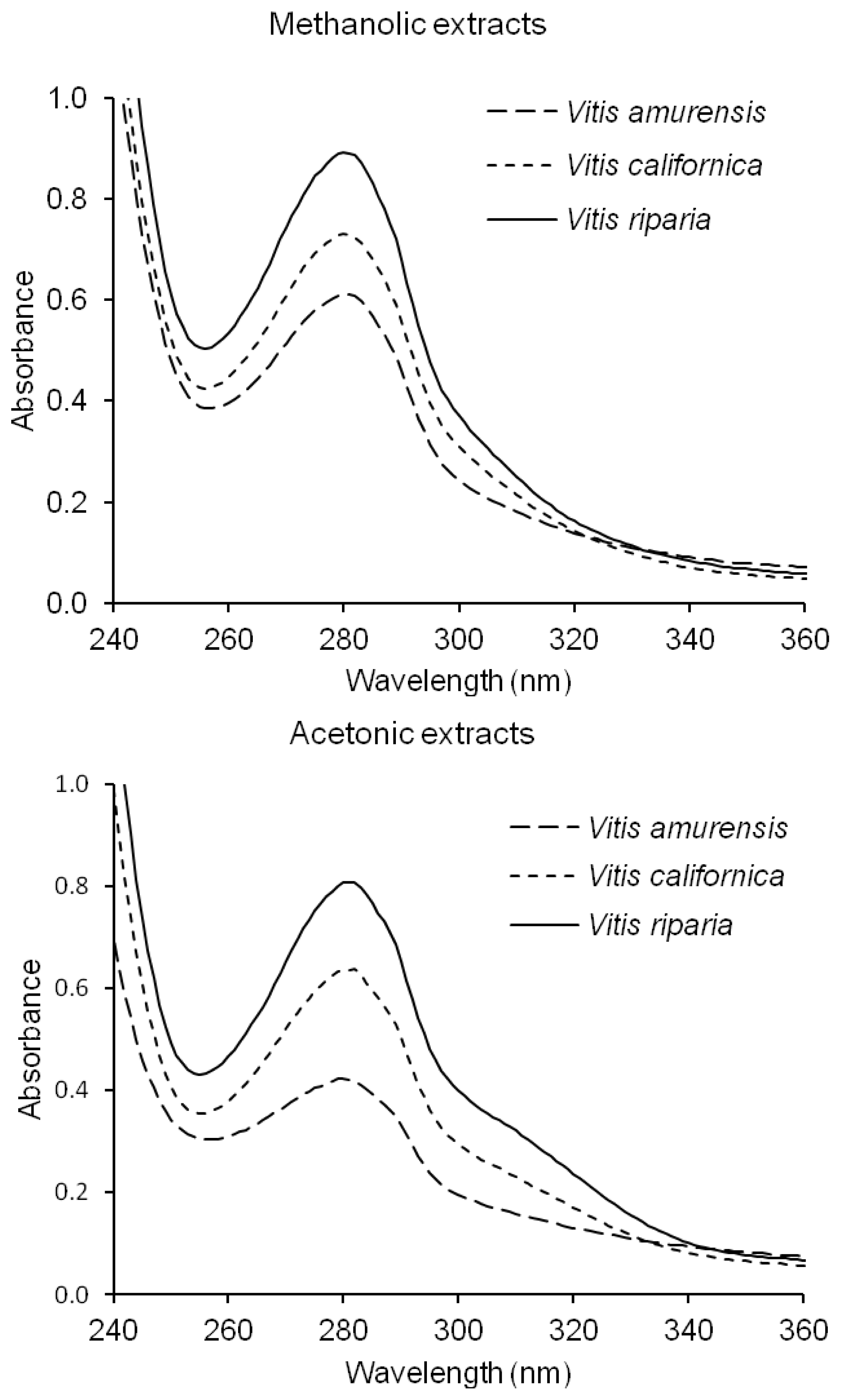
3.6. UV Spectra
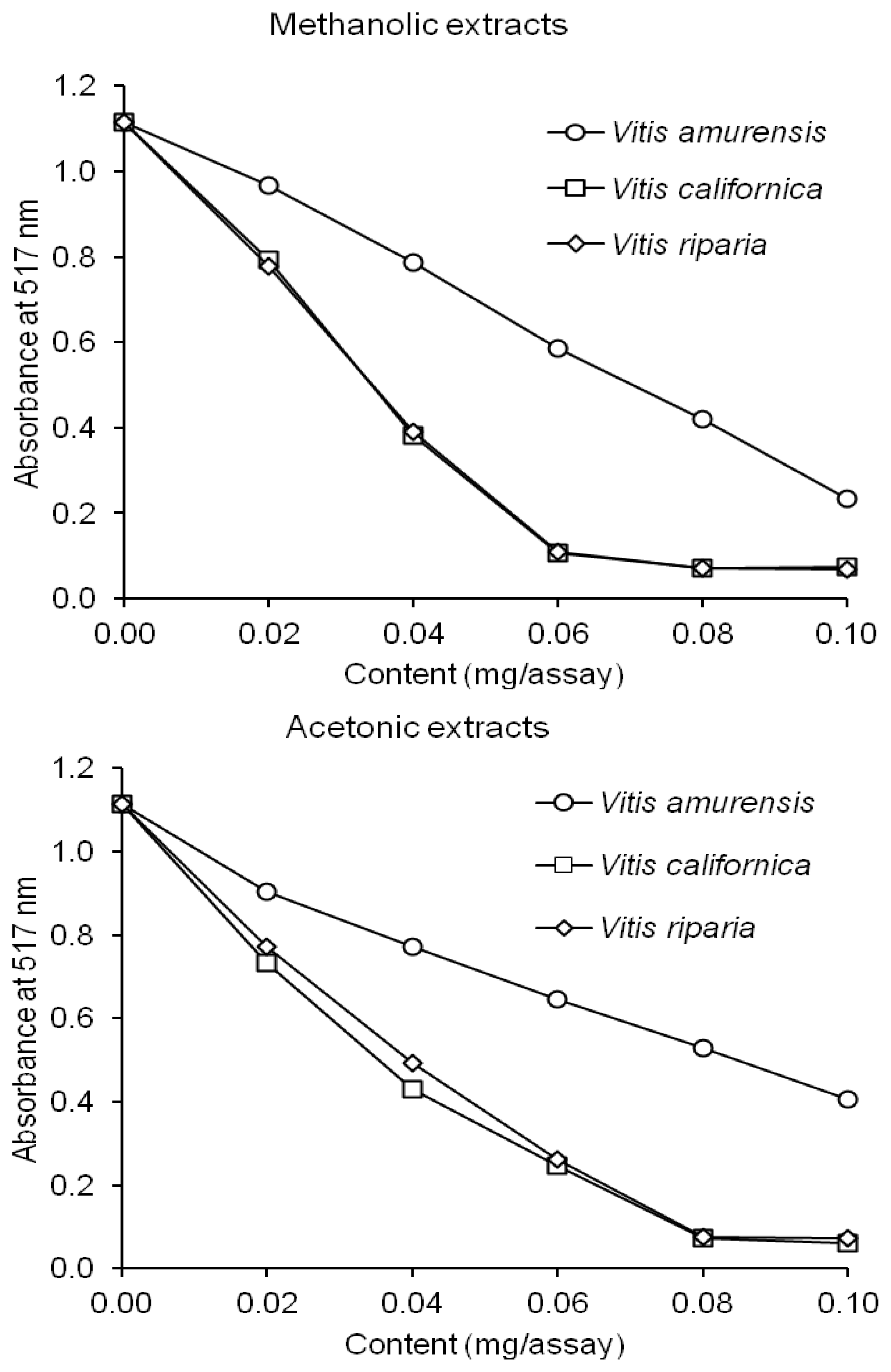
3.7. Scavenging of the DPPH Radical
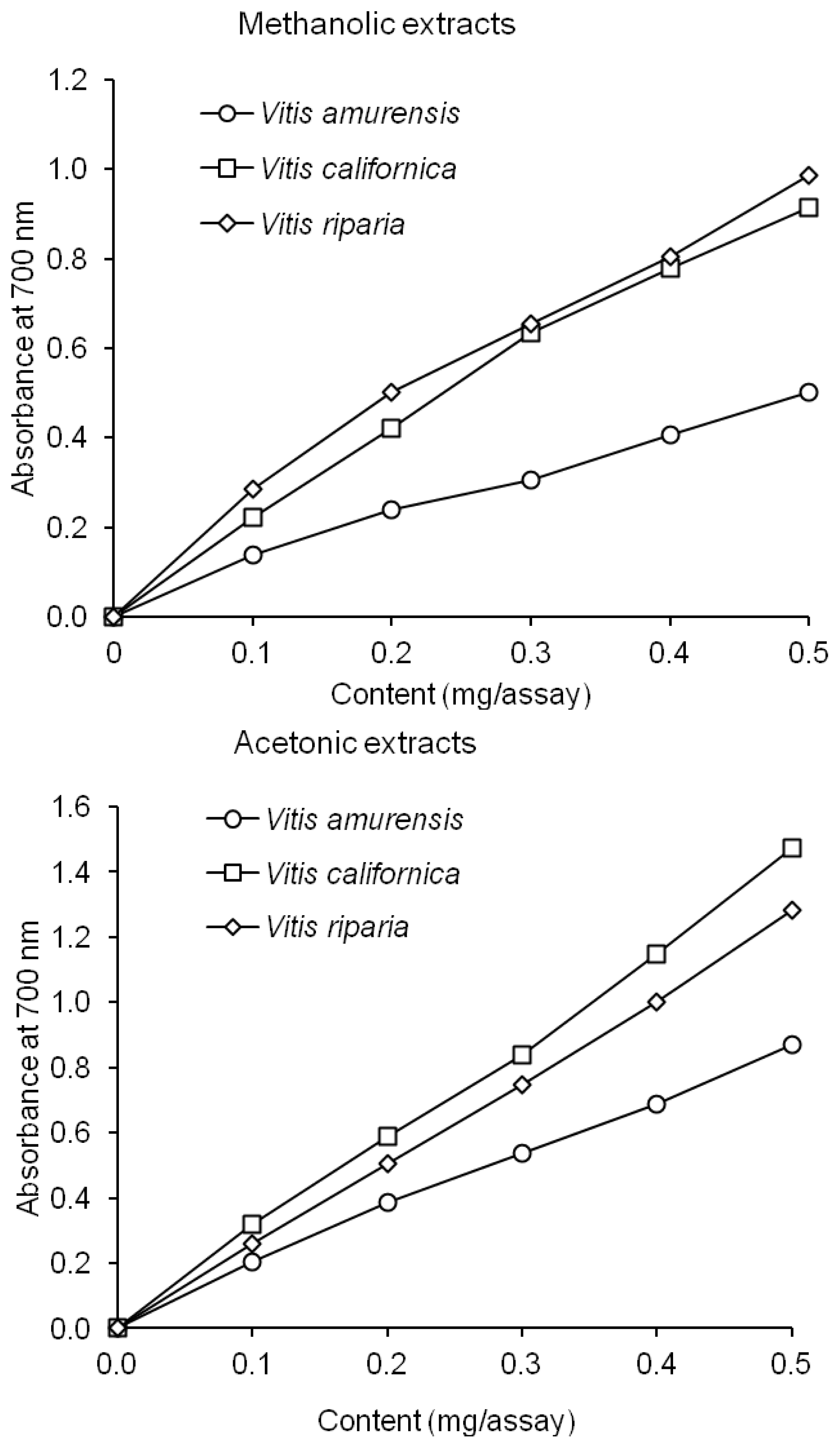
3.8. Reducing Power
3.9. HPLC-PAD Analysis of Catechins
3.10. HPLC-PAD Analysis of Phenolic Acids
3.11. Statistical Analysis
4. Conclusions
References
- Maier, T.; Schieber, A.; Kammerer, D.R.; Carle, R. Residues of grape (Vitis vinifera L.) seed oil production as a valuable source of phenolic antioxidants. Food Chem 2009, 112, 551–559. [Google Scholar]
- Xu, C.; Zhang, Y.; Cao, L.; Lu, J. Phenolic compounds and antioxidant properties of different grape cultivars grown in China. Food Chem 2010, 119, 1557–1565. [Google Scholar]
- Jayaprakasha, G.K.; Singh, R.P.; Sakariach, K.K. Antioxidant activity of grape seed (Vitis vinifera) extracts on peroxidation models in vitro. Food Chem 2001, 73, 285–290. [Google Scholar]
- Casazza, A.A.; Aliakbarian, B.; Mantegna, S.; Cravotto, G.; Perego, P. Extraction of phenolics from Vitis vinifera wastes using non-conventional techniques. J. Food Eng 2010, 100, 50–55. [Google Scholar]
- Meyer, A.; Yi, O.-S.; Pearson, D.A.; Waterhouse, A.L.; Frankel, E.N. Inhibition of human low-density lipoprotein oxidation in relation to composition of phenolic antioxidants in grapes (Vitis vinifera). J. Agric. Food Chem 1997, 45, 1638–1643. [Google Scholar]
- Ostrowska, B.; Rzemykowska, Z. Antioxidant activity of plant polyphenols of in prevention of artherosclerosis. Herba Polonica 1998, 44, 253–255. [Google Scholar]
- Jayaprakasha, G.K.; Selvi, T.; Sakariah, K.K. Antibacterial and antioxidant activities of grape (Vitis vinifera) seed extract. Food Res. Int 2003, 36, 117–122. [Google Scholar]
- Escribano-Bailón, T.; Gutierrez-Fernandez, Y.; Rivas-Gonzolo, J.; Santos-Buelga, C. Characterization of procyanidins of Vitis vinifera varitey Tinta del Pais grape seeds. J. Agric. Food Chem 1992, 40, 1794–1799. [Google Scholar]
- De Freitas, V.A.P.; Glories, Y.; Bourgeois, G.; Vitry, C. Characterization of oligomeric and polymeric procyanidins from grape seeds by liquid secondary ion mass spectrometry. Phytochemistry 1998, 49, 1435–1441. [Google Scholar]
- Pekić, B.; Kovać, V.; Alonso, E.; Revilla, E. Study of extraction of proanthocyanidins from grape extract and procyanidins. Food Chem 1998, 61, 201–206. [Google Scholar]
- Saito, M.; Hosoyama, H.; Ariga, T.; Kataoka, S.; Yamaji, N. Anticulcer activity of grape seed extract and procyanidins. J. Agric. Food Chem 1998, 46, 1460–1464. [Google Scholar]
- Sun, B.; Leandro, C.; da Silva, J.M.R.; Spranger, I. Separation of grape and wine proanthocyanidins according to their degree of polymerization. J. Agric. Food Chem 1998, 46, 1390–1396. [Google Scholar]
- Kennedy, J.A.; Troup, G.J.; Pilbrow, J.R.; Hutton, D.R.; Hewitt, D.; Hunter, C.R.; Ristic, R.; Iland, P.G.; Jones, G.P. Development of seed polyphenols in berries from Vitis vinifera L. cv. Shiraz. Aust. J. Grape Wine Res 2000, 6, 244–254. [Google Scholar]
- Poudel, P.R.; Tamura, H.; Kataoka, I.; Mochioka, R. Phenolic compounds and antioxidant activities of skins and seeds of five wild grapes and two hybrids native in Japan. J. Food Comp. Anal 2008, 21, 622–625. [Google Scholar]
- Amarowicz, R.; Weidner, S. Biological Activity of Grapevine Phenolic Compounds. In Grapevine Molecular Physiology and Biochemistry, 2nd ed; Roubelakis-Angelakis, K.A., Ed.; Springer: Heidelberg, Germany, 2009; pp. 389–405. [Google Scholar]
- Hatzidimitriou, E.; Nenadis, N.; Tsimidou, M.Z. Changes in the catechin and epicatechin content of grape seeds on storage under different water activity (aw) conditions. Food Chem 2007, 105, 1504–1511. [Google Scholar]
- Wróbel, M.; Karamać, M.; Amarowicz, R.; Frączek, E.; Weidner, S. Metabolism of phenolic compounds in Vitis riparia seeds during stratification and during germination under optimal and low temperature stress conditions. Acta Physiol. Plant 2005, 27, 313–320. [Google Scholar]
- Jaleel, C.A.; Riadh, K.; Gopi, R.; Manivannan, P.; Ines, J.; Al-Juburi, H.J.; Chang-Xing, Z.; Hong-Bo, S.; Panneerselvam, R. Antioxidant defense responses: Physiological plasticity in higher plants under abiotic constraints. Acta Physiol. Plant 2009, 31, 427–436. [Google Scholar]
- Caillet, S.; Salmieri, S.; Lacroix, M. Evaluation of free radical-scavenging properties of commercial grape phenol extracts by a fast colorimetric method. Food Chem 2006, 95, 1–8. [Google Scholar]
- Weidner, S.; Karamać, M.; Amarowicz, R.; Szypulska, E.; Gołgowska, A. Changes in composition of phenolic compounds and antioxidant properties of Vitis amurensis seeds germinated under osmotic stress. Acta Physiol. Plant 2007, 29, 283–290. [Google Scholar]
- Weidner, S.; Kordala, E.; Brosowska-Arendt, W.; Karamać, M; Kosińska, A.; Amarowicz, R. Phenolic compounds and properties of antioxidants in grapevine roots (Vitis vinifera L.) under low-temperature stress followed by recovery. Acta Soc. Bot. Pol 2009, 78, 279–286. [Google Scholar]
- He, F.; Pan, Q.-H.; Shi, Y.; Duan, C.-Q. Biosynthesis and genetic regulation of proanthocyanidins in plants. Molecules 2008, 13, 2674–2703. [Google Scholar]
- Downey, M.O.; Harvey, J.S.; Robinson, S.P. Analyses of tannins in seeds and skins of Shiraz grapes throughout berry development. Aust. J. Grape Wine Res 2003, 9, 15–27. [Google Scholar]
- Da Silva, J.M.R.; Darmon, N.; Fernandez, Y.; Mitjavila, S. Oxygen free radical scavenger capacity in aqueous models of different procyanidins from grape seeds. J. Agric. Food Chem 1991, 39, 1549–1552. [Google Scholar]
- Oszmiański, J.; Lamer-Zarawska, E. Antimutagenic and anticarcinogenic activities of plant polyphonols (in Polish). Przem. Spoż 1992, 46, 253–255. [Google Scholar]
- Oszmiański, J. Polyphenols as natural food antioxidants (in Polish). Przem. Spoż 1995, 48, 94–96. [Google Scholar]
- Yen, G.-C.; Chen, H.-Y. Antioxidant activity of various tea extracts in relation to their antimutagenicity. J. Agric. Food Chem 1991, 39, 27–32. [Google Scholar]
- Amarowicz, R.; Raab, B. Antioxidative activity of leguminous seed extracts evaluated by chemiluminescence methods. Z. Naturforsch. C 1997, 52, 709–712. [Google Scholar]
- Amarowicz, R.; Pegg, R.B.; Rahimi-Moghaddam, P.; Barl, B.; Weil, J.A. Free-radical scavenging capacity and antioxidant activity of selected plant species from the Canadian prairies. Food Chem 2004, 84, 551–562. [Google Scholar]
- Price, M.L.; van Scoyoc, S.; Butler, L.G. A critical evaluation of the vanillin reaction as an assay for tannin in sorghum grain. J. Agric. Food Chem 1978, 26, 1214–1218. [Google Scholar]
- Hagerrman, A.E.; Butler, L.G. Protein precipitation method for quantitative determination of tannins. J. Agric. Food Chem 1978, 26, 809–812. [Google Scholar]
- Amarowicz, R.; Karamać, M.; Weidner, S.; Abe, S.; Shahidi, F. Antioxidant activity of wheat caryopses and embryos extracts. J. Food Lipids 2002, 9, 201–210. [Google Scholar]
- Oyaizu, M. Studies on products of browning reaction—Antioxidative activities of products of browning reaction prepared from glucosamine. Jpn. J. Nutr 1978, 44, 307–315. [Google Scholar]
- Crozier, A.; Jensen, E.; Lean, M.E.I.; McDonald, M.S. Quantitative analysis of flavonoids by reverse-phase high performance liquid chromatography. J. Chromatogr. A 1997, 761, 315–321. [Google Scholar]
- Weidner, S.; Amarowicz, R.; Karamać, M.; Frączek, E. Changes in endogenous phenolic acids during development of Secale cereale caryopses and after dehydration treatment of unripe rye grains. Plant Physiol. Biochem 2000, 38, 595–602. [Google Scholar]


| Solvent used for extraction | Species | mg/g extract | mg/g f.m. | mg/g d.m. | μg/seed |
|---|---|---|---|---|---|
| 80% acetone | V. amurensis | 208 ± 3 a | 12.1 ± 0.2 a | 14.0 ± 0.2 a | 428 ± 6 a |
| V. california | 396 ± 13 b | 28.5 ± 1.0 b | 31.7 ± 1.1 b | 846 ± 29 b | |
| V. riparia | 377 ± 17 b | 29.7 ± 1.3 b | 32.7 ± 1.5 b | 843 ± 38 b | |
| 80% methanol | V. amurensis | 172 ± 3 a | 9.2 ± 0.2 a | 10.6 ± 0.2 a | 324 ± 5 a |
| V. california | 301 ± 6 b | 17.5 ± 0.4 b | 19.4 ± 0.4 b | 518 ± 10 b | |
| V. riparia | 308 ± 10 b | 19.7 ± 0.7 c | 21.7 ± 0.8 c | 559 ± 19 b | |
| Species | Vanillin method (Absorbance at 500 nm/mg extract/mL) | BSA precipitation method (Absorbance at 510 nm/mg extract/mL) |
|---|---|---|
| V. amurensis | 0.063 ± 0.001 a | 0.024 ± 0.002 a |
| V. california | 0.142 ± 0.002 b | 0.059 ± 0.002 b |
| V riparia | 0.130 ± 0.001 c | 0.051 ± 0.001 b |
| Species | Phenolic compound | mg/g extract | mg/g f.m. | mg/g d.m. | μg/seed |
|---|---|---|---|---|---|
| V. amurensis | Catechin | 33 ± 2 a | 1.7 ± 0.1 a | 2.0± 0.1 a | 61 ± 3 a |
| Epicatecin | 35 ± 2 a | 1.9 ± 0.1 a | 2.2 ± 0.1 a | 66 ± 4 a | |
| Total | 68 ± 4 a | 3.6 ± 0.2 a | 4.2 ± 0.2 a | 127 ± 7 a | |
| V. californica | Catechin | 33 ± 2 a | 1.9 ± 0.1 a | 2.2 ± 0.1 a | 57 ± 3 a |
| Epicatecin | 38 ± 2 a | 2.2 ± 0.1 b | 2.4 ± 0.1 a | 65 ± 4 a | |
| Total | 71 ± 4 a | 4.1 ± 0.2 b | 4.6 ± 0.2 a | 122 ± 6 a | |
| V. riparia | Catechin | 31 ± 2 a | 2.0 ± 0.1 a | 2.2 ± 0.1 a | 55 ± 3 a |
| Epicatecin | 35 ± 2 a | 2.2 ± 0.1 b | 2.5 ± 0.1 a | 63 ± 3 a | |
| Total | 66 ± 4 a | 4.2 ± 0.2 bc | 4.7 ± 0.2 a | 118 ± 6 a | |
| Species | Form of phenolic acids | mg/g extract | μg/g f.m. | μg/g d.m. | μg/seed |
|---|---|---|---|---|---|
| V. amurensis | Free | 0.3 ± 0.0 a | 18 ± 2 a | 21± 2 a | 0.7 ± 0.1 a |
| Esterified | 0.7± 0.0 a | 34 ± 1 a | 40 ± 1 a | 1.2 ± 0.0 a | |
| Glucosided | 0.6 ± 0.0 a | 33 ± 1 a | 38 ± 2 a | 1.2 ± 0.1 a | |
| Total | 1.6 ± 0.0 a | 85 ± 4 a | 99 ± 5 a | 3.1 ± 0.1 a | |
| V. californica | Free | 1.9 ± 0.2 b | 112 ±12 b | 125 ± 13 b | 3.3 ± 0.0 b |
| Esterified | 3.4 ± 0.1 b | 194 ± 4 b | 216 ± 5 b | 5.8 ± 0.1 b | |
| Glucosided | 3.3 ± 0.2 b | 191 ± 10 b | 212 ± 11 b | 5.7 ± 0.3 b | |
| Total | 8.6 ± 0.5 b | 497 ± 26 b | 553 ± 29 b | 14.8 ± 0.7 b | |
| V. riparia | Free | 2.3 ± 0.2 b | 145 ± 15 b | 160 ± 17 c | 4.1 ± 0.4 b |
| Esterified | 4.7 ± 0.1 c | 298 ± 6 c | 328 ± 7 c | 8.5 ± 0.2 c | |
| Glucosided | 3.2 ± 0.2 b | 202 ± 11 b | 223 ± 12 b | 5.7 ± 0.3 b | |
| Total | 10.2 ± 0.5 c | 645 ± 32 c | 711 ± 36 c | 18.3 ± 0.9 c | |
| Species | Form of phenolic acids | mg/g extract | μg/g f.m. | μg/g d.m. | μg/seed |
|---|---|---|---|---|---|
| V. amurensis | Free | 0.033 ± 0.004 a | 1.73 ± 0.22 a | 2.00 ± 0.26 a | 0.061 ± 0.008 a |
| Esterified | 0.026 ± 0.002 a | 1.38 ± 0.09 a | 1.60 ± 0.11 a | 0.049 ± 0.003 a | |
| Total | 0.059 ± 0.006 a | 3.13 ± 0.31 a | 3.62 ± 0.36 a | 0.110 ± 0.011 a | |
| V. californica | Free | 0.026 ± 0.003 b | 1.50 ± 0.19 a | 1.67 ± 0.21 b | 0.045 ± 0.006 b |
| Esterified | 0.134 ± 0.009 b | 7.77 ± 0.54 a | 8.64 ± 0.60 b | 0.230 ± 0.016 b | |
| Total | 0.160 ± 0.012 b | 9.28 ± 0.72 b | 10.32 ± 0.71 b | 0.275 ± 0.022 b | |
| V. riparia | Free | 0.016 ± 0.002 c | 1.02 ± 0.11 b | 1.13 ± 0.00 c | 0.029 ± 0.004 c |
| Esterified | 0.108 ± 0.007 c | 6.89 ±0.47 a | 7.60 ± 0.90 b | 0.196 ± 0.013 c | |
| Total | 0.124 ± 0.010 c | 7.91 ± 0.99 b | 8.72 ±0.42 c | 0.225 ± 0.017 c | |
© 2012 by the authors; licensee Molecular Diversity Preservation International, Basel, Switzerland. This article is an open-access article distributed under the terms and conditions of the Creative Commons Attribution license (http://creativecommons.org/licenses/by/3.0/).
Share and Cite
Weidner, S.; Powałka, A.; Karamać, M.; Amarowicz, R. Extracts of Phenolic Compounds from Seeds of Three Wild Grapevines—Comparison of Their Antioxidant Activities and the Content of Phenolic Compounds. Int. J. Mol. Sci. 2012, 13, 3444-3457. https://doi.org/10.3390/ijms13033444
Weidner S, Powałka A, Karamać M, Amarowicz R. Extracts of Phenolic Compounds from Seeds of Three Wild Grapevines—Comparison of Their Antioxidant Activities and the Content of Phenolic Compounds. International Journal of Molecular Sciences. 2012; 13(3):3444-3457. https://doi.org/10.3390/ijms13033444
Chicago/Turabian StyleWeidner, Stanisław, Anna Powałka, Magdalena Karamać, and Ryszard Amarowicz. 2012. "Extracts of Phenolic Compounds from Seeds of Three Wild Grapevines—Comparison of Their Antioxidant Activities and the Content of Phenolic Compounds" International Journal of Molecular Sciences 13, no. 3: 3444-3457. https://doi.org/10.3390/ijms13033444
APA StyleWeidner, S., Powałka, A., Karamać, M., & Amarowicz, R. (2012). Extracts of Phenolic Compounds from Seeds of Three Wild Grapevines—Comparison of Their Antioxidant Activities and the Content of Phenolic Compounds. International Journal of Molecular Sciences, 13(3), 3444-3457. https://doi.org/10.3390/ijms13033444