<?xml version="1.0" encoding="UTF-8"?>
<!DOCTYPE article PUBLIC "-//NLM//DTD Journal Publishing DTD v2.3 20070202//EN" "journalpublishing.dtd">
<article xmlns:xlink="http://www.w3.org/1999/xlink" xml:lang="en" article-type="research-article">
<front>
<journal-meta>
<journal-id journal-id-type="publisher-id">ijms</journal-id>
<journal-title>International Journal of Molecular Sciences</journal-title>
<abbrev-journal-title>Int. J. Mol. Sci.</abbrev-journal-title>
<issn pub-type="epub">1422-0067</issn>
<publisher>
<publisher-name>Molecular Diversity Preservation International (MDPI)</publisher-name></publisher></journal-meta>
<article-meta>
<article-id pub-id-type="doi">10.3390/ijms13032951</article-id>
<article-id pub-id-type="publisher-id">ijms-13-02951</article-id>
<article-categories>
<subj-group>
<subject>Article</subject></subj-group></article-categories>
<title-group>
<article-title>Characterization of Novel Di-, Tri-, and Tetranucleotide Microsatellite Primers Suitable for Genotyping Various Plant Pathogenic Fungi with Special Emphasis on Fusaria and <italic>Mycospherella graminicola</italic></article-title></title-group>
<contrib-group>
<contrib contrib-type="author">
<name><surname>Bahkali</surname><given-names>Ali H.</given-names></name><xref ref-type="aff" rid="af1-ijms-13-02951">1</xref></contrib>
<contrib contrib-type="author">
<name><surname>Abd-Elsalam</surname><given-names>Kamel A.</given-names></name><xref ref-type="aff" rid="af2-ijms-13-02951">2</xref><xref ref-type="aff" rid="af3-ijms-13-02951">3</xref><xref ref-type="aff" rid="af4-ijms-13-02951">4</xref><xref ref-type="corresp" rid="c1-ijms-13-02951">*</xref></contrib>
<contrib contrib-type="author">
<name><surname>Guo</surname><given-names>Jian-Rong</given-names></name><xref ref-type="aff" rid="af5-ijms-13-02951">5</xref></contrib>
<contrib contrib-type="author">
<name><surname>Khiyami</surname><given-names>Mohamed A.</given-names></name><xref ref-type="aff" rid="af4-ijms-13-02951">4</xref></contrib>
<contrib contrib-type="author">
<name><surname>Verreet</surname><given-names>Joseph-Alexander</given-names></name><xref ref-type="aff" rid="af3-ijms-13-02951">3</xref></contrib></contrib-group>
<aff id="af1-ijms-13-02951">
<label>1</label>Botany and Microbiology Department, College of Science, King Saud University, P. O. Box: 2455, Riyadh 1145, Kingdom of Saudi Arabia; E-Mail: <email>abahkali@ksu.edu.sa</email></aff>
<aff id="af2-ijms-13-02951">
<label>2</label>Agricultural Research Center, Plant Pathology Research Institute, Giza, Egypt</aff>
<aff id="af3-ijms-13-02951">
<label>3</label>Institute of Phytopathology, Christian-Albrechts-University Kiel, Hermann-Rodewald-Str. 9, D-24118, Kiel, Germany; E-Mail: <email>javerreet@phytomed.uni-kiel.de</email> (J.-A.V.)</aff>
<aff id="af4-ijms-13-02951">
<label>4</label>King Abdulaziz City for Science and Technology (KACST), P. O. Box 6086, Riyadh 11442, Kingdom of Saudi Arabia; E-Mail: <email>mkhiyami@kacst.edu.sa</email></aff>
<aff id="af5-ijms-13-02951">
<label>5</label>Institute of Environment and Plant Protection, Chinese Academy of Tropical Agricultural Sciences, 71737 Danzhou, Hainan, China; E-Mail: <email>guojianrong@hotmail.com</email> (J.-R.G.)</aff>
<author-notes>
<corresp id="c1-ijms-13-02951">
<label>*</label>Author to whom correspondence should be addressed; E-Mail: <email>abd-elsalam.k.a@post.com</email>; Tel.: +966-92-1467-580; Fax: +966-1467-5833.</corresp></author-notes>
<pub-date pub-type="collection">
<year>2012</year></pub-date>
<pub-date pub-type="epub">
<day>06</day>
<month>3</month>
<year>2012</year></pub-date>
<volume>13</volume>
<issue>3</issue>
<fpage>2951</fpage>
<lpage>2964</lpage>
<history>
<date date-type="received">
<day>07</day>
<month>11</month>
<year>2011</year></date>
<date date-type="rev-recd">
<day>09</day>
<month>1</month>
<year>2012</year></date>
<date date-type="accepted">
<day>20</day>
<month>2</month>
<year>2012</year></date></history>
<permissions>
<copyright-statement>© 2012 by the authors; licensee Molecular Diversity Preservation International, Basel, Switzerland.</copyright-statement>
<copyright-year>2012</copyright-year>
<license license-type="open-access" xlink:href="http://creativecommons.org/licenses/by/3.0">
<p>This article is an open-access article distributed under the terms and conditions of the Creative Commons Attribution license (http://creativecommons.org/licenses/by/3.0/).</p></license></permissions>
<abstract>
<p>The goals of this investigation were to identify and evaluate the use of polymorphic microsatellite marker (PMM) analysis for molecular typing of seventeen plant pathogenic fungi. Primers for di-, tri-, and tetranucleotide loci were designed directly from the recently published genomic sequence of <italic>Mycospherlla graminicola</italic> and <italic>Fusarium graminearum</italic>. A total of 20 new microsatellite primers as easy-to-score markers were developed. Microsatellite primer PCR (MP-PCR) yielded highly reproducible and complex genomic fingerprints, with several bands ranging in size from 200 to 3000 bp. Of the 20 primers tested, only (TAGG)4, (TCC)5 and (CA)7T produced a high number of polymorphic bands from either <italic>F. graminearum</italic> or <italic>F. culmorum</italic>. (ATG)5 led to successful amplifications in <italic>M. graminicola</italic> isolates collected from Germany. Percentage of polymorphic bands among <italic>Fusarium</italic> species ranged from 9 to 100%. Cluster analysis of banding patterns of the isolates corresponded well to the established species delineations based on morphology and other methods of phylogenetic analysis. The current research demonstrates that the newly designed microsatellite primers are reliable, sensitive and technically simple tools for assaying genetic variability in plant pathogenic fungi.</p></abstract>
<kwd-group>
<kwd>genotyping</kwd>
<kwd>tetranucleotide microsatellites</kwd>
<kwd>SSR</kwd>
<kwd>fungal plant pathogen</kwd></kwd-group></article-meta></front>
<body>
<sec sec-type="intro">
<title>1. Introduction</title>
<p>Microsatellites, also known as simple sequence repeats (SSRs) are tandemly repeated DNA sequence elements. They consist of repeats of 1–13 base pairs (bp) [<xref ref-type="bibr" rid="b1-ijms-13-02951">1</xref>,<xref ref-type="bibr" rid="b2-ijms-13-02951">2</xref>] which can be multiplied more than 100 times in a genome. They are highly abundant and present high levels of polymorphisms throughout all eukaryotic genomes and also in prokaryotic genomes [<xref ref-type="bibr" rid="b3-ijms-13-02951">3</xref>]. Due to their high mutability, SSRs are regarded to play an important role in genome evolution [<xref ref-type="bibr" rid="b4-ijms-13-02951">4</xref>].</p>
<p>Microsatellites or SSR markers have proved highly useful for molecular identification and differentiation among individuals and populations by PCR-based methods because of their frequently variable loci in the genome. The microsatellite-primed polymerase chain reaction (MP-PCR) uses single primers to produce DNA fingerprint profiles, requiring only small amounts of DNA for direct PCR and gel electrophoresis analysis [<xref ref-type="bibr" rid="b5-ijms-13-02951">5</xref>]. In comparison with other marker techniques such as AFLP, RAPD, and RFLP, it is a quite simple and powerful fingerprinting tool due to its high reproducibility, ease of scoring, high throughput and codominance as well as to the high polymorphism of band profiles even among related species and genera [<xref ref-type="bibr" rid="b6-ijms-13-02951">6</xref>,<xref ref-type="bibr" rid="b7-ijms-13-02951">7</xref>]. Additionally, the amenability of SSRs to PCR amplification and relatively easy scoring make them valuable for analyzing large populations in different laboratories, which is not possible using RAPDs (randomly amplified polymorphic DNA) or AFLPs (amplified fragment length polymorphism) [<xref ref-type="bibr" rid="b8-ijms-13-02951">8</xref>].</p>
<p>Fungi are the largest eukaryotic group in nature, including mushrooms, rusts, smuts, puffballs, truffles, morels, molds, and yeasts, as well as many less well-known organisms [<xref ref-type="bibr" rid="b9-ijms-13-02951">9</xref>]. About 70,000 species of fungi have been described and approximately 1.5 million species may exist [<xref ref-type="bibr" rid="b10-ijms-13-02951">10</xref>]. Like other eukaryotic organisms, fungi also contain abundant SSRs in their genomes [<xref ref-type="bibr" rid="b11-ijms-13-02951">11</xref>]. The abundance and high variability of microsatellites allow their use as highly preferred markers to study the genetic diversity of various fungal species [<xref ref-type="bibr" rid="b12-ijms-13-02951">12</xref>]. Recently, MP-PCR has been frequently and extensively applied for various fungal molecular biological studies such as genetic diversity [<xref ref-type="bibr" rid="b13-ijms-13-02951">13</xref>–<xref ref-type="bibr" rid="b16-ijms-13-02951">16</xref>], pathogen identification and differentiation [<xref ref-type="bibr" rid="b17-ijms-13-02951">17</xref>] and fungal evolution [<xref ref-type="bibr" rid="b18-ijms-13-02951">18</xref>].</p>
<p>Microsatellites have been, utilized in studying variability of fungi [<xref ref-type="bibr" rid="b13-ijms-13-02951">13</xref>] such as <italic>Ascochyta rabei</italic> [<xref ref-type="bibr" rid="b19-ijms-13-02951">19</xref>,<xref ref-type="bibr" rid="b20-ijms-13-02951">20</xref>], <italic>F. oxysporum</italic> f. sp. <italic>ciceri</italic> races [<xref ref-type="bibr" rid="b14-ijms-13-02951">14</xref>], <italic>Fusarium oxysporum</italic> f. sp. <italic>radicis-lycopersici</italic>, <italic>Fusarium graminearum</italic> [<xref ref-type="bibr" rid="b21-ijms-13-02951">21</xref>], <italic>F. poae</italic> [<xref ref-type="bibr" rid="b22-ijms-13-02951">22</xref>], <italic>Fusarium</italic> spp. isolates [<xref ref-type="bibr" rid="b23-ijms-13-02951">23</xref>,<xref ref-type="bibr" rid="b24-ijms-13-02951">24</xref>], <italic>Phoma tracheiphila</italic> [<xref ref-type="bibr" rid="b25-ijms-13-02951">25</xref>,<xref ref-type="bibr" rid="b26-ijms-13-02951">26</xref>]<italic>. Pythium</italic> [<xref ref-type="bibr" rid="b27-ijms-13-02951">27</xref>,<xref ref-type="bibr" rid="b28-ijms-13-02951">28</xref>] and <italic>Rhizoctonis solani</italic> [<xref ref-type="bibr" rid="b16-ijms-13-02951">16</xref>,<xref ref-type="bibr" rid="b29-ijms-13-02951">29</xref>,<xref ref-type="bibr" rid="b30-ijms-13-02951">30</xref>].</p>
<p>In spite of approximately 40 microsatellite primers have been developed for separation of individual fungal species by MP-PCR, only a few have been proved to be applicable for a wider range of fungal species. Development of new microsatellite primers is therefore desirable for fungal molecular studies. Recently, Karaoglu <italic>et al.</italic> [<xref ref-type="bibr" rid="b11-ijms-13-02951">11</xref>] analyzed and compared the occurrence and frequency of SSRs in nine complete fungal genomes. Their achievements offer a possibility to design new microsatellite primers suitable for multiple fungi based on the relative abundance of SSRs in genomes. In this study, we designed 20 new microsatellite primers based on SSRs of several fungal species reported by Karaoglu <italic>et al.</italic> [<xref ref-type="bibr" rid="b11-ijms-13-02951">11</xref>] and tested their availability using 16 common fungal species.</p></sec>
<sec>
<title>2. Experimental Section</title>
<sec>
<title>2.1. Culture of Fungal Species and DNA Extraction</title>
<p>Nineteen isolates of <italic>Mycosphaerella graminicola</italic> and 16 isolates representing other fungal species originating from different geographic locations (<xref ref-type="table" rid="t1-ijms-13-02951">Table 1</xref>) were used to test the suitability of the tested primers. <italic>Pyrenophora teres</italic> was kindly provided by Dr. F. Maier in Biocenter Klein Flottbek, University of Hamburg and <italic>P. tritici-repentis</italic> by Prof. Dr. Holger B. Deising, Institut für Pflanzenzüchtung und Pflanzenschutz, University of Halle, Germany. The other isolates were obtained from Institute of Phytopathology, University of Kiel, Germany. <italic>M. graminicola</italic> was cultured in a malt-yeast-extract broth and the other species in potato dextrose broth on a shaker at 22 °C, 120 rpm<italic>. M. graminicola</italic> was harvested after 5 days by centrifugation at 8000 <italic>g</italic> for 2 min and washed once with sterile distilled water. The other isolates were harvested after 5–10 days by filtration and the water residue was removed with sterile filter paper. Spores or mycelia were ground to a fine powder in liquid nitrogen using a mortar and pistil and DNA was extracted using the method described by Cenis <italic>et al.</italic> [<xref ref-type="bibr" rid="b31-ijms-13-02951">31</xref>] with minor modifications.</p></sec>
<sec sec-type="methods">
<title>2.2. Primer Design</title>
<p>Seventeen repeated motifs were selected to design new primers based on their abundance in eight fungal genomes by analyzing in the SSR database generated by Karaoglu <italic>et al.</italic> [<xref ref-type="bibr" rid="b11-ijms-13-02951">11</xref>]. Genome sequence data of <italic>F. graminearum</italic> (36.2 Mbp size) available from Broad Institute (<ext-link xlink:href="www.broadinstitute.org" ext-link-type="uri">www.broadinstitute.org</ext-link>) and the genome sequence of <italic>Mycosphaerella graminicola</italic> (39.7 Mbp<italic>)</italic> available at <italic>Mycosphaerella graminicola</italic> v2.0, (<ext-link xlink:href="http://genome.jgi-psf.org/Mycgr3" ext-link-type="uri">http://genome.jgi-psf.org/Mycgr3</ext-link>) were used to search for mono-, di-, tri-, and tetranuclotide motifs. The aim of this search was to explore repetitive sequences that were expected to have a very high degree of polymorphism. Altogether the twenty primers listed in <xref ref-type="table" rid="t2-ijms-13-02951">Table 2</xref> were designed. The suitability of primers was tested with 19 isolates of <italic>Mycosphaerella graminicola</italic> and 16 isolates representing other fungal species (<xref ref-type="table" rid="t1-ijms-13-02951">Table 1</xref>).</p></sec>
<sec>
<title>2.3. Microsatellite Primed PCR</title>
<p>PCR mixtures contained 10 pmol primer; 10 mM Tris-HCl (pH 9.0), 50 mM KCl, 0.1% (v/v) Triton<sup>®</sup> X-100, 2.5 mM MgCl<sub>2</sub>, 200 μM of each dNTP, 1 U of <italic>Taq</italic> polymerase and 5 ng of template DNA in a total volume of 25 μL. To obtain the optimal annealing temperature of each primer, a PCR was performed with 12 different annealing temperatures, <italic>i.e.</italic>, 40.1 °C, 40.5 °C, 41.3 °C, 42.7 °C, 44.4 °C, 46.4 °C, 48.3 °C, 50.3 °C, 52.6 °C, 54.0 °C, 54.7 °C and 55.2 °C in a Px2 gradient PCR thermal cycler (Thermo Hybaid, Ashford, United Kingdom). The reactions were carried out in a PTC-200 Thermocycler (MJ Research) according to the following PCR programm: 94 °C for 2 min, followed by 40 cycles of 94 °C for 1 min, 40–55°C (depending on primers used) for 90s and 72 °C for 2 min with a final extension at 72 °C for 6 min. PCR amplification with each primer was repeated at least twice to check the reproducibility of DNA profiles.</p></sec>
<sec sec-type="methods">
<title>2.4. Visual Analysis of Banding Patterns and Gel Documentation</title>
<p>All PCR-amplified products were separated by electrophoresis on 1.5% agarose gels for 1.5 h at 7.0 V/cm<sup>2</sup>. After that, the gel was photographed using the GelSystem Flexi gel documentation system (Biostep, Jahnsdorf, Germany). The banding patterns obtained were compared for polymorphism by visual observation. Visible bands among isolates with the same migration distance were considered the same. Each distinct band was considered as polymorphic band and was scored for the presence (1) or the absence (0) among the isolates. Only reproducible bands in repeated PCR amplification were considered for analyses. A dendogram was computed (Gene Tools by SynGene) using the DICE similarity coefficient and Unweighted Pair Group Method with Arithmetic Mean (UPGMA).</p></sec></sec>
<sec sec-type="results">
<title>3. Results</title>
<p>Based on the abundance of SSR in eight fungal genomes in the SSR database Karaoglu <italic>et al.</italic>, [<xref ref-type="bibr" rid="b11-ijms-13-02951">11</xref>], 20 repeat motifs were selected to design new primers. Altogether 20 microsatellite primers were designed (<xref ref-type="table" rid="t2-ijms-13-02951">Table 2</xref>). To get the optimal annealing temperature of each primer, a PCR was performed with 12 different annealing temperatures ranging from 40–55 °C (<xref ref-type="table" rid="t2-ijms-13-02951">Table 2</xref>). The results showed that annealing temperature had different influence on these primers. For (GTCA)4, (TTTC)4, no clear difference were observed between the banding patterns produced at different annealing temperatures. (TGAC)4 amplified clearer banding pattern at higher temperatures, whereas (GTA)5, (TAC)5, (TGC)5, (TGT)5 and (GGTT)5 gave the best banding patterns at 40 °C. For (CT)7G, (AG)7C and (TAGG)4, the optimum temperature was 48 °C, at which clearer fingerprints with a higher number of bands was produced as compared with those at other annealing temperatures.</p>
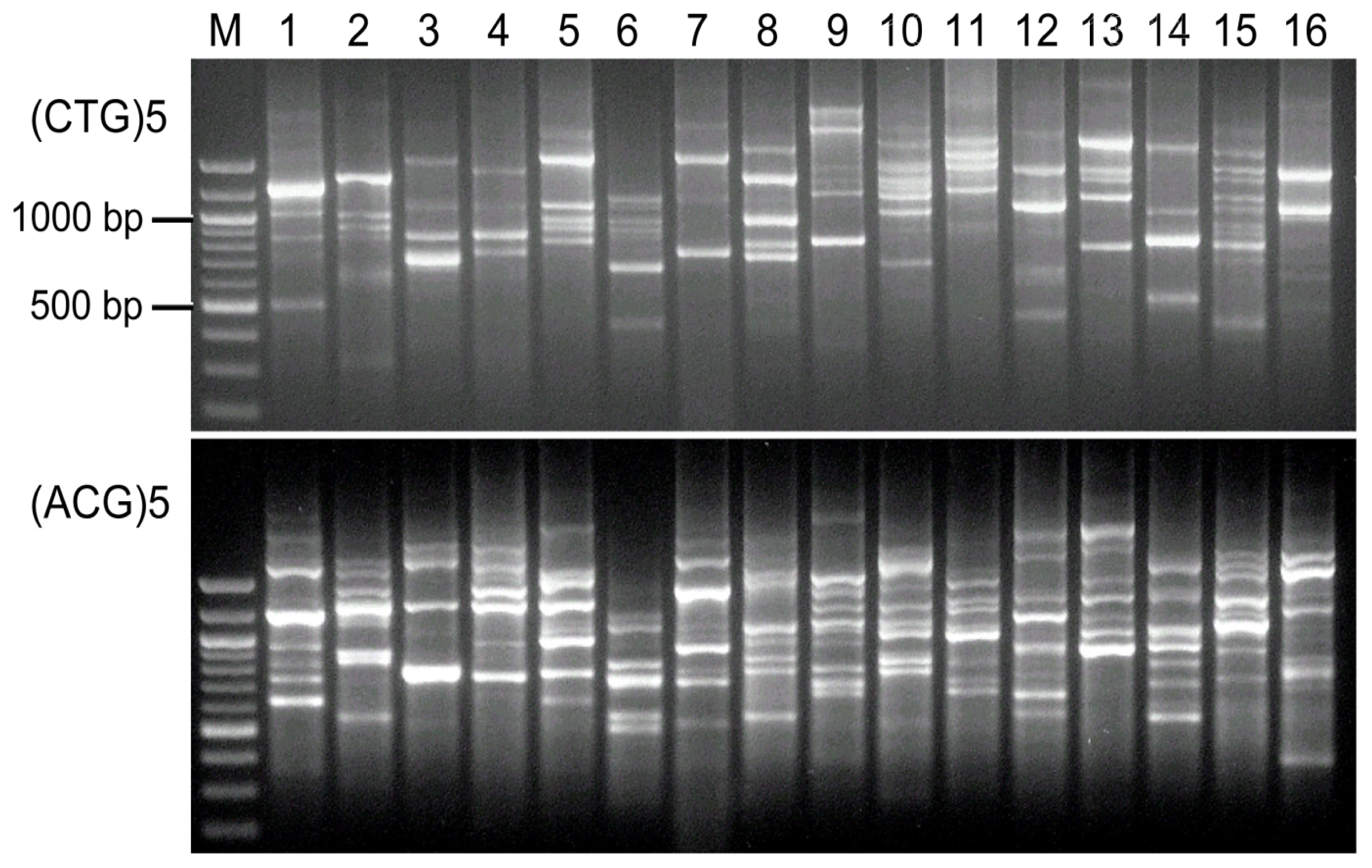
<p>The suitability of these primers for typing fungi was tested with 16 common fungal species in comparison with five previously established primers. All the primers tested produced banding patterns for at least one fungal species. The sizes of fragments amplified ranged mostly from 300–2000 bp (<xref ref-type="table" rid="t2-ijms-13-02951">Table 2</xref>). Of these primers, (CA)7T, (CTG)5, (AGG)5, (TCC)5, (ACG)5, (TGG)5, (ATG)5, (TGAC)4, (GTCA)4, (TTTC)4 and all the five previously established primers amplified clear banding patterns from all the 16 species tested (<xref ref-type="table" rid="t3-ijms-13-02951">Table 3</xref>). (AGG)5 and (ACG)5 generated 107 and 103 bands, respectively, from these species, with 6.7 and 6.3 for each species (<xref ref-type="fig" rid="f1-ijms-13-02951">Figure 1</xref>). (AG)7C gave rise to clear fingerprints from 15 of the 16 species except <italic>S. nodorum</italic>, (TAGG)4 except from <italic>Chaetomium</italic> sp. Primer (CT)7G amplified no band from <italic>M. phaseolina</italic> and <italic>C. beticola</italic>, and (GTA)5 did not amplify DNA from 10 out of 16 species. (GGTT)5 led to five clear bands from <italic>S. nodorum</italic> and <italic>Alternaria</italic> sp., but it is not optimal for other species tested. Although some bands were amplified from some of the species by (TGC)5, (GCT)5 and (TGT)5, these primers produced smear banding patterns and led to an unclear background. (TAC)5 amplified three bands only from <italic>S. tritici</italic>.</p>
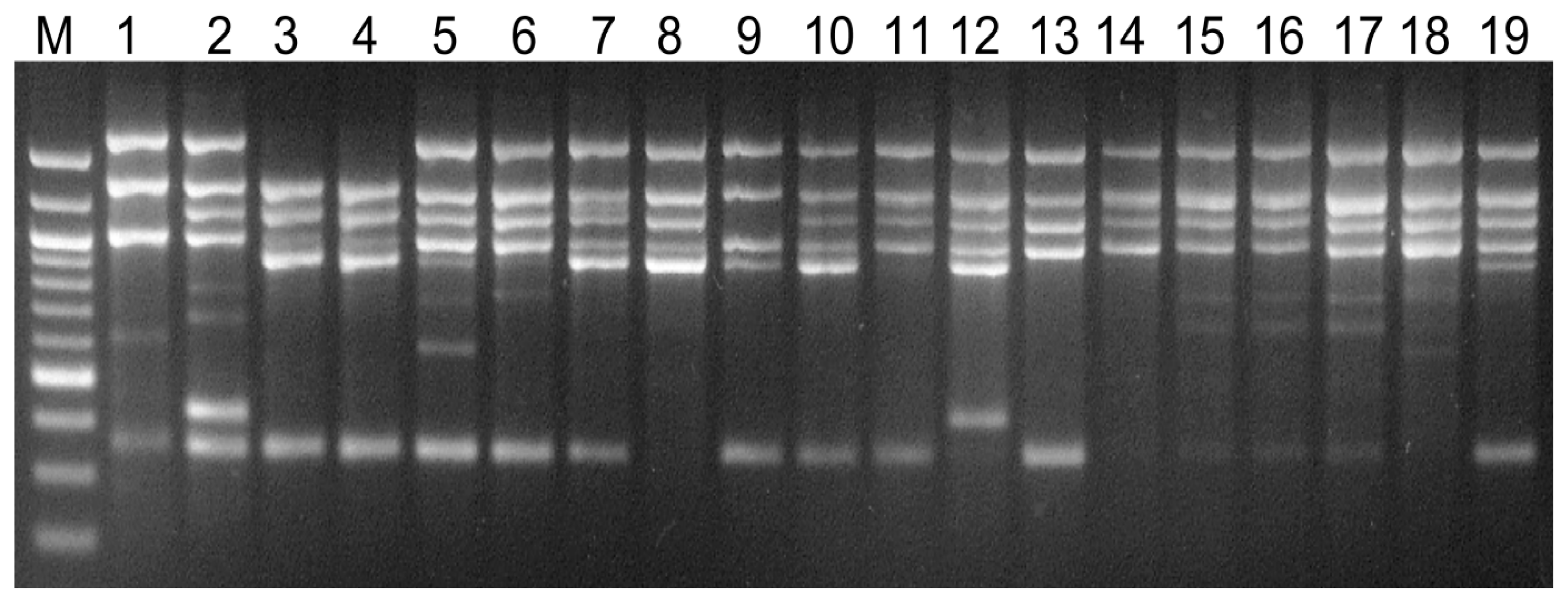
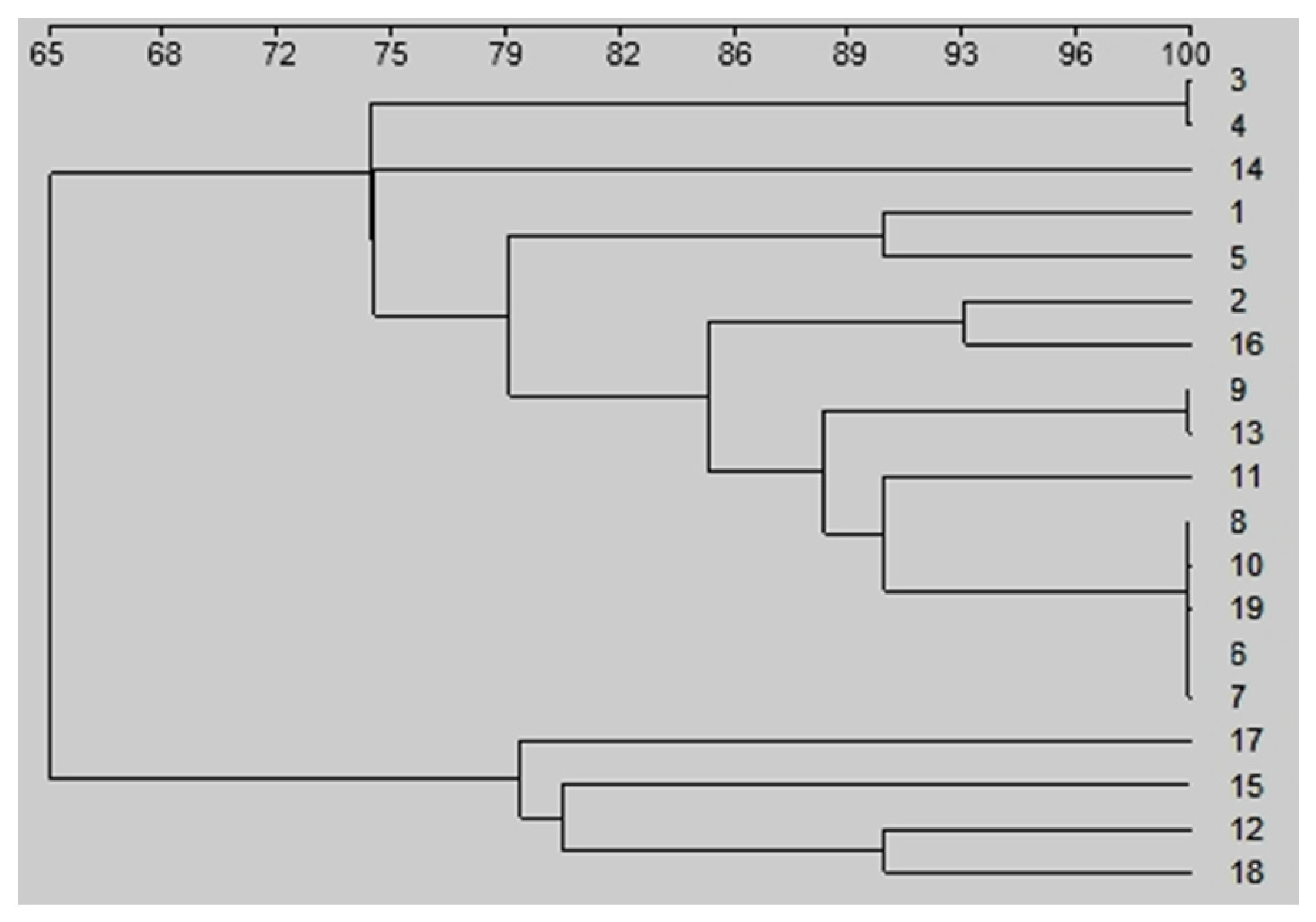
<p>Almost all the primers that led to clear multiple banding patterns also showed a high polymorphism among different fungal species. We compared the production of polymorphic bands by these primers between two genetically closely related <italic>Fusarium</italic> species (<xref ref-type="table" rid="t3-ijms-13-02951">Table 3</xref>). Of the 20 primers tested, only (TGG)5, (GTA)5 and (GGTT)4 produced no polymorphic bands from either <italic>F. graminearum</italic> or <italic>F. culmorum</italic>. (TAGG)4, (TCC)5 and (CA)7T produced a high number of polymorphic bands from the two species, with 8, 7 and 5 polymorphisms, respectively. (AG)7C, (TTTC)4 and (TGT)5 amplified 100% of polymorphic bands, with 4. 4 and 1.0 bands, respectively (<xref ref-type="table" rid="t4-ijms-13-02951">Table 4</xref>). Using the Gene Tools software package and the Dice coefficient, trinucleotide microsatellite primer (ATG)5 amplified genomic DNA fragments from all sixteen isolates and clear distinction of the isolates was possible (<xref ref-type="fig" rid="f2-ijms-13-02951">Figure 2</xref>). Genetic similarity of the isolates was determined using the Dice’s coefficient and the UPGMA clustering method. Two major groups were observed in the resulting dendrogram, which was divided into three subgroups. Between <italic>M. graminicola</italic> isolates, similarities ranged from 74 to 100% for intraspecific comparisons (<xref ref-type="fig" rid="f3-ijms-13-02951">Figure 3</xref>). The results showed that isolates 3 and 4 had the highest (100%) similarity suggesting that they might originate from the same clonal lineage.</p></sec>
<sec sec-type="discussion">
<title>4. Discussion</title>
<p>Microsatellite markers distinguish themselves as codominant, multiallelic, highly polymorphic genetic markers, requiring small amounts of DNA for straightforward PCR and gel electrophoresis analysis [<xref ref-type="bibr" rid="b32-ijms-13-02951">32</xref>] .</p>
<p>In the current research, di, tri, tetra nucleotide repeat primers were used to obtain multilocus profiles using a MP-PCR assay for the evaluation of relative abundance, nature and polymorphism among 16 different common phytopathogenic fungal species. Also, multilocus profiles obtained in <italic>F. graminearum</italic>, <italic>F. culmorum</italic>, and <italic>Mycosphaerella graminicola</italic> as models for plant pathogens were evaluated. (ATG)5 amplification provided better discrimination of intraspecific diversity with <italic>M. graminicola</italic> strains, but we assumed that these may arise through primer competition, differential efficacy of primer extension at the chosen annealing temperature, in contrast to what could happen with the MP-PCR technique. Our results revealed a high degree of genetic diversity in the <italic>M. graminicola</italic> population in Germany.</p>
<p>The polymorphism found using primer (ATG)5 distinguished different patterns among the analyzed <italic>M. graminicola</italic> isolates, even though in some cases based in some faint bands. Thus, their application would be more inclined to diagnosis than to population genetics studies. The usual method to develop microsatellites involved hybridization-based identification of genomic clones containing possible nucleotide repeats, sequencing of the clones and designing primers that flank the repeat region. This strategy can be effective, but is costly in resources and time. Its use in the genus <italic>Mycosphaerella</italic> resulted in the identification of only nine microsatellites in <italic>M. graminicola</italic> [<xref ref-type="bibr" rid="b33-ijms-13-02951">33</xref>]. Highly polymorphic microsatellite markers that can be multiplexed for high-throughput genetic analyses of <italic>M. graminicola</italic> and related species [<xref ref-type="bibr" rid="b34-ijms-13-02951">34</xref>].</p>
<p>The highest number of polymorphic DNA fragments were produced using ISSR primers (ATC)<sub>7</sub> and (GTG)<sub>5</sub>, which detected bands in 38 <italic>M. graminicola</italic> isolates [<xref ref-type="bibr" rid="b35-ijms-13-02951">35</xref>]. Nine pairs of single-locus microsatellite primers were used to analyze the genomic DNA of 90 isolates of <italic>M. graminicola</italic> that were collected using a hierarchical sampling procedure from different locations, leaves, and lesions within a wheat field near Saskatoon. Allelic series at eight different loci were detected [<xref ref-type="bibr" rid="b36-ijms-13-02951">36</xref>]. Eight single-locus microsatellite markers were used to study genetic variability in a German population of <italic>M. graminicola</italic>. The results showed that there was a high level of genetic variability within the population. The genetic diversity detected within the <italic>M. graminicola</italic> population and the pattern of the distribution of genetic variability suggests that sexual reproduction occurs in the population. Chen and McDonald [<xref ref-type="bibr" rid="b37-ijms-13-02951">37</xref>] reported that sexual reproduction played a major role in the genetic structure of populations of <italic>M. graminicola</italic> in the United States. This hypothesis is supported by the recent discovery of the sexual stage of this pathogen in Manitoba [<xref ref-type="bibr" rid="b38-ijms-13-02951">38</xref>]. Of the 20 primers tested, only (TGG)5, (GTA)5 and (GGTT)4 were found to produce non polymorphic bands from either <italic>F. graminearum</italic> or <italic>F. culmorum</italic> while (AG)7C, (TTTC)4 and (TGT)5 amplified 100% of polymorphic bands. Microsatellite primer PCR (MP-PCR) yielded highly reproducible and complex genomic fingerprints, with several bands ranging in size from 200 to 3000 bp. Of the 20 primers tested, only (TAGG)4, (TCC)5 and (CA)7T produced a high number of polymorphic bands from either <italic>F. graminearum</italic> or <italic>F. culmorum</italic>. Based on the specific PCR fingerprints and the high interspecies variation of these banding patterns, a clear distinction between all species was possible. Among trinucleotide repeats, 53 different types of repeat motifs were identified and the CTT repeat motif was predominant in the <italic>F. graminearum</italic> genome [<xref ref-type="bibr" rid="b39-ijms-13-02951">39</xref>]. Microsatellite-primed polymerase chain reaction using the dinucleotide and tetranucleotide primers showed clear polymorphisms among the different <italic>Fusarium</italic> spp. isolates. Microsatellite-primed PCR fingerprinting with (GACA)<sub>4</sub> primer discriminated between <italic>C. naterciae</italic>, <italic>C. radicalis</italic>, and <italic>C. parasitica</italic> [<xref ref-type="bibr" rid="b40-ijms-13-02951">40</xref>].</p>
<p>Both primers gave similar results in phenetic analysis of genetic similarity between populations [<xref ref-type="bibr" rid="b24-ijms-13-02951">24</xref>]. Of all the primers tested, only the microsatellite repeats (CA)8 and (GACA)4 were unable to generate visible DNA fingerprints. It is possible that these repeats are not present in the genomes of these fungi. Another possibility is that the primer annealing sites are at such a distance that amplification by Taq polymerase is impossible. These microsatellites will be useful in population genetic studies of these fungi. The results presented herein indicated that a microsatellite technique provides an efficient tool for the identification of polymorphic loci that can be used to monitor the genetic differences between phytopathogenic fungi. Upcoming research is warranted to develop more microsatellite primers with a wider array of <italic>Fusarium</italic> spp.</p></sec>
<sec sec-type="conclusions">
<title>5. Conclusions</title>
<p>Twenty two microsatellite primers presented here will be valuable for future investigations of the population structure of plant pathogenic fungi. Considering a considerable diagnostic value of markers developed in the current study, they might be a useful tool for screening large fungal collections and generating fingerprints patterns convenient to cluster isolates into specific groups. It could be applied for differentiating individual isolates from a clonal lineage. It will also be useful to characterize undefined collections in order to group isolates into potential species groups.</p></sec></body>
<back>
<ack>
<title>Acknowledgements</title>
<p>This study was supported in part by grants from the National Plan of Science and Technology, King Abdulaziz City of Science and Technology, Riyadh, Saudi Arabia (10-Bio-971-02). We thank Ludwig Niessen for reviewing the manuscript prior to submission.</p></ack>
<ref-list>
<title>References</title>
<ref id="b1-ijms-13-02951"><label>1</label><citation citation-type="journal"><person-group person-group-type="author"><name><surname>Debrauwere</surname><given-names>H.</given-names></name><name><surname>Gendrel</surname><given-names>C.G.</given-names></name><name><surname>Lechat</surname><given-names>S.</given-names></name><name><surname>Dutreix</surname><given-names>M.</given-names></name></person-group><article-title>Differences and similarities between various tandem repeat sequences: Minisatellites and microsatellites</article-title><source>Biochimie</source><year>1997</year><volume>79</volume><fpage>577</fpage><lpage>586</lpage><pub-id pub-id-type="doi">10.1016/S0300-9084(97)82006-8</pub-id><pub-id pub-id-type="pmid">9466695</pub-id></citation></ref>
<ref id="b2-ijms-13-02951"><label>2</label><citation citation-type="journal"><person-group person-group-type="author"><name><surname>Chambers</surname><given-names>G.K.</given-names></name><name><surname>MacAvoy</surname><given-names>E.S.</given-names></name></person-group><article-title>Microsatellites: Consensus and controversy</article-title><source>Comp. Biochem. Physiol. B</source><year>2000</year><volume>126</volume><fpage>455</fpage><lpage>476</lpage><pub-id pub-id-type="doi">10.1016/S0305-0491(00)00233-9</pub-id><pub-id pub-id-type="pmid">11026658</pub-id></citation></ref>
<ref id="b3-ijms-13-02951"><label>3</label><citation citation-type="journal"><person-group person-group-type="author"><name><surname>Gur-Arie</surname><given-names>R.</given-names></name><name><surname>Cohen</surname><given-names>C.J.</given-names></name><name><surname>Eitan</surname><given-names>Y.</given-names></name><name><surname>Shelef</surname><given-names>L.</given-names></name><name><surname>Hallerman</surname><given-names>E.M.</given-names></name><name><surname>Kashi</surname><given-names>Y.</given-names></name></person-group><article-title>Simple sequence repeats in <italic>Escherichia coli</italic>: Abundance, distribution, composition, and polymorphism</article-title><source>Genome Res</source><year>2000</year><volume>10</volume><fpage>62</fpage><lpage>71</lpage><pub-id pub-id-type="pmid">10645951</pub-id></citation></ref>
<ref id="b4-ijms-13-02951"><label>4</label><citation citation-type="journal"><person-group person-group-type="author"><name><surname>Tautz</surname><given-names>D.</given-names></name><name><surname>Trick</surname><given-names>M.</given-names></name><name><surname>Dover</surname><given-names>G.A.</given-names></name></person-group><article-title>Cryptic simplicity in DNA is a major source of genetic variation</article-title><source>Nature</source><year>1986</year><volume>322</volume><fpage>652</fpage><lpage>656</lpage><pub-id pub-id-type="doi">10.1038/322652a0</pub-id><pub-id pub-id-type="pmid">3748144</pub-id></citation></ref>
<ref id="b5-ijms-13-02951"><label>5</label><citation citation-type="journal"><person-group person-group-type="author"><name><surname>Ellegren</surname><given-names>H.</given-names></name></person-group><article-title>Microsatellites: Simple sequences with complex evolution</article-title><source>Nat. Rev. Genet</source><year>2004</year><volume>5</volume><fpage>435</fpage><lpage>445</lpage><pub-id pub-id-type="pmid">15153996</pub-id></citation></ref>
<ref id="b6-ijms-13-02951"><label>6</label><citation citation-type="journal"><person-group person-group-type="author"><name><surname>Powell</surname><given-names>W.</given-names></name><name><surname>Morgante</surname><given-names>M.</given-names></name><name><surname>Andre</surname><given-names>C.</given-names></name><name><surname>Hanafey</surname><given-names>M.</given-names></name><name><surname>Vogel</surname><given-names>J.</given-names></name><name><surname>Tingey</surname><given-names>S.</given-names></name><name><surname>Rafalski</surname><given-names>A.</given-names></name></person-group><article-title>The comparison of RFLP, RAPD, AFLP and SSR (microsatellite) markers for germplasm analysis</article-title><source>Mol. Breed</source><year>1996</year><volume>2</volume><fpage>225</fpage><lpage>238</lpage><pub-id pub-id-type="doi">10.1007/BF00564200</pub-id></citation></ref>
<ref id="b7-ijms-13-02951"><label>7</label><citation citation-type="journal"><person-group person-group-type="author"><name><surname>Yamamoto</surname><given-names>T.</given-names></name><name><surname>Timura</surname><given-names>T.</given-names></name><name><surname>Sawamura</surname><given-names>Y.</given-names></name><name><surname>Kotobuki</surname><given-names>K.</given-names></name><name><surname>Ban</surname><given-names>Y.</given-names></name><name><surname>Hayashi</surname><given-names>T.</given-names></name><name><surname>Matsuta</surname><given-names>N.</given-names></name></person-group><article-title>SSRs isolated from apple can identify polymorphism and genetic diversity in pear</article-title><source>Theor. Appl. Genet</source><year>2001</year><volume>102</volume><fpage>865</fpage><lpage>870</lpage><pub-id pub-id-type="doi">10.1007/s001220000524</pub-id></citation></ref>
<ref id="b8-ijms-13-02951"><label>8</label><citation citation-type="journal"><person-group person-group-type="author"><name><surname>Zane</surname><given-names>L.</given-names></name><name><surname>Bargelloni</surname><given-names>L.</given-names></name><name><surname>Patarnello</surname><given-names>T.</given-names></name></person-group><article-title>Strategies for microsatellite isolation: A review</article-title><source>Mol. Ecol</source><year>2002</year><volume>11</volume><fpage>1</fpage><lpage>16</lpage><pub-id pub-id-type="doi">10.1046/j.0962-1083.2001.01418.x</pub-id><pub-id pub-id-type="pmid">11903900</pub-id></citation></ref>
<ref id="b9-ijms-13-02951"><label>9</label><citation citation-type="book"><person-group person-group-type="author"><name><surname>Alexopoulos</surname><given-names>C.J.</given-names></name><name><surname>Mims</surname><given-names>C.W.</given-names></name><name><surname>Blackwell</surname><given-names>M</given-names></name></person-group><source>Introductory Mycology</source><edition>4th ed</edition><publisher-name>John Wiley &amp; Sons</publisher-name><publisher-loc>New York, NY, USA</publisher-loc><year>1996</year></citation></ref>
<ref id="b10-ijms-13-02951"><label>10</label><citation citation-type="journal"><person-group person-group-type="author"><name><surname>Hawksworth</surname><given-names>D.L.</given-names></name></person-group><article-title>The fungal dimension of biodiversity: Magnitude, significance, and conservation</article-title><source>Mycol. Res</source><year>1991</year><volume>95</volume><fpage>641</fpage><lpage>655</lpage><pub-id pub-id-type="doi">10.1016/S0953-7562(09)80810-1</pub-id></citation></ref>
<ref id="b11-ijms-13-02951"><label>11</label><citation citation-type="journal"><person-group person-group-type="author"><name><surname>Karaoglu</surname><given-names>H.</given-names></name><name><surname>Lee</surname><given-names>C.M.Y.</given-names></name><name><surname>Meyer</surname><given-names>W.</given-names></name></person-group><article-title>Survey of simple sequence repeats in completed fungal genomes</article-title><source>Mol. Biol. Evol</source><year>2004</year><volume>22</volume><fpage>639</fpage><lpage>649</lpage><pub-id pub-id-type="doi">10.1093/molbev/msi057</pub-id><pub-id pub-id-type="pmid">15563717</pub-id></citation></ref>
<ref id="b12-ijms-13-02951"><label>12</label><citation citation-type="journal"><person-group person-group-type="author"><name><surname>Goldstein</surname><given-names>D.B.</given-names></name><name><surname>Pollock</surname><given-names>D.D.</given-names></name></person-group><article-title>Launching microsatellites: A review of mutation processes and methods of phylogenetic inference</article-title><source>J. Hered</source><year>1997</year><volume>88</volume><fpage>335</fpage><lpage>342</lpage><pub-id pub-id-type="doi">10.1093/oxfordjournals.jhered.a023114</pub-id><pub-id pub-id-type="pmid">9378905</pub-id></citation></ref>
<ref id="b13-ijms-13-02951"><label>13</label><citation citation-type="journal"><person-group person-group-type="author"><name><surname>DeScenzo</surname><given-names>R.A.</given-names></name><name><surname>Harrington</surname><given-names>T.C.</given-names></name></person-group><article-title>Use of (CAT) 5 as a DNA fingerprinting probe for fungi</article-title><source>Phytopathology</source><year>1994</year><volume>84</volume><fpage>534</fpage><lpage>540</lpage><pub-id pub-id-type="doi">10.1094/Phyto-84-534</pub-id></citation></ref>
<ref id="b14-ijms-13-02951"><label>14</label><citation citation-type="journal"><person-group person-group-type="author"><name><surname>Barve</surname><given-names>M.P.</given-names></name><name><surname>Haware</surname><given-names>M.P.</given-names></name><name><surname>Sainani</surname><given-names>M.N.</given-names></name><name><surname>Ranjekar</surname><given-names>P.K.</given-names></name><name><surname>Gupta</surname><given-names>V.S.</given-names></name></person-group><article-title>Potential of microsatellites to distinguish four races of <italic>Fusarium oxysporum</italic> f. sp. <italic>ciceri</italic> prevalent in India</article-title><source>Theor. Appl. Genet</source><year>2001</year><volume>102</volume><fpage>138</fpage><lpage>147</lpage><pub-id pub-id-type="doi">10.1007/s001220051629</pub-id></citation></ref>
<ref id="b15-ijms-13-02951"><label>15</label><citation citation-type="journal"><person-group person-group-type="author"><name><surname>Lasker</surname><given-names>J.</given-names></name><name><surname>Ran</surname><given-names>Y.</given-names></name></person-group><article-title>Analysis of Polymorphic Microsatellite Markers for B. A. Typing <italic>Penicillium marneffei</italic> Isolates</article-title><source>J. Clin. Microbiol.</source><year>2004</year><volume>42</volume><fpage>1483</fpage><lpage>1490</lpage><pub-id pub-id-type="doi">10.1128/JCM.42.4.1483-1490.2004</pub-id><pub-id pub-id-type="pmid">15070993</pub-id></citation></ref>
<ref id="b16-ijms-13-02951"><label>16</label><citation citation-type="journal"><person-group person-group-type="author"><name><surname>Mwang’Ombe</surname><given-names>A.W.</given-names></name><name><surname>Thiong’O</surname><given-names>G.</given-names></name><name><surname>Olubayo</surname><given-names>F.M.</given-names></name><name><surname>Kiprop</surname><given-names>E.K.</given-names></name></person-group><article-title>DNA microsatellite analysis of Kenyan isolates of <italic>Rhizoctonis solani</italic> from common bean (<italic>Phaseolus vulgaris</italic> L.)</article-title><source>Plant Pathol. J</source><year>2007</year><volume>6</volume><fpage>66</fpage><lpage>71</lpage><pub-id pub-id-type="doi">10.3923/ppj.2007.66.71</pub-id></citation></ref>
<ref id="b17-ijms-13-02951"><label>17</label><citation citation-type="journal"><person-group person-group-type="author"><name><surname>Alves</surname><given-names>A.</given-names></name><name><surname>Phillips</surname><given-names>A.J.L.</given-names></name><name><surname>Henriques</surname><given-names>I.</given-names></name><name><surname>Correia</surname><given-names>A.</given-names></name></person-group><article-title>Rapid differentiation of species of Botryosphaeriaceae by PCR fingerprinting</article-title><source>Res. Microbiol</source><year>2007</year><volume>158</volume><fpage>112</fpage><lpage>121</lpage><pub-id pub-id-type="doi">10.1016/j.resmic.2006.10.003</pub-id><pub-id pub-id-type="pmid">17293086</pub-id></citation></ref>
<ref id="b18-ijms-13-02951"><label>18</label><citation citation-type="journal"><person-group person-group-type="author"><name><surname>Wöstemeyer</surname><given-names>J.</given-names></name><name><surname>Kreibich</surname><given-names>A.</given-names></name></person-group><article-title>Repetitive DNA elements in fungi (Mycota): Impact on genomic architecture and evolution</article-title><source>Curr. Genet</source><year>2002</year><volume>41</volume><fpage>189</fpage><lpage>198</lpage><pub-id pub-id-type="doi">10.1007/s00294-002-0306-y</pub-id><pub-id pub-id-type="pmid">12172959</pub-id></citation></ref>
<ref id="b19-ijms-13-02951"><label>19</label><citation citation-type="journal"><person-group person-group-type="author"><name><surname>Geistlinger</surname><given-names>J.</given-names></name><name><surname>Maqbool</surname><given-names>S.</given-names></name><name><surname>Kaiser</surname><given-names>W.J.</given-names></name><name><surname>Kahl</surname><given-names>G.</given-names></name></person-group><article-title>Detection of microsatellite fingerprint markers and their Mendelian inheritance in <italic>Ascochyta rabei</italic></article-title><source>Mycol. Res</source><year>1997</year><volume>101</volume><fpage>1113</fpage><lpage>1121</lpage><pub-id pub-id-type="doi">10.1017/S0953756297004231</pub-id></citation></ref>
<ref id="b20-ijms-13-02951"><label>20</label><citation citation-type="journal"><person-group person-group-type="author"><name><surname>Geistlinger</surname><given-names>J.</given-names></name><name><surname>Weising</surname><given-names>K.</given-names></name><name><surname>Kaiser</surname><given-names>W.J.</given-names></name><name><surname>Kahl</surname><given-names>G.</given-names></name></person-group><article-title>Allelic variation at a hypervariable compound microsatellite locus in the ascomycete <italic>Ascochyta rabiei</italic></article-title><source>Mol. Gen. Genet</source><year>1997</year><volume>256</volume><fpage>298</fpage><lpage>305</lpage><pub-id pub-id-type="doi">10.1007/s004380050573</pub-id><pub-id pub-id-type="pmid">9393455</pub-id></citation></ref>
<ref id="b21-ijms-13-02951"><label>21</label><citation citation-type="journal"><person-group person-group-type="author"><name><surname>Vogelgsang</surname><given-names>S.</given-names></name><name><surname>Enkerli</surname><given-names>J.</given-names></name><name><surname>Jenny</surname><given-names>E.</given-names></name><name><surname>Roffler</surname><given-names>S.</given-names></name><name><surname>Widme</surname><given-names>F.</given-names></name></person-group><article-title>2011 Characterization of <italic>Fusarium poae</italic> microsatellite markers on strains from Switzerland and other countries</article-title><source>J. Phytopathol</source><year>2011</year><volume>159</volume><fpage>197</fpage><lpage>200</lpage><pub-id pub-id-type="doi">10.1111/j.1439-0434.2010.01747.x</pub-id></citation></ref>
<ref id="b22-ijms-13-02951"><label>22</label><citation citation-type="journal"><person-group person-group-type="author"><name><surname>Vogelgsang</surname><given-names>S.</given-names></name><name><surname>Widmer</surname><given-names>F.</given-names></name><name><surname>Jenny</surname><given-names>E.</given-names></name><name><surname>Enkerli</surname><given-names>J.</given-names></name></person-group><article-title>Characterisation of novel <italic>Fusarium graminearum</italic> microsatellite markers in different <italic>Fusarium</italic> species from various countries</article-title><source>Eur. J. Plant Pathol</source><year>2009</year><volume>123</volume><fpage>477</fpage><lpage>482</lpage><pub-id pub-id-type="doi">10.1007/s10658-008-9379-x</pub-id></citation></ref>
<ref id="b23-ijms-13-02951"><label>23</label><citation citation-type="journal"><person-group person-group-type="author"><name><surname>Saharan</surname><given-names>M.S.</given-names></name><name><surname>Naef</surname><given-names>A.</given-names></name></person-group><article-title>Detection of genetic variation among Indian wheat head scab pathogens (<italic>Fusarium</italic> spp./isolates) with microsatellite markers</article-title><source>Crop Prot</source><year>2008</year><volume>27</volume><fpage>1148</fpage><lpage>1154</lpage><pub-id pub-id-type="doi">10.1016/j.cropro.2008.01.008</pub-id></citation></ref>
<ref id="b24-ijms-13-02951"><label>24</label><citation citation-type="journal"><person-group person-group-type="author"><name><surname>Abd-Elsalam</surname><given-names>K.A.</given-names></name><name><surname>Bahkali</surname><given-names>H.A.</given-names></name><name><surname>Verreet</surname><given-names>J.A.</given-names></name><name><surname>Moslem</surname><given-names>M.A.</given-names></name></person-group><article-title>Microsatellite-primed PCR as a tool for discrimination of <italic>Fusarium</italic> species</article-title><source>J. Food Saf</source><year>2011</year><volume>31</volume><fpage>35</fpage><lpage>40</lpage><pub-id pub-id-type="doi">10.1111/j.1745-4565.2010.00262.x</pub-id></citation></ref>
<ref id="b25-ijms-13-02951"><label>25</label><citation citation-type="journal"><person-group person-group-type="author"><name><surname>Balmas</surname><given-names>V.</given-names></name><name><surname>Scherm</surname><given-names>B.</given-names></name><name><surname>di Primo</surname><given-names>P.</given-names></name><name><surname>Rau</surname><given-names>D.</given-names></name><name><surname>Marcello</surname><given-names>A.</given-names></name><name><surname>Migheli</surname><given-names>Q.</given-names></name></person-group><article-title>Molecular characterisation of vegetative compatibility groups in <italic>Fusarium oxysporum</italic> f. sp. <italic>radicis-lycopersici</italic> and f. sp. <italic>lycopersici</italic> by random amplification of polymorphic DNA and microsatellite-primed PCR</article-title><source>Eur. J. Plant Pathol.</source><year>2005a</year><volume>111</volume><fpage>1</fpage><lpage>8</lpage><pub-id pub-id-type="doi">10.1007/s10658-004-1602-9</pub-id></citation></ref>
<ref id="b26-ijms-13-02951"><label>26</label><citation citation-type="journal"><person-group person-group-type="author"><name><surname>Balmas</surname><given-names>V.</given-names></name><name><surname>Scherm</surname><given-names>B.</given-names></name><name><surname>Ghignone</surname><given-names>S.</given-names></name><name><surname>Salem</surname><given-names>A.-O.M.</given-names></name><name><surname>Cacciola</surname><given-names>S.O.</given-names></name><name><surname>Migheli</surname><given-names>Q.</given-names></name></person-group><article-title>Characterisation of <italic>Phoma tracheiphila</italic> by RAPD-PCR, microsatellite-primed PCR and ITS rDNA sequencing and development of specific primers for in planta PCR detection</article-title><source>Eur. J. Plant Pathol.</source><year>2005</year><volume>111</volume><fpage>235</fpage><lpage>247</lpage><pub-id pub-id-type="doi">10.1007/s10658-004-4173-x</pub-id></citation></ref>
<ref id="b27-ijms-13-02951"><label>27</label><citation citation-type="journal"><person-group person-group-type="author"><name><surname>Lee</surname><given-names>S.</given-names></name><name><surname>Moorman</surname><given-names>G.W.</given-names></name></person-group><article-title>Identification and characterization of simple sequence repeat markers for <italic>Pythium aphanidermatum</italic>, <italic>P. cryptoirregulare</italic>, and <italic>P. irregulare</italic> and the potential use in <italic>Pythium</italic> population genetics</article-title><source>Curr. Genet</source><year>2008</year><volume>53</volume><fpage>81</fpage><lpage>93</lpage><pub-id pub-id-type="doi">10.1007/s00294-007-0167-5</pub-id><pub-id pub-id-type="pmid">18058102</pub-id></citation></ref>
<ref id="b28-ijms-13-02951"><label>28</label><citation citation-type="journal"><person-group person-group-type="author"><name><surname>Ling</surname><given-names>Y.</given-names></name><name><surname>Zhou</surname><given-names>W.</given-names></name><name><surname>Motohashi</surname><given-names>K.</given-names></name><name><surname>Suga</surname><given-names>H.</given-names></name><name><surname>Fukui</surname><given-names>H.</given-names></name><name><surname>Kageyama</surname><given-names>K.</given-names></name></person-group><article-title>Development of microsatellite markers for <italic>Pythium helicoides</italic></article-title><source>FEMS Microbiol. Lett</source><year>2009</year><volume>293</volume><fpage>85</fpage><lpage>91</lpage><pub-id pub-id-type="doi">10.1111/j.1574-6968.2009.01518.x</pub-id><pub-id pub-id-type="pmid">19278526</pub-id></citation></ref>
<ref id="b29-ijms-13-02951"><label>29</label><citation citation-type="journal"><person-group person-group-type="author"><name><surname>Guillemaut</surname><given-names>C.</given-names></name><name><surname>Edel-Hermann</surname><given-names>V.</given-names></name><name><surname>Camporota</surname><given-names>P.</given-names></name><name><surname>Alabouvette</surname><given-names>C.</given-names></name><name><surname>Richard-Molard</surname><given-names>M.</given-names></name><name><surname>Steinberg</surname><given-names>C.</given-names></name></person-group><article-title>Typing of anastomosis groups of <italic>Rhizoctonia solani</italic> by restriction analysis of ribosomal DNA</article-title><source>Can. J. Microbiol</source><year>2003</year><volume>49</volume><fpage>556</fpage><lpage>568</lpage><pub-id pub-id-type="doi">10.1139/w03-066</pub-id><pub-id pub-id-type="pmid">14608422</pub-id></citation></ref>
<ref id="b30-ijms-13-02951"><label>30</label><citation citation-type="journal"><person-group person-group-type="author"><name><surname>Abd-Elsalam</surname><given-names>K.A.</given-names></name><name><surname>Guo</surname><given-names>J.-R.</given-names></name><name><surname>Moslem</surname><given-names>M.A.</given-names></name><name><surname>Bahkali</surname><given-names>A.H.</given-names></name><name><surname>Verreet</surname><given-names>J.-A.</given-names></name></person-group><article-title>Suitability of intergenic spacer or internal transcribed spacer microsatellite-primed PCR for the identification of phytopathogenic fungi</article-title><source>J. Rapid Autom. Methods Microbiol</source><year>2009</year><volume>17</volume><fpage>383</fpage><lpage>397</lpage><pub-id pub-id-type="doi">10.1111/j.1745-4581.2009.00178.x</pub-id></citation></ref>
<ref id="b31-ijms-13-02951"><label>31</label><citation citation-type="journal"><person-group person-group-type="author"><name><surname>Cenis</surname><given-names>J.L.</given-names></name></person-group><article-title>Rapid extraction of fungal <italic>DNA</italic> for PCR amplification</article-title><source>Nucleic Acids Res</source><year>1992</year><volume>20</volume><pub-id pub-id-type="doi">10.1093/nar/20.9.2380</pub-id></citation></ref>
<ref id="b32-ijms-13-02951"><label>32</label><citation citation-type="journal"><person-group person-group-type="author"><name><surname>Ellegren</surname><given-names>H.</given-names></name></person-group><article-title>Microsatellites: Simple sequences with complex evolution</article-title><source>Genetics</source><year>2004</year><volume>5</volume><fpage>435</fpage><lpage>445</lpage><pub-id pub-id-type="pmid">15153996</pub-id></citation></ref>
<ref id="b33-ijms-13-02951"><label>33</label><citation citation-type="journal"><person-group person-group-type="author"><name><surname>Owen</surname><given-names>P.G.</given-names></name><name><surname>Pei</surname><given-names>M.</given-names></name><name><surname>Karp</surname><given-names>A.</given-names></name><name><surname>Royle</surname><given-names>D.J.</given-names></name><name><surname>Edwards</surname><given-names>K.J.</given-names></name></person-group><article-title>Isolation and characterization of microsatellite loci in the wheat pathogen <italic>Mycosphaerella graminicola</italic></article-title><source>Mol. Ecol</source><year>1998</year><volume>7</volume><fpage>1611</fpage><lpage>1612</lpage><pub-id pub-id-type="doi">10.1046/j.1365-294X.1998.00499.x</pub-id><pub-id pub-id-type="pmid">9819910</pub-id></citation></ref>
<ref id="b34-ijms-13-02951"><label>34</label><citation citation-type="journal"><person-group person-group-type="author"><name><surname>Goodwin</surname><given-names>S.B.</given-names></name><name><surname>van der Lee</surname><given-names>T.A.J.</given-names></name><name><surname>Cavaletto</surname><given-names>J.R.</given-names></name><name><surname>Te Lintel Hekkert</surname><given-names>B.</given-names></name><name><surname>Crane</surname><given-names>C.F.</given-names></name><name><surname>Kema</surname><given-names>G.H.</given-names></name></person-group><article-title>Identification and genetic mapping of highly polymorphic microsatellite loci from an EST database of the septoria tritici blotch pathogen <italic>Mycosphaerella graminicola</italic></article-title><source>Fungal Genet. Biol</source><year>2007</year><volume>44</volume><fpage>398</fpage><lpage>414</lpage><pub-id pub-id-type="doi">10.1016/j.fgb.2006.09.004</pub-id><pub-id pub-id-type="pmid">17074520</pub-id></citation></ref>
<ref id="b35-ijms-13-02951"><label>35</label><citation citation-type="journal"><person-group person-group-type="author"><name><surname>Castillo</surname><given-names>N.</given-names></name><name><surname>Cordo</surname><given-names>C.</given-names></name><name><surname>Simón</surname><given-names>M.</given-names></name></person-group><article-title>Molecular variability among isolates of <italic>Mycosphaerella graminicola</italic>, the causal agent of <italic>Septoria tritici</italic> blotch, in Argentina</article-title><source>Phytoparasitica</source><year>2010</year><volume>38</volume><fpage>379</fpage><lpage>389</lpage><pub-id pub-id-type="doi">10.1007/s12600-010-0110-z</pub-id></citation></ref>
<ref id="b36-ijms-13-02951"><label>36</label><citation citation-type="journal"><person-group person-group-type="author"><name><surname>Razavi</surname><given-names>M.</given-names></name><name><surname>Hughes</surname><given-names>G.R.</given-names></name></person-group><article-title>Microsatellite markers provide evidence for sexual reproduction of <italic>Mycosphaerella graminicola</italic> in Saskatchewan</article-title><source>Genome</source><year>2004</year><volume>47</volume><fpage>789</fpage><lpage>794</lpage><pub-id pub-id-type="doi">10.1139/g04-036</pub-id><pub-id pub-id-type="pmid">15499393</pub-id></citation></ref>
<ref id="b37-ijms-13-02951"><label>37</label><citation citation-type="journal"><person-group person-group-type="author"><name><surname>Chen</surname><given-names>R.S.</given-names></name><name><surname>McDonald</surname><given-names>B.A.</given-names></name></person-group><article-title>Sexual reproduction plays a major role in the genetic structure of populations of the fungus <italic>Mycosphaerella graminicola</italic></article-title><source>Genetics</source><year>1996</year><volume>142</volume><fpage>1119</fpage><lpage>1127</lpage><pub-id pub-id-type="pmid">8846892</pub-id></citation></ref>
<ref id="b38-ijms-13-02951"><label>38</label><citation citation-type="journal"><person-group person-group-type="author"><name><surname>Hoorne</surname><given-names>C.</given-names></name><name><surname>Lamari</surname><given-names>J.</given-names></name><name><surname>Gilbert</surname><given-names>J.</given-names></name><name><surname>Balance</surname><given-names>G.M.</given-names></name></person-group><article-title>First report of <italic>Mycosphaerella graminicola</italic>, the sexual state of <italic>Septoria tritici</italic>, in Manitoba, Canada</article-title><source>Can. J. Plant Pathol</source><year>2002</year><volume>24</volume><fpage>445</fpage><lpage>449</lpage><pub-id pub-id-type="doi">10.1080/07060660209507032</pub-id></citation></ref>
<ref id="b39-ijms-13-02951"><label>39</label><citation citation-type="journal"><person-group person-group-type="author"><name><surname>Singh</surname><given-names>R.</given-names></name><name><surname>Sheoran</surname><given-names>S.</given-names></name><name><surname>Sharma</surname><given-names>P.</given-names></name><name><surname>Chatrath</surname><given-names>R.</given-names></name></person-group><article-title>Analysis of simple sequence repeats (SSRs) dynamics in fungus <italic>Fusarium graminearum</italic></article-title><source>Bioinformation</source><year>2011</year><volume>5</volume><fpage>402</fpage><lpage>404</lpage><pub-id pub-id-type="doi">10.6026/97320630005402</pub-id><pub-id pub-id-type="pmid">21423884</pub-id></citation></ref>
<ref id="b40-ijms-13-02951"><label>40</label><citation citation-type="journal"><person-group person-group-type="author"><name><surname>Bragança</surname><given-names>H.</given-names></name><name><surname>Rigling</surname><given-names>D.</given-names></name><name><surname>Diogo</surname><given-names>E.</given-names></name><name><surname>Phillips</surname><given-names>J.C.A.</given-names></name><name><surname>Tenreiro</surname><given-names>R.</given-names></name></person-group><article-title><italic>Cryphonectria naterciae</italic>: A new species in the <italic>Cryphonectria–Endothia</italic> complex and diagnostic molecular markers based on microsatellite-primed PCR</article-title><source>Fungal Biol</source><year>2011</year><volume>115</volume><fpage>852</fpage><lpage>861</lpage><pub-id pub-id-type="doi">10.1016/j.funbio.2011.06.014</pub-id><pub-id pub-id-type="pmid">21872182</pub-id></citation></ref></ref-list>
<sec sec-type="display-objects">
<title>Figures and Tables</title>
<fig id="f1-ijms-13-02951" position="float">
<label>Figure 1</label>
<caption>
<p>DNA fingerprinting profiles amplified from 16 different common phytopathogenic fungal species using the two newly designed primers (CTG)5 and (ACG)5. Twenty μL of PCR products were separated by electrophoresis on a 1.5% agarose gel for 1.5 h at 7.0 V/cm<sup>2</sup>. Lanes 1 to 16 are <italic>Fusarium oxysporum f. sp. vasinfectum</italic>, <italic>F. solani</italic>, <italic>F. graminearum</italic>, <italic>F. culmorum</italic>, <italic>F. poae</italic>, <italic>Macrophomina phaseolina</italic>, <italic>Trichoderma harizinum</italic>, <italic>Stagonospora nodorum</italic>, <italic>Septoria tritici, Pyrenophora tritici-</italic>repentis, <italic>P. teres</italic>, <italic>Pseudocercosporella herpotrichoides</italic>, <italic>Penicillium</italic> sp., <italic>Alternaria</italic> sp., <italic>Cercospora beticola</italic>, <italic>Chaetomium</italic> sp. M is the 100-bp DNA ladder.</p></caption>
<graphic xlink:href="ijms-13-02951f1.gif"/></fig>
<fig id="f2-ijms-13-02951" position="float">
<label>Figure 2</label>
<caption>
<p>DNA fingerprinting profiles amplified from 19 different single-spore isolates of <italic>Mycosphaerella graminicola</italic> using a newly designed primer (ATG)5. Lanes 1 to 19 are the isolates K-Or-1, K-Or-30, K-Or-38, K-Or-44, OK-102, OK-108, OK-109, OK-112, OK-120, K-Ba-10, K-Ba-20, K-Ba-30, K-Ba-40, K-Ba-60, G-Or-1, G-Or-6, G-Or-8, G-Or-88 and G-Or-102 of <italic>M. graminicola</italic>. M is the 100-bp DNA ladder.</p></caption>
<graphic xlink:href="ijms-13-02951f2.gif"/></fig>
<fig id="f3-ijms-13-02951" position="float">
<label>Figure 3</label>
<caption>
<p>Dendrogram based on the Dice coefficient constructed by unweighted pair-group method with arithmetic average cluster analysis of 19 different single-spore isolates of <italic>Mycosphaerella graminicola</italic> using a newly designed primer (ATG)5. Positions 1 to 19 are the isolates K-Or-1, K-Or-30, K-Or-38, K-Or-44, OK-102, OK-108, OK-109, OK-112, OK-120, K-Ba-10, K-Ba-20, K-Ba-30, K-Ba-40, K-Ba-60, G-Or-1, G-Or-6, G-Or-8, G-Or-88 and G-Or-102 of <italic>M. graminicola</italic>.</p></caption>
<graphic xlink:href="ijms-13-02951f3.gif"/></fig>
<table-wrap id="t1-ijms-13-02951" position="float">
<label>Table 1</label>
<caption>
<p>Fungal species and isolates used in this study.</p></caption>
<table frame="hsides" rules="groups">
<thead>
<tr>
<th align="left" valign="middle">Fungal species</th>
<th align="center" valign="middle">Isolates</th>
<th align="center" valign="middle">Abbrevation</th>
<th align="center" valign="middle">Host</th>
<th align="center" valign="middle">Origin</th></tr></thead>
<tbody>
<tr>
<td align="left" valign="top">1. <italic>Mycosphaella graminicola</italic></td>
<td align="center" valign="top">K-Or-1</td>
<td align="center" valign="top">Mg</td>
<td align="center" valign="top">Wheat</td>
<td align="center" valign="top">Germany</td></tr>
<tr>
<td align="left" valign="top">2.</td>
<td align="center" valign="top">K-Or-30</td>
<td align="center" valign="top"/>
<td align="center" valign="top">Wheat</td>
<td align="center" valign="top">Kiel, Germany</td></tr>
<tr>
<td align="left" valign="top">3.</td>
<td align="center" valign="top">K-Or-38</td>
<td align="center" valign="top"/>
<td align="center" valign="top">Wheat</td>
<td align="center" valign="top">Kiel, Germany</td></tr>
<tr>
<td align="left" valign="top">4.</td>
<td align="center" valign="top">K-Or-44</td>
<td align="center" valign="top"/>
<td align="center" valign="top">Wheat</td>
<td align="center" valign="top">Kiel, Germany</td></tr>
<tr>
<td align="left" valign="top">5.</td>
<td align="center" valign="top">OK-102</td>
<td align="center" valign="top"/>
<td align="center" valign="top">Wheat</td>
<td align="center" valign="top">Kiel, Germany</td></tr>
<tr>
<td align="left" valign="top">6.</td>
<td align="center" valign="top">OK-108</td>
<td align="center" valign="top"/>
<td align="center" valign="top">Wheat</td>
<td align="center" valign="top">Kiel, Germany</td></tr>
<tr>
<td align="left" valign="top">7.</td>
<td align="center" valign="top">OK-109</td>
<td align="center" valign="top"/>
<td align="center" valign="top">Wheat</td>
<td align="center" valign="top">Kiel, Germany</td></tr>
<tr>
<td align="left" valign="top">8.</td>
<td align="center" valign="top">OK-112</td>
<td align="center" valign="top"/>
<td align="center" valign="top">Wheat</td>
<td align="center" valign="top">Kiel, Germany</td></tr>
<tr>
<td align="left" valign="top">9.</td>
<td align="center" valign="top">OK-120</td>
<td align="center" valign="top"/>
<td align="center" valign="top">Wheat</td>
<td align="center" valign="top">Kiel, Germany</td></tr>
<tr>
<td align="left" valign="top">10.</td>
<td align="center" valign="top">K-Ba-10</td>
<td align="center" valign="top"/>
<td align="center" valign="top">Wheat</td>
<td align="center" valign="top">Kiel, Germany</td></tr>
<tr>
<td align="left" valign="top">11.</td>
<td align="center" valign="top">K-Ba-20</td>
<td align="center" valign="top"/>
<td align="center" valign="top">Wheat</td>
<td align="center" valign="top">Kiel, Germany</td></tr>
<tr>
<td align="left" valign="top">12.</td>
<td align="center" valign="top">K-Ba-30</td>
<td align="center" valign="top"/>
<td align="center" valign="top">Wheat</td>
<td align="center" valign="top">Kiel, Germany</td></tr>
<tr>
<td align="left" valign="top">13.</td>
<td align="center" valign="top">K-Ba-40</td>
<td align="center" valign="top"/>
<td align="center" valign="top">Wheat</td>
<td align="center" valign="top">Kiel, Germany</td></tr>
<tr>
<td align="left" valign="top">14.</td>
<td align="center" valign="top">K-Ba-60</td>
<td align="center" valign="top"/>
<td align="center" valign="top">Wheat</td>
<td align="center" valign="top">Kiel, Germany</td></tr>
<tr>
<td align="left" valign="top">15.</td>
<td align="center" valign="top">G-Or-1</td>
<td align="center" valign="top"/>
<td align="center" valign="top">Wheat</td>
<td align="center" valign="top">Kiel, Germany</td></tr>
<tr>
<td align="left" valign="top">16.</td>
<td align="center" valign="top">G-Or-6</td>
<td align="center" valign="top"/>
<td align="center" valign="top">Wheat</td>
<td align="center" valign="top">Göttingen, Germany</td></tr>
<tr>
<td align="left" valign="top">17.</td>
<td align="center" valign="top">G-Or-8</td>
<td align="center" valign="top"/>
<td align="center" valign="top">Wheat</td>
<td align="center" valign="top">Göttingen, Germany</td></tr>
<tr>
<td align="left" valign="top">18.</td>
<td align="center" valign="top">G-Or-88</td>
<td align="center" valign="top"/>
<td align="center" valign="top">Wheat</td>
<td align="center" valign="top">Göttingen, Germany</td></tr>
<tr>
<td align="left" valign="top">19.</td>
<td align="center" valign="top">G-Or-102</td>
<td align="center" valign="top"/>
<td align="center" valign="top">Wheat</td>
<td align="center" valign="top">Göttingen;Germany</td></tr>
<tr>
<td align="left" valign="top"><italic>Fusarium oxysporum f. sp. vasinfectum</italic></td>
<td align="center" valign="top"/>
<td align="center" valign="top">Fov</td>
<td align="center" valign="top">Cotton</td>
<td align="center" valign="top">Egypt</td></tr>
<tr>
<td align="left" valign="top"><italic>F. solani</italic></td>
<td align="center" valign="top"/>
<td align="center" valign="top">Fs</td>
<td align="center" valign="top">Cotton</td>
<td align="center" valign="top">Egypt</td></tr>
<tr>
<td align="left" valign="top"><italic>F. germanium</italic></td>
<td align="center" valign="top">Isolate 37</td>
<td align="center" valign="top">Fg</td>
<td align="center" valign="top">Wheat</td>
<td align="center" valign="top">Germany</td></tr>
<tr>
<td align="left" valign="top"><italic>F. culmorum</italic></td>
<td align="center" valign="top"/>
<td align="center" valign="top">Fcu</td>
<td align="center" valign="top">Wheat</td>
<td align="center" valign="top">Germany</td></tr>
<tr>
<td align="left" valign="top"><italic>F. poae</italic></td>
<td align="center" valign="top"/>
<td align="center" valign="top">Fp</td>
<td align="center" valign="top">Wheat</td>
<td align="center" valign="top">Germany</td></tr>
<tr>
<td align="left" valign="top"><italic>Macrophomina phaseolina</italic></td>
<td align="center" valign="top"/>
<td align="center" valign="top">Mp</td>
<td align="center" valign="top">Cotton</td>
<td align="center" valign="top">Egypt</td></tr>
<tr>
<td align="left" valign="top"><italic>Trichoderma harizinum</italic></td>
<td align="center" valign="top"/>
<td align="center" valign="top">Th</td>
<td align="center" valign="top">Cotton</td>
<td align="center" valign="top">Egypt</td></tr>
<tr>
<td align="left" valign="top"><italic>Septoria tritici</italic></td>
<td align="center" valign="top"/>
<td align="center" valign="top">St</td>
<td align="center" valign="top">Wheat</td>
<td align="center" valign="top">Germany</td></tr>
<tr>
<td align="left" valign="top"><italic>Stagonospora nodorum</italic></td>
<td align="center" valign="top">GB1</td>
<td align="center" valign="top">Sn</td>
<td align="center" valign="top">Wheat</td>
<td align="center" valign="top">Germany</td></tr>
<tr>
<td align="left" valign="top"><italic>Pyrenophora teres</italic></td>
<td align="center" valign="top"/>
<td align="center" valign="top">Pte</td>
<td align="center" valign="top">Barley</td>
<td align="center" valign="top">Germany</td></tr>
<tr>
<td align="left" valign="top"><italic>Pyrenophora tritici-</italic>repentis.</td>
<td align="center" valign="top">Greifenhagen I</td>
<td align="center" valign="top">Ptr</td>
<td align="center" valign="top">Wheat</td>
<td align="center" valign="top">Germany</td></tr>
<tr>
<td align="left" valign="top"><italic>Pseudocercosporella herpotrichoides</italic></td>
<td align="center" valign="top"/>
<td align="center" valign="top">Ph</td>
<td align="center" valign="top">Wheat</td>
<td align="center" valign="top">Germany</td></tr>
<tr>
<td align="left" valign="top"><italic>Penicillium</italic> sp.</td>
<td align="center" valign="top"/>
<td align="center" valign="top">Pen</td>
<td align="center" valign="top">Wheat</td>
<td align="center" valign="top">Germany</td></tr>
<tr>
<td align="left" valign="top"><italic>Alternaria</italic> sp.</td>
<td align="center" valign="top"/>
<td align="center" valign="top">Alt</td>
<td align="center" valign="top">Wheat</td>
<td align="center" valign="top">Germany</td></tr>
<tr>
<td align="left" valign="top"><italic>Cercospora beticola</italic></td>
<td align="center" valign="top"/>
<td align="center" valign="top">Cb</td>
<td align="center" valign="top">Sugerbeet</td>
<td align="center" valign="top">Germany</td></tr>
<tr>
<td align="left" valign="top"><italic>Chaetomium</italic> sp.</td>
<td align="center" valign="top"/>
<td align="center" valign="top">Ch</td>
<td align="center" valign="top">Cotton</td>
<td align="center" valign="top">Egypt</td></tr></tbody></table></table-wrap>
<table-wrap id="t2-ijms-13-02951" position="float">
<label>Table 2</label>
<caption>
<p>Microsatellite primers developed in this study and their length, GC content, molecular weight, motifs, optimum annealing temperature, size range of fragments and mean number of alleles amplified from the 16 fungal species amplified.</p></caption>
<table frame="hsides" rules="groups">
<thead>
<tr>
<th align="center" valign="middle">Nucleotides repeats</th>
<th align="center" valign="middle">Primers</th>
<th align="center" valign="middle">Motif</th>
<th align="center" valign="middle">Length</th>
<th align="center" valign="middle">GC Content (%)</th>
<th align="center" valign="middle">MW</th>
<th align="center" valign="middle">Optimum AT (°C)</th>
<th align="center" valign="middle">Range of fragment size (bp)</th></tr></thead>
<tbody>
<tr>
<td align="center" valign="middle" rowspan="3">Di</td>
<td align="center" valign="middle">(CT)7G</td>
<td align="center" valign="middle">CT</td>
<td align="center" valign="middle">15</td>
<td align="center" valign="middle">53.3</td>
<td align="center" valign="middle">4420.9</td>
<td align="center" valign="middle">40</td>
<td align="center" valign="middle">400–2000</td></tr>
<tr>
<td align="center" valign="middle">(CA)7T</td>
<td align="center" valign="middle">CA</td>
<td align="center" valign="middle">15</td>
<td align="center" valign="middle">46.7</td>
<td align="center" valign="middle">4458.9</td>
<td align="center" valign="middle">52</td>
<td align="center" valign="middle">300–1700</td></tr>
<tr>
<td align="center" valign="middle">(AG)7C</td>
<td align="center" valign="middle">AG</td>
<td align="center" valign="middle">15</td>
<td align="center" valign="middle">53.3</td>
<td align="center" valign="middle">4724.1</td>
<td align="center" valign="middle">48</td>
<td align="center" valign="middle">200–2500</td></tr>
<tr>
<td colspan="8" align="left" valign="middle">
<hr/></td></tr>
<tr>
<td align="center" valign="middle" rowspan="11">Tri</td>
<td align="center" valign="middle">(CTG)5</td>
<td align="center" valign="middle">CTG</td>
<td align="center" valign="middle">15</td>
<td align="center" valign="middle">66.7</td>
<td align="center" valign="middle">4550.9</td>
<td align="center" valign="middle">52</td>
<td align="center" valign="middle">450–2000</td></tr>
<tr>
<td align="center" valign="middle">(AGG)5</td>
<td align="center" valign="middle">AGG</td>
<td align="center" valign="middle">15</td>
<td align="center" valign="middle">66.7</td>
<td align="center" valign="middle">4796.1</td>
<td align="center" valign="middle">52</td>
<td align="center" valign="middle">350–2000</td></tr>
<tr>
<td align="center" valign="middle">(TCC)5</td>
<td align="center" valign="middle">TCC</td>
<td align="center" valign="middle">15</td>
<td align="center" valign="middle">66.7</td>
<td align="center" valign="middle">4350.8</td>
<td align="center" valign="middle">50</td>
<td align="center" valign="middle">400–2000</td></tr>
<tr>
<td align="center" valign="middle">(ACG)5</td>
<td align="center" valign="middle">ACG</td>
<td align="center" valign="middle">15</td>
<td align="center" valign="middle">66.7</td>
<td align="center" valign="middle">4596.0</td>
<td align="center" valign="middle">50</td>
<td align="center" valign="middle">400–2000</td></tr>
<tr>
<td align="center" valign="middle">(TGG)5</td>
<td align="center" valign="middle">TGG</td>
<td align="center" valign="middle">15</td>
<td align="center" valign="middle">66.7</td>
<td align="center" valign="middle">4751.1</td>
<td align="center" valign="middle">50</td>
<td align="center" valign="middle">350–1500</td></tr>
<tr>
<td align="center" valign="middle">(GTA)5</td>
<td align="center" valign="middle">GTA</td>
<td align="center" valign="middle">15</td>
<td align="center" valign="middle">33.3</td>
<td align="center" valign="middle">4671.1</td>
<td align="center" valign="middle">40</td>
<td align="center" valign="middle">600–2000</td></tr>
<tr>
<td align="center" valign="middle">(ATG)5</td>
<td align="center" valign="middle">ATG</td>
<td align="center" valign="middle">15</td>
<td align="center" valign="middle">33.3</td>
<td align="center" valign="middle">4671.1</td>
<td align="center" valign="middle">50</td>
<td align="center" valign="middle">200–3000</td></tr>
<tr>
<td align="center" valign="middle">(TAC)5</td>
<td align="center" valign="middle">TAC</td>
<td align="center" valign="middle">15</td>
<td align="center" valign="middle">33.3</td>
<td align="center" valign="middle">4470.9</td>
<td align="center" valign="middle">40</td>
<td align="center" valign="middle">700–1500</td></tr>
<tr>
<td align="center" valign="middle">(TGC)5</td>
<td align="center" valign="middle">TGC</td>
<td align="center" valign="middle">15</td>
<td align="center" valign="middle">66.7</td>
<td align="center" valign="middle">4550.9</td>
<td align="center" valign="middle">40</td>
<td align="center" valign="middle">1000–1800</td></tr>
<tr>
<td align="center" valign="middle">(GCT)5</td>
<td align="center" valign="middle">GCT</td>
<td align="center" valign="middle">15</td>
<td align="center" valign="middle">66.7</td>
<td align="center" valign="middle">4550.9</td>
<td align="center" valign="middle">52</td>
<td align="center" valign="middle">600–2000</td></tr>
<tr>
<td align="center" valign="middle">(TGT)5</td>
<td align="center" valign="middle">TGT</td>
<td align="center" valign="middle">15</td>
<td align="center" valign="middle">33.3</td>
<td align="center" valign="middle">4626.0</td>
<td align="center" valign="middle">40</td>
<td align="center" valign="middle">400–1800</td></tr>
<tr>
<td colspan="8" align="left" valign="middle">
<hr/></td></tr>
<tr>
<td align="center" valign="middle" rowspan="6">Tetra</td>
<td align="center" valign="middle">(TGAC)4</td>
<td align="center" valign="middle">TGAC</td>
<td align="center" valign="middle">16</td>
<td align="center" valign="middle">50.0</td>
<td align="center" valign="middle">4881.2</td>
<td align="center" valign="middle">55</td>
<td align="center" valign="middle">400–2500</td></tr>
<tr>
<td align="center" valign="middle">(GTCA)4</td>
<td align="center" valign="middle">GTCA</td>
<td align="center" valign="middle">16</td>
<td align="center" valign="middle">50.0</td>
<td align="center" valign="middle">4881.2</td>
<td align="center" valign="middle">50</td>
<td align="center" valign="middle">400–1800</td></tr>
<tr>
<td align="center" valign="middle">(TAGG)4</td>
<td align="center" valign="middle">TAGG</td>
<td align="center" valign="middle">16</td>
<td align="center" valign="middle">50.0</td>
<td align="center" valign="middle">5041.3</td>
<td align="center" valign="middle">50</td>
<td align="center" valign="middle">200–2000</td></tr>
<tr>
<td align="center" valign="middle">(TTTC)4</td>
<td align="center" valign="middle">TTTC</td>
<td align="center" valign="middle">16</td>
<td align="center" valign="middle">25.0</td>
<td align="center" valign="middle">4745.1</td>
<td align="center" valign="middle">40</td>
<td align="center" valign="middle">300–2000</td></tr>
<tr>
<td align="center" valign="middle">(TACC)4</td>
<td align="center" valign="middle">TACC</td>
<td align="center" valign="middle">16</td>
<td align="center" valign="middle">50.0</td>
<td align="center" valign="middle">4721.1</td>
<td align="center" valign="middle">45</td>
<td align="center" valign="middle">550–2000</td></tr>
<tr>
<td align="center" valign="middle">(GGTT)4</td>
<td align="center" valign="middle">GGTT</td>
<td align="center" valign="middle">16</td>
<td align="center" valign="middle">50.0</td>
<td align="center" valign="middle">5005.3</td>
<td align="center" valign="middle">40</td>
<td align="center" valign="middle">550–2500</td></tr></tbody></table></table-wrap>
<table-wrap id="t3-ijms-13-02951" position="float">
<label>Table 3</label>
<caption>
<p>Total number of bands amplified from sixteen fungal species with 20 newly developed microsatellite primers (MP) and five known primers.</p></caption>
<table frame="hsides" rules="groups">
<thead>
<tr>
<th align="center" valign="middle" rowspan="3">MP Primers</th>
<th colspan="16" align="center" valign="middle">Number of alleles amplified from different fungal species</th>
<th align="center" valign="middle" rowspan="3">Total No. of Band</th>
<th align="center" valign="middle" rowspan="3">Mean alleles amplified per species</th></tr>
<tr>
<th colspan="16" align="left" valign="middle">
<hr/></th></tr>
<tr>
<th align="center" valign="middle">Fov</th>
<th align="center" valign="middle">Fs</th>
<th align="center" valign="middle">Fg</th>
<th align="center" valign="middle">Fcu</th>
<th align="center" valign="middle">Fp</th>
<th align="center" valign="middle">Mp</th>
<th align="center" valign="middle">Th</th>
<th align="center" valign="middle">St</th>
<th align="center" valign="middle">Sn</th>
<th align="center" valign="middle">Pte</th>
<th align="center" valign="middle">Ptri</th>
<th align="center" valign="middle">Ph</th>
<th align="center" valign="middle">Pen</th>
<th align="center" valign="middle">Alt</th>
<th align="center" valign="middle">Cb</th>
<th align="center" valign="middle">Ch</th></tr></thead>
<tbody>
<tr>
<td align="center" valign="top">(CT)7G</td>
<td align="center" valign="top">2</td>
<td align="center" valign="top">4</td>
<td align="center" valign="top">3</td>
<td align="center" valign="top">5</td>
<td align="center" valign="top">0</td>
<td align="center" valign="top">1</td>
<td align="center" valign="top">3</td>
<td align="center" valign="top">5</td>
<td align="center" valign="top">3</td>
<td align="center" valign="top">2</td>
<td align="center" valign="top">4</td>
<td align="center" valign="top">2</td>
<td align="center" valign="top">0</td>
<td align="center" valign="top">3</td>
<td align="center" valign="top">43</td>
<td align="center" valign="top">2.7</td></tr>
<tr>
<td align="center" valign="top">(CA)7T</td>
<td align="center" valign="top">4</td>
<td align="center" valign="top">3</td>
<td align="center" valign="top">7</td>
<td align="center" valign="top">4</td>
<td align="center" valign="top">23</td>
<td align="center" valign="top">5</td>
<td align="center" valign="top">3</td>
<td align="center" valign="top">4</td>
<td align="center" valign="top">3</td>
<td align="center" valign="top">2</td>
<td align="center" valign="top">3</td>
<td align="center" valign="top">4</td>
<td align="center" valign="top">5</td>
<td align="center" valign="top">4</td>
<td align="center" valign="top">61</td>
<td align="center" valign="top">3.8</td></tr>
<tr>
<td align="center" valign="top">(AG)7C</td>
<td align="center" valign="top">1</td>
<td align="center" valign="top">2</td>
<td align="center" valign="top">3</td>
<td align="center" valign="top">4</td>
<td align="center" valign="top">3</td>
<td align="center" valign="top">6</td>
<td align="center" valign="top">0</td>
<td align="center" valign="top">4</td>
<td align="center" valign="top">6</td>
<td align="center" valign="top">2</td>
<td align="center" valign="top">4</td>
<td align="center" valign="top">8</td>
<td align="center" valign="top">3</td>
<td align="center" valign="top">5</td>
<td align="center" valign="top">52</td>
<td align="center" valign="top">3.3</td></tr>
<tr>
<td align="center" valign="top">(CTG)5</td>
<td align="center" valign="top">4</td>
<td align="center" valign="top">5</td>
<td align="center" valign="top">4</td>
<td align="center" valign="top">5</td>
<td align="center" valign="top">4</td>
<td align="center" valign="top">6</td>
<td align="center" valign="top">4</td>
<td align="center" valign="top">5</td>
<td align="center" valign="top">4</td>
<td align="center" valign="top">7</td>
<td align="center" valign="top">3</td>
<td align="center" valign="top">71</td>
<td align="center" valign="top">4.4</td></tr>
<tr>
<td align="center" valign="top">(AGG)5</td>
<td align="center" valign="top">10</td>
<td align="center" valign="top">8</td>
<td align="center" valign="top">7</td>
<td align="center" valign="top">8</td>
<td align="center" valign="top">5</td>
<td align="center" valign="top">6</td>
<td align="center" valign="top">4</td>
<td align="center" valign="top">8</td>
<td align="center" valign="top">6</td>
<td align="center" valign="top">4</td>
<td align="center" valign="top">6</td>
<td align="center" valign="top">5</td>
<td align="center" valign="top">6</td>
<td align="center" valign="top">7</td>
<td align="center" valign="top">103</td>
<td align="center" valign="top">6.4</td></tr>
<tr>
<td align="center" valign="top">(TCC)5</td>
<td align="center" valign="top">8</td>
<td align="center" valign="top">9</td>
<td align="center" valign="top">4</td>
<td align="center" valign="top">5</td>
<td align="center" valign="top">4</td>
<td align="center" valign="top">6</td>
<td align="center" valign="top">5</td>
<td align="center" valign="top">4</td>
<td align="center" valign="top">6</td>
<td align="center" valign="top">5</td>
<td align="center" valign="top">6</td>
<td align="center" valign="top">5</td>
<td align="center" valign="top">3</td>
<td align="center" valign="top">90</td>
<td align="center" valign="top">5.6</td></tr>
<tr>
<td align="center" valign="top">(ACG)5</td>
<td align="center" valign="top">6</td>
<td align="center" valign="top">4</td>
<td align="center" valign="top">6</td>
<td align="center" valign="top">7</td>
<td align="center" valign="top">6</td>
<td align="center" valign="top">5</td>
<td align="center" valign="top">7</td>
<td align="center" valign="top">10</td>
<td align="center" valign="top">7</td>
<td align="center" valign="top">8</td>
<td align="center" valign="top">7</td>
<td align="center" valign="top">107</td>
<td align="center" valign="top">6.7</td></tr>
<tr>
<td align="center" valign="top">(TGG)5</td>
<td align="center" valign="top">3</td>
<td align="center" valign="top">5</td>
<td align="center" valign="top">7</td>
<td align="center" valign="top">6</td>
<td align="center" valign="top">4</td>
<td align="center" valign="top">6</td>
<td align="center" valign="top">7</td>
<td align="center" valign="top">5</td>
<td align="center" valign="top">7</td>
<td align="center" valign="top">5</td>
<td align="center" valign="top">6</td>
<td align="center" valign="top">8</td>
<td align="center" valign="top">91</td>
<td align="center" valign="top">5.7</td></tr>
<tr>
<td align="center" valign="top">(GTA)5</td>
<td align="center" valign="top">0</td>
<td align="center" valign="top">2</td>
<td align="center" valign="top">0</td>
<td align="center" valign="top">3</td>
<td align="center" valign="top">0</td>
<td align="center" valign="top">3</td>
<td align="center" valign="top">0</td>
<td align="center" valign="top">3</td>
<td align="center" valign="top">0</td>
<td align="center" valign="top">3</td>
<td align="center" valign="top">0</td>
<td align="center" valign="top">17</td>
<td align="center" valign="top">1.1</td></tr>
<tr>
<td align="center" valign="top">(ATG)5</td>
<td align="center" valign="top">4</td>
<td align="center" valign="top">5</td>
<td align="center" valign="top">6</td>
<td align="center" valign="top">2</td>
<td align="center" valign="top">7</td>
<td align="center" valign="top">3</td>
<td align="center" valign="top">4</td>
<td align="center" valign="top">5</td>
<td align="center" valign="top">1</td>
<td align="center" valign="top">3</td>
<td align="center" valign="top">4</td>
<td align="center" valign="top">5</td>
<td align="center" valign="top">2</td>
<td align="center" valign="top">4</td>
<td align="center" valign="top">63</td>
<td align="center" valign="top">3.9</td></tr>
<tr>
<td align="center" valign="top">(TAC)5</td>
<td align="center" valign="top">0</td>
<td align="center" valign="top">3</td>
<td align="center" valign="top">0</td>
<td align="center" valign="top">3</td>
<td align="center" valign="top">0.2</td></tr>
<tr>
<td align="center" valign="top">(TGC)5</td>
<td align="center" valign="top">3</td>
<td align="center" valign="top">1</td>
<td align="center" valign="top">2</td>
<td align="center" valign="top">3</td>
<td align="center" valign="top">0</td>
<td align="center" valign="top">3</td>
<td align="center" valign="top">2</td>
<td align="center" valign="top">5</td>
<td align="center" valign="top">1</td>
<td align="center" valign="top">3</td>
<td align="center" valign="top">0</td>
<td align="center" valign="top">3</td>
<td align="center" valign="top">0</td>
<td align="center" valign="top">32</td>
<td align="center" valign="top">2.0</td></tr>
<tr>
<td align="center" valign="top">(GCT)5</td>
<td align="center" valign="top">3</td>
<td align="center" valign="top">2</td>
<td align="center" valign="top">4</td>
<td align="center" valign="top">3</td>
<td align="center" valign="top">0</td>
<td align="center" valign="top">1</td>
<td align="center" valign="top">2</td>
<td align="center" valign="top">1</td>
<td align="center" valign="top">2</td>
<td align="center" valign="top">3</td>
<td align="center" valign="top">2</td>
<td align="center" valign="top">4</td>
<td align="center" valign="top">3</td>
<td align="center" valign="top">38</td>
<td align="center" valign="top">2.4</td></tr>
<tr>
<td align="center" valign="top">(TGT)5</td>
<td align="center" valign="top">0</td>
<td align="center" valign="top">1</td>
<td align="center" valign="top">0</td>
<td align="center" valign="top">2</td>
<td align="center" valign="top">0</td>
<td align="center" valign="top">1</td>
<td align="center" valign="top">2</td>
<td align="center" valign="top">1</td>
<td align="center" valign="top">0</td>
<td align="center" valign="top">9</td>
<td align="center" valign="top">0.6</td></tr>
<tr>
<td align="center" valign="top">(TGAC)4</td>
<td align="center" valign="top">6</td>
<td align="center" valign="top">3</td>
<td align="center" valign="top">6</td>
<td align="center" valign="top">4</td>
<td align="center" valign="top">6</td>
<td align="center" valign="top">4</td>
<td align="center" valign="top">1</td>
<td align="center" valign="top">6</td>
<td align="center" valign="top">5</td>
<td align="center" valign="top">4</td>
<td align="center" valign="top">5</td>
<td align="center" valign="top">8</td>
<td align="center" valign="top">2</td>
<td align="center" valign="top">67</td>
<td align="center" valign="top">4.2</td></tr>
<tr>
<td align="center" valign="top">(GTCA)4</td>
<td align="center" valign="top">1</td>
<td align="center" valign="top">2</td>
<td align="center" valign="top">4</td>
<td align="center" valign="top">5</td>
<td align="center" valign="top">2</td>
<td align="center" valign="top">4</td>
<td align="center" valign="top">2</td>
<td align="center" valign="top">4</td>
<td align="center" valign="top">3</td>
<td align="center" valign="top">2</td>
<td align="center" valign="top">5</td>
<td align="center" valign="top">3</td>
<td align="center" valign="top">2</td>
<td align="center" valign="top">1</td>
<td align="center" valign="top">44</td>
<td align="center" valign="top">2.8</td></tr>
<tr>
<td align="center" valign="top">(TAGG)4</td>
<td align="center" valign="top">4</td>
<td align="center" valign="top">8</td>
<td align="center" valign="top">3</td>
<td align="center" valign="top">4</td>
<td align="center" valign="top">3</td>
<td align="center" valign="top">2</td>
<td align="center" valign="top">3</td>
<td align="center" valign="top">4</td>
<td align="center" valign="top">3</td>
<td align="center" valign="top">5</td>
<td align="center" valign="top">3</td>
<td align="center" valign="top">5</td>
<td align="center" valign="top">3</td>
<td align="center" valign="top">5</td>
<td align="center" valign="top">3</td>
<td align="center" valign="top">62</td>
<td align="center" valign="top">3.8</td></tr>
<tr>
<td align="center" valign="top">(TTTC)4</td>
<td align="center" valign="top">3</td>
<td align="center" valign="top">1</td>
<td align="center" valign="top">3</td>
<td align="center" valign="top">1</td>
<td align="center" valign="top">3</td>
<td align="center" valign="top">2</td>
<td align="center" valign="top">1</td>
<td align="center" valign="top">2</td>
<td align="center" valign="top">4</td>
<td align="center" valign="top">3</td>
<td align="center" valign="top">2</td>
<td align="center" valign="top">4</td>
<td align="center" valign="top">2</td>
<td align="center" valign="top">3</td>
<td align="center" valign="top">38</td>
<td align="center" valign="top">2.4</td></tr>
<tr>
<td align="center" valign="top">(TACC)4</td>
<td align="center" valign="top">5</td>
<td align="center" valign="top">4</td>
<td align="center" valign="top">3</td>
<td align="center" valign="top">2</td>
<td align="center" valign="top">4</td>
<td align="center" valign="top">0</td>
<td align="center" valign="top">4</td>
<td align="center" valign="top">1</td>
<td align="center" valign="top">2</td>
<td align="center" valign="top">3</td>
<td align="center" valign="top">4</td>
<td align="center" valign="top">7</td>
<td align="center" valign="top">2</td>
<td align="center" valign="top">3</td>
<td align="center" valign="top">48</td>
<td align="center" valign="top">3.0</td></tr>
<tr>
<td align="center" valign="top">(GGTT)4</td>
<td align="center" valign="top">1</td>
<td align="center" valign="top">3</td>
<td align="center" valign="top">1</td>
<td align="center" valign="top">4</td>
<td align="center" valign="top">0</td>
<td align="center" valign="top">4</td>
<td align="center" valign="top">5</td>
<td align="center" valign="top">2</td>
<td align="center" valign="top">5</td>
<td align="center" valign="top">1</td>
<td align="center" valign="top">3</td>
<td align="center" valign="top">36</td>
<td align="center" valign="top">2.3</td></tr>
<tr>
<td align="center" valign="top">T3B</td>
<td align="center" valign="top">5</td>
<td align="center" valign="top">7</td>
<td align="center" valign="top">10</td>
<td align="center" valign="top">6</td>
<td align="center" valign="top">7</td>
<td align="center" valign="top">8</td>
<td align="center" valign="top">9</td>
<td align="center" valign="top">7</td>
<td align="center" valign="top">6</td>
<td align="center" valign="top">5</td>
<td align="center" valign="top">4</td>
<td align="center" valign="top">5</td>
<td align="center" valign="top">4</td>
<td align="center" valign="top">6</td>
<td align="center" valign="top">105</td>
<td align="center" valign="top">6.6</td></tr>
<tr>
<td align="center" valign="top">M13</td>
<td align="center" valign="top">4</td>
<td align="center" valign="top">6</td>
<td align="center" valign="top">5</td>
<td align="center" valign="top">4</td>
<td align="center" valign="top">2</td>
<td align="center" valign="top">6</td>
<td align="center" valign="top">4</td>
<td align="center" valign="top">3</td>
<td align="center" valign="top">5</td>
<td align="center" valign="top">7</td>
<td align="center" valign="top">5</td>
<td align="center" valign="top">4</td>
<td align="center" valign="top">69</td>
<td align="center" valign="top">4.3</td></tr>
<tr>
<td align="center" valign="top">(GTG)5</td>
<td align="center" valign="top">5</td>
<td align="center" valign="top">6</td>
<td align="center" valign="top">5</td>
<td align="center" valign="top">8</td>
<td align="center" valign="top">4</td>
<td align="center" valign="top">6</td>
<td align="center" valign="top">4</td>
<td align="center" valign="top">6</td>
<td align="center" valign="top">8</td>
<td align="center" valign="top">4</td>
<td align="center" valign="top">90</td>
<td align="center" valign="top">5.7</td></tr>
<tr>
<td align="center" valign="top">(GTGC)4</td>
<td align="center" valign="top">6</td>
<td align="center" valign="top">5</td>
<td align="center" valign="top">3</td>
<td align="center" valign="top">6</td>
<td align="center" valign="top">2</td>
<td align="center" valign="top">4</td>
<td align="center" valign="top">2</td>
<td align="center" valign="top">1</td>
<td align="center" valign="top">3</td>
<td align="center" valign="top">4</td>
<td align="center" valign="top">5</td>
<td align="center" valign="top">6</td>
<td align="center" valign="top">4</td>
<td align="center" valign="top">3</td>
<td align="center" valign="top">62</td>
<td align="center" valign="top">3.9</td></tr>
<tr>
<td align="center" valign="top">(CAG)3</td>
<td align="center" valign="top">4</td>
<td align="center" valign="top">5</td>
<td align="center" valign="top">4</td>
<td align="center" valign="top">5</td>
<td align="center" valign="top">6</td>
<td align="center" valign="top">4</td>
<td align="center" valign="top">5</td>
<td align="center" valign="top">4</td>
<td align="center" valign="top">5</td>
<td align="center" valign="top">4</td>
<td align="center" valign="top">5</td>
<td align="center" valign="top">75</td>
<td align="center" valign="top">4.7</td></tr></tbody></table>
<table-wrap-foot><fn id="tfn1-ijms-13-02951">
<p>(TB) total number of bands, * T3B. (5′-AggTCgCgggTTCgAATCC-3′)M13. (5′-gAgggTggCggTTCT-3′).</p></fn></table-wrap-foot></table-wrap>
<table-wrap id="t4-ijms-13-02951" position="float">
<label>Table 4</label>
<caption>
<p>Comparison of total number of bands (TB), number of polymorphic bands (PB), percentage of polymorphic bands (PB %) amplified from <italic>Fusarium graminearum</italic> (Fg) and <italic>F. culmorum</italic> (Fcu).</p></caption>
<table frame="hsides" rules="groups">
<thead>
<tr>
<th align="center" valign="middle" rowspan="3">Primers</th>
<th colspan="3" align="center" valign="middle">Total bands</th>
<th colspan="3" align="center" valign="middle">Polymorphic bands</th>
<th align="center" valign="middle" rowspan="3">PB%</th></tr>
<tr>
<th colspan="6" align="left" valign="middle">
<hr/></th></tr>
<tr>
<th align="center" valign="middle">Fg</th>
<th align="center" valign="middle">Fcu</th>
<th align="center" valign="middle">Total</th>
<th align="center" valign="middle">Fg</th>
<th align="center" valign="middle">Fcu</th>
<th align="center" valign="middle">Total</th></tr></thead>
<tbody>
<tr>
<td align="center" valign="top">(CT)7G</td>
<td align="center" valign="top">4</td>
<td align="center" valign="top">3</td>
<td align="center" valign="top">7</td>
<td align="center" valign="top">2</td>
<td align="center" valign="top">1</td>
<td align="center" valign="top">3</td>
<td align="center" valign="top">42.9</td></tr>
<tr>
<td align="center" valign="top">(CA)7 T</td>
<td align="center" valign="top">7</td>
<td align="center" valign="top">4</td>
<td align="center" valign="top">11</td>
<td align="center" valign="top">4</td>
<td align="center" valign="top">1</td>
<td align="center" valign="top">5</td>
<td align="center" valign="top">45.5</td></tr>
<tr>
<td align="center" valign="top">(AG)7C</td>
<td align="center" valign="top">2</td>
<td align="center" valign="top">4</td>
<td align="center" valign="top">2</td>
<td align="center" valign="top">4</td>
<td align="center" valign="top">100.0</td></tr>
<tr>
<td align="center" valign="top">(CTG)5</td>
<td align="center" valign="top">4</td>
<td align="center" valign="top">8</td>
<td align="center" valign="top">2</td>
<td align="center" valign="top">4</td>
<td align="center" valign="top">50.0</td></tr>
<tr>
<td align="center" valign="top">(AGG)5</td>
<td align="center" valign="top">8</td>
<td align="center" valign="top">7</td>
<td align="center" valign="top">15</td>
<td align="center" valign="top">2</td>
<td align="center" valign="top">4</td>
<td align="center" valign="top">26.7</td></tr>
<tr>
<td align="center" valign="top">(TCC)5</td>
<td align="center" valign="top">9</td>
<td align="center" valign="top">18</td>
<td align="center" valign="top">4</td>
<td align="center" valign="top">3</td>
<td align="center" valign="top">7</td>
<td align="center" valign="top">38.9</td></tr>
<tr>
<td align="center" valign="top">(ACG)5</td>
<td align="center" valign="top">4</td>
<td align="center" valign="top">6</td>
<td align="center" valign="top">10</td>
<td align="center" valign="top">0</td>
<td align="center" valign="top">2</td>
<td align="center" valign="top">33.3</td></tr>
<tr>
<td align="center" valign="top">(TGG)5</td>
<td align="center" valign="top">5</td>
<td align="center" valign="top">10</td>
<td align="center" valign="top">0</td>
<td align="center" valign="top">0</td></tr>
<tr>
<td align="center" valign="top">(GTA)5</td>
<td align="center" valign="top">0</td>
<td align="center" valign="top">0</td></tr>
<tr>
<td align="center" valign="top">(ATG)5</td>
<td align="center" valign="top">6</td>
<td align="center" valign="top">2</td>
<td align="center" valign="top">8</td>
<td align="center" valign="top">3</td>
<td align="center" valign="top">0</td>
<td align="center" valign="top">3</td>
<td align="center" valign="top">37.5</td></tr>
<tr>
<td align="center" valign="top">(TAC)5</td>
<td align="center" valign="top">0</td>
<td align="center" valign="top">0</td></tr>
<tr>
<td align="center" valign="top">(TGC)5</td>
<td align="center" valign="top">1</td>
<td align="center" valign="top">2</td>
<td align="center" valign="top">3</td>
<td align="center" valign="top">1</td>
<td align="center" valign="top">2</td>
<td align="center" valign="top">67.7</td></tr>
<tr>
<td align="center" valign="top">(GCT)5</td>
<td align="center" valign="top">4</td>
<td align="center" valign="top">3</td>
<td align="center" valign="top">7</td>
<td align="center" valign="top">2</td>
<td align="center" valign="top">0</td>
<td align="center" valign="top">2</td>
<td align="center" valign="top">28.6</td></tr>
<tr>
<td align="center" valign="top">(TGT)5</td>
<td align="center" valign="top">1</td>
<td align="center" valign="top">0</td>
<td align="center" valign="top">1</td>
<td align="center" valign="top">0</td>
<td align="center" valign="top">1</td>
<td align="center" valign="top">100.0</td></tr>
<tr>
<td align="center" valign="top">(TGAC)4</td>
<td align="center" valign="top">6</td>
<td align="center" valign="top">4</td>
<td align="center" valign="top">10</td>
<td align="center" valign="top">3</td>
<td align="center" valign="top">1</td>
<td align="center" valign="top">4</td>
<td align="center" valign="top">40.0</td></tr>
<tr>
<td align="center" valign="top">(GTCA)4</td>
<td align="center" valign="top">4</td>
<td align="center" valign="top">5</td>
<td align="center" valign="top">9</td>
<td align="center" valign="top">2</td>
<td align="center" valign="top">4</td>
<td align="center" valign="top">44.4</td></tr>
<tr>
<td align="center" valign="top">(TAGG)4</td>
<td align="center" valign="top">8</td>
<td align="center" valign="top">3</td>
<td align="center" valign="top">11</td>
<td align="center" valign="top">6</td>
<td align="center" valign="top">2</td>
<td align="center" valign="top">8</td>
<td align="center" valign="top">72.7</td></tr>
<tr>
<td align="center" valign="top">(TTTC)4</td>
<td align="center" valign="top">3</td>
<td align="center" valign="top">1</td>
<td align="center" valign="top">4</td>
<td align="center" valign="top">3</td>
<td align="center" valign="top">1</td>
<td align="center" valign="top">4</td>
<td align="center" valign="top">100</td></tr>
<tr>
<td align="center" valign="top">(TACC)4</td>
<td align="center" valign="top">3</td>
<td align="center" valign="top">2</td>
<td align="center" valign="top">5</td>
<td align="center" valign="top">2</td>
<td align="center" valign="top">1</td>
<td align="center" valign="top">40.0</td></tr>
<tr>
<td align="center" valign="top">(GGTT)4</td>
<td align="center" valign="top">1</td>
<td align="center" valign="top">2</td>
<td align="center" valign="top">0</td>
<td align="center" valign="top">0</td></tr>
<tr>
<td align="center" valign="top"><xref ref-type="table-fn" rid="tfn2-ijms-13-02951">*</xref>T3B</td>
<td align="center" valign="top">7</td>
<td align="center" valign="top">14</td>
<td align="center" valign="top">2</td>
<td align="center" valign="top">4</td>
<td align="center" valign="top">28.6</td></tr>
<tr>
<td align="center" valign="top"><xref ref-type="table-fn" rid="tfn2-ijms-13-02951">*</xref>M13</td>
<td align="center" valign="top">6</td>
<td align="center" valign="top">5</td>
<td align="center" valign="top">11</td>
<td align="center" valign="top">1</td>
<td align="center" valign="top">2</td>
<td align="center" valign="top">18.2</td></tr>
<tr>
<td align="center" valign="top">(GTG)5</td>
<td align="center" valign="top">6</td>
<td align="center" valign="top">5</td>
<td align="center" valign="top">11</td>
<td align="center" valign="top">1</td>
<td align="center" valign="top">0</td>
<td align="center" valign="top">1</td>
<td align="center" valign="top">9.09</td></tr>
<tr>
<td align="center" valign="top">(GTGC)4</td>
<td align="center" valign="top">3</td>
<td align="center" valign="top">6</td>
<td align="center" valign="top">9</td>
<td align="center" valign="top">1</td>
<td align="center" valign="top">4</td>
<td align="center" valign="top">5</td>
<td align="center" valign="top">55.6</td></tr>
<tr>
<td align="center" valign="top">(CAG)3</td>
<td align="center" valign="top">5</td>
<td align="center" valign="top">4</td>
<td align="center" valign="top">9</td>
<td align="center" valign="top">2</td>
<td align="center" valign="top">0</td>
<td align="center" valign="top">2</td>
<td align="center" valign="top">22.2</td></tr></tbody></table>
<table-wrap-foot><fn id="tfn2-ijms-13-02951">
<label>*</label>
<p>T3B. (5′-AggTCgCgggTTCgAATCC-3′)M13. (5′-gAgggTggCggTTCT-3′).</p></fn></table-wrap-foot></table-wrap></sec></back></article>