<?xml version="1.0" encoding="UTF-8"?>
<!DOCTYPE article PUBLIC "-//NLM//DTD Journal Publishing DTD v2.3 20070202//EN" "journalpublishing.dtd">
<article xmlns:mml="http://www.w3.org/1998/Math/MathML" xmlns:xlink="http://www.w3.org/1999/xlink" xml:lang="en" article-type="research-article">
<front>
<journal-meta>
<journal-id journal-id-type="publisher-id">ijms</journal-id>
<journal-title>International Journal of Molecular Sciences</journal-title>
<abbrev-journal-title>Int. J. Mol. Sci.</abbrev-journal-title>
<issn pub-type="epub">1422-0067</issn>
<publisher>
<publisher-name>Molecular Diversity Preservation International (MDPI)</publisher-name></publisher></journal-meta>
<article-meta>
<article-id pub-id-type="doi">10.3390/ijms13022160</article-id>
<article-id pub-id-type="publisher-id">ijms-13-02160</article-id>
<article-categories>
<subj-group>
<subject>Article</subject></subj-group></article-categories>
<title-group>
<article-title>On the Electrophilic Character of Molecules Through Its Relation with Electronegativity and Chemical Hardness</article-title></title-group>
<contrib-group>
<contrib contrib-type="author">
<name><surname>Islam</surname><given-names>Nazmul</given-names></name></contrib>
<contrib contrib-type="author">
<name><surname>Ghosh</surname><given-names>Dulal C.</given-names></name><xref ref-type="corresp" rid="c1-ijms-13-02160">*</xref></contrib>
<aff id="af1-ijms-13-02160">Department of Chemistry, University of Kalyani, Kalyani 741235, West Bengal, India; E-Mail: <email>nazmul.islam786@gmail.com</email></aff></contrib-group>
<author-notes>
<corresp id="c1-ijms-13-02160">
<label>*</label>Author to whom correspondence should be addressed; E-Mail: <email>dcghosh1@rediffmail.com</email>; Tel.: +91-94-3338-9909; Fax: +91-33-2582-8282.</corresp></author-notes>
<pub-date pub-type="collection">
<year>2012</year></pub-date>
<pub-date pub-type="epub">
<day>17</day>
<month>2</month>
<year>2012</year></pub-date>
<volume>13</volume>
<issue>2</issue>
<fpage>2160</fpage>
<lpage>2175</lpage>
<history>
<date date-type="received">
<day>31</day>
<month>12</month>
<year>2011</year></date>
<date date-type="rev-recd">
<day>06</day>
<month>2</month>
<year>2012</year></date>
<date date-type="accepted">
<day>07</day>
<month>2</month>
<year>2012</year></date></history>
<permissions>
<copyright-statement>© 2012 by the authors; licensee Molecular Diversity Preservation International, Basel, Switzerland.</copyright-statement>
<copyright-year>2012</copyright-year>
<license license-type="open-access" xlink:href="http://creativecommons.org/licenses/by/3.0">
<p>This article is an open-access article distributed under the terms and conditions of the Creative Commons Attribution license (http://creativecommons.org/licenses/by/3.0/).</p></license></permissions>
<abstract>
<p>Electrophilicity is an intrinsic property of atoms and molecules. It probably originates logistically with the involvement in the physical process of electrostatics of soaked charge in electronic shells and the screened nuclear charge of atoms. Motivated by the existing view of conceptual density functional theory that similar to electronegativity and hardness equalization, there should be a physical process of equalization of electrophilicity during the chemical process of formation of hetero nuclear molecules, we have developed a new theoretical scheme and formula for evaluating the electrophilicity of hetero nuclear molecules. A comparative study with available bench marking reveals that the hypothesis of electrophilicity and equalization, and the present method of evaluating equalized electrophilicity, are scientifically promising.</p></abstract>
<kwd-group>
<kwd>electronegativity</kwd>
<kwd>hardness</kwd>
<kwd>electrophilicity index</kwd>
<kwd>electronegativity equalization principle</kwd>
<kwd>hardness equalization principle</kwd>
<kwd>electrophilicity equalization principle</kwd></kwd-group></article-meta></front>
<body>
<sec sec-type="intro">
<title>1. Introduction</title>
<p>Electrophilicity is a very useful theoretical construct of conceptual chemistry originating from the fruition of the long effort of understanding the mechanisms of organic reactions [<xref ref-type="bibr" rid="b1-ijms-13-02160">1</xref>]. A molecule can be theoretically dissected into a Lewis acid and a Lewis base, and the formation of the molecule can be conceived as a reaction between an acid and a base or between an electrophile and a nucleophile. In general, the electrophiles are electron lovers or electron deficient and hence prefer to accept electrons and form bonds with nucleophiles. Thus electrophilicity is a useful structural depictor of reactivity and is frequently used in the analysis of the chemical reactivity of molecules [<xref ref-type="bibr" rid="b1-ijms-13-02160">1</xref>–<xref ref-type="bibr" rid="b12-ijms-13-02160">12</xref>].</p>
<p>Ingold [<xref ref-type="bibr" rid="b13-ijms-13-02160">13</xref>] proposed the first global electrophilicity scale to describe electron-deficient (electrophile) and electron-rich (nucleophile) species based on the valence electron theory of Lewis. Electrophilicity is the intrinsic structural property of being an electrophile. Sporadic information has appeared regarding electrophiles and electrophilicity in conceptual theoretical chemistry and several methods exist to rank electrophiles in order of philicity or reactivity [<xref ref-type="bibr" rid="b3-ijms-13-02160">3</xref>]. The present day theoretical paradigm of chemistry—the conceptual density functional theory, CDFT [<xref ref-type="bibr" rid="b12-ijms-13-02160">12</xref>,<xref ref-type="bibr" rid="b14-ijms-13-02160">14</xref>–<xref ref-type="bibr" rid="b18-ijms-13-02160">18</xref>] has introduced three magic words—electronegativity, chemical hardness and electrophilicity to chemistry and physics.</p>
<p>Although various definitions and scales of measurement of electronegativity and hardness are known, there has been hardly any effort made to understand the fundamental nature of electrophilicity from first principles. There have been several empirical efforts to rank the electrophiles in order of their reactivity in terms of equilibrium constants of chemical reactions [<xref ref-type="bibr" rid="b19-ijms-13-02160">19</xref>,<xref ref-type="bibr" rid="b20-ijms-13-02160">20</xref>]. The quantitative definition of electrophilicity was put forward by Parr and co-workers [<xref ref-type="bibr" rid="b10-ijms-13-02160">10</xref>] following the work of Maynard <italic>et al</italic>. [<xref ref-type="bibr" rid="b11-ijms-13-02160">11</xref>].</p>
<p>Parr <italic>et al</italic>. [<xref ref-type="bibr" rid="b10-ijms-13-02160">10</xref>] defined global electrophilicity as a quantitative intrinsic numerical value and suggested the term electrophilicity index, <italic>ω</italic>, a new global reactivity descriptor of atoms and molecules, as</p>
<disp-formula id="FD1">
<label>(1)</label>
<mml:math id="mm1" display="block">
<mml:semantics id="sm1">
<mml:mrow>
<mml:mi>ω</mml:mi>
<mml:mo>=</mml:mo>
<mml:mfrac>
<mml:mrow>
<mml:msup>
<mml:mrow>
<mml:mi>μ</mml:mi></mml:mrow>
<mml:mn>2</mml:mn></mml:msup></mml:mrow>
<mml:mrow>
<mml:mn>2</mml:mn>
<mml:mi>η</mml:mi></mml:mrow></mml:mfrac></mml:mrow></mml:semantics></mml:math></disp-formula>
<p>where <italic>μ</italic> is the chemical potential and <italic>η</italic> is the hardness of the system.</p>
<p>Thereafter there was a surge of research on electrophilicity [<xref ref-type="bibr" rid="b1-ijms-13-02160">1</xref>–<xref ref-type="bibr" rid="b9-ijms-13-02160">9</xref>,<xref ref-type="bibr" rid="b12-ijms-13-02160">12</xref>].</p>
<p>Since electronegativity, <italic>χ</italic> is additive, inverse of the chemical potential, the electrophilicity index, <italic>ω</italic>, can be written as</p>
<disp-formula id="FD2">
<label>(2)</label>
<mml:math id="mm2" display="block">
<mml:semantics id="sm2">
<mml:mrow>
<mml:mi>ω</mml:mi>
<mml:mo>=</mml:mo>
<mml:mfrac>
<mml:mrow>
<mml:msup>
<mml:mrow>
<mml:mi>χ</mml:mi></mml:mrow>
<mml:mn>2</mml:mn></mml:msup></mml:mrow>
<mml:mrow>
<mml:mn>2</mml:mn>
<mml:mi>η</mml:mi></mml:mrow></mml:mfrac></mml:mrow></mml:semantics></mml:math></disp-formula>
<p>Electrophilicity is a property of atoms which signifies the energy lowering process on soaking electrons from donors. The electrophilicity index measures the stabilization in energy when the system acquires an additional electronic charge from the environment. In fact Chaquin [<xref ref-type="bibr" rid="b21-ijms-13-02160">21</xref>] has drawn an analogy between electrophilicity and electrical power which has the classical equation as <italic>P</italic> = <italic>V</italic><sup>2</sup>/<italic>R</italic>, where <italic>R</italic> is resistance and <italic>V</italic> is voltage. In this sense the electrophilicity index is a kind of power.</p>
<p>The <xref rid="FD2" ref-type="disp-formula">Equation 2</xref> for electrophilicity physically means that it simultaneously encompasses both the properties of the electrophile to acquire an additional electronic charge driven by <italic>μ</italic><sup>2</sup> and the resistance of the system to exchange electronic charge with the environment described by <italic>η</italic>. However, effectively it is conceived as representing the stabilization energy of the system when it becomes saturated by electrons coming from the surroundings.</p>
<p>The fundamental nature and operational significance of electrophilicity have been critically analyzed by Gazquez [<xref ref-type="bibr" rid="b22-ijms-13-02160">22</xref>].</p>
<p>Parr <italic>et al.</italic> [<xref ref-type="bibr" rid="b10-ijms-13-02160">10</xref>] evaluated <italic>ω</italic> in terms of <xref rid="FD2" ref-type="disp-formula">Equation 2</xref> by invoking the operational and approximate formula of <italic>χ</italic> and <italic>η</italic> suggested by Parr, Pearson and others [<xref ref-type="bibr" rid="b23-ijms-13-02160">23</xref>,<xref ref-type="bibr" rid="b24-ijms-13-02160">24</xref>]. Ayers <italic>et al.</italic> [<xref ref-type="bibr" rid="b25-ijms-13-02160">25</xref>,<xref ref-type="bibr" rid="b26-ijms-13-02160">26</xref>] seem to furnish a critical justification for measuring <italic>ω</italic> in terms of the ansatz in <xref rid="FD2" ref-type="disp-formula">Equation 2</xref>. The chemical potential and chemical hardness are key indicators of the overall reactivity of the molecule and are the most fundamental descriptors of charge transfer during a chemical reaction. Hence, it is not surprising that such indicators can usually be written as functions of chemical potential and chemical hardness. Ayers <italic>et al</italic>. [<xref ref-type="bibr" rid="b25-ijms-13-02160">25</xref>,<xref ref-type="bibr" rid="b26-ijms-13-02160">26</xref>] have further opined that chemical potential alone cannot be a measure of electrophilicity: Whereas a molecule with low chemical potential is a good electrophile, an extremely hard molecule has feeble electron acceptability. Consequently, a measure of molecular electrophilicity depends on both the chemical potential and the chemical hardness.</p>
<p>The evaluation of <italic>ω</italic> requires the theoretical or experimental ionization energy, <italic>I</italic> and electron affinity, <italic>A</italic> of atoms and molecules. But the experimental <italic>I</italic> and <italic>A</italic> for any chemical system are still undetermined. The theoretical evaluation of these descriptors invoking Hartree-Fock SCF theory and Koopman’s theorem is an unsuccessful and yet unresolved venture of theoretical chemistry [<xref ref-type="bibr" rid="b27-ijms-13-02160">27</xref>–<xref ref-type="bibr" rid="b30-ijms-13-02160">30</xref>]. Therefore, we, are seeking some alternative algorithm, semi-empirical in nature, to evaluate the density functional descriptors, without the experimental or theoretical <italic>I</italic> and <italic>A</italic> of chemical systems. We have demonstrated [<xref ref-type="bibr" rid="b31-ijms-13-02160">31</xref>–<xref ref-type="bibr" rid="b38-ijms-13-02160">38</xref>] that the nature of electronegativity, hardness and the electrophilicity index are fundamentally qualitative <italic>per se</italic> as they are not observable. Thus these descriptors are noumena—that is to say, they occur but cannot be seen. Hence, the possibility of experimental determination of such descriptors is ruled out. And since these descriptors are not observable, no quantum mechanical operators can be suggested for them. This rules out any quantum mechanical evaluation of such descriptors.</p>
<p>It is important to mention here some outstanding work of Putz and his coworkers [<xref ref-type="bibr" rid="b39-ijms-13-02160">39</xref>–<xref ref-type="bibr" rid="b47-ijms-13-02160">47</xref>] on electronegativity and hardness and their usefulness for the theoretical prediction of several physicochemical properties—such as the fundamentals of chemical bonding. The basic physico-chemical concepts of density functional theory are employed by Putz <italic>et al</italic>. [<xref ref-type="bibr" rid="b39-ijms-13-02160">39</xref>–<xref ref-type="bibr" rid="b47-ijms-13-02160">47</xref>] to highlight the role of energy in chemical structure, while its extended influence in electronic localization function helps in the understanding of chemical bonding. In this context the energy functionals accompanied by electronic localization functions may provide a comprehensive description of the global-local levels of electronic structures in general and of chemical bonds in particular. It has been shown that the aromaticity of a peripheral topological path may be well described by superior finite difference schemes of electronegativity and chemical hardness indices under certain calibrating conditions. They [<xref ref-type="bibr" rid="b39-ijms-13-02160">39</xref>–<xref ref-type="bibr" rid="b47-ijms-13-02160">47</xref>] have also discussed at length the problem of observability to electronegativity and chemical hardness. Invoking a semi classical method, Putz introduced the electronegativity of an element as the power by which the frontier electrons are attracted to the center of the atom, this being a stability measure of the atomic system as a whole. A new chemical hardness expression in terms of atomic radius has also been given by Putz <italic>et al</italic>. [<xref ref-type="bibr" rid="b39-ijms-13-02160">39</xref>–<xref ref-type="bibr" rid="b47-ijms-13-02160">47</xref>]. A unified Mulliken valence with Parr groundstate electronegativity picture has been presented by Putz and his coworkers [<xref ref-type="bibr" rid="b39-ijms-13-02160">39</xref>–<xref ref-type="bibr" rid="b47-ijms-13-02160">47</xref>].</p>
<p>One may think logistically that it is quite possible that the electronic structure, especially the shell structure and the physical process of screening of the nuclear charge of atoms, are intimately linked to the origin and development of the hardness, electronegativity and electrophilicity of atoms.</p>
<p>Hence, this tendency of charge soaking and energy lowering must involve attraction between the screened nucleus and the electronic charge in the shells of the atoms., Therefore, it transpires that shell structure and the screened nuclear charge of the atoms act conjointly to develop the new electrostatic property—the electrophilicity of atoms. Because the soaked electron density must be accommodated in the shells/sub-shells, energy is necessarily released by the electrostatic attraction of the nuclei. Relying upon the above conjecture of the mechanism of development of electrophilicity, we [<xref ref-type="bibr" rid="b38-ijms-13-02160">38</xref>] have proposed an electrostatic approach to arrive at a new formula of evaluating <italic>ω</italic> of atoms in terms of their most probable radii, the size descriptors.</p>
<p>We [<xref ref-type="bibr" rid="b31-ijms-13-02160">31</xref>–<xref ref-type="bibr" rid="b37-ijms-13-02160">37</xref>] have posited that there is much conceptual commonality between the two fundamental theoretical descriptors of chemistry and physics—the electronegativity and the hardness and both the fundamental descriptors originate from the same source—the electron attracting power of the screened nucleus upon the valence electrons. In a recent work [<xref ref-type="bibr" rid="b38-ijms-13-02160">38</xref>], we derived a new formula for evaluating the electrophilicity index <italic>ω</italic> based on the hypothesis that hardness and electronegativity originate from the same source in the structure of atoms and that they must be proportional to each other <italic>i.e.</italic>,</p>
<disp-formula id="FD3">
<label>(3)</label>
<mml:math id="mm3" display="block">
<mml:semantics id="sm3">
<mml:mrow>
<mml:mi>χ</mml:mi>
<mml:mo>∞</mml:mo>
<mml:mi>η</mml:mi></mml:mrow></mml:semantics></mml:math></disp-formula>
<p>or,</p>
<disp-formula id="FD4">
<label>(4)</label>
<mml:math id="mm4" display="block">
<mml:semantics id="sm4">
<mml:mrow>
<mml:mi>χ</mml:mi>
<mml:mo>=</mml:mo>
<mml:mi>L</mml:mi>
<mml:mo>·</mml:mo>
<mml:mi>η</mml:mi></mml:mrow></mml:semantics></mml:math></disp-formula>
<p>where <italic>L</italic> is the proportionality constant.</p>
<p>Putting <italic>χ</italic> = <italic>L η</italic> in the <xref rid="FD2" ref-type="disp-formula">Equation 2</xref> we get</p>
<disp-formula id="FD5">
<label>(5)</label>
<mml:math id="mm5" display="block">
<mml:semantics id="sm5">
<mml:mrow>
<mml:mi>ω</mml:mi>
<mml:mo>=</mml:mo>
<mml:mfrac>
<mml:mrow>
<mml:msup>
<mml:mrow>
<mml:mi>L</mml:mi></mml:mrow>
<mml:mn>2</mml:mn></mml:msup>
<mml:msup>
<mml:mrow>
<mml:mi>η</mml:mi></mml:mrow>
<mml:mn>2</mml:mn></mml:msup></mml:mrow>
<mml:mrow>
<mml:mn>2</mml:mn>
<mml:mi>η</mml:mi></mml:mrow></mml:mfrac>
<mml:mo>=</mml:mo>
<mml:mfrac>
<mml:mrow>
<mml:msup>
<mml:mrow>
<mml:mi>L</mml:mi></mml:mrow>
<mml:mn>2</mml:mn></mml:msup>
<mml:mi>η</mml:mi></mml:mrow>
<mml:mn>2</mml:mn></mml:mfrac></mml:mrow></mml:semantics></mml:math></disp-formula>
<p>Now classically, the energy <italic>E</italic>(<italic>N</italic>) of charging a conducting sphere of radius <italic>r</italic> with charge <italic>q</italic> is given by [<xref ref-type="bibr" rid="b48-ijms-13-02160">48</xref>]</p>
<disp-formula id="FD6">
<label>(6)</label>
<mml:math id="mm6" display="block">
<mml:semantics id="sm6">
<mml:mrow>
<mml:mi>E</mml:mi>
<mml:mo stretchy="false">(</mml:mo>
<mml:mi>N</mml:mi>
<mml:mo stretchy="false">)</mml:mo>
<mml:mo>=</mml:mo>
<mml:mfrac>
<mml:mrow>
<mml:msup>
<mml:mrow>
<mml:mi>q</mml:mi></mml:mrow>
<mml:mn>2</mml:mn></mml:msup></mml:mrow>
<mml:mrow>
<mml:mn>2</mml:mn>
<mml:mi>r</mml:mi></mml:mrow></mml:mfrac>
<mml:mi> </mml:mi>
<mml:mo stretchy="false">(</mml:mo>
<mml:mtext>in C</mml:mtext>
<mml:mo>.</mml:mo>
<mml:mtext>G</mml:mtext>
<mml:mo>.</mml:mo>
<mml:mtext>S</mml:mtext>
<mml:mo>.</mml:mo>
<mml:mtext>Unit</mml:mtext>
<mml:mo stretchy="false">)</mml:mo></mml:mrow></mml:semantics></mml:math></disp-formula>
<p>In <xref rid="FD6" ref-type="disp-formula">Equation 6</xref>,<italic>E</italic>(<italic>N</italic>) is in ergs, <italic>q</italic> is the charge in electrostatic units and <italic>r</italic> is in cm.</p>
<p>Now, for an atom, the change in energy associated with the increase or decrease of <italic>q</italic> can be estimated in terms of <xref rid="FD6" ref-type="disp-formula">Equation 6</xref>. In particular, on removal of an electron of charge, <italic>e</italic> to make the charge (<italic>q</italic> − <italic>e</italic>), the energy change would be the ionization energy, <italic>I</italic>. Similarly, the energy evolved on addition of an electron with <italic>q</italic> (<italic>q</italic> + <italic>e</italic>) would be the electron affinity, <italic>A</italic>. Hence,</p>
<disp-formula id="FD7">
<label>(7)</label>
<mml:math id="mm7" display="block">
<mml:semantics id="sm7">
<mml:mrow>
<mml:mi>I</mml:mi>
<mml:mo>=</mml:mo>
<mml:mi>E</mml:mi>
<mml:mo stretchy="false">(</mml:mo>
<mml:mi>N</mml:mi>
<mml:mo>+</mml:mo>
<mml:mn>1</mml:mn>
<mml:mo stretchy="false">)</mml:mo>
<mml:mo>-</mml:mo>
<mml:mi>E</mml:mi>
<mml:mo stretchy="false">(</mml:mo>
<mml:mi>N</mml:mi>
<mml:mo stretchy="false">)</mml:mo>
<mml:mo>=</mml:mo>
<mml:mrow>
<mml:mo>[</mml:mo>
<mml:mrow>
<mml:mfrac>
<mml:mrow>
<mml:msup>
<mml:mrow>
<mml:mrow>
<mml:mo stretchy="false">(</mml:mo>
<mml:mi>q</mml:mi>
<mml:mo>+</mml:mo>
<mml:mi>e</mml:mi>
<mml:mo stretchy="false">)</mml:mo></mml:mrow></mml:mrow>
<mml:mn>2</mml:mn></mml:msup></mml:mrow>
<mml:mrow>
<mml:mn>2</mml:mn>
<mml:mi>r</mml:mi></mml:mrow></mml:mfrac>
<mml:mo>-</mml:mo>
<mml:mfrac>
<mml:mrow>
<mml:msup>
<mml:mrow>
<mml:mi>q</mml:mi></mml:mrow>
<mml:mn>2</mml:mn></mml:msup></mml:mrow>
<mml:mrow>
<mml:mn>2</mml:mn>
<mml:mi>r</mml:mi></mml:mrow></mml:mfrac></mml:mrow>
<mml:mo>]</mml:mo></mml:mrow></mml:mrow></mml:semantics></mml:math></disp-formula>
<p>and</p>
<disp-formula id="FD8">
<label>(8)</label>
<mml:math id="mm8" display="block">
<mml:semantics id="sm8">
<mml:mrow>
<mml:mi>A</mml:mi>
<mml:mo>=</mml:mo>
<mml:mi>E</mml:mi>
<mml:mo stretchy="false">(</mml:mo>
<mml:mi>N</mml:mi>
<mml:mo stretchy="false">)</mml:mo>
<mml:mo>-</mml:mo>
<mml:mi>E</mml:mi>
<mml:mo stretchy="false">(</mml:mo>
<mml:mi>N</mml:mi>
<mml:mo>-</mml:mo>
<mml:mn>1</mml:mn>
<mml:mo stretchy="false">)</mml:mo>
<mml:mo>=</mml:mo>
<mml:mrow>
<mml:mo>[</mml:mo>
<mml:mrow>
<mml:mfrac>
<mml:mrow>
<mml:msup>
<mml:mrow>
<mml:mi>q</mml:mi></mml:mrow>
<mml:mn>2</mml:mn></mml:msup></mml:mrow>
<mml:mrow>
<mml:mn>2</mml:mn>
<mml:mi>r</mml:mi></mml:mrow></mml:mfrac>
<mml:mo>-</mml:mo>
<mml:mfrac>
<mml:mrow>
<mml:msup>
<mml:mrow>
<mml:mrow>
<mml:mo stretchy="false">(</mml:mo>
<mml:mi>q</mml:mi>
<mml:mo>-</mml:mo>
<mml:mi>e</mml:mi>
<mml:mo stretchy="false">)</mml:mo></mml:mrow></mml:mrow>
<mml:mn>2</mml:mn></mml:msup></mml:mrow>
<mml:mrow>
<mml:mn>2</mml:mn>
<mml:mi>r</mml:mi></mml:mrow></mml:mfrac></mml:mrow>
<mml:mo>]</mml:mo></mml:mrow></mml:mrow></mml:semantics></mml:math></disp-formula>
<p>Now putting the values of <italic>I</italic> and <italic>A</italic> from above into the formula of global hardness of Parr and Pearson [<xref ref-type="bibr" rid="b24-ijms-13-02160">24</xref>], we get</p>
<disp-formula id="FD9">
<label>(9)</label>
<mml:math id="mm9" display="block">
<mml:semantics id="sm9">
<mml:mrow>
<mml:mi>η</mml:mi>
<mml:mo>=</mml:mo>
<mml:mfrac>
<mml:mrow>
<mml:mo stretchy="false">(</mml:mo>
<mml:mi>I</mml:mi>
<mml:mo>-</mml:mo>
<mml:mi>A</mml:mi>
<mml:mo stretchy="false">)</mml:mo></mml:mrow>
<mml:mn>2</mml:mn></mml:mfrac>
<mml:mo>=</mml:mo>
<mml:mrow>
<mml:mo>[</mml:mo>
<mml:mrow>
<mml:mo stretchy="false">{</mml:mo>
<mml:mfrac>
<mml:mrow>
<mml:msup>
<mml:mrow>
<mml:mrow>
<mml:mo stretchy="false">(</mml:mo>
<mml:mi>q</mml:mi>
<mml:mo>+</mml:mo>
<mml:mi>e</mml:mi>
<mml:mo stretchy="false">)</mml:mo></mml:mrow></mml:mrow>
<mml:mn>2</mml:mn></mml:msup></mml:mrow>
<mml:mrow>
<mml:mn>2</mml:mn>
<mml:mi>r</mml:mi></mml:mrow></mml:mfrac>
<mml:mo>-</mml:mo>
<mml:mfrac>
<mml:mrow>
<mml:msup>
<mml:mrow>
<mml:mi>q</mml:mi></mml:mrow>
<mml:mn>2</mml:mn></mml:msup></mml:mrow>
<mml:mrow>
<mml:mn>2</mml:mn>
<mml:mi>r</mml:mi></mml:mrow></mml:mfrac>
<mml:mo stretchy="false">}</mml:mo>
<mml:mo>-</mml:mo>
<mml:mo stretchy="false">{</mml:mo>
<mml:mfrac>
<mml:mrow>
<mml:msup>
<mml:mrow>
<mml:mi>q</mml:mi></mml:mrow>
<mml:mn>2</mml:mn></mml:msup></mml:mrow>
<mml:mrow>
<mml:mn>2</mml:mn>
<mml:mi>r</mml:mi></mml:mrow></mml:mfrac>
<mml:mo>+</mml:mo>
<mml:mfrac>
<mml:mrow>
<mml:msup>
<mml:mrow>
<mml:mrow>
<mml:mo stretchy="false">(</mml:mo>
<mml:mi>q</mml:mi>
<mml:mo>-</mml:mo>
<mml:mi>e</mml:mi>
<mml:mo stretchy="false">)</mml:mo></mml:mrow></mml:mrow>
<mml:mn>2</mml:mn></mml:msup></mml:mrow>
<mml:mrow>
<mml:mn>2</mml:mn>
<mml:mi>r</mml:mi></mml:mrow></mml:mfrac>
<mml:mo stretchy="false">}</mml:mo></mml:mrow>
<mml:mo>]</mml:mo></mml:mrow></mml:mrow></mml:semantics></mml:math></disp-formula>
<p>or,</p>
<disp-formula id="FD10">
<label>(10)</label>
<mml:math id="mm10" display="block">
<mml:semantics id="sm10">
<mml:mrow>
<mml:mi>η</mml:mi>
<mml:mo>=</mml:mo>
<mml:mfrac>
<mml:mrow>
<mml:msup>
<mml:mrow>
<mml:mi>e</mml:mi></mml:mrow>
<mml:mn>2</mml:mn></mml:msup></mml:mrow>
<mml:mrow>
<mml:mn>2</mml:mn>
<mml:mi>r</mml:mi></mml:mrow></mml:mfrac></mml:mrow></mml:semantics></mml:math></disp-formula>
<p>where <italic>e</italic> is the electronic charge in esu and <italic>r</italic> is the most probable or absolute radius of the atom in cm.</p>
<p><xref rid="FD10" ref-type="disp-formula">Equation 10</xref> clearly shows that hardness has the dimension of energy.</p>
<p>Now as the Parr and Pearson’s formula of hardness is approximate, we [<xref ref-type="bibr" rid="b49-ijms-13-02160">49</xref>] therefore proposed that the hardness, <italic>η</italic> is not exactly equal to <italic>e</italic><sup>2</sup>/2<italic>r</italic>, rather, in all probability, proportional to <italic>e</italic><sup>2</sup>/2<italic>r</italic>.</p>
<disp-formula id="FD11">
<label>(11)</label>
<mml:math id="mm11" display="block">
<mml:semantics id="sm11">
<mml:mrow>
<mml:mi>η</mml:mi>
<mml:mo>∞</mml:mo>
<mml:mfrac>
<mml:mrow>
<mml:msup>
<mml:mrow>
<mml:mi>e</mml:mi></mml:mrow>
<mml:mn>2</mml:mn></mml:msup></mml:mrow>
<mml:mrow>
<mml:mn>2</mml:mn>
<mml:mi>r</mml:mi></mml:mrow></mml:mfrac></mml:mrow></mml:semantics></mml:math></disp-formula>
<disp-formula id="FD12">
<label>(12)</label>
<mml:math id="mm12" display="block">
<mml:semantics id="sm12">
<mml:mrow>
<mml:mtext>or</mml:mtext>
<mml:mo>,</mml:mo>
<mml:mi> </mml:mi>
<mml:mi>η</mml:mi>
<mml:mo>=</mml:mo>
<mml:mi>C</mml:mi>
<mml:mfrac>
<mml:mrow>
<mml:msup>
<mml:mrow>
<mml:mi>e</mml:mi></mml:mrow>
<mml:mn>2</mml:mn></mml:msup></mml:mrow>
<mml:mrow>
<mml:mn>2</mml:mn>
<mml:mi>r</mml:mi></mml:mrow></mml:mfrac></mml:mrow></mml:semantics></mml:math></disp-formula>
<p>where <italic>C</italic> is the proportionality constant.</p>
<p>Comparing <xref rid="FD5" ref-type="disp-formula">Equations 5</xref> and <xref rid="FD12" ref-type="disp-formula">12</xref> we get,</p>
<disp-formula id="FD13">
<label>(13)</label>
<mml:math id="mm13" display="block">
<mml:semantics id="sm13">
<mml:mrow>
<mml:mi>ω</mml:mi>
<mml:mo>=</mml:mo>
<mml:mfrac>
<mml:mrow>
<mml:msup>
<mml:mrow>
<mml:mi>L</mml:mi></mml:mrow>
<mml:mn>2</mml:mn></mml:msup>
<mml:msup>
<mml:mrow>
<mml:mi>C</mml:mi>
<mml:mi>e</mml:mi></mml:mrow>
<mml:mn>2</mml:mn></mml:msup></mml:mrow>
<mml:mi>r</mml:mi></mml:mfrac></mml:mrow></mml:semantics></mml:math></disp-formula>
<p>Since, <italic>L</italic> and <italic>C</italic> are constants, we can write</p>
<disp-formula id="FD14">
<label>(14)</label>
<mml:math id="mm14" display="block">
<mml:semantics id="sm14">
<mml:mrow>
<mml:mi>ω</mml:mi>
<mml:mo>∝</mml:mo>
<mml:msup>
<mml:mrow>
<mml:mi>e</mml:mi></mml:mrow>
<mml:mn>2</mml:mn></mml:msup>
<mml:mo>/</mml:mo>
<mml:mi>r</mml:mi></mml:mrow></mml:semantics></mml:math></disp-formula>
<p>The new formula for evaluating <italic>ω</italic> is</p>
<disp-formula id="FD15">
<label>(15)</label>
<mml:math id="mm15" display="block">
<mml:semantics id="sm15">
<mml:mrow>
<mml:mi>ω</mml:mi>
<mml:mi> </mml:mi>
<mml:mo stretchy="false">(</mml:mo>
<mml:mtext>eV</mml:mtext>
<mml:mo stretchy="false">)</mml:mo>
<mml:mo>=</mml:mo>
<mml:mfrac>
<mml:mrow>
<mml:msup>
<mml:mrow>
<mml:mi>K</mml:mi>
<mml:mi>e</mml:mi></mml:mrow>
<mml:mn>2</mml:mn></mml:msup></mml:mrow>
<mml:mi>r</mml:mi></mml:mfrac></mml:mrow></mml:semantics></mml:math></disp-formula>
<p>where <italic>K</italic> is the proportionality constant, <italic>e</italic> is the electronic charge and <italic>r</italic> is the most probable radii of atoms.</p></sec>
<sec>
<title>2. Electrophilicity Equalization Principle</title>
<p>The electrophilicity equalization principle, similar to electronegativity equalization and hardness equalization, is implicit and sporadically segregated in the literature of CDFT. However, we have found that there are adherents and detractors of the electrophilicity equalization principle. A survey of the literature shows that several workers [<xref ref-type="bibr" rid="b50-ijms-13-02160">50</xref>,<xref ref-type="bibr" rid="b51-ijms-13-02160">51</xref>] have studied the variation of electrophilicity during molecular vibrations and internal rotations and it has been found [<xref ref-type="bibr" rid="b50-ijms-13-02160">50</xref>] that under constant chemical potential and <italic>V</italic>(<italic>r</italic>), there would be a minimum electrophilicity principle along a reaction path. Chaquin [<xref ref-type="bibr" rid="b21-ijms-13-02160">21</xref>], by analogy with classical electrostatics, suggests an interpretation of Parr’s “electrophilicity index” as a “global energy index” leading to a “minimum electrophilicity principle”. It is expected to decrease during an exothermal process and in comparison with the principle of maximum hardness, the “principle of minimum electrophilicity” seems to be more often obeyed [<xref ref-type="bibr" rid="b52-ijms-13-02160">52</xref>–<xref ref-type="bibr" rid="b54-ijms-13-02160">54</xref>]. It is pertinent to mention here the work of Ayers and Parr on hardness and hyper hardness equalization [<xref ref-type="bibr" rid="b25-ijms-13-02160">25</xref>,<xref ref-type="bibr" rid="b26-ijms-13-02160">26</xref>]. According to them [<xref ref-type="bibr" rid="b25-ijms-13-02160">25</xref>,<xref ref-type="bibr" rid="b26-ijms-13-02160">26</xref>], since electronegativity and hardness are both equalized, the electrophilicity (being the ratio of the two) must also be equalized. The electrophilicity equalization principle is also implicit in the work of Chaquin [<xref ref-type="bibr" rid="b21-ijms-13-02160">21</xref>] and Noorizadeh and Shakerzadeh [<xref ref-type="bibr" rid="b52-ijms-13-02160">52</xref>,<xref ref-type="bibr" rid="b53-ijms-13-02160">53</xref>]. Therefore, it is quite probable that there should be, similar to the physical process of electronegativity equalization [<xref ref-type="bibr" rid="b23-ijms-13-02160">23</xref>,<xref ref-type="bibr" rid="b55-ijms-13-02160">55</xref>] and the hardness equalization [<xref ref-type="bibr" rid="b25-ijms-13-02160">25</xref>,<xref ref-type="bibr" rid="b26-ijms-13-02160">26</xref>,<xref ref-type="bibr" rid="b34-ijms-13-02160">34</xref>–<xref ref-type="bibr" rid="b37-ijms-13-02160">37</xref>,<xref ref-type="bibr" rid="b56-ijms-13-02160">56</xref>–<xref ref-type="bibr" rid="b58-ijms-13-02160">58</xref>], an analogous process of equalization of electrophilicity during the event of molecule formation. Looking at the <xref rid="FD2" ref-type="disp-formula">Equation 2</xref>, for the definition of electrophilicity, it is given that electrophilicity is the result of conjoint action of two global quantities of CDFT, the electronegativity and the chemical hardness. Thus the strongest argument in favour of electrophilicity equalization follows from the fact that, since electronegativity equalization is unequivocal and widely accepted and hardness equalization is also now established, and since if electronegativity and hardness are both equalized, then electrophilicity (being their ratio) must also be inevitably equalized. Thus, the present analysis logistically establishes that it is unequivocal that electrophilicity equalization exists and is manifest during the chemical events of molecule formation. It is worth noting that the electrophilicity equalization principle was challenged by von Szentpaly [<xref ref-type="bibr" rid="b59-ijms-13-02160">59</xref>] who has ruled out any possibility of electrophilicity equalization. But our present analysis logistically establishes that it is unequivocal that electrophilicity equalization exists and is manifest during the chemical events of molecule formation.</p>
<p>Recently, Chattaraj <italic>et al</italic>. [<xref ref-type="bibr" rid="b8-ijms-13-02160">8</xref>] have suggested a theoretical method of computing an equalized electrophilicity index on molecule formation. However, he assumed that the hardness and the electronegativity act separately in opposite directions while producing a new property—electrophilicity and its equalization. Moreover, in order to compute the equalized electrophilicity indices of molecules, they invoked the geometric mean principle of electronegativity equalization [<xref ref-type="bibr" rid="b55-ijms-13-02160">55</xref>] and hardness equalization [<xref ref-type="bibr" rid="b58-ijms-13-02160">58</xref>]. However, we believe that the method of computing equalized electrophilicity index of Chattaraj <italic>et al</italic>. [<xref ref-type="bibr" rid="b8-ijms-13-02160">8</xref>] is not acceptable, in view of earlier findings that the geometric as well as the other mean principle of hardness equalization has not been that successful in studying chemical interactions [<xref ref-type="bibr" rid="b35-ijms-13-02160">35</xref>].</p>
<p>This method of Chattaraj has been contradicted by von Szentpaly [<xref ref-type="bibr" rid="b59-ijms-13-02160">59</xref>]. Szentpaly in a recent communication [<xref ref-type="bibr" rid="b59-ijms-13-02160">59</xref>] ruled out the possibility of electrophilicity equalization and also investigated the geometric mean equalization model proposed by Chattaraj <italic>et al</italic>. [<xref ref-type="bibr" rid="b8-ijms-13-02160">8</xref>]. He showed that there is no ground for suggesting a principle of electrophilicity equalization by arithmetic, geometric, or harmonic averaging of atomic values. We also partially support Szentpaly because we believe that the theoretical model and mechanism of the process of electrophilicity equalization put forward by Chattaraj <italic>et al</italic>. [<xref ref-type="bibr" rid="b8-ijms-13-02160">8</xref>] is not convincing on theoretical consideration of the development and origin of hardness, electronegativity and electrophilicity. We have also pointed out the theoretical discrepancies apparent in the method suggested by Chattaraj <italic>et al</italic>. [<xref ref-type="bibr" rid="b8-ijms-13-02160">8</xref>] in invoking the mean principle. Similar to Szentpaly,, we also do not rely upon the various mean principles in order to point out the theoretical discrepancy in the method of Chattaraj under this reference,. Thus, the physical process of electrophilicity equalization through the simple consideration of the geometric mean of atomic electronegativity and hardness does not seem to be a convincing proposition, considering that we have convincingly demonstrated the inadequacy of geometric mean principle during the hardness equalization process [<xref ref-type="bibr" rid="b34-ijms-13-02160">34</xref>].</p>
<p>After publication of the paper of Szentpaly [<xref ref-type="bibr" rid="b59-ijms-13-02160">59</xref>], Chattaraj <italic>et al</italic>. [<xref ref-type="bibr" rid="b60-ijms-13-02160">60</xref>] commented on the possibility of ruling out any electrophilicity equalization principle and tried to justify the electrophilicity equalization principle. In the next communication Szentpaly [<xref ref-type="bibr" rid="b61-ijms-13-02160">61</xref>] further criticized the electrophilicity equalization principle.</p>
<p>In contrast to Szentpaly [<xref ref-type="bibr" rid="b59-ijms-13-02160">59</xref>], we [<xref ref-type="bibr" rid="b34-ijms-13-02160">34</xref>–<xref ref-type="bibr" rid="b38-ijms-13-02160">38</xref>] believe that the equalization process works in the formation of molecules but we agree with the idea that the geometric as well as the other mean principle of hardness equalization is not particularly successful for studying chemical interactions and hence to study equalization of descriptors. We consider electrophilicity to be one of the most important properties/descriptors of atoms and molecules. In this report, we have developed a new scheme for the physical process of electrophilicity equalization during the chemical event of formation of hetero nuclear molecules.</p></sec>
<sec>
<title>3. Method of Computation</title>
<p>Our present work is based upon the hypothesis of electrophilicity equalization with the aim to suggest a formula for evaluating the equalized electrophilicity of a molecule in terms of the atomic electrophilicities.</p>
<p>Let us consider the formation of a polyatomic molecule ABC… from its constituents. The polyatomic molecule is assumed to be a cluster of atoms where one atom is at the center and the others are surrounding it. Let us assume that the central atom is A and the ligands surrounding the central atom are B, C, … as represented below:</p>
<disp-formula id="FD16">
<label>(16)</label>
<mml:math id="mm16" display="block">
<mml:semantics id="sm16">
<mml:mrow>
<mml:mtext>A</mml:mtext>
<mml:mo>+</mml:mo>
<mml:mtext>B</mml:mtext>
<mml:mo>+</mml:mo>
<mml:mtext>C</mml:mtext>
<mml:mo>+</mml:mo>
<mml:mo>…</mml:mo>
<mml:mo>→</mml:mo>
<mml:mtext>ABC</mml:mtext>
<mml:mo>…</mml:mo></mml:mrow></mml:semantics></mml:math></disp-formula>
<p>Let us consider the electrophilicity index of the molecule and the combining atoms are <italic>ω</italic><sub>M</sub> and <italic>ω</italic><sub>B</sub>, <italic>ω</italic><sub>C</sub> <italic>ω</italic><sub>n</sub>, respectively.</p>
<p>Let us further assume that <italic>r</italic><sub>A</sub> is the most probable atomic radius of the central atom A and <italic>r</italic><sub>B</sub>, <italic>r</italic><sub>C</sub>, <italic>r</italic><sub>n</sub> are the most probable atomic radii of the ligands B, C, … n, respectively.</p>
<p>It is the result of rigorous investigation of the status and the physical condition of atoms in molecules that the atoms remain in a slightly modified state in the molecule [<xref ref-type="bibr" rid="b62-ijms-13-02160">62</xref>–<xref ref-type="bibr" rid="b64-ijms-13-02160">64</xref>]. Since the radii of atoms in any molecule are not available and since there is no hint of any method for evaluation of the radius of any atom as part of any molecule, we can therefore safely assume, for all approximate purposes, that the radius of the atom in a polyatomic molecule is approximately equal to its most probable radius. Now, during the formation of the poly atomic molecule, let <italic>δ</italic> be the total amount of charge transfer from the central atom A to n, the number of the ligands surrounding the central atom. The total amount of charge transferred (<italic>δ</italic>) is distributed among the ligands and, of course, the charge distribution is governed by the electrophilicity indices of the individual ligands.</p>
<p>Let, B, C, … nth ligands have the charges <italic>δ</italic><sub>1</sub>, <italic>δ</italic><sub>2</sub>, … <italic>δ</italic><sub>n</sub> respectively in the molecular cluster and let</p>
<disp-formula id="FD17">
<label>(17)</label>
<mml:math id="mm17" display="block">
<mml:semantics id="sm17">
<mml:mrow>
<mml:mi>δ</mml:mi>
<mml:mo>=</mml:mo>
<mml:msub>
<mml:mrow>
<mml:mi>δ</mml:mi></mml:mrow>
<mml:mn>1</mml:mn></mml:msub>
<mml:mo>+</mml:mo>
<mml:msub>
<mml:mrow>
<mml:mi>δ</mml:mi></mml:mrow>
<mml:mn>2</mml:mn></mml:msub>
<mml:mo>+</mml:mo>
<mml:mo>…</mml:mo>
<mml:mo>+</mml:mo>
<mml:msub>
<mml:mrow>
<mml:mi>δ</mml:mi></mml:mrow>
<mml:mi>n</mml:mi></mml:msub></mml:mrow></mml:semantics></mml:math></disp-formula>
<p>Now, after the charge transfer and invoking <xref rid="FD3" ref-type="disp-formula">Equation 3</xref> above, the electrophilicity indices of the central atom A in the poly atomic molecule becomes</p>
<disp-formula id="FD18">
<label>(18)</label>
<mml:math id="mm18" display="block">
<mml:semantics id="sm18">
<mml:mrow>
<mml:msub>
<mml:mrow>
<mml:msup>
<mml:mrow>
<mml:mi>ω</mml:mi></mml:mrow>
<mml:mo>/</mml:mo></mml:msup></mml:mrow>
<mml:mtext>A</mml:mtext></mml:msub>
<mml:mo>=</mml:mo>
<mml:mfrac>
<mml:mrow>
<mml:mi>K</mml:mi>
<mml:msup>
<mml:mrow>
<mml:mrow>
<mml:mo stretchy="false">(</mml:mo>
<mml:mi>e</mml:mi>
<mml:mo>-</mml:mo>
<mml:mi>δ</mml:mi>
<mml:mo stretchy="false">)</mml:mo></mml:mrow></mml:mrow>
<mml:mn>2</mml:mn></mml:msup></mml:mrow>
<mml:mrow>
<mml:mn>2</mml:mn>
<mml:msubsup>
<mml:mrow>
<mml:mi>r</mml:mi></mml:mrow>
<mml:mi>A</mml:mi>
<mml:mo>/</mml:mo></mml:msubsup></mml:mrow></mml:mfrac></mml:mrow></mml:semantics></mml:math></disp-formula>
<p>and the electrophilicity index of the ligands in the molecule becomes</p>
<disp-formula id="FD19">
<label>(19)</label>
<mml:math id="mm19" display="block">
<mml:semantics id="sm19">
<mml:mtable columnalign="left">
<mml:mtr>
<mml:mtd>
<mml:msub>
<mml:mrow>
<mml:msup>
<mml:mrow>
<mml:mi>ω</mml:mi></mml:mrow>
<mml:mo>/</mml:mo></mml:msup></mml:mrow>
<mml:mtext>B</mml:mtext></mml:msub>
<mml:mo>=</mml:mo>
<mml:mfrac>
<mml:mrow>
<mml:mi>K</mml:mi>
<mml:msup>
<mml:mrow>
<mml:mrow>
<mml:mo stretchy="false">(</mml:mo>
<mml:mi>e</mml:mi>
<mml:mo>+</mml:mo>
<mml:msub>
<mml:mrow>
<mml:mi>δ</mml:mi></mml:mrow>
<mml:mn>1</mml:mn></mml:msub>
<mml:mo stretchy="false">)</mml:mo></mml:mrow></mml:mrow>
<mml:mn>2</mml:mn></mml:msup></mml:mrow>
<mml:mrow>
<mml:mn>2</mml:mn>
<mml:msubsup>
<mml:mrow>
<mml:mi>r</mml:mi></mml:mrow>
<mml:mi>B</mml:mi>
<mml:mo>/</mml:mo></mml:msubsup></mml:mrow></mml:mfrac>
<mml:mo>,</mml:mo></mml:mtd></mml:mtr>
<mml:mtr>
<mml:mtd>
<mml:msub>
<mml:mrow>
<mml:msup>
<mml:mrow>
<mml:mi>ω</mml:mi></mml:mrow>
<mml:mo>/</mml:mo></mml:msup></mml:mrow>
<mml:mtext>C</mml:mtext></mml:msub>
<mml:mo>=</mml:mo>
<mml:mfrac>
<mml:mrow>
<mml:mi>K</mml:mi>
<mml:msup>
<mml:mrow>
<mml:mrow>
<mml:mo stretchy="false">(</mml:mo>
<mml:mi>e</mml:mi>
<mml:mo>+</mml:mo>
<mml:msub>
<mml:mrow>
<mml:mi>δ</mml:mi></mml:mrow>
<mml:mn>2</mml:mn></mml:msub>
<mml:mo stretchy="false">)</mml:mo></mml:mrow></mml:mrow>
<mml:mn>2</mml:mn></mml:msup></mml:mrow>
<mml:mrow>
<mml:mn>2</mml:mn>
<mml:msubsup>
<mml:mrow>
<mml:mi>r</mml:mi></mml:mrow>
<mml:mi>C</mml:mi>
<mml:mo>/</mml:mo></mml:msubsup></mml:mrow></mml:mfrac>
<mml:mo>,</mml:mo></mml:mtd></mml:mtr>
<mml:mtr>
<mml:mtd>
<mml:msub>
<mml:mrow>
<mml:msup>
<mml:mrow>
<mml:mi>ω</mml:mi></mml:mrow>
<mml:mo>/</mml:mo></mml:msup></mml:mrow>
<mml:mtext>n</mml:mtext></mml:msub>
<mml:mo>=</mml:mo>
<mml:mfrac>
<mml:mrow>
<mml:mi>K</mml:mi>
<mml:msup>
<mml:mrow>
<mml:mrow>
<mml:mo stretchy="false">(</mml:mo>
<mml:mi>e</mml:mi>
<mml:mo>+</mml:mo>
<mml:msub>
<mml:mrow>
<mml:mi>δ</mml:mi></mml:mrow>
<mml:mi>n</mml:mi></mml:msub>
<mml:mo stretchy="false">)</mml:mo></mml:mrow></mml:mrow>
<mml:mn>2</mml:mn></mml:msup></mml:mrow>
<mml:mrow>
<mml:mn>2</mml:mn>
<mml:msubsup>
<mml:mrow>
<mml:mi>r</mml:mi></mml:mrow>
<mml:mi>n</mml:mi>
<mml:mo>/</mml:mo></mml:msubsup></mml:mrow></mml:mfrac></mml:mtd></mml:mtr></mml:mtable></mml:semantics></mml:math></disp-formula>
<p>respectively, where <italic>r</italic><sup>/</sup><sub>A</sub>, <italic>r</italic><sup>/</sup><sub>B</sub>, <italic>r</italic><sup>/</sup><sub>C</sub>, … <italic>r</italic><sup>/</sup><sub>n</sub> are the radii of atoms in the molecule. Similarly <italic>ω</italic><sup>/</sup><sub>A,</sub> <italic>ω</italic><sup>/</sup><sub>B</sub>, <italic>ω</italic><sup>/</sup><sub>C</sub>, …<italic>ω</italic><sup>/</sup><sub>n</sub> are the electrophilicity indices of the atoms in the molecule.</p>
<p>Expanding <xref rid="FD18" ref-type="disp-formula">Equation 18</xref>, (<italic>e</italic> − <italic>δ</italic>)<sup>2</sup>, and neglecting the <italic>δ</italic><sup>2</sup> term in the expansion we get: The electrophilicity index of the central atom, A as</p>
<disp-formula id="FD20">
<label>(20)</label>
<mml:math id="mm20" display="block">
<mml:semantics id="sm20">
<mml:mrow>
<mml:msub>
<mml:mrow>
<mml:msup>
<mml:mrow>
<mml:mi>ω</mml:mi></mml:mrow>
<mml:mo>/</mml:mo></mml:msup></mml:mrow>
<mml:mtext>A</mml:mtext></mml:msub>
<mml:mo>=</mml:mo>
<mml:mfrac>
<mml:mrow>
<mml:mi>K</mml:mi>
<mml:mo stretchy="false">(</mml:mo>
<mml:msup>
<mml:mrow>
<mml:mi>e</mml:mi></mml:mrow>
<mml:mn>2</mml:mn></mml:msup>
<mml:mo>-</mml:mo>
<mml:mn>2</mml:mn>
<mml:mi>e</mml:mi>
<mml:mi>δ</mml:mi>
<mml:mo stretchy="false">)</mml:mo></mml:mrow>
<mml:mrow>
<mml:mn>2</mml:mn>
<mml:msubsup>
<mml:mrow>
<mml:mi>r</mml:mi></mml:mrow>
<mml:mi>A</mml:mi>
<mml:mo>/</mml:mo></mml:msubsup></mml:mrow></mml:mfrac></mml:mrow></mml:semantics></mml:math></disp-formula>
<p>and similarly expanding <xref rid="FD19" ref-type="disp-formula">Equation 19</xref>, (<italic>e</italic> + <italic>δ</italic>)<sup>2</sup> and neglecting the square terms from the expansion of electrophilicity indices of the ligands in the molecule, the formulae for electrophilicity indices of atoms in the molecule appear as</p>
<disp-formula id="FD21">
<label>(21)</label>
<mml:math id="mm21" display="block">
<mml:semantics id="sm21">
<mml:mrow>
<mml:msub>
<mml:mrow>
<mml:msup>
<mml:mrow>
<mml:mi>ω</mml:mi></mml:mrow>
<mml:mo>/</mml:mo></mml:msup></mml:mrow>
<mml:mtext>n</mml:mtext></mml:msub>
<mml:mo>=</mml:mo>
<mml:mfrac>
<mml:mrow>
<mml:mi>K</mml:mi>
<mml:mo stretchy="false">(</mml:mo>
<mml:msup>
<mml:mrow>
<mml:mi>e</mml:mi></mml:mrow>
<mml:mn>2</mml:mn></mml:msup>
<mml:mo>-</mml:mo>
<mml:mn>2</mml:mn>
<mml:mi>e</mml:mi>
<mml:mi>δ</mml:mi>
<mml:mo stretchy="false">)</mml:mo></mml:mrow>
<mml:mrow>
<mml:mn>2</mml:mn>
<mml:msubsup>
<mml:mrow>
<mml:mi>r</mml:mi></mml:mrow>
<mml:mi>A</mml:mi>
<mml:mo>/</mml:mo></mml:msubsup></mml:mrow></mml:mfrac></mml:mrow></mml:semantics></mml:math></disp-formula>
<p>The electrophilicity equalization principle implies that, after the formation of the molecule, the electrophilicity indices of the individual constituents must be equalized, <italic>i.e.</italic>,</p>
<disp-formula id="FD22">
<label>(22)</label>
<mml:math id="mm22" display="block">
<mml:semantics id="sm22">
<mml:mrow>
<mml:msub>
<mml:mrow>
<mml:mi>ω</mml:mi></mml:mrow>
<mml:mtext>M</mml:mtext></mml:msub>
<mml:mo>=</mml:mo>
<mml:msub>
<mml:mrow>
<mml:msup>
<mml:mrow>
<mml:mi>ω</mml:mi></mml:mrow>
<mml:mo>/</mml:mo></mml:msup></mml:mrow>
<mml:mtext>A</mml:mtext></mml:msub>
<mml:mo>=</mml:mo>
<mml:msub>
<mml:mrow>
<mml:msup>
<mml:mrow>
<mml:mi>ω</mml:mi></mml:mrow>
<mml:mo>/</mml:mo></mml:msup></mml:mrow>
<mml:mtext>B</mml:mtext></mml:msub>
<mml:mo>=</mml:mo>
<mml:msub>
<mml:mrow>
<mml:msup>
<mml:mrow>
<mml:mi>ω</mml:mi></mml:mrow>
<mml:mo>/</mml:mo></mml:msup></mml:mrow>
<mml:mtext>C</mml:mtext></mml:msub>
<mml:mo>=</mml:mo>
<mml:mo>…</mml:mo>
<mml:mo>=</mml:mo>
<mml:msub>
<mml:mrow>
<mml:msup>
<mml:mrow>
<mml:mi>ω</mml:mi></mml:mrow>
<mml:mo>/</mml:mo></mml:msup></mml:mrow>
<mml:mtext>n</mml:mtext></mml:msub></mml:mrow></mml:semantics></mml:math></disp-formula>
<p>The <xref rid="FD23" ref-type="disp-formula">Equation 23</xref> implies</p>
<disp-formula id="FD23">
<label>(23)</label>
<mml:math id="mm23" display="block">
<mml:semantics id="sm23">
<mml:mtable columnalign="left">
<mml:mtr>
<mml:mtd>
<mml:msub>
<mml:mrow>
<mml:mi>ω</mml:mi></mml:mrow>
<mml:mtext>M</mml:mtext></mml:msub>
<mml:mo>=</mml:mo>
<mml:mfrac>
<mml:mrow>
<mml:mi>K</mml:mi>
<mml:mo stretchy="false">(</mml:mo>
<mml:msup>
<mml:mrow>
<mml:mi>e</mml:mi></mml:mrow>
<mml:mn>2</mml:mn></mml:msup>
<mml:mo>-</mml:mo>
<mml:mn>2</mml:mn>
<mml:mi>e</mml:mi>
<mml:mi>δ</mml:mi>
<mml:mo stretchy="false">)</mml:mo></mml:mrow>
<mml:mrow>
<mml:mn>2</mml:mn>
<mml:msubsup>
<mml:mrow>
<mml:mi>r</mml:mi></mml:mrow>
<mml:mtext>A</mml:mtext>
<mml:mo>/</mml:mo></mml:msubsup></mml:mrow></mml:mfrac>
<mml:mo>=</mml:mo>
<mml:mfrac>
<mml:mrow>
<mml:mi>K</mml:mi>
<mml:mo stretchy="false">(</mml:mo>
<mml:msup>
<mml:mrow>
<mml:mi>e</mml:mi></mml:mrow>
<mml:mn>2</mml:mn></mml:msup>
<mml:mo>+</mml:mo>
<mml:mn>2</mml:mn>
<mml:mi>e</mml:mi>
<mml:msub>
<mml:mrow>
<mml:mi>δ</mml:mi></mml:mrow>
<mml:mn>1</mml:mn></mml:msub>
<mml:mo stretchy="false">)</mml:mo></mml:mrow>
<mml:mrow>
<mml:mn>2</mml:mn>
<mml:msubsup>
<mml:mrow>
<mml:mi>r</mml:mi></mml:mrow>
<mml:mtext>B</mml:mtext>
<mml:mo>/</mml:mo></mml:msubsup></mml:mrow></mml:mfrac>
<mml:mo>=</mml:mo>
<mml:mfrac>
<mml:mrow>
<mml:mi>K</mml:mi>
<mml:mo stretchy="false">(</mml:mo>
<mml:msup>
<mml:mrow>
<mml:mi>e</mml:mi></mml:mrow>
<mml:mn>2</mml:mn></mml:msup>
<mml:mo>+</mml:mo>
<mml:mn>2</mml:mn>
<mml:mi>e</mml:mi>
<mml:msub>
<mml:mrow>
<mml:mi>δ</mml:mi></mml:mrow>
<mml:mn>2</mml:mn></mml:msub>
<mml:mo stretchy="false">)</mml:mo></mml:mrow>
<mml:mrow>
<mml:mn>2</mml:mn>
<mml:msubsup>
<mml:mrow>
<mml:mi>r</mml:mi></mml:mrow>
<mml:mtext>C</mml:mtext>
<mml:mo>/</mml:mo></mml:msubsup></mml:mrow></mml:mfrac>
<mml:mo>=</mml:mo>
<mml:mo>…</mml:mo>
<mml:mo>=</mml:mo>
<mml:mfrac>
<mml:mrow>
<mml:mi>K</mml:mi>
<mml:mo stretchy="false">(</mml:mo>
<mml:msup>
<mml:mrow>
<mml:mi>e</mml:mi></mml:mrow>
<mml:mn>2</mml:mn></mml:msup>
<mml:mo>+</mml:mo>
<mml:mn>2</mml:mn>
<mml:mi>e</mml:mi>
<mml:msub>
<mml:mrow>
<mml:mi>δ</mml:mi></mml:mrow>
<mml:mi>n</mml:mi></mml:msub>
<mml:mo stretchy="false">)</mml:mo></mml:mrow>
<mml:mrow>
<mml:mn>2</mml:mn>
<mml:msubsup>
<mml:mrow>
<mml:mi>r</mml:mi></mml:mrow>
<mml:mtext>n</mml:mtext>
<mml:mo>/</mml:mo></mml:msubsup></mml:mrow></mml:mfrac></mml:mtd></mml:mtr>
<mml:mtr>
<mml:mtd>
<mml:mo>=</mml:mo>
<mml:mfrac>
<mml:mrow>
<mml:mi>K</mml:mi>
<mml:mo stretchy="false">{</mml:mo>
<mml:mo stretchy="false">(</mml:mo>
<mml:msup>
<mml:mrow>
<mml:mi>e</mml:mi></mml:mrow>
<mml:mn>2</mml:mn></mml:msup>
<mml:mo>-</mml:mo>
<mml:mn>2</mml:mn>
<mml:mi>e</mml:mi>
<mml:mi>δ</mml:mi>
<mml:mo stretchy="false">)</mml:mo>
<mml:mo>+</mml:mo>
<mml:mo stretchy="false">(</mml:mo>
<mml:msup>
<mml:mrow>
<mml:mi>e</mml:mi></mml:mrow>
<mml:mn>2</mml:mn></mml:msup>
<mml:mo>+</mml:mo>
<mml:mn>2</mml:mn>
<mml:mi>e</mml:mi>
<mml:msub>
<mml:mrow>
<mml:mi>δ</mml:mi></mml:mrow>
<mml:mn>1</mml:mn></mml:msub>
<mml:mo stretchy="false">)</mml:mo>
<mml:mo>+</mml:mo>
<mml:mo stretchy="false">(</mml:mo>
<mml:msup>
<mml:mrow>
<mml:mi>e</mml:mi></mml:mrow>
<mml:mn>2</mml:mn></mml:msup>
<mml:mo>+</mml:mo>
<mml:mn>2</mml:mn>
<mml:mi>e</mml:mi>
<mml:msub>
<mml:mrow>
<mml:mi>δ</mml:mi></mml:mrow>
<mml:mn>2</mml:mn></mml:msub>
<mml:mo stretchy="false">)</mml:mo>
<mml:mo>+</mml:mo>
<mml:mo>…</mml:mo>
<mml:mo>+</mml:mo>
<mml:mo stretchy="false">(</mml:mo>
<mml:msup>
<mml:mrow>
<mml:mi>e</mml:mi></mml:mrow>
<mml:mn>2</mml:mn></mml:msup>
<mml:mo>+</mml:mo>
<mml:mn>2</mml:mn>
<mml:mi>e</mml:mi>
<mml:msub>
<mml:mrow>
<mml:mi>δ</mml:mi></mml:mrow>
<mml:mtext>n</mml:mtext></mml:msub>
<mml:mo stretchy="false">)</mml:mo>
<mml:mo stretchy="false">}</mml:mo></mml:mrow>
<mml:mrow>
<mml:mrow>
<mml:mo>(</mml:mo>
<mml:mrow>
<mml:mn>2</mml:mn>
<mml:msub>
<mml:mrow>
<mml:msup>
<mml:mrow>
<mml:mi>r</mml:mi></mml:mrow>
<mml:mo>/</mml:mo></mml:msup></mml:mrow>
<mml:mtext>A</mml:mtext></mml:msub>
<mml:mo>+</mml:mo>
<mml:mn>2</mml:mn>
<mml:msub>
<mml:mrow>
<mml:msup>
<mml:mrow>
<mml:mi>r</mml:mi></mml:mrow>
<mml:mo>/</mml:mo></mml:msup></mml:mrow>
<mml:mtext>B</mml:mtext></mml:msub>
<mml:mo>+</mml:mo>
<mml:mn>2</mml:mn>
<mml:msub>
<mml:mrow>
<mml:msup>
<mml:mrow>
<mml:mi>r</mml:mi></mml:mrow>
<mml:mo>/</mml:mo></mml:msup></mml:mrow>
<mml:mtext>C</mml:mtext></mml:msub>
<mml:mo>+</mml:mo>
<mml:mo>…</mml:mo>
<mml:mo>+</mml:mo>
<mml:mn>2</mml:mn>
<mml:msub>
<mml:mrow>
<mml:msup>
<mml:mrow>
<mml:mi>r</mml:mi></mml:mrow>
<mml:mo>/</mml:mo></mml:msup></mml:mrow>
<mml:mtext>n</mml:mtext></mml:msub></mml:mrow>
<mml:mo>)</mml:mo></mml:mrow></mml:mrow></mml:mfrac></mml:mtd></mml:mtr>
<mml:mtr>
<mml:mtd>
<mml:mo>=</mml:mo>
<mml:mfrac>
<mml:mrow>
<mml:mi>K</mml:mi>
<mml:mo stretchy="false">(</mml:mo>
<mml:msup>
<mml:mrow>
<mml:mi>e</mml:mi></mml:mrow>
<mml:mn>2</mml:mn></mml:msup>
<mml:mo>-</mml:mo>
<mml:mn>2</mml:mn>
<mml:mi>e</mml:mi>
<mml:mi>δ</mml:mi>
<mml:mo>+</mml:mo>
<mml:msup>
<mml:mrow>
<mml:mtext>n</mml:mtext>
<mml:mi>e</mml:mi></mml:mrow>
<mml:mn>2</mml:mn></mml:msup>
<mml:mo>+</mml:mo>
<mml:mn>2</mml:mn>
<mml:mi>e</mml:mi>
<mml:mi>δ</mml:mi>
<mml:mo stretchy="false">)</mml:mo></mml:mrow>
<mml:mrow>
<mml:mrow>
<mml:mo>(</mml:mo>
<mml:mrow>
<mml:mn>2</mml:mn>
<mml:msub>
<mml:mrow>
<mml:msup>
<mml:mrow>
<mml:mi>r</mml:mi></mml:mrow>
<mml:mo>/</mml:mo></mml:msup></mml:mrow>
<mml:mtext>A</mml:mtext></mml:msub>
<mml:mo>+</mml:mo>
<mml:mn>2</mml:mn>
<mml:msub>
<mml:mrow>
<mml:msup>
<mml:mrow>
<mml:mi>r</mml:mi></mml:mrow>
<mml:mo>/</mml:mo></mml:msup></mml:mrow>
<mml:mtext>B</mml:mtext></mml:msub>
<mml:mo>+</mml:mo>
<mml:mn>2</mml:mn>
<mml:msub>
<mml:mrow>
<mml:msup>
<mml:mrow>
<mml:mi>r</mml:mi></mml:mrow>
<mml:mo>/</mml:mo></mml:msup></mml:mrow>
<mml:mtext>C</mml:mtext></mml:msub>
<mml:mo>+</mml:mo>
<mml:mo>…</mml:mo>
<mml:mo>+</mml:mo>
<mml:mn>2</mml:mn>
<mml:msub>
<mml:mrow>
<mml:msup>
<mml:mrow>
<mml:mi>r</mml:mi></mml:mrow>
<mml:mo>/</mml:mo></mml:msup></mml:mrow>
<mml:mtext>n</mml:mtext></mml:msub></mml:mrow>
<mml:mo>)</mml:mo></mml:mrow></mml:mrow></mml:mfrac></mml:mtd></mml:mtr>
<mml:mtr>
<mml:mtd>
<mml:mo>=</mml:mo>
<mml:mfrac>
<mml:mrow>
<mml:mi>K</mml:mi>
<mml:mo stretchy="false">(</mml:mo>
<mml:msup>
<mml:mrow>
<mml:mi>e</mml:mi></mml:mrow>
<mml:mn>2</mml:mn></mml:msup>
<mml:mo>+</mml:mo>
<mml:mtext>n</mml:mtext>
<mml:msup>
<mml:mrow>
<mml:mi>e</mml:mi></mml:mrow>
<mml:mn>2</mml:mn></mml:msup>
<mml:mo stretchy="false">)</mml:mo></mml:mrow>
<mml:mrow>
<mml:mrow>
<mml:mo>(</mml:mo>
<mml:mrow>
<mml:mn>2</mml:mn>
<mml:msub>
<mml:mrow>
<mml:msup>
<mml:mrow>
<mml:mi>r</mml:mi></mml:mrow>
<mml:mo>/</mml:mo></mml:msup></mml:mrow>
<mml:mtext>A</mml:mtext></mml:msub>
<mml:mo>+</mml:mo>
<mml:mn>2</mml:mn>
<mml:msub>
<mml:mrow>
<mml:msup>
<mml:mrow>
<mml:mi>r</mml:mi></mml:mrow>
<mml:mo>/</mml:mo></mml:msup></mml:mrow>
<mml:mtext>B</mml:mtext></mml:msub>
<mml:mo>+</mml:mo>
<mml:mn>2</mml:mn>
<mml:msub>
<mml:mrow>
<mml:msup>
<mml:mrow>
<mml:mi>r</mml:mi></mml:mrow>
<mml:mo>/</mml:mo></mml:msup></mml:mrow>
<mml:mtext>C</mml:mtext></mml:msub>
<mml:mo>+</mml:mo>
<mml:mo>…</mml:mo>
<mml:mo>+</mml:mo>
<mml:mn>2</mml:mn>
<mml:msub>
<mml:mrow>
<mml:msup>
<mml:mrow>
<mml:mi>r</mml:mi></mml:mrow>
<mml:mo>/</mml:mo></mml:msup></mml:mrow>
<mml:mtext>n</mml:mtext></mml:msub></mml:mrow>
<mml:mo>)</mml:mo></mml:mrow></mml:mrow></mml:mfrac></mml:mtd></mml:mtr></mml:mtable></mml:semantics></mml:math></disp-formula>
<p>In the reverse process, where charge transfer from the ligands to the central atom occurs, the same formula results.</p>
<p>Invoking the approximation that atoms retain their identity in the molecule [<xref ref-type="bibr" rid="b62-ijms-13-02160">62</xref>–<xref ref-type="bibr" rid="b64-ijms-13-02160">64</xref>], we can replace the <italic>r</italic><sup>/</sup>term by the most probable radii of the corresponding atom in <xref rid="FD24" ref-type="disp-formula">Equation 24</xref> and it finally appears as</p>
<disp-formula id="FD24">
<label>(24)</label>
<mml:math id="mm24" display="block">
<mml:semantics id="sm24">
<mml:mrow>
<mml:msub>
<mml:mrow>
<mml:mi>ω</mml:mi></mml:mrow>
<mml:mtext>M</mml:mtext></mml:msub>
<mml:mo>=</mml:mo>
<mml:mfrac>
<mml:mrow>
<mml:mi>K</mml:mi>
<mml:mi> </mml:mi>
<mml:mo stretchy="false">(</mml:mo>
<mml:mi>n</mml:mi>
<mml:mo>+</mml:mo>
<mml:mn>1</mml:mn>
<mml:mo stretchy="false">)</mml:mo>
<mml:msup>
<mml:mrow>
<mml:mi>e</mml:mi></mml:mrow>
<mml:mn>2</mml:mn></mml:msup></mml:mrow>
<mml:mrow>
<mml:mn>2</mml:mn>
<mml:mstyle displaystyle="true">
<mml:munder>
<mml:mo>∑</mml:mo>
<mml:mi>i</mml:mi></mml:munder></mml:mstyle>
<mml:mrow>
<mml:msub>
<mml:mrow>
<mml:mi>r</mml:mi></mml:mrow>
<mml:mi>i</mml:mi></mml:msub></mml:mrow></mml:mrow></mml:mfrac></mml:mrow></mml:semantics></mml:math></disp-formula>
<p><xref rid="FD25" ref-type="disp-formula">Equation 25</xref> computes electrophilicity index in esu, and in electron volts it appears as:</p>
<disp-formula id="FD25">
<label>(25)</label>
<mml:math id="mm25" display="block">
<mml:semantics id="sm25">
<mml:mrow>
<mml:msub>
<mml:mrow>
<mml:mi>ω</mml:mi></mml:mrow>
<mml:mtext>M</mml:mtext></mml:msub>
<mml:mo>=</mml:mo>
<mml:mfrac>
<mml:mrow>
<mml:mi>K</mml:mi>
<mml:mi> </mml:mi>
<mml:mn>7.2</mml:mn>
<mml:mo stretchy="false">(</mml:mo>
<mml:mi>n</mml:mi>
<mml:mo>+</mml:mo>
<mml:mn>1</mml:mn>
<mml:mo stretchy="false">)</mml:mo></mml:mrow>
<mml:mrow>
<mml:mstyle displaystyle="true">
<mml:munder>
<mml:mo>∑</mml:mo>
<mml:mi>i</mml:mi></mml:munder></mml:mstyle>
<mml:mrow>
<mml:msub>
<mml:mrow>
<mml:mi>r</mml:mi></mml:mrow>
<mml:mi>i</mml:mi></mml:msub></mml:mrow></mml:mrow></mml:mfrac></mml:mrow></mml:semantics></mml:math></disp-formula>
<p>where, <italic>r</italic><italic><sub>i</sub></italic> is the atomic radius in Angstrom units.</p>
<p>We have calculated the standardized value of <italic>K</italic> = 0.382516 (for diatomic molecules) and <italic>K</italic> = 0.172 (for poly atomic molecules). To compute <italic>K</italic> for hetero nuclear diatomics, we have proceeded as follows. First the geometry optimization of the corresponding molecules has been furnished using the 6-31G* basis set of the Hyperchem 8.0 professional program [<xref ref-type="bibr" rid="b65-ijms-13-02160">65</xref>] to compute the HOMO and LUMO energies of the molecule. After that, using Koopman’s approximation we have computed the <italic>I</italic>’s and <italic>A</italic>’s of the molecules. Thereafter considering the formula of Parr <italic>et al.</italic> [<xref ref-type="bibr" rid="b10-ijms-13-02160">10</xref>,<xref ref-type="bibr" rid="b24-ijms-13-02160">24</xref>] we have computed the electrophilicity indices data of the molecules and labeled it as <italic>ab initio</italic> electrophilicity indices data of the molecules. Thereafter, we have divided the <italic>ab initio</italic> theoretically computed electrophilicity indices data of the molecules by 
<inline-formula>
<mml:math id="mm26">
<mml:semantics id="sm26">
<mml:mrow>
<mml:mfrac>
<mml:mrow>
<mml:mn>7.2</mml:mn>
<mml:mo stretchy="false">(</mml:mo>
<mml:mi>n</mml:mi>
<mml:mo>+</mml:mo>
<mml:mn>1</mml:mn>
<mml:mo stretchy="false">)</mml:mo></mml:mrow>
<mml:mrow>
<mml:mstyle displaystyle="true">
<mml:munder>
<mml:mo>∑</mml:mo>
<mml:mi>i</mml:mi></mml:munder></mml:mstyle>
<mml:mrow>
<mml:msub>
<mml:mrow>
<mml:mi>r</mml:mi></mml:mrow>
<mml:mi>i</mml:mi></mml:msub></mml:mrow></mml:mrow></mml:mfrac></mml:mrow></mml:semantics></mml:math></inline-formula>. Then, we have taken the mean of several K’s and the mean value obtained is 0.278. To compute the K for polyatomic molecules, we have divided global electrophilicity indices of some poly-atomic molecules, computed using the experimental Ionization energy and electron affinity of the corresponding molecule [<xref ref-type="bibr" rid="b66-ijms-13-02160">66</xref>] and adopting the formula of <italic>ω</italic> of Parr <italic>et al</italic>. [<xref ref-type="bibr" rid="b10-ijms-13-02160">10</xref>], by 
<inline-formula>
<mml:math id="mm27">
<mml:semantics id="sm27">
<mml:mrow>
<mml:mfrac>
<mml:mrow>
<mml:mn>7.2</mml:mn>
<mml:mo stretchy="false">(</mml:mo>
<mml:mi>n</mml:mi>
<mml:mo>+</mml:mo>
<mml:mn>1</mml:mn>
<mml:mo stretchy="false">)</mml:mo></mml:mrow>
<mml:mrow>
<mml:mstyle displaystyle="true">
<mml:munder>
<mml:mo>∑</mml:mo>
<mml:mi>i</mml:mi></mml:munder></mml:mstyle>
<mml:mrow>
<mml:msub>
<mml:mrow>
<mml:mi>r</mml:mi></mml:mrow>
<mml:mi>i</mml:mi></mml:msub></mml:mrow></mml:mrow></mml:mfrac></mml:mrow></mml:semantics></mml:math></inline-formula>. Thereafter, we have taken the mean of several <italic>K</italic>’s and the mean value obtained is 0.172. In each case, the most probable radii of atoms were taken from the reference [<xref ref-type="bibr" rid="b67-ijms-13-02160">67</xref>].</p></sec>
<sec sec-type="results|discussion">
<title>4. Results and Discussion</title>
<p>Electrophilicity is a conceptual qualitative descriptor useful in the rationale of chemical events.</p>
<p>Since it is a conceptual entity, there is no possibility of its rigorous theoretical derivation. Parr <italic>et al</italic>. [<xref ref-type="bibr" rid="b10-ijms-13-02160">10</xref>] suggested an ansatz for evaluating electrophilicity. However, Parr <italic>et al</italic>. [<xref ref-type="bibr" rid="b10-ijms-13-02160">10</xref>] seem to have put forward a density functional rationale of their ansatz. Hence <italic>ω</italic> is a density functional descriptor. Thus, so far, the ansatz of Parr <italic>et al</italic>. is the best formula to evaluate <italic>ω</italic> of atoms and molecules. If the <italic>I</italic> and <italic>A</italic> values are reliable, we can set up a reliable bench mark of <italic>ω</italic> values computed through the ansatz of Parr <italic>et al</italic>. [<xref ref-type="bibr" rid="b10-ijms-13-02160">10</xref>].</p>
<p>Equation 26 is invoked to evaluate the electrophilicity indices of some selected hetero nuclear di-atomic and polyatomic molecules and the evaluated electrophilicity indices are presented in <xref ref-type="table" rid="t1-ijms-13-02160">Tables 1</xref> and <xref ref-type="table" rid="t2-ijms-13-02160">2</xref> respectively.</p>
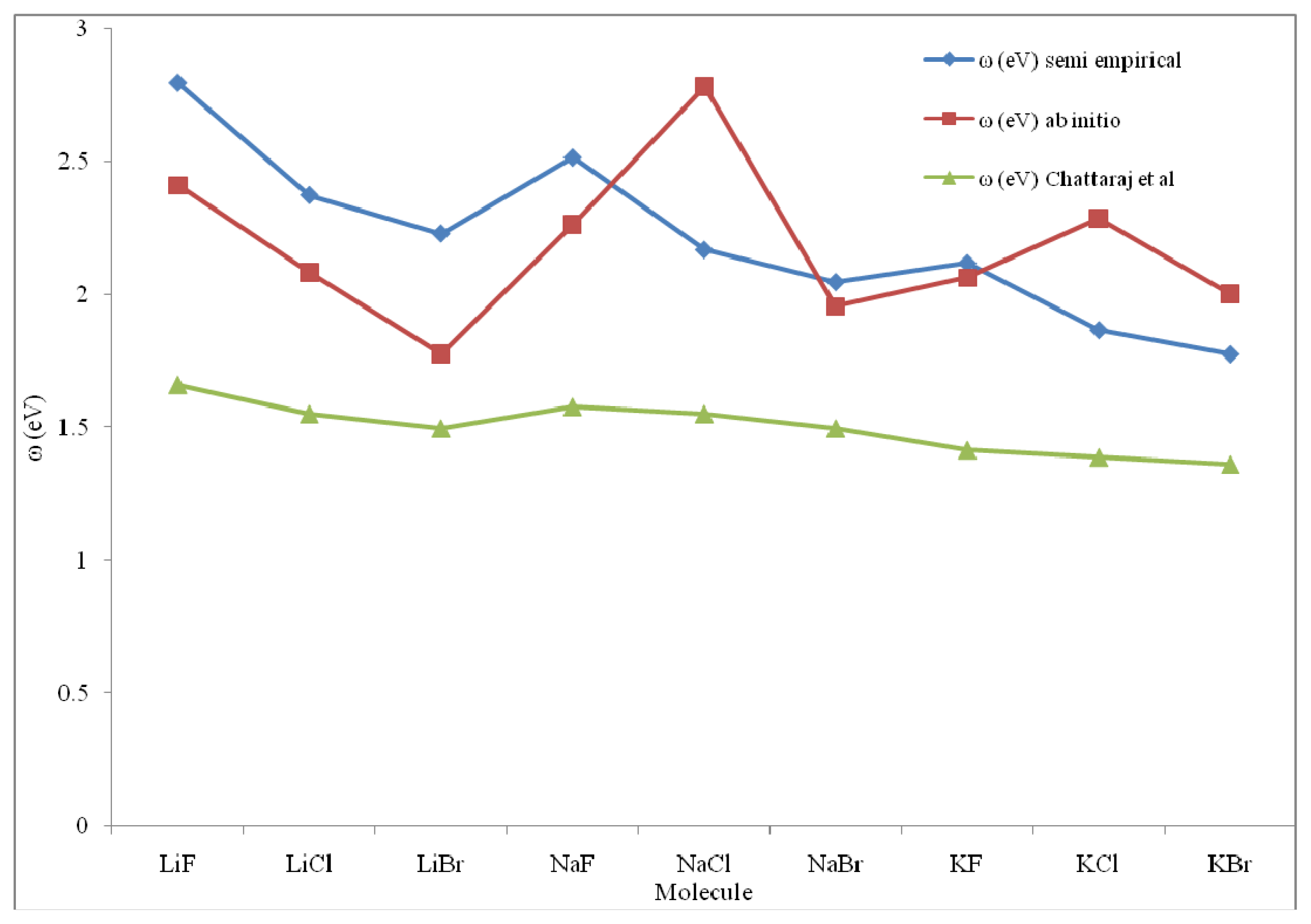
<p>Since the electrophilicity index has no experimental benchmark, we have made a determined attempt to perform the validity test of our model of electrophilicity equalization in <xref ref-type="table" rid="t1-ijms-13-02160">Table 1</xref>, where three sets of electrophilicity indices of the di-atomic molecules are presented. We have taken one set of diatomic molecule and another set of tri-atomic molecules and computed their electrophilicity, <italic>ω</italic> in terms of our suggested model and formula. Furthermore, we have invoked the ansatz of Parr <italic>et al</italic>. [<xref ref-type="bibr" rid="b10-ijms-13-02160">10</xref>], <xref rid="FD2" ref-type="disp-formula">Equation 2</xref>, and computed the electrophilicity indices of the same di-atomic molecules. The required parameters, <italic>I</italic> and <italic>A</italic>, are computed using the <italic>ab initio</italic> quantum chemical method stated above. The electrophilicites published by Chattaraj <italic>et al</italic>. [<xref ref-type="bibr" rid="b8-ijms-13-02160">8</xref>] are also presented for sake of comparison.</p>
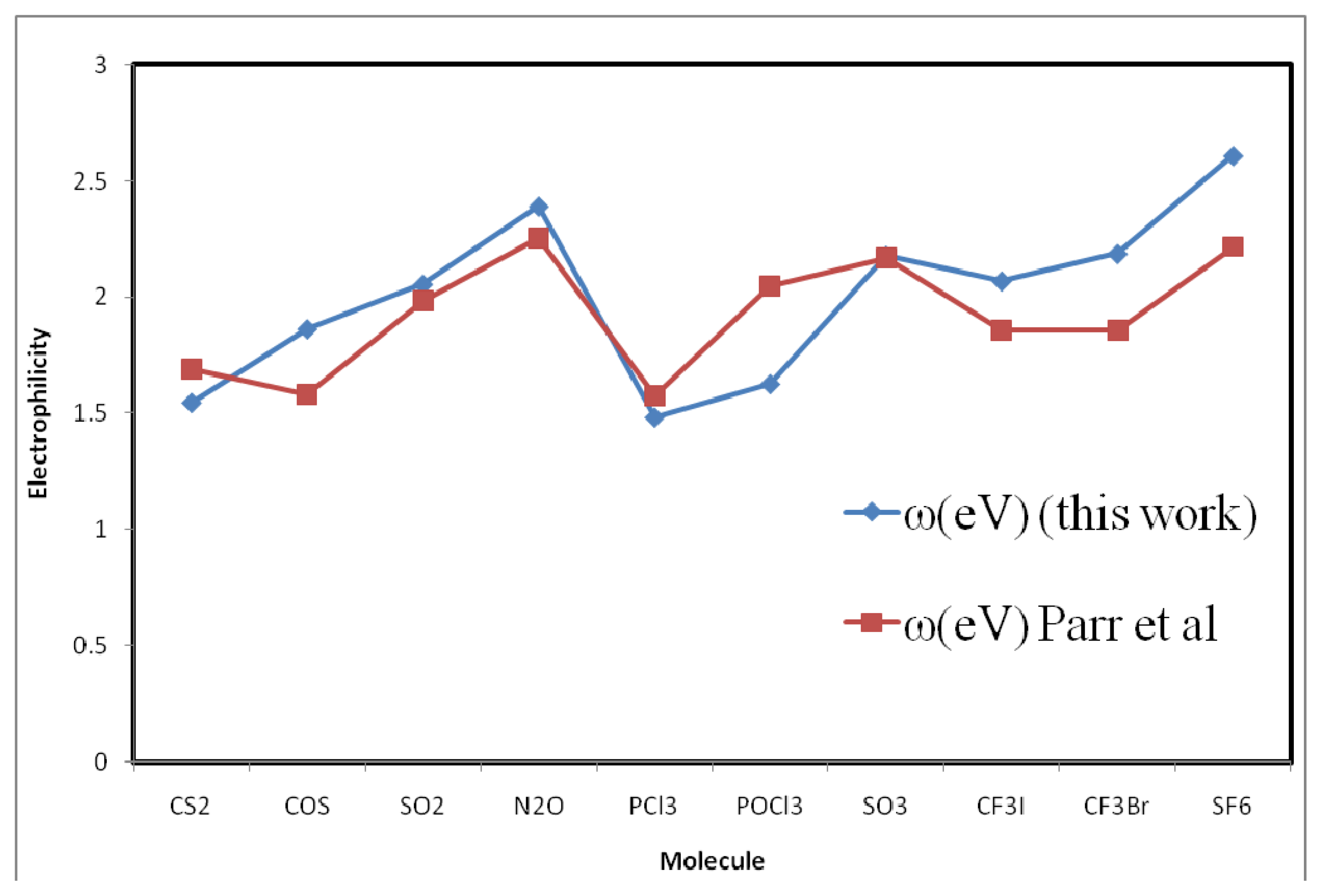
<p>To perform a comparative study for hetero-nuclear poly-atomic systems, two sets of electrophilicites computed through the ansatz of Parr <italic>et al</italic>. and using experimental <italic>I</italic> and <italic>A</italic>, and those with the formula of the present work for poly-atomic molecules, are presented in <xref ref-type="table" rid="t2-ijms-13-02160">Table 2</xref>. To have a better view of the comparative study, the results are plotted in <xref ref-type="fig" rid="f1-ijms-13-02160">Figures 1</xref> and <xref ref-type="fig" rid="f2-ijms-13-02160">2</xref>.</p>
<p>A close look at <xref ref-type="table" rid="t1-ijms-13-02160">Table 1</xref> for di-atomic molecules reveals that the <italic>ω</italic> values computed by the present work are systematically closer to the corresponding values of Parr <italic>et al</italic>. as compared with the corresponding values of Chattaraj <italic>et al</italic>. [<xref ref-type="bibr" rid="b8-ijms-13-02160">8</xref>]. <xref ref-type="fig" rid="f1-ijms-13-02160">Figure 1</xref> reveals that the profiles of electrophilicities of the present work and those of Parr <italic>et al</italic>. [<xref ref-type="bibr" rid="b10-ijms-13-02160">10</xref>] are systematically closer and those of Chattaraj <italic>et al</italic>. [<xref ref-type="bibr" rid="b8-ijms-13-02160">8</xref>] are far off the profile for the bench mark <italic>ω</italic> values.</p>
<p><xref ref-type="table" rid="t2-ijms-13-02160">Table 2</xref> reveals that there is a strong correlation between the molecular electrophilicity indices of the hetero nuclear polyatomic molecules evaluated through <xref rid="FD14" ref-type="disp-formula">Equation 14</xref>, with their corresponding values evaluated using the experimental <italic>I</italic> and <italic>A</italic> through the ansatz of Parr <italic>et al.</italic> [<xref ref-type="bibr" rid="b10-ijms-13-02160">10</xref>]. <xref ref-type="fig" rid="f2-ijms-13-02160">Figure 2</xref> reveals that the profiles of the <italic>ω</italic> values are close and strongly correlated. It is further evident that the <italic>ω</italic> values of as many as four molecular systems are so close that one is almost superimposed upon the other.</p></sec>
<sec>
<title>5. Conclusion</title>
<p>In conclusion we state that we have basically launched a quest as to whether or not there exists a physical process of electrophilicity equalization similar to the phenomena of electronegativity and hardness equalization during the chemical event of molecule formation. The study suggests that the electrophilicity equalization principle is most likely to be a valid theoretical proposition, similar in nature to the electronegativity and hardness equalization principle. We have employed an algorithm invoking the theorem of electrostatics for the computation of the equalized electrophilicity on the event of molecule formation. The results demonstrate that the qualitative view of conceptual chemistry in that there should be a physical process of electrophilicity equalization on the event of molecule formation, is scientifically an acceptable proposition. After a detailed comparative study, it seems that the present model of electrophilicity equalization is an improvement on that of Chattaraj <italic>et al.</italic> [<xref ref-type="bibr" rid="b8-ijms-13-02160">8</xref>].</p></sec></body>
<back>
<ref-list>
<title>References</title>
<ref id="b1-ijms-13-02160"><label>1</label><citation citation-type="journal"><person-group person-group-type="author"><name><surname>Chattaraj</surname><given-names>P.K.</given-names></name><name><surname>Maiti</surname><given-names>B.</given-names></name><name><surname>Sarkar</surname><given-names>U.</given-names></name></person-group><article-title>Philicity: A unified treatment of chemical reactivity and selectivity</article-title><source>J. Phys. Chem. A</source><year>2003</year><volume>107</volume><fpage>4973</fpage><lpage>4975</lpage><pub-id pub-id-type="doi">10.1021/jp034707u</pub-id></citation></ref>
<ref id="b2-ijms-13-02160"><label>2</label><citation citation-type="journal"><person-group person-group-type="author"><name><surname>Pérez</surname><given-names>P.</given-names></name></person-group><article-title>Relationship between super electrophilicity and the electrophilicity index of isolated species</article-title><source>J. Org. Chem</source><year>2004</year><volume>69</volume><fpage>5048</fpage><lpage>5053</lpage><pub-id pub-id-type="doi">10.1021/jo049945f</pub-id><pub-id pub-id-type="pmid">15255734</pub-id></citation></ref>
<ref id="b3-ijms-13-02160"><label>3</label><citation citation-type="journal"><person-group person-group-type="author"><name><surname>Chattaraj</surname><given-names>P.K.</given-names></name><name><surname>Sarkar</surname><given-names>U.</given-names></name><name><surname>Roy</surname><given-names>D.R.</given-names></name></person-group><article-title>Electrophilicity index</article-title><source>Chem. Rev</source><year>2006</year><volume>106</volume><fpage>2065</fpage><lpage>2091</lpage><pub-id pub-id-type="doi">10.1021/cr040109f</pub-id><pub-id pub-id-type="pmid">16771443</pub-id></citation></ref>
<ref id="b4-ijms-13-02160"><label>4</label><citation citation-type="journal"><person-group person-group-type="author"><name><surname>Campodónico</surname><given-names>P.R.</given-names></name><name><surname>Aizman</surname><given-names>A.</given-names></name><name><surname>Contreras</surname><given-names>R.</given-names></name></person-group><article-title>Empirical scale of nucleophilicity for substituted pyridines</article-title><source>Chem. Phys. Lett</source><year>2006</year><volume>422</volume><fpage>204</fpage><lpage>209</lpage><pub-id pub-id-type="doi">10.1016/j.cplett.2006.02.045</pub-id></citation></ref>
<ref id="b5-ijms-13-02160"><label>5</label><citation citation-type="journal"><person-group person-group-type="author"><name><surname>de Vleeschouwer</surname><given-names>F.</given-names></name><name><surname>van Speybroeck</surname><given-names>V.</given-names></name><name><surname>Waroquier</surname><given-names>M.</given-names></name><name><surname>Geerlings</surname><given-names>P.</given-names></name><name><surname>de Proft</surname><given-names>F.</given-names></name></person-group><article-title>Electrophilicity and nucleophilicity index for radicals</article-title><source>Org. Lett</source><year>2007</year><volume>9</volume><fpage>2721</fpage><lpage>2724</lpage><pub-id pub-id-type="doi">10.1021/ol071038k</pub-id><pub-id pub-id-type="pmid">17559221</pub-id></citation></ref>
<ref id="b6-ijms-13-02160"><label>6</label><citation citation-type="journal"><person-group person-group-type="author"><name><surname>Padmanabhan</surname><given-names>J.</given-names></name><name><surname>Parthasarathi</surname><given-names>R.</given-names></name><name><surname>Subramanian</surname><given-names>V.</given-names></name><name><surname>Chattaraj</surname><given-names>P.K.</given-names></name></person-group><article-title>Electrophilicity-based charge transfer descriptor</article-title><source>J. Phys. Chem. A</source><year>2007</year><volume>111</volume><fpage>1358</fpage><lpage>1361</lpage><pub-id pub-id-type="doi">10.1021/jp0649549</pub-id><pub-id pub-id-type="pmid">17256919</pub-id></citation></ref>
<ref id="b7-ijms-13-02160"><label>7</label><citation citation-type="journal"><person-group person-group-type="author"><name><surname>Noorizadeh</surname><given-names>S.</given-names></name><name><surname>Shakerzadeh</surname><given-names>E.</given-names></name></person-group><article-title>A new scale of electronegativity based on electrophilicity index</article-title><source>J. Phys. Chem. A</source><year>2008</year><volume>112</volume><fpage>3486</fpage><lpage>3491</lpage><pub-id pub-id-type="doi">10.1021/jp709877h</pub-id><pub-id pub-id-type="pmid">18331007</pub-id></citation></ref>
<ref id="b8-ijms-13-02160"><label>8</label><citation citation-type="journal"><person-group person-group-type="author"><name><surname>Chattaraj</surname><given-names>P.K.</given-names></name><name><surname>Giri</surname><given-names>S.</given-names></name><name><surname>Duley</surname><given-names>S.</given-names></name></person-group><article-title>Electrophilicity equalization principle</article-title><source>J. Phys. Chem. Lett</source><year>2010</year><volume>1</volume><fpage>1064</fpage><lpage>1067</lpage><pub-id pub-id-type="doi">10.1021/jz1001117</pub-id></citation></ref>
<ref id="b9-ijms-13-02160"><label>9</label><citation citation-type="journal"><person-group person-group-type="author"><name><surname>Chattaraj</surname><given-names>P.K.</given-names></name><name><surname>Duley</surname><given-names>S.</given-names></name></person-group><article-title>Electron affinity, electronegativity, and electrophilicity of atoms and ions</article-title><source>J. Chem. Eng. Data</source><year>2010</year><volume>55</volume><fpage>1882</fpage><lpage>1886</lpage><pub-id pub-id-type="doi">10.1021/je900892p</pub-id></citation></ref>
<ref id="b10-ijms-13-02160"><label>10</label><citation citation-type="journal"><person-group person-group-type="author"><name><surname>Parr</surname><given-names>R.G.</given-names></name><name><surname>von Szentpaly</surname><given-names>L.</given-names></name><name><surname>Liu</surname><given-names>S.</given-names></name></person-group><article-title>Electrophilicity index</article-title><source>J. Am. Chem. Soc</source><year>1999</year><volume>121</volume><fpage>1922</fpage><lpage>1924</lpage><pub-id pub-id-type="doi">10.1021/ja983494x</pub-id></citation></ref>
<ref id="b11-ijms-13-02160"><label>11</label><citation citation-type="journal"><person-group person-group-type="author"><name><surname>Maynard</surname><given-names>A.T.</given-names></name><name><surname>Huang</surname><given-names>M.</given-names></name><name><surname>Rice</surname><given-names>W.G.</given-names></name><name><surname>Covell</surname><given-names>D.G.</given-names></name></person-group><article-title>Reactivity of the HIV-1 nucleocapsid protein p7 zinc finger domains from the perspective of density-functional theory</article-title><source>Proc. Natl. Acad. Sci. USA</source><year>1998</year><volume>95</volume><fpage>11578</fpage><lpage>11583</lpage><pub-id pub-id-type="doi">10.1073/pnas.95.20.11578</pub-id><pub-id pub-id-type="pmid">9751708</pub-id></citation></ref>
<ref id="b12-ijms-13-02160"><label>12</label><citation citation-type="book"><person-group person-group-type="author"><name><surname>Liu</surname><given-names>S.B.</given-names></name></person-group><article-title>Electrophilicity</article-title><source>Chemical Reactivity Theory: A Density Functional View</source><person-group person-group-type="editor"><name><surname>Chattaraj</surname><given-names>P.K.</given-names></name></person-group><publisher-name>Taylor and Francis</publisher-name><publisher-loc>Boca Raton, FL, USA</publisher-loc><year>2009</year><fpage>179</fpage></citation></ref>
<ref id="b13-ijms-13-02160"><label>13</label><citation citation-type="journal"><person-group person-group-type="author"><name><surname>Ingold</surname><given-names>C.K.</given-names></name></person-group><article-title>Principles of an electronic theory of organic reactions</article-title><source>Chem. Rev</source><year>1934</year><volume>15</volume><fpage>225</fpage><lpage>274</lpage><pub-id pub-id-type="doi">10.1021/cr60051a003</pub-id></citation></ref>
<ref id="b14-ijms-13-02160"><label>14</label><citation citation-type="journal"><person-group person-group-type="author"><name><surname>Geerlings</surname><given-names>P.</given-names></name><name><surname>de Proft</surname><given-names>F.</given-names></name><name><surname>Langenaeker</surname><given-names>W.</given-names></name></person-group><article-title>Conceptual density functional theory</article-title><source>Chem. Rev</source><year>2003</year><volume>103</volume><fpage>1793</fpage><lpage>1873</lpage><pub-id pub-id-type="doi">10.1021/cr990029p</pub-id><pub-id pub-id-type="pmid">12744694</pub-id></citation></ref>
<ref id="b15-ijms-13-02160"><label>15</label><citation citation-type="journal"><person-group person-group-type="author"><name><surname>Gazquez</surname><given-names>J.L.</given-names></name></person-group><article-title>Perspectives on the density functional theory of chemical reactivity</article-title><source>J. Mex. Chem. Soc</source><year>2008</year><volume>52</volume><fpage>3</fpage><lpage>10</lpage></citation></ref>
<ref id="b16-ijms-13-02160"><label>16</label><citation citation-type="journal"><person-group person-group-type="author"><name><surname>Chermette</surname><given-names>H.</given-names></name></person-group><article-title>Chemical reactivity indexes in density functional theory</article-title><source>J. Comput. Chem</source><year>1999</year><volume>20</volume><fpage>129</fpage><lpage>154</lpage><pub-id pub-id-type="doi">10.1002/(SICI)1096-987X(19990115)20:1&lt;129::AID-JCC13&gt;3.0.CO;2-A</pub-id></citation></ref>
<ref id="b17-ijms-13-02160"><label>17</label><citation citation-type="journal"><person-group person-group-type="author"><name><surname>Ayers</surname><given-names>P.W.</given-names></name><name><surname>Anderson</surname><given-names>J.S.M.</given-names></name><name><surname>Bartolotti</surname><given-names>L.J.</given-names></name></person-group><article-title>Perturbative perspectives on the chemical reaction prediction problem</article-title><source>Int. J. Quantum Chem</source><year>2005</year><volume>101</volume><fpage>520</fpage><lpage>534</lpage><pub-id pub-id-type="doi">10.1002/qua.20307</pub-id></citation></ref>
<ref id="b18-ijms-13-02160"><label>18</label><citation citation-type="journal"><person-group person-group-type="author"><name><surname>Liu</surname><given-names>S.B.</given-names></name></person-group><article-title>Conceptual density functional theory and some recent developments</article-title><source>Acta Phys. Chim. Sin</source><year>2009</year><volume>25</volume><fpage>590</fpage><lpage>600</lpage></citation></ref>
<ref id="b19-ijms-13-02160"><label>19</label><citation citation-type="journal"><person-group person-group-type="author"><name><surname>Mayr</surname><given-names>H.</given-names></name><name><surname>Patz</surname><given-names>M.</given-names></name></person-group><article-title>Scales of nucleophilicity and electrophilicity: A system for ordering polar organic and organometallic reactions</article-title><source>Angew. Chem. Int. Ed. Engl</source><year>1994</year><volume>33</volume><fpage>938</fpage><lpage>957</lpage><pub-id pub-id-type="doi">10.1002/anie.199409381</pub-id></citation></ref>
<ref id="b20-ijms-13-02160"><label>20</label><citation citation-type="journal"><person-group person-group-type="author"><name><surname>Legon</surname><given-names>A.C.</given-names></name><name><surname>Millen</surname><given-names>D.J.</given-names></name></person-group><article-title>Hydrogen bonding as a probe of electron densities: Limiting gas-phase nucleophilicities and electrophilicities of B and HX</article-title><source>J. Am. Chem. Soc</source><year>1987</year><volume>109</volume><fpage>356</fpage><lpage>358</lpage><pub-id pub-id-type="doi">10.1021/ja00236a011</pub-id></citation></ref>
<ref id="b21-ijms-13-02160"><label>21</label><citation citation-type="journal"><person-group person-group-type="author"><name><surname>Chaquin</surname><given-names>P.</given-names></name></person-group><article-title>Absolute electronegativity and hardness: An analogy with classical electrostatics suggests an interpretation of the Parr ‘electrophilicity index’ as a ‘global energy index’ leading to the ‘minimum electrophilicity principle’</article-title><source>Chem. Phys. Lett</source><year>2008</year><volume>458</volume><fpage>231</fpage><lpage>234</lpage><pub-id pub-id-type="doi">10.1016/j.cplett.2008.04.087</pub-id></citation></ref>
<ref id="b22-ijms-13-02160"><label>22</label><citation citation-type="journal"><person-group person-group-type="author"><name><surname>Gazquez</surname><given-names>J.L.</given-names></name></person-group><article-title>Perspectives on the density functional theory of chemical reactivity</article-title><source>J. Mex. Chem. Soc</source><year>2008</year><volume>52</volume><fpage>3</fpage><lpage>10</lpage></citation></ref>
<ref id="b23-ijms-13-02160"><label>23</label><citation citation-type="journal"><person-group person-group-type="author"><name><surname>Parr</surname><given-names>R.G.</given-names></name><name><surname>Donnelly</surname><given-names>R.A.</given-names></name><name><surname>Levy</surname><given-names>M.</given-names></name><name><surname>Palke</surname><given-names>W.E.</given-names></name></person-group><article-title>Electronegativity: The density functional viewpoint</article-title><source>J. Chem. Phys</source><year>1978</year><volume>68</volume><fpage>3801</fpage><lpage>3806</lpage><pub-id pub-id-type="doi">10.1063/1.436185</pub-id></citation></ref>
<ref id="b24-ijms-13-02160"><label>24</label><citation citation-type="journal"><person-group person-group-type="author"><name><surname>Parr</surname><given-names>R.G.</given-names></name><name><surname>Pearson</surname><given-names>R.G.</given-names></name></person-group><article-title>Absolute hardness: companion parameter to absolute electronegativity</article-title><source>J. Am. Chem. Soc</source><year>1983</year><volume>105</volume><fpage>7512</fpage><lpage>7516</lpage><pub-id pub-id-type="doi">10.1021/ja00364a005</pub-id></citation></ref>
<ref id="b25-ijms-13-02160"><label>25</label><citation citation-type="journal"><person-group person-group-type="author"><name><surname>Ayers</surname><given-names>P.W.</given-names></name><name><surname>Parr</surname><given-names>R.G.</given-names></name></person-group><article-title>Beyond electronegativity and local hardness: Higher-order equalization criteria for determination of a ground-state electron density</article-title><source>J. Chem. Phys</source><year>2008</year><volume>129</volume><fpage>054111</fpage><lpage>054117</lpage><pub-id pub-id-type="doi">10.1063/1.2957900</pub-id><pub-id pub-id-type="pmid">18698892</pub-id></citation></ref>
<ref id="b26-ijms-13-02160"><label>26</label><citation citation-type="journal"><person-group person-group-type="author"><name><surname>Ayers</surname><given-names>P.W.</given-names></name><name><surname>Parr</surname><given-names>R.G.</given-names></name></person-group><article-title>Local hardness equalization: Exploiting the ambiguity</article-title><source>J. Chem. Phys</source><year>2008</year><volume>128</volume><fpage>184108</fpage><lpage>184115</lpage><pub-id pub-id-type="doi">10.1063/1.2918731</pub-id><pub-id pub-id-type="pmid">18532800</pub-id></citation></ref>
<ref id="b27-ijms-13-02160"><label>27</label><citation citation-type="book"><person-group person-group-type="author"><name><surname>Atkins</surname><given-names>P.W.</given-names></name></person-group><source>QUANTA: A Handbook of Concepts</source><edition>2nd ed.</edition><publisher-name>Oxford University Press</publisher-name><publisher-loc>Cary, NC, USA</publisher-loc><year>1991</year></citation></ref>
<ref id="b28-ijms-13-02160"><label>28</label><citation citation-type="book"><person-group person-group-type="author"><name><surname>Pillar</surname><given-names>F.L.</given-names></name></person-group><source>Elementary Quantum Chemistry</source><publisher-name>McGraw Hill</publisher-name><publisher-loc>New York, NY, USA</publisher-loc><year>1968</year></citation></ref>
<ref id="b29-ijms-13-02160"><label>29</label><citation citation-type="journal"><person-group person-group-type="author"><name><surname>Plakhutin</surname><given-names>B.N.</given-names></name><name><surname>Gorelik</surname><given-names>E.V.</given-names></name><name><surname>Breslavskaya</surname><given-names>N.N.</given-names></name></person-group><article-title>Koopmans’ theorem in the ROHF method: Canonical form for the Hartree-Fock hamiltonian</article-title><source>J. Chem. Phys</source><year>2006</year><volume>125</volume><fpage>204110</fpage><lpage>204119</lpage><pub-id pub-id-type="doi">10.1063/1.2393223</pub-id><pub-id pub-id-type="pmid">17144693</pub-id></citation></ref>
<ref id="b30-ijms-13-02160"><label>30</label><citation citation-type="journal"><person-group person-group-type="author"><name><surname>Plakhutin</surname><given-names>B.N.</given-names></name><name><surname>Davidson</surname><given-names>E.R.</given-names></name></person-group><article-title>Koopmans’ theorem in the restricted open-shell Hartree-Fock method. 1. A variational approach</article-title><source>J. Phys. Chem. A</source><year>2009</year><volume>113</volume><fpage>12386</fpage><lpage>12395</lpage><pub-id pub-id-type="doi">10.1021/jp9002593</pub-id><pub-id pub-id-type="pmid">19459641</pub-id></citation></ref>
<ref id="b31-ijms-13-02160"><label>31</label><citation citation-type="journal"><person-group person-group-type="author"><name><surname>Ghosh</surname><given-names>D.C.</given-names></name><name><surname>Islam</surname><given-names>N.</given-names></name></person-group><article-title>Whether electronegativity and hardness are manifest two different descriptors of the one and the same property of atoms—A quest</article-title><source>Int. J. Quantum Chem</source><year>2011</year><volume>111</volume><fpage>40</fpage><lpage>51</lpage><pub-id pub-id-type="doi">10.1002/qua.22415</pub-id></citation></ref>
<ref id="b32-ijms-13-02160"><label>32</label><citation citation-type="journal"><person-group person-group-type="author"><name><surname>Ghosh</surname><given-names>D.C.</given-names></name><name><surname>Islam</surname><given-names>N.</given-names></name></person-group><article-title>Determination of some descriptors of the real world working on the identity of the basic concept and the origin of the electronegativity and the global hardness of atoms, part 1: Evaluation of internuclear bond distance of some heteronuclear diatomics</article-title><source>Int. J. Quantum Chem</source><year>2011</year><volume>111</volume><fpage>1942</fpage><lpage>1949</lpage><pub-id pub-id-type="doi">10.1002/qua.22500</pub-id></citation></ref>
<ref id="b33-ijms-13-02160"><label>33</label><citation citation-type="journal"><person-group person-group-type="author"><name><surname>Ghosh</surname><given-names>D.C.</given-names></name><name><surname>Islam</surname><given-names>N.</given-names></name></person-group><article-title>Determination of some descriptors of the real world working on the identity of the basic concept and the origin of the electronegativity and the global hardness of atoms. Part 2: Computation of the dipole moments of some heteronuclear diatomics</article-title><source>Int. J. Quantum Chem</source><year>2011</year><volume>111</volume><fpage>2802</fpage><lpage>2810</lpage><pub-id pub-id-type="doi">10.1002/qua.22651</pub-id></citation></ref>
<ref id="b34-ijms-13-02160"><label>34</label><citation citation-type="journal"><person-group person-group-type="author"><name><surname>Ghosh</surname><given-names>D.C.</given-names></name><name><surname>Islam</surname><given-names>N.</given-names></name></person-group><article-title>Whether there is a hardness equalization principle analogous to the electronegativity equalization principle—A quest</article-title><source>Int. J. Quantum Chem</source><year>2011</year><volume>111</volume><fpage>1961</fpage><lpage>1969</lpage><pub-id pub-id-type="doi">10.1002/qua.22508</pub-id></citation></ref>
<ref id="b35-ijms-13-02160"><label>35</label><citation citation-type="journal"><person-group person-group-type="author"><name><surname>Ghosh</surname><given-names>D.C.</given-names></name><name><surname>Islam</surname><given-names>N.</given-names></name></person-group><article-title>A quest for the algorithm for evaluating the molecular hardness</article-title><source>Int. J. Quantum Chem</source><year>2011</year><volume>111</volume><fpage>1931</fpage><lpage>1941</lpage><pub-id pub-id-type="doi">10.1002/qua.22499</pub-id></citation></ref>
<ref id="b36-ijms-13-02160"><label>36</label><citation citation-type="journal"><person-group person-group-type="author"><name><surname>Ghosh</surname><given-names>D.C.</given-names></name><name><surname>Islam</surname><given-names>N.</given-names></name></person-group><article-title>Charge transfer associated with the physical process of hardness equalization and the chemical event of the molecule formation and the dipole moments</article-title><source>Int. J. Quantum Chem</source><year>2011</year><volume>111</volume><fpage>2811</fpage><lpage>2819</lpage><pub-id pub-id-type="doi">10.1002/qua.22653</pub-id></citation></ref>
<ref id="b37-ijms-13-02160"><label>37</label><citation citation-type="journal"><person-group person-group-type="author"><name><surname>Islam</surname><given-names>N.</given-names></name><name><surname>Ghosh</surname><given-names>D.C.</given-names></name></person-group><article-title>A new algorithm for the evaluation of equilibrium internuclear bond distance of heteronuclear diatomic molecule based on the hardness equalization principle</article-title><source>Eur. Phys. J. D</source><year>2011</year><volume>61</volume><fpage>341</fpage><lpage>348</lpage><pub-id pub-id-type="doi">10.1140/epjd/e2010-10058-6</pub-id></citation></ref>
<ref id="b38-ijms-13-02160"><label>38</label><citation citation-type="journal"><person-group person-group-type="author"><name><surname>Islam</surname><given-names>N.</given-names></name><name><surname>Ghosh</surname><given-names>D.C.</given-names></name></person-group><article-title>A new radial dependent electrostatic algorithm for the evaluation of the electrophilicity indices of the atoms</article-title><source>Int. J. Quantum Chem</source><year>2011</year><volume>111</volume><fpage>3556</fpage><lpage>3564</lpage></citation></ref>
<ref id="b39-ijms-13-02160"><label>39</label><citation citation-type="journal"><person-group person-group-type="author"><name><surname>Putz</surname><given-names>M.V.</given-names></name></person-group><article-title>Electronegativity, quantum observable</article-title><source>Int. J. Quantum Chem</source><year>2009</year><volume>109</volume><fpage>733</fpage><lpage>738</lpage><pub-id pub-id-type="doi">10.1002/qua.21957</pub-id></citation></ref>
<ref id="b40-ijms-13-02160"><label>40</label><citation citation-type="journal"><person-group person-group-type="author"><name><surname>Putz</surname><given-names>M.V.</given-names></name><name><surname>Russo</surname><given-names>N.</given-names></name><name><surname>Sicilia</surname><given-names>E.</given-names></name></person-group><article-title>About the mulliken electronegativity in DFT</article-title><source>Theor. Chem. Acc</source><year>2005</year><volume>114</volume><fpage>38</fpage><lpage>45</lpage><pub-id pub-id-type="doi">10.1007/s00214-005-0641-4</pub-id></citation></ref>
<ref id="b41-ijms-13-02160"><label>41</label><citation citation-type="journal"><person-group person-group-type="author"><name><surname>Putz</surname><given-names>M.V.</given-names></name></person-group><article-title>Systematic formulations for electronegativity and hardness and their atomic scales within density functional softness theory</article-title><source>Int. J. Quantum Chem</source><year>2006</year><volume>106</volume><fpage>361</fpage><lpage>389</lpage><pub-id pub-id-type="doi">10.1002/qua.20787</pub-id></citation></ref>
<ref id="b42-ijms-13-02160"><label>42</label><citation citation-type="journal"><person-group person-group-type="author"><name><surname>Putz</surname><given-names>M.V.</given-names></name><name><surname>Russo</surname><given-names>N.</given-names></name><name><surname>Sicilia</surname><given-names>E.</given-names></name></person-group><article-title>Atomic radii scale and related size properties from density functional electronegativity formulation</article-title><source>J. Phys. Chem. A</source><year>2003</year><volume>107</volume><fpage>5461</fpage><lpage>5465</lpage><pub-id pub-id-type="doi">10.1021/jp027492h</pub-id></citation></ref>
<ref id="b43-ijms-13-02160"><label>43</label><citation citation-type="journal"><person-group person-group-type="author"><name><surname>Putz</surname><given-names>M.V.</given-names></name></person-group><article-title>Semi classical electronegativity and chemical hardness</article-title><source>J. Theor. Comput. Chem</source><year>2007</year><volume>6</volume><fpage>33</fpage><lpage>47</lpage><pub-id pub-id-type="doi">10.1142/S0219633607002861</pub-id></citation></ref>
<ref id="b44-ijms-13-02160"><label>44</label><citation citation-type="journal"><person-group person-group-type="author"><name><surname>Putz</surname><given-names>M.V.</given-names></name><name><surname>Russo</surname><given-names>N.</given-names></name><name><surname>Sicilia</surname><given-names>E.</given-names></name></person-group><article-title>On the application of the HSAB principle through the use of improved computational schemes for chemical hardness evaluation</article-title><source>J. Comput. Chem</source><year>2004</year><volume>25</volume><fpage>994</fpage><lpage>1003</lpage><pub-id pub-id-type="doi">10.1002/jcc.20027</pub-id><pub-id pub-id-type="pmid">15027111</pub-id></citation></ref>
<ref id="b45-ijms-13-02160"><label>45</label><citation citation-type="journal"><person-group person-group-type="author"><name><surname>Tarko</surname><given-names>L.</given-names></name><name><surname>Putz</surname><given-names>M.V.</given-names></name></person-group><article-title>On electronegativity and chemical hardness relationships with aromaticity</article-title><source>J. Math. Chem</source><year>2010</year><volume>47</volume><fpage>487</fpage><lpage>495</lpage><pub-id pub-id-type="doi">10.1007/s10910-009-9585-6</pub-id></citation></ref>
<ref id="b46-ijms-13-02160"><label>46</label><citation citation-type="journal"><person-group person-group-type="author"><name><surname>Putz</surname><given-names>M.V.</given-names></name></person-group><article-title>Chemical action and chemical bonding</article-title><source>J. Mol. Struct. (Theochem.)</source><year>2009</year><volume>900</volume><fpage>64</fpage><lpage>70</lpage><pub-id pub-id-type="doi">10.1016/j.theochem.2008.12.026</pub-id></citation></ref>
<ref id="b47-ijms-13-02160"><label>47</label><citation citation-type="journal"><person-group person-group-type="author"><name><surname>Putz</surname><given-names>M.V.</given-names></name></person-group><article-title>On absolute aromaticity within electronegativity and chemical hardness reactivity pictures</article-title><source>MATCH Commun. Math. Comput. Chem</source><year>2010</year><volume>64</volume><fpage>391</fpage><lpage>418</lpage></citation></ref>
<ref id="b48-ijms-13-02160"><label>48</label><citation citation-type="book"><person-group person-group-type="author"><name><surname>Feynman</surname><given-names>R.P.</given-names></name><name><surname>Leighton</surname><given-names>R.B.</given-names></name><name><surname>Sands</surname><given-names>M</given-names></name></person-group><source>The Feynman Lecture on Physics</source><publisher-name>Addison-Wesley</publisher-name><publisher-loc>Boston, MA, USA</publisher-loc><year>1964</year><volume>1</volume></citation></ref>
<ref id="b49-ijms-13-02160"><label>49</label><citation citation-type="journal"><person-group person-group-type="author"><name><surname>Ghosh</surname><given-names>D.C.</given-names></name><name><surname>Islam</surname><given-names>N.</given-names></name></person-group><article-title>Semi-empirical evaluation of the global hardness of the atoms of 103 elements of the periodic table using the most probable radii as their size descriptors</article-title><source>Int. J. Quantum Chem</source><year>2009</year><volume>110</volume><fpage>1206</fpage><lpage>1213</lpage></citation></ref>
<ref id="b50-ijms-13-02160"><label>50</label><citation citation-type="journal"><person-group person-group-type="author"><name><surname>Chamorro</surname><given-names>E.</given-names></name><name><surname>Chattaraj</surname><given-names>P.K.</given-names></name><name><surname>Fuentealba</surname><given-names>P.</given-names></name></person-group><article-title>Variation of the electrophilicity index along the reaction path</article-title><source>J. Phys. Chem. A</source><year>2003</year><volume>107</volume><fpage>7068</fpage><lpage>7072</lpage><pub-id pub-id-type="doi">10.1021/jp035435y</pub-id></citation></ref>
<ref id="b51-ijms-13-02160"><label>51</label><citation citation-type="journal"><person-group person-group-type="author"><name><surname>Parthasarathi</surname><given-names>R.</given-names></name><name><surname>Elango</surname><given-names>M.</given-names></name><name><surname>Subramanian</surname><given-names>V.</given-names></name><name><surname>Chattaraj</surname><given-names>P.K.</given-names></name></person-group><article-title>Variation of electrophilicity during molecular vibrations and internal rotations</article-title><source>Theor. Chem. Acc</source><year>2005</year><volume>113</volume><fpage>257</fpage><lpage>266</lpage><pub-id pub-id-type="doi">10.1007/s00214-005-0634-3</pub-id></citation></ref>
<ref id="b52-ijms-13-02160"><label>52</label><citation citation-type="journal"><person-group person-group-type="author"><name><surname>Noorizadeh</surname><given-names>S.</given-names></name></person-group><article-title>Is there a minimum electrophilicity principle in chemical reactions?</article-title><source>Chin. J. Chem</source><year>2007</year><volume>27</volume><fpage>1439</fpage><lpage>1444</lpage></citation></ref>
<ref id="b53-ijms-13-02160"><label>53</label><citation citation-type="journal"><person-group person-group-type="author"><name><surname>Noorizadeh</surname><given-names>S.</given-names></name><name><surname>Shakerzadeh</surname><given-names>E.</given-names></name></person-group><article-title>Minimum electrophilicity principle in Lewis acid-base complexes of boron trihalides</article-title><source>J. Mol. Struct. (Theochem.)</source><year>2008</year><volume>868</volume><fpage>22</fpage><lpage>26</lpage><pub-id pub-id-type="doi">10.1016/j.theochem.2008.07.033</pub-id></citation></ref>
<ref id="b54-ijms-13-02160"><label>54</label><citation citation-type="journal"><person-group person-group-type="author"><name><surname>Morell</surname><given-names>C.</given-names></name><name><surname>Labet</surname><given-names>V.</given-names></name><name><surname>Grand</surname><given-names>A.</given-names></name><name><surname>Chermette</surname><given-names>H.</given-names></name></person-group><article-title>Minimum electrophilicity principle: An analysis based upon the variation of both chemical potential and absolute hardness</article-title><source>Phys. Chem. Chem. Phys</source><year>2009</year><volume>11</volume><fpage>3417</fpage><lpage>3423</lpage><pub-id pub-id-type="doi">10.1039/b818534d</pub-id><pub-id pub-id-type="pmid">19421543</pub-id></citation></ref>
<ref id="b55-ijms-13-02160"><label>55</label><citation citation-type="journal"><person-group person-group-type="author"><name><surname>Sanderson</surname><given-names>R.T.</given-names></name></person-group><article-title>An interpretation of bond lengths and a classification of bonds</article-title><source>Science</source><year>1951</year><volume>114</volume><fpage>670</fpage><lpage>672</lpage><pub-id pub-id-type="doi">10.1126/science.114.2973.670</pub-id><pub-id pub-id-type="pmid">17770191</pub-id></citation></ref>
<ref id="b56-ijms-13-02160"><label>56</label><citation citation-type="journal"><person-group person-group-type="author"><name><surname>Berkowitz</surname><given-names>M.</given-names></name><name><surname>Ghosh</surname><given-names>S.K.</given-names></name><name><surname>Parr</surname><given-names>R.G.</given-names></name></person-group><article-title>On the concept of local hardness in chemistry</article-title><source>J. Am. Chem. Soc</source><year>1985</year><volume>107</volume><fpage>6811</fpage><lpage>6820</lpage><pub-id pub-id-type="doi">10.1021/ja00310a011</pub-id></citation></ref>
<ref id="b57-ijms-13-02160"><label>57</label><citation citation-type="journal"><person-group person-group-type="author"><name><surname>Ghosh</surname><given-names>S.K.</given-names></name><name><surname>Berkowitz</surname><given-names>M.</given-names></name><name><surname>Parr</surname><given-names>R.G.</given-names></name></person-group><article-title>Transcription of ground-state density-functional theory into a local thermodynamics</article-title><source>Proc. Natl. Acad. Sci. USA</source><year>1984</year><volume>81</volume><fpage>8028</fpage><lpage>8031</lpage><pub-id pub-id-type="doi">10.1073/pnas.81.24.8028</pub-id><pub-id pub-id-type="pmid">6595675</pub-id></citation></ref>
<ref id="b58-ijms-13-02160"><label>58</label><citation citation-type="journal"><person-group person-group-type="author"><name><surname>Datta</surname><given-names>D.</given-names></name></person-group><article-title>Geometric mean principle for hardness equalization, a corollary of Sanderson’s geometric mean principle of electronegativity equalization</article-title><source>J. Phys. Chem</source><year>1986</year><volume>90</volume><fpage>4216</fpage><lpage>4217</lpage><pub-id pub-id-type="doi">10.1021/j100408a076</pub-id></citation></ref>
<ref id="b59-ijms-13-02160"><label>59</label><citation citation-type="journal"><person-group person-group-type="author"><name><surname>von Szentpaly</surname><given-names>L.</given-names></name></person-group><article-title>Ruling out any electrophilicity equalization principle</article-title><source>J. Phys.Chem. A</source><year>2011</year><volume>115</volume><fpage>8528</fpage><lpage>8531</lpage><pub-id pub-id-type="doi">10.1021/jp203319y</pub-id><pub-id pub-id-type="pmid">21699180</pub-id></citation></ref>
<ref id="b60-ijms-13-02160"><label>60</label><citation citation-type="journal"><person-group person-group-type="author"><name><surname>Chattaraj</surname><given-names>P.K.</given-names></name><name><surname>Giri</surname><given-names>S.</given-names></name><name><surname>Duley</surname><given-names>S</given-names></name></person-group><article-title>Comment on Ruling out any electrophilicity equalization Principle</article-title><source>J. Phys. Chem. Soc. A</source><year>2011</year><volume>115</volume><comment>doi.org/10.1021/jp208541x.</comment><pub-id pub-id-type="doi">10.1021/jp203319y</pub-id></citation></ref>
<ref id="b61-ijms-13-02160"><label>61</label><citation citation-type="journal"><person-group person-group-type="author"><name><surname>von Szentpaly</surname><given-names>L</given-names></name></person-group><article-title>Reply to comment on ruling out any electrophilicity equalization principle</article-title><source>J. Phys. Chem. A</source><year>2012</year><volume>116</volume><comment>doi.org/10.1021/jp210486g.</comment></citation></ref>
<ref id="b62-ijms-13-02160"><label>62</label><citation citation-type="journal"><person-group person-group-type="author"><name><surname>Murphy</surname><given-names>L.R.</given-names></name><name><surname>Meek</surname><given-names>T.L.</given-names></name><name><surname>Allred</surname><given-names>A.L.</given-names></name><name><surname>Allen</surname><given-names>L.C.</given-names></name></person-group><article-title>evaluation and test of pauling’s electronegativity scale</article-title><source>J. Phys. Chem. A</source><year>2000</year><volume>104</volume><fpage>5867</fpage><lpage>5871</lpage><pub-id pub-id-type="doi">10.1021/jp000288e</pub-id></citation></ref>
<ref id="b63-ijms-13-02160"><label>63</label><citation citation-type="journal"><person-group person-group-type="author"><name><surname>Nalewajski</surname><given-names>R.F.</given-names></name><name><surname>Parr</surname><given-names>R.G.</given-names></name></person-group><article-title>Information theory, atoms in molecules, and molecular similarity</article-title><source>Proc. Natl. Acad. Sci. USA</source><year>2000</year><volume>97</volume><fpage>8879</fpage><lpage>8882</lpage><pub-id pub-id-type="doi">10.1073/pnas.97.16.8879</pub-id><pub-id pub-id-type="pmid">10922049</pub-id></citation></ref>
<ref id="b64-ijms-13-02160"><label>64</label><citation citation-type="journal"><person-group person-group-type="author"><name><surname>Bader</surname><given-names>R.F.W.</given-names></name></person-group><article-title>A quantum theory of molecular structure and its applications</article-title><source>Chem. Rev</source><year>1991</year><volume>91</volume><fpage>893</fpage><lpage>928</lpage><pub-id pub-id-type="doi">10.1021/cr00005a013</pub-id></citation></ref>
<ref id="b65-ijms-13-02160"><label>65</label><citation citation-type="book"><source><italic>Hyperchem</italic>, Version 8.0.6</source><publisher-name>Hypercube</publisher-name><publisher-loc>Gainesville, FL, USA</publisher-loc><year>2008</year></citation></ref>
<ref id="b66-ijms-13-02160"><label>66</label><citation citation-type="journal"><person-group person-group-type="author"><name><surname>Yang</surname><given-names>W.</given-names></name><name><surname>Lee</surname><given-names>C.</given-names></name><name><surname>Ghosh</surname><given-names>S.K.</given-names></name></person-group><article-title>Molecular softness as the average of atomic softnesses: Companion principle to the geometric mean principle for electronegativity equalization</article-title><source>J. Phys. Chem</source><year>1985</year><volume>89</volume><fpage>5412</fpage><lpage>5414</lpage><pub-id pub-id-type="doi">10.1021/j100271a019</pub-id></citation></ref>
<ref id="b67-ijms-13-02160"><label>67</label><citation citation-type="journal"><person-group person-group-type="author"><name><surname>Ghosh</surname><given-names>D.C.</given-names></name><name><surname>Biswas</surname><given-names>R.</given-names></name><name><surname>Chakraborty</surname><given-names>T.</given-names></name><name><surname>Islam</surname><given-names>N.</given-names></name><name><surname>Rajak</surname><given-names>S.K.</given-names></name></person-group><article-title>The wave mechanical evaluation of the absolute radii of atoms</article-title><source>J. Mol. Struct. (Theochem.)</source><year>2008</year><volume>865</volume><fpage>60</fpage><lpage>67</lpage><pub-id pub-id-type="doi">10.1016/j.theochem.2008.06.020</pub-id></citation></ref></ref-list>
<sec sec-type="display-objects">
<title>Figures and Tables</title>
<fig id="f1-ijms-13-02160" position="float">
<label>Figure 1</label>
<caption>
<p>Comparative study of the three sets of electrophilicity indices of some selected hetero nuclear diatomic molecules.</p></caption>
<graphic xlink:href="ijms-13-02160f1.gif"/></fig>
<fig id="f2-ijms-13-02160" position="float">
<label>Figure 2</label>
<caption>
<p>Comparative study of two sets of electrophilicity indices of some selected hetero nuclear poly-atomic molecules.</p></caption>
<graphic xlink:href="ijms-13-02160f2.gif"/></fig>
<table-wrap id="t1-ijms-13-02160" position="float">
<label>Table 1</label>
<caption>
<p>Computed Electrophilicity index (<italic>ω</italic>) data along with the data of Chattaraj <italic>et al.</italic> [<xref ref-type="bibr" rid="b8-ijms-13-02160">8</xref>] of some selected diatomic molecules and the standard deviations of the two sets of data from the values computed using the ansatz of Parr <italic>et al.</italic> [<xref ref-type="bibr" rid="b10-ijms-13-02160">10</xref>].</p></caption>
<table frame="hsides" rules="all">
<thead>
<tr>
<th align="center" valign="middle">Molecule</th>
<th align="center" valign="middle"><italic>ω</italic> in eV (Present work)</th>
<th align="center" valign="middle"><italic>ω</italic> in eV (Parr <italic>et al.</italic>’s work)</th>
<th align="center" valign="middle"><italic>ω</italic> in eV (Chattaraj <italic>et al.</italic>’s work)</th>
<th align="center" valign="middle">SD in % (Parr <italic>et al.</italic>’s work <italic>vs.</italic> Present work)</th>
<th align="center" valign="middle">SD in % (Parr <italic>et al.</italic>’s work <italic>vs.</italic> Chattaraj <italic>et al.</italic>’s work)</th></tr></thead>
<tbody>
<tr>
<td align="center" valign="top">LiF</td>
<td align="center" valign="top">2.796056041</td>
<td align="center" valign="top">2.411008</td>
<td align="center" valign="top">1.66</td>
<td align="center" valign="top">15.97041739</td>
<td align="center" valign="top">31.14913</td></tr>
<tr>
<td align="center" valign="top">LiCl</td>
<td align="center" valign="top">2.374237241</td>
<td align="center" valign="top">2.083325</td>
<td align="center" valign="top">1.551</td>
<td align="center" valign="top">13.96384342</td>
<td align="center" valign="top">25.5517</td></tr>
<tr>
<td align="center" valign="top">LiBr</td>
<td align="center" valign="top">2.230052794</td>
<td align="center" valign="top">1.776961</td>
<td align="center" valign="top">1.497</td>
<td align="center" valign="top">25.49812821</td>
<td align="center" valign="top">15.75504</td></tr>
<tr>
<td align="center" valign="top">NaF</td>
<td align="center" valign="top">2.515173699</td>
<td align="center" valign="top">2.263738</td>
<td align="center" valign="top">1.578</td>
<td align="center" valign="top">11.10710246</td>
<td align="center" valign="top">30.29229</td></tr>
<tr>
<td align="center" valign="top">NaCl</td>
<td align="center" valign="top">2.168594646</td>
<td align="center" valign="top">2.782726</td>
<td align="center" valign="top">1.551</td>
<td align="center" valign="top">22.06941517</td>
<td align="center" valign="top">44.26329</td></tr>
<tr>
<td align="center" valign="top">NaBr</td>
<td align="center" valign="top">2.047669294</td>
<td align="center" valign="top">1.95519</td>
<td align="center" valign="top">1.497</td>
<td align="center" valign="top">4.729938983</td>
<td align="center" valign="top">23.43455</td></tr>
<tr>
<td align="center" valign="top">KF</td>
<td align="center" valign="top">2.118550154</td>
<td align="center" valign="top">2.063906</td>
<td align="center" valign="top">1.415</td>
<td align="center" valign="top">2.64760866</td>
<td align="center" valign="top">31.44068</td></tr>
<tr>
<td align="center" valign="top">KCl</td>
<td align="center" valign="top">1.867196746</td>
<td align="center" valign="top">2.285827</td>
<td align="center" valign="top">1.388</td>
<td align="center" valign="top">18.31417049</td>
<td align="center" valign="top">39.27799</td></tr>
<tr>
<td align="center" valign="top">KBr</td>
<td align="center" valign="top">1.776848516</td>
<td align="center" valign="top">2.002401</td>
<td align="center" valign="top">1.361</td>
<td align="center" valign="top">11.26410165</td>
<td align="center" valign="top">32.0316</td></tr></tbody></table></table-wrap>
<table-wrap id="t2-ijms-13-02160" position="float">
<label>Table 2</label>
<caption>
<p>Computed Electrophilicity index (<italic>ω</italic>) data along with the data computed using the formula of Parr, <italic>et al.</italic> [<xref ref-type="bibr" rid="b10-ijms-13-02160">10</xref>] of some selected polyatomic molecules and the standard deviation of the data computed in the present work from the values computed using the ansatz of Parr <italic>et al.</italic> [<xref ref-type="bibr" rid="b10-ijms-13-02160">10</xref>].</p></caption>
<table frame="hsides" rules="all">
<thead>
<tr>
<th align="center" valign="middle">Molecule</th>
<th align="center" valign="middle"><italic>ω</italic> in eV (Present work)</th>
<th align="center" valign="middle"><italic>ω</italic> in eV (Parr <italic>et al.</italic>’s work)</th>
<th align="center" valign="middle">SD in % (Parr’s work <italic>vs.</italic> Present work)</th></tr></thead>
<tbody>
<tr>
<td align="center" valign="top">CS<sub>2</sub></td>
<td align="center" valign="top">1.5457</td>
<td align="center" valign="top">1.69</td>
<td align="center" valign="top">8.538461538</td></tr>
<tr>
<td align="center" valign="top">COS</td>
<td align="center" valign="top">1.86309</td>
<td align="center" valign="top">1.58</td>
<td align="center" valign="top">17.91708861</td></tr>
<tr>
<td align="center" valign="top">SO<sub>2</sub></td>
<td align="center" valign="top">2.05525</td>
<td align="center" valign="top">1.985</td>
<td align="center" valign="top">3.539042821</td></tr>
<tr>
<td align="center" valign="top">N<sub>2</sub>O</td>
<td align="center" valign="top">2.39121</td>
<td align="center" valign="top">2.257</td>
<td align="center" valign="top">5.946389012</td></tr>
<tr>
<td align="center" valign="top">PCl<sub>3</sub></td>
<td align="center" valign="top">1.48275</td>
<td align="center" valign="top">1.574</td>
<td align="center" valign="top">5.797331639</td></tr>
<tr>
<td align="center" valign="top">POCl<sub>3</sub></td>
<td align="center" valign="top">1.62653</td>
<td align="center" valign="top">2.048</td>
<td align="center" valign="top">20.57958984</td></tr>
<tr>
<td align="center" valign="top">SO<sub>3</sub></td>
<td align="center" valign="top">2.17862</td>
<td align="center" valign="top">2.168</td>
<td align="center" valign="top">0.489852399</td></tr>
<tr>
<td align="center" valign="top">CF<sub>3</sub>I</td>
<td align="center" valign="top">2.06933</td>
<td align="center" valign="top">1.857</td>
<td align="center" valign="top">11.43403339</td></tr>
<tr>
<td align="center" valign="top">CF<sub>3</sub>Br</td>
<td align="center" valign="top">2.18716</td>
<td align="center" valign="top">1.857</td>
<td align="center" valign="top">17.77921379</td></tr>
<tr>
<td align="center" valign="top">SF<sub>6</sub></td>
<td align="center" valign="top">2.60898</td>
<td align="center" valign="top">2.219</td>
<td align="center" valign="top">17.57458315</td></tr></tbody></table></table-wrap></sec></back></article>