
<?xml version="1.0" encoding="UTF-8"?>
<!DOCTYPE article PUBLIC "-//NLM//DTD Journal Publishing DTD v2.3 20070202//EN" "journalpublishing.dtd">
<article xmlns:xlink="http://www.w3.org/1999/xlink" xml:lang="en" article-type="review-article">
<front>
<journal-meta>
<journal-id journal-id-type="publisher-id">ijms</journal-id>
<journal-title>International Journal of Molecular Sciences</journal-title>
<abbrev-journal-title>Int. J. Mol. Sci.</abbrev-journal-title>
<issn pub-type="epub">1422-0067</issn>
<publisher>
<publisher-name>Molecular Diversity Preservation International (MDPI)</publisher-name></publisher></journal-meta>
<article-meta>
<article-id pub-id-type="doi">10.3390/ijms131115401</article-id>
<article-id pub-id-type="publisher-id">ijms-13-15401</article-id>
<article-categories>
<subj-group>
<subject>Review</subject></subj-group></article-categories>
<title-group>
<article-title>Marine Omega-3 Phospholipids: Metabolism and Biological Activities</article-title></title-group>
<contrib-group>
<contrib contrib-type="author">
<name><surname>Burri</surname><given-names>Lena</given-names></name><xref ref-type="aff" rid="af1-ijms-13-15401">1</xref></contrib>
<contrib contrib-type="author">
<name><surname>Hoem</surname><given-names>Nils</given-names></name><xref ref-type="aff" rid="af1-ijms-13-15401">1</xref></contrib>
<contrib contrib-type="author">
<name><surname>Banni</surname><given-names>Sebastiano</given-names></name><xref ref-type="aff" rid="af2-ijms-13-15401">2</xref></contrib>
<contrib contrib-type="author">
<name><surname>Berge</surname><given-names>Kjetil</given-names></name><xref ref-type="aff" rid="af1-ijms-13-15401">1</xref><xref ref-type="corresp" rid="c1-ijms-13-15401">*</xref></contrib></contrib-group>
<aff id="af1-ijms-13-15401">
<label>1</label>Aker BioMarine ASA, Fjordalléen 16, NO-0115 Oslo, Norway; E-Mails: <email>lena.burri@akerbiomarine.com</email> (L.B.); <email>nils.hoem@akerbiomarine.com</email> (N.H.)</aff>
<aff id="af2-ijms-13-15401">
<label>2</label>Department of Biomedical Sciences, University of Cagliari, Cagliari, Italy; E-Mail: <email>banni@unica.it</email></aff>
<author-notes>
<corresp id="c1-ijms-13-15401">
<label>*</label>Author to whom correspondence should be addressed; E-Mail: <email>kjetil.berge@akerbiomarine.com</email>; Tel.: +47-24-13-00-00; Fax: +47-24-13-01-10.</corresp></author-notes>
<pub-date pub-type="collection">
<year>2012</year></pub-date>
<pub-date pub-type="epub">
<day>21</day>
<month>11</month>
<year>2012</year></pub-date>
<volume>13</volume>
<issue>11</issue>
<fpage>15401</fpage>
<lpage>15419</lpage>
<history>
<date date-type="received">
<day>08</day>
<month>10</month>
<year>2012</year></date>
<date date-type="rev-recd">
<day>09</day>
<month>11</month>
<year>2012</year></date>
<date date-type="accepted">
<day>14</day>
<month>11</month>
<year>2012</year></date></history>
<permissions>
<copyright-statement>© 2012 by the authors; licensee Molecular Diversity Preservation International, Basel, Switzerland.</copyright-statement>
<copyright-year>2012</copyright-year>
<license license-type="open-access" xlink:href="http://creativecommons.org/licenses/by/3.0">
<p>This article is an open-access article distributed under the terms and conditions of the Creative Commons Attribution license (http://creativecommons.org/licenses/by/3.0/).</p></license></permissions>
<abstract>
<p>The biological activities of omega-3 fatty acids (n-3 FAs) have been under extensive study for several decades. However, not much attention has been paid to differences of dietary forms, such as triglycerides (TGs) versus ethyl esters or phospholipids (PLs). New innovative marine raw materials, like krill and fish by-products, present n-3 FAs mainly in the PL form. With their increasing availability, new evidence has emerged on n-3 PL biological activities and differences to n-3 TGs. In this review, we describe the recently discovered nutritional properties of n-3 PLs on different parameters of metabolic syndrome and highlight their different metabolic bioavailability in comparison to other dietary forms of n-3 FAs.</p></abstract>
<kwd-group>
<kwd>phospholipid</kwd>
<kwd>krill oil</kwd>
<kwd>phosphatidylcholine</kwd>
<kwd>fish oil</kwd>
<kwd>triglyceride</kwd></kwd-group></article-meta></front>
<body>
<sec sec-type="intro">
<title>1. Introduction</title>
<p>Marine omega-3 phospholipids (n-3 PLs) are defined as PLs containing n-3 long-chain polyunsaturated fatty acids (PUFAs) derived from marine organisms. This makes them different from PLs derived from vegetable sources, since they do not contain long-chain n-3 PUFAs.</p>
<p>A substantial number of studies on n-3 FAs have assessed their health benefits [<xref ref-type="bibr" rid="b1-ijms-13-15401">1</xref>,<xref ref-type="bibr" rid="b2-ijms-13-15401">2</xref>]. Research on beneficial effects of n-3 PUFAs against atherosclerosis and thrombosis was initiated by studies done by Dyerberg and Bang on the Greenland Eskimos in the early 1970s [<xref ref-type="bibr" rid="b3-ijms-13-15401">3</xref>,<xref ref-type="bibr" rid="b4-ijms-13-15401">4</xref>]. Later, n-3 PUFAs have been shown to be crucial at cellular levels for maintaining membrane homeostasis, as ligands for transcription factors thus influencing gene expression, and for an optimal balance with n-6 fatty acids to secure a regulated inflammatory response, a healthy body composition homeostasis and an equilibrated neurological and psychiatric balance [<xref ref-type="bibr" rid="b5-ijms-13-15401">5</xref>,<xref ref-type="bibr" rid="b6-ijms-13-15401">6</xref>].</p>
<p>Most of the clinical studies have been carried out using n-3 FAs bound to TGs or ethyl esters. However, more recently, marine products enriched in n-3 PUFAs bound to PLs have received increasing attention for their emerging health benefits, as discussed in this review.</p></sec>
<sec>
<title>2. PL Classes</title>
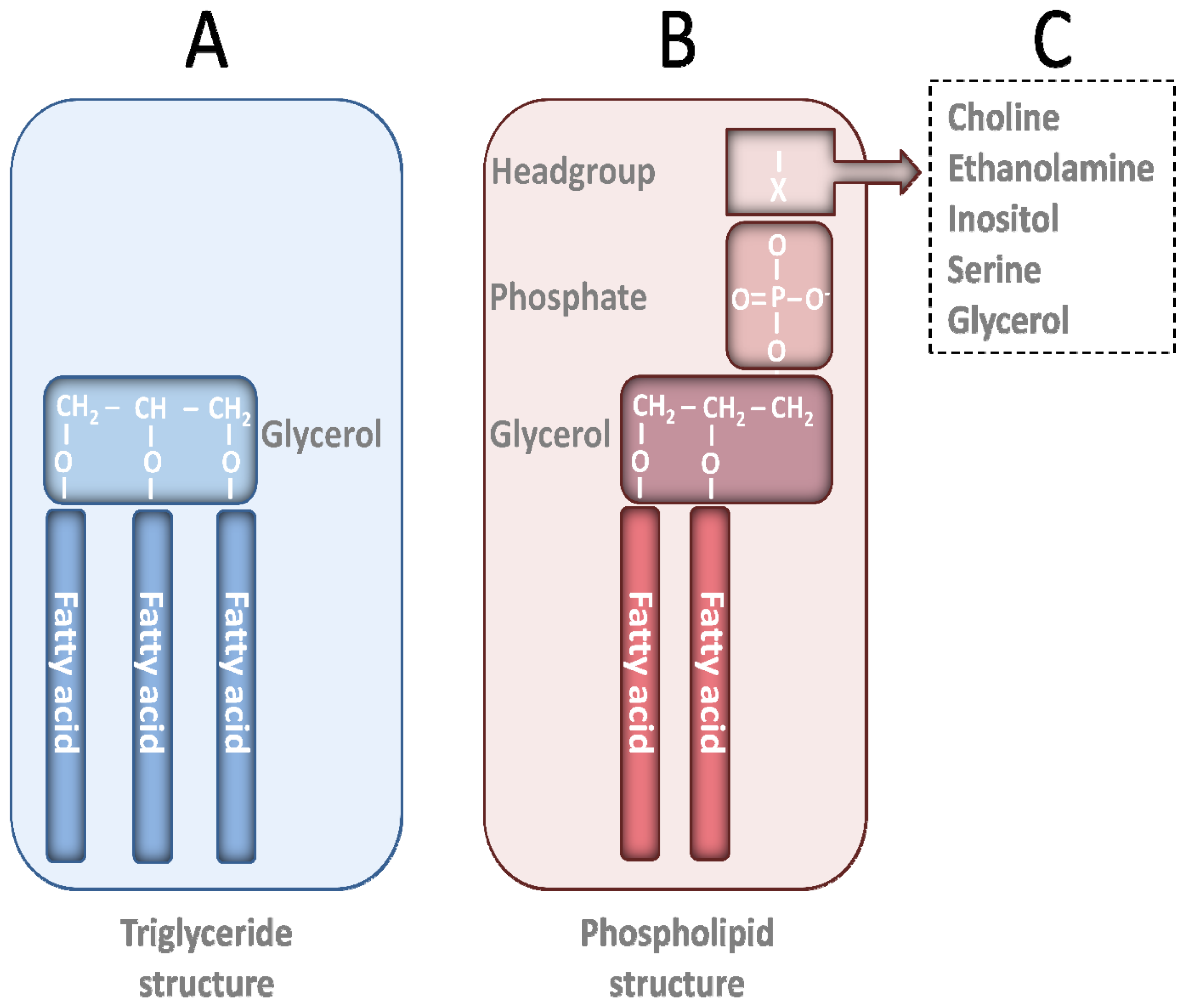
<p>In nature, n-3 FAs are mainly esterified either in PLs or TGs or, due to a partial hydrolysis, are present in the free form. Whereas TGs consist of three FAs esterified to a glycerol backbone, PLs have normally two FAs esterified to a glycerol backbone, and a phosphorous group that is further linked to a headgroup (<xref ref-type="fig" rid="f1-ijms-13-15401">Figure 1</xref>). TGs are highly hydrophobic, whereas PLs are hydrophilic due to the polar headgroup. Hence, the physical-chemical properties of these two groups of lipid structures are different and only PLs are able to form micelles and liposomes.</p>
<p>There are three main classes of PLs: glyceroPLs (FAs ester-bound to backbone), ether glycerolipids and sphingoPLs. GlyceroPLs are the most common subgroup and can be further divided into different subgroups, which are defined by the head-group located in the PL (<xref ref-type="fig" rid="f1-ijms-13-15401">Figure 1</xref>). The headgroup can consist of choline, ethanolamine, glycerol, inositol or serine. For example, phosphatidylcholine (PC) contains a choline head-group, whereas phosphatidylethanolamine (PE) contains an ethanolamine head-group. The distribution of the different PLs in marine resources was recently reviewed by Lu and colleagues [<xref ref-type="bibr" rid="b7-ijms-13-15401">7</xref>]. According to this review, the most predominant PLs in marine sources such as salmon, tuna, rainbow trout and mackerel, is PC, whereas PE is shown to be the second most abundant. Phosphatidylinositol (PI), phosphatidylserine (PS), lysophosphatidylcholine (lyso-PC), and sphingomyelin are found in smaller amounts.</p></sec>
<sec>
<title>3. Sources of Marine PLs</title>
<sec>
<title>3.1. Fish Roe</title>
<p>One by-product of the fish industry that is particularly interesting in respect to marine PLs is fish roe. The word ‘roe’ stands for the eggs and the ovaries full of eggs of seafood. Fish roe is used for human consumption and is a rich source of n-3 PUFAs in PL form [<xref ref-type="bibr" rid="b8-ijms-13-15401">8</xref>–<xref ref-type="bibr" rid="b10-ijms-13-15401">10</xref>]. Fish roe from herring, salmon, pollock, and flying fish contain between 38%–75% of their lipids in the form of PLs with PC being the predominant lipid class [<xref ref-type="bibr" rid="b11-ijms-13-15401">11</xref>]. In salmon, that had the highest total lipid content of the four fish examined, 56% of the lipids were in TG form, whereas the other roes had values below 20%. More than 30% of the total FAs were eicosapentaenoic acid (EPA, 20:5n<italic>-</italic>3) or docosahexaenoic acid (DHA, 22:6n-3). A high presence of these two FAs in fish roes has also been demonstrated in other studies [<xref ref-type="bibr" rid="b8-ijms-13-15401">8</xref>,<xref ref-type="bibr" rid="b12-ijms-13-15401">12</xref>,<xref ref-type="bibr" rid="b13-ijms-13-15401">13</xref>].</p></sec>
<sec>
<title>3.2. Krill Oil</title>
<p>One important source of marine PLs is krill oil (KO). KO has become increasingly popular as a food supplement during the last decade, and the research on KO in animal and human studies is growing. KO is extracted from the Antarctic crustacean krill (<italic>Euphausia superba</italic>), a shrimp-like zooplankton. It is known for a high amount of PL-bound n-3 PUFAs, in particular EPA and DHA. The majority of these two fatty acids are contained in the PC form [<xref ref-type="bibr" rid="b14-ijms-13-15401">14</xref>,<xref ref-type="bibr" rid="b15-ijms-13-15401">15</xref>]. The amount of PLs in oil extracted from krill is typically around 40%. The FA composition of the PLs in KO was recently characterized in two studies [<xref ref-type="bibr" rid="b16-ijms-13-15401">16</xref>,<xref ref-type="bibr" rid="b17-ijms-13-15401">17</xref>]. Both studies revealed a complex composition of PL species in KO. In the study performed by Winther <italic>et al</italic>., 69 different choline-containing PL molecules were identified. Of these, 58% contained n-3 PUFA in one position, whereas n-3 PUFAs in both positions were found in 10% of the PC molecules. The most prevalent n-3 PUFAs were EPA and DHA, but also stearidonic acid and docosapentaenoic acid (DPA) were present in smaller amounts.</p></sec>
<sec>
<title>3.3. Fish</title>
<p>The main dietary source of EPA and DHA is fish, in particular cold-water oily fish like salmon, sardine, anchovy, herring, or mackerel. Fish contains between 1%–1.5% PLs and 10%–15% TGs [<xref ref-type="bibr" rid="b18-ijms-13-15401">18</xref>]. Depending on the kind of fish, up to one third of the EPA and DHA content might exist in the form of PLs [<xref ref-type="bibr" rid="b19-ijms-13-15401">19</xref>]. One study has shown that in Atlantic salmon, EPA and DHA are bound to PLs and TGs in a 40:60 ratio [<xref ref-type="bibr" rid="b20-ijms-13-15401">20</xref>]. Hence, fish represents a potential source of marine PLs, but the production of marine PLs from fish has so far been limited. Moreover, the amount of by-products from fish is significant and thus further represents a valuable source of marine PLs.</p>
<p>However, the FA content and also the overall amount of fat in farmed fish can be quite different in comparison to wild fish. Because vegetable oils and oilseeds are used in aquaculture feed, the (EPA + DHA) to (arachidonic acid + linolenic acid) ratio can be as low as 1.5 for farmed <italic>versus</italic> 14.5 for wild salmon [<xref ref-type="bibr" rid="b21-ijms-13-15401">21</xref>]. In comparison, the corresponding ratio in KO is 12.0 [<xref ref-type="bibr" rid="b22-ijms-13-15401">22</xref>].</p></sec></sec>
<sec>
<title>4. Different Tissue Distribution of FAs from PL and TG Ester Forms</title>
<p>The FA chain length and unsaturation affect the intestinal absorption efficiency of lipids, whereas the chemical structure of the lipids (TGs <italic>versus</italic> PLs) determines their digestion products before absorption [<xref ref-type="bibr" rid="b23-ijms-13-15401">23</xref>–<xref ref-type="bibr" rid="b25-ijms-13-15401">25</xref>]. Digestion of TGs was suggested to start in the stomach, where they are hydrolyzed by lingual and gastric lipases. However, only insignificant amounts of PLs are substrates for these enzymes and the major portion of PLs is hydrolyzed in the small intestine by pancreatic phospholipase A<sub>2</sub> with the help of other lipases. In contrast to the hydrolysis products of TGs, the corresponding products from PLs are not dependent on bile salts to form micelles. After uptake into the enterocytes, the PLs are mainly incorporated into the chylomicron surface layer, while the TGs are solubilized in the interior of chylomicrons [<xref ref-type="bibr" rid="b24-ijms-13-15401">24</xref>]. There are, however, studies with human intestinal CaCo-2 cells [<xref ref-type="bibr" rid="b26-ijms-13-15401">26</xref>], rat [<xref ref-type="bibr" rid="b27-ijms-13-15401">27</xref>] and swine [<xref ref-type="bibr" rid="b28-ijms-13-15401">28</xref>] suggesting that a substantial part of the dietary PL fraction is integrated into high-density lipoprotein (HDL) particles already in the intestine that later join the plasma HDL pool. In addition, others have suggested an important role for the intestine in the synthesis of HDL [<xref ref-type="bibr" rid="b29-ijms-13-15401">29</xref>–<xref ref-type="bibr" rid="b31-ijms-13-15401">31</xref>].</p>
<p>In the bloodstream, chylomicrons are catabolized by the endothelial-bound enzyme lipoprotein lipase (LPL), which hydrolyzes TGs, releasing FAs, which can subsequently be taken up by tissue [<xref ref-type="bibr" rid="b32-ijms-13-15401">32</xref>]. As a result of delipidation of chylomicrons, chylomicron remnant particles are formed, which are finally taken up and metabolized by the liver. During circulation in the blood stream, lipid components of chylomicrons can also be transferred to HDL, which is a process catalyzed by cholesteryl ester transfer protein (CETP) that exchanges cholesteryl esters from HDL to the chylomicron remnant particles and TGs to HDL [<xref ref-type="bibr" rid="b33-ijms-13-15401">33</xref>].</p>
<p>FA absorption in the small intestine has been found equivalent for both the PL- and TG-derived compounds [<xref ref-type="bibr" rid="b34-ijms-13-15401">34</xref>–<xref ref-type="bibr" rid="b38-ijms-13-15401">38</xref>]. It has, however, been proposed that the different PL and TG ester forms could determine in which blood pool (free FAs, outer <italic>versus</italic> inner layer of chylomicrons, different lipoprotein particles) the FAs end up [<xref ref-type="bibr" rid="b39-ijms-13-15401">39</xref>]. This could then influence the distribution of FAs into different tissues. There is some evidence that PLs might be a more efficient delivery form of PUFAs to the brain than TGs [<xref ref-type="bibr" rid="b40-ijms-13-15401">40</xref>,<xref ref-type="bibr" rid="b41-ijms-13-15401">41</xref>]. For example, it has been found by radioactive labeling of DHA in PC and TG esters that DHA from PC is more efficiently taken up into different tissues than DHA from TG in ten week old rats [<xref ref-type="bibr" rid="b42-ijms-13-15401">42</xref>]. The incorporation of DHA was more than twice as high from PLs as from TGs in brain, liver, and kidney, and higher DHA incorporation was also seen in adrenal gland, brown fat, thymus and ulveal tract/retina. More specifically, in the brain the DHA uptake was significantly increased in 11 out of 14 brain regions after PL administration, compared to supplementation in TG form. The increased tissue accumulation of radioactivity in the PC form became apparent only in ten weeks old animals and was absent in two week old animals. Another observation of the study was a strong decrease of <sup>14</sup>C-DHA coming from either ester form in the brain in older animals compared to younger animals.</p>
<p>A further study has equally found that radiolabeled arachidonic acid esterified in PLs accumulates more efficiently in baboon neonate tissues (brain, liver and lung) than do the TG structures [<xref ref-type="bibr" rid="b43-ijms-13-15401">43</xref>]. The incorporation of arachidonic acid into the brain tissue was 2.1 fold higher when baboons were supplemented with PLs, as compared to TG administration. Moreover, a study in obese Zucker rats compared n-3 FAs either given in the form of fish oil (FO; n-3 FAs in TGs) or KO (majority of n-3 FAs in PLs) [<xref ref-type="bibr" rid="b44-ijms-13-15401">44</xref>]. In this study, KO led to a significantly higher incorporation of EPA and DHA into tissue PLs. In heart, there was a 96% and 42% higher incorporation of EPA and DHA, respectively, into the PLs after KO compared to FO supplementation. Similar observations were identified in the liver. EPA and DHA levels were 47% and 13% higher after KO administration, which is in agreement with the studies in rats and baboons [<xref ref-type="bibr" rid="b42-ijms-13-15401">42</xref>,<xref ref-type="bibr" rid="b43-ijms-13-15401">43</xref>]. There was also a significantly higher presence of DHA in the brain after KO supplementation to the diet as compared to FO supplementation [<xref ref-type="bibr" rid="b45-ijms-13-15401">45</xref>]. This finding was supported by a recent study with KO demonstrating increased DHA amount in the brain and beneficial effect on memory function in rats [<xref ref-type="bibr" rid="b46-ijms-13-15401">46</xref>]. Moreover, it has been demonstrated that DHA in the form of lyso-PC, and more specifically, when DHA is located in the <italic>sn</italic>-1 position, is efficiently taken up in the developing rat brain [<xref ref-type="bibr" rid="b47-ijms-13-15401">47</xref>]. Also other studies performed by the same research group have documented that lyso-PC can be an effective delivery form of DHA to the rat brain [<xref ref-type="bibr" rid="b48-ijms-13-15401">48</xref>]. In addition, Cansell and colleagues have investigated the metabolism of EPA and DHA delivered either in PL (liposomes) or TG form [<xref ref-type="bibr" rid="b49-ijms-13-15401">49</xref>–<xref ref-type="bibr" rid="b52-ijms-13-15401">52</xref>]. They found an increased n-3 PUFA bioavailability from PLs in the lymph, in comparison to n-3 PUFAs from TGs. Numerous studies in humans, such as the Framingham study, linked DHA levels in blood plasma to brain-related disorders like Alzheimer’s disease, and several different protective roles of DHA in the brain have been suggested [<xref ref-type="bibr" rid="b53-ijms-13-15401">53</xref>,<xref ref-type="bibr" rid="b54-ijms-13-15401">54</xref>]. Finally, in humans it has been demonstrated that PLs are a more efficient delivery form of DHA to platelets and erythrocytes than TGs [<xref ref-type="bibr" rid="b55-ijms-13-15401">55</xref>].</p>
<p>The mechanism behind an increased tissue uptake of n-3 PUFAs bound to PLs is currently not known, and more detailed mechanistical studies need to be done in order to fully explain the differences in tissue accumulations between the two ester forms.</p></sec>
<sec>
<title>5. Health Effects of Non-Marine and Marine PLs</title>
<p>Due to the dual hydrophilic and hydrophobic properties of PLs, they are mainly known for their role as building blocks for cell membranes in almost all known living beings. In addition to their role in cellular structure and function, they play an important part in the formation of lipoproteins, which transport lipids to tissues via the blood stream. Additionally, certain PL metabolites serve as important molecules within several signaling systems.</p>
<p>During the latest years, more and more focus has been laid on the beneficial health effects of PLs in both animals and humans. Marine n-3 PLs however, that come in a particular blend of PL molecules and n-3 PUFAs bound to it, have been studied to a lesser extent. However, during the last decade several papers have described the effects of two important sources of marine PLs: KO and fish roe, which is summarized in Section 5.4 (n-3 PLs) below. The studies with marine PLs in humans and animals are listed in <xref ref-type="table" rid="t1-ijms-13-15401">Tables 1</xref> and <xref ref-type="table" rid="t2-ijms-13-15401">2</xref>.</p>
<sec>
<title>5.1. PLs</title>
<p>PCs by themselves, without the added benefit of n-3 PUFAs, have been described to alleviate senescence [<xref ref-type="bibr" rid="b80-ijms-13-15401">80</xref>] and to be beneficial for cognitive functions [<xref ref-type="bibr" rid="b81-ijms-13-15401">81</xref>], inflammatory diseases [<xref ref-type="bibr" rid="b82-ijms-13-15401">82</xref>], as well as plasma and liver lipid metabolism [<xref ref-type="bibr" rid="b83-ijms-13-15401">83</xref>,<xref ref-type="bibr" rid="b84-ijms-13-15401">84</xref>]. Other studies have shown that PLs might increase sport performance [<xref ref-type="bibr" rid="b85-ijms-13-15401">85</xref>,<xref ref-type="bibr" rid="b86-ijms-13-15401">86</xref>]. The beneficial effects of PLs on blood and hepatic lipids have been studied in a number of animal experiments [<xref ref-type="bibr" rid="b83-ijms-13-15401">83</xref>,<xref ref-type="bibr" rid="b87-ijms-13-15401">87</xref>–<xref ref-type="bibr" rid="b94-ijms-13-15401">94</xref>], and both cholesterol and TG levels are affected upon treatment. In particular, egg and soybean PLs have been shown to increase levels of HDL in humans [<xref ref-type="bibr" rid="b84-ijms-13-15401">84</xref>] and to lower hepatic TG levels by 45% in orotic acid-induced fatty liver in rats [<xref ref-type="bibr" rid="b83-ijms-13-15401">83</xref>]. In addition, trials in humans have demonstrated that PLs can protect the liver against alcohol-related damages [<xref ref-type="bibr" rid="b95-ijms-13-15401">95</xref>–<xref ref-type="bibr" rid="b97-ijms-13-15401">97</xref>]. PC was further described by Lieber and colleagues to defend against liver fibrosis and cirrhosis induced by alcohol fed to baboons over a period of 6.5 years [<xref ref-type="bibr" rid="b12-ijms-13-15401">12</xref>]. Interestingly, patients with fatty liver showed a PL profile modification with a decrease of PC and PE [<xref ref-type="bibr" rid="b98-ijms-13-15401">98</xref>].</p>
<p>Three underlying mechanisms seem to be important for the beneficial effects on cholesterol and/or TG after PL administration: (a) increased sterol excretion, (b) stimulated lipid secretion from bile, and (c) increased β-oxidation and decreased synthesis of lipids in the liver [<xref ref-type="bibr" rid="b99-ijms-13-15401">99</xref>]. The majority of the studies performed with PLs did not include n-3 PUFAs-containing PLs, indicating that PLs in general have beneficial effects. However, other studies have demonstrated that PLs containing n-3 PUFAs have more potent effects on liver and blood plasma lipid levels, compared to PLs without n-3 PUFAs [<xref ref-type="bibr" rid="b94-ijms-13-15401">94</xref>,<xref ref-type="bibr" rid="b100-ijms-13-15401">100</xref>].</p></sec>
<sec>
<title>5.2. Choline</title>
<p>Choline, the head-group of PC and sphingomyelin, is an essential human nutrient. Rich sources of choline are beef liver, egg, fish, chicken and milk [<xref ref-type="bibr" rid="b101-ijms-13-15401">101</xref>]. KO, which contains approximately 40% of PC, is also a good source of choline. In addition to being an important part of PC and to being a major source of methyl groups in the <italic>S</italic>-adenosylmethionine pathway, choline is also a substrate in the synthesis of acetylcholine. This neurotransmitter is involved in neuron networks associated with memory [<xref ref-type="bibr" rid="b102-ijms-13-15401">102</xref>]. Aging may depress the availability of neurotransmitters like acetylcholine. Hence, it has been hypothesized by some researchers that supplementation of choline-containing compounds like PC might stimulate the production of acetylcholine and have a beneficial impact on the central nervous system [<xref ref-type="bibr" rid="b103-ijms-13-15401">103</xref>].</p>
<p>Choline supplementation is especially important for vegetarians, vegans and people who drink excess amounts of alcohol, since they have an elevated risk of choline deficiency. In addition to an increased risk of developing liver dysfunction [<xref ref-type="bibr" rid="b12-ijms-13-15401">12</xref>,<xref ref-type="bibr" rid="b104-ijms-13-15401">104</xref>,<xref ref-type="bibr" rid="b105-ijms-13-15401">105</xref>], choline deficiency might also hinder normal development of memory function [<xref ref-type="bibr" rid="b106-ijms-13-15401">106</xref>]. Supplementation with choline has been attributed to impact on brain function, when given to rats either before birth or during the second week after birth [<xref ref-type="bibr" rid="b13-ijms-13-15401">13</xref>,<xref ref-type="bibr" rid="b107-ijms-13-15401">107</xref>–<xref ref-type="bibr" rid="b111-ijms-13-15401">111</xref>]. The long-lasting effect of choline administration on rodent spatial memory function seems to involve changes in the hippocampus [<xref ref-type="bibr" rid="b112-ijms-13-15401">112</xref>–<xref ref-type="bibr" rid="b114-ijms-13-15401">114</xref>]. There is also some evidence that a high intake of choline might reduce the risk of breast cancer and colorectal cancer [<xref ref-type="bibr" rid="b115-ijms-13-15401">115</xref>–<xref ref-type="bibr" rid="b117-ijms-13-15401">117</xref>].</p></sec>
<sec>
<title>5.3. n-3 PUFAs</title>
<p>The main source of n-3 PUFAs are algae that can synthetize them <italic>de novo</italic>. They are the basis for the enrichment of n-3 PUFAs in the lipids of other marine organisms over the aquatic food chain. The n-3 FAs distinguish themselves from the n-6 FAs by the position of the first double bond from the methyl end of the chain. N-6 metabolites cannot be converted into n-3 FAs and humans can only poorly synthesize n-3 PUFAs from their precursor α-linolenic acid (ALA; 18:3n<italic>-</italic>3), which is present in plants like rapeseed, soybean, walnut, flaxseed, perilla, chia, and hemp. The dietary intake of EPA and DHA is essential as they are extensively associated with optimal human health and protection against disease.</p>
<p>EPA and DHA have the ability to influence cell membrane fluidity, permeability or membrane protein-mediated responses. By being precursors to lipid mediators (eicosanoids/docosanoids) or as ligands for transcription factors, these n-3 PUFAs affect cell and tissue physiology and response to external signals [<xref ref-type="bibr" rid="b118-ijms-13-15401">118</xref>]. By these means, EPA and DHA support cardiovascular health as well as cognitive, visual, immune, and reproductive system functions. There are also indications that they confer health benefits regarding e.g. tumorigenesis, hypertriglyceridemia, atherosclerosis, mental illness, dementia, bone health, and attention-deficit hyperactivity disorder (ADHD) [<xref ref-type="bibr" rid="b119-ijms-13-15401">119</xref>–<xref ref-type="bibr" rid="b130-ijms-13-15401">130</xref>]. In spite of an overwhelming amount of evidence on the beneficial effects of n-3 PUFAs on human health, some controversy remains [<xref ref-type="bibr" rid="b131-ijms-13-15401">131</xref>–<xref ref-type="bibr" rid="b135-ijms-13-15401">135</xref>]. The reason might be that published meta-analysis were based on different study inclusion criteria, e.g., number of subjects, length of treatment, n-3 dose given, disease state of participants, co-medications, compliance of study product intake, dietary background (intake of fish/other n-3 products), placebo/not placebo controlled, <italic>etc.</italic> This led to a significant heterogeneity in conclusions. Moreover, there is a variation in statistical strictness (<italic>p</italic>-values) used in the different analysis. Nevertheless, the totality of the scientific research supports a cardiovascular benefit of n-3 PUFAs in healthy individuals, as well as in several groups with pre-existing cardiovascular diseases.</p></sec>
<sec>
<title>5.4. n-3 PLs</title>
<sec>
<title>5.4.1. KO</title>
<p>Intake of n-3 PUFAs in the chemical form of PLs from KO has been associated with several health promoting aspects (<xref ref-type="table" rid="t1-ijms-13-15401">Tables 1</xref> and <xref ref-type="table" rid="t2-ijms-13-15401">2</xref>). In some studies, the effects were stronger than the ones observed with FO, which may be attributed to an increased efficacy of EPA and DHA in PL form compared to the TG form and to their different target tissue accumulations [<xref ref-type="bibr" rid="b22-ijms-13-15401">22</xref>,<xref ref-type="bibr" rid="b63-ijms-13-15401">63</xref>,<xref ref-type="bibr" rid="b64-ijms-13-15401">64</xref>]. Two studies in obese animals have demonstrated that KO has beneficial effects on fatty liver and plasma cholesterol levels [<xref ref-type="bibr" rid="b44-ijms-13-15401">44</xref>,<xref ref-type="bibr" rid="b70-ijms-13-15401">70</xref>]. In the diet-induced obesity model it was also demonstrated that KO improves insulin sensitivity [<xref ref-type="bibr" rid="b70-ijms-13-15401">70</xref>]. Further, KO has been shown to have effects on markers of inflammation and arthritis symptoms in preclinical and clinical studies [<xref ref-type="bibr" rid="b58-ijms-13-15401">58</xref>,<xref ref-type="bibr" rid="b75-ijms-13-15401">75</xref>]. In addition, beneficial changes in hepatic and cardiac steatosis, plasma hypercholesterolemia, glucose homeostasis, adiponectin levels, and premenstrual syndrome have been associated with the intake of KO in several studies [<xref ref-type="bibr" rid="b22-ijms-13-15401">22</xref>,<xref ref-type="bibr" rid="b56-ijms-13-15401">56</xref>,<xref ref-type="bibr" rid="b60-ijms-13-15401">60</xref>,<xref ref-type="bibr" rid="b70-ijms-13-15401">70</xref>]. Moreover, increased endocannabinoid levels, as metabolic parameters of metabolic syndrome and obesity [<xref ref-type="bibr" rid="b136-ijms-13-15401">136</xref>], have been found to be ameliorated in obese rats, mice and humans after KO supplementation [<xref ref-type="bibr" rid="b44-ijms-13-15401">44</xref>,<xref ref-type="bibr" rid="b45-ijms-13-15401">45</xref>,<xref ref-type="bibr" rid="b57-ijms-13-15401">57</xref>,<xref ref-type="bibr" rid="b69-ijms-13-15401">69</xref>]. Other recent studies have demonstrated that KO improves memory function, protects against heart failure and attenuates inflammation in ulcerative colitis in rats [<xref ref-type="bibr" rid="b46-ijms-13-15401">46</xref>,<xref ref-type="bibr" rid="b65-ijms-13-15401">65</xref>,<xref ref-type="bibr" rid="b74-ijms-13-15401">74</xref>].</p></sec>
<sec>
<title>5.4.2. Fish and Fish Roe</title>
<p>A recent study comparing n-3 TGs and n-3 PLs (isolated from fish) revealed that the PL form was better in improving the metabolic profile in obese mice than the TG form [<xref ref-type="bibr" rid="b67-ijms-13-15401">67</xref>]. EPA and/or DHA were shown to be more efficiently taken up in tissues like liver, white adipose tissue and muscle, when given in the PL form. The beneficial effect of PLs on plasma insulin and adipose hypertrophy was partly explained by their effect on the endocannabinoid metabolome in white adipose tissue. A number of reports have looked at the health benefits of various fish roes in animals and humans. In mice, the intake of extracted herring roe lipids led to an increase in plasma adiponectin levels and a decrease in plasma TG, PL, total cholesterol, and glucose amounts [<xref ref-type="bibr" rid="b8-ijms-13-15401">8</xref>]. The same authors have also shown in a maze-behavior experiment that the extracted lipids improve learning capacity in mice [<xref ref-type="bibr" rid="b9-ijms-13-15401">9</xref>]. Three other studies using n-3 rich PLs from herring roe have further demonstrated beneficial effects in different animal models [<xref ref-type="bibr" rid="b8-ijms-13-15401">8</xref>,<xref ref-type="bibr" rid="b9-ijms-13-15401">9</xref>,<xref ref-type="bibr" rid="b66-ijms-13-15401">66</xref>,<xref ref-type="bibr" rid="b71-ijms-13-15401">71</xref>]. In obese Otsuka Long-Evans Tokushima fatty rats, an animal model used for human obesity, PC extracted from salmon roe led to a reduction in liver weight and hepatic lipid levels after four weeks of administration [<xref ref-type="bibr" rid="b94-ijms-13-15401">94</xref>]. The changes were attributed to the suppression of FA synthesis and increase of FA β-oxidation.</p>
<p>In a small human trial of six patients, PC obtained from salmon roe were tested for their potential to alleviate chronic liver disease during six month of administration [<xref ref-type="bibr" rid="b10-ijms-13-15401">10</xref>]. Results showed significantly decreased serum globulin and increased HDL and apolipoprotein A–I and E levels. However, no other blood parameters important for liver function were affected and a larger and longer study design might help to fully unveil the potential of n-3 PLs in improving hepatic damage and inflammation. Another human study over six weeks showed that marine PLs from salmon roe might help in the prevention of tumor-associated weight loss [<xref ref-type="bibr" rid="b137-ijms-13-15401">137</xref>]. Daily, the patients received 1.5 g marine PLs for six weeks and a stabilization of body weight was achieved in addition to improved appetite and quality of life.</p></sec></sec></sec>
<sec>
<title>6. Future Perspectives</title>
<p>Commercial PLs produced from vegetable sources are usually processed from soybean oil (also called soy lecithin), and are widely used as functional ingredients in pharmaceutical industries, cosmetics, and food. PLs are also processed from non-marine animal sources like egg, milk and brain, or marine sources like krill, fish by-products, and roe.</p>
<p>There are two main areas of pharmaceutical applications of marine PLs: (1) nutritional use, and (2) drug delivery. Within drug delivery, PLs are of importance, since they are able to form liposomes after mixture into an aqueous media. Liposomes have been investigated as drug carriers for decades and several different types have been developed.</p>
<p>The second important area for the use of PLs is within cosmetics, where their applications include emollients and specific ingredients for skin care, hair care, make-up and decorative products. The emulsifying properties of PLs are used in skin moisturizing products, where they play two important roles. In addition to having potential beneficial properties for the epidermis, they are also used as vehicles or carriers in dermatologic delivery systems.</p>
<p>PLs play an important role in food manufacturing and are currently used in a wide range of food products such as baked goods, instant drinks, dairy products, chocolate and margarine. The most widely used application of PLs in foods is as an emulsifier, where it is utilized in both water-in-oil emulsions, as well as in oil-in-water emulsions. However, modern diets are depleted in PLs due to increased use of refined oils and purified raw materials, which had led to a lower intake of PLs. Hence, the supplementation of marine PLs may serve three important functions within the functional food segment: (a) emulsifying properties, (b) supplementation of n-3 FAs and (c) beneficial nutritional effects of the PLs themselves.</p>
<p>Traditional PLs used within nutrition or for pharmaceutical and cosmetic applications do not normally contain n-3 PUFAs, or at best only very small amounts. The increased accessibility of marine PLs during recent years opens up new possibilities for the use of PLs not only as a superior nutritional source of n-3 PUFAs, but also for use in the pharmaceutical, cosmetic and functional food industries.</p></sec></body>
<back>
<ack>
<title>Acknowledgments</title>
<p>Lena Burri, Nils Hoem and Kjetil Berge are employees in Aker BioMarine Antarctic AS. Part of the research on krill oil performed by Sebastiano Banni has been funded by Aker BioMarine ASA.</p></ack>
<fn-group><fn id="fn1-ijms-13-15401">
<p><bold>Conflict of Interest</bold></p>
<p>The authors declare no conflict of interest.</p></fn></fn-group>
<ref-list>
<title>References</title>
<ref id="b1-ijms-13-15401"><label>1</label><citation citation-type="journal"><person-group person-group-type="author"><name><surname>Wassall</surname><given-names>S.R.</given-names></name><name><surname>Stillwell</surname><given-names>W.</given-names></name></person-group><article-title>Polyunsaturated fatty acid-cholesterol interactions: Domain formation in membranes</article-title><source>Biochimi. Biophys. Acta</source><year>2009</year><volume>1788</volume><fpage>24</fpage><lpage>32</lpage><pub-id pub-id-type="doi">10.1016/j.bbamem.2008.10.011</pub-id></citation></ref>
<ref id="b2-ijms-13-15401"><label>2</label><citation citation-type="journal"><person-group person-group-type="author"><name><surname>Riediger</surname><given-names>N.D.</given-names></name><name><surname>Othman</surname><given-names>R.A.</given-names></name><name><surname>Suh</surname><given-names>M.</given-names></name><name><surname>Moghadasian</surname><given-names>M.H.</given-names></name></person-group><article-title>A systemic review of the roles of n-3 fatty acids in health and disease</article-title><source>J. Am. Dietet. Assoc</source><year>2009</year><volume>109</volume><fpage>668</fpage><lpage>679</lpage><pub-id pub-id-type="doi">10.1016/j.jada.2008.12.022</pub-id></citation></ref>
<ref id="b3-ijms-13-15401"><label>3</label><citation citation-type="journal"><person-group person-group-type="author"><name><surname>Bang</surname><given-names>H.O.</given-names></name><name><surname>Dyerberg</surname><given-names>J.</given-names></name><name><surname>Nielsen</surname><given-names>A.B.</given-names></name></person-group><article-title>Plasma lipid and lipoprotein pattern in Greenlandic West-coast Eskimos</article-title><source>Lancet</source><year>1971</year><volume>1</volume><fpage>1143</fpage><lpage>1145</lpage><pub-id pub-id-type="pmid">4102857</pub-id></citation></ref>
<ref id="b4-ijms-13-15401"><label>4</label><citation citation-type="journal"><person-group person-group-type="author"><name><surname>Dyerberg</surname><given-names>J.</given-names></name><name><surname>Bang</surname><given-names>H.O.</given-names></name><name><surname>Hjorne</surname><given-names>N.</given-names></name></person-group><article-title>Fatty acid composition of the plasma lipids in Greenland Eskimos</article-title><source>Am. J. Clin. Nutr</source><year>1975</year><volume>28</volume><fpage>958</fpage><lpage>966</lpage><pub-id pub-id-type="pmid">1163480</pub-id></citation></ref>
<ref id="b5-ijms-13-15401"><label>5</label><citation citation-type="journal"><person-group person-group-type="author"><name><surname>Cottin</surname><given-names>S.C.</given-names></name><name><surname>Sanders</surname><given-names>T.A.</given-names></name><name><surname>Hall</surname><given-names>W.L.</given-names></name></person-group><article-title>The differential effects of EPA and DHA on cardiovascular risk factors</article-title><source>Proc. Nutr. Soc</source><year>2011</year><volume>70</volume><fpage>215</fpage><lpage>231</lpage><pub-id pub-id-type="doi">10.1017/S0029665111000061</pub-id><pub-id pub-id-type="pmid">21349231</pub-id></citation></ref>
<ref id="b6-ijms-13-15401"><label>6</label><citation citation-type="journal"><person-group person-group-type="author"><name><surname>Banni</surname><given-names>S.</given-names></name><name><surname>Di Marzo</surname><given-names>V.</given-names></name></person-group><article-title>Effect of dietary fat on endocannabinoids and related mediators: Consequences on energy homeostasis, inflammation and mood</article-title><source>Mol. Nutr. Food Res</source><year>2010</year><volume>54</volume><fpage>82</fpage><lpage>92</lpage><pub-id pub-id-type="doi">10.1002/mnfr.200900516</pub-id><pub-id pub-id-type="pmid">20013888</pub-id></citation></ref>
<ref id="b7-ijms-13-15401"><label>7</label><citation citation-type="journal"><person-group person-group-type="author"><name><surname>Lu</surname><given-names>F.S.</given-names></name><name><surname>Nielsen</surname><given-names>N.S.</given-names></name><name><surname>Timm-Heinrich</surname><given-names>M.</given-names></name><name><surname>Jacobsen</surname><given-names>C.</given-names></name></person-group><article-title>Oxidative stability of marine phospholipids in the liposomal form and their applications</article-title><source>Lipids</source><year>2011</year><volume>46</volume><fpage>3</fpage><lpage>23</lpage><pub-id pub-id-type="doi">10.1007/s11745-010-3496-y</pub-id><pub-id pub-id-type="pmid">21088919</pub-id></citation></ref>
<ref id="b8-ijms-13-15401"><label>8</label><citation citation-type="journal"><person-group person-group-type="author"><name><surname>Higuchi</surname><given-names>T.</given-names></name><name><surname>Shirai</surname><given-names>N.</given-names></name><name><surname>Suzuki</surname><given-names>H.</given-names></name></person-group><article-title>Effects of dietary herring roe lipids on plasma lipid, glucose, insulin, and adiponectin concentrations in mice</article-title><source>J. Agric. Food Chem</source><year>2006</year><volume>54</volume><fpage>3750</fpage><lpage>3755</lpage><pub-id pub-id-type="doi">10.1021/jf0531712</pub-id><pub-id pub-id-type="pmid">19127755</pub-id></citation></ref>
<ref id="b9-ijms-13-15401"><label>9</label><citation citation-type="journal"><person-group person-group-type="author"><name><surname>Shirai</surname><given-names>N.</given-names></name><name><surname>Higuchi</surname><given-names>T.</given-names></name><name><surname>Suzuki</surname><given-names>H.</given-names></name></person-group><article-title>Effect of lipids extracted from a salted herring roe food product on maze-behavior in mice</article-title><source>J. Nutr. Sci. Vitaminol. (Tokyo)</source><year>2006</year><volume>52</volume><fpage>451</fpage><lpage>456</lpage><pub-id pub-id-type="doi">10.3177/jnsv.52.451</pub-id></citation></ref>
<ref id="b10-ijms-13-15401"><label>10</label><citation citation-type="journal"><person-group person-group-type="author"><name><surname>Hayashi</surname><given-names>H.</given-names></name><name><surname>Tanaka</surname><given-names>Y.</given-names></name><name><surname>Hibino</surname><given-names>H.</given-names></name><name><surname>Umeda</surname><given-names>Y.</given-names></name><name><surname>Kawamitsu</surname><given-names>H.</given-names></name><name><surname>Fujimoto</surname><given-names>H.</given-names></name><name><surname>Amakawa</surname><given-names>T.</given-names></name></person-group><article-title>Beneficial effect of salmon roe phosphatidylcholine in chronic liver disease</article-title><source>Curr. Med. Res. Opin</source><year>1999</year><volume>15</volume><fpage>177</fpage><lpage>184</lpage><pub-id pub-id-type="doi">10.1185/03007999909114089</pub-id><pub-id pub-id-type="pmid">10621924</pub-id></citation></ref>
<ref id="b11-ijms-13-15401"><label>11</label><citation citation-type="journal"><person-group person-group-type="author"><name><surname>Shirai</surname><given-names>N.</given-names></name><name><surname>Higuchi</surname><given-names>T.</given-names></name><name><surname>Suzuki</surname><given-names>H.</given-names></name></person-group><article-title>Analysis of lipid classes and the fatty acid composition of the salted fish roe food products, Ikura, Tarako, Tobiko and Kazunoko</article-title><source>Food Chem</source><year>2006</year><volume>94</volume><fpage>61</fpage><lpage>67</lpage><pub-id pub-id-type="doi">10.1016/j.foodchem.2004.10.050</pub-id></citation></ref>
<ref id="b12-ijms-13-15401"><label>12</label><citation citation-type="journal"><person-group person-group-type="author"><name><surname>Lieber</surname><given-names>C.S.</given-names></name><name><surname>Robins</surname><given-names>S.J.</given-names></name><name><surname>Li</surname><given-names>J.</given-names></name><name><surname>DeCarli</surname><given-names>L.M.</given-names></name><name><surname>Mak</surname><given-names>K.M.</given-names></name><name><surname>Fasulo</surname><given-names>J.M.</given-names></name><name><surname>Leo</surname><given-names>M.A.</given-names></name></person-group><article-title>Phosphatidylcholine protects against fibrosis and cirrhosis in the baboon</article-title><source>Gastroenterology</source><year>1994</year><volume>106</volume><fpage>152</fpage><lpage>159</lpage><pub-id pub-id-type="pmid">8276177</pub-id></citation></ref>
<ref id="b13-ijms-13-15401"><label>13</label><citation citation-type="journal"><person-group person-group-type="author"><name><surname>Loy</surname><given-names>R.</given-names></name><name><surname>Heyer</surname><given-names>D.</given-names></name><name><surname>Williams</surname><given-names>C.L.</given-names></name><name><surname>Meck</surname><given-names>W.H.</given-names></name></person-group><article-title>Choline-induced spatial memory facilitation correlates with altered distribution and morphology of septal neurons</article-title><source>Adv. Exp. Med. Biol</source><year>1991</year><volume>295</volume><fpage>373</fpage><lpage>382</lpage><pub-id pub-id-type="pmid">1776578</pub-id></citation></ref>
<ref id="b14-ijms-13-15401"><label>14</label><citation citation-type="journal"><person-group person-group-type="author"><name><surname>Phleger</surname><given-names>C.F.</given-names></name><name><surname>Nelson</surname><given-names>M.M.</given-names></name><name><surname>Mooney</surname><given-names>B.D.</given-names></name><name><surname>Nichols</surname><given-names>P.D.</given-names></name></person-group><article-title>Interannual and between species comparison of the lipids, fatty acids and sterols of Antarctic krill from the US AMLR Elephant Island survey area</article-title><source>Comp. Biochem. Physiol. B Biochem. Mol. Biol</source><year>2002</year><volume>131</volume><fpage>733</fpage><lpage>747</lpage><pub-id pub-id-type="doi">10.1016/S1096-4959(02)00021-0</pub-id><pub-id pub-id-type="pmid">11923086</pub-id></citation></ref>
<ref id="b15-ijms-13-15401"><label>15</label><citation citation-type="journal"><person-group person-group-type="author"><name><surname>Tou</surname><given-names>J.C.</given-names></name><name><surname>Jaczynski</surname><given-names>J.</given-names></name><name><surname>Chen</surname><given-names>Y.C.</given-names></name></person-group><article-title>Krill for human consumption: Nutritional value and potential health benefits</article-title><source>Nutr. Rev</source><year>2007</year><volume>65</volume><fpage>63</fpage><lpage>77</lpage><pub-id pub-id-type="pmid">17345959</pub-id></citation></ref>
<ref id="b16-ijms-13-15401"><label>16</label><citation citation-type="journal"><person-group person-group-type="author"><name><surname>Le Grandois</surname><given-names>J.</given-names></name><name><surname>Marchioni</surname><given-names>E.</given-names></name><name><surname>Zhao</surname><given-names>M.</given-names></name><name><surname>Giuffrida</surname><given-names>F.</given-names></name><name><surname>Ennahar</surname><given-names>S.</given-names></name><name><surname>Bindler</surname><given-names>F.</given-names></name></person-group><article-title>Investigation of natural phosphatidylcholine sources: Separation and identification by liquid chromatography-electrospray ionization-tandem mass spectrometry (LC-ESI-MS2) of molecular species</article-title><source>J. Agric. Food Chem</source><year>2009</year><volume>57</volume><fpage>6014</fpage><lpage>6020</lpage><pub-id pub-id-type="doi">10.1021/jf900903e</pub-id><pub-id pub-id-type="pmid">19545117</pub-id></citation></ref>
<ref id="b17-ijms-13-15401"><label>17</label><citation citation-type="journal"><person-group person-group-type="author"><name><surname>Winther</surname><given-names>B.</given-names></name><name><surname>Hoem</surname><given-names>N.</given-names></name><name><surname>Berge</surname><given-names>K.</given-names></name><name><surname>Reubsaet</surname><given-names>L.</given-names></name></person-group><article-title>Elucidation of phosphatidylcholine composition in krill oil extracted from <italic>Euphausia superba</italic></article-title><source>Lipids</source><year>2011</year><volume>46</volume><fpage>25</fpage><lpage>36</lpage><pub-id pub-id-type="doi">10.1007/s11745-010-3472-6</pub-id><pub-id pub-id-type="pmid">20848234</pub-id></citation></ref>
<ref id="b18-ijms-13-15401"><label>18</label><citation citation-type="book"><person-group person-group-type="author"><name><surname>Hjaltason</surname><given-names>B.</given-names></name><name><surname>Haraldsson</surname><given-names>G.G.</given-names></name></person-group><article-title>Fish Oils and Lipids from Marine Sources</article-title><source>Modifying Lipids for Use in Food</source><person-group person-group-type="editor"><name><surname>Gunstone</surname><given-names>F.D.</given-names></name></person-group><publisher-name>Woodhead Publishing</publisher-name><publisher-loc>Cambridge, UK</publisher-loc><year>2006</year><fpage>57</fpage><lpage>79</lpage></citation></ref>
<ref id="b19-ijms-13-15401"><label>19</label><citation citation-type="journal"><person-group person-group-type="author"><name><surname>Xu</surname><given-names>R.</given-names></name><name><surname>Hung</surname><given-names>J.B.</given-names></name><name><surname>German</surname><given-names>J.B.</given-names></name></person-group><article-title>Effects of dietary lipids on the fatty acid composition of triglycerides and phospholipids in tissues of white sturgeon</article-title><source>Aquacult. Nutr</source><year>1996</year><volume>2</volume><fpage>101</fpage><lpage>109</lpage><pub-id pub-id-type="doi">10.1111/j.1365-2095.1996.tb00016.x</pub-id></citation></ref>
<ref id="b20-ijms-13-15401"><label>20</label><citation citation-type="journal"><person-group person-group-type="author"><name><surname>Polvi</surname><given-names>S.M.</given-names></name><name><surname>Ackman</surname><given-names>R.G.</given-names></name></person-group><article-title>Atlantic salmon (<italic>Salmo salar</italic>) muscle lipids and their response to alternative dietary fatty acid sources</article-title><source>J. Agric. Food Chem</source><year>1992</year><volume>40</volume><fpage>1001</fpage><lpage>1007</lpage><pub-id pub-id-type="doi">10.1021/jf00018a018</pub-id></citation></ref>
<ref id="b21-ijms-13-15401"><label>21</label><citation citation-type="journal"><person-group person-group-type="author"><name><surname>Strobel</surname><given-names>C.</given-names></name><name><surname>Jahreis</surname><given-names>G.</given-names></name><name><surname>Kuhnt</surname><given-names>K.</given-names></name></person-group><article-title>Survey of n-3 and n-6 polyunsaturated fatty acids in fish and fish products</article-title><source>Lipids Health Dis</source><year>2012</year><volume>11</volume><fpage>144</fpage><pub-id pub-id-type="doi">10.1186/1476-511X-11-144</pub-id><pub-id pub-id-type="pmid">23110317</pub-id></citation></ref>
<ref id="b22-ijms-13-15401"><label>22</label><citation citation-type="journal"><person-group person-group-type="author"><name><surname>Ulven</surname><given-names>S.M.</given-names></name><name><surname>Kirkhus</surname><given-names>B.</given-names></name><name><surname>Lamglait</surname><given-names>A.</given-names></name><name><surname>Basu</surname><given-names>S.</given-names></name><name><surname>Elind</surname><given-names>E.</given-names></name><name><surname>Haider</surname><given-names>T.</given-names></name><name><surname>Berge</surname><given-names>K.</given-names></name><name><surname>Vik</surname><given-names>H.</given-names></name><name><surname>Pedersen</surname><given-names>J.I.</given-names></name></person-group><article-title>Metabolic effects of krill oil are essentially similar to those of fish oil but at lower dose of EPA and DHA, in healthy volunteers</article-title><source>Lipids</source><year>2011</year><volume>46</volume><fpage>37</fpage><lpage>46</lpage><pub-id pub-id-type="doi">10.1007/s11745-010-3490-4</pub-id><pub-id pub-id-type="pmid">21042875</pub-id></citation></ref>
<ref id="b23-ijms-13-15401"><label>23</label><citation citation-type="journal"><person-group person-group-type="author"><name><surname>Carlier</surname><given-names>H.</given-names></name><name><surname>Bernard</surname><given-names>A.</given-names></name><name><surname>Caselli</surname><given-names>C.</given-names></name></person-group><article-title>Digestion and absorption of polyunsaturated fatty acids</article-title><source>Reprod. Nutr. Dev</source><year>1991</year><volume>31</volume><fpage>475</fpage><lpage>500</lpage><pub-id pub-id-type="doi">10.1051/rnd:19910501</pub-id><pub-id pub-id-type="pmid">1768307</pub-id></citation></ref>
<ref id="b24-ijms-13-15401"><label>24</label><citation citation-type="journal"><person-group person-group-type="author"><name><surname>Iqbal</surname><given-names>J.</given-names></name><name><surname>Hussain</surname><given-names>M.M.</given-names></name></person-group><article-title>Intestinal lipid absorption</article-title><source>Am. J. Physiol. Endocrinol. Metab</source><year>2009</year><volume>296</volume><fpage>E1183</fpage><lpage>E1194</lpage><pub-id pub-id-type="doi">10.1152/ajpendo.90899.2008</pub-id><pub-id pub-id-type="pmid">19158321</pub-id></citation></ref>
<ref id="b25-ijms-13-15401"><label>25</label><citation citation-type="journal"><person-group person-group-type="author"><name><surname>Friedman</surname><given-names>H.I.</given-names></name><name><surname>Nylund</surname><given-names>B.</given-names></name></person-group><article-title>Intestinal fat digestion, absorption, and transport. A review</article-title><source>Am. J. Clin. Nutr</source><year>1980</year><volume>33</volume><fpage>1108</fpage><lpage>1139</lpage><pub-id pub-id-type="pmid">6989228</pub-id></citation></ref>
<ref id="b26-ijms-13-15401"><label>26</label><citation citation-type="journal"><person-group person-group-type="author"><name><surname>Krimbou</surname><given-names>L.</given-names></name><name><surname>Hassan</surname><given-names>H.H.</given-names></name><name><surname>Blain</surname><given-names>S.</given-names></name><name><surname>Rashid</surname><given-names>S.</given-names></name><name><surname>Denis</surname><given-names>M.</given-names></name><name><surname>Marcil</surname><given-names>M.</given-names></name><name><surname>Genest</surname><given-names>J.</given-names></name></person-group><article-title>Biogenesis and speciation of nascent apoA-I-containing particles in various cell lines</article-title><source>J. Lipid Res</source><year>2005</year><volume>46</volume><fpage>1668</fpage><lpage>1677</lpage><pub-id pub-id-type="doi">10.1194/jlr.M500038-JLR200</pub-id><pub-id pub-id-type="pmid">15897603</pub-id></citation></ref>
<ref id="b27-ijms-13-15401"><label>27</label><citation citation-type="journal"><person-group person-group-type="author"><name><surname>Magun</surname><given-names>A.M.</given-names></name><name><surname>Mish</surname><given-names>B.</given-names></name><name><surname>Glickman</surname><given-names>R.M.</given-names></name></person-group><article-title>Intracellular apoA-I and apoB distribution in rat intestine is altered by lipid feeding</article-title><source>J. Lipid Res</source><year>1988</year><volume>29</volume><fpage>1107</fpage><lpage>1116</lpage><pub-id pub-id-type="pmid">3141543</pub-id></citation></ref>
<ref id="b28-ijms-13-15401"><label>28</label><citation citation-type="journal"><person-group person-group-type="author"><name><surname>Wang</surname><given-names>H.</given-names></name><name><surname>Du</surname><given-names>J.</given-names></name><name><surname>Lu</surname><given-names>S.</given-names></name><name><surname>Yao</surname><given-names>Y.</given-names></name><name><surname>Hunter</surname><given-names>F.</given-names></name><name><surname>Black</surname><given-names>D.D.</given-names></name></person-group><article-title>Regulation of intestinal apolipoprotein A-I synthesis by dietary phosphatidylcholine in newborn swine</article-title><source>Lipids</source><year>2001</year><volume>36</volume><fpage>683</fpage><lpage>687</lpage><pub-id pub-id-type="doi">10.1007/s11745-001-0773-x</pub-id><pub-id pub-id-type="pmid">11521966</pub-id></citation></ref>
<ref id="b29-ijms-13-15401"><label>29</label><citation citation-type="journal"><person-group person-group-type="author"><name><surname>Brunham</surname><given-names>L.R.</given-names></name><name><surname>Kruit</surname><given-names>J.K.</given-names></name><name><surname>Iqbal</surname><given-names>J.</given-names></name><name><surname>Fievet</surname><given-names>C.</given-names></name><name><surname>Timmins</surname><given-names>J.M.</given-names></name><name><surname>Pape</surname><given-names>T.D.</given-names></name><name><surname>Coburn</surname><given-names>B.A.</given-names></name><name><surname>Bissada</surname><given-names>N.</given-names></name><name><surname>Staels</surname><given-names>B.</given-names></name><name><surname>Groen</surname><given-names>A.K.</given-names></name><etal/></person-group><article-title>Intestinal ABCA1 directly contributes to HDL biogenesis <italic>in vivo</italic></article-title><source>J. Clin. Invest</source><year>2006</year><volume>116</volume><fpage>1052</fpage><lpage>1062</lpage><pub-id pub-id-type="doi">10.1172/JCI27352</pub-id><pub-id pub-id-type="pmid">16543947</pub-id></citation></ref>
<ref id="b30-ijms-13-15401"><label>30</label><citation citation-type="journal"><person-group person-group-type="author"><name><surname>Forester</surname><given-names>G.P.</given-names></name><name><surname>Tall</surname><given-names>A.R.</given-names></name><name><surname>Bisgaier</surname><given-names>C.L.</given-names></name><name><surname>Glickman</surname><given-names>R.M.</given-names></name></person-group><article-title>Rat intestine secretes spherical high density lipoproteins</article-title><source>J. Biol. Chem</source><year>1983</year><volume>258</volume><fpage>5938</fpage><lpage>5943</lpage><pub-id pub-id-type="pmid">6853560</pub-id></citation></ref>
<ref id="b31-ijms-13-15401"><label>31</label><citation citation-type="journal"><person-group person-group-type="author"><name><surname>Green</surname><given-names>P.H.</given-names></name><name><surname>Tall</surname><given-names>A.R.</given-names></name><name><surname>Glickman</surname><given-names>R.M.</given-names></name></person-group><article-title>Rat intestine secretes discoid high density lipoprotein</article-title><source>J. Clin. Invest</source><year>1978</year><volume>61</volume><fpage>528</fpage><lpage>534</lpage><pub-id pub-id-type="doi">10.1172/JCI108963</pub-id><pub-id pub-id-type="pmid">202615</pub-id></citation></ref>
<ref id="b32-ijms-13-15401"><label>32</label><citation citation-type="journal"><person-group person-group-type="author"><name><surname>Preiss-Landl</surname><given-names>K.</given-names></name><name><surname>Zimmermann</surname><given-names>R.</given-names></name><name><surname>Hammerle</surname><given-names>G.</given-names></name><name><surname>Zechner</surname><given-names>R.</given-names></name></person-group><article-title>Lipoprotein lipase: The regulation of tissue specific expression and its role in lipid and energy metabolism</article-title><source>Curr. Opin. Lipidol</source><year>2002</year><volume>13</volume><fpage>471</fpage><lpage>481</lpage><pub-id pub-id-type="doi">10.1097/00041433-200210000-00002</pub-id><pub-id pub-id-type="pmid">12352010</pub-id></citation></ref>
<ref id="b33-ijms-13-15401"><label>33</label><citation citation-type="journal"><person-group person-group-type="author"><name><surname>Yamashita</surname><given-names>S.</given-names></name><name><surname>Hirano</surname><given-names>K.</given-names></name><name><surname>Sakai</surname><given-names>N.</given-names></name><name><surname>Matsuzawa</surname><given-names>Y.</given-names></name></person-group><article-title>Molecular biology and pathophysiological aspects of plasma cholesteryl ester transfer protein</article-title><source>Biochim. Biophys. Acta</source><year>2000</year><volume>1529</volume><fpage>257</fpage><lpage>275</lpage><pub-id pub-id-type="doi">10.1016/S1388-1981(00)00164-5</pub-id><pub-id pub-id-type="pmid">11111094</pub-id></citation></ref>
<ref id="b34-ijms-13-15401"><label>34</label><citation citation-type="journal"><person-group person-group-type="author"><name><surname>Amate</surname><given-names>L.</given-names></name><name><surname>Gil</surname><given-names>A.</given-names></name><name><surname>Ramirez</surname><given-names>M.</given-names></name></person-group><article-title>Dietary long-chain polyunsaturated fatty acids from different sources affect fat and fatty acid excretions in rats</article-title><source>J. Nutr</source><year>2001</year><volume>131</volume><fpage>3216</fpage><lpage>3221</lpage><pub-id pub-id-type="pmid">11739869</pub-id></citation></ref>
<ref id="b35-ijms-13-15401"><label>35</label><citation citation-type="journal"><person-group person-group-type="author"><name><surname>Sala-Vila</surname><given-names>A.</given-names></name><name><surname>Campoy</surname><given-names>C.</given-names></name><name><surname>Castellote</surname><given-names>A.I.</given-names></name><name><surname>Garrido</surname><given-names>F.J.</given-names></name><name><surname>Rivero</surname><given-names>M.</given-names></name><name><surname>Rodriguez-Palmero</surname><given-names>M.</given-names></name><name><surname>Lopez-Sabater</surname><given-names>M.C.</given-names></name></person-group><article-title>Influence of dietary source of docosahexaenoic and arachidonic acids on their incorporation into membrane phospholipids of red blood cells in term infants</article-title><source>Prostaglandins Leukotrienes Essent. Fatty Acids</source><year>2006</year><volume>74</volume><fpage>143</fpage><lpage>148</lpage><pub-id pub-id-type="doi">10.1016/j.plefa.2005.10.003</pub-id></citation></ref>
<ref id="b36-ijms-13-15401"><label>36</label><citation citation-type="journal"><person-group person-group-type="author"><name><surname>Sala-Vila</surname><given-names>A.</given-names></name><name><surname>Castellote</surname><given-names>A.I.</given-names></name><name><surname>Campoy</surname><given-names>C.</given-names></name><name><surname>Rivero</surname><given-names>M.</given-names></name><name><surname>Rodriguez-Palmero</surname><given-names>M.</given-names></name><name><surname>Lopez-Sabater</surname><given-names>M.C.</given-names></name></person-group><article-title>The source of long-chain PUFA in formula supplements does not affect the fatty acid composition of plasma lipids in full-term infants</article-title><source>J. Nutr</source><year>2004</year><volume>134</volume><fpage>868</fpage><lpage>873</lpage><pub-id pub-id-type="pmid">15051839</pub-id></citation></ref>
<ref id="b37-ijms-13-15401"><label>37</label><citation citation-type="journal"><person-group person-group-type="author"><name><surname>Valenzuela</surname><given-names>A.</given-names></name><name><surname>Nieto</surname><given-names>S.</given-names></name><name><surname>Sanhueza</surname><given-names>J.</given-names></name><name><surname>Nunez</surname><given-names>M.J.</given-names></name><name><surname>Ferrer</surname><given-names>C.</given-names></name></person-group><article-title>Tissue accretion and milk content of docosahexaenoic acid in female rats after supplementation with different docosahexaenoic acid sources</article-title><source>Ann. Nutr. Metab</source><year>2005</year><volume>49</volume><fpage>325</fpage><lpage>332</lpage><pub-id pub-id-type="doi">10.1159/000087337</pub-id><pub-id pub-id-type="pmid">16088098</pub-id></citation></ref>
<ref id="b38-ijms-13-15401"><label>38</label><citation citation-type="journal"><person-group person-group-type="author"><name><surname>Valenzuela</surname><given-names>A.</given-names></name><name><surname>Valenzuela</surname><given-names>V.</given-names></name><name><surname>Sanhueza</surname><given-names>J.</given-names></name><name><surname>Nieto</surname><given-names>S.</given-names></name></person-group><article-title>Effect of supplementation with docosahexaenoic acid ethyl ester and sn-2 docosahexaenyl monoacylglyceride on plasma and erythrocyte fatty acids in rats</article-title><source>Ann. Nutr. Metab</source><year>2005</year><volume>49</volume><fpage>49</fpage><lpage>53</lpage><pub-id pub-id-type="doi">10.1159/000084177</pub-id><pub-id pub-id-type="pmid">15735367</pub-id></citation></ref>
<ref id="b39-ijms-13-15401"><label>39</label><citation citation-type="journal"><person-group person-group-type="author"><name><surname>Amate</surname><given-names>L.</given-names></name><name><surname>Gil</surname><given-names>A.</given-names></name><name><surname>Ramirez</surname><given-names>M.</given-names></name></person-group><article-title>Feeding infant piglets formula with long-chain polyunsaturated fatty acids as triacylglycerols or phospholipids influences the distribution of these fatty acids in plasma lipoprotein fractions</article-title><source>J. Nutr</source><year>2001</year><volume>131</volume><fpage>1250</fpage><lpage>1255</lpage><pub-id pub-id-type="pmid">11285334</pub-id></citation></ref>
<ref id="b40-ijms-13-15401"><label>40</label><citation citation-type="journal"><person-group person-group-type="author"><name><surname>Lagarde</surname><given-names>M.</given-names></name><name><surname>Bernoud</surname><given-names>N.</given-names></name><name><surname>Brossard</surname><given-names>N.</given-names></name><name><surname>Lemaitre-Delaunay</surname><given-names>D.</given-names></name><name><surname>Thies</surname><given-names>F.</given-names></name><name><surname>Croset</surname><given-names>M.</given-names></name><name><surname>Lecerf</surname><given-names>J.</given-names></name></person-group><article-title>Lysophosphatidylcholine as a preferred carrier form of docosahexaenoic acid to the brain</article-title><source>J. Mol. Neurosci.</source><year>2001</year><volume>16</volume><fpage>201</fpage><lpage>204</lpage><comment>discussion 215–221</comment><pub-id pub-id-type="doi">10.1385/JMN:16:2-3:201</pub-id><pub-id pub-id-type="pmid">11478375</pub-id></citation></ref>
<ref id="b41-ijms-13-15401"><label>41</label><citation citation-type="journal"><person-group person-group-type="author"><name><surname>Picq</surname><given-names>M.</given-names></name><name><surname>Chen</surname><given-names>P.</given-names></name><name><surname>Perez</surname><given-names>M.</given-names></name><name><surname>Michaud</surname><given-names>M.</given-names></name><name><surname>Vericel</surname><given-names>E.</given-names></name><name><surname>Guichardant</surname><given-names>M.</given-names></name><name><surname>Lagarde</surname><given-names>M.</given-names></name></person-group><article-title>DHA metabolism: Targeting the brain and lipoxygenation</article-title><source>Mol. Neurobiol</source><year>2010</year><volume>42</volume><fpage>48</fpage><lpage>51</lpage><pub-id pub-id-type="doi">10.1007/s12035-010-8131-7</pub-id><pub-id pub-id-type="pmid">20422316</pub-id></citation></ref>
<ref id="b42-ijms-13-15401"><label>42</label><citation citation-type="journal"><person-group person-group-type="author"><name><surname>Graf</surname><given-names>B.A.</given-names></name><name><surname>Duchateau</surname><given-names>G.S.</given-names></name><name><surname>Patterson</surname><given-names>A.B.</given-names></name><name><surname>Mitchell</surname><given-names>E.S.</given-names></name><name><surname>van Bruggen</surname><given-names>P.</given-names></name><name><surname>Koek</surname><given-names>J.H.</given-names></name><name><surname>Melville</surname><given-names>S.</given-names></name><name><surname>Verkade</surname><given-names>H.J.</given-names></name></person-group><article-title>Age dependent incorporation of 14C-DHA into rat brain and body tissues after dosing various 14C-DHA-esters</article-title><source>Prostaglandins Leukotrienes Essent. Fatty Acids</source><year>2010</year><volume>83</volume><fpage>89</fpage><lpage>96</lpage><pub-id pub-id-type="doi">10.1016/j.plefa.2010.05.004</pub-id></citation></ref>
<ref id="b43-ijms-13-15401"><label>43</label><citation citation-type="journal"><person-group person-group-type="author"><name><surname>Wijendran</surname><given-names>V.</given-names></name><name><surname>Huang</surname><given-names>M.C.</given-names></name><name><surname>Diau</surname><given-names>G.Y.</given-names></name><name><surname>Boehm</surname><given-names>G.</given-names></name><name><surname>Nathanielsz</surname><given-names>P.W.</given-names></name><name><surname>Brenna</surname><given-names>J.T.</given-names></name></person-group><article-title>Efficacy of dietary arachidonic acid provided as triglyceride or phospholipid as substrates for brain arachidonic acid accretion in baboon neonates</article-title><source>Pediatr. Res</source><year>2002</year><volume>51</volume><fpage>265</fpage><lpage>272</lpage><pub-id pub-id-type="doi">10.1203/00006450-200203000-00002</pub-id><pub-id pub-id-type="pmid">11861929</pub-id></citation></ref>
<ref id="b44-ijms-13-15401"><label>44</label><citation citation-type="journal"><person-group person-group-type="author"><name><surname>Batetta</surname><given-names>B.</given-names></name><name><surname>Griinari</surname><given-names>M.</given-names></name><name><surname>Carta</surname><given-names>G.</given-names></name><name><surname>Murru</surname><given-names>E.</given-names></name><name><surname>Ligresti</surname><given-names>A.</given-names></name><name><surname>Cordeddu</surname><given-names>L.</given-names></name><name><surname>Giordano</surname><given-names>E.</given-names></name><name><surname>Sanna</surname><given-names>F.</given-names></name><name><surname>Bisogno</surname><given-names>T.</given-names></name><name><surname>Uda</surname><given-names>S.</given-names></name><etal/></person-group><article-title>Endocannabinoids may mediate the ability of (n-3) fatty acids to reduce ectopic fat and inflammatory mediators in obese Zucker rats</article-title><source>J. Nutr</source><year>2009</year><volume>139</volume><fpage>1495</fpage><lpage>501</lpage><pub-id pub-id-type="doi">10.3945/jn.109.104844</pub-id><pub-id pub-id-type="pmid">19549757</pub-id></citation></ref>
<ref id="b45-ijms-13-15401"><label>45</label><citation citation-type="journal"><person-group person-group-type="author"><name><surname>Di Marzo</surname><given-names>V.</given-names></name><name><surname>Griinari</surname><given-names>M.</given-names></name><name><surname>Carta</surname><given-names>G.</given-names></name><name><surname>Murru</surname><given-names>E.</given-names></name><name><surname>Ligresti</surname><given-names>A.</given-names></name><name><surname>Cordeddu</surname><given-names>L.</given-names></name><name><surname>Giordano</surname><given-names>E.</given-names></name><name><surname>Bisogno</surname><given-names>T.</given-names></name><name><surname>Collu</surname><given-names>M.</given-names></name><name><surname>Batetta</surname><given-names>B.</given-names></name><etal/></person-group><article-title>Dietary krill oil increases docosahexaenoic acid and reduces 2-arachidonoylglycerol but not <italic>N</italic>-acylethanolamine levels in the brain of obese Zucker rats</article-title><source>Int. Dairy J</source><year>2010</year><volume>20</volume><fpage>231</fpage><lpage>235</lpage><pub-id pub-id-type="doi">10.1016/j.idairyj.2009.11.015</pub-id></citation></ref>
<ref id="b46-ijms-13-15401"><label>46</label><citation citation-type="journal"><person-group person-group-type="author"><name><surname>Gamoh</surname><given-names>S.</given-names></name></person-group><article-title>Krill-derived phospholipids rich in n-3 fatty acid improve spatial memory in adult rats</article-title><source>J. Agric. Sci</source><year>2011</year><volume>3</volume><fpage>3</fpage><lpage>12</lpage></citation></ref>
<ref id="b47-ijms-13-15401"><label>47</label><citation citation-type="journal"><person-group person-group-type="author"><name><surname>Thies</surname><given-names>F.</given-names></name><name><surname>Delachambre</surname><given-names>M.C.</given-names></name><name><surname>Bentejac</surname><given-names>M.</given-names></name><name><surname>Lagarde</surname><given-names>M.</given-names></name><name><surname>Lecerf</surname><given-names>J.</given-names></name></person-group><article-title>Unsaturated fatty acids esterified in 2-acyl-l-lysophosphatidylcholine bound to albumin are more efficiently taken up by the young rat brain than the unesterified form</article-title><source>J. Neurochem</source><year>1992</year><volume>59</volume><fpage>1110</fpage><lpage>1116</lpage><pub-id pub-id-type="doi">10.1111/j.1471-4159.1992.tb08353.x</pub-id><pub-id pub-id-type="pmid">1494901</pub-id></citation></ref>
<ref id="b48-ijms-13-15401"><label>48</label><citation citation-type="journal"><person-group person-group-type="author"><name><surname>Thies</surname><given-names>F.</given-names></name><name><surname>Pillon</surname><given-names>C.</given-names></name><name><surname>Moliere</surname><given-names>P.</given-names></name><name><surname>Lagarde</surname><given-names>M.</given-names></name><name><surname>Lecerf</surname><given-names>J.</given-names></name></person-group><article-title>Preferential incorporation of sn-2 lysoPC DHA over unesterified DHA in the young rat brain</article-title><source>Am. J. Physiol</source><year>1994</year><volume>267</volume><fpage>R1273</fpage><lpage>R1279</lpage><pub-id pub-id-type="pmid">7977854</pub-id></citation></ref>
<ref id="b49-ijms-13-15401"><label>49</label><citation citation-type="journal"><person-group person-group-type="author"><name><surname>Cansell</surname><given-names>M.</given-names></name></person-group><article-title>Marine phospholipids as dietary carriers of long-chain polyunsaturated fatty acids</article-title><source>Lipid Technol</source><year>2010</year><volume>22</volume><fpage>223</fpage><lpage>226</lpage><pub-id pub-id-type="doi">10.1002/lite.201000057</pub-id></citation></ref>
<ref id="b50-ijms-13-15401"><label>50</label><citation citation-type="journal"><person-group person-group-type="author"><name><surname>Cansell</surname><given-names>M.</given-names></name><name><surname>Moussaoui</surname><given-names>N.</given-names></name><name><surname>Petit</surname><given-names>A.P.</given-names></name><name><surname>Denizot</surname><given-names>A.</given-names></name><name><surname>Combe</surname><given-names>N.</given-names></name></person-group><article-title>Feeding rats with liposomes or fish oil differently affects their lipid metabolism</article-title><source>Eur. J. Lipid Sci. Technol</source><year>2006</year><volume>108</volume><fpage>459</fpage><lpage>467</lpage><pub-id pub-id-type="doi">10.1002/ejlt.200500337</pub-id></citation></ref>
<ref id="b51-ijms-13-15401"><label>51</label><citation citation-type="journal"><person-group person-group-type="author"><name><surname>Cansell</surname><given-names>M.</given-names></name><name><surname>Nacka</surname><given-names>F.</given-names></name><name><surname>Combe</surname><given-names>N.</given-names></name></person-group><article-title>Marine lipid-based liposomes increase <italic>in vivo</italic> FA bioavailability</article-title><source>Lipids</source><year>2003</year><volume>38</volume><fpage>551</fpage><lpage>559</lpage><pub-id pub-id-type="doi">10.1007/s11745-003-1341-0</pub-id><pub-id pub-id-type="pmid">12880112</pub-id></citation></ref>
<ref id="b52-ijms-13-15401"><label>52</label><citation citation-type="journal"><person-group person-group-type="author"><name><surname>Cansell</surname><given-names>M.S.</given-names></name><name><surname>Battin</surname><given-names>A.</given-names></name><name><surname>Degrace</surname><given-names>P.</given-names></name><name><surname>Gresti</surname><given-names>J.</given-names></name><name><surname>Clouet</surname><given-names>P.</given-names></name><name><surname>Combe</surname><given-names>N.</given-names></name></person-group><article-title>Early dissimilar fates of liver eicosapentaenoic acid in rats fed liposomes or fish oil and gene expression related to lipid metabolism</article-title><source>Lipids</source><year>2009</year><volume>44</volume><fpage>237</fpage><lpage>247</lpage><pub-id pub-id-type="doi">10.1007/s11745-008-3279-x</pub-id><pub-id pub-id-type="pmid">19156456</pub-id></citation></ref>
<ref id="b53-ijms-13-15401"><label>53</label><citation citation-type="journal"><person-group person-group-type="author"><name><surname>Cole</surname><given-names>G.M.</given-names></name><name><surname>Ma</surname><given-names>Q.L.</given-names></name><name><surname>Frautschy</surname><given-names>S.A.</given-names></name></person-group><article-title>Dietary fatty acids and the aging brain</article-title><source>Nutr. Rev</source><year>2010</year><volume>68</volume><fpage>S102</fpage><lpage>S111</lpage><pub-id pub-id-type="doi">10.1111/j.1753-4887.2010.00345.x</pub-id><pub-id pub-id-type="pmid">21091943</pub-id></citation></ref>
<ref id="b54-ijms-13-15401"><label>54</label><citation citation-type="journal"><person-group person-group-type="author"><name><surname>Schaefer</surname><given-names>E.J.</given-names></name><name><surname>Bongard</surname><given-names>V.</given-names></name><name><surname>Beiser</surname><given-names>A.S.</given-names></name><name><surname>Lamon-Fava</surname><given-names>S.</given-names></name><name><surname>Robins</surname><given-names>S.J.</given-names></name><name><surname>Au</surname><given-names>R.</given-names></name><name><surname>Tucker</surname><given-names>K.L.</given-names></name><name><surname>Kyle</surname><given-names>D.J.</given-names></name><name><surname>Wilson</surname><given-names>P.W.</given-names></name><name><surname>Wolf</surname><given-names>P.A.</given-names></name></person-group><article-title>Plasma phosphatidylcholine docosahexaenoic acid content and risk of dementia and Alzheimer disease: The Framingham Heart Study</article-title><source>Arch. Neurol</source><year>2006</year><volume>63</volume><fpage>1545</fpage><lpage>1550</lpage><pub-id pub-id-type="doi">10.1001/archneur.63.11.1545</pub-id><pub-id pub-id-type="pmid">17101822</pub-id></citation></ref>
<ref id="b55-ijms-13-15401"><label>55</label><citation citation-type="journal"><person-group person-group-type="author"><name><surname>Lemaitre-Delaunay</surname><given-names>D.</given-names></name><name><surname>Pachiaudi</surname><given-names>C.</given-names></name><name><surname>Laville</surname><given-names>M.</given-names></name><name><surname>Pousin</surname><given-names>J.</given-names></name><name><surname>Armstrong</surname><given-names>M.</given-names></name><name><surname>Lagarde</surname><given-names>M.</given-names></name></person-group><article-title>Blood compartmental metabolism of docosahexaenoic acid (DHA) in humans after ingestion of a single dose of [(13)C]DHA in phosphatidylcholine</article-title><source>J. Lipid Res</source><year>1999</year><volume>40</volume><fpage>1867</fpage><lpage>1874</lpage><pub-id pub-id-type="pmid">10508206</pub-id></citation></ref>
<ref id="b56-ijms-13-15401"><label>56</label><citation citation-type="journal"><person-group person-group-type="author"><name><surname>Bunea</surname><given-names>R.</given-names></name><name><surname>El Farrah</surname><given-names>K.</given-names></name><name><surname>Deutsch</surname><given-names>L.</given-names></name></person-group><article-title>Evaluation of the effects of neptune krill oil on the clinical course of hyperlipidemia</article-title><source>Altern. Med. Rev</source><year>2004</year><volume>9</volume><fpage>420</fpage><lpage>428</lpage><pub-id pub-id-type="pmid">15656713</pub-id></citation></ref>
<ref id="b57-ijms-13-15401"><label>57</label><citation citation-type="journal"><person-group person-group-type="author"><name><surname>Banni</surname><given-names>S.</given-names></name><name><surname>Carta</surname><given-names>G.</given-names></name><name><surname>Murru</surname><given-names>E.</given-names></name><name><surname>Cordeddu</surname><given-names>L.</given-names></name><name><surname>Giordano</surname><given-names>E.</given-names></name><name><surname>Sirigu</surname><given-names>A.R.</given-names></name><name><surname>Berge</surname><given-names>K.</given-names></name><name><surname>Vik</surname><given-names>H.</given-names></name><name><surname>Maki</surname><given-names>K.C.</given-names></name><name><surname>Di Marzo</surname><given-names>V.</given-names></name><etal/></person-group><article-title>Krill oil significantly decreases 2-arachidonoylglycerol plasma levels in obese subjects</article-title><source>Nutr. Metab.(Lond)</source><year>2011</year><volume>8</volume><fpage>7</fpage><pub-id pub-id-type="doi">10.1186/1743-7075-8-7</pub-id></citation></ref>
<ref id="b58-ijms-13-15401"><label>58</label><citation citation-type="journal"><person-group person-group-type="author"><name><surname>Deutsch</surname><given-names>L.</given-names></name></person-group><article-title>Evaluation of the effect of neptune krill oil on chronic inflammation and arthritic symptoms</article-title><source>J. Am. Coll. Nutr</source><year>2007</year><volume>26</volume><fpage>39</fpage><lpage>48</lpage><pub-id pub-id-type="pmid">17353582</pub-id></citation></ref>
<ref id="b59-ijms-13-15401"><label>59</label><citation citation-type="journal"><person-group person-group-type="author"><name><surname>Skarpańska-Stejnborn</surname><given-names>A.</given-names></name><name><surname>Pilaczyńska-Szcześniak</surname><given-names>L.</given-names></name><name><surname>Basta</surname><given-names>P.</given-names></name><name><surname>Foriasz</surname><given-names>J.</given-names></name><name><surname>Arlet</surname><given-names>J.</given-names></name></person-group><article-title>Effects of supplementation with neptune krill oil (Euphasia Superba) on selected redox parameters and pro-Inflammatory markers in athletes during exhaustive exercise</article-title><source>J. Hum. Kinet</source><year>2010</year><volume>25</volume><fpage>49</fpage><lpage>57</lpage><pub-id pub-id-type="doi">10.2478/v10078-010-0031-4</pub-id></citation></ref>
<ref id="b60-ijms-13-15401"><label>60</label><citation citation-type="journal"><person-group person-group-type="author"><name><surname>Sampalis</surname><given-names>F.</given-names></name><name><surname>Bunea</surname><given-names>R.</given-names></name><name><surname>Pelland</surname><given-names>M.F.</given-names></name><name><surname>Kowalski</surname><given-names>O.</given-names></name><name><surname>Duguet</surname><given-names>N.</given-names></name><name><surname>Dupuis</surname><given-names>S.</given-names></name></person-group><article-title>Evaluation of the effects of neptune krill oil on the management of premenstrual syndrome and dysmenorrhea</article-title><source>Altern. Med. Rev</source><year>2003</year><volume>8</volume><fpage>171</fpage><lpage>179</lpage><pub-id pub-id-type="pmid">12777162</pub-id></citation></ref>
<ref id="b61-ijms-13-15401"><label>61</label><citation citation-type="journal"><person-group person-group-type="author"><name><surname>Richter</surname><given-names>Y.</given-names></name><name><surname>Herzog</surname><given-names>Y.</given-names></name><name><surname>Cohen</surname><given-names>T.</given-names></name><name><surname>Steinhart</surname><given-names>Y.</given-names></name></person-group><article-title>The effect of phosphatidylserine-containing omega-3 fatty acids on memory abilities in subjects with subjective memory complaints: A pilot study</article-title><source>Clin. Interv. Aging</source><year>2010</year><volume>5</volume><fpage>313</fpage><lpage>316</lpage><pub-id pub-id-type="pmid">21103402</pub-id></citation></ref>
<ref id="b62-ijms-13-15401"><label>62</label><citation citation-type="journal"><person-group person-group-type="author"><name><surname>Vaisman</surname><given-names>N.</given-names></name><name><surname>Kaysar</surname><given-names>N.</given-names></name><name><surname>Zaruk-Adasha</surname><given-names>Y.</given-names></name><name><surname>Pelled</surname><given-names>D.</given-names></name><name><surname>Brichon</surname><given-names>G.</given-names></name><name><surname>Zwingelstein</surname><given-names>G.</given-names></name><name><surname>Bodennec</surname><given-names>J.</given-names></name></person-group><article-title>Correlation between changes in blood fatty acid composition and visual sustained attention performance in children with inattention: Effect of dietary n-3 fatty acids containing phospholipids</article-title><source>Am. J. Clin. Nutr</source><year>2008</year><volume>87</volume><fpage>1170</fpage><lpage>1180</lpage><pub-id pub-id-type="pmid">18469236</pub-id></citation></ref>
<ref id="b63-ijms-13-15401"><label>63</label><citation citation-type="journal"><person-group person-group-type="author"><name><surname>Maki</surname><given-names>K.C.</given-names></name><name><surname>Reeves</surname><given-names>M.S.</given-names></name><name><surname>Farmer</surname><given-names>M.</given-names></name><name><surname>Griinari</surname><given-names>M.</given-names></name><name><surname>Berge</surname><given-names>K.</given-names></name><name><surname>Vik</surname><given-names>H.</given-names></name><name><surname>Hubacher</surname><given-names>R.</given-names></name><name><surname>Rains</surname><given-names>T.M.</given-names></name></person-group><article-title>Krill oil supplementation increases plasma concentrations of eicosapentaenoic and docosahexaenoic acids in overweight and obese men and women</article-title><source>Nutr. Res</source><year>2009</year><volume>29</volume><fpage>609</fpage><lpage>615</lpage><pub-id pub-id-type="doi">10.1016/j.nutres.2009.09.004</pub-id><pub-id pub-id-type="pmid">19854375</pub-id></citation></ref>
<ref id="b64-ijms-13-15401"><label>64</label><citation citation-type="journal"><person-group person-group-type="author"><name><surname>Schuchardt</surname><given-names>J.P.</given-names></name><name><surname>Schneider</surname><given-names>I.</given-names></name><name><surname>Meyer</surname><given-names>H.</given-names></name><name><surname>Neubronner</surname><given-names>J.</given-names></name><name><surname>von Schacky</surname><given-names>C.</given-names></name><name><surname>Hahn</surname><given-names>A.</given-names></name></person-group><article-title>Incorporation of EPA and DHA into plasma phospholipids in response to different omega-3 fatty acid formulations—A comparative bioavailability study of fish oil <italic>vs</italic>. krill oil</article-title><source>Lipids Health Dis</source><year>2011</year><volume>10</volume><fpage>145</fpage><pub-id pub-id-type="doi">10.1186/1476-511X-10-145</pub-id><pub-id pub-id-type="pmid">21854650</pub-id></citation></ref>
<ref id="b65-ijms-13-15401"><label>65</label><citation citation-type="journal"><person-group person-group-type="author"><name><surname>Fosshaug</surname><given-names>L.E.</given-names></name><name><surname>Berge</surname><given-names>R.K.</given-names></name><name><surname>Beitnes</surname><given-names>J.O.</given-names></name><name><surname>Berge</surname><given-names>K.</given-names></name><name><surname>Vik</surname><given-names>H.</given-names></name><name><surname>Aukrust</surname><given-names>P.</given-names></name><name><surname>Gullestad</surname><given-names>L.</given-names></name><name><surname>Vinge</surname><given-names>L.E.</given-names></name><name><surname>Oie</surname><given-names>E.</given-names></name></person-group><article-title>Krill oil attenuates left ventricular dilatation after myocardial infarction in rats</article-title><source>Lipids Health Dis</source><year>2011</year><volume>10</volume><fpage>245</fpage><pub-id pub-id-type="doi">10.1186/1476-511X-10-245</pub-id><pub-id pub-id-type="pmid">22206454</pub-id></citation></ref>
<ref id="b66-ijms-13-15401"><label>66</label><citation citation-type="journal"><person-group person-group-type="author"><name><surname>Higuchi</surname><given-names>T.</given-names></name><name><surname>Shirai</surname><given-names>N.</given-names></name><name><surname>Suzuki</surname><given-names>H.</given-names></name></person-group><article-title>Effects of herring roe on plasma lipid, glucose, insulin and adiponectin levels, and hepatic lipid contents in mice</article-title><source>J. Nutr. Sci. Vitaminol. (Tokyo)</source><year>2008</year><volume>54</volume><fpage>230</fpage><lpage>236</lpage><pub-id pub-id-type="doi">10.3177/jnsv.54.230</pub-id></citation></ref>
<ref id="b67-ijms-13-15401"><label>67</label><citation citation-type="journal"><person-group person-group-type="author"><name><surname>Rossmeisl</surname><given-names>M.</given-names></name><name><surname>Jilkova</surname><given-names>Z.M.</given-names></name><name><surname>Kuda</surname><given-names>O.</given-names></name><name><surname>Jelenik</surname><given-names>T.</given-names></name><name><surname>Medrikova</surname><given-names>D.</given-names></name><name><surname>Stankova</surname><given-names>B.</given-names></name><name><surname>Kristinsson</surname><given-names>B.</given-names></name><name><surname>Haraldsson</surname><given-names>G.G.</given-names></name><name><surname>Svensen</surname><given-names>H.</given-names></name><name><surname>Stoknes</surname><given-names>I.</given-names></name><etal/></person-group><article-title>Metabolic effects of n-3 PUFA as phospholipids are superior to triglycerides in mice fed a high-fat diet: Possible role of endocannabinoids</article-title><source>PLoS One</source><year>2012</year><volume>7</volume><fpage>e38834</fpage><pub-id pub-id-type="doi">10.1371/journal.pone.0038834</pub-id><pub-id pub-id-type="pmid">22701720</pub-id></citation></ref>
<ref id="b68-ijms-13-15401"><label>68</label><citation citation-type="journal"><person-group person-group-type="author"><name><surname>Ferramosca</surname><given-names>A.</given-names></name><name><surname>Conte</surname><given-names>A.</given-names></name><name><surname>Burri</surname><given-names>L.</given-names></name><name><surname>Berge</surname><given-names>K.</given-names></name><name><surname>De Nuccio</surname><given-names>F.</given-names></name><name><surname>Giudetti</surname><given-names>A.M.</given-names></name><name><surname>Zara</surname><given-names>V.</given-names></name></person-group><article-title>A krill oil supplemented diet suppresses hepatic steatosis in high-fat fed rats</article-title><source>PLoS One</source><year>2012</year><volume>7</volume><fpage>e38797</fpage><pub-id pub-id-type="doi">10.1371/journal.pone.0038797</pub-id><pub-id pub-id-type="pmid">22685607</pub-id></citation></ref>
<ref id="b69-ijms-13-15401"><label>69</label><citation citation-type="journal"><person-group person-group-type="author"><name><surname>Piscitelli</surname><given-names>F.</given-names></name><name><surname>Carta</surname><given-names>G.</given-names></name><name><surname>Bisogno</surname><given-names>T.</given-names></name><name><surname>Murru</surname><given-names>E.</given-names></name><name><surname>Cordeddu</surname><given-names>L.</given-names></name><name><surname>Berge</surname><given-names>K.</given-names></name><name><surname>Tandy</surname><given-names>S.</given-names></name><name><surname>Cohn</surname><given-names>J.S.</given-names></name><name><surname>Griinari</surname><given-names>M.</given-names></name><name><surname>Banni</surname><given-names>S.</given-names></name><etal/></person-group><article-title>Effect of dietary krill oil supplementation on the endocannabinoidome of metabolically relevant tissues from high fat-fed mice</article-title><source>Nutr.Metab</source><year>2011</year><volume>8</volume><fpage>1</fpage><lpage>16</lpage><pub-id pub-id-type="doi">10.1186/1743-7075-8-1</pub-id></citation></ref>
<ref id="b70-ijms-13-15401"><label>70</label><citation citation-type="journal"><person-group person-group-type="author"><name><surname>Tandy</surname><given-names>S.</given-names></name><name><surname>Chung</surname><given-names>R.W.S.</given-names></name><name><surname>Wat</surname><given-names>E.</given-names></name><name><surname>Kamili</surname><given-names>A.</given-names></name><name><surname>Berge</surname><given-names>K.</given-names></name><name><surname>Griinari</surname><given-names>M.</given-names></name><name><surname>Cohn</surname><given-names>J.S.</given-names></name></person-group><article-title>Dietary krill oil supplementation reduces hepatic steatosis, glycemia and hypercholesterolemia in high-fat fed mice</article-title><source>J. Agric. Food Chem</source><year>2009</year><volume>57</volume><fpage>9339</fpage><lpage>9345</lpage><pub-id pub-id-type="doi">10.1021/jf9016042</pub-id><pub-id pub-id-type="pmid">19761211</pub-id></citation></ref>
<ref id="b71-ijms-13-15401"><label>71</label><citation citation-type="journal"><person-group person-group-type="author"><name><surname>Moriya</surname><given-names>H.</given-names></name><name><surname>Hosokawa</surname><given-names>M.</given-names></name><name><surname>Miyashita</surname><given-names>K.</given-names></name></person-group><article-title>Combination effect of herring roe lipids and proteins on plasma lipids and abdominal fat weight of mouse</article-title><source>J. Food Sci</source><year>2007</year><volume>72</volume><fpage>C231</fpage><lpage>C234</lpage><pub-id pub-id-type="doi">10.1111/j.1750-3841.2007.00356.x</pub-id><pub-id pub-id-type="pmid">17995707</pub-id></citation></ref>
<ref id="b72-ijms-13-15401"><label>72</label><citation citation-type="journal"><person-group person-group-type="author"><name><surname>Bjorndal</surname><given-names>B.</given-names></name><name><surname>Burri</surname><given-names>L.</given-names></name><name><surname>Wergedahl</surname><given-names>H.</given-names></name><name><surname>Svardal</surname><given-names>A.</given-names></name><name><surname>Bohov</surname><given-names>P.</given-names></name><name><surname>Berge</surname><given-names>R.K.</given-names></name></person-group><article-title>Dietary supplementation of herring roe and milt enhances hepatic fatty acid catabolism in female mice transgenic for hTNFalpha</article-title><source>Eur. J. Nutr</source><year>2012</year><volume>51</volume><fpage>741</fpage><lpage>753</lpage><pub-id pub-id-type="doi">10.1007/s00394-011-0254-8</pub-id><pub-id pub-id-type="pmid">21986673</pub-id></citation></ref>
<ref id="b73-ijms-13-15401"><label>73</label><citation citation-type="journal"><person-group person-group-type="author"><name><surname>Vigerust</surname><given-names>N.F.</given-names></name><name><surname>Bjorndal</surname><given-names>B.</given-names></name><name><surname>Bohov</surname><given-names>P.</given-names></name><name><surname>Brattelid</surname><given-names>T.</given-names></name><name><surname>Svardal</surname><given-names>A.</given-names></name><name><surname>Berge</surname><given-names>R.K.</given-names></name></person-group><article-title>Krill oil <italic>versus</italic> fish oil in modulation of inflammation and lipid metabolism in mice transgenic for TNF-alpha</article-title><source>Eur. J. Nutr.</source><year>2012</year><pub-id pub-id-type="doi">10.1007/s00394-012-0441-2</pub-id></citation></ref>
<ref id="b74-ijms-13-15401"><label>74</label><citation citation-type="journal"><person-group person-group-type="author"><name><surname>Grimstad</surname><given-names>T.</given-names></name><name><surname>Bjorndal</surname><given-names>B.</given-names></name><name><surname>Cacabelos</surname><given-names>D.</given-names></name><name><surname>Aasprong</surname><given-names>O.G.</given-names></name><name><surname>Janssen</surname><given-names>E.A.</given-names></name><name><surname>Omdal</surname><given-names>R.</given-names></name><name><surname>Svardal</surname><given-names>A.</given-names></name><name><surname>Hausken</surname><given-names>T.</given-names></name><name><surname>Bohov</surname><given-names>P.</given-names></name><name><surname>Portero-Otin</surname><given-names>M.</given-names></name><etal/></person-group><article-title>Dietary supplementation of krill oil attenuates inflammation and oxidative stress in experimental ulcerative colitis in rats</article-title><source>Scand. J. Gastroenterol</source><year>2012</year><volume>47</volume><fpage>49</fpage><lpage>58</lpage><pub-id pub-id-type="pmid">22126533</pub-id></citation></ref>
<ref id="b75-ijms-13-15401"><label>75</label><citation citation-type="journal"><person-group person-group-type="author"><name><surname>Ierna</surname><given-names>M.</given-names></name><name><surname>Kerr</surname><given-names>A.</given-names></name><name><surname>Scales</surname><given-names>H.</given-names></name><name><surname>Berge</surname><given-names>K.</given-names></name><name><surname>Griinari</surname><given-names>M.</given-names></name></person-group><article-title>Supplementation of diet with krill oil protects against experimental rheumatoid arthritis</article-title><source>BMC Musculoskeletal Disord</source><year>2010</year><volume>11</volume><fpage>136</fpage><pub-id pub-id-type="doi">10.1186/1471-2474-11-136</pub-id></citation></ref>
<ref id="b76-ijms-13-15401"><label>76</label><citation citation-type="journal"><person-group person-group-type="author"><name><surname>Lee</surname><given-names>B.</given-names></name><name><surname>Sur</surname><given-names>B.J.</given-names></name><name><surname>Han</surname><given-names>J.J.</given-names></name><name><surname>Shim</surname><given-names>I.</given-names></name><name><surname>Her</surname><given-names>S.</given-names></name><name><surname>Lee</surname><given-names>H.J.</given-names></name><name><surname>Hahm</surname><given-names>D.H.</given-names></name></person-group><article-title>Krill phosphatidylserine improves learning and memory in Morris water maze in aged rats</article-title><source>Prog. Neuropsychopharmacol. Biol. Psychiatry</source><year>2010</year><volume>34</volume><fpage>1085</fpage><lpage>1093</lpage><pub-id pub-id-type="doi">10.1016/j.pnpbp.2010.05.031</pub-id><pub-id pub-id-type="pmid">20677367</pub-id></citation></ref>
<ref id="b77-ijms-13-15401"><label>77</label><citation citation-type="journal"><person-group person-group-type="author"><name><surname>Lukas</surname><given-names>R.</given-names></name><name><surname>Gigliotti</surname><given-names>J.C.</given-names></name><name><surname>Smith</surname><given-names>B.J.</given-names></name><name><surname>Altman</surname><given-names>S.</given-names></name><name><surname>Tou</surname><given-names>J.C.</given-names></name></person-group><article-title>Consumtion of different sources of omega-3 polyunsaturated fatty acids by growing female rats affects long bone mass and microarchitecture</article-title><source>Bone</source><year>2011</year><volume>49</volume><fpage>455</fpage><lpage>462</lpage><pub-id pub-id-type="doi">10.1016/j.bone.2011.05.029</pub-id><pub-id pub-id-type="pmid">21672645</pub-id></citation></ref>
<ref id="b78-ijms-13-15401"><label>78</label><citation citation-type="journal"><person-group person-group-type="author"><name><surname>Ferramosca</surname><given-names>A.</given-names></name><name><surname>Conte</surname><given-names>L.</given-names></name><name><surname>Zara</surname><given-names>V.</given-names></name></person-group><article-title>A krill oil supplemented diet reduces the activities of the mitochondrial tricarboxylate carrier and of the cytosolic lipogenic enzymes in rats</article-title><source>J. Anim. Physiol. Anim. Nutr.</source><year>2011</year><fpage>1</fpage><lpage>12</lpage></citation></ref>
<ref id="b79-ijms-13-15401"><label>79</label><citation citation-type="journal"><person-group person-group-type="author"><name><surname>Burri</surname><given-names>L.</given-names></name><name><surname>Berge</surname><given-names>K.</given-names></name><name><surname>Wibrand</surname><given-names>K.</given-names></name><name><surname>Berge</surname><given-names>R.K.</given-names></name><name><surname>Barger</surname><given-names>J.L.</given-names></name></person-group><article-title>Differential effects of krill oil and fish oil on the hepatic transcriptome in mice</article-title><source>Front. Genet</source><year>2011</year><volume>2</volume><fpage>1</fpage><lpage>8</lpage><pub-id pub-id-type="pmid">22303300</pub-id></citation></ref>
<ref id="b80-ijms-13-15401"><label>80</label><citation citation-type="journal"><person-group person-group-type="author"><name><surname>Hung</surname><given-names>M.C.</given-names></name><name><surname>Shibasaki</surname><given-names>K.</given-names></name><name><surname>Yoshida</surname><given-names>R.</given-names></name><name><surname>Sato</surname><given-names>M.</given-names></name><name><surname>Imaizumi</surname><given-names>K.</given-names></name></person-group><article-title>Learning behaviour and cerebral protein kinase C, antioxidant status, lipid composition in senescence-accelerated mouse: Influence of a phosphatidylcholine-vitamin B12 diet</article-title><source>Br. J. Nutr</source><year>2001</year><volume>86</volume><fpage>163</fpage><lpage>171</lpage><pub-id pub-id-type="doi">10.1079/BJN2001391</pub-id><pub-id pub-id-type="pmid">11502229</pub-id></citation></ref>
<ref id="b81-ijms-13-15401"><label>81</label><citation citation-type="journal"><person-group person-group-type="author"><name><surname>Chung</surname><given-names>S.Y.</given-names></name><name><surname>Moriyama</surname><given-names>T.</given-names></name><name><surname>Uezu</surname><given-names>E.</given-names></name><name><surname>Uezu</surname><given-names>K.</given-names></name><name><surname>Hirata</surname><given-names>R.</given-names></name><name><surname>Yohena</surname><given-names>N.</given-names></name><name><surname>Masuda</surname><given-names>Y.</given-names></name><name><surname>Kokubu</surname><given-names>T.</given-names></name><name><surname>Yamamoto</surname><given-names>S.</given-names></name></person-group><article-title>Administration of phosphatidylcholine increases brain acetylcholine concentration and improves memory in mice with dementia</article-title><source>J. Nutr</source><year>1995</year><volume>125</volume><fpage>1484</fpage><lpage>1489</lpage><pub-id pub-id-type="pmid">7782901</pub-id></citation></ref>
<ref id="b82-ijms-13-15401"><label>82</label><citation citation-type="journal"><person-group person-group-type="author"><name><surname>Schneider</surname><given-names>H.</given-names></name><name><surname>Braun</surname><given-names>A.</given-names></name><name><surname>Fullekrug</surname><given-names>J.</given-names></name><name><surname>Stremmel</surname><given-names>W.</given-names></name><name><surname>Ehehalt</surname><given-names>R.</given-names></name></person-group><article-title>Lipid based therapy for ulcerative colitis-modulation of intestinal mucus membrane phospholipids as a tool to influence inflammation</article-title><source>Int. J. Mol. Sci</source><year>2010</year><volume>11</volume><fpage>4149</fpage><lpage>4164</lpage><pub-id pub-id-type="doi">10.3390/ijms11104149</pub-id><pub-id pub-id-type="pmid">21152327</pub-id></citation></ref>
<ref id="b83-ijms-13-15401"><label>83</label><citation citation-type="journal"><person-group person-group-type="author"><name><surname>Buang</surname><given-names>Y.</given-names></name><name><surname>Wang</surname><given-names>Y.M.</given-names></name><name><surname>Cha</surname><given-names>J.Y.</given-names></name><name><surname>Nagao</surname><given-names>K.</given-names></name><name><surname>Yanagita</surname><given-names>T.</given-names></name></person-group><article-title>Dietary phosphatidylcholine alleviates fatty liver induced by orotic acid</article-title><source>Nutrition</source><year>2005</year><volume>21</volume><fpage>867</fpage><lpage>873</lpage><pub-id pub-id-type="doi">10.1016/j.nut.2004.11.019</pub-id><pub-id pub-id-type="pmid">15975496</pub-id></citation></ref>
<ref id="b84-ijms-13-15401"><label>84</label><citation citation-type="journal"><person-group person-group-type="author"><name><surname>O’Brien</surname><given-names>B.C.</given-names></name><name><surname>Andrews</surname><given-names>V.G.</given-names></name></person-group><article-title>Influence of dietary egg and soybean phospholipids and triacylglycerols on human serum lipoproteins</article-title><source>Lipids</source><year>1993</year><volume>28</volume><fpage>7</fpage><lpage>12</lpage><pub-id pub-id-type="doi">10.1007/BF02536352</pub-id><pub-id pub-id-type="pmid">8446012</pub-id></citation></ref>
<ref id="b85-ijms-13-15401"><label>85</label><citation citation-type="journal"><person-group person-group-type="author"><name><surname>Jager</surname><given-names>R.</given-names></name><name><surname>Purpura</surname><given-names>M.</given-names></name><name><surname>Geiss</surname><given-names>K.R.</given-names></name><name><surname>Weiss</surname><given-names>M.</given-names></name><name><surname>Baumeister</surname><given-names>J.</given-names></name><name><surname>Amatulli</surname><given-names>F.</given-names></name><name><surname>Schroder</surname><given-names>L.</given-names></name><name><surname>Herwegen</surname><given-names>H.</given-names></name></person-group><article-title>The effect of phosphatidylserine on golf performance</article-title><source>J. Int. Soc. Sports Nutr</source><year>2007</year><volume>4</volume><fpage>23</fpage><pub-id pub-id-type="doi">10.1186/1550-2783-4-23</pub-id><pub-id pub-id-type="pmid">18053194</pub-id></citation></ref>
<ref id="b86-ijms-13-15401"><label>86</label><citation citation-type="journal"><person-group person-group-type="author"><name><surname>Jager</surname><given-names>R.</given-names></name><name><surname>Purpura</surname><given-names>M.</given-names></name><name><surname>Kingsley</surname><given-names>M.</given-names></name></person-group><article-title>Phospholipids and sports performance</article-title><source>J. Int. Soc. Sports Nutr</source><year>2007</year><volume>4</volume><fpage>5</fpage><pub-id pub-id-type="doi">10.1186/1550-2783-4-5</pub-id><pub-id pub-id-type="pmid">17908342</pub-id></citation></ref>
<ref id="b87-ijms-13-15401"><label>87</label><citation citation-type="journal"><person-group person-group-type="author"><name><surname>An</surname><given-names>B.K.</given-names></name><name><surname>Nishiyama</surname><given-names>H.</given-names></name><name><surname>Tanaka</surname><given-names>K.</given-names></name><name><surname>Ohtani</surname><given-names>S.</given-names></name><name><surname>Iwata</surname><given-names>T.</given-names></name><name><surname>Tsutsumi</surname><given-names>K.</given-names></name><name><surname>Kasai</surname><given-names>M.</given-names></name></person-group><article-title>Dietary safflower phospholipid reduces liver lipids in laying hens</article-title><source>Poult. Sci</source><year>1997</year><volume>76</volume><fpage>689</fpage><lpage>695</lpage><pub-id pub-id-type="pmid">9154621</pub-id></citation></ref>
<ref id="b88-ijms-13-15401"><label>88</label><citation citation-type="journal"><person-group person-group-type="author"><name><surname>Imaizumi</surname><given-names>K.</given-names></name><name><surname>Mawatari</surname><given-names>K.</given-names></name><name><surname>Murata</surname><given-names>M.</given-names></name><name><surname>Ikeda</surname><given-names>I.</given-names></name><name><surname>Sugano</surname><given-names>M.</given-names></name></person-group><article-title>The contrasting effect of dietary phosphatidylethanolamine and phosphatidylcholine on serum lipoproteins and liver lipids in rats</article-title><source>J. Nutr</source><year>1983</year><volume>113</volume><fpage>2403</fpage><lpage>2411</lpage><pub-id pub-id-type="pmid">6686250</pub-id></citation></ref>
<ref id="b89-ijms-13-15401"><label>89</label><citation citation-type="journal"><person-group person-group-type="author"><name><surname>Iwata</surname><given-names>T.</given-names></name><name><surname>Hoshi</surname><given-names>S.</given-names></name><name><surname>Takehisa</surname><given-names>F.</given-names></name><name><surname>Tsutsumi</surname><given-names>K.</given-names></name><name><surname>Furukawa</surname><given-names>Y.</given-names></name><name><surname>Kimura</surname><given-names>S.</given-names></name></person-group><article-title>The effect of dietary safflower phospholipid and soybean phospholipid on plasma and liver lipids in rats fed a hypercholesterolemic diet</article-title><source>J. Nutr. Sci. Vitaminol. (Tokyo)</source><year>1992</year><volume>38</volume><fpage>471</fpage><lpage>479</lpage><pub-id pub-id-type="doi">10.3177/jnsv.38.471</pub-id></citation></ref>
<ref id="b90-ijms-13-15401"><label>90</label><citation citation-type="journal"><person-group person-group-type="author"><name><surname>Kabir</surname><given-names>Y.</given-names></name><name><surname>Ide</surname><given-names>T.</given-names></name></person-group><article-title>Effect of dietary soybean phospholipid and fats differing in the degree of unsaturation on fatty acid synthesis and oxidation in rat liver</article-title><source>J. Nutr. Sci. Vitaminol. (Tokyo)</source><year>1995</year><volume>41</volume><fpage>635</fpage><lpage>645</lpage><pub-id pub-id-type="doi">10.3177/jnsv.41.635</pub-id></citation></ref>
<ref id="b91-ijms-13-15401"><label>91</label><citation citation-type="journal"><person-group person-group-type="author"><name><surname>LeBlanc</surname><given-names>M.J.</given-names></name><name><surname>Brunet</surname><given-names>S.</given-names></name><name><surname>Bouchard</surname><given-names>G.</given-names></name><name><surname>Lamireau</surname><given-names>T.</given-names></name><name><surname>Yousef</surname><given-names>I.M.</given-names></name><name><surname>Gavino</surname><given-names>V.</given-names></name><name><surname>Levy</surname><given-names>E.</given-names></name><name><surname>Tuchweber</surname><given-names>B.</given-names></name></person-group><article-title>Effects of dietary soybean lecithin on plasma lipid transport and hepatic cholesterol metabolism in rats</article-title><source>J. Nutr. Biochem</source><year>2003</year><volume>14</volume><fpage>40</fpage><lpage>48</lpage><pub-id pub-id-type="doi">10.1016/S0955-2863(02)00253-X</pub-id><pub-id pub-id-type="pmid">12559476</pub-id></citation></ref>
<ref id="b92-ijms-13-15401"><label>92</label><citation citation-type="journal"><person-group person-group-type="author"><name><surname>Polichetti</surname><given-names>E.</given-names></name><name><surname>Diaconescu</surname><given-names>N.</given-names></name><name><surname>De La Porte</surname><given-names>P.L.</given-names></name><name><surname>Malli</surname><given-names>L.</given-names></name><name><surname>Portugal</surname><given-names>H.</given-names></name><name><surname>Pauli</surname><given-names>A.M.</given-names></name><name><surname>Lafont</surname><given-names>H.</given-names></name><name><surname>Tuchweber</surname><given-names>B.</given-names></name><name><surname>Yousef</surname><given-names>I.</given-names></name><name><surname>Chanussot</surname><given-names>F.</given-names></name></person-group><article-title>Cholesterol-lowering effect of soyabean lecithin in normolipidaemic rats by stimulation of biliary lipid secretion</article-title><source>Br. J. Nutr</source><year>1996</year><volume>75</volume><fpage>471</fpage><lpage>478</lpage><pub-id pub-id-type="doi">10.1079/BJN19960148</pub-id><pub-id pub-id-type="pmid">8785219</pub-id></citation></ref>
<ref id="b93-ijms-13-15401"><label>93</label><citation citation-type="journal"><person-group person-group-type="author"><name><surname>Polichetti</surname><given-names>E.</given-names></name><name><surname>Janisson</surname><given-names>A.</given-names></name><name><surname>de la Porte</surname><given-names>P.L.</given-names></name><name><surname>Portugal</surname><given-names>H.</given-names></name><name><surname>Leonardi</surname><given-names>J.</given-names></name><name><surname>Luna</surname><given-names>A.</given-names></name><name><surname>La Droitte</surname><given-names>P.</given-names></name><name><surname>Chanussot</surname><given-names>F.</given-names></name></person-group><article-title>Dietary polyenylphosphatidylcholine decreases cholesterolemia in hypercholesterolemic rabbits: Role of the hepato-biliary axis</article-title><source>Life Sci</source><year>2000</year><volume>67</volume><fpage>2563</fpage><lpage>2576</lpage><pub-id pub-id-type="doi">10.1016/S0024-3205(00)00840-7</pub-id><pub-id pub-id-type="pmid">11104358</pub-id></citation></ref>
<ref id="b94-ijms-13-15401"><label>94</label><citation citation-type="journal"><person-group person-group-type="author"><name><surname>Shirouchi</surname><given-names>B.</given-names></name><name><surname>Nagao</surname><given-names>K.</given-names></name><name><surname>Inoue</surname><given-names>N.</given-names></name><name><surname>Ohkubo</surname><given-names>T.</given-names></name><name><surname>Hibino</surname><given-names>H.</given-names></name><name><surname>Yanagita</surname><given-names>T.</given-names></name></person-group><article-title>Effect of dietary omega-3 phosphatidylcholine on obesity-related disorders in obese Otsuka Long-Evans Tokushima fatty rats</article-title><source>J. Agric. Food Chem</source><year>2007</year><volume>55</volume><fpage>7170</fpage><lpage>7176</lpage><pub-id pub-id-type="doi">10.1021/jf071225x</pub-id><pub-id pub-id-type="pmid">17661494</pub-id></citation></ref>
<ref id="b95-ijms-13-15401"><label>95</label><citation citation-type="journal"><person-group person-group-type="author"><name><surname>Lieber</surname><given-names>C.S.</given-names></name></person-group><article-title>New concepts of the pathogenesis of alcoholic liver disease lead to novel treatments</article-title><source>Curr. Gastroenterol. Rep</source><year>2004</year><volume>6</volume><fpage>60</fpage><lpage>65</lpage><pub-id pub-id-type="doi">10.1007/s11894-004-0027-0</pub-id><pub-id pub-id-type="pmid">14720455</pub-id></citation></ref>
<ref id="b96-ijms-13-15401"><label>96</label><citation citation-type="journal"><person-group person-group-type="author"><name><surname>Lieber</surname><given-names>C.S.</given-names></name></person-group><article-title>Alcoholic fatty liver: Its pathogenesis and mechanism of progression to inflammation and fibrosis</article-title><source>Alcohol</source><year>2004</year><volume>34</volume><fpage>9</fpage><lpage>19</lpage><pub-id pub-id-type="doi">10.1016/j.alcohol.2004.07.008</pub-id><pub-id pub-id-type="pmid">15670660</pub-id></citation></ref>
<ref id="b97-ijms-13-15401"><label>97</label><citation citation-type="journal"><person-group person-group-type="author"><name><surname>Turecky</surname><given-names>L.</given-names></name><name><surname>Kupcova</surname><given-names>V.</given-names></name><name><surname>Szantova</surname><given-names>M.</given-names></name><name><surname>Uhlikova</surname><given-names>E.</given-names></name></person-group><article-title>Plasma lipid parameters in patients with alcoholic fatty liver after treatment with essential phospholipids</article-title><source>Bratisl. Lek. Listy</source><year>2003</year><volume>104</volume><fpage>227</fpage><lpage>231</lpage><pub-id pub-id-type="pmid">15168868</pub-id></citation></ref>
<ref id="b98-ijms-13-15401"><label>98</label><citation citation-type="journal"><person-group person-group-type="author"><name><surname>Puri</surname><given-names>P.</given-names></name><name><surname>Baillie</surname><given-names>R.A.</given-names></name><name><surname>Wiest</surname><given-names>M.M.</given-names></name><name><surname>Mirshahi</surname><given-names>F.</given-names></name><name><surname>Choudhury</surname><given-names>J.</given-names></name><name><surname>Cheung</surname><given-names>O.</given-names></name><name><surname>Sargeant</surname><given-names>C.</given-names></name><name><surname>Contos</surname><given-names>M.J.</given-names></name><name><surname>Sanyal</surname><given-names>A.J.</given-names></name></person-group><article-title>A lipidomic analysis of nonalcoholic fatty liver disease</article-title><source>Hepatology</source><year>2007</year><volume>46</volume><fpage>1081</fpage><lpage>1090</lpage><pub-id pub-id-type="doi">10.1002/hep.21763</pub-id><pub-id pub-id-type="pmid">17654743</pub-id></citation></ref>
<ref id="b99-ijms-13-15401"><label>99</label><citation citation-type="journal"><person-group person-group-type="author"><name><surname>Cohn</surname><given-names>J.S.</given-names></name><name><surname>Wat</surname><given-names>E.</given-names></name><name><surname>Kamili</surname><given-names>A.</given-names></name><name><surname>Tandy</surname><given-names>S.</given-names></name></person-group><article-title>Dietary phospholipids, hepatic lipid metabolism and cardiovascular disease</article-title><source>Curr. Opin. Lipidol</source><year>2008</year><volume>19</volume><fpage>257</fpage><lpage>262</lpage><pub-id pub-id-type="doi">10.1097/MOL.0b013e3282ffaf96</pub-id><pub-id pub-id-type="pmid">18460916</pub-id></citation></ref>
<ref id="b100-ijms-13-15401"><label>100</label><citation citation-type="journal"><person-group person-group-type="author"><name><surname>Dasgupta</surname><given-names>S.</given-names></name><name><surname>Bhattacharyya</surname><given-names>D.K.</given-names></name></person-group><article-title>Dietary effect of eicosapentaenoic acid (EPA) containing soyphospholipid</article-title><source>J. Oleo Sci</source><year>2007</year><volume>56</volume><fpage>563</fpage><lpage>568</lpage><pub-id pub-id-type="doi">10.5650/jos.56.563</pub-id><pub-id pub-id-type="pmid">17938546</pub-id></citation></ref>
<ref id="b101-ijms-13-15401"><label>101</label><citation citation-type="journal"><person-group person-group-type="author"><name><surname>Zeisel</surname><given-names>S.H.</given-names></name><name><surname>Mar</surname><given-names>M.H.</given-names></name><name><surname>Howe</surname><given-names>J.C.</given-names></name><name><surname>Holden</surname><given-names>J.M.</given-names></name></person-group><article-title>Concentrations of choline-containing compounds and betaine in common foods</article-title><source>J. Nutr</source><year>2003</year><volume>133</volume><fpage>1302</fpage><lpage>1307</lpage><pub-id pub-id-type="pmid">12730414</pub-id></citation></ref>
<ref id="b102-ijms-13-15401"><label>102</label><citation citation-type="journal"><person-group person-group-type="author"><name><surname>Deiana</surname><given-names>S.</given-names></name><name><surname>Platt</surname><given-names>B.</given-names></name><name><surname>Riedel</surname><given-names>G.</given-names></name></person-group><article-title>The cholinergic system and spatial learning</article-title><source>Behav. Brain Res</source><year>2011</year><volume>221</volume><fpage>389</fpage><lpage>411</lpage><pub-id pub-id-type="doi">10.1016/j.bbr.2010.11.036</pub-id><pub-id pub-id-type="pmid">21108971</pub-id></citation></ref>
<ref id="b103-ijms-13-15401"><label>103</label><citation citation-type="journal"><person-group person-group-type="author"><name><surname>McDaniel</surname><given-names>M.A.</given-names></name><name><surname>Maier</surname><given-names>S.F.</given-names></name><name><surname>Einstein</surname><given-names>G.O.</given-names></name></person-group><article-title>“Brain-specific” nutrients: A memory cure?”</article-title><source>Nutrition</source><year>2003</year><volume>19</volume><fpage>957</fpage><lpage>975</lpage><pub-id pub-id-type="doi">10.1016/S0899-9007(03)00024-8</pub-id><pub-id pub-id-type="pmid">14624946</pub-id></citation></ref>
<ref id="b104-ijms-13-15401"><label>104</label><citation citation-type="journal"><person-group person-group-type="author"><name><surname>Da Costa</surname><given-names>K.A.</given-names></name><name><surname>Cochary</surname><given-names>E.F.</given-names></name><name><surname>Blusztajn</surname><given-names>J.K.</given-names></name><name><surname>Garner</surname><given-names>S.C.</given-names></name><name><surname>Zeisel</surname><given-names>S.H.</given-names></name></person-group><article-title>Accumulation of 1,2-sn-diradylglycerol with increased membrane-associated protein kinase C may be the mechanism for spontaneous hepatocarcinogenesis in choline-deficient rats</article-title><source>J. Biol. Chem</source><year>1993</year><volume>268</volume><fpage>2100</fpage><lpage>2105</lpage><pub-id pub-id-type="pmid">8420980</pub-id></citation></ref>
<ref id="b105-ijms-13-15401"><label>105</label><citation citation-type="journal"><person-group person-group-type="author"><name><surname>Zeisel</surname><given-names>S.H.</given-names></name><name><surname>Da Costa</surname><given-names>K.A.</given-names></name><name><surname>Franklin</surname><given-names>P.D.</given-names></name><name><surname>Alexander</surname><given-names>E.A.</given-names></name><name><surname>Lamont</surname><given-names>J.T.</given-names></name><name><surname>Sheard</surname><given-names>N.F.</given-names></name><name><surname>Beiser</surname><given-names>A.</given-names></name></person-group><article-title>Choline, an essential nutrient for humans</article-title><source>FASEB J</source><year>1991</year><volume>5</volume><fpage>2093</fpage><lpage>2098</lpage><pub-id pub-id-type="pmid">2010061</pub-id></citation></ref>
<ref id="b106-ijms-13-15401"><label>106</label><citation citation-type="journal"><person-group person-group-type="author"><name><surname>Zeisel</surname><given-names>S.H.</given-names></name></person-group><article-title>Choline: Needed for normal development of memory</article-title><source>J. Am. Coll. Nutr</source><year>2000</year><volume>19</volume><fpage>528S</fpage><lpage>531S</lpage><pub-id pub-id-type="pmid">11023003</pub-id></citation></ref>
<ref id="b107-ijms-13-15401"><label>107</label><citation citation-type="journal"><person-group person-group-type="author"><name><surname>Meck</surname><given-names>W.H.</given-names></name><name><surname>Williams</surname><given-names>C.L.</given-names></name></person-group><article-title>Perinatal choline supplementation increases the threshold for chunking in spatial memory</article-title><source>Neuroreport</source><year>1997</year><volume>8</volume><fpage>3053</fpage><lpage>3059</lpage><pub-id pub-id-type="doi">10.1097/00001756-199709290-00010</pub-id><pub-id pub-id-type="pmid">9331913</pub-id></citation></ref>
<ref id="b108-ijms-13-15401"><label>108</label><citation citation-type="journal"><person-group person-group-type="author"><name><surname>Meck</surname><given-names>W.H.</given-names></name><name><surname>Williams</surname><given-names>C.L.</given-names></name></person-group><article-title>Simultaneous temporal processing is sensitive to prenatal choline availability in mature and aged rats</article-title><source>Neuroreport</source><year>1997</year><volume>8</volume><fpage>3045</fpage><lpage>3051</lpage><pub-id pub-id-type="doi">10.1097/00001756-199709290-00009</pub-id><pub-id pub-id-type="pmid">9331912</pub-id></citation></ref>
<ref id="b109-ijms-13-15401"><label>109</label><citation citation-type="journal"><person-group person-group-type="author"><name><surname>Meck</surname><given-names>W.H.</given-names></name><name><surname>Williams</surname><given-names>C.L.</given-names></name></person-group><article-title>Characterization of the facilitative effects of perinatal choline supplementation on timing and temporal memory</article-title><source>Neuroreport</source><year>1997</year><volume>8</volume><fpage>2831</fpage><lpage>2835</lpage><pub-id pub-id-type="doi">10.1097/00001756-199709080-00005</pub-id><pub-id pub-id-type="pmid">9376513</pub-id></citation></ref>
<ref id="b110-ijms-13-15401"><label>110</label><citation citation-type="journal"><person-group person-group-type="author"><name><surname>Tees</surname><given-names>R.C.</given-names></name></person-group><article-title>The influences of rearing environment and neonatal choline dietary supplementation on spatial learning and memory in adult rats</article-title><source>Behav. Brain Res</source><year>1999</year><volume>105</volume><fpage>173</fpage><lpage>188</lpage><pub-id pub-id-type="doi">10.1016/S0166-4328(99)00074-1</pub-id><pub-id pub-id-type="pmid">10563491</pub-id></citation></ref>
<ref id="b111-ijms-13-15401"><label>111</label><citation citation-type="journal"><person-group person-group-type="author"><name><surname>Williams</surname><given-names>C.L.</given-names></name><name><surname>Meck</surname><given-names>W.H.</given-names></name><name><surname>Heyer</surname><given-names>D.D.</given-names></name><name><surname>Loy</surname><given-names>R.</given-names></name></person-group><article-title>Hypertrophy of basal forebrain neurons and enhanced visuospatial memory in perinatally choline-supplemented rats</article-title><source>Brain Res</source><year>1998</year><volume>794</volume><fpage>225</fpage><lpage>238</lpage><pub-id pub-id-type="doi">10.1016/S0006-8993(98)00229-7</pub-id><pub-id pub-id-type="pmid">9622639</pub-id></citation></ref>
<ref id="b112-ijms-13-15401"><label>112</label><citation citation-type="journal"><person-group person-group-type="author"><name><surname>Albright</surname><given-names>C.D.</given-names></name><name><surname>Tsai</surname><given-names>A.Y.</given-names></name><name><surname>Friedrich</surname><given-names>C.B.</given-names></name><name><surname>Mar</surname><given-names>M.H.</given-names></name><name><surname>Zeisel</surname><given-names>S.H.</given-names></name></person-group><article-title>Choline availability alters embryonic development of the hippocampus and septum in the rat</article-title><source>Brain Res. Dev. Brain Res</source><year>1999</year><volume>113</volume><fpage>13</fpage><lpage>20</lpage><pub-id pub-id-type="doi">10.1016/S0165-3806(98)00183-7</pub-id><pub-id pub-id-type="pmid">10064869</pub-id></citation></ref>
<ref id="b113-ijms-13-15401"><label>113</label><citation citation-type="journal"><person-group person-group-type="author"><name><surname>Albright</surname><given-names>C.D.</given-names></name><name><surname>Zeisel</surname><given-names>S.H.</given-names></name></person-group><article-title>Choline deficiency causes increased localization of transforming growth factor-beta1 signaling proteins and apoptosis in the rat liver</article-title><source>Pathobiology</source><year>1997</year><volume>65</volume><fpage>264</fpage><lpage>270</lpage><pub-id pub-id-type="doi">10.1159/000164137</pub-id><pub-id pub-id-type="pmid">9459496</pub-id></citation></ref>
<ref id="b114-ijms-13-15401"><label>114</label><citation citation-type="journal"><person-group person-group-type="author"><name><surname>Holmes-McNary</surname><given-names>M.Q.</given-names></name><name><surname>Loy</surname><given-names>R.</given-names></name><name><surname>Mar</surname><given-names>M.H.</given-names></name><name><surname>Albright</surname><given-names>C.D.</given-names></name><name><surname>Zeisel</surname><given-names>S.H.</given-names></name></person-group><article-title>Apoptosis is induced by choline deficiency in fetal brain and in PC12 cells</article-title><source>Brain Res. Dev. Brain Res</source><year>1997</year><volume>101</volume><fpage>9</fpage><lpage>16</lpage><pub-id pub-id-type="doi">10.1016/S0165-3806(97)00044-8</pub-id><pub-id pub-id-type="pmid">9263575</pub-id></citation></ref>
<ref id="b115-ijms-13-15401"><label>115</label><citation citation-type="journal"><person-group person-group-type="author"><name><surname>Xu</surname><given-names>X.</given-names></name><name><surname>Gammon</surname><given-names>M.D.</given-names></name><name><surname>Zeisel</surname><given-names>S.H.</given-names></name><name><surname>Bradshaw</surname><given-names>P.T.</given-names></name><name><surname>Wetmur</surname><given-names>J.G.</given-names></name><name><surname>Teitelbaum</surname><given-names>S.L.</given-names></name><name><surname>Neugut</surname><given-names>A.I.</given-names></name><name><surname>Santella</surname><given-names>R.M.</given-names></name><name><surname>Chen</surname><given-names>J.</given-names></name></person-group><article-title>High intakes of choline and betaine reduce breast cancer mortality in a population-based study</article-title><source>FASEB J</source><year>2009</year><volume>23</volume><fpage>4022</fpage><lpage>4028</lpage><pub-id pub-id-type="doi">10.1096/fj.09-136507</pub-id><pub-id pub-id-type="pmid">19635752</pub-id></citation></ref>
<ref id="b116-ijms-13-15401"><label>116</label><citation citation-type="journal"><person-group person-group-type="author"><name><surname>Xu</surname><given-names>X.</given-names></name><name><surname>Gammon</surname><given-names>M.D.</given-names></name><name><surname>Zeisel</surname><given-names>S.H.</given-names></name><name><surname>Lee</surname><given-names>Y.L.</given-names></name><name><surname>Wetmur</surname><given-names>J.G.</given-names></name><name><surname>Teitelbaum</surname><given-names>S.L.</given-names></name><name><surname>Bradshaw</surname><given-names>P.T.</given-names></name><name><surname>Neugut</surname><given-names>A.I.</given-names></name><name><surname>Santella</surname><given-names>R.M.</given-names></name><name><surname>Chen</surname><given-names>J.</given-names></name></person-group><article-title>Choline metabolism and risk of breast cancer in a population-based study</article-title><source>FASEB J</source><year>2008</year><volume>22</volume><fpage>2045</fpage><lpage>2052</lpage><pub-id pub-id-type="doi">10.1096/fj.07-101279</pub-id><pub-id pub-id-type="pmid">18230680</pub-id></citation></ref>
<ref id="b117-ijms-13-15401"><label>117</label><citation citation-type="journal"><person-group person-group-type="author"><name><surname>Lee</surname><given-names>J.E.</given-names></name><name><surname>Giovannucci</surname><given-names>E.</given-names></name><name><surname>Fuchs</surname><given-names>C.S.</given-names></name><name><surname>Willett</surname><given-names>W.C.</given-names></name><name><surname>Zeisel</surname><given-names>S.H.</given-names></name><name><surname>Cho</surname><given-names>E.</given-names></name></person-group><article-title>Choline and betaine intake and the risk of colorectal cancer in men</article-title><source>Cancer Epidemiol. Biomarkers Prev</source><year>2010</year><volume>19</volume><fpage>884</fpage><lpage>887</lpage><pub-id pub-id-type="doi">10.1158/1055-9965.EPI-09-1295</pub-id><pub-id pub-id-type="pmid">20160273</pub-id></citation></ref>
<ref id="b118-ijms-13-15401"><label>118</label><citation citation-type="journal"><person-group person-group-type="author"><name><surname>Jump</surname><given-names>D.B.</given-names></name><name><surname>Botolin</surname><given-names>D.</given-names></name><name><surname>Wang</surname><given-names>Y.</given-names></name><name><surname>Xu</surname><given-names>J.</given-names></name><name><surname>Christian</surname><given-names>B.</given-names></name><name><surname>Demeure</surname><given-names>O.</given-names></name></person-group><article-title>Fatty acid regulation of hepatic gene transcription</article-title><source>J. Nutr</source><year>2005</year><volume>135</volume><fpage>2503</fpage><lpage>2506</lpage><pub-id pub-id-type="pmid">16251601</pub-id></citation></ref>
<ref id="b119-ijms-13-15401"><label>119</label><citation citation-type="journal"><person-group person-group-type="author"><name><surname>Arita</surname><given-names>M.</given-names></name><name><surname>Yoshida</surname><given-names>M.</given-names></name><name><surname>Hong</surname><given-names>S.</given-names></name><name><surname>Tjonahen</surname><given-names>E.</given-names></name><name><surname>Glickman</surname><given-names>J.N.</given-names></name><name><surname>Petasis</surname><given-names>N.A.</given-names></name><name><surname>Blumberg</surname><given-names>R.S.</given-names></name><name><surname>Serhan</surname><given-names>C.N.</given-names></name></person-group><article-title>Resolvin E1, an endogenous lipid mediator derived from omega-3 eicosapentaenoic acid, protects against 2,4,6-trinitrobenzene sulfonic acid-induced colitis</article-title><source>Proc. Natl. Acad. Sci. USA</source><year>2005</year><volume>102</volume><fpage>7671</fpage><lpage>7676</lpage><pub-id pub-id-type="doi">10.1073/pnas.0409271102</pub-id><pub-id pub-id-type="pmid">15890784</pub-id></citation></ref>
<ref id="b120-ijms-13-15401"><label>120</label><citation citation-type="journal"><person-group person-group-type="author"><name><surname>Davidson</surname><given-names>M.H.</given-names></name></person-group><article-title>Mechanisms for the hypotriglyceridemic effect of marine omega-3 fatty acids</article-title><source>Am. J. Cardiol</source><year>2006</year><volume>98</volume><fpage>27i</fpage><lpage>33i</lpage><pub-id pub-id-type="pmid">16919514</pub-id></citation></ref>
<ref id="b121-ijms-13-15401"><label>121</label><citation citation-type="journal"><person-group person-group-type="author"><name><surname>Hoffman</surname><given-names>D.R.</given-names></name><name><surname>Boettcher</surname><given-names>J.A.</given-names></name><name><surname>Diersen-Schade</surname><given-names>D.A.</given-names></name></person-group><article-title>Toward optimizing vision and cognition in term infants by dietary docosahexaenoic and arachidonic acid supplementation: A review of randomized controlled trials</article-title><source>Prostaglandins Leukotrienes Essent. Fatty Acids</source><year>2009</year><volume>81</volume><fpage>151</fpage><lpage>158</lpage><pub-id pub-id-type="doi">10.1016/j.plefa.2009.05.003</pub-id></citation></ref>
<ref id="b122-ijms-13-15401"><label>122</label><citation citation-type="journal"><person-group person-group-type="author"><name><surname>Iso</surname><given-names>H.</given-names></name><name><surname>Kobayashi</surname><given-names>M.</given-names></name><name><surname>Ishihara</surname><given-names>J.</given-names></name><name><surname>Sasaki</surname><given-names>S.</given-names></name><name><surname>Okada</surname><given-names>K.</given-names></name><name><surname>Kita</surname><given-names>Y.</given-names></name><name><surname>Kokubo</surname><given-names>Y.</given-names></name><name><surname>Tsugane</surname><given-names>S.</given-names></name></person-group><article-title>Intake of fish and n3 fatty acids and risk of coronary heart disease among Japanese: The Japan Public Health Center-Based (JPHC) study cohort I</article-title><source>Circulation</source><year>2006</year><volume>113</volume><fpage>195</fpage><lpage>202</lpage><pub-id pub-id-type="doi">10.1161/CIRCULATIONAHA.105.581355</pub-id><pub-id pub-id-type="pmid">16401768</pub-id></citation></ref>
<ref id="b123-ijms-13-15401"><label>123</label><citation citation-type="journal"><person-group person-group-type="author"><name><surname>Serini</surname><given-names>S.</given-names></name><name><surname>Piccioni</surname><given-names>E.</given-names></name><name><surname>Calviello</surname><given-names>G.</given-names></name></person-group><article-title>Dietary n-3 PUFA vascular targeting and the prevention of tumor growth and age-related macular degeneration</article-title><source>Curr. Med. Chem</source><year>2009</year><volume>16</volume><fpage>4511</fpage><lpage>4526</lpage><pub-id pub-id-type="doi">10.2174/092986709789760788</pub-id><pub-id pub-id-type="pmid">19903153</pub-id></citation></ref>
<ref id="b124-ijms-13-15401"><label>124</label><citation citation-type="journal"><person-group person-group-type="author"><name><surname>Von Schacky</surname><given-names>C.</given-names></name><name><surname>Angerer</surname><given-names>P.</given-names></name><name><surname>Kothny</surname><given-names>W.</given-names></name><name><surname>Theisen</surname><given-names>K.</given-names></name><name><surname>Mudra</surname><given-names>H.</given-names></name></person-group><article-title>The effect of dietary omega-3 fatty acids on coronary atherosclerosis. A randomized, double-blind, placebo-controlled trial</article-title><source>Ann. Intern. Med</source><year>1999</year><volume>130</volume><fpage>554</fpage><lpage>562</lpage><pub-id pub-id-type="pmid">10189324</pub-id></citation></ref>
<ref id="b125-ijms-13-15401"><label>125</label><citation citation-type="journal"><person-group person-group-type="author"><name><surname>Weitz</surname><given-names>D.</given-names></name><name><surname>Weintraub</surname><given-names>H.</given-names></name><name><surname>Fisher</surname><given-names>E.</given-names></name><name><surname>Schwartzbard</surname><given-names>A.Z.</given-names></name></person-group><article-title>Fish oil for the treatment of cardiovascular disease</article-title><source>Cardiol. Rev</source><year>2010</year><volume>18</volume><fpage>258</fpage><lpage>263</lpage><pub-id pub-id-type="doi">10.1097/CRD.0b013e3181ea0de0</pub-id><pub-id pub-id-type="pmid">20699674</pub-id></citation></ref>
<ref id="b126-ijms-13-15401"><label>126</label><citation citation-type="journal"><person-group person-group-type="author"><name><surname>Wu</surname><given-names>M.</given-names></name><name><surname>Harvey</surname><given-names>K.A.</given-names></name><name><surname>Ruzmetov</surname><given-names>N.</given-names></name><name><surname>Welch</surname><given-names>Z.R.</given-names></name><name><surname>Sech</surname><given-names>L.</given-names></name><name><surname>Jackson</surname><given-names>K.</given-names></name><name><surname>Stillwell</surname><given-names>W.</given-names></name><name><surname>Zaloga</surname><given-names>G.P.</given-names></name><name><surname>Siddiqui</surname><given-names>R.A.</given-names></name></person-group><article-title>Omega-3 polyunsaturated fatty acids attenuate breast cancer growth through activation of a neutral sphingomyelinase-mediated pathway</article-title><source>Int. J. Cancer</source><year>2005</year><volume>117</volume><fpage>340</fpage><lpage>348</lpage><pub-id pub-id-type="doi">10.1002/ijc.21238</pub-id><pub-id pub-id-type="pmid">15900589</pub-id></citation></ref>
<ref id="b127-ijms-13-15401"><label>127</label><citation citation-type="journal"><person-group person-group-type="author"><name><surname>Yurko-Mauro</surname><given-names>K.</given-names></name></person-group><article-title>Cognitive and cardiovascular benefits of docosahexaenoic acid in aging and cognitive decline</article-title><source>Curr. Alzheimer Res</source><year>2010</year><volume>7</volume><fpage>190</fpage><lpage>196</lpage><pub-id pub-id-type="doi">10.2174/156720510791050911</pub-id><pub-id pub-id-type="pmid">20088810</pub-id></citation></ref>
<ref id="b128-ijms-13-15401"><label>128</label><citation citation-type="journal"><person-group person-group-type="author"><name><surname>Horrobin</surname><given-names>D.F.</given-names></name></person-group><article-title>Interactions between n-3 and n-6 essential fatty acids (EFAs) in the regulation of cardiovascular disorders and inflammation</article-title><source>Prostaglandins Leukotrienes Essent. Fatty Acids</source><year>1991</year><volume>44</volume><fpage>127</fpage><lpage>131</lpage><pub-id pub-id-type="doi">10.1016/0952-3278(91)90196-C</pub-id></citation></ref>
<ref id="b129-ijms-13-15401"><label>129</label><citation citation-type="journal"><person-group person-group-type="author"><name><surname>Morris</surname><given-names>M.C.</given-names></name><name><surname>Evans</surname><given-names>D.A.</given-names></name><name><surname>Bienias</surname><given-names>J.L.</given-names></name><name><surname>Tangney</surname><given-names>C.C.</given-names></name><name><surname>Bennett</surname><given-names>D.A.</given-names></name><name><surname>Wilson</surname><given-names>R.S.</given-names></name><name><surname>Aggarwal</surname><given-names>N.</given-names></name><name><surname>Schneider</surname><given-names>J.</given-names></name></person-group><article-title>Consumption of fish and n-3 fatty acids and risk of incident Alzheimer disease</article-title><source>Arch. Neurol</source><year>2003</year><volume>60</volume><fpage>940</fpage><lpage>946</lpage><pub-id pub-id-type="doi">10.1001/archneur.60.7.940</pub-id><pub-id pub-id-type="pmid">12873849</pub-id></citation></ref>
<ref id="b130-ijms-13-15401"><label>130</label><citation citation-type="journal"><person-group person-group-type="author"><name><surname>Richardson</surname><given-names>A.J.</given-names></name><name><surname>Puri</surname><given-names>B.K.</given-names></name></person-group><article-title>A randomized double-blind, placebo-controlled study of the effects of supplementation with highly unsaturated fatty acids on ADHD-related symptoms in children with specific learning difficulties</article-title><source>Prog. Neuropsychopharmacol. Biol. Psychiatry</source><year>2002</year><volume>26</volume><fpage>233</fpage><lpage>239</lpage><pub-id pub-id-type="doi">10.1016/S0278-5846(01)00254-8</pub-id><pub-id pub-id-type="pmid">11817499</pub-id></citation></ref>
<ref id="b131-ijms-13-15401"><label>131</label><citation citation-type="journal"><person-group person-group-type="author"><name><surname>Chowdhury</surname><given-names>R.</given-names></name><name><surname>Stevens</surname><given-names>S.</given-names></name><name><surname>Gorman</surname><given-names>D.</given-names></name><name><surname>Pan</surname><given-names>A.</given-names></name><name><surname>Warnakula</surname><given-names>S.</given-names></name><name><surname>Chowdhury</surname><given-names>S.</given-names></name><name><surname>Ward</surname><given-names>H.</given-names></name><name><surname>Johnson</surname><given-names>L.</given-names></name><name><surname>Crowe</surname><given-names>F.</given-names></name><name><surname>Hu</surname><given-names>F.B.</given-names></name><etal/></person-group><article-title>Association between fish consumption, long chain omega 3 fatty acids, and risk of cerebrovascular disease: Systematic review and meta-analysis</article-title><source>BMJ</source><year>2012</year><volume>345</volume><fpage>e6698</fpage><pub-id pub-id-type="doi">10.1136/bmj.e6698</pub-id><pub-id pub-id-type="pmid">23112118</pub-id></citation></ref>
<ref id="b132-ijms-13-15401"><label>132</label><citation citation-type="journal"><person-group person-group-type="author"><name><surname>Hooper</surname><given-names>L.</given-names></name><name><surname>Thompson</surname><given-names>R.L.</given-names></name><name><surname>Harrison</surname><given-names>R.A.</given-names></name><name><surname>Summerbell</surname><given-names>C.D.</given-names></name><name><surname>Ness</surname><given-names>A.R.</given-names></name><name><surname>Moore</surname><given-names>H.J.</given-names></name><name><surname>Worthington</surname><given-names>H.V.</given-names></name><name><surname>Durrington</surname><given-names>P.N.</given-names></name><name><surname>Higgins</surname><given-names>J.P.</given-names></name><name><surname>Capps</surname><given-names>N.E.</given-names></name><etal/></person-group><article-title>Risks and benefits of omega 3 fats for mortality, cardiovascular disease, and cancer: Systematic review</article-title><source>BMJ</source><year>2006</year><volume>332</volume><fpage>752</fpage><lpage>760</lpage><pub-id pub-id-type="doi">10.1136/bmj.38755.366331.2F</pub-id><pub-id pub-id-type="pmid">16565093</pub-id></citation></ref>
<ref id="b133-ijms-13-15401"><label>133</label><citation citation-type="journal"><person-group person-group-type="author"><name><surname>Marik</surname><given-names>P.E.</given-names></name><name><surname>Varon</surname><given-names>J.</given-names></name></person-group><article-title>Omega-3 dietary supplements and the risk of cardiovascular events: A systematic review</article-title><source>Clin. Cardiol</source><year>2009</year><volume>32</volume><fpage>365</fpage><lpage>372</lpage><pub-id pub-id-type="doi">10.1002/clc.20604</pub-id><pub-id pub-id-type="pmid">19609891</pub-id></citation></ref>
<ref id="b134-ijms-13-15401"><label>134</label><citation citation-type="journal"><person-group person-group-type="author"><name><surname>Rizos</surname><given-names>E.C.</given-names></name><name><surname>Ntzani</surname><given-names>E.E.</given-names></name><name><surname>Bika</surname><given-names>E.</given-names></name><name><surname>Kostapanos</surname><given-names>M.S.</given-names></name><name><surname>Elisaf</surname><given-names>M.S.</given-names></name></person-group><article-title>Association between omega-3 fatty acid supplementation and risk of major cardiovascular disease events: A systematic review and meta-analysis</article-title><source>JAMA</source><year>2012</year><volume>308</volume><fpage>1024</fpage><lpage>1033</lpage><pub-id pub-id-type="doi">10.1001/2012.jama.11374</pub-id><pub-id pub-id-type="pmid">22968891</pub-id></citation></ref>
<ref id="b135-ijms-13-15401"><label>135</label><citation citation-type="journal"><person-group person-group-type="author"><name><surname>Wang</surname><given-names>C.</given-names></name><name><surname>Harris</surname><given-names>W.S.</given-names></name><name><surname>Chung</surname><given-names>M.</given-names></name><name><surname>Lichtenstein</surname><given-names>A.H.</given-names></name><name><surname>Balk</surname><given-names>E.M.</given-names></name><name><surname>Kupelnick</surname><given-names>B.</given-names></name><name><surname>Jordan</surname><given-names>H.S.</given-names></name><name><surname>Lau</surname><given-names>J.</given-names></name></person-group><article-title>n-3 Fatty acids from fish or fish-oil supplements, but not alpha-linolenic acid, benefit cardiovascular disease outcomes in primary- and secondary-prevention studies: A systematic review</article-title><source>Am. J. Clin. Nutr</source><year>2006</year><volume>84</volume><fpage>5</fpage><lpage>17</lpage><pub-id pub-id-type="pmid">16825676</pub-id></citation></ref>
<ref id="b136-ijms-13-15401"><label>136</label><citation citation-type="journal"><person-group person-group-type="author"><name><surname>Ligresti</surname><given-names>A.</given-names></name><name><surname>Petrosino</surname><given-names>S.</given-names></name><name><surname>Di Marzo</surname><given-names>V.</given-names></name></person-group><article-title>From endocannabinoid profiling to “endocannabinoid therapeutics”</article-title><source>Curr. Opin. Chem. Biol</source><year>2009</year><volume>13</volume><fpage>321</fpage><lpage>331</lpage><pub-id pub-id-type="doi">10.1016/j.cbpa.2009.04.615</pub-id><pub-id pub-id-type="pmid">19497779</pub-id></citation></ref>
<ref id="b137-ijms-13-15401"><label>137</label><citation citation-type="journal"><person-group person-group-type="author"><name><surname>Taylor</surname><given-names>L.A.</given-names></name><name><surname>Pletschen</surname><given-names>L.</given-names></name><name><surname>Arends</surname><given-names>J.</given-names></name><name><surname>Unger</surname><given-names>C.</given-names></name><name><surname>Massing</surname><given-names>U.</given-names></name></person-group><article-title>Marine phospholipids—A promising new dietary approach to tumor-associated weight loss</article-title><source>Support. Care Cancer</source><year>2010</year><volume>18</volume><fpage>159</fpage><lpage>170</lpage><pub-id pub-id-type="doi">10.1007/s00520-009-0640-4</pub-id><pub-id pub-id-type="pmid">19404684</pub-id></citation></ref></ref-list>
<sec sec-type="display-objects">
<title>Figure and Tables</title>
<fig id="f1-ijms-13-15401" position="float">
<label>Figure 1</label>
<caption>
<p>Triglyceride and phospholipid structures.</p></caption>
<graphic xlink:href="ijms-13-15401f1.gif"/></fig>
<table-wrap id="t1-ijms-13-15401" position="float">
<label>Table 1</label>
<caption>
<p>Overview over clinical studies with marine n-3 PLs.</p></caption>
<table frame="hsides" rules="groups">
<thead>
<tr>
<th align="left" valign="bottom">Area of study</th>
<th align="left" valign="bottom">Population characteristics</th>
<th align="center" valign="bottom">Treatment</th>
<th align="left" valign="bottom">Main findings</th>
<th align="center" valign="bottom">References</th></tr></thead>
<tbody>
<tr>
<td align="left" valign="top">Cardiovascular</td>
<td align="left" valign="top">Dyslipidemia</td>
<td align="center" valign="top">KO</td>
<td align="left" valign="top">Improved blood lipids</td>
<td align="center" valign="top">[<xref ref-type="bibr" rid="b56-ijms-13-15401">56</xref>]</td></tr>
<tr>
<td align="left" valign="top">Obesity</td>
<td align="left" valign="top">Normal to obese</td>
<td align="center" valign="top">KO</td>
<td align="left" valign="top">Changed endocannabinoid levels</td>
<td align="center" valign="top">[<xref ref-type="bibr" rid="b57-ijms-13-15401">57</xref>]</td></tr>
<tr>
<td align="left" valign="top">Inflammation</td>
<td align="left" valign="top">Arthritis</td>
<td align="center" valign="top">KO</td>
<td align="left" valign="top">Reduced arthritic symptoms</td>
<td align="center" valign="top">[<xref ref-type="bibr" rid="b58-ijms-13-15401">58</xref>]</td></tr>
<tr>
<td align="left" valign="top"/>
<td align="left" valign="top">Athletes</td>
<td align="center" valign="top">KO</td>
<td align="left" valign="top">Reduced oxidative damage</td>
<td align="center" valign="top">[<xref ref-type="bibr" rid="b59-ijms-13-15401">59</xref>]</td></tr>
<tr>
<td align="left" valign="top">PMS</td>
<td align="left" valign="top">Women</td>
<td align="center" valign="top">KO</td>
<td align="left" valign="top">Reduced dysmenorrhea</td>
<td align="center" valign="top">[<xref ref-type="bibr" rid="b60-ijms-13-15401">60</xref>]</td></tr>
<tr>
<td align="left" valign="top">Brain</td>
<td align="left" valign="top">Memory complains</td>
<td align="center" valign="top">n-3 PS <xref ref-type="table-fn" rid="tfn2-ijms-13-15401">1</xref></td>
<td align="left" valign="top">Improved word recall</td>
<td align="center" valign="top">[<xref ref-type="bibr" rid="b61-ijms-13-15401">61</xref>]</td></tr>
<tr>
<td align="left" valign="top">Eye</td>
<td align="left" valign="top">ADHD children</td>
<td align="center" valign="top">n-3 PLs <xref ref-type="table-fn" rid="tfn3-ijms-13-15401">2</xref></td>
<td align="left" valign="top">Improved attention</td>
<td align="center" valign="top">[<xref ref-type="bibr" rid="b62-ijms-13-15401">62</xref>]</td></tr>
<tr>
<td align="left" valign="top">Liver</td>
<td align="left" valign="top">Chronic liver disease</td>
<td align="center" valign="top">Roe <xref ref-type="table-fn" rid="tfn4-ijms-13-15401">3</xref></td>
<td align="left" valign="top">Improved lipid parameters</td>
<td align="center" valign="top">[<xref ref-type="bibr" rid="b10-ijms-13-15401">10</xref>]</td></tr>
<tr>
<td align="left" valign="top">Bioavailability</td>
<td align="left" valign="top">Healthy</td>
<td align="center" valign="top">KO</td>
<td align="left" valign="top">Increased n-3 FA blood levels</td>
<td align="center" valign="top">[<xref ref-type="bibr" rid="b22-ijms-13-15401">22</xref>,<xref ref-type="bibr" rid="b63-ijms-13-15401">63</xref>,<xref ref-type="bibr" rid="b64-ijms-13-15401">64</xref>]</td></tr></tbody></table>
<table-wrap-foot><fn id="tfn1-ijms-13-15401">
<p>FA, fatty acid; KO, krill oil; PLs, phospholipids; PMS, premenstrual syndrome; PS, phosphatidylserine.</p></fn><fn id="tfn2-ijms-13-15401">
<label>1</label>
<p>The n-3 PS was synthesized from krill.</p></fn><fn id="tfn3-ijms-13-15401">
<label>2</label>
<p>The n-3 PLs were isolated from KO.</p></fn><fn id="tfn4-ijms-13-15401">
<label>3</label>
<p>Salmon roe.</p></fn></table-wrap-foot></table-wrap>
<table-wrap id="t2-ijms-13-15401" position="float">
<label>Table 2</label>
<caption>
<p>Overview over pre-clinical studies with marine n-3 PLs.</p></caption>
<table frame="hsides" rules="groups">
<thead>
<tr>
<th align="left" valign="bottom">Area of study</th>
<th align="center" valign="bottom">Animal model</th>
<th align="center" valign="bottom">Treatment</th>
<th align="center" valign="bottom">Main findings</th>
<th align="center" valign="bottom">References</th></tr></thead>
<tbody>
<tr>
<td align="left" valign="top" rowspan="2">Cardiovascular</td>
<td align="left" valign="top">Heart failure (r)</td>
<td align="center" valign="top">KO</td>
<td align="left" valign="top">Attenuated heart remodeling</td>
<td align="center" valign="top">[<xref ref-type="bibr" rid="b65-ijms-13-15401">65</xref>]</td></tr>
<tr>
<td align="left" valign="top">Healthy (m)</td>
<td align="center" valign="top">Roe <xref ref-type="table-fn" rid="tfn6-ijms-13-15401">1</xref></td>
<td align="left" valign="top">Improved blood lipids and adiponectin</td>
<td align="center" valign="top">[<xref ref-type="bibr" rid="b8-ijms-13-15401">8</xref>,<xref ref-type="bibr" rid="b66-ijms-13-15401">66</xref>]</td></tr>
<tr>
<td colspan="5" align="left" valign="top">
<hr/></td></tr>
<tr>
<td align="left" valign="top" rowspan="6">Obesity</td>
<td align="left" valign="top">High fat diet (m)</td>
<td align="center" valign="top">n-3 PLs <xref ref-type="table-fn" rid="tfn7-ijms-13-15401">2</xref></td>
<td align="left" valign="top">Improved metabolic profile</td>
<td align="center" valign="top">[<xref ref-type="bibr" rid="b67-ijms-13-15401">67</xref>]</td></tr>
<tr>
<td align="left" valign="top">High-fat diet (r)</td>
<td align="center" valign="top">KO</td>
<td align="left" valign="top">Decreased body weight</td>
<td align="center" valign="top">[<xref ref-type="bibr" rid="b68-ijms-13-15401">68</xref>]</td></tr>
<tr>
<td align="left" valign="top">High-fat diet (m)</td>
<td align="center" valign="top">KO</td>
<td align="left" valign="top">Reduced endocannabinoid biosynthesis</td>
<td align="center" valign="top">[<xref ref-type="bibr" rid="b69-ijms-13-15401">69</xref>]</td></tr>
<tr>
<td align="left" valign="top">High-fat diet (m)</td>
<td align="center" valign="top">KO</td>
<td align="left" valign="top">Decreased hepatic steatosis</td>
<td align="center" valign="top">[<xref ref-type="bibr" rid="b70-ijms-13-15401">70</xref>]</td></tr>
<tr>
<td align="left" valign="top">Genetic obesity (r)</td>
<td align="center" valign="top">KO</td>
<td align="left" valign="top">Decreased hepatic and heart lipids</td>
<td align="center" valign="top">[<xref ref-type="bibr" rid="b44-ijms-13-15401">44</xref>]</td></tr>
<tr>
<td align="left" valign="top">High-fat diet (m)</td>
<td align="center" valign="top">Roe <xref ref-type="table-fn" rid="tfn8-ijms-13-15401">3</xref></td>
<td align="left" valign="top">Reduced abdominal fat</td>
<td align="center" valign="top">[<xref ref-type="bibr" rid="b71-ijms-13-15401">71</xref>]</td></tr>
<tr>
<td colspan="5" align="left" valign="top">
<hr/></td></tr>
<tr>
<td align="left" valign="top" rowspan="3">Inflammation</td>
<td align="left" valign="top">TNFα overexpression (m)</td>
<td align="center" valign="top">Roe <xref ref-type="table-fn" rid="tfn8-ijms-13-15401">3</xref>, KO</td>
<td align="left" valign="top">Increased hepatic β-oxidation</td>
<td align="center" valign="top">[<xref ref-type="bibr" rid="b72-ijms-13-15401">72</xref>–<xref ref-type="bibr" rid="b74-ijms-13-15401">74</xref>]</td></tr>
<tr>
<td align="left" valign="top">Ulcerative colitis (r)</td>
<td align="center" valign="top">KO</td>
<td align="left" valign="top">Reduced oxidative stress</td>
<td align="center" valign="top">[<xref ref-type="bibr" rid="b75-ijms-13-15401">75</xref>]</td></tr>
<tr>
<td align="left" valign="top">Arthritis (m)</td>
<td align="center" valign="top">KO</td>
<td align="left" valign="top">Reduced arthritis scores</td>
<td align="center" valign="top"/></tr>
<tr>
<td colspan="5" align="left" valign="top">
<hr/></td></tr>
<tr>
<td align="left" valign="top" rowspan="4">Brain</td>
<td align="left" valign="top">Healthy (r)</td>
<td align="center" valign="top">n-3 PLs <xref ref-type="table-fn" rid="tfn9-ijms-13-15401">4</xref></td>
<td align="left" valign="top">Improved memory function</td>
<td align="center" valign="top">[<xref ref-type="bibr" rid="b46-ijms-13-15401">46</xref>]</td></tr>
<tr>
<td align="left" valign="top">Genetic obesity (r)</td>
<td align="center" valign="top">KO</td>
<td align="left" valign="top">Increased DHA level in brain</td>
<td align="center" valign="top">[<xref ref-type="bibr" rid="b45-ijms-13-15401">45</xref>]</td></tr>
<tr>
<td align="left" valign="top">Healthy (r)</td>
<td align="center" valign="top">n-3 PS <xref ref-type="table-fn" rid="tfn10-ijms-13-15401">5</xref></td>
<td align="left" valign="top">Improved learning and memory</td>
<td align="center" valign="top">[<xref ref-type="bibr" rid="b76-ijms-13-15401">76</xref>]</td></tr>
<tr>
<td align="left" valign="top">Healthy (m)</td>
<td align="center" valign="top">Roe <xref ref-type="table-fn" rid="tfn6-ijms-13-15401">1</xref></td>
<td align="left" valign="top">Improved learning capacity</td>
<td align="center" valign="top">[<xref ref-type="bibr" rid="b9-ijms-13-15401">9</xref>]</td></tr>
<tr>
<td colspan="5" align="left" valign="top">
<hr/></td></tr>
<tr>
<td align="left" valign="top">Bone</td>
<td align="left" valign="top">Growing females (r)</td>
<td align="center" valign="top">KO</td>
<td align="left" valign="top">Did not improve bone mass/architecture</td>
<td align="center" valign="top">[<xref ref-type="bibr" rid="b77-ijms-13-15401">77</xref>]</td></tr>
<tr>
<td colspan="5" align="left" valign="top">
<hr/></td></tr>
<tr>
<td align="left" valign="top" rowspan="2">Other</td>
<td align="left" valign="top">Healthy (r)</td>
<td align="center" valign="top">KO</td>
<td align="left" valign="top">Decreased hepatic lipogenesis</td>
<td align="center" valign="top">[<xref ref-type="bibr" rid="b78-ijms-13-15401">78</xref>]</td></tr>
<tr>
<td align="left" valign="top">Healthy (m)</td>
<td align="center" valign="top">KO</td>
<td align="left" valign="top">Beneficial hepatic gene regulation</td>
<td align="center" valign="top">[<xref ref-type="bibr" rid="b79-ijms-13-15401">79</xref>]</td></tr></tbody></table>
<table-wrap-foot><fn id="tfn5-ijms-13-15401">
<p>(m), mice; (r), rats; KO, krill oil; PLs, phospholipids; PS, phosphatidylserine.</p></fn><fn id="tfn6-ijms-13-15401">
<label>1</label>
<p>Salted herring roe.</p></fn><fn id="tfn7-ijms-13-15401">
<label>2</label>
<p>Extracted from herring meal.</p></fn><fn id="tfn8-ijms-13-15401">
<label>3</label>
<p>Herring roe.</p></fn><fn id="tfn9-ijms-13-15401">
<label>4</label>
<p>Isolated from KO.</p></fn><fn id="tfn10-ijms-13-15401">
<label>5</label>
<p>Synthesized from KO.</p></fn></table-wrap-foot></table-wrap></sec></back></article>