<?xml version="1.0" encoding="UTF-8"?>
<!DOCTYPE article PUBLIC "-//NLM//DTD Journal Publishing DTD v2.3 20070202//EN" "journalpublishing.dtd">
<article xmlns:xlink="http://www.w3.org/1999/xlink" xml:lang="en" article-type="research-article">
<front>
<journal-meta>
<journal-id journal-id-type="publisher-id">ijms</journal-id>
<journal-title>International Journal of Molecular Sciences</journal-title>
<abbrev-journal-title>Int. J. Mol. Sci.</abbrev-journal-title>
<issn pub-type="epub">1422-0067</issn>
<publisher>
<publisher-name>Molecular Diversity Preservation International (MDPI)</publisher-name></publisher></journal-meta>
<article-meta>
<article-id pub-id-type="doi">10.3390/ijms131115373</article-id>
<article-id pub-id-type="publisher-id">ijms-13-15373</article-id>
<article-categories>
<subj-group>
<subject>Article</subject></subj-group></article-categories>
<title-group>
<article-title>Tenomodulin Inhibits Retinal Neovascularization in a Mouse Model of Oxygen-Induced Retinopathy</article-title></title-group>
<contrib-group>
<contrib contrib-type="author">
<name><surname>Wang</surname><given-names>Wei</given-names></name><xref ref-type="aff" rid="af1-ijms-13-15373">1</xref><xref ref-type="corresp" rid="c1-ijms-13-15373">*</xref></contrib>
<contrib contrib-type="author">
<name><surname>Li</surname><given-names>Zhongqiu</given-names></name><xref ref-type="aff" rid="af1-ijms-13-15373">1</xref></contrib>
<contrib contrib-type="author">
<name><surname>Sato</surname><given-names>Tatsuhiko</given-names></name><xref ref-type="aff" rid="af2-ijms-13-15373">2</xref></contrib>
<contrib contrib-type="author">
<name><surname>Oshima</surname><given-names>Yusuke</given-names></name><xref ref-type="aff" rid="af2-ijms-13-15373">2</xref></contrib></contrib-group>
<aff id="af1-ijms-13-15373">
<label>1</label>Department of Ophthalmology, Beijing Chao-Yang Hospital, Capital Medical University, Beijing 100020, China; E-Mail: <email>lizhqiu@gmail.com</email></aff>
<aff id="af2-ijms-13-15373">
<label>2</label>Department of Ophthalmology and Visual Science, Osaka University Medical School, Yamadaoka, Suita, Osaka 5650871, Japan; E-Mails: <email>tatsusatou@gmail.com</email> (T.S.); <email>oshima@ophthal.med.osaka-u.ac.jp</email> (Y.O.)</aff>
<author-notes>
<corresp id="c1-ijms-13-15373">
<label>*</label>Author to whom correspondence should be addressed; E-Mail: <email>wendy_wen81@hotmail.com</email>; Tel.: +86-10-8523-1343.</corresp></author-notes>
<pub-date pub-type="collection">
<year>2012</year></pub-date>
<pub-date pub-type="epub">
<day>20</day>
<month>11</month>
<year>2012</year></pub-date>
<volume>13</volume>
<issue>11</issue>
<fpage>15373</fpage>
<lpage>15386</lpage>
<history>
<date date-type="received">
<day>14</day>
<month>09</month>
<year>2012</year></date>
<date date-type="rev-recd">
<day>09</day>
<month>10</month>
<year>2012</year></date>
<date date-type="accepted">
<day>14</day>
<month>11</month>
<year>2012</year></date></history>
<permissions>
<copyright-statement>© 2012 by the authors; licensee Molecular Diversity Preservation International, Basel, Switzerland.</copyright-statement>
<copyright-year>2012</copyright-year>
<license license-type="open-access" xlink:href="http://creativecommons.org/licenses/by/3.0">
<p>This article is an open-access article distributed under the terms and conditions of the Creative Commons Attribution license (http://creativecommons.org/licenses/by/3.0/).</p></license></permissions>
<abstract>
<p>We aimed to determine the anti-angiogenic effect of tenomodulin (TeM) on retinal neovascularization in an oxygen-induced retinopathy (OIR) mouse model. OIR was induced in C57BL/6 mice by exposing seven-day-old mice to 75% oxygen for five days followed by room air for five days. Control mice were exposed to room air from birth until postnatal day 17. Mice received intravitreal injections of 1 μg of TeM in one eye and PBS in the contralateral eye at P7 before being exposed to 75% oxygen. Eyes were collected at postnatal day 17. Retinal blood vessel patterns were visualized by fluorescein angiography. We quantified the number of neovascular nuclei that were present beyond the inner limiting membrane (ILM) using histological methods with a masked approach. Furthermore, double immunohistochemical staining of TeM was performed on retinas to identify nuclei protruding into the vitreous cavity. Western blot was used to detect exogenous TeM protein. The central nonperfusion area (NPA, mm<sup>2</sup>) of TeM-injected eyes was significantly different from that of OIR and PBS-injected eyes, and the number of nuclei in new blood vessels breaking through the ILM in each retinal cross-section significantly differed from that of OIR eyes and PBS-injected control eyes. Cellular nuclei of new blood vessels protruding into the vitreous cavity were also observed in TeM-injected retinas by immunohistochemistry. Western blotting revealed a 16-kDa immunoreactive protein, indicating incorporation of an exogenous TeM fragment into the retina. Our data shows that TeM can effectively inhibit pathological angiogenesis in mouse eyes; indicating its potential role in prevention and treatment of ocular neovascularization.</p></abstract>
<kwd-group>
<kwd>tenomodulin</kwd>
<kwd>retinal neovascularization</kwd>
<kwd>C57BL/6J mouse</kwd>
<kwd>proliferation</kwd>
<kwd>angiogenesis</kwd></kwd-group></article-meta></front>
<body>
<sec sec-type="intro">
<title>1. Introduction</title>
<p>Retinal neovascularization, the pathological growth of new blood vessels, is characteristic of several eye diseases that cause catastrophic vision loss throughout the world. Thus, the control of ocular neovascularization is promising for the treatment of these disorders [<xref ref-type="bibr" rid="b1-ijms-13-15373">1</xref>,<xref ref-type="bibr" rid="b2-ijms-13-15373">2</xref>]. However, the current ability to prevent retinal neovascularization is severely limited, and there are no preventive or early intervention treatment modalities available for these diseases [<xref ref-type="bibr" rid="b3-ijms-13-15373">3</xref>–<xref ref-type="bibr" rid="b5-ijms-13-15373">5</xref>]. The current therapies of laser photocoagulation and cryoablation can slow the deterioration of vision, but they also have some side effects and complications such as killing photoreceptor cells, damaging the visual field, and resulting in limited vision loss [<xref ref-type="bibr" rid="b4-ijms-13-15373">4</xref>]. The common pathological changes of such lesions are hypoxia in retinal tissue and structural damage to the retinal microcirculation, which lead to proliferation of vascular endothelial cells and a thickening of the basement membrane followed by neovascularization [<xref ref-type="bibr" rid="b4-ijms-13-15373">4</xref>]. It is postulated that angiogenesis results from an imbalance between angiogenic stimulators and inhibitors in a given tissue bed [<xref ref-type="bibr" rid="b6-ijms-13-15373">6</xref>–<xref ref-type="bibr" rid="b8-ijms-13-15373">8</xref>]. Under some pathological conditions, however, an imbalance between these factors disturbs the vascular quiescence that needs to be maintained. Numerous proangiogenic molecules have been proposed to play a role in retinal neovascularization, including vascular endothelial growth factor (VEGF), the insulin-like growth factors (IGF), basic fibroblast growth factor (bFGF), hepatocyte factor, and transforming growth factor (TGF)-β [<xref ref-type="bibr" rid="b9-ijms-13-15373">9</xref>–<xref ref-type="bibr" rid="b13-ijms-13-15373">13</xref>]. Ocular tissues are maintained under physiological conditions without the occurrence of neovascularization, suggesting the presence of angiogenesis inhibitors in the tissue. Thus, a balance of inducers and inhibitors of endothelial cell proliferation and angiogenesis may regulate the promotion or suppression of vascularization in the eye [<xref ref-type="bibr" rid="b14-ijms-13-15373">14</xref>]. Little is known, however, about angiogenic inhibitory factors. The existence of angiogenic inhibitors has been predicted in retinal pigment epithelium [<xref ref-type="bibr" rid="b15-ijms-13-15373">15</xref>], the vitreous body [<xref ref-type="bibr" rid="b16-ijms-13-15373">16</xref>,<xref ref-type="bibr" rid="b17-ijms-13-15373">17</xref>], and the lens [<xref ref-type="bibr" rid="b18-ijms-13-15373">18</xref>], although most of these inhibitors have not yet been isolated.</p>
<p>Tenomodulin (TeM; also referred to as Tnmd or tendin), a novel member of the tumor necrosis factor family [<xref ref-type="bibr" rid="b19-ijms-13-15373">19</xref>], has been newly identified as a transmembrane-type angiogenesis inhibitor [<xref ref-type="bibr" rid="b20-ijms-13-15373">20</xref>]. TeM is a type II transmembrane protein that is specifically expressed in dense connective tissues having little vascularity, including tendons, ligaments, the epimysium of skeletal muscle, the cornea, and the sclera [<xref ref-type="bibr" rid="b20-ijms-13-15373">20</xref>–<xref ref-type="bibr" rid="b24-ijms-13-15373">24</xref>]. Mice lacking TeM display a severe decrease in tenocyte proliferation in tendons as newborns, and a disrupted collagen fibril structure in adulthood [<xref ref-type="bibr" rid="b25-ijms-13-15373">25</xref>]. A limited number of studies have examined TeM as an inhibitor of angiogenesis, and have shown that it inhibits proliferation and tube morphogenesis of vascular endothelial cells <italic>in vitro</italic>, and that it suppresses tumorigenesis <italic>in vivo</italic>[<xref ref-type="bibr" rid="b20-ijms-13-15373">20</xref>,<xref ref-type="bibr" rid="b26-ijms-13-15373">26</xref>–<xref ref-type="bibr" rid="b28-ijms-13-15373">28</xref>]. However, the role of TeM in retinal neovascularization is unclear, and its potential clinical usefulness as a modulator of neovascularization <italic>in vivo</italic> has not been extensively studied. In this study, we explored the anti-angiogenic potential of TeM on retinal neovascularization in a mouse model, using intravitreal administration.</p></sec>
<sec sec-type="results">
<title>2. Results</title>
<sec>
<title>2.1. Quantification of the Central Nonperfusion Area of the Retina</title>
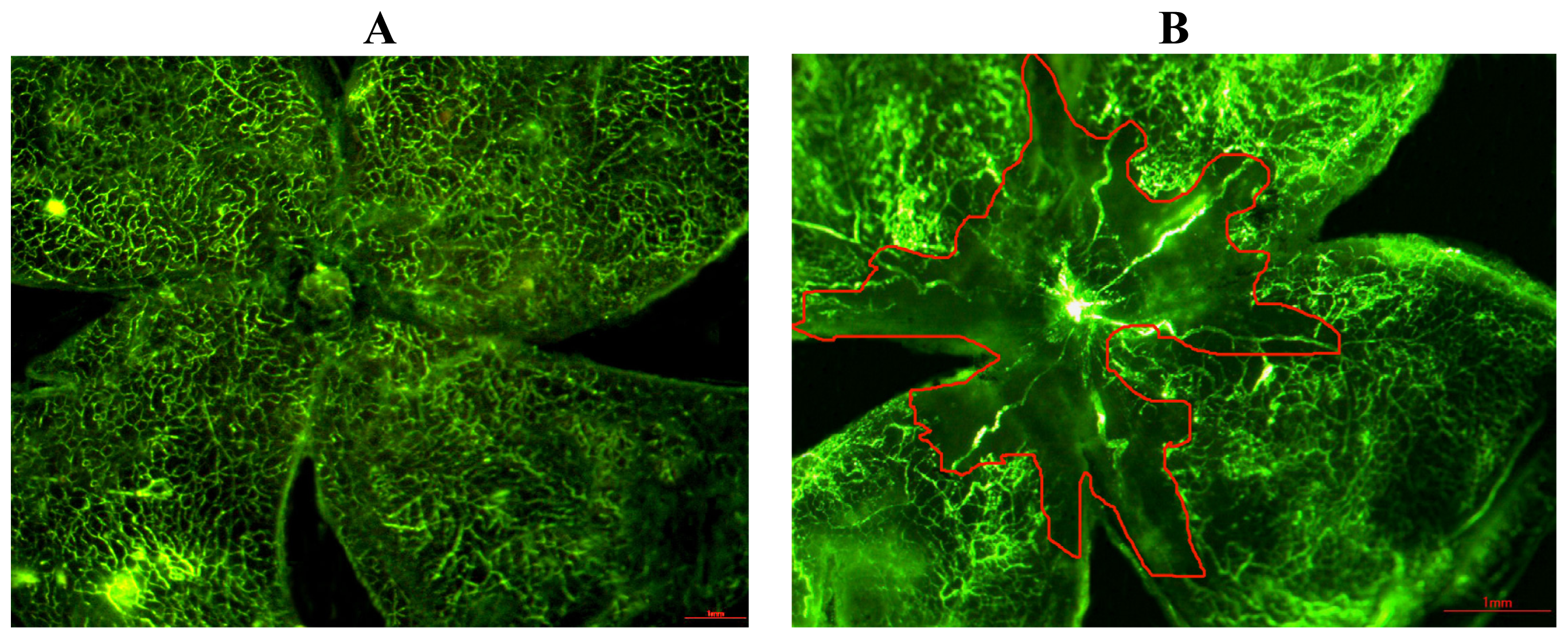
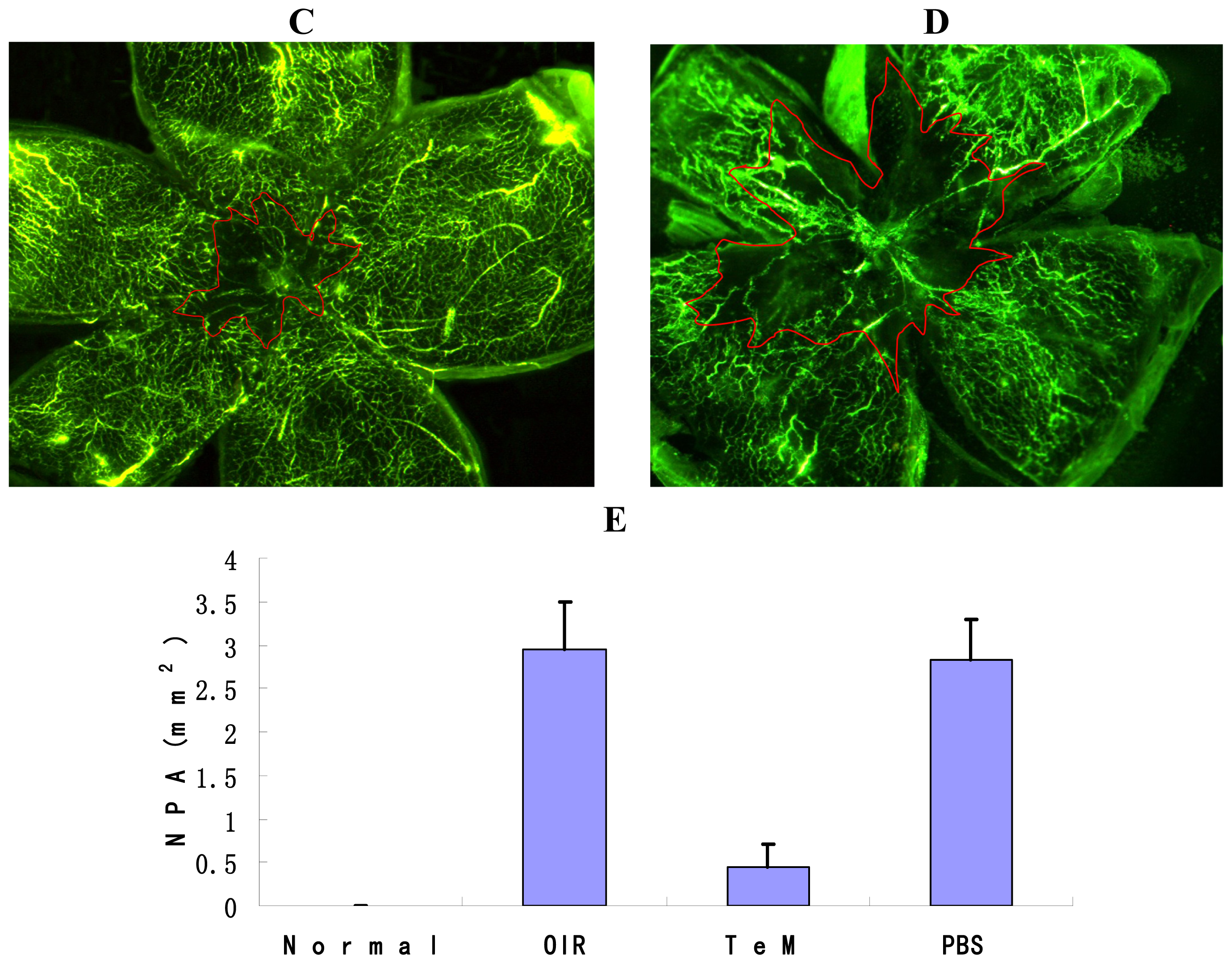
<p>The morphologic characteristics of retinal vessels were observed in retinal flat mounts after fluorescein-dextran perfusion. The retina of the P17 normoxia mouse had two layers of vessels that extended from the optic nerve to the periphery, and there was no central nonperfused area (<xref ref-type="fig" rid="f1-ijms-13-15373">Figure 1A</xref>). The retina of the P17 hyperoxia mouse had a prominent nonperfused area in the center, and tortuous, dilated vessels between the perfused and nonperfused area (<xref ref-type="fig" rid="f1-ijms-13-15373">Figure 1B</xref>). In the TeM-injected mouse (<xref ref-type="fig" rid="f1-ijms-13-15373">Figure 1C</xref>), the central ischemic area showed significant differences from that of the hyperoxia mouse (<italic>p</italic> &lt; 0.001), and the PBS-injected contralateral control eye (<xref ref-type="fig" rid="f1-ijms-13-15373">Figure 1D</xref>) (<italic>p</italic> &lt; 0.001). There were also very few abnormal vessels, although signs of central vaso-obliteration and neovascularization were still present (<xref ref-type="fig" rid="f1-ijms-13-15373">Figure 1C</xref>).</p></sec>
<sec>
<title>2.2. Histopathology</title>
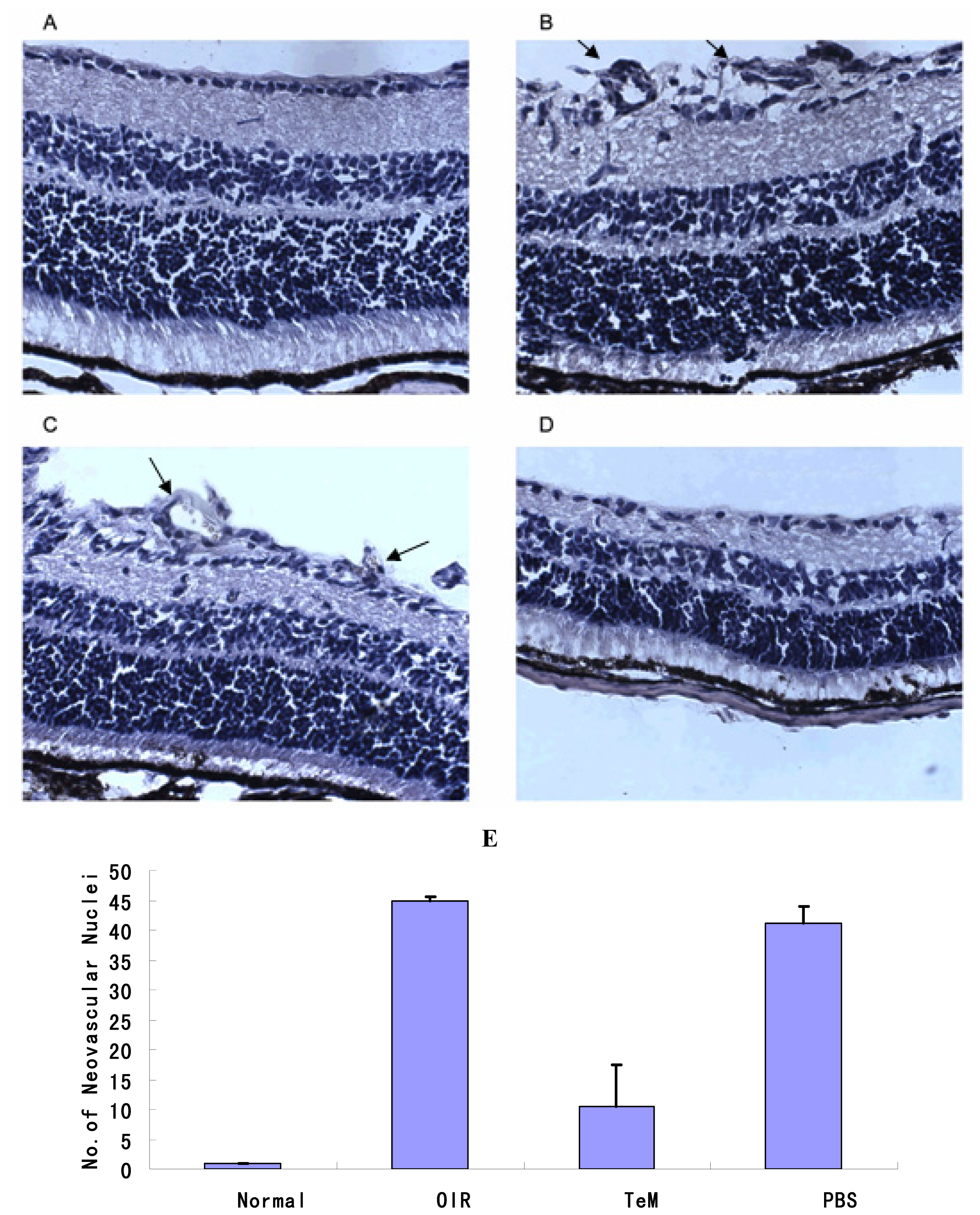
<p>For quantitative assessment of the vasoproliferation response, HE staining was performed, and the nuclei of new blood vessels extending beyond the inner limiting membrane (ILM) into the vitreous body were counted. An average of 15–18 sections for each group was assessed. Either no neovascular nuclei or very few nuclei were found in retinas of mice raised in the normoxic condition (<xref ref-type="fig" rid="f2-ijms-13-15373">Figure 2A</xref>), whereas both OIR and PBS-injected mice retinas showed active neovascular responses. HE staining was observed in large clusters of blood vessels protruding from the inner retina into the vitreous cavity (<xref ref-type="fig" rid="f2-ijms-13-15373">Figure 2B,C</xref>). The mean numbers of neovascular nuclei counted in OIR and PBS-injected retinas were 44.93 ± 6.78 and 41.07 ± 7.31, respectively. In contrast, fewer blood vessels were observed beyond the ILM in TeM-injected mice (<xref ref-type="fig" rid="f2-ijms-13-15373">Figure 2D</xref>); the mean number of neovascular nuclei was 10.57 ± 2.95. There were significant differences (<italic>p</italic> &lt; 0.01) in the means among TeM-injected mice and OIR mice, and TeM-injected eyes and PBS-injected control eyes. Thus, prophylactic injection of TeM significantly attenuated the neovascularization response.</p></sec>
<sec>
<title>2.3. CD31 Staining of Vascular Cells</title>
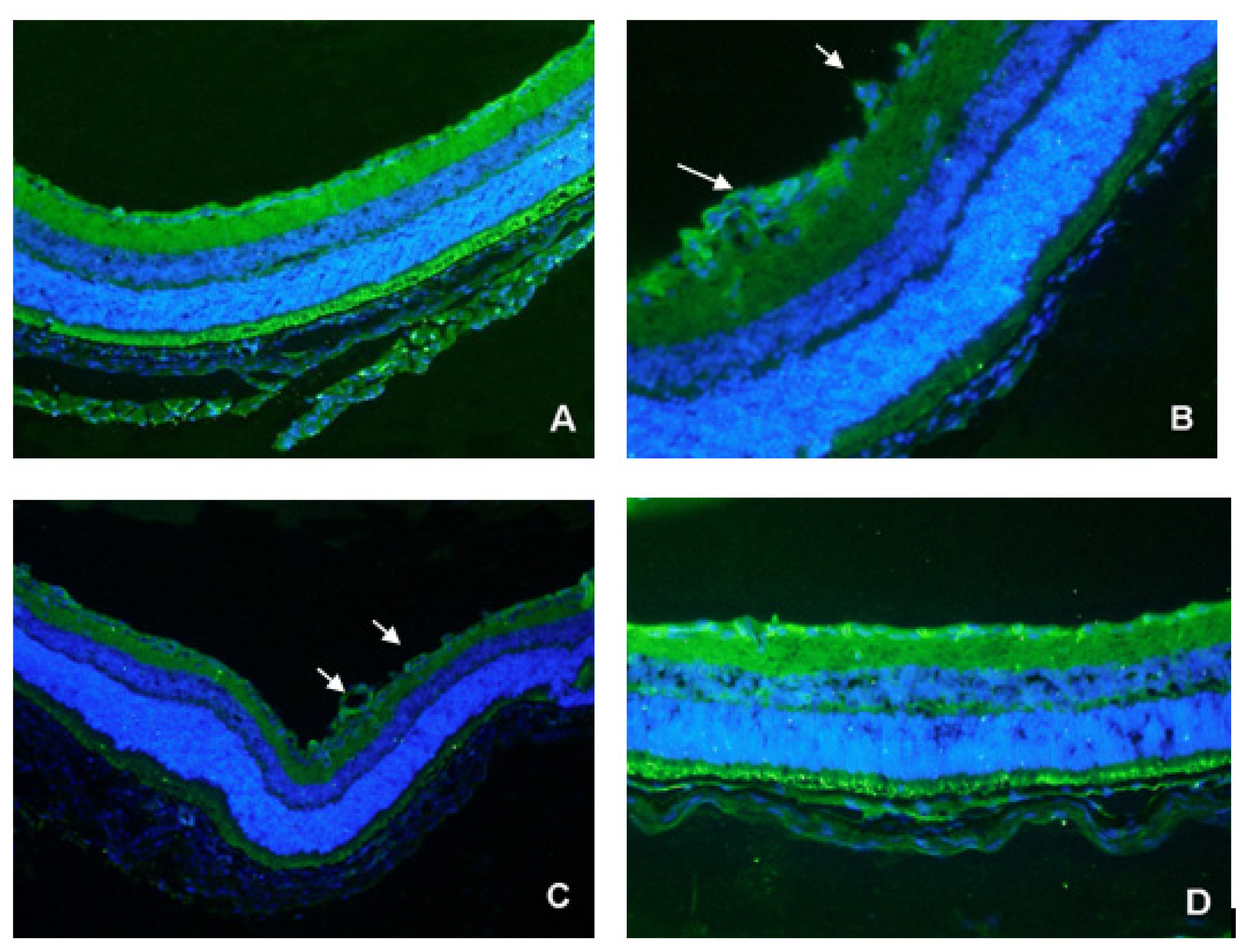
<p>The nuclei of new blood vessels protruding from the inner retina into the vitreous cavity were observed in double immunohistochemical-stained frozen retinal sections of P17 C57BL/6 mice (<xref ref-type="fig" rid="f3-ijms-13-15373">Figure 3</xref>). CD31 selectively stains vascular cells. Either no neovascular nuclei, or very few nuclei were found in the retinas of mice raised in normoxic conditions (<xref ref-type="fig" rid="f3-ijms-13-15373">Figure 3A</xref>), whereas both OIR (<xref ref-type="fig" rid="f3-ijms-13-15373">Figure 3B</xref>) and PBS-injected (<xref ref-type="fig" rid="f3-ijms-13-15373">Figure 3C</xref>) mice retinas showed active neovascular responses. The TeM-injected retina exhibited very few neovascular nuclei (<xref ref-type="fig" rid="f3-ijms-13-15373">Figure 3D</xref>).</p></sec>
<sec>
<title>2.4. Detection of Exogenous TeM Protein in Retinas</title>
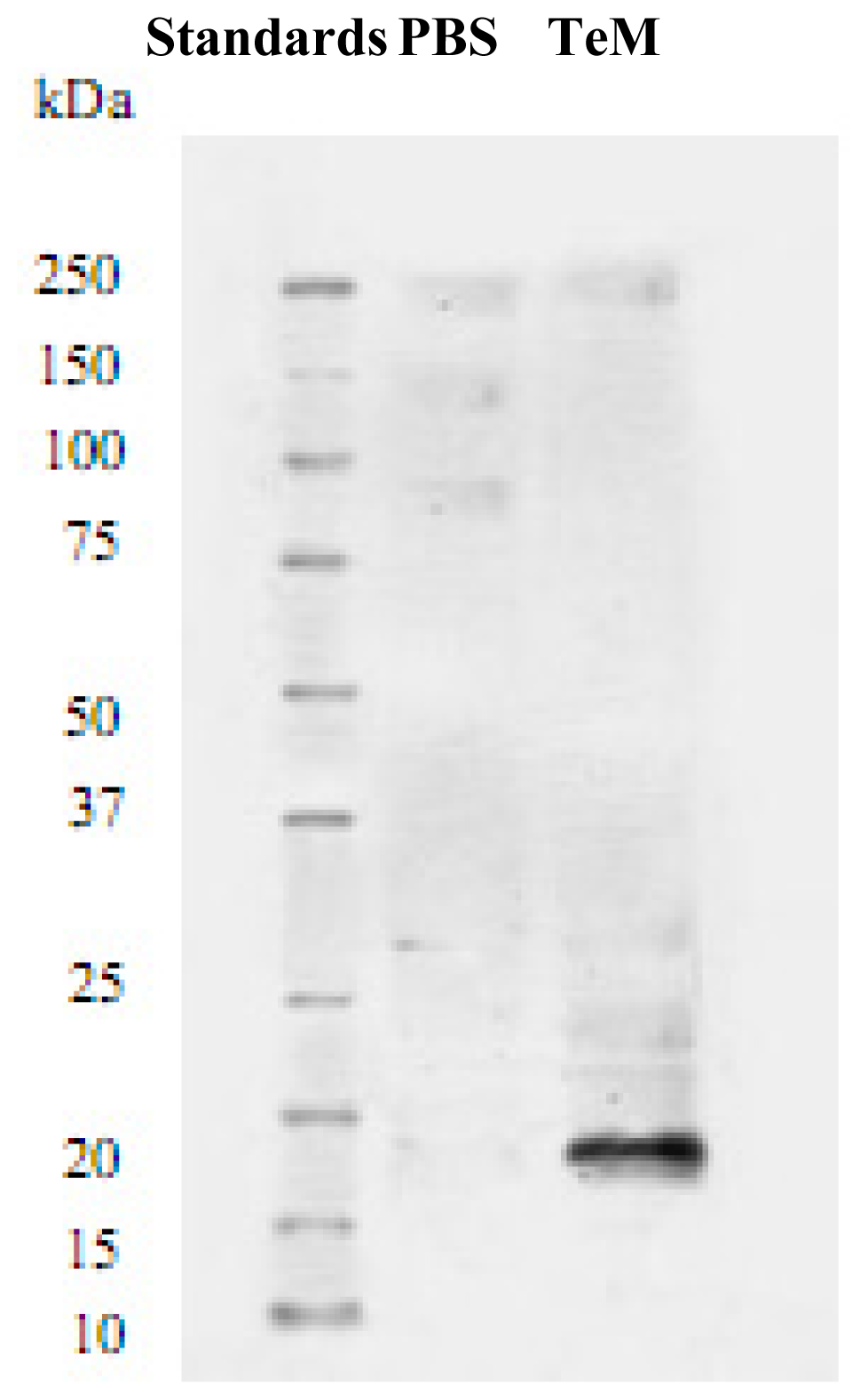
<p>Exogenous TeM protein was detected by western blot analysis as a prominent band of approximately 16 kDa (which is its expected size) in extracts from P17 TeM-injected retinas. This demonstrates the presence of TeM used in the experiments. In contrast, no immunoreactive band was detected in extracts from PBS-injected control retinas (<xref ref-type="fig" rid="f4-ijms-13-15373">Figure 4</xref>). This demonstrated that the OIR model was successful, and that the exogenous TeM was incorporated into the retina.</p></sec></sec>
<sec>
<title>3. Experimental Section</title>
<sec>
<title>3.1. Preparation of Tenomodulin</title>
<p>TeM (2 mg/mL) was generously provided by Dr. K. Yamana, Teijin Pharmaceutical Co., Ltd. (Hino, Tokyo, Japan). It was dissolved in a solution containing 25 mM HEPES and 0.15 M NaCl at pH 8.3, and stored at −80 °C. The TeM protein has a strong hydrophobic nature, high concentrations that result in precipitation, and freeze-thaw cycles can be repeated 2 to 3 times. The activity of the TeM protein can be maintained for 2 to 3 days in aqueous solution.</p></sec>
<sec>
<title>3.2. Animal Model and Treatment</title>
<p>This study adhered to the ARVO Statement for the Use of Animals in Ophthalmic and Vision Research. Neonatal mice (C57BL/6) were provided by Charles River Laboratories, Osaka, Japan and housed in the animal facility of the Osaka University Graduate School of Medicine. C57BL/6 mice were randomly divided into three groups: a normoxia group (control group), an oxygen-exposed group (OIR group), and a TeM group; each group had one nursing mother and five pups. The mice in the normoxia group were maintained in room air from birth until postnatal day 17 (P17). The mice in the oxygen-exposed group were exposed to 75% ± 2% oxygen (hyperoxia) at postnatal day 7 (P7) for five days and then returned to room air for another five days, producing relatively hypoxic conditions. In the TeM experimental group, 1 μg (0.5 μL) TeM was injected into the vitreous body at P7 with a 32 gauge needle (Hamilton, Reno, NV, USA) in one eye, while the same volume of PBS was injected into the other eye as a control. As soon as the injections were finished, the mice were then exposed to a 75% ± 2% oxygen environment.</p></sec>
<sec>
<title>3.3. Angiography Using High Molecular Weight Fluorescein-Dextran for Retinal Flat-Mounting</title>
<p>Fluorescein angiography of the retina was performed as previously described [<xref ref-type="bibr" rid="b29-ijms-13-15373">29</xref>]. On P17, mice were deeply anesthetized by isoflurane (Abbott, Japan) inhalation, and then perfused through the left ventricle with 1 mL of PBS containing 50 mg of 2 × 10<sup>6</sup> molecular weight fluorescein-dextran (Sigma, St. Louis, MO, USA). Eyes from the normoxia, OIR, and intravitreal injection groups were enucleated and placed in 10% formalin neutral buffer for 4 to 24 h. Corneas and lenses were removed; peripheral retinas were cut and then flat-mounted on a glass slide with glycerol-gelatin. The flat-mounted retinas were viewed by fluorescence microscopy (Leica Microsystems, MZ16F, Japan) and photographed. The central nonperfused area of the retina was quantified from the digital images in a masked fashion, using image processing and analysis software (NIH ImageJ Version 1.61, available in the public domain via the National Institute of Health, Bethesda, MD, USA).</p></sec>
<sec>
<title>3.4. HE Staining</title>
<p>Mice from all groups were sacrificed on P17. Eyes were removed and fixed with 4% paraformaldehyde in PBS for 4 h followed by immersion in 20% sucrose in PBS overnight for frozen sections. The tissues were embedded in optimal cutting temperature (OCT) compound (Tissue-Tek; Sakura Finetechnical Co., Ltd., Tokyo, Japan), frozen at −80 °C, and sectioned at an 8-μm thickness with a cryostat at −20 °C. The sections were taken at roughly 100 μm intervals, spanning the entire retina. Eight-micrometer thick frozen tissue sections adjacent to those used to quantitate retinal neovascularization were stained with Mayer’s hematoxylin (5 min) and eosin (3 min). Specimens were then dehydrated and cover-slipped. Photographs were taken to quantify the neovascular response. Eyes of 5–8 mice from each group were analyzed (each experiment was performed at least two times; the number of animals used for each group was more than 10). For each eye, three sections were randomly chosen and evaluated, neovascular cell nuclei protruding into the vitreous from the ILM were counted using a masked protocol, and the mean number of neovascular nuclei per section was determined.</p></sec>
<sec>
<title>3.5. Immunohistochemistry</title>
<p>Mice from all groups were sacrificed on P17. Eyes were removed and fixed with 4% paraformaldehyde in PBS for 4 h followed by immersion in 20% sucrose in PBS overnight for frozen sections. The tissues were embedded in OCT compound (Tissue-Tek; Sakura Finetechnical Co., Ltd., Tokyo, Japan), frozen at −80 °C, and sectioned at an 8-μm thickness with a cryostat at −20 °C. Sections were obtained at roughly 100 μm intervals, spanning the entire retina. After three 5-min washes with PBS, sections were incubated for 1 h with 5% normal donkey serum at room temperature, and were then incubated overnight at 4 °C with affinity purified goat polyclonal anti-mouse IgG (PECAM-1, M-20, also referred to as CD31; Santa Cruz Biotechnology, Santa Cruz, CA, USA) as the primary antibody, diluted 1:50 with 1% normal donkey serum in PBST (0.3% Triton X in PBS). For the control, normal goat IgG (Santa Cruz Biotechnology, Santa Cruz, CA, USA) was used as the primary antibody. Sections were rinsed in PBS 3 times (5 min each time) and incubated with a secondary Alexa 488 donkey anti-goat IgG-conjugated antibody (Molecular Probes, Invitrogen) plus DAPI (Sigma, St. Louis, MO, USA) for double-staining for 1 h at room temperature. After rinsing the sections again, they were mounted with glycerol-gelatin, viewed under a fluorescence microscope (Axiovert 200; Carl Zeiss, Tokyo, Japan), and photographed.</p></sec>
<sec sec-type="methods">
<title>3.6. Western Blot Analysis</title>
<p>Intravitreal-injected retinas from P17 mice were dissected and lysed in RIPA buffer (Sigma, St. Louis, MO, USA) with proteinase inhibitor on ice for gel analysis. Samples were homogenized and then centrifuged at 1.5 K rpm for 5 min at 4 °C. Supernatant was loaded and electrophoresed on 12.5% SDS-poly-polyacrylamide gel and transferred to Hybond-P membranes (Amersham Biosciences, Piscataway, NJ, USA). After preincubation with blocking buffer (5% BSA in PBST) at 4 °C overnight, the membrane was incubated with anti-FLAG M2 monoclonal antibody (Sigma-Aldrich, St. Louis, MO, USA) for 30 min at room temperature. After washing, HRP-conjugated rabbit anti-mouse IgG (Amersham Biotech, Piscataway, NJ, USA) was added for 30 min at room temperature with shaking, according to the manufacturer’s protocol. Visualization was achieved using DAB substrate buffer and DAB chromogen (Dako North America, Inc., Carpinteria, CA, USA).</p></sec>
<sec sec-type="methods">
<title>3.7. Statistical Analysis</title>
<p>Each experiment was performed at least two times, and the data were analyzed statistically using Statistical Package for the Social Sciences (SPSS 13.0), using one-way analysis of variance (ANOVA), followed by Scheffé’s pairwise comparison. <italic>p</italic> values of &lt;0.05 were considered statistically significant.</p></sec></sec>
<sec sec-type="discussion">
<title>4. Discussion</title>
<p>Tenomodulin is a member of a new family of type II transmembrane glycoproteins [<xref ref-type="bibr" rid="b25-ijms-13-15373">25</xref>,<xref ref-type="bibr" rid="b26-ijms-13-15373">26</xref>]. It is predominantly expressed in dense connective tissues including tendons, ligaments, and eyes; it has been reported that a novel gene encoding TeM has homology to chondromodulin I (ChM-I) [<xref ref-type="bibr" rid="b21-ijms-13-15373">21</xref>,<xref ref-type="bibr" rid="b23-ijms-13-15373">23</xref>,<xref ref-type="bibr" rid="b24-ijms-13-15373">24</xref>]. ChM-I is a 25 kDa glycoprotein that is expressed in the avascular cartilage and at lower levels in the eye and thymus, and it has been previously identified as a tissue-specific inhibitor of angiogenesis in fetal bovine cartilage [<xref ref-type="bibr" rid="b27-ijms-13-15373">27</xref>]. TeM has significant amino acid sequence homology (36%) with the ChM-I precursor [<xref ref-type="bibr" rid="b21-ijms-13-15373">21</xref>,<xref ref-type="bibr" rid="b23-ijms-13-15373">23</xref>]. Cloning of the full-length cDNA of TeM revealed that the TeM protein (317 amino acid residues) has a single transmembrane domain in the <italic>N</italic>-terminal region, 2 N-linked glycosylation sites, and a cysteine-rich domain (Phe225-Val317) in the <italic>C</italic>-terminal region [<xref ref-type="bibr" rid="b21-ijms-13-15373">21</xref>,<xref ref-type="bibr" rid="b23-ijms-13-15373">23</xref>,<xref ref-type="bibr" rid="b24-ijms-13-15373">24</xref>]. TeM and ChM-I exhibit the strongest sequence identity (65%) within the 63-amino-acid <italic>C</italic>-terminal region, which corresponds to the predicted anti-angiogenic functional domain of ChM-I (Phe272-Val334) [<xref ref-type="bibr" rid="b23-ijms-13-15373">23</xref>]. Both TeM and ChM-I carry 8 cysteine residues in their <italic>C</italic>-terminal domains, and the spacing of the 8 cysteine residues in TeM is almost identical with that in ChM-I [<xref ref-type="bibr" rid="b21-ijms-13-15373">21</xref>,<xref ref-type="bibr" rid="b23-ijms-13-15373">23</xref>]. However, in contrast to ChM-I, the mature form of which is a secreted protein existing in the extracellular matrix after being processed from a transmembrane-type precursor [<xref ref-type="bibr" rid="b21-ijms-13-15373">21</xref>], the TeM protein is presumably located at the cell surface, and it also lacks the hormone-processing signal present in the ChM-I precursor [<xref ref-type="bibr" rid="b21-ijms-13-15373">21</xref>,<xref ref-type="bibr" rid="b23-ijms-13-15373">23</xref>]. Because of the similarity in the <italic>C</italic>-terminal characteristics between TeM and ChM-I, and the structural analogy noted between skeletal connective tissues and the eye in terms of hypovascularity and the components of their extracellular matrix, it is possible that TeM also participates in the maintenance of avascular conditions in the eye.</p>
<p>Both TeM and ChM-I have been reported to inhibit proliferation and tube morphogenesis of vascular endothelial cells <italic>in vitro</italic> and have a strong anti-tumor effect <italic>in vivo</italic>. Clinical and laboratory studies have also reported robust evidence indicating that tumor angiogenesis is inhibited by administration of anti-angiogenic factors. Oshima <italic>et al.</italic> have also reported that recombinant ChM-I protein effectively suppresses the growth of chondrosarcoma and colon adenocarcinoma by inhibiting angiogenesis <italic>in vivo</italic>[<xref ref-type="bibr" rid="b26-ijms-13-15373">26</xref>]. It is likely, therefore, that the <italic>C</italic>-terminal ChM-I-like domain of TeM has anti-tumor activity <italic>in vivo</italic>, and indeed expression of both Ad-shTeM (the 116 amino acids of the human TeM <italic>C</italic>-terminal) and Ad-shChM-I (the 120 amino acids of the human ChM-I precursor <italic>C</italic>-terminal) result in the effective inhibition of angiogenesis, followed by suppression of tumor growth [<xref ref-type="bibr" rid="b20-ijms-13-15373">20</xref>,<xref ref-type="bibr" rid="b23-ijms-13-15373">23</xref>]. The conserved anti-angiogenic domain present in both TeM and ChM-I might therefore be a useful target for tumor treatment, although the mechanisms underlying TeM or ChM-I activity are not fully understood.</p>
<p>The anti-angiogenic potential of TeM on retinal neovascularization <italic>in vivo</italic> also remains unclear. Previously, Docheva <italic>et al.</italic> reported that mice lacking both TeM and ChM-I showed normal OIR retinal vasculature, and that double-deficient mice did not have changes in tendon vessel density. This suggested that TeM is a regulator of tenocyte proliferation and is involved in collagen fibril maturation, but did not support a role for TeM in angiogenesis <italic>in vivo</italic>[<xref ref-type="bibr" rid="b25-ijms-13-15373">25</xref>]. The controversial <italic>in vitro</italic> and <italic>in vivo</italic> studies regarding the role of ChM-I and TeM in angiogenesis led us to investigate TeM function in retinal neovascularization, which had not been studied in oxygen-induced retinopathy (OIR) in C57BL/6 mice. In the present study, we used a highly reproducible mouse model of ischemia-induced retinopathy [<xref ref-type="bibr" rid="b29-ijms-13-15373">29</xref>]. This mouse model of OIR is useful in assessing medical intervention on proliferative retinal vasculopathies [<xref ref-type="bibr" rid="b29-ijms-13-15373">29</xref>]. As demonstrated in this report, exogenous TeM protein was successfully detected by western blotting as a 16 kDa immunoreactive band in retinal extracts from TeM-injected mice. This represents the expected molecular size of a TeM fragment, indicating that this fragment of TeM was used in this study, since previous studies have reported the molecular mass of the full-length TeM protein to be approximately 45 kDa [<xref ref-type="bibr" rid="b20-ijms-13-15373">20</xref>,<xref ref-type="bibr" rid="b25-ijms-13-15373">25</xref>,<xref ref-type="bibr" rid="b26-ijms-13-15373">26</xref>]. We found that this fragment of TeM is antiangiogenic and prophylactic injection of the fragment partially prevents ischemia-induced proliferative retinopathy. The molecular mass of this fragment corresponds to a <italic>C</italic>-terminal fragment of TeM after cleavage at a predicted site [<xref ref-type="bibr" rid="b25-ijms-13-15373">25</xref>], and the <italic>C</italic>-terminal of full-length TeM is exposed on the cell surface [<xref ref-type="bibr" rid="b26-ijms-13-15373">26</xref>]. Furthermore, the <italic>C</italic>-terminal domain of both TeM and ChM-I exhibits antiangiogenic properties [<xref ref-type="bibr" rid="b26-ijms-13-15373">26</xref>]; thus, it can be speculated that the full-length TeM protein is also antiangiogenic. Regardless of the interpretation of these results, this is an interesting finding, and further research and confirmation is necessary.</p>
<p>The mechanism of inhibition of pathological angiogenesis by TeM <italic>in vivo</italic> remains unclear. Previous studies, both <italic>in vitro</italic> and <italic>in vivo</italic>, have demonstrated that VEGF plays a major role in stimulating retinal neovascularization [<xref ref-type="bibr" rid="b6-ijms-13-15373">6</xref>,<xref ref-type="bibr" rid="b8-ijms-13-15373">8</xref>,<xref ref-type="bibr" rid="b30-ijms-13-15373">30</xref>–<xref ref-type="bibr" rid="b34-ijms-13-15373">34</xref>]. VEGF levels have been found to be elevated in the retina and vitreous cavity of patients with ischemic ocular neovascular disorders, as well as in animal models of ocular neovascularization [<xref ref-type="bibr" rid="b3-ijms-13-15373">3</xref>,<xref ref-type="bibr" rid="b4-ijms-13-15373">4</xref>,<xref ref-type="bibr" rid="b8-ijms-13-15373">8</xref>,<xref ref-type="bibr" rid="b35-ijms-13-15373">35</xref>]. Many studies have shown that blocking VEGF activity can prevent the development of retinal neovascularization [<xref ref-type="bibr" rid="b31-ijms-13-15373">31</xref>,<xref ref-type="bibr" rid="b35-ijms-13-15373">35</xref>–<xref ref-type="bibr" rid="b37-ijms-13-15373">37</xref>]. Thus, we suspect that prior injection of TeM inhibits VEGF activity that is stimulated by moving the mice to the relatively hypoxic conditions of normal room air. Previous studies have proposed that upregulation of VEGF in the aqueous humor and vitreous body plays an important role in intraocular angiogenesis [<xref ref-type="bibr" rid="b20-ijms-13-15373">20</xref>,<xref ref-type="bibr" rid="b35-ijms-13-15373">35</xref>,<xref ref-type="bibr" rid="b38-ijms-13-15373">38</xref>]. In a physiological state, expression and localization of VEGF are also detectable in normal vascularized ocular tissues, such as the conjunctiva, iris, retina, and choroid-RPE complex [<xref ref-type="bibr" rid="b21-ijms-13-15373">21</xref>,<xref ref-type="bibr" rid="b39-ijms-13-15373">39</xref>]. These features suggest the presence of antiangiogenic agents in the avascular parts of the eye, such as the sclerocornea, aqueous humor, and vitreous body, for the prevention of vascular invasion. It is of interest that TeM and other inhibitory factors such as PEDF are constitutively present in the aqueous humor and vitreous body at a high concentration, possibly working to counterbalance the angiogenic stimulators [<xref ref-type="bibr" rid="b15-ijms-13-15373">15</xref>,<xref ref-type="bibr" rid="b20-ijms-13-15373">20</xref>,<xref ref-type="bibr" rid="b28-ijms-13-15373">28</xref>]. It has also been concluded by others that the retina is the major tissue where TeM and ChM- I are coexpressed [<xref ref-type="bibr" rid="b20-ijms-13-15373">20</xref>]. These angiogenic characteristics include the <italic>C</italic> terminus of TeM restricting vascular formation in the retina. The fact that TeM is a transmembrane protein and the presence of its antiangiogenic domain on the cell surface may work as an antiangiogenic barrier for the physiological prevention of vascular invasion into hypovascular tissues [<xref ref-type="bibr" rid="b20-ijms-13-15373">20</xref>, <xref ref-type="bibr" rid="b26-ijms-13-15373">26</xref>]. On the basis of these studies, we speculate that the possible mechanism of TeM inhibition of retinal neovascularization in our mouse model maybe as follows: a hypoxic state stimulates a high expression of VEGF; meanwhile, ectogenic TeM administration associated with the endogenous TeM leads to the elevated levels of TeM, thus preventing pathological angiogenesis. A recent study demonstrated that the <italic>C</italic>-terminal fragments of TeM and ChM-I, both of which are located downstream of the transmembrane domain, are responsible for their antiangiogenic activity [<xref ref-type="bibr" rid="b20-ijms-13-15373">20</xref>]. This may be another factor contributing to their inhibition of retinal neovascularization.</p></sec>
<sec sec-type="conclusions">
<title>5. Conclusions</title>
<p>The findings of this study indicate that TeM is effective, at least in part, in preventing pathologic angiogenesis in a mouse model of ischemic retinopathy. A better understanding of the biology and mechanism of action of TeM may someday lead to the development of novel and more effective therapeutic approaches for the treatment of pathologic neovascular conditions. Thus, these findings offer preventive and therapeutic potential for the management of pathologic intraocular angiogenesis.</p></sec></body>
<back>
<ack>
<title>Acknowledgements</title>
<p>We would like to express our sincere gratitude to the Sasagawa Medicine Scholarship system, which provided us with the opportunity to conduct this research at the Department of Ophthalmology and Visual Science, Osaka University. We thank K. Yamana (Teijin Pharmaceutical Corporation) for his kindly providing of TeM. We are also grateful to professor Tano who passed away 2 years ago.</p></ack>
<ref-list>
<title>References</title>
<ref id="b1-ijms-13-15373"><label>1</label><citation citation-type="journal"><person-group person-group-type="author"><name><surname>Kiyoshi</surname><given-names>S.</given-names></name><name><surname>Hitoshi</surname><given-names>T.</given-names></name><name><surname>Atsushi</surname><given-names>O.</given-names></name><name><surname>Hideyasu</surname><given-names>O.</given-names></name><name><surname>Yoshihito</surname><given-names>H.</given-names></name></person-group><article-title>Expression of Thrombospondin-1 in ischemia-induced retinal Neovascularization</article-title><source>Am. J. Pathol</source><year>1999</year><volume>154</volume><fpage>343</fpage><lpage>352</lpage><pub-id pub-id-type="doi">10.1016/S0002-9440(10)65281-9</pub-id><pub-id pub-id-type="pmid">10027393</pub-id></citation></ref>
<ref id="b2-ijms-13-15373"><label>2</label><citation citation-type="journal"><person-group person-group-type="author"><name><surname>May</surname><given-names>C.A.</given-names></name><name><surname>Ohlmann</surname><given-names>A.V.</given-names></name><name><surname>Hammes</surname><given-names>H.</given-names></name><name><surname>Spandau</surname><given-names>U.H.M.</given-names></name></person-group><article-title>Proteins with an endostatin-like domain in a mouse model of oxygen-induced retinopathy</article-title><source>Exp. Eye Res</source><year>2006</year><volume>82</volume><fpage>341</fpage><lpage>348</lpage><pub-id pub-id-type="doi">10.1016/j.exer.2005.07.005</pub-id><pub-id pub-id-type="pmid">16122735</pub-id></citation></ref>
<ref id="b3-ijms-13-15373"><label>3</label><citation citation-type="journal"><person-group person-group-type="author"><name><surname>Josef</surname><given-names>N.</given-names></name><name><surname>Aqeela</surname><given-names>A.</given-names></name><name><surname>Hao</surname><given-names>P.</given-names></name><name><surname>Esteban</surname><given-names>G.</given-names></name><name><surname>Nan</surname><given-names>L.</given-names></name><name><surname>Sergio</surname><given-names>L.C.</given-names></name><name><surname>Sergio</surname><given-names>C.</given-names></name><name><surname>Polyxenie</surname><given-names>E.S.</given-names></name><name><surname>Lynn</surname><given-names>C.S.</given-names></name><name><surname>Maria</surname><given-names>B.G.</given-names></name></person-group><article-title>The dipeptide Arg-Gln inhibits retinal neovascularization in the mouse model of Oxygen-induced retinopathy</article-title><source>Invest. Ophthalmol. Vis. Sci</source><year>2006</year><volume>47</volume><fpage>3151</fpage><lpage>3155</lpage><pub-id pub-id-type="doi">10.1167/iovs.05-1473</pub-id><pub-id pub-id-type="pmid">16799062</pub-id></citation></ref>
<ref id="b4-ijms-13-15373"><label>4</label><citation citation-type="journal"><person-group person-group-type="author"><name><surname>Anat</surname><given-names>B.</given-names></name><name><surname>Igor</surname><given-names>M.</given-names></name><name><surname>Millicent</surname><given-names>S.</given-names></name><name><surname>Helen</surname><given-names>G.</given-names></name><name><surname>Golda</surname><given-names>D.</given-names></name><name><surname>Sabrina</surname><given-names>G.K.</given-names></name><name><surname>Vicktoria</surname><given-names>V.D.</given-names></name><name><surname>Rami</surname><given-names>S.</given-names></name><name><surname>Paz</surname><given-names>E.</given-names></name><name><surname>Alexander</surname><given-names>F.</given-names></name><etal/></person-group><article-title>Inhibition of oxygen-induced retinopathy in RTP801-Deficient mice</article-title><source>Invest. Ophthalmol. Vis. Sci</source><year>2004</year><volume>45</volume><fpage>3796</fpage><lpage>3805</lpage><pub-id pub-id-type="doi">10.1167/iovs.04-0052</pub-id><pub-id pub-id-type="pmid">15452091</pub-id></citation></ref>
<ref id="b5-ijms-13-15373"><label>5</label><citation citation-type="journal"><person-group person-group-type="author"><name><surname>Frank</surname><given-names>R.N.</given-names></name></person-group><article-title>Diabetic retinopathy</article-title><source>N. Engl. J. Med</source><year>2004</year><volume>300</volume><fpage>48</fpage><lpage>58</lpage></citation></ref>
<ref id="b6-ijms-13-15373"><label>6</label><citation citation-type="journal"><person-group person-group-type="author"><name><surname>Zhenhua</surname><given-names>X.</given-names></name><name><surname>Yilin</surname><given-names>Y.</given-names></name><name><surname>Elia</surname><given-names>J.D.</given-names></name></person-group><article-title>Vascular endothelial growth factor upregulates expression of ADAMTS1 in endothelial cells through protein Kinase C signaling</article-title><source>Invest. Ophthalmol. Vis. Sci</source><year>2006</year><volume>47</volume><fpage>4059</fpage><lpage>4066</lpage><pub-id pub-id-type="doi">10.1167/iovs.05-1528</pub-id><pub-id pub-id-type="pmid">16936124</pub-id></citation></ref>
<ref id="b7-ijms-13-15373"><label>7</label><citation citation-type="journal"><person-group person-group-type="author"><name><surname>Hanahan</surname><given-names>D.</given-names></name><name><surname>Folkman</surname><given-names>J.</given-names></name></person-group><article-title>Patterns and emerging mechanisms of the angiogenic switch during tumorigenesis</article-title><source>Cell</source><year>1996</year><volume>86</volume><fpage>353</fpage><lpage>364</lpage><pub-id pub-id-type="doi">10.1016/S0092-8674(00)80108-7</pub-id><pub-id pub-id-type="pmid">8756718</pub-id></citation></ref>
<ref id="b8-ijms-13-15373"><label>8</label><citation citation-type="journal"><person-group person-group-type="author"><name><surname>Elia</surname><given-names>J.D.</given-names></name><name><surname>Hoseong</surname><given-names>S.Y.</given-names></name><name><surname>Izumi</surname><given-names>S.</given-names></name><name><surname>Masaru</surname><given-names>M.</given-names></name><name><surname>Elaine</surname><given-names>Y.</given-names></name><name><surname>Keisuke</surname><given-names>M.</given-names></name><name><surname>Miyuki</surname><given-names>K.</given-names></name><name><surname>Lin</surname><given-names>Y.</given-names></name><name><surname>Kiyoshi</surname><given-names>S.</given-names></name><name><surname>Karen</surname><given-names>W.</given-names></name><etal/></person-group><article-title>Pigment Epithelium-Derived Factor Suppresses Ischemia-induced retinal neovascularization and VEGF-induced migration and growth</article-title><source>Invest. Ophthalmol. Vis. Sci</source><year>2002</year><volume>43</volume><fpage>821</fpage><lpage>829</lpage><pub-id pub-id-type="pmid">11867604</pub-id></citation></ref>
<ref id="b9-ijms-13-15373"><label>9</label><citation citation-type="journal"><person-group person-group-type="author"><name><surname>Smith</surname><given-names>L.E.</given-names></name><name><surname>Shen</surname><given-names>W.</given-names></name><name><surname>Perruzzi</surname><given-names>C.</given-names></name><name><surname>Soker</surname><given-names>S.</given-names></name><name><surname>Kinose</surname><given-names>F.</given-names></name><name><surname>Xu</surname><given-names>X.</given-names></name><name><surname>Robinson</surname><given-names>G.</given-names></name><name><surname>Driver</surname><given-names>S.</given-names></name><name><surname>Bischoff</surname><given-names>J.</given-names></name><name><surname>Zhang</surname><given-names>B.</given-names></name><etal/></person-group><article-title>Regulation of vascular endothelial growth factor-dependent retinal neovascularization by insulin-like growth factor-1 receptor</article-title><source>Nat. Med</source><year>1999</year><volume>5</volume><fpage>1390</fpage><lpage>1395</lpage><pub-id pub-id-type="doi">10.1038/70963</pub-id><pub-id pub-id-type="pmid">10581081</pub-id></citation></ref>
<ref id="b10-ijms-13-15373"><label>10</label><citation citation-type="journal"><person-group person-group-type="author"><name><surname>Smith</surname><given-names>L.E.</given-names></name><name><surname>Kopchick</surname><given-names>J.J.</given-names></name><name><surname>Chen</surname><given-names>W.</given-names></name><name><surname>Knapp</surname><given-names>J.</given-names></name><name><surname>Kinose</surname><given-names>F.</given-names></name><name><surname>Daley</surname><given-names>D.</given-names></name><name><surname>Foley</surname><given-names>E.</given-names></name><name><surname>Smith</surname><given-names>R.G.</given-names></name><name><surname>Schaeffer</surname><given-names>J.M.</given-names></name></person-group><article-title>Essential role of growth hormone in ischemia-induced retinal neovascularization</article-title><source>Science</source><year>1997</year><volume>276</volume><fpage>1706</fpage><lpage>1709</lpage><pub-id pub-id-type="doi">10.1126/science.276.5319.1706</pub-id><pub-id pub-id-type="pmid">9180082</pub-id></citation></ref>
<ref id="b11-ijms-13-15373"><label>11</label><citation citation-type="journal"><person-group person-group-type="author"><name><surname>Jennifer</surname><given-names>L.W.</given-names></name><name><surname>Nicole</surname><given-names>S.A.</given-names></name><name><surname>Darren</surname><given-names>J.K.</given-names></name><name><surname>Richard</surname><given-names>E.</given-names></name></person-group><article-title>COX-2 inhibition and perinal angiogenesis in a mouse model of retinopathy of prematurity</article-title><source>Invest. Ophthalmol. Vis. Sci</source><year>2003</year><volume>44</volume><fpage>974</fpage><lpage>979</lpage><pub-id pub-id-type="doi">10.1167/iovs.02-0392</pub-id><pub-id pub-id-type="pmid">12601017</pub-id></citation></ref>
<ref id="b12-ijms-13-15373"><label>12</label><citation citation-type="journal"><person-group person-group-type="author"><name><surname>Moravski</surname><given-names>C.J.</given-names></name><name><surname>Kelly</surname><given-names>D.J.</given-names></name><name><surname>Cooper</surname><given-names>M.E.</given-names></name><name><surname>Gilbert</surname><given-names>R.E.</given-names></name><name><surname>Bertram</surname><given-names>J.F.</given-names></name><name><surname>Shahinfar</surname><given-names>S.</given-names></name><name><surname>Skinner</surname><given-names>S.L.</given-names></name><name><surname>Wilkinson-Berka</surname><given-names>J.L.</given-names></name></person-group><article-title>Retinal neovascularization is prevented by blockade of the renin-angiotensin system</article-title><source>Hypertension</source><year>2000</year><volume>36</volume><fpage>1099</fpage><lpage>1104</lpage><pub-id pub-id-type="doi">10.1161/01.HYP.36.6.1099</pub-id><pub-id pub-id-type="pmid">11116132</pub-id></citation></ref>
<ref id="b13-ijms-13-15373"><label>13</label><citation citation-type="journal"><person-group person-group-type="author"><name><surname>Gibert</surname><given-names>R.E.</given-names></name><name><surname>Vranes</surname><given-names>D.</given-names></name><name><surname>Berka</surname><given-names>J.L.</given-names></name><name><surname>Lelly</surname><given-names>D.J.</given-names></name><name><surname>Cox</surname><given-names>A.</given-names></name><name><surname>Wu</surname><given-names>L.L.</given-names></name><name><surname>Stacker</surname><given-names>S.A.</given-names></name><name><surname>Cooper</surname><given-names>M.E.</given-names></name></person-group><article-title>Vascular endothelial growth factor and its receptors in control and diabetic rat eyes</article-title><source>Lab. Invest</source><year>1998</year><volume>78</volume><fpage>1145</fpage><lpage>1155</lpage></citation></ref>
<ref id="b14-ijms-13-15373"><label>14</label><citation citation-type="journal"><person-group person-group-type="author"><name><surname>Chabot</surname><given-names>S.</given-names></name><name><surname>Jabrane-Ferrat</surname><given-names>N.</given-names></name><name><surname>Bigot</surname><given-names>K.</given-names></name><name><surname>Tabiasco</surname><given-names>J.</given-names></name><name><surname>Provost</surname><given-names>A.</given-names></name><name><surname>Golzio</surname><given-names>M.</given-names></name><name><surname>Noman</surname><given-names>M.Z.</given-names></name><name><surname>Giustiniani</surname><given-names>J.</given-names></name><name><surname>Bellard</surname><given-names>E.</given-names></name><name><surname>Brayer</surname><given-names>S.</given-names></name><etal/></person-group><article-title>A novel antiangiogenic and vascular normalization therapy targeted against human CD160 receptor</article-title><source>J. Exp. Med</source><year>2011</year><volume>208</volume><fpage>973</fpage><lpage>986</lpage><pub-id pub-id-type="doi">10.1084/jem.20100810</pub-id><pub-id pub-id-type="pmid">21482699</pub-id></citation></ref>
<ref id="b15-ijms-13-15373"><label>15</label><citation citation-type="journal"><person-group person-group-type="author"><name><surname>Dawson</surname><given-names>D.W.</given-names></name><name><surname>Volpert</surname><given-names>O.V.</given-names></name><name><surname>Gillis</surname><given-names>P.</given-names></name><name><surname>Crawford</surname><given-names>S.E.</given-names></name><name><surname>Xu</surname><given-names>H.</given-names></name><name><surname>Benedict</surname><given-names>W.</given-names></name><name><surname>Bouck</surname><given-names>N.P.</given-names></name></person-group><article-title>Pigment epithelium-derived factor: a potent inhibitor of angiogenesis</article-title><source>Science</source><year>1999</year><volume>285</volume><fpage>245</fpage><lpage>248</lpage><pub-id pub-id-type="doi">10.1126/science.285.5425.245</pub-id><pub-id pub-id-type="pmid">10398599</pub-id></citation></ref>
<ref id="b16-ijms-13-15373"><label>16</label><citation citation-type="journal"><person-group person-group-type="author"><name><surname>Lutty</surname><given-names>G.A.</given-names></name><name><surname>Mello</surname><given-names>R.J.</given-names></name><name><surname>Chandler</surname><given-names>C.</given-names></name><name><surname>Fait</surname><given-names>C.</given-names></name><name><surname>Bennett</surname><given-names>A.</given-names></name><name><surname>Patz</surname><given-names>A.</given-names></name></person-group><article-title>Regulation of cell growth by vitreous humour</article-title><source>J. Cell. Sci</source><year>1985</year><volume>76</volume><fpage>53</fpage><lpage>65</lpage><pub-id pub-id-type="pmid">4066796</pub-id></citation></ref>
<ref id="b17-ijms-13-15373"><label>17</label><citation citation-type="journal"><person-group person-group-type="author"><name><surname>Brem</surname><given-names>S.</given-names></name><name><surname>Preis</surname><given-names>I.</given-names></name><name><surname>Langer</surname><given-names>R.</given-names></name><name><surname>Brem</surname><given-names>H.</given-names></name><name><surname>Folkman</surname><given-names>J.</given-names></name></person-group><article-title>Inhibition of neo-vascularization by an extract derived from vitreous</article-title><source>Am. J. Ophthalmol</source><year>1997</year><volume>84</volume><fpage>323</fpage><lpage>328</lpage></citation></ref>
<ref id="b18-ijms-13-15373"><label>18</label><citation citation-type="journal"><person-group person-group-type="author"><name><surname>Williams</surname><given-names>G.A.</given-names></name><name><surname>Eisenstein</surname><given-names>R.</given-names></name><name><surname>Schumacher</surname><given-names>B.</given-names></name><name><surname>Hsiao</surname><given-names>K.-C.</given-names></name></person-group><article-title>Inhibitor of vascular endothelial cell growth in the lens</article-title><source>Am. J. Ophthalmol</source><year>1984</year><volume>97</volume><fpage>366</fpage><lpage>371</lpage><pub-id pub-id-type="pmid">6199981</pub-id></citation></ref>
<ref id="b19-ijms-13-15373"><label>19</label><citation citation-type="journal"><person-group person-group-type="author"><name><surname>Zhai</surname><given-names>Y.</given-names></name><name><surname>Ni</surname><given-names>J.</given-names></name><name><surname>Jiang</surname><given-names>G.W.</given-names></name><name><surname>Lu</surname><given-names>J.</given-names></name><name><surname>Xing</surname><given-names>L.</given-names></name><name><surname>Lincoln</surname><given-names>C.</given-names></name><name><surname>Cart</surname><given-names>K.C.</given-names></name><name><surname>Janat</surname><given-names>F.</given-names></name><name><surname>Kozak</surname><given-names>D.</given-names></name><name><surname>Xu</surname><given-names>S.</given-names></name><etal/></person-group><article-title>VEGI, a novel cytokine of the tunor necrosis factor family, is an angiogenesis inhibitor that suppresses the growth of colon carcinomas <italic>in vivo</italic></article-title><source>FASEB J</source><year>1999</year><volume>13</volume><fpage>181</fpage><lpage>189</lpage><pub-id pub-id-type="pmid">9872942</pub-id></citation></ref>
<ref id="b20-ijms-13-15373"><label>20</label><citation citation-type="journal"><person-group person-group-type="author"><name><surname>Yusuke</surname><given-names>O.</given-names></name><name><surname>Chisa</surname><given-names>S.</given-names></name><name><surname>Junichi</surname><given-names>H.</given-names></name><name><surname>Koji</surname><given-names>N.</given-names></name><name><surname>Fumi</surname><given-names>T.</given-names></name><name><surname>Jun-ichi</surname><given-names>M.</given-names></name><name><surname>Yuji</surname><given-names>H.</given-names></name><name><surname>Yasuo</surname><given-names>T.</given-names></name></person-group><article-title>Expression and localization of Tenomodulin, a transmembrane type Chondromodulin-I-related angiogenesis inhibitor, in mouse eyes</article-title><source>Invest. Ophthalmol. Vis. Sci</source><year>2003</year><volume>44</volume><fpage>1814</fpage><lpage>1822</lpage><pub-id pub-id-type="doi">10.1167/iovs.02-0664</pub-id><pub-id pub-id-type="pmid">12714610</pub-id></citation></ref>
<ref id="b21-ijms-13-15373"><label>21</label><citation citation-type="journal"><person-group person-group-type="author"><name><surname>Brandau</surname><given-names>O.</given-names></name><name><surname>Meindl</surname><given-names>A.</given-names></name><name><surname>Fassler</surname><given-names>R.</given-names></name><name><surname>Aszodi</surname><given-names>A.</given-names></name></person-group><article-title>A novel gene, tendin, is strongly expressed in tendons and ligaments and shows high homology with chondromodulin-I</article-title><source>Dev. Dyn</source><year>2001</year><volume>221</volume><fpage>72</fpage><lpage>80</lpage><pub-id pub-id-type="doi">10.1002/dvdy.1126</pub-id><pub-id pub-id-type="pmid">11357195</pub-id></citation></ref>
<ref id="b22-ijms-13-15373"><label>22</label><citation citation-type="journal"><person-group person-group-type="author"><name><surname>Pisani</surname><given-names>D.F.</given-names></name><name><surname>Pierson</surname><given-names>P.M.</given-names></name><name><surname>Massoudi</surname><given-names>A.</given-names></name><name><surname>Leclerc</surname><given-names>L.</given-names></name><name><surname>Chopard</surname><given-names>A.</given-names></name><name><surname>Marini</surname><given-names>J.F.</given-names></name><name><surname>Dechesne</surname><given-names>C.A.</given-names></name></person-group><article-title>Myodulin is a novel potential angiogenic factor in skeletal muscle</article-title><source>Exp. Cell. Res</source><year>2004</year><volume>292</volume><fpage>40</fpage><lpage>50</lpage><pub-id pub-id-type="doi">10.1016/j.yexcr.2003.08.017</pub-id><pub-id pub-id-type="pmid">14720505</pub-id></citation></ref>
<ref id="b23-ijms-13-15373"><label>23</label><citation citation-type="journal"><person-group person-group-type="author"><name><surname>Shukunami</surname><given-names>C.</given-names></name><name><surname>Oshima</surname><given-names>Y.</given-names></name><name><surname>Hiraki</surname><given-names>Y.</given-names></name></person-group><article-title>Molecular cloning of tenomodulin, a novel chondromodulin-I related gene</article-title><source>Biochem. Biophys. Res. Commun</source><year>2001</year><volume>280</volume><fpage>1323</fpage><lpage>1327</lpage><pub-id pub-id-type="doi">10.1006/bbrc.2001.4271</pub-id><pub-id pub-id-type="pmid">11162673</pub-id></citation></ref>
<ref id="b24-ijms-13-15373"><label>24</label><citation citation-type="journal"><person-group person-group-type="author"><name><surname>Yamana</surname><given-names>K.</given-names></name><name><surname>Wada</surname><given-names>H.</given-names></name><name><surname>Takahashi</surname><given-names>Y.</given-names></name><name><surname>Sato</surname><given-names>H.</given-names></name><name><surname>Kasahara</surname><given-names>Y.</given-names></name><name><surname>Kiyoki</surname><given-names>M.</given-names></name></person-group><article-title>Molecular cloning and characterization of CHM1L, a novel membrane molecule similar to chondromodulin-I</article-title><source>Biochem. Biophys. Res. Commun</source><year>2001</year><volume>280</volume><fpage>1101</fpage><lpage>1106</lpage><pub-id pub-id-type="doi">10.1006/bbrc.2000.4245</pub-id><pub-id pub-id-type="pmid">11162640</pub-id></citation></ref>
<ref id="b25-ijms-13-15373"><label>25</label><citation citation-type="journal"><person-group person-group-type="author"><name><surname>Docheva</surname><given-names>D.</given-names></name><name><surname>Hunziker</surname><given-names>E.B.</given-names></name><name><surname>Fassler</surname><given-names>R.</given-names></name><name><surname>Brandau</surname><given-names>O.</given-names></name></person-group><article-title>Tenomodulin is necessary for tenocyte proliferation and tendon maturation</article-title><source>Mol. Cell. Biol</source><year>2005</year><volume>25</volume><fpage>699</fpage><lpage>705</lpage><pub-id pub-id-type="doi">10.1128/MCB.25.2.699-705.2005</pub-id><pub-id pub-id-type="pmid">15632070</pub-id></citation></ref>
<ref id="b26-ijms-13-15373"><label>26</label><citation citation-type="journal"><person-group person-group-type="author"><name><surname>Oshima</surname><given-names>Y.</given-names></name><name><surname>Sato</surname><given-names>K.</given-names></name><name><surname>Tashiro</surname><given-names>F.</given-names></name><name><surname>Miyazaki</surname><given-names>J.I.</given-names></name><name><surname>Nishida</surname><given-names>K.</given-names></name><name><surname>Hiraki</surname><given-names>Y.</given-names></name><name><surname>Tano</surname><given-names>Y.</given-names></name><name><surname>Shukunami</surname><given-names>C.</given-names></name></person-group><article-title>Anti-angiogenic action of the <italic>C</italic>-terminal domain of tenomodulin that shares homology with chondromodulin-I</article-title><source>Cell. Sci.</source><year>2004</year><pub-id pub-id-type="doi">10.1242/jcs.01112</pub-id></citation></ref>
<ref id="b27-ijms-13-15373"><label>27</label><citation citation-type="journal"><person-group person-group-type="author"><name><surname>Shukunami</surname><given-names>C.</given-names></name><name><surname>Oshima</surname><given-names>Y.</given-names></name><name><surname>Hiraki</surname><given-names>Y.</given-names></name></person-group><article-title>Chondromodulin-I and tenomodulin: A new class of tissue-specific angiogenesis inhibitors found in hypovascular connective tissues</article-title><source>Biochem. Biophys. Res. Commun</source><year>2005</year><volume>333</volume><fpage>299</fpage><lpage>307</lpage><pub-id pub-id-type="doi">10.1016/j.bbrc.2005.05.133</pub-id><pub-id pub-id-type="pmid">15950187</pub-id></citation></ref>
<ref id="b28-ijms-13-15373"><label>28</label><citation citation-type="journal"><person-group person-group-type="author"><name><surname>Haruko</surname><given-names>F.</given-names></name><name><surname>Shoichi</surname><given-names>S.</given-names></name><name><surname>Kiyoshi</surname><given-names>Y.</given-names></name><name><surname>Koyama</surname><given-names>Y.</given-names></name><name><surname>Yaoita</surname><given-names>E.</given-names></name><name><surname>Funaki</surname><given-names>S.</given-names></name><name><surname>Shirakashi</surname><given-names>M.</given-names></name><name><surname>Oshima</surname><given-names>Y.</given-names></name><name><surname>Shukunami</surname><given-names>C.</given-names></name><name><surname>Hiraki</surname><given-names>Y.</given-names></name></person-group><article-title>Haruki Abe 2 and Tadashi Yamamoto Expression and localization of angiogenic inhibitory factor, chondromodulin-I, in adult rat eye</article-title><source>Invest. Ophthalmol. Vis. Sci</source><year>2001</year><volume>42</volume><fpage>1193</fpage><lpage>1200</lpage><pub-id pub-id-type="pmid">11328727</pub-id></citation></ref>
<ref id="b29-ijms-13-15373"><label>29</label><citation citation-type="journal"><person-group person-group-type="author"><name><surname>Smith</surname><given-names>L.E.</given-names></name><name><surname>Wesolowski</surname><given-names>E.</given-names></name><name><surname>McLellan</surname><given-names>A.</given-names></name><name><surname>Kostyk</surname><given-names>S.K.</given-names></name><name><surname>D’Amato</surname><given-names>R.</given-names></name><name><surname>Sullivan</surname><given-names>R.</given-names></name><name><surname>D’Amore</surname><given-names>P.A.</given-names></name></person-group><article-title>Oxygen-induced retinopathy in the mouse</article-title><source>Invest. Ophthalmol. Vis. Sci</source><year>1994</year><volume>35</volume><fpage>101</fpage><lpage>111</lpage><pub-id pub-id-type="pmid">7507904</pub-id></citation></ref>
<ref id="b30-ijms-13-15373"><label>30</label><citation citation-type="journal"><person-group person-group-type="author"><name><surname>Shibuya</surname><given-names>M.</given-names></name></person-group><article-title>Differential roles of vascular endothelial cell growth factor receptor-1 and Receptor-2 in Angiogenesis</article-title><source>Biochem. Mol. Biol</source><year>2006</year><volume>39</volume><fpage>469</fpage><lpage>478</lpage><pub-id pub-id-type="doi">10.5483/BMBRep.2006.39.5.469</pub-id></citation></ref>
<ref id="b31-ijms-13-15373"><label>31</label><citation citation-type="journal"><person-group person-group-type="author"><name><surname>Konopatskaya</surname><given-names>O.</given-names></name><name><surname>Churchill</surname><given-names>A.J.</given-names></name><name><surname>Harper</surname><given-names>S.J.</given-names></name><name><surname>Bates</surname><given-names>D.O.</given-names></name><name><surname>Gardiner</surname><given-names>T.A.</given-names></name></person-group><article-title>VEGF<sub>165</sub>b, an endogenous <italic>C</italic>-terminal splice variant of VEGF, inhibits retinal neovascularization in mice</article-title><source>Mol. Vis</source><year>2006</year><volume>12</volume><fpage>626</fpage><lpage>632</lpage><pub-id pub-id-type="pmid">16735996</pub-id></citation></ref>
<ref id="b32-ijms-13-15373"><label>32</label><citation citation-type="journal"><person-group person-group-type="author"><name><surname>Lutty</surname><given-names>G.A.</given-names></name><name><surname>Mcleod</surname><given-names>D.S.</given-names></name></person-group><article-title>Retinal vascular development and oxygen-induced retinopathy: A role for adenosine</article-title><source>Prog. Ret. Eye Res</source><year>2003</year><volume>22</volume><fpage>95</fpage><lpage>111</lpage><pub-id pub-id-type="doi">10.1016/S1350-9462(02)00058-7</pub-id></citation></ref>
<ref id="b33-ijms-13-15373"><label>33</label><citation citation-type="journal"><person-group person-group-type="author"><name><surname>Hidenori</surname><given-names>I.</given-names></name><name><surname>Masabaru</surname><given-names>O.</given-names></name><name><surname>Nobuyuki</surname><given-names>K.</given-names></name><name><surname>Takashi</surname><given-names>K.</given-names></name><name><surname>Onrai</surname><given-names>M.</given-names></name><name><surname>Yozo</surname><given-names>M.</given-names></name><name><surname>Takashi</surname><given-names>M.</given-names></name></person-group><article-title>Colocalization of neuropilin-1 and Flk-1 in retinal neovascularization in a mouse model of retinopathy</article-title><source>Invest. Ophthalmol. Vis. Sci</source><year>2001</year><volume>42</volume><fpage>1172</fpage><lpage>1178</lpage><pub-id pub-id-type="pmid">11328724</pub-id></citation></ref>
<ref id="b34-ijms-13-15373"><label>34</label><citation citation-type="journal"><person-group person-group-type="author"><name><surname>Irene</surname><given-names>N.</given-names></name><name><surname>Rosemary</surname><given-names>D.</given-names></name><name><surname>Lucia</surname><given-names>Z.</given-names></name><name><surname>Peter</surname><given-names>S.</given-names></name><name><surname>Stephen</surname><given-names>P.G.</given-names></name></person-group><article-title>C-Ab1 is required for the development of hyperoxia-induced retinopathy</article-title><source>J. Exp. Med</source><year>2001</year><volume>193</volume><fpage>1383</fpage><lpage>1391</lpage><pub-id pub-id-type="doi">10.1084/jem.193.12.1383</pub-id><pub-id pub-id-type="pmid">11413193</pub-id></citation></ref>
<ref id="b35-ijms-13-15373"><label>35</label><citation citation-type="journal"><person-group person-group-type="author"><name><surname>Aiello</surname><given-names>L.P.</given-names></name><name><surname>Avery</surname><given-names>R.L.</given-names></name><name><surname>Arrigg</surname><given-names>P.G.</given-names></name><name><surname>Keyt</surname><given-names>B.A.</given-names></name><name><surname>Jampel</surname><given-names>H.D.</given-names></name><name><surname>Shah</surname><given-names>S.T.</given-names></name><name><surname>Pasquale</surname><given-names>L.R.</given-names></name><name><surname>Thieme</surname><given-names>H.</given-names></name><name><surname>Iwamoto</surname><given-names>M.A.</given-names></name><name><surname>Park</surname><given-names>J.E.</given-names></name><etal/></person-group><article-title>Vascular endothelial growth factor in ocular fluid of patients with diabetic retinopathy and other retinal disorders</article-title><source>King N. Engl. Med.</source><year>1994</year><volume>331</volume><fpage>1480</fpage><lpage>1487</lpage><pub-id pub-id-type="doi">10.1056/NEJM199412013312203</pub-id></citation></ref>
<ref id="b36-ijms-13-15373"><label>36</label><citation citation-type="journal"><person-group person-group-type="author"><name><surname>Aiello</surname><given-names>L.P.</given-names></name><name><surname>Pierce</surname><given-names>E.A.</given-names></name><name><surname>Foley</surname><given-names>E.D.</given-names></name><name><surname>Takaqi</surname><given-names>H.</given-names></name><name><surname>Chen</surname><given-names>H.</given-names></name><name><surname>Riddle</surname><given-names>L.</given-names></name><name><surname>Ferrara</surname><given-names>N.</given-names></name><name><surname>King</surname><given-names>G.L.</given-names></name><name><surname>Smith</surname><given-names>L.E.</given-names></name></person-group><article-title>Suppression of retinal neovascularization <italic>in vivo</italic> by inhibition of vascular endothelial growth factor (VEGF) using soluble VEGF-receptor chimeric proteins</article-title><source>Proc. Natl. Acad. Sci. USA</source><year>1995</year><volume>92</volume><fpage>10457</fpage><lpage>10461</lpage><pub-id pub-id-type="doi">10.1073/pnas.92.23.10457</pub-id><pub-id pub-id-type="pmid">7479819</pub-id></citation></ref>
<ref id="b37-ijms-13-15373"><label>37</label><citation citation-type="journal"><person-group person-group-type="author"><name><surname>Adamis</surname><given-names>A.P.</given-names></name><name><surname>Shima</surname><given-names>D.T.</given-names></name><name><surname>Tolentino</surname><given-names>M.J.</given-names></name><name><surname>Gragoudas</surname><given-names>E.S.</given-names></name><name><surname>Ferrara</surname><given-names>N.</given-names></name><name><surname>Folkmam</surname><given-names>J.</given-names></name><name><surname>D’Amore</surname><given-names>P.A.</given-names></name><name><surname>Miller</surname><given-names>J.W.</given-names></name></person-group><article-title>Inhibition of vascular endothelial growth factor prevents retinal ischemia-associated iris neovascularization in a nonhuman primate</article-title><source>Arch. Ophthamol</source><year>1996</year><volume>114</volume><fpage>66</fpage><lpage>71</lpage><pub-id pub-id-type="doi">10.1001/archopht.1996.01100130062010</pub-id></citation></ref>
<ref id="b38-ijms-13-15373"><label>38</label><citation citation-type="journal"><person-group person-group-type="author"><name><surname>Miller</surname><given-names>J.W.</given-names></name><name><surname>Adamis</surname><given-names>A.P.</given-names></name><name><surname>Aiello</surname><given-names>L.P.</given-names></name></person-group><article-title>Vascular endothelial growth factor in ocular neovascularization and proliferative diabetic retinopathy</article-title><source>Diabetes Metab. Rev</source><year>1997</year><volume>13</volume><fpage>37</fpage><lpage>50</lpage><pub-id pub-id-type="doi">10.1002/(SICI)1099-0895(199703)13:1&lt;37::AID-DMR174&gt;3.0.CO;2-K</pub-id><pub-id pub-id-type="pmid">9134347</pub-id></citation></ref>
<ref id="b39-ijms-13-15373"><label>39</label><citation citation-type="journal"><person-group person-group-type="author"><name><surname>Kim</surname><given-names>I.</given-names></name><name><surname>Ryan</surname><given-names>A.M.</given-names></name><name><surname>Rohan</surname><given-names>R.</given-names></name><name><surname>Amano</surname><given-names>S.</given-names></name><name><surname>Aqular</surname><given-names>S.</given-names></name><name><surname>Miller</surname><given-names>J.W.</given-names></name><name><surname>Adamis</surname><given-names>A.P.</given-names></name></person-group><article-title>Constitutive expression of VEGF, VEGFR-1, and VEGFR-2 in normal eyes</article-title><source>Invest. Ophthalmol. Vis. Sci</source><year>1999</year><volume>40</volume><fpage>2115</fpage><lpage>2121</lpage><pub-id pub-id-type="pmid">10440268</pub-id></citation></ref></ref-list>
<sec sec-type="display-objects">
<title>Figures</title>
<fig id="f1-ijms-13-15373" position="float">
<label>Figure 1</label>
<caption>
<p>Comparison of flat-mounted fluorescein-perfused 17-day-old mouse retinas. (<bold>A</bold>) Both superficial and deep vascular layers of retina extend from the optic nerve to the retinal periphery in a uniformly distributed reticular pattern in the normoxic mice. No nonperfused area (NPA) was seen in the normal 17-day-old mice; (<bold>B</bold>) A central nonperfused area, as well as torturous and dilated vessels between the hypoperfused, and the perfuse areas were seen in the hyperoxic mice; (<bold>C</bold>) Fewer central nonperfused areas were seen in the TeM-injected mice; (<bold>D</bold>) The nonperfused area was clearly abnormal in the PBS-injected mice. The red-circled regions were mapped out by an observer, and areas were calculated using NIH ImageJ software (Scale bar: 1 mm, 40×); (<bold>E</bold>) A comparison of central nonperfusion areas in retina (<italic>n</italic> = 8), compared with OIR- and PBS-injected mice, the retinal central ischemic areas of TeM-injected mice were significantly different (<italic>F</italic> = 130.244, <italic>p</italic> &lt; 0.01). Data shown are the mean ± SD (one-way ANOVA, Scheffé’s pairwise comparison).</p></caption>
<graphic xlink:href="ijms-13-15373f1a.gif"/>
<graphic xlink:href="ijms-13-15373f1b.gif"/></fig>
<fig id="f2-ijms-13-15373" position="float">
<label>Figure 2</label>
<caption>
<p>HE staining of frozen sections from 17-day-old mice (40×). (<bold>A</bold>) No cells were observed to be breaking through the internal limiting membrane (ILM) in the normoxic group; (<bold>B</bold>) Endothelial cells breaking though the ILM were seen in the oxygen-exposed group; (<bold>C</bold>) Endothelial cells breaking through the ILM were also found in PBS-injected eyes; (<bold>D</bold>) Fewer cells were seen breaking though the ILM in the TeM group. Arrows: clusters of blood vessels in retinal sections; (<bold>E</bold>) Graphs showing the average number of neovascular nuclei per retinal section calculated from analysis of HE staining of frozen sections from 17-day-old mice (<italic>n</italic> = 15). Compared with OIR mice and PBS-injected control mice, the average number of neovascular nuclei per retinal section of TeM-injected mice was significantly different (<italic>p</italic> &lt; 0.01). Data shown are the mean ± SD. (one-way ANOVA, Scheffé’s pairwise comparison). The results were obtained from at least three independent experiments.</p></caption>
<graphic xlink:href="ijms-13-15373f2.gif"/></fig>
<fig id="f3-ijms-13-15373" position="float">
<label>Figure 3</label>
<caption>
<p>Double immunohistochemical staining of frozen retinal sections of P17 C57BL/6 mice. Serial sections were treated with the polyclonal antibody, CD31. A green signal indicates positive staining for vessels, and blue signals indicate nuclei. (<bold>A</bold>) Normoxia condition; (<bold>B</bold>) Hyperoxia condition; (<bold>C</bold>) Injected with PBS before being exposed to 75% oxygen; (<bold>D</bold>) Injected with TeM before being exposed to 75% oxygen. Arrows: new blood vessels protruding into the vitreous cavity (B, C). Magnification: 100×.</p></caption>
<graphic xlink:href="ijms-13-15373f3.gif"/></fig>
<fig id="f4-ijms-13-15373" position="float">
<label>Figure 4</label>
<caption>
<p>Detection of exogenous TeM protein in retina of 17-day-old mice by western blotting. An immunoreactive band was detected with a molecular mass of approximately 16 kDa in TeM-injected retina, but not in PBS-injected retina.</p></caption>
<graphic xlink:href="ijms-13-15373f4.gif"/></fig></sec></back></article>