<?xml version="1.0" encoding="UTF-8"?>
<!DOCTYPE article PUBLIC "-//NLM//DTD Journal Publishing DTD v2.3 20070202//EN" "journalpublishing.dtd">
<article xmlns:mml="http://www.w3.org/1998/Math/MathML" xmlns:xlink="http://www.w3.org/1999/xlink" xml:lang="en" article-type="research-article">
<front>
<journal-meta>
<journal-id journal-id-type="publisher-id">ijms</journal-id>
<journal-title>International Journal of Molecular Sciences</journal-title>
<abbrev-journal-title>Int. J. Mol. Sci.</abbrev-journal-title>
<issn pub-type="epub">1422-0067</issn>
<publisher>
<publisher-name>Molecular Diversity Preservation International (MDPI)</publisher-name></publisher></journal-meta>
<article-meta>
<article-id pub-id-type="doi">10.3390/ijms131013049</article-id>
<article-id pub-id-type="publisher-id">ijms-13-13049</article-id>
<article-categories>
<subj-group>
<subject>Article</subject></subj-group></article-categories>
<title-group>
<article-title>Formulation Optimization of a Palm-Based Nanoemulsion System Containing Levodopa</article-title></title-group>
<contrib-group>
<contrib contrib-type="author">
<name><surname>Zainol</surname><given-names>Syafinaz</given-names></name><xref ref-type="aff" rid="af1-ijms-13-13049">1</xref><xref ref-type="corresp" rid="c1-ijms-13-13049">*</xref></contrib>
<contrib contrib-type="author">
<name><surname>Basri</surname><given-names>Mahiran</given-names></name><xref ref-type="aff" rid="af1-ijms-13-13049">1</xref><xref ref-type="aff" rid="af2-ijms-13-13049">2</xref><xref ref-type="corresp" rid="c1-ijms-13-13049">*</xref></contrib>
<contrib contrib-type="author">
<name><surname>Basri</surname><given-names>Hamidon Bin</given-names></name><xref ref-type="aff" rid="af3-ijms-13-13049">3</xref></contrib>
<contrib contrib-type="author">
<name><surname>Shamsuddin</surname><given-names>Ahmad Fuad</given-names></name><xref ref-type="aff" rid="af4-ijms-13-13049">4</xref><xref ref-type="aff" rid="af5-ijms-13-13049">5</xref></contrib>
<contrib contrib-type="author">
<name><surname>Abdul-Gani</surname><given-names>Siti Salwa</given-names></name><xref ref-type="aff" rid="af1-ijms-13-13049">1</xref></contrib>
<contrib contrib-type="author">
<name><surname>Karjiban</surname><given-names>Roghayeh Abedi</given-names></name><xref ref-type="aff" rid="af1-ijms-13-13049">1</xref></contrib>
<contrib contrib-type="author">
<name><surname>Abdul-Malek</surname><given-names>Emilia</given-names></name><xref ref-type="aff" rid="af1-ijms-13-13049">1</xref></contrib></contrib-group>
<aff id="af1-ijms-13-13049">
<label>1</label>Department of Chemistry, Faculty of Science, Universiti Putra Malaysia, 43400 UPM Serdang, Selangor, Malaysia; E-Mails: <email>salwa@science.upm.edu.my</email> (S.S.A.-G.); <email>rosa.abedi@gmail.com</email> (R.A.K.); <email>emilia@science.upm.edu.my</email> (E.A.-M.)</aff>
<aff id="af2-ijms-13-13049">
<label>2</label>Laboratory of Molecular Biomedicine, Institute of Bioscience, Universiti Putra Malaysia, 43400 UPM Serdang, Selangor, Malaysia</aff>
<aff id="af3-ijms-13-13049">
<label>3</label>Department of Medicine, Faculty of Medicine and Health Science, Universiti Putra Malaysia, 43400 UPM Serdang, Selangor, Malaysia; E-Mail: <email>hamidon@medic.upm.edu.my</email></aff>
<aff id="af4-ijms-13-13049">
<label>4</label>Centre for Drug Delivery Research, Faculty of Pharmacy, Universiti Kebangsaan Malaysia, Jalan Raja Muda Abdul Aziz, 50300 Kuala Lumpur, Malaysia; E-Mail: <email>afsna@pharmacy.ukm.my</email></aff>
<aff id="af5-ijms-13-13049">
<label>5</label>Quality Use of Medicines Research Group, Faculty of Pharmacy, Universiti Kebangsaan Malaysia, Jalan Raja Muda Abdul Aziz, 50300 Kuala Lumpur, Malaysia</aff>
<author-notes>
<corresp id="c1-ijms-13-13049">
<label>*</label>Authors to whom correspondence should be addressed; E-Mails: <email>syafinazzainol@gmail.com</email> (S.Z.); <email>mahiran@science.upm.edu.my</email> (M.B.); Tel.: +603-8946-7266 (M.B.).</corresp></author-notes>
<pub-date pub-type="collection">
<year>2012</year></pub-date>
<pub-date pub-type="epub">
<day>11</day>
<month>10</month>
<year>2012</year></pub-date>
<volume>13</volume>
<issue>10</issue>
<fpage>13049</fpage>
<lpage>13064</lpage>
<history>
<date date-type="received">
<day>02</day>
<month>08</month>
<year>2012</year></date>
<date date-type="rev-recd">
<day>26</day>
<month>08</month>
<year>2012</year></date>
<date date-type="accepted">
<day>09</day>
<month>10</month>
<year>2012</year></date></history>
<permissions>
<copyright-statement>© 2012 by the authors; licensee Molecular Diversity Preservation International, Basel, Switzerland.</copyright-statement>
<copyright-year>2012</copyright-year>
<license license-type="open-access" xlink:href="http://creativecommons.org/licenses/by/3.0">
<p>This article is an open-access article distributed under the terms and conditions of the Creative Commons Attribution license (http://creativecommons.org/licenses/by/3.0/).</p></license></permissions>
<abstract>
<p>Response surface methodology (RSM) was utilized to investigate the influence of the main emulsion composition; mixture of palm and medium-chain triglyceride (MCT) oil (6%–12% <italic>w</italic>/<italic>w</italic>), lecithin (1%–3% <italic>w</italic>/<italic>w</italic>), and Cremophor EL (0.5%–1.5% <italic>w</italic>/<italic>w</italic>) as well as the preparation method; addition rate (2–20 mL/min), on the physicochemical properties of palm-based nanoemulsions. The response variables were the three main emulsion properties; particle size, zeta potential and polydispersity index. Optimization of the four independent variables was carried out to obtain an optimum level palm-based nanoemulsion with desirable characteristics. The response surface analysis showed that the variation in the three responses could be depicted as a quadratic function of the main composition of the emulsion and the preparation method. The experimental data could be fitted sufficiently well into a second-order polynomial model. The optimized formulation was stable for six months at 4 °C.</p></abstract>
<kwd-group>
<kwd>palm oil</kwd>
<kwd>nanoemulsions</kwd>
<kwd>levodopa</kwd>
<kwd>Response Surface Methodology</kwd>
<kwd>central composite design</kwd></kwd-group></article-meta></front>
<body>
<sec sec-type="intro">
<title>1. Introduction</title>
<p>Parkinson’s disease (PD) is one of the central nervous system (CNS) diseases which is expected to rise with increasing lifespan and population demographics in the future. Various types of drugs are used to treat and relieve the symptoms of the disease including levodopa, ropinirole, apomorphine and selegiline. However, levodopa is the “gold standard” for anti-parkinsonian therapy and consequently, nearly every PD patient eventually receives this drug [<xref ref-type="bibr" rid="b1-ijms-13-13049">1</xref>].</p>
<p>At present, 95% of all new potential therapeutics has poor pharmacokinetics and biopharmaceutical properties [<xref ref-type="bibr" rid="b2-ijms-13-13049">2</xref>]. Therefore, it is necessary to produce efficient drug delivery systems in which the drug molecule reaches only the target site of action, without influencing other organs and tissues. Nanotechnology plays an important role in therapies of the future as nanomedicines could lower doses required for efficacy as well as increasing the therapeutic indices and safety profiles of new therapeutics [<xref ref-type="bibr" rid="b3-ijms-13-13049">3</xref>]. The drug delivery systems include liposomes, micelles, nanoemulsion, nanoparticulate systems and dendrimers.</p>
<p>Nanoemulsion systems are potential carriers for efficient delivery of drugs across the blood-brain barrier. In general, they are biocompatible, biodegradable, physically stable (particularly nanoemulsion and microemulsions) and relatively easy to produce on a large scale using proven technology [<xref ref-type="bibr" rid="b4-ijms-13-13049">4</xref>]. Their non toxic and non irritant nature makes them ideal therapeutic agents as they do not damage human and animal cells [<xref ref-type="bibr" rid="b5-ijms-13-13049">5</xref>]. Their long term physical stability confers an additional advantage. Nanoemulsion in parenteral delivery has been adopted for supplying nutritional requirements, controlled drug release, vaccine delivery and for drug targeting to specific sites [<xref ref-type="bibr" rid="b6-ijms-13-13049">6</xref>]. Intravenous administration of nanoemulsions is shown to be very advantageous, particularly due to their droplet size of less than 1 μm [<xref ref-type="bibr" rid="b7-ijms-13-13049">7</xref>]. In addition, the emulsions can minimize the pain associated with intravenously administrated drugs by exposing the tissue to lower concentrations of the compounds [<xref ref-type="bibr" rid="b4-ijms-13-13049">4</xref>].</p>
<p>Palm oil is yielded from the fruit of the <italic>Elaeis guineensis</italic> tree. As a vegetable oil, palm oil is one of the promising resources of industrial fats and oils due to its various beneficial properties such as high thermal, high productivity and oxidative stability. Palm oil has been widely used in the food industry. It has not been explored in pharmaceutical applications. Palm oil for pharmaceutical application should be explored and expanded due to its favorable properties such as a long chain triglyceride, nontoxicity and low cost. In order to meet some application requirements such as pharmaceutical and cosmetic formulations, there is a need to convert the oil into an emulsion. In the preparation of palm oil emulsion, organic solvents are not needed. However, until now, there does not seem to have been any report on the use of palm oil in an emulsion formulation for drug delivery.</p>
<p>Response Surface Methodology (RSM) is a tool which consists of mathematical and statistical techniques which are derived from the fit of empirical models to the obtained data from experiments. In order to explain the studied system, linear or square polynomial functions are utilized. Hence, the experimental conditions can be investigated for the optimization study. RSM has been used broadly to develop and optimize new formulations as it can evaluate all potential factors simultaneously. From the experimental design, the influence of the formulation variables on responses can be determined and the effects of factor interaction can be investigated. The advantages of using RSM are reported to be the reduction in the number of experimental runs needed to evaluate multiple variables and the ability of the statistical tool to identify interactions [<xref ref-type="bibr" rid="b8-ijms-13-13049">8</xref>]. Therefore, it is less laborious and time consuming compared to studying one-variable at a time [<xref ref-type="bibr" rid="b9-ijms-13-13049">9</xref>]. Additionally, this experimental methodology generates a mathematical model which is presented in graphical form [<xref ref-type="bibr" rid="b10-ijms-13-13049">10</xref>].</p>
<p>In this work, levodopa was selected as the targeted drug to be loaded in the nanoemulsion as it is widely used to treat and relieve the symptoms of PD. To date, levodopa is only available for the patient in tablet form. Therefore, the aims of this work by using RSM were to formulate an optimal novel palm-based nanoemulsion containing levodopa and to evaluate simultaneously the main effects and interaction effects between the factors including composition of oil, lecithin and Cremophor EL as well as the addition rate on the responses; particle size, zeta potential and polydispersity index.</p></sec>
<sec sec-type="results|discussion">
<title>2. Results and Discussion</title>
<sec>
<title>2.1. Screening of Variables</title>
<p>A preliminary study was carried out to evaluate the levels of independent variables. Based on the resultant data, the lower, middle and upper levels of the four independent variables were determined. Levodopa nanoemulsions showed particle size below 200 nm, narrow size distribution and zeta potential of more or less ±25 mV by restraining the range of oil, lecithin, Cremophor EL composition and addition rate at levels of 6%–12%, 1%–3%, 0.5%–1.5% and 2–20 mL/min, respectively.</p></sec>
<sec>
<title>2.2. Fitting the Response Surface Models</title>
<p>The variation in the particle size, polydispersity index and zeta potential were predicted by employing response surface methodology as the responses were the function of the emulsion composition and preparation variables of levodopa loaded nanoemulsions. <xref ref-type="table" rid="t1-ijms-13-13049">Table 1</xref> shows the experimental data obtained for the three response variables based on central composite design (CCD) matrix. The experimental data was statistically analyzed. The statistic analysis was used to determine the best fitted model for the four independent variables. The estimated regression coefficients, <italic>R</italic><sup>2</sup>, adjusted <italic>R</italic><sup>2</sup>, regression (<italic>p</italic>-value), lack of fit (<italic>p</italic>-value) and probability values related to the effect of the four independent variables are shown in <xref ref-type="table" rid="t2-ijms-13-13049">Table 2</xref>. A positive value in the regression equation represents an effect that favors optimization due to a synergistic effect, while a negative value indicates an inverse relationship or antagonistic effect between the factor and the response [<xref ref-type="bibr" rid="b11-ijms-13-13049">11</xref>]. It should be mentioned that non-significant (<italic>p</italic> &lt; 0.005) linear terms were included in the final reduced model if quadratic or interaction terms containing these variables were found to be significant (<italic>p</italic> &lt; 0.05) [<xref ref-type="bibr" rid="b12-ijms-13-13049">12</xref>].</p>
<p>In this work, the response surface analysis demonstrated that the second-order polynomial used for particle size has a higher coefficient of determination (<italic>R</italic><sup>2</sup> = 0.9757) compared to the polydispersity index (<italic>R</italic><sup>2</sup> = 0.9632) and the zeta potential (<italic>R</italic><sup>2</sup> = 0.9093). The obtained coefficient of determination showed that more than 90% of the response variation of the particle size, zeta potential and polydispersity index could be described by RSM models as the function of the main nanoemulsion and preparation variables. It was observed that the lack of fit had no indication of significant (<italic>p</italic> &lt; 0.05) for the final reduced model, therefore proving the satisfactory fitness of the response surface model to the significant (<italic>p</italic> &lt; 0.05) factors effect (<xref ref-type="table" rid="t2-ijms-13-13049">Table 2</xref>).</p>
<p>From <xref ref-type="table" rid="t2-ijms-13-13049">Table 2</xref>, it was observed that only two independent variables (C and D) exhibited a positive effect on the response of particle size (<italic>R</italic><sub>1</sub>). For zeta potential (<italic>R</italic><sub>2</sub>), three independent variables (A, B, C) presented a positive effect while for polydispersity index (<italic>R</italic><sub>3</sub>) all independent variables presented negative effects except for one variable (D). Coefficients with more than one factor, or higher order terms in the regression equation, represent the interaction between terms or the quadratic relationship, respectively which suggest a non-linear relationship between factors and responses [<xref ref-type="bibr" rid="b13-ijms-13-13049">13</xref>]. In this condition, factors can produce a different degree of response than is predicted by the regression equation if they are varied at different levels or more than one factor is changed simultaneously [<xref ref-type="bibr" rid="b11-ijms-13-13049">11</xref>]. All the responses <italic>R</italic><sub>1</sub>, <italic>R</italic><sub>2</sub> and <italic>R</italic><sub>3</sub> were affected by the interaction of independent variables, presenting a quadratic relationship. The interaction effects between A and B and between A and D were favorable only for response <italic>R</italic><sub>2</sub>. A favorable effect was also noticed for all responses, <italic>R</italic><sub>1</sub>, <italic>R</italic><sub>2</sub> and <italic>R</italic><sub>3</sub> for the interaction between B and C. The interaction between B and D was favorable only for <italic>R</italic><sub>1</sub>. However, it was observed that the interaction between A and C and between C and D had an inverse effect for all responses. Quadratic effects of all four independent variables were noticed for all the responses. The highest and positive quadratic effect for all variables was noticed for <italic>R</italic><sub>1</sub> while the highest and negative quadratic effect was noticed for <italic>R</italic><sub>2</sub>.</p>
<p>The coefficient significance of the quadratic polynomial models was evaluated by using Analysis of Variance (ANOVA). For any of the terms in the models, a large <italic>F</italic>-value and a small <italic>p</italic>-value indicated a more significant effect on the respective response variables [<xref ref-type="bibr" rid="b14-ijms-13-13049">14</xref>]. <xref ref-type="table" rid="t3-ijms-13-13049">Table 3</xref> shows the effect of independent variables on the variation of the physicochemical properties of levodopa-loaded nanoemulsions. The independent variables that most affect the particle size of the nanoemulsion for the linear term were lecithin composition, followed by the linear term of addition rate; the other two linear terms (oil and Cremophor EL composition) did not indicate any significant effect (<italic>p</italic> &gt; 0.05). The quadratic term of lecithin composition also had a significant effect (<italic>p</italic> &lt; 0.05) on the particle size of nanoemulsions. Conversely, the effect of the other three quadratic terms was insignificant (<italic>p</italic> &gt; 0.05). Furthermore, the interaction between oil and lecithin composition and between oil composition and addition rate showed a significant effect (<italic>p</italic> &lt; 0.05) on the particle size of nanoemulsions.</p>
<p>The variable which exhibited the largest effect on the zeta potential of the nanoemulsion for the linear term was Cremophor EL composition. The other three variables (oil composition, lecithin composition and addition rate) showed insignificant effects. The quadratic terms of Cremophor EL composition, addition rate and oil composition exhibited significant effects on the zeta potential as well. The interaction between oil composition and addition rate showed a significant effect on the zeta potential compared to the other interactions.</p>
<p>For the polydispersity index, the linear and quadratic term of the addition rate had the most significant effect (<italic>p</italic> &lt; 0.001), followed by the linear term of Cremophor EL composition and interaction between Cremophor EL composition and addition rate. Thus, it was indicated that in evaluating the response variation of the polydispersity index, it was important to consider the Cremophor EL composition and the addition rate.</p></sec>
<sec sec-type="methods">
<title>2.3. Response Surface Analysis</title>
<p>In general, there is a high demand in the pharmaceutical industry for the production of nanoemulsions with a smaller droplet size (&lt;1 μm). Due to the nano-sized and kinetically stable characteristics, nanoemulsions are very efficient in encapsulating and/or solubilising the drugs and can successfully deliver them to the targeted part of the body. Direct contact of the drug with the body fluids and tissues can be avoided and the drug is released slowly over a prolonged period of time, which may lead to minimization of side effects [<xref ref-type="bibr" rid="b15-ijms-13-13049">15</xref>–<xref ref-type="bibr" rid="b17-ijms-13-13049">17</xref>].</p>
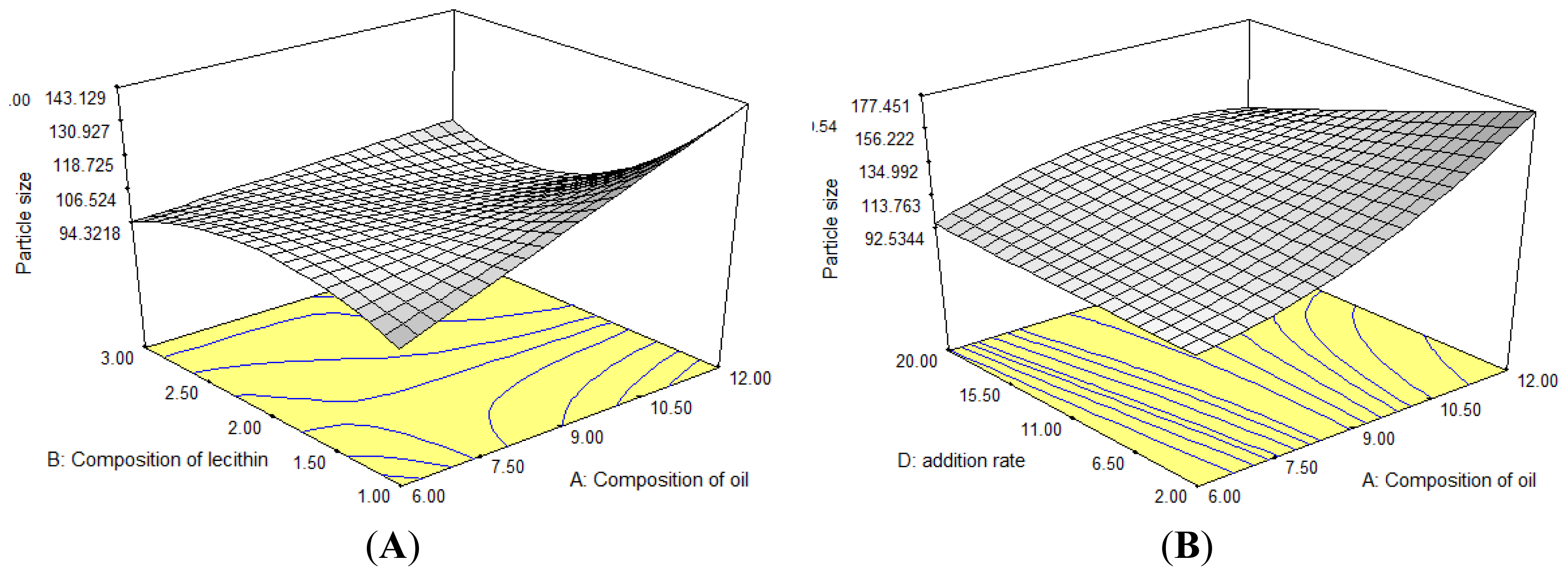
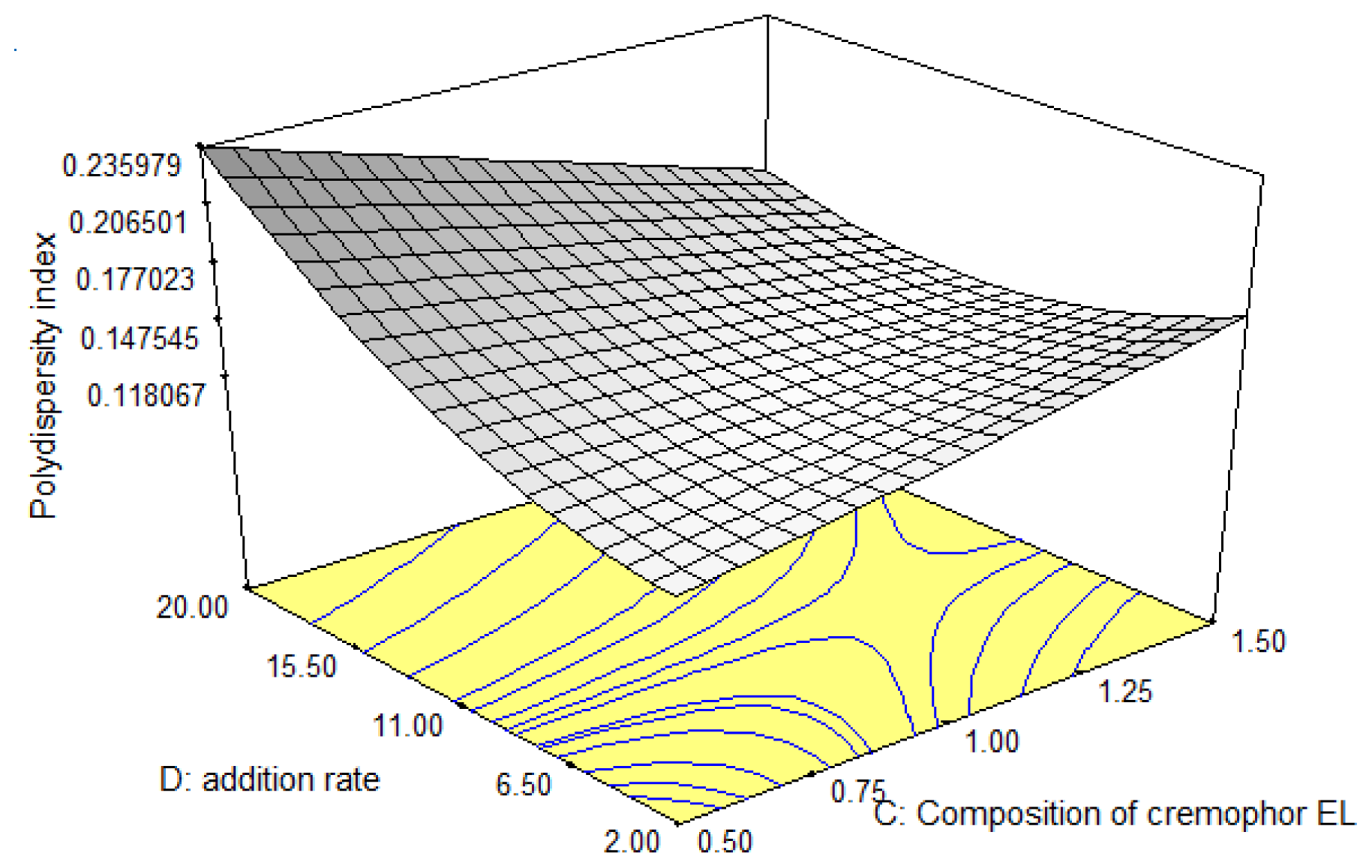
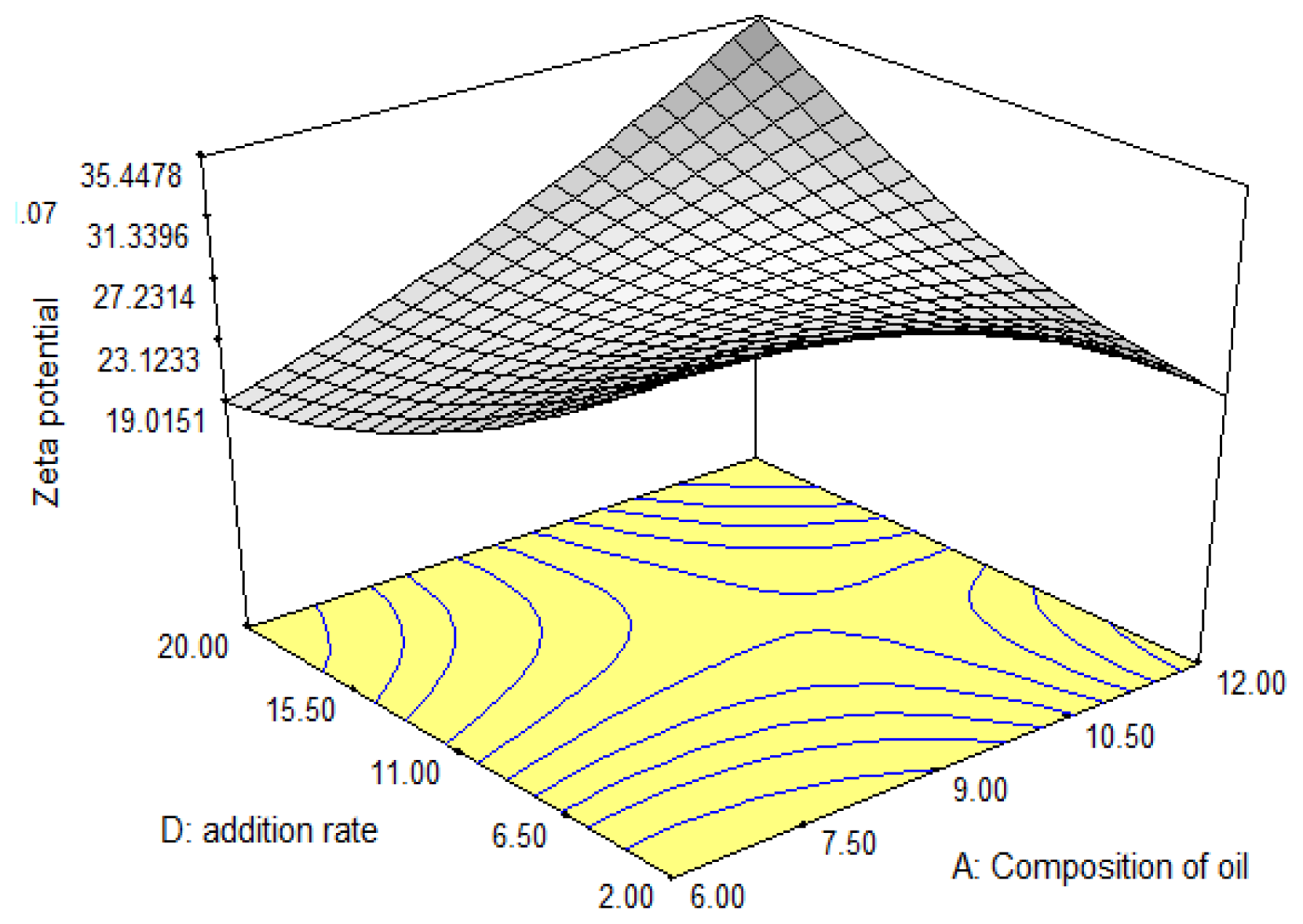
<p>For the optimization of levodopa-loaded nanoemulsions, response surface analyses were plotted in three dimensional model graphs. The response surface plots for particle size, zeta potential and polydispersity index which are used to interpret the interaction effect of the variables are presented in <xref ref-type="fig" rid="f1-ijms-13-13049">Figures 1</xref>–<xref ref-type="fig" rid="f3-ijms-13-13049">3</xref> respectively. The third and forth factors were kept at constant level. <xref ref-type="fig" rid="f1-ijms-13-13049">Figure 1A,B</xref> demonstrated that the particle size increases with increasing oil composition. The oil phase composition influences the physicochemical properties and the stability of parenteral lipid emulsions [<xref ref-type="bibr" rid="b18-ijms-13-13049">18</xref>]. A few explanations need to be considered to describe the observed results. First, with the rise in the oil content, the droplet disruption process becomes more difficult which is due to an increase in the flow resistance and hence the droplet break-up rate becomes severely restricted [<xref ref-type="bibr" rid="b19-ijms-13-13049">19</xref>,<xref ref-type="bibr" rid="b20-ijms-13-13049">20</xref>]. Second, part of the effect can be attributed to the increased rates of collision frequency, particularly at lower concentration, between the emulsion droplets followed by an ultimate increase of coalescence frequency which subsequently lead to a higher probability of coalescence of the droplets [<xref ref-type="bibr" rid="b21-ijms-13-13049">21</xref>].</p>
<p>As shown in <xref ref-type="fig" rid="f1-ijms-13-13049">Figure 1A</xref>, the increasing in lecithin content led to an increase in particle size. However, additional increase in the lecithin composition resulted in a decrease of the particle size. The increase in particle size may result from an impoverishment of the surfactant at the interface with increasing surface of the dispersed oil phase [<xref ref-type="bibr" rid="b20-ijms-13-13049">20</xref>]. In addition, the increase in particle size may also be due to an insufficient amount of lecithin to emulsify the oil and the aqueous phase. Decrease of particle size by further increase in lecithin is due to the fact that the emulsifier plays a vital role in the formation of emulsion as it lowers the interfacial tension, thereby the Laplace pressure, <italic>p</italic> is reduced and the stress required for droplet deformation is reduced [<xref ref-type="bibr" rid="b21-ijms-13-13049">21</xref>]. <xref ref-type="fig" rid="f1-ijms-13-13049">Figure 1B</xref> demonstrates increasing particle size when the oil composition is increased (9%–12% <italic>w</italic>/<italic>w</italic>) and the addition rate is reduced. Generally, particle size was reduced when the addition rate was decreased. However, the phenomenon did not occur in this case. The possible reason for this observation might be due to the relatively higher oil content. The addition rate factor did not help significantly in the emulsification process.</p>
<p>The zeta potential is a stability indicative parameter in colloidal systems like submicron emulsions [<xref ref-type="bibr" rid="b22-ijms-13-13049">22</xref>–<xref ref-type="bibr" rid="b24-ijms-13-13049">24</xref>] due to electrostatic repulsion. <xref ref-type="fig" rid="f2-ijms-13-13049">Figure 2</xref> demonstrated that by decreasing the addition rate and the composition of oil, the zeta potential increased. This observation could be due to the stabilization mechanisms; electrostatic and steric mechanism. At low addition rate and composition of oil, the effect of steric stabilization is caused by the incorporation of surfactant and co-surfactant. However, by increasing the addition rate and oil composition, the surfactant and co-surfactant were unable to increase the electrostatic repulsion between emulsion droplets, as the amount was insufficient. In addition, decreasing the addition rate at high range (10.5–20 mL/min) increased the zeta potential with increasing oil composition. The reason for this behavior could be attributed to the strong repulsive Coulomb force between charged particles which counterbalances the Van der Waals attraction force and this phenomenon is not only contributed by the surfactant role but is also due to the decreasing addition rate.</p>
<p>Polydispersity index (PI) characterizes the disperse systems with respect to deviation from the average size, and values up to 0.250 are acceptable for parenteral emulsions [<xref ref-type="bibr" rid="b25-ijms-13-13049">25</xref>]. The polydispersity index varied from 0 to 1. The composition of materials and the preparation method used play an important role in the emulsion formulation as both may affect each other and thus influence the physicochemical properties of the emulsions. <xref ref-type="fig" rid="f3-ijms-13-13049">Figure 3</xref> demonstrated that the polydispersity index increased with increasing addition rate and Cremophor EL composition at low range (0.5%–0.8% <italic>w</italic>/<italic>w</italic>). The increasing polydispersity index could be due to the high addition rate of the oil phase over the mixture of the aqueous phase, thus limiting the breaking down of the oil droplet during the emulsification process. This promoted the formation of a large particle size. The presence of a high concentration of emulsifier ultimately led to an increase in the flow resistance in the batch emulsification process which in turn resulted in the larger magnitude of apparent viscosity of the prepared emulsions [<xref ref-type="bibr" rid="b19-ijms-13-13049">19</xref>,<xref ref-type="bibr" rid="b26-ijms-13-13049">26</xref>]. The higher concentration of co-emulsifier produced an emulsion with high viscosity, which can considerably affect the emulsification efficiency. Consequently, this condition increased the coalescence rate resulting in a larger particle size. The large particles tend to coalesce faster than small particles. This phenomenon contributed to the high polydispersity index as the distribution of the particle size became broad. In addition, the low amount of Cremophor EL used, was insufficient to emulsify the emulsion system.</p>
<p>By increasing the addition rate (11–20mL/min) and composition of Cremophor EL (0.85%–1.5% <italic>w</italic>/<italic>w</italic>) the polydispersity index decreased. The decrease in polydispersity index could be due to the co-surfactant, Cremophor EL which possesses polyethylene glycols and ethoxylated glycerol polar covalent parts. Both structures have excellent capability to solubilize many types of essential oil. Because of these two highly hydrophilic groups in the aqueous phase, the difference in viscosity between the two immiscible phases is reduced, thereby leading to lowering of the critical Weber number followed by an increased droplet break-up efficiency [<xref ref-type="bibr" rid="b21-ijms-13-13049">21</xref>]. Cremophor EL, which is a non-ionic surfactant, was chosen as co-surfactant not only due to its great emulsifying properties but also due to its characteristically low toxicity.</p></sec>
<sec>
<title>2.4. Optimization of Responses for Formulating Levodopa Nanoemulsions</title>
<p>By using Design-Expert software, the desirability function was probed to acquire an optimized formulation. An optimum levodopa nanoemulsion is that with smallest particle size, lowest polydispersity index and highest zeta potential. The response surface and contour plot were used to visualize the interaction between the independent variables. By investigating the interaction effect between the independent variables and evaluating the optimization constraints, the optimum levodopa nanoemulsion was prepared with a composition of 7.14% oil, 2.2% lecithin, 1.24% Cremophor EL, and an addition rate of 5.5 mL/min. Based on the optimum formulation, the predicted values of particle size, zeta potential and polydispersity index are 104.04 nm, −29.18 mV and 0.136, respectively.</p></sec>
<sec>
<title>2.5. Verification of the Reduced Models</title>
<p>Experimental and predicted values of the responses were compared to check the adequacy of the response surface equations. The optimized formulation of levodopa-loaded nanoemulsion has a particle size of 109.63 nm, zeta potential of −31.06 and polydispersity index of 0.174. As displayed in <xref ref-type="table" rid="t4-ijms-13-13049">Table 4</xref>, no significant (<italic>p</italic> &gt; 0.05) difference was noted between the experimental and theoretical predicted value. The sufficiency of the corresponding response surface models was verified based on the observations.</p></sec>
<sec sec-type="methods">
<title>2.6. Stability Study</title>
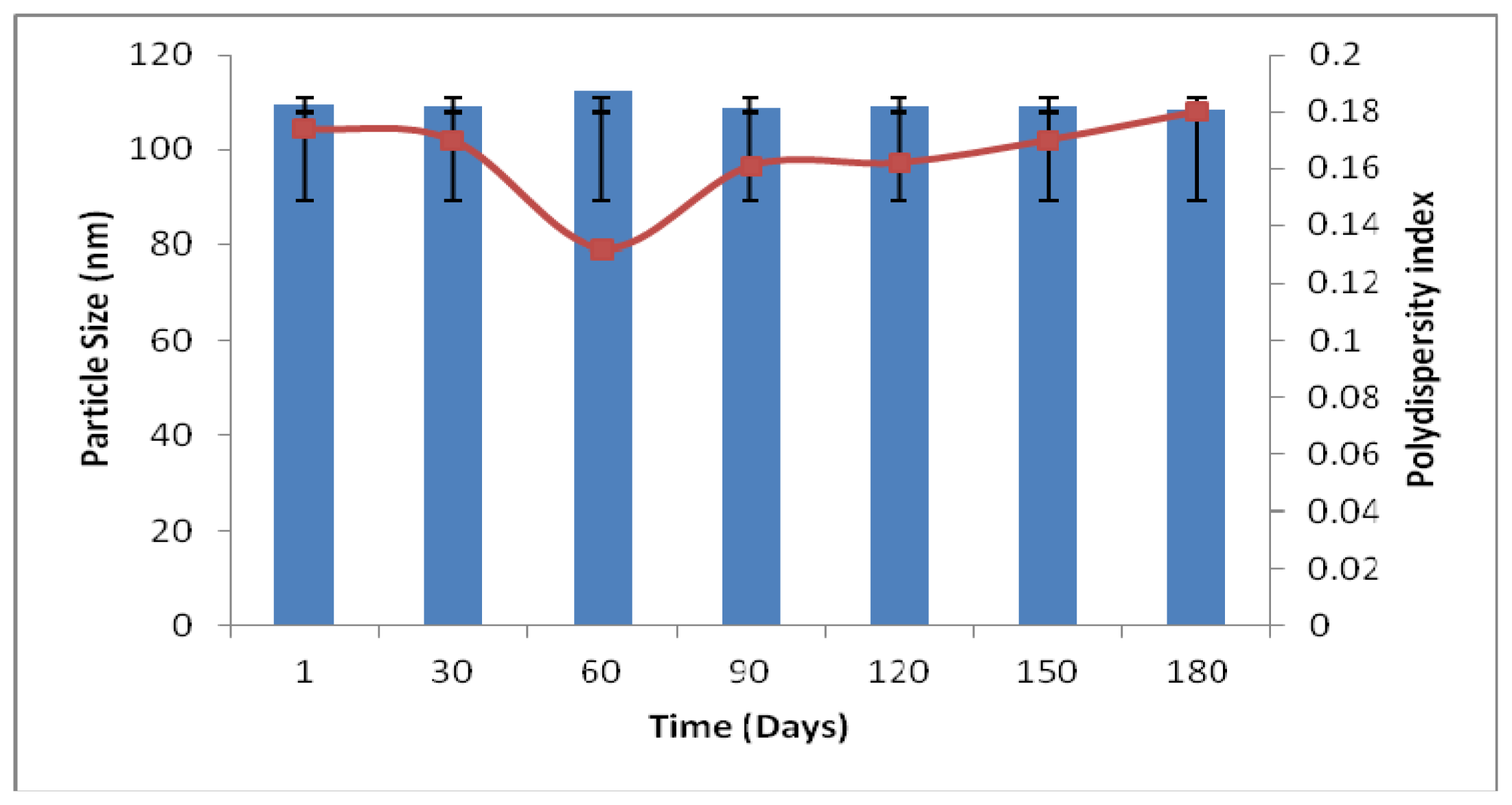
<p>For parenteral emulsions, the droplet size and polydispersity index (PI) are important physicochemical parameters since large particle sizes are clinically unacceptable due to emboli formation [<xref ref-type="bibr" rid="b22-ijms-13-13049">22</xref>,<xref ref-type="bibr" rid="b27-ijms-13-13049">27</xref>]. <xref ref-type="fig" rid="f4-ijms-13-13049">Figure 4</xref> depicts the particle size and polydispersity index of optimized formulation over time. All levodopa-containing nanoemulsions prepared based on the recommended optimum condition were stable at 4 °C ± 1 °C during the tested period (6 months). No significant changes of particle size and polydispersity index were observed over a period of six months. The excellent stability could be due to the steric stabilizing effect of the non-ionic emulsifier (lecithin) in which a bulk steric barrier is formed against particle collision. Thus, this phenomenon prevents the occurrence of flocculation and coalescence. Improved emulsion stabilization could be explained by the presence of some free emulsifier in micellar form as it plays a vital role in preventing the coalescence after emulsification and storage [<xref ref-type="bibr" rid="b20-ijms-13-13049">20</xref>]. Furthermore, it has been reported that MCT can destabilize the emulsion with respect to droplet coalescence, while LCT can increase the viscosity of MCT and the particle size distribution of emulsions, which would increase the stability of emulsions during storage [<xref ref-type="bibr" rid="b23-ijms-13-13049">23</xref>]. In essence, it is hypothesized that the whole nano-system is in a stable state and this might be due to the rapid absorption of the non-ionic surfactant, lecithin onto the droplet interface</p></sec></sec>
<sec>
<title>3. Experimental Section</title>
<sec>
<title>3.1. Material</title>
<p>Palm oil was purchased from Sime Darby Jomalina Sdn Bhd, Malaysia. The composition of palm oil is 44.3% palmitic acid, 38.7% oleic acid, 10.5% linoleic acid, 4.6% stearic acid, 1.0% myristic acid, and 0.9% other material which can be considered as impurities. Medium-chain Triglyceride oil was purchased from Pharm-D Sendirian Berhad, Malaysia. Pure soy bean lecithin with 70% phosphatidylcholine (Lipoid S 75) was purchased from Lipoid GmbH, Ludwigshafen-Germany. Polyethylene glycol 400 (PEG 400) was purchased from Merck, USA. Cremophor EL, a non-ionic surfactant with pH of 6.0 to 8.0 was purchased from Sigma-Aldrich, France. Glycerol was purchased from JT Baker, USA. Levodopa was purchased from Noveltek Lifescienceco, Limited, Hong Kong, China. Water was deionised by Milli-Q filtration system.</p></sec>
<sec>
<title>3.2. Formation of Nanoemulsions Containing Levodopa</title>
<p>Nanoemulsions were formulated using a mixture of palm and MCT oil containing levodopa as dispersed oil phase and Mili-Q water as the continuous aqueous phase. Lecithin was dissolved in the oil phase containing a mixture of palm oil with MCT oil (1:1) at 55 °C for 30 min. Levodopa was added to the oil phase and stirred. PEG 400, Cremophor EL and glycerol were dissolved in the deionised water. The preparation was continued by adding the oil phase dropwise to the aqueous solution with continuous stirring using the overhead stirrer (IKA<sup>®</sup> RW 20 Digital, Nara, Japan) at 300 rpm. The mixture was pre-emulsified with a high shear homogenizer (Kinematica, Lucerne, Switzerland) at 4000 rpm. The pre-emulsification step was performed for 5 min and repeated three times. The resultant coarse emulsion was subjected to a high pressure homogenizer (Gea Niro Soavi S.p.a) for 10 cycles at 800 bars. <xref ref-type="table" rid="t5-ijms-13-13049">Table 5</xref> depicts the composition of formulated nanoemulsion.</p></sec>
<sec sec-type="methods">
<title>3.3. Experimental Design</title>
<p>A four-factor CCD was utilized to study the effect of oil composition (6%–12% <italic>w</italic>/<italic>w</italic>, A), lecithin composition (1%–3% <italic>w</italic>/<italic>w</italic>, B), Cremophor EL composition (0.5%–1.5% <italic>w</italic>/<italic>w</italic>, C) and addition rate (2–20 mL/min, D) on the three response variables; particle size (R<sub>1</sub>), zeta potential (R<sub>2</sub>) and polydispersity index (R<sub>3</sub>). Hence, based on the CCD, a total of 30 experiments were run using Design Expert software (version 6.0.6, Stat ease Inc, Minneapolis, USA). The experimental runs involved 16 factorial points, 8 axial points and 6 replicates of centre points at 3 levels. The choice of CCD as the experimental design is for the following reasons: it is more precise for estimating factor effects, the interaction effect between factors can be evaluated and permits optimization in the full factor space. The experimental data was analyzed by response surface regression procedure and the results were statistically analyzed by corresponding analysis of variances. An appropriate polynomial model was chosen based on the significant terms (<italic>p</italic> &lt; 0.005), the least significant lack of fit, coefficient of variance, the multiple correlation coefficient, and adjusted multiple correlation coefficient provided by Design-Expert software. The experiments were carried out in randomized order in order to minimize the effect of unexplained variability on the actual response due to extraneous factors [<xref ref-type="bibr" rid="b28-ijms-13-13049">28</xref>]. To determine the repeatability of the method, the center point was repeated six times. The quadratic model was obtained in the design of the experimental space and the upper and lower levels are exhibited in <xref ref-type="table" rid="t6-ijms-13-13049">Table 6</xref>. The CCD matrix is shown in <xref ref-type="table" rid="t7-ijms-13-13049">Table 7</xref>.</p></sec>
<sec sec-type="methods">
<title>3.4. Statistical Analysis</title>
<p>The optimum condition of the independent variables was ascertained by conducting Response Surface Methodology to predict the variation of material compositions as well as preparation conditions. The optimal composition and conditions of preparation of levodopa-loaded nanoemulsions were chosen based on the condition of attaining minimum particle size (<italic>R</italic><sub>1</sub>), maximum zeta potential (<italic>R</italic><sub>2</sub>) and minimum polydispersity index (<italic>R</italic><sub>3</sub>). By using the polynomial regression equation, the response surface behavior was explored for the response function (<italic>Y</italic><italic><sub>i</sub></italic>). The generalized response surface model is as shown below:</p>
<disp-formula id="FD1">
<mml:math id="mm1" display="block">
<mml:semantics id="sm1">
<mml:mtable columnalign="left">
<mml:mtr>
<mml:mtd>
<mml:msub>
<mml:mrow>
<mml:mi>Y</mml:mi></mml:mrow>
<mml:mi>i</mml:mi></mml:msub>
<mml:mo>=</mml:mo>
<mml:msub>
<mml:mrow>
<mml:mi>β</mml:mi></mml:mrow>
<mml:mn>0</mml:mn></mml:msub>
<mml:mo>+</mml:mo>
<mml:msub>
<mml:mrow>
<mml:mi>β</mml:mi></mml:mrow>
<mml:mn>1</mml:mn></mml:msub>
<mml:msub>
<mml:mrow>
<mml:mi>x</mml:mi></mml:mrow>
<mml:mn>1</mml:mn></mml:msub>
<mml:mo>+</mml:mo>
<mml:msub>
<mml:mrow>
<mml:mi>β</mml:mi></mml:mrow>
<mml:mn>2</mml:mn></mml:msub>
<mml:msub>
<mml:mrow>
<mml:mi>x</mml:mi></mml:mrow>
<mml:mn>2</mml:mn></mml:msub>
<mml:mo>+</mml:mo>
<mml:msub>
<mml:mrow>
<mml:mi>β</mml:mi></mml:mrow>
<mml:mn>3</mml:mn></mml:msub>
<mml:msub>
<mml:mrow>
<mml:mi>x</mml:mi></mml:mrow>
<mml:mn>3</mml:mn></mml:msub>
<mml:mo>+</mml:mo>
<mml:msub>
<mml:mrow>
<mml:mi>β</mml:mi></mml:mrow>
<mml:mn>4</mml:mn></mml:msub>
<mml:msub>
<mml:mrow>
<mml:mi>x</mml:mi></mml:mrow>
<mml:mn>4</mml:mn></mml:msub>
<mml:mo>-</mml:mo>
<mml:msub>
<mml:mrow>
<mml:mi>β</mml:mi></mml:mrow>
<mml:mrow>
<mml:mn>11</mml:mn></mml:mrow></mml:msub>
<mml:msup>
<mml:mrow>
<mml:msub>
<mml:mrow>
<mml:mi>x</mml:mi></mml:mrow>
<mml:mn>1</mml:mn></mml:msub></mml:mrow>
<mml:mn>2</mml:mn></mml:msup>
<mml:mo>+</mml:mo>
<mml:msub>
<mml:mrow>
<mml:mi>β</mml:mi></mml:mrow>
<mml:mrow>
<mml:mn>22</mml:mn></mml:mrow></mml:msub>
<mml:msup>
<mml:mrow>
<mml:msub>
<mml:mrow>
<mml:mi>x</mml:mi></mml:mrow>
<mml:mn>2</mml:mn></mml:msub></mml:mrow>
<mml:mn>2</mml:mn></mml:msup>
<mml:mo>+</mml:mo>
<mml:msub>
<mml:mrow>
<mml:mi>β</mml:mi></mml:mrow>
<mml:mrow>
<mml:mn>33</mml:mn></mml:mrow></mml:msub>
<mml:msup>
<mml:mrow>
<mml:msub>
<mml:mrow>
<mml:mi>x</mml:mi></mml:mrow>
<mml:mn>3</mml:mn></mml:msub></mml:mrow>
<mml:mn>2</mml:mn></mml:msup>
<mml:mo>+</mml:mo>
<mml:msub>
<mml:mrow>
<mml:mi>β</mml:mi></mml:mrow>
<mml:mrow>
<mml:mn>44</mml:mn></mml:mrow></mml:msub>
<mml:msup>
<mml:mrow>
<mml:msub>
<mml:mrow>
<mml:mi>x</mml:mi></mml:mrow>
<mml:mn>4</mml:mn></mml:msub></mml:mrow>
<mml:mn>2</mml:mn></mml:msup>
<mml:mo>+</mml:mo>
<mml:msub>
<mml:mrow>
<mml:mi>β</mml:mi></mml:mrow>
<mml:mrow>
<mml:mn>12</mml:mn></mml:mrow></mml:msub>
<mml:msub>
<mml:mrow>
<mml:mi>x</mml:mi></mml:mrow>
<mml:mn>1</mml:mn></mml:msub>
<mml:msub>
<mml:mrow>
<mml:mi>x</mml:mi></mml:mrow>
<mml:mn>2</mml:mn></mml:msub>
<mml:mo>+</mml:mo>
<mml:msub>
<mml:mrow>
<mml:mi>β</mml:mi></mml:mrow>
<mml:mrow>
<mml:mn>13</mml:mn></mml:mrow></mml:msub>
<mml:msub>
<mml:mrow>
<mml:mi>x</mml:mi></mml:mrow>
<mml:mn>1</mml:mn></mml:msub>
<mml:msub>
<mml:mrow>
<mml:mi>x</mml:mi></mml:mrow>
<mml:mn>3</mml:mn></mml:msub>
<mml:mo>+</mml:mo>
<mml:msub>
<mml:mrow>
<mml:mi>β</mml:mi></mml:mrow>
<mml:mrow>
<mml:mn>14</mml:mn></mml:mrow></mml:msub>
<mml:msub>
<mml:mrow>
<mml:mi>x</mml:mi></mml:mrow>
<mml:mn>1</mml:mn></mml:msub>
<mml:msub>
<mml:mrow>
<mml:mi>x</mml:mi></mml:mrow>
<mml:mn>4</mml:mn></mml:msub></mml:mtd></mml:mtr>
<mml:mtr>
<mml:mtd>
<mml:mo>+</mml:mo>
<mml:msub>
<mml:mrow>
<mml:mi>β</mml:mi></mml:mrow>
<mml:mrow>
<mml:mn>23</mml:mn></mml:mrow></mml:msub>
<mml:msub>
<mml:mrow>
<mml:mi>x</mml:mi></mml:mrow>
<mml:mn>2</mml:mn></mml:msub>
<mml:msub>
<mml:mrow>
<mml:mi>x</mml:mi></mml:mrow>
<mml:mn>3</mml:mn></mml:msub>
<mml:mo>+</mml:mo>
<mml:msub>
<mml:mrow>
<mml:mi>β</mml:mi></mml:mrow>
<mml:mrow>
<mml:mn>24</mml:mn></mml:mrow></mml:msub>
<mml:msub>
<mml:mrow>
<mml:mi>x</mml:mi></mml:mrow>
<mml:mn>2</mml:mn></mml:msub>
<mml:msub>
<mml:mrow>
<mml:mi>x</mml:mi></mml:mrow>
<mml:mn>4</mml:mn></mml:msub>
<mml:mo>+</mml:mo>
<mml:msub>
<mml:mrow>
<mml:mi>β</mml:mi></mml:mrow>
<mml:mrow>
<mml:mn>34</mml:mn></mml:mrow></mml:msub>
<mml:msub>
<mml:mrow>
<mml:mi>x</mml:mi></mml:mrow>
<mml:mn>3</mml:mn></mml:msub>
<mml:msub>
<mml:mrow>
<mml:mi>x</mml:mi></mml:mrow>
<mml:mn>4</mml:mn></mml:msub></mml:mtd></mml:mtr></mml:mtable></mml:semantics></mml:math></disp-formula>
<p>Where <italic>Y</italic><italic><sub>i</sub></italic> is the predicted response; <italic>β</italic><sub>0</sub> is constant; <italic>β</italic><italic><sub>i</sub></italic>, <italic>β</italic><italic><sub>ii</sub></italic> are the linear, quadratic and interaction coefficients, respectively [<xref ref-type="bibr" rid="b21-ijms-13-13049">21</xref>]. The significant differences between the independent variables were determined by utilizing Analysis of Variance (ANOVA). Only the significant (<italic>p</italic> &lt; 0.05) independent variables effects were involved in the reduced model. The non-significant (<italic>p</italic> &gt; 0.005) independent variables were eliminated. Then, the experimental data was refitted to the significant regression coefficient (<italic>p</italic> &gt; 0.05). Consequently, the final reduced model was obtained. Two dimensional contour plots and three dimensional response surface plots were constructed to see the interaction effect of the variables on the responses. It was suggested that for a good fit of a model, <italic>R</italic><sup>2</sup> should be at least 0.80 [<xref ref-type="bibr" rid="b21-ijms-13-13049">21</xref>].</p></sec>
<sec>
<title>3.5. Verification of Models</title>
<p>Quantitative comparison between the theoretical prediction and obtained experimental values was made to validate the models. In addition, the percentage of the calculated value was also determined. The predicted error is the difference between the experimental value and the predicted value per predicted value [<xref ref-type="bibr" rid="b29-ijms-13-13049">29</xref>].</p></sec>
<sec>
<title>3.6. Particle Size and Polydispersity Index</title>
<p>Dynamic light scattering was used to analyze the particle size and polydispersity index of the nanoemulsion by using Malvern Nano ZS90, Malvern, UK. The measurement was performed at a scattering angle of 173° at 25 °C. The nanoemulsions were diluted with deionised water to the required concentration. Then the diluted emulsions were placed in the cuvette. The count rate was maintained between 100 and 300 kcps.</p></sec>
<sec>
<title>3.7. Zeta Potential</title>
<p>Dynamic light scattering was used to measure the zeta potential of the nanoemulsion by using Malvern Nano ZS90, Malvern, UK. The measurement was carried out at a scattering angle of 173° at 25 °C. The nanoemulsions were diluted with deionised water to the required concentration. A folded capillary electrophoresis cell was used to measure the zeta potential. The count rate was maintained between 100 and 300 kcps.</p></sec>
<sec sec-type="methods">
<title>3.8. Stability Study</title>
<p>After preparation of the Levodopa-containing nanoemulsion based on the optimized formulation, the nanoemulsion was observed over a period of 6 months at 4 °C or until instability was observed at room temperature, 25 °C. The particle size, polydispersity index and zeta potential were evaluated.</p></sec></sec>
<sec sec-type="conclusions">
<title>4. Conclusions</title>
<p>The current study showed that Response Surface Methodology is a beneficial tool for carrying out the optimization study of levodopa nanoemulsion formulations. The variation of the average particle size, zeta potential and polydispersity index were predicted by employing second order polynomial regression. Generally, the linear effect of Cremophor EL had a significant effect (<italic>p</italic> &lt; 0.05) on the zeta potential and polydispersity index while the addition rate had a significant effect on the particle size and polydispersity index. Conversely, all the responses were significantly (<italic>p</italic> &lt; 0.05) affected by the interaction effect between oil composition and lecithin composition, oil composition and addition rate and between Cremophor EL and addition rate. The quadratics of all four independent variables had significant (<italic>p</italic> &lt; 0.05) effect on the the three response variables studied. The high stability of the Levodopa-loaded nanoemulsion was due to the stabilizing effect of lecithin and Cremophor EL.</p></sec></body>
<back>
<ack>
<title>Acknowledgments</title>
<p>The authors gratefully acknowledge the financial support from the Ministry of Science, Technology and Innovation of Malaysia (MOSTI) under the Nanotechnology Top Down (NND) project number 5489103 and National Science Fellowship (NSF) grant for the scholar, Syafinaz Zainol.</p></ack>
<ref-list>
<title>References</title>
<ref id="b1-ijms-13-13049"><label>1</label><citation citation-type="journal"><person-group person-group-type="author"><name><surname>Le Witt</surname><given-names>P.A.</given-names></name></person-group><article-title>Levodopa therapeutic for Parkinson’s disease: New development</article-title><source>Parkinsonism Related Disord</source><year>2009</year><volume>15</volume><fpage>S31</fpage><lpage>S34</lpage></citation></ref>
<ref id="b2-ijms-13-13049"><label>2</label><citation citation-type="journal"><person-group person-group-type="author"><name><surname>Brayden</surname><given-names>D.J.</given-names></name></person-group><article-title>Controlled release technologies for drug delivery</article-title><source>Drug Discov. Today</source><year>2003</year><volume>8</volume><fpage>976</fpage><lpage>978</lpage><pub-id pub-id-type="doi">10.1016/S1359-6446(03)02874-5</pub-id><pub-id pub-id-type="pmid">14643159</pub-id></citation></ref>
<ref id="b3-ijms-13-13049"><label>3</label><citation citation-type="journal"><person-group person-group-type="author"><name><surname>Koo</surname><given-names>O.M.</given-names></name><name><surname>Rubinstein</surname><given-names>I.</given-names></name><name><surname>Onyuksel</surname><given-names>H.</given-names></name></person-group><article-title>Role of nanotechnology in targeted drug delivery and imaging: A concise review</article-title><source>Nanomed. Nanotechnol. Biol. Med</source><year>2005</year><volume>3</volume><fpage>193</fpage><lpage>212</lpage></citation></ref>
<ref id="b4-ijms-13-13049"><label>4</label><citation citation-type="journal"><person-group person-group-type="author"><name><surname>Li</surname><given-names>J.</given-names></name><name><surname>Nie</surname><given-names>S.</given-names></name><name><surname>Yang</surname><given-names>X.</given-names></name><name><surname>Wang</surname><given-names>C.</given-names></name><name><surname>Cui</surname><given-names>S.</given-names></name><name><surname>Shenyang</surname><given-names>W.P.</given-names></name></person-group><article-title>Optimization of tocol emulsions for the intravenous delivery of clarithromycin</article-title><source>Int. J. Pharm</source><year>2008</year><volume>356</volume><fpage>282</fpage><lpage>290</lpage><pub-id pub-id-type="pmid">18289806</pub-id><pub-id pub-id-type="doi">10.1016/j.ijpharm.2007.12.046</pub-id></citation></ref>
<ref id="b5-ijms-13-13049"><label>5</label><citation citation-type="journal"><person-group person-group-type="author"><name><surname>Aboofazeli</surname><given-names>R.</given-names></name></person-group><article-title>Nanometric scaled emulsions (Nanoemulsions)</article-title><source>Iranian J. Pharm. Res</source><year>2010</year><volume>9</volume><fpage>325</fpage><lpage>326</lpage></citation></ref>
<ref id="b6-ijms-13-13049"><label>6</label><citation citation-type="journal"><person-group person-group-type="author"><name><surname>Tamilvanan</surname><given-names>S.</given-names></name></person-group><article-title>Oil-in-water lipid nanoemulsions: Implications for parenteral and ocular delivering systems</article-title><source>Prog. Lipid Res</source><year>2004</year><volume>43</volume><fpage>489</fpage><lpage>533</lpage><pub-id pub-id-type="doi">10.1016/j.plipres.2004.09.001</pub-id><pub-id pub-id-type="pmid">15522762</pub-id></citation></ref>
<ref id="b7-ijms-13-13049"><label>7</label><citation citation-type="journal"><person-group person-group-type="author"><name><surname>Tamilvanan</surname><given-names>S.</given-names></name><name><surname>Schmidt</surname><given-names>S.</given-names></name><name><surname>Muller</surname><given-names>R.H.</given-names></name><name><surname>Benita</surname><given-names>S.</given-names></name></person-group><article-title><italic>In vitro</italic> absorption of plasma proteins onto the surface (charges) modified-submicron emulsions for intravenous administration</article-title><source>Eur. J. Pharm. Biopharm</source><year>2005</year><volume>59</volume><fpage>1</fpage><lpage>7</lpage><pub-id pub-id-type="doi">10.1016/j.ejpb.2004.07.001</pub-id><pub-id pub-id-type="pmid">15567295</pub-id></citation></ref>
<ref id="b8-ijms-13-13049"><label>8</label><citation citation-type="journal"><person-group person-group-type="author"><name><surname>Chen</surname><given-names>M.J.</given-names></name><name><surname>Chen</surname><given-names>K.N.</given-names></name><name><surname>Lin</surname><given-names>C.W.</given-names></name></person-group><article-title>Sequential quadratic programming for development of a new probiotic diary tofu with glucono-lactone</article-title><source>J. Food Sci</source><year>2004</year><volume>69</volume><fpage>344</fpage><lpage>350</lpage></citation></ref>
<ref id="b9-ijms-13-13049"><label>9</label><citation citation-type="journal"><person-group person-group-type="author"><name><surname>Junqueira</surname><given-names>R.M.</given-names></name><name><surname>Castro</surname><given-names>I.A.</given-names></name><name><surname>Areas</surname><given-names>J.A.G.</given-names></name><name><surname>Silva</surname><given-names>A.C.C.</given-names></name><name><surname>Scholz</surname><given-names>M.B.S.</given-names></name><name><surname>Mendes</surname><given-names>S.</given-names></name></person-group><article-title>Application of response surface methodology for the optimization of oxidants in wheat flour</article-title><source>Food Chem</source><year>2007</year><volume>101</volume><fpage>131</fpage><lpage>139</lpage><pub-id pub-id-type="doi">10.1016/j.foodchem.2006.01.029</pub-id></citation></ref>
<ref id="b10-ijms-13-13049"><label>10</label><citation citation-type="journal"><person-group person-group-type="author"><name><surname>Bas</surname><given-names>D.</given-names></name><name><surname>Boyac</surname><given-names>I.H.</given-names></name></person-group><article-title>Modelling and optimization I: usability of response surface methodology</article-title><source>J. Food Eng</source><year>2007</year><volume>78</volume><fpage>836</fpage><lpage>845</lpage><pub-id pub-id-type="doi">10.1016/j.jfoodeng.2005.11.024</pub-id></citation></ref>
<ref id="b11-ijms-13-13049"><label>11</label><citation citation-type="journal"><person-group person-group-type="author"><name><surname>Woitiski</surname><given-names>C.M.</given-names></name><name><surname>Veiga</surname><given-names>F.</given-names></name><name><surname>Ribiero</surname><given-names>A.</given-names></name><name><surname>Neufeld</surname><given-names>R.</given-names></name></person-group><article-title>Design for Optimization of nanoparticles integrating biomaterials for orally dose insulin</article-title><source>Eur. J. Pharm. Biopharm</source><year>2009</year><volume>73</volume><fpage>25</fpage><lpage>33</lpage><pub-id pub-id-type="pmid">19508892</pub-id><pub-id pub-id-type="doi">10.1016/j.ejpb.2009.06.002</pub-id></citation></ref>
<ref id="b12-ijms-13-13049"><label>12</label><citation citation-type="journal"><person-group person-group-type="author"><name><surname>Mirhosseini</surname><given-names>H.</given-names></name><name><surname>Tan</surname><given-names>C.P.</given-names></name><name><surname>Taherian</surname><given-names>A.R.</given-names></name><name><surname>Boo</surname><given-names>H.C.</given-names></name></person-group><article-title>Modeling the physicochemical properties of orange beverage emulsion as function of main emulsion components using response surface methodology</article-title><source>Carbohyd. Polym</source><year>2009</year><volume>75</volume><fpage>512</fpage><lpage>520</lpage><pub-id pub-id-type="doi">10.1016/j.carbpol.2008.08.022</pub-id></citation></ref>
<ref id="b13-ijms-13-13049"><label>13</label><citation citation-type="journal"><person-group person-group-type="author"><name><surname>Motwani</surname><given-names>S.K.</given-names></name><name><surname>Copra</surname><given-names>S.</given-names></name><name><surname>Talegaonkar</surname><given-names>S.</given-names></name><name><surname>Kohli</surname><given-names>K.</given-names></name><name><surname>Ahmad</surname><given-names>F.J.</given-names></name><name><surname>Khar</surname><given-names>R.K.</given-names></name></person-group><article-title>Chitosan-sodium alginate nanoparticles as submicroscopic reservoirs for ocular delivery: Formulation, optimization and <italic>in vitro</italic> characterization</article-title><source>J. Pharm. Biopharm</source><year>2008</year><volume>68</volume><fpage>513</fpage><lpage>525</lpage></citation></ref>
<ref id="b14-ijms-13-13049"><label>14</label><citation citation-type="journal"><person-group person-group-type="author"><name><surname>Joglekar</surname><given-names>A.M.</given-names></name><name><surname>May</surname><given-names>A.T.</given-names></name></person-group><article-title>Product excellence through design of experiments</article-title><source>Cereal Foods World</source><year>1987</year><volume>32</volume><fpage>857</fpage><lpage>868</lpage></citation></ref>
<ref id="b15-ijms-13-13049"><label>15</label><citation citation-type="journal"><person-group person-group-type="author"><name><surname>Quanhong</surname><given-names>L.</given-names></name><name><surname>Caili</surname><given-names>F.</given-names></name></person-group><article-title>Application of response surface methodology for extraction optimization of geminant pumpkin seeds protein</article-title><source>Food Chem</source><year>2005</year><volume>92</volume><fpage>701</fpage><lpage>706</lpage><pub-id pub-id-type="doi">10.1016/j.foodchem.2004.08.042</pub-id></citation></ref>
<ref id="b16-ijms-13-13049"><label>16</label><citation citation-type="journal"><person-group person-group-type="author"><name><surname>Mizushima</surname><given-names>Y.K.</given-names></name><name><surname>Aihara</surname><given-names>H.H.</given-names></name><name><surname>Kurachi</surname><given-names>M.</given-names></name></person-group><article-title>Inhibition of bronchoconstriction by aerosol of a lipid emulsion containing prostaglandin</article-title><source>J. Pharm. Pharmacol</source><year>1983</year><volume>35</volume><fpage>397</fpage><pub-id pub-id-type="doi">10.1111/j.2042-7158.1983.tb02968.x</pub-id><pub-id pub-id-type="pmid">6135785</pub-id></citation></ref>
<ref id="b17-ijms-13-13049"><label>17</label><citation citation-type="journal"><person-group person-group-type="author"><name><surname>Bock</surname><given-names>T.</given-names></name><name><surname>Müller</surname><given-names>B.W.</given-names></name></person-group><article-title>A novel assay to determine the hemolytic activity of drugs incorporated in colloidal carriers systems</article-title><source>Pharm. Res</source><year>1994</year><volume>11</volume><fpage>589</fpage><lpage>591</lpage><pub-id pub-id-type="doi">10.1023/A:1018987120738</pub-id><pub-id pub-id-type="pmid">8058621</pub-id></citation></ref>
<ref id="b18-ijms-13-13049"><label>18</label><citation citation-type="journal"><person-group person-group-type="author"><name><surname>Lovell</surname><given-names>M.W.</given-names></name><name><surname>Lohnson</surname><given-names>H.W.</given-names></name><name><surname>Hui</surname><given-names>H.W.</given-names></name><name><surname>Cannon</surname><given-names>J.B.</given-names></name><name><surname>Gupta</surname><given-names>P.K.</given-names></name><name><surname>Hsu</surname><given-names>C.C.</given-names></name></person-group><article-title>Less-painful emulsion formulation for intravenous administration of clarithromycin</article-title><source>Int. J. Pharm</source><year>1994</year><volume>109</volume><fpage>45</fpage><lpage>45</lpage><pub-id pub-id-type="doi">10.1016/0378-5173(94)90120-1</pub-id></citation></ref>
<ref id="b19-ijms-13-13049"><label>19</label><citation citation-type="journal"><person-group person-group-type="author"><name><surname>Abismail</surname><given-names>B.</given-names></name><name><surname>Canselier</surname><given-names>J.P.</given-names></name><name><surname>Wilhelm</surname><given-names>A.M.</given-names></name><name><surname>Delmas</surname><given-names>H.</given-names></name><name><surname>Gourdon</surname><given-names>C.</given-names></name></person-group><article-title>Emulsification by ultrasound: Droplet distribution and stability</article-title><source>Ultrason. Sonochem</source><year>1999</year><volume>6</volume><fpage>75</fpage><lpage>83</lpage><pub-id pub-id-type="doi">10.1016/S1350-4177(98)00027-3</pub-id><pub-id pub-id-type="pmid">11233941</pub-id></citation></ref>
<ref id="b20-ijms-13-13049"><label>20</label><citation citation-type="journal"><person-group person-group-type="author"><name><surname>Jumaa</surname><given-names>M.</given-names></name><name><surname>Muller</surname><given-names>B.W.</given-names></name></person-group><article-title>The effect of oil components and homogenization conditions on the physicochemical properties and stability of parenteral fat emulsions</article-title><source>Int. J. Pharm</source><year>1998</year><volume>163</volume><fpage>81</fpage><lpage>89</lpage><pub-id pub-id-type="doi">10.1016/S0378-5173(97)00369-4</pub-id></citation></ref>
<ref id="b21-ijms-13-13049"><label>21</label><citation citation-type="journal"><person-group person-group-type="author"><name><surname>Tang</surname><given-names>S.Y.</given-names></name><name><surname>Manickam</surname><given-names>S.</given-names></name><name><surname>Wei</surname><given-names>T.K.</given-names></name><name><surname>Nashiru</surname><given-names>B.</given-names></name></person-group><article-title>Formulation development and optimization of a novel Cremophor EL-based nanoemulsion using ultrasound cavitation</article-title><source>Ultras. Sonochem</source><year>2012</year><volume>19</volume><fpage>330</fpage><lpage>345</lpage><pub-id pub-id-type="doi">10.1016/j.ultsonch.2011.07.001</pub-id></citation></ref>
<ref id="b22-ijms-13-13049"><label>22</label><citation citation-type="journal"><person-group person-group-type="author"><name><surname>Benita</surname><given-names>S.</given-names></name><name><surname>Levy</surname><given-names>M.Y.</given-names></name></person-group><article-title>Submicron emulsions as colloidal drug carrier for intravenous administration: Comprehensive physicochemical characterization</article-title><source>J. Pharm. Sci</source><year>1993</year><volume>82</volume><fpage>1069</fpage><lpage>1079</lpage><pub-id pub-id-type="doi">10.1002/jps.2600821102</pub-id><pub-id pub-id-type="pmid">8289116</pub-id></citation></ref>
<ref id="b23-ijms-13-13049"><label>23</label><citation citation-type="journal"><person-group person-group-type="author"><name><surname>Tamilvanan</surname><given-names>S.</given-names></name><name><surname>Benita</surname><given-names>S.</given-names></name></person-group><article-title>The potential of lipid emulsion for ocular delivery of lipophilic drugs</article-title><source>Eur. J. Pharm. Biopharm</source><year>2004</year><volume>58</volume><fpage>357</fpage><lpage>368</lpage><pub-id pub-id-type="doi">10.1016/j.ejpb.2004.03.033</pub-id><pub-id pub-id-type="pmid">15296961</pub-id></citation></ref>
<ref id="b24-ijms-13-13049"><label>24</label><citation citation-type="journal"><person-group person-group-type="author"><name><surname>Tamilvanan</surname><given-names>S.</given-names></name></person-group><article-title>Formulation of multifunctional oil-in-water nanosized emulsions for active and passive targeting of drugs to otherwise inaccessible internal organs of the human body</article-title><source>Int. J. Pharm</source><year>2009</year><volume>381</volume><fpage>62</fpage><lpage>76</lpage><pub-id pub-id-type="pmid">19666097</pub-id><pub-id pub-id-type="doi">10.1016/j.ijpharm.2009.08.001</pub-id></citation></ref>
<ref id="b25-ijms-13-13049"><label>25</label><citation citation-type="journal"><person-group person-group-type="author"><name><surname>Wang</surname><given-names>J.J.</given-names></name><name><surname>Sung</surname><given-names>K.C.</given-names></name><name><surname>Hu</surname><given-names>O.Y.P.</given-names></name><name><surname>Yeh</surname><given-names>C.H.</given-names></name><name><surname>Fang</surname><given-names>J.Y.</given-names></name></person-group><article-title>Submicron lipid emulsion as a drug delivery system for nalbuphine and its prodrugs</article-title><source>J. Control. Release</source><year>2006</year><volume>115</volume><fpage>140</fpage><lpage>149</lpage><pub-id pub-id-type="doi">10.1016/j.jconrel.2006.07.023</pub-id><pub-id pub-id-type="pmid">16959357</pub-id></citation></ref>
<ref id="b26-ijms-13-13049"><label>26</label><citation citation-type="journal"><person-group person-group-type="author"><name><surname>Muller</surname><given-names>R.H.</given-names></name><name><surname>Schmidt</surname><given-names>S.</given-names></name><name><surname>Buttle</surname><given-names>I.</given-names></name><name><surname>Akkar</surname><given-names>A.</given-names></name><name><surname>Schmitt</surname><given-names>J.</given-names></name><name><surname>Bromer</surname><given-names>S.</given-names></name></person-group><article-title>SolEmul-novel technology for the formulation of intravenous emulsions with poorly soluble drugs</article-title><source>Int. J. Pharm</source><year>2004</year><volume>269</volume><fpage>293</fpage><lpage>302</lpage><pub-id pub-id-type="doi">10.1016/j.ijpharm.2003.09.019</pub-id><pub-id pub-id-type="pmid">14706241</pub-id></citation></ref>
<ref id="b27-ijms-13-13049"><label>27</label><citation citation-type="journal"><person-group person-group-type="author"><name><surname>Dluzewska</surname><given-names>E.</given-names></name><name><surname>Stobiecka</surname><given-names>A.</given-names></name><name><surname>Maszewska</surname><given-names>M.</given-names></name></person-group><article-title>Effect of oil phase concentration on rheology properties and stability of beverage emulsions</article-title><source>Acta Sci. Pol. Technol. Alignment</source><year>2006</year><volume>5</volume><fpage>147</fpage><lpage>156</lpage></citation></ref>
<ref id="b28-ijms-13-13049"><label>28</label><citation citation-type="journal"><person-group person-group-type="author"><name><surname>Floyd</surname><given-names>A.G.</given-names></name></person-group><article-title>Top ten considerations in the development of parenteral emulsions</article-title><source>Pharm. Sci. Technol. Today</source><year>1999</year><volume>4</volume><fpage>134</fpage><lpage>143</lpage><pub-id pub-id-type="pmid">10322370</pub-id></citation></ref>
<ref id="b29-ijms-13-13049"><label>29</label><citation citation-type="journal"><person-group person-group-type="author"><name><surname>Liu</surname><given-names>S.</given-names></name><name><surname>Yang</surname><given-names>F.</given-names></name><name><surname>Zhang</surname><given-names>C.</given-names></name><name><surname>Ji</surname><given-names>H.</given-names></name><name><surname>Hong</surname><given-names>P.</given-names></name><name><surname>Deng</surname><given-names>C.</given-names></name></person-group><article-title>Optimization of process parameters for supercritical carbon dioxide extraction of <italic>Passiflora</italic> seed oil by response surface methodology</article-title><source>J. Supercrit. Fluids</source><year>2009</year><volume>48</volume><fpage>9</fpage><lpage>14</lpage><pub-id pub-id-type="doi">10.1016/j.supflu.2008.09.013</pub-id></citation></ref></ref-list>
<sec sec-type="display-objects">
<title>Figures and Tables</title>
<fig id="f1-ijms-13-13049" position="float">
<label>Figure 1</label>
<caption>
<p>Response surface plots showing the interaction effects of (<bold>A</bold>) lecithin composition and oil composition as well as (<bold>B</bold>) oil composition and addition rate on response. <italic>R</italic><sub>1</sub>, particle size.</p></caption>
<graphic xlink:href="ijms-13-13049f1.gif"/></fig>
<fig id="f2-ijms-13-13049" position="float">
<label>Figure 2</label>
<caption>
<p>Response surface plot showing the interaction effects of oil composition and addition rate on response R<sub>2</sub>, zeta potential.</p></caption>
<graphic xlink:href="ijms-13-13049f2.gif"/></fig>
<fig id="f3-ijms-13-13049" position="float">
<label>Figure 3</label>
<caption>
<p>Response surface plot showing the interaction effects of Cremophor EL composition and addition rate on response <italic>R</italic><sub>3</sub>, polydispersity index.</p></caption>
<graphic xlink:href="ijms-13-13049f3.gif"/></fig>
<fig id="f4-ijms-13-13049" position="float">
<label>Figure 4</label>
<caption>
<p>Stability of the optimized levodopa nanoemulsion upon storage at 4 °C as a function of particle size and polydispersity index over storage of 6 months.</p></caption>
<graphic xlink:href="ijms-13-13049f4.gif"/></fig>
<table-wrap id="t1-ijms-13-13049" position="float">
<label>Table 1</label>
<caption>
<p>The experimental data obtained for the three responses.</p></caption>
<table frame="hsides" rules="groups">
<thead>
<tr>
<th align="center" valign="bottom">Experiment Number</th>
<th align="center" valign="bottom"><italic>R</italic><sub>1</sub></th>
<th align="center" valign="bottom"><italic>R</italic><sub>2</sub></th>
<th align="center" valign="bottom"><italic>R</italic><sub>3</sub></th></tr></thead>
<tbody>
<tr>
<td align="center" valign="top">1</td>
<td align="center" valign="top">89.49</td>
<td align="center" valign="top">23.10</td>
<td align="center" valign="top">0.14</td></tr>
<tr>
<td align="center" valign="top">2</td>
<td align="center" valign="top">101.87</td>
<td align="center" valign="top">25.40</td>
<td align="center" valign="top">0.12</td></tr>
<tr>
<td align="center" valign="top">3</td>
<td align="center" valign="top">100.90</td>
<td align="center" valign="top">24.10</td>
<td align="center" valign="top">0.12</td></tr>
<tr>
<td align="center" valign="top">4</td>
<td align="center" valign="top">145.40</td>
<td align="center" valign="top">28.93</td>
<td align="center" valign="top">0.23</td></tr>
<tr>
<td align="center" valign="top">5</td>
<td align="center" valign="top">101.85</td>
<td align="center" valign="top">30.42</td>
<td align="center" valign="top">0.14</td></tr>
<tr>
<td align="center" valign="top">6</td>
<td align="center" valign="top">101.00</td>
<td align="center" valign="top">23.10</td>
<td align="center" valign="top">0.13</td></tr>
<tr>
<td align="center" valign="top">7</td>
<td align="center" valign="top">93.54</td>
<td align="center" valign="top">36.80</td>
<td align="center" valign="top">0.16</td></tr>
<tr>
<td align="center" valign="top">8</td>
<td align="center" valign="top">104.70</td>
<td align="center" valign="top">1.19</td>
<td align="center" valign="top">0.18</td></tr>
<tr>
<td align="center" valign="top">9</td>
<td align="center" valign="top">107.23</td>
<td align="center" valign="top">2.76</td>
<td align="center" valign="top">0.15</td></tr>
<tr>
<td align="center" valign="top">10</td>
<td align="center" valign="top">133.25</td>
<td align="center" valign="top">26.70</td>
<td align="center" valign="top">0.13</td></tr>
<tr>
<td align="center" valign="top">11</td>
<td align="center" valign="top">103.47</td>
<td align="center" valign="top">7.67</td>
<td align="center" valign="top">0.20</td></tr>
<tr>
<td align="center" valign="top">12</td>
<td align="center" valign="top">96.88</td>
<td align="center" valign="top">33.80</td>
<td align="center" valign="top">0.19</td></tr>
<tr>
<td align="center" valign="top">13</td>
<td align="center" valign="top">119.70</td>
<td align="center" valign="top">35.45</td>
<td align="center" valign="top">0.22</td></tr>
<tr>
<td align="center" valign="top">14</td>
<td align="center" valign="top">106.70</td>
<td align="center" valign="top">28.70</td>
<td align="center" valign="top">0.16</td></tr>
<tr>
<td align="center" valign="top">15</td>
<td align="center" valign="top">186.30</td>
<td align="center" valign="top">25.45</td>
<td align="center" valign="top">0.13</td></tr>
<tr>
<td align="center" valign="top">16</td>
<td align="center" valign="top">91.39</td>
<td align="center" valign="top">36.45</td>
<td align="center" valign="top">0.15</td></tr>
<tr>
<td align="center" valign="top">17</td>
<td align="center" valign="top">100.48</td>
<td align="center" valign="top">26.35</td>
<td align="center" valign="top">0.14</td></tr>
<tr>
<td align="center" valign="top">18</td>
<td align="center" valign="top">107.93</td>
<td align="center" valign="top">29.65</td>
<td align="center" valign="top">0.15</td></tr>
<tr>
<td align="center" valign="top">19</td>
<td align="center" valign="top">145.50</td>
<td align="center" valign="top">18.30</td>
<td align="center" valign="top">0.16</td></tr>
<tr>
<td align="center" valign="top">20</td>
<td align="center" valign="top">99.87</td>
<td align="center" valign="top">37.00</td>
<td align="center" valign="top">0.10</td></tr>
<tr>
<td align="center" valign="top">21</td>
<td align="center" valign="top">108.95</td>
<td align="center" valign="top">23.05</td>
<td align="center" valign="top">0.16</td></tr>
<tr>
<td align="center" valign="top">22</td>
<td align="center" valign="top">117.50</td>
<td align="center" valign="top">30.90</td>
<td align="center" valign="top">0.32</td></tr>
<tr>
<td align="center" valign="top">23</td>
<td align="center" valign="top">113.80</td>
<td align="center" valign="top">32.00</td>
<td align="center" valign="top">0.16</td></tr>
<tr>
<td align="center" valign="top">24</td>
<td align="center" valign="top">84.68</td>
<td align="center" valign="top">36.10</td>
<td align="center" valign="top">0.17</td></tr>
<tr>
<td align="center" valign="top">25</td>
<td align="center" valign="top">122.80</td>
<td align="center" valign="top">26.33</td>
<td align="center" valign="top">0.19</td></tr>
<tr>
<td align="center" valign="top">26</td>
<td align="center" valign="top">105.10</td>
<td align="center" valign="top">23.37</td>
<td align="center" valign="top">0.14</td></tr>
<tr>
<td align="center" valign="top">27</td>
<td align="center" valign="top">88.68</td>
<td align="center" valign="top">35.88</td>
<td align="center" valign="top">0.16</td></tr>
<tr>
<td align="center" valign="top">28</td>
<td align="center" valign="top">99.50</td>
<td align="center" valign="top">20.23</td>
<td align="center" valign="top">0.13</td></tr>
<tr>
<td align="center" valign="top">29</td>
<td align="center" valign="top">99.47</td>
<td align="center" valign="top">29.43</td>
<td align="center" valign="top">0.11</td></tr>
<tr>
<td align="center" valign="top">30</td>
<td align="center" valign="top">87.89</td>
<td align="center" valign="top">26.10</td>
<td align="center" valign="top">0.19</td></tr></tbody></table>
<table-wrap-foot><fn id="tfn1-ijms-13-13049">
<p><italic>R</italic><sub>1</sub>: Particle Size; <italic>R</italic><sub>2</sub>: ζ potential; <italic>R</italic><sub>3</sub>: Polydispersity index.</p></fn></table-wrap-foot></table-wrap>
<table-wrap id="t2-ijms-13-13049" position="float">
<label>Table 2</label>
<caption>
<p>Regression coefficients, adjusted and probability values for the final reduced models.</p></caption>
<table frame="hsides" rules="groups">
<thead>
<tr>
<th align="center" valign="bottom">Regression Coefficient</th>
<th align="center" valign="bottom"><italic>R</italic><sub>1</sub></th>
<th align="center" valign="bottom"><italic>R</italic><sub>2</sub></th>
<th align="center" valign="bottom"><italic>R</italic><sub>3</sub></th></tr></thead>
<tbody>
<tr>
<td align="center" valign="top">A<sup>0</sup></td>
<td align="center" valign="top">102.958</td>
<td align="center" valign="top">24.802</td>
<td align="center" valign="top">0.140</td></tr>
<tr>
<td align="center" valign="top">A</td>
<td align="center" valign="top">−3.83</td>
<td align="center" valign="top">1.938</td>
<td align="center" valign="top">−0.004</td></tr>
<tr>
<td align="center" valign="top">B</td>
<td align="center" valign="top">−10.623</td>
<td align="center" valign="top">1.2</td>
<td align="center" valign="top">−0.0013</td></tr>
<tr>
<td align="center" valign="top">C</td>
<td align="center" valign="top">0.896</td>
<td align="center" valign="top">5.727</td>
<td align="center" valign="top">−0.009</td></tr>
<tr>
<td align="center" valign="top">D</td>
<td align="center" valign="top">7.206</td>
<td align="center" valign="top">−1.245</td>
<td align="center" valign="top">0.039</td></tr>
<tr>
<td align="center" valign="top">A<sup>2</sup></td>
<td align="center" valign="top">−0.155</td>
<td align="center" valign="top">2.36</td>
<td align="center" valign="top">0.0017</td></tr>
<tr>
<td align="center" valign="top">B<sup>2</sup></td>
<td align="center" valign="top">5.896</td>
<td align="center" valign="top">−0.609</td>
<td align="center" valign="top">−0.0008</td></tr>
<tr>
<td align="center" valign="top">C<sup>2</sup></td>
<td align="center" valign="top">0.783</td>
<td align="center" valign="top">−2.622</td>
<td align="center" valign="top">0.00051</td></tr>
<tr>
<td align="center" valign="top">D<sup>2</sup></td>
<td align="center" valign="top">0.855</td>
<td align="center" valign="top">2.564</td>
<td align="center" valign="top">0.024</td></tr>
<tr>
<td align="center" valign="top">AB</td>
<td align="center" valign="top">−10.3</td>
<td align="center" valign="top">0.643</td>
<td align="center" valign="top">−0.0069</td></tr>
<tr>
<td align="center" valign="top">AC</td>
<td align="center" valign="top">−2.081</td>
<td align="center" valign="top">−1.436</td>
<td align="center" valign="top">−0.0011</td></tr>
<tr>
<td align="center" valign="top">AD</td>
<td align="center" valign="top">−6.749</td>
<td align="center" valign="top">3.825</td>
<td align="center" valign="top">−0.008</td></tr>
<tr>
<td align="center" valign="top">BC</td>
<td align="center" valign="top">2.559</td>
<td align="center" valign="top">1.628</td>
<td align="center" valign="top">0.0039</td></tr>
<tr>
<td align="center" valign="top">BD</td>
<td align="center" valign="top">2.674</td>
<td align="center" valign="top">−2.052</td>
<td align="center" valign="top">−0.0067</td></tr>
<tr>
<td align="center" valign="top">CD</td>
<td align="center" valign="top">−1.429</td>
<td align="center" valign="top">−0.885</td>
<td align="center" valign="top">−0.0157</td></tr>
<tr>
<td align="center" valign="top"><italic>R</italic><sup>2</sup></td>
<td align="center" valign="top">0.976</td>
<td align="center" valign="top">0.909</td>
<td align="center" valign="top">0.963</td></tr>
<tr>
<td align="center" valign="top"><italic>R</italic><sup>2</sup> (Adjusted)</td>
<td align="center" valign="top">0.922</td>
<td align="center" valign="top">0.671</td>
<td align="center" valign="top">0.882</td></tr>
<tr>
<td align="center" valign="top">Regression (<italic>p</italic>-value)</td>
<td align="center" valign="top">&lt;0.0001</td>
<td align="center" valign="top">0.0284</td>
<td align="center" valign="top">0.0003</td></tr>
<tr>
<td align="center" valign="top">Lack of Fit (<italic>p</italic>-value)</td>
<td align="center" valign="top">0.0514</td>
<td align="center" valign="top">0.0711</td>
<td align="center" valign="top">0.2241</td></tr></tbody></table>
<table-wrap-foot><fn id="tfn2-ijms-13-13049">
<p>A<sub>0</sub> is constant, A, B, C and D are the linear, quadratic and interaction coefficients of the quadratic polynomial coefficient. <italic>R</italic><sub>1</sub>: Particle Size; <italic>R</italic><sub>2</sub>: ζ potential; <italic>R</italic><sub>3</sub>: Polydispersity index.</p></fn></table-wrap-foot></table-wrap>
<table-wrap id="t3-ijms-13-13049" position="float">
<label>Table 3</label>
<caption>
<p>Analysis of variance (ANOVA) of regression coefficient of the fitted quadratic equation.</p></caption>
<table frame="hsides" rules="groups">
<thead>
<tr>
<th align="center" valign="middle" rowspan="3"/>
<th align="center" valign="middle" rowspan="3">Variables</th>
<th colspan="2" align="center" valign="middle"><italic>R</italic><sub>1</sub></th>
<th colspan="2" align="center" valign="middle"><italic>R</italic><sub>2</sub></th>
<th colspan="2" align="center" valign="middle"><italic>R</italic><sub>3</sub></th></tr>
<tr>
<th colspan="2" align="left" valign="middle">
<hr/></th>
<th colspan="2" align="left" valign="middle">
<hr/></th>
<th colspan="2" align="left" valign="middle">
<hr/></th></tr>
<tr>
<th align="center" valign="middle"><italic>F</italic> Value</th>
<th align="center" valign="middle"><italic>p</italic> Value</th>
<th align="center" valign="middle"><italic>F</italic> Value</th>
<th align="center" valign="middle"><italic>p</italic> Value</th>
<th align="center" valign="middle"><italic>F</italic> Value</th>
<th align="center" valign="middle"><italic>p</italic> Value</th></tr></thead>
<tbody>
<tr>
<td align="center" valign="top" rowspan="4">Main effects</td>
<td align="center" valign="top">A</td>
<td align="center" valign="top">3.393</td>
<td align="center" valign="top">0.0986</td>
<td align="center" valign="top">1.087</td>
<td align="center" valign="top">0.3277</td>
<td align="center" valign="top">0.606</td>
<td align="center" valign="top">0.4564</td></tr>
<tr>
<td align="center" valign="top">B</td>
<td align="center" valign="top">78.41</td>
<td align="center" valign="top">&lt;0.0001</td>
<td align="center" valign="top">0.417</td>
<td align="center" valign="top">0.5366</td>
<td align="center" valign="top">0.201</td>
<td align="center" valign="top">0.6648</td></tr>
<tr>
<td align="center" valign="top">C</td>
<td align="center" valign="top">0.558</td>
<td align="center" valign="top">0.474</td>
<td align="center" valign="top">9.492</td>
<td align="center" valign="top">0.0151</td>
<td align="center" valign="top">9.242</td>
<td align="center" valign="top">0.014</td></tr>
<tr>
<td align="center" valign="top">D</td>
<td align="center" valign="top">12.028</td>
<td align="center" valign="top">0.0071</td>
<td align="center" valign="top">0.449</td>
<td align="center" valign="top">0.5218</td>
<td align="center" valign="top">58.543</td>
<td align="center" valign="top">&lt;0.0001</td></tr>
<tr>
<td colspan="8" align="left" valign="top">
<hr/></td></tr>
<tr>
<td align="center" valign="top" rowspan="4">Quadratic effects</td>
<td align="center" valign="top">A<sup>2</sup></td>
<td align="center" valign="top">0.019</td>
<td align="center" valign="top">0.8929</td>
<td align="center" valign="top">5.527</td>
<td align="center" valign="top">0.0466</td>
<td align="center" valign="top">0.404</td>
<td align="center" valign="top">0.541</td></tr>
<tr>
<td align="center" valign="top">B<sup>2</sup></td>
<td align="center" valign="top">27.606</td>
<td align="center" valign="top">0.0005</td>
<td align="center" valign="top">0.368</td>
<td align="center" valign="top">0.561</td>
<td align="center" valign="top">0.102</td>
<td align="center" valign="top">0.7567</td></tr>
<tr>
<td align="center" valign="top">C<sup>2</sup></td>
<td align="center" valign="top">0.487</td>
<td align="center" valign="top">0.5027</td>
<td align="center" valign="top">6.823</td>
<td align="center" valign="top">0.031</td>
<td align="center" valign="top">0.034</td>
<td align="center" valign="top">0.8573</td></tr>
<tr>
<td align="center" valign="top">D<sup>2</sup></td>
<td align="center" valign="top">0.581</td>
<td align="center" valign="top">0.4655</td>
<td align="center" valign="top">6.522</td>
<td align="center" valign="top">0.034</td>
<td align="center" valign="top">75.862</td>
<td align="center" valign="top">&lt;0.0001</td></tr>
<tr>
<td colspan="8" align="left" valign="top">
<hr/></td></tr>
<tr>
<td align="center" valign="top" rowspan="6">Interaction effects</td>
<td align="center" valign="top">AB</td>
<td align="center" valign="top">49.143</td>
<td align="center" valign="top">&lt;0.0001</td>
<td align="center" valign="top">0.24</td>
<td align="center" valign="top">0.6377</td>
<td align="center" valign="top">3.611</td>
<td align="center" valign="top">0.0898</td></tr>
<tr>
<td align="center" valign="top">AC</td>
<td align="center" valign="top">2.006</td>
<td align="center" valign="top">0.1904</td>
<td align="center" valign="top">1.193</td>
<td align="center" valign="top">0.3065</td>
<td align="center" valign="top">0.091</td>
<td align="center" valign="top">0.7703</td></tr>
<tr>
<td align="center" valign="top">AD</td>
<td align="center" valign="top">21.101</td>
<td align="center" valign="top">0.0013</td>
<td align="center" valign="top">8.467</td>
<td align="center" valign="top">0.0196</td>
<td align="center" valign="top">5.114</td>
<td align="center" valign="top">0.0501</td></tr>
<tr>
<td align="center" valign="top">BC</td>
<td align="center" valign="top">3.034</td>
<td align="center" valign="top">0.1155</td>
<td align="center" valign="top">1.535</td>
<td align="center" valign="top">0.2505</td>
<td align="center" valign="top">1.155</td>
<td align="center" valign="top">0.3104</td></tr>
<tr>
<td align="center" valign="top">BD</td>
<td align="center" valign="top">3.034</td>
<td align="center" valign="top">0.1021</td>
<td align="center" valign="top">2.438</td>
<td align="center" valign="top">0.1571</td>
<td align="center" valign="top">3.418</td>
<td align="center" valign="top">0.0975</td></tr>
<tr>
<td align="center" valign="top">CD</td>
<td align="center" valign="top">3.034</td>
<td align="center" valign="top">0.3562</td>
<td align="center" valign="top">0.454</td>
<td align="center" valign="top">0.5195</td>
<td align="center" valign="top">18.856</td>
<td align="center" valign="top">0.0019</td></tr></tbody></table>
<table-wrap-foot><fn id="tfn3-ijms-13-13049">
<p>A: Composition of oil; B: Composition of Lecithin, C: Composition of Cremophor EL; D: Addition rate. <italic>R</italic><sub>1</sub>: Particle Size; <italic>R</italic><sub>2</sub>: Zeta potential; <italic>R</italic><sub>3</sub>: Polydispersity index.</p></fn></table-wrap-foot></table-wrap>
<table-wrap id="t4-ijms-13-13049" position="float">
<label>Table 4</label>
<caption>
<p>The predicted and observed response values for the optimized nanoemulsion.</p></caption>
<table frame="hsides" rules="groups">
<thead>
<tr>
<th align="left" valign="bottom">Response</th>
<th align="center" valign="bottom">Predicted</th>
<th align="center" valign="bottom">Observed</th></tr></thead>
<tbody>
<tr>
<td align="left" valign="top"><italic>R</italic><sub>1</sub>: Particle size</td>
<td align="center" valign="top">104.04</td>
<td align="center" valign="top">109.63</td></tr>
<tr>
<td align="left" valign="top"><italic>R</italic><sub>2</sub>: Zeta potential</td>
<td align="center" valign="top">−29.18</td>
<td align="center" valign="top">−31.06</td></tr>
<tr>
<td align="left" valign="top"><italic>R</italic><sub>3</sub>: Polydispersity index</td>
<td align="center" valign="top">0.136</td>
<td align="center" valign="top">0.174</td></tr></tbody></table></table-wrap>
<table-wrap id="t5-ijms-13-13049" position="float">
<label>Table 5</label>
<caption>
<p>Composition of oil and aqueous phase formulated nanoemulsion.</p></caption>
<table frame="hsides" rules="groups">
<thead>
<tr>
<th align="left" valign="bottom">Materials</th>
<th align="center" valign="bottom">Amount (<italic>w</italic>/<italic>w</italic>, %)</th></tr></thead>
<tbody>
<tr>
<td colspan="2" align="left" valign="top"><italic>Oil phase</italic></td></tr>
<tr>
<td align="left" valign="top">Palm Oil</td>
<td align="center" valign="top">5</td></tr>
<tr>
<td align="left" valign="top">MCT Oil</td>
<td align="center" valign="top">5</td></tr>
<tr>
<td align="left" valign="top">Lecithin</td>
<td align="center" valign="top">3</td></tr>
<tr>
<td align="left" valign="top">Levodopa</td>
<td align="center" valign="top">0.9</td></tr>
<tr>
<td colspan="2" align="left" valign="top">
<hr/></td></tr>
<tr>
<td colspan="2" align="left" valign="top"><italic>Aqueous phase</italic></td></tr>
<tr>
<td align="left" valign="top">Polyethylene glycol 400</td>
<td align="center" valign="top">0.45</td></tr>
<tr>
<td align="left" valign="top">Cremophor EL</td>
<td align="center" valign="top">0.4</td></tr>
<tr>
<td align="left" valign="top">Glycerol</td>
<td align="center" valign="top">2</td></tr>
<tr>
<td align="left" valign="top">Deionised water q.s</td>
<td align="center" valign="top">100</td></tr></tbody></table></table-wrap>
<table-wrap id="t6-ijms-13-13049" position="float">
<label>Table 6</label>
<caption>
<p>Levels of independent variables in central composite design (CCD).</p></caption>
<table frame="hsides" rules="groups">
<thead>
<tr>
<th align="center" valign="middle" rowspan="3">Independent variables</th>
<th colspan="5" align="center" valign="middle">Coded Levels</th></tr>
<tr>
<th colspan="5" align="left" valign="middle">
<hr/></th></tr>
<tr>
<th align="center" valign="middle">Axial (−α)</th>
<th align="center" valign="middle">Low</th>
<th align="center" valign="middle">Centre</th>
<th align="center" valign="middle">High</th>
<th align="center" valign="middle">Axial (+α)</th></tr></thead>
<tbody>
<tr>
<td align="center" valign="top">Palm oil: MCT oil (1:1) (%, <italic>w</italic>/<italic>w</italic>)</td>
<td align="center" valign="top">3</td>
<td align="center" valign="top">6</td>
<td align="center" valign="top">9</td>
<td align="center" valign="top">12</td>
<td align="center" valign="top">15</td></tr>
<tr>
<td align="center" valign="top">Lecithin (%, <italic>w</italic>/<italic>w</italic>)</td>
<td align="center" valign="top">0</td>
<td align="center" valign="top">1</td>
<td align="center" valign="top">2</td>
<td align="center" valign="top">3</td>
<td align="center" valign="top">4</td></tr>
<tr>
<td align="center" valign="top">Cremophor EL (%, <italic>w</italic>/<italic>w</italic>)</td>
<td align="center" valign="top">0</td>
<td align="center" valign="top">0.5</td>
<td align="center" valign="top">1</td>
<td align="center" valign="top">1.5</td>
<td align="center" valign="top">2</td></tr>
<tr>
<td align="center" valign="top">Addition rate (mL/min)</td>
<td align="center" valign="top">−7</td>
<td align="center" valign="top">2</td>
<td align="center" valign="top">11</td>
<td align="center" valign="top">20</td>
<td align="center" valign="top">29</td></tr></tbody></table></table-wrap>
<table-wrap id="t7-ijms-13-13049" position="float">
<label>Table 7</label>
<caption>
<p>The matrix of central composite design (CCD).</p></caption>
<table frame="hsides" rules="groups">
<thead>
<tr>
<th align="center" valign="bottom">Experiment Number</th>
<th align="center" valign="bottom">Blocks</th>
<th align="center" valign="bottom">A</th>
<th align="center" valign="bottom">B</th>
<th align="center" valign="bottom">C</th>
<th align="center" valign="bottom">D</th></tr></thead>
<tbody>
<tr>
<td align="center" valign="top">1 <xref ref-type="table-fn" rid="tfn5-ijms-13-13049">*</xref></td>
<td align="center" valign="top">Block 1</td>
<td align="center" valign="top">9</td>
<td align="center" valign="top">2</td>
<td align="center" valign="top">1</td>
<td align="center" valign="top">11</td></tr>
<tr>
<td align="center" valign="top">2</td>
<td align="center" valign="top">Block 1</td>
<td align="center" valign="top">12</td>
<td align="center" valign="top">3</td>
<td align="center" valign="top">0.5</td>
<td align="center" valign="top">20</td></tr>
<tr>
<td align="center" valign="top">3</td>
<td align="center" valign="top">Block 1</td>
<td align="center" valign="top">12</td>
<td align="center" valign="top">3</td>
<td align="center" valign="top">1.5</td>
<td align="center" valign="top">2</td></tr>
<tr>
<td align="center" valign="top">4</td>
<td align="center" valign="top">Block 1</td>
<td align="center" valign="top">6</td>
<td align="center" valign="top">3</td>
<td align="center" valign="top">0.5</td>
<td align="center" valign="top">2</td></tr>
<tr>
<td align="center" valign="top">5</td>
<td align="center" valign="top">Block 1</td>
<td align="center" valign="top">6</td>
<td align="center" valign="top">1</td>
<td align="center" valign="top">0.5</td>
<td align="center" valign="top">20</td></tr>
<tr>
<td align="center" valign="top">6</td>
<td align="center" valign="top">Block 1</td>
<td align="center" valign="top">12</td>
<td align="center" valign="top">1</td>
<td align="center" valign="top">1.5</td>
<td align="center" valign="top">20</td></tr>
<tr>
<td align="center" valign="top">7 <xref ref-type="table-fn" rid="tfn5-ijms-13-13049">*</xref></td>
<td align="center" valign="top">Block 1</td>
<td align="center" valign="top">9</td>
<td align="center" valign="top">2</td>
<td align="center" valign="top">1</td>
<td align="center" valign="top">11</td></tr>
<tr>
<td align="center" valign="top">8</td>
<td align="center" valign="top">Block 1</td>
<td align="center" valign="top">6</td>
<td align="center" valign="top">3</td>
<td align="center" valign="top">1.5</td>
<td align="center" valign="top">20</td></tr>
<tr>
<td align="center" valign="top">9</td>
<td align="center" valign="top">Block 1</td>
<td align="center" valign="top">12</td>
<td align="center" valign="top">1</td>
<td align="center" valign="top">0.5</td>
<td align="center" valign="top">2</td></tr>
<tr>
<td align="center" valign="top">10</td>
<td align="center" valign="top">Block 1</td>
<td align="center" valign="top">6</td>
<td align="center" valign="top">1</td>
<td align="center" valign="top">1.5</td>
<td align="center" valign="top">2</td></tr>
<tr>
<td align="center" valign="top">11</td>
<td align="center" valign="top">Block 2</td>
<td align="center" valign="top">6</td>
<td align="center" valign="top">3</td>
<td align="center" valign="top">1.5</td>
<td align="center" valign="top">2</td></tr>
<tr>
<td align="center" valign="top">12 <xref ref-type="table-fn" rid="tfn5-ijms-13-13049">*</xref></td>
<td align="center" valign="top">Block 2</td>
<td align="center" valign="top">9</td>
<td align="center" valign="top">2</td>
<td align="center" valign="top">1</td>
<td align="center" valign="top">11</td></tr>
<tr>
<td align="center" valign="top">13</td>
<td align="center" valign="top">Block 2</td>
<td align="center" valign="top">12</td>
<td align="center" valign="top">3</td>
<td align="center" valign="top">1.5</td>
<td align="center" valign="top">20</td></tr>
<tr>
<td align="center" valign="top">14</td>
<td align="center" valign="top">Block 2</td>
<td align="center" valign="top">6</td>
<td align="center" valign="top">1</td>
<td align="center" valign="top">1.5</td>
<td align="center" valign="top">20</td></tr>
<tr>
<td align="center" valign="top">15</td>
<td align="center" valign="top">Block 2</td>
<td align="center" valign="top">12</td>
<td align="center" valign="top">1</td>
<td align="center" valign="top">1.5</td>
<td align="center" valign="top">2</td></tr>
<tr>
<td align="center" valign="top">16</td>
<td align="center" valign="top">Block 2</td>
<td align="center" valign="top">12</td>
<td align="center" valign="top">3</td>
<td align="center" valign="top">0.5</td>
<td align="center" valign="top">2</td></tr>
<tr>
<td align="center" valign="top">17 <xref ref-type="table-fn" rid="tfn5-ijms-13-13049">*</xref></td>
<td align="center" valign="top">Block 2</td>
<td align="center" valign="top">9</td>
<td align="center" valign="top">2</td>
<td align="center" valign="top">1</td>
<td align="center" valign="top">11</td></tr>
<tr>
<td align="center" valign="top">18</td>
<td align="center" valign="top">Block 2</td>
<td align="center" valign="top">6</td>
<td align="center" valign="top">3</td>
<td align="center" valign="top">0.5</td>
<td align="center" valign="top">20</td></tr>
<tr>
<td align="center" valign="top">19</td>
<td align="center" valign="top">Block 2</td>
<td align="center" valign="top">12</td>
<td align="center" valign="top">1</td>
<td align="center" valign="top">0.5</td>
<td align="center" valign="top">20</td></tr>
<tr>
<td align="center" valign="top">20</td>
<td align="center" valign="top">Block 2</td>
<td align="center" valign="top">6</td>
<td align="center" valign="top">1</td>
<td align="center" valign="top">0.5</td>
<td align="center" valign="top">2</td></tr>
<tr>
<td align="center" valign="top">21 <xref ref-type="table-fn" rid="tfn5-ijms-13-13049">*</xref></td>
<td align="center" valign="top">Block 3</td>
<td align="center" valign="top">9</td>
<td align="center" valign="top">2</td>
<td align="center" valign="top">1</td>
<td align="center" valign="top">11</td></tr>
<tr>
<td align="center" valign="top">22</td>
<td align="center" valign="top">Block 3</td>
<td align="center" valign="top">9</td>
<td align="center" valign="top">2</td>
<td align="center" valign="top">0</td>
<td align="center" valign="top">11</td></tr>
<tr>
<td align="center" valign="top">23</td>
<td align="center" valign="top">Block 3</td>
<td align="center" valign="top">15</td>
<td align="center" valign="top">2</td>
<td align="center" valign="top">1</td>
<td align="center" valign="top">11</td></tr>
<tr>
<td align="center" valign="top">24</td>
<td align="center" valign="top">Block 3</td>
<td align="center" valign="top">9</td>
<td align="center" valign="top">2</td>
<td align="center" valign="top">1</td>
<td align="center" valign="top">−7</td></tr>
<tr>
<td align="center" valign="top">25 <xref ref-type="table-fn" rid="tfn5-ijms-13-13049">*</xref></td>
<td align="center" valign="top">Block 3</td>
<td align="center" valign="top">9</td>
<td align="center" valign="top">2</td>
<td align="center" valign="top">1</td>
<td align="center" valign="top">11</td></tr>
<tr>
<td align="center" valign="top">26</td>
<td align="center" valign="top">Block 3</td>
<td align="center" valign="top">9</td>
<td align="center" valign="top">4</td>
<td align="center" valign="top">1</td>
<td align="center" valign="top">11</td></tr>
<tr>
<td align="center" valign="top">27</td>
<td align="center" valign="top">Block 3</td>
<td align="center" valign="top">9</td>
<td align="center" valign="top">2</td>
<td align="center" valign="top">11</td></tr>
<tr>
<td align="center" valign="top">28</td>
<td align="center" valign="top">Block 3</td>
<td align="center" valign="top">9</td>
<td align="center" valign="top">0</td>
<td align="center" valign="top">1</td>
<td align="center" valign="top">11</td></tr>
<tr>
<td align="center" valign="top">29</td>
<td align="center" valign="top">Block 3</td>
<td align="center" valign="top">3</td>
<td align="center" valign="top">2</td>
<td align="center" valign="top">1</td>
<td align="center" valign="top">11</td></tr>
<tr>
<td align="center" valign="top">30</td>
<td align="center" valign="top">Block 3</td>
<td align="center" valign="top">9</td>
<td align="center" valign="top">2</td>
<td align="center" valign="top">1</td>
<td align="center" valign="top">29</td></tr></tbody></table>
<table-wrap-foot><fn id="tfn4-ijms-13-13049">
<p>A: Composition of oil; B: Composition of Lecithin, C: Composition of Cremophor EL; D: Addition rate.</p></fn><fn id="tfn5-ijms-13-13049">
<label>*</label>
<p>Center point.</p></fn></table-wrap-foot></table-wrap></sec></back></article>