<?xml version="1.0" encoding="UTF-8"?>
<!DOCTYPE article PUBLIC "-//NLM//DTD Journal Publishing DTD v2.3 20070202//EN" "journalpublishing.dtd">
<article xmlns:xlink="http://www.w3.org/1999/xlink" xml:lang="en" article-type="review-article">
<front>
<journal-meta>
<journal-id journal-id-type="publisher-id">ijms</journal-id>
<journal-title>International Journal of Molecular Sciences</journal-title>
<abbrev-journal-title>Int. J. Mol. Sci.</abbrev-journal-title>
<issn pub-type="epub">1422-0067</issn>
<publisher>
<publisher-name>Molecular Diversity Preservation International (MDPI)</publisher-name></publisher></journal-meta>
<article-meta>
<article-id pub-id-type="doi">10.3390/ijms131012970</article-id>
<article-id pub-id-type="publisher-id">ijms-13-12970</article-id>
<article-categories>
<subj-group>
<subject>Review</subject></subj-group></article-categories>
<title-group>
<article-title>Molecular Pathogenesis of Neuromyelitis Optica</article-title></title-group>
<contrib-group>
<contrib contrib-type="author">
<name><surname>Bukhari</surname><given-names>Wajih</given-names></name><xref ref-type="aff" rid="af1-ijms-13-12970">1</xref><xref ref-type="aff" rid="af2-ijms-13-12970">2</xref><xref ref-type="corresp" rid="c1-ijms-13-12970">*</xref></contrib>
<contrib contrib-type="author">
<name><surname>Barnett</surname><given-names>Michael H</given-names></name><xref ref-type="aff" rid="af3-ijms-13-12970">3</xref></contrib>
<contrib contrib-type="author">
<name><surname>Prain</surname><given-names>Kerri</given-names></name><xref ref-type="aff" rid="af4-ijms-13-12970">4</xref></contrib>
<contrib contrib-type="author">
<name><surname>Broadley</surname><given-names>Simon A</given-names></name><xref ref-type="aff" rid="af1-ijms-13-12970">1</xref><xref ref-type="aff" rid="af2-ijms-13-12970">2</xref></contrib></contrib-group>
<aff id="af1-ijms-13-12970">
<label>1</label>School of Medicine, Gold Coast Campus, Griffith University, QLD 4222, Australia; E-Mail: <email>simon.broadley@griffith.edu.au</email></aff>
<aff id="af2-ijms-13-12970">
<label>2</label>Department of Neurology, Gold Coast Hospital, Southport, QLD 4215, Australia</aff>
<aff id="af3-ijms-13-12970">
<label>3</label>Brain and Mind Research Institute, Camperdown, NSW 2050, Australia; E-Mail: <email>michael@sydneyneurology.com.au</email></aff>
<aff id="af4-ijms-13-12970">
<label>4</label>Autoimmune laboratory, Division of Immunology, Pathology Queensland, Herston, QLD 4029, Australia; E-Mail: <email>kerri_prain@health.qld.gov.au</email></aff>
<author-notes>
<corresp id="c1-ijms-13-12970">
<label>*</label>Author to whom correspondence should be addressed; E-Mail: <email>w.bukhari@griffith.edu.au</email>; Tel.: +61-07-5678-0702; Fax: +61-07-5678-0708.</corresp></author-notes>
<pub-date pub-type="collection">
<year>2012</year></pub-date>
<pub-date pub-type="epub">
<day>11</day>
<month>10</month>
<year>2012</year></pub-date>
<volume>13</volume>
<issue>10</issue>
<fpage>12970</fpage>
<lpage>12993</lpage>
<history>
<date date-type="received">
<day>03</day>
<month>08</month>
<year>2012</year></date>
<date date-type="rev-recd">
<day>08</day>
<month>09</month>
<year>2012</year></date>
<date date-type="accepted">
<day>13</day>
<month>09</month>
<year>2012</year></date></history>
<permissions>
<copyright-statement>© 2012 by the authors; licensee Molecular Diversity Preservation International, Basel, Switzerland.</copyright-statement>
<copyright-year>2012</copyright-year>
<license license-type="open-access" xlink:href="http://creativecommons.org/licenses/by/3.0">
<p>This article is an open-access article distributed under the terms and conditions of the Creative Commons Attribution license (http://creativecommons.org/licenses/by/3.0/).</p></license></permissions>
<abstract>
<p>Neuromyelitis optica (NMO) is a rare autoimmune disorder, distinct from multiple sclerosis, causing inflammatory lesions in the optic nerves and spinal cord. An autoantibody (NMO IgG) against aquaporin-4 (AQP4), a water channel expressed on astrocytes is thought to be causative. Peripheral production of the antibody is triggered by an unknown process in genetically susceptible individuals. Anti-AQP4 antibody enters the central nervous system (CNS) when the blood brain barrier is made permeable and has high affinity for orthogonal array particles of AQP4. Like other autoimmune diseases, Th17 cells and their effector cytokines (such as interleukin 6) have been implicated in pathogenesis. AQP4 expressing peripheral organs are not affected by NMO IgG, but the antibody causes extensive astrocytic loss in specific regions of the CNS through complement mediated cytotoxicity. Demyelination occurs during the inflammatory process and is probably secondary to oligodendrocyte apoptosis subsequent to loss of trophic support from astrocytes. Ultimately, extensive axonal injury leads to severe disability. Despite rapid advances in the understanding of NMO pathogenesis, unanswered questions remain, particularly with regards to disease mechanisms in NMO IgG seronegative cases. Increasing knowledge of the molecular pathology is leading to improved treatment strategies.</p></abstract>
<kwd-group>
<kwd>pathogenesis</kwd>
<kwd>Devic’s disease</kwd>
<kwd>immunology</kwd>
<kwd>genetics</kwd>
<kwd>neuromyelitis optica</kwd>
<kwd>multiple sclerosis</kwd>
<kwd>aquaporin-4</kwd>
<kwd>astrocytopathy</kwd>
<kwd>astrocyte</kwd></kwd-group></article-meta></front>
<body>
<sec sec-type="intro">
<title>1. Introduction</title>
<p>A syndrome of severe demyelination affecting the optic nerves and spinal cord specifically was described in the mid-late 19th century by Allbutt and Erb [<xref ref-type="bibr" rid="b1-ijms-13-12970">1</xref>,<xref ref-type="bibr" rid="b2-ijms-13-12970">2</xref>] and possibly even earlier by others [<xref ref-type="bibr" rid="b3-ijms-13-12970">3</xref>]. More detailed phenotypic features, including simultaneous, sequential and relapsing-remitting forms of the ocular and spinal manifestations together with detailed pathological studies were provided by Devic [<xref ref-type="bibr" rid="b4-ijms-13-12970">4</xref>]. Whilst further phenotypic clues emerged over the following century, including cerebrospinal fluid (CSF) pleiocytosis, elevated CSF protein and normal magnetic resonance imaging (MRI) brain [<xref ref-type="bibr" rid="b5-ijms-13-12970">5</xref>,<xref ref-type="bibr" rid="b6-ijms-13-12970">6</xref>], the clinical description of neuromyelitis optica (NMO) and the potential overlap with MS remained essentially unchanged until the discovery of a specific antibody (NMO IgG) in 2004 [<xref ref-type="bibr" rid="b7-ijms-13-12970">7</xref>].</p>
<p>The clinical features of NMO are compared with MS in <xref ref-type="table" rid="t1-ijms-13-12970">Table 1</xref>. NMO is characterised clinically by synchronous or sequential optic neuritis and longitudinally extensive spinal cord inflammation. Monophasic and relapsing courses are recognised; progressive disease is uncommon [<xref ref-type="bibr" rid="b8-ijms-13-12970">8</xref>,<xref ref-type="bibr" rid="b9-ijms-13-12970">9</xref>]. NMO is typically more severe than MS and is more likely to result in significant residual loss of vision and immobility following attacks [<xref ref-type="bibr" rid="b6-ijms-13-12970">6</xref>,<xref ref-type="bibr" rid="b10-ijms-13-12970">10</xref>]. MRI of the brain is typically normal initially and the CSF shows elevated protein and a lymphocytic pleiocytosis [<xref ref-type="bibr" rid="b6-ijms-13-12970">6</xref>]. Oligoclonal bands are less commonly seen in NMO than in MS [<xref ref-type="bibr" rid="b11-ijms-13-12970">11</xref>]. Since the discovery of NMO IgG the phenotype associated with NMO has broadened to include an encephalopathic presentation (sometimes with large diffuse cerebral white matter lesions) [<xref ref-type="bibr" rid="b12-ijms-13-12970">12</xref>–<xref ref-type="bibr" rid="b14-ijms-13-12970">14</xref>], recurrent optic neuritis or cord disease (including partial cord lesions) [<xref ref-type="bibr" rid="b14-ijms-13-12970">14</xref>,<xref ref-type="bibr" rid="b15-ijms-13-12970">15</xref>], intractable hiccups (particularly in childhood) [<xref ref-type="bibr" rid="b16-ijms-13-12970">16</xref>,<xref ref-type="bibr" rid="b17-ijms-13-12970">17</xref>] and an acute brain stem syndrome [<xref ref-type="bibr" rid="b17-ijms-13-12970">17</xref>]. In addition to optic nerve involvement with or without nonspecific white matter lesions [<xref ref-type="bibr" rid="b6-ijms-13-12970">6</xref>,<xref ref-type="bibr" rid="b13-ijms-13-12970">13</xref>], other abnormalities found on brain MRI include lesions of the hypothalamus [<xref ref-type="bibr" rid="b12-ijms-13-12970">12</xref>], periaqueductal grey matter [<xref ref-type="bibr" rid="b12-ijms-13-12970">12</xref>,<xref ref-type="bibr" rid="b18-ijms-13-12970">18</xref>] and splenium of the corpus collosum [<xref ref-type="bibr" rid="b19-ijms-13-12970">19</xref>]. Confluent periventricular lesions are also rarely observed, mostly in fulminant cases [<xref ref-type="bibr" rid="b20-ijms-13-12970">20</xref>,<xref ref-type="bibr" rid="b21-ijms-13-12970">21</xref>]. The gender ratio for NMO is much higher (female:male = 9:1) [<xref ref-type="bibr" rid="b10-ijms-13-12970">10</xref>] than it is for MS (3:1) [<xref ref-type="bibr" rid="b22-ijms-13-12970">22</xref>]. An association with other autoimmune diseases has been frequently reported [<xref ref-type="bibr" rid="b23-ijms-13-12970">23</xref>], in contrast with MS, which either does not show any association [<xref ref-type="bibr" rid="b24-ijms-13-12970">24</xref>,<xref ref-type="bibr" rid="b25-ijms-13-12970">25</xref>] or only a mild association with systemic autoimmunity [<xref ref-type="bibr" rid="b26-ijms-13-12970">26</xref>,<xref ref-type="bibr" rid="b27-ijms-13-12970">27</xref>].</p>
<p>Formal diagnostic criteria have been established for NMO [<xref ref-type="bibr" rid="b13-ijms-13-12970">13</xref>]. Whilst a number of different diagnostic criteria have been proposed the most widely accepted require the presence of optic neuritis, acute myelitis and at least two out of: (1) contiguous spinal cord MRI lesion extending over ≥3 vertebral segments; (2) brain MRI not meeting diagnostic criteria for multiple sclerosis; and (3) NMO IgG seropositive status [<xref ref-type="bibr" rid="b13-ijms-13-12970">13</xref>]. Using these criteria, NMO IgG is found to be highly specific for NMO. However, these criteria do not capture a large number of cases that have an incomplete clinical picture. This includes cases of isolated or recurrent optic neuritis, isolated myelitis and more recently cases of recurrent hiccoughs in childhood, an acute brainstem syndrome, encephalitis involving the white matter and other unusual presentations which have been associated with NMO IgG and have been collectively labelled as NMO spectrum disorder [<xref ref-type="bibr" rid="b14-ijms-13-12970">14</xref>].</p>
<p>As a seemingly antigen specific autoimmune disease with potentially dire consequences, treatment approaches in NMO are generally more aggressive than in MS and usually incorporates immunosuppressive therapy. There is increasing evidence that conventional treatment for MS, in the form of β-interferon, may be associated with a worse outcome in NMO [<xref ref-type="bibr" rid="b28-ijms-13-12970">28</xref>–<xref ref-type="bibr" rid="b30-ijms-13-12970">30</xref>]. Initial treatment of attacks in NMO is usually with high dose intravenous corticosteroids [<xref ref-type="bibr" rid="b6-ijms-13-12970">6</xref>] or if this fails plasmapheresis [<xref ref-type="bibr" rid="b31-ijms-13-12970">31</xref>]. Maintenance treatment with oral corticosteroids and immunosuppression (cyclophosphamide, azathioprine, mycophenolate mofetil, methotrexate) is recommended as first line treatment [<xref ref-type="bibr" rid="b32-ijms-13-12970">32</xref>]. There is growing evidence for the role of rituximab therapy in NMO [<xref ref-type="bibr" rid="b33-ijms-13-12970">33</xref>,<xref ref-type="bibr" rid="b34-ijms-13-12970">34</xref>]. This treatment approach makes logical sense given the presumed pathogenic role of NMO IgG.</p>
<p>The discovery of NMO IgG, which is directed against aquaporin-4 (AQP4), has dramatically changed the clinical definition of NMO and our understanding of the pathophysiology of this disease. A picture is finally emerging of NMO as a distinct pathological entity rather than a variant of MS, although some areas of confusion remain.</p>
<p>In NMO, involvement of the optic nerves and the central grey matter of the spinal cord is common and may lead to severe loss of vision, disability and even death [<xref ref-type="bibr" rid="b6-ijms-13-12970">6</xref>]. The brain is often relatively spared in the early stages of the disease [<xref ref-type="bibr" rid="b6-ijms-13-12970">6</xref>]. The central pathological process in NMO is the production of abnormal auto-antibodies against AQP4 expressed on astrocytes. These autoantibodies mediate complement dependent necrosis of astrocytes [<xref ref-type="bibr" rid="b35-ijms-13-12970">35</xref>] and subsequent demyelination [<xref ref-type="bibr" rid="b36-ijms-13-12970">36</xref>] together with significant loss of neurons [<xref ref-type="bibr" rid="b37-ijms-13-12970">37</xref>]. The aim of this review is to summarise the roles played by key molecules in the pathogenesis of NMO. The nexus between the molecular basis of NMO and potential therapeutic approaches will be explored.</p></sec>
<sec>
<title>2. Pathogenesis of NMO</title>
<sec>
<title>2.1. Aquaporin 4</title>
<p>Aquaporins are water channels present on cell membranes [<xref ref-type="bibr" rid="b38-ijms-13-12970">38</xref>]. Of 13 different aquaporins, AQP4 is the predominant type found in mammalian brain [<xref ref-type="bibr" rid="b39-ijms-13-12970">39</xref>]. The AQP4 gene is located on chromosome 18. The gene product is a bidirectional, osmosis driven water channel mainly expressed on the foot processes of astrocytes and on ependymal cells in the CNS [<xref ref-type="bibr" rid="b40-ijms-13-12970">40</xref>]. It is also expressed in many other organs such as the kidneys, and the gastrointestinal and respiratory tracts [<xref ref-type="bibr" rid="b41-ijms-13-12970">41</xref>]. In the CNS AQP4 is preferentially expressed in the retina [<xref ref-type="bibr" rid="b42-ijms-13-12970">42</xref>], optic nerve, hypothalamus, cerebellum, periventricular and periaqueductal regions, and the spinal cord [<xref ref-type="bibr" rid="b40-ijms-13-12970">40</xref>], and low levels are observed in the cerebral cortex [<xref ref-type="bibr" rid="b40-ijms-13-12970">40</xref>,<xref ref-type="bibr" rid="b43-ijms-13-12970">43</xref>]. AQP4 forms as a tetramer [<xref ref-type="bibr" rid="b44-ijms-13-12970">44</xref>] and each AQP4 monomer has two splicing isoforms identified as M1 and M23. M1 (32 kDa) is 22 amino acids longer than M23 (30 kDa) which is spliced in a shorter formation at the <italic>N</italic>-terminus [<xref ref-type="bibr" rid="b45-ijms-13-12970">45</xref>]. M23 is the predominant isoform in the CNS [<xref ref-type="bibr" rid="b46-ijms-13-12970">46</xref>]. AQP4 tetramers are arranged in groups in the form of orthogonal arrays of particles (OAP) on the cell membrane. The size and conformation of these arrays is determined by the relative amount of M23 <italic>versus</italic> M1 present in the tetramers [<xref ref-type="bibr" rid="b47-ijms-13-12970">47</xref>]. AQP4 OAPs have been likened to rafts. The M1 isoform limits the size of OAPs but M23 facilitates formation of larger aggregates [<xref ref-type="bibr" rid="b48-ijms-13-12970">48</xref>]. Post translationally, palmitic acid binds with <italic>N</italic>-terminal cysteines of M1 and inhibits orthogonal array formation [<xref ref-type="bibr" rid="b49-ijms-13-12970">49</xref>]. AQP4 is associated with the glutamate transporter, excitatory amino acid transporter 2 (EAAT2). In AQP4-transfected cells, EAAT2 is internalised during AQP4 endocytosis [<xref ref-type="bibr" rid="b50-ijms-13-12970">50</xref>,<xref ref-type="bibr" rid="b51-ijms-13-12970">51</xref>], a process that has not been observed in primary astrocyte cultures or <italic>in vivo</italic> experiments [<xref ref-type="bibr" rid="b52-ijms-13-12970">52</xref>].</p>
<p>AQP4 knockout mice do not show any neurological deficits in health [<xref ref-type="bibr" rid="b53-ijms-13-12970">53</xref>] but show altered response in disease states. For example, AQP4 knockout mice show reduced cytotoxic oedema of the brain in stroke [<xref ref-type="bibr" rid="b53-ijms-13-12970">53</xref>], reduced glial scar formation [<xref ref-type="bibr" rid="b54-ijms-13-12970">54</xref>], increased vasogenic oedema with brain tumours [<xref ref-type="bibr" rid="b55-ijms-13-12970">55</xref>] and CNS infection [<xref ref-type="bibr" rid="b56-ijms-13-12970">56</xref>], and a more severe form of induced hydrocephalus [<xref ref-type="bibr" rid="b56-ijms-13-12970">56</xref>].</p></sec>
<sec>
<title>2.2. NMO IgG</title>
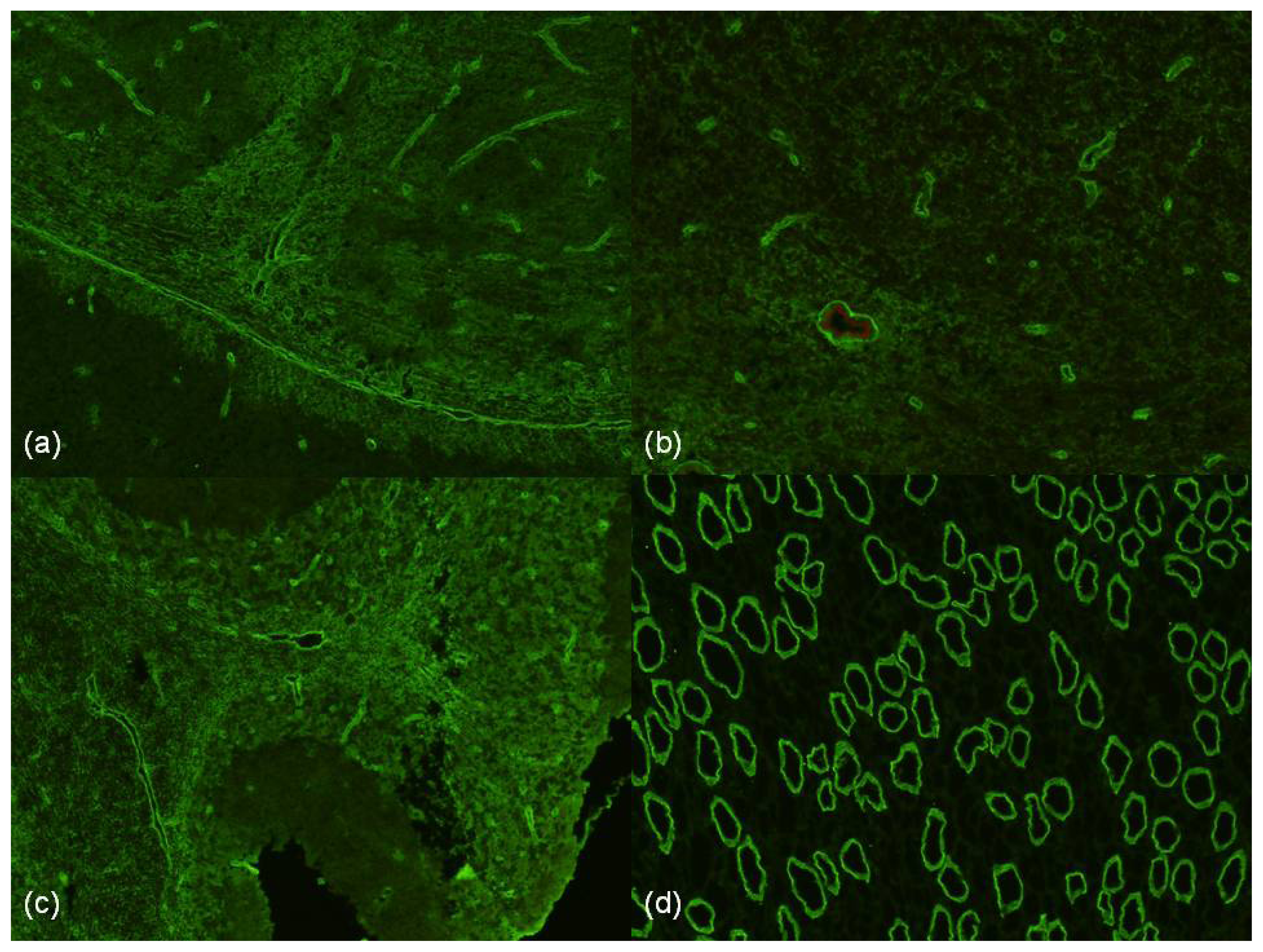
<p>Antibodies against AQP4, originally identified as NMO IgG, were first demonstrated through standard immunofluorescence techniques using various substrates, including mouse brain and kidney [<xref ref-type="bibr" rid="b7-ijms-13-12970">7</xref>]. Classical staining of the subpial surface, microvessels of brain and cerebellum and papillary tubules of the kidney is illustrated in <xref ref-type="fig" rid="f1-ijms-13-12970">Figure 1</xref>. Subsequently enzyme linked immunosorbent assay (ELISA) and live cell-based assays have been developed with live cell-based assays utilising the M23 isoform of AQP4 having the highest sensitivity [<xref ref-type="bibr" rid="b57-ijms-13-12970">57</xref>].</p>
<p>NMO IgG has high specificity (99%) [<xref ref-type="bibr" rid="b58-ijms-13-12970">58</xref>,<xref ref-type="bibr" rid="b59-ijms-13-12970">59</xref>] and moderate sensitivity ranging from 56% [<xref ref-type="bibr" rid="b58-ijms-13-12970">58</xref>] to 73% [<xref ref-type="bibr" rid="b7-ijms-13-12970">7</xref>,<xref ref-type="bibr" rid="b58-ijms-13-12970">58</xref>] for NMO. It has been observed that the sensitivity of the autoantibody is higher in relapsing cases of NMO [<xref ref-type="bibr" rid="b58-ijms-13-12970">58</xref>]. The autoantibody in the blood of NMO patients is predominantly the IgG1 isotype (98% of cases) [<xref ref-type="bibr" rid="b60-ijms-13-12970">60</xref>], which can potently activate the complement system [<xref ref-type="bibr" rid="b61-ijms-13-12970">61</xref>]. IgG2, IgG3 and IgG4 also occur in a lower proportion of cases [<xref ref-type="bibr" rid="b60-ijms-13-12970">60</xref>]. IgM NMO antibody has also been reported in the blood of up to 10% of patients with NMO but it is not known to exist in the absence of IgG [<xref ref-type="bibr" rid="b62-ijms-13-12970">62</xref>]. NMO IgG binds to the third extracellular loop of AQP4 [<xref ref-type="bibr" rid="b63-ijms-13-12970">63</xref>] and the generation of conformational epitopes during OAP formation results in preferential binding with the M23 isoform [<xref ref-type="bibr" rid="b64-ijms-13-12970">64</xref>]. One study has suggested that NMO IgG has considerably lower affinity for the AQP4 protein when compared with the epitope presented by OAPs [<xref ref-type="bibr" rid="b65-ijms-13-12970">65</xref>]. NMO IgG does not cross the blood brain barrier (BBB) in normal subjects [<xref ref-type="bibr" rid="b66-ijms-13-12970">66</xref>] but it can cross the placenta [<xref ref-type="bibr" rid="b67-ijms-13-12970">67</xref>]. It has been demonstrated that NMO IgG is synthesised outside of the CNS. Persistent intrathecal synthesis of oligoclonal IgG, the most stable laboratory feature of MS, was absent in a study of 89 seropositive patients with NMO spectrum disorder, although transient intrathecal production was occasionally observed during acute relapses [<xref ref-type="bibr" rid="b11-ijms-13-12970">11</xref>]. CSF from 20 NMO patients showed lower titres of NMO IgG in CSF than in serum (with a ratio of 1:500) in keeping with extrathecal synthesis of the autoantibody [<xref ref-type="bibr" rid="b68-ijms-13-12970">68</xref>]. A further seven cases of NMO with low CSF antibody index of NMO IgG (AQP4 IgG/Total IgG) have since been reported [<xref ref-type="bibr" rid="b69-ijms-13-12970">69</xref>]. In order to cause disease in the CNS, the extrathecally produced autoantibody requires disruption of the BBB (possible mechanisms for this are discussed below). NMO IgG is occasionally restricted to the CSF [<xref ref-type="bibr" rid="b70-ijms-13-12970">70</xref>] and AQP4 specific B cells have been identified in the CSF of one patient with NMO [<xref ref-type="bibr" rid="b71-ijms-13-12970">71</xref>]. In some patients, NMO IgG is produced by a subset of CD20 negative B cells (CD19<sup>intermediate</sup>CD27<sup>high</sup>CD38<sup>high</sup>CD180<sup>−</sup>) that resembled early plasma cells [<xref ref-type="bibr" rid="b72-ijms-13-12970">72</xref>].</p></sec>
<sec>
<title>2.3. Triggers for Autoimmunity</title>
<p>A genetic predisposing factor is likely in NMO, as the disease is relatively more prevalent in non-Caucasian populations, as compared to MS which is more common in Europeans [<xref ref-type="bibr" rid="b73-ijms-13-12970">73</xref>–<xref ref-type="bibr" rid="b76-ijms-13-12970">76</xref>]. However, the stand alone prevalence of NMO (not relative to MS) has not been systematically determined in any large population. Further clues favouring a genetic predisposition derive from familial NMO cases. While such cases have been described for many years [<xref ref-type="bibr" rid="b77-ijms-13-12970">77</xref>], only a small proportion (3%) of cases have a positive family history, predominantly those with Asian or Latino descent [<xref ref-type="bibr" rid="b78-ijms-13-12970">78</xref>]. In the most comprehensive familial study to date (12 families, 25 affected individuals), the pattern of inheritance was thought to be complex [<xref ref-type="bibr" rid="b78-ijms-13-12970">78</xref>]. The human leukocyte antigen (HLA) associations of NMO are contrasted with MS in <xref ref-type="table" rid="t2-ijms-13-12970">Table 2</xref>. NMO IgG positivity has been found to be associated with HLA-DRB1*03 (DR3) in French (OR 3.08; 95% CI 1.52–6.27, <italic>p</italic> = 0.001) [<xref ref-type="bibr" rid="b79-ijms-13-12970">79</xref>] and Brazilian (OR 3.23; 95% CI 1.07–9.82, <italic>p</italic> = 0.04) populations [<xref ref-type="bibr" rid="b80-ijms-13-12970">80</xref>] and HLA-DPB1*0501 in Japanese (OR 4.8; 95% CI 1.6–14.3, <italic>p</italic> = 0.032) [<xref ref-type="bibr" rid="b81-ijms-13-12970">81</xref>] and Chinese (OR 7.096; 95% CI 2.011–25.044, <italic>p</italic> = 0.022) populations [<xref ref-type="bibr" rid="b82-ijms-13-12970">82</xref>]. Notably, these HLA haplotypes are also associated with other humoral autoimmune disorders such as systemic lupus erythematosus (SLE) [<xref ref-type="bibr" rid="b83-ijms-13-12970">83</xref>] and Graves’ disease [<xref ref-type="bibr" rid="b84-ijms-13-12970">84</xref>]. Indeed, NMO often coexists with other autoimmune conditions such as SLE and Sjögren syndrome [<xref ref-type="bibr" rid="b23-ijms-13-12970">23</xref>] and these disorders are also more common in family members of patients with NMO [<xref ref-type="bibr" rid="b78-ijms-13-12970">78</xref>]. Recent diagnostic criteria for NMO have tended to exclude SLE and Sjögren syndrome as not being compatible with a diagnosis of NMO [<xref ref-type="bibr" rid="b13-ijms-13-12970">13</xref>].</p>
<p>Like many other autoimmune disorders NMO is also more common in women [<xref ref-type="bibr" rid="b10-ijms-13-12970">10</xref>,<xref ref-type="bibr" rid="b88-ijms-13-12970">88</xref>] suggesting that gender differences play a role in the pathogenesis of NMO. Genetic analysis of the <italic>AQP4</italic> gene was carried out to determine if mutations in the gene are associated with NMO [<xref ref-type="bibr" rid="b89-ijms-13-12970">89</xref>]. No significant association was found with the 8 selected SNPs. However, at position number 3180 in the <italic>AQP4</italic> gene, which transcripts arginine at position 19, two missense mutations were observed in 3 out of 191 cases of NMO but not in any of 1363 controls. Whilst not statistically significant, it was speculated that loss of arginine 19 may impair palmitoylation of AQP4, which may increase the size of OAPs [<xref ref-type="bibr" rid="b49-ijms-13-12970">49</xref>] and thereby generate immunogenic epitopes. Since Arginine 19 is in the regulatory sequence of M23 [<xref ref-type="bibr" rid="b90-ijms-13-12970">90</xref>], this mutation could result in dysregulation of the transcription or translation of M23, resulting in a potentially immunogenic conformational change in OAPs. As described previously NMO IgG has high affinity for epitopes expressed in OAPs but lower affinity for isolated AQP4 protein [<xref ref-type="bibr" rid="b65-ijms-13-12970">65</xref>].</p>
<p>In one series the onset of neurological symptoms in almost 30% of NMO cases was preceded by a viral or bacterial infection (more cases associated with varicella zoster and mycobacterium tuberculosis) [<xref ref-type="bibr" rid="b91-ijms-13-12970">91</xref>] and vaccination against human papilloma virus has been reported to precede the onset of NMO in 4 teenage girls [<xref ref-type="bibr" rid="b92-ijms-13-12970">92</xref>]. Parainfectious NMO may have a different immunopathogenesis as the majority of these cases have a monophasic course [<xref ref-type="bibr" rid="b91-ijms-13-12970">91</xref>]. Rarely, a paraneoplastic association has also been described in NMO, especially with carcinoma of the breast and lung, and B cell-lymphoma [<xref ref-type="bibr" rid="b93-ijms-13-12970">93</xref>]. A recent study of the T cells derived from the blood of 15 NMO patients has supported molecular mimicry as a possible cause of autoimmunity in NMO. Homology between the immunogenic amino acids 66–75 of <italic>AQP4</italic> and the surface protein ABC-TP of clostridia species especially <italic>Clostridium perfringens</italic> has been observed and ABC-TP was shown to cross react with anti-AQP4 T cells [<xref ref-type="bibr" rid="b94-ijms-13-12970">94</xref>]. <italic>Clostridium perfringens</italic> is a ubiquitous organism and can occur in human gut as a commensal [<xref ref-type="bibr" rid="b95-ijms-13-12970">95</xref>]. This study requires independent replication.</p>
<p>In MS, autoantibodies against myelin and other CNS antigens have been variably reported in as many as 60%–70% of cases [<xref ref-type="bibr" rid="b96-ijms-13-12970">96</xref>] and the levels of autoantibodies fluctuate with relapses of disease [<xref ref-type="bibr" rid="b97-ijms-13-12970">97</xref>]. However, no consistent high affinity serum autoantibody response is observed in MS and B-cells may be sensitised against self-antigens as an epiphenomenon during relapses. Similarly, there is a possibility that an initial disease process in the CNS of NMO patients attracts B-cells and sensitises them against AQP4. However, in an experiment to detect spontaneous production of NMO IgG in murine experimental autoimmune encephalomyelitis (EAE), extensive infiltration of immune cells into the CNS was seen without any detectable NMO IgG [<xref ref-type="bibr" rid="b98-ijms-13-12970">98</xref>].</p>
<p>It remains to be discovered what, if any, role is played by molecular mimicry, bystander activation or a persistent infection in the initiation of autoantibody production in NMO.</p></sec>
<sec>
<title>2.4. Is Anti-AQP4 Antibody Pathogenic?</title>
<p>The antibody from the serum of NMO patients has been shown to exacerbate the clinical and pathological features of murine EAE [<xref ref-type="bibr" rid="b66-ijms-13-12970">66</xref>,<xref ref-type="bibr" rid="b99-ijms-13-12970">99</xref>] and to cause disease when injected intracerebrally in wild-type mice [<xref ref-type="bibr" rid="b35-ijms-13-12970">35</xref>]. However, NMO IgG is only pathogenic in the presence of human complement proteins [<xref ref-type="bibr" rid="b35-ijms-13-12970">35</xref>,<xref ref-type="bibr" rid="b100-ijms-13-12970">100</xref>] or a pre-existing inflammatory state in the CNS such as occurs in EAE or mice pre-treated with Freund’s complete adjuvant [<xref ref-type="bibr" rid="b101-ijms-13-12970">101</xref>]. The stronger the pre-existing CNS inflammation, the more severe the disease. Therefore, in EAE models more extensive disease is induced by NMO IgG [<xref ref-type="bibr" rid="b66-ijms-13-12970">66</xref>,<xref ref-type="bibr" rid="b99-ijms-13-12970">99</xref>], whereas only mild disease is observed in mice pre-treated with Freund’s complete adjuvant, which causes milder CNS inflammation than EAE [<xref ref-type="bibr" rid="b101-ijms-13-12970">101</xref>]. AQP4 is expressed in non-CNS tissues [<xref ref-type="bibr" rid="b68-ijms-13-12970">68</xref>,<xref ref-type="bibr" rid="b102-ijms-13-12970">102</xref>], but no pathological involvement of extra neuronal tissues has been observed in NMO cases. This suggests that pathogenic potential of the autoantibody is restricted to the CNS. NMO IgG fails to produce disease in juvenile mice with incomplete BBB [<xref ref-type="bibr" rid="b66-ijms-13-12970">66</xref>]; while access of NMO IgG to the CNS is a pre-requisite for the induction of disease, it is not sufficient to cause clinically relevant pathology in isolation. Higher titres of NMO IgG have been reported in patients with increased disease activity and severity [<xref ref-type="bibr" rid="b68-ijms-13-12970">68</xref>,<xref ref-type="bibr" rid="b103-ijms-13-12970">103</xref>], consistent with antibody pathogenicity. However, antibody titres do not correlate closely with disease activity in all studies [<xref ref-type="bibr" rid="b60-ijms-13-12970">60</xref>,<xref ref-type="bibr" rid="b104-ijms-13-12970">104</xref>,<xref ref-type="bibr" rid="b105-ijms-13-12970">105</xref>]. More questions have been raised about the pathogenicity of NMO IgG following a case report in which NMO IgG was detected in blood 10 years before the clinical onset of the disease [<xref ref-type="bibr" rid="b106-ijms-13-12970">106</xref>] and in another case series where NMO IgG was detected in 2 patients with cancer but without any clinical manifestation of NMO [<xref ref-type="bibr" rid="b93-ijms-13-12970">93</xref>]. It can be concluded that NMO IgG is pathogenic, but only in a specific CNS milieu.</p></sec>
<sec>
<title>2.5. Immune Mediated Astrocytopathy</title>
<p>NMO IgG binds with AQP4 and activates complement making the lytic complex C5b-9, which destroys astrocytes [<xref ref-type="bibr" rid="b107-ijms-13-12970">107</xref>]. Neutrophils, natural killer cells, macrophages, tumour necrosis factor α, interleukin (IL)-6, IL-1β, and interferon-gamma have been shown to amplify this complement mediated damage [<xref ref-type="bibr" rid="b100-ijms-13-12970">100</xref>]. Complement regulatory proteins (CRP) on astrocytes such as decay-accelerating factor (CD55), membrane cofactor protein (CD46), complement receptor 1 and protectin (CD59) may also be dysfunctional in NMO, thus facilitating complement mediated astrocyte injury. In mice injected intracerebrally with NMO IgG. NMO-like lesions are only produced when human, but not mouse, complement is co-administered [<xref ref-type="bibr" rid="b35-ijms-13-12970">35</xref>]. It is known that murine CRP may not have a potent protective effect against heterologous complement [<xref ref-type="bibr" rid="b108-ijms-13-12970">108</xref>,<xref ref-type="bibr" rid="b109-ijms-13-12970">109</xref>]. CRP dysfunction secondary to autoantibodies has been reported in MS [<xref ref-type="bibr" rid="b110-ijms-13-12970">110</xref>]. The possibility of dysfunctional CRP in NMO requires further investigation.</p>
<p>Anti-AQP4 antibody has been reported in some studies to cause internalisation of AQP4 [<xref ref-type="bibr" rid="b50-ijms-13-12970">50</xref>,<xref ref-type="bibr" rid="b61-ijms-13-12970">61</xref>,<xref ref-type="bibr" rid="b111-ijms-13-12970">111</xref>]. However, internalisation of AQP4, a process that could paradoxically protect astrocytes from immune mediated cytotoxicity, is unlikely to be the principal pathogenic mechanism in NMO. As noted previously the absence of AQP4 function does not result in neurological disorder in AQP4 knockout mice [<xref ref-type="bibr" rid="b53-ijms-13-12970">53</xref>]. Additionally, little or no internalisation of antibody-AQP4 complex is observed in primary astrocyte culture or <italic>in vivo</italic>, emphasising the limited applicability of AQP4-transfected cells when modelling human disease [<xref ref-type="bibr" rid="b52-ijms-13-12970">52</xref>,<xref ref-type="bibr" rid="b112-ijms-13-12970">112</xref>]. It has also been shown that astrocytes do not suffer any osmotic injury as NMO IgG does not disturb the function of AQP4 [<xref ref-type="bibr" rid="b113-ijms-13-12970">113</xref>,<xref ref-type="bibr" rid="b114-ijms-13-12970">114</xref>].</p>
<p>Perivascular glial fibrillary acid protein (GFAP) positive astrocytes are consistently lost in NMO lesions in contrast with MS [<xref ref-type="bibr" rid="b36-ijms-13-12970">36</xref>,<xref ref-type="bibr" rid="b37-ijms-13-12970">37</xref>], where lesional GFAP is usually upregulated [<xref ref-type="bibr" rid="b115-ijms-13-12970">115</xref>]. CSF levels of GFAP are markedly elevated during relapses of NMO but not MS [<xref ref-type="bibr" rid="b116-ijms-13-12970">116</xref>]. GFAP is a cytoskeletal protein that plays a role in astrocyte motility and structure [<xref ref-type="bibr" rid="b115-ijms-13-12970">115</xref>]. It is highly expressed by reactive astrocytes [<xref ref-type="bibr" rid="b117-ijms-13-12970">117</xref>].</p></sec>
<sec>
<title>2.6. Immunopathogenesis</title>
<p>Systemic production of autoantibody with disease limited to the CNS implicates the presence of orchestrating T helper cells as well as a cascade of cytokines in the periphery and within the CNS. B cells are also attracted to the CNS by chemokines secreted at sites of inflammation. A study involving 31 NMO patients found various Th2 related cytokines such as IL-1 receptor antagonist, IL-5, IL-10 and IL-13; and the Th17 related cytokines IL-6, IL-8 and granulocyte colony stimulating factor to be elevated in the CSF. However, the signature Th2 cytokine, IL-4, and Th17 cytokine, IL-17, were not detected in the CSF [<xref ref-type="bibr" rid="b118-ijms-13-12970">118</xref>]. Other studies have shown increased levels of IL-17 in the CSF of NMO patients [<xref ref-type="bibr" rid="b119-ijms-13-12970">119</xref>,<xref ref-type="bibr" rid="b120-ijms-13-12970">120</xref>]. Therefore, Th17 cells may have an intermittent role in the CNS inflammation that characterises NMO. Chitinases, hydrolases secreted by the innate immune cells that play a role in Th2 as well as Th1 related inflammatory processes, are also increased in the CSF of NMO patients. In response to IL-13 monocytes obtained from NMO patients secrete chitinases that increase <italic>in vitro</italic> chemotaxis of eosinophils, macrophages and T cells across the BBB by promoting the secretion of various cytokines IL-8, RANTES (CCL5), MCP1 (CCL2), and eotaxins by monocytes [<xref ref-type="bibr" rid="b121-ijms-13-12970">121</xref>]. Eosinophils and macrophages are abundant in NMO lesions [<xref ref-type="bibr" rid="b122-ijms-13-12970">122</xref>]. CSF levels of CXCL13, a potent chemo-attractant for B cells, are elevated and correlate with disease severity [<xref ref-type="bibr" rid="b123-ijms-13-12970">123</xref>]. As indicated previously, anti-AQP4 B cells have been detected in the CSF of NMO patients [<xref ref-type="bibr" rid="b71-ijms-13-12970">71</xref>]. CXCL13 is secreted by sensitised T helper cells [<xref ref-type="bibr" rid="b124-ijms-13-12970">124</xref>] and antigen presenting cells (APC) [<xref ref-type="bibr" rid="b125-ijms-13-12970">125</xref>]. B-cell activating factor (BAFF) is increased in the CSF but not serum of NMO patients [<xref ref-type="bibr" rid="b126-ijms-13-12970">126</xref>]. BAFF, secreted by innate immune cells, APC [<xref ref-type="bibr" rid="b127-ijms-13-12970">127</xref>] and activated astrocytes [<xref ref-type="bibr" rid="b128-ijms-13-12970">128</xref>], increases the survival and maturation of B cells through NF-κB [<xref ref-type="bibr" rid="b129-ijms-13-12970">129</xref>]. Thus, BAFF can perpetuate the auto-reactive B cell population in the CNS. It is interesting to note that treatment with both β-interferon and glatiramer acetate was found to increase levels of BAFF in the serum of MS patients [<xref ref-type="bibr" rid="b126-ijms-13-12970">126</xref>]. This may account for the apparent worsening of NMO with β-interferon [<xref ref-type="bibr" rid="b28-ijms-13-12970">28</xref>–<xref ref-type="bibr" rid="b30-ijms-13-12970">30</xref>]. Despite similar changes in BAFF occurring with glatiramer acetate the same concerns regarding its use in NMO have not been raised [<xref ref-type="bibr" rid="b130-ijms-13-12970">130</xref>,<xref ref-type="bibr" rid="b131-ijms-13-12970">131</xref>].</p>
<p>IL-6 is elevated not only in the CSF but also in the serum of patients with NMO [<xref ref-type="bibr" rid="b118-ijms-13-12970">118</xref>,<xref ref-type="bibr" rid="b132-ijms-13-12970">132</xref>], particularly in patients with more severe disease [<xref ref-type="bibr" rid="b132-ijms-13-12970">132</xref>]. This proinflammatory cytokine, which can also be secreted by activated astrocytes [<xref ref-type="bibr" rid="b133-ijms-13-12970">133</xref>], increases the survival of NMO IgG producing B cells and the production of antibody [<xref ref-type="bibr" rid="b72-ijms-13-12970">72</xref>]. In <italic>ex vivo</italic> experiments in murine spinal cord, IL-6 increased the induced NMO-like lesions [<xref ref-type="bibr" rid="b100-ijms-13-12970">100</xref>]. In a study of 18 NMO patients, IL-9, a T cell growth factor, was elevated in the serum [<xref ref-type="bibr" rid="b134-ijms-13-12970">134</xref>] but, not the CSF [<xref ref-type="bibr" rid="b118-ijms-13-12970">118</xref>]. IL-6 is involved in the development of IL-17-secreting CD4<sup>+</sup> T cells (Th17) [<xref ref-type="bibr" rid="b135-ijms-13-12970">135</xref>]. Th17 cells have been implicated in many autoimmune disorders such as rheumatoid arthritis, psoriasis, MS and inflammatory bowel disease [<xref ref-type="bibr" rid="b136-ijms-13-12970">136</xref>]. Th17 cells and their principal product, IL-17, are found to be increased in serum from patients with NMO [<xref ref-type="bibr" rid="b137-ijms-13-12970">137</xref>,<xref ref-type="bibr" rid="b138-ijms-13-12970">138</xref>], and some studies as seen above have also shown elevated IL-17 in the CSF [<xref ref-type="bibr" rid="b119-ijms-13-12970">119</xref>,<xref ref-type="bibr" rid="b120-ijms-13-12970">120</xref>], suggesting the involvement of Th17 cells and IL-17 in the pathogenesis of the disease. IL-17 is seen to mediate inflammation in the brain of EAE mice by promoting microglial activation [<xref ref-type="bibr" rid="b139-ijms-13-12970">139</xref>]. Th17 cells may dictate the autoimmune milieu that facilitates the pathogenesis of NMO. A subset of B cells (CD27<sup>high</sup>CD38<sup>high</sup>CD180<sup>−</sup> with low CD20 and CD19<sup>−</sup>), which may be producing anti-AQP4 antibody, appear to be activated [<xref ref-type="bibr" rid="b72-ijms-13-12970">72</xref>]. Further implicating a role for humoral immunity in NMO, CD27<sup>+</sup> memory B cell levels rise in association with relapses [<xref ref-type="bibr" rid="b34-ijms-13-12970">34</xref>]. There is some evidence that cellular autoimmunity is also initiated as CD4<sup>+</sup> T cells against AQP4 are detectable in the blood of patients with NMO [<xref ref-type="bibr" rid="b140-ijms-13-12970">140</xref>,<xref ref-type="bibr" rid="b141-ijms-13-12970">141</xref>].</p>
<p>Rituximab has been found to be clinically effective in NMO [<xref ref-type="bibr" rid="b33-ijms-13-12970">33</xref>,<xref ref-type="bibr" rid="b34-ijms-13-12970">34</xref>] and reduces the levels of anti-NMO IgG, but the antibody does not completely disappear [<xref ref-type="bibr" rid="b34-ijms-13-12970">34</xref>,<xref ref-type="bibr" rid="b103-ijms-13-12970">103</xref>,<xref ref-type="bibr" rid="b142-ijms-13-12970">142</xref>]. There may also be a BAFF related transient elevation in the anti-NMO titres observed 2 weeks after the first injection of rituximab [<xref ref-type="bibr" rid="b142-ijms-13-12970">142</xref>]. One possible explanation for this is that plasma cells, which do not express CD20 (the target of rituximab), may continue to produce antibody for a period of time, possibly at an increased rate due to the depletion of memory B cells and other modulatory Bcells (regulatory B cells) which do carry CD20 [<xref ref-type="bibr" rid="b143-ijms-13-12970">143</xref>]. Repeated rituximab therapy may reduce the level of NMO IgG after the depletion of memory B cells and natural death of short-lived plasmablasts/plasma cells. Long-lived plasma cells may continue to secrete autoantibody despite the treatment with rituximab [<xref ref-type="bibr" rid="b144-ijms-13-12970">144</xref>]. An alternative explanation is that it is purely through the modulatory effects of B cells on T cells that rituximab is having an effect, such that removal of memory B cells and activated B cells diminishes the proinflammatory milieu.</p>
<p>Disruption of the BBB is required for NMO IgG to enter the CNS. Serum from NMO patients can cause breakdown of the BBB [<xref ref-type="bibr" rid="b145-ijms-13-12970">145</xref>,<xref ref-type="bibr" rid="b146-ijms-13-12970">146</xref>] by an unknown mechanism. However, autoantibodies against cultured human brain microvascular endothelial cells were detected in 10 out of 14 seropositive NMO patients. These autoantibodies, which are distinct from anti-AQP4, were observed to reduce the expression of the tight junction proteins, that constitute the BBB, possibly through the autocrine secretion of vascular endothelial growth factor [<xref ref-type="bibr" rid="b146-ijms-13-12970">146</xref>]. The BBB is further disrupted by injury to astrocytic foot processes sustained in the disease process [<xref ref-type="bibr" rid="b111-ijms-13-12970">111</xref>].</p>
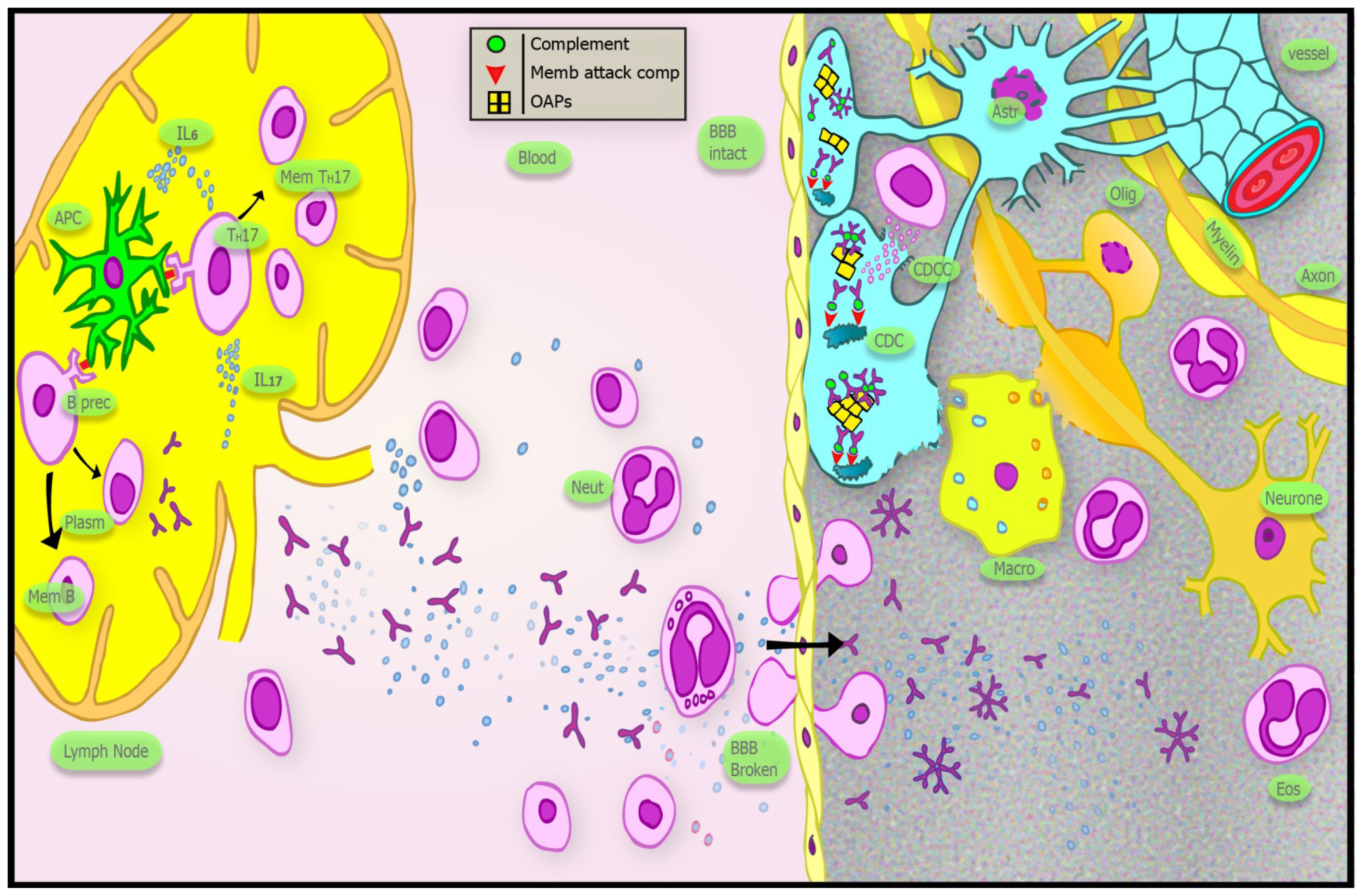
<p>Oligodendrocyte damage appears to follow immune mediated astrocyte injury [<xref ref-type="bibr" rid="b36-ijms-13-12970">36</xref>,<xref ref-type="bibr" rid="b101-ijms-13-12970">101</xref>] and these cells are not affected in <italic>AQP4</italic> null mice when exposed to NMO IgG and complement factors [<xref ref-type="bibr" rid="b100-ijms-13-12970">100</xref>]. Glutamate induced excitotoxicity is one potential mechanism of oligodendrocyte injury. Glutamate is removed by excitatory amino acid transporter 2 (EAAT2) present on astrocytes in association with <italic>AQP4</italic>. In AQP4 transfected cells, the glutamate transporter is internalised with antibody-AQP4 complex, implicating glutamate excitotoxicity in NMO [<xref ref-type="bibr" rid="b50-ijms-13-12970">50</xref>,<xref ref-type="bibr" rid="b51-ijms-13-12970">51</xref>]. However, studies utilising primary astrocyte cultures as a substrate and <italic>in vivo</italic> studies have failed to demonstrate significant AQP4 complex or glutamate transporter internalisation [<xref ref-type="bibr" rid="b52-ijms-13-12970">52</xref>,<xref ref-type="bibr" rid="b112-ijms-13-12970">112</xref>]. Recent work has suggested that NMO IgG bound to the M23 isoform of AQP4 increases resistance to internalisation but does cause internalisation of the M1 isoform [<xref ref-type="bibr" rid="b112-ijms-13-12970">112</xref>]. AQP4 has been observed in autopsy studies to be lost both in MS and NMO lesions [<xref ref-type="bibr" rid="b37-ijms-13-12970">37</xref>,<xref ref-type="bibr" rid="b147-ijms-13-12970">147</xref>]. This may be due to loss of astrocytes rather than internalisation. Loss of <italic>AQP4</italic> in EAE models has been observed to be neuroprotective [<xref ref-type="bibr" rid="b98-ijms-13-12970">98</xref>], but it is likely that this effect is mediated by its water channelling action, which is not affected by NMO IgG binding [<xref ref-type="bibr" rid="b113-ijms-13-12970">113</xref>,<xref ref-type="bibr" rid="b114-ijms-13-12970">114</xref>]. Thus, loss of <italic>AQP4</italic> in NMO, either by internalisation or astrocyte loss, is one of the markers of the disease but may not be a primary pathogenic process. Whilst it is possible that the inflammatory process primarily targeting astrocytes causes bystander injury to nearby oligodendrocytes, widespread loss of oligodendrocytes is reported in early NMO lesions in the absence of a significant macrophage infiltrate [<xref ref-type="bibr" rid="b36-ijms-13-12970">36</xref>]. The immunoglobulin predominantly seen in lesions of NMO patients in one study was of IgM type [<xref ref-type="bibr" rid="b148-ijms-13-12970">148</xref>] but as noted earlier it is only detected in the blood of 10% of patients [<xref ref-type="bibr" rid="b62-ijms-13-12970">62</xref>]. A possible explanation for this is intrathecal synthesis by local B-cells undergoing class switching. However, another study also showed IgG along with IgM in lesions of NMO patients thus supporting the role of IgG as a pathogenic antibody [<xref ref-type="bibr" rid="b36-ijms-13-12970">36</xref>]. The immunopathogenesis of NMO is summarised in <xref ref-type="fig" rid="f2-ijms-13-12970">Figure 2</xref>.</p></sec>
<sec>
<title>2.7. Histopathology of NMO</title>
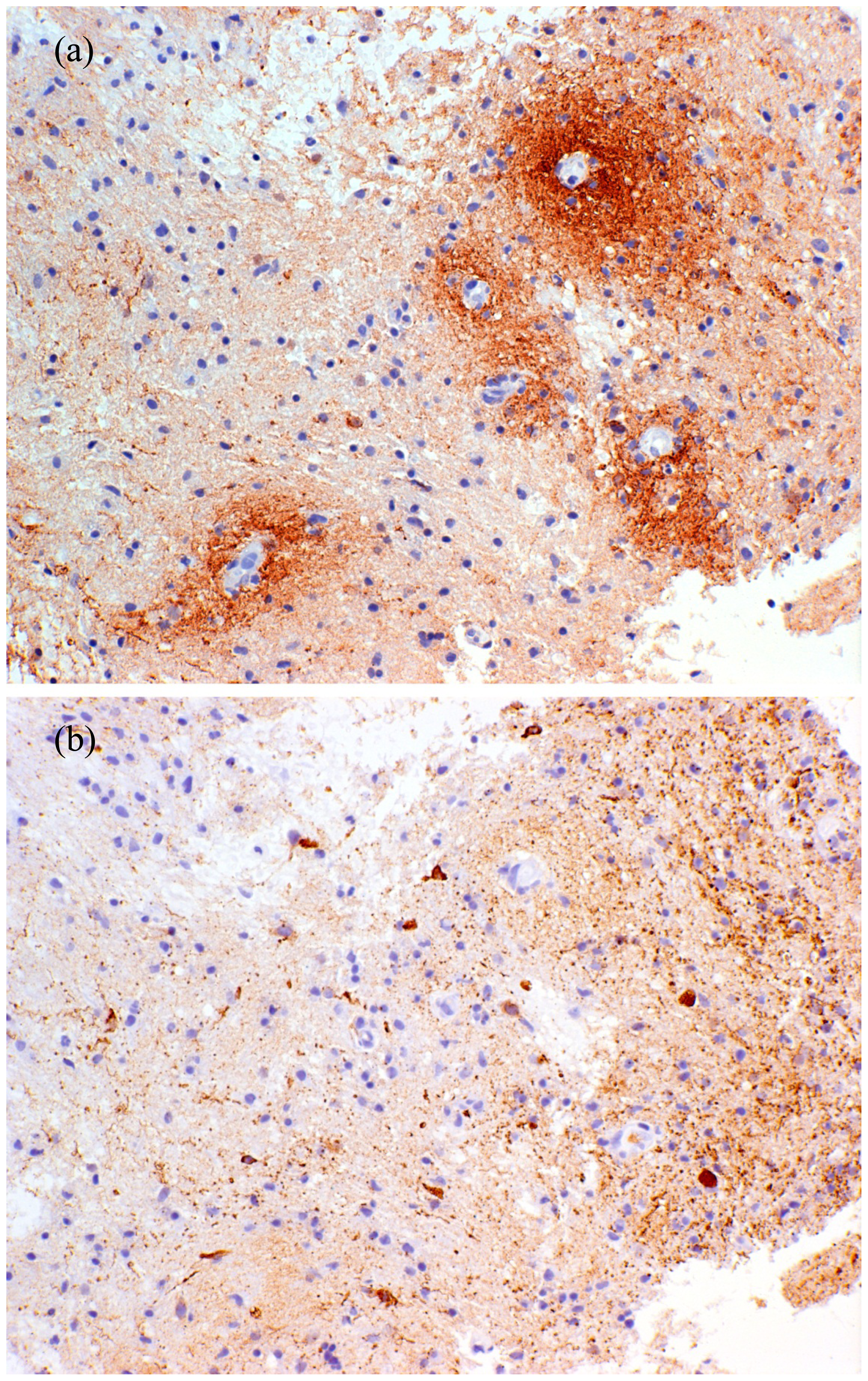
<p>The earliest pathological descriptions of NMO highlighted the frequent occurrence of necrosis with cavitation, hyalinisation of small vessels and perivascular inflammatory infiltrates. These features were helpful in distinguishing NMO from MS. More recent work has indicated the importance of perivascular deposition of immunoglobulin and complement [<xref ref-type="bibr" rid="b148-ijms-13-12970">148</xref>] and its localisation to the vascular glial limiting membrane [<xref ref-type="bibr" rid="b149-ijms-13-12970">149</xref>]. The infiltrate consists of macrophages, granulocytes and eosinophils with a general paucity of lymphocytes [<xref ref-type="bibr" rid="b122-ijms-13-12970">122</xref>]. Modern histopathological techniques have demonstrated the specificity of acute fragmentation and loss of perivascular GFAP-positive astrocyte foot processes and their cell bodies as an early and consistent feature of NMO [<xref ref-type="bibr" rid="b36-ijms-13-12970">36</xref>,<xref ref-type="bibr" rid="b150-ijms-13-12970">150</xref>]. Whilst loss of <italic>AQP4</italic> is seen in NMO lesions [<xref ref-type="bibr" rid="b37-ijms-13-12970">37</xref>,<xref ref-type="bibr" rid="b147-ijms-13-12970">147</xref>], this is not consistent and is also seen in MS [<xref ref-type="bibr" rid="b151-ijms-13-12970">151</xref>,<xref ref-type="bibr" rid="b152-ijms-13-12970">152</xref>]. Relative preservation of myelin in early lesions with massive astrocyte destruction implicates astrocyte injury as the primary pathological event in NMO [<xref ref-type="bibr" rid="b37-ijms-13-12970">37</xref>,<xref ref-type="bibr" rid="b147-ijms-13-12970">147</xref>]. The presence of myelin loss and phagocytosis by macrophages in subacute NMO lesions suggests that this is a secondary phenomenon. Morphologically distinct unipolar and bipolar GFAP-positive astrocytes are seen in demyelinated subacute lesions suggesting that astrocyte progenitor cells may be responsible for reparative processes in NMO [<xref ref-type="bibr" rid="b37-ijms-13-12970">37</xref>,<xref ref-type="bibr" rid="b147-ijms-13-12970">147</xref>,<xref ref-type="bibr" rid="b153-ijms-13-12970">153</xref>]. Interestingly, significant necrosis of axons was not seen in early and subacute lesions [<xref ref-type="bibr" rid="b36-ijms-13-12970">36</xref>]. Intramyelenic oedema with partial astrocyte preservation may be responsible for the presumed vasogenic oedema seen on MRI as extensive white matter lesions in the brain [<xref ref-type="bibr" rid="b112-ijms-13-12970">112</xref>]. The typical histopathological appearances in NMO are illustrated in <xref ref-type="fig" rid="f3-ijms-13-12970">Figure 3</xref>.</p></sec></sec>
<sec sec-type="conclusions">
<title>3. Conclusions</title>
<p>Great strides have been made in elucidating the molecular underpinnings of NMO, but aspects of the pathogenesis remain unknown and no currently proposed disease model is completely satisfactory.</p>
<p>It seems likely that NMO is an autoimmune disease that develops in genetically susceptible individuals. There is already some evidence for specific HLA alleles and polymorphisms of the <italic>AQP4</italic> gene being associated with NMO. Infection, vaccination, and neoplasm may trigger the disease process in some cases but a recognisable initiating event is lacking in most. In the schema presented in <xref ref-type="fig" rid="f2-ijms-13-12970">Figure 2</xref>, this trigger induces the release of inflammatory cytokines, including IL-6, and Th17 cells are stimulated. A subset of B-cells in the peripheral tissues is stimulated to produce anti-AQP4 IgG antibody. The BBB is made permeable to the autoantibody by either a systemic inflammatory response or a local pathological process in the CNS. Auto-reactive B cells may also enter the CNS and undergo class switching to produce IgM autoantibody. The antibody fixes complement on AQP4 expressing astrocytic foot processes. Stellate astrocytes are damaged by complement dependent cytotoxicity and complement dependent cellular cytotoxicity. Oligodendrocytes that are in close proximity to astrocyte foot processes are possibly affected through bystander inflammatory damage or, more likely, loss of trophic support from astrocytes. The resulting demyelination causes loss of saltatory conduction and conduction block, leading to neurological deficit. With continuing or repeated inflammation, substantial neuro-axonal loss ensues. The near absence of progressive forms of NMO (primary or secondary) suggests that neuro-axonal damage is the result of the acute inflammation, whether directly or indirectly, rather than as a result of a secondary degenerative process as appears to be the case in some forms of MS.</p>
<p>Some CNS sites, such as cerebellum, express <italic>AQP4</italic> abundantly but are not usually involved in NMO. Similarly, cerebral cortex expresses <italic>AQP4</italic> but is not affected. This may be due to the specific local immune environment. Elucidation of such protective mechanisms will be helpful in identifying new therapeutic targets. The processes responsible for oligodendrocyte loss are also largely unknown and the mechanism of axonal injury in chronic lesions is also poorly understood. Important questions regarding the aetiopathogenesis of seronegative cases with NMO phenotypes remain. Do these cases have a different antigenic target (heterogeneity) or do they represent a milder form of the disease (<italic>forme fruste</italic>), or do they reflect technical problems with the currently available NMO IgG assays (false negatives)?</p>
<p>As the first autoimmune disease of the CNS for which a specific autoantibody and antigenic target have been identified NMO represents a significant opportunity to better understand and hopefully treat its more heterogeneous and complex cousin, MS. Very recent research has highlighted a novel potential therapeutic approach utilising small-molecule inhibitors to reduce AQP4 mediated astrocyte cytotoxicity by disrupting the interaction between NMO-IgG and M23-AQP4 [<xref ref-type="bibr" rid="b154-ijms-13-12970">154</xref>]. These experiments demonstrate the very direct way in which a greater understanding of the pathogenesis of autoimmune diseases such as NMO can lead to new therapeutic interventions. The prominent role played by IL-6 in NMO has led to the suggestion that IL-6 receptor blockade may be an effective therapy [<xref ref-type="bibr" rid="b72-ijms-13-12970">72</xref>]. The development of fully humanised monoclonal antibodies against the B-cell antigens CD20 [<xref ref-type="bibr" rid="b155-ijms-13-12970">155</xref>] and CD19 [<xref ref-type="bibr" rid="b156-ijms-13-12970">156</xref>] raise exciting prospects for improved tolerability and potentially greater efficacy in the treatment of NMO.</p></sec></body>
<back>
<ack>
<title>Acknowledgements</title>
<p>We are grateful to Jacob Sharples and Robert Loudon for assistance with the illustration. Wajih Bukhari is supported by a Fellowship Scholarship from Multiple Sclerosis Research Australia.</p></ack>
<ref-list>
<title>References</title>
<ref id="b1-ijms-13-12970"><label>1</label><citation citation-type="journal"><person-group person-group-type="author"><name><surname>Allbutt</surname><given-names>T.</given-names></name></person-group><article-title>On the opthalmoscopic signs of spinal disease</article-title><source>Lancet</source><year>1870</year><volume>1</volume><fpage>76</fpage><lpage>78</lpage></citation></ref>
<ref id="b2-ijms-13-12970"><label>2</label><citation citation-type="journal"><person-group person-group-type="author"><name><surname>Erb</surname><given-names>W.</given-names></name></person-group><article-title>About the concurrence of optic neuritis and subacute myelitis</article-title><source>Arch. Psychiatr. Nervenkr</source><year>1879</year><volume>1</volume><fpage>146</fpage><lpage>157</lpage></citation></ref>
<ref id="b3-ijms-13-12970"><label>3</label><citation citation-type="journal"><person-group person-group-type="author"><name><surname>Jarius</surname><given-names>S.</given-names></name><name><surname>Wildemann</surname><given-names>B</given-names></name></person-group><article-title>On the contribution of thomas clifford allbutt, F.R.S., to the early history of neuromyelitis optica</article-title><source>J. Neurol</source><year>2012</year><pub-id pub-id-type="doi">10.1007/s00415-012-6594-3</pub-id></citation></ref>
<ref id="b4-ijms-13-12970"><label>4</label><citation citation-type="journal"><person-group person-group-type="author"><name><surname>Devic</surname><given-names>E.</given-names></name></person-group><article-title>Myélite subaiguë compliquée de névrite optique</article-title><source>Bull. Med. (Paris)</source><year>1894</year><volume>8</volume><fpage>1033</fpage><lpage>1034</lpage></citation></ref>
<ref id="b5-ijms-13-12970"><label>5</label><citation citation-type="journal"><person-group person-group-type="author"><name><surname>Totsuka</surname><given-names>S.</given-names></name></person-group><article-title>Clinico-pathological studies on the two cases of neuromyelitis optica (Devic’s disease) with a chronic clinical course, with especial reference on its relationship to multiple sclerosis</article-title><source>Folia Psychiatr. Neurol. Jpn</source><year>1962</year><volume>64</volume><fpage>1149</fpage><lpage>1165</lpage><pub-id pub-id-type="pmid">14010427</pub-id></citation></ref>
<ref id="b6-ijms-13-12970"><label>6</label><citation citation-type="journal"><person-group person-group-type="author"><name><surname>Wingerchuk</surname><given-names>D.M.</given-names></name><name><surname>Hogancamp</surname><given-names>W.F.</given-names></name><name><surname>O’Brien</surname><given-names>P.C.</given-names></name><name><surname>Weinshenker</surname><given-names>B.G.</given-names></name></person-group><article-title>The clinical course of neuromyelitis optica (Devic’s syndrome)</article-title><source>Neurology</source><year>1999</year><volume>53</volume><fpage>1107</fpage><lpage>1114</lpage><pub-id pub-id-type="doi">10.1212/WNL.53.5.1107</pub-id><pub-id pub-id-type="pmid">10496275</pub-id></citation></ref>
<ref id="b7-ijms-13-12970"><label>7</label><citation citation-type="journal"><person-group person-group-type="author"><name><surname>Lennon</surname><given-names>V.A.</given-names></name><name><surname>Wingerchuk</surname><given-names>D.M.</given-names></name><name><surname>Kryzer</surname><given-names>T.J.</given-names></name><name><surname>Pittock</surname><given-names>S.J.</given-names></name><name><surname>Lucchinetti</surname><given-names>C.F.</given-names></name><name><surname>Fujihara</surname><given-names>K.</given-names></name><name><surname>Nakashima</surname><given-names>I.</given-names></name><name><surname>Weinshenker</surname><given-names>B.G.</given-names></name></person-group><article-title>A serum autoantibody marker of neuromyelitis optica: Distinction from multiple sclerosis</article-title><source>Lancet</source><year>2004</year><volume>364</volume><fpage>2106</fpage><lpage>2112</lpage><pub-id pub-id-type="doi">10.1016/S0140-6736(04)17551-X</pub-id><pub-id pub-id-type="pmid">15589308</pub-id></citation></ref>
<ref id="b8-ijms-13-12970"><label>8</label><citation citation-type="journal"><person-group person-group-type="author"><name><surname>Kim</surname><given-names>J.S.</given-names></name><name><surname>Park</surname><given-names>Y.H.</given-names></name><name><surname>Kim</surname><given-names>S.M.</given-names></name><name><surname>Kim</surname><given-names>S.H.</given-names></name><name><surname>Park</surname><given-names>K.S.</given-names></name><name><surname>Sung</surname><given-names>J.J.</given-names></name><name><surname>Lee</surname><given-names>K.W.</given-names></name></person-group><article-title>A case of chronic progressive myelopathy</article-title><source>Mult. Scler</source><year>2010</year><volume>16</volume><fpage>1255</fpage><lpage>1257</lpage><pub-id pub-id-type="doi">10.1177/1352458510377907</pub-id><pub-id pub-id-type="pmid">20798133</pub-id></citation></ref>
<ref id="b9-ijms-13-12970"><label>9</label><citation citation-type="journal"><person-group person-group-type="author"><name><surname>Wingerchuk</surname><given-names>D.M.</given-names></name><name><surname>Pittock</surname><given-names>S.J.</given-names></name><name><surname>Lucchinetti</surname><given-names>C.F.</given-names></name><name><surname>Lennon</surname><given-names>V.A.</given-names></name><name><surname>Weinshenker</surname><given-names>B.G.</given-names></name></person-group><article-title>A secondary progressive clinical course is uncommon in neuromyelitis optica</article-title><source>Neurology</source><year>2007</year><volume>68</volume><fpage>603</fpage><lpage>605</lpage><pub-id pub-id-type="doi">10.1212/01.wnl.0000254502.87233.9a</pub-id><pub-id pub-id-type="pmid">17310032</pub-id></citation></ref>
<ref id="b10-ijms-13-12970"><label>10</label><citation citation-type="journal"><person-group person-group-type="author"><name><surname>Jarius</surname><given-names>S.</given-names></name><name><surname>Ruprecht</surname><given-names>K.</given-names></name><name><surname>Wildemann</surname><given-names>B.</given-names></name><name><surname>Kuempfel</surname><given-names>T.</given-names></name><name><surname>Ringelstein</surname><given-names>M.</given-names></name><name><surname>Geis</surname><given-names>C.</given-names></name><name><surname>Kleiter</surname><given-names>I.</given-names></name><name><surname>Kleinschnitz</surname><given-names>C.</given-names></name><name><surname>Berthele</surname><given-names>A.</given-names></name><name><surname>Brettschneider</surname><given-names>J.</given-names></name><etal/></person-group><article-title>Contrasting disease patterns in seropositive and seronegative neuromyelitis optica: A multicentre study of 175 patients</article-title><source>J. Neuroinflamm</source><year>2012</year><volume>9</volume><fpage>14</fpage><pub-id pub-id-type="doi">10.1186/1742-2094-9-14</pub-id></citation></ref>
<ref id="b11-ijms-13-12970"><label>11</label><citation citation-type="journal"><person-group person-group-type="author"><name><surname>Jarius</surname><given-names>S.</given-names></name><name><surname>Paul</surname><given-names>F.</given-names></name><name><surname>Franciotta</surname><given-names>D.</given-names></name><name><surname>Ruprecht</surname><given-names>K.</given-names></name><name><surname>Ringelstein</surname><given-names>M.</given-names></name><name><surname>Bergamaschi</surname><given-names>R.</given-names></name><name><surname>Rommer</surname><given-names>P.</given-names></name><name><surname>Kleiter</surname><given-names>I.</given-names></name><name><surname>Stich</surname><given-names>O.</given-names></name><name><surname>Reuss</surname><given-names>R.</given-names></name><etal/></person-group><article-title>Cerebrospinal fluid findings in aquaporin-4 antibody positive neuromyelitis optica: Results from 211 lumbar punctures</article-title><source>J. Neurol. Sci</source><year>2011</year><volume>306</volume><fpage>82</fpage><lpage>90</lpage><pub-id pub-id-type="doi">10.1016/j.jns.2011.03.038</pub-id><pub-id pub-id-type="pmid">21550068</pub-id></citation></ref>
<ref id="b12-ijms-13-12970"><label>12</label><citation citation-type="journal"><person-group person-group-type="author"><name><surname>Pittock</surname><given-names>S.J.</given-names></name><name><surname>Lennon</surname><given-names>V.A.</given-names></name><name><surname>Krecke</surname><given-names>K.</given-names></name><name><surname>Wingerchuk</surname><given-names>D.M.</given-names></name><name><surname>Lucchinetti</surname><given-names>C.F.</given-names></name><name><surname>Weinshenker</surname><given-names>B.G.</given-names></name></person-group><article-title>Brain abnormalities in neuromyelitis optica</article-title><source>Arch. Neurol</source><year>2006</year><volume>63</volume><fpage>390</fpage><lpage>396</lpage><pub-id pub-id-type="doi">10.1001/archneur.63.3.390</pub-id><pub-id pub-id-type="pmid">16533966</pub-id></citation></ref>
<ref id="b13-ijms-13-12970"><label>13</label><citation citation-type="journal"><person-group person-group-type="author"><name><surname>Wingerchuk</surname><given-names>D.M.</given-names></name><name><surname>Lennon</surname><given-names>V.A.</given-names></name><name><surname>Pittock</surname><given-names>S.J.</given-names></name><name><surname>Lucchinetti</surname><given-names>C.F.</given-names></name><name><surname>Weinshenker</surname><given-names>B.G.</given-names></name></person-group><article-title>Revised diagnostic criteria for neuromyelitis optica</article-title><source>Neurology</source><year>2006</year><volume>66</volume><fpage>1485</fpage><lpage>1489</lpage><pub-id pub-id-type="doi">10.1212/01.wnl.0000216139.44259.74</pub-id><pub-id pub-id-type="pmid">16717206</pub-id></citation></ref>
<ref id="b14-ijms-13-12970"><label>14</label><citation citation-type="journal"><person-group person-group-type="author"><name><surname>Wingerchuk</surname><given-names>D.M.</given-names></name><name><surname>Lennon</surname><given-names>V.A.</given-names></name><name><surname>Lucchinetti</surname><given-names>C.F.</given-names></name><name><surname>Pittock</surname><given-names>S.J.</given-names></name><name><surname>Weinshenker</surname><given-names>B.G.</given-names></name></person-group><article-title>The spectrum of neuromyelitis optica</article-title><source>Lancet Neurol</source><year>2007</year><volume>6</volume><fpage>805</fpage><lpage>815</lpage><pub-id pub-id-type="pmid">17706564</pub-id><pub-id pub-id-type="doi">10.1016/S1474-4422(07)70216-8</pub-id></citation></ref>
<ref id="b15-ijms-13-12970"><label>15</label><citation citation-type="journal"><person-group person-group-type="author"><name><surname>Bizzoco</surname><given-names>E.</given-names></name><name><surname>Lolli</surname><given-names>F.</given-names></name><name><surname>Repice</surname><given-names>A.M.</given-names></name><name><surname>Hakiki</surname><given-names>B.</given-names></name><name><surname>Falcini</surname><given-names>M.</given-names></name><name><surname>Barilaro</surname><given-names>A.</given-names></name><name><surname>Taiuti</surname><given-names>R.</given-names></name><name><surname>Siracusa</surname><given-names>G.</given-names></name><name><surname>Amato</surname><given-names>M.P.</given-names></name><name><surname>Biagioli</surname><given-names>T.</given-names></name><etal/></person-group><article-title>Prevalence of neuromyelitis optica spectrum disorder and phenotype distribution</article-title><source>J. Neurol</source><year>2009</year><volume>256</volume><fpage>1891</fpage><lpage>1898</lpage><pub-id pub-id-type="doi">10.1007/s00415-009-5171-x</pub-id><pub-id pub-id-type="pmid">19479168</pub-id></citation></ref>
<ref id="b16-ijms-13-12970"><label>16</label><citation citation-type="journal"><person-group person-group-type="author"><name><surname>McKeon</surname><given-names>A.</given-names></name><name><surname>Lennon</surname><given-names>V.A.</given-names></name><name><surname>Lotze</surname><given-names>T.</given-names></name><name><surname>Tenenbaum</surname><given-names>S.</given-names></name><name><surname>Ness</surname><given-names>J.M.</given-names></name><name><surname>Rensel</surname><given-names>M.</given-names></name><name><surname>Kuntz</surname><given-names>N.L.</given-names></name><name><surname>Fryer</surname><given-names>J.P.</given-names></name><name><surname>Homburger</surname><given-names>H.</given-names></name><name><surname>Hunter</surname><given-names>J.</given-names></name><etal/></person-group><article-title>CNS aquaporin-4 autoimmunity in children</article-title><source>Neurology</source><year>2008</year><volume>71</volume><fpage>93</fpage><lpage>100</lpage><pub-id pub-id-type="doi">10.1212/01.wnl.0000314832.24682.c6</pub-id><pub-id pub-id-type="pmid">18509092</pub-id></citation></ref>
<ref id="b17-ijms-13-12970"><label>17</label><citation citation-type="journal"><person-group person-group-type="author"><name><surname>Takahashi</surname><given-names>T.</given-names></name><name><surname>Miyazawa</surname><given-names>I.</given-names></name><name><surname>Misu</surname><given-names>T.</given-names></name><name><surname>Takano</surname><given-names>R.</given-names></name><name><surname>Nakashima</surname><given-names>I.</given-names></name><name><surname>Fujihara</surname><given-names>K.</given-names></name><name><surname>Tobita</surname><given-names>M.</given-names></name><name><surname>Itoyama</surname><given-names>Y.</given-names></name></person-group><article-title>Intractable hiccup and nausea in neuromyelitis optica with anti-aquaporin-4 antibody: A herald of acute exacerbations</article-title><source>J. Neurol. Neurosurg. Psychiatry</source><year>2008</year><volume>79</volume><fpage>1075</fpage><lpage>1078</lpage><pub-id pub-id-type="doi">10.1136/jnnp.2008.145391</pub-id><pub-id pub-id-type="pmid">18420727</pub-id></citation></ref>
<ref id="b18-ijms-13-12970"><label>18</label><citation citation-type="journal"><person-group person-group-type="author"><name><surname>Pittock</surname><given-names>S.J.</given-names></name><name><surname>Weinshenker</surname><given-names>B.G.</given-names></name><name><surname>Lucchinetti</surname><given-names>C.F.</given-names></name><name><surname>Wingerchuk</surname><given-names>D.M.</given-names></name><name><surname>Corboy</surname><given-names>J.R.</given-names></name><name><surname>Lennon</surname><given-names>V.A.</given-names></name></person-group><article-title>Neuromyelitis optica brain lesions localized at sites of high aquaporin 4 expression</article-title><source>Arch. Neurol</source><year>2006</year><volume>63</volume><fpage>964</fpage><lpage>968</lpage><pub-id pub-id-type="doi">10.1001/archneur.63.7.964</pub-id><pub-id pub-id-type="pmid">16831965</pub-id></citation></ref>
<ref id="b19-ijms-13-12970"><label>19</label><citation citation-type="journal"><person-group person-group-type="author"><name><surname>Makino</surname><given-names>T.</given-names></name><name><surname>Ito</surname><given-names>S.</given-names></name><name><surname>Mori</surname><given-names>M.</given-names></name><name><surname>Yonezu</surname><given-names>T.</given-names></name><name><surname>Ogawa</surname><given-names>Y.</given-names></name><name><surname>Kuwabara</surname><given-names>S</given-names></name></person-group><article-title>Diffuse and heterogeneous T2-hyperintense lesions in the splenium are characteristic of neuromyelitis optica</article-title><source>Mult. Scler</source><year>2012</year><pub-id pub-id-type="doi">10.1177/1352458512454772</pub-id></citation></ref>
<ref id="b20-ijms-13-12970"><label>20</label><citation citation-type="journal"><person-group person-group-type="author"><name><surname>Ikeda</surname><given-names>K.</given-names></name><name><surname>Ito</surname><given-names>H.</given-names></name><name><surname>Hidaka</surname><given-names>T.</given-names></name><name><surname>Takazawa</surname><given-names>T.</given-names></name><name><surname>Sekine</surname><given-names>T.</given-names></name><name><surname>Yoshii</surname><given-names>Y.</given-names></name><name><surname>Hirayama</surname><given-names>T.</given-names></name><name><surname>Kawabe</surname><given-names>K.</given-names></name><name><surname>Kano</surname><given-names>O.</given-names></name><name><surname>Iwasaki</surname><given-names>Y.</given-names></name></person-group><article-title>Repeated non-enhancing tumefactive lesions in a patient with a neuromyelitis optica spectrum disorder</article-title><source>Intern. Med</source><year>2011</year><volume>50</volume><fpage>1061</fpage><lpage>1064</lpage><pub-id pub-id-type="doi">10.2169/internalmedicine.50.4295</pub-id><pub-id pub-id-type="pmid">21532234</pub-id></citation></ref>
<ref id="b21-ijms-13-12970"><label>21</label><citation citation-type="journal"><person-group person-group-type="author"><name><surname>Newey</surname><given-names>C.R.</given-names></name><name><surname>Bermel</surname><given-names>R.A.</given-names></name></person-group><article-title>Fulminant cerebral demyelination in neuromyelitis optica</article-title><source>Neurology</source><year>2011</year><volume>77</volume><fpage>193</fpage><pub-id pub-id-type="doi">10.1212/WNL.0b013e3182242d6e</pub-id><pub-id pub-id-type="pmid">21747076</pub-id></citation></ref>
<ref id="b22-ijms-13-12970"><label>22</label><citation citation-type="journal"><person-group person-group-type="author"><name><surname>Orton</surname><given-names>S.M.</given-names></name><name><surname>Herrera</surname><given-names>B.M.</given-names></name><name><surname>Yee</surname><given-names>I.M.</given-names></name><name><surname>Valdar</surname><given-names>W.</given-names></name><name><surname>Ramagopalan</surname><given-names>S.V.</given-names></name><name><surname>Sadovnick</surname><given-names>A.D.</given-names></name><name><surname>Ebers</surname><given-names>G.C.</given-names></name></person-group><collab>Canadian Collaborative Study G</collab><article-title>Sex ratio of multiple sclerosis in canada: A longitudinal study</article-title><source>Lancet Neurol</source><year>2006</year><volume>5</volume><fpage>932</fpage><lpage>936</lpage><pub-id pub-id-type="pmid">17052660</pub-id><pub-id pub-id-type="doi">10.1016/S1474-4422(06)70581-6</pub-id></citation></ref>
<ref id="b23-ijms-13-12970"><label>23</label><citation citation-type="journal"><person-group person-group-type="author"><name><surname>Wingerchuk</surname><given-names>D.M.</given-names></name><name><surname>Weinshenker</surname><given-names>B.G.</given-names></name></person-group><article-title>The emerging relationship between neuromyelitis optica and systemic rheumatologic autoimmune disease</article-title><source>Mult. Scler</source><year>2012</year><volume>18</volume><fpage>5</fpage><lpage>10</lpage><pub-id pub-id-type="pmid">22623121</pub-id></citation></ref>
<ref id="b24-ijms-13-12970"><label>24</label><citation citation-type="journal"><person-group person-group-type="author"><name><surname>Wynn</surname><given-names>D.R.</given-names></name><name><surname>Rodriguez</surname><given-names>M.</given-names></name><name><surname>O’Fallon</surname><given-names>W.M.</given-names></name><name><surname>Kurland</surname><given-names>L.T.</given-names></name></person-group><article-title>A reappraisal of the epidemiology of multiple sclerosis in Olmsted county, Minnesota</article-title><source>Neurology</source><year>1990</year><volume>40</volume><fpage>780</fpage><lpage>786</lpage><pub-id pub-id-type="doi">10.1212/WNL.40.5.780</pub-id><pub-id pub-id-type="pmid">2082944</pub-id></citation></ref>
<ref id="b25-ijms-13-12970"><label>25</label><citation citation-type="journal"><person-group person-group-type="author"><name><surname>Broadley</surname><given-names>S.A.</given-names></name><name><surname>Deans</surname><given-names>J.</given-names></name><name><surname>Sawcer</surname><given-names>S.J.</given-names></name><name><surname>Clayton</surname><given-names>D.</given-names></name><name><surname>Compston</surname><given-names>D.A.</given-names></name></person-group><article-title>Autoimmune disease in first-degree relatives of patients with multiple sclerosis. A UK survey</article-title><source>Brain</source><year>2000</year><volume>123</volume><fpage>1102</fpage><lpage>1111</lpage><pub-id pub-id-type="doi">10.1093/brain/123.6.1102</pub-id><pub-id pub-id-type="pmid">10825350</pub-id></citation></ref>
<ref id="b26-ijms-13-12970"><label>26</label><citation citation-type="journal"><person-group person-group-type="author"><name><surname>Spadaro</surname><given-names>M.</given-names></name><name><surname>Amendolea</surname><given-names>M.A.</given-names></name><name><surname>Mazzucconi</surname><given-names>M.G.</given-names></name><name><surname>Fantozzi</surname><given-names>R.</given-names></name><name><surname>Di Lello</surname><given-names>R.</given-names></name><name><surname>Zangari</surname><given-names>P.</given-names></name><name><surname>Masala</surname><given-names>G.</given-names></name></person-group><article-title>Autoimmunity in multiple sclerosis: Study of a wide spectrum of autoantibodies</article-title><source>Mult. Scler</source><year>1999</year><volume>5</volume><fpage>121</fpage><lpage>125</lpage><pub-id pub-id-type="pmid">10335521</pub-id></citation></ref>
<ref id="b27-ijms-13-12970"><label>27</label><citation citation-type="journal"><person-group person-group-type="author"><name><surname>Henderson</surname><given-names>R.D.</given-names></name><name><surname>Bain</surname><given-names>C.J.</given-names></name><name><surname>Pender</surname><given-names>M.P.</given-names></name></person-group><article-title>The occurrence of autoimmune diseases in patients with multiple sclerosis and their families</article-title><source>J. Clin. Neurosci</source><year>2000</year><volume>7</volume><fpage>434</fpage><lpage>437</lpage><pub-id pub-id-type="pmid">10942666</pub-id><pub-id pub-id-type="doi">10.1054/jocn.2000.0693</pub-id></citation></ref>
<ref id="b28-ijms-13-12970"><label>28</label><citation citation-type="journal"><person-group person-group-type="author"><name><surname>Kim</surname><given-names>S.H.</given-names></name><name><surname>Kim</surname><given-names>W.</given-names></name><name><surname>Li</surname><given-names>X.F.</given-names></name><name><surname>Jung</surname><given-names>I.J.</given-names></name><name><surname>Kim</surname><given-names>H.J.</given-names></name></person-group><article-title>Does interferon β treatment exacerbate neuromyelitis optica spectrum disorder?</article-title><source>Mult. Scler</source><year>2012</year><pub-id pub-id-type="doi">10.1177/1352458512439439</pub-id></citation></ref>
<ref id="b29-ijms-13-12970"><label>29</label><citation citation-type="journal"><person-group person-group-type="author"><name><surname>Shimizu</surname><given-names>J.</given-names></name><name><surname>Hatanaka</surname><given-names>Y.</given-names></name><name><surname>Hasegawa</surname><given-names>M.</given-names></name><name><surname>Iwata</surname><given-names>A.</given-names></name><name><surname>Sugimoto</surname><given-names>I.</given-names></name><name><surname>Date</surname><given-names>H.</given-names></name><name><surname>Goto</surname><given-names>J.</given-names></name><name><surname>Shimizu</surname><given-names>T.</given-names></name><name><surname>Takatsu</surname><given-names>M.</given-names></name><name><surname>Sakurai</surname><given-names>Y.</given-names></name><etal/></person-group><article-title>IFNbeta-1b may severely exacerbate Japanese optic-spinal MS in neuromyelitis optica spectrum</article-title><source>Neurology</source><year>2010</year><volume>75</volume><fpage>1423</fpage><lpage>1427</lpage><pub-id pub-id-type="pmid">20826711</pub-id><pub-id pub-id-type="doi">10.1212/WNL.0b013e3181f8832e</pub-id></citation></ref>
<ref id="b30-ijms-13-12970"><label>30</label><citation citation-type="journal"><person-group person-group-type="author"><name><surname>Palace</surname><given-names>J.</given-names></name><name><surname>Leite</surname><given-names>M.I.</given-names></name><name><surname>Nairne</surname><given-names>A.</given-names></name><name><surname>Vincent</surname><given-names>A.</given-names></name></person-group><article-title>Interferon beta treatment in neuromyelitis optica: Increase in relapses and aquaporin 4 antibody titers</article-title><source>Arch. Neurol</source><year>2010</year><volume>67</volume><fpage>1016</fpage><lpage>1017</lpage><pub-id pub-id-type="doi">10.1001/archneurol.2010.188</pub-id><pub-id pub-id-type="pmid">20697055</pub-id></citation></ref>
<ref id="b31-ijms-13-12970"><label>31</label><citation citation-type="journal"><person-group person-group-type="author"><name><surname>Watanabe</surname><given-names>S.</given-names></name><name><surname>Nakashima</surname><given-names>I.</given-names></name><name><surname>Misu</surname><given-names>T.</given-names></name><name><surname>Miyazawa</surname><given-names>I.</given-names></name><name><surname>Shiga</surname><given-names>Y.</given-names></name><name><surname>Fujihara</surname><given-names>K.</given-names></name><name><surname>Itoyama</surname><given-names>Y.</given-names></name></person-group><article-title>Therapeutic efficacy of plasma exchange in NMO-IgG-positive patients with neuromyelitis optica</article-title><source>Mult. Scler</source><year>2007</year><volume>13</volume><fpage>128</fpage><lpage>132</lpage><pub-id pub-id-type="doi">10.1177/1352458506071174</pub-id><pub-id pub-id-type="pmid">17294622</pub-id></citation></ref>
<ref id="b32-ijms-13-12970"><label>32</label><citation citation-type="journal"><person-group person-group-type="author"><name><surname>Papeix</surname><given-names>C.</given-names></name><name><surname>Vidal</surname><given-names>J.S.</given-names></name><name><surname>de Seze</surname><given-names>J.</given-names></name><name><surname>Pierrot-Deseilligny</surname><given-names>C.</given-names></name><name><surname>Tourbah</surname><given-names>A.</given-names></name><name><surname>Stankoff</surname><given-names>B.</given-names></name><name><surname>Lebrun</surname><given-names>C.</given-names></name><name><surname>Moreau</surname><given-names>T.</given-names></name><name><surname>Vermersch</surname><given-names>P.</given-names></name><name><surname>Fontaine</surname><given-names>B.</given-names></name><etal/></person-group><article-title>Immunosuppressive therapy is more effective than interferon in neuromyelitis optica</article-title><source>Mult. Scler</source><year>2007</year><volume>13</volume><fpage>256</fpage><lpage>259</lpage><pub-id pub-id-type="doi">10.1177/1352458506070732</pub-id><pub-id pub-id-type="pmid">17439893</pub-id></citation></ref>
<ref id="b33-ijms-13-12970"><label>33</label><citation citation-type="journal"><person-group person-group-type="author"><name><surname>Jacob</surname><given-names>A.</given-names></name><name><surname>Weinshenker</surname><given-names>B.G.</given-names></name><name><surname>Violich</surname><given-names>I.</given-names></name><name><surname>McLinskey</surname><given-names>N.</given-names></name><name><surname>Krupp</surname><given-names>L.</given-names></name><name><surname>Fox</surname><given-names>R.J.</given-names></name><name><surname>Wingerchuk</surname><given-names>D.M.</given-names></name><name><surname>Boggild</surname><given-names>M.</given-names></name><name><surname>Constantinescu</surname><given-names>C.S.</given-names></name><name><surname>Miller</surname><given-names>A.</given-names></name><etal/></person-group><article-title>Treatment of neuromyelitis optica with rituximab: Retrospective analysis of 25 patients</article-title><source>Arch. Neurol</source><year>2008</year><volume>65</volume><fpage>1443</fpage><lpage>1448</lpage><pub-id pub-id-type="doi">10.1001/archneur.65.11.noc80069</pub-id><pub-id pub-id-type="pmid">18779415</pub-id></citation></ref>
<ref id="b34-ijms-13-12970"><label>34</label><citation citation-type="journal"><person-group person-group-type="author"><name><surname>Kim</surname><given-names>S.H.</given-names></name><name><surname>Kim</surname><given-names>W.</given-names></name><name><surname>Li</surname><given-names>X.F.</given-names></name><name><surname>Jung</surname><given-names>I.J.</given-names></name><name><surname>Kim</surname><given-names>H.J.</given-names></name></person-group><article-title>Repeated treatment with rituximab based on the assessment of peripheral circulating memory B cells in patients with relapsing neuromyelitis optica over 2 years</article-title><source>Arch. Neurol</source><year>2011</year><volume>68</volume><fpage>1412</fpage><lpage>1420</lpage><pub-id pub-id-type="doi">10.1001/archneurol.2011.154</pub-id><pub-id pub-id-type="pmid">21747007</pub-id></citation></ref>
<ref id="b35-ijms-13-12970"><label>35</label><citation citation-type="journal"><person-group person-group-type="author"><name><surname>Saadoun</surname><given-names>S.</given-names></name><name><surname>Waters</surname><given-names>P.</given-names></name><name><surname>Bell</surname><given-names>B.A.</given-names></name><name><surname>Vincent</surname><given-names>A.</given-names></name><name><surname>Verkman</surname><given-names>A.S.</given-names></name><name><surname>Papadopoulos</surname><given-names>M.C.</given-names></name></person-group><article-title>Intra-cerebral injection of neuromyelitis optica immunoglobulin G and human complement produces neuromyelitis optica lesions in mice</article-title><source>Brain</source><year>2010</year><volume>133</volume><fpage>349</fpage><lpage>361</lpage><pub-id pub-id-type="doi">10.1093/brain/awp309</pub-id><pub-id pub-id-type="pmid">20047900</pub-id></citation></ref>
<ref id="b36-ijms-13-12970"><label>36</label><citation citation-type="journal"><person-group person-group-type="author"><name><surname>Parratt</surname><given-names>J.D.</given-names></name><name><surname>Prineas</surname><given-names>J.W.</given-names></name></person-group><article-title>Neuromyelitis optica: A demyelinating disease characterized by acute destruction and regeneration of perivascular astrocytes</article-title><source>Mult. Scler</source><year>2010</year><volume>16</volume><fpage>1156</fpage><lpage>1172</lpage><pub-id pub-id-type="doi">10.1177/1352458510382324</pub-id><pub-id pub-id-type="pmid">20823059</pub-id></citation></ref>
<ref id="b37-ijms-13-12970"><label>37</label><citation citation-type="journal"><person-group person-group-type="author"><name><surname>Misu</surname><given-names>T.</given-names></name><name><surname>Fujihara</surname><given-names>K.</given-names></name><name><surname>Kakita</surname><given-names>A.</given-names></name><name><surname>Konno</surname><given-names>H.</given-names></name><name><surname>Nakamura</surname><given-names>M.</given-names></name><name><surname>Watanabe</surname><given-names>S.</given-names></name><name><surname>Takahashi</surname><given-names>T.</given-names></name><name><surname>Nakashima</surname><given-names>I.</given-names></name><name><surname>Takahashi</surname><given-names>H.</given-names></name><name><surname>Itoyama</surname><given-names>Y.</given-names></name></person-group><article-title>Loss of aquaporin 4 in lesions of neuromyelitis optica: Distinction from multiple sclerosis</article-title><source>Brain</source><year>2007</year><volume>130</volume><fpage>1224</fpage><lpage>1234</lpage><pub-id pub-id-type="doi">10.1093/brain/awm047</pub-id><pub-id pub-id-type="pmid">17405762</pub-id></citation></ref>
<ref id="b38-ijms-13-12970"><label>38</label><citation citation-type="journal"><person-group person-group-type="author"><name><surname>Preston</surname><given-names>G.M.</given-names></name><name><surname>Carroll</surname><given-names>T.P.</given-names></name><name><surname>Guggino</surname><given-names>W.B.</given-names></name><name><surname>Agre</surname><given-names>P.</given-names></name></person-group><article-title>Appearance of water channels in xenopus oocytes expressing red cell CHIP28 protein</article-title><source>Science</source><year>1992</year><volume>256</volume><fpage>385</fpage><lpage>387</lpage><pub-id pub-id-type="doi">10.1126/science.256.5055.385</pub-id><pub-id pub-id-type="pmid">1373524</pub-id></citation></ref>
<ref id="b39-ijms-13-12970"><label>39</label><citation citation-type="journal"><person-group person-group-type="author"><name><surname>Verkman</surname><given-names>A.S.</given-names></name></person-group><article-title>More than just water channels: Unexpected cellular roles of aquaporins</article-title><source>J. Cell Sci</source><year>2005</year><volume>118</volume><fpage>3225</fpage><lpage>3232</lpage><pub-id pub-id-type="pmid">16079275</pub-id><pub-id pub-id-type="doi">10.1242/jcs.02519</pub-id></citation></ref>
<ref id="b40-ijms-13-12970"><label>40</label><citation citation-type="journal"><person-group person-group-type="author"><name><surname>Nielsen</surname><given-names>S.</given-names></name><name><surname>Nagelhus</surname><given-names>E.A.</given-names></name><name><surname>Amiry-Moghaddam</surname><given-names>M.</given-names></name><name><surname>Bourque</surname><given-names>C.</given-names></name><name><surname>Agre</surname><given-names>P.</given-names></name><name><surname>Ottersen</surname><given-names>O.P.</given-names></name></person-group><article-title>Specialized membrane domains for water transport in glial cells: High-resolution immunogold cytochemistry of aquaporin-4 in rat brain</article-title><source>J. Neurosci</source><year>1997</year><volume>17</volume><fpage>171</fpage><lpage>180</lpage><pub-id pub-id-type="pmid">8987746</pub-id></citation></ref>
<ref id="b41-ijms-13-12970"><label>41</label><citation citation-type="journal"><person-group person-group-type="author"><name><surname>Frigeri</surname><given-names>A.</given-names></name><name><surname>Gropper</surname><given-names>M.A.</given-names></name><name><surname>Umenishi</surname><given-names>F.</given-names></name><name><surname>Kawashima</surname><given-names>M.</given-names></name><name><surname>Brown</surname><given-names>D.</given-names></name><name><surname>Verkman</surname><given-names>A.S.</given-names></name></person-group><article-title>Localization of MIWC and GLIP water channel homologs in neuromuscular, epithelial and glandular tissues</article-title><source>J. Cell Sci</source><year>1995</year><volume>108</volume><fpage>2993</fpage><lpage>3002</lpage><pub-id pub-id-type="pmid">8537439</pub-id></citation></ref>
<ref id="b42-ijms-13-12970"><label>42</label><citation citation-type="journal"><person-group person-group-type="author"><name><surname>Li</surname><given-names>J.</given-names></name><name><surname>Patil</surname><given-names>R.V.</given-names></name><name><surname>Verkman</surname><given-names>A.S.</given-names></name></person-group><article-title>Mildly abnormal retinal function in transgenic mice without muller cell aquaporin-4 water channels</article-title><source>Invest. Ophth. Vis. Sci</source><year>2002</year><volume>43</volume><fpage>573</fpage><lpage>579</lpage></citation></ref>
<ref id="b43-ijms-13-12970"><label>43</label><citation citation-type="journal"><person-group person-group-type="author"><name><surname>Venero</surname><given-names>J.L.</given-names></name><name><surname>Vizuete</surname><given-names>M.L.</given-names></name><name><surname>Ilundain</surname><given-names>A.A.</given-names></name><name><surname>Machado</surname><given-names>A.</given-names></name><name><surname>Echevarria</surname><given-names>M.</given-names></name><name><surname>Cano</surname><given-names>J.</given-names></name></person-group><article-title>Detailed localization of aquaporin-4 messenger RNA in the CNS: Preferential expression in periventricular organs</article-title><source>Neuroscience</source><year>1999</year><volume>94</volume><fpage>239</fpage><lpage>250</lpage><pub-id pub-id-type="pmid">10613514</pub-id><pub-id pub-id-type="doi">10.1016/S0306-4522(99)00182-7</pub-id></citation></ref>
<ref id="b44-ijms-13-12970"><label>44</label><citation citation-type="journal"><person-group person-group-type="author"><name><surname>Agre</surname><given-names>P.</given-names></name><name><surname>King</surname><given-names>L.S.</given-names></name><name><surname>Yasui</surname><given-names>M.</given-names></name><name><surname>Guggino</surname><given-names>W.B.</given-names></name><name><surname>Ottersen</surname><given-names>O.P.</given-names></name><name><surname>Fujiyoshi</surname><given-names>Y.</given-names></name><name><surname>Engel</surname><given-names>A.</given-names></name><name><surname>Nielsen</surname><given-names>S.</given-names></name></person-group><article-title>Aquaporin water channels—From atomic structure to clinical medicine</article-title><source>J. Physiol</source><year>2002</year><volume>542</volume><fpage>3</fpage><lpage>16</lpage><pub-id pub-id-type="doi">10.1113/jphysiol.2002.020818</pub-id><pub-id pub-id-type="pmid">12096044</pub-id></citation></ref>
<ref id="b45-ijms-13-12970"><label>45</label><citation citation-type="journal"><person-group person-group-type="author"><name><surname>Lu</surname><given-names>M.Q.</given-names></name><name><surname>Lee</surname><given-names>M.D.</given-names></name><name><surname>Smith</surname><given-names>B.L.</given-names></name><name><surname>Jung</surname><given-names>J.S.</given-names></name><name><surname>Agre</surname><given-names>P.</given-names></name><name><surname>Verdijk</surname><given-names>M.A.J.</given-names></name><name><surname>Merkx</surname><given-names>G.</given-names></name><name><surname>Rijs</surname><given-names>J.P.L.</given-names></name><name><surname>Deen</surname><given-names>P.M.T.</given-names></name></person-group><article-title>The human AQP4 gene: Definition of the locus encoding two water channel polypeptides in brain</article-title><source>Proc. Natl. Acad. Sci. USA</source><year>1996</year><volume>93</volume><fpage>10908</fpage><lpage>10912</lpage><pub-id pub-id-type="doi">10.1073/pnas.93.20.10908</pub-id><pub-id pub-id-type="pmid">8855281</pub-id></citation></ref>
<ref id="b46-ijms-13-12970"><label>46</label><citation citation-type="journal"><person-group person-group-type="author"><name><surname>Neely</surname><given-names>J.D.</given-names></name><name><surname>Christensen</surname><given-names>B.M.</given-names></name><name><surname>Nielsen</surname><given-names>S.</given-names></name><name><surname>Agre</surname><given-names>P.</given-names></name></person-group><article-title>Heterotetrameric composition of aquaporin-4 water channels</article-title><source>Biochemistry</source><year>1999</year><volume>38</volume><fpage>11156</fpage><lpage>11163</lpage><pub-id pub-id-type="doi">10.1021/bi990941s</pub-id><pub-id pub-id-type="pmid">10460172</pub-id></citation></ref>
<ref id="b47-ijms-13-12970"><label>47</label><citation citation-type="journal"><person-group person-group-type="author"><name><surname>Furman</surname><given-names>C.S.</given-names></name><name><surname>Gorelick-Feldman</surname><given-names>D.A.</given-names></name><name><surname>Davidson</surname><given-names>K.G.</given-names></name><name><surname>Yasumura</surname><given-names>T.</given-names></name><name><surname>Neely</surname><given-names>J.D.</given-names></name><name><surname>Agre</surname><given-names>P.</given-names></name><name><surname>Rash</surname><given-names>J.E.</given-names></name></person-group><article-title>Aquaporin-4 square array assembly: Opposing actions of M1 and M23 isoforms</article-title><source>Proc. Natl. Acad. Sci. USA</source><year>2003</year><volume>100</volume><fpage>13609</fpage><lpage>13614</lpage><pub-id pub-id-type="doi">10.1073/pnas.2235843100</pub-id><pub-id pub-id-type="pmid">14597700</pub-id></citation></ref>
<ref id="b48-ijms-13-12970"><label>48</label><citation citation-type="journal"><person-group person-group-type="author"><name><surname>Strand</surname><given-names>L.</given-names></name><name><surname>Moe</surname><given-names>S.E.</given-names></name><name><surname>Solbu</surname><given-names>T.T.</given-names></name><name><surname>Vaadal</surname><given-names>M.</given-names></name><name><surname>Holen</surname><given-names>T.</given-names></name></person-group><article-title>Roles of aquaporin-4 isoforms and amino acids in square array assembly</article-title><source>Biochemistry</source><year>2009</year><volume>48</volume><fpage>5785</fpage><lpage>5793</lpage><pub-id pub-id-type="doi">10.1021/bi802231q</pub-id><pub-id pub-id-type="pmid">19445480</pub-id></citation></ref>
<ref id="b49-ijms-13-12970"><label>49</label><citation citation-type="journal"><person-group person-group-type="author"><name><surname>Suzuki</surname><given-names>H.</given-names></name><name><surname>Nishikawa</surname><given-names>K.</given-names></name><name><surname>Hiroaki</surname><given-names>Y.</given-names></name><name><surname>Fujiyoshi</surname><given-names>Y.</given-names></name></person-group><article-title>Formation of aquaporin-4 arrays is inhibited by palmitoylation of <italic>N</italic>-terminal cysteine residues</article-title><source>BBA-Biomembranes</source><year>2008</year><volume>1778</volume><fpage>1181</fpage><lpage>1189</lpage><pub-id pub-id-type="doi">10.1016/j.bbamem.2007.12.007</pub-id><pub-id pub-id-type="pmid">18179769</pub-id></citation></ref>
<ref id="b50-ijms-13-12970"><label>50</label><citation citation-type="journal"><person-group person-group-type="author"><name><surname>Hinson</surname><given-names>S.R.</given-names></name><name><surname>Roemer</surname><given-names>S.F.</given-names></name><name><surname>Lucchinetti</surname><given-names>C.F.</given-names></name><name><surname>Fryer</surname><given-names>J.P.</given-names></name><name><surname>Kryzer</surname><given-names>T.J.</given-names></name><name><surname>Chamberlain</surname><given-names>J.L.</given-names></name><name><surname>Howe</surname><given-names>C.L.</given-names></name><name><surname>Pittock</surname><given-names>S.J.</given-names></name><name><surname>Lennon</surname><given-names>V.A.</given-names></name></person-group><article-title>Aquaporin-4-binding autoantibodies in patients with neuromyelitis optica impair glutamate transport by down-regulating EAAT2</article-title><source>J. Exp. Med</source><year>2008</year><volume>205</volume><fpage>2473</fpage><lpage>2481</lpage><pub-id pub-id-type="doi">10.1084/jem.20081241</pub-id><pub-id pub-id-type="pmid">18838545</pub-id></citation></ref>
<ref id="b51-ijms-13-12970"><label>51</label><citation citation-type="journal"><person-group person-group-type="author"><name><surname>Marignier</surname><given-names>R.</given-names></name><name><surname>Nicolle</surname><given-names>A.</given-names></name><name><surname>Watrin</surname><given-names>C.</given-names></name><name><surname>Touret</surname><given-names>M.</given-names></name><name><surname>Cavagna</surname><given-names>S.</given-names></name><name><surname>Varrin-Doyer</surname><given-names>M.</given-names></name><name><surname>Cavillon</surname><given-names>G.</given-names></name><name><surname>Rogemond</surname><given-names>V.</given-names></name><name><surname>Confavreux</surname><given-names>C.</given-names></name><name><surname>Honnorat</surname><given-names>J.</given-names></name><etal/></person-group><article-title>Oligodendrocytes are damaged by neuromyelitis optica immunoglobulin G via astrocyte injury</article-title><source>Brain</source><year>2010</year><volume>133</volume><fpage>2578</fpage><lpage>2591</lpage><pub-id pub-id-type="doi">10.1093/brain/awq177</pub-id><pub-id pub-id-type="pmid">20688809</pub-id></citation></ref>
<ref id="b52-ijms-13-12970"><label>52</label><citation citation-type="journal"><person-group person-group-type="author"><name><surname>Ratelade</surname><given-names>J.</given-names></name><name><surname>Bennett</surname><given-names>J.L.</given-names></name><name><surname>Verkman</surname><given-names>A.S.</given-names></name></person-group><article-title>Evidence against cellular internalization <italic>in vivo</italic> of NMO-IgG, aquaporin-4, and excitatory amino acid transporter 2 in neuromyelitis optica</article-title><source>J. Biol. Chem</source><year>2011</year><volume>286</volume><fpage>45156</fpage><lpage>45164</lpage><pub-id pub-id-type="doi">10.1074/jbc.M111.297275</pub-id><pub-id pub-id-type="pmid">22069320</pub-id></citation></ref>
<ref id="b53-ijms-13-12970"><label>53</label><citation citation-type="journal"><person-group person-group-type="author"><name><surname>Manley</surname><given-names>G.T.</given-names></name><name><surname>Fujimura</surname><given-names>M.</given-names></name><name><surname>Ma</surname><given-names>T.</given-names></name><name><surname>Noshita</surname><given-names>N.</given-names></name><name><surname>Filiz</surname><given-names>F.</given-names></name><name><surname>Bollen</surname><given-names>A.W.</given-names></name><name><surname>Chan</surname><given-names>P.</given-names></name><name><surname>Verkman</surname><given-names>A.S.</given-names></name></person-group><article-title>Aquaporin-4 deletion in mice reduces brain edema after acute water intoxication and ischemic stroke</article-title><source>Nat. Med</source><year>2000</year><volume>6</volume><fpage>159</fpage><lpage>163</lpage><pub-id pub-id-type="doi">10.1038/72256</pub-id><pub-id pub-id-type="pmid">10655103</pub-id></citation></ref>
<ref id="b54-ijms-13-12970"><label>54</label><citation citation-type="journal"><person-group person-group-type="author"><name><surname>Saadoun</surname><given-names>S.</given-names></name><name><surname>Papadopoulos</surname><given-names>M.C.</given-names></name><name><surname>Watanabe</surname><given-names>H.</given-names></name><name><surname>Yan</surname><given-names>D.</given-names></name><name><surname>Manley</surname><given-names>G.T.</given-names></name><name><surname>Verkman</surname><given-names>A.S.</given-names></name></person-group><article-title>Involvement of aquaporin-4 in astroglial cell migration and glial scar formation</article-title><source>J. Cell Sci</source><year>2005</year><volume>118</volume><fpage>5691</fpage><lpage>5698</lpage><pub-id pub-id-type="doi">10.1242/jcs.02680</pub-id><pub-id pub-id-type="pmid">16303850</pub-id></citation></ref>
<ref id="b55-ijms-13-12970"><label>55</label><citation citation-type="journal"><person-group person-group-type="author"><name><surname>Papadopoulos</surname><given-names>M.C.</given-names></name><name><surname>Manley</surname><given-names>G.T.</given-names></name><name><surname>Krishna</surname><given-names>S.</given-names></name><name><surname>Verkman</surname><given-names>A.S.</given-names></name></person-group><article-title>Aquaporin-4 facilitates reabsorption of excess fluid in vasogenic brain edema</article-title><source>FASEB J</source><year>2004</year><volume>18</volume><fpage>1291</fpage><lpage>1293</lpage><pub-id pub-id-type="pmid">15208268</pub-id></citation></ref>
<ref id="b56-ijms-13-12970"><label>56</label><citation citation-type="journal"><person-group person-group-type="author"><name><surname>Bloch</surname><given-names>O.</given-names></name><name><surname>Papadopoulos</surname><given-names>M.C.</given-names></name><name><surname>Manley</surname><given-names>G.T.</given-names></name><name><surname>Verkman</surname><given-names>A.S.</given-names></name></person-group><article-title>Aquaporin-4 gene deletion in mice increases focal edema associated with staphylococcal brain abscess</article-title><source>J. Neurochem</source><year>2005</year><volume>95</volume><fpage>254</fpage><lpage>262</lpage><pub-id pub-id-type="doi">10.1111/j.1471-4159.2005.03362.x</pub-id><pub-id pub-id-type="pmid">16181429</pub-id></citation></ref>
<ref id="b57-ijms-13-12970"><label>57</label><citation citation-type="journal"><person-group person-group-type="author"><name><surname>Waters</surname><given-names>P.</given-names></name><name><surname>Leite</surname><given-names>M.I.</given-names></name><name><surname>Gray</surname><given-names>B.</given-names></name><name><surname>Vincent</surname><given-names>A.</given-names></name><name><surname>Jiang</surname><given-names>Y.</given-names></name><name><surname>Palace</surname><given-names>J.</given-names></name></person-group><article-title>Aquaporin-4 M23 isoform provides a more sensitive assay for aquaporin-4 antibodies</article-title><source>J. Neurol. Neurosurg. Psychiatry</source><year>2010</year><volume>81</volume><fpage>E32</fpage></citation></ref>
<ref id="b58-ijms-13-12970"><label>58</label><citation citation-type="journal"><person-group person-group-type="author"><name><surname>Ketelslegers</surname><given-names>I.A.</given-names></name><name><surname>Modderman</surname><given-names>P.W.</given-names></name><name><surname>Vennegoor</surname><given-names>A.</given-names></name><name><surname>Killestein</surname><given-names>J.</given-names></name><name><surname>Hamann</surname><given-names>D.</given-names></name><name><surname>Hintzen</surname><given-names>R.Q.</given-names></name></person-group><article-title>Antibodies against aquaporin-4 in neuromyelitis optica: Distinction between recurrent and monophasic patients</article-title><source>Mult. Scler</source><year>2011</year><volume>17</volume><fpage>1527</fpage><lpage>1530</lpage><pub-id pub-id-type="doi">10.1177/1352458511412995</pub-id><pub-id pub-id-type="pmid">21828202</pub-id></citation></ref>
<ref id="b59-ijms-13-12970"><label>59</label><citation citation-type="journal"><person-group person-group-type="author"><name><surname>Jarius</surname><given-names>S.</given-names></name><name><surname>Wildemann</surname><given-names>B.</given-names></name></person-group><article-title>AQP4 antibodies in neuromyelitis optica: Diagnostic and pathogenetic relevance</article-title><source>Nat. Rev. Neurol</source><year>2010</year><volume>6</volume><fpage>383</fpage><lpage>392</lpage><pub-id pub-id-type="pmid">20639914</pub-id><pub-id pub-id-type="doi">10.1038/nrneurol.2010.72</pub-id></citation></ref>
<ref id="b60-ijms-13-12970"><label>60</label><citation citation-type="journal"><person-group person-group-type="author"><name><surname>Kira</surname><given-names>J.</given-names></name></person-group><article-title>Autoimmunity in neuromyelitis optica and opticospinal multiple sclerosis: Astrocytopathy as a common denominator in demyelinating disorders</article-title><source>J. Neurol. Sci</source><year>2011</year><volume>311</volume><fpage>69</fpage><lpage>77</lpage><pub-id pub-id-type="doi">10.1016/j.jns.2011.08.043</pub-id><pub-id pub-id-type="pmid">21962794</pub-id></citation></ref>
<ref id="b61-ijms-13-12970"><label>61</label><citation citation-type="journal"><person-group person-group-type="author"><name><surname>Hinson</surname><given-names>S.R.</given-names></name><name><surname>Pittock</surname><given-names>S.J.</given-names></name><name><surname>Lucchinetti</surname><given-names>C.F.</given-names></name><name><surname>Roemer</surname><given-names>S.F.</given-names></name><name><surname>Fryer</surname><given-names>J.P.</given-names></name><name><surname>Kryzer</surname><given-names>T.J.</given-names></name><name><surname>Lennon</surname><given-names>V.A.</given-names></name></person-group><article-title>Pathogenic potential of IgG binding to water channel extracellular domain in neuromyelitis optica</article-title><source>Neurology</source><year>2007</year><volume>69</volume><fpage>2221</fpage><lpage>2231</lpage><pub-id pub-id-type="doi">10.1212/01.WNL.0000289761.64862.ce</pub-id><pub-id pub-id-type="pmid">17928579</pub-id></citation></ref>
<ref id="b62-ijms-13-12970"><label>62</label><citation citation-type="journal"><person-group person-group-type="author"><name><surname>Jarius</surname><given-names>S.</given-names></name><name><surname>Franciotta</surname><given-names>D.</given-names></name><name><surname>Bergamaschi</surname><given-names>R.</given-names></name><name><surname>Wildemann</surname><given-names>B.</given-names></name><name><surname>Wandinger</surname><given-names>K.P.</given-names></name></person-group><article-title>Immunoglobulin M antibodies to aquaporin-4 in neuromyelitis optica and related disorders</article-title><source>Clin. Chem. Lab. Med</source><year>2010</year><volume>48</volume><fpage>659</fpage><lpage>663</lpage><pub-id pub-id-type="pmid">20184532</pub-id></citation></ref>
<ref id="b63-ijms-13-12970"><label>63</label><citation citation-type="journal"><person-group person-group-type="author"><name><surname>Tani</surname><given-names>T.</given-names></name><name><surname>Sakimura</surname><given-names>K.</given-names></name><name><surname>Tsujita</surname><given-names>M.</given-names></name><name><surname>Nakada</surname><given-names>T.</given-names></name><name><surname>Tanaka</surname><given-names>M.</given-names></name><name><surname>Nishizawa</surname><given-names>M.</given-names></name><name><surname>Tanaka</surname><given-names>K.</given-names></name></person-group><article-title>Identification of binding sites for anti-aquaporin 4 antibodies in patients with neuromyelitis optica</article-title><source>J. Neuroimmunol</source><year>2009</year><volume>211</volume><fpage>110</fpage><lpage>113</lpage><pub-id pub-id-type="doi">10.1016/j.jneuroim.2009.04.001</pub-id><pub-id pub-id-type="pmid">19410301</pub-id></citation></ref>
<ref id="b64-ijms-13-12970"><label>64</label><citation citation-type="journal"><person-group person-group-type="author"><name><surname>Crane</surname><given-names>J.M.</given-names></name><name><surname>Lam</surname><given-names>C.</given-names></name><name><surname>Rossi</surname><given-names>A.</given-names></name><name><surname>Gupta</surname><given-names>T.</given-names></name><name><surname>Bennett</surname><given-names>J.L.</given-names></name><name><surname>Verkman</surname><given-names>A.S.</given-names></name></person-group><article-title>Binding affinity and specificity of neuromyelitis optica autoantibodies to aquaporin-4 M1/M23 isoforms and orthogonal arrays</article-title><source>J. Biol. Chem</source><year>2011</year><volume>286</volume><fpage>16516</fpage><lpage>16524</lpage><pub-id pub-id-type="doi">10.1074/jbc.M111.227298</pub-id><pub-id pub-id-type="pmid">21454592</pub-id></citation></ref>
<ref id="b65-ijms-13-12970"><label>65</label><citation citation-type="journal"><person-group person-group-type="author"><name><surname>Nicchia</surname><given-names>G.P.</given-names></name><name><surname>Mastrototaro</surname><given-names>M.</given-names></name><name><surname>Rossi</surname><given-names>A.</given-names></name><name><surname>Pisani</surname><given-names>F.</given-names></name><name><surname>Tortorella</surname><given-names>C.</given-names></name><name><surname>Ruggieri</surname><given-names>M.</given-names></name><name><surname>Lia</surname><given-names>A.</given-names></name><name><surname>Trojano</surname><given-names>M.</given-names></name><name><surname>Frigeri</surname><given-names>A.</given-names></name><name><surname>Svelto</surname><given-names>M.</given-names></name></person-group><article-title>Aquaporin-4 orthogonal arrays of particles are the target for neuromyelitis optica autoantibodies</article-title><source>Glia</source><year>2009</year><volume>57</volume><fpage>1363</fpage><lpage>1373</lpage><pub-id pub-id-type="doi">10.1002/glia.20855</pub-id><pub-id pub-id-type="pmid">19229993</pub-id></citation></ref>
<ref id="b66-ijms-13-12970"><label>66</label><citation citation-type="journal"><person-group person-group-type="author"><name><surname>Bradl</surname><given-names>M.</given-names></name><name><surname>Misu</surname><given-names>T.</given-names></name><name><surname>Takahashi</surname><given-names>T.</given-names></name><name><surname>Watanabe</surname><given-names>M.</given-names></name><name><surname>Mader</surname><given-names>S.</given-names></name><name><surname>Reindl</surname><given-names>M.</given-names></name><name><surname>Adzemovic</surname><given-names>M.</given-names></name><name><surname>Bauer</surname><given-names>J.</given-names></name><name><surname>Berger</surname><given-names>T.</given-names></name><name><surname>Fujihara</surname><given-names>K.</given-names></name><etal/></person-group><article-title>Neuromyelitis optica: Pathogenicity of patient immunoglobulin in vivo</article-title><source>Ann. Neurol</source><year>2009</year><volume>66</volume><fpage>630</fpage><lpage>643</lpage><pub-id pub-id-type="doi">10.1002/ana.21837</pub-id><pub-id pub-id-type="pmid">19937948</pub-id></citation></ref>
<ref id="b67-ijms-13-12970"><label>67</label><citation citation-type="journal"><person-group person-group-type="author"><name><surname>Ratelade</surname><given-names>J.</given-names></name><name><surname>Bennett</surname><given-names>J.L.</given-names></name><name><surname>Verkman</surname><given-names>A.S.</given-names></name></person-group><article-title>Intravenous neuromyelitis optica autoantibody in mice targets aquaporin-4 in peripheral organs and area postrema</article-title><source>PLoS One</source><year>2011</year><volume>6</volume><fpage>e27412</fpage><pub-id pub-id-type="pmid">22076159</pub-id><pub-id pub-id-type="doi">10.1371/journal.pone.0027412</pub-id></citation></ref>
<ref id="b68-ijms-13-12970"><label>68</label><citation citation-type="journal"><person-group person-group-type="author"><name><surname>Takahashi</surname><given-names>T.</given-names></name><name><surname>Fujihara</surname><given-names>K.</given-names></name><name><surname>Nakashima</surname><given-names>I.</given-names></name><name><surname>Misu</surname><given-names>T.</given-names></name><name><surname>Miyazawa</surname><given-names>I.</given-names></name><name><surname>Nakamura</surname><given-names>M.</given-names></name><name><surname>Watanabe</surname><given-names>S.</given-names></name><name><surname>Shiga</surname><given-names>Y.</given-names></name><name><surname>Kanaoka</surname><given-names>C.</given-names></name><name><surname>Fujimori</surname><given-names>J.</given-names></name><etal/></person-group><article-title>Anti-aquaporin-4 antibody is involved in the pathogenesis of NMO: A study on antibody titre</article-title><source>Brain</source><year>2007</year><volume>130</volume><fpage>1235</fpage><lpage>1243</lpage><pub-id pub-id-type="doi">10.1093/brain/awm062</pub-id><pub-id pub-id-type="pmid">17449477</pub-id></citation></ref>
<ref id="b69-ijms-13-12970"><label>69</label><citation citation-type="journal"><person-group person-group-type="author"><name><surname>Kalluri</surname><given-names>S.R.</given-names></name><name><surname>Illes</surname><given-names>Z.</given-names></name><name><surname>Srivastava</surname><given-names>R.</given-names></name><name><surname>Cree</surname><given-names>B.</given-names></name><name><surname>Menge</surname><given-names>T.</given-names></name><name><surname>Bennett</surname><given-names>J.L.</given-names></name><name><surname>Berthele</surname><given-names>A.</given-names></name><name><surname>Hemmer</surname><given-names>B.</given-names></name></person-group><article-title>Quantification and functional characterization of antibodies to native aquaporin 4 in neuromyelitis optica</article-title><source>Arch. Neurol</source><year>2010</year><volume>67</volume><fpage>1201</fpage><lpage>1208</lpage><pub-id pub-id-type="doi">10.1001/archneurol.2010.269</pub-id><pub-id pub-id-type="pmid">20937947</pub-id></citation></ref>
<ref id="b70-ijms-13-12970"><label>70</label><citation citation-type="journal"><person-group person-group-type="author"><name><surname>Klawiter</surname><given-names>E.C.</given-names></name><name><surname>Alvarez</surname><given-names>E.</given-names><suffix>3rd</suffix></name><name><surname>Xu</surname><given-names>J.</given-names></name><name><surname>Paciorkowski</surname><given-names>A.R.</given-names></name><name><surname>Zhu</surname><given-names>L.</given-names></name><name><surname>Parks</surname><given-names>B.J.</given-names></name><name><surname>Cross</surname><given-names>A.H.</given-names></name><name><surname>Naismith</surname><given-names>R.T.</given-names></name></person-group><article-title>NMO-IgG detected in CSF in seronegative neuromyelitis optica</article-title><source>Neurology</source><year>2009</year><volume>72</volume><fpage>1101</fpage><lpage>1103</lpage><pub-id pub-id-type="doi">10.1212/01.wnl.0000345066.57745.50</pub-id><pub-id pub-id-type="pmid">19307546</pub-id></citation></ref>
<ref id="b71-ijms-13-12970"><label>71</label><citation citation-type="journal"><person-group person-group-type="author"><name><surname>Bennett</surname><given-names>J.L.</given-names></name><name><surname>Lam</surname><given-names>C.</given-names></name><name><surname>Kalluri</surname><given-names>S.R.</given-names></name><name><surname>Saikali</surname><given-names>P.</given-names></name><name><surname>Bautista</surname><given-names>K.</given-names></name><name><surname>Dupree</surname><given-names>C.</given-names></name><name><surname>Glogowska</surname><given-names>M.</given-names></name><name><surname>Case</surname><given-names>D.</given-names></name><name><surname>Antel</surname><given-names>J.P.</given-names></name><name><surname>Owens</surname><given-names>G.P.</given-names></name><etal/></person-group><article-title>Intrathecal pathogenic anti-aquaporin-4 antibodies in early neuromyelitis optica</article-title><source>Ann. Neurol</source><year>2009</year><volume>66</volume><fpage>617</fpage><lpage>629</lpage><pub-id pub-id-type="doi">10.1002/ana.21802</pub-id><pub-id pub-id-type="pmid">19938104</pub-id></citation></ref>
<ref id="b72-ijms-13-12970"><label>72</label><citation citation-type="journal"><person-group person-group-type="author"><name><surname>Chihara</surname><given-names>N.</given-names></name><name><surname>Aranami</surname><given-names>T.</given-names></name><name><surname>Sato</surname><given-names>W.</given-names></name><name><surname>Miyazaki</surname><given-names>Y.</given-names></name><name><surname>Miyake</surname><given-names>S.</given-names></name><name><surname>Okamoto</surname><given-names>T.</given-names></name><name><surname>Ogawa</surname><given-names>M.</given-names></name><name><surname>Toda</surname><given-names>T.</given-names></name><name><surname>Yamamura</surname><given-names>T.</given-names></name></person-group><article-title>Interleukin 6 signaling promotes anti-aquaporin 4 autoantibody production from plasmablasts in neuromyelitis optica</article-title><source>Proc. Natl. Acad. Sci. USA</source><year>2011</year><volume>108</volume><fpage>3701</fpage><lpage>3706</lpage><pub-id pub-id-type="doi">10.1073/pnas.1017385108</pub-id><pub-id pub-id-type="pmid">21321193</pub-id></citation></ref>
<ref id="b73-ijms-13-12970"><label>73</label><citation citation-type="journal"><person-group person-group-type="author"><name><surname>Kira</surname><given-names>J.</given-names></name></person-group><article-title>Multiple sclerosis in the japanese population</article-title><source>Lancet Neurol</source><year>2003</year><volume>2</volume><fpage>117</fpage><lpage>127</lpage><pub-id pub-id-type="doi">10.1016/S1474-4422(03)00308-9</pub-id><pub-id pub-id-type="pmid">12849268</pub-id></citation></ref>
<ref id="b74-ijms-13-12970"><label>74</label><citation citation-type="journal"><person-group person-group-type="author"><name><surname>Osuntokun</surname><given-names>B.O.</given-names></name></person-group><article-title>The pattern of neurological illness in tropical Africa. Experience at Ibadan, Nigeria</article-title><source>J. Neurol. Sci</source><year>1971</year><volume>12</volume><fpage>417</fpage><lpage>442</lpage><pub-id pub-id-type="doi">10.1016/0022-510X(71)90110-9</pub-id><pub-id pub-id-type="pmid">4324654</pub-id></citation></ref>
<ref id="b75-ijms-13-12970"><label>75</label><citation citation-type="journal"><person-group person-group-type="author"><name><surname>Chopra</surname><given-names>J.S.</given-names></name><name><surname>Radhakrishnan</surname><given-names>K.</given-names></name><name><surname>Sawhney</surname><given-names>B.B.</given-names></name><name><surname>Pal</surname><given-names>S.R.</given-names></name><name><surname>Banerjee</surname><given-names>A.K.</given-names></name></person-group><article-title>Multiple sclerosis in north-west India</article-title><source>Acta Neurol. Scand</source><year>1980</year><volume>62</volume><fpage>312</fpage><lpage>321</lpage><pub-id pub-id-type="pmid">7468154</pub-id></citation></ref>
<ref id="b76-ijms-13-12970"><label>76</label><citation citation-type="journal"><person-group person-group-type="author"><name><surname>Papais-Alvarenga</surname><given-names>R.M.</given-names></name><name><surname>Miranda-Santos</surname><given-names>C.M.</given-names></name><name><surname>Puccioni-Sohler</surname><given-names>M.</given-names></name><name><surname>de Almeida</surname><given-names>A.M.</given-names></name><name><surname>Oliveira</surname><given-names>S.</given-names></name><name><surname>Basilio De Oliveira</surname><given-names>C.A.</given-names></name><name><surname>Alvarenga</surname><given-names>H.</given-names></name><name><surname>Poser</surname><given-names>C.M.</given-names></name></person-group><article-title>Optic neuromyelitis syndrome in Brazilian patients</article-title><source>J. Neurol. Neurosurg. Psychiatry</source><year>2002</year><volume>73</volume><fpage>429</fpage><lpage>435</lpage><pub-id pub-id-type="pmid">12235313</pub-id><pub-id pub-id-type="doi">10.1136/jnnp.73.4.429</pub-id></citation></ref>
<ref id="b77-ijms-13-12970"><label>77</label><citation citation-type="journal"><person-group person-group-type="author"><name><surname>McAlpine</surname><given-names>D.</given-names></name></person-group><article-title>Familial neuromyelitis optica: Its occurrence in identical twins</article-title><source>Brain</source><year>1938</year><volume>61</volume><fpage>430</fpage><lpage>448</lpage><pub-id pub-id-type="doi">10.1093/brain/61.4.430</pub-id></citation></ref>
<ref id="b78-ijms-13-12970"><label>78</label><citation citation-type="journal"><person-group person-group-type="author"><name><surname>Matiello</surname><given-names>M.</given-names></name><name><surname>Kim</surname><given-names>H.J.</given-names></name><name><surname>Kim</surname><given-names>W.</given-names></name><name><surname>Brum</surname><given-names>D.G.</given-names></name><name><surname>Barreira</surname><given-names>A.A.</given-names></name><name><surname>Kingsbury</surname><given-names>D.J.</given-names></name><name><surname>Plant</surname><given-names>G.T.</given-names></name><name><surname>Adoni</surname><given-names>T.</given-names></name><name><surname>Weinshenker</surname><given-names>B.G.</given-names></name></person-group><article-title>Familial neuromyelitis optica</article-title><source>Neurology</source><year>2010</year><volume>75</volume><fpage>310</fpage><lpage>315</lpage><pub-id pub-id-type="doi">10.1212/WNL.0b013e3181ea9f15</pub-id><pub-id pub-id-type="pmid">20660861</pub-id></citation></ref>
<ref id="b79-ijms-13-12970"><label>79</label><citation citation-type="journal"><person-group person-group-type="author"><name><surname>Zephir</surname><given-names>H.</given-names></name><name><surname>Fajardy</surname><given-names>I.</given-names></name><name><surname>Outteryck</surname><given-names>O.</given-names></name><name><surname>Blanc</surname><given-names>F.</given-names></name><name><surname>Roger</surname><given-names>N.</given-names></name><name><surname>Fleury</surname><given-names>M.</given-names></name><name><surname>Rudolf</surname><given-names>G.</given-names></name><name><surname>Marignier</surname><given-names>R.</given-names></name><name><surname>Vukusic</surname><given-names>S.</given-names></name><name><surname>Confavreux</surname><given-names>C.</given-names></name><etal/></person-group><article-title>Is neuromyelitis optica associated with human leukocyte antigen?</article-title><source>Mult. Scler</source><year>2009</year><volume>15</volume><fpage>571</fpage><lpage>579</lpage><pub-id pub-id-type="doi">10.1177/1352458508102085</pub-id><pub-id pub-id-type="pmid">19299434</pub-id></citation></ref>
<ref id="b80-ijms-13-12970"><label>80</label><citation citation-type="journal"><person-group person-group-type="author"><name><surname>Brum</surname><given-names>D.G.</given-names></name><name><surname>Barreira</surname><given-names>A.A.</given-names></name><name><surname>dos Santos</surname><given-names>A.C.</given-names></name><name><surname>Kaimen-Maciel</surname><given-names>D.R.</given-names></name><name><surname>Matiello</surname><given-names>M.</given-names></name><name><surname>Costa</surname><given-names>R.M.</given-names></name><name><surname>Deghaide</surname><given-names>N.H.</given-names></name><name><surname>Costa</surname><given-names>L.S.</given-names></name><name><surname>Louzada-Junior</surname><given-names>P.</given-names></name><name><surname>Diniz</surname><given-names>P.R.</given-names></name><etal/></person-group><article-title>HLA-DRB association in neuromyelitis optica is different from that observed in multiple sclerosis</article-title><source>Mult. Scler</source><year>2010</year><volume>16</volume><fpage>21</fpage><lpage>29</lpage><pub-id pub-id-type="doi">10.1177/1352458509350741</pub-id><pub-id pub-id-type="pmid">19995845</pub-id></citation></ref>
<ref id="b81-ijms-13-12970"><label>81</label><citation citation-type="journal"><person-group person-group-type="author"><name><surname>Matsushita</surname><given-names>T.</given-names></name><name><surname>Matsuoka</surname><given-names>T.</given-names></name><name><surname>Isobe</surname><given-names>N.</given-names></name><name><surname>Kawano</surname><given-names>Y.</given-names></name><name><surname>Minohara</surname><given-names>M.</given-names></name><name><surname>Shi</surname><given-names>N.</given-names></name><name><surname>Nishimura</surname><given-names>Y.</given-names></name><name><surname>Ochi</surname><given-names>H.</given-names></name><name><surname>Kira</surname><given-names>J.</given-names></name></person-group><article-title>Association of the HLA-DPB1*0501 allele with anti-aquaporin-4 antibody positivity in japanese patients with idiopathic central nervous system demyelinating disorders</article-title><source>Tissue Antigens</source><year>2009</year><volume>73</volume><fpage>171</fpage><lpage>176</lpage><pub-id pub-id-type="doi">10.1111/j.1399-0039.2008.01172.x</pub-id><pub-id pub-id-type="pmid">19140826</pub-id></citation></ref>
<ref id="b82-ijms-13-12970"><label>82</label><citation citation-type="journal"><person-group person-group-type="author"><name><surname>Wang</surname><given-names>H.</given-names></name><name><surname>Dai</surname><given-names>Y.</given-names></name><name><surname>Qiu</surname><given-names>W.</given-names></name><name><surname>Zhong</surname><given-names>X.</given-names></name><name><surname>Wu</surname><given-names>A.</given-names></name><name><surname>Wang</surname><given-names>Y.</given-names></name><name><surname>Lu</surname><given-names>Z.</given-names></name><name><surname>Bao</surname><given-names>J.</given-names></name><name><surname>Hu</surname><given-names>X.</given-names></name></person-group><article-title>HLA-DPB1 0501 is associated with susceptibility to anti-aquaporin-4 antibodies positive neuromyelitis optica in southern han chinese</article-title><source>J. Neuroimmunol</source><year>2011</year><volume>233</volume><fpage>181</fpage><lpage>184</lpage><pub-id pub-id-type="doi">10.1016/j.jneuroim.2010.11.004</pub-id><pub-id pub-id-type="pmid">21130504</pub-id></citation></ref>
<ref id="b83-ijms-13-12970"><label>83</label><citation citation-type="journal"><person-group person-group-type="author"><name><surname>Tsao</surname><given-names>B.P.</given-names></name></person-group><article-title>The genetics of human systemic lupus erythematosus</article-title><source>Trends Immunol</source><year>2003</year><volume>24</volume><fpage>595</fpage><lpage>602</lpage><pub-id pub-id-type="doi">10.1016/j.it.2003.09.006</pub-id><pub-id pub-id-type="pmid">14596884</pub-id></citation></ref>
<ref id="b84-ijms-13-12970"><label>84</label><citation citation-type="journal"><person-group person-group-type="author"><name><surname>Onuma</surname><given-names>H.</given-names></name><name><surname>Ota</surname><given-names>M.</given-names></name><name><surname>Sugenoya</surname><given-names>A.</given-names></name><name><surname>Inoko</surname><given-names>H.</given-names></name></person-group><article-title>Association of HLA-DPB1*0501 with early-onset Graves’ disease in Japanese</article-title><source>Hum. Immunol</source><year>1994</year><volume>39</volume><fpage>195</fpage><lpage>201</lpage><pub-id pub-id-type="doi">10.1016/0198-8859(94)90260-7</pub-id><pub-id pub-id-type="pmid">8026987</pub-id></citation></ref>
<ref id="b85-ijms-13-12970"><label>85</label><citation citation-type="journal"><person-group person-group-type="author"><name><surname>Matiello</surname><given-names>M.</given-names></name><name><surname>Kantarci</surname><given-names>O.</given-names></name><name><surname>Brum</surname><given-names>D.</given-names></name><name><surname>Schaefer-Klein</surname><given-names>J.</given-names></name><name><surname>Weinshenker</surname><given-names>B.</given-names></name><name><surname>Consortium</surname><given-names>N.G.</given-names></name></person-group><article-title>HLA DRB1*1501 tagging rs3135388 polymorphism associated with multiple sclerosis is inversely associated with NMO</article-title><source>Mult. Scler</source><year>2009</year><volume>15</volume><fpage>S69</fpage></citation></ref>
<ref id="b86-ijms-13-12970"><label>86</label><citation citation-type="journal"><person-group person-group-type="author"><name><surname>Deschamps</surname><given-names>R.</given-names></name><name><surname>Paturel</surname><given-names>L.</given-names></name><name><surname>Jeannin</surname><given-names>S.</given-names></name><name><surname>Chausson</surname><given-names>N.</given-names></name><name><surname>Olindo</surname><given-names>S.</given-names></name><name><surname>Bera</surname><given-names>O.</given-names></name><name><surname>Bellance</surname><given-names>R.</given-names></name><name><surname>Smadja</surname><given-names>D.</given-names></name><name><surname>Cesaire</surname><given-names>D.</given-names></name><name><surname>Cabre</surname><given-names>P.</given-names></name></person-group><article-title>Different HLA class II (DRB1 and DQB1) alleles determine either susceptibility or resistance to nmo and multiple sclerosis among the French Afro-Caribbean population</article-title><source>Mult. Scler</source><year>2011</year><volume>17</volume><fpage>24</fpage><lpage>31</lpage><pub-id pub-id-type="doi">10.1177/1352458510382810</pub-id><pub-id pub-id-type="pmid">20861181</pub-id></citation></ref>
<ref id="b87-ijms-13-12970"><label>87</label><citation citation-type="journal"><person-group person-group-type="author"><name><surname>Stewart</surname><given-names>G.J.</given-names></name><name><surname>Teutsch</surname><given-names>S.M.</given-names></name><name><surname>Castle</surname><given-names>M.</given-names></name><name><surname>Heard</surname><given-names>R.N.</given-names></name><name><surname>Bennetts</surname><given-names>B.H.</given-names></name></person-group><article-title>HLA-DR, -DQA1 and -DQB1 associations in Australian multiple sclerosis patients</article-title><source>Eur. J. Immunogenet</source><year>1997</year><volume>24</volume><fpage>81</fpage><lpage>92</lpage><pub-id pub-id-type="doi">10.1046/j.1365-2370.1997.00252.x</pub-id><pub-id pub-id-type="pmid">9104579</pub-id></citation></ref>
<ref id="b88-ijms-13-12970"><label>88</label><citation citation-type="journal"><person-group person-group-type="author"><name><surname>Mealy</surname><given-names>M.A.</given-names></name><name><surname>Wingerchuk</surname><given-names>D.M.</given-names></name><name><surname>Greenberg</surname><given-names>B.M.</given-names></name><name><surname>Levy</surname><given-names>M.</given-names></name></person-group><article-title>Epidemiology of neuromyelitis optica in the United States: A multicenter analysis epidemiology of NMO</article-title><source>Arch. Neurol</source><year>2012</year><volume>69</volume><fpage>1176</fpage><lpage>1180</lpage><pub-id pub-id-type="doi">10.1001/archneurol.2012.314</pub-id><pub-id pub-id-type="pmid">22733096</pub-id></citation></ref>
<ref id="b89-ijms-13-12970"><label>89</label><citation citation-type="journal"><person-group person-group-type="author"><name><surname>Matiello</surname><given-names>M.</given-names></name><name><surname>Schaefer-Klein</surname><given-names>J.L.</given-names></name><name><surname>Hebrink</surname><given-names>D.D.</given-names></name><name><surname>Kingsbury</surname><given-names>D.J.</given-names></name><name><surname>Atkinson</surname><given-names>E.J.</given-names></name><name><surname>Weinshenker</surname><given-names>B.G.</given-names></name></person-group><article-title>NMO genetics collaborators, genetic analysis of aquaporin-4 in neuromyelitis optica</article-title><source>Neurology</source><year>2011</year><volume>77</volume><fpage>1149</fpage><lpage>1155</lpage><pub-id pub-id-type="doi">10.1212/WNL.0b013e31822f045b</pub-id><pub-id pub-id-type="pmid">21900637</pub-id></citation></ref>
<ref id="b90-ijms-13-12970"><label>90</label><citation citation-type="journal"><person-group person-group-type="author"><name><surname>Rossi</surname><given-names>A.</given-names></name><name><surname>Pisani</surname><given-names>F.</given-names></name><name><surname>Nicchia</surname><given-names>G.P.</given-names></name><name><surname>Svelto</surname><given-names>M.</given-names></name><name><surname>Frigeri</surname><given-names>A.</given-names></name></person-group><article-title>Evidences for a leaky scanning mechanism for the synthesis of the shorter M23 protein isoform of aquaporin-4 implication in orthogonal array formation and neuromyelitis optica antibody interaction</article-title><source>J. Biol. Chem</source><year>2010</year><volume>285</volume><fpage>4562</fpage><lpage>4569</lpage><pub-id pub-id-type="doi">10.1074/jbc.M109.069245</pub-id><pub-id pub-id-type="pmid">20007705</pub-id></citation></ref>
<ref id="b91-ijms-13-12970"><label>91</label><citation citation-type="journal"><person-group person-group-type="author"><name><surname>Sellner</surname><given-names>J.</given-names></name><name><surname>Hemmer</surname><given-names>B.</given-names></name><name><surname>Muhlau</surname><given-names>M.</given-names></name></person-group><article-title>The clinical spectrum and immunobiology of parainfectious neuromyelitis optica (devic) syndromes</article-title><source>J. Autoimmunity</source><year>2010</year><volume>34</volume><fpage>371</fpage><lpage>379</lpage><pub-id pub-id-type="doi">10.1016/j.jaut.2009.09.013</pub-id></citation></ref>
<ref id="b92-ijms-13-12970"><label>92</label><citation citation-type="journal"><person-group person-group-type="author"><name><surname>Menge</surname><given-names>T.</given-names></name><name><surname>Cree</surname><given-names>B.</given-names></name><name><surname>Saleh</surname><given-names>A.</given-names></name><name><surname>Waterboer</surname><given-names>T.</given-names></name><name><surname>Berthele</surname><given-names>A.</given-names></name><name><surname>Kalluri</surname><given-names>S.R.</given-names></name><name><surname>Hemmer</surname><given-names>B.</given-names></name><name><surname>Aktas</surname><given-names>O.</given-names></name><name><surname>Hartung</surname><given-names>H.P.</given-names></name><name><surname>Methner</surname><given-names>A.</given-names></name><etal/></person-group><article-title>Neuromyelitis optica following human papillomavirus vaccination</article-title><source>Neurology</source><year>2012</year><volume>79</volume><fpage>285</fpage><lpage>287</lpage><pub-id pub-id-type="doi">10.1212/WNL.0b013e31825fdead</pub-id><pub-id pub-id-type="pmid">22722628</pub-id></citation></ref>
<ref id="b93-ijms-13-12970"><label>93</label><citation citation-type="journal"><person-group person-group-type="author"><name><surname>Pittock</surname><given-names>S.J.</given-names></name><name><surname>Lennon</surname><given-names>V.A.</given-names></name></person-group><article-title>Aquaporin-4 autoantibodies in a paraneoplastic context</article-title><source>Arch. Neurol</source><year>2008</year><volume>65</volume><fpage>629</fpage><lpage>632</lpage><pub-id pub-id-type="doi">10.1001/archneur.65.5.629</pub-id><pub-id pub-id-type="pmid">18474738</pub-id></citation></ref>
<ref id="b94-ijms-13-12970"><label>94</label><citation citation-type="journal"><person-group person-group-type="author"><name><surname>Varrin-Doyer</surname><given-names>M.</given-names></name><name><surname>Spencer</surname><given-names>C.M.</given-names></name><name><surname>Schulze-Topphoff</surname><given-names>U.</given-names></name><name><surname>Nelson</surname><given-names>P.A.</given-names></name><name><surname>Stroud</surname><given-names>R.M.</given-names></name><name><surname>BA</surname><given-names>C.C.</given-names></name><name><surname>Zamvil</surname><given-names>S.S.</given-names></name></person-group><article-title>Aquaporin 4-specific T cells in neuromyelitis optica exhibit a Th17 bias and recognize Clostridium ABC transporter</article-title><source>Ann. Neurol</source><year>2012</year><volume>72</volume><fpage>53</fpage><lpage>64</lpage><pub-id pub-id-type="doi">10.1002/ana.23651</pub-id><pub-id pub-id-type="pmid">22807325</pub-id></citation></ref>
<ref id="b95-ijms-13-12970"><label>95</label><citation citation-type="journal"><person-group person-group-type="author"><name><surname>Hatheway</surname><given-names>C.L.</given-names></name></person-group><article-title>Toxigenic clostridia</article-title><source>Clin. Microbiol. Rev</source><year>1990</year><volume>3</volume><fpage>66</fpage><lpage>98</lpage><pub-id pub-id-type="pmid">2404569</pub-id></citation></ref>
<ref id="b96-ijms-13-12970"><label>96</label><citation citation-type="journal"><person-group person-group-type="author"><name><surname>Egg</surname><given-names>R.</given-names></name><name><surname>Reindl</surname><given-names>M.</given-names></name><name><surname>Deisenhammer</surname><given-names>F.</given-names></name><name><surname>Linington</surname><given-names>C.</given-names></name><name><surname>Berger</surname><given-names>T.</given-names></name></person-group><article-title>Anti-MOG and anti-MBP antibody subclasses in multiple sclerosis</article-title><source>Mult. Scler</source><year>2001</year><volume>7</volume><fpage>285</fpage><lpage>289</lpage><pub-id pub-id-type="pmid">11724443</pub-id></citation></ref>
<ref id="b97-ijms-13-12970"><label>97</label><citation citation-type="journal"><person-group person-group-type="author"><name><surname>Angelucci</surname><given-names>F.</given-names></name><name><surname>Mirabella</surname><given-names>M.</given-names></name><name><surname>Frisullo</surname><given-names>G.</given-names></name><name><surname>Caggiula</surname><given-names>M.</given-names></name><name><surname>Tonali</surname><given-names>P.A.</given-names></name><name><surname>Batocchi</surname><given-names>A.P.</given-names></name></person-group><article-title>Serum levels of anti-myelin antibodies in relapsing-remitting multiple sclerosis patients during different phases of disease activity and immunomodulatory therapy</article-title><source>Dis. Markers</source><year>2005</year><volume>21</volume><fpage>49</fpage><lpage>55</lpage><pub-id pub-id-type="pmid">15920290</pub-id></citation></ref>
<ref id="b98-ijms-13-12970"><label>98</label><citation citation-type="journal"><person-group person-group-type="author"><name><surname>Li</surname><given-names>L.</given-names></name><name><surname>Zhang</surname><given-names>H.</given-names></name><name><surname>Varrin-Doyer</surname><given-names>M.</given-names></name><name><surname>Zamvil</surname><given-names>S.S.</given-names></name><name><surname>Verkman</surname><given-names>A.S.</given-names></name></person-group><article-title>Proinflammatory role of aquaporin-4 in autoimmune neuroinflammation</article-title><source>FASEB J</source><year>2011</year><volume>25</volume><fpage>1556</fpage><lpage>1566</lpage><pub-id pub-id-type="doi">10.1096/fj.10-177279</pub-id><pub-id pub-id-type="pmid">21257712</pub-id></citation></ref>
<ref id="b99-ijms-13-12970"><label>99</label><citation citation-type="journal"><person-group person-group-type="author"><name><surname>Kinoshita</surname><given-names>M.</given-names></name><name><surname>Nakatsuji</surname><given-names>Y.</given-names></name><name><surname>Kimura</surname><given-names>T.</given-names></name><name><surname>Moriya</surname><given-names>M.</given-names></name><name><surname>Takata</surname><given-names>K.</given-names></name><name><surname>Okuno</surname><given-names>T.</given-names></name><name><surname>Kumanogoh</surname><given-names>A.</given-names></name><name><surname>Kajiyama</surname><given-names>K.</given-names></name><name><surname>Yoshikawa</surname><given-names>H.</given-names></name><name><surname>Sakoda</surname><given-names>S.</given-names></name></person-group><article-title>Neuromyelitis optica: Passive transfer to rats by human immunoglobulin</article-title><source>Biochem. Biophys. Res. Commun</source><year>2009</year><volume>386</volume><fpage>623</fpage><lpage>627</lpage><pub-id pub-id-type="doi">10.1016/j.bbrc.2009.06.085</pub-id><pub-id pub-id-type="pmid">19545538</pub-id></citation></ref>
<ref id="b100-ijms-13-12970"><label>100</label><citation citation-type="journal"><person-group person-group-type="author"><name><surname>Zhang</surname><given-names>H.</given-names></name><name><surname>Bennett</surname><given-names>J.L.</given-names></name><name><surname>Verkman</surname><given-names>A.S.</given-names></name></person-group><article-title><italic>Ex vivo</italic> spinal cord slice model of neuromyelitis optica reveals novel immunopathogenic mechanisms</article-title><source>Ann. Neurol</source><year>2011</year><volume>70</volume><fpage>943</fpage><lpage>954</lpage><pub-id pub-id-type="doi">10.1002/ana.22551</pub-id><pub-id pub-id-type="pmid">22069219</pub-id></citation></ref>
<ref id="b101-ijms-13-12970"><label>101</label><citation citation-type="journal"><person-group person-group-type="author"><name><surname>Kinoshita</surname><given-names>M.</given-names></name><name><surname>Nakatsuji</surname><given-names>Y.</given-names></name><name><surname>Kimura</surname><given-names>T.</given-names></name><name><surname>Moriya</surname><given-names>M.</given-names></name><name><surname>Takata</surname><given-names>K.</given-names></name><name><surname>Okuno</surname><given-names>T.</given-names></name><name><surname>Kumanogoh</surname><given-names>A.</given-names></name><name><surname>Kajiyama</surname><given-names>K.</given-names></name><name><surname>Yoshikawa</surname><given-names>H.</given-names></name><name><surname>Sakoda</surname><given-names>S.</given-names></name></person-group><article-title>Anti-aquaporin-4 antibody induces astrocytic cytotoxicity in the absence of CNS antigen-specific T cells</article-title><source>Biochem. Biophys. Res. Commun</source><year>2010</year><volume>394</volume><fpage>205</fpage><lpage>210</lpage><pub-id pub-id-type="doi">10.1016/j.bbrc.2010.02.157</pub-id><pub-id pub-id-type="pmid">20188706</pub-id></citation></ref>
<ref id="b102-ijms-13-12970"><label>102</label><citation citation-type="journal"><person-group person-group-type="author"><name><surname>Lennon</surname><given-names>V.A.</given-names></name><name><surname>Kryzer</surname><given-names>T.J.</given-names></name><name><surname>Pittock</surname><given-names>S.J.</given-names></name><name><surname>Verkman</surname><given-names>A.S.</given-names></name><name><surname>Hinson</surname><given-names>S.R.</given-names></name></person-group><article-title>IgG marker of optic-spinal multiple sclerosis binds to the aquaporin-4 water channel</article-title><source>J. Exp. Med</source><year>2005</year><volume>202</volume><fpage>473</fpage><lpage>477</lpage><pub-id pub-id-type="doi">10.1084/jem.20050304</pub-id><pub-id pub-id-type="pmid">16087714</pub-id></citation></ref>
<ref id="b103-ijms-13-12970"><label>103</label><citation citation-type="journal"><person-group person-group-type="author"><name><surname>Jarius</surname><given-names>S.</given-names></name><name><surname>Aboul-Enein</surname><given-names>F.</given-names></name><name><surname>Waters</surname><given-names>P.</given-names></name><name><surname>Kuenz</surname><given-names>B.</given-names></name><name><surname>Hauser</surname><given-names>A.</given-names></name><name><surname>Berger</surname><given-names>T.</given-names></name><name><surname>Lang</surname><given-names>W.</given-names></name><name><surname>Reindl</surname><given-names>M.</given-names></name><name><surname>Vincent</surname><given-names>A.</given-names></name><name><surname>Kristoferitsch</surname><given-names>W.</given-names></name></person-group><article-title>Antibody to aquaporin-4 in the long-term course of neuromyelitis optica</article-title><source>Brain</source><year>2008</year><volume>131</volume><fpage>3072</fpage><lpage>3080</lpage><pub-id pub-id-type="doi">10.1093/brain/awn240</pub-id><pub-id pub-id-type="pmid">18945724</pub-id></citation></ref>
<ref id="b104-ijms-13-12970"><label>104</label><citation citation-type="journal"><person-group person-group-type="author"><name><surname>Hinson</surname><given-names>S.R.</given-names></name><name><surname>McKeon</surname><given-names>A.</given-names></name><name><surname>Fryer</surname><given-names>J.P.</given-names></name><name><surname>Apiwattanakul</surname><given-names>M.</given-names></name><name><surname>Lennon</surname><given-names>V.A.</given-names></name><name><surname>Pittock</surname><given-names>S.J.</given-names></name></person-group><article-title>Prediction of neuromyelitis optica attack severity by quantitation of complement-mediated injury to aquaporin-4-expressing cells</article-title><source>Arch. Neurol</source><year>2009</year><volume>66</volume><fpage>1164</fpage><lpage>1167</lpage><pub-id pub-id-type="doi">10.1001/archneurol.2009.188</pub-id><pub-id pub-id-type="pmid">19752309</pub-id></citation></ref>
<ref id="b105-ijms-13-12970"><label>105</label><citation citation-type="journal"><person-group person-group-type="author"><name><surname>Matsushita</surname><given-names>T.</given-names></name><name><surname>Isobe</surname><given-names>N.</given-names></name><name><surname>Matsuoka</surname><given-names>T.</given-names></name><name><surname>Shi</surname><given-names>N.</given-names></name><name><surname>Kawano</surname><given-names>Y.</given-names></name><name><surname>Wu</surname><given-names>X.M.</given-names></name><name><surname>Yoshiura</surname><given-names>T.</given-names></name><name><surname>Nakao</surname><given-names>Y.</given-names></name><name><surname>Ishizu</surname><given-names>T.</given-names></name><name><surname>Kira</surname><given-names>J.I.</given-names></name></person-group><article-title>Aquaporin-4 autoimmune syndrome and anti-aquaporin-4 antibody-negative opticospinal multiple sclerosis in Japanese</article-title><source>Mult. Scler</source><year>2009</year><volume>15</volume><fpage>834</fpage><lpage>847</lpage><pub-id pub-id-type="doi">10.1177/1352458509104595</pub-id><pub-id pub-id-type="pmid">19465451</pub-id></citation></ref>
<ref id="b106-ijms-13-12970"><label>106</label><citation citation-type="journal"><person-group person-group-type="author"><name><surname>Nishiyama</surname><given-names>S.</given-names></name><name><surname>Ito</surname><given-names>T.</given-names></name><name><surname>Misu</surname><given-names>T.</given-names></name><name><surname>Takahashi</surname><given-names>T.</given-names></name><name><surname>Kikuchi</surname><given-names>A.</given-names></name><name><surname>Suzuki</surname><given-names>N.</given-names></name><name><surname>Jin</surname><given-names>K.</given-names></name><name><surname>Aoki</surname><given-names>M.</given-names></name><name><surname>Fujihara</surname><given-names>K.</given-names></name><name><surname>Itoyama</surname><given-names>Y.</given-names></name></person-group><article-title>A case of NMO seropositive for aquaporin-4 antibody more than 10 years before onset</article-title><source>Neurology</source><year>2009</year><volume>72</volume><fpage>1960</fpage><lpage>1961</lpage><pub-id pub-id-type="doi">10.1212/WNL.0b013e3181a82621</pub-id><pub-id pub-id-type="pmid">19487655</pub-id></citation></ref>
<ref id="b107-ijms-13-12970"><label>107</label><citation citation-type="journal"><person-group person-group-type="author"><name><surname>Kinoshita</surname><given-names>M.</given-names></name><name><surname>Nakatsuji</surname><given-names>Y.</given-names></name><name><surname>Moriya</surname><given-names>M.</given-names></name><name><surname>Okuno</surname><given-names>T.</given-names></name><name><surname>Kumanogoh</surname><given-names>A.</given-names></name><name><surname>Nakano</surname><given-names>M.</given-names></name><name><surname>Takahashi</surname><given-names>T.</given-names></name><name><surname>Fujihara</surname><given-names>K.</given-names></name><name><surname>Tanaka</surname><given-names>K.</given-names></name><name><surname>Sakoda</surname><given-names>S.</given-names></name></person-group><article-title>Astrocytic necrosis is induced by anti-aquaporin-4 antibody-positive serum</article-title><source>Neuroreport</source><year>2009</year><volume>20</volume><fpage>508</fpage><lpage>512</lpage><pub-id pub-id-type="doi">10.1097/WNR.0b013e32832776f4</pub-id><pub-id pub-id-type="pmid">19297740</pub-id></citation></ref>
<ref id="b108-ijms-13-12970"><label>108</label><citation citation-type="journal"><person-group person-group-type="author"><name><surname>Kim</surname><given-names>Y.U.</given-names></name><name><surname>Kinoshita</surname><given-names>T.</given-names></name><name><surname>Molina</surname><given-names>H.</given-names></name><name><surname>Hourcade</surname><given-names>D.</given-names></name><name><surname>Seya</surname><given-names>T.</given-names></name><name><surname>Wagner</surname><given-names>L.M.</given-names></name><name><surname>Holers</surname><given-names>V.M.</given-names></name></person-group><article-title>Mouse complement regulatory protein Crry/p65 uses the specific mechanisms of both human decay-accelerating factor and membrane cofactor protein</article-title><source>J. Exp. Med</source><year>1995</year><volume>181</volume><fpage>151</fpage><lpage>159</lpage><pub-id pub-id-type="doi">10.1084/jem.181.1.151</pub-id><pub-id pub-id-type="pmid">7528766</pub-id></citation></ref>
<ref id="b109-ijms-13-12970"><label>109</label><citation citation-type="journal"><person-group person-group-type="author"><name><surname>Lener</surname><given-names>M.</given-names></name><name><surname>Vinci</surname><given-names>G.</given-names></name><name><surname>Duponchel</surname><given-names>C.</given-names></name><name><surname>Meo</surname><given-names>T.</given-names></name><name><surname>Tosi</surname><given-names>M.</given-names></name></person-group><article-title>Molecular cloning, gene structure and expression profile of mouse C1 inhibitor</article-title><source>Eur. J. Biochem</source><year>1998</year><volume>254</volume><fpage>117</fpage><lpage>122</lpage><pub-id pub-id-type="doi">10.1046/j.1432-1327.1998.2540117.x</pub-id><pub-id pub-id-type="pmid">9652403</pub-id></citation></ref>
<ref id="b110-ijms-13-12970"><label>110</label><citation citation-type="journal"><person-group person-group-type="author"><name><surname>Pinter</surname><given-names>C.</given-names></name><name><surname>Beltrami</surname><given-names>S.</given-names></name><name><surname>Caputo</surname><given-names>D.</given-names></name><name><surname>Ferrante</surname><given-names>P.</given-names></name><name><surname>Clivio</surname><given-names>A.</given-names></name></person-group><article-title>Presence of autoantibodies against complement regulatory proteins in relapsing-remitting multiple sclerosis</article-title><source>J. Neurovirol</source><year>2000</year><volume>6</volume><fpage>S42</fpage><lpage>S46</lpage><pub-id pub-id-type="pmid">10871784</pub-id></citation></ref>
<ref id="b111-ijms-13-12970"><label>111</label><citation citation-type="journal"><person-group person-group-type="author"><name><surname>Vincent</surname><given-names>T.</given-names></name><name><surname>Saikali</surname><given-names>P.</given-names></name><name><surname>Cayrol</surname><given-names>R.</given-names></name><name><surname>Roth</surname><given-names>A.D.</given-names></name><name><surname>Bar-Or</surname><given-names>A.</given-names></name><name><surname>Prat</surname><given-names>A.</given-names></name><name><surname>Antel</surname><given-names>J.P.</given-names></name></person-group><article-title>Functional consequences of neuromyelitis optica-IgG astrocyte interactions on blood-brain barrier permeability and granulocyte recruitment</article-title><source>J. Immunol</source><year>2008</year><volume>181</volume><fpage>5730</fpage><lpage>5737</lpage><pub-id pub-id-type="pmid">18832732</pub-id></citation></ref>
<ref id="b112-ijms-13-12970"><label>112</label><citation citation-type="journal"><person-group person-group-type="author"><name><surname>Hinson</surname><given-names>S.R.</given-names></name><name><surname>Romero</surname><given-names>M.F.</given-names></name><name><surname>Popescu</surname><given-names>B.F.</given-names></name><name><surname>Lucchinetti</surname><given-names>C.F.</given-names></name><name><surname>Fryer</surname><given-names>J.P.</given-names></name><name><surname>Wolburg</surname><given-names>H.</given-names></name><name><surname>Fallier-Becker</surname><given-names>P.</given-names></name><name><surname>Noell</surname><given-names>S.</given-names></name><name><surname>Lennon</surname><given-names>V.A.</given-names></name></person-group><article-title>Molecular outcomes of neuromyelitis optica (NMO)-IgG binding to aquaporin-4 in astrocytes</article-title><source>Proc. Natl. Acad. Sci. USA</source><year>2012</year><volume>109</volume><fpage>1245</fpage><lpage>1250</lpage><pub-id pub-id-type="doi">10.1073/pnas.1109980108</pub-id><pub-id pub-id-type="pmid">22128336</pub-id></citation></ref>
<ref id="b113-ijms-13-12970"><label>113</label><citation citation-type="journal"><person-group person-group-type="author"><name><surname>Melamud</surname><given-names>L.</given-names></name><name><surname>Fernandez</surname><given-names>J.M.</given-names></name><name><surname>Rivarola</surname><given-names>V.</given-names></name><name><surname>Di Giusto</surname><given-names>G.</given-names></name><name><surname>Ford</surname><given-names>P.</given-names></name><name><surname>Villa</surname><given-names>A.</given-names></name><name><surname>Capurro</surname><given-names>C.</given-names></name></person-group><article-title>Neuromyelitis optica immunoglobulin G present in sera from neuromyelitis optica patients affects aquaporin-4 expression and water permeability of the astrocyte plasma membrane</article-title><source>J. Neurosci. Res</source><year>2012</year><volume>90</volume><fpage>1240</fpage><lpage>1248</lpage><pub-id pub-id-type="doi">10.1002/jnr.22822</pub-id><pub-id pub-id-type="pmid">22354518</pub-id></citation></ref>
<ref id="b114-ijms-13-12970"><label>114</label><citation citation-type="journal"><person-group person-group-type="author"><name><surname>Rossi</surname><given-names>A.</given-names></name><name><surname>Ratelade</surname><given-names>J.</given-names></name><name><surname>Papadopoulos</surname><given-names>M.C.</given-names></name><name><surname>Bennett</surname><given-names>J.L.</given-names></name><name><surname>Verkman</surname><given-names>A.S.</given-names></name></person-group><article-title>Consequences of NMO-IgG binding to aquaporin-4 in neuromyelitis optica</article-title><source>Proc. Natl. Acad. Sci. USA</source><year>2012</year><volume>109</volume><pub-id pub-id-type="doi">10.1073/pnas.1203463109</pub-id></citation></ref>
<ref id="b115-ijms-13-12970"><label>115</label><citation citation-type="journal"><person-group person-group-type="author"><name><surname>Eng</surname><given-names>L.F.</given-names></name><name><surname>Ghirnikar</surname><given-names>R.S.</given-names></name><name><surname>Lee</surname><given-names>Y.L.</given-names></name></person-group><article-title>Glial fibrillary acidic protein: GFAP-thirty-one years (1969–2000)</article-title><source>Neurochem. Res</source><year>2000</year><volume>25</volume><fpage>1439</fpage><lpage>1451</lpage><pub-id pub-id-type="doi">10.1023/A:1007677003387</pub-id><pub-id pub-id-type="pmid">11059815</pub-id></citation></ref>
<ref id="b116-ijms-13-12970"><label>116</label><citation citation-type="journal"><person-group person-group-type="author"><name><surname>Takano</surname><given-names>R.</given-names></name><name><surname>Misu</surname><given-names>T.</given-names></name><name><surname>Takahashi</surname><given-names>T.</given-names></name><name><surname>Sato</surname><given-names>S.</given-names></name><name><surname>Fujihara</surname><given-names>K.</given-names></name><name><surname>Itoyama</surname><given-names>Y.</given-names></name></person-group><article-title>Astrocytic damage is far more severe than demyelination in NMO a clinical CSF biomarker study</article-title><source>Neurology</source><year>2010</year><volume>75</volume><fpage>208</fpage><lpage>216</lpage><pub-id pub-id-type="doi">10.1212/WNL.0b013e3181e2414b</pub-id><pub-id pub-id-type="pmid">20644148</pub-id></citation></ref>
<ref id="b117-ijms-13-12970"><label>117</label><citation citation-type="journal"><person-group person-group-type="author"><name><surname>Sofroniew</surname><given-names>M.V.</given-names></name><name><surname>Vinters</surname><given-names>H.V.</given-names></name></person-group><article-title>Astrocytes: Biology and pathology</article-title><source>Acta Neuropathol</source><year>2010</year><volume>119</volume><fpage>7</fpage><lpage>35</lpage><pub-id pub-id-type="doi">10.1007/s00401-009-0619-8</pub-id><pub-id pub-id-type="pmid">20012068</pub-id></citation></ref>
<ref id="b118-ijms-13-12970"><label>118</label><citation citation-type="journal"><person-group person-group-type="author"><name><surname>Uzawa</surname><given-names>A.</given-names></name><name><surname>Mori</surname><given-names>M.</given-names></name><name><surname>Arai</surname><given-names>K.</given-names></name><name><surname>Sato</surname><given-names>Y.</given-names></name><name><surname>Hayakawa</surname><given-names>S.</given-names></name><name><surname>Masuda</surname><given-names>S.</given-names></name><name><surname>Taniguchi</surname><given-names>J.</given-names></name><name><surname>Kuwabara</surname><given-names>S.</given-names></name></person-group><article-title>Cytokine and chemokine profiles in neuromyelitis optica: Significance of interleukin-6</article-title><source>Mult. Scler</source><year>2010</year><volume>16</volume><fpage>1443</fpage><lpage>1452</lpage><pub-id pub-id-type="doi">10.1177/1352458510379247</pub-id><pub-id pub-id-type="pmid">20739337</pub-id></citation></ref>
<ref id="b119-ijms-13-12970"><label>119</label><citation citation-type="journal"><person-group person-group-type="author"><name><surname>Tanaka</surname><given-names>M.</given-names></name><name><surname>Matsushita</surname><given-names>T.</given-names></name><name><surname>Tateishi</surname><given-names>T.</given-names></name><name><surname>Ochi</surname><given-names>H.</given-names></name><name><surname>Kawano</surname><given-names>Y.</given-names></name><name><surname>Mei</surname><given-names>F.J.</given-names></name><name><surname>Minohara</surname><given-names>M.</given-names></name><name><surname>Murai</surname><given-names>H.</given-names></name><name><surname>Kira</surname><given-names>J.I.</given-names></name></person-group><article-title>Distinct CSF cytokine/chemokine profiles in atopic myelitis and other causes of myelitis</article-title><source>Neurology</source><year>2008</year><volume>71</volume><fpage>974</fpage><lpage>981</lpage><pub-id pub-id-type="doi">10.1212/01.wnl.0000326589.57128.c3</pub-id><pub-id pub-id-type="pmid">18809833</pub-id></citation></ref>
<ref id="b120-ijms-13-12970"><label>120</label><citation citation-type="journal"><person-group person-group-type="author"><name><surname>Ishizu</surname><given-names>T.</given-names></name><name><surname>Osoegawa</surname><given-names>M.</given-names></name><name><surname>Mei</surname><given-names>F.J.</given-names></name><name><surname>Kikuchi</surname><given-names>H.</given-names></name><name><surname>Tanaka</surname><given-names>M.</given-names></name><name><surname>Takakura</surname><given-names>Y.</given-names></name><name><surname>Minohara</surname><given-names>M.</given-names></name><name><surname>Murai</surname><given-names>H.</given-names></name><name><surname>Mihara</surname><given-names>F.</given-names></name><name><surname>Taniwaki</surname><given-names>T.</given-names></name><etal/></person-group><article-title>Intrathecal activation of the IL-17/IL-8 axis in opticospinal multiple sclerosis</article-title><source>Brain</source><year>2005</year><volume>128</volume><fpage>988</fpage><lpage>1002</lpage><pub-id pub-id-type="doi">10.1093/brain/awh453</pub-id><pub-id pub-id-type="pmid">15743872</pub-id></citation></ref>
<ref id="b121-ijms-13-12970"><label>121</label><citation citation-type="journal"><person-group person-group-type="author"><name><surname>Correale</surname><given-names>J.</given-names></name><name><surname>Fiol</surname><given-names>M.</given-names></name></person-group><article-title>Chitinase effects on immune cell response in neuromyelitis optica and multiple sclerosis</article-title><source>Mult. Scler</source><year>2011</year><volume>17</volume><fpage>521</fpage><lpage>531</lpage><pub-id pub-id-type="doi">10.1177/1352458510392619</pub-id><pub-id pub-id-type="pmid">21159721</pub-id></citation></ref>
<ref id="b122-ijms-13-12970"><label>122</label><citation citation-type="journal"><person-group person-group-type="author"><name><surname>Mandler</surname><given-names>R.N.</given-names></name><name><surname>Davis</surname><given-names>L.E.</given-names></name><name><surname>Jeffery</surname><given-names>D.R.</given-names></name><name><surname>Kornfeld</surname><given-names>M.</given-names></name></person-group><article-title>Devic’s neuromyelitis optica: A clinicopathological study of 8 patients</article-title><source>Ann. Neurol</source><year>1993</year><volume>34</volume><fpage>162</fpage><lpage>168</lpage><pub-id pub-id-type="doi">10.1002/ana.410340211</pub-id><pub-id pub-id-type="pmid">8338340</pub-id></citation></ref>
<ref id="b123-ijms-13-12970"><label>123</label><citation citation-type="journal"><person-group person-group-type="author"><name><surname>Zhong</surname><given-names>X.</given-names></name><name><surname>Wang</surname><given-names>H.</given-names></name><name><surname>Dai</surname><given-names>Y.</given-names></name><name><surname>Wu</surname><given-names>A.</given-names></name><name><surname>Bao</surname><given-names>J.</given-names></name><name><surname>Xu</surname><given-names>W.</given-names></name><name><surname>Cheng</surname><given-names>C.</given-names></name><name><surname>Lu</surname><given-names>Z.</given-names></name><name><surname>Qiu</surname><given-names>W.</given-names></name><name><surname>Hu</surname><given-names>X</given-names></name></person-group><article-title>Cerebrospinal fluid levels of CXCL13 are elevated in neuromyelitis optica</article-title><source>J. Neuroimmunol</source><year>2011</year><volume>240–241</volume><fpage>104</fpage><lpage>108</lpage><pub-id pub-id-type="pmid">22036953</pub-id></citation></ref>
<ref id="b124-ijms-13-12970"><label>124</label><citation citation-type="journal"><person-group person-group-type="author"><name><surname>Manzo</surname><given-names>A.</given-names></name><name><surname>Vitolo</surname><given-names>B.</given-names></name><name><surname>Humby</surname><given-names>F.</given-names></name><name><surname>Caporali</surname><given-names>R.</given-names></name><name><surname>Jarrossay</surname><given-names>D.</given-names></name><name><surname>Dell’accio</surname><given-names>F.</given-names></name><name><surname>Ciardelli</surname><given-names>L.</given-names></name><name><surname>Uguccioni</surname><given-names>M.</given-names></name><name><surname>Montecucco</surname><given-names>C.</given-names></name><name><surname>Pitzalis</surname><given-names>C.</given-names></name></person-group><article-title>Mature antigen-experienced T helper cells synthesize and secrete the B cell chemoattractant CXCL13 in the inflammatory environment of the rheumatoid joint</article-title><source>Arthritis Rheum</source><year>2008</year><volume>58</volume><fpage>3377</fpage><lpage>3387</lpage><pub-id pub-id-type="doi">10.1002/art.23966</pub-id><pub-id pub-id-type="pmid">18975336</pub-id></citation></ref>
<ref id="b125-ijms-13-12970"><label>125</label><citation citation-type="journal"><person-group person-group-type="author"><name><surname>Carlsen</surname><given-names>H.S.</given-names></name><name><surname>Baekkevold</surname><given-names>E.S.</given-names></name><name><surname>Morton</surname><given-names>H.C.</given-names></name><name><surname>Haraldsen</surname><given-names>G.</given-names></name><name><surname>Brandtzaeg</surname><given-names>P.</given-names></name></person-group><article-title>Monocyte-like and mature macrophages produce CXCL13 (B cell-attracting chemokine 1) in inflammatory lesions with lymphoid neogenesis</article-title><source>Blood</source><year>2004</year><volume>104</volume><fpage>3021</fpage><lpage>3027</lpage><pub-id pub-id-type="doi">10.1182/blood-2004-02-0701</pub-id><pub-id pub-id-type="pmid">15284119</pub-id></citation></ref>
<ref id="b126-ijms-13-12970"><label>126</label><citation citation-type="journal"><person-group person-group-type="author"><name><surname>Vaknin-Dembinsky</surname><given-names>A.</given-names></name><name><surname>Brill</surname><given-names>L.</given-names></name><name><surname>Orpaz</surname><given-names>N.</given-names></name><name><surname>Abramsky</surname><given-names>O.</given-names></name><name><surname>Karussis</surname><given-names>D.</given-names></name></person-group><article-title>Preferential increase of B-cell activating factor in the cerebrospinal fluid of neuromyelitis optica in a white population</article-title><source>Mult. Scler</source><year>2010</year><volume>16</volume><fpage>1453</fpage><lpage>1457</lpage><pub-id pub-id-type="doi">10.1177/1352458510380416</pub-id><pub-id pub-id-type="pmid">20935029</pub-id></citation></ref>
<ref id="b127-ijms-13-12970"><label>127</label><citation citation-type="journal"><person-group person-group-type="author"><name><surname>Mackay</surname><given-names>F.</given-names></name><name><surname>Schneider</surname><given-names>P.</given-names></name></person-group><article-title>Cracking the BAFF code</article-title><source>Nat. Rev. Immunol</source><year>2009</year><volume>9</volume><fpage>491</fpage><lpage>502</lpage><pub-id pub-id-type="doi">10.1038/nri2572</pub-id><pub-id pub-id-type="pmid">19521398</pub-id></citation></ref>
<ref id="b128-ijms-13-12970"><label>128</label><citation citation-type="journal"><person-group person-group-type="author"><name><surname>Krumbholz</surname><given-names>M.</given-names></name><name><surname>Theil</surname><given-names>D.</given-names></name><name><surname>Derfuss</surname><given-names>T.</given-names></name><name><surname>Rosenwald</surname><given-names>A.</given-names></name><name><surname>Schrader</surname><given-names>F.</given-names></name><name><surname>Monoranu</surname><given-names>C.M.</given-names></name><name><surname>Kalled</surname><given-names>S.L.</given-names></name><name><surname>Hess</surname><given-names>D.M.</given-names></name><name><surname>Serafini</surname><given-names>B.</given-names></name><name><surname>Aloisi</surname><given-names>F.</given-names></name><etal/></person-group><article-title>BAFF is produced by astrocytes and up-regulated in multiple sclerosis lesions and primary central nervous system lymphoma</article-title><source>J. Exp. Med</source><year>2005</year><volume>201</volume><fpage>195</fpage><lpage>200</lpage><pub-id pub-id-type="doi">10.1084/jem.20041674</pub-id><pub-id pub-id-type="pmid">15642740</pub-id></citation></ref>
<ref id="b129-ijms-13-12970"><label>129</label><citation citation-type="journal"><person-group person-group-type="author"><name><surname>Kayagaki</surname><given-names>N.</given-names></name><name><surname>Yan</surname><given-names>M.</given-names></name><name><surname>Seshasayee</surname><given-names>D.</given-names></name><name><surname>Wang</surname><given-names>H.</given-names></name><name><surname>Lee</surname><given-names>W.</given-names></name><name><surname>French</surname><given-names>D.M.</given-names></name><name><surname>Grewal</surname><given-names>I.S.</given-names></name><name><surname>Cochran</surname><given-names>A.G.</given-names></name><name><surname>Gordon</surname><given-names>N.C.</given-names></name><name><surname>Yin</surname><given-names>J.</given-names></name><etal/></person-group><article-title>BAFF/BLyS receptor 3 binds the B cell survival factor BAFF ligand through a discrete surface loop and promotes processing of NF-kappaB2</article-title><source>Immunity</source><year>2002</year><volume>17</volume><fpage>515</fpage><lpage>524</lpage><pub-id pub-id-type="doi">10.1016/S1074-7613(02)00425-9</pub-id><pub-id pub-id-type="pmid">12387744</pub-id></citation></ref>
<ref id="b130-ijms-13-12970"><label>130</label><citation citation-type="journal"><person-group person-group-type="author"><name><surname>Bergamaschi</surname><given-names>R</given-names></name></person-group><article-title>Glatiramer acetate treatment in Devic’s neuromyelitis optica</article-title><source>Brain</source><year>2003</year><volume>126</volume><pub-id pub-id-type="doi">10.1093/brain/awg140</pub-id></citation></ref>
<ref id="b131-ijms-13-12970"><label>131</label><citation citation-type="journal"><person-group person-group-type="author"><name><surname>Gartzen</surname><given-names>K.</given-names></name><name><surname>Limmroth</surname><given-names>V.</given-names></name><name><surname>Putzki</surname><given-names>N.</given-names></name></person-group><article-title>Relapsing neuromyelitis optica responsive to glatiramer acetate treatment</article-title><source>Eur. J. Neurol</source><year>2007</year><volume>14</volume><fpage>e12</fpage><lpage>e13</lpage><pub-id pub-id-type="pmid">17956431</pub-id></citation></ref>
<ref id="b132-ijms-13-12970"><label>132</label><citation citation-type="journal"><person-group person-group-type="author"><name><surname>Icoz</surname><given-names>S.</given-names></name><name><surname>Tuzun</surname><given-names>E.</given-names></name><name><surname>Kurtuncu</surname><given-names>M.</given-names></name><name><surname>Durmus</surname><given-names>H.</given-names></name><name><surname>Mutlu</surname><given-names>M.</given-names></name><name><surname>Eraksoy</surname><given-names>M.</given-names></name><name><surname>Akman-Demir</surname><given-names>G.</given-names></name></person-group><article-title>Enhanced IL-6 production in aquaporin-4 antibody positive neuromyelitis optica patients</article-title><source>Int. J. Neurosci</source><year>2010</year><volume>120</volume><fpage>71</fpage><lpage>75</lpage><pub-id pub-id-type="doi">10.3109/00207450903428970</pub-id><pub-id pub-id-type="pmid">20128675</pub-id></citation></ref>
<ref id="b133-ijms-13-12970"><label>133</label><citation citation-type="journal"><person-group person-group-type="author"><name><surname>Farina</surname><given-names>C.</given-names></name><name><surname>Aloisi</surname><given-names>F.</given-names></name><name><surname>Meinl</surname><given-names>E.</given-names></name></person-group><article-title>Astrocytes are active players in cerebral innate immunity</article-title><source>Trends Immunol</source><year>2007</year><volume>28</volume><fpage>138</fpage><lpage>145</lpage><pub-id pub-id-type="doi">10.1016/j.it.2007.01.005</pub-id><pub-id pub-id-type="pmid">17276138</pub-id></citation></ref>
<ref id="b134-ijms-13-12970"><label>134</label><citation citation-type="journal"><person-group person-group-type="author"><name><surname>Ulusoy</surname><given-names>C.</given-names></name><name><surname>Tuzun</surname><given-names>E.</given-names></name><name><surname>Kurtuncu</surname><given-names>M.</given-names></name><name><surname>Turkoglu</surname><given-names>R.</given-names></name><name><surname>Akman-Demir</surname><given-names>G.</given-names></name><name><surname>Eraksoy</surname><given-names>M.</given-names></name></person-group><article-title>Comparison of the cytokine profiles of patients with neuronal-antibody-associated central nervous system disorders</article-title><source>Int. J. Neurosci</source><year>2012</year><volume>122</volume><fpage>284</fpage><lpage>289</lpage><pub-id pub-id-type="doi">10.3109/00207454.2011.648762</pub-id><pub-id pub-id-type="pmid">22176581</pub-id></citation></ref>
<ref id="b135-ijms-13-12970"><label>135</label><citation citation-type="journal"><person-group person-group-type="author"><name><surname>Bettelli</surname><given-names>E.</given-names></name><name><surname>Carrier</surname><given-names>Y.</given-names></name><name><surname>Gao</surname><given-names>W.</given-names></name><name><surname>Korn</surname><given-names>T.</given-names></name><name><surname>Strom</surname><given-names>T.B.</given-names></name><name><surname>Oukka</surname><given-names>M.</given-names></name><name><surname>Weiner</surname><given-names>H.L.</given-names></name><name><surname>Kuchroo</surname><given-names>V.K.</given-names></name></person-group><article-title>Reciprocal developmental pathways for the generation of pathogenic effector Th17 and regulatory T cells</article-title><source>Nature</source><year>2006</year><volume>441</volume><fpage>235</fpage><lpage>238</lpage><pub-id pub-id-type="pmid">16648838</pub-id><pub-id pub-id-type="doi">10.1038/nature04753</pub-id></citation></ref>
<ref id="b136-ijms-13-12970"><label>136</label><citation citation-type="journal"><person-group person-group-type="author"><name><surname>Wilke</surname><given-names>C.M.</given-names></name><name><surname>Bishop</surname><given-names>K.</given-names></name><name><surname>Fox</surname><given-names>D.</given-names></name><name><surname>Zou</surname><given-names>W.</given-names></name></person-group><article-title>Deciphering the role of Th17 cells in human disease</article-title><source>Trends Immunol</source><year>2011</year><volume>32</volume><fpage>603</fpage><lpage>611</lpage><pub-id pub-id-type="doi">10.1016/j.it.2011.08.003</pub-id><pub-id pub-id-type="pmid">21958759</pub-id></citation></ref>
<ref id="b137-ijms-13-12970"><label>137</label><citation citation-type="journal"><person-group person-group-type="author"><name><surname>Wang</surname><given-names>H.H.</given-names></name><name><surname>Dai</surname><given-names>Y.Q.</given-names></name><name><surname>Qiu</surname><given-names>W.</given-names></name><name><surname>Lu</surname><given-names>Z.Q.</given-names></name><name><surname>Peng</surname><given-names>F.H.</given-names></name><name><surname>Wang</surname><given-names>Y.G.</given-names></name><name><surname>Bao</surname><given-names>J.</given-names></name><name><surname>Li</surname><given-names>Y.</given-names></name><name><surname>Hu</surname><given-names>X.Q.</given-names></name></person-group><article-title>Interleukin-17-secreting T cells in neuromyelitis optica and multiple sclerosis during relapse</article-title><source>J. Clin. Neurosci</source><year>2011</year><volume>18</volume><fpage>1313</fpage><lpage>1317</lpage><pub-id pub-id-type="pmid">21795048</pub-id><pub-id pub-id-type="doi">10.1016/j.jocn.2011.01.031</pub-id></citation></ref>
<ref id="b138-ijms-13-12970"><label>138</label><citation citation-type="journal"><person-group person-group-type="author"><name><surname>Li</surname><given-names>Y.</given-names></name><name><surname>Wang</surname><given-names>H.</given-names></name><name><surname>Long</surname><given-names>Y.</given-names></name><name><surname>Lu</surname><given-names>Z.</given-names></name><name><surname>Hu</surname><given-names>X.</given-names></name></person-group><article-title>Increased memory Th17 cells in patients with neuromyelitis optica and multiple sclerosis</article-title><source>J. Neuroimmunol</source><year>2011</year><volume>234</volume><fpage>155</fpage><lpage>160</lpage><pub-id pub-id-type="doi">10.1016/j.jneuroim.2011.03.009</pub-id><pub-id pub-id-type="pmid">21489641</pub-id></citation></ref>
<ref id="b139-ijms-13-12970"><label>139</label><citation citation-type="journal"><person-group person-group-type="author"><name><surname>Murphy</surname><given-names>A.C.</given-names></name><name><surname>Lalor</surname><given-names>S.J.</given-names></name><name><surname>Lynch</surname><given-names>M.A.</given-names></name><name><surname>Mills</surname><given-names>K.H.</given-names></name></person-group><article-title>Infiltration of Th1 and Th17 cells and activation of microglia in the CNS during the course of experimental autoimmune encephalomyelitis</article-title><source>Brain Behav. Immun</source><year>2010</year><volume>24</volume><fpage>641</fpage><lpage>651</lpage><pub-id pub-id-type="doi">10.1016/j.bbi.2010.01.014</pub-id><pub-id pub-id-type="pmid">20138983</pub-id></citation></ref>
<ref id="b140-ijms-13-12970"><label>140</label><citation citation-type="journal"><person-group person-group-type="author"><name><surname>Matsuya</surname><given-names>N.</given-names></name><name><surname>Komori</surname><given-names>M.</given-names></name><name><surname>Nomura</surname><given-names>K.</given-names></name><name><surname>Nakane</surname><given-names>S.</given-names></name><name><surname>Fukudome</surname><given-names>T.</given-names></name><name><surname>Goto</surname><given-names>H.</given-names></name><name><surname>Shiraishi</surname><given-names>H.</given-names></name><name><surname>Wandinger</surname><given-names>K.P.</given-names></name><name><surname>Matsuo</surname><given-names>H.</given-names></name><name><surname>Kondo</surname><given-names>T.</given-names></name></person-group><article-title>Increased T-cell immunity against aquaporin-4 and proteolipid protein in neuromyelitis optica</article-title><source>Int. Immunol</source><year>2011</year><volume>23</volume><fpage>565</fpage><lpage>573</lpage><pub-id pub-id-type="doi">10.1093/intimm/dxr056</pub-id><pub-id pub-id-type="pmid">21795759</pub-id></citation></ref>
<ref id="b141-ijms-13-12970"><label>141</label><citation citation-type="journal"><person-group person-group-type="author"><name><surname>Vaknin-Dembinsky</surname><given-names>A.</given-names></name><name><surname>Brill</surname><given-names>L.</given-names></name><name><surname>Kassis</surname><given-names>I.</given-names></name><name><surname>Petrou</surname><given-names>P.</given-names></name><name><surname>Ovadia</surname><given-names>H.</given-names></name><name><surname>Ben-Hur</surname><given-names>T.</given-names></name><name><surname>Abramsky</surname><given-names>O.</given-names></name><name><surname>Karussis</surname><given-names>D.</given-names></name></person-group><article-title>T-cell reactivity against AQP4 in neuromyelitis optica</article-title><source>Neurology</source><year>2012</year><volume>79</volume><fpage>945</fpage><lpage>946</lpage><pub-id pub-id-type="doi">10.1212/WNL.0b013e318266fc2b</pub-id><pub-id pub-id-type="pmid">22895587</pub-id></citation></ref>
<ref id="b142-ijms-13-12970"><label>142</label><citation citation-type="journal"><person-group person-group-type="author"><name><surname>Nakashima</surname><given-names>I.</given-names></name><name><surname>Takahashi</surname><given-names>T.</given-names></name><name><surname>Cree</surname><given-names>B.A.</given-names></name><name><surname>Kim</surname><given-names>H.J.</given-names></name><name><surname>Suzuki</surname><given-names>C.</given-names></name><name><surname>Genain</surname><given-names>C.P.</given-names></name><name><surname>Vincent</surname><given-names>T.</given-names></name><name><surname>Fujihara</surname><given-names>K.</given-names></name><name><surname>Itoyama</surname><given-names>Y.</given-names></name><name><surname>Bar-Or</surname><given-names>A.</given-names></name></person-group><article-title>Transient increases in anti-aquaporin-4 antibody titers following rituximab treatment in neuromyelitis optica, in association with elevated serum BAFF levels</article-title><source>J. Clin. Neurosci</source><year>2011</year><volume>18</volume><fpage>997</fpage><lpage>998</lpage><pub-id pub-id-type="doi">10.1016/j.jocn.2010.12.011</pub-id><pub-id pub-id-type="pmid">21565508</pub-id></citation></ref>
<ref id="b143-ijms-13-12970"><label>143</label><citation citation-type="journal"><person-group person-group-type="author"><name><surname>Tedder</surname><given-names>T.F.</given-names></name><name><surname>Engel</surname><given-names>P.</given-names></name></person-group><article-title>Cd20: A regulator of cell-cycle progression of B lymphocytes</article-title><source>Immunol. Today</source><year>1994</year><volume>15</volume><fpage>450</fpage><lpage>454</lpage><pub-id pub-id-type="doi">10.1016/0167-5699(94)90276-3</pub-id><pub-id pub-id-type="pmid">7524522</pub-id></citation></ref>
<ref id="b144-ijms-13-12970"><label>144</label><citation citation-type="journal"><person-group person-group-type="author"><name><surname>Manz</surname><given-names>R.A.</given-names></name><name><surname>Arce</surname><given-names>S.</given-names></name><name><surname>Cassese</surname><given-names>G.</given-names></name><name><surname>Hauser</surname><given-names>A.E.</given-names></name><name><surname>Hiepe</surname><given-names>F.</given-names></name><name><surname>Radbruch</surname><given-names>A.</given-names></name></person-group><article-title>Humoral immunity and long-lived plasma cells</article-title><source>Curr. Opin. Immunol</source><year>2002</year><volume>14</volume><fpage>517</fpage><lpage>521</lpage><pub-id pub-id-type="pmid">12088688</pub-id><pub-id pub-id-type="doi">10.1016/S0952-7915(02)00356-4</pub-id></citation></ref>
<ref id="b145-ijms-13-12970"><label>145</label><citation citation-type="journal"><person-group person-group-type="author"><name><surname>Uzawa</surname><given-names>A.</given-names></name><name><surname>Mori</surname><given-names>M.</given-names></name><name><surname>Masuda</surname><given-names>S.</given-names></name><name><surname>Kuwabara</surname><given-names>S.</given-names></name></person-group><article-title>Markedly elevated soluble intercellular adhesion molecule 1, soluble vascular cell adhesion molecule 1 levels, and blood-brain barrier breakdown in neuromyelitis optica</article-title><source>Arch. Neurol</source><year>2011</year><volume>68</volume><fpage>913</fpage><lpage>917</lpage><pub-id pub-id-type="doi">10.1001/archneurol.2011.148</pub-id><pub-id pub-id-type="pmid">21747031</pub-id></citation></ref>
<ref id="b146-ijms-13-12970"><label>146</label><citation citation-type="journal"><person-group person-group-type="author"><name><surname>Shimizu</surname><given-names>F.</given-names></name><name><surname>Sano</surname><given-names>Y.</given-names></name><name><surname>Takahashi</surname><given-names>T.</given-names></name><name><surname>Haruki</surname><given-names>H.</given-names></name><name><surname>Saito</surname><given-names>K.</given-names></name><name><surname>Koga</surname><given-names>M.</given-names></name><name><surname>Kanda</surname><given-names>T.</given-names></name></person-group><article-title>Sera from neuromyelitis optica patients disrupt the blood-brain barrier</article-title><source>J. Neurol. Neurosurg. Psychiatry</source><year>2012</year><volume>83</volume><fpage>288</fpage><lpage>297</lpage><pub-id pub-id-type="doi">10.1136/jnnp-2011-300434</pub-id><pub-id pub-id-type="pmid">22100760</pub-id></citation></ref>
<ref id="b147-ijms-13-12970"><label>147</label><citation citation-type="journal"><person-group person-group-type="author"><name><surname>Roemer</surname><given-names>S.F.</given-names></name><name><surname>Parisi</surname><given-names>J.E.</given-names></name><name><surname>Lennon</surname><given-names>V.A.</given-names></name><name><surname>Benarroch</surname><given-names>E.E.</given-names></name><name><surname>Lassmann</surname><given-names>H.</given-names></name><name><surname>Bruck</surname><given-names>W.</given-names></name><name><surname>Mandler</surname><given-names>R.N.</given-names></name><name><surname>Weinshenker</surname><given-names>B.G.</given-names></name><name><surname>Pittock</surname><given-names>S.J.</given-names></name><name><surname>Wingerchuk</surname><given-names>D.M.</given-names></name><etal/></person-group><article-title>Pattern-specific loss of aquaporin-4 immunoreactivity distinguishes neuromyelitis optica from multiple sclerosis</article-title><source>Brain</source><year>2007</year><volume>130</volume><fpage>1194</fpage><lpage>1205</lpage><pub-id pub-id-type="doi">10.1093/brain/awl371</pub-id><pub-id pub-id-type="pmid">17282996</pub-id></citation></ref>
<ref id="b148-ijms-13-12970"><label>148</label><citation citation-type="journal"><person-group person-group-type="author"><name><surname>Lucchinetti</surname><given-names>C.F.</given-names></name><name><surname>Mandler</surname><given-names>R.N.</given-names></name><name><surname>McGavern</surname><given-names>D.</given-names></name><name><surname>Bruck</surname><given-names>W.</given-names></name><name><surname>Gleich</surname><given-names>G.</given-names></name><name><surname>Ransohoff</surname><given-names>R.M.</given-names></name><name><surname>Trebst</surname><given-names>C.</given-names></name><name><surname>Weinshenker</surname><given-names>B.</given-names></name><name><surname>Wingerchuk</surname><given-names>D.</given-names></name><name><surname>Parisi</surname><given-names>J.E.</given-names></name><etal/></person-group><article-title>A role for humoral mechanisms in the pathogenesis of Devic’s neuromyelitis optica</article-title><source>Brain</source><year>2002</year><volume>125</volume><fpage>1450</fpage><lpage>1461</lpage><pub-id pub-id-type="doi">10.1093/brain/awf151</pub-id><pub-id pub-id-type="pmid">12076996</pub-id></citation></ref>
<ref id="b149-ijms-13-12970"><label>149</label><citation citation-type="journal"><person-group person-group-type="author"><name><surname>Barnett</surname><given-names>M.H.</given-names></name><name><surname>Parratt</surname><given-names>J.D.</given-names></name><name><surname>Cho</surname><given-names>E.S.</given-names></name><name><surname>Prineas</surname><given-names>J.W.</given-names></name></person-group><article-title>Immunoglobulins and complement in postmortem multiple sclerosis tissue</article-title><source>Ann. Neurol</source><year>2009</year><volume>65</volume><fpage>32</fpage><lpage>46</lpage><pub-id pub-id-type="doi">10.1002/ana.21524</pub-id><pub-id pub-id-type="pmid">19194879</pub-id></citation></ref>
<ref id="b150-ijms-13-12970"><label>150</label><citation citation-type="journal"><person-group person-group-type="author"><name><surname>Barnett</surname><given-names>M.H.</given-names></name><name><surname>Prineas</surname><given-names>J.W.</given-names></name><name><surname>Buckland</surname><given-names>M.E.</given-names></name><name><surname>Parratt</surname><given-names>J.D.</given-names></name><name><surname>Pollard</surname><given-names>J.D.</given-names></name></person-group><article-title>Massive astrocyte destruction in neuromyelitis optica despite natalizumab therapy</article-title><source>Mult. Scler</source><year>2012</year><volume>18</volume><fpage>108</fpage><lpage>112</lpage><pub-id pub-id-type="doi">10.1177/1352458511421185</pub-id><pub-id pub-id-type="pmid">21868485</pub-id></citation></ref>
<ref id="b151-ijms-13-12970"><label>151</label><citation citation-type="journal"><person-group person-group-type="author"><name><surname>Kobayashi</surname><given-names>Z.</given-names></name><name><surname>Tsuchiya</surname><given-names>K.</given-names></name><name><surname>Uchihara</surname><given-names>T.</given-names></name><name><surname>Nakamura</surname><given-names>A.</given-names></name><name><surname>Haga</surname><given-names>C.</given-names></name><name><surname>Yokota</surname><given-names>O.</given-names></name><name><surname>Ishizu</surname><given-names>H.</given-names></name><name><surname>Taki</surname><given-names>K.</given-names></name><name><surname>Arai</surname><given-names>T.</given-names></name><name><surname>Akiyama</surname><given-names>H.</given-names></name><etal/></person-group><article-title>Intractable hiccup caused by medulla oblongata lesions: A study of an autopsy patient with possible neuromyelitis optica</article-title><source>J. Neurol. Sci</source><year>2009</year><volume>285</volume><fpage>241</fpage><lpage>245</lpage><pub-id pub-id-type="doi">10.1016/j.jns.2009.06.014</pub-id><pub-id pub-id-type="pmid">19577262</pub-id></citation></ref>
<ref id="b152-ijms-13-12970"><label>152</label><citation citation-type="journal"><person-group person-group-type="author"><name><surname>Matsuoka</surname><given-names>T.</given-names></name><name><surname>Suzuki</surname><given-names>S.O.</given-names></name><name><surname>Suenaga</surname><given-names>T.</given-names></name><name><surname>Iwaki</surname><given-names>T.</given-names></name><name><surname>Kira</surname><given-names>J.</given-names></name></person-group><article-title>Reappraisal of aquaporin-4 astrocytopathy in asian neuromyelitis optica and multiple sclerosis patients</article-title><source>Brain Pathol</source><year>2011</year><volume>21</volume><fpage>516</fpage><lpage>532</lpage><pub-id pub-id-type="pmid">21241398</pub-id></citation></ref>
<ref id="b153-ijms-13-12970"><label>153</label><citation citation-type="journal"><person-group person-group-type="author"><name><surname>Lee</surname><given-names>D.H.</given-names></name><name><surname>Metz</surname><given-names>I.</given-names></name><name><surname>Berthele</surname><given-names>A.</given-names></name><name><surname>Stadelmann</surname><given-names>C.</given-names></name><name><surname>Bruck</surname><given-names>W.</given-names></name><name><surname>Linker</surname><given-names>R.A.</given-names></name><name><surname>Gold</surname><given-names>R.</given-names></name><name><surname>Schroeder</surname><given-names>A.</given-names></name></person-group><article-title>Supraspinal demyelinating lesions in neuromyelitis optica display a typical astrocyte pathology</article-title><source>Neuropathol. Appl. Neurobiol</source><year>2010</year><volume>36</volume><fpage>685</fpage><lpage>687</lpage><pub-id pub-id-type="pmid">20618839</pub-id><pub-id pub-id-type="doi">10.1111/j.1365-2990.2010.01105.x</pub-id></citation></ref>
<ref id="b154-ijms-13-12970"><label>154</label><citation citation-type="journal"><person-group person-group-type="author"><name><surname>Tradtrantip</surname><given-names>L.</given-names></name><name><surname>Zhang</surname><given-names>H.</given-names></name><name><surname>Anderson</surname><given-names>M.O.</given-names></name><name><surname>Saadoun</surname><given-names>S.</given-names></name><name><surname>Phuan</surname><given-names>P.W.</given-names></name><name><surname>Papadopoulos</surname><given-names>M.C.</given-names></name><name><surname>Bennett</surname><given-names>J.L.</given-names></name><name><surname>Verkman</surname><given-names>A.S.</given-names></name></person-group><article-title>Small-molecule inhibitors of NMO-IgG binding to aquaporin-4 reduce astrocyte cytotoxicity in neuromyelitis optica</article-title><source>FASEB J</source><year>2012</year><volume>26</volume><fpage>2197</fpage><lpage>2208</lpage><pub-id pub-id-type="doi">10.1096/fj.11-201608</pub-id><pub-id pub-id-type="pmid">22319008</pub-id></citation></ref>
<ref id="b155-ijms-13-12970"><label>155</label><citation citation-type="journal"><person-group person-group-type="author"><name><surname>Hutas</surname><given-names>G.</given-names></name></person-group><article-title>Ocrelizumab, a humanized monoclonal antibody against CD20 for inflammatory disorders and B-cell malignancies</article-title><source>Curr. Opin. Investig. Drugs</source><year>2008</year><volume>9</volume><fpage>1206</fpage><lpage>1215</lpage><pub-id pub-id-type="pmid">18951300</pub-id></citation></ref>
<ref id="b156-ijms-13-12970"><label>156</label><citation citation-type="journal"><person-group person-group-type="author"><name><surname>Herbst</surname><given-names>R.</given-names></name><name><surname>Wang</surname><given-names>Y.</given-names></name><name><surname>Gallagher</surname><given-names>S.</given-names></name><name><surname>Mittereder</surname><given-names>N.</given-names></name><name><surname>Kuta</surname><given-names>E.</given-names></name><name><surname>Damschroder</surname><given-names>M.</given-names></name><name><surname>Woods</surname><given-names>R.</given-names></name><name><surname>Rowe</surname><given-names>D.C.</given-names></name><name><surname>Cheng</surname><given-names>L.</given-names></name><name><surname>Cook</surname><given-names>K.</given-names></name><etal/></person-group><article-title>B-cell depletion in vitro and in vivo with an afucosylated anti-CD19 antibody</article-title><source>J. Pharmacol. Exp. Ther</source><year>2010</year><volume>335</volume><fpage>213</fpage><lpage>222</lpage><pub-id pub-id-type="doi">10.1124/jpet.110.168062</pub-id><pub-id pub-id-type="pmid">20605905</pub-id></citation></ref></ref-list>
<sec sec-type="display-objects">
<title>Figures and Tables</title>
<fig id="f1-ijms-13-12970" position="float">
<label>Figure 1</label>
<caption>
<p>NMO positive Immunofluorescence on a composite of mouse cerebellum, midbrain and kidney (serum dilution 1:40, goat anti-human IgG F(ab)2 fluorescein isothiocyanate, 200× magnification). (<bold>a</bold>) and (<bold>b</bold>) staining of subpial surface and microvessels of the midbrain. (<bold>c</bold>) Microvessel staining of cerebellar granular layer, molecular layer and white matter. (<bold>d</bold>) Staining of the papillary tubules of the kidney.</p></caption>
<graphic xlink:href="ijms-13-12970f1.gif"/></fig>
<fig id="f2-ijms-13-12970" position="float">
<label>Figure 2</label>
<caption>
<p>Schematic diagram of the immunopathogenesis of NMO. APC: antigen presenting cell; B prec: precursor B cell; Plasm: Plasma cell; Mem B: memory B cell; Mem Th17: memory Th17 cell; Neut: neutrophil; BBB: blood brain barrier; CDC: complement dependant cytotoxicity; CDCC: complement dependant cell mediated cytotoxicity; Astr: astrocyte; Olig: oligodendrocyte; Macro: macrophage; Eos: eosinophil.</p></caption>
<graphic xlink:href="ijms-13-12970f2.gif"/></fig>
<fig id="f3-ijms-13-12970" position="float">
<label>Figure 3</label>
<caption>
<p>Serial sections from a biopsy of an early brain white matter NMO lesion immunostained for (<bold>a</bold>) C3d and (<bold>b</bold>) GFAP. (<bold>a</bold>) Typical perivascular complement deposition around numerous small vessels; <bold>(b</bold>) Particulate GFAP-positive debris with a perivascular accentuation indicating massive astrocyte destruction in a region with relatively preserved myelin architecture. Note that no normal astrocytes are visible.</p></caption>
<graphic xlink:href="ijms-13-12970f3.gif"/></fig>
<table-wrap id="t1-ijms-13-12970" position="float">
<label>Table 1</label>
<caption>
<p>Comparison of neuromyelitis optica (NMO) with multiple sclerosis (MS).</p></caption>
<table frame="hsides" rules="groups">
<thead>
<tr>
<th align="center" valign="middle">Clinical feature</th>
<th align="center" valign="middle">NMO</th>
<th align="center" valign="middle">MS</th></tr></thead>
<tbody>
<tr>
<td align="center" valign="top"><bold>Optic neuritis</bold></td>
<td align="center" valign="top">+++</td>
<td align="center" valign="top">++</td></tr>
<tr>
<td align="center" valign="top">Severe, bilateral</td>
<td align="center" valign="top">+++</td>
<td align="center" valign="top">(+)</td></tr>
<tr>
<td align="center" valign="top"><bold>Myelitis</bold></td>
<td align="center" valign="top">+++</td>
<td align="center" valign="top">++</td></tr>
<tr>
<td align="center" valign="top">Partial</td>
<td align="center" valign="top">(+)</td>
<td align="center" valign="top">+++</td></tr>
<tr>
<td align="center" valign="top">Extensive (&gt;3 segments)</td>
<td align="center" valign="top">+++</td>
<td align="center" valign="top"><xref ref-type="table-fn" rid="tfn1-ijms-13-12970">−</xref></td></tr>
<tr>
<td align="center" valign="top"><bold>CSF analysis</bold></td>
<td align="center" valign="top"/>
<td align="center" valign="top"/></tr>
<tr>
<td align="center" valign="top">Oligoclonal bands</td>
<td align="center" valign="top">(+)</td>
<td align="center" valign="top">++</td></tr>
<tr>
<td align="center" valign="top">Elevated protein</td>
<td align="center" valign="top">+</td>
<td align="center" valign="top">(+)</td></tr>
<tr>
<td align="center" valign="top">Pleiocytosis</td>
<td align="center" valign="top">++</td>
<td align="center" valign="top">+</td></tr>
<tr>
<td align="center" valign="top">Lymphocytes</td>
<td align="center" valign="top">++</td>
<td align="center" valign="top"><xref ref-type="table-fn" rid="tfn1-ijms-13-12970">−</xref></td></tr>
<tr>
<td align="center" valign="top"><bold>MRI brain</bold></td>
<td align="center" valign="top"/>
<td align="center" valign="top"/></tr>
<tr>
<td align="center" valign="top">Normal at onset</td>
<td align="center" valign="top">++</td>
<td align="center" valign="top">+</td></tr>
<tr>
<td align="center" valign="top">Hypothalamic/thalamic</td>
<td align="center" valign="top">+</td>
<td align="center" valign="top"><xref ref-type="table-fn" rid="tfn1-ijms-13-12970">−</xref></td></tr>
<tr>
<td align="center" valign="top">Large hemispheric</td>
<td align="center" valign="top">+</td>
<td align="center" valign="top">+</td></tr>
<tr>
<td align="center" valign="top">Brainstem</td>
<td align="center" valign="top">+</td>
<td align="center" valign="top">+</td></tr>
<tr>
<td align="center" valign="top">“Barkhof” abnormal MRI</td>
<td align="center" valign="top">+</td>
<td align="center" valign="top">+++</td></tr>
<tr>
<td align="center" valign="top"><bold>NMO IgG</bold></td>
<td align="center" valign="top">++</td>
<td align="center" valign="top">(<xref ref-type="table-fn" rid="tfn1-ijms-13-12970">−</xref>)</td></tr>
<tr>
<td align="center" valign="top"><bold>Gender ratio (F:M)</bold></td>
<td align="center" valign="top">9:1</td>
<td align="center" valign="top">3:1</td></tr></tbody></table>
<table-wrap-foot><fn id="tfn1-ijms-13-12970">
<p>−: never seen; (+): can be seen but rare; +: sometimes seen; ++: often seen; +++: essentially universal.</p></fn></table-wrap-foot></table-wrap>
<table-wrap id="t2-ijms-13-12970" position="float">
<label>Table 2</label>
<caption>
<p>Human leukocyte antigen (HLA) associations in NMO and MS.</p></caption>
<table frame="hsides" rules="groups">
<thead>
<tr>
<th align="center" valign="middle">Disease</th>
<th align="center" valign="middle">Population</th>
<th align="center" valign="middle">N</th>
<th align="center" valign="middle">DRB1</th>
<th align="center" valign="middle">DQA1</th>
<th align="center" valign="middle">DQB1</th>
<th align="center" valign="middle">DPB1</th></tr></thead>
<tbody>
<tr>
<td align="center" valign="top"><bold>NMO</bold></td>
<td align="center" valign="top">Japan [<xref ref-type="bibr" rid="b81-ijms-13-12970">81</xref>]</td>
<td align="center" valign="top">38</td>
<td align="center" valign="top"/>
<td align="center" valign="top">0501</td></tr>
<tr>
<td align="center" valign="top"/>
<td align="center" valign="top">France [<xref ref-type="bibr" rid="b79-ijms-13-12970">79</xref>]</td>
<td align="center" valign="top">45</td>
<td align="center" valign="top">03</td>
<td align="center" valign="top">-</td>
<td align="center" valign="top">02</td>
<td align="center" valign="top"/></tr>
<tr>
<td align="center" valign="top"/>
<td align="center" valign="top">Brazil [<xref ref-type="bibr" rid="b80-ijms-13-12970">80</xref>]</td>
<td align="center" valign="top">54</td>
<td align="center" valign="top">03</td>
<td align="center" valign="top"/>
<td align="center" valign="top"/></tr>
<tr>
<td align="center" valign="top"/>
<td align="center" valign="top">USA [<xref ref-type="bibr" rid="b85-ijms-13-12970">85</xref>]</td>
<td align="center" valign="top">154</td>
<td align="center" valign="top">(not 1501)</td>
<td align="center" valign="top"/>
<td align="center" valign="top"/></tr>
<tr>
<td align="center" valign="top"/>
<td align="center" valign="top">Han Chinese [<xref ref-type="bibr" rid="b82-ijms-13-12970">82</xref>]</td>
<td align="center" valign="top"/>
<td align="center" valign="top">0501</td></tr>
<tr>
<td align="center" valign="top"/>
<td align="center" valign="top">Martinque [<xref ref-type="bibr" rid="b86-ijms-13-12970">86</xref>]</td>
<td align="center" valign="top">42</td>
<td align="center" valign="top">03</td>
<td align="center" valign="top"/>
<td align="center" valign="top">-</td>
<td align="center" valign="top"/></tr>
<tr>
<td align="center" valign="top"><bold>MS</bold></td>
<td align="center" valign="top">Australia [<xref ref-type="bibr" rid="b87-ijms-13-12970">87</xref>]</td>
<td align="center" valign="top">100</td>
<td align="center" valign="top">1501</td>
<td align="center" valign="top">0102</td>
<td align="center" valign="top">0602</td>
<td align="center" valign="top">-</td></tr></tbody></table></table-wrap></sec></back></article>