<?xml version="1.0" encoding="UTF-8"?>
<!DOCTYPE article PUBLIC "-//NLM//DTD Journal Publishing DTD v2.3 20070202//EN" "journalpublishing.dtd">
<article xmlns:xlink="http://www.w3.org/1999/xlink" xml:lang="en" article-type="review-article">
<front>
<journal-meta>
<journal-id journal-id-type="publisher-id">ijms</journal-id>
<journal-title>International Journal of Molecular Sciences</journal-title>
<abbrev-journal-title>Int. J. Mol. Sci.</abbrev-journal-title>
<issn pub-type="epub">1422-0067</issn>
<publisher>
<publisher-name>Molecular Diversity Preservation International (MDPI)</publisher-name></publisher></journal-meta>
<article-meta>
<article-id pub-id-type="doi">10.3390/ijms13010097</article-id>
<article-id pub-id-type="publisher-id">ijms-13-00097</article-id>
<article-categories>
<subj-group>
<subject>Review</subject></subj-group></article-categories>
<title-group>
<article-title>Bioinformatics Tools and Novel Challenges in Long Non-Coding RNAs (lncRNAs) Functional Analysis</article-title></title-group>
<contrib-group>
<contrib contrib-type="author">
<name><surname>Da Sacco</surname><given-names>Letizia</given-names></name></contrib>
<contrib contrib-type="author">
<name><surname>Baldassarre</surname><given-names>Antonella</given-names></name></contrib>
<contrib contrib-type="author">
<name><surname>Masotti</surname><given-names>Andrea</given-names></name><xref ref-type="corresp" rid="c1-ijms-13-00097">*</xref></contrib>
<aff id="af1-ijms-13-00097">Gene Expression, Microarrays Laboratory, IRCCS-Bambino Gesù Children’s Hospital, P.za S.Onofrio 4, 00165 Rome, Italy; E-Mails: <email>letizia.dasacco@opbg.net</email> (L.D.S.); <email>antonellabalda@libero.it</email> (A.B.)</aff></contrib-group>
<author-notes>
<corresp id="c1-ijms-13-00097">
<label>*</label>Author to whom correspondence should be addressed; E-Mail: <email>andrea.masotti@opbg.net</email>; Tel.: +39-06-6859-2650; Fax: +39-06-6859-2904.</corresp></author-notes>
<pub-date pub-type="collection">
<year>2012</year></pub-date>
<pub-date pub-type="epub">
<day>23</day>
<month>12</month>
<year>2011</year></pub-date>
<volume>13</volume>
<issue>1</issue>
<fpage>97</fpage>
<lpage>114</lpage>
<history>
<date date-type="received">
<day>21</day>
<month>11</month>
<year>2011</year></date>
<date date-type="rev-recd">
<day>02</day>
<month>12</month>
<year>2011</year></date>
<date date-type="accepted">
<day>05</day>
<month>12</month>
<year>2011</year></date></history>
<permissions>
<copyright-statement>© 2012 by the authors; licensee Molecular Diversity Preservation International, Basel, Switzerland.</copyright-statement>
<copyright-year>2012</copyright-year>
<license license-type="open-access" xlink:href="http://creativecommons.org/licenses/by/3.0">
<p>This article is an open-access article distributed under the terms and conditions of the Creative Commons Attribution license (http://creativecommons.org/licenses/by/3.0/).</p></license></permissions>
<abstract>
<p>The advent of next generation sequencing revealed that a fraction of transcribed RNAs (short and long RNAs) is non-coding. Long non-coding RNAs (lncRNAs) have a crucial role in regulating gene expression and in epigenetics (chromatin and histones remodeling). LncRNAs may have different roles: gene activators (signaling), repressors (decoy), <italic>cis</italic> and <italic>trans</italic> gene expression regulators (guides) and chromatin modificators (scaffolds) without the need to be mutually exclusive. LncRNAs are also implicated in a number of diseases. The huge amount of inhomogeneous data produced so far poses several bioinformatics challenges spanning from the simple annotation to the more complex functional annotation. In this review, we report and discuss several bioinformatics resources freely available and dealing with the study of lncRNAs. To our knowledge, this is the first review summarizing all the available bioinformatics resources on lncRNAs appeared in the literature after the completion of the human genome project. Therefore, the aim of this review is to provide a little guide for biologists and bioinformaticians looking for dedicated resources, public repositories and other tools for lncRNAs functional analysis.</p></abstract>
<kwd-group>
<kwd>non-coding RNAs</kwd>
<kwd>lncRNAs</kwd>
<kwd>genomics</kwd>
<kwd>bioinformatics</kwd>
<kwd>systems biology</kwd></kwd-group></article-meta></front>
<body>
<sec sec-type="intro">
<title>1. Introduction</title>
<p>In the last few years, the advent of novel and high-throughput technologies to sequence the genome (next generation sequencing. NGS) has revealed that eukaryotes transcribe up to 90% of their genomic DNA [<xref ref-type="bibr" rid="b1-ijms-13-00097">1</xref>]. However, only 1–2% of these transcripts encode for proteins [<xref ref-type="bibr" rid="b2-ijms-13-00097">2</xref>,<xref ref-type="bibr" rid="b3-ijms-13-00097">3</xref>], while the remaining large fraction of transcribed RNAs are classified as non-coding RNAs (ncRNAs) [<xref ref-type="bibr" rid="b4-ijms-13-00097">4</xref>,<xref ref-type="bibr" rid="b5-ijms-13-00097">5</xref>]. Furthermore, the fact that the majority of ncRNAs are expressed in a spatio-temporal manner at substantially lower levels than mRNAs, often exhibiting precise sub-cellular localization, suggests that these ncRNAs mainly fulfill regulatory functions and are more likely central components of an extensive RNA control network coexisting along with proteins [<xref ref-type="bibr" rid="b6-ijms-13-00097">6</xref>].</p>
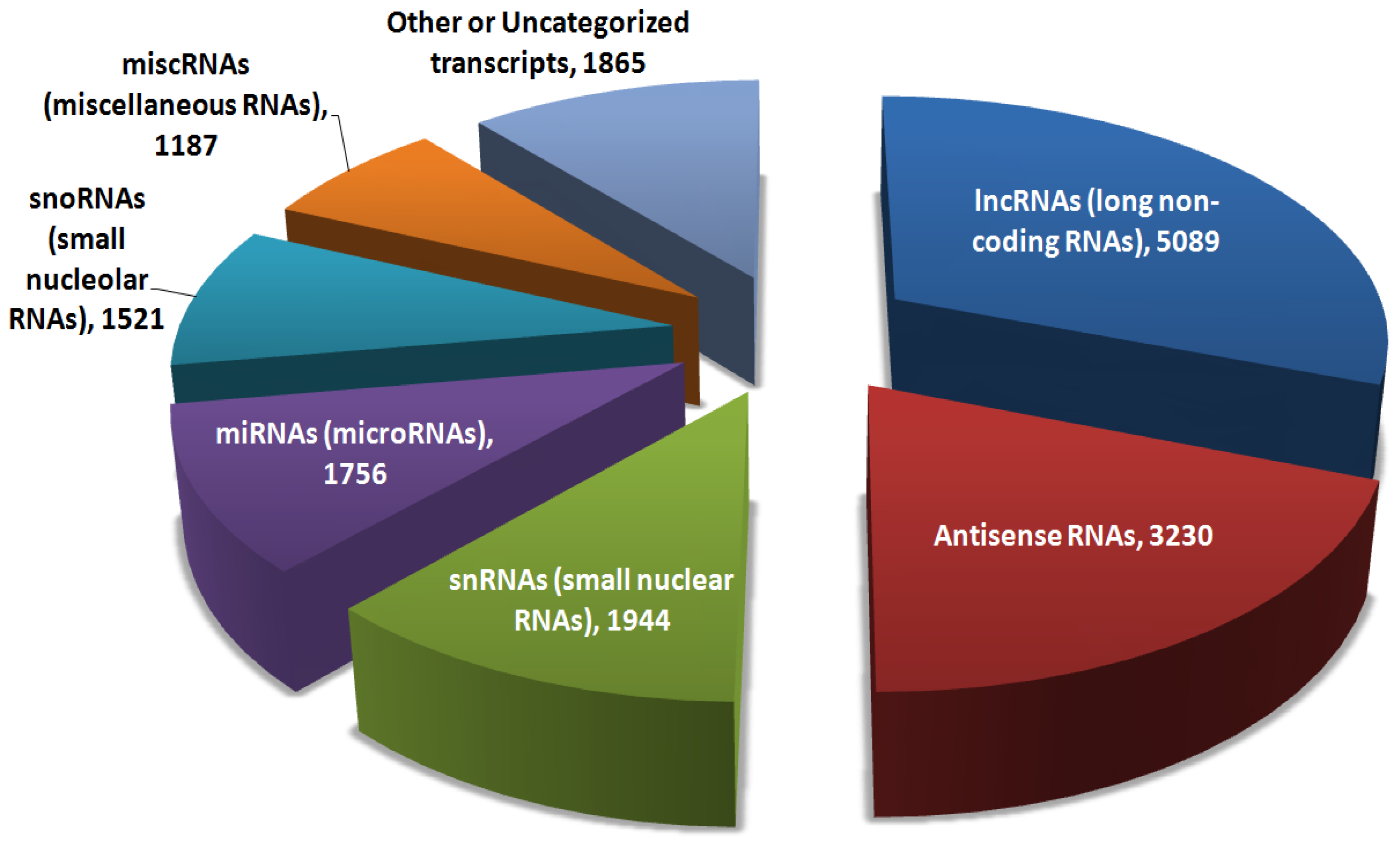
<p>Based on their size. ncRNAs can be classified as small (~18–31 nt), medium (~31–200 nt) and long (from 200 nt up to several hundred kb) transcripts [<xref ref-type="bibr" rid="b7-ijms-13-00097">7</xref>,<xref ref-type="bibr" rid="b8-ijms-13-00097">8</xref>]. While the small ncRNAs group contains small interfering RNAs (siRNAs), microRNAs (miRNAs) and Piwi interacting RNAs (piRNAs) and are localized in the cell cytoplasm, medium ncRNAs are mainly represented by small nuclear (snRNAs) and small nucleolar RNAs (snoRNAs) and reside in the cell nucleus (<xref ref-type="fig" rid="f1-ijms-13-00097">Figure 1</xref>).</p>
<p>Alternatively. ncRNAs can be functionally divided into housekeeping ncRNAs (<italic>i.e.</italic>, ribosomal, transfer, snRNAs and snoRNAs) playing crucial roles in many cellular processes, and regulatory ncRNAs (<italic>i.e.</italic>, miRNAs, piRNAs, siRNAs and lncRNAs) [<xref ref-type="bibr" rid="b9-ijms-13-00097">9</xref>]. However, other regulatory ncRNAs such as promoter-associated RNAs (PARs) and enhancer RNAs (eRNAs) have been recently described and added to this increasing category [<xref ref-type="bibr" rid="b10-ijms-13-00097">10</xref>–<xref ref-type="bibr" rid="b12-ijms-13-00097">12</xref>].</p>
<p>Unlike small and medium ncRNAs, long non-coding RNAs (lncRNAs) are not highly conserved at the primary sequence level but they have been estimated to be ~17,000 in human and ~10,000 in the mouse genome [<xref ref-type="bibr" rid="b13-ijms-13-00097">13</xref>].</p>
<p>Based on their genomic position, lncRNAs can be further catalogued into four categories: (i) sense or antisense (when the ncRNA overlaps one or more exons of another transcript on the same or opposite strand, respectively); (ii) bidirectional (when the expression of the ncRNA and that of a neighboring coding transcript on the opposite strand is initiated in close genomic proximity); (iii) intronic (when the ncRNA is derived from an intron of a second transcript); and (iv) intergenic (when the ncRNA is localized between two genes) [<xref ref-type="bibr" rid="b9-ijms-13-00097">9</xref>].</p>
<p>All of these considerations emphasize the fact that the genome organization is more complex than previously thought. The conventional thinking of RNA as the messenger of the genetic information from DNA to protein translation is no longer acceptable. In fact, many lncRNAs can be primary transcripts for the production of shorter RNAs (such as miRNAs) [<xref ref-type="bibr" rid="b15-ijms-13-00097">15</xref>], making a clear categorization of ncRNAs quite difficult. In eukaryotes, lncRNAs have been implicated in many biological processes with different functional roles such as X chromosome inactivation [<xref ref-type="bibr" rid="b16-ijms-13-00097">16</xref>,<xref ref-type="bibr" rid="b17-ijms-13-00097">17</xref>], genomic imprinting [<xref ref-type="bibr" rid="b18-ijms-13-00097">18</xref>], sub-cellular structural organization [<xref ref-type="bibr" rid="b19-ijms-13-00097">19</xref>,<xref ref-type="bibr" rid="b20-ijms-13-00097">20</xref>], telomere [<xref ref-type="bibr" rid="b21-ijms-13-00097">21</xref>] and centromere organization [<xref ref-type="bibr" rid="b22-ijms-13-00097">22</xref>,<xref ref-type="bibr" rid="b23-ijms-13-00097">23</xref>] and nuclear trafficking [<xref ref-type="bibr" rid="b24-ijms-13-00097">24</xref>].</p>
<p>Finally, the different nomenclature found in many papers adds further complexity to understanding the nature and role of these ncRNAs and the retrieval of specific information. In fact, another subgroup of lncRNAs called “large intergenic” non-coding RNAs (or lincRNAs) has been described [<xref ref-type="bibr" rid="b25-ijms-13-00097">25</xref>]. However, in a following paper the same group defines these ncRNAs as “large intervening” [<xref ref-type="bibr" rid="b26-ijms-13-00097">26</xref>] while others call them simply “large” ncRNAs [<xref ref-type="bibr" rid="b27-ijms-13-00097">27</xref>]. He <italic>et al.</italic> studied the “messenger-like non-coding RNAs” (ml-ncRNAs) as potential precursors of miRNAs [<xref ref-type="bibr" rid="b15-ijms-13-00097">15</xref>]. Another definition has been reported by Zong <italic>et al.</italic> when they found “nuclear-retained” RNAs (nrRNAs) implicated in the modulation of gene expression by influencing chromatin modification, transcription and posttranscriptional gene processing [<xref ref-type="bibr" rid="b28-ijms-13-00097">28</xref>]. According to the authors’ feeling, we agree that our understanding of the functional role played by ncRNAs is like “a tip of an iceberg” and that the unraveling of ncRNAs’ functions and of their interplay with other biological actors, deserves further experimental investigations and focused bioinformatics efforts.</p>
<p>Although next generation technologies in RNA sequencing (RNA-Seq) allowed the identification of thousands of lncRNAs with an unprecedented throughput, only a few of them have been completely characterized from a functional point of view. In fact, determining the function of individual lncRNAs still remains challenging [<xref ref-type="bibr" rid="b11-ijms-13-00097">11</xref>]. Computational tools allowing researchers to know what they are looking for, if they are finding something new, the name of what they are finding or to better characterize the potential functions of these lncRNAs, would therefore facilitate the unraveling of the biological role and to emphasize the significance of this group of ncRNAs in a variety of systems and diseases.</p>
<p>The aim of this review is focused on those computational approaches and bioinformatics resources available to researchers dealing with lncRNAs functional analysis. We also present a brief overview of the mechanisms of action of lncRNAs as transcriptional and epigenetic regulators.</p></sec>
<sec>
<title>2. The Four Main Roles of Long Non-Coding RNAs</title>
<p>The main features and properties of long non-coding RNAs will be briefly presented in the following paragraph. We decided to mention briefly the four major roles of lncRNAs in order to treat in more detail the bioinformatics tools and resources available to researchers involved in the study, functional analysis or simply annotation of known (and unknown) lncRNAs.</p>
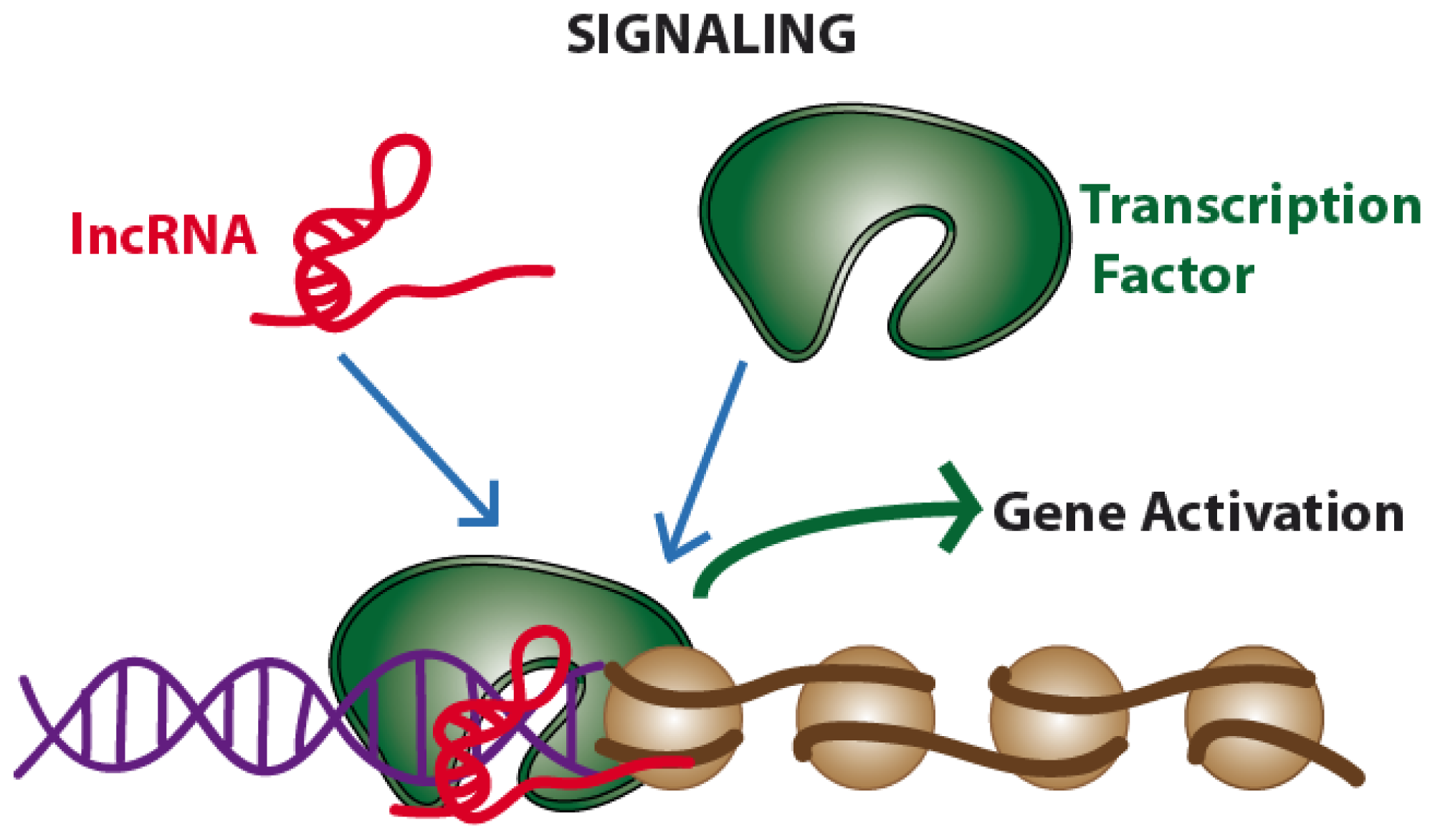
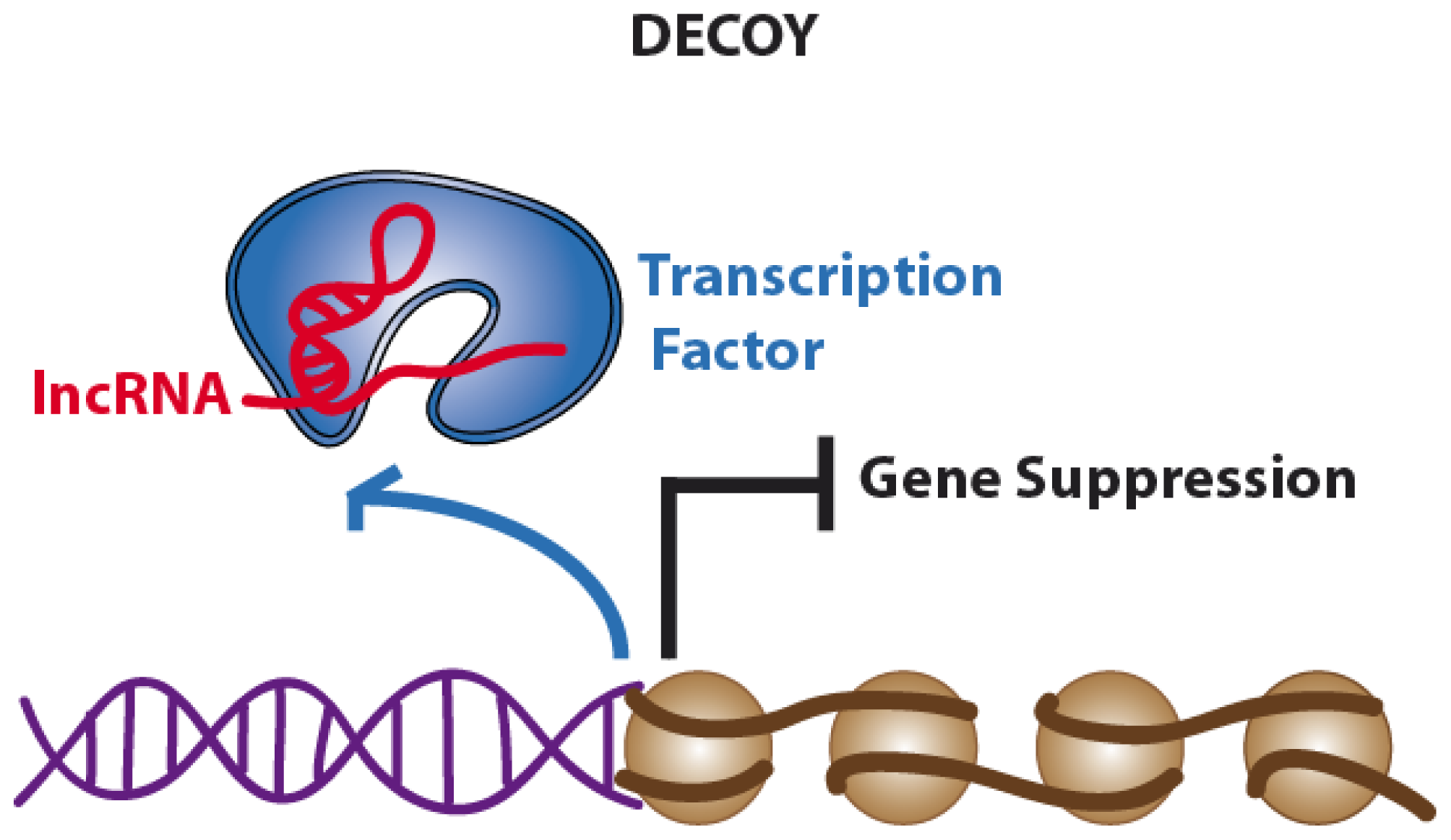
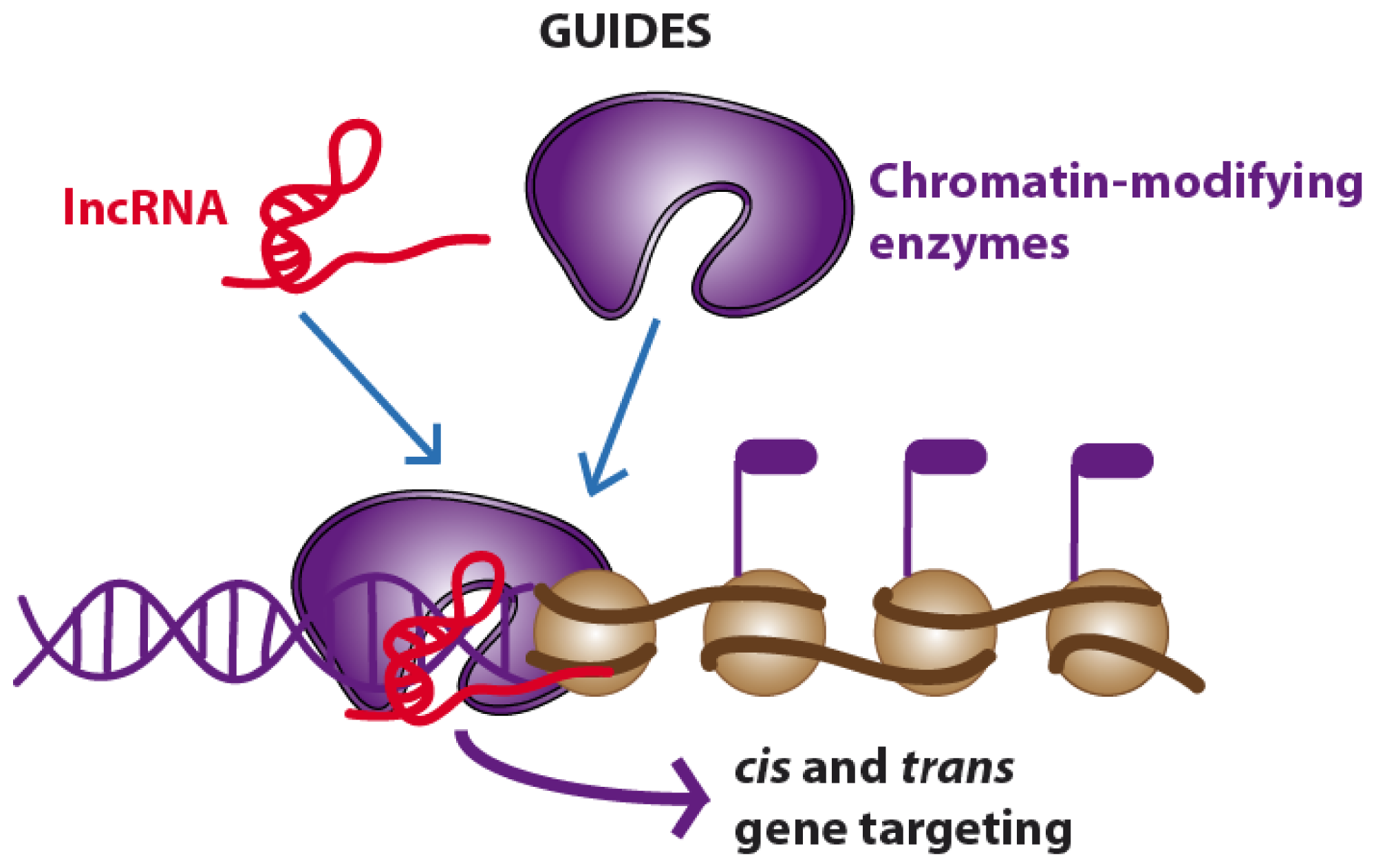
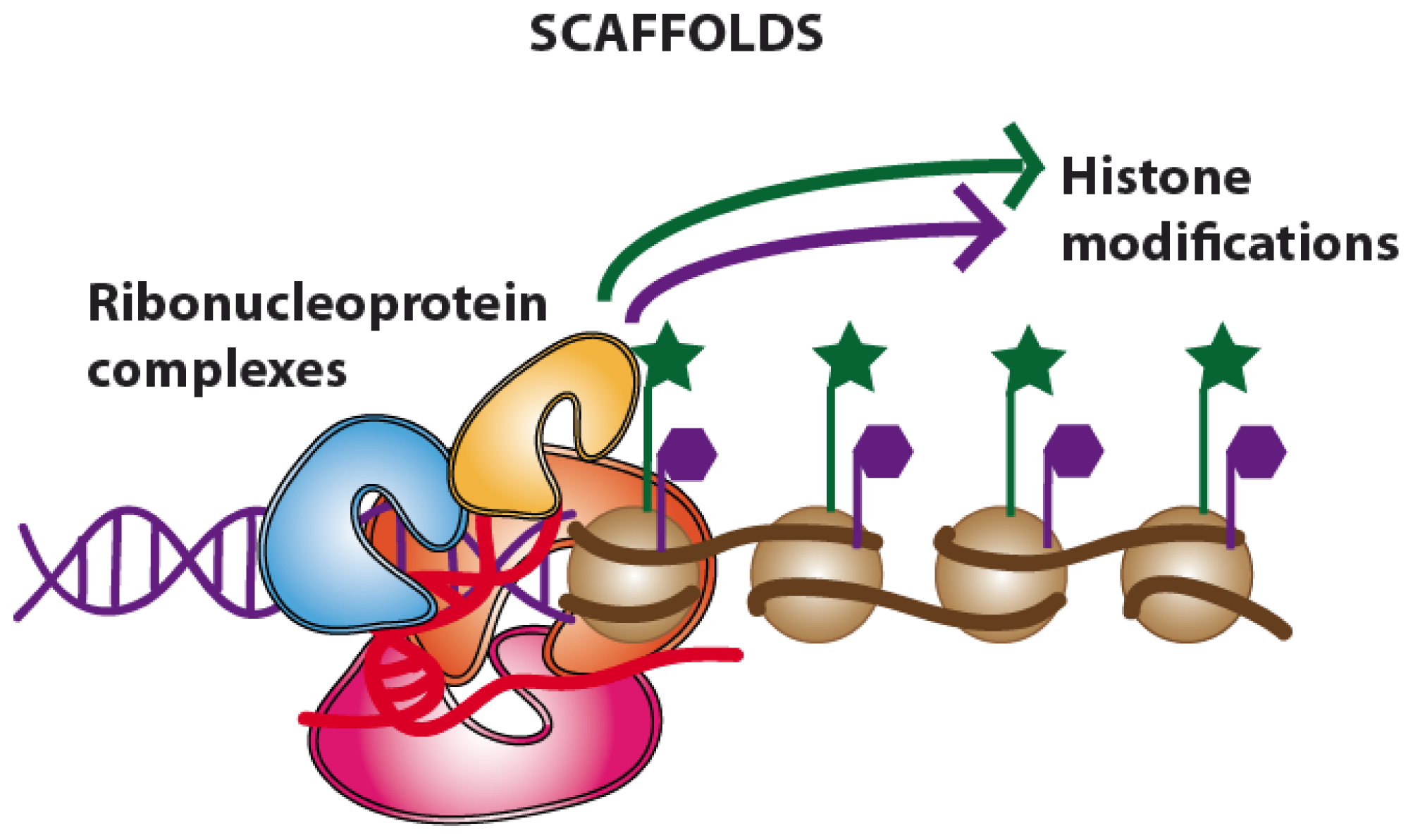
<p>LncRNAs show a low level of sequence conservation, they generally have a 7-methylguanosine cap at 5′ end, they can terminate with or without a poly(A) chain at their 3′ end [<xref ref-type="bibr" rid="b26-ijms-13-00097">26</xref>,<xref ref-type="bibr" rid="b29-ijms-13-00097">29</xref>,<xref ref-type="bibr" rid="b30-ijms-13-00097">30</xref>] and they have well-defined sites for binding of transcription factors (<italic>i.e.</italic>, NF-kB) in their promoter regions [<xref ref-type="bibr" rid="b31-ijms-13-00097">31</xref>]. Most lncRNAs are expressed in a tissue-specific pattern and transcribed by RNA polymerase II (RNA Pol II), as also suggested by the presence of trimethylation of lysine residue K4 of histone H3 (H3K4me3) in the promoter region and H3K36me3 along the transcript, the so called “chromatin signature (a K4-K36 domain)” [<xref ref-type="bibr" rid="b26-ijms-13-00097">26</xref>]. However, several lncRNAs are also transcribed by RNA Pol III [<xref ref-type="bibr" rid="b32-ijms-13-00097">32</xref>,<xref ref-type="bibr" rid="b33-ijms-13-00097">33</xref>]. As lncRNAs reside in the nucleus, their functions span from the regulation of transcription and modeling of nuclear architecture, to telomere biology and chromosomal dynamics [<xref ref-type="bibr" rid="b34-ijms-13-00097">34</xref>]. According to the authoritative review by Wang and Chang published this year, lncRNAs can be categorized in four main categories or archetypes: signals, decoys, guides and scaffolds (<xref ref-type="fig" rid="f2-ijms-13-00097">Figures 2</xref>–<xref ref-type="fig" rid="f5-ijms-13-00097">5</xref>) [<xref ref-type="bibr" rid="b35-ijms-13-00097">35</xref>].</p>
<p>While the mechanism of signals and decoys deals with gene activation or suppression (<xref ref-type="fig" rid="f2-ijms-13-00097">Figures 2</xref> and <xref ref-type="fig" rid="f3-ijms-13-00097">3</xref>) respectively, guides can recruit chromatin-modifying enzymes to regulate the expression of genes, either in <italic>cis</italic> (near the site of lncRNA production) or in <italic>trans</italic> (distant genes) through a phenomenon called “transvection” (<xref ref-type="fig" rid="f4-ijms-13-00097">Figure 4</xref>). Finally, scaffolds can bring together multiple proteins to form ribonucleoprotein (RNP) complexes (<xref ref-type="fig" rid="f5-ijms-13-00097">Figure 5</xref>) and these lncRNA-RNP systems stabilize nuclear structures or signaling complexes acting on chromatin and determining histone modifications.</p>
<p>To a first approximation, we can say that the first two types of functions (signaling and decoys) deal with gene expression and regulation, while the latter two (guides and scaffolds) deal with epigenetic modifications. However, authors emphasized that each lncRNAs may have several functions belonging to different functional types without the need to be mutually exclusive; rather, lncRNAs may develop complex functions exploiting a combination of different molecular mechanisms.</p>
<sec>
<title>2.1. Signaling. Long Non-Coding RNAs Acting as Gene Expression Enhancers or Repressors</title>
<p>Ørom <italic>et al.</italic> recently characterized over a thousand lncRNAs expressed in multiple cell lines (<italic>i.e.</italic>, fibroblasts, keratinocytes and HeLa cells). They found that depletion of certain number of lncRNAs led to a consequent decreased expression of their neighboring protein-coding genes such as the master regulator of hematopoiesis, SCL (also called TAL1), Snai1 and Snai2 [<xref ref-type="bibr" rid="b12-ijms-13-00097">12</xref>]. With their study they outlined that even a small set of lncRNAs can act as gene expression enhancers in various human cell lines.</p>
<p>There are other examples in the literature addressing that the transcription of lncRNA can lead to an active silencing at their respective genomic locations, especially in imprinting mechanisms. Imprinting is an epigenetic regulatory mechanism that in mammals leads to silencing of autosomal genes in one of the two alleles, one inherited from the mother and one from the father. LncRNAs such as Kcnq1ot1 and Air, which map to the Kcnq1 and Igf2r imprinted gene clusters, respectively, mediate the transcriptional silencing of multiple genes by interacting with chromatin and recruiting the chromatin-modifying machinery [<xref ref-type="bibr" rid="b18-ijms-13-00097">18</xref>,<xref ref-type="bibr" rid="b36-ijms-13-00097">36</xref>]. Also Xist is another well-known lncRNA that plays an essential role in chromosome X inactivation (XCI) in female cells [<xref ref-type="bibr" rid="b37-ijms-13-00097">37</xref>,<xref ref-type="bibr" rid="b38-ijms-13-00097">38</xref>]. In fact, during development, the expressed lncRNA Xist “covers” the X chromosome from which it is transcribed, leading to a generalized repression of gene expression.</p>
<p>However, lncRNAs may be also involved in stress events such as in the response to DNA damage as recently reported by Huarte <italic>et al.</italic> [<xref ref-type="bibr" rid="b39-ijms-13-00097">39</xref>]. LincRNA-p21 is a long intergenic non-coding RNA located upstream of CDKN1A gene, that has been reported to have an important regulatory role as transcriptional repressor in the canonical p53 pathway and to trigger apoptosis. In this regulatory mechanism, p53 directly induces lincRNA-p21 expression most likely through the direct interaction of p53 itself to the lincRNA-p21 promoter region, while reduction of lincRNA-p21 has been reported to increase the expression of numerous p53-repressed transcripts [<xref ref-type="bibr" rid="b39-ijms-13-00097">39</xref>]. Besides, the mammalian CDKN1A promoter has been reported to be involved in several lncRNAs transcription upon DNA damage [<xref ref-type="bibr" rid="b40-ijms-13-00097">40</xref>]. PANDA, one of these lncRNAs, is expressed only in p53-positive cells (p53 bind to the CDKN1A locus) and interacts with the transcription factor NF-YA down-regulating the expression of pro-apoptotic genes and enabling cell-cycle arrest. PANDA may also act as a decoy, as better described in the following paragraph.</p></sec>
<sec>
<title>2.2. Decoys. Long Non-Coding RNAs Acting as Molecular Sinks</title>
<p>The lncRNA PANDA has either signal and decoy functions, as already mentioned above. Having a decoy function means that the lncRNA, once transcribed, binds to a target protein and keeps it apart, preventing the exploitation of its function. In this way, lncRNAs act to repress the action of RBPs, transcription factors, chromatin modifiers, or other regulatory factors. LncRNA PANDA is very sensitive to DNA damage and inhibits the expression of apoptotic genes through direct binding to (and sequestering of) NF-YA transcription factor [<xref ref-type="bibr" rid="b40-ijms-13-00097">40</xref>]. When the DNA damage is low or moderate, the cell survives. Interestingly, a subset of human breast cancers overexpresses PANDA, while PANDA depletion can sensitize cells to chemotherapeutic agent, suggesting novel potential clinical applications.</p>
<p>The telomeric repeat-containing RNA (TERRA) is another lncRNA involved in telomeric heterochromatin assembly. It is transcribed from telomeres, the DNA-protein complexes located at the physical ends of eukaryotic chromosomes, essential for chromosome stability [<xref ref-type="bibr" rid="b41-ijms-13-00097">41</xref>]. TERRA has been demonstrated to have mainly two functions: to interact with telomerase RNA through a repeating sequence [<xref ref-type="bibr" rid="b42-ijms-13-00097">42</xref>], and to bind to the telomerase reverse transcriptase (TERT) protein subunit. TERRA has been shown to bind and sequester telomerase retaining telomerase near the telomeric 3′ end but at the same time, inhibiting its action [<xref ref-type="bibr" rid="b42-ijms-13-00097">42</xref>]. TERRA is however transcribed in a cell-cycle dependent manner (with the highest levels in G1 phase and the lowest in S phase), suggesting that telomerase may be consequently regulated.</p></sec>
<sec>
<title>2.3. Guides and Scaffolds. Long Non-Coding RNAs Acting as “Molecular Assemblers”</title>
<p>When lncRNAs bind to proteins and direct the localization of RBP complex to specific target for chromatin modification, we can assume that they are working as “molecular guides”. As previously mentioned, lncRNAs can guide changes in gene expression either in <italic>cis</italic> or in <italic>trans</italic> in a way difficult to predict if one takes into account only their sequences.</p>
<p>This mode of action is quite complicated also by the fact that lncRNAs may contact several effector molecules such as the trithorax group proteins (TxG), the polycomb group proteins (PcG), and the common set of transcription factors [<xref ref-type="bibr" rid="b35-ijms-13-00097">35</xref>]. This guiding mode of action is intimately linked to the scaffold function, that is, when other factors are recruited to form a “molecular platform” for chromatin modification leading to the modulation of central signaling events [<xref ref-type="bibr" rid="b43-ijms-13-00097">43</xref>]. To exploit this function, lncRNA should have different domains for distinctly binding different effector molecules at the same time and in timely and spatially manner. Therefore, it appears clear that the understanding of the ways by which lncRNAs are able to form these complex scaffolds is crucial and not fully achieved so far.</p>
<p>To cite only a couple of examples of this mode of action, we may recall two processes: the telomerase assembly and the gene repression through the polycomb complex PRC2. In the former process, the reverse transcriptase telomerase contributes to maintain genome stability by adding telomeric DNA repeats to chromosome ends. To exploit this catalytic activity, telomerase requires that two subunits come into close contact: the telomerase RNA component TERC and the catalytic transcriptase TERT. Additionally, other components or accessory proteins can take part to the process [<xref ref-type="bibr" rid="b44-ijms-13-00097">44</xref>].</p>
<p>The protein complex PRC2 (Polycomb Repressive Complex 2) has histone methyltransferase activity and transfers three methyl groups to histone H3 on lysine 27 (H3K27me3). The histone methylation leads to a transcriptionally silent chromatin. It has been shown that the lncRNA HOTAIR binds to this complex through an upstream sequence of 300 nt from the beginning of the 5′ edge [<xref ref-type="bibr" rid="b45-ijms-13-00097">45</xref>] repressing gene expression [<xref ref-type="bibr" rid="b46-ijms-13-00097">46</xref>]. At the same time, the downstream sequence located 700 nt from the 3′ end of HOTAIR has been found to interact with a second protein complex recruited to demethylate histone H3 on K4 and containing LSD1, CoREST, and REST [<xref ref-type="bibr" rid="b45-ijms-13-00097">45</xref>]. These recent findings emphasize the importance of HOTAIR (and of other lncRNAs) in the chromatin modification processes leading to suppression of gene expression and indicate that these complex RNA-protein interactions should be studied in details in order to fully understand the potential mechanisms in which they are involved.</p>
<p>Therefore, it appears clear that bioinformatics and systems biology approaches have a crucial role in assisting researchers to shed a light on those biological processes where lncRNAs are involved and where most of the mechanisms have still to be understood. For this reason, we decided to review the tools (software, database and other utilities) available to researchers dealing with the interpretation of the molecular mechanisms underlying this complex emerging field.</p></sec></sec>
<sec sec-type="methods">
<title>3. Functional Analysis of Long Non-Coding RNAs (lncRNAs)</title>
<p>Several bioinformatics resources are available to researchers for different purposes and they include database and repositories, annotation tools and other software. <xref ref-type="table" rid="t1-ijms-13-00097">Table 1</xref> summarizes the resources available so far.</p>
<sec sec-type="methods">
<title>3.1. Databases and Public Repositories</title>
<p>One of the first database developed to give information on ncRNAs with documented or possible regulatory functions has been developed by Barciszewski’s group in 2003 [<xref ref-type="bibr" rid="b47-ijms-13-00097">47</xref>]. Their Noncoding RNA database (<ext-link xlink:href="http://biobases.ibch.poznan.pl/ncRNA/" ext-link-type="uri">http://biobases.ibch.poznan.pl/ncRNA/</ext-link>) was the first repository containing nucleotide sequences (retrievable in FASTA format), short descriptions of the activities of particular ncRNAs, GenBank accession numbers and literature references. However, at that time, the total number of unique mammalian ncRNAs in the database was &lt;40 excluding homologs and miRNAs. Currently, the database includes over 30,000 individual sequences from 99 species of Bacteria, Archaea and Eukaryota. The primary source of sequences included in the database was the GenBank and additional annotation information for mouse and human ncRNAs were derived from FANTOM3 database and H-inviational Integrated Database of Annotated Human Genes version 3.4, respectively.</p>
<p>Another database developed the same year was Rfam (<ext-link xlink:href="http://www.sanger.ac.uk/Software/Rfam/" ext-link-type="uri">http://www.sanger.ac.uk/Software/Rfam/</ext-link>) a collection of multiple sequence alignments and covariance models representing non-coding RNA families [<xref ref-type="bibr" rid="b48-ijms-13-00097">48</xref>]. The first release of Rfam (1.0) contained over 50.000 ncRNA genes belonging to 25 families. After integration with more specialized RNA databases such as miRBase, IRESite, Pseudobase, snoRNABase, the plant snoRNA database, TransTerm and the Yeast snoRNA database, authors envisage that the next version (Rfam 9.1) will contain more than 700 entirely new families, reaching a total of more than 1300 [<xref ref-type="bibr" rid="b49-ijms-13-00097">49</xref>].</p>
<p>In year 2005, Mattick’s group reported an implementation of a previous ncRNAs catalogue, developing RNAdb (<ext-link xlink:href="http://research.imb.uq.edu.au/RNAdb" ext-link-type="uri">http://research.imb.uq.edu.au/RNAdb</ext-link>), a comprehensive mammalian noncoding RNA database containing over 800 unique experimentally studied ncRNAs, associated with diseases and/or developmental processes [<xref ref-type="bibr" rid="b50-ijms-13-00097">50</xref>]. This database was further implemented in 2007 with the RNAdb 2.0 [<xref ref-type="bibr" rid="b51-ijms-13-00097">51</xref>] where the authors provided also nucleotide sequences and annotations for tens of thousands of non-housekeeping ncRNAs, including a wide range of mammalian microRNAs, small nucleolar RNAs as well as ncRNAs predicted on the basis of structural features and alignments.</p>
<p>Another curated dataset, the H-Invitational Database (H-InvDB) (<ext-link xlink:href="http://www.h-invitational.jp/" ext-link-type="uri">http://www.h-invitational.jp/</ext-link>), resulted from the joint efforts of many researchers involved in the Human Full-length cDNA Annotation Invitational project [<xref ref-type="bibr" rid="b52-ijms-13-00097">52</xref>]. H-InvDB (release 3.4, August 2006), produced by the “Genome Information Integration Project” (2005–2008), contains more than 1700 putative ncRNAs defined by the absence of any open reading frame and by not belonging to the pseudogene classification.</p>
<p>Over the years, several other databases emerged to fill the gaps of categorizing other ncRNAs such as SRP RNAs, tmRNAs or RNase P RNAs and other ncRNAs named according to cellular localizations (<italic>i.e.</italic>, snRNAs, snoRNAs or scRNAs), to functions (<italic>i.e.</italic>, package, guide or transfer-messenger RNAs) or to their sedimentation coefficients (<italic>i.e.</italic>, 6S RNA, 5.3S RNA, <italic>etc.</italic>). Therefore, to establish a common and uniform classification system, the ncRNA database NONCODE (<ext-link xlink:href="http://www.noncode.org" ext-link-type="uri">http://www.noncode.org</ext-link>, <ext-link xlink:href="http://noncode.bioinfo.org.cn" ext-link-type="uri">http://noncode.bioinfo.org.cn</ext-link>) has been created [<xref ref-type="bibr" rid="b54-ijms-13-00097">54</xref>]. The first release of NONCODE (v1.0) contained 5339 non-redundant sequences from 861 organisms, including eukaryotes, eubacteria, archaebacteria, virus and viroids. In the following years, a significant growth in the amount of data on ncRNAs led to the NONCODE v.2.0, where the number of collected ncRNAs reached over 206226 non-redundant sequences from 861 organisms [<xref ref-type="bibr" rid="b55-ijms-13-00097">55</xref>]. In this version, other novel classes of ncRNAs, such as Piwi-interacting RNAs (piRNAs), stem-bulge RNAs (sbRNAs) and snRNA-like RNAs (snlRNAs) [<xref ref-type="bibr" rid="b64-ijms-13-00097">64</xref>] have been included together with other unclassified ncRNAs. To date, NONCODE has reached the version 3.0 and now contains 42,3976 public sequences from 1239 organisms covering all kingdoms of life, including vira and viroids. One of the appealing features with this database, is the possibility to obtain functional information on a lncRNA of interest. In fact, NONCODE integrates a classification system, the “process function class” or PfClass, that is based on the cellular process and function in which a given ncRNA is involved. Therefore, PfClass is a unified classification system giving an output of concise functional annotations for a certain ncRNA.</p>
<p>By integrating different available databases such as FANTOM3 [<xref ref-type="bibr" rid="b65-ijms-13-00097">65</xref>], H-invDB rel. 5.0 [<xref ref-type="bibr" rid="b53-ijms-13-00097">53</xref>], miRBase v10.0 [<xref ref-type="bibr" rid="b66-ijms-13-00097">66</xref>], NONCODE v1.0 [<xref ref-type="bibr" rid="b54-ijms-13-00097">54</xref>], Rfam v8.1 [<xref ref-type="bibr" rid="b48-ijms-13-00097">48</xref>], RNAdb v2.0 [<xref ref-type="bibr" rid="b51-ijms-13-00097">51</xref>], snoRNA-LBME-db rel. 3 [<xref ref-type="bibr" rid="b67-ijms-13-00097">67</xref>], and Gene Expression Omnibus (GEO) [<xref ref-type="bibr" rid="b68-ijms-13-00097">68</xref>], another Japanese group generated a platform for mining/annotating functional RNA candidates from non-coding RNA sequences, that they called fRNAdb (<ext-link xlink:href="http://www.ncrna.org/frnadb" ext-link-type="uri">http://www.ncrna.org/frnadb</ext-link>) [<xref ref-type="bibr" rid="b57-ijms-13-00097">57</xref>]. fRNAdb is a database providing a support for computational analyses related to RNA secondary structure motif discovery, EST support evaluation, <italic>cis</italic>-regulatory element search and protein homology search. Moreover, the fRNAdb interface is linked to a customized UCSC Genome Browser (RNA-specific custom tracks). The updated version fRNAdb 3.0 supports two important tasks: annotation of anonymous RNA transcripts and discovery of novel non-coding RNAs [<xref ref-type="bibr" rid="b58-ijms-13-00097">58</xref>]. Interestingly, the last version of fRNAdb not only expanded the number of sequences from 13,693 to 509,795, but, as in the case of the NONCODE database, it also integrated sequence ontology classification (SO, <ext-link xlink:href="http://song.sourceforge.net/" ext-link-type="uri">http://song.sourceforge.net/</ext-link>), keyword search function and Blast search service.</p>
<p>As previously described, in mammals there are a series of non-coding RNAs mono-allelically expressed in a parent-dependent manner, that have been called “imprinted” ncRNAs [<xref ref-type="bibr" rid="b69-ijms-13-00097">69</xref>]. Increasing evidences suggest that dysregulation of imprinted ncRNAs are implicated in many human diseases such as Prader-Willi syndrome (PWS), Beckwith-Wiedemann syndrome (BWS), Silver-Russell syndrome (SRS), transient neonatal diabetes mellitus (TNDM), and various tumors [<xref ref-type="bibr" rid="b70-ijms-13-00097">70</xref>–<xref ref-type="bibr" rid="b72-ijms-13-00097">72</xref>]. At present, this category of imprinted ncRNAs includes small nucleolar RNAs (snoRNAs), microRNAs (miRNAs), small interfering RNAs (siRNAs), Piwi-interacting RNAs (piRNAs), antisense ncRNAs, and mRNA-like ncRNAs [<xref ref-type="bibr" rid="b73-ijms-13-00097">73</xref>]. To reduce the scattering of data found on the literature or in different available databases, Zhang et al. systematically collected all the information of mammalian imprinted ncRNAs in a comprehensive database called ncRNAimprint [<xref ref-type="bibr" rid="b59-ijms-13-00097">59</xref>]. This database contains 7094 entries where the majority are represented by piRNA (6612), followed by microRNAs (187), snoRNAs (129), siRNAs (107) and antisense ncRNAs (26). For mammalian species, only 33 records for mRNA-like ncRNAs are currently available (<ext-link xlink:href="http://rnaqueen.sysu.edu.cn/ncRNAimprint" ext-link-type="uri">http://rnaqueen.sysu.edu.cn/ncRNAimprint</ext-link>).</p>
<p>Another public repository is represented by the Noncoding RNA Expression Database (NRED) (<ext-link xlink:href="http://jsm-research.imb.uq.edu.au/NRED" ext-link-type="uri">http://jsm-research.imb.uq.edu.au/NRED</ext-link>), which provides gene expression information for thousands of long ncRNAs in human and mouse [<xref ref-type="bibr" rid="b60-ijms-13-00097">60</xref>]. NRED is a multifaceted repository since it integrates also evolutionary conservation, secondary structure evidence, genomic context links and antisense relationships for represented lncRNAs. Therefore, NRED gives also useful information for characterizing lncRNAs based on these criteria. An updated version of this repository (NRED2) has been expected for 2011.</p>
<p>The NRED resource has been linked to another reference database for lncRNAs called lncRNAdb [<xref ref-type="bibr" rid="b13-ijms-13-00097">13</xref>]. This database collects all the lncRNAs associated with any of the biological functions in eukaryotes, or those mRNAs with a regulatory role (<ext-link xlink:href="http://www.lncrnadb.org/" ext-link-type="uri">http://www.lncrnadb.org/</ext-link>). LncRNAdb includes information about sequences, structural information, genomic context, expression, subcellular localization, conservation, functional evidence and other relevant information and is linked to the UCSC Genome Browser for visualization and Noncoding RNA Expression Database (NRED) for expression information from a variety of sources. The database contains over 150 lncRNAs identified in 60 different species and most of them (~75%) are from mammals, the more intensively studied class.</p>
<p>In order to simplify the challenging determination of lncRNAs function, Moran et al. described the development of a novel computational approach that consisted in the integration of RNA-seq data with available annotation resources [<xref ref-type="bibr" rid="b61-ijms-13-00097">61</xref>]. Authors characterized lncRNAs using multiple features, including sequence, structural, transcriptional, and orthology information. They obtained a stringent set of 4662 human lincRNAs loci (14,353 transcripts), 2798 of which (~60%) were not identified by RefSeq, UCSC, and GENCODE. Then, the authors generated a reference catalog of 8195 human lincRNAs based on integrating RNA-seq data from 24 tissues and cell types with publicly available transcript annotations. They also found that the expression of lncRNAs is tissue-specific and linked to the expression of their neighboring genes. These results have been collected into the Human Body Map lincRNAs (<ext-link xlink:href="http://www.broadinstitute.org/genome_bio/human_lincrnas/" ext-link-type="uri">http://www.broadinstitute.org/genome_bio/human_lincrnas/</ext-link>). This integrated and comprehensive reference catalog could help to analyze the global properties of lncRNAs and facilitate further studies on functional classification of these non-coding genes.</p></sec>
<sec>
<title>3.2. Annotation Tools and Other Bioinformatics Tools</title>
<p>In the last few years we assisted at an exponential growth of genome-wide expression studies as a result of an extensive use of microarray technology. However, none of these studies addressed the problem to take into proper consideration the location of the measuring probes in the context of the currently known genomes and transcriptomes. Besides, the number of noncoding genes and their associated isoforms increases continuously. Therefore, to meet the need to develop new tools combining genomic and transcriptomic information and to provide a clear mapping of expression probes to current genomic annotations, the Genomic and Transcriptomic Explorer (GATExplorer) web platform (<ext-link xlink:href="http://bioinfow.dep.usal.es/xgate/" ext-link-type="uri">http://bioinfow.dep.usal.es/xgate/</ext-link>) has been developed [<xref ref-type="bibr" rid="b62-ijms-13-00097">62</xref>]. GATExplorer is a web platform and a database integrating a gene loci browser with nucleotide level mappings of oligo probes from expression microarrays. It allows an interactive exploration of gene loci, transcripts and exons of human, mouse and rat genomes, and shows the specific location of all “mappable” Affymetrix microarray probes and their respective expression levels in a broad set of biological samples. The web site allows visualization of probes in their genomic context together with any associated protein-coding or noncoding transcripts. GATExplorer integrates data from Ensembl, RNAdb, Affymetrix and GeneAtlas. This tool is very useful when researchers are dealing with gene discovery, because considering expression at the nucleotide level rather than at the gene level, it allows to detect expression signals from novel entities. GATExplorer provides the means to undertake a higher resolution analysis of microarray data and potentially to extract considerably more detailed and biologically accurate information from existing and future microarray experiments.</p>
<p>Another web interface, the non-coding RNA Function ANnotation server (ncFANS) (<ext-link xlink:href="http://www.ebiomed.org/ncFANs/" ext-link-type="uri">http://www.ebiomed.org/ncFANs/</ext-link>), recently emerged in the panorama of computational tools dedicated to the analysis of lncRNAs [<xref ref-type="bibr" rid="b63-ijms-13-00097">63</xref>]. The tool ncFANs has been developed for functional annotation of specific lncRNAs, both in mouse and in human, through the re-annotation of Affymetrix array data, finally giving the possibility to re-analyze microarray data already acquired for other experiments. To annotate the lncRNAs function, ncFANs provides two alternative strategies: the first employs a coding-noncoding gene co-expression (CNC) network [<xref ref-type="bibr" rid="b74-ijms-13-00097">74</xref>], the other identifies conditionrelated differentially expressed lncRNAs.</p></sec>
<sec>
<title>3.3. Biological and Bioinformatics Approaches for lncRNA Discovery</title>
<p>Genomic projects over the past decade have stably confirmed the presence of many thousands of non-coding transcripts in mammals [<xref ref-type="bibr" rid="b75-ijms-13-00097">75</xref>]. However, the understanding of lncRNAs function is still partially unknown. Two main challenges prevent this knowledge: (1) to identify likely functional lncRNAs and (2) to infer lncRNAs putative function in hypothesis-driven experiments. Guttman <italic>et al.</italic> recently developed an efficient method to create genome-wide chromatin-state maps, using chromatin immunoprecipitation followed by massively parallel sequencing (ChIP-Seq) [<xref ref-type="bibr" rid="b76-ijms-13-00097">76</xref>]. Genes actively transcribed by RNA Pol II are marked by trimethylation of lysine 4 of histone H3 (H3K4me3) at their promoter and trimethylation of lysine 36 of histone H3 (H3K36me3) along the length of the transcribed region (feature called “K4–K36 domain”). The identification of K4–K36 structures residing outside known protein-coding gene loci, allowed the systematic discovery of functional lncRNAs [<xref ref-type="bibr" rid="b26-ijms-13-00097">26</xref>]. The authors created an RNA expression compendium of both lncRNAs and protein-coding genes across a wide range of tissues to infer lncRNAs putative function that they assessed experimentally. This analysis revealed numerous sets of lncRNAs associated with distinct and diverse biological processes. Moreover, Guttman <italic>et al.</italic> found that chromatin structure can lead to the identification of sets of lncRNAs showing a high degree of evolutionary conservation, therefore biologically functional. With their approach, the functional roles for 150 lncRNAs have been obtained, and they have also predicted the pathways for almost 85 lncRNAs. Therefore, the authors demonstrated that the pipeline they reported can be efficiently employed for inferring putative roles for lncRNAs.</p>
<p>To solve the computational challenges of identification of diffuse signals from the chromatin immunoprecipitation and high-throughput massively parallel sequencing (ChIP-Seq) technology, and to suggest a new method respect to those currently available, Garmire et al. presented a novel global clustering approach to enrich diffuse CHIP-Seq signals of RNA polymerase II and histone 3 lysine 4 trimethylation (H3K4Me3) and applied it to identify putative lncRNAs in macrophage cells [<xref ref-type="bibr" rid="b77-ijms-13-00097">77</xref>]. The authors implemented an iterative global-clustering-over-linear-separator (GCLS) algorithm to reconstruct the most correct transcription units and they found a total of 374 putative lncRNAs in macrophages under the “no treatment” condition and 189 lncRNAs under LPS treatment.</p>
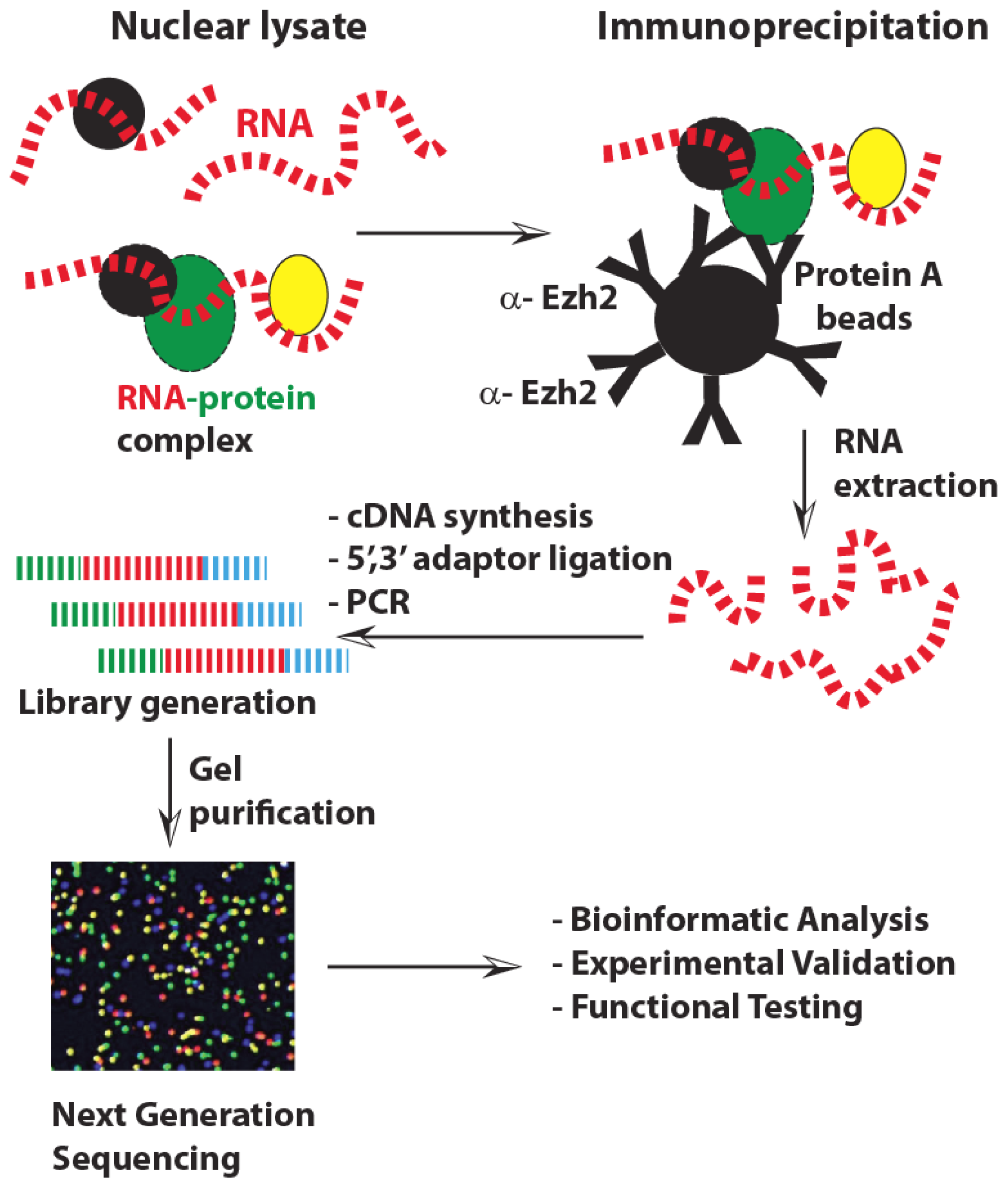
<p>Finally, Zhao et al. elaborated a novel method to characterize lncRNAs starting from the concept that RNA-mediated recruitment is especially attractive for conserved Polycomb proteins controlling many aspects of development [<xref ref-type="bibr" rid="b78-ijms-13-00097">78</xref>]. Mammalian PRC2 contains four core subunits, Eed, Suz12, RbAp48, and the catalytic Ezh2. Interestingly, several PRC2 subunits have potential RNA-binding motifs [<xref ref-type="bibr" rid="b79-ijms-13-00097">79</xref>] while a recent work identified several short RNAs of 50–200 nt as candidate PRC2 regulators [<xref ref-type="bibr" rid="b80-ijms-13-00097">80</xref>]. Therefore, they developed the RIP-seq technology to capture a genome-wide pool of long transcripts (&gt;200 nt) associated with PRC2. This method consists in capturing the genome-wide pool bound to PRC2 by combining native RIP [<xref ref-type="bibr" rid="b81-ijms-13-00097">81</xref>] and RNA-seq [<xref ref-type="bibr" rid="b82-ijms-13-00097">82</xref>] in a combined protocol that they called “RIP-seq” (<xref ref-type="fig" rid="f6-ijms-13-00097">Figure 6</xref>).</p>
<p>Authors demonstrated that RIP-seq technology can be employed to identify RNA cofactors for other chromatin modifiers, and that different cell types might have different transcriptomes, consistent with their developmental profiles. Because chromatin modifiers such as PRC2 play a central role in several biological conditions, a genome-wide profile of regulatory RNAs represents a valuable tool in treating and diagnosing several diseases.</p></sec></sec>
<sec sec-type="conclusions">
<title>5. Conclusions</title>
<p>The discovery of long non-coding RNAs posed several challenges to researchers dealing with these “junk” molecules. The number of these small and long transcripts continued to increase since the last several years. Various databases has emerged to meet the need of rationalizing the information and to help researchers in their annotation and description work. There are other challenges still open, such as finding a common nomenclature and constructing a general functional ontology. Surely, in the future we will assist to an explosion of information about these non-coding RNAs. since to date very little is known about their precise role in many biological mechanisms and disease pathogenesis. We think that the advent of the next generation sequencing coupled to bioinformatics approaches will lead to a detailed description of the role of long non-coding RNAs and to the discovery of an unexplored world.</p></sec></body>
<back>
<ack>
<title>Acknowledgments</title>
<p>The Italian Ministry of Health is gratefully acknowledged for funding.</p></ack>
<ref-list>
<title>References</title>
<ref id="b1-ijms-13-00097"><label>1</label><citation citation-type="journal"><collab>ENCODE Project Consortium</collab><article-title>The ENCODE (ENCyclopedia Of DNA Elements) Project</article-title><source>Science</source><year>2004</year><volume>306</volume><fpage>636</fpage><lpage>640</lpage><pub-id pub-id-type="doi">10.1126/science.1105136</pub-id><pub-id pub-id-type="pmid">15499007</pub-id></citation></ref>
<ref id="b2-ijms-13-00097"><label>2</label><citation citation-type="journal"><collab>ENCODE Project Consortium</collab><article-title>Identification and analysis of functional elements in 1% of the human genome by the ENCODE pilot project</article-title><source>Nature</source><year>2007</year><volume>447</volume><fpage>799</fpage><lpage>816</lpage><pub-id pub-id-type="doi">10.1038/nature05874</pub-id><pub-id pub-id-type="pmid">17571346</pub-id></citation></ref>
<ref id="b3-ijms-13-00097"><label>3</label><citation citation-type="journal"><person-group person-group-type="author"><name><surname>Mattick</surname><given-names>J.S.</given-names></name></person-group><article-title>The genetic signatures of noncoding RNAs</article-title><source>PLoS Genet</source><year>2009</year><volume>5</volume><fpage>e1000459</fpage><pub-id pub-id-type="doi">10.1371/journal.pgen.1000459</pub-id><pub-id pub-id-type="pmid">19390609</pub-id></citation></ref>
<ref id="b4-ijms-13-00097"><label>4</label><citation citation-type="journal"><person-group person-group-type="author"><name><surname>Mattick</surname><given-names>J.S.</given-names></name></person-group><article-title>The functional genomics of noncoding RNA</article-title><source>Science</source><year>2005</year><volume>309</volume><fpage>1527</fpage><lpage>1528</lpage><pub-id pub-id-type="doi">10.1126/science.1117806</pub-id><pub-id pub-id-type="pmid">16141063</pub-id></citation></ref>
<ref id="b5-ijms-13-00097"><label>5</label><citation citation-type="journal"><person-group person-group-type="author"><name><surname>Mattick</surname><given-names>J.S.</given-names></name><name><surname>Makunin</surname><given-names>I.V.</given-names></name></person-group><article-title>Non-coding RNA</article-title><source>Hum. Mol. Genet</source><year>2006</year><volume>15</volume><fpage>R17</fpage><lpage>R29</lpage><pub-id pub-id-type="doi">10.1093/hmg/ddl046</pub-id><pub-id pub-id-type="pmid">16651366</pub-id></citation></ref>
<ref id="b6-ijms-13-00097"><label>6</label><citation citation-type="journal"><person-group person-group-type="author"><name><surname>Mercer</surname><given-names>T.R.</given-names></name><name><surname>Dinger</surname><given-names>M.E.</given-names></name><name><surname>Mattick</surname><given-names>J.S.</given-names></name></person-group><article-title>Long non-coding RNAs: Insights into functions</article-title><source>Nat. Rev. Genet</source><year>2009</year><volume>10</volume><fpage>155</fpage><lpage>159</lpage><pub-id pub-id-type="doi">10.1038/nrg2521</pub-id><pub-id pub-id-type="pmid">19188922</pub-id></citation></ref>
<ref id="b7-ijms-13-00097"><label>7</label><citation citation-type="journal"><person-group person-group-type="author"><name><surname>Nagano</surname><given-names>T.</given-names></name><name><surname>Fraser</surname><given-names>P.</given-names></name></person-group><article-title>No-nonsense functions for long noncoding RNAs</article-title><source>Cell</source><year>2011</year><volume>145</volume><fpage>178</fpage><lpage>181</lpage><pub-id pub-id-type="doi">10.1016/j.cell.2011.03.014</pub-id><pub-id pub-id-type="pmid">21496640</pub-id></citation></ref>
<ref id="b8-ijms-13-00097"><label>8</label><citation citation-type="journal"><person-group person-group-type="author"><name><surname>Wilusz</surname><given-names>J.E.</given-names></name><name><surname>Sunwoo</surname><given-names>H.</given-names></name><name><surname>Spector</surname><given-names>D.L.</given-names></name></person-group><article-title>Long noncoding RNAs: Functional surprises from the RNA world</article-title><source>Genes Dev</source><year>2009</year><volume>23</volume><fpage>1494</fpage><lpage>1504</lpage><pub-id pub-id-type="doi">10.1101/gad.1800909</pub-id><pub-id pub-id-type="pmid">19571179</pub-id></citation></ref>
<ref id="b9-ijms-13-00097"><label>9</label><citation citation-type="journal"><person-group person-group-type="author"><name><surname>Ponting</surname><given-names>C.P.</given-names></name><name><surname>Oliver</surname><given-names>P.L.</given-names></name><name><surname>Reik</surname><given-names>W.</given-names></name></person-group><article-title>Evolution and functions of long noncoding RNAs</article-title><source>Cell</source><year>2009</year><volume>136</volume><fpage>629</fpage><lpage>641</lpage><pub-id pub-id-type="doi">10.1016/j.cell.2009.02.006</pub-id><pub-id pub-id-type="pmid">19239885</pub-id></citation></ref>
<ref id="b10-ijms-13-00097"><label>10</label><citation citation-type="journal"><person-group person-group-type="author"><name><surname>Kim</surname><given-names>T.K.</given-names></name><name><surname>Hemberg</surname><given-names>M.</given-names></name><name><surname>Gray</surname><given-names>J.M.</given-names></name><name><surname>Costa</surname><given-names>A.M.</given-names></name><name><surname>Bear</surname><given-names>D.M.</given-names></name><name><surname>Wu</surname><given-names>J.</given-names></name><name><surname>Harmin</surname><given-names>D.A.</given-names></name><name><surname>Laptewicz</surname><given-names>M.</given-names></name><name><surname>Barbara-Haley</surname><given-names>K.</given-names></name><name><surname>Kuersten</surname><given-names>S.</given-names></name><etal/></person-group><article-title>Widespread transcription at neuronal activity-regulated enhancers</article-title><source>Nature</source><year>2010</year><volume>465</volume><fpage>182</fpage><lpage>187</lpage><pub-id pub-id-type="doi">10.1038/nature09033</pub-id><pub-id pub-id-type="pmid">20393465</pub-id></citation></ref>
<ref id="b11-ijms-13-00097"><label>11</label><citation citation-type="journal"><person-group person-group-type="author"><name><surname>De Santa</surname><given-names>F.</given-names></name><name><surname>Barozzi</surname><given-names>I.</given-names></name><name><surname>Mietton</surname><given-names>F.</given-names></name><name><surname>Ghisletti</surname><given-names>S.</given-names></name><name><surname>Polletti</surname><given-names>S.</given-names></name><name><surname>Tusi</surname><given-names>B.K.</given-names></name><name><surname>Muller</surname><given-names>H.</given-names></name><name><surname>Ragoussis</surname><given-names>J.</given-names></name><name><surname>Wei</surname><given-names>C.L.</given-names></name><name><surname>Natoli</surname><given-names>G.</given-names></name></person-group><article-title>A large fraction of extragenic RNA pol II transcription sites overlap enhancers</article-title><source>PLoS Biol</source><year>2010</year><volume>8</volume><fpage>e1000384</fpage><pub-id pub-id-type="doi">10.1371/journal.pbio.1000384</pub-id><pub-id pub-id-type="pmid">20485488</pub-id></citation></ref>
<ref id="b12-ijms-13-00097"><label>12</label><citation citation-type="journal"><person-group person-group-type="author"><name><surname>Orom</surname><given-names>U.A.</given-names></name><name><surname>Derrien</surname><given-names>T.</given-names></name><name><surname>Beringer</surname><given-names>M.</given-names></name><name><surname>Gumireddy</surname><given-names>K.</given-names></name><name><surname>Gardini</surname><given-names>A.</given-names></name><name><surname>Bussotti</surname><given-names>G.</given-names></name><name><surname>Lai</surname><given-names>F.</given-names></name><name><surname>Zytnicki</surname><given-names>M.</given-names></name><name><surname>Notredame</surname><given-names>C.</given-names></name><name><surname>Huang</surname><given-names>Q.</given-names></name><etal/></person-group><article-title>Long noncoding RNAs with enhancer-like function in human cells</article-title><source>Cell</source><year>2010</year><volume>143</volume><fpage>46</fpage><lpage>58</lpage><pub-id pub-id-type="doi">10.1016/j.cell.2010.09.001</pub-id><pub-id pub-id-type="pmid">20887892</pub-id></citation></ref>
<ref id="b13-ijms-13-00097"><label>13</label><citation citation-type="journal"><person-group person-group-type="author"><name><surname>Amaral</surname><given-names>P.P.</given-names></name><name><surname>Clark</surname><given-names>M.B.</given-names></name><name><surname>Gascoigne</surname><given-names>D.K.</given-names></name><name><surname>Dinger</surname><given-names>M.E.</given-names></name><name><surname>Mattick</surname><given-names>J.S.</given-names></name></person-group><article-title>lncRNAdb: A reference database for long noncoding RNAs</article-title><source>Nucleic Acids Res</source><year>2011</year><volume>39</volume><fpage>D146</fpage><lpage>D151</lpage><pub-id pub-id-type="doi">10.1093/nar/gkq1138</pub-id><pub-id pub-id-type="pmid">21112873</pub-id></citation></ref>
<ref id="b14-ijms-13-00097"><label>14</label><citation citation-type="journal"><person-group person-group-type="author"><name><surname>Baker</surname><given-names>M.</given-names></name></person-group><article-title>Long noncoding RNAs: the search for function</article-title><source>Nat. Meth</source><year>2011</year><volume>8</volume><fpage>379</fpage><lpage>383</lpage><pub-id pub-id-type="doi">10.1038/nmeth0511-379</pub-id></citation></ref>
<ref id="b15-ijms-13-00097"><label>15</label><citation citation-type="journal"><person-group person-group-type="author"><name><surname>He</surname><given-names>S.</given-names></name><name><surname>Su</surname><given-names>H.</given-names></name><name><surname>Liu</surname><given-names>C.</given-names></name><name><surname>Skogerbo</surname><given-names>G.</given-names></name><name><surname>He</surname><given-names>H.</given-names></name><name><surname>He</surname><given-names>D.</given-names></name><name><surname>Zhu</surname><given-names>X.</given-names></name><name><surname>Liu</surname><given-names>T.</given-names></name><name><surname>Zhao</surname><given-names>Y.</given-names></name><name><surname>Chen</surname><given-names>R.</given-names></name></person-group><article-title>MicroRNA-encoding long non-coding RNAs</article-title><source>BMC Genomics</source><year>2008</year><volume>9</volume><fpage>236</fpage><pub-id pub-id-type="doi">10.1186/1471-2164-9-236</pub-id><pub-id pub-id-type="pmid">18492288</pub-id></citation></ref>
<ref id="b16-ijms-13-00097"><label>16</label><citation citation-type="journal"><person-group person-group-type="author"><name><surname>Kanduri</surname><given-names>C.</given-names></name><name><surname>Whitehead</surname><given-names>J.</given-names></name><name><surname>Mohammad</surname><given-names>F.</given-names></name></person-group><article-title>The long and the short of it: RNA-directed chromatin asymmetry in mammalian X-chromosome inactivation</article-title><source>FEBS Lett</source><year>2009</year><volume>583</volume><fpage>857</fpage><lpage>864</lpage><pub-id pub-id-type="doi">10.1016/j.febslet.2009.02.004</pub-id><pub-id pub-id-type="pmid">19302783</pub-id></citation></ref>
<ref id="b17-ijms-13-00097"><label>17</label><citation citation-type="journal"><person-group person-group-type="author"><name><surname>Lee</surname><given-names>J.T.</given-names></name></person-group><article-title>Lessons from X-chromosome inactivation: long ncRNA as guides and tethers to the epigenome</article-title><source>Genes Dev</source><year>2009</year><volume>23</volume><fpage>1831</fpage><lpage>1842</lpage><pub-id pub-id-type="doi">10.1101/gad.1811209</pub-id><pub-id pub-id-type="pmid">19684108</pub-id></citation></ref>
<ref id="b18-ijms-13-00097"><label>18</label><citation citation-type="journal"><person-group person-group-type="author"><name><surname>Mohammad</surname><given-names>F.</given-names></name><name><surname>Mondal</surname><given-names>T.</given-names></name><name><surname>Kanduri</surname><given-names>C.</given-names></name></person-group><article-title>Epigenetics of imprinted long noncoding RNAs</article-title><source>Epigenetics</source><year>2009</year><volume>4</volume><fpage>277</fpage><lpage>286</lpage><pub-id pub-id-type="doi">10.4161/epi.4.5.9242</pub-id><pub-id pub-id-type="pmid">19617707</pub-id></citation></ref>
<ref id="b19-ijms-13-00097"><label>19</label><citation citation-type="journal"><person-group person-group-type="author"><name><surname>Clemson</surname><given-names>C.M.</given-names></name><name><surname>Hutchinson</surname><given-names>J.N.</given-names></name><name><surname>Sara</surname><given-names>S.A.</given-names></name><name><surname>Ensminger</surname><given-names>A.W.</given-names></name><name><surname>Fox</surname><given-names>A.H.</given-names></name><name><surname>Chess</surname><given-names>A.</given-names></name><name><surname>Lawrence</surname><given-names>J.B.</given-names></name></person-group><article-title>An architectural role for a nuclear noncoding RNA: NEAT1 RNA is essential for the structure of paraspeckles</article-title><source>Mol. Cell</source><year>2009</year><volume>33</volume><fpage>717</fpage><lpage>726</lpage><pub-id pub-id-type="doi">10.1016/j.molcel.2009.01.026</pub-id><pub-id pub-id-type="pmid">19217333</pub-id></citation></ref>
<ref id="b20-ijms-13-00097"><label>20</label><citation citation-type="journal"><person-group person-group-type="author"><name><surname>Sasaki</surname><given-names>Y.T.</given-names></name><name><surname>Ideue</surname><given-names>T.</given-names></name><name><surname>Sano</surname><given-names>M.</given-names></name><name><surname>Mituyama</surname><given-names>T.</given-names></name><name><surname>Hirose</surname><given-names>T.</given-names></name></person-group><article-title>MENepsilon/beta noncoding RNAs are essential for structural integrity of nuclear paraspeckles</article-title><source>Proc. Natl. Acad. Sci. USA</source><year>2009</year><volume>106</volume><fpage>2525</fpage><lpage>2530</lpage><pub-id pub-id-type="doi">10.1073/pnas.0807899106</pub-id><pub-id pub-id-type="pmid">19188602</pub-id></citation></ref>
<ref id="b21-ijms-13-00097"><label>21</label><citation citation-type="journal"><person-group person-group-type="author"><name><surname>Schoeftner</surname><given-names>S.</given-names></name><name><surname>Blasco</surname><given-names>M.A.</given-names></name></person-group><article-title>A “higher order” of telomere regulation: Telomere heterochromatin and telomeric RNAs</article-title><source>EMBO J</source><year>2009</year><volume>28</volume><fpage>2323</fpage><lpage>2336</lpage><pub-id pub-id-type="doi">10.1038/emboj.2009.197</pub-id><pub-id pub-id-type="pmid">19629032</pub-id></citation></ref>
<ref id="b22-ijms-13-00097"><label>22</label><citation citation-type="journal"><person-group person-group-type="author"><name><surname>Wong</surname><given-names>L.H.</given-names></name><name><surname>Brettingham-Moore</surname><given-names>K.H.</given-names></name><name><surname>Chan</surname><given-names>L.</given-names></name><name><surname>Quach</surname><given-names>J.M.</given-names></name><name><surname>Anderson</surname><given-names>M.A.</given-names></name><name><surname>Northrop</surname><given-names>E.L.</given-names></name><name><surname>Hannan</surname><given-names>R.</given-names></name><name><surname>Saffery</surname><given-names>R.</given-names></name><name><surname>Shaw</surname><given-names>M.L.</given-names></name><name><surname>Williams</surname><given-names>E.</given-names></name><etal/></person-group><article-title>Centromere RNA is a key component for the assembly of nucleoproteins at the nucleolus and centromere</article-title><source>Genome Res</source><year>2007</year><volume>17</volume><fpage>1146</fpage><lpage>1160</lpage><pub-id pub-id-type="doi">10.1101/gr.6022807</pub-id><pub-id pub-id-type="pmid">17623812</pub-id></citation></ref>
<ref id="b23-ijms-13-00097"><label>23</label><citation citation-type="journal"><person-group person-group-type="author"><name><surname>Ferri</surname><given-names>F.</given-names></name><name><surname>Bouzinba-Segard</surname><given-names>H.</given-names></name><name><surname>Velasco</surname><given-names>G.</given-names></name><name><surname>Hube</surname><given-names>F.</given-names></name><name><surname>Francastel</surname><given-names>C.</given-names></name></person-group><article-title>Non-coding murine centromeric transcripts associate with and potentiate Aurora B kinase</article-title><source>Nucleic Acids Res</source><year>2009</year><volume>37</volume><fpage>5071</fpage><lpage>5080</lpage><pub-id pub-id-type="doi">10.1093/nar/gkp529</pub-id><pub-id pub-id-type="pmid">19542185</pub-id></citation></ref>
<ref id="b24-ijms-13-00097"><label>24</label><citation citation-type="journal"><person-group person-group-type="author"><name><surname>Willingham</surname><given-names>A.T.</given-names></name><name><surname>Orth</surname><given-names>A.P.</given-names></name><name><surname>Batalov</surname><given-names>S.</given-names></name><name><surname>Peters</surname><given-names>E.C.</given-names></name><name><surname>Wen</surname><given-names>B.G.</given-names></name><name><surname>Aza-Blanc</surname><given-names>P.</given-names></name><name><surname>Hogenesch</surname><given-names>J.B.</given-names></name><name><surname>Schultz</surname><given-names>P.G.</given-names></name></person-group><article-title>A strategy for probing the function of noncoding RNAs finds a repressor of NFAT</article-title><source>Science</source><year>2005</year><volume>309</volume><fpage>1570</fpage><lpage>1573</lpage><pub-id pub-id-type="doi">10.1126/science.1115901</pub-id><pub-id pub-id-type="pmid">16141075</pub-id></citation></ref>
<ref id="b25-ijms-13-00097"><label>25</label><citation citation-type="journal"><person-group person-group-type="author"><name><surname>Khalil</surname><given-names>A.M.</given-names></name><name><surname>Guttman</surname><given-names>M.</given-names></name><name><surname>Huarte</surname><given-names>M.</given-names></name><name><surname>Garber</surname><given-names>M.</given-names></name><name><surname>Raj</surname><given-names>A.</given-names></name><name><surname>Rivea Morales</surname><given-names>D.</given-names></name><name><surname>Thomas</surname><given-names>K.</given-names></name><name><surname>Presser</surname><given-names>A.</given-names></name><name><surname>Bernstein</surname><given-names>B.E.</given-names></name><name><surname>van Oudenaarden</surname><given-names>A.</given-names></name><etal/></person-group><article-title>Many human large intergenic noncoding RNAs associate with chromatin-modifying complexes and affect gene expression</article-title><source>Proc. Natl. Acad. Sci. USA</source><year>2009</year><volume>106</volume><fpage>11667</fpage><lpage>11672</lpage><pub-id pub-id-type="doi">10.1073/pnas.0904715106</pub-id><pub-id pub-id-type="pmid">19571010</pub-id></citation></ref>
<ref id="b26-ijms-13-00097"><label>26</label><citation citation-type="journal"><person-group person-group-type="author"><name><surname>Guttman</surname><given-names>M.</given-names></name><name><surname>Amit</surname><given-names>I.</given-names></name><name><surname>Garber</surname><given-names>M.</given-names></name><name><surname>French</surname><given-names>C.</given-names></name><name><surname>Lin</surname><given-names>M.F.</given-names></name><name><surname>Feldser</surname><given-names>D.</given-names></name><name><surname>Huarte</surname><given-names>M.</given-names></name><name><surname>Zuk</surname><given-names>O.</given-names></name><name><surname>Carey</surname><given-names>B.W.</given-names></name><name><surname>Cassady</surname><given-names>J.P.</given-names></name><etal/></person-group><article-title>Chromatin signature reveals over a thousand highly conserved large non-coding RNAs in mammals</article-title><source>Nature</source><year>2009</year><volume>458</volume><fpage>223</fpage><lpage>227</lpage><pub-id pub-id-type="doi">10.1038/nature07672</pub-id><pub-id pub-id-type="pmid">19182780</pub-id></citation></ref>
<ref id="b27-ijms-13-00097"><label>27</label><citation citation-type="journal"><person-group person-group-type="author"><name><surname>Huarte</surname><given-names>M.</given-names></name><name><surname>Rinn</surname><given-names>J.L.</given-names></name></person-group><article-title>Large non-coding RNAs: Missing links in cancer?</article-title><source>Hum. Mol. Genet</source><year>2010</year><volume>19</volume><fpage>R152</fpage><lpage>R161</lpage><pub-id pub-id-type="doi">10.1093/hmg/ddq353</pub-id><pub-id pub-id-type="pmid">20729297</pub-id></citation></ref>
<ref id="b28-ijms-13-00097"><label>28</label><citation citation-type="journal"><person-group person-group-type="author"><name><surname>Zong</surname><given-names>X.</given-names></name><name><surname>Tripathi</surname><given-names>V.</given-names></name><name><surname>Prasanth</surname><given-names>K.V.</given-names></name></person-group><article-title>RNA splicing control: Yet another gene regulatory role for long nuclear noncoding RNAs</article-title><source>RNA Biol</source><year>2011</year><volume>8</volume><fpage>968</fpage><lpage>977</lpage><pub-id pub-id-type="doi">10.4161/rna.8.6.17606</pub-id><pub-id pub-id-type="pmid">21941126</pub-id></citation></ref>
<ref id="b29-ijms-13-00097"><label>29</label><citation citation-type="journal"><person-group person-group-type="author"><name><surname>Kapranov</surname><given-names>P.</given-names></name><name><surname>Cheng</surname><given-names>J.</given-names></name><name><surname>Dike</surname><given-names>S.</given-names></name><name><surname>Nix</surname><given-names>D.A.</given-names></name><name><surname>Duttagupta</surname><given-names>R.</given-names></name><name><surname>Willingham</surname><given-names>A.T.</given-names></name><name><surname>Stadler</surname><given-names>P.F.</given-names></name><name><surname>Hertel</surname><given-names>J.</given-names></name><name><surname>Hackermüller</surname><given-names>J.</given-names></name><name><surname>Hofacker</surname><given-names>I.L.</given-names></name><etal/></person-group><article-title>RNA maps reveal new RNA classes and a possible function for pervasive transcription</article-title><source>Science</source><year>2007</year><volume>316</volume><fpage>1484</fpage><lpage>1488</lpage><pub-id pub-id-type="doi">10.1126/science.1138341</pub-id><pub-id pub-id-type="pmid">17510325</pub-id></citation></ref>
<ref id="b30-ijms-13-00097"><label>30</label><citation citation-type="journal"><person-group person-group-type="author"><name><surname>Wu</surname><given-names>Q.</given-names></name><name><surname>Kim</surname><given-names>Y.C.</given-names></name><name><surname>Lu</surname><given-names>J.</given-names></name><name><surname>Xuan</surname><given-names>Z.</given-names></name><name><surname>Chen</surname><given-names>J.</given-names></name><name><surname>Zheng</surname><given-names>Y.</given-names></name><name><surname>Zhou</surname><given-names>T.</given-names></name><name><surname>Zhang</surname><given-names>M.Q.</given-names></name><name><surname>Wu</surname><given-names>C.I.</given-names></name><name><surname>Wang</surname><given-names>S.M.</given-names></name></person-group><article-title>Poly A-transcripts expressed in HeLa cells</article-title><source>PLoS One</source><year>2008</year><volume>3</volume><fpage>e2803</fpage><pub-id pub-id-type="doi">10.1371/journal.pone.0002803</pub-id><pub-id pub-id-type="pmid">18665230</pub-id></citation></ref>
<ref id="b31-ijms-13-00097"><label>31</label><citation citation-type="journal"><person-group person-group-type="author"><name><surname>Martone</surname><given-names>R.</given-names></name><name><surname>Euskirchen</surname><given-names>G.</given-names></name><name><surname>Bertone</surname><given-names>P.</given-names></name><name><surname>Hartman</surname><given-names>S.</given-names></name><name><surname>Royce</surname><given-names>T.E.</given-names></name><name><surname>Luscombe</surname><given-names>N.M.</given-names></name><name><surname>Rinn</surname><given-names>J.L.</given-names></name><name><surname>Nelson</surname><given-names>F.K.</given-names></name><name><surname>Miller</surname><given-names>P.</given-names></name><name><surname>Gerstein</surname><given-names>M.</given-names></name><etal/></person-group><article-title>Distribution of NF-kappaB-binding sites across human chromosome 22</article-title><source>Proc. Natl. Acad. Sci. USA</source><year>2003</year><volume>100</volume><fpage>12247</fpage><lpage>12252</lpage><pub-id pub-id-type="doi">10.1073/pnas.2135255100</pub-id><pub-id pub-id-type="pmid">14527995</pub-id></citation></ref>
<ref id="b32-ijms-13-00097"><label>32</label><citation citation-type="journal"><person-group person-group-type="author"><name><surname>Prasanth</surname><given-names>K.V.</given-names></name><name><surname>Spector</surname><given-names>D.L.</given-names></name></person-group><article-title>Eukaryotic regulatory RNAs: An answer to the “genome complexity” conundrum</article-title><source>Genes Dev</source><year>2007</year><volume>21</volume><fpage>11</fpage><lpage>42</lpage><pub-id pub-id-type="doi">10.1101/gad.1484207</pub-id><pub-id pub-id-type="pmid">17210785</pub-id></citation></ref>
<ref id="b33-ijms-13-00097"><label>33</label><citation citation-type="journal"><person-group person-group-type="author"><name><surname>Dieci</surname><given-names>G.</given-names></name><name><surname>Fiorino</surname><given-names>G.</given-names></name><name><surname>Castelnuovo</surname><given-names>M.</given-names></name><name><surname>Teichmann</surname><given-names>M.</given-names></name><name><surname>Pagano</surname><given-names>A.</given-names></name></person-group><article-title>The expanding RNA polymerase III transcriptome</article-title><source>Trends Genet</source><year>2007</year><volume>23</volume><fpage>614</fpage><lpage>622</lpage><pub-id pub-id-type="doi">10.1016/j.tig.2007.09.001</pub-id><pub-id pub-id-type="pmid">17977614</pub-id></citation></ref>
<ref id="b34-ijms-13-00097"><label>34</label><citation citation-type="journal"><person-group person-group-type="author"><name><surname>Amaral</surname><given-names>P.P.</given-names></name><name><surname>Mattick</surname><given-names>J.S.</given-names></name></person-group><article-title>Noncoding RNA in development</article-title><source>Mamm. Genome</source><year>2008</year><volume>19</volume><fpage>454</fpage><lpage>492</lpage><pub-id pub-id-type="doi">10.1007/s00335-008-9136-7</pub-id><pub-id pub-id-type="pmid">18839252</pub-id></citation></ref>
<ref id="b35-ijms-13-00097"><label>35</label><citation citation-type="journal"><person-group person-group-type="author"><name><surname>Wang</surname><given-names>K.C.</given-names></name><name><surname>Chang</surname><given-names>H.Y.</given-names></name></person-group><article-title>Molecular mechanisms of long noncoding RNAs</article-title><source>Mol. Cell</source><year>2011</year><volume>43</volume><fpage>904</fpage><lpage>914</lpage><pub-id pub-id-type="doi">10.1016/j.molcel.2011.08.018</pub-id><pub-id pub-id-type="pmid">21925379</pub-id></citation></ref>
<ref id="b36-ijms-13-00097"><label>36</label><citation citation-type="journal"><person-group person-group-type="author"><name><surname>Nagano</surname><given-names>T.</given-names></name><name><surname>Mitchell</surname><given-names>J.A.</given-names></name><name><surname>Sanz</surname><given-names>L.A.</given-names></name><name><surname>Pauler</surname><given-names>F.M.</given-names></name><name><surname>Ferguson-Smith</surname><given-names>A.C.</given-names></name><name><surname>Feil</surname><given-names>R.</given-names></name><name><surname>Fraser</surname><given-names>P.</given-names></name></person-group><article-title>The Air noncoding RNA epigenetically silences transcription by targeting G9a to chromatin</article-title><source>Science</source><year>2008</year><volume>322</volume><fpage>1717</fpage><lpage>1720</lpage><pub-id pub-id-type="doi">10.1126/science.1163802</pub-id><pub-id pub-id-type="pmid">18988810</pub-id></citation></ref>
<ref id="b37-ijms-13-00097"><label>37</label><citation citation-type="journal"><person-group person-group-type="author"><name><surname>Pontier</surname><given-names>D.B.</given-names></name><name><surname>Gribnau</surname><given-names>J.</given-names></name></person-group><article-title>Xist regulation and function explored</article-title><source>Hum. Genet</source><year>2011</year><volume>130</volume><fpage>223</fpage><lpage>236</lpage><pub-id pub-id-type="doi">10.1007/s00439-011-1008-7</pub-id><pub-id pub-id-type="pmid">21626138</pub-id></citation></ref>
<ref id="b38-ijms-13-00097"><label>38</label><citation citation-type="journal"><person-group person-group-type="author"><name><surname>Gontan</surname><given-names>C.</given-names></name><name><surname>Jonkers</surname><given-names>I.</given-names></name><name><surname>Gribnau</surname><given-names>J.</given-names></name></person-group><article-title>Long noncoding RNAs and X chromosome inactivation</article-title><source>Prog. Mol. Subcell. Biol</source><year>2011</year><volume>51</volume><fpage>43</fpage><lpage>64</lpage><pub-id pub-id-type="pmid">21287133</pub-id></citation></ref>
<ref id="b39-ijms-13-00097"><label>39</label><citation citation-type="journal"><person-group person-group-type="author"><name><surname>Huarte</surname><given-names>M.</given-names></name><name><surname>Guttman</surname><given-names>M.</given-names></name><name><surname>Feldser</surname><given-names>D.</given-names></name><name><surname>Garber</surname><given-names>M.</given-names></name><name><surname>Koziol</surname><given-names>M.J.</given-names></name><name><surname>Kenzelmann-Broz</surname><given-names>D.</given-names></name><name><surname>Khalil</surname><given-names>A.M.</given-names></name><name><surname>Zuk</surname><given-names>O.</given-names></name><name><surname>Amit</surname><given-names>I.</given-names></name><name><surname>Rabani</surname><given-names>M.</given-names></name><etal/></person-group><article-title>A large intergenic noncoding RNA induced by p53 mediates global gene repression in the p53 response</article-title><source>Cell</source><year>2010</year><volume>142</volume><fpage>409</fpage><lpage>419</lpage><pub-id pub-id-type="doi">10.1016/j.cell.2010.06.040</pub-id><pub-id pub-id-type="pmid">20673990</pub-id></citation></ref>
<ref id="b40-ijms-13-00097"><label>40</label><citation citation-type="journal"><person-group person-group-type="author"><name><surname>Hung</surname><given-names>T.</given-names></name><name><surname>Wang</surname><given-names>Y.</given-names></name><name><surname>Lin</surname><given-names>M.F.</given-names></name><name><surname>Koegel</surname><given-names>A.K.</given-names></name><name><surname>Kotake</surname><given-names>Y.</given-names></name><name><surname>Grant</surname><given-names>G.D.</given-names></name><name><surname>Horlings</surname><given-names>H.M.</given-names></name><name><surname>Shah</surname><given-names>N.</given-names></name><name><surname>Umbricht</surname><given-names>C.</given-names></name><name><surname>Wang</surname><given-names>P.</given-names></name><etal/></person-group><article-title>Extensive and coordinated transcription of noncoding RNAs within cell-cycle promoters</article-title><source>Nat. Genet</source><year>2011</year><volume>43</volume><fpage>621</fpage><lpage>629</lpage><pub-id pub-id-type="doi">10.1038/ng.848</pub-id><pub-id pub-id-type="pmid">21642992</pub-id></citation></ref>
<ref id="b41-ijms-13-00097"><label>41</label><citation citation-type="journal"><person-group person-group-type="author"><name><surname>Azzalin</surname><given-names>C.M.</given-names></name><name><surname>Reichenbach</surname><given-names>P.</given-names></name><name><surname>Khoriauli</surname><given-names>L.</given-names></name><name><surname>Giulotto</surname><given-names>E.</given-names></name><name><surname>Lingner</surname><given-names>J.</given-names></name></person-group><article-title>Telomeric repeat containing RNA and RNA surveillance factors at mammalian chromosome ends</article-title><source>Science</source><year>2007</year><volume>318</volume><fpage>798</fpage><lpage>801</lpage><pub-id pub-id-type="doi">10.1126/science.1147182</pub-id><pub-id pub-id-type="pmid">17916692</pub-id></citation></ref>
<ref id="b42-ijms-13-00097"><label>42</label><citation citation-type="journal"><person-group person-group-type="author"><name><surname>Redon</surname><given-names>S.</given-names></name><name><surname>Reichenbach</surname><given-names>P.</given-names></name><name><surname>Lingner</surname><given-names>J.</given-names></name></person-group><article-title>The non-coding RNA TERRA is a natural ligand and direct inhibitor of human telomerase</article-title><source>Nucleic Acids Res</source><year>2010</year><volume>38</volume><fpage>5797</fpage><lpage>5806</lpage><pub-id pub-id-type="doi">10.1093/nar/gkq296</pub-id><pub-id pub-id-type="pmid">20460456</pub-id></citation></ref>
<ref id="b43-ijms-13-00097"><label>43</label><citation citation-type="journal"><person-group person-group-type="author"><name><surname>Spitale</surname><given-names>R.C.</given-names></name><name><surname>Tsai</surname><given-names>M.C.</given-names></name><name><surname>Chang</surname><given-names>H.Y.</given-names></name></person-group><article-title>RNA templating the epigenome: Long noncoding RNAs as molecular scaffolds</article-title><source>Epigenetics</source><year>2011</year><volume>6</volume><fpage>539</fpage><lpage>543</lpage><pub-id pub-id-type="doi">10.4161/epi.6.5.15221</pub-id><pub-id pub-id-type="pmid">21393997</pub-id></citation></ref>
<ref id="b44-ijms-13-00097"><label>44</label><citation citation-type="journal"><person-group person-group-type="author"><name><surname>Collins</surname><given-names>K.</given-names></name></person-group><article-title>Physiological assembly and activity of human telomerase complexes</article-title><source>Mech. Ageing Dev</source><year>2008</year><volume>129</volume><fpage>91</fpage><lpage>98</lpage><pub-id pub-id-type="doi">10.1016/j.mad.2007.10.008</pub-id><pub-id pub-id-type="pmid">18054989</pub-id></citation></ref>
<ref id="b45-ijms-13-00097"><label>45</label><citation citation-type="journal"><person-group person-group-type="author"><name><surname>Tsai</surname><given-names>M.C.</given-names></name><name><surname>Manor</surname><given-names>O.</given-names></name><name><surname>Wan</surname><given-names>Y.</given-names></name><name><surname>Mosammaparast</surname><given-names>N.</given-names></name><name><surname>Wang</surname><given-names>J.K.</given-names></name><name><surname>Lan</surname><given-names>F.</given-names></name><name><surname>Shi</surname><given-names>Y.</given-names></name><name><surname>Segal</surname><given-names>E.</given-names></name><name><surname>Chang</surname><given-names>H.Y.</given-names></name></person-group><article-title>Long noncoding RNA as modular scaffold of histone modification complexes</article-title><source>Science</source><year>2010</year><volume>329</volume><fpage>689</fpage><lpage>693</lpage><pub-id pub-id-type="doi">10.1126/science.1192002</pub-id><pub-id pub-id-type="pmid">20616235</pub-id></citation></ref>
<ref id="b46-ijms-13-00097"><label>46</label><citation citation-type="journal"><person-group person-group-type="author"><name><surname>Rinn</surname><given-names>J.L.</given-names></name><name><surname>Kertesz</surname><given-names>M.</given-names></name><name><surname>Wang</surname><given-names>J.K.</given-names></name><name><surname>Squazzo</surname><given-names>S.L.</given-names></name><name><surname>Xu</surname><given-names>X.</given-names></name><name><surname>Brugmann</surname><given-names>S.A.</given-names></name><name><surname>Goodnough</surname><given-names>L.H.</given-names></name><name><surname>Helms</surname><given-names>J.A.</given-names></name><name><surname>Farnham</surname><given-names>P.J.</given-names></name><name><surname>Segal</surname><given-names>E.</given-names></name><etal/></person-group><article-title>Functional demarcation of active and silent chromatin domains in human HOX loci by noncoding RNAs</article-title><source>Cell</source><year>2007</year><volume>129</volume><fpage>1311</fpage><lpage>1323</lpage><pub-id pub-id-type="doi">10.1016/j.cell.2007.05.022</pub-id><pub-id pub-id-type="pmid">17604720</pub-id></citation></ref>
<ref id="b47-ijms-13-00097"><label>47</label><citation citation-type="journal"><person-group person-group-type="author"><name><surname>Szymanski</surname><given-names>M.</given-names></name><name><surname>Erdmann</surname><given-names>V.A.</given-names></name><name><surname>Barciszewski</surname><given-names>J.</given-names></name></person-group><article-title>Noncoding regulatory RNAs database</article-title><source>Nucleic Acids Res</source><year>2003</year><volume>31</volume><fpage>429</fpage><lpage>431</lpage><pub-id pub-id-type="doi">10.1093/nar/gkg124</pub-id><pub-id pub-id-type="pmid">12520042</pub-id></citation></ref>
<ref id="b48-ijms-13-00097"><label>48</label><citation citation-type="journal"><person-group person-group-type="author"><name><surname>Griffiths-Jones</surname><given-names>S.</given-names></name><name><surname>Bateman</surname><given-names>A.</given-names></name><name><surname>Marshall</surname><given-names>M.</given-names></name><name><surname>Khanna</surname><given-names>A.</given-names></name><name><surname>Eddy</surname><given-names>S.R.</given-names></name></person-group><article-title>Rfam: An RNA family database</article-title><source>Nucleic Acids Res</source><year>2003</year><volume>31</volume><fpage>439</fpage><lpage>441</lpage><pub-id pub-id-type="doi">10.1093/nar/gkg006</pub-id><pub-id pub-id-type="pmid">12520045</pub-id></citation></ref>
<ref id="b49-ijms-13-00097"><label>49</label><citation citation-type="journal"><person-group person-group-type="author"><name><surname>Gardner</surname><given-names>P.P.</given-names></name><name><surname>Daub</surname><given-names>J.</given-names></name><name><surname>Tate</surname><given-names>J.G.</given-names></name><name><surname>Nawrocki</surname><given-names>E.P.</given-names></name><name><surname>Kolbe</surname><given-names>D.L.</given-names></name><name><surname>Lindgreen</surname><given-names>S.</given-names></name><name><surname>Wilkinson</surname><given-names>A.C.</given-names></name><name><surname>Finn</surname><given-names>R.D.</given-names></name><name><surname>Griffiths-Jones</surname><given-names>S.</given-names></name><name><surname>Eddy</surname><given-names>S.R.</given-names></name><etal/></person-group><article-title>Rfam: Updates to the RNA families database</article-title><source>Nucleic Acids Res</source><year>2009</year><volume>37</volume><fpage>D136</fpage><lpage>D140</lpage><pub-id pub-id-type="doi">10.1093/nar/gkn766</pub-id><pub-id pub-id-type="pmid">18953034</pub-id></citation></ref>
<ref id="b50-ijms-13-00097"><label>50</label><citation citation-type="journal"><person-group person-group-type="author"><name><surname>Pang</surname><given-names>K.C.</given-names></name><name><surname>Stephen</surname><given-names>S.</given-names></name><name><surname>Engstrom</surname><given-names>P.G.</given-names></name><name><surname>Tajul-Arifin</surname><given-names>K.</given-names></name><name><surname>Chen</surname><given-names>W.</given-names></name><name><surname>Wahlestedt</surname><given-names>C.</given-names></name><name><surname>Lenhard</surname><given-names>B.</given-names></name><name><surname>Hayashizaki</surname><given-names>Y.</given-names></name><name><surname>Mattick</surname><given-names>J.S.</given-names></name></person-group><article-title>RNAdb—A comprehensive mammalian noncoding RNA database</article-title><source>Nucleic Acids Res</source><year>2005</year><volume>33</volume><fpage>D125</fpage><lpage>D130</lpage><pub-id pub-id-type="doi">10.1093/nar/gni117</pub-id><pub-id pub-id-type="pmid">15608161</pub-id></citation></ref>
<ref id="b51-ijms-13-00097"><label>51</label><citation citation-type="journal"><person-group person-group-type="author"><name><surname>Pang</surname><given-names>K.C.</given-names></name><name><surname>Stephen</surname><given-names>S.</given-names></name><name><surname>Dinger</surname><given-names>M.E.</given-names></name><name><surname>Engstrom</surname><given-names>P.G.</given-names></name><name><surname>Lenhard</surname><given-names>B.</given-names></name><name><surname>Mattick</surname><given-names>J.S.</given-names></name></person-group><article-title>RNAdb 2.0—An expanded database of mammalian non-coding RNAs</article-title><source>Nucleic Acids Res</source><year>2007</year><volume>35</volume><fpage>D178</fpage><lpage>D182</lpage><pub-id pub-id-type="doi">10.1093/nar/gkl926</pub-id><pub-id pub-id-type="pmid">17145715</pub-id></citation></ref>
<ref id="b52-ijms-13-00097"><label>52</label><citation citation-type="journal"><person-group person-group-type="author"><name><surname>Imanishi</surname><given-names>T.</given-names></name><name><surname>Itoh</surname><given-names>T.</given-names></name><name><surname>Suzuki</surname><given-names>Y.</given-names></name><name><surname>O’Donovan</surname><given-names>C.</given-names></name><name><surname>Fukuchi</surname><given-names>S.</given-names></name><name><surname>Koyanagi</surname><given-names>K.O.</given-names></name><name><surname>Barrero</surname><given-names>R.A.</given-names></name><name><surname>Tamura</surname><given-names>T.</given-names></name><name><surname>Yamaguchi-Kabata</surname><given-names>Y.</given-names></name><name><surname>Tanino</surname><given-names>M.</given-names></name><etal/></person-group><article-title>Integrative annotation of 21,037 human genes validated by full-length cDNA clones</article-title><source>PLoS Biol</source><year>2004</year><volume>2</volume><fpage>e162</fpage><pub-id pub-id-type="doi">10.1371/journal.pbio.0020162</pub-id><pub-id pub-id-type="pmid">15103394</pub-id></citation></ref>
<ref id="b53-ijms-13-00097"><label>53</label><citation citation-type="journal"><person-group person-group-type="author"><name><surname>Yamasaki</surname><given-names>C.</given-names></name><name><surname>Koyanagi</surname><given-names>K.O.</given-names></name><name><surname>Fujii</surname><given-names>Y.</given-names></name><name><surname>Itoh</surname><given-names>T.</given-names></name><name><surname>Barrero</surname><given-names>R.</given-names></name><name><surname>Tamura</surname><given-names>T.</given-names></name><name><surname>Yamaguchi-Kabata</surname><given-names>Y.</given-names></name><name><surname>Tanino</surname><given-names>M.</given-names></name><name><surname>Takeda</surname><given-names>J.</given-names></name><name><surname>Fukuchi</surname><given-names>S.</given-names></name><etal/></person-group><article-title>Investigation of protein functions through data-mining on integrated human transcriptome database, H-Invitational database (H-InvDB)</article-title><source>Gene</source><year>2005</year><volume>364</volume><fpage>99</fpage><lpage>107</lpage><pub-id pub-id-type="doi">10.1016/j.gene.2005.05.036</pub-id><pub-id pub-id-type="pmid">16185827</pub-id></citation></ref>
<ref id="b54-ijms-13-00097"><label>54</label><citation citation-type="journal"><person-group person-group-type="author"><name><surname>Liu</surname><given-names>C.</given-names></name><name><surname>Bai</surname><given-names>B.</given-names></name><name><surname>Skogerbo</surname><given-names>G.</given-names></name><name><surname>Cai</surname><given-names>L.</given-names></name><name><surname>Deng</surname><given-names>W.</given-names></name><name><surname>Zhang</surname><given-names>Y.</given-names></name><name><surname>Bu</surname><given-names>D.</given-names></name><name><surname>Zhao</surname><given-names>Y.</given-names></name><name><surname>Chen</surname><given-names>R.</given-names></name></person-group><article-title>NONCODE: An integrated knowledge database of non-coding RNAs</article-title><source>Nucleic Acids Res</source><year>2005</year><volume>33</volume><fpage>D112</fpage><lpage>D115</lpage><pub-id pub-id-type="doi">10.1093/nar/gni113</pub-id><pub-id pub-id-type="pmid">15608158</pub-id></citation></ref>
<ref id="b55-ijms-13-00097"><label>55</label><citation citation-type="journal"><person-group person-group-type="author"><name><surname>He</surname><given-names>S.</given-names></name><name><surname>Liu</surname><given-names>C.</given-names></name><name><surname>Skogerbo</surname><given-names>G.</given-names></name><name><surname>Zhao</surname><given-names>H.</given-names></name><name><surname>Wang</surname><given-names>J.</given-names></name><name><surname>Liu</surname><given-names>T.</given-names></name><name><surname>Bai</surname><given-names>B.</given-names></name><name><surname>Zhao</surname><given-names>Y.</given-names></name><name><surname>Chen</surname><given-names>R.</given-names></name></person-group><article-title>NONCODE v2.0: Decoding the non-coding</article-title><source>Nucleic Acids Res</source><year>2008</year><volume>36</volume><fpage>D170</fpage><lpage>D172</lpage><pub-id pub-id-type="doi">10.1093/nar/gkn294</pub-id><pub-id pub-id-type="pmid">18000000</pub-id></citation></ref>
<ref id="b56-ijms-13-00097"><label>56</label><citation citation-type="journal"><person-group person-group-type="author"><name><surname>Bu</surname><given-names>D.</given-names></name><name><surname>Yu</surname><given-names>K.</given-names></name><name><surname>Sun</surname><given-names>S.</given-names></name><name><surname>Xie</surname><given-names>C.</given-names></name><name><surname>Skogerbo</surname><given-names>G.</given-names></name><name><surname>Miao</surname><given-names>R.</given-names></name><name><surname>Xiao</surname><given-names>H.</given-names></name><name><surname>Liao</surname><given-names>Q.</given-names></name><name><surname>Luo</surname><given-names>H.</given-names></name><name><surname>Zhao</surname><given-names>G.</given-names></name><etal/></person-group><article-title>NONCODE v3.0: integrative annotation of long noncoding RNAs</article-title><source>Nucleic Acids Res</source><year>2011</year><pub-id pub-id-type="doi">10.1093/nar/gkr1175.</pub-id></citation></ref>
<ref id="b57-ijms-13-00097"><label>57</label><citation citation-type="journal"><person-group person-group-type="author"><name><surname>Kin</surname><given-names>T.</given-names></name><name><surname>Yamada</surname><given-names>K.</given-names></name><name><surname>Terai</surname><given-names>G.</given-names></name><name><surname>Okida</surname><given-names>H.</given-names></name><name><surname>Yoshinari</surname><given-names>Y.</given-names></name><name><surname>Ono</surname><given-names>Y.</given-names></name><name><surname>Kojima</surname><given-names>A.</given-names></name><name><surname>Kimura</surname><given-names>Y.</given-names></name><name><surname>Komori</surname><given-names>T.</given-names></name><name><surname>Asai</surname><given-names>K.</given-names></name></person-group><article-title>fRNAdb: A platform for mining/annotating functional RNA candidates from non-coding RNA sequences</article-title><source>Nucleic Acids Res</source><year>2007</year><volume>35</volume><fpage>D145</fpage><lpage>D148</lpage><pub-id pub-id-type="doi">10.1093/nar/gkl837</pub-id><pub-id pub-id-type="pmid">17099231</pub-id></citation></ref>
<ref id="b58-ijms-13-00097"><label>58</label><citation citation-type="journal"><person-group person-group-type="author"><name><surname>Mituyama</surname><given-names>T.</given-names></name><name><surname>Yamada</surname><given-names>K.</given-names></name><name><surname>Hattori</surname><given-names>E.</given-names></name><name><surname>Okida</surname><given-names>H.</given-names></name><name><surname>Ono</surname><given-names>Y.</given-names></name><name><surname>Terai</surname><given-names>G.</given-names></name><name><surname>Yoshizawa</surname><given-names>A.</given-names></name><name><surname>Komori</surname><given-names>T.</given-names></name><name><surname>Asai</surname><given-names>K.</given-names></name></person-group><article-title>The Functional RNA Database 3.0: databases to support mining and annotation of functional RNAs</article-title><source>Nucleic Acids Res</source><year>2009</year><volume>37</volume><fpage>D89</fpage><lpage>D92</lpage><pub-id pub-id-type="doi">10.1093/nar/gkn805</pub-id><pub-id pub-id-type="pmid">18948287</pub-id></citation></ref>
<ref id="b59-ijms-13-00097"><label>59</label><citation citation-type="journal"><person-group person-group-type="author"><name><surname>Zhang</surname><given-names>Y.</given-names></name><name><surname>Guan</surname><given-names>D.G.</given-names></name><name><surname>Yang</surname><given-names>J.H.</given-names></name><name><surname>Shao</surname><given-names>P.</given-names></name><name><surname>Zhou</surname><given-names>H.</given-names></name><name><surname>Qu</surname><given-names>L.H.</given-names></name></person-group><article-title>ncRNAimprint: A comprehensive database of mammalian imprinted noncoding RNAs</article-title><source>RNA</source><year>2010</year><volume>16</volume><fpage>1889</fpage><lpage>1901</lpage><pub-id pub-id-type="doi">10.1261/rna.2226910</pub-id><pub-id pub-id-type="pmid">20801769</pub-id></citation></ref>
<ref id="b60-ijms-13-00097"><label>60</label><citation citation-type="journal"><person-group person-group-type="author"><name><surname>Dinger</surname><given-names>M.E.</given-names></name><name><surname>Pang</surname><given-names>K.C.</given-names></name><name><surname>Mercer</surname><given-names>T.R.</given-names></name><name><surname>Crowe</surname><given-names>M.L.</given-names></name><name><surname>Grimmond</surname><given-names>S.M.</given-names></name><name><surname>Mattick</surname><given-names>J.S.</given-names></name></person-group><article-title>NRED: A database of long noncoding RNA expression</article-title><source>Nucleic Acids Res</source><year>2009</year><volume>37</volume><fpage>D122</fpage><lpage>D126</lpage><pub-id pub-id-type="doi">10.1093/nar/gkn617</pub-id><pub-id pub-id-type="pmid">18829717</pub-id></citation></ref>
<ref id="b61-ijms-13-00097"><label>61</label><citation citation-type="journal"><person-group person-group-type="author"><name><surname>Cabili</surname><given-names>M.N.</given-names></name><name><surname>Trapnell</surname><given-names>C.</given-names></name><name><surname>Goff</surname><given-names>L.</given-names></name><name><surname>Koziol</surname><given-names>M.</given-names></name><name><surname>Tazon-Vega</surname><given-names>B.</given-names></name><name><surname>Regev</surname><given-names>A.</given-names></name><name><surname>Rinn</surname><given-names>J.L.</given-names></name></person-group><article-title>Integrative annotation of human large intergenic noncoding RNAs reveals global properties and specific subclasses</article-title><source>Genes Dev</source><year>2011</year><volume>25</volume><fpage>1915</fpage><lpage>1927</lpage><pub-id pub-id-type="doi">10.1101/gad.17446611</pub-id><pub-id pub-id-type="pmid">21890647</pub-id></citation></ref>
<ref id="b62-ijms-13-00097"><label>62</label><citation citation-type="journal"><person-group person-group-type="author"><name><surname>Risueno</surname><given-names>A.</given-names></name><name><surname>Fontanillo</surname><given-names>C.</given-names></name><name><surname>Dinger</surname><given-names>M.E.</given-names></name><name><surname>De Las Rivas</surname><given-names>J.</given-names></name></person-group><article-title>GATExplorer: Genomic and transcriptomic explorer; mapping expression probes to gene loci, transcripts, exons and ncRNAs</article-title><source>BMC Bioinforma</source><year>2010</year><volume>11</volume><fpage>221</fpage><pub-id pub-id-type="doi">10.1186/1471-2105-11-221</pub-id></citation></ref>
<ref id="b63-ijms-13-00097"><label>63</label><citation citation-type="journal"><person-group person-group-type="author"><name><surname>Liao</surname><given-names>Q.</given-names></name><name><surname>Xiao</surname><given-names>H.</given-names></name><name><surname>Bu</surname><given-names>D.</given-names></name><name><surname>Xie</surname><given-names>C.</given-names></name><name><surname>Miao</surname><given-names>R.</given-names></name><name><surname>Luo</surname><given-names>H.</given-names></name><name><surname>Zhao</surname><given-names>G.</given-names></name><name><surname>Yu</surname><given-names>K.</given-names></name><name><surname>Zhao</surname><given-names>H.</given-names></name><name><surname>Skogerbo</surname><given-names>G.</given-names></name><etal/></person-group><article-title>ncFANs: A web server for functional annotation of long non-coding RNAs</article-title><source>Nucleic Acids Res</source><year>2011</year><volume>39</volume><fpage>W118</fpage><lpage>W124</lpage><pub-id pub-id-type="doi">10.1093/nar/gkr432</pub-id><pub-id pub-id-type="pmid">21715382</pub-id></citation></ref>
<ref id="b64-ijms-13-00097"><label>64</label><citation citation-type="journal"><person-group person-group-type="author"><name><surname>Deng</surname><given-names>W.</given-names></name><name><surname>Zhu</surname><given-names>X.</given-names></name><name><surname>Skogerbø</surname><given-names>G.</given-names></name><name><surname>Zhao</surname><given-names>Y.</given-names></name><name><surname>Fu</surname><given-names>Z.</given-names></name><name><surname>Wang</surname><given-names>Y.</given-names></name><name><surname>He</surname><given-names>H.</given-names></name><name><surname>Cai</surname><given-names>L.</given-names></name><name><surname>Sun</surname><given-names>H.</given-names></name><name><surname>Liu</surname><given-names>C.</given-names></name><etal/></person-group><article-title>Organization of the Caenorhabditis elegans small non-coding transcriptome: genomic features, biogenesis, and expression</article-title><source>Genome Res</source><year>2006</year><volume>16</volume><fpage>20</fpage><lpage>29</lpage><pub-id pub-id-type="pmid">16344563</pub-id></citation></ref>
<ref id="b65-ijms-13-00097"><label>65</label><citation citation-type="journal"><person-group person-group-type="author"><name><surname>Maeda</surname><given-names>N.</given-names></name><name><surname>Kasukawa</surname><given-names>T.</given-names></name><name><surname>Oyama</surname><given-names>R.</given-names></name><name><surname>Gough</surname><given-names>J.</given-names></name><name><surname>Frith</surname><given-names>M.</given-names></name><name><surname>Engström</surname><given-names>P.G.</given-names></name><name><surname>Lenhard</surname><given-names>B.</given-names></name><name><surname>Aturaliya</surname><given-names>R.N.</given-names></name><name><surname>Batalov</surname><given-names>S.</given-names></name><name><surname>Beisel</surname><given-names>K.W.</given-names></name><etal/></person-group><article-title>Transcript annotation in FANTOM3: mouse gene catalog based on physical cDNAs</article-title><source>PLoS Genet</source><year>2006</year><volume>2</volume><fpage>e62</fpage><pub-id pub-id-type="doi">10.1371/journal.pgen.0020062</pub-id><pub-id pub-id-type="pmid">16683036</pub-id></citation></ref>
<ref id="b66-ijms-13-00097"><label>66</label><citation citation-type="journal"><person-group person-group-type="author"><name><surname>Griffiths-Jones</surname><given-names>S.</given-names></name><name><surname>Grocock</surname><given-names>R.J.</given-names></name><name><surname>van Dongen</surname><given-names>S.</given-names></name><name><surname>Bateman</surname><given-names>A.</given-names></name><name><surname>Enright</surname><given-names>A.J.</given-names></name></person-group><article-title>miRBase: microRNA sequences, targets and gene nomenclature</article-title><source>Nucleic Acids Res</source><year>2006</year><volume>34</volume><fpage>D140</fpage><lpage>D144</lpage><pub-id pub-id-type="doi">10.1093/nar/gkj112</pub-id><pub-id pub-id-type="pmid">16381832</pub-id></citation></ref>
<ref id="b67-ijms-13-00097"><label>67</label><citation citation-type="journal"><person-group person-group-type="author"><name><surname>Lestrade</surname><given-names>L.</given-names></name><name><surname>Weber</surname><given-names>M.J.</given-names></name></person-group><article-title>snoRNA-LBME-db, a comprehensive database of human H/ACA and C/D box snoRNAs</article-title><source>Nucleic Acids Res</source><year>2006</year><volume>34</volume><fpage>D158</fpage><lpage>D162</lpage><pub-id pub-id-type="doi">10.1093/nar/gkj002</pub-id><pub-id pub-id-type="pmid">16381836</pub-id></citation></ref>
<ref id="b68-ijms-13-00097"><label>68</label><citation citation-type="journal"><person-group person-group-type="author"><name><surname>Barrett</surname><given-names>T.</given-names></name><name><surname>Troup</surname><given-names>D.B.</given-names></name><name><surname>Wilhite</surname><given-names>S.E.</given-names></name><name><surname>Ledoux</surname><given-names>P.</given-names></name><name><surname>Rudnev</surname><given-names>D.</given-names></name><name><surname>Evangelista</surname><given-names>C.</given-names></name><name><surname>Kim</surname><given-names>I.F.</given-names></name><name><surname>Soboleva</surname><given-names>A.</given-names></name><name><surname>Tomashevsky</surname><given-names>M.</given-names></name><name><surname>Edgar</surname><given-names>R.</given-names></name></person-group><article-title>NCBI GEO: mining tens of millions of expression profiles—database and tools update</article-title><source>Nucleic Acids Res</source><year>2007</year><volume>35</volume><fpage>D760</fpage><lpage>D765</lpage><pub-id pub-id-type="doi">10.1093/nar/gkl887</pub-id><pub-id pub-id-type="pmid">17099226</pub-id></citation></ref>
<ref id="b69-ijms-13-00097"><label>69</label><citation citation-type="journal"><person-group person-group-type="author"><name><surname>Royo</surname><given-names>H.</given-names></name><name><surname>Cavaille</surname><given-names>J.</given-names></name></person-group><article-title>Non-coding RNAs in imprinted gene clusters</article-title><source>Biol. Cell</source><year>2008</year><volume>100</volume><fpage>149</fpage><lpage>166</lpage><pub-id pub-id-type="doi">10.1042/BC20070126</pub-id><pub-id pub-id-type="pmid">18271756</pub-id></citation></ref>
<ref id="b70-ijms-13-00097"><label>70</label><citation citation-type="journal"><person-group person-group-type="author"><name><surname>Sahoo</surname><given-names>T.</given-names></name><name><surname>del Gaudio</surname><given-names>D.</given-names></name><name><surname>German</surname><given-names>J.R.</given-names></name><name><surname>Shinawi</surname><given-names>M.</given-names></name><name><surname>Peters</surname><given-names>S.U.</given-names></name><name><surname>Person</surname><given-names>R.E.</given-names></name><name><surname>Garnica</surname><given-names>A.</given-names></name><name><surname>Cheung</surname><given-names>S.W.</given-names></name><name><surname>Beaudet</surname><given-names>A.L.</given-names></name></person-group><article-title>Prader-Willi phenotype caused by paternal deficiency for the HBII-85 C/D box small nucleolar RNA cluster</article-title><source>Nat. Genet</source><year>2008</year><volume>40</volume><fpage>719</fpage><lpage>721</lpage><pub-id pub-id-type="doi">10.1038/ng.158</pub-id><pub-id pub-id-type="pmid">18500341</pub-id></citation></ref>
<ref id="b71-ijms-13-00097"><label>71</label><citation citation-type="journal"><person-group person-group-type="author"><name><surname>Bliek</surname><given-names>J.</given-names></name><name><surname>Terhal</surname><given-names>P.</given-names></name><name><surname>van den Bogaard</surname><given-names>M.J.</given-names></name><name><surname>Maas</surname><given-names>S.</given-names></name><name><surname>Hamel</surname><given-names>B.</given-names></name><name><surname>Salieb-Beugelaar</surname><given-names>G.</given-names></name><name><surname>Simon</surname><given-names>M.</given-names></name><name><surname>Letteboer</surname><given-names>T.</given-names></name><name><surname>van der Smagt</surname><given-names>J.</given-names></name><name><surname>Kroes</surname><given-names>H.</given-names></name><name><surname>Mannens</surname><given-names>M.</given-names></name></person-group><article-title>Hypomethylation of the H19 gene causes not only Silver-Russell syndrome (SRS) but also isolated asymmetry or an SRS-like phenotype</article-title><source>Am. J. Hum. Genet</source><year>2006</year><volume>78</volume><fpage>604</fpage><lpage>614</lpage><pub-id pub-id-type="doi">10.1086/502981</pub-id><pub-id pub-id-type="pmid">16532391</pub-id></citation></ref>
<ref id="b72-ijms-13-00097"><label>72</label><citation citation-type="journal"><person-group person-group-type="author"><name><surname>Zhang</surname><given-names>X.</given-names></name><name><surname>Zhou</surname><given-names>Y.</given-names></name><name><surname>Mehta</surname><given-names>K.R.</given-names></name><name><surname>Danila</surname><given-names>D.C.</given-names></name><name><surname>Scolavino</surname><given-names>S.</given-names></name><name><surname>Johnson</surname><given-names>S.R.</given-names></name><name><surname>Klibanski</surname><given-names>A.</given-names></name></person-group><article-title>A pituitary-derived MEG3 isoform functions as a growth suppressor in tumor cells</article-title><source>J. Clin. Endocrinol. Metab</source><year>2003</year><volume>88</volume><fpage>5119</fpage><lpage>5126</lpage><pub-id pub-id-type="doi">10.1210/jc.2003-030222</pub-id><pub-id pub-id-type="pmid">14602737</pub-id></citation></ref>
<ref id="b73-ijms-13-00097"><label>73</label><citation citation-type="journal"><person-group person-group-type="author"><name><surname>Koerner</surname><given-names>M.V.</given-names></name><name><surname>Pauler</surname><given-names>F.M.</given-names></name><name><surname>Huang</surname><given-names>R.</given-names></name><name><surname>Barlow</surname><given-names>D.P.</given-names></name></person-group><article-title>The function of non-coding RNAs in genomic imprinting</article-title><source>Development</source><year>2009</year><volume>136</volume><fpage>1771</fpage><lpage>1783</lpage><pub-id pub-id-type="doi">10.1242/dev.030403</pub-id><pub-id pub-id-type="pmid">19429783</pub-id></citation></ref>
<ref id="b74-ijms-13-00097"><label>74</label><citation citation-type="journal"><person-group person-group-type="author"><name><surname>Liao</surname><given-names>Q.</given-names></name><name><surname>Liu</surname><given-names>C.</given-names></name><name><surname>Yuan</surname><given-names>X.</given-names></name><name><surname>Kang</surname><given-names>S.</given-names></name><name><surname>Miao</surname><given-names>R.</given-names></name><name><surname>Xiao</surname><given-names>H.</given-names></name><name><surname>Zhao</surname><given-names>G.</given-names></name><name><surname>Luo</surname><given-names>H.</given-names></name><name><surname>Bu</surname><given-names>D.</given-names></name><name><surname>Zhao</surname><given-names>H.</given-names></name><etal/></person-group><article-title>Large-scale prediction of long non-coding RNA functions in a coding-non-coding gene co-expression network</article-title><source>Nucleic Acids Res</source><year>2011</year><volume>39</volume><fpage>3864</fpage><lpage>3878</lpage><pub-id pub-id-type="doi">10.1093/nar/gkq1348</pub-id><pub-id pub-id-type="pmid">21247874</pub-id></citation></ref>
<ref id="b75-ijms-13-00097"><label>75</label><citation citation-type="journal"><person-group person-group-type="author"><name><surname>Carninci</surname><given-names>P.</given-names></name><name><surname>Kasukawa</surname><given-names>T.</given-names></name><name><surname>Katayama</surname><given-names>S.</given-names></name><name><surname>Gough</surname><given-names>J.</given-names></name><name><surname>Frith</surname><given-names>M.C.</given-names></name><name><surname>Maeda</surname><given-names>N.</given-names></name><name><surname>Oyama</surname><given-names>R.</given-names></name><name><surname>Ravasi</surname><given-names>T.</given-names></name><name><surname>Lenhard</surname><given-names>B.</given-names></name><name><surname>Wells</surname><given-names>C.</given-names></name><etal/></person-group><article-title>The transcriptional landscape of the mammalian genome</article-title><source>Science</source><year>2005</year><volume>309</volume><fpage>1559</fpage><lpage>1563</lpage><pub-id pub-id-type="doi">10.1126/science.1112014</pub-id><pub-id pub-id-type="pmid">16141072</pub-id></citation></ref>
<ref id="b76-ijms-13-00097"><label>76</label><citation citation-type="journal"><person-group person-group-type="author"><name><surname>Mikkelsen</surname><given-names>T.S.</given-names></name><name><surname>Ku</surname><given-names>M.</given-names></name><name><surname>Jaffe</surname><given-names>D.B.</given-names></name><name><surname>Issac</surname><given-names>B.</given-names></name><name><surname>Lieberman</surname><given-names>E.</given-names></name><name><surname>Giannoukos</surname><given-names>G.</given-names></name><name><surname>Alvarez</surname><given-names>P.</given-names></name><name><surname>Brockman</surname><given-names>W.</given-names></name><name><surname>Kim</surname><given-names>T.-K.</given-names></name><name><surname>Koche</surname><given-names>R.P.</given-names></name><etal/></person-group><article-title>Genome-wide maps of chromatin state in pluripotent and lineage-committed cells</article-title><source>Nature</source><year>2007</year><volume>448</volume><fpage>553</fpage><lpage>560</lpage><pub-id pub-id-type="doi">10.1038/nature06008</pub-id><pub-id pub-id-type="pmid">17603471</pub-id></citation></ref>
<ref id="b77-ijms-13-00097"><label>77</label><citation citation-type="journal"><person-group person-group-type="author"><name><surname>Garmire</surname><given-names>L.X.</given-names></name><name><surname>Garmire</surname><given-names>D.G.</given-names></name><name><surname>Huang</surname><given-names>W.</given-names></name><name><surname>Yao</surname><given-names>J.</given-names></name><name><surname>Glass</surname><given-names>C.K.</given-names></name><name><surname>Subramaniam</surname><given-names>S.</given-names></name></person-group><article-title>A global clustering algorithm to identify long intergenic non-coding RNA—with applications in mouse macrophages</article-title><source>PLoS One</source><year>2011</year><volume>6</volume><fpage>e24051</fpage><pub-id pub-id-type="doi">10.1371/journal.pone.0024051</pub-id><pub-id pub-id-type="pmid">21980340</pub-id></citation></ref>
<ref id="b78-ijms-13-00097"><label>78</label><citation citation-type="journal"><person-group person-group-type="author"><name><surname>Zhao</surname><given-names>J.</given-names></name><name><surname>Ohsumi</surname><given-names>T.K.</given-names></name><name><surname>Kung</surname><given-names>J.T.</given-names></name><name><surname>Ogawa</surname><given-names>Y.</given-names></name><name><surname>Grau</surname><given-names>D.J.</given-names></name><name><surname>Sarma</surname><given-names>K.</given-names></name><name><surname>Song</surname><given-names>J.J.</given-names></name><name><surname>Kingston</surname><given-names>R.E.</given-names></name><name><surname>Borowsky</surname><given-names>M.</given-names></name><name><surname>Lee</surname><given-names>J.T.</given-names></name></person-group><article-title>Genome-wide identification of polycomb-associated RNAs by RIP-seq</article-title><source>Mol. Cell</source><year>2010</year><volume>40</volume><fpage>939</fpage><lpage>953</lpage><pub-id pub-id-type="doi">10.1016/j.molcel.2010.12.011</pub-id><pub-id pub-id-type="pmid">21172659</pub-id></citation></ref>
<ref id="b79-ijms-13-00097"><label>79</label><citation citation-type="journal"><person-group person-group-type="author"><name><surname>Bernstein</surname><given-names>E.</given-names></name><name><surname>Allis</surname><given-names>C.D.</given-names></name></person-group><article-title>RNA meets chromatin</article-title><source>Genes Dev</source><year>2005</year><volume>19</volume><fpage>1635</fpage><lpage>1655</lpage><pub-id pub-id-type="doi">10.1101/gad.1324305</pub-id><pub-id pub-id-type="pmid">16024654</pub-id></citation></ref>
<ref id="b80-ijms-13-00097"><label>80</label><citation citation-type="journal"><person-group person-group-type="author"><name><surname>Kanhere</surname><given-names>A.</given-names></name><name><surname>Viiri</surname><given-names>K.</given-names></name><name><surname>Araujo</surname><given-names>C.C.</given-names></name><name><surname>Rasaiyaah</surname><given-names>J.</given-names></name><name><surname>Bouwman</surname><given-names>R.D.</given-names></name><name><surname>Whyte</surname><given-names>W.A.</given-names></name><name><surname>Pereira</surname><given-names>C.F.</given-names></name><name><surname>Brookes</surname><given-names>E.</given-names></name><name><surname>Walker</surname><given-names>K.</given-names></name><name><surname>Bell</surname><given-names>G.W.</given-names></name><etal/></person-group><article-title>Short RNAs are transcribed from repressed polycomb target genes and interact with polycomb repressive complex-2</article-title><source>Mol. Cell</source><year>2010</year><volume>38</volume><fpage>675</fpage><lpage>688</lpage><pub-id pub-id-type="doi">10.1016/j.molcel.2010.03.019</pub-id><pub-id pub-id-type="pmid">20542000</pub-id></citation></ref>
<ref id="b81-ijms-13-00097"><label>81</label><citation citation-type="journal"><person-group person-group-type="author"><name><surname>Zhao</surname><given-names>J.</given-names></name><name><surname>Sun</surname><given-names>B.K.</given-names></name><name><surname>Erwin</surname><given-names>J.A.</given-names></name><name><surname>Song</surname><given-names>J.J.</given-names></name><name><surname>Lee</surname><given-names>J.T.</given-names></name></person-group><article-title>Polycomb proteins targeted by a short repeat RNA to the mouse X chromosome</article-title><source>Science</source><year>2008</year><volume>322</volume><fpage>750</fpage><lpage>756</lpage><pub-id pub-id-type="doi">10.1126/science.1163045</pub-id><pub-id pub-id-type="pmid">18974356</pub-id></citation></ref>
<ref id="b82-ijms-13-00097"><label>82</label><citation citation-type="journal"><person-group person-group-type="author"><name><surname>Cloonan</surname><given-names>N.</given-names></name><name><surname>Forrest</surname><given-names>A.R.R.</given-names></name><name><surname>Kolle</surname><given-names>G.</given-names></name><name><surname>Gardiner</surname><given-names>B.B.A.</given-names></name><name><surname>Faulkner</surname><given-names>G.J.</given-names></name><name><surname>Brown</surname><given-names>M.K.</given-names></name><name><surname>Taylor</surname><given-names>D.F.</given-names></name><name><surname>Steptoe</surname><given-names>A.L.</given-names></name><name><surname>Wani</surname><given-names>S.</given-names></name><name><surname>Bethel</surname><given-names>G.</given-names></name><etal/></person-group><article-title>Stem cell transcriptome profiling via massive-scale mRNA sequencing</article-title><source>Nat. Methods</source><year>2008</year><volume>5</volume><fpage>613</fpage><lpage>619</lpage><pub-id pub-id-type="doi">10.1038/nmeth.1223</pub-id><pub-id pub-id-type="pmid">18516046</pub-id></citation></ref></ref-list>
<sec sec-type="display-objects">
<title>Figures and Table</title>
<fig id="f1-ijms-13-00097" position="float">
<label>Figure 1</label>
<caption>
<p>Long non-coding RNAs are just one of the many non-coding transcripts being annotated. The pie chart represents the major categories of the 16,592 non-coding RNAs. Adapted from [<xref ref-type="bibr" rid="b14-ijms-13-00097">14</xref>].</p></caption>
<graphic xlink:href="ijms-13-00097f1.gif"/></fig>
<fig id="f2-ijms-13-00097" position="float">
<label>Figure 2</label>
<caption>
<p>Long non-coding RNAs acting as gene activators (signaling archetype).</p></caption>
<graphic xlink:href="ijms-13-00097f2.gif"/></fig>
<fig id="f3-ijms-13-00097" position="float">
<label>Figure 3</label>
<caption>
<p>Long non-coding RNAs acting as gene suppressors (decoy archetype).</p></caption>
<graphic xlink:href="ijms-13-00097f3.gif"/></fig>
<fig id="f4-ijms-13-00097" position="float">
<label>Figure 4</label>
<caption>
<p>Long non-coding RNAs acting as <italic>cis</italic> and <italic>trans</italic> gene expression regulators (guide archetype).</p></caption>
<graphic xlink:href="ijms-13-00097f4.gif"/></fig>
<fig id="f5-ijms-13-00097" position="float">
<label>Figure 5</label>
<caption>
<p>Long non-coding RNAs acting as chromatin modificators (scaffold archetype).</p></caption>
<graphic xlink:href="ijms-13-00097f5.gif"/></fig>
<fig id="f6-ijms-13-00097" position="float">
<label>Figure 6</label>
<caption>
<p>Rip-seq technology. After cell lysis an immunoprecipitation step is required to isolate RNA bound to Polycomb proteins. Retrotranscription to cDNA and ligation with suitable adapters are required prior to next generation sequencing. Bioinformatics analysis and further validation led to the identification of novel lncRNAs.</p></caption>
<graphic xlink:href="ijms-13-00097f6.gif"/></fig>
<table-wrap id="t1-ijms-13-00097" position="float">
<label>Table 1</label>
<caption>
<p>Bioinformatics resources (database, public repositories, annotation tools and other software) are summarized along with web links and year of publication. Resources are listed as described in the review.</p></caption>
<table frame="box" rules="all">
<thead>
<tr>
<th align="center" valign="top">Bioinformatics Resources</th>
<th align="center" valign="top">Year</th>
<th align="center" valign="top">Web Link</th>
<th align="center" valign="top">Reference</th></tr></thead>
<tbody>
<tr>
<td colspan="4" align="center" valign="top"><bold><italic>Databases and public repositories</italic></bold></td></tr>
<tr>
<td align="center" valign="top">NcRNAdb</td>
<td align="center" valign="top">2003</td>
<td align="center" valign="top"><ext-link xlink:href="http://biobases.ibch.poznan.pl/ncRNA" ext-link-type="uri">http://biobases.ibch.poznan.pl/ncRNA</ext-link></td>
<td align="center" valign="top">[<xref ref-type="bibr" rid="b47-ijms-13-00097">47</xref>]</td></tr>
<tr>
<td align="center" valign="top">Rfam</td>
<td align="center" valign="top">2003</td>
<td align="center" valign="top"><ext-link xlink:href="http://www.sanger.ac.uk/Software/Rfam" ext-link-type="uri">http://www.sanger.ac.uk/Software/Rfam</ext-link></td>
<td align="center" valign="top">[<xref ref-type="bibr" rid="b48-ijms-13-00097">48</xref>,<xref ref-type="bibr" rid="b49-ijms-13-00097">49</xref>]</td></tr>
<tr>
<td align="center" valign="top">RNAdb</td>
<td align="center" valign="top">2005</td>
<td align="center" valign="top"><ext-link xlink:href="http://research.imb.uq.edu.au/RNAdb" ext-link-type="uri">http://research.imb.uq.edu.au/RNAdb</ext-link></td>
<td align="center" valign="top">[<xref ref-type="bibr" rid="b50-ijms-13-00097">50</xref>]</td></tr>
<tr>
<td align="center" valign="top">RNAdb 2.0</td>
<td align="center" valign="top">2007</td>
<td align="center" valign="top"><ext-link xlink:href="http://research.imb.uq.edu.au/RNAdb" ext-link-type="uri">http://research.imb.uq.edu.au/RNAdb</ext-link></td>
<td align="center" valign="top">[<xref ref-type="bibr" rid="b51-ijms-13-00097">51</xref>]</td></tr>
<tr>
<td align="center" valign="top">H-InvDB</td>
<td align="center" valign="top">2004</td>
<td align="center" valign="top"><ext-link xlink:href="http://www.h-invitational.jp" ext-link-type="uri">http://www.h-invitational.jp</ext-link></td>
<td align="center" valign="top">[<xref ref-type="bibr" rid="b52-ijms-13-00097">52</xref>]</td></tr>
<tr>
<td align="center" valign="top">H-InvDB rel 5.0</td>
<td align="center" valign="top">2005</td>
<td align="center" valign="top"><ext-link xlink:href="http://www.h-invitational.jp" ext-link-type="uri">http://www.h-invitational.jp</ext-link></td>
<td align="center" valign="top">[<xref ref-type="bibr" rid="b53-ijms-13-00097">53</xref>]</td></tr>
<tr>
<td align="center" valign="top">NONCODE</td>
<td align="center" valign="top">2005</td>
<td align="center" valign="top"><ext-link xlink:href="http://www.noncode.org" ext-link-type="uri">http://www.noncode.org</ext-link></td>
<td align="center" valign="top">[<xref ref-type="bibr" rid="b54-ijms-13-00097">54</xref>]</td></tr>
<tr>
<td align="center" valign="top">NONCODE v2.0</td>
<td align="center" valign="top">2008</td>
<td align="center" valign="top"><ext-link xlink:href="http://www.noncode.org" ext-link-type="uri">http://www.noncode.org</ext-link></td>
<td align="center" valign="top">[<xref ref-type="bibr" rid="b55-ijms-13-00097">55</xref>]</td></tr>
<tr>
<td align="center" valign="top">NONCODE v3.0</td>
<td align="center" valign="top">2011</td>
<td align="center" valign="top"><ext-link xlink:href="http://www.noncode.org" ext-link-type="uri">http://www.noncode.org</ext-link></td>
<td align="center" valign="top">[<xref ref-type="bibr" rid="b56-ijms-13-00097">56</xref>]</td></tr>
<tr>
<td align="center" valign="top">fRNAdb</td>
<td align="center" valign="top">2007</td>
<td align="center" valign="top"><ext-link xlink:href="http://www.ncrna.org/frnadb" ext-link-type="uri">http://www.ncrna.org/frnadb</ext-link></td>
<td align="center" valign="top">[<xref ref-type="bibr" rid="b57-ijms-13-00097">57</xref>]</td></tr>
<tr>
<td align="center" valign="top">fRNAdb 3.0</td>
<td align="center" valign="top">2009</td>
<td align="center" valign="top"><ext-link xlink:href="http://www.ncrna.org/frnadb" ext-link-type="uri">http://www.ncrna.org/frnadb</ext-link></td>
<td align="center" valign="top">[<xref ref-type="bibr" rid="b58-ijms-13-00097">58</xref>]</td></tr>
<tr>
<td align="center" valign="top">ncRNAimprint</td>
<td align="center" valign="top">2010</td>
<td align="center" valign="top"><ext-link xlink:href="http://rnaqueen.sysu.edu.cn/ncRNAimprint/" ext-link-type="uri">http://rnaqueen.sysu.edu.cn/ncRNAimprint/</ext-link></td>
<td align="center" valign="top">[<xref ref-type="bibr" rid="b59-ijms-13-00097">59</xref>]</td></tr>
<tr>
<td align="center" valign="top">NRED</td>
<td align="center" valign="top">2009</td>
<td align="center" valign="top"><ext-link xlink:href="http://jsm-research.imb.uq.edu.au/NRED" ext-link-type="uri">http://jsm-research.imb.uq.edu.au/NRED</ext-link></td>
<td align="center" valign="top">[<xref ref-type="bibr" rid="b60-ijms-13-00097">60</xref>]</td></tr>
<tr>
<td align="center" valign="top">lncRNAdb</td>
<td align="center" valign="top">2011</td>
<td align="center" valign="top"><ext-link xlink:href="http://www.lncrnadb.org/" ext-link-type="uri">http://www.lncrnadb.org/</ext-link></td>
<td align="center" valign="top">[<xref ref-type="bibr" rid="b13-ijms-13-00097">13</xref>]</td></tr>
<tr>
<td align="center" valign="top">Human Body Map lincRNAs</td>
<td align="center" valign="top">2011</td>
<td align="center" valign="top"><ext-link xlink:href="http://www.broadinstitute.org/genome_bio/human_lincrnas/" ext-link-type="uri">http://www.broadinstitute.org/genome_bio/human_lincrnas/</ext-link></td>
<td align="center" valign="top">[<xref ref-type="bibr" rid="b61-ijms-13-00097">61</xref>]</td></tr>
<tr>
<td colspan="4" align="center" valign="top"><bold><italic>Annotation tools and other bioinformatics tools</italic></bold></td></tr>
<tr>
<td align="center" valign="top">GATExplorer</td>
<td align="center" valign="top">2010</td>
<td align="center" valign="top"><ext-link xlink:href="http://bioinfow.dep.usal.es/xgate/" ext-link-type="uri">http://bioinfow.dep.usal.es/xgate/</ext-link></td>
<td align="center" valign="top">[<xref ref-type="bibr" rid="b62-ijms-13-00097">62</xref>]</td></tr>
<tr>
<td align="center" valign="top">ncFANs</td>
<td align="center" valign="top">2011</td>
<td align="center" valign="top"><ext-link xlink:href="http://www.ebiomed.org/ncFANs/" ext-link-type="uri">http://www.ebiomed.org/ncFANs/</ext-link></td>
<td align="center" valign="top">[<xref ref-type="bibr" rid="b63-ijms-13-00097">63</xref>]</td></tr></tbody></table></table-wrap></sec></back></article>