<?xml version="1.0" encoding="UTF-8"?>
<!DOCTYPE article PUBLIC "-//NLM//DTD Journal Publishing DTD v2.3 20070202//EN" "journalpublishing.dtd">
<article xmlns:xlink="http://www.w3.org/1999/xlink" xml:lang="en" article-type="review-article">
<front>
<journal-meta>
<journal-id journal-id-type="publisher-id">ijms</journal-id>
<journal-title>International Journal of Molecular Sciences</journal-title>
<abbrev-journal-title>Int. J. Mol. Sci.</abbrev-journal-title>
<issn pub-type="epub">1422-0067</issn>
<publisher>
<publisher-name>Molecular Diversity Preservation International (MDPI)</publisher-name></publisher></journal-meta>
<article-meta>
<article-id pub-id-type="doi">10.3390/ijms13011225</article-id>
<article-id pub-id-type="publisher-id">ijms-13-01225</article-id>
<article-categories>
<subj-group>
<subject>Review</subject></subj-group></article-categories>
<title-group>
<article-title>Disruption of Axonal Transport in Motor Neuron Diseases</article-title></title-group>
<contrib-group>
<contrib contrib-type="author">
<name><surname>Ikenaka</surname><given-names>Kensuke</given-names></name><xref ref-type="aff" rid="af1-ijms-13-01225">1</xref></contrib>
<contrib contrib-type="author">
<name><surname>Katsuno</surname><given-names>Masahisa</given-names></name><xref ref-type="aff" rid="af1-ijms-13-01225">1</xref><xref ref-type="corresp" rid="c1-ijms-13-01225">*</xref></contrib>
<contrib contrib-type="author">
<name><surname>Kawai</surname><given-names>Kaori</given-names></name><xref ref-type="aff" rid="af1-ijms-13-01225">1</xref></contrib>
<contrib contrib-type="author">
<name><surname>Ishigaki</surname><given-names>Shinsuke</given-names></name><xref ref-type="aff" rid="af1-ijms-13-01225">1</xref><xref ref-type="aff" rid="af2-ijms-13-01225">2</xref></contrib>
<contrib contrib-type="author">
<name><surname>Tanaka</surname><given-names>Fumiaki</given-names></name><xref ref-type="aff" rid="af1-ijms-13-01225">1</xref></contrib>
<contrib contrib-type="author">
<name><surname>Sobue</surname><given-names>Gen</given-names></name><xref ref-type="aff" rid="af1-ijms-13-01225">1</xref><xref ref-type="aff" rid="af2-ijms-13-01225">2</xref><xref ref-type="corresp" rid="c1-ijms-13-01225">*</xref></contrib></contrib-group>
<aff id="af1-ijms-13-01225">
<label>1</label>Department of Neurology, Nagoya University Graduate School of Medicine. 65 Tsurumai-cho, Showa-ku, Nagoya 466-8550, Japan; E-Mails: <email>ikenakaman@med.nagoya-u.ac.jp</email> (K.I.); <email>kawaik@med.nagoya-u.ac.jp</email> (K.K.); <email>ftanaka@med.nagoya-u.ac.jp</email> (F.T.)</aff>
<aff id="af2-ijms-13-01225">
<label>2</label>Core Research for Evolutional Science and Technology (CREST), Japan Science and Technology Agency (JST), Saitama 332-0012, Japan; E-Mail: <email>shinsuke.ishigaki@gmail.com</email> (S.I.)</aff>
<author-notes>
<corresp id="c1-ijms-13-01225">
<label>*</label>Authors to whom correspondence should be addressed; E-Mails: <email>ka2no@med.nagoya-u.ac.jp</email> (M.K.); <email>sobueg@med.nagoya-u.ac.jp</email> (G.S.); Tel.: +81-52-744-2391 (M.K.); +81-52-744-2385 (G.S.); Fax: +81-52-744-2394 (M.K.); +81-52-744-2384 (G.S.).</corresp></author-notes>
<pub-date pub-type="collection">
<year>2012</year></pub-date>
<pub-date pub-type="epub">
<day>23</day>
<month>1</month>
<year>2012</year></pub-date>
<volume>13</volume>
<issue>1</issue>
<fpage>1225</fpage>
<lpage>1238</lpage>
<history>
<date date-type="received">
<day>2</day>
<month>11</month>
<year>2011</year></date>
<date date-type="rev-recd">
<day>11</day>
<month>1</month>
<year>2012</year></date>
<date date-type="accepted">
<day>16</day>
<month>1</month>
<year>2012</year></date></history>
<permissions>
<copyright-statement>© 2012 by the authors; licensee Molecular Diversity Preservation International, Basel, Switzerland.</copyright-statement>
<copyright-year>2012</copyright-year>
<license license-type="open-access" xlink:href="http://creativecommons.org/licenses/by/3.0">
<p>This article is an open-access article distributed under the terms and conditions of the Creative Commons Attribution license (http://creativecommons.org/licenses/by/3.0/).</p></license></permissions>
<abstract>
<p>Motor neurons typically have very long axons, and fine-tuning axonal transport is crucial for their survival. The obstruction of axonal transport is gaining attention as a cause of neuronal dysfunction in a variety of neurodegenerative motor neuron diseases. Depletions in dynein and dynactin-1, motor molecules regulating axonal trafficking, disrupt axonal transport in flies, and mutations in their genes cause motor neuron degeneration in humans and rodents. Axonal transport defects are among the early molecular events leading to neurodegeneration in mouse models of amyotrophic lateral sclerosis (ALS). Gene expression profiles indicate that dynactin-1 mRNA is downregulated in degenerating spinal motor neurons of autopsied patients with sporadic ALS. Dynactin-1 mRNA is also reduced in the affected neurons of a mouse model of spinal and bulbar muscular atrophy, a motor neuron disease caused by triplet CAG repeat expansion in the gene encoding the androgen receptor. Pathogenic androgen receptor proteins also inhibit kinesin-1 microtubule-binding activity and disrupt anterograde axonal transport by activating c-Jun <italic>N</italic>-terminal kinase. Disruption of axonal transport also underlies the pathogenesis of spinal muscular atrophy and hereditary spastic paraplegias. These observations suggest that the impairment of axonal transport is a key event in the pathological processes of motor neuron degeneration and an important target of therapy development for motor neuron diseases.</p></abstract>
<kwd-group>
<kwd>axonal transport</kwd>
<kwd>dynactin-1</kwd>
<kwd>dynein</kwd>
<kwd>kinesin</kwd>
<kwd>neurofilament</kwd>
<kwd>motor neuron</kwd>
<kwd>amyotrophic lateral sclerosis</kwd>
<kwd>spinal and bulbar muscular atrophy</kwd>
<kwd>spinal muscular atrophy</kwd>
<kwd>hereditary spastic paraplegia</kwd></kwd-group></article-meta></front>
<body>
<sec sec-type="intro">
<title>1. Introduction</title>
<p>Motor neurons are highly specialized cells that possess the longest axons (more than 1 m long in human), which connect the soma with synaptic sites distant from the cell body. Moreover, although axons can represent &gt;99% of the volume of a cell, protein and lipid syntheses occur almost exclusively in the cell body [<xref ref-type="bibr" rid="b1-ijms-13-01225">1</xref>]. Therefore, active transport is required to supply the axon with newly synthesized materials and to transport neurotrophic factors and damaged organelles from the axon terminal to the cell body [<xref ref-type="bibr" rid="b2-ijms-13-01225">2</xref>–<xref ref-type="bibr" rid="b4-ijms-13-01225">4</xref>]. The major components of axonal transport are a group of specialized motor proteins and the cytoskeletal networks of microtubules and actin filaments. An increasing number of reports link defects in axonal transport with motor neuron degenerations, such as amyotrophic lateral sclerosis (ALS), spinal and bulbar muscular atrophy (SBMA), spinal muscular atrophy (SMA), and hereditary spastic paraplegias (HSPs) [<xref ref-type="bibr" rid="b1-ijms-13-01225">1</xref>,<xref ref-type="bibr" rid="b5-ijms-13-01225">5</xref>]. Moreover, several studies identified mutations in microtubule-based motor proteins of the kinesin and dynein superfamilies in certain hereditary forms of motor neuron diseases (MNDs): mutations in the genes encoding kinesin 1 motors (<italic>KIF5A</italic>) in certain types of HSPs [<xref ref-type="bibr" rid="b6-ijms-13-01225">6</xref>]; two missense mutations in the dynein gene in the <italic>Loa</italic> and <italic>Cra</italic> mouse models of ALS [<xref ref-type="bibr" rid="b7-ijms-13-01225">7</xref>]; and a mutation in the dynactin-1 gene linked to a familial form of lower motor neuron disease [<xref ref-type="bibr" rid="b8-ijms-13-01225">8</xref>]. Dysfunctions of various membrane-associated proteins also cause motor neuron diseases by impairing the efficient transport of cargos such as mitochondria and endosomes. In this article, we summarize the current knowledge of the relationships between axonal transport defects and the pathogeneses of MNDs.</p></sec>
<sec>
<title>2. Motor Proteins and Motor Neuron Disease</title>
<sec>
<title>2.1. Dynein/Dynactin Complex</title>
<p>Cytoplasmic dynein consists of two homodimerized heavy chains and multiple accessory proteins, including intermediate, light intermediate, and light chains [<xref ref-type="bibr" rid="b9-ijms-13-01225">9</xref>], and is a major motor driving retrograde transport in cells. Dynein is involved in a variety of intracellular motile processes, including mitosis, maintenance of the Golgi apparatus, and the trafficking of membranous vesicles and other intracellular particles [<xref ref-type="bibr" rid="b5-ijms-13-01225">5</xref>,<xref ref-type="bibr" rid="b10-ijms-13-01225">10</xref>,<xref ref-type="bibr" rid="b11-ijms-13-01225">11</xref>]. Two dynein mutant mouse strains, <italic>Legs at odd angles</italic> (<italic>Loa</italic>) and <italic>Cramping1</italic> (<italic>Cra1</italic>), were identified in a screen for genes involved in late onset MND [<xref ref-type="bibr" rid="b7-ijms-13-01225">7</xref>]. Heterozygous mice carrying these mutations exhibit an age-related progressive loss of muscle tone and locomotor ability [<xref ref-type="bibr" rid="b7-ijms-13-01225">7</xref>]. The mechanisms by which these mutations cause neurodegeneration are still discussed. Although Hafezparast <italic>et al</italic>. demonstrated that the <italic>Loa</italic> mutation causes axonal transport defect by using an assay for the visualization and quantitation of axonal retrograde transport of motor neuron cultures from <italic>Loa/Loa</italic> mouse based on a fluorescent fragment of tetanus toxin (TeNT HC), heterozygous knock out of dynein did not exacerbate, but ameliorated, axonal transport in a mutant superoxide dismutase 1 (SOD1) mouse model of ALS [<xref ref-type="bibr" rid="b7-ijms-13-01225">7</xref>,<xref ref-type="bibr" rid="b12-ijms-13-01225">12</xref>]. Moreover, Ori-McKenney <italic>et al</italic>. reported that neurodegeneration in the <italic>Loa</italic><sup>+/−</sup> mutant mouse is unlikely to result from dynein subunit dissociation or dissociation of dynein from its cargo, but from an altered interaction between dynein and microtubules [<xref ref-type="bibr" rid="b13-ijms-13-01225">13</xref>]. On the other hand, another mutation of dynein, sprawling (<italic>Swl</italic>), induces an early-onset sensory neuropathy, but not progressive motor neuron loss, in the heterozygous knock out mice for this gene, indicating the perplexing relationship between dynein mutations and axonal transport [<xref ref-type="bibr" rid="b14-ijms-13-01225">14</xref>]. In addition to the mutations in dynein, a G59S mutation in the P150<sup>Glued</sup> subunit of dynactin (dynactin-1) has been identified in families with a slowly progressive, autosomal dominant form of lower motor neuron disease [<xref ref-type="bibr" rid="b8-ijms-13-01225">8</xref>]. Dynactin is a multiprotein complex associated with dynein [<xref ref-type="bibr" rid="b15-ijms-13-01225">15</xref>] and is required to attach dynein to its cargos [<xref ref-type="bibr" rid="b16-ijms-13-01225">16</xref>]. Indeed, the dynactin depletion model of <italic>Drosophila</italic> exhibited disrupted axonal transport [<xref ref-type="bibr" rid="b17-ijms-13-01225">17</xref>]. The G59S substitution occurs in the highly conserved CAP-Gly motif of dynactin-1, a domain that binds directly to microtubules [<xref ref-type="bibr" rid="b8-ijms-13-01225">8</xref>] and slows transport of organelles <italic>in vitro</italic> [<xref ref-type="bibr" rid="b18-ijms-13-01225">18</xref>]. The G59S-mutated protein also has an enhanced propensity to misfold and forms aggregates in which trapped organelles, such as mitochondria, are found. Although early degeneration of axons and neuromuscular junctions are the common features of three different mouse models of mutant G59S [<xref ref-type="bibr" rid="b19-ijms-13-01225">19</xref>,<xref ref-type="bibr" rid="b20-ijms-13-01225">20</xref>], whether an axonal transport defect is present in these models has yet to be elucidated. Lai <italic>et al</italic>. reported that the retrograde transport of neurofilaments and synaptophysin were affected in motor neurons of heterozygous knock-in mice with G59S mutant dynactin-1 [<xref ref-type="bibr" rid="b21-ijms-13-01225">21</xref>]. However, Chevalier-Larsen <italic>et al</italic>. demonstrated the absence of axonal transport defects in their transgenic mouse model by performing a double ligation assay on sciatic nerves [<xref ref-type="bibr" rid="b19-ijms-13-01225">19</xref>]. To resolve this discrepancy, further experiments, such as <italic>in vivo</italic> imaging of axons, are needed to analyze the transport of cargos, and it is also important to generate and analyze dynactin-1 depletion models.</p></sec>
<sec>
<title>2.2. Kinesin</title>
<p>The kinesin superfamily proteins (KIFs) comprise three major groups: <italic>N</italic>-terminal motor domain KIFs (<italic>N</italic>-KIFs), middle motor domain KIFs (M-KIFs), and <italic>C</italic>-terminal motor domain KIFs (C-KIFs), and are mainly responsible for the anterograde transport of the various materials to nerve terminals [<xref ref-type="bibr" rid="b22-ijms-13-01225">22</xref>–<xref ref-type="bibr" rid="b24-ijms-13-01225">24</xref>]. <italic>KIF5A</italic> encodes a neuron-specific, kinesin-1 heavy chain member of the kinesin superfamily, which has been implicated in MND. Mutations in the gene for the KIF5A subunit of kinesin 1 (formerly SPG10) are associated with an early-onset, pure form of HSP, exhibiting a dying-back neuropathy characterized by progressive weakness and spasticity of the legs [<xref ref-type="bibr" rid="b5-ijms-13-01225">5</xref>,<xref ref-type="bibr" rid="b25-ijms-13-01225">25</xref>]. The pathological mechanism underlying this mutant is the disruption of KIF5A’s ability to bind with microtubules, leading to a failure of adequate anterograde transport [<xref ref-type="bibr" rid="b26-ijms-13-01225">26</xref>]. Because KIF5A motor proteins transport many cargos that are important for neurons, including neurofilaments, mitochondria, and SNARE proteins essential for synaptic vesicle docking [<xref ref-type="bibr" rid="b27-ijms-13-01225">27</xref>,<xref ref-type="bibr" rid="b28-ijms-13-01225">28</xref>], disruption of KIF5A motility results in dysregulation of axonal homeostasis. In addition to mutations in the kinesin family itself, modifications of the motor domain are also potential causes of MNDs [<xref ref-type="bibr" rid="b29-ijms-13-01225">29</xref>].</p></sec></sec>
<sec>
<title>3. Axonal Transport Defects and Cargo Accumulation</title>
<p>As a result of the decreased motility of motor proteins or their decreased binding to motor proteins, various cargos of motor proteins are accumulated in degenerated motor neurons. Among these we highlight three of the major cargos, neurofilaments, mitochondria, and autophagosomes, accumulations of which are the pathological hallmarks of various MNDs.</p>
<sec>
<title>3.1. Neurofilaments</title>
<p>Neurofilaments are made up of three components, neurofilament light chain (NF-L), middle chain (NF-M), and heavy chain (NF-H). Neurofilament assembly in the axon is essential for establishing proper axon diameter, and its aggregates have long been recognized as a characteristic pathological change in MNDs [<xref ref-type="bibr" rid="b30-ijms-13-01225">30</xref>–<xref ref-type="bibr" rid="b32-ijms-13-01225">32</xref>]. Neurofilaments are transported along microtubules by kinesin and the dynein/dynactin-1 complex, and dysfunctions of these motor proteins lead to accumulation of neurofilaments in axons and somata, as observed in the <italic>KIF5A</italic> mutant mouse and <italic>dynactin-1</italic> mutant mouse [<xref ref-type="bibr" rid="b20-ijms-13-01225">20</xref>,<xref ref-type="bibr" rid="b30-ijms-13-01225">30</xref>,<xref ref-type="bibr" rid="b33-ijms-13-01225">33</xref>,<xref ref-type="bibr" rid="b34-ijms-13-01225">34</xref>]. Moreover, mutations in neurofilaments also cause motor neuron degeneration. Mersiyanova <italic>et al</italic>. reports that the A998C transversion in the first exon of <italic>NF-L</italic> results in Charcot-Marie-Tooth (CMT) type 2 [<xref ref-type="bibr" rid="b35-ijms-13-01225">35</xref>]. The missense mutations in NF-L observed in CMT lead to disruption of axonal transport of neurofilaments and to the subsequent assembly and aggregation of NF-L in neuronal cells and in primary cultured neurons [<xref ref-type="bibr" rid="b36-ijms-13-01225">36</xref>,<xref ref-type="bibr" rid="b37-ijms-13-01225">37</xref>]. These studies strongly suggest that disruption of the axonal transport of neurofilaments is one of the underlying pathogenic mechanisms in the development of MNDs.</p></sec>
<sec>
<title>3.2. Mitochondria</title>
<p>Growing evidence suggests that mitochondrial damage is involved in motor neuron degeneration in CMT, HSP, and ALS. Local energy synthesis by mitochondria is essential to axonal homeostasis and its altered distribution and dysfunction play critical roles in axonal degeneration. Because mitochondria are transported by kinesin and the dynein/dynactin complex [<xref ref-type="bibr" rid="b24-ijms-13-01225">24</xref>], defects in axonal transport result in abnormal accumulation of mitochondria. It has been shown that mitochondria accumulate in the axons of spinal motor neurons in mouse mutant SOD1 models [<xref ref-type="bibr" rid="b38-ijms-13-01225">38</xref>–<xref ref-type="bibr" rid="b40-ijms-13-01225">40</xref>] and in sporadic ALS (SALS) patients [<xref ref-type="bibr" rid="b41-ijms-13-01225">41</xref>], suggesting an impairment of axonal transport in ALS. Indeed, in mutant SOD1 models, a defect in the axonal transport of mitochondria in sciatic nerves was directly observed during the presymptomatic stage [<xref ref-type="bibr" rid="b39-ijms-13-01225">39</xref>]. Moreover, the presence of mitochondria with abnormal morphology, observed in both ALS models and SALS patients, indicates a poor recycling or degradation of abnormal mitochondria due to impaired retrograde transport [<xref ref-type="bibr" rid="b42-ijms-13-01225">42</xref>–<xref ref-type="bibr" rid="b44-ijms-13-01225">44</xref>].</p>
<p>It is important to assess whether the activation of mitochondrial mobility in axons has a beneficial effect on axonal degeneration in MNDs. It is proposed that increased mitochondrial transport might aid the efficient delivery of healthy mitochondria to axons and/or the removal of damaged mitochondria from the periphery. However, Zhu <italic>et al</italic>. reported that mutant SOD1 mice crossed with syntaphilin knock-out mice that have a higher proportion of axonal mitochondrial mobility, displayed no observable improvement in the deterioration of motor function or in disease progression and lifespan [<xref ref-type="bibr" rid="b45-ijms-13-01225">45</xref>]. They suggested that mitochondrial dysfunction, rather than impaired mobility, may be more important for mutant SOD1 toxicity. On the other hand, a mouse model of mutant HSPB1-induced CMT exhibits impaired axonal transport of mitochondria, and treatment with histone deacetylase 6 inhibitors restored mitochondrial transport and attenuated the motor phenotype of this model [<xref ref-type="bibr" rid="b46-ijms-13-01225">46</xref>].</p></sec>
<sec>
<title>3.3. Autophagosomes</title>
<p>The autophagy-lysosome pathway is responsible for the highly regulated recycling of intracellular contents, and it is well known that dysfunction of this pathway causes neurodegeneration [<xref ref-type="bibr" rid="b47-ijms-13-01225">47</xref>,<xref ref-type="bibr" rid="b48-ijms-13-01225">48</xref>]. Abnormal intraneuronal accumulation of autophagosomes is observed in various neurodegenerative diseases, including Alzheimer’s disease [<xref ref-type="bibr" rid="b49-ijms-13-01225">49</xref>], Parkinson’s disease [<xref ref-type="bibr" rid="b50-ijms-13-01225">50</xref>], and Huntington’s disease [<xref ref-type="bibr" rid="b51-ijms-13-01225">51</xref>]. Because the autophagosome is a cargo that moves bidirectionally along microtubules powered by the kinesin family of motor proteins and the dynein/dynactin complex [<xref ref-type="bibr" rid="b52-ijms-13-01225">52</xref>–<xref ref-type="bibr" rid="b55-ijms-13-01225">55</xref>], the autophagosomes accumulates in those motor neurons with altered axonal transport. Human pathology and animal models of motor neuron disease also exhibited the same accumulations of autophagosomes, for example in SALS patients [<xref ref-type="bibr" rid="b56-ijms-13-01225">56</xref>], the mutant dynein model (<italic>Loa</italic> mouse) [<xref ref-type="bibr" rid="b47-ijms-13-01225">47</xref>], and in the mutant dynactin-1 mouse model [<xref ref-type="bibr" rid="b20-ijms-13-01225">20</xref>]. Abnormal organelles, such as damaged mitochondria and dilated endoplasmic reticulum, are also observed in these motor neurons, and organelle accumulations are also observed in the neuritis of the Atg7<sup>−/−</sup> mouse, which cannot form autophagosomes [<xref ref-type="bibr" rid="b48-ijms-13-01225">48</xref>]. Therefore, disruption of autophagosomal transport resulting in the dysfunction of the autophagy system in axons is construed to be a causative mechanism of axonal degeneration.</p></sec></sec>
<sec>
<title>4. MND and Axonal Transport Defects</title>
<p>MNDs affect various motor systems, including corticospinal upper motor neurons, lower motor neurons, neuromuscular junctions, and skeletal muscles. Impairments of these systems result in various motor phenotypes, such as muscle atrophy, weakness, and spasticity. Recent studies implicate axonal transport defects in the pathogeneses of MNDs (<xref ref-type="table" rid="t1-ijms-13-01225">Table 1</xref>).</p>
<sec>
<title>ALS</title>
<p>Amyotrophic lateral sclerosis is a fatal neurodegenerative disease characterized by progressive loss of motor neurons [<xref ref-type="bibr" rid="b67-ijms-13-01225">67</xref>]. Approximately 10% of ALS cases are familial (FALS) with inheritance patterns, while 90% are sporadic (SALS) with no known genetic defect [<xref ref-type="bibr" rid="b68-ijms-13-01225">68</xref>,<xref ref-type="bibr" rid="b69-ijms-13-01225">69</xref>]. There is at present no obvious consensus understanding of the pathogenic mechanism of SALS; however, the abnormal accumulation of neurofilaments, damaged mitochondria, and autophagosomes present in motor neurons of SALS patients [<xref ref-type="bibr" rid="b41-ijms-13-01225">41</xref>,<xref ref-type="bibr" rid="b44-ijms-13-01225">44</xref>,<xref ref-type="bibr" rid="b56-ijms-13-01225">56</xref>,<xref ref-type="bibr" rid="b70-ijms-13-01225">70</xref>], suggests that axonal transport defects might be implicated in the pathogenesis, but the molecular mechanisms causing axonal transport defects are still unclear.</p>
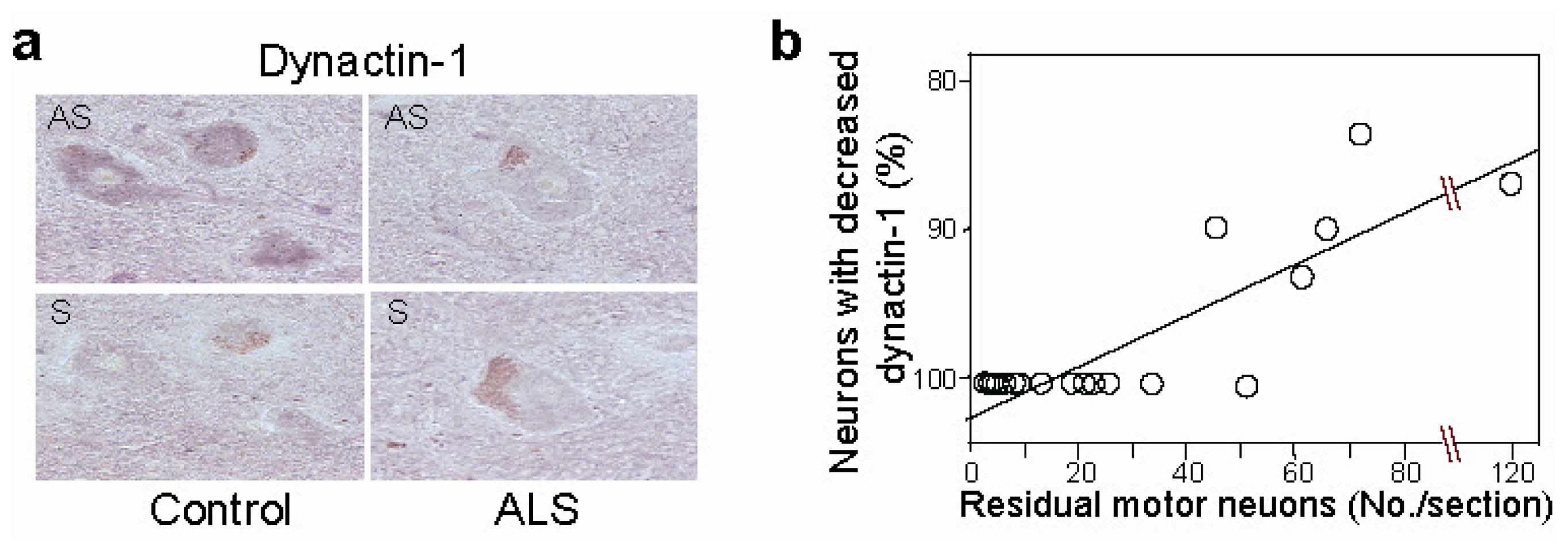
<p>To uncover this mechanism, we created a motor neuron-specific gene expression profile in patients with SALS using microarray technology combined with laser-captured microdissection, the results of which were further verified by <italic>in situ</italic> hybridization and quantitative wide-ranging research activities [<xref ref-type="bibr" rid="b71-ijms-13-01225">71</xref>]. Among the genes with dysregulated expressions, <italic>dynactin-1</italic> was markedly and widely downregulated in SALS motor neurons [<xref ref-type="bibr" rid="b71-ijms-13-01225">71</xref>]. Furthermore, we found that the downregulation of <italic>dynactin-1</italic> occurs prior to the accumulation of phosphorylated-neurofilament, which is, again, a marker of defective axonal transport and is considered a rather early marker of neurodegeneration (<xref ref-type="fig" rid="f1-ijms-13-01225">Figure 1</xref>) [<xref ref-type="bibr" rid="b72-ijms-13-01225">72</xref>]. The dramatic change in <italic>dynactin-1</italic> in patients with SALS seems to be specific for motor neurons, as <italic>dynactin-1</italic> expression was preserved in neurons in the dorsal nucleus of Clarke and the intermediolateral nucleus in the spinal cord, Purkinje cells of the cerebellum, and cortical neurons in the occipital cortex. By taking into account that mutations in <italic>dynactin-1</italic> cause MNDs, these results strongly suggest that the downregulation of <italic>dynactin-1</italic> in motor neurons may play a significant role in motor neuron degeneration in SALS.</p></sec>
<sec>
<title>SBMA</title>
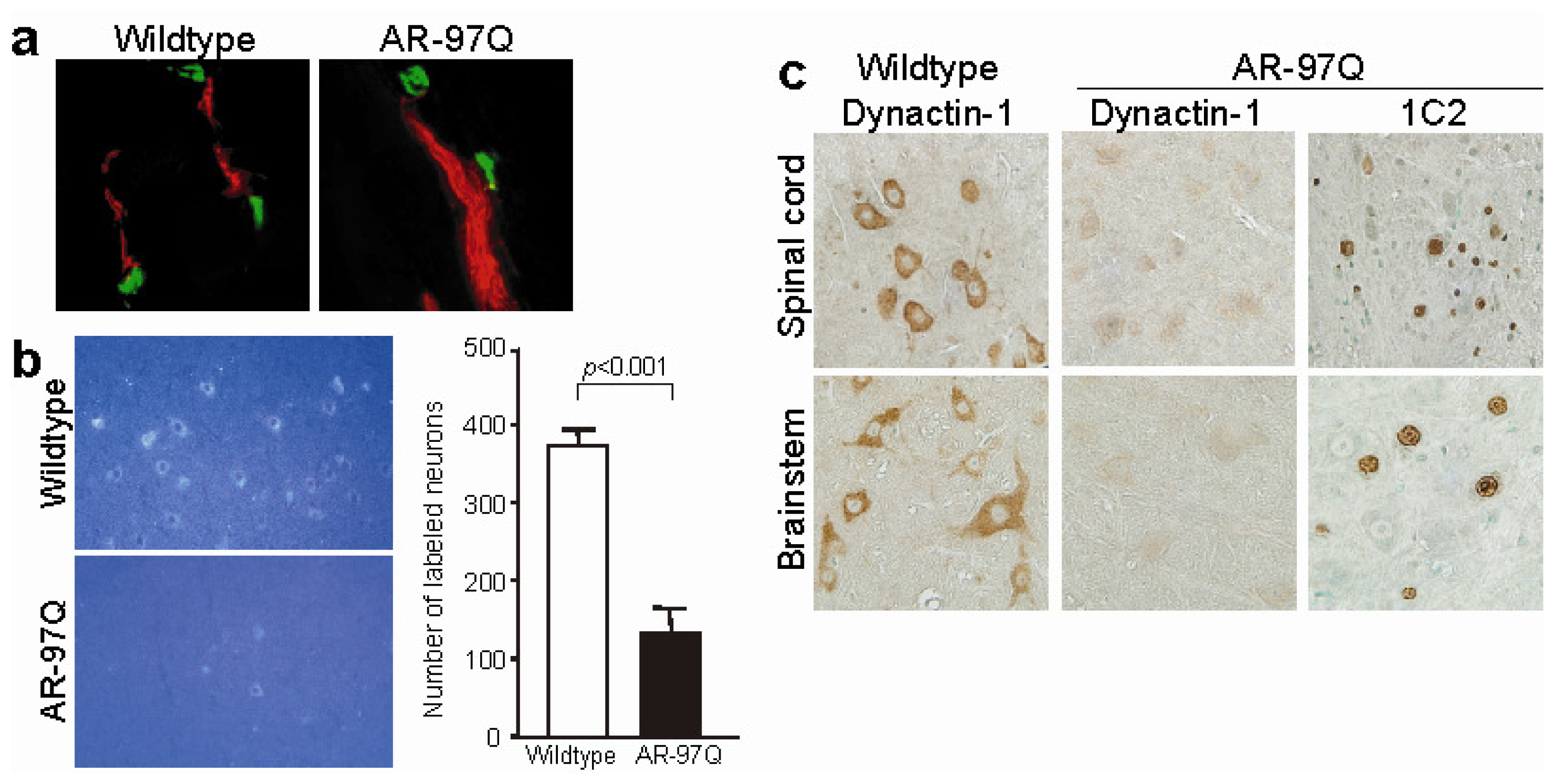
<p>Spinal and bulbar muscular atrophy, or Kennedy’s disease, is a hereditary neurodegenerative disease characterized by a loss of bulbar and spinal motor neurons [<xref ref-type="bibr" rid="b63-ijms-13-01225">63</xref>,<xref ref-type="bibr" rid="b73-ijms-13-01225">73</xref>]. The causative molecular defect in SBMA is the expansion of a trinucleotide CAG repeat, which encodes a polyglutamine tract in the first exon of the <italic>AR</italic> gene [<xref ref-type="bibr" rid="b74-ijms-13-01225">74</xref>]. The resulting mutant AR forms aggregations in the nucleus and affects the expression of various genes by inhibiting transcription factors and coactivators [<xref ref-type="bibr" rid="b75-ijms-13-01225">75</xref>,<xref ref-type="bibr" rid="b76-ijms-13-01225">76</xref>]. Polyglutamine-expanded AR inhibits axonal transport via a pathway involving cJun <italic>N</italic>-terminal kinase (JNK) activation, phosphorylation of kinesin-1 heavy chain subunits by JNK, and inhibition of kinesin-1 function [<xref ref-type="bibr" rid="b29-ijms-13-01225">29</xref>]. Interestingly, we found that <italic>dynactin-1</italic> is downregulated in the spinal motor neurons of SBMA patients and transgenic model mice (<xref ref-type="fig" rid="f2-ijms-13-01225">Figure 2</xref>) [<xref ref-type="bibr" rid="b62-ijms-13-01225">62</xref>], which is also observed in SALS patients [<xref ref-type="bibr" rid="b71-ijms-13-01225">71</xref>,<xref ref-type="bibr" rid="b72-ijms-13-01225">72</xref>]. Fluoro-gold labeling revealed that retrograde axonal transport in SBMA mice was significantly impaired. Moreover, abnormal accumulations of neurofilaments and synaptic proteins were observed in the distal part of axons in these mice. The retrograde transport defects preceded the onset of motor symptoms, and were restored by hormonal interventions that prevent accumulations of mutant <italic>AR</italic> in the nucleus. The disruption of retrograde axonal transport was also documented in a knock-in mouse model of SBMA and in mice over-expressing wildtype <italic>AR</italic> in muscle [<xref ref-type="bibr" rid="b77-ijms-13-01225">77</xref>], although this was not the case in another mouse model of SBMA [<xref ref-type="bibr" rid="b78-ijms-13-01225">78</xref>].</p></sec>
<sec>
<title>SMA</title>
<p>Spinal muscular atrophy is an autosomal recessive disease that selectively affects lower motor neurons and is classified into 3 forms: a severe form (type I; Werdnig–Hoffmann disease), an intermediate form (type II), and a juvenile form (type III; Kugelberg–Welander disease). SMA occurs in 1/6000 live births and is the leading genetic cause of infantile mortality in the USA. SMA is caused by the mutation or deletion of the “survival motor neuron 1” gene (<italic>SMN1</italic>), which plays an important role in RNA metabolism [<xref ref-type="bibr" rid="b79-ijms-13-01225">79</xref>]. Reduced levels of SMN1 lead to pathological changes at neuromuscular junctions, including decreased synaptic vesicle density, synaptic transmission defects, and neurofilament accumulation [<xref ref-type="bibr" rid="b80-ijms-13-01225">80</xref>]. In a mouse model of SMA, fast anterograde axonal transport is disrupted, providing the molecular basis for the synaptic pathology [<xref ref-type="bibr" rid="b81-ijms-13-01225">81</xref>]. The levels of dynein in the sciatic nerve are also reduced in this mouse model, suggesting the concomitant involvement of retrograde axonal transport [<xref ref-type="bibr" rid="b81-ijms-13-01225">81</xref>].</p></sec>
<sec>
<title>HSP</title>
<p>The hereditary spastic paraplegias are a heterogeneous group of genetic disorders characterized by lower extremity spastic weakness due to retrograde degeneration of the corticospinal tracts and posterior columns, which is often accompanied by brisk reflexes, extensor plantar reflexes, and urinary urgency [<xref ref-type="bibr" rid="b82-ijms-13-01225">82</xref>]. This disorder is classified into pure (uncomplicated) HSP and complicated HSP, depending on the presence of other neurological features in addition to spastic paraparesis. Spastic weakness is confined to the lower extremities in pure HSP, whereas complicated HSP is associated with mental retardation, ataxia, extrapyramidal signs, visual dysfunction or epilepsy. Among the causative proteins of HSPs, atlastin, spastin, and K1F5A regulate axonal transport [<xref ref-type="bibr" rid="b33-ijms-13-01225">33</xref>,<xref ref-type="bibr" rid="b64-ijms-13-01225">64</xref>–<xref ref-type="bibr" rid="b66-ijms-13-01225">66</xref>]. While atlastin and spastin facilitate vesicle trafficking, KIF5A regulates anterograde axonal transport as described above.</p></sec></sec>
<sec sec-type="conclusions">
<title>5. Conclusions</title>
<p>The fine-tuning of axonal transport is crucial for the survival of motor neurons, while defects in axonal transport have been implicated in the pathogenesis of various disorders that affect motor systems. The elucidation of relationships between axonal transport and motor neuron degeneration is key to the development of molecular-targeted therapies and biomarkers for MNDs.</p></sec></body>
<back>
<ack>
<title>Acknowledgments</title>
<p>This work was supported by a Center-of-Excellence (COE) grant, a Grant-in-Aid for Scientific Research on Innovated Areas “Foundation of Synapse and Neurocircuit Pathology” [No, 22110005], and Grant-in-Aids from the Ministry of Education, Culture, Sports, Science, and Technology of Japan [No. 21229011, 22390175]; grants from the Ministry of Health, Labor and Welfare of Japan; and Core Research for Evolutional Science and Technology (CREST) of the Japan Science and Technology Agency (JST).</p></ack>
<ref-list>
<title>References</title>
<ref id="b1-ijms-13-01225"><label>1</label><citation citation-type="journal"><person-group person-group-type="author"><name><surname>Holzbaur</surname><given-names>E.L.</given-names></name></person-group><article-title>Motor neurons rely on motor proteins</article-title><source>Trends Cell Biol</source><year>2004</year><volume>14</volume><fpage>233</fpage><lpage>240</lpage><pub-id pub-id-type="doi">10.1016/j.tcb.2004.03.009</pub-id><pub-id pub-id-type="pmid">15130579</pub-id></citation></ref>
<ref id="b2-ijms-13-01225"><label>2</label><citation citation-type="journal"><person-group person-group-type="author"><name><surname>Chao</surname><given-names>M.V.</given-names></name></person-group><article-title>Retrograde transport redux</article-title><source>Neuron</source><year>2003</year><volume>39</volume><fpage>1</fpage><lpage>2</lpage><pub-id pub-id-type="doi">10.1016/S0896-6273(03)00401-X</pub-id><pub-id pub-id-type="pmid">12848924</pub-id></citation></ref>
<ref id="b3-ijms-13-01225"><label>3</label><citation citation-type="journal"><person-group person-group-type="author"><name><surname>Hollenbeck</surname><given-names>P.J.</given-names></name><name><surname>Saxton</surname><given-names>W.M.</given-names></name></person-group><article-title>The axonal transport of mitochondria</article-title><source>J. Cell Sci</source><year>2005</year><volume>118</volume><fpage>5411</fpage><lpage>5419</lpage><pub-id pub-id-type="doi">10.1242/jcs.02745</pub-id><pub-id pub-id-type="pmid">16306220</pub-id></citation></ref>
<ref id="b4-ijms-13-01225"><label>4</label><citation citation-type="journal"><person-group person-group-type="author"><name><surname>Hollenbeck</surname><given-names>P.J.</given-names></name></person-group><article-title>The pattern and mechanism of mitochondrial transport in axons</article-title><source>Front Biosci</source><year>1996</year><volume>1</volume><fpage>d91</fpage><lpage>d102</lpage><pub-id pub-id-type="pmid">9159217</pub-id></citation></ref>
<ref id="b5-ijms-13-01225"><label>5</label><citation citation-type="journal"><person-group person-group-type="author"><name><surname>El-Kadi</surname><given-names>A.M.</given-names></name><name><surname>Soura</surname><given-names>V.</given-names></name><name><surname>Hafezparast</surname><given-names>M.</given-names></name></person-group><article-title>Defective axonal transport in motor neuron disease</article-title><source>J. Neurosci. Res</source><year>2007</year><volume>85</volume><fpage>2557</fpage><lpage>2566</lpage><pub-id pub-id-type="doi">10.1002/jnr.21188</pub-id><pub-id pub-id-type="pmid">17265455</pub-id></citation></ref>
<ref id="b6-ijms-13-01225"><label>6</label><citation citation-type="journal"><person-group person-group-type="author"><name><surname>Fichera</surname><given-names>M.</given-names></name><name><surname>Lo Giudice</surname><given-names>M.</given-names></name><name><surname>Falco</surname><given-names>M.</given-names></name><name><surname>Sturnio</surname><given-names>M.</given-names></name><name><surname>Amata</surname><given-names>S.</given-names></name><name><surname>Calabrese</surname><given-names>O.</given-names></name><name><surname>Bigoni</surname><given-names>S.</given-names></name><name><surname>Calzolari</surname><given-names>E.</given-names></name><name><surname>Neri</surname><given-names>M.</given-names></name></person-group><article-title>Evidence of kinesin heavy chain (kif5a) involvement in pure hereditary spastic paraplegia</article-title><source>Neurology</source><year>2004</year><volume>63</volume><fpage>1108</fpage><lpage>1110</lpage><pub-id pub-id-type="doi">10.1212/01.WNL.0000138731.60693.D2</pub-id><pub-id pub-id-type="pmid">15452312</pub-id></citation></ref>
<ref id="b7-ijms-13-01225"><label>7</label><citation citation-type="journal"><person-group person-group-type="author"><name><surname>Hafezparast</surname><given-names>M.</given-names></name><name><surname>Klocke</surname><given-names>R.</given-names></name><name><surname>Ruhrberg</surname><given-names>C.</given-names></name><name><surname>Marquardt</surname><given-names>A.</given-names></name><name><surname>Ahmad-Annuar</surname><given-names>A.</given-names></name><name><surname>Bowen</surname><given-names>S.</given-names></name><name><surname>Lalli</surname><given-names>G.</given-names></name><name><surname>Witherden</surname><given-names>A.S.</given-names></name><name><surname>Hummerich</surname><given-names>H.</given-names></name><name><surname>Nicholson</surname><given-names>S.</given-names></name><etal/></person-group><article-title>Mutations in dynein link motor neuron degeneration to defects in retrograde transport</article-title><source>Science</source><year>2003</year><volume>300</volume><fpage>808</fpage><lpage>812</lpage><pub-id pub-id-type="doi">10.1126/science.1083129</pub-id><pub-id pub-id-type="pmid">12730604</pub-id></citation></ref>
<ref id="b8-ijms-13-01225"><label>8</label><citation citation-type="journal"><person-group person-group-type="author"><name><surname>Puls</surname><given-names>I.</given-names></name><name><surname>Jonnakuty</surname><given-names>C.</given-names></name><name><surname>LaMonte</surname><given-names>B.H.</given-names></name><name><surname>Holzbaur</surname><given-names>E.L.</given-names></name><name><surname>Tokito</surname><given-names>M.</given-names></name><name><surname>Mann</surname><given-names>E.</given-names></name><name><surname>Floeter</surname><given-names>M.K.</given-names></name><name><surname>Bidus</surname><given-names>K.</given-names></name><name><surname>Drayna</surname><given-names>D.</given-names></name><name><surname>Oh</surname><given-names>S.J.</given-names></name><etal/></person-group><article-title>Mutant dynactin in motor neuron disease</article-title><source>Nat. Genet</source><year>2003</year><volume>33</volume><fpage>455</fpage><lpage>456</lpage><pub-id pub-id-type="doi">10.1038/ng1123</pub-id><pub-id pub-id-type="pmid">12627231</pub-id></citation></ref>
<ref id="b9-ijms-13-01225"><label>9</label><citation citation-type="journal"><person-group person-group-type="author"><name><surname>Pfister</surname><given-names>K.K.</given-names></name><name><surname>Fisher</surname><given-names>E.M.</given-names></name><name><surname>Gibbons</surname><given-names>I.R.</given-names></name><name><surname>Hays</surname><given-names>T.S.</given-names></name><name><surname>Holzbaur</surname><given-names>E.L.</given-names></name><name><surname>McIntosh</surname><given-names>J.R.</given-names></name><name><surname>Porter</surname><given-names>M.E.</given-names></name><name><surname>Schroer</surname><given-names>T.A.</given-names></name><name><surname>Vaughan</surname><given-names>K.T.</given-names></name><name><surname>Witman</surname><given-names>G.B.</given-names></name><etal/></person-group><article-title>Cytoplasmic dynein nomenclature</article-title><source>J. Cell Biol</source><year>2005</year><volume>171</volume><fpage>411</fpage><lpage>413</lpage><pub-id pub-id-type="doi">10.1083/jcb.200508078</pub-id><pub-id pub-id-type="pmid">16260502</pub-id></citation></ref>
<ref id="b10-ijms-13-01225"><label>10</label><citation citation-type="journal"><person-group person-group-type="author"><name><surname>King</surname><given-names>S.M.</given-names></name></person-group><article-title>The dynein microtubule motor</article-title><source>Biochim. Biophys. Acta</source><year>2000</year><volume>1496</volume><fpage>60</fpage><lpage>75</lpage><pub-id pub-id-type="doi">10.1016/S0167-4889(00)00009-4</pub-id><pub-id pub-id-type="pmid">10722877</pub-id></citation></ref>
<ref id="b11-ijms-13-01225"><label>11</label><citation citation-type="journal"><person-group person-group-type="author"><name><surname>Holzbaur</surname><given-names>E.L.</given-names></name><name><surname>Vallee</surname><given-names>R.B.</given-names></name></person-group><article-title>Dyneins: Molecular structure and cellular function</article-title><source>Annu. Rev. Cell Biol</source><year>1994</year><volume>10</volume><fpage>339</fpage><lpage>372</lpage><pub-id pub-id-type="doi">10.1146/annurev.cb.10.110194.002011</pub-id><pub-id pub-id-type="pmid">7888180</pub-id></citation></ref>
<ref id="b12-ijms-13-01225"><label>12</label><citation citation-type="journal"><person-group person-group-type="author"><name><surname>Kieran</surname><given-names>D.</given-names></name><name><surname>Hafezparast</surname><given-names>M.</given-names></name><name><surname>Bohnert</surname><given-names>S.</given-names></name><name><surname>Dick</surname><given-names>J.R.</given-names></name><name><surname>Martin</surname><given-names>J.</given-names></name><name><surname>Schiavo</surname><given-names>G.</given-names></name><name><surname>Fisher</surname><given-names>E.M.</given-names></name><name><surname>Greensmith</surname><given-names>L.</given-names></name></person-group><article-title>A mutation in dynein rescues axonal transport defects and extends the life span of ALS mice</article-title><source>J. Cell Biol</source><year>2005</year><volume>169</volume><fpage>561</fpage><lpage>567</lpage><pub-id pub-id-type="doi">10.1083/jcb.200501085</pub-id><pub-id pub-id-type="pmid">15911875</pub-id></citation></ref>
<ref id="b13-ijms-13-01225"><label>13</label><citation citation-type="journal"><person-group person-group-type="author"><name><surname>Ori-McKenney</surname><given-names>K.M.</given-names></name><name><surname>Xu</surname><given-names>J.</given-names></name><name><surname>Gross</surname><given-names>S.P.</given-names></name><name><surname>Vallee</surname><given-names>R.B.</given-names></name></person-group><article-title>A cytoplasmic dynein tail mutation impairs motor processivity</article-title><source>Nat. Cell Biol</source><year>2010</year><volume>12</volume><fpage>1228</fpage><lpage>1234</lpage><pub-id pub-id-type="doi">10.1038/ncb2127</pub-id><pub-id pub-id-type="pmid">21102439</pub-id></citation></ref>
<ref id="b14-ijms-13-01225"><label>14</label><citation citation-type="journal"><person-group person-group-type="author"><name><surname>Chen</surname><given-names>X.J.</given-names></name><name><surname>Levedakou</surname><given-names>E.N.</given-names></name><name><surname>Millen</surname><given-names>K.J.</given-names></name><name><surname>Wollmann</surname><given-names>R.L.</given-names></name><name><surname>Soliven</surname><given-names>B.</given-names></name><name><surname>Popko</surname><given-names>B.</given-names></name></person-group><article-title>Proprioceptive sensory neuropathy in mice with a mutation in the cytoplasmic Dynein heavy chain 1 gene</article-title><source>J. Neurosci</source><year>2007</year><volume>27</volume><fpage>14515</fpage><lpage>14124</lpage><pub-id pub-id-type="doi">10.1523/JNEUROSCI.4338-07.2007</pub-id><pub-id pub-id-type="pmid">18160659</pub-id></citation></ref>
<ref id="b15-ijms-13-01225"><label>15</label><citation citation-type="journal"><person-group person-group-type="author"><name><surname>Gill</surname><given-names>S.R.</given-names></name><name><surname>Schroer</surname><given-names>T.A.</given-names></name><name><surname>Szilak</surname><given-names>I.</given-names></name><name><surname>Steuer</surname><given-names>E.R.</given-names></name><name><surname>Sheetz</surname><given-names>M.P.</given-names></name><name><surname>Cleveland</surname><given-names>D.W.</given-names></name></person-group><article-title>Dynactin, a conserved, ubiquitously expressed component of an activator of vesicle motility mediated by cytoplasmic dynein</article-title><source>J. Cell Biol</source><year>1991</year><volume>115</volume><fpage>1639</fpage><lpage>1650</lpage><pub-id pub-id-type="doi">10.1083/jcb.115.6.1639</pub-id><pub-id pub-id-type="pmid">1836789</pub-id></citation></ref>
<ref id="b16-ijms-13-01225"><label>16</label><citation citation-type="journal"><person-group person-group-type="author"><name><surname>Karki</surname><given-names>S.</given-names></name><name><surname>Holzbaur</surname><given-names>E.L.</given-names></name></person-group><article-title>Affinity chromatography demonstrates a direct binding between cytoplasmic dynein and the dynactin complex</article-title><source>J. Biol. Chem</source><year>1995</year><volume>270</volume><fpage>28806</fpage><lpage>28811</lpage><pub-id pub-id-type="doi">10.1074/jbc.270.48.28806</pub-id><pub-id pub-id-type="pmid">7499404</pub-id></citation></ref>
<ref id="b17-ijms-13-01225"><label>17</label><citation citation-type="journal"><person-group person-group-type="author"><name><surname>Haghnia</surname><given-names>M.</given-names></name><name><surname>Cavalli</surname><given-names>V.</given-names></name><name><surname>Shah</surname><given-names>S.B.</given-names></name><name><surname>Schimmelpfeng</surname><given-names>K.</given-names></name><name><surname>Brusch</surname><given-names>R.</given-names></name><name><surname>Yang</surname><given-names>G.</given-names></name><name><surname>Herrera</surname><given-names>C.</given-names></name><name><surname>Pilling</surname><given-names>A.</given-names></name><name><surname>Goldstein</surname><given-names>L.S.</given-names></name></person-group><article-title>Dynactin is required for coordinated bidirectional motility, but not for dynein membrane attachment</article-title><source>Mol. Biol. Cell</source><year>2007</year><volume>18</volume><fpage>2081</fpage><lpage>2089</lpage><pub-id pub-id-type="doi">10.1091/mbc.E06-08-0695</pub-id><pub-id pub-id-type="pmid">17360970</pub-id></citation></ref>
<ref id="b18-ijms-13-01225"><label>18</label><citation citation-type="journal"><person-group person-group-type="author"><name><surname>Levy</surname><given-names>J.R.</given-names></name><name><surname>Sumner</surname><given-names>C.J.</given-names></name><name><surname>Caviston</surname><given-names>J.P.</given-names></name><name><surname>Tokito</surname><given-names>M.K.</given-names></name><name><surname>Ranganathan</surname><given-names>S.</given-names></name><name><surname>Ligon</surname><given-names>L.A.</given-names></name><name><surname>Wallace</surname><given-names>K.E.</given-names></name><name><surname>LaMonte</surname><given-names>B.H.</given-names></name><name><surname>Harmison</surname><given-names>G.G.</given-names></name><name><surname>Puls</surname><given-names>I.</given-names></name><etal/></person-group><article-title>A motor neuron disease-associated mutation in p150glued perturbs dynactin function and induces protein aggregation</article-title><source>J. Cell Biol</source><year>2006</year><volume>172</volume><fpage>733</fpage><lpage>745</lpage><pub-id pub-id-type="doi">10.1083/jcb.200511068</pub-id><pub-id pub-id-type="pmid">16505168</pub-id></citation></ref>
<ref id="b19-ijms-13-01225"><label>19</label><citation citation-type="journal"><person-group person-group-type="author"><name><surname>Chevalier-Larsen</surname><given-names>E.S.</given-names></name><name><surname>Wallace</surname><given-names>K.E.</given-names></name><name><surname>Pennise</surname><given-names>C.R.</given-names></name><name><surname>Holzbaur</surname><given-names>E.L.</given-names></name></person-group><article-title>Lysosomal proliferation and distal degeneration in motor neurons expressing the g59s mutation in the p150glued subunit of dynactin</article-title><source>Hum. Mol. Genet</source><year>2008</year><volume>17</volume><fpage>1946</fpage><lpage>1955</lpage><pub-id pub-id-type="doi">10.1093/hmg/ddn092</pub-id><pub-id pub-id-type="pmid">18364389</pub-id></citation></ref>
<ref id="b20-ijms-13-01225"><label>20</label><citation citation-type="journal"><person-group person-group-type="author"><name><surname>Laird</surname><given-names>F.M.</given-names></name><name><surname>Farah</surname><given-names>M.H.</given-names></name><name><surname>Ackerley</surname><given-names>S.</given-names></name><name><surname>Hoke</surname><given-names>A.</given-names></name><name><surname>Maragakis</surname><given-names>N.</given-names></name><name><surname>Rothstein</surname><given-names>J.D.</given-names></name><name><surname>Griffin</surname><given-names>J.</given-names></name><name><surname>Price</surname><given-names>D.L.</given-names></name><name><surname>Martin</surname><given-names>L.J.</given-names></name><name><surname>Wong</surname><given-names>P.C.</given-names></name></person-group><article-title>Motor neuron disease occurring in a mutant dynactin mouse model is characterized by defects in vesicular trafficking</article-title><source>J. Neurosci</source><year>2008</year><volume>28</volume><fpage>1997</fpage><lpage>2005</lpage><pub-id pub-id-type="doi">10.1523/JNEUROSCI.4231-07.2008</pub-id><pub-id pub-id-type="pmid">18305234</pub-id></citation></ref>
<ref id="b21-ijms-13-01225"><label>21</label><citation citation-type="journal"><person-group person-group-type="author"><name><surname>Lai</surname><given-names>C.</given-names></name><name><surname>Lin</surname><given-names>X.</given-names></name><name><surname>Chandran</surname><given-names>J.</given-names></name><name><surname>Shim</surname><given-names>H.</given-names></name><name><surname>Yang</surname><given-names>W.J.</given-names></name><name><surname>Cai</surname><given-names>H.</given-names></name></person-group><article-title>The g59s mutation in p150 (glued) causes dysfunction of dynactin in mice</article-title><source>J. Neurosci</source><year>2007</year><volume>27</volume><fpage>13982</fpage><lpage>13990</lpage><pub-id pub-id-type="doi">10.1523/JNEUROSCI.4226-07.2007</pub-id><pub-id pub-id-type="pmid">18094236</pub-id></citation></ref>
<ref id="b22-ijms-13-01225"><label>22</label><citation citation-type="journal"><person-group person-group-type="author"><name><surname>Miki</surname><given-names>H.</given-names></name><name><surname>Setou</surname><given-names>M.</given-names></name><name><surname>Kaneshiro</surname><given-names>K.</given-names></name><name><surname>Hirokawa</surname><given-names>N.</given-names></name></person-group><article-title>All kinesin superfamily protein, kif, genes in mouse and human</article-title><source>Proc. Natl. Acad. Sci. USA</source><year>2001</year><volume>98</volume><fpage>7004</fpage><lpage>7011</lpage><pub-id pub-id-type="doi">10.1073/pnas.111145398</pub-id><pub-id pub-id-type="pmid">11416179</pub-id></citation></ref>
<ref id="b23-ijms-13-01225"><label>23</label><citation citation-type="journal"><person-group person-group-type="author"><name><surname>Hirokawa</surname><given-names>N.</given-names></name><name><surname>Takemura</surname><given-names>R.</given-names></name></person-group><article-title>Molecular motors and mechanisms of directional transport in neurons</article-title><source>Nat. Rev. Neurosci</source><year>2005</year><volume>6</volume><fpage>201</fpage><lpage>214</lpage><pub-id pub-id-type="doi">10.1038/nrn1624</pub-id><pub-id pub-id-type="pmid">15711600</pub-id></citation></ref>
<ref id="b24-ijms-13-01225"><label>24</label><citation citation-type="journal"><person-group person-group-type="author"><name><surname>Hirokawa</surname><given-names>N.</given-names></name><name><surname>Niwa</surname><given-names>S.</given-names></name><name><surname>Tanaka</surname><given-names>Y.</given-names></name></person-group><article-title>Molecular motors in neurons: Transport mechanisms and roles in brain function, development, and disease</article-title><source>Neuron</source><year>2010</year><volume>68</volume><fpage>610</fpage><lpage>638</lpage><pub-id pub-id-type="doi">10.1016/j.neuron.2010.09.039</pub-id><pub-id pub-id-type="pmid">21092854</pub-id></citation></ref>
<ref id="b25-ijms-13-01225"><label>25</label><citation citation-type="journal"><person-group person-group-type="author"><name><surname>Reid</surname><given-names>E.</given-names></name><name><surname>Kloos</surname><given-names>M.</given-names></name><name><surname>Ashley-Koch</surname><given-names>A.</given-names></name><name><surname>Hughes</surname><given-names>L.</given-names></name><name><surname>Bevan</surname><given-names>S.</given-names></name><name><surname>Svenson</surname><given-names>I.K.</given-names></name><name><surname>Graham</surname><given-names>F.L.</given-names></name><name><surname>Gaskell</surname><given-names>P.C.</given-names></name><name><surname>Dearlove</surname><given-names>A.</given-names></name><name><surname>Pericak-Vance</surname><given-names>M.A.</given-names></name><etal/></person-group><article-title>A kinesin heavy chain (kif5a) mutation in hereditary spastic paraplegia (spg10)</article-title><source>Am. J. Hum. Genet</source><year>2002</year><volume>71</volume><fpage>1189</fpage><lpage>1194</lpage><pub-id pub-id-type="doi">10.1086/344210</pub-id><pub-id pub-id-type="pmid">12355402</pub-id></citation></ref>
<ref id="b26-ijms-13-01225"><label>26</label><citation citation-type="journal"><person-group person-group-type="author"><name><surname>Song</surname><given-names>H.</given-names></name><name><surname>Endow</surname><given-names>S.A.</given-names></name></person-group><article-title>Decoupling of nucleotide- and microtubule-binding sites in a kinesin mutant</article-title><source>Nature</source><year>1998</year><volume>396</volume><fpage>587</fpage><lpage>590</lpage><pub-id pub-id-type="doi">10.1038/25153</pub-id><pub-id pub-id-type="pmid">9859995</pub-id></citation></ref>
<ref id="b27-ijms-13-01225"><label>27</label><citation citation-type="journal"><person-group person-group-type="author"><name><surname>Hirokawa</surname><given-names>N.</given-names></name><name><surname>Noda</surname><given-names>Y.</given-names></name></person-group><article-title>Intracellular transport and kinesin superfamily proteins, kifs: Structure, function, and dynamics</article-title><source>Physiol. Rev</source><year>2008</year><volume>88</volume><fpage>1089</fpage><lpage>1118</lpage><pub-id pub-id-type="doi">10.1152/physrev.00023.2007</pub-id><pub-id pub-id-type="pmid">18626067</pub-id></citation></ref>
<ref id="b28-ijms-13-01225"><label>28</label><citation citation-type="journal"><person-group person-group-type="author"><name><surname>Shi</surname><given-names>P.</given-names></name><name><surname>Strom</surname><given-names>A.L.</given-names></name><name><surname>Gal</surname><given-names>J.</given-names></name><name><surname>Zhu</surname><given-names>H.</given-names></name></person-group><article-title>Effects of als-related SOD1 mutants on dynein- and kif5-mediated retrograde and anterograde axonal transport</article-title><source>Biochim. Biophys. Acta</source><year>2010</year><volume>1802</volume><fpage>707</fpage><lpage>716</lpage><pub-id pub-id-type="doi">10.1016/j.bbadis.2010.05.008</pub-id><pub-id pub-id-type="pmid">20510358</pub-id></citation></ref>
<ref id="b29-ijms-13-01225"><label>29</label><citation citation-type="journal"><person-group person-group-type="author"><name><surname>Morfini</surname><given-names>G.</given-names></name><name><surname>Pigino</surname><given-names>G.</given-names></name><name><surname>Szebenyi</surname><given-names>G.</given-names></name><name><surname>You</surname><given-names>Y.</given-names></name><name><surname>Pollema</surname><given-names>S.</given-names></name><name><surname>Brady</surname><given-names>S.T.</given-names></name></person-group><article-title>Jnk mediates pathogenic effects of polyglutamine-expanded androgen receptor on fast axonal transport</article-title><source>Nat. Neurosci</source><year>2006</year><volume>9</volume><fpage>907</fpage><lpage>916</lpage><pub-id pub-id-type="doi">10.1038/nn1717</pub-id><pub-id pub-id-type="pmid">16751763</pub-id></citation></ref>
<ref id="b30-ijms-13-01225"><label>30</label><citation citation-type="journal"><person-group person-group-type="author"><name><surname>Lee</surname><given-names>M.K.</given-names></name><name><surname>Cleveland</surname><given-names>D.W.</given-names></name></person-group><article-title>Neuronal intermediate filaments</article-title><source>Annu. Rev. Neurosci</source><year>1996</year><volume>19</volume><fpage>187</fpage><lpage>217</lpage><pub-id pub-id-type="doi">10.1146/annurev.ne.19.030196.001155</pub-id><pub-id pub-id-type="pmid">8833441</pub-id></citation></ref>
<ref id="b31-ijms-13-01225"><label>31</label><citation citation-type="journal"><person-group person-group-type="author"><name><surname>Garcia</surname><given-names>M.L.</given-names></name><name><surname>Lobsiger</surname><given-names>C.S.</given-names></name><name><surname>Shah</surname><given-names>S.B.</given-names></name><name><surname>Deerinck</surname><given-names>T.J.</given-names></name><name><surname>Crum</surname><given-names>J.</given-names></name><name><surname>Young</surname><given-names>D.</given-names></name><name><surname>Ward</surname><given-names>C.M.</given-names></name><name><surname>Crawford</surname><given-names>T.O.</given-names></name><name><surname>Gotow</surname><given-names>T.</given-names></name><name><surname>Uchiyama</surname><given-names>Y.</given-names></name><etal/></person-group><article-title>Nf-m is an essential target for the myelin-directed “Outside-in” Signaling cascade that mediates radial axonal growth</article-title><source>J. Cell Biol</source><year>2003</year><volume>163</volume><fpage>1011</fpage><lpage>1020</lpage><pub-id pub-id-type="doi">10.1083/jcb.200308159</pub-id><pub-id pub-id-type="pmid">14662745</pub-id></citation></ref>
<ref id="b32-ijms-13-01225"><label>32</label><citation citation-type="journal"><person-group person-group-type="author"><name><surname>Bruijn</surname><given-names>L.I.</given-names></name><name><surname>Miller</surname><given-names>T.M.</given-names></name><name><surname>Cleveland</surname><given-names>D.W.</given-names></name></person-group><article-title>Unraveling the mechanisms involved in motor neuron degeneration in als</article-title><source>Annu. Rev. Neurosci</source><year>2004</year><volume>27</volume><fpage>723</fpage><lpage>749</lpage><pub-id pub-id-type="doi">10.1146/annurev.neuro.27.070203.144244</pub-id><pub-id pub-id-type="pmid">15217349</pub-id></citation></ref>
<ref id="b33-ijms-13-01225"><label>33</label><citation citation-type="journal"><person-group person-group-type="author"><name><surname>Xia</surname><given-names>C.H.</given-names></name><name><surname>Roberts</surname><given-names>E.A.</given-names></name><name><surname>Her</surname><given-names>L.S.</given-names></name><name><surname>Liu</surname><given-names>X.</given-names></name><name><surname>Williams</surname><given-names>D.S.</given-names></name><name><surname>Cleveland</surname><given-names>D.W.</given-names></name><name><surname>Goldstein</surname><given-names>L.S.</given-names></name></person-group><article-title>Abnormal neurofilament transport caused by targeted disruption of neuronal kinesin heavy chain kif5a</article-title><source>J. Cell Biol</source><year>2003</year><volume>161</volume><fpage>55</fpage><lpage>66</lpage><pub-id pub-id-type="doi">10.1083/jcb.200301026</pub-id><pub-id pub-id-type="pmid">12682084</pub-id></citation></ref>
<ref id="b34-ijms-13-01225"><label>34</label><citation citation-type="journal"><person-group person-group-type="author"><name><surname>Koehnle</surname><given-names>T.J.</given-names></name><name><surname>Brown</surname><given-names>A.</given-names></name></person-group><article-title>Slow axonal transport of neurofilament protein in cultured neurons</article-title><source>J. Cell Biol</source><year>1999</year><volume>144</volume><fpage>447</fpage><lpage>458</lpage><pub-id pub-id-type="doi">10.1083/jcb.144.3.447</pub-id><pub-id pub-id-type="pmid">9971740</pub-id></citation></ref>
<ref id="b35-ijms-13-01225"><label>35</label><citation citation-type="journal"><person-group person-group-type="author"><name><surname>Mersiyanova</surname><given-names>I.V.</given-names></name><name><surname>Perepelov</surname><given-names>A.V.</given-names></name><name><surname>Polyakov</surname><given-names>A.V.</given-names></name><name><surname>Sitnikov</surname><given-names>V.F.</given-names></name><name><surname>Dadali</surname><given-names>E.L.</given-names></name><name><surname>Oparin</surname><given-names>R.B.</given-names></name><name><surname>Petrin</surname><given-names>A.N.</given-names></name><name><surname>Evgrafov</surname><given-names>O.V.</given-names></name></person-group><article-title>A new variant of charcot-marie-tooth disease type 2 is probably the result of a mutation in the neurofilament-light gene</article-title><source>Am. J. Hum. Genet</source><year>2000</year><volume>67</volume><fpage>37</fpage><lpage>46</lpage><pub-id pub-id-type="doi">10.1086/302962</pub-id><pub-id pub-id-type="pmid">10841809</pub-id></citation></ref>
<ref id="b36-ijms-13-01225"><label>36</label><citation citation-type="journal"><person-group person-group-type="author"><name><surname>Perez-Olle</surname><given-names>R.</given-names></name><name><surname>Jones</surname><given-names>S.T.</given-names></name><name><surname>Liem</surname><given-names>R.K.</given-names></name></person-group><article-title>Phenotypic analysis of neurofilament light gene mutations linked to charcot-marie-tooth disease in cell culture models</article-title><source>Hum. Mol. Genet</source><year>2004</year><volume>13</volume><fpage>2207</fpage><lpage>2220</lpage><pub-id pub-id-type="doi">10.1093/hmg/ddh236</pub-id><pub-id pub-id-type="pmid">15282209</pub-id></citation></ref>
<ref id="b37-ijms-13-01225"><label>37</label><citation citation-type="journal"><person-group person-group-type="author"><name><surname>Perez-Olle</surname><given-names>R.</given-names></name><name><surname>Lopez-Toledano</surname><given-names>M.A.</given-names></name><name><surname>Goryunov</surname><given-names>D.</given-names></name><name><surname>Cabrera-Poch</surname><given-names>N.</given-names></name><name><surname>Stefanis</surname><given-names>L.</given-names></name><name><surname>Brown</surname><given-names>K.</given-names></name><name><surname>Liem</surname><given-names>R.K.</given-names></name></person-group><article-title>Mutations in the neurofilament light gene linked to charcot-marie-tooth disease cause defects in transport</article-title><source>J. Neurochem</source><year>2005</year><volume>93</volume><fpage>861</fpage><lpage>874</lpage><pub-id pub-id-type="doi">10.1111/j.1471-4159.2005.03095.x</pub-id><pub-id pub-id-type="pmid">15857389</pub-id></citation></ref>
<ref id="b38-ijms-13-01225"><label>38</label><citation citation-type="journal"><person-group person-group-type="author"><name><surname>Magrane</surname><given-names>J.</given-names></name><name><surname>Manfredi</surname><given-names>G.</given-names></name></person-group><article-title>Mitochondrial function, morphology, and axonal transport in amyotrophic lateral sclerosis</article-title><source>Antioxid. Redox. Signal</source><year>2009</year><volume>11</volume><fpage>1615</fpage><lpage>1626</lpage><pub-id pub-id-type="doi">10.1089/ars.2009.2604</pub-id><pub-id pub-id-type="pmid">19344253</pub-id></citation></ref>
<ref id="b39-ijms-13-01225"><label>39</label><citation citation-type="journal"><person-group person-group-type="author"><name><surname>Bilsland</surname><given-names>L.G.</given-names></name><name><surname>Sahai</surname><given-names>E.</given-names></name><name><surname>Kelly</surname><given-names>G.</given-names></name><name><surname>Golding</surname><given-names>M.</given-names></name><name><surname>Greensmith</surname><given-names>L.</given-names></name><name><surname>Schiavo</surname><given-names>G.</given-names></name></person-group><article-title>Deficits in axonal transport precede als symptoms <italic>in vivo</italic></article-title><source>Proc. Natl. Acad. Sci. USA</source><year>2010</year><volume>107</volume><fpage>20523</fpage><lpage>20528</lpage><pub-id pub-id-type="doi">10.1073/pnas.1006869107</pub-id><pub-id pub-id-type="pmid">21059924</pub-id></citation></ref>
<ref id="b40-ijms-13-01225"><label>40</label><citation citation-type="journal"><person-group person-group-type="author"><name><surname>Collard</surname><given-names>J.F.</given-names></name><name><surname>Cote</surname><given-names>F.</given-names></name><name><surname>Julien</surname><given-names>J.P.</given-names></name></person-group><article-title>Defective axonal transport in a transgenic mouse model of amyotrophic lateral sclerosis</article-title><source>Nature</source><year>1995</year><volume>375</volume><fpage>61</fpage><lpage>64</lpage><pub-id pub-id-type="doi">10.1038/375061a0</pub-id><pub-id pub-id-type="pmid">7536898</pub-id></citation></ref>
<ref id="b41-ijms-13-01225"><label>41</label><citation citation-type="journal"><person-group person-group-type="author"><name><surname>Sasaki</surname><given-names>S.</given-names></name><name><surname>Iwata</surname><given-names>M.</given-names></name></person-group><article-title>Impairment of fast axonal transport in the proximal axons of anterior horn neurons in amyotrophic lateral sclerosis</article-title><source>Neurology</source><year>1996</year><volume>47</volume><fpage>535</fpage><lpage>540</lpage><pub-id pub-id-type="doi">10.1212/WNL.47.2.535</pub-id><pub-id pub-id-type="pmid">8757033</pub-id></citation></ref>
<ref id="b42-ijms-13-01225"><label>42</label><citation citation-type="journal"><person-group person-group-type="author"><name><surname>Wong</surname><given-names>P.C.</given-names></name><name><surname>Pardo</surname><given-names>C.A.</given-names></name><name><surname>Borchelt</surname><given-names>D.R.</given-names></name><name><surname>Lee</surname><given-names>M.K.</given-names></name><name><surname>Copeland</surname><given-names>N.G.</given-names></name><name><surname>Jenkins</surname><given-names>N.A.</given-names></name><name><surname>Sisodia</surname><given-names>S.S.</given-names></name><name><surname>Cleveland</surname><given-names>D.W.</given-names></name><name><surname>Price</surname><given-names>D.L.</given-names></name></person-group><article-title>An adverse property of a familial als-linked SOD1 mutation causes motor neuron disease characterized by vacuolar degeneration of mitochondria</article-title><source>Neuron</source><year>1995</year><volume>14</volume><fpage>1105</fpage><lpage>1116</lpage><pub-id pub-id-type="doi">10.1016/0896-6273(95)90259-7</pub-id><pub-id pub-id-type="pmid">7605627</pub-id></citation></ref>
<ref id="b43-ijms-13-01225"><label>43</label><citation citation-type="journal"><person-group person-group-type="author"><name><surname>Kong</surname><given-names>J.</given-names></name><name><surname>Xu</surname><given-names>Z.</given-names></name></person-group><article-title>Massive mitochondrial degeneration in motor neurons triggers the onset of amyotrophic lateral sclerosis in mice expressing a mutant SOD1</article-title><source>J. Neurosci</source><year>1998</year><volume>18</volume><fpage>3241</fpage><lpage>3250</lpage><pub-id pub-id-type="pmid">9547233</pub-id></citation></ref>
<ref id="b44-ijms-13-01225"><label>44</label><citation citation-type="journal"><person-group person-group-type="author"><name><surname>Sasaki</surname><given-names>S.</given-names></name><name><surname>Iwata</surname><given-names>M.</given-names></name></person-group><article-title>Mitochondrial alterations in the spinal cord of patients with sporadic amyotrophic lateral sclerosis</article-title><source>J. Neuropathol. Exp. Neurol</source><year>2007</year><volume>66</volume><fpage>10</fpage><lpage>16</lpage><pub-id pub-id-type="doi">10.1097/nen.0b013e31802c396b</pub-id><pub-id pub-id-type="pmid">17204932</pub-id></citation></ref>
<ref id="b45-ijms-13-01225"><label>45</label><citation citation-type="journal"><person-group person-group-type="author"><name><surname>Zhu</surname><given-names>Y.B.</given-names></name><name><surname>Sheng</surname><given-names>Z.H.</given-names></name></person-group><article-title>Increased axonal mitochondrial mobility does not slow als-like disease in mutant SOD1 mice</article-title><source>J. Biol. Chem</source><year>2011</year><volume>26</volume><fpage>23432</fpage><lpage>23440</lpage></citation></ref>
<ref id="b46-ijms-13-01225"><label>46</label><citation citation-type="journal"><person-group person-group-type="author"><name><surname>d’Ydewalle</surname><given-names>C.</given-names></name><name><surname>Krishnan</surname><given-names>J.</given-names></name><name><surname>Chiheb</surname><given-names>D.M.</given-names></name><name><surname>Van Damme</surname><given-names>P.</given-names></name><name><surname>Irobi</surname><given-names>J.</given-names></name><name><surname>Kozikowski</surname><given-names>A.P.</given-names></name><name><surname>Berghe</surname><given-names>P.V.</given-names></name><name><surname>Timmerman</surname><given-names>V.</given-names></name><name><surname>Robberecht</surname><given-names>W.</given-names></name><name><surname>Van Den Bosch</surname><given-names>L.</given-names></name></person-group><article-title>Hdac6 inhibitors reverse axonal loss in a mouse model of mutant hspb1-induced charcot-marie-tooth disease</article-title><source>Nat. Med</source><year>2011</year><volume>17</volume><fpage>968</fpage><lpage>974</lpage><pub-id pub-id-type="doi">10.1038/nm.2396</pub-id><pub-id pub-id-type="pmid">21785432</pub-id></citation></ref>
<ref id="b47-ijms-13-01225"><label>47</label><citation citation-type="journal"><person-group person-group-type="author"><name><surname>Ravikumar</surname><given-names>B.</given-names></name><name><surname>Acevedo-Arozena</surname><given-names>A.</given-names></name><name><surname>Imarisio</surname><given-names>S.</given-names></name><name><surname>Berger</surname><given-names>Z.</given-names></name><name><surname>Vacher</surname><given-names>C.</given-names></name><name><surname>O’Kane</surname><given-names>C.J.</given-names></name><name><surname>Brown</surname><given-names>S.D.</given-names></name><name><surname>Rubinsztein</surname><given-names>D.C.</given-names></name></person-group><article-title>Dynein mutations impair autophagic clearance of aggregate-prone proteins</article-title><source>Nat. Genet</source><year>2005</year><volume>37</volume><fpage>771</fpage><lpage>776</lpage><pub-id pub-id-type="doi">10.1038/ng1591</pub-id><pub-id pub-id-type="pmid">15980862</pub-id></citation></ref>
<ref id="b48-ijms-13-01225"><label>48</label><citation citation-type="journal"><person-group person-group-type="author"><name><surname>Komatsu</surname><given-names>M.</given-names></name><name><surname>Wang</surname><given-names>Q.J.</given-names></name><name><surname>Holstein</surname><given-names>G.R.</given-names></name><name><surname>Friedrich</surname><given-names>V.L.</given-names><suffix>Jr</suffix></name><name><surname>Iwata</surname><given-names>J.</given-names></name><name><surname>Kominami</surname><given-names>E.</given-names></name><name><surname>Chait</surname><given-names>B.T.</given-names></name><name><surname>Tanaka</surname><given-names>K.</given-names></name><name><surname>Yue</surname><given-names>Z.</given-names></name></person-group><article-title>Essential role for autophagy protein atg7 in the maintenance of axonal homeostasis and the prevention of axonal degeneration</article-title><source>Proc. Natl. Acad. Sci. USA</source><year>2007</year><volume>104</volume><fpage>14489</fpage><lpage>14494</lpage><pub-id pub-id-type="doi">10.1073/pnas.0701311104</pub-id><pub-id pub-id-type="pmid">17726112</pub-id></citation></ref>
<ref id="b49-ijms-13-01225"><label>49</label><citation citation-type="journal"><person-group person-group-type="author"><name><surname>Yu</surname><given-names>W.H.</given-names></name><name><surname>Cuervo</surname><given-names>A.M.</given-names></name><name><surname>Kumar</surname><given-names>A.</given-names></name><name><surname>Peterhoff</surname><given-names>C.M.</given-names></name><name><surname>Schmidt</surname><given-names>S.D.</given-names></name><name><surname>Lee</surname><given-names>J.H.</given-names></name><name><surname>Mohan</surname><given-names>P.S.</given-names></name><name><surname>Mercken</surname><given-names>M.</given-names></name><name><surname>Farmery</surname><given-names>M.R.</given-names></name><name><surname>Tjernberg</surname><given-names>L.O.</given-names></name><etal/></person-group><article-title>Macroautophagy—a novel beta-amyloid peptide-generating pathway activated in Alzheimer’s disease</article-title><source>J. Cell Biol</source><year>2005</year><volume>171</volume><fpage>87</fpage><lpage>98</lpage><pub-id pub-id-type="doi">10.1083/jcb.200505082</pub-id><pub-id pub-id-type="pmid">16203860</pub-id></citation></ref>
<ref id="b50-ijms-13-01225"><label>50</label><citation citation-type="journal"><person-group person-group-type="author"><name><surname>Jellinger</surname><given-names>K.A.</given-names></name></person-group><article-title>Basic mechanisms of neurodegeneration: a critical update</article-title><source>J. Cell Mol. Med</source><year>2010</year><volume>14</volume><fpage>457</fpage><lpage>487</lpage><pub-id pub-id-type="pmid">20070435</pub-id></citation></ref>
<ref id="b51-ijms-13-01225"><label>51</label><citation citation-type="journal"><person-group person-group-type="author"><name><surname>Sapp</surname><given-names>E.</given-names></name><name><surname>Schwarz</surname><given-names>C.</given-names></name><name><surname>Chase</surname><given-names>K.</given-names></name><name><surname>Bhide</surname><given-names>P.G.</given-names></name><name><surname>Young</surname><given-names>A.B.</given-names></name><name><surname>Penney</surname><given-names>J.</given-names></name><name><surname>Vonsattel</surname><given-names>J.P.</given-names></name><name><surname>Aronin</surname><given-names>N.</given-names></name><name><surname>DiFiglia</surname><given-names>M.</given-names></name></person-group><article-title>Huntingtin localization in brains of normal and huntington’s disease patients</article-title><source>Ann. Neurol</source><year>1997</year><volume>42</volume><fpage>604</fpage><lpage>612</lpage><pub-id pub-id-type="doi">10.1002/ana.410420411</pub-id><pub-id pub-id-type="pmid">9382472</pub-id></citation></ref>
<ref id="b52-ijms-13-01225"><label>52</label><citation citation-type="journal"><person-group person-group-type="author"><name><surname>Kimura</surname><given-names>S.</given-names></name><name><surname>Noda</surname><given-names>T.</given-names></name><name><surname>Yoshimori</surname><given-names>T.</given-names></name></person-group><article-title>Dynein-dependent movement of autophagosomes mediates efficient encounters with lysosomes</article-title><source>Cell Struct. Funct</source><year>2008</year><volume>33</volume><fpage>109</fpage><lpage>122</lpage><pub-id pub-id-type="doi">10.1247/csf.08005</pub-id><pub-id pub-id-type="pmid">18388399</pub-id></citation></ref>
<ref id="b53-ijms-13-01225"><label>53</label><citation citation-type="journal"><person-group person-group-type="author"><name><surname>Yang</surname><given-names>Y.</given-names></name><name><surname>Xu</surname><given-names>K.</given-names></name><name><surname>Koike</surname><given-names>T.</given-names></name><name><surname>Zheng</surname><given-names>X.</given-names></name></person-group><article-title>Transport of autophagosomes in neurites of pc12 cells during serum deprivation</article-title><source>Autophagy</source><year>2008</year><volume>4</volume><fpage>243</fpage><lpage>245</lpage><pub-id pub-id-type="pmid">18094609</pub-id></citation></ref>
<ref id="b54-ijms-13-01225"><label>54</label><citation citation-type="journal"><person-group person-group-type="author"><name><surname>Yue</surname><given-names>Z.</given-names></name><name><surname>Wang</surname><given-names>Q.J.</given-names></name><name><surname>Komatsu</surname><given-names>M.</given-names></name></person-group><article-title>Neuronal autophagy: Going the distance to the axon</article-title><source>Autophagy</source><year>2008</year><volume>4</volume><fpage>94</fpage><lpage>96</lpage><pub-id pub-id-type="pmid">18000396</pub-id></citation></ref>
<ref id="b55-ijms-13-01225"><label>55</label><citation citation-type="journal"><person-group person-group-type="author"><name><surname>Katsumata</surname><given-names>K.</given-names></name><name><surname>Nishiyama</surname><given-names>J.</given-names></name><name><surname>Inoue</surname><given-names>T.</given-names></name><name><surname>Mizushima</surname><given-names>N.</given-names></name><name><surname>Takeda</surname><given-names>J.</given-names></name><name><surname>Yuzaki</surname><given-names>M.</given-names></name></person-group><article-title>Dynein- and activity-dependent retrograde transport of autophagosomes in neuronal axons</article-title><source>Autophagy</source><year>2010</year><volume>6</volume><fpage>378</fpage><lpage>385</lpage><pub-id pub-id-type="doi">10.4161/auto.6.3.11262</pub-id><pub-id pub-id-type="pmid">20150763</pub-id></citation></ref>
<ref id="b56-ijms-13-01225"><label>56</label><citation citation-type="journal"><person-group person-group-type="author"><name><surname>Sasaki</surname><given-names>S.</given-names></name></person-group><article-title>Autophagy in spinal cord motor neurons in sporadic amyotrophic lateral sclerosis</article-title><source>J. Neuropathol. Exp. Neurol</source><year>2011</year><volume>70</volume><fpage>349</fpage><lpage>359</lpage><pub-id pub-id-type="doi">10.1097/NEN.0b013e3182160690</pub-id><pub-id pub-id-type="pmid">21487309</pub-id></citation></ref>
<ref id="b57-ijms-13-01225"><label>57</label><citation citation-type="journal"><person-group person-group-type="author"><name><surname>Rosen</surname><given-names>D.R.</given-names></name><name><surname>Siddique</surname><given-names>T.</given-names></name><name><surname>Patterson</surname><given-names>D.</given-names></name><name><surname>Figlewicz</surname><given-names>D.A.</given-names></name><name><surname>Sapp</surname><given-names>P.</given-names></name><name><surname>Hentati</surname><given-names>A.</given-names></name><name><surname>Donaldson</surname><given-names>D.</given-names></name><name><surname>Goto</surname><given-names>J.</given-names></name><name><surname>O’Regan</surname><given-names>J.P.</given-names></name><name><surname>Deng</surname><given-names>H.X.</given-names></name><etal/></person-group><article-title>Mutations in Cu/Zn superoxide dismutase gene are associated with familial amyotrophic lateral sclerosis</article-title><source>Nature</source><year>1993</year><volume>362</volume><fpage>59</fpage><lpage>62</lpage><pub-id pub-id-type="doi">10.1038/362059a0</pub-id><pub-id pub-id-type="pmid">8446170</pub-id></citation></ref>
<ref id="b58-ijms-13-01225"><label>58</label><citation citation-type="journal"><person-group person-group-type="author"><name><surname>Otomo</surname><given-names>A.</given-names></name><name><surname>Hadano</surname><given-names>S.</given-names></name><name><surname>Okada</surname><given-names>T.</given-names></name><name><surname>Mizumura</surname><given-names>H.</given-names></name><name><surname>Kunita</surname><given-names>R.</given-names></name><name><surname>Nishijima</surname><given-names>H.</given-names></name><name><surname>Showguchi-Miyata</surname><given-names>J.</given-names></name><name><surname>Yanagisawa</surname><given-names>Y.</given-names></name><name><surname>Kohiki</surname><given-names>E.</given-names></name><name><surname>Suga</surname><given-names>E.</given-names></name><etal/></person-group><article-title>Als2, a novel guanine nucleotide exchange factor for the small gtpase rab5, is implicated in endosomal dynamics</article-title><source>Hum. Mol. Genet</source><year>2003</year><volume>12</volume><fpage>1671</fpage><lpage>1687</lpage><pub-id pub-id-type="doi">10.1093/hmg/ddg184</pub-id><pub-id pub-id-type="pmid">12837691</pub-id></citation></ref>
<ref id="b59-ijms-13-01225"><label>59</label><citation citation-type="journal"><person-group person-group-type="author"><name><surname>Nishimura</surname><given-names>A.L.</given-names></name><name><surname>Mitne-Neto</surname><given-names>M.</given-names></name><name><surname>Silva</surname><given-names>H.C.</given-names></name><name><surname>Richieri-Costa</surname><given-names>A.</given-names></name><name><surname>Middleton</surname><given-names>S.</given-names></name><name><surname>Cascio</surname><given-names>D.</given-names></name><name><surname>Kok</surname><given-names>F.</given-names></name><name><surname>Oliveira</surname><given-names>J.R.</given-names></name><name><surname>Gillingwater</surname><given-names>T.</given-names></name><name><surname>Webb</surname><given-names>J.</given-names></name><etal/></person-group><article-title>A mutation in the vesicle-trafficking protein vapb causes late-onset spinal muscular atrophy and amyotrophic lateral sclerosis</article-title><source>Am. J. Hum. Genet</source><year>2004</year><volume>75</volume><fpage>822</fpage><lpage>831</lpage><pub-id pub-id-type="doi">10.1086/425287</pub-id><pub-id pub-id-type="pmid">15372378</pub-id></citation></ref>
<ref id="b60-ijms-13-01225"><label>60</label><citation citation-type="journal"><person-group person-group-type="author"><name><surname>Parkinson</surname><given-names>N.</given-names></name><name><surname>Ince</surname><given-names>P.G.</given-names></name><name><surname>Smith</surname><given-names>M.O.</given-names></name><name><surname>Highley</surname><given-names>R.</given-names></name><name><surname>Skibinski</surname><given-names>G.</given-names></name><name><surname>Andersen</surname><given-names>P.M.</given-names></name><name><surname>Morrison</surname><given-names>K.E.</given-names></name><name><surname>Pall</surname><given-names>H.S.</given-names></name><name><surname>Hardiman</surname><given-names>O.</given-names></name><name><surname>Collinge</surname><given-names>J.</given-names></name><etal/></person-group><article-title>Als phenotypes with mutations in chmp2b (charged multivesicular body protein 2b)</article-title><source>Neurology</source><year>2006</year><volume>67</volume><fpage>1074</fpage><lpage>1077</lpage><pub-id pub-id-type="doi">10.1212/01.wnl.0000231510.89311.8b</pub-id><pub-id pub-id-type="pmid">16807408</pub-id></citation></ref>
<ref id="b61-ijms-13-01225"><label>61</label><citation citation-type="journal"><person-group person-group-type="author"><name><surname>Cox</surname><given-names>L.E.</given-names></name><name><surname>Ferraiuolo</surname><given-names>L.</given-names></name><name><surname>Goodall</surname><given-names>E.F.</given-names></name><name><surname>Heath</surname><given-names>P.R.</given-names></name><name><surname>Higginbottom</surname><given-names>A.</given-names></name><name><surname>Mortiboys</surname><given-names>H.</given-names></name><name><surname>Hollinger</surname><given-names>H.C.</given-names></name><name><surname>Hartley</surname><given-names>J.A.</given-names></name><name><surname>Brockington</surname><given-names>A.</given-names></name><name><surname>Burness</surname><given-names>C.E.</given-names></name><etal/></person-group><article-title>Mutations in chmp2b in lower motor neuron predominant amyotrophic lateral sclerosis (als)</article-title><source>PLoS One</source><year>2010</year><volume>5</volume><pub-id pub-id-type="doi">10.1371/journal.pone.0009872</pub-id></citation></ref>
<ref id="b62-ijms-13-01225"><label>62</label><citation citation-type="journal"><person-group person-group-type="author"><name><surname>Katsuno</surname><given-names>M.</given-names></name><name><surname>Adachi</surname><given-names>H.</given-names></name><name><surname>Minamiyama</surname><given-names>M.</given-names></name><name><surname>Waza</surname><given-names>M.</given-names></name><name><surname>Tokui</surname><given-names>K.</given-names></name><name><surname>Banno</surname><given-names>H.</given-names></name><name><surname>Suzuki</surname><given-names>K.</given-names></name><name><surname>Onoda</surname><given-names>Y.</given-names></name><name><surname>Tanaka</surname><given-names>F.</given-names></name><name><surname>Doyu</surname><given-names>M.</given-names></name><etal/></person-group><article-title>Reversible disruption of dynactin-1-mediated retrograde axonal transport in polyglutamine-induced motor neuron degeneration</article-title><source>J. Neurosci</source><year>2006</year><volume>26</volume><fpage>12106</fpage><lpage>12117</lpage><pub-id pub-id-type="doi">10.1523/JNEUROSCI.3032-06.2006</pub-id><pub-id pub-id-type="pmid">17122035</pub-id></citation></ref>
<ref id="b63-ijms-13-01225"><label>63</label><citation citation-type="journal"><person-group person-group-type="author"><name><surname>Sobue</surname><given-names>G.</given-names></name><name><surname>Hashizume</surname><given-names>Y.</given-names></name><name><surname>Mukai</surname><given-names>E.</given-names></name><name><surname>Hirayama</surname><given-names>M.</given-names></name><name><surname>Mitsuma</surname><given-names>T.</given-names></name><name><surname>Takahashi</surname><given-names>A.</given-names></name></person-group><article-title>X-linked recessive bulbospinal neuronopathy. A clinicopathological study</article-title><source>Brain</source><year>1989</year><volume>112</volume><fpage>209</fpage><lpage>232</lpage><pub-id pub-id-type="doi">10.1093/brain/112.1.209</pub-id><pub-id pub-id-type="pmid">2917278</pub-id></citation></ref>
<ref id="b64-ijms-13-01225"><label>64</label><citation citation-type="journal"><person-group person-group-type="author"><name><surname>Zhao</surname><given-names>X.</given-names></name><name><surname>Alvarado</surname><given-names>D.</given-names></name><name><surname>Rainier</surname><given-names>S.</given-names></name><name><surname>Lemons</surname><given-names>R.</given-names></name><name><surname>Hedera</surname><given-names>P.</given-names></name><name><surname>Weber</surname><given-names>C.H.</given-names></name><name><surname>Tukel</surname><given-names>T.</given-names></name><name><surname>Apak</surname><given-names>M.</given-names></name><name><surname>Heiman-Patterson</surname><given-names>T.</given-names></name><name><surname>Ming</surname><given-names>L.</given-names></name><etal/></person-group><article-title>Mutations in a newly identified gtpase gene cause autosomal dominant hereditary spastic paraplegia</article-title><source>Nat. Genet</source><year>2001</year><volume>29</volume><fpage>326</fpage><lpage>331</lpage><pub-id pub-id-type="doi">10.1038/ng758</pub-id><pub-id pub-id-type="pmid">11685207</pub-id></citation></ref>
<ref id="b65-ijms-13-01225"><label>65</label><citation citation-type="journal"><person-group person-group-type="author"><name><surname>Rismanchi</surname><given-names>N.</given-names></name><name><surname>Soderblom</surname><given-names>C.</given-names></name><name><surname>Stadler</surname><given-names>J.</given-names></name><name><surname>Zhu</surname><given-names>P.P.</given-names></name><name><surname>Blackstone</surname><given-names>C.</given-names></name></person-group><article-title>Atlastin GTPases are required for Golgi apparatus and ER morphogenesis</article-title><source>Hum. Mol. Genet</source><year>2008</year><volume>17</volume><fpage>1591</fpage><lpage>1604</lpage><pub-id pub-id-type="doi">10.1093/hmg/ddn046</pub-id><pub-id pub-id-type="pmid">18270207</pub-id></citation></ref>
<ref id="b66-ijms-13-01225"><label>66</label><citation citation-type="journal"><person-group person-group-type="author"><name><surname>Hazan</surname><given-names>J.</given-names></name><name><surname>Fonknechten</surname><given-names>N.</given-names></name><name><surname>Mavel</surname><given-names>D.</given-names></name><name><surname>Paternotte</surname><given-names>C.</given-names></name><name><surname>Samson</surname><given-names>D.</given-names></name><name><surname>Artiguenave</surname><given-names>F.</given-names></name><name><surname>Davoine</surname><given-names>C.S.</given-names></name><name><surname>Cruaud</surname><given-names>C.</given-names></name><name><surname>Durr</surname><given-names>A.</given-names></name><name><surname>Wincker</surname><given-names>P.</given-names></name><etal/></person-group><article-title>Spastin, a new aaa protein, is altered in the most frequent form of autosomal dominant spastic paraplegia</article-title><source>Nat. Genet</source><year>1999</year><volume>23</volume><fpage>296</fpage><lpage>303</lpage><pub-id pub-id-type="doi">10.1038/15472</pub-id><pub-id pub-id-type="pmid">10610178</pub-id></citation></ref>
<ref id="b67-ijms-13-01225"><label>67</label><citation citation-type="journal"><person-group person-group-type="author"><name><surname>Rowland</surname><given-names>L.P.</given-names></name><name><surname>Shneider</surname><given-names>N.A.</given-names></name></person-group><article-title>Amyotrophic lateral sclerosis</article-title><source>N. Engl. J. Med</source><year>2001</year><volume>344</volume><fpage>1688</fpage><lpage>1700</lpage><pub-id pub-id-type="doi">10.1056/NEJM200105313442207</pub-id><pub-id pub-id-type="pmid">11386269</pub-id></citation></ref>
<ref id="b68-ijms-13-01225"><label>68</label><citation citation-type="journal"><person-group person-group-type="author"><name><surname>Ince</surname><given-names>P.G.</given-names></name><name><surname>Highley</surname><given-names>J.R.</given-names></name><name><surname>Kirby</surname><given-names>J.</given-names></name><name><surname>Wharton</surname><given-names>S.B.</given-names></name><name><surname>Takahashi</surname><given-names>H.</given-names></name><name><surname>Strong</surname><given-names>M.J.</given-names></name><name><surname>Shaw</surname><given-names>P.J.</given-names></name></person-group><article-title>Molecular pathology and genetic advances in amyotrophic lateral sclerosis: an emerging molecular pathway and the significance of glial pathology</article-title><source>Acta Neuropathol</source><year>2011</year><volume>122</volume><fpage>657</fpage><lpage>671</lpage><pub-id pub-id-type="doi">10.1007/s00401-011-0913-0</pub-id><pub-id pub-id-type="pmid">22105541</pub-id></citation></ref>
<ref id="b69-ijms-13-01225"><label>69</label><citation citation-type="journal"><person-group person-group-type="author"><name><surname>Wroe</surname><given-names>R.</given-names></name><name><surname>Wai-Ling Butler</surname><given-names>A.</given-names></name><name><surname>Andersen</surname><given-names>P.M.</given-names></name><name><surname>Powell</surname><given-names>J.F.</given-names></name><name><surname>Al-Chalabi</surname><given-names>A.</given-names></name></person-group><article-title>ALSOD: the Amyotrophic Lateral Sclerosis Online Database</article-title><source>Amyotroph. Lateral. Scler</source><year>2008</year><volume>9</volume><fpage>249</fpage><lpage>250</lpage><pub-id pub-id-type="doi">10.1080/17482960802146106</pub-id><pub-id pub-id-type="pmid">18608099</pub-id></citation></ref>
<ref id="b70-ijms-13-01225"><label>70</label><citation citation-type="journal"><person-group person-group-type="author"><name><surname>Sasaki</surname><given-names>S.</given-names></name><name><surname>Warita</surname><given-names>H.</given-names></name><name><surname>Abe</surname><given-names>K.</given-names></name><name><surname>Iwata</surname><given-names>M.</given-names></name></person-group><article-title>Impairment of axonal transport in the axon hillock and the initial segment of anterior horn neurons in transgenic mice with a G93A mutant SOD1 gene</article-title><source>Acta Neuropathol</source><year>2005</year><volume>110</volume><fpage>48</fpage><lpage>56</lpage><pub-id pub-id-type="doi">10.1007/s00401-005-1021-9</pub-id><pub-id pub-id-type="pmid">15920660</pub-id></citation></ref>
<ref id="b71-ijms-13-01225"><label>71</label><citation citation-type="journal"><person-group person-group-type="author"><name><surname>Jiang</surname><given-names>Y.M.</given-names></name><name><surname>Yamamoto</surname><given-names>M.</given-names></name><name><surname>Kobayashi</surname><given-names>Y.</given-names></name><name><surname>Yoshihara</surname><given-names>T.</given-names></name><name><surname>Liang</surname><given-names>Y.</given-names></name><name><surname>Terao</surname><given-names>S.</given-names></name><name><surname>Takeuchi</surname><given-names>H.</given-names></name><name><surname>Ishigaki</surname><given-names>S.</given-names></name><name><surname>Katsuno</surname><given-names>M.</given-names></name><name><surname>Adachi</surname><given-names>H.</given-names></name><etal/></person-group><article-title>Gene expression profile of spinal motor neurons in sporadic amyotrophic lateral sclerosis</article-title><source>Ann. Neurol</source><year>2005</year><volume>57</volume><fpage>236</fpage><lpage>251</lpage><pub-id pub-id-type="doi">10.1002/ana.20379</pub-id><pub-id pub-id-type="pmid">15668976</pub-id></citation></ref>
<ref id="b72-ijms-13-01225"><label>72</label><citation citation-type="journal"><person-group person-group-type="author"><name><surname>Jiang</surname><given-names>Y.M.</given-names></name><name><surname>Yamamoto</surname><given-names>M.</given-names></name><name><surname>Tanaka</surname><given-names>F.</given-names></name><name><surname>Ishigaki</surname><given-names>S.</given-names></name><name><surname>Katsuno</surname><given-names>M.</given-names></name><name><surname>Adachi</surname><given-names>H.</given-names></name><name><surname>Niwa</surname><given-names>J.</given-names></name><name><surname>Doyu</surname><given-names>M.</given-names></name><name><surname>Yoshida</surname><given-names>M.</given-names></name><name><surname>Hashizume</surname><given-names>Y.</given-names></name><etal/></person-group><article-title>Gene expressions specifically detected in motor neurons (dynactin-1, early growth response 3, acetyl-coa transporter, death receptor 5, and cyclin c) differentially correlate to pathologic markers in sporadic amyotrophic lateral sclerosis</article-title><source>J. Neuropathol. Exp. Neurol</source><year>2007</year><volume>66</volume><fpage>617</fpage><lpage>627</lpage><pub-id pub-id-type="doi">10.1097/nen.0b013e318093ece3</pub-id><pub-id pub-id-type="pmid">17620987</pub-id></citation></ref>
<ref id="b73-ijms-13-01225"><label>73</label><citation citation-type="journal"><person-group person-group-type="author"><name><surname>Kennedy</surname><given-names>W.R.</given-names></name><name><surname>Alter</surname><given-names>M.</given-names></name><name><surname>Sung</surname><given-names>J.H.</given-names></name></person-group><article-title>Progressive proximal spinal and bulbar muscular atrophy of late onset. A sex-linked recessive trait</article-title><source>Neurology</source><year>1968</year><volume>18</volume><fpage>671</fpage><lpage>680</lpage><pub-id pub-id-type="doi">10.1212/WNL.18.7.671</pub-id><pub-id pub-id-type="pmid">4233749</pub-id></citation></ref>
<ref id="b74-ijms-13-01225"><label>74</label><citation citation-type="journal"><person-group person-group-type="author"><name><surname>La Spada</surname><given-names>A.R.</given-names></name><name><surname>Wilson</surname><given-names>E.M.</given-names></name><name><surname>Lubahn</surname><given-names>D.B.</given-names></name><name><surname>Harding</surname><given-names>A.E.</given-names></name><name><surname>Fischbeck</surname><given-names>K.H.</given-names></name></person-group><article-title>Androgen receptor gene mutations in x-linked spinal and bulbar muscular atrophy</article-title><source>Nature</source><year>1991</year><volume>352</volume><fpage>77</fpage><lpage>79</lpage><pub-id pub-id-type="doi">10.1038/352077a0</pub-id><pub-id pub-id-type="pmid">2062380</pub-id></citation></ref>
<ref id="b75-ijms-13-01225"><label>75</label><citation citation-type="journal"><person-group person-group-type="author"><name><surname>Gatchel</surname><given-names>J.R.</given-names></name><name><surname>Zoghbi</surname><given-names>H.Y.</given-names></name></person-group><article-title>Diseases of unstable repeat expansion: Mechanisms and common principles</article-title><source>Nat. Rev. Genet</source><year>2005</year><volume>6</volume><fpage>743</fpage><lpage>755</lpage><pub-id pub-id-type="pmid">16205714</pub-id></citation></ref>
<ref id="b76-ijms-13-01225"><label>76</label><citation citation-type="journal"><person-group person-group-type="author"><name><surname>Cha</surname><given-names>J.H.</given-names></name></person-group><article-title>Transcriptional dysregulation in huntington’s disease</article-title><source>Trends Neurosci</source><year>2000</year><volume>23</volume><fpage>387</fpage><lpage>392</lpage><pub-id pub-id-type="doi">10.1016/S0166-2236(00)01609-X</pub-id><pub-id pub-id-type="pmid">10941183</pub-id></citation></ref>
<ref id="b77-ijms-13-01225"><label>77</label><citation citation-type="journal"><person-group person-group-type="author"><name><surname>Kemp</surname><given-names>M.Q.</given-names></name><name><surname>Poort</surname><given-names>J.L.</given-names></name><name><surname>Baqri</surname><given-names>R.M.</given-names></name><name><surname>Lieberman</surname><given-names>A.P.</given-names></name><name><surname>Breedlove</surname><given-names>S.M.</given-names></name><name><surname>Miller</surname><given-names>K.E.</given-names></name><name><surname>Jordan</surname><given-names>C.L.</given-names></name></person-group><article-title>Impaired motoneuronal retrograde transport in two models of SBMA implicates two sites of androgen action</article-title><source>Hum. Mol. Genet</source><year>2011</year><volume>22</volume><fpage>4475</fpage><lpage>4490</lpage></citation></ref>
<ref id="b78-ijms-13-01225"><label>78</label><citation citation-type="journal"><person-group person-group-type="author"><name><surname>Malik</surname><given-names>B.</given-names></name><name><surname>Nirmalananthan</surname><given-names>N.</given-names></name><name><surname>Bilsland</surname><given-names>L.G.</given-names></name><name><surname>La Spada</surname><given-names>A.R.</given-names></name><name><surname>Hanna</surname><given-names>M.G.</given-names></name><name><surname>Schiavo</surname><given-names>G.</given-names></name><name><surname>Gallo</surname><given-names>J.M.</given-names></name><name><surname>Greensmith</surname><given-names>L.</given-names></name></person-group><article-title>Absence of disturbed axonal transport in spinal and bulbar muscular atrophy</article-title><source>Hum. Mol. Genet</source><year>2011</year><volume>20</volume><fpage>1776</fpage><lpage>1786</lpage><pub-id pub-id-type="doi">10.1093/hmg/ddr061</pub-id><pub-id pub-id-type="pmid">21317158</pub-id></citation></ref>
<ref id="b79-ijms-13-01225"><label>79</label><citation citation-type="journal"><person-group person-group-type="author"><name><surname>Lorson</surname><given-names>C.L.</given-names></name><name><surname>Rindt</surname><given-names>H.</given-names></name><name><surname>Shababi</surname><given-names>M.</given-names></name></person-group><article-title>Spinal muscular atrophy: mechanisms and therapeutic strategies</article-title><source>Hum. Mol. Genet</source><year>2010</year><volume>19</volume><fpage>R111</fpage><lpage>R118</lpage><pub-id pub-id-type="doi">10.1093/hmg/ddq147</pub-id><pub-id pub-id-type="pmid">20392710</pub-id></citation></ref>
<ref id="b80-ijms-13-01225"><label>80</label><citation citation-type="journal"><person-group person-group-type="author"><name><surname>Kong</surname><given-names>L.</given-names></name><name><surname>Wang</surname><given-names>X.</given-names></name><name><surname>Choe</surname><given-names>D.W.</given-names></name><name><surname>Polley</surname><given-names>M.</given-names></name><name><surname>Burnett</surname><given-names>B.G.</given-names></name><name><surname>Bosch-Marcé</surname><given-names>M.</given-names></name><name><surname>Griffin</surname><given-names>J.W.</given-names></name><name><surname>Rich</surname><given-names>M.M.</given-names></name><name><surname>Sumner</surname><given-names>C.J.</given-names></name></person-group><article-title>Impaired synaptic release and immaturity of neuromuscular junctions in spinal muscular atrophy mice</article-title><source>J. Neurosci</source><year>2009</year><volume>29</volume><fpage>842</fpage><lpage>851</lpage><pub-id pub-id-type="doi">10.1523/JNEUROSCI.4434-08.2009</pub-id><pub-id pub-id-type="pmid">19158308</pub-id></citation></ref>
<ref id="b81-ijms-13-01225"><label>81</label><citation citation-type="journal"><person-group person-group-type="author"><name><surname>Dale</surname><given-names>J.M.</given-names></name><name><surname>Shen</surname><given-names>H.</given-names></name><name><surname>Barry</surname><given-names>D.M.</given-names></name><name><surname>Garcia</surname><given-names>V.B.</given-names></name><name><surname>Rose</surname><given-names>F.F.</given-names><suffix>Jr</suffix></name><name><surname>Lorsen</surname><given-names>C.L.</given-names></name><name><surname>Garcia</surname><given-names>M.L.</given-names></name></person-group><article-title>The spinal muscular atrophy mouse model, SMAΔ7, displays altered axonal transport without global neurofilament alterations</article-title><source>Acta Neuropathol</source><year>2011</year><volume>122</volume><fpage>331</fpage><lpage>341</lpage><pub-id pub-id-type="doi">10.1007/s00401-011-0848-5</pub-id><pub-id pub-id-type="pmid">21681521</pub-id></citation></ref>
<ref id="b82-ijms-13-01225"><label>82</label><citation citation-type="journal"><person-group person-group-type="author"><name><surname>Blackstone</surname><given-names>C.</given-names></name><name><surname>O’Kane</surname><given-names>C.J.</given-names></name><name><surname>Reid</surname><given-names>E.</given-names></name></person-group><article-title>Hereditary spastic paraplegias: membrane traffic and the motor pathway</article-title><source>Nat. Rev. Neurosci</source><year>2011</year><volume>12</volume><fpage>31</fpage><lpage>42</lpage><pub-id pub-id-type="pmid">21139634</pub-id></citation></ref></ref-list>
<sec sec-type="display-objects">
<title>Figures and Table</title>
<fig id="f1-ijms-13-01225" position="float">
<label>Figure 1</label>
<caption>
<p>Dysregulation of <italic>dynactin-1</italic> in amyotrophic lateral sclerosis (ALS). (<bold>a</bold>) <italic>In situ</italic> hybridization of antisense (AS) and sense (S) <italic>dynactin-1</italic> probes in spinal motor neurons of control and ALS subjects; (<bold>b</bold>) Relationship between the number of residual motor neurons and the percentage of neurons with decreased <italic>dynactin-1</italic> (Reproduced from Jiang <italic>et al</italic>. [<xref ref-type="bibr" rid="b72-ijms-13-01225">72</xref>]).</p></caption>
<graphic xlink:href="ijms-13-01225f1.gif"/></fig>
<fig id="f2-ijms-13-01225" position="float">
<label>Figure 2</label>
<caption>
<p>Disrupted retrograde axonal transport in a mouse model of spinal and bulbar muscular atrophy (SBMA). (<bold>a</bold>) Immunofluorescent anti-α-bungarotoxin (green) and anti-phospho NF-H (red) antibody staining of mouse skeletal muscle. Phosphorylated NF-H accumulates in the distal end of motor axons in the SBMA mice (AR-97Q); (<bold>b</bold>) Retrograde labeling of lumbar motor neurons by Fluoro-gold injection into the gastrocnemius muscle demonstrated decreased retrograde axonal transport in AR-97Q mice; (<bold>c</bold>) Immunohistochemistry shows decreased expression of dynactin-1 in motor neurons of spinal cord and brainstem of AR-97Q mice compared with wildtype mice. Accumulation of pathogenic AR is detected by 1C2, an anti-polyglutamine antibody (Reproduced from Katsuno <italic>et al</italic>. [<xref ref-type="bibr" rid="b62-ijms-13-01225">62</xref>]).</p></caption>
<graphic xlink:href="ijms-13-01225f2.gif"/></fig>
<table-wrap id="t1-ijms-13-01225" position="float">
<label>Table 1</label>
<caption>
<p>Gene mutations in motor neuron diseases (MNDs) affecting axonal transport.</p></caption>
<table frame="hsides" rules="groups">
<thead>
<tr>
<th align="center" valign="middle">MND type</th>
<th align="center" valign="middle">Gene symbol</th>
<th align="center" valign="middle">Protein</th>
<th align="center" valign="middle">Protein function</th>
<th align="center" valign="middle">Phenotype</th>
<th align="center" valign="middle">Ref.</th></tr></thead>
<tbody>
<tr>
<td align="center" valign="middle">ALS1</td>
<td align="center" valign="middle"><italic>SOD1</italic></td>
<td align="center" valign="middle">Cu/Zn superoxide dismutase</td>
<td align="center" valign="middle">Detoxification enzyme</td>
<td align="center" valign="middle">Varies among mutations from typical ALS type to atypical ALS</td>
<td align="center" valign="middle">[<xref ref-type="bibr" rid="b57-ijms-13-01225">57</xref>]</td></tr>
<tr>
<td align="center" valign="middle">ALS2</td>
<td align="center" valign="middle"><italic>ALS2</italic></td>
<td align="center" valign="middle">Alsin</td>
<td align="center" valign="middle">Guanine nucleotide exchange factor (GEF) signaling; controlling endosomal dynamics</td>
<td align="center" valign="middle">Juvenile onset, progressive muscle weakness and paralysis</td>
<td align="center" valign="middle">[<xref ref-type="bibr" rid="b58-ijms-13-01225">58</xref>]</td></tr>
<tr>
<td align="center" valign="middle">ALS8 and SMA</td>
<td align="center" valign="middle"><italic>VAPB</italic></td>
<td align="center" valign="middle">Synaptobrevin-associated membrane protein B (VAPB)</td>
<td align="center" valign="middle">Vesicular trafficking; acts during ER-Golgi transport and secretion</td>
<td align="center" valign="middle">Adult onset, slowly progressive upper and lower motor neuron disease. Phenotype varies from SMA type to ALS type</td>
<td align="center" valign="middle">[<xref ref-type="bibr" rid="b59-ijms-13-01225">59</xref>]</td></tr>
<tr>
<td align="center" valign="middle">Lower motor neuron disease</td>
<td align="center" valign="middle"><italic>DCTN1</italic></td>
<td align="center" valign="middle">Dynactin-1 (p150<sup>glued</sup>)</td>
<td align="center" valign="middle">Retrograde axonal transport</td>
<td align="center" valign="middle">Slowly progressive lower motor neuron disease</td>
<td align="center" valign="middle">[<xref ref-type="bibr" rid="b8-ijms-13-01225">8</xref>,<xref ref-type="bibr" rid="b18-ijms-13-01225">18</xref>]</td></tr>
<tr>
<td align="center" valign="middle">ALS</td>
<td align="center" valign="middle"><italic>CHMP2B</italic></td>
<td align="center" valign="middle">Charged multivesicular body protein 2B (CHMP2B)</td>
<td align="center" valign="middle">Vesicular trafficking; acts as a component of the ESCRTIII (endosomal secretory complex required for transport) complex</td>
<td align="center" valign="middle">Lower dominant motor neuron disease</td>
<td align="center" valign="middle">[<xref ref-type="bibr" rid="b60-ijms-13-01225">60</xref>,<xref ref-type="bibr" rid="b61-ijms-13-01225">61</xref>]</td></tr>
<tr>
<td align="center" valign="middle">SBMA</td>
<td align="center" valign="middle"><italic>AR</italic></td>
<td align="center" valign="middle">Androgen receptor</td>
<td align="center" valign="middle">DNA-binding transcription factor</td>
<td align="center" valign="middle">Slowly progressive lower motor neuron disease</td>
<td align="center" valign="middle">[<xref ref-type="bibr" rid="b29-ijms-13-01225">29</xref>,<xref ref-type="bibr" rid="b62-ijms-13-01225">62</xref>,<xref ref-type="bibr" rid="b63-ijms-13-01225">63</xref>]</td></tr>
<tr>
<td align="center" valign="middle">SPG3</td>
<td align="center" valign="middle"><italic>ATL1</italic></td>
<td align="center" valign="middle">Atlastin</td>
<td align="center" valign="middle">Vesicular trafficking; a member of GTPase family, essential for axon formation and elongation</td>
<td align="center" valign="middle">Early-onset pure, slow progression HSP</td>
<td align="center" valign="middle">[<xref ref-type="bibr" rid="b64-ijms-13-01225">64</xref>,<xref ref-type="bibr" rid="b65-ijms-13-01225">65</xref>]</td></tr>
<tr>
<td align="center" valign="middle">SPG4</td>
<td align="center" valign="middle"><italic>SPAST</italic></td>
<td align="center" valign="middle">Spastin</td>
<td align="center" valign="middle">An ATPase belonging to the AAA family acting for microtubule dynamics</td>
<td align="center" valign="middle">Mainly pure HSP with variable onset</td>
<td align="center" valign="middle">[<xref ref-type="bibr" rid="b66-ijms-13-01225">66</xref>]</td></tr>
<tr>
<td align="center" valign="middle">SPG10</td>
<td align="center" valign="middle"><italic>Kif5A</italic></td>
<td align="center" valign="middle">Kinesin (K1F5A)</td>
<td align="center" valign="middle">Anterograde axonal transport</td>
<td align="center" valign="middle">Early onset progressive weakness and leg spasticity</td>
<td align="center" valign="middle">[<xref ref-type="bibr" rid="b33-ijms-13-01225">33</xref>]</td></tr></tbody></table></table-wrap></sec></back></article>