<?xml version="1.0" encoding="UTF-8"?>
<!DOCTYPE article PUBLIC "-//NLM//DTD Journal Publishing DTD v2.3 20070202//EN" "journalpublishing.dtd">
<article xmlns:xlink="http://www.w3.org/1999/xlink" xml:lang="en" article-type="research-article">
<front>
<journal-meta>
<journal-id journal-id-type="publisher-id">ijms</journal-id>
<journal-title>International Journal of Molecular Sciences</journal-title>
<abbrev-journal-title>Int. J. Mol. Sci.</abbrev-journal-title>
<issn pub-type="epub">1422-0067</issn>
<publisher>
<publisher-name>Molecular Diversity Preservation International (MDPI)</publisher-name></publisher></journal-meta>
<article-meta>
<article-id pub-id-type="doi">10.3390/ijms12063422</article-id>
<article-id pub-id-type="publisher-id">ijms-12-03422</article-id>
<article-categories>
<subj-group>
<subject>Article</subject></subj-group></article-categories>
<title-group>
<article-title>Flavonoid Analyses and Antimicrobial Activity of Various Parts of <italic>Phaleria macrocarpa</italic> (Scheff.) Boerl Fruit</article-title></title-group>
<contrib-group>
<contrib contrib-type="author">
<name><surname>Hendra</surname><given-names>Rudi</given-names></name><xref ref-type="aff" rid="af1-ijms-12-03422">1</xref><xref ref-type="aff" rid="af2-ijms-12-03422">2</xref></contrib>
<contrib contrib-type="author">
<name><surname>Ahmad</surname><given-names>Syahida</given-names></name><xref ref-type="aff" rid="af1-ijms-12-03422">1</xref><xref ref-type="corresp" rid="c1-ijms-12-03422">*</xref></contrib>
<contrib contrib-type="author">
<name><surname>Sukari</surname><given-names>Aspollah</given-names></name><xref ref-type="aff" rid="af3-ijms-12-03422">3</xref></contrib>
<contrib contrib-type="author">
<name><surname>Shukor</surname><given-names>M. Yunus</given-names></name><xref ref-type="aff" rid="af1-ijms-12-03422">1</xref></contrib>
<contrib contrib-type="author">
<name><surname>Oskoueian</surname><given-names>Ehsan</given-names></name><xref ref-type="aff" rid="af4-ijms-12-03422">4</xref></contrib></contrib-group>
<aff id="af1-ijms-12-03422">
<label>1</label> Department of Biochemistry, Faculty of Biotechnology and Biomolecular Sciences, Universiti Putra Malaysia (UPM), 43400 UPM Serdang, Selangor, Malaysia; E-Mails: <email>rootdee2001@yahoo.com</email> (R.H.); <email>yunus@biotech.upm.edu.my</email> (M.Y.S.)</aff>
<aff id="af2-ijms-12-03422">
<label>2</label> Department of Chemistry, Faculty of Mathematic and Natural Sciences, University of Riau, Pekanbaru, Riau, Indonesia</aff>
<aff id="af3-ijms-12-03422">
<label>3</label> Department of Chemistry, Faculty of Sciences, Universiti Putra Malaysia (UPM), 43400 UPM Serdang, Selangor, Malaysia; E-Mail: <email>aspollah@science.upm.edu.my</email></aff>
<aff id="af4-ijms-12-03422">
<label>4</label> Department of Microbiology, Faculty of Biotechnology and Biomolecular Sciences, Universiti Putra Malaysia (UPM), 43400 UPM Serdang, Selangor, Malaysia; E-Mail: <email>ehs424@yahoo.com</email></aff>
<author-notes>
<corresp id="c1-ijms-12-03422">
<label>*</label>Author to whom correspondence should be addressed; E-Mail: <email>syahida@biotech.upm.edu.my</email>; Tel.: +603-89466694; Fax: +603-89430913.</corresp></author-notes>
<pub-date pub-type="collection">
<year>2011</year></pub-date>
<pub-date pub-type="epub">
<day>27</day>
<month>5</month>
<year>2011</year></pub-date>
<volume>12</volume>
<issue>6</issue>
<fpage>3422</fpage>
<lpage>3431</lpage>
<history>
<date date-type="received">
<day>21</day>
<month>3</month>
<year>2011</year></date>
<date date-type="rev-recd">
<day>06</day>
<month>4</month>
<year>2011</year></date>
<date date-type="accepted">
<day>10</day>
<month>5</month>
<year>2011</year></date></history>
<permissions>
<copyright-statement>© 2011 by the authors; licensee Molecular Diversity Preservation International, Basel, Switzerland.</copyright-statement>
<copyright-year>2011</copyright-year>
<license license-type="open-access" xlink:href="http://creativecommons.org/licenses/by/3.0">
<p>This article is an open-access article distributed under the terms and conditions of the Creative Commons Attribution license (http://creativecommons.org/licenses/by/3.0/).</p></license></permissions>
<abstract>
<p><italic>Phaleria macrocarpa</italic> (Scheff.) Boerl (Thymelaceae) is commonly known as ‘Crown of God’, ‘Mahkota Dewa’, and ‘Pau’. It originates from Papua Island, Indonesia and it grows in tropical areas. Empirically, it is potent in treating the hypertensive, diabetic, cancer and diuretic patients. It has a long history of ethnopharmacological usage, and the lack of information about its biological activities led us to investigate the possible biological activities by characterisation of flavonoids and antimicrobial activity of various part of <italic>P. macrocarpa</italic> against pathogenic bacteria and fungi. The results showed that kaempferol, myricetin, naringin, and rutin were the major flavonoids present in the pericarp while naringin and quercetin were found in the mesocarp and seed. Furthermore, the antibacterial activity of different parts of <italic>P. macrocarpa</italic> fruit showed a weak ability to moderate antibacterial activity against pathogenic tested bacteria (inhibition range: 0.93–2.17 cm) at concentration of 0.3 mg/disc. The anti fungi activity was only found in seed extract against <italic>Aspergillus niger</italic> (1.87 cm) at concentration of 0.3 mg/well. From the results obtained, <italic>P. macrocarpa</italic> fruit could be considered as a natural antimicrobial source due to the presence of flavonoid compounds.</p></abstract>
<kwd-group>
<kwd><italic>P. macrocarpa</italic></kwd>
<kwd>flavonoid</kwd>
<kwd>antimicrobial activity</kwd></kwd-group></article-meta></front>
<body>
<sec sec-type="intro">
<title>1. Introduction</title>
<p><italic>Phaleria macrocarpa</italic> (Scheff.) Boerl (Thymelaceae) is commonly known as ‘Crown of God’, ‘Mahkota Dewa’, and ‘Pau’. It originates from Papua Island, Indonesia and it grows in tropical areas. This plant is one of the most popular medicinal plants in Indonesia. <italic>P. macrocarpa</italic> grows throughout the year in tropical areas reaching a height of around 1–6 m. It is a complete tree (stem, leaves, flower and fruit) and the fruits are eclipse-shaped with a diameter of around 3 cm. The color of the fruit is green before ripening and red when fully ripe [<xref ref-type="bibr" rid="b1-ijms-12-03422">1</xref>]. Previous studies on secondary metabolites from <italic>P. macrocarpa</italic> have confirmed the presence of Kaempferol-3-<italic>O</italic>-β-<sc>d</sc>-glucoside in the fruit and it was found to protect H4IIE rat hepatoma against oxidative stress [<xref ref-type="bibr" rid="b2-ijms-12-03422">2</xref>,<xref ref-type="bibr" rid="b3-ijms-12-03422">3</xref>]. In addition, Osimi [<xref ref-type="bibr" rid="b4-ijms-12-03422">4</xref>] isolated 3 compounds (icariside C3, phalerin, and mangiferin) from the fruit and icariside C3 showed a slow vasorelaxant activity against noradrenaline-induced contraction of isolated rat aorta. Moreover, benzophenone glucoside and 4′-6′-dihyroxy-4-metoxybenzophenone-2-<italic>O</italic>-glucoside were isolated from the fruit and leaves [<xref ref-type="bibr" rid="b5-ijms-12-03422">5</xref>,<xref ref-type="bibr" rid="b6-ijms-12-03422">6</xref>].</p>
<p>Empirically, it is believed that it has the potential to treat hypertension, diabetes, cancer and diuretic conditions. Natural phytochemicals have been reported to possess a wide range of biological activities including antioxidant, antimicrobial and anti-inflammatory properties [<xref ref-type="bibr" rid="b7-ijms-12-03422">7</xref>]. Recently, there has been a growing interest in the investigation and introduction of medicinal plants with various biological activities to the pharmaceutical industries since synthetic drugs have been associated with several side effects on human health. Furthermore, microorganisms indicated a resistance to synthetic antimicrobial agents, which is a serious and immediate concern [<xref ref-type="bibr" rid="b8-ijms-12-03422">8</xref>,<xref ref-type="bibr" rid="b9-ijms-12-03422">9</xref>]. Due to these facts, the exploration of new alternative medicines derived from plants is required. Flavonoids are classified under phenolic groups in plants which have been known to possess antimicrobial activity [<xref ref-type="bibr" rid="b10-ijms-12-03422">10</xref>]. The mechanisms of flavonoids that are antimicrobial can be classified as the inhibition of nucleic acid synthesis, cytoplasmic membrane function, and energy metabolism [<xref ref-type="bibr" rid="b11-ijms-12-03422">11</xref>]. There has been a long history of ethnopharmacological usage and the lack of information about <italic>P. macrocarpa</italic> fruit’s biological activities led us to investigate the possible biological activities by the characterization of flavonoids and antimicrobial activity of various parts of this fruit against various pathogenic bacteria and fungi.</p></sec>
<sec sec-type="results|discussion">
<title>2. Results and Discussion</title>
<sec>
<title>2.1. Flavonoid Compounds Analyses</title>
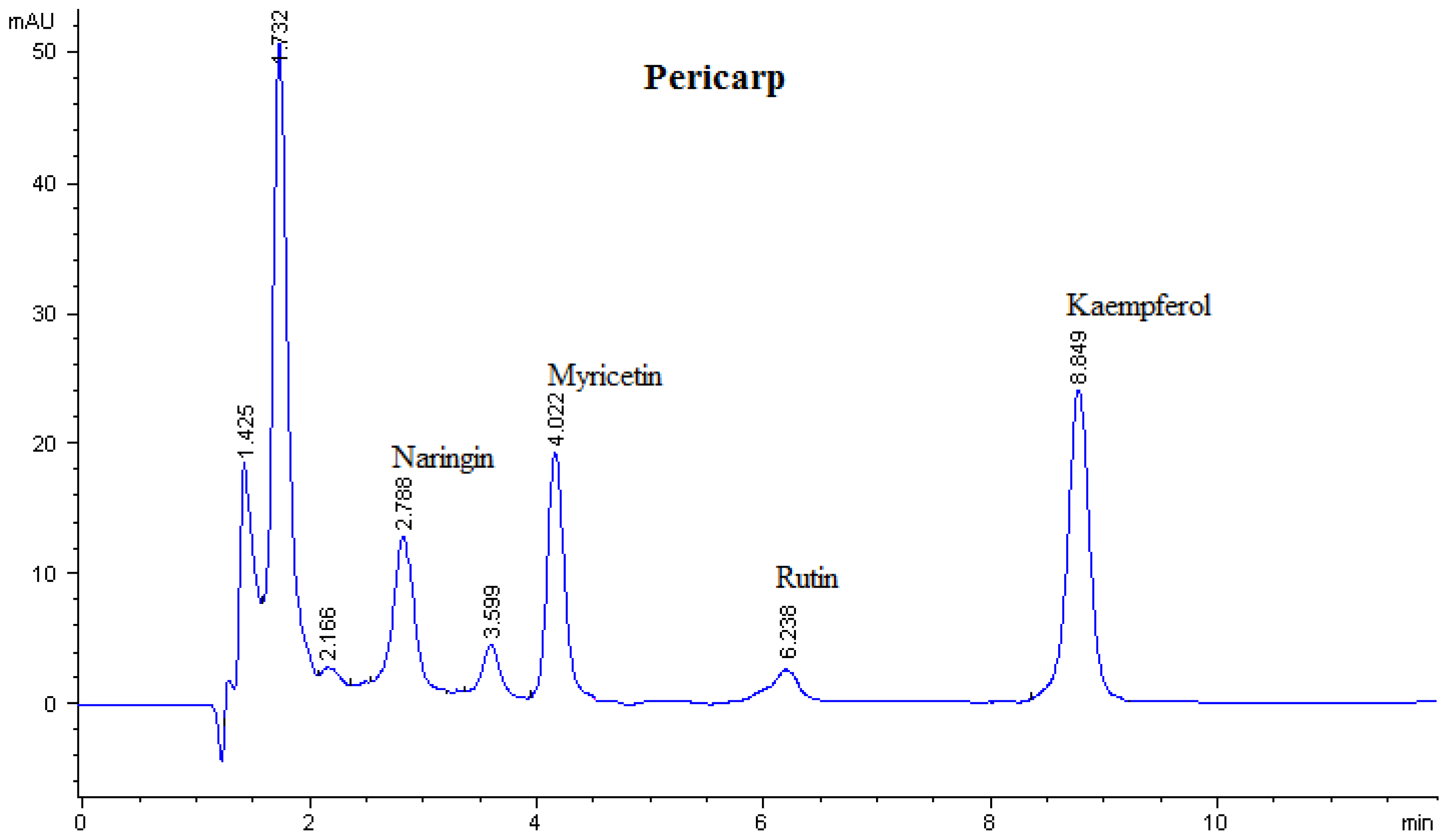
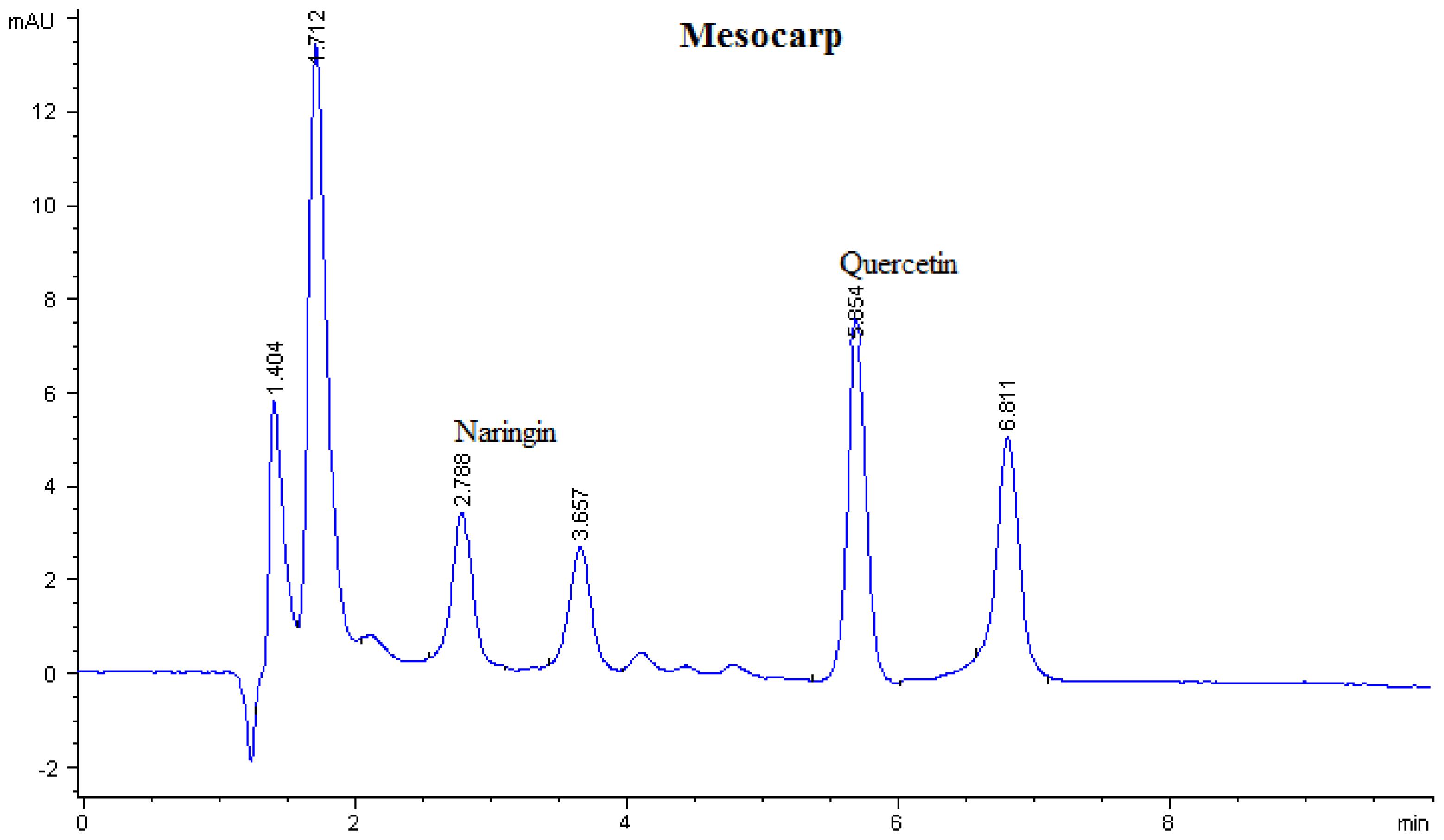
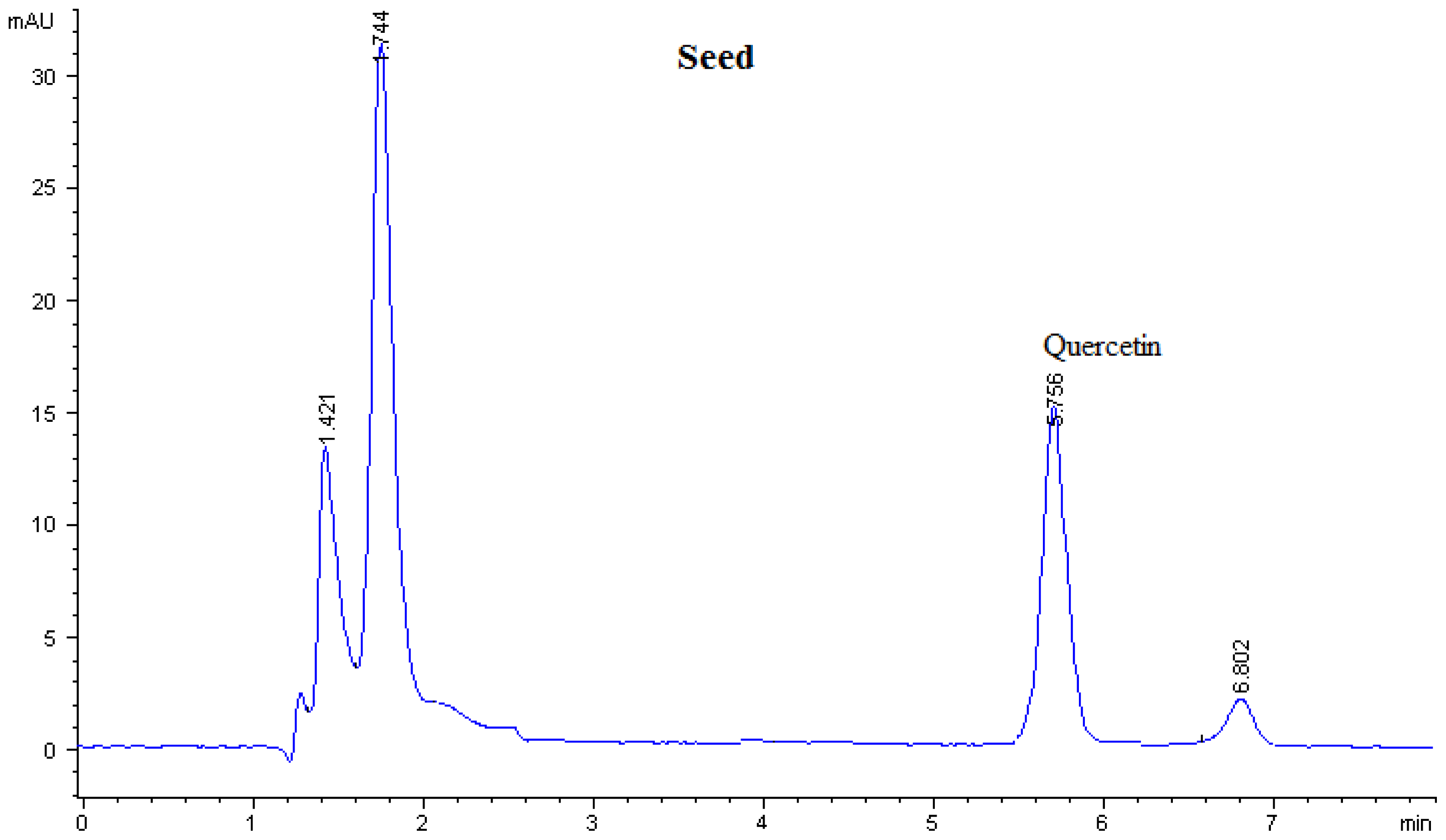
<p>Flavonoid compounds present in <italic>P. macrocarpa</italic> fruits were analyzed by using Reversed-Phase High Performance Liquid Chromatography (RP-HPLC). The flavonoid compounds have been identified according to their retention times and quantified according to their respective standard calibration curves (<xref ref-type="fig" rid="f1-ijms-12-03422">Figures 1</xref>, <xref ref-type="fig" rid="f2-ijms-12-03422">2</xref> and <xref ref-type="fig" rid="f3-ijms-12-03422">3</xref>). Kaempferol, myricetin, naringin, and rutin were found as flavonoid compounds in pericarp of <italic>P. macrocarpa</italic> fruit (<xref ref-type="table" rid="t1-ijms-12-03422">Table 1</xref>). The results also confirmed the presence of naringin and quercetin in mesocarp. Moreover, the seed of <italic>P. macrocarpa</italic> fruit contained only quercetin with the value of 0.452 mg/g dried weight (DW).</p>
<p>Among the flavonoids detected, the kaempferol content was significantly (p &lt; 0.05) higher in the pericarp extract (76 μg/g DW). This value was lower than the kaempferol value in Chinese tea leaves (1.56–3.31 mg/g dried leaves) [<xref ref-type="bibr" rid="b12-ijms-12-03422">12</xref>] but higher than in strawberries (8 μg/g dried-weight) [<xref ref-type="bibr" rid="b13-ijms-12-03422">13</xref>]. This finding was supported by Zhang <italic>et al.</italic> [<xref ref-type="bibr" rid="b3-ijms-12-03422">3</xref>] who isolated the kaempferol-3-<italic>O</italic>-β-<sc>d</sc>-glucoside from <italic>P. macrocarpa</italic> fruit.</p>
<p>Myricetin (59.90 μg/mg DW) located at the pericarp has a lower content compared with blackcurrant (71 μg/mg DW) but higher than blueberry (26 μg/mg DW) [<xref ref-type="bibr" rid="b13-ijms-12-03422">13</xref>]. The amount of naringin present at the pericarp and mesocarp (39.00 and 1.90 μg/mg DW) was found to be lower than that of citrus (3.26 mg/g DW) [<xref ref-type="bibr" rid="b14-ijms-12-03422">14</xref>]. Furthermore, rutin was detected in pericarp with a value of 17.80 μg/mg DW and it was found to be lower than citrus with a value of 3.26 mg/g DW [<xref ref-type="bibr" rid="b14-ijms-12-03422">14</xref>] and <italic>Amaranthus viridis</italic> (58.2 μg/mg DW) [<xref ref-type="bibr" rid="b15-ijms-12-03422">15</xref>]. <xref ref-type="table" rid="t1-ijms-12-03422">Table 1</xref> shows the concentration of quercetin present in mesocarp and seed with the values of 31.80 and 42.80 μg/mg DW, respectively. These values were found to be lower than the quercetin that is found in onion and garlic which is reported by Crozier <italic>et al.</italic> [<xref ref-type="bibr" rid="b16-ijms-12-03422">16</xref>] with value 201 and 227 μg/mg DW.</p></sec>
<sec>
<title>2.2. Antimicrobial Activity</title>
<p>The results obtained from antimicrobial assay are presented in <xref ref-type="table" rid="t2-ijms-12-03422">Table 2</xref> at a concentration of 0.3 mg/disc. According to <xref ref-type="table" rid="t2-ijms-12-03422">Table 2</xref>, the extracts of <italic>P. macrocarpa</italic> fruit showed variable ranges of antimicrobial activities against 8 bacteria (Gram-positive and Gram-negative).</p>
<p>In general, most of the extracts indicated weak to moderate inhibitory activities against the bacteria tested. The extract of <italic>P. macrocarpa</italic> fruits at 0.3 mg/disc showed variable inhibitory activity against all bacteria with inhibition zone diameters ranging from 0.93–2.33 cm, as shown in <xref ref-type="table" rid="t1-ijms-12-03422">Table 1</xref>. The microorganisms responses were different to the different extracts obtain from various parts of <italic>P. macrocarpa</italic> friut. Pericarp of <italic>P. macrocarpa</italic> fruit showed high inhibition on Gram-positive and Gram-negative bacteria compared to mesocarp, seed and kanamycin (1 μg/disc). In this study, it was shown that all the extracts could give higher inhibition to Gram-positive bacteria compared to Gram-negative bacteria. These results are in agreement with Othman [<xref ref-type="bibr" rid="b17-ijms-12-03422">17</xref>] that Gram-negative microorganisms are typically more resistant to antimicrobial agents than Gram-positive bacteria. This has long been explained by the presence of an outer-membrane permeability barrier in Gram-negative bacteria, which limits access of the antimicrobial agents to their targets in the bacterial cells.</p>
<p>Furthermore, all the extracts assayed indicate no activity to weak inhibitory activities against all fungi. Based on <xref ref-type="table" rid="t1-ijms-12-03422">Table 1</xref>, the antifungal activity of extracts from different parts, pericarp and mesocarp showed no antifungal activity against all fungi tested but seed extract at the concentration of 0.3 mg/well showed antifungal activity against <italic>Aspergilus. niger</italic> with inhibition 1.87 cm. This inhibition was low compared to Amphotericin B (25 μg/well). Interestingly, the tested bacteria and fungi showed different sensitivities to the different extracts of <italic>P. macrocarpa</italic> fruit. These results might be due to the presence of phytochemical in seeds such as phorbol esters. Borris <italic>et al.</italic> [<xref ref-type="bibr" rid="b18-ijms-12-03422">18</xref>] mentioned that <italic>Phaleria</italic> sp. contain phorbol esters which are present in the seed of the fruit. Saetae and Suntornsuk stated that phorbol esters were found to be responsible for fungal growth inhibition in the crude extract of <italic>Jatropha curcas</italic> seed cake.</p>
<p>Antimicrobial activities observed in this study might be due to the presence of flavonoid compounds. Extracts of various medicinal plants containing phenolic and flavonoids have been previously reported to possess antimicrobial activity [<xref ref-type="bibr" rid="b19-ijms-12-03422">19</xref>,<xref ref-type="bibr" rid="b20-ijms-12-03422">20</xref>]. Vaquero <italic>et al.</italic> [<xref ref-type="bibr" rid="b21-ijms-12-03422">21</xref>] investigated the properties of gallic, caffeic, vanillic acid, rutin, and quercetin of different wine against pathogenic microorganisms. <italic>Escherichia coli</italic> were the most sensitive bacterium and <italic>Flavobacterium</italic> sp. was resistant against all phenolic compounds tested. The flavonoid analyses (<xref ref-type="table" rid="t1-ijms-12-03422">Table 1</xref>) revealed the presence of kaempferol, myricetin, naringin, quercetin and rutin in <italic>P. macrocarpa</italic> fruit. The presence of these compounds might contribute to antimicrobial activity of <italic>P. macrocarpa</italic> fruit since Cushnie and Lamb [<xref ref-type="bibr" rid="b11-ijms-12-03422">11</xref>] reported that kaempferol, myricetin, naringin, quercetin and rutin have antimicrobial activity against human pathogenic microorganisms with some mechanisms of action such as inhibition of nucleic acid synthesis, cytoplasmic membrane function and energy metabolisms. The antimicrobial activity of the extracts of <italic>P. macrocarpa</italic> fruit might be due to one of the mechanisms of action mentioned above. Antimicrobial activity from pericarp, mesocarp, and seed of <italic>P. macrocarpa</italic> fruit might be due to the presence of kaempferol, myricetin, naringin, quercetin and rutin. Teffo <italic>et al.</italic> [<xref ref-type="bibr" rid="b22-ijms-12-03422">22</xref>] isolated four kaempferols from <italic>Dodonaea viscosa</italic> Jacq. var. <italic>angustifolia</italic> leaf extracts and applied them to some human phatogenic bacteria. The results showed that all isolated kaempferols could inhibit growth rate of <italic>Staphylococcus aureus, Enterococcus faecalis, E. coli</italic> and <italic>Pseudomonas aeruginosa</italic>. In addition, Demetzos <italic>et al.</italic> [<xref ref-type="bibr" rid="b23-ijms-12-03422">23</xref>] investigated the antimicrobial activity of myricetin and its derivate and the results showed that they could inhibit Gram-positive bacteria compared to Gram-negative. Furthermore, Li, Xu and Mandalari <italic>et al.</italic> [<xref ref-type="bibr" rid="b24-ijms-12-03422">24</xref>,<xref ref-type="bibr" rid="b25-ijms-12-03422">25</xref>] mentioned that quercetin and naringin have antimicrobial activity.</p>
<p>The results of the present study are quite encouraging as almost all of extracts exhibited antimicrobial activity against most of the pathogens. However, the antimicrobial activity varies widely, depending on the microorganism.</p></sec></sec>
<sec sec-type="methods">
<title>3. Experimental Methods</title>
<sec sec-type="materials">
<title>3.1. Plant Materials</title>
<p>The fruits of <italic>P. macorcarpa</italic> were obtained from Faculty of Mathematic and Natural Sciences, University of Riau, Riau province, Indonesia. The plant species was identified by the laboratory of Plant Taxonomy staff at Herbarium Bogoriense, Bogor, Indonesia. The voucher specimen (SA1611/2008) was deposited at Herbarium Bogoriense, Bogor, Indonesia. The fruits were washed and separated into pericarp, mesocarp and seed. Those parts were air-dried for 7 days and kept for further analyses.</p></sec>
<sec>
<title>3.2. Extraction</title>
<p>The extractions of <italic>P. macrocarpa</italic> were carried out based on Crozier <italic>et al.</italic> [<xref ref-type="bibr" rid="b16-ijms-12-03422">16</xref>] with some modification. Air-dried powders of each part of <italic>P. macrocarpa</italic> (0.5 g) were weighed and placed into a 100 mL conical flask. 40 mL of methanol was added, followed by 10 mL and 6 M HCL solution. The mixture was stirred using a magnetic stirrer. The mixture was placed in a sample flask (250 mL), attached to reflux for 2 h at 90 °C, then the mixture was filtered using Whatman No.1 filter paper (Whatman, England), and taken to dryness by using a vacuumed Rotary Evaporator (Buchii, Switzerland) at 40 °C.</p></sec>
<sec>
<title>3.3. Determination of Flavonoid Compounds by HPLC</title>
<p>The flavonoid compounds of different parts of <italic>P. macrocarpa</italic> fruit were quantitatively measured by a reversed-phase HPLC technique based on the method described by Crozier <italic>et al.</italic> [<xref ref-type="bibr" rid="b16-ijms-12-03422">16</xref>]. Flavonoid compounds standards consisted of quercetin, rutin, myricetin, kaempferol, naringin, apigenin, and luteolin. an aliquot of sample extract was loaded on a high-performance liquid chromatography (HPLC) Agilent-1200 series instrument equipped with a UV-Vis photodiode array (DAD) detector, binary pump, vacuum degasser, auto sampler and analytical column (Nova-Pak<sup>®</sup> C18 60Å 4 μm 3.9 × 150 mm, Waters, NANPA, MA, USA). The mobile phase comprises deionized water and acetonitrile. The pH of water was adjusted to 2.5 with trifluoroacetic acid. The flavonoid compounds were detected at 365 nm. The column was equilibrated by 100% solvent A (15% acetonitrile) then the ratio of solvent B (35% acetonitrile) was increased to 100% in 20 min. This ratio was maintained for the rest of the analysis with a flow rate of 1 mL/min.</p></sec>
<sec>
<title>3.4. Antimicrobial Activity</title>
<sec>
<title>3.4.1. Bacteria and Fungi Cultures</title>
<p>The Gram-negative and -positive bacteria (Bacillus cereus, Bacillus subtilis, Enterobacter aerogenes, E. coli, Klebsiella pneumonie, Micrococcus luteus, P. aeruginosa, and S. aureus), fungi (A. niger, Fusarium oxysporum, Ganoderma lucidum, and Mucor indicus) were all purchased from the Institute of Malaysian Research (IMR) and maintained in the Department of Microbiology, Faculty of Biotechnology and Biomolecular Sciences, Universiti Putra Malaysia.</p></sec>
<sec>
<title>3.4.2. Bacterial Susceptibility Testing</title>
<p>The antibacterial assay of <italic>P. macrocarpa</italic> fruit extracts was carried out by the disc diffusion method [<xref ref-type="bibr" rid="b26-ijms-12-03422">26</xref>]. All the microorganisms mentioned above were incubated at 37 °C for 24 h by inoculation into nutrient broth. The culture suspensions were prepared and adjusted to approximately 10<sup>5</sup> c.f.u. of bacteria/mL. One hundred microliters of the inoculate were spread over plates containing sterile nutrient agar. Paper filter discs (6 mm) impregnated with 10 μL (0.30 mg/disc) of each extract were placed on the surface of the media. The plates were left for 30 min at room temperature to allow the diffusion of the extracts and incubated at 37 °C for 24 h. Finally, the inhibition zone around the disc was measured. Kanamycin (1 μg/disc) was also included in the test as a reference control to evaluate the susceptibility of tested strains. The experiments were run in triplicate.</p></sec>
<sec>
<title>3.4.3. Fungi Susceptibility Testing</title>
<p>The antfungal assays of <italic>Phaleria macrocarpa</italic> fruit extracts were carried out by the agar well diffusion assay [<xref ref-type="bibr" rid="b27-ijms-12-03422">27</xref>]. Briefly, a suspension of the tested fungi was prepared (10<sup>5</sup> spore/mL), added 100 μL into agar plate and dispensed uniformly in the surface of the agar plate. The small wells were cut in the agar plate using a cork borer (6 mm). A fixed volume of extracts (0.3 mg/well) and (25 μg/well) Amphotericin B (PAA Lab., Cölbe, Germany) were loaded in the wells. The plates were incubated at 29 °C for 72 h and the diameter of the inhibition zone around each well was recorded.</p></sec></sec></sec>
<sec sec-type="conclusions">
<title>4. Conclusions</title>
<p>This study showed that <italic>P. macrocarpa</italic> fruit contained kaempferol, myricetin, naringin, and rutin as flavonoids. Moreover pericarp, mesocarp, and seed extract were potent as antimicrobial agents. The presence of flavonoids could contribute to its antimicrobial activities. It is suggested that <italic>P. macrocarpa</italic> fruit could be considered as source of antimicrobial agent which might be applied in pharmaceutical and cosmetic products.</p></sec></body>
<back>
<ack>
<title>Acknowledgements</title>
<p>The author would like to thank the Faculty of Biotechnology and Biomolecular Sciences, Universiti Putra Malaysia for the laboratory facilities and Faculty of Mathematic and Natural Sciences, University of Riau for providing the samples.</p></ack>
<ref-list>
<title>References</title>
<ref id="b1-ijms-12-03422"><label>1</label><citation citation-type="book"><person-group person-group-type="author"><name><surname>Backer</surname><given-names>C</given-names></name><name><surname>van den Brink</surname><given-names>R</given-names></name></person-group><source>Flora of Java (Spermatophytes Only)</source><publisher-loc>Noordhoff</publisher-loc><publisher-name>Groningen, The Netherlands</publisher-name><year>1965</year><volume>II</volume></citation></ref>
<ref id="b2-ijms-12-03422"><label>2</label><citation citation-type="journal"><person-group person-group-type="author"><name><surname>Steffan</surname><given-names>B</given-names></name><name><surname>Watjen</surname><given-names>W</given-names></name><name><surname>Michels</surname><given-names>G</given-names></name><name><surname>Niering</surname><given-names>P</given-names></name><name><surname>Wray</surname><given-names>V</given-names></name><name><surname>Ebel</surname><given-names>R</given-names></name><name><surname>Edrada</surname><given-names>R</given-names></name><name><surname>Kahl</surname><given-names>R</given-names></name><name><surname>Proksch</surname><given-names>P</given-names></name></person-group><article-title>Polyphenols from plants used in traditional Indonesian medicine (Jamu): Uptake and antioxidative effects in rat H4IIE hepatoma cells</article-title><source>J. Pharm. Pharmacol</source><year>2005</year><volume>57</volume><fpage>233</fpage><lpage>240</lpage><pub-id pub-id-type="doi">10.1211/0022357055317</pub-id><pub-id pub-id-type="pmid">15720788</pub-id></citation></ref>
<ref id="b3-ijms-12-03422"><label>3</label><citation citation-type="journal"><person-group person-group-type="author"><name><surname>Zhang</surname><given-names>Y</given-names></name><name><surname>Xu</surname><given-names>X</given-names></name><name><surname>Liu</surname><given-names>H</given-names></name></person-group><article-title>Chemical constituents from <italic>Mahkota dewa</italic></article-title><source>J. Asian Nat. Prod. Res</source><year>2006</year><volume>8</volume><fpage>119</fpage><lpage>123</lpage><pub-id pub-id-type="doi">10.1080/10286020500480472</pub-id><pub-id pub-id-type="pmid">16753792</pub-id></citation></ref>
<ref id="b4-ijms-12-03422"><label>4</label><citation citation-type="journal"><person-group person-group-type="author"><name><surname>Oshimi</surname><given-names>S</given-names></name><name><surname>Zaima</surname><given-names>K</given-names></name><name><surname>Matsuno</surname><given-names>Y</given-names></name><name><surname>Hirasawa</surname><given-names>Y</given-names></name><name><surname>Iizuka</surname><given-names>T</given-names></name><name><surname>Studiawan</surname><given-names>H</given-names></name><name><surname>Indrayanto</surname><given-names>G</given-names></name><name><surname>Zaini</surname><given-names>NC</given-names></name><name><surname>Morita</surname><given-names>H</given-names></name></person-group><article-title>Studies on the constituents from the fruits of <italic>Phaleria macrocarpa</italic></article-title><source>J. Nat. Med</source><year>2008</year><volume>62</volume><fpage>207</fpage><lpage>210</lpage><pub-id pub-id-type="doi">10.1007/s11418-007-0209-9</pub-id><pub-id pub-id-type="pmid">18404325</pub-id></citation></ref>
<ref id="b5-ijms-12-03422"><label>5</label><citation citation-type="journal"><person-group person-group-type="author"><name><surname>Hakim</surname><given-names>R</given-names></name><name><surname>Nawawi</surname><given-names>A</given-names></name><name><surname>Adnyana</surname><given-names>I</given-names></name><name><surname>Achmad</surname><given-names>S</given-names></name><name><surname>Makmur</surname><given-names>E</given-names></name><name><surname>Hakim</surname><given-names>E</given-names></name><name><surname>Syah</surname><given-names>Y</given-names></name><name><surname>Kitajima</surname><given-names>M</given-names></name></person-group><article-title>Benzophenone glucoside from red fruit <italic>Phaleria macrocarpa</italic> and test the activity against DPPH and murine leukemia cells P-388</article-title><source>Bull. Soc. Nat. Prod. Chem</source><year>2004</year><volume>4</volume><fpage>67</fpage><lpage>70</lpage></citation></ref>
<ref id="b6-ijms-12-03422"><label>6</label><citation citation-type="journal"><person-group person-group-type="author"><name><surname>Kusmaardiyani</surname><given-names>S</given-names></name><name><surname>Nawawi</surname><given-names>A</given-names></name><name><surname>Rahmi</surname><given-names>K</given-names></name></person-group><article-title>Isolation of benzophenone from <italic>Phaleria macrocarpa</italic> (Scheff.) Boerl. (Thymelaeaceae) leaf</article-title><source>Acta Pharm. Indones</source><year>2004</year><volume>29</volume><fpage>150</fpage><lpage>152</lpage></citation></ref>
<ref id="b7-ijms-12-03422"><label>7</label><citation citation-type="journal"><person-group person-group-type="author"><name><surname>Ao</surname><given-names>C</given-names></name><name><surname>Li</surname><given-names>A</given-names></name><name><surname>Elzaawely</surname><given-names>AA</given-names></name><name><surname>Xuan</surname><given-names>TD</given-names></name><name><surname>Tawata</surname><given-names>S</given-names></name></person-group><article-title>Evaluation of antioxidant and antibacterial activities of <italic>Ficus microcarpa</italic> L. fil. extract</article-title><source>Food Control</source><year>2008</year><volume>19</volume><fpage>940</fpage><lpage>948</lpage><pub-id pub-id-type="doi">10.1016/j.foodcont.2007.09.007</pub-id></citation></ref>
<ref id="b8-ijms-12-03422"><label>8</label><citation citation-type="journal"><person-group person-group-type="author"><name><surname>Cragg</surname><given-names>G</given-names></name><name><surname>Newman</surname><given-names>D</given-names></name><name><surname>Snader</surname><given-names>K</given-names></name></person-group><article-title>Natural products in drug discovery and development</article-title><source>J. Nat. Prod</source><year>1997</year><volume>60</volume><fpage>52</fpage><lpage>60</lpage><pub-id pub-id-type="doi">10.1021/np9604893</pub-id><pub-id pub-id-type="pmid">9014353</pub-id></citation></ref>
<ref id="b9-ijms-12-03422"><label>9</label><citation citation-type="journal"><person-group person-group-type="author"><name><surname>Manian</surname><given-names>R</given-names></name><name><surname>Anusuya</surname><given-names>N</given-names></name><name><surname>Siddhuraju</surname><given-names>P</given-names></name><name><surname>Manian</surname><given-names>S</given-names></name></person-group><article-title>The antioxidant activity and free radical scavenging potential of two different solvent extracts of <italic>Camellia sinensis</italic> (L.) O. Kuntz, <italic>Ficus bengalensis</italic> L. and <italic>Ficus racemosa</italic> L</article-title><source>Food Chem</source><year>2008</year><volume>107</volume><fpage>1000</fpage><lpage>1007</lpage><pub-id pub-id-type="doi">10.1016/j.foodchem.2007.09.008</pub-id></citation></ref>
<ref id="b10-ijms-12-03422"><label>10</label><citation citation-type="journal"><person-group person-group-type="author"><name><surname>Cowan</surname><given-names>M</given-names></name></person-group><article-title>Plant products as antimicrobial agents</article-title><source>Clin. Microbiol. Rev</source><year>1999</year><volume>12</volume><fpage>564</fpage><pub-id pub-id-type="pmid">10515903</pub-id></citation></ref>
<ref id="b11-ijms-12-03422"><label>11</label><citation citation-type="journal"><person-group person-group-type="author"><name><surname>Cushnie</surname><given-names>TPT</given-names></name><name><surname>Lamb</surname><given-names>AJ</given-names></name></person-group><article-title>Antimicrobial activity of flavonoids</article-title><source>Int. J. Antimicrob. Agents</source><year>2005</year><volume>26</volume><fpage>343</fpage><lpage>356</lpage><pub-id pub-id-type="doi">10.1016/j.ijantimicag.2005.09.002</pub-id><pub-id pub-id-type="pmid">16323269</pub-id></citation></ref>
<ref id="b12-ijms-12-03422"><label>12</label><citation citation-type="journal"><person-group person-group-type="author"><name><surname>Wang</surname><given-names>H</given-names></name><name><surname>Helliwell</surname><given-names>K</given-names></name></person-group><article-title>Determination of flavonols in green and black tea leaves and green tea infusions by high-performance liquid chromatography</article-title><source>Food Res. Int</source><year>2001</year><volume>34</volume><fpage>223</fpage><lpage>227</lpage><pub-id pub-id-type="doi">10.1016/S0963-9969(00)00156-3</pub-id></citation></ref>
<ref id="b13-ijms-12-03422"><label>13</label><citation citation-type="journal"><person-group person-group-type="author"><name><surname>Hakkinen</surname><given-names>S</given-names></name><name><surname>Karenlampi</surname><given-names>S</given-names></name><name><surname>Heinonen</surname><given-names>I</given-names></name><name><surname>Mykkanen</surname><given-names>H</given-names></name><name><surname>Torronen</surname><given-names>A</given-names></name></person-group><article-title>Content of the flavonols quercetin, myricetin, and kaempferol in 25 edible berries</article-title><source>J. Agr. Food. Chem</source><year>1999</year><volume>47</volume><fpage>2274</fpage><lpage>2279</lpage><pub-id pub-id-type="doi">10.1021/jf9811065</pub-id></citation></ref>
<ref id="b14-ijms-12-03422"><label>14</label><citation citation-type="journal"><person-group person-group-type="author"><name><surname>De Lourdes Mata Bilbao</surname><given-names>M</given-names></name><name><surname>Andrés-Lacueva</surname><given-names>C</given-names></name><name><surname>Jáuregui</surname><given-names>O</given-names></name><name><surname>Lamuela-Raventós</surname><given-names>RM</given-names></name></person-group><article-title>Determination of flavonoids in a Citrus fruit extract by LC-DAD and LC-MS</article-title><source>Food Chem</source><year>2007</year><volume>101</volume><fpage>1742</fpage><lpage>1747</lpage><pub-id pub-id-type="doi">10.1016/j.foodchem.2006.01.032</pub-id></citation></ref>
<ref id="b15-ijms-12-03422"><label>15</label><citation citation-type="journal"><person-group person-group-type="author"><name><surname>Kumar</surname><given-names>B</given-names></name><name><surname>Lakshman</surname><given-names>K</given-names></name><name><surname>Jayaveera</surname><given-names>K</given-names></name><name><surname>Krishna</surname><given-names>N</given-names></name><name><surname>Manjunath</surname><given-names>M</given-names></name><name><surname>Suresh</surname><given-names>M</given-names></name></person-group><article-title>Estimation of rutin and quercetin in <italic>Amaranthus viridis</italic> Linn by HPLC</article-title><source>Asian J. Exp. Sci</source><year>2009</year><volume>23</volume><fpage>51</fpage><lpage>54</lpage></citation></ref>
<ref id="b16-ijms-12-03422"><label>16</label><citation citation-type="journal"><person-group person-group-type="author"><name><surname>Crozier</surname><given-names>A</given-names></name><name><surname>Jensen</surname><given-names>E</given-names></name><name><surname>Lean</surname><given-names>MEJ</given-names></name><name><surname>McDonald</surname><given-names>MS</given-names></name></person-group><article-title>Quantitative analysis of flavonoids by reversed-phase high-performance liquid chromatography</article-title><source>J. Chromatogr. A</source><year>1997</year><volume>761</volume><fpage>315</fpage><lpage>321</lpage><pub-id pub-id-type="doi">10.1016/S0021-9673(96)00826-6</pub-id></citation></ref>
<ref id="b17-ijms-12-03422"><label>17</label><citation citation-type="book"><person-group person-group-type="author"><name><surname>Othman</surname><given-names>F</given-names></name></person-group><source>Chemical Constituents and Biological Activities of Flavonoids from Hydroponically Grown Pegaga (Centella asiatica, Linn. Urban) Extracts</source><publisher-name>Universiti Putra Malaysia</publisher-name><publisher-loc>Serdang, Malaysia</publisher-loc><year>2003</year></citation></ref>
<ref id="b18-ijms-12-03422"><label>18</label><citation citation-type="journal"><person-group person-group-type="author"><name><surname>Borris</surname><given-names>R</given-names></name><name><surname>Blaskó</surname><given-names>G</given-names></name><name><surname>Cordell</surname><given-names>G</given-names></name></person-group><article-title>Ethnopharmacologic and phytochemical studies of the Thymelaeaceae</article-title><source>J. Ethnopharmacol</source><year>1988</year><volume>24</volume><fpage>41</fpage><lpage>91</lpage><pub-id pub-id-type="doi">10.1016/0378-8741(88)90138-9</pub-id><pub-id pub-id-type="pmid">3059068</pub-id></citation></ref>
<ref id="b19-ijms-12-03422"><label>19</label><citation citation-type="journal"><person-group person-group-type="author"><name><surname>Ayaz</surname><given-names>F</given-names></name><name><surname>HayIrlIoglu-Ayaz</surname><given-names>S</given-names></name><name><surname>Alpay-Karaoglu</surname><given-names>S</given-names></name><name><surname>Gruz</surname><given-names>J</given-names></name><name><surname>Valentová</surname><given-names>K</given-names></name><name><surname>Ulrichová</surname><given-names>J</given-names></name><name><surname>Strnad</surname><given-names>M</given-names></name></person-group><article-title>Phenolic acid contents of kale (<italic>Brassica oleraceae</italic> L. var. <italic>acephala</italic> DC.) extracts and their antioxidant and antibacterial activities</article-title><source>Food Chem</source><year>2008</year><volume>107</volume><fpage>19</fpage><lpage>25</lpage><pub-id pub-id-type="doi">10.1016/j.foodchem.2007.07.003</pub-id></citation></ref>
<ref id="b20-ijms-12-03422"><label>20</label><citation citation-type="journal"><person-group person-group-type="author"><name><surname>Rahman</surname><given-names>M</given-names></name><name><surname>Moon</surname><given-names>S</given-names></name></person-group><article-title>Antimicrobial phenolic derivatives from <italic>Dendranthema zawadskii</italic> var. <italic>latilobum kitamura</italic> (Asteraceae)</article-title><source>Arch. Pharm. Res</source><year>2007</year><volume>30</volume><fpage>1374</fpage><lpage>1379</lpage><pub-id pub-id-type="doi">10.1007/BF02977359</pub-id><pub-id pub-id-type="pmid">18087803</pub-id></citation></ref>
<ref id="b21-ijms-12-03422"><label>21</label><citation citation-type="journal"><person-group person-group-type="author"><name><surname>Vaquero</surname><given-names>MJR</given-names></name><name><surname>Alberto</surname><given-names>MR</given-names></name><name><surname>de Nadra</surname><given-names>MCM</given-names></name></person-group><article-title>Antibacterial effect of phenolic compounds from different wines</article-title><source>Food Control</source><year>2007</year><volume>18</volume><fpage>93</fpage><lpage>101</lpage><pub-id pub-id-type="doi">10.1016/j.foodcont.2005.08.010</pub-id></citation></ref>
<ref id="b22-ijms-12-03422"><label>22</label><citation citation-type="journal"><person-group person-group-type="author"><name><surname>Teffo</surname><given-names>L</given-names></name><name><surname>Aderogba</surname><given-names>M</given-names></name><name><surname>Eloff</surname><given-names>J</given-names></name></person-group><article-title>Antibacterial and antioxidant activities of four kaempferol methyl ethers isolated from <italic>Dodonaea viscosa</italic> Jacq. var. <italic>angustifolia</italic> leaf extracts</article-title><source>S. Afr. J. Bot</source><year>2010</year><volume>76</volume><fpage>25</fpage><lpage>29</lpage><pub-id pub-id-type="doi">10.1016/j.sajb.2009.06.010</pub-id></citation></ref>
<ref id="b23-ijms-12-03422"><label>23</label><citation citation-type="journal"><person-group person-group-type="author"><name><surname>Demetzos</surname><given-names>C</given-names></name><name><surname>Angelopoulou</surname><given-names>D</given-names></name><name><surname>Kolocouris</surname><given-names>A</given-names></name><name><surname>Daliani</surname><given-names>I</given-names></name><name><surname>Mavromoustakos</surname><given-names>T</given-names></name></person-group><article-title>Structure elucidation, conformational analysis and thermal effects on membrane bilayers of an antimicrobial myricetin ether derivative</article-title><source>J. Heterocycl. Chem</source><year>2001</year><volume>38</volume><fpage>703</fpage><lpage>710</lpage><pub-id pub-id-type="doi">10.1002/jhet.5570380327</pub-id></citation></ref>
<ref id="b24-ijms-12-03422"><label>24</label><citation citation-type="journal"><person-group person-group-type="author"><name><surname>Li</surname><given-names>M</given-names></name><name><surname>Xu</surname><given-names>Z</given-names></name></person-group><article-title>Quercetin in a lotus leaves extract may be responsible for antibacterial activity</article-title><source>Arch. Pharm. Res</source><year>2008</year><volume>31</volume><fpage>640</fpage><lpage>644</lpage><pub-id pub-id-type="doi">10.1007/s12272-001-1206-5</pub-id><pub-id pub-id-type="pmid">18481022</pub-id></citation></ref>
<ref id="b25-ijms-12-03422"><label>25</label><citation citation-type="journal"><person-group person-group-type="author"><name><surname>Mandalari</surname><given-names>G</given-names></name><name><surname>Bennett</surname><given-names>R</given-names></name><name><surname>Bisignano</surname><given-names>G</given-names></name><name><surname>Trombetta</surname><given-names>D</given-names></name><name><surname>Saija</surname><given-names>A</given-names></name><name><surname>Faulds</surname><given-names>C</given-names></name><name><surname>Gasson</surname><given-names>M</given-names></name><name><surname>Narbad</surname><given-names>A</given-names></name></person-group><article-title>Antimicrobial activity of flavonoids extracted from bergamot (<italic>Citrus bergamia</italic> Risso) peel, a byproduct of the essential oil industry</article-title><source>J. Appl. Microbiol</source><year>2007</year><volume>103</volume><fpage>2056</fpage><lpage>2064</lpage><pub-id pub-id-type="doi">10.1111/j.1365-2672.2007.03456.x</pub-id><pub-id pub-id-type="pmid">18045389</pub-id></citation></ref>
<ref id="b26-ijms-12-03422"><label>26</label><citation citation-type="journal"><person-group person-group-type="author"><name><surname>Boussaada</surname><given-names>O</given-names></name><name><surname>Chriaa</surname><given-names>J</given-names></name><name><surname>Nabli</surname><given-names>R</given-names></name><name><surname>Ammar</surname><given-names>S</given-names></name><name><surname>Saidana</surname><given-names>D</given-names></name><name><surname>Mahjoub</surname><given-names>M</given-names></name><name><surname>Chraeif</surname><given-names>I</given-names></name><name><surname>Helal</surname><given-names>A</given-names></name><name><surname>Mighri</surname><given-names>Z</given-names></name></person-group><article-title>Antimicrobial and antioxidant activities of methanol extracts of <italic>Evax pygmaea</italic> (Asteraceae) growing wild in Tunisia</article-title><source>World J. Microb. Biot</source><year>2008</year><volume>24</volume><fpage>1289</fpage><lpage>1296</lpage><pub-id pub-id-type="doi">10.1007/s11274-007-9600-7</pub-id></citation></ref>
<ref id="b27-ijms-12-03422"><label>27</label><citation citation-type="journal"><person-group person-group-type="author"><name><surname>Quiroga</surname><given-names>E</given-names></name><name><surname>Sampietro</surname><given-names>A</given-names></name><name><surname>Vattuone</surname><given-names>M</given-names></name></person-group><article-title>Screening antifungal activities of selected medicinal plants</article-title><source>J. Ethnopharmacol</source><year>2001</year><volume>74</volume><fpage>89</fpage><lpage>96</lpage><pub-id pub-id-type="doi">10.1016/S0378-8741(00)00350-0</pub-id><pub-id pub-id-type="pmid">11137353</pub-id></citation></ref></ref-list>
<sec sec-type="display-objects">
<title>Figures and Tables</title>
<fig id="f1-ijms-12-03422" position="float">
<label>Figure 1</label>
<caption>
<p>Flavonoids content of pericarp of <italic>P. macrocarpa</italic> analysed by HPLC at the wavelength of 365 nm.</p></caption>
<graphic xlink:href="ijms-12-03422f1.gif"/></fig>
<fig id="f2-ijms-12-03422" position="float">
<label>Figure 2</label>
<caption>
<p>Flavonoids content of mesocarp of <italic>P. macrocarpa</italic> analysed by HPLC at the wavelength of 365 nm.</p></caption>
<graphic xlink:href="ijms-12-03422f2.gif"/></fig>
<fig id="f3-ijms-12-03422" position="float">
<label>Figure 3</label>
<caption>
<p>Flavonoids content of seed of <italic>P. macrocarpa</italic> analysed by HPLC at the wavelength of 365 nm.</p></caption>
<graphic xlink:href="ijms-12-03422f3.gif"/></fig>
<table-wrap id="t1-ijms-12-03422" position="float">
<label>Table 1</label>
<caption>
<p>Contents of flavonoids compounds in pericarp, mesocarp, and seed of <italic>P. macrocarpa</italic> fruit.</p></caption>
<table frame="hsides" rules="groups">
<thead>
<tr>
<th align="center" valign="middle" rowspan="2">Sample</th>
<th colspan="7" align="center" valign="bottom">Flavonoid contents (μg/g DW)
<hr/></th></tr>
<tr>
<th align="center" valign="bottom">Apigenin</th>
<th align="center" valign="bottom">Kaempferol</th>
<th align="center" valign="bottom">Luteolin</th>
<th align="center" valign="bottom">Myricetin</th>
<th align="center" valign="bottom">Naringin</th>
<th align="center" valign="bottom">Quercetin</th>
<th align="center" valign="bottom">Rutin</th></tr></thead>
<tbody>
<tr>
<td align="center" valign="top">Pericarp</td>
<td align="center" valign="top">-</td>
<td align="center" valign="top">76.00 ± 0.003</td>
<td align="center" valign="top">-</td>
<td align="center" valign="top">59.90 ± 0.001</td>
<td align="center" valign="top">39.80 ± 0.001</td>
<td align="center" valign="top">-</td>
<td align="center" valign="top">17.80 ± 0.001</td></tr>
<tr>
<td align="center" valign="top">Mesocarp</td>
<td align="center" valign="top">-</td>
<td align="center" valign="top">1.90</td>
<td align="center" valign="top">31.80 ± 0.002</td>
<td align="center" valign="top">-</td></tr>
<tr>
<td align="center" valign="top">Seed</td>
<td align="center" valign="top">-</td>
<td align="center" valign="top">45.20 ± 0.003</td>
<td align="center" valign="top">-</td></tr></tbody></table>
<table-wrap-foot><fn id="tfn1-ijms-12-03422">
<p>-Not detected; analysis were done in triplicate.</p></fn></table-wrap-foot></table-wrap>
<table-wrap id="t2-ijms-12-03422" position="float">
<label>Table 2</label>
<caption>
<p>Antimicrobial activity of extracts obtained from various parts of <italic>P. macrocarpa</italic> fruit.</p></caption>
<table frame="hsides" rules="groups">
<thead>
<tr>
<th align="center" valign="middle" rowspan="2">Microorganisms</th>
<th colspan="5" align="center" valign="bottom">Inhibition zone (cm)<xref ref-type="table-fn" rid="tfn2-ijms-12-03422">*</xref>
<hr/></th></tr>
<tr>
<th align="center" valign="middle">Pericarp</th>
<th align="center" valign="middle">Mesocarp</th>
<th align="center" valign="middle">Seed</th>
<th align="center" valign="middle">Kanamycin (1 μg/disc)</th>
<th align="center" valign="middle">Amphotericin B (25 μg/well)</th></tr></thead>
<tbody>
<tr>
<td colspan="6" align="left" valign="top"><bold>Gram-Positive Bacteria</bold></td></tr>
<tr>
<td align="left" valign="top"><italic>B. cereus</italic></td>
<td align="center" valign="top">1.73</td>
<td align="center" valign="top">1.53</td>
<td align="center" valign="top">1.40</td>
<td align="center" valign="top">1.63</td>
<td align="center" valign="top">-</td></tr>
<tr>
<td align="left" valign="top"><italic>B. subtilis</italic></td>
<td align="center" valign="top">2.33</td>
<td align="center" valign="top">2.00</td>
<td align="center" valign="top">1.83</td>
<td align="center" valign="top">1.33</td>
<td align="center" valign="top">-</td></tr>
<tr>
<td align="left" valign="top"><italic>M. luteus</italic></td>
<td align="center" valign="top">1.57</td>
<td align="center" valign="top">1.47</td>
<td align="center" valign="top">1.37</td>
<td align="center" valign="top">1.35</td>
<td align="center" valign="top">-</td></tr>
<tr>
<td align="left" valign="top"><italic>S. aureus</italic></td>
<td align="center" valign="top">1.53</td>
<td align="center" valign="top">1.73</td>
<td align="center" valign="top">1.40</td>
<td align="center" valign="top">1.35</td>
<td align="center" valign="top">-</td></tr>
<tr>
<td align="left" valign="top">Average</td>
<td align="center" valign="top">1.79</td>
<td align="center" valign="top">1.68</td>
<td align="center" valign="top">1.50</td>
<td align="center" valign="top">1.42</td>
<td align="center" valign="top">-</td></tr>
<tr>
<td colspan="6" align="left" valign="top"><bold>Gram-Negative Bacteria</bold></td></tr>
<tr>
<td align="left" valign="top"><italic>E. aerogenes</italic></td>
<td align="center" valign="top">1.50</td>
<td align="center" valign="top">1.30</td>
<td align="center" valign="top">1.20</td>
<td align="center" valign="top">1.55</td>
<td align="center" valign="top">-</td></tr>
<tr>
<td align="left" valign="top"><italic>E. coli</italic></td>
<td align="center" valign="top">2.17</td>
<td align="center" valign="top">1.47</td>
<td align="center" valign="top">1.73</td>
<td align="center" valign="top">-</td></tr>
<tr>
<td align="left" valign="top"><italic>K. pnuomoniae</italic></td>
<td align="center" valign="top">1.23</td>
<td align="center" valign="top">1.10</td>
<td align="center" valign="top">0.97</td>
<td align="center" valign="top">1.5</td>
<td align="center" valign="top">-</td></tr>
<tr>
<td align="left" valign="top"><italic>P. aeruginosa</italic></td>
<td align="center" valign="top">1.40</td>
<td align="center" valign="top">1.17</td>
<td align="center" valign="top">0.93</td>
<td align="center" valign="top">1</td>
<td align="center" valign="top">-</td></tr>
<tr>
<td align="left" valign="top">Average</td>
<td align="center" valign="top">1.56</td>
<td align="center" valign="top">1.26</td>
<td align="center" valign="top">1.14</td>
<td align="center" valign="top">1.45</td>
<td align="center" valign="top">-</td></tr>
<tr>
<td colspan="6" align="left" valign="top"><bold>Fungi</bold></td></tr>
<tr>
<td align="left" valign="top"><italic>A. nige</italic></td>
<td align="center" valign="top">0</td>
<td align="center" valign="top">1.87</td>
<td align="center" valign="top">-</td>
<td align="center" valign="top">2.70</td></tr>
<tr>
<td align="left" valign="top"><italic>F. oxysporum</italic></td>
<td align="center" valign="top">0</td>
<td align="center" valign="top">-</td>
<td align="center" valign="top">1.80</td></tr>
<tr>
<td align="left" valign="top"><italic>G. lucidum</italic></td>
<td align="center" valign="top">0</td>
<td align="center" valign="top">-</td>
<td align="center" valign="top">0.40</td></tr>
<tr>
<td align="left" valign="top"><italic>M. indicus</italic></td>
<td align="center" valign="top">0</td>
<td align="center" valign="top">-</td>
<td align="center" valign="top">1.20</td></tr>
<tr>
<td align="left" valign="top"/>
<td align="center" valign="top">0</td>
<td align="center" valign="top">0.47</td>
<td align="center" valign="top">-</td>
<td align="center" valign="top">1.53 ± 0.97</td></tr></tbody></table>
<table-wrap-foot><fn id="tfn2-ijms-12-03422">
<label>*</label>
<p>Inhibition zone in diameter (cm); 0: no inhibition; analyses were done in triplicate.</p></fn></table-wrap-foot></table-wrap></sec></back></article>