
<?xml version="1.0" encoding="UTF-8"?>
<!DOCTYPE article PUBLIC "-//NLM//DTD Journal Publishing DTD v2.3 20070202//EN" "journalpublishing.dtd">
<article xmlns:mml="http://www.w3.org/1998/Math/MathML" xmlns:xlink="http://www.w3.org/1999/xlink" xml:lang="en" article-type="research-article">
<front>
<journal-meta>
<journal-id journal-id-type="publisher-id">ijms</journal-id>
<journal-title>International Journal of Molecular Sciences</journal-title>
<abbrev-journal-title>Int. J. Mol. Sci.</abbrev-journal-title>
<issn pub-type="epub">1422-0067</issn>
<publisher>
<publisher-name>Molecular Diversity Preservation International (MDPI)</publisher-name></publisher></journal-meta>
<article-meta>
<article-id pub-id-type="doi">10.3390/ijms12032077</article-id>
<article-id pub-id-type="publisher-id">ijms-12-02077</article-id>
<article-categories>
<subj-group>
<subject>Article</subject></subj-group></article-categories>
<title-group>
<article-title><italic>In Vitro</italic> Ability of Currently Available Oximes to Reactivate Organophosphate Pesticide-Inhibited Human Acetylcholinesterase and Butyrylcholinesterase</article-title></title-group>
<contrib-group>
<contrib contrib-type="author">
<name><surname>Jun</surname><given-names>Daniel</given-names></name><xref ref-type="aff" rid="af1-ijms-12-02077"><sup>1</sup></xref><xref ref-type="aff" rid="af2-ijms-12-02077"><sup>2</sup></xref><xref ref-type="aff" rid="af3-ijms-12-02077"><sup>3</sup></xref><xref ref-type="corresp" rid="c1-ijms-12-02077"><sup>*</sup></xref></contrib>
<contrib contrib-type="author">
<name><surname>Musilova</surname><given-names>Lucie</given-names></name><xref ref-type="aff" rid="af4-ijms-12-02077"><sup>4</sup></xref><xref ref-type="aff" rid="af5-ijms-12-02077"><sup>5</sup></xref></contrib>
<contrib contrib-type="author">
<name><surname>Musilek</surname><given-names>Kamil</given-names></name><xref ref-type="aff" rid="af6-ijms-12-02077"><sup>6</sup></xref></contrib>
<contrib contrib-type="author">
<name><surname>Kuca</surname><given-names>Kamil</given-names></name><xref ref-type="aff" rid="af1-ijms-12-02077"><sup>1</sup></xref><xref ref-type="corresp" rid="c1-ijms-12-02077"><sup>*</sup></xref></contrib></contrib-group>
<aff id="af1-ijms-12-02077">
<label>1</label> Center of Advanced Studies, Faculty of Military Health Sciences, University of Defence, Trebesska 1575, Hradec Kralove, 500 01, Czech Republic</aff>
<aff id="af2-ijms-12-02077">
<label>2</label> Department of Water Resources and Environmental Modeling, Faculty of Environmental Sciences, Czech University of Life Sciences Prague, Kamycka 129, Praha 6—Suchdol, 16521, Czech Republic</aff>
<aff id="af3-ijms-12-02077">
<label>3</label> University Hospital Hradec Kralove, Sokolska 581, Hradec Kralove, 50005, Czech Republic</aff>
<aff id="af4-ijms-12-02077">
<label>4</label> Hospital Pharmacy, University Hospital Hradec Kralove, Sokolska 581, Hradec Kralove, 500 05, Czech Republic; E-Mail: <email>musilova.lucie@fnhk.cz</email></aff>
<aff id="af5-ijms-12-02077">
<label>5</label> Department of Biochemical Sciences, Charles University in Prague, Faculty of Pharmacy in Hradec Kralove, Heyrovskeho 1203, Hradec Kralove, 50005, Czech Republic</aff>
<aff id="af6-ijms-12-02077">
<label>6</label> Department of Toxicology, Faculty of Military Health Sciences, University of Defence, Trebesska 1575, Hradec Kralove, 50001, Czech Republic; E-Mail: <email>musilek@pmfhk.cz</email></aff>
<author-notes>
<corresp id="c1-ijms-12-02077">
<label>*</label>Authors to whom correspondence should be addressed; E-Mails: <email>jun@pmfhk.cz</email> (D.J.); <email>kucakam@pmfhk.cz</email> (K.K.); Tel.: +420-973-255-193; Fax: +420-495-518-094.</corresp></author-notes>
<pub-date pub-type="epub">
<day>23</day>
<month>3</month>
<year>2011</year></pub-date>
<pub-date pub-type="collection">
<year>2011</year></pub-date>
<volume>12</volume>
<issue>3</issue>
<fpage>2077</fpage>
<lpage>2087</lpage>
<history>
<date date-type="received">
<day>11</day>
<month>2</month>
<year>2011</year></date>
<date date-type="accepted">
<day>9</day>
<month>3</month>
<year>2011</year></date></history>
<permissions>
<copyright-statement>© 2011 by the authors; licensee MDPI, Basel, Switzerland.</copyright-statement>
<copyright-year>2011</copyright-year>
<license license-type="open-access" xlink:href="http://creativecommons.org/licenses/by/3.0">
<p>This article is an open-access article distributed under the terms and conditions of the Creative Commons Attribution license (http://creativecommons.org/licenses/by/3.0/).</p></license></permissions>
<abstract>
<p>We have <italic>in vitro</italic> tested the ability of common, commercially available, cholinesterase reactivators (pralidoxime, obidoxime, methoxime, trimedoxime and HI-6) to reactivate human acetylcholinesterase (AChE), inhibited by five structurally different organophosphate pesticides and inhibitors (paraoxon, dichlorvos, DFP, leptophos-oxon and methamidophos). We also tested reactivation of human butyrylcholinesterase (BChE) with the aim of finding a potent oxime, suitable to serve as a “pseudocatalytic” bioscavenger in combination with this enzyme. Such a combination could allow an increase of prophylactic and therapeutic efficacy of the administered enzyme. According to our results, the best broad-spectrum AChE reactivators were trimedoxime and obidoxime in the case of paraoxon, leptophos-oxon, and methamidophos-inhibited AChE. Methamidophos and leptophos-oxon were quite easily reactivatable by all tested reactivators. In the case of methamidophos-inhibited AChE, the lower oxime concentration (10<sup>−5</sup> M) had higher reactivation ability than the 10<sup>−4</sup> M concentration. Therefore, we evaluated the reactivation ability of obidoxime in a concentration range of 10<sup>−3</sup>–10<sup>−7</sup> M. The reactivation of methamidophos-inhibited AChE with different obidoxime concentrations resulted in a bell shaped curve with maximum reactivation at 10<sup>−5</sup> M. In the case of BChE, no reactivator exceeded 15% reactivation ability and therefore none of the oximes can be recommended as a candidate for “pseudocatalytic” bioscavengers with BChE.</p></abstract>
<kwd-group>
<kwd>acetylcholinesterase</kwd>
<kwd>butyrylcholinesterase</kwd>
<kwd><italic>in vitro</italic></kwd>
<kwd>nerve agent</kwd>
<kwd>organophosphate</kwd>
<kwd>pesticide</kwd>
<kwd>reactivator</kwd>
<kwd>oxime</kwd>
<kwd>scavenger</kwd></kwd-group></article-meta></front>
<body>
<sec sec-type="intro">
<label>1.</label>
<title>Introduction</title>
<p>Organophosphates (OPs) are widely used as pesticides (e.g., parathion, methamidophos) in agriculture, as plasticizers and flame retardants (cresyl diphenyl phosphate, triaryl phosphate) in the industry, and as toxic chemical warfare agents (nerve agents, e.g., sarin, VX). OP pesticide poisonings causes tens of thousands of deaths every year in the whole world [<xref ref-type="bibr" rid="b1-ijms-12-02077">1</xref>]. OP pesticides irreversibly inhibit enzymes acetylcholinesterase (AChE; EC 3.1.1.7) and butyrylcholinesterase (BChE; EC 3.1.1.8) by phosphorylation or phosphonylation (phosphylation) of the serine hydroxyl group at the enzyme’s active site. Inhibited AChE cannot cleave the neuromediator acetylcholine which is then accumulated in the nerve synapses and causes cholinergic crisis, which can lead to death [<xref ref-type="bibr" rid="b2-ijms-12-02077">2</xref>]. Resulting enzyme complexes underlie secondary reactions, which may affect the efficacy of medical treatment and the diagnosis [<xref ref-type="bibr" rid="b3-ijms-12-02077">3</xref>]. Phosphylated AChE and BChE may undergo spontaneous dealkylation, through alkyl–oxygen bond scission or P–N bond scission in case of tabun [<xref ref-type="bibr" rid="b3-ijms-12-02077">3</xref>–<xref ref-type="bibr" rid="b5-ijms-12-02077">5</xref>]. This unimolecular process is called aging and it results in an irreversibly inactivated enzyme [<xref ref-type="bibr" rid="b3-ijms-12-02077">3</xref>]. Negatively charged adduct is then stabilized by interaction with the catalytic His 440 [<xref ref-type="bibr" rid="b6-ijms-12-02077">6</xref>]. Reactivation is limited by aging of the AChE and high concentrations of pesticides. Aging of AChE takes longer with diethyl-OPs compounds than with dimethyl-OPs; half-lives of dimethyl-OPs are 3.7 h, and of diethyl-OPs, 31 h. For this reason, the oxime therapy should begin as soon as possible following intoxication. Oximes may be effective if started within about 120 hours for diethyl-OP poisoning and 12 hours for dimethyl-OP poisoning (therapeutic window, four times the half-life) [<xref ref-type="bibr" rid="b7-ijms-12-02077">7</xref>–<xref ref-type="bibr" rid="b10-ijms-12-02077">10</xref>]. Additional secondary reaction is a spontaneous reactivation, leading to recovery of AChE or BChE function [<xref ref-type="bibr" rid="b3-ijms-12-02077">3</xref>]. Spontaneous reactivation is the combination of two parallel processes: dephosphylation and aging [<xref ref-type="bibr" rid="b6-ijms-12-02077">6</xref>]. Kinetics of aging, reactivation and spontaneous dephosphylation depends on the source of cholinesterase and chemical structure of OP and reactivator.</p>
<p>Current therapy of OP poisonings involves the administration of anticholinergic drug (atropine), anticonvulsants (diazepam) and for the recovery of function of inhibited AChE antidotes from the group of pyridinium or bispyridinium aldoximes (oximes) are used. Therapeutic efficacy of these compounds depends on their chemical structure and also type of OP inhibitor. Prophylaxis is realized by administration of reversible inhibitors of AChE (e.g., carbamate pyridostigmine) [<xref ref-type="bibr" rid="b11-ijms-12-02077">11</xref>]. Relatively new approach in treatment of OP poisonings is using of enzyme bioscavengers. These bioscavengers are able to catch and neutralize toxic OP molecules in the bloodstream, before they can reach their physiological target—AChE in different tissues [<xref ref-type="bibr" rid="b12-ijms-12-02077">12</xref>]. They can prevent post-exposure incapacitation and toxic effects that are commonly observed in animals treated by traditional antidotal regimen [<xref ref-type="bibr" rid="b13-ijms-12-02077">13</xref>]. Many scientific efforts have been focused on butyrylcholinesterase (BChE) as a bioscavenger capable of sequestering molecules of nerve agents or pesticides from the bloodstream and serving as OP-nonspecific prophylactics [<xref ref-type="bibr" rid="b12-ijms-12-02077">12</xref>,<xref ref-type="bibr" rid="b14-ijms-12-02077">14</xref>]. BChE was recently evaluated in several clinical studies (phase I) in USA.</p>
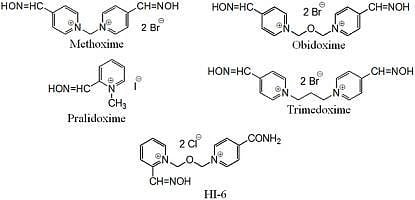
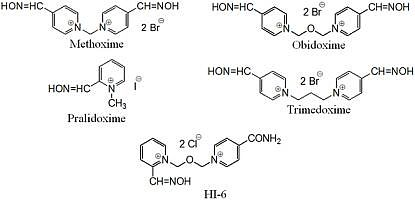
<p>The aim of our work was to test and summarize reactivation ability of common, commercially available AChE reactivators (methoxime, pralidoxime, obidoxime, trimedoxime and HI-6, see <xref ref-type="fig" rid="f1-ijms-12-02077">Figure 1</xref>) and to evaluate their potential usefulness in the treatment of OP pesticide poisoning.</p>
<p>We have tested their ability to reactivate human AChE inhibited by five structurally different pesticides <italic>in vitro</italic>. Moreover, we tested reactivation of BChE, in parallel, with the aim of finding a potent oxime, suitable of serving in combination with this enzyme (administered as prophylactic antidote or occurring naturally in blood) as a “pseudocatalytic” bioscavenger. Such a combination could allow an increase of prophylactic and therapeutic efficacy of the administered enzyme and also a decrease in the amount of enzyme necessary and cost of such a bioscavenger [<xref ref-type="bibr" rid="b15-ijms-12-02077">15</xref>,<xref ref-type="bibr" rid="b16-ijms-12-02077">16</xref>].</p></sec>
<sec sec-type="results|discussion">
<label>2.</label>
<title>Results and Discussion</title>
<p>Measured values of reactivation ability of tested oxime reactivators are summarized in <xref ref-type="table" rid="t1-ijms-12-02077">Tables 1</xref> and <xref ref-type="table" rid="t2-ijms-12-02077">Table 2</xref>.</p>
<p>Reactivators were evaluated <italic>in vitro</italic>, in concentrations 10<sup>−4</sup> M and 10<sup>−5</sup> M, which are usually attainable in plasma within clinical treatment in the hospital in the case of intoxication by OPs [<xref ref-type="bibr" rid="b20-ijms-12-02077">20</xref>].</p>
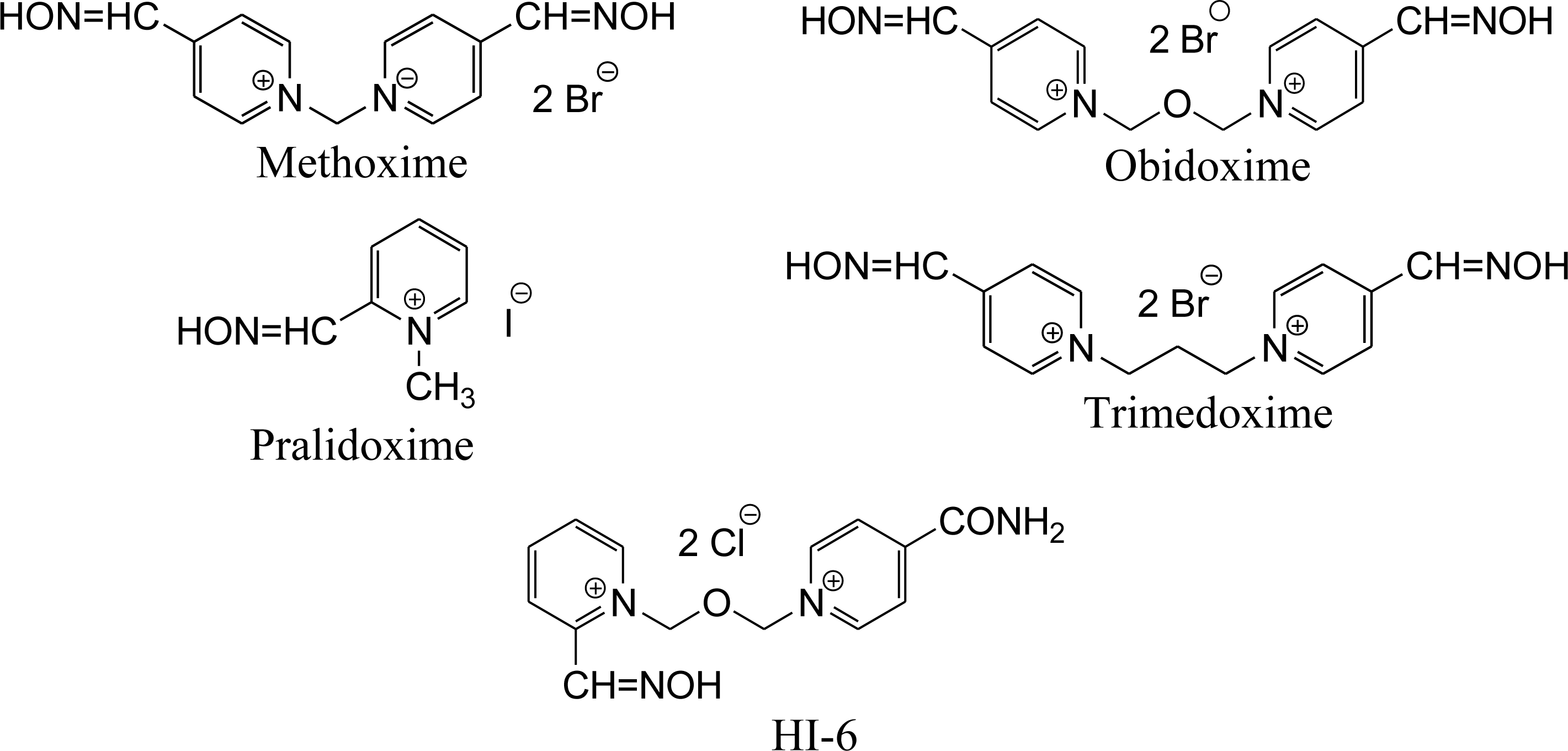
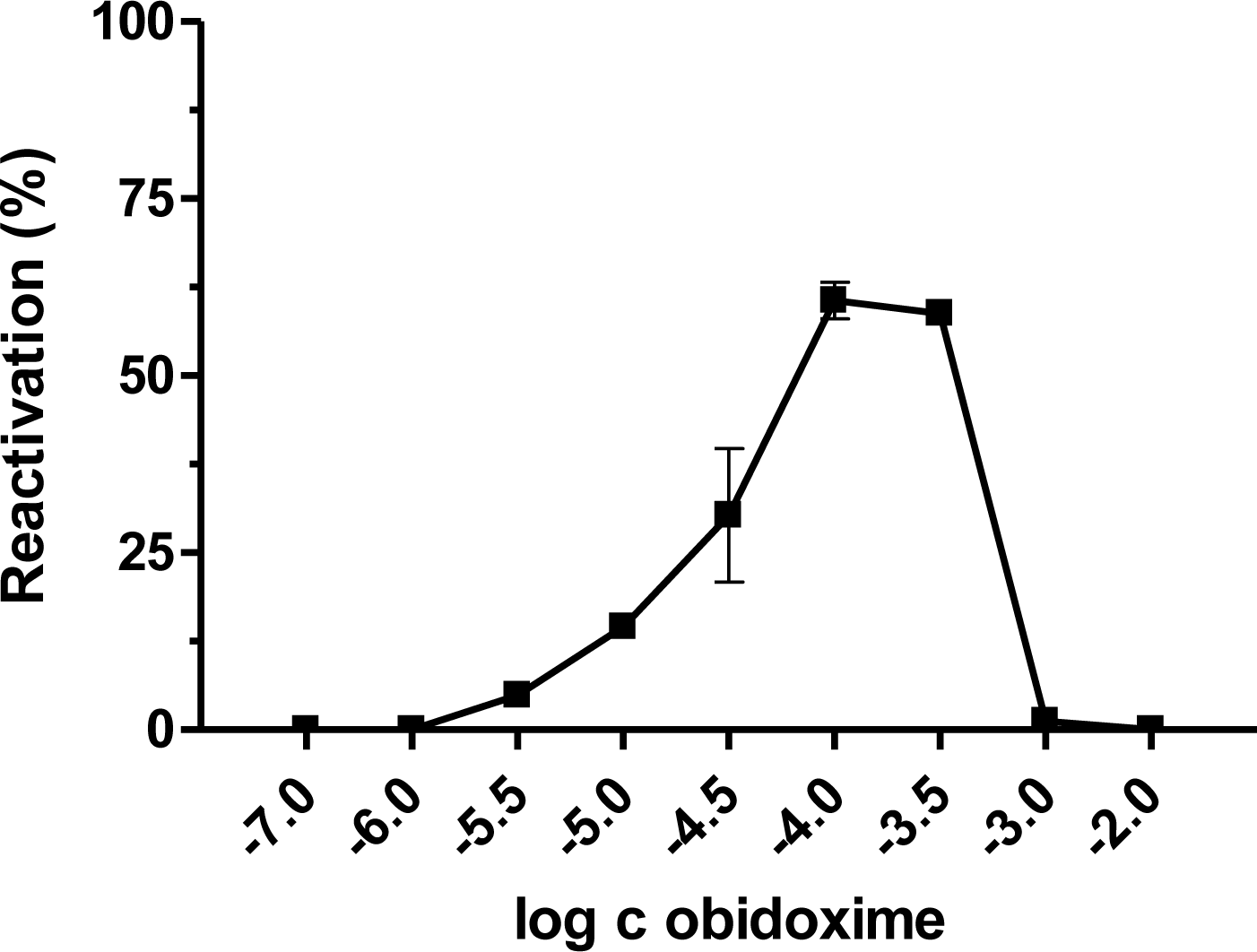
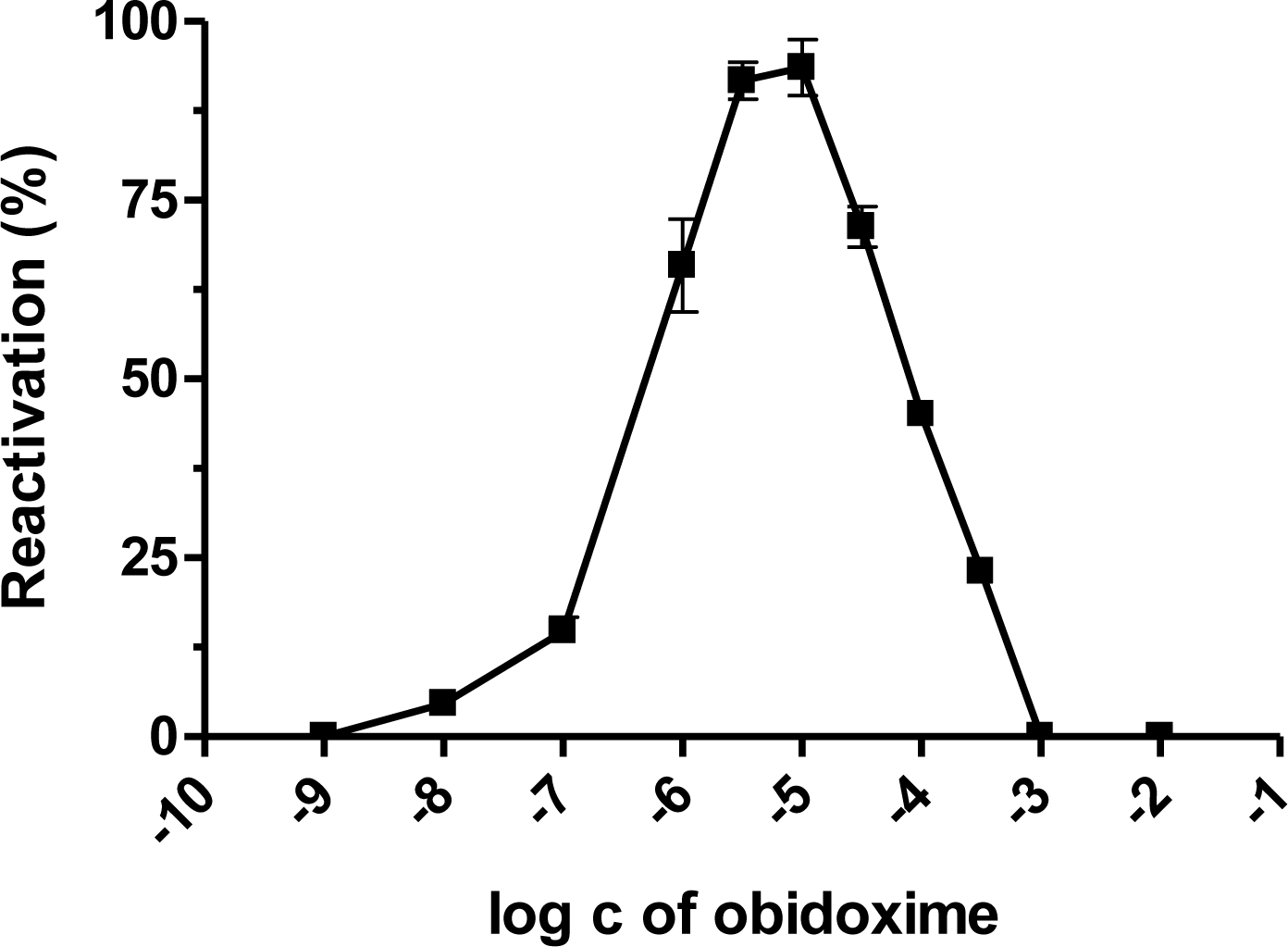
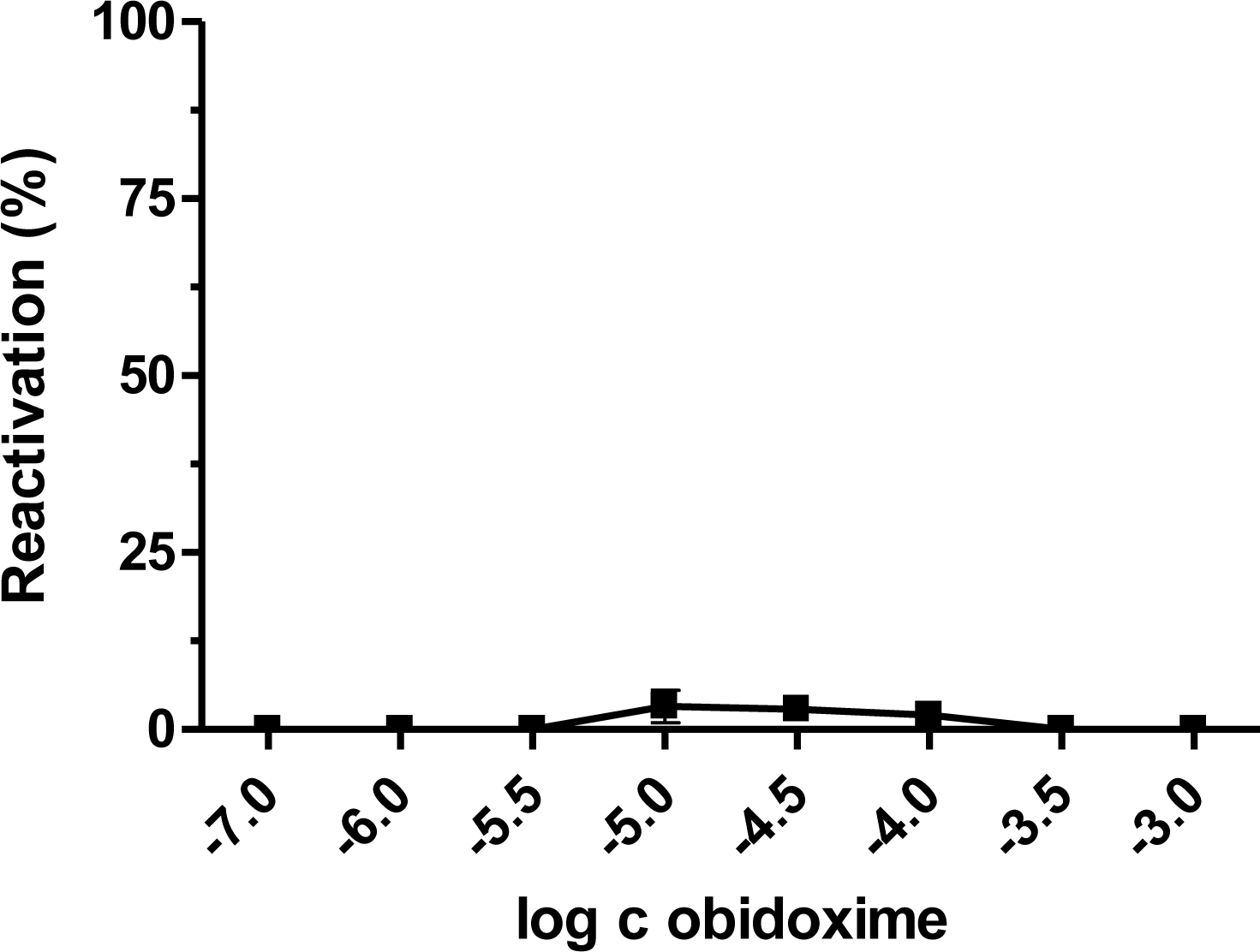
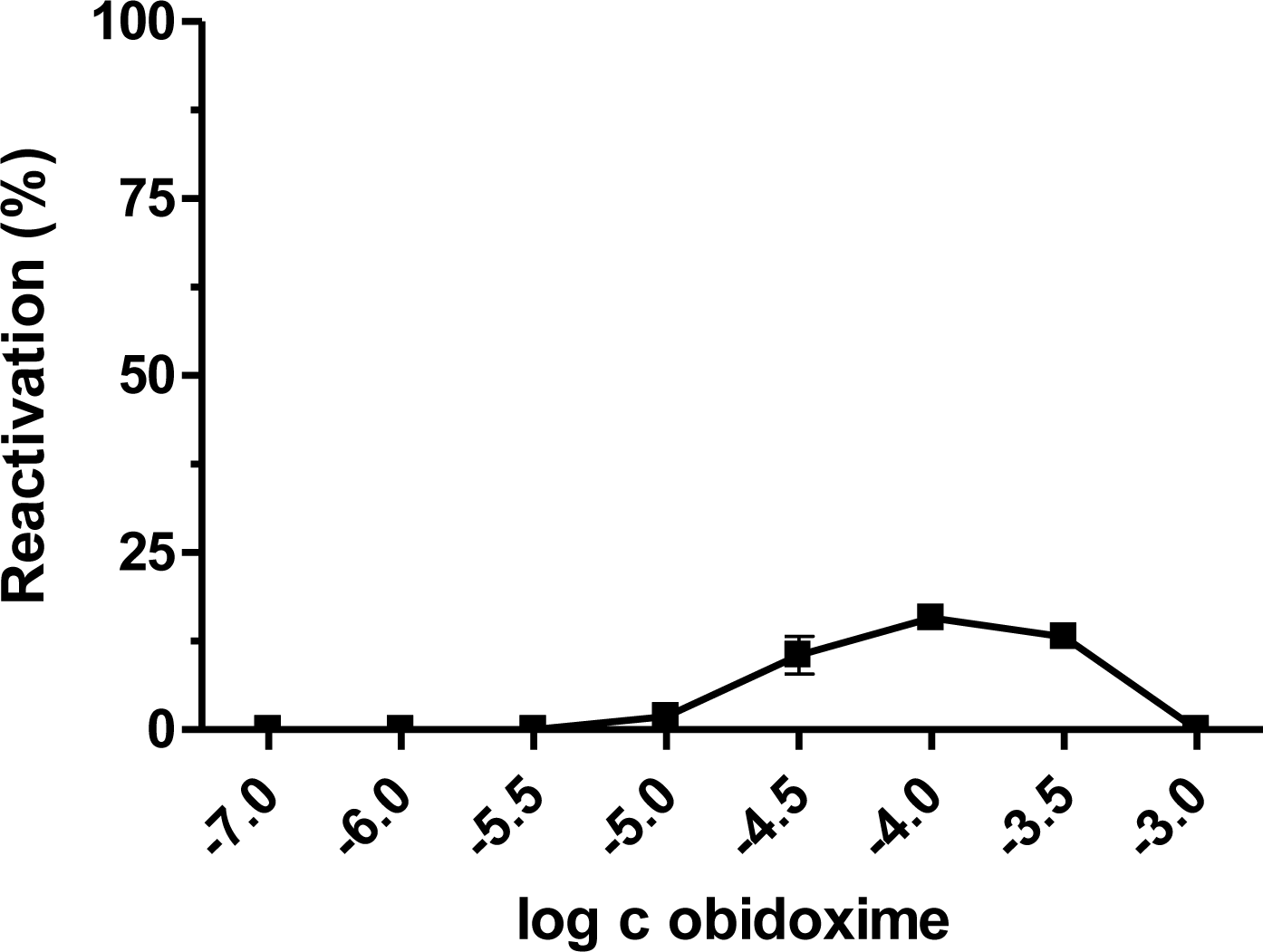
<p>Our results demonstrated that the best broad-spectrum AChE reactivators after 10 minutes of reactivation, are trimedoxime and obidoxime, because they reached more than 50% of reactivation in the case of paraoxon, leptophos-oxon and methamidophos-inhibited AChE. DFP- and dichlorvos-inhibited AChE were not sufficiently reactivated. Methamidophos and leptophos-oxon are quite easily reactivatable by all tested reactivators. In reactivation of dichlorvos-, paraoxon-, DFP- and leptophos-oxon-inhibited AChE, a higher oxime concentration caused higher reactivation of the phosphorylated enzyme. Reverse behavior was observed for methamidophos-inhibited enzyme, where the maximum reactivation ability was achieved with lower oxime concentration. Therefore, we investigated the relationship between oxime concentration and type of inhibitor used. Obidoxime was selected as a suitable model oxime and its reactivation ability was estimated in a concentration range (depending on the inhibitor) of 10<sup>−8</sup>–10<sup>−2</sup> M (<xref ref-type="fig" rid="f2-ijms-12-02077">Figures 2</xref>–<xref ref-type="fig" rid="f6-ijms-12-02077">6</xref>). As a result, we obtained bell-shaped dependencies of reactivation ability on obidoxime concentration for each inhibitor.</p>
<p>Maximum level of reactivation for each inhibitor was achieved at different obidoxime concentrations and, especially for methamidophos; the maximum was shifted towards lower concentrations. While the lower oxime concentration (left side of the graph), causes practically only reactivation of the phosphorylated enzyme, on increasing concentration enzyme inhibition with reactivator occurs (right side of the graph) [<xref ref-type="bibr" rid="b21-ijms-12-02077">21</xref>]. This is the reason, why the course of the reactivation curve is always bell-shaped in the whole concentration range of oxime [<xref ref-type="bibr" rid="b22-ijms-12-02077">22</xref>,<xref ref-type="bibr" rid="b23-ijms-12-02077">23</xref>]. Therefore, the reactivation process itself is characterized in the increasing and the decreasing parts of the curve showing both reactivation and inhibition of liberated intact AChE by the reactivator itself. Each reactivator varies in the optimal concentration for reactivation. Lower concentrations were optimal for some oximes (e.g., 10<sup>−5</sup> M) [<xref ref-type="bibr" rid="b22-ijms-12-02077">22</xref>,<xref ref-type="bibr" rid="b24-ijms-12-02077">24</xref>,<xref ref-type="bibr" rid="b25-ijms-12-02077">25</xref>]. Another important factor affecting the reactivation process and the course of the reactivation curve is the formation of phosphorylated oximes during reactivation [<xref ref-type="bibr" rid="b26-ijms-12-02077">26</xref>] as their presence causes re-inhibition of the enzyme. The probability of their formation increases with higher enzyme or oxime concentrations [<xref ref-type="bibr" rid="b27-ijms-12-02077">27</xref>]. There is evidence that phosphorylated oximes could decompose in blood because human plasma paraoxonase may be capable of degrading dimethoxy- and diethoxy-phosphorylated oximes derived from obidoxime and trimedoxime [<xref ref-type="bibr" rid="b28-ijms-12-02077">28</xref>].</p>
<p>Aging of inhibited enzyme could also decrease reactivation potency. In this study, measured reactivation ability was not corrected for this phenomenon.</p>
<p>According to our results, reactivation ability of tested oximes for BChE was very low in comparison with values measured for AChE. Comparable results, with reactivation of OP-inhibited BChE, were also obtained by Aurbek <italic>et al.</italic> [<xref ref-type="bibr" rid="b29-ijms-12-02077">29</xref>].</p></sec>
<sec>
<label>3.</label>
<title>Experimental Section</title>
<p>Cholinesterase reactivators used in this study were synthesized in our lab or purchased from Leciva (Czech Republic), Merck (Germany) and Phoenix Chemicals Ltd. (United Kingdom). Purity of all the AChE reactivators utilized was tested using TLC (DC-Alufolien Cellulose F; mobile phase <italic>n</italic>-butanol-acetic acid-water = 5:1:2; detection by Dragendorff reagent) and NMR (Varian Gemini 300, Palo Alto, CA, USA), and their purity was higher than 98%. Pesticides and inhibitors with a minimum purity of 90% were purchased from Dr. Ehrenstorfer (Augsburg, Germany) and Sigma-Aldrich (Czech Republic). All other chemicals used in this study were of analytical purity and were purchased from Sigma-Aldrich (Czech Republic). Reactivation potency of five oximes (methoxime, pralidoxime, obidoxime, trimedoxime and HI-6) was tested by <italic>in vitro</italic> screening test. For this purpose modified Ellman’s method was used [<xref ref-type="bibr" rid="b17-ijms-12-02077">17</xref>–<xref ref-type="bibr" rid="b19-ijms-12-02077">19</xref>,<xref ref-type="bibr" rid="b25-ijms-12-02077">25</xref>,<xref ref-type="bibr" rid="b30-ijms-12-02077">30</xref>–<xref ref-type="bibr" rid="b32-ijms-12-02077">32</xref>]. Paraoxon (diethyl 4-nitrophenyl phosphate, the active “toxic” form of pesticide parathion), dichlorvos (2,2-dichlorovinyl dimethyl phosphate), DFP (diisopropyl fluorophosphate), leptophos-oxon (<italic>O</italic>-[4-bromo-2,5-dichlorophenyl] <italic>O</italic>-methyl phenylphosphonate) and methamidophos (<italic>O</italic>,<italic>S</italic>-dimethyl phosphoramidothioate) were selected as suitable model OP inhibitors. Human erythrocyte hemolyzate was used as a source of AChE and human plasma as a source of BChE. The blood samples were collected from healthy volunteers from the vein into a disposable syringe containing 3.8% sodium citrate (the ratio blood/citrate was 1:10 <italic>w</italic>/<italic>w</italic>). The citrated blood was centrifuged for 20 min at 2856 × g, the plasma was removed as supernatant, frozen and was kept under −80 °C (source of BChE). The erythrocytes were washed three times with phosphate buffer (PB; 0.1 M, pH 7.4) and then hemolyzed in PB (0.01 M, pH 7.4) in a ratio 1:10 (<italic>w</italic>/<italic>w</italic>), frozen and kept under −80 °C (source of AChE). Enzymes were inhibited to 5 % of their original activity using concentration corresponding to IC<sub>95</sub> (concentration which causes 95% inhibition). Time of enzyme inhibition (equivalent to 7 × T<sub>1/2</sub>) was calculated separately for each compound from experimentally determined half-life (T<sub>1/2</sub>) of reaction between enzyme and inhibitor. Detailed data about used concentrations of inhibitors and time of inhibition are summarized in <xref ref-type="table" rid="t3-ijms-12-02077">Table 3</xref>. The inhibition of AChE was started in plastic cuvettes by addition of inhibitor solution in isopropanol to the mixture of phosphate buffer (0.05 M, pH 7.4) and hemolyzate (activity before inhibition was set to 10 U/L) or plasma (activity was set to 13.3 U/L). Concentration of isopropanol in the sample was 5%. This concentration had no significant influence on the activity of both cholinesterases. Blind samples with uninhibited enzyme were incubated for given time (<xref ref-type="table" rid="t3-ijms-12-02077">Table 3</xref>) with isopropanol in final concentration 5% [<xref ref-type="bibr" rid="b25-ijms-12-02077">25</xref>,<xref ref-type="bibr" rid="b32-ijms-12-02077">32</xref>]. Inhibited enzymes were then immediately incubated for 10 min with solution of reactivator in phosphate buffer (0.05 M, pH 7.4) at concentrations 10<sup>−4</sup> M and 10<sup>−5</sup> M (and 10<sup>−8</sup>–10<sup>−2</sup> M for obidoxime). Mixture was diluted 20 times before the measurement. Activity of AChE (BChE) was determined spectrophotometrically by modified method according to Ellman [<xref ref-type="bibr" rid="b30-ijms-12-02077">30</xref>]. The final concentration of DTNB and acetylthiocholine or butyrylthiocholine in the mixture was 10<sup>−3</sup> M.</p>
<p>All results were corrected for oximolysis. Reactivation potency was calculated from the formula:
<disp-formula>
<mml:math display="block">
<mml:mrow>
<mml:mo>%</mml:mo>
<mml:mi> </mml:mi>
<mml:mi>R</mml:mi>
<mml:mo>=</mml:mo>
<mml:mo stretchy="false">[</mml:mo>
<mml:mn>1</mml:mn>
<mml:mo>−</mml:mo>
<mml:mo stretchy="false">(</mml:mo>
<mml:msub>
<mml:mi>a</mml:mi>
<mml:mn>0</mml:mn></mml:msub>
<mml:mo>−</mml:mo>
<mml:msub>
<mml:mi>a</mml:mi>
<mml:mi>r</mml:mi></mml:msub>
<mml:mo stretchy="false">)</mml:mo>
<mml:mo>/</mml:mo>
<mml:mo stretchy="false">(</mml:mo>
<mml:msub>
<mml:mi>a</mml:mi>
<mml:mn>0</mml:mn></mml:msub>
<mml:mo>−</mml:mo>
<mml:msub>
<mml:mi>a</mml:mi>
<mml:mi>i</mml:mi></mml:msub>
<mml:mo stretchy="false">)</mml:mo>
<mml:mo stretchy="false">]</mml:mo>
<mml:mo>×</mml:mo>
<mml:mn>100</mml:mn></mml:mrow></mml:math></disp-formula>where % <italic>R</italic> is percent of reactivation, <italic>a</italic><italic><sub>0</sub></italic> is activity of intact enzyme, <italic>a</italic><italic><sub>i</sub></italic> is activity of inhibited enzyme and <italic>a</italic><italic><sub>r</sub></italic> is activity of reactivated enzyme minus oximolysis. Data were not corrected for aging because enzyme was reactivated at the latest one hour after inhibition and time of incubation with oxime was relatively short (10 min.) Detailed description of the method can be found in publications of Musilova <italic>et al.</italic> [<xref ref-type="bibr" rid="b31-ijms-12-02077">31</xref>,<xref ref-type="bibr" rid="b32-ijms-12-02077">32</xref>].</p></sec>
<sec sec-type="conclusions">
<label>4.</label>
<title>Conclusions</title>
<p>According to our results, bisquaternary oximes seem to be more potent reactivators of pesticide-inhibited AChE than monoquaternary pralidoxime. No reactivator achieved sufficient ability to reactivate OP pesticide-inhibited BChE, and therefore none of the oximes can be recommended as a candidate for “pseudocatalytic” bioscavengers with BChE. Because of this, a larger group (not only the currently available ones) of reactivators need to be tested to better understand the structure–activity relationship which would then help in the synthesis of new reactivators of BChE—“rational synthesis of BChE reactivators”.</p></sec></body>
<back>
<ack>
<p>Authors would like to thank Martina Hrabinova and Petr Stodulka for their excellent technical help. This work was supported by the Ministry of Defence (Czech Republic)—Grant No. OVUOFVZ200902 and MO0FVZ0000604. All the tested oximes are available from the authors.</p></ack>
<ref-list>
<title>References</title>
<ref id="b1-ijms-12-02077"><label>1.</label><citation citation-type="journal"><person-group person-group-type="author"><name><surname>Costa</surname><given-names>LG</given-names></name></person-group><article-title>Current issues in organophosphate toxicology</article-title><source>Clin. Chim. Acta</source><year>2006</year><volume>366</volume><fpage>1</fpage><lpage>13</lpage><pub-id pub-id-type="doi">10.1016/j.cca.2005.10.008</pub-id><pub-id pub-id-type="pmid">16337171</pub-id></citation></ref>
<ref id="b2-ijms-12-02077"><label>2.</label><citation citation-type="journal"><person-group person-group-type="author"><name><surname>Maxwell</surname><given-names>DM</given-names></name><name><surname>Brecht</surname><given-names>KM</given-names></name><name><surname>Koplovitz</surname><given-names>I</given-names></name><name><surname>Sweeney</surname><given-names>RE</given-names></name></person-group><article-title>Acetylcholinesterase inhibition: Does it explain the toxicity of organophosphorus compounds?</article-title><source>Arch. Toxicol</source><year>2006</year><volume>80</volume><fpage>756</fpage><lpage>760</lpage><pub-id pub-id-type="doi">10.1007/s00204-006-0120-2</pub-id><pub-id pub-id-type="pmid">16770629</pub-id></citation></ref>
<ref id="b3-ijms-12-02077"><label>3.</label><citation citation-type="journal"><person-group person-group-type="author"><name><surname>Worek</surname><given-names>F</given-names></name><name><surname>Koller</surname><given-names>M</given-names></name><name><surname>Thiermann</surname><given-names>H</given-names></name><name><surname>Szinicz</surname><given-names>L</given-names></name></person-group><article-title>Diagnostic aspects of organophosphate poisoning</article-title><source>Toxicology</source><year>2005</year><volume>214</volume><fpage>182</fpage><lpage>189</lpage><pub-id pub-id-type="doi">10.1016/j.tox.2005.06.012</pub-id><pub-id pub-id-type="pmid">16051411</pub-id></citation></ref>
<ref id="b4-ijms-12-02077"><label>4.</label><citation citation-type="journal"><person-group person-group-type="author"><name><surname>Elhanany</surname><given-names>E</given-names></name><name><surname>Ordentlich</surname><given-names>A</given-names></name><name><surname>Dgany</surname><given-names>O</given-names></name><name><surname>Kaplan</surname><given-names>D</given-names></name><name><surname>Segall</surname><given-names>Y</given-names></name><name><surname>Barak</surname><given-names>R</given-names></name><name><surname>Velan</surname><given-names>B</given-names></name><name><surname>Shafferman</surname><given-names>A</given-names></name></person-group><article-title>Resolving pathways of interaction of covalent inhibitors with the active site of acetylcholinesterases: MALDI-TOF/MS analysis of various nerve agent phosphyl adducts</article-title><source>Chem. Res. Toxicol</source><year>2001</year><volume>14</volume><fpage>912</fpage><lpage>918</lpage><pub-id pub-id-type="doi">10.1021/tx0100542</pub-id><pub-id pub-id-type="pmid">11453739</pub-id></citation></ref>
<ref id="b5-ijms-12-02077"><label>5.</label><citation citation-type="journal"><person-group person-group-type="author"><name><surname>Barak</surname><given-names>D</given-names></name><name><surname>Ordentlich</surname><given-names>A</given-names></name><name><surname>Kaplan</surname><given-names>D</given-names></name><name><surname>Barak</surname><given-names>R</given-names></name><name><surname>Mizrahi</surname><given-names>D</given-names></name><name><surname>Kronman</surname><given-names>C</given-names></name><name><surname>Segall</surname><given-names>Y</given-names></name><name><surname>Velan</surname><given-names>B</given-names></name><name><surname>Shafferman</surname><given-names>A</given-names></name></person-group><article-title>Evidence for P-N bond scission in phosphoroamidate nerve agent adducts of human acetylcholinesterase</article-title><source>Biochemistry</source><year>2000</year><volume>39</volume><fpage>1156</fpage><lpage>1161</lpage><pub-id pub-id-type="doi">10.1021/bi992009n</pub-id><pub-id pub-id-type="pmid">10653663</pub-id></citation></ref>
<ref id="b6-ijms-12-02077"><label>6.</label><citation citation-type="journal"><person-group person-group-type="author"><name><surname>Millard</surname><given-names>CB</given-names></name><name><surname>Kryger</surname><given-names>G</given-names></name><name><surname>Ordentlich</surname><given-names>A</given-names></name><name><surname>Greenblatt</surname><given-names>HM</given-names></name><name><surname>Harel</surname><given-names>M</given-names></name><name><surname>Raves</surname><given-names>ML</given-names></name><name><surname>Segall</surname><given-names>Y</given-names></name><name><surname>Barak</surname><given-names>D</given-names></name><name><surname>Shafferman</surname><given-names>A</given-names></name><name><surname>Silman</surname><given-names>I</given-names></name><name><surname>Sussman</surname><given-names>JL</given-names></name></person-group><article-title>Crystal structures of aged phosphonylated acetylcholinesterase: Nerve agent reaction products at the atomic level</article-title><source>Biochemistry</source><year>1999</year><volume>38</volume><fpage>7032</fpage><lpage>7039</lpage><pub-id pub-id-type="doi">10.1021/bi982678l</pub-id><pub-id pub-id-type="pmid">10353814</pub-id></citation></ref>
<ref id="b7-ijms-12-02077"><label>7.</label><citation citation-type="journal"><person-group person-group-type="author"><name><surname>Eyer</surname><given-names>P</given-names></name></person-group><article-title>The role of oximes in the management of organophosphorus pesticide poisoning</article-title><source>Toxicol. Rev</source><year>2003</year><volume>22</volume><fpage>165</fpage><lpage>190</lpage><pub-id pub-id-type="doi">10.2165/00139709-200322030-00004</pub-id><pub-id pub-id-type="pmid">15181665</pub-id></citation></ref>
<ref id="b8-ijms-12-02077"><label>8.</label><citation citation-type="journal"><person-group person-group-type="author"><name><surname>Worek</surname><given-names>F</given-names></name><name><surname>Backer</surname><given-names>M</given-names></name><name><surname>Thiermann</surname><given-names>H</given-names></name><name><surname>Szinicz</surname><given-names>L</given-names></name><name><surname>Mast</surname><given-names>U</given-names></name><name><surname>Klimmek</surname><given-names>R</given-names></name><name><surname>Eyer</surname><given-names>P</given-names></name></person-group><article-title>Reappraisal of indications and limitations of oxime therapy in organophosphate poisoning</article-title><source>Hum. Exp. Toxicol</source><year>1997</year><volume>16</volume><fpage>466</fpage><lpage>472</lpage><pub-id pub-id-type="doi">10.1177/096032719701600808</pub-id><pub-id pub-id-type="pmid">9292287</pub-id></citation></ref>
<ref id="b9-ijms-12-02077"><label>9.</label><citation citation-type="journal"><person-group person-group-type="author"><name><surname>Thompson</surname><given-names>DF</given-names></name><name><surname>Thompson</surname><given-names>GD</given-names></name><name><surname>Greenwood</surname><given-names>RB</given-names></name><name><surname>Trammel</surname><given-names>HL</given-names></name></person-group><article-title>Therapeutic dosing of pralidoxime chloride</article-title><source>Drug Intell. Clin. Pharm</source><year>1987</year><volume>21</volume><fpage>590</fpage><lpage>593</lpage><pub-id pub-id-type="pmid">3301250</pub-id></citation></ref>
<ref id="b10-ijms-12-02077"><label>10.</label><citation citation-type="journal"><person-group person-group-type="author"><name><surname>Eddleston</surname><given-names>M</given-names></name><name><surname>Singh</surname><given-names>S</given-names></name><name><surname>Buckley</surname><given-names>N</given-names></name></person-group><article-title>Acute organophosphorus poisoning</article-title><source>Clin Evid</source><year>2003</year><source>June</source><fpage>1542</fpage><lpage>1553</lpage></citation></ref>
<ref id="b11-ijms-12-02077"><label>11.</label><citation citation-type="journal"><person-group person-group-type="author"><name><surname>Bajgar</surname><given-names>J</given-names></name><name><surname>Fusek</surname><given-names>J</given-names></name><name><surname>Kuca</surname><given-names>K</given-names></name><name><surname>Bartosova</surname><given-names>L</given-names></name><name><surname>Jun</surname><given-names>D</given-names></name></person-group><article-title>Treatment of organophosphate intoxication using cholinesterase reactivators: Facts and fiction</article-title><source>Mini. Rev. Med. Chem</source><year>2007</year><volume>7</volume><fpage>461</fpage><lpage>466</lpage><pub-id pub-id-type="doi">10.2174/138955707780619581</pub-id><pub-id pub-id-type="pmid">17504181</pub-id></citation></ref>
<ref id="b12-ijms-12-02077"><label>12.</label><citation citation-type="journal"><person-group person-group-type="author"><name><surname>Saxena</surname><given-names>A</given-names></name><name><surname>Sun</surname><given-names>W</given-names></name><name><surname>Luo</surname><given-names>C</given-names></name><name><surname>Myers</surname><given-names>TM</given-names></name><name><surname>Koplovitz</surname><given-names>I</given-names></name><name><surname>Lenz</surname><given-names>DE</given-names></name><name><surname>Doctor</surname><given-names>BP</given-names></name></person-group><article-title>Bioscavenger for protection from toxicity of organophosphorus compounds</article-title><source>J. Mol. Neurosci</source><year>2006</year><volume>30</volume><fpage>145</fpage><lpage>148</lpage><pub-id pub-id-type="doi">10.1385/JMN:30:1:145</pub-id><pub-id pub-id-type="pmid">17192662</pub-id></citation></ref>
<ref id="b13-ijms-12-02077"><label>13.</label><citation citation-type="journal"><person-group person-group-type="author"><name><surname>Maxwell</surname><given-names>DM</given-names></name><name><surname>Brecht</surname><given-names>KM</given-names></name><name><surname>Doctor</surname><given-names>BP</given-names></name><name><surname>Wolfe</surname><given-names>AD</given-names></name></person-group><article-title>Comparison of antidote protection against soman by pyridostigmine, HI-6 and acetylcholinesterase</article-title><source>J. Pharmacol. Exp. Ther</source><year>1993</year><volume>264</volume><fpage>1085</fpage><lpage>1089</lpage><pub-id pub-id-type="pmid">8450452</pub-id></citation></ref>
<ref id="b14-ijms-12-02077"><label>14.</label><citation citation-type="journal"><person-group person-group-type="author"><name><surname>Kolarich</surname><given-names>D</given-names></name><name><surname>Weber</surname><given-names>A</given-names></name><name><surname>Pabst</surname><given-names>M</given-names></name><name><surname>Stadlmann</surname><given-names>J</given-names></name><name><surname>Teschner</surname><given-names>W</given-names></name><name><surname>Ehrlich</surname><given-names>H</given-names></name><name><surname>Schwarz</surname><given-names>HP</given-names></name><name><surname>Altmann</surname><given-names>F</given-names></name></person-group><article-title>Glycoproteomic characterization of butyrylcholinesterase from human plasma</article-title><source>Proteomics</source><year>2008</year><volume>8</volume><fpage>254</fpage><lpage>263</lpage><pub-id pub-id-type="doi">10.1002/pmic.200700720</pub-id><pub-id pub-id-type="pmid">18203274</pub-id></citation></ref>
<ref id="b15-ijms-12-02077"><label>15.</label><citation citation-type="journal"><person-group person-group-type="author"><name><surname>Lenz</surname><given-names>DE</given-names></name><name><surname>Yeung</surname><given-names>D</given-names></name><name><surname>Smith</surname><given-names>JR</given-names></name><name><surname>Sweeney</surname><given-names>RE</given-names></name><name><surname>Lumley</surname><given-names>LA</given-names></name><name><surname>Cerasoli</surname><given-names>DM</given-names></name></person-group><article-title>Stoichiometric and catalytic scavengers as protection against nerve agent toxicity: A mini review</article-title><source>Toxicology</source><year>2007</year><volume>233</volume><fpage>31</fpage><lpage>39</lpage><pub-id pub-id-type="doi">10.1016/j.tox.2006.11.066</pub-id><pub-id pub-id-type="pmid">17188793</pub-id></citation></ref>
<ref id="b16-ijms-12-02077"><label>16.</label><citation citation-type="journal"><person-group person-group-type="author"><name><surname>Jun</surname><given-names>D</given-names></name><name><surname>Musilova</surname><given-names>L</given-names></name><name><surname>Link</surname><given-names>M</given-names></name><name><surname>Loiodice</surname><given-names>M</given-names></name><name><surname>Nachon</surname><given-names>F</given-names></name><name><surname>Rochu</surname><given-names>D</given-names></name><name><surname>Renault</surname><given-names>F</given-names></name><name><surname>Masson</surname><given-names>P</given-names></name></person-group><article-title>Preparation and characterization of methoxy polyethylene glycol-conjugated phosphotriesterase as a potential catalytic bioscavenger against organophosphate poisoning</article-title><source>Chem. Biol.Inter</source><year>2010</year><volume>187</volume><fpage>380</fpage><lpage>383</lpage><pub-id pub-id-type="doi">10.1016/j.cbi.2010.03.017</pub-id></citation></ref>
<ref id="b17-ijms-12-02077"><label>17.</label><citation citation-type="journal"><person-group person-group-type="author"><name><surname>Jun</surname><given-names>D</given-names></name><name><surname>Musilova</surname><given-names>L</given-names></name><name><surname>Kuca</surname><given-names>K</given-names></name><name><surname>Kassa</surname><given-names>J</given-names></name><name><surname>Bajgar</surname><given-names>J</given-names></name></person-group><article-title>Potency of several oximes to reactivate human acetylcholinesterase and butyrylcholinesterase inhibited by paraoxon <italic>in vitro</italic></article-title><source>Chem. Biol. Inter</source><year>2008</year><volume>175</volume><fpage>421</fpage><lpage>424</lpage><pub-id pub-id-type="doi">10.1016/j.cbi.2008.05.004</pub-id></citation></ref>
<ref id="b18-ijms-12-02077"><label>18.</label><citation citation-type="book"><person-group person-group-type="author"><name><surname>Bajgar</surname><given-names>EJ</given-names></name></person-group><source>Central and Peripheral Nervous System: Effects of Highly Toxic Organophosphates and Their Antidotes</source><publisher-name>Research Signpost</publisher-name><publisher-loc>Kerala, India</publisher-loc><year>2009</year></citation></ref>
<ref id="b19-ijms-12-02077"><label>19.</label><citation citation-type="journal"><person-group person-group-type="author"><name><surname>Jun</surname><given-names>D</given-names></name><name><surname>Musilova</surname><given-names>L</given-names></name><name><surname>Pohanka</surname><given-names>M</given-names></name><name><surname>Jung</surname><given-names>YS</given-names></name><name><surname>Bostik</surname><given-names>P</given-names></name><name><surname>Kuca</surname><given-names>K</given-names></name></person-group><article-title>Reactivation of human acetylcholinesterase and butyrylcholinesterase inhibited by leptophos-oxon with different oxime reactivators <italic>in vitro</italic></article-title><source>Int. J.Mol. Sci</source><year>2010</year><volume>11</volume><fpage>2856</fpage><lpage>2863</lpage><pub-id pub-id-type="doi">10.3390/ijms11082856</pub-id><pub-id pub-id-type="pmid">21152278</pub-id></citation></ref>
<ref id="b20-ijms-12-02077"><label>20.</label><citation citation-type="journal"><person-group person-group-type="author"><name><surname>Bajgar</surname><given-names>J</given-names></name></person-group><article-title>Organophosphates/nerve agent poisoning: Mechanism of action, diagnosis, prophylaxis, and treatment</article-title><source>Adv. Clin. Chem</source><year>2004</year><volume>38</volume><fpage>151</fpage><lpage>216</lpage><pub-id pub-id-type="pmid">15521192</pub-id></citation></ref>
<ref id="b21-ijms-12-02077"><label>21.</label><citation citation-type="journal"><person-group person-group-type="author"><name><surname>Lorke</surname><given-names>DE</given-names></name><name><surname>Nurulain</surname><given-names>SM</given-names></name><name><surname>Hasan</surname><given-names>MY</given-names></name><name><surname>Kuca</surname><given-names>K</given-names></name><name><surname>Musilek</surname><given-names>K</given-names></name><name><surname>Petroianu</surname><given-names>GA</given-names></name></person-group><article-title>Eight new bispyridinium oximes in comparison with the conventional oximes pralidoxime and obidoxime: <italic>In vivo</italic> efficacy to protect from diisopropylfluorophosphate toxicity</article-title><source>J. Appl. Toxicol</source><year>2008</year><volume>28</volume><fpage>920</fpage><lpage>928</lpage><pub-id pub-id-type="doi">10.1002/jat.1359</pub-id><pub-id pub-id-type="pmid">18548743</pub-id></citation></ref>
<ref id="b22-ijms-12-02077"><label>22.</label><citation citation-type="journal"><person-group person-group-type="author"><name><surname>Musilek</surname><given-names>K</given-names></name><name><surname>Kuca</surname><given-names>K</given-names></name><name><surname>Jun</surname><given-names>D</given-names></name><name><surname>Dohnal</surname><given-names>V</given-names></name><name><surname>Dolezal</surname><given-names>M</given-names></name></person-group><article-title>Synthesis of a novel series of bispyridinium compounds bearing a xylene linker and evaluation of their reactivation activity against chlorpyrifos-inhibited acetylcholinesterase</article-title><source>J. Enzyme Inhib. Med. Chem</source><year>2005</year><volume>20</volume><fpage>409</fpage><lpage>415</lpage><pub-id pub-id-type="doi">10.1080/14756360500179762</pub-id><pub-id pub-id-type="pmid">16335048</pub-id></citation></ref>
<ref id="b23-ijms-12-02077"><label>23.</label><citation citation-type="journal"><person-group person-group-type="author"><name><surname>Kuca</surname><given-names>K</given-names></name><name><surname>Cabal</surname><given-names>J</given-names></name><name><surname>Jun</surname><given-names>D</given-names></name><name><surname>Hrabinova</surname><given-names>M</given-names></name></person-group><article-title>In vitro evaluation of acetylcholinesterase reactivators as potential antidotes against tabun nerve agent poisonings</article-title><source>Drug Chem. Toxicol</source><year>2006</year><volume>29</volume><fpage>443</fpage><lpage>449</lpage><pub-id pub-id-type="doi">10.1080/01480540600718565</pub-id><pub-id pub-id-type="pmid">16931445</pub-id></citation></ref>
<ref id="b24-ijms-12-02077"><label>24.</label><citation citation-type="journal"><person-group person-group-type="author"><name><surname>Kuca</surname><given-names>K</given-names></name><name><surname>Kassa</surname><given-names>J</given-names></name></person-group><article-title>A comparison of the ability of a new bispyridinium oxime-1-(4-hydroxyiminomethylpyridinium)-4-(4-carbamoylpyridinium)butane dibromide and currently used oximes to reactivate nerve agent-inhibited rat brain acetylcholinesterase by <italic>in vitro</italic> methods</article-title><source>J. Enzyme Inhib. Med. Chem</source><year>2003</year><volume>18</volume><fpage>529</fpage><lpage>535</lpage><pub-id pub-id-type="doi">10.1080/14756360310001605552</pub-id><pub-id pub-id-type="pmid">15008517</pub-id></citation></ref>
<ref id="b25-ijms-12-02077"><label>25.</label><citation citation-type="journal"><person-group person-group-type="author"><name><surname>Kuca</surname><given-names>K</given-names></name><name><surname>Musilova</surname><given-names>L</given-names></name><name><surname>Palecek</surname><given-names>J</given-names></name><name><surname>Cirkva</surname><given-names>V</given-names></name><name><surname>Paar</surname><given-names>M</given-names></name><name><surname>Musilek</surname><given-names>K</given-names></name><name><surname>Hrabinova</surname><given-names>M</given-names></name><name><surname>Pohanka</surname><given-names>M</given-names></name><name><surname>Karasova</surname><given-names>JZ</given-names></name><name><surname>Jun</surname><given-names>D</given-names></name></person-group><article-title>Novel bisquaternary oximes—Reactivation of acetylcholinesterase and butyrylcholinesterase inhibited by paraoxon</article-title><source>Molecules</source><year>2009</year><volume>14</volume><fpage>4915</fpage><lpage>4921</lpage><pub-id pub-id-type="doi">10.3390/molecules14124915</pub-id><pub-id pub-id-type="pmid">20032868</pub-id></citation></ref>
<ref id="b26-ijms-12-02077"><label>26.</label><citation citation-type="journal"><person-group person-group-type="author"><name><surname>Stenzel</surname><given-names>J</given-names></name><name><surname>Worek</surname><given-names>F</given-names></name><name><surname>Eyer</surname><given-names>P</given-names></name></person-group><article-title>Preparation and characterization of dialkylphosphoryl-obidoxime conjugates, potent anticholinesterase derivatives that are quickly hydrolyzed by human paraoxonase (PON1192Q)</article-title><source>Biochem. Pharmacol</source><year>2007</year><volume>74</volume><fpage>1390</fpage><lpage>1400</lpage><pub-id pub-id-type="doi">10.1016/j.bcp.2007.07.013</pub-id><pub-id pub-id-type="pmid">17714697</pub-id></citation></ref>
<ref id="b27-ijms-12-02077"><label>27.</label><citation citation-type="journal"><person-group person-group-type="author"><name><surname>Worek</surname><given-names>F</given-names></name><name><surname>Diepold</surname><given-names>C</given-names></name><name><surname>Eyer</surname><given-names>P</given-names></name></person-group><article-title>Dimethylphosphoryl-inhibited human cholinesterases: Inhibition, reactivation, and aging kinetics</article-title><source>Arch. Toxicol</source><year>1999</year><volume>73</volume><fpage>7</fpage><lpage>14</lpage><pub-id pub-id-type="doi">10.1007/s002040050580</pub-id><pub-id pub-id-type="pmid">10207609</pub-id></citation></ref>
<ref id="b28-ijms-12-02077"><label>28.</label><citation citation-type="journal"><person-group person-group-type="author"><name><surname>Kiderlen</surname><given-names>D</given-names></name><name><surname>Worek</surname><given-names>F</given-names></name><name><surname>Klimmek</surname><given-names>R</given-names></name><name><surname>Eyer</surname><given-names>P</given-names></name></person-group><article-title>The phosphoryl oxime-destroying activity of human plasma</article-title><source>Arch. Toxicol</source><year>2000</year><volume>74</volume><fpage>27</fpage><lpage>32</lpage><pub-id pub-id-type="doi">10.1007/s002040050648</pub-id><pub-id pub-id-type="pmid">10817664</pub-id></citation></ref>
<ref id="b29-ijms-12-02077"><label>29.</label><citation citation-type="journal"><person-group person-group-type="author"><name><surname>Aurbek</surname><given-names>N</given-names></name><name><surname>Thiermann</surname><given-names>H</given-names></name><name><surname>Eyer</surname><given-names>F</given-names></name><name><surname>Eyer</surname><given-names>P</given-names></name><name><surname>Worek</surname><given-names>F</given-names></name></person-group><article-title>Suitability of human butyrylcholinesterase as therapeutic marker and pseudo catalytic scavenger in organophosphate poisoning: A kinetic analysis</article-title><source>Toxicology</source><year>2009</year><volume>259</volume><fpage>133</fpage><lpage>139</lpage><pub-id pub-id-type="doi">10.1016/j.tox.2009.02.014</pub-id><pub-id pub-id-type="pmid">19428953</pub-id></citation></ref>
<ref id="b30-ijms-12-02077"><label>30.</label><citation citation-type="journal"><person-group person-group-type="author"><name><surname>Ellman</surname><given-names>GL</given-names></name><name><surname>Courtney</surname><given-names>KD</given-names></name><name><surname>Andres</surname><given-names>V</given-names><suffix>Jr</suffix></name><name><surname>Feather-Stone</surname><given-names>RM</given-names></name></person-group><article-title>A new and rapid colorimetric determination of acetylcholinesterase activity</article-title><source>Biochem. Pharmacol</source><year>1961</year><volume>7</volume><fpage>88</fpage><lpage>95</lpage><pub-id pub-id-type="doi">10.1016/0006-2952(61)90145-9</pub-id><pub-id pub-id-type="pmid">13726518</pub-id></citation></ref>
<ref id="b31-ijms-12-02077"><label>31.</label><citation citation-type="journal"><person-group person-group-type="author"><name><surname>Musilova</surname><given-names>L</given-names></name><name><surname>Jun</surname><given-names>D</given-names></name><name><surname>Palecek</surname><given-names>J</given-names></name><name><surname>Cirkva</surname><given-names>V</given-names></name><name><surname>Musilek</surname><given-names>K</given-names></name><name><surname>Paar</surname><given-names>M</given-names></name><name><surname>Hrabinova</surname><given-names>M</given-names></name><name><surname>Pohanka</surname><given-names>M</given-names></name><name><surname>Kuca</surname><given-names>K</given-names></name></person-group><article-title>Novel nucleophilic compounds with oxime group as reactivators of paraoxon-inhibited cholinesterases</article-title><source>Lett. Drug Design Disc</source><year>2010</year><volume>7</volume><fpage>260</fpage><lpage>264</lpage><pub-id pub-id-type="doi">10.2174/157018010790945823</pub-id></citation></ref>
<ref id="b32-ijms-12-02077"><label>32.</label><citation citation-type="journal"><person-group person-group-type="author"><name><surname>Musilova</surname><given-names>L</given-names></name><name><surname>Kuca</surname><given-names>K</given-names></name><name><surname>Jung</surname><given-names>YS</given-names></name><name><surname>Jun</surname><given-names>D</given-names></name></person-group><article-title><italic>In vitro</italic> oxime-assisted reactivation of paraoxon-inhibited human acetylcholinesterase and butyrylcholinesterase</article-title><source>Clin. Toxicol. (Phila)</source><year>2009</year><volume>47</volume><fpage>545</fpage><lpage>550</lpage><pub-id pub-id-type="doi">10.1080/15563650903058914</pub-id></citation></ref></ref-list>
<sec sec-type="display-objects">
<title>Figures and Tables</title>
<fig id="f1-ijms-12-02077" position="float">
<label>Figure 1.</label>
<caption>
<p>Structures of tested oxime reactivators.</p></caption>
<graphic xlink:href="ijms-12-02077f1.gif"/></fig>
<fig id="f2-ijms-12-02077" position="float">
<label>Figure 2.</label>
<caption>
<p>Relationship between obidoxime concentration and corresponding reactivation ability of methamidophos-inhibited AChE.</p></caption>
<graphic xlink:href="ijms-12-02077f2.gif"/></fig>
<fig id="f3-ijms-12-02077" position="float">
<label>Figure 3.</label>
<caption>
<p>Relationship between obidoxime concentration and corresponding reactivation ability of paraoxon-inhibited AChE.</p></caption>
<graphic xlink:href="ijms-12-02077f3.gif"/></fig>
<fig id="f4-ijms-12-02077" position="float">
<label>Figure 4.</label>
<caption>
<p>Relationship between obidoxime concentration and corresponding reactivation ability of dichlorvos-inhibited AChE.</p></caption>
<graphic xlink:href="ijms-12-02077f4.gif"/></fig>
<fig id="f5-ijms-12-02077" position="float">
<label>Figure 5.</label>
<caption>
<p>Relationship between obidoxime concentration and corresponding reactivation ability of DFP-inhibited AChE.</p></caption>
<graphic xlink:href="ijms-12-02077f5.gif"/></fig>
<fig id="f6-ijms-12-02077" position="float">
<label>Figure 6.</label>
<caption>
<p>Relationship between obidoxime concentration and corresponding reactivation ability of leptophos-oxon-inhibited AChE.</p></caption>
<graphic xlink:href="ijms-12-02077f6.gif"/></fig>
<table-wrap id="t1-ijms-12-02077" position="float">
<label>Table 1.</label>
<caption>
<p>Reactivation ability of five oximes to reactivate OP-inhibited human erythrocyte AChE, at concentrations 10<sup>−4</sup> M and 10<sup>−5</sup> M (%, mean value of three independent determinations; time of reactivation 10 min; pH 7.4; temperature 25 °C).</p></caption>
<table frame="hsides" rules="groups">
<thead>
<tr>
<th align="center" valign="middle" rowspan="5">AChE</th>
<th colspan="4" align="center" valign="middle">Paraoxon [<xref ref-type="bibr" rid="b17-ijms-12-02077">17</xref>]</th>
<th colspan="4" align="center" valign="middle">Dichlorvos</th>
<th colspan="4" align="center" valign="middle">DFP [<xref ref-type="bibr" rid="b18-ijms-12-02077">18</xref>]</th>
<th colspan="4" align="center" valign="middle">Leptophos-oxon [<xref ref-type="bibr" rid="b19-ijms-12-02077">19</xref>]</th>
<th colspan="4" align="center" valign="middle">Methamidophos</th></tr>
<tr>
<th colspan="20" align="left" valign="middle">
<hr/></th></tr>
<tr>
<th colspan="2" align="center" valign="middle">100 μM</th>
<th colspan="2" align="center" valign="middle">10 μM</th>
<th colspan="2" align="center" valign="middle">100 μM</th>
<th colspan="2" align="center" valign="middle">10 μM</th>
<th colspan="2" align="center" valign="middle">100 μM</th>
<th colspan="2" align="center" valign="middle">10 μM</th>
<th colspan="2" align="center" valign="middle">100 μM</th>
<th colspan="2" align="center" valign="middle">10 μM</th>
<th colspan="2" align="center" valign="middle">100 μM</th>
<th colspan="2" align="center" valign="middle">10 μM</th></tr>
<tr>
<th colspan="20" align="left" valign="middle">
<hr/></th></tr>
<tr>
<th align="center" valign="middle">Mean</th>
<th align="center" valign="middle">SD</th>
<th align="center" valign="middle">Mean</th>
<th align="center" valign="middle">SD</th>
<th align="center" valign="middle">Mean</th>
<th align="center" valign="middle">SD</th>
<th align="center" valign="middle">Mean</th>
<th align="center" valign="middle">SD</th>
<th align="center" valign="middle">Mean</th>
<th align="center" valign="middle">SD</th>
<th align="center" valign="middle">Mean</th>
<th align="center" valign="middle">SD</th>
<th align="center" valign="middle">Mean</th>
<th align="center" valign="middle">SD</th>
<th align="center" valign="middle">Mean</th>
<th align="center" valign="middle">SD</th>
<th align="center" valign="middle">Mean</th>
<th align="center" valign="middle">SD</th>
<th align="center" valign="middle">Mean</th>
<th align="center" valign="middle">SD</th></tr></thead>
<tbody>
<tr>
<td align="center" valign="top">Methoxime</td>
<td align="center" valign="top">23.4</td>
<td align="center" valign="top">4.5</td>
<td align="center" valign="top">4.3</td>
<td align="center" valign="top">1.5</td>
<td align="center" valign="top">0</td>
<td align="center" valign="top">0.2</td>
<td align="center" valign="top">0.6</td>
<td align="center" valign="top">6.4</td>
<td align="center" valign="top">0.5</td>
<td align="center" valign="top">1.5</td>
<td align="center" valign="top">0.5</td>
<td align="center" valign="top">52.6</td>
<td align="center" valign="top">0.5</td>
<td align="center" valign="top">11.9</td>
<td align="center" valign="top">0.9</td>
<td align="center" valign="top">61.7</td>
<td align="center" valign="top">2.4</td>
<td align="center" valign="top">68.1</td>
<td align="center" valign="top">11.4</td></tr>
<tr>
<td align="center" valign="top">Pralidoxime</td>
<td align="center" valign="top">18.1</td>
<td align="center" valign="top">0.9</td>
<td align="center" valign="top">1.3</td>
<td align="center" valign="top">0.9</td>
<td align="center" valign="top">2.6</td>
<td align="center" valign="top">0.6</td>
<td align="center" valign="top">0.2</td>
<td align="center" valign="top">0.6</td>
<td align="center" valign="top">2.3</td>
<td align="center" valign="top">0.2</td>
<td align="center" valign="top">0</td>
<td align="center" valign="top">13.2</td>
<td align="center" valign="top">0.9</td>
<td align="center" valign="top">4.1</td>
<td align="center" valign="top">1.3</td>
<td align="center" valign="top">53.4</td>
<td align="center" valign="top">3.1</td>
<td align="center" valign="top">53.8</td>
<td align="center" valign="top">22.6</td></tr>
<tr>
<td align="center" valign="top">Obidoxime</td>
<td align="center" valign="top">96.8</td>
<td align="center" valign="top">0.9</td>
<td align="center" valign="top">59.4</td>
<td align="center" valign="top">0.9</td>
<td align="center" valign="top">0</td>
<td align="center" valign="top">0.6</td>
<td align="center" valign="top">0.1</td>
<td align="center" valign="top">17.1</td>
<td align="center" valign="top">0.1</td>
<td align="center" valign="top">7.4</td>
<td align="center" valign="top">0.5</td>
<td align="center" valign="top">50.3</td>
<td align="center" valign="top">0.9</td>
<td align="center" valign="top">31.4</td>
<td align="center" valign="top">0.2</td>
<td align="center" valign="top">5.8</td>
<td align="center" valign="top">4.8</td>
<td align="center" valign="top">57.0</td>
<td align="center" valign="top">18.7</td></tr>
<tr>
<td align="center" valign="top">Trimedoxime</td>
<td align="center" valign="top">86.0</td>
<td align="center" valign="top">1.6</td>
<td align="center" valign="top">45.3</td>
<td align="center" valign="top">0.8</td>
<td align="center" valign="top">0</td>
<td align="center" valign="top">23.8</td>
<td align="center" valign="top">0.2</td>
<td align="center" valign="top">6.4</td>
<td align="center" valign="top">0.2</td>
<td align="center" valign="top">51.3</td>
<td align="center" valign="top">0.5</td>
<td align="center" valign="top">26.4</td>
<td align="center" valign="top">2.7</td>
<td align="center" valign="top">9.4</td>
<td align="center" valign="top">7.5</td>
<td align="center" valign="top">53.1</td>
<td align="center" valign="top">10.9</td></tr>
<tr>
<td align="center" valign="top">HI-6</td>
<td align="center" valign="top">16.1</td>
<td align="center" valign="top">0.2</td>
<td align="center" valign="top">3.9</td>
<td align="center" valign="top">0.9</td>
<td align="center" valign="top">0</td>
<td align="center" valign="top">0.6</td>
<td align="center" valign="top">1.1</td>
<td align="center" valign="top">0</td>
<td align="center" valign="top">32.8</td>
<td align="center" valign="top">8.0</td>
<td align="center" valign="top">11.6</td>
<td align="center" valign="top">0.4</td>
<td align="center" valign="top">37.4</td>
<td align="center" valign="top">12.3</td>
<td align="center" valign="top">75.2</td>
<td align="center" valign="top">14.6</td></tr></tbody></table></table-wrap>
<table-wrap id="t2-ijms-12-02077" position="float">
<label>Table 2.</label>
<caption>
<p>Reactivation ability of five oximes to reactivate OP-inhibited human plasma BChE, at concentrations 10<sup>−4</sup> M and 10<sup>−5</sup> M (%, mean value of three independent determinations; time of reactivation 10 min; pH 7.4; temperature 25 °C).</p></caption>
<table frame="hsides" rules="groups">
<thead>
<tr>
<th align="center" valign="middle" rowspan="5">BChE</th>
<th colspan="4" align="center" valign="middle">Paraoxon [<xref ref-type="bibr" rid="b17-ijms-12-02077">17</xref>]</th>
<th colspan="4" align="center" valign="middle">Dichlorvos</th>
<th colspan="4" align="center" valign="middle">DFP [<xref ref-type="bibr" rid="b18-ijms-12-02077">18</xref>]</th>
<th colspan="4" align="center" valign="middle">Leptophos-oxon [<xref ref-type="bibr" rid="b19-ijms-12-02077">19</xref>]</th>
<th colspan="4" align="center" valign="middle">Methamidophos</th></tr>
<tr>
<th colspan="20" align="left" valign="middle">
<hr/></th></tr>
<tr>
<th colspan="2" align="center" valign="middle">100 μM</th>
<th colspan="2" align="center" valign="middle">10 μM</th>
<th colspan="2" align="center" valign="middle">100 μM</th>
<th colspan="2" align="center" valign="middle">10 μM</th>
<th colspan="2" align="center" valign="middle">100 μM</th>
<th colspan="2" align="center" valign="middle">10 μM</th>
<th colspan="2" align="center" valign="middle">100 μM</th>
<th colspan="2" align="center" valign="middle">10 μM</th>
<th colspan="2" align="center" valign="middle">100 μM</th>
<th colspan="2" align="center" valign="middle">10 μM</th></tr>
<tr>
<th colspan="20" align="left" valign="middle">
<hr/></th></tr>
<tr>
<th align="center" valign="middle">Mean</th>
<th align="center" valign="middle">SD</th>
<th align="center" valign="middle">Mean</th>
<th align="center" valign="middle">SD</th>
<th align="center" valign="middle">Mean</th>
<th align="center" valign="middle">SD</th>
<th align="center" valign="middle">Mean</th>
<th align="center" valign="middle">SD</th>
<th align="center" valign="middle">Mean</th>
<th align="center" valign="middle">SD</th>
<th align="center" valign="middle">Mean</th>
<th align="center" valign="middle">SD</th>
<th align="center" valign="middle">Mean</th>
<th align="center" valign="middle">SD</th>
<th align="center" valign="middle">Mean</th>
<th align="center" valign="middle">SD</th>
<th align="center" valign="middle">Mean</th>
<th align="center" valign="middle">SD</th>
<th align="center" valign="middle">Mean</th>
<th align="center" valign="middle">SD</th></tr></thead>
<tbody>
<tr>
<td align="center" valign="top">Methoxime</td>
<td align="center" valign="top">6.1</td>
<td align="center" valign="top">0.6</td>
<td align="center" valign="top">0.9</td>
<td align="center" valign="top">0.8</td>
<td align="center" valign="top">0.2</td>
<td align="center" valign="top">0.1</td>
<td align="center" valign="top">0.2</td>
<td align="center" valign="top">0.1</td>
<td align="center" valign="top">8.2</td>
<td align="center" valign="top">1.3</td>
<td align="center" valign="top">0.8</td>
<td align="center" valign="top">0.5</td>
<td align="center" valign="top">6.4</td>
<td align="center" valign="top">0.4</td>
<td align="center" valign="top">1.9</td>
<td align="center" valign="top">1.8</td>
<td align="center" valign="top">4.8</td>
<td align="center" valign="top">0.2</td>
<td align="center" valign="top">1.0</td>
<td align="center" valign="top">0.2</td></tr>
<tr>
<td align="center" valign="top">Pralidoxime</td>
<td align="center" valign="top">5.5</td>
<td align="center" valign="top">0.1</td>
<td align="center" valign="top">1.0</td>
<td align="center" valign="top">0.3</td>
<td align="center" valign="top">1.0</td>
<td align="center" valign="top">0.1</td>
<td align="center" valign="top">0.4</td>
<td align="center" valign="top">0.2</td>
<td align="center" valign="top">6.4</td>
<td align="center" valign="top">0.8</td>
<td align="center" valign="top">0.7</td>
<td align="center" valign="top">0.1</td>
<td align="center" valign="top">2.3</td>
<td align="center" valign="top">1.8</td>
<td align="center" valign="top">0</td>
<td align="center" valign="top">3.5</td>
<td align="center" valign="top">0.3</td>
<td align="center" valign="top">0</td>
<td align="center" valign="top">0</td></tr>
<tr>
<td align="center" valign="top">Obidoxime</td>
<td align="center" valign="top">9.9</td>
<td align="center" valign="top">0.4</td>
<td align="center" valign="top">2.2</td>
<td align="center" valign="top">0.4</td>
<td align="center" valign="top">3.1</td>
<td align="center" valign="top">0.2</td>
<td align="center" valign="top">1.6</td>
<td align="center" valign="top">0.4</td>
<td align="center" valign="top">9.5</td>
<td align="center" valign="top">1.0</td>
<td align="center" valign="top">1.5</td>
<td align="center" valign="top">0.6</td>
<td align="center" valign="top">14.3</td>
<td align="center" valign="top">0.6</td>
<td align="center" valign="top">6.5</td>
<td align="center" valign="top">4.2</td>
<td align="center" valign="top">0.3</td>
<td align="center" valign="top">1.0</td>
<td align="center" valign="top">0.2</td></tr>
<tr>
<td align="center" valign="top">Trimedoxime</td>
<td align="center" valign="top">12.1</td>
<td align="center" valign="top">1.7</td>
<td align="center" valign="top">1.3</td>
<td align="center" valign="top">0.3</td>
<td align="center" valign="top">1.2</td>
<td align="center" valign="top">0.1</td>
<td align="center" valign="top">0.4</td>
<td align="center" valign="top">0.2</td>
<td align="center" valign="top">7.3</td>
<td align="center" valign="top">0.5</td>
<td align="center" valign="top">0.8</td>
<td align="center" valign="top">0.5</td>
<td align="center" valign="top">8.5</td>
<td align="center" valign="top">2.4</td>
<td align="center" valign="top">2.1</td>
<td align="center" valign="top">0.4</td>
<td align="center" valign="top">5.2</td>
<td align="center" valign="top">0.7</td>
<td align="center" valign="top">0.6</td>
<td align="center" valign="top">0.8</td></tr>
<tr>
<td align="center" valign="top">HI-6</td>
<td align="center" valign="top">2.3</td>
<td align="center" valign="top">0.3</td>
<td align="center" valign="top">0.8</td>
<td align="center" valign="top">0.5</td>
<td align="center" valign="top">0.6</td>
<td align="center" valign="top">0.1</td>
<td align="center" valign="top">0.4</td>
<td align="center" valign="top">0.1</td>
<td align="center" valign="top">3.8</td>
<td align="center" valign="top">0.1</td>
<td align="center" valign="top">0.7</td>
<td align="center" valign="top">0.2</td>
<td align="center" valign="top">5.6</td>
<td align="center" valign="top">4.9</td>
<td align="center" valign="top">0</td>
<td align="center" valign="top">4.8</td>
<td align="center" valign="top">0.2</td>
<td align="center" valign="top">0.1</td>
<td align="center" valign="top">0.2</td></tr></tbody></table></table-wrap>
<table-wrap id="t3-ijms-12-02077" position="float">
<label>Table 3.</label>
<caption>
<p>Concentration of inhibitors (IC<sub>95</sub>) and time of inhibition (7 × T<sub>1/2</sub>) for AChE and BChE used in experiment.</p></caption>
<table frame="hsides" rules="groups">
<thead>
<tr>
<th align="left" valign="bottom" rowspan="3"><bold>Inhibitor</bold></th>
<th colspan="2" align="center" valign="bottom"><bold>AChE</bold></th>
<th colspan="2" align="center" valign="bottom"><bold>BChE</bold></th></tr>
<tr>
<th colspan="4" align="left" valign="bottom">
<hr/></th></tr>
<tr>
<th align="center" valign="bottom"><bold>IC<sub>95</sub> (M)</bold></th>
<th align="center" valign="bottom"><bold>7 × T<sub>1/2</sub> (min)</bold></th>
<th align="center" valign="bottom"><bold>IC<sub>95</sub> (M)</bold></th>
<th align="center" valign="bottom"><bold>7 × T<sub>1/2</sub> (min)</bold></th></tr></thead>
<tbody>
<tr>
<td align="left" valign="top">Paraoxon</td>
<td align="center" valign="top">3.38 × 10<sup>−6</sup></td>
<td align="center" valign="top">2.17</td>
<td align="center" valign="top">1.41 × 10<sup>−7</sup></td>
<td align="center" valign="top">1.82</td></tr>
<tr>
<td align="left" valign="top">Dichlorvos</td>
<td align="center" valign="top">3.30 × 10<sup>−4</sup></td>
<td align="center" valign="top">0.32</td>
<td align="center" valign="top">2.08 × 10<sup>−6</sup></td>
<td align="center" valign="top">2.20</td></tr>
<tr>
<td align="left" valign="top">DFP</td>
<td align="center" valign="top">5.00 × 10<sup>−6</sup></td>
<td align="center" valign="top">0.93</td>
<td align="center" valign="top">8.30 × 10<sup>−8</sup></td>
<td align="center" valign="top">1.75</td></tr>
<tr>
<td align="left" valign="top">Leptophos<italic>−</italic>oxon</td>
<td align="center" valign="top">4.16 × 10<sup>−7</sup></td>
<td align="center" valign="top">2.45</td>
<td align="center" valign="top">7.06 × 10<sup>−6</sup></td>
<td align="center" valign="top">0.75</td></tr>
<tr>
<td align="left" valign="top">Methamidophos</td>
<td align="center" valign="top">4.26 × 10<sup>−5</sup></td>
<td align="center" valign="top">2.22</td>
<td align="center" valign="top">2.08 × 10<sup>−4</sup></td>
<td align="center" valign="top">2.83</td></tr></tbody></table></table-wrap></sec></back></article>