<?xml version="1.0" encoding="UTF-8"?>
<!DOCTYPE article PUBLIC "-//NLM//DTD Journal Publishing DTD v2.3 20070202//EN" "journalpublishing.dtd">
<article xmlns:mml="http://www.w3.org/1998/Math/MathML" xmlns:xlink="http://www.w3.org/1999/xlink" xml:lang="en" article-type="research-article">
<front>
<journal-meta>
<journal-id journal-id-type="publisher-id">ijms</journal-id>
<journal-title>International Journal of Molecular Sciences</journal-title>
<abbrev-journal-title>Int. J. Mol. Sci.</abbrev-journal-title>
<issn pub-type="epub">1422-0067</issn>
<publisher>
<publisher-name>Molecular Diversity Preservation International (MDPI)</publisher-name></publisher></journal-meta>
<article-meta>
<article-id pub-id-type="doi">10.3390/ijms12020935</article-id>
<article-id pub-id-type="publisher-id">ijms-12-00935</article-id>
<article-categories>
<subj-group>
<subject>Article</subject></subj-group></article-categories>
<title-group>
<article-title>Formation and Morphology of Zn<sub>2</sub>Ti<sub>3</sub>O<sub>8</sub> Powders Using Hydrothermal Process without Dispersant Agent or Mineralizer</article-title></title-group>
<contrib-group>
<contrib contrib-type="author">
<name><surname>Wang</surname><given-names>Cheng-Li</given-names></name><xref ref-type="aff" rid="af1-ijms-12-00935">1</xref></contrib>
<contrib contrib-type="author">
<name><surname>Hwang</surname><given-names>Weng-Sing</given-names></name><xref ref-type="aff" rid="af1-ijms-12-00935">1</xref></contrib>
<contrib contrib-type="author">
<name><surname>Chang</surname><given-names>Kuo-Ming</given-names></name><xref ref-type="aff" rid="af2-ijms-12-00935">2</xref></contrib>
<contrib contrib-type="author">
<name><surname>Ko</surname><given-names>Horng-Huey</given-names></name><xref ref-type="aff" rid="af3-ijms-12-00935">3</xref></contrib>
<contrib contrib-type="author">
<name><surname>Hsi</surname><given-names>Chi-Shiung</given-names></name><xref ref-type="aff" rid="af4-ijms-12-00935">4</xref></contrib>
<contrib contrib-type="author">
<name><surname>Huang</surname><given-names>Hong-Hsin</given-names></name><xref ref-type="aff" rid="af5-ijms-12-00935">5</xref></contrib>
<contrib contrib-type="author">
<name><surname>Wang</surname><given-names>Moo-Chin</given-names></name><xref ref-type="aff" rid="af3-ijms-12-00935">3</xref><xref ref-type="corresp" rid="c1-ijms-12-00935">*</xref></contrib></contrib-group>
<aff id="af1-ijms-12-00935">
<label>1</label> Department of Materials Science and Engineering, National Cheng Kung University, 1 Ta-Hsueh Road, Tainan 70101, Taiwan; E-Mails: <email>N58991223@ncku.edu.tw</email> (C.-L.W.); <email>wshwang@mail.ncku.edu.tw</email> (W.-S.H.)</aff>
<aff id="af2-ijms-12-00935">
<label>2</label> Department of Mechanical Engineering, National Kaohsiung University of Applied Sciences, 415 Chien-Kung Road, Kaohsiung 80782, Taiwan; E-Mail: <email>koming@cc.kuas.edu.tw</email></aff>
<aff id="af3-ijms-12-00935">
<label>3</label> Department of Fragrance and Cosmetics Science, Kaohsiung Medical University, 100 Shih-Chuan 1<sup>st</sup> Road, Kaohsiung 80708, Taiwan; E-Mail: <email>hhko@kmu.edu.tw</email></aff>
<aff id="af4-ijms-12-00935">
<label>4</label> Department of Materials Science and Engineering, National United University, 1 Lein-Da, Kung-Ching Li, Miao-Li 36003, Taiwan; E-Mail: <email>chsi@nuu.edu.tw</email></aff>
<aff id="af5-ijms-12-00935">
<label>5</label> Department of Electrical Engineering, Cheng Shiu University, 840, Cheng Ching Road, Niaosong, Kaohsiung 83347, Taiwan; E-Mail: <email>funs@csu.edu.tw</email></aff>
<author-notes>
<corresp id="c1-ijms-12-00935">
<label>*</label>Author to whom correspondence should be addressed; E-Mail: <email>mcwang@cc.kmu.edu.tw</email>; Tel.: +886-7-3121101 ext. 2366; Fax: +886-7-3210683.</corresp></author-notes>
<pub-date pub-type="epub">
<day>28</day>
<month>1</month>
<year>2011</year></pub-date>
<pub-date pub-type="collection">
<year>2011</year></pub-date>
<volume>12</volume>
<issue>2</issue>
<fpage>935</fpage>
<lpage>945</lpage>
<history>
<date date-type="received">
<day>16</day>
<month>12</month>
<year>2010</year></date>
<date date-type="rev-recd">
<day>18</day>
<month>1</month>
<year>2011</year></date>
<date date-type="accepted">
<day>19</day>
<month>1</month>
<year>2011</year></date></history>
<permissions>
<copyright-statement>© 2011 by the authors; licensee MDPI, Basel, Switzerland.</copyright-statement>
<copyright-year>2011</copyright-year>
<license license-type="open-access" xlink:href="http://creativecommons.org/licenses/by/3.0">
<p>This article is an open-access article distributed under the terms and conditions of the Creative Commons Attribution license (http://creativecommons.org/licenses/by/3.0/).</p></license></permissions>
<abstract>
<p>Synthesis of Zn<sub>2</sub>Ti<sub>3</sub>O<sub>8</sub> powders for attenuating UVA using TiCl<sub>4</sub>, Zn(NO<sub>3</sub>)<sub>2</sub>·6H<sub>2</sub>O and NH<sub>4</sub>OH as precursor materials by hydrothermal process has been investigated. The X-ray diffractometry (XRD) results show the phases of ZnO, anatase TiO<sub>2</sub> and Zn<sub>2</sub>Ti<sub>3</sub>O<sub>8</sub> coexisted when the zinc titanate powders were calcined at 600 °C for 1 h. When calcined at 900 °C for 1 h, the XRD results reveal the existence of ZnO, Zn<sub>2</sub>TiO<sub>4</sub>, rutile TiO<sub>2</sub> and ZnTiO<sub>3</sub>. Scanning electron microscope (SEM) observations show extensive large agglomeration in the samples. Transmission electron microscope (TEM) and electron diffraction (ED) examination results indicate that ZnTiO<sub>3</sub> crystallites formed with a size of about 5 nm on the matrix of plate-like ZnO when calcined at 700 °C for 1 h. The calcination samples have acceptable absorbance at a wavelength of 400 nm, indicating that the zinc titanate precursor powders calcined at 700 °C for 1 h can be used as an UVA-attenuating agent.</p></abstract>
<kwd-group>
<kwd>Zn<sub>2</sub>Ti<sub>3</sub>O<sub>8</sub> powders</kwd>
<kwd>hydrothermal</kwd>
<kwd>UVA-attenuating</kwd></kwd-group></article-meta></front>
<body>
<sec sec-type="intro">
<label>1.</label>
<title>Introduction</title>
<p>Ultraviolet (UV) radiation that reaches the earth and damages skin can be divided into three key wavelengths: (i) UVC (32–280 nm), (ii) UVB (280–320 nm) and (iii) UVA (320–400 nm). UVA radiation is a major culprit in photoaging and skin cancers. Moreover, UVB, which primarily reaches the top-most layer of skin, is thought to be responsible for acute photodamage, including sunburn and some non-melanoma skin cancers [<xref ref-type="bibr" rid="b1-ijms-12-00935">1</xref>]. Therefore, protection against harmful UVA and UVB radiation is very important. Sheath [<xref ref-type="bibr" rid="b2-ijms-12-00935">2</xref>] pointed out that sunscreens used for the protection of human skin against the harmful effects of solar radiation must contain UV-absorbing substances.</p>
<p>Fine particles of various metal oxides, such ZnO and TiO<sub>2</sub>, are extensively used as agents to attenuate (scatter and/or absorb) UV radiation, and have many attractive characteristics, such as a long history of topical use, broad spectrum absorption, high photostability and low irritancy [<xref ref-type="bibr" rid="b3-ijms-12-00935">3</xref>]. However, an extensive literature search found that the use of ZnO-TiO<sub>2</sub> as a sunscreen for cosmetic applications has not been fully investigated.</p>
<p>Dulin and Rase [<xref ref-type="bibr" rid="b4-ijms-12-00935">4</xref>] first established the basic phase diagram of the ZnO-TiO<sub>2</sub> system, and reported the temperature and composition ranges of stability for zinc metatitanate (ZnTiO<sub>3</sub>) and zinc orthotitanate (Zn<sub>2</sub>TiO<sub>4</sub>). Only Zn<sub>2</sub>Ti<sub>3</sub>O<sub>8</sub>, ZnTiO<sub>3</sub> and Zn<sub>2</sub>TiO<sub>4</sub> have been confirmed to exist in ZnO-TiO<sub>2</sub> systems by previous researchers [<xref ref-type="bibr" rid="b4-ijms-12-00935">4</xref>–<xref ref-type="bibr" rid="b7-ijms-12-00935">7</xref>]. The compound of Zn<sub>2</sub>Ti<sub>3</sub>O<sub>8</sub> has a cubic structure with a lattice constant of <italic>a</italic><sub>o</sub> = 0.8390(5) nm, and has been observed to be a low-temperature form of ZnTiO<sub>3</sub> that exists at temperatures below 820 °C [<xref ref-type="bibr" rid="b7-ijms-12-00935">7</xref>]. ZnTiO<sub>3</sub> has a rhombohedral structure with lattice constants of <italic>a</italic><sub>o</sub> = 0.5078(2) and <italic>c</italic><sub>o</sub> = 1.3920(1) nm [<xref ref-type="bibr" rid="b5-ijms-12-00935">5</xref>]. When heated between 965 and 1010 °C, ZnTiO<sub>3</sub> decomposes and forms Zn<sub>2</sub>TiO<sub>4</sub> and rutile TiO<sub>2</sub> [<xref ref-type="bibr" rid="b6-ijms-12-00935">6</xref>]. The compound of Zn<sub>2</sub>TiO<sub>4</sub> has a face-centered cubic crystal structure with a lattice constant of <italic>a</italic><sub>o</sub> = 0.8460(2) nm [<xref ref-type="bibr" rid="b8-ijms-12-00935">8</xref>].</p>
<p>Zinc titanates, such as ZnTiO<sub>3</sub> and Zn<sub>2</sub>TiO<sub>4</sub>, are attractive as sorbents for removing sulfur from hot coal gasification products [<xref ref-type="bibr" rid="b9-ijms-12-00935">9</xref>,<xref ref-type="bibr" rid="b10-ijms-12-00935">10</xref>], pigments [<xref ref-type="bibr" rid="b11-ijms-12-00935">11</xref>], and gas sensors for ethanol, NO and CO [<xref ref-type="bibr" rid="b12-ijms-12-00935">12</xref>]. Due to the recent progress of microwave applications in the area of mobile telephones and satellite communications, these substances can also be used as dielectric resonators and fitters [<xref ref-type="bibr" rid="b13-ijms-12-00935">13</xref>,<xref ref-type="bibr" rid="b14-ijms-12-00935">14</xref>]. Furthermore, Chang <italic>et al</italic>. [<xref ref-type="bibr" rid="b15-ijms-12-00935">15</xref>,<xref ref-type="bibr" rid="b16-ijms-12-00935">16</xref>] also found that doped and undoped ZnTiO<sub>3</sub> have a V-type resistivity-temperature characteristic and possess typical positive thermal coefficient resistivity (PTCR) properties when above the transition point. However, the use of Zn<sub>2</sub>Ti<sub>3</sub>O<sub>8</sub> or ZnTiO<sub>3</sub> as UV-attenuating agents has not been reported.</p>
<p>The chemistry and microstructure are important factors for applications of zinc titanate powders. Hence, various methods have been adopted for the preparation of ZnTiO<sub>3</sub> powders, including conventional solid state reaction [<xref ref-type="bibr" rid="b5-ijms-12-00935">5</xref>] and sol-gel processes [<xref ref-type="bibr" rid="b16-ijms-12-00935">16</xref>,<xref ref-type="bibr" rid="b17-ijms-12-00935">17</xref>]. In addition, Zn<sub>2</sub>TiO<sub>4</sub> powders have been obtained by solid-state reaction [<xref ref-type="bibr" rid="b8-ijms-12-00935">8</xref>], and the ball mill method [<xref ref-type="bibr" rid="b18-ijms-12-00935">18</xref>]. However, the solid-state reaction processes have some drawbacks, such as high reaction temperature, large particle size and limited degree of chemical homogeneity. On the other hand, Reddy <italic>et al</italic>. [<xref ref-type="bibr" rid="b19-ijms-12-00935">19</xref>] pointed out that a single phase of Zn<sub>2</sub>Ti<sub>3</sub>O<sub>8</sub> is produced when zinc titanyl oxalate hydrate decomposes at 650 °C for several hours. However, until now, no information is available on the synthesis and characterization of Zn<sub>2</sub>Ti<sub>3</sub>O<sub>8</sub> powders by a hydrothermal process without the addition of a dispersant agent.</p>
<p>In the present study, high purity TiCl<sub>4</sub> and Zn(NO<sub>3</sub>)<sub>2</sub>·6H<sub>2</sub>O have been used for the synthesis of Zn<sub>2</sub>Ti<sub>3</sub>O<sub>8</sub> crystallite powders by a hydrothermal process without the addition of either a dispersant agent or mineralizer. The main purpose of the present investigation was to examine the formation and morphology of Zn<sub>2</sub>Ti<sub>3</sub>O<sub>8</sub> nanocrystallite powders. In addition, this study (i) investigated the thermal behavior of zinc titanate precursor powders, (ii) evaluated the phase transition of zinc titanate precursor powders, and (iii) observed the morphology of zinc titanate precursor powders after calcination at various temperatures for 1 h.</p></sec>
<sec sec-type="methods">
<label>2.</label>
<title>Experimental Procedure</title>
<sec>
<label>2.1.</label>
<title>Sample Preparation</title>
<p>The Zn<sub>2</sub>Ti<sub>3</sub>O<sub>8</sub> nanocrystallite powders were prepared by a hydrothermal process without the addition of a dispersant agent. The starting materials were prepared in a aqueous solution with reagent-grade titanium tetrachloride solution (TiCl<sub>4</sub>, purity ≥ 98.0%, supplied by Fulka, France), zinc nitrate (Zn(NO<sub>3</sub>)<sub>2</sub>·6H<sub>2</sub>O, purity ≥ 98.0%, supplied by Slfa Aersor, USA) and 25 vol% ammonia solution (NH<sub>4</sub>OH, supplied by Riedel-de Haën, Germany). 0.05 M and 1.0 vol% aqueous solutions were prepared from reagent-grade TiCl<sub>4</sub>, Zn(NO<sub>3</sub>)<sub>2</sub>·6H<sub>2</sub>O and 25 vol% NH<sub>4</sub>OH, respectively. A molar ratio of [Zn<sup>2+</sup>]/[Ti<sup>4+</sup>] was 1.0. An aqueous solution of Zn(NO<sub>3</sub>)<sub>2</sub> was added to TiCl<sub>4</sub> solution under an air atmosphere. The pH of the mixture was then raised to 7.0 by using NH<sub>4</sub>OH aqueous solution and stirring the resulting solution for 2 h at room temperature. Subsequently, the solution was kept in an autoclave at 150 °C for 1 h. After cooling, the precipitates obtained were filtered, and washed thoroughly three times with a large amount of deionized water and ethanol (purity ≥ 99.85%, supplied by J. J. Baker, USA) to remove Cl<sup>−</sup>. The final precipitates were dried at −55 °C in a vacuum and the white zinc titanate precursor powders were thus obtained.</p></sec>
<sec>
<label>2.2.</label>
<title>Sample Characterization</title>
<p>Differential thermal analysis (DTA, Perkin-Elmer 7 Series Thermal Analysis System, Boston, MA, USA) was conducted on 50 mg zinc titanate precursor powders at a heating rate of 10 °C/min in air with a reference material of Al<sub>2</sub>O<sub>3</sub>. The calcination temperature was determined from the DTA result.</p>
<p>The crystalline phase was identified using an X-ray diffractometer (XRD, Rigaku D-Max<bold>/</bold>IIIV, Tokyo, Japan) with Cu K<italic><sub>α</sub></italic> radiation and Ni filter, operated at 30 kV, 20 mA and a scanning rate of 0.25°/min.</p>
<p>The morphology of the zinc titanate precursor powders calcined at various temperatures for 1 h were observed with a scanning electron microscope (SEM, Hitachi, S-3000N, Japan) and transmission electron microscope (TEM, Hitachi model HF-2000, Tokyo, Japan). The crystal structure of the post-calcined powders was determined by selected area electron diffraction (SAED) analysis. The TEM samples were prepared by dispersing the post-calcined powders in an ultrasonic bath and then collected on a copper grid.</p></sec></sec>
<sec sec-type="results|discussion">
<label>3.</label>
<title>Results and Discussion</title>
<sec>
<label>3.1.</label>
<title>Thermal Behavior of the Zinc Titanate Precursor Powders</title>
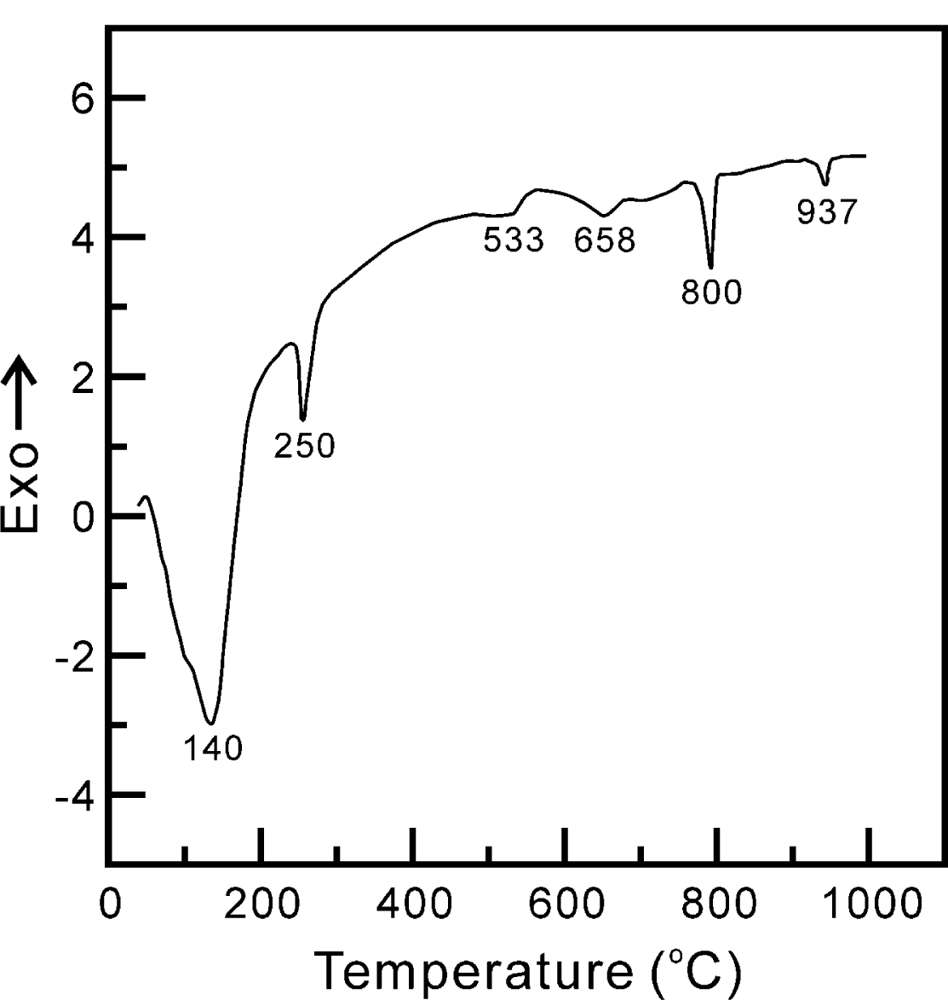
<p>The DTA curve of the zinc titanate precursor powders, produced without the addition of either a dispersant agent or mineralizer, and which was heated from 25 to 1000 °C in static air at a heating rate of 10 °C/min, is shown in <xref ref-type="fig" rid="f1-ijms-12-00935">Figure 1</xref>. There are four endothermic peaks at 140, 250, 800 and 940 °C in the DTA curve. The endothermic peak at 140 °C is due to the dehydration of the zinc titanate precursor powders. The second endothermic peak, at 250 °C, is attributed to the decomposition of NH<sub>2</sub>- into N<sub>2</sub> and H<sub>2</sub> [<xref ref-type="bibr" rid="b20-ijms-12-00935">20</xref>]. The third endothermic peak, at 800 °C, is caused by the decomposition of Zn<sub>2</sub>Ti<sub>3</sub>O<sub>8</sub> into ZnTiO<sub>3</sub> and rutile TiO<sub>2</sub>. The fourth endothermic peak, at 940 °C, is due to the ZnTiO<sub>3</sub> decomposing, which leads to the formation of Zn<sub>2</sub>TiO<sub>4</sub> and rutile TiO<sub>2</sub>. Moreover, <xref ref-type="fig" rid="f1-ijms-12-00935">Figure 1</xref> also shows two relatively small broad exothermic peaks at around 558 and 689 °C. The first exothermic peak, at 558 °C, is due to the anatase TiO<sub>2</sub> accompanied by Zn<sub>2</sub>Ti<sub>3</sub>O<sub>8</sub> formation. The second exothermic peak at 689 °C is caused by the ZnTiO<sub>3</sub> accompanied with rutile TiO<sub>2</sub> formation.</p></sec>
<sec>
<label>3.2.</label>
<title>Phase Transition of Zinc Titanate Precursor Powders Calcined at Various Temperatures for 1 h</title>
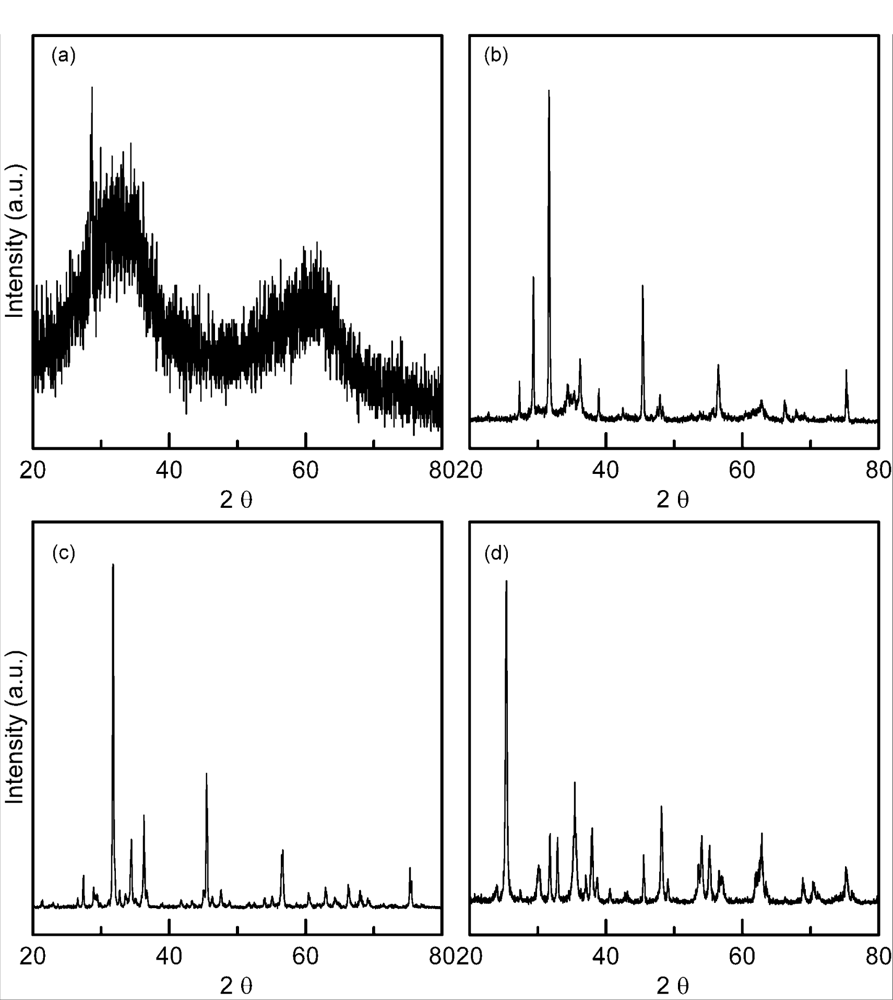
<p><xref ref-type="fig" rid="f2-ijms-12-00935">Figure 2</xref> shows the XRD patterns of the zinc titanate precursor powders prepared without a dispersant agent or mineralizer and calcined at various temperatures for 1 h. The XRD pattern of the freeze dried precursor powders before calcination is shown in <xref ref-type="fig" rid="f2-ijms-12-00935">Figure 2(a)</xref>, which reveals that the precursor powders still maintained the amorphous state. <xref ref-type="fig" rid="f2-ijms-12-00935">Figure 2(b)</xref> shows the XRD pattern of the zinc titanate precursor powders calcined at 600 °C for 1 h, and indicates that the anatase TiO<sub>2</sub> appeared due to the reflections located (101), (110), (103), (200), (105), (211) and (220) (JCPDS Cards No.89-4203). <xref ref-type="fig" rid="f2-ijms-12-00935">Figure 2(b)</xref> also shows the presence of ZnO, due to the reflection peaks located at (100), (110) and (103) (JCPDS Card No.89-1397). Furthermore, the reflection peaks of Zn<sub>2</sub>Ti<sub>3</sub>O<sub>8</sub> also appeared at (210), (220), (400), (440), and (622) (JCPDS Card No.87-1991). The XRD pattern of zinc titanate precursor powders calcined at 700 °C for 1 h are illustrated in <xref ref-type="fig" rid="f2-ijms-12-00935">Figure 2(c)</xref>, which reveals that the crystallized phases were composed of the major phases of ZnO and Zn<sub>2</sub>Ti<sub>3</sub>O<sub>8</sub>, with rutile TiO<sub>2</sub> as the secondary phase and the minor phases of ZnTiO<sub>3</sub> and anatase TiO<sub>2</sub>. <xref ref-type="fig" rid="f2-ijms-12-00935">Figure 2(d)</xref> shows the XRD pattern of zinc titanate precursor calcined at 900 °C for 1 h. It reveals that the crystallized phase was composed of ZnO, Zn<sub>2</sub>TiO<sub>4</sub>, rutile TiO<sub>2</sub> and ZnTiO<sub>3</sub>, but the anatase TiO<sub>2</sub> disappeared.</p>
<p>Moreover, from <xref ref-type="fig" rid="f2-ijms-12-00935">Figure 2(c) and (d)</xref>, it is seen that there is a significantly higher intensity value for the ZnO (100) reflection (I<sub>100</sub>). Golón <italic>et al</italic>. [<xref ref-type="bibr" rid="b21-ijms-12-00935">21</xref>] have pointed out that for hydrothermal treatment systems, samples reveal an apparent preferential orientation growth in the (100) direction, leading to a significant I<sub>100</sub> value. In fact, zinc and oxygen atoms are arranged alternatively along the c-axis, and thus as is well established, this inherent asymmetry along the c-axis results in the anisotropic growth of ZnO crystallites.</p>
<p>On the other hand, Bartram and Slepetys [<xref ref-type="bibr" rid="b5-ijms-12-00935">5</xref>] pointed out that with a sample prepared at the mole ratio of ZnO:TiO<sub>2</sub> = 2:1 and calcined at 700 and 800 °C for various times, the phase of defect-spinel type Zn<sub>2</sub>Ti<sub>3</sub>O<sub>8</sub> with a trace amount of uncombined TiO<sub>2</sub> is produced. This is caused by the four Ti ions that are missing from the 16-point positions of the spinel-type structure arrangement, resulting in a defective spinel-type structure. Mrázek <italic>et al</italic>. [<xref ref-type="bibr" rid="b22-ijms-12-00935">22</xref>] reported that the TiO<sub>2</sub> and Zn<sub>2</sub>TiO<sub>4</sub> are decomposed from prepared Zn<sub>x</sub>Ti<sub>y</sub>O<sub>z</sub> powders for various ratios of ZnO/TiO<sub>2</sub>. TiO<sub>2</sub> exists at temperatures of 400–600 °C prepared by sol-gel method [<xref ref-type="bibr" rid="b23-ijms-12-00935">23</xref>].</p>
<p>In <xref ref-type="fig" rid="f2-ijms-12-00935">Figure 2(b) and (c)</xref>, it can be seen that although the intensity of Zn<sub>2</sub>Ti<sub>3</sub>O<sub>8</sub> increases with the calcination temperature, a small fraction of Zn<sub>2</sub>Ti<sub>3</sub>O<sub>8</sub> decomposes and leads to the formation of the ZnTiO<sub>3</sub> and rutile TiO<sub>2</sub>. This reaction can be expressed as follows:
<disp-formula id="FD1">
<label>(1)</label>
<mml:math display="block">
<mml:msub>
<mml:mtext>Zn</mml:mtext>
<mml:mn>2</mml:mn></mml:msub>
<mml:msub>
<mml:mtext>T</mml:mtext>
<mml:mn>3</mml:mn></mml:msub>
<mml:msub>
<mml:mtext>O</mml:mtext>
<mml:mn>8</mml:mn></mml:msub>
<mml:mo>→</mml:mo>
<mml:mn>2</mml:mn>
<mml:mtext>Zn</mml:mtext>
<mml:msub>
<mml:mtext>TiO</mml:mtext>
<mml:mn>3</mml:mn></mml:msub>
<mml:mo>+</mml:mo>
<mml:msub>
<mml:mtext>TiO</mml:mtext>
<mml:mrow>
<mml:mn>2</mml:mn>
<mml:mo stretchy="false">(</mml:mo>
<mml:mtext>r</mml:mtext>
<mml:mo stretchy="false">)</mml:mo></mml:mrow></mml:msub>
<mml:mo>.</mml:mo></mml:math></disp-formula></p>
<p>Yang and Swisher [<xref ref-type="bibr" rid="b24-ijms-12-00935">24</xref>] also pointed out that Zn<sub>2</sub>Ti<sub>3</sub>O<sub>8</sub> is a thermodynamically stable compound up to temperatures between 700 and 800 °C. Just above this temperature, ZnTiO<sub>3</sub> is more stable than the compound of Zn<sub>2</sub>Ti<sub>3</sub>O<sub>8</sub>. Furthermore, Yamaguchi <italic>et al</italic>. [<xref ref-type="bibr" rid="b6-ijms-12-00935">6</xref>] also proposed using an amorphous material prepared by the simultaneous hydrolysis of zinc acetylautonate and titanium isopropoxide for synthesis of the ZnTiO<sub>3</sub> powders. The XRD result shows the reflection peaks of the compound corresponding to Zn<sub>2</sub>Ti<sub>3</sub>O<sub>8</sub> appeared at 600 °C [<xref ref-type="bibr" rid="b5-ijms-12-00935">5</xref>] and the intensity of the reflection peaks increased rapidly up to 760 °C. No other compounds and free species, except for the hexagonal form of ZnTiO<sub>3</sub>, are observed up to the decomposition temperature at 965 °C. These results suggest that the compound so far denoted as Zn<sub>2</sub>Ti<sub>3</sub>O<sub>8</sub> is a low temperature form of ZnTiO<sub>3</sub>.</p>
<p>On the other hand, the phase of Zn<sub>2</sub>TiO<sub>4</sub> formed by the thermal decomposition of Zn<sub>2</sub>Ti<sub>3</sub>O<sub>8</sub> in the range of 650–900 °C has been reported by previous studies [<xref ref-type="bibr" rid="b5-ijms-12-00935">5</xref>,<xref ref-type="bibr" rid="b25-ijms-12-00935">25</xref>]. <xref ref-type="fig" rid="f2-ijms-12-00935">Figure 2(c)</xref> shows that for the zinc titanate precursor powders calcined at 700 °C for 1 h, only a small fraction of Zn<sub>2</sub>Ti<sub>3</sub>O<sub>8</sub> decomposed and formed the ZnTiO<sub>3</sub> and rutile TiO<sub>2</sub>. This result was attributed to the fact that the phase of Zn<sub>2</sub>Ti<sub>3</sub>O<sub>8</sub> at 700 °C still has thermal stability. When calcined at 900 °C for 1 h, the Zn<sub>2</sub>Ti<sub>3</sub>O<sub>8</sub> phase disappeared and the reflection peaks of ZnTiO<sub>3</sub> also nearly vanished, but the intensity of Zn<sub>2</sub>TiO<sub>4</sub> and rutile TiO<sub>2</sub> increased. This is because the Zn<sub>2</sub>Ti<sub>3</sub>O<sub>8</sub> and ZnTiO<sub>3</sub> phases decomposed, leading to the formation of Zn<sub>2</sub>TiO<sub>4</sub> and rutile TiO<sub>2</sub>. These reactions can be expressed as follows:
<disp-formula id="FD2">
<label>(2)</label>
<mml:math display="block">
<mml:msub>
<mml:mtext>Zn</mml:mtext>
<mml:mn>2</mml:mn></mml:msub>
<mml:msub>
<mml:mtext>Ti</mml:mtext>
<mml:mn>3</mml:mn></mml:msub>
<mml:msub>
<mml:mtext>O</mml:mtext>
<mml:mn>8</mml:mn></mml:msub>
<mml:mo>→</mml:mo>
<mml:msub>
<mml:mtext>Zn</mml:mtext>
<mml:mn>2</mml:mn></mml:msub>
<mml:msub>
<mml:mtext>TiO</mml:mtext>
<mml:mn>4</mml:mn></mml:msub>
<mml:mo>+</mml:mo>
<mml:mn>2</mml:mn>
<mml:msub>
<mml:mtext>TiO</mml:mtext>
<mml:mrow>
<mml:mn>2</mml:mn>
<mml:mo stretchy="false">(</mml:mo>
<mml:mtext>r</mml:mtext>
<mml:mo stretchy="false">)</mml:mo></mml:mrow></mml:msub></mml:math></disp-formula>
<disp-formula id="FD3">
<label>(3)</label>
<mml:math display="block">
<mml:mn>2</mml:mn>
<mml:mtext>Zn</mml:mtext>
<mml:msub>
<mml:mtext>TiO</mml:mtext>
<mml:mn>3</mml:mn></mml:msub>
<mml:mo>→</mml:mo>
<mml:msub>
<mml:mtext>Zn</mml:mtext>
<mml:mn>2</mml:mn></mml:msub>
<mml:msub>
<mml:mtext>TiO</mml:mtext>
<mml:mn>4</mml:mn></mml:msub>
<mml:mo>+</mml:mo>
<mml:msub>
<mml:mtext>TiO</mml:mtext>
<mml:mrow>
<mml:mn>2</mml:mn>
<mml:mo stretchy="false">(</mml:mo>
<mml:mtext>r</mml:mtext>
<mml:mo stretchy="false">)</mml:mo></mml:mrow></mml:msub></mml:math></disp-formula></p></sec>
<sec>
<label>3.3.</label>
<title>Microstructure of the Zinc Titanate Precursor Powders Calcined at Various Temperatures for 1 h</title>
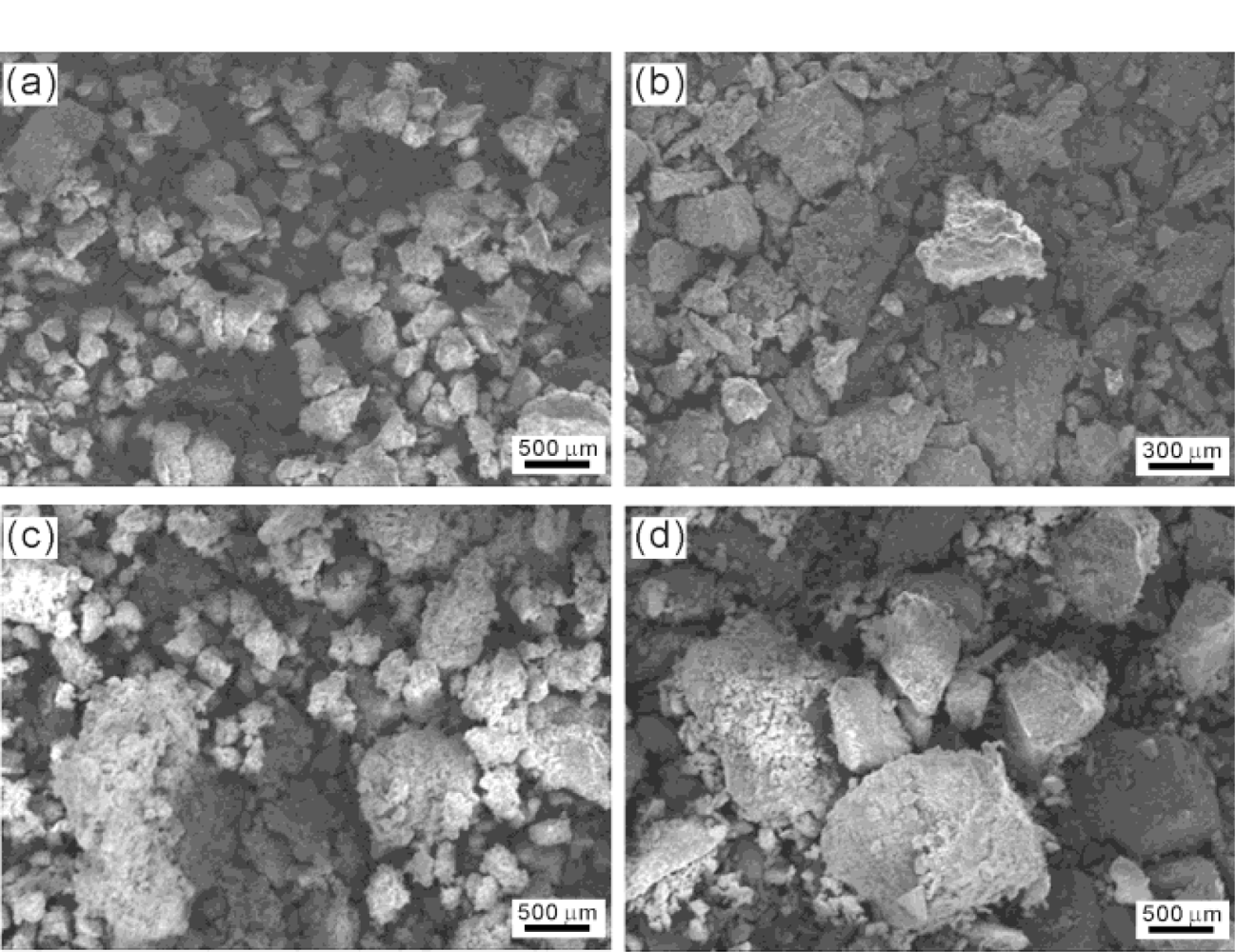
<p>The SEM microstructure of the zinc titanate precursor powders calcined at various temperatures for 1 h are shown in <xref ref-type="fig" rid="f3-ijms-12-00935">Figure 3</xref>. <xref ref-type="fig" rid="f3-ijms-12-00935">Figure 3(a)</xref> shows the morphology of the freeze-dried zinc titanate precursor powders without a dispersant agent or mineralizer agglomerates to the size of about 140 ± 70 μm. The SEM micrographs in <xref ref-type="fig" rid="f3-ijms-12-00935">Figure 3(b) and (d)</xref> shows the zinc titanate precursor powders calcined at 600, 700 and 900 °C for 1 h, respectively. It can be seen that the agglomerated size of the particles increases as the calcination temperature rises from 600 to 900 °C. When calcined at 900 °C for 1 h, the size increases from 140 ± 70 μm to 270 ± 170 μm. Since the zinc titanate precursor powders were prepared through the wet-chemical routes, during this process, <italic>i.e.</italic>, drying and/or subsequent steps, agglomeration can occur. During calcination, the most common type of agglomeration in the conventional powders was due to solid bonds that formed between the particles.</p>
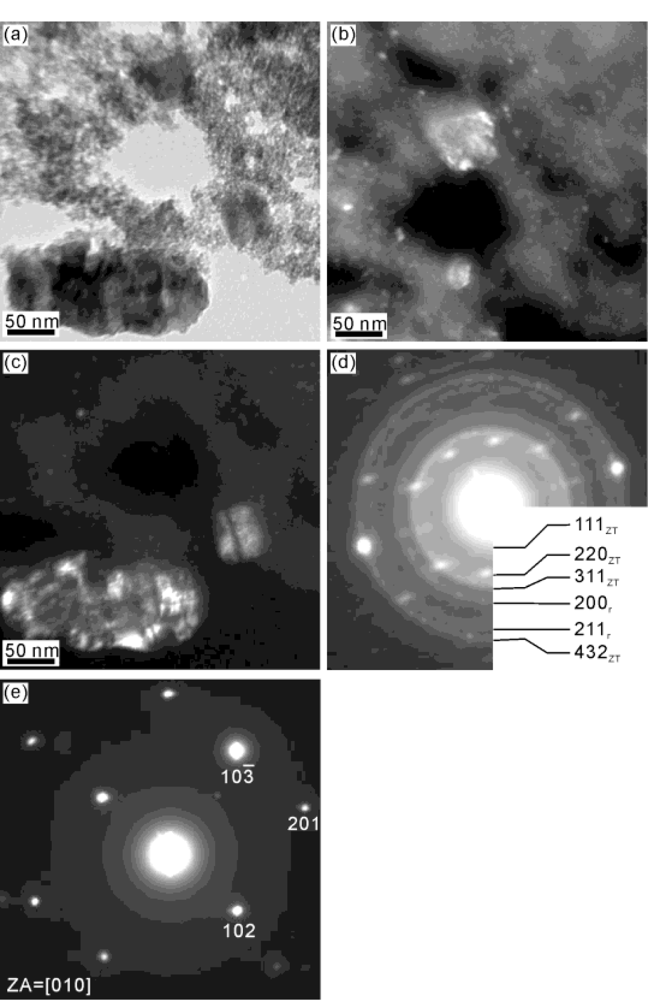
<p>The bright field (BF) and dark field (DF) TEM micrographs and the corresponding electron diffraction (ED) patterns of the freeze dried zinc titanate precursor powders calcined at 700 °C for 1 h are shown in <xref ref-type="fig" rid="f4-ijms-12-00935">Figure 4</xref>. <xref ref-type="fig" rid="f4-ijms-12-00935">Figure 4(a)</xref> shows the BF image, in which fine particles with size of about 5 nm and a larger particle with a length of 200 nm and width of 100 nm are observed. Aubert <italic>et al</italic>. [<xref ref-type="bibr" rid="b26-ijms-12-00935">26</xref>] also reported the particle of TiO<sub>2</sub> is about 5 nm. <xref ref-type="fig" rid="f4-ijms-12-00935">Figure 4(a)</xref> shows that the larger particles, of ZnO which cause the contact area of ZnO with anatase TiO<sub>2</sub> to decrease, led to a decrease in the reaction of ZnO with anatase TiO<sub>2</sub>, meaning that insufficient Zn<sub>2</sub>Ti<sub>3</sub>O<sub>8</sub> was produced. <xref ref-type="fig" rid="f4-ijms-12-00935">Figure 4(b),(c)</xref> shows the DF images of the fine and larger particles in <xref ref-type="fig" rid="f4-ijms-12-00935">Figure 4(a)</xref>. In addition, <xref ref-type="fig" rid="f4-ijms-12-00935">Figure 4(d),(e)</xref> shows the ED patterns of the particles in <xref ref-type="fig" rid="f3-ijms-12-00935">Figure 3(b),(c)</xref>, respectively. The ED pattern of <xref ref-type="fig" rid="f4-ijms-12-00935">Figure 4(d)</xref> corresponds to the phases of ZnTiO<sub>3</sub> and rutile TiO<sub>2</sub>. On the other hand, the ED pattern of <xref ref-type="fig" rid="f4-ijms-12-00935">Figure 4(e)</xref> corresponds to ZnO. <xref ref-type="fig" rid="f4-ijms-12-00935">Figure 4(d)</xref> also shows evidence of ZnTiO<sub>3</sub> and rutile TiO<sub>2</sub> when calcined at 700 °C for 1 h. Moreover, the microstructure of the ZnTiO<sub>3</sub> crystallite shows a nearly spherical morphology growing on the matrix of a plate-like phase of ZnO.</p>
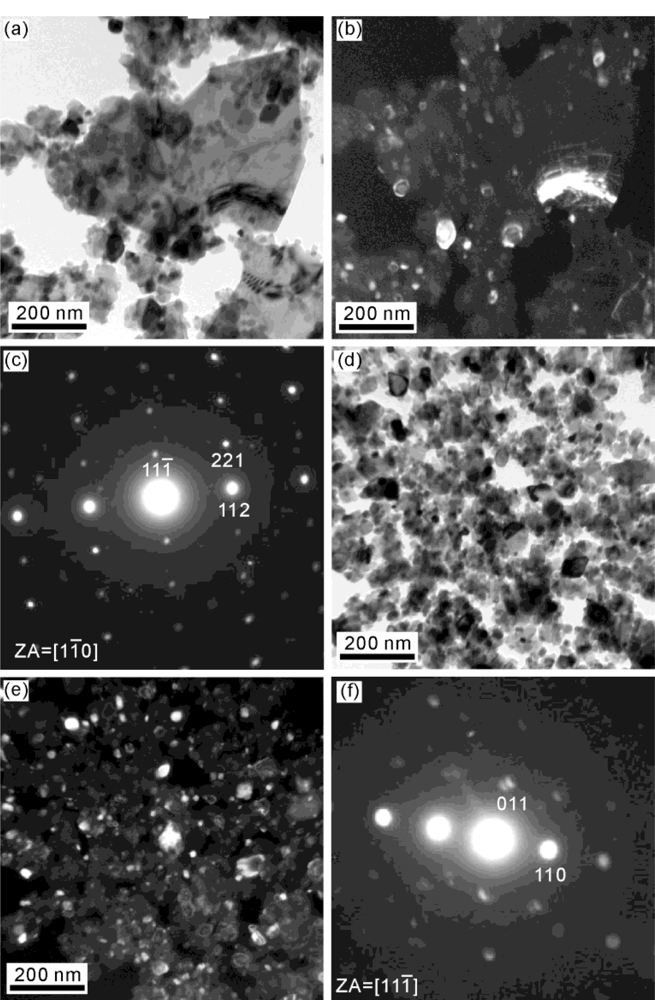
<p><xref ref-type="fig" rid="f5-ijms-12-00935">Figure 5(a),(b)</xref> shows the BF and DF images of the freeze dried zinc titanate precursor powders calcined at 900°C for 1 h, revealing that two kinds morphology coexist in the sample. One is the fine particles with a size of about 50 nm, and the other one is belt-shape particles with a length of 200 nm and width of 50 nm. The ED pattern of the <xref ref-type="fig" rid="f5-ijms-12-00935">Figure 5(c)</xref> belt-shaped and fine particles correspond to ZnTiO<sub>3</sub> with a zone axis (ZA) of [110]. <xref ref-type="fig" rid="f5-ijms-12-00935">Figure 5(d),(e)</xref> shows the BF and DF images of the fine particles with the size of about 38 ± 18 μm. The ED pattern of <xref ref-type="fig" rid="f5-ijms-12-00935">Figure 5(f)</xref> corresponds to ZnTiO<sub>3</sub> with the ZA of [ıı̄ı].</p></sec>
<sec>
<label>3.4.</label>
<title>The Transmittance of Zinc Titanate Precursor Powders Calcined at 900 °C for 1 h</title>
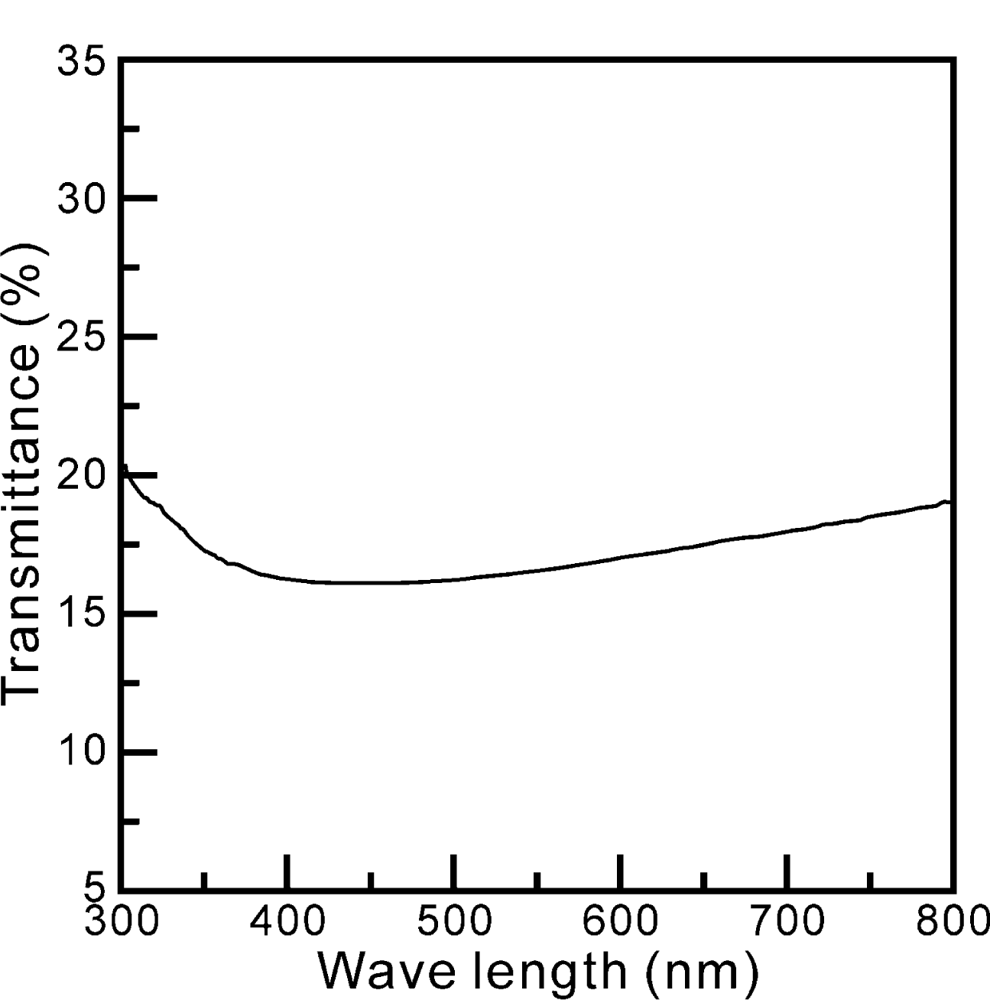
<p><xref ref-type="fig" rid="f6-ijms-12-00935">Figure 6</xref> shows the relation between transmittance and wavelength range between 300 and 800 nm for freeze dried zinc precursor powders calcined at 700 °C for 1 h. It is found that the calcined sample has an acceptable transmittance at the wavelength of 400 nm. This result indicates that zinc titanate precursor powders calcined at 700 °C for 1 h can be used as an UVA-attenuating agent.</p></sec></sec>
<sec sec-type="conclusions">
<label>4.</label>
<title>Conclusions</title>
<p>Zn<sub>2</sub>Ti<sub>3</sub>O<sub>8</sub> powders prepared by a hydrothermal method without a dispersant agent or mineralizer for use in UVA-attenuating applications have been investigated using DTA, XRD, SEM, TEM, ED and UV/VIS. The results are summarized as follows:
<list list-type="order">
<list-item>
<p>When the zinc titanate precursor powders were prepared at pH = 7 and calcined at 600 °C for 1 h, the XRD results show that the phases of ZnO, anatase TiO<sub>2</sub> and Zn<sub>2</sub>Ti<sub>3</sub>O<sub>8</sub> coexisted in the sample. However, when calcined at 900 °C for 1 h, the XRD result reveals the existence of Zn<sub>2</sub>TiO<sub>4</sub>, rutile TiO<sub>2</sub>, and ZnO.</p></list-item>
<list-item>
<p>The SEM results reveal significant agglomeration in both the freeze-dried and post-calcined samples.</p></list-item>
<list-item>
<p>The TEM and ED examination indicates the existence of near spherical Zn<sub>2</sub>Ti<sub>3</sub>O<sub>8</sub> crystallites with size of about 5 nm on larger ZnO particles with a length of 200 nm and width of 100 nm. The microstructure ZnTiO<sub>3</sub> shows a somewhat belt-shaped morphology, with a length of 200 nm and width of 50 nm for precipitates calcined at 900 °C for 1 h.</p></list-item>
<list-item>
<p>The calcined samples have an acceptable transmittance when the wavelength is 400 nm. This result indicates that zinc titanate precursor powders calcined at 700 °C for 1 h can be used as an UVA-attenuating agent.</p></list-item></list></p></sec></body>
<back>
<ack>
<p>This work was supported by the National Science Council and Kaohsiung Medical University, Taiwan, under Contract No.95-2221-E-037-007 and Q 097038, respectively, which is gratefully acknowledged. In addition, the authors sincerely thank M.P Hung and M.H. Hon for the discussions and S.Y. Yau for the assistance in TEM.</p></ack>
<ref-list>
<title>References</title>
<ref id="b1-ijms-12-00935"><label>1.</label><citation citation-type="book"><person-group person-group-type="author"><name><surname>Fairhurst</surname><given-names>D</given-names></name><name><surname>Mitchnick</surname><given-names>MA</given-names></name></person-group><source>Sunscreens: Development, Evaluation, and Regulatory Aspects</source><edition>2nd ed</edition><person-group person-group-type="editor"><name><surname>Lowe</surname><given-names>NJ</given-names></name><name><surname>Shaath</surname><given-names>NA</given-names></name><name><surname>Pathat</surname><given-names>MA</given-names></name></person-group><publisher-name>Marcel Dekker</publisher-name><publisher-loc>New York, NY, USA</publisher-loc><year>1997</year><fpage>313</fpage><lpage>352</lpage></citation></ref>
<ref id="b2-ijms-12-00935"><label>2.</label><citation citation-type="book"><person-group person-group-type="author"><name><surname>Shaath</surname><given-names>NA</given-names></name></person-group><source>Sunscreens: Development, Evaluation, and Regulatory Aspects</source><edition>2nd ed</edition><person-group person-group-type="editor"><name><surname>Lowe</surname><given-names>NJ</given-names></name><name><surname>Shaath</surname><given-names>NA</given-names></name><name><surname>Pathat</surname><given-names>MA</given-names></name></person-group><publisher-name>Marcel Dekker</publisher-name><publisher-loc>New York, NY, USA</publisher-loc><year>1997</year><fpage>3</fpage><lpage>33</lpage></citation></ref>
<ref id="b3-ijms-12-00935"><label>3.</label><citation citation-type="journal"><person-group person-group-type="author"><name><surname>Al-Hill</surname><given-names>SM</given-names></name><name><surname>Willamder</surname><given-names>M</given-names></name></person-group><article-title>Optical propertics of zinc oxide nano-particles embedded in dielectric medium for UV region: Numberical simulation</article-title><source>J. Nanoparticle Res</source><year>2006</year><volume>8</volume><fpage>79</fpage><lpage>97</lpage><pub-id pub-id-type="doi">10.1007/s11051-005-8024-2</pub-id></citation></ref>
<ref id="b4-ijms-12-00935"><label>4.</label><citation citation-type="journal"><person-group person-group-type="author"><name><surname>Dulin</surname><given-names>FH</given-names></name><name><surname>Rase</surname><given-names>DE</given-names></name></person-group><article-title>Phase equilibria in the system ZnO-TiO<sub>2</sub></article-title><source>J. Am. Ceram. Soc</source><year>1960</year><volume>43</volume><fpage>125</fpage><lpage>131</lpage><pub-id pub-id-type="doi">10.1111/j.1151-2916.1960.tb14326.x</pub-id></citation></ref>
<ref id="b5-ijms-12-00935"><label>5.</label><citation citation-type="journal"><person-group person-group-type="author"><name><surname>Bartram</surname><given-names>SF</given-names></name><name><surname>Slepetys</surname><given-names>RA</given-names></name></person-group><article-title>Compound formation and crystal structure in the system ZnO-TiO<sub>2</sub></article-title><source>J. Am. Ceram. Soc</source><year>1961</year><volume>44</volume><fpage>493</fpage><lpage>499</lpage><pub-id pub-id-type="doi">10.1111/j.1151-2916.1961.tb13712.x</pub-id></citation></ref>
<ref id="b6-ijms-12-00935"><label>6.</label><citation citation-type="journal"><person-group person-group-type="author"><name><surname>Yamaguchi</surname><given-names>O</given-names></name><name><surname>Morimi</surname><given-names>M</given-names></name><name><surname>Kawabata</surname><given-names>H</given-names></name><name><surname>Shimizu</surname><given-names>K</given-names></name></person-group><article-title>Formation and transformation of ZnTiO<sub>3</sub></article-title><source>J. Am. Ceram. Soc</source><year>1987</year><volume>70</volume><fpage>97</fpage><lpage>98</lpage></citation></ref>
<ref id="b7-ijms-12-00935"><label>7.</label><citation citation-type="journal"><person-group person-group-type="author"><name><surname>Steinike</surname><given-names>U</given-names></name><name><surname>Wallis</surname><given-names>B</given-names></name></person-group><article-title>Formation and Strusture of Ti-Zn-Oxides</article-title><source>Cryst. Res. Technol</source><year>1997</year><volume>32</volume><fpage>187</fpage><lpage>193</lpage><pub-id pub-id-type="doi">10.1002/crat.2170320119</pub-id></citation></ref>
<ref id="b8-ijms-12-00935"><label>8.</label><citation citation-type="journal"><person-group person-group-type="author"><name><surname>Kim</surname><given-names>HT</given-names></name><name><surname>Kim</surname><given-names>Y</given-names></name><name><surname>Valant</surname><given-names>M</given-names></name><name><surname>Suvorov</surname><given-names>D</given-names></name></person-group><article-title>Titanium incorporation in Zn<sub>2</sub>TiO<sub>4</sub> spinel ceramics</article-title><source>J. Am. Ceram. Soc</source><year>2001</year><volume>84</volume><fpage>1081</fpage><lpage>1086</lpage><pub-id pub-id-type="doi">10.1111/j.1151-2916.2001.tb00793.x</pub-id></citation></ref>
<ref id="b9-ijms-12-00935"><label>9.</label><citation citation-type="journal"><person-group person-group-type="author"><name><surname>Swisher</surname><given-names>JH</given-names></name><name><surname>Schwerdtfeger</surname><given-names>K</given-names></name></person-group><article-title>Thermodynamic analysis of sorption reactions for the removal of sulfur from hot gases</article-title><source>J. Mater. Eng. Preform</source><year>1992</year><volume>1</volume><fpage>565</fpage><lpage>571</lpage><pub-id pub-id-type="doi">10.1007/BF02682694</pub-id></citation></ref>
<ref id="b10-ijms-12-00935"><label>10.</label><citation citation-type="journal"><person-group person-group-type="author"><name><surname>Swisher</surname><given-names>JH</given-names></name><name><surname>Yang</surname><given-names>J</given-names></name><name><surname>Gupta</surname><given-names>RP</given-names></name></person-group><article-title>Attrition-resistant zinc titanate sorbent for Sulfur</article-title><source>Ind. Eng. Chem</source><year>1995</year><volume>34</volume><fpage>4463</fpage><lpage>4471</lpage><pub-id pub-id-type="doi">10.1021/ie00039a037</pub-id></citation></ref>
<ref id="b11-ijms-12-00935"><label>11.</label><citation citation-type="other"><person-group person-group-type="author"><name><surname>McCord</surname><given-names>AT</given-names></name><name><surname>Saunder</surname><given-names>HF</given-names></name></person-group><comment>Preparation of pigmentary materials. US Patent 2379019</comment><year>1945</year></citation></ref>
<ref id="b12-ijms-12-00935"><label>12.</label><citation citation-type="journal"><person-group person-group-type="author"><name><surname>Obayashi</surname><given-names>H</given-names></name><name><surname>Sakurai</surname><given-names>Y</given-names></name><name><surname>Gejo</surname><given-names>T</given-names></name></person-group><article-title>Perovskite-type oxide as ethanol sensors</article-title><source>J. Solid State Chem</source><year>1976</year><volume>17</volume><fpage>299</fpage><lpage>303</lpage><pub-id pub-id-type="doi">10.1016/0022-4596(76)90135-3</pub-id></citation></ref>
<ref id="b13-ijms-12-00935"><label>13.</label><citation citation-type="journal"><person-group person-group-type="author"><name><surname>Kagata</surname><given-names>H</given-names></name><name><surname>Inoue</surname><given-names>T</given-names></name><name><surname>Kato</surname><given-names>J</given-names></name><name><surname>Kameyama</surname><given-names>I</given-names></name><name><surname>Ishizaki</surname><given-names>T</given-names></name></person-group><article-title>Low-fire microwave dielectric ceramics, and maltilayer devices with silver internal electrode</article-title><source>Ceram. Trans</source><year>1993</year><volume>32</volume><fpage>81</fpage><lpage>90</lpage></citation></ref>
<ref id="b14-ijms-12-00935"><label>14.</label><citation citation-type="journal"><person-group person-group-type="author"><name><surname>Negas</surname><given-names>T</given-names></name><name><surname>Yeager</surname><given-names>T</given-names></name><name><surname>Bell</surname><given-names>S</given-names></name><name><surname>Coats</surname><given-names>N</given-names></name><name><surname>Minis</surname><given-names>I</given-names></name></person-group><article-title>BaTi<sub>9</sub>O<sub>20</sub>-based ceramics resulted for modern microwave applications</article-title><source>Am. Ceram. Soc. Bull</source><year>1993</year><volume>72</volume><fpage>80</fpage><lpage>89</lpage></citation></ref>
<ref id="b15-ijms-12-00935"><label>15.</label><citation citation-type="journal"><person-group person-group-type="author"><name><surname>Chang</surname><given-names>YS</given-names></name><name><surname>Chang</surname><given-names>YH</given-names></name><name><surname>Chen</surname><given-names>IG</given-names></name><name><surname>Chen</surname><given-names>GJ</given-names></name></person-group><article-title>Synthesis and characterization of zinc titanate doped with magnesium</article-title><source>Solid State Commun</source><year>2003</year><volume>128</volume><fpage>203</fpage><lpage>208</lpage><pub-id pub-id-type="doi">10.1016/S0038-1098(03)00527-1</pub-id></citation></ref>
<ref id="b16-ijms-12-00935"><label>16.</label><citation citation-type="journal"><person-group person-group-type="author"><name><surname>Chang</surname><given-names>YS</given-names></name><name><surname>Chang</surname><given-names>YH</given-names></name><name><surname>Chen</surname><given-names>IG</given-names></name><name><surname>Chen</surname><given-names>GJ</given-names></name><name><surname>Chai</surname><given-names>YL</given-names></name></person-group><article-title>Synthesis and characterization of zinc titanate nano-crystal powders by sol-gel technique</article-title><source>J. Cryst. Growth</source><year>2002</year><volume>243</volume><fpage>319</fpage><lpage>326</lpage><pub-id pub-id-type="doi">10.1016/S0022-0248(02)01490-2</pub-id></citation></ref>
<ref id="b17-ijms-12-00935"><label>17.</label><citation citation-type="journal"><person-group person-group-type="author"><name><surname>Hosono</surname><given-names>E</given-names></name><name><surname>Fujihara</surname><given-names>S</given-names></name><name><surname>Onuki</surname><given-names>M</given-names></name><name><surname>Kimura</surname><given-names>T</given-names></name></person-group><article-title>Low-temperature synthesis of nanocrystalline zinc titanate materials with high specific surface area</article-title><source>J. Am. Ceram. Soc</source><year>2004</year><volume>87</volume><fpage>1785</fpage><lpage>1788</lpage><pub-id pub-id-type="doi">10.1111/j.1551-2916.2004.01785.x</pub-id></citation></ref>
<ref id="b18-ijms-12-00935"><label>18.</label><citation citation-type="journal"><person-group person-group-type="author"><name><surname>Manik</surname><given-names>SK</given-names></name><name><surname>Bose</surname><given-names>P</given-names></name><name><surname>Pradhan</surname><given-names>SK</given-names></name></person-group><article-title>Microstructure characterization and phase transformation kinetics of ball-milled preprared nanocrystalline Zn<sub>2</sub>TiO<sub>4</sub> by Rietveld method</article-title><source>Mater. Chem. Phys</source><year>2003</year><volume>82</volume><fpage>837</fpage><lpage>847</lpage><pub-id pub-id-type="doi">10.1016/j.matchemphys.2003.07.012</pub-id></citation></ref>
<ref id="b19-ijms-12-00935"><label>19.</label><citation citation-type="journal"><person-group person-group-type="author"><name><surname>Reddy</surname><given-names>VB</given-names></name><name><surname>Goel</surname><given-names>SP</given-names></name><name><surname>Mehrotra</surname><given-names>PN</given-names></name></person-group><article-title>Investigation on formation of zinc titanates via thermal decomposition of zinc titanyl oxalate hydrate</article-title><source>Mater. Chem. Phys</source><year>1984</year><volume>10</volume><fpage>365</fpage><lpage>373</lpage><pub-id pub-id-type="doi">10.1016/0254-0584(84)90097-X</pub-id></citation></ref>
<ref id="b20-ijms-12-00935"><label>20.</label><citation citation-type="journal"><person-group person-group-type="author"><name><surname>Kuo</surname><given-names>CL</given-names></name><name><surname>Wang</surname><given-names>CL</given-names></name><name><surname>Chen</surname><given-names>TY</given-names></name><name><surname>Chen</surname><given-names>GJ</given-names></name><name><surname>Hung</surname><given-names>IM</given-names></name><name><surname>Shih</surname><given-names>CJ</given-names></name><name><surname>Fung</surname><given-names>KZ</given-names></name></person-group><article-title>Low-temperature synthesis of nanocrystalline lanthanum monoaluminate powders by chemical co-precipitation</article-title><source>J. Alloy. Compd</source><year>2007</year><volume>392</volume><fpage>367</fpage><lpage>374</lpage></citation></ref>
<ref id="b21-ijms-12-00935"><label>21.</label><citation citation-type="journal"><person-group person-group-type="author"><name><surname>Golón</surname><given-names>G</given-names></name><name><surname>Hidalgo</surname><given-names>MC</given-names></name><name><surname>Navío</surname><given-names>JA</given-names></name><name><surname>Melián</surname><given-names>EP</given-names></name><name><surname>Díaz</surname><given-names>OG</given-names></name><name><surname>Rodriguez</surname><given-names>JMD</given-names></name></person-group><article-title>Highly photoactive ZnO by amine capping-assisted hydrothermal treatment</article-title><source>Appl. Catal. B Environ</source><year>2008</year><volume>83</volume><fpage>30</fpage><lpage>38</lpage><pub-id pub-id-type="doi">10.1016/j.apcatb.2008.01.033</pub-id></citation></ref>
<ref id="b22-ijms-12-00935"><label>22.</label><citation citation-type="journal"><person-group person-group-type="author"><name><surname>Krylova</surname><given-names>G</given-names></name><name><surname>Brioude</surname><given-names>A</given-names></name><name><surname>Girard</surname><given-names>SA</given-names></name><name><surname>Mrazek</surname><given-names>J</given-names></name><name><surname>Spanhel</surname><given-names>L</given-names></name></person-group><article-title>Natural superhydrophilicity and photocatalytic properties of sol-gel derived ZnTiO<sub>3</sub>-ilmenite/r-TiO<sub>2</sub> films</article-title><source>Phys. Chem. Chem. Phys</source><year>2010</year><volume>12</volume><fpage>15101</fpage><lpage>15110</lpage><pub-id pub-id-type="doi">10.1039/c004517a</pub-id><pub-id pub-id-type="pmid">20963231</pub-id></citation></ref>
<ref id="b23-ijms-12-00935"><label>23.</label><citation citation-type="journal"><person-group person-group-type="author"><name><surname>Aubert</surname><given-names>T</given-names></name><name><surname>Grasset</surname><given-names>F</given-names></name><name><surname>Potel</surname><given-names>M</given-names></name><name><surname>Nazabal</surname><given-names>V</given-names></name><name><surname>Cardinal</surname><given-names>T</given-names></name><name><surname>Pechev</surname><given-names>S</given-names></name><name><surname>Saito</surname><given-names>N</given-names></name><name><surname>Ohashi</surname><given-names>N</given-names></name><name><surname>Haneda</surname><given-names>H</given-names></name></person-group><article-title>Synthesis and characterization of Eu3+,Ti4+@ZnO organosols and nanocrystalline c-ZnTiO<sub>3</sub> thin films aiming at high transparency and luminescence</article-title><source>Sci. Technol. Adv. Mater</source><year>2010</year><volume>11</volume><fpage>044401</fpage><pub-id pub-id-type="doi">10.1088/1468-6996/11/4/044401</pub-id></citation></ref>
<ref id="b24-ijms-12-00935"><label>24.</label><citation citation-type="journal"><person-group person-group-type="author"><name><surname>Yang</surname><given-names>J</given-names></name><name><surname>Swisher</surname><given-names>JH</given-names></name></person-group><article-title>The phase stability of Zn<sub>2</sub>Ti<sub>3</sub>O<sub>8</sub></article-title><source>Mater. Character</source><year>1996</year><volume>37</volume><fpage>153</fpage><lpage>159</lpage><pub-id pub-id-type="doi">10.1016/S1044-5803(96)00098-8</pub-id></citation></ref>
<ref id="b25-ijms-12-00935"><label>25.</label><citation citation-type="journal"><person-group person-group-type="author"><name><surname>Aal</surname><given-names>AA</given-names></name><name><surname>Barakat</surname><given-names>MA</given-names></name><name><surname>Mohamed</surname><given-names>RM</given-names></name></person-group><article-title>Electrophoreted Zn-TiO<sub>2</sub>-ZnO nanocompsite coating films for photocatalytic degradation of 2-chlorophenol</article-title><source>Appl. Surface Sci</source><year>2008</year><volume>254</volume><fpage>4577</fpage><lpage>4583</lpage><pub-id pub-id-type="doi">10.1016/j.apsusc.2008.01.049</pub-id></citation></ref>
<ref id="b26-ijms-12-00935"><label>26.</label><citation citation-type="journal"><person-group person-group-type="author"><name><surname>Mrázek</surname><given-names>J</given-names></name><name><surname>Spanhel</surname><given-names>L</given-names></name><name><surname>Chadeyron</surname><given-names>G</given-names></name><name><surname>Matêjec</surname><given-names>V</given-names></name></person-group><article-title>Evolution and Eu<sup>3+</sup> doping of sol–gel derived ternary Zn<sub>x</sub>Ti<sub>y</sub>O<sub>z</sub> nanocrystals</article-title><source>J. Phys. Chem. C</source><year>2010</year><volume>114</volume><fpage>2843</fpage><lpage>2852</lpage><pub-id pub-id-type="doi">10.1021/jp9036217</pub-id></citation></ref></ref-list>
<sec sec-type="display-objects">
<title>Figures</title>
<fig id="f1-ijms-12-00935" position="float">
<label>Figure 1.</label>
<caption>
<p>Differential thermal analysis (DTA) curve of zinc titanate precursor powders with a heating rate of 10 °C·min<sup>−1</sup>.</p></caption>
<graphic xlink:href="ijms-12-00935f1.gif"/></fig>
<fig id="f2-ijms-12-00935" position="float">
<label>Figure 2.</label>
<caption>
<p>X-ray diffraction (XRD) patterns of ZnTiO<sub>3</sub> precipitates calcined at various temperatures for 1 h: (<bold>a</bold>) before calcination, (<bold>b</bold>) calcined at 600 °C, (<bold>c</bold>) 700 °C, and (<bold>d</bold>) 900 °C.</p></caption>
<graphic xlink:href="ijms-12-00935f2.gif"/></fig>
<fig id="f3-ijms-12-00935" position="float">
<label>Figure 3.</label>
<caption>
<p>Scanning electron microscope (SEM) morphology of zinc titanate precursor powders calcined at various temperatures for 1 h: (<bold>a</bold>) before calcination, (<bold>b</bold>) calcined at 600 °C, (<bold>c</bold>) 700 °C, and (<bold>d</bold>) 900 °C.</p></caption>
<graphic xlink:href="ijms-12-00935f3.gif"/></fig>
<fig id="f4-ijms-12-00935" position="float">
<label>Figure 4.</label>
<caption>
<p>Transmission electron microscope (TEM) morphology and electron diffraction (ED) patterns of zinc titanate precursor powders calcined at 700 °C for 1 h: (<bold>a</bold>) bright field (BF) image, (<bold>b</bold>) dark field (DF) image by using a circle spot of (<bold>d</bold>), (<bold>c</bold>) DF image by using a circle spot of (<bold>e</bold>), (<bold>d</bold>) ED pattern corresponding to the phases of Zn<sub>2</sub>Ti<sub>3</sub>O<sub>8</sub> (denoted by ZT) and rutile TiO<sub>2</sub> (denoted by r), and (<bold>e</bold>) ED pattern corresponding to ZnO.</p></caption>
<graphic xlink:href="ijms-12-00935f4.gif"/></fig>
<fig id="f5-ijms-12-00935" position="float">
<label>Figure 5.</label>
<caption>
<p>TEM morphology and ED patterns of zinc titanate precursor powders calcined at 900 °C for 1 h: (<bold>a</bold>) BF image, (<bold>b</bold>) DF image by using a circle spot of (<bold>c</bold>), (<bold>c</bold>) ED pattern corresponding to ZnTiO<sub>2</sub>, (<bold>d</bold>) BF image, (<bold>e</bold>) DF image by using a circle spot of (<bold>f</bold>), and (<bold>f</bold>) ED pattern corresponding to Zn<sub>2</sub>TiO<sub>3</sub>.</p></caption>
<graphic xlink:href="ijms-12-00935f5.gif"/></fig>
<fig id="f6-ijms-12-00935" position="float">
<label>Figure 6.</label>
<caption>
<p>Relation between the absorbed and wavelength between 300 and 800 nm for ZnTiO<sub>3</sub> precipitates calcined at 900 °C for 1 h.</p></caption>
<graphic xlink:href="ijms-12-00935f6.gif"/></fig></sec></back></article>