<?xml version="1.0" encoding="UTF-8"?>
<!DOCTYPE article PUBLIC "-//NLM//DTD Journal Publishing DTD v2.3 20070202//EN" "journalpublishing.dtd">
<article xmlns:xlink="http://www.w3.org/1999/xlink" xml:lang="en" article-type="review-article">
<front>
<journal-meta>
<journal-id journal-id-type="publisher-id">ijms</journal-id>
<journal-title>International Journal of Molecular Sciences</journal-title>
<abbrev-journal-title>Int. J. Mol. Sci.</abbrev-journal-title>
<issn pub-type="epub">1422-0067</issn>
<publisher>
<publisher-name>Molecular Diversity Preservation International (MDPI)</publisher-name></publisher></journal-meta>
<article-meta>
<article-id pub-id-type="doi">10.3390/ijms12020917</article-id>
<article-id pub-id-type="publisher-id">ijms-12-00917</article-id>
<article-categories>
<subj-group>
<subject>Review</subject></subj-group></article-categories>
<title-group>
<article-title>Effects of Chitin and Its Derivative Chitosan on Postharvest Decay of Fruits: A Review</article-title></title-group>
<contrib-group>
<contrib contrib-type="author">
<name><surname>Zhang</surname><given-names>Hongyin</given-names></name><xref ref-type="corresp" rid="c1-ijms-12-00917">*</xref></contrib>
<contrib contrib-type="author">
<name><surname>Li</surname><given-names>Renping</given-names></name></contrib>
<contrib contrib-type="author">
<name><surname>Liu</surname><given-names>Weimin</given-names></name></contrib>
<aff id="af1-ijms-12-00917">College of Food and Biological Engineering, Jiangsu University, Zhenjiang 212013, Jiangsu, China; E-Mails: <email>renpingli1121@163.com</email> (R.L.); <email>liuwmwu@ujs.edu.cn</email> (W.L.)</aff></contrib-group>
<author-notes>
<corresp id="c1-ijms-12-00917">
<label>*</label>Author to whom correspondence should be addressed; E-Mail: <email>zhanghongyin126@126.com</email>; Tel.: +86-511-88780201; Fax: +86-511-88780201.</corresp></author-notes>
<pub-date pub-type="epub">
<day>27</day>
<month>1</month>
<year>2011</year></pub-date>
<pub-date pub-type="collection">
<year>2011</year></pub-date>
<volume>12</volume>
<issue>2</issue>
<fpage>917</fpage>
<lpage>934</lpage>
<history>
<date date-type="received">
<day>22</day>
<month>12</month>
<year>2010</year></date>
<date date-type="rev-recd">
<day>21</day>
<month>1</month>
<year>2011</year></date>
<date date-type="accepted">
<day>25</day>
<month>1</month>
<year>2011</year></date></history>
<permissions>
<copyright-statement>© 2011 by the authors; licensee MDPI, Basel, Switzerland.</copyright-statement>
<copyright-year>2011</copyright-year>
<license license-type="open-access" xlink:href="http://creativecommons.org/licenses/by/3.0">
<p>This article is an open-access article distributed under the terms and conditions of the Creative Commons Attribution license (http://creativecommons.org/licenses/by/3.0/).</p></license></permissions>
<abstract>
<p>Considerable economic losses to harvested fruits are caused by postharvest fungal decay during transportation and storage, which can be significantly controlled by synthetic fungicides. However, considering public concern over pesticide residues in food and the environment, there is a need for safer alternatives for the control of postharvest decay to substitute synthetic fungicides. As the second most abundant biopolymer renewable source in nature, chitin and its derivative chitosan are widely used in controlling postharvest decay of fruits. This review aims to introduce the effect of chitin and chitosan on postharvest decay in fruits and the possible modes of action involved. We found most of the actions discussed in these researches rest on physiological mechanisms. All of the mechanisms are summarized to lay the groundwork for further studies which should focus on the molecular mechanisms of chitin and chitosan in controlling postharvest decay of fruits.</p></abstract>
<kwd-group>
<kwd>chitin</kwd>
<kwd>chitosan</kwd>
<kwd>fruits</kwd>
<kwd>postharvest decay</kwd>
<kwd>control efficacy</kwd>
<kwd>mechanisms</kwd></kwd-group></article-meta></front>
<body>
<sec sec-type="intro">
<label>1.</label>
<title>Introduction</title>
<p>Fresh fruits and vegetables are very perishable and susceptible to postharvest diseases which limit the storage period and marketing life of them. Moreover, postharvest decay results in substantial economic losses around the world. As is known, synthetic fungicide treatment has long been the main method for controlling postharvest diseases [<xref ref-type="bibr" rid="b1-ijms-12-00917">1</xref>]. However, there is increasing international concern over the indiscriminate use of synthetic fungicides on crops because of the possible harmful effects on human health [<xref ref-type="bibr" rid="b2-ijms-12-00917">2</xref>] and the emergence of pathogen resistance to fungicides [<xref ref-type="bibr" rid="b3-ijms-12-00917">3</xref>]. Therefore, new alternatives for controlling postharvest diseases which have good efficacy, low residues, and little or no toxicity to non-target organisms are in urgent demand.</p>
<p>A great many alternative strategies, including biological control with antagonistic microorganisms, applications of plant bioactive compounds, refrigerated storage, heat treatment, high pressure processing and modified atmosphere storage [<xref ref-type="bibr" rid="b4-ijms-12-00917">4</xref>,<xref ref-type="bibr" rid="b5-ijms-12-00917">5</xref>], have been used to control postharvest diseases of fruits and inhibit growth of the pathogens. However, all these methods could not control postharvest diseases as effectively as synthetic fungicides. And some of the processes also have limitations, such as partial destruction of quality attributes of food products, especially heat-labile nutrients and sensory attributes [<xref ref-type="bibr" rid="b6-ijms-12-00917">6</xref>].</p>
<p>Chitin, together with its derivative chitosan, has been reported as a promising alternative to control postharvest diseases. Chitin is the second most abundant biopolymer renewable source in nature after cellulose, which has a versatile application potential in the agriculture-food industry [<xref ref-type="bibr" rid="b7-ijms-12-00917">7</xref>], for instance, as a biopesticide, which has been approved by the U.S. Environmental Protection Agency (EPA), and as a food additive, approved by the U.S. Food and Drug Administration (FDA). Similarly, chitosan has become a prospective alternative treatment for fruit and vegetables due to its natural character, antimicrobial activity, and elicitation of defense responses in plant tissue [<xref ref-type="bibr" rid="b8-ijms-12-00917">8</xref>,<xref ref-type="bibr" rid="b9-ijms-12-00917">9</xref>]. Chitin or chitosan has been used to control postharvest diseases of many fruits such as pear [<xref ref-type="bibr" rid="b10-ijms-12-00917">10</xref>], strawberry [<xref ref-type="bibr" rid="b11-ijms-12-00917">11</xref>,<xref ref-type="bibr" rid="b12-ijms-12-00917">12</xref>], table grape [<xref ref-type="bibr" rid="b13-ijms-12-00917">13</xref>], tomato [<xref ref-type="bibr" rid="b14-ijms-12-00917">14</xref>], citrus [<xref ref-type="bibr" rid="b15-ijms-12-00917">15</xref>], and longan [<xref ref-type="bibr" rid="b16-ijms-12-00917">16</xref>].</p>
<p>This review summarizes the efficiency of chitin and chitosan on controlling postharvest diseases which consequently prolongs the shelf-life of fruits, and its possible mechanisms involved. New research approaches to fully understand the mechanism of chitin and chitosan against fungal pathogens are also suggested.</p></sec>
<sec>
<label>2.</label>
<title>Structures and Functions of Chitin and Chitosan</title>
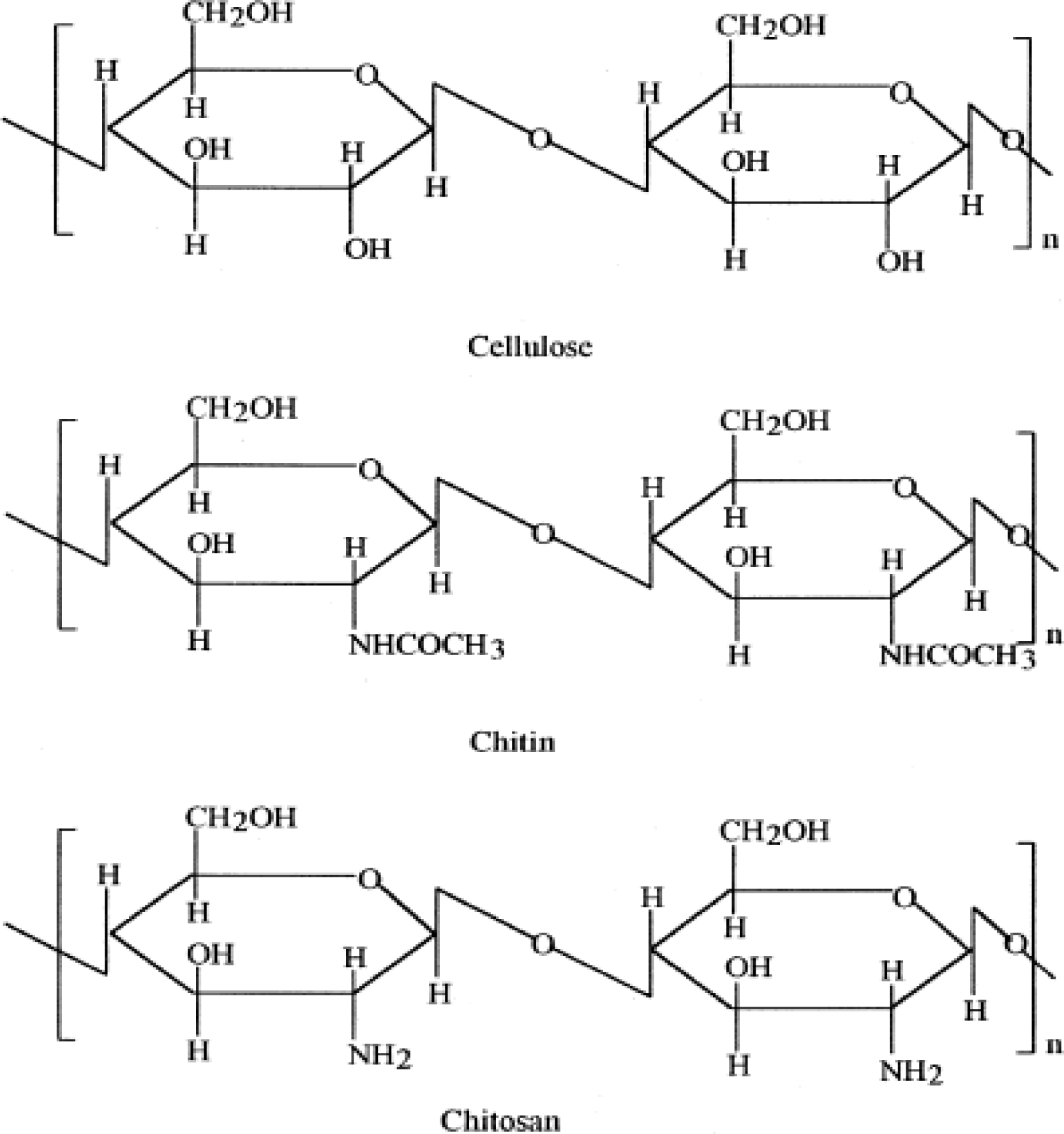
<p>Chitin and chitosan are polysaccharides, chemically similar to cellulose, differing only by the presence or absence of nitrogen [<xref ref-type="bibr" rid="b17-ijms-12-00917">17</xref>]. Chitin, a naturally abundant mucopolysaccharide, and the supporting material of crustaceans, insects, <italic>etc</italic>., is well known to consist of 2-acetamido-2-deoxy-β-<sc>d</sc>-glucose though a β (1→4) linkage. Chitin can be degraded by chitinase. Its immunogenicity is exceptionally low, in spite of the presence of nitrogen. It is a highly insoluble material resembling cellulose in its solubility and low chemical reactivity. It may be regarded as cellulose with hydroxyl at position C-2 replaced by an acetamido group. Like cellulose, it functions naturally as a structural polysaccharide. Chitin is a white, hard, inelastic, nitrogenous polysaccharide and the major source of surface pollution in coastal areas. Chitosan is the <italic>N</italic>-deacetylated derivative of chitin, although this <italic>N</italic>-deacetylation is almost never complete. A sharp nomenclature with respect to the degree of <italic>N</italic>-deacetylation has not been defined between chitin and chitosan [<xref ref-type="bibr" rid="b18-ijms-12-00917">18</xref>,<xref ref-type="bibr" rid="b19-ijms-12-00917">19</xref>]. The structures of cellulose, chitin and chitosan are shown in <xref ref-type="fig" rid="f1-ijms-12-00917">Figure 1</xref> [<xref ref-type="bibr" rid="b20-ijms-12-00917">20</xref>].</p>
<p>Chitin and its derivative chitosan have been of interest in the past few decades due to their potential broad range of industrial applications [<xref ref-type="bibr" rid="b21-ijms-12-00917">21</xref>,<xref ref-type="bibr" rid="b22-ijms-12-00917">22</xref>]. However, there has been limited attention paid to the food application of these versatile biopolymers. They offer a wide range of unique applications including bioconversion for the production of value-added food products [<xref ref-type="bibr" rid="b23-ijms-12-00917">23</xref>–<xref ref-type="bibr" rid="b25-ijms-12-00917">25</xref>], preservation of foods from microbial deterioration [<xref ref-type="bibr" rid="b26-ijms-12-00917">26</xref>–<xref ref-type="bibr" rid="b30-ijms-12-00917">30</xref>], formation of biodegradable films [<xref ref-type="bibr" rid="b31-ijms-12-00917">31</xref>–<xref ref-type="bibr" rid="b36-ijms-12-00917">36</xref>], recovery of waste material from food processing discards [<xref ref-type="bibr" rid="b37-ijms-12-00917">37</xref>–<xref ref-type="bibr" rid="b44-ijms-12-00917">44</xref>], purification of water [<xref ref-type="bibr" rid="b45-ijms-12-00917">45</xref>–<xref ref-type="bibr" rid="b48-ijms-12-00917">48</xref>] and clarification and deacidification of fruit juices [<xref ref-type="bibr" rid="b49-ijms-12-00917">49</xref>–<xref ref-type="bibr" rid="b53-ijms-12-00917">53</xref>]. In this text, we especially pay attention to the antimicrobial function of chitin and chitosan in fruits. Hernández-Lauzardo <italic>et al.</italic> have reported the significant effect of chitosan on inhibiting three isolates of <italic>Rhizopus stolonifer</italic> obtained from several fruits [<xref ref-type="bibr" rid="b54-ijms-12-00917">54</xref>]. It has been reported that chitin and chitosan are effective in reducing postharvest diseases of fruits and vegetables by inhibiting spore germination, germ tube elongation, mycelial growth of fungal phytopathogens, enhancing the efficacy of antagonistic yeasts, and boosting the activity of defense-related enzymes or pertinent substances [<xref ref-type="bibr" rid="b55-ijms-12-00917">55</xref>–<xref ref-type="bibr" rid="b60-ijms-12-00917">60</xref>].</p></sec>
<sec>
<label>3.</label>
<title>Effects of Chitin and Chitosan on Postharvest Disease of Fruits</title>
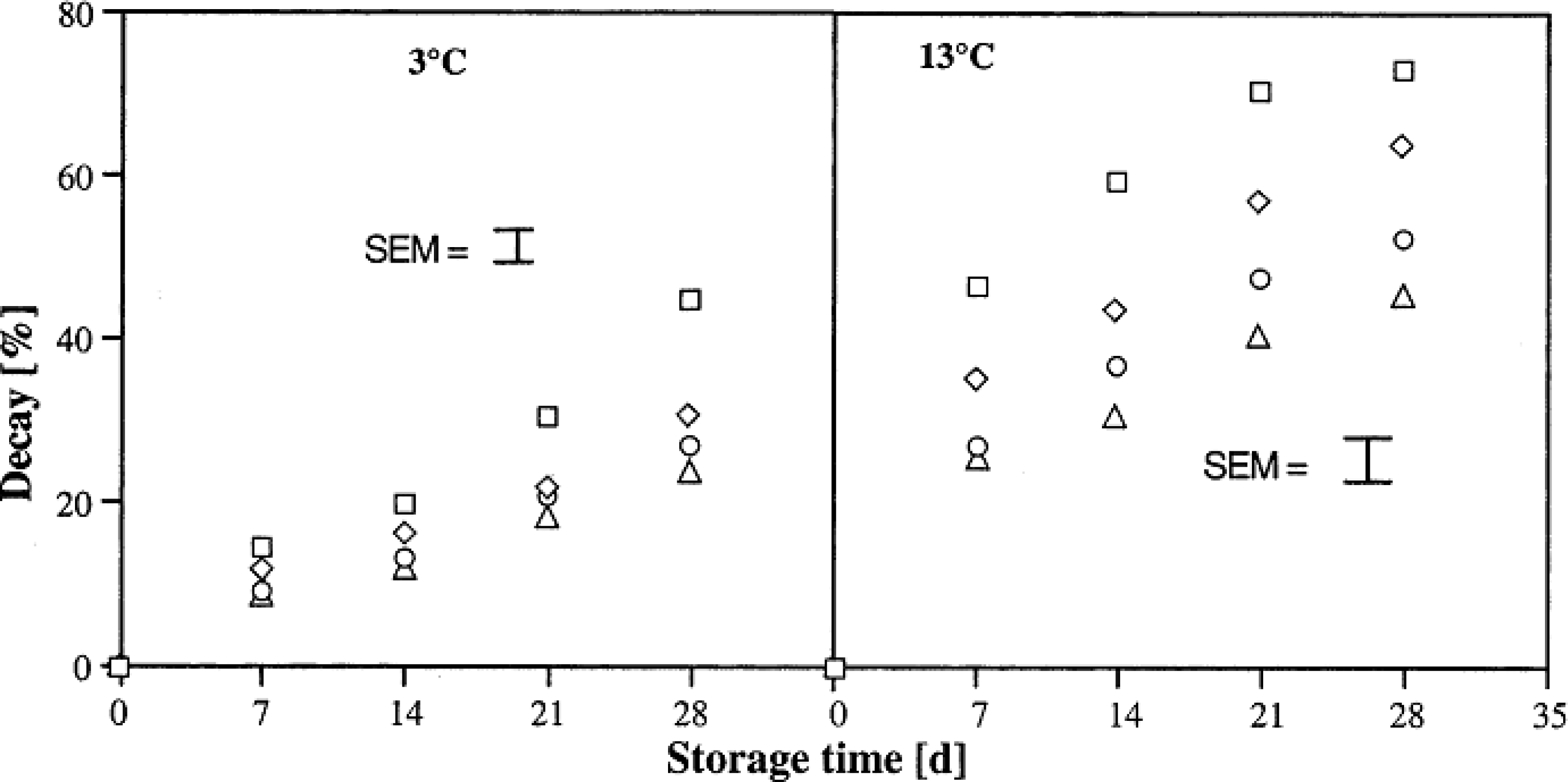
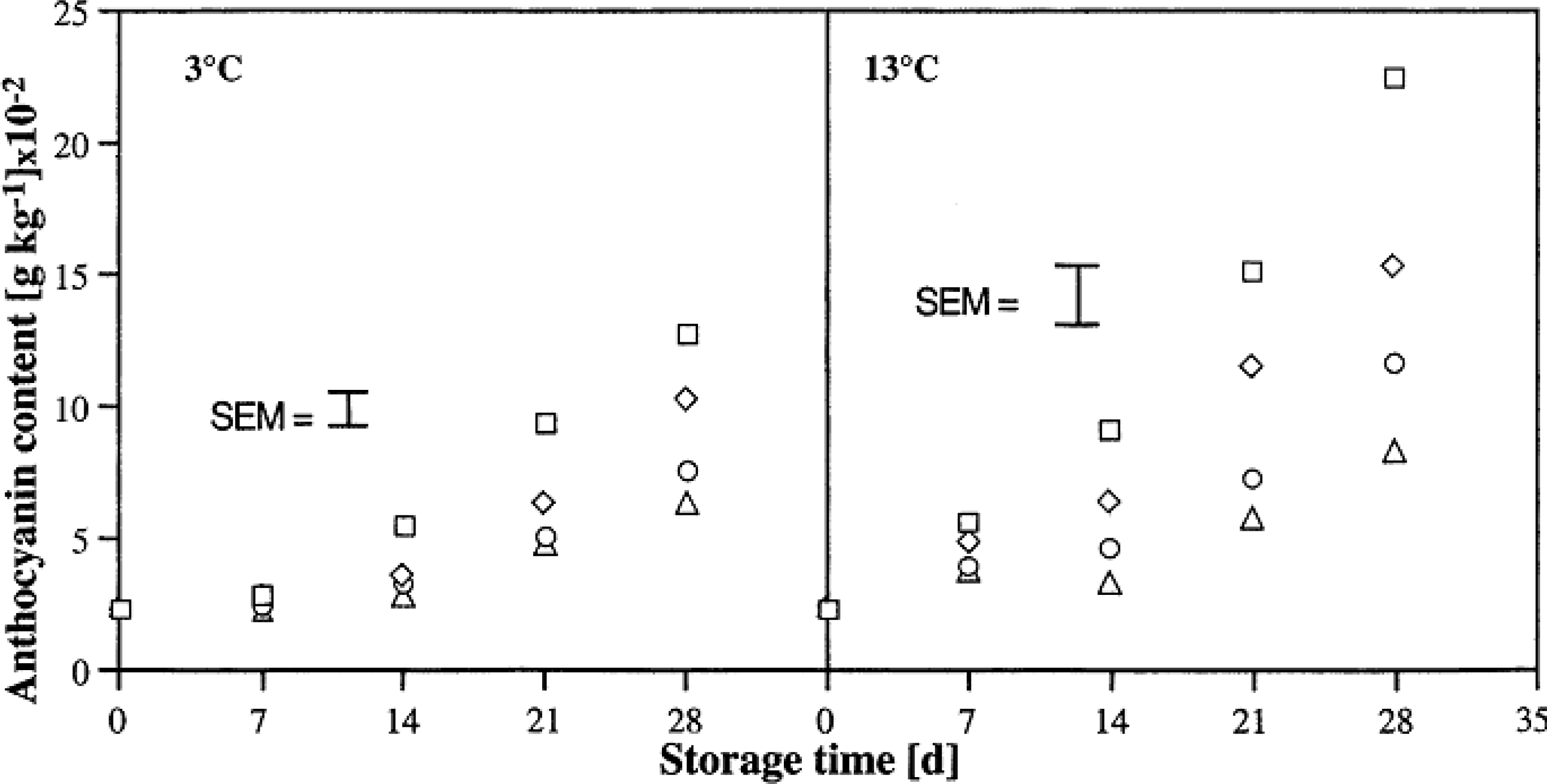
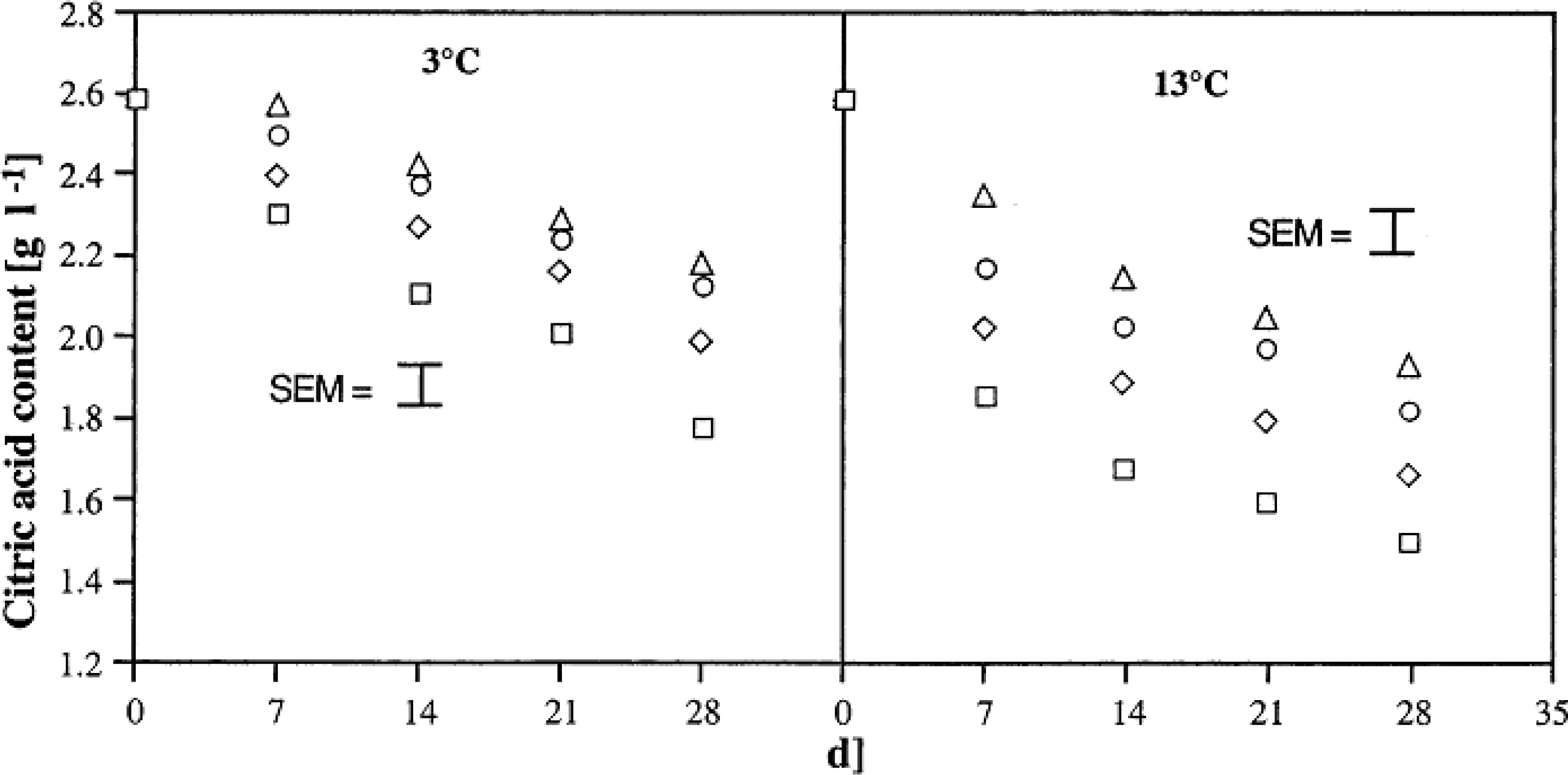
<p>Recently, the method of using chitin and chitosan to control postharvest diseases of fruits was developed. Chitosan at low molecular weight (LMWC) has been reported to control postharvest diseases of citrus fruit [<xref ref-type="bibr" rid="b15-ijms-12-00917">15</xref>]. The results indicated that LMWC significantly inhibited the decay of citrus fruit caused by <italic>Penicillium digitatum</italic>, <italic>Penicillium italicum</italic>, <italic>Botrydiplodia lecanidion</italic>, and <italic>Botrytis cinerea</italic> after 14 days storage at 25 °C, and is more effective than TBZ and high molecular weight chitosan (HMWC) (<xref ref-type="table" rid="t1-ijms-12-00917">Table 1</xref>). Meanwhile, low molecular weight chitosan coating beneficially influenced firmness, total soluble solid content, titratable acidity, ascorbic acid content and water content of citrus fruit after 56 days of storage at 15 °C (<xref ref-type="table" rid="t2-ijms-12-00917">Table 2</xref>). Bhaskara Reddy <italic>et al</italic>. [<xref ref-type="bibr" rid="b12-ijms-12-00917">12</xref>] found that pre-harvest chitosan sprays effectively inhibited the postharvest decay of strawberry fruit caused by <italic>Botrytis cinerea</italic> during storage at 3 and 13 °C, and the decay decreased with increasing chitosan concentration (<xref ref-type="fig" rid="f2-ijms-12-00917">Figure 2</xref>). Furthermore, fruits from chitosan sprayed plants were firmer and ripened at a slower rate as indicated by anthocyanin content and titratable acidity than berries from non-treated plants (<xref ref-type="fig" rid="f3-ijms-12-00917">Figures 3</xref> and <xref ref-type="fig" rid="f4-ijms-12-00917">4</xref>).</p>
<p>In addition to being singularly applied, there are many reports on combined applications of chitosan with other antifungal compounds. Yu <italic>et al</italic>. [<xref ref-type="bibr" rid="b61-ijms-12-00917">61</xref>] found that chitosan applied alone or with <italic>Cryptococcus laurentii</italic> could effectively inhibit the blue mold rot caused by <italic>Penicillium expansum</italic> in apple fruit after seven days of incubation at 20 °C. When applied alone, treatment with chitosan at the highest concentration (1%) and the lowest viscosity (12 cP) was the most effective. When used in combinations, treatment of <italic>Cryptococcus laurentii</italic> with chitosan at a concentration of 0.1% and lowest viscosity (12 cP) was the most effective (<xref ref-type="table" rid="t3-ijms-12-00917">Table 3</xref>). Similar results were found when using chitosan coating with postharvest calcium on extending shelf-life of strawberries [<xref ref-type="bibr" rid="b62-ijms-12-00917">62</xref>]; and chitosan with ethanol on controlling postharvest gray mold of table grapes caused by <italic>Botrytis cinerea</italic> [<xref ref-type="bibr" rid="b63-ijms-12-00917">63</xref>].</p>
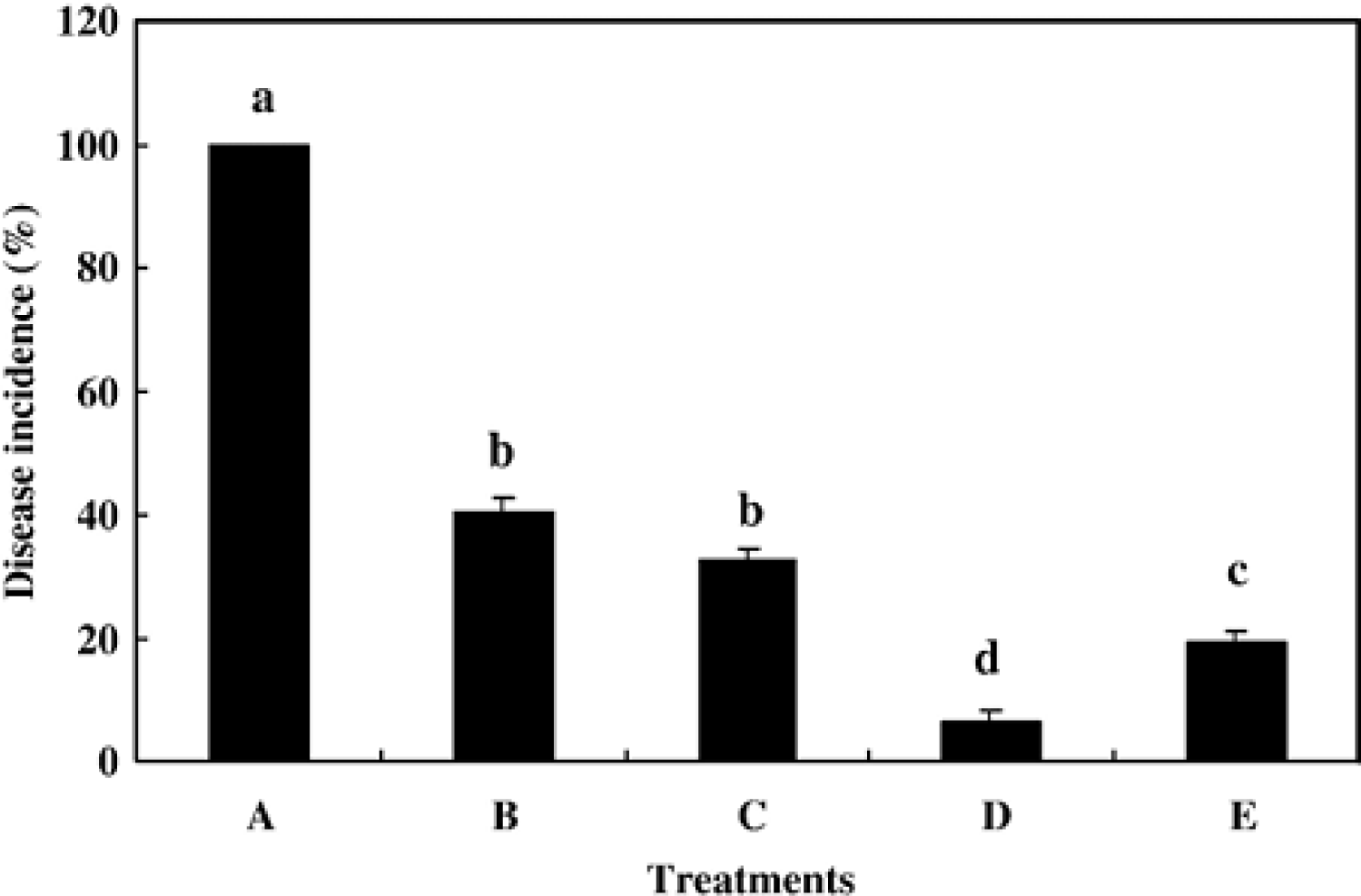
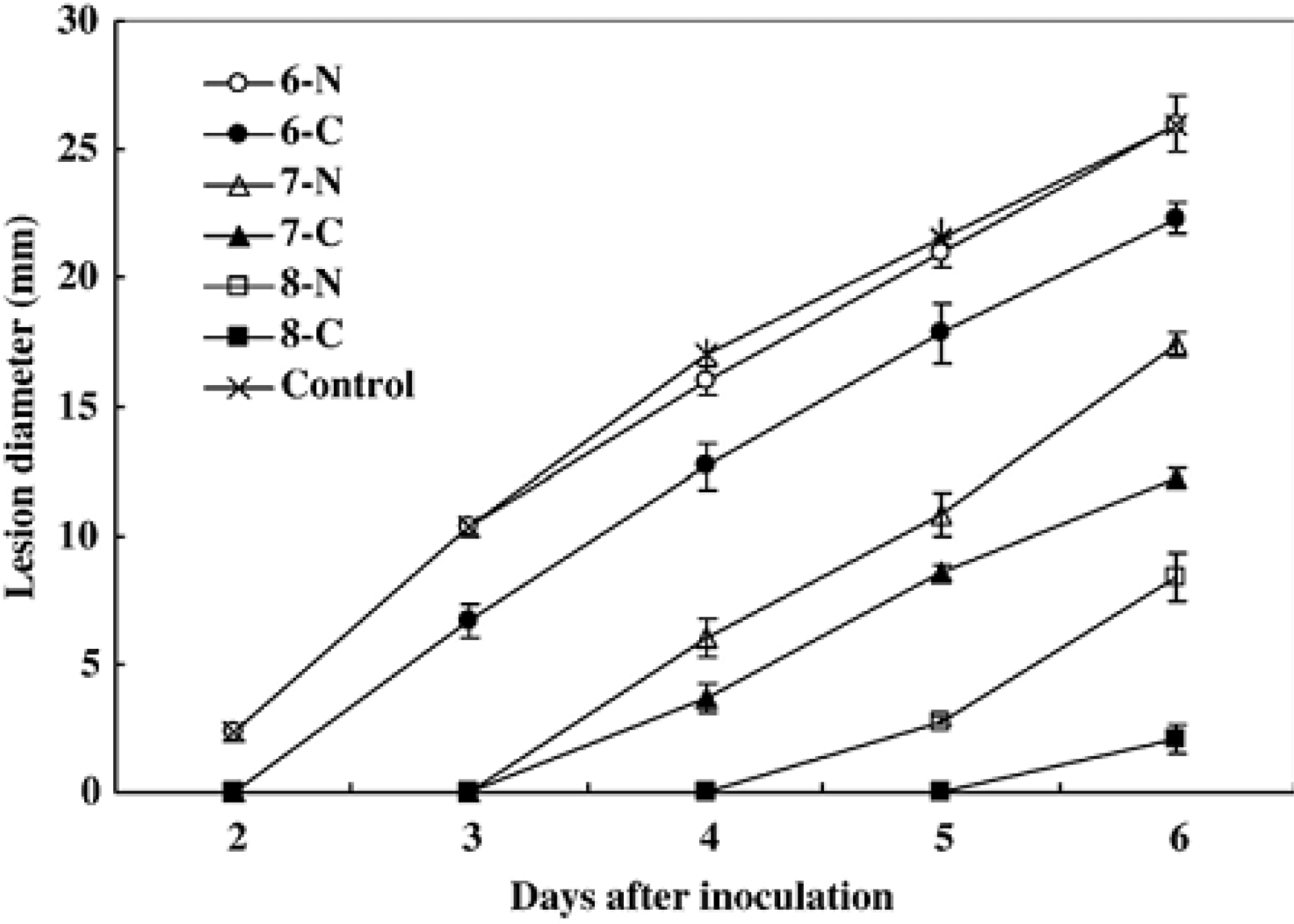
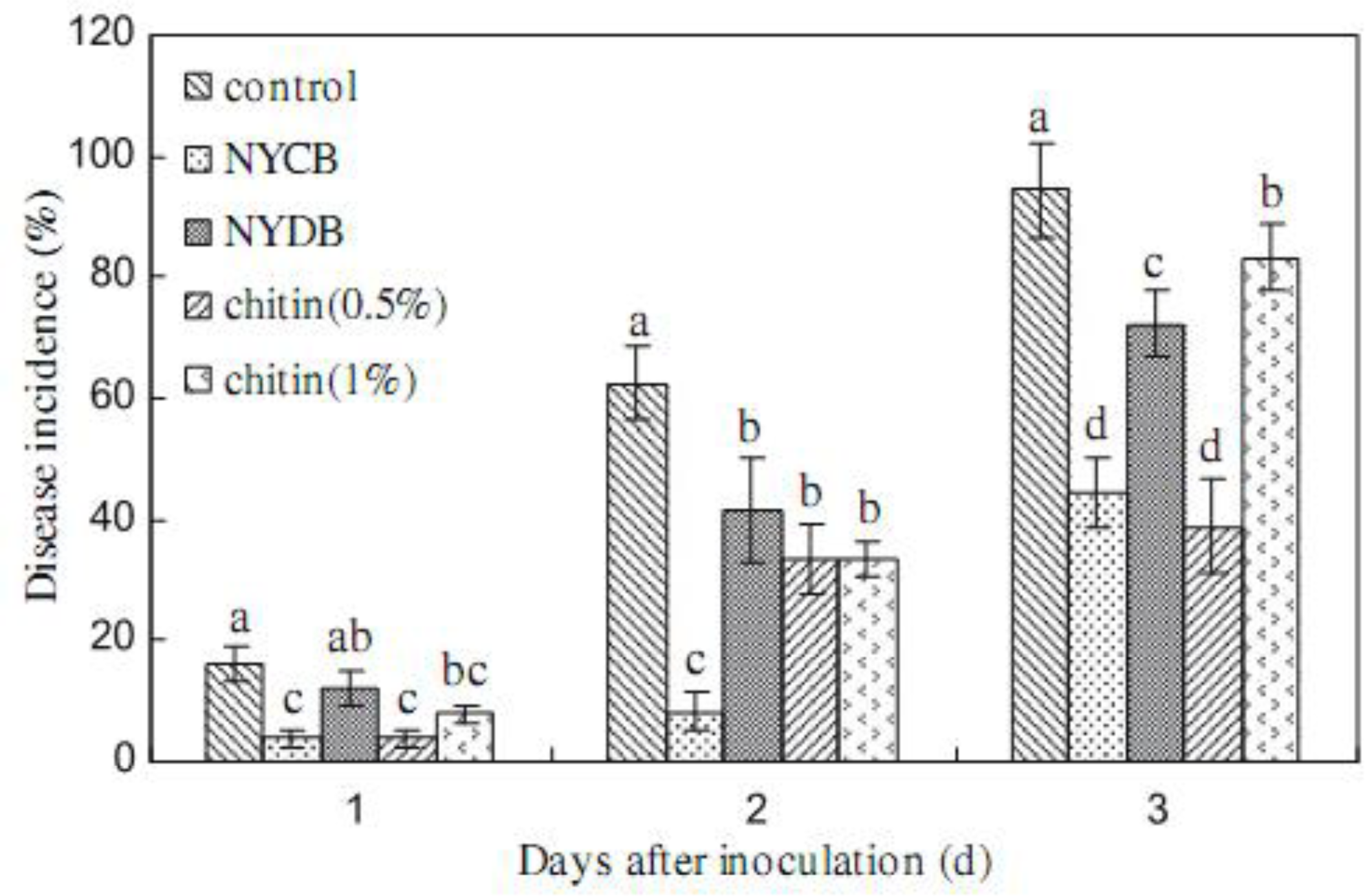
<p>Biological antagonists have already been shown to effectively inhibit the postharvest decay of fruit in recent years [<xref ref-type="bibr" rid="b64-ijms-12-00917">64</xref>–<xref ref-type="bibr" rid="b67-ijms-12-00917">67</xref>]. However, for biological control to be accepted as an economically viable option, consistency and efficacy of antagonistic yeasts in controlling postharvest diseases must be enhanced [<xref ref-type="bibr" rid="b68-ijms-12-00917">68</xref>,<xref ref-type="bibr" rid="b69-ijms-12-00917">69</xref>]. Many attempts have been proposed to improve the performance of postharvest biocontrol yeasts. Physiological manipulation may be a useful method [<xref ref-type="bibr" rid="b69-ijms-12-00917">69</xref>]. Recently, enhancement of the biocontrol efficacy of antagonists to postharvest diseases of fruits by addition of chitin or chitosan to the growth medium was reported. Yu <italic>et al</italic>. [<xref ref-type="bibr" rid="b10-ijms-12-00917">10</xref>] found that the disease incidence and lesion diameter of blue mold rot caused by <italic>Penicillium expansum</italic> in pear fruit was significantly inhibited by <italic>Cryptococcus laurentii</italic> which was cultivated in nutrient yeast dextrose broth (NYDB) media amended with chitin, especially at the optimal concentration (1.0%) (<xref ref-type="fig" rid="f5-ijms-12-00917">Figures 5</xref> and <xref ref-type="fig" rid="f6-ijms-12-00917">6</xref>). Similarly, our research team used <italic>Rhodotorula glutinis</italic> cultivated with NYDB amended with chitin or nutrient yeast chitin broth (NYCB: Chitin as the sole carbon source instead of dextrose in the media of nutrient yeast dextrose broth) to control the grey mold decay caused by <italic>Botrytis cinerea</italic> in strawberries [<xref ref-type="bibr" rid="b11-ijms-12-00917">11</xref>], we found that the antagonistic activity of <italic>R. glutinis</italic> was greatly enhanced by chitin inducing incubation (0.5% chitin), which resulted in a significant reduction of the disease incidence (<xref ref-type="fig" rid="f7-ijms-12-00917">Figure 7</xref>).</p></sec>
<sec>
<label>4.</label>
<title>Mode of Action of the Control of Postharvest Decay of Fruits by Chitin and Chitosan</title>
<p>Because of the positive charge on the C<sub>2</sub> of the glucosamine monomer below pH 6, chitosan is more soluble and has a better antimicrobial activity than chitin [<xref ref-type="bibr" rid="b70-ijms-12-00917">70</xref>]. Therefore, the application on controlling postharvest decay of fruits and the possible mechanisms discussed mostly rest on chitosan. The exact mechanism of the antimicrobial action of chitin, chitosan, and their derivatives is still imperfectly known, but different mechanisms have been proposed [<xref ref-type="bibr" rid="b71-ijms-12-00917">71</xref>].</p>
<sec>
<label>4.1.</label>
<title>The Direct Effect of Chitin and Chitosan on Fungal Pathogens</title>
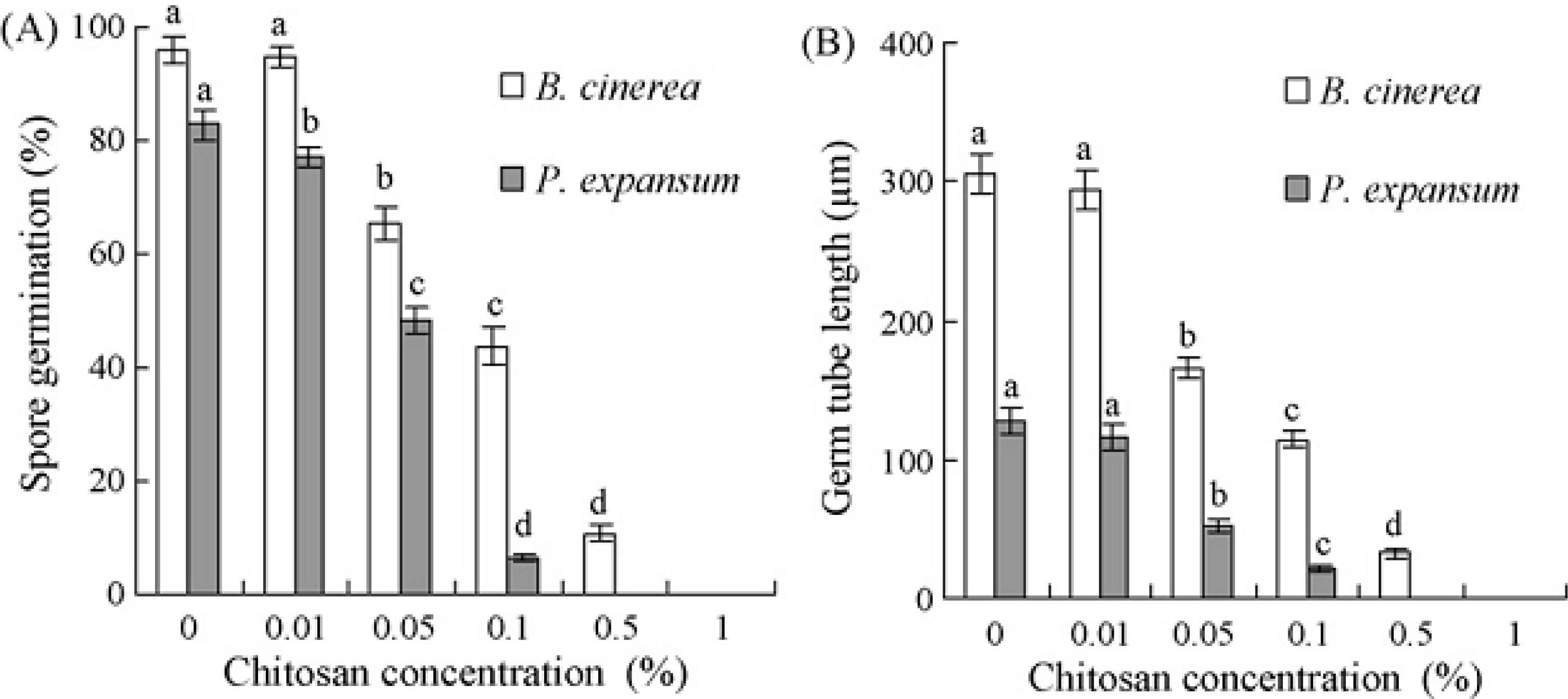
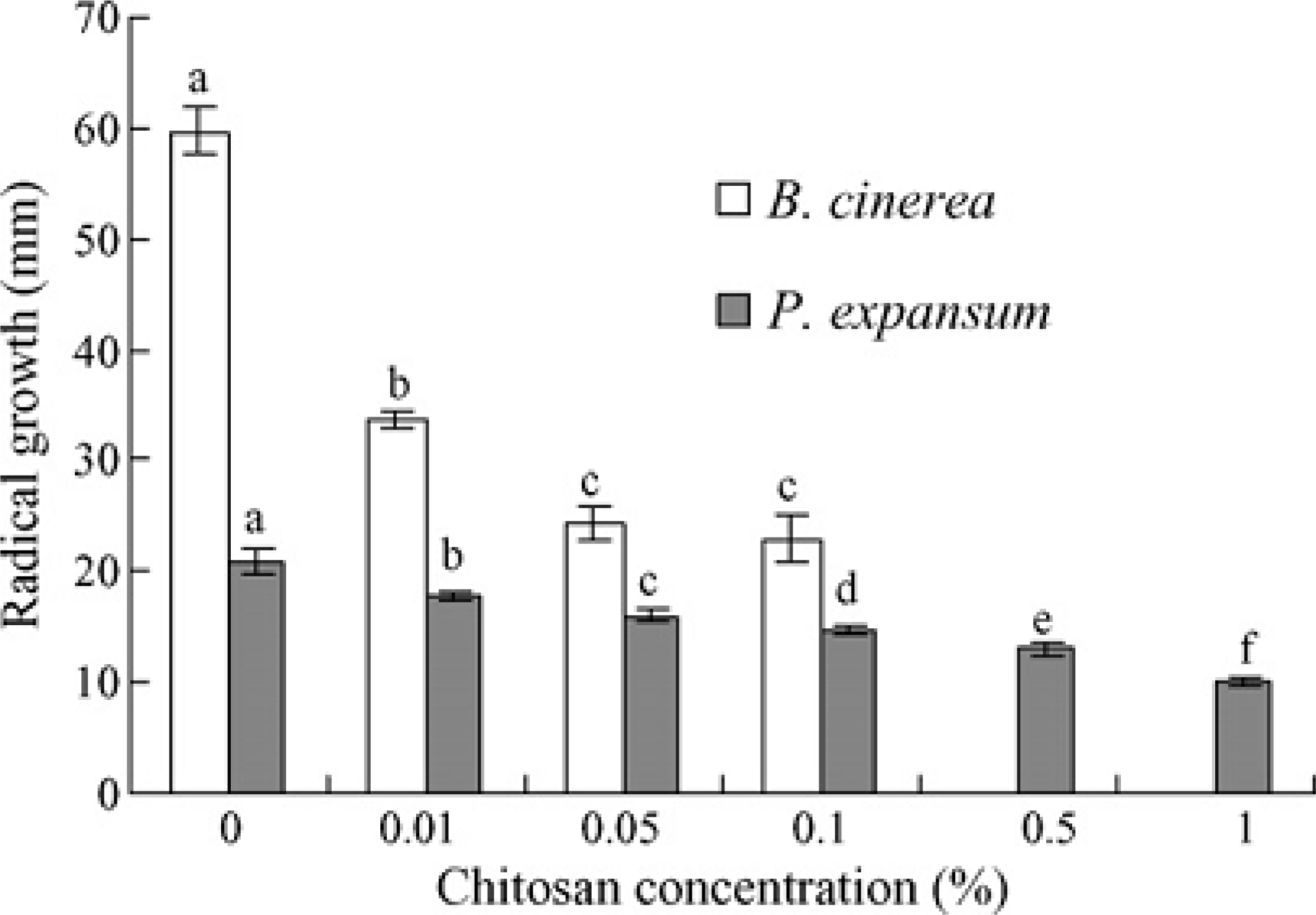
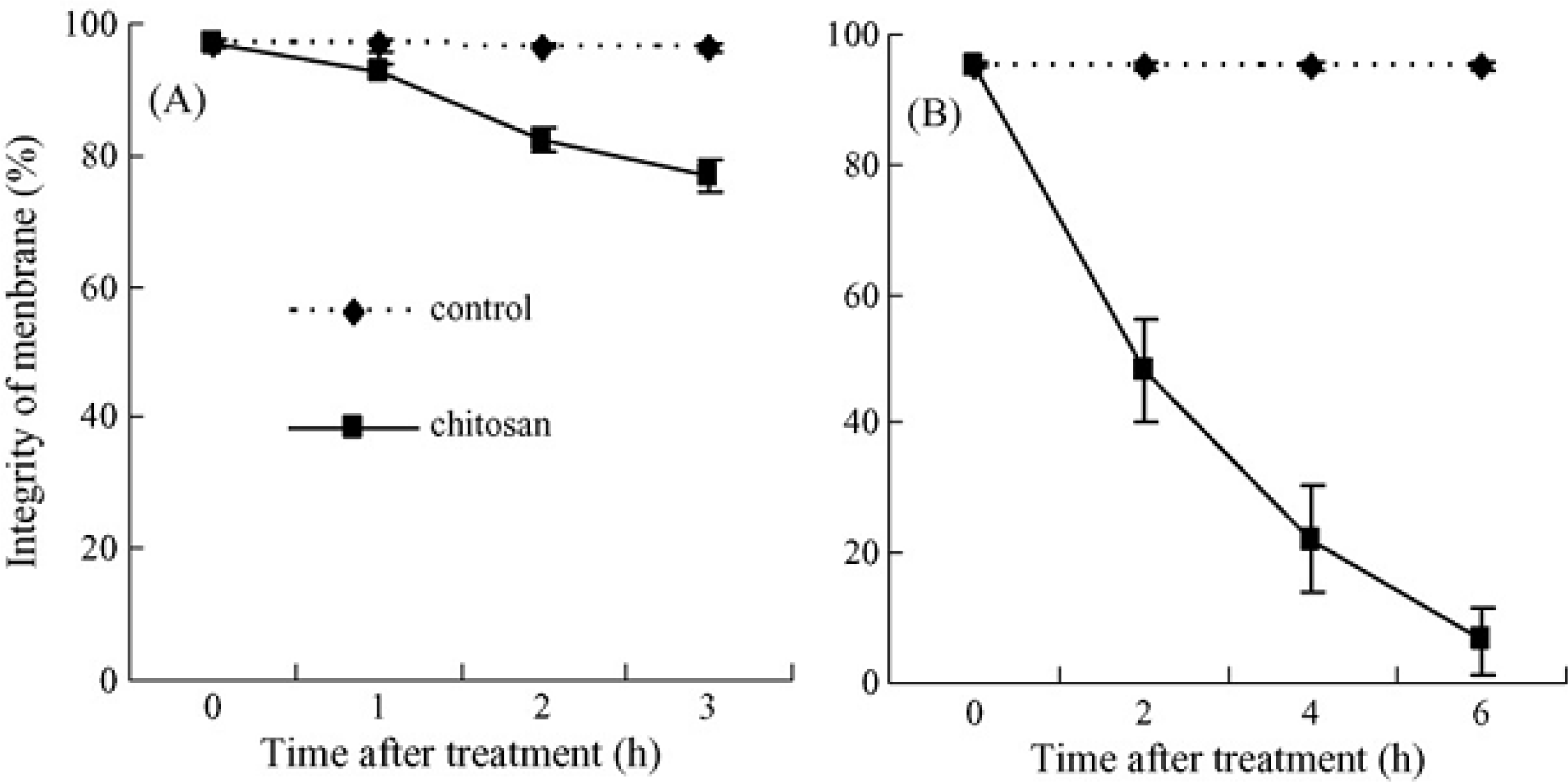
<p>Numerous previous studies have shown that chitosan could directly inhibit spore germination, germ tube elongation and mycelial growth of many phytopathogens, such as <italic>Botrytis cinerea</italic> [<xref ref-type="bibr" rid="b58-ijms-12-00917">58</xref>,<xref ref-type="bibr" rid="b59-ijms-12-00917">59</xref>,<xref ref-type="bibr" rid="b72-ijms-12-00917">72</xref>], <italic>Fusarium solani</italic> [<xref ref-type="bibr" rid="b73-ijms-12-00917">73</xref>], <italic>Rhizopus stolonifer</italic> [<xref ref-type="bibr" rid="b58-ijms-12-00917">58</xref>,<xref ref-type="bibr" rid="b74-ijms-12-00917">74</xref>], <italic>Penicillium</italic> [<xref ref-type="bibr" rid="b59-ijms-12-00917">59</xref>,<xref ref-type="bibr" rid="b72-ijms-12-00917">72</xref>], and <italic>Sclerotium rolfsii</italic> [<xref ref-type="bibr" rid="b73-ijms-12-00917">73</xref>]. Liu <italic>et al</italic>. [<xref ref-type="bibr" rid="b59-ijms-12-00917">59</xref>] reported that chitosan completely inhibited spore germination of <italic>P. expansum</italic> at 0.5% and <italic>B. cinerea</italic> at 1%, significantly inhibited germ tube elongation of both pathogens when the concentration was higher than 0.01% (<italic>P</italic> &lt; 0.05) (<xref ref-type="fig" rid="f8-ijms-12-00917">Figures 8</xref> and <xref ref-type="fig" rid="f9-ijms-12-00917">9</xref>), and the plasma membranes of spores of both pathogens were damaged (<xref ref-type="fig" rid="f10-ijms-12-00917">Figure 10</xref>). The reasons for the antimicrobial character of chitosan remain controversial. Two hypotheses are as follows: (1) The polycationic chitosan consumes the electronegative charges on cell surfaces and the cell permeability is changed, thus this interaction results in the leakage of intracellular electrolytes and proteinaceous constituents; (2) chitosan enters fungal cells and then essential nutrients are adsorbed, which inhibit or slow down the synthesis of mRNA and protein [<xref ref-type="bibr" rid="b75-ijms-12-00917">75</xref>–<xref ref-type="bibr" rid="b79-ijms-12-00917">79</xref>].</p></sec>
<sec>
<label>4.2.</label>
<title>The Induced Disease Resistance of Fruits by Chitin and Chitosan</title>
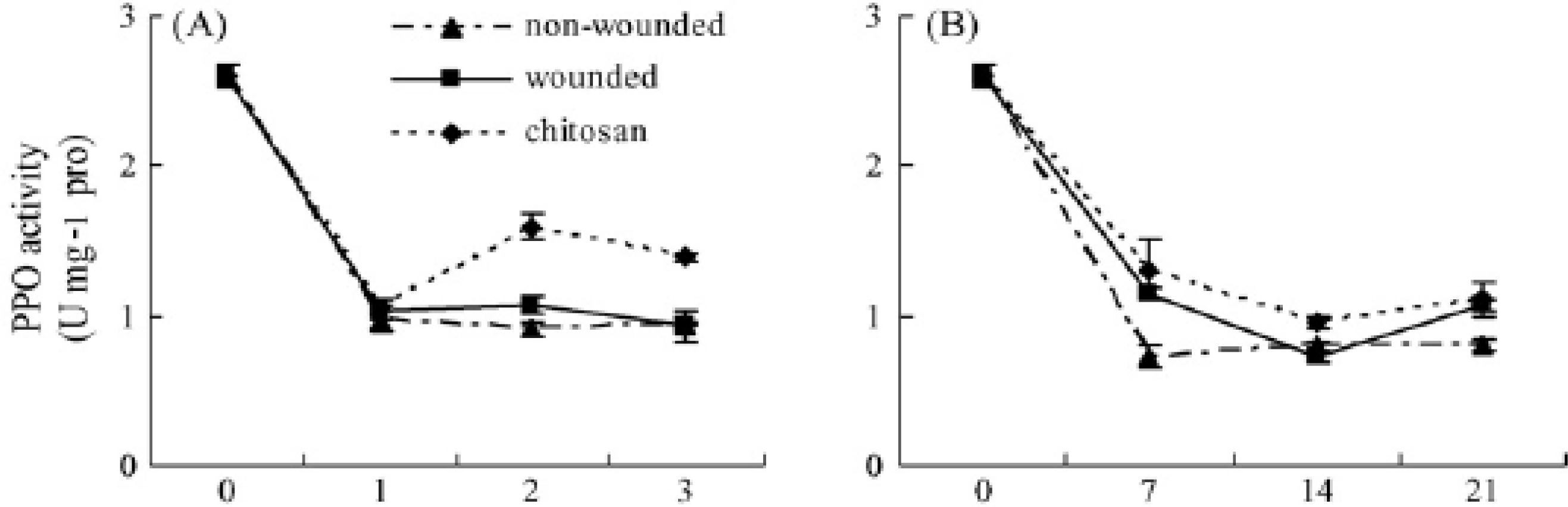
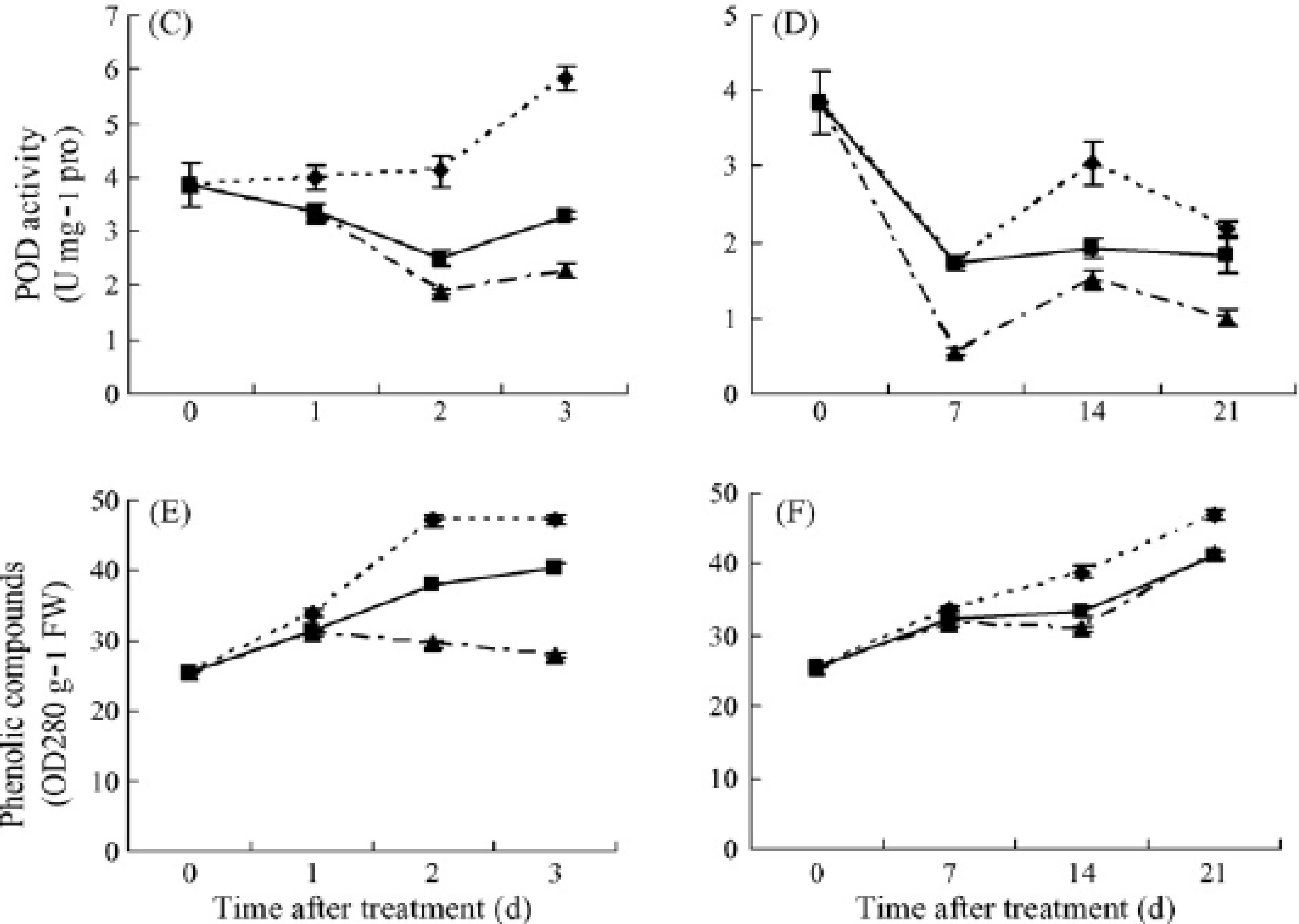
<p>The chitinase activity is usually induced in the presence of chitin, which may have diverse biological roles including the antifungal activity [<xref ref-type="bibr" rid="b80-ijms-12-00917">80</xref>–<xref ref-type="bibr" rid="b82-ijms-12-00917">82</xref>]. As an exogenous elicitor, chitosan can induce resistance in the host by increasing the activities of several defense-related enzymes, such as chitinase and β-1,3-glucanase in oranges, strawberries and raspberries [<xref ref-type="bibr" rid="b83-ijms-12-00917">83</xref>,<xref ref-type="bibr" rid="b84-ijms-12-00917">84</xref>], and phenylalanine ammonialyase (PAL) activity in strawberries and table grapes [<xref ref-type="bibr" rid="b85-ijms-12-00917">85</xref>,<xref ref-type="bibr" rid="b86-ijms-12-00917">86</xref>]. Similar results were also found by Meng <italic>et al</italic>. [<xref ref-type="bibr" rid="b87-ijms-12-00917">87</xref>] in pear fruit. After being treated with chitosan or oligochitosan, the activities of POD, PPO, CHI, and β-1,3-GLU in pear fruit were induced which might be beneficial to fruit against infection by fungal pathogens (<xref ref-type="fig" rid="f11-ijms-12-00917">Figure 11</xref>). Liu <italic>et al</italic>. [<xref ref-type="bibr" rid="b88-ijms-12-00917">88</xref>] found that treatment of chitosan induced the activities of PPO and POD, and increased the content of phenolic compounds in tomato fruit stored at 25 and 2 °C (<xref ref-type="fig" rid="f12-ijms-12-00917">Figure 12</xref>); these results possibly being related to the effective control of chitosan on gray mold rot and blue mold rot of tomato fruit. Moreover, chitosan is known to elicit plant defense responses by activating pathogenesis-related (PR) gene functions, such as chitinases [<xref ref-type="bibr" rid="b89-ijms-12-00917">89</xref>,<xref ref-type="bibr" rid="b90-ijms-12-00917">90</xref>], chitosanase, β-glucanases and lignin [<xref ref-type="bibr" rid="b91-ijms-12-00917">91</xref>] and callose [<xref ref-type="bibr" rid="b92-ijms-12-00917">92</xref>].</p></sec></sec>
<sec sec-type="conclusions">
<label>5.</label>
<title>Conclusions</title>
<p>In conlusion, chitin and its derivative chitosan have shown a great potential as natural biodegradable substances which have anti-microbial activities. Previous studies have indicated that chitin and chitosan could effectively inhibit postharvest diseases of fruits by direct inhibition on spore germination, germ tube elongation and mycelial growth of phytopathogens and indirect inducement of defense-related enzymes, such as POD, PPO, PAL, GLU. However, the mode of action for chitin and chitosan controlling postharvest diseases of fruits are still limited and unclear. Therefore, to fully understand the mechanism of chitin and chitosan against fungal pathogens and the function in inducing defense response of fruits to pathogen infection, new approaches at the molecular and proteomic level, including the separation and identification of differential expression genes and differential expression proteins, are really needed in further studies.</p></sec></body>
<back>
<ref-list>
<title>References</title>
<ref id="b1-ijms-12-00917"><label>1.</label><citation citation-type="journal"><person-group person-group-type="author"><name><surname>Eckert</surname><given-names>JW</given-names></name><name><surname>Ogawa</surname><given-names>JM</given-names></name></person-group><article-title>The chemical control of postharvest diseases: deciduous fruits, berries, vegetables and root/tuber crops</article-title><source>Annu. Rev. Phytopathol</source><year>1998</year><volume>26</volume><fpage>433</fpage><lpage>469</lpage></citation></ref>
<ref id="b2-ijms-12-00917"><label>2.</label><citation citation-type="journal"><person-group person-group-type="author"><name><surname>Norman</surname><given-names>C</given-names></name></person-group><article-title>EPA sets new policy on pesticide cancer risks</article-title><source>Science</source><year>1998</year><volume>242</volume><fpage>366</fpage><lpage>367</lpage></citation></ref>
<ref id="b3-ijms-12-00917"><label>3.</label><citation citation-type="journal"><person-group person-group-type="author"><name><surname>Holmes</surname><given-names>GJ</given-names></name><name><surname>Eckert</surname><given-names>JW</given-names></name></person-group><article-title>Sensitivity of <italic>Penicillium digitatum</italic> and <italic>P. italicum</italic> to postharvest citrus fungicides in California</article-title><source>Phytopathology</source><year>1999</year><volume>89</volume><fpage>716</fpage><lpage>721</lpage><pub-id pub-id-type="doi">10.1094/PHYTO.1999.89.9.716</pub-id><pub-id pub-id-type="pmid">18944698</pub-id></citation></ref>
<ref id="b4-ijms-12-00917"><label>4.</label><citation citation-type="journal"><person-group person-group-type="author"><name><surname>Sharma</surname><given-names>RR</given-names></name><name><surname>Singh</surname><given-names>D</given-names></name><name><surname>Singh</surname><given-names>R</given-names></name></person-group><article-title>Biological control of postharvest diseases of fruits and vegetables by microbial antagonists: A review</article-title><source>Biol. Control</source><year>2009</year><volume>50</volume><fpage>205</fpage><lpage>221</lpage><pub-id pub-id-type="doi">10.1016/j.biocontrol.2009.05.001</pub-id></citation></ref>
<ref id="b5-ijms-12-00917"><label>5.</label><citation citation-type="journal"><person-group person-group-type="author"><name><surname>Mari</surname><given-names>M</given-names></name><name><surname>Neri</surname><given-names>F</given-names></name><name><surname>Bertolini</surname><given-names>P</given-names></name></person-group><article-title>Novel approaches to prevent and control postharvest diseases of fruits</article-title><source>Stewart Postharvest Rev</source><year>2007</year><volume>3</volume><fpage>1</fpage><lpage>7</lpage></citation></ref>
<ref id="b6-ijms-12-00917"><label>6.</label><citation citation-type="book"><person-group person-group-type="author"><name><surname>Barbosa-Cánovas</surname><given-names>GV</given-names></name><name><surname>Davidson</surname><given-names>PM</given-names></name><name><surname>Dreher</surname><given-names>M</given-names></name><name><surname>Hartel</surname><given-names>RW</given-names></name></person-group><article-title>Microwave pasteurization and sterilization of foods</article-title><source>Handbook of Food Preservation</source><edition>2nd ed</edition><person-group person-group-type="editor"><name><surname>Rahman</surname><given-names>MS</given-names></name></person-group><publisher-name>CRC Press LLC</publisher-name><publisher-loc>New York, NY, USA</publisher-loc><year>2007</year><fpage>691</fpage><lpage>711</lpage></citation></ref>
<ref id="b7-ijms-12-00917"><label>7.</label><citation citation-type="journal"><person-group person-group-type="author"><name><surname>Prashanth</surname><given-names>KVH</given-names></name><name><surname>Tharanathan</surname><given-names>RN</given-names></name></person-group><article-title>Chitin/chitosan: Modifications and their unlimited application potential—An overview</article-title><source>Trends Food Sci. Technol</source><year>2007</year><volume>18</volume><fpage>117</fpage><lpage>131</lpage><pub-id pub-id-type="doi">10.1016/j.tifs.2006.10.022</pub-id></citation></ref>
<ref id="b8-ijms-12-00917"><label>8.</label><citation citation-type="journal"><person-group person-group-type="author"><name><surname>Terry</surname><given-names>LA</given-names></name><name><surname>Joyce</surname><given-names>DC</given-names></name></person-group><article-title>Elicitors of induced disease resistance in postharvest horticultural crops: A brief review</article-title><source>Postharvest Biol. Technol</source><year>2004</year><volume>32</volume><fpage>1</fpage><lpage>13</lpage><pub-id pub-id-type="doi">10.1016/j.postharvbio.2003.09.016</pub-id></citation></ref>
<ref id="b9-ijms-12-00917"><label>9.</label><citation citation-type="journal"><person-group person-group-type="author"><name><surname>Fisk</surname><given-names>CL</given-names></name><name><surname>Silver</surname><given-names>AM</given-names></name><name><surname>Strik</surname><given-names>BC</given-names></name><name><surname>Zhao</surname><given-names>Y</given-names></name></person-group><article-title>Postharvest quality of hardy kiwifruit (<italic>Actinidia arguta</italic> “Ananasnaya”) associated with packaging and storage conditions</article-title><source>Postharvest Biol. Technol</source><year>2008</year><volume>47</volume><fpage>338</fpage><lpage>345</lpage><pub-id pub-id-type="doi">10.1016/j.postharvbio.2007.07.015</pub-id></citation></ref>
<ref id="b10-ijms-12-00917"><label>10.</label><citation citation-type="journal"><person-group person-group-type="author"><name><surname>Yu</surname><given-names>T</given-names></name><name><surname>Wang</surname><given-names>LP</given-names></name><name><surname>Yin</surname><given-names>Y</given-names></name><name><surname>Wang</surname><given-names>YX</given-names></name><name><surname>Zheng</surname><given-names>XD</given-names></name></person-group><article-title>Effect of chitin on the antagonistic activity of <italic>Cryptococcus laurentii</italic> against <italic>Penicillium expansum</italic> in pear fruit</article-title><source>Int. J. Food Microbiol</source><year>2008</year><volume>122</volume><fpage>44</fpage><lpage>48</lpage><pub-id pub-id-type="doi">10.1016/j.ijfoodmicro.2007.11.059</pub-id><pub-id pub-id-type="pmid">18162192</pub-id></citation></ref>
<ref id="b11-ijms-12-00917"><label>11.</label><citation citation-type="journal"><person-group person-group-type="author"><name><surname>Ge</surname><given-names>LL</given-names></name><name><surname>Zhang</surname><given-names>HY</given-names></name><name><surname>Chen</surname><given-names>KP</given-names></name><name><surname>Ma</surname><given-names>LC</given-names></name><name><surname>Xu</surname><given-names>ZL</given-names></name></person-group><article-title>Effect of chitin on the antagonistic activity of <italic>Rhodotorula glutinis</italic> against <italic>Botrytis cinerea</italic> in strawberries and the possible mechanisms involved</article-title><source>Food Chem</source><year>2010</year><volume>120</volume><fpage>490</fpage><lpage>495</lpage><pub-id pub-id-type="doi">10.1016/j.foodchem.2009.10.042</pub-id></citation></ref>
<ref id="b12-ijms-12-00917"><label>12.</label><citation citation-type="journal"><person-group person-group-type="author"><name><surname>Bhaskara</surname><given-names>RMV</given-names></name><name><surname>Belkacemi</surname><given-names>K</given-names></name><name><surname>Corcuff</surname><given-names>R</given-names></name><name><surname>Castaigne</surname><given-names>F</given-names></name><name><surname>Arul</surname><given-names>J</given-names></name></person-group><article-title>Effect of pre-harvest chitosan sprays on post-harvest infection by <italic>Botrytis cinerea</italic> and quality of strawberry fruit</article-title><source>Postharvest Biol. Technol</source><year>2000</year><volume>20</volume><fpage>39</fpage><lpage>51</lpage><pub-id pub-id-type="doi">10.1016/S0925-5214(00)00108-3</pub-id></citation></ref>
<ref id="b13-ijms-12-00917"><label>13.</label><citation citation-type="journal"><person-group person-group-type="author"><name><surname>Meng</surname><given-names>XH</given-names></name><name><surname>Li</surname><given-names>BQ</given-names></name><name><surname>Liu</surname><given-names>J</given-names></name><name><surname>Tian</surname><given-names>SP</given-names></name></person-group><article-title>Physiological responses and quality attributes of table grape fruit to chitosan preharvest spray and postharvest coating during storage</article-title><source>Food Chem</source><year>2008</year><volume>106</volume><fpage>501</fpage><lpage>508</lpage><pub-id pub-id-type="doi">10.1016/j.foodchem.2007.06.012</pub-id></citation></ref>
<ref id="b14-ijms-12-00917"><label>14.</label><citation citation-type="journal"><person-group person-group-type="author"><name><surname>Badawya</surname><given-names>MEI</given-names></name><name><surname>Rabeab</surname><given-names>EI</given-names></name></person-group><article-title>Potential of the biopolymer chitosan with different molecular weights to control postharvest gray mold of tomato fruit</article-title><source>Postharvest Biol. Technol</source><year>2009</year><volume>51</volume><fpage>110</fpage><lpage>117</lpage><pub-id pub-id-type="doi">10.1016/j.postharvbio.2008.05.018</pub-id></citation></ref>
<ref id="b15-ijms-12-00917"><label>15.</label><citation citation-type="journal"><person-group person-group-type="author"><name><surname>Chien</surname><given-names>PJ</given-names></name><name><surname>Sheu</surname><given-names>F</given-names></name><name><surname>Lin</surname><given-names>HR</given-names></name></person-group><article-title>Coating citrus (<italic>Murcott tangor</italic>) fruit with low molecular weight chitosan increases postharvest quality and shelf life</article-title><source>Food Chem</source><year>2007</year><volume>100</volume><fpage>1160</fpage><lpage>1164</lpage><pub-id pub-id-type="doi">10.1016/j.foodchem.2005.10.068</pub-id></citation></ref>
<ref id="b16-ijms-12-00917"><label>16.</label><citation citation-type="journal"><person-group person-group-type="author"><name><surname>Jiang</surname><given-names>YM</given-names></name><name><surname>Li</surname><given-names>YB</given-names></name></person-group><article-title>Effect of chitosan coating on postharvest life and qualitily on longan fruit</article-title><source>Food Chem</source><year>2001</year><volume>73</volume><fpage>139</fpage><lpage>143</lpage><pub-id pub-id-type="doi">10.1016/S0308-8146(00)00246-6</pub-id></citation></ref>
<ref id="b17-ijms-12-00917"><label>17.</label><citation citation-type="journal"><person-group person-group-type="author"><name><surname>Freepons</surname><given-names>D</given-names></name></person-group><article-title>Chitosan, does it have a place in agriculture?</article-title><source>Proc Plant Growth Regul Soc Am</source><year>1991</year><fpage>11</fpage><lpage>19</lpage></citation></ref>
<ref id="b18-ijms-12-00917"><label>18.</label><citation citation-type="book"><source>Nutural Chelating Polymers</source><person-group person-group-type="editor"><name><surname>Muzzarelli</surname><given-names>RAA</given-names></name></person-group><publisher-name>Pergamon Press</publisher-name><publisher-loc>New York, NY, USA</publisher-loc><year>1973</year><fpage>83</fpage></citation></ref>
<ref id="b19-ijms-12-00917"><label>19.</label><citation citation-type="book"><source>Chitin, Chitosan and Related Enzymes</source><person-group person-group-type="editor"><name><surname>Zikakis</surname><given-names>JP</given-names></name></person-group><publisher-name>Academic Press</publisher-name><publisher-loc>Orlando, FL, USA</publisher-loc><year>1984</year><fpage>XVII</fpage></citation></ref>
<ref id="b20-ijms-12-00917"><label>20.</label><citation citation-type="journal"><person-group person-group-type="author"><name><surname>Ravi</surname><given-names>KMNV</given-names></name></person-group><article-title>A review of chitin and chitosan applications</article-title><source>React. Funct. Polym</source><year>2000</year><volume>46</volume><fpage>1</fpage><lpage>27</lpage><pub-id pub-id-type="doi">10.1016/S1381-5148(00)00038-9</pub-id></citation></ref>
<ref id="b21-ijms-12-00917"><label>21.</label><citation citation-type="journal"><person-group person-group-type="author"><name><surname>Ornum</surname><given-names>VJ</given-names></name></person-group><article-title>Shrimp waste-must it be wasted?</article-title><source>INFOFISH Int</source><year>1992</year><volume>6</volume><fpage>48</fpage><lpage>52</lpage></citation></ref>
<ref id="b22-ijms-12-00917"><label>22.</label><citation citation-type="journal"><person-group person-group-type="author"><name><surname>No</surname><given-names>HK</given-names></name><name><surname>Meyers</surname><given-names>SP</given-names></name></person-group><article-title>Preparation and characterization of chitin and chitosan—A Review</article-title><source>J. Aquat. Food Prod. Technol</source><year>1995</year><volume>4</volume><fpage>27</fpage><lpage>52</lpage><pub-id pub-id-type="doi">10.1300/J030v04n02_03</pub-id></citation></ref>
<ref id="b23-ijms-12-00917"><label>23.</label><citation citation-type="journal"><person-group person-group-type="author"><name><surname>Shahidi</surname><given-names>F</given-names></name><name><surname>Synowiecki</surname><given-names>J</given-names></name></person-group><article-title>Isolation and characterization of nutrients and value-added products from snow crab (<italic>Chinoecetes opilio</italic>) and Shrimp (<italic>Pandalus borealis</italic>) processing discards</article-title><source>J. Agric. Food Chem</source><year>1991</year><volume>39</volume><fpage>1527</fpage><lpage>1532</lpage><pub-id pub-id-type="doi">10.1021/jf00008a032</pub-id></citation></ref>
<ref id="b24-ijms-12-00917"><label>24.</label><citation citation-type="journal"><person-group person-group-type="author"><name><surname>Carroad</surname><given-names>PA</given-names></name><name><surname>Tom</surname><given-names>RA</given-names></name></person-group><article-title>Bioconversion of shellfish chitin wastes: Process conception and selection of microorganisms</article-title><source>J. Food Sci</source><year>1978</year><volume>43</volume><fpage>1158</fpage><lpage>1161</lpage><pub-id pub-id-type="doi">10.1111/j.1365-2621.1978.tb15259.x</pub-id></citation></ref>
<ref id="b25-ijms-12-00917"><label>25.</label><citation citation-type="journal"><person-group person-group-type="author"><name><surname>Revah-Moiseev</surname><given-names>S</given-names></name><name><surname>Carroad</surname><given-names>PA</given-names></name></person-group><article-title>Conversion of the enzymatic hydrolysate of shellfish waste chitin to single-cell protein</article-title><source>Biotechnol. Bioeng</source><year>1981</year><volume>23</volume><fpage>1067</fpage><lpage>1078</lpage><pub-id pub-id-type="doi">10.1002/bit.260230514</pub-id></citation></ref>
<ref id="b26-ijms-12-00917"><label>26.</label><citation citation-type="journal"><person-group person-group-type="author"><name><surname>Papineau</surname><given-names>AM</given-names></name><name><surname>Hoover</surname><given-names>DG</given-names></name><name><surname>Knorr</surname><given-names>D</given-names></name><name><surname>Farkas</surname><given-names>DF</given-names></name></person-group><article-title>Antimicrobial effect of water-soluble chitosans with high hydrostatic pressure</article-title><source>Food Biotechnol</source><year>1991</year><volume>5</volume><fpage>45</fpage><lpage>57</lpage><pub-id pub-id-type="doi">10.1080/08905439109549790</pub-id></citation></ref>
<ref id="b27-ijms-12-00917"><label>27.</label><citation citation-type="journal"><person-group person-group-type="author"><name><surname>El Ghaouth</surname><given-names>A</given-names></name><name><surname>Arul</surname><given-names>J</given-names></name><name><surname>Asselin</surname><given-names>A</given-names></name><name><surname>Benhamou</surname><given-names>N</given-names></name></person-group><article-title>Antifungal activity of chitosan on post-harvest pathogens: Induction of morphological and cytological alterations in <italic>Rhizopus Stolonifer</italic></article-title><source>Mycol. Res</source><year>1992</year><volume>96</volume><fpage>769</fpage><lpage>779</lpage><pub-id pub-id-type="doi">10.1016/S0953-7562(09)80447-4</pub-id></citation></ref>
<ref id="b28-ijms-12-00917"><label>28.</label><citation citation-type="journal"><person-group person-group-type="author"><name><surname>Sudarshan</surname><given-names>NR</given-names></name><name><surname>Hoover</surname><given-names>DG</given-names></name><name><surname>Knorr</surname><given-names>D</given-names></name></person-group><article-title>Antibacterial action of chitosan</article-title><source>Food Biotechnol</source><year>1992</year><volume>6</volume><fpage>257</fpage><lpage>272</lpage><pub-id pub-id-type="doi">10.1080/08905439209549838</pub-id></citation></ref>
<ref id="b29-ijms-12-00917"><label>29.</label><citation citation-type="journal"><person-group person-group-type="author"><name><surname>Fang</surname><given-names>SW</given-names></name><name><surname>Li</surname><given-names>CF</given-names></name><name><surname>Shih</surname><given-names>DYC</given-names></name></person-group><article-title>Antifungal activity of chitosan and its preservative effect on low-sugar Candied Kumquat</article-title><source>J. Food Prot</source><year>1994</year><volume>56</volume><fpage>136</fpage><lpage>140</lpage></citation></ref>
<ref id="b30-ijms-12-00917"><label>30.</label><citation citation-type="journal"><person-group person-group-type="author"><name><surname>Chen</surname><given-names>CS</given-names></name><name><surname>Liau</surname><given-names>WY</given-names></name><name><surname>Tsai</surname><given-names>GJ</given-names></name></person-group><article-title>Antibacterial effects of <italic>N</italic>-sulfonated and <italic>N</italic>-sulfobenzoyl chitosan and application to oyster preservation</article-title><source>J. Food Prot</source><year>1998</year><volume>61</volume><fpage>1124</fpage><lpage>1128</lpage><pub-id pub-id-type="pmid">9766062</pub-id></citation></ref>
<ref id="b31-ijms-12-00917"><label>31.</label><citation citation-type="journal"><person-group person-group-type="author"><name><surname>Wong</surname><given-names>DWS</given-names></name><name><surname>Gastineau</surname><given-names>FA</given-names></name><name><surname>Gregorski</surname><given-names>KS</given-names></name><name><surname>Tillin</surname><given-names>SJ</given-names></name><name><surname>Pavlath</surname><given-names>AE</given-names></name></person-group><article-title>Chitosan-lipid films: Microstructure and surface energy</article-title><source>J. Agric. Food Chem</source><year>1992</year><volume>40</volume><fpage>540</fpage><lpage>544</lpage><pub-id pub-id-type="doi">10.1021/jf00016a002</pub-id></citation></ref>
<ref id="b32-ijms-12-00917"><label>32.</label><citation citation-type="journal"><person-group person-group-type="author"><name><surname>Uragami</surname><given-names>T</given-names></name><name><surname>Matsuda</surname><given-names>T</given-names></name><name><surname>Okuno</surname><given-names>H</given-names></name><name><surname>Miyata</surname><given-names>T</given-names></name></person-group><article-title>Structure of chemically modified chitosan membranes and their characteristics of permeation and separation of aqueous ethanol solutions</article-title><source>J. Membr. Sci</source><year>1994</year><volume>88</volume><fpage>243</fpage><lpage>251</lpage><pub-id pub-id-type="doi">10.1016/0376-7388(94)87010-1</pub-id></citation></ref>
<ref id="b33-ijms-12-00917"><label>33.</label><citation citation-type="journal"><person-group person-group-type="author"><name><surname>Butler</surname><given-names>BL</given-names></name><name><surname>Vergano</surname><given-names>PJ</given-names></name><name><surname>Testin</surname><given-names>RF</given-names></name><name><surname>Bunn</surname><given-names>JN</given-names></name><name><surname>Wiles</surname><given-names>JL</given-names></name></person-group><article-title>Mechanical and barrier properties of edible chitosan films as affected by composition and storage</article-title><source>J Food Sci</source><year>1996</year><volume>61</volume><fpage>953</fpage><lpage>955</lpage><fpage>961</fpage></citation></ref>
<ref id="b34-ijms-12-00917"><label>34.</label><citation citation-type="journal"><person-group person-group-type="author"><name><surname>Chen</surname><given-names>RH</given-names></name><name><surname>Hwa</surname><given-names>HD</given-names></name></person-group><article-title>Effect of molecular weight of chitosan with the same degree of deacetylation on the thermal, mechanical, and permeability properties of the prepared membrane</article-title><source>Carbohydr. Polym</source><year>1996</year><volume>29</volume><fpage>353</fpage><lpage>358</lpage><pub-id pub-id-type="doi">10.1016/S0144-8617(96)00007-0</pub-id></citation></ref>
<ref id="b35-ijms-12-00917"><label>35.</label><citation citation-type="journal"><person-group person-group-type="author"><name><surname>Hoagland</surname><given-names>PD</given-names></name><name><surname>Parris</surname><given-names>N</given-names></name></person-group><article-title>Chitosan/Pectin Laminated Films</article-title><source>J. Agric. Food Chem</source><year>1996</year><volume>44</volume><fpage>1915</fpage><lpage>1919</lpage><pub-id pub-id-type="doi">10.1021/jf950162s</pub-id></citation></ref>
<ref id="b36-ijms-12-00917"><label>36.</label><citation citation-type="journal"><person-group person-group-type="author"><name><surname>Kittur</surname><given-names>FS</given-names></name><name><surname>Kumar</surname><given-names>KR</given-names></name><name><surname>Tharanathan</surname><given-names>RN</given-names></name></person-group><article-title>Functional packaging properties of chitosan films</article-title><source>Z Lesbensm. Unters Forsch. A</source><year>1998</year><volume>206</volume><fpage>44</fpage><lpage>47</lpage><pub-id pub-id-type="doi">10.1007/s002170050211</pub-id></citation></ref>
<ref id="b37-ijms-12-00917"><label>37.</label><citation citation-type="journal"><person-group person-group-type="author"><name><surname>Bough</surname><given-names>WA</given-names></name></person-group><article-title>Reduction of suspended solids in vegetable canning waste effluents by coagulation with chitosan</article-title><source>J. Food Sci</source><year>1975</year><volume>40</volume><fpage>297</fpage><lpage>301</lpage><pub-id pub-id-type="doi">10.1111/j.1365-2621.1975.tb02187.x</pub-id></citation></ref>
<ref id="b38-ijms-12-00917"><label>38.</label><citation citation-type="journal"><person-group person-group-type="author"><name><surname>Bough</surname><given-names>WA</given-names></name></person-group><article-title>Chitosan—a polymer from seafood waste, for use in treatment of food processing wastes and activated sludge</article-title><source>Proc. Biochem</source><year>1976</year><volume>11</volume><fpage>13</fpage><lpage>16</lpage></citation></ref>
<ref id="b39-ijms-12-00917"><label>39.</label><citation citation-type="journal"><person-group person-group-type="author"><name><surname>Bough</surname><given-names>WA</given-names></name><name><surname>Landes</surname><given-names>DR</given-names></name></person-group><article-title>Recovery and nutritional evaluation of proteinaceous solids separated from whey by coagulation with chitosan</article-title><source>J. Dairy Sci</source><year>1976</year><volume>59</volume><fpage>1874</fpage><lpage>1880</lpage><pub-id pub-id-type="doi">10.3168/jds.S0022-0302(76)84456-6</pub-id><pub-id pub-id-type="pmid">993408</pub-id></citation></ref>
<ref id="b40-ijms-12-00917"><label>40.</label><citation citation-type="journal"><person-group person-group-type="author"><name><surname>Latlief</surname><given-names>SJ</given-names></name><name><surname>Knorr</surname><given-names>D</given-names></name></person-group><article-title>Effect of chitin as coagulating aid on protein yield, composition and functionality of tomato seed protein concentrates</article-title><source>J. Food Sci</source><year>1983</year><volume>48</volume><fpage>1587</fpage><lpage>1590</lpage><pub-id pub-id-type="doi">10.1111/j.1365-2621.1983.tb05037.x</pub-id></citation></ref>
<ref id="b41-ijms-12-00917"><label>41.</label><citation citation-type="journal"><person-group person-group-type="author"><name><surname>Senstad</surname><given-names>C</given-names></name><name><surname>Mattiasson</surname><given-names>B</given-names></name></person-group><article-title>Purification of wheat germ agglutinin using affinity flocculation with chitosan and a subsequent centrifugation or floatation step</article-title><source>Biotechnol. Bioeng</source><year>1989</year><volume>34</volume><fpage>387</fpage><lpage>393</lpage><pub-id pub-id-type="doi">10.1002/bit.260340312</pub-id><pub-id pub-id-type="pmid">18588115</pub-id></citation></ref>
<ref id="b42-ijms-12-00917"><label>42.</label><citation citation-type="journal"><person-group person-group-type="author"><name><surname>Hwang</surname><given-names>DC</given-names></name><name><surname>Damodaran</surname><given-names>S</given-names></name></person-group><article-title>Selective precipitation and removal of lipids from cheese whey using chitosan</article-title><source>J. Agric. Food Chem</source><year>1995</year><volume>43</volume><fpage>33</fpage><lpage>37</lpage><pub-id pub-id-type="doi">10.1021/jf00049a008</pub-id></citation></ref>
<ref id="b43-ijms-12-00917"><label>43.</label><citation citation-type="journal"><person-group person-group-type="author"><name><surname>Sun</surname><given-names>WQ</given-names></name><name><surname>Payne</surname><given-names>GF</given-names></name></person-group><article-title>Tyrosinase-containing chitosan gels: A combined catalyst and sorbent for selective phenol removal</article-title><source>Biotechnol. Bioeng</source><year>1996</year><volume>51</volume><fpage>79</fpage><lpage>86</lpage><pub-id pub-id-type="pmid">18627090</pub-id></citation></ref>
<ref id="b44-ijms-12-00917"><label>44.</label><citation citation-type="journal"><person-group person-group-type="author"><name><surname>Pinotti</surname><given-names>A</given-names></name><name><surname>Bevilacqua</surname><given-names>A</given-names></name><name><surname>Zaritzky</surname><given-names>N</given-names></name></person-group><article-title>Optimization of the flocculation stage in a model system of a food emulsion waste using chitosan as polyelectrolyte</article-title><source>J. Food Eng</source><year>1997</year><volume>32</volume><fpage>69</fpage><lpage>81</lpage><pub-id pub-id-type="doi">10.1016/S0260-8774(97)00003-4</pub-id></citation></ref>
<ref id="b45-ijms-12-00917"><label>45.</label><citation citation-type="book"><person-group person-group-type="author"><name><surname>Jeuniaux</surname><given-names>C</given-names></name></person-group><article-title>Chitosan as a Tool for the Purification of Waters</article-title><source>Chitin in Nature and Technology</source><person-group person-group-type="editor"><name><surname>Muzzarelli</surname><given-names>RAA</given-names></name><name><surname>Jeuniaux</surname><given-names>C</given-names></name><name><surname>Gooday</surname><given-names>GW</given-names></name></person-group><publisher-name>Plenum Press</publisher-name><publisher-loc>New York, NY, USA</publisher-loc><year>1986</year><fpage>551</fpage><lpage>570</lpage></citation></ref>
<ref id="b46-ijms-12-00917"><label>46.</label><citation citation-type="book"><person-group person-group-type="author"><name><surname>Micera</surname><given-names>G</given-names></name><name><surname>Deiana</surname><given-names>S</given-names></name><name><surname>Dessi</surname><given-names>A</given-names></name><name><surname>Decock</surname><given-names>P</given-names></name><name><surname>Dubois</surname><given-names>B</given-names></name><name><surname>Kozlowski</surname><given-names>H</given-names></name></person-group><article-title>Copper and Vanadium Complexes of Chitosan</article-title><source>Chitin in Nature and Technology</source><person-group person-group-type="editor"><name><surname>Muzzarelli</surname><given-names>RAA</given-names></name><name><surname>Jeuniaux</surname><given-names>C</given-names></name><name><surname>Gooday</surname><given-names>GW</given-names></name></person-group><publisher-name>Plenum Press</publisher-name><publisher-loc>New York, NY, USA</publisher-loc><year>1986</year><fpage>565</fpage><lpage>567</lpage></citation></ref>
<ref id="b47-ijms-12-00917"><label>47.</label><citation citation-type="journal"><person-group person-group-type="author"><name><surname>Muzzarelli</surname><given-names>RAA</given-names></name><name><surname>Weckx</surname><given-names>M</given-names></name><name><surname>Filippini</surname><given-names>O</given-names></name><name><surname>Signo</surname><given-names>F</given-names></name></person-group><article-title>Removal of trace metal ions from industrial waters, unclear effluents and drinking water, with the aid of cross-linked <italic>N</italic>-carboxymethyl chitosan</article-title><source>Carbohydr. Polym</source><year>1989</year><volume>11</volume><fpage>293</fpage><lpage>306</lpage><pub-id pub-id-type="doi">10.1016/0144-8617(89)90004-0</pub-id></citation></ref>
<ref id="b48-ijms-12-00917"><label>48.</label><citation citation-type="book"><person-group person-group-type="author"><name><surname>Deans</surname><given-names>JR</given-names></name><name><surname>Dixon</surname><given-names>BG</given-names></name></person-group><article-title>Bioabsorbents for Waste-water Treatment</article-title><source>Advances in Chitin and Chitosan</source><person-group person-group-type="editor"><name><surname>Brine</surname><given-names>CJ</given-names></name><name><surname>Sandford</surname><given-names>PA</given-names></name><name><surname>Zikakis</surname><given-names>JP</given-names></name></person-group><publisher-name>Elsevier Applied Science</publisher-name><publisher-loc>Oxford, UK</publisher-loc><year>1992</year><fpage>648</fpage><lpage>656</lpage></citation></ref>
<ref id="b49-ijms-12-00917"><label>49.</label><citation citation-type="journal"><person-group person-group-type="author"><name><surname>Imeri</surname><given-names>AG</given-names></name><name><surname>Knorr</surname><given-names>D</given-names></name></person-group><article-title>Effect of chitosan on yield and compositional data of carrot and apple juice</article-title><source>J. Food Sci</source><year>1988</year><volume>53</volume><fpage>1707</fpage><lpage>1709</lpage><pub-id pub-id-type="doi">10.1111/j.1365-2621.1988.tb07821.x</pub-id></citation></ref>
<ref id="b50-ijms-12-00917"><label>50.</label><citation citation-type="journal"><person-group person-group-type="author"><name><surname>Soto-Peralta</surname><given-names>NV</given-names></name><name><surname>Müller</surname><given-names>H</given-names></name><name><surname>Knorr</surname><given-names>D</given-names></name></person-group><article-title>Effect of chitosan treatments on the clarity and color of apple juice</article-title><source>J. Food Sci</source><year>1989</year><volume>54</volume><fpage>495</fpage><lpage>496</lpage><pub-id pub-id-type="doi">10.1111/j.1365-2621.1989.tb03119.x</pub-id></citation></ref>
<ref id="b51-ijms-12-00917"><label>51.</label><citation citation-type="journal"><person-group person-group-type="author"><name><surname>Chen</surname><given-names>Y</given-names></name><name><surname>Li</surname><given-names>C</given-names></name></person-group><article-title>Studies on the application of chitosan to clarification of grapefruit juice</article-title><source>Food Sci</source><year>1996</year><volume>23</volume><fpage>617</fpage><lpage>628</lpage></citation></ref>
<ref id="b52-ijms-12-00917"><label>52.</label><citation citation-type="journal"><person-group person-group-type="author"><name><surname>Rwan</surname><given-names>J</given-names></name><name><surname>Wu</surname><given-names>J</given-names></name></person-group><article-title>Deacidification of grapefruit juice with chitosan</article-title><source>Food Sci</source><year>1996</year><volume>23</volume><fpage>509</fpage><lpage>519</lpage></citation></ref>
<ref id="b53-ijms-12-00917"><label>53.</label><citation citation-type="journal"><person-group person-group-type="author"><name><surname>Spagna</surname><given-names>G</given-names></name><name><surname>Pifferi</surname><given-names>PG</given-names></name><name><surname>Rangoni</surname><given-names>C</given-names></name><name><surname>Mattivi</surname><given-names>F</given-names></name><name><surname>Nicolini</surname><given-names>G</given-names></name><name><surname>Palmonari</surname><given-names>R</given-names></name></person-group><article-title>The stabilization of white Wines by Adsorption of Phenolic Compounds on Chitin and Chitosan</article-title><source>Food Res. Inter</source><year>1996</year><volume>29</volume><fpage>241</fpage><lpage>248</lpage><pub-id pub-id-type="doi">10.1016/0963-9969(96)00025-7</pub-id></citation></ref>
<ref id="b54-ijms-12-00917"><label>54.</label><citation citation-type="journal"><person-group person-group-type="author"><name><surname>Hernández-Lauzardo</surname><given-names>AN</given-names></name><name><surname>Velázquez-del Valle</surname><given-names>MG</given-names></name><name><surname>Veranza-Castelán</surname><given-names>L</given-names></name><name><surname>Melo-Giorgana</surname><given-names>GE</given-names></name><name><surname>Guerra-Sánchez</surname><given-names>MG</given-names></name></person-group><article-title>Effect of chitosan on three isolates of <italic>Rhizopus stolonifer</italic> obtained from peach, papaya and tomato</article-title><source>Fruits</source><year>2010</year><volume>65</volume><fpage>245</fpage><lpage>253</lpage><pub-id pub-id-type="doi">10.1051/fruits/2010020</pub-id></citation></ref>
<ref id="b55-ijms-12-00917"><label>55.</label><citation citation-type="journal"><person-group person-group-type="author"><name><surname>Ait Barka</surname><given-names>E</given-names></name><name><surname>Eullaffroy</surname><given-names>P</given-names></name><name><surname>Clément</surname><given-names>C</given-names></name><name><surname>Vernet</surname><given-names>G</given-names></name></person-group><article-title>Chitosan improves development, and protects <italic>Vitis vinifera</italic> L. against <italic>Botrytis cinerea</italic></article-title><source>Plant Cell Rep</source><year>2004</year><volume>22</volume><fpage>608</fpage><lpage>614</lpage><pub-id pub-id-type="doi">10.1007/s00299-003-0733-3</pub-id><pub-id pub-id-type="pmid">14595516</pub-id></citation></ref>
<ref id="b56-ijms-12-00917"><label>56.</label><citation citation-type="journal"><person-group person-group-type="author"><name><surname>Benhamou</surname><given-names>N</given-names></name></person-group><article-title>Elicitor-induced plant defence pathways</article-title><source>Trends Plant Sci</source><year>1996</year><volume>1</volume><fpage>233</fpage><lpage>240</lpage></citation></ref>
<ref id="b57-ijms-12-00917"><label>57.</label><citation citation-type="journal"><person-group person-group-type="author"><name><surname>El Ghaouth</surname><given-names>A</given-names></name><name><surname>Smilanick</surname><given-names>JL</given-names></name><name><surname>Brown</surname><given-names>GE</given-names></name><name><surname>Wisniewski</surname><given-names>M</given-names></name><name><surname>Wilson</surname><given-names>CL</given-names></name></person-group><article-title>Application of Candida saitoana and glycolchitosan for the control of postharvest diseases of apple and citrus fruit under semi-commercial conditions</article-title><source>Plant Dis</source><year>1999</year><volume>84</volume><fpage>243</fpage><lpage>248</lpage></citation></ref>
<ref id="b58-ijms-12-00917"><label>58.</label><citation citation-type="journal"><person-group person-group-type="author"><name><surname>El Ghaouth</surname><given-names>A</given-names></name><name><surname>Arul</surname><given-names>J</given-names></name><name><surname>Grenier</surname><given-names>J</given-names></name><name><surname>Asselin</surname><given-names>A</given-names></name></person-group><article-title>Antifungal activity of chitosan on two postharvest pathogens of strawberry fruits</article-title><source>Phytopathology</source><year>1992</year><volume>82</volume><fpage>398</fpage><lpage>402</lpage><pub-id pub-id-type="doi">10.1094/Phyto-82-398</pub-id></citation></ref>
<ref id="b59-ijms-12-00917"><label>59.</label><citation citation-type="journal"><person-group person-group-type="author"><name><surname>Liu</surname><given-names>J</given-names></name><name><surname>Tian</surname><given-names>SP</given-names></name><name><surname>Meng</surname><given-names>XH</given-names></name><name><surname>Xu</surname><given-names>Y</given-names></name></person-group><article-title>Effects of chitosan on control of postharvest diseases and physiological response of tomato fruit</article-title><source>Postharvest Biol. Technol</source><year>2007</year><volume>44</volume><fpage>300</fpage><lpage>306</lpage><pub-id pub-id-type="doi">10.1016/j.postharvbio.2006.12.019</pub-id></citation></ref>
<ref id="b60-ijms-12-00917"><label>60.</label><citation citation-type="journal"><person-group person-group-type="author"><name><surname>Zhang</surname><given-names>DL</given-names></name><name><surname>Quantick</surname><given-names>PC</given-names></name></person-group><article-title>Antifungal effects of chitosan coating on fresh strawberries and raspberries during storage</article-title><source>J. Hortic. Sci. Biotechnol</source><year>1998</year><volume>73</volume><fpage>763</fpage><lpage>767</lpage></citation></ref>
<ref id="b61-ijms-12-00917"><label>61.</label><citation citation-type="journal"><person-group person-group-type="author"><name><surname>Yu</surname><given-names>T</given-names></name><name><surname>Li</surname><given-names>HY</given-names></name><name><surname>Zheng</surname><given-names>XD</given-names></name></person-group><article-title>Synergistic effect of chitosan and <italic>Cryptococcus laurentii</italic> on inhibition of <italic>Penicillium expansum</italic> infections</article-title><source>Int. J. Food Microbiol</source><year>2007</year><volume>114</volume><fpage>261</fpage><lpage>266</lpage><pub-id pub-id-type="doi">10.1016/j.ijfoodmicro.2006.09.008</pub-id><pub-id pub-id-type="pmid">17107729</pub-id></citation></ref>
<ref id="b62-ijms-12-00917"><label>62.</label><citation citation-type="journal"><person-group person-group-type="author"><name><surname>Hernádez-Muñoz</surname><given-names>P</given-names></name><name><surname>Almenar</surname><given-names>E</given-names></name><name><surname>Valle</surname><given-names>VD</given-names></name><name><surname>Velez</surname><given-names>D</given-names></name><name><surname>Gavara</surname><given-names>R</given-names></name></person-group><article-title>Effect of chitosan coating combined with postharvest calcium treatment on strawberry (<italic>Fragaria</italic> × <italic>ananassa</italic>) quality during refrigerated storage</article-title><source>Food Chem</source><year>2008</year><volume>110</volume><fpage>428</fpage><lpage>435</lpage><pub-id pub-id-type="doi">10.1016/j.foodchem.2008.02.020</pub-id></citation></ref>
<ref id="b63-ijms-12-00917"><label>63.</label><citation citation-type="journal"><person-group person-group-type="author"><name><surname>Romanazzi</surname><given-names>G</given-names></name><name><surname>Karabulut</surname><given-names>OA</given-names></name><name><surname>Smilanick</surname><given-names>JL</given-names></name></person-group><article-title>Combination of chitosan and ethanol to control postharvest gray mold of table grapes</article-title><source>Postharvest Biol. Technol</source><year>2007</year><volume>45</volume><fpage>134</fpage><lpage>140</lpage><pub-id pub-id-type="doi">10.1016/j.postharvbio.2007.01.004</pub-id></citation></ref>
<ref id="b64-ijms-12-00917"><label>64.</label><citation citation-type="journal"><person-group person-group-type="author"><name><surname>Chalutz</surname><given-names>E</given-names></name><name><surname>Wilson</surname><given-names>CL</given-names></name></person-group><article-title>Postharvest biocontrol of green and blue mold and sour rot of citrus fruits by <italic>Debaryomyces bansenii</italic></article-title><source>Plant Dis</source><year>1990</year><volume>74</volume><fpage>134</fpage><lpage>137</lpage><pub-id pub-id-type="doi">10.1094/PD-74-0134</pub-id></citation></ref>
<ref id="b65-ijms-12-00917"><label>65.</label><citation citation-type="journal"><person-group person-group-type="author"><name><surname>Smilanick</surname><given-names>JL</given-names></name><name><surname>Denis-Arrue</surname><given-names>R</given-names></name></person-group><article-title>Control of green mold of lemons with <italic>Pseudomonas species</italic></article-title><source>Plant Dis</source><year>1992</year><volume>76</volume><fpage>481</fpage><lpage>485</lpage><pub-id pub-id-type="doi">10.1094/PD-76-0481</pub-id></citation></ref>
<ref id="b66-ijms-12-00917"><label>66.</label><citation citation-type="journal"><person-group person-group-type="author"><name><surname>Zhang</surname><given-names>HY</given-names></name><name><surname>Zheng</surname><given-names>XD</given-names></name><name><surname>Fu</surname><given-names>CX</given-names></name><name><surname>Xi</surname><given-names>YF</given-names></name></person-group><article-title>Postharvest biological control of gray mold rot of pear with <italic>Cryptococcus laurentii</italic></article-title><source>Postharvest Biol. Technol</source><year>2005</year><volume>35</volume><fpage>79</fpage><lpage>86</lpage><pub-id pub-id-type="doi">10.1016/j.postharvbio.2004.03.011</pub-id></citation></ref>
<ref id="b67-ijms-12-00917"><label>67.</label><citation citation-type="journal"><person-group person-group-type="author"><name><surname>Zhang</surname><given-names>HY</given-names></name><name><surname>Wang</surname><given-names>L</given-names></name><name><surname>Ma</surname><given-names>LC</given-names></name><name><surname>Dong</surname><given-names>Y</given-names></name><name><surname>Jiang</surname><given-names>S</given-names></name><name><surname>Xu</surname><given-names>B</given-names></name><name><surname>Zheng</surname><given-names>XD</given-names></name></person-group><article-title>Biocontrol of major postharvest pathogens on apple using <italic>Rhodotorula glutinis</italic> and its effects on postharvest quality parameters</article-title><source>Biol. Control</source><year>2009</year><volume>48</volume><fpage>79</fpage><lpage>83</lpage><pub-id pub-id-type="doi">10.1016/j.biocontrol.2008.09.004</pub-id></citation></ref>
<ref id="b68-ijms-12-00917"><label>68.</label><citation citation-type="journal"><person-group person-group-type="author"><name><surname>Droby</surname><given-names>S</given-names></name><name><surname>Wsiniewski</surname><given-names>M</given-names></name><name><surname>Ei-Ghaouth</surname><given-names>A</given-names></name><name><surname>Wilson</surname><given-names>C</given-names></name></person-group><article-title>Biological control of postharvest diseases of fruit and vegetables: Current achievements and future challenges</article-title><source>Acta Hortic</source><year>2003</year><volume>628</volume><fpage>703</fpage><lpage>713</lpage></citation></ref>
<ref id="b69-ijms-12-00917"><label>69.</label><citation citation-type="journal"><person-group person-group-type="author"><name><surname>Janisiewicz</surname><given-names>WJ</given-names></name><name><surname>Korsten</surname><given-names>L</given-names></name></person-group><article-title>Biological control of postharvest diseases of fruits</article-title><source>Annu. Rev. Phytopathol</source><year>2002</year><volume>40</volume><fpage>411</fpage><lpage>441</lpage><pub-id pub-id-type="doi">10.1146/annurev.phyto.40.120401.130158</pub-id><pub-id pub-id-type="pmid">12147766</pub-id></citation></ref>
<ref id="b70-ijms-12-00917"><label>70.</label><citation citation-type="journal"><person-group person-group-type="author"><name><surname>Chen</surname><given-names>CS</given-names></name><name><surname>Liau</surname><given-names>WY</given-names></name><name><surname>Tsai</surname><given-names>GJ</given-names></name></person-group><article-title>Antibacterial effects of <italic>N</italic>-sulfonated and <italic>N</italic>-sulfobenzoyl chitosan and application to oyster preservation</article-title><source>J. Food Prot</source><year>1998</year><volume>61</volume><fpage>1124</fpage><lpage>1128</lpage><pub-id pub-id-type="pmid">9766062</pub-id></citation></ref>
<ref id="b71-ijms-12-00917"><label>71.</label><citation citation-type="journal"><person-group person-group-type="author"><name><surname>Rabea</surname><given-names>EI</given-names></name><name><surname>Badawy</surname><given-names>MET</given-names></name><name><surname>Stevens</surname><given-names>CV</given-names></name><name><surname>Smagghe</surname><given-names>G</given-names></name><name><surname>Steurbaut</surname><given-names>W</given-names></name></person-group><article-title>Chitosan as antimicrobial agent: Applications and mode of action</article-title><source>Biomacromolecules</source><year>2003</year><volume>4</volume><fpage>1457</fpage><lpage>1465</lpage><pub-id pub-id-type="doi">10.1021/bm034130m</pub-id><pub-id pub-id-type="pmid">14606868</pub-id></citation></ref>
<ref id="b72-ijms-12-00917"><label>72.</label><citation citation-type="journal"><person-group person-group-type="author"><name><surname>Chien</surname><given-names>PJ</given-names></name><name><surname>Chou</surname><given-names>CC</given-names></name></person-group><article-title>Antifungal activity of chitosan and its application to control post-harvest quality and fungal rotting of Tankan citrus fruit (<italic>Citrus tankan hayata</italic>)</article-title><source>J. Sci. Food Agric</source><year>2006</year><volume>86</volume><fpage>1964</fpage><lpage>1969</lpage><pub-id pub-id-type="doi">10.1002/jsfa.2570</pub-id></citation></ref>
<ref id="b73-ijms-12-00917"><label>73.</label><citation citation-type="journal"><person-group person-group-type="author"><name><surname>Eweis</surname><given-names>M</given-names></name><name><surname>Elkholy</surname><given-names>SS</given-names></name><name><surname>Elsabee</surname><given-names>MZ</given-names></name></person-group><article-title>Antifungal efficacy of chitosan and its thiourea derivatives upon the growth of some sugar-beet pathogens</article-title><source>Int. J. Biol. Macromol</source><year>2006</year><volume>38</volume><fpage>1</fpage><lpage>8</lpage><pub-id pub-id-type="doi">10.1016/j.ijbiomac.2005.12.009</pub-id><pub-id pub-id-type="pmid">16413607</pub-id></citation></ref>
<ref id="b74-ijms-12-00917"><label>74.</label><citation citation-type="journal"><person-group person-group-type="author"><name><surname>Hernández-Lauzardo</surname><given-names>AN</given-names></name><name><surname>Bautista-Banõs</surname><given-names>S</given-names></name><name><surname>Velázquez-del Valle</surname><given-names>MG</given-names></name><name><surname>Méndez-Montealvo</surname><given-names>MG</given-names></name><name><surname>Sánchez-Rivera</surname><given-names>MM</given-names></name><name><surname>Bello-Pérez</surname><given-names>LA</given-names></name></person-group><article-title>Antifungal effects of chitosan with different molecular weights on <italic>in vitro</italic> development of <italic>Rhizopus stolonifer</italic> (Ehrenb.:Fr.) Vuill</article-title><source>Carbohydr. Polym</source><year>2008</year><volume>73</volume><fpage>541</fpage><lpage>547</lpage><pub-id pub-id-type="doi">10.1016/j.carbpol.2007.12.020</pub-id></citation></ref>
<ref id="b75-ijms-12-00917"><label>75.</label><citation citation-type="journal"><person-group person-group-type="author"><name><surname>Avadi</surname><given-names>MR</given-names></name><name><surname>Sadeghi</surname><given-names>AMM</given-names></name><name><surname>Tahzibi</surname><given-names>A</given-names></name><name><surname>Bayati</surname><given-names>K</given-names></name><name><surname>Pouladzadeh</surname><given-names>M</given-names></name><name><surname>Zohuriaan-Mehr</surname><given-names>MJ</given-names></name></person-group><article-title>Diethylmethyl chitosan as an antimicrobial agent: Synthesis, characterization and antibacterial effects</article-title><source>Eur. Polym. J</source><year>2004</year><volume>40</volume><fpage>1355</fpage><lpage>1361</lpage><pub-id pub-id-type="doi">10.1016/j.eurpolymj.2004.02.015</pub-id></citation></ref>
<ref id="b76-ijms-12-00917"><label>76.</label><citation citation-type="journal"><person-group person-group-type="author"><name><surname>Chen</surname><given-names>CS</given-names></name><name><surname>Liau</surname><given-names>WY</given-names></name><name><surname>Tsai</surname><given-names>GJ</given-names></name></person-group><article-title>Antibacterial effects of <italic>N</italic>-sulfonated and <italic>N</italic>-sulfobenzoyl chitosan and application to oyster preservation</article-title><source>J. Food Prot</source><year>1998</year><volume>61</volume><fpage>1124</fpage><lpage>1128</lpage><pub-id pub-id-type="pmid">9766062</pub-id></citation></ref>
<ref id="b77-ijms-12-00917"><label>77.</label><citation citation-type="journal"><person-group person-group-type="author"><name><surname>Chen</surname><given-names>SP</given-names></name><name><surname>Wu</surname><given-names>GZ</given-names></name><name><surname>Zeng</surname><given-names>HY</given-names></name></person-group><article-title>Preparation of high antimicrobial activity thiourea chitosan-Ag<sup>+</sup> complex</article-title><source>Carbohydr. Polym</source><year>2005</year><volume>60</volume><fpage>33</fpage><lpage>38</lpage><pub-id pub-id-type="doi">10.1016/j.carbpol.2004.11.020</pub-id></citation></ref>
<ref id="b78-ijms-12-00917"><label>78.</label><citation citation-type="journal"><person-group person-group-type="author"><name><surname>El Ghaouth</surname><given-names>A</given-names></name><name><surname>Arul</surname><given-names>J</given-names></name><name><surname>Wilson</surname><given-names>C</given-names></name><name><surname>Benhamou</surname><given-names>N</given-names></name></person-group><article-title>Biochemical and cytochemical aspects of the interactions of chitosan and <italic>Botrytis cinerea</italic> in bell pepper fruit</article-title><source>Postharvest Biol. Technol</source><year>1997</year><volume>12</volume><fpage>183</fpage><lpage>194</lpage><pub-id pub-id-type="doi">10.1016/S0925-5214(97)00056-2</pub-id></citation></ref>
<ref id="b79-ijms-12-00917"><label>79.</label><citation citation-type="journal"><person-group person-group-type="author"><name><surname>Jia</surname><given-names>ZS</given-names></name><name><surname>Shen</surname><given-names>DF</given-names></name><name><surname>Xu</surname><given-names>WL</given-names></name></person-group><article-title>Synthesis and antibacterial activities of quaternary ammonium salt of chitosan</article-title><source>Carbohydr. Res</source><year>2001</year><volume>333</volume><fpage>1</fpage><lpage>6</lpage><pub-id pub-id-type="doi">10.1016/S0008-6215(01)00112-4</pub-id><pub-id pub-id-type="pmid">11423105</pub-id></citation></ref>
<ref id="b80-ijms-12-00917"><label>80.</label><citation citation-type="journal"><person-group person-group-type="author"><name><surname>Dahiya</surname><given-names>N</given-names></name><name><surname>Tewari</surname><given-names>R</given-names></name><name><surname>Hoondal</surname><given-names>GS</given-names></name></person-group><article-title>Biotechnological aspects of chitinolytic enzymes: A review</article-title><source>Appl. Microbiol. Biotechnol</source><year>2006</year><volume>71</volume><fpage>773</fpage><lpage>782</lpage><pub-id pub-id-type="doi">10.1007/s00253-005-0183-7</pub-id><pub-id pub-id-type="pmid">16249876</pub-id></citation></ref>
<ref id="b81-ijms-12-00917"><label>81.</label><citation citation-type="journal"><person-group person-group-type="author"><name><surname>Gohel</surname><given-names>V</given-names></name><name><surname>Singh</surname><given-names>A</given-names></name><name><surname>Vimal</surname><given-names>M</given-names></name><name><surname>Ashwini</surname><given-names>P</given-names></name><name><surname>Chhatpar</surname><given-names>HS</given-names></name></person-group><article-title>Bioprospecting and antifungal potential of chitinolytic microorganisms</article-title><source>Afr. J. Biotechnol</source><year>2006</year><volume>5</volume><fpage>54</fpage><lpage>72</lpage></citation></ref>
<ref id="b82-ijms-12-00917"><label>82.</label><citation citation-type="journal"><person-group person-group-type="author"><name><surname>Li</surname><given-names>DC</given-names></name></person-group><article-title>Review of fungal chitinases</article-title><source>Mycopathologia</source><year>2006</year><volume>161</volume><fpage>345</fpage><lpage>360</lpage><pub-id pub-id-type="doi">10.1007/s11046-006-0024-y</pub-id><pub-id pub-id-type="pmid">16761182</pub-id></citation></ref>
<ref id="b83-ijms-12-00917"><label>83.</label><citation citation-type="journal"><person-group person-group-type="author"><name><surname>Fajardo</surname><given-names>JE</given-names></name><name><surname>McCollum</surname><given-names>TG</given-names></name><name><surname>McDonald</surname><given-names>RE</given-names></name><name><surname>Mayer</surname><given-names>RT</given-names></name></person-group><article-title>Differential induction of proteins in orange flavedo by biologically based elicitors and challenged by <italic>Penicillium digitatum</italic> Sacc</article-title><source>Biol. Control</source><year>1998</year><volume>13</volume><fpage>143</fpage><lpage>151</lpage><pub-id pub-id-type="doi">10.1006/bcon.1998.0661</pub-id></citation></ref>
<ref id="b84-ijms-12-00917"><label>84.</label><citation citation-type="journal"><person-group person-group-type="author"><name><surname>Zhang</surname><given-names>D</given-names></name><name><surname>Quantick</surname><given-names>PC</given-names></name></person-group><article-title>Antifungal effects of chitosan coating on fresh strawberries and raspberries during storage</article-title><source>J. Hortic. Sci. Biotechnol</source><year>1998</year><volume>73</volume><fpage>763</fpage><lpage>767</lpage></citation></ref>
<ref id="b85-ijms-12-00917"><label>85.</label><citation citation-type="journal"><person-group person-group-type="author"><name><surname>Romanazzi</surname><given-names>G</given-names></name><name><surname>Nigro</surname><given-names>F</given-names></name><name><surname>Ippolito</surname><given-names>A</given-names></name></person-group><article-title>Effetto di trattamenti pre e postraccolta con chitosano sui marciumi della fragola in conservazione</article-title><source>Frutticoltura</source><year>2000</year><volume>62</volume><fpage>71</fpage><lpage>75</lpage></citation></ref>
<ref id="b86-ijms-12-00917"><label>86.</label><citation citation-type="journal"><person-group person-group-type="author"><name><surname>Romanazzi</surname><given-names>G</given-names></name><name><surname>Nigro</surname><given-names>F</given-names></name><name><surname>Ippolito</surname><given-names>A</given-names></name><name><surname>Di Venere</surname><given-names>D</given-names></name><name><surname>Salerno</surname><given-names>M</given-names></name></person-group><article-title>Effects of pre and postharvest chitosan treatments to control storage grey mould of table grapes</article-title><source>J. Food Sci</source><year>2002</year><volume>67</volume><fpage>1862</fpage><lpage>1867</lpage><pub-id pub-id-type="doi">10.1111/j.1365-2621.2002.tb08737.x</pub-id></citation></ref>
<ref id="b87-ijms-12-00917"><label>87.</label><citation citation-type="journal"><person-group person-group-type="author"><name><surname>Meng</surname><given-names>XH</given-names></name><name><surname>Yang</surname><given-names>LY</given-names></name><name><surname>Kennedy</surname><given-names>JF</given-names></name><name><surname>Tian</surname><given-names>SP</given-names></name></person-group><article-title>Effects of chitosan and oligochitosan on growth of two fungal pathogens and physiological properties in pear fruit</article-title><source>Carbohydr. Polym</source><year>2010</year><volume>81</volume><fpage>70</fpage><lpage>75</lpage><pub-id pub-id-type="doi">10.1016/j.carbpol.2010.01.057</pub-id></citation></ref>
<ref id="b88-ijms-12-00917"><label>88.</label><citation citation-type="journal"><person-group person-group-type="author"><name><surname>Liu</surname><given-names>J</given-names></name><name><surname>Tian</surname><given-names>SP</given-names></name><name><surname>Meng</surname><given-names>XH</given-names></name><name><surname>Xu</surname><given-names>Y</given-names></name></person-group><article-title>Effects of chitosan on control of postharvest diseases and physiological responses of tomato fruit</article-title><source>Postharvest Biol. Technol</source><year>2007</year><volume>44</volume><fpage>300</fpage><lpage>306</lpage><pub-id pub-id-type="doi">10.1016/j.postharvbio.2006.12.019</pub-id></citation></ref>
<ref id="b89-ijms-12-00917"><label>89.</label><citation citation-type="journal"><person-group person-group-type="author"><name><surname>Mauch</surname><given-names>F</given-names></name><name><surname>Hadwiger</surname><given-names>LA</given-names></name><name><surname>Boller</surname><given-names>T</given-names></name></person-group><article-title>Ethylene: Symptom, not signal for the induction of chitinase and β-1,3-glucanase in pea pods by pathogens and elicitors</article-title><source>Plant Physiol</source><year>1984</year><volume>76</volume><fpage>607</fpage><lpage>611</lpage><pub-id pub-id-type="doi">10.1104/pp.76.3.607</pub-id><pub-id pub-id-type="pmid">16663892</pub-id></citation></ref>
<ref id="b90-ijms-12-00917"><label>90.</label><citation citation-type="journal"><person-group person-group-type="author"><name><surname>Benhamou</surname><given-names>N</given-names></name><name><surname>Thériault</surname><given-names>G</given-names></name></person-group><article-title>Treatment with chitosan enhances resistance of tomato plants to the crown and root rot pathogen <italic>Fusarium oxysporum</italic> f. sp. <italic>radicis-lycopersici</italic></article-title><source>Physiol. Mol. Plant Pathol</source><year>1992</year><volume>41</volume><fpage>33</fpage><lpage>52</lpage><pub-id pub-id-type="doi">10.1016/0885-5765(92)90047-Y</pub-id></citation></ref>
<ref id="b91-ijms-12-00917"><label>91.</label><citation citation-type="journal"><person-group person-group-type="author"><name><surname>Notsu</surname><given-names>S</given-names></name><name><surname>Saito</surname><given-names>N</given-names></name><name><surname>Kosaki</surname><given-names>H</given-names></name><name><surname>Inui</surname><given-names>H</given-names></name><name><surname>Hirano</surname><given-names>S</given-names></name></person-group><article-title>Stimulation of phenylalanine ammonia-lyase activity and lignification in rice callus treated with chitin, chitosan and their derivatives</article-title><source>Biosci. Biotechnol. Biochem</source><year>1994</year><volume>58</volume><fpage>552</fpage><lpage>553</lpage><pub-id pub-id-type="doi">10.1271/bbb.58.552</pub-id></citation></ref>
<ref id="b92-ijms-12-00917"><label>92.</label><citation citation-type="journal"><person-group person-group-type="author"><name><surname>Kauss</surname><given-names>H</given-names></name><name><surname>Jeblick</surname><given-names>W</given-names></name><name><surname>Domard</surname><given-names>A</given-names></name></person-group><article-title>The degree of polymerization and <italic>N</italic>-acetylation of chitosan determine its ability to elicit callose formation in suspension cells and protoplast of <italic>Catharanthus roseus</italic></article-title><source>Planta</source><year>1989</year><volume>178</volume><fpage>385</fpage><lpage>392</lpage><pub-id pub-id-type="doi">10.1007/BF00391866</pub-id></citation></ref></ref-list>
<sec sec-type="display-objects">
<title>Figures and Tables</title>
<fig id="f1-ijms-12-00917" position="float">
<label>Figure 1.</label>
<caption>
<p>Structures of cellulose, chitin and chitosan. Reproduced from Reference [<xref ref-type="bibr" rid="b20-ijms-12-00917">20</xref>].</p></caption>
<graphic xlink:href="ijms-12-00917f1.gif"/></fig>
<fig id="f2-ijms-12-00917" position="float">
<label>Figure 2.</label>
<caption>
<p>Effect of pre-harvest chitosan spray treatments on the decay of strawberry fruit stored at 3 (S.E.M. ± 1.58) and 13 °C (S.E.M. ± 2.28). Control (□); 2 gl<sup>−1</sup> (⋄); 4 gl<sup>−1</sup> (○) and 6 gl<sup>−1</sup> (Δ). Data were pooled across the number of sprays and picks and repetitions. Reproduced from Reference [<xref ref-type="bibr" rid="b12-ijms-12-00917">12</xref>].</p></caption>
<graphic xlink:href="ijms-12-00917f2.gif"/></fig>
<fig id="f3-ijms-12-00917" position="float">
<label>Figure 3.</label>
<caption>
<p>Effect of pre-harvest chitosan spray treatments on anthocyanin content of strawberry fruit stored at 3 (S.E.M. ± 0.57 × 10<sup>−2</sup>) and 13 °C (S.E.M. ± 0.84 × 10<sup>−2</sup>). Control (□); 2 gl<sup>−1</sup> (⋄); 4 gl<sup>−1</sup>(○) and 6 gl<sup>−1</sup> (Δ). Data were pooled across the number of sprays and picks and repetitions. Reproduced from Reference [<xref ref-type="bibr" rid="b12-ijms-12-00917">12</xref>].</p></caption>
<graphic xlink:href="ijms-12-00917f3.gif"/></fig>
<fig id="f4-ijms-12-00917" position="float">
<label>Figure 4.</label>
<caption>
<p>Effect of pre-harvest chitosan spray treatments on titratable acidity of strawberry fruit stored at 3 (S.E.M. ± 0.038) and 13 °C (S.E.M. ± 0.18); Control (□); 2 gl<sup>−1</sup> (⋄); 4 gl<sup>−1</sup>(○) and 6 gl<sup>−1</sup> (Δ). Data were pooled across the number of sprays and picks and repetitions. Reproduced from Reference [<xref ref-type="bibr" rid="b12-ijms-12-00917">12</xref>].</p></caption>
<graphic xlink:href="ijms-12-00917f4.gif"/></fig>
<fig id="f5-ijms-12-00917" position="float">
<label>Figure 5.</label>
<caption>
<p>Efficacy of <italic>Cryptococcus laurentii</italic> (1 × 10<sup>8</sup> cells/mL) in inhibiting disease incidence of blue mold caused by <italic>Penicillium expansum</italic> in pear fruit wounds after 6 days of incubation at 25 °C in nutrient yeast dextrose broth (NYDB) (<bold>B</bold>), NYDB amended with chitin at 2.0% (<bold>C</bold>), 1.0% (<bold>D</bold>), 0.5% (<bold>E</bold>). The treatment with water and inoculated with <italic>P. expansum</italic> was served as the positive control (<bold>A</bold>). Bars represent standard errors. Different letters indicates significant differences (<italic>P</italic> = 0.01) according to the Duncan’s multiple range test. Reproduced from Reference [<xref ref-type="bibr" rid="b10-ijms-12-00917">10</xref>].</p></caption>
<graphic xlink:href="ijms-12-00917f5.gif"/></fig>
<fig id="f6-ijms-12-00917" position="float">
<label>Figure 6.</label>
<caption>
<p>Efficacy of <italic>Cryptococcus laurentii</italic> in inhibiting the lesion diameter of blue mold caused by <italic>Penicillium expansum</italic> in pear fruit wounds at 25 °C. Treatment with water and inoculated with <italic>P. expansum</italic> was applied as the control. Bars represent standard errors. (○) <italic>C. laurentii</italic> grown in NYDB at 1 × 10<sup>6</sup> cells/mL; (•) <italic>C. laurentii</italic> grown in NYDB with chitin at 1.0% at 1 × 10<sup>6</sup> cells/mL; (Δ) <italic>C. laurentii</italic> grown in NYDB at 1 × 10<sup>7</sup> cells/mL; (▴) <italic>C. laurentii</italic> grown in NYDB with chitin at 1.0% at 1 × 10<sup>7</sup> cells/mL; (□) <italic>C. laurentii</italic> grown in NYDB at 1 × 10<sup>8</sup> cells/mL; (▪) <italic>C. laurentii</italic> grown in NYDB with chitin at 1.0% at 1 × 10<sup>8</sup> cells/mL. Reproduced from Reference [<xref ref-type="bibr" rid="b10-ijms-12-00917">10</xref>].</p></caption>
<graphic xlink:href="ijms-12-00917f6.gif"/></fig>
<fig id="f7-ijms-12-00917" position="float">
<label>Figure 7.</label>
<caption>
<p>Efficacy of <italic>R. glutinis</italic> harvested from different media in controlling grey mould decay of strawberries. Each value is the mean of two experiments. Bars represent standard deviations. Different letters indicate significant differences (<italic>P</italic> = 0.05) according to Duncan’s multiple range test and the data from each time point are separated. Reproduced from Reference [<xref ref-type="bibr" rid="b11-ijms-12-00917">11</xref>].</p></caption>
<graphic xlink:href="ijms-12-00917f7.gif"/></fig>
<fig id="f8-ijms-12-00917" position="float">
<label>Figure 8.</label>
<caption>
<p>Effects of chitosan concentration on spore germination (<bold>A</bold>) and germ tube elongation (<bold>B</bold>) of <italic>Botrytis cinerea</italic> and <italic>Penicillium expansum</italic> 12 h after incubation at 25 °C. Bars represent standard deviations of the means. Values followed by different letters are significantly different according to Duncan’s multiple range test at <italic>P</italic> &lt; 0.05. Reproduced from Reference [<xref ref-type="bibr" rid="b59-ijms-12-00917">59</xref>].</p></caption>
<graphic xlink:href="ijms-12-00917f8.gif"/></fig>
<fig id="f9-ijms-12-00917" position="float">
<label>Figure 9.</label>
<caption>
<p>Effects of chitosan concentration on mycelial growth of <italic>B. cinerea</italic> and <italic>P. expansum</italic> 3 days after incubation at 25 °C. Bars represent standard deviations of the means. Values followed by different letters are significantly different according to Duncan’s multiple range test at <italic>P</italic> &lt; 0.05. Reproduced from Reference [<xref ref-type="bibr" rid="b59-ijms-12-00917">59</xref>].</p></caption>
<graphic xlink:href="ijms-12-00917f9.gif"/></fig>
<fig id="f10-ijms-12-00917" position="float">
<label>Figure 10.</label>
<caption>
<p>Effects of chitosan on plasma membrane integrity of the spores of <italic>B. cinerea</italic> (<bold>A</bold>) and <italic>P. expansum</italic> (<bold>B</bold>). Pathogen spores were cultured in PDB containing 5% chitosan or in PDB without chitosan as the control at 25 °C. Bars represent standard deviations of the means. Reproduced from Reference [<xref ref-type="bibr" rid="b59-ijms-12-00917">59</xref>].</p></caption>
<graphic xlink:href="ijms-12-00917f10.gif"/></fig>
<fig id="f11-ijms-12-00917" position="float">
<label>Figure 11.</label>
<caption>
<p>Effects of chitosan or oligochitosan on activities of POD (<bold>A</bold>), PPO (<bold>B</bold>), CHI (<bold>C</bold>) and β-1,3-glucanase (<bold>D</bold>) of pear fruit. Reproduced from Reference [<xref ref-type="bibr" rid="b87-ijms-12-00917">87</xref>].</p></caption>
<graphic xlink:href="ijms-12-00917f11.gif"/></fig>
<fig id="f12-ijms-12-00917" position="float">
<label>Figure 12.</label>
<caption>
<p>Changes of PPO activities (<bold>A</bold> and <bold>B</bold>), POD activities (<bold>C</bold> and <bold>D</bold>), and phenolic compounds (<bold>E</bold> and <bold>F</bold>) in tomato fruit. Fruit were treated with 1% chitosan, and stored at 25 °C (<bold>A</bold>, <bold>C</bold> and <bold>E</bold>) and 2 °C (<bold>B</bold>, <bold>D</bold> and <bold>F</bold>), respectively. Fruit wounded and treated with water, and non-wounded, served as controls. Bars represent standard deviations of the means. Reproduced from Reference [<xref ref-type="bibr" rid="b88-ijms-12-00917">88</xref>].</p></caption>
<graphic xlink:href="ijms-12-00917f12a.gif"/>
<graphic xlink:href="ijms-12-00917f12b.gif"/></fig>
<table-wrap id="t1-ijms-12-00917" position="float">
<label>Table 1.</label>
<caption>
<p>Effect of low molecular weight chitosan (LMWC) on decay of citrus fruits caused by <italic>Penicillium digitatum</italic>, <italic>Penicillium italicum</italic>, <italic>Botrydiplodia lecanidion</italic> and <italic>Botrytis cinerea</italic>. Reproduced from Reference [<xref ref-type="bibr" rid="b15-ijms-12-00917">15</xref>].</p></caption>
<table frame="hsides" rules="groups">
<thead>
<tr>
<th align="center" valign="middle" rowspan="2"><bold>Treatments<xref ref-type="table-fn" rid="tfn1-ijms-12-00917">1</xref></bold></th>
<th colspan="4" align="center" valign="middle"><bold>Infected Fruit (%)<xref ref-type="table-fn" rid="tfn2-ijms-12-00917">2</xref>,<xref ref-type="table-fn" rid="tfn3-ijms-12-00917">3</xref></bold>
<hr/></th></tr>
<tr>
<th align="center" valign="middle"><bold><italic>P. digitatum</italic></bold></th>
<th align="center" valign="middle"><bold><italic>P. Italicum</italic></bold></th>
<th align="center" valign="middle"><bold><italic>B. Lecanidion</italic></bold></th>
<th align="center" valign="middle"><bold><italic>B. cinerea</italic></bold></th></tr></thead>
<tbody>
<tr>
<td align="center" valign="middle">Control</td>
<td align="center" valign="middle">100 <sup>a</sup></td>
<td align="center" valign="middle">100 <sup>a</sup></td></tr>
<tr>
<td align="center" valign="middle" colspan="5">
<hr/></td></tr>
<tr>
<td align="center" valign="middle"/>
<td align="center" valign="middle">HMWC</td>
<td align="center" valign="middle"/>
<td align="center" valign="middle"/></tr>
<tr>
<td align="center" valign="middle">0.05%</td>
<td align="center" valign="middle">60.0 <sup>c</sup></td>
<td align="center" valign="middle">65.0 <sup>c</sup></td>
<td align="center" valign="middle">78.3 <sup>c</sup></td>
<td align="center" valign="middle">70.0 <sup>c</sup></td></tr>
<tr>
<td align="center" valign="middle">0.1%</td>
<td align="center" valign="middle">53.3 <sup>d</sup></td>
<td align="center" valign="middle">66.7 <sup>c</sup></td>
<td align="center" valign="middle">75.0 <sup>c</sup></td>
<td align="center" valign="middle">68.3 <sup>c</sup></td></tr>
<tr>
<td align="center" valign="middle">0.2%</td>
<td align="center" valign="middle">41.7 <sup>e</sup></td>
<td align="center" valign="middle">58.3 <sup>d</sup></td>
<td align="center" valign="middle">73.3 <sup>c</sup></td>
<td align="center" valign="middle">60.0 <sup>d</sup></td></tr>
<tr>
<td colspan="5" align="left" valign="middle">
<hr/></td></tr>
<tr>
<td align="center" valign="middle"/>
<td align="center" valign="middle">LMWC</td>
<td align="center" valign="middle"/>
<td align="center" valign="middle"/></tr>
<tr>
<td align="center" valign="middle">0.05%</td>
<td align="center" valign="middle">21.7 <sup>f</sup></td>
<td align="center" valign="middle">25.0 <sup>e</sup></td>
<td align="center" valign="middle">33.3 <sup>d</sup></td>
<td align="center" valign="middle">30.0 <sup>e</sup></td></tr>
<tr>
<td align="center" valign="middle">0.1%</td>
<td align="center" valign="middle">10.0 <sup>g</sup></td>
<td align="center" valign="middle">15.3 <sup>f</sup></td>
<td align="center" valign="middle">21.6 <sup>e</sup></td>
<td align="center" valign="middle">18.3 <sup>f</sup></td></tr>
<tr>
<td align="center" valign="middle">0.2%</td>
<td align="center" valign="middle">5.0 <sup>h</sup></td>
<td align="center" valign="middle">8.3 <sup>g</sup></td>
<td align="center" valign="middle">15.0 <sup>f</sup></td>
<td align="center" valign="middle">11.7 <sup>g</sup></td></tr>
<tr>
<td colspan="5" align="left" valign="middle">
<hr/></td></tr>
<tr>
<td align="center" valign="middle"/>
<td align="center" valign="middle">TBZ</td>
<td align="center" valign="middle"/>
<td align="center" valign="middle"/></tr>
<tr>
<td align="center" valign="middle">0.1%</td>
<td align="center" valign="middle">78.3 <sup>b</sup></td>
<td align="center" valign="middle">83.3 <sup>b</sup></td>
<td align="center" valign="middle">88.3 <sup>b</sup></td>
<td align="center" valign="middle">85.0 <sup>b</sup></td></tr></tbody></table>
<table-wrap-foot><fn id="tfn1-ijms-12-00917">
<label>1</label>
<p>The <italic>P. digitatum</italic>, <italic>P. italicum</italic>, <italic>B. lecanidion</italic> and <italic>B. cinerea</italic> spore concentrations were 10<sup>5</sup> conidia/mL;</p></fn><fn id="tfn2-ijms-12-00917">
<label>2</label>
<p>Means are averaged over three trials. Each trial involved treating three identical groups of 120 citrus fruit with each treatment. Decay was evaluated after 14 days of storage at 25 °C;</p></fn><fn id="tfn3-ijms-12-00917">
<label>3</label>
<p>Values followed by the same letter do not significantly differ at <italic>P</italic> &gt; 0.05, according to Duncan’s multiple range test.</p></fn></table-wrap-foot></table-wrap>
<table-wrap id="t2-ijms-12-00917" position="float">
<label>Table 2.</label>
<caption>
<p>Effect of low molecular weight chitosan (LMWC) coating on quality attributes of postharvest <italic>Murcott</italic> tangor fruits after 56 days of storage at 15 °C <xref ref-type="table-fn" rid="tfn4-ijms-12-00917">1</xref>,<xref ref-type="table-fn" rid="tfn5-ijms-12-00917">2</xref>. Reproduced from Reference [<xref ref-type="bibr" rid="b15-ijms-12-00917">15</xref>].</p></caption>
<table frame="hsides" rules="groups">
<thead>
<tr>
<th align="center" valign="top"/>
<th align="center" valign="top"><bold>Firmness (g)</bold></th>
<th align="center" valign="top"><bold>Total Soluble Solids (brix)</bold></th>
<th align="center" valign="top"><bold>Titratable Acidity (%)</bold></th>
<th align="center" valign="top"><bold>Ascorbic Acid (mg/100 mL)</bold></th>
<th align="center" valign="top"><bold>Water Contents (%)</bold></th></tr></thead>
<tbody>
<tr>
<td align="center" valign="top">Control (water)</td>
<td align="center" valign="top">136 ± 5 <sup>d</sup></td>
<td align="center" valign="top">12.9 ± 0.5 <sup>b</sup></td>
<td align="center" valign="top">1.12 ± 0.03 <sup>b</sup></td>
<td align="center" valign="top">52.2 ± 2.3 <sup>c</sup></td>
<td align="center" valign="top">80.7 ± 1.2 <sup>e</sup></td></tr>
<tr>
<td colspan="6" align="left" valign="top">
<hr/></td></tr>
<tr>
<td align="center" valign="top"/>
<td align="center" valign="top">LMWC</td>
<td align="center" valign="top"/>
<td align="center" valign="top"/></tr>
<tr>
<td align="center" valign="top">0.05%</td>
<td align="center" valign="top">223 ± 5 <sup>c</sup></td>
<td align="center" valign="top">13.8 ± 0.1 <sup>a</sup></td>
<td align="center" valign="top">1.25 ± 0.04 <sup>a</sup></td>
<td align="center" valign="top">75.1 ± 2.9 <sup>a</sup></td>
<td align="center" valign="top">84.1 ± 1.9 <sup>c</sup></td></tr>
<tr>
<td align="center" valign="top">0.1%</td>
<td align="center" valign="top">248 ± 5 <sup>b</sup></td>
<td align="center" valign="top">13.8 ± 0.2 <sup>a</sup></td>
<td align="center" valign="top">1.27 ± 0.05 <sup>a</sup></td>
<td align="center" valign="top">75.3 ± 3.1 <sup>a</sup></td>
<td align="center" valign="top">86.4 ± 1.2 <sup>b</sup></td></tr>
<tr>
<td align="center" valign="top">0.2%</td>
<td align="center" valign="top">269 ± 5 <sup>a</sup></td>
<td align="center" valign="top">13.9 ± 0.1 <sup>a</sup></td>
<td align="center" valign="top">1.28 ± 0.05 <sup>a</sup></td>
<td align="center" valign="top">75.5 ± 3.1 <sup>a</sup></td>
<td align="center" valign="top">87.8 ± 2.3 <sup>a</sup></td></tr>
<tr>
<td colspan="6" align="left" valign="top">
<hr/></td></tr>
<tr>
<td align="center" valign="top"/>
<td align="center" valign="top">HMWC</td>
<td align="center" valign="top"/>
<td align="center" valign="top"/></tr>
<tr>
<td align="center" valign="top">0.05%</td>
<td align="center" valign="top">196 ± 4 <sup>e</sup></td>
<td align="center" valign="top">13.1 ± 0.1 <sup>b</sup></td>
<td align="center" valign="top">1.11 ± 0.05 <sup>b</sup></td>
<td align="center" valign="top">63.2 ± 2.9 <sup>b</sup></td>
<td align="center" valign="top">83.7 ± 2.0 <sup>d</sup></td></tr>
<tr>
<td align="center" valign="top">0.1%</td>
<td align="center" valign="top">198 ± 4 <sup>e</sup></td>
<td align="center" valign="top">13.1 ± 0.1 <sup>b</sup></td>
<td align="center" valign="top">1.12 ± 0.04 <sup>b</sup></td>
<td align="center" valign="top">63.5 ± 3.0 <sup>b</sup></td>
<td align="center" valign="top">83.8 ± 1.2 <sup>d</sup></td></tr>
<tr>
<td align="center" valign="top">0.2%</td>
<td align="center" valign="top">200 ± 5 <sup>e</sup></td>
<td align="center" valign="top">13.2 ± 0.1 <sup>b</sup></td>
<td align="center" valign="top">1.12 ± 0.05 <sup>b</sup></td>
<td align="center" valign="top">64.1 ± 3.0 <sup>b</sup></td>
<td align="center" valign="top">83.9 ± 2.0 <sup>d</sup></td></tr>
<tr>
<td colspan="6" align="left" valign="top">
<hr/></td></tr>
<tr>
<td align="center" valign="top"/>
<td align="center" valign="top">TBZ</td>
<td align="center" valign="top"/>
<td align="center" valign="top"/></tr>
<tr>
<td align="center" valign="top">0.1%</td>
<td align="center" valign="top">193 ± 5 <sup>e</sup></td>
<td align="center" valign="top">13.1 ± 0.1 <sup>b</sup></td>
<td align="center" valign="top">1.12 ± 0.05 <sup>b</sup></td>
<td align="center" valign="top">62.7 ± 3.1 <sup>b</sup></td>
<td align="center" valign="top">83.5 ± 2.2 <sup>d</sup></td></tr></tbody></table>
<table-wrap-foot><fn id="tfn4-ijms-12-00917">
<label>1</label>
<p>Means are averaged values of three trials. Each trial contained three replicates of 120 Murcott tangor fruits per treatment.</p></fn><fn id="tfn5-ijms-12-00917">
<label>2</label>
<p>Values within a column with the same letter are not significantly different (<italic>P</italic> &gt; 0.05).</p></fn></table-wrap-foot></table-wrap>
<table-wrap id="t3-ijms-12-00917" position="float">
<label>Table 3.</label>
<caption>
<p>Effects of chitosan at different concentrations with various viscosities, alone, or in combination with <italic>Cryptococcus laurentii</italic> on the reduction of the blue mould rot in apple fruit wounds. Reproduced from Reference [<xref ref-type="bibr" rid="b61-ijms-12-00917">61</xref>].</p></caption>
<table frame="hsides" rules="groups">
<thead>
<tr>
<th align="left" valign="top"><bold>Treatments</bold></th>
<th align="left" valign="top"/>
<th align="left" valign="top"><bold>Disease Incidence (%)</bold></th>
<th align="left" valign="top"><bold>Lesion Diameter (mm)</bold></th></tr></thead>
<tbody>
<tr>
<td align="left" valign="top">Control</td>
<td align="left" valign="top"/>
<td align="left" valign="top">100 ± 0</td>
<td align="left" valign="top">17.71 ± 1.69</td></tr>
<tr>
<td colspan="4" align="left" valign="top">
<hr/></td></tr>
<tr>
<td align="left" valign="top" rowspan="4">1% chitosan</td>
<td align="left" valign="top">12 cP</td>
<td align="left" valign="top">39.4 ± 2.5</td>
<td align="left" valign="top">5.20 ± 0.17</td></tr>
<tr>
<td align="left" valign="top">20 cP</td>
<td align="left" valign="top">45.9 ± 2.4</td>
<td align="left" valign="top">5.67 ± 0.29</td></tr>
<tr>
<td align="left" valign="top">100 cP</td>
<td align="left" valign="top">51.1 ± 2.0</td>
<td align="left" valign="top">6.97 ± 0.35</td></tr>
<tr>
<td align="left" valign="top">130 cP</td>
<td align="left" valign="top">55.9 ± 1.5</td>
<td align="left" valign="top">6.87 ± 0.35</td></tr>
<tr>
<td colspan="4" align="left" valign="top">
<hr/></td></tr>
<tr>
<td align="left" valign="top" rowspan="4">0.1% chitosan</td>
<td align="left" valign="top">12 cP</td>
<td align="left" valign="top">87.5 ± 3.9</td>
<td align="left" valign="top">12.1 ± 0.32</td></tr>
<tr>
<td align="left" valign="top">20 cP</td>
<td align="left" valign="top">100 ± 0</td>
<td align="left" valign="top">13.9 ± 0.31</td></tr>
<tr>
<td align="left" valign="top">100 cP</td>
<td align="left" valign="top">100 ± 0</td>
<td align="left" valign="top">15.3 ± 0.60</td></tr>
<tr>
<td align="left" valign="top">130 cP</td>
<td align="left" valign="top">100 ± 0</td>
<td align="left" valign="top">16.3 ± 0.63</td></tr>
<tr>
<td colspan="4" align="left" valign="top">
<hr/></td></tr>
<tr>
<td align="left" valign="top"><italic>C. laurentii</italic></td>
<td align="left" valign="top"/>
<td align="left" valign="top">48.4 ± 2.6</td>
<td align="left" valign="top">6.67 ± 0.48</td></tr>
<tr>
<td colspan="4" align="left" valign="top">
<hr/></td></tr>
<tr>
<td align="left" valign="top" rowspan="4"><italic>C. laurentii +</italic> 1% chitosan</td>
<td align="left" valign="top">12 cP</td>
<td align="left" valign="top">30.0 ± 1.3</td>
<td align="left" valign="top">5.52 ± 0.42</td></tr>
<tr>
<td align="left" valign="top">20 cP</td>
<td align="left" valign="top">33.8 ± 2.7</td>
<td align="left" valign="top">6.37 ± 0.38</td></tr>
<tr>
<td align="left" valign="top">100 cP</td>
<td align="left" valign="top">44.3 ± 3.2</td>
<td align="left" valign="top">6.93 ± 0.35</td></tr>
<tr>
<td align="left" valign="top">130 cP</td>
<td align="left" valign="top">46.0 ± 3.4</td>
<td align="left" valign="top">7.47 ± 0.50</td></tr>
<tr>
<td colspan="4" align="left" valign="top">
<hr/></td></tr>
<tr>
<td align="left" valign="top"><italic>C. laurentii +</italic> 0.1% chitosan</td>
<td align="left" valign="top">12 cP</td>
<td align="left" valign="top">14.0 ± 1.2</td>
<td align="left" valign="top">2.37 ± 0.22</td></tr>
<tr>
<td colspan="4" align="left" valign="top">
<hr/></td></tr>
<tr>
<td align="left" valign="top" rowspan="3"/>
<td align="left" valign="top">20 cP</td>
<td align="left" valign="top">19.3 ± 2.7</td>
<td align="left" valign="top">3.44 ± 0.50</td></tr>
<tr>
<td align="left" valign="top">100 cP</td>
<td align="left" valign="top">33.5 ± 2.2</td>
<td align="left" valign="top">6.07 ± 0.58</td></tr>
<tr>
<td align="left" valign="top">130 cP</td>
<td align="left" valign="top">36.7 ± 1.9</td>
<td align="left" valign="top">6.25 ± 0.35</td></tr>
<tr>
<td colspan="4" align="left" valign="top">
<hr/></td></tr>
<tr>
<td align="left" valign="top" rowspan="4"><italic>C. laurentii +</italic> 0.01% chitosan</td>
<td align="left" valign="top">12 cP</td>
<td align="left" valign="top">45.0 ± 2.7</td>
<td align="left" valign="top">7.7 ± 0.51</td></tr>
<tr>
<td align="left" valign="top">20 cP</td>
<td align="left" valign="top">42.5 ± 3.7</td>
<td align="left" valign="top">7.46 ± 0.38</td></tr>
<tr>
<td align="left" valign="top">100 cP</td>
<td align="left" valign="top">52.5 ± 3.1</td>
<td align="left" valign="top">9.46 ± 0.43</td></tr>
<tr>
<td align="left" valign="top">130 cP</td>
<td align="left" valign="top">50.2 ± 3.3</td>
<td align="left" valign="top">8.67 ± 0.29</td></tr></tbody></table>
<table-wrap-foot><fn id="tfn6-ijms-12-00917">
<p>Data are means ± standard deviations of four replicates.</p></fn></table-wrap-foot></table-wrap></sec></back></article>