
<?xml version="1.0" encoding="UTF-8"?>
<!DOCTYPE article PUBLIC "-//NLM//DTD Journal Publishing DTD v2.3 20070202//EN" "journalpublishing.dtd">
<article xmlns:mml="http://www.w3.org/1998/Math/MathML" xmlns:xlink="http://www.w3.org/1999/xlink" xml:lang="en" article-type="research-article">
<front>
<journal-meta>
<journal-id journal-id-type="publisher-id">ijms</journal-id>
<journal-title>International Journal of Molecular Sciences</journal-title>
<abbrev-journal-title>Int. J. Mol. Sci.</abbrev-journal-title>
<issn pub-type="epub">1422-0067</issn>
<publisher>
<publisher-name>Molecular Diversity Preservation International (MDPI)</publisher-name></publisher></journal-meta>
<article-meta>
<article-id pub-id-type="doi">10.3390/ijms12021293</article-id>
<article-id pub-id-type="publisher-id">ijms-12-01293</article-id>
<article-categories>
<subj-group>
<subject>Article</subject></subj-group></article-categories>
<title-group>
<article-title>Effect of Annealing Temperature on the Optical Spectra of CdS Thin Films Deposited at Low Solution Concentrations by Chemical Bath Deposition (CBD) Technique</article-title></title-group>
<contrib-group>
<contrib contrib-type="author">
<name><surname>Rizwan</surname><given-names>Zahid</given-names></name><xref ref-type="aff" rid="af1-ijms-12-01293">1</xref></contrib>
<contrib contrib-type="author">
<name><surname>Zakaria</surname><given-names>Azmi</given-names></name><xref ref-type="aff" rid="af1-ijms-12-01293">1</xref><xref ref-type="aff" rid="af2-ijms-12-01293">2</xref><xref ref-type="corresp" rid="c1-ijms-12-01293">*</xref></contrib>
<contrib contrib-type="author">
<name><surname>Mohd Ghazali</surname><given-names>Mohd Sabri</given-names></name><xref ref-type="aff" rid="af1-ijms-12-01293">1</xref></contrib>
<contrib contrib-type="author">
<name><surname>Jafari</surname><given-names>Atefeh</given-names></name><xref ref-type="aff" rid="af1-ijms-12-01293">1</xref></contrib>
<contrib contrib-type="author">
<name><surname>Din</surname><given-names>Fasih Ud</given-names></name><xref ref-type="aff" rid="af1-ijms-12-01293">1</xref></contrib>
<contrib contrib-type="author">
<name><surname>Zamiri</surname><given-names>Reza</given-names></name><xref ref-type="aff" rid="af1-ijms-12-01293">1</xref></contrib></contrib-group>
<aff id="af1-ijms-12-01293">
<label>1</label>Department of Physics, Faculty of Science, Universiti Putra Malaysia, 43400 UPM Serdang, Selangor, Malaysia; E-Mails: <email>zahidrizwan64@gmail.com</email> (Z.R.); <email>mgm.sabri@gmail.com</email> (M.S.M.G.); <email>atefeh.j87@gmail.com</email> (A.J.); <email>uddin.fasih@gmail.com</email> (F.U.D.); <email>zamiri.r@gmail.com</email> (R.Z.)</aff>
<aff id="af2-ijms-12-01293">
<label>2</label>Advanced Materials and Nanotechnology Laboratory, Institute of Advanced Technology, Universiti Putra Malaysia, 43400 UPM Serdang, Selangor, Malaysia</aff>
<author-notes>
<corresp id="c1-ijms-12-01293">
<label>*</label>Author to whom correspondence should be addressed; E-Mail: <email>azmizak@gmail.com</email>; Tel.: +603-89466650; Fax: +603-89454454.</corresp></author-notes>
<pub-date pub-type="epub">
<day>22</day>
<month>2</month>
<year>2011</year></pub-date>
<pub-date pub-type="collection">
<year>2011</year></pub-date>
<volume>12</volume>
<issue>2</issue>
<fpage>1293</fpage>
<lpage>1305</lpage>
<history>
<date date-type="received">
<day>27</day>
<month>12</month>
<year>2010</year></date>
<date date-type="rev-recd">
<day>30</day>
<month>1</month>
<year>2011</year></date>
<date date-type="accepted">
<day>6</day>
<month>2</month>
<year>2011</year></date></history>
<permissions>
<copyright-statement>© 2011 by the authors; licensee MDPI, Basel, Switzerland.</copyright-statement>
<copyright-year>2011</copyright-year>
<license license-type="open-access" xlink:href="http://creativecommons.org/licenses/by/3.0">
<p>This article is an open-access article distributed under the terms and conditions of the Creative Commons Attribution license (http://creativecommons.org/licenses/by/3.0/).</p></license></permissions>
<abstract>
<p>Two different concentrations of CdCl<sub>2</sub> and (NH<sub>2</sub>)<sub>2</sub>CS were used to prepare CdS thin films, to be deposited on glass substrate by chemical bath deposition (CBD) technique. CdCl<sub>2</sub> (0.000312 M and 0.000625 M) was employed as a source of Cd<sup>2+</sup> while (NH<sub>2</sub>)<sub>2</sub>CS (0.00125 M and 0.000625 M) for S<sup>2−</sup> at a constant bath temperature of 70 °C. Adhesion of the deposited films was found to be very good for all the solution concentrations of both reagents. The films were air-annealed at a temperature between 200 °C to 360 °C for one hour. The minimum thickness was observed to be 33.6 nm for film annealed at 320 °C. XRD analyses reveal that the films were cubic along with peaks of hexagonal phase for all film samples. The crystallite size of the films decreased from 41.4 nm to 7.4 nm with the increase of annealing temperature for the CdCl<sub>2</sub> (0.000312 M). Optical energy band gap (<italic>E<sub>g</sub></italic>), Urbach energy (<italic>E<sub>u</sub></italic>) and absorption coefficient (<italic>α</italic>) have been calculated from the transmission spectral data. These parameters have been discussed as a function of annealing temperature and solution concentration. The best transmission (about 97%) was obtained for the air-annealed films at higher temperature at CdCl<sub>2</sub> (0.000312 M).</p></abstract>
<kwd-group>
<kwd>chemical bath deposition</kwd>
<kwd>cadmium sulphide</kwd>
<kwd>window layer</kwd>
<kwd>air-annealing</kwd></kwd-group></article-meta></front>
<body>
<sec sec-type="intro">
<label>1.</label>
<title>Introduction</title>
<p>Many techniques, such as electro-deposition, vacuum evaporation, sputtering, radio frequency, pulsed laser evaporation, molecular beam epitaxy (MBE), metal organic chemical vapor deposition (MOCVD), spray pyrolysis deposition (SPD), close-spaced sublimation (CSS), successive ionic layer adsorption and reaction (SILAR), Micelle method and chemical bath deposition (CBD), have been used to develop thin films for a long time. These techniques have also been used for the preparation of CdS films. Among these techniques, CBD has become an attractive route due to its simplicity, being inexpensive and having large surface area deposition at low temperature. This technique is also reported to offer an excellent control to deposit uniform thin films, and is also known as the solution growth technique or chemical deposition technique. CBD has been used to grow CdS films since the 1960s [<xref ref-type="bibr" rid="b1-ijms-12-01293">1</xref>–<xref ref-type="bibr" rid="b3-ijms-12-01293">3</xref>]. This technique also enhances the performance of CdS window layer as compared to other film growing techniques. Moreover, these films are composed of closely packed nanocrystals (NCs) which make them attractive for basic and applied research of NCs [<xref ref-type="bibr" rid="b4-ijms-12-01293">4</xref>]. The highest efficiency was obtained with the use of the CBD technique to deposit thin films of CdS as a window layer, however preparing the film at very low concentration has not yet been discussed before. High efficiency was also obtained when the CBD technique was used to grow the buffer layer for CdTe and CIGS solar cells [<xref ref-type="bibr" rid="b5-ijms-12-01293">5</xref>,<xref ref-type="bibr" rid="b6-ijms-12-01293">6</xref>]. It is also used in the fabrication of other electronic and optoelectronic devices [<xref ref-type="bibr" rid="b7-ijms-12-01293">7</xref>,<xref ref-type="bibr" rid="b8-ijms-12-01293">8</xref>]. CdS is an excellent heterojunction partner for p-type CdTe, CuInSe<sub>2</sub>, Cu(In,Ga)Se<sub>2</sub> (CIGS) because of the wide optical band gap (2.42 eV). CdS is also an important material due to its novel properties like photoconductivity, high index of refraction (2.5) and its high electron affinity [<xref ref-type="bibr" rid="b9-ijms-12-01293">9</xref>,<xref ref-type="bibr" rid="b10-ijms-12-01293">10</xref>]. The substrate is immersed in a bath of alkaline aqueous solution of chemicals. The ions Cd<sup>2+</sup> and S<sup>2−</sup> resulting from the chemical reaction in the bath solution grow CdS thin films on the immersed substrate [<xref ref-type="bibr" rid="b11-ijms-12-01293">11</xref>,<xref ref-type="bibr" rid="b12-ijms-12-01293">12</xref>]. Control of temperature, film deposition time, concentrations of the reactive which provide Cd<sup>2+</sup> and S<sup>2−</sup> ions for chemical reaction, pH of aqueous solution is required for the deposition of CdS film on the immersed substrate in the chemical bath deposition technique.</p>
<p>CdS film develops through a series of chemical reactions [<xref ref-type="bibr" rid="b13-ijms-12-01293">13</xref>]. Firstly, cadmium salt hydrolyses to provide free Cd<sup>2+</sup> ions. These cadmium ions react with ammonia molecules supplied by the ammonium salt to form the cadmium <italic>n</italic>-amine complex where <italic>n</italic> = 1, 2, 3…6.</p>
<disp-formula>
<mml:math display="block">
<mml:mrow>
<mml:msup>
<mml:mrow>
<mml:mtext>Cd</mml:mtext></mml:mrow>
<mml:mrow>
<mml:mn>2</mml:mn>
<mml:mo>+</mml:mo></mml:mrow></mml:msup>
<mml:mo>+</mml:mo>
<mml:mi>n</mml:mi>
<mml:msub>
<mml:mrow>
<mml:mtext>NH</mml:mtext></mml:mrow>
<mml:mn>3</mml:mn></mml:msub>
<mml:mo>⇌</mml:mo>
<mml:msup>
<mml:mrow>
<mml:mtext>Cd</mml:mtext>
<mml:msub>
<mml:mrow>
<mml:mo stretchy="false">(</mml:mo>
<mml:msub>
<mml:mrow>
<mml:mtext>NH</mml:mtext></mml:mrow>
<mml:mn>3</mml:mn></mml:msub>
<mml:mo stretchy="false">)</mml:mo></mml:mrow>
<mml:mi>n</mml:mi></mml:msub></mml:mrow>
<mml:mrow>
<mml:mn>2</mml:mn>
<mml:mo>+</mml:mo></mml:mrow></mml:msup></mml:mrow></mml:math></disp-formula>
<p>Secondly, hydroxyl radical (OH)<sup>1−</sup> promotes the thiourea hydrolysis to release the sulfur ions via successive chemical reactions,
<disp-formula>
<mml:math display="block">
<mml:msub>
<mml:mtext>H</mml:mtext>
<mml:mn>2</mml:mn></mml:msub>
<mml:mtext>S</mml:mtext>
<mml:mo>+</mml:mo>
<mml:mn>2</mml:mn>
<mml:msup>
<mml:mtext>OH</mml:mtext>
<mml:mo>−</mml:mo></mml:msup>
<mml:mo>⇌</mml:mo>
<mml:msup>
<mml:mtext>S</mml:mtext>
<mml:mrow>
<mml:mn>2</mml:mn>
<mml:mo>−</mml:mo></mml:mrow></mml:msup>
<mml:mo>+</mml:mo>
<mml:mn>2</mml:mn>
<mml:msub>
<mml:mtext>H</mml:mtext>
<mml:mn>2</mml:mn></mml:msub>
<mml:mtext>O</mml:mtext></mml:math></disp-formula>
<disp-formula>
<mml:math display="block">
<mml:msub>
<mml:mrow>
<mml:mo stretchy="false">(</mml:mo>
<mml:msub>
<mml:mtext>NH</mml:mtext>
<mml:mn>2</mml:mn></mml:msub>
<mml:mo stretchy="false">)</mml:mo></mml:mrow>
<mml:mn>2</mml:mn></mml:msub>
<mml:mtext>CS</mml:mtext>
<mml:mo>→</mml:mo>
<mml:msub>
<mml:mtext>H</mml:mtext>
<mml:mn>2</mml:mn></mml:msub>
<mml:mtext>S</mml:mtext>
<mml:mo>+</mml:mo>
<mml:msub>
<mml:mtext>CN</mml:mtext>
<mml:mn>2</mml:mn></mml:msub>
<mml:msub>
<mml:mtext>H</mml:mtext>
<mml:mn>2</mml:mn></mml:msub></mml:math></disp-formula>
<disp-formula>
<mml:math display="block">
<mml:msup>
<mml:mtext>Cd</mml:mtext>
<mml:mrow>
<mml:mn>2</mml:mn>
<mml:mo>+</mml:mo></mml:mrow></mml:msup>
<mml:mo>+</mml:mo>
<mml:msup>
<mml:mtext>S</mml:mtext>
<mml:mrow>
<mml:mn>2</mml:mn>
<mml:mo>−</mml:mo></mml:mrow></mml:msup>
<mml:mo>→</mml:mo>
<mml:mtext>CdS</mml:mtext></mml:math></disp-formula></p>
<p>Finally, the presence of the free ions of Cd<sup>2+</sup> and S<sup>2−</sup> enables CdS to be made.</p>
<p>In this study, the CBD technique has been used to deposit nanostructured CdS thin films on microscopic glass slides at very low solution concentrations of CdCl<sub>2</sub> (0.000312 M) with thiourea (0.000625 M), and secondly CdCl<sub>2</sub> (0.000625 M) with thiourea (0.000125 M). The optical and structural properties of CdS films are discussed as a function of annealing temperature and solution concentration.</p></sec>
<sec>
<label>2.</label>
<title>Experimental</title>
<p>All the reagents and solvents used were of analytical grade and procured from Alfa Aesar (Malaysia). Solvents were of 99.9% purity and were used without further purification. Glasswares (Pyrex, Germany) used were soaked overnight in 20% nitric acid solution, followed by rinsing with double distilled deionized water and oven drying at 70 °C for 1 h.</p>
<p>Cadmium chloride and thiourea were used to grow CdS films on microscopic glass slides (76 × 25 × 1.2 mm) as substrate. The substrates were cleaned in acetone and ethanol ultrasonically for 20 min. Then substrates were washed with double deionized water and dried under N<sub>2</sub> atmosphere. Solutions of two different concentrations, concentration A = CdCl<sub>2</sub> (0.000625 M), thiourea (0.00125 M) and concentration B = CdCl<sub>2</sub> (0.000312 M), thiourea (0.000625 M), were prepared in doubly distilled deionized water by continuous stirring at room temperature to deposit CdS films.</p>
<p>Six samples of each solution concentration (A and B) were prepared by mixing solutions of CdCl<sub>2</sub> and (NH<sub>2</sub>)<sub>2</sub>CS. These solutions were placed separately in a water bath using a digital hot plate and the temperature was raised up to 65 °C while stirring. Ammonia (NH<sub>3</sub>) in aqueous solution was used as a complexing agent. It was added drop by drop in CdCl<sub>2</sub> solution to dissolve the white precipitate of Cd(OH)<sub>2</sub> under constant stirring conditions until the pH of the solution was adjusted to 11. Thiourea solution was added in CdCl<sub>2</sub> solution in 30 s under vigorous stirring. The temperature of the resulting clear solution was further raised to 70 °C followed by immersing cleaned substrates vertically in the solution using special Teflon holders. The container was covered to avoid the evaporation of ammonia. Deposited substrates were washed in deionized water ultrasonically to remove the loosely adhered CdS particles and were dried at ambient conditions. Deposited film samples were divided into six sets. One sample from each solution concentration (A and B) was characterized as-deposited (A<sub>0</sub> and B<sub>0</sub>). The other samples were air annealed in the temperature range (200–360 °C) for 1 h at a heating and cooling rate of 4 °C min<sup>−1</sup>. The samples ware characterized as for annealing temperature 200 °C (A<sub>200</sub> and B<sub>200</sub>), 240 °C (A<sub>240</sub> and B<sub>240</sub>), 280 °C (A<sub>280</sub> and B<sub>280</sub>), 320 °C (A<sub>320</sub> and B<sub>320</sub>) and 360 °C (A<sub>360</sub> and B<sub>360</sub>).</p>
<p>Thickness of the films was measured by an Ellipsometer (DRE-Dr. RISS ELX-02C). Cu K<sub>α</sub> radiation (λ = 1.540598 Å) with PANalytical (Philips) X’Pert Pro PW1830 was used for XRD analysis. The XRD data were analyzed by X’Pert High Score software for the identification of the crystalline phases in the films. Crystallite size (<italic>D</italic>) was determined using Scherer formula,
<disp-formula id="FD1">
<label>(1)</label>
<mml:math display="block">
<mml:mi>D</mml:mi>
<mml:mo>=</mml:mo>
<mml:mfrac>
<mml:mrow>
<mml:mi>K</mml:mi>
<mml:mo stretchy="false">(</mml:mo>
<mml:mi>λ</mml:mi>
<mml:mo stretchy="false">)</mml:mo></mml:mrow>
<mml:mrow>
<mml:mi>β</mml:mi>
<mml:mi> </mml:mi>
<mml:mtext>cos</mml:mtext>
<mml:mi> </mml:mi>
<mml:mi>θ</mml:mi></mml:mrow></mml:mfrac></mml:math></disp-formula>where β is the full width at half maximum (FWHM in radians) of the X-ray diffracted peak corrected for instrumental broadening and θ is Bragg angle, λ is the wavelength of X-ray, K is Scherer constant; taken as 0.94 for the calculations [<xref ref-type="bibr" rid="b14-ijms-12-01293">14</xref>,<xref ref-type="bibr" rid="b15-ijms-12-01293">15</xref>].</p>
<p>The optical transmission (<italic>T</italic>) data was measured by double beam spectrophotometer (Shimadzu) over the wavelength range of 350 to 1100 nm. The absorption coefficient (<italic>α</italic>) was calculated using the Equation,
<disp-formula id="FD2">
<label>(2)</label>
<mml:math display="block">
<mml:mi>α</mml:mi>
<mml:mo>=</mml:mo>
<mml:mfrac>
<mml:mrow>
<mml:mtext>ln</mml:mtext>
<mml:mo stretchy="false">(</mml:mo>
<mml:mfrac>
<mml:mn>1</mml:mn>
<mml:mi>T</mml:mi></mml:mfrac>
<mml:mo stretchy="false">)</mml:mo></mml:mrow>
<mml:mi>d</mml:mi></mml:mfrac></mml:math></disp-formula>Optical energy band gap (<italic>E<sub>g</sub></italic>) can be calculated using absorption coefficient (<italic>α</italic>),
<disp-formula id="FD3">
<label>(3)</label>
<mml:math display="block">
<mml:mi>α</mml:mi>
<mml:mo>=</mml:mo>
<mml:mfrac>
<mml:mrow>
<mml:mi>A</mml:mi>
<mml:msup>
<mml:mrow>
<mml:mo stretchy="false">(</mml:mo>
<mml:mi>h</mml:mi>
<mml:mi>υ</mml:mi>
<mml:mo>−</mml:mo>
<mml:msub>
<mml:mi>E</mml:mi>
<mml:mi>g</mml:mi></mml:msub>
<mml:mo stretchy="false">)</mml:mo></mml:mrow>
<mml:mi>n</mml:mi></mml:msup></mml:mrow>
<mml:mrow>
<mml:mi>h</mml:mi>
<mml:mi>υ</mml:mi></mml:mrow></mml:mfrac></mml:math></disp-formula>where <italic>A</italic> is constant, <italic>hυ</italic> is photon energy, <italic>n</italic> is 0.5 for direct band gap materials as CdS is a direct band gap material [<xref ref-type="bibr" rid="b16-ijms-12-01293">16</xref>,<xref ref-type="bibr" rid="b17-ijms-12-01293">17</xref>]. (<italic>αhυ</italic>)<sup>2</sup> is plotted as a function of <italic>hυ</italic>. The linear portion of the curve extrapolated to (<italic>αhυ</italic>)<sup>2</sup> = 0, gives the value of <italic>E</italic><sub>g</sub>. The absorption coefficient (<italic>α</italic>) shows a tail for sub-band gap energy. The Urbach energy (<italic>E<sub>u</sub></italic>), associated with the width of the tail was measured from the formula [<xref ref-type="bibr" rid="b17-ijms-12-01293">17</xref>],
<disp-formula id="FD4">
<label>(4)</label>
<mml:math display="block">
<mml:mi>α</mml:mi>
<mml:mo>=</mml:mo>
<mml:msub>
<mml:mi>α</mml:mi>
<mml:mi>o</mml:mi></mml:msub>
<mml:msup>
<mml:mi>e</mml:mi>
<mml:mrow>
<mml:mi>h</mml:mi>
<mml:mi>υ</mml:mi>
<mml:mo>/</mml:mo>
<mml:msub>
<mml:mi>E</mml:mi>
<mml:mi>u</mml:mi></mml:msub></mml:mrow></mml:msup></mml:math></disp-formula>where <italic>α</italic><sub>o</sub> is constant. The inverse of the slope from the plot of ln<italic>α</italic> <italic>versus hυ</italic> gives the value of Urbach energy (<italic>E<sub>u</sub></italic>).</p></sec>
<sec sec-type="results|discussion">
<label>3.</label>
<title>Results and Discussion</title>
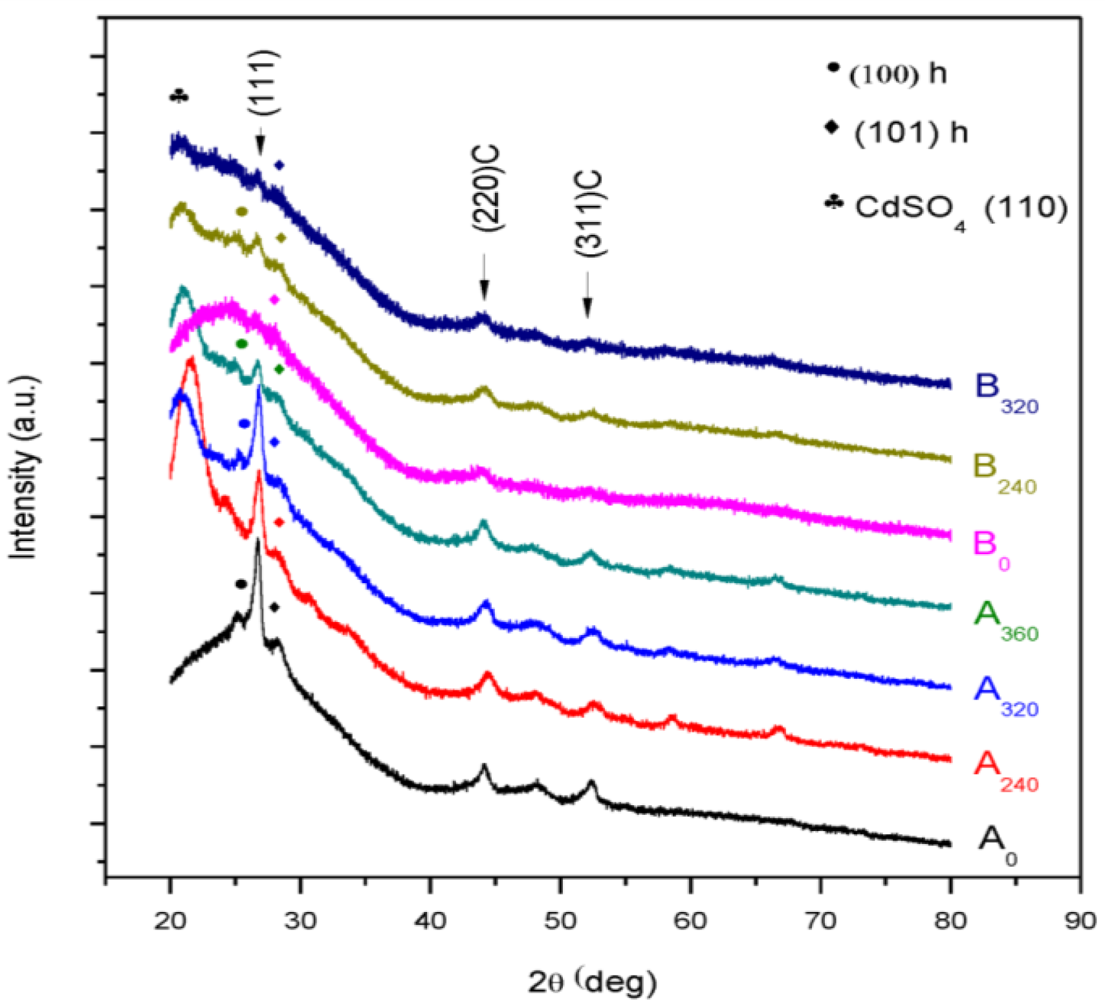
<p>CdS films prepared from a reaction mixture containing cadmium chloride and thiourea for both molar concentrations (A and B) show polycrystalline nature [<xref ref-type="bibr" rid="b18-ijms-12-01293">18</xref>,<xref ref-type="bibr" rid="b19-ijms-12-01293">19</xref>] as shown in the XRD pattern, <xref ref-type="fig" rid="f1-ijms-12-01293">Figure 1</xref>. The XRD graphs are scaled to a small size and seven graphs are presented in one figure, many of the small peaks are lost in this process. Here, all of the peaks that were observed are described in detail in <xref ref-type="table" rid="t1-ijms-12-01293">Table 1</xref>. Both samples without any heat treatment are polycrystalline and a mixture of cubic and hexagonal phase of CdS [<xref ref-type="bibr" rid="b18-ijms-12-01293">18</xref>–<xref ref-type="bibr" rid="b20-ijms-12-01293">20</xref>].</p>
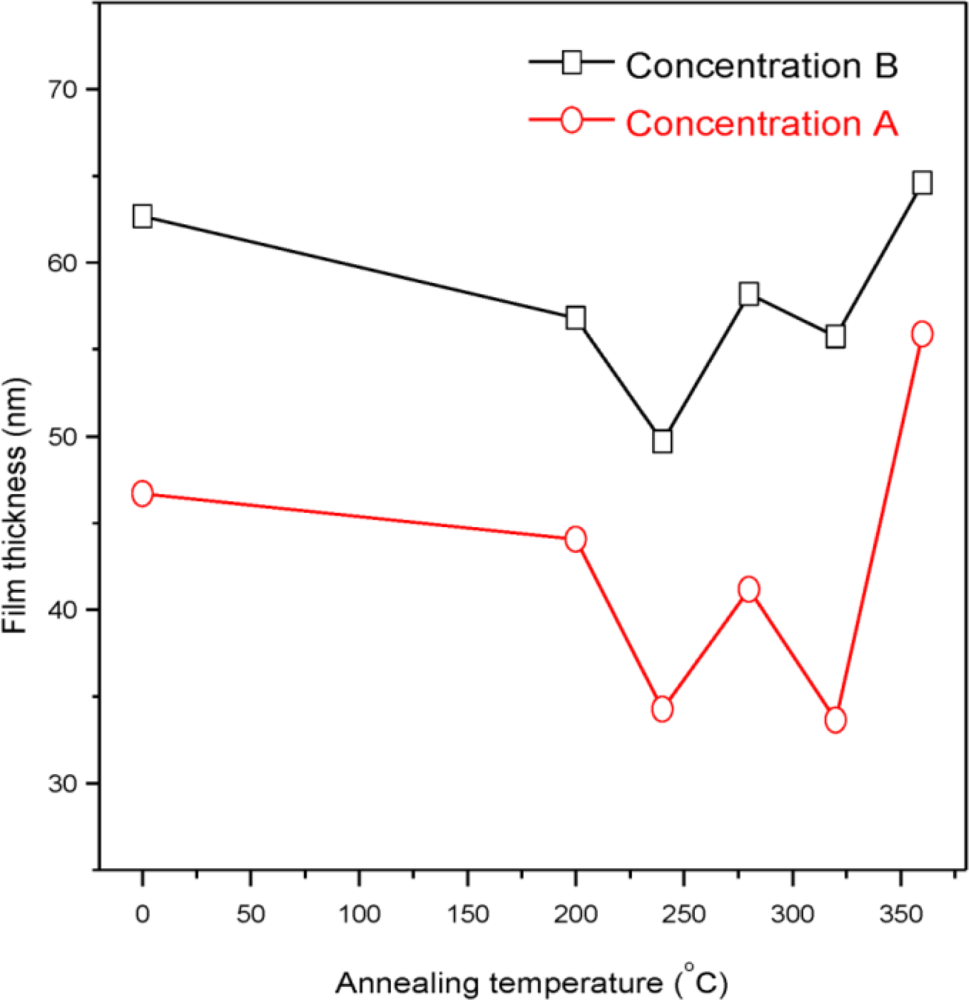
<p>In all samples except A<sub>0</sub> and B<sub>0</sub>, two peaks were observed at 2θ = 20.8511° and 21.5199° (ref: 00-036-0898) belonging to (110), (020) orthorhombic CdSO<sub>4</sub>. It is also observed that the preferred orientation is (111) which is (111) due to the controlled nucleation process occurring in the growing film. This suggests the slow growth rate of the film deposition [<xref ref-type="bibr" rid="b21-ijms-12-01293">21</xref>]. Thickness of the film sample B<sub>0</sub> is 62.7 nm and is further decreased with the increase of the annealing temperature (<xref ref-type="fig" rid="f2-ijms-12-01293">Figure 2</xref>). The thickness is about 64.6 nm for the sample B<sub>360</sub>. It was observed that the thickness of the samples prepared from the solution concentration A is lower than that of the samples prepared from solution concentration B for all annealing temperatures. The minimum thickness 33.6 nm was observed for the sample A<sub>320</sub>. This indicates the thickness of the film is lower when the higher solution concentration is used.</p>
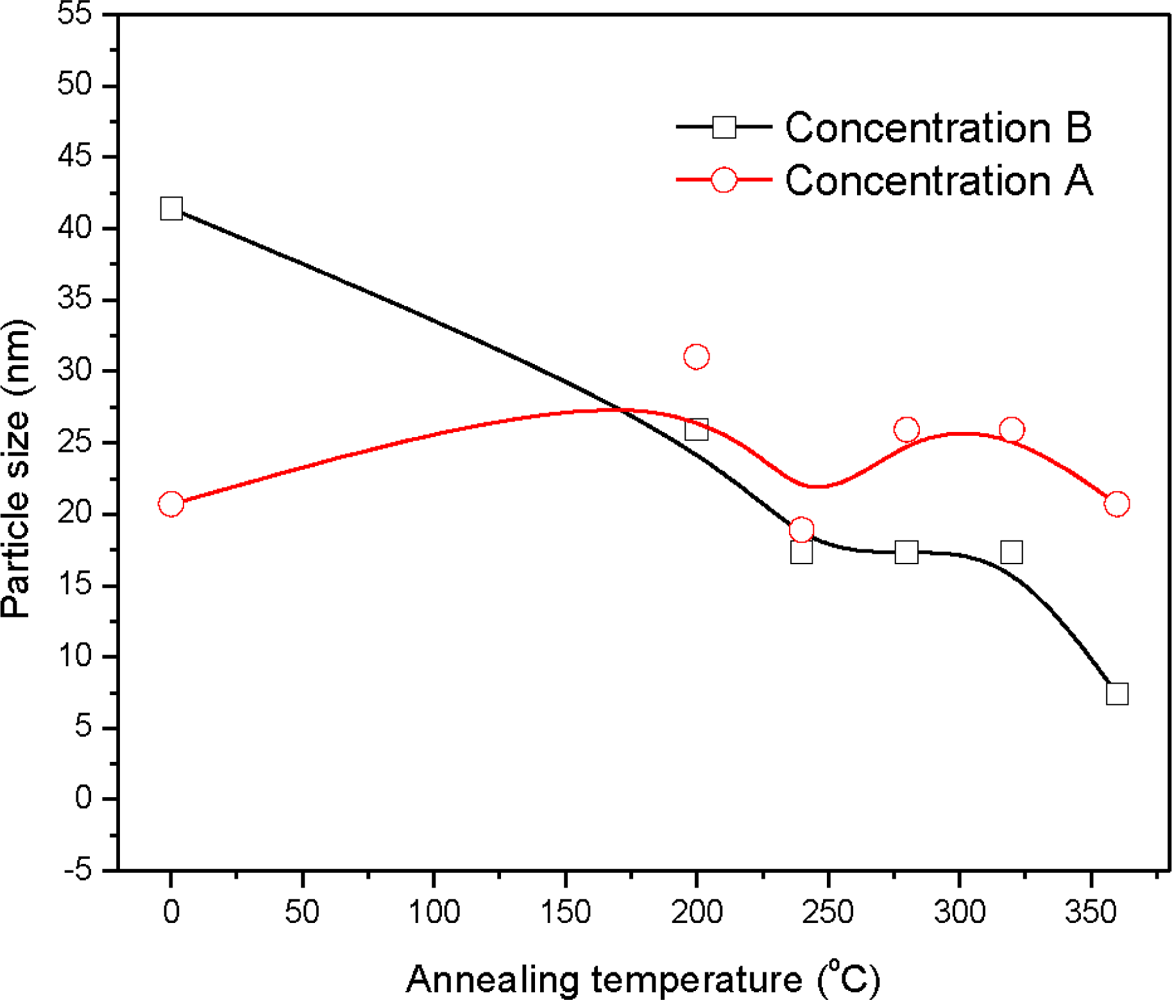
<p>The average crystallite size of the film sample A<sub>0</sub> is 20.7 nm. The crystallite size of the sample A<sub>200</sub> is 31 nm and is further reduced to 20 nm for the sample A<sub>360</sub>, <xref ref-type="fig" rid="f3-ijms-12-01293">Figure 3</xref>. The average crystallite size of the film sample B<sub>0</sub> is 41.4 nm and is reduced to 7.4 nm for the sample B<sub>360</sub>. This indicates a decrease in crystallite size with the increase of annealing temperature, suggesting an increase in crystallinity with annealing temperature. This situation was not observed for the samples prepared from the solution concentration A, which is higher than that of solution concentration B. This indicates the films developed at higher concentration were more crystalline in nature before annealing.</p>
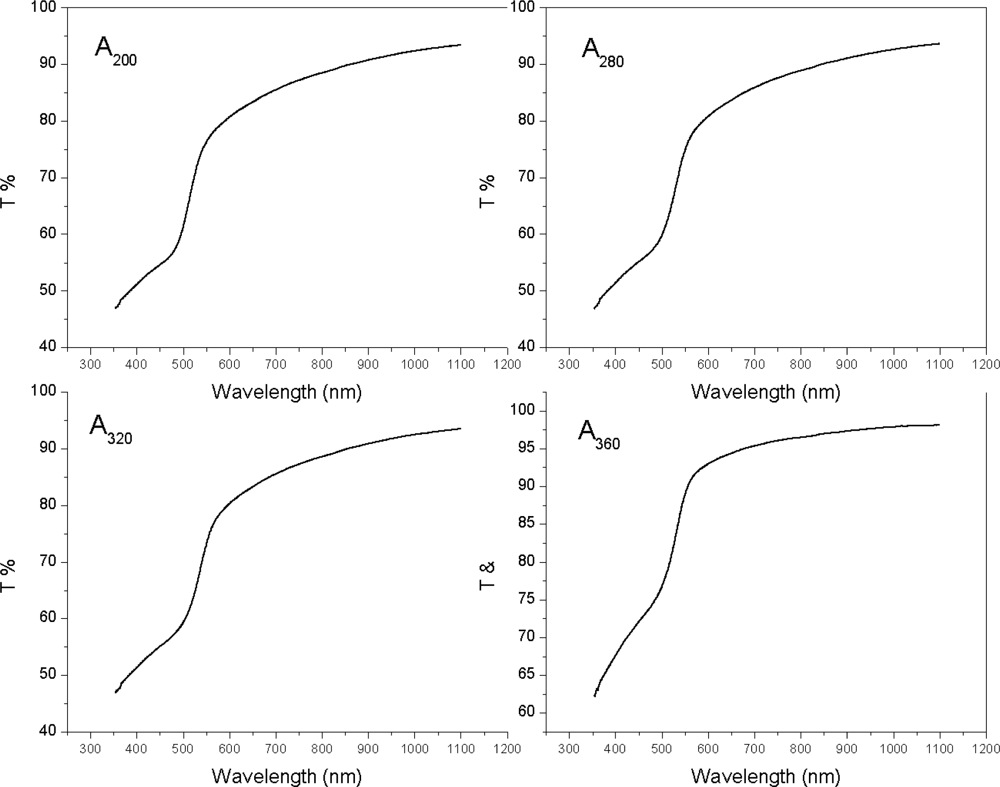
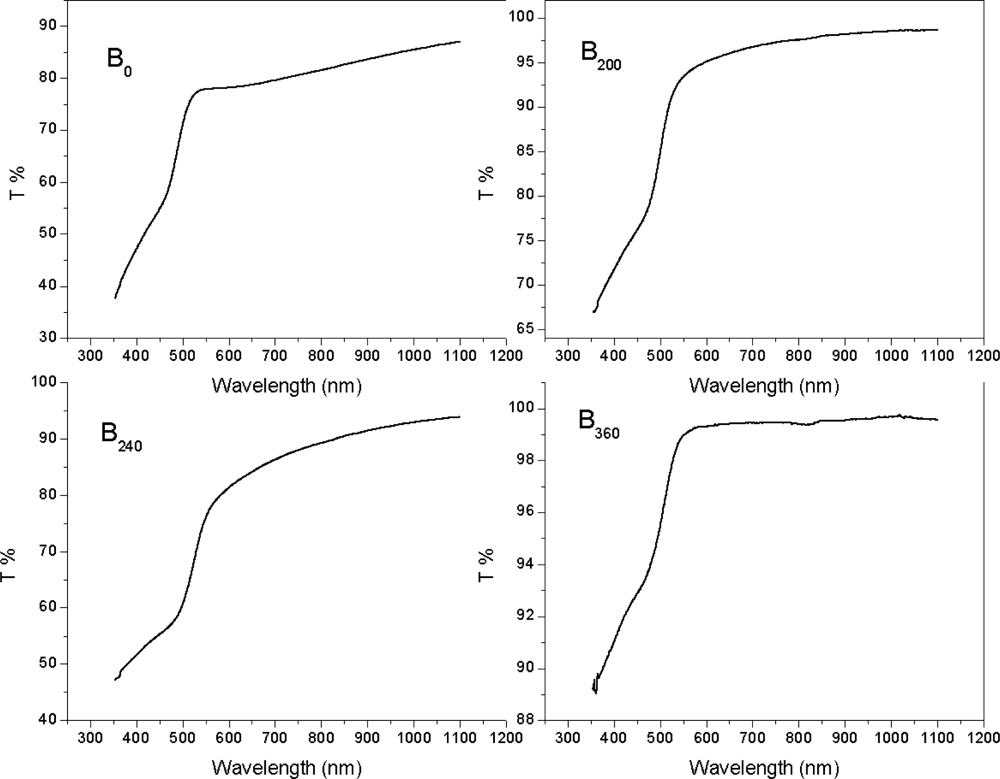
<p>The transmittance spectra of CdS films were recorded over 350 to 1100 nm (<xref ref-type="fig" rid="f4-ijms-12-01293">Figures 4</xref> and <xref ref-type="fig" rid="f5-ijms-12-01293">5</xref>). The spectra showed transmittance dependence of film on the wavelength at a different annealing temperature. The transmittance (T%) is about 89% at wavelength of 550 nm for the sample A<sub>360</sub> and is increased to 97% at the wavelength 850 nm, <xref ref-type="fig" rid="f4-ijms-12-01293">Figure 4</xref>. It is slightly increased with the further increase of wavelength. The transmittance (T%) is about 98% at wavelength of 550 nm for the sample B<sub>360</sub> and remains approximately constant with the further increase of the wavelength up to 1100 nm, <xref ref-type="fig" rid="f5-ijms-12-01293">Figure 5</xref>.</p>
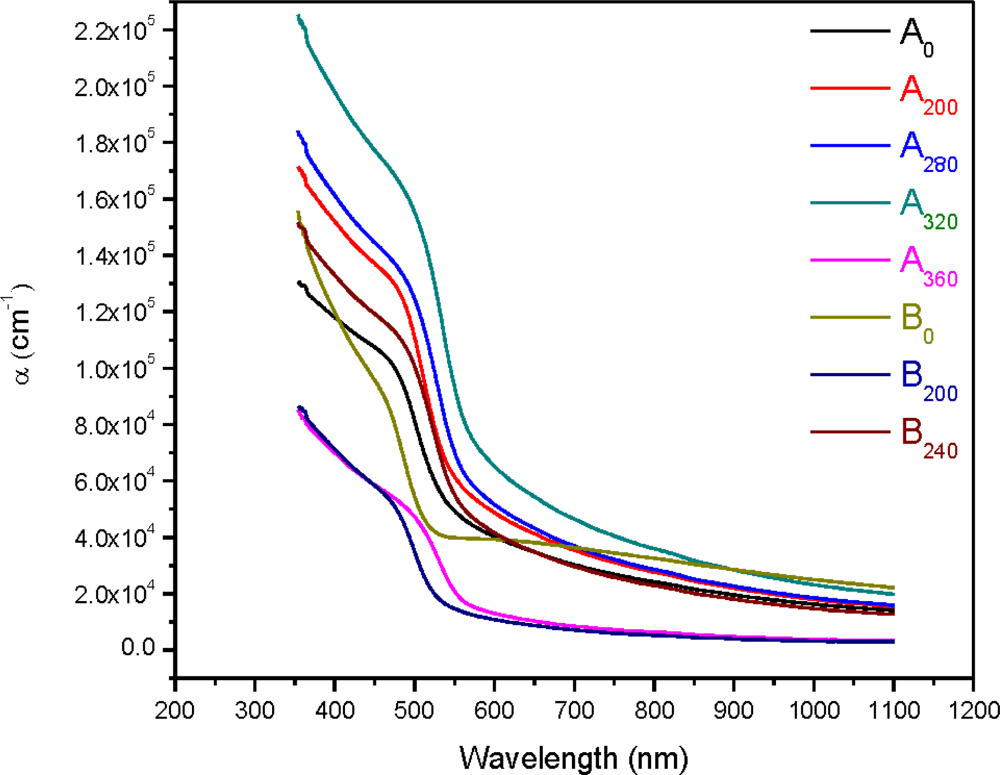
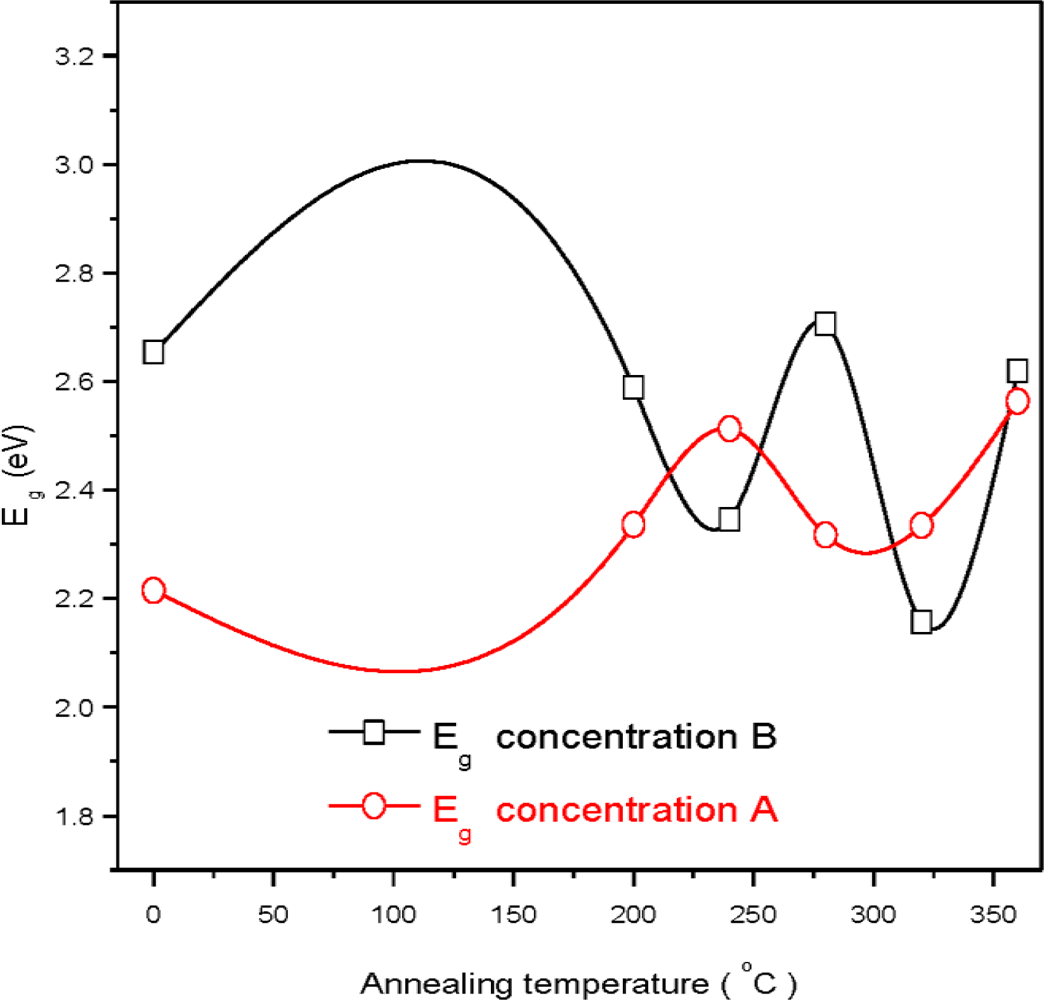
<p>It was observed that transmission spectra shift towards the lower wavelength range for the sample B<sub>360</sub>, which indicates the increase in the optical energy band gap. This suggests the higher concentration of the solution (concentration A) has better crystallinity as compared to the samples that are prepared from the lower concentration (concentration B) at the annealing temperature 360 °C. The transmittance is about 80% at wavelength of 550 nm for the sample A<sub>0</sub> and is increased to 91% at the wavelength 850 nm. It is slightly increased with the further increase of wavelength. The transmittance is 78% at wavelength of 550 nm for the sample B<sub>0</sub> and is slightly increased with the further increase of wavelength up to 1100 nm. The transmission spectrum is observed to shift towards the lower wavelength range for the sample B<sub>0</sub>. This shift of spectra indicates the increase in the optical energy band gap (<italic>E<sub>g</sub></italic>), as shown in <xref ref-type="fig" rid="f8-ijms-12-01293">Figure 8</xref> [<xref ref-type="bibr" rid="b22-ijms-12-01293">22</xref>]. This suggests the higher concentration of the solutions (concentration A) has the better crystallinity as compared to the samples which are prepared from the lower concentration solutions (concentration B) for the as-deposited CdS thin films. The variation of the optical absorption coefficient (<italic>α</italic>) with wavelength for different annealing temperatures and solution concentrations is shown in <xref ref-type="fig" rid="f6-ijms-12-01293">Figure 6</xref>.</p>
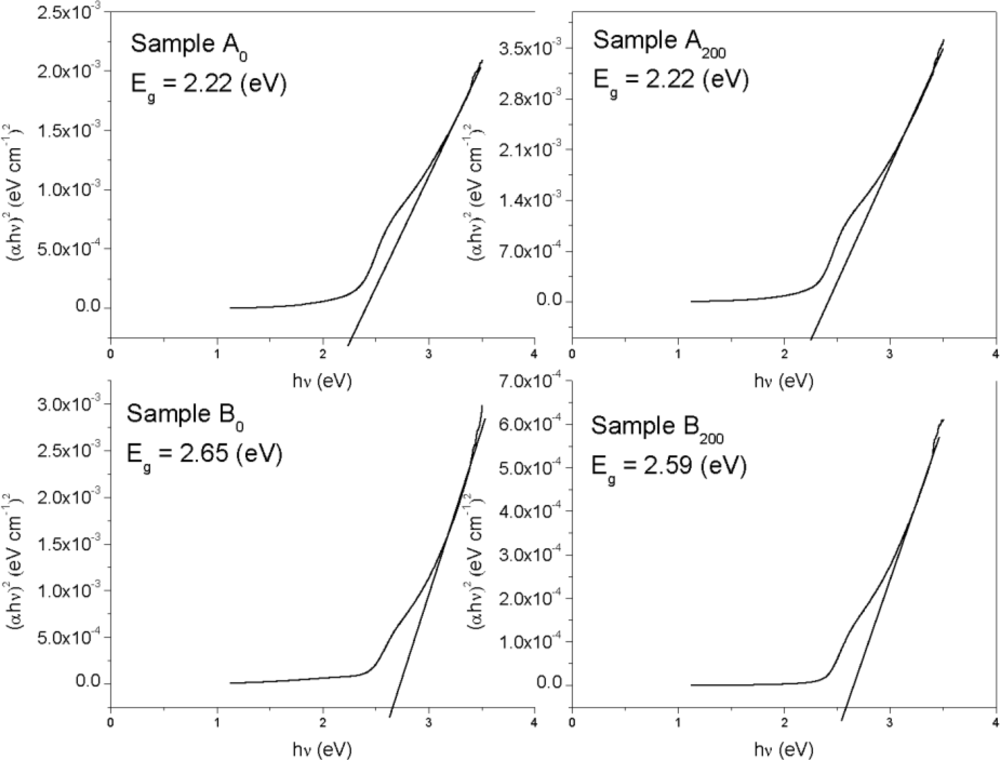
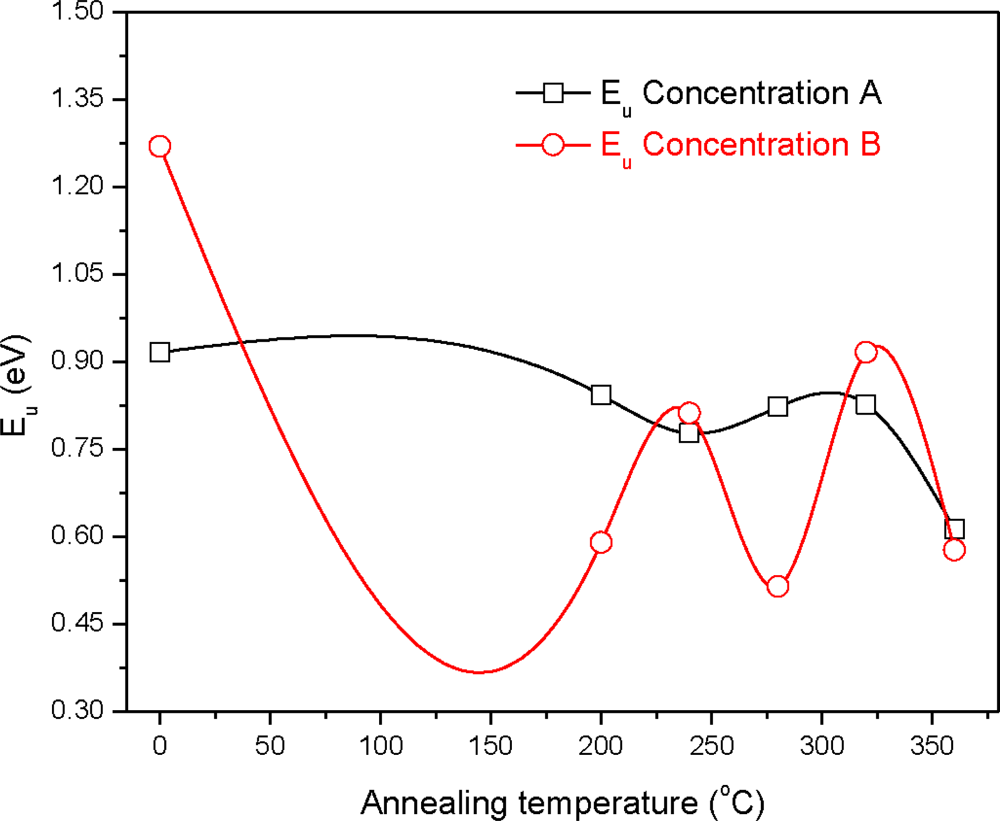
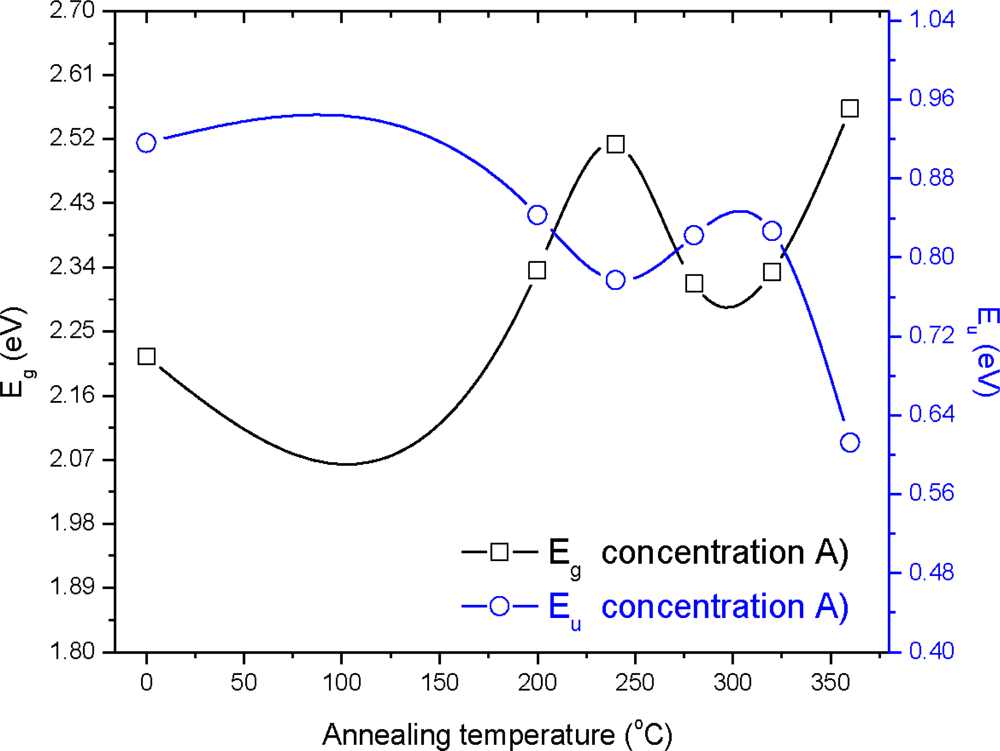
<p>The graph (<italic>αhυ</italic>)<sup>2</sup> <italic>versus</italic> photon energy (<italic>hυ</italic>) is shown in <xref ref-type="fig" rid="f7-ijms-12-01293">Figure 7</xref>. The value of the optical energy band gap (<italic>E<sub>g</sub></italic>) is 2.22 eV for sample A<sub>0</sub>. The value of the optical energy band gap (<italic>E<sub>g</sub></italic>) is 2.65 eV for sample B<sub>0</sub> <xref ref-type="fig" rid="f8-ijms-12-01293">Figure 8</xref>. It was observed that there is a prominent change in the value of <italic>E<sub>g</sub></italic> for the samples A<sub>0</sub> and B<sub>0</sub>. This suggests that the crystallinity of the films increased with the increase of the solution concentration. It is clear from <xref ref-type="fig" rid="f2-ijms-12-01293">Figure 2</xref> that the film thickness is also increased with the decrease of solution concentration. Particle size also increased with the decrease of solution concentration. It is supposed that loosely adherent collides are formed with the decrease of the concentration. This may be the reason why the value of <italic>E<sub>g</sub></italic> is increased. It is also observed that the value of <italic>E<sub>g</sub></italic> for solution concentration A (higher concentration) increases with the increase of annealing temperature indicating that the crystallinity is enhanced with annealing temperature. The trend in the value of <italic>E<sub>g</sub></italic> decreases for the samples prepared from solution concentration B (lower concentration). This suggests a decrease in the crystallinity for very low concentrations. <italic>E<sub>u</sub></italic> is Urbach energy and is shown in <xref ref-type="fig" rid="f9-ijms-12-01293">Figures 9</xref> and <xref ref-type="fig" rid="f10-ijms-12-01293">10</xref>. <italic>E<sub>u</sub></italic> is also known as band tail width and is due to the disorder in the thin film material. Its variation with annealing temperature is shown in <xref ref-type="fig" rid="f11-ijms-12-01293">Figure 11</xref> for concentration A and B. The variation of bond length and bond angle from their standard value in the crystalline material is called disorder [<xref ref-type="bibr" rid="b23-ijms-12-01293">23</xref>,<xref ref-type="bibr" rid="b24-ijms-12-01293">24</xref>]. It is clear that the optical band gap is opposite to the disorder. This behavior indicates that the obtained optical band gap is governed with the disorder variation in the CdS films.</p></sec>
<sec sec-type="conclusions">
<label>4.</label>
<title>Conclusions</title>
<p>The CdS films were deposited by the CBD technique for the different solution concentrations at constant bath temperature. XRD analysis shows that the films were in cubic phase along with the hexagonal CdS at both solution concentrations. The crystallite size varied with the annealing temperature. Optical transmission 75–97% was observed at the wavelength 850 nm. The optical transmittance varied with the annealing temperature. The optical band gap was governed with the disordering phenomena in CdS films.</p></sec></body>
<back>
<ack>
<p>The authors are thankful to the Malaysian Ministry of Higher Education for funding this research work through FRGS Project # 01-01-07-139FR.</p></ack>
<ref-list>
<title>References</title>
<ref id="b1-ijms-12-01293"><label>1.</label><citation citation-type="journal"><person-group person-group-type="author"><name><surname>Khallif</surname><given-names>H</given-names></name><name><surname>Isaiah</surname><given-names>O</given-names></name><name><surname>Chai</surname><given-names>G</given-names></name><name><surname>Chow</surname><given-names>L</given-names></name></person-group><article-title>Characterization of CdS thin films grown by chemical bath deposition using four different cadmium sources</article-title><source>Thin Solid Films</source><year>2008</year><volume>516</volume><fpage>7306</fpage><lpage>7312</lpage><pub-id pub-id-type="doi">10.1016/j.tsf.2008.01.004</pub-id></citation></ref>
<ref id="b2-ijms-12-01293"><label>2.</label><citation citation-type="journal"><person-group person-group-type="author"><name><surname>Bertino</surname><given-names>MF</given-names></name><name><surname>Gadipalli</surname><given-names>RR</given-names></name><name><surname>Story</surname><given-names>JG</given-names></name><name><surname>Williams</surname><given-names>CG</given-names></name><name><surname>Zhang</surname><given-names>G</given-names></name><name><surname>Sotiriou-Leventis</surname><given-names>C</given-names></name><name><surname>Tokuhiro</surname><given-names>AT</given-names></name><name><surname>Guha</surname><given-names>S</given-names></name><name><surname>Leventis</surname><given-names>N</given-names></name></person-group><article-title>Laser writing of semi conductor nanoparticles and quantum dots</article-title><source>Appl. Phys. Lett</source><year>2004</year><volume>85</volume><fpage>6007</fpage><lpage>6010</lpage><pub-id pub-id-type="doi">10.1063/1.1836000</pub-id></citation></ref>
<ref id="b3-ijms-12-01293"><label>3.</label><citation citation-type="journal"><person-group person-group-type="author"><name><surname>Zhang</surname><given-names>J</given-names></name><name><surname>Sun</surname><given-names>L</given-names></name><name><surname>Liao</surname><given-names>S</given-names></name><name><surname>Yan</surname><given-names>C</given-names></name></person-group><article-title>Size control and photoluminescence enhancement of CdS nanoparticles prepared via reverse micelle method</article-title><source>Solid State Commun</source><year>2002</year><volume>124</volume><fpage>45</fpage><lpage>48</lpage><pub-id pub-id-type="doi">10.1016/S0038-1098(02)00448-9</pub-id></citation></ref>
<ref id="b4-ijms-12-01293"><label>4.</label><citation citation-type="journal"><person-group person-group-type="author"><name><surname>Hodes</surname><given-names>G</given-names></name><name><surname>Albu-Yaron</surname><given-names>A</given-names></name><name><surname>Decker</surname><given-names>F</given-names></name><name><surname>Motisuke</surname><given-names>P</given-names></name></person-group><article-title>Three-dimensional quantum-size effect in chemically deposited cadmium selenide films</article-title><source>Phys. Rev. B</source><year>1987</year><volume>36</volume><fpage>4215</fpage><lpage>4221</lpage><pub-id pub-id-type="doi">10.1103/PhysRevB.36.4215</pub-id></citation></ref>
<ref id="b5-ijms-12-01293"><label>5.</label><citation citation-type="journal"><person-group person-group-type="author"><name><surname>Contreras</surname><given-names>MA</given-names></name><name><surname>Egaas</surname><given-names>B</given-names></name><name><surname>Ramanathan</surname><given-names>K</given-names></name><name><surname>Hiltner</surname><given-names>J</given-names></name><name><surname>Swartzlander</surname><given-names>A</given-names></name><name><surname>Hasoon</surname><given-names>F</given-names></name><name><surname>Noufi</surname><given-names>R</given-names></name></person-group><article-title>Progress toward 20% efficiency in Cu(In,Ga)Se2 polycrystalline thin-film solar cells</article-title><source>Res. Appl</source><year>1999</year><volume>7</volume><fpage>311</fpage><lpage>316</lpage></citation></ref>
<ref id="b6-ijms-12-01293"><label>6.</label><citation citation-type="journal"><person-group person-group-type="author"><name><surname>Khallif</surname><given-names>H</given-names></name><name><surname>Oladej</surname><given-names>IO</given-names></name><name><surname>Chow</surname><given-names>L</given-names></name></person-group><article-title>Optimization of chemical bath deposited CdS thin films using nitrilotriacetic acid as a complexing agent</article-title><source>Thin Solid Films</source><year>2008</year><volume>516</volume><fpage>5967</fpage><lpage>5973</lpage><pub-id pub-id-type="doi">10.1016/j.tsf.2007.10.079</pub-id></citation></ref>
<ref id="b7-ijms-12-01293"><label>7.</label><citation citation-type="journal"><person-group person-group-type="author"><name><surname>Oladeji</surname><given-names>I</given-names></name><name><surname>Chow</surname><given-names>L</given-names></name><name><surname>Ferekides</surname><given-names>C</given-names></name><name><surname>Viswanathan</surname><given-names>V</given-names></name><name><surname>Zhao</surname><given-names>Z</given-names></name></person-group><article-title>Matter/CdTe/CdS/Cd<sub>1−</sub><italic><sub>x</sub></italic>Zn<italic><sub>x</sub></italic>S/TCO/glass: A new CdTe thin film solar cell structure</article-title><source>Sol. Energy Mater. Sol. Cells</source><year>2000</year><volume>61</volume><fpage>203</fpage><lpage>211</lpage><pub-id pub-id-type="doi">10.1016/S0927-0248(99)00114-2</pub-id></citation></ref>
<ref id="b8-ijms-12-01293"><label>8.</label><citation citation-type="journal"><person-group person-group-type="author"><name><surname>Contreras</surname><given-names>M</given-names></name><name><surname>Romero</surname><given-names>M</given-names></name><name><surname>To</surname><given-names>B</given-names></name><name><surname>Hasoon</surname><given-names>F</given-names></name><name><surname>Noufi</surname><given-names>R</given-names></name><name><surname>Ward</surname><given-names>S</given-names></name><name><surname>Ramanathan</surname><given-names>K</given-names></name></person-group><article-title>Optimization of CBD CdS process in high-efficiency Cu(In,Ga)Se2-based solar cells</article-title><source>Thin Solid Films</source><year>2002</year><volume>403</volume><fpage>204</fpage><lpage>211</lpage><pub-id pub-id-type="doi">10.1016/S0040-6090(01)01538-3</pub-id></citation></ref>
<ref id="b9-ijms-12-01293"><label>9.</label><citation citation-type="journal"><person-group person-group-type="author"><name><surname>Chu</surname><given-names>TL</given-names></name><name><surname>Chu</surname><given-names>SS</given-names></name><name><surname>Ferekides</surname><given-names>C</given-names></name><name><surname>Wu</surname><given-names>CQ</given-names></name><name><surname>Britt</surname><given-names>J</given-names></name><name><surname>Wang</surname><given-names>C</given-names></name></person-group><article-title>High efficiency thin film CdS/CdTe heterojunction solar cells</article-title><source>J. Cryst. Growth</source><year>1992</year><volume>117</volume><fpage>1073</fpage><pub-id pub-id-type="doi">10.1016/0022-0248(92)90916-7</pub-id></citation></ref>
<ref id="b10-ijms-12-01293"><label>10.</label><citation citation-type="journal"><person-group person-group-type="author"><name><surname>Ferekides</surname><given-names>C</given-names></name><name><surname>Britt</surname><given-names>J</given-names></name></person-group><article-title>CdTe solar cells with efficiencies over 15%</article-title><source>Sol. Energy Mat. Sol. Cells</source><year>1994</year><volume>35</volume><fpage>255</fpage><lpage>262</lpage><pub-id pub-id-type="doi">10.1016/0927-0248(94)90148-1</pub-id></citation></ref>
<ref id="b11-ijms-12-01293"><label>11.</label><citation citation-type="journal"><person-group person-group-type="author"><name><surname>Kaur</surname><given-names>I</given-names></name><name><surname>Pandya</surname><given-names>DK</given-names></name><name><surname>Chopra</surname><given-names>L</given-names></name></person-group><article-title>Growth kinetics and polymorphism of chemically deposited CdS films</article-title><source>J. Electrochem. Soc</source><year>1980</year><volume>127</volume><fpage>943</fpage><lpage>948</lpage><pub-id pub-id-type="doi">10.1149/1.2129792</pub-id></citation></ref>
<ref id="b12-ijms-12-01293"><label>12.</label><citation citation-type="journal"><person-group person-group-type="author"><name><surname>Froment</surname><given-names>M</given-names></name><name><surname>Lincot</surname><given-names>D</given-names></name></person-group><article-title>Phase formation processes in solution at the atomic level: Metal chalcogenide semiconductors</article-title><source>Electrochim. Acta</source><year>1995</year><volume>40</volume><fpage>1293</fpage><lpage>1303</lpage><pub-id pub-id-type="doi">10.1016/0013-4686(95)00065-M</pub-id></citation></ref>
<ref id="b13-ijms-12-01293"><label>13.</label><citation citation-type="journal"><person-group person-group-type="author"><name><surname>Gutiérrez</surname><given-names>LCD</given-names></name><name><surname>Rosendob</surname><given-names>E</given-names></name><name><surname>Ortegaa</surname><given-names>M</given-names></name><name><surname>Olivac</surname><given-names>AI</given-names></name><name><surname>Tapiab</surname><given-names>O</given-names></name><name><surname>Díazb</surname><given-names>T</given-names></name><name><surname>Juárezb</surname><given-names>H</given-names></name><name><surname>Garcíab</surname><given-names>G</given-names></name><name><surname>Rubínd</surname><given-names>M</given-names></name></person-group><article-title>Structural analysis of CdS thin films obtained by multiple dips of oscillating bath</article-title><source>Mat. Sci. Eng. B</source><year>2009</year><volume>165</volume><fpage>74</fpage><lpage>76</lpage><pub-id pub-id-type="doi">10.1016/j.mseb.2009.03.003</pub-id></citation></ref>
<ref id="b14-ijms-12-01293"><label>14.</label><citation citation-type="journal"><person-group person-group-type="author"><name><surname>Caglar</surname><given-names>M</given-names></name><name><surname>Caglar</surname><given-names>Y</given-names></name><name><surname>Ilican</surname><given-names>S</given-names></name></person-group><article-title>The determination of the thickness and optical constants of the ZnO crystalline thin film by using envelope method</article-title><source>J. Optoelectron. Adv. Mater</source><year>2006</year><volume>8</volume><fpage>1410</fpage><lpage>1413</lpage></citation></ref>
<ref id="b15-ijms-12-01293"><label>15.</label><citation citation-type="journal"><person-group person-group-type="author"><name><surname>Prabahar</surname><given-names>S</given-names></name><name><surname>Dhanam</surname><given-names>M</given-names></name></person-group><article-title>CdS thin films from two different chemical baths-structural and optical analysis</article-title><source>J. Cryst. Growth</source><year>2005</year><volume>285</volume><fpage>41</fpage><lpage>48</lpage><pub-id pub-id-type="doi">10.1016/j.jcrysgro.2005.08.008</pub-id></citation></ref>
<ref id="b16-ijms-12-01293"><label>16.</label><citation citation-type="journal"><person-group person-group-type="author"><name><surname>Sanap</surname><given-names>VB</given-names></name><name><surname>Pawar</surname><given-names>BH</given-names></name></person-group><article-title>Optical study of the effect of cadmium sources on nano-crystalline CdS thin films</article-title><source>Chalcogenide Lett</source><year>2010</year><volume>7</volume><fpage>227</fpage><lpage>231</lpage></citation></ref>
<ref id="b17-ijms-12-01293"><label>17.</label><citation citation-type="journal"><person-group person-group-type="author"><name><surname>Ghosh</surname><given-names>T</given-names></name><name><surname>Bandyopadhyay</surname><given-names>S</given-names></name><name><surname>Roy</surname><given-names>KK</given-names></name><name><surname>Kar</surname><given-names>S</given-names></name><name><surname>Lahiri</surname><given-names>AK</given-names></name><name><surname>Maiti</surname><given-names>AK</given-names></name><name><surname>Goswami</surname><given-names>K</given-names></name></person-group><article-title>Optical and structural properties of lead iodide thin films prepared by vaccum evaporation method</article-title><source>Cryst. Res. Technol</source><year>2008</year><volume>43</volume><fpage>959</fpage><lpage>963</lpage><pub-id pub-id-type="doi">10.1002/crat.200811160</pub-id></citation></ref>
<ref id="b18-ijms-12-01293"><label>18.</label><citation citation-type="journal"><person-group person-group-type="author"><name><surname>Morris</surname><given-names>GC</given-names></name><name><surname>Vanderveen</surname><given-names>R</given-names></name></person-group><article-title>Cadmium sulphide films prepared by pulsed electrodeposition</article-title><source>Sol. Energy Mater. Sol. Cells</source><year>1992</year><volume>27</volume><fpage>305</fpage><lpage>319</lpage><pub-id pub-id-type="doi">10.1016/0927-0248(92)90092-4</pub-id></citation></ref>
<ref id="b19-ijms-12-01293"><label>19.</label><citation citation-type="journal"><person-group person-group-type="author"><name><surname>Zelaya-Angel</surname><given-names>O</given-names></name><name><surname>Alvarado-Gil</surname><given-names>JJ</given-names></name><name><surname>Lozada-Morales</surname><given-names>R</given-names></name><name><surname>Varga</surname><given-names>H</given-names></name><name><surname>Ferreira da Silva</surname><given-names>A</given-names></name></person-group><article-title>Band-gap shift in CdS semiconductor by photoacoustic spectroscopy: Evidence of a cubic hexagonal lattice transition</article-title><source>Appl. Phys. Lett</source><year>1994</year><volume>64</volume><fpage>291</fpage><lpage>294</lpage><pub-id pub-id-type="doi">10.1063/1.111184</pub-id></citation></ref>
<ref id="b20-ijms-12-01293"><label>20.</label><citation citation-type="journal"><person-group person-group-type="author"><name><surname>Murali</surname><given-names>KR</given-names></name><name><surname>Matheline</surname><given-names>M</given-names></name><name><surname>John</surname><given-names>R</given-names></name></person-group><article-title>Characteristics of brush electrodeposited CdS films</article-title><source>Chalcogenide Lett</source><year>2009</year><volume>6</volume><fpage>483</fpage><lpage>490</lpage></citation></ref>
<ref id="b21-ijms-12-01293"><label>21.</label><citation citation-type="journal"><person-group person-group-type="author"><name><surname>Sasikala</surname><given-names>G</given-names></name><name><surname>Thilakan</surname><given-names>P</given-names></name><name><surname>Subramanian</surname><given-names>C</given-names></name></person-group><article-title>Modification in the chemical bath deposition apparatus, growth and characterization of CdS semiconducting thin films for photovoltaic applications</article-title><source>Sol. Energy Mater. Sol. Cells</source><year>2000</year><volume>62</volume><fpage>275</fpage><lpage>293</lpage><pub-id pub-id-type="doi">10.1016/S0927-0248(99)00170-1</pub-id></citation></ref>
<ref id="b22-ijms-12-01293"><label>22.</label><citation citation-type="journal"><person-group person-group-type="author"><name><surname>Liu</surname><given-names>F</given-names></name><name><surname>Lai</surname><given-names>Y</given-names></name><name><surname>Liu</surname><given-names>J</given-names></name><name><surname>Wang</surname><given-names>B</given-names></name><name><surname>Kuang</surname><given-names>S</given-names></name><name><surname>Zhang</surname><given-names>Z</given-names></name><name><surname>Li</surname><given-names>J</given-names></name><name><surname>Liu</surname><given-names>Y</given-names></name></person-group><article-title>Characterization of chemical bath deposited CdS thin films at different deposition temperature</article-title><source>J. Alloys Compd</source><year>2010</year><volume>493</volume><fpage>305</fpage><lpage>308</lpage><pub-id pub-id-type="doi">10.1016/j.jallcom.2009.12.088</pub-id></citation></ref>
<ref id="b23-ijms-12-01293"><label>23.</label><citation citation-type="journal"><person-group person-group-type="author"><name><surname>Moualkia</surname><given-names>H</given-names></name><name><surname>Hariech</surname><given-names>S</given-names></name><name><surname>Aida</surname><given-names>MS</given-names></name></person-group><article-title>Structural and optical properties of CdS thin films grown by chemical bath deposition</article-title><source>Thin Solid Films</source><year>2009</year><volume>518</volume><fpage>1259</fpage><lpage>1262</lpage><pub-id pub-id-type="doi">10.1016/j.tsf.2009.04.067</pub-id></citation></ref>
<ref id="b24-ijms-12-01293"><label>24.</label><citation citation-type="journal"><person-group person-group-type="author"><name><surname>Kurik</surname><given-names>MV</given-names></name></person-group><article-title>Urbach rule</article-title><source>Phys. Status Solid A</source><year>1971</year><volume>8</volume><fpage>9</fpage><lpage>45</lpage><pub-id pub-id-type="doi">10.1002/pssa.2210080102</pub-id></citation></ref></ref-list>
<sec sec-type="display-objects">
<title>Figures and Table</title>
<fig id="f1-ijms-12-01293" position="float">
<label>Figure 1.</label>
<caption>
<p>XRD pattern of CdS film for different annealing temperatures.</p></caption>
<graphic xlink:href="ijms-12-01293f1.gif"/></fig>
<fig id="f2-ijms-12-01293" position="float">
<label>Figure 2.</label>
<caption>
<p>Variation of film thickness with different annealing temperatures.</p></caption>
<graphic xlink:href="ijms-12-01293f2.gif"/></fig>
<fig id="f3-ijms-12-01293" position="float">
<label>Figure 3.</label>
<caption>
<p>Variation of crystallite size with the annealing temperature.</p></caption>
<graphic xlink:href="ijms-12-01293f3.gif"/></fig>
<fig id="f4-ijms-12-01293" position="float">
<label>Figure 4.</label>
<caption>
<p>Transmittance spectra for different annealing temperatures for concentration A.</p></caption>
<graphic xlink:href="ijms-12-01293f4.gif"/></fig>
<fig id="f5-ijms-12-01293" position="float">
<label>Figure 5.</label>
<caption>
<p>Transmittance spectra for different annealing temperatures for concentration B.</p></caption>
<graphic xlink:href="ijms-12-01293f5.gif"/></fig>
<fig id="f6-ijms-12-01293" position="float">
<label>Figure 6.</label>
<caption>
<p>Absorption coefficient (<italic>α</italic>) for different annealing temperatures.</p></caption>
<graphic xlink:href="ijms-12-01293f6.gif"/></fig>
<fig id="f7-ijms-12-01293" position="float">
<label>Figure 7.</label>
<caption>
<p>Variation of the optical energy band gap (<italic>E<sub>g</sub></italic>) with photon energy (<italic>hυ</italic>) at different concentrations and annealing temperatures.</p></caption>
<graphic xlink:href="ijms-12-01293f7.gif"/></fig>
<fig id="f8-ijms-12-01293" position="float">
<label>Figure 8.</label>
<caption>
<p>Variation of the optical energy band gap (<italic>E<sub>g</sub></italic>) at different annealing temperatures.</p></caption>
<graphic xlink:href="ijms-12-01293f8.gif"/></fig>
<fig id="f9-ijms-12-01293" position="float">
<label>Figure 9.</label>
<caption>
<p>Variation of the optical energy band gap (<italic>E<sub>g</sub></italic>) and Urbach energy (<italic>E<sub>u</sub></italic>) with annealing temperature for concentration A.</p></caption>
<graphic xlink:href="ijms-12-01293f9.gif"/></fig>
<fig id="f10-ijms-12-01293" position="float">
<label>Figure 10.</label>
<caption>
<p>Variation of the optical energy band gap (<italic>E<sub>g</sub></italic>) and Urbach energy (<italic>E<sub>u</sub></italic>) with annealing temperature for concentration B.</p></caption>
<graphic xlink:href="ijms-12-01293f10.gif"/></fig>
<fig id="f11-ijms-12-01293" position="float">
<label>Figure 11.</label>
<caption>
<p>Variation of Urbach energy (<italic>E<sub>u</sub></italic>) with annealing temperature for concentration A and B.</p></caption>
<graphic xlink:href="ijms-12-01293f11.gif"/></fig>
<table-wrap id="t1-ijms-12-01293" position="float">
<label>Table 1.</label>
<caption>
<p>A summary of XRD data for all samples.</p></caption>
<table frame="hsides" rules="groups">
<thead>
<tr>
<th align="left" valign="top"><bold>Sample</bold></th>
<th align="left" valign="top"><bold>2θ (Deg.) (hkl)</bold></th>
<th align="left" valign="top"><bold>CdS Structure</bold></th></tr></thead>
<tbody>
<tr>
<td align="left" valign="top" rowspan="2">A<sub>0</sub></td>
<td align="left" valign="top">26.7277°(111), 44.1346°(220), 52.3619°(311)</td>
<td align="left" valign="top">cubic (ref: 01-080-0019)</td></tr>
<tr>
<td align="left" valign="top">25.1618°(100), 28.2306°(101), 48.1229°(103)</td>
<td align="left" valign="top">hexagonal (ref: 01-080-0006)</td></tr>
<tr>
<td align="left" valign="top" rowspan="2">B<sub>0</sub></td>
<td align="left" valign="top">26.4962°(111), 43.9355°(220), 51.9702°(311)</td>
<td align="left" valign="top">cubic (ref: 01-075-1546)</td></tr>
<tr>
<td align="left" valign="top">28.1727°(101)</td>
<td align="left" valign="top">hexagonal (ref: 00-065-3414).</td></tr>
<tr>
<td align="left" valign="top" rowspan="2">A<sub>200</sub></td>
<td align="left" valign="top">26.8079°(111), 44.4133°(220), 52.7364°(311)</td>
<td align="left" valign="top">cubic (ref: 01-075-0581)</td></tr>
<tr>
<td align="left" valign="top">28.6450°(101), 58.4937°(202), 66.7578°(203)</td>
<td align="left" valign="top">hexagonal (ref: 01-080-0006).</td></tr>
<tr>
<td align="left" valign="top" rowspan="2">B<sub>200</sub></td>
<td align="left" valign="top">26.7070°(111), 44.2175°(220), 52.4116°(311)</td>
<td align="left" valign="top">cubic (ref: 01-080-0019)</td></tr>
<tr>
<td align="left" valign="top">24.6784°(100), 28.3841°(101), 58.4548°(202), 66.6981°(203)</td>
<td align="left" valign="top">hexagonal (ref: 01-089-2944).</td></tr>
<tr>
<td align="left" valign="top" rowspan="2">A<sub>240</sub></td>
<td align="left" valign="top">26.8176°(111), 30.8886°(220), 44.4089°(311</td>
<td align="left" valign="top">cubic (ref: 01-075-1546)</td></tr>
<tr>
<td align="left" valign="top">58.5947°(202), 66.8296°(203)</td>
<td align="left" valign="top">hexagonal (ref: 01-080-0006).</td></tr>
<tr>
<td align="left" valign="top" rowspan="2">B<sub>240</sub></td>
<td align="left" valign="top">26.6935°(111), 44.0913°(220), 52.3710°(311)</td>
<td align="left" valign="top">cubic (ref: 01-075-1546)</td></tr>
<tr>
<td align="left" valign="top">25.0745°(100), 28.4921°(101)</td>
<td align="left" valign="top">hexagonal (ref: 00-001-0783).</td></tr>
<tr>
<td align="left" valign="top" rowspan="2">A<sub>280</sub></td>
<td align="left" valign="top">26.7905°(111), 30.7475°(200), 44.4319°(220), 52.5711° (311), 73.2311°(420)</td>
<td align="left" valign="top">cubic (ref: 01-080-0019)</td></tr>
<tr>
<td align="left" valign="top">24.7269°(100), 28.3734°(101), 48.0309°(103), 58.6591° (202), 66.8441°(203)</td>
<td align="left" valign="top">hexagonal (ref: 01-077-2306).</td></tr>
<tr>
<td align="left" valign="top" rowspan="2">B<sub>280</sub></td>
<td align="left" valign="top">25.5707°(111), 30.3946°(200), 44.1649°(220)</td>
<td align="left" valign="top">Cubic (ref: 00-042-1411)</td></tr>
<tr>
<td align="left" valign="top">28.1785°(101), 47.5271°(103), 58.3791°(202), 66.5891°(203)</td>
<td align="left" valign="top">hexagonal (ref: 01-080-0006).</td></tr>
<tr>
<td align="left" valign="top" rowspan="2">A<sub>320</sub></td>
<td align="left" valign="top">26.8012°(111), 44.2445°(220), 52.5047°(311)</td>
<td align="left" valign="top">cubic (ref: 01-080-0019)</td></tr>
<tr>
<td align="left" valign="top">25.3195°(100), 28.5660°(101), 58.3476°(202)</td>
<td align="left" valign="top">hexagonal (ref: 00-001-0783).</td></tr>
<tr>
<td align="left" valign="top" rowspan="2">B<sub>320</sub></td>
<td align="left" valign="top">26.5834°(111), 44.0583°(220), 52.1528°(311)</td>
<td align="left" valign="top">cubic (ref: 01-080-0019)</td></tr>
<tr>
<td align="left" valign="top">28.4385°(101)</td>
<td align="left" valign="top">hexagonal (ref: 01-075-1545).</td></tr>
<tr>
<td align="left" valign="top" rowspan="2">A<sub>360</sub></td>
<td align="left" valign="top">26.7119°(111), 43.9950°(220), 52.2836°(311</td>
<td align="left" valign="top">cubic (ref: 01-080-0019)</td></tr>
<tr>
<td align="left" valign="top">24.9576 °(100), 28.2761°(101), 58.2849°(202)</td>
<td align="left" valign="top">hexagonal (ref: 01-080-0006).</td></tr>
<tr>
<td align="left" valign="top" rowspan="2">B<sub>360</sub></td>
<td align="left" valign="top">43.7486°(220)</td>
<td align="left" valign="top">cubic (ref: 00-065-2887).</td></tr>
<tr>
<td align="left" valign="top">24.6729°(100)</td>
<td align="left" valign="top">hexagonal (ref: 00-006-0314)</td></tr></tbody></table></table-wrap></sec></back></article>