
<?xml version="1.0" encoding="UTF-8"?>
<!DOCTYPE article PUBLIC "-//NLM//DTD Journal Publishing DTD v2.3 20070202//EN" "journalpublishing.dtd">
<article xmlns:mml="http://www.w3.org/1998/Math/MathML" xmlns:xlink="http://www.w3.org/1999/xlink" xml:lang="en" article-type="research-article">
<front>
<journal-meta>
<journal-id journal-id-type="publisher-id">ijms</journal-id>
<journal-title>International Journal of Molecular Sciences</journal-title>
<abbrev-journal-title>Int. J. Mol. Sci.</abbrev-journal-title>
<issn pub-type="epub">1422-0067</issn>
<publisher>
<publisher-name>Molecular Diversity Preservation International (MDPI)</publisher-name></publisher></journal-meta>
<article-meta>
<article-id pub-id-type="doi">10.3390/ijms12021281</article-id>
<article-id pub-id-type="publisher-id">ijms-12-01281</article-id>
<article-categories>
<subj-group>
<subject>Article</subject></subj-group></article-categories>
<title-group>
<article-title>Application of Molecular Topology for the Prediction of Reaction Yields and Anti-Inflammatory Activity of Heterocyclic Amidine Derivatives</article-title></title-group>
<contrib-group>
<contrib contrib-type="author">
<name><surname>Pla-Franco</surname><given-names>Jordi</given-names></name></contrib>
<contrib contrib-type="author">
<name><surname>Gálvez-Llompart</surname><given-names>María</given-names></name></contrib>
<contrib contrib-type="author">
<name><surname>Gálvez</surname><given-names>Jorge</given-names></name></contrib>
<contrib contrib-type="author">
<name><surname>García-Domenech</surname><given-names>Ramón</given-names></name><xref ref-type="corresp" rid="c1-ijms-12-01281">*</xref></contrib>
<aff id="af1-ijms-12-01281">Molecular Connectivity and Drug Design Research Unit, Faculty of Pharmacy, Department of Physical Chemistry, University of Valencia Avd, V.A. Estellés, s/n 46100-Burjassot, Valencia, Spain; E-Mails: <email>jorpla3@alumni.uv.es</email> (J.P.-F.); <email>galloma@alumni.uv.es</email> (M.G.-L.); <email>jorge.galvez@uv.es</email> (J.G.)</aff></contrib-group>
<author-notes>
<corresp id="c1-ijms-12-01281">
<label>*</label>Author to whom correspondence should be addressed; E-Mail: <email>ramon.garcia@uv.es</email>; Tel.: +34963544291; Fax: +34963544892.</corresp></author-notes>
<pub-date pub-type="epub">
<day>22</day>
<month>2</month>
<year>2011</year></pub-date>
<pub-date pub-type="collection">
<year>2011</year></pub-date>
<volume>12</volume>
<issue>2</issue>
<fpage>1281</fpage>
<lpage>1292</lpage>
<history>
<date date-type="received">
<day>12</day>
<month>1</month>
<year>2011</year></date>
<date date-type="accepted">
<day>12</day>
<month>2</month>
<year>2011</year></date></history>
<permissions>
<copyright-statement>© 2011 by the authors; licensee MDPI, Basel, Switzerland.</copyright-statement>
<copyright-year>2011</copyright-year>
<license license-type="open-access" xlink:href="http://creativecommons.org/licenses/by/3.0">
<p>This article is an open-access article distributed under the terms and conditions of the Creative Commons Attribution license (http://creativecommons.org/licenses/by/3.0/).</p></license></permissions>
<abstract>
<p>Topological-mathematical models based on multiple linear regression analyses have been built to predict the reaction yields and the anti-inflammatory activity of a set of heterocylic amidine derivatives, synthesized under environmental friendly conditions, using microwave irradiation. Two models with three variables each were selected. The models were validated by cross-validation and randomization tests. The final outcome demonstrates a good agreement between the predicted and experimental results, confirming the robustness of the method. These models also enabled the screening of virtual libraries for new amidine derivatives predicted to show higher values of reaction yields and anti-inflammatory activity.</p></abstract>
<kwd-group>
<kwd>QSAR analysis</kwd>
<kwd>molecular topology</kwd>
<kwd>multilineal regression analysis</kwd>
<kwd>amidine derivatives</kwd>
<kwd>yield reaction</kwd>
<kwd>anti-inflammatory activity</kwd></kwd-group></article-meta></front>
<body>
<sec sec-type="intro">
<label>1.</label>
<title>Introduction</title>
<p>Solvent-free reactions show a number of features that meet several of the principles of Green Chemistry, such as preventing formation of waste, increasing atom economy and savings in the use of auxiliary compounds [<xref ref-type="bibr" rid="b1-ijms-12-01281">1</xref>]. In addition, these techniques can reduce the amount of hazardous products formed in chemical processes and increase the selectivity and yield of many organic reactions [<xref ref-type="bibr" rid="b2-ijms-12-01281">2</xref>].</p>
<p>In this paper, we have focused on reactions employing microwave radiation. Microwave dielectric heating uses the capability of some solids or liquids to transform the electromagnetic energy into heat. Moreover, its magnitude depends on the properties of the molecules, so microwave radiation can be used to introduce a certain degree of selectivity [<xref ref-type="bibr" rid="b3-ijms-12-01281">3</xref>] in the chemical process/es under study. Main applications of this technique are, among others, microwave assisted extraction [<xref ref-type="bibr" rid="b4-ijms-12-01281">4</xref>], desorption and recovery of solids [<xref ref-type="bibr" rid="b5-ijms-12-01281">5</xref>], SO<sub>2</sub> emissions reduction and synthesis of organometallic [<xref ref-type="bibr" rid="b6-ijms-12-01281">6</xref>], organic and inorganic compounds [<xref ref-type="bibr" rid="b7-ijms-12-01281">7</xref>,<xref ref-type="bibr" rid="b8-ijms-12-01281">8</xref>].</p>
<p>Furthermore, there are many approaches that have been proposed to ease the prediction of molecular properties. Equations linking quantitative structure–property (QSPR) relationships are particularly relevant and can be applied to large libraries of compounds for virtual computational screening [<xref ref-type="bibr" rid="b9-ijms-12-01281">9</xref>,<xref ref-type="bibr" rid="b10-ijms-12-01281">10</xref>]. However, these models require good structural descriptors that reliably represent the molecular features responsible for the property of interest.</p>
<p>Molecular Topology (MT) has largely demonstrated its efficacy in depicting molecular structures and predicting their properties. It follows a two-dimensional approach only considering the internal arrangement, including atoms. The structure of each molecule is represented by specific subsets of topological indices (TIs). These indices, when well chosen, provide a unique way of characterizing a molecular structure [<xref ref-type="bibr" rid="b11-ijms-12-01281">11</xref>]. TIs are able to characterize the most important features of molecular structure: molecular size, binding and branching. The computation of TIs is very swift and they also have the advantage of behaving as true structural invariants. This means that TIs are independent of the spatial position of the atoms in a particular moment, although extensions of the TIs, taking account of the three-dimensional structure, have been also devised [<xref ref-type="bibr" rid="b12-ijms-12-01281">12</xref>,<xref ref-type="bibr" rid="b13-ijms-12-01281">13</xref>].</p>
<p>MT has demonstrated to be an excellent tool in the prediction of physicochemical [<xref ref-type="bibr" rid="b14-ijms-12-01281">14</xref>] and biological properties [<xref ref-type="bibr" rid="b15-ijms-12-01281">15</xref>] of structurally heterogeneous groups of compounds.</p>
<p>Most pain likely to be suffered in a lifetime is sensitive to anti-inflammatory (AI) drugs, for instance myalgia, artralgia, cephalalgia, neuralgia, dysmenorrheal and acute or chronic inflammatory processes. Furthermore, they are often useful in the unrest linked to viral and bacterial processes. They constitute the first level treatment of pain in the World Health Organization (WHO) strategy. All this accounts for their selection as our object of study in this paper.</p>
<p>Amidine derivatives are well known for their broad range of pharmaceutically relevant properties (anticancer [<xref ref-type="bibr" rid="b16-ijms-12-01281">16</xref>–<xref ref-type="bibr" rid="b18-ijms-12-01281">18</xref>], antimicrobial [<xref ref-type="bibr" rid="b19-ijms-12-01281">19</xref>], antifungal [<xref ref-type="bibr" rid="b20-ijms-12-01281">20</xref>], antibacterial [<xref ref-type="bibr" rid="b21-ijms-12-01281">21</xref>] to mention just a few). However, they also exhibit anti-inflammatory activity (AA) [<xref ref-type="bibr" rid="b22-ijms-12-01281">22</xref>,<xref ref-type="bibr" rid="b23-ijms-12-01281">23</xref>], and this is why we have focused our attention on them.</p>
<p>The purpose of this work is to build up some predictive models for the reaction yield, and the anti-inflammatory activity, of a set of heterocyclic amidine derivatives synthesized under environmental friendly conditions using microwave irradiation. Later on, the models were applied to virtual screening libraries in order to search for new amidine derivatives with higher values of reaction yields and anti-inflammatory activity.</p></sec>
<sec sec-type="materials|methods">
<label>2.</label>
<title>Materials and Methods</title>
<sec sec-type="methods">
<label>2.1.</label>
<title>Data Sets and Studied Reactions</title>
<p>All compounds used in the present study were collected from recently published literature sources [<xref ref-type="bibr" rid="b24-ijms-12-01281">24</xref>]. The data set used comprises series of heterocyclic amidine derivatives.</p>
<p>The <italic>in vivo</italic> anti-inflammatory activities expressed as percentage of carrageenan edema inhibition was used on albino rats of Charles Foster strain, by adopting the method of Winter <italic>et al.</italic> [<xref ref-type="bibr" rid="b25-ijms-12-01281">25</xref>].</p>
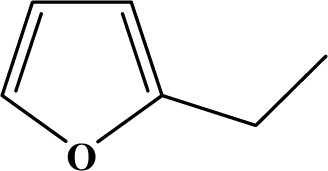
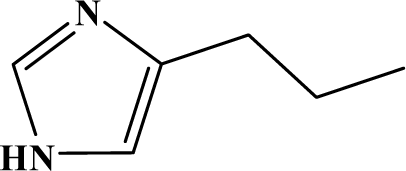
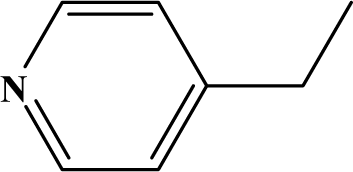
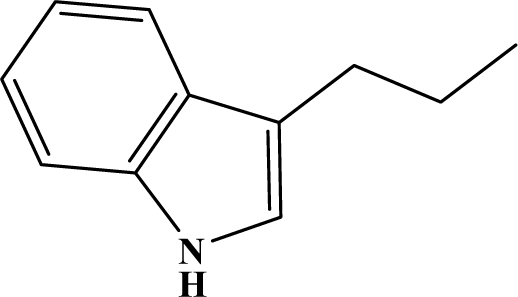
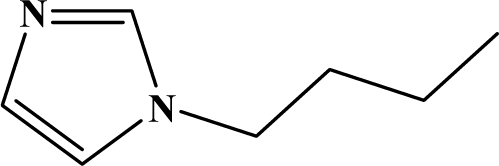
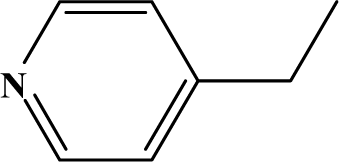
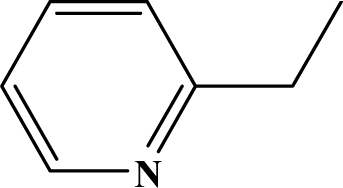
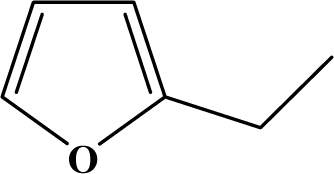
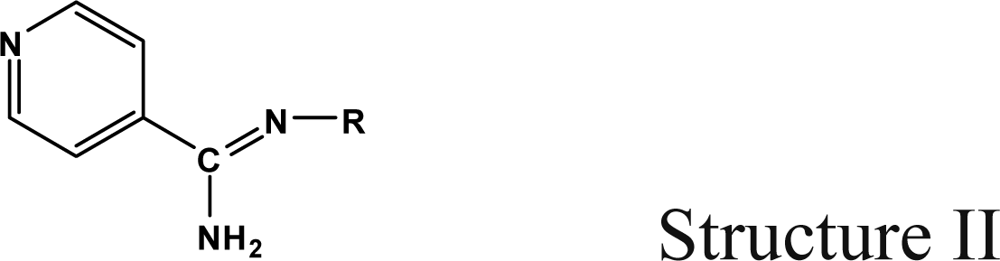
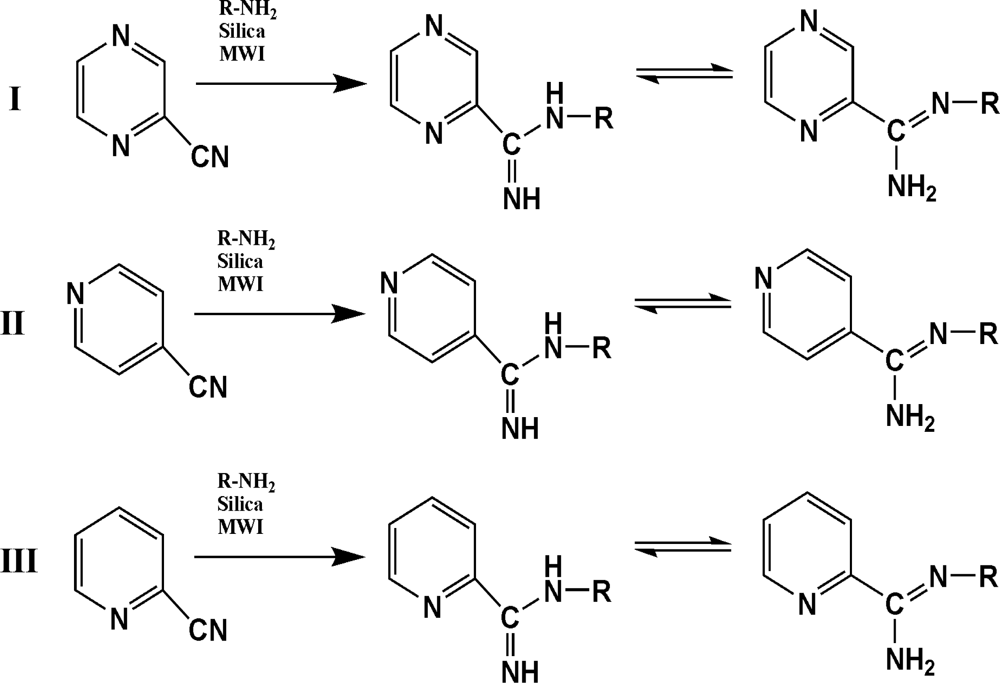
<p>The reaction studied in this work is the free-solvent synthesis described by Sondhi <italic>et al.</italic> [<xref ref-type="bibr" rid="b24-ijms-12-01281">24</xref>] in one of his later works. In this study, several heterocyclic amidine derivatives were synthesized by condensation of 2-cyanopyrazine, 4-cyanopyridine and 2-cyanopyridine with furfurylamine, histamine, 1-(3-aminopropyl) imidazole, 4-picolylamine, 2-picolylamine, and tryptamine respectively, using microwave irradiation. The products obtained showed anti-inflammatory activity and achieved good reaction yields. <xref ref-type="fig" rid="f1-ijms-12-01281">Figure 1</xref> shows reaction schemes while <xref ref-type="table" rid="t1-ijms-12-01281">Table 1</xref> shows the products and their respective properties.</p></sec>
<sec>
<label>2.2.</label>
<title>Molecular Descriptors</title>
<p>Molecular descriptors used in the present work were topological indices (TI) which are described in <xref ref-type="table" rid="t2-ijms-12-01281">Table 2</xref>, along with their definitions and references.</p>
<p>The chemical structure of each compound was drawn with the aid of the Chemdraw Software Package, Version 10. Each compound was characterized by a set of 434 TIs obtained with Dragon Software, Version 5.4 [<xref ref-type="bibr" rid="b30-ijms-12-01281">30</xref>]. They were computed from the adjacency topological matrix obtained from the hydrogen depleted graph.</p></sec>
<sec sec-type="methods">
<label>2.3.</label>
<title>QSAR Algorithms: Multilinear Regression Analysis</title>
<p>The general purpose of multilinear regression analysis (MLRA) is to outline the relation between two or more independent variables and a dependent variable, by fitting a linear equation to observed data.</p>
<p>The regression equations were obtained by correlating the experimental yields values and the percentage of carrageenan edema inhibition of the 16 compounds from the database with the aforementioned TIs. We used the software package Statistica Version 8.0 to develope multilinear regression analysis, MLRA.</p>
<p>Variable selection was carried out by means of the Furnival–Wilson algorithm and variable sets with the minimal Mallows’ Cp were selected as optimal for the regression equations [<xref ref-type="bibr" rid="b31-ijms-12-01281">31</xref>].</p>
<p>Typically, the quality and robustness of the model must be verified by using different types of validation criteria. In this article, as our data set was small, n = 16, we used the internal validation or cross-validation with a leave-one-out procedure (LOO) and a randomization test.</p>
<p>In the LOO algorithm, one case is eliminated from the data set and then the regression analysis, with the N-1 remaining cases and the original descriptors (the ones selected in the first regression), is performed again. The corresponding property value for the removed case is then predicted. This procedure is repeated as many times as there are cases in the data. The value of prediction coefficient, Q<sup>2</sup>, indicates the quality of the prediction function selected.</p>
<p>In the randomization test, the values of the property of each compound are randomly permuted and linearly correlated with the aforementioned descriptors.</p></sec>
<sec>
<label>2.4.</label>
<title>Molecular Screening</title>
<p>Molecular topology is an efficient tool showing some advantages over other more well known approaches, such as molecular mechanics or quantum chemistry. The most remarkable advantage is perhaps the calculation speed. Hundreds of compounds can be analyzed within a few minutes time frame.</p>
<p>For this reason, molecular topology is well suited to evaluate possible biological activities of compounds represented in large databases or virtual libraries.</p>
<p>If the predictive power of the QSAR model obtained is satisfactory, it can be used to record and optimize the property analyzed.</p>
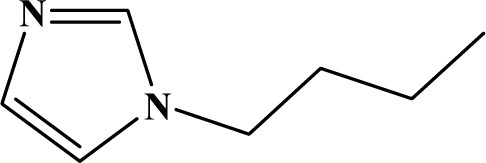
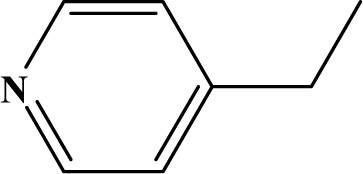
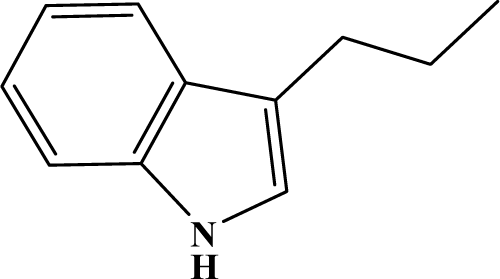
<p>In this paper, we have designed a library of heterocyclic amidine derivatives using the scheme reaction II illustrated in <xref ref-type="fig" rid="f1-ijms-12-01281">Figure 1</xref>, by using different substituents in the R position.</p>
<p>Only the compounds predicted to be active and with a high reaction yield were selected as potential interesting candidates.</p></sec></sec>
<sec sec-type="results|discussion">
<label>3.</label>
<title>Results and Discussion</title>
<p>Searching for equations capable to predict reaction yields (logYield) and anti-inflammatory activity (logAA) of the analyzed amidine derivatives, was the first objective. The best linear equations obtained, and their statistical parameters, were:
<disp-formula id="FD1">
<label>(1)</label>
<mml:math display="block">
<mml:mtable columnalign="left">
<mml:mtr>
<mml:mtd>
<mml:mtext>logYield</mml:mtext>
<mml:mo>=</mml:mo>
<mml:mn>3.927</mml:mn>
<mml:mo>+</mml:mo>
<mml:mn>0.029</mml:mn>
<mml:mtext>Pol</mml:mtext>
<mml:mtext>−</mml:mtext>
<mml:mn>0.316</mml:mn>
<mml:mtext>ATS</mml:mtext>
<mml:mn>8</mml:mn>
<mml:mtext>v</mml:mtext>
<mml:mtext>−</mml:mtext>
<mml:mn>0.534</mml:mn>
<mml:mtext>EEig</mml:mtext>
<mml:mn>01</mml:mn>
<mml:mtext>d</mml:mtext></mml:mtd></mml:mtr>
<mml:mtr>
<mml:mtd>
<mml:mtext>with</mml:mtext>
<mml:mi> </mml:mi>
<mml:mtext>N</mml:mtext>
<mml:mo>=</mml:mo>
<mml:mn>16</mml:mn>
<mml:mo>,</mml:mo>
<mml:mi> </mml:mi>
<mml:mtext>r</mml:mtext>
<mml:mo>=</mml:mo>
<mml:mn>0.884</mml:mn>
<mml:mo>,</mml:mo>
<mml:mi> </mml:mi>
<mml:msup>
<mml:mtext>r</mml:mtext>
<mml:mn>2</mml:mn></mml:msup>
<mml:mo>=</mml:mo>
<mml:mn>0.782</mml:mn>
<mml:mo>,</mml:mo>
<mml:mi> </mml:mi>
<mml:msup>
<mml:mtext>Q</mml:mtext>
<mml:mn>2</mml:mn></mml:msup>
<mml:mo>=</mml:mo>
<mml:mn>0.667</mml:mn>
<mml:mo>,</mml:mo>
<mml:mi> </mml:mi>
<mml:mtext>SEE</mml:mtext>
<mml:mo>=</mml:mo>
<mml:mn>0.0117</mml:mn>
<mml:mo>,</mml:mo>
<mml:mi> </mml:mi>
<mml:mtext>F</mml:mtext>
<mml:mo>=</mml:mo>
<mml:mn>14.3</mml:mn>
<mml:mo>,</mml:mo>
<mml:mi> </mml:mi>
<mml:mtext>p</mml:mtext>
<mml:mo>=</mml:mo>
<mml:mn>0.0002</mml:mn>
<mml:mo>;</mml:mo></mml:mtd></mml:mtr></mml:mtable></mml:math></disp-formula>
<disp-formula id="FD2">
<label>(2)</label>
<mml:math display="block">
<mml:mtable columnalign="left">
<mml:mtr>
<mml:mtd>
<mml:mtext>and</mml:mtext>
<mml:mo>,</mml:mo>
<mml:mi> </mml:mi>
<mml:mtext>logAA</mml:mtext>
<mml:mo>=</mml:mo>
<mml:mn>10.384</mml:mn>
<mml:mtext>−</mml:mtext>
<mml:mn>1.324</mml:mn>
<mml:mtext>EEig</mml:mtext>
<mml:mn>09</mml:mn>
<mml:mtext>x</mml:mtext>
<mml:mtext>−</mml:mtext>
<mml:mn>4.193</mml:mn>
<mml:mtext>EEig</mml:mtext>
<mml:mn>06</mml:mn>
<mml:mtext>r</mml:mtext>
<mml:mo>+</mml:mo>
<mml:mn>2.404</mml:mn>
<mml:mtext>EEig</mml:mtext>
<mml:mn>10</mml:mn>
<mml:mtext>r</mml:mtext></mml:mtd></mml:mtr>
<mml:mtr>
<mml:mtd>
<mml:mtext>with</mml:mtext>
<mml:mi> </mml:mi>
<mml:mtext>N</mml:mtext>
<mml:mo>=</mml:mo>
<mml:mn>16</mml:mn>
<mml:mo>,</mml:mo>
<mml:mi> </mml:mi>
<mml:mtext>r</mml:mtext>
<mml:mo>=</mml:mo>
<mml:mn>0.906</mml:mn>
<mml:mo>,</mml:mo>
<mml:mi> </mml:mi>
<mml:msup>
<mml:mtext>r</mml:mtext>
<mml:mn>2</mml:mn></mml:msup>
<mml:mo>=</mml:mo>
<mml:mn>0.820</mml:mn>
<mml:mo>,</mml:mo>
<mml:mi> </mml:mi>
<mml:msup>
<mml:mtext>Q</mml:mtext>
<mml:mn>2</mml:mn></mml:msup>
<mml:mo>=</mml:mo>
<mml:mn>0.629</mml:mn>
<mml:mo>,</mml:mo>
<mml:mi> </mml:mi>
<mml:mtext>SEE</mml:mtext>
<mml:mo>=</mml:mo>
<mml:mn>0.0671</mml:mn>
<mml:mo>,</mml:mo>
<mml:mi> </mml:mi>
<mml:mtext>F</mml:mtext>
<mml:mo>=</mml:mo>
<mml:mn>18.2</mml:mn>
<mml:mo>,</mml:mo>
<mml:mi> </mml:mi>
<mml:mtext>p</mml:mtext>
<mml:mo>=</mml:mo>
<mml:mn>0.00009.</mml:mn></mml:mtd></mml:mtr></mml:mtable></mml:math></disp-formula></p>
<p>The above values of 0.75 and 0.5 of r<sup>2</sup> and Q<sup>2</sup>, respectively, in addition to the low values of SEE in both cases (less than 12% of the average values of the property) confirm the validity of the models from a predictive standpoint.</p>
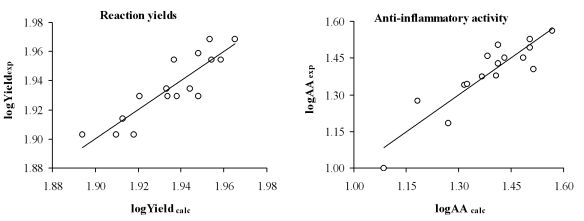
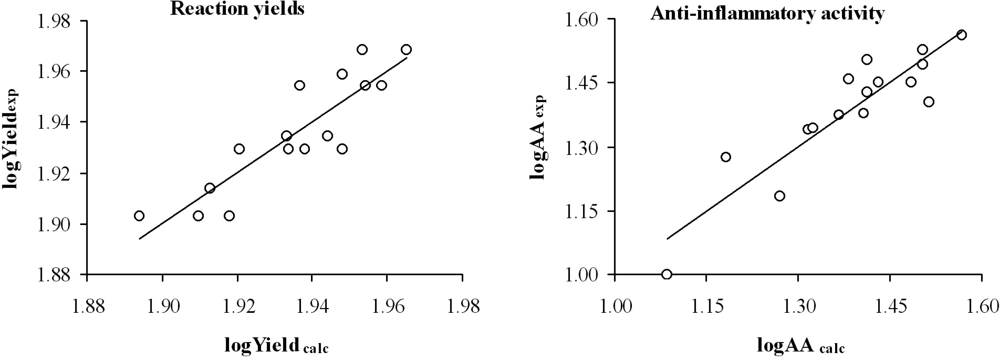
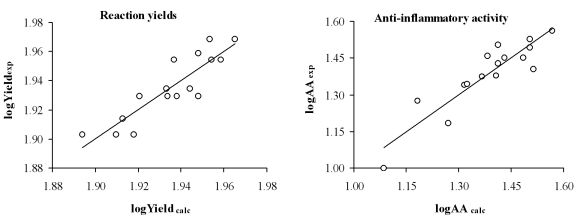
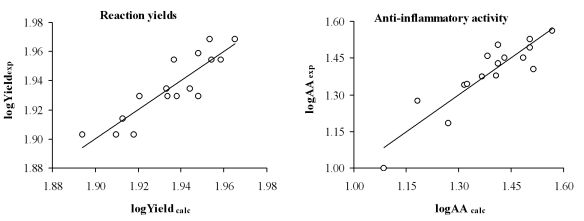
<p><xref ref-type="table" rid="t3-ijms-12-01281">Table 3</xref> and <xref ref-type="fig" rid="f2-ijms-12-01281">Figure 2</xref> show the yield and the anti-inflammatory activity predicted for each compound analyzed.</p>
<p>The EEig indices, topological descriptors derived from the eigenvalue of the adjacency matrix of edges weighed with different properties appear in both equations [<xref ref-type="bibr" rid="b29-ijms-12-01281">29</xref>]. So, EEig01d takes into account the dipole moments of atoms, EEig09x the bond order of the various edges and EEig06r and EEig10r the resonance integral. Other indices present in <xref ref-type="disp-formula" rid="FD1">Equation 1</xref> are Pol, the number of polarity calculated as the number of pairs of vertexes at topological distance equal to 3 [<xref ref-type="bibr" rid="b26-ijms-12-01281">26</xref>,<xref ref-type="bibr" rid="b27-ijms-12-01281">27</xref>] and the Moreau-Broto autocorrelation index, ATS8v, weighed by Van der Waals volumes [<xref ref-type="bibr" rid="b28-ijms-12-01281">28</xref>].</p>
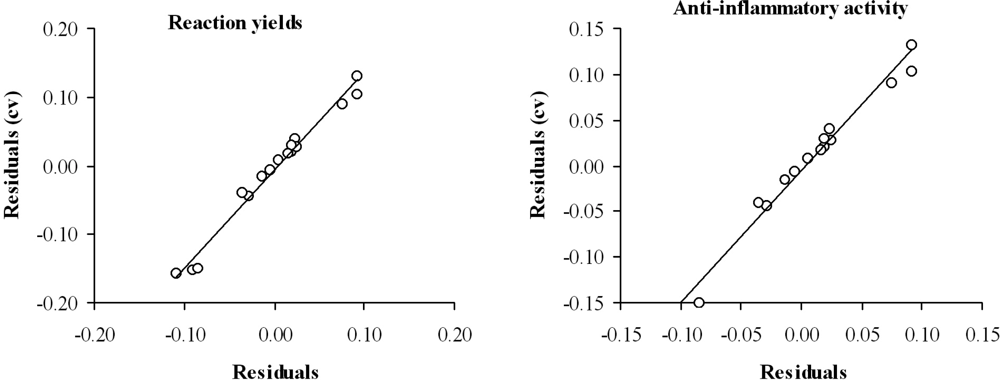
<p>The predictive ability of the selected mathematical topological models was evaluated through cross-validation, using the leave-one-out test. <xref ref-type="table" rid="t3-ijms-12-01281">Table 3</xref> (columns 4 and 7) and <xref ref-type="fig" rid="f3-ijms-12-01281">Figure 3</xref> show the obtained results. The values of Q<sup>2</sup> = 0.667 for reaction yield and Q<sup>2</sup> = 0.629 for anti-inflammatory activity are accepted as satisfactory [<xref ref-type="bibr" rid="b32-ijms-12-01281">32</xref>].</p>
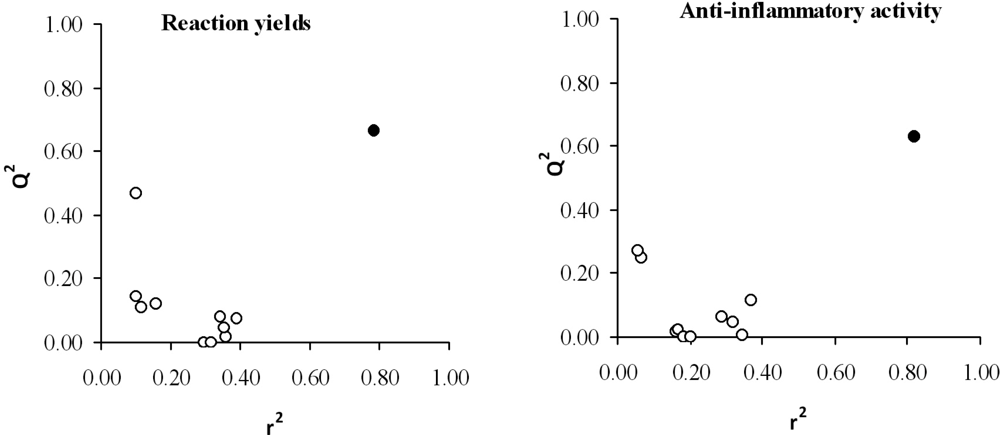
<p>In order to prevent the possible existence of fortuitous regressions, a <italic>randomization test</italic> was carried out. Thus, the values of the property of each compound are randomly permuted and linearly correlated with the aforementioned descriptors. This process is repeated as many times as needed. The usual way to represent the results of a randomization test is plotting the correlation coefficients <italic>versus</italic> the predicted ones, r<sup>2</sup> and Q<sup>2</sup>, respectively. The results of the randomness tests, shown in <xref ref-type="fig" rid="f4-ijms-12-01281">Figure 4</xref>, suggest a high stability of both models (all regressions were rather poor except for the selected equation (black point) with the real values for each compound).</p>
<p>Once predictive equations were established, it was possible to carry out a search for new compounds showing anti-inflammatory activity, that could be reliably obtained from a highly efficient synthetic reaction. Based on the selected topological models, a virtual molecular screening, using the reaction scheme II and different structural fragments, was carried out. The results are exposed in <xref ref-type="table" rid="t4-ijms-12-01281">Table 4</xref>. All proposed compounds, except 7a and 7c, show an expected yield exceeding 80%. With respect to the anti-inflammatory activity, compounds 7d–g exceeds the value of 50% in its pharmacological activity. In conclusion, it can be said that the proposed group of compounds is interesting from the anti-inflammatory activity standpoint.</p>
<p>Of course, these indicative results need to be confirmed by experimental tests. Should the test prove positive, the models proposed would be validated and could serve as a useful tool for the search of novel compounds synthesized under environmental friendly conditions and displaying anti-inflammatory activity.</p></sec>
<sec sec-type="conclusions">
<label>4.</label>
<title>Conclusions</title>
<p>Molecular topology was successfully used to arrange QSPR models for predicting the reaction yield and anti-inflammatory activity, in a group of 16 heterocyclic amidine derivatives, synthesized under environmental friendly conditions, using microwave irradiation. All the molecular descriptors used in this study were topological indices. The mathematical models achieved and described herein retain the main structural features of the correlatable properties, and hence can be applied to the search of new analogous compounds with an improved environmental profile.</p></sec></body>
<back>
<ack>
<p>We thank the Ministerio de Educación e Innovación, Spain (project SAF2009-13059-C03-02), for support of this work.</p></ack>
<ref-list>
<title>References</title>
<ref id="b1-ijms-12-01281"><label>1.</label><citation citation-type="journal"><person-group person-group-type="author"><name><surname>Tanaka</surname><given-names>K</given-names></name><name><surname>Toda</surname><given-names>F</given-names></name></person-group><article-title>Solvent-free organic synthesis</article-title><source>Chem. Rev</source><year>2000</year><volume>100</volume><fpage>1025</fpage><lpage>1074</lpage><pub-id pub-id-type="doi">10.1021/cr940089p</pub-id><pub-id pub-id-type="pmid">11749257</pub-id></citation></ref>
<ref id="b2-ijms-12-01281"><label>2.</label><citation citation-type="journal"><person-group person-group-type="author"><name><surname>Wannberg</surname><given-names>J</given-names></name><name><surname>Larhed</surname><given-names>M</given-names></name></person-group><article-title>Increasing rates and scope of reactions: Sluggish amines in microwave-heated aminocarbonylation reactions under air</article-title><source>J. Org. Chem</source><year>2003</year><volume>68</volume><fpage>5750</fpage><lpage>5753</lpage><pub-id pub-id-type="doi">10.1021/jo034382d</pub-id><pub-id pub-id-type="pmid">12839476</pub-id></citation></ref>
<ref id="b3-ijms-12-01281"><label>3.</label><citation citation-type="journal"><person-group person-group-type="author"><name><surname>De La Hoz</surname><given-names>A</given-names></name><name><surname>Diaz-Ortiz</surname><given-names>A</given-names></name><name><surname>Moreno</surname><given-names>A</given-names></name></person-group><article-title>Selectivity in organic synthesis under microwave irradiation</article-title><source>Curr. Org. Chem</source><year>2004</year><volume>8</volume><fpage>903</fpage><lpage>918</lpage><pub-id pub-id-type="doi">10.2174/1385272043370429</pub-id></citation></ref>
<ref id="b4-ijms-12-01281"><label>4.</label><citation citation-type="journal"><person-group person-group-type="author"><name><surname>Ganzler</surname><given-names>K</given-names></name><name><surname>Salgo</surname><given-names>A</given-names></name><name><surname>Valko</surname><given-names>K</given-names></name></person-group><article-title>Microwave extraction: A novel sample preparation method for chromatography</article-title><source>J. Chromatogr. A</source><year>1986</year><volume>371</volume><fpage>299</fpage><lpage>306</lpage><pub-id pub-id-type="doi">10.1016/S0021-9673(01)94714-4</pub-id></citation></ref>
<ref id="b5-ijms-12-01281"><label>5.</label><citation citation-type="journal"><person-group person-group-type="author"><name><surname>Barakat</surname><given-names>M</given-names></name><name><surname>Mahmoud</surname><given-names>M</given-names></name></person-group><article-title>Recovery of platinum from spent catalyst</article-title><source>Hydrometallurgy</source><year>2004</year><volume>72</volume><fpage>179</fpage><lpage>184</lpage><pub-id pub-id-type="doi">10.1016/S0304-386X(03)00141-5</pub-id></citation></ref>
<ref id="b6-ijms-12-01281"><label>6.</label><citation citation-type="journal"><person-group person-group-type="author"><name><surname>Radoiu</surname><given-names>MT</given-names></name><name><surname>Martin</surname><given-names>DI</given-names></name><name><surname>Calinescu</surname><given-names>I</given-names></name></person-group><article-title>Emission control of SO<sub>2</sub> and NOx by irradiation methods</article-title><source>J. Hazard. Mater</source><year>2003</year><volume>97</volume><fpage>145</fpage><lpage>158</lpage><pub-id pub-id-type="doi">10.1016/S0304-3894(02)00256-X</pub-id><pub-id pub-id-type="pmid">12573835</pub-id></citation></ref>
<ref id="b7-ijms-12-01281"><label>7.</label><citation citation-type="journal"><person-group person-group-type="author"><name><surname>Zhu</surname><given-names>YJ</given-names></name><name><surname>Wang</surname><given-names>WW</given-names></name><name><surname>Qi</surname><given-names>RJ</given-names></name><name><surname>Hu</surname><given-names>XL</given-names></name></person-group><article-title>Microwave-assisted synthesis of single-crystalline tellurium nanorods and nanowires in ionic liquids</article-title><source>Angew. Chem</source><year>2004</year><volume>116</volume><fpage>1434</fpage><lpage>1438</lpage><pub-id pub-id-type="doi">10.1002/ange.200353101</pub-id></citation></ref>
<ref id="b8-ijms-12-01281"><label>8.</label><citation citation-type="journal"><person-group person-group-type="author"><name><surname>LidstroÈm</surname><given-names>P</given-names></name><name><surname>Tierney</surname><given-names>J</given-names></name><name><surname>Wathey</surname><given-names>B</given-names></name><name><surname>Westman</surname><given-names>J</given-names></name></person-group><article-title>Microwave assisted organic synthesis—A review</article-title><source>Tetrahedron</source><year>2001</year><volume>57</volume><fpage>9225</fpage><lpage>9283</lpage><pub-id pub-id-type="doi">10.1016/S0040-4020(01)00906-1</pub-id></citation></ref>
<ref id="b9-ijms-12-01281"><label>9.</label><citation citation-type="journal"><person-group person-group-type="author"><name><surname>De Julian-Ortiz</surname><given-names>JV</given-names></name><name><surname>Galvez</surname><given-names>J</given-names></name><name><surname>Munoz-Collado</surname><given-names>C</given-names></name><name><surname>Garcia-Domenech</surname><given-names>R</given-names></name><name><surname>Gimeno-Cardona</surname><given-names>C</given-names></name></person-group><article-title>Virtual combinatorial syntheses and computational screening of new potential anti-herpes compounds1</article-title><source>J. Med. Chem</source><year>1999</year><volume>42</volume><fpage>3308</fpage><lpage>3314</lpage><pub-id pub-id-type="doi">10.1021/jm981132u</pub-id><pub-id pub-id-type="pmid">10464017</pub-id></citation></ref>
<ref id="b10-ijms-12-01281"><label>10.</label><citation citation-type="journal"><person-group person-group-type="author"><name><surname>Garcia-Domenech</surname><given-names>R</given-names></name><name><surname>Galvez</surname><given-names>J</given-names></name><name><surname>De Julian-Ortiz</surname><given-names>JV</given-names></name><name><surname>Pogliani</surname><given-names>L</given-names></name></person-group><article-title>Some new trends in chemical graph theory</article-title><source>Chem. Rev</source><year>2008</year><volume>108</volume><fpage>1127</fpage><lpage>1169</lpage><pub-id pub-id-type="doi">10.1021/cr0780006</pub-id><pub-id pub-id-type="pmid">18302420</pub-id></citation></ref>
<ref id="b11-ijms-12-01281"><label>11.</label><citation citation-type="journal"><person-group person-group-type="author"><name><surname>Kier</surname><given-names>LB</given-names></name><name><surname>Hall</surname><given-names>LH</given-names></name></person-group><article-title>The nature of structure-activity relationships and their relation to molecular connectivity</article-title><source>Eur. J. Med. Chem</source><year>1977</year><volume>12</volume><fpage>307</fpage><lpage>312</lpage></citation></ref>
<ref id="b12-ijms-12-01281"><label>12.</label><citation citation-type="journal"><person-group person-group-type="author"><name><surname>De Julián-Ortiz</surname><given-names>J</given-names></name><name><surname>De Gregorio Alapont</surname><given-names>C</given-names></name><name><surname>Ríos-Santamarina</surname><given-names>I</given-names></name><name><surname>García-Doménech</surname><given-names>R</given-names></name><name><surname>Gálvez</surname><given-names>J</given-names></name></person-group><article-title>Prediction of properties of chiral compounds by molecular topology</article-title><source>J. Mol. Graph. Model</source><year>1998</year><volume>16</volume><fpage>14</fpage><lpage>18</lpage><pub-id pub-id-type="doi">10.1016/S1093-3263(98)00013-8</pub-id><pub-id pub-id-type="pmid">9783256</pub-id></citation></ref>
<ref id="b13-ijms-12-01281"><label>13.</label><citation citation-type="journal"><person-group person-group-type="author"><name><surname>Golbraikh</surname><given-names>A</given-names></name><name><surname>Bonchev</surname><given-names>D</given-names></name><name><surname>Tropsha</surname><given-names>A</given-names></name></person-group><article-title>Novel ZE-isomerism descriptors derived from molecular topology and their application to QSAR analysis</article-title><source>J. Chem. Inf. Comput. Sci</source><year>2002</year><volume>42</volume><fpage>769</fpage><lpage>787</lpage><pub-id pub-id-type="doi">10.1021/ci0103469</pub-id><pub-id pub-id-type="pmid">12132878</pub-id></citation></ref>
<ref id="b14-ijms-12-01281"><label>14.</label><citation citation-type="journal"><person-group person-group-type="author"><name><surname>Gálvez</surname><given-names>J</given-names></name><name><surname>Gálvez-Llompart</surname><given-names>M</given-names></name><name><surname>García-Domenech</surname><given-names>R</given-names></name></person-group><article-title>Application of molecular topology for the prediction of the reaction times and yields under solvent-free conditions</article-title><source>Green Chem</source><year>2010</year><volume>12</volume><fpage>1056</fpage><lpage>1061</lpage><pub-id pub-id-type="doi">10.1039/b926047a</pub-id></citation></ref>
<ref id="b15-ijms-12-01281"><label>15.</label><citation citation-type="journal"><person-group person-group-type="author"><name><surname>Galvez-Llompart</surname><given-names>M</given-names></name><name><surname>Giner</surname><given-names>M</given-names></name><name><surname>Recio</surname><given-names>C</given-names></name><name><surname>Candeletti</surname><given-names>S</given-names></name><name><surname>Garcia-Domenech</surname><given-names>R</given-names></name></person-group><article-title>Application of molecular topology to the search of novel NSAIDs: Experimental validation of activity</article-title><source>Lett. Drug Des. Discov</source><year>2010</year><volume>7</volume><fpage>438</fpage><lpage>445</lpage><pub-id pub-id-type="doi">10.2174/157018010791306597</pub-id></citation></ref>
<ref id="b16-ijms-12-01281"><label>16.</label><citation citation-type="journal"><person-group person-group-type="author"><name><surname>Sondhi</surname><given-names>SM</given-names></name><name><surname>Rani</surname><given-names>R</given-names></name><name><surname>Gupta</surname><given-names>P</given-names></name><name><surname>Agrawal</surname><given-names>S</given-names></name><name><surname>Saxena</surname><given-names>A</given-names></name></person-group><article-title>Synthesis, anticancer, and anti-inflammatory activity evaluation of methanesulfonamide and amidine derivatives of 3, 4-Diaryl-2-Imino-4-Thiazolines</article-title><source>Mol. Divers</source><year>2009</year><volume>13</volume><fpage>357</fpage><lpage>366</lpage><pub-id pub-id-type="doi">10.1007/s11030-009-9125-0</pub-id><pub-id pub-id-type="pmid">19267213</pub-id></citation></ref>
<ref id="b17-ijms-12-01281"><label>17.</label><citation citation-type="journal"><person-group person-group-type="author"><name><surname>Han</surname><given-names>FS</given-names></name><name><surname>Osajima</surname><given-names>H</given-names></name><name><surname>Cheung</surname><given-names>M</given-names></name><name><surname>Tokuyama</surname><given-names>H</given-names></name><name><surname>Fukuyama</surname><given-names>T</given-names></name></person-group><article-title>Novel structural motifs consisting of chiral thiazolines: Synthesis, molecular recognition, and anticancer activity</article-title><source>Chem. Eur. J</source><year>2007</year><volume>13</volume><fpage>3026</fpage><lpage>3038</lpage><pub-id pub-id-type="doi">10.1002/chem.200601446</pub-id><pub-id pub-id-type="pmid">17285652</pub-id></citation></ref>
<ref id="b18-ijms-12-01281"><label>18.</label><citation citation-type="journal"><person-group person-group-type="author"><name><surname>Li</surname><given-names>W</given-names></name><name><surname>Wang</surname><given-names>Z</given-names></name><name><surname>Gududuru</surname><given-names>V</given-names></name><name><surname>Zbytek</surname><given-names>B</given-names></name><name><surname>Slominski</surname><given-names>AT</given-names></name><name><surname>Dalton</surname><given-names>JT</given-names></name><name><surname>Miller</surname><given-names>DD</given-names></name></person-group><article-title>Structure-activity relationship studies of arylthiazolidine amides as selective cytotoxic agents for melanoma</article-title><source>Anticancer Res</source><year>2007</year><volume>27</volume><fpage>883</fpage><lpage>888</lpage><pub-id pub-id-type="pmid">17465215</pub-id></citation></ref>
<ref id="b19-ijms-12-01281"><label>19.</label><citation citation-type="journal"><person-group person-group-type="author"><name><surname>Turan-Zitouni</surname><given-names>G</given-names></name><name><surname>Sivaci</surname><given-names>D</given-names></name><name><surname>Kaplancikli</surname><given-names>Z</given-names></name><name><surname>Özdemir</surname><given-names>A</given-names></name></person-group><article-title>Synthesis and antimicrobial activity of some pyridinyliminothiazoline derivatives</article-title><source>Il Farmaco</source><year>2002</year><volume>57</volume><fpage>569</fpage><lpage>572</lpage><pub-id pub-id-type="doi">10.1016/S0014-827X(02)01250-8</pub-id><pub-id pub-id-type="pmid">12164216</pub-id></citation></ref>
<ref id="b20-ijms-12-01281"><label>20.</label><citation citation-type="journal"><person-group person-group-type="author"><name><surname>Ashok</surname><given-names>M</given-names></name><name><surname>Holla</surname><given-names>BS</given-names></name><name><surname>Kumari</surname><given-names>NS</given-names></name></person-group><article-title>Convenient one pot synthesis of some novel derivatives of Thiazolo [2, 3-b] dihydropyrimidinone possessing 4-Methylthiophenyl moiety and evaluation of their antibacterial and antifungal activities</article-title><source>Eur. J. Med. Chem</source><year>2007</year><volume>42</volume><fpage>380</fpage><lpage>385</lpage><pub-id pub-id-type="doi">10.1016/j.ejmech.2006.09.003</pub-id><pub-id pub-id-type="pmid">17070617</pub-id></citation></ref>
<ref id="b21-ijms-12-01281"><label>21.</label><citation citation-type="journal"><person-group person-group-type="author"><name><surname>Bedi</surname><given-names>P</given-names></name><name><surname>Mahajan</surname><given-names>MP</given-names></name><name><surname>Kapoor</surname><given-names>VK</given-names></name></person-group><article-title>Amidine derived 1, 3-Diazabuta-1, 3-Dienes as potential antibacterial and antifungal agents</article-title><source>Bioorg. Med. Chem. Lett</source><year>2004</year><volume>14</volume><fpage>3821</fpage><lpage>3824</lpage><pub-id pub-id-type="doi">10.1016/j.bmcl.2004.04.104</pub-id><pub-id pub-id-type="pmid">15203169</pub-id></citation></ref>
<ref id="b22-ijms-12-01281"><label>22.</label><citation citation-type="journal"><person-group person-group-type="author"><name><surname>Sondhi</surname><given-names>SM</given-names></name><name><surname>Dinodia</surname><given-names>M</given-names></name><name><surname>Kumar</surname><given-names>A</given-names></name></person-group><article-title>Synthesis, anti-inflammatory and analgesic activity evaluation of some amidine and hydrazone derivatives</article-title><source>Bioorg. Med. Chem</source><year>2006</year><volume>14</volume><fpage>4657</fpage><lpage>4663</lpage><pub-id pub-id-type="doi">10.1016/j.bmc.2006.02.014</pub-id><pub-id pub-id-type="pmid">16504522</pub-id></citation></ref>
<ref id="b23-ijms-12-01281"><label>23.</label><citation citation-type="journal"><person-group person-group-type="author"><name><surname>Khanna</surname><given-names>IK</given-names></name><name><surname>Yu</surname><given-names>Y</given-names></name><name><surname>Huff</surname><given-names>RM</given-names></name><name><surname>Weier</surname><given-names>RM</given-names></name><name><surname>Xu</surname><given-names>X</given-names></name><name><surname>Koszyk</surname><given-names>FJ</given-names></name><name><surname>Collins</surname><given-names>PW</given-names></name><name><surname>Cogburn</surname><given-names>JN</given-names></name><name><surname>Isakson</surname><given-names>PC</given-names></name><name><surname>Koboldt</surname><given-names>CM</given-names></name></person-group><article-title>Selective Cyclooxygenase-2 inhibitors: Heteroaryl modified 1, 2-Diarylimidazoles are potent, orally active anti-inflammatory agents</article-title><source>J. Med. Chem</source><year>2000</year><volume>43</volume><fpage>3168</fpage><lpage>3185</lpage><pub-id pub-id-type="doi">10.1021/jm0000719</pub-id><pub-id pub-id-type="pmid">10956225</pub-id></citation></ref>
<ref id="b24-ijms-12-01281"><label>24.</label><citation citation-type="journal"><person-group person-group-type="author"><name><surname>Sondhi</surname><given-names>SM</given-names></name><name><surname>Rani</surname><given-names>R</given-names></name><name><surname>Roy</surname><given-names>P</given-names></name><name><surname>Agrawal</surname><given-names>S</given-names></name><name><surname>Saxena</surname><given-names>A</given-names></name></person-group><article-title>Conventional and microwave assisted synthesis of small molecule based biologically active heterocyclic amidine derivatives</article-title><source>Eur. J. Med. Chem</source><year>2010</year><volume>45</volume><fpage>902</fpage><lpage>908</lpage><pub-id pub-id-type="doi">10.1016/j.ejmech.2009.11.030</pub-id><pub-id pub-id-type="pmid">19959259</pub-id></citation></ref>
<ref id="b25-ijms-12-01281"><label>25.</label><citation citation-type="journal"><person-group person-group-type="author"><name><surname>Winter</surname><given-names>CA</given-names></name><name><surname>Risley</surname><given-names>EA</given-names></name><name><surname>Nuss</surname><given-names>GW</given-names></name></person-group><article-title>Carrageenin-induced edema in hind paw of the rat as an assay for anti-inflammatory drugs</article-title><source>Proc. Soc. Exp. Biol. Med</source><year>1962</year><volume>111</volume><fpage>544</fpage><lpage>547</lpage><pub-id pub-id-type="pmid">14001233</pub-id></citation></ref>
<ref id="b26-ijms-12-01281"><label>26.</label><citation citation-type="journal"><person-group person-group-type="author"><name><surname>Wiener</surname><given-names>H</given-names></name></person-group><article-title>Structural determination of paraffin boiling points</article-title><source>J. Am. Chem. Soc</source><year>1947</year><volume>69</volume><fpage>17</fpage><lpage>20</lpage><pub-id pub-id-type="doi">10.1021/ja01193a005</pub-id><pub-id pub-id-type="pmid">20291038</pub-id></citation></ref>
<ref id="b27-ijms-12-01281"><label>27.</label><citation citation-type="journal"><person-group person-group-type="author"><name><surname>Wiener</surname><given-names>H</given-names></name></person-group><article-title>Correlation of heats of isomerization, and differences in heats of vaporization of isomers, among the paraffin hydrocarbons</article-title><source>J. Am. Chem. Soc</source><year>1947</year><volume>69</volume><fpage>2636</fpage><lpage>2638</lpage><pub-id pub-id-type="doi">10.1021/ja01203a022</pub-id></citation></ref>
<ref id="b28-ijms-12-01281"><label>28.</label><citation citation-type="journal"><person-group person-group-type="author"><name><surname>Moreau</surname><given-names>G</given-names></name><name><surname>Broto</surname><given-names>P</given-names></name></person-group><article-title>Autocorrelation of molecular structures. Application to sar studies</article-title><source>Nouv. J. Chim</source><year>1980</year><volume>4</volume><fpage>757</fpage><lpage>764</lpage></citation></ref>
<ref id="b29-ijms-12-01281"><label>29.</label><citation citation-type="journal"><person-group person-group-type="author"><name><surname>Bonchev</surname><given-names>D</given-names></name><name><surname>Mekenyan</surname><given-names>O</given-names></name></person-group><article-title>A topological approach to the calculation of the Pi-electron energy and energy gap of infinite conjugated polymers</article-title><source>Z. Naturforsch. A</source><year>1980</year><volume>35A</volume><fpage>739</fpage><lpage>747</lpage></citation></ref>
<ref id="b30-ijms-12-01281"><label>30.</label><citation citation-type="book"><source>DRAGON for Windows (Software for Molecular Descriptor Calculations)</source><comment>Version 5.4</comment><publisher-name>TALETE SRL</publisher-name><publisher-loc>Milano, Italy</publisher-loc><year>2006</year></citation></ref>
<ref id="b31-ijms-12-01281"><label>31.</label><citation citation-type="journal"><person-group person-group-type="author"><name><surname>Hocking</surname><given-names>R</given-names></name></person-group><article-title>Criteria for selection of a subset regression: Which one should be used?</article-title><source>Technometrics</source><year>1972</year><volume>14</volume><fpage>967</fpage><lpage>970</lpage><pub-id pub-id-type="doi">10.1080/00401706.1972.10488992</pub-id></citation></ref>
<ref id="b32-ijms-12-01281"><label>32.</label><citation citation-type="journal"><person-group person-group-type="author"><name><surname>Besalu</surname><given-names>E</given-names></name></person-group><article-title>Fast computation of cross-validated properties in full linear leave-many-out procedures</article-title><source>J. Math. Chem</source><year>2001</year><volume>29</volume><fpage>191</fpage><lpage>204</lpage><pub-id pub-id-type="doi">10.1023/A:1010924406885</pub-id></citation></ref></ref-list>
<sec sec-type="display-objects">
<title>Figures and Tables</title>
<fig id="f1-ijms-12-01281" position="float">
<label>Figure 1.</label>
<caption>
<p>Synthesis of amidine derivatives.</p></caption>
<graphic xlink:href="ijms-12-01281f1.gif"/></fig>
<fig id="f2-ijms-12-01281" position="float">
<label>Figure 2.</label>
<caption>
<p>Graphic representation of logYield<sub>exp</sub> <italic>versus</italic> logYield<sub>calc</sub> and logAA<sub>exp</sub> <italic>versus</italic> logAA<sub>calc</sub> from the topological models selected.</p></caption>
<graphic xlink:href="ijms-12-01281f2.gif"/></fig>
<fig id="f3-ijms-12-01281" position="float">
<label>Figure 3.</label>
<caption>
<p>Graphic representation of cross-validated residuals <italic>versus</italic> residual for the topological models selected.</p></caption>
<graphic xlink:href="ijms-12-01281f3.gif"/></fig>
<fig id="f4-ijms-12-01281" position="float">
<label>Figure 4.</label>
<caption>
<p>Graphic representation of the prediction coefficient, Q<sup>2</sup>, <italic>versus</italic> correlation coefficient, r<sup>2</sup>, obtained by randomization study with yield (left panel) and anti-inflammatory activity (right panel) shown. Black point: selected model.</p></caption>
<graphic xlink:href="ijms-12-01281f4.gif"/></fig>
<table-wrap id="t1-ijms-12-01281" position="float">
<label>Table 1</label>
<caption>
<p>Reaction yields and anti-inflammatory activity of amidine derivatives synthesized by microwave assisted methods.</p>
<p>
<graphic xlink:href="ijms-12-01281f5.gif"/></p></caption>
<table frame="hsides" rules="groups">
<thead>
<tr>
<th align="center" valign="top"><bold>Synthesis</bold></th>
<th align="center" valign="top"><bold>Comp.</bold></th>
<th align="center" valign="top"><bold>R</bold></th>
<th align="center" valign="top"><bold>(%) Yield</bold></th>
<th align="center" valign="top"><bold>(%)AA<xref ref-type="table-fn" rid="tfn1-ijms-12-01281">*</xref></bold></th></tr></thead>
<tbody>
<tr>
<td align="center" valign="top">I</td>
<td align="center" valign="top">3a</td>
<td align="left" valign="top">
<inline-graphic xlink:href="ijms-12-01281i1.gif"/></td>
<td align="center" valign="top">93</td>
<td align="center" valign="top">36.6</td></tr>
<tr>
<td align="center" valign="top">I</td>
<td align="center" valign="top">3b</td>
<td align="left" valign="top">
<inline-graphic xlink:href="ijms-12-01281i2.gif"/></td>
<td align="center" valign="top">91</td>
<td align="center" valign="top">25.4</td></tr>
<tr>
<td align="center" valign="top">I</td>
<td align="center" valign="top">3c</td>
<td align="left" valign="top">
<inline-graphic xlink:href="ijms-12-01281i3.gif"/></td>
<td align="center" valign="top">80</td>
<td align="center" valign="top">21.8</td></tr>
<tr>
<td align="center" valign="top">I</td>
<td align="center" valign="top">3d</td>
<td align="left" valign="top">
<inline-graphic xlink:href="ijms-12-01281i4.gif"/></td>
<td align="center" valign="top">90</td>
<td align="center" valign="top">32.0</td></tr>
<tr>
<td align="center" valign="top">I</td>
<td align="center" valign="top">3f</td>
<td align="left" valign="top">
<inline-graphic xlink:href="ijms-12-01281i5.gif"/></td>
<td align="center" valign="top">85</td>
<td align="center" valign="top">23.9</td></tr>
<tr>
<td align="center" valign="top">II</td>
<td align="center" valign="top">4a</td>
<td align="left" valign="top">
<inline-graphic xlink:href="ijms-12-01281i6.gif"/></td>
<td align="center" valign="top">90</td>
<td align="center" valign="top">15.2</td></tr>
<tr>
<td align="center" valign="top">II</td>
<td align="center" valign="top">4b</td>
<td align="left" valign="top">
<inline-graphic xlink:href="ijms-12-01281i7.gif"/></td>
<td align="center" valign="top">82</td>
<td align="center" valign="top">22.1</td></tr>
<tr>
<td align="center" valign="top">II</td>
<td align="center" valign="top">4c</td>
<td align="left" valign="top">
<inline-graphic xlink:href="ijms-12-01281i8.gif"/></td>
<td align="center" valign="top">80</td>
<td align="center" valign="top">10</td></tr>
<tr>
<td align="center" valign="top">II</td>
<td align="center" valign="top">4d</td>
<td align="left" valign="top">
<inline-graphic xlink:href="ijms-12-01281i9.gif"/></td>
<td align="center" valign="top">85</td>
<td align="center" valign="top">31.0</td></tr>
<tr>
<td align="center" valign="top">II</td>
<td align="center" valign="top">4e</td>
<td align="left" valign="top">
<inline-graphic xlink:href="ijms-12-01281i10.gif"/></td>
<td align="center" valign="top">93</td>
<td align="center" valign="top">33.8</td></tr>
<tr>
<td align="center" valign="top">II</td>
<td align="center" valign="top">4f</td>
<td align="left" valign="top">
<inline-graphic xlink:href="ijms-12-01281i11.gif"/></td>
<td align="center" valign="top">80</td>
<td align="center" valign="top">28.2</td></tr>
<tr>
<td align="center" valign="top">III</td>
<td align="center" valign="top">5a</td>
<td align="left" valign="top">
<inline-graphic xlink:href="ijms-12-01281i12.gif"/></td>
<td align="center" valign="top">85</td>
<td align="center" valign="top">28.7</td></tr>
<tr>
<td align="center" valign="top">III</td>
<td align="center" valign="top">5b</td>
<td align="left" valign="top">
<inline-graphic xlink:href="ijms-12-01281i13.gif"/></td>
<td align="center" valign="top">86</td>
<td align="center" valign="top">26.8</td></tr>
<tr>
<td align="center" valign="top">III</td>
<td align="center" valign="top">5c</td>
<td align="left" valign="top">
<inline-graphic xlink:href="ijms-12-01281i14.gif"/></td>
<td align="center" valign="top">86</td>
<td align="center" valign="top">18.8</td></tr>
<tr>
<td align="center" valign="top">III</td>
<td align="center" valign="top">5d</td>
<td align="left" valign="top">
<inline-graphic xlink:href="ijms-12-01281i15.gif"/></td>
<td align="center" valign="top">90</td>
<td align="center" valign="top">28.2</td></tr>
<tr>
<td align="center" valign="top">III</td>
<td align="center" valign="top">5f</td>
<td align="left" valign="top">
<inline-graphic xlink:href="ijms-12-01281i16.gif"/></td>
<td align="center" valign="top">85</td>
<td align="center" valign="top">23.6</td></tr></tbody></table>
<table-wrap-foot><fn id="tfn1-ijms-12-01281">
<label>*</label>
<p>Anti-inflammatory activity at a dose of 50 mg/Kg <italic>p.o</italic>. [<xref ref-type="bibr" rid="b24-ijms-12-01281">24</xref>]. (Ibuprofen, reference drug with AA=39.0%).</p></fn></table-wrap-foot></table-wrap>
<table-wrap id="t2-ijms-12-01281" position="float">
<label>Table 2.</label>
<caption>
<p>Descriptors used in this study.</p></caption>
<table frame="box" rules="all">
<thead>
<tr>
<th align="center" valign="middle"><bold>Symbol</bold></th>
<th align="center" valign="middle"><bold>Name</bold></th>
<th align="center" valign="middle"><bold>Definition</bold></th>
<th align="center" valign="middle"><bold>Refs.</bold></th></tr></thead>
<tbody>
<tr>
<td align="center" valign="middle">Pol</td>
<td align="center" valign="middle">Polarity number</td>
<td align="center" valign="middle">Number of pairs of vertexes at topological distance equal to 3</td>
<td align="center" valign="middle">[<xref ref-type="bibr" rid="b26-ijms-12-01281">26</xref>,<xref ref-type="bibr" rid="b27-ijms-12-01281">27</xref>]</td></tr>
<tr>
<td align="center" valign="middle">ATSkv<break/>k = 1–8</td>
<td align="center" valign="middle">Moreau-Broto autocorrelation index of order k weighed by Van der Waals volumes</td>
<td align="center" valign="middle">
<inline-formula>
<mml:math>
<mml:msub>
<mml:mtext>ATS</mml:mtext>
<mml:mrow>
<mml:mtext>kv</mml:mtext></mml:mrow></mml:msub>
<mml:mo>=</mml:mo>
<mml:mfrac>
<mml:mn>1</mml:mn>
<mml:mn>2</mml:mn></mml:mfrac>
<mml:munderover>
<mml:mo>∑</mml:mo>
<mml:mrow>
<mml:mtext>i</mml:mtext>
<mml:mo>=</mml:mo>
<mml:mn>1</mml:mn></mml:mrow>
<mml:mtext>A</mml:mtext></mml:munderover>
<mml:mrow>
<mml:munderover>
<mml:mo>∑</mml:mo>
<mml:mrow>
<mml:mtext>j</mml:mtext>
<mml:mo>=</mml:mo>
<mml:mn>1</mml:mn></mml:mrow>
<mml:mtext>A</mml:mtext></mml:munderover>
<mml:mrow>
<mml:mrow>
<mml:mo>(</mml:mo>
<mml:mrow>
<mml:msub>
<mml:mtext>v</mml:mtext>
<mml:mtext>i</mml:mtext></mml:msub>
<mml:mi> </mml:mi>
<mml:msub>
<mml:mtext>v</mml:mtext>
<mml:mtext>j</mml:mtext></mml:msub>
<mml:mo>δ</mml:mo>
<mml:mo>(</mml:mo>
<mml:msub>
<mml:mtext>d</mml:mtext>
<mml:mrow>
<mml:mtext>ij</mml:mtext></mml:mrow></mml:msub>
<mml:mi> </mml:mi>
<mml:mo>;</mml:mo>
<mml:mi> </mml:mi>
<mml:mtext>k</mml:mtext>
<mml:mo>)</mml:mo></mml:mrow>
<mml:mo>)</mml:mo>
<mml:mi> </mml:mi></mml:mrow></mml:mrow></mml:mrow></mml:math></inline-formula><break/>v, Van der Waals volume<break/>□, Kronecker delta<break/>d<sub>ij</sub>, topological distance between i-atom and k-atom<break/>k, index order</td>
<td align="center" valign="middle">[<xref ref-type="bibr" rid="b28-ijms-12-01281">28</xref>]</td></tr>
<tr>
<td align="center" valign="middle">EEigkd<break/>k = 1–15</td>
<td align="center" valign="middle">K-st eigenvalue from weighted edge adjacency matrix</td>
<td align="center" valign="middle">K-st eigenvalue from edge adjacency matrix weighted by dipole moments of atoms</td>
<td align="center" valign="middle">[<xref ref-type="bibr" rid="b29-ijms-12-01281">29</xref>]</td></tr>
<tr>
<td align="center" valign="middle">EEigkr<break/>k = 1–15</td>
<td align="center" valign="middle">K-st eigenvalue from weighted edge adjacency matrix</td>
<td align="center" valign="middle">K-st eigenvalue from edge adjacency matrix weighted by the resonance integral</td>
<td align="center" valign="middle">[<xref ref-type="bibr" rid="b29-ijms-12-01281">29</xref>]</td></tr></tbody></table></table-wrap>
<table-wrap id="t3-ijms-12-01281" position="float">
<label>Table 3.</label>
<caption>
<p>Experimental and predicted values obtained for each compound analyzed through multilinear regression analysis.</p></caption>
<table frame="hsides" rules="groups">
<thead>
<tr>
<th align="center" valign="middle"><bold>Comp.</bold></th>
<th align="center" valign="middle"><bold>Yield<sub>exp</sub><xref ref-type="table-fn" rid="tfn2-ijms-12-01281">a</xref> (%)</bold></th>
<th align="center" valign="middle"><bold>Yield<sub>calc</sub><xref ref-type="table-fn" rid="tfn3-ijms-12-01281">b</xref> (%)</bold></th>
<th align="center" valign="middle"><bold>Yield<sub>calc</sub> (cv)<xref ref-type="table-fn" rid="tfn4-ijms-12-01281">c</xref> (%)</bold></th>
<th align="center" valign="middle"><bold>AA<sub>exp</sub><xref ref-type="table-fn" rid="tfn2-ijms-12-01281">a</xref> (%)</bold></th>
<th align="center" valign="middle"><bold>AA<sub>calc</sub><xref ref-type="table-fn" rid="tfn5-ijms-12-01281">d</xref> (%)</bold></th>
<th align="center" valign="middle"><bold>AA<sub>calc</sub> (cv)<xref ref-type="table-fn" rid="tfn6-ijms-12-01281">e</xref> (%)</bold></th></tr></thead>
<tbody>
<tr>
<td align="center" valign="middle">3a</td>
<td align="center" valign="middle">93</td>
<td align="center" valign="middle">92</td>
<td align="center" valign="middle">36.6</td>
<td align="center" valign="middle">37.1</td>
<td align="center" valign="middle">37.2</td></tr>
<tr>
<td align="center" valign="middle">3b</td>
<td align="center" valign="middle">91</td>
<td align="center" valign="middle">89</td>
<td align="center" valign="middle">88</td>
<td align="center" valign="middle">25.4</td>
<td align="center" valign="middle">32.6</td>
<td align="center" valign="middle">36.4</td></tr>
<tr>
<td align="center" valign="middle">3c</td>
<td align="center" valign="middle">80</td>
<td align="center" valign="middle">83</td>
<td align="center" valign="middle">21.8</td>
<td align="center" valign="middle">20.7</td>
<td align="center" valign="middle">19.9</td></tr>
<tr>
<td align="center" valign="middle">3d</td>
<td align="center" valign="middle">90</td>
<td align="center" valign="middle">91</td>
<td align="center" valign="middle">32.0</td>
<td align="center" valign="middle">25.9</td>
<td align="center" valign="middle">25.2</td></tr>
<tr>
<td align="center" valign="middle">3f</td>
<td align="center" valign="middle">85</td>
<td align="center" valign="middle">86</td>
<td align="center" valign="middle">2.9</td>
<td align="center" valign="middle">25.6</td>
<td align="center" valign="middle">26.4</td></tr>
<tr>
<td align="center" valign="middle">4a</td>
<td align="center" valign="middle">90</td>
<td align="center" valign="middle">15.2</td>
<td align="center" valign="middle">18.7</td>
<td align="center" valign="middle">21.6</td></tr>
<tr>
<td align="center" valign="middle">4b</td>
<td align="center" valign="middle">82</td>
<td align="center" valign="middle">22.1</td>
<td align="center" valign="middle">21.1</td>
<td align="center" valign="middle">21.0</td></tr>
<tr>
<td align="center" valign="middle">4c</td>
<td align="center" valign="middle">80</td>
<td align="center" valign="middle">78</td>
<td align="center" valign="middle">10.0</td>
<td align="center" valign="middle">12.2</td>
<td align="center" valign="middle">14.1</td></tr>
<tr>
<td align="center" valign="middle">4d</td>
<td align="center" valign="middle">85</td>
<td align="center" valign="middle">89</td>
<td align="center" valign="middle">31.0</td>
<td align="center" valign="middle">32.0</td>
<td align="center" valign="middle">32.1</td></tr>
<tr>
<td align="center" valign="middle">4e</td>
<td align="center" valign="middle">93</td>
<td align="center" valign="middle">90</td>
<td align="center" valign="middle">89</td>
<td align="center" valign="middle">33.8</td>
<td align="center" valign="middle">32.0</td>
<td align="center" valign="middle">31.7</td></tr>
<tr>
<td align="center" valign="middle">4f</td>
<td align="center" valign="middle">80</td>
<td align="center" valign="middle">81</td>
<td align="center" valign="middle">82</td>
<td align="center" valign="middle">28.2</td>
<td align="center" valign="middle">27.0</td>
<td align="center" valign="middle">26.4</td></tr>
<tr>
<td align="center" valign="middle">5a</td>
<td align="center" valign="middle">85</td>
<td align="center" valign="middle">87</td>
<td align="center" valign="middle">28.7</td>
<td align="center" valign="middle">24.1</td>
<td align="center" valign="middle">23.3</td></tr>
<tr>
<td align="center" valign="middle">5b</td>
<td align="center" valign="middle">86</td>
<td align="center" valign="middle">88</td>
<td align="center" valign="middle">89</td>
<td align="center" valign="middle">26.8</td>
<td align="center" valign="middle">25.8</td>
<td align="center" valign="middle">25.8</td></tr>
<tr>
<td align="center" valign="middle">5c</td>
<td align="center" valign="middle">86</td>
<td align="center" valign="middle">18.8</td>
<td align="center" valign="middle">15.2</td>
<td align="center" valign="middle">13.9</td></tr>
<tr>
<td align="center" valign="middle">5d</td>
<td align="center" valign="middle">90</td>
<td align="center" valign="middle">86</td>
<td align="center" valign="middle">28.2</td>
<td align="center" valign="middle">30.6</td>
<td align="center" valign="middle">30.9</td></tr>
<tr>
<td align="center" valign="middle">5f</td>
<td align="center" valign="middle">85</td>
<td align="center" valign="middle">83</td>
<td align="center" valign="middle">23.6</td>
<td align="center" valign="middle">23.3</td>
<td align="center" valign="middle">23.2</td></tr></tbody></table>
<table-wrap-foot><fn id="tfn2-ijms-12-01281">
<label>a</label>
<p>From reference [<xref ref-type="bibr" rid="b24-ijms-12-01281">24</xref>];</p></fn><fn id="tfn3-ijms-12-01281">
<label>b</label>
<p>Calculated from <xref ref-type="disp-formula" rid="FD1">Equation (1)</xref>;</p></fn><fn id="tfn4-ijms-12-01281">
<label>c</label>
<p>From cross-validation with <xref ref-type="disp-formula" rid="FD1">Equation (1)</xref>;</p></fn><fn id="tfn5-ijms-12-01281">
<label>d</label>
<p>Calculated from <xref ref-type="disp-formula" rid="FD2">Equation (2)</xref>;</p></fn><fn id="tfn6-ijms-12-01281">
<label>e</label>
<p>From cross-validation with <xref ref-type="disp-formula" rid="FD2">Equation (2)</xref>.</p></fn></table-wrap-foot></table-wrap>
<table-wrap id="t4-ijms-12-01281" position="float">
<label>Table 4.</label>
<caption>
<p>Computational screening applied to heterocyclic amidine derivatives and selection of theoretically anti-inflammatory compounds with high reaction yield.</p>
<p>
<graphic xlink:href="ijms-12-01281f6.gif"/></p></caption>
<table frame="hsides" rules="groups">
<thead>
<tr>
<th align="center" valign="middle"><bold>Sinthesis</bold></th>
<th align="center" valign="middle"><bold>Comp.</bold></th>
<th align="center" valign="middle"><bold>R</bold></th>
<th align="center" valign="middle"><bold>Yield<sub>calc</sub><xref ref-type="table-fn" rid="tfn7-ijms-12-01281">a</xref> (%)</bold></th>
<th align="center" valign="middle"><bold>AA<sub>calc</sub><xref ref-type="table-fn" rid="tfn8-ijms-12-01281">b</xref> (%)</bold></th></tr></thead>
<tbody>
<tr>
<td align="center" valign="middle">II</td>
<td align="center" valign="middle">6a</td>
<td align="left" valign="middle">
<inline-graphic xlink:href="ijms-12-01281i17.gif"/></td>
<td align="center" valign="middle">89.3</td>
<td align="center" valign="middle">31.1</td></tr>
<tr>
<td align="center" valign="middle">II</td>
<td align="center" valign="middle">6b</td>
<td align="left" valign="middle">
<inline-graphic xlink:href="ijms-12-01281i18.gif"/></td>
<td align="center" valign="middle">95.9</td>
<td align="center" valign="middle">31.4</td></tr>
<tr>
<td align="center" valign="middle">II</td>
<td align="center" valign="middle">6c</td>
<td align="left" valign="middle">
<inline-graphic xlink:href="ijms-12-01281i19.gif"/></td>
<td align="center" valign="middle">97.8</td>
<td align="center" valign="middle">31.4</td></tr>
<tr>
<td align="center" valign="middle">II</td>
<td align="center" valign="middle">6d</td>
<td align="left" valign="middle">
<inline-graphic xlink:href="ijms-12-01281i20.gif"/></td>
<td align="center" valign="middle">98.2</td>
<td align="center" valign="middle">31.6</td></tr>
<tr>
<td align="center" valign="middle">II</td>
<td align="center" valign="middle">7a</td>
<td align="left" valign="middle">
<inline-graphic xlink:href="ijms-12-01281i21.gif"/></td>
<td align="center" valign="middle">80.3</td>
<td align="center" valign="middle">29.8</td></tr>
<tr>
<td align="center" valign="middle">II</td>
<td align="center" valign="middle">7b</td>
<td align="left" valign="middle">
<inline-graphic xlink:href="ijms-12-01281i22.gif"/></td>
<td align="center" valign="middle">89.5</td>
<td align="center" valign="middle">27.2</td></tr>
<tr>
<td align="center" valign="middle">II</td>
<td align="center" valign="middle">7c</td>
<td align="left" valign="middle">
<inline-graphic xlink:href="ijms-12-01281i23.gif"/></td>
<td align="center" valign="middle">72.7</td>
<td align="center" valign="middle">42.2</td></tr>
<tr>
<td align="center" valign="middle">II</td>
<td align="center" valign="middle">7d</td>
<td align="left" valign="middle">
<inline-graphic xlink:href="ijms-12-01281i24.gif"/></td>
<td align="center" valign="middle">93.8</td>
<td align="center" valign="middle">65.3</td></tr>
<tr>
<td align="center" valign="middle">II</td>
<td align="center" valign="middle">7e</td>
<td align="left" valign="middle">
<inline-graphic xlink:href="ijms-12-01281i25.gif"/></td>
<td align="center" valign="middle">94.9</td>
<td align="center" valign="middle">69.9</td></tr>
<tr>
<td align="center" valign="middle">II</td>
<td align="center" valign="middle">7f</td>
<td align="left" valign="middle">
<inline-graphic xlink:href="ijms-12-01281i26.gif"/></td>
<td align="center" valign="middle">86.0</td>
<td align="center" valign="middle">57.9</td></tr>
<tr>
<td align="center" valign="middle">II</td>
<td align="center" valign="middle">7g</td>
<td align="left" valign="middle">
<inline-graphic xlink:href="ijms-12-01281i27.gif"/></td>
<td align="center" valign="middle">85.3</td>
<td align="center" valign="middle">56.1</td></tr>
<tr>
<td align="center" valign="middle">II</td>
<td align="center" valign="middle">8a</td>
<td align="left" valign="middle">
<inline-graphic xlink:href="ijms-12-01281i28.gif"/></td>
<td align="center" valign="middle">96.3</td>
<td align="center" valign="middle">67.1</td></tr>
<tr>
<td align="center" valign="middle">II</td>
<td align="center" valign="middle">8b</td>
<td align="left" valign="middle">
<inline-graphic xlink:href="ijms-12-01281i29.gif"/></td>
<td align="center" valign="middle">96.2</td>
<td align="center" valign="middle">59.3</td></tr>
<tr>
<td align="center" valign="middle">II</td>
<td align="center" valign="middle">8c</td>
<td align="left" valign="middle">
<inline-graphic xlink:href="ijms-12-01281i30.gif"/></td>
<td align="center" valign="middle">83.9</td>
<td align="center" valign="middle">47.5</td></tr>
<tr>
<td align="center" valign="middle">II</td>
<td align="center" valign="middle">8d</td>
<td align="left" valign="middle">
<inline-graphic xlink:href="ijms-12-01281i31.gif"/></td>
<td align="center" valign="middle">85.7</td>
<td align="center" valign="middle">48.9</td></tr></tbody></table>
<table-wrap-foot><fn id="tfn7-ijms-12-01281">
<label>a</label>
<p>Calculated from <xref ref-type="disp-formula" rid="FD1">Equation (1)</xref>;</p></fn><fn id="tfn8-ijms-12-01281">
<label>b</label>
<p>Calculated from <xref ref-type="disp-formula" rid="FD2">Equation (2)</xref>.</p></fn></table-wrap-foot></table-wrap></sec></back></article>