
<?xml version="1.0" encoding="UTF-8"?>
<!DOCTYPE article PUBLIC "-//NLM//DTD Journal Publishing DTD v2.3 20070202//EN" "journalpublishing.dtd">
<article xmlns:mml="http://www.w3.org/1998/Math/MathML" xmlns:xlink="http://www.w3.org/1999/xlink" xml:lang="en" article-type="research-article">
<front>
<journal-meta>
<journal-id journal-id-type="publisher-id">ijms</journal-id>
<journal-title>International Journal of Molecular Sciences</journal-title>
<abbrev-journal-title>Int. J. Mol. Sci.</abbrev-journal-title>
<issn pub-type="epub">1422-0067</issn>
<publisher>
<publisher-name>Molecular Diversity Preservation International (MDPI)</publisher-name></publisher></journal-meta>
<article-meta>
<article-id pub-id-type="doi">10.3390/ijms12128626</article-id>
<article-id pub-id-type="publisher-id">ijms-12-08626</article-id>
<article-categories>
<subj-group>
<subject>Article</subject></subj-group></article-categories>
<title-group>
<article-title>Validation of Quantitative Structure-Activity Relationship (QSAR) Model for Photosensitizer Activity Prediction</article-title></title-group>
<contrib-group>
<contrib contrib-type="author">
<name><surname>Frimayanti</surname><given-names>Neni</given-names></name><xref ref-type="aff" rid="af1-ijms-12-08626">1</xref><xref ref-type="aff" rid="af2-ijms-12-08626">2</xref></contrib>
<contrib contrib-type="author">
<name><surname>Yam</surname><given-names>Mun Li</given-names></name><xref ref-type="aff" rid="af3-ijms-12-08626">3</xref></contrib>
<contrib contrib-type="author">
<name><surname>Lee</surname><given-names>Hong Boon</given-names></name><xref ref-type="aff" rid="af3-ijms-12-08626">3</xref></contrib>
<contrib contrib-type="author">
<name><surname>Othman</surname><given-names>Rozana</given-names></name><xref ref-type="aff" rid="af2-ijms-12-08626">2</xref><xref ref-type="aff" rid="af4-ijms-12-08626">4</xref></contrib>
<contrib contrib-type="author">
<name><surname>Zain</surname><given-names>Sharifuddin M.</given-names></name><xref ref-type="aff" rid="af1-ijms-12-08626">1</xref><xref ref-type="aff" rid="af2-ijms-12-08626">2</xref></contrib>
<contrib contrib-type="author">
<name><surname>Rahman</surname><given-names>Noorsaadah Abd.</given-names></name><xref ref-type="aff" rid="af1-ijms-12-08626">1</xref><xref ref-type="aff" rid="af2-ijms-12-08626">2</xref><xref ref-type="corresp" rid="c1-ijms-12-08626">*</xref></contrib></contrib-group>
<aff id="af1-ijms-12-08626">
<label>1</label>Department of Chemistry, Faculty of Science, University of Malaya, Lembah Pantai 50603, Kuala Lumpur, Malaysia; E-Mails: <email>nenifrimayanti@yahoo.com</email> (N.F.); <email>smzain@um.edu.my</email> (S.M.Z.)</aff>
<aff id="af2-ijms-12-08626">
<label>2</label>Drug Design and Development Research Group, University of Malaya, Lembah Pantai 50603, Kuala Lumpur, Malaysia</aff>
<aff id="af3-ijms-12-08626">
<label>3</label>Drug Discovery Group, Cancer Research Initiatives Foundation, Sime Darby Medical Centre, Subang Jaya, Selangor Darul Ehsan 47500, Malaysia; E-Mails: <email>munli.yam@carif.com.my</email> (M.L.Y.); <email>hongboon.lee@carif.com.my</email> (H.B.L.)</aff>
<aff id="af4-ijms-12-08626">
<label>4</label>Department of Pharmacy, Faculty of Medicine, University of Malaya, Lembah Pantai 50603, Kuala Lumpur, Malaysia; E-Mail: <email>rozanaothman@um.edu.my</email></aff>
<author-notes>
<corresp id="c1-ijms-12-08626">
<label>*</label>Author to whom correspondence should be addressed; E-Mail: <email>noorsaadah@um.edu.my</email>; Tel.: +603-79674254; Fax: +603-79674193.</corresp></author-notes>
<pub-date pub-type="collection">
<year>2011</year></pub-date>
<pub-date pub-type="epub">
<day>29</day>
<month>11</month>
<year>2011</year></pub-date>
<volume>12</volume>
<issue>12</issue>
<fpage>8626</fpage>
<lpage>8644</lpage>
<history>
<date date-type="received">
<day>19</day>
<month>8</month>
<year>2011</year></date>
<date date-type="rev-recd">
<day>02</day>
<month>11</month>
<year>2011</year></date>
<date date-type="accepted">
<day>15</day>
<month>11</month>
<year>2011</year></date></history>
<permissions>
<copyright-statement>© 2011 by the authors; licensee MDPI, Basel, Switzerland.</copyright-statement>
<copyright-year>2011</copyright-year>
<license license-type="open-access" xlink:href="http://creativecommons.org/licenses/by/3.0">
<p>This article is an open-access article distributed under the terms and conditions of the Creative Commons Attribution license (http://creativecommons.org/licenses/by/3.0/).</p></license></permissions>
<abstract>
<p>Photodynamic therapy is a relatively new treatment method for cancer which utilizes a combination of oxygen, a photosensitizer and light to generate reactive singlet oxygen that eradicates tumors via direct cell-killing, vasculature damage and engagement of the immune system. Most of photosensitizers that are in clinical and pre-clinical assessments, or those that are already approved for clinical use, are mainly based on cyclic tetrapyrroles. In an attempt to discover new effective photosensitizers, we report the use of the quantitative structure-activity relationship (QSAR) method to develop a model that could correlate the structural features of cyclic tetrapyrrole-based compounds with their photodynamic therapy (PDT) activity. In this study, a set of 36 porphyrin derivatives was used in the model development where 24 of these compounds were in the training set and the remaining 12 compounds were in the test set. The development of the QSAR model involved the use of the multiple linear regression analysis (MLRA) method. Based on the method, <italic>r</italic><sup>2</sup> value, <italic>r</italic><sup>2</sup> (<italic>CV</italic>) value and <italic>r</italic><sup>2</sup> prediction value of 0.87, 0.71 and 0.70 were obtained. The QSAR model was also employed to predict the experimental compounds in an external test set. This external test set comprises 20 porphyrin-based compounds with experimental IC<sub>50</sub> values ranging from 0.39 μM to 7.04 μM. Thus the model showed good correlative and predictive ability, with a predictive correlation coefficient (<italic>r</italic><sup>2</sup> prediction for external test set) of 0.52. The developed QSAR model was used to discover some compounds as new lead photosensitizers from this external test set.</p></abstract>
<kwd-group>
<kwd>QSAR</kwd>
<kwd>photodynamic therapy</kwd>
<kwd>photosensitizer</kwd>
<kwd>porphyrin</kwd>
<kwd>IC<sub>50</sub> half maximal inhibitory concentration</kwd></kwd-group></article-meta></front>
<body>
<sec sec-type="intro">
<title>1. Introduction</title>
<p>Cancer is a dangerous disease in which cells grow and divide beyond their normal limits. Currently, the major treatments for cancer include surgery, chemotherapy, and radiation [<xref ref-type="bibr" rid="b1-ijms-12-08626">1</xref>]. However, high incidences of undesirable side effects have prompted researchers to search for safer and more effective treatments.</p>
<p>Photodynamic therapy (PDT) provides an alternative treatment for cancer with relatively low side effects [<xref ref-type="bibr" rid="b2-ijms-12-08626">2</xref>]. This treatment uses the combined effects of light and light activated toxic drugs or photosensitizers to target tumor cells. Photosensitizers are chemical compounds that could be excited by light of a specific wavelength [<xref ref-type="bibr" rid="b3-ijms-12-08626">3</xref>], often with visible or near infrared light. A photosensitive drug absorbs photons which alter the drugs into an excited state. These excited drugs then pass their energy to oxygen to form free radicals (singlet oxygen) which oxidize cellular structures [<xref ref-type="bibr" rid="b4-ijms-12-08626">4</xref>–<xref ref-type="bibr" rid="b7-ijms-12-08626">7</xref>]. Oxidative damage caused by the free radicals exceeds a threshold level causing the cells to die.</p>
<p>Photofrin and other early photosensitizers (often referred to as first generation sensitizers), have properties that make them less than ideal for use in clinical PDT settings. First generation photosensitizers have several serious drawbacks in that they are not specific to cancer cells, but also tend to accumulate in normal tissues [<xref ref-type="bibr" rid="b7-ijms-12-08626">7</xref>]. This means that not only the cancer cells, but also normal cells could be damaged by the treatment. In addition, first generation photosensitizers do not discharge rapidly from the human body. Hence, patients receiving photofrin treatment must stay out of the sun for at least a month following treatment [<xref ref-type="bibr" rid="b8-ijms-12-08626">8</xref>]. In addition, larger and deep-seated tumors cannot normally be treated with these agents.</p>
<p>Much work has been done to develop new photosensitizers (second generation) to improve the pharmacokinetics and physical properties of the first generation photosensitizers [<xref ref-type="bibr" rid="b9-ijms-12-08626">9</xref>]. Important objectives for scientists remain to develop new photosensitizers of pure compounds which are activated strongly by red light above 630 nm [<xref ref-type="bibr" rid="b10-ijms-12-08626">10</xref>].</p>
<p>Many QSAR approaches have been used to search for new photosensitizing agents for cancer therapy. For example, Boyle and Dolphin [<xref ref-type="bibr" rid="b11-ijms-12-08626">11</xref>] reported the relationship between structure and properties affecting tumoricidal effects of compounds in their development of second generation photosensitizers. Henderson and co-workers [<xref ref-type="bibr" rid="b12-ijms-12-08626">12</xref>] reported a comparative study between tumor localizing properties and hydrophilicity, as well as dimerization abilities of 28 porphyrins and pheophorbides. They observed the tumoricidal activities of the compounds to be dependent upon a delicate balance between their hydrophilic and hydrophobic characters. Another study by Potter <italic>et al.</italic> [<xref ref-type="bibr" rid="b13-ijms-12-08626">13</xref>] examined the relationship between the photophysical properties and photodynamic activities of five tetrapyrroles. A good correlation between generation of singlet oxygen and PDT effect was observed. An <italic>in vivo</italic> structure-activity relationship of a set of silicon phthalocyanine sensitizers was reported in 1994 [<xref ref-type="bibr" rid="b14-ijms-12-08626">14</xref>].</p>
<p>Henderson and co-workers [<xref ref-type="bibr" rid="b12-ijms-12-08626">12</xref>] reported PDT activity to be a non-linear function of lipophilicity for a series of pyropheophorbide derivatives. They used a semi-empirical, non-linear activity lipophilicity relationship model, and found lipophilicity to be highly predictive for photodynamic activity. Unfortunately, accumulation of photosensitizers in the cancer tissue is not enough for good tumoricidal effects.</p>
<p>Another study on a QSAR model by Vanyur <italic>et al.</italic> [<xref ref-type="bibr" rid="b10-ijms-12-08626">10</xref>] predicted the biological activity of a congeneric series of pyropheophorbides used as sensitizers in photodynamic therapy based on their molecular structures using multiple linear regression and artificial neural network (ANN) techniques.</p>
<p>In this study, QSAR models correlating the molecular characteristics of some porphyrin-based compounds with their inhibitory concentration (IC<sub>50</sub>) is generated. The QSAR model developed was subsequently applied to predict the PDT activity of unknown compounds, not only those in the test set (<italic>i.e.</italic>, data set), but also some unknown compounds used in an external test set.</p></sec>
<sec sec-type="results|discussion">
<title>2. Results and Discussion</title>
<sec>
<title>2.1. QSAR Modeling</title>
<p>The best QSAR model obtained is shown below:</p>
<disp-formula id="FD1">
<label>(1)</label>
<mml:math id="mm1" display="block">
<mml:semantics id="sm1">
<mml:mtable columnalign="left">
<mml:mtr>
<mml:mtd>
<mml:mtext>Log </mml:mtext>
<mml:mn>1</mml:mn>
<mml:mo>/</mml:mo>
<mml:msub>
<mml:mrow>
<mml:mtext>IC</mml:mtext></mml:mrow>
<mml:mrow>
<mml:mn>50</mml:mn></mml:mrow></mml:msub>
<mml:mo>=</mml:mo>
<mml:mn>0.96</mml:mn>
<mml:mo>×</mml:mo>
<mml:mtext>Verloop B</mml:mtext>
<mml:mn>2</mml:mn>
<mml:mi> </mml:mi>
<mml:mo stretchy="false">(</mml:mo>
<mml:mtext>subst</mml:mtext>
<mml:mn>.1</mml:mn>
<mml:mo stretchy="false">)</mml:mo>
<mml:mo>+</mml:mo>
<mml:mn>6.43</mml:mn>
<mml:mo>×</mml:mo>
<mml:mtext>inertia moment </mml:mtext>
<mml:mn>3</mml:mn>
<mml:mi> </mml:mi>
<mml:mtext>length</mml:mtext>
<mml:mo>-</mml:mo>
<mml:mn>1.63</mml:mn>
<mml:mo>×</mml:mo>
<mml:mtext>VAMP</mml:mtext></mml:mtd></mml:mtr>
<mml:mtr>
<mml:mtd>
<mml:mtext>octupole ZZY</mml:mtext>
<mml:mo>+</mml:mo>
<mml:mn>0.72</mml:mn></mml:mtd></mml:mtr></mml:mtable></mml:semantics></mml:math></disp-formula>
<p>This model, developed using multiple linear regression analysis (MLRA) technique has the <italic>r</italic><italic><sup>2</sup></italic> value of 0.87 and <italic>r</italic><sup>2</sup> (<italic>CV</italic>) value of 0.71. The cross-validated coefficient (<italic>CV</italic>) defines the goodness of prediction while the non-cross-validated conventional correlation coefficient (<italic>r</italic><sup>2</sup>) defines the goodness of fit of the QSAR model [<xref ref-type="bibr" rid="b15-ijms-12-08626">15</xref>]. The <italic>F</italic> test value is the degree of statistical confidence.</p>
<p>In general, a QSAR model is acceptable when it has an <italic>r</italic><sup>2</sup> value greater than 0.6 and <italic>r</italic><sup>2</sup> (<italic>CV</italic>) greater than 0.5 [<xref ref-type="bibr" rid="b15-ijms-12-08626">15</xref>,<xref ref-type="bibr" rid="b16-ijms-12-08626">16</xref>]. The <italic>r</italic><sup>2</sup> (<italic>CV</italic>) value of 0.71 exhibits a good internal predictive power of the developed model. The model also showed an <italic>r</italic><sup>2</sup> value of 0.87. This high value obtained added to its usefulness as a predictive tool. The statistical output of the MLRA model is presented in <xref ref-type="table" rid="t1-ijms-12-08626">Table 1</xref>.</p>
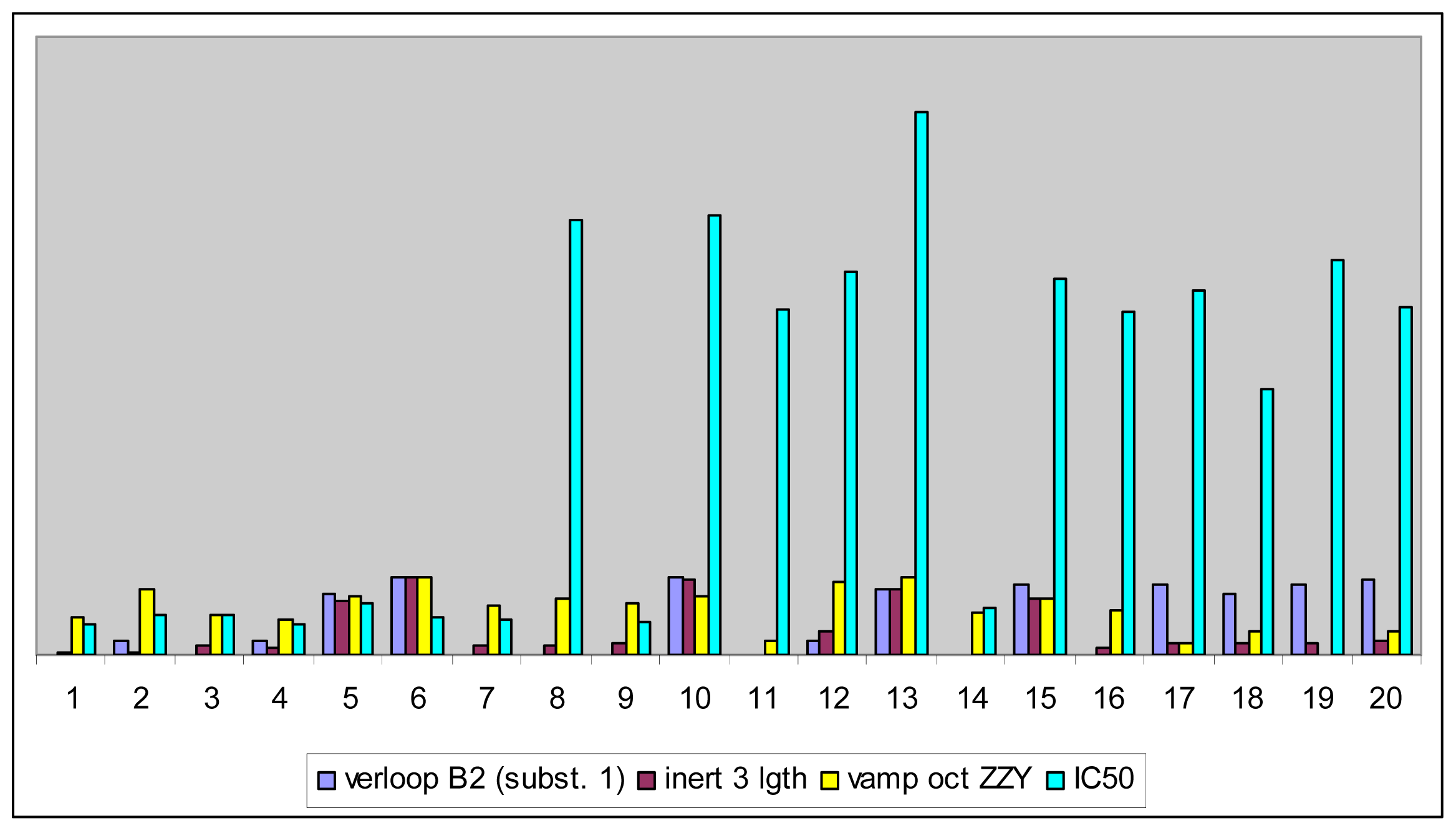
<p>Based on this QSAR model described above, it could be inferred that inhibitory activity will improve with increase of the electrostatic parameter (<italic>i.e.</italic>, Vamp octupole ZZY). The electrostatic parameters are properties of a molecule which are related to its electron affinity and demonstrate the susceptibility of a molecule towards attack by nucleophiles. In this study, VAMP octupole ZZY correlates well with the PDT activity. Compounds numbers 1, 2, and 5 were observed to be more active than compound numbers 11, 14, and 16 to 20. The increasing value of this descriptor (<xref ref-type="fig" rid="f1-ijms-12-08626">Figure 1</xref> and <xref ref-type="table" rid="t2-ijms-12-08626">Table 2</xref>) made the photosensitizers more efficiently absorb photons and produce reactive singlet oxygen (ROS). This may explain the activities observed by these photosensitizers [<xref ref-type="bibr" rid="b17-ijms-12-08626">17</xref>,<xref ref-type="bibr" rid="b18-ijms-12-08626">18</xref>].</p>
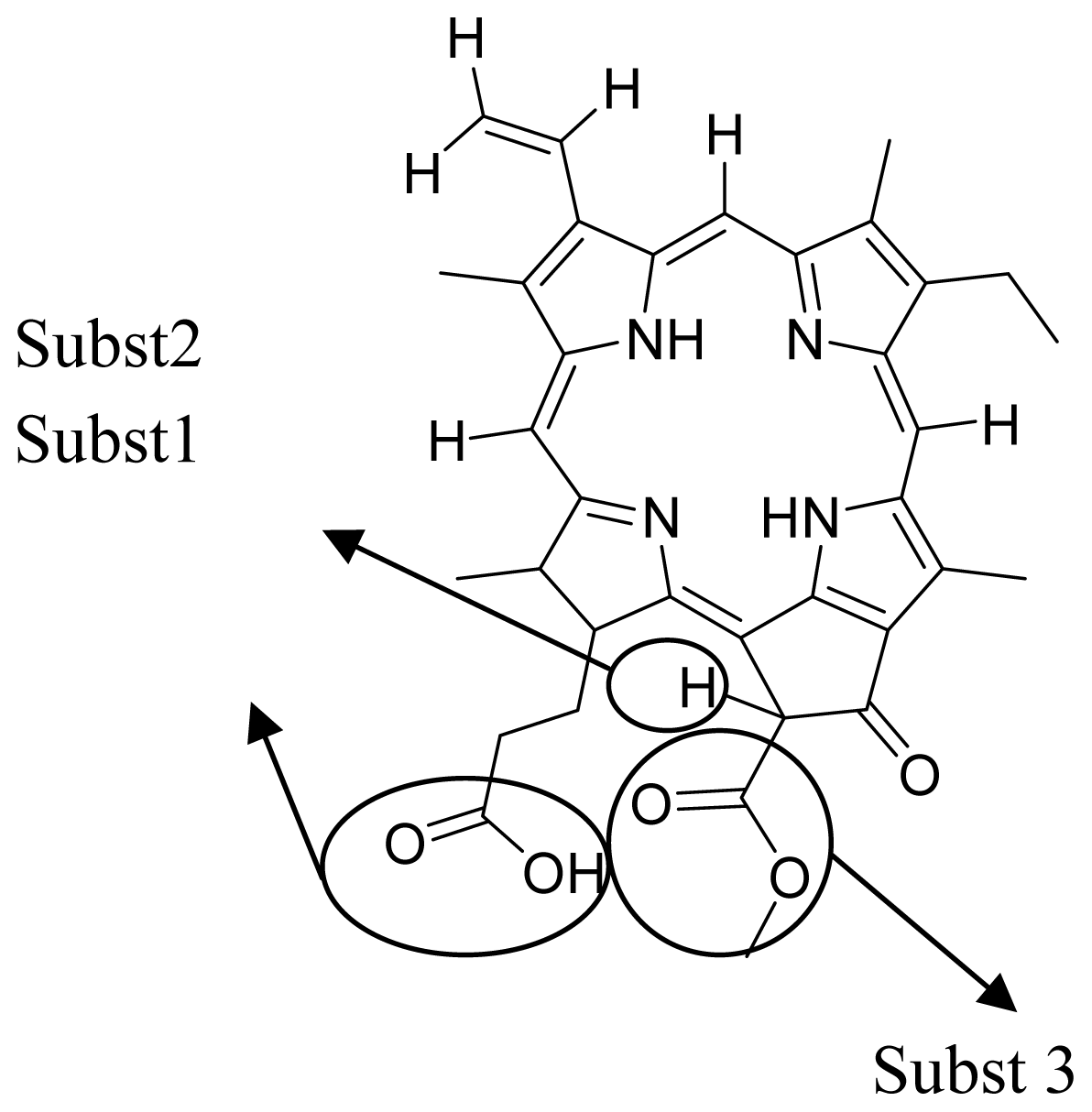
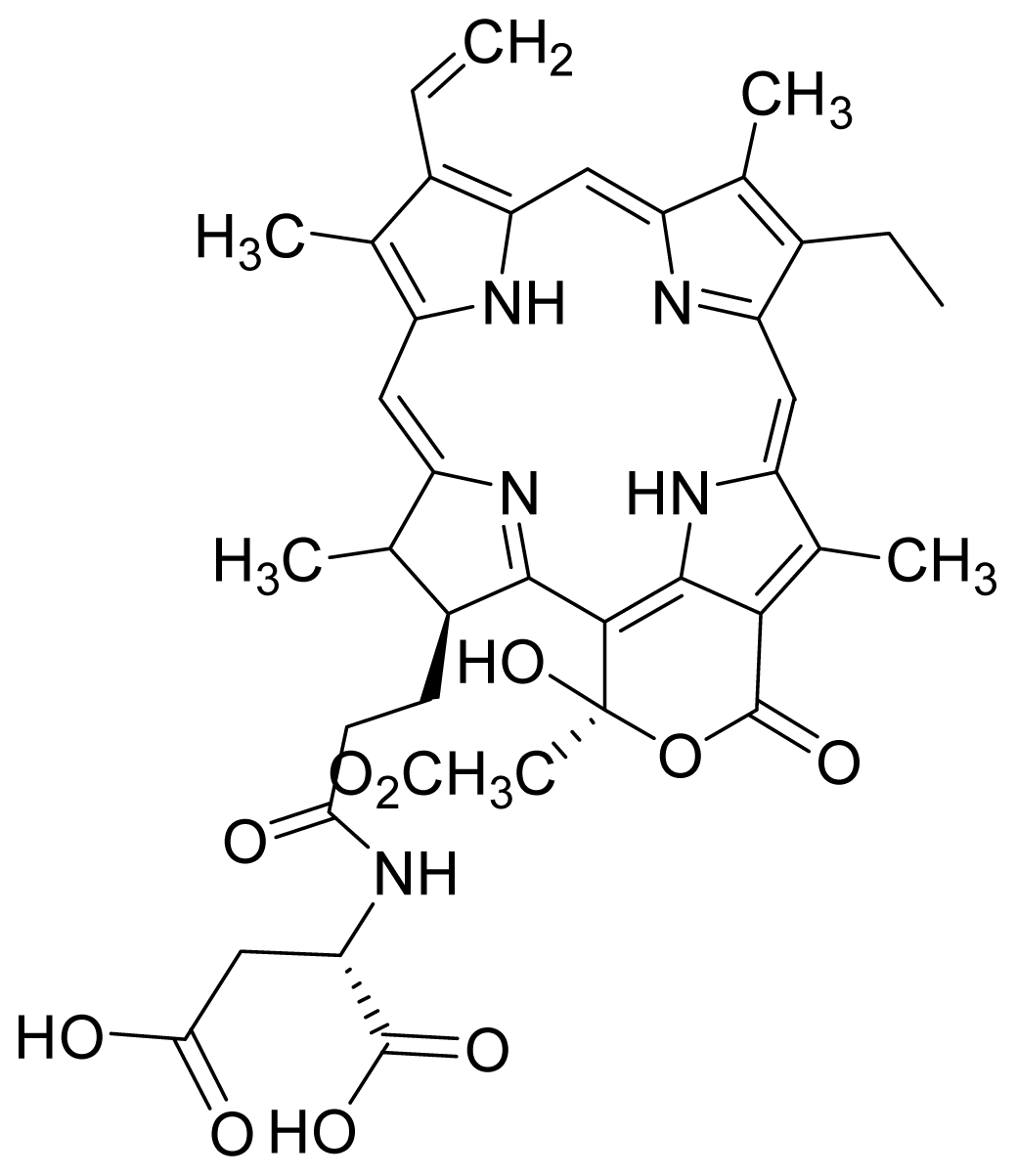
<p>Verloop parameters are sets of multi-dimensional steric descriptors. They can be used to characterize the shape and volume of the substituent, which are important in explaining the steric influence of substituents in the interactions of organic compounds with macromolecular drug receptors [<xref ref-type="bibr" rid="b19-ijms-12-08626">19</xref>]. The verloop descriptor and PDT activity has negative correlation. Increasing value of verloop descriptor will decrease the PDT activity. Some functional groups in substituent 1 will be exerted into PDT activity, such as the presence of hydrophilic groups (<italic>i.e.</italic>, -COOH) and causes a decrease in the verloop values for the compounds numbers 1, 2 and 5 (0.17, 017 and 0.10, respectively); presumably resulting in the compounds being more active. Anyway, the presence of amino acid, such as in compound No. 19, increased the verloop values and decreases the PDT activity.</p>
<p>The QSAR model showed a negative correlation between the moment of inertia descriptor and PDT activity where molecules with smaller size and length were observed to have better PDT activities. For example, compound No. 11, which has a smaller size and length compared to compound No. 15, showed better PDT activity [<xref ref-type="bibr" rid="b20-ijms-12-08626">20</xref>]. The statistical significance of the parameters in the QSAR model is presented in <xref ref-type="table" rid="t3-ijms-12-08626">Table 3</xref> and a brief description of these descriptors are detailed in <xref ref-type="table" rid="t4-ijms-12-08626">Table 4</xref>.</p>
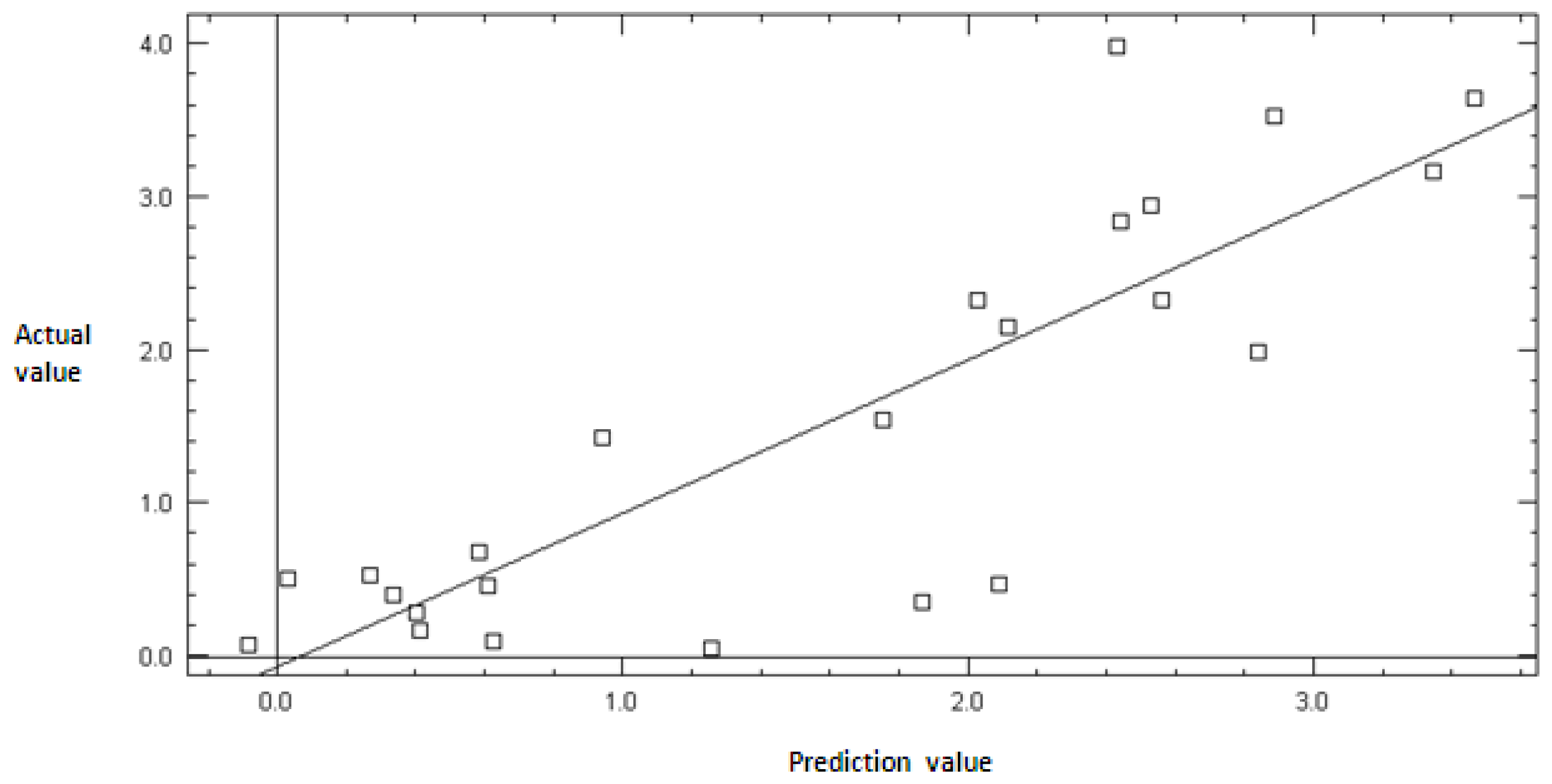
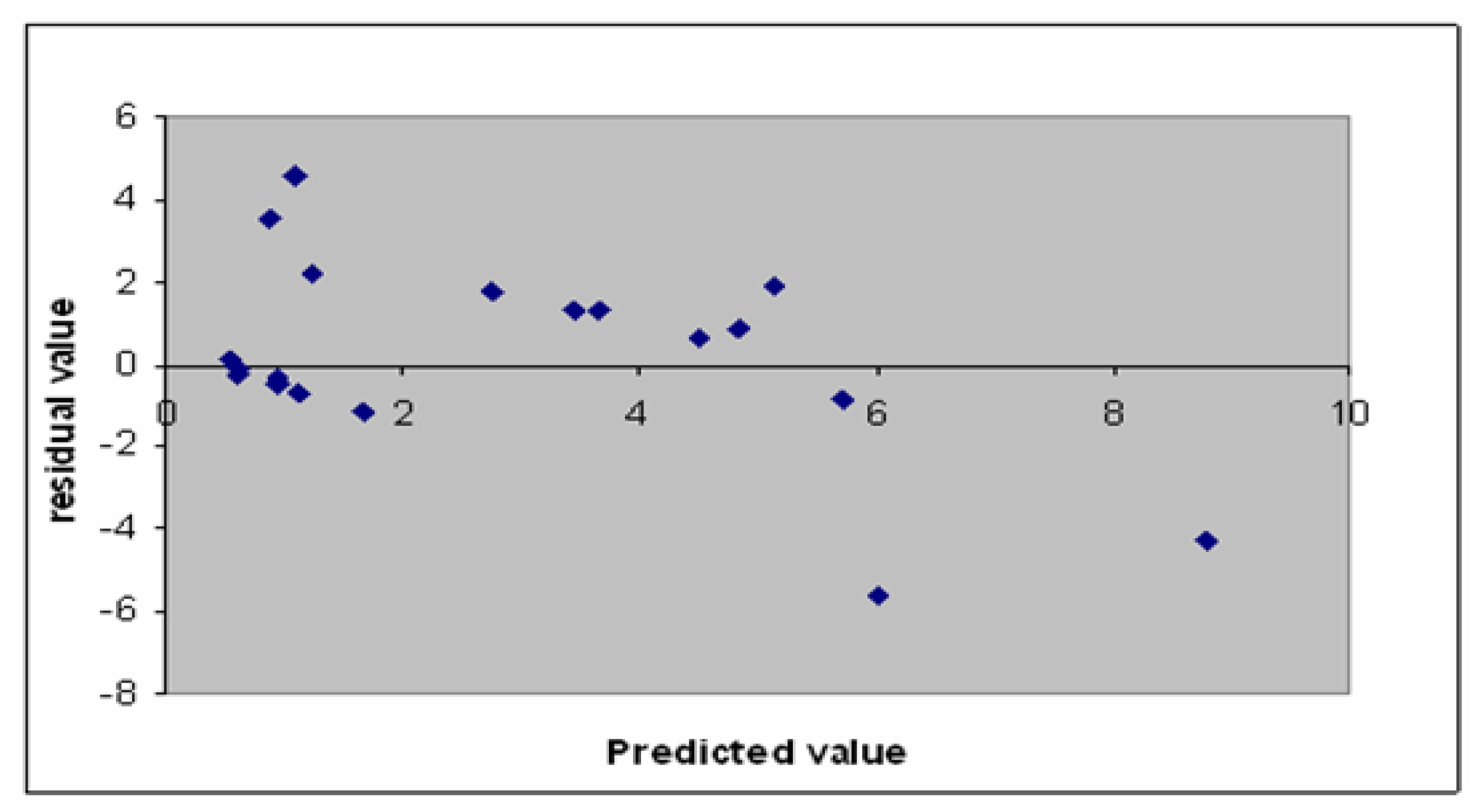
<p>A plot of experimental <italic>vs.</italic> predicted IC<sub>50</sub> is shown in <xref ref-type="fig" rid="f2-ijms-12-08626">Figure 2</xref>, while a plot of residual <italic>vs.</italic> predicted value is shown in <xref ref-type="fig" rid="f3-ijms-12-08626">Figure 3</xref>. These two plots are important for the predictive ability of QSAR. Residual plots (scatter) are used to detect the existence of outliers from a QSAR model [<xref ref-type="bibr" rid="b21-ijms-12-08626">21</xref>,<xref ref-type="bibr" rid="b22-ijms-12-08626">22</xref>]. <xref ref-type="fig" rid="f3-ijms-12-08626">Figure 3</xref> shows that there are no outliers, in this study. Hence, the developed QSAR model is considered to be stable.</p></sec>
<sec>
<title>2.2. Model Validation</title>
<p>To determine the stability of a predictive model the most used method is by analyzing the influence of each of its elements on the final model. Any model, even with excellent goodness-of-fit and satisfactory predictions, may lack a real relationship between structural descriptors and activities. To confirm the existence of chance correlations, a reliable validation procedure must be carried out. The definitive validity of a model is examined with the external validation, to evaluate its efficacy.</p>
<p>The inhibition concentrations of the compounds in the test set (<italic>i.e.</italic>, 12 porphyrin-based compounds in the test set and 20 porphyrins-based compounds in the external test set) were predicted using the QSAR model developed in this study. The calculated IC<sub>50</sub> values of the compounds in the predicted set and external test set are listed in <xref ref-type="table" rid="t5-ijms-12-08626">Tables 5</xref> and <xref ref-type="table" rid="t6-ijms-12-08626">6</xref>, respectively. The correlation coefficient (<italic>r</italic><sup>2</sup>) between predicted and experimental value for the QSAR model was also calculated. A predictive correlation coefficient <italic>r</italic><sup>2</sup> value (test set) of 0.70 and external set of 0.52 were obtained for the developed QSAR model. An <italic>r</italic><sup>2</sup> value of more than 0.5 between the predicted and the experimental values renders the model to be good and able to predict the PDT activities of compounds not included in the model development process [<xref ref-type="bibr" rid="b21-ijms-12-08626">21</xref>].</p>
<p>To further evaluate the significance of the developed model, it needs to undergo a stability test. For this, standard error of estimate and root mean squares are used. The values of standard error (<italic>SEE</italic>), root mean square error (<italic>RMSE</italic>) and root mean squares error prediction (<italic>RMSEP</italic>) in this model are 0.49, 3.7 and 3.6, respectively, which further adds to the statistical significance of the developed model. In addition, the low values of <italic>SEE</italic>, <italic>RMSE</italic> and <italic>RMSEP</italic> indicate that the developed QSAR model is stable for predicting unknown compounds in the test set.</p>
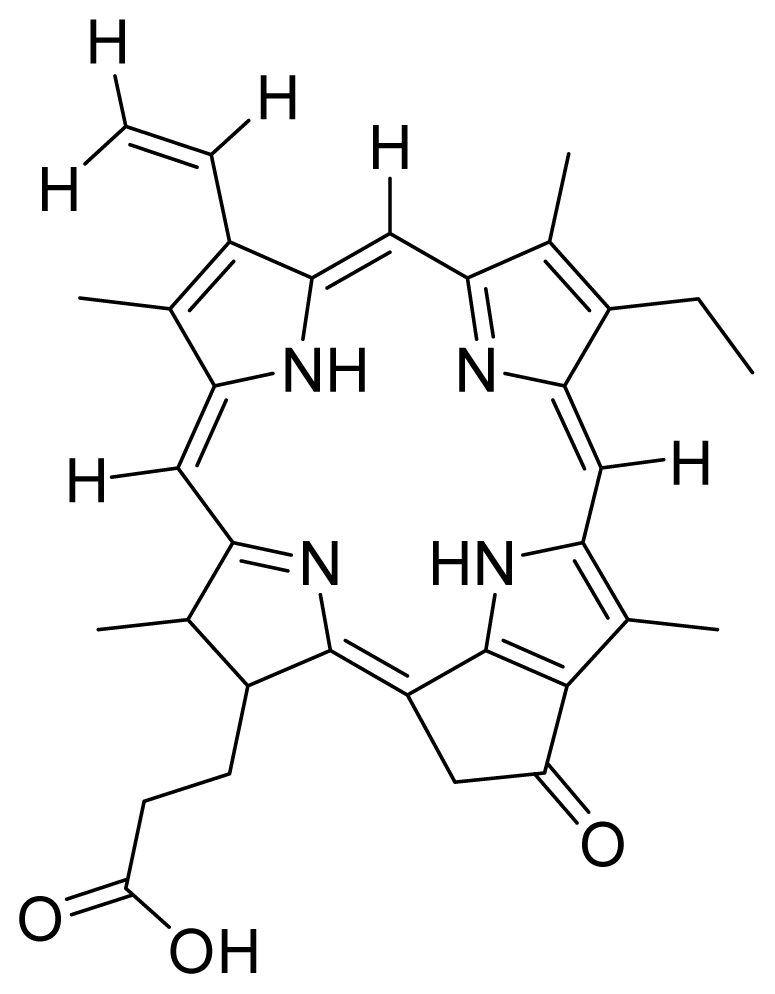
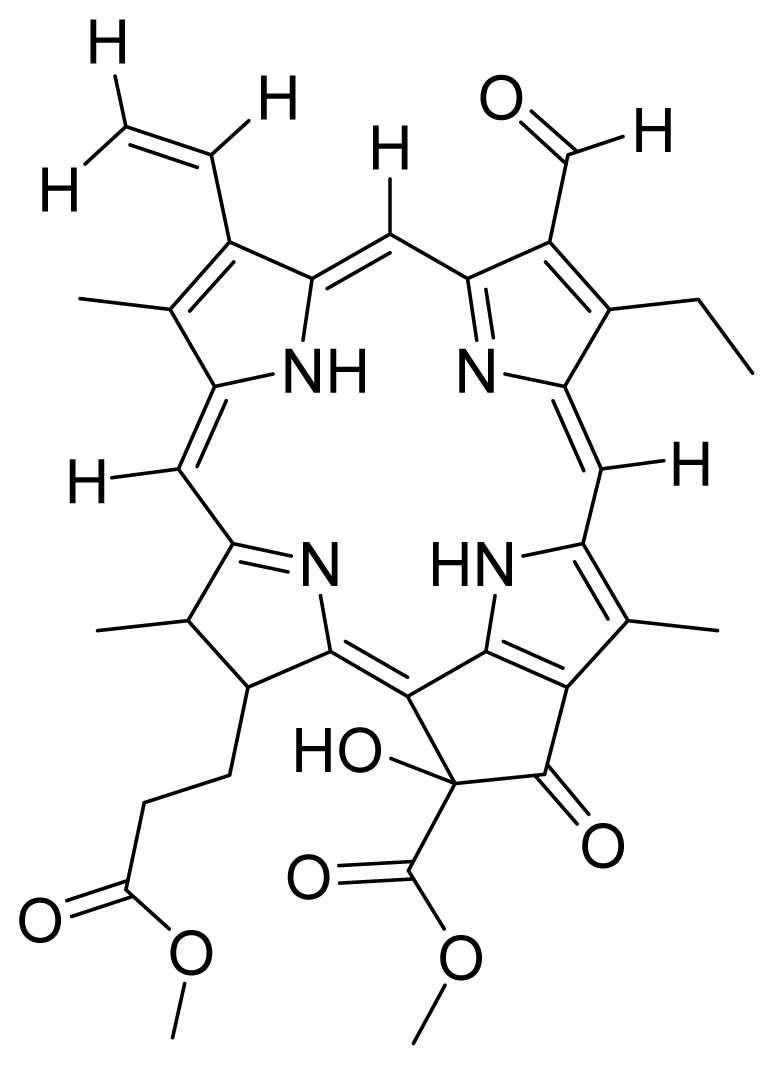
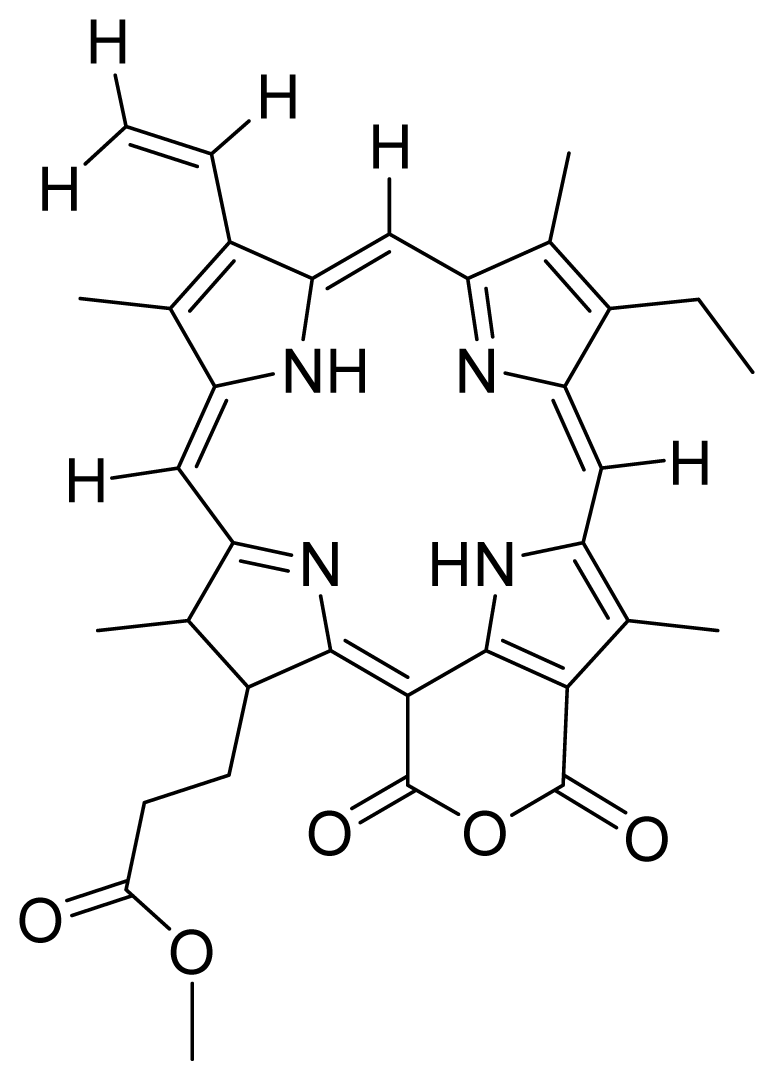
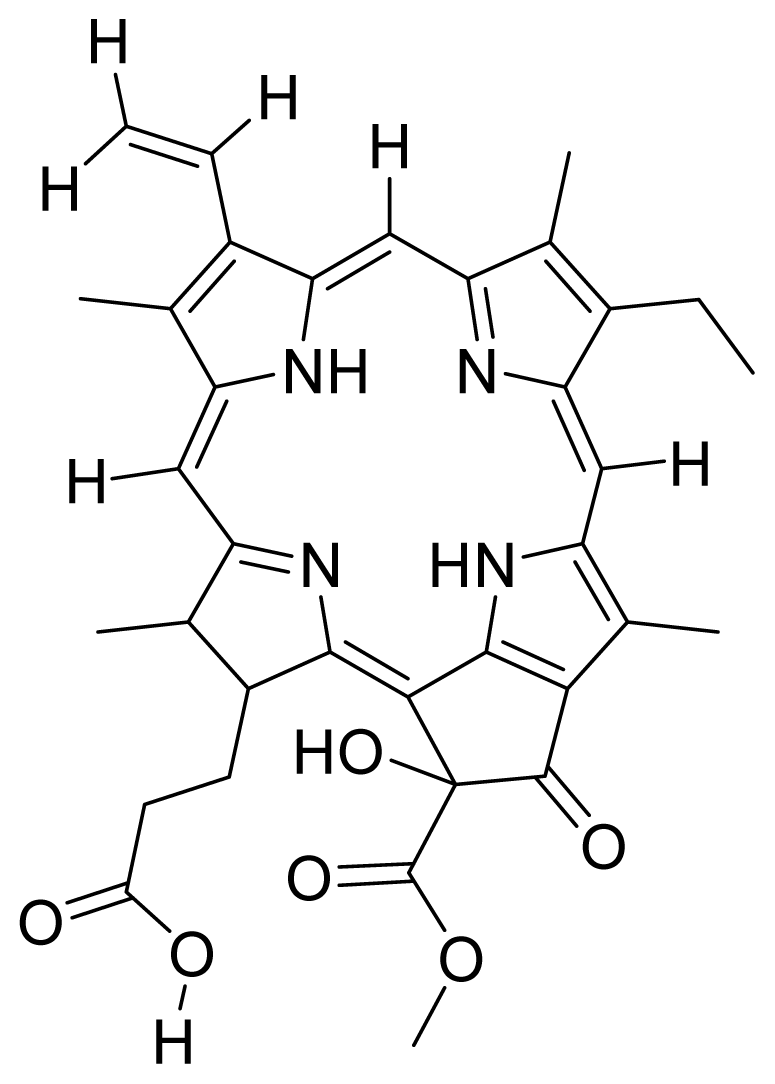
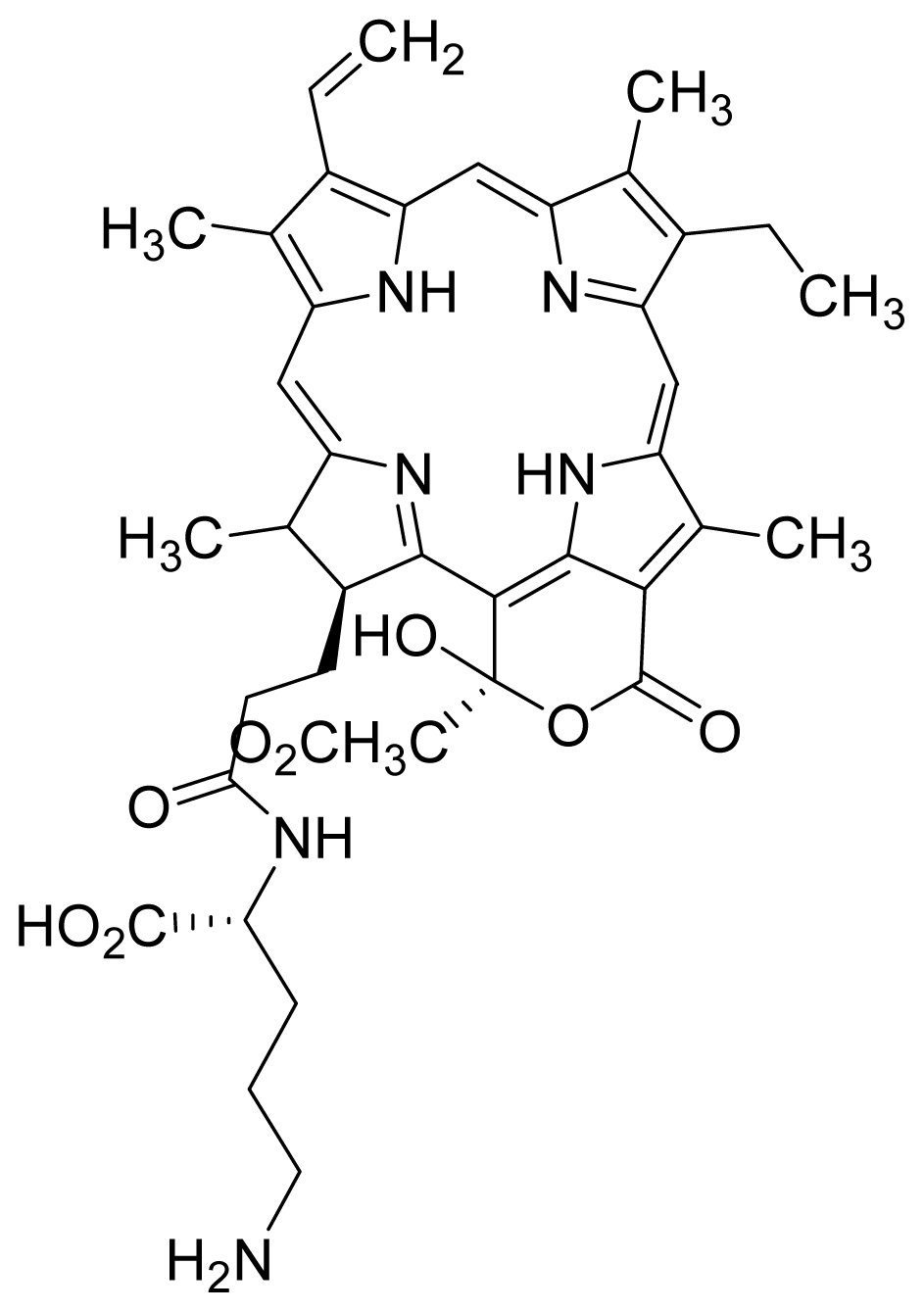
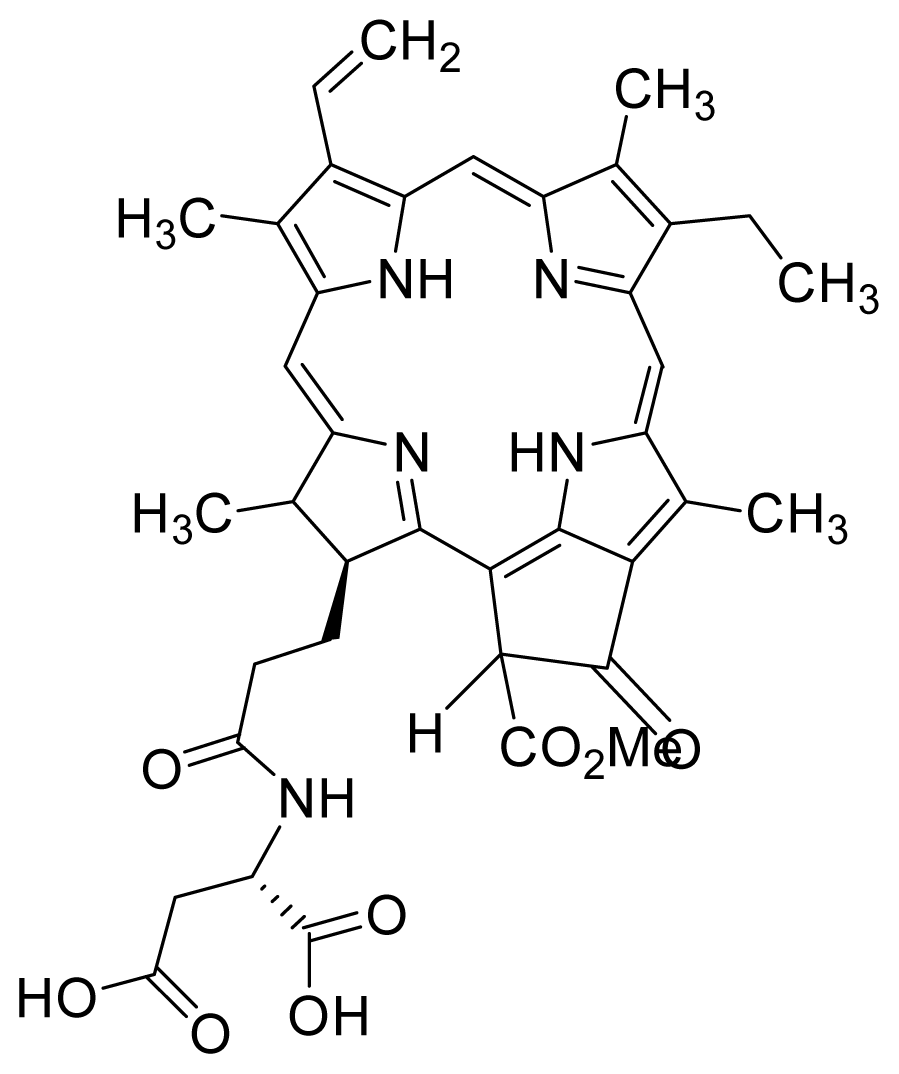
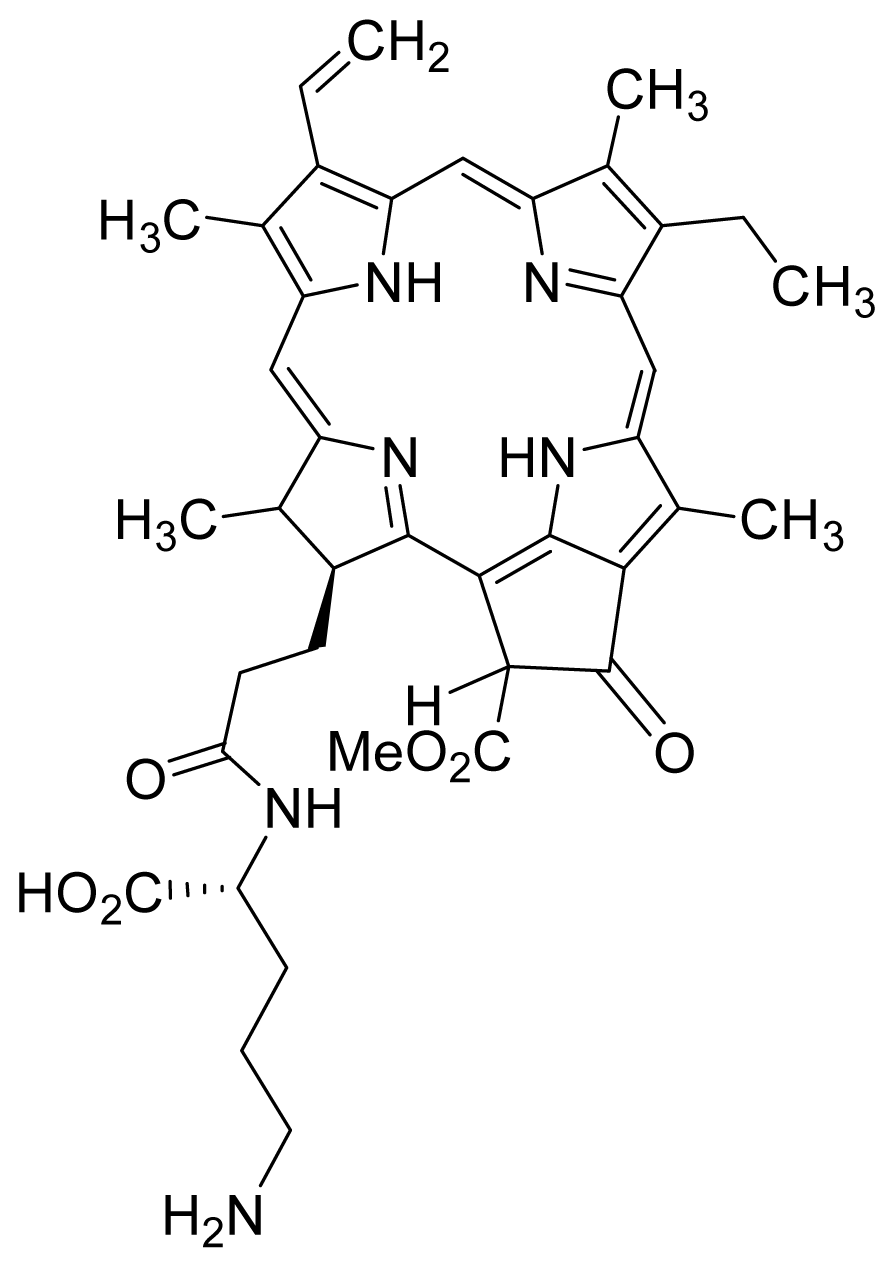
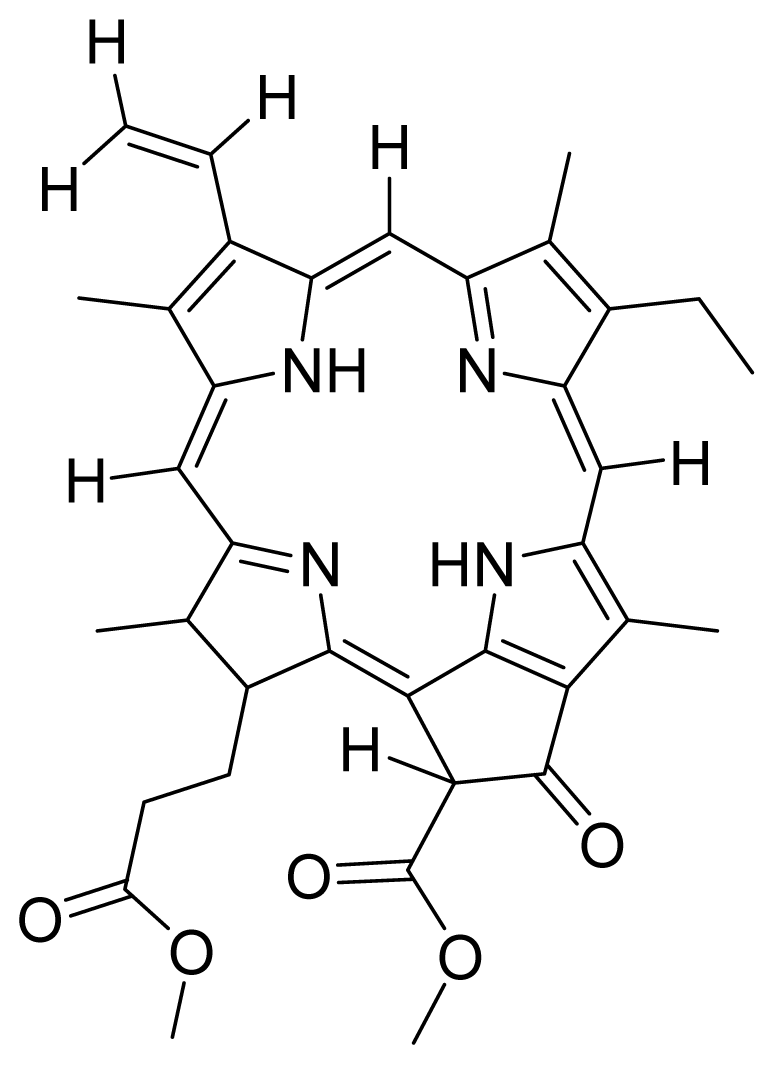
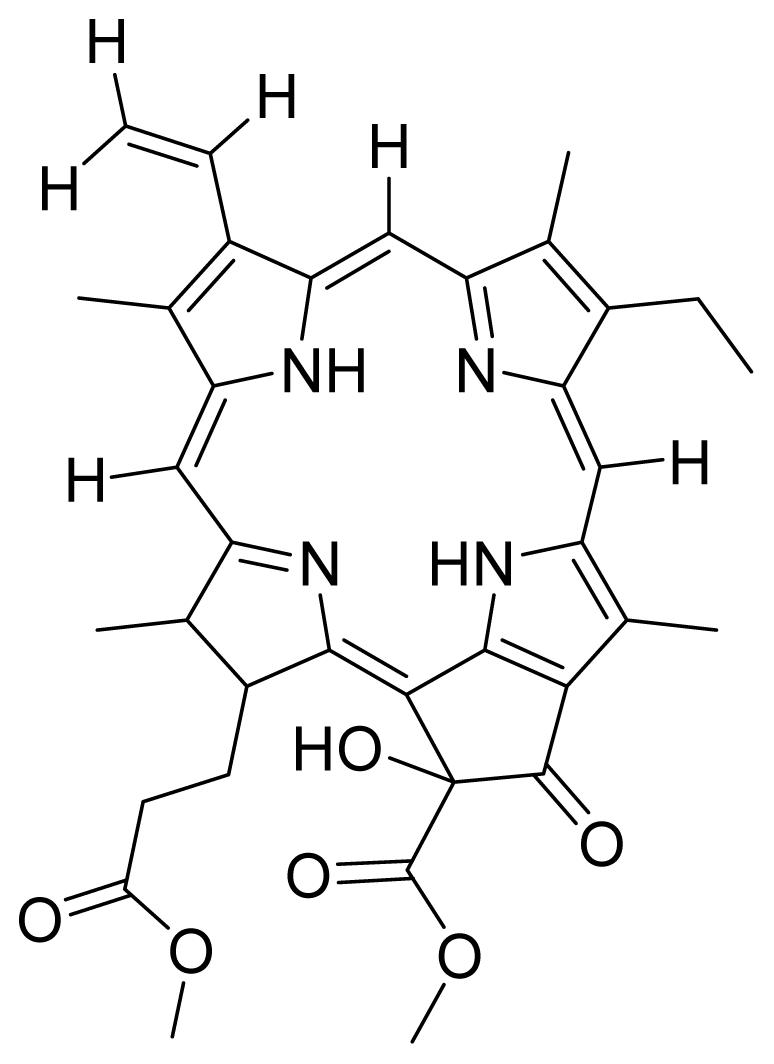
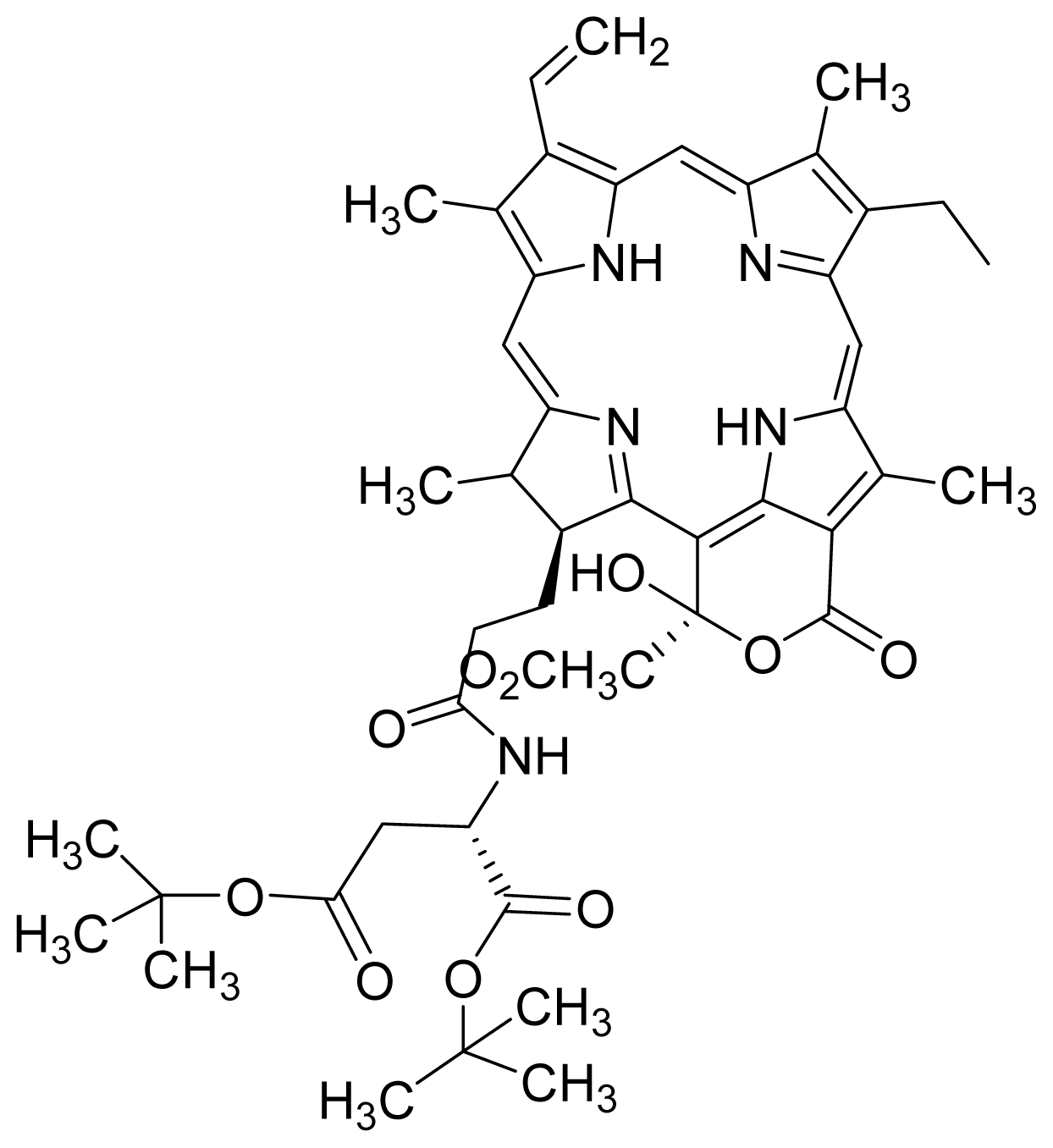
<p>As expected, the developed QSAR model was able to endorse the experimental IC<sub>50</sub> values for the compounds in the external test set. Some of the compounds, such as <bold>2</bold>, <bold>4</bold>, <bold>5</bold>, <bold>6</bold>, and <bold>9</bold> are confirmed active photosensitizers; while others such as compounds <bold>8</bold> and <bold>15</bold> showed good activities in the QSAR model but did not provide good activity when tested experimentally. This difference between theoretical and experimental results may be due to the experimental conditions in which the compounds possibly did not reach the required site for action which would result in good activities. However, further experiments will have to be carried out to ascertain the reason for this inactivity.</p></sec></sec>
<sec>
<title>3. Experimental</title>
<sec>
<title>3.1. QSAR Modeling of Porphyrin</title>
<p>Data set of the photosensitizing agents obtained from the literature [<xref ref-type="bibr" rid="b23-ijms-12-08626">23</xref>,<xref ref-type="bibr" rid="b24-ijms-12-08626">24</xref>] was used to develop the QSAR models. The data set consisted of 36 chemical compounds which were divided into a training set (24 compounds) for model development and a test set (12 compounds) for model validation. In addition, 20 porphyrin-based compounds have been shown to be good photosensitizers with experimental IC<sub>50</sub> values ranging from 0.39 μM to 7.04 μM. Hence, these compounds were used as external set for model validation (data shown herewith).</p>
<p>The training set selection was performed by first sorting through the biological activity list in increasing value. Next, the list of compounds were divided into three groups, <italic>i.e.</italic>, group I comprising of compounds No. 1 to 12, group II with compounds No. 13 to 24 and group III comprising of compounds No. 25 to 36. The compounds in groups I and III were assigned to the training set, and compounds in group II were assigned to the test set.</p>
<p>The molecular structure of each compound was sketched using ChemDraw 6.0 (Cambridge Soft) [<xref ref-type="bibr" rid="b25-ijms-12-08626">25</xref>] and then converted to 3D using Corina in TSAR 3.3 software package (Accelrys) [<xref ref-type="bibr" rid="b26-ijms-12-08626">26</xref>]. Cosmic in TSAR 3.3 (Accelrys) was used to optimize these molecular structures where the optimizations were terminated when the energy differences or the energy gradients become smaller than 1 × 10<sup>−5</sup> or 1 × 10<sup>−10</sup> kcal/mol, respectively. Molecular descriptors were also generated using TSAR 3.3 (Accelrys) [<xref ref-type="bibr" rid="b26-ijms-12-08626">26</xref>] for each compound.</p>
<p>In this study, 316 descriptors were first generated for then correlation matrix was applied to select the best subset of descriptors to be included in the QSAR model development. It could be used to identify highly correlated pairs of variables, and thus identifying the redundancy in the data set. A coefficient of 1.0 indicates two variables to be perfectly correlated while a coefficient 0.0 indicates no correlation. Pair-wise correlations were performed on members of the descriptors pool, moving one of the two descriptors randomly when their correlation coefficient exceeded 0.9 [<xref ref-type="bibr" rid="b22-ijms-12-08626">22</xref>]. The reduced descriptors pool used to develop QSAR model reported in this work contained 50 descriptors and are shown in <xref ref-type="table" rid="t7-ijms-12-08626">Table 7</xref>.</p>
<p>The next step involved scaling the descriptors, prior to the model development stage. This was a very delicate procedure since there could be underlying relationships amongst the descriptors, and manipulations involved in this step might lead to unforeseen effects. Range scaling could assist in preventing weightings of descriptors upon the Euclidean distance calculations in multidimensional descriptors space. The scaling was calculated as follows:</p>
<disp-formula id="FD2">
<label>(2)</label>
<mml:math id="mm2" display="block">
<mml:semantics id="sm2">
<mml:mrow>
<mml:msub>
<mml:mrow>
<mml:mi>y</mml:mi></mml:mrow>
<mml:mi>i</mml:mi></mml:msub>
<mml:mo>=</mml:mo>
<mml:mfrac>
<mml:mrow>
<mml:msub>
<mml:mrow>
<mml:mi>x</mml:mi></mml:mrow>
<mml:mi>i</mml:mi></mml:msub>
<mml:mo>-</mml:mo>
<mml:mtext>min</mml:mtext>
<mml:mo stretchy="false">(</mml:mo>
<mml:mi>x</mml:mi>
<mml:mo stretchy="false">)</mml:mo></mml:mrow>
<mml:mrow>
<mml:mtext>max</mml:mtext>
<mml:mo stretchy="false">(</mml:mo>
<mml:mi>x</mml:mi>
<mml:mo stretchy="false">)</mml:mo>
<mml:mo>-</mml:mo>
<mml:mtext>min</mml:mtext>
<mml:mo stretchy="false">(</mml:mo>
<mml:mi>x</mml:mi>
<mml:mo stretchy="false">)</mml:mo></mml:mrow></mml:mfrac></mml:mrow></mml:semantics></mml:math></disp-formula>
<p>where, <italic>y</italic><italic><sub>i</sub></italic> is the scaled value; <italic>x</italic><italic><sub>i</sub></italic> is the original value; min (<italic>x</italic>) is the minimum collection of <italic>x</italic> objects; and max (<italic>x</italic>) is the maximum collection of <italic>x</italic> objects.</p></sec>
<sec>
<title>3.2. Development of QSAR Model</title>
<p>The selected descriptors were then used to develop a QSAR model. In this study, the QSAR model is developed using the multiple linear regression analysis (MLRA) technique [<xref ref-type="bibr" rid="b15-ijms-12-08626">15</xref>]. The main goal of QSAR model development is to find the best set of descriptors that will produce a stable QSAR model with the ability to predict properties of unknown compounds.</p>
<p>For the MLRA technique, stepwise regression was chosen in the development of the QSAR model, in which a selection algorithm was used to select a subset of the input variables, <italic>X</italic>. The advantage of estimating a model with stepwise MLRA is that only a few variables are needed to build the QSAR model [<xref ref-type="bibr" rid="b16-ijms-12-08626">16</xref>]. The stepwise method combines two approaches, which are the forward and backward stepping.</p>
<p>In forward stepping, the partial <italic>F</italic> (statistical significance) values for all variables outside the model were calculated. This process is continued until no more variables qualified to enter the model. In backward stepping, the partial <italic>F</italic> values for all variables inside the model were calculated. The variable with the lowest partial <italic>F</italic> value was removed from the model. This process is continued until no more variables were qualified to be removed from the model. In general, a model can be accepted if it had fewer variables with better predictive power <italic>r</italic><sup>2</sup> (<italic>CV</italic>).</p>
<p>Cross validation provides a rigorous internal check on the models derived using multiple regression analysis, giving an estimate of the true predictive power of the model <italic>i.e.</italic>, how reliable are the predicted values for the untested compounds. The cross validation analysis in TSAR 3.3 software package (Accelrys) [<xref ref-type="bibr" rid="b26-ijms-12-08626">26</xref>] was performed using leave-one-out method where one compound is removed from data set and its activity is predicted using the model derived from the rest of the data set [<xref ref-type="bibr" rid="b22-ijms-12-08626">22</xref>].</p></sec>
<sec>
<title>3.3. Model Validation</title>
<p>The last step in QSAR model development is model validation. It is important to evaluate the robustness and the predictive capacity or validity of the model before using the model to predict and interpret biological activities of compounds in the test set. When estimating the predictive ability of QSAR models, it is necessary to distinguish two classes of predictive power, namely the internal and external predictivity. Internal predictivity measures how accurately the model can predict the bioactivities of the set of compounds (training set) used to build the statistical model. External predictivity tries to measure the predictive power for molecules to which the model has not been subjected to before. Of the two, external predictivity is observed to be more accurate [<xref ref-type="bibr" rid="b19-ijms-12-08626">19</xref>].</p>
<p>In this study, external validation was performed on a test set (<italic>i.e.</italic>, test set and external test set). The best QSAR model developed was validated by predicting IC<sub>50</sub> value of compounds in the test set, and tested for chance correlation by comparing the predicted and experimental photodynamic activities.</p></sec>
<sec>
<title>3.4. Preparation of Compounds for External Test Set</title>
<p>Compounds <bold>1</bold> and <bold>2</bold> were purchased from Frontier Scientific Inc., USA, and used without further purification. Experimental data for the isolation as well as the spectroscopic data for compounds <bold>3</bold>, <bold>4</bold>, <bold>7</bold>, <bold>8</bold>, and <bold>9</bold> have already been reported by Kamarulzaman [<xref ref-type="bibr" rid="b27-ijms-12-08626">27</xref>], and compound <bold>12</bold> by Tan [<xref ref-type="bibr" rid="b28-ijms-12-08626">28</xref>]. Compound <bold>13</bold> was obtained from David Appleton (Centre for Natural Product Research and Drug Discovery (CENAR), Department of Pharmacology, Faculty of Medicine, University of Malaya, Kuala Lumpur, Malaysia). The identity and purity of the compounds were confirmed using high resolution mass spectrometry (HRMS) before use. Compound <bold>13</bold> (aquatic samples) had been previously identified by Harris <italic>et al.</italic> [<xref ref-type="bibr" rid="b29-ijms-12-08626">29</xref>].</p>
<p>Compounds <bold>5</bold> and <bold>6</bold> were semi-synthesized from compound <bold>12</bold>. Briefly, compound <bold>12</bold> was dissolved in <italic>N</italic>,<italic>N</italic>′-dicyclohexylcarbodiimide (DCC) and 4-dimethylaminopyridine (DMAP) in dry dichloromethane (DCM), and subsequently reacted with a mixture of H-Asp-(OtBu)(OtBu) and excess diisopropylethylamine (DIPEA) in dry dichloromethane for 3 h at room temperature. A mixture of compound <bold>6</bold> and unreacted compound <bold>12</bold> were purified using preparative thin layer chromatography (PTLC) in 7:3 hexane:acetone solvent system. The major band at R<italic><sub>f</sub></italic> = 0.73 was isolated, re-dissolved with cold acetonitrile, filtered and dried to yield compound <bold>6</bold>. The protecting group of compound <bold>6</bold> was removed by stirring with 1:1 ratio of DCM and trifluoroacetic acid (TFA), followed by partitioning with equal amounts of water and DCM. The organic layer was collected and dried using rotary evaporator to yield compound <bold>5</bold>. The identity of compound <bold>12</bold> as the starting material was confirmed by LCMS and UV-vis absorbance data. The structure of compound <bold>5</bold> was confirmed by <sup>1</sup>H-NMR, HRMS and UV-vis absorbance data. The structure of compound <bold>6</bold> which was obtained following removal of the protecting group (OtBu) (OtBu) of compound <bold>5</bold> was confirmed by HRMS and UV-vis absorbance data.</p>
<p>Compounds <bold>10</bold>, <bold>11</bold> and <bold>14</bold> were isolated from a methanolic extract of the leaves of <italic>Leonurus sibiricus</italic>. The methanolic crude extract was purified using silica gel column chromatography, eluting with increasing amounts of acetone (0–100%) in hexane and finally with 100% methanol. Fractions 34 and 40 which were eluted at 100% acetone were combined and further purified using PTLC in 20% acetone in hexane to yield compound <bold>11</bold> (R<italic><sub>f</sub></italic> = 0.36). The band corresponding to R<italic><sub>f</sub></italic> = 0.55 was isolated and treated with 8:2 TFA:H<sub>2</sub>O to yield compound <bold>10</bold>. Fraction 12 which was eluted at 6:4 hexane:acetone was subjected to further purification by PTLC using 75:25 hexane:acetone to yield compound <bold>14</bold> (R<italic><sub>f</sub></italic> = 0.48). The structure of compound <bold>10</bold> was confirmed by HRMS and UV-vis absorbance data whereas the identity of compounds <bold>11</bold> and <bold>14</bold> was confirmed by <sup>1</sup>H-NMR, HRMS and UV-vis absorbance data. The spectroscopic data of compounds <bold>10</bold>, <bold>11</bold> and <bold>14</bold> were in agreement with the literature data [<xref ref-type="bibr" rid="b30-ijms-12-08626">30</xref>–<xref ref-type="bibr" rid="b32-ijms-12-08626">32</xref>].</p>
<p>Compounds <bold>15</bold>, <bold>16</bold> and <bold>17</bold> were semi-synthesized in a similar way as compounds <bold>5</bold> and <bold>6</bold>, but with the addition of H-Lys-(OtBu)(Boc) in the reaction, instead of H-Asp-(OtBu)(OtBu). Following purification using PTLC (60:40 hexane:acetone), the major band at R<italic><sub>f</sub></italic> = 0.15 was isolated, re-dissolved with cold acetonitrile, filtered and dried to yield compound <bold>15</bold>. The protecting group of compound <bold>15</bold> was removed by stirring with 1:1 ratio of DCM and TFA, followed by partitioning with equal amounts of water and DCM. The organic layer was collected and dried using rotary evaporator to yield compound <bold>16</bold>, which was further purified using Sephadex column chromatography and 100% methanol. A second PTLC band at R<italic><sub>f</sub></italic> = 0.63 was isolated and treated with 1:1 DCM:TFA to yield compound <bold>17</bold>. The structure of compound <bold>15</bold> was confirmed by <sup>1</sup>H-NMR, HRMS and UV-vis absorbance data. The structures of compound <bold>16</bold>, following the removal of the protecting group (OtBu)(Boc), and compound <bold>17</bold> were confirmed by HRMS and UV-vis absorbance data.</p>
<p>For the synthesis of compound <bold>18</bold>, pheophorbide-<italic>a</italic> was dissolved in a solution containing DCC and DMAP in dry dichloromethane. This mixture was then reacted with another mixture of H-Asp-(OtBu)(OtBu) and excess DIPEA in dichloromethane. The reaction mixture was washed, dried, and subjected to purification using silica gel column chromatography using hexane:acetone solvent system. After the major brown band was eluted from the column, the solvent was evaporated and the solid was dissolved in 100% cold acetonitrile, filtered and dried. Removal of the protecting group was performed by stirring the compound with 1:1 ratio of DCM:TFA. Following partitioning with equal amounts of water and DCM, the organic layer was collected and dried using rotary evaporator to obtain compound <bold>18</bold>. The structure of compound <bold>18</bold> was confirmed by <sup>1</sup>H-NMR, HRMS and UV-vis absorbance data. Compounds <bold>19</bold> and <bold>20</bold> were semi-synthesized in a similar way as compounds <bold>18</bold> but with the addition of H-Lys-(OtBu)(Boc) in the reaction, instead of H-Asp-(OtBu)(OtBu). Following purification with silica gel column chromatography using hexane-acetone solvent system, the fraction corresponding to R<italic><sub>f</sub></italic> = 0.46 in 60:40 hexane:acetone was collected, further purified by PTLC (60:40 hexane:acetone), and subsequently treated with 1:1 DCM:TFA to yield compound <bold>19</bold>. Another fraction corresponding to R<italic><sub>f</sub></italic> = 0.42 in 60:40 hexane:acetone was collected, further purified by PTLC (60:40 hexane:acetone) and subsequently treated with 1:1 DCM:TFA to yield compound <bold>20</bold>. The structures of compounds <bold>19</bold> and <bold>20</bold> were confirmed by HRMS and UV-vis absorbance data.</p></sec>
<sec>
<title>3.5. Determination of Photocytotoxicity of Compounds in External Test Set by MTT (3-(4,5-dimethylthiazol-2-yl)-2,5-diphenyl-2H-tetrazolium hydrobromide) Assay</title>
<p>Leukemic cell line HL-60 in phenol red-free RPMI medium containing 5% fetal bovine serum were seeded in 96-well plate at the density of 15,000 cells/well. Photosensitizers, dissolved in the same medium were added at concentrations ranging from 0.01 to 10 μM. Following 2 h incubation, the cells were irradiated for 10 min with a broad spectrum light source at light dose of 5.6 J/cm<sup>2</sup>. The cells were further incubated for 24 h. At the end of the incubation, 20 μL of MTT solution (5 mg/mL) was added into each well and incubated for 4 h. The plate was then subjected to centrifugation at 2000 rpm for 10 min. 100 μL of medium was carefully removed and replaced with 100 μL of DMSO to dissolve the purple formazan formed. Absorbance was read at 570 nm using an OpsysMR microplate spectrometer (Thermo-Labsystems, Chantilly, VA, USA). The half maximal inhibitory concentrations (IC<sub>50</sub>) of the photosensitizers were then determined. Duplicate of the experiment was performed without irradiation to assess the dark toxicity of the photosensitizers. Compounds <bold>1</bold>–<bold>20</bold> showed negligible toxicity in the dark.</p></sec></sec>
<sec sec-type="conclusions">
<title>4. Conclusions</title>
<p>The QSAR model has been successfully developed with a good correlative and predictive ability for predicting PDT activity. This QSAR model exhibiting a high degree of accuracy was then validated by predicting the PDT activity of experimental compounds in the external test set. The PDT activity is predominantly influenced by a set of descriptors which appeared in the QSAR model such as electrostatic and steric properties. The developed QSAR model was able to discover and confirm the PDT activities of five compounds as potential active photosensitizers.</p></sec></body>
<back>
<ack>
<title>Acknowledgements</title>
<p>We thank University of Malaya for the financial support through University Grant Research Scheme (UMRG) No. RG012/09BIO.</p></ack>
<ref-list>
<title>References</title>
<ref id="b1-ijms-12-08626"><label>1</label><citation citation-type="book"><person-group person-group-type="author"><name><surname>Gerard</surname><given-names>L.C.C.</given-names></name><name><surname>Halimah</surname><given-names>Y</given-names></name></person-group><source>Second Report of National Cancer Register, Cancer Incidence in Malaysia</source><publisher-name>National Cancer Registry</publisher-name><publisher-loc>Kuala Lumpur, Malaysia</publisher-loc><year>2003</year></citation></ref>
<ref id="b2-ijms-12-08626"><label>2</label><citation citation-type="journal"><person-group person-group-type="author"><name><surname>Nyman</surname><given-names>E.</given-names></name><name><surname>Hynninen</surname><given-names>P.H.</given-names></name></person-group><article-title>Research advances in the use of tetrapyrrolic photosensitizers for photodynamic therapy</article-title><source>J. Photochem. Photobiol. B</source><year>2004</year><volume>73</volume><fpage>1</fpage><lpage>28</lpage><pub-id pub-id-type="doi">10.1016/j.jphotobiol.2003.10.002</pub-id><pub-id pub-id-type="pmid">14732247</pub-id></citation></ref>
<ref id="b3-ijms-12-08626"><label>3</label><citation citation-type="journal"><person-group person-group-type="author"><name><surname>Henderson</surname><given-names>B.W.</given-names></name><name><surname>Dougherty</surname><given-names>T.J.</given-names></name></person-group><article-title>How does photodynamic therapy works</article-title><source>J. Photochem. Photobiol</source><year>1992</year><volume>55</volume><fpage>145</fpage><lpage>157</lpage><pub-id pub-id-type="doi">10.1111/j.1751-1097.1992.tb04222.x</pub-id></citation></ref>
<ref id="b4-ijms-12-08626"><label>4</label><citation citation-type="journal"><person-group person-group-type="author"><name><surname>Detty</surname><given-names>M.R.</given-names></name><name><surname>Gibson</surname><given-names>S.L.</given-names></name><name><surname>Wagner</surname><given-names>S.J.</given-names></name></person-group><article-title>Current clinical and preclinical photosensitizers for use in photodynamic therapy</article-title><source>J. Med. Chem</source><year>2004</year><volume>47</volume><fpage>3897</fpage><lpage>3915</lpage><pub-id pub-id-type="doi">10.1021/jm040074b</pub-id><pub-id pub-id-type="pmid">15267226</pub-id></citation></ref>
<ref id="b5-ijms-12-08626"><label>5</label><citation citation-type="journal"><person-group person-group-type="author"><name><surname>Dougherty</surname><given-names>T.J.</given-names></name></person-group><article-title>Photosensitizers: Therapy and detection of malignant tumours</article-title><source>J. Photochem. Photobiol</source><year>1987</year><volume>45</volume><fpage>879</fpage><lpage>889</lpage><pub-id pub-id-type="doi">10.1111/j.1751-1097.1987.tb07898.x</pub-id></citation></ref>
<ref id="b6-ijms-12-08626"><label>6</label><citation citation-type="journal"><person-group person-group-type="author"><name><surname>Dougherty</surname><given-names>T.J.</given-names></name></person-group><article-title>Photodynamic therapy</article-title><source>J. Photochem. Photobiol</source><year>1993</year><volume>58</volume><fpage>895</fpage><lpage>900</lpage><pub-id pub-id-type="doi">10.1111/j.1751-1097.1993.tb04990.x</pub-id></citation></ref>
<ref id="b7-ijms-12-08626"><label>7</label><citation citation-type="journal"><person-group person-group-type="author"><name><surname>Macdonald</surname><given-names>I.D.T.</given-names></name></person-group><article-title>Basic principles of photodynamic therapy</article-title><source>J. Porphyr. Phthalocya</source><year>2001</year><volume>5</volume><fpage>105</fpage><lpage>129</lpage><pub-id pub-id-type="doi">10.1002/jpp.328</pub-id></citation></ref>
<ref id="b8-ijms-12-08626"><label>8</label><citation citation-type="book"><person-group person-group-type="author"><name><surname>Bonnett</surname><given-names>R</given-names></name></person-group><source>Chemical Aspects of Photodynamic Therapy</source><publisher-name>Gordon and Breach Science</publisher-name><publisher-loc>Amsterdam, The Netherlands</publisher-loc><year>2000</year></citation></ref>
<ref id="b9-ijms-12-08626"><label>9</label><citation citation-type="journal"><person-group person-group-type="author"><name><surname>Allison</surname><given-names>R.R.</given-names></name><name><surname>Downie</surname><given-names>G.H.</given-names></name><name><surname>Cuenca</surname><given-names>R.</given-names></name><name><surname>Hu</surname><given-names>X.H.</given-names></name><name><surname>Child</surname><given-names>C.J.</given-names></name><name><surname>Sibata</surname><given-names>C.H.</given-names></name></person-group><article-title>Photosensitizers in clinical PDT</article-title><source>Photodiagnosis Photodyn. Ther</source><year>2004</year><volume>1</volume><fpage>27</fpage><lpage>42</lpage><pub-id pub-id-type="doi">10.1016/S1572-1000(04)00007-9</pub-id></citation></ref>
<ref id="b10-ijms-12-08626"><label>10</label><citation citation-type="journal"><person-group person-group-type="author"><name><surname>Vanyur</surname><given-names>R.</given-names></name><name><surname>Heberger</surname><given-names>K.</given-names></name><name><surname>Kovesdi</surname><given-names>I.</given-names></name><name><surname>Jakus</surname><given-names>J.</given-names></name></person-group><article-title>Prediction of tumoricidal activity and accumulation of photosensitizers in photodynamic therapy using multiple linear regression and artificial neural networks</article-title><source>J. Photochem. Photobiol</source><year>2002</year><volume>75</volume><fpage>471</fpage><lpage>478</lpage><pub-id pub-id-type="doi">10.1562/0031-8655(2002)075&lt;0471:POTAAA&gt;2.0.CO;2</pub-id></citation></ref>
<ref id="b11-ijms-12-08626"><label>11</label><citation citation-type="journal"><person-group person-group-type="author"><name><surname>Boyle</surname><given-names>R.W.</given-names></name><name><surname>Dolphyn</surname><given-names>D.</given-names></name></person-group><article-title>Structure and biodistribution relationships of photodynamic sensitizers</article-title><source>J. Photochem. Photobiol</source><year>1996</year><volume>64</volume><fpage>469</fpage><lpage>485</lpage><pub-id pub-id-type="doi">10.1111/j.1751-1097.1996.tb03093.x</pub-id></citation></ref>
<ref id="b12-ijms-12-08626"><label>12</label><citation citation-type="journal"><person-group person-group-type="author"><name><surname>Henderson</surname><given-names>B.W.</given-names></name><name><surname>Bellnier</surname><given-names>D.A.</given-names></name><name><surname>Greco</surname><given-names>W.R.</given-names></name><name><surname>Sharma</surname><given-names>A.</given-names></name><name><surname>Pandey</surname><given-names>R.K.</given-names></name><name><surname>Vanghan</surname><given-names>L.A.</given-names></name><name><surname>Weishaupt</surname><given-names>K.R.</given-names></name><name><surname>Dougherty</surname><given-names>T.J.</given-names></name></person-group><article-title>An <italic>in vivo</italic> quantitative structure-activity relationship for congeneric series of pyropheophorbide derivatives as photosensitizers for photodynamic therapy</article-title><source>Cancer Res</source><year>1997</year><volume>57</volume><fpage>4000</fpage><lpage>4007</lpage><pub-id pub-id-type="pmid">9307285</pub-id></citation></ref>
<ref id="b13-ijms-12-08626"><label>13</label><citation citation-type="journal"><person-group person-group-type="author"><name><surname>Potter</surname><given-names>W.R.</given-names></name><name><surname>Henderson</surname><given-names>B.W.</given-names></name><name><surname>Bellnier</surname><given-names>D.A.</given-names></name><name><surname>Pandey</surname><given-names>R.K.</given-names></name><name><surname>Vanghan</surname><given-names>L.A.</given-names></name><name><surname>Weishaupt</surname><given-names>K.R.</given-names></name><name><surname>Douherty</surname><given-names>T.J.</given-names></name></person-group><article-title>Parabolic quantitative structure-activity and photodynamic therapy: Application of three compartment model with clearance to the <italic>in vivo</italic> quantitative structure-activity relationships of a congeneric series of pyropheoporbide derivatives used as photosensitizers for photodynamic therapy</article-title><source>J. Photochem. Photobiol</source><year>1999</year><volume>70</volume><fpage>781</fpage><lpage>788</lpage></citation></ref>
<ref id="b14-ijms-12-08626"><label>14</label><citation citation-type="journal"><person-group person-group-type="author"><name><surname>Depnath</surname><given-names>A.K.</given-names></name><name><surname>Jiang</surname><given-names>S.</given-names></name><name><surname>Strick</surname><given-names>N.</given-names></name><name><surname>Lin</surname><given-names>K.</given-names></name><name><surname>Haberfield</surname><given-names>P.</given-names></name><name><surname>Neurath</surname><given-names>A.R.</given-names></name></person-group><article-title>Three-dimensional structure-activity analysis of a series of porphyrins derivatives with anti hiv-1 activity targeted to the v3 loop of the gp120 envelope glycoprotein of the human immunodeficiency virus type 1</article-title><source>J. Med. Chem</source><year>1994</year><volume>37</volume><fpage>1099</fpage><lpage>1108</lpage><pub-id pub-id-type="doi">10.1021/jm00034a007</pub-id><pub-id pub-id-type="pmid">8164251</pub-id></citation></ref>
<ref id="b15-ijms-12-08626"><label>15</label><citation citation-type="journal"><person-group person-group-type="author"><name><surname>Golbraikh</surname><given-names>A.</given-names></name><name><surname>Tropsha</surname><given-names>A.</given-names></name></person-group><article-title>Predictive qsar modeling diversity sampling of experimental data set and test set selection</article-title><source>J. Comput. Aided Mol. Des</source><year>2002</year><volume>5</volume><fpage>231</fpage><lpage>243</lpage></citation></ref>
<ref id="b16-ijms-12-08626"><label>16</label><citation citation-type="book"><person-group person-group-type="author"><name><surname>Beebe</surname><given-names>K.R.</given-names></name><name><surname>Pell</surname><given-names>R.J.</given-names></name><name><surname>Seasholtz</surname><given-names>M.B.</given-names></name></person-group><source>Chemometrics, a Practical Guide</source><publisher-name>Wiley Interscience</publisher-name><publisher-loc>New York, NY, USA</publisher-loc><year>1998</year></citation></ref>
<ref id="b17-ijms-12-08626"><label>17</label><citation citation-type="journal"><person-group person-group-type="author"><name><surname>Li</surname><given-names>H.</given-names></name><name><surname>Sun</surname><given-names>J.</given-names></name><name><surname>Sui</surname><given-names>X.</given-names></name><name><surname>Liu</surname><given-names>J.</given-names></name><name><surname>Yan</surname><given-names>Z.</given-names></name><name><surname>Liu</surname><given-names>X.</given-names></name><name><surname>Sun</surname><given-names>Y.</given-names></name><name><surname>He</surname><given-names>Z.</given-names></name></person-group><article-title>First-principle, structure-based prediction of hepatic metabolic clearance values in human</article-title><source>Eur. J. Med. Chem</source><year>2009</year><volume>44</volume><fpage>1600</fpage><lpage>1606</lpage><pub-id pub-id-type="doi">10.1016/j.ejmech.2008.07.027</pub-id><pub-id pub-id-type="pmid">18768239</pub-id></citation></ref>
<ref id="b18-ijms-12-08626"><label>18</label><citation citation-type="journal"><person-group person-group-type="author"><name><surname>Vicini</surname><given-names>P.</given-names></name><name><surname>Geronikaki</surname><given-names>A.</given-names></name><name><surname>Incerti</surname><given-names>M.</given-names></name><name><surname>Zani</surname><given-names>F.</given-names></name><name><surname>Dearden</surname><given-names>J.</given-names></name><name><surname>Hewitt</surname><given-names>M.</given-names></name></person-group><article-title>2-heteroarylimino-5- benzylidene-4-thiazolidinones analogues of 2-thiazolylimino-5-benzylidene-4-thiazolidinones with antimicrobial activity: Synthesis and structure—activity relationship</article-title><source>Bioorg. Med. Chem</source><year>2008</year><volume>16</volume><fpage>3714</fpage><lpage>3724</lpage><pub-id pub-id-type="doi">10.1016/j.bmc.2008.02.001</pub-id><pub-id pub-id-type="pmid">18299196</pub-id></citation></ref>
<ref id="b19-ijms-12-08626"><label>19</label><citation citation-type="thesis"><person-group person-group-type="author"><name><surname>Korhonen</surname><given-names>S.M.</given-names></name></person-group><article-title>A fuzzy superposition and qsar technique towards an automated computational detection of biologically active compounds using multivariate methods</article-title><source>PhD Thesis</source><publisher-name>University of Kuopio</publisher-name><publisher-loc>Kuopio, Finland</publisher-loc><year>2007</year></citation></ref>
<ref id="b20-ijms-12-08626"><label>20</label><citation citation-type="journal"><person-group person-group-type="author"><name><surname>Lin</surname><given-names>B.</given-names></name><name><surname>Pirrung</surname><given-names>M.C.</given-names></name><name><surname>Deng</surname><given-names>L.</given-names></name><name><surname>Li</surname><given-names>Z.</given-names></name><name><surname>Liu</surname><given-names>Y.</given-names></name><name><surname>Webster</surname><given-names>N.J.G.</given-names></name></person-group><article-title>Neuroprotection by small molecule activators of the nerve growth factor receptor</article-title><source>J. Pharmacol. Exp. Ther</source><year>2007</year><volume>322</volume><fpage>59</fpage><lpage>69</lpage><pub-id pub-id-type="doi">10.1124/jpet.106.118034</pub-id><pub-id pub-id-type="pmid">17468299</pub-id></citation></ref>
<ref id="b21-ijms-12-08626"><label>21</label><citation citation-type="journal"><person-group person-group-type="author"><name><surname>Golbraikh</surname><given-names>A.</given-names></name><name><surname>Tropsha</surname><given-names>A.</given-names></name></person-group><article-title>Beware of <italic>q</italic><sup>2</sup>!</article-title><source>J. Mol. Graph. Model</source><year>2002</year><volume>20</volume><fpage>269</fpage><lpage>276</lpage><pub-id pub-id-type="doi">10.1016/S1093-3263(01)00123-1</pub-id><pub-id pub-id-type="pmid">11858635</pub-id></citation></ref>
<ref id="b22-ijms-12-08626"><label>22</label><citation citation-type="book"><source><italic>Windows Reference Guide</italic>, TSAR version 3.3</source><publisher-name>Oxford Molecular, Ltd.</publisher-name><publisher-loc>Oxford, UK</publisher-loc><year>2000</year></citation></ref>
<ref id="b23-ijms-12-08626"><label>23</label><citation citation-type="journal"><person-group person-group-type="author"><name><surname>Banfi</surname><given-names>S.</given-names></name><name><surname>Caruso</surname><given-names>E.</given-names></name><name><surname>Buccafurni</surname><given-names>L.</given-names></name><name><surname>Murano</surname><given-names>R.</given-names></name><name><surname>Monti</surname><given-names>E.</given-names></name><name><surname>Gariboldi</surname><given-names>M.</given-names></name><name><surname>Papa</surname><given-names>E.</given-names></name><name><surname>Gramatica</surname><given-names>P.</given-names></name></person-group><article-title>Comparison between 5,10,15,20-tetraaryl- and diarylporphyrins as photosensitizers: Synthesis, photodynamic activity and quantitative structure activity relationship modeling</article-title><source>J. Med. Chem</source><year>2006</year><volume>49</volume><fpage>3293</fpage><lpage>3304</lpage><pub-id pub-id-type="doi">10.1021/jm050997m</pub-id><pub-id pub-id-type="pmid">16722648</pub-id></citation></ref>
<ref id="b24-ijms-12-08626"><label>24</label><citation citation-type="journal"><person-group person-group-type="author"><name><surname>Banfi</surname><given-names>S.</given-names></name><name><surname>Caruso</surname><given-names>E.</given-names></name><name><surname>Caprioli</surname><given-names>S.</given-names></name><name><surname>Mazzagatti</surname><given-names>L.</given-names></name><name><surname>Canti</surname><given-names>G.</given-names></name><name><surname>Ravizza</surname><given-names>R.</given-names></name><name><surname>Gariboldi</surname><given-names>M.</given-names></name><name><surname>Monti</surname><given-names>E.</given-names></name></person-group><article-title>Photodynamic effects of porphyrin and chlorin photosensitizers in human colon adenocarcinoma cells</article-title><source>Bioorg. Med. Chem.</source><year>2004</year><volume>14</volume><fpage>4853</fpage><lpage>4860</lpage></citation></ref>
<ref id="b25-ijms-12-08626"><label>25</label><citation citation-type="book"><source>ChemDraw, version 6.0</source><publisher-name>Cambridge Scientific Computing, Inc.</publisher-name><publisher-loc>Cambridge, MA, USA</publisher-loc><year>2004</year></citation></ref>
<ref id="b26-ijms-12-08626"><label>26</label><citation citation-type="book"><source><italic>TSAR</italic>, version 3.3</source><publisher-name>Oxford Molecular, Ltd.</publisher-name><publisher-loc>Oxford, UK</publisher-loc><year>2000</year></citation></ref>
<ref id="b27-ijms-12-08626"><label>27</label><citation citation-type="journal"><person-group person-group-type="author"><name><surname>Kamarulzaman</surname><given-names>F.A.</given-names></name><name><surname>Shaari</surname><given-names>K.</given-names></name><name><surname>Ho</surname><given-names>A.S.H.</given-names></name><name><surname>Lajis</surname><given-names>N.H.</given-names></name><name><surname>Teo</surname><given-names>S.H.</given-names></name><name><surname>Lee</surname><given-names>H.B.</given-names></name></person-group><article-title>Derivatives of pheophorbide-a and pheophorbide-b from photocytotoxic piper penangense extract</article-title><source>Chem. Biodivers</source><year>2011</year><volume>8</volume><fpage>494</fpage><lpage>502</lpage><pub-id pub-id-type="doi">10.1002/cbdv.201000341</pub-id><pub-id pub-id-type="pmid">21404433</pub-id></citation></ref>
<ref id="b28-ijms-12-08626"><label>28</label><citation citation-type="journal"><person-group person-group-type="author"><name><surname>Tan</surname><given-names>P.J.</given-names></name><name><surname>Appleton</surname><given-names>D.R.</given-names></name><name><surname>Mustafa</surname><given-names>M.R.</given-names></name><name><surname>Lee</surname><given-names>H.B.</given-names></name></person-group><article-title>Rapid identification of cyclic tetrapyrrolic photosensitisers for photodynamic therapy using on-line hyphenated lc-pda-ms coupled with photocytotoxicity assay</article-title><source>Phytochem. Anal</source><year>2011</year><pub-id pub-id-type="doi">10.1002/pca.1324.</pub-id></citation></ref>
<ref id="b29-ijms-12-08626"><label>29</label><citation citation-type="journal"><person-group person-group-type="author"><name><surname>Harris</surname><given-names>P.G.</given-names></name><name><surname>Pearce</surname><given-names>G.E.S.</given-names></name><name><surname>Peakman</surname><given-names>T.M.</given-names></name><name><surname>Maxwell</surname><given-names>J.R.</given-names></name></person-group><article-title>A widespread and abundant chlorophyll transformation product in aquatic environments</article-title><source>Org. Geochem</source><year>1995</year><volume>23</volume><fpage>183</fpage><lpage>187</lpage><pub-id pub-id-type="doi">10.1016/0146-6380(95)00006-Z</pub-id></citation></ref>
<ref id="b30-ijms-12-08626"><label>30</label><citation citation-type="journal"><person-group person-group-type="author"><name><surname>Demberelnyamba</surname><given-names>D.</given-names></name><name><surname>Ariuna</surname><given-names>M.</given-names></name><name><surname>Shim</surname><given-names>Y.K.</given-names></name></person-group><article-title>Newly synthesized water-soluble cholinium-purpurin photosensitizers and their stabilized gold nanoparticle as promising anticancer agents</article-title><source>Int. J. Mol. Sci</source><year>2008</year><volume>9</volume><fpage>864</fpage><lpage>871</lpage><pub-id pub-id-type="doi">10.3390/ijms9050864</pub-id><pub-id pub-id-type="pmid">19325790</pub-id></citation></ref>
<ref id="b31-ijms-12-08626"><label>31</label><citation citation-type="journal"><person-group person-group-type="author"><name><surname>Ocampo</surname><given-names>R.</given-names></name><name><surname>Repeta</surname><given-names>D.J.</given-names></name></person-group><article-title>Structural determination of purpurin-18 (as methyl ester) from sedimentary organic matter</article-title><source>Org. Geochem</source><year>1999</year><volume>30</volume><fpage>189</fpage><lpage>193</lpage><pub-id pub-id-type="doi">10.1016/S0146-6380(98)00214-9</pub-id></citation></ref>
<ref id="b32-ijms-12-08626"><label>32</label><citation citation-type="journal"><person-group person-group-type="author"><name><surname>Wongsinkongman</surname><given-names>P.</given-names></name><name><surname>Brossi</surname><given-names>A.</given-names></name><name><surname>Wang</surname><given-names>H.K.</given-names></name><name><surname>Bastow</surname><given-names>K.F.</given-names></name><name><surname>Lee</surname><given-names>K.H.</given-names></name></person-group><article-title>Antitumor agents. Part 209: Pheophorbide-a derivatives as photoindependent cytotoxic agents</article-title><source>Bioorg. Med. Chem</source><year>2002</year><volume>10</volume><fpage>583</fpage><lpage>591</lpage><pub-id pub-id-type="doi">10.1016/S0968-0896(01)00305-4</pub-id><pub-id pub-id-type="pmid">11814846</pub-id></citation></ref></ref-list>
<sec sec-type="display-objects">
<title>Figures and Tables</title>
<fig id="f1-ijms-12-08626" position="float">
<label>Figure 1</label>
<caption>
<p>Effects of descriptors in quantitative structure-activity relationship (QSAR) model with their photodynamic therapy (PDT) activity.</p></caption>
<graphic xlink:href="ijms-12-08626f1.gif"/></fig>
<fig id="f2-ijms-12-08626" position="float">
<label>Figure 2</label>
<caption>
<p>Plot of actual value <italic>vs.</italic> predicted value of training set.</p></caption>
<graphic xlink:href="ijms-12-08626f2.gif"/></fig>
<fig id="f3-ijms-12-08626" position="float">
<label>Figure 3</label>
<caption>
<p>Plot of residual value <italic>vs.</italic> predicted value.</p></caption>
<graphic xlink:href="ijms-12-08626f3.gif"/></fig>
<table-wrap id="t1-ijms-12-08626" position="float">
<label>Table 1</label>
<caption>
<p>Statistical output of multiple linear regression analysis (MLRA) model.</p></caption>
<table frame="hsides" rules="groups">
<thead>
<tr>
<th align="center" valign="bottom">Statistical Output</th>
<th align="center" valign="bottom">Value</th></tr></thead>
<tbody>
<tr>
<td align="left" valign="top">Non<italic>-</italic>cross validated <italic>r</italic><sup>2</sup></td>
<td align="center" valign="top">0.87</td></tr>
<tr>
<td align="left" valign="top">Cross validation <italic>r</italic><sup>2</sup> (<italic>CV</italic>)</td>
<td align="center" valign="top">0.71</td></tr>
<tr>
<td align="left" valign="top"><italic>F-</italic>value</td>
<td align="center" valign="top">37.85</td></tr>
<tr>
<td align="left" valign="top"><italic>F-</italic>probability</td>
<td align="center" valign="top">1.95 × 10<sup>−8</sup></td></tr>
<tr>
<td align="left" valign="top">Standard error of estimate <italic>(SEE)</italic></td>
<td align="center" valign="top">0.49</td></tr>
<tr>
<td align="left" valign="top">Residual sum of square (<italic>RSS</italic>)</td>
<td align="center" valign="top">4.12</td></tr>
<tr>
<td align="left" valign="top">Predictive sum of square (<italic>PRESS</italic>)</td>
<td align="center" valign="top">9.23</td></tr></tbody></table></table-wrap>
<table-wrap id="t2-ijms-12-08626" position="float">
<label>Table 2</label>
<caption>
<p>Descriptor values of compounds in the external test set.</p></caption>
<table frame="hsides" rules="groups">
<thead>
<tr>
<th align="center" valign="bottom">No.</th>
<th align="center" valign="bottom">Verloop B2 (subst. 1)</th>
<th align="center" valign="bottom">Inert 3 Length</th>
<th align="center" valign="bottom">Vamp Octupole ZZY</th>
<th align="center" valign="bottom">Exp IC<sub>50</sub> (μM)</th></tr></thead>
<tbody>
<tr>
<td align="center" valign="top">1</td>
<td align="center" valign="top">0.00</td>
<td align="center" valign="top">0.02</td>
<td align="center" valign="top">0.49</td>
<td align="center" valign="top">0.39</td></tr>
<tr>
<td align="center" valign="top">2</td>
<td align="center" valign="top">0.17</td>
<td align="center" valign="top">0.03</td>
<td align="center" valign="top">0.85</td>
<td align="center" valign="top">0.52</td></tr>
<tr>
<td align="center" valign="top">3</td>
<td align="center" valign="top">0.00</td>
<td align="center" valign="top">0.11</td>
<td align="center" valign="top">0.52</td>
<td align="center" valign="top">0.51</td></tr>
<tr>
<td align="center" valign="top">4</td>
<td align="center" valign="top">0.17</td>
<td align="center" valign="top">0.11</td>
<td align="center" valign="top">0.44</td>
<td align="center" valign="top">0.39</td></tr>
<tr>
<td align="center" valign="top">5</td>
<td align="center" valign="top">0.79</td>
<td align="center" valign="top">0.71</td>
<td align="center" valign="top">0.75</td>
<td align="center" valign="top">0.68</td></tr>
<tr>
<td align="center" valign="top">6</td>
<td align="center" valign="top">1.00</td>
<td align="center" valign="top">0.50</td></tr>
<tr>
<td align="center" valign="top">7</td>
<td align="center" valign="top">0.00</td>
<td align="center" valign="top">0.13</td>
<td align="center" valign="top">0.63</td>
<td align="center" valign="top">0.45</td></tr>
<tr>
<td align="center" valign="top">8</td>
<td align="center" valign="top">0.00</td>
<td align="center" valign="top">0.13</td>
<td align="center" valign="top">0.73</td>
<td align="center" valign="top">5.63</td></tr>
<tr>
<td align="center" valign="top">9</td>
<td align="center" valign="top">0.00</td>
<td align="center" valign="top">0.14</td>
<td align="center" valign="top">0.67</td>
<td align="center" valign="top">0.44</td></tr>
<tr>
<td align="center" valign="top">10</td>
<td align="center" valign="top">1.00</td>
<td align="center" valign="top">0.98</td>
<td align="center" valign="top">0.77</td>
<td align="center" valign="top">5.69</td></tr>
<tr>
<td align="center" valign="top">11</td>
<td align="center" valign="top">0.00</td>
<td align="center" valign="top">0.18</td>
<td align="center" valign="top">4.47</td></tr>
<tr>
<td align="center" valign="top">12</td>
<td align="center" valign="top">0.17</td>
<td align="center" valign="top">0.29</td>
<td align="center" valign="top">0.93</td>
<td align="center" valign="top">4.96</td></tr>
<tr>
<td align="center" valign="top">13</td>
<td align="center" valign="top">0.84</td>
<td align="center" valign="top">0.99</td>
<td align="center" valign="top">7.04</td></tr>
<tr>
<td align="center" valign="top">14</td>
<td align="center" valign="top">0.00</td>
<td align="center" valign="top">0.56</td>
<td align="center" valign="top">0.62</td></tr>
<tr>
<td align="center" valign="top">15</td>
<td align="center" valign="top">0.90</td>
<td align="center" valign="top">0.12</td>
<td align="center" valign="top">0.74</td>
<td align="center" valign="top">4.86</td></tr>
<tr>
<td align="center" valign="top">16</td>
<td align="center" valign="top">0.00</td>
<td align="center" valign="top">0.09</td>
<td align="center" valign="top">0.58</td>
<td align="center" valign="top">4.45</td></tr>
<tr>
<td align="center" valign="top">17</td>
<td align="center" valign="top">0.89</td>
<td align="center" valign="top">0.14</td>
<td align="center" valign="top">0.15</td>
<td align="center" valign="top">4.72</td></tr>
<tr>
<td align="center" valign="top">18</td>
<td align="center" valign="top">0.80</td>
<td align="center" valign="top">0.14</td>
<td align="center" valign="top">0.29</td>
<td align="center" valign="top">3.43</td></tr>
<tr>
<td align="center" valign="top">19</td>
<td align="center" valign="top">0.92</td>
<td align="center" valign="top">0.15</td>
<td align="center" valign="top">0.00</td>
<td align="center" valign="top">5.11</td></tr>
<tr>
<td align="center" valign="top">20</td>
<td align="center" valign="top">0.97</td>
<td align="center" valign="top">0.17</td>
<td align="center" valign="top">0.30</td>
<td align="center" valign="top">4.49</td></tr></tbody></table></table-wrap>
<table-wrap id="t3-ijms-12-08626" position="float">
<label>Table 3</label>
<caption>
<p>Statistical significance of parameters.</p></caption>
<table frame="hsides" rules="groups">
<thead>
<tr>
<th align="center" valign="middle">Descriptors</th>
<th align="center" valign="middle">Regression Coefficient <xref ref-type="table-fn" rid="tfn1-ijms-12-08626">a</xref></th>
<th align="center" valign="middle">Jacknife SE <xref ref-type="table-fn" rid="tfn2-ijms-12-08626">b</xref></th>
<th align="center" valign="middle">Covariance SE <xref ref-type="table-fn" rid="tfn3-ijms-12-08626">c</xref></th>
<th align="center" valign="middle"><italic>t</italic>-Value <xref ref-type="table-fn" rid="tfn4-ijms-12-08626">d</xref></th>
<th align="center" valign="middle"><italic>t</italic>-Probability <xref ref-type="table-fn" rid="tfn5-ijms-12-08626">e</xref></th></tr></thead>
<tbody>
<tr>
<td align="center" valign="top">Verloop B2</td>
<td align="center" valign="top">0.96</td>
<td align="center" valign="top">0.41</td>
<td align="center" valign="top">0.44</td>
<td align="center" valign="top">2.16</td>
<td align="center" valign="top">0.05</td></tr>
<tr>
<td align="center" valign="top">Inertia moment 3 length</td>
<td align="center" valign="top">6.42</td>
<td align="center" valign="top">0.52</td>
<td align="center" valign="top">0.73</td>
<td align="center" valign="top">8.75</td>
<td align="center" valign="top">1.04 × 10<sup>−7</sup></td></tr>
<tr>
<td align="center" valign="top">Vamp octupole ZZY</td>
<td align="center" valign="top">−1.63</td>
<td align="center" valign="top">1.06</td>
<td align="center" valign="top">0.80</td>
<td align="center" valign="top">−2.03</td>
<td align="center" valign="top">0.06</td></tr></tbody></table>
<table-wrap-foot><fn id="tfn1-ijms-12-08626">
<label>a</label>
<p>The regression coefficient for each variable in the equation;</p></fn><fn id="tfn2-ijms-12-08626">
<label>b</label>
<p>An estimate of the standard error of each regression coefficient derived from a Jacknife procedure on the final regression model;</p></fn><fn id="tfn3-ijms-12-08626">
<label>c</label>
<p>Estimate of the standard error of each regression coefficient derived from the covariance matrix;</p></fn><fn id="tfn4-ijms-12-08626">
<label>d</label>
<p>Significance of each variable included in the final model;</p></fn><fn id="tfn5-ijms-12-08626">
<label>e</label>
<p>Statistical significance for t-values.</p></fn></table-wrap-foot></table-wrap>
<table-wrap id="t4-ijms-12-08626" position="float">
<label>Table 4</label>
<caption>
<p>Descriptors which were included in the MLRA model.</p></caption>
<table frame="hsides" rules="rows">
<thead>
<tr>
<th align="center" valign="bottom">Descriptor</th>
<th align="center" valign="bottom">Symbol</th>
<th align="center" valign="bottom">Explanation</th></tr></thead>
<tbody>
<tr>
<td align="center" valign="middle">Verloop parameter</td>
<td align="center" valign="middle">Verloop B2 (substituent 1)</td>
<td align="left" valign="middle">The distance from the axis of the attachment bond, measured perpendicularly to the edge of the substituents.</td></tr>
<tr>
<td align="center" valign="middle">Molecular attributes</td>
<td align="center" valign="middle">Inertia moment 3 length</td>
<td align="left" valign="middle">Indicates the strength and orientation behaviors of molecule in an electrostatic field.</td></tr>
<tr>
<td align="center" valign="middle">Electrostatic parameter</td>
<td align="center" valign="middle">Vamp octupole ZZY</td>
<td align="left" valign="middle">Properties of molecule arising from the interaction between a charge probe, such as positive unit point reflecting a proton, and target molecule.</td></tr></tbody></table></table-wrap>
<table-wrap id="t5-ijms-12-08626" position="float">
<label>Table 5</label>
<caption>
<p>Calculated log 1/IC<sub>50</sub> for compounds in the test set.</p></caption>
<table frame="hsides" rules="groups">
<thead>
<tr>
<th align="center" valign="bottom">Compounds No.</th>
<th align="center" valign="bottom">Experimental log 1/IC<sub>50</sub></th>
<th align="center" valign="bottom">Predicted log 1/IC<sub>50</sub></th></tr></thead>
<tbody>
<tr>
<td align="center" valign="top">1</td>
<td align="center" valign="top">1.39</td>
<td align="center" valign="top">1.70</td></tr>
<tr>
<td align="center" valign="top">2</td>
<td align="center" valign="top">1.39</td>
<td align="center" valign="top">1.83</td></tr>
<tr>
<td align="center" valign="top">3</td>
<td align="center" valign="top">1.37</td>
<td align="center" valign="top">2.12</td></tr>
<tr>
<td align="center" valign="top">4</td>
<td align="center" valign="top">1.25</td>
<td align="center" valign="top">2.12</td></tr>
<tr>
<td align="center" valign="top">5</td>
<td align="center" valign="top">1.11</td>
<td align="center" valign="top">1.58</td></tr>
<tr>
<td align="center" valign="top">6</td>
<td align="center" valign="top">1.03</td>
<td align="center" valign="top">1.84</td></tr>
<tr>
<td align="center" valign="top">7</td>
<td align="center" valign="top">0.97</td>
<td align="center" valign="top">1.54</td></tr>
<tr>
<td align="center" valign="top">8</td>
<td align="center" valign="top">0.96</td>
<td align="center" valign="top">1.46</td></tr>
<tr>
<td align="center" valign="top">9</td>
<td align="center" valign="top">0.82</td>
<td align="center" valign="top">1.66</td></tr>
<tr>
<td align="center" valign="top">10</td>
<td align="center" valign="top">0.80</td>
<td align="center" valign="top">1.32</td></tr>
<tr>
<td align="center" valign="top">11</td>
<td align="center" valign="top">0.78</td>
<td align="center" valign="top">1.42</td></tr>
<tr>
<td align="center" valign="top">12</td>
<td align="center" valign="top">0.71</td>
<td align="center" valign="top">1.72</td></tr></tbody></table></table-wrap>
<table-wrap id="t6-ijms-12-08626" position="float">
<label>Table 6</label>
<caption>
<p>Calculated IC<sub>50</sub> for compounds in the external test set.</p></caption>
<table frame="hsides" rules="groups">
<thead>
<tr>
<th align="center" valign="middle">No.</th>
<th align="center" valign="middle">Compounds</th>
<th align="center" valign="middle">Exp. Value (μM)</th>
<th align="center" valign="middle">Pred. Value (μM)</th>
<th align="center" valign="middle">No.</th>
<th align="center" valign="middle">Compounds</th>
<th align="center" valign="middle">Exp. Value (μM)</th>
<th align="center" valign="middle">Pred. Value (μM)</th></tr></thead>
<tbody>
<tr>
<td align="center" valign="middle">1</td>
<td align="center" valign="middle">
<graphic xlink:href="ijms-12-08626f4.gif"/><break/>Pheophorbide A (pha)</td>
<td align="center" valign="middle">0.39</td>
<td align="center" valign="middle">6.02</td>
<td align="center" valign="middle">2</td>
<td align="center" valign="middle">
<graphic xlink:href="ijms-12-08626f5.gif"/><break/>Pyropheophorbide A</td>
<td align="center" valign="middle">0.52</td>
<td align="center" valign="middle">0.6</td></tr>
<tr>
<td align="center" valign="middle">3</td>
<td align="center" valign="middle">
<graphic xlink:href="ijms-12-08626f6.gif"/><break/>Pheophorbide A methyl ester</td>
<td align="center" valign="middle">0.51</td>
<td align="center" valign="middle">1.65</td>
<td align="center" valign="middle">4</td>
<td align="center" valign="middle">
<graphic xlink:href="ijms-12-08626f7.gif"/><break/>Hydroxy pheophorbide A methyl ester</td>
<td align="center" valign="middle">0.39</td>
<td align="center" valign="middle">0.61</td></tr>
<tr>
<td align="center" valign="middle">5</td>
<td align="center" valign="middle">
<graphic xlink:href="ijms-12-08626f8.gif"/><break/>G2 aspartyl (deprotected)</td>
<td align="center" valign="middle">0.68</td>
<td align="center" valign="middle">0.54</td>
<td align="center" valign="middle">6</td>
<td align="center" valign="middle">
<graphic xlink:href="ijms-12-08626f9.gif"/><break/>G2 aspartyl (protected)</td>
<td align="center" valign="middle">0.50</td>
<td align="center" valign="middle">0.56</td></tr>
<tr>
<td align="center" valign="middle">7</td>
<td align="center" valign="middle">
<graphic xlink:href="ijms-12-08626f10.gif"/><break/>Hydroxy pheophorbide B methyl ester</td>
<td align="center" valign="middle">0.45</td>
<td align="center" valign="middle">1.12</td>
<td align="center" valign="middle">8</td>
<td align="center" valign="middle">
<graphic xlink:href="ijms-12-08626f11.gif"/><break/>Methoxy G2 methyl ester (a type)</td>
<td align="center" valign="middle">5.63</td>
<td align="center" valign="middle">1.08</td></tr>
<tr>
<td align="center" valign="middle">9</td>
<td align="center" valign="middle">
<graphic xlink:href="ijms-12-08626f12.gif"/><break/>G2 dimethyl ester (15<sup>1</sup>- hydroxypurpurin-7-lactone methyl diester)</td>
<td align="center" valign="middle">0.44</td>
<td align="center" valign="middle">0.95</td>
<td align="center" valign="middle">10</td>
<td align="center" valign="middle">
<graphic xlink:href="ijms-12-08626f13.gif"/><break/>Purpurin 18 (KMP1)</td>
<td align="center" valign="middle">5.69</td>
<td align="center" valign="middle">4.82</td></tr>
<tr>
<td align="center" valign="middle">11</td>
<td align="center" valign="middle">
<graphic xlink:href="ijms-12-08626f14.gif"/><break/>Purpurin-18 methyl ester</td>
<td align="center" valign="middle">4.47</td>
<td align="center" valign="middle">8.78</td>
<td align="center" valign="middle">12</td>
<td align="center" valign="middle">
<graphic xlink:href="ijms-12-08626f15.gif"/><break/>G2 acid methyl (15<sup>1</sup>-hydroxypurpurin-7-lactone methyl ester)</td>
<td align="center" valign="middle">4.96</td>
<td align="center" valign="middle">3.67</td></tr>
<tr>
<td align="center" valign="middle">13</td>
<td align="center" valign="middle">
<graphic xlink:href="ijms-12-08626f16.gif"/><break/>Chlorophyllone a</td>
<td align="center" valign="middle">0.62</td>
<td align="center" valign="middle">0.95</td>
<td align="center" valign="middle">14</td>
<td align="center" valign="middle">
<graphic xlink:href="ijms-12-08626f17.gif"/><break/>G2 lysine (protected)</td>
<td align="center" valign="middle">7.04</td>
<td align="center" valign="middle">5.15</td></tr>
<tr>
<td align="center" valign="middle">15</td>
<td align="center" valign="middle">
<graphic xlink:href="ijms-12-08626f18.gif"/><break/>Hydroxy pheophorbide A</td>
<td align="center" valign="middle">4.45</td>
<td align="center" valign="middle">0.88</td>
<td align="center" valign="middle">16</td>
<td align="center" valign="middle">
<graphic xlink:href="ijms-12-08626f19.gif"/><break/>G2 lysine deprotected</td>
<td align="center" valign="middle">4.86</td>
<td align="center" valign="middle">5.72</td></tr>
<tr>
<td align="center" valign="middle">17</td>
<td align="center" valign="middle">
<graphic xlink:href="ijms-12-08626f20.gif"/><break/>Purpurin Lys</td>
<td align="center" valign="middle">4.72</td>
<td align="center" valign="middle">3.43</td>
<td align="center" valign="middle">18</td>
<td align="center" valign="middle">
<graphic xlink:href="ijms-12-08626f21.gif"/><break/>Pha Asp</td>
<td align="center" valign="middle">3.43</td>
<td align="center" valign="middle">1.23</td></tr>
<tr>
<td align="center" valign="middle">19</td>
<td align="center" valign="middle">
<graphic xlink:href="ijms-12-08626f22.gif"/><break/>Pha Lys</td>
<td align="center" valign="middle">5.11</td>
<td align="center" valign="middle">4.49</td>
<td align="center" valign="middle">20</td>
<td align="center" valign="middle">
<graphic xlink:href="ijms-12-08626f23.gif"/><break/>HO-Pha-Lys</td>
<td align="center" valign="middle">4.49</td>
<td align="center" valign="middle">2.76</td></tr></tbody></table></table-wrap>
<table-wrap id="t7-ijms-12-08626" position="float">
<label>Table 7</label>
<caption>
<p>List of descriptors which were used to develop QSAR model.</p></caption>
<table frame="hsides" rules="groups">
<thead>
<tr>
<th align="center" valign="middle" rowspan="2">Descriptor</th>
<th colspan="2" align="center" valign="bottom">Statistics
<hr/></th>
<th align="center" valign="middle" rowspan="2">Descriptor</th>
<th colspan="2" align="center" valign="bottom">Statistics
<hr/></th></tr>
<tr>
<th align="center" valign="bottom"><italic>X̄</italic></th>
<th align="center" valign="bottom">SD</th>
<th align="center" valign="bottom"><italic>X̄</italic></th>
<th align="center" valign="bottom">SD</th></tr></thead>
<tbody>
<tr>
<td align="left" valign="top">Verloop L (subst. 1)</td>
<td align="center" valign="top">0.50</td>
<td align="center" valign="top">0.29</td>
<td align="left" valign="top">Verloop L (subst. 2)</td>
<td align="center" valign="top">0.23</td>
<td align="center" valign="top">0.26</td></tr>
<tr>
<td align="left" valign="top">Verloop B1 (subst. 1)</td>
<td align="center" valign="top">0.54</td>
<td align="center" valign="top">0.26</td>
<td align="left" valign="top">Verloop B1 (subst. 2)</td>
<td align="center" valign="top">0.66</td>
<td align="center" valign="top">0.32</td></tr>
<tr>
<td align="left" valign="top">Verloop B2 (subst. 1)</td>
<td align="center" valign="top">0.37</td>
<td align="center" valign="top">0.25</td>
<td align="left" valign="top">Verloop B2 (subst. 3)</td>
<td align="center" valign="top">0.05</td>
<td align="center" valign="top">0.11</td></tr>
<tr>
<td align="left" valign="top">Verloop B4 (subst. 1)</td>
<td align="center" valign="top">0.58</td>
<td align="center" valign="top">0.28</td>
<td align="left" valign="top">Verloop B5 (subst. 2)</td>
<td align="center" valign="top">0.48</td>
<td align="center" valign="top">0.31</td></tr>
<tr>
<td align="left" valign="top">Inert. Moment 2 size</td>
<td align="center" valign="top">0.14</td>
<td align="center" valign="top">0.07</td>
<td align="left" valign="top">Inert. Moment 1length</td>
<td align="center" valign="top">0.31</td>
<td align="center" valign="top">0.27</td></tr>
<tr>
<td align="left" valign="top">Inert. Moment 3 length</td>
<td align="center" valign="top">0.23</td>
<td align="center" valign="top">0.15</td>
<td align="left" valign="top">Ellipsoidal volume</td>
<td align="center" valign="top">0.15</td>
<td align="center" valign="top">0.07</td></tr>
<tr>
<td align="left" valign="top">Log P</td>
<td align="center" valign="top">0.60</td>
<td align="center" valign="top">0.26</td>
<td align="left" valign="top">Total lipole</td>
<td align="center" valign="top">0.37</td>
<td align="center" valign="top">0.25</td></tr>
<tr>
<td align="left" valign="top">Lipole X component</td>
<td align="center" valign="top">0.34</td>
<td align="center" valign="top">0.22</td>
<td align="left" valign="top">Lipole Z component</td>
<td align="center" valign="top">0.53</td>
<td align="center" valign="top">0.27</td></tr>
<tr>
<td align="left" valign="top">Kier ChiV5 (ring)</td>
<td align="center" valign="top">0.24</td>
<td align="center" valign="top">0.33</td>
<td align="left" valign="top">Kappa 2</td>
<td align="center" valign="top">0.22</td>
<td align="center" valign="top">0.15</td></tr>
<tr>
<td align="left" valign="top">Balaban topological</td>
<td align="center" valign="top">0.42</td>
<td align="center" valign="top">0.29</td>
<td align="left" valign="top">ADME H bond donor</td>
<td align="center" valign="top">0.14</td>
<td align="center" valign="top">0.28</td></tr>
<tr>
<td align="left" valign="top">ADME violation</td>
<td align="center" valign="top">0.27</td>
<td align="left" valign="top">VAMP total energy</td>
<td align="center" valign="top">0.78</td>
<td align="center" valign="top">0.15</td></tr>
<tr>
<td align="left" valign="top">VAMP heat of formation</td>
<td align="center" valign="top">0.68</td>
<td align="center" valign="top">0.18</td>
<td align="left" valign="top">VAMP HOMO</td>
<td align="center" valign="top">0.44</td>
<td align="center" valign="top">0.14</td></tr>
<tr>
<td align="left" valign="top">VAMP polarization XX</td>
<td align="center" valign="top">0.26</td>
<td align="center" valign="top">0.13</td>
<td align="left" valign="top">VAMP polarization XY</td>
<td align="center" valign="top">0.41</td>
<td align="center" valign="top">0.29</td></tr>
<tr>
<td align="left" valign="top">VAMP polarization XZ</td>
<td align="center" valign="top">0.49</td>
<td align="center" valign="top">0.25</td>
<td align="left" valign="top">VAMP polarization YY</td>
<td align="center" valign="top">0.33</td>
<td align="center" valign="top">0.16</td></tr>
<tr>
<td align="left" valign="top">VAMP polarization YZ</td>
<td align="center" valign="top">0.47</td>
<td align="center" valign="top">0.25</td>
<td align="left" valign="top">VAMP polarization ZZ</td>
<td align="center" valign="top">0.33</td>
<td align="center" valign="top">0.24</td></tr>
<tr>
<td align="left" valign="top">VAMP quadpole XX</td>
<td align="center" valign="top">0.62</td>
<td align="center" valign="top">0.16</td>
<td align="left" valign="top">VAMP quadpole XY</td>
<td align="center" valign="top">0.57</td>
<td align="center" valign="top">0.19</td></tr>
<tr>
<td align="left" valign="top">VAMP quadpole XZ</td>
<td align="center" valign="top">0.58</td>
<td align="center" valign="top">0.26</td>
<td align="left" valign="top">VAMP quadpole YY</td>
<td align="center" valign="top">0.55</td>
<td align="center" valign="top">0.18</td></tr>
<tr>
<td align="left" valign="top">VAMP quadpole YZ</td>
<td align="center" valign="top">0.34</td>
<td align="center" valign="top">0.21</td>
<td align="left" valign="top">VAMP quadpole ZZ</td>
<td align="center" valign="top">0.25</td>
<td align="center" valign="top">0.10</td></tr>
<tr>
<td align="left" valign="top">VAMP octupole XXX</td>
<td align="center" valign="top">0.14</td>
<td align="center" valign="top">0.09</td>
<td align="left" valign="top">VAMP octupole XXY</td>
<td align="center" valign="top">0.88</td>
<td align="center" valign="top">0.07</td></tr>
<tr>
<td align="left" valign="top">VAMP octupole XXZ</td>
<td align="center" valign="top">0.27</td>
<td align="center" valign="top">0.11</td>
<td align="left" valign="top">VAMP octupole YYX</td>
<td align="center" valign="top">0.88</td>
<td align="center" valign="top">0.10</td></tr>
<tr>
<td align="left" valign="top">VAMP octupole YYY</td>
<td align="center" valign="top">0.42</td>
<td align="center" valign="top">0.23</td>
<td align="left" valign="top">VAMP octupole YYZ</td>
<td align="center" valign="top">0.89</td>
<td align="center" valign="top">0.07</td></tr>
<tr>
<td align="left" valign="top">VAMP octupole ZZX</td>
<td align="center" valign="top">0.75</td>
<td align="center" valign="top">0.19</td>
<td align="left" valign="top">VAMP octupole ZZY</td>
<td align="center" valign="top">0.59</td>
<td align="center" valign="top">0.23</td></tr>
<tr>
<td align="left" valign="top">VAMP octupole ZZZ</td>
<td align="center" valign="top">0.57</td>
<td align="center" valign="top">0.19</td>
<td align="left" valign="top">VAMP octupole XYZ</td>
<td align="center" valign="top">0.19</td>
<td align="center" valign="top">0.08</td></tr>
<tr>
<td align="left" valign="top">Total dipole</td>
<td align="center" valign="top">0.26</td>
<td align="center" valign="top">0.16</td>
<td align="left" valign="top">Dipole x component</td>
<td align="center" valign="top">0.19</td>
<td align="center" valign="top">0.13</td></tr>
<tr>
<td align="left" valign="top">Dipole Y component</td>
<td align="center" valign="top">0.52</td>
<td align="center" valign="top">0.27</td>
<td align="left" valign="top">Dipole Z component</td>
<td align="center" valign="top">0.60</td>
<td align="center" valign="top">0.23</td></tr></tbody></table>
<table-wrap-foot><fn id="tfn6-ijms-12-08626">
<p><italic>X̄</italic> is mean value of the descriptors; SD: standard deviation of the descriptors.</p></fn></table-wrap-foot></table-wrap></sec></back></article>