
<?xml version="1.0" encoding="UTF-8"?>
<!DOCTYPE article PUBLIC "-//NLM//DTD Journal Publishing DTD v2.3 20070202//EN" "journalpublishing.dtd">
<article xmlns:xlink="http://www.w3.org/1999/xlink" xml:lang="en" article-type="review-article">
<front>
<journal-meta>
<journal-id journal-id-type="publisher-id">ijms</journal-id>
<journal-title>International Journal of Molecular Sciences</journal-title>
<abbrev-journal-title>Int. J. Mol. Sci.</abbrev-journal-title>
<issn pub-type="epub">1422-0067</issn>
<publisher>
<publisher-name>Molecular Diversity Preservation International (MDPI)</publisher-name></publisher></journal-meta>
<article-meta>
<article-id pub-id-type="doi">10.3390/ijms12117898</article-id>
<article-id pub-id-type="publisher-id">ijms-12-07898</article-id>
<article-categories>
<subj-group>
<subject>Review</subject></subj-group></article-categories>
<title-group>
<article-title>Environmental Signals and Regulatory Pathways That Influence Exopolysaccharide Production in Rhizobia</article-title></title-group>
<contrib-group>
<contrib contrib-type="author">
<name><surname>Janczarek</surname><given-names>Monika</given-names></name></contrib>
<aff id="af1-ijms-12-07898">Department of Genetics and Microbiology, University of M. Curie-Skłodowska, Akademicka 19 st., Lublin 20-033, Poland; E-Mail: <email>mon.jan@poczta.umcs.lublin.pl</email>; Tel.: +48-81-537-5974; Fax: +48-81-537-5959</aff></contrib-group>
<pub-date pub-type="collection">
<year>2011</year></pub-date>
<pub-date pub-type="epub">
<day>15</day>
<month>11</month>
<year>2011</year></pub-date>
<volume>12</volume>
<issue>11</issue>
<fpage>7898</fpage>
<lpage>7933</lpage>
<history>
<date date-type="received">
<day>29</day>
<month>8</month>
<year>2011</year></date>
<date date-type="rev-recd">
<day>04</day>
<month>11</month>
<year>2011</year></date>
<date date-type="accepted">
<day>07</day>
<month>11</month>
<year>2011</year></date></history>
<permissions>
<copyright-statement>© 2011 by the authors; licensee MDPI, Basel, Switzerland.</copyright-statement>
<copyright-year>2011</copyright-year>
<license license-type="open-access" xlink:href="http://creativecommons.org/licenses/by/3.0">
<p>This article is an open-access article distributed under the terms and conditions of the Creative Commons Attribution license (http://creativecommons.org/licenses/by/3.0/).</p></license></permissions>
<abstract>
<p>Rhizobia are Gram-negative bacteria that can exist either as free-living bacteria or as nitrogen-fixing symbionts inside root nodules of leguminous plants. The composition of the rhizobial outer surface, containing a variety of polysaccharides, plays a significant role in the adaptation of these bacteria in both habitats. Among rhizobial polymers, exopolysaccharide (EPS) is indispensable for the invasion of a great majority of host plants which form indeterminate-type nodules. Various functions are ascribed to this heteropolymer, including protection against environmental stress and host defense, attachment to abiotic and biotic surfaces, and in signaling. The synthesis of EPS in rhizobia is a multi-step process regulated by several proteins at both transcriptional and post-transcriptional levels. Also, some environmental factors (carbon source, nitrogen and phosphate starvation, flavonoids) and stress conditions (osmolarity, ionic strength) affect EPS production. This paper discusses the recent data concerning the function of the genes required for EPS synthesis and the regulation of this process by several environmental signals. Up till now, the synthesis of rhizobial EPS has been best studied in two species, <italic>Sinorhizobium meliloti</italic> and <italic>Rhizobium leguminosarum.</italic> The latest data indicate that EPS synthesis in rhizobia undergoes very complex hierarchical regulation, in which proteins engaged in quorum sensing and the regulation of motility genes also participate. This finding enables a better understanding of the complex processes occurring in the rhizosphere which are crucial for successful colonization and infection of host plant roots.</p></abstract>
<kwd-group>
<kwd>exopolysaccharide synthesis</kwd>
<kwd><italic>exo</italic> and <italic>pss</italic> genes</kwd>
<kwd><italic>Sinorhizobium meliloti</italic></kwd>
<kwd><italic>Rhizobium leguminosarum</italic></kwd>
<kwd>quorum sensing</kwd>
<kwd>motility</kwd>
<kwd>rhizobium-legume symbiosis</kwd></kwd-group></article-meta></front>
<body>
<sec sec-type="intro">
<title>1. Introduction</title>
<p>Rhizobia comprise a very diverse group of nitrogen-fixing symbiotic bacteria that belong to α and β subclasses of the <italic>Proteobacteria</italic>, and are members of several genera, including <italic>Rhizobium</italic>, <italic>Sinorhizobium</italic>, <italic>Mesorhizobium</italic>, <italic>Bradyrhizobium</italic>, <italic>Azorhizobium</italic>, <italic>Allorhizobium</italic> and <italic>Methylobacterium</italic> (α<italic>-</italic>rhizobia), as well as <italic>Burkholderia</italic> and <italic>Cupriavidus</italic> (β<italic>-</italic>rhizobia) [<xref ref-type="bibr" rid="b1-ijms-12-07898">1</xref>]. They possess the ability to associate with leguminous plants and induce the formation of special organs, termed nodules, on roots and stems, inside of which atmospheric nitrogen is reduced to ammonia by the enzymatic complex of nitrogenase. The establishment of symbiosis is a very complex process involving a coordinated exchange of signals between the host plant and its microsymbiont, in which flavonoids secreted by plant roots and rhizobial lipochitin oligosaccharides (Nod factors) play key roles [<xref ref-type="bibr" rid="b2-ijms-12-07898">2</xref>]. In addition, both the bacterial and plant cell surface components participate in this plant-microbe interaction [<xref ref-type="bibr" rid="b3-ijms-12-07898">3</xref>,<xref ref-type="bibr" rid="b4-ijms-12-07898">4</xref>]. The outer surface of rhizobia consists of complex polysaccharides, among these lipopolysaccharides (LPS), capsular (CPS) and extracellular (EPS) polysaccharides, K-antigen polysaccharide (KPS), cyclic β-glucan (CG) and recently reported in <italic>R. leguminosarum</italic>, high-molecular-weight neutral polysaccharide (NP or glucomannan) and gel-forming polysaccharide (GPS) [<xref ref-type="bibr" rid="b5-ijms-12-07898">5</xref>,<xref ref-type="bibr" rid="b6-ijms-12-07898">6</xref>]. LPS, composed of lipid A, a core oligosaccharide and an antigen polysaccharide, are anchored in the outer membrane. CPS are tightly associated with the bacterial surface and are neutral or acidic polysaccharides, with a structure in most species very similar or even identical to EPS. In contrast to CPS, EPS are weakly associated with the bacterial surface and are released in large amounts into the environment [<xref ref-type="bibr" rid="b3-ijms-12-07898">3</xref>,<xref ref-type="bibr" rid="b5-ijms-12-07898">5</xref>]. Rhizobial K-antigens show structural analogies to group II K-antigens of <italic>Escherichia coli</italic> and they, in some cases, can functionally substitute for EPS [<xref ref-type="bibr" rid="b7-ijms-12-07898">7</xref>]. Cyclic β-glucans are important for hypoosmotic adaptation of bacteria and for plant infection (in both indeterminate- and determinate-nodule-forming symbioses) [<xref ref-type="bibr" rid="b8-ijms-12-07898">8</xref>]. CG-deficient mutants demonstrate an increased production of EPS [<xref ref-type="bibr" rid="b9-ijms-12-07898">9</xref>]. All these surface polysaccharides play an essential role in the establishment of an effective symbiosis, especially with host plants that form indeterminate-type nodules, such as <italic>Trifolium</italic>, <italic>Pisum</italic>, <italic>Vicia</italic> and <italic>Medicago</italic> spp. [<xref ref-type="bibr" rid="b3-ijms-12-07898">3</xref>].</p>
<p>A successful early interaction between symbiotic partners leads to the invasion of host plant roots, where bacteria divide within the tubular structures called infection threads and penetrate root tissues. Inside nodules, rhizobia are released from infection threads to the cytoplasm of host cells and differentiate into bacteroids, which provide the plant with a reduced form of nitrogen [<xref ref-type="bibr" rid="b2-ijms-12-07898">2</xref>].</p>
<p>The ability to produce EPS is a widespread feature among bacteria. This heteropolymer performs several functions, such as nutrient gathering, protection against environmental stress and antimicrobial compounds, and attachment to surfaces [<xref ref-type="bibr" rid="b4-ijms-12-07898">4</xref>]. In nitrogen-fixing bacteria which establish symbioses with legumes forming indeterminate-type nodules, EPS is additionally indispensable for successful infection of host plant roots [<xref ref-type="bibr" rid="b3-ijms-12-07898">3</xref>]. EPS-deficient mutants of <italic>Rhizobium leguminosarum</italic> and <italic>Sinorhizobium (Ensifer) meliloti</italic> are impaired in nodule cell invasion, and as a consequence, in nitrogen fixation [<xref ref-type="bibr" rid="b10-ijms-12-07898">10</xref>–<xref ref-type="bibr" rid="b12-ijms-12-07898">12</xref>]. However, non-producing EPS mutant of <italic>S. meliloti</italic> Rm41 (<italic>exoB</italic>) induces normal nitrogen-fixing nodules on alfalfa, because K-antigen from this strain can substitute for EPS [<xref ref-type="bibr" rid="b13-ijms-12-07898">13</xref>,<xref ref-type="bibr" rid="b14-ijms-12-07898">14</xref>]. <italic>Sinorhizobium fredii</italic> strain HH103, which is closely related to <italic>S. meliloti</italic>, does not strictly require EPS and KPS to nodulate <italic>Glycyrrhiza uralensis</italic> plants forming indeterminate-type nodules [<xref ref-type="bibr" rid="b15-ijms-12-07898">15</xref>]. On the other hand, alterations in rhizobial EPS can lead in some cases to impairment in symbiosis, in that makrosymbiont forms determinate-type nodules (<italic>Bradyrhizobium japonicum</italic> USDA110—soybean) [<xref ref-type="bibr" rid="b16-ijms-12-07898">16</xref>]. These data indicate that, although EPS is an essential for a great majority of indeterminate-nodule-forming symbioses, there are some interesting examples showing differences with <italic>R. leguminosarum</italic> and <italic>S. meliloti</italic> species.</p>
<p>Rhizobial EPS is also very important for proper biofilm formation both on abiotic surfaces and on host plant roots, being the major component of the biofilm matrix [<xref ref-type="bibr" rid="b4-ijms-12-07898">4</xref>,<xref ref-type="bibr" rid="b17-ijms-12-07898">17</xref>]. Biosynthesis of EPS in rhizobia is a complex process regulated at both transcriptional and post-transcriptional levels and influenced by several nutrient and environmental conditions.</p>
<p>This review focuses on the genetic control of the biosynthesis of rhizobial EPS, the regulation of this process by different environmental factors and its relationship with other bacterial pathways.</p></sec>
<sec>
<title>2. Chemical Structure of Rhizobial Exopolysaccharides</title>
<p>Rhizobial EPS are species-specific (or even strain-specific) linear or branched heteropolymers and homopolymers which consist of repeating units containing mainly common monosaccharides, such as <sc>d</sc>-glucose, <sc>d</sc>-galactose, <sc>d</sc>-mannose, <sc>l</sc>-rhamnose, <sc>d</sc>-glucuronic acid and <sc>d</sc>-galacturonic acid, substituted with non-carbohydrate residues (e.g., acetyl, pyruvyl, succinyl and 3-hydroxybutanoyl groups) which are responsible for the acidic character of EPS [<xref ref-type="bibr" rid="b3-ijms-12-07898">3</xref>]. Among these EPS, a high diversity in chemical structure has been described, which concerns their sugar composition and the size of their repeating units, the type of glycosidic linkages, non-carbohydrate modifications, and the degree of polymerization [<xref ref-type="bibr" rid="b5-ijms-12-07898">5</xref>,<xref ref-type="bibr" rid="b6-ijms-12-07898">6</xref>]. EPS are produced in two forms of different molecular masses, a high-molecular-weight (HMW) fraction containing polymers of 10<sup>6</sup> to 10<sup>7</sup> Da and a low-molecular-weight (LMW) fraction consisting of monomers, dimers and trimers of the repeating unit [<xref ref-type="bibr" rid="b18-ijms-12-07898">18</xref>–<xref ref-type="bibr" rid="b20-ijms-12-07898">20</xref>]. The LMW fraction is an active biological form of EPS indispensable for successful infection of leguminous plants forming indeterminate-type nodules.</p>
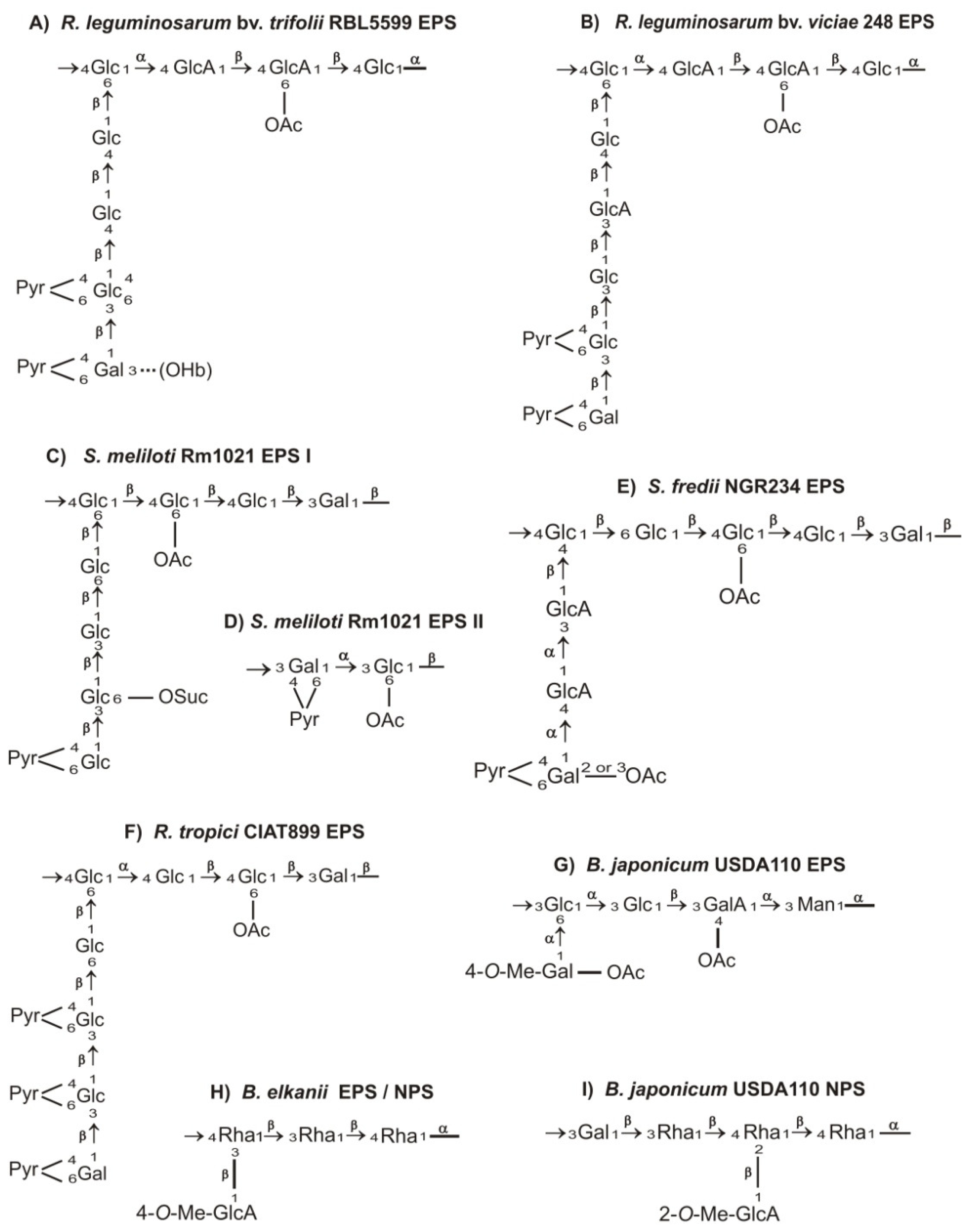
<p>In general, EPS synthesized by fast-growing rhizobia (e.g., <italic>S. meliloti</italic> and <italic>R. leguminosarum</italic>) are composed of octasaccharide repeating units, in which glucose is a dominant sugar component (<xref ref-type="fig" rid="f1-ijms-12-07898">Figure 1</xref>). <italic>R. leguminosarum</italic> strains belonging to different biovars (<italic>trifolii</italic>, <italic>viciae</italic> and <italic>phaseoli</italic>) and establishing symbiosis with different plant hosts (e.g., <italic>Trifolium</italic>, <italic>Pisum</italic>, <italic>Vicia</italic> and <italic>Phaseolus</italic> spp.), produce EPS which have a similar basic structure but may vary in their patterns of non-carbohydrate modification. <italic>R. leguminosarum</italic> EPS consists of repeating units that contain <sc>d</sc>-glucose, <sc>d</sc>-glucuronic acid and <sc>d</sc>-galactose in a molar ratio 5:2:1, joined by β-1,3 and β-1,4 glycosidic bonds, and modified by acetyl, pyruvyl and 3-hydroxybutanoyl groups (<xref ref-type="fig" rid="f1-ijms-12-07898">Figure 1A</xref>) [<xref ref-type="bibr" rid="b21-ijms-12-07898">21</xref>–<xref ref-type="bibr" rid="b25-ijms-12-07898">25</xref>]. Hovewer, <italic>R. leguminosarum</italic> bv. <italic>viciae</italic> strain 248 produces EPS whose repeating units have an extra glucuronic acid residue and absence of 3-hydroxybutanoyl group (<xref ref-type="fig" rid="f1-ijms-12-07898">Figure 1B</xref>) [<xref ref-type="bibr" rid="b26-ijms-12-07898">26</xref>].</p>
<p><italic>S. meliloti</italic>, which induces nodule formation on alfalfa (<italic>Medicago sativa</italic>) plants produces two structurally distinct EPS, succinoglycan (EPS I) and synthesized under phosphate starvation galactoglucan (EPS II) [<xref ref-type="bibr" rid="b27-ijms-12-07898">27</xref>–<xref ref-type="bibr" rid="b29-ijms-12-07898">29</xref>]. EPS I is composed of repeating units containing seven residues of <sc>d</sc>-glucose and one residue of <sc>d</sc>-galactose joined by β-1,3, β-1,4 and β-1,6 glycosidic linkages, and substituted with acetyl, pyruvyl and succinyl groups (<xref ref-type="fig" rid="f1-ijms-12-07898">Figure 1C</xref>) [<xref ref-type="bibr" rid="b28-ijms-12-07898">28</xref>–<xref ref-type="bibr" rid="b30-ijms-12-07898">30</xref>]. EPS II consists of disaccharide repeating units containing <sc>d</sc>-glucose and <sc>d</sc>-galactose in a molar ratio 1:1 linked by α-1,3 and β-1,3 bonds. Most of the glucosyl residues are 6-<italic>O</italic>-acetylated and all the galactosyl residues are substituted with 4,6-<italic>O</italic>-pyruvyl groups (<xref ref-type="fig" rid="f1-ijms-12-07898">Figure 1D</xref>) [<xref ref-type="bibr" rid="b29-ijms-12-07898">29</xref>,<xref ref-type="bibr" rid="b31-ijms-12-07898">31</xref>].</p>
<p><italic>Sinorhizobium fredii</italic> NGR234, which has a very wide host range (it nodulates over 112 host plants), produces EPS whose repeating units contain <sc>d</sc>-galactose, <sc>d</sc>-glucuronic acid and <sc>d</sc>-glucose in a molar ratio 2:2:4, with acetyl and pyruvyl modifications (<xref ref-type="fig" rid="f1-ijms-12-07898">Figure 1E</xref>) [<xref ref-type="bibr" rid="b32-ijms-12-07898">32</xref>].</p>
<p>EPS synthesized by <italic>Rhizobium tropici</italic> is composed of octasaccharide units containing <sc>d</sc>-glucose and <sc>d</sc>-galactose in a molar ratio 6:2, and modified by pyruvyl and acetyl residues (<xref ref-type="fig" rid="f1-ijms-12-07898">Figure 1F</xref>) [<xref ref-type="bibr" rid="b33-ijms-12-07898">33</xref>].</p>
<p>In contrast to EPS of fast-growing rhizobia, the structures of EPS synthesized by slow-growing bradyrhizobia demonstrate an even higher diversity. For example, <italic>Bradyrhizobium japonicum</italic> EPS is composed of pentasaccharide subunits containing <sc>d</sc>-mannose, <sc>d</sc>-galacturonic acid, <sc>d</sc>-glucose and <sc>d</sc>-galactose in a molar ratio 1:1:2:1 (<xref ref-type="fig" rid="f1-ijms-12-07898">Figure 1G</xref>) [<xref ref-type="bibr" rid="b34-ijms-12-07898">34</xref>,<xref ref-type="bibr" rid="b35-ijms-12-07898">35</xref>], whereas the tetrasaccharide subunits of <italic>Bradyrhizobium elkani</italic> EPS contain only two sugars, L-rhamnose and 4-<italic>O</italic>-methyl-<sc>d</sc>-glucuronic acid (molar ratio 3:1) (<xref ref-type="fig" rid="f1-ijms-12-07898">Figure 1H</xref>) [<xref ref-type="bibr" rid="b36-ijms-12-07898">36</xref>]. <italic>B. japonicum</italic> also synthesizes a nodule-specific polysaccharide, termed NPS, which differs from the EPS produced by these bacteria in the free-living stage (<xref ref-type="fig" rid="f1-ijms-12-07898">Figure 1I</xref>) [<xref ref-type="bibr" rid="b36-ijms-12-07898">36</xref>–<xref ref-type="bibr" rid="b38-ijms-12-07898">38</xref>]. In contrast to <italic>B. japonicum</italic> NPS, NPS synthesized by <italic>B. elkani</italic> has a structure identical to its EPS.</p>
<p><italic>Azorhizobium caulinodans</italic>, the microsymbiont of the tropical legume <italic>Sesbania rostrata</italic>, produces EPS of the same structure both in culture and inside nodules. It is a linear homopolysaccharide of α-1,3-linked 4,6-<italic>O</italic>-pyruvyl-<sc>d</sc>-galactosyl residues [<xref ref-type="bibr" rid="b39-ijms-12-07898">39</xref>].</p></sec>
<sec>
<title>3. Genetic Control of EPS Synthesis in Rhizobia</title>
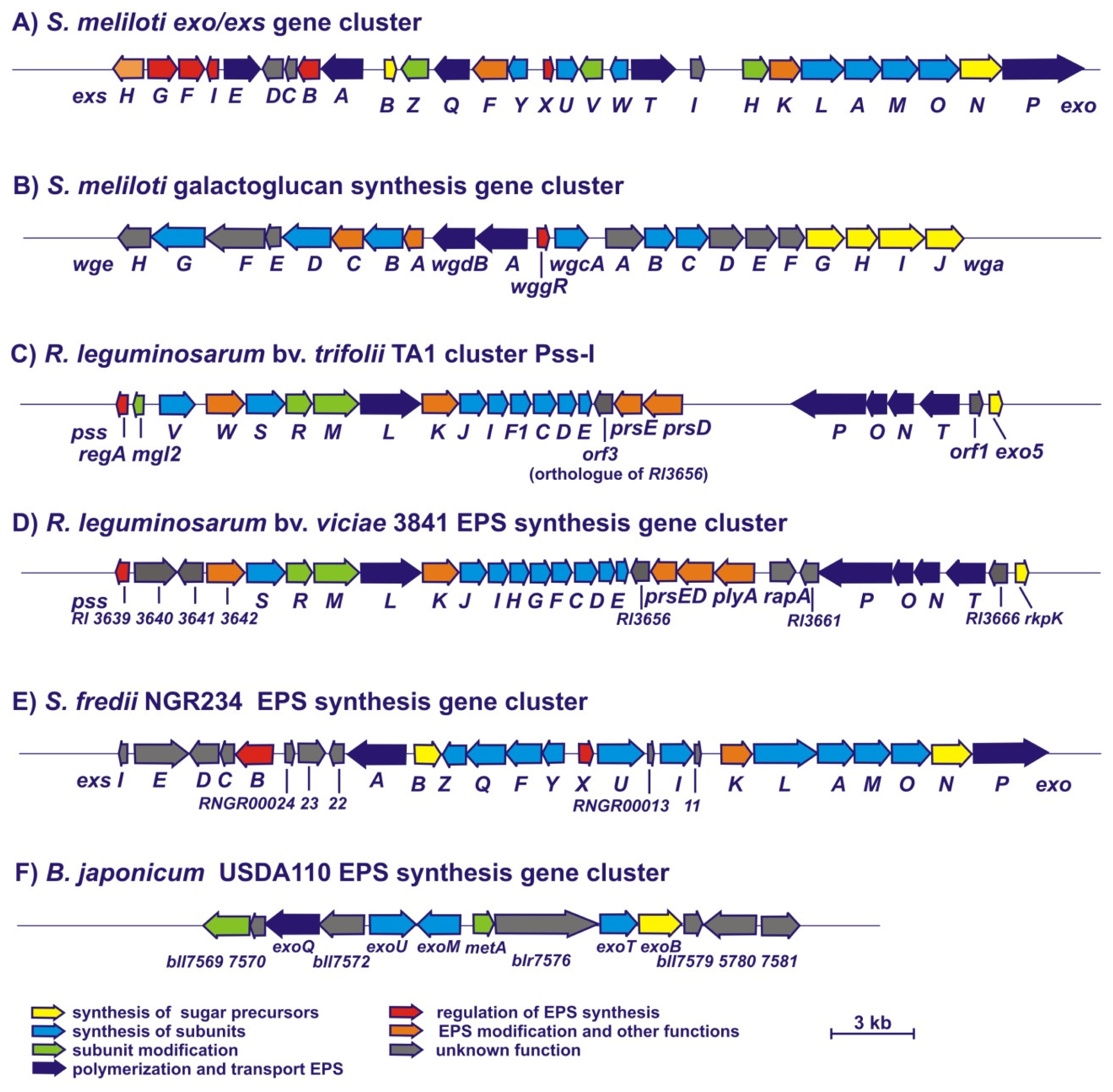
<p>Similarly to other bacteria, the synthesis of EPS in rhizobia is a multi-step process requiring the coordinated activity of many enzymatic proteins. Genes engaged in this process are usually grouped in large clusters and located on rhizobial chromosomes or megaplasmids (<xref ref-type="fig" rid="f2-ijms-12-07898">Figure 2</xref>) [<xref ref-type="bibr" rid="b40-ijms-12-07898">40</xref>–<xref ref-type="bibr" rid="b47-ijms-12-07898">47</xref>]. Among these are genes encoding enzymes indispensable for the synthesis of nucleotide sugar precursors, enzymes engaged in unit assembly and modification, and proteins responsible for polymerization of repeating units and transport of EPS outside bacteria [<xref ref-type="bibr" rid="b3-ijms-12-07898">3</xref>].</p>
<p>EPS synthesis is carried out by a multi-protein complex located in both inner (IM) and outer (OM) membranes. Undecaprenol phosphate, anchored in the inner leaflet of the IM, is a sugar acceptor for the synthesis of EPS and other bacterial heteropolysaccharides. Nucleotide diphospho-sugars serving as precursors are sequentially bonded to the acceptor by specific glycosyl transferases, resulting in growing polysaccharide subunits. Then, the subunits are flipped across the IM to the periplasmic space by the action of a Wzx-like translocase [<xref ref-type="bibr" rid="b48-ijms-12-07898">48</xref>,<xref ref-type="bibr" rid="b49-ijms-12-07898">49</xref>]. Polymerization of repeating units is most probably coupled with export of the growing chain of the polymer to the bacterial surface. This process involves the activity of a Wzy-like polymerase and a Wzc-like inner membrane-periplasmic auxiliary protein [<xref ref-type="bibr" rid="b48-ijms-12-07898">48</xref>,<xref ref-type="bibr" rid="b50-ijms-12-07898">50</xref>].</p>
<sec>
<title>3.1. Genes Involved in the Synthesis of <italic>S. meliloti</italic> EPS I and EPS II</title>
<p>Up to now, the biosynthesis of rhizobial EPS and regulation of this process has been best studied for succinoglycan (EPS I) of <italic>S. meliloti</italic>. The data concerning the synthesis of EPS in other rhizobial species are much more fragmentary. In <italic>S. meliloti</italic>, the genes involved in the synthesis of EPS I form a large <italic>exo</italic>/<italic>exs</italic> cluster (~35 kb) located on the pSymB megaplasmid (<xref ref-type="fig" rid="f2-ijms-12-07898">Figure 2A</xref>) [<xref ref-type="bibr" rid="b30-ijms-12-07898">30</xref>,<xref ref-type="bibr" rid="b40-ijms-12-07898">40</xref>,<xref ref-type="bibr" rid="b51-ijms-12-07898">51</xref>–<xref ref-type="bibr" rid="b56-ijms-12-07898">56</xref>]. In this region, 28 <italic>exo</italic>/<italic>exs</italic> genes organized in several operons have been identified, among them the genes encoding enzymes for the synthesis of nucleotide sugar precursors (<italic>exoB</italic> and <italic>exoN</italic>), enzymes involved in unit assembly (<italic>exoY</italic>, <italic>exoF</italic>, <italic>exoA</italic>, <italic>exoL</italic>, <italic>exoM</italic>, <italic>exoO</italic>, <italic>exoU</italic> and <italic>exoW</italic>) and modification (<italic>exoZ</italic>, <italic>exoH</italic> and <italic>exoV</italic>), and proteins responsible for polymerization of repeating units and transport of EPS I (<italic>exoP</italic>, <italic>exoT</italic>, <italic>exoQ</italic> and <italic>exsA</italic>) [<xref ref-type="bibr" rid="b51-ijms-12-07898">51</xref>–<xref ref-type="bibr" rid="b59-ijms-12-07898">59</xref>]. Moreover, other genes essential for sugar precursor synthesis (<italic>exoC</italic>) and regulation of EPS I production (<italic>exoD</italic>, <italic>exoR</italic>, <italic>exoS</italic> and <italic>mucR</italic>) are not linked with this region, but dispersed throughout the chromosome of <italic>S. meliloti</italic> [<xref ref-type="bibr" rid="b60-ijms-12-07898">60</xref>–<xref ref-type="bibr" rid="b64-ijms-12-07898">64</xref>]. Proteins encoded by the <italic>exoC</italic>, <italic>exoN</italic> and <italic>exoB</italic> genes are engaged in the synthesis of nucleotide sugar precursors (UDP-glucose and UDP-galactose). ExoC phosphoglucomutase converts glucose-6-phosphate into glucose-1-phosphate [<xref ref-type="bibr" rid="b64-ijms-12-07898">64</xref>]. ExoN possesses a UDP-glucose pyrophosphorylase activity and synthesizes UDP-glucose from glucose-1-phosphate [<xref ref-type="bibr" rid="b52-ijms-12-07898">52</xref>,<xref ref-type="bibr" rid="b54-ijms-12-07898">54</xref>]. ExoB is a UDP-glucose 4-epimerase which synthesizes UDP-galactose from UDP-glucose [<xref ref-type="bibr" rid="b65-ijms-12-07898">65</xref>]. A mutation in <italic>exoN</italic> only results in the production of diminished amounts of EPS I, whereas mutations in both <italic>exoC</italic> and <italic>exoB</italic> genes abolish the synthesis of this polymer and affect the production of other polysaccharides, such as EPS II and LPS, which contain galactose [<xref ref-type="bibr" rid="b52-ijms-12-07898">52</xref>,<xref ref-type="bibr" rid="b54-ijms-12-07898">54</xref>].</p>
<p>The assembly of octasaccharide repeating units of EPS I is initiated by the addition of UDP-galactose to the lipid carrier located in the IM. This step engages two proteins, galactosyl-IP-transferase encoded by <italic>exoY</italic> and auxiliary ExoF protein [<xref ref-type="bibr" rid="b56-ijms-12-07898">56</xref>,<xref ref-type="bibr" rid="b62-ijms-12-07898">62</xref>]. The next steps of subunit synthesis are carried out by six glucosyltransferases encoded by <italic>exoALMOUW</italic> genes which add sequential residues of glucose to the growing chain of the subunit [<xref ref-type="bibr" rid="b30-ijms-12-07898">30</xref>,<xref ref-type="bibr" rid="b52-ijms-12-07898">52</xref>,<xref ref-type="bibr" rid="b54-ijms-12-07898">54</xref>,<xref ref-type="bibr" rid="b55-ijms-12-07898">55</xref>]. However, the gene encoding the enzyme responsible for the addition of the last glucose to the subunit has not yet been identified. A mutation in the <italic>exoY</italic> gene resulted in a very strong symbiotic effect; a strain carrying this mutation was totally defective in the production of EPS I and formation of infection threads and, consequently, in nitrogen fixation [<xref ref-type="bibr" rid="b52-ijms-12-07898">52</xref>,<xref ref-type="bibr" rid="b56-ijms-12-07898">56</xref>]. Also, mutants in the <italic>exoA</italic>, <italic>exoL</italic> and <italic>exoM</italic> genes produced no detectable amounts of EPS I and formed nodules inefficient in nitrogen-fixation [<xref ref-type="bibr" rid="b11-ijms-12-07898">11</xref>,<xref ref-type="bibr" rid="b54-ijms-12-07898">54</xref>].</p>
<p>The protein products of three <italic>exo</italic> genes, <italic>exoZ</italic>, <italic>exoH</italic> and <italic>exoV</italic>, are needed for the addition of non-sugar modifications to the subunits; ExoZ is involved in the addition of acetyl, ExoH provides succinyl, and ExoV pyruvyl groups (<xref ref-type="fig" rid="f2-ijms-12-07898">Figure 2A</xref>) [<xref ref-type="bibr" rid="b11-ijms-12-07898">11</xref>,<xref ref-type="bibr" rid="b30-ijms-12-07898">30</xref>,<xref ref-type="bibr" rid="b55-ijms-12-07898">55</xref>,<xref ref-type="bibr" rid="b65-ijms-12-07898">65</xref>]. An <italic>exoV</italic> mutant accumulates only monomer units, indicating that the presence of a pyruvyl substituent in the units is crucial for the polymerization and secretion of EPS I. On the other hand, succinyl groups seem to be significant for the formation of the LMW fraction of this polymer. The function of this type of modification is confirmed by the phenotype of the <italic>exoH</italic> mutant, which exclusively synthesizes HMW EPS I lacking succinyl groups and induces the formation of ineffective nodules without bacteria on alfalfa. The absence of acetyl groups in EPS I causes the weakest symbiotic effect among all types of non-sugar substituents, as an <italic>exoZ</italic> mutant forms nitrogen-fixing nodules on its host plant and exhibits only a slightly diminished efficiency in the formation of infection threads [<xref ref-type="bibr" rid="b11-ijms-12-07898">11</xref>,<xref ref-type="bibr" rid="b30-ijms-12-07898">30</xref>].</p>
<p>Polymerization and export of EPS I are carried out by proteins encoded by <italic>exoPQT</italic> genes (<xref ref-type="fig" rid="f2-ijms-12-07898">Figure 2A</xref>) [<xref ref-type="bibr" rid="b51-ijms-12-07898">51</xref>,<xref ref-type="bibr" rid="b54-ijms-12-07898">54</xref>,<xref ref-type="bibr" rid="b59-ijms-12-07898">59</xref>]. In particular, ExoP, an autophosphorylated tyrosine kinase has a crucial role in this process. A mutation of <italic>exoP</italic> blocks polymerization of repeating units. Recently, Jofre and Becker [<xref ref-type="bibr" rid="b59-ijms-12-07898">59</xref>] have established that the <italic>N</italic>-terminal domain of ExoP, located mainly in the periplasmic space, is essential for EPS I synthesis. A deletion of the <italic>C</italic>-terminal domain of this protein, displaying an ATPase activity, resulted only in a decreased production of EPS I, confirming rather a regulatory function of this domain [<xref ref-type="bibr" rid="b20-ijms-12-07898">20</xref>,<xref ref-type="bibr" rid="b51-ijms-12-07898">51</xref>,<xref ref-type="bibr" rid="b58-ijms-12-07898">58</xref>]. Two other proteins engaged in polymerization are ExoQ, responsible for the production of HMW EPS I, and ExoT, participating in the biosynthesis of its LMW form (trimers and tetramers of octasaccharide units).</p>
<p>Furthermore, ExsA protein belonging to ABC transporters is also important for the secretion of HMW EPS I [<xref ref-type="bibr" rid="b57-ijms-12-07898">57</xref>]. An LMW form of this heteropolymer, which is especially active in symbiosis, is also generated as a result of a cleavage of its HMW fraction by two distinct enzymes, ExoK (β-1,3-1,4-glucanase) and ExsH (succinoglycan depolymerase). Acetyl and succinyl modifications present in EPS I influence the susceptibility of this polysaccharide to cleavage by these glycanases [<xref ref-type="bibr" rid="b66-ijms-12-07898">66</xref>].</p>
<p>The synthesis of the second <italic>S. meliloti</italic> exopolysaccharide, named galactoglucan (EPS II), is directed by <italic>exp</italic> genes located in a 27-kb cluster on the pSymB plasmid, at a distance of 160 kb from the <italic>exo</italic>/<italic>exs</italic> genes (<xref ref-type="fig" rid="f2-ijms-12-07898">Figure 2B</xref>) [<xref ref-type="bibr" rid="b67-ijms-12-07898">67</xref>,<xref ref-type="bibr" rid="b68-ijms-12-07898">68</xref>]. This cluster contains 22 genes organized into five operons: <italic>wga</italic> (<italic>expA</italic>), <italic>wgcA</italic> (<italic>expC</italic>), <italic>wggR</italic> (<italic>expG</italic>), <italic>wgd</italic> (<italic>expD</italic>) and <italic>wge</italic> (<italic>expE</italic>) [<xref ref-type="bibr" rid="b69-ijms-12-07898">69</xref>]. Among them, four genes (<italic>wgaG</italic>, <italic>wgaH</italic>, <italic>wgaI</italic> and <italic>wgaJ</italic>) are involved in the synthesis of deoxythymidine diphospho-sugar precursors (dTDP-rhamnose and dTDP-glucose), and six genes encode potential glycosyltransferases: WgaB and WgeB β-glucosyltransferases and WgaC, WgcA, WgeD and WgeG galactosyltransferases. Other genes of this cluster are potentially engaged in the polymerization (<italic>wgdA</italic> and <italic>wgdB</italic>) and regulation of EPS II synthesis (<italic>wggR</italic>) [<xref ref-type="bibr" rid="b67-ijms-12-07898">67</xref>–<xref ref-type="bibr" rid="b69-ijms-12-07898">69</xref>].</p></sec>
<sec>
<title>3.2. Genes Involved in the Synthesis of EPS in <italic>R. leguminosarum</italic></title>
<p>In contrast to the well-studied model of the synthesis of <italic>S. meliloti</italic> EPS I, the data concerning EPS biosynthesis in <italic>R. leguminosarum</italic> are much more scarce. Genes involved in the synthesis of nucleotide sugar precursors as well as genes engaged in the synthesis and export of EPS are located on the chromosome of <italic>R. leguminosarum</italic>, and the majority of them are grouped in a large cluster termed Pss-I (<xref ref-type="fig" rid="f2-ijms-12-07898">Figure 2C</xref>) [<xref ref-type="bibr" rid="b42-ijms-12-07898">42</xref>].</p>
<p>So far, two genes, <italic>exoB</italic> and <italic>exo5</italic>, responsible for the synthesis of sugar precursors have been characterized in <italic>R. leguminosarum. exoB</italic> encodes a UDP-glucose 4-epimerase indispensable for the synthesis of UDP-galactose, which is a donor of this sugar in the synthesis of EPS and other polysaccharides containing galactose [<xref ref-type="bibr" rid="b70-ijms-12-07898">70</xref>,<xref ref-type="bibr" rid="b71-ijms-12-07898">71</xref>]. An <italic>exoB</italic> mutant produces EPS lacking terminal galactoses in the repeating units and is almost completely unable to invade host plant roots, inducing the formation of abnormal nodules. The <italic>exo5</italic> gene, located in the cluster Pss-I, codes for a UDP-glucose dehydrogenase which is responsible for the conversion of UDP-glucose to UDP-glucuronic acid (<xref ref-type="fig" rid="f2-ijms-12-07898">Figure 2C</xref>). An <italic>exo5</italic> mutant displays pleiotropic effects, including changes in the bacterial cell envelope and defectiveness in symbiosis [<xref ref-type="bibr" rid="b72-ijms-12-07898">72</xref>]. This mutant is able to synthesize neither UDP-glucuronic nor UDP-galacturonic acids and, as a consequence, does not produce EPS and CPS, and its LPS lacks galacturonic acid [<xref ref-type="bibr" rid="b72-ijms-12-07898">72</xref>,<xref ref-type="bibr" rid="b73-ijms-12-07898">73</xref>].</p>
<p>The <italic>pssA</italic> gene encoding a protein participating in the first step of the synthesis of the octasaccharide subunit represents a single open reading frame and is located at a long distance from other <italic>pss</italic> genes. This gene encodes an integral membrane-bound protein of glucosyl-IP-transferase activity, which transfers glucose-1-phosphate from UDP-glucose to the lipid carrier [<xref ref-type="bibr" rid="b74-ijms-12-07898">74</xref>,<xref ref-type="bibr" rid="b75-ijms-12-07898">75</xref>]. <italic>pssA</italic> is a very conserved gene present in all <italic>R. leguminosarum</italic> biovars [<xref ref-type="bibr" rid="b12-ijms-12-07898">12</xref>,<xref ref-type="bibr" rid="b74-ijms-12-07898">74</xref>,<xref ref-type="bibr" rid="b76-ijms-12-07898">76</xref>,<xref ref-type="bibr" rid="b77-ijms-12-07898">77</xref>] and also in other closely related species, such as <italic>Rhizobium etli</italic> and <italic>Rhizobium gallicum</italic> [<xref ref-type="bibr" rid="b78-ijms-12-07898">78</xref>]. Mutations in <italic>pssA</italic> totally abolish EPS production and result in the induction of empty (devoid of bacteria) non-nitrogen-fixing nodules on roots of host plants which form indeterminate-type nodules (clover, pea and vetch) [<xref ref-type="bibr" rid="b10-ijms-12-07898">10</xref>,<xref ref-type="bibr" rid="b12-ijms-12-07898">12</xref>,<xref ref-type="bibr" rid="b79-ijms-12-07898">79</xref>]. The transcription of <italic>pssA ex planta</italic> is at a very low level, suggesting that the expression of this key gene for EPS synthesis is under very stringent regulation [<xref ref-type="bibr" rid="b80-ijms-12-07898">80</xref>]. Also inside nodules, <italic>pssA</italic> expression was at a very low, almost undetectable level [<xref ref-type="bibr" rid="b81-ijms-12-07898">81</xref>–<xref ref-type="bibr" rid="b83-ijms-12-07898">83</xref>].</p>
<p>The subsequent steps of the assembly of the repeating unit engage proteins encoded by <italic>pss</italic> genes located in the cluster Pss-I (<xref ref-type="fig" rid="f2-ijms-12-07898">Figure 2C</xref>). This 35-kb long region, encompassing more than 20 genes, is highly conserved among all the so far sequenced genomes of <italic>R. leguminosarum</italic> strains [<xref ref-type="bibr" rid="b41-ijms-12-07898">41</xref>–<xref ref-type="bibr" rid="b45-ijms-12-07898">45</xref>,<xref ref-type="bibr" rid="b84-ijms-12-07898">84</xref>] and the closely related <italic>R. etli</italic> [<xref ref-type="bibr" rid="b43-ijms-12-07898">43</xref>]. The addition of a second sugar residue to the subunit is catalyzed by a glucuronosyl-β-1,4-glucosyltransferase encoded by two genes of this region, <italic>pssD</italic> and <italic>pssE</italic> [<xref ref-type="bibr" rid="b12-ijms-12-07898">12</xref>,<xref ref-type="bibr" rid="b75-ijms-12-07898">75</xref>]. A <italic>pssD</italic> mutant demonstrates a very similar phenotype to the <italic>pssA</italic> mutant; it does not produce EPS and elicits non-nitrogen-fixing nodules on host plants, which contain almost no bacteria. Mutations in the <italic>pssDE</italic> and even more pronouncedly, in the <italic>pssA</italic> gene, exhibit also other effects, including differences in the levels of the synthesis of several proteins [<xref ref-type="bibr" rid="b77-ijms-12-07898">77</xref>,<xref ref-type="bibr" rid="b85-ijms-12-07898">85</xref>] and LPS profiles in comparison to the parental strain [<xref ref-type="bibr" rid="b86-ijms-12-07898">86</xref>,<xref ref-type="bibr" rid="b87-ijms-12-07898">87</xref>].</p>
<p>The third step of repeating unit synthesis is carried out by a glucuronosyl-β-1,4-glucuronosyltransferase encoded by <italic>pssC</italic> [<xref ref-type="bibr" rid="b12-ijms-12-07898">12</xref>,<xref ref-type="bibr" rid="b75-ijms-12-07898">75</xref>,<xref ref-type="bibr" rid="b84-ijms-12-07898">84</xref>]. A mutation in this gene results in more than a 2-fold decrease of EPS production and induction of nitrogen-fixing nodules on clover [<xref ref-type="bibr" rid="b12-ijms-12-07898">12</xref>], whereas failed nodulation on vetch [<xref ref-type="bibr" rid="b84-ijms-12-07898">84</xref>].</p>
<p>So far, enzymes participating in the next steps of the synthesis of the EPS subunit have not been characterized, although it is very probable that some of the <italic>pss</italic> genes located in the Pss-I cluster, which encode putative glycosyltransferases (e.g., <italic>pssF</italic>, <italic>pssG</italic>, <italic>pssH</italic>, <italic>pssI</italic>, <italic>pssJ</italic> and <italic>pssS</italic>) might be engaged in this process (<xref ref-type="fig" rid="f2-ijms-12-07898">Figure 2C,D</xref>) [<xref ref-type="bibr" rid="b42-ijms-12-07898">42</xref>,<xref ref-type="bibr" rid="b84-ijms-12-07898">84</xref>]. Other <italic>pss</italic> genes present in this cluster, such as <italic>pssR</italic>, encoding a putative acetyltransfease, and <italic>pssM</italic>, encoding a ketal pyruvate transferase, are most probably involved in the addition of non-sugar substituents to EPS subunits. Recently, the role of the <italic>pssM</italic> gene in EPS modification and the symbiosis of <italic>R. leguminosarum</italic> with pea plants has been confirmed [<xref ref-type="bibr" rid="b88-ijms-12-07898">88</xref>]. A mutation of this gene led to the absence of pyruvyl groups at the sub-terminal glucose in repeating units. As a result of this change in the composition of EPS, the bacteria elicited non-nitrogen-fixing nodules on the host plant. Nodules induced by the <italic>pssM</italic> mutant showed normal nodule invasion and release of bacteria into plant cells, but their differentiation into bacteroids was impaired [<xref ref-type="bibr" rid="b88-ijms-12-07898">88</xref>]. These findings confirm that this type of modification of EPS in <italic>R. leguminosarum</italic> is crucial for its biological function in the establishment of an effective symbiosis.</p>
<p>Furthermore, in <italic>R. leguminosarum</italic> bv. <italic>viciae</italic>, the <italic>exo-344</italic> gene encoding glycosyltransferase responsible for the addition of the galactose residue was identified, which could be engaged in the last step of the assembly of the subunit [<xref ref-type="bibr" rid="b23-ijms-12-07898">23</xref>]. An <italic>exo-344</italic> mutant demonstrates a phenotype very similar to the <italic>exoB</italic> mutant, as it produces only monomer units lacking the terminal galactose.</p>
<p>Polymerization and the export of EPS outside bacteria are carried out by a secretion system consisting of at least three proteins encoded by the <italic>pssT</italic>, <italic>pssN</italic> and <italic>pssP</italic> genes of the <italic>pssTNOP</italic> operon (<xref ref-type="fig" rid="f2-ijms-12-07898">Figure 2C</xref>) [<xref ref-type="bibr" rid="b42-ijms-12-07898">42</xref>]. The PssP protein, displaying a significant identity to <italic>S. meliloti</italic> ExoP and other membrane-periplasmic auxiliary proteins involved in the synthesis of HMW EPS I and CPS, is the major component of this system [<xref ref-type="bibr" rid="b89-ijms-12-07898">89</xref>]. Similarly to the phenotype of the <italic>S. meliloti exoP</italic> mutant, the deletion of <italic>pssP</italic> totally abolishes EPS production in <italic>R. leguminosarum</italic>. PssT is an integral inner membrane protein similar to Wzy-like proteins, and a mutation in this gene results in overproduction of EPS [<xref ref-type="bibr" rid="b90-ijms-12-07898">90</xref>]. A third component of this secretion system, the PssN lipoprotein, is an outer membrane-associated protein directed to the periplasmic space by its <italic>N</italic>-terminal signal sequence [<xref ref-type="bibr" rid="b91-ijms-12-07898">91</xref>]. Additionally, the PssL protein, which displays a significant similarity to Wzx-type flippases participating in the translocation of the O-antigen from the inner to the outer leaflet of the IM, might also be a component of this complex [<xref ref-type="bibr" rid="b92-ijms-12-07898">92</xref>].</p>
<p><italic>pssO</italic>, another gene of the <italic>pssTNOP</italic> operon, encodes a protein uniquely found in <italic>R. leguminosarum</italic> and <italic>R. etli</italic> species, which is secreted outside of bacteria and remains attached to cells [<xref ref-type="bibr" rid="b93-ijms-12-07898">93</xref>]. A <italic>pssO</italic> mutant does not produce EPS and elicits nodules inefficient at fixing nitrogen on clover plants, indicating that this protein is important for the synthesis and/or transport of EPS, although its function in this process has not been established precisely.</p>
<p>Apart from the <italic>pss</italic> genes mentioned above, other genes essential for EPS synthesis but not directly engaged in this process are also present in the Pss-I cluster. These include the <italic>plyA</italic> and <italic>prsDE</italic> genes located close to <italic>pssCDE</italic> (<xref ref-type="fig" rid="f2-ijms-12-07898">Figure 2C,D</xref>) [<xref ref-type="bibr" rid="b42-ijms-12-07898">42</xref>]. The <italic>prsDE</italic> genes encode components of the type I protein secretion system, which is conserved in all <italic>R. leguminosarum</italic> biovars, as well as in <italic>R. etli</italic>, <italic>S. meliloti</italic> and <italic>Agrobacterium tumefaciens</italic> [<xref ref-type="bibr" rid="b4-ijms-12-07898">4</xref>]. This secretion system exhibits an atypical broad substrate specificity, exporting at least 13 substrates, among them glycanases (PlyA, PlyB and PlyC), rhizobial adhesion proteins (RapA2, RapB and RapC), and the nodulation protein NodO [<xref ref-type="bibr" rid="b94-ijms-12-07898">94</xref>–<xref ref-type="bibr" rid="b97-ijms-12-07898">97</xref>]. Glycosyl hydrolases PlyA and PlyB cleave EPS, affecting its processing [<xref ref-type="bibr" rid="b97-ijms-12-07898">97</xref>,<xref ref-type="bibr" rid="b98-ijms-12-07898">98</xref>]. A <italic>prsD</italic> mutant produces EPS of a higher degree of polymerization than the wild-type strain and elicits a higher number of nodules incapable of fixing nitrogen [<xref ref-type="bibr" rid="b94-ijms-12-07898">94</xref>].</p></sec>
<sec>
<title>3.3. Genes Involved in the Synthesis of EPS in Other Rhizobia</title>
<p>In the <italic>S. fredii</italic> NGR234 genome, a 28-kb region comprising <italic>exo</italic> genes organized in four operons has been identified (<xref ref-type="fig" rid="f2-ijms-12-07898">Figure 2E</xref>) [<xref ref-type="bibr" rid="b99-ijms-12-07898">99</xref>,<xref ref-type="bibr" rid="b100-ijms-12-07898">100</xref>]. These genes are highly homologous to the <italic>exoA, exoB</italic>, <italic>exoY</italic>, <italic>exoL</italic>, <italic>exoM</italic>, <italic>exoN</italic> and <italic>exoP</italic> genes of <italic>S. meliloti</italic>. Large parts of <italic>exo</italic> clusters of <italic>S. fredii</italic> NGR234 and <italic>S. meliloti</italic> species are closely related (especially their <italic>exoX-exoY</italic> regions are almost identical). Additionally, the <italic>exoG</italic> gene, not linked with this <italic>exo</italic> region, has been identified in the <italic>S. fredii</italic> NGR234 genome [<xref ref-type="bibr" rid="b101-ijms-12-07898">101</xref>]. The presence of similar <italic>exo</italic> genes in <italic>S. fredii</italic> NGR234 and <italic>S. meliloti</italic> might be explained by the fact that both of these rhizobial species produce EPS of very similar structures (<xref ref-type="fig" rid="f1-ijms-12-07898">Figure 1C,E</xref>). However, some differences in the genetic organization of these <italic>exo</italic> clusters have been observed [<xref ref-type="bibr" rid="b102-ijms-12-07898">102</xref>,<xref ref-type="bibr" rid="b103-ijms-12-07898">103</xref>]. For example, a non-functional homologue of <italic>S. meliloti exoH</italic>, which is responsible for succinylation of EPS by this bacterium, changed its location from the <italic>exo</italic> cluster in plasmid pNGR234b to <italic>S. fredii</italic> genome [<xref ref-type="bibr" rid="b103-ijms-12-07898">103</xref>]. These data explain why, in contrast to <italic>S. meliloti</italic> EPS, EPS of <italic>S. fredii</italic> NGR234 is not succinylated.</p>
<p>A region involved in EPS biosynthesis has also been identified in the genome of <italic>B. japonicum</italic> (<xref ref-type="fig" rid="f2-ijms-12-07898">Figure 2F</xref>) [<xref ref-type="bibr" rid="b47-ijms-12-07898">47</xref>,<xref ref-type="bibr" rid="b104-ijms-12-07898">104</xref>]. This cluster contains several genes organized into at least four different operons, among them a gene homologous to <italic>S. meliloti exoB</italic>, which encodes a UDP-galactose 4′-epimerase. Protein products of other genes are homologous to UDP-hexose transferases and <italic>S. meliloti</italic> ExoP involved in EPS I chain-length determination. A deletion mutant, which does not contain the DNA fragment encoding the <italic>C</italic>-terminal part of ExoP, the ExoT transferase and the <italic>N</italic>-terminal part of ExoB, synthesizes only the LMW fraction of EPS lacking galactose, nodulates the host plant with a delay and induces symptoms of plant defense reactions [<xref ref-type="bibr" rid="b104-ijms-12-07898">104</xref>].</p>
<p>To date, little is known about EPS synthesis in the <italic>Mesorhizobium</italic> genus, encompassing moderately-growing rhizobia. Recently, a cluster involved in the biosynthesis of this polymer has been found in the <italic>M. tianshanense</italic> genome [<xref ref-type="bibr" rid="b105-ijms-12-07898">105</xref>]. In this region, the <italic>mtpE</italic> and <italic>mtpABCD</italic> genes were identified, which demonstrate a significant homology to the <italic>R. leguminosarum exo5</italic> and <italic>pssNOPT</italic> genes, respectively. EPS production is completely abolished in both <italic>mtpABCD</italic> and <italic>mtpE</italic> mutants. These mutants also form significantly less biofilm on glass surfaces and are defective in nodulation of their host plant, Asian licorice (<italic>Glycyrrhiza uralensis</italic>) [<xref ref-type="bibr" rid="b105-ijms-12-07898">105</xref>].</p></sec></sec>
<sec>
<title>4. Regulation of EPS Biosynthesis</title>
<p>In rhizobia, the process of EPS synthesis is very complex and is regulated at both transcriptional and post-transcriptional levels, with multiple regulatory systems, which up to now have been best studied in two species, <italic>S. meliloti</italic> and <italic>R. leguminosarum</italic>. Adaptation of EPS synthesis to various environmental conditions requires a complex regulatory network involving cross talk between the different regulatory components. Several environmental factors and stress conditions, such as media osmolarity, ammonium and phosphate availability and flavonoids influence EPS biosynthesis [<xref ref-type="bibr" rid="b106-ijms-12-07898">106</xref>–<xref ref-type="bibr" rid="b108-ijms-12-07898">108</xref>]. Also, other culture conditions, such as the type of carbon source and culture age can modify the amount and composition of EPS produced [<xref ref-type="bibr" rid="b109-ijms-12-07898">109</xref>–<xref ref-type="bibr" rid="b111-ijms-12-07898">111</xref>].</p>
<sec>
<title>4.1. Regulation of EPS Synthesis in <italic>S. meliloti</italic></title>
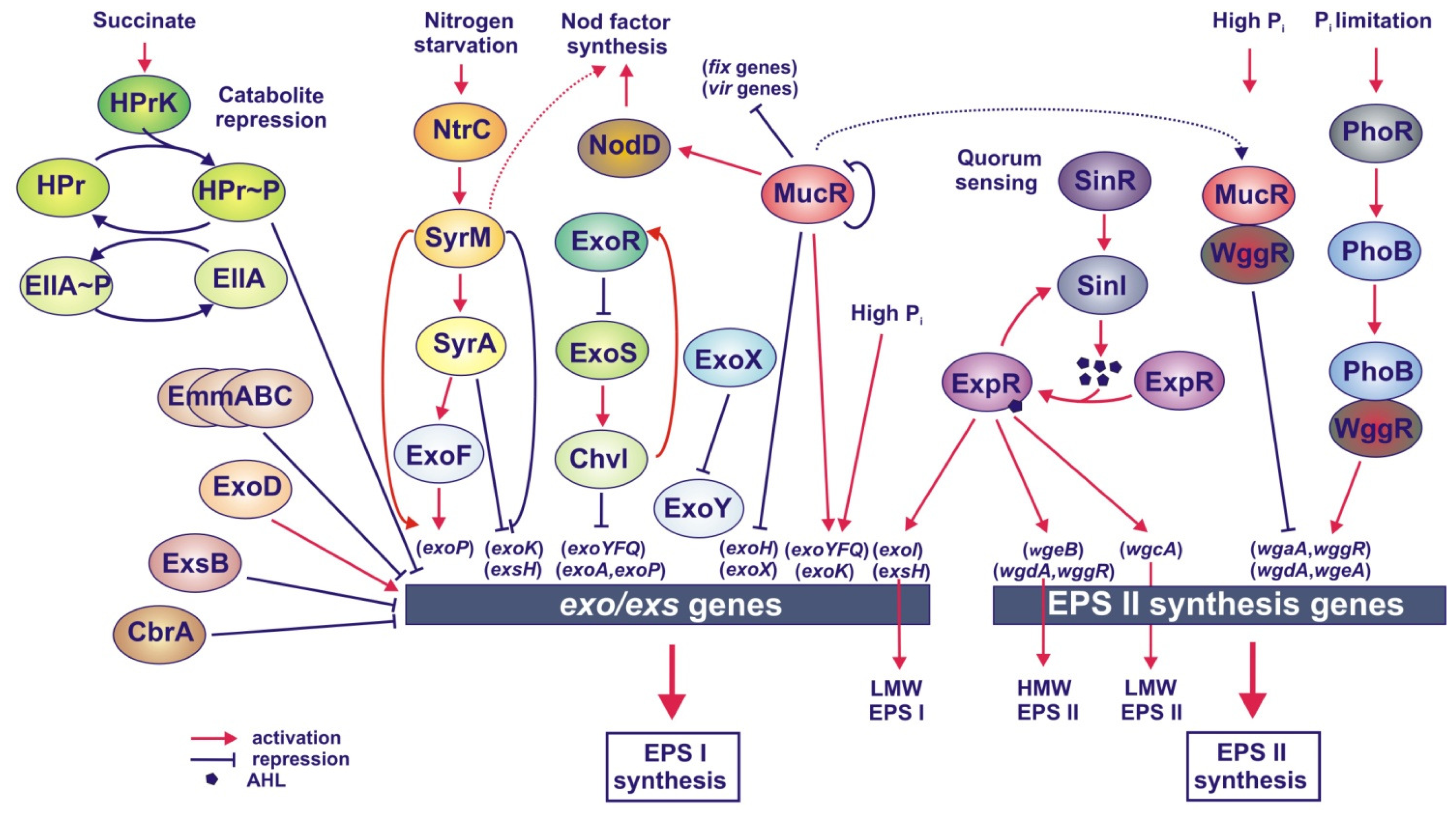
<p>In <italic>S. meliloti</italic>, several regulatory genes of EPS I and EPS II synthesis have been identified either on the chromosome (<italic>mucR</italic>, <italic>exoR</italic>, <italic>exoS</italic>, <italic>exoD, expR</italic>, <italic>syrM</italic> and <italic>phoB</italic>) or on the megaplasmid pSymB (<italic>exsB</italic>, <italic>exoX</italic> and <italic>wggR</italic>). The majority of the proteins encoded by these genes have been described as repressors (<xref ref-type="fig" rid="f3-ijms-12-07898">Figure 3</xref>). These include the <italic>exoR</italic>, <italic>exoS</italic>, <italic>exoX</italic> and <italic>exsB</italic> genes, which negatively affect EPS I synthesis, and the <italic>mucR</italic>, which negatively regulates EPS II synthesis [<xref ref-type="bibr" rid="b57-ijms-12-07898">57</xref>,<xref ref-type="bibr" rid="b60-ijms-12-07898">60</xref>,<xref ref-type="bibr" rid="b62-ijms-12-07898">62</xref>,<xref ref-type="bibr" rid="b107-ijms-12-07898">107</xref>,<xref ref-type="bibr" rid="b112-ijms-12-07898">112</xref>]. On the other hand, the SyrM and PhoB proteins are positive regulators of EPS I and EPS II production, respectively [<xref ref-type="bibr" rid="b69-ijms-12-07898">69</xref>,<xref ref-type="bibr" rid="b113-ijms-12-07898">113</xref>]. Among the identified regulators, MucR seems to be a global regulatory protein playing a key role in both positive regulation of EPS I synthesis and negative regulation of EPS II synthesis, thus coupling these two biosynthetic pathways [<xref ref-type="bibr" rid="b113-ijms-12-07898">113</xref>–<xref ref-type="bibr" rid="b116-ijms-12-07898">116</xref>].</p>
<p>The production of <italic>S. meliloti</italic> EPS is affected by several nutritional and stress conditions. Limitations of some non-carbon nutrients, like nitrogen and sulfur, very high phosphate concentrations, and hyperosmotic stress stimulate the synthesis of EPS I [<xref ref-type="bibr" rid="b61-ijms-12-07898">61</xref>,<xref ref-type="bibr" rid="b107-ijms-12-07898">107</xref>]. On the other hand, phosphate starvation stimulates EPS II production [<xref ref-type="bibr" rid="b27-ijms-12-07898">27</xref>,<xref ref-type="bibr" rid="b107-ijms-12-07898">107</xref>,<xref ref-type="bibr" rid="b113-ijms-12-07898">113</xref>], indicating that the concentration of this nutrient is an essential signal affecting which type of EPS will be produced by <italic>S. meliloti</italic>. Also, different osmotic conditions modify EPS biosynthesis in this bacterium. A low osmotic pressure results in the production of mainly LMW EPS I, whereas production of the HMW fraction of this polymer is stimulated by an increased osmotic pressure [<xref ref-type="bibr" rid="b117-ijms-12-07898">117</xref>]. Recently, Jofre and Becker [<xref ref-type="bibr" rid="b59-ijms-12-07898">59</xref>] have reported that polymerization of EPS I is affected by the ionic strength of the medium rather than osmolarity.</p>
<sec>
<title>4.1.1. Regulation of EPS I Synthesis</title>
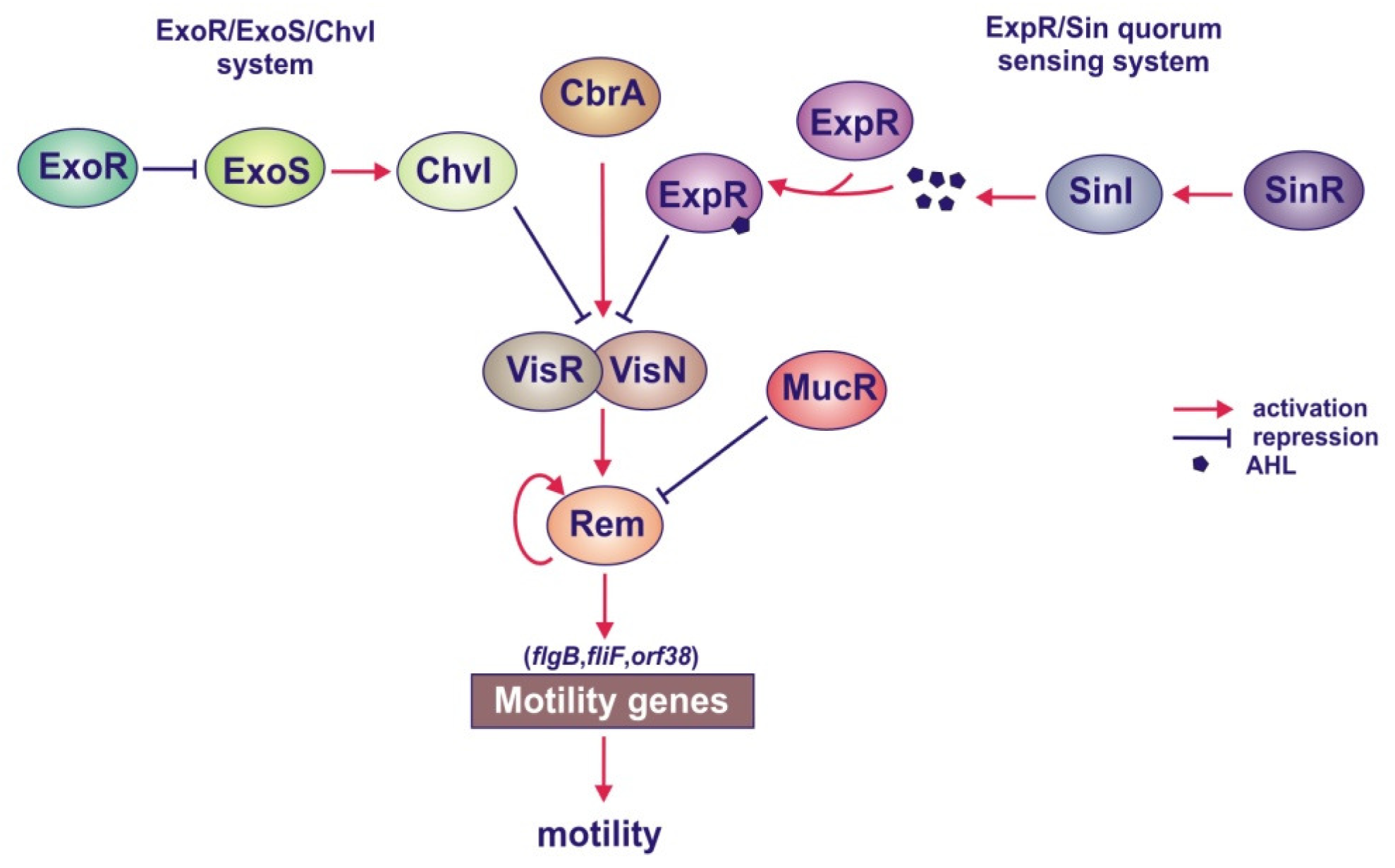
<p>In general, regulation of <italic>S. meliloti</italic> EPS I synthesis is almost negative, with the exception of the MucR and SyrM, which function as positive regulators of this process (<xref ref-type="fig" rid="f3-ijms-12-07898">Figure 3</xref>) [<xref ref-type="bibr" rid="b114-ijms-12-07898">114</xref>,<xref ref-type="bibr" rid="b116-ijms-12-07898">116</xref>,<xref ref-type="bibr" rid="b118-ijms-12-07898">118</xref>]. To date, six regulatory genes have been found to negatively affect EPS I synthesis, including the <italic>exoX</italic> and <italic>exsB</italic> genes linked with the <italic>exo</italic>/<italic>exs</italic> cluster, and the chromosomal <italic>exoR</italic>, <italic>exoS</italic>, <italic>cbrA</italic> and <italic>emmC</italic> genes. Mutants in both <italic>exoR</italic> and <italic>exoS</italic> genes display an increased production of EPS I and a higher expression of several <italic>exo</italic> genes (<italic>exoYFQ</italic>, <italic>exoA</italic> and <italic>exoP</italic>) in relation to the parental strain [<xref ref-type="bibr" rid="b61-ijms-12-07898">61</xref>,<xref ref-type="bibr" rid="b62-ijms-12-07898">62</xref>,<xref ref-type="bibr" rid="b119-ijms-12-07898">119</xref>]. Despite these similarities, they differ in their symbiotic properties; the <italic>exoR</italic> mutant induces non-nitrogen-fixing nodules on alfalfa, whereas the <italic>exoS</italic> mutant elicits the formation of effective nodules on this host plant [<xref ref-type="bibr" rid="b62-ijms-12-07898">62</xref>]. The ExoS protein was found to be almost identical to <italic>A. tumefaciens</italic> ChvG, which is a sensor protein of a two-component regulatory system [<xref ref-type="bibr" rid="b120-ijms-12-07898">120</xref>]. ExoS is located in the IM in the form of homodimers, and its sensor domain, located in the periplasmic space, is responsible for the recognition of an environmental signal. After the signal has been recognized, ExoS kinase activates a second component of this system, the ChvI response regulator, by its phosphorylation. Next, ChvI affects the transcription of <italic>exo</italic> genes, so that this consequently leads to the modulation of EPS I production (<xref ref-type="fig" rid="f3-ijms-12-07898">Figure 3</xref>) [<xref ref-type="bibr" rid="b112-ijms-12-07898">112</xref>]. ExoR is a periplasmic protein, which translocates to the periplasm, where it physically interacts with the ExoS and inhibits ExoS/ChvI two-component signalling [<xref ref-type="bibr" rid="b121-ijms-12-07898">121</xref>–<xref ref-type="bibr" rid="b123-ijms-12-07898">123</xref>]. <italic>exoR</italic> expression was found to be upregulated in the absence of functional ExoR. This regulation is mediated by the ExoS/ChvI system, which positively affects the transcription of <italic>exoR</italic> [<xref ref-type="bibr" rid="b123-ijms-12-07898">123</xref>–<xref ref-type="bibr" rid="b125-ijms-12-07898">125</xref>]. Both the ExoR protein and the ExoS/ChvI system, apart from EPS I synthesis, are also involved in the regulation of flagellum biosynthesis genes [<xref ref-type="bibr" rid="b112-ijms-12-07898">112</xref>].</p>
<p>Recently, novel <italic>S. meliloti exoS</italic> and <italic>chvI</italic> null mutants have been reported [<xref ref-type="bibr" rid="b126-ijms-12-07898">126</xref>,<xref ref-type="bibr" rid="b127-ijms-12-07898">127</xref>]. Phenotypic analysis of these two mutants demonstrated that the ExoS/ChvI regulatory system was also required for growth on over 21 different carbon sources. Additionally, the <italic>chvI</italic> mutant exhibited several other effects, such as failure in the growth on complex media, an altered LPS profile, hypermotility, lower tolerance to acidic conditions and synthesis of significantly less poly-3-hydroxybutyrate than the wild type strain. These data indicate that ChvI is a crucial protein engaged in <italic>S. meliloti</italic> regulatory networks involving both the bacterial cell envelope and carbon source utilization [<xref ref-type="bibr" rid="b127-ijms-12-07898">127</xref>].</p>
<p>In conclusion, the ExoR, ExoS and ChvI proteins form a regulatory system which appear to be involved in several critical cell processes, such as EPS I production, nutrient utilization, motility and free-living viability [<xref ref-type="bibr" rid="b123-ijms-12-07898">123</xref>,<xref ref-type="bibr" rid="b126-ijms-12-07898">126</xref>,<xref ref-type="bibr" rid="b127-ijms-12-07898">127</xref>].</p>
<p><italic>exoX</italic> located in the <italic>exo/exs</italic> cluster, is another gene participating in the negative regulation of EPS I synthesis (<xref ref-type="fig" rid="f3-ijms-12-07898">Figure 3</xref>). It has been shown that the ratio of <italic>exoX</italic> copies to the copies of the <italic>exoY</italic> encoding an enzyme, catalyzing the initial step of repeating unit synthesis, is very important for the proper level of EPS I synthesis. ExoX is a small, inner membrane-attached protein showing a significant similarity to the previously identified PsiA of <italic>R. leguminosarum</italic> bv. <italic>phaseoli</italic> and ExoX of <italic>Rhizobium</italic> sp. NGR234 [<xref ref-type="bibr" rid="b99-ijms-12-07898">99</xref>,<xref ref-type="bibr" rid="b100-ijms-12-07898">100</xref>]. Mutants in <italic>exoX</italic> overproduced EPS I, whereas the presence of multiple copies of this gene inhibited the production of EPS I. Since the expression of <italic>exo</italic> genes was not affected by the gene dosage of <italic>exoX</italic> to <italic>exoY</italic>, it was suggested that ExoX functions as a post-transcriptional inhibitor of the ExoY [<xref ref-type="bibr" rid="b56-ijms-12-07898">56</xref>,<xref ref-type="bibr" rid="b119-ijms-12-07898">119</xref>]. The fact that both ExoX and ExoY are associated with the IM suggests a direct interaction between these two proteins [<xref ref-type="bibr" rid="b100-ijms-12-07898">100</xref>].</p>
<p><italic>exsB</italic> is a second gene in the <italic>exo/exs</italic> region, which encodes a regulator negatively affecting EPS I synthesis (<xref ref-type="fig" rid="f3-ijms-12-07898">Figure 3</xref>) [<xref ref-type="bibr" rid="b57-ijms-12-07898">57</xref>]. Similarly to the phenotype of the <italic>exoX</italic> mutant<italic>,</italic> an <italic>exsB</italic> mutant produced 3-fold more EPS I than the wild type, but in contrast to the <italic>exoX</italic> mutant, additional <italic>exsB</italic> copies resulted in a decrease of EPS I production to 20% of the control. Since this effect was not caused by direct regulation of the transcription of <italic>exo</italic> genes in this mutant background (the only exception was the reduction of <italic>exoK</italic> expression) [<xref ref-type="bibr" rid="b60-ijms-12-07898">60</xref>], negative regulation of EPS I production by ExsB must have occurred mainly at the post-transcriptional level [<xref ref-type="bibr" rid="b54-ijms-12-07898">54</xref>,<xref ref-type="bibr" rid="b57-ijms-12-07898">57</xref>].</p>
<p>Among environmental factors, ammonia has been found to significantly affect EPS I synthesis. The regulation of this process by nitrogen availability is directed by the NtrC and SyrM proteins, which under limitation of this nutrient act as positive regulators. Mutations in genes for these two regulatory proteins decrease EPS I production under nitrogen starvation. The SyrM protein increases the transcription of the <italic>exoF</italic> and <italic>exoP</italic> genes via induction of <italic>syrA</italic> expression, and additionally by direct activation of <italic>exoP</italic> transcription (<xref ref-type="fig" rid="f3-ijms-12-07898">Figure 3</xref>) [<xref ref-type="bibr" rid="b118-ijms-12-07898">118</xref>,<xref ref-type="bibr" rid="b128-ijms-12-07898">128</xref>]. On the other hand, SyrM inhibits the expression of <italic>exsH</italic> and <italic>exoK</italic> encoding endoglycanases. The <italic>exoK</italic> gene is of special interest among all <italic>exo</italic> genes of the <italic>exo</italic>/<italic>exs</italic> region in that it is a target for the action of at least three regulatory proteins (MucR, SyrM and ExsB), indicating that the level of its expression is very important for the proper degree of polymerization of EPS I.</p>
<p>The SyrM protein is also involved in the regulation of the expression of <italic>nod</italic> genes, which are responsible for the synthesis of another symbiotic signal, the Nod factor [<xref ref-type="bibr" rid="b128-ijms-12-07898">128</xref>,<xref ref-type="bibr" rid="b129-ijms-12-07898">129</xref>]. This protein belongs to the family of LysR-type transcriptional regulators and displays a similarity to NodD proteins engaged in the activation of <italic>nod</italic> genes [<xref ref-type="bibr" rid="b118-ijms-12-07898">118</xref>]. SyrM is involved in the determination of the ratio of LMW to HMW EPS I, and this process is affected by nitrogen and luteolin, the plant flavonoid indispensable for the activation of <italic>nod</italic> genes in the presence of NodD [<xref ref-type="bibr" rid="b118-ijms-12-07898">118</xref>,<xref ref-type="bibr" rid="b129-ijms-12-07898">129</xref>]. These data indicate that SyrM influences both EPS I and Nod factor synthesis, suggesting that nitrogen starvation might be a factor affecting the concentration of these two signal molecules essential in the early stages of host plant infection.</p>
<p>The precise role of another chromosomal gene, <italic>exoD</italic>, in the regulation of EPS I synthesis is difficult to explain. Nevertheless, the gene seems to positively affect this process because an <italic>exoD</italic> mutant produces diminished amounts of EPS I [<xref ref-type="bibr" rid="b63-ijms-12-07898">63</xref>]. Furthermore, this mutant was found to be sensitive to alkaline conditions and elicited effective nodules on host plants exclusively in a slightly acidic growth medium [<xref ref-type="bibr" rid="b63-ijms-12-07898">63</xref>].</p>
<p>Among the regulatory proteins of <italic>S. meliloti</italic>, MucR seems to play a key role in the positive regulation of EPS I synthesis. A mutation in <italic>mucR</italic> results in a high level of EPS II production but only a very low level of LMW EPS I synthesis [<xref ref-type="bibr" rid="b60-ijms-12-07898">60</xref>,<xref ref-type="bibr" rid="b114-ijms-12-07898">114</xref>,<xref ref-type="bibr" rid="b115-ijms-12-07898">115</xref>]. The MucR protein contains the C<sub>2</sub>H<sub>2</sub> type zinc-finger motif and influences the transcription of some <italic>exo</italic> genes (<italic>exoH</italic>, <italic>exoX</italic>, <italic>exoY</italic>) by binding to a palindromic sequence located in promoter regions of the regulated genes, but the observed levels of modulation are not high. In the <italic>mucR</italic> mutant, the transcription of <italic>exoH</italic> and <italic>exoX</italic> was slightly increased, whereas the expression of <italic>exoK</italic> and the <italic>exoYFQ</italic> operon decreased 1.5-fold. This indicates that the positive function of MucR in EPS I synthesis is a result of both stimulation of the expression of EPS I synthesis genes and repression of <italic>exoX</italic> transcription [<xref ref-type="bibr" rid="b114-ijms-12-07898">114</xref>,<xref ref-type="bibr" rid="b115-ijms-12-07898">115</xref>]. Moreover, MucR negatively regulates its own transcription by binding to a palindromic sequence located in the <italic>mucR</italic> upstream region [<xref ref-type="bibr" rid="b60-ijms-12-07898">60</xref>,<xref ref-type="bibr" rid="b115-ijms-12-07898">115</xref>].</p>
<p>Recently, Morris and Gonzalez [<xref ref-type="bibr" rid="b125-ijms-12-07898">125</xref>] have characterized a novel three-component system, consisting of the EmmA, EmmB and EmmC proteins, which appear to play a crucial role in the adaptability and survivability of <italic>S. meliloti</italic>. EmmA is a protein secreted to the periplasm, whereas EmmB and EmmC are sensor and response proteins, respectively. The <italic>emmABC</italic> genes are associated with EPS I production, motility and stress adaptation. Mutations in the <italic>emm</italic> locus cause motility defects, an increase in succinoglycan synthesis and a decrease in stress tolerance, which, in consequence, leads to the loss of the ability to form an optimal symbiosis with alfalfa [<xref ref-type="bibr" rid="b125-ijms-12-07898">125</xref>]. The EmmABC system shows some functional similarity to the ExoR-ExoS-ChvI system, although no cross-regulation of these systems has been evidenced. This suggests that these two systems may act in parallel but separate fashions in the regulation of important cell processes, such as EPS I production and motility, in response to environmental cues.</p>
<p>Moreover, it has recently been demonstrated that the <italic>cbrA</italic> gene, which encodes a stationary phase-induced sensor kinase, is also associated with EPS I synthesis and motility [<xref ref-type="bibr" rid="b130-ijms-12-07898">130</xref>]. This is confirmed by the phenotype of the <italic>cbrA</italic> mutant, which overproduces EPS I and shows cell envelope defects, a decrease in flagellar biosynthesis and symbiotic defects.</p></sec>
<sec>
<title>4.1.2. Regulation of EPS I Synthesis by Succinate-Mediated Catabolite Repression</title>
<p>Recently, succinate-mediated catabolite repression has been characterized in <italic>S. meliloti</italic>, and some proteins of the phosphotransferase system (PTS) engaged in this regulation appeared to affect EPS I production [<xref ref-type="bibr" rid="b131-ijms-12-07898">131</xref>,<xref ref-type="bibr" rid="b132-ijms-12-07898">132</xref>]. Although this bacterium can utilize a variety of compounds as sources of carbon, succinate is preferred carbon and energy source to other compounds (glucose, fructose, galactose and lactose), playing an especially important role in <italic>S. meliloti</italic> metabolism during both the free-living and symbiotic states. The <italic>hprK</italic>, <italic>EIIA</italic> (<italic>manX</italic>) and <italic>hpr</italic> genes for the PTS system form a cluster in the chromosome located immediately downstream of the <italic>exoS</italic> gene [<xref ref-type="bibr" rid="b132-ijms-12-07898">132</xref>]. HPrK of a kinase/phosphatase activity is the main component of the PTS system and it regulates succinate-mediated catabolite repression through phosphorylation/dephosphorylation of its substrate, the protein HPr. A phosphorylated form of HPr activates <italic>EIIA</italic>, that leads to enhancing of catabolite repression in the presence of succinate. A mutation in <italic>hpr</italic> results in several effects, including altered carbon metabolism, production of EPS I, and sensitivity to cobalt limitation [<xref ref-type="bibr" rid="b131-ijms-12-07898">131</xref>,<xref ref-type="bibr" rid="b132-ijms-12-07898">132</xref>]. An <italic>EIIA</italic> mutant demonstrates slowed growth on diverse carbon sources and enhanced accumulation of HMW EPS I. Despite these strong phenotypes, both <italic>hpr</italic> and <italic>EIIA</italic> mutants exhibit wild-type nodulation and nitrogen fixation on alfalfa [<xref ref-type="bibr" rid="b131-ijms-12-07898">131</xref>]. On the other hand, a <italic>hprK</italic> mutant overproduces EPS I and induces nodules that do not fix nitrogen, indicating that this gene, apart from the key role in catabolite repression, is also important for EPS I synthesis and effective symbiosis [<xref ref-type="bibr" rid="b132-ijms-12-07898">132</xref>].</p></sec>
<sec>
<title>4.1.3. Regulation of EPS II Synthesis</title>
<p>Besides nitrogen, phosphate is another environmental factor which plays a significant role in the regulation of EPS synthesis in <italic>S. meliloti</italic>. In contrast to EPS I, whose production is induced in the presence of high phosphate concentrations (above 10 mM), low-phosphate conditions, typically found in soil (0.1 to 10 μM), stimulate EPS II production [<xref ref-type="bibr" rid="b19-ijms-12-07898">19</xref>,<xref ref-type="bibr" rid="b97-ijms-12-07898">97</xref>,<xref ref-type="bibr" rid="b103-ijms-12-07898">103</xref>]. This polysaccharide probably plays a dominant role in the environmental conditions, where this nutrient is scarce. Recently, Rinaudi and Gonzalez [<xref ref-type="bibr" rid="b133-ijms-12-07898">133</xref>] have shown that symbiotically active fraction of EPS II is crucial for both root colonization and biofilm formation.</p>
<p>In <italic>S. meliloti</italic>, phosphate regulates a considerable number of genes, including the genes involved in EPS II synthesis, through the PhoB response regulator forming a two-component regulatory system with the sensor kinase PhoR (<xref ref-type="fig" rid="f3-ijms-12-07898">Figure 3</xref>) [<xref ref-type="bibr" rid="b67-ijms-12-07898">67</xref>,<xref ref-type="bibr" rid="b69-ijms-12-07898">69</xref>,<xref ref-type="bibr" rid="b113-ijms-12-07898">113</xref>,<xref ref-type="bibr" rid="b134-ijms-12-07898">134</xref>–<xref ref-type="bibr" rid="b137-ijms-12-07898">137</xref>]. In general, PhoB functions as a positive regulator which induces the expression of genes belonging to the Pho regulon under P<sub>i</sub> limitation. In these conditions, a phosphorylated form of PhoB activates the transcription of target genes by binding to the PHO box sequence located in the promoters of phosphate-regulated genes [<xref ref-type="bibr" rid="b134-ijms-12-07898">134</xref>,<xref ref-type="bibr" rid="b136-ijms-12-07898">136</xref>]. Among genes belonging to the <italic>S. meliloti</italic> Pho regulon, Krol and Becker [<xref ref-type="bibr" rid="b135-ijms-12-07898">135</xref>] have found the <italic>wgaA</italic>, <italic>wggR</italic>, <italic>wgdA</italic> and <italic>wgeA</italic> genes involved in EPS II synthesis, whose expression was significantly induced in P<sub>i</sub>-limited cells. In upstream regions of these genes, two PHO box-like sequences have been identified [<xref ref-type="bibr" rid="b113-ijms-12-07898">113</xref>,<xref ref-type="bibr" rid="b136-ijms-12-07898">136</xref>].</p>
<p>EPS II synthesis is also regulated by two other regulatory proteins, WggR (ExpG) and MucR (<xref ref-type="fig" rid="f3-ijms-12-07898">Figure 3</xref>) [<xref ref-type="bibr" rid="b69-ijms-12-07898">69</xref>,<xref ref-type="bibr" rid="b138-ijms-12-07898">138</xref>]. WggR, encoded by a gene located in the galactoglucan synthesis gene cluster, positively affects the synthesis of EPS II under P<sub>i</sub> limitation [<xref ref-type="bibr" rid="b67-ijms-12-07898">67</xref>]. This protein, belonging to the Mar family of transcriptional regulators containing a helix-turn-helix motif, binds to conserved palindromic sequences located in promoter regions of the <italic>wgaA</italic>, <italic>wggR</italic>/<italic>wgdA</italic> and <italic>wgeA</italic> genes to activate their expression [<xref ref-type="bibr" rid="b69-ijms-12-07898">69</xref>,<xref ref-type="bibr" rid="b113-ijms-12-07898">113</xref>]. The deletion of <italic>wggR</italic> reduces EPS II synthesis under P<sub>i</sub> starvation, whereas additional copies of this gene slightly increase EPS II production [<xref ref-type="bibr" rid="b69-ijms-12-07898">69</xref>,<xref ref-type="bibr" rid="b113-ijms-12-07898">113</xref>]. The second regulator, MucR, represses galactoglucan synthesis, whereas a mutation in <italic>mucR</italic> leads to the production of the HMW form of this polysaccharide only [<xref ref-type="bibr" rid="b60-ijms-12-07898">60</xref>,<xref ref-type="bibr" rid="b107-ijms-12-07898">107</xref>,<xref ref-type="bibr" rid="b139-ijms-12-07898">139</xref>].</p>
<p>Transcription of the <italic>wga</italic>, <italic>wge</italic> and <italic>wgd</italic> operons is governed by two promoters that are differentially controlled by PhoB, WggR and MucR [<xref ref-type="bibr" rid="b69-ijms-12-07898">69</xref>]. Upstream of the distal promoters of these genes, three motifs functioning as binding sites for the MucR, WggR and PhoB proteins have been identified, and the binding site for WggR ovelapped with the PHO box sequence. Under phosphate-sufficient conditions, the transcription of the <italic>wga</italic>, <italic>wgd</italic> and <italic>wge</italic> genes is repressed by MucR, which strongly inhibits the activity of both promoters by binding to the sequence located in the vicinity of the distal transcription start sites, and consequently, only traces of EPS II are produced [<xref ref-type="bibr" rid="b69-ijms-12-07898">69</xref>]. The WggR protein also slightly inhibits the activity of the distal promoter under the same conditions. Under P<sub>i</sub> starvation, WggR and phosphorylated PhoB bind to the promoter regions and activate the transcription of the <italic>wga</italic>, <italic>wgd</italic> and <italic>wge</italic> genes. This phosphate-dependent regulation of EPS II synthesis has been reported to involve the cooperative action of WggR and PhoB. This indicates that WggR plays a special role in the regulation of EPS II synthesis mediated by the PhoB and MucR proteins. The activities of PhoB, WggR and MucR regulators ensure fine-tuning of the expression of galactoglucan synthesis genes, which allows bacteria to adapt to changing environmental conditions [<xref ref-type="bibr" rid="b69-ijms-12-07898">69</xref>,<xref ref-type="bibr" rid="b113-ijms-12-07898">113</xref>,<xref ref-type="bibr" rid="b138-ijms-12-07898">138</xref>]. Moreover, the transcription of <italic>wggR</italic> is activated by PhoB under P<sub>i</sub> limitation, and both the WggR and PhoB proteins function cooperatively in the transcription activation of this regulatory gene [<xref ref-type="bibr" rid="b69-ijms-12-07898">69</xref>].</p></sec>
<sec>
<title>4.1.4. Role of Quorum Sensing in the Regulation of EPS I and EPS II Synthesis</title>
<p><italic>S. meliloti</italic> possesses at least three quorum-sensing systems, among them the Sin system, consisting of SinR, a LuxR-type transcriptional regulator, and SinI, an autoinducer synthase responsible for the synthesis of a series of long-chain <italic>N</italic>-acyl homoserine lactons (AHL) (<xref ref-type="fig" rid="f3-ijms-12-07898">Figure 3</xref>) [<xref ref-type="bibr" rid="b139-ijms-12-07898">139</xref>,<xref ref-type="bibr" rid="b140-ijms-12-07898">140</xref>]. AHL represent one of the classes of pheromone-like signals, called autoinducers, which are released exogenously and whose concentration acts as an indicator of population density for the bacteria. The Sin system regulates the expression of many <italic>S. meliloti</italic> genes, including genes involved in the production of EPS I and EPS II, motility, chemotaxis and other cellular processes, such as nitrogen fixation and metal transport. The regulation of most of these genes is dependent on the presence of another LuxR-type regulator, ExpR [<xref ref-type="bibr" rid="b141-ijms-12-07898">141</xref>–<xref ref-type="bibr" rid="b144-ijms-12-07898">144</xref>].</p>
<p><italic>S. meliloti</italic> wild type exhibits a mucoid phenotype due to the presence of EPS II. However, both <italic>sinI</italic> and <italic>expR</italic> mutants remain dry and unable to produce EPS II, which confirms the role of the Sin system and the ExpR protein in the synthesis of this polysaccharide [<xref ref-type="bibr" rid="b139-ijms-12-07898">139</xref>,<xref ref-type="bibr" rid="b141-ijms-12-07898">141</xref>,<xref ref-type="bibr" rid="b142-ijms-12-07898">142</xref>,<xref ref-type="bibr" rid="b145-ijms-12-07898">145</xref>]. Expression of <italic>sinI</italic> is dependent on <italic>sinR</italic> and is enhanced by AHL-ExpR (<xref ref-type="fig" rid="f3-ijms-12-07898">Figure 3</xref>). Also, galactoglucan biosynthesis genes (particularly <italic>wgeB</italic>, <italic>wgdA</italic>, <italic>wggR</italic> and <italic>wgcA</italic>) are highly induced in the presence of AHL, and their expression depends not only on the production of this signal but also on the active ExpR protein [<xref ref-type="bibr" rid="b139-ijms-12-07898">139</xref>,<xref ref-type="bibr" rid="b145-ijms-12-07898">145</xref>]. Expression of genes of the <italic>wge</italic>, <italic>wga</italic> and <italic>wgd</italic> operons is required for the synthesis of HMW EPS II, whereas expression of <italic>wgcA</italic>, encoding glycosyltransferase, is critical for the production of symbiotically active LMW EPS II [<xref ref-type="bibr" rid="b145-ijms-12-07898">145</xref>]. Recently, it has been established that ExpR binds to promoter regions of the <italic>sinI</italic>, <italic>wgaA</italic> and <italic>wgeA</italic> genes, and this binding is enhanced in the presence of AHL [<xref ref-type="bibr" rid="b142-ijms-12-07898">142</xref>]. Activation of these genes by ExpR is almost completely dependent on the presence of WggR when another regulator, MucR, is present. But in the absence of MucR, WggR is not required for the positive effect of ExpR. This WggR-dependent effect is also seen with PhoB-dependent induction under P<sub>i</sub> starvation and suggests that WggR functions as a general mediator of the expression of EPS II synthesis genes for at least two regulators (PhoB and MucR) under different conditions [<xref ref-type="bibr" rid="b69-ijms-12-07898">69</xref>]. The close proximity of the binding sites for ExpR, WggR, PhoB and MucR suggests a complex regulation of EPS II synthesis genes involving protein-protein interaction and, possibly, some competition for the target sites, which allows changing the level of production of this polymer in response to different environmental factors [<xref ref-type="bibr" rid="b69-ijms-12-07898">69</xref>,<xref ref-type="bibr" rid="b142-ijms-12-07898">142</xref>]. MucR appeared to repress EPS II synthesis at an extremely low population density until the ExpR/Sin system abolishes this effect at levels of quorum sufficient for biofilm formation and invasion of the host plant [<xref ref-type="bibr" rid="b144-ijms-12-07898">144</xref>].</p>
<p>Moreover, ExpR and the Sin quorum-sensing system regulate some <italic>exo/exs</italic> genes involved in EPS I production (<xref ref-type="fig" rid="f3-ijms-12-07898">Figure 3</xref>) [<xref ref-type="bibr" rid="b142-ijms-12-07898">142</xref>,<xref ref-type="bibr" rid="b143-ijms-12-07898">143</xref>,<xref ref-type="bibr" rid="b146-ijms-12-07898">146</xref>]. ExpR stimulates the expression of <italic>exoI</italic> and <italic>exsH</italic> encoding a succinoglycan glucanase which is responsible for the generation of the LMW form of this polysaccharide [<xref ref-type="bibr" rid="b143-ijms-12-07898">143</xref>]. In the promoter regions of these genes, binding sites for ExpR have been found [<xref ref-type="bibr" rid="b142-ijms-12-07898">142</xref>]. These data confirm that the ExpR/Sin system is engaged in the regulation of not only EPS II, but also EPS I biosynthesis.</p>
<p>The regulation of EPS synthesis by <italic>sinRI</italic> is an important finding, which connects quorum sensing with the symbiotic process. A <italic>sinI</italic> mutant unable to produce AHL is deficient in invasion of alfalfa plants, indicating that the Sin system plays an essential role in the establishment of an effective symbiosis [<xref ref-type="bibr" rid="b143-ijms-12-07898">143</xref>].</p>
<p>Recently, Mueller and Gonzalez [<xref ref-type="bibr" rid="b144-ijms-12-07898">144</xref>] have reported that MucR plays a more global regulatory role, being engaged, together with the ExpR/Sin system, in the complex regulation of symbiotic functions. In planctonic <italic>S. meliloti</italic>, MucR properly coordinates a diverse set of bacterial behaviors by repressing a variety of genes, whose expression is activated only during symbiosis, including those involved in nitrogen fixation and respiration (<italic>fix</italic> genes) (<xref ref-type="fig" rid="f3-ijms-12-07898">Figure 3</xref>). In addition, MucR has been found to enhance the bacterial ability to induce nodule formation on the host plant by increasing Nod factor synthesis via increased expression of <italic>nodD</italic> [<xref ref-type="bibr" rid="b144-ijms-12-07898">144</xref>].</p></sec>
<sec>
<title>4.1.5. Roles of the MucR, ExoR/ExoS/ChvI and ExpR/Sin Systems in the Regulation of Motility Genes</title>
<p>Bacterial motility is one of the critical factors for the establishment of symbiosis under natural soil conditions. The regulatory proteins MucR, ExoR and ExpR, which play an essential role in EPS synthesis, appear to be also involved in motility, indicating that the regulation of these two processes is coupled in <italic>S. meliloti</italic> (<xref ref-type="fig" rid="f4-ijms-12-07898">Figure 4</xref>) [<xref ref-type="bibr" rid="b112-ijms-12-07898">112</xref>,<xref ref-type="bibr" rid="b116-ijms-12-07898">116</xref>,<xref ref-type="bibr" rid="b141-ijms-12-07898">141</xref>,<xref ref-type="bibr" rid="b144-ijms-12-07898">144</xref>,<xref ref-type="bibr" rid="b147-ijms-12-07898">147</xref>–<xref ref-type="bibr" rid="b149-ijms-12-07898">149</xref>]. The 56-kb chromosomal region, named the flagellar region, encompasses a majority of genes associated with motility. These genes, categorized into three main classes, are expressed in a hierarchical manner [<xref ref-type="bibr" rid="b148-ijms-12-07898">148</xref>,<xref ref-type="bibr" rid="b149-ijms-12-07898">149</xref>]. At the top of the hierarchy are <italic>visN</italic> and <italic>visR</italic> genes, which encode subunits of the LuxR-type transcriptional activator of motility and chemotaxis genes [<xref ref-type="bibr" rid="b148-ijms-12-07898">148</xref>,<xref ref-type="bibr" rid="b149-ijms-12-07898">149</xref>]. The VisN/VisR regulator activates the transcription of <italic>rem</italic>, which codes for a protein postively regulating the expression of the motility and chemotaxis genes (<xref ref-type="fig" rid="f4-ijms-12-07898">Figure 4</xref>). A disruption of <italic>visN</italic>, <italic>visR</italic> or <italic>rem</italic> leads to the loss of flagella and, in consequence, the loss of swimming and swarming motility. Rem positively regulates the expression of its own gene and the expression of motility genes by direct binding to the promoters of <italic>flgB</italic>, <italic>fliF</italic> and <italic>orf38</italic> [<xref ref-type="bibr" rid="b141-ijms-12-07898">141</xref>,<xref ref-type="bibr" rid="b147-ijms-12-07898">147</xref>]. Tambalo and associates have described recently that VisN/R-Rem cascade also participates in the regulation of a majority of flagellar, motility and chemotaxis genes (<italic>che1</italic>, <italic>motA</italic>, <italic>flaABCD</italic>, <italic>motB</italic> and <italic>mcpD</italic>) in <italic>R. leguminosarum</italic> [<xref ref-type="bibr" rid="b150-ijms-12-07898">150</xref>,<xref ref-type="bibr" rid="b151-ijms-12-07898">151</xref>]. All of these genes except <italic>mcpD</italic> are located within the main motility and chemotaxis gene cluster of <italic>R. leguminosarum</italic>. However, other chemotaxis and motility genes (<italic>che2</italic> operon, <italic>flaH</italic>, <italic>flaG</italic>, <italic>flaE</italic> and <italic>mcpC</italic>) found outside of this cluster are not regulated by VisN/R and Rem activators, suggesting a role of additional regulatory system in this process.</p>
<p>Recently, other regulators of motility have been found, which are encoded by genes located outside this region, among them CbrA, initially described as a regulator of symbiosis [<xref ref-type="bibr" rid="b130-ijms-12-07898">130</xref>], MucR, and the two systems, ExpR/Sin and ExoR/ExoS/ChvI (<xref ref-type="fig" rid="f4-ijms-12-07898">Figure 4</xref>) [<xref ref-type="bibr" rid="b112-ijms-12-07898">112</xref>,<xref ref-type="bibr" rid="b116-ijms-12-07898">116</xref>,<xref ref-type="bibr" rid="b130-ijms-12-07898">130</xref>,<xref ref-type="bibr" rid="b144-ijms-12-07898">144</xref>,<xref ref-type="bibr" rid="b147-ijms-12-07898">147</xref>]. A lack of functional CbrA results in a decreased expression of several motility genes, among them <italic>visN</italic>, <italic>visR</italic> and <italic>rem</italic> [<xref ref-type="bibr" rid="b130-ijms-12-07898">130</xref>]. Hoang and associates [<xref ref-type="bibr" rid="b147-ijms-12-07898">147</xref>] demonstrated that the ExpR/Sin system controls motility gene expression via the VisN/VisR and Rem regulators in a population-density-dependent manner. This system suppresses motility by repression of <italic>visN</italic> and <italic>visR</italic> expression when the bacteria reach the late logarithmic growth phase [<xref ref-type="bibr" rid="b139-ijms-12-07898">139</xref>]. Also, the second regulatory system, ExoR/ExoS/ChvI, which is involved in the regulation of EPS I synthesis, suppresses motility gene expression through VisN/VisR and Rem [<xref ref-type="bibr" rid="b147-ijms-12-07898">147</xref>]. In both <italic>exoR</italic> and <italic>exoS</italic> mutants, the expression of all genes for flagellum biosynthesis was downregulated, and for this reason, the cells carrying these mutations lost the ability to swim and swarm [<xref ref-type="bibr" rid="b112-ijms-12-07898">112</xref>]. Recently, MucR has also been found to participate in the regulatory network controlling motility in <italic>S. meliloti</italic> [<xref ref-type="bibr" rid="b116-ijms-12-07898">116</xref>]. This protein, apart from activating EPS I and inhibiting EPS II synthesis, downregulates the expression of <italic>rem</italic> by direct binding to its upstream region.</p>
<p>In conclusion, all three regulatory pathways mediated by the MucR protein and the ExoR/ExoS/ChvI and ExpR/Sin regulatory systems suppress motility through repression of the expression of the regulatory <italic>visN</italic>, <italic>visR</italic> and <italic>rem</italic> genes [<xref ref-type="bibr" rid="b112-ijms-12-07898">112</xref>,<xref ref-type="bibr" rid="b116-ijms-12-07898">116</xref>,<xref ref-type="bibr" rid="b144-ijms-12-07898">144</xref>,<xref ref-type="bibr" rid="b147-ijms-12-07898">147</xref>].</p></sec></sec>
<sec>
<title>4.2. Regulation of EPS Synthesis in <italic>R. leguminosarum</italic></title>
<p>In contrast to <italic>S. meliloti</italic>, the knowledge about regulation of EPS biosynthesis in <italic>R. leguminosarum</italic> is much more fragmentary. Up to now, only a few regulatory genes involved in this process have been described. These include two genes, <italic>psiA</italic> and <italic>psrA</italic>, located on the symbiotic megaplasmid (pSym), and <italic>exoR</italic>, <italic>pssB</italic>, <italic>rosR</italic> and <italic>expR</italic> genes located on the chromosome of <italic>R. leguminosarum</italic> (<xref ref-type="fig" rid="f5-ijms-12-07898">Figure 5</xref>) [<xref ref-type="bibr" rid="b82-ijms-12-07898">82</xref>,<xref ref-type="bibr" rid="b83-ijms-12-07898">83</xref>,<xref ref-type="bibr" rid="b152-ijms-12-07898">152</xref>–<xref ref-type="bibr" rid="b156-ijms-12-07898">156</xref>].</p>
<p><italic>psiA</italic> (a polysaccharide inhibition gene) and <italic>psrA</italic> (a polysaccharide restoration gene), the first to be identified among those genes, have been found on pSym of <italic>R. leguminosarum</italic> bv. <italic>phaseoli</italic>, near the <italic>nod-nif</italic> region involved in nodulation and nitrogen fixation [<xref ref-type="bibr" rid="b152-ijms-12-07898">152</xref>]. Although a mutation in <italic>psiA</italic> does not affect EPS production, additional copies of this gene prevent EPS synthesis and abolish nodulation of <italic>Phaselous</italic> plants [<xref ref-type="bibr" rid="b81-ijms-12-07898">81</xref>–<xref ref-type="bibr" rid="b83-ijms-12-07898">83</xref>,<xref ref-type="bibr" rid="b152-ijms-12-07898">152</xref>]. The inhibitory effect of extra <italic>psiA</italic> copies is overcome in the presence of multiple copies of <italic>psrA</italic> or <italic>pssA</italic>, encoding the glucosyl-IP-transferase engaged in the first step of EPS synthesis [<xref ref-type="bibr" rid="b81-ijms-12-07898">81</xref>,<xref ref-type="bibr" rid="b82-ijms-12-07898">82</xref>]. This indicates that for proper EPS production, a balanced number of <italic>psiA</italic>, <italic>pssA</italic> and <italic>psrA</italic> copies is required. <italic>psiA</italic> encodes a small, inner membrane-attached protein, which shows a similarity to the <italic>S. meliloti</italic> ExoX regulator. Also PssA, containing a hydrophobic <italic>N</italic>-terminal end and a transmembrane helix domain is located in the IM [<xref ref-type="bibr" rid="b81-ijms-12-07898">81</xref>,<xref ref-type="bibr" rid="b157-ijms-12-07898">157</xref>]. The same subcellular localization of both PsiA and PssA proteins suggests that PsiA most probably functions as a post-translational inhibitor of PssA, which binds to and inhibits the activity of this enzyme.</p>
<p>The second regulator, PsrA, which belongs to a family of transcriptional regulators containing a helix-turn-helix motif represses the transcription of <italic>psiA</italic> (<xref ref-type="fig" rid="f5-ijms-12-07898">Figure 5</xref>) [<xref ref-type="bibr" rid="b83-ijms-12-07898">83</xref>,<xref ref-type="bibr" rid="b152-ijms-12-07898">152</xref>]. A <italic>psrA</italic> mutant produces a decreased amount of EPS in comparison to the wild type strain, suggesting a positive role of this gene in EPS synthesis. Both a strain with multiple copies of <italic>psrA</italic> and a <italic>psiA</italic> mutant demonstrate similar symbiotic phenotypes—they induce the formation of non-nitrogen-fixing nodules on the host plant. These data suggest that <italic>psiA</italic> most probably inhibits EPS production inside nodules via the repression of <italic>psrA.</italic> The <italic>psiA</italic> and <italic>psrA</italic> genes have been identified exclusively on pSym plasmids of <italic>R. leguminosarum</italic> bv. <italic>phaseoli</italic> strains, indicating that this regulatory mechanism is specific only to this biovar [<xref ref-type="bibr" rid="b78-ijms-12-07898">78</xref>,<xref ref-type="bibr" rid="b152-ijms-12-07898">152</xref>].</p>
<p>EPS production in <italic>R. leguminosarum</italic> is also negatively regulated by <italic>exoR</italic>, which shows a significant similarity to the <italic>exoR</italic> of <italic>S. meliloti</italic> (<xref ref-type="fig" rid="f5-ijms-12-07898">Figure 5</xref>). An <italic>R. leguminosarum</italic> bv. <italic>viciae exoR</italic> mutant produces 3-fold more EPS than the wild-type strain similarly to the <italic>S. meliloti exoR</italic> mutant [<xref ref-type="bibr" rid="b153-ijms-12-07898">153</xref>]; but in contrast to this latter mutant, it induces both effective and non-infective nodules on pea plants.</p>
<p>Also <italic>pssB</italic>, located upstream of the <italic>pssA</italic> gene, seems to be engaged in negative regulation of EPS synthesis; however, its precise role in this process is difficult to establish. A <italic>pssB</italic> mutant produces higher amounts of EPS than the wild type and induces non-nitrogen-fixing nodules on clover and vetch [<xref ref-type="bibr" rid="b154-ijms-12-07898">154</xref>,<xref ref-type="bibr" rid="b158-ijms-12-07898">158</xref>,<xref ref-type="bibr" rid="b159-ijms-12-07898">159</xref>], whereas additional copies of this gene result in increased EPS production [<xref ref-type="bibr" rid="b160-ijms-12-07898">160</xref>]. <italic>pssB</italic> encodes a protein belonging to a family of inositol monophosphate phosphatases (IMP-ases), encompassing enzymes from both prokaryotic and eukaryotic organisms [<xref ref-type="bibr" rid="b159-ijms-12-07898">159</xref>,<xref ref-type="bibr" rid="b160-ijms-12-07898">160</xref>]. In mammalian cells, IMPases are responsible for the conversion of inositol monophosphate to inositol, which is needed for the regeneration of phospholipids containing inositol. But the role of IMPase in the metabolism of rhizobia is unclear. This enzyme may generate the pool of inositol, which is a compound commonly found inside bacteroids of <italic>R. leguminosarum</italic> bv. <italic>viciae</italic> and also abundantly occurring in pea nodules. On the other hand, inositol catabolism seems to be important for survival and competition of rhizobial strains, being crucial for successful invasion of host plants [<xref ref-type="bibr" rid="b160-ijms-12-07898">160</xref>].</p>
<sec>
<title>4.2.1. Role of RosR in EPS Synthesis and Symbiosis</title>
<p>Recently, <italic>rosR</italic>, which seems to play a key role in the regulation of EPS synthesis among all the so far described regulatory genes, has been identified on the chromosome of <italic>R. leguminosarum</italic> bv. <italic>trifolii</italic> (<xref ref-type="fig" rid="f5-ijms-12-07898">Figure 5</xref>) [<xref ref-type="bibr" rid="b155-ijms-12-07898">155</xref>]. This gene is very conserved and is present in the genomes of all strains belonging to three <italic>R. leguminosarum</italic> biovars and closely related species, <italic>R. etli</italic> and <italic>R. gallicum</italic>, suggesting its important regulatory role in other rhizobial species as well [<xref ref-type="bibr" rid="b78-ijms-12-07898">78</xref>,<xref ref-type="bibr" rid="b161-ijms-12-07898">161</xref>]. <italic>R. leguminosarum rosR</italic> also shares a significant identity with <italic>ros</italic> of <italic>A. tumefaciens</italic> [<xref ref-type="bibr" rid="b162-ijms-12-07898">162</xref>], <italic>rosAR</italic> of <italic>A. radiobacter</italic> [<xref ref-type="bibr" rid="b163-ijms-12-07898">163</xref>] and <italic>mucR</italic> of <italic>S. meliloti</italic> [<xref ref-type="bibr" rid="b60-ijms-12-07898">60</xref>]. All these genes encode transcriptional regulators belonging to the family of Ros/MucR proteins, which possess C<sub>2</sub>H<sub>2</sub> type zinc-finger motifs and are involved in the regulation of EPS synthesis. A genome-wide genetic screening has shown that <italic>R. etli</italic> RosR affects the expression of many functionally diverse genes, among them those responsible for the synthesis and modification of surface polysaccharides (<italic>exoB</italic>, <italic>prsD</italic>, <italic>pssK</italic> and <italic>plyA</italic>) [<xref ref-type="bibr" rid="b164-ijms-12-07898">164</xref>]. A mutation in <italic>R. leguminosarum</italic> bv. <italic>trifolii rosR</italic> results in a substantial decrease of EPS production and ineffective symbiosis with clover, whereas additional copies of this gene lead to a nearly twofold increase of EPS synthesis [<xref ref-type="bibr" rid="b79-ijms-12-07898">79</xref>,<xref ref-type="bibr" rid="b155-ijms-12-07898">155</xref>], indicating that <italic>rosR</italic> functions as a positive regulator of this process. Moreover, a <italic>rosR</italic> mutant exhibits several other effects, including a decreased ratio of LMW to HMW fractions of EPS, quantitative alterations in the polysaccharide constituent of LPS, changes in membrane and secreted protein profiles, higher sensitivity to surface-active detergents and some osmolytes, and decreased motility and nodulation competitiveness [<xref ref-type="bibr" rid="b165-ijms-12-07898">165</xref>]. But the most striking effect of <italic>rosR</italic> mutation is the considerably decreased attachment and colonization of root hairs, indicating that the mutation affects the first steps of the invasion process. On the other hand, multiple <italic>rosR</italic> copies significantly enhance competitiveness and clover nodulation in <italic>R. leguminosarum</italic> bv. <italic>trifolii</italic> strains, confirming the essential role of this gene in symbiosis [<xref ref-type="bibr" rid="b79-ijms-12-07898">79</xref>].</p>
<p>The data obtained by our research group indicate that <italic>rosR</italic> expression is very complex and is modulated by different environmental factors (<xref ref-type="fig" rid="f5-ijms-12-07898">Figure 5</xref>) [<xref ref-type="bibr" rid="b108-ijms-12-07898">108</xref>,<xref ref-type="bibr" rid="b155-ijms-12-07898">155</xref>,<xref ref-type="bibr" rid="b166-ijms-12-07898">166</xref>]. This gene demonstrates a very high level of expression, which is due to the action of its strong distal promoter as well as two additional regulatory elements, an upstream promoter element and TGN extended −10 element [<xref ref-type="bibr" rid="b166-ijms-12-07898">166</xref>]. In addition, several other sequence motifs were identified in the <italic>rosR</italic> upstream region, among them a LysR motif recognized by proteins from the LysR family, motifs resembling <italic>E. coli</italic> cAMP-CRP binding site, PHO boxes as binding sites for the PhoB regulator, and the RosR box [<xref ref-type="bibr" rid="b155-ijms-12-07898">155</xref>,<xref ref-type="bibr" rid="b166-ijms-12-07898">166</xref>]. The complexity of <italic>rosR</italic> regulation is additionally enhanced by six inverted repeats of different lengths found in this region, which are most probably engaged in post-transcriptional regulation, affecting the stability of <italic>rosR</italic> transcripts [<xref ref-type="bibr" rid="b108-ijms-12-07898">108</xref>]. We confirmed that RosR recognizes and binds to the 22-bp-long palindromic sequence, called the RosR box, and decreases the transcription of its own gene [<xref ref-type="bibr" rid="b155-ijms-12-07898">155</xref>]. In the presence of glucose, <italic>rosR</italic> transcription is also significantly decreased, indicating that the expression of this gene is regulated by catabolic repression [<xref ref-type="bibr" rid="b166-ijms-12-07898">166</xref>]. Moreover, <italic>rosR</italic> transcription increases in the presence of clover root exudates and the functional activator NodD [<xref ref-type="bibr" rid="b108-ijms-12-07898">108</xref>]. Also phosphate affects <italic>rosR</italic> expression, and PHO boxes located in the <italic>rosR</italic> upstream region are most probably target sites for PhoB. These data show that four regulatory proteins (RosR, CRP-like protein, NodD and PhoB) are involved in the regulation of <italic>rosR</italic> expression in response to different environmental factors (<xref ref-type="fig" rid="f5-ijms-12-07898">Figure 5</xref>). Also, EPS production in <italic>R. leguminosarum</italic> is affected by phosphate and ammonia, plant flavonoids and the type of carbon source [<xref ref-type="bibr" rid="b108-ijms-12-07898">108</xref>,<xref ref-type="bibr" rid="b166-ijms-12-07898">166</xref>,<xref ref-type="bibr" rid="b167-ijms-12-07898">167</xref>]. This indicates that the increase of EPS synthesis in the presence of flavonoids and glycerol, and under phosphate limitation, is mediated by <italic>rosR</italic>, whose transcription also increases significantly in these conditions. The positive role of RosR in EPS production seems to be a coupled effect of stimulation of <italic>pssA</italic> expression [<xref ref-type="bibr" rid="b155-ijms-12-07898">155</xref>] and repression of the expression of the <italic>exoR</italic> and <italic>pssB</italic> genes, engaged in the negative regulation of this process (<xref ref-type="fig" rid="f5-ijms-12-07898">Figure 5</xref>) [<xref ref-type="bibr" rid="b168-ijms-12-07898">168</xref>]. In addition, root exudates, phosphate and ammonia starvation affect the transcription of some <italic>pss</italic> genes (<italic>pssA</italic>, <italic>pssB</italic>, <italic>pssO</italic> and <italic>pssP</italic>) [<xref ref-type="bibr" rid="b79-ijms-12-07898">79</xref>,<xref ref-type="bibr" rid="b169-ijms-12-07898">169</xref>].</p>
<p>In general, a positive effect of flavonoids and <italic>nod</italic> genes on EPS production has been observed in <italic>R. leguminosarum</italic> and <italic>S. meliloti</italic>, suggesting connected regulation of the synthesis of both symbiotic signals, EPS and Nod factors. But, influence of flavonoids on EPS production seems to be different in different rhizobia, because the presence of genistein—an effective inducer of <italic>nod</italic> genes in <italic>S. fredii</italic> HH103, results in a non-mucoid phenotype [<xref ref-type="bibr" rid="b170-ijms-12-07898">170</xref>,<xref ref-type="bibr" rid="b171-ijms-12-07898">171</xref>]. On the other hand, <italic>nolR</italic> encoding a regulator of <italic>nod</italic> genes has a positive effect on EPS synthesis in this strain [<xref ref-type="bibr" rid="b170-ijms-12-07898">170</xref>,<xref ref-type="bibr" rid="b171-ijms-12-07898">171</xref>].</p></sec>
<sec>
<title>4.2.2. Role of Quorum Sensing in the Regulation of EPS Synthesis</title>
<p>EPS production in <italic>R. leguminosarum</italic> also seems to be influenced by quorum sensing (<xref ref-type="fig" rid="f5-ijms-12-07898">Figure 5</xref>) [<xref ref-type="bibr" rid="b140-ijms-12-07898">140</xref>]. In <italic>R. leguminosarum</italic> bv. <italic>viciae</italic>, four different AHL-based quorum sensing systems, <italic>cin</italic>, <italic>rai</italic>, <italic>rhi</italic> and <italic>tra</italic>, have been discovered, which are involved in several processes, including plasmid transfer and nodulation [<xref ref-type="bibr" rid="b172-ijms-12-07898">172</xref>]. The <italic>cinR</italic>, <italic>cinI</italic> and <italic>cinS</italic> genes of the <italic>cin</italic> system are at the top of this hierarchical regulatory network and induce the other (<italic>rai</italic>, <italic>rhi</italic> and <italic>tra</italic>) systems. CinI is responsible for the production of <italic>N</italic>-(3-hydroxy-7-<italic>cis-</italic>tetradecenoyl)-<sc>l</sc>-homoserine lactone, and CinR induces <italic>cinI</italic> in response to this AHL [<xref ref-type="bibr" rid="b140-ijms-12-07898">140</xref>]. The third element of the <italic>cin</italic> system, CinS, is a small protein having an anti-repressor function, which induces the regulatory genes <italic>rhiR</italic> and <italic>raiR</italic> of the <italic>rhi</italic> and <italic>rai</italic> systems, and also <italic>plyB</italic> encoding an extracellular glycanase (<xref ref-type="fig" rid="f5-ijms-12-07898">Figure 5</xref>) [<xref ref-type="bibr" rid="b156-ijms-12-07898">156</xref>,<xref ref-type="bibr" rid="b173-ijms-12-07898">173</xref>]. This protein acts by attenuating the repressive activity of another regulator, PraR. A cloned <italic>cinS</italic> causes an apparent loss of colony mucoidy with colony aging, and this unusual phenotype is a result of the action of increased amounts of PlyB, which degrades EPS. Another protein that is required for the induction of both <italic>raiR</italic> and <italic>plyB</italic> is ExpR, which functions independently of CinI-made AHL [<xref ref-type="bibr" rid="b156-ijms-12-07898">156</xref>,<xref ref-type="bibr" rid="b173-ijms-12-07898">173</xref>]. <italic>R. leguminosarum expR</italic> is homologous to the <italic>expR</italic> of <italic>S. meliloti</italic> and the two proteins encoded by these genes are LuxR-type regulators. Nevertheless, several functional differences between them have been found. In contrast to the <italic>expR</italic> mutant of <italic>S. meliloti</italic>, the colony morphology of the <italic>R. leguminosarum expR</italic> mutant is very similar to the wild type. This indicates that <italic>expR</italic> regulates a lower number of genes in <italic>R. leguminosarum</italic> than its homolog from <italic>S. meliloti</italic>, and among them only one gene, <italic>plyB</italic>, which is associated with EPS production [<xref ref-type="bibr" rid="b156-ijms-12-07898">156</xref>,<xref ref-type="bibr" rid="b173-ijms-12-07898">173</xref>].</p></sec></sec>
<sec>
<title>4.3. Role of EPS Synthesis Genes in Biofilm Formation in Rhizobia</title>
<p>Similarly to other bacterial EPS, rhizobial EPS play a significant role in biofilm formation, being the major components of its matrix, which provides a physical barrier against diffusion of toxic compounds and protection against environmental stresses [<xref ref-type="bibr" rid="b17-ijms-12-07898">17</xref>]. A mutation in <italic>R. leguminosarum pssA</italic>, a key gene for EPS synthesis, completely abolishes the production of this polysaccharide and biofilm formation [<xref ref-type="bibr" rid="b174-ijms-12-07898">174</xref>]. Also, the size of EPS is very important for normal biofilm development, as borne out by the fact that <italic>prsD</italic>, <italic>prsE</italic>, <italic>plyB</italic> and <italic>plyBplyA</italic> mutants, which produce EPS of significantly longer chains than the wild type, are impaired in biofilm formation [<xref ref-type="bibr" rid="b174-ijms-12-07898">174</xref>]. Both mutants in the <italic>prsD</italic> and <italic>prsE</italic> genes encoding components of the PrsD-PrsE type I secretion system are only able to form biofilm of an immature structure. In addition, mutants in the <italic>plyA</italic> and <italic>plyB</italic> genes, which encode glycanases cleaving EPS, show delayed formation of a biofilm with an atypical structure. Also, RapC, RapA1 and RapA2 agglutinins secreted via the PrsD-PrsE system are responsible for the adhesion and aggregation of rhizobia [<xref ref-type="bibr" rid="b4-ijms-12-07898">4</xref>,<xref ref-type="bibr" rid="b174-ijms-12-07898">174</xref>]. Moreover, a mutation in <italic>rosR</italic> results in the formation of lower amounts of biofilm, which differs significantly in depth, architecture and viability of cells from that of the wild type, confirming the important role of this gene in biofilm formation [<xref ref-type="bibr" rid="b108-ijms-12-07898">108</xref>,<xref ref-type="bibr" rid="b165-ijms-12-07898">165</xref>]. Similarly in <italic>S. meliloti</italic>, EPS I is required for biofilm development, since an <italic>exoY</italic> mutant non-producing this polysaccharide forms an immature biofilm [<xref ref-type="bibr" rid="b175-ijms-12-07898">175</xref>]. Rinaudi and Gonzalez have reported [<xref ref-type="bibr" rid="b133-ijms-12-07898">133</xref>] that the ExpR/Sin quorum-sensing system controls biofilm formation in this bacterium through the production of EPS II. The symbiotically active LMW fraction of this polymer appeared to be a crucial factor for the development of biofilm and root colonization [<xref ref-type="bibr" rid="b133-ijms-12-07898">133</xref>]. Also, the <italic>cin</italic> quorum system is engaged in biofilm formation by <italic>R. leguminosarum</italic>, because a <italic>cinS</italic> mutant forms higher amounts of biofilm than the wild type [<xref ref-type="bibr" rid="b173-ijms-12-07898">173</xref>].</p>
<p>Moreover, several nutrients and stress conditions regulate biofilm formation by <italic>S. meliloti</italic> and <italic>R. leguminosarum.</italic> In <italic>S. meliloti</italic>, the concentrations of sucrose, calcium and phosphate positively correlate with biofilm formation, whereas extreme temperature and pH values have a negative effect on this process [<xref ref-type="bibr" rid="b176-ijms-12-07898">176</xref>]. Also, nutrients such as phosphate, ammonium, type of carbon source and plant flavonoids affect biofilm formation by <italic>R. leguminosarum</italic> [<xref ref-type="bibr" rid="b108-ijms-12-07898">108</xref>]. This finding could be explained, to some extent, by the increased production of EPS in these growth conditions. Besides EPS, other rhizobial polysaccharides and components are also involved in biofilm maturation, including Nod factors and flagellum, pointing to the complexity of this process [<xref ref-type="bibr" rid="b17-ijms-12-07898">17</xref>]. Flagella-less mutants of <italic>S. meliloti</italic> exhibit reduced biofilming capabilities [<xref ref-type="bibr" rid="b175-ijms-12-07898">175</xref>]. Also, common <italic>nodD1ABC</italic> genes engaged in the synthesis of core Nod factor are required for the establishment of a mature biofilm by <italic>S. meliloti</italic> [<xref ref-type="bibr" rid="b177-ijms-12-07898">177</xref>]. Williams and co-workers described that, apart from EPS, other polysaccharides are important for attachment and biofilm formation by <italic>R. leguminosarum</italic> [<xref ref-type="bibr" rid="b178-ijms-12-07898">178</xref>]. It has been indicated that cellulose (<italic>celA</italic>) and glucomannan (<italic>gmsA</italic>) mutants of <italic>R. leguminosarum</italic> do not form biofilms on root hairs, although they develop normal biofilms <italic>in vitro</italic>, confirming a significant role of these polymers in bacterium-plant interactions.</p></sec></sec>
<sec sec-type="conclusions">
<title>5. Conclusions</title>
<p>Extracellular polysaccharides secreted in large amounts by rhizobia are species-specific polymers which, for many years now, have been a subject of great interest because of their important role in successful nodulation of leguminous plants. For this reason, many data concerning the synthesis of rhizobial EPS and regulation of this process by environmental factors have been obtained, especially for the species <italic>S. meliloti</italic>. It has been demonstrated that EPS synthesis in this bacterium undergoes very complex regulation, and its link with other cellular processes (motility, quorum sensing, catabolite repression) essential for survival in soil, colonization and infection of host plants has been confirmed. In contrast to <italic>S. meliloti</italic>, the knowledge about the function of the particular enzymes and regulatory proteins required for EPS synthesis in other rhizobial species is still fragmentary. The recently obtained genome sequences of several rhizobial species will advance functional analysis of the genetic regions involved in the synthesis of surface polysaccharides. Another unexplored area is recognition of LMW EPS, the biologically active form indispensable for the establishment of an effective symbiosis. In spite of intensive studies, the mechanism of the action of this signal molecule and its interaction with plant receptors has not been discovered so far.</p></sec></body>
<back>
<ack>
<title>Acknowledgements</title>
<p>This work was partially supported by the grant N N303 092234 of the Polish Ministry of Sciences and Higher Education.</p></ack>
<glossary id="GL">
<title>Abbreviations</title>
<def-list>
<def-item>
<term id="G1">Glc</term>
<def>
<p>glucose</p></def></def-item>
<def-item>
<term id="G2">GlcA</term>
<def>
<p>glucuronic acid</p></def></def-item>
<def-item>
<term id="G3">Gal</term>
<def>
<p>galactose</p></def></def-item>
<def-item>
<term id="G4">Man</term>
<def>
<p>mannose</p></def></def-item>
<def-item>
<term id="G5">Rha</term>
<def>
<p>rhamnose</p></def></def-item>
<def-item>
<term id="G6">OAc</term>
<def>
<p>acetyl</p></def></def-item>
<def-item>
<term id="G7">Pyr</term>
<def>
<p>ketal pyruvate</p></def></def-item>
<def-item>
<term id="G8">Suc</term>
<def>
<p>succinyl</p></def></def-item>
<def-item>
<term id="G9">OHb</term>
<def>
<p>hydroxybutanoyl</p></def></def-item>
<def-item>
<term id="G10">Me</term>
<def>
<p>methyl groups</p></def></def-item></def-list></glossary>
<ref-list>
<title>References</title>
<ref id="b1-ijms-12-07898"><label>1</label><citation citation-type="journal"><person-group person-group-type="author"><name><surname>Dresler-Nurmi</surname><given-names>A.</given-names></name><name><surname>Fewer</surname><given-names>D.P.</given-names></name><name><surname>Räsänen</surname><given-names>L.A.</given-names></name><name><surname>Lindstrőm</surname><given-names>K.</given-names></name></person-group><article-title>The diversity and evolution of rhizobia</article-title><source>Microbiol. Monogr</source><year>2009</year><volume>8</volume><fpage>3</fpage><lpage>41</lpage></citation></ref>
<ref id="b2-ijms-12-07898"><label>2</label><citation citation-type="journal"><person-group person-group-type="author"><name><surname>Gibson</surname><given-names>K.E.</given-names></name><name><surname>Kobayashi</surname><given-names>H.</given-names></name><name><surname>Walker</surname><given-names>G.C.</given-names></name></person-group><article-title>Molecular determinants of a symbiotic chronic infection</article-title><source>Annu. Rev. Genet</source><year>2008</year><volume>42</volume><fpage>413</fpage><lpage>441</lpage><pub-id pub-id-type="doi">10.1146/annurev.genet.42.110807.091427</pub-id><pub-id pub-id-type="pmid">18983260</pub-id></citation></ref>
<ref id="b3-ijms-12-07898"><label>3</label><citation citation-type="journal"><person-group person-group-type="author"><name><surname>Skorupska</surname><given-names>A.</given-names></name><name><surname>Janczarek</surname><given-names>M.</given-names></name><name><surname>Marczak</surname><given-names>M.</given-names></name><name><surname>Mazur</surname><given-names>A.</given-names></name><name><surname>Król</surname><given-names>J</given-names></name></person-group><article-title>Rhizobial exopolysaccharides: Genetic control and symbiotic functions</article-title><source>Microb. Cell Fact</source><year>2006</year><volume>5</volume><pub-id pub-id-type="doi">10.1186/1475-2859-5-7</pub-id></citation></ref>
<ref id="b4-ijms-12-07898"><label>4</label><citation citation-type="journal"><person-group person-group-type="author"><name><surname>Downie</surname><given-names>J.A.</given-names></name></person-group><article-title>The roles of extracellular proteins, polysaccharides and signals in the interactions of rhizobia with legume roots</article-title><source>FEMS Microbiol. Rev</source><year>2010</year><volume>34</volume><fpage>150</fpage><lpage>170</lpage><pub-id pub-id-type="doi">10.1111/j.1574-6976.2009.00205.x</pub-id><pub-id pub-id-type="pmid">20070373</pub-id></citation></ref>
<ref id="b5-ijms-12-07898"><label>5</label><citation citation-type="journal"><person-group person-group-type="author"><name><surname>Fraysse</surname><given-names>N.</given-names></name><name><surname>Couderc</surname><given-names>F.</given-names></name><name><surname>Poinsot</surname><given-names>V.</given-names></name></person-group><article-title>Surface polysaccharide involvement in establishing the rhizobium-legume symbiosis</article-title><source>Eur. J. Biochem</source><year>2003</year><volume>270</volume><fpage>1365</fpage><lpage>1380</lpage><pub-id pub-id-type="doi">10.1046/j.1432-1033.2003.03492.x</pub-id><pub-id pub-id-type="pmid">12653992</pub-id></citation></ref>
<ref id="b6-ijms-12-07898"><label>6</label><citation citation-type="journal"><person-group person-group-type="author"><name><surname>Laus</surname><given-names>M.C.</given-names></name><name><surname>Logman</surname><given-names>T.J.</given-names></name><name><surname>Lamers</surname><given-names>G.E.</given-names></name><name><surname>van Brussel</surname><given-names>A.A.</given-names></name><name><surname>Carlson</surname><given-names>R.W.</given-names></name><name><surname>Kijne</surname><given-names>J.W.</given-names></name></person-group><article-title>A novel polar surface polysaccharide from <italic>Rhizobium leguminosarum</italic> binds host plant lectin</article-title><source>Mol. Microbiol</source><year>2006</year><volume>59</volume><fpage>1704</fpage><lpage>1713</lpage><pub-id pub-id-type="doi">10.1111/j.1365-2958.2006.05057.x</pub-id><pub-id pub-id-type="pmid">16553877</pub-id></citation></ref>
<ref id="b7-ijms-12-07898"><label>7</label><citation citation-type="journal"><person-group person-group-type="author"><name><surname>Becker</surname><given-names>A.</given-names></name><name><surname>Fraysse</surname><given-names>N.</given-names></name><name><surname>Sharypova</surname><given-names>L.</given-names></name></person-group><article-title>Recent advances in studies on structure and symbiosis-related function of rhizobial K-antigens and lipopolysaccharides</article-title><source>Mol. Plant Microbe Interact</source><year>2005</year><volume>18</volume><fpage>899</fpage><lpage>905</lpage><pub-id pub-id-type="doi">10.1094/MPMI-18-0899</pub-id><pub-id pub-id-type="pmid">16167760</pub-id></citation></ref>
<ref id="b8-ijms-12-07898"><label>8</label><citation citation-type="journal"><person-group person-group-type="author"><name><surname>Breedveld</surname><given-names>M.</given-names></name><name><surname>Miller</surname><given-names>K.J.</given-names></name></person-group><article-title>Cyclic β-glucans of members of the family <italic>Rhizobiaceae</italic></article-title><source>Microbiol. Rev</source><year>1994</year><volume>58</volume><fpage>145</fpage><lpage>161</lpage><pub-id pub-id-type="pmid">8078434</pub-id></citation></ref>
<ref id="b9-ijms-12-07898"><label>9</label><citation citation-type="journal"><person-group person-group-type="author"><name><surname>Crespo-Rivas</surname><given-names>J.C.</given-names></name><name><surname>Margaret</surname><given-names>I.</given-names></name><name><surname>Hidalgo</surname><given-names>A.</given-names></name><name><surname>Buendía-Clavería</surname><given-names>A.M.</given-names></name><name><surname>Ollero</surname><given-names>F.J.</given-names></name><name><surname>López-Baena</surname><given-names>F.J.</given-names></name><name><surname>del Socorro Murdoch</surname><given-names>P.</given-names></name><name><surname>Rodríguez-Carvajal</surname><given-names>M.A.</given-names></name><name><surname>Soria-Díaz</surname><given-names>M.E.</given-names></name><name><surname>Reguera</surname><given-names>M.</given-names></name><etal/></person-group><article-title><italic>Sinorhizobium fredii</italic> HH103 <italic>cgs</italic> mutants are unable to nodulate determinate-and indeterminate nodule—forming legumes and overproduce an altered EPS</article-title><source>Mol. Plant Microbe Interact</source><year>2009</year><volume>22</volume><fpage>575</fpage><lpage>588</lpage><pub-id pub-id-type="doi">10.1094/MPMI-22-5-0575</pub-id><pub-id pub-id-type="pmid">19348575</pub-id></citation></ref>
<ref id="b10-ijms-12-07898"><label>10</label><citation citation-type="journal"><person-group person-group-type="author"><name><surname>Rolfe</surname><given-names>B.G.</given-names></name><name><surname>Carlson</surname><given-names>R.W.</given-names></name><name><surname>Ridge</surname><given-names>R.W.</given-names></name><name><surname>Dazzo</surname><given-names>R.W.</given-names></name><name><surname>Mateos</surname><given-names>F.B.</given-names></name><name><surname>Pankhurst</surname><given-names>C.E.</given-names></name></person-group><article-title>Defective infection and nodulation of clovers by exopolysaccharide mutants of <italic>Rhizobium leguminosarum</italic> bv <italic>trifolii</italic></article-title><source>Aust. J. Plant Physiol</source><year>1996</year><volume>23</volume><fpage>285</fpage><lpage>303</lpage><pub-id pub-id-type="doi">10.1071/PP9960285</pub-id></citation></ref>
<ref id="b11-ijms-12-07898"><label>11</label><citation citation-type="journal"><person-group person-group-type="author"><name><surname>Cheng</surname><given-names>H.-P.</given-names></name><name><surname>Walker</surname><given-names>G.C.</given-names></name></person-group><article-title>Succinoglycan is required for initiation and elongation of infection threads during nodulation of alfalfa by <italic>Rhizobium meliloti</italic></article-title><source>J. Bacteriol</source><year>1998</year><volume>180</volume><fpage>5183</fpage><lpage>5191</lpage><pub-id pub-id-type="pmid">9748453</pub-id></citation></ref>
<ref id="b12-ijms-12-07898"><label>12</label><citation citation-type="journal"><person-group person-group-type="author"><name><surname>van Workum</surname><given-names>W.A.</given-names></name><name><surname>Canter Cremers</surname><given-names>H.C.J.</given-names></name><name><surname>Wijfjes</surname><given-names>A.H.M.</given-names></name><name><surname>van der Kolk</surname><given-names>C.</given-names></name><name><surname>Wijffelman</surname><given-names>C.A.</given-names></name><name><surname>Kijne</surname><given-names>J.W.</given-names></name></person-group><article-title>Cloning and characterization of four genes of <italic>Rhizobium leguminosarum</italic> bv. <italic>trifolii</italic> involved in exopolysaccharide production and nodulation</article-title><source>Mol. Plant Microbe Interact</source><year>1997</year><volume>10</volume><fpage>290</fpage><lpage>301</lpage><pub-id pub-id-type="doi">10.1094/MPMI.1997.10.2.290</pub-id><pub-id pub-id-type="pmid">9057334</pub-id></citation></ref>
<ref id="b13-ijms-12-07898"><label>13</label><citation citation-type="journal"><person-group person-group-type="author"><name><surname>Williams</surname><given-names>M.N.</given-names></name><name><surname>Hollingsworth</surname><given-names>R.I.</given-names></name><name><surname>Klein</surname><given-names>S.</given-names></name><name><surname>Signer</surname><given-names>E.R.</given-names></name></person-group><article-title>The symbiotic defect of <italic>Rhizobium meliloti</italic> exopolysaccharide mutants is suppressed by <italic>lpsZ</italic><italic><sup>+</sup></italic>, a gene involved in lipopolysaccharide biosynthesis</article-title><source>J. Bacteriol</source><year>1990</year><volume>172</volume><fpage>2622</fpage><lpage>2632</lpage><pub-id pub-id-type="pmid">2158975</pub-id></citation></ref>
<ref id="b14-ijms-12-07898"><label>14</label><citation citation-type="journal"><person-group person-group-type="author"><name><surname>Reuhs</surname><given-names>B.L.</given-names></name><name><surname>Williams</surname><given-names>M.N.</given-names></name><name><surname>Kim</surname><given-names>J.S.</given-names></name><name><surname>Carlson</surname><given-names>R.W.</given-names></name><name><surname>Cote</surname><given-names>F.</given-names></name></person-group><article-title>Suppression of the FixZ phenotype of <italic>Rhizobium meliloti exoB</italic> mutants by <italic>lpsZ</italic> is correlated to a modified expression of the K polysaccharide</article-title><source>J. Bacteriol</source><year>1995</year><volume>177</volume><fpage>4289</fpage><lpage>4296</lpage><pub-id pub-id-type="pmid">7635814</pub-id></citation></ref>
<ref id="b15-ijms-12-07898"><label>15</label><citation citation-type="journal"><person-group person-group-type="author"><name><surname>Margaret-Oliver</surname><given-names>I.</given-names></name><name><surname>Lei</surname><given-names>W.</given-names></name><name><surname>Parada</surname><given-names>M.</given-names></name><name><surname>Rodríguez-Carvajal</surname><given-names>M.A.</given-names></name><name><surname>Crespo-Rivas</surname><given-names>J.C.</given-names></name><name><surname>Hidalgo</surname><given-names>A.</given-names></name><name><surname>Gil-Serrano</surname><given-names>A.</given-names></name><name><surname>Moreno</surname><given-names>J.</given-names></name><name><surname>Rodríguez-Navarro</surname><given-names>D.N.</given-names></name><name><surname>Buendía-Clavería</surname><given-names>A.</given-names></name><etal/></person-group><article-title><italic>Sinorhizobium fredii</italic> HH103 does not strictly require KPS and/or EPS to nodulate <italic>Glycyrrhiza uralensis</italic>, an indeterminate nodule-forming legume</article-title><source>Arch. Microbiol</source><year>2011</year><pub-id pub-id-type="doi">10.1007/s00203-011-0729-2</pub-id></citation></ref>
<ref id="b16-ijms-12-07898"><label>16</label><citation citation-type="journal"><person-group person-group-type="author"><name><surname>Quelas</surname><given-names>J.I.</given-names></name><name><surname>Mongiardini</surname><given-names>E.J.</given-names></name><name><surname>Casabuono</surname><given-names>A.</given-names></name><name><surname>López-García</surname><given-names>S.L.</given-names></name><name><surname>Althabegoiti</surname><given-names>M.J.</given-names></name><name><surname>Covelli</surname><given-names>J.M.</given-names></name><name><surname>Pérez-Giménez</surname><given-names>J.</given-names></name><name><surname>Couto</surname><given-names>A.</given-names></name><name><surname>Lodeiro</surname><given-names>A.R.</given-names></name></person-group><article-title>Lack of galactose or galacturonic acid in <italic>Bradyrhizobium japonicum</italic> USDA 110 exopolysaccharide leads to different symbiotic responses in soybean</article-title><source>Mol. Plant Microbe Interact</source><year>2010</year><volume>23</volume><fpage>1592</fpage><lpage>1604</lpage><pub-id pub-id-type="doi">10.1094/MPMI-05-10-0122</pub-id><pub-id pub-id-type="pmid">20636103</pub-id></citation></ref>
<ref id="b17-ijms-12-07898"><label>17</label><citation citation-type="journal"><person-group person-group-type="author"><name><surname>Rinaudi</surname><given-names>L.V.</given-names></name><name><surname>Giordano</surname><given-names>W.</given-names></name></person-group><article-title>An integrated view of biofilm formation in rhizobia</article-title><source>FEMS Microbiol. Lett</source><year>2010</year><volume>304</volume><fpage>1</fpage><lpage>11</lpage><pub-id pub-id-type="doi">10.1111/j.1574-6968.2009.01840.x</pub-id><pub-id pub-id-type="pmid">19930462</pub-id></citation></ref>
<ref id="b18-ijms-12-07898"><label>18</label><citation citation-type="journal"><person-group person-group-type="author"><name><surname>Amemura</surname><given-names>A.</given-names></name><name><surname>Harada</surname><given-names>T.</given-names></name><name><surname>Abe</surname><given-names>M.</given-names></name><name><surname>Higashi</surname><given-names>S.</given-names></name></person-group><article-title>Structural studies of the acidic polysaccharide from <italic>Rhizobium trifolii</italic> 4S</article-title><source>Carbohydr. Res</source><year>1983</year><volume>115</volume><fpage>165</fpage><lpage>174</lpage><pub-id pub-id-type="doi">10.1016/0008-6215(83)88144-0</pub-id></citation></ref>
<ref id="b19-ijms-12-07898"><label>19</label><citation citation-type="journal"><person-group person-group-type="author"><name><surname>Djordjevic</surname><given-names>S.P.</given-names></name><name><surname>Chen</surname><given-names>H.</given-names></name><name><surname>Batley</surname><given-names>M.</given-names></name><name><surname>Redmond</surname><given-names>J.W.</given-names></name><name><surname>Rolfe</surname><given-names>B.G.</given-names></name></person-group><article-title>Nitrogen fixation ability of exopolysaccharide synthesis mutants of <italic>Rhizobium</italic> sp. strain NGR234 and <italic>Rhizobium trifolii</italic> is restored by addition of homologous exopolysaccharides</article-title><source>J. Bacteriol</source><year>1987</year><volume>169</volume><fpage>53</fpage><lpage>60</lpage><pub-id pub-id-type="pmid">3025187</pub-id></citation></ref>
<ref id="b20-ijms-12-07898"><label>20</label><citation citation-type="journal"><person-group person-group-type="author"><name><surname>Gonzalez</surname><given-names>J.E.</given-names></name><name><surname>Semino</surname><given-names>C.E.</given-names></name><name><surname>Wang</surname><given-names>L.X.</given-names></name><name><surname>Castellano-Torres</surname><given-names>L.</given-names></name></person-group><article-title>Biosynthetic control of molecular weight in the polymerization of the octasaccharide subunits of succinoglycan, a symbiotically important exopolysaccharide of <italic>Rhizobium meliloti</italic></article-title><source>Proc. Natl. Acad. Sci. USA</source><year>1998</year><volume>95</volume><fpage>13477</fpage><lpage>13482</lpage><pub-id pub-id-type="doi">10.1073/pnas.95.23.13477</pub-id><pub-id pub-id-type="pmid">9811825</pub-id></citation></ref>
<ref id="b21-ijms-12-07898"><label>21</label><citation citation-type="journal"><person-group person-group-type="author"><name><surname>Robertson</surname><given-names>B.K.</given-names></name><name><surname>Aman</surname><given-names>P.</given-names></name><name><surname>Darvill</surname><given-names>A.G.</given-names></name><name><surname>McNeil</surname><given-names>M.</given-names></name><name><surname>Albersheim</surname><given-names>P.</given-names></name></person-group><article-title>Host-symbiont interactions. The structure of acidic extracellular polysaccharides secreted by <italic>Rhizobium leguminosarum</italic> and <italic>Rhizobium trifolii</italic></article-title><source>Plant Physiol</source><year>1981</year><volume>67</volume><fpage>389</fpage><lpage>400</lpage><pub-id pub-id-type="doi">10.1104/pp.67.3.389</pub-id><pub-id pub-id-type="pmid">16661681</pub-id></citation></ref>
<ref id="b22-ijms-12-07898"><label>22</label><citation citation-type="journal"><person-group person-group-type="author"><name><surname>O’Neill</surname><given-names>M.A.</given-names></name><name><surname>Darvill</surname><given-names>A.G.</given-names></name><name><surname>Albersheim</surname><given-names>P.</given-names></name></person-group><article-title>The degree of esterification and points of substitution by <italic>O</italic>-acetyl and <italic>O</italic>-(3-hydroxybutanoyl) groups in the acidic extracellular polysaccharides secreted by <italic>Rhizobium leguminosarum</italic> biovars <italic>viciae</italic>, <italic>trifolii</italic>, and <italic>phaseoli</italic> are not related to host range</article-title><source>J. Biol. Chem</source><year>1991</year><volume>266</volume><fpage>9549</fpage><lpage>9555</lpage><pub-id pub-id-type="pmid">2033051</pub-id></citation></ref>
<ref id="b23-ijms-12-07898"><label>23</label><citation citation-type="journal"><person-group person-group-type="author"><name><surname>Breedveld</surname><given-names>M.W.</given-names></name><name><surname>Canter Cremers</surname><given-names>H.C.J.</given-names></name><name><surname>Batley</surname><given-names>M.</given-names></name><name><surname>Posthumus</surname><given-names>M.A.</given-names></name><name><surname>Zevenhuizen</surname><given-names>L.P.T.M.</given-names></name><name><surname>Wijfelman</surname><given-names>C.A.</given-names></name><name><surname>Zehnder</surname><given-names>A.J.B.</given-names></name></person-group><article-title>Polysaccharide synthesis in relation to nodulation behaviour of <italic>Rhizobium leguminosarum</italic></article-title><source>J. Bacteriol</source><year>1993</year><volume>175</volume><fpage>750</fpage><lpage>757</lpage><pub-id pub-id-type="pmid">8423148</pub-id></citation></ref>
<ref id="b24-ijms-12-07898"><label>24</label><citation citation-type="journal"><person-group person-group-type="author"><name><surname>McNeil</surname><given-names>M.</given-names></name><name><surname>Darvill</surname><given-names>J.</given-names></name><name><surname>Darvill</surname><given-names>A.</given-names></name><name><surname>Albersheim</surname><given-names>P.</given-names></name><name><surname>van Veen</surname><given-names>R.</given-names></name><name><surname>Hooykaas</surname><given-names>P.</given-names></name><name><surname>Schilperoort</surname><given-names>R.</given-names></name><name><surname>Dell</surname><given-names>A.</given-names></name></person-group><article-title>The discernible structural features of the acidic exopolysaccharides secreted by different <italic>Rhizobium</italic> species are the same</article-title><source>Carbohydr. Res</source><year>1986</year><volume>146</volume><fpage>307</fpage><lpage>326</lpage><pub-id pub-id-type="doi">10.1016/0008-6215(86)85048-0</pub-id></citation></ref>
<ref id="b25-ijms-12-07898"><label>25</label><citation citation-type="journal"><person-group person-group-type="author"><name><surname>Philip-Hollingsworth</surname><given-names>S.</given-names></name><name><surname>Hollingsworth</surname><given-names>R.I.</given-names></name><name><surname>Dazzo</surname><given-names>F.B.</given-names></name></person-group><article-title>Host-range related structural features of the acidic extracellular polysaccharides of <italic>Rhizobium trifolii</italic> and <italic>Rhizobium leguminosarum</italic></article-title><source>J. Biol. Chem</source><year>1989</year><volume>264</volume><fpage>1461</fpage><lpage>1466</lpage><pub-id pub-id-type="pmid">2912966</pub-id></citation></ref>
<ref id="b26-ijms-12-07898"><label>26</label><citation citation-type="journal"><person-group person-group-type="author"><name><surname>Canter Cremers</surname><given-names>H.C.J.</given-names></name><name><surname>Stevens</surname><given-names>K.</given-names></name><name><surname>Lugtenberg</surname><given-names>B.J.J.</given-names></name><name><surname>Wijffelman</surname><given-names>C.A.</given-names></name><name><surname>Batley</surname><given-names>M.</given-names></name><name><surname>Redmond</surname><given-names>J.W.</given-names></name><name><surname>Breedveld</surname><given-names>M.</given-names></name><name><surname>Zevenhuizen</surname><given-names>L.P.T.M.</given-names></name></person-group><article-title>Unusual structure of the exopolysaccharide of <italic>Rhizobium leguminosarum</italic> biovar <italic>viciae</italic> strain 248</article-title><source>Carbohydr. Res</source><year>1991</year><volume>218</volume><fpage>185</fpage><lpage>200</lpage><pub-id pub-id-type="doi">10.1016/0008-6215(91)84097-X</pub-id><pub-id pub-id-type="pmid">1802384</pub-id></citation></ref>
<ref id="b27-ijms-12-07898"><label>27</label><citation citation-type="journal"><person-group person-group-type="author"><name><surname>Zhan</surname><given-names>H</given-names></name><name><surname>Lee</surname><given-names>C.C.</given-names></name><name><surname>Leigh</surname><given-names>J.A.</given-names></name></person-group><article-title>Induction of the second exopolysaccharide (EPSb) in <italic>Rhizobium meliloti</italic> SU47 by low phosphate concentrations</article-title><source>J. Bacteriol</source><year>1991</year><volume>173</volume><fpage>7391</fpage><lpage>7394</lpage><pub-id pub-id-type="pmid">1938929</pub-id></citation></ref>
<ref id="b28-ijms-12-07898"><label>28</label><citation citation-type="journal"><person-group person-group-type="author"><name><surname>Reinhold</surname><given-names>B.B.</given-names></name><name><surname>Chan</surname><given-names>S.Y.</given-names></name><name><surname>Reuber</surname><given-names>T.L.</given-names></name><name><surname>Marra</surname><given-names>A.</given-names></name><name><surname>Walker</surname><given-names>G.C.</given-names></name><name><surname>Reinhold</surname><given-names>V.N.</given-names></name></person-group><article-title>Detailed structural characterization of succinoglycan, the major exopolysaccharide of <italic>Rhizobium meliloti</italic> Rm 1021</article-title><source>J. Bacteriol</source><year>1994</year><volume>176</volume><fpage>1997</fpage><lpage>2002</lpage><pub-id pub-id-type="pmid">8144468</pub-id></citation></ref>
<ref id="b29-ijms-12-07898"><label>29</label><citation citation-type="journal"><person-group person-group-type="author"><name><surname>Zevenhuizen</surname><given-names>L.P.T.M.</given-names></name></person-group><article-title>Succinoglycan and galactoglucan</article-title><source>Carbohydr. Polym</source><year>1997</year><volume>33</volume><fpage>139</fpage><lpage>144</lpage><pub-id pub-id-type="doi">10.1016/S0144-8617(97)00054-4</pub-id></citation></ref>
<ref id="b30-ijms-12-07898"><label>30</label><citation citation-type="journal"><person-group person-group-type="author"><name><surname>Reuber</surname><given-names>T.L.</given-names></name><name><surname>Walker</surname><given-names>G.C.</given-names></name></person-group><article-title>Biosynthesis of succinoglycan, a symbiotically important exopolysaccharide of <italic>Rhizobium meliloti</italic></article-title><source>Cell</source><year>1993</year><volume>74</volume><fpage>269</fpage><lpage>280</lpage><pub-id pub-id-type="doi">10.1016/0092-8674(93)90418-P</pub-id><pub-id pub-id-type="pmid">8343955</pub-id></citation></ref>
<ref id="b31-ijms-12-07898"><label>31</label><citation citation-type="journal"><person-group person-group-type="author"><name><surname>Her</surname><given-names>G.R.</given-names></name><name><surname>Glazebrook</surname><given-names>J.</given-names></name><name><surname>Walker</surname><given-names>G.C.</given-names></name><name><surname>Reinhold</surname><given-names>V.N.</given-names></name></person-group><article-title>Structural studies of a novel exopolysaccharide produced by a mutant of <italic>Rhizobium meliloti</italic> strain Rm 1021</article-title><source>Carbohydr. Res</source><year>1990</year><volume>198</volume><fpage>305</fpage><lpage>312</lpage><pub-id pub-id-type="doi">10.1016/0008-6215(90)84300-J</pub-id><pub-id pub-id-type="pmid">2379191</pub-id></citation></ref>
<ref id="b32-ijms-12-07898"><label>32</label><citation citation-type="journal"><person-group person-group-type="author"><name><surname>Djordjevic</surname><given-names>S.P.</given-names></name><name><surname>Batley</surname><given-names>M.</given-names></name><name><surname>Redmond</surname><given-names>J.W.</given-names></name><name><surname>Rolfe</surname><given-names>B.G.</given-names></name></person-group><article-title>The structure of the exopolysaccharide from <italic>Rhizobium</italic> sp. strain ANU280 (NGR234)</article-title><source>Carbohydr. Res</source><year>1986</year><volume>148</volume><fpage>87</fpage><lpage>99</lpage><pub-id pub-id-type="doi">10.1016/0008-6215(86)80039-8</pub-id></citation></ref>
<ref id="b33-ijms-12-07898"><label>33</label><citation citation-type="journal"><person-group person-group-type="author"><name><surname>Gil-Serrano</surname><given-names>A.</given-names></name><name><surname>Del Junco</surname><given-names>S.A.</given-names></name><name><surname>Tejero-Mateo</surname><given-names>P.</given-names></name></person-group><article-title>Structure of extracellular polysaccharide secreted by <italic>Rhizobium leguminosarum</italic> bv. <italic>phaseoli</italic> CIAT899</article-title><source>Carbohydr. Res</source><year>1990</year><volume>204</volume><fpage>103</fpage><lpage>107</lpage><pub-id pub-id-type="doi">10.1016/0008-6215(90)84025-P</pub-id><pub-id pub-id-type="pmid">2279241</pub-id></citation></ref>
<ref id="b34-ijms-12-07898"><label>34</label><citation citation-type="journal"><person-group person-group-type="author"><name><surname>Minamisawa</surname><given-names>K.</given-names></name></person-group><article-title>Comparison of extracellular polysaccharide composition, rhizobiotoxine production, and hydrogenase phenotype among various strains of <italic>Bradyrhizobium japonicum</italic></article-title><source>Plant Cell Physiol</source><year>1989</year><volume>30</volume><fpage>877</fpage><lpage>884</lpage></citation></ref>
<ref id="b35-ijms-12-07898"><label>35</label><citation citation-type="journal"><person-group person-group-type="author"><name><surname>Poveda</surname><given-names>A.</given-names></name><name><surname>Santamaria</surname><given-names>M.</given-names></name><name><surname>Bernabe</surname><given-names>M.</given-names></name><name><surname>Prieto</surname><given-names>A.</given-names></name><name><surname>Briux</surname><given-names>M.</given-names></name><name><surname>Corzo</surname><given-names>J.</given-names></name><name><surname>Jimenez-Barbero</surname><given-names>J.</given-names></name></person-group><article-title>Studies on the structure and the solution conformation of an acidic extracellular polysaccharide isolated from <italic>Bradyrhizobium</italic></article-title><source>Carbohydr. Res</source><year>1997</year><volume>304</volume><fpage>209</fpage><lpage>217</lpage><pub-id pub-id-type="doi">10.1016/S0008-6215(97)00237-1</pub-id><pub-id pub-id-type="pmid">9468626</pub-id></citation></ref>
<ref id="b36-ijms-12-07898"><label>36</label><citation citation-type="journal"><person-group person-group-type="author"><name><surname>An</surname><given-names>J.</given-names></name><name><surname>Carlson</surname><given-names>R.W.</given-names></name><name><surname>Glushka</surname><given-names>J.</given-names></name><name><surname>Streeter</surname><given-names>J.G.</given-names></name></person-group><article-title>The structure of a novel polysaccharide produced by <italic>Bradyrhizobium</italic> species within soybean nodules</article-title><source>Carbohydr. Res</source><year>1995</year><volume>269</volume><fpage>303</fpage><lpage>317</lpage><pub-id pub-id-type="doi">10.1016/0008-6215(94)00361-I</pub-id><pub-id pub-id-type="pmid">7780995</pub-id></citation></ref>
<ref id="b37-ijms-12-07898"><label>37</label><citation citation-type="journal"><person-group person-group-type="author"><name><surname>Streeter</surname><given-names>J.G.</given-names></name><name><surname>Salminen</surname><given-names>S.O.</given-names></name><name><surname>Whitmoyer</surname><given-names>R.F.</given-names></name><name><surname>Carlson</surname><given-names>R.W.</given-names></name></person-group><article-title>Formation of novel polysaccharide by <italic>Bradyrhizobium japonicum</italic> bacteroids in soybean nodules</article-title><source>Appl. Environ. Microbiol</source><year>1992</year><volume>58</volume><fpage>607</fpage><lpage>613</lpage><pub-id pub-id-type="pmid">16348649</pub-id></citation></ref>
<ref id="b38-ijms-12-07898"><label>38</label><citation citation-type="journal"><person-group person-group-type="author"><name><surname>Streeter</surname><given-names>J.G.</given-names></name></person-group><article-title>Failure of inoculant rhizobia to overcome the dominance of indigenous strains for nodule formation</article-title><source>Can. J. Microbiol</source><year>1994</year><volume>40</volume><fpage>513</fpage><lpage>522</lpage><pub-id pub-id-type="doi">10.1139/m94-084</pub-id></citation></ref>
<ref id="b39-ijms-12-07898"><label>39</label><citation citation-type="journal"><person-group person-group-type="author"><name><surname>D’Haeze</surname><given-names>W.</given-names></name><name><surname>Glushka</surname><given-names>J.</given-names></name><name><surname>De Rycke</surname><given-names>R.</given-names></name><name><surname>Holsters</surname><given-names>M.</given-names></name><name><surname>Carlson</surname><given-names>R.W.</given-names></name></person-group><article-title>Structural characterization of extracellular polysaccharides of <italic>Azorhizobium caulinodans</italic> and importance for nodule initiation on <italic>Sesbania rostrata</italic></article-title><source>Mol. Microbiol</source><year>2004</year><volume>52</volume><fpage>485</fpage><lpage>500</lpage><pub-id pub-id-type="doi">10.1111/j.1365-2958.2004.03989.x</pub-id><pub-id pub-id-type="pmid">15066035</pub-id></citation></ref>
<ref id="b40-ijms-12-07898"><label>40</label><citation citation-type="journal"><person-group person-group-type="author"><name><surname>Finan</surname><given-names>T.M.</given-names></name><name><surname>Weidner</surname><given-names>S.</given-names></name><name><surname>Womg</surname><given-names>K.</given-names></name><name><surname>Buhrmester</surname><given-names>J.</given-names></name><name><surname>Chain</surname><given-names>P.</given-names></name><name><surname>Vorhölter</surname><given-names>F.J.</given-names></name><name><surname>Hernandez-Lucas</surname><given-names>I.</given-names></name><name><surname>Becker</surname><given-names>A.</given-names></name><name><surname>Cowie</surname><given-names>A.</given-names></name><name><surname>Gouzy</surname><given-names>J.</given-names></name><etal/></person-group><article-title>The complete sequence of the 1683-kb pSymB megaplasmid from the N<sub>2</sub>-fixing endosymbiont <italic>Sinorhizobium meliloti</italic></article-title><source>Proc. Natl. Acad. Sci. USA</source><year>2001</year><volume>98</volume><fpage>9889</fpage><lpage>9894</lpage><pub-id pub-id-type="doi">10.1073/pnas.161294698</pub-id><pub-id pub-id-type="pmid">11481431</pub-id></citation></ref>
<ref id="b41-ijms-12-07898"><label>41</label><citation citation-type="journal"><person-group person-group-type="author"><name><surname>Young</surname><given-names>J.P.W.</given-names></name><name><surname>Crossman</surname><given-names>L.C.</given-names></name><name><surname>Johnston</surname><given-names>A.W.B.</given-names></name><name><surname>Thomson</surname><given-names>N.R.</given-names></name><name><surname>Ghazoui</surname><given-names>Z.F.</given-names></name><name><surname>Hull</surname><given-names>K.H.</given-names></name><name><surname>Wexler</surname><given-names>M.</given-names></name><name><surname>Curson</surname><given-names>A.R.</given-names></name><name><surname>Todd</surname><given-names>J.D.</given-names></name><name><surname>Poole</surname><given-names>P.S.</given-names></name><etal/></person-group><article-title>The genome of <italic>Rhizobium leguminosarum</italic> has recognizable core and accessory components</article-title><source>Genome Biol</source><year>2006</year><volume>7</volume><pub-id pub-id-type="doi">10.1186/gb-2006-7-4-r34</pub-id></citation></ref>
<ref id="b42-ijms-12-07898"><label>42</label><citation citation-type="journal"><person-group person-group-type="author"><name><surname>Król</surname><given-names>J.E.</given-names></name><name><surname>Mazur</surname><given-names>A.</given-names></name><name><surname>Marczak</surname><given-names>M.</given-names></name><name><surname>Skorupska</surname><given-names>A.</given-names></name></person-group><article-title>Syntenic arrangements of the surface polysaccharide biosynthesis genes in <italic>Rhizobium leguminosarum</italic></article-title><source>Genomics</source><year>2007</year><volume>89</volume><fpage>237</fpage><lpage>247</lpage><pub-id pub-id-type="doi">10.1016/j.ygeno.2006.08.015</pub-id><pub-id pub-id-type="pmid">17014983</pub-id></citation></ref>
<ref id="b43-ijms-12-07898"><label>43</label><citation citation-type="journal"><person-group person-group-type="author"><name><surname>González</surname><given-names>V.</given-names></name><name><surname>Santamaría</surname><given-names>R.I.</given-names></name><name><surname>Bustos</surname><given-names>P.</given-names></name><name><surname>Hernández-González</surname><given-names>I.</given-names></name><name><surname>Medrano-Soto</surname><given-names>A.</given-names></name><name><surname>Moreno-Hagelsieb</surname><given-names>G.</given-names></name><name><surname>Janga</surname><given-names>S.C.</given-names></name><name><surname>Ramírez</surname><given-names>M.A.</given-names></name><name><surname>Jiménez-Jacinto</surname><given-names>V.</given-names></name><name><surname>Collado-Vides</surname><given-names>J.</given-names></name><etal/></person-group><article-title>The partitioned <italic>Rhizobium etli</italic> genome: Genetic and metabolic redundancy in seven interacting replicons</article-title><source>Proc. Natl. Acad. Sci. USA</source><year>2006</year><volume>103</volume><fpage>3834</fpage><lpage>3839</lpage><pub-id pub-id-type="doi">10.1073/pnas.0508502103</pub-id><pub-id pub-id-type="pmid">16505379</pub-id></citation></ref>
<ref id="b44-ijms-12-07898"><label>44</label><citation citation-type="journal"><person-group person-group-type="author"><name><surname>Reeve</surname><given-names>W.</given-names></name><name><surname>O’Hara</surname><given-names>G.</given-names></name><name><surname>Chain</surname><given-names>P.</given-names></name><name><surname>Ardley</surname><given-names>J.</given-names></name><name><surname>Bräu</surname><given-names>L.</given-names></name><name><surname>Nandesena</surname><given-names>K.</given-names></name><name><surname>Tiwari</surname><given-names>R.</given-names></name><name><surname>Copeland</surname><given-names>A.</given-names></name><name><surname>Nolan</surname><given-names>M.</given-names></name><name><surname>Han</surname><given-names>C.</given-names></name><etal/></person-group><article-title>Complete genome sequence of <italic>Rhizobium leguminosarum</italic> bv. <italic>trifolii</italic> strain WSM1325, an effective microsymbiont of annual Mediterranean clovers</article-title><source>Stand. Genomic Sci</source><year>2010</year><volume>2</volume><fpage>347</fpage><lpage>356</lpage><pub-id pub-id-type="doi">10.4056/sigs.852027</pub-id><pub-id pub-id-type="pmid">21304718</pub-id></citation></ref>
<ref id="b45-ijms-12-07898"><label>45</label><citation citation-type="journal"><person-group person-group-type="author"><name><surname>Reeve</surname><given-names>W.</given-names></name><name><surname>O’Hara</surname><given-names>G.</given-names></name><name><surname>Chain</surname><given-names>P.</given-names></name><name><surname>Ardley</surname><given-names>J.</given-names></name><name><surname>Bräu</surname><given-names>L.</given-names></name><name><surname>Nandesena</surname><given-names>K.</given-names></name><name><surname>Tiwari</surname><given-names>R.</given-names></name><name><surname>Malfatti</surname><given-names>S.</given-names></name><name><surname>Kiss</surname><given-names>H.</given-names></name><name><surname>Lapidus</surname><given-names>A.</given-names></name><etal/></person-group><article-title>Complete genome sequence of <italic>Rhizobium leguminosarum</italic> bv. <italic>trifolii</italic> strain WSM2304, an effective microsymbiont of the South American clover <italic>Trifolium polymorphum</italic></article-title><source>Stand. Genomic Sci</source><year>2010</year><volume>2</volume><fpage>66</fpage><lpage>76</lpage><pub-id pub-id-type="doi">10.4056/sigs.44642</pub-id><pub-id pub-id-type="pmid">21304679</pub-id></citation></ref>
<ref id="b46-ijms-12-07898"><label>46</label><citation citation-type="journal"><person-group person-group-type="author"><name><surname>Kaneko</surname><given-names>T.</given-names></name><name><surname>Nakamura</surname><given-names>Y.</given-names></name><name><surname>Sato</surname><given-names>S.</given-names></name><name><surname>Asamizu</surname><given-names>E.</given-names></name><name><surname>Kato</surname><given-names>T.</given-names></name><name><surname>Sasamoto</surname><given-names>S.</given-names></name><name><surname>Watanabe</surname><given-names>A.</given-names></name><name><surname>Idesawa</surname><given-names>K.</given-names></name><name><surname>Ishikawa</surname><given-names>A.</given-names></name><name><surname>Kawashima</surname><given-names>K.</given-names></name><etal/></person-group><article-title>Complete genome structure of the nitrogen-fixing symbiotic bacterium <italic>Mesorhizobium loti</italic></article-title><source>DNA Res</source><year>2000</year><volume>7</volume><fpage>331</fpage><lpage>338</lpage><pub-id pub-id-type="doi">10.1093/dnares/7.6.331</pub-id><pub-id pub-id-type="pmid">11214968</pub-id></citation></ref>
<ref id="b47-ijms-12-07898"><label>47</label><citation citation-type="journal"><person-group person-group-type="author"><name><surname>Kaneko</surname><given-names>T.</given-names></name><name><surname>Nakamura</surname><given-names>Y.</given-names></name><name><surname>Sato</surname><given-names>S.</given-names></name><name><surname>Minamisawa</surname><given-names>K.</given-names></name><name><surname>Uchiumi</surname><given-names>T.</given-names></name><name><surname>Sasamoto</surname><given-names>S.</given-names></name><name><surname>Watanabe</surname><given-names>A.</given-names></name><name><surname>Idesawa</surname><given-names>K.</given-names></name><name><surname>Iriguchi</surname><given-names>M.</given-names></name><name><surname>Kawashima</surname><given-names>K.</given-names></name><etal/></person-group><article-title>Complete genomic sequence of nitrogen-fixing symbiotic bacterium <italic>Bradyrhizobium japonicum</italic> USDA110</article-title><source>DNA Res</source><year>2002</year><volume>9</volume><fpage>225</fpage><lpage>256</lpage><pub-id pub-id-type="doi">10.1093/dnares/9.6.225</pub-id><pub-id pub-id-type="pmid">12597279</pub-id></citation></ref>
<ref id="b48-ijms-12-07898"><label>48</label><citation citation-type="journal"><person-group person-group-type="author"><name><surname>Whitfield</surname><given-names>C.</given-names></name><name><surname>Paiment</surname><given-names>A.</given-names></name></person-group><article-title>Biosynthesis and assembly of Group I capsular polysaccharides in <italic>Escherichia coli</italic> and related extracellular polysaccharides in other bacteria</article-title><source>Carbohydr. Res</source><year>2003</year><volume>338</volume><fpage>2491</fpage><lpage>2502</lpage><pub-id pub-id-type="doi">10.1016/j.carres.2003.08.010</pub-id><pub-id pub-id-type="pmid">14670711</pub-id></citation></ref>
<ref id="b49-ijms-12-07898"><label>49</label><citation citation-type="journal"><person-group person-group-type="author"><name><surname>Liu</surname><given-names>D.</given-names></name><name><surname>Cole</surname><given-names>R.A.</given-names></name><name><surname>Reeves</surname><given-names>P.R.</given-names></name></person-group><article-title>An O-antigen processing function for Wzx(RfbX): A promising candidate for O-unit flippase</article-title><source>J. Bacteriol</source><year>1996</year><volume>178</volume><fpage>2102</fpage><lpage>2107</lpage><pub-id pub-id-type="pmid">8606190</pub-id></citation></ref>
<ref id="b50-ijms-12-07898"><label>50</label><citation citation-type="journal"><person-group person-group-type="author"><name><surname>Paulsen</surname><given-names>I.T.</given-names></name><name><surname>Beness</surname><given-names>A.M.</given-names></name><name><surname>Saier</surname><given-names>M.H.</given-names></name></person-group><article-title>Computer-based analyses of the protein constituents of transport systems catalyzing export of complex carbohydrates in bacteria</article-title><source>Microbiology</source><year>1997</year><volume>143</volume><fpage>2685</fpage><lpage>2699</lpage><pub-id pub-id-type="doi">10.1099/00221287-143-8-2685</pub-id><pub-id pub-id-type="pmid">9274022</pub-id></citation></ref>
<ref id="b51-ijms-12-07898"><label>51</label><citation citation-type="journal"><person-group person-group-type="author"><name><surname>Glucksmann</surname><given-names>M.A.</given-names></name><name><surname>Reuber</surname><given-names>T.L.</given-names></name><name><surname>Walker</surname><given-names>G.C.</given-names></name></person-group><article-title>Genes needed for the modification, polimerization, export and processing of succinoglycan by <italic>Rhizobium meliloti</italic>: A model for succinoglycan biosynthesis</article-title><source>J. Bacteriol</source><year>1993</year><volume>175</volume><fpage>7045</fpage><lpage>7055</lpage><pub-id pub-id-type="pmid">8226646</pub-id></citation></ref>
<ref id="b52-ijms-12-07898"><label>52</label><citation citation-type="journal"><person-group person-group-type="author"><name><surname>Glucksmann</surname><given-names>M.A.</given-names></name><name><surname>Reuber</surname><given-names>T.L.</given-names></name><name><surname>Walker</surname><given-names>G.C.</given-names></name></person-group><article-title>Family of glycosyl transferases needed for the synthesis of succinoglycan by <italic>Rhizobium meliloti</italic></article-title><source>J. Bacteriol</source><year>1993</year><volume>175</volume><fpage>7033</fpage><lpage>7044</lpage><pub-id pub-id-type="pmid">8226645</pub-id></citation></ref>
<ref id="b53-ijms-12-07898"><label>53</label><citation citation-type="journal"><person-group person-group-type="author"><name><surname>Becker</surname><given-names>A.</given-names></name><name><surname>Kleickmann</surname><given-names>A.</given-names></name><name><surname>Arnold</surname><given-names>W.</given-names></name><name><surname>Pühler</surname><given-names>A.</given-names></name></person-group><article-title>Analysis of the <italic>Rhizobium meliloti exoH</italic>/<italic>exoK</italic>/<italic>exoL</italic> fragment: ExoK shows homology to excreted endo-β-1,3-1,4-glucanases and ExoH resembles membrane proteins</article-title><source>Mol. Gen. Genet</source><year>1993</year><volume>238</volume><fpage>145</fpage><lpage>154</lpage><pub-id pub-id-type="pmid">8479421</pub-id></citation></ref>
<ref id="b54-ijms-12-07898"><label>54</label><citation citation-type="journal"><person-group person-group-type="author"><name><surname>Becker</surname><given-names>A.</given-names></name><name><surname>Kleickmann</surname><given-names>A.</given-names></name><name><surname>Keller</surname><given-names>M.</given-names></name><name><surname>Arnold</surname><given-names>W.</given-names></name><name><surname>Pühler</surname><given-names>A.</given-names></name></person-group><article-title>Identification and analysis of the <italic>Rhizobium meliloti exoAMONP</italic> genes involved in exopolysaccharide biosynthesis and mapping of promoters located on the <italic>exoHKLAMONP</italic> fragment</article-title><source>Mol. Gen. Genet</source><year>1993</year><volume>241</volume><fpage>367</fpage><lpage>379</lpage><pub-id pub-id-type="pmid">8246891</pub-id></citation></ref>
<ref id="b55-ijms-12-07898"><label>55</label><citation citation-type="journal"><person-group person-group-type="author"><name><surname>Becker</surname><given-names>A.</given-names></name><name><surname>Kleickmann</surname><given-names>A.</given-names></name><name><surname>Küster</surname><given-names>H.</given-names></name><name><surname>Keller</surname><given-names>M.</given-names></name><name><surname>Arnold</surname><given-names>W.</given-names></name><name><surname>Pühler</surname><given-names>A.</given-names></name></person-group><article-title>Analysis of the <italic>Rhizobium meliloti</italic> genes <italic>exoU</italic>, <italic>exoV</italic>, <italic>exoW</italic>, <italic>exoT</italic> and <italic>exoI</italic> involved in exopolysaccharide biosynthesis and nodule invasion: <italic>exoU</italic> and <italic>exoW</italic> probably encode glucosyltransferases</article-title><source>Mol. Plant Microbe Interact</source><year>1993</year><volume>6</volume><fpage>735</fpage><lpage>744</lpage><pub-id pub-id-type="doi">10.1094/MPMI-6-735</pub-id><pub-id pub-id-type="pmid">8118055</pub-id></citation></ref>
<ref id="b56-ijms-12-07898"><label>56</label><citation citation-type="journal"><person-group person-group-type="author"><name><surname>Müller</surname><given-names>P.</given-names></name><name><surname>Keller</surname><given-names>M.</given-names></name><name><surname>Weng</surname><given-names>W.M.</given-names></name><name><surname>Quandt</surname><given-names>J.</given-names></name><name><surname>Arnold</surname><given-names>W.</given-names></name><name><surname>Pühler</surname><given-names>A.</given-names></name></person-group><article-title>Genetic analysis of the <italic>Rhizobium meliloti exoYFQ</italic> operon: ExoY is homologous to sugar transferases and ExoQ represents a transmembrane protein</article-title><source>Mol. Plant Microbe Interact</source><year>1993</year><volume>6</volume><fpage>55</fpage><lpage>65</lpage><pub-id pub-id-type="doi">10.1094/MPMI-6-055</pub-id><pub-id pub-id-type="pmid">8439670</pub-id></citation></ref>
<ref id="b57-ijms-12-07898"><label>57</label><citation citation-type="journal"><person-group person-group-type="author"><name><surname>Becker</surname><given-names>A.</given-names></name><name><surname>Küster</surname><given-names>H.</given-names></name><name><surname>Niehaus</surname><given-names>K.</given-names></name><name><surname>Pühler</surname><given-names>A.</given-names></name></person-group><article-title>Extension of the <italic>Rhizobium meliloti</italic> succinoglycan biosynthesis gene cluster: Identification of the <italic>exsA</italic> gene encoding an ABC transporter protein, and the <italic>exsB</italic> gene which probably codes for a regulator of succinoglycan biosynthesis</article-title><source>Mol. Gen. Genet</source><year>1995</year><volume>249</volume><fpage>487</fpage><lpage>497</lpage><pub-id pub-id-type="doi">10.1007/BF00290574</pub-id><pub-id pub-id-type="pmid">8544814</pub-id></citation></ref>
<ref id="b58-ijms-12-07898"><label>58</label><citation citation-type="journal"><person-group person-group-type="author"><name><surname>Becker</surname><given-names>A.</given-names></name><name><surname>Niehaus</surname><given-names>K.</given-names></name><name><surname>Pühler</surname><given-names>A.</given-names></name></person-group><article-title>Low-molecular-weight succinoglycan is predominantly produced by <italic>Rhizobium meliloti</italic> strains carrying a mutated ExoP protein characterized by a periplasmic <italic>N</italic>-terminal domain and a missing <italic>C</italic>-terminal domain</article-title><source>Mol. Microbiol</source><year>1995</year><volume>16</volume><fpage>191</fpage><lpage>203</lpage><pub-id pub-id-type="doi">10.1111/j.1365-2958.1995.tb02292.x</pub-id><pub-id pub-id-type="pmid">7565082</pub-id></citation></ref>
<ref id="b59-ijms-12-07898"><label>59</label><citation citation-type="journal"><person-group person-group-type="author"><name><surname>Jofre</surname><given-names>E.</given-names></name><name><surname>Becker</surname><given-names>A.</given-names></name></person-group><article-title>Production of succinoglycan polymer in <italic>Sinorhizobium meliloti</italic> is affected by SMb21506 and requires the <italic>N</italic>-terminal domain of ExoP</article-title><source>Mol. Plant Microbe Interact</source><year>2009</year><volume>22</volume><fpage>1656</fpage><lpage>1668</lpage><pub-id pub-id-type="doi">10.1094/MPMI-22-12-1656</pub-id><pub-id pub-id-type="pmid">19888830</pub-id></citation></ref>
<ref id="b60-ijms-12-07898"><label>60</label><citation citation-type="journal"><person-group person-group-type="author"><name><surname>Keller</surname><given-names>M.</given-names></name><name><surname>Roxlau</surname><given-names>A.</given-names></name><name><surname>Wenig</surname><given-names>W.M.</given-names></name><name><surname>Schmidt</surname><given-names>M.</given-names></name><name><surname>Quandt</surname><given-names>J.</given-names></name><name><surname>Niehaus</surname><given-names>K.</given-names></name><name><surname>Jording</surname><given-names>D.</given-names></name><name><surname>Arnold</surname><given-names>W.</given-names></name><name><surname>Pühler</surname><given-names>A.</given-names></name></person-group><article-title>Molecular analysis of the <italic>Rhizobium meliloti mucR</italic> gene regulating the biosynthesis of the exopolysaccharides succinoglycan and galactoglucan</article-title><source>Mol. Plant Microbe Interact</source><year>1995</year><volume>8</volume><fpage>267</fpage><lpage>277</lpage><pub-id pub-id-type="doi">10.1094/MPMI-8-0267</pub-id><pub-id pub-id-type="pmid">7756693</pub-id></citation></ref>
<ref id="b61-ijms-12-07898"><label>61</label><citation citation-type="journal"><person-group person-group-type="author"><name><surname>Doherty</surname><given-names>D.</given-names></name><name><surname>Leigh</surname><given-names>J.A.</given-names></name><name><surname>Glazebrook</surname><given-names>J.</given-names></name><name><surname>Walker</surname><given-names>G.C.</given-names></name></person-group><article-title><italic>Rhizobium meliloti</italic> mutants that overproduce the <italic>R. meliloti</italic> acidic calcofluor-binding exopolysaccharide</article-title><source>J. Bacteriol</source><year>1988</year><volume>170</volume><fpage>4249</fpage><lpage>4256</lpage><pub-id pub-id-type="pmid">2842307</pub-id></citation></ref>
<ref id="b62-ijms-12-07898"><label>62</label><citation citation-type="journal"><person-group person-group-type="author"><name><surname>Reed</surname><given-names>J.W.</given-names></name><name><surname>Glazebrook</surname><given-names>J.</given-names></name><name><surname>Walker</surname><given-names>G.C.</given-names></name></person-group><article-title>The <italic>exoR</italic> gene of <italic>Rhizobium meliloti</italic> affect RNA levels of other <italic>exo</italic> genes but lacks homology to known transcriptional regulators</article-title><source>J. Bacteriol</source><year>1991</year><volume>173</volume><fpage>3789</fpage><lpage>3794</lpage><pub-id pub-id-type="pmid">1711027</pub-id></citation></ref>
<ref id="b63-ijms-12-07898"><label>63</label><citation citation-type="journal"><person-group person-group-type="author"><name><surname>Reed</surname><given-names>J.W.</given-names></name><name><surname>Walker</surname><given-names>G.C.</given-names></name></person-group><article-title>The <italic>exoD</italic> gene of <italic>Rhizobium meliloti</italic> encodes a novel function needed for alfalfa nodule invasion</article-title><source>J. Bacteriol</source><year>1991</year><volume>173</volume><fpage>664</fpage><lpage>677</lpage><pub-id pub-id-type="pmid">1987158</pub-id></citation></ref>
<ref id="b64-ijms-12-07898"><label>64</label><citation citation-type="journal"><person-group person-group-type="author"><name><surname>Uttaro</surname><given-names>A.D.</given-names></name><name><surname>Cangelosi</surname><given-names>G.A.</given-names></name><name><surname>Geremia</surname><given-names>R.A.</given-names></name><name><surname>Nester</surname><given-names>E.W.</given-names></name><name><surname>Ugalde</surname><given-names>R.A.</given-names></name></person-group><article-title>Biochemical characterization of avirulent <italic>exoC</italic> mutants of <italic>Agrobacterium tumefaciens</italic></article-title><source>J. Bacteriol</source><year>1990</year><volume>172</volume><fpage>1640</fpage><lpage>1646</lpage><pub-id pub-id-type="pmid">2307661</pub-id></citation></ref>
<ref id="b65-ijms-12-07898"><label>65</label><citation citation-type="journal"><person-group person-group-type="author"><name><surname>Buendia</surname><given-names>A.M.</given-names></name><name><surname>Enenkel</surname><given-names>B.</given-names></name><name><surname>Koplin</surname><given-names>R.</given-names></name><name><surname>Niehaus</surname><given-names>K.</given-names></name><name><surname>Arnold</surname><given-names>W.</given-names></name><name><surname>Pühler</surname><given-names>A.</given-names></name></person-group><article-title>The <italic>Rhizobium meliloti exoZ</italic>/<italic>exoB</italic> fragment of megaplasmid 2: ExoB functions as an UDP-glucose 4-epimerase and ExoZ shows homology to NodX of <italic>Rhizobium leguminosarum</italic> biovar <italic>viciae</italic> strain TOM</article-title><source>Mol. Microbiol</source><year>1991</year><volume>5</volume><fpage>1519</fpage><lpage>1530</lpage><pub-id pub-id-type="doi">10.1111/j.1365-2958.1991.tb00799.x</pub-id><pub-id pub-id-type="pmid">1787800</pub-id></citation></ref>
<ref id="b66-ijms-12-07898"><label>66</label><citation citation-type="journal"><person-group person-group-type="author"><name><surname>York</surname><given-names>G.M.</given-names></name><name><surname>Walker</surname><given-names>G.C.</given-names></name></person-group><article-title>The succinyl and acetyl modifications of succinoglycan influence susceptibility of succinoglycan to cleavage by the <italic>Rhizobium meliloti</italic> glycanases ExoK and ExsH</article-title><source>J. Bacteriol</source><year>1998</year><volume>180</volume><fpage>4184</fpage><lpage>4191</lpage><pub-id pub-id-type="pmid">9696768</pub-id></citation></ref>
<ref id="b67-ijms-12-07898"><label>67</label><citation citation-type="journal"><person-group person-group-type="author"><name><surname>Becker</surname><given-names>A.</given-names></name><name><surname>Rüberg</surname><given-names>S.</given-names></name><name><surname>Küster</surname><given-names>H.</given-names></name><name><surname>Roxlau</surname><given-names>A.A.</given-names></name><name><surname>Keller</surname><given-names>M.</given-names></name><name><surname>Ivashina</surname><given-names>T.</given-names></name><name><surname>Cheng</surname><given-names>H.</given-names></name><name><surname>Walker</surname><given-names>G.C.</given-names></name><name><surname>Pühler</surname><given-names>A.</given-names></name></person-group><article-title>The 32-kilobase <italic>exp</italic> gene cluster of <italic>Rhizobium meliloti</italic> directing the biosynthesis of galactoglucan: Genetic organization and properties of the encoded gene products</article-title><source>J. Bacteriol</source><year>1997</year><volume>179</volume><fpage>1375</fpage><lpage>1384</lpage><pub-id pub-id-type="pmid">9023225</pub-id></citation></ref>
<ref id="b68-ijms-12-07898"><label>68</label><citation citation-type="journal"><person-group person-group-type="author"><name><surname>Moreira</surname><given-names>L.M.</given-names></name><name><surname>Becker</surname><given-names>J.D.</given-names></name><name><surname>Pühler</surname><given-names>A.</given-names></name><name><surname>Becker</surname><given-names>A.</given-names></name></person-group><article-title>The <italic>Sinorhizobium meliloti</italic> ExpE1 protein secreted by a type I secretion system involving ExpD1 and ExpD2 is required for biosynthesis or secretion of the exopolysaccharide galactoglucan</article-title><source>Microbiology</source><year>2000</year><volume>136</volume><fpage>2237</fpage><lpage>2248</lpage></citation></ref>
<ref id="b69-ijms-12-07898"><label>69</label><citation citation-type="journal"><person-group person-group-type="author"><name><surname>Bahlawane</surname><given-names>C.</given-names></name><name><surname>Baumgarth</surname><given-names>B.</given-names></name><name><surname>Serrania</surname><given-names>J.</given-names></name><name><surname>Rüberg</surname><given-names>S.</given-names></name><name><surname>Becker</surname><given-names>A.</given-names></name></person-group><article-title>Fine-tuning of galactoglucan biosynthesis in <italic>Sinorhizobium meliloti</italic> by differential WggR (ExpG)-, PhoB-, and MucR-dependent regulation of two promoters</article-title><source>J. Bacteriol</source><year>2008</year><volume>190</volume><fpage>3456</fpage><lpage>3466</lpage><pub-id pub-id-type="doi">10.1128/JB.00062-08</pub-id><pub-id pub-id-type="pmid">18344362</pub-id></citation></ref>
<ref id="b70-ijms-12-07898"><label>70</label><citation citation-type="journal"><person-group person-group-type="author"><name><surname>Canter Cremers</surname><given-names>H.C.J.</given-names></name><name><surname>Batley</surname><given-names>M.</given-names></name><name><surname>Redmond</surname><given-names>J.W.</given-names></name><name><surname>Eysdems</surname><given-names>L.</given-names></name><name><surname>Breedveld</surname><given-names>M.W.</given-names></name><name><surname>Zevenhuizen</surname><given-names>L.P.T.M.</given-names></name><name><surname>Pees</surname><given-names>E.</given-names></name><name><surname>Wijffelman</surname><given-names>C.A.</given-names></name><name><surname>Lugtenberg</surname><given-names>B.J.J.</given-names></name></person-group><article-title><italic>Rhizobium leguminosarum exoB</italic> mutants are deficient in the synthesis of UDP-glucose 4′-epimerase</article-title><source>J. Biol. Chem</source><year>1990</year><volume>265</volume><fpage>21122</fpage><lpage>21127</lpage><pub-id pub-id-type="pmid">2250016</pub-id></citation></ref>
<ref id="b71-ijms-12-07898"><label>71</label><citation citation-type="journal"><person-group person-group-type="author"><name><surname>Sánchez-Andújar</surname><given-names>B.</given-names></name><name><surname>Coronado</surname><given-names>C.</given-names></name><name><surname>Philip-Hollingsworth</surname><given-names>S.</given-names></name><name><surname>Dazzo</surname><given-names>F.B.</given-names></name><name><surname>Palomares</surname><given-names>A.J.</given-names></name></person-group><article-title>Structure and role in symbiosis of the <italic>exoB</italic> gene of <italic>Rhizobium leguminosarum</italic> bv <italic>trifolii</italic></article-title><source>Mol. Gen. Genet</source><year>1997</year><volume>255</volume><fpage>131</fpage><lpage>140</lpage><pub-id pub-id-type="doi">10.1007/s004380050481</pub-id><pub-id pub-id-type="pmid">9236769</pub-id></citation></ref>
<ref id="b72-ijms-12-07898"><label>72</label><citation citation-type="journal"><person-group person-group-type="author"><name><surname>Laus</surname><given-names>M.C.</given-names></name><name><surname>Logman</surname><given-names>T.J.</given-names></name><name><surname>van Brussel</surname><given-names>A.A.N.</given-names></name><name><surname>Carlson</surname><given-names>R.W.</given-names></name><name><surname>Azadi</surname><given-names>P.</given-names></name><name><surname>Gao</surname><given-names>M.</given-names></name><name><surname>Kijne</surname><given-names>J.W.</given-names></name></person-group><article-title>Involvement of <italic>exo5</italic> in production of surface polysaccharides in <italic>Rhizobium leguminosarum</italic> and its role in nodulation of <italic>Vicia sativa</italic> subsp <italic>nigra</italic></article-title><source>J. Bacteriol</source><year>2004</year><volume>186</volume><fpage>6617</fpage><lpage>6625</lpage><pub-id pub-id-type="doi">10.1128/JB.186.19.6617-6625.2004</pub-id><pub-id pub-id-type="pmid">15375143</pub-id></citation></ref>
<ref id="b73-ijms-12-07898"><label>73</label><citation citation-type="journal"><person-group person-group-type="author"><name><surname>Muszyński</surname><given-names>A.</given-names></name><name><surname>Laus</surname><given-names>M.</given-names></name><name><surname>Kijne</surname><given-names>J.W.</given-names></name><name><surname>Carlson</surname><given-names>R.W.</given-names></name></person-group><article-title>The structures of the lipopolysaccharides from <italic>Rhizobium leguminosarum</italic> RBL5523 and its UDP-glucose dehydrogenase mutant (<italic>exo5</italic>)</article-title><source>Glycobiology</source><year>2011</year><volume>21</volume><fpage>55</fpage><lpage>68</lpage><pub-id pub-id-type="doi">10.1093/glycob/cwq131</pub-id><pub-id pub-id-type="pmid">20817634</pub-id></citation></ref>
<ref id="b74-ijms-12-07898"><label>74</label><citation citation-type="journal"><person-group person-group-type="author"><name><surname>Borthakur</surname><given-names>D.</given-names></name><name><surname>Barker</surname><given-names>R.F.</given-names></name><name><surname>Latchford</surname><given-names>J.W.</given-names></name><name><surname>Rossen</surname><given-names>L.</given-names></name><name><surname>Johnston</surname><given-names>A.W.B.</given-names></name></person-group><article-title>Analysis of <italic>pss</italic> genes of <italic>Rhizobium leguminosarum</italic> required for exopolysaccharide synthesis and nodulation of peas: Their primary structure and their interaction with <italic>psi</italic> and other nodulation genes</article-title><source>Mol. Gen. Genet</source><year>1988</year><volume>213</volume><fpage>155</fpage><lpage>162</lpage><pub-id pub-id-type="doi">10.1007/BF00333413</pub-id><pub-id pub-id-type="pmid">2851702</pub-id></citation></ref>
<ref id="b75-ijms-12-07898"><label>75</label><citation citation-type="journal"><person-group person-group-type="author"><name><surname>Pollock</surname><given-names>T.J.</given-names></name><name><surname>Workum</surname><given-names>W.A.</given-names></name><name><surname>Thorne</surname><given-names>L.</given-names></name><name><surname>Mikolajczak</surname><given-names>M.J.</given-names></name><name><surname>Yamazaki</surname><given-names>M.</given-names></name><name><surname>Kijne</surname><given-names>J.W.</given-names></name><name><surname>Armentrout</surname><given-names>R.W.</given-names></name></person-group><article-title>Assignment of biochemical functions to glycosyl transferase genes which are essential for biosynthesis of exopolysaccharides in <italic>Sphingomonas</italic> strain S88 and <italic>Rhizobium leguminosarum</italic></article-title><source>J. Bacteriol</source><year>1998</year><volume>180</volume><fpage>586</fpage><lpage>593</lpage><pub-id pub-id-type="pmid">9457861</pub-id></citation></ref>
<ref id="b76-ijms-12-07898"><label>76</label><citation citation-type="journal"><person-group person-group-type="author"><name><surname>Ivashina</surname><given-names>T.V.</given-names></name><name><surname>Khmelnitsky</surname><given-names>M.I.</given-names></name><name><surname>Shlyapnikov</surname><given-names>M.G.</given-names></name><name><surname>Kanapin</surname><given-names>A.A.</given-names></name><name><surname>Ksenzenko</surname><given-names>V.N.</given-names></name></person-group><article-title>The <italic>pss4</italic> gene from <italic>Rhizobium leguminosarum</italic> biovar <italic>viciae</italic> VF39: Cloning, sequence and the possible role in polysaccharide production and nodule formation</article-title><source>Gene</source><year>1994</year><volume>50</volume><fpage>111</fpage><lpage>116</lpage></citation></ref>
<ref id="b77-ijms-12-07898"><label>77</label><citation citation-type="journal"><person-group person-group-type="author"><name><surname>Janczarek</surname><given-names>M.</given-names></name><name><surname>Skorupska</surname><given-names>A.</given-names></name></person-group><article-title>Exopolysaccharide synthesis in <italic>R. leguminosarum</italic> bv. <italic>trifolii</italic> is related to various metabolic pathway</article-title><source>Res. Microbiol</source><year>2003</year><volume>154</volume><fpage>433</fpage><lpage>442</lpage><pub-id pub-id-type="doi">10.1016/S0923-2508(03)00113-X</pub-id><pub-id pub-id-type="pmid">12892850</pub-id></citation></ref>
<ref id="b78-ijms-12-07898"><label>78</label><citation citation-type="journal"><person-group person-group-type="author"><name><surname>Janczarek</surname><given-names>M.</given-names></name><name><surname>Kalita</surname><given-names>M.</given-names></name><name><surname>Skorupska</surname><given-names>A.</given-names></name></person-group><article-title>New taxonomic markers for identification of <italic>Rhizobium leguminosarum</italic> and discrimination between closely related species</article-title><source>Arch. Microbiol</source><year>2009</year><volume>191</volume><fpage>207</fpage><lpage>219</lpage><pub-id pub-id-type="doi">10.1007/s00203-008-0447-6</pub-id><pub-id pub-id-type="pmid">19020864</pub-id></citation></ref>
<ref id="b79-ijms-12-07898"><label>79</label><citation citation-type="journal"><person-group person-group-type="author"><name><surname>Janczarek</surname><given-names>M.</given-names></name><name><surname>Jaroszuk-Œciseł</surname><given-names>J.</given-names></name><name><surname>Skorupska</surname><given-names>A.</given-names></name></person-group><article-title>Multiple copies of <italic>rosR</italic> and <italic>pssA</italic> genes enhance exopolysaccharide production, symbiotic competitiveness and clover nodulation in <italic>Rhizobium leguminosarum</italic> bv <italic>trifolii</italic></article-title><source>Antonie Van Leeuwenhoek</source><year>2009</year><volume>96</volume><fpage>471</fpage><lpage>486</lpage><pub-id pub-id-type="doi">10.1007/s10482-009-9362-3</pub-id><pub-id pub-id-type="pmid">19588265</pub-id></citation></ref>
<ref id="b80-ijms-12-07898"><label>80</label><citation citation-type="journal"><person-group person-group-type="author"><name><surname>Janczarek</surname><given-names>M.</given-names></name><name><surname>Skorupska</surname><given-names>A.</given-names></name></person-group><article-title>Regulation of <italic>pssA</italic> and <italic>pssB</italic> gene expression in <italic>R. leguminosarum</italic> bv. <italic>trifolii</italic>in response to environmental factors</article-title><source>Antonie Van Leeuwenhoek</source><year>2004</year><volume>85</volume><fpage>217</fpage><lpage>227</lpage><pub-id pub-id-type="doi">10.1023/B:ANTO.0000020342.39867.fb</pub-id><pub-id pub-id-type="pmid">15031650</pub-id></citation></ref>
<ref id="b81-ijms-12-07898"><label>81</label><citation citation-type="journal"><person-group person-group-type="author"><name><surname>Latchford</surname><given-names>J.W.</given-names></name><name><surname>Borthakur</surname><given-names>D.</given-names></name><name><surname>Johnston</surname><given-names>A.W.B.</given-names></name></person-group><article-title>The products of <italic>Rhizobium</italic> genes, <italic>psi</italic> and <italic>pss</italic>, which affect exopolysaccharide production, are associated with the bacterial cell surface</article-title><source>Mol. Microbiol</source><year>1991</year><volume>5</volume><fpage>2107</fpage><lpage>2114</lpage><pub-id pub-id-type="doi">10.1111/j.1365-2958.1991.tb02140.x</pub-id><pub-id pub-id-type="pmid">1662758</pub-id></citation></ref>
<ref id="b82-ijms-12-07898"><label>82</label><citation citation-type="journal"><person-group person-group-type="author"><name><surname>Mimmack</surname><given-names>M.L.</given-names></name><name><surname>Borthakur</surname><given-names>D.</given-names></name><name><surname>Jones</surname><given-names>M.A.</given-names></name><name><surname>Downie</surname><given-names>J.A.</given-names></name><name><surname>Johnston</surname><given-names>A.W.B.</given-names></name></person-group><article-title>The <italic>psi</italic> operon of <italic>Rhizobium leguminosarum</italic> biovar <italic>phaseoli</italic>: Identification of two genes whose products are located at the bacterial cell surface</article-title><source>Microbiology</source><year>1994</year><volume>140</volume><fpage>1223</fpage><lpage>1229</lpage><pub-id pub-id-type="doi">10.1099/13500872-140-5-1223</pub-id><pub-id pub-id-type="pmid">7517767</pub-id></citation></ref>
<ref id="b83-ijms-12-07898"><label>83</label><citation citation-type="journal"><person-group person-group-type="author"><name><surname>Mimmack</surname><given-names>M.L.</given-names></name><name><surname>Hong</surname><given-names>G.F.</given-names></name><name><surname>Johnston</surname><given-names>A.W.B.</given-names></name></person-group><article-title>Sequence and regulation of <italic>psrA</italic>, a gene on the Sym plasmid of <italic>Rhizobium leguminosarum</italic> biovar <italic>phaseoli</italic> which inhibits transcription of the <italic>psi</italic> genes</article-title><source>Microbiology</source><year>1994</year><volume>140</volume><fpage>455</fpage><lpage>461</lpage><pub-id pub-id-type="doi">10.1099/00221287-140-3-455</pub-id><pub-id pub-id-type="pmid">8012570</pub-id></citation></ref>
<ref id="b84-ijms-12-07898"><label>84</label><citation citation-type="journal"><person-group person-group-type="author"><name><surname>Sadykov</surname><given-names>M.R.</given-names></name><name><surname>Ivashina</surname><given-names>T.V.</given-names></name><name><surname>Kanapin</surname><given-names>A.A.</given-names></name><name><surname>Shlyapnikov</surname><given-names>M.G.</given-names></name><name><surname>Ksenzenko</surname><given-names>V.N.</given-names></name></person-group><article-title>Structural and functional organization of the exopolysaccharide biosynthesis genes in <italic>Rhizobium leguminosarum</italic> bv. <italic>viciae</italic> VF39</article-title><source>Mol. Biol</source><year>1998</year><volume>32</volume><fpage>665</fpage><lpage>671</lpage></citation></ref>
<ref id="b85-ijms-12-07898"><label>85</label><citation citation-type="journal"><person-group person-group-type="author"><name><surname>Guerreiro</surname><given-names>N.</given-names></name><name><surname>Ksenzenko</surname><given-names>V.</given-names></name><name><surname>Djordjevic</surname><given-names>M.A.</given-names></name><name><surname>Ivashina</surname><given-names>T.V.</given-names></name><name><surname>Rolfe</surname><given-names>B.</given-names></name></person-group><article-title>Elevated levels of synthesis of over 20 proteins results after mutation of the <italic>Rhizobium leguminosarum</italic> exopolysaccharide synthesis gene <italic>pssA</italic></article-title><source>J. Bacteriol</source><year>2000</year><volume>182</volume><fpage>4521</fpage><lpage>4532</lpage><pub-id pub-id-type="doi">10.1128/JB.182.16.4521-4532.2000</pub-id><pub-id pub-id-type="pmid">10913086</pub-id></citation></ref>
<ref id="b86-ijms-12-07898"><label>86</label><citation citation-type="journal"><person-group person-group-type="author"><name><surname>Janczarek</surname><given-names>M.</given-names></name><name><surname>Król</surname><given-names>J.</given-names></name><name><surname>Kutkowska</surname><given-names>J.</given-names></name><name><surname>Mazur</surname><given-names>A.</given-names></name><name><surname>Wielbo</surname><given-names>J.</given-names></name><name><surname>Borucki</surname><given-names>W.</given-names></name><name><surname>Kopcińska</surname><given-names>J.</given-names></name><name><surname>Łotocka</surname><given-names>B.</given-names></name><name><surname>Urbanik-Sypniewska</surname><given-names>T.</given-names></name><name><surname>Skorupska</surname><given-names>A.</given-names></name></person-group><article-title>Mutation in the <italic>pssB-pssA</italic> intergenic region of <italic>Rhizobium leguminosarum</italic> bv. <italic>trifolii</italic> affects the surface polysaccharide synthesis and nitrogen fixation ability</article-title><source>J. Plant Physiol</source><year>2001</year><volume>158</volume><fpage>1565</fpage><lpage>1574</lpage><pub-id pub-id-type="doi">10.1078/0176-1617-00563</pub-id></citation></ref>
<ref id="b87-ijms-12-07898"><label>87</label><citation citation-type="journal"><person-group person-group-type="author"><name><surname>Kutkowska</surname><given-names>J.</given-names></name><name><surname>Turska-Szewczuk</surname><given-names>A.</given-names></name><name><surname>Janczarek</surname><given-names>M.</given-names></name><name><surname>Paduch</surname><given-names>R.</given-names></name><name><surname>Kaminska</surname><given-names>T.</given-names></name><name><surname>Urbanik-Sypniewska</surname><given-names>T.</given-names></name></person-group><article-title>Biological activity of (lipo)polysaccharides of the exopolysaccharide-deficient mutant Rt120 derived from <italic>Rhizobium leguminosarum</italic> bv. <italic>trifolii</italic> strain TA1</article-title><source>Biochemistry (Mosc. )</source><year>2011</year><volume>76</volume><fpage>840</fpage><lpage>850</lpage><pub-id pub-id-type="doi">10.1134/S0006297911070157</pub-id></citation></ref>
<ref id="b88-ijms-12-07898"><label>88</label><citation citation-type="journal"><person-group person-group-type="author"><name><surname>Ivashina</surname><given-names>T.V.</given-names></name><name><surname>Fedorova</surname><given-names>E.E.</given-names></name><name><surname>Ashina</surname><given-names>N.P.</given-names></name><name><surname>Kalinchuk</surname><given-names>N.A.</given-names></name><name><surname>Druzhinina</surname><given-names>T.N.</given-names></name><name><surname>Shashkov</surname><given-names>A.S.</given-names></name><name><surname>Shibaev</surname><given-names>V.N.</given-names></name><name><surname>Ksenzenko</surname><given-names>V.N.</given-names></name></person-group><article-title>Mutation in the <italic>pssM</italic> gene encoding ketal pyruvate transferase leads to disruption of <italic>Rhizobium leguminosarum</italic> bv. <italic>viciae-Pisum sativum</italic> symbiosis</article-title><source>J. Appl. Microbiol</source><year>2010</year><volume>109</volume><fpage>731</fpage><lpage>742</lpage><pub-id pub-id-type="pmid">20233262</pub-id></citation></ref>
<ref id="b89-ijms-12-07898"><label>89</label><citation citation-type="journal"><person-group person-group-type="author"><name><surname>Mazur</surname><given-names>A.</given-names></name><name><surname>Król</surname><given-names>J.E.</given-names></name><name><surname>Wielbo</surname><given-names>J.</given-names></name><name><surname>Urbanik-Sypniewska</surname><given-names>T.</given-names></name><name><surname>Skorupska</surname><given-names>A.</given-names></name></person-group><article-title><italic>Rhizobium leguminosarum</italic> bv. <italic>trifolii</italic> PssP protein is required for exopolysaccharide biosynthesis and polymerization</article-title><source>Mol. Plant Microbe Interact</source><year>2002</year><volume>15</volume><fpage>388</fpage><lpage>397</lpage><pub-id pub-id-type="doi">10.1094/MPMI.2002.15.4.388</pub-id><pub-id pub-id-type="pmid">12026178</pub-id></citation></ref>
<ref id="b90-ijms-12-07898"><label>90</label><citation citation-type="journal"><person-group person-group-type="author"><name><surname>Mazur</surname><given-names>A.</given-names></name><name><surname>Król</surname><given-names>J.E.</given-names></name><name><surname>Marczak</surname><given-names>M.</given-names></name><name><surname>Skorupska</surname><given-names>A.</given-names></name></person-group><article-title>Membrane topology of PssT, the transmembrane protein component of type I exopolysaccharide transport system in the <italic>Rhizobium leguminosarum</italic> bv. <italic>trifolii</italic> strain TA1</article-title><source>J. Bacteriol</source><year>2003</year><volume>185</volume><fpage>2503</fpage><lpage>2511</lpage><pub-id pub-id-type="doi">10.1128/JB.185.8.2503-2511.2003</pub-id><pub-id pub-id-type="pmid">12670974</pub-id></citation></ref>
<ref id="b91-ijms-12-07898"><label>91</label><citation citation-type="journal"><person-group person-group-type="author"><name><surname>Marczak</surname><given-names>M.</given-names></name><name><surname>Mazur</surname><given-names>A.</given-names></name><name><surname>Król</surname><given-names>J.E.</given-names></name><name><surname>Gruszecki</surname><given-names>W.I.</given-names></name><name><surname>Skorupska</surname><given-names>A.</given-names></name></person-group><article-title>Lipoprotein PssN of <italic>Rhizobium leguminosarum</italic> bv. <italic>trifolii</italic>: Subcellular localization and possible involvment in exopolysaccharide export</article-title><source>J. Bacteriol</source><year>2006</year><volume>188</volume><fpage>6943</fpage><lpage>6952</lpage><pub-id pub-id-type="doi">10.1128/JB.00651-06</pub-id><pub-id pub-id-type="pmid">16980497</pub-id></citation></ref>
<ref id="b92-ijms-12-07898"><label>92</label><citation citation-type="journal"><person-group person-group-type="author"><name><surname>Mazur</surname><given-names>A.</given-names></name><name><surname>Marczak</surname><given-names>M.</given-names></name><name><surname>Król</surname><given-names>J.</given-names></name><name><surname>Skorupska</surname><given-names>A.</given-names></name></person-group><article-title>Topological and transcrptional analysis of <italic>pssL</italic> gene product: A putative Wzx-like exopolysaccharide translocase in <italic>Rhizobium leguminosarum</italic> bv. <italic>trifolii</italic> TA1</article-title><source>Arch. Microbiol</source><year>2005</year><volume>184</volume><fpage>1</fpage><lpage>10</lpage><pub-id pub-id-type="doi">10.1007/s00203-005-0018-z</pub-id><pub-id pub-id-type="pmid">16044265</pub-id></citation></ref>
<ref id="b93-ijms-12-07898"><label>93</label><citation citation-type="journal"><person-group person-group-type="author"><name><surname>Marczak</surname><given-names>M.</given-names></name><name><surname>Mazur</surname><given-names>A.</given-names></name><name><surname>Gruszecki</surname><given-names>W.I.</given-names></name><name><surname>Skorupska</surname><given-names>A.</given-names></name></person-group><article-title>PssO, a unique extracellular protein important for exopolysaccharide synthesis in <italic>Rhizobium leguminosarum</italic> bv <italic>trifolii</italic></article-title><source>Biochimie</source><year>2008</year><volume>90</volume><fpage>1781</fpage><lpage>1790</lpage><pub-id pub-id-type="doi">10.1016/j.biochi.2008.08.004</pub-id><pub-id pub-id-type="pmid">18835420</pub-id></citation></ref>
<ref id="b94-ijms-12-07898"><label>94</label><citation citation-type="journal"><person-group person-group-type="author"><name><surname>Finnie</surname><given-names>C.</given-names></name><name><surname>Hartley</surname><given-names>N.M.</given-names></name><name><surname>Findlay</surname><given-names>K.C.</given-names></name><name><surname>Downie</surname><given-names>J.A.</given-names></name></person-group><article-title>The <italic>Rhizobium leguminosarum prsDE</italic> genes are required for secretion of several proteins, some of which influence nodulation, symbiotic nitrogen fixation and exopolysaccharide modification</article-title><source>Mol. Microbiol</source><year>1997</year><volume>25</volume><fpage>135</fpage><lpage>146</lpage><pub-id pub-id-type="doi">10.1046/j.1365-2958.1997.4471803.x</pub-id><pub-id pub-id-type="pmid">11902716</pub-id></citation></ref>
<ref id="b95-ijms-12-07898"><label>95</label><citation citation-type="journal"><person-group person-group-type="author"><name><surname>Finnie</surname><given-names>C.</given-names></name><name><surname>Zorreguieta</surname><given-names>A.</given-names></name><name><surname>Hartley</surname><given-names>N.M.</given-names></name><name><surname>Downie</surname><given-names>J.A.</given-names></name></person-group><article-title>Characterization of <italic>Rhizobium leguminosarum</italic> exopolysaccharide glycanases that are secreted via a type I exporter and have a novel heptapeptide repeat motif</article-title><source>J. Bacteriol</source><year>1998</year><volume>180</volume><fpage>1691</fpage><lpage>1699</lpage><pub-id pub-id-type="pmid">9537364</pub-id></citation></ref>
<ref id="b96-ijms-12-07898"><label>96</label><citation citation-type="journal"><person-group person-group-type="author"><name><surname>Ausmees</surname><given-names>N.</given-names></name><name><surname>Jacobsson</surname><given-names>K.</given-names></name><name><surname>Lindberg</surname><given-names>M.</given-names></name></person-group><article-title>A unipolarly located, cell-surface-associated agglutinin, RapA, belongs to a family of <italic>Rhizobium</italic>-adhering proteins (Rap) in <italic>Rhizobium leguminosarum</italic> bv <italic>trifolii</italic></article-title><source>Microbiology</source><year>2001</year><volume>147</volume><fpage>549</fpage><lpage>559</lpage><pub-id pub-id-type="pmid">11238962</pub-id></citation></ref>
<ref id="b97-ijms-12-07898"><label>97</label><citation citation-type="journal"><person-group person-group-type="author"><name><surname>Krehenbrink</surname><given-names>M.</given-names></name><name><surname>Downie</surname><given-names>J.A.</given-names></name></person-group><article-title>Identification of protein secretion systems and novel secreted proteins in <italic>Rhizobium leguminosarum</italic> bv <italic>viciae</italic></article-title><source>BMC Genomics</source><year>2008</year><volume>9</volume><pub-id pub-id-type="doi">10.1186/1471-2164-9-55</pub-id></citation></ref>
<ref id="b98-ijms-12-07898"><label>98</label><citation citation-type="journal"><person-group person-group-type="author"><name><surname>Zorreguieta</surname><given-names>A.</given-names></name><name><surname>Finnie</surname><given-names>C.</given-names></name><name><surname>Downie</surname><given-names>J.A.</given-names></name></person-group><article-title>Extracellular glycanases of <italic>Rhizobium leguminosarum</italic> are activated on the cell surface by an exopolysaccharide-related component</article-title><source>J. Bacteriol</source><year>2000</year><volume>182</volume><fpage>1304</fpage><lpage>1312</lpage><pub-id pub-id-type="doi">10.1128/JB.182.5.1304-1312.2000</pub-id><pub-id pub-id-type="pmid">10671451</pub-id></citation></ref>
<ref id="b99-ijms-12-07898"><label>99</label><citation citation-type="journal"><person-group person-group-type="author"><name><surname>Gray</surname><given-names>J.X.</given-names></name><name><surname>Djordjevic</surname><given-names>M.A.</given-names></name><name><surname>Rolfe</surname><given-names>B.G.</given-names></name></person-group><article-title>Two genes that regulate exopolysaccharide production in <italic>Rhizobium</italic> sp. strain NGR234: DNA sequences and resultant phenotypes</article-title><source>J. Bacteriol</source><year>1990</year><volume>172</volume><fpage>193</fpage><lpage>203</lpage><pub-id pub-id-type="pmid">2152899</pub-id></citation></ref>
<ref id="b100-ijms-12-07898"><label>100</label><citation citation-type="journal"><person-group person-group-type="author"><name><surname>Zhan</surname><given-names>H.</given-names></name><name><surname>Leigh</surname><given-names>J.A.</given-names></name></person-group><article-title>Two genes that regulate exopolysaccharide production in <italic>Rhizobium meliloti</italic></article-title><source>J. Bacteriol</source><year>1990</year><volume>172</volume><fpage>5254</fpage><lpage>5259</lpage><pub-id pub-id-type="pmid">2118508</pub-id></citation></ref>
<ref id="b101-ijms-12-07898"><label>101</label><citation citation-type="journal"><person-group person-group-type="author"><name><surname>Zhan</surname><given-names>H.J.</given-names></name><name><surname>Gray</surname><given-names>J.X.</given-names></name><name><surname>Levery</surname><given-names>S.B.</given-names></name><name><surname>Rolfe</surname><given-names>B.G.</given-names></name><name><surname>Leigh</surname><given-names>J.A.</given-names></name></person-group><article-title>Functional and evolutionary relatedness of genes for exopolysaccharide synthesis in <italic>Rhizobium meliloti</italic> and <italic>Rhizobium</italic> sp. strain NGR234</article-title><source>J. Bacteriol</source><year>1990</year><volume>172</volume><fpage>5245</fpage><lpage>5253</lpage><pub-id pub-id-type="pmid">2203745</pub-id></citation></ref>
<ref id="b102-ijms-12-07898"><label>102</label><citation citation-type="journal"><person-group person-group-type="author"><name><surname>Staehelin</surname><given-names>C.</given-names></name><name><surname>Forsberg</surname><given-names>L.S.</given-names></name><name><surname>D’Haeze</surname><given-names>W.</given-names></name><name><surname>Gao</surname><given-names>M.Y.</given-names></name><name><surname>Carlson</surname><given-names>R.W.</given-names></name><name><surname>Xie</surname><given-names>Z.P.</given-names></name><name><surname>Pellock</surname><given-names>B.J.</given-names></name><name><surname>Jones</surname><given-names>K.M.</given-names></name><name><surname>Walker</surname><given-names>G.C.</given-names></name><name><surname>Streit</surname><given-names>W.R.</given-names></name><etal/></person-group><article-title>Exo-oligosaccharides of <italic>Rhizobium</italic> sp. strain NGR234 are required for symbiosis with various legumes</article-title><source>J. Bacteriol</source><year>2006</year><volume>188</volume><fpage>6168</fpage><lpage>6178</lpage><pub-id pub-id-type="doi">10.1128/JB.00365-06</pub-id><pub-id pub-id-type="pmid">16923883</pub-id></citation></ref>
<ref id="b103-ijms-12-07898"><label>103</label><citation citation-type="journal"><person-group person-group-type="author"><name><surname>Schmeisser</surname><given-names>C.</given-names></name><name><surname>Liesegang</surname><given-names>H.</given-names></name><name><surname>Krysciak</surname><given-names>D.</given-names></name><name><surname>Bakkou</surname><given-names>N.</given-names></name><name><surname>Le Quéré</surname><given-names>A.</given-names></name><name><surname>Wollherr</surname><given-names>A.</given-names></name><name><surname>Heinemeyer</surname><given-names>I.</given-names></name><name><surname>Morgenstern</surname><given-names>B.</given-names></name><name><surname>Pommerening-Röser</surname><given-names>A.</given-names></name><name><surname>Flores</surname><given-names>M.</given-names></name><etal/></person-group><article-title><italic>Rhizobium</italic> sp. strain NGR234 possesses a remarkable number of secretion systems</article-title><source>Appl. Environ. Microbiol</source><year>2009</year><volume>75</volume><fpage>4035</fpage><lpage>4045</lpage><pub-id pub-id-type="doi">10.1128/AEM.00515-09</pub-id><pub-id pub-id-type="pmid">19376903</pub-id></citation></ref>
<ref id="b104-ijms-12-07898"><label>104</label><citation citation-type="journal"><person-group person-group-type="author"><name><surname>Becker</surname><given-names>B.</given-names></name><name><surname>Kosch</surname><given-names>K.</given-names></name><name><surname>Parniske</surname><given-names>M.</given-names></name><name><surname>Müller</surname><given-names>P.</given-names></name></person-group><article-title>Exopolysaccharide synthesis in <italic>Bradyrhizobium japonicum</italic>: Sequence, operon structure and mutational analysis of an <italic>exo</italic> gene cluster</article-title><source>Mol. Gen. Genet</source><year>1998</year><volume>259</volume><fpage>161</fpage><lpage>171</lpage><pub-id pub-id-type="doi">10.1007/s004380050801</pub-id><pub-id pub-id-type="pmid">9747707</pub-id></citation></ref>
<ref id="b105-ijms-12-07898"><label>105</label><citation citation-type="journal"><person-group person-group-type="author"><name><surname>Wang</surname><given-names>P.</given-names></name><name><surname>Zhong</surname><given-names>Z.</given-names></name><name><surname>Zhou</surname><given-names>J.</given-names></name><name><surname>Cai</surname><given-names>T.</given-names></name><name><surname>Zhu</surname><given-names>J.</given-names></name></person-group><article-title>Exopolysaccharide biosynthesis is important for <italic>Mesorhizobium tianshanense</italic>-plant host interaction</article-title><source>Arch. Microbiol</source><year>2008</year><volume>189</volume><fpage>525</fpage><lpage>530</lpage><pub-id pub-id-type="doi">10.1007/s00203-007-0345-3</pub-id><pub-id pub-id-type="pmid">18188540</pub-id></citation></ref>
<ref id="b106-ijms-12-07898"><label>106</label><citation citation-type="journal"><person-group person-group-type="author"><name><surname>Bardin</surname><given-names>S.D.</given-names></name><name><surname>Finan</surname><given-names>T.M.</given-names></name></person-group><article-title>Regulation of phosphate assimilation in <italic>Rhizobium</italic> (<italic>Sinorhizobium</italic>) <italic>meliloti</italic></article-title><source>Genetics</source><year>1998</year><volume>148</volume><fpage>1689</fpage><lpage>1700</lpage><pub-id pub-id-type="pmid">9560387</pub-id></citation></ref>
<ref id="b107-ijms-12-07898"><label>107</label><citation citation-type="journal"><person-group person-group-type="author"><name><surname>Mendrygal</surname><given-names>K.E.</given-names></name><name><surname>González</surname><given-names>J.E.</given-names></name></person-group><article-title>Environmental regulation of exopolysaccharide production in <italic>Sinorhizobium meliloti</italic></article-title><source>J. Bacteriol</source><year>2000</year><volume>182</volume><fpage>599</fpage><lpage>606</lpage><pub-id pub-id-type="doi">10.1128/JB.182.3.599-606.2000</pub-id><pub-id pub-id-type="pmid">10633091</pub-id></citation></ref>
<ref id="b108-ijms-12-07898"><label>108</label><citation citation-type="journal"><person-group person-group-type="author"><name><surname>Janczarek</surname><given-names>M.</given-names></name><name><surname>Skorupska</surname><given-names>A.</given-names></name></person-group><article-title>Modulation of <italic>rosR</italic> expression and exopolysaccharide production in <italic>Rhizobium leguminosarum</italic> bv. <italic>trifolii</italic> by phosphate and clover root exudates</article-title><source>Int. J. Mol. Sci</source><year>2011</year><volume>12</volume><fpage>4132</fpage><lpage>4155</lpage><pub-id pub-id-type="doi">10.3390/ijms12064132</pub-id><pub-id pub-id-type="pmid">21747729</pub-id></citation></ref>
<ref id="b109-ijms-12-07898"><label>109</label><citation citation-type="journal"><person-group person-group-type="author"><name><surname>Zevenhuizen</surname><given-names>L.P.T.M.</given-names></name></person-group><article-title>Selective synthesis of polysaccharides by <italic>Rhizobium trifolii</italic></article-title><source>FEMS Microbiol. Lett</source><year>1986</year><volume>35</volume><fpage>43</fpage><lpage>47</lpage><pub-id pub-id-type="doi">10.1111/j.1574-6968.1986.tb01496.x</pub-id></citation></ref>
<ref id="b110-ijms-12-07898"><label>110</label><citation citation-type="journal"><person-group person-group-type="author"><name><surname>Breedveld</surname><given-names>M.W.</given-names></name><name><surname>Zevenhuizen</surname><given-names>L.P.</given-names></name><name><surname>Canter Cremers</surname><given-names>H.C.</given-names></name><name><surname>Zehnder</surname><given-names>A.J.</given-names></name></person-group><article-title>Influence of growth conditions on production of capsular and extracellular polysaccharides by <italic>Rhizobium leguminosarum</italic></article-title><source>Antonie Van Leeuwenhoek</source><year>1993</year><volume>64</volume><fpage>1</fpage><lpage>8</lpage><pub-id pub-id-type="doi">10.1007/BF00870915</pub-id><pub-id pub-id-type="pmid">8273998</pub-id></citation></ref>
<ref id="b111-ijms-12-07898"><label>111</label><citation citation-type="journal"><person-group person-group-type="author"><name><surname>Quelas</surname><given-names>J.I.</given-names></name><name><surname>López-García</surname><given-names>S.L.</given-names></name><name><surname>Casabuono</surname><given-names>A.</given-names></name><name><surname>Althabegoiti</surname><given-names>M.J.</given-names></name><name><surname>Mongiardini</surname><given-names>E.J.</given-names></name><name><surname>Pérez-Giménez</surname><given-names>J.</given-names></name><name><surname>Couto</surname><given-names>A.</given-names></name><name><surname>Lodeiro</surname><given-names>A.R.</given-names></name></person-group><article-title>Effects of N-starvation and C-source on <italic>Bradyrhizobium japonicum</italic> exopolysaccharide production and composition, and bacterial infectivity to soybean roots</article-title><source>Arch. Microbiol</source><year>2006</year><volume>186</volume><fpage>119</fpage><lpage>128</lpage><pub-id pub-id-type="doi">10.1007/s00203-006-0127-3</pub-id><pub-id pub-id-type="pmid">16802172</pub-id></citation></ref>
<ref id="b112-ijms-12-07898"><label>112</label><citation citation-type="journal"><person-group person-group-type="author"><name><surname>Yao</surname><given-names>S.Y.</given-names></name><name><surname>Luo</surname><given-names>L.</given-names></name><name><surname>Har</surname><given-names>K.J.</given-names></name><name><surname>Becker</surname><given-names>A.</given-names></name><name><surname>Rüberg</surname><given-names>S.</given-names></name><name><surname>Yu</surname><given-names>G.Q.</given-names></name><name><surname>Zhu</surname><given-names>J.B.</given-names></name><name><surname>Cheng</surname><given-names>H.P.</given-names></name></person-group><article-title><italic>Sinorhizobium meliloti</italic> ExoR and ExoS proteins regulate both succinoglycan and flagellum production</article-title><source>J. Bacteriol</source><year>2004</year><volume>186</volume><fpage>6042</fpage><lpage>6049</lpage><pub-id pub-id-type="doi">10.1128/JB.186.18.6042-6049.2004</pub-id><pub-id pub-id-type="pmid">15342573</pub-id></citation></ref>
<ref id="b113-ijms-12-07898"><label>113</label><citation citation-type="journal"><person-group person-group-type="author"><name><surname>Rüberg</surname><given-names>S.</given-names></name><name><surname>Pühler</surname><given-names>A.</given-names></name><name><surname>Becker</surname><given-names>A.</given-names></name></person-group><article-title>Biosynthesis of the exopolysaccharide galactoglucan in <italic>Sinorhizobium meliloti</italic> is subject to a complex control by the phosphate-dependent regulator PhoB and the proteins ExpG and MucR</article-title><source>Microbiology</source><year>1999</year><volume>145</volume><fpage>603</fpage><lpage>611</lpage><pub-id pub-id-type="doi">10.1099/13500872-145-3-603</pub-id><pub-id pub-id-type="pmid">10217494</pub-id></citation></ref>
<ref id="b114-ijms-12-07898"><label>114</label><citation citation-type="journal"><person-group person-group-type="author"><name><surname>Bertram-Drogatz</surname><given-names>P.A.</given-names></name><name><surname>Quester</surname><given-names>I.</given-names></name><name><surname>Becker</surname><given-names>A.</given-names></name><name><surname>Pühler</surname><given-names>A.</given-names></name></person-group><article-title>The <italic>Sinorhizobium meliloti</italic> MucR protein, which is essential for the production of high-molecular-weight succinoglycan exopolysaccharide, binds to short DNA regions upstream of <italic>exoH</italic> and <italic>exoY</italic></article-title><source>Mol. Gen. Genet</source><year>1998</year><volume>257</volume><fpage>433</fpage><lpage>441</lpage><pub-id pub-id-type="doi">10.1007/s004380050667</pub-id><pub-id pub-id-type="pmid">9529524</pub-id></citation></ref>
<ref id="b115-ijms-12-07898"><label>115</label><citation citation-type="journal"><person-group person-group-type="author"><name><surname>Bertram-Drogatz</surname><given-names>P.A.</given-names></name><name><surname>Rüberg</surname><given-names>S.</given-names></name><name><surname>Becker</surname><given-names>A.</given-names></name></person-group><article-title>The regulatory protein MucR binds to a short DNA region located upstream of the <italic>mucR</italic> coding region in <italic>Rhizobium meliloti</italic></article-title><source>Mol. Gen. Genet</source><year>1997</year><volume>254</volume><fpage>529</fpage><lpage>538</lpage><pub-id pub-id-type="doi">10.1007/s004380050448</pub-id><pub-id pub-id-type="pmid">9197412</pub-id></citation></ref>
<ref id="b116-ijms-12-07898"><label>116</label><citation citation-type="journal"><person-group person-group-type="author"><name><surname>Bahlawane</surname><given-names>C.</given-names></name><name><surname>McIntosh</surname><given-names>M.</given-names></name><name><surname>Krol</surname><given-names>E.</given-names></name><name><surname>Becker</surname><given-names>A.</given-names></name></person-group><article-title><italic>Sinorhizobium meliloti</italic> regulator MucR couples exopolysaccharide synthesis and motility</article-title><source>Mol. Plant Microbe Interact</source><year>2008</year><volume>21</volume><fpage>1498</fpage><lpage>1509</lpage><pub-id pub-id-type="doi">10.1094/MPMI-21-11-1498</pub-id><pub-id pub-id-type="pmid">18842098</pub-id></citation></ref>
<ref id="b117-ijms-12-07898"><label>117</label><citation citation-type="journal"><person-group person-group-type="author"><name><surname>Breedveld</surname><given-names>M.W.</given-names></name><name><surname>Zevenhuizen</surname><given-names>L.P.T.M.</given-names></name><name><surname>Zehnder</surname><given-names>A.J.B.</given-names></name></person-group><article-title>Osmotically induced oligo- and polysaccharide synthesis by <italic>Rhizobium meliloti</italic> SU-47</article-title><source>J. Gen. Microbiol</source><year>1990</year><volume>136</volume><fpage>2511</fpage><lpage>2519</lpage></citation></ref>
<ref id="b118-ijms-12-07898"><label>118</label><citation citation-type="journal"><person-group person-group-type="author"><name><surname>Dusha</surname><given-names>I.</given-names></name><name><surname>Olah</surname><given-names>B.</given-names></name><name><surname>Szegletes</surname><given-names>Z.</given-names></name><name><surname>Erdei</surname><given-names>L.</given-names></name><name><surname>Kondorosi</surname><given-names>A.</given-names></name></person-group><article-title><italic>syrM</italic> is involved in the determination of the amount and ratio of the two forms of the acidic exopolysaccharide EPS I in <italic>Rhizobium meliloti</italic></article-title><source>Mol. Plant Microbe Interact</source><year>1999</year><volume>12</volume><fpage>755</fpage><lpage>765</lpage><pub-id pub-id-type="doi">10.1094/MPMI.1999.12.9.755</pub-id></citation></ref>
<ref id="b119-ijms-12-07898"><label>119</label><citation citation-type="journal"><person-group person-group-type="author"><name><surname>Reed</surname><given-names>J.W.</given-names></name><name><surname>Capage</surname><given-names>M.</given-names></name><name><surname>Walker</surname><given-names>G.C.</given-names></name></person-group><article-title><italic>Rhizobium meliloti exoG</italic> and <italic>exoJ</italic> mutations affect the ExoX-ExoY system for modulation of exopolysaccharide production</article-title><source>J. Bacteriol</source><year>1991</year><volume>173</volume><fpage>3776</fpage><lpage>3788</lpage><pub-id pub-id-type="pmid">2050634</pub-id></citation></ref>
<ref id="b120-ijms-12-07898"><label>120</label><citation citation-type="journal"><person-group person-group-type="author"><name><surname>Osterås</surname><given-names>M.</given-names></name><name><surname>Stanley</surname><given-names>J.</given-names></name><name><surname>Finan</surname><given-names>T.M.</given-names></name></person-group><article-title>Identification of <italic>Rhizobium</italic>-specific intergenic mosaic elements within an essential two-component regulatory system of <italic>Rhizobium</italic> species</article-title><source>J. Bacteriol</source><year>1995</year><volume>177</volume><fpage>5485</fpage><lpage>5494</lpage><pub-id pub-id-type="pmid">7559334</pub-id></citation></ref>
<ref id="b121-ijms-12-07898"><label>121</label><citation citation-type="journal"><person-group person-group-type="author"><name><surname>Cheng</surname><given-names>H.P.</given-names></name><name><surname>Walker</surname><given-names>G.C.</given-names></name></person-group><article-title>Succinoglycan production by <italic>Rhizobium meliloti</italic> is regulated through the ExoS-ChvI two-component regulatory system</article-title><source>J. Bacteriol</source><year>1998</year><volume>180</volume><fpage>20</fpage><lpage>26</lpage><pub-id pub-id-type="pmid">9422587</pub-id></citation></ref>
<ref id="b122-ijms-12-07898"><label>122</label><citation citation-type="journal"><person-group person-group-type="author"><name><surname>Wells</surname><given-names>D.H.</given-names></name><name><surname>Chen</surname><given-names>E.J.</given-names></name><name><surname>Fisher</surname><given-names>R.F.</given-names></name><name><surname>Long</surname><given-names>S.R.</given-names></name></person-group><article-title>ExoR is genetically coupled to the ExoS-ChvI two-component system and located in the periplasm of <italic>Sinorhizobium meliloti</italic></article-title><source>Mol. Microbiol</source><year>2007</year><volume>64</volume><fpage>647</fpage><lpage>664</lpage><pub-id pub-id-type="doi">10.1111/j.1365-2958.2007.05680.x</pub-id><pub-id pub-id-type="pmid">17462014</pub-id></citation></ref>
<ref id="b123-ijms-12-07898"><label>123</label><citation citation-type="journal"><person-group person-group-type="author"><name><surname>Chen</surname><given-names>E.J.</given-names></name><name><surname>Sabio</surname><given-names>E.A.</given-names></name><name><surname>Long</surname><given-names>S.R.</given-names></name></person-group><article-title>The periplasmic regulator ExoR inhibits ExoS/ChvI two-component signalling in <italic>Sinorhizobium meliloti</italic></article-title><source>Mol. Microbiol</source><year>2008</year><volume>69</volume><fpage>1290</fpage><lpage>1303</lpage><pub-id pub-id-type="doi">10.1111/j.1365-2958.2008.06362.x</pub-id><pub-id pub-id-type="pmid">18631237</pub-id></citation></ref>
<ref id="b124-ijms-12-07898"><label>124</label><citation citation-type="journal"><person-group person-group-type="author"><name><surname>Lu</surname><given-names>H.Y.</given-names></name><name><surname>Cheng</surname><given-names>H.P.</given-names></name></person-group><article-title>Autoregulation of <italic>Sinorhizobium meliloti exoR</italic> gene expression</article-title><source>Microbiology</source><year>2010</year><volume>156</volume><fpage>2092</fpage><lpage>2101</lpage><pub-id pub-id-type="doi">10.1099/mic.0.038547-0</pub-id><pub-id pub-id-type="pmid">20413557</pub-id></citation></ref>
<ref id="b125-ijms-12-07898"><label>125</label><citation citation-type="journal"><person-group person-group-type="author"><name><surname>Morris</surname><given-names>J.</given-names></name><name><surname>González</surname><given-names>J.E.</given-names></name></person-group><article-title>The novel genes <italic>emmABC</italic> are associated with exopolysaccharide production, motility, stress adaptation, and symbiosis in <italic>Sinorhizobium meliloti</italic></article-title><source>J. Bacteriol</source><year>2009</year><volume>191</volume><fpage>5890</fpage><lpage>5900</lpage><pub-id pub-id-type="doi">10.1128/JB.00760-09</pub-id><pub-id pub-id-type="pmid">19633078</pub-id></citation></ref>
<ref id="b126-ijms-12-07898"><label>126</label><citation citation-type="journal"><person-group person-group-type="author"><name><surname>Bélanger</surname><given-names>L.</given-names></name><name><surname>Dimmick</surname><given-names>K.A.</given-names></name><name><surname>Fleming</surname><given-names>J.S.</given-names></name><name><surname>Charles</surname><given-names>T.C.</given-names></name></person-group><article-title>Null mutations in <italic>Sinorhizobium meliloti exoS</italic> and <italic>chvI</italic> demonstrate the importance of this two-component regulatory system for symbiosis</article-title><source>Mol. Microbiol</source><year>2009</year><volume>74</volume><fpage>1223</fpage><lpage>1237</lpage><pub-id pub-id-type="doi">10.1111/j.1365-2958.2009.06931.x</pub-id><pub-id pub-id-type="pmid">19843226</pub-id></citation></ref>
<ref id="b127-ijms-12-07898"><label>127</label><citation citation-type="journal"><person-group person-group-type="author"><name><surname>Wang</surname><given-names>C.</given-names></name><name><surname>Kemp</surname><given-names>J.</given-names></name><name><surname>Da Fonseca</surname><given-names>I.O.</given-names></name><name><surname>Equi</surname><given-names>R.C.</given-names></name><name><surname>Sheng</surname><given-names>X.</given-names></name><name><surname>Charles</surname><given-names>T.C.</given-names></name><name><surname>Sobral</surname><given-names>B.W.S.</given-names></name></person-group><article-title><italic>Sinorhizobium meliloti</italic> 1021 loss-of-function deletion mutation in <italic>chvI</italic> and its phenotypic characteristics</article-title><source>Mo. Plant Microbe Interact</source><year>2010</year><volume>23</volume><fpage>153</fpage><lpage>160</lpage><pub-id pub-id-type="doi">10.1094/MPMI-23-2-0153</pub-id></citation></ref>
<ref id="b128-ijms-12-07898"><label>128</label><citation citation-type="journal"><person-group person-group-type="author"><name><surname>Barnett</surname><given-names>M.J.</given-names></name><name><surname>Long</surname><given-names>S.R.</given-names></name></person-group><article-title>Identification and characterization of a gene on <italic>Rhizobium meliloti</italic> pSymA, <italic>syrB</italic>, that negatively affects <italic>syrM</italic> expression</article-title><source>Mol. Plant Microbe Interact</source><year>1997</year><volume>10</volume><fpage>550</fpage><lpage>559</lpage><pub-id pub-id-type="doi">10.1094/MPMI.1997.10.5.550</pub-id><pub-id pub-id-type="pmid">9204561</pub-id></citation></ref>
<ref id="b129-ijms-12-07898"><label>129</label><citation citation-type="journal"><person-group person-group-type="author"><name><surname>Barnett</surname><given-names>M.J.</given-names></name><name><surname>Long</surname><given-names>S.R.</given-names></name></person-group><article-title>DNA sequence and translational product of a new nodulation-regulatory locus: <italic>syrM</italic> has sequence similarity to NodD proteins</article-title><source>J. Bacteriol</source><year>1990</year><volume>172</volume><fpage>3695</fpage><lpage>3700</lpage><pub-id pub-id-type="pmid">2361944</pub-id></citation></ref>
<ref id="b130-ijms-12-07898"><label>130</label><citation citation-type="journal"><person-group person-group-type="author"><name><surname>Gibson</surname><given-names>K.E.</given-names></name><name><surname>Barnett</surname><given-names>M.J.</given-names></name><name><surname>Toman</surname><given-names>C.J.</given-names></name><name><surname>Long</surname><given-names>S.R.</given-names></name><name><surname>Walker</surname><given-names>G.C.</given-names></name></person-group><article-title>The symbiosis regulator CbrA modulates a complex regulatory network affecting the flagellar apparatus and cell envelope proteins</article-title><source>J. Bacteriol</source><year>2007</year><volume>189</volume><fpage>3591</fpage><lpage>3602</lpage><pub-id pub-id-type="doi">10.1128/JB.01834-06</pub-id><pub-id pub-id-type="pmid">17237174</pub-id></citation></ref>
<ref id="b131-ijms-12-07898"><label>131</label><citation citation-type="journal"><person-group person-group-type="author"><name><surname>Pinedo</surname><given-names>C.A.</given-names></name><name><surname>Bringhurst</surname><given-names>R.M.</given-names></name><name><surname>Gage</surname><given-names>D.J.</given-names></name></person-group><article-title><italic>Sinorhizobium meliloti</italic> mutants lacking phosphotransferase system enzyme HPr or EIIA are altered in diverse processes, including carbon metabolism, cobalt requirements and succinoglycan production</article-title><source>J. Bacteriol</source><year>2008</year><volume>190</volume><fpage>2947</fpage><lpage>2956</lpage><pub-id pub-id-type="doi">10.1128/JB.01917-07</pub-id><pub-id pub-id-type="pmid">18281401</pub-id></citation></ref>
<ref id="b132-ijms-12-07898"><label>132</label><citation citation-type="journal"><person-group person-group-type="author"><name><surname>Pinedo</surname><given-names>C.A.</given-names></name><name><surname>Gage</surname><given-names>D.J.</given-names></name></person-group><article-title>HPrK regulates succinate-mediated catabolite repression in the gram-negative symbiont <italic>Sinorhizobium meliloti</italic></article-title><source>J. Bacteriol</source><year>2009</year><volume>191</volume><fpage>298</fpage><lpage>309</lpage><pub-id pub-id-type="doi">10.1128/JB.01115-08</pub-id><pub-id pub-id-type="pmid">18931135</pub-id></citation></ref>
<ref id="b133-ijms-12-07898"><label>133</label><citation citation-type="journal"><person-group person-group-type="author"><name><surname>Rinaudi</surname><given-names>L.V.</given-names></name><name><surname>González</surname><given-names>J.E.</given-names></name></person-group><article-title>The low-molecular-weight fraction of the exopolysaccharide II from <italic>Sinorhizobium meliloti</italic> is a crucial determinant of biofilm formation</article-title><source>J. Bacteriol</source><year>2009</year><volume>191</volume><fpage>7216</fpage><lpage>7224</lpage><pub-id pub-id-type="doi">10.1128/JB.01063-09</pub-id><pub-id pub-id-type="pmid">19783627</pub-id></citation></ref>
<ref id="b134-ijms-12-07898"><label>134</label><citation citation-type="journal"><person-group person-group-type="author"><name><surname>Summers</surname><given-names>M.L.</given-names></name><name><surname>Elkins</surname><given-names>J.G.</given-names></name><name><surname>Elliot</surname><given-names>B.A.</given-names></name><name><surname>McDermott</surname><given-names>T.R.</given-names></name></person-group><article-title>Expression and regulation of phosphate stress inducible genes in <italic>Sinorhizobium meliloti</italic></article-title><source>Mol. Plant Microbe Interact</source><year>1999</year><volume>11</volume><fpage>1094</fpage><lpage>1101</lpage></citation></ref>
<ref id="b135-ijms-12-07898"><label>135</label><citation citation-type="journal"><person-group person-group-type="author"><name><surname>Krol</surname><given-names>E.</given-names></name><name><surname>Becker</surname><given-names>A.</given-names></name></person-group><article-title>Global transcriptional analysis of the phosphate starvation response in <italic>Sinorhizobium meliloti</italic> strains 1021 and 2011</article-title><source>Mol. Gen. Genomics</source><year>2004</year><volume>272</volume><fpage>1</fpage><lpage>17</lpage></citation></ref>
<ref id="b136-ijms-12-07898"><label>136</label><citation citation-type="journal"><person-group person-group-type="author"><name><surname>Yuan</surname><given-names>Z.</given-names></name><name><surname>Zaheer</surname><given-names>R.</given-names></name><name><surname>Morton</surname><given-names>R.</given-names></name><name><surname>Finan</surname><given-names>T.M.</given-names></name></person-group><article-title>Genome prediction of PhoB regulated promoters in <italic>Sinorhizobium meliloti</italic> and twelve proteobacteria</article-title><source>Nucleic Acids Res</source><year>2006</year><volume>34</volume><fpage>2686</fpage><lpage>2697</lpage><pub-id pub-id-type="doi">10.1093/nar/gkl365</pub-id><pub-id pub-id-type="pmid">16717279</pub-id></citation></ref>
<ref id="b137-ijms-12-07898"><label>137</label><citation citation-type="journal"><person-group person-group-type="author"><name><surname>Quester</surname><given-names>I.</given-names></name><name><surname>Becker</surname><given-names>A.</given-names></name></person-group><article-title>Four promoters subject to regulation by ExoR and PhoB direct transcription of the <italic>Sinorhizobium meliloti exoYFQ</italic> operon involved in the biosynthesis of succinoglycan</article-title><source>J. Mol. Microbiol. Biotechnol</source><year>2004</year><volume>7</volume><fpage>115</fpage><lpage>132</lpage><pub-id pub-id-type="doi">10.1159/000078655</pub-id><pub-id pub-id-type="pmid">15263816</pub-id></citation></ref>
<ref id="b138-ijms-12-07898"><label>138</label><citation citation-type="journal"><person-group person-group-type="author"><name><surname>Baumgarth</surname><given-names>B.</given-names></name><name><surname>Bartels</surname><given-names>F.W.</given-names></name><name><surname>Anselmetti</surname><given-names>D.</given-names></name><name><surname>Becker</surname><given-names>A.</given-names></name><name><surname>Ros</surname><given-names>R.</given-names></name></person-group><article-title>Detailed studies of the binding mechanism of the <italic>Sinorhizobium meliloti</italic> transcriptional activator ExpG to DNA</article-title><source>Microbiology</source><year>2005</year><volume>151</volume><fpage>1</fpage><lpage>10</lpage><pub-id pub-id-type="doi">10.1099/mic.0.27760-0</pub-id><pub-id pub-id-type="pmid">15632419</pub-id></citation></ref>
<ref id="b139-ijms-12-07898"><label>139</label><citation citation-type="journal"><person-group person-group-type="author"><name><surname>Marketon</surname><given-names>M.M.</given-names></name><name><surname>Glenn</surname><given-names>S.A.</given-names></name><name><surname>Eberhard</surname><given-names>A.</given-names></name><name><surname>González</surname><given-names>J.E.</given-names></name></person-group><article-title>Quorum sensing controls exopolysaccharide production in <italic>Sinorhizobium meliloti</italic></article-title><source>J. Bacteriol</source><year>2003</year><volume>185</volume><fpage>325</fpage><lpage>331</lpage><pub-id pub-id-type="doi">10.1128/JB.185.1.325-331.2003</pub-id><pub-id pub-id-type="pmid">12486070</pub-id></citation></ref>
<ref id="b140-ijms-12-07898"><label>140</label><citation citation-type="journal"><person-group person-group-type="author"><name><surname>González</surname><given-names>J.E.</given-names></name><name><surname>Marketon</surname><given-names>M.M.</given-names></name></person-group><article-title>Quorum sensing in nitrogen-fixing rhizobia</article-title><source>Microbiol. Mol. Biol. Rev</source><year>2003</year><volume>67</volume><fpage>574</fpage><lpage>592</lpage><pub-id pub-id-type="doi">10.1128/MMBR.67.4.574-592.2003</pub-id><pub-id pub-id-type="pmid">14665677</pub-id></citation></ref>
<ref id="b141-ijms-12-07898"><label>141</label><citation citation-type="journal"><person-group person-group-type="author"><name><surname>Hoang</surname><given-names>H.H.</given-names></name><name><surname>Becker</surname><given-names>A.</given-names></name><name><surname>González</surname><given-names>J.E.</given-names></name></person-group><article-title>The LuxR homolog ExpR, in combination with the Sin quorum sensing system, plays a central role in <italic>Sinorhizobium meliloti</italic> gene expression</article-title><source>J. Bacteriol</source><year>2004</year><volume>186</volume><fpage>5460</fpage><lpage>5472</lpage><pub-id pub-id-type="doi">10.1128/JB.186.16.5460-5472.2004</pub-id><pub-id pub-id-type="pmid">15292148</pub-id></citation></ref>
<ref id="b142-ijms-12-07898"><label>142</label><citation citation-type="journal"><person-group person-group-type="author"><name><surname>McIntosh</surname><given-names>M.</given-names></name><name><surname>Krol</surname><given-names>E.</given-names></name><name><surname>Becker</surname><given-names>A.</given-names></name></person-group><article-title>Competitive and cooperative effects in quorum-sensing-regulated galactoglucan biosynthesis in <italic>Sinorhizobium meliloti</italic></article-title><source>J. Bacteriol</source><year>2008</year><volume>190</volume><fpage>5308</fpage><lpage>5317</lpage><pub-id pub-id-type="doi">10.1128/JB.00063-08</pub-id><pub-id pub-id-type="pmid">18515420</pub-id></citation></ref>
<ref id="b143-ijms-12-07898"><label>143</label><citation citation-type="journal"><person-group person-group-type="author"><name><surname>Gurich</surname><given-names>N.</given-names></name><name><surname>González</surname><given-names>J.E.</given-names></name></person-group><article-title>Role of quorum sensing in <italic>Sinorhizobium meliloti</italic>-alfalfa symbiosis</article-title><source>J. Bacteriol</source><year>2009</year><volume>191</volume><fpage>4372</fpage><lpage>4382</lpage><pub-id pub-id-type="doi">10.1128/JB.00376-09</pub-id><pub-id pub-id-type="pmid">19395488</pub-id></citation></ref>
<ref id="b144-ijms-12-07898"><label>144</label><citation citation-type="journal"><person-group person-group-type="author"><name><surname>Mueller</surname><given-names>K.</given-names></name><name><surname>González</surname><given-names>J.E.</given-names></name></person-group><article-title>Complex regulation of symbiotic functions is coordinated by MucR and quorum sensing in <italic>Sinorhizobium meliloti</italic></article-title><source>J. Bacteriol</source><year>2011</year><volume>193</volume><fpage>485</fpage><lpage>496</lpage><pub-id pub-id-type="doi">10.1128/JB.01129-10</pub-id><pub-id pub-id-type="pmid">21057009</pub-id></citation></ref>
<ref id="b145-ijms-12-07898"><label>145</label><citation citation-type="journal"><person-group person-group-type="author"><name><surname>Pellock</surname><given-names>B.J.</given-names></name><name><surname>Teplicki</surname><given-names>M.</given-names></name><name><surname>Boinay</surname><given-names>R.P.</given-names></name><name><surname>Bauer</surname><given-names>W.D.</given-names></name><name><surname>Walker</surname><given-names>G.C.</given-names></name></person-group><article-title>A LuxR homolog controls production of symbiotically active extracellular polysaccharide II by <italic>Sinorhizobium meliloti</italic></article-title><source>J. Bacteriol</source><year>2002</year><volume>184</volume><fpage>5067</fpage><lpage>5076</lpage><pub-id pub-id-type="doi">10.1128/JB.184.18.5067-5076.2002</pub-id><pub-id pub-id-type="pmid">12193623</pub-id></citation></ref>
<ref id="b146-ijms-12-07898"><label>146</label><citation citation-type="journal"><person-group person-group-type="author"><name><surname>Glenn</surname><given-names>S.A.</given-names></name><name><surname>Gurich</surname><given-names>N.</given-names></name><name><surname>Feeney</surname><given-names>M.A.</given-names></name><name><surname>González</surname><given-names>J.E.</given-names></name></person-group><article-title>The ExpR/Sin quorum-sensing system controls succinoglycan production in <italic>Sinorhizobium meliloti</italic></article-title><source>J. Bacteriol</source><year>2007</year><volume>189</volume><fpage>7077</fpage><lpage>7088</lpage><pub-id pub-id-type="doi">10.1128/JB.00906-07</pub-id><pub-id pub-id-type="pmid">17644606</pub-id></citation></ref>
<ref id="b147-ijms-12-07898"><label>147</label><citation citation-type="journal"><person-group person-group-type="author"><name><surname>Hoang</surname><given-names>H.H.</given-names></name><name><surname>Gurich</surname><given-names>N.</given-names></name><name><surname>González</surname><given-names>J.E.</given-names></name></person-group><article-title>Regulation of motility by the ExpR/Sin quorum-sensing system in <italic>Sinorhizobium meliloti</italic></article-title><source>J. Bacteriol</source><year>2008</year><volume>190</volume><fpage>861</fpage><lpage>871</lpage><pub-id pub-id-type="doi">10.1128/JB.01310-07</pub-id><pub-id pub-id-type="pmid">18024512</pub-id></citation></ref>
<ref id="b148-ijms-12-07898"><label>148</label><citation citation-type="journal"><person-group person-group-type="author"><name><surname>Sourjik</surname><given-names>V.</given-names></name><name><surname>Muschler</surname><given-names>P.</given-names></name><name><surname>Scharf</surname><given-names>B.</given-names></name><name><surname>Schmitt</surname><given-names>R.</given-names></name></person-group><article-title>VisN and VisR are global regulators of chemotaxis, flagellar, and motility genes in <italic>Sinorhizobium</italic> (<italic>Rhizobium</italic>) <italic>meliloti</italic></article-title><source>J. Bacteriol</source><year>2000</year><volume>182</volume><fpage>782</fpage><lpage>788</lpage><pub-id pub-id-type="doi">10.1128/JB.182.3.782-788.2000</pub-id><pub-id pub-id-type="pmid">10633114</pub-id></citation></ref>
<ref id="b149-ijms-12-07898"><label>149</label><citation citation-type="journal"><person-group person-group-type="author"><name><surname>Galibert</surname><given-names>F.</given-names></name><name><surname>Finan</surname><given-names>T.M.</given-names></name><name><surname>Long</surname><given-names>S.R.</given-names></name><name><surname>Pühler</surname><given-names>A.</given-names></name><name><surname>Abola</surname><given-names>P.</given-names></name><name><surname>Ampe</surname><given-names>F.</given-names></name><name><surname>Barloy-Hubler</surname><given-names>F.</given-names></name><name><surname>Barnett</surname><given-names>M.J.</given-names></name><name><surname>Becker</surname><given-names>A.</given-names></name><name><surname>Boistard</surname><given-names>P.</given-names></name><etal/></person-group><article-title>The composite genome of the legume symbiont <italic>Sinorhizobium meliloti</italic></article-title><source>Science</source><year>2001</year><volume>293</volume><fpage>668</fpage><lpage>672</lpage><pub-id pub-id-type="doi">10.1126/science.1060966</pub-id><pub-id pub-id-type="pmid">11474104</pub-id></citation></ref>
<ref id="b150-ijms-12-07898"><label>150</label><citation citation-type="journal"><person-group person-group-type="author"><name><surname>Tambalo</surname><given-names>D.D.</given-names></name><name><surname>Del Bel</surname><given-names>K.L.</given-names></name><name><surname>Bustard</surname><given-names>D.E.</given-names></name><name><surname>Greenwood</surname><given-names>P.R.</given-names></name><name><surname>Steedman</surname><given-names>A.E.</given-names></name><name><surname>Hynes</surname><given-names>M.F.</given-names></name></person-group><article-title>Regulation of flagellar, motility and chemotaxis genes in <italic>Rhizobium leguminosarum</italic> by the VisN/R-Rem cascade</article-title><source>Microbiology</source><year>2010</year><volume>156</volume><fpage>1673</fpage><lpage>1685</lpage><pub-id pub-id-type="doi">10.1099/mic.0.035386-0</pub-id><pub-id pub-id-type="pmid">20203055</pub-id></citation></ref>
<ref id="b151-ijms-12-07898"><label>151</label><citation citation-type="journal"><person-group person-group-type="author"><name><surname>Tambalo</surname><given-names>D.D.</given-names></name><name><surname>Yost</surname><given-names>C.K.</given-names></name><name><surname>Hynes</surname><given-names>M.F.</given-names></name></person-group><article-title>Characterization of swarming motility in <italic>Rhizobium leguminosarum</italic> bv <italic>viciae</italic></article-title><source>FEMS Microbiol. Lett</source><year>2010</year><volume>307</volume><fpage>165</fpage><lpage>174</lpage><pub-id pub-id-type="doi">10.1111/j.1574-6968.2010.01982.x</pub-id><pub-id pub-id-type="pmid">20455952</pub-id></citation></ref>
<ref id="b152-ijms-12-07898"><label>152</label><citation citation-type="journal"><person-group person-group-type="author"><name><surname>Borthakur</surname><given-names>D.</given-names></name><name><surname>Johnston</surname><given-names>A.W.B.</given-names></name></person-group><article-title>Sequence of <italic>psi</italic>, a gene of the symbiotic plasmid of <italic>Rhizobium phaseoli</italic> which inhibits exopolysaccharide synthesis and nodulation and demonstration that its transcription is inhibited by <italic>psr</italic>, another gene on the symbiotic plasmid</article-title><source>Mol. Gen. Genet</source><year>1987</year><volume>207</volume><fpage>149</fpage><lpage>154</lpage><pub-id pub-id-type="doi">10.1007/BF00331502</pub-id><pub-id pub-id-type="pmid">3474492</pub-id></citation></ref>
<ref id="b153-ijms-12-07898"><label>153</label><citation citation-type="journal"><person-group person-group-type="author"><name><surname>Reeve</surname><given-names>W.G.</given-names></name><name><surname>Dilworth</surname><given-names>M.J.</given-names></name><name><surname>Tiwari</surname><given-names>R.P.</given-names></name><name><surname>Glenn</surname><given-names>A.R.</given-names></name></person-group><article-title>Regulation of exopolysaccharide production in <italic>Rhizobium leguminosarum</italic> biovar <italic>viciae</italic> WSM710 involves <italic>exoR</italic></article-title><source>Microbiology</source><year>1997</year><volume>143</volume><fpage>1951</fpage><lpage>1958</lpage><pub-id pub-id-type="doi">10.1099/00221287-143-6-1951</pub-id><pub-id pub-id-type="pmid">9202471</pub-id></citation></ref>
<ref id="b154-ijms-12-07898"><label>154</label><citation citation-type="journal"><person-group person-group-type="author"><name><surname>Janczarek</surname><given-names>M.</given-names></name><name><surname>Król</surname><given-names>J.</given-names></name><name><surname>Skorupska</surname><given-names>A.</given-names></name></person-group><article-title>The <italic>pssB</italic> gene product of <italic>Rhizobium leguminosarum</italic> bv. <italic>trifolii</italic> is homologous to a family of inositol monophosphatases</article-title><source>FEMS Microbiol. Lett</source><year>1999</year><volume>173</volume><fpage>319</fpage><lpage>325</lpage><pub-id pub-id-type="doi">10.1111/j.1574-6968.1999.tb13520.x</pub-id><pub-id pub-id-type="pmid">10227162</pub-id></citation></ref>
<ref id="b155-ijms-12-07898"><label>155</label><citation citation-type="journal"><person-group person-group-type="author"><name><surname>Janczarek</surname><given-names>M.</given-names></name><name><surname>Skorupska</surname><given-names>A.</given-names></name></person-group><article-title>The <italic>Rhizobium leguminosarum</italic> bv. <italic>trifolii</italic> RosR: Transcriptional regulator involved in exopolysaccharide production</article-title><source>Mol. Plant Microbe Interact</source><year>2007</year><volume>20</volume><fpage>867</fpage><lpage>881</lpage><pub-id pub-id-type="doi">10.1094/MPMI-20-7-0867</pub-id><pub-id pub-id-type="pmid">17601173</pub-id></citation></ref>
<ref id="b156-ijms-12-07898"><label>156</label><citation citation-type="journal"><person-group person-group-type="author"><name><surname>Edwards</surname><given-names>A.</given-names></name><name><surname>Frederix</surname><given-names>M.</given-names></name><name><surname>Wisniewski-Dyé</surname><given-names>F.</given-names></name><name><surname>Jones</surname><given-names>J.</given-names></name><name><surname>Zorreguieta</surname><given-names>A.</given-names></name><name><surname>Downie</surname><given-names>J.A.</given-names></name></person-group><article-title>The <italic>cin</italic> and <italic>rai</italic> quorum-sensing regulatory systems in <italic>Rhizobium leguminosarum</italic> are coordinated by ExpR and CinS, a small regulatory protein coexpressed with CinI</article-title><source>J. Bacteriol</source><year>2009</year><volume>191</volume><fpage>3059</fpage><lpage>3067</lpage><pub-id pub-id-type="doi">10.1128/JB.01650-08</pub-id><pub-id pub-id-type="pmid">19270098</pub-id></citation></ref>
<ref id="b157-ijms-12-07898"><label>157</label><citation citation-type="journal"><person-group person-group-type="author"><name><surname>Ksenzenko</surname><given-names>V.N.</given-names></name><name><surname>Ivashina</surname><given-names>T.V.</given-names></name><name><surname>Dubeĭkovskaia</surname><given-names>Z.A.</given-names></name><name><surname>Ivanov</surname><given-names>S.G.</given-names></name><name><surname>Nanazashvili</surname><given-names>M.B.</given-names></name><name><surname>Druzhinina</surname><given-names>T.N.</given-names></name><name><surname>Kalinchuk</surname><given-names>N.A.</given-names></name><name><surname>Shibaev</surname><given-names>V.N.</given-names></name></person-group><article-title>The <italic>pssA</italic> gene encodes UDP-glucose: Polyprenyl phosphate-glucosyl phosphotransferase initiating biosynthesis of <italic>Rhizobium leguminosarum</italic> exopolysaccharide</article-title><source>Russ. J. Bioorg. Chem</source><year>2007</year><volume>33</volume><fpage>150</fpage><lpage>155</lpage><pub-id pub-id-type="doi">10.1134/S1068162007010177</pub-id></citation></ref>
<ref id="b158-ijms-12-07898"><label>158</label><citation citation-type="journal"><person-group person-group-type="author"><name><surname>Ivashina</surname><given-names>T.V.</given-names></name><name><surname>Sadykov</surname><given-names>M.R.</given-names></name><name><surname>Chatuev</surname><given-names>B.M.</given-names></name><name><surname>Kanapin</surname><given-names>A.A.</given-names></name><name><surname>Shliapnikov</surname><given-names>M.G.</given-names></name><name><surname>Ksenzenko</surname><given-names>V.N.</given-names></name></person-group><article-title>The <italic>Rhizobium leguminosarum</italic> bv. <italic>viciae</italic> VF39 <italic>pssB</italic> gene product participates in symbiotic fixation of molecular nitrogen</article-title><source>Dokl. Akad. Nauk</source><year>1996</year><volume>350</volume><fpage>712</fpage><lpage>715</lpage><pub-id pub-id-type="pmid">8991547</pub-id></citation></ref>
<ref id="b159-ijms-12-07898"><label>159</label><citation citation-type="journal"><person-group person-group-type="author"><name><surname>Kutkowska</surname><given-names>J.</given-names></name><name><surname>Janczarek</surname><given-names>M.</given-names></name><name><surname>Kopcińska</surname><given-names>J.</given-names></name><name><surname>Urbanik-Sypniewska</surname><given-names>T.</given-names></name><name><surname>Skorupska</surname><given-names>A.</given-names></name></person-group><article-title>Effects of <italic>pssB</italic> mutation on surface polysaccharides and symbiotic phenotype of <italic>Rhizobium leguminosarum</italic> bv <italic>trifolii</italic></article-title><source>Acta Biol. Crac. Ser. Bot</source><year>2007</year><volume>49</volume><fpage>81</fpage><lpage>89</lpage></citation></ref>
<ref id="b160-ijms-12-07898"><label>160</label><citation citation-type="journal"><person-group person-group-type="author"><name><surname>Janczarek</surname><given-names>M.</given-names></name><name><surname>Skorupska</surname><given-names>A.</given-names></name></person-group><article-title>The <italic>Rhizobium leguminosarum</italic> bv. <italic>trifolii pssB</italic> gene product is an inositol monophosphatase that influences exopolysaccharide synthesis</article-title><source>Arch. Microbiol</source><year>2001</year><volume>175</volume><fpage>143</fpage><lpage>151</lpage><pub-id pub-id-type="doi">10.1007/s002030000250</pub-id><pub-id pub-id-type="pmid">11285742</pub-id></citation></ref>
<ref id="b161-ijms-12-07898"><label>161</label><citation citation-type="journal"><person-group person-group-type="author"><name><surname>Bittinger</surname><given-names>M.A.</given-names></name><name><surname>Milner</surname><given-names>J.L.</given-names></name><name><surname>Saville</surname><given-names>B.J.</given-names></name><name><surname>Handelsman</surname><given-names>J.</given-names></name></person-group><article-title><italic>rosR</italic>, a determinant of nodulation competitiveness in <italic>Rhizobium etli</italic></article-title><source>Mol. Plant Microbe Interact</source><year>1997</year><volume>10</volume><fpage>180</fpage><lpage>186</lpage><pub-id pub-id-type="doi">10.1094/MPMI.1997.10.2.180</pub-id><pub-id pub-id-type="pmid">9057324</pub-id></citation></ref>
<ref id="b162-ijms-12-07898"><label>162</label><citation citation-type="journal"><person-group person-group-type="author"><name><surname>Chou</surname><given-names>A.Y.</given-names></name><name><surname>Archdeacon</surname><given-names>J.</given-names></name><name><surname>Kado</surname><given-names>C.I.</given-names></name></person-group><article-title><italic>Agrobacterium</italic> transcriptional regulator Ros is a prokaryotic zinc finger protein that regulates the plant oncogene <italic>ipt</italic></article-title><source>Proc. Natl. Acad. Sci. USA</source><year>1998</year><volume>95</volume><fpage>5293</fpage><lpage>5298</lpage><pub-id pub-id-type="doi">10.1073/pnas.95.9.5293</pub-id><pub-id pub-id-type="pmid">9560269</pub-id></citation></ref>
<ref id="b163-ijms-12-07898"><label>163</label><citation citation-type="journal"><person-group person-group-type="author"><name><surname>Hussain</surname><given-names>H.</given-names></name><name><surname>Johnston</surname><given-names>A.W.</given-names></name></person-group><article-title>Iron-dependent transcription of the regulatory gene <italic>ros</italic> of <italic>Agrobacterium radiobacter</italic></article-title><source>Mol. Plant Microbe Interact</source><year>1997</year><volume>10</volume><fpage>1087</fpage><lpage>1093</lpage><pub-id pub-id-type="doi">10.1094/MPMI.1997.10.9.1087</pub-id><pub-id pub-id-type="pmid">9390423</pub-id></citation></ref>
<ref id="b164-ijms-12-07898"><label>164</label><citation citation-type="journal"><person-group person-group-type="author"><name><surname>Bittinger</surname><given-names>M.A.</given-names></name><name><surname>Handelsman</surname><given-names>J.</given-names></name></person-group><article-title>Identification of genes in the RosR regulon of <italic>Rhizobium etli</italic></article-title><source>J. Bacteriol</source><year>2000</year><volume>182</volume><fpage>1706</fpage><lpage>1713</lpage><pub-id pub-id-type="doi">10.1128/JB.182.6.1706-1713.2000</pub-id><pub-id pub-id-type="pmid">10692377</pub-id></citation></ref>
<ref id="b165-ijms-12-07898"><label>165</label><citation citation-type="journal"><person-group person-group-type="author"><name><surname>Janczarek</surname><given-names>M.</given-names></name><name><surname>Kutkowska</surname><given-names>J.</given-names></name><name><surname>Piersiak</surname><given-names>T.</given-names></name><name><surname>Skorupska</surname><given-names>A</given-names></name></person-group><article-title><italic>Rhizobium leguminosarum</italic> bv. <italic>trifolii rosR</italic> is required for interaction with clover, biofilm formation and adaptation to the environment</article-title><source>BMC Microbiol</source><year>2010</year><volume>10</volume><pub-id pub-id-type="doi">10.1186/1471-2180-10-284</pub-id></citation></ref>
<ref id="b166-ijms-12-07898"><label>166</label><citation citation-type="journal"><person-group person-group-type="author"><name><surname>Janczarek</surname><given-names>M.</given-names></name><name><surname>Skorupska</surname><given-names>A.</given-names></name></person-group><article-title><italic>Rhizobium leguminosarum</italic> bv. <italic>trifolii rosR</italic> gene expression is regulated by catabolic repression</article-title><source>FEMS Microbiol. Lett</source><year>2009</year><volume>291</volume><fpage>112</fpage><lpage>119</lpage><pub-id pub-id-type="doi">10.1111/j.1574-6968.2008.01443.x</pub-id><pub-id pub-id-type="pmid">19077060</pub-id></citation></ref>
<ref id="b167-ijms-12-07898"><label>167</label><citation citation-type="journal"><person-group person-group-type="author"><name><surname>Wielbo</surname><given-names>J.</given-names></name><name><surname>Skorupska</surname><given-names>A.</given-names></name></person-group><article-title>Influence of phosphate and ammonia on the growth, exopolysaccharide production and symbiosis of <italic>Rhizobium leguminosarum</italic> bv. <italic>trifolii</italic> TA1 with clover (<italic>Trifolium pratense</italic>)</article-title><source>Acta Biol. Hung</source><year>2008</year><volume>59</volume><fpage>115</fpage><lpage>127</lpage><pub-id pub-id-type="doi">10.1556/ABiol.59.2008.1.10</pub-id><pub-id pub-id-type="pmid">18401950</pub-id></citation></ref>
<ref id="b168-ijms-12-07898"><label>168</label><citation citation-type="commun"><person-group person-group-type="author"><name><surname>Janczarek</surname><given-names>M</given-names></name></person-group><publisher-name>University of M. Curie-Skłodowska</publisher-name><publisher-loc>Lublin, Poland</publisher-loc><source>Personal communication</source><year>2011</year></citation></ref>
<ref id="b169-ijms-12-07898"><label>169</label><citation citation-type="journal"><person-group person-group-type="author"><name><surname>Wielbo</surname><given-names>J.</given-names></name><name><surname>Mazur</surname><given-names>A.</given-names></name><name><surname>Krol</surname><given-names>J.E.</given-names></name><name><surname>Marczak</surname><given-names>M.</given-names></name><name><surname>Skorupska</surname><given-names>A.</given-names></name></person-group><article-title>Environmental modulation of the <italic>pssTNOP</italic> gene expression in <italic>Rhizobium leguminosarum</italic> bv <italic>trifolii</italic></article-title><source>Can. J. Microbiol</source><year>2004</year><volume>50</volume><fpage>1</fpage><lpage>11</lpage><pub-id pub-id-type="doi">10.1139/w03-076</pub-id><pub-id pub-id-type="pmid">15052317</pub-id></citation></ref>
<ref id="b170-ijms-12-07898"><label>170</label><citation citation-type="journal"><person-group person-group-type="author"><name><surname>Vinardell</surname><given-names>J.M.</given-names></name><name><surname>Ollero</surname><given-names>F.J.</given-names></name><name><surname>Hidalgo</surname><given-names>A.</given-names></name><name><surname>López-Baena</surname><given-names>F.J.</given-names></name><name><surname>Medina</surname><given-names>C.</given-names></name><name><surname>Ivanov-Vangelov</surname><given-names>K.</given-names></name><name><surname>Parada</surname><given-names>M.</given-names></name><name><surname>Madinabeitia</surname><given-names>N.</given-names></name><name><surname>Espuny Mdel</surname><given-names>R.</given-names></name><name><surname>Bellogín</surname><given-names>R.A.</given-names></name><etal/></person-group><article-title>NolR regulates diverse symbiotic signals of <italic>Sinorhizobium fredii</italic> HH103</article-title><source>Mol. Plant Microbe Interact</source><year>2004</year><volume>17</volume><fpage>676</fpage><lpage>685</lpage><pub-id pub-id-type="doi">10.1094/MPMI.2004.17.6.676</pub-id><pub-id pub-id-type="pmid">15195950</pub-id></citation></ref>
<ref id="b171-ijms-12-07898"><label>171</label><citation citation-type="journal"><person-group person-group-type="author"><name><surname>Chen</surname><given-names>H.</given-names></name><name><surname>Gao</surname><given-names>K.</given-names></name><name><surname>Kondorosi</surname><given-names>E.</given-names></name><name><surname>Kondorosi</surname><given-names>A.</given-names></name><name><surname>Rolfe</surname><given-names>B.G.</given-names></name></person-group><article-title>Functional genomic analysis of global regulator NolR in <italic>Sinorhizobium meliloti</italic></article-title><source>Mol. Plant Microbe Interact</source><year>2005</year><volume>18</volume><fpage>1340</fpage><lpage>1352</lpage><pub-id pub-id-type="doi">10.1094/MPMI-18-1340</pub-id><pub-id pub-id-type="pmid">16478054</pub-id></citation></ref>
<ref id="b172-ijms-12-07898"><label>172</label><citation citation-type="journal"><person-group person-group-type="author"><name><surname>Wisniewski-Dyé</surname><given-names>F.</given-names></name><name><surname>Downie</surname><given-names>J.A.</given-names></name></person-group><article-title>Quorum sensing in <italic>Rhizobium</italic></article-title><source>Antonie Van Leeuwenhoek</source><year>2002</year><volume>81</volume><fpage>397</fpage><lpage>407</lpage><pub-id pub-id-type="doi">10.1023/A:1020501104051</pub-id><pub-id pub-id-type="pmid">12448738</pub-id></citation></ref>
<ref id="b173-ijms-12-07898"><label>173</label><citation citation-type="journal"><person-group person-group-type="author"><name><surname>Frederix</surname><given-names>M.</given-names></name><name><surname>Edwards</surname><given-names>A.</given-names></name><name><surname>McAnulla</surname><given-names>C.</given-names></name><name><surname>Downie</surname><given-names>J.A.</given-names></name></person-group><article-title>Co-ordination of quorum-sensing regulation in <italic>Rhizobium leguminosarum</italic> by induction of an anti-repressor</article-title><source>Mol. Microbiol</source><year>2011</year><volume>81</volume><fpage>994</fpage><lpage>1007</lpage><pub-id pub-id-type="doi">10.1111/j.1365-2958.2011.07738.x</pub-id><pub-id pub-id-type="pmid">21732996</pub-id></citation></ref>
<ref id="b174-ijms-12-07898"><label>174</label><citation citation-type="journal"><person-group person-group-type="author"><name><surname>Russo</surname><given-names>D.M.</given-names></name><name><surname>Williams</surname><given-names>A.</given-names></name><name><surname>Edwards</surname><given-names>A.</given-names></name><name><surname>Posadas</surname><given-names>D.M.</given-names></name><name><surname>Finnie</surname><given-names>C.</given-names></name><name><surname>Dankert</surname><given-names>M.</given-names></name><name><surname>Downie</surname><given-names>J.A.</given-names></name><name><surname>Zorreguieta</surname><given-names>A.</given-names></name></person-group><article-title>Proteins exported via the PrsD-PrsE type I secretion system and the acidic exopolysaccharide are involved in biofilm formation by <italic>Rhizobium leguminosarum</italic></article-title><source>J. Bacteriol</source><year>2006</year><volume>188</volume><fpage>4474</fpage><lpage>4486</lpage><pub-id pub-id-type="doi">10.1128/JB.00246-06</pub-id><pub-id pub-id-type="pmid">16740954</pub-id></citation></ref>
<ref id="b175-ijms-12-07898"><label>175</label><citation citation-type="journal"><person-group person-group-type="author"><name><surname>Fujishige</surname><given-names>N.A.</given-names></name><name><surname>Kapadia</surname><given-names>N.N.</given-names></name><name><surname>De Hoff</surname><given-names>P.L.</given-names></name><name><surname>Hirsch</surname><given-names>A.M.</given-names></name></person-group><article-title>Investigations of <italic>Rhizobium</italic> biofilm formation</article-title><source>FEMS Microbiol. Ecol</source><year>2006</year><volume>56</volume><fpage>195</fpage><lpage>206</lpage><pub-id pub-id-type="doi">10.1111/j.1574-6941.2005.00044.x</pub-id><pub-id pub-id-type="pmid">16629750</pub-id></citation></ref>
<ref id="b176-ijms-12-07898"><label>176</label><citation citation-type="journal"><person-group person-group-type="author"><name><surname>Rinaudi</surname><given-names>L.V.</given-names></name><name><surname>Fujishige</surname><given-names>N.A.</given-names></name><name><surname>Hirsch</surname><given-names>A.M.</given-names></name><name><surname>Banchio</surname><given-names>E.</given-names></name><name><surname>Zorreguieta</surname><given-names>A.</given-names></name><name><surname>Giordano</surname><given-names>W.</given-names></name></person-group><article-title>Effects of nutritional and environmental conditions on <italic>Sinorhizobium meliloti</italic> biofilm formation</article-title><source>Res. Microbiol</source><year>2006</year><volume>157</volume><fpage>867</fpage><lpage>875</lpage><pub-id pub-id-type="doi">10.1016/j.resmic.2006.06.002</pub-id><pub-id pub-id-type="pmid">16887339</pub-id></citation></ref>
<ref id="b177-ijms-12-07898"><label>177</label><citation citation-type="journal"><person-group person-group-type="author"><name><surname>Fujishige</surname><given-names>N.A.</given-names></name><name><surname>Lum</surname><given-names>M.R.</given-names></name><name><surname>De Hoff</surname><given-names>P.L.</given-names></name><name><surname>Whitelegge</surname><given-names>J.P.</given-names></name><name><surname>Faull</surname><given-names>K.F.</given-names></name><name><surname>Hirsch</surname><given-names>A.M.</given-names></name></person-group><article-title><italic>Rhizobium</italic> common <italic>nod</italic> genes are required for biofilm formation</article-title><source>Mol. Microbiol</source><year>2008</year><volume>67</volume><fpage>504</fpage><lpage>515</lpage><pub-id pub-id-type="doi">10.1111/j.1365-2958.2007.06064.x</pub-id><pub-id pub-id-type="pmid">18086203</pub-id></citation></ref>
<ref id="b178-ijms-12-07898"><label>178</label><citation citation-type="journal"><person-group person-group-type="author"><name><surname>Williams</surname><given-names>A.</given-names></name><name><surname>Wilkinson</surname><given-names>A.</given-names></name><name><surname>Krehenbrink</surname><given-names>M.</given-names></name><name><surname>Russo</surname><given-names>D.</given-names></name><name><surname>Zorreguieta</surname><given-names>A.</given-names></name><name><surname>Downie</surname><given-names>J.A.</given-names></name></person-group><article-title>Glucomannan-mediated attachment of <italic>Rhizobium leguminosarum</italic> to pea root hairs is required for competitive nodule infection</article-title><source>J. Bacteriol</source><year>2008</year><volume>190</volume><fpage>4706</fpage><lpage>4715</lpage><pub-id pub-id-type="doi">10.1128/JB.01694-07</pub-id><pub-id pub-id-type="pmid">18441060</pub-id></citation></ref></ref-list>
<sec sec-type="display-objects">
<title>Figures</title>
<fig id="f1-ijms-12-07898" position="float">
<label>Figure 1</label>
<caption>
<p>Chemical structures of the repeating units of rhizobial exopolysaccharides (EPS): (<bold>A</bold>) <italic>R. leguminosarum</italic> bv. <italic>trifolii</italic> [<xref ref-type="bibr" rid="b21-ijms-12-07898">21</xref>–<xref ref-type="bibr" rid="b23-ijms-12-07898">23</xref>], (<bold>B</bold>) <italic>R. leguminosarum</italic> bv. <italic>viciae</italic> [<xref ref-type="bibr" rid="b26-ijms-12-07898">26</xref>], (<bold>C</bold>) <italic>S. meliloti</italic> EPS I [<xref ref-type="bibr" rid="b28-ijms-12-07898">28</xref>–<xref ref-type="bibr" rid="b30-ijms-12-07898">30</xref>], (<bold>D</bold>) <italic>S. meliloti</italic> EPS II [<xref ref-type="bibr" rid="b27-ijms-12-07898">27</xref>,<xref ref-type="bibr" rid="b29-ijms-12-07898">29</xref>,<xref ref-type="bibr" rid="b31-ijms-12-07898">31</xref>], (<bold>E</bold>) <italic>S. fredii</italic> NGR234 [<xref ref-type="bibr" rid="b32-ijms-12-07898">32</xref>], (<bold>F</bold>) <italic>R. tropici</italic> [<xref ref-type="bibr" rid="b33-ijms-12-07898">33</xref>], (<bold>G</bold>) <italic>B. japonicum</italic> [<xref ref-type="bibr" rid="b34-ijms-12-07898">34</xref>,<xref ref-type="bibr" rid="b35-ijms-12-07898">35</xref>], (<bold>H</bold>) <italic>B. elkanii</italic> [<xref ref-type="bibr" rid="b36-ijms-12-07898">36</xref>], (<bold>I</bold>) <italic>B. japonicum</italic> NPS [<xref ref-type="bibr" rid="b36-ijms-12-07898">36</xref>–<xref ref-type="bibr" rid="b38-ijms-12-07898">38</xref>].</p></caption>
<graphic xlink:href="ijms-12-07898f1.gif"/></fig>
<fig id="f2-ijms-12-07898" position="float">
<label>Figure 2</label>
<caption>
<p>Genetic organization of EPS synthesis gene clusters in <italic>S. meliloti</italic> ((<bold>A</bold>) <italic>exo</italic>/<italic>exs</italic> cluster and (<bold>B</bold>) <italic>exp</italic> cluster involved in the synthesis of EPS I and EPS II, respectively) (Acc. no. NC_003078) [<xref ref-type="bibr" rid="b40-ijms-12-07898">40</xref>]; (<bold>C</bold>) <italic>R. leguminosarum</italic> bv. <italic>trifolii</italic> TA1 (Acc. no. DQ384110) [<xref ref-type="bibr" rid="b42-ijms-12-07898">42</xref>]; (<bold>D</bold>) <italic>R. leguminosarum</italic> bv. <italic>viciae</italic> 3841 (Acc. no. AM236080) [<xref ref-type="bibr" rid="b41-ijms-12-07898">41</xref>]; (<bold>E</bold>) <italic>S. fredii</italic> NGR234 (Acc. no. AY316746); (<bold>F</bold>) <italic>B. japonicum</italic> USDA110 (Acc. no. NC_004463) [<xref ref-type="bibr" rid="b47-ijms-12-07898">47</xref>].</p></caption>
<graphic xlink:href="ijms-12-07898f2.gif"/></fig>
<fig id="f3-ijms-12-07898" position="float">
<label>Figure 3</label>
<caption>
<p>Model of the regulatory network correlating exopolysaccharide production, quorum sensing and catabolite repression in <italic>S. meliloti</italic>.</p></caption>
<graphic xlink:href="ijms-12-07898f3.gif"/></fig>
<fig id="f4-ijms-12-07898" position="float">
<label>Figure 4</label>
<caption>
<p>The regulation of <italic>S. meliloti</italic> motility genes by MucR, CbrA and two ExoR/ExoS/ChvI and ExpR/SinR/SinI regulatory systems.</p></caption>
<graphic xlink:href="ijms-12-07898f4.gif"/></fig>
<fig id="f5-ijms-12-07898" position="float">
<label>Figure 5</label>
<caption>
<p>Model of regulation of EPS synthesis in <italic>R. leguminosarum</italic>.</p></caption>
<graphic xlink:href="ijms-12-07898f5.gif"/></fig></sec></back></article>