<?xml version="1.0" encoding="UTF-8"?>
<!DOCTYPE article PUBLIC "-//NLM//DTD Journal Publishing DTD v2.3 20070202//EN" "journalpublishing.dtd">
<article xmlns:xlink="http://www.w3.org/1999/xlink" xml:lang="en" article-type="research-article">
<front>
<journal-meta>
<journal-id journal-id-type="publisher-id">ijms</journal-id>
<journal-title>International Journal of Molecular Sciences</journal-title>
<abbrev-journal-title>Int. J. Mol. Sci.</abbrev-journal-title>
<issn pub-type="epub">1422-0067</issn>
<publisher>
<publisher-name>Molecular Diversity Preservation International (MDPI)</publisher-name></publisher></journal-meta>
<article-meta>
<article-id pub-id-type="doi">10.3390/ijms12106722</article-id>
<article-id pub-id-type="publisher-id">ijms-12-06722</article-id>
<article-categories>
<subj-group>
<subject>Article</subject></subj-group></article-categories>
<title-group>
<article-title>Molecular Identification of <italic>Fusarium</italic> Species in <italic>Gibberella fujikuroi</italic> Species Complex from Rice, Sugarcane and Maize from Peninsular Malaysia</article-title></title-group>
<contrib-group>
<contrib contrib-type="author">
<name><surname>Hsuan</surname><given-names>Heng Mei</given-names></name><xref ref-type="aff" rid="af1-ijms-12-06722">1</xref></contrib>
<contrib contrib-type="author">
<name><surname>Salleh</surname><given-names>Baharuddin</given-names></name><xref ref-type="aff" rid="af1-ijms-12-06722">1</xref></contrib>
<contrib contrib-type="author">
<name><surname>Zakaria</surname><given-names>Latiffah</given-names></name><xref ref-type="aff" rid="af1-ijms-12-06722">1</xref><xref ref-type="aff" rid="af2-ijms-12-06722">2</xref><xref ref-type="corresp" rid="c1-ijms-12-06722">*</xref></contrib></contrib-group>
<aff id="af1-ijms-12-06722">
<label>1</label>School of Biological Sciences, Universiti Sains Malaysia, 11800 USM, Pulau Pinang, Malaysia; E-Mails: <email>hmsuan@yahoo.com</email> (H.M.H.); <email>sallehb@usm.my</email> (B.S.)</aff>
<aff id="af2-ijms-12-06722">
<label>2</label>Centre of Marine and Coastal Studies, Universiti Sains Malaysia (CEMACS-Mukahead), 11800 USM, Pulau Pinang, Malaysia</aff>
<author-notes>
<corresp id="c1-ijms-12-06722">
<label>*</label> Author to whom correspondence should be addressed; E-Mail: <email>Lfah@usm.my</email>; Tel.: +604-6533506; Fax: +604-66565125.</corresp></author-notes>
<pub-date pub-type="collection">
<year>2011</year></pub-date>
<pub-date pub-type="epub">
<day>11</day>
<month>10</month>
<year>2011</year></pub-date>
<volume>12</volume>
<issue>10</issue>
<fpage>6722</fpage>
<lpage>6732</lpage>
<history>
<date date-type="received">
<day>25</day>
<month>8</month>
<year>2011</year></date>
<date date-type="rev-recd">
<day>15</day>
<month>9</month>
<year>2011</year></date>
<date date-type="accepted">
<day>16</day>
<month>9</month>
<year>2011</year></date></history>
<permissions>
<copyright-statement>© 2011 by the authors; licensee MDPI, Basel, Switzerland.</copyright-statement>
<copyright-year>2011</copyright-year>
<license license-type="open-access" xlink:href="http://creativecommons.org/licenses/by/3.0">
<p>This article is an open-access article distributed under the terms and conditions of the Creative Commons Attribution license (http://creativecommons.org/licenses/by/3.0/).</p></license></permissions>
<abstract>
<p>The objective of this study was to identify <italic>Fusarium</italic> species in the <italic>Gibberella fujikuroi</italic> species complex from rice, sugarcane and maize as most of the <italic>Fusarium</italic> species in the species complex are found on the three crops. Isolates used were collected from the field and obtained from culture collection. The <italic>Fusarium</italic> isolates were initially sorted based on morphology and identifications confirmed based on the DNA sequence of the translation elongation factor 1-α (TEF-1α) gene. Based on the closest match of BLAST analysis, five species were recovered, namely, <italic>F. sacchari</italic>, <italic>F. fujikuroi</italic>, <italic>F. proliferatum</italic>, <italic>F. andiyazi</italic> and <italic>F. verticillioides</italic>. This is the first report regarding <italic>F. andiyazi</italic> from rice in Malaysia and Southeast Asia. The phylogenetic tree generated by using the neighbor joining method showed that isolates from the same species were grouped in the same clade. The present study indicated that <italic>Fusarium</italic> species in the <italic>G. fujikuroi</italic> species complex are widespread in rice, sugarcane and maize in Peninsular Malaysia. The findings also suggest that the use of morphological characters for identification of <italic>Fusarium</italic> species in the <italic>G. fujikuroi</italic> species complex from the three crops will lead to incorrect species designation.</p></abstract>
<kwd-group>
<kwd><italic>Fusarium</italic></kwd>
<kwd>rice</kwd>
<kwd>sugarcane</kwd>
<kwd>maize</kwd></kwd-group></article-meta></front>
<body>
<sec sec-type="intro">
<title>1. Introduction</title>
<p>Diseases caused by <italic>Fusarium</italic> species in the <italic>Gibberella fujikuroi</italic> species complex are among the most common diseases reported on agricultural crops worldwide. In Peninsular Malaysia, several species of <italic>Fusarium</italic> in the species complex such as <italic>F. verticillioides</italic>, <italic>F. sacchari</italic>, <italic>F. subglutinans</italic>, <italic>F. proliferatum</italic> and <italic>F. fujikuroi</italic> have been implicated in diseases of several agricultural crops including rice, sugarcane and maize [<xref ref-type="bibr" rid="b1-ijms-12-06722">1</xref>–<xref ref-type="bibr" rid="b3-ijms-12-06722">3</xref>].</p>
<p>Studies of <italic>Fusarium</italic> species on agricultural crops in Peninsular Malaysia has been based mainly on morphological characters which could lead to incorrect species designation. There are limits on the use of morphological characters for the identification of species in the <italic>G. fujikuroi</italic> species complex as some species have very similar morphology, for example <italic>F. proliferatum</italic> and <italic>F. fujikuroi</italic>, <italic>F. sacchari</italic> and <italic>F. subglutinans</italic> as well as <italic>F. verticillioides</italic> and <italic>F. andiyazi</italic>. In spite of the limitations associated with morphological characters, these traits still play an important role in sorting isolates into smaller groups before other methods of identification are applied [<xref ref-type="bibr" rid="b4-ijms-12-06722">4</xref>].</p>
<p>Differences in DNA sequences of genes have been used to support morphological identification of <italic>Fusarium</italic> species. Phylogenetic analysis on DNA sequences has been used to distinguish and to evaluate the genetic relationship among closely related <italic>Fusarium</italic> species [<xref ref-type="bibr" rid="b5-ijms-12-06722">5</xref>–<xref ref-type="bibr" rid="b11-ijms-12-06722">11</xref>].</p>
<p>The DNA sequences encoding translation elongation factor 1-α gene (TEF-1α) has been widely used for species identification. Sequences for this gene are available through GenBank and through the more focused FUSARIUM-ID [<xref ref-type="bibr" rid="b12-ijms-12-06722">12</xref>]. The FUSARIUM-ID database contains sequences that can be associated with a strain that is publicly available through either USDA NRRL collection or the collection maintained at the Pennsylvania State University.</p>
<p>The correct species name of a plant pathogenic fungus is important for the development of effective disease control management, quarantine purposes and as a basis for making decisions to protect agricultural crops as well as other natural resources from fungal pathogens [<xref ref-type="bibr" rid="b13-ijms-12-06722">13</xref>]. Therefore, the present study was conducted to identify <italic>Fusarium</italic> species in <italic>G. fujikuroi</italic> species complex isolated from rice, sugarcane and maize, by using morphological characteristics and DNA sequencing of TEF-1α gene. Based on similar studies conducted, we expected that diverse species of <italic>G. fujikuroi</italic> species complex would be identified.</p></sec>
<sec sec-type="results|discussion">
<title>2. Results and Discussion</title>
<p>The isolates in the stock cultures were identified solely based on morphological characteristics, which could easily result in misidentification. Based on the morphological characteristics of isolates from the field and reidentification of isolates from the stock culture, 30 isolates were identified as <italic>F. verticillioides</italic>, 20 as <italic>F. sacchari</italic>, seven as <italic>F. subglutinans</italic>, 12 as <italic>F. proliferatum</italic> and nine as <italic>F. fujikuroi</italic>. The <italic>Fusarium</italic> isolates showed white or purple cottony aerial mycelium. Various pigmentations from white to light purple and from purple to dark purple were observed. Most of the macroconidia were slender with three septate with a curved apical cell and a notched basal cell. The morphology of microconidia from all the isolates were oval shaped with flattened base and were mostly formed in false head. The length of the chain varied from short (less than 10 microconidia), to medium (10–20 microconidia) and long (more than 20 microconidia).</p>
<p>Although isolates of <italic>Fusarium</italic> species in <italic>G. fujikuroi</italic> species complex were difficult to distinguish, there are some morphological characteristics which could be used to differentiate these species. Isolates of <italic>F. proliferatum</italic> produced abundant aerial mycelia, pyriform and clavate conidia, polyphialides were frequent and the isolates were recovered from rice, sugarcane and maize. Isolates of <italic>F. fujikuroi</italic> produced cottony aerial mycelia, abundance of sporodochia, lesser polyphialides and only recovered from rice. The length of microconidia in chain of <italic>F. proliferatum</italic> was longer (more than 20) than <italic>F. fujikuroi</italic> (less than 20).</p>
<p>Isolates of <italic>F. sacchari</italic> and <italic>F. subglutinans</italic> were distinguished by their macroconidia. Isolates of <italic>F. sacchari</italic> isolated from rice and sugarcane produced pyriform macroconidia while isolates of <italic>F. subglutinans</italic> isolated from maize produced oval macroconidia. <italic>F. sacchari</italic> and <italic>F. subglutinans</italic> were differentiated from <italic>F. verticillioides</italic>, <italic>F. fujikuroi</italic> and <italic>F. proliferatum</italic> by the absence of microconidia in chain. Microconidia formation of <italic>F. subglutinans</italic> and <italic>F. sacchari</italic> were produced in false heads.</p>
<p>Problems with using morphological characteristics to identify <italic>Fusarium</italic> species in the <italic>G. fujikuroi</italic> species complex have been reported by many workers [<xref ref-type="bibr" rid="b14-ijms-12-06722">14</xref>–<xref ref-type="bibr" rid="b17-ijms-12-06722">17</xref>]. However, initial identification and characterization using morphological characters is important to sort the species into smaller groups before applying other methods of identification [<xref ref-type="bibr" rid="b4-ijms-12-06722">4</xref>].</p>
<p>From PCR amplification with the EF-1 and EF-2 primers, a single band of 750 bp was successfully amplified from all 78 isolates of <italic>Fusarium</italic> spp. BLAST search for similarities using FUSARIUM-ID showed that the percentage of similarity of the isolates ranged from 97%–100%. Therefore, the species name assigned was according to the closest BLAST search (<xref ref-type="table" rid="t1-ijms-12-06722">Table 1</xref>). Altogether, based on TEF-1α sequences, the closest match for all the isolates, 23 isolates were tentatively identified as <italic>F. verticillioides</italic>, 6 as <italic>F. andiyazi</italic>, 29 as <italic>F. sacchari</italic>, 11 as <italic>F. fujikuroi</italic> and 9 as <italic>F. proliferatum</italic> (<xref ref-type="table" rid="t1-ijms-12-06722">Table 1</xref>).</p>
<p>Exact match or 100% similarity with isolates in FUSARIUM-ID database was found for only 12 isolates. Possible explanations were suggested by Geiser <italic>et al</italic>. [<xref ref-type="bibr" rid="b12-ijms-12-06722">12</xref>] who suggested that the reason for this could be the occurrence of allelic variant, existence of a new species, no sequence representative in the database or that the query sequence is poorly defined.</p>
<p>Six isolates (3055, 3061, 3073, 3086, 3088 and 3137) from rice were tentatively identified as <italic>F. andiyazi</italic> as the TEF-1α sequences were similar to <italic>F. andiyazi</italic> with similarity ranging from 98%–99%. This report is the first of <italic>F. andiyazi</italic> occurrence in Malaysia as well as in Southeast Asia, and the first report of <italic>F. andiyazi</italic> on rice in Malaysia. <italic>F. andiyazi</italic> was first described by Marasas <italic>et al.</italic> [<xref ref-type="bibr" rid="b16-ijms-12-06722">16</xref>] from sorghum in Africa and the United States and has also been reported from rice seed samples from Africa and Asia [<xref ref-type="bibr" rid="b10-ijms-12-06722">10</xref>]. In the present study, swollen cells were observed, however, the swollen cells produced by <italic>F. verticillioides</italic> and pseudochlamydospores formed by <italic>F. andiyazi</italic> were difficult to distinguish which may explain why the structures were not easily distinguishable on CLA. <italic>F. andiyazi</italic> was also reported to be morphologically similar with <italic>F. thapsinum</italic>, a species in <italic>G. fujikuroi</italic> complex which is commonly found in sorghum [<xref ref-type="bibr" rid="b18-ijms-12-06722">18</xref>]. Thus, <italic>F. andiyazi</italic> was very difficult to identify with only morphological characters and can only be distinguished by using DNA sequences. Wulff <italic>et al</italic>. [<xref ref-type="bibr" rid="b10-ijms-12-06722">10</xref>] also differentiated <italic>F. andiyazi</italic> and <italic>F. verticillioides</italic> isolated from rice using TEF-1α sequences and both species were grouped in different clades. Another method to differentiate between <italic>F. andiyazi</italic> and <italic>F. verticillioides</italic> is by mycotoxins production. In a study by Wulff <italic>et al</italic>. [<xref ref-type="bibr" rid="b10-ijms-12-06722">10</xref>], <italic>F. verticillioides</italic> produced significant level of fumonisin B1 whereas <italic>F. andiyazi</italic> only produced traces of fumonisions.</p>
<p><italic>F. verticillioides</italic> is widely distributed worldwide and is one of the most common pathogens of maize, associated with ear rot and stalk rot of maize as well as symptomless infections or as endophyte on maize [<xref ref-type="bibr" rid="b19-ijms-12-06722">19</xref>]. In the present study, only four isolates of <italic>F. verticillioides</italic> were isolated from rice infected with bakanae disease. In addition to agricultural crops, <italic>F. verticillioides</italic> has been isolated from mangrove soil in Malaysia [<xref ref-type="bibr" rid="b20-ijms-12-06722">20</xref>]. In the present study the isolates of <italic>F. verticillioides</italic> were most commonly isolated from maize.</p>
<p>Isolates identified as <italic>F. subglutinans</italic> from maize based on morphological characteristics were all identified as <italic>F. sacchari</italic> based on TEF-1α sequences. Most of the isolates of <italic>F. sacchari</italic> in this study were isolated from sugarcane showing pokkah boeng disease symptoms although nine isolates were obtained from rice and two isolates from maize. <italic>F. sacchari</italic> causes pokkah boeng of sugarcane and is widely distributed in sugarcane growing areas in Malaysia [<xref ref-type="bibr" rid="b3-ijms-12-06722">3</xref>]. Isolates of <italic>F. sacchari</italic> have also been isolated from rice with bakanae disease symptoms [<xref ref-type="bibr" rid="b2-ijms-12-06722">2</xref>]. According to Burgess <italic>et al</italic>. [<xref ref-type="bibr" rid="b21-ijms-12-06722">21</xref>], <italic>F. subglutinans</italic> is seldom isolated in warmer countries as it was widespread in cooler temperate regions. Logrieco <italic>et al</italic>. [<xref ref-type="bibr" rid="b22-ijms-12-06722">22</xref>] also reported that <italic>F. subglutinans</italic> occurs under colder and more humid conditions. <italic>F. subglutinans</italic> and <italic>F. sacchari</italic> are distinct biological species [<xref ref-type="bibr" rid="b23-ijms-12-06722">23</xref>] and it is possible that most, if not all of the reports of <italic>F. subglutinans</italic> from Malaysia are actually reports of <italic>F. sacchari</italic>.</p>
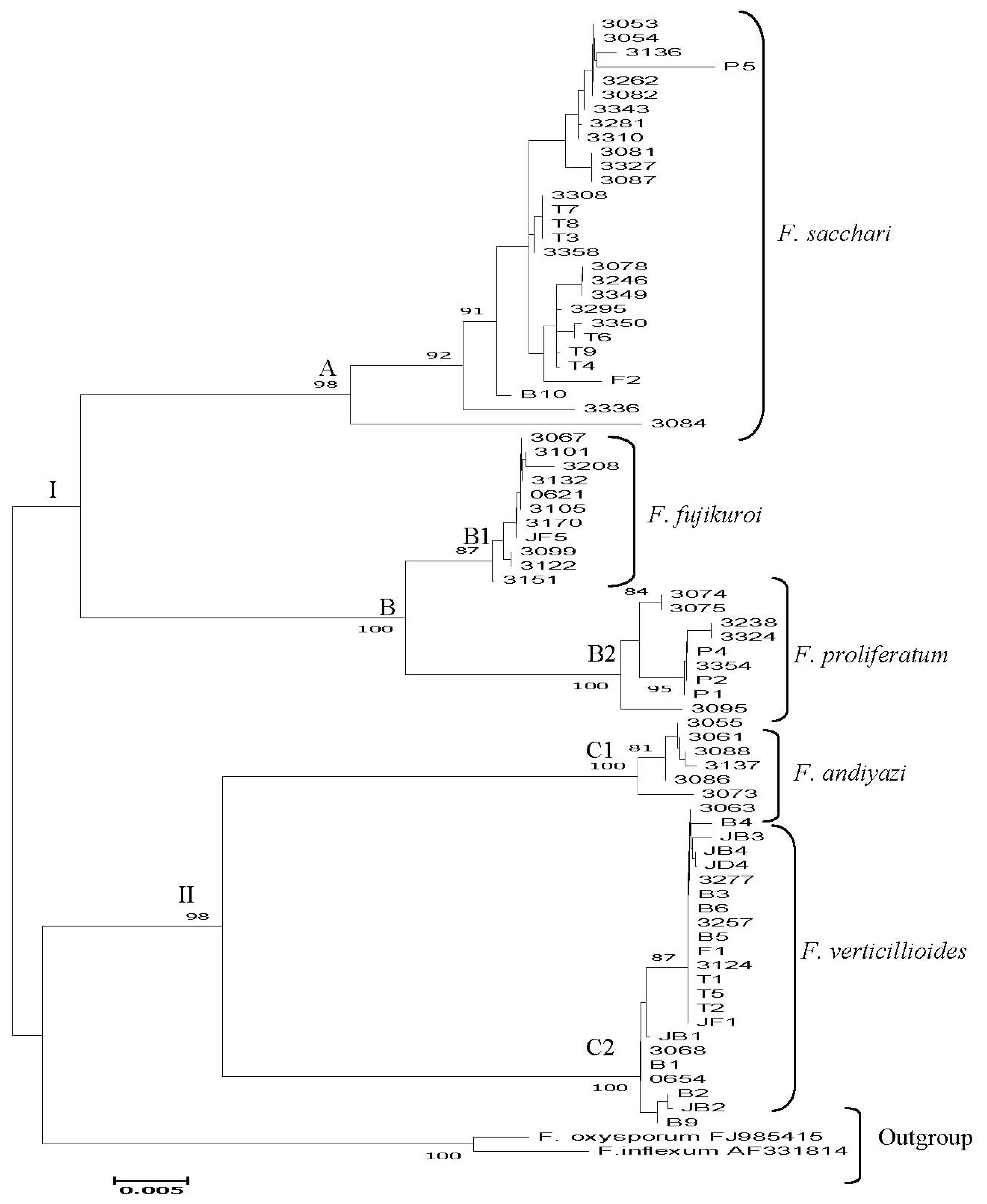
<p>Phylogenetic relationships were analyzed by the neighbor-joining method which was based on 670 aligned positions (<xref ref-type="fig" rid="f1-ijms-12-06722">Figure 1</xref>). In the data set, there were 135 variable sites, 526 conserved sites and 111 parsimony informative sites. All the main clades of the tree were well supported with bootstrap values ranging from 98%–100%. The phylogenetic tree can be divided into two main clades, I and II. Clade I consisted of sub-clades A and B. Isolates of <italic>F. sacchari</italic> were grouped in sub-clade A. Isolates of <italic>F. fujikuroi</italic> and <italic>F. proliferatum</italic> were grouped separately in sub-clades B1 and B2 respectively. Isolates of <italic>F. andiyazi</italic> and <italic>F. verticillioides</italic> were grouped separately in sub-clades C1 and C2. <italic>F. oxysporum</italic> and <italic>F. inflexum</italic> were clustered separately from the isolates of <italic>G. fujikuroi</italic> species complex.</p>
<p>The isolates of <italic>F. sacchari</italic> formed a distinct clade that was clearly separated from the other isolates of <italic>Fusarium</italic> in the neighbor-joining tree. The taxa closest to <italic>F. sacchari</italic> were <italic>F. proliferatum</italic> and <italic>F. fujikuroi</italic>. The grouping of <italic>F. sacchari</italic>, <italic>F. proliferatum</italic> and <italic>F. fujikuroi</italic> were in accordance with the biogeographic hyphotesis formulated by O’Donnell <italic>et al.</italic> [<xref ref-type="bibr" rid="b14-ijms-12-06722">14</xref>] which grouped the three species in the Asian clade.</p>
<p>Eleven isolates of <italic>F. fujikuroi</italic> and nine isolates of <italic>F. proliferatum</italic> were identified based on the closest match on of TEF-1α gene sequences. Both isolates of <italic>F. fujikuroi</italic> and <italic>F. proliferatum</italic> formed separate sub-clades in the tree (<xref ref-type="fig" rid="f1-ijms-12-06722">Figure 1</xref>) but are in the same main clade which indicated that <italic>F. fujikuroi</italic> and <italic>F. proliferatum</italic> are closely related. Similar results were also reported by Wulff <italic>et al</italic>. [<xref ref-type="bibr" rid="b10-ijms-12-06722">10</xref>] in which <italic>F. fujikuroi</italic> and <italic>F. proliferatum,</italic> which both cause bakanae disease, were grouped in separate sub-clades. Both <italic>F. fujikuroi</italic> and <italic>F. proliferatum</italic> are grouped in the Asian clade and are morphologically and biologically very similar [<xref ref-type="bibr" rid="b14-ijms-12-06722">14</xref>,<xref ref-type="bibr" rid="b24-ijms-12-06722">24</xref>]. Moreover, <italic>F. fujikuroi</italic> and <italic>F. proliferatum</italic> are regarded as sibling species and some isolates can cross fertile [<xref ref-type="bibr" rid="b25-ijms-12-06722">25</xref>].</p>
<p>Isolates of <italic>F. verticillioides</italic> were clustered in the same main clade with isolates of <italic>F. andiyazi. F. verticillioides</italic> was grouped in the African clade with several other agricultural important pathogens of <italic>G. fujikuroi</italic> species complex [<xref ref-type="bibr" rid="b14-ijms-12-06722">14</xref>]. Although <italic>F. verticillioides</italic> is a member of the African clade, the major host of the fungus is maize which originated in Mexico or Central America. With more species recovered from different host plants and substrates in Malaysia, it could change the composition of the African clade. As for <italic>F. andiyazi</italic>, the detail species concept and phylogenetic analysis of the species remains to be determined [<xref ref-type="bibr" rid="b26-ijms-12-06722">26</xref>].</p>
<p>This study presents the identification of <italic>Fusarium</italic> species of <italic>G. fujikuroi</italic> species complex from rice, sugarcane and maize based on TEF-1α gene which is a useful marker for distinguishing <italic>Fusarium</italic> species [<xref ref-type="bibr" rid="b12-ijms-12-06722">12</xref>]. Phylogenetic analysis based on the gene clearly grouped the different species into separate groups with high bootstrap values confirming that TEF-1α gene is a good marker for identification of <italic>Fusarium</italic> species. However, additional genes such as other protein coding genes and genes involved in mycotoxin biosynthesis would support the taxonomic affinities of isolates which showed 97–99% sequence similarities as well as to study the pathogen populations. Studies on the evaluation of mycotoxins production are also needed as mycotoxins are commonly produced by <italic>Fusarium</italic> species in the <italic>G. fujikuroi</italic> species complex. Furthermore, there is also the probability that new strains will probably emerge through hybridization, which could lead to the establishment of new plant diseases.</p></sec>
<sec>
<title>3. Experimental Section</title>
<sec>
<title>3.1. Fungal Isolates</title>
<p>Fungal isolates used in this study were obtained from three hosts, namely, rice, sugarcane and maize. <italic>Fusarium</italic> isolates from rice were obtained from rice plants showing bakanae disease symptoms, showing abnormal elongation of the stem. <italic>Fusarium</italic> isolates from sugarcane were isolated from leaves with pokkah boeng symptoms showing leaves crumpled, stunted, twisted and chlorosis near the base. From maize, <italic>Fusarium</italic> isolation was made from rotting of the kernels. The samples were collected from 2008–2009.</p>
<p>Abnormal growth of rice plants and sugarcane leaves were cut to approximately 1 cm<sup>2</sup> with a sterile scalpel and soaked in 10% sodium hypoclorite (Clorox) for 30 s, transferred into sterile distilled water and soaked for another 30 s. The pieces of the tissues were then dried on sterilized filter paper (Whatman<sup>®</sup> No 1) and put onto peptone pentachloronitrobenzene agar (PPA) plate. The PPA plates were incubated at 25 °C until mycelia growth was observed. Mycelia from the samples were then subcultured onto potato sucrose agar (PSA). Kernels from maize were directly plated onto PPA plates with sterile forceps and incubated at 25 °C until mycelia growth were observed from the samples. The mycelia were also transferred onto PSA. To obtain pure culture of mycelia grow from the tissues and maize kernels, single spore isolation was carried out using dilution plating [<xref ref-type="bibr" rid="b4-ijms-12-06722">4</xref>]. For identification, three different types of media were used, namely Potato Dextrose Agar (PDA), PSA and Carnation Leaf Agar (CLA) as described in The <italic>Fusarium</italic> Laboratory Manual [<xref ref-type="bibr" rid="b4-ijms-12-06722">4</xref>]. Microscopic and macroscopic characteristics as described in the manual were used for species identification.</p>
<p>Thirty isolates from the field comprising 19 isolates from maize, three isolates from rice and eight isolates from sugarcane were successfully isolated and identified. Another 48 isolates from the rice, sugarcane and maize were also obtained from stock culture of School of Biological Sciences, Universiti Sains Malaysia culture collection. The samples were collected in 2007–2008. The isolates from the stock culture were also recovered from bakanae disease of rice, pokkah boeng disease of sugarcane and rotting of maize kernels and were identified based on morphological characteristics. In total, 78 isolates of <italic>Fusarium</italic> were used in this study (<xref ref-type="table" rid="t1-ijms-12-06722">Table 1</xref>).</p></sec>
<sec>
<title>3.2. DNA Extraction</title>
<p>Genomic DNA was extracted from mycelia grown on PSA, incubated for 7 days at 27 °C. Mycelia were ground in a mortar with liquid nitrogen until it became a fine powder. Approximately 0.23 g of the lyophilized mycelia was used for DNA extraction with a DNeasy<sup>®</sup> Plant Mini Kit (Qiagen, Germany), according to the manufacturer’s instructions. The DNA concentration was measured from all samples using UV spectrophotometry using a Nanodrop ND-1000 (Thermo Scientific, Wilmington, DE, USA) and adjusted to 20 ng/μL.</p></sec>
<sec>
<title>3.3. PCR Amplification</title>
<p>The TEF-1α gene was amplified with primers EF-1 (5′GTT AAG AGG CGC GGT GTC GGT GTG 3′) and EF-2 (5′GGA AGT ACC AGT GAT CAT GTT3′) [<xref ref-type="bibr" rid="b14-ijms-12-06722">14</xref>]. Amplification reactions were carried out in a 50 μL reaction mixture which consisted of 1X PCR buffer, 3.5 mM of MgCl<sub>2</sub>, 0.16 mM of dNTP mix (Promega, Madison WI, USA), 1.75 unit of GoTaq<sup>®</sup> DNA polymerase (Promega, Madison WI, USA), 0.3 μM of each primers and 0.5 μL of DNA template.</p>
<p>PCR was performed in a DNA Engine™ Peltier Thermal Cycler Model PTC-100 (MJ Research) as follows: initial denaturation at 94 °C for 85 s followed by 35 cycles of denaturation at 95 °C for 35 s, annealing at 59 °C for 55 s and extension at 72 °C for 90 s, followed by final extension for 10 min at 72 °C.</p>
<p>PCR products were detected by electrophoresis in a 1.5% agarose gel in TBE buffer. The electrophoresis was run for 100 min at 80 V and 400 mA. The size of the band was estimated by comparison to 100 bp DNA marker (MBI Fermentas, Lithunia). A negative control was used to test the absence of contamination.</p></sec>
<sec sec-type="methods">
<title>3.4. DNA Sequencing and Phylogenetic Analysis</title>
<p>The PCR products were purified using a QIAquick PCR Purification Kit (Qiagen, Germany) according to the manufacurer’s instruction. The purified PCR products were directly sequence in both directions using the respective forward and reverse primers, and sent for sequencing to a service provider.</p>
<p>DNA sequences were aligned by using ClusterW Multiple alignment in Molecular Evolutionary Genetic Analysis 4 or MEGA 4 [<xref ref-type="bibr" rid="b27-ijms-12-06722">27</xref>] and adjusted manually. Default gap penalties were used in the pair-wise alignment. The consensus sequence was then compared with other DNA sequences by using BLAST against FUSARIUM-ID database at <ext-link xlink:href="http://fusarium.cbio.psu.edu" ext-link-type="uri">http://fusarium.cbio.psu.edu</ext-link> [<xref ref-type="bibr" rid="b12-ijms-12-06722">12</xref>].</p>
<p>All sequences were aligned with gap opening penalty of 3.0, and a gap extension penalty of 1.8. Neighbor-joining analysis was then performed in MEGA 4. A neighbor-joining tree was constructed with the Jukes-Cantor model and the reliability of neighbor-joining trees was estimated by bootstrap method with 1000 replications. <italic>Fusarium oxysporum</italic> (FJ985415) and <italic>F. inflexum</italic> (AF331814) sequences from GenBank were selected as the outgroup.</p></sec></sec>
<sec sec-type="conclusions">
<title>4. Conclusions</title>
<p>The wide host range of <italic>Fusarium</italic> species in the <italic>G. fujikuroi</italic> species complex suggest that new species or species that have not been reported from Peninsular Malaysia are likely to be found on agricultural crops and other substrates such as from the soils. The present study suggests that many isolates of <italic>Fusarium</italic> species in the <italic>G. fujikuroi</italic> species complex in culture collections maybe misidentified which is not surprising since the isolates have been identified primarily using morphological characters. Accurate identification of <italic>Fusarium</italic> species associated with economically important crops could help in the formulation of disease control strategies, prediction of host range, climatic adaptation and mycotoxin production potential.</p></sec></body>
<back>
<ack>
<title>Acknowledgments</title>
<p>The study was funded by Fundamental Research Grant Scheme grant scheme (203/PBIOLOGY/671057), Ministry of Higher Learning Malaysia.</p></ack>
<ref-list>
<title>References</title>
<ref id="b1-ijms-12-06722"><label>1</label><citation citation-type="journal"><person-group person-group-type="author"><name><surname>Marasas</surname><given-names>WFO</given-names></name><name><surname>Ploetz</surname><given-names>RC</given-names></name><name><surname>Wingfield</surname><given-names>MJ</given-names></name><name><surname>Wingfield</surname><given-names>BD</given-names></name><name><surname>Steenkamp</surname><given-names>ET</given-names></name></person-group><article-title>Mango malformation disease and the associated <italic>Fusarium</italic> species</article-title><source>Phytopathology</source><year>2006</year><volume>96</volume><fpage>667</fpage><lpage>672</lpage><pub-id pub-id-type="doi">10.1094/PHYTO-96-0667</pub-id><pub-id pub-id-type="pmid">18943188</pub-id></citation></ref>
<ref id="b2-ijms-12-06722"><label>2</label><citation citation-type="journal"><person-group person-group-type="author"><name><surname>Mohd Zainudin</surname><given-names>NAI</given-names></name><name><surname>Razak</surname><given-names>AA</given-names></name><name><surname>Salleh</surname><given-names>B</given-names></name></person-group><article-title>Bakanae disease of rice in Malaysia and Indonesia: Etiology of the causal agent based on morphological, physiological and pathogenicity characteristics</article-title><source>J. Plant Prot. Res</source><year>2008</year><volume>48</volume><fpage>476</fpage><lpage>485</lpage></citation></ref>
<ref id="b3-ijms-12-06722"><label>3</label><citation citation-type="journal"><person-group person-group-type="author"><name><surname>Siti Nordahliawate</surname><given-names>MS</given-names></name><name><surname>Nur Ain Izzati</surname><given-names>MZ</given-names></name><name><surname>Razak</surname><given-names>AA</given-names></name><name><surname>Salleh</surname><given-names>B</given-names></name></person-group><article-title>Distribution, morphological characterization and pathogenicity of <italic>Fusarium sacchari a</italic>ssociated with pokkah boeng disease of sugarcane in Peninsular Malaysia</article-title><source>J. Trop. Agric. Sci</source><year>2008</year><volume>31</volume><fpage>279</fpage><lpage>286</lpage></citation></ref>
<ref id="b4-ijms-12-06722"><label>4</label><citation citation-type="book"><person-group person-group-type="author"><name><surname>Leslie</surname><given-names>JF</given-names></name><name><surname>Summerell</surname><given-names>BA</given-names></name></person-group><source>The Fusarium Laboratory Manual</source><edition>1st ed</edition><publisher-name>Blackwell Publishing</publisher-name><publisher-loc>Hoboken, NJ, USA</publisher-loc><year>2006</year></citation></ref>
<ref id="b5-ijms-12-06722"><label>5</label><citation citation-type="journal"><person-group person-group-type="author"><name><surname>Yli-Matilla</surname><given-names>T</given-names></name><name><surname>Paavaeen-Huhtala</surname><given-names>S</given-names></name><name><surname>Bulat</surname><given-names>SA</given-names></name><name><surname>Alekhina</surname><given-names>IA</given-names></name><name><surname>Nirenberg</surname><given-names>HI</given-names></name></person-group><article-title>Molecular, morphological and phylogenetic analysis of the <italic>Fusarium avenaceum</italic> / <italic>F. arthrosporioides</italic> / <italic>F. tricinctum</italic> species complex – a polyphasic approach</article-title><source>Mycol. Res</source><year>2002</year><volume>106</volume><fpage>655</fpage><lpage>669</lpage><pub-id pub-id-type="doi">10.1017/S0953756202006020</pub-id></citation></ref>
<ref id="b6-ijms-12-06722"><label>6</label><citation citation-type="journal"><person-group person-group-type="author"><name><surname>Knutsen</surname><given-names>AK</given-names></name><name><surname>Torp</surname><given-names>M</given-names></name><name><surname>Holst-Jensen</surname><given-names>A</given-names></name></person-group><article-title>Phylogenetic analyses of <italic>Fusarium poae, Fusarium sporotrichiodes</italic> and <italic>Fusarium langsethiae</italic> species complex based on partial sequences of the translation elongation factor 1-α gene</article-title><source>Int. J. Food Microbiol</source><year>2004</year><volume>95</volume><fpage>287</fpage><lpage>295</lpage><pub-id pub-id-type="doi">10.1016/j.ijfoodmicro.2003.12.007</pub-id><pub-id pub-id-type="pmid">15337593</pub-id></citation></ref>
<ref id="b7-ijms-12-06722"><label>7</label><citation citation-type="journal"><person-group person-group-type="author"><name><surname>Jurjevic</surname><given-names>Z</given-names></name><name><surname>Wilson</surname><given-names>DM</given-names></name><name><surname>Wilson</surname><given-names>JP</given-names></name><name><surname>Geiser</surname><given-names>DM</given-names></name><name><surname>Juba</surname><given-names>JH</given-names></name><name><surname>Mubatanhema</surname><given-names>W</given-names></name><name><surname>Widstrom</surname><given-names>NW</given-names></name><name><surname>Rains</surname><given-names>GC</given-names></name></person-group><article-title><italic>Fusarium</italic> species of the <italic>Gibberella fujikuroi</italic> complex and fumonisin contamination of pearl millet and corn in Georgia, USA</article-title><source>Mycopathologia</source><year>2005</year><volume>159</volume><fpage>401</fpage><lpage>406</lpage><pub-id pub-id-type="doi">10.1007/s11046-004-1050-2</pub-id><pub-id pub-id-type="pmid">15883726</pub-id></citation></ref>
<ref id="b8-ijms-12-06722"><label>8</label><citation citation-type="journal"><person-group person-group-type="author"><name><surname>Morales-Rodriguez</surname><given-names>I</given-names></name><name><surname>deYanex-Morales</surname><given-names>M</given-names></name><name><surname>Silva-Rajas</surname><given-names>HV</given-names></name><name><surname>Garcia de-la-Santos</surname><given-names>G</given-names></name><name><surname>Guzman de-Pena</surname><given-names>DA</given-names></name></person-group><article-title>Biodiversity of <italic>Fusarium</italic> species in Mexico associated with ear rot in maize and their identification using phylogenetic approach</article-title><source>Mycopathologia</source><year>2007</year><volume>163</volume><fpage>31</fpage><lpage>39</lpage><pub-id pub-id-type="doi">10.1007/s11046-006-0082-1</pub-id><pub-id pub-id-type="pmid">17216329</pub-id></citation></ref>
<ref id="b9-ijms-12-06722"><label>9</label><citation citation-type="journal"><person-group person-group-type="author"><name><surname>Nalim</surname><given-names>FA</given-names></name><name><surname>Elmer</surname><given-names>WH</given-names></name><name><surname>McGovern</surname><given-names>PJ</given-names></name><name><surname>Geiser</surname><given-names>DM</given-names></name></person-group><article-title>Multilocus phylogenetic diversity of <italic>Fusarium avenaceum</italic> pathogenic on lisianthus</article-title><source>Phytopathology</source><year>2009</year><volume>99</volume><fpage>462</fpage><lpage>468</lpage><pub-id pub-id-type="doi">10.1094/PHYTO-99-4-0462</pub-id><pub-id pub-id-type="pmid">19271989</pub-id></citation></ref>
<ref id="b10-ijms-12-06722"><label>10</label><citation citation-type="journal"><person-group person-group-type="author"><name><surname>Wulff</surname><given-names>EG</given-names></name><name><surname>Sørensen</surname><given-names>JL</given-names></name><name><surname>Lübeck</surname><given-names>M</given-names></name><name><surname>Nielsen</surname><given-names>KF</given-names></name><name><surname>Thrane</surname><given-names>U</given-names></name><name><surname>Torp</surname><given-names>J</given-names></name></person-group><article-title><italic>Fusarium</italic> spp. associated with rice Bakanae: Ecology, genetic diversity, pathogenicity and toxigenicity</article-title><source>Environ. Microbiol</source><year>2010</year><volume>12</volume><fpage>649</fpage><lpage>657</lpage><pub-id pub-id-type="doi">10.1111/j.1462-2920.2009.02105.x</pub-id><pub-id pub-id-type="pmid">20002135</pub-id></citation></ref>
<ref id="b11-ijms-12-06722"><label>11</label><citation citation-type="journal"><person-group person-group-type="author"><name><surname>Harrow</surname><given-names>SA</given-names></name><name><surname>Ferrokhi-Nejad</surname><given-names>R</given-names></name><name><surname>Pitman</surname><given-names>AR</given-names></name><name><surname>Scott</surname><given-names>IAW</given-names></name><name><surname>Bentley</surname><given-names>A</given-names></name><name><surname>Hide</surname><given-names>C</given-names></name><name><surname>Cromey</surname><given-names>MG</given-names></name></person-group><article-title>Characterization of New Zealand <italic>Fusarium</italic> populations using a polyphasic approach differentiates the <italic>F. avenaceum/F. acuminatum/F. tricinctum</italic> species complex in cereal and grassland systems</article-title><source>Fungal Biol</source><year>2010</year><volume>114</volume><fpage>293</fpage><lpage>311</lpage><pub-id pub-id-type="doi">10.1016/j.funbio.2010.01.005</pub-id><pub-id pub-id-type="pmid">20943139</pub-id></citation></ref>
<ref id="b12-ijms-12-06722"><label>12</label><citation citation-type="journal"><person-group person-group-type="author"><name><surname>Geiser</surname><given-names>DM</given-names></name><name><surname>Jimenez-Gasco</surname><given-names>M</given-names></name><name><surname>Kang</surname><given-names>S</given-names></name><name><surname>Makalowska</surname><given-names>I</given-names></name><name><surname>Veeraraghavan</surname><given-names>N</given-names></name><name><surname>Ward</surname><given-names>TJ</given-names></name><name><surname>Zhang</surname><given-names>N</given-names></name><name><surname>Kuldau</surname><given-names>GA</given-names></name><name><surname>O’Donnell</surname><given-names>K</given-names></name></person-group><article-title>FUSARIUM-ID v. 1.0: A DNA sequence database for identifying <italic>Fusarium</italic></article-title><source>Eur. J. Plant Pathol</source><year>2004</year><volume>110</volume><fpage>473</fpage><lpage>479</lpage><pub-id pub-id-type="doi">10.1023/B:EJPP.0000032386.75915.a0</pub-id></citation></ref>
<ref id="b13-ijms-12-06722"><label>13</label><citation citation-type="journal"><person-group person-group-type="author"><name><surname>Rossman</surname><given-names>AY</given-names></name><name><surname>Palm-Hernandez</surname><given-names>ME</given-names></name></person-group><article-title>Systematics of plant pathogenic Fungi. Why it matters</article-title><source>Plant Dis</source><year>2008</year><volume>92</volume><fpage>1377</fpage><lpage>1386</lpage></citation></ref>
<ref id="b14-ijms-12-06722"><label>14</label><citation citation-type="journal"><person-group person-group-type="author"><name><surname>O’Donnell</surname><given-names>K</given-names></name><name><surname>Cigelnik</surname><given-names>E</given-names></name><name><surname>Nirenberg</surname><given-names>HI</given-names></name></person-group><article-title>Molecular systematics and phylogeography of the <italic>Gibberella fujikuroi</italic> species complex</article-title><source>Mycologia</source><year>1998</year><volume>90</volume><fpage>465</fpage><lpage>493</lpage><pub-id pub-id-type="doi">10.2307/3761407</pub-id></citation></ref>
<ref id="b15-ijms-12-06722"><label>15</label><citation citation-type="journal"><person-group person-group-type="author"><name><surname>O’Donnell</surname><given-names>K</given-names></name><name><surname>Nirenberg</surname><given-names>HI</given-names></name><name><surname>Aoki</surname><given-names>T</given-names></name><name><surname>Cigelnik</surname><given-names>E</given-names></name></person-group><article-title>A multigene phylogeny of the <italic>Gibberella fujikuroi</italic> species complex: Detection of additional phylogenetically distinct species</article-title><source>Mycoscience</source><year>2000</year><volume>41</volume><fpage>61</fpage><lpage>78</lpage><pub-id pub-id-type="doi">10.1007/BF02464387</pub-id></citation></ref>
<ref id="b16-ijms-12-06722"><label>16</label><citation citation-type="journal"><person-group person-group-type="author"><name><surname>Marasas</surname><given-names>WFO</given-names></name><name><surname>Rheeder</surname><given-names>JP</given-names></name><name><surname>Lamprecht</surname><given-names>SC</given-names></name><name><surname>Zeller</surname><given-names>KA</given-names></name><name><surname>Leslie</surname><given-names>JF</given-names></name></person-group><article-title><italic>Fusarium andiyazi sp. nov</italic>., a new species from sorghum</article-title><source>Mycologia</source><year>2001</year><volume>93</volume><fpage>1203</fpage><lpage>1210</lpage><pub-id pub-id-type="doi">10.2307/3761681</pub-id></citation></ref>
<ref id="b17-ijms-12-06722"><label>17</label><citation citation-type="journal"><person-group person-group-type="author"><name><surname>Steenkamp</surname><given-names>ET</given-names></name><name><surname>Wingfield</surname><given-names>BD</given-names></name><name><surname>Coutinho</surname><given-names>TA</given-names></name><name><surname>Wingfield</surname><given-names>MJ</given-names></name><name><surname>Marasas</surname><given-names>WFO</given-names></name></person-group><article-title>Differentiation of <italic>Fusarium subglutinans</italic> f. sp. <italic>pini</italic> by histone gene sequence data</article-title><source>Appl. Environ. Microb</source><year>1999</year><volume>65</volume><fpage>3401</fpage><lpage>3406</lpage></citation></ref>
<ref id="b18-ijms-12-06722"><label>18</label><citation citation-type="journal"><person-group person-group-type="author"><name><surname>Klittich</surname><given-names>CJ</given-names></name><name><surname>Leslie</surname><given-names>JF</given-names></name><name><surname>Nelson</surname><given-names>PE</given-names></name><name><surname>Marasas</surname><given-names>WFO</given-names></name></person-group><article-title><italic>Fusarium thapsinum</italic> (<italic>Gibberella thapsina</italic>): a new species in section Liseola from sorghum</article-title><source>Mycologia</source><year>1997</year><fpage>643</fpage><lpage>652</lpage></citation></ref>
<ref id="b19-ijms-12-06722"><label>19</label><citation citation-type="journal"><person-group person-group-type="author"><name><surname>Bacon</surname><given-names>CW</given-names></name><name><surname>Hinton</surname><given-names>DM</given-names></name></person-group><article-title>Symptomless endophytic colonization of maize by <italic>Fusarium moniliforme</italic></article-title><source>Can. J. Botany</source><year>1996</year><volume>74</volume><fpage>1195</fpage><lpage>1202</lpage><pub-id pub-id-type="doi">10.1139/b96-144</pub-id></citation></ref>
<ref id="b20-ijms-12-06722"><label>20</label><citation citation-type="journal"><person-group person-group-type="author"><name><surname>Latiffah</surname><given-names>Z</given-names></name><name><surname>Mah</surname><given-names>KF</given-names></name><name><surname>Heng</surname><given-names>MH</given-names></name><name><surname>Maziah</surname><given-names>Z</given-names></name><name><surname>Baharuddin</surname><given-names>S</given-names></name></person-group><article-title><italic>Fusarium</italic> species isolated from mangrove soil in Kampung Pantai Acheh, Balik Pulau, Pulau Pinang</article-title><source>Trop. Life Sci. Res</source><year>2010</year><volume>21</volume><fpage>23</fpage><lpage>32</lpage></citation></ref>
<ref id="b21-ijms-12-06722"><label>21</label><citation citation-type="book"><person-group person-group-type="author"><name><surname>Burgess</surname><given-names>LW</given-names></name><name><surname>Summerell</surname><given-names>BA</given-names></name><name><surname>Bullock</surname><given-names>S</given-names></name><name><surname>Gott</surname><given-names>KP</given-names></name><name><surname>Backhouse</surname><given-names>D</given-names></name></person-group><source>Laboratory Manual for Fusarium Research</source><publisher-name>University of Sydney</publisher-name><publisher-loc>Sydney, Australia</publisher-loc><year>1994</year></citation></ref>
<ref id="b22-ijms-12-06722"><label>22</label><citation citation-type="journal"><person-group person-group-type="author"><name><surname>Logrieco</surname><given-names>A</given-names></name><name><surname>Mule</surname><given-names>G</given-names></name><name><surname>Moretti</surname><given-names>A</given-names></name><name><surname>Bottalico</surname><given-names>A</given-names></name></person-group><article-title>Toxigenic <italic>Fusarium</italic> species and mycotoxins associated with maize ear rot in Europe</article-title><source>Eur. J. Plant Pathol</source><year>2002</year><volume>108</volume><fpage>597</fpage><lpage>609</lpage><pub-id pub-id-type="doi">10.1023/A:1020679029993</pub-id></citation></ref>
<ref id="b23-ijms-12-06722"><label>23</label><citation citation-type="journal"><person-group person-group-type="author"><name><surname>Leslie</surname><given-names>JF</given-names></name></person-group><article-title>Mating populations in <italic>Gibberella fujikuroi</italic> (<italic>Fusarium</italic> section Liseola)</article-title><source>Phytopathology</source><year>1991</year><volume>81</volume><fpage>1958</fpage><lpage>1060</lpage></citation></ref>
<ref id="b24-ijms-12-06722"><label>24</label><citation citation-type="journal"><person-group person-group-type="author"><name><surname>Leslie</surname><given-names>JF</given-names></name><name><surname>Anderson</surname><given-names>LL</given-names></name><name><surname>Bowden</surname><given-names>RL</given-names></name><name><surname>Lee</surname><given-names>YW</given-names></name></person-group><article-title>Inter- and intra-specific genetic variation in <italic>Fusarium</italic></article-title><source>Int. J. Food Mircobiol</source><year>2007</year><volume>119</volume><fpage>25</fpage><lpage>32</lpage><pub-id pub-id-type="doi">10.1016/j.ijfoodmicro.2007.07.059</pub-id></citation></ref>
<ref id="b25-ijms-12-06722"><label>25</label><citation citation-type="journal"><person-group person-group-type="author"><name><surname>Leslie</surname><given-names>JF</given-names></name><name><surname>Zeller</surname><given-names>KA</given-names></name><name><surname>Wahler</surname><given-names>M</given-names></name><name><surname>Summerell</surname><given-names>BA</given-names></name></person-group><article-title>Interfertility of two mating populations in the <italic>Gibberella fujikuroi</italic> species complex</article-title><source>Eur. J. Plant Pathol</source><year>2004</year><volume>110</volume><fpage>611</fpage><lpage>618</lpage><pub-id pub-id-type="doi">10.1023/B:EJPP.0000032400.55446.d8</pub-id></citation></ref>
<ref id="b26-ijms-12-06722"><label>26</label><citation citation-type="journal"><person-group person-group-type="author"><name><surname>Kvas</surname><given-names>M</given-names></name><name><surname>Marasas</surname><given-names>WFO</given-names></name><name><surname>Wingfield</surname><given-names>BD</given-names></name><name><surname>Wingfield</surname><given-names>MJ</given-names></name></person-group><article-title>Diversity and evolution of <italic>Fusarium</italic> species in the <italic>Gibberella fujikuroi</italic> complex</article-title><source>Fungal Divers</source><year>2009</year><volume>24</volume><fpage>1</fpage><lpage>21</lpage></citation></ref>
<ref id="b27-ijms-12-06722"><label>27</label><citation citation-type="journal"><person-group person-group-type="author"><name><surname>Tamura</surname><given-names>K</given-names></name><name><surname>Dudley</surname><given-names>J</given-names></name><name><surname>Nei</surname><given-names>M</given-names></name><name><surname>Kumar</surname><given-names>S</given-names></name></person-group><article-title>MEGA 4: Molecular Evolutionary Genetics Analysis (MEGA) software 4.0</article-title><source>Mol. Biol. Evol</source><year>2007</year><volume>24</volume><fpage>1596</fpage><lpage>1599</lpage><pub-id pub-id-type="doi">10.1093/molbev/msm092</pub-id><pub-id pub-id-type="pmid">17488738</pub-id></citation></ref></ref-list>
<sec sec-type="display-objects">
<title>Figure and Table</title>
<fig id="f1-ijms-12-06722" position="float">
<label>Figure 1</label>
<caption>
<p>Neighbor-joining tree showing the relationship of 78 isolates of <italic>Fusarium</italic> of the <italic>G. fujikuroi</italic> species complex inferred from TEF-1α using Jukes-Cantor method. The bootstrap values (1000 replicates) higher than 50% are shown next to the branches. <italic>F. oxysporum</italic> and <italic>F. inflexum</italic> are the outgroup.</p></caption>
<graphic xlink:href="ijms-12-06722f1.gif"/></fig>
<table-wrap id="t1-ijms-12-06722" position="float">
<label>Table 1</label>
<caption>
<p>Identification of <italic>Fusarium</italic> isolates from rice, sugarcane and maize based on morphological and (translation elongation factor) TEF-1α sequences.</p></caption>
<table frame="hsides" rules="groups">
<thead>
<tr>
<th align="left" valign="top">Isolate and Host</th>
<th align="left" valign="top">Location</th>
<th align="left" valign="top">Morphological Identification</th>
<th align="left" valign="top">TEF-1α sequences (% similarity)</th>
<th align="left" valign="top">Accession Number</th></tr></thead>
<tbody>
<tr>
<td align="left" valign="top"><xref ref-type="table-fn" rid="tfn2-ijms-12-06722">*</xref>0654 (R)</td>
<td align="left" valign="top">Seberang Perai, Penang</td>
<td align="left" valign="top"><italic>F. verticillioides</italic></td>
<td align="left" valign="top"><italic>F. verticillioides</italic> (99)</td>
<td align="left" valign="top">JN675681</td></tr>
<tr>
<td align="left" valign="top"><xref ref-type="table-fn" rid="tfn2-ijms-12-06722">*</xref>3063 (R)</td>
<td align="left" valign="top">Seberang Perak, Perak</td>
<td align="left" valign="top"><italic>F. verticillioides</italic></td>
<td align="left" valign="top"><italic>F. verticillioides</italic> (99)</td>
<td align="left" valign="top">JN675682</td></tr>
<tr>
<td align="left" valign="top"><xref ref-type="table-fn" rid="tfn2-ijms-12-06722">*</xref>3068 (R)</td>
<td align="left" valign="top">Jabi, Terengganu</td>
<td align="left" valign="top"><italic>F. verticillioides</italic></td>
<td align="left" valign="top"><italic>F. verticillioides</italic> (99)</td>
<td align="left" valign="top">JN675683</td></tr>
<tr>
<td align="left" valign="top"><xref ref-type="table-fn" rid="tfn2-ijms-12-06722">*</xref>3124 (R)</td>
<td align="left" valign="top">Kuala Selangor, Selangor</td>
<td align="left" valign="top"><italic>F. verticillioides</italic></td>
<td align="left" valign="top"><italic>F. verticillioides</italic> (99)</td>
<td align="left" valign="top">JN675680</td></tr>
<tr>
<td align="left" valign="top"><xref ref-type="table-fn" rid="tfn2-ijms-12-06722">*</xref>3257 (SC)</td>
<td align="left" valign="top">Padang Terap, Kedah</td>
<td align="left" valign="top"><italic>F. verticillioides</italic></td>
<td align="left" valign="top"><italic>F. verticillioides</italic> (100)</td>
<td align="left" valign="top">JN675684</td></tr>
<tr>
<td align="left" valign="top">T1 (SC)</td>
<td align="left" valign="top">Chuping, Perlis</td>
<td align="left" valign="top"><italic>F. verticillioides</italic></td>
<td align="left" valign="top"><italic>F. verticillioides</italic> (100)</td>
<td align="left" valign="top">JN675701</td></tr>
<tr>
<td align="left" valign="top">T2 (SC)</td>
<td align="left" valign="top">Chuping, Perlis</td>
<td align="left" valign="top"><italic>F. verticillioides</italic></td>
<td align="left" valign="top"><italic>F. verticillioides</italic> (99)</td>
<td align="left" valign="top">JN675702</td></tr>
<tr>
<td align="left" valign="top"><xref ref-type="table-fn" rid="tfn2-ijms-12-06722">*</xref>3277 (SC)</td>
<td align="left" valign="top">Chuping, Perlis</td>
<td align="left" valign="top"><italic>F. verticillioides</italic></td>
<td align="left" valign="top"><italic>F. verticillioides</italic> (100)</td>
<td align="left" valign="top">JN675699</td></tr>
<tr>
<td align="left" valign="top">T5 (SC)</td>
<td align="left" valign="top">Chuping, Perlis</td>
<td align="left" valign="top"><italic>F. verticillioides</italic></td>
<td align="left" valign="top"><italic>F. verticillioides</italic> (100)</td>
<td align="left" valign="top">JN675700</td></tr>
<tr>
<td align="left" valign="top">JB1 (M)</td>
<td align="left" valign="top">Gurun, Kedah</td>
<td align="left" valign="top"><italic>F. verticillioides</italic></td>
<td align="left" valign="top"><italic>F. verticillioides</italic> (99)</td>
<td align="left" valign="top">JN675693</td></tr>
<tr>
<td align="left" valign="top">JB2 (M</td>
<td align="left" valign="top">Gurun, Kedah</td>
<td align="left" valign="top"><italic>F. verticillioides</italic></td>
<td align="left" valign="top"><italic>F. verticillioides</italic> (99)</td>
<td align="left" valign="top">JN675694</td></tr>
<tr>
<td align="left" valign="top">JB3 (M)</td>
<td align="left" valign="top">Gurun, Kedah</td>
<td align="left" valign="top"><italic>F. verticillioides</italic></td>
<td align="left" valign="top"><italic>F. verticillioides</italic> (99)</td>
<td align="left" valign="top">JN675695</td></tr>
<tr>
<td align="left" valign="top">JB4 (M)</td>
<td align="left" valign="top">Gurun, Kedah</td>
<td align="left" valign="top"><italic>F. verticillioides</italic></td>
<td align="left" valign="top"><italic>F. verticillioides</italic> (99)</td>
<td align="left" valign="top">JN675696</td></tr>
<tr>
<td align="left" valign="top">JD4 (M)</td>
<td align="left" valign="top">Gurun, Kedah</td>
<td align="left" valign="top"><italic>F. verticillioides</italic></td>
<td align="left" valign="top"><italic>F. verticillioides</italic> (99)</td>
<td align="left" valign="top">JN675697</td></tr>
<tr>
<td align="left" valign="top">JF1 (M)</td>
<td align="left" valign="top">Gurun, Kedah</td>
<td align="left" valign="top"><italic>F. verticillioides</italic></td>
<td align="left" valign="top"><italic>F. verticillioides</italic> (99)</td>
<td align="left" valign="top">JN675698</td></tr>
<tr>
<td align="left" valign="top">B1 (M)</td>
<td align="left" valign="top">Gurun, Kedah</td>
<td align="left" valign="top"><italic>F. verticillioides</italic></td>
<td align="left" valign="top"><italic>F. verticillioides</italic> (99)</td>
<td align="left" valign="top">JN675685</td></tr>
<tr>
<td align="left" valign="top">B2 (M)</td>
<td align="left" valign="top">Gurun, Kedah</td>
<td align="left" valign="top"><italic>F. verticillioides</italic></td>
<td align="left" valign="top"><italic>F. verticillioides</italic> (100)</td>
<td align="left" valign="top">JN675686</td></tr>
<tr>
<td align="left" valign="top">B3 (M)</td>
<td align="left" valign="top">Gurun, Kedah</td>
<td align="left" valign="top"><italic>F. verticillioides</italic></td>
<td align="left" valign="top"><italic>F. verticillioides</italic> (98)</td>
<td align="left" valign="top">JN675687</td></tr>
<tr>
<td align="left" valign="top">B4 (M)</td>
<td align="left" valign="top">Gurun, Kedah</td>
<td align="left" valign="top"><italic>F. verticillioides</italic></td>
<td align="left" valign="top"><italic>F. verticillioides</italic> (100)</td>
<td align="left" valign="top">JN675688</td></tr>
<tr>
<td align="left" valign="top">B5 (M)</td>
<td align="left" valign="top">Gurun, Kedah</td>
<td align="left" valign="top"><italic>F. verticillioides</italic></td>
<td align="left" valign="top"><italic>F. verticillioides</italic> (100)</td>
<td align="left" valign="top">JN675689</td></tr>
<tr>
<td align="left" valign="top">B6 (M)</td>
<td align="left" valign="top">Gurun, Kedah</td>
<td align="left" valign="top"><italic>F. verticillioides</italic></td>
<td align="left" valign="top"><italic>F. verticillioides</italic> (100)</td>
<td align="left" valign="top">JN675690</td></tr>
<tr>
<td align="left" valign="top">B9 (M)</td>
<td align="left" valign="top">Gurun, Kedah</td>
<td align="left" valign="top"><italic>F. verticillioides</italic></td>
<td align="left" valign="top"><italic>F. verticillioides</italic> (99)</td>
<td align="left" valign="top">JN675691</td></tr>
<tr>
<td align="left" valign="top">F1 (M)</td>
<td align="left" valign="top">Gurun, Kedah</td>
<td align="left" valign="top"><italic>F. verticillioides</italic></td>
<td align="left" valign="top"><italic>F. verticillioides</italic> (99)</td>
<td align="left" valign="top">JN675692</td></tr>
<tr>
<td align="left" valign="top"><xref ref-type="table-fn" rid="tfn2-ijms-12-06722">*</xref>3055 (R)</td>
<td align="left" valign="top">Seberang Perak, Perak</td>
<td align="left" valign="top"><italic>F. verticillioides</italic></td>
<td align="left" valign="top"><italic>F. andiyazi</italic> (98</td>
<td align="left" valign="top">JN408195</td></tr>
<tr>
<td align="left" valign="top"><xref ref-type="table-fn" rid="tfn2-ijms-12-06722">*</xref>3061 (R)</td>
<td align="left" valign="top">Seberang Perak, Perak</td>
<td align="left" valign="top"><italic>F. verticillioides</italic></td>
<td align="left" valign="top"><italic>F. andiyazi</italic> (98)</td>
<td align="left" valign="top">JN408196</td></tr>
<tr>
<td align="left" valign="top"><xref ref-type="table-fn" rid="tfn2-ijms-12-06722">*</xref>3073 (R)</td>
<td align="left" valign="top">Tumpat, Kelantan</td>
<td align="left" valign="top"><italic>F. verticillioides</italic></td>
<td align="left" valign="top"><italic>F. andiyazi</italic> (98)</td>
<td align="left" valign="top">JN675629</td></tr>
<tr>
<td align="left" valign="top"><xref ref-type="table-fn" rid="tfn2-ijms-12-06722">*</xref>3086 (R)</td>
<td align="left" valign="top">Rompin, Pahang</td>
<td align="left" valign="top"><italic>F. verticillioides</italic></td>
<td align="left" valign="top"><italic>F. andiyazi</italic> (98)</td>
<td align="left" valign="top">JN408197</td></tr>
<tr>
<td align="left" valign="top"><xref ref-type="table-fn" rid="tfn2-ijms-12-06722">*</xref>3088 (R)</td>
<td align="left" valign="top">Rompin, Pahang</td>
<td align="left" valign="top"><italic>F. verticillioides</italic></td>
<td align="left" valign="top"><italic>F. andiyazi</italic> (98)</td>
<td align="left" valign="top">JN408198</td></tr>
<tr>
<td align="left" valign="top"><xref ref-type="table-fn" rid="tfn2-ijms-12-06722">*</xref>3137 (R)</td>
<td align="left" valign="top">Sungai Besar, Selangor</td>
<td align="left" valign="top"><italic>F. verticillioides</italic></td>
<td align="left" valign="top"><italic>F. andiyazi</italic> (98)</td>
<td align="left" valign="top">JN675630</td></tr>
<tr>
<td align="left" valign="top"><xref ref-type="table-fn" rid="tfn2-ijms-12-06722">*</xref>3053 (R)</td>
<td align="left" valign="top">Teluk Intan, Perak</td>
<td align="left" valign="top"><italic>F. sacchari</italic></td>
<td align="left" valign="top"><italic>F. sacchari</italic> (99)</td>
<td align="left" valign="top">JN675640</td></tr>
<tr>
<td align="left" valign="top"><xref ref-type="table-fn" rid="tfn2-ijms-12-06722">*</xref>3054(R)</td>
<td align="left" valign="top">Seberang Perak, Perak</td>
<td align="left" valign="top"><italic>F. sacchari</italic></td>
<td align="left" valign="top"><italic>F. sacchari</italic> (99)</td>
<td align="left" valign="top">JN675641</td></tr>
<tr>
<td align="left" valign="top"><xref ref-type="table-fn" rid="tfn2-ijms-12-06722">*</xref>3078 (R)</td>
<td align="left" valign="top">Rompin, Pahang</td>
<td align="left" valign="top"><italic>F. sacchari</italic></td>
<td align="left" valign="top"><italic>F. sacchari</italic> (100)</td>
<td align="left" valign="top">JN675642</td></tr>
<tr>
<td align="left" valign="top"><xref ref-type="table-fn" rid="tfn2-ijms-12-06722">*</xref>3081 (R)</td>
<td align="left" valign="top">Rompin, Pahang</td>
<td align="left" valign="top"><italic>F. sacchari</italic></td>
<td align="left" valign="top"><italic>F. sacchari</italic> (99)</td>
<td align="left" valign="top">JN675643</td></tr>
<tr>
<td align="left" valign="top"><xref ref-type="table-fn" rid="tfn2-ijms-12-06722">*</xref>3082 (R)</td>
<td align="left" valign="top">Rompin, Pahang</td>
<td align="left" valign="top"><italic>F. sacchari</italic></td>
<td align="left" valign="top"><italic>F. sacchari</italic> (99)</td>
<td align="left" valign="top">JN675644</td></tr>
<tr>
<td align="left" valign="top"><xref ref-type="table-fn" rid="tfn2-ijms-12-06722">*</xref>3084 (R)</td>
<td align="left" valign="top">Rompin, Pahang</td>
<td align="left" valign="top"><italic>F. sacchari</italic></td>
<td align="left" valign="top"><italic>F. sacchari</italic> (99)</td>
<td align="left" valign="top">JN675645</td></tr>
<tr>
<td align="left" valign="top"><xref ref-type="table-fn" rid="tfn2-ijms-12-06722">*</xref>3087 (R)</td>
<td align="left" valign="top">Rompin, Pahang</td>
<td align="left" valign="top"><italic>F. sacchari</italic></td>
<td align="left" valign="top"><italic>F. sacchari</italic> (99)</td>
<td align="left" valign="top">JN675646</td></tr>
<tr>
<td align="left" valign="top"><xref ref-type="table-fn" rid="tfn2-ijms-12-06722">*</xref>3136 (R)</td>
<td align="left" valign="top">Sungai Besar, Selangor</td>
<td align="left" valign="top"><italic>F. sacchari</italic></td>
<td align="left" valign="top"><italic>F. sacchari</italic> (97)</td>
<td align="left" valign="top">JN675647</td></tr>
<tr>
<td align="left" valign="top">P5 (R)</td>
<td align="left" valign="top">Gurun, Kedah</td>
<td align="left" valign="top"><italic>F. sacchari</italic></td>
<td align="left" valign="top"><italic>F. sacchari</italic> (99)</td>
<td align="left" valign="top">JN675662</td></tr>
<tr>
<td align="left" valign="top"><xref ref-type="table-fn" rid="tfn2-ijms-12-06722">*</xref>3246 (SC)</td>
<td align="left" valign="top">Padang Terap, Kedah</td>
<td align="left" valign="top"><italic>F. sacchari</italic></td>
<td align="left" valign="top"><italic>F. sacchari</italic> (99)</td>
<td align="left" valign="top">JN675648</td></tr>
<tr>
<td align="left" valign="top"><xref ref-type="table-fn" rid="tfn2-ijms-12-06722">*</xref>3262 (SC)</td>
<td align="left" valign="top">Padang Terap, Kedah</td>
<td align="left" valign="top"><italic>F. sacchari</italic></td>
<td align="left" valign="top"><italic>F. sacchari</italic> (99)</td>
<td align="left" valign="top">JN675649</td></tr>
<tr>
<td align="left" valign="top"><xref ref-type="table-fn" rid="tfn2-ijms-12-06722">*</xref>3281 (SC)</td>
<td align="left" valign="top">Chuping, Perlis</td>
<td align="left" valign="top"><italic>F. subglutinans</italic></td>
<td align="left" valign="top"><italic>F. sacchari</italic> (99)</td>
<td align="left" valign="top">JN675650</td></tr>
<tr>
<td align="left" valign="top"><xref ref-type="table-fn" rid="tfn2-ijms-12-06722">*</xref>3295 (SC)</td>
<td align="left" valign="top">Chuping, Perlis</td>
<td align="left" valign="top"><italic>F. subglutinans</italic></td>
<td align="left" valign="top"><italic>F. sacchari</italic> (99)</td>
<td align="left" valign="top">JN675651</td></tr>
<tr>
<td align="left" valign="top"><xref ref-type="table-fn" rid="tfn2-ijms-12-06722">*</xref>3308 (SC)</td>
<td align="left" valign="top">Kupang, Kedah</td>
<td align="left" valign="top"><italic>F. subglutinans</italic></td>
<td align="left" valign="top"><italic>F. sacchari</italic> (99)</td>
<td align="left" valign="top">JN675652</td></tr>
<tr>
<td align="left" valign="top"><xref ref-type="table-fn" rid="tfn2-ijms-12-06722">*</xref>3310 (SC)</td>
<td align="left" valign="top">Kupang, Kedah</td>
<td align="left" valign="top"><italic>F. subglutinans</italic></td>
<td align="left" valign="top"><italic>F. sacchari</italic> (99)</td>
<td align="left" valign="top">JN675653</td></tr>
<tr>
<td align="left" valign="top"><xref ref-type="table-fn" rid="tfn2-ijms-12-06722">*</xref>3327 (SC)</td>
<td align="left" valign="top">Rantau Panjang, Kelantan</td>
<td align="left" valign="top"><italic>F. sacchari</italic></td>
<td align="left" valign="top"><italic>F. sacchari</italic> (99)</td>
<td align="left" valign="top">JN675654</td></tr>
<tr>
<td align="left" valign="top"><xref ref-type="table-fn" rid="tfn2-ijms-12-06722">*</xref>3336 (SC)</td>
<td align="left" valign="top">Kuantan, Pahang</td>
<td align="left" valign="top"><italic>F. sacchari</italic></td>
<td align="left" valign="top"><italic>F. sacchari</italic> (98)</td>
<td align="left" valign="top">JN675655</td></tr>
<tr>
<td align="left" valign="top"><xref ref-type="table-fn" rid="tfn2-ijms-12-06722">*</xref>3343 (SC)</td>
<td align="left" valign="top">Kg Awah, Pahang</td>
<td align="left" valign="top"><italic>F. sacchari</italic></td>
<td align="left" valign="top"><italic>F. sacchari</italic> (99)</td>
<td align="left" valign="top">JN675656</td></tr>
<tr>
<td align="left" valign="top"><xref ref-type="table-fn" rid="tfn2-ijms-12-06722">*</xref>3349 (SC)</td>
<td align="left" valign="top">Kuantan, Pahang</td>
<td align="left" valign="top"><italic>F. subglutinans</italic></td>
<td align="left" valign="top"><italic>F. sacchari</italic> (100)</td>
<td align="left" valign="top">JN675657</td></tr>
<tr>
<td align="left" valign="top"><xref ref-type="table-fn" rid="tfn2-ijms-12-06722">*</xref>3350 (SC)</td>
<td align="left" valign="top">Kuantan, Pahang</td>
<td align="left" valign="top"><italic>F. sacchari</italic></td>
<td align="left" valign="top"><italic>F. sacchari</italic> (100)</td>
<td align="left" valign="top">JN675658</td></tr>
<tr>
<td align="left" valign="top">T3 (SC)</td>
<td align="left" valign="top">Chuping, Perlis</td>
<td align="left" valign="top"><italic>F. sacchari</italic></td>
<td align="left" valign="top"><italic>F. sacchari</italic> (99)</td>
<td align="left" valign="top">JN675663</td></tr>
<tr>
<td align="left" valign="top">T4 (SC))</td>
<td align="left" valign="top">Chuping, Perlis</td>
<td align="left" valign="top"><italic>F. sacchari</italic></td>
<td align="left" valign="top"><italic>F. sacchari</italic> (99)</td>
<td align="left" valign="top">JN675664</td></tr>
<tr>
<td align="left" valign="top">T6 (SC)</td>
<td align="left" valign="top">Chuping, Perlis</td>
<td align="left" valign="top"><italic>F. sacchari</italic></td>
<td align="left" valign="top"><italic>F. sacchari</italic> (99)</td>
<td align="left" valign="top">JN675665</td></tr>
<tr>
<td align="left" valign="top">T7 (SC)</td>
<td align="left" valign="top">Chuping, Perlis</td>
<td align="left" valign="top"><italic>F. sacchari</italic></td>
<td align="left" valign="top"><italic>F. sacchari</italic> (99)</td>
<td align="left" valign="top">JN675666</td></tr>
<tr>
<td align="left" valign="top">T8 (SC)</td>
<td align="left" valign="top">Chuping, Perlis</td>
<td align="left" valign="top"><italic>F. sacchari</italic></td>
<td align="left" valign="top"><italic>F. sacchari</italic> (99)</td>
<td align="left" valign="top">JN675667</td></tr>
<tr>
<td align="left" valign="top">T9 (SC))</td>
<td align="left" valign="top">Chuping, Perlis</td>
<td align="left" valign="top"><italic>F. sacchari</italic></td>
<td align="left" valign="top"><italic>F. sacchari</italic> (99)</td>
<td align="left" valign="top">JN675668</td></tr>
<tr>
<td align="left" valign="top"><xref ref-type="table-fn" rid="tfn2-ijms-12-06722">*</xref>3358 (SC)</td>
<td align="left" valign="top">Bagan Serai, Johor</td>
<td align="left" valign="top"><italic>F. sacchari</italic></td>
<td align="left" valign="top"><italic>F. sacchari</italic> (99)</td>
<td align="left" valign="top">JN675659</td></tr>
<tr>
<td align="left" valign="top">B10 (M)</td>
<td align="left" valign="top">Gurun, Kedah</td>
<td align="left" valign="top"><italic>F. subglutinans</italic></td>
<td align="left" valign="top"><italic>F. sacchari</italic> (99)</td>
<td align="left" valign="top">JN675660</td></tr>
<tr>
<td align="left" valign="top">F2 (M)</td>
<td align="left" valign="top">Gurun, Kedah</td>
<td align="left" valign="top"><italic>F. subglutinans</italic></td>
<td align="left" valign="top"><italic>F. sacchari</italic> (100)</td>
<td align="left" valign="top">JN675661</td></tr>
<tr>
<td align="left" valign="top"><xref ref-type="table-fn" rid="tfn2-ijms-12-06722">*</xref>0621 (R)</td>
<td align="left" valign="top">Cuping, Perlis</td>
<td align="left" valign="top"><italic>F. fujikuroi</italic></td>
<td align="left" valign="top"><italic>F. fujikuroi</italic> (98)</td>
<td align="left" valign="top">JN675669</td></tr>
<tr>
<td align="left" valign="top"><xref ref-type="table-fn" rid="tfn2-ijms-12-06722">*</xref>3067 (R)</td>
<td align="left" valign="top">Jabi, Terengganu</td>
<td align="left" valign="top"><italic>F. fujikuroi</italic></td>
<td align="left" valign="top"><italic>F. fujikuroi</italic> (98)</td>
<td align="left" valign="top">JN675670</td></tr>
<tr>
<td align="left" valign="top"><xref ref-type="table-fn" rid="tfn2-ijms-12-06722">*</xref>3099 (R)</td>
<td align="left" valign="top">Kuala Selangor, Selangor</td>
<td align="left" valign="top"><italic>F. fujikuroi</italic></td>
<td align="left" valign="top"><italic>F. fujikuroi</italic> (98)</td>
<td align="left" valign="top">JN675671</td></tr>
<tr>
<td align="left" valign="top"><xref ref-type="table-fn" rid="tfn2-ijms-12-06722">*</xref>3101 (R)</td>
<td align="left" valign="top">Kuala Selangor, Selangor</td>
<td align="left" valign="top"><italic>F. fujikuroi</italic></td>
<td align="left" valign="top"><italic>F. fujikuroi</italic> (98)</td>
<td align="left" valign="top">JN675672</td></tr>
<tr>
<td align="left" valign="top"><xref ref-type="table-fn" rid="tfn2-ijms-12-06722">*</xref>3105 (R)</td>
<td align="left" valign="top">Kuala Selangor, Selangor</td>
<td align="left" valign="top"><italic>F. fujikuroi</italic></td>
<td align="left" valign="top"><italic>F. fujikuroi</italic> (98)</td>
<td align="left" valign="top">JN675673</td></tr>
<tr>
<td align="left" valign="top"><xref ref-type="table-fn" rid="tfn2-ijms-12-06722">*</xref>3122 (R)</td>
<td align="left" valign="top">Kuala Selangor, Selangor</td>
<td align="left" valign="top"><italic>F. fujikuroi</italic></td>
<td align="left" valign="top"><italic>F. fujikuroi</italic> (97)</td>
<td align="left" valign="top">JN675674</td></tr>
<tr>
<td align="left" valign="top"><xref ref-type="table-fn" rid="tfn2-ijms-12-06722">*</xref>3132 (R)</td>
<td align="left" valign="top">Sungai Besar, Selangor</td>
<td align="left" valign="top"><italic>F. fujikuroi</italic></td>
<td align="left" valign="top"><italic>F. fujikuroi</italic> (98)</td>
<td align="left" valign="top">JN675678</td></tr>
<tr>
<td align="left" valign="top"><xref ref-type="table-fn" rid="tfn2-ijms-12-06722">*</xref>3151 (R)</td>
<td align="left" valign="top">Sungai Besar, Selangor</td>
<td align="left" valign="top"><italic>F. proliferatum</italic></td>
<td align="left" valign="top"><italic>F. fujikuroi</italic> (98)</td>
<td align="left" valign="top">JN675675</td></tr>
<tr>
<td align="left" valign="top"><xref ref-type="table-fn" rid="tfn2-ijms-12-06722">*</xref>3170 (R)</td>
<td align="left" valign="top">Permatang Tok Jaya, Penang</td>
<td align="left" valign="top"><italic>F. proliferatum</italic></td>
<td align="left" valign="top"><italic>F. fujikuroi</italic> (98)</td>
<td align="left" valign="top">JN675676</td></tr>
<tr>
<td align="left" valign="top"><xref ref-type="table-fn" rid="tfn2-ijms-12-06722">*</xref>3208 (R)</td>
<td align="left" valign="top">Permatang Tok Jaya, Penang</td>
<td align="left" valign="top"><italic>F. fujikuroi</italic></td>
<td align="left" valign="top"><italic>F. fujikuroi</italic> (98)</td>
<td align="left" valign="top">JN675677</td></tr>
<tr>
<td align="left" valign="top">JF5 (M)</td>
<td align="left" valign="top">Gurun, Kedah</td>
<td align="left" valign="top"><italic>F. proliferatum</italic></td>
<td align="left" valign="top"><italic>F. fujikuroi</italic> (98)</td>
<td align="left" valign="top">JN675679</td></tr>
<tr>
<td align="left" valign="top"><xref ref-type="table-fn" rid="tfn2-ijms-12-06722">*</xref>3074 (R)</td>
<td align="left" valign="top">Tumpat, Kelantan</td>
<td align="left" valign="top"><italic>F. proliferatum</italic></td>
<td align="left" valign="top"><italic>F. proliferatum</italic> (99)</td>
<td align="left" valign="top">JN675636</td></tr>
<tr>
<td align="left" valign="top"><xref ref-type="table-fn" rid="tfn2-ijms-12-06722">*</xref>3075 (R)</td>
<td align="left" valign="top">Tumpat, Kelantan</td>
<td align="left" valign="top"><italic>F. proliferatum</italic></td>
<td align="left" valign="top"><italic>F. proliferatum</italic> (98)</td>
<td align="left" valign="top">JN675637</td></tr>
<tr>
<td align="left" valign="top"><xref ref-type="table-fn" rid="tfn2-ijms-12-06722">*</xref>3095 (R)</td>
<td align="left" valign="top">Kuala Selangor, Selangor</td>
<td align="left" valign="top"><italic>F. proliferatum</italic></td>
<td align="left" valign="top"><italic>F. proliferatum</italic> (98)</td>
<td align="left" valign="top">JN675631</td></tr>
<tr>
<td align="left" valign="top">P1 (R)</td>
<td align="left" valign="top">Gurun, Kedah</td>
<td align="left" valign="top"><italic>F. proliferatum</italic></td>
<td align="left" valign="top"><italic>F. proliferatum</italic> (98)</td>
<td align="left" valign="top">JN675633</td></tr>
<tr>
<td align="left" valign="top">P2 (R)</td>
<td align="left" valign="top">Gurun, Kedah</td>
<td align="left" valign="top"><italic>F. proliferatum</italic></td>
<td align="left" valign="top"><italic>F. proliferatum</italic> (98)</td>
<td align="left" valign="top">JN675634</td></tr>
<tr>
<td align="left" valign="top">P4 (R)</td>
<td align="left" valign="top">Gurun, Kedah</td>
<td align="left" valign="top"><italic>F. proliferatum</italic></td>
<td align="left" valign="top"><italic>F. proliferatum</italic> (99)</td>
<td align="left" valign="top">JN675635</td></tr>
<tr>
<td align="left" valign="top"><xref ref-type="table-fn" rid="tfn2-ijms-12-06722">*</xref>3238 (SC)</td>
<td align="left" valign="top">Padang Terap, Kedah</td>
<td align="left" valign="top"><italic>F. proliferatum</italic></td>
<td align="left" valign="top"><italic>F. proliferatum</italic> (98)</td>
<td align="left" valign="top">JN675638</td></tr>
<tr>
<td align="left" valign="top"><xref ref-type="table-fn" rid="tfn2-ijms-12-06722">*</xref>3324 (SC)</td>
<td align="left" valign="top">Rantau Panjang, Kelantan</td>
<td align="left" valign="top"><italic>F. proliferatum</italic></td>
<td align="left" valign="top"><italic>F. proliferatum</italic> (98)</td>
<td align="left" valign="top">JN675639</td></tr>
<tr>
<td align="left" valign="top"><xref ref-type="table-fn" rid="tfn2-ijms-12-06722">*</xref>3354 (SC)</td>
<td align="left" valign="top">Bagan Serai, Perak</td>
<td align="left" valign="top"><italic>F. proliferatum</italic></td>
<td align="left" valign="top"><italic>F. proliferatum</italic> (99)</td>
<td align="left" valign="top">JN675632</td></tr></tbody></table>
<table-wrap-foot><fn id="tfn1-ijms-12-06722">
<p>R: rice; SC: sugarcane; M: maize;</p></fn><fn id="tfn2-ijms-12-06722">
<label>*</label>
<p>isolates from stock culture.</p></fn></table-wrap-foot></table-wrap></sec></back></article>