
<?xml version="1.0" encoding="UTF-8"?>
<!DOCTYPE article PUBLIC "-//NLM//DTD Journal Publishing DTD v2.3 20070202//EN" "journalpublishing.dtd">
<article xmlns:xlink="http://www.w3.org/1999/xlink" xml:lang="en" article-type="research-article">
<front>
<journal-meta>
<journal-id journal-id-type="publisher-id">ijms</journal-id>
<journal-title>International Journal of Molecular Sciences</journal-title>
<abbrev-journal-title>Int. J. Mol. Sci.</abbrev-journal-title>
<issn pub-type="epub">1422-0067</issn>
<publisher>
<publisher-name>Molecular Diversity Preservation International (MDPI)</publisher-name></publisher></journal-meta>
<article-meta>
<article-id pub-id-type="doi">10.3390/ijms12106517</article-id>
<article-id pub-id-type="publisher-id">ijms-12-06517</article-id>
<article-categories>
<subj-group>
<subject>Article</subject></subj-group></article-categories>
<title-group>
<article-title>Characterization of Terpenoids from the Root of <italic>Ceriops tagal</italic> with Antifouling Activity</article-title></title-group>
<contrib-group>
<contrib contrib-type="author">
<name><surname>Chen</surname><given-names>Jun-De</given-names></name><xref ref-type="aff" rid="af1-ijms-12-06517">1</xref><xref ref-type="corresp" rid="c1-ijms-12-06517">*</xref></contrib>
<contrib contrib-type="author">
<name><surname>Yi</surname><given-names>Rui-Zao</given-names></name><xref ref-type="aff" rid="af1-ijms-12-06517">1</xref></contrib>
<contrib contrib-type="author">
<name><surname>Lin</surname><given-names>Yi-Ming</given-names></name><xref ref-type="aff" rid="af2-ijms-12-06517">2</xref></contrib>
<contrib contrib-type="author">
<name><surname>Feng</surname><given-names>Dan-Qing</given-names></name><xref ref-type="aff" rid="af3-ijms-12-06517">3</xref></contrib>
<contrib contrib-type="author">
<name><surname>Zhou</surname><given-names>Hai-Chao</given-names></name><xref ref-type="aff" rid="af2-ijms-12-06517">2</xref></contrib>
<contrib contrib-type="author">
<name><surname>Wang</surname><given-names>Zhan-Chang</given-names></name><xref ref-type="aff" rid="af3-ijms-12-06517">3</xref></contrib></contrib-group>
<aff id="af1-ijms-12-06517">
<label>1</label>Research Center for the Chemistry and Chemical Engineering of Marine Biological Resource, The Third Institute of Oceanography of the State Oceanic Administration, Xiamen 361005, China; E-Mail: <email>yiruizao@163.com</email></aff>
<aff id="af2-ijms-12-06517">
<label>2</label>Department of Biology, School of Life Sciences, Xiamen University, Xiamen 361005, China; E-Mails: <email>linym1967@yahoo.com.cn</email> (Y.-M.L.); <email>zhouhc2010@yahoo.com.cn</email> (H.-C.Z.)</aff>
<aff id="af3-ijms-12-06517">
<label>3</label>Department of Oceanography, College of Oceanography and Environmental Science, Xiamen University, Xiamen 361005, China; E-Mails: <email>dqfeng@xmu.edu.cn</email> (D.-Q.F.); <email>wzc_ttt@sina.com.cn</email></aff>
<author-notes>
<corresp id="c1-ijms-12-06517">
<label>*</label> Author to whom correspondence should be addressed; E-Mail: <email>chenjunde1979@gmail.com</email>; Tel.: +86-592-2195527; Fax: +86-592-2195527.</corresp></author-notes>
<pub-date pub-type="collection">
<year>2011</year></pub-date>
<pub-date pub-type="epub">
<day>06</day>
<month>10</month>
<year>2011</year></pub-date>
<volume>12</volume>
<issue>10</issue>
<fpage>6517</fpage>
<lpage>6528</lpage>
<history>
<date date-type="received">
<day>16</day>
<month>8</month>
<year>2011</year></date>
<date date-type="rev-recd">
<day>27</day>
<month>9</month>
<year>2011</year></date>
<date date-type="accepted">
<day>28</day>
<month>9</month>
<year>2011</year></date></history>
<permissions>
<copyright-statement>© 2011 by the authors; licensee MDPI, Basel, Switzerland.</copyright-statement>
<copyright-year>2011</copyright-year>
<license license-type="open-access" xlink:href="http://creativecommons.org/licenses/by/3.0">
<p>This article is an open-access article distributed under the terms and conditions of the Creative Commons Attribution license (http://creativecommons.org/licenses/by/3.0/).</p></license></permissions>
<abstract>
<p>One new dimeric diterpenoid, 8(14)-enyl-pimar-2′(3′)-en-4′(18′)-en-15′(16′)-endolabr- 16,15,2′,3′-oxoan-16-one (<bold>1</bold>) and five known terpenoids: Tagalsin C (<bold>2</bold>), Tagalsin I (<bold>3</bold>), lup-20(29)-ene-3<italic>β</italic>,28-diol (<bold>4</bold>), 3-oxolup-20(29)-en-28-oic acid (<bold>5</bold>) and 28-hydroxylup- 20(29)-en-3-one (<bold>6</bold>) were isolated from the roots of the mangrove plant <italic>Ceriops tagal</italic>. Their structures and relative stereochemistry were elucidated by means of extensive NMR, IR and MS analysis. The antifouling activity against larval settlement of the barnacle <italic>Balanus albicostatus</italic> were evaluated using capsaicin as a positive control. All these terpenoids exhibited antifouling activity against cyprid larvae of the barnacle without significant toxicity. The structure-activity relationship results demonstrated that the order of antifouling activity was diterpenoid (Compound <bold>2</bold>) &gt; triterpenoid (Compounds <bold>4</bold>, <bold>5</bold> and <bold>6</bold>) &gt; dimeric diterpenoid (Compounds <bold>1</bold> and <bold>3</bold>). The functional groups on the C-28 position of lupane triterpenoid significantly affect the antifouling activity. The diterpenoid dimmer with two identical diterpenoid subunits might display more potent antifouling activity than one with two different diterpenoid subunits. The stability test showed that Compounds <bold>2</bold>, <bold>4</bold>, <bold>5</bold> and <bold>6</bold> remained stable over 2-month exposure under filtered seawater.</p></abstract>
<kwd-group>
<kwd>terpenoids</kwd>
<kwd>antifouling activity</kwd>
<kwd>barnacle</kwd>
<kwd><italic>Ceriops tagal</italic></kwd>
<kwd>structure-activity relationship</kwd></kwd-group></article-meta></front>
<body>
<sec sec-type="intro">
<title>1. Introduction</title>
<p>It is well known that marine fouling organisms, settling on ship hulls and other artificial surfaces submerged in seawaters, cause technical and economic problems [<xref ref-type="bibr" rid="b1-ijms-12-06517">1</xref>,<xref ref-type="bibr" rid="b2-ijms-12-06517">2</xref>]. Antifouling paints, containing organotin compounds such as tributyltin (TBT) and tributyltin oxide (TBTO), are very effective in controlling these fouling organisms. However, these substances have been found to be toxic to many non-target marine organisms and to pollute the marine ecosystem [<xref ref-type="bibr" rid="b2-ijms-12-06517">2</xref>,<xref ref-type="bibr" rid="b3-ijms-12-06517">3</xref>]. These have resulted in the total ban of the application of organotin-based antifouling paints in January 2008 in many countries [<xref ref-type="bibr" rid="b2-ijms-12-06517">2</xref>]. Currently, some booster biocides are used for antifouling paints, but they may also pollute the aquatic environments [<xref ref-type="bibr" rid="b4-ijms-12-06517">4</xref>]. Thus, there is an urgent demand for finding new antifouling agents which are effective and environmentally friendly. In many studies, it is suggested that marine organisms have both physical and chemical methods to protect themselves from the harmful process of biofouling [<xref ref-type="bibr" rid="b5-ijms-12-06517">5</xref>–<xref ref-type="bibr" rid="b7-ijms-12-06517">7</xref>]. The key chemical antifouling mechanism of marine organisms occurs via the production of secondary metabolites (also known as natural products) which deter foulers [<xref ref-type="bibr" rid="b2-ijms-12-06517">2</xref>,<xref ref-type="bibr" rid="b8-ijms-12-06517">8</xref>–<xref ref-type="bibr" rid="b14-ijms-12-06517">14</xref>]. Based on recent research, terpenoids, which are an important natural product, may act as defensive compounds for a variety of organisms in the marine world [<xref ref-type="bibr" rid="b15-ijms-12-06517">15</xref>,<xref ref-type="bibr" rid="b16-ijms-12-06517">16</xref>]. <italic>Ceriop tagal</italic>, a mangrove plant species in the Family of Rhizophoraceae, has been proved to possess a series of antifouling terpenoids with unique structural diversity [<xref ref-type="bibr" rid="b9-ijms-12-06517">9</xref>,<xref ref-type="bibr" rid="b14-ijms-12-06517">14</xref>]. Moreover, our previous work has demonstrated that pimarane diterpenoids isolated from the <italic>C. tagal</italic> can significantly inhibit larval settlement of the barnacle <italic>Balanus albicostatus</italic>, which is one important fouling organism in East Asian coastal waters [<xref ref-type="bibr" rid="b9-ijms-12-06517">9</xref>]. The structure–activity relationship (SAR) analysis of these pimarane diterpenoids suggested that the functional groups on the C-15 and C-16 position of pimarane diterpenoid were responsible for the antifouling activity [<xref ref-type="bibr" rid="b9-ijms-12-06517">9</xref>]. This was further confirmed by the result obtained from our SAR studies on synthetic pimarane diterpenoids [<xref ref-type="bibr" rid="b17-ijms-12-06517">17</xref>].</p>
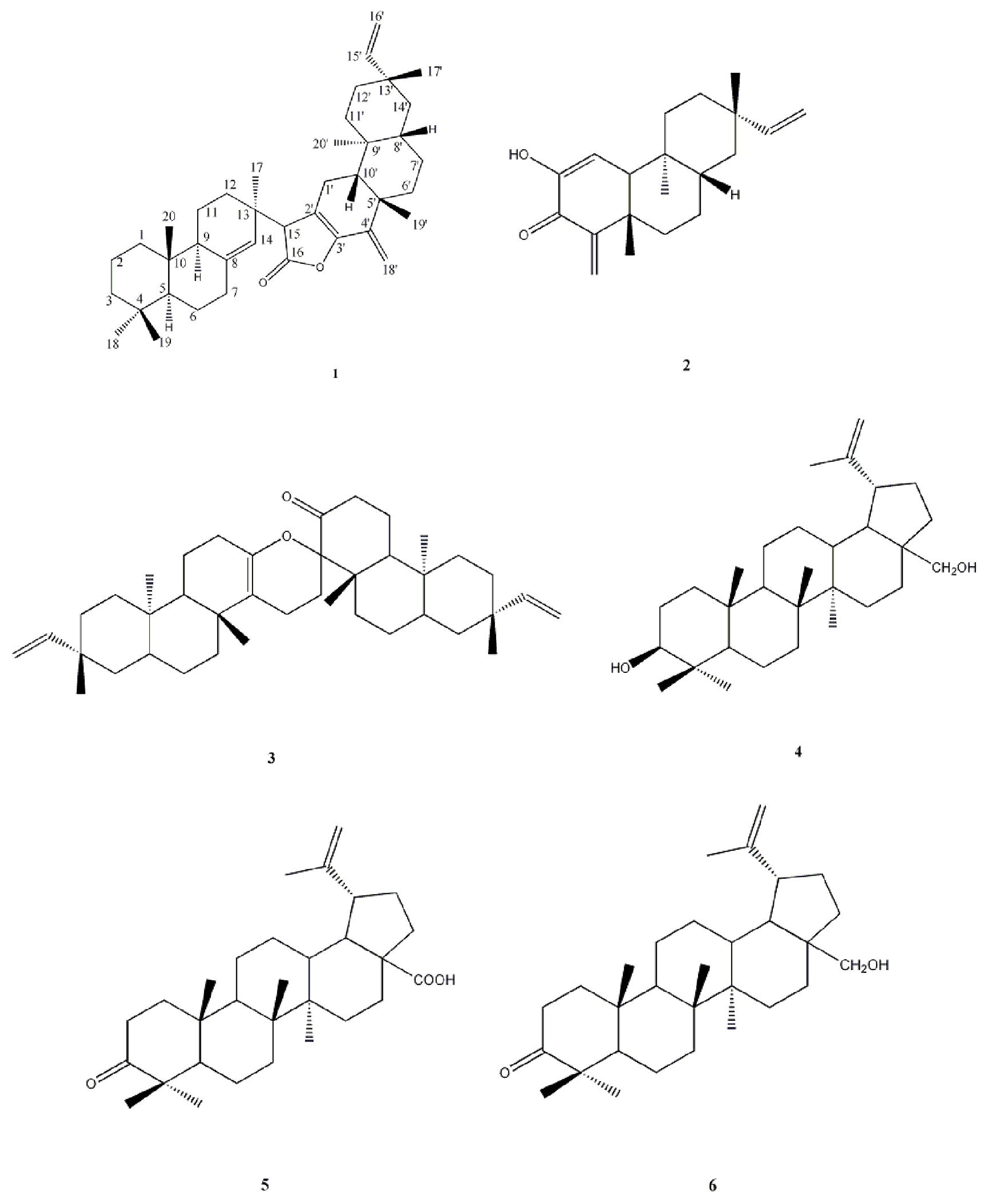
<p>Due to the highly structural diversity of terpenoids, the structure–activity of mangrove terpenoids merits further investigation. We obtained six terpenoids from <italic>C. tagal</italic>, and then evaluated their antifouling activity against larval settlement of the barnacle <italic>B. albicostatus</italic> using capsaicin as a positive control. These antifouling terpenoids included one new dimeric diterpenoid, 8(14)-enyl-pimar- 2′(3′)-en-4′(18′)-en-15′(16′)-en-dolabr-16,15,2′,3′-oxoan-16-one (<bold>1</bold>) and five known terpenoids, designated as Tagalsin C (<bold>2</bold>), Tagalsin I (<bold>3</bold>), lup-20(29)-ene-3<italic>β</italic>,28-diol (<bold>4</bold>), 3-oxolup-20(29)-en-28-oic acid (<bold>5</bold>) and 28-hydroxylup-20(29)-en-3-one (<bold>6</bold>) (<xref ref-type="fig" rid="f1-ijms-12-06517">Figure 1</xref>). The isolation, structural elucidation and antifouling activity of these compounds are described in the present study.</p></sec>
<sec sec-type="results|discussion">
<title>2. Results and Discussion</title>
<sec>
<title>2.1. Structural Elucidation of Terpenoids</title>
<p>Compound <bold>1</bold> was obtained as yellow oil, and its molecular composition of C<sub>40</sub>H<sub>58</sub>O<sub>2</sub> was established by HR-ESI-MS (<italic>m/z</italic> 571.4751 [M + H+]<sup>+</sup>, C<sub>40</sub>H<sub>58</sub>O<sub>2</sub><sup>+</sup>). The ESI-MS of <bold>1</bold> showed quasimolecular ion peaks at <italic>m/z</italic> 571.3 [M + 1]<sup>+</sup> and 592.7 [M + Na]<sup>+</sup>, respectively. The IR absorptions at 1724 1650, 1237, 1001 and 798 cm<sup>–1</sup> showed the presence of carbalkoxy and double groups. Analyses of the <sup>1</sup>H-NMR, <sup>13</sup>C-NMR, DEPT and HMQC spectra revealed not only the presence of 7 methyls, 15 methylenes, 7 methines and 11 quaternary carbon (including one carbalkoxy group at δ<sub>C</sub> 177.0, d), but also the presence of one tetrasubstituted double bond, one tetrasubstituted double bond and two terminal double bonds (<xref ref-type="table" rid="t1-ijms-12-06517">Tables 1</xref>). Four methyl singlets (δ<sub>C</sub> 24.7, q; 33.7, q; 22.1, q; 15.4, q) and one trisubstituted double bond (δ<sub>C</sub> 137.7, s; 128.5, d) suggesting that a pimarane-type diterpenoid structure might be presented [<xref ref-type="bibr" rid="b9-ijms-12-06517">9</xref>,<xref ref-type="bibr" rid="b18-ijms-12-06517">18</xref>–<xref ref-type="bibr" rid="b21-ijms-12-06517">21</xref>]. Meanwhile, three methyl singlets (δ<sub>C</sub> 23.0, q; 33.1, q; 11.8, q) and two terminal double bonds (δ<sub>C</sub> 139.5, s; 105.9, t; 151.0, d; 109.0, t) might indicate the structure of a dolabradiene-type diterpenoid [<xref ref-type="bibr" rid="b22-ijms-12-06517">22</xref>–<xref ref-type="bibr" rid="b25-ijms-12-06517">25</xref>]. Therefore, Compound <bold>1</bold> seemed to be a dimeric diterpenoid composed of two moieties, one being a pimarane-type diterpenoid (part A) and the other a dolabradiene-type diterpenoid (part B).</p>
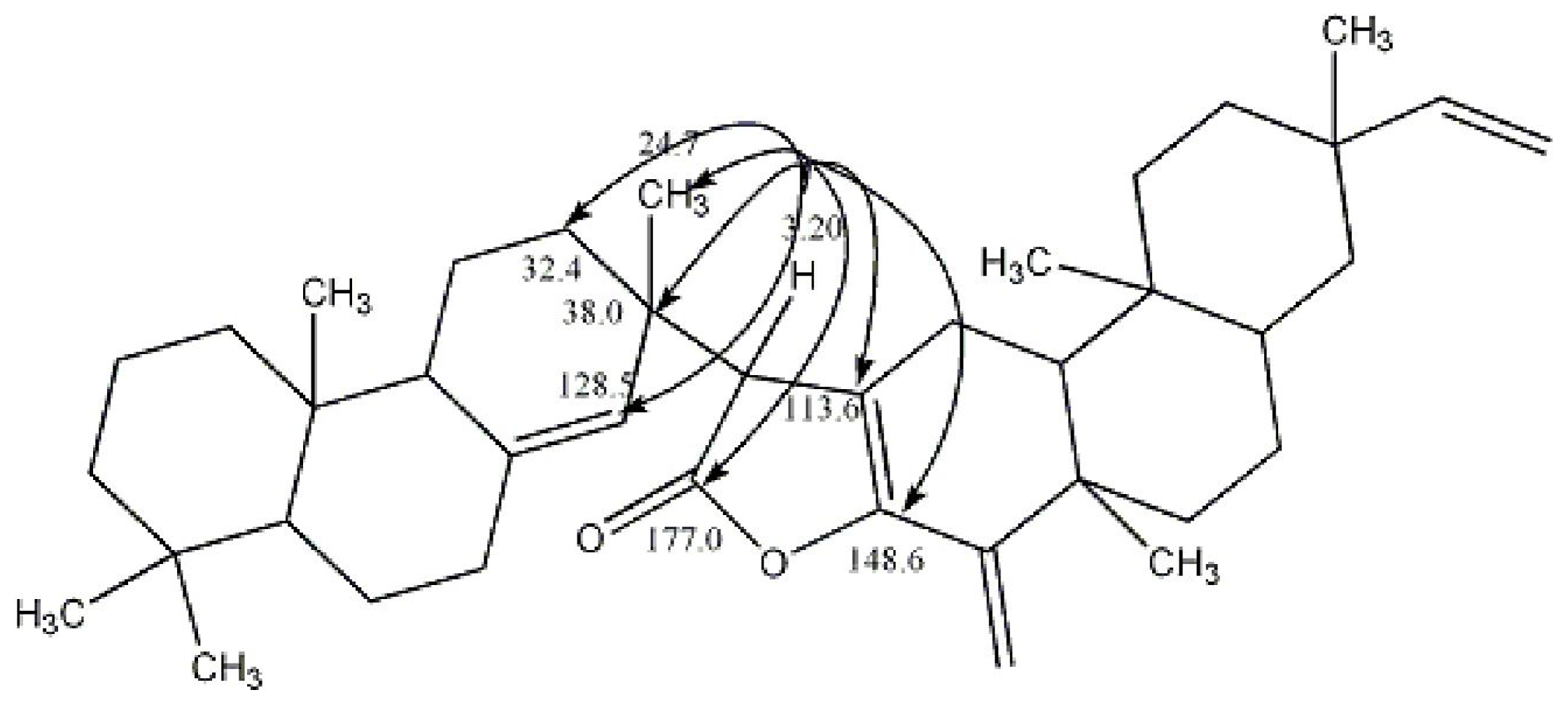
<p>The HMBC correlations of Me18 (δ<sub>H</sub> 0.89, s) with C-5 (δ<sub>C</sub> 55.0, d), C-3 (δ<sub>C</sub> 42.1, t), C-4 (δ<sub>C</sub> 33.3, s) and C-19 (δ<sub>C</sub> 22.1, q); Me19 (δ<sub>H</sub> 0.85, s) with C-5 (δ<sub>C</sub> 55.0, d), C-3 (δ<sub>C</sub> 42.1, t), C-4 (δ<sub>C</sub> 33.3, s) and C-18 (δ<sub>C</sub> 33.7, q); Me20 (δ<sub>H</sub> 0.82, s) with C-9 (δ<sub>C</sub> 49.8, d), C-1 (δ<sub>C</sub> 39.2, t); Me17 (δ<sub>H</sub> 0.99, s) with C-14 (δ<sub>C</sub> 128.5, d), C-15 (δ<sub>C</sub> 56.2, d), C-13 (δ<sub>C</sub> 38.0, s) and C-12 (δ<sub>C</sub> 32.4, t); H-5 (δ<sub>H</sub> 1.06, m) with C-20 (δ<sub>C</sub> 15.4, q), C-6 (δ<sub>C</sub> 22.7, t); H-9 (δ<sub>H</sub> 1.74, m) with C-8 (δ<sub>C</sub> 137.7, s), C-14 (δ<sub>C</sub> 128.5, d), C-20 (δ<sub>C</sub> 15.4, q), C-11 (δ<sub>C</sub> 18.6, t)and C-10 (δ<sub>C</sub> 38.87, s); H-14 (δ<sub>H</sub> 5.55, s) with C-9 (δ<sub>C</sub> 49.8, d), C-13 (δ<sub>C</sub> 38.0, s), C-7 (δ<sub>C</sub> 36.23, t), C-12 (δ<sub>C</sub> 32.4, t) and C-17 (δ<sub>C</sub> 24.7, q) confirmed that part A belonged to a pimarane-type diterpenoid. The HMBC correlations of Me-20′ (δ<sub>H</sub> 0.57, s) with C-10′ (δ<sub>C</sub> 53.3, d), C-8′ (δ<sub>C</sub> 43.0, d), C-9′ (δ<sub>C</sub> 38.1, s ) and C-11′ (δ<sub>C</sub> 35.2, t); Me-19′ (δ<sub>H</sub> 1.14, s) with C-4′ (δ<sub>C</sub> 139.5, s), C-10′ (δ<sub>C</sub> 53.3, d), C-5′ (δ<sub>C</sub> 39.1, s ) and C-6′ (δ<sub>C</sub> 36.8, t); Me-17′ (δ<sub>H</sub> 1.01, s) with C-15′ (δ<sub>C</sub> 151.0, d), C-13′ (δ<sub>C</sub> 36.18, s) and C-12′ (δ<sub>C</sub> 32.0, t); H-15′ (δ<sub>H</sub> 5.81, dd, <italic>J</italic> = 12.6, 21 Hz) with C-14′ (δ<sub>C</sub> 38.93, t), C-13′ (δ<sub>C</sub> 36.18, s), C-12′ (δ<sub>C</sub> 32.0, t) and C-17′ (δ<sub>C</sub> 23.0, q); H-16′ (δ<sub>H</sub> 4.82, d, <italic>J</italic> = 13.2 Hz) with C-15′ (δ<sub>C</sub> 151.0, d) and C-13′ (δ<sub>C</sub> 36.18, s); H-1′ (δ<sub>H</sub> 2.28, m) with C-3′ (δ<sub>C</sub> 148.6, s), C-2′ (δ<sub>C</sub> 113.6, s), C-10′ (δ<sub>C</sub> 53.3, d), C-9′ (δ<sub>C</sub> 38.1, s) and C-5′ (δ<sub>C</sub> 39.1, s); H-1′ (δ<sub>H</sub> 2.56, dd, <italic>J</italic> = 7.8, 14.4 Hz) with C-3′ (δ<sub>C</sub> 148.6, s), C-2′ (δ<sub>C</sub> 113.6, s), C-10′ (δ<sub>C</sub> 53.3, d) and C-9′ (δ<sub>C</sub> 38.1, s); H-10′ (δ<sub>H</sub> 1.38, m) with C-5′ (<italic>δ</italic><sub>C</sub> 39.1, s), C-9′ (<italic>δ</italic><sub>C</sub> 38.1, s), C-11′ (<italic>δ</italic><sub>C</sub> 35.2, t), C-19′ (<italic>δ</italic><sub>C</sub> 33.1, q) and C-1′ (<italic>δ</italic><sub>C</sub> 22.2, t); H-18′ (<italic>δ</italic><sub>H</sub> 5.26, s) with C-5′ (δ<sub>C</sub> 39.1, s), C-3′ (δ<sub>C</sub> 148.6, s) and C-4′ (δ<sub>C</sub> 139.5, s); H-18′ (δ<sub>H</sub> 5.08, s) with C-5′ (δ<sub>C</sub> 39.1, s), C-3′ (δ<sub>C</sub> 148.6, s) and C-4′ (δ<sub>C</sub> 139.5, s) confirmed that part B belonged to a dolabradiene-type diterpenoid. Then the chemical shift of δ<sub>C</sub> 56.2 (d, C-15), δ<sub>C</sub> 177.0 (s, C-16), δ<sub>C</sub> 148.6 (s, C-3′) were compatible with a bond between C-3′ and the lactone O-atom, which was further confirmed by the HR-ESI-MS spectrum. The HMBC correlations from H-15 (δ<sub>H</sub> 3.20, s) to C-3′ (δ<sub>C</sub> 148.6, s), C-14 (δ<sub>C</sub> 128.5, d), C-2′ (δ<sub>C</sub> 113.6, s), C-13 (δ<sub>C</sub> 38.0, s), C-12 (δ<sub>C</sub> 32.4, t), C-17 (δ<sub>C</sub> 24.7, q) and C-16 (δ<sub>C</sub> 177.0, s) established the connection between part A and part B at the site of C-15, C-2′ and C-3′ (<xref ref-type="fig" rid="f2-ijms-12-06517">Figure 2</xref>). Furthermore, other HMBC correlations along with the comparison of its NMR data and the known pimarane-type diterpenoid and dolabradiene-type diterpenoid comprehensively confirmed that the planar structure of <bold>1</bold> was assigned as a novel dimeric diterpenoid [<xref ref-type="bibr" rid="b18-ijms-12-06517">18</xref>–<xref ref-type="bibr" rid="b26-ijms-12-06517">26</xref>].</p>
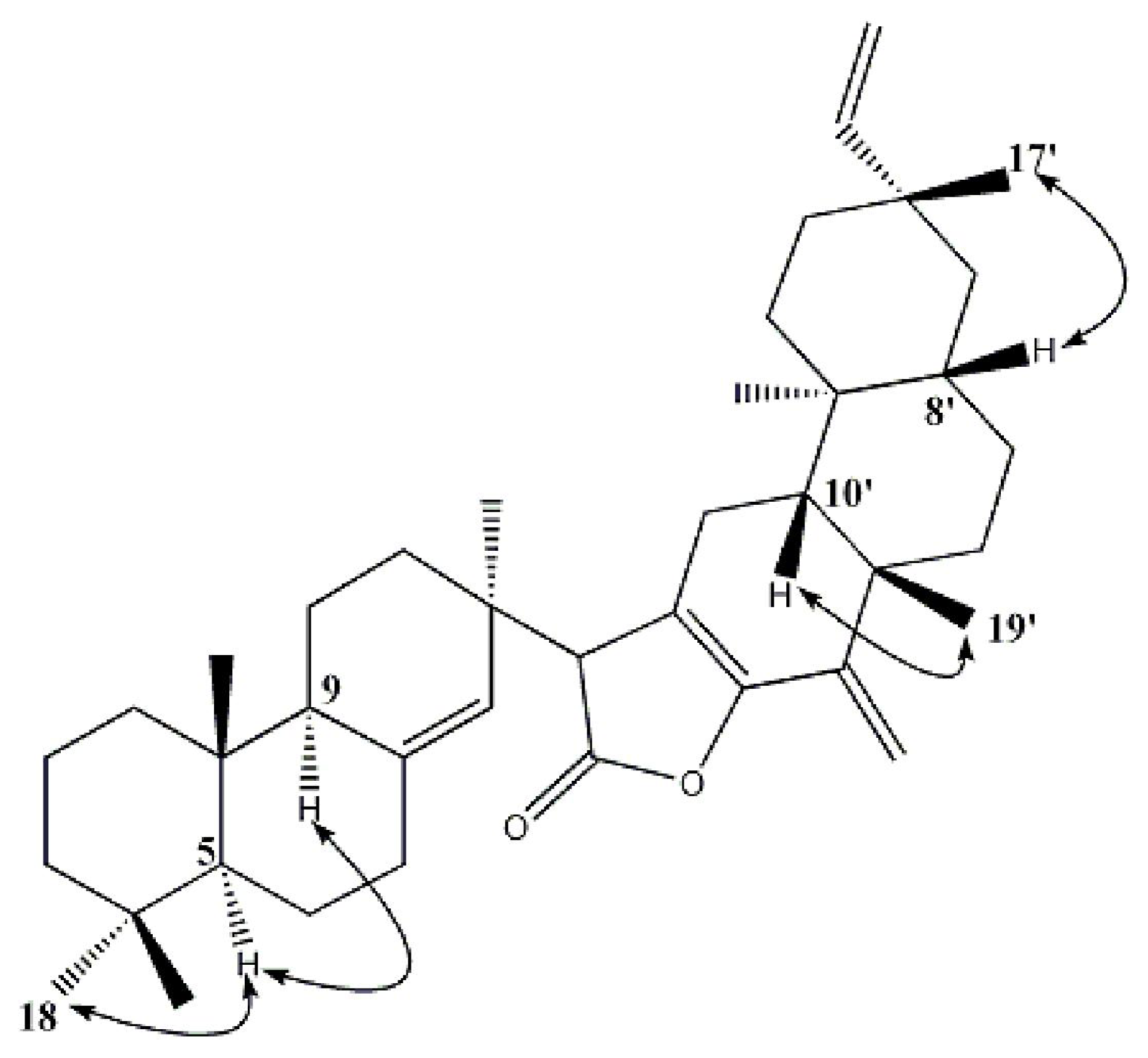
<p>The relative stereochemistry of <bold>1</bold> was established by NOE spectrum. Comparison of the NMR data of <bold>1</bold> with the pimarane-type diterpenoid and dolabradiene-type diterpenoid showed that the Me-17 (δ<sub>C</sub> 24.7, q), Me-18 (δ<sub>C</sub> 33.7, q) and Me-20′ (δ<sub>C</sub> 11.8, q) were in a relative α-orientation, while Me-19 (δ<sub>C</sub> 22.1, q), Me-20 (δ<sub>C</sub> 15.4, q), Me-19′ (δ<sub>C</sub> 33.1, q) and Me-17′ (δ<sub>C</sub> 23.0, q) were in a relative <italic>β</italic>-orientation [<xref ref-type="bibr" rid="b18-ijms-12-06517">18</xref>–<xref ref-type="bibr" rid="b26-ijms-12-06517">26</xref>]. NOE correlations between Me-18/H-5 and H-5/H-9 indicated that H-5 and H-9 were on the β-side of <bold>1</bold>. NOE correlations between H-10′/Me-19′ and Me-17′/H-8′ indicated that they were oriented on another side of the nucleus (<xref ref-type="fig" rid="f3-ijms-12-06517">Figure 3</xref>).</p>
<p>Five known terpenoids, Tagalsin C (<bold>2</bold>), Tagalsin I (<bold>3</bold>), lup-20(29)-ene-3<italic>β</italic>,28-diol (<bold>4</bold>), 3-oxolup- 20(29)-en-28-oic acid (<bold>5</bold>) and 28-hydroxylup-20(29)-en-3-one (<bold>6</bold>), were identified by comparison of their physical and spectral data with those in the literature [<xref ref-type="bibr" rid="b23-ijms-12-06517">23</xref>,<xref ref-type="bibr" rid="b27-ijms-12-06517">27</xref>–<xref ref-type="bibr" rid="b31-ijms-12-06517">31</xref>].</p></sec>
<sec>
<title>2.2. Antifouling Activity of Terpenoids</title>
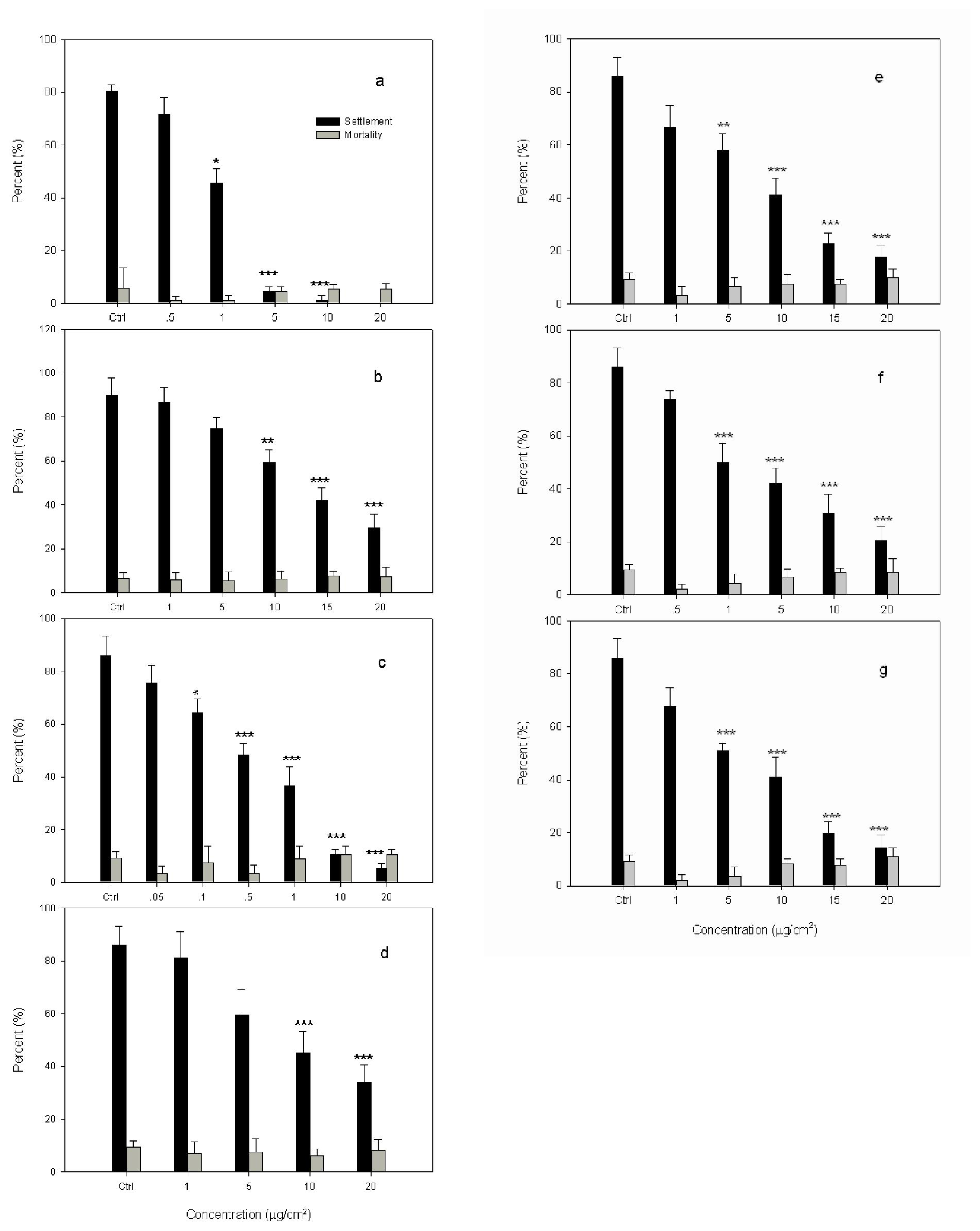
<p>The effects of terpenoids on settlement and mortality of <italic>B. albicostatus</italic> cyprids are shown in <xref ref-type="fig" rid="f4-ijms-12-06517">Figure 4</xref> and their EC<sub>50</sub> and LC<sub>50</sub> values are summarized in <xref ref-type="table" rid="t2-ijms-12-06517">Table 2</xref>. Capsaicin was used as a positive standard with EC<sub>50</sub> value of 1.32 μg/cm<sup>2</sup> (<xref ref-type="fig" rid="f4-ijms-12-06517">Figure 4</xref> and <xref ref-type="table" rid="t2-ijms-12-06517">Table 2</xref>). Filtered seawater (FSW) was used as a negative control. Comparison of means using ANOVA and Dunnet’s test showed that all of the terpenoids significantly inhibited settlement compared with the negative control (<italic>P</italic> &lt; 0.001) without significant toxicity (<italic>P</italic> &gt; 0.05). From Dunnet’s test, capsaicin significantly reduced larval settlement at 5 μg/cm<sup>2</sup> (<italic>P</italic> &lt; 0.001), and Compounds <bold>1</bold>–<bold>6</bold> significantly reduced larval settlement at 0.5–15 μg/cm<sup>2</sup> (<italic>P</italic> &lt; 0.001). Moreover, the non-toxicity compounds were defined as those that do not directly kill fouling organisms at or near the levels at which they deter fouling [<xref ref-type="bibr" rid="b32-ijms-12-06517">32</xref>]. In the present study, the LC<sub>50</sub> values of these terpenoids were all above 250 μg/cm<sup>2</sup>. The lower EC<sub>50</sub>/LC<sub>50</sub> ratio indicated that all these terpenoids had the ability to inhibit larval settlement in a non-toxic way. In addition, the stability test showed that Compounds <bold>1</bold> and <bold>3</bold> were degraded while Compounds <bold>2</bold>, <bold>4</bold>, <bold>5</bold> and <bold>6</bold> remained stable over 2-month exposure under FSW.</p>
<p>As shown in <xref ref-type="table" rid="t2-ijms-12-06517">Table 2</xref>, Compounds <bold>1</bold>–<bold>6</bold> exhibited antifouling activity against cyprid larvae of the barnacle <italic>B. albicostatus</italic>, with EC<sub>50</sub> values ranging from 0.65 to 13.9 μg/cm<sup>2</sup>. Compound <bold>2</bold> was more active than capsaicin, while Compounds <bold>1</bold>, <bold>3</bold>, <bold>4</bold>, <bold>5</bold> and <bold>6</bold> showed antifouling activity weaker than capsaicin. Among these terpenoids, diterpenoid (Compound <bold>2</bold>) showed the best antifouling activity against cyprid larvae of the barnacle <italic>B. albicostatus</italic>, followed by triterpenoid (Compounds <bold>4</bold>, <bold>5</bold> and <bold>6</bold>), and then dimeric diterpenoid (Compounds <bold>1</bold> and <bold>3</bold>). In addition, the antifouling activity of Compound <bold>3</bold> was stronger than Compound <bold>1</bold>, which suggested that the diterpenoid dimmer with two identical diterpenoid subunits might display more potent antifouling activity than the one with two different diterpenoid subunits. By comparing the EC<sub>50</sub> value of Compound <bold>5</bold> and Compound <bold>6</bold> and considering that the only difference between the structures of these two compounds is the difference group on the C-28 of lupane triterpenoid, it is evident that the carboxyl group at the C-28 of lupane triterpenoid might have a more potent antifouling activity than the oxygenated methylene group. However, when carbonyl group at the C-3 position in lupane triterpenoid (Compound <bold>6</bold>) is substituted by hydroxyl group, the resulting compound (Compound <bold>4</bold>) showed almost the same antifouling activity as Compound <bold>6</bold>. This result indicated that the hydroxyl group might be another important functional group expressing potent antifouling activity in lupane triterpenoid.</p></sec></sec>
<sec>
<title>3. Experimental Section</title>
<sec>
<title>3.1. General</title>
<p><sup>1</sup>H-NMR spectra were measured with Varian UNITY PLUS 500 spectrometer (USA). <sup>1</sup>H-, <sup>13</sup>C- and 2D-NMR spectra were measured with Varian INOVA 600 spectrometer (USA). High-resolution ESI mass spectra data were measured with a Waters Q-TOF MicroTM spectrometer (USA) and were provided by Zhengzhou University, China. Low-resolution ESI mass spectra data were recorded on an AB 3200Q TRAP spectrometer (USA). IR spectra were measured using a Nicolet 380 FT-IR spectrophotometer (USA). The optical rotation data were obtained on a Rudolph Autopol IV polarimeter (USA). 200–300 mesh Silica gel (Qingdao Marine Chemical Factory, Qingdao, China) were used for column chromatography. Compounds were monitored by TLC on GF 254 silica gel (Qingdao Marine Chemical Factory, Qingdao, China). ODS and Sephadex LH-20 were obtained from Pharmacia Co. Capsaicin was purchased from Sigma Chemical Co., USA, with purity above 95%.</p></sec>
<sec>
<title>3.2. Extraction and Isolation</title>
<p>The roots of <italic>C. tagal</italic> were collected from Hainan Province, China in July 2005. The air-dried and powdered material (4.1 kg) was extracted with 95% EtOH at room temperature. The extract was concentrated and partitioned sequentially with petroleum ether, ethyl acetate and H<sub>2</sub>O. The petroleum ether extract (11.5 g) was subjected to a silica gel column, eluted with a petroleum ether–ethyl acetate gradient to obtain 13 fractions (A–M). Fraction C (0.135 g) was chromatographed over silica gel and Sephadex LH-20 repeatedly, and the major fraction obtained was then purified by reversed-phase semi-preparation HPLC (elution with 1:1 hexane-CHCl<sub>3</sub>) to yield Compound <bold>1</bold> (50 mg). Fraction K (1.059 g) was chromatographed over silica gel and Sephadex LH-20 repeatedly (elution with 30:1 petroleum ether–acetone) to yield Compound <bold>4</bold> (5 mg) and Compound <bold>5</bold> (10 mg). Fraction J (5.3 g) was chromatographed over silica gel repeatedly (elution with 30:1 petroleum ether–acetone) to yield Compound <bold>6</bold> (6 mg). Moreover, the ethyl acetate extract (73.6 g) was subjected to a silica gel column, eluted with a CHCl<sub>3</sub>–MeOH gradient to obtain 12 fractions (A2-L2). Fraction B2 (8.32 g) was chromatographed over silica gel and Sephadex LH-20 repeatedly. Compound <bold>2</bold> (10 mg) was further separated by silica gel (elution with 40:1 petroleum ether–ethyl acetate) and Compound <bold>3</bold> (53 mg) was purified by silica gel (elution with 2.5:1 hexane-CHCl<sub>3</sub>).</p>
<p><italic>8(14)-enyl-pimar-2′(3′)-en-4′(18′)-en-15′(16′)-en-dolabr-16,15,2′,3′-oxoan-16-one</italic> (<bold>1</bold>): C<sub>40</sub>H<sub>58</sub>O<sub>2</sub>; yellow oil; [α]<sub>D</sub><sup>25</sup> = +68.25 (<italic>c</italic> = 0.50, CHCl<sub>3</sub>); UV (CHCl<sub>3</sub>): 214 (2.5905), 224 (3.0367), 234 (2.929), 244 (2.7263). IR <italic>ν</italic><sub>max</sub> (KBr): 1724,1650, 1237, 1001, 798 cm<sup>–1</sup>; ESI-MS, <italic>m/z</italic> 571.3 ([M + 1]<sup>+</sup>), 592.7 [M + Na]<sup>+</sup>, HR-ESI-MS at <italic>m/z</italic> 571.4751 ([M + H+]<sup>+</sup>, C<sub>40</sub>H<sub>58</sub>O<sub>2</sub><sup>+</sup>calc. 571.4741 ); <sup>1</sup>H-NMR and <sup>13</sup>C-NMR data for <bold>1</bold> are listed in <xref ref-type="table" rid="t1-ijms-12-06517">Table 1</xref>.</p></sec>
<sec>
<title>3.3. Antifouling Assay</title>
<p>Antifouling efficacies of the six terpenoids isolated from <italic>C. tagal</italic> were evaluated by the settlement inhibition assay with cyprid larvae of <italic>B. albicostatus. B. albicostatus</italic> adults were collected from intertidal rocks in Xiamen, China. Adults released the nauplius I and nauplius II stages upon immersion in seawater after dried for 12 h [<xref ref-type="bibr" rid="b8-ijms-12-06517">8</xref>]. Naupilar larvae actively swimming towards the light were collected using a pipette. They were cultured in filtered seawater (FSW, 0.22 μm, salinity 30‰, and temperature 25 °C) by feeding with the diatom Chaetoceros muelleri at a concentration of 2.0 × 10<sup>5</sup> cells·mL<sup>−1</sup>. The FSW and diet were renewed everyday. After 5~6 days, most of the nauplii had metamorphosed to cyprids, and then the cyprids were collected within 24 h. Antifouling efficacies of the six terpenoids were investigated according to the method of Hellio <italic>et al</italic>. with a minor modification [<xref ref-type="bibr" rid="b33-ijms-12-06517">33</xref>]. The tested compounds were introduced to the glass dishes using CH<sub>2</sub>Cl<sub>2</sub> as carrier solvent. After evaporation of the solvent at room temperature, 30 cyprids and 10 mL FSW were added to each glass dishe. There were three replicates for FSW negative control and each concentration of the tested compounds. Dishes were incubated in dark at 25 °C for 48 h. After that, numbers of larvae which settled, died or did not settle in each replicate were enumerated under a stereomicroscope. Cyprids that did not move and did not respond to a touch with a metal probe were regarded as dead [<xref ref-type="bibr" rid="b34-ijms-12-06517">34</xref>]. Cyprids that permanently attached and metamorphosed were counted as settled [<xref ref-type="bibr" rid="b33-ijms-12-06517">33</xref>,<xref ref-type="bibr" rid="b35-ijms-12-06517">35</xref>]. In addition, the stability of terpenoids was tested using the method of thin layer chromatography (TLC), which were identified by comparison of the spots and <italic>R</italic><sub>f</sub> values of these terpenoids before and after 2-month exposure in FSW control [<xref ref-type="bibr" rid="b17-ijms-12-06517">17</xref>]. Three replicates were set up for each of FSW control. The tested terpenoids were dissolved in CH<sub>2</sub>Cl<sub>2</sub> and evaporated after 2-month exposure in FSW (three replicates). Compounds that showed the same spots and <italic>R</italic><sub>f</sub> values with before were regarded as stability. Compounds that showed the different spots and <italic>R</italic><sub>f</sub> values with before were regarded as degradation. Moreover, statistical calculations were performed with the SPSS software package. One-way ANOVA followed by a Dunnett's test for multiple comparisons of treatment means with a negative control was used for the settlement or mortality percentages analysis. The significance level was defined as <italic>p</italic> &lt; 0.05. Both EC<sub>50</sub> (the concentration that reduces the settlement rate by 50% relative to the negative control) and LC<sub>50</sub> (the concentration that results in 50% mortality relative to the negative control) were estimated using the Spearman-Karber method with a 95% confidence interval [<xref ref-type="bibr" rid="b36-ijms-12-06517">36</xref>,<xref ref-type="bibr" rid="b37-ijms-12-06517">37</xref>].</p></sec></sec>
<sec sec-type="conclusions">
<title>4. Conclusions</title>
<p>One new dimeric diterpenoid and five known terpenoids were isolated from the roots of <italic>C. tagal</italic>. These terpenoids were able to inhibit cyprid settlement (EC<sub>50</sub> values range of 0.65 to 13.9 μg/cm<sup>2</sup>) without significant toxicity. Moreover, the functional groups on the C-28 position of lupane triterpenoid significantly affect their antifouling activity. The diterpenoid dimmer with two identical diterpenoid subunits might display more potent antifouling activity than the one with two different diterpenoid subunits. Diterpenoid showed the strongest antifouling activity against cyprid larvae of the barnacle <italic>B. albicostatus</italic> followed by triterpenoid, and then dimeric diterpenoid. The stability test showed that Compounds <bold>2</bold>, <bold>4</bold>, <bold>5</bold> and <bold>6</bold> remained stable over a 2-month exposure under FSW.</p></sec></body>
<back>
<ack>
<title>Acknowledgments</title>
<p>This work was supported by program for New Century Excellent Talents in University (NCET-07- 0725), the National Natural Science Foundation of China (40906078).</p></ack>
<ref-list>
<title>References</title>
<ref id="b1-ijms-12-06517"><label>1</label><citation citation-type="journal"><person-group person-group-type="author"><name><surname>Richmond</surname><given-names>MD</given-names></name><name><surname>Seed</surname><given-names>R</given-names></name></person-group><article-title>A review of marine macrofouling communities with special reference to animal fouling</article-title><source>Biofouling</source><year>1991</year><volume>2</volume><fpage>151</fpage><lpage>168</lpage></citation></ref>
<ref id="b2-ijms-12-06517"><label>2</label><citation citation-type="journal"><person-group person-group-type="author"><name><surname>Yebra</surname><given-names>DM</given-names></name><name><surname>Kiil</surname><given-names>S</given-names></name><name><surname>Dam-Johansen</surname><given-names>K</given-names></name></person-group><article-title>Antifouling technology-past, present and future steps towards efficient and environmentally friendly antifouling coatings</article-title><source>Prog. Org. Coat</source><year>2004</year><volume>50</volume><fpage>75</fpage><lpage>104</lpage><pub-id pub-id-type="doi">10.1016/j.porgcoat.2003.06.001</pub-id></citation></ref>
<ref id="b3-ijms-12-06517"><label>3</label><citation citation-type="journal"><person-group person-group-type="author"><name><surname>Kwong</surname><given-names>TFN</given-names></name><name><surname>Miao</surname><given-names>L</given-names></name><name><surname>Li</surname><given-names>X</given-names></name><name><surname>Qian</surname><given-names>PY</given-names></name></person-group><article-title>Novel antifouling and antimicrobial compound from a marine-derived fungus <italic>Ampelomyces</italic> sp</article-title><source>Mar. Biotechnol</source><year>2006</year><volume>8</volume><fpage>634</fpage><lpage>640</lpage><pub-id pub-id-type="doi">10.1007/s10126-005-6146-2</pub-id><pub-id pub-id-type="pmid">16924374</pub-id></citation></ref>
<ref id="b4-ijms-12-06517"><label>4</label><citation citation-type="journal"><person-group person-group-type="author"><name><surname>Thomas</surname><given-names>KV</given-names></name></person-group><article-title>The environmental fate and behavior of antifouling paint booster biocides: A review</article-title><source>Biofouling</source><year>2001</year><volume>17</volume><fpage>73</fpage><lpage>86</lpage><pub-id pub-id-type="doi">10.1080/08927010109378466</pub-id></citation></ref>
<ref id="b5-ijms-12-06517"><label>5</label><citation citation-type="journal"><person-group person-group-type="author"><name><surname>Wahl</surname><given-names>M</given-names></name><name><surname>Kröger</surname><given-names>K</given-names></name><name><surname>Lenz</surname><given-names>M</given-names></name></person-group><article-title>Non-toxic protection against epibiosis</article-title><source>Biofouling</source><year>1998</year><volume>12</volume><fpage>205</fpage><lpage>226</lpage><pub-id pub-id-type="doi">10.1080/08927019809378355</pub-id></citation></ref>
<ref id="b6-ijms-12-06517"><label>6</label><citation citation-type="journal"><person-group person-group-type="author"><name><surname>Wahl</surname><given-names>M</given-names></name></person-group><article-title>Marine epibiosis. I. Fouling and antifouling: some basic aspects</article-title><source>Mar. Ecol. Prog. Ser</source><year>1989</year><volume>58</volume><fpage>175</fpage><lpage>189</lpage><pub-id pub-id-type="doi">10.3354/meps058175</pub-id></citation></ref>
<ref id="b7-ijms-12-06517"><label>7</label><citation citation-type="journal"><person-group person-group-type="author"><name><surname>Slattery</surname><given-names>M</given-names></name><name><surname>McClintock</surname><given-names>JB</given-names></name><name><surname>Heine</surname><given-names>JN</given-names></name></person-group><article-title>Chemical defenses in Antarctic soft corals: evidence for antifouling compounds</article-title><source>J. Exp. Mar. Biol. Ecol</source><year>1995</year><volume>190</volume><fpage>61</fpage><lpage>77</lpage><pub-id pub-id-type="doi">10.1016/0022-0981(95)00032-M</pub-id></citation></ref>
<ref id="b8-ijms-12-06517"><label>8</label><citation citation-type="journal"><person-group person-group-type="author"><name><surname>Maréchal</surname><given-names>JP</given-names></name><name><surname>Hellio</surname><given-names>C</given-names></name></person-group><article-title>Development of new non-toxic antifouling solutions</article-title><source>Int. J. Mol. Sci</source><year>2009</year><volume>10</volume><fpage>4623</fpage><lpage>4637</lpage><pub-id pub-id-type="doi">10.3390/ijms10114623</pub-id><pub-id pub-id-type="pmid">20087457</pub-id></citation></ref>
<ref id="b9-ijms-12-06517"><label>9</label><citation citation-type="journal"><person-group person-group-type="author"><name><surname>Chen</surname><given-names>JD</given-names></name><name><surname>Feng</surname><given-names>DQ</given-names></name><name><surname>Yang</surname><given-names>ZW</given-names></name><name><surname>Wang</surname><given-names>ZC</given-names></name><name><surname>Qiu</surname><given-names>Y</given-names></name><name><surname>Lin</surname><given-names>YM</given-names></name></person-group><article-title>Antifouling metabolites from the mangrove plant <italic>Ceriops tagal</italic></article-title><source>Molecules</source><year>2008</year><volume>13</volume><fpage>212</fpage><lpage>219</lpage><pub-id pub-id-type="doi">10.3390/molecules13020212</pub-id><pub-id pub-id-type="pmid">18305413</pub-id></citation></ref>
<ref id="b10-ijms-12-06517"><label>10</label><citation citation-type="journal"><person-group person-group-type="author"><name><surname>Qian</surname><given-names>PY</given-names></name><name><surname>Xu</surname><given-names>Y</given-names></name><name><surname>Fusetani</surname><given-names>N</given-names></name></person-group><article-title>Natural products as antifouling compounds: recent progress and future perspectives</article-title><source>Biofouling</source><year>2010</year><volume>26</volume><fpage>223</fpage><lpage>234</lpage><pub-id pub-id-type="doi">10.1080/08927010903470815</pub-id><pub-id pub-id-type="pmid">19960389</pub-id></citation></ref>
<ref id="b11-ijms-12-06517"><label>11</label><citation citation-type="journal"><person-group person-group-type="author"><name><surname>Raveendran</surname><given-names>TV</given-names></name><name><surname>Limna Mol</surname><given-names>VP</given-names></name></person-group><article-title>Natural product antifoulants</article-title><source>Curr. Sci. India</source><year>2009</year><volume>97</volume><fpage>508</fpage><lpage>520</lpage></citation></ref>
<ref id="b12-ijms-12-06517"><label>12</label><citation citation-type="journal"><person-group person-group-type="author"><name><surname>Qiu</surname><given-names>Y</given-names></name><name><surname>Deng</surname><given-names>ZW</given-names></name><name><surname>Xu</surname><given-names>MJ</given-names></name><name><surname>Li</surname><given-names>QS</given-names></name><name><surname>Lin</surname><given-names>WH</given-names></name></person-group><article-title>New A-nor steroids and their antifouling activity from the Chinese marine sponge <italic>Acanthella cavernosa</italic></article-title><source>Steroids</source><year>2008</year><volume>73</volume><fpage>1500</fpage><lpage>1504</lpage><pub-id pub-id-type="doi">10.1016/j.steroids.2008.08.006</pub-id><pub-id pub-id-type="pmid">18812182</pub-id></citation></ref>
<ref id="b13-ijms-12-06517"><label>13</label><citation citation-type="journal"><person-group person-group-type="author"><name><surname>Wang</surname><given-names>ZC</given-names></name><name><surname>Lin</surname><given-names>YM</given-names></name><name><surname>Feng</surname><given-names>DQ</given-names></name><name><surname>Ke</surname><given-names>CH</given-names></name><name><surname>Lin</surname><given-names>P</given-names></name><name><surname>Yan</surname><given-names>CL</given-names></name><name><surname>Chen</surname><given-names>JD</given-names></name></person-group><article-title>A new atisane-type diterpene from the bark of the mangrove</article-title><source>Molecules</source><year>2009</year><volume>14</volume><fpage>414</fpage><lpage>422</lpage><pub-id pub-id-type="doi">10.3390/molecules14010414</pub-id><pub-id pub-id-type="pmid">19158653</pub-id></citation></ref>
<ref id="b14-ijms-12-06517"><label>14</label><citation citation-type="journal"><person-group person-group-type="author"><name><surname>Blunt</surname><given-names>JW</given-names></name><name><surname>Copp</surname><given-names>BR</given-names></name><name><surname>Hu</surname><given-names>WP</given-names></name><name><surname>Munro</surname><given-names>MHG</given-names></name><name><surname>Northcote</surname><given-names>PT</given-names></name><name><surname>Prinsep</surname><given-names>MR</given-names></name></person-group><article-title>Marine natural products</article-title><source>Nat. Prod. Rep</source><year>2009</year><volume>26</volume><fpage>170</fpage><lpage>244</lpage><pub-id pub-id-type="doi">10.1039/b805113p</pub-id><pub-id pub-id-type="pmid">19177222</pub-id></citation></ref>
<ref id="b15-ijms-12-06517"><label>15</label><citation citation-type="journal"><person-group person-group-type="author"><name><surname>Gershenzon</surname><given-names>J</given-names></name><name><surname>Dudareva</surname><given-names>N</given-names></name></person-group><article-title>The function of terpene natural products in the natural world</article-title><source>Nat. Chem. Biol</source><year>2007</year><volume>3</volume><fpage>408</fpage><lpage>414</lpage><pub-id pub-id-type="doi">10.1038/nchembio.2007.5</pub-id><pub-id pub-id-type="pmid">17576428</pub-id></citation></ref>
<ref id="b16-ijms-12-06517"><label>16</label><citation citation-type="journal"><person-group person-group-type="author"><name><surname>De Carvalho</surname><given-names>CCCR</given-names></name><name><surname>Fernandes</surname><given-names>P</given-names></name></person-group><article-title>Production of metabolites as bacterial responses to the marine environment</article-title><source>Mar. Drugs</source><year>2010</year><volume>8</volume><fpage>705</fpage><lpage>727</lpage><pub-id pub-id-type="doi">10.3390/md8030705</pub-id><pub-id pub-id-type="pmid">20411122</pub-id></citation></ref>
<ref id="b17-ijms-12-06517"><label>17</label><citation citation-type="journal"><person-group person-group-type="author"><name><surname>Chen</surname><given-names>JD</given-names></name><name><surname>Yi</surname><given-names>RZ</given-names></name><name><surname>Sun</surname><given-names>CL</given-names></name><name><surname>Feng</surname><given-names>DQ</given-names></name><name><surname>Lin</surname><given-names>YM</given-names></name></person-group><article-title>Antifouling activity of simple synthetic diterpenoids against larvae of the barnacle <italic>Balanus albicostatus</italic> Pilsbry</article-title><source>Molecules</source><year>2010</year><volume>15</volume><fpage>8072</fpage><lpage>8081</lpage><pub-id pub-id-type="doi">10.3390/molecules15118072</pub-id><pub-id pub-id-type="pmid">21063270</pub-id></citation></ref>
<ref id="b18-ijms-12-06517"><label>18</label><citation citation-type="journal"><person-group person-group-type="author"><name><surname>Lal</surname><given-names>AR</given-names></name><name><surname>Cambie</surname><given-names>RC</given-names></name><name><surname>Rutledge</surname><given-names>PS</given-names></name><name><surname>Woodgate</surname><given-names>PD</given-names></name></person-group><article-title>Ent-Pimarane and ent-abietane diterpenes from <italic>Euphorbia fidjiana</italic></article-title><source>Phytochemistry</source><year>1990</year><volume>29</volume><fpage>2239</fpage><lpage>2246</lpage><pub-id pub-id-type="doi">10.1016/0031-9422(90)83045-3</pub-id></citation></ref>
<ref id="b19-ijms-12-06517"><label>19</label><citation citation-type="journal"><person-group person-group-type="author"><name><surname>Ma</surname><given-names>GX</given-names></name><name><surname>Wang</surname><given-names>TS</given-names></name><name><surname>Yin</surname><given-names>L</given-names></name><name><surname>Pan</surname><given-names>Y</given-names></name></person-group><article-title>Two pimarane diterpenoids from <italic>Ephemerantha ionchophylla</italic> and their evaluation as modulators of the multidrug resistance phenotype</article-title><source>J. Nat. Prod</source><year>1998</year><volume>61</volume><fpage>112</fpage><lpage>115</lpage><pub-id pub-id-type="doi">10.1021/np970065o</pub-id><pub-id pub-id-type="pmid">9461658</pub-id></citation></ref>
<ref id="b20-ijms-12-06517"><label>20</label><citation citation-type="journal"><person-group person-group-type="author"><name><surname>Luo</surname><given-names>XD</given-names></name><name><surname>Wu</surname><given-names>SH</given-names></name><name><surname>Ma</surname><given-names>YB</given-names></name><name><surname>Wu</surname><given-names>DG</given-names></name></person-group><article-title>Ent-pimarane derivatives from <italic>Dysoxylum hainanense</italic></article-title><source>Phytochemistry</source><year>2001</year><volume>57</volume><fpage>131</fpage><lpage>134</lpage><pub-id pub-id-type="doi">10.1016/S0031-9422(00)00482-9</pub-id><pub-id pub-id-type="pmid">11336254</pub-id></citation></ref>
<ref id="b21-ijms-12-06517"><label>21</label><citation citation-type="journal"><person-group person-group-type="author"><name><surname>Xiang</surname><given-names>Y</given-names></name><name><surname>Zhang</surname><given-names>H</given-names></name><name><surname>Fan</surname><given-names>CQ</given-names></name><name><surname>Yue</surname><given-names>JM</given-names></name></person-group><article-title>Novel diterpenoids and diterpenoid glycosides from <italic>Siegesbeckia orientalis</italic></article-title><source>J. Nat. Prod</source><year>2004</year><volume>67</volume><fpage>1517</fpage><lpage>1521</lpage><pub-id pub-id-type="doi">10.1021/np0400407</pub-id><pub-id pub-id-type="pmid">15387652</pub-id></citation></ref>
<ref id="b22-ijms-12-06517"><label>22</label><citation citation-type="journal"><person-group person-group-type="author"><name><surname>Koike</surname><given-names>K</given-names></name><name><surname>Cordell</surname><given-names>GA</given-names></name><name><surname>Farnsworth</surname><given-names>NR</given-names></name></person-group><article-title>New cytotoxic diterpenes from <italic>Rondeletia panamensis</italic> (Rubiaceae)</article-title><source>Tetrahedron</source><year>1980</year><volume>36</volume><fpage>1167</fpage><lpage>1172</lpage><pub-id pub-id-type="doi">10.1016/0040-4020(80)87013-X</pub-id></citation></ref>
<ref id="b23-ijms-12-06517"><label>23</label><citation citation-type="journal"><person-group person-group-type="author"><name><surname>Zhang</surname><given-names>Y</given-names></name><name><surname>Deng</surname><given-names>Z</given-names></name><name><surname>Gao</surname><given-names>T</given-names></name><name><surname>Proksch</surname><given-names>P</given-names></name><name><surname>Lin</surname><given-names>W</given-names></name></person-group><article-title>Tagalsins A-H, dolabranes-type diterpenes from the mangrove plant, <italic>Ceriops tagal</italic></article-title><source>Phytochemistry</source><year>2005</year><volume>66</volume><fpage>1465</fpage><lpage>1471</lpage><pub-id pub-id-type="doi">10.1016/j.phytochem.2005.04.018</pub-id><pub-id pub-id-type="pmid">15927216</pub-id></citation></ref>
<ref id="b24-ijms-12-06517"><label>24</label><citation citation-type="journal"><person-group person-group-type="author"><name><surname>Nagashima</surname><given-names>F</given-names></name><name><surname>Tori</surname><given-names>M</given-names></name><name><surname>Asakawa</surname><given-names>Y</given-names></name></person-group><article-title>Diterpenoids from the east Malaysian liverwort <italic>Schistochila aligera</italic></article-title><source>Phytochemistry</source><year>1991</year><volume>30</volume><fpage>849</fpage><lpage>851</lpage><pub-id pub-id-type="doi">10.1016/0031-9422(91)85266-3</pub-id></citation></ref>
<ref id="b25-ijms-12-06517"><label>25</label><citation citation-type="journal"><person-group person-group-type="author"><name><surname>Ouyang</surname><given-names>XW</given-names></name><name><surname>Wang</surname><given-names>XC</given-names></name><name><surname>Yue</surname><given-names>QX</given-names></name><name><surname>Hu</surname><given-names>LH</given-names></name></person-group><article-title>A new dolabrane-type diterpene from <italic>Ceriops tagal</italic></article-title><source>Nat. Prod. Commun</source><year>2010</year><volume>5</volume><fpage>9</fpage><lpage>12</lpage><pub-id pub-id-type="pmid">20184010</pub-id></citation></ref>
<ref id="b26-ijms-12-06517"><label>26</label><citation citation-type="journal"><person-group person-group-type="author"><name><surname>Chen</surname><given-names>JD</given-names></name><name><surname>Qiu</surname><given-names>Y</given-names></name><name><surname>Yang</surname><given-names>ZW</given-names></name><name><surname>Lin</surname><given-names>P</given-names></name><name><surname>Lin</surname><given-names>YM</given-names></name></person-group><article-title>Dimeric diterpenes from the roots of the mangrove plant <italic>Ceriops tagal</italic></article-title><source>Helv. Chim Acta</source><year>2008</year><volume>91</volume><fpage>2292</fpage><lpage>2298</lpage><pub-id pub-id-type="doi">10.1002/hlca.200890249</pub-id></citation></ref>
<ref id="b27-ijms-12-06517"><label>27</label><citation citation-type="journal"><person-group person-group-type="author"><name><surname>Zhang</surname><given-names>Y</given-names></name><name><surname>Lu</surname><given-names>Y</given-names></name><name><surname>Mao</surname><given-names>L</given-names></name><name><surname>Proksch</surname><given-names>P</given-names></name><name><surname>Lin</surname><given-names>WH</given-names></name></person-group><article-title>Tagalsins I and J, two novel tetraterpenoids from the mangrove plant, <italic>Ceriops tagal</italic></article-title><source>Org. Lett</source><year>2005</year><volume>7</volume><fpage>3037</fpage><lpage>3040</lpage><pub-id pub-id-type="doi">10.1021/ol0509843</pub-id><pub-id pub-id-type="pmid">15987199</pub-id></citation></ref>
<ref id="b28-ijms-12-06517"><label>28</label><citation citation-type="journal"><person-group person-group-type="author"><name><surname>Wang</surname><given-names>XC</given-names></name><name><surname>Ouyang</surname><given-names>XW</given-names></name><name><surname>Hu</surname><given-names>LH</given-names></name></person-group><article-title>Three new lupane-type triterpenes from <italic>Ceriops tagal</italic></article-title><source>J. Asian Nat. Prod. Res</source><year>2010</year><volume>12</volume><fpage>576</fpage><lpage>581</lpage><pub-id pub-id-type="doi">10.1080/10286020.2010.485566</pub-id><pub-id pub-id-type="pmid">20628936</pub-id></citation></ref>
<ref id="b29-ijms-12-06517"><label>29</label><citation citation-type="journal"><person-group person-group-type="author"><name><surname>Diqui</surname><given-names>S</given-names></name><name><surname>Hafeez</surname><given-names>F</given-names></name><name><surname>Begum</surname><given-names>S</given-names></name><name><surname>Siddiqui</surname><given-names>BS</given-names></name></person-group><article-title>Oleanderol, a new pentacyclic triterpene from the leaves of <italic>Nerium oleander</italic></article-title><source>J. Nat. Prod</source><year>1988</year><volume>51</volume><fpage>229</fpage><lpage>233</lpage><pub-id pub-id-type="doi">10.1021/np50056a006</pub-id></citation></ref>
<ref id="b30-ijms-12-06517"><label>30</label><citation citation-type="journal"><person-group person-group-type="author"><name><surname>Kuroyanagi</surname><given-names>M</given-names></name><name><surname>Shiotsu</surname><given-names>M</given-names></name><name><surname>Ebihara</surname><given-names>T</given-names></name><name><surname>Kawai</surname><given-names>H</given-names></name><name><surname>Ueno</surname><given-names>A</given-names></name><name><surname>Fukushima</surname><given-names>S</given-names></name></person-group><article-title>Chemical studies on <italic>Vibumum awabuki K</italic></article-title><source>Koch. Chem. Pharm. Bull</source><year>1986</year><volume>34</volume><fpage>4012</fpage><lpage>4017</lpage><pub-id pub-id-type="doi">10.1248/cpb.34.4012</pub-id></citation></ref>
<ref id="b31-ijms-12-06517"><label>31</label><citation citation-type="journal"><person-group person-group-type="author"><name><surname>Tinto</surname><given-names>WF</given-names></name><name><surname>Blair</surname><given-names>LC</given-names></name><name><surname>Allj</surname><given-names>A</given-names></name></person-group><article-title>Lupane triterpenoids of <italic>Salacia cordat</italic>a</article-title><source>J. Nat. Prod</source><year>1992</year><volume>55</volume><fpage>395</fpage><lpage>398</lpage><pub-id pub-id-type="doi">10.1021/np50081a020</pub-id></citation></ref>
<ref id="b32-ijms-12-06517"><label>32</label><citation citation-type="journal"><person-group person-group-type="author"><name><surname>Feng</surname><given-names>DQ</given-names></name><name><surname>Ke</surname><given-names>CH</given-names></name><name><surname>Li</surname><given-names>SJ</given-names></name><name><surname>Lu</surname><given-names>CY</given-names></name><name><surname>Guo</surname><given-names>F</given-names></name></person-group><article-title>Pyrethroids as promising marine antifoulants: laboratory and field studies</article-title><source>Mar. Biotechnol</source><year>2009</year><volume>11</volume><fpage>153</fpage><lpage>160</lpage><pub-id pub-id-type="doi">10.1007/s10126-008-9130-9</pub-id><pub-id pub-id-type="pmid">18654821</pub-id></citation></ref>
<ref id="b33-ijms-12-06517"><label>33</label><citation citation-type="journal"><person-group person-group-type="author"><name><surname>Hellio</surname><given-names>C</given-names></name><name><surname>Tsoukatou</surname><given-names>M</given-names></name><name><surname>Maréchal</surname><given-names>JP</given-names></name><name><surname>Aldred</surname><given-names>N</given-names></name><name><surname>Beaupoil</surname><given-names>C</given-names></name><name><surname>Clare</surname><given-names>AS</given-names></name><name><surname>Vagias</surname><given-names>C</given-names></name><name><surname>Roussis</surname><given-names>V</given-names></name></person-group><article-title>Inhibitory effects of Mediterranean sponge extracts and metabolites on larval settlement of the barnacle <italic>Balanus amphitrite</italic></article-title><source>Mar. Biotechnol</source><year>2005</year><volume>7</volume><fpage>297</fpage><lpage>305</lpage><pub-id pub-id-type="doi">10.1007/s10126-004-3150-x</pub-id><pub-id pub-id-type="pmid">15971089</pub-id></citation></ref>
<ref id="b34-ijms-12-06517"><label>34</label><citation citation-type="journal"><person-group person-group-type="author"><name><surname>Rittschof</surname><given-names>D</given-names></name><name><surname>Clare</surname><given-names>AS</given-names></name><name><surname>Gerhart</surname><given-names>DJ</given-names></name><name><surname>Mary</surname><given-names>SA</given-names></name><name><surname>Bonaventura</surname><given-names>J</given-names></name></person-group><article-title>Barnacle <italic>in vitro</italic> assays for biologically active substance: toxicity and settlement inhibition assays using mass cultured <italic>Balanus amphitrite amphitrite</italic> Darwin</article-title><source>Biofouling</source><year>1992</year><volume>6</volume><fpage>115</fpage><lpage>122</lpage><pub-id pub-id-type="doi">10.1080/08927019209386217</pub-id></citation></ref>
<ref id="b35-ijms-12-06517"><label>35</label><citation citation-type="journal"><person-group person-group-type="author"><name><surname>Rittschof</surname><given-names>D</given-names></name><name><surname>Lai</surname><given-names>CH</given-names></name><name><surname>Kok</surname><given-names>LM</given-names></name><name><surname>Teo</surname><given-names>SLM</given-names></name></person-group><article-title>Pharmaceuticals as antifoulants: concept and principles</article-title><source>Biofouling</source><year>2003</year><volume>19s</volume><fpage>207</fpage><lpage>212</lpage></citation></ref>
<ref id="b36-ijms-12-06517"><label>36</label><citation citation-type="journal"><person-group person-group-type="author"><name><surname>Hamilton</surname><given-names>MA</given-names></name><name><surname>Russo</surname><given-names>RC</given-names></name><name><surname>Thurston</surname><given-names>RV</given-names></name></person-group><article-title>Trimmed Spearman-Karber method for estimating median lethal concentrations in toxicity bioassays</article-title><source>Environ. Sci. Technol</source><year>1977</year><volume>11</volume><fpage>714</fpage><lpage>719</lpage><pub-id pub-id-type="doi">10.1021/es60130a004</pub-id></citation></ref>
<ref id="b37-ijms-12-06517"><label>37</label><citation citation-type="journal"><person-group person-group-type="author"><name><surname>Hamilton</surname><given-names>MA</given-names></name><name><surname>Russo</surname><given-names>RC</given-names></name><name><surname>Thurston</surname><given-names>RV</given-names></name></person-group><article-title>Correction to: Hamilton, M.A., Russo, R.C., Thurston, R.V. Trimmed Spearman-Karber method for estimating median lethal concentrations in toxicity bioassays</article-title><source>Environ. Sci. Technol</source><year>1978</year><volume>12</volume><fpage>417</fpage><pub-id pub-id-type="doi">10.1021/es60140a017</pub-id></citation></ref></ref-list>
<sec sec-type="display-objects">
<title>Figures and Tables</title>
<fig id="f1-ijms-12-06517" position="float">
<label>Figure 1</label>
<caption>
<p>Structures of the isolated terpenoids <bold>1</bold>–<bold>6</bold>.</p></caption>
<graphic xlink:href="ijms-12-06517f1.gif"/></fig>
<fig id="f2-ijms-12-06517" position="float">
<label>Figure 2</label>
<caption>
<p>Key HMBC of Compound 1.</p></caption>
<graphic xlink:href="ijms-12-06517f2.gif"/></fig>
<fig id="f3-ijms-12-06517" position="float">
<label>Figure 3</label>
<caption>
<p>Key NOE correlations of Compound 1.</p></caption>
<graphic xlink:href="ijms-12-06517f3.gif"/></fig>
<fig id="f4-ijms-12-06517" position="float">
<label>Figure 4</label>
<caption>
<p>Effects of compounds on settlement and survival of <italic>B. albicostatus</italic> cyprids. <bold>a</bold>: Capsaicin; <bold>b</bold>: 8(14)-enyl-pimar-2′(3′)-en-4′(18′)-en-15′(16′)-en-dolabr-16,15,2′,3′-oxoan- 16-one (<bold>1</bold>); <bold>c</bold>: Tagalsin C (<bold>2</bold>); <bold>d</bold>: Tagalsin I (<bold>3</bold>); <bold>e</bold>: lup-20(29)-ene-3<italic>β</italic>,28-diol (<bold>4</bold>); <bold>f</bold>: 3-oxolup-20(29)-en-28-oic acid (<bold>5</bold>); <bold>g</bold>: 28-hydroxylup-20(29)-en-3-one (<bold>6</bold>). Data were analyzed using one-way ANOVA, where *<italic>P</italic> &lt; 0.05; **<italic>P</italic> &lt; 0.01 and ***<italic>P</italic> &lt; 0.001 were significantly different from the negative control.</p></caption>
<graphic xlink:href="ijms-12-06517f4.gif"/></fig>
<table-wrap id="t1-ijms-12-06517" position="float">
<label>Table 1</label>
<caption>
<p> <sup>1</sup>H-NMR Data (500 MHz) and <sup>13</sup>C-NMR Data (125 MHz) for Compound <bold>1</bold> (CDCl<sub>3</sub>).</p></caption>
<table frame="hsides" rules="groups">
<thead>
<tr>
<th align="left" valign="bottom">No.</th>
<th align="center" valign="bottom">δ<sub>C</sub></th>
<th align="center" valign="bottom">δ<sub>H</sub></th>
<th align="center" valign="bottom">No.</th>
<th align="center" valign="bottom">δ<sub>C</sub></th>
<th align="center" valign="bottom">δ<sub>H</sub></th></tr></thead>
<tbody>
<tr>
<td align="left" valign="top">1</td>
<td align="left" valign="top">39.2 t</td>
<td align="left" valign="top">0.95 (m)</td>
<td align="left" valign="top">1′</td>
<td align="left" valign="top">22.2 t</td>
<td align="left" valign="top">2.28 (m)</td></tr>
<tr>
<td align="left" valign="top"/>
<td align="left" valign="top">1.71 (m)</td>
<td align="left" valign="top"/>
<td align="left" valign="top">2.56 (dd, <italic>J</italic> = 7.8, 14.4 Hz)</td></tr>
<tr>
<td align="left" valign="top">2</td>
<td align="left" valign="top">19.0 t</td>
<td align="left" valign="top">1.53 (m)</td>
<td align="left" valign="top">2′</td>
<td align="left" valign="top">113.6 s</td>
<td align="left" valign="top"/></tr>
<tr>
<td align="left" valign="top">3</td>
<td align="left" valign="top">42.1 t</td>
<td align="left" valign="top">1.40 (m)</td>
<td align="left" valign="top">3′</td>
<td align="left" valign="top">148.6 s</td>
<td align="left" valign="top"/></tr>
<tr>
<td align="left" valign="top"/>
<td align="left" valign="top">1.19 (m)</td>
<td align="left" valign="top">4′</td>
<td align="left" valign="top">139.5 s</td>
<td align="left" valign="top"/></tr>
<tr>
<td align="left" valign="top">4</td>
<td align="left" valign="top">33.3 s</td>
<td align="left" valign="top"/>
<td align="left" valign="top">5′</td>
<td align="left" valign="top">39.1 s</td>
<td align="left" valign="top"/></tr>
<tr>
<td align="left" valign="top">5</td>
<td align="left" valign="top">55.0 d</td>
<td align="left" valign="top">1.06 (m)</td>
<td align="left" valign="top">6′</td>
<td align="left" valign="top">36.8 t</td>
<td align="left" valign="top">2.17 (m)</td></tr>
<tr>
<td align="left" valign="top">6</td>
<td align="left" valign="top">22.7 t</td>
<td align="left" valign="top">1.58 (m)</td>
<td align="left" valign="top"/>
<td align="left" valign="top">1.54 (m)</td></tr>
<tr>
<td align="left" valign="top"/>
<td align="left" valign="top">1.34 (m)</td>
<td align="left" valign="top">7′</td>
<td align="left" valign="top">25.6 t</td>
<td align="left" valign="top">1.19 (m)</td></tr>
<tr>
<td align="left" valign="top">7</td>
<td align="left" valign="top">36.23 t</td>
<td align="left" valign="top">2.05 (m)</td>
<td align="left" valign="top">8′</td>
<td align="left" valign="top">43.0 d</td>
<td align="left" valign="top">1.47 (m)</td></tr>
<tr>
<td align="left" valign="top"/>
<td align="left" valign="top">2.36 (d, <italic>J</italic> = 15 Hz)</td>
<td align="left" valign="top">9′</td>
<td align="left" valign="top">38.1 s</td>
<td align="left" valign="top"/></tr>
<tr>
<td align="left" valign="top">8</td>
<td align="left" valign="top">137.7 s</td>
<td align="left" valign="top"/>
<td align="left" valign="top">10′</td>
<td align="left" valign="top">53.3 d</td>
<td align="left" valign="top">1.38 (m)</td></tr>
<tr>
<td align="left" valign="top">9</td>
<td align="left" valign="top">49.8 d</td>
<td align="left" valign="top">1.74 (m)</td>
<td align="left" valign="top">11′</td>
<td align="left" valign="top">35.2 t</td>
<td align="left" valign="top">1.60 (m)</td></tr>
<tr>
<td align="left" valign="top">10</td>
<td align="left" valign="top">38.87 s</td>
<td align="left" valign="top"/>
<td align="left" valign="top">1.34 (m)</td></tr>
<tr>
<td align="left" valign="top">11</td>
<td align="left" valign="top">18.6 t</td>
<td align="left" valign="top">1.60 (m)</td>
<td align="left" valign="top">12′</td>
<td align="left" valign="top">32.0 t</td>
<td align="left" valign="top">1.54 (m)</td></tr>
<tr>
<td align="left" valign="top"/>
<td align="left" valign="top">1.10 (m)</td>
<td align="left" valign="top"/>
<td align="left" valign="top">1.31 (m)</td></tr>
<tr>
<td align="left" valign="top">12</td>
<td align="left" valign="top">32.4 t</td>
<td align="left" valign="top">1.68 (m)</td>
<td align="left" valign="top">13′</td>
<td align="left" valign="top">36.18 s</td>
<td align="left" valign="top"/></tr>
<tr>
<td align="left" valign="top"/>
<td align="left" valign="top">1.22 (m)</td>
<td align="left" valign="top">14′</td>
<td align="left" valign="top">38.93 t</td>
<td align="left" valign="top">1.36 (m)</td></tr>
<tr>
<td align="left" valign="top">13</td>
<td align="left" valign="top">38.0 s</td>
<td align="left" valign="top"/>
<td align="left" valign="top">1.04 (m)</td></tr>
<tr>
<td align="left" valign="top">14</td>
<td align="left" valign="top">128.5 d</td>
<td align="left" valign="top">5.55 (s)</td>
<td align="left" valign="top">15′</td>
<td align="left" valign="top">151.0 d</td>
<td align="left" valign="top">5.81 (dd, <italic>J</italic> = 12.6, 21 Hz)</td></tr>
<tr>
<td align="left" valign="top">15</td>
<td align="left" valign="top">56.2 d</td>
<td align="left" valign="top">3.20 (s)</td>
<td align="left" valign="top">16′</td>
<td align="left" valign="top">109.0 t</td>
<td align="left" valign="top">4.82 (d, <italic>J</italic> = 13.2 Hz)</td></tr>
<tr>
<td align="left" valign="top"/>
<td align="left" valign="top">4.92 (d, <italic>J</italic> = 21 Hz)</td></tr>
<tr>
<td align="left" valign="top">16</td>
<td align="left" valign="top">177.0 s</td>
<td align="left" valign="top"/>
<td align="left" valign="top">17′</td>
<td align="left" valign="top">23.0 q</td>
<td align="left" valign="top">1.01 (s)</td></tr>
<tr>
<td align="left" valign="top">17</td>
<td align="left" valign="top">24.7 q</td>
<td align="left" valign="top">0.99 (s)</td>
<td align="left" valign="top">18′</td>
<td align="left" valign="top">105.9 t</td>
<td align="left" valign="top">5.26 (s)</td></tr>
<tr>
<td align="left" valign="top">18</td>
<td align="left" valign="top">33.7 q</td>
<td align="left" valign="top">0.89 (s)</td>
<td align="left" valign="top"/>
<td align="left" valign="top">5.08 (s)</td></tr>
<tr>
<td align="left" valign="top">19</td>
<td align="left" valign="top">22.1 q</td>
<td align="left" valign="top">0.85 (s)</td>
<td align="left" valign="top">19′</td>
<td align="left" valign="top">33.1 q</td>
<td align="left" valign="top">1.14 (s)</td></tr>
<tr>
<td align="left" valign="top">20</td>
<td align="left" valign="top">15.4 q</td>
<td align="left" valign="top">0.82 (s)</td>
<td align="left" valign="top">20′</td>
<td align="left" valign="top">11.8 q</td>
<td align="left" valign="top">0.57 (s)</td></tr></tbody></table></table-wrap>
<table-wrap id="t2-ijms-12-06517" position="float">
<label>Table 2</label>
<caption>
<p>Antifouling activity of the investigated terpenoids against <italic>B. albicostatus</italic> cyprid larvae.</p></caption>
<table frame="hsides" rules="groups">
<thead>
<tr>
<th align="center" valign="middle">Compound</th>
<th align="center" valign="middle">Skeleton structure</th>
<th align="center" valign="middle">EC<sub>50</sub> (μg/cm<sup>2</sup>)</th>
<th align="center" valign="middle">LC<sub>50</sub> (μg/cm<sup>2</sup>)</th></tr></thead>
<tbody>
<tr>
<td align="left" valign="middle">Capsaicin (positive control)</td>
<td align="center" valign="middle">-</td>
<td align="left" valign="middle">1.32 ± 0.02 <xref ref-type="table-fn" rid="tfn1-ijms-12-06517">b</xref></td>
<td align="left" valign="middle">&gt; 250</td></tr>
<tr>
<td align="left" valign="middle">8(14)-enyl-pimar-2′(3′)-en-4′(18′)-en-15′(16′)-en-dolabr-16,15,2′,3′-oxoan-16-one (<bold>1</bold>)</td>
<td align="left" valign="middle">Dimeric diterpenoid</td>
<td align="left" valign="middle">13.94 ± 0.81 <xref ref-type="table-fn" rid="tfn1-ijms-12-06517">f</xref></td>
<td align="left" valign="middle">&gt; 250</td></tr>
<tr>
<td align="left" valign="middle">Tagalsin C (<bold>2</bold>)</td>
<td align="left" valign="middle">Diterpenoid</td>
<td align="left" valign="middle">0.65 ± 0.02 <xref ref-type="table-fn" rid="tfn1-ijms-12-06517">a</xref></td>
<td align="left" valign="middle">&gt; 250</td></tr>
<tr>
<td align="left" valign="middle">Tagalsin I (<bold>3</bold>)</td>
<td align="left" valign="middle">Dimeric diterpenoid</td>
<td align="left" valign="middle">11.67 ± 0.47 <xref ref-type="table-fn" rid="tfn1-ijms-12-06517">e</xref></td>
<td align="left" valign="middle">&gt; 250</td></tr>
<tr>
<td align="left" valign="middle">lup-20(29)-ene-3β,28-diol (<bold>4</bold>)</td>
<td align="left" valign="middle">Triterpenoid</td>
<td align="left" valign="middle">9.27 ± 0.30 <xref ref-type="table-fn" rid="tfn1-ijms-12-06517">d</xref></td>
<td align="left" valign="middle">&gt; 250</td></tr>
<tr>
<td align="left" valign="middle">3-oxolup-20(29)-en-28-oic acid (<bold>5</bold>)</td>
<td align="left" valign="middle">Triterpenoid</td>
<td align="left" valign="middle">3.50 ± 0.24 <xref ref-type="table-fn" rid="tfn1-ijms-12-06517">c</xref></td>
<td align="left" valign="middle">&gt; 250</td></tr>
<tr>
<td align="left" valign="middle">28-hydroxylup-20(29)-en-3-one (<bold>6</bold>)</td>
<td align="left" valign="middle">Triterpenoid</td>
<td align="left" valign="middle">8.73 ± 0.43 <xref ref-type="table-fn" rid="tfn1-ijms-12-06517">d</xref></td>
<td align="left" valign="middle">&gt; 250</td></tr></tbody></table>
<table-wrap-foot><fn id="tfn1-ijms-12-06517">
<label>a–f</label>
<p>Values with different letters in the same column of EC<sub>50</sub> are significantly different at <italic>p</italic> &lt; 0.05 level.</p></fn></table-wrap-foot></table-wrap></sec></back></article>