
<?xml version="1.0" encoding="UTF-8"?>
<!DOCTYPE article PUBLIC "-//NLM//DTD Journal Publishing DTD v2.3 20070202//EN" "journalpublishing.dtd">
<article xmlns:mml="http://www.w3.org/1998/Math/MathML" xmlns:xlink="http://www.w3.org/1999/xlink" xml:lang="en" article-type="research-article">
<front>
<journal-meta>
<journal-id journal-id-type="publisher-id">ijms</journal-id>
<journal-title>International Journal of Molecular Sciences</journal-title>
<abbrev-journal-title>Int. J. Mol. Sci.</abbrev-journal-title>
<issn pub-type="epub">1422-0067</issn>
<publisher>
<publisher-name>Molecular Diversity Preservation International (MDPI)</publisher-name></publisher></journal-meta>
<article-meta>
<article-id pub-id-type="doi">10.3390/ijms12010317</article-id>
<article-id pub-id-type="publisher-id">ijms-12-00317</article-id>
<article-categories>
<subj-group>
<subject>Article</subject></subj-group></article-categories>
<title-group>
<article-title>Symmetry-Adapted Rotator Functions for Molecules in Cylindrical Confinement</article-title></title-group>
<contrib-group>
<contrib contrib-type="author">
<name><surname>Verberck</surname><given-names>Bart</given-names></name></contrib>
<aff id="af1-ijms-12-00317">Departement Fysica, Universiteit Antwerpen, Groenenborgerlaan 171, B-2020 Antwerpen, Belgium; E-Mail: <email>bart.verberck@ua.ac.be</email></aff></contrib-group>
<pub-date pub-type="collection">
<year>2011</year></pub-date>
<pub-date pub-type="epub">
<day>13</day>
<month>1</month>
<year>2011</year></pub-date>
<volume>12</volume>
<issue>1</issue>
<fpage>317</fpage>
<lpage>333</lpage>
<history>
<date date-type="received">
<day>2</day>
<month>12</month>
<year>2010</year></date>
<date date-type="rev-recd">
<day>7</day>
<month>1</month>
<year>2011</year></date>
<date date-type="accepted">
<day>12</day>
<month>1</month>
<year>2011</year></date></history>
<permissions>
<copyright-statement>© 2011 by the authors; licensee Molecular Diversity Preservation International, Basel, Switzerland.</copyright-statement>
<copyright-year>2011</copyright-year>
<license license-type="open-access" xlink:href="http://creativecommons.org/licenses/by/3.0">
<p>This article is an open-access article distributed under the terms and conditions of the Creative Commons Attribution license (http://creativecommons.org/licenses/by/3.0/).</p></license></permissions>
<abstract>
<p>We present a general description of the formalism of symmetry-adapted rotator functions (SARFs) for molecules in cylindrical confinement. Molecules are considered as clusters of interaction centers (ICs), can have any symmetry, and can display different types of ICs. Cylindrical confinement can be realized by encapsulation in a carbon nanotube (CNT). The potential energy of a molecule surrounded by a CNT can be calculated by evaluating a limited number of terms of an expansion into SARFs, which offers a significant reduction of the computation time. Optimal molecular orientations can be deduced from the resulting potential energy landscape. Examples, including the case of a molecule with cubic symmetry inside a CNT, are discussed.</p></abstract>
<kwd-group>
<kwd>molecular symmetry</kwd>
<kwd>symmetry-adapted rotator functions</kwd>
<kwd>cylindrical confinement</kwd></kwd-group></article-meta></front>
<body>
<sec sec-type="intro">
<title>1. Introduction</title>
<p>Symmetry plays an extremely important role in nature. Accordingly, the mathematics of symmetry is embedded in many aspects of theoretical physics. In particular, many concepts from group theory have been applied to describe the crystal structure of solids.</p>
<p>Molecular crystals combine the symmetry of a crystal lattice with molecular symmetries (for a review, see Ref. [<xref ref-type="bibr" rid="b1-ijms-12-00317">1</xref>]). Various physical properties of molecular crystals can be described in terms of functions adapted to the molecules’ symmetry and the symmetry of the sites they occupy in the crystal lattice: symmetry-adapted rotator functions (SARFs). They were first introduced by James and Keenan for the description of solid heavy methane, CD<sub>4</sub> [<xref ref-type="bibr" rid="b2-ijms-12-00317">2</xref>]. General descriptions have been elaborated by Yvinec and Pick [<xref ref-type="bibr" rid="b3-ijms-12-00317">3</xref>] and Michel and Parlinski [<xref ref-type="bibr" rid="b4-ijms-12-00317">4</xref>].</p>
<p>Traditionally, SARFs have been used to describe three-dimensional lattices. However, in recent years, molecules have been successfully inserted into carbon nanotubes (CNTs), the internal hollow space of which provides cylindrical confinement. The first reported synthesis of such a system (called “nanopeapod”) featured C<sub>60</sub> molecules encapsulated in a CNT [<xref ref-type="bibr" rid="b5-ijms-12-00317">5</xref>]. The SARFs for a C<sub>60</sub> molecule in cylindrical confinement were developed afterwards [<xref ref-type="bibr" rid="b6-ijms-12-00317">6</xref>,<xref ref-type="bibr" rid="b7-ijms-12-00317">7</xref>]. By now, SARFs for cylindrical site symmetry have been developed for C<sub>60</sub>, C<sub>70</sub> and C<sub>80</sub> peapods, each featuring different molecular symmetries (<italic>I</italic><italic><sub>h</sub></italic> [<xref ref-type="bibr" rid="b8-ijms-12-00317">8</xref>], <italic>D</italic><sub>5</sub><italic><sub>h</sub></italic> [<xref ref-type="bibr" rid="b9-ijms-12-00317">9</xref>] and <italic>D</italic><sub>5</sub><italic><sub>d</sub></italic> [<xref ref-type="bibr" rid="b10-ijms-12-00317">10</xref>], respectively).</p>
<p>The purpose of the present paper is to provide a general description of the construction of SARFs for molecules of any symmetry in cylindrical confinement. First, we present a pedestrian approach to the example of a C<sub>60</sub> peapod: we show how the potential energy of the C<sub>60</sub> molecule, positioned on the long axis of a CNT, can be expanded into a series of SARFs. We then discuss the resulting formulas, and extend the potential model used for calculating the interaction energy of a C<sub>60</sub> molecule and the surrounding CNT. This is followed by the general construction of SARFs. While the main goal is to focus on the mathematical formalism behind SARFs, we will also show potential energy landscapes for various tube radii (“nanotube fields”) and point to the associated optimal molecular orientations. The practical advantage of SARFs expansions is discussed. In addition, we provide an original example with cubic molecular symmetry.</p></sec>
<sec>
<title>2. Theoretical Formalism</title>
<sec>
<title>2.1. Example #1</title>
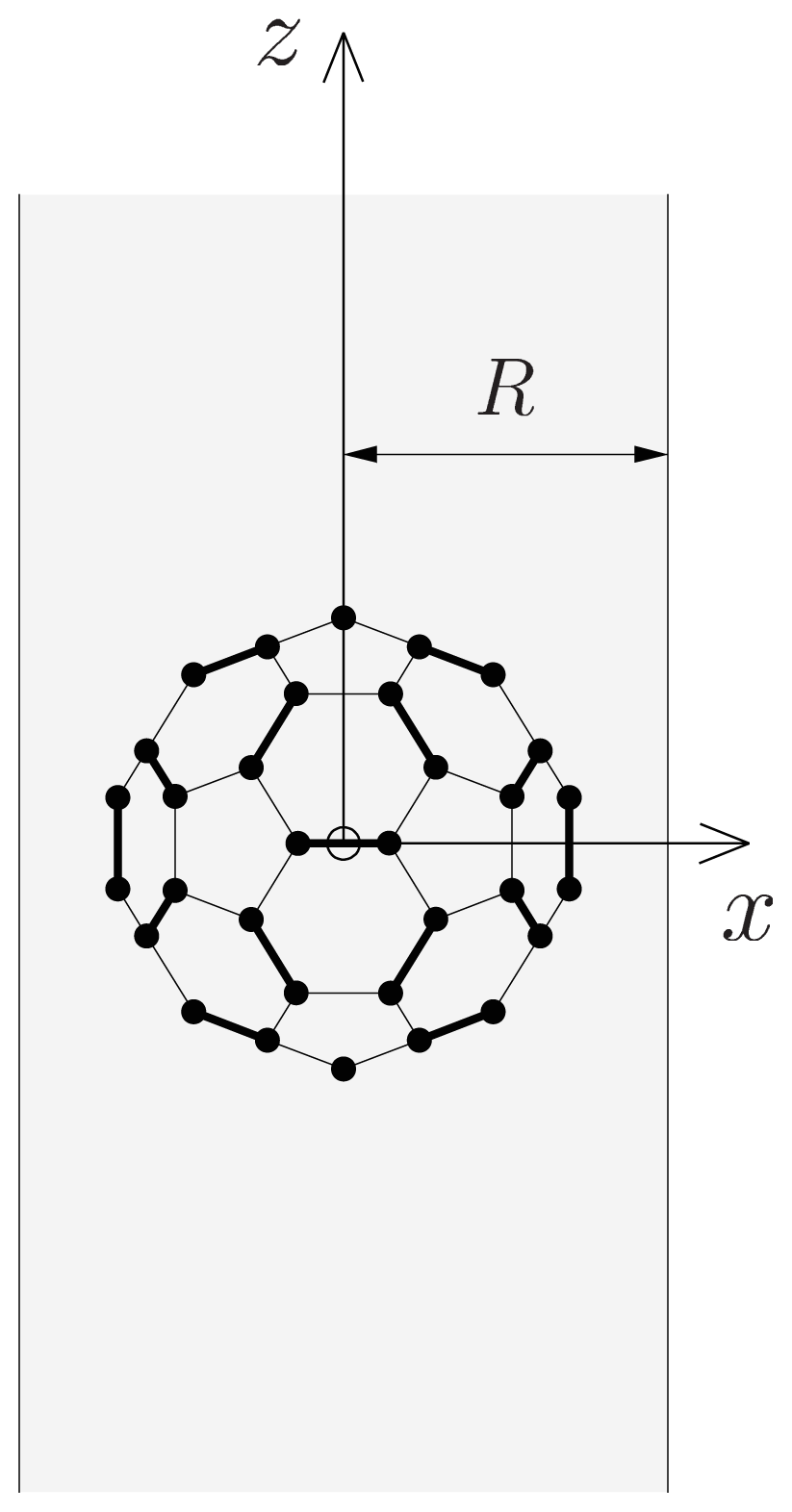
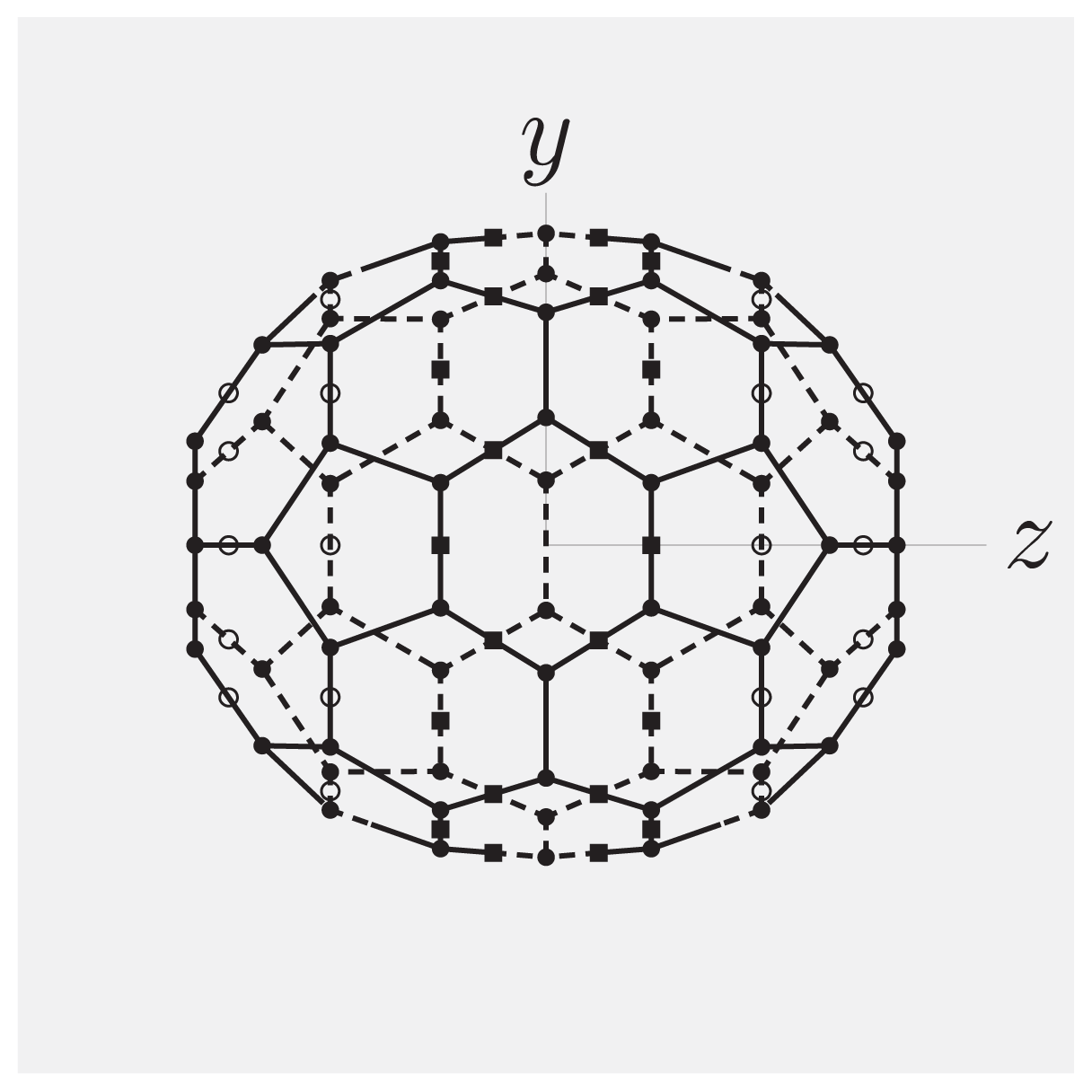
<p>It is instructive to introduce the formalism of SARFs for cylindrical confinement by elaborating a concrete example. We consider a C<sub>60</sub> molecule encapsulated in a CNT with its center of mass on the tube’s long axis (<xref ref-type="fig" rid="f1-ijms-12-00317">Figure 1</xref>). We treat the molecule as a rigid cluster of 60 carbon atoms, labeled Λ<sub>a</sub> = 1<italic>, . . . ,</italic> 60, and the nanotube as a homogeneous cylindrical density distribution <italic>n</italic>(<italic>r⃗</italic>) of carbon atoms (the subscript <sub>a</sub> stands for atom). The interaction energy then reads</p>
<disp-formula id="FD1">
<label>(1)</label>
<mml:math display="block">
<mml:semantics>
<mml:mrow>
<mml:mi>V</mml:mi>
<mml:mo>=</mml:mo>
<mml:munderover>
<mml:mo>∑</mml:mo>
<mml:mrow>
<mml:msub>
<mml:mrow>
<mml:mi mathvariant="normal">Λ</mml:mi></mml:mrow>
<mml:mtext>a</mml:mtext></mml:msub>
<mml:mo>=</mml:mo>
<mml:mn>1</mml:mn></mml:mrow>
<mml:mrow>
<mml:mn>60</mml:mn></mml:mrow></mml:munderover>
<mml:mrow>
<mml:mrow>
<mml:mo>∫</mml:mo>
<mml:mrow>
<mml:mi>d</mml:mi>
<mml:mover accent="true">
<mml:mi>r</mml:mi>
<mml:mo>→</mml:mo></mml:mover>
<mml:mi>n</mml:mi>
<mml:mo stretchy="false">(</mml:mo>
<mml:mover accent="true">
<mml:mi>r</mml:mi>
<mml:mo>→</mml:mo></mml:mover>
<mml:mo stretchy="false">)</mml:mo>
<mml:mi>v</mml:mi>
<mml:mo stretchy="false">(</mml:mo>
<mml:mo>∣</mml:mo>
<mml:mover accent="true">
<mml:mi>r</mml:mi>
<mml:mo>→</mml:mo></mml:mover>
<mml:mo>-</mml:mo>
<mml:msub>
<mml:mrow>
<mml:mover accent="true">
<mml:mi>r</mml:mi>
<mml:mo>→</mml:mo></mml:mover></mml:mrow>
<mml:mrow>
<mml:msub>
<mml:mrow>
<mml:mi mathvariant="normal">Λ</mml:mi></mml:mrow>
<mml:mtext>a</mml:mtext></mml:msub></mml:mrow></mml:msub>
<mml:mo>∣</mml:mo>
<mml:mo stretchy="false">)</mml:mo></mml:mrow></mml:mrow></mml:mrow></mml:mrow></mml:semantics></mml:math></disp-formula>
<p>where <italic>r⃗</italic><sub>Λ<sub>a</sub></sub> = (<italic>x</italic><sub>Λ<sub>a</sub></sub><italic>, y</italic><sub>Λ<sub>a</sub></sub><italic>, z</italic><sub>Λ<sub>a</sub></sub>) is the position vector of atom Λ<sub>a</sub> of the C<sub>60</sub> molecule. The function <italic>v</italic>(<italic>d</italic>) is the pair potential function giving the energy of two interacting centers (a carbon atom of the molecule and a carbon atom of the tube) at a distance <italic>d</italic> apart. Its precise form is not essential at this moment. For a tube of radius <italic>R</italic>, <italic>n</italic>(<italic>r⃗</italic>)<italic>dr⃗</italic> = <italic>σδ</italic>(<italic>ρ</italic> − <italic>R</italic>)<italic>ρdρd</italic>Φ<italic>dZ</italic>, and <italic>V</italic> becomes</p>
<disp-formula id="FD2">
<label>(2)</label>
<mml:math display="block">
<mml:semantics>
<mml:mtable columnalign="left" columnspacing="2pt">
<mml:mtr>
<mml:mtd>
<mml:mi>V</mml:mi>
<mml:mo>=</mml:mo>
<mml:mi>σ</mml:mi>
<mml:munderover>
<mml:mo>∑</mml:mo>
<mml:mrow>
<mml:msub>
<mml:mrow>
<mml:mi mathvariant="normal">Λ</mml:mi></mml:mrow>
<mml:mtext>a</mml:mtext></mml:msub>
<mml:mo>=</mml:mo>
<mml:mn>1</mml:mn></mml:mrow>
<mml:mrow>
<mml:mn>60</mml:mn></mml:mrow></mml:munderover>
<mml:mrow>
<mml:mrow>
<mml:msubsup>
<mml:mo>∫</mml:mo>
<mml:mn>0</mml:mn>
<mml:mo>∞</mml:mo></mml:msubsup>
<mml:mrow>
<mml:mi>ρ</mml:mi>
<mml:mi>d</mml:mi>
<mml:mi>ρ</mml:mi></mml:mrow></mml:mrow>
<mml:mrow>
<mml:msubsup>
<mml:mo>∫</mml:mo>
<mml:mn>0</mml:mn>
<mml:mrow>
<mml:mn>2</mml:mn>
<mml:mi>π</mml:mi></mml:mrow></mml:msubsup>
<mml:mrow>
<mml:mi>d</mml:mi>
<mml:mi>φ</mml:mi></mml:mrow></mml:mrow>
<mml:mrow>
<mml:msubsup>
<mml:mo>∫</mml:mo>
<mml:mrow>
<mml:mo>-</mml:mo>
<mml:mo>∞</mml:mo></mml:mrow>
<mml:mrow>
<mml:mo>+</mml:mo>
<mml:mo>∞</mml:mo></mml:mrow></mml:msubsup>
<mml:mrow>
<mml:mi>d</mml:mi>
<mml:mi>Z</mml:mi>
<mml:mi> </mml:mi>
<mml:mi>δ</mml:mi>
<mml:mo stretchy="false">(</mml:mo>
<mml:mi>ρ</mml:mi>
<mml:mo>-</mml:mo>
<mml:mi>R</mml:mi>
<mml:mo stretchy="false">)</mml:mo>
<mml:mi>v</mml:mi>
<mml:mo stretchy="false">(</mml:mo>
<mml:mo>∣</mml:mo>
<mml:mover accent="true">
<mml:mi>r</mml:mi>
<mml:mo>→</mml:mo></mml:mover>
<mml:mo>-</mml:mo>
<mml:msub>
<mml:mrow>
<mml:mover accent="true">
<mml:mi>r</mml:mi>
<mml:mo>→</mml:mo></mml:mover></mml:mrow>
<mml:mrow>
<mml:msub>
<mml:mrow>
<mml:mi mathvariant="normal">Λ</mml:mi></mml:mrow>
<mml:mtext>a</mml:mtext></mml:msub></mml:mrow></mml:msub>
<mml:mo>∣</mml:mo>
<mml:mo stretchy="false">)</mml:mo></mml:mrow></mml:mrow></mml:mrow></mml:mtd></mml:mtr>
<mml:mtr>
<mml:mtd>
<mml:mo>=</mml:mo>
<mml:mi>σ</mml:mi>
<mml:mi>R</mml:mi>
<mml:munderover>
<mml:mo>∑</mml:mo>
<mml:mrow>
<mml:msub>
<mml:mrow>
<mml:mi mathvariant="normal">Λ</mml:mi></mml:mrow>
<mml:mtext>a</mml:mtext></mml:msub>
<mml:mo>=</mml:mo>
<mml:mn>1</mml:mn></mml:mrow>
<mml:mrow>
<mml:mn>60</mml:mn></mml:mrow></mml:munderover>
<mml:mrow>
<mml:mrow>
<mml:msubsup>
<mml:mo>∫</mml:mo>
<mml:mn>0</mml:mn>
<mml:mrow>
<mml:mn>2</mml:mn>
<mml:mi>π</mml:mi></mml:mrow></mml:msubsup>
<mml:mrow>
<mml:mi>d</mml:mi>
<mml:mi mathvariant="normal">Φ</mml:mi></mml:mrow></mml:mrow>
<mml:mrow>
<mml:msubsup>
<mml:mo>∫</mml:mo>
<mml:mrow>
<mml:mo>-</mml:mo>
<mml:mo>∞</mml:mo></mml:mrow>
<mml:mrow>
<mml:mo>+</mml:mo>
<mml:mo>∞</mml:mo></mml:mrow></mml:msubsup>
<mml:mrow>
<mml:mi>d</mml:mi>
<mml:mi>Z</mml:mi>
<mml:mi> </mml:mi>
<mml:mi>v</mml:mi>
<mml:mo stretchy="false">(</mml:mo>
<mml:mo>∣</mml:mo>
<mml:msub>
<mml:mrow>
<mml:mover accent="true">
<mml:mi>r</mml:mi>
<mml:mo>→</mml:mo></mml:mover></mml:mrow>
<mml:mi>R</mml:mi></mml:msub>
<mml:mo>-</mml:mo>
<mml:msub>
<mml:mrow>
<mml:mover accent="true">
<mml:mi>r</mml:mi>
<mml:mo>→</mml:mo></mml:mover></mml:mrow>
<mml:mrow>
<mml:msub>
<mml:mrow>
<mml:mi mathvariant="normal">Λ</mml:mi></mml:mrow>
<mml:mtext>a</mml:mtext></mml:msub></mml:mrow></mml:msub>
<mml:mo>∣</mml:mo>
<mml:mo stretchy="false">)</mml:mo></mml:mrow></mml:mrow></mml:mrow></mml:mtd></mml:mtr></mml:mtable></mml:semantics></mml:math></disp-formula>
<p>Here, cylindrical coordinates (<italic>ρ,</italic>Φ<italic>,Z</italic>) have been introduced so that <italic>r⃗</italic> = (<italic>ρ</italic> cos Φ<italic>, ρ</italic> sin Φ<italic>, Z</italic>), and <italic>r⃗</italic><italic><sub>R</sub></italic> = (<italic>R</italic>cos Φ<italic>, R</italic> sin Φ<italic>, Z</italic>). The quantity <italic>σ</italic> is the tube’s surface density, the value for rolled-up graphene sheets (CNTs) is 0.372 Å<sup>−2</sup>.</p>
<p>We have not yet specified the molecule’s orientation. Let us introduce a reference orientation for the C<sub>60</sub> molecule, we choose it to be the orientation where two-fold symmetry axes coincide with the coordinate axes—the so-called standard orientation (<xref ref-type="fig" rid="f1-ijms-12-00317">Figure 1</xref>). The molecule’s center of mass coincides with the origin and the <italic>z</italic>-axis is chosen to coincide with the tube’s long axis. Molecular rotations can now be specified with respect to this standard orientation. Using the Euler angle convention of Ref. [<xref ref-type="bibr" rid="b11-ijms-12-00317">11</xref>], any rotation can be described as the succession of three Euler rotations: (i) a rotation ℜ<italic><sub>z</sub></italic>(<italic>α</italic>) over 0 ≤ <italic>α &lt;</italic> 2<italic>π</italic> about the <italic>z</italic>-axis, followed by (ii) a rotation ℜ<italic><sub>y</sub></italic>(<italic>β</italic>) over 0 ≤ <italic>β</italic> ≤ <italic>π</italic> about the <italic>y</italic>-axis, and finally (iii) a rotation ℜ<italic><sub>z</sub></italic>(<italic>γ</italic>) over 0 ≤ <italic>γ &lt;</italic> 2<italic>π</italic> about the <italic>z</italic>-axis again. The <italic>x</italic>-, <italic>y</italic>- and <italic>z</italic>-axes are kept fixed. Note that <italic>α</italic> = <italic>β</italic> = <italic>γ</italic> = 0 then corresponds to the standard (reference) orientation. With the convention of Ref. [<xref ref-type="bibr" rid="b11-ijms-12-00317">11</xref>], any coordinate function <italic>f</italic>(<italic>r⃗</italic>) is transformed as ℜ (<italic>α, β, γ</italic>)<italic>f</italic>(<italic>r⃗</italic> ) = <italic>f</italic>(ℜ<sup>−1</sup>(<italic>α, β, γ</italic>) <italic>r⃗</italic> ), where ℜ (<italic>α, β, γ</italic>) = ℜ<italic><sub>z</sub></italic>(<italic>γ</italic>) ℜ<italic><sub>y</sub></italic>(<italic>β</italic>) ℜ<italic><sub>z</sub></italic>(<italic>α</italic>). Applying this to the pair potentials <italic>v</italic>, essentially functions of the atomic positions <italic>r⃗</italic><sub>Λ<sub>a</sub></sub>, results in the following explicit expression for the molecule-tube interaction energy <italic>V</italic> (<italic>α, β, γ</italic>) for a rotated molecule:</p>
<disp-formula id="FD3">
<label>(3)</label>
<mml:math display="block">
<mml:semantics>
<mml:mrow>
<mml:mi>V</mml:mi>
<mml:mo stretchy="false">(</mml:mo>
<mml:mi>α</mml:mi>
<mml:mo>,</mml:mo>
<mml:mi>β</mml:mi>
<mml:mo>,</mml:mo>
<mml:mi>γ</mml:mi>
<mml:mo stretchy="false">)</mml:mo>
<mml:mo>≡</mml:mo>
<mml:mi mathvariant="fraktur">R</mml:mi>
<mml:mo stretchy="false">(</mml:mo>
<mml:mi>α</mml:mi>
<mml:mo>,</mml:mo>
<mml:mi>β</mml:mi>
<mml:mo>,</mml:mo>
<mml:mi>γ</mml:mi>
<mml:mo stretchy="false">)</mml:mo>
<mml:mi>V</mml:mi>
<mml:mo>=</mml:mo>
<mml:mi>σ</mml:mi>
<mml:mi>R</mml:mi>
<mml:munderover>
<mml:mo>∑</mml:mo>
<mml:mrow>
<mml:msub>
<mml:mrow>
<mml:mi mathvariant="normal">Λ</mml:mi></mml:mrow>
<mml:mtext>a</mml:mtext></mml:msub>
<mml:mo>=</mml:mo>
<mml:mn>1</mml:mn></mml:mrow>
<mml:mrow>
<mml:mn>60</mml:mn></mml:mrow></mml:munderover>
<mml:mrow>
<mml:mrow>
<mml:msubsup>
<mml:mo>∫</mml:mo>
<mml:mn>0</mml:mn>
<mml:mrow>
<mml:mn>2</mml:mn>
<mml:mi>π</mml:mi></mml:mrow></mml:msubsup>
<mml:mrow>
<mml:mi>d</mml:mi>
<mml:mi mathvariant="normal">Φ</mml:mi></mml:mrow></mml:mrow>
<mml:mrow>
<mml:msubsup>
<mml:mo>∫</mml:mo>
<mml:mrow>
<mml:mo>-</mml:mo>
<mml:mo>∞</mml:mo></mml:mrow>
<mml:mrow>
<mml:mo>+</mml:mo>
<mml:mo>∞</mml:mo></mml:mrow></mml:msubsup>
<mml:mrow>
<mml:mi>d</mml:mi>
<mml:mi>Z</mml:mi>
<mml:mi> </mml:mi>
<mml:mi>v</mml:mi>
<mml:mo stretchy="false">(</mml:mo>
<mml:mo>∣</mml:mo>
<mml:msub>
<mml:mrow>
<mml:mover accent="true">
<mml:mi>r</mml:mi>
<mml:mo>→</mml:mo></mml:mover></mml:mrow>
<mml:mi>R</mml:mi></mml:msub>
<mml:mo>-</mml:mo>
<mml:msup>
<mml:mrow>
<mml:mi mathvariant="fraktur">R</mml:mi></mml:mrow>
<mml:mrow>
<mml:mo>-</mml:mo>
<mml:mn>1</mml:mn></mml:mrow></mml:msup>
<mml:mo stretchy="false">(</mml:mo>
<mml:mi>α</mml:mi>
<mml:mo>,</mml:mo>
<mml:mi>β</mml:mi>
<mml:mo>,</mml:mo>
<mml:mi>γ</mml:mi>
<mml:mo stretchy="false">)</mml:mo>
<mml:msub>
<mml:mrow>
<mml:mover accent="true">
<mml:mi>r</mml:mi>
<mml:mo>→</mml:mo></mml:mover></mml:mrow>
<mml:mrow>
<mml:msub>
<mml:mrow>
<mml:mi mathvariant="normal">Λ</mml:mi></mml:mrow>
<mml:mtext>a</mml:mtext></mml:msub></mml:mrow></mml:msub>
<mml:mo>∣</mml:mo>
<mml:mo stretchy="false">)</mml:mo></mml:mrow></mml:mrow></mml:mrow></mml:mrow></mml:semantics></mml:math></disp-formula>
<p>Expression (<xref rid="FD3" ref-type="disp-formula">3</xref>) does not make use of the molecule’s symmetry; its numerical implementation requires the use of explicit Euler rotation matrices and is computationally heavy. To exploit the symmetries of both the molecule and the surrounding tube, we proceed as follows. First, we introduce spherical coordinates for the atoms of the molecule, <italic>r⃗</italic><sub>Λ<sub>a</sub></sub> = (<italic>r</italic><sub>Λ<sub>a</sub></sub> sin <italic>θ</italic><sub>Λ<sub>a</sub></sub> cos <italic>φ</italic><sub>Λ<sub>a</sub></sub><italic>, r</italic><sub>Λ<sub>a</sub></sub> sin <italic>θ</italic><sub>Λ<sub>a</sub></sub> sin <italic>φ</italic><sub>Λ<sub>a</sub></sub><italic>, r</italic><sub>Λ<sub>a</sub></sub> cos <italic>θ</italic><sub>Λ<sub>a</sub></sub>), and rewrite the interaction energy for a molecule in the standard orientation as</p>
<disp-formula id="FD4">
<label>(4)</label>
<mml:math display="block">
<mml:semantics>
<mml:mrow>
<mml:mi>V</mml:mi>
<mml:mo>=</mml:mo>
<mml:mi>σ</mml:mi>
<mml:mi>R</mml:mi>
<mml:munderover>
<mml:mo>∑</mml:mo>
<mml:mrow>
<mml:msub>
<mml:mrow>
<mml:mi mathvariant="normal">Λ</mml:mi></mml:mrow>
<mml:mtext>a</mml:mtext></mml:msub>
<mml:mo>=</mml:mo>
<mml:mn>1</mml:mn></mml:mrow>
<mml:mrow>
<mml:mn>60</mml:mn></mml:mrow></mml:munderover>
<mml:mrow>
<mml:mi>w</mml:mi>
<mml:mo stretchy="false">(</mml:mo>
<mml:mi>R</mml:mi>
<mml:mo>;</mml:mo>
<mml:msub>
<mml:mrow>
<mml:mi>r</mml:mi></mml:mrow>
<mml:mrow>
<mml:msub>
<mml:mrow>
<mml:mi mathvariant="normal">Λ</mml:mi></mml:mrow>
<mml:mtext>a</mml:mtext></mml:msub></mml:mrow></mml:msub>
<mml:mo>,</mml:mo>
<mml:msub>
<mml:mrow>
<mml:mi>θ</mml:mi></mml:mrow>
<mml:mrow>
<mml:msub>
<mml:mrow>
<mml:mi mathvariant="normal">Λ</mml:mi></mml:mrow>
<mml:mtext>a</mml:mtext></mml:msub></mml:mrow></mml:msub>
<mml:mo>,</mml:mo>
<mml:msub>
<mml:mrow>
<mml:mi>φ</mml:mi></mml:mrow>
<mml:mrow>
<mml:msub>
<mml:mrow>
<mml:mi mathvariant="normal">Λ</mml:mi></mml:mrow>
<mml:mtext>a</mml:mtext></mml:msub></mml:mrow></mml:msub>
<mml:mo stretchy="false">)</mml:mo></mml:mrow></mml:mrow></mml:semantics></mml:math></disp-formula>
<p>with</p>
<disp-formula id="FD5">
<label>(5)</label>
<mml:math display="block">
<mml:semantics>
<mml:mrow>
<mml:mi>w</mml:mi>
<mml:mo stretchy="false">(</mml:mo>
<mml:mi>R</mml:mi>
<mml:mo>;</mml:mo>
<mml:msub>
<mml:mrow>
<mml:mi>r</mml:mi></mml:mrow>
<mml:mrow>
<mml:msub>
<mml:mrow>
<mml:mi mathvariant="normal">Λ</mml:mi></mml:mrow>
<mml:mtext>a</mml:mtext></mml:msub></mml:mrow></mml:msub>
<mml:mo>,</mml:mo>
<mml:msub>
<mml:mrow>
<mml:mi>θ</mml:mi></mml:mrow>
<mml:mrow>
<mml:msub>
<mml:mrow>
<mml:mi mathvariant="normal">Λ</mml:mi></mml:mrow>
<mml:mtext>a</mml:mtext></mml:msub></mml:mrow></mml:msub>
<mml:mo>,</mml:mo>
<mml:msub>
<mml:mrow>
<mml:mi>φ</mml:mi></mml:mrow>
<mml:mrow>
<mml:msub>
<mml:mrow>
<mml:mi mathvariant="normal">Λ</mml:mi></mml:mrow>
<mml:mtext>a</mml:mtext></mml:msub></mml:mrow></mml:msub>
<mml:mo stretchy="false">)</mml:mo>
<mml:mo>=</mml:mo>
<mml:mrow>
<mml:msubsup>
<mml:mo>∫</mml:mo>
<mml:mn>0</mml:mn>
<mml:mrow>
<mml:mn>2</mml:mn>
<mml:mi>π</mml:mi></mml:mrow></mml:msubsup>
<mml:mrow>
<mml:mi>d</mml:mi>
<mml:mi mathvariant="normal">Φ</mml:mi></mml:mrow></mml:mrow>
<mml:mrow>
<mml:msubsup>
<mml:mo>∫</mml:mo>
<mml:mrow>
<mml:mo>-</mml:mo>
<mml:mo>∞</mml:mo></mml:mrow>
<mml:mo>∞</mml:mo></mml:msubsup>
<mml:mrow>
<mml:mi>d</mml:mi>
<mml:mi>Z</mml:mi>
<mml:mi> </mml:mi>
<mml:mi>v</mml:mi>
<mml:mo stretchy="false">(</mml:mo>
<mml:mo>∣</mml:mo>
<mml:msub>
<mml:mrow>
<mml:mover accent="true">
<mml:mi>r</mml:mi>
<mml:mo>→</mml:mo></mml:mover></mml:mrow>
<mml:mi>R</mml:mi></mml:msub>
<mml:mo>-</mml:mo>
<mml:msub>
<mml:mrow>
<mml:mover accent="true">
<mml:mi>r</mml:mi>
<mml:mo>→</mml:mo></mml:mover></mml:mrow>
<mml:mrow>
<mml:msub>
<mml:mrow>
<mml:mi mathvariant="normal">Λ</mml:mi></mml:mrow>
<mml:mtext>a</mml:mtext></mml:msub></mml:mrow></mml:msub>
<mml:mo>∣</mml:mo>
<mml:mo stretchy="false">)</mml:mo></mml:mrow></mml:mrow></mml:mrow></mml:semantics></mml:math></disp-formula>
<p>The distance <italic>|r⃗</italic><italic><sub>R</sub></italic> − <italic>r⃗</italic><sub>Λ<sub>a</sub></sub><italic>|</italic> reads</p>
<disp-formula id="FD6">
<label>(6)</label>
<mml:math display="block">
<mml:semantics>
<mml:mrow>
<mml:mo>∣</mml:mo>
<mml:msub>
<mml:mrow>
<mml:mover accent="true">
<mml:mi>r</mml:mi>
<mml:mo>→</mml:mo></mml:mover></mml:mrow>
<mml:mi>R</mml:mi></mml:msub>
<mml:mo>-</mml:mo>
<mml:msub>
<mml:mrow>
<mml:mover accent="true">
<mml:mi>r</mml:mi>
<mml:mo>→</mml:mo></mml:mover></mml:mrow>
<mml:mrow>
<mml:msub>
<mml:mrow>
<mml:mi mathvariant="normal">Λ</mml:mi></mml:mrow>
<mml:mtext>a</mml:mtext></mml:msub></mml:mrow></mml:msub>
<mml:mo>∣</mml:mo>
<mml:mo>=</mml:mo>
<mml:msqrt>
<mml:mrow>
<mml:msup>
<mml:mrow>
<mml:mi>R</mml:mi></mml:mrow>
<mml:mn>2</mml:mn></mml:msup>
<mml:mo>+</mml:mo>
<mml:msup>
<mml:mrow>
<mml:mi>Z</mml:mi></mml:mrow>
<mml:mn>2</mml:mn></mml:msup>
<mml:mo>+</mml:mo>
<mml:msubsup>
<mml:mrow>
<mml:mi>r</mml:mi></mml:mrow>
<mml:mrow>
<mml:msub>
<mml:mrow>
<mml:mi mathvariant="normal">Λ</mml:mi></mml:mrow>
<mml:mtext>a</mml:mtext></mml:msub></mml:mrow>
<mml:mn>2</mml:mn></mml:msubsup>
<mml:mo>-</mml:mo>
<mml:mn>2</mml:mn>
<mml:mi>R</mml:mi>
<mml:msub>
<mml:mrow>
<mml:mi>r</mml:mi></mml:mrow>
<mml:mrow>
<mml:msub>
<mml:mrow>
<mml:mi mathvariant="normal">Λ</mml:mi></mml:mrow>
<mml:mtext>a</mml:mtext></mml:msub></mml:mrow></mml:msub>
<mml:mtext>cos</mml:mtext>
<mml:mo stretchy="false">(</mml:mo>
<mml:mi mathvariant="normal">Φ</mml:mi>
<mml:mo>-</mml:mo>
<mml:msub>
<mml:mrow>
<mml:mi>φ</mml:mi></mml:mrow>
<mml:mrow>
<mml:msub>
<mml:mrow>
<mml:mi mathvariant="normal">Λ</mml:mi></mml:mrow>
<mml:mtext>a</mml:mtext></mml:msub></mml:mrow></mml:msub>
<mml:mo stretchy="false">)</mml:mo>
<mml:mtext>sin</mml:mtext>
<mml:msub>
<mml:mrow>
<mml:mi>θ</mml:mi></mml:mrow>
<mml:mrow>
<mml:msub>
<mml:mrow>
<mml:mi mathvariant="normal">Λ</mml:mi></mml:mrow>
<mml:mtext>a</mml:mtext></mml:msub></mml:mrow></mml:msub>
<mml:mo>-</mml:mo>
<mml:mn>2</mml:mn>
<mml:mi>Z</mml:mi>
<mml:msub>
<mml:mrow>
<mml:mi>r</mml:mi></mml:mrow>
<mml:mrow>
<mml:msub>
<mml:mrow>
<mml:mi mathvariant="normal">Λ</mml:mi></mml:mrow>
<mml:mtext>a</mml:mtext></mml:msub></mml:mrow></mml:msub>
<mml:mtext>cos</mml:mtext>
<mml:msub>
<mml:mrow>
<mml:mi>θ</mml:mi></mml:mrow>
<mml:mrow>
<mml:msub>
<mml:mrow>
<mml:mi mathvariant="normal">Λ</mml:mi></mml:mrow>
<mml:mtext>a</mml:mtext></mml:msub></mml:mrow></mml:msub></mml:mrow></mml:msqrt></mml:mrow></mml:semantics></mml:math></disp-formula>
<p>Only the difference of Φ and <italic>φ</italic><sub>Λ<sub>a</sub></sub> enters expression (<xref rid="FD6" ref-type="disp-formula">6</xref>), as the argument of the function cos. Therefore, the quantity <italic>w</italic> is independent of <italic>φ</italic><sub>Λ<sub>a</sub></sub>, since a change of variables Φ′ = Φ − <italic>φ</italic><sub>Λ<sub>a</sub></sub> eliminates <italic>φ</italic><sub>Λ<sub>a</sub></sub> from the expression for <italic>|r⃗</italic><italic><sub>R</sub></italic> − <italic>r⃗</italic><sub>Λ<sub>a</sub></sub><italic>|</italic> and since ∫<italic><sub>φ</sub></italic><sub>Λ<sub>a</sub></sub><sup>2</sup><italic><sup>π</sup></italic><sup>+</sup><italic><sup>φ</sup></italic><sup>Λ<sub>a</sub></sup> <italic>d</italic>Φ′<italic>f</italic>(Φ′) = ∫<sub>0</sub><sup>2</sup><italic><sup>π</sup></italic> <italic>d</italic>Φ′<italic>f</italic>(Φ′) for a function <italic>f</italic> with periodicity 2<italic>π</italic>. For a C<sub>60</sub> molecule, all C atoms have the same radial coordinate <italic>r</italic><sub>Λ<sub>a</sub></sub> ≡ <italic>r</italic><sub>a</sub>, which can therefore be considered a constant rather than a variable in expressions (<xref rid="FD4" ref-type="disp-formula">4</xref>) – (<xref rid="FD6" ref-type="disp-formula">6</xref>). Hence, we end up with the equations</p>
<disp-formula id="FD7">
<label>(7)</label>
<mml:math display="block">
<mml:semantics>
<mml:mrow>
<mml:mi>V</mml:mi>
<mml:mo>=</mml:mo>
<mml:mi>σ</mml:mi>
<mml:mi>R</mml:mi>
<mml:munderover>
<mml:mo>∑</mml:mo>
<mml:mrow>
<mml:msub>
<mml:mrow>
<mml:mi mathvariant="normal">Λ</mml:mi></mml:mrow>
<mml:mtext>a</mml:mtext></mml:msub>
<mml:mo>=</mml:mo>
<mml:mn>1</mml:mn></mml:mrow>
<mml:mrow>
<mml:mn>60</mml:mn></mml:mrow></mml:munderover>
<mml:mrow>
<mml:mi>w</mml:mi>
<mml:mo stretchy="false">(</mml:mo>
<mml:mi>R</mml:mi>
<mml:mo>;</mml:mo>
<mml:msub>
<mml:mrow>
<mml:mi>θ</mml:mi></mml:mrow>
<mml:mrow>
<mml:msub>
<mml:mrow>
<mml:mi mathvariant="normal">Λ</mml:mi></mml:mrow>
<mml:mtext>a</mml:mtext></mml:msub></mml:mrow></mml:msub>
<mml:mo stretchy="false">)</mml:mo></mml:mrow></mml:mrow></mml:semantics></mml:math></disp-formula>
<disp-formula id="FD8">
<label>(8)</label>
<mml:math display="block">
<mml:semantics>
<mml:mrow>
<mml:mi>w</mml:mi>
<mml:mo stretchy="false">(</mml:mo>
<mml:mi>R</mml:mi>
<mml:mo>;</mml:mo>
<mml:msub>
<mml:mrow>
<mml:mi>θ</mml:mi></mml:mrow>
<mml:mrow>
<mml:msub>
<mml:mrow>
<mml:mi mathvariant="normal">Λ</mml:mi></mml:mrow>
<mml:mtext>a</mml:mtext></mml:msub></mml:mrow></mml:msub>
<mml:mo stretchy="false">)</mml:mo>
<mml:mo>=</mml:mo>
<mml:mrow>
<mml:msubsup>
<mml:mo>∫</mml:mo>
<mml:mn>0</mml:mn>
<mml:mrow>
<mml:mn>2</mml:mn>
<mml:mi>π</mml:mi></mml:mrow></mml:msubsup>
<mml:mrow>
<mml:mi>d</mml:mi>
<mml:msup>
<mml:mi mathvariant="normal">Φ</mml:mi>
<mml:mo>′</mml:mo></mml:msup></mml:mrow></mml:mrow>
<mml:mrow>
<mml:msubsup>
<mml:mo>∫</mml:mo>
<mml:mrow>
<mml:mo>-</mml:mo>
<mml:mo>∞</mml:mo></mml:mrow>
<mml:mo>∞</mml:mo></mml:msubsup>
<mml:mrow>
<mml:mi>d</mml:mi>
<mml:mi>Z</mml:mi>
<mml:mi> </mml:mi>
<mml:mi>v</mml:mi>
<mml:mo stretchy="false">(</mml:mo>
<mml:mi>d</mml:mi>
<mml:mo stretchy="false">(</mml:mo>
<mml:mi>R</mml:mi>
<mml:mo>;</mml:mo>
<mml:mi>Z</mml:mi>
<mml:mo>,</mml:mo>
<mml:msup>
<mml:mi mathvariant="normal">Φ</mml:mi>
<mml:mo>′</mml:mo></mml:msup>
<mml:mo>,</mml:mo>
<mml:msub>
<mml:mrow>
<mml:mi>θ</mml:mi></mml:mrow>
<mml:mrow>
<mml:msub>
<mml:mrow>
<mml:mi mathvariant="normal">Λ</mml:mi></mml:mrow>
<mml:mtext>a</mml:mtext></mml:msub></mml:mrow></mml:msub>
<mml:mo stretchy="false">)</mml:mo>
<mml:mo stretchy="false">)</mml:mo></mml:mrow></mml:mrow></mml:mrow></mml:semantics></mml:math></disp-formula>
<disp-formula id="FD9">
<label>(9)</label>
<mml:math display="block">
<mml:semantics>
<mml:mrow>
<mml:mi>d</mml:mi>
<mml:mo stretchy="false">(</mml:mo>
<mml:mi>R</mml:mi>
<mml:mo>;</mml:mo>
<mml:mi>Z</mml:mi>
<mml:mo>,</mml:mo>
<mml:msup>
<mml:mi mathvariant="normal">Φ</mml:mi>
<mml:mo>′</mml:mo></mml:msup>
<mml:mo>,</mml:mo>
<mml:msub>
<mml:mrow>
<mml:mi>θ</mml:mi></mml:mrow>
<mml:mrow>
<mml:msub>
<mml:mrow>
<mml:mi mathvariant="normal">Λ</mml:mi></mml:mrow>
<mml:mtext>a</mml:mtext></mml:msub></mml:mrow></mml:msub>
<mml:mo stretchy="false">)</mml:mo>
<mml:mo>=</mml:mo>
<mml:msqrt>
<mml:mrow>
<mml:msup>
<mml:mrow>
<mml:mi>R</mml:mi></mml:mrow>
<mml:mn>2</mml:mn></mml:msup>
<mml:mo>+</mml:mo>
<mml:msup>
<mml:mrow>
<mml:mi>Z</mml:mi></mml:mrow>
<mml:mn>2</mml:mn></mml:msup>
<mml:mo>+</mml:mo>
<mml:msup>
<mml:mrow>
<mml:mi>r</mml:mi></mml:mrow>
<mml:mn>2</mml:mn></mml:msup>
<mml:mo>-</mml:mo>
<mml:mn>2</mml:mn>
<mml:mi>R</mml:mi>
<mml:mi>r</mml:mi>
<mml:mtext>cos</mml:mtext>
<mml:msup>
<mml:mi mathvariant="normal">Φ</mml:mi>
<mml:mo>′</mml:mo></mml:msup>
<mml:mtext>sin</mml:mtext>
<mml:msub>
<mml:mrow>
<mml:mi>θ</mml:mi></mml:mrow>
<mml:mrow>
<mml:msub>
<mml:mrow>
<mml:mi mathvariant="normal">Λ</mml:mi></mml:mrow>
<mml:mtext>a</mml:mtext></mml:msub></mml:mrow></mml:msub>
<mml:mo>-</mml:mo>
<mml:mn>2</mml:mn>
<mml:mi>Z</mml:mi>
<mml:mi>r</mml:mi>
<mml:mtext>cos</mml:mtext>
<mml:msub>
<mml:mrow>
<mml:mi>θ</mml:mi></mml:mrow>
<mml:mrow>
<mml:msub>
<mml:mrow>
<mml:mi mathvariant="normal">Λ</mml:mi></mml:mrow>
<mml:mtext>a</mml:mtext></mml:msub></mml:mrow></mml:msub></mml:mrow></mml:msqrt></mml:mrow></mml:semantics></mml:math></disp-formula>
<p>The quantity <italic>w</italic>(<italic>R; θ</italic><sub>Λ<sub>a</sub></sub>), taken as a function of <italic>θ</italic><sub>Λ<sub>a</sub></sub>, can be expanded into <italic>m</italic> = 0 spherical harmonics:</p>
<disp-formula id="FD10">
<label>(10)</label>
<mml:math display="block">
<mml:semantics>
<mml:mrow>
<mml:mi>w</mml:mi>
<mml:mo stretchy="false">(</mml:mo>
<mml:mi>R</mml:mi>
<mml:mo>;</mml:mo>
<mml:msub>
<mml:mrow>
<mml:mi>θ</mml:mi></mml:mrow>
<mml:mrow>
<mml:msub>
<mml:mrow>
<mml:mi mathvariant="normal">Λ</mml:mi></mml:mrow>
<mml:mtext>a</mml:mtext></mml:msub></mml:mrow></mml:msub>
<mml:mo stretchy="false">)</mml:mo>
<mml:mo>=</mml:mo>
<mml:munderover>
<mml:mo>∑</mml:mo>
<mml:mrow>
<mml:mi>l</mml:mi>
<mml:mo>=</mml:mo>
<mml:mn>0</mml:mn></mml:mrow>
<mml:mo>∞</mml:mo></mml:munderover>
<mml:mrow>
<mml:msub>
<mml:mrow>
<mml:mi>v</mml:mi></mml:mrow>
<mml:mi>l</mml:mi></mml:msub>
<mml:mo stretchy="false">(</mml:mo>
<mml:mi>R</mml:mi>
<mml:mo stretchy="false">)</mml:mo>
<mml:msubsup>
<mml:mrow>
<mml:mi>Y</mml:mi></mml:mrow>
<mml:mi>l</mml:mi>
<mml:mn>0</mml:mn></mml:msubsup>
<mml:mo stretchy="false">(</mml:mo>
<mml:msub>
<mml:mrow>
<mml:mi>θ</mml:mi></mml:mrow>
<mml:mrow>
<mml:msub>
<mml:mrow>
<mml:mi mathvariant="normal">Λ</mml:mi></mml:mrow>
<mml:mtext>a</mml:mtext></mml:msub></mml:mrow></mml:msub>
<mml:mo stretchy="false">)</mml:mo></mml:mrow></mml:mrow></mml:semantics></mml:math></disp-formula>
<disp-formula id="FD11">
<label>(11)</label>
<mml:math display="block">
<mml:semantics>
<mml:mtable columnalign="left" columnspacing="2pt">
<mml:mtr>
<mml:mtd>
<mml:msub>
<mml:mrow>
<mml:mi>v</mml:mi></mml:mrow>
<mml:mi>l</mml:mi></mml:msub>
<mml:mo stretchy="false">(</mml:mo>
<mml:mi>R</mml:mi>
<mml:mo stretchy="false">)</mml:mo>
<mml:mo>=</mml:mo>
<mml:mn>2</mml:mn>
<mml:mi>π</mml:mi>
<mml:mrow>
<mml:msubsup>
<mml:mo>∫</mml:mo>
<mml:mn>0</mml:mn>
<mml:mi>π</mml:mi></mml:msubsup>
<mml:mrow>
<mml:mtext>sin</mml:mtext>
<mml:mi>θ</mml:mi>
<mml:mi>d</mml:mi>
<mml:mi>θ</mml:mi>
<mml:mi> </mml:mi>
<mml:msubsup>
<mml:mrow>
<mml:mi>Y</mml:mi></mml:mrow>
<mml:mi>l</mml:mi>
<mml:mn>0</mml:mn></mml:msubsup>
<mml:mo stretchy="false">(</mml:mo>
<mml:mi>θ</mml:mi>
<mml:mo stretchy="false">)</mml:mo>
<mml:mi>w</mml:mi>
<mml:mo stretchy="false">(</mml:mo>
<mml:mi>R</mml:mi>
<mml:mo>;</mml:mo>
<mml:mi>θ</mml:mi>
<mml:mo stretchy="false">)</mml:mo></mml:mrow></mml:mrow></mml:mtd></mml:mtr>
<mml:mtr>
<mml:mtd>
<mml:mo>=</mml:mo>
<mml:mn>2</mml:mn>
<mml:mi>π</mml:mi>
<mml:mrow>
<mml:msubsup>
<mml:mo>∫</mml:mo>
<mml:mn>0</mml:mn>
<mml:mi>π</mml:mi></mml:msubsup>
<mml:mrow>
<mml:mtext>sin</mml:mtext>
<mml:mi>θ</mml:mi>
<mml:mi>d</mml:mi>
<mml:mi>θ</mml:mi></mml:mrow></mml:mrow>
<mml:mrow>
<mml:msubsup>
<mml:mo>∫</mml:mo>
<mml:mn>0</mml:mn>
<mml:mrow>
<mml:mn>2</mml:mn>
<mml:mi>π</mml:mi></mml:mrow></mml:msubsup>
<mml:mrow>
<mml:mi>d</mml:mi>
<mml:msup>
<mml:mi mathvariant="normal">Φ</mml:mi>
<mml:mo>′</mml:mo></mml:msup></mml:mrow></mml:mrow>
<mml:mrow>
<mml:msubsup>
<mml:mo>∫</mml:mo>
<mml:mrow>
<mml:mo>-</mml:mo>
<mml:mo>∞</mml:mo></mml:mrow>
<mml:mo>∞</mml:mo></mml:msubsup>
<mml:mrow>
<mml:mi>d</mml:mi>
<mml:mi>Z</mml:mi>
<mml:mi> </mml:mi>
<mml:msubsup>
<mml:mrow>
<mml:mi>Y</mml:mi></mml:mrow>
<mml:mi>l</mml:mi>
<mml:mn>0</mml:mn></mml:msubsup>
<mml:mo stretchy="false">(</mml:mo>
<mml:mi>θ</mml:mi>
<mml:mo stretchy="false">)</mml:mo>
<mml:mi>v</mml:mi>
<mml:mo stretchy="false">(</mml:mo>
<mml:mi>d</mml:mi>
<mml:mo stretchy="false">(</mml:mo>
<mml:mi>R</mml:mi>
<mml:mo>;</mml:mo>
<mml:mi>Z</mml:mi>
<mml:mo>,</mml:mo>
<mml:msup>
<mml:mi mathvariant="normal">Φ</mml:mi>
<mml:mo>′</mml:mo></mml:msup>
<mml:mo>,</mml:mo>
<mml:mi>θ</mml:mi>
<mml:mo stretchy="false">)</mml:mo>
<mml:mo stretchy="false">)</mml:mo></mml:mrow></mml:mrow></mml:mtd></mml:mtr></mml:mtable></mml:semantics></mml:math></disp-formula>
<p>Here, we use the Bradley and Cracknell spherical harmonics (Ref. [<xref ref-type="bibr" rid="b11-ijms-12-00317">11</xref>]). Upon rotation, spherical harmonics transform into linear combinations of spherical harmonics. One has</p>
<disp-formula id="FD12">
<label>(12)</label>
<mml:math display="block">
<mml:semantics>
<mml:mrow>
<mml:mi mathvariant="fraktur">R</mml:mi>
<mml:mo stretchy="false">(</mml:mo>
<mml:mi>α</mml:mi>
<mml:mo>,</mml:mo>
<mml:mi>β</mml:mi>
<mml:mo>,</mml:mo>
<mml:mi>γ</mml:mi>
<mml:mo stretchy="false">)</mml:mo>
<mml:msubsup>
<mml:mrow>
<mml:mi>Y</mml:mi></mml:mrow>
<mml:mi>l</mml:mi>
<mml:mi>m</mml:mi></mml:msubsup>
<mml:mo stretchy="false">(</mml:mo>
<mml:mi>θ</mml:mi>
<mml:mo>,</mml:mo>
<mml:mi>φ</mml:mi>
<mml:mo stretchy="false">)</mml:mo>
<mml:mo>=</mml:mo>
<mml:munderover>
<mml:mo>∑</mml:mo>
<mml:mrow>
<mml:mi>n</mml:mi>
<mml:mo>=</mml:mo>
<mml:mo>-</mml:mo>
<mml:mi>l</mml:mi></mml:mrow>
<mml:mi>l</mml:mi></mml:munderover>
<mml:mrow>
<mml:msubsup>
<mml:mrow>
<mml:mi mathvariant="script">D</mml:mi></mml:mrow>
<mml:mrow>
<mml:mi>n</mml:mi>
<mml:mo>,</mml:mo>
<mml:mi>m</mml:mi></mml:mrow>
<mml:mi>l</mml:mi></mml:msubsup>
<mml:mo stretchy="false">(</mml:mo>
<mml:mi>α</mml:mi>
<mml:mo>,</mml:mo>
<mml:mi>β</mml:mi>
<mml:mo>,</mml:mo>
<mml:mi>γ</mml:mi>
<mml:mo stretchy="false">)</mml:mo>
<mml:msubsup>
<mml:mrow>
<mml:mi>Y</mml:mi></mml:mrow>
<mml:mi>l</mml:mi>
<mml:mi>n</mml:mi></mml:msubsup>
<mml:mo stretchy="false">(</mml:mo>
<mml:mi>θ</mml:mi>
<mml:mo>,</mml:mo>
<mml:mi>φ</mml:mi>
<mml:mo stretchy="false">)</mml:mo></mml:mrow></mml:mrow></mml:semantics></mml:math></disp-formula>
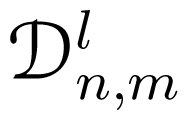
<p>The rotation operator ℜ(<italic>α, β, γ</italic>) has been introduced before; the quantities <inline-graphic xlink:href="ijms-12-00317ig1.gif"/> (<italic>α, β, γ</italic>) are the Wigner <inline-graphic xlink:href="ijms-12-00317ig2.gif"/>-functions. In the present case, cylindrical symmetry implies <italic>m</italic> = 0, for which the <italic>α</italic>-independent Wigner <inline-graphic xlink:href="ijms-12-00317ig2.gif"/>-functions reduce to</p>
<disp-formula id="FD13">
<label>(13)</label>
<mml:math display="block">
<mml:semantics>
<mml:mrow>
<mml:msubsup>
<mml:mrow>
<mml:mi mathvariant="script">D</mml:mi></mml:mrow>
<mml:mrow>
<mml:mi>n</mml:mi>
<mml:mo>,</mml:mo>
<mml:mi>m</mml:mi>
<mml:mo>=</mml:mo>
<mml:mn>0</mml:mn></mml:mrow>
<mml:mi>l</mml:mi></mml:msubsup>
<mml:mo stretchy="false">(</mml:mo>
<mml:mi>β</mml:mi>
<mml:mo>,</mml:mo>
<mml:mi>γ</mml:mi>
<mml:mo stretchy="false">)</mml:mo>
<mml:mo>=</mml:mo>
<mml:msqrt>
<mml:mrow>
<mml:mfrac>
<mml:mrow>
<mml:mn>4</mml:mn>
<mml:mi>π</mml:mi></mml:mrow>
<mml:mrow>
<mml:mn>2</mml:mn>
<mml:mi>l</mml:mi>
<mml:mo>+</mml:mo>
<mml:mn>1</mml:mn></mml:mrow></mml:mfrac></mml:mrow></mml:msqrt>
<mml:msup>
<mml:mrow>
<mml:mrow>
<mml:mo stretchy="false">[</mml:mo>
<mml:msubsup>
<mml:mrow>
<mml:mi>Y</mml:mi></mml:mrow>
<mml:mi>l</mml:mi>
<mml:mi>n</mml:mi></mml:msubsup>
<mml:mo stretchy="false">(</mml:mo>
<mml:mi>β</mml:mi>
<mml:mo>,</mml:mo>
<mml:mi>γ</mml:mi>
<mml:mo stretchy="false">)</mml:mo>
<mml:mo stretchy="false">]</mml:mo></mml:mrow></mml:mrow>
<mml:mo>*</mml:mo></mml:msup></mml:mrow></mml:semantics></mml:math></disp-formula>
<p>Collecting the previous equations results in the following potential energy expression for a rotated molecule:</p>
<disp-formula id="FD14">
<label>(14)</label>
<mml:math display="block">
<mml:semantics>
<mml:mtable columnalign="left" columnspacing="2pt">
<mml:mtr>
<mml:mtd>
<mml:mi>V</mml:mi>
<mml:mo stretchy="false">(</mml:mo>
<mml:mi>α</mml:mi>
<mml:mo>,</mml:mo>
<mml:mi>β</mml:mi>
<mml:mo>,</mml:mo>
<mml:mi>γ</mml:mi>
<mml:mo stretchy="false">)</mml:mo>
<mml:mo>=</mml:mo>
<mml:mi>σ</mml:mi>
<mml:mi>R</mml:mi>
<mml:munderover>
<mml:mo>∑</mml:mo>
<mml:mrow>
<mml:msub>
<mml:mrow>
<mml:mi mathvariant="normal">Λ</mml:mi></mml:mrow>
<mml:mtext>a</mml:mtext></mml:msub>
<mml:mo>=</mml:mo>
<mml:mn>1</mml:mn></mml:mrow>
<mml:mrow>
<mml:mn>60</mml:mn></mml:mrow></mml:munderover>
<mml:mrow>
<mml:munderover>
<mml:mo>∑</mml:mo>
<mml:mrow>
<mml:mi>l</mml:mi>
<mml:mo>=</mml:mo>
<mml:mn>0</mml:mn></mml:mrow>
<mml:mo>∞</mml:mo></mml:munderover>
<mml:mrow>
<mml:msub>
<mml:mrow>
<mml:mi>v</mml:mi></mml:mrow>
<mml:mi>l</mml:mi></mml:msub>
<mml:mo stretchy="false">(</mml:mo>
<mml:mi>R</mml:mi>
<mml:mo stretchy="false">)</mml:mo>
<mml:mi mathvariant="fraktur">R</mml:mi>
<mml:mo stretchy="false">(</mml:mo>
<mml:mi>α</mml:mi>
<mml:mo>,</mml:mo>
<mml:mi>β</mml:mi>
<mml:mo>,</mml:mo>
<mml:mi>γ</mml:mi>
<mml:mo stretchy="false">)</mml:mo>
<mml:msubsup>
<mml:mrow>
<mml:mi>Y</mml:mi></mml:mrow>
<mml:mi>l</mml:mi>
<mml:mn>0</mml:mn></mml:msubsup>
<mml:mo stretchy="false">(</mml:mo>
<mml:msub>
<mml:mrow>
<mml:mi>θ</mml:mi></mml:mrow>
<mml:mrow>
<mml:msub>
<mml:mrow>
<mml:mi mathvariant="normal">Λ</mml:mi></mml:mrow>
<mml:mtext>a</mml:mtext></mml:msub></mml:mrow></mml:msub>
<mml:mo stretchy="false">)</mml:mo></mml:mrow></mml:mrow></mml:mtd></mml:mtr>
<mml:mtr>
<mml:mtd>
<mml:mo>=</mml:mo>
<mml:mi>σ</mml:mi>
<mml:mi>R</mml:mi>
<mml:munderover>
<mml:mo>∑</mml:mo>
<mml:mrow>
<mml:mi>l</mml:mi>
<mml:mo>=</mml:mo>
<mml:mn>0</mml:mn></mml:mrow>
<mml:mo>∞</mml:mo></mml:munderover>
<mml:mrow>
<mml:msub>
<mml:mrow>
<mml:mi>v</mml:mi></mml:mrow>
<mml:mi>l</mml:mi></mml:msub>
<mml:mo stretchy="false">(</mml:mo>
<mml:mi>R</mml:mi>
<mml:mo stretchy="false">)</mml:mo></mml:mrow>
<mml:munderover>
<mml:mo>∑</mml:mo>
<mml:mrow>
<mml:mi>n</mml:mi>
<mml:mo>=</mml:mo>
<mml:mo>-</mml:mo>
<mml:mi>l</mml:mi></mml:mrow>
<mml:mi>l</mml:mi></mml:munderover>
<mml:mrow>
<mml:msubsup>
<mml:mrow>
<mml:mi mathvariant="script">D</mml:mi></mml:mrow>
<mml:mrow>
<mml:mi>n</mml:mi>
<mml:mo>,</mml:mo>
<mml:mi>m</mml:mi>
<mml:mo>=</mml:mo>
<mml:mn>0</mml:mn></mml:mrow>
<mml:mi>l</mml:mi></mml:msubsup>
<mml:mo stretchy="false">(</mml:mo>
<mml:mi>β</mml:mi>
<mml:mo>,</mml:mo>
<mml:mi>γ</mml:mi>
<mml:mo stretchy="false">)</mml:mo></mml:mrow>
<mml:munderover>
<mml:mo>∑</mml:mo>
<mml:mrow>
<mml:msub>
<mml:mrow>
<mml:mi mathvariant="normal">Λ</mml:mi></mml:mrow>
<mml:mtext>a</mml:mtext></mml:msub>
<mml:mo>=</mml:mo>
<mml:mn>1</mml:mn></mml:mrow>
<mml:mrow>
<mml:mn>60</mml:mn></mml:mrow></mml:munderover>
<mml:mrow>
<mml:msubsup>
<mml:mrow>
<mml:mi>Y</mml:mi></mml:mrow>
<mml:mi>l</mml:mi>
<mml:mi>n</mml:mi></mml:msubsup>
<mml:mo stretchy="false">(</mml:mo>
<mml:msub>
<mml:mrow>
<mml:mi>θ</mml:mi></mml:mrow>
<mml:mrow>
<mml:msub>
<mml:mrow>
<mml:mi mathvariant="normal">Λ</mml:mi></mml:mrow>
<mml:mtext>a</mml:mtext></mml:msub></mml:mrow></mml:msub>
<mml:mo>,</mml:mo>
<mml:msub>
<mml:mrow>
<mml:mi>φ</mml:mi></mml:mrow>
<mml:mrow>
<mml:msub>
<mml:mrow>
<mml:mi mathvariant="normal">Λ</mml:mi></mml:mrow>
<mml:mtext>a</mml:mtext></mml:msub></mml:mrow></mml:msub>
<mml:mo stretchy="false">)</mml:mo>
<mml:mo>≡</mml:mo>
<mml:mi>V</mml:mi>
<mml:mo stretchy="false">(</mml:mo>
<mml:mi>β</mml:mi>
<mml:mo>,</mml:mo>
<mml:mi>γ</mml:mi>
<mml:mo stretchy="false">)</mml:mo></mml:mrow></mml:mtd></mml:mtr></mml:mtable></mml:semantics></mml:math></disp-formula>
<p>The potential energy <italic>V</italic> (<italic>β, γ</italic>) depends on the molecule’s orientation and on the tube’s radius; it can therefore be considered as a potential energy field (nanotube field) set up by the surrounding tube and experienced by the molecule. Note that there is no <italic>α</italic>-dependence since the initial rotation ℜ<italic><sub>z</sub></italic>(<italic>α</italic>) about the <italic>z</italic>-axis has no effect on the interaction energy—a consequence of the “smooth-tube approximation”.</p>
<p>So far, only the cylindrical symmetry—the site symmetry—has been used. The molecular symmetry is accounted for by the distribution of C atoms. We introduce atomic form factors <italic>c</italic><italic><sub>l</sub></italic><italic><sup>n</sup></italic>,</p>
<disp-formula id="FD15">
<label>(15)</label>
<mml:math display="block">
<mml:semantics>
<mml:mrow>
<mml:msubsup>
<mml:mrow>
<mml:mi>c</mml:mi></mml:mrow>
<mml:mi>l</mml:mi>
<mml:mi>n</mml:mi></mml:msubsup>
<mml:mo>=</mml:mo>
<mml:munderover>
<mml:mo>∑</mml:mo>
<mml:mrow>
<mml:msub>
<mml:mrow>
<mml:mi mathvariant="normal">Λ</mml:mi></mml:mrow>
<mml:mi>a</mml:mi></mml:msub>
<mml:mo>=</mml:mo>
<mml:mn>1</mml:mn></mml:mrow>
<mml:mrow>
<mml:mn>60</mml:mn></mml:mrow></mml:munderover>
<mml:mrow>
<mml:msubsup>
<mml:mrow>
<mml:mi>Y</mml:mi></mml:mrow>
<mml:mi>l</mml:mi>
<mml:mi>n</mml:mi></mml:msubsup>
<mml:mo stretchy="false">(</mml:mo>
<mml:msub>
<mml:mrow>
<mml:mi>θ</mml:mi></mml:mrow>
<mml:mrow>
<mml:msub>
<mml:mrow>
<mml:mi mathvariant="normal">Λ</mml:mi></mml:mrow>
<mml:mi>a</mml:mi></mml:msub></mml:mrow></mml:msub>
<mml:mo>,</mml:mo>
<mml:msub>
<mml:mrow>
<mml:mi>φ</mml:mi></mml:mrow>
<mml:mrow>
<mml:msub>
<mml:mrow>
<mml:mi mathvariant="normal">Λ</mml:mi></mml:mrow>
<mml:mi>a</mml:mi></mml:msub></mml:mrow></mml:msub>
<mml:mo stretchy="false">)</mml:mo></mml:mrow></mml:mrow></mml:semantics></mml:math></disp-formula>
<p>molecular shape factors <italic>g</italic><italic><sub>l</sub></italic>,</p>
<disp-formula id="FD16">
<label>(16)</label>
<mml:math display="block">
<mml:semantics>
<mml:mrow>
<mml:msub>
<mml:mrow>
<mml:mi>g</mml:mi></mml:mrow>
<mml:mi>l</mml:mi></mml:msub>
<mml:mo>=</mml:mo>
<mml:msqrt>
<mml:mrow>
<mml:munderover>
<mml:mo>∑</mml:mo>
<mml:mrow>
<mml:mi>n</mml:mi>
<mml:mo>=</mml:mo>
<mml:mo>-</mml:mo>
<mml:mi>l</mml:mi></mml:mrow>
<mml:mi>l</mml:mi></mml:munderover>
<mml:mrow>
<mml:msup>
<mml:mrow>
<mml:mrow>
<mml:mo stretchy="false">(</mml:mo>
<mml:msubsup>
<mml:mrow>
<mml:mi>c</mml:mi></mml:mrow>
<mml:mi>l</mml:mi>
<mml:mi>n</mml:mi></mml:msubsup>
<mml:mo stretchy="false">)</mml:mo></mml:mrow></mml:mrow>
<mml:mn>2</mml:mn></mml:msup></mml:mrow></mml:mrow></mml:msqrt></mml:mrow></mml:semantics></mml:math></disp-formula>
<p>and normalised atomic form factors <italic>α</italic><italic><sub>l</sub></italic><italic><sup>n</sup></italic>,</p>
<disp-formula id="FD17">
<label>(17)</label>
<mml:math display="block">
<mml:semantics>
<mml:mrow>
<mml:msubsup>
<mml:mrow>
<mml:mi>α</mml:mi></mml:mrow>
<mml:mi>l</mml:mi>
<mml:mi>n</mml:mi></mml:msubsup>
<mml:mo>=</mml:mo>
<mml:mfrac>
<mml:mrow>
<mml:msubsup>
<mml:mrow>
<mml:mi>c</mml:mi></mml:mrow>
<mml:mi>l</mml:mi>
<mml:mi>n</mml:mi></mml:msubsup></mml:mrow>
<mml:mrow>
<mml:msub>
<mml:mrow>
<mml:mi>g</mml:mi></mml:mrow>
<mml:mi>l</mml:mi></mml:msub></mml:mrow></mml:mfrac></mml:mrow></mml:semantics></mml:math></disp-formula>
<p>Icosahedral molecular symmetry implies that <italic>c</italic><italic><sub>l</sub></italic><italic><sup>n</sup></italic> differs from zero only for <italic>n</italic> even and <italic>l</italic> = 0<italic>,</italic> 6<italic>,</italic> 10<italic>,</italic> 12<italic>, . . .</italic>. The non-vanishing <italic>g</italic><italic><sub>l</sub></italic> and <italic>α</italic><italic><sub>l</sub></italic><italic><sup>n</sup></italic> values are tabulated in <xref ref-type="table" rid="t1-ijms-12-00317">Table 1</xref> up to <italic>l</italic> = 12. We can now rewrite <italic>V</italic> (<italic>β, γ</italic>) as</p>
<disp-formula id="FD18">
<label>(18)</label>
<mml:math display="block">
<mml:semantics>
<mml:mrow>
<mml:mi>V</mml:mi>
<mml:mo stretchy="false">(</mml:mo>
<mml:mi>β</mml:mi>
<mml:mo>,</mml:mo>
<mml:mi>γ</mml:mi>
<mml:mo stretchy="false">)</mml:mo>
<mml:mo>=</mml:mo>
<mml:mi>σ</mml:mi>
<mml:mi>R</mml:mi>
<mml:munder>
<mml:mo>∑</mml:mo>
<mml:mrow>
<mml:mi>l</mml:mi>
<mml:mo>=</mml:mo>
<mml:mn>0</mml:mn>
<mml:mo>,</mml:mo>
<mml:mn>6</mml:mn>
<mml:mo>,</mml:mo>
<mml:mn>10</mml:mn>
<mml:mo>,</mml:mo>
<mml:mn>12</mml:mn>
<mml:mo>,</mml:mo>
<mml:mo>…</mml:mo></mml:mrow></mml:munder>
<mml:mrow>
<mml:msub>
<mml:mrow>
<mml:mi>v</mml:mi></mml:mrow>
<mml:mi>l</mml:mi></mml:msub>
<mml:mo stretchy="false">(</mml:mo>
<mml:mi>R</mml:mi>
<mml:mo stretchy="false">)</mml:mo>
<mml:msub>
<mml:mrow>
<mml:mi>g</mml:mi></mml:mrow>
<mml:mi>l</mml:mi></mml:msub>
<mml:msub>
<mml:mrow>
<mml:mi mathvariant="script">U</mml:mi></mml:mrow>
<mml:mi>l</mml:mi></mml:msub>
<mml:mo stretchy="false">(</mml:mo>
<mml:mi>β</mml:mi>
<mml:mo>,</mml:mo>
<mml:mi>γ</mml:mi>
<mml:mo stretchy="false">)</mml:mo></mml:mrow></mml:mrow></mml:semantics></mml:math></disp-formula>
<p>where</p>
<disp-formula id="FD19">
<label>(19)</label>
<mml:math display="block">
<mml:semantics>
<mml:mrow>
<mml:msub>
<mml:mrow>
<mml:mi mathvariant="script">U</mml:mi></mml:mrow>
<mml:mi>l</mml:mi></mml:msub>
<mml:mo stretchy="false">(</mml:mo>
<mml:mi>β</mml:mi>
<mml:mo>,</mml:mo>
<mml:mi>γ</mml:mi>
<mml:mo stretchy="false">)</mml:mo>
<mml:mo>=</mml:mo>
<mml:munderover>
<mml:mo>∑</mml:mo>
<mml:mrow>
<mml:mi>n</mml:mi>
<mml:mo>=</mml:mo>
<mml:mo>-</mml:mo>
<mml:mi>l</mml:mi></mml:mrow>
<mml:mi>l</mml:mi></mml:munderover>
<mml:mrow>
<mml:msubsup>
<mml:mrow>
<mml:mi>α</mml:mi></mml:mrow>
<mml:mi>l</mml:mi>
<mml:mi>n</mml:mi></mml:msubsup>
<mml:msubsup>
<mml:mrow>
<mml:mi>D</mml:mi></mml:mrow>
<mml:mrow>
<mml:mi>n</mml:mi>
<mml:mo>,</mml:mo>
<mml:mn>0</mml:mn></mml:mrow>
<mml:mi>l</mml:mi></mml:msubsup>
<mml:mo stretchy="false">(</mml:mo>
<mml:mi>β</mml:mi>
<mml:mo>,</mml:mo>
<mml:mi>γ</mml:mi>
<mml:mo stretchy="false">)</mml:mo></mml:mrow></mml:mrow></mml:semantics></mml:math></disp-formula>
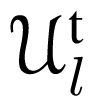
<p>are molecular-and-site-symmetry-adapted rotator functions (SARFs). Rotator functions, originally introduced by James and Keenan [<xref ref-type="bibr" rid="b2-ijms-12-00317">2</xref>], are the appropriate variables for the description of orientationaldependent properties of molecules in crystals [<xref ref-type="bibr" rid="b3-ijms-12-00317">3</xref>,<xref ref-type="bibr" rid="b4-ijms-12-00317">4</xref>]. They account for the symmetry of the molecule and the symmetry of the crystal site point group. In the present case the crystal site symmetry is the <italic>D</italic><italic><sub>∞h</sub></italic> symmetry of the (smooth) nanotube. The cylindrical site symmetry has the consequence that the Wigner <inline-graphic xlink:href="ijms-12-00317ig2.gif"/>-functions are linear combinations of spherical harmonics [<xref rid="FD13" ref-type="disp-formula">Equation (13)</xref>], and that the rotator functions <inline-graphic xlink:href="ijms-12-00317ig3.gif"/>(<italic>β, γ</italic>) can be easily implemented:</p>
<disp-formula id="FD20">
<label>(20)</label>
<mml:math display="block">
<mml:semantics>
<mml:mrow>
<mml:msub>
<mml:mrow>
<mml:mi mathvariant="script">U</mml:mi></mml:mrow>
<mml:mi>l</mml:mi></mml:msub>
<mml:mo stretchy="false">(</mml:mo>
<mml:mi>β</mml:mi>
<mml:mo>,</mml:mo>
<mml:mi>γ</mml:mi>
<mml:mo stretchy="false">)</mml:mo>
<mml:mo>=</mml:mo>
<mml:msqrt>
<mml:mrow>
<mml:mfrac>
<mml:mrow>
<mml:mn>4</mml:mn>
<mml:mi>π</mml:mi></mml:mrow>
<mml:mrow>
<mml:mn>2</mml:mn>
<mml:mi>l</mml:mi>
<mml:mo>+</mml:mo>
<mml:mn>1</mml:mn></mml:mrow></mml:mfrac></mml:mrow></mml:msqrt>
<mml:munderover>
<mml:mo>∑</mml:mo>
<mml:mrow>
<mml:mi>n</mml:mi>
<mml:mo>=</mml:mo>
<mml:mo>-</mml:mo>
<mml:mi>l</mml:mi></mml:mrow>
<mml:mi>l</mml:mi></mml:munderover>
<mml:mrow>
<mml:msubsup>
<mml:mrow>
<mml:mi>α</mml:mi></mml:mrow>
<mml:mi>l</mml:mi>
<mml:mi>n</mml:mi></mml:msubsup>
<mml:msup>
<mml:mrow>
<mml:mrow>
<mml:mo stretchy="false">[</mml:mo>
<mml:msubsup>
<mml:mrow>
<mml:mi>Y</mml:mi></mml:mrow>
<mml:mi>l</mml:mi>
<mml:mi>n</mml:mi></mml:msubsup>
<mml:mo stretchy="false">(</mml:mo>
<mml:mi>β</mml:mi>
<mml:mo>,</mml:mo>
<mml:mi>γ</mml:mi>
<mml:mo stretchy="false">)</mml:mo>
<mml:mo stretchy="false">]</mml:mo></mml:mrow></mml:mrow>
<mml:mo>*</mml:mo></mml:msup></mml:mrow></mml:mrow></mml:semantics></mml:math></disp-formula>
<p>The symmetry of a C<sub>60</sub> molecule implies some restrictions on the atomic form factors. The combination of a center of inversion and the (<italic>x, z</italic>)- and (<italic>x, y</italic>)-planes being mirror planes results in the follow properties:</p>
<disp-formula id="FD21">
<label>(21a)</label>
<mml:math display="block">
<mml:semantics>
<mml:mrow>
<mml:msubsup>
<mml:mrow>
<mml:mi>c</mml:mi></mml:mrow>
<mml:mi>l</mml:mi>
<mml:mi>n</mml:mi></mml:msubsup>
<mml:mo>=</mml:mo>
<mml:mn>0</mml:mn>
<mml:mi> </mml:mi>
<mml:mtext>if </mml:mtext>
<mml:mi>l</mml:mi>
<mml:mi> </mml:mi>
<mml:mtext>odd</mml:mtext></mml:mrow></mml:semantics></mml:math></disp-formula>
<disp-formula id="FD22">
<label>(21b)</label>
<mml:math display="block">
<mml:semantics>
<mml:mrow>
<mml:msup>
<mml:mrow>
<mml:mrow>
<mml:mo stretchy="false">(</mml:mo>
<mml:msubsup>
<mml:mrow>
<mml:mi>c</mml:mi></mml:mrow>
<mml:mi>l</mml:mi>
<mml:mi>n</mml:mi></mml:msubsup>
<mml:mo stretchy="false">)</mml:mo></mml:mrow></mml:mrow>
<mml:mo>*</mml:mo></mml:msup>
<mml:mo>=</mml:mo>
<mml:msubsup>
<mml:mrow>
<mml:mi>c</mml:mi></mml:mrow>
<mml:mi>l</mml:mi>
<mml:mi>n</mml:mi></mml:msubsup></mml:mrow></mml:semantics></mml:math></disp-formula>
<disp-formula id="FD23">
<label>(21c)</label>
<mml:math display="block">
<mml:semantics>
<mml:mrow>
<mml:msubsup>
<mml:mrow>
<mml:mi>c</mml:mi></mml:mrow>
<mml:mi>l</mml:mi>
<mml:mrow>
<mml:mo>-</mml:mo>
<mml:mi>n</mml:mi></mml:mrow></mml:msubsup>
<mml:mo>=</mml:mo>
<mml:msubsup>
<mml:mrow>
<mml:mi>c</mml:mi></mml:mrow>
<mml:mi>l</mml:mi>
<mml:mi>n</mml:mi></mml:msubsup></mml:mrow></mml:semantics></mml:math></disp-formula>
<disp-formula id="FD24">
<label>(21d)</label>
<mml:math display="block">
<mml:semantics>
<mml:mrow>
<mml:msubsup>
<mml:mrow>
<mml:mi>c</mml:mi></mml:mrow>
<mml:mi>l</mml:mi>
<mml:mi>n</mml:mi></mml:msubsup>
<mml:mo>=</mml:mo>
<mml:mn>0</mml:mn>
<mml:mi> </mml:mi>
<mml:mtext>if </mml:mtext>
<mml:mi>l</mml:mi>
<mml:mi> </mml:mi>
<mml:mtext>even and </mml:mtext>
<mml:mi>n</mml:mi>
<mml:mi> </mml:mi>
<mml:mtext>odd</mml:mtext></mml:mrow></mml:semantics></mml:math></disp-formula>
<p>The same relations hold for the normalized molecular form factors <italic>α</italic><italic><sub>l</sub></italic><italic><sup>n</sup></italic>. In particular, it follows that the rotator functions are real functions since <italic>α</italic><italic><sub>l</sub></italic><sup>−</sup><italic><sup>n</sup></italic> = <italic>α</italic><italic><sub>l</sub></italic><italic><sup>n</sup></italic> and [<italic>Y</italic><italic><sub>l</sub></italic><italic><sup>n</sup></italic> (<italic>β, γ</italic>)]<italic><sup>*</sup></italic> = <italic>Y</italic><italic><sub>l</sub></italic><sup>−</sup><italic><sup>n</sup></italic> (<italic>β, γ</italic>).</p>
<p>In summary, as a numerically much more efficient alternative to <xref rid="FD3" ref-type="disp-formula">Equation (3)</xref> involving explicit coordinate transformations (Euler rotations), one can maximally exploit the symmetry of both the molecule and its environment by first calculating the atomic form factors <italic>c</italic><italic><sub>l</sub></italic><italic><sup>n</sup></italic> [<xref rid="FD15" ref-type="disp-formula">Equation (15)</xref>], molecular shape factors <italic>g</italic><italic><sub>l</sub></italic> [<xref rid="FD16" ref-type="disp-formula">Equation (16)</xref>], and normalised atomic form factors <italic>α</italic><italic><sub>l</sub></italic><italic><sup>n</sup></italic> [<xref rid="FD17" ref-type="disp-formula">Equation (17)</xref>]. The latter then serve as coefficients in linear combinations of spherical harmonics defined as SARFs [<xref rid="FD20" ref-type="disp-formula">Equation (20)</xref>]. These coefficients have only to be calculated once. For a given tube radius <italic>R</italic>, the expansion coefficients <italic>v</italic><italic><sub>l</sub></italic>(<italic>R</italic>) are calculated by numerical integration [<xref rid="FD11" ref-type="disp-formula">Equation (11)</xref>]. The evaluation of a few leading terms of [<xref rid="FD18" ref-type="disp-formula">Equation (18)</xref>] then serves as an excellent approximation for the molecule’s potential energy <italic>V</italic> (<italic>β, γ</italic>).</p>
<p>For actual calculations, a potential function and potential parameters have to be specified. In Refs. [<xref ref-type="bibr" rid="b12-ijms-12-00317">12</xref>] and [<xref ref-type="bibr" rid="b13-ijms-12-00317">13</xref>], a Born–Mayer–van der Waals C-C pair potential,</p>
<disp-formula id="FD25">
<label>(22)</label>
<mml:math display="block">
<mml:semantics>
<mml:mrow>
<mml:mi>v</mml:mi>
<mml:mo stretchy="false">(</mml:mo>
<mml:mi>d</mml:mi>
<mml:mo stretchy="false">)</mml:mo>
<mml:mo>=</mml:mo>
<mml:msub>
<mml:mrow>
<mml:mi>C</mml:mi></mml:mrow>
<mml:mn>1</mml:mn></mml:msub>
<mml:msup>
<mml:mrow>
<mml:mi>e</mml:mi></mml:mrow>
<mml:mrow>
<mml:mo>-</mml:mo>
<mml:msub>
<mml:mrow>
<mml:mi>C</mml:mi></mml:mrow>
<mml:mn>2</mml:mn></mml:msub>
<mml:mi>d</mml:mi></mml:mrow></mml:msup>
<mml:mo>-</mml:mo>
<mml:mfrac>
<mml:mi>B</mml:mi>
<mml:mrow>
<mml:msup>
<mml:mrow>
<mml:mi>d</mml:mi></mml:mrow>
<mml:mn>6</mml:mn></mml:msup></mml:mrow></mml:mfrac></mml:mrow></mml:semantics></mml:math></disp-formula>
<p>was introduced for studying C<sub>60</sub>-C<sub>60</sub> interactions in C<sub>60</sub>-fullerite (solid buckminsterfullerene); it led to a crystal field potential and a structural phase transition temperature [<xref ref-type="bibr" rid="b14-ijms-12-00317">14</xref>,<xref ref-type="bibr" rid="b15-ijms-12-00317">15</xref>] in good agreement with experiments. Using the potential constants <italic>C</italic><sub>1</sub> = 3.24 <italic>×</italic> 10<sup>7</sup> K <italic>× k</italic><sub>B</sub>, <italic>C</italic><sub>2</sub> = 3.6 Å<sup>−1</sup> and <italic>B</italic> = 4.579 <italic>×</italic> 10<sup>5</sup> K <italic>× k</italic><sub>B</sub> · Å<sup>6</sup> of Refs. [<xref ref-type="bibr" rid="b6-ijms-12-00317">6</xref>] and [<xref ref-type="bibr" rid="b7-ijms-12-00317">7</xref>] results in the <italic>v</italic><italic><sub>l</sub></italic>(<italic>R</italic>) coefficients, obtained via numerical integration of expression (<xref rid="FD11" ref-type="disp-formula">11</xref>), shown in <xref ref-type="table" rid="t2-ijms-12-00317">Table 2</xref>. The amplitude of these coefficients decreases with increasing <italic>l</italic>. More indicative are the weighted coefficients <italic>g</italic><italic><sub>l</sub></italic><italic>v</italic><italic><sub>l</sub></italic>(<italic>R</italic>), also given in <xref ref-type="table" rid="t2-ijms-12-00317">Table 2</xref>. They reveal the relative importance of the contributing <italic>l</italic> terms. The <italic>l</italic> = 12 terms clearly contribute much less than the <italic>l</italic> = 6 terms— the lowest-order terms introducing (<italic>β, γ</italic>)-dependence, but the <italic>l</italic> = 10 contribution obviously plays an important role for the <italic>R</italic> = 6.0 and <italic>R</italic> = 7.0 cases.</p>
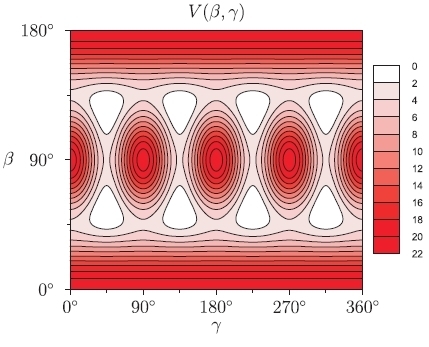
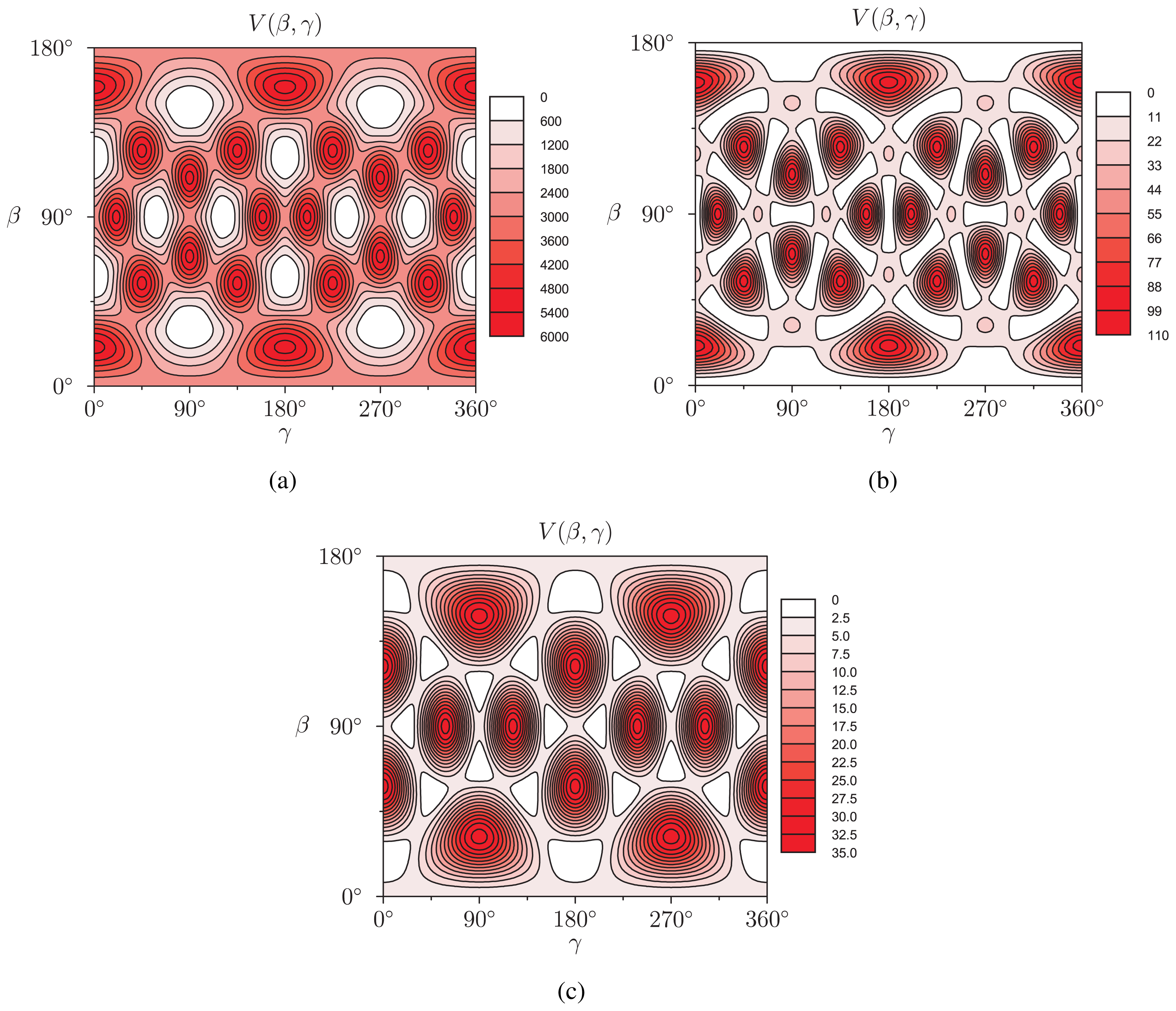
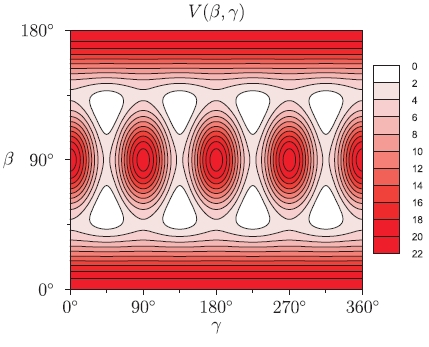
<p>Having calculated the quantities <italic>g</italic><italic><sub>l</sub></italic>, <italic>v</italic><italic><sub>l</sub></italic>(<italic>R</italic>) and <italic>α</italic><italic><sub>l</sub></italic><italic><sup>n</sup></italic> allows to construct the rotator functions <inline-graphic xlink:href="ijms-12-00317ig3.gif"/>(<italic>β, γ</italic>) and to evaluate expression (<xref rid="FD18" ref-type="disp-formula">18</xref>). In <xref ref-type="fig" rid="f2-ijms-12-00317">Figure 2</xref>, we show the results of <italic>V</italic> (<italic>β, γ</italic>) for <italic>R</italic> = 6.0 Å, <italic>R</italic> = 7.0 Å and <italic>R</italic> = 8.0 Å for a calculation up to <italic>l</italic> = 12. For <italic>R</italic> = 6.0 Å, there are 12 local minima, corresponding to the twelve equivalent molecular orientations where two opposing pentagons of the C<sub>60</sub> molecule are perpendicular to the <italic>z</italic>-axis. The 20 maxima correspond to orientations where hexagons are perpendicular to the <italic>z</italic>-axis. (The “soccer-ball structure” indeed features 12 pentagons and 20 hexagons.) At <italic>R</italic> = 7.0 Å, there are 30 local minima: they correspond to the molecular configurations where opposing double bonds are perpendicular to the tube’s long axis (<italic>z</italic>-axis). The potential energy is maximal when a hexagon is perpendicular to the <italic>z</italic>-axis. Finally, at <italic>R</italic> = 8.0 Å, minima and maxima correspond to hexagons and pentagons perpendicular to the <italic>z</italic>-axis, respectively.</p>
<p>When comparing the nanotube fields shown in <xref ref-type="fig" rid="f2-ijms-12-00317">Figure 2</xref> to the (<italic>β, γ</italic>)-maps obtained via the exact formula with explicit coordinate transforms [<xref rid="FD3" ref-type="disp-formula">Equation (3)</xref>], there is no visual difference: the SARFs expansion up to <italic>l</italic> = 12 is an excellent approximation. Using the same integration routines, the direct calculations took a few hours each, however, while the evaluation of the <italic>v</italic><italic><sub>l</sub></italic>(<italic>R</italic>) coefficients and the SARFs expansion was a matter of seconds. Therefore, in addition to providing physical and mathematical understanding of the symmetries present in the system, SARFs have a considerable computational advantage.</p></sec>
<sec sec-type="discussion">
<title>2.2. Discussion</title>
<p>The important feature in the construction of an expansion into SARFs is the vanishing of several atomic form factors <italic>c</italic><italic><sub>l</sub></italic><italic><sup>n</sup></italic> (<italic>α</italic><italic><sub>l</sub></italic><italic><sup>n</sup></italic>). This is a direct consequence of the symmetry of the considered molecule. In terms of group theory, only certain linear combinations of spherical harmonics <italic>Y</italic><italic><sub>l</sub></italic><italic><sup>n</sup></italic> (<italic>β, γ</italic>) belong to the unit representation (<italic>A</italic><sub>1</sub><italic><sub>g</sub></italic> irreducible representation) of the molecular symmetry group and contribute to the expansion of <italic>V</italic> (<italic>β, γ</italic>) into SARFs. For a cylindrical tube there is no <italic>α</italic>-dependence, and the expansion into SARFs is in fact nothing but an expansion into linear combinations of spherical harmonics <italic>Y</italic><italic><sub>l</sub></italic><italic><sup>n</sup></italic> (<italic>β, γ</italic>) belonging to the unit representation.</p></sec>
<sec>
<title>2.3. Extension to clusters with different types of interaction centers</title>
<p>Often, several types of molecular sites are treated as interaction centers (ICs). In the case of a molecule consisting of different types of atoms, every atomic type interacts differently with the surrounding nanotube, which can be accounted for by using different potential constants (or even different potential functions). The pair potential <italic>v</italic>(<italic>d</italic>) and the expansion coefficients <italic>v</italic><italic><sub>l</sub></italic>(<italic>R</italic>) then become type-dependent:</p>
<disp-formula id="FD26">
<label>(23)</label>
<mml:math display="block">
<mml:semantics>
<mml:mrow>
<mml:msubsup>
<mml:mrow>
<mml:mi>v</mml:mi></mml:mrow>
<mml:mi>l</mml:mi>
<mml:mtext>t</mml:mtext></mml:msubsup>
<mml:mo stretchy="false">(</mml:mo>
<mml:mi>R</mml:mi>
<mml:mo stretchy="false">)</mml:mo>
<mml:mo>=</mml:mo>
<mml:mn>2</mml:mn>
<mml:mi>π</mml:mi>
<mml:mrow>
<mml:msubsup>
<mml:mo>∫</mml:mo>
<mml:mn>0</mml:mn>
<mml:mi>π</mml:mi></mml:msubsup>
<mml:mrow>
<mml:mtext>sin</mml:mtext>
<mml:mi>θ</mml:mi>
<mml:mi>d</mml:mi>
<mml:mi>θ</mml:mi></mml:mrow></mml:mrow>
<mml:mrow>
<mml:msubsup>
<mml:mo>∫</mml:mo>
<mml:mn>0</mml:mn>
<mml:mrow>
<mml:mn>2</mml:mn>
<mml:mi>π</mml:mi></mml:mrow></mml:msubsup>
<mml:mrow>
<mml:mi>d</mml:mi>
<mml:msup>
<mml:mi mathvariant="normal">Φ</mml:mi>
<mml:mo>′</mml:mo></mml:msup></mml:mrow></mml:mrow>
<mml:mrow>
<mml:msubsup>
<mml:mo>∫</mml:mo>
<mml:mrow>
<mml:mo>-</mml:mo>
<mml:mo>∞</mml:mo></mml:mrow>
<mml:mo>∞</mml:mo></mml:msubsup>
<mml:mrow>
<mml:mi>d</mml:mi>
<mml:mi>Z</mml:mi>
<mml:mi> </mml:mi>
<mml:msubsup>
<mml:mrow>
<mml:mi>Y</mml:mi></mml:mrow>
<mml:mi>l</mml:mi>
<mml:mn>0</mml:mn></mml:msubsup>
<mml:mo stretchy="false">(</mml:mo>
<mml:mi>θ</mml:mi>
<mml:mo stretchy="false">)</mml:mo>
<mml:msup>
<mml:mrow>
<mml:mi>v</mml:mi></mml:mrow>
<mml:mtext>t</mml:mtext></mml:msup>
<mml:mo stretchy="false">(</mml:mo>
<mml:mi>d</mml:mi>
<mml:mo stretchy="false">(</mml:mo>
<mml:mi>R</mml:mi>
<mml:mo>;</mml:mo>
<mml:mi>Z</mml:mi>
<mml:mo>,</mml:mo>
<mml:msup>
<mml:mi mathvariant="normal">Φ</mml:mi>
<mml:mo>′</mml:mo></mml:msup>
<mml:mo>,</mml:mo>
<mml:mi>θ</mml:mi>
<mml:mo stretchy="false">)</mml:mo>
<mml:mo stretchy="false">)</mml:mo></mml:mrow></mml:mrow></mml:mrow></mml:semantics></mml:math></disp-formula>
<p>Here, the superscript <sup>t</sup> stands for the IC type. The ICs need not only be atoms; in the case of C<sub>60</sub> molecules, it is customary to place ICs on bonds. For a C<sub>60</sub> molecule, double bonds (fusing hexagons) and single bonds (fusing hexagons and pentagons) are considered, and labeled t = db and t = sb, respectively. (By bonds, the midpoints of bonds are understood.) These additional ICs were originally introduced to account for variations in the charge distribution of a C<sub>60</sub> molecule [<xref ref-type="bibr" rid="b13-ijms-12-00317">13</xref>,<xref ref-type="bibr" rid="b16-ijms-12-00317">16</xref>]. For each of the IC types, t = a, db, sb, the atomic form factors</p>
<disp-formula id="FD27">
<label>(24)</label>
<mml:math display="block">
<mml:semantics>
<mml:mrow>
<mml:msubsup>
<mml:mrow>
<mml:mi>c</mml:mi></mml:mrow>
<mml:mi>l</mml:mi>
<mml:mrow>
<mml:mtext>t</mml:mtext>
<mml:mo>,</mml:mo>
<mml:mi>n</mml:mi></mml:mrow></mml:msubsup>
<mml:mo>=</mml:mo>
<mml:munderover>
<mml:mo>∑</mml:mo>
<mml:mrow>
<mml:msub>
<mml:mrow>
<mml:mi mathvariant="normal">Λ</mml:mi></mml:mrow>
<mml:mtext>t</mml:mtext></mml:msub>
<mml:mo>=</mml:mo>
<mml:mn>1</mml:mn></mml:mrow>
<mml:mrow>
<mml:mn>60</mml:mn></mml:mrow></mml:munderover>
<mml:mrow>
<mml:msubsup>
<mml:mrow>
<mml:mi>Y</mml:mi></mml:mrow>
<mml:mi>l</mml:mi>
<mml:mi>n</mml:mi></mml:msubsup>
<mml:mo stretchy="false">(</mml:mo>
<mml:msub>
<mml:mrow>
<mml:mi>θ</mml:mi></mml:mrow>
<mml:mrow>
<mml:msub>
<mml:mrow>
<mml:mi mathvariant="normal">Λ</mml:mi></mml:mrow>
<mml:mtext>t</mml:mtext></mml:msub></mml:mrow></mml:msub>
<mml:mo>,</mml:mo>
<mml:msub>
<mml:mrow>
<mml:mi>φ</mml:mi></mml:mrow>
<mml:mrow>
<mml:msub>
<mml:mrow>
<mml:mi mathvariant="normal">Λ</mml:mi></mml:mrow>
<mml:mtext>t</mml:mtext></mml:msub></mml:mrow></mml:msub>
<mml:mo stretchy="false">)</mml:mo></mml:mrow></mml:mrow></mml:semantics></mml:math></disp-formula>
<p>the molecular shape factors</p>
<disp-formula id="FD28">
<label>(25)</label>
<mml:math display="block">
<mml:semantics>
<mml:mrow>
<mml:msubsup>
<mml:mrow>
<mml:mi>g</mml:mi></mml:mrow>
<mml:mi>l</mml:mi>
<mml:mtext>t</mml:mtext></mml:msubsup>
<mml:mo>=</mml:mo>
<mml:msqrt>
<mml:mrow>
<mml:munderover>
<mml:mo>∑</mml:mo>
<mml:mrow>
<mml:mi>n</mml:mi>
<mml:mo>=</mml:mo>
<mml:mo>-</mml:mo>
<mml:mi>l</mml:mi></mml:mrow>
<mml:mi>l</mml:mi></mml:munderover>
<mml:mrow>
<mml:msup>
<mml:mrow>
<mml:mrow>
<mml:mo stretchy="false">(</mml:mo>
<mml:msubsup>
<mml:mrow>
<mml:mi>c</mml:mi></mml:mrow>
<mml:mi>l</mml:mi>
<mml:mrow>
<mml:mtext>t</mml:mtext>
<mml:mo>,</mml:mo>
<mml:mi>n</mml:mi></mml:mrow></mml:msubsup>
<mml:mo stretchy="false">)</mml:mo></mml:mrow></mml:mrow>
<mml:mn>2</mml:mn></mml:msup></mml:mrow></mml:mrow></mml:msqrt></mml:mrow></mml:semantics></mml:math></disp-formula>
<p>and the normalised atomic form factors</p>
<disp-formula id="FD29">
<label>(26)</label>
<mml:math display="block">
<mml:semantics>
<mml:mrow>
<mml:msubsup>
<mml:mrow>
<mml:mi>α</mml:mi></mml:mrow>
<mml:mi>l</mml:mi>
<mml:mrow>
<mml:mtext>t</mml:mtext>
<mml:mo>,</mml:mo>
<mml:mi>n</mml:mi></mml:mrow></mml:msubsup>
<mml:mo>=</mml:mo>
<mml:mfrac>
<mml:mrow>
<mml:msubsup>
<mml:mrow>
<mml:mi>c</mml:mi></mml:mrow>
<mml:mi>l</mml:mi>
<mml:mrow>
<mml:mtext>t</mml:mtext>
<mml:mo>,</mml:mo>
<mml:mi>n</mml:mi></mml:mrow></mml:msubsup></mml:mrow>
<mml:mrow>
<mml:msubsup>
<mml:mrow>
<mml:mi>g</mml:mi></mml:mrow>
<mml:mi>l</mml:mi>
<mml:mtext>t</mml:mtext></mml:msubsup></mml:mrow></mml:mfrac></mml:mrow></mml:semantics></mml:math></disp-formula>
<p>have to be calculated. Here, <italic>θ</italic><sub>Λ<sub>t</sub></sub> and <italic>φ</italic><sub>Λ<sub>t</sub></sub> stand for the polar and azimuthal angles of the ICs of type t, labeled Λ<sub>t</sub> = 1<italic>, . . . ,N</italic><sub>t</sub>, with <italic>N</italic><sub>t</sub> the number of ICs of type t (<italic>N</italic><sub>a</sub> = 60, <italic>N</italic><sub>db</sub> = 30 and <italic>N</italic><sub>sb</sub> = 60). Remarkably, it turns out that</p>
<disp-formula id="FD30">
<label>(27)</label>
<mml:math display="block">
<mml:semantics>
<mml:mrow>
<mml:msubsup>
<mml:mrow>
<mml:mi>α</mml:mi></mml:mrow>
<mml:mi>l</mml:mi>
<mml:mrow>
<mml:mtext>t</mml:mtext>
<mml:mo>,</mml:mo>
<mml:mi>n</mml:mi></mml:mrow></mml:msubsup>
<mml:mo>=</mml:mo>
<mml:msubsup>
<mml:mrow>
<mml:mi>ξ</mml:mi></mml:mrow>
<mml:mi>l</mml:mi>
<mml:mtext>t</mml:mtext></mml:msubsup>
<mml:msubsup>
<mml:mrow>
<mml:mi>α</mml:mi></mml:mrow>
<mml:mi>l</mml:mi>
<mml:mrow>
<mml:mtext>a</mml:mtext>
<mml:mo>,</mml:mo>
<mml:mi>n</mml:mi></mml:mrow></mml:msubsup></mml:mrow></mml:semantics></mml:math></disp-formula>
<p>with <italic>ξ</italic><italic><sub>l</sub></italic><sup>t</sup> = <italic>±</italic>1. It is therefore useful to introduce modified molecular shape factors</p>
<disp-formula id="FD31">
<label>(28)</label>
<mml:math display="block">
<mml:semantics>
<mml:mrow>
<mml:msubsup>
<mml:mrow>
<mml:mover accent="true">
<mml:mi>g</mml:mi>
<mml:mo>˜</mml:mo></mml:mover></mml:mrow>
<mml:mi>l</mml:mi>
<mml:mtext>t</mml:mtext></mml:msubsup>
<mml:mo>=</mml:mo>
<mml:msubsup>
<mml:mrow>
<mml:mi>ξ</mml:mi></mml:mrow>
<mml:mi>l</mml:mi>
<mml:mtext>t</mml:mtext></mml:msubsup>
<mml:msubsup>
<mml:mrow>
<mml:mi>g</mml:mi></mml:mrow>
<mml:mi>l</mml:mi>
<mml:mtext>t</mml:mtext></mml:msubsup></mml:mrow></mml:semantics></mml:math></disp-formula>
<p>so that</p>
<disp-formula id="FD32">
<label>(29)</label>
<mml:math display="block">
<mml:semantics>
<mml:mrow>
<mml:msubsup>
<mml:mrow>
<mml:mi>c</mml:mi></mml:mrow>
<mml:mi>l</mml:mi>
<mml:mrow>
<mml:mtext>t</mml:mtext>
<mml:mo>,</mml:mo>
<mml:mi>n</mml:mi></mml:mrow></mml:msubsup>
<mml:mo>=</mml:mo>
<mml:msubsup>
<mml:mrow>
<mml:mover accent="true">
<mml:mi>g</mml:mi>
<mml:mo>˜</mml:mo></mml:mover></mml:mrow>
<mml:mi>l</mml:mi>
<mml:mtext>t</mml:mtext></mml:msubsup>
<mml:msubsup>
<mml:mrow>
<mml:mi>α</mml:mi></mml:mrow>
<mml:mi>l</mml:mi>
<mml:mi>n</mml:mi></mml:msubsup></mml:mrow></mml:semantics></mml:math></disp-formula>
<p>where <italic>α</italic><italic><sub>l</sub></italic><italic><sup>n</sup></italic> ≡ <italic>α</italic><italic><sub>l</sub></italic><sup>a</sup><italic><sup>,n</sup></italic>. This allows to write the following generalised expression for <italic>V</italic> (<italic>β, γ</italic>):</p>
<disp-formula id="FD33">
<label>(30)</label>
<mml:math display="block">
<mml:semantics>
<mml:mrow>
<mml:mi>V</mml:mi>
<mml:mo stretchy="false">(</mml:mo>
<mml:mi>β</mml:mi>
<mml:mo>,</mml:mo>
<mml:mi>γ</mml:mi>
<mml:mo stretchy="false">)</mml:mo>
<mml:mo>=</mml:mo>
<mml:mi>σ</mml:mi>
<mml:mi>R</mml:mi>
<mml:munder>
<mml:mo>∑</mml:mo>
<mml:mrow>
<mml:mi>l</mml:mi>
<mml:mo>=</mml:mo>
<mml:mn>0</mml:mn>
<mml:mo>,</mml:mo>
<mml:mn>6</mml:mn>
<mml:mo>,</mml:mo>
<mml:mn>10</mml:mn>
<mml:mo>,</mml:mo>
<mml:mn>12</mml:mn>
<mml:mo>,</mml:mo>
<mml:mo>…</mml:mo></mml:mrow></mml:munder>
<mml:mrow>
<mml:munder>
<mml:mo>∑</mml:mo>
<mml:mrow>
<mml:mtext>t</mml:mtext>
<mml:mo>=</mml:mo>
<mml:mtext>a</mml:mtext>
<mml:mo>,</mml:mo>
<mml:mtext>db</mml:mtext>
<mml:mo>,</mml:mo>
<mml:mtext>sb</mml:mtext></mml:mrow></mml:munder>
<mml:mrow>
<mml:msubsup>
<mml:mrow>
<mml:mi>v</mml:mi></mml:mrow>
<mml:mi>l</mml:mi>
<mml:mtext>t</mml:mtext></mml:msubsup>
<mml:mo stretchy="false">(</mml:mo>
<mml:mi>R</mml:mi>
<mml:mo stretchy="false">)</mml:mo>
<mml:msubsup>
<mml:mrow>
<mml:mover accent="true">
<mml:mi>g</mml:mi>
<mml:mo>˜</mml:mo></mml:mover></mml:mrow>
<mml:mi>l</mml:mi>
<mml:mtext>t</mml:mtext></mml:msubsup>
<mml:msub>
<mml:mrow>
<mml:mi mathvariant="script">U</mml:mi></mml:mrow>
<mml:mi>l</mml:mi></mml:msub>
<mml:mo stretchy="false">(</mml:mo>
<mml:mi>β</mml:mi>
<mml:mo>,</mml:mo>
<mml:mi>γ</mml:mi>
<mml:mo stretchy="false">)</mml:mo></mml:mrow></mml:mrow></mml:mrow></mml:semantics></mml:math></disp-formula>
<p>Note that the same SARFs as before [<xref rid="FD19" ref-type="disp-formula">Equation (19)</xref>] can be used.</p>
<p>The nanotube fields of a C<sub>60</sub> molecule arising from the extended interaction model described in the present subsection do not differ qualitatively from the ones shown in <xref ref-type="fig" rid="f2-ijms-12-00317">Figure 2</xref>. For full details, we refer to Ref. [<xref ref-type="bibr" rid="b8-ijms-12-00317">8</xref>].</p>
<p>The manifestation of potential energy landscapes as in <xref ref-type="fig" rid="f2-ijms-12-00317">Figure 2</xref> as a consequence of molecular symmetry and cylindrical confinement and their dependence on the tube radius <italic>R</italic> has important implications on the physical properties of a “peapod”—a chain of several molecules encapsulated in a CNT. In particular, the peapod system of C<sub>60</sub> molecules encapsulated in a CNT displays unusual dynamical behavior as demonstrated by different experimental techniques: inelastic neutron scattering [<xref ref-type="bibr" rid="b17-ijms-12-00317">17</xref>], nuclear magnetic resonance [<xref ref-type="bibr" rid="b18-ijms-12-00317">18</xref>,<xref ref-type="bibr" rid="b19-ijms-12-00317">19</xref>] and high-pressure near-infrared Raman scattering [<xref ref-type="bibr" rid="b20-ijms-12-00317">20</xref>]. Obviously, for a realistic description of peapods, molecule-molecule interactions have to be taken into account as well. For typical tube radii (<italic>R ~</italic> 7 Å) of C<sub>60</sub> peapod samples, though, the intermolecular interactions are several orders of magnitude smaller than the molecule-tube interaction [<xref ref-type="bibr" rid="b8-ijms-12-00317">8</xref>] and do therefore not significantly influence the molecules’ optimal orientation with respect to the surrounding CNT. A discussion of the dynamics of the molecules in a C<sub>60</sub>-peapod is beyond the scope of the present paper, however — we recall that our purpose is to provide the mathematical framework for the effective exploitation of the molecular and the environmental symmetry for calculating potential energies. For details, we refer to the relevant experimental [<xref ref-type="bibr" rid="b17-ijms-12-00317">17</xref>,<xref ref-type="bibr" rid="b18-ijms-12-00317">18</xref>,<xref ref-type="bibr" rid="b19-ijms-12-00317">19</xref>,<xref ref-type="bibr" rid="b20-ijms-12-00317">20</xref>] and theoretical [<xref ref-type="bibr" rid="b6-ijms-12-00317">6</xref>,<xref ref-type="bibr" rid="b7-ijms-12-00317">7</xref>,<xref ref-type="bibr" rid="b8-ijms-12-00317">8</xref>] literature.</p></sec>
<sec>
<title>2.4. General formulation for non-spherical clusters of interaction centers</title>
<p>In the foregoing we have introduced SARFs for a C<sub>60</sub> molecule, displaying icosahedral symmetry, with atoms, double and single bonds considered as three different types of ICs. A special feature of the C<sub>60</sub> molecule is that for each IC type, the radial coordinates of the ICs are equal (dependent on t, not on Λ<sub>t</sub>): <italic>r</italic><sub>Λ<sub>a</sub></sub> ≡ <italic>r</italic><sub>a</sub>, <italic>r</italic><sub>Λ<sub>db</sub></sub> ≡ <italic>r</italic><sub>db</sub>, <italic>r</italic><sub>Λ <sub>sb</sub></sub> ≡ <italic>r</italic><sub>sb</sub>. This does not hold for all symmetries, however. The general formulation of a molecule’s nanotube field <italic>V</italic> (<italic>β, γ</italic>) has to take this into account.</p>
<p>To fix ideas, we take the example of a C<sub>70</sub> molecule, which has an ellipsoidal shape and<italic>D</italic><sub>5</sub><italic><sub>h</sub></italic> symmetry. (All formulas of this subsection will hold in general, though.) A popular IC cluster model for C<sub>70</sub> features the 70 carbon atoms (t = a), 20 so-called D-centers on bonds near the top and bottom of the molecule (t = D) and 30 so-called I-centers in the “equatorial zone” of the molecule as ICs (<xref ref-type="fig" rid="f3-ijms-12-00317">Figure 3</xref>). The essential step to develop appropriate SARFs is to group ICs with the same value of the radial coordinate <italic>r</italic><sub>Λ<sub>t</sub></sub>. In the case of a C<sub>70</sub> molecule, ICs with the same <italic>|z</italic><sub>Λ<sub>t</sub></sub><italic>|</italic> value have the same <italic>r</italic><sub>Λ<sub>t</sub></sub> value. Therefore, we can think of layers of ICs having the absolute value of their <italic>z</italic>-coordinate in common. We use the term ‘layers’ in an abstract way and let it refer to a group of ICs with equal <italic>r</italic><sub>Λ<sub>t</sub></sub> values. We label the layers by an index <italic>λ</italic><sub>t</sub>, and the ICs within layer <italic>λ</italic><sub>t</sub> by an index <italic>ν</italic><italic><sub>λ</sub></italic><sub><sub>t</sub></sub>. This results in a compound index</p>
<disp-formula id="FD34">
<label>(31)</label>
<mml:math display="block">
<mml:semantics>
<mml:mrow>
<mml:msub>
<mml:mrow>
<mml:mi mathvariant="normal">Λ</mml:mi></mml:mrow>
<mml:mtext>t</mml:mtext></mml:msub>
<mml:mo>≡</mml:mo>
<mml:mo stretchy="false">(</mml:mo>
<mml:msub>
<mml:mrow>
<mml:mi>λ</mml:mi></mml:mrow>
<mml:mtext>t</mml:mtext></mml:msub>
<mml:mo>,</mml:mo>
<mml:msub>
<mml:mrow>
<mml:mi>ν</mml:mi></mml:mrow>
<mml:mrow>
<mml:msub>
<mml:mrow>
<mml:mi>λ</mml:mi></mml:mrow>
<mml:mtext>t</mml:mtext></mml:msub></mml:mrow></mml:msub>
<mml:mo stretchy="false">)</mml:mo></mml:mrow></mml:semantics></mml:math></disp-formula>
<p>to address IC Λ<sub>t</sub>. Introducing the layer-dependent analogues of <xref rid="FD15" ref-type="disp-formula">Equations (15)</xref> – <xref rid="FD17" ref-type="disp-formula">(17)</xref>,</p>
<disp-formula id="FD35">
<label>(32a)</label>
<mml:math display="block">
<mml:semantics>
<mml:mrow>
<mml:msubsup>
<mml:mrow>
<mml:mi>c</mml:mi></mml:mrow>
<mml:mi>l</mml:mi>
<mml:mrow>
<mml:mtext>t</mml:mtext>
<mml:mo>,</mml:mo>
<mml:mi>n</mml:mi></mml:mrow></mml:msubsup>
<mml:mo stretchy="false">(</mml:mo>
<mml:msub>
<mml:mrow>
<mml:mi>λ</mml:mi></mml:mrow>
<mml:mtext>t</mml:mtext></mml:msub>
<mml:mo stretchy="false">)</mml:mo>
<mml:mo>=</mml:mo>
<mml:munder>
<mml:mo>∑</mml:mo>
<mml:mrow>
<mml:msub>
<mml:mrow>
<mml:mi>ν</mml:mi></mml:mrow>
<mml:mrow>
<mml:msub>
<mml:mrow>
<mml:mi mathvariant="normal">Λ</mml:mi></mml:mrow>
<mml:mtext>t</mml:mtext></mml:msub></mml:mrow></mml:msub></mml:mrow></mml:munder>
<mml:mrow>
<mml:msubsup>
<mml:mrow>
<mml:mi>Y</mml:mi></mml:mrow>
<mml:mi>l</mml:mi>
<mml:mi>n</mml:mi></mml:msubsup>
<mml:mo stretchy="false">(</mml:mo>
<mml:msub>
<mml:mrow>
<mml:mi>θ</mml:mi></mml:mrow>
<mml:mrow>
<mml:msub>
<mml:mrow>
<mml:mi mathvariant="normal">Λ</mml:mi></mml:mrow>
<mml:mtext>t</mml:mtext></mml:msub></mml:mrow></mml:msub>
<mml:mo>,</mml:mo>
<mml:msub>
<mml:mrow>
<mml:mi>φ</mml:mi></mml:mrow>
<mml:mrow>
<mml:msub>
<mml:mrow>
<mml:mi mathvariant="normal">Λ</mml:mi></mml:mrow>
<mml:mtext>t</mml:mtext></mml:msub></mml:mrow></mml:msub>
<mml:mo stretchy="false">)</mml:mo></mml:mrow></mml:mrow></mml:semantics></mml:math></disp-formula>
<disp-formula id="FD36">
<label>(32b)</label>
<mml:math display="block">
<mml:semantics>
<mml:mrow>
<mml:msubsup>
<mml:mrow>
<mml:mi>g</mml:mi></mml:mrow>
<mml:mi>l</mml:mi>
<mml:mtext>t</mml:mtext></mml:msubsup>
<mml:mo stretchy="false">(</mml:mo>
<mml:msub>
<mml:mrow>
<mml:mi>λ</mml:mi></mml:mrow>
<mml:mtext>t</mml:mtext></mml:msub>
<mml:mo stretchy="false">)</mml:mo>
<mml:mo>=</mml:mo>
<mml:msqrt>
<mml:mrow>
<mml:munderover>
<mml:mo>∑</mml:mo>
<mml:mrow>
<mml:mi>n</mml:mi>
<mml:mo>=</mml:mo>
<mml:mo>-</mml:mo>
<mml:mi>l</mml:mi></mml:mrow>
<mml:mi>l</mml:mi></mml:munderover>
<mml:mrow>
<mml:msup>
<mml:mrow>
<mml:mrow>
<mml:mo stretchy="false">(</mml:mo>
<mml:msubsup>
<mml:mrow>
<mml:mi>c</mml:mi></mml:mrow>
<mml:mi>l</mml:mi>
<mml:mrow>
<mml:mtext>t</mml:mtext>
<mml:mo>,</mml:mo>
<mml:mi>n</mml:mi></mml:mrow></mml:msubsup>
<mml:mo stretchy="false">(</mml:mo>
<mml:msub>
<mml:mrow>
<mml:mi>λ</mml:mi></mml:mrow>
<mml:mtext>t</mml:mtext></mml:msub>
<mml:mo stretchy="false">)</mml:mo>
<mml:mo stretchy="false">)</mml:mo></mml:mrow></mml:mrow>
<mml:mn>2</mml:mn></mml:msup></mml:mrow></mml:mrow></mml:msqrt></mml:mrow></mml:semantics></mml:math></disp-formula>
<disp-formula id="FD37">
<label>(32c)</label>
<mml:math display="block">
<mml:semantics>
<mml:mrow>
<mml:msubsup>
<mml:mrow>
<mml:mi>α</mml:mi></mml:mrow>
<mml:mi>l</mml:mi>
<mml:mrow>
<mml:mtext>t</mml:mtext>
<mml:mo>,</mml:mo>
<mml:mi>n</mml:mi></mml:mrow></mml:msubsup>
<mml:mo stretchy="false">(</mml:mo>
<mml:msub>
<mml:mrow>
<mml:mi>λ</mml:mi></mml:mrow>
<mml:mtext>t</mml:mtext></mml:msub>
<mml:mo stretchy="false">)</mml:mo>
<mml:mo>=</mml:mo>
<mml:mfrac>
<mml:mrow>
<mml:msubsup>
<mml:mrow>
<mml:mi>c</mml:mi></mml:mrow>
<mml:mi>l</mml:mi>
<mml:mrow>
<mml:mtext>t</mml:mtext>
<mml:mo>,</mml:mo>
<mml:mi>n</mml:mi></mml:mrow></mml:msubsup>
<mml:mo stretchy="false">(</mml:mo>
<mml:msub>
<mml:mrow>
<mml:mi>λ</mml:mi></mml:mrow>
<mml:mtext>t</mml:mtext></mml:msub>
<mml:mo stretchy="false">)</mml:mo></mml:mrow>
<mml:mrow>
<mml:msubsup>
<mml:mrow>
<mml:mi>g</mml:mi></mml:mrow>
<mml:mi>l</mml:mi>
<mml:mtext>t</mml:mtext></mml:msubsup>
<mml:mo stretchy="false">(</mml:mo>
<mml:msub>
<mml:mrow>
<mml:mi>λ</mml:mi></mml:mrow>
<mml:mtext>t</mml:mtext></mml:msub>
<mml:mo stretchy="false">)</mml:mo></mml:mrow></mml:mfrac></mml:mrow></mml:semantics></mml:math></disp-formula>
<p>and the layer-dependent SARFs</p>
<disp-formula id="FD38">
<label>(33)</label>
<mml:math display="block">
<mml:semantics>
<mml:mrow>
<mml:msubsup>
<mml:mrow>
<mml:mi mathvariant="script">U</mml:mi></mml:mrow>
<mml:mi>l</mml:mi>
<mml:mtext>t</mml:mtext></mml:msubsup>
<mml:mo stretchy="false">(</mml:mo>
<mml:msub>
<mml:mrow>
<mml:mi>λ</mml:mi></mml:mrow>
<mml:mtext>t</mml:mtext></mml:msub>
<mml:mo>;</mml:mo>
<mml:mi>β</mml:mi>
<mml:mo>,</mml:mo>
<mml:mi>γ</mml:mi>
<mml:mo stretchy="false">)</mml:mo>
<mml:mo>=</mml:mo>
<mml:munderover>
<mml:mo>∑</mml:mo>
<mml:mrow>
<mml:mi>n</mml:mi>
<mml:mo>=</mml:mo>
<mml:mo>-</mml:mo>
<mml:mi>l</mml:mi></mml:mrow>
<mml:mi>l</mml:mi></mml:munderover>
<mml:mrow>
<mml:msubsup>
<mml:mrow>
<mml:mi>α</mml:mi></mml:mrow>
<mml:mi>l</mml:mi>
<mml:mrow>
<mml:mtext>t</mml:mtext>
<mml:mo>,</mml:mo>
<mml:mi>n</mml:mi></mml:mrow></mml:msubsup>
<mml:mo stretchy="false">(</mml:mo>
<mml:msub>
<mml:mrow>
<mml:mi>λ</mml:mi></mml:mrow>
<mml:mtext>t</mml:mtext></mml:msub>
<mml:mo stretchy="false">)</mml:mo>
<mml:msubsup>
<mml:mrow>
<mml:mi mathvariant="script">D</mml:mi></mml:mrow>
<mml:mrow>
<mml:mi>n</mml:mi>
<mml:mo>,</mml:mo>
<mml:mn>0</mml:mn></mml:mrow>
<mml:mi>l</mml:mi></mml:msubsup>
<mml:mo stretchy="false">(</mml:mo>
<mml:mi>β</mml:mi>
<mml:mo>,</mml:mo>
<mml:mi>γ</mml:mi>
<mml:mo stretchy="false">)</mml:mo></mml:mrow></mml:mrow></mml:semantics></mml:math></disp-formula>
<p>results in the following expression for the molecule’s nanotube field:</p>
<disp-formula id="FD39">
<label>(34)</label>
<mml:math display="block">
<mml:semantics>
<mml:mrow>
<mml:mi>V</mml:mi>
<mml:mo stretchy="false">(</mml:mo>
<mml:mi>β</mml:mi>
<mml:mo>,</mml:mo>
<mml:mi>γ</mml:mi>
<mml:mo stretchy="false">)</mml:mo>
<mml:mo>=</mml:mo>
<mml:mi>σ</mml:mi>
<mml:mi>R</mml:mi>
<mml:munderover>
<mml:mo>∑</mml:mo>
<mml:mrow>
<mml:mi>l</mml:mi>
<mml:mo>=</mml:mo>
<mml:mn>0</mml:mn></mml:mrow>
<mml:mo>∞</mml:mo></mml:munderover>
<mml:mrow>
<mml:msubsup>
<mml:mrow>
<mml:mi>v</mml:mi></mml:mrow>
<mml:mi>l</mml:mi>
<mml:mtext>t</mml:mtext></mml:msubsup>
<mml:mo stretchy="false">(</mml:mo>
<mml:mi>R</mml:mi>
<mml:mo stretchy="false">)</mml:mo>
<mml:msubsup>
<mml:mrow>
<mml:mi>g</mml:mi></mml:mrow>
<mml:mi>l</mml:mi>
<mml:mtext>t</mml:mtext></mml:msubsup>
<mml:msubsup>
<mml:mrow>
<mml:mi mathvariant="script">U</mml:mi></mml:mrow>
<mml:mi>l</mml:mi>
<mml:mtext>t</mml:mtext></mml:msubsup>
<mml:mo stretchy="false">(</mml:mo>
<mml:msub>
<mml:mrow>
<mml:mi>λ</mml:mi></mml:mrow>
<mml:mtext>t</mml:mtext></mml:msub>
<mml:mo>;</mml:mo>
<mml:mi>β</mml:mi>
<mml:mo>,</mml:mo>
<mml:mi>γ</mml:mi>
<mml:mo stretchy="false">)</mml:mo></mml:mrow></mml:mrow></mml:semantics></mml:math></disp-formula>
<p><xref rid="FD39" ref-type="disp-formula">Equation (34)</xref> is the most general form of the SARFs expansion for a molecule placed on the long axis of a CNT. It takes into account different IC types and the non-spherical distribution of ICs. Note that there is no proportionality rule like <xref rid="FD32" ref-type="disp-formula">Equation (29)</xref> in the case of “layered” structures (different <italic>r</italic><sub>Λ<sub>t</sub></sub> values for IC type t). Results for the C<sub>70</sub> molecule’s nanotube fields and their physical implications can be found in Ref. [<xref ref-type="bibr" rid="b9-ijms-12-00317">9</xref>].</p></sec>
<sec>
<title>2.5. Example #2</title>
<p>We now apply the SARFs procedure to an example with cubic molecular symmetry. Cubane, C<sub>8</sub>H<sub>8</sub>, has eight carbon atoms arranged on the corners of a cube to each of which a hydrogen atom is bound (<xref ref-type="fig" rid="f4-ijms-12-00317">Figure 4</xref>). While its chemical synthesis dates back to 1964 [<xref ref-type="bibr" rid="b21-ijms-12-00317">21</xref>], it has gained renewed interest after the successful synthesis of fullerene-cubane, C<sub>60</sub>.C<sub>8</sub>H<sub>8</sub>, a remarkable molecular crystal consisting of icosahedral (<italic>I</italic><italic><sub>h</sub></italic>) and cubic (<italic>O</italic><italic><sub>h</sub></italic>) molecules with stoichiometry 1:1 [<xref ref-type="bibr" rid="b22-ijms-12-00317">22</xref>].</p>
<p>We consider a cubane molecule encapsulated in a CNT with radius <italic>R</italic>; it is intended as a generic example of a cubic molecule inserted into a nanotube. An example of an actual molecule with <italic>O</italic><italic><sub>h</sub></italic> symmetry that has successfully been encapsulated in a nanotube is octasilesquioxane, Si<sub>8</sub>H<sub>8</sub>O<sub>12</sub> [<xref ref-type="bibr" rid="b23-ijms-12-00317">23</xref>,<xref ref-type="bibr" rid="b24-ijms-12-00317">24</xref>].</p>
<p>We model the cubane molecule as a simple cubic cluster of 8 ICs placed on the H atoms and define the standard orientation (<italic>α</italic> = <italic>β</italic> = <italic>γ</italic> = 0) as the orientation where the cube’s faces are parallel to the coordinate planes. The ICs then have coordinates (<italic>±a,±a,±a</italic>), (<italic>±a,±a, a</italic>), (<italic>±a, a,±a</italic>) and (<italic>a,±a,±a</italic>) with <italic>a</italic> = 1.4139 Å. First, the atomic form factors <italic>c</italic><italic><sub>l</sub></italic><italic><sup>n</sup></italic> and the derived quantities <italic>g</italic><italic><sub>l</sub></italic> and <italic>α</italic><italic><sub>l</sub></italic><italic><sup>n</sup></italic> have to be determined [<xref rid="FD15" ref-type="disp-formula">Equations (15)</xref> – <xref rid="FD17" ref-type="disp-formula">(17)</xref>]. In <xref ref-type="table" rid="t3-ijms-12-00317">Table 3</xref> we show the non-zero <italic>g</italic><italic><sub>l</sub></italic> and <italic>α</italic><italic><sub>l</sub></italic><italic><sup>n</sup></italic> coefficients up to <italic>l</italic> = 12. The symmetry relations (<xref rid="FD21" ref-type="disp-formula">21a</xref>) – (<xref rid="FD24" ref-type="disp-formula">21d</xref>) are also valid for cubic symmetry. In addition, <italic>c</italic><italic><sub>l</sub></italic><italic><sup>n</sup></italic> (<italic>α</italic><italic><sub>l</sub></italic><italic><sup>n</sup></italic>) coefficients vanish if <italic>n</italic> is not a multiple of 4:</p>
<disp-formula id="FD40">
<label>(35)</label>
<mml:math display="block">
<mml:semantics>
<mml:mrow>
<mml:msubsup>
<mml:mrow>
<mml:mi>c</mml:mi></mml:mrow>
<mml:mi>l</mml:mi>
<mml:mi>n</mml:mi></mml:msubsup>
<mml:mo>=</mml:mo>
<mml:mn>0</mml:mn>
<mml:mi> </mml:mi>
<mml:mtext>if </mml:mtext>
<mml:mi>n</mml:mi>
<mml:mo>∉</mml:mo>
<mml:mn>4</mml:mn>
<mml:mi mathvariant="double-struck">Z</mml:mi></mml:mrow></mml:semantics></mml:math></disp-formula>
<p>The lowest non-zero <italic>l</italic>-value yielding non-vanishing <italic>c</italic><italic><sub>l</sub></italic><italic><sup>n</sup></italic> coefficients is <italic>l</italic> = 4. This is a well-known result from group theory; the <italic>l</italic> = 4 rotator function</p>
<disp-formula id="FD41">
<label>(36)</label>
<mml:math display="block">
<mml:semantics>
<mml:mrow>
<mml:msub>
<mml:mrow>
<mml:mi mathvariant="script">U</mml:mi></mml:mrow>
<mml:mn>4</mml:mn></mml:msub>
<mml:mo stretchy="false">(</mml:mo>
<mml:mi>β</mml:mi>
<mml:mo>,</mml:mo>
<mml:mi>γ</mml:mi>
<mml:mo stretchy="false">)</mml:mo>
<mml:mo>=</mml:mo>
<mml:msqrt>
<mml:mrow>
<mml:mfrac>
<mml:mrow>
<mml:mn>4</mml:mn>
<mml:mi>π</mml:mi></mml:mrow>
<mml:mn>9</mml:mn></mml:mfrac></mml:mrow></mml:msqrt>
<mml:mo stretchy="false">[</mml:mo>
<mml:msubsup>
<mml:mrow>
<mml:mi>α</mml:mi></mml:mrow>
<mml:mn>4</mml:mn>
<mml:mn>4</mml:mn></mml:msubsup>
<mml:msubsup>
<mml:mrow>
<mml:mi>Y</mml:mi></mml:mrow>
<mml:mn>4</mml:mn>
<mml:mn>4</mml:mn></mml:msubsup>
<mml:mo stretchy="false">(</mml:mo>
<mml:mi>β</mml:mi>
<mml:mo>,</mml:mo>
<mml:mi>γ</mml:mi>
<mml:mo stretchy="false">)</mml:mo>
<mml:mo>+</mml:mo>
<mml:msubsup>
<mml:mrow>
<mml:mi>α</mml:mi></mml:mrow>
<mml:mn>4</mml:mn>
<mml:mn>0</mml:mn></mml:msubsup>
<mml:msubsup>
<mml:mrow>
<mml:mi>Y</mml:mi></mml:mrow>
<mml:mn>4</mml:mn>
<mml:mn>0</mml:mn></mml:msubsup>
<mml:mo stretchy="false">(</mml:mo>
<mml:mi>β</mml:mi>
<mml:mo>,</mml:mo>
<mml:mi>γ</mml:mi>
<mml:mo stretchy="false">)</mml:mo>
<mml:mo>+</mml:mo>
<mml:msubsup>
<mml:mrow>
<mml:mi>α</mml:mi></mml:mrow>
<mml:mn>4</mml:mn>
<mml:mn>4</mml:mn></mml:msubsup>
<mml:msubsup>
<mml:mrow>
<mml:mi>Y</mml:mi></mml:mrow>
<mml:mn>4</mml:mn>
<mml:mrow>
<mml:mo>-</mml:mo>
<mml:mn>4</mml:mn></mml:mrow></mml:msubsup>
<mml:mo stretchy="false">(</mml:mo>
<mml:mi>β</mml:mi>
<mml:mo>,</mml:mo>
<mml:mi>γ</mml:mi>
<mml:mo stretchy="false">)</mml:mo>
<mml:mo stretchy="false">]</mml:mo></mml:mrow></mml:semantics></mml:math></disp-formula>
<p>is proportional to the cubic harmonic <italic>K</italic><sub>4</sub>(<italic>β, γ</italic>). The next non-zero terms in the SARFs expansion have <italic>l</italic> = 6<italic>,</italic> 8<italic>,</italic> 10<italic>,</italic> 12<italic>, . . .</italic>.</p>
<p>For the pair interaction potential <italic>v</italic>(<italic>d</italic>) we take the Lennard-Jones potential used for modeling cubanefullerene interactions in C<sub>60</sub>.C<sub>8</sub>H<sub>8</sub> [<xref ref-type="bibr" rid="b25-ijms-12-00317">25</xref>]:</p>
<disp-formula id="FD42">
<label>(37)</label>
<mml:math display="block">
<mml:semantics>
<mml:mrow>
<mml:mi>v</mml:mi>
<mml:mo stretchy="false">(</mml:mo>
<mml:mi>d</mml:mi>
<mml:mo stretchy="false">)</mml:mo>
<mml:mo>=</mml:mo>
<mml:mn>4</mml:mn>
<mml:mi>ɛ</mml:mi>
<mml:mrow>
<mml:mo>[</mml:mo>
<mml:mrow>
<mml:msup>
<mml:mrow>
<mml:mrow>
<mml:mrow>
<mml:mo>(</mml:mo>
<mml:mrow>
<mml:mfrac>
<mml:mi>σ</mml:mi>
<mml:mi>d</mml:mi></mml:mfrac></mml:mrow>
<mml:mo>)</mml:mo></mml:mrow></mml:mrow></mml:mrow>
<mml:mrow>
<mml:mn>12</mml:mn></mml:mrow></mml:msup>
<mml:mo>-</mml:mo>
<mml:msup>
<mml:mrow>
<mml:mrow>
<mml:mrow>
<mml:mo>(</mml:mo>
<mml:mrow>
<mml:mfrac>
<mml:mi>σ</mml:mi>
<mml:mi>d</mml:mi></mml:mfrac></mml:mrow>
<mml:mo>)</mml:mo></mml:mrow></mml:mrow></mml:mrow>
<mml:mn>6</mml:mn></mml:msup></mml:mrow>
<mml:mo>]</mml:mo></mml:mrow></mml:mrow></mml:semantics></mml:math></disp-formula>
<p>with <italic>ɛ</italic> = 16.733 K <italic>× k</italic><sub>B</sub> and <italic>σ</italic> = 2.895 Å. For two radii, <italic>R</italic> = 5.0 Å and <italic>R</italic> = 7.0 Å, we first calculate the expansion coefficients <italic>v</italic><italic><sub>l</sub></italic>(<italic>R</italic>) [<xref rid="FD11" ref-type="disp-formula">Equation (11)</xref>]. They are shown in <xref ref-type="table" rid="t4-ijms-12-00317">Table 4</xref> up to <italic>l</italic> = 12, together with the weighted expansion coefficients <italic>g</italic><italic><sub>l</sub></italic><italic>v</italic><italic><sub>l</sub></italic>(<italic>R</italic>). The magnitude of <italic>g</italic><italic><sub>l</sub></italic><italic>v</italic><italic><sub>l</sub></italic>(<italic>R</italic>) decreases rapidly with increasing <italic>l</italic>. The <italic>R</italic> = 5.0 Å and <italic>R</italic> = 7.0 Å nanotube fields, calculated via the SARFs expansion up to <italic>l</italic> = 12, <xref rid="FD18" ref-type="disp-formula">Equation (18)</xref>, are shown in <xref ref-type="fig" rid="f5-ijms-12-00317">Figure (5)</xref>. Both display cubic symmetry, but the local minima and maxima are located differently. For <italic>R</italic> = 5.0 Å, 6 equivalent minima can be distinguished. They correspond to the 6 realisations of the standard orientation where the cubane molecule’s faces are aligned with the coordinate planes. There are 12 maxima, they correspond to the orientations where the <italic>z</italic>-axis (long axis of the tube) intersects the midpoints of two opposing edges of the cube. At <italic>R</italic> = 7.0 Å, the local minima have become local maxima. There are 8 local minima, corresponding to orientations where the tube’s long axis intersects two opposing vertices of the cube. These findings are relevant for explaining actual experimental results; Si<sub>8</sub>H<sub>8</sub>O<sub>12</sub> molecules (of cubic symmetry) inserted in CNTs with radii <italic>R ≈</italic> 6 Å - 7 Å self-assemble into Si<sub>4</sub><italic><sub>n</sub></italic>H<sub>8</sub>O<sub>8</sub><italic><sub>n</sub></italic><sub>−4</sub> ladder-like structures [<xref ref-type="bibr" rid="b26-ijms-12-00317">26</xref>]. We argue that the optimal orientations found here are a necessary prerequisite for the formation of the experimentally observed chemical bonds between neighboring octasilesquioxane monomers.</p></sec></sec>
<sec sec-type="conclusions">
<title>3. Conclusions</title>
<p>We have outlined the construction of SARFs for molecules of any symmetry in cylindrical confinement. The molecules are taken as discrete clusters of ICs, labeled Λ<sub>t</sub>, of different types, labeled t. In general, SARFs <inline-graphic xlink:href="ijms-12-00317ig4.gif"/> (<italic>λ</italic><sub>t</sub>; <italic>β, γ</italic>) are obtained via <xref rid="FD38" ref-type="disp-formula">Equation (33)</xref>, where the index <italic>λ</italic><sub>t</sub> groups ICs having the same radial coordinate <italic>r</italic><sub>Λ<sub>t</sub></sub> ≡ <italic>r</italic><italic><sub>λ</sub></italic><sub><sub>t</sub></sub> (layers of ICs). The SARFs are type- and layer-dependent. In some special cases, e.g., for spherical clusters like C<sub>60</sub>, type-independent SARFs can be constructed. The main consequence of the cylindrical site symmetry is the SARFs’ independence on the Euler angle <italic>α</italic>. The molecule-tube interaction energy (nanotube field) is conveniently obtained as an expansion into SARFs, <xref rid="FD39" ref-type="disp-formula">Equation (34)</xref>, where the expansion coefficients <italic>v</italic><italic><sub>l</sub></italic><sup>t</sup> (<italic>R</italic>) are obtained via numerical integrations [<xref rid="FD26" ref-type="disp-formula">Equation (23)</xref>] involving the pair potentials <italic>v</italic><sub>t</sub>(<italic>d</italic>). It turns out that a limited number of terms (typically up to <italic>l</italic> = 12) provides an excellent approximation to the exact expression [<xref rid="FD3" ref-type="disp-formula">Equation (3)</xref>] with explicit coordinate transforms. For concrete examples, the SARFs expansion has proven to be computationally much more efficient: the calculations of a C<sub>60</sub> molecule’s nanotube field take less than 1000 times the time for the direct calculation.</p>
<p>Knowledge of the nanotube field of a molecule encapsulated in a CNT immediately allows to identify stable molecular orientations. In the case of C<sub>60</sub> molecules, depending on the tube radius <italic>R</italic>, different configurations are energetically favorable: pentagons (<italic>R</italic> = 6.0 Å), double bonds (<italic>R</italic> = 7.0 Å) or hexagons (<italic>R</italic> = 8.0 Å) perpendicular to the tube’s long axis. For cubic molecules, an example of which is C<sub>8</sub>H<sub>8</sub>, we also find different regimes. For small radii, the cube’s faces are aligned to the crystal planes, while for large radii, two opposing edges are intersected halfway by the tube’s long axis of the tube.</p>
<p>The computational efficiency for nanotube field calculations is one of the main advantages of using SARFs. There are, however, many more situations in which SARFs are useful, especially in the context of orientational order-disorder phase transitions in molecular crystals (see e.g. Ref. [<xref ref-type="bibr" rid="b27-ijms-12-00317">27</xref>] for a treatment of the <italic>Fm</italic>3̄<italic>m</italic> → <italic>Pa</italic>3̄ phase transition in solid C<sub>60</sub>). The general theoretical framework of SARFs as described by Michel and Parlinski [<xref ref-type="bibr" rid="b4-ijms-12-00317">4</xref>] is readily applicable to the one-dimensional crystals resulting from inserting molecules in CNTs. For example, the thermal averages</p>
<disp-formula id="FD43">
<label>(38)</label>
<mml:math display="block">
<mml:semantics>
<mml:mrow>
<mml:mo stretchy="false">〈</mml:mo>
<mml:msubsup>
<mml:mrow>
<mml:mi mathvariant="script">U</mml:mi></mml:mrow>
<mml:mi>l</mml:mi>
<mml:mtext>t</mml:mtext></mml:msubsup>
<mml:mo stretchy="false">(</mml:mo>
<mml:msub>
<mml:mrow>
<mml:mi>λ</mml:mi></mml:mrow>
<mml:mtext>t</mml:mtext></mml:msub>
<mml:mo stretchy="false">)</mml:mo>
<mml:mo stretchy="false">〉</mml:mo>
<mml:mo>=</mml:mo>
<mml:mfrac>
<mml:mrow>
<mml:mrow>
<mml:msubsup>
<mml:mo>∫</mml:mo>
<mml:mn>0</mml:mn>
<mml:mi>π</mml:mi></mml:msubsup>
<mml:mrow>
<mml:mtext>sin</mml:mtext>
<mml:mi>β</mml:mi>
<mml:mi>d</mml:mi>
<mml:mi>β</mml:mi></mml:mrow></mml:mrow>
<mml:mrow>
<mml:msubsup>
<mml:mo>∫</mml:mo>
<mml:mn>0</mml:mn>
<mml:mrow>
<mml:mn>2</mml:mn>
<mml:mi>π</mml:mi></mml:mrow></mml:msubsup>
<mml:mrow>
<mml:mi>d</mml:mi>
<mml:mi>γ</mml:mi>
<mml:mi> </mml:mi>
<mml:msubsup>
<mml:mrow>
<mml:mi mathvariant="script">U</mml:mi></mml:mrow>
<mml:mi>l</mml:mi>
<mml:mtext>t</mml:mtext></mml:msubsup>
<mml:mo stretchy="false">(</mml:mo>
<mml:msub>
<mml:mrow>
<mml:mi>λ</mml:mi></mml:mrow>
<mml:mtext>t</mml:mtext></mml:msub>
<mml:mo>;</mml:mo>
<mml:mi>β</mml:mi>
<mml:mo>,</mml:mo>
<mml:mi>γ</mml:mi>
<mml:mo stretchy="false">)</mml:mo>
<mml:msup>
<mml:mrow>
<mml:mi>e</mml:mi></mml:mrow>
<mml:mrow>
<mml:mo>-</mml:mo>
<mml:mfrac>
<mml:mrow>
<mml:mi>V</mml:mi>
<mml:mo stretchy="false">(</mml:mo>
<mml:mi>β</mml:mi>
<mml:mo>,</mml:mo>
<mml:mi>γ</mml:mi>
<mml:mo stretchy="false">)</mml:mo></mml:mrow>
<mml:mrow>
<mml:msub>
<mml:mrow>
<mml:mi>k</mml:mi></mml:mrow>
<mml:mtext>B</mml:mtext></mml:msub>
<mml:mi>T</mml:mi></mml:mrow></mml:mfrac></mml:mrow></mml:msup></mml:mrow></mml:mrow></mml:mrow>
<mml:mrow>
<mml:mrow>
<mml:msubsup>
<mml:mo>∫</mml:mo>
<mml:mn>0</mml:mn>
<mml:mi>π</mml:mi></mml:msubsup>
<mml:mrow>
<mml:mtext>sin</mml:mtext>
<mml:mi>β</mml:mi>
<mml:mi>d</mml:mi>
<mml:mi>β</mml:mi></mml:mrow></mml:mrow>
<mml:mrow>
<mml:msubsup>
<mml:mo>∫</mml:mo>
<mml:mn>0</mml:mn>
<mml:mrow>
<mml:mn>2</mml:mn>
<mml:mi>π</mml:mi></mml:mrow></mml:msubsup>
<mml:mrow>
<mml:mi>d</mml:mi>
<mml:mi>γ</mml:mi>
<mml:mi> </mml:mi>
<mml:msup>
<mml:mrow>
<mml:mi>e</mml:mi></mml:mrow>
<mml:mrow>
<mml:mo>-</mml:mo>
<mml:mfrac>
<mml:mrow>
<mml:mi>V</mml:mi>
<mml:mo stretchy="false">(</mml:mo>
<mml:mi>β</mml:mi>
<mml:mo>,</mml:mo>
<mml:mi>γ</mml:mi>
<mml:mo stretchy="false">)</mml:mo></mml:mrow>
<mml:mrow>
<mml:msub>
<mml:mrow>
<mml:mi>k</mml:mi></mml:mrow>
<mml:mtext>B</mml:mtext></mml:msub>
<mml:mi>T</mml:mi></mml:mrow></mml:mfrac></mml:mrow></mml:msup></mml:mrow></mml:mrow></mml:mrow></mml:mfrac></mml:mrow></mml:semantics></mml:math></disp-formula>
<p>can play the role of order parameters of second-order orientational phase transitions and are also are quantities relevant for the interpretation of Raman and/or infra-red spectroscopic measurements.</p>
<p>Throughout the paper, we have worked under the smooth-tube approximation, neglecting the actual honeycomb network of carbon atoms of the CNT. As has been shown by comparing the results of both the smooth-tube approach and calculations taking the discrete structure of a CNT into account, this is a valid approximation [<xref ref-type="bibr" rid="b8-ijms-12-00317">8</xref>,<xref ref-type="bibr" rid="b9-ijms-12-00317">9</xref>]. Another assumption has been that the molecule is located on the tube’s long axis. While this is plausible for small tube radii because of the strong repulsion between the molecule and the surrounding tube wall, one expects a shift Δ<italic>r</italic> away from the tube’s axis from a certain radius onwards. This is indeed the case; for C<sub>60</sub> and higher (tubular) fullerene molecules, the energetically favorable position is off-axis from <italic>R ≈</italic> 7 Å [<xref ref-type="bibr" rid="b6-ijms-12-00317">6</xref>,<xref ref-type="bibr" rid="b7-ijms-12-00317">7</xref>,<xref ref-type="bibr" rid="b28-ijms-12-00317">28</xref>] onwards. For small deviations from the on-axis position, a Taylor expansion into powers of the off-axis shift Δ<italic>r</italic> in combination with an expansion into SARFs can provide a generalization of the on-axis treatment given here. However, this is beyond the scope of the present paper.</p></sec></body>
<back>
<ref-list>
<title>References</title>
<ref id="b1-ijms-12-00317"><label>1</label><citation citation-type="journal"><person-group person-group-type="author"><name><surname>Lynden-Bell</surname><given-names>RM</given-names></name><name><surname>Michel</surname><given-names>KH</given-names></name></person-group><article-title>Translation-rotation coupling, phase transitions, and elastic phenomena in orientationally disordered crystals</article-title><source>Rev. Mod. Phys</source><year>1994</year><volume>66</volume><fpage>721</fpage><lpage>762</lpage><pub-id pub-id-type="doi">10.1103/RevModPhys.66.721</pub-id></citation></ref>
<ref id="b2-ijms-12-00317"><label>2</label><citation citation-type="journal"><person-group person-group-type="author"><name><surname>James</surname><given-names>HM</given-names></name><name><surname>Keenan</surname><given-names>TA</given-names></name></person-group><article-title>Theory of Phase Transitions in Solid Heavy Methane</article-title><source>J. Chem. Phys</source><year>1959</year><volume>31</volume><fpage>12</fpage><lpage>41</lpage><pub-id pub-id-type="doi">10.1063/1.1730276</pub-id></citation></ref>
<ref id="b3-ijms-12-00317"><label>3</label><citation citation-type="journal"><person-group person-group-type="author"><name><surname>Yvinec</surname><given-names>M</given-names></name><name><surname>Pick</surname><given-names>RM</given-names></name></person-group><article-title>Orientational disorder in plastic molecular crystals I. - Group theory and ODIC description</article-title><source>J. Phys (France)</source><year>1980</year><volume>41</volume><fpage>1045</fpage><lpage>1052</lpage><pub-id pub-id-type="doi">10.1051/jphys:019800041090104500</pub-id></citation></ref>
<ref id="b4-ijms-12-00317"><label>4</label><citation citation-type="journal"><person-group person-group-type="author"><name><surname>Michel</surname><given-names>KH</given-names></name><name><surname>Parlinski</surname><given-names>K</given-names></name></person-group><article-title>Symmetry properties, normal modes, and free energy of orientationally disordered crystals</article-title><source>Phys. Rev B</source><year>1985</year><volume>31</volume><fpage>1823</fpage><lpage>1835</lpage><pub-id pub-id-type="doi">10.1103/PhysRevB.31.1823</pub-id></citation></ref>
<ref id="b5-ijms-12-00317"><label>5</label><citation citation-type="journal"><person-group person-group-type="author"><name><surname>Smith</surname><given-names>BW</given-names></name><name><surname>Monthioux</surname><given-names>M</given-names></name><name><surname>Luzzi</surname><given-names>DE</given-names></name></person-group><article-title>Encapsulated C<sub>60</sub> in carbon nanotubes</article-title><source>Nature (London)</source><year>1998</year><volume>396</volume><fpage>323</fpage><lpage>324</lpage></citation></ref>
<ref id="b6-ijms-12-00317"><label>6</label><citation citation-type="journal"><person-group person-group-type="author"><name><surname>Michel</surname><given-names>KH</given-names></name><name><surname>Verberck</surname><given-names>B</given-names></name><name><surname>Nikolaev</surname><given-names>AV</given-names></name></person-group><article-title>Anisotropic Packing and One-Dimensional Fluctuations of C<sub>60</sub> Molecules in Carbon Nanotubes</article-title><source>Phys Rev Lett</source><year>2005</year><volume>95</volume><fpage>185506-1</fpage><lpage>14</lpage></citation></ref>
<ref id="b7-ijms-12-00317"><label>7</label><citation citation-type="journal"><person-group person-group-type="author"><name><surname>Michel</surname><given-names>KH</given-names></name><name><surname>Verberck</surname><given-names>B</given-names></name><name><surname>Nikolaev</surname><given-names>AV</given-names></name></person-group><article-title>Nanotube field and one-dimensional fluctuations of C<sub>60</sub> molecules in carbon nanotubes</article-title><source>Eur. Phys. J B</source><year>2005</year><volume>48</volume><fpage>113</fpage><lpage>124</lpage></citation></ref>
<ref id="b8-ijms-12-00317"><label>8</label><citation citation-type="journal"><person-group person-group-type="author"><name><surname>Verberck</surname><given-names>B</given-names></name><name><surname>Michel</surname><given-names>KH</given-names></name></person-group><article-title>Nanotube field of C<sub>60</sub> molecules in carbon nanotubes: Atomistic versus continuous approach</article-title><source>Phys Rev B</source><year>2006</year><volume>74</volume><fpage>045421-1</fpage><lpage>14</lpage></citation></ref>
<ref id="b9-ijms-12-00317"><label>9</label><citation citation-type="journal"><person-group person-group-type="author"><name><surname>Verberck</surname><given-names>B</given-names></name><name><surname>Michel</surname><given-names>KH</given-names></name></person-group><article-title>Nanotube field and orientational properties of C<sub>70</sub> molecules in carbon nanotubes</article-title><source>Phys Rev B</source><year>2007</year><volume>75</volume><fpage>045419-1</fpage><lpage>14</lpage></citation></ref>
<ref id="b10-ijms-12-00317"><label>10</label><citation citation-type="journal"><person-group person-group-type="author"><name><surname>Verberck</surname><given-names>B</given-names></name></person-group><article-title>Orientational properties of C<sub>70</sub> and C<sub>80</sub> fullerenes in carbon nanotubes</article-title><source>Phys Rev B</source><year>2011</year><comment>accepted</comment></citation></ref>
<ref id="b11-ijms-12-00317"><label>11</label><citation citation-type="book"><person-group person-group-type="author"><name><surname>Bradley</surname><given-names>CJ</given-names></name><name><surname>Cracknell</surname><given-names>AP</given-names></name></person-group><source>The Mathematical Theory of Symmetry in Solids</source><publisher-name>Clarendon</publisher-name><publisher-loc>Oxford, UK</publisher-loc><year>1972</year></citation></ref>
<ref id="b12-ijms-12-00317"><label>12</label><citation citation-type="journal"><person-group person-group-type="author"><name><surname>Lamoen</surname><given-names>D</given-names></name><name><surname>Michel</surname><given-names>KH</given-names></name></person-group><article-title>Crystal field and molecular structure in solid C<sub>60</sub></article-title><source>Z. Phys. B: Condens Matter</source><year>1993</year><volume>92</volume><fpage>323</fpage><lpage>330</lpage><pub-id pub-id-type="doi">10.1007/BF01308749</pub-id></citation></ref>
<ref id="b13-ijms-12-00317"><label>13</label><citation citation-type="journal"><person-group person-group-type="author"><name><surname>Copley</surname><given-names>JRD</given-names></name><name><surname>Michel</surname><given-names>KH</given-names></name></person-group><article-title>Neutron and X-ray scattering cross sections of orientationally disordered solid C<sub>60</sub></article-title><source>J. Phys.: Condens Matter</source><year>1993</year><volume>5</volume><fpage>4353</fpage><lpage>4370</lpage><pub-id pub-id-type="doi">10.1088/0953-8984/5/26/008</pub-id></citation></ref>
<ref id="b14-ijms-12-00317"><label>14</label><citation citation-type="journal"><person-group person-group-type="author"><name><surname>Launois</surname><given-names>P</given-names></name><name><surname>Ravy</surname><given-names>S</given-names></name><name><surname>Moret</surname><given-names>R</given-names></name></person-group><article-title>Tests of current models of intermolecular potentials against x-ray diffuse scattering in C<sub>60</sub></article-title><source>Phys. Rev B</source><year>1997</year><volume>55</volume><fpage>2651</fpage><lpage>2665</lpage><pub-id pub-id-type="doi">10.1103/PhysRevB.55.2651</pub-id></citation></ref>
<ref id="b15-ijms-12-00317"><label>15</label><citation citation-type="journal"><person-group person-group-type="author"><name><surname>Michel</surname><given-names>KH</given-names></name><name><surname>Copley</surname><given-names>JRD</given-names></name></person-group><article-title>Orientational mode coupling, diffuse scattering, and the order-disorder phase transition in solid C<sub>60</sub></article-title><source>Z. Phys. B: Condens Matter</source><year>1997</year><volume>103</volume><fpage>369</fpage><lpage>376</lpage><pub-id pub-id-type="doi">10.1007/s002570050390</pub-id></citation></ref>
<ref id="b16-ijms-12-00317"><label>16</label><citation citation-type="journal"><person-group person-group-type="author"><name><surname>Sprik</surname><given-names>M</given-names></name><name><surname>Cheng</surname><given-names>A</given-names></name><name><surname>Klein</surname><given-names>ML</given-names></name></person-group><article-title>Modeling the orientational ordering transition in solid fullerene C<sub>60</sub></article-title><source>J. Phys. Chem</source><year>1992</year><volume>96</volume><fpage>2027</fpage><lpage>2029</lpage><pub-id pub-id-type="doi">10.1021/j100184a004</pub-id></citation></ref>
<ref id="b17-ijms-12-00317"><label>17</label><citation citation-type="journal"><person-group person-group-type="author"><name><surname>Rols</surname><given-names>S</given-names></name><name><surname>Cambedouzou</surname><given-names>J</given-names></name><name><surname>Chorro</surname><given-names>M</given-names></name><name><surname>Schober</surname><given-names>H</given-names></name><name><surname>Agafonov</surname><given-names>V</given-names></name><name><surname>Launois</surname><given-names>P</given-names></name><name><surname>Davydov</surname><given-names>V</given-names></name><name><surname>Rakhmanina</surname><given-names>AV</given-names></name><name><surname>Kataura</surname><given-names>H</given-names></name><name><surname>Sauvajol</surname><given-names>J-L</given-names></name></person-group><article-title>How Confinement Affects the Dynamics of C<sub>60</sub> in Carbon Nanopeapods</article-title><source>Phys Rev Lett</source><year>2008</year><volume>101</volume><fpage>065507-1</fpage><lpage>4</lpage></citation></ref>
<ref id="b18-ijms-12-00317"><label>18</label><citation citation-type="journal"><person-group person-group-type="author"><name><surname>Matsuda</surname><given-names>K</given-names></name><name><surname>Maniwa</surname><given-names>Y</given-names></name><name><surname>Kataura</surname><given-names>H</given-names></name></person-group><article-title>Highly rotational C<sub>60</sub> dynamics inside single-walled carbon nanotubes: NMR observations</article-title><source>Phys Rev B</source><year>2008</year><volume>77</volume><fpage>075421-1</fpage><lpage>6</lpage></citation></ref>
<ref id="b19-ijms-12-00317"><label>19</label><citation citation-type="journal"><person-group person-group-type="author"><name><surname>Abou-Hamad</surname><given-names>E</given-names></name><name><surname>Kim</surname><given-names>Y</given-names></name><name><surname>Wågberg</surname><given-names>T</given-names></name><name><surname>Boesch</surname><given-names>D</given-names></name><name><surname>Aloni</surname><given-names>S</given-names></name><name><surname>Zettl</surname><given-names>A</given-names></name><name><surname>Rubio</surname><given-names>A</given-names></name><name><surname>Luzzi</surname><given-names>DE</given-names></name><name><surname>Goze-Bac</surname><given-names>C</given-names></name></person-group><article-title>Molecular Dynamics and Phase Transition in One-Dimensional Crystal of C<sub>60</sub> Encapsulated Single Wall Carbon Nanotubes</article-title><source>ACS Nano</source><year>2009</year><volume>12</volume><fpage>3878</fpage><lpage>3883</lpage></citation></ref>
<ref id="b20-ijms-12-00317"><label>20</label><citation citation-type="journal"><person-group person-group-type="author"><name><surname>Zou</surname><given-names>Y</given-names></name><name><surname>Liu</surname><given-names>B</given-names></name><name><surname>Wang</surname><given-names>L</given-names></name><name><surname>Liu</surname><given-names>D</given-names></name><name><surname>Yu</surname><given-names>S</given-names></name><name><surname>Wang</surname><given-names>P</given-names></name><name><surname>Wang</surname><given-names>T</given-names></name><name><surname>Yao</surname><given-names>M</given-names></name><name><surname>Li</surname><given-names>Q</given-names></name><name><surname>Zou</surname><given-names>B</given-names></name><name><surname>Cui</surname><given-names>T</given-names></name><name><surname>Zou</surname><given-names>G</given-names></name><name><surname>Wågberg</surname><given-names>T</given-names></name><name><surname>Sundqvist</surname><given-names>B</given-names></name><name><surname>Mao</surname><given-names>H-K</given-names></name></person-group><article-title>Rotational dynamics of confined C<sub>60</sub> from nearinfrared Raman studies under high pressure</article-title><source>Proc. Natl. Acad. Sci USA</source><year>2009</year><volume>106</volume><fpage>22135</fpage><lpage>22138</lpage><pub-id pub-id-type="doi">10.1073/pnas.0911963106</pub-id><pub-id pub-id-type="pmid">20018752</pub-id></citation></ref>
<ref id="b21-ijms-12-00317"><label>21</label><citation citation-type="journal"><person-group person-group-type="author"><name><surname>Eaton</surname><given-names>PE</given-names></name><name><surname>Cole</surname><given-names>TW</given-names><suffix>Jr</suffix></name></person-group><article-title>The cubane system</article-title><source>J. Am. Chem. Soc</source><year>1964</year><volume>86</volume><fpage>962</fpage><lpage>964</lpage><pub-id pub-id-type="doi">10.1021/ja01059a072</pub-id></citation></ref>
<ref id="b22-ijms-12-00317"><label>22</label><citation citation-type="journal"><person-group person-group-type="author"><name><surname>Pekker</surname><given-names>S</given-names></name><name><surname>Kováts</surname><given-names>É</given-names></name><name><surname>Oszlányi</surname><given-names>G</given-names></name><name><surname>Bényei</surname><given-names>G</given-names></name><name><surname>Klupp</surname><given-names>G</given-names></name><name><surname>Bortel</surname><given-names>G</given-names></name><name><surname>Jalsovszky</surname><given-names>I</given-names></name><name><surname>Jakab</surname><given-names>E</given-names></name><name><surname>Borondics</surname><given-names>F</given-names></name><name><surname>Kamarás</surname><given-names>K</given-names></name><name><surname>Bokor</surname><given-names>M</given-names></name><name><surname>Kriza</surname><given-names>G</given-names></name><name><surname>Tompa</surname><given-names>K</given-names></name><name><surname>Faigel</surname><given-names>G</given-names></name></person-group><article-title>Rotorstator molecular crystals of fullerenes with cubane</article-title><source>Nature Mater</source><year>2005</year><volume>4</volume><fpage>764</fpage><lpage>767</lpage><pub-id pub-id-type="doi">10.1038/nmat1468</pub-id></citation></ref>
<ref id="b23-ijms-12-00317"><label>23</label><citation citation-type="journal"><person-group person-group-type="author"><name><surname>Khlobystov</surname><given-names>AN</given-names></name><name><surname>Britz</surname><given-names>DA</given-names></name><name><surname>Briggs</surname><given-names>GAD</given-names></name></person-group><article-title>Molecules in Carbon Nanotubes</article-title><source>Acc. Chem. Res</source><year>2005</year><volume>38</volume><fpage>901</fpage><lpage>909</lpage><pub-id pub-id-type="doi">10.1021/ar040287v</pub-id><pub-id pub-id-type="pmid">16359162</pub-id></citation></ref>
<ref id="b24-ijms-12-00317"><label>24</label><citation citation-type="journal"><person-group person-group-type="author"><name><surname>Wang</surname><given-names>J</given-names></name><name><surname>Kuimova</surname><given-names>MK</given-names></name><name><surname>Poliakoff</surname><given-names>M</given-names></name><name><surname>Briggs</surname><given-names>GAD</given-names></name><name><surname>Khlobystov</surname><given-names>AN</given-names></name></person-group><article-title>Encapsulation and IR Probing of Cube-Shaped Octasilasesquioxane H<sub>8</sub>Si<sub>8</sub>O<sub>12</sub> in Carbon Nanotubes</article-title><source>Angew. Chem. Int. Ed</source><year>2006</year><volume>45</volume><fpage>5188</fpage><lpage>5191</lpage><pub-id pub-id-type="doi">10.1002/anie.200504273</pub-id></citation></ref>
<ref id="b25-ijms-12-00317"><label>25</label><citation citation-type="journal"><person-group person-group-type="author"><name><surname>Verberck</surname><given-names>B</given-names></name><name><surname>Vliegenthart</surname><given-names>GA</given-names></name><name><surname>Gompper</surname><given-names>G</given-names></name></person-group><article-title>Orientational ordering in solid C<sub>60</sub> fullerene-cubane</article-title><source>J Chem Phys</source><year>2009</year><volume>130</volume><fpage>154510-1</fpage><lpage>14</lpage></citation></ref>
<ref id="b26-ijms-12-00317"><label>26</label><citation citation-type="journal"><person-group person-group-type="author"><name><surname>Liu</surname><given-names>Z</given-names></name><name><surname>Joung</surname><given-names>S-J</given-names></name><name><surname>Okazaki</surname><given-names>T</given-names></name><name><surname>Suenaga</surname><given-names>K</given-names></name><name><surname>Hagiwara</surname><given-names>Y</given-names></name><name><surname>Ohsuna</surname><given-names>T</given-names></name><name><surname>Kuroda</surname><given-names>K</given-names></name><name><surname>Iijima</surname><given-names>S</given-names></name></person-group><article-title>Self-Assembled Double Ladder Structure Formed Inside Carbon Nanotubes by Encapsulation of H<sub>8</sub>Si<sub>8</sub>O<sub>12</sub></article-title><source>ACS Nano</source><year>2009</year><volume>3</volume><fpage>1160</fpage><lpage>1166</lpage><pub-id pub-id-type="doi">10.1021/nn9002727</pub-id><pub-id pub-id-type="pmid">19408925</pub-id></citation></ref>
<ref id="b27-ijms-12-00317"><label>27</label><citation citation-type="journal"><person-group person-group-type="author"><name><surname>Michel</surname><given-names>KH</given-names></name><name><surname>Copley</surname><given-names>JRD</given-names></name><name><surname>Neumann</surname><given-names>DA</given-names></name></person-group><article-title>Microscopic theory of orientational disorder and the orientational phase transition in solid C<sub>60</sub></article-title><source>Phys. Rev. Lett</source><year>1992</year><volume>68</volume><fpage>2929</fpage><lpage>2932</lpage><pub-id pub-id-type="doi">10.1103/PhysRevLett.68.2929</pub-id><pub-id pub-id-type="pmid">10045531</pub-id></citation></ref>
<ref id="b28-ijms-12-00317"><label>28</label><citation citation-type="journal"><person-group person-group-type="author"><name><surname>Verberck</surname><given-names>B</given-names></name><name><surname>Tarakina</surname><given-names>NV</given-names></name></person-group><article-title>Tubular fullerenes inside carbon nanotubes: optimal molecular orientation versus tube radius</article-title><source>Eur J Phys B</source><year>2011</year><comment>submitted</comment></citation></ref></ref-list>
<sec sec-type="display-objects">
<title>Figures and Tables</title>
<fig id="f1-ijms-12-00317" position="float">
<label>Figure 1</label>
<caption>
<p>A C<sub>60</sub> molecule in a CNT with radius <italic>R</italic>; the molecule is positioned on the tube’s long axis (<italic>z</italic>-axis). Double bonds are shown thicker than single bonds; the depicted molecular orientation is the so-called standard orientation.</p></caption><graphic xlink:href="ijms-12-00317f1.gif"/></fig>
<fig id="f2-ijms-12-00317" position="float">
<label>Figure 2</label>
<caption>
<p>Nanotube field <italic>V</italic> (<italic>β, γ</italic>) of a C<sub>60</sub> molecule in a CNT with radius (a) <italic>R</italic> = 6.0 Å, (b) <italic>R</italic> = 7.0 Å and (c) <italic>R</italic> = 8.0 Å, in units K <italic>× k</italic><sub>B</sub>. The absolute minima have been subtracted so that the local energy minima lie at zero.</p></caption><graphic xlink:href="ijms-12-00317f2.gif"/></fig>
<fig id="f3-ijms-12-00317" position="float">
<label>Figure 3</label>
<caption>
<p>Projection of a C<sub>70</sub> molecule in the standard orientation on the (<italic>y, z</italic>)-plane. Apart from atoms (dots), midpoints of certain bonds in the “cap” and “belt” regions are considered as ICs as well— D-centers (circles) and I-centers (squares), respectively.</p></caption><graphic xlink:href="ijms-12-00317f3.gif"/></fig>
<fig id="f4-ijms-12-00317" position="float">
<label>Figure 4</label>
<caption>
<p>A C<sub>8</sub>H<sub>8</sub> molecule.</p></caption><graphic xlink:href="ijms-12-00317f4.gif"/></fig>
<fig id="f5-ijms-12-00317" position="float">
<label>Figure 5</label>
<caption>
<p>Nanotube field <italic>V</italic> (<italic>β, γ</italic>) of a C<sub>8</sub>H<sub>8</sub> molecule in a CNT with radius (a) <italic>R</italic> = 5.0 Å and (b) <italic>R</italic> = 8.0 Å, in units K <italic>× k</italic><sub>B</sub>. The absolute minima have been subtracted so that the local energy minima lie at zero.</p></caption><graphic xlink:href="ijms-12-00317f5.gif"/></fig>
<table-wrap id="t1-ijms-12-00317" position="float">
<label>Table 1</label>
<caption>
<p>Atomic form factors 
<inline-formula>
<mml:math>
<mml:semantics>
<mml:mrow>
<mml:msubsup>
<mml:mrow>
<mml:mi>c</mml:mi></mml:mrow>
<mml:mi>l</mml:mi>
<mml:mi>n</mml:mi></mml:msubsup></mml:mrow></mml:semantics></mml:math></inline-formula>, molecular shape factors <italic>g</italic><italic><sub>l</sub></italic>, and normalised atomic form factors 
<inline-formula>
<mml:math>
<mml:semantics>
<mml:mrow>
<mml:msubsup>
<mml:mrow>
<mml:mi>α</mml:mi></mml:mrow>
<mml:mi>l</mml:mi>
<mml:mi>n</mml:mi></mml:msubsup></mml:mrow></mml:semantics></mml:math></inline-formula> for <italic>I</italic><italic><sub>h</sub></italic> symmetry.</p></caption>
<table frame="hsides" rules="groups">
<thead>
<tr>
<th align="left" valign="bottom"><italic>l</italic></th>
<th align="left" valign="bottom"><italic>g</italic><italic><sub>l</sub></italic></th>
<th align="left" valign="bottom"><italic>n</italic></th>
<th align="left" valign="bottom">
<inline-formula>
<mml:math>
<mml:semantics>
<mml:mrow>
<mml:msubsup>
<mml:mrow>
<mml:mi>α</mml:mi></mml:mrow>
<mml:mi>l</mml:mi>
<mml:mi>n</mml:mi></mml:msubsup></mml:mrow></mml:semantics></mml:math></inline-formula></th></tr></thead>
<tbody>
<tr>
<td align="left" valign="top">0</td>
<td align="left" valign="top">16.9257</td>
<td align="left" valign="top">0</td>
<td align="left" valign="top">1</td></tr>
<tr>
<td colspan="4" align="left" valign="top"><hr/></td></tr>
<tr>
<td align="left" valign="top">6</td>
<td align="left" valign="top">2.6365</td>
<td align="left" valign="top">0</td>
<td align="left" valign="top">−0.2073</td></tr>
<tr>
<td align="left" valign="top">6</td><td align="left" valign="top"/>
<td align="left" valign="top">2</td>
<td align="left" valign="top">−0.4750</td></tr>
<tr>
<td align="left" valign="top">6</td><td align="left" valign="top"/>
<td align="left" valign="top">4</td>
<td align="left" valign="top">0.3878</td></tr>
<tr>
<td align="left" valign="top">6</td><td align="left" valign="top"/>
<td align="left" valign="top">6</td>
<td align="left" valign="top">0.3202</td></tr>
<tr>
<td colspan="4" align="left" valign="top"><hr/></td></tr>
<tr>
<td align="left" valign="top">10</td>
<td align="left" valign="top">19.2982</td>
<td align="left" valign="top">0</td>
<td align="left" valign="top">0.3545</td></tr>
<tr>
<td align="left" valign="top">10</td><td align="left" valign="top"/>
<td align="left" valign="top">2</td>
<td align="left" valign="top">−0.2880</td></tr>
<tr>
<td align="left" valign="top">10</td><td align="left" valign="top"/>
<td align="left" valign="top">4</td>
<td align="left" valign="top">−0.3572</td></tr>
<tr>
<td align="left" valign="top">10</td><td align="left" valign="top"/>
<td align="left" valign="top">6</td>
<td align="left" valign="top">−0.0565</td></tr>
<tr>
<td align="left" valign="top">10</td><td align="left" valign="top"/>
<td align="left" valign="top">8</td>
<td align="left" valign="top">−0.4251</td></tr>
<tr>
<td align="left" valign="top">10</td><td align="left" valign="top"/>
<td align="left" valign="top">10</td>
<td align="left" valign="top">0.2069</td></tr>
<tr>
<td colspan="4" align="left" valign="top"><hr/></td></tr>
<tr>
<td align="left" valign="top">12</td>
<td align="left" valign="top">9.0051</td>
<td align="left" valign="top">0</td>
<td align="left" valign="top">−0.4145</td></tr>
<tr>
<td align="left" valign="top">12</td><td align="left" valign="top"/>
<td align="left" valign="top">2</td>
<td align="left" valign="top">−0.1179</td></tr>
<tr>
<td align="left" valign="top">12</td><td align="left" valign="top"/>
<td align="left" valign="top">4</td>
<td align="left" valign="top">−0.1830</td></tr>
<tr>
<td align="left" valign="top">12</td><td align="left" valign="top"/>
<td align="left" valign="top">6</td>
<td align="left" valign="top">0.4635</td></tr>
<tr>
<td align="left" valign="top">12</td><td align="left" valign="top"/>
<td align="left" valign="top">8</td>
<td align="left" valign="top">−0.0738</td></tr>
<tr>
<td align="left" valign="top">12</td><td align="left" valign="top"/>
<td align="left" valign="top">10</td>
<td align="left" valign="top">−0.2924</td></tr>
<tr>
<td align="left" valign="top">12</td><td align="left" valign="top"/>
<td align="left" valign="top">12</td>
<td align="left" valign="top">−0.2469</td></tr></tbody></table></table-wrap>
<table-wrap id="t2-ijms-12-00317" position="float">
<label>Table 2</label>
<caption>
<p>Expansion coefficients <italic>v</italic><italic><sub>l</sub></italic> <italic>(R</italic>) and weighted expansion coefficients <italic>g</italic><italic><sub>l</sub></italic><italic>v</italic><italic><sub>l</sub></italic> <italic>(R</italic>) for <italic>R</italic> = 6.0 Å, <italic>R</italic> = 7.0 Å and <italic>R</italic> = 8.0 Å, obtained with Born–Mayer–van der Waals potential (<xref rid="FD25" ref-type="disp-formula">22</xref>), in units K <italic>× k</italic><sub>B</sub> · Å.</p></caption>
<table frame="hsides" rules="groups">
<thead>
<tr>
<th align="left" valign="bottom"><italic>R</italic></th>
<th align="left" valign="bottom"><italic>v</italic><sub>0</sub>(<italic>R</italic>)</th>
<th align="left" valign="bottom"><italic>v</italic><sub>6</sub>(<italic>R</italic>)</th>
<th align="left" valign="bottom"><italic>v</italic><sub>10</sub>(<italic>R</italic>)</th>
<th align="left" valign="bottom"><italic>v</italic><sub>12</sub>(<italic>R</italic>)</th></tr></thead>
<tbody>
<tr>
<td align="left" valign="top">6.0 Å</td>
<td align="left" valign="top">−2201.02</td>
<td align="left" valign="top">−833.92</td>
<td align="left" valign="top">−53.79</td>
<td align="left" valign="top">7.87</td></tr>
<tr>
<td align="left" valign="top">7.0 Å</td>
<td align="left" valign="top">−2151.95</td>
<td align="left" valign="top">−7.81</td>
<td align="left" valign="top">−1.99</td>
<td align="left" valign="top">0.36</td></tr>
<tr>
<td align="left" valign="top">8.0 Å</td>
<td align="left" valign="top">−886.63</td>
<td align="left" valign="top">4.23</td>
<td align="left" valign="top">−0.04</td>
<td align="left" valign="top">0.01</td></tr>
<tr>
<td colspan="5" align="left" valign="top"><hr/></td></tr>
<tr>
<td align="left" valign="top"><italic>R</italic></td>
<td align="left" valign="top"><italic>g</italic><sub>0</sub><italic>v</italic><sub>0</sub>(<italic>R</italic>)</td>
<td align="left" valign="top"><italic>g</italic><sub>6</sub><italic>v</italic><sub>6</sub>(<italic>R</italic>)</td>
<td align="left" valign="top"><italic>g</italic><sub>10</sub><italic>v</italic><sub>10</sub>(<italic>R</italic>)</td>
<td align="left" valign="top"><italic>g</italic><sub>12</sub><italic>v</italic><sub>12</sub>(<italic>R</italic>)</td></tr>
<tr>
<td colspan="5" align="left" valign="top"><hr/></td></tr>
<tr>
<td align="left" valign="top">6.0 Å</td>
<td align="left" valign="top">−37253.82</td>
<td align="left" valign="top">−2198.65</td>
<td align="left" valign="top">−1038.13</td>
<td align="left" valign="top">62.97</td></tr>
<tr>
<td align="left" valign="top">7.0 Å</td>
<td align="left" valign="top">−36423.20</td>
<td align="left" valign="top">−20.58</td>
<td align="left" valign="top">−38.49</td>
<td align="left" valign="top">2.85</td></tr>
<tr>
<td align="left" valign="top">8.0 Å</td>
<td align="left" valign="top">−15006.86</td>
<td align="left" valign="top">11.14</td>
<td align="left" valign="top">−0.71</td>
<td align="left" valign="top">0.09</td></tr></tbody></table></table-wrap>
<table-wrap id="t3-ijms-12-00317" position="float">
<label>Table 3</label>
<caption>
<p>Atomic form factors 
<inline-formula>
<mml:math>
<mml:semantics>
<mml:mrow>
<mml:msubsup>
<mml:mrow>
<mml:mi>c</mml:mi></mml:mrow>
<mml:mi>l</mml:mi>
<mml:mi>n</mml:mi></mml:msubsup></mml:mrow></mml:semantics></mml:math></inline-formula>, molecular shape factors <italic>g</italic><italic><sub>l</sub></italic><italic>,</italic> and normalised atomic form factors 
<inline-formula>
<mml:math>
<mml:semantics>
<mml:mrow>
<mml:msubsup>
<mml:mrow>
<mml:mi>α</mml:mi></mml:mrow>
<mml:mi>l</mml:mi>
<mml:mi>n</mml:mi></mml:msubsup></mml:mrow></mml:semantics></mml:math></inline-formula> for <italic>O</italic><italic><sub>h</sub></italic> symmetry.</p></caption>
<table frame="hsides" rules="groups">
<thead>
<tr>
<th align="right" valign="bottom"><italic>l</italic></th>
<th align="right" valign="bottom"><italic>g</italic><italic><sub>l</sub></italic></th>
<th align="right" valign="bottom"><italic>n</italic></th>
<th align="right" valign="bottom">
<inline-formula>
<mml:math>
<mml:semantics>
<mml:mrow>
<mml:msubsup>
<mml:mrow>
<mml:mi>α</mml:mi></mml:mrow>
<mml:mi>l</mml:mi>
<mml:mi>n</mml:mi></mml:msubsup></mml:mrow></mml:semantics></mml:math></inline-formula></th></tr></thead>
<tbody>
<tr>
<td align="right" valign="top">0</td>
<td align="right" valign="top">2.2568</td>
<td align="right" valign="top">0</td>
<td align="right" valign="top">1</td></tr>
<tr>
<td colspan="4" align="left" valign="top"><hr/></td></tr>
<tr>
<td align="right" valign="top">4</td>
<td align="right" valign="top">3.4473</td>
<td align="right" valign="top">0</td>
<td align="right" valign="top">−0.7638</td></tr>
<tr>
<td align="right" valign="top">4</td><td align="right" valign="top"/>
<td align="right" valign="top">4</td>
<td align="right" valign="top">−0.4564</td></tr>
<tr>
<td colspan="4" align="left" valign="top"><hr/></td></tr>
<tr>
<td align="right" valign="top">6</td>
<td align="right" valign="top">5.1143</td>
<td align="right" valign="top">0</td>
<td align="right" valign="top">0.3536</td></tr>
<tr>
<td align="right" valign="top">6</td><td align="right" valign="top"/>
<td align="right" valign="top">4</td>
<td align="right" valign="top">−0.6614</td></tr>
<tr>
<td colspan="4" align="left" valign="top"><hr/></td></tr>
<tr>
<td align="right" valign="top">8</td>
<td align="right" valign="top">1.9797</td>
<td align="right" valign="top">0</td>
<td align="right" valign="top">0.7181</td></tr>
<tr>
<td align="right" valign="top">8</td><td align="right" valign="top"/>
<td align="right" valign="top">4</td>
<td align="right" valign="top">0.2700</td></tr>
<tr>
<td align="right" valign="top">8</td><td align="right" valign="top"/>
<td align="right" valign="top">8</td>
<td align="right" valign="top">0.4114</td></tr>
<tr>
<td colspan="4" align="left" valign="top"><hr/></td></tr>
<tr>
<td align="right" valign="top">10</td>
<td align="right" valign="top">6.7237</td>
<td align="right" valign="top">0</td>
<td align="right" valign="top">−0.4114</td></tr>
<tr>
<td align="right" valign="top">10</td><td align="right" valign="top"/>
<td align="right" valign="top">4</td>
<td align="right" valign="top">0.4146</td></tr>
<tr>
<td align="right" valign="top">10</td><td align="right" valign="top"/>
<td align="right" valign="top">8</td>
<td align="right" valign="top">0.4934</td></tr>
<tr>
<td colspan="4" align="left" valign="top"><hr/></td></tr>
<tr>
<td align="right" valign="top">12</td>
<td align="right" valign="top">4.6866</td>
<td align="right" valign="top">0</td>
<td align="right" valign="top">0.0919</td></tr>
<tr>
<td align="right" valign="top">12</td><td align="right" valign="top"/>
<td align="right" valign="top">4</td>
<td align="right" valign="top">−0.3625</td></tr>
<tr>
<td align="right" valign="top">12</td><td align="right" valign="top"/>
<td align="right" valign="top">8</td>
<td align="right" valign="top">0.5977</td></tr>
<tr>
<td align="right" valign="top">12</td><td align="right" valign="top"/>
<td align="right" valign="top">12</td>
<td align="right" valign="top">−0.0849</td></tr></tbody></table></table-wrap>
<table-wrap id="t4-ijms-12-00317" position="float">
<label>Table 4</label>
<caption>
<p>Expansion coefficients <italic>v</italic><italic><sub>l</sub></italic> <italic>(R</italic>) and weighted expansion coefficients <italic>g</italic><italic><sub>l</sub></italic><italic>v</italic><italic><sub>l</sub></italic> <italic>(R</italic>) for <italic>R</italic> = 5.0 Å and <italic>R</italic> = 7.0 Å, obtained with Lennard-Jones potential (<xref rid="FD42" ref-type="disp-formula">37</xref>), in units K <italic>× k</italic><sub>B</sub> · Å.</p></caption>
<table frame="hsides" rules="groups">
<thead>
<tr>
<th align="right" valign="bottom"><italic>R</italic></th>
<th align="right" valign="bottom"><italic>v</italic><sub>0</sub>(<italic>R</italic>)</th>
<th align="right" valign="bottom"><italic>v</italic><sub>4</sub>(<italic>R</italic>)</th>
<th align="right" valign="bottom"><italic>v</italic><sub>6</sub>(<italic>R</italic>)</th>
<th align="right" valign="bottom"><italic>v</italic><sub>8</sub>(<italic>R</italic>)</th>
<th align="right" valign="bottom"><italic>v</italic><sub>10</sub>(<italic>R</italic>)</th>
<th align="right" valign="bottom"><italic>v</italic><sub>12</sub>(<italic>R</italic>)</th></tr></thead>
<tbody>
<tr>
<td align="right" valign="top">5.0 Å</td>
<td align="right" valign="top">−474.28</td>
<td align="right" valign="top">106.87</td>
<td align="right" valign="top">−49.25</td>
<td align="right" valign="top">14.53</td>
<td align="right" valign="top">−3.38</td>
<td align="right" valign="top">0.67</td></tr>
<tr>
<td align="right" valign="top">7.0 Å</td>
<td align="right" valign="top">−103.26</td>
<td align="right" valign="top">−1.89</td>
<td align="right" valign="top">0.11</td>
<td align="right" valign="top">0.00</td>
<td align="right" valign="top">0.00</td></tr>
<tr>
<td colspan="7" align="left" valign="top"><hr/></td></tr>
<tr>
<td align="right" valign="top"><italic>R</italic></td>
<td align="right" valign="top"><italic>g</italic><sub>0</sub><italic>v</italic><sub>0</sub>(<italic>R</italic>)</td>
<td align="right" valign="top"><italic>g</italic><sub>4</sub><italic>v</italic><sub>4</sub>(<italic>R</italic>)</td>
<td align="right" valign="top"><italic>g</italic><sub>6</sub><italic>v</italic><sub>6</sub>(<italic>R</italic>)</td>
<td align="right" valign="top"><italic>g</italic><sub>8</sub><italic>v</italic><sub>8</sub>(<italic>R</italic>)</td>
<td align="right" valign="top"><italic>g</italic><sub>10</sub><italic>v</italic><sub>10</sub>(<italic>R</italic>)</td>
<td align="right" valign="top"><italic>g</italic><sub>12</sub><italic>v</italic><sub>12</sub>(<italic>R</italic>)</td></tr>
<tr>
<td colspan="7" align="left" valign="top"><hr/></td></tr>
<tr>
<td align="right" valign="top">5.0 Å</td>
<td align="right" valign="top">−1070.37</td>
<td align="right" valign="top">368.41</td>
<td align="right" valign="top">−251.86</td>
<td align="right" valign="top">28.76</td>
<td align="right" valign="top">−22.71</td>
<td align="right" valign="top">3.14</td></tr>
<tr>
<td align="right" valign="top">7.0 Å</td>
<td align="right" valign="top">−233.04</td>
<td align="right" valign="top">−6.53</td>
<td align="right" valign="top">0.55</td>
<td align="right" valign="top">−0.01</td>
<td align="right" valign="top">0.00</td>
<td align="right" valign="top">0.00</td></tr></tbody></table></table-wrap></sec></back></article>