
<?xml version="1.0" encoding="UTF-8"?>
<!DOCTYPE article PUBLIC "-//NLM//DTD Journal Publishing DTD v2.3 20070202//EN" "journalpublishing.dtd">
<article xmlns:mml="http://www.w3.org/1998/Math/MathML" xmlns:xlink="http://www.w3.org/1999/xlink" xml:lang="en" article-type="research-article">
<front>
<journal-meta>
<journal-id journal-id-type="publisher-id">ijms</journal-id>
<journal-title>International Journal of Molecular Sciences</journal-title>
<abbrev-journal-title>Int. J. Mol. Sci.</abbrev-journal-title>
<issn pub-type="epub">1422-0067</issn>
<publisher>
<publisher-name>Molecular Diversity Preservation International (MDPI)</publisher-name></publisher></journal-meta>
<article-meta>
<article-id pub-id-type="doi">10.3390/ijms11041228</article-id>
<article-id pub-id-type="publisher-id">ijms-11-01228</article-id>
<article-categories>
<subj-group>
<subject>Article</subject></subj-group></article-categories>
<title-group>
<article-title>Study on QSTR of Benzoic Acid Compounds with MCI</article-title></title-group>
<contrib-group>
<contrib contrib-type="author">
<name><surname>Li</surname><given-names>Zuojing</given-names></name><xref ref-type="aff" rid="af1-ijms-11-01228">1</xref></contrib>
<contrib contrib-type="author">
<name><surname>Sun</surname><given-names>Yezhi</given-names></name><xref ref-type="aff" rid="af2-ijms-11-01228">2</xref></contrib>
<contrib contrib-type="author">
<name><surname>Yan</surname><given-names>Xinli</given-names></name><xref ref-type="aff" rid="af1-ijms-11-01228">1</xref></contrib>
<contrib contrib-type="author">
<name><surname>Meng</surname><given-names>Fanhao</given-names></name><xref ref-type="aff" rid="af2-ijms-11-01228">2</xref><xref ref-type="corresp" rid="c1-ijms-11-01228">*</xref></contrib></contrib-group>
<aff id="af1-ijms-11-01228">
<label>1</label> School of Foundation, Shenyang Pharmaceutical University, No. 103 Wenhua Road, Shenyang, Liaoning, 110016, China; E-Mail: 
<email>zuojing100677@sina.com</email> (Z.L.); 
<email>yanlier@hotmail.com</email> (X.Y.)</aff>
<aff id="af2-ijms-11-01228">
<label>2</label> School of Pharmaceutical Science, China Medical University, No. 92 Bei-er Road, Shenyang, Liaoning, 110001, China; E-Mail: 
<email>sunyezhi@gmail.com</email> (Y.S.)</aff>
<author-notes>
<corresp id="c1-ijms-11-01228">
<label>*</label> Author to whom correspondence should be addressed; E-Mail: 
<email>fhmeng@cmu.edu.cn</email>; Tel.: +86-24-23256666-5329; Fax: +86-24-23269483.</corresp></author-notes>
<pub-date pub-type="collection">
<year>2010</year></pub-date>
<pub-date pub-type="epub">
<day>24</day>
<month>3</month>
<year>2010</year></pub-date>
<volume>11</volume>
<issue>4</issue>
<fpage>1228</fpage>
<lpage>1235</lpage>
<history>
<date date-type="received">
<day>24</day>
<month>12</month>
<year>2009</year></date>
<date date-type="rev-recd">
<day>1</day>
<month>3</month>
<year>2010</year></date>
<date date-type="accepted">
<day>16</day>
<month>3</month>
<year>2010</year></date></history>
<permissions>
<copyright-statement>© 2010 by the authors; licensee Molecular Diversity Preservation International, Basel, Switzerland.</copyright-statement>
<copyright-year>2010</copyright-year>
<license license-type="open-access" xlink:href="http://creativecommons.org/licenses/by/3.0">
<p>This article is an open-access article distributed under the terms and conditions of the Creative Commons Attribution license (http://creativecommons.org/licenses/by/3.0/).</p></license></permissions>
<abstract>
<p>Quantitative structure-toxicity relationship (QSTR) plays an important role in toxicity prediction. With the modified method, the quantum chemistry parameters of 57 benzoic acid compounds were calculated with modified molecular connectivity index (MCI) using Visual Basic Program Software, and the QSTR of benzoic acid compounds in mice <italic>via</italic> oral LD<sub>50</sub> (acute toxicity) was studied. A model was built to more accurately predict the toxicity of benzoic acid compounds in mice <italic>via</italic> oral LD<sub>50</sub>: 39 benzoic acid compounds were used as a training dataset for building the regression model and 18 others as a forecasting dataset to test the prediction ability of the model using SAS 9.0 Program Software. The model is LogLD<sub>50</sub> = 1.2399 × <sup>0</sup>J<sup>A</sup> +2.6911 × <sup>1</sup>J<sup>A</sup> – 0.4445 × J<sup>B</sup> (R<sup>2</sup> = 0.9860), where <sup>0</sup>J<sup>A</sup> is zero order connectivity index, <sup>1</sup>J<sup>A</sup> is the first order connectivity index and J<sub>B</sub> = <sup>0</sup>J<sup>A</sup> × <sup>1</sup>J<sup>A</sup> is the cross factor. The model was shown to have a good forecasting ability.</p></abstract>
<kwd-group>
<kwd>benzoic acid</kwd>
<kwd>acute toxicity</kwd>
<kwd>MCI</kwd>
<kwd>toxicity prediction</kwd>
<kwd>QSTR</kwd></kwd-group></article-meta></front>
<body>
<sec sec-type="intro">
<label>1.</label>
<title>Introduction</title>
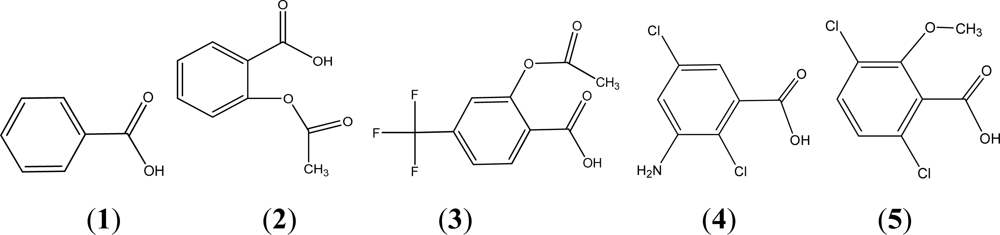
<p>Benzoic acid compounds are an important organic chemical raw material that are widely used in food, medicine, cosmetic, antiseptic, insecticide, dyestuff, <italic>etc.</italic> For example, benzoic acid is a common antiseptic, Aspirin is a famous non-steroid anti-inflammatory drug, Triflusal is a antithrombotic, and Chloramben and Dicamba are common pesticides (see <xref ref-type="fig" rid="f1-ijms-11-01228">Figure 1</xref>). Most benzoic acid compounds are toxic and are hardly degraded by microorganism in the natural environment, which may cause serious public health and environmental problems.</p>
<p>With the development of synthetic chemistry, combinatorial chemistry and pharmaceutical chemistry, millions of new compounds are being synthesized. Classical chemical substance evaluation needs a lot of time and is expensive, and the speed of analyzing the toxicity of compounds is less than the speed of discovery of new compounds. Nowadays, scientists pay more and more attention to the importance of prediction toxicity in the early stage. Quantitative structure-toxicity relationships (QSTR) have been efficiently used for the study of toxicity mechanisms of various compounds [<xref ref-type="bibr" rid="b1-ijms-11-01228">1</xref>].</p>
<p>QSTR plays an important role in toxicity forecasting, which is widely used in the modern studying of compounds, since more and more compounds are being found. It is necessary to predict the toxicity of compounds accurately and quickly [<xref ref-type="bibr" rid="b2-ijms-11-01228">2</xref>–<xref ref-type="bibr" rid="b4-ijms-11-01228">4</xref>]. QSTR of benzoic acid compounds with molecular connectivity index (MCI) in mice <italic>via</italic> oral LD<sub>50</sub> (acute toxicity, half lethal dose) are not reported. The quantitative structure characteristic parameters of 57 benzoic acid compounds were obtained with MCI. Values of LD<sub>50</sub> for mice in benzoic acid compounds have been collected from various literature sources. In this work, the QSTR of benzoic acid compounds in mice <italic>via</italic> oral LD<sub>50</sub> was studied and a model was developed to more accurately predict the toxicity of benzoic acid compounds in mice <italic>via</italic> oral LD<sub>50</sub>. 39 benzoic acid compounds were used as a training dataset for building the regression model, and 18 other benzoic acid compounds as a forecasting dataset to test the prediction ability of the model. The experimental result analysis showed that <sup>0</sup>J<sup>A</sup>, <sup>1</sup>J<sup>A</sup> and cross factor J<sup>B</sup> were important factors affecting the toxicity of benzoic acid compounds (although the toxicity mechanism of compounds is not clear yet), where <sup>0</sup>J<sup>A</sup> is zero order connectivity index, <sup>1</sup>J<sup>A</sup> is the first order connectivity index and J<sub>B</sub>= <sup>0</sup>J<sup>A</sup> × <sup>1</sup>J<sup>A</sup> is the cross factor.</p></sec>
<sec sec-type="methods">
<label>2.</label>
<title>Research Methods</title>
<p>In 1975, Milan Randic described a skeletal branching index that correlated with the three physical properties of alkenes [<xref ref-type="bibr" rid="b5-ijms-11-01228">5</xref>]. The concept was further developed and applied extensively by Kier and Hall [<xref ref-type="bibr" rid="b6-ijms-11-01228">6</xref>–<xref ref-type="bibr" rid="b8-ijms-11-01228">8</xref>], which led to the molecular connectivity index (MCI). Eventually, Kier and Hall modified the connectivity indices to discriminate carbon atoms from other heteroatoms, which introduced the valance molecular connectivity index <sup>m</sup>χ<sup>t</sup> [<xref ref-type="bibr" rid="b9-ijms-11-01228">9</xref>]. The MCI is calculated with the follow formula:
<disp-formula id="FD1">
<label>(1)</label>
<mml:math display="block">
<mml:mrow>
<mml:msup><mml:mrow/>
<mml:mtext>m</mml:mtext></mml:msup>
<mml:msup>
<mml:mrow>
<mml:mrow>
<mml:mo>χ</mml:mo></mml:mrow></mml:mrow>
<mml:mtext>t</mml:mtext></mml:msup>
<mml:mo>=</mml:mo>
<mml:mo>∑</mml:mo>
<mml:mrow>
<mml:msub>
<mml:mrow>
<mml:mrow>
<mml:msup><mml:mrow/>
<mml:mrow>
<mml:mtext>Nm</mml:mtext></mml:mrow></mml:msup></mml:mrow></mml:mrow>
<mml:mrow>
<mml:mrow>
<mml:mtext>j</mml:mtext>
<mml:mo>=</mml:mo>
<mml:mn>1</mml:mn></mml:mrow></mml:mrow></mml:msub>
<mml:msup>
<mml:mrow>
<mml:mrow>
<mml:mrow>
<mml:mo stretchy="false">(</mml:mo>
<mml:mrow>
<mml:msup>
<mml:mrow>
<mml:mo>Π</mml:mo></mml:mrow>
<mml:mrow>
<mml:mrow>
<mml:mtext>m</mml:mtext>
<mml:mo>+</mml:mo>
<mml:mn>1</mml:mn></mml:mrow></mml:mrow></mml:msup>
<mml:msub><mml:mrow/>
<mml:mtext>i</mml:mtext></mml:msub>
<mml:mi> </mml:mi>
<mml:mn>1</mml:mn>
<mml:mo>/</mml:mo>
<mml:msub>
<mml:mrow>
<mml:mrow>
<mml:mo>δ</mml:mo></mml:mrow></mml:mrow>
<mml:mtext>i</mml:mtext></mml:msub></mml:mrow>
<mml:mo stretchy="false">)</mml:mo></mml:mrow></mml:mrow></mml:mrow>
<mml:mrow>
<mml:mn>1</mml:mn>
<mml:mo>/</mml:mo>
<mml:mn>2</mml:mn></mml:mrow></mml:msup></mml:mrow></mml:mrow></mml:math></disp-formula><sup>m</sup>χ<sup>t</sup> is mth-order MCI, <italic>t</italic> is the type of sub-graph including path (p), cluster (c), path-cluster (pc), N<sub>m</sub> is the number of the sub-graph of the same type and order. The abbreviation is δ = σ – <italic>h</italic>, where σ is the count of electrons in σ orbital and <italic>h</italic> is the count of bonding hydrogen atoms.</p>
<p>There was no doubt that the MCI was proved to be the one of the most successful and widely used descriptors. The MCI has been introduced and used in many studies [<xref ref-type="bibr" rid="b10-ijms-11-01228">10</xref>–<xref ref-type="bibr" rid="b13-ijms-11-01228">13</xref>].</p>
<p>From the skeletal branching index of Randic to the connectivity index modified by Kier and Hall, the core is the connectivity of atoms, which is from the connectivity δ<sub>i</sub> of upper atom to valence connectivity of δ<sub>iv</sub>. The computing method of heteroatom i modified by Kier and Hall is as the following formula:
<disp-formula id="FD2">
<label>(2)</label>
<mml:math display="block">
<mml:mrow>
<mml:msub>
<mml:mrow>
<mml:mrow>
<mml:mo>δ</mml:mo></mml:mrow></mml:mrow>
<mml:mrow>
<mml:mtext>iv</mml:mtext></mml:mrow></mml:msub>
<mml:mo>=</mml:mo>
<mml:mrow>
<mml:mo>(</mml:mo>
<mml:mrow>
<mml:msub>
<mml:mrow>
<mml:mtext>Z</mml:mtext></mml:mrow>
<mml:mtext>i</mml:mtext></mml:msub>
<mml:mo>−</mml:mo>
<mml:msub>
<mml:mrow>
<mml:mtext>h</mml:mtext></mml:mrow>
<mml:mtext>i</mml:mtext></mml:msub></mml:mrow>
<mml:mo>)</mml:mo></mml:mrow>
<mml:mo>/</mml:mo>
<mml:mrow>
<mml:mo>(</mml:mo>
<mml:mrow>
<mml:mtext>Z</mml:mtext>
<mml:mo>−</mml:mo>
<mml:msub>
<mml:mrow>
<mml:mtext>Z</mml:mtext></mml:mrow>
<mml:mtext>i</mml:mtext></mml:msub>
<mml:mo>−</mml:mo>
<mml:mn>1</mml:mn></mml:mrow>
<mml:mo>)</mml:mo></mml:mrow></mml:mrow></mml:math></disp-formula></p>
<p>Z and Z<sub>i</sub> are the count of extra nuclear electrons and valence electrons, respectively, <italic>h</italic><sub>i</sub> is the count of hydrogen atoms combining with heteroatom i. Although Kier <italic>et al</italic> contributed to the computing method of heteroatom i, the method could not discriminate the same heteroatom in different oxidation states. More recently, Yu <italic>et al</italic> improved the method, and redefined the valence connectivity value δ<sup>h</sup><sub>i</sub> using the following formula [<xref ref-type="bibr" rid="b14-ijms-11-01228">14</xref>]:
<disp-formula id="FD3">
<label>(3)</label>
<mml:math display="block">
<mml:mrow>
<mml:msup>
<mml:mrow>
<mml:mrow>
<mml:mo>δ</mml:mo></mml:mrow></mml:mrow>
<mml:mtext>h</mml:mtext></mml:msup>
<mml:msub><mml:mrow/>
<mml:mtext>i</mml:mtext></mml:msub>
<mml:mo>=</mml:mo>
<mml:mn>2</mml:mn>
<mml:mi> </mml:mi>
<mml:mo>×</mml:mo>
<mml:mi> </mml:mi>
<mml:mtext>Z </mml:mtext>
<mml:mrow>
<mml:mo stretchy="false">(</mml:mo>
<mml:mrow>
<mml:msub>
<mml:mrow>
<mml:mtext>Z</mml:mtext></mml:mrow>
<mml:mtext>i</mml:mtext></mml:msub>
<mml:mo>−</mml:mo>
<mml:msub>
<mml:mrow>
<mml:mtext>h</mml:mtext></mml:mrow>
<mml:mtext>i</mml:mtext></mml:msub></mml:mrow>
<mml:mo stretchy="false">)</mml:mo></mml:mrow>
<mml:mrow>
<mml:mo stretchy="false">[</mml:mo>
<mml:mrow>
<mml:msup>
<mml:mrow>
<mml:mrow>
<mml:mrow>
<mml:mo stretchy="false">(</mml:mo>
<mml:mrow>
<mml:mn>8</mml:mn>
<mml:mo>−</mml:mo>
<mml:msub>
<mml:mrow>
<mml:mtext>N</mml:mtext></mml:mrow>
<mml:mtext>i</mml:mtext></mml:msub></mml:mrow>
<mml:mo stretchy="false">)</mml:mo></mml:mrow></mml:mrow></mml:mrow>
<mml:mrow>
<mml:mn>1</mml:mn>
<mml:mo>/</mml:mo>
<mml:msub>
<mml:mrow>
<mml:mtext>N</mml:mtext></mml:mrow>
<mml:mtext>i</mml:mtext></mml:msub></mml:mrow></mml:msup></mml:mrow>
<mml:mo stretchy="false">]</mml:mo></mml:mrow>
<mml:mrow>
<mml:mo stretchy="false">[</mml:mo>
<mml:mrow>
<mml:msup>
<mml:mrow>
<mml:mrow>
<mml:mrow>
<mml:mo stretchy="false">(</mml:mo>
<mml:mrow>
<mml:mn>2</mml:mn>
<mml:msub>
<mml:mrow>
<mml:mtext>n</mml:mtext></mml:mrow>
<mml:mtext>i</mml:mtext></mml:msub>
<mml:mo>−</mml:mo>
<mml:mn>1</mml:mn></mml:mrow>
<mml:mo stretchy="false">)</mml:mo></mml:mrow></mml:mrow></mml:mrow>
<mml:mrow>
<mml:msub>
<mml:mrow>
<mml:mtext>h</mml:mtext></mml:mrow>
<mml:mtext>i</mml:mtext></mml:msub>
<mml:mo>/</mml:mo>
<mml:msub>
<mml:mrow>
<mml:mtext>N</mml:mtext></mml:mrow>
<mml:mtext>i</mml:mtext></mml:msub>
<mml:mo>−</mml:mo>
<mml:mn>1</mml:mn></mml:mrow></mml:msup></mml:mrow>
<mml:mo stretchy="false">]</mml:mo></mml:mrow>
<mml:mo>/</mml:mo>
<mml:mrow>
<mml:mo stretchy="false">[</mml:mo>
<mml:mrow>
<mml:mrow>
<mml:mo stretchy="false">(</mml:mo>
<mml:mrow>
<mml:msub>
<mml:mrow>
<mml:mtext>m</mml:mtext></mml:mrow>
<mml:mtext>i</mml:mtext></mml:msub>
<mml:mo>+</mml:mo>
<mml:msub>
<mml:mrow>
<mml:mtext>L</mml:mtext></mml:mrow>
<mml:mtext>p</mml:mtext></mml:msub></mml:mrow>
<mml:mo stretchy="false">)</mml:mo></mml:mrow>
<mml:mrow>
<mml:mo stretchy="false">(</mml:mo>
<mml:mrow>
<mml:mn>2</mml:mn>
<mml:msub>
<mml:mrow>
<mml:mtext>n</mml:mtext></mml:mrow>
<mml:mtext>i</mml:mtext></mml:msub>
<mml:mo>−</mml:mo>
<mml:mn>1</mml:mn></mml:mrow>
<mml:mo stretchy="false">)</mml:mo></mml:mrow></mml:mrow>
<mml:mo stretchy="false">]</mml:mo></mml:mrow></mml:mrow></mml:math></disp-formula>m<sub>i</sub> is the count of bonding electrons, Z is the count of extra nuclear electrons, n<sub>i</sub> is maximum first quantum number, Z<sub>i</sub> is the valence electron number, N<sub>i</sub> is the count, L<sub>p</sub> is the hybridization style of heteroatom i, the value as following: sp<sup>3</sup>, L<sub>p</sub> = 1; sp<sup>2</sup>, L<sub>p</sub> = −1.8; sp, L<sub>p</sub> = 2; if that is the atom itself, L<sub>p</sub> = 2, m<sub>i</sub> = 0.</p>
<p>The program package for calculating the MCI of compounds was compiled by Visual Basic Program Software according to the modified formula. In order to predict the toxicity of benzoic acid compounds and get the prediction model, the molecular structure of 57 benzoic acid compounds was entered into the program package and their MCI were calculated. 39 of them were a training dataset for building the multi variance linear regression model (logarithm of LD<sub>50</sub> as dependent variable and MCI as factor), and 18 of them were predicted samples to test the prediction ability of the model using SAS 9.0 Program Software. During the process of building the regression model, the cross factor was considered into the model.</p></sec>
<sec sec-type="results|discussion">
<label>3.</label>
<title>Results and Discussion</title>
<p>In what follows, we will present the process of computing MCI, choosing factors of the regression model and building the model, as well as testing the model. Firstly, zero order connectivity index <sup>0</sup>J<sup>A</sup> and first order connectivity index <sup>1</sup>J<sup>A</sup> were calculated using the program package. The value of LD<sub>50</sub> was converted to logarithm in order to make all the data in the same order of magnitude and easier to statistically analysze and compare. Then, the toxicity data was analyzed in the training dataset as regression analysis. Non-intercept stepwise regression was chosen as the statistical method. The influencing factors were as follows: zero order connectivity index <sup>0</sup>J<sup>A</sup>, first order connectivity index <sup>1</sup>J<sup>A</sup> and the cross factor J<sub>B</sub>= <sup>0</sup>J<sup>A</sup> × <sup>1</sup>J<sup>A</sup>. These influencing factors were inspected, and the results were as below:
<list list-type="order">
<list-item>
<p><sup>0</sup>J<sup>A</sup>: R-Square = 0.9542 and C<sub>(p)</sub> = 1.0000</p></list-item>
<list-item>
<p><sup>1</sup>J<sup>A</sup>: R-Square = 0.9560 and C<sub>(p)</sub> = 1.0000</p></list-item>
<list-item>
<p>J<sup>B</sup>: R-Square = 0.8656 and C<sub>(p)</sub> = 1.0000</p></list-item>
<list-item>
<p><sup>0</sup>J<sup>A</sup>, <sup>1</sup>J<sup>A</sup>: R-Square = 0.9560 and C<sub>(p)</sub> = 0.2565</p></list-item>
<list-item>
<p><sup>0</sup>J<sup>A</sup>, J<sup>B</sup>: R-Square = 0.9829 and C<sub>(p)</sub> = 2.0000</p></list-item>
<list-item>
<p><sup>1</sup>J<sup>A</sup>, J<sup>B</sup>: R-Square = 0.9816 and C<sub>(p)</sub> = 2.0000</p></list-item>
<list-item>
<p><sup>0</sup>J<sup>A</sup>, <sup>1</sup>J<sup>A</sup>: J<sup>B</sup>: R-Square = 0.9860 and C<sub>(p)</sub> = 3.0000</p></list-item></list></p>
<p>The results show that the groups are fine expect (3) and (4), and correlation coefficient (R<sup>2</sup>) showed that (7) is the best. It was shown that the regression linearity of (7) is better than other groups. Therefore, <sup>0</sup>J<sup>A</sup>, <sup>1</sup>J<sup>A</sup> and J<sup>B</sup> were chosen as the independent variables of the model (see <xref ref-type="table" rid="t1-ijms-11-01228">Table 1</xref>).</p>
<p>Comparing the p value in the table, it was shown that <sup>0</sup>J<sup>A</sup>, <sup>1</sup>J<sup>A</sup> and J<sup>B</sup> had an obvious significant influence, and a regression estimated model was built:
<disp-formula>
<mml:math display="block">
<mml:mrow>
<mml:msub>
<mml:mrow>
<mml:mrow>
<mml:mtext>LogLD</mml:mtext></mml:mrow></mml:mrow>
<mml:mrow>
<mml:mn>50</mml:mn></mml:mrow></mml:msub>
<mml:mo>=</mml:mo>
<mml:mn>1.2399</mml:mn>
<mml:mi> </mml:mi>
<mml:mo>×</mml:mo>
<mml:msup>
<mml:mrow>
<mml:mi> </mml:mi></mml:mrow>
<mml:mn>0</mml:mn></mml:msup>
<mml:msup>
<mml:mrow>
<mml:mtext>J</mml:mtext></mml:mrow>
<mml:mtext>A</mml:mtext></mml:msup>
<mml:mi> </mml:mi>
<mml:mo>+</mml:mo>
<mml:mi> </mml:mi>
<mml:mn>2.6911</mml:mn>
<mml:mi> </mml:mi>
<mml:mo>×</mml:mo>
<mml:msup>
<mml:mrow>
<mml:mi> </mml:mi></mml:mrow>
<mml:mn>1</mml:mn></mml:msup>
<mml:msup>
<mml:mrow>
<mml:mtext>J</mml:mtext></mml:mrow>
<mml:mtext>A</mml:mtext></mml:msup>
<mml:mo>−</mml:mo>
<mml:mn>0.4445</mml:mn>
<mml:mi> </mml:mi>
<mml:mo>×</mml:mo>
<mml:mi> </mml:mi>
<mml:msup>
<mml:mrow>
<mml:mtext>J</mml:mtext></mml:mrow>
<mml:mtext>B</mml:mtext></mml:msup>
<mml:mi> </mml:mi>
<mml:mrow>
<mml:mo stretchy="false">(</mml:mo>
<mml:mrow>
<mml:msup>
<mml:mrow>
<mml:mtext>R</mml:mtext></mml:mrow>
<mml:mn>2</mml:mn></mml:msup>
<mml:mo>=</mml:mo>
<mml:mn>0.9860</mml:mn></mml:mrow>
<mml:mo stretchy="false">)</mml:mo></mml:mrow></mml:mrow></mml:math></disp-formula></p>
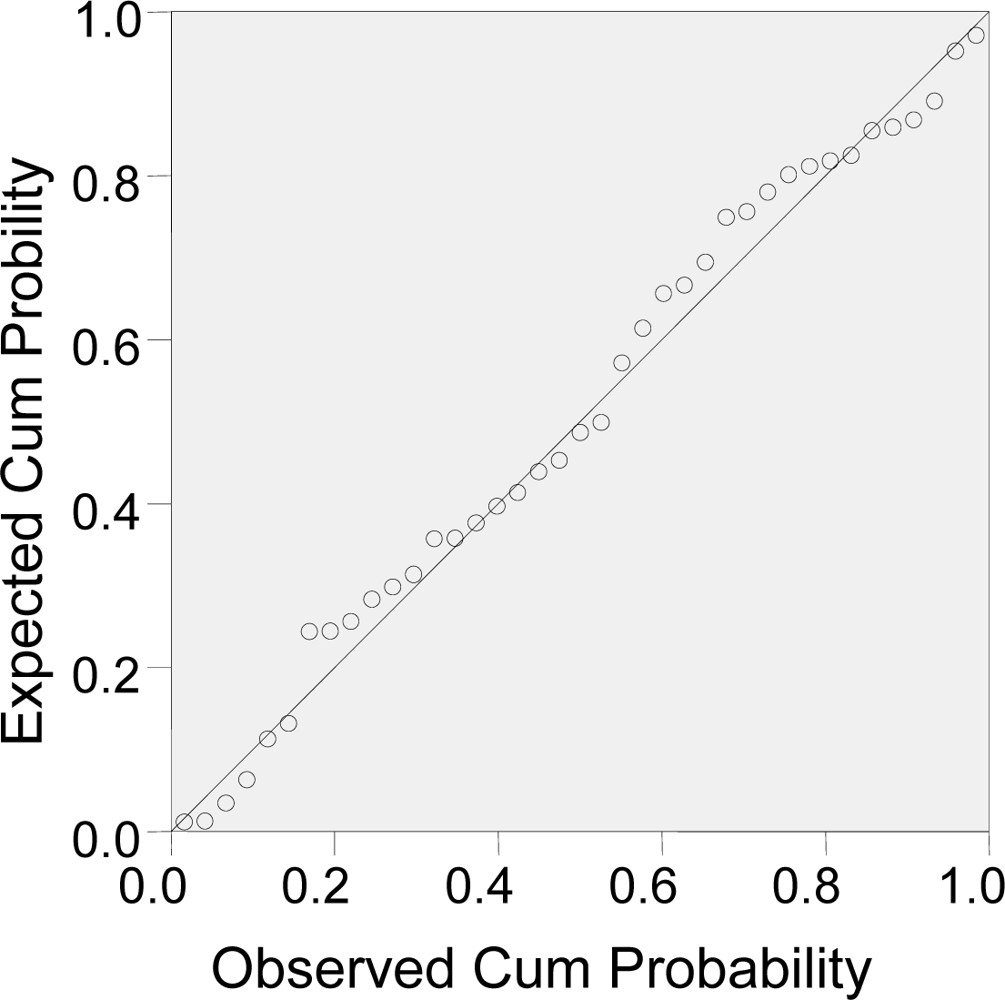
<p>Obeying the principles that the value of correlation coefficient (R<sup>2</sup>) is approximate to 1 and the p value is less than 0.01, as well as the numbers of the parameters equal to the test coefficient, we found that the linearity of the model is appropriate. The result of residual analysis shows that the fitting of the model was good (see <xref ref-type="table" rid="t2-ijms-11-01228">Table 2</xref>). The distribution of residual is a normal distribution, since the scatter plots are almost standing on one line (see <xref ref-type="fig" rid="f2-ijms-11-01228">Figure 2</xref>).</p>
<p>From analysis of the model, it was known that <sup>0</sup>J<sup>A</sup>, <sup>1</sup>J<sup>A</sup> and cross factor J<sup>B</sup> had great influence on the oral toxicity in mice. When <sup>0</sup>J<sup>A</sup> and <sup>1</sup>J<sup>A</sup> decrease, the value of LD<sub>50</sub> increases. And LD<sub>50</sub> decreases as J<sup>B</sup> increases. Since increasing LD<sub>50</sub> resulted in lower toxicity, therefore, the model showed that <sup>0</sup>J<sup>A</sup> and <sup>1</sup>J<sup>A</sup> have a negative correlation to the toxicity of benzoic acid compounds, and J<sup>B</sup> has a positive correlation to the toxicity of benzoic acid compounds. The ability of regression model with 18 benzoic acid compounds was also tested, and the result indicates that the prediction ability of the model is good (<xref ref-type="table" rid="t3-ijms-11-01228">Table 3</xref>). It is shown that these influencing factors indeed had an significant effect on toxicity, and the forecasting accuracy of the model becomes higher when introducing the cross factor (J<sup>B</sup>).</p></sec>
<sec sec-type="conclusions">
<label>4.</label>
<title>Conclusions</title>
<p>LD<sub>50</sub> is a common factor for evaluating compound toxicity, which reflects receptivity of test animals, and LD<sub>50</sub> values have high reproducibility and stability. In QSTR study, linear regression analysis is a widely useful quantization method [<xref ref-type="bibr" rid="b15-ijms-11-01228">15</xref>]. In this work, the quantitative parameters were calculated with MCI and the toxicity prediction model of benzoic acid compounds was obtained as follow. LogLD<sub>50</sub>=1.2399 × <sup>0</sup>J<sup>A</sup> +2.6911 × <sup>1</sup>J<sup>A</sup> – 0.4445 × J<sup>B</sup>, R-Square = 0.9860. The model has a good forecasting ability.</p></sec></body>
<back>
<ack>
<p>This work was supported by Chinese National Science Foundation (No. 30571591).</p></ack>
<ref-list>
<title>References and Notes</title>
<ref id="b1-ijms-11-01228"><label>1.</label><citation citation-type="journal"><person-group person-group-type="author"><name><surname>Sun</surname><given-names>YZ</given-names></name><name><surname>Yan</surname><given-names>XL</given-names></name><name><surname>Li</surname><given-names>ZJ</given-names></name><name><surname>Meng</surname><given-names>FH</given-names></name></person-group><article-title>Application of Chemical Models in Toxicological Study</article-title><source>Chinese J. Environ. Health</source><year>2007</year><volume>24</volume><fpage>734</fpage><lpage>736</lpage></citation></ref>
<ref id="b2-ijms-11-01228"><label>2.</label><citation citation-type="journal"><person-group person-group-type="author"><name><surname>Mihai</surname><given-names>VP</given-names></name><name><surname>Ana-Maria</surname><given-names>L</given-names></name></person-group><article-title>Introducing Spectral Structure Activity Relationship (S-SAR) Analysis. Application to Ecotoxicology</article-title><source>Int. J. Mol. Sci</source><year>2007</year><volume>8</volume><fpage>363</fpage><lpage>391</lpage><pub-id pub-id-type="doi">10.3390/i8050363</pub-id></citation></ref>
<ref id="b3-ijms-11-01228"><label>3.</label><citation citation-type="journal"><person-group person-group-type="author"><name><surname>Mihai</surname><given-names>VP</given-names></name><name><surname>Ana-Maria</surname><given-names>P</given-names></name><name><surname>Marius</surname><given-names>L</given-names></name><name><surname>Luciana</surname><given-names>I</given-names></name><name><surname>Adrian</surname><given-names>C</given-names></name></person-group><article-title>Quantum-SAR Extension of the Spectral-SAR Algorithm. Application to Polyphenolic Anticancer Bioactivity</article-title><source>Int. J. Mol. Sci</source><year>2009</year><volume>10</volume><fpage>1193</fpage><lpage>1214</lpage><pub-id pub-id-type="doi">10.3390/ijms10031193</pub-id><pub-id pub-id-type="pmid">19399244</pub-id></citation></ref>
<ref id="b4-ijms-11-01228"><label>4.</label><citation citation-type="journal"><person-group person-group-type="author"><name><surname>Meng</surname><given-names>FH</given-names></name><name><surname>Sun</surname><given-names>YZ</given-names></name><name><surname>Li</surname><given-names>ZJ</given-names></name><name><surname>Yan</surname><given-names>XL</given-names></name></person-group><article-title>The Application of QSAR in the Study of Chemicals Toxicity</article-title><source>Chem. Bioeng</source><year>2007</year><volume>24</volume><fpage>5</fpage><lpage>7</lpage></citation></ref>
<ref id="b5-ijms-11-01228"><label>5.</label><citation citation-type="journal"><person-group person-group-type="author"><name><surname>Randic</surname><given-names>M</given-names></name></person-group><article-title>On characterization of molecular branching</article-title><source>J. Am. Chem. Soc</source><year>1975</year><volume>97</volume><fpage>6609</fpage><lpage>6615</lpage><pub-id pub-id-type="doi">10.1021/ja00856a001</pub-id></citation></ref>
<ref id="b6-ijms-11-01228"><label>6.</label><citation citation-type="journal"><person-group person-group-type="author"><name><surname>Kier</surname><given-names>LB</given-names></name><name><surname>Murray</surname><given-names>WJ</given-names></name><name><surname>Randic</surname><given-names>M</given-names></name><name><surname>Hall</surname><given-names>LH</given-names></name></person-group><article-title>Molecular connectvity I Relationship to non-specific local anesthetic activity</article-title><source>J. Pharm. Sci</source><year>1975</year><volume>64</volume><fpage>1971</fpage><lpage>1974</lpage><pub-id pub-id-type="doi">10.1002/jps.2600641214</pub-id><pub-id pub-id-type="pmid">1206491</pub-id></citation></ref>
<ref id="b7-ijms-11-01228"><label>7.</label><citation citation-type="journal"><person-group person-group-type="author"><name><surname>Hall</surname><given-names>LH</given-names></name><name><surname>Kier</surname><given-names>LB</given-names></name><name><surname>Murray</surname><given-names>WJ</given-names></name></person-group><article-title>Molecular connectivity I. Relationship to water solubility and boiling point</article-title><source>J. Pharm. Sci</source><year>1975</year><volume>64</volume><fpage>1974</fpage><lpage>1977</lpage><pub-id pub-id-type="doi">10.1002/jps.2600641215</pub-id><pub-id pub-id-type="pmid">1206492</pub-id></citation></ref>
<ref id="b8-ijms-11-01228"><label>8.</label><citation citation-type="journal"><person-group person-group-type="author"><name><surname>Kier</surname><given-names>LB</given-names></name><name><surname>Murray</surname><given-names>WJ</given-names></name><name><surname>Randic</surname><given-names>M</given-names></name></person-group><article-title>Molecular connectivity V connectivity series applied to density</article-title><source>J. Pharm. Sci</source><year>1976</year><volume>65</volume><fpage>1226</fpage><lpage>1230</lpage><pub-id pub-id-type="doi">10.1002/jps.2600650824</pub-id><pub-id pub-id-type="pmid">978443</pub-id></citation></ref>
<ref id="b9-ijms-11-01228"><label>9.</label><citation citation-type="journal"><person-group person-group-type="author"><name><surname>Kier</surname><given-names>LB</given-names></name><name><surname>Murray</surname><given-names>WJ</given-names></name><name><surname>Randic</surname><given-names>M</given-names></name><name><surname>Hall</surname><given-names>LH</given-names></name></person-group><article-title>Molecular connectivity VII Specific treatment of heteroatoms</article-title><source>J. Pharm. Sci</source><year>1976</year><volume>65</volume><fpage>1806</fpage><lpage>1809</lpage><pub-id pub-id-type="doi">10.1002/jps.2600651228</pub-id><pub-id pub-id-type="pmid">1032667</pub-id></citation></ref>
<ref id="b10-ijms-11-01228"><label>10.</label><citation citation-type="journal"><person-group person-group-type="author"><name><surname>Gayathri</surname><given-names>P</given-names></name><name><surname>Pande</surname><given-names>V</given-names></name><name><surname>Sivakumar</surname><given-names>R</given-names></name><name><surname>Gupta</surname><given-names>SP</given-names></name></person-group><article-title>A quantitative structure-activity relationship study on some HIV-1 protease inhibitors using molecular connectivity index</article-title><source>Bioorgan. Med. Chem</source><year>2001</year><volume>11</volume><fpage>3059</fpage><lpage>3036</lpage></citation></ref>
<ref id="b11-ijms-11-01228"><label>11.</label><citation citation-type="journal"><person-group person-group-type="author"><name><surname>Roy</surname><given-names>K</given-names></name><name><surname>Leonard</surname><given-names>JT</given-names></name></person-group><article-title>QSAR modeling of HIV-1 reverse transcriptase inhibitor 2-amino-6-arylsulfonylbenzonitriles and congeners using molecular connectivity and E-state parameters</article-title><source>Bioorgan. Med. Chem</source><year>2004</year><volume>12</volume><fpage>745</fpage><lpage>754</lpage><pub-id pub-id-type="doi">10.1016/j.bmc.2003.11.009</pub-id></citation></ref>
<ref id="b12-ijms-11-01228"><label>12.</label><citation citation-type="journal"><person-group person-group-type="author"><name><surname>Agrawal</surname><given-names>VK</given-names></name><name><surname>Khadikar</surname><given-names>PV</given-names></name></person-group><article-title>QSAR study on inhibitor of brain 3-hydroxy-anthranihc acid dioxygenase (3-HAO): A molecular connectivity approach</article-title><source>Bioorgan. Med. Chem</source><year>2001</year><volume>9</volume><fpage>3295</fpage><pub-id pub-id-type="doi">10.1016/S0968-0896(01)00242-5</pub-id></citation></ref>
<ref id="b13-ijms-11-01228"><label>13.</label><citation citation-type="journal"><person-group person-group-type="author"><name><surname>Gupta</surname><given-names>S</given-names></name><name><surname>Singh</surname><given-names>M</given-names></name><name><surname>Madan</surname><given-names>AK</given-names></name></person-group><article-title>Applications of graph theory: Relationship of molecular connectivity index and atomic molecular connectivity index with anti-HSV activity</article-title><source>J. Mol. Struct</source><year>2001</year><volume>571</volume><fpage>147</fpage><lpage>152</lpage><pub-id pub-id-type="doi">10.1016/S0166-1280(01)00560-7</pub-id></citation></ref>
<ref id="b14-ijms-11-01228"><label>14.</label><citation citation-type="journal"><person-group person-group-type="author"><name><surname>Yu</surname><given-names>XM</given-names></name><name><surname>Yu</surname><given-names>XS</given-names></name></person-group><article-title>A New Method for Calculation Valence Delta of Heteroatoms in Molecular Valence Connectivity Topological Index and Its Application</article-title><source>Chin. J. Organ. Chem</source><year>2001</year><volume>21</volume><fpage>658</fpage><lpage>667</lpage></citation></ref>
<ref id="b15-ijms-11-01228"><label>15.</label><citation citation-type="book"><person-group person-group-type="author"><name><surname>Xu</surname><given-names>SJ</given-names></name></person-group><source>Computer-Assisted Drug Molecular Design</source><publisher-name>Chemical industry press</publisher-name><publisher-loc>Beijing, China</publisher-loc><year>2004</year></citation></ref></ref-list>
<sec sec-type="display-objects">
<title>Figures and Tables</title>
<fig id="f1-ijms-11-01228" position="float">
<label>Figure 1.</label>
<caption>
<p>Molecular structures of benzoic acid (<bold>1</bold>), aspirin (<bold>2</bold>), triflusal (<bold>3</bold>), chloramben (<bold>4</bold>) and dicamba (<bold>5</bold>).</p></caption><graphic xlink:href="ijms-11-01228f1.gif"/></fig>
<fig id="f2-ijms-11-01228" position="float">
<label>Figure 2.</label>
<caption>
<p>Normal P-P Plot of residual.</p></caption><graphic xlink:href="ijms-11-01228f2.gif"/></fig>
<table-wrap id="t1-ijms-11-01228" position="float">
<label>Table 1.</label>
<caption>
<p>Variable parameter estimation analysis.</p></caption>
<table frame="hsides" rules="groups">
<thead>
<tr>
<th valign="middle" align="center"><bold>Variable parameters</bold></th>
<th valign="middle" align="center"><bold>Standard estimate</bold></th>
<th valign="middle" align="center"><bold>Error</bold></th>
<th valign="middle" align="center"><bold>Type II SS</bold></th>
<th valign="middle" align="center"><bold>F value</bold></th>
<th valign="middle" align="center"><bold>Pr &gt; F</bold></th></tr></thead>
<tbody>
<tr>
<td valign="top" align="center"><sup>0</sup>J<sup>A</sup></td>
<td valign="top" align="center">1.2399</td>
<td valign="top" align="center">0.4374</td>
<td valign="top" align="center">6.6827</td>
<td valign="top" align="center">8.04</td>
<td valign="top" align="center">0.0075</td></tr>
<tr>
<td valign="top" align="center"><sup>1</sup>J<sup>A</sup></td>
<td valign="top" align="center">2.6911</td>
<td valign="top" align="center">0.8057</td>
<td valign="top" align="center">9.2768</td>
<td valign="top" align="center">11.16</td>
<td valign="top" align="center">0.0020</td></tr>
<tr>
<td valign="top" align="center">J<sup>B</sup></td>
<td valign="top" align="center">–0.4445</td>
<td valign="top" align="center">0.0509</td>
<td valign="top" align="center">63.3327</td>
<td valign="top" align="center">76.16</td>
<td valign="top" align="center">&lt;0.0001</td></tr></tbody></table></table-wrap>
<table-wrap id="t2-ijms-11-01228" position="float">
<label>Table 2.</label>
<caption>
<p>Building the toxicity prediction regression model of benzoic acid compounds with training dataset (39 benzoic acid compounds).</p></caption>
<table frame="hsides" rules="groups">
<thead>
<tr>
<th valign="middle" align="center" rowspan="3"><bold>No.</bold></th>
<th valign="top" align="center"><bold>Compound</bold></th>
<th valign="top" align="center"><bold>CAS No.</bold></th>
<th valign="middle" align="center" colspan="2"><bold>LogLD<sub>50</sub></bold></th>
<th valign="middle" align="center"><bold>Std error (predicted)</bold></th>
<th valign="middle" align="center"><bold>Residual</bold></th></tr>
<tr>
<th valign="top" align="left" colspan="6"><hr/></th></tr>
<tr><th valign="middle" align="center"/><th valign="middle" align="center"/>
<th valign="middle" align="center"><bold>Dependent variable</bold></th>
<th valign="middle" align="center"><bold>Predicted value</bold></th><th valign="middle" align="center"/><th valign="middle" align="center"/></tr></thead>
<tbody>
<tr>
<td valign="top" align="center">1</td>
<td valign="top" align="center">benzamide</td>
<td valign="top" align="center">55-21-0</td>
<td valign="top" align="center">7.056</td>
<td valign="top" align="center">7.187</td>
<td valign="top" align="center">0.189</td>
<td valign="top" align="center">–0.131</td></tr>
<tr>
<td valign="top" align="center">2</td>
<td valign="top" align="center">4-aminobenzoic acid</td>
<td valign="top" align="center">150-13-0</td>
<td valign="top" align="center">7.955</td>
<td valign="top" align="center">7.264</td>
<td valign="top" align="center">0.174</td>
<td valign="top" align="center">0.691</td></tr>
<tr>
<td valign="top" align="center">3</td>
<td valign="top" align="center">4-chlorobenzoic acid</td>
<td valign="top" align="center">74-11-3</td>
<td valign="top" align="center">7.065</td>
<td valign="top" align="center">7.254</td>
<td valign="top" align="center">0.175</td>
<td valign="top" align="center">–0.189</td></tr>
<tr>
<td valign="top" align="center">4</td>
<td valign="top" align="center">3-hydroxybenzoic acid</td>
<td valign="top" align="center">99-06-9</td>
<td valign="top" align="center">7.601</td>
<td valign="top" align="center">7.236</td>
<td valign="top" align="center">0.176</td>
<td valign="top" align="center">0.362</td></tr>
<tr>
<td valign="top" align="center">5</td>
<td valign="top" align="center">4-bromobenzoic acid</td>
<td valign="top" align="center">586-76-5</td>
<td valign="top" align="center">6.965</td>
<td valign="top" align="center">7.283</td>
<td valign="top" align="center">0.172</td>
<td valign="top" align="center">–0.318</td></tr>
<tr>
<td valign="top" align="center">6</td>
<td valign="top" align="center">2-iodobenzoic acid</td>
<td valign="top" align="center">88-67-5</td>
<td valign="top" align="center">7.313</td>
<td valign="top" align="center">7.310</td>
<td valign="top" align="center">0.170</td>
<td valign="top" align="center">0.003</td></tr>
<tr>
<td valign="top" align="center">7</td>
<td valign="top" align="center">amino salicylic acid</td>
<td valign="top" align="center">65-49-6</td>
<td valign="top" align="center">8.294</td>
<td valign="top" align="center">7.334</td>
<td valign="top" align="center">0.169</td>
<td valign="top" align="center">0.960</td></tr>
<tr>
<td valign="top" align="center">8</td>
<td valign="top" align="center">methyl benzoate</td>
<td valign="top" align="center">93-58-3</td>
<td valign="top" align="center">8.111</td>
<td valign="top" align="center">7.490</td>
<td valign="top" align="center">0.172</td>
<td valign="top" align="center">0.621</td></tr>
<tr>
<td valign="top" align="center">9</td>
<td valign="top" align="center">3-aminobenzoic acid</td>
<td valign="top" align="center">99-05-8</td>
<td valign="top" align="center">8.748</td>
<td valign="top" align="center">7.264</td>
<td valign="top" align="center">0.174</td>
<td valign="top" align="center">1.484</td></tr>
<tr>
<td valign="top" align="center">10</td>
<td valign="top" align="center">3-methylbenzoic acid</td>
<td valign="top" align="center">99-04-7</td>
<td valign="top" align="center">7.396</td>
<td valign="top" align="center">7.496</td>
<td valign="top" align="center">0.151</td>
<td valign="top" align="center">–0.100</td></tr>
<tr>
<td valign="top" align="center">11</td>
<td valign="top" align="center">4-hydroxybenzoic acid</td>
<td valign="top" align="center">99-96-7</td>
<td valign="top" align="center">7.696</td>
<td valign="top" align="center">7.239</td>
<td valign="top" align="center">0.176</td>
<td valign="top" align="center">0.457</td></tr>
<tr>
<td valign="top" align="center">12</td>
<td valign="top" align="center">4-methylbenzoic acid</td>
<td valign="top" align="center">99-94-5</td>
<td valign="top" align="center">7.758</td>
<td valign="top" align="center">7.496</td>
<td valign="top" align="center">0.151</td>
<td valign="top" align="center">0.262</td></tr>
<tr>
<td valign="top" align="center">13</td>
<td valign="top" align="center">6-methylsalicylic acid</td>
<td valign="top" align="center">567-61-3</td>
<td valign="top" align="center">5.522</td>
<td valign="top" align="center">7.518</td>
<td valign="top" align="center">0.155</td>
<td valign="top" align="center">–1.997</td></tr>
<tr>
<td valign="top" align="center">14</td>
<td valign="top" align="center">3,5-diiodosalicylic acid</td>
<td valign="top" align="center">133-91-5</td>
<td valign="top" align="center">6.109</td>
<td valign="top" align="center">7.460</td>
<td valign="top" align="center">0.170</td>
<td valign="top" align="center">–1.351</td></tr>
<tr>
<td valign="top" align="center">15</td>
<td valign="top" align="center">2-acetyloxybenzoic acid (aspirin)</td>
<td valign="top" align="center">50-78-2</td>
<td valign="top" align="center">5.522</td>
<td valign="top" align="center">7.493</td>
<td valign="top" align="center">0.201</td>
<td valign="top" align="center">–1.971</td></tr>
<tr>
<td valign="top" align="center">16</td>
<td valign="top" align="center">2,4,6-triiodobenzoic acid</td>
<td valign="top" align="center">2012-31-9</td>
<td valign="top" align="center">7.170</td>
<td valign="top" align="center">7.490</td>
<td valign="top" align="center">0.170</td>
<td valign="top" align="center">–0.320</td></tr>
<tr>
<td valign="top" align="center">17</td>
<td valign="top" align="center">3,4,5-triiodobenzoic acid</td>
<td valign="top" align="center">2338-20-7</td>
<td valign="top" align="center">8.434</td>
<td valign="top" align="center">7.490</td>
<td valign="top" align="center">0.170</td>
<td valign="top" align="center">0.944</td></tr>
<tr>
<td valign="top" align="center">18</td>
<td valign="top" align="center">4-tert-butylbenzoic acid</td>
<td valign="top" align="center">98-73-7</td>
<td valign="top" align="center">6.342</td>
<td valign="top" align="center">6.617</td>
<td valign="top" align="center">0.481</td>
<td valign="top" align="center">–0.274</td></tr>
<tr>
<td valign="top" align="center">19</td>
<td valign="top" align="center">2-formylbenzoic acid</td>
<td valign="top" align="center">119-67-5</td>
<td valign="top" align="center">8.407</td>
<td valign="top" align="center">7.411</td>
<td valign="top" align="center">0.160</td>
<td valign="top" align="center">0.997</td></tr>
<tr>
<td valign="top" align="center">20</td>
<td valign="top" align="center">2-hydroxybenzamide (salicylamide)</td>
<td valign="top" align="center">65-45-2</td>
<td valign="top" align="center">5.704</td>
<td valign="top" align="center">7.306</td>
<td valign="top" align="center">0.181</td>
<td valign="top" align="center">–1.603</td></tr>
<tr>
<td valign="top" align="center">21</td>
<td valign="top" align="center">2-hydroxybenzoic acid (salicylic acid)</td>
<td valign="top" align="center">69-72-7</td>
<td valign="top" align="center">6.174</td>
<td valign="top" align="center">7.243</td>
<td valign="top" align="center">0.176</td>
<td valign="top" align="center">–1.069</td></tr>
<tr>
<td valign="top" align="center">22</td>
<td valign="top" align="center">2-aminobenzoic acid methyl ester</td>
<td valign="top" align="center">134-20-3</td>
<td valign="top" align="center">8.269</td>
<td valign="top" align="center">7.513</td>
<td valign="top" align="center">0.196</td>
<td valign="top" align="center">0.756</td></tr>
<tr>
<td valign="top" align="center">23</td>
<td valign="top" align="center">2-(acetyl amino)benzoic acid</td>
<td valign="top" align="center">89-52-1</td>
<td valign="top" align="center">7.016</td>
<td valign="top" align="center">7.481</td>
<td valign="top" align="center">0.405</td>
<td valign="top" align="center">–0.465</td></tr>
<tr>
<td valign="top" align="center">24</td>
<td valign="top" align="center">2-amino-3,5-dichlorobenzoic acid</td>
<td valign="top" align="center">2789-92-6</td>
<td valign="top" align="center">7.185</td>
<td valign="top" align="center">7.412</td>
<td valign="top" align="center">0.173</td>
<td valign="top" align="center">–0.227</td></tr>
<tr>
<td valign="top" align="center">25</td>
<td valign="top" align="center">4-hydroxy-3,5-diiodobenzoic acid</td>
<td valign="top" align="center">618-76-8</td>
<td valign="top" align="center">8.294</td>
<td valign="top" align="center">7.460</td>
<td valign="top" align="center">0.170</td>
<td valign="top" align="center">0.834</td></tr>
<tr>
<td valign="top" align="center">26</td>
<td valign="top" align="center">3,5-diiodo-4-methoxybenzoic acid</td>
<td valign="top" align="center">4253-11-6</td>
<td valign="top" align="center">6.908</td>
<td valign="top" align="center">7.484</td>
<td valign="top" align="center">0.280</td>
<td valign="top" align="center">–0.576</td></tr>
<tr>
<td valign="top" align="center">27</td>
<td valign="top" align="center">2,3,6-trichlorobenzoic acid (2,3,6-TBA)</td>
<td valign="top" align="center">50-31-7</td>
<td valign="top" align="center">6.422</td>
<td valign="top" align="center">7.408</td>
<td valign="top" align="center">0.172</td>
<td valign="top" align="center">–0.986</td></tr>
<tr>
<td valign="top" align="center">28</td>
<td valign="top" align="center">2-aminobenzoic acid (anthranilic acid)</td>
<td valign="top" align="center">118-92-3</td>
<td valign="top" align="center">7.244</td>
<td valign="top" align="center">7.268</td>
<td valign="top" align="center">0.174</td>
<td valign="top" align="center">–0.024</td></tr>
<tr>
<td valign="top" align="center">29</td>
<td valign="top" align="center">4-aminobenzoic acid ethyl ester (benzocaine)</td>
<td valign="top" align="center">94-09-7</td>
<td valign="top" align="center">7.824</td>
<td valign="top" align="center">7.437</td>
<td valign="top" align="center">0.235</td>
<td valign="top" align="center">0.387</td></tr>
<tr>
<td valign="top" align="center">30</td>
<td valign="top" align="center">2-hydroxybenzoic acid methyl ester</td>
<td valign="top" align="center">119-36-8</td>
<td valign="top" align="center">7.012</td>
<td valign="top" align="center">7.516</td>
<td valign="top" align="center">0.747</td>
<td valign="top" align="center">–0.504</td></tr>
<tr>
<td valign="top" align="center">31</td>
<td valign="top" align="center">2,5-dihydroxybenzoic acid (gentisic acid)</td>
<td valign="top" align="center">490-79-9</td>
<td valign="top" align="center">8.412</td>
<td valign="top" align="center">7.313</td>
<td valign="top" align="center">0.171</td>
<td valign="top" align="center">1.099</td></tr>
<tr>
<td valign="top" align="center">32</td>
<td valign="top" align="center">5-amino-2-hydroxybenzoic acid (mesalamine)</td>
<td valign="top" align="center">89-57-6</td>
<td valign="top" align="center">8.123</td>
<td valign="top" align="center">7.334</td>
<td valign="top" align="center">0.169</td>
<td valign="top" align="center">0.789</td></tr>
<tr>
<td valign="top" align="center">33</td>
<td valign="top" align="center">3-amino-2,5-dichlorobenzoic acid (chloramben)</td>
<td valign="top" align="center">133-90-4</td>
<td valign="top" align="center">8.223</td>
<td valign="top" align="center">7.412</td>
<td valign="top" align="center">0.173</td>
<td valign="top" align="center">0.811</td></tr>
<tr>
<td valign="top" align="center">34</td>
<td valign="top" align="center">benzoic acid N,N-diethylamide (rebemide)</td>
<td valign="top" align="center">1696-17-9</td>
<td valign="top" align="center">6.659</td>
<td valign="top" align="center">6.495</td>
<td valign="top" align="center">0.517</td>
<td valign="top" align="center">0.165</td></tr>
<tr>
<td valign="top" align="center">35</td>
<td valign="top" align="center">3,6-dichloro-2-methoxybenzoic acid (dicamba)</td>
<td valign="top" align="center">1918-00-9</td>
<td valign="top" align="center">7.082</td>
<td valign="top" align="center">7.508</td>
<td valign="top" align="center">0.263</td>
<td valign="top" align="center">–0.426</td></tr>
<tr>
<td valign="top" align="center">36</td>
<td valign="top" align="center">1,4-benzenedicarboxylic acid (terephthalic acid)</td>
<td valign="top" align="center">100-21-0</td>
<td valign="top" align="center">8.071</td>
<td valign="top" align="center">7.469</td>
<td valign="top" align="center">0.153</td>
<td valign="top" align="center">0.602</td></tr>
<tr>
<td valign="top" align="center">37</td>
<td valign="top" align="center">2-hydroxy-5-methylbenzoic acid (p-cresotic acid)</td>
<td valign="top" align="center">89-56-5</td>
<td valign="top" align="center">6.908</td>
<td valign="top" align="center">7.516</td>
<td valign="top" align="center">0.156</td>
<td valign="top" align="center">–0.609</td></tr>
<tr>
<td valign="top" align="center">38</td>
<td valign="top" align="center">4-hydroxybenzoic acid propyl ester (propylparaben)</td>
<td valign="top" align="center">94-13-3</td>
<td valign="top" align="center">8.753</td>
<td valign="top" align="center">7.062</td>
<td valign="top" align="center">0.405</td>
<td valign="top" align="center">1.692</td></tr>
<tr>
<td valign="top" align="center">39</td>
<td valign="top" align="center">2-hydroxy-3-methylbenzoic acid (hydroxytoluic acid)</td>
<td valign="top" align="center">83-40-9</td>
<td valign="top" align="center">6.908</td>
<td valign="top" align="center">7.518</td>
<td valign="top" align="center">0.155</td>
<td valign="top" align="center">–0.610</td></tr></tbody></table></table-wrap>
<table-wrap id="t3-ijms-11-01228" position="float">
<label>Table 3.</label>
<caption>
<p>Toxicity prediction of the regression model with Testing dataset (18 benzoic acid compounds).</p></caption>
<table frame="hsides" rules="groups">
<thead>
<tr><th valign="middle" align="center"/><th valign="middle" align="center"/><th valign="middle" align="center"/>
<th valign="middle" align="center" colspan="2"><bold>LogLD<sub>50</sub></bold><hr/></th></tr>
<tr>
<th valign="top" align="center"><bold>No.</bold></th>
<th valign="top" align="center"><bold>Compound</bold></th>
<th valign="top" align="center"><bold>CAS No.</bold></th>
<th valign="top" align="center"><bold>Dependent variable</bold></th>
<th valign="top" align="center"><bold>Predicted value</bold></th></tr></thead>
<tbody>
<tr>
<td valign="top" align="center">1</td>
<td valign="top" align="center">benzoic acid</td>
<td valign="top" align="center">65-85-0</td>
<td valign="top" align="center">7.57</td>
<td valign="top" align="center">7.16</td></tr>
<tr>
<td valign="top" align="center">2</td>
<td valign="top" align="center">2-benzoylbenzoic acid</td>
<td valign="top" align="center">85-52-9</td>
<td valign="top" align="center">6.68</td>
<td valign="top" align="center">5.69</td></tr>
<tr>
<td valign="top" align="center">3</td>
<td valign="top" align="center">2,3,5-triiodobenzoic acid</td>
<td valign="top" align="center">88-82-4</td>
<td valign="top" align="center">6.55</td>
<td valign="top" align="center">7.49</td></tr>
<tr>
<td valign="top" align="center">4</td>
<td valign="top" align="center">2-benzoyl-5-chlorobenzoic acid</td>
<td valign="top" align="center">1147-42-8</td>
<td valign="top" align="center">6.35</td>
<td valign="top" align="center">6.16</td></tr>
<tr>
<td valign="top" align="center">5</td>
<td valign="top" align="center">5-amino-2-benzoylbenzoic acid</td>
<td valign="top" align="center">2162-57-4</td>
<td valign="top" align="center">7.44</td>
<td valign="top" align="center">6.14</td></tr>
<tr>
<td valign="top" align="center">6</td>
<td valign="top" align="center">2-acetoxy-5-bromobenzoic acid</td>
<td valign="top" align="center">1503-53-3</td>
<td valign="top" align="center">6.48</td>
<td valign="top" align="center">7.43</td></tr>
<tr>
<td valign="top" align="center">7</td>
<td valign="top" align="center">4-methylbenzoic acid methyl ester</td>
<td valign="top" align="center">99-75-2</td>
<td valign="top" align="center">8.24</td>
<td valign="top" align="center">7.47</td></tr>
<tr>
<td valign="top" align="center">8</td>
<td valign="top" align="center">2-hydroxy-3,6-dichlorobenzoic acid</td>
<td valign="top" align="center">3401-80-7</td>
<td valign="top" align="center">6.49</td>
<td valign="top" align="center">7.40</td></tr>
<tr>
<td valign="top" align="center">9</td>
<td valign="top" align="center">benzoic acid 3-hydroxyphenyl ester</td>
<td valign="top" align="center">136-36-7</td>
<td valign="top" align="center">6.68</td>
<td valign="top" align="center">6.06</td></tr>
<tr>
<td valign="top" align="center">10</td>
<td valign="top" align="center">6-benzoyl-3-methylbenzoic acid</td>
<td valign="top" align="center">1147-41-7</td>
<td valign="top" align="center">6.80</td>
<td valign="top" align="center">5.28</td></tr>
<tr>
<td valign="top" align="center">11</td>
<td valign="top" align="center">3,4,5-trihydroxybenzoic acid propyl ester</td>
<td valign="top" align="center">121-79-9</td>
<td valign="top" align="center">7.44</td>
<td valign="top" align="center">6.78</td></tr>
<tr>
<td valign="top" align="center">12</td>
<td valign="top" align="center">2-hydroxybenzoic acid 2-methylpropyl ester</td>
<td valign="top" align="center">87-19-4</td>
<td valign="top" align="center">8.54</td>
<td valign="top" align="center">6.33</td></tr>
<tr>
<td valign="top" align="center">13</td>
<td valign="top" align="center">2-(3-chloro-2-methylphenylamino) benzoic acid</td>
<td valign="top" align="center">13710-19-5</td>
<td valign="top" align="center">5.63</td>
<td valign="top" align="center">4.52</td></tr>
<tr>
<td valign="top" align="center">14</td>
<td valign="top" align="center">3-acetylamino-2,4,6-triiodobenzoic acid (acetrizoate)</td>
<td valign="top" align="center">85-36-9</td>
<td valign="top" align="center">9.90</td>
<td valign="top" align="center">7.13</td></tr>
<tr>
<td valign="top" align="center">15</td>
<td valign="top" align="center">benzoic acid 2-methylpropyl ester (isobutyl benzoate)</td>
<td valign="top" align="center">120-50-3</td>
<td valign="top" align="center">8.48</td>
<td valign="top" align="center">6.50</td></tr>
<tr>
<td valign="top" align="center">16</td>
<td valign="top" align="center">2-(2,3-dimethylphenyl)aminobenzoic acid (mefenafic acid)</td>
<td valign="top" align="center">61-68-7</td>
<td valign="top" align="center">6.26</td>
<td valign="top" align="center">3.29</td></tr>
<tr>
<td valign="top" align="center">17</td>
<td valign="top" align="center">2-acetyloxy-4-trifluoromethylbenzoic acid (triflusal)</td>
<td valign="top" align="center">322-79-2</td>
<td valign="top" align="center">6.08</td>
<td valign="top" align="center">6.32</td></tr>
<tr>
<td valign="top" align="center">18</td>
<td valign="top" align="center">1,1′-biphenyl-2′,4′-difluoro-4-hydroxy-3-carboxylic acid (diflunisal)</td>
<td valign="top" align="center">22494-42-4</td>
<td valign="top" align="center">6.08</td>
<td valign="top" align="center">5.87</td></tr></tbody></table></table-wrap></sec></back></article>