
<?xml version="1.0" encoding="UTF-8"?>
<!DOCTYPE article PUBLIC "-//NLM//DTD Journal Publishing DTD v2.3 20070202//EN" "journalpublishing.dtd">
<article xmlns:mml="http://www.w3.org/1998/Math/MathML" xmlns:xlink="http://www.w3.org/1999/xlink" xml:lang="en" article-type="research-article">
<front>
<journal-meta>
<journal-id journal-id-type="publisher-id">ijms</journal-id>
<journal-title>International Journal of Molecular Sciences</journal-title>
<abbrev-journal-title>Int. J. Mol. Sci.</abbrev-journal-title>
<issn pub-type="epub">1422-0067</issn>
<publisher>
<publisher-name>Molecular Diversity Preservation International (MDPI)</publisher-name></publisher></journal-meta>
<article-meta>
<article-id pub-id-type="doi">10.3390/ijms11114309</article-id>
<article-id pub-id-type="publisher-id">ijms-11-04309</article-id>
<article-categories>
<subj-group>
<subject>Article</subject></subj-group></article-categories>
<title-group>
<article-title>Relationships among the A Genomes of <italic>Triticum</italic> L. Species as Evidenced by SSR Markers, in Iran</article-title></title-group>
<contrib-group>
<contrib contrib-type="author">
<name><surname>Ehtemam</surname><given-names>Mohammad Hosein</given-names></name><xref ref-type="aff" rid="af1-ijms-11-04309">1</xref></contrib>
<contrib contrib-type="author">
<name><surname>Rahiminejad</surname><given-names>Mohammad Reza</given-names></name><xref ref-type="aff" rid="af1-ijms-11-04309">1</xref><xref ref-type="corresp" rid="c1-ijms-11-04309">*</xref></contrib>
<contrib contrib-type="author">
<name><surname>Saeidi</surname><given-names>Hojjatollah</given-names></name><xref ref-type="aff" rid="af1-ijms-11-04309">1</xref></contrib>
<contrib contrib-type="author">
<name><surname>Tabatabaei</surname><given-names>Badraldin Ebrahim Sayed</given-names></name><xref ref-type="aff" rid="af2-ijms-11-04309">2</xref></contrib>
<contrib contrib-type="author">
<name><surname>Krattinger</surname><given-names>Simon G.</given-names></name><xref ref-type="aff" rid="af3-ijms-11-04309">3</xref></contrib>
<contrib contrib-type="author">
<name><surname>Keller</surname><given-names>Beat</given-names></name><xref ref-type="aff" rid="af3-ijms-11-04309">3</xref></contrib></contrib-group>
<aff id="af1-ijms-11-04309">
<label>1</label> Department of Biology, University of Isfahan, Isfahan, 81746-73441, Iran; E-Mails: <email>hehtemam@cc.iut.ac.ir</email> (M.H.E.); <email>ho.saeidi@sci.ui.ac.ir</email> (H.S.)</aff>
<aff id="af2-ijms-11-04309">
<label>2</label> Department of Agriculture, Isfahan University of Technology, Isfahan, 84156-83111, Iran; E-Mail: <email>sayedt@cc.iut.ac.ir</email> (B.E.S.T.)</aff>
<aff id="af3-ijms-11-04309">
<label>3</label> Institute of Plant Biology, University of Zurich, Switzerland; E-Mails: <email>skratt@botinst.uzh.ch</email> (S.G.K.); <email>bkeller@botinst.uzh.ch</email> (B.K.)</aff>
<author-notes>
<corresp id="c1-ijms-11-04309">
<label>*</label>Author to whom correspondence should be addressed; E-Mail: <email>mrr@sci.ui.ac.ir</email>; Tel.: +98-311-7932470; Fax: +98-311-7932456.</corresp></author-notes>
<pub-date pub-type="epub">
<day>2</day>
<month>11</month>
<year>2010</year></pub-date>
<pub-date pub-type="collection">
<year>2010</year></pub-date>
<volume>11</volume>
<issue>11</issue>
<fpage>4309</fpage>
<lpage>4325</lpage>
<history>
<date date-type="received">
<day>7</day>
<month>9</month>
<year>2010</year></date>
<date date-type="rev-recd">
<day>6</day>
<month>10</month>
<year>2010</year></date>
<date date-type="accepted">
<day>22</day>
<month>10</month>
<year>2010</year></date></history>
<permissions>
<copyright-statement>© 2010 by the authors; licensee Molecular Diversity Preservation International, Basel, Switzerland.</copyright-statement>
<copyright-year>2010</copyright-year>
<license license-type="open-access" xlink:href="http://creativecommons.org/licenses/by/3.0">
<p>This article is an open-access article distributed under the terms and conditions of the Creative Commons Attribution license (http://creativecommons.org/licenses/by/3.0/).</p></license></permissions>
<abstract>
<p>The relationships among 55 wheat accessions (47 accessions collected from Iran and eight accessions provided by the Institute of Plant Biology of the University of Zurich, Switzerland) belonging to eight species carrying A genome (<italic>Triticum monococcum</italic> L., <italic>T. boeoticum</italic> Boiss., <italic>T. urartu</italic> Tumanian ex Gandilyan, <italic>T. durum</italic> Desf., <italic>T. turgidum</italic> L., <italic>T. dicoccum</italic> Schrank ex Schübler, <italic>T. dicoccoides</italic> (Körn. ex Asch. &amp; Graebner) Schweinf. and <italic>T. aestivum</italic> L.) were evaluated using 31 A genome specific microsatellite markers. A high level of polymorphism was observed among the accessions studied (PIC = 0.77). The highest gene diversity was revealed among <italic>T. durum</italic> genotypes, while the lowest genetic variation was found in <italic>T. dicoccoides</italic> accessions. The analysis of molecular variance (AMOVA) showed a significant genetic variance (75.56%) among these accessions, representing a high intra-specific genetic diversity within <italic>Triticum</italic> taxa in Iran. However, such a variance was not observed among their ploidy levels. Based on the genetic similarity analysis, the accessions collected from Iran were divided into two main groups: diploids and polyploids. The genetic similarity among the diploid and polyploid species was 0.85 and 0.89 respectively. There were no significant differences in A genome diversity from different geographic regions. Based on the genetic diversity analyses, we consider there is value in a greater sampling of each species in Iran to discover useful genes for breeding purposes.</p></abstract>
<kwd-group>
<kwd><italic>Triticum</italic></kwd>
<kwd>SSRs</kwd>
<kwd>Iran</kwd>
<kwd>wheat</kwd>
<kwd>genetic analysis</kwd></kwd-group></article-meta></front>
<body>
<sec sec-type="intro">
<label>1.</label>
<title>Introduction</title>
<p>The genus <italic>Triticum</italic> L. is one of the most important genera in the tribe Triticeae and has been the focus of many biosystematic studies. Four basic genomes, A, B, D and G are involved in the genomic constitution of all <italic>Triticum</italic> species [<xref ref-type="bibr" rid="b1-ijms-11-04309">1</xref>,<xref ref-type="bibr" rid="b2-ijms-11-04309">2</xref>]. The ancestral diploid species of A, B and D genome have diverged from a common ancestor about three million years ago [<xref ref-type="bibr" rid="b3-ijms-11-04309">3</xref>]. From these ancestral diploids, two species hybridized somewhere along the Fertile Crescent to form the first tetraploid <italic>Triticum</italic> species [<xref ref-type="bibr" rid="b4-ijms-11-04309">4</xref>]. The processes of polyploidization and genomic differentiation finally resulted in the present day genus <italic>Triticum</italic> with a ploidy series of di-, tetra- and hexaploid species, all based on x = 7 [<xref ref-type="bibr" rid="b5-ijms-11-04309">5</xref>]. The A and D genomes which are less differentiated from those of the parental diploids, are considered as pivotal genomes [<xref ref-type="bibr" rid="b6-ijms-11-04309">6</xref>,<xref ref-type="bibr" rid="b7-ijms-11-04309">7</xref>]. Many reports indicated that the A genome has suffered different changes in <italic>T. urarto</italic> Thum. ex Gandil. (A<sup>u</sup>A<sup>u</sup>) and <italic>T. boeoticum</italic> Boiss. (A<sup>b</sup>A<sup>b</sup>) [<xref ref-type="bibr" rid="b2-ijms-11-04309">2</xref>,<xref ref-type="bibr" rid="b8-ijms-11-04309">8</xref>].</p>
<p>Since wheat cultivation commenced, the breeding and selection of particular genotypes have resulted in enormous loss of alleles and limited the genetic diversity of modern wheat cultivars [<xref ref-type="bibr" rid="b9-ijms-11-04309">9</xref>,<xref ref-type="bibr" rid="b10-ijms-11-04309">10</xref>]. Therefore, the remaining variability in the cultivated wheat gene pool is insufficient to address current and future breeding efforts [<xref ref-type="bibr" rid="b11-ijms-11-04309">11</xref>]. For that reason, there is an essential and urgent need to explore the genetic potential among natural populations of wheat species and their closely related taxa. Germplasm accessions distinct from modern wheat cultivars are predicted to contain potentially useful alleles to broaden the genetic base of wheat [<xref ref-type="bibr" rid="b12-ijms-11-04309">12</xref>].</p>
<p>Since the bread wheat (<italic>T. aestivum</italic>) most probably originated from the south eastern or south western Caspian Sea in Iran [<xref ref-type="bibr" rid="b13-ijms-11-04309">13</xref>–<xref ref-type="bibr" rid="b15-ijms-11-04309">15</xref>], the wild species and populations growing in Iran, as one of the putative centers of origin of cultivated wheat, can be valuable from this point of view. This opinion is strengthened by the fact that the chromosomes of A genome carry important genes such as adult plant resistance genes [<xref ref-type="bibr" rid="b16-ijms-11-04309">16</xref>], milling yield genes [<xref ref-type="bibr" rid="b17-ijms-11-04309">17</xref>], flour color genes[<xref ref-type="bibr" rid="b18-ijms-11-04309">18</xref>], white salted noodle quality genes [<xref ref-type="bibr" rid="b19-ijms-11-04309">19</xref>], supernumerary spikelet (SS) genes [<xref ref-type="bibr" rid="b20-ijms-11-04309">20</xref>], sprouting resistance genes [<xref ref-type="bibr" rid="b21-ijms-11-04309">21</xref>], chlorophyll synthesis genes [<xref ref-type="bibr" rid="b22-ijms-11-04309">22</xref>], total florets per spike genes [<xref ref-type="bibr" rid="b23-ijms-11-04309">23</xref>], cold tolerance genes [<xref ref-type="bibr" rid="b24-ijms-11-04309">24</xref>], size of stomata genes [<xref ref-type="bibr" rid="b25-ijms-11-04309">25</xref>], forest resistance genes [<xref ref-type="bibr" rid="b26-ijms-11-04309">26</xref>,<xref ref-type="bibr" rid="b27-ijms-11-04309">27</xref>] and yield traits such as tiller number, heading date and plant height genes [<xref ref-type="bibr" rid="b28-ijms-11-04309">28</xref>]. Many workers have studied the <italic>Triticum</italic> species from different points of view: morphology [<xref ref-type="bibr" rid="b29-ijms-11-04309">29</xref>,<xref ref-type="bibr" rid="b30-ijms-11-04309">30</xref>], isozymes [<xref ref-type="bibr" rid="b14-ijms-11-04309">14</xref>,<xref ref-type="bibr" rid="b31-ijms-11-04309">31</xref>,<xref ref-type="bibr" rid="b32-ijms-11-04309">32</xref>] restriction fragment length polymorphismes (RFLPs) [<xref ref-type="bibr" rid="b33-ijms-11-04309">33</xref>–<xref ref-type="bibr" rid="b35-ijms-11-04309">35</xref>], and microsatellites [<xref ref-type="bibr" rid="b36-ijms-11-04309">36</xref>–<xref ref-type="bibr" rid="b39-ijms-11-04309">39</xref>]. A high level of polymorphism in RFLPs and microsatellites among <italic>Triticum</italic> species accessions has been detected [<xref ref-type="bibr" rid="b37-ijms-11-04309">37</xref>,<xref ref-type="bibr" rid="b40-ijms-11-04309">40</xref>–<xref ref-type="bibr" rid="b43-ijms-11-04309">43</xref>].</p>
<p>Microsatellites or simple sequence repeats (SSRs) have become the markers of choice among a variety of different molecular markers in order to evaluate genetic diversity and phylogenetic relationships [<xref ref-type="bibr" rid="b44-ijms-11-04309">44</xref>,<xref ref-type="bibr" rid="b45-ijms-11-04309">45</xref>]. It has been demonstrated that microsatellites are highly informative markers in many plant species [<xref ref-type="bibr" rid="b40-ijms-11-04309">40</xref>,<xref ref-type="bibr" rid="b41-ijms-11-04309">41</xref>,<xref ref-type="bibr" rid="b46-ijms-11-04309">46</xref>–<xref ref-type="bibr" rid="b61-ijms-11-04309">61</xref>] and it is believed that microsatellites show a much higher level of polymorphism in hexaploid wheat than any other marker systems.</p>
<p>More than a thousand wheat mapped microsatellite markers are available that are useful tools for genetic analyses. Genomic SSRs have been used in wheat for a variety of purposes including genomic mapping [<xref ref-type="bibr" rid="b33-ijms-11-04309">33</xref>,<xref ref-type="bibr" rid="b40-ijms-11-04309">40</xref>,<xref ref-type="bibr" rid="b62-ijms-11-04309">62</xref>,<xref ref-type="bibr" rid="b63-ijms-11-04309">63</xref>], gene tagging [<xref ref-type="bibr" rid="b39-ijms-11-04309">39</xref>,<xref ref-type="bibr" rid="b64-ijms-11-04309">64</xref>–<xref ref-type="bibr" rid="b66-ijms-11-04309">66</xref>] and genetic diversity [<xref ref-type="bibr" rid="b41-ijms-11-04309">41</xref>,<xref ref-type="bibr" rid="b67-ijms-11-04309">67</xref>,<xref ref-type="bibr" rid="b68-ijms-11-04309">68</xref>] analyses.</p>
<p>This study was aimed to use SSR markers to estimate the level of A genome polymorphism and to identify the relationships among the species carrying A genome of the genus <italic>Triticum</italic> native to Iran.</p></sec>
<sec sec-type="results|discussion">
<label>2.</label>
<title>Results and Discussion</title>
<p>All 31 A genome specific SSR primers yielded 410 bands (alleles) from genomic DNA of all 55 accessions of eight A genome containing <italic>Triticum</italic> species from which 316 (0.77) were polymorphic (<xref ref-type="table" rid="t1-ijms-11-04309">Table 1</xref>).</p>
<p>The number of alleles per microsatellite ranged from 5 (Xgwm512 and Xgwm179) to 22 (Xgwm666) with an average of 12.8 alleles per locus (<xref ref-type="table" rid="t1-ijms-11-04309">Table 1</xref>). Major allele frequency ranged from 0.13 to 0.46 averaging 0.29 (<xref ref-type="table" rid="t1-ijms-11-04309">Table 1</xref>). The mean value for polymorphism information content (PIC) for all microsatellites was 0.77. The microsatellite Xgwm427 with 20 alleles had the highest (0.92) and the microsatellite Xgwm136 with 6 alleles had the lowest (0.63) PIC value (<xref ref-type="table" rid="t1-ijms-11-04309">Table 1</xref>).</p>
<sec sec-type="methods">
<label>2.1.</label>
<title>Genetic Similarity Analysis</title>
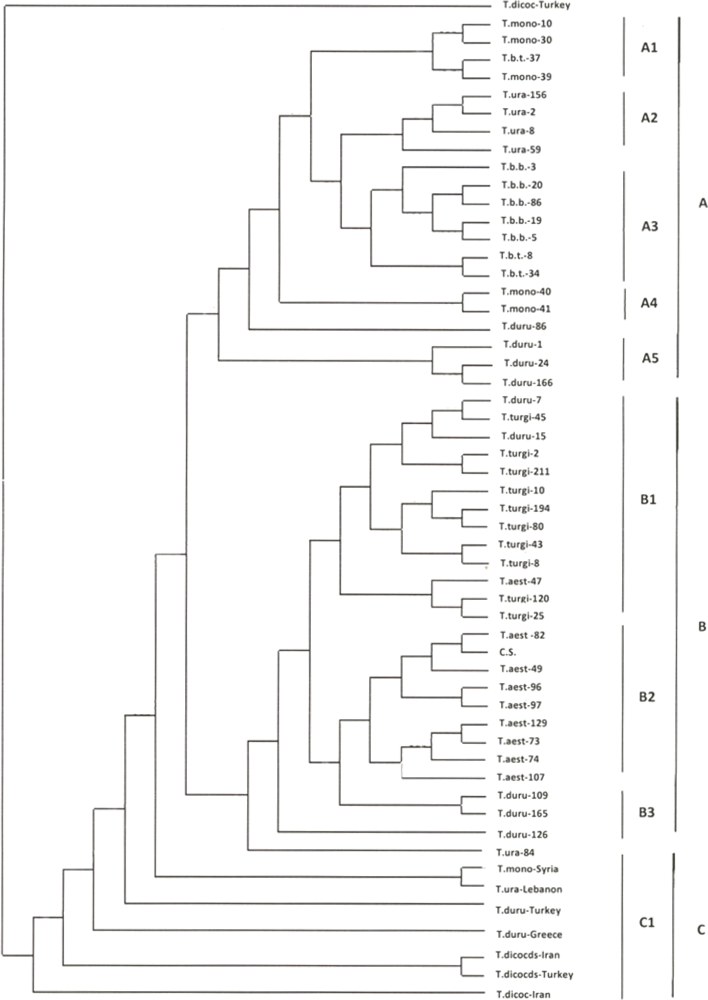
<p>The results distinguished all the 55 accessions (<xref ref-type="fig" rid="f1-ijms-11-04309">Figure 1</xref>), from which 46 were divided into two major groups designated as A and B in <xref ref-type="fig" rid="f1-ijms-11-04309">Figure 1</xref> with 100% bootstrap support (data not shown).</p>
<p>These two groups, with several subgroups, were heterogeneous. The accessions of diploid species were grouped with considerable genetic similarities (except T.ura-84). Four accessions of tetraploid cultivated wheat <italic>T. durum</italic> were grouped with diploid accessions (group A, <xref ref-type="fig" rid="f1-ijms-11-04309">Figure 1</xref>). The group B included 14 tetraploid, 11 hexaploid and one diploid accession. The remaining eight accessions (provided by the Institute of Plant Biology, University of Zurich, Switzerland) were not grouped with the above main groups, and were clearly separated from the Iranian ones (group C, <xref ref-type="fig" rid="f1-ijms-11-04309">Figure 1</xref>).</p>
<p>At the species level (<xref ref-type="table" rid="t2-ijms-11-04309">Table 2</xref>), the highest genetic similarity (0.89) was found between <italic>T. aestivum</italic> and <italic>T. durum</italic>; although <italic>T. aestivum</italic> and <italic>T. turgidum</italic> with a genetic similarity of 0.86 appeared relatively close too. The two species <italic>T. dicoccum</italic> and <italic>T. dicoccoides</italic> with 0.64 and 0.67 genetic similarity respectively, were grouped well away from the other species, indicating that the A genome in tetraploids was distant from the genome in the diploid and polyploid species.</p>
<p>In the UPGMA dendrogram (<xref ref-type="fig" rid="f1-ijms-11-04309">Figure 1</xref>), the eight <italic>Triticum</italic> species studied were divided into three groups: (1) three diploids (<italic>T. monococcum</italic>, <italic>T. boeoticum</italic>, <italic>T. urartu</italic>), (2) three cultivated wheats (<italic>T. aetivum</italic>, <italic>T. durum</italic> and <italic>T. turgidum</italic>), and (3) two tetraploids (<italic>T. dicoccum</italic> and <italic>T. dicoccoides</italic>).</p></sec>
<sec sec-type="methods">
<label>2.2.</label>
<title>Analysis of Molecular Variance (AMOVA)</title>
<p>The main portion of genetic variance (75.56%) was attributed to the variation among populations within species. A significant genetic variation (17.44%) was calculated between different species. There was no significant difference between A genome of species with different ploidy levels (<xref ref-type="table" rid="t3-ijms-11-04309">Table 3</xref>).</p>
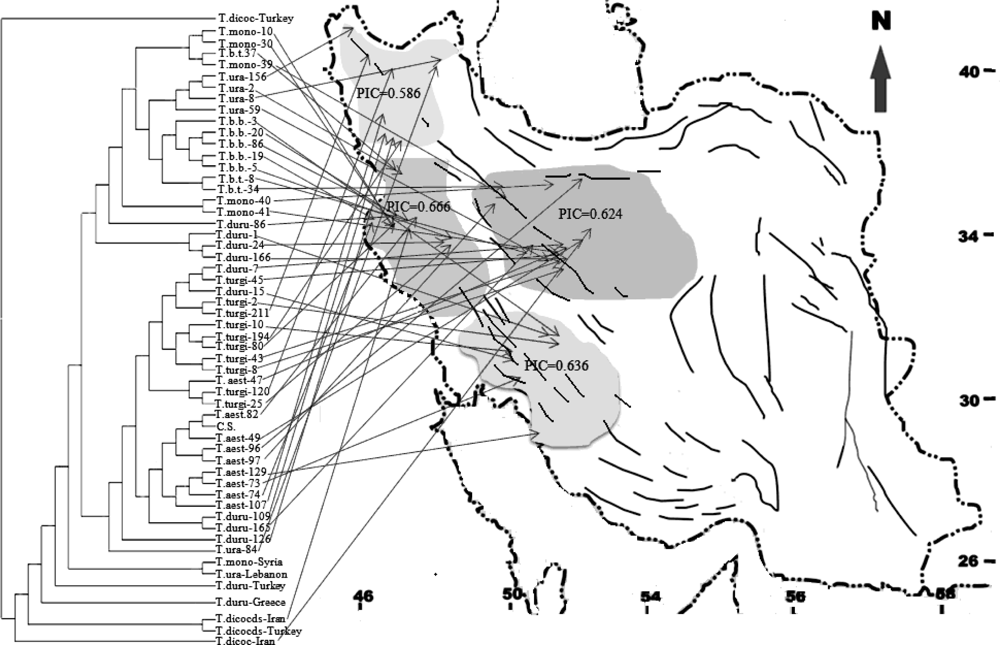
<p>The accessions were mainly collected from Iran as it is considered to be a part of centre of origin of cultivated wheat [<xref ref-type="bibr" rid="b15-ijms-11-04309">15</xref>]. The germplasms presented in the centre of origin of a taxon are considered to be more diverse than those growing at the margins of its geographic distribution. The higher genetic diversity observed in this study concur with previous reports [<xref ref-type="bibr" rid="b37-ijms-11-04309">37</xref>,<xref ref-type="bibr" rid="b41-ijms-11-04309">41</xref>,<xref ref-type="bibr" rid="b42-ijms-11-04309">42</xref>,<xref ref-type="bibr" rid="b69-ijms-11-04309">69</xref>], indicating Iran as a likely part of the centre of diversity of this genus. The differences can also be attributed to the number of accessions studied, their genetic background, and the number of markers used. A total of 410 polymorphic bands (alleles) detected in this study seem to be enough to assess genetic variation among accessions. Zhang <italic>et al.</italic> (2002) [<xref ref-type="bibr" rid="b70-ijms-11-04309">70</xref>] discussed that the presence of 350–400 alleles is enough for objective assessment of genetic relationship between wheat accessions. From the geographic point of view, the A genome SSR differentiations were not correlated with geographic distribution (<xref ref-type="fig" rid="f2-ijms-11-04309">Figure 2</xref>); however, some groupings related to both taxa and geographic origin (e.g., of <italic>T. durum</italic> accessions collected from NW and <italic>T. boeoticum</italic> subsp. <italic>boeoticum</italic> accessions collected from the West) were evident. The data were able to group geographically closely related collections (<xref ref-type="fig" rid="f2-ijms-11-04309">Figure 2</xref>). There were no significant differences between diversity measures calculated for different regions.</p>
<p>The recognition of the tetraploid species <italic>T. durum</italic> as a subspecies of <italic>T. turgidum</italic> by Kihara (1994) [<xref ref-type="bibr" rid="b1-ijms-11-04309">1</xref>] and Mc Fadden and Sears (1966) [<xref ref-type="bibr" rid="b71-ijms-11-04309">71</xref>] has been followed up by some other botanists. In spite of high genetic similarity between the two taxa showed in this study, they were enough apart to be considered as a distinct species; this is supported by morphological studies [<xref ref-type="bibr" rid="b72-ijms-11-04309">72</xref>]. Analyses at the accessional level (<xref ref-type="fig" rid="f1-ijms-11-04309">Figure 1</xref>) indicated higher genetic distances among the accessions of these two species. The origin of the A genome encountered in the hexaploid wheat has always been under discussion, and its two closely related species, <italic>i.e.</italic>, <italic>T. durum</italic> and <italic>T. turgidum,</italic> have been generally known as the putative A genome donors to <italic>T. aestivum</italic> [<xref ref-type="bibr" rid="b71-ijms-11-04309">71</xref>,<xref ref-type="bibr" rid="b73-ijms-11-04309">73</xref>]. When one considers the very close genetic similarities between the above tetra- and the latter hexaploid <italic>Triticum</italic> species provided by this study (0.89 and 0.86 respectively, see <xref ref-type="table" rid="t2-ijms-11-04309">Table 2</xref>), this notion is strengthened.</p>
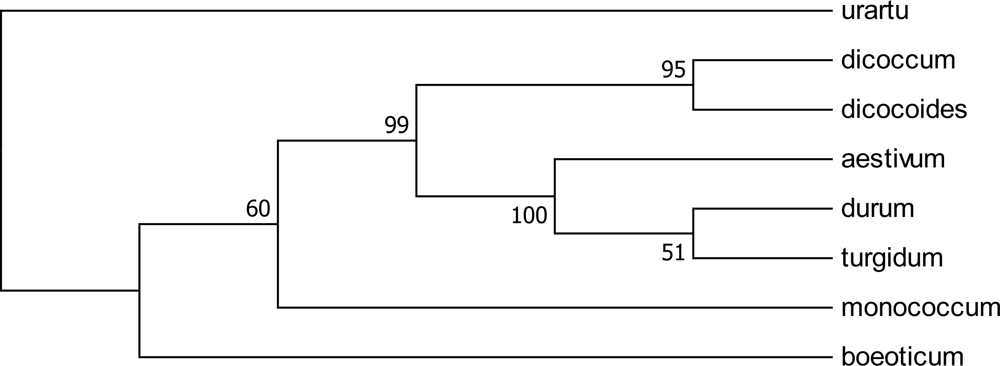
<p>Considering the topology of the UPGMA dendrogram (<xref ref-type="fig" rid="f3-ijms-11-04309">Figure 3</xref>), the tetraploid species were divided into two groups: (1) <italic>T. turgidum</italic> and <italic>T. durum</italic>, and (2) <italic>T. dicoccoides</italic> and <italic>T. dicoccum</italic>. This can be interpreted either as different post hybridization A genome modifications among the tetraploid species or involving two different origins as the A genome donor to them or preferential gene flow occurring between pair species within each group.</p>
<p>The SSR analysis showed a close relationship between the diploid <italic>Triticum</italic> species. Based on the calculated genetic similarities (<xref ref-type="table" rid="t2-ijms-11-04309">Table 2</xref>), the A genomes occurring among the polyploids appeared to be more similar to that of the diploid species <italic>T. monococcum</italic> than the other diploids. This observation is partly in accordance with Johnson (1975) [<xref ref-type="bibr" rid="b74-ijms-11-04309">74</xref>] and Tsunewaki (1999) [<xref ref-type="bibr" rid="b75-ijms-11-04309">75</xref>] who pointed out that the A genome donor to <italic>T. aestivum</italic>, <italic>T. turgidum</italic> and <italic>T. durum</italic>, is <italic>T. monococcum</italic>, and to <italic>T. dicoccoides</italic> and <italic>T. dicoccum</italic> is <italic>T. urartu</italic>.</p></sec></sec>
<sec>
<label>3.</label>
<title>Experimental Section</title>
<p>A total of 47 accessions particularly collected for this study and eight accessions provided by the Institute of Plant Biology, University of Zurich (<xref ref-type="table" rid="t4-ijms-11-04309">Table 4</xref>) were examined.</p>
<p>The materials were taxonomically identified based on Rahiminejad and Kharazyan [<xref ref-type="bibr" rid="b72-ijms-11-04309">72</xref>]. DNA was isolated from fresh leaves of twenty individuals of each accession using CTAB DNA extraction method [<xref ref-type="bibr" rid="b76-ijms-11-04309">76</xref>]. In order to assess genetic relationships and diversity of the species carrying A genome in the genus <italic>Triticum</italic>, 31 A genome specific SSR primers [<xref ref-type="bibr" rid="b36-ijms-11-04309">36</xref>] were used. Markers name and other details regarding the SSR markers are presented in <xref ref-type="table" rid="t1-ijms-11-04309">Table 1</xref>.</p>
<p>Polymerase chain reactions (PCRs) were performed based on Jakson and Matthews (2000) [<xref ref-type="bibr" rid="b77-ijms-11-04309">77</xref>]. Briefly, the PCR was carried out in 10 μL containing 2.5 μL of the 13 ng/μL genomic DNA sample, 1 μL of 10 × reaction buffer, 0.3 μL of 30 mM MgCl<sub>2</sub>, 1 U <italic>Taq</italic> polymerase, 0.5 μL of 2.5 mM dNTPs and 0.3 pmol each of IRD 800 dye and IRD 700 dye labeled arbitrary primers. The amplification program consisted of the following cycles: 95 °C for 4 min, 95 °C for 30 sec, 50 °C to 60 °C (depending on the primer set) for 30 sec, 72 °C for 1.5 min and a final extension at 72 °C for 10 min. After 4 min at 95 °C, 35 cycles were performed for 30 sec at 95 °C, 30 sec at annealing temperature (50–60 °C, see <xref ref-type="table" rid="t1-ijms-11-04309">Table 1</xref>), 1.5 min at 72 °C, followed by a final extension step of 10 min at 72 °C. Upon completing the PCR cycles, 0.8 μL of PCR products of each sample was loaded onto a 6% polyacrylamide sequencing gel in a Li-COR Global DNA Sequencer, and electrophoresed at 2000 V for 1.5 h.</p>
<sec>
<title>Statistical Analyses</title>
<p>In order to perform a simple phenetic analysis, the presence (1) and absence (0) of each band with particular mobility was scored. Genetic similarities were calculated using Powermarker [<xref ref-type="bibr" rid="b78-ijms-11-04309">78</xref>] and NTSYS-PC softwares from the data tables. A genetic similarity based dendrogram (based on Jaccard’s similarity coefficient) [<xref ref-type="bibr" rid="b56-ijms-11-04309">56</xref>] was constructed to show relationships between populations and species using the UPGMA clustering method implemented in NTSYS-PC [<xref ref-type="bibr" rid="b79-ijms-11-04309">79</xref>].</p>
<p>For the genetic diversity analysis, allele number per locus, major allele frequencies, polymorphism information content (
<inline-formula>
<mml:math> 
<mml:mi>P</mml:mi>
<mml:mi>I</mml:mi>
<mml:mi>C</mml:mi>
<mml:mo>=</mml:mo>
<mml:mn>1</mml:mn>
<mml:mo>−</mml:mo>
<mml:munderover>
<mml:mo>∑</mml:mo>
<mml:mrow>
<mml:mi>i</mml:mi>
<mml:mo>=</mml:mo>
<mml:mn>1</mml:mn></mml:mrow>
<mml:mi>n</mml:mi></mml:munderover>
<mml:mrow>
<mml:msubsup>
<mml:mi>p</mml:mi>
<mml:mi>i</mml:mi>
<mml:mn>2</mml:mn></mml:msubsup>
<mml:mo>−</mml:mo></mml:mrow>
<mml:munderover>
<mml:mo>∑</mml:mo>
<mml:mrow>
<mml:mi>i</mml:mi>
<mml:mo>=</mml:mo>
<mml:mn>1</mml:mn></mml:mrow>
<mml:mrow>
<mml:mi>n</mml:mi>
<mml:mo>−</mml:mo>
<mml:mn>1</mml:mn></mml:mrow></mml:munderover>
<mml:mrow>
<mml:munderover>
<mml:mo>∑</mml:mo>
<mml:mrow>
<mml:mi>j</mml:mi>
<mml:mo>=</mml:mo>
<mml:mi>i</mml:mi>
<mml:mo>+</mml:mo>
<mml:mn>1</mml:mn></mml:mrow>
<mml:mi>n</mml:mi></mml:munderover>
<mml:mn>2</mml:mn>
<mml:munderover>
<mml:mi>p</mml:mi>
<mml:mi>i</mml:mi>
<mml:mn>2</mml:mn></mml:munderover>
<mml:munderover>
<mml:mi>p</mml:mi>
<mml:mi>j</mml:mi>
<mml:mn>2</mml:mn></mml:munderover></mml:mrow></mml:math></inline-formula>, where <italic>p<sub>i</sub></italic> and <italic>p<sub>j</sub></italic> are the frequencies of the <italic>i</italic>th and <italic>j</italic>th alleles of a given marker, respectively [<xref ref-type="bibr" rid="b80-ijms-11-04309">80</xref>]) and gene diversity (<italic>D<sub>i</sub></italic>) were calculated as genetic parameters of polymorphism for each marker in all accessions, and for all markers in the accessions collected from the same geographical regions (see <xref ref-type="fig" rid="f2-ijms-11-04309">Figure 2</xref>). For all the parameters, the overall estimates were calculated as the averages across all loci. The analysis of molecular variance (AMOVA; implemented in ARLEQUIN software [<xref ref-type="bibr" rid="b81-ijms-11-04309">81</xref>]) was carried out to estimate the variance components of fingerprinting patterns, and to partition the variation among ploidy levels (groups), among the species with a same ploidy level (within groups) and among the accessions within the species.</p></sec></sec>
<sec>
<label>4.</label>
<title>Conclusion</title>
<p>Based on the results of this study, and those previously reported [<xref ref-type="bibr" rid="b82-ijms-11-04309">82</xref>,<xref ref-type="bibr" rid="b83-ijms-11-04309">83</xref>], it can be concluded that a hypothetical process of hybridization, polyploidization and genomic differentiation can result in the A genome of bread wheat as below:
<disp-formula>
<mml:math display="block">
<mml:mrow>
<mml:mi>T</mml:mi>
<mml:mo>.</mml:mo>
<mml:mtext> </mml:mtext>
<mml:mtext mathvariant="italic">monococcum  </mml:mtext>
<mml:mo>→</mml:mo>
<mml:mtext> </mml:mtext>
<mml:mi>T</mml:mi>
<mml:mo>.</mml:mo>
<mml:mtext> </mml:mtext>
<mml:mtext mathvariant="italic">durum</mml:mtext>
<mml:mo>:</mml:mo>
<mml:mi>T</mml:mi>
<mml:mo>.</mml:mo>
<mml:mtext> </mml:mtext>
<mml:mtext mathvariant="italic">turgidum  </mml:mtext>
<mml:mo>→</mml:mo>
<mml:mtext> </mml:mtext>
<mml:mi>T</mml:mi>
<mml:mo>.</mml:mo>
<mml:mtext> </mml:mtext>
<mml:mtext mathvariant="italic">aestivum</mml:mtext></mml:mrow></mml:math></disp-formula>Huang <italic>et al.</italic> (2002) [<xref ref-type="bibr" rid="b29-ijms-11-04309">29</xref>], and Wicker <italic>et al.</italic> (2003) [<xref ref-type="bibr" rid="b84-ijms-11-04309">84</xref>] suggested that the genome of <italic>T. urartu</italic> (A<sup>u</sup>) diverged about 0.5–3 Mya from the genome of <italic>T. monococcum</italic> (A<sup>m</sup>). Therefore, it can be proposed that <italic>T. monococcum</italic> is the parental A genome species in the genus <italic>Triticum</italic> and the A genome of di-, tetra- and hexaploid species carrying A genome are directly or indirectly originated from this species. The populations of <italic>T. monococcum</italic> grow in restricted areas and the data (not shown) indicated low seed germination ability (about 10%) of this species. Therefore, this can be interpreted that <italic>T. monococcum</italic> is facing the risk of extinction in this area and we suggest that carrying out a wider sampling with more depth across its geographic range of distribution would be vital for gene pool conservation proposes.</p>
<p>As <xref ref-type="fig" rid="f1-ijms-11-04309">Figure 1</xref> shows the materials provided by the Institute of Plant Biology, University of Zurich are clearly separated from the Iranian accessions. These originated from Turkey, Syria, Lebanon, Greece and Iran. In dendrogram, these accessions were mainly divided according to their country of origin. The <italic>T. dicoccoides</italic> accessions originating from Iran and Turkey were grouped together; however, because of less materials being studied no interpretation can be made about their genetic relationship. Since there were no materials belonging to <italic>T. dicoccum</italic> and <italic>T. dicoccoides</italic> among the 47 accessions specifically collected from Iran for this study, no comparison was made with their Iranian genepool (<xref ref-type="table" rid="t4-ijms-11-04309">Table 4</xref>).</p>
<p>AMOVA analyses showed that the main portion of diversity is attributed to the variation among the accessions within species, suggesting high genetic diversity within the <italic>Triticum</italic> species in Iran. We would expect that a great sampling of each species in Iran and analysis of genetic diversity would be worthwhile to reveal the genetic structure of their gene pools and to discover new useful alleles for breeding proposes.</p></sec></body>
<back>
<ack>
<p>The authors wish to thank the Office of Graduate Studies of the University of Isfahan and the Institute of Plant Biology, University of Zurich for their support.</p></ack>
<ref-list>
<title>References</title>
<ref id="b1-ijms-11-04309"><label>1.</label><citation citation-type="journal"><person-group person-group-type="author"><name><surname>Kihara</surname><given-names>H</given-names></name></person-group><article-title>Cytologische und genetische Studien bei wichtigen Getreidearten mit besonderer Rücksicht auf das Verhalten der Chromosomen und die Sterilität in den Bastarden</article-title><source>Mem. Coll. Sci. Kyoto Imp. Univ</source><year>1924</year><volume>1</volume><fpage>1</fpage><lpage>200</lpage></citation></ref>
<ref id="b2-ijms-11-04309"><label>2.</label><citation citation-type="journal"><person-group person-group-type="author"><name><surname>Lilienfeld</surname><given-names>F</given-names></name><name><surname>Kihara</surname><given-names>H</given-names></name></person-group><article-title>Genomanalyse bei Triticum und Aegilops. V. Triticum timopheevi Zhuk</article-title><source>Cytologia</source><year>1934</year><volume>6</volume><fpage>87</fpage><lpage>122</lpage><pub-id pub-id-type="doi">10.1508/cytologia.6.87</pub-id></citation></ref>
<ref id="b3-ijms-11-04309"><label>3.</label><citation citation-type="journal"><person-group person-group-type="author"><name><surname>Gill</surname><given-names>BS</given-names></name><name><surname>Appels</surname><given-names>R</given-names></name><name><surname>Botha-Oberholster</surname><given-names>A-M</given-names></name><name><surname>Buell</surname><given-names>CR</given-names></name><name><surname>Bennetzen</surname><given-names>JL</given-names></name><name><surname>Chalhoub</surname><given-names>B</given-names></name><name><surname>Chumley</surname><given-names>F</given-names></name><name><surname>Dvorak</surname><given-names>J</given-names></name><name><surname>Iwanaga</surname><given-names>M</given-names></name><name><surname>Keller</surname><given-names>B</given-names></name><etal/></person-group><article-title>A workshop report on whaet genome sequencing: International genome research on wheat consortium</article-title><source>Genetics</source><year>2004</year><volume>168</volume><fpage>1087</fpage><lpage>1096</lpage><pub-id pub-id-type="doi">10.1534/genetics.104.034769</pub-id><pub-id pub-id-type="pmid">15514080</pub-id></citation></ref>
<ref id="b4-ijms-11-04309"><label>4.</label><citation citation-type="book"><person-group person-group-type="author"><name><surname>Harlan</surname><given-names>JR</given-names></name></person-group><article-title>Crops and Man</article-title><edition>2nd ed.</edition><source>American Soc. of Agronomy</source><publisher-name>CSSA</publisher-name><publisher-loc>Madison, WI, USA</publisher-loc><year>1992</year></citation></ref>
<ref id="b5-ijms-11-04309"><label>5.</label><citation citation-type="journal"><person-group person-group-type="author"><name><surname>Sakamura</surname><given-names>T</given-names></name></person-group><article-title>Kurze Mitteilung über die Chromosomenzahlen und die Verwandtschaftsverhältnisse der <italic>Triticum</italic>-Arten</article-title><source>Bot. Mag. Tokyo</source><year>1918</year><volume>32</volume><fpage>151</fpage><lpage>154</lpage></citation></ref>
<ref id="b6-ijms-11-04309"><label>6.</label><citation citation-type="journal"><person-group person-group-type="author"><name><surname>Zohary</surname><given-names>D</given-names></name><name><surname>Feldman</surname><given-names>M</given-names></name></person-group><article-title>Hybridization between amphiploids and the evolution of polyploids in the wheat (<italic>Aegilops-Triticum</italic>) group</article-title><source>Evolution</source><year>1962</year><volume>16</volume><fpage>44</fpage><lpage>61</lpage><pub-id pub-id-type="doi">10.2307/2406265</pub-id></citation></ref>
<ref id="b7-ijms-11-04309"><label>7.</label><citation citation-type="book"><person-group person-group-type="author"><name><surname>Kimber</surname><given-names>G</given-names></name><name><surname>Feldman</surname><given-names>M</given-names></name></person-group><source>Wild Wheat, an Introduction</source><publisher-name>College of Agriculture, University of Missouri</publisher-name><publisher-loc>Columbia, MO, USA</publisher-loc><year>1987</year></citation></ref>
<ref id="b8-ijms-11-04309"><label>8.</label><citation citation-type="journal"><person-group person-group-type="author"><name><surname>Mandy</surname><given-names>G</given-names></name></person-group><article-title>New concept of the origin of <italic>Triticum aestivum</italic></article-title><source>Acta Agron. Hung</source><year>1970</year><volume>19</volume><fpage>413</fpage><lpage>417</lpage></citation></ref>
<ref id="b9-ijms-11-04309"><label>9.</label><citation citation-type="journal"><person-group person-group-type="author"><name><surname>Allard</surname><given-names>RW</given-names></name></person-group><article-title>Genetic basis of the evolution of adaptedness in plants</article-title><source>Euphytica</source><year>1996</year><volume>92</volume><fpage>1</fpage><lpage>11</lpage><pub-id pub-id-type="doi">10.1007/BF00022822</pub-id></citation></ref>
<ref id="b10-ijms-11-04309"><label>10.</label><citation citation-type="journal"><person-group person-group-type="author"><name><surname>Hoisington</surname><given-names>D</given-names></name><name><surname>Khairallah</surname><given-names>M</given-names></name><name><surname>Ribaut</surname><given-names>JM</given-names></name><name><surname>Skovmand</surname><given-names>B</given-names></name><name><surname>Taba</surname><given-names>S</given-names></name><name><surname>Warburton</surname><given-names>M</given-names></name></person-group><article-title>Plant genetic resources: What can they contribute toward increased crop productivity?</article-title><source>Proc. Natl. Acad. Sci.USA</source><year>1999</year><volume>99</volume><fpage>8133</fpage><lpage>8138</lpage></citation></ref>
<ref id="b11-ijms-11-04309"><label>11.</label><citation citation-type="book"><person-group person-group-type="author"><name><surname>Rejesus</surname><given-names>RM</given-names></name><name><surname>van Ginkel</surname><given-names>M</given-names></name><name><surname>Smale</surname><given-names>M</given-names></name></person-group><article-title>Wheat breeder’s perspectives of genetic diversity and germplasm use; Wheat special report 40</article-title><publisher-name>CYMMIT</publisher-name><publisher-loc>Texcoco, Mexico</publisher-loc><year>1996</year></citation></ref>
<ref id="b12-ijms-11-04309"><label>12.</label><citation citation-type="journal"><person-group person-group-type="author"><name><surname>Vavilov</surname><given-names>NI</given-names></name></person-group><article-title>The theory of the origin of cultivated plants after Darwin</article-title><source>Navka (Science)</source><year>1940</year><volume>2</volume><fpage>55</fpage><lpage>75</lpage></citation></ref>
<ref id="b13-ijms-11-04309"><label>13.</label><citation citation-type="journal"><person-group person-group-type="author"><name><surname>Tsunewaki</surname><given-names>K</given-names></name></person-group><article-title>Comparative gene analysis of common wheat and its ancestral species. II. Waxiness, growth habit and awnedness</article-title><source>Jpn. J. Bot</source><year>1966</year><volume>19</volume><fpage>175</fpage><lpage>229</lpage></citation></ref>
<ref id="b14-ijms-11-04309"><label>14.</label><citation citation-type="journal"><person-group person-group-type="author"><name><surname>Nakai</surname><given-names>Y</given-names></name></person-group><article-title>Isosyme variation in <italic>Aegilops</italic> and <italic>Triticum</italic>, IV The origin of the common wheats revealed from the study on esterase isozymes in synthesized wheats</article-title><source>Jpn. J. Genet</source><year>1979</year><volume>54</volume><fpage>175</fpage><lpage>189</lpage><pub-id pub-id-type="doi">10.1266/jjg.54.175</pub-id></citation></ref>
<ref id="b15-ijms-11-04309"><label>15.</label><citation citation-type="journal"><person-group person-group-type="author"><name><surname>Nishikawa</surname><given-names>K</given-names></name><name><surname>Furuta</surname><given-names>Y</given-names></name><name><surname>Wada</surname><given-names>T</given-names></name></person-group><article-title>Genetic studies on alpha-amylase isozymes in wheat. III. Intraspecific variation in <italic>Aegilops squarrosa</italic> and the birthplace of hexaploid wheat</article-title><source>Jpn. J. Genet</source><year>1980</year><volume>55</volume><fpage>325</fpage><lpage>336</lpage><pub-id pub-id-type="doi">10.1266/jjg.55.325</pub-id></citation></ref>
<ref id="b16-ijms-11-04309"><label>16.</label><citation citation-type="journal"><person-group person-group-type="author"><name><surname>Helguera</surname><given-names>M</given-names></name><name><surname>Khan</surname><given-names>IA</given-names></name><name><surname>Dubcovsky</surname><given-names>J</given-names></name></person-group><article-title>Development of PCR markers for wheat leaf rust resistance gene <italic>Lr47</italic></article-title><source>Theor. Appl. Genet</source><year>2000</year><volume>101</volume><fpage>625</fpage><lpage>631</lpage><pub-id pub-id-type="doi">10.1007/s001220051524</pub-id></citation></ref>
<ref id="b17-ijms-11-04309"><label>17.</label><citation citation-type="journal"><person-group person-group-type="author"><name><surname>Parker</surname><given-names>GD</given-names></name><name><surname>Chalmers</surname><given-names>KJ</given-names></name><name><surname>Rathjen</surname><given-names>AJ</given-names></name><name><surname>Langridge</surname><given-names>P</given-names></name></person-group><article-title>Mapping loci associated with milling yield in wheat (<italic>Triticum aestivum</italic> L.)</article-title><source>Mol. Breed</source><year>1999</year><volume>5</volume><fpage>561</fpage><lpage>568</lpage><pub-id pub-id-type="doi">10.1023/A:1009678023431</pub-id></citation></ref>
<ref id="b18-ijms-11-04309"><label>18.</label><citation citation-type="journal"><person-group person-group-type="author"><name><surname>Parker</surname><given-names>GD</given-names></name><name><surname>Langridge</surname><given-names>P</given-names></name></person-group><article-title>Development of a STS marker linked to a major locus controlling flour colour in wheat (<italic>Triticum aestivum</italic> L.)</article-title><source>Mol. Breed</source><year>2000</year><volume>6</volume><fpage>169</fpage><lpage>174</lpage><pub-id pub-id-type="doi">10.1023/A:1009638017859</pub-id></citation></ref>
<ref id="b19-ijms-11-04309"><label>19.</label><citation citation-type="journal"><person-group person-group-type="author"><name><surname>Zhao</surname><given-names>ZD</given-names></name><name><surname>Liu</surname><given-names>JJ</given-names></name><name><surname>Dong</surname><given-names>JY</given-names></name><name><surname>Zhang</surname><given-names>L</given-names></name><name><surname>Li</surname><given-names>Q</given-names></name></person-group><article-title>Association between TOM and cooking quality of Chinese noodle</article-title><source>Acta Agronomica Sin</source><year>1998</year><volume>24</volume><fpage>738</fpage><lpage>742</lpage></citation></ref>
<ref id="b20-ijms-11-04309"><label>20.</label><citation citation-type="journal"><person-group person-group-type="author"><name><surname>Peng</surname><given-names>ZS</given-names></name><name><surname>Yen</surname><given-names>C</given-names></name><name><surname>Yang</surname><given-names>JL</given-names></name></person-group><article-title>Chromosomal Location of genes for supernumerary spikelet in bread wheat</article-title><source>Euphytica</source><year>1998</year><volume>103</volume><fpage>109</fpage><lpage>114</lpage><pub-id pub-id-type="doi">10.1023/A:1018323310621</pub-id></citation></ref>
<ref id="b21-ijms-11-04309"><label>21.</label><citation citation-type="journal"><person-group person-group-type="author"><name><surname>Zanetti</surname><given-names>S</given-names></name><name><surname>Winzeler</surname><given-names>M</given-names></name><name><surname>Keller</surname><given-names>M</given-names></name><name><surname>Keller</surname><given-names>B</given-names></name><name><surname>Messmer</surname><given-names>M</given-names></name></person-group><article-title>Genetic Analysis of Pre-Harvest Sprouting Resistance in a Wheat 3 Spelt Cross</article-title><source>Crop Sci</source><year>2000</year><volume>40</volume><fpage>1406</fpage><lpage>1417</lpage><pub-id pub-id-type="doi">10.2135/cropsci2000.4051406x</pub-id></citation></ref>
<ref id="b22-ijms-11-04309"><label>22.</label><citation citation-type="journal"><person-group person-group-type="author"><name><surname>Ramana</surname><given-names>JV</given-names></name><name><surname>Singh</surname><given-names>D</given-names></name></person-group><article-title>Major genes involved in chlorophyll synthesis in bread wheat (<italic>Triticum aestivum</italic> L.) Cultivars</article-title><source>Indian J. Genet. Plant Breed</source><year>2002</year><volume>62</volume><fpage>67</fpage><lpage>80</lpage></citation></ref>
<ref id="b23-ijms-11-04309"><label>23.</label><citation citation-type="journal"><person-group person-group-type="author"><name><surname>Zheng</surname><given-names>YL</given-names></name><name><surname>Yen</surname><given-names>C</given-names></name><name><surname>Yang</surname><given-names>JL</given-names></name></person-group><article-title>Monosomic analysis for total and sterile floret number per spike in the multispikelet line 10-A of common wheat</article-title><source>Wheat Inf. Service</source><year>1993</year><volume>77</volume><fpage>25</fpage><lpage>28</lpage></citation></ref>
<ref id="b24-ijms-11-04309"><label>24.</label><citation citation-type="journal"><person-group person-group-type="author"><name><surname>Vagujfalvi</surname><given-names>A</given-names></name><name><surname>Crosatti</surname><given-names>C</given-names></name><name><surname>Galiba</surname><given-names>G</given-names></name><name><surname>Dubcovsky</surname><given-names>J</given-names></name><name><surname>Cattivelli</surname><given-names>L</given-names></name></person-group><article-title>Two loci on wheat chromosome 5A regulate the differential cold-dependent expression of the cor14b gene in frosttolerant and frost-sensitive genotypes</article-title><source>Mol. Gen. Genet</source><year>2000</year><volume>263</volume><fpage>194</fpage><lpage>200</lpage><pub-id pub-id-type="doi">10.1007/s004380051160</pub-id><pub-id pub-id-type="pmid">10778737</pub-id></citation></ref>
<ref id="b25-ijms-11-04309"><label>25.</label><citation citation-type="journal"><person-group person-group-type="author"><name><surname>Davydov</surname><given-names>VA</given-names></name></person-group><article-title>Characterization of the stomatal apparatus in monosomic lines of chinese spring wheat</article-title><source>Genetika (Moskva)</source><year>1999</year><volume>35</volume><fpage>546</fpage><lpage>550</lpage></citation></ref>
<ref id="b26-ijms-11-04309"><label>26.</label><citation citation-type="journal"><person-group person-group-type="author"><name><surname>Sutka</surname><given-names>J</given-names></name><name><surname>Galiba</surname><given-names>G</given-names></name><name><surname>Snape</surname><given-names>JW</given-names></name></person-group><article-title>Inheritance of frost resistance in wheat (<italic>Triticum aestivum</italic> L.)</article-title><source>Acta Agron. Hung</source><year>1997</year><volume>45</volume><fpage>257</fpage><lpage>263</lpage></citation></ref>
<ref id="b27-ijms-11-04309"><label>27.</label><citation citation-type="journal"><person-group person-group-type="author"><name><surname>Veisz</surname><given-names>O</given-names></name><name><surname>Sutka</surname><given-names>J</given-names></name></person-group><article-title>Role of the chromosome 4B in suppressing frost resistance in winter wheat (<italic>Triticum aestivum</italic> L.).</article-title><source>Cereal Res. Commun</source><year>1998</year><volume>26</volume><fpage>47</fpage><lpage>52</lpage></citation></ref>
<ref id="b28-ijms-11-04309"><label>28.</label><citation citation-type="journal"><person-group person-group-type="author"><name><surname>Yuanwu</surname><given-names>Z</given-names></name><name><surname>Yujun</surname><given-names>Y</given-names></name></person-group><article-title>Study on the γ radiosensitivity of monosomic lines of Sumai 3 to radiation from 60Co</article-title><source>Acta Agron. Sin</source><year>1995</year><volume>21</volume><fpage>429</fpage><lpage>433</lpage></citation></ref>
<ref id="b29-ijms-11-04309"><label>29.</label><citation citation-type="journal"><person-group person-group-type="author"><name><surname>Hammer</surname><given-names>K</given-names></name><name><surname>Filatenko</surname><given-names>AA</given-names></name><name><surname>Alkhanjari</surname><given-names>S</given-names></name><name><surname>Al-Maskri</surname><given-names>A</given-names></name><name><surname>Buerkert</surname><given-names>A</given-names></name></person-group><article-title>Emmer (Triticum dicoccon Schrank) in Oman</article-title><source>Genet. Resour. Crop Evol</source><year>2004</year><volume>51</volume><fpage>111</fpage><lpage>113</lpage><pub-id pub-id-type="doi">10.1023/B:GRES.0000026038.92932.8b</pub-id></citation></ref>
<ref id="b30-ijms-11-04309"><label>30.</label><citation citation-type="journal"><person-group person-group-type="author"><name><surname>Filatenko</surname><given-names>AA</given-names></name><name><surname>Hammer</surname><given-names>K</given-names></name></person-group><article-title>A new gross morphological variation in the genus <italic>Triticum</italic> L</article-title><source>Genet Resour. Crop Evol</source><year>2007</year><volume>54</volume><fpage>231</fpage><lpage>232</lpage><pub-id pub-id-type="doi">10.1007/s10722-006-9137-x</pub-id></citation></ref>
<ref id="b31-ijms-11-04309"><label>31.</label><citation citation-type="journal"><person-group person-group-type="author"><name><surname>Tsegaye</surname><given-names>S</given-names></name><name><surname>Tesemma</surname><given-names>T</given-names></name></person-group><article-title>The genetics of some isozyme variants in tetraploid wheats (<italic>Triticum turgidum</italic> L.)</article-title><source>Hereditas</source><year>1995</year><volume>123</volume><fpage>147</fpage><lpage>154</lpage></citation></ref>
<ref id="b32-ijms-11-04309"><label>32.</label><citation citation-type="journal"><person-group person-group-type="author"><name><surname>Cheniany</surname><given-names>M</given-names></name><name><surname>Ebrahimzadeh</surname><given-names>H</given-names></name><name><surname>Salimi</surname><given-names>A</given-names></name><name><surname>Niknam</surname><given-names>V</given-names></name></person-group><article-title>Isozyme variation in some populations of wild diploid wheats in Iran</article-title><source>Biochem. Syst. Ecol</source><year>2007</year><volume>35</volume><fpage>363</fpage><lpage>371</lpage><pub-id pub-id-type="doi">10.1016/j.bse.2006.12.006</pub-id></citation></ref>
<ref id="b33-ijms-11-04309"><label>33.</label><citation citation-type="journal"><person-group person-group-type="author"><name><surname>Mesfin</surname><given-names>A</given-names></name><name><surname>Frohberg</surname><given-names>RC</given-names></name></person-group><article-title>RFLP Markers Associated with High Grain Protein from <italic>Triticum turgidum</italic> L. var. <italic>dicoccoides</italic> Introgressed into Hard Red Spring Wheat</article-title><source>Crop Sci</source><year>1999</year><volume>39</volume><fpage>508</fpage><lpage>513</lpage><pub-id pub-id-type="doi">10.2135/cropsci1999.0011183X003900020035x</pub-id></citation></ref>
<ref id="b34-ijms-11-04309"><label>34.</label><citation citation-type="journal"><person-group person-group-type="author"><name><surname>D’ovidio</surname><given-names>R</given-names></name><name><surname>Tanzarella</surname><given-names>OA</given-names></name><name><surname>Masci</surname><given-names>S</given-names></name><name><surname>Lafiandra</surname><given-names>D</given-names></name><name><surname>Porceddu</surname><given-names>E</given-names></name></person-group><article-title>RFLP and PCR analyses at <italic>Gli-1</italic>, <italic>Gli-2</italic>, <italic>Glu-1</italic> and <italic>Glu-3</italic> loci in cultivated and wild wheats</article-title><source>Hereditas</source><year>1992</year><volume>116</volume><fpage>79</fpage><lpage>85</lpage></citation></ref>
<ref id="b35-ijms-11-04309"><label>35.</label><citation citation-type="journal"><person-group person-group-type="author"><name><surname>Figliuolo</surname><given-names>G</given-names></name><name><surname>Perrino</surname><given-names>P</given-names></name></person-group><article-title>Genetic diversity and intra-specific phylogeny of <italic>Triticum turgidum</italic> L. subsp. <italic>dicoccon</italic> (Schrank) Thell. revealed by RFLPs and SSRs</article-title><source>Genet. Resour. Crop Evol</source><year>2004</year><volume>51</volume><fpage>519</fpage><lpage>527</lpage><pub-id pub-id-type="doi">10.1023/B:GRES.0000024153.75636.6f</pub-id></citation></ref>
<ref id="b36-ijms-11-04309"><label>36.</label><citation citation-type="journal"><person-group person-group-type="author"><name><surname>Röder</surname><given-names>MS</given-names></name><name><surname>Korzun</surname><given-names>V</given-names></name><name><surname>Wendehake</surname><given-names>K</given-names></name><name><surname>Plashke</surname><given-names>J</given-names></name><name><surname>Tixier</surname><given-names>MH</given-names></name><name><surname>Leory</surname><given-names>P</given-names></name><name><surname>Ganal</surname><given-names>MW</given-names></name></person-group><article-title>A microsatellite map of wheat</article-title><source>Genetics</source><year>1998</year><volume>149</volume><fpage>2007</fpage><lpage>2023</lpage><pub-id pub-id-type="pmid">9691054</pub-id></citation></ref>
<ref id="b37-ijms-11-04309"><label>37.</label><citation citation-type="journal"><person-group person-group-type="author"><name><surname>Mohammadi</surname><given-names>SA</given-names></name><name><surname>Khodarahmi</surname><given-names>M</given-names></name><name><surname>Jamalirad</surname><given-names>S</given-names></name><name><surname>Jalal Kamali</surname><given-names>MR</given-names></name></person-group><article-title>Genetic diversity in a collection of old and new bread wheat cultivars from Iran as revealed by simple sequence repeat-based analysis</article-title><source>Ann. Appl. Biol</source><year>2009</year><volume>154</volume><fpage>67</fpage><lpage>76</lpage><pub-id pub-id-type="doi">10.1111/j.1744-7348.2008.00273.x</pub-id></citation></ref>
<ref id="b38-ijms-11-04309"><label>38.</label><citation citation-type="journal"><person-group person-group-type="author"><name><surname>Gupta</surname><given-names>PK</given-names></name><name><surname>Balyan</surname><given-names>HS</given-names></name><name><surname>Edvards</surname><given-names>KJ</given-names></name><name><surname>Isaac</surname><given-names>P</given-names></name><name><surname>Korzun</surname><given-names>V</given-names></name><name><surname>Roder</surname><given-names>M</given-names></name><name><surname>Gautier</surname><given-names>M-F</given-names></name><name><surname>Joudrier</surname><given-names>P</given-names></name><name><surname>Schlatter</surname><given-names>AR</given-names></name><name><surname>Dubcovskly</surname><given-names>J</given-names></name><etal/></person-group><article-title>Genetic mapping of 66 new microsatellite (SSR) loci in bread wheat</article-title><source>Theor. Appl. Genet</source><year>2002</year><volume>105</volume><fpage>413</fpage><lpage>422</lpage><pub-id pub-id-type="doi">10.1007/s00122-002-0865-9</pub-id><pub-id pub-id-type="pmid">12582546</pub-id></citation></ref>
<ref id="b39-ijms-11-04309"><label>39.</label><citation citation-type="journal"><person-group person-group-type="author"><name><surname>Bossolini</surname><given-names>E</given-names></name><name><surname>Krattinger</surname><given-names>SG</given-names></name><name><surname>Keller</surname><given-names>B</given-names></name></person-group><article-title>Development of simple sequence repeat markers specific for the Lr34 resistance region of wheat using sequence information from rice and Aegilops tauschii</article-title><source>Theor. Appl. Genet</source><year>2006</year><volume>113</volume><fpage>1049</fpage><lpage>1062</lpage><pub-id pub-id-type="doi">10.1007/s00122-006-0364-5</pub-id><pub-id pub-id-type="pmid">16896711</pub-id></citation></ref>
<ref id="b40-ijms-11-04309"><label>40.</label><citation citation-type="journal"><person-group person-group-type="author"><name><surname>Bryan</surname><given-names>GJ</given-names></name><name><surname>Collins</surname><given-names>AJ</given-names></name><name><surname>Stephenson</surname><given-names>P</given-names></name><name><surname>Orry</surname><given-names>A</given-names></name><name><surname>Smith</surname><given-names>JB</given-names></name><name><surname>Gale</surname><given-names>MD</given-names></name></person-group><article-title>Isolation and characterization of microsatellites from hexaploid bread wheat</article-title><source>Theor. Appl. Genet</source><year>1997</year><volume>94</volume><fpage>557</fpage><lpage>563</lpage><pub-id pub-id-type="doi">10.1007/s001220050451</pub-id></citation></ref>
<ref id="b41-ijms-11-04309"><label>41.</label><citation citation-type="journal"><person-group person-group-type="author"><name><surname>Plaschke</surname><given-names>J</given-names></name><name><surname>Ganal</surname><given-names>MW</given-names></name><name><surname>Röder</surname><given-names>MS</given-names></name></person-group><article-title>Detection of genetic diversity in closely related bread wheat using microsatellite markers</article-title><source>Theor. Appl. Genet</source><year>1995</year><volume>91</volume><fpage>1001</fpage><lpage>1010</lpage></citation></ref>
<ref id="b42-ijms-11-04309"><label>42.</label><citation citation-type="journal"><person-group person-group-type="author"><name><surname>Stachel</surname><given-names>M</given-names></name><name><surname>Lelley</surname><given-names>T</given-names></name><name><surname>Grausgruber</surname><given-names>H</given-names></name><name><surname>Vollmann</surname><given-names>J</given-names></name></person-group><article-title>Application of microsatellites in wheat (<italic>Triticum aestivum</italic> L.) for studying genetic differentiation caused by selection for adaptation and use</article-title><source>Theor. Appl. Genet</source><year>2000</year><volume>100</volume><fpage>242</fpage><lpage>248</lpage><pub-id pub-id-type="doi">10.1007/s001220050032</pub-id></citation></ref>
<ref id="b43-ijms-11-04309"><label>43.</label><citation citation-type="journal"><person-group person-group-type="author"><name><surname>Huang</surname><given-names>SX</given-names></name><name><surname>Sirikhachornkit</surname><given-names>A</given-names></name><name><surname>Su</surname><given-names>XJ</given-names></name><name><surname>Faris</surname><given-names>J</given-names></name><name><surname>Gill</surname><given-names>B</given-names></name><name><surname>Haselkorn</surname><given-names>R</given-names></name><name><surname>Gornicki</surname><given-names>P</given-names></name></person-group><article-title>Genes encoding plastid acetyl-CoA carboxylase and 3-Phosphoglycerate kinase of the Triticum/Aegilops complex and evolutionary history of polyploid wheat</article-title><source>Proc. Natl. Acad. Sci. USA</source><year>2002</year><volume>99</volume><fpage>8133</fpage><lpage>8138</lpage><pub-id pub-id-type="doi">10.1073/pnas.072223799</pub-id><pub-id pub-id-type="pmid">12060759</pub-id></citation></ref>
<ref id="b44-ijms-11-04309"><label>44.</label><citation citation-type="journal"><person-group person-group-type="author"><name><surname>Eujayl</surname><given-names>I</given-names></name><name><surname>Sorrells</surname><given-names>M</given-names></name><name><surname>Baum</surname><given-names>M</given-names></name><name><surname>Wolters</surname><given-names>P</given-names></name><name><surname>Powell</surname><given-names>W</given-names></name></person-group><article-title>Isolation of EST-derived microsatellite markers for genotyping the A and B genomes of wheat</article-title><source>Theor. Appl. Genet</source><year>2002</year><volume>104</volume><fpage>339</fpage><lpage>407</lpage></citation></ref>
<ref id="b45-ijms-11-04309"><label>45.</label><citation citation-type="journal"><person-group person-group-type="author"><name><surname>Buchanan</surname><given-names>FC</given-names></name><name><surname>Adams</surname><given-names>LJ</given-names></name><name><surname>Littlejohn</surname><given-names>RP</given-names></name><name><surname>Maddox</surname><given-names>JF</given-names></name><name><surname>Crawford</surname><given-names>AM</given-names></name></person-group><article-title>Determination of evolutionary relationships among sheep breeds using microsatellites</article-title><source>Genomics</source><year>1994</year><volume>22</volume><fpage>397</fpage><lpage>403</lpage><pub-id pub-id-type="doi">10.1006/geno.1994.1401</pub-id><pub-id pub-id-type="pmid">7806227</pub-id></citation></ref>
<ref id="b46-ijms-11-04309"><label>46.</label><citation citation-type="journal"><person-group person-group-type="author"><name><surname>Condit</surname><given-names>R</given-names></name><name><surname>Hubbell</surname><given-names>S</given-names></name></person-group><article-title>Abundance and DNA sequence of two-base repeat regions in tropical tree genomes</article-title><source>Genomics</source><year>1991</year><volume>34</volume><fpage>66</fpage><lpage>71</lpage></citation></ref>
<ref id="b47-ijms-11-04309"><label>47.</label><citation citation-type="journal"><person-group person-group-type="author"><name><surname>Kkaya</surname><given-names>MS</given-names></name><name><surname>Bhagwat</surname><given-names>AA</given-names></name><name><surname>Cregan</surname><given-names>PB</given-names></name></person-group><article-title>Length polymorphisms of simple sequences repeat DNA in soybean</article-title><source>Genetics</source><year>1992</year><volume>132</volume><fpage>1131</fpage><lpage>1139</lpage><pub-id pub-id-type="pmid">1459432</pub-id></citation></ref>
<ref id="b48-ijms-11-04309"><label>48.</label><citation citation-type="journal"><person-group person-group-type="author"><name><surname>Lagercrantz</surname><given-names>U</given-names></name><name><surname>Ellegren</surname><given-names>H</given-names></name><name><surname>Andersson</surname><given-names>L</given-names></name></person-group><article-title>The abundance of various polymorphic microsatellite motifs differs between plants and vertebrates</article-title><source>Nucleic Acids Res</source><year>1993</year><volume>21</volume><fpage>1111</fpage><lpage>1115</lpage><pub-id pub-id-type="doi">10.1093/nar/21.5.1111</pub-id><pub-id pub-id-type="pmid">8464696</pub-id></citation></ref>
<ref id="b49-ijms-11-04309"><label>49.</label><citation citation-type="journal"><person-group person-group-type="author"><name><surname>Senior</surname><given-names>ML</given-names></name><name><surname>Heun</surname><given-names>M</given-names></name></person-group><article-title>Mapping maize microsatellites and polymerase chain reaction confirmation of the targeted repeats using a CT primer</article-title><source>Genome</source><year>1993</year><volume>36</volume><fpage>884</fpage><lpage>889</lpage><pub-id pub-id-type="doi">10.1139/g93-116</pub-id><pub-id pub-id-type="pmid">7903654</pub-id></citation></ref>
<ref id="b50-ijms-11-04309"><label>50.</label><citation citation-type="journal"><person-group person-group-type="author"><name><surname>Wu</surname><given-names>KS</given-names></name><name><surname>Tanksley</surname><given-names>SD</given-names></name></person-group><article-title>Abundance, polymorphism and genetic mapping of microsatellites in rice</article-title><source>Mol. Gen. Genet</source><year>1993</year><volume>241</volume><fpage>225</fpage><lpage>235</lpage><pub-id pub-id-type="doi">10.1007/BF00280220</pub-id><pub-id pub-id-type="pmid">7901751</pub-id></citation></ref>
<ref id="b51-ijms-11-04309"><label>51.</label><citation citation-type="journal"><person-group person-group-type="author"><name><surname>Bell</surname><given-names>CJ</given-names></name><name><surname>Ecker</surname><given-names>JR</given-names></name></person-group><article-title>Assignment of 30 microsatellite loci to the linkage map of <italic>Arabidopsis</italic></article-title><source>Genomics</source><year>1994</year><volume>19</volume><fpage>137</fpage><lpage>144</lpage><pub-id pub-id-type="doi">10.1006/geno.1994.1023</pub-id><pub-id pub-id-type="pmid">8188214</pub-id></citation></ref>
<ref id="b52-ijms-11-04309"><label>52.</label><citation citation-type="journal"><person-group person-group-type="author"><name><surname>Saghai-Maroof</surname><given-names>MA</given-names></name><name><surname>Soliman</surname><given-names>K</given-names></name><name><surname>Jorgensen</surname><given-names>RA</given-names></name><name><surname>Allard</surname><given-names>RW</given-names></name></person-group><article-title>Ribosomal DNA spacer-length polymorphisms in barley: Mendelian inheritance, chromosome location and population dynamics</article-title><source>Proc. Natl. Acad. Sci. USA</source><year>1984</year><volume>81</volume><fpage>8014</fpage><lpage>8018</lpage><pub-id pub-id-type="doi">10.1073/pnas.81.24.8014</pub-id><pub-id pub-id-type="pmid">6096873</pub-id></citation></ref>
<ref id="b53-ijms-11-04309"><label>53.</label><citation citation-type="journal"><person-group person-group-type="author"><name><surname>Rongwen</surname><given-names>J</given-names></name><name><surname>Akkaya</surname><given-names>MS</given-names></name><name><surname>Bhagwat</surname><given-names>AA</given-names></name><name><surname>Lavi</surname><given-names>U</given-names></name><name><surname>Crecan</surname><given-names>PB</given-names></name></person-group><article-title>The use of microsatellite DNA markers for soybean genotype identification</article-title><source>Theor. Appl. Genet</source><year>1995</year><volume>90</volume><fpage>43</fpage><lpage>48</lpage></citation></ref>
<ref id="b54-ijms-11-04309"><label>54.</label><citation citation-type="journal"><person-group person-group-type="author"><name><surname>Liu</surname><given-names>ZW</given-names></name><name><surname>Biyashev</surname><given-names>RM</given-names></name><name><surname>Saghai-Maroof</surname><given-names>MA</given-names></name></person-group><article-title>Development of simple sequence repeat DNA markers and their integration into a barley linkage map</article-title><source>Theor. Appl. Genet</source><year>1996</year><volume>93</volume><fpage>869</fpage><lpage>876</lpage><pub-id pub-id-type="doi">10.1007/BF00224088</pub-id></citation></ref>
<ref id="b55-ijms-11-04309"><label>55.</label><citation citation-type="journal"><person-group person-group-type="author"><name><surname>Mörchen</surname><given-names>M</given-names></name><name><surname>Cuguen</surname><given-names>J</given-names></name><name><surname>Michaelis</surname><given-names>G</given-names></name><name><surname>Hänni</surname><given-names>C</given-names></name><name><surname>Saumitou-Laprade</surname><given-names>P</given-names></name></person-group><article-title>Abundance and length polymorphism of microsatellite repeats in <italic>Beta vulgaris</italic> L</article-title><source>Theor. Appl. Genet</source><year>1996</year><volume>92</volume><fpage>326</fpage><lpage>333</lpage><pub-id pub-id-type="doi">10.1007/BF00223675</pub-id></citation></ref>
<ref id="b56-ijms-11-04309"><label>56.</label><citation citation-type="journal"><person-group person-group-type="author"><name><surname>Proven</surname><given-names>J</given-names></name><name><surname>Powell</surname><given-names>W</given-names></name><name><surname>Waugh</surname><given-names>R</given-names></name></person-group><article-title>Microsatellite analysis of relationships within cultivated potato (<italic>Solanum tuberosum</italic>)</article-title><source>Theor. Appl. Genet</source><year>1996</year><volume>92</volume><fpage>1078</fpage><lpage>1084</lpage><pub-id pub-id-type="doi">10.1007/BF00224052</pub-id></citation></ref>
<ref id="b57-ijms-11-04309"><label>57.</label><citation citation-type="journal"><person-group person-group-type="author"><name><surname>Szewc-McFadden</surname><given-names>AK</given-names></name><name><surname>Kresovich</surname><given-names>S</given-names></name><name><surname>Bliek</surname><given-names>SM</given-names></name><name><surname>Mrrchell</surname><given-names>SE</given-names></name><name><surname>McFerson</surname><given-names>JR</given-names></name></person-group><article-title>Identification of polymorphic, conserved simple sequence repeats (SSRs) in cultivated <italic>Brassica</italic> species</article-title><source>Theor. Appl. Genet</source><year>1996</year><volume>93</volume><fpage>534</fpage><lpage>538</lpage><pub-id pub-id-type="doi">10.1007/BF00417944</pub-id></citation></ref>
<ref id="b58-ijms-11-04309"><label>58.</label><citation citation-type="journal"><person-group person-group-type="author"><name><surname>Taramino</surname><given-names>G</given-names></name><name><surname>Tingey</surname><given-names>S</given-names></name></person-group><article-title>Simple sequence repeats for germplasm analysis and mapping in maize</article-title><source>Genome</source><year>1996</year><volume>39</volume><fpage>277</fpage><lpage>287</lpage><pub-id pub-id-type="doi">10.1139/g96-038</pub-id><pub-id pub-id-type="pmid">8984002</pub-id></citation></ref>
<ref id="b59-ijms-11-04309"><label>59.</label><citation citation-type="journal"><person-group person-group-type="author"><name><surname>Smulders</surname><given-names>MJM</given-names></name><name><surname>Bredemeijer</surname><given-names>G</given-names></name><name><surname>Rus-Kortekaas</surname><given-names>W</given-names></name><name><surname>Arens</surname><given-names>P</given-names></name><name><surname>Vosman</surname><given-names>B</given-names></name></person-group><article-title>Use of short microsatellites from database sequences to generate polymorphisms among <italic>Lycopersicum esculentum</italic> cultivars and accessions of other <italic>Lycopersicum</italic> species</article-title><source>Theor. Appl. Genet</source><year>1997</year><volume>91</volume><fpage>681</fpage><lpage>690</lpage></citation></ref>
<ref id="b60-ijms-11-04309"><label>60.</label><citation citation-type="journal"><person-group person-group-type="author"><name><surname>Röder</surname><given-names>MS</given-names></name><name><surname>Plaschke</surname><given-names>J</given-names></name><name><surname>König</surname><given-names>SU</given-names></name><name><surname>Börner</surname><given-names>A</given-names></name><name><surname>Sorrells</surname><given-names>ME</given-names></name><name><surname>Tanksley</surname><given-names>SD</given-names></name><name><surname>Ganal</surname><given-names>MW</given-names></name></person-group><article-title>Abundance, variability and chromosomal location of microsatellites in wheat</article-title><source>Mol. Gen. Genet</source><year>1995</year><volume>246</volume><fpage>327</fpage><lpage>333</lpage><pub-id pub-id-type="doi">10.1007/BF00288605</pub-id><pub-id pub-id-type="pmid">7854317</pub-id></citation></ref>
<ref id="b61-ijms-11-04309"><label>61.</label><citation citation-type="journal"><person-group person-group-type="author"><name><surname>Ma</surname><given-names>ZQ</given-names></name><name><surname>Röder</surname><given-names>M</given-names></name><name><surname>Sorrells</surname><given-names>ME</given-names></name></person-group><article-title>Frequencies and sequence characteristics of di-, tetra-nucleotide microsatellites in wheat</article-title><source>Genome</source><year>1996</year><volume>39</volume><fpage>123</fpage><lpage>130</lpage><pub-id pub-id-type="doi">10.1139/g96-017</pub-id><pub-id pub-id-type="pmid">8851802</pub-id></citation></ref>
<ref id="b62-ijms-11-04309"><label>62.</label><citation citation-type="journal"><person-group person-group-type="author"><name><surname>Stephenson</surname><given-names>P</given-names></name><name><surname>Bryan</surname><given-names>G</given-names></name><name><surname>Kirby</surname><given-names>J</given-names></name><name><surname>Collins</surname><given-names>A</given-names></name><name><surname>Devos</surname><given-names>K</given-names></name><name><surname>Busso</surname><given-names>C</given-names></name><name><surname>Gale</surname><given-names>M</given-names></name></person-group><article-title>Fifty new microsatellite loci for the wheat genetic map</article-title><source>Theor. Appl. Genet</source><year>1998</year><volume>97</volume><fpage>946</fpage><lpage>949</lpage><pub-id pub-id-type="doi">10.1007/s001220050975</pub-id></citation></ref>
<ref id="b63-ijms-11-04309"><label>63.</label><citation citation-type="journal"><person-group person-group-type="author"><name><surname>Varshney</surname><given-names>RK</given-names></name><name><surname>Prasad</surname><given-names>M</given-names></name><name><surname>Roy</surname><given-names>JK</given-names></name><name><surname>Röder</surname><given-names>MS</given-names></name><name><surname>Balyan</surname><given-names>HS</given-names></name><name><surname>Gupta</surname><given-names>PK</given-names></name></person-group><article-title>Intregated physical maps of <italic>2DL</italic>, <italic>6BS</italic> and <italic>7DL</italic> carrying loci for grain protein content and preharvest sprouling tolerance in bread wheat</article-title><source>Creal Res. Commun</source><year>2001</year><volume>29</volume><fpage>33</fpage><lpage>40</lpage></citation></ref>
<ref id="b64-ijms-11-04309"><label>64.</label><citation citation-type="journal"><person-group person-group-type="author"><name><surname>Korzun</surname><given-names>V</given-names></name><name><surname>Röder</surname><given-names>MS</given-names></name><name><surname>Ganal</surname><given-names>MW</given-names></name><name><surname>Worland</surname><given-names>AJ</given-names></name><name><surname>Law</surname><given-names>CN</given-names></name></person-group><article-title>Genetic analysis of the dwarfing gene <italic>Rht8</italic> in wheat Part 1. Molecular mapping of <italic>Rht8</italic> on the short arm of chromosome 2D of bread wheat (<italic>Triticum aestivum</italic> L.)</article-title><source>Theor. Appl. Genet</source><year>1998</year><volume>96</volume><fpage>1104</fpage><lpage>1109</lpage><pub-id pub-id-type="doi">10.1007/s001220050845</pub-id></citation></ref>
<ref id="b65-ijms-11-04309"><label>65.</label><citation citation-type="journal"><person-group person-group-type="author"><name><surname>Prasad</surname><given-names>M</given-names></name><name><surname>Varshney</surname><given-names>RK</given-names></name><name><surname>Kumar</surname><given-names>A</given-names></name><name><surname>Balyan</surname><given-names>HS</given-names></name><name><surname>Sharma</surname><given-names>PC</given-names></name><name><surname>Edwards</surname><given-names>KJ</given-names></name><name><surname>Singh</surname><given-names>H</given-names></name><name><surname>Dhaliwal</surname><given-names>HS</given-names></name><name><surname>Roy</surname><given-names>JK</given-names></name><name><surname>Gupta</surname><given-names>PK</given-names></name></person-group><article-title>A microsatellite marker associated with a QTL for grain protein content on chromosome arm 2DL of bread wheat</article-title><source>Theor. Appl. Genet</source><year>1999</year><volume>99</volume><fpage>341</fpage><lpage>345</lpage><pub-id pub-id-type="doi">10.1007/s001220051242</pub-id></citation></ref>
<ref id="b66-ijms-11-04309"><label>66.</label><citation citation-type="journal"><person-group person-group-type="author"><name><surname>Roy</surname><given-names>JK</given-names></name><name><surname>Prasad</surname><given-names>M</given-names></name><name><surname>Varshney</surname><given-names>RK</given-names></name><name><surname>Balyan</surname><given-names>HS</given-names></name><name><surname>Blake</surname><given-names>TK</given-names></name><name><surname>Dhaliwal</surname><given-names>HS</given-names></name><name><surname>Singh</surname><given-names>H</given-names></name><name><surname>Edwards</surname><given-names>KJ</given-names></name><name><surname>Gupta</surname><given-names>PK</given-names></name></person-group><article-title>Identification of a microsatellite on chromosomes 6B and a STS on 7D of bread wheat showing an association with preharvest sprouting tolerance</article-title><source>Theor. Appl. Genet</source><year>1999</year><volume>99</volume><fpage>336</fpage><lpage>340</lpage><pub-id pub-id-type="doi">10.1007/s001220051241</pub-id></citation></ref>
<ref id="b67-ijms-11-04309"><label>67.</label><citation citation-type="journal"><person-group person-group-type="author"><name><surname>Prasad</surname><given-names>M</given-names></name><name><surname>Varshney</surname><given-names>RK</given-names></name><name><surname>Roy</surname><given-names>JK</given-names></name><name><surname>Balyan</surname><given-names>HS</given-names></name><name><surname>Gupta</surname><given-names>PK</given-names></name></person-group><article-title>The use of microsatellites for detecting DNA polymorphism, genotype identification and genetic diversity in wheat</article-title><source>Theor. Appl. Genet</source><year>2000</year><volume>100</volume><fpage>584</fpage><lpage>592</lpage></citation></ref>
<ref id="b68-ijms-11-04309"><label>68.</label><citation citation-type="book"><person-group person-group-type="author"><name><surname>McLauchlan</surname><given-names>A</given-names></name><name><surname>Henry</surname><given-names>RJ</given-names></name><name><surname>Issac</surname><given-names>PG</given-names></name><name><surname>Edwards</surname><given-names>KJ</given-names></name></person-group><article-title>Microsatellite analysis in cultivated hexaploid wheat and wild wheat relatives</article-title><source>Plant Genotyping: The DNA Fingerprinting of Plants</source><person-group person-group-type="editor"><name><surname>Henry</surname><given-names>RJ</given-names></name></person-group><publisher-name>CABI Publishing, CAB International</publisher-name><publisher-loc>Wallingford, UK</publisher-loc><year>2001</year><fpage>147</fpage><lpage>159</lpage></citation></ref>
<ref id="b69-ijms-11-04309"><label>69.</label><citation citation-type="journal"><person-group person-group-type="author"><name><surname>Huang</surname><given-names>XQ</given-names></name><name><surname>Börner</surname><given-names>A</given-names></name><name><surname>Röder</surname><given-names>MS</given-names></name><name><surname>Ganal</surname><given-names>MW</given-names></name></person-group><article-title>Assessing genetic diversity of wheat (<italic>Triticum aestivum</italic> L.) germplasm using microsatellite markers</article-title><source>Theor. Appl. Genet</source><year>2002</year><volume>105</volume><fpage>699</fpage><lpage>707</lpage><pub-id pub-id-type="doi">10.1007/s00122-002-0959-4</pub-id><pub-id pub-id-type="pmid">12582483</pub-id></citation></ref>
<ref id="b70-ijms-11-04309"><label>70.</label><citation citation-type="journal"><person-group person-group-type="author"><name><surname>Zhang</surname><given-names>XY</given-names></name><name><surname>Li</surname><given-names>GW</given-names></name><name><surname>Wang</surname><given-names>LF</given-names></name><name><surname>Wang</surname><given-names>HM</given-names></name><name><surname>You</surname><given-names>GX</given-names></name><name><surname>Dong</surname><given-names>YS</given-names></name></person-group><article-title>An estimation of the minimum number of SSR alleles needed to reveal genetic relationships in wheat varieties. I. Information from large-scale planted varieties and cornerstone breeding parents in Chinese wheat improvement and production</article-title><source>Theor. Appl. Genet</source><year>2002</year><volume>106</volume><fpage>112</fpage><lpage>117</lpage><pub-id pub-id-type="pmid">12582878</pub-id></citation></ref>
<ref id="b71-ijms-11-04309"><label>71.</label><citation citation-type="journal"><person-group person-group-type="author"><name><surname>McFadden</surname><given-names>ES</given-names></name><name><surname>Sears</surname><given-names>ER</given-names></name></person-group><article-title>The origin of <italic>Triticum spelta</italic> and its free-threshing hexaploid relatives</article-title><source>J. Hered</source><year>1966</year><volume>37</volume><fpage>81</fpage><lpage>89</lpage></citation></ref>
<ref id="b72-ijms-11-04309"><label>72.</label><citation citation-type="journal"><person-group person-group-type="author"><name><surname>Rahiminegad</surname><given-names>MR</given-names></name><name><surname>Kharazian</surname><given-names>N</given-names></name></person-group><article-title>Illustration of and a key to the genus <italic>Triticum</italic> L. in Iran</article-title><source>Wheat Inf. Service</source><year>2005</year><volume>99</volume><fpage>29</fpage><lpage>34</lpage></citation></ref>
<ref id="b73-ijms-11-04309"><label>73.</label><citation citation-type="journal"><person-group person-group-type="author"><name><surname>Kihara</surname><given-names>H</given-names></name></person-group><article-title>The diversity of DD analyzer, one of the ancestors of common wheat (preliminary reports)</article-title><source>Aric. Hort</source><year>1944</year><volume>19</volume><fpage>889</fpage><lpage>890</lpage></citation></ref>
<ref id="b74-ijms-11-04309"><label>74.</label><citation citation-type="journal"><person-group person-group-type="author"><name><surname>Johnson</surname><given-names>BL</given-names></name></person-group><article-title>Identification of the apparent B-genome donor of wheat</article-title><source>Can. J. Genet. Cytol</source><year>1975</year><volume>17</volume><fpage>21</fpage><lpage>39</lpage></citation></ref>
<ref id="b75-ijms-11-04309"><label>75.</label><citation citation-type="journal"><person-group person-group-type="author"><name><surname>Tsunekawi</surname><given-names>K</given-names></name><name><surname>Ebona</surname><given-names>K</given-names></name></person-group><article-title>Production of near-isogenic lines of common wheat for glaucousness and genetic basis of this trait clarified by their use</article-title><source>Genes Genet. Syst</source><year>1999</year><volume>74</volume><fpage>33</fpage><lpage>41</lpage><pub-id pub-id-type="doi">10.1266/ggs.74.33</pub-id></citation></ref>
<ref id="b76-ijms-11-04309"><label>76.</label><citation citation-type="journal"><person-group person-group-type="author"><name><surname>Rogers</surname><given-names>SO</given-names></name><name><surname>Bendich</surname><given-names>AJ</given-names></name></person-group><article-title>Extraction of DNA from milligram amounts of fresh, herbarium and mummified plant tissues</article-title><source>Plant Mol. Biol</source><year>1985</year><volume>5</volume><fpage>69</fpage><lpage>76</lpage><pub-id pub-id-type="doi">10.1007/BF00020088</pub-id></citation></ref>
<ref id="b77-ijms-11-04309"><label>77.</label><citation citation-type="journal"><person-group person-group-type="author"><name><surname>Jackson</surname><given-names>JA</given-names></name><name><surname>Matthews</surname><given-names>D</given-names></name></person-group><article-title>Modified inter-simple sequence repeat PCR protocol for use in conjunction with the Li-Cor gene ImagIR(2) DNA analyzer</article-title><source>Biotechniques</source><year>2000</year><volume>28</volume><fpage>914</fpage><lpage>917</lpage><pub-id pub-id-type="pmid">10818697</pub-id></citation></ref>
<ref id="b78-ijms-11-04309"><label>78.</label><citation citation-type="journal"><person-group person-group-type="author"><name><surname>Liu</surname><given-names>K</given-names></name><name><surname>Muse</surname><given-names>SV</given-names></name></person-group><article-title>PowerMarker: Integrated analysis enviornment for genetic marker data</article-title><source>Bioinformatic</source><year>2005</year><volume>21</volume><fpage>2128</fpage><lpage>2129</lpage><pub-id pub-id-type="doi">10.1093/bioinformatics/bti282</pub-id></citation></ref>
<ref id="b79-ijms-11-04309"><label>79.</label><citation citation-type="journal"><person-group person-group-type="author"><name><surname>Jaccard</surname><given-names>P</given-names></name></person-group><article-title>Novelles rescherches sur la distribution florale</article-title><source>Bull. Soc. Vaud. Sci. Nat</source><year>1908</year><volume>44</volume><fpage>223</fpage><lpage>270</lpage></citation></ref>
<ref id="b80-ijms-11-04309"><label>80.</label><citation citation-type="book"><person-group person-group-type="author"><name><surname>Rohlf</surname><given-names>FJ</given-names></name></person-group><source>NTSYS-PC numerical taxonomy and multivariate analysis system, version 2.02</source><publisher-name>Exter Publications</publisher-name><publisher-loc>Setauket, NY, USA</publisher-loc><year>1998</year></citation></ref>
<ref id="b81-ijms-11-04309"><label>81.</label><citation citation-type="journal"><person-group person-group-type="author"><name><surname>Nei</surname><given-names>M</given-names></name></person-group><article-title>Genetic distance between populations</article-title><source>Am. Nat</source><year>1972</year><volume>106</volume><fpage>283</fpage><lpage>293</lpage><pub-id pub-id-type="doi">10.1086/282771</pub-id></citation></ref>
<ref id="b82-ijms-11-04309"><label>82.</label><citation citation-type="journal"><person-group person-group-type="author"><name><surname>Excoffier</surname><given-names>L</given-names></name><name><surname>Smouse</surname><given-names>PE</given-names></name><name><surname>Quattro</surname><given-names>JM</given-names></name></person-group><article-title>Analysis of molecular variance inferred from metric distances among DNA haplotypes: Application to human mitochondrial DNA restriction data</article-title><source>Genetics</source><year>1992</year><volume>131</volume><fpage>479</fpage><lpage>791</lpage><pub-id pub-id-type="pmid">1644282</pub-id></citation></ref>
<ref id="b83-ijms-11-04309"><label>83.</label><citation citation-type="journal"><person-group person-group-type="author"><name><surname>Gill</surname><given-names>BS</given-names></name><name><surname>Kimber</surname><given-names>G</given-names></name></person-group><article-title>Giemsa C-banding and the evolution of wheat</article-title><source>Proc. Natl. Acad. Sci. USA</source><year>1974</year><volume>71</volume><fpage>4086</fpage><lpage>4090</lpage><pub-id pub-id-type="doi">10.1073/pnas.71.10.4086</pub-id><pub-id pub-id-type="pmid">16592188</pub-id></citation></ref>
<ref id="b84-ijms-11-04309"><label>84.</label><citation citation-type="journal"><person-group person-group-type="author"><name><surname>Dvořák</surname><given-names>J</given-names></name></person-group><article-title>The relationships between the genomes of <italic>Triticum urartu</italic> and the A and B genomes of <italic>Triticum aestivum</italic></article-title><source>Can. J. Genet. Cytol</source><year>1976</year><volume>18</volume><fpage>371</fpage><lpage>377</lpage></citation></ref>
<ref id="b85-ijms-11-04309"><label>85.</label><citation citation-type="journal"><person-group person-group-type="author"><name><surname>Wicker</surname><given-names>T</given-names></name><name><surname>Yahiaui</surname><given-names>N</given-names></name><name><surname>Guyot</surname><given-names>R</given-names></name><name><surname>Schlagenhauf</surname><given-names>E</given-names></name><name><surname>Liu</surname><given-names>Z</given-names></name><name><surname>Dubcovsky</surname><given-names>J</given-names></name><name><surname>Keller</surname><given-names>B</given-names></name></person-group><article-title>Rapid genome divergence at orthologous low molecular weight glutenin loci of the A and Am genomes of wheat</article-title><source>Plant Cell</source><year>2003</year><volume>15</volume><fpage>1186</fpage><lpage>1197</lpage><pub-id pub-id-type="doi">10.1105/tpc.011023</pub-id><pub-id pub-id-type="pmid">12724543</pub-id></citation></ref></ref-list>
<sec sec-type="display-objects">
<title>Figures and Tables</title>
<fig id="f1-ijms-11-04309" position="float">
<label>Figure 1.</label>
<caption>
<p>A genetic similarity based dendrogram showing relationships among <italic>Triticum</italic> accessions using 31 microsatellite markers. The main groups are denoted on the right side as A, B and C and the sub-groups as A1, A2, A3, A4, A5, B1, B2, B3 and C1. (T.mono = <italic>Triticum monococcum</italic>, T.b.t. = <italic>T. boeoticum</italic> subsp. <italic>taodar</italic>, T.b.b. = <italic>T. boeoticum</italic> subsp. <italic>boeoticum</italic>, T.ura = <italic>T. urartu</italic>, T.duru = <italic>T. durum</italic>, T.turgi. = <italic>T. turgidum</italic>, T.dicoc = <italic>T. dicoccum</italic>, T.dicocds = <italic>T. dicoccoides</italic>, T.aest = <italic>T. aestivum</italic>, and C.S. = Chinese spring).</p></caption><graphic xlink:href="ijms-11-04309f1.gif"/></fig>
<fig id="f2-ijms-11-04309" position="float">
<label>Figure 2.</label>
<caption>
<p>An integrated illustration of a dendrogram showing relationships among the accessions carrying A genome and the map of their geographic origin. Average PICs of all microsatellites are shown as average in each region.</p></caption><graphic xlink:href="ijms-11-04309f2.gif"/></fig>
<fig id="f3-ijms-11-04309" position="float">
<label>Figure 3.</label>
<caption>
<p>A bootstrap dendrogram based on genetic distances, constructed using UPGMA method, showing relationships between A genomes of 8 <italic>Triticum</italic> species.</p></caption><graphic xlink:href="ijms-11-04309f3.gif"/></fig>
<table-wrap id="t1-ijms-11-04309" position="float">
<label>Table 1.</label>
<caption>
<p>Amplification of the homologous microsatellites in 55 accessions of the genus <italic>Triticum</italic> using 31 primer sets originally designed for the microsatellites of A genome (for the primer sequence see Röder <italic>et al.</italic> 1998 [<xref ref-type="bibr" rid="b36-ijms-11-04309">36</xref>]).</p></caption>
<table frame="hsides" rules="groups">
<thead>
<tr>
<th align="left" valign="middle"><bold>Marker</bold></th>
<th align="left" valign="middle"><bold>Chr. Loc.</bold></th>
<th align="left" valign="middle"><bold>Ann. Temp.</bold></th>
<th align="left" valign="middle"><bold>Allele Fr.</bold></th>
<th align="left" valign="middle"><bold>Allele No</bold></th>
<th align="left" valign="middle"><bold>HE</bold></th>
<th align="left" valign="middle"><bold>HO</bold></th>
<th align="left" valign="middle"><bold>PIC</bold></th></tr></thead>
<tbody>
<tr>
<td align="left" valign="top">gwm-601</td>
<td align="left" valign="top">4A</td>
<td align="left" valign="top">60</td>
<td align="left" valign="top">0.37</td>
<td align="left" valign="top">15</td>
<td align="left" valign="top">0.7</td>
<td align="left" valign="top">0.85</td>
<td align="left" valign="top">0.66</td></tr>
<tr>
<td align="left" valign="top">gwm-135</td>
<td align="left" valign="top">1A</td>
<td align="left" valign="top">60</td>
<td align="left" valign="top">0.28</td>
<td align="left" valign="top">14</td>
<td align="left" valign="top">0.84</td>
<td align="left" valign="top">0.66</td>
<td align="left" valign="top">0.83</td></tr>
<tr>
<td align="left" valign="top">gwm-71</td>
<td align="left" valign="top">2A</td>
<td align="left" valign="top">60</td>
<td align="left" valign="top">0.22</td>
<td align="left" valign="top">18</td>
<td align="left" valign="top">0.86</td>
<td align="left" valign="top">0.85</td></tr>
<tr>
<td align="left" valign="top">gwm-666</td>
<td align="left" valign="top">1A, 3A, 5A, 7A</td>
<td align="left" valign="top">60</td>
<td align="left" valign="top">0.22</td>
<td align="left" valign="top">22</td>
<td align="left" valign="top">0.86</td>
<td align="left" valign="top">0.98</td>
<td align="left" valign="top">0.84</td></tr>
<tr>
<td align="left" valign="top">gwm-311</td>
<td align="left" valign="top">2A, 2B, 6B</td>
<td align="left" valign="top">60</td>
<td align="left" valign="top">0.23</td>
<td align="left" valign="top">12</td>
<td align="left" valign="top">0.86</td>
<td align="left" valign="top">0.27</td>
<td align="left" valign="top">0.85</td></tr>
<tr>
<td align="left" valign="top">gwm-359</td>
<td align="left" valign="top">2A</td>
<td align="left" valign="top">55</td>
<td align="left" valign="top">0.23</td>
<td align="left" valign="top">14</td>
<td align="left" valign="top">0.86</td>
<td align="left" valign="top">0.75</td>
<td align="left" valign="top">0.85</td></tr>
<tr>
<td align="left" valign="top">gwm-512</td>
<td align="left" valign="top">2A</td>
<td align="left" valign="top">60</td>
<td align="left" valign="top">0.29</td>
<td align="left" valign="top">5</td>
<td align="left" valign="top">0.75</td>
<td align="left" valign="top">0.12</td>
<td align="left" valign="top">0.70</td></tr>
<tr>
<td align="left" valign="top">gwm-372</td>
<td align="left" valign="top">2A</td>
<td align="left" valign="top">60</td>
<td align="left" valign="top">0.23</td>
<td align="left" valign="top">14</td>
<td align="left" valign="top">0.88</td>
<td align="left" valign="top">0.24</td>
<td align="left" valign="top">0.87</td></tr>
<tr>
<td align="left" valign="top">gwm-391</td>
<td align="left" valign="top">3A</td>
<td align="left" valign="top">55</td>
<td align="left" valign="top">0.22</td>
<td align="left" valign="top">18</td>
<td align="left" valign="top">0.79</td>
<td align="left" valign="top">0.81</td>
<td align="left" valign="top">0.77</td></tr>
<tr>
<td align="left" valign="top">gwm-757</td>
<td align="left" valign="top">3A</td>
<td align="left" valign="top">60</td>
<td align="left" valign="top">0.27</td>
<td align="left" valign="top">14</td>
<td align="left" valign="top">0.84</td>
<td align="left" valign="top">0.74</td>
<td align="left" valign="top">0.83</td></tr>
<tr>
<td align="left" valign="top">gwm-155</td>
<td align="left" valign="top">3A</td>
<td align="left" valign="top">60</td>
<td align="left" valign="top">0.34</td>
<td align="left" valign="top">8</td>
<td align="left" valign="top">0.77</td>
<td align="left" valign="top">0</td>
<td align="left" valign="top">0.74</td></tr>
<tr>
<td align="left" valign="top">gwm-291</td>
<td align="left" valign="top">5A</td>
<td align="left" valign="top">60</td>
<td align="left" valign="top">0.41</td>
<td align="left" valign="top">16</td>
<td align="left" valign="top">0.77</td>
<td align="left" valign="top">0.59</td>
<td align="left" valign="top">0.74</td></tr>
<tr>
<td align="left" valign="top">gwm-494</td>
<td align="left" valign="top">6A, 4A, 3A, 1B</td>
<td align="left" valign="top">60</td>
<td align="left" valign="top">0.34</td>
<td align="left" valign="top">12</td>
<td align="left" valign="top">0.77</td>
<td align="left" valign="top">0.87</td>
<td align="left" valign="top">0.74</td></tr>
<tr>
<td align="left" valign="top">gwm-427</td>
<td align="left" valign="top">6A</td>
<td align="left" valign="top">50</td>
<td align="left" valign="top">0.13</td>
<td align="left" valign="top">20</td>
<td align="left" valign="top">0.92</td>
<td align="left" valign="top">0.24</td>
<td align="left" valign="top">0.92</td></tr>
<tr>
<td align="left" valign="top">gwm-635</td>
<td align="left" valign="top">7A, 7B, 7D</td>
<td align="left" valign="top">60</td>
<td align="left" valign="top">0.20</td>
<td align="left" valign="top">11</td>
<td align="left" valign="top">0.86</td>
<td align="left" valign="top">0.63</td>
<td align="left" valign="top">0.85</td></tr>
<tr>
<td align="left" valign="top">gwm-332</td>
<td align="left" valign="top">7A</td>
<td align="left" valign="top">60</td>
<td align="left" valign="top">0.23</td>
<td align="left" valign="top">12</td>
<td align="left" valign="top">0.85</td>
<td align="left" valign="top">0.67</td>
<td align="left" valign="top">0.84</td></tr>
<tr>
<td align="left" valign="top">gwm-296</td>
<td align="left" valign="top">2A, 2D, 7D</td>
<td align="left" valign="top">55</td>
<td align="left" valign="top">0.14</td>
<td align="left" valign="top">18</td>
<td align="left" valign="top">0.78</td>
<td align="left" valign="top">0.49</td>
<td align="left" valign="top">0.76</td></tr>
<tr>
<td align="left" valign="top">gwm-471</td>
<td align="left" valign="top">7A, 7B</td>
<td align="left" valign="top">60</td>
<td align="left" valign="top">0.26</td>
<td align="left" valign="top">12</td>
<td align="left" valign="top">0.85</td>
<td align="left" valign="top">0.39</td>
<td align="left" valign="top">0.84</td></tr>
<tr>
<td align="left" valign="top">gwm-260</td>
<td align="left" valign="top">7A</td>
<td align="left" valign="top">55</td>
<td align="left" valign="top">0.21</td>
<td align="left" valign="top">13</td>
<td align="left" valign="top">0.87</td>
<td align="left" valign="top">0.83</td>
<td align="left" valign="top">0.86</td></tr>
<tr>
<td align="left" valign="top">gwm-459</td>
<td align="left" valign="top">6A</td>
<td align="left" valign="top">55</td>
<td align="left" valign="top">0.46</td>
<td align="left" valign="top">9</td>
<td align="left" valign="top">0.73</td>
<td align="left" valign="top">0.25</td>
<td align="left" valign="top">0.71</td></tr>
<tr>
<td align="left" valign="top">gwm-179</td>
<td align="left" valign="top">5A</td>
<td align="left" valign="top">55</td>
<td align="left" valign="top">0.31</td>
<td align="left" valign="top">5</td>
<td align="left" valign="top">0.77</td>
<td align="left" valign="top">0.62</td>
<td align="left" valign="top">0.74</td></tr>
<tr>
<td align="left" valign="top">gwm-382</td>
<td align="left" valign="top">2A, 2B, 2D</td>
<td align="left" valign="top">60</td>
<td align="left" valign="top">0.27</td>
<td align="left" valign="top">15</td>
<td align="left" valign="top">0.86</td>
<td align="left" valign="top">0.26</td>
<td align="left" valign="top">0.85</td></tr>
<tr>
<td align="left" valign="top">gwm-205</td>
<td align="left" valign="top">5A, 5D</td>
<td align="left" valign="top">60</td>
<td align="left" valign="top">0.23</td>
<td align="left" valign="top">19</td>
<td align="left" valign="top">0.9</td>
<td align="left" valign="top">0.8</td>
<td align="left" valign="top">0.89</td></tr>
<tr>
<td align="left" valign="top">gwm-136</td>
<td align="left" valign="top">1A</td>
<td align="left" valign="top">60</td>
<td align="left" valign="top">0.41</td>
<td align="left" valign="top">6</td>
<td align="left" valign="top">0.68</td>
<td align="left" valign="top">0.5</td>
<td align="left" valign="top">0.63</td></tr>
<tr>
<td align="left" valign="top">wmc-104</td>
<td align="left" valign="top">1A, 6B</td>
<td align="left" valign="top">55</td>
<td align="left" valign="top">0.44</td>
<td align="left" valign="top">10</td>
<td align="left" valign="top">0.74</td>
<td align="left" valign="top">0.22</td>
<td align="left" valign="top">0.72</td></tr>
<tr>
<td align="left" valign="top">barc-56</td>
<td align="left" valign="top">5A</td>
<td align="left" valign="top">55</td>
<td align="left" valign="top">0.32</td>
<td align="left" valign="top">15</td>
<td align="left" valign="top">0.78</td>
<td align="left" valign="top">0.5</td>
<td align="left" valign="top">0.75</td></tr>
<tr>
<td align="left" valign="top">barc-151</td>
<td align="left" valign="top">5A, 7A</td>
<td align="left" valign="top">55</td>
<td align="left" valign="top">0.19</td>
<td align="left" valign="top">13</td>
<td align="left" valign="top">0.88</td>
<td align="left" valign="top">0.14</td>
<td align="left" valign="top">0.87</td></tr>
<tr>
<td align="left" valign="top">cfa-2086</td>
<td align="left" valign="top">2A</td>
<td align="left" valign="top">60</td>
<td align="left" valign="top">0.19</td>
<td align="left" valign="top">17</td>
<td align="left" valign="top">0.86</td>
<td align="left" valign="top">0.46</td>
<td align="left" valign="top">0.85</td></tr>
<tr>
<td align="left" valign="top">cfa-2028</td>
<td align="left" valign="top">7A</td>
<td align="left" valign="top">55</td>
<td align="left" valign="top">0.33</td>
<td align="left" valign="top">9</td>
<td align="left" valign="top">0.75</td>
<td align="left" valign="top">0.72</td>
<td align="left" valign="top">0.72</td></tr>
<tr>
<td align="left" valign="top">cfa-2262</td>
<td align="left" valign="top">3A</td>
<td align="left" valign="top">55</td>
<td align="left" valign="top">0.22</td>
<td align="left" valign="top">13</td>
<td align="left" valign="top">0.77</td>
<td align="left" valign="top">0.2</td>
<td align="left" valign="top">0.74</td></tr>
<tr>
<td align="left" valign="top">cfa-2263</td>
<td align="left" valign="top">2A</td>
<td align="left" valign="top">60</td>
<td align="left" valign="top">0.17</td>
<td align="left" valign="top">11</td>
<td align="left" valign="top">0.88</td>
<td align="left" valign="top">0.25</td>
<td align="left" valign="top">0.87</td></tr>
<tr>
<td colspan="8" align="left" valign="top"><hr/></td></tr>
<tr>
<td align="left" valign="middle"><bold>Mean</bold></td><td align="left" valign="middle"/><td align="left" valign="middle"/>
<td align="left" valign="middle">0.29</td>
<td align="left" valign="middle">12.8</td>
<td align="left" valign="middle">0.79</td>
<td align="left" valign="middle">0.49</td>
<td align="left" valign="middle">0.77</td></tr>
<tr>
<td colspan="8" align="left" valign="middle"><hr/></td></tr>
<tr>
<td align="left" valign="middle"><bold>Sum</bold></td><td align="left" valign="middle"/><td align="left" valign="middle"/><td align="left" valign="middle"/>
<td align="left" valign="middle">410</td><td align="left" valign="middle"/><td align="left" valign="middle"/><td align="left" valign="middle"/></tr></tbody></table></table-wrap>
<table-wrap id="t2-ijms-11-04309" position="float">
<label>Table 2.</label>
<caption>
<p>The analysis of genetic similarity between A genomes of diploid and diploid, diploid and tetraploid, diploid and hexaploid, tetraploid and tetraploid, and tetraploid and hexaploid pair species of 55 accessions belonging to eight <italic>Triticum</italic> L. species as revealed by SSR markers.</p></caption>
<table frame="hsides" rules="groups">
<thead>
<tr>
<th align="left" valign="bottom"><bold>Groups</bold></th>
<th align="left" valign="bottom"><bold>Species</bold></th>
<th align="center" valign="bottom"><bold>Genetic Similarity</bold></th></tr></thead>
<tbody>
<tr>
<td align="left" valign="top"><bold>diplo &amp; diplo</bold></td>
<td align="left" valign="top"><italic>T. monococcum &amp; T.boeoticum</italic></td>
<td align="center" valign="top">0.89</td></tr>
<tr><td align="left" valign="top"/>
<td align="left" valign="top"><italic>T. monococcum &amp; T. urartu</italic></td>
<td align="center" valign="top">0.90</td></tr>
<tr><td align="left" valign="top"/>
<td align="left" valign="top"><italic>T.boeoticum &amp; T. urartu</italic></td>
<td align="center" valign="top">0.90</td></tr>
<tr>
<td align="left" valign="top"><bold>tetra &amp; tetra</bold></td>
<td align="left" valign="top"><italic>T. durum &amp; T. turgidum</italic></td>
<td align="center" valign="top">0.86</td></tr>
<tr><td align="left" valign="top"/>
<td align="left" valign="top"><italic>T. durum &amp; T. dicoccum</italic></td>
<td align="center" valign="top">0.79</td></tr>
<tr><td align="left" valign="top"/>
<td align="left" valign="top"><italic>T. durum &amp; T. dicoccoides</italic></td>
<td align="center" valign="top">0.78</td></tr>
<tr><td align="left" valign="top"/>
<td align="left" valign="top"><italic>T. turgidum &amp; T. dicoccum</italic></td>
<td align="center" valign="top">0.79</td></tr>
<tr><td align="left" valign="top"/>
<td align="left" valign="top"><italic>T. turgidum &amp; T. dicoccoides</italic></td>
<td align="center" valign="top">0.78</td></tr>
<tr><td align="left" valign="top"/>
<td align="left" valign="top"><italic>T. dicoccum &amp; T. dicoccoides</italic></td>
<td align="center" valign="top">0.70</td></tr>
<tr>
<td align="left" valign="top"><bold>diplo &amp; tetra</bold></td>
<td align="left" valign="top"><italic>T. monococcum &amp; T. durum</italic></td>
<td align="center" valign="top">0.85</td></tr>
<tr><td align="left" valign="top"/>
<td align="left" valign="top"><italic>T. monococcum &amp; T. turgidum</italic></td>
<td align="center" valign="top">0.66</td></tr>
<tr><td align="left" valign="top"/>
<td align="left" valign="top"><italic>T. monococcum &amp; T. dicoccum</italic></td>
<td align="center" valign="top">0.74</td></tr>
<tr><td align="left" valign="top"/>
<td align="left" valign="top"><italic>T.monococcum&amp;T.dicoccoides</italic></td>
<td align="center" valign="top">0.74</td></tr>
<tr><td align="left" valign="top"/>
<td align="left" valign="top"><italic>T. boeoticum &amp; T. durum</italic></td>
<td align="center" valign="top">0.82</td></tr>
<tr><td align="left" valign="top"/>
<td align="left" valign="top"><italic>T. boeoticum &amp; T. turgidum</italic></td>
<td align="center" valign="top">0.65</td></tr>
<tr><td align="left" valign="top"/>
<td align="left" valign="top"><italic>T. boeoticum &amp; T. dicoccum</italic></td>
<td align="center" valign="top">0.66</td></tr>
<tr><td align="left" valign="top"/>
<td align="left" valign="top"><italic>T. boeoticum &amp; T. dicoccoides</italic></td>
<td align="center" valign="top">0.69</td></tr>
<tr><td align="left" valign="top"/>
<td align="left" valign="top"><italic>T. urartu &amp; T. durum</italic></td>
<td align="center" valign="top">0.84</td></tr>
<tr><td align="left" valign="top"/>
<td align="left" valign="top"><italic>T. urartu &amp; T. turgidum</italic></td>
<td align="center" valign="top">0.64</td></tr>
<tr><td align="left" valign="top"/>
<td align="left" valign="top"><italic>T. urartu &amp; T. dicoccum</italic></td>
<td align="center" valign="top">0.75</td></tr>
<tr><td align="left" valign="top"/>
<td align="left" valign="top"><italic>T. urartu &amp; T. dicoccoides</italic></td>
<td align="center" valign="top">0.76</td></tr>
<tr>
<td align="left" valign="top"><bold>diplo &amp; hexa</bold></td>
<td align="left" valign="top"><italic>T. monococcum &amp; T. aestivum</italic></td>
<td align="center" valign="top">0.77</td></tr>
<tr><td align="left" valign="top"/>
<td align="left" valign="top"><italic>T. boeoticum &amp; T. aestivum</italic></td>
<td align="center" valign="top">0.72</td></tr>
<tr><td align="left" valign="top"/>
<td align="left" valign="top"><italic>T. urartu &amp; T. aestivum</italic></td>
<td align="center" valign="top">0.72</td></tr>
<tr>
<td align="left" valign="top"><bold>tetra &amp; hexa</bold></td>
<td align="left" valign="top"><italic>T. durum &amp; T. aestivum</italic></td>
<td align="center" valign="top">0.89</td></tr>
<tr><td align="left" valign="top"/>
<td align="left" valign="top"><italic>T. turgidum &amp; T. aestivum</italic></td>
<td align="center" valign="top">0.86</td></tr>
<tr><td align="left" valign="top"/>
<td align="left" valign="top"><italic>T. dicoccum &amp; T. aestivum</italic></td>
<td align="center" valign="top">0.64</td></tr>
<tr><td align="left" valign="top"/>
<td align="left" valign="top"><italic>T. dicoccoides &amp; T. aestivum</italic></td>
<td align="center" valign="top">0.67</td></tr></tbody></table></table-wrap>
<table-wrap id="t3-ijms-11-04309" position="float">
<label>Table 3.</label>
<caption>
<p>The analysis of molecular variance (AMOVA) of 55 accessions of eight A genome containing species of the genus <italic>Triticum</italic> calculated at ploidy level (groups), species within each ploidy level (within groups) and accessions of each species (within species).</p></caption>
<table frame="hsides" rules="groups">
<thead>
<tr>
<th align="center" valign="middle"><bold>Source of variation</bold></th>
<th align="center" valign="middle"><bold>d.f</bold></th>
<th align="center" valign="middle"><bold>Sum of squares</bold></th>
<th align="center" valign="middle"><bold>Mean of squares</bold></th>
<th align="center" valign="middle"><bold>Percentage of variation</bold></th>
<th align="center" valign="middle"><bold>Variance components</bold></th>
<th align="center" valign="middle"><bold>P-value</bold></th></tr></thead>
<tbody>
<tr>
<td align="center" valign="top"><bold>Among Ploidy levels (groups)</bold></td>
<td align="center" valign="top">2</td>
<td align="center" valign="top">235.865</td>
<td align="center" valign="top"><italic>117.932</italic></td>
<td align="center" valign="top">7.00</td>
<td align="center" valign="top">2.30879</td>
<td align="center" valign="top">&lt;0.001</td></tr>
<tr>
<td align="center" valign="top"><bold>Among species Within groups</bold></td>
<td align="center" valign="top">5</td>
<td align="center" valign="top">286.738</td>
<td align="center" valign="top">57.347</td>
<td align="center" valign="top">17.44</td>
<td align="center" valign="top">5.75630</td>
<td align="center" valign="top">&lt;0.001</td></tr>
<tr>
<td align="center" valign="top"><bold>Among accessions</bold></td>
<td align="center" valign="top">47</td>
<td align="center" valign="top">1172.161</td>
<td align="center" valign="top">24.939</td>
<td align="center" valign="top">75.56</td>
<td align="center" valign="top">24.93959</td>
<td align="center" valign="top">0.10948 ± 0.00939</td></tr>
<tr>
<td colspan="7" align="left" valign="top"><hr/></td></tr>
<tr>
<td align="center" valign="top"><bold>Total</bold></td>
<td align="center" valign="top">54</td>
<td align="center" valign="top">1694.764</td>
<td align="center" valign="top">200.218</td>
<td align="center" valign="top">100</td>
<td align="center" valign="top">33.00468</td><td align="center" valign="top"/></tr></tbody></table></table-wrap>
<table-wrap id="t4-ijms-11-04309" position="float">
<label>Table 4.</label>
<caption>
<p>The species name, collection label, genome combination and the origin of accessions used in this study.</p></caption>
<table frame="box" rules="all">
<thead>
<tr>
<th align="center" valign="bottom"><bold>Species</bold></th>
<th align="center" valign="bottom"><bold>Collection label</bold></th>
<th align="center" valign="bottom"><bold>Genome</bold></th>
<th align="center" valign="bottom"><bold>Locality and altitude (m)</bold></th></tr></thead>
<tbody>
<tr>
<td align="center" valign="top"><italic>T. monococcum</italic></td>
<td align="center" valign="top">T. mono-30</td>
<td align="center" valign="top">A</td>
<td align="left" valign="top">Kermanshah, Gardaneh Reno (1480)</td></tr>
<tr><td align="center" valign="top"/>
<td align="center" valign="top">T. mono -10</td>
<td align="center" valign="top">A</td>
<td align="left" valign="top">Kordestan, 3 km to Saghez (1620)</td></tr>
<tr><td align="center" valign="top"/>
<td align="center" valign="top">T. mono -41</td>
<td align="center" valign="top">A</td>
<td align="left" valign="top">Isfahan, Semirom to yasooj (2100)</td></tr>
<tr><td align="center" valign="top"/>
<td align="center" valign="top">T. mono -39</td>
<td align="center" valign="top">A</td>
<td align="left" valign="top">Arak to Malayer (2020)</td></tr>
<tr><td align="center" valign="top"/>
<td align="center" valign="top">T. mono -40</td>
<td align="center" valign="top">A</td>
<td align="left" valign="top">Tehran, Taleghan valley (1850)</td></tr>
<tr><td align="center" valign="top"/>
<td align="center" valign="top">T. mono Syria</td>
<td align="center" valign="top">A</td>
<td align="left" valign="top">Provided by Institute of Plant Biology of the University of Zurich</td></tr>
<tr>
<td align="center" valign="top"><italic>T.boeoticum</italic> subsp<italic>. thaodar</italic></td>
<td align="center" valign="top">T.b.t.-37</td>
<td align="center" valign="top">A</td>
<td align="left" valign="top">Kordestan, 5 km after Jenan to Saghez (1770)</td></tr>
<tr><td align="center" valign="top"/>
<td align="center" valign="top">T.b.t.-8</td>
<td align="center" valign="top">A</td>
<td align="left" valign="top">Chaharmahal Bakhtiari, Shahr-e-Kord, Shapoorabad to Jooneghan (2090)</td></tr>
<tr><td align="center" valign="top"/>
<td align="center" valign="top">T.b.t.-34</td>
<td align="center" valign="top">A</td>
<td align="left" valign="top">Arak 15 km to Malayer (1840)</td></tr>
<tr>
<td align="center" valign="top"><italic>T.boeoticum</italic> subsp. <italic>boeoticum</italic></td>
<td align="center" valign="top">T.b.b.-19</td>
<td align="center" valign="top">A</td>
<td align="left" valign="top">Ilam to Kermanshah, Gardaneh Reno (1370)</td></tr>
<tr><td align="center" valign="top"/>
<td align="center" valign="top">T.b.b.-5</td>
<td align="center" valign="top">A</td>
<td align="left" valign="top">Lorestan, 35 km to Khoramabad from Malavi (1100)</td></tr>
<tr><td align="center" valign="top"/>
<td align="center" valign="top">T.b.b.-20</td>
<td align="center" valign="top">A</td>
<td align="left" valign="top">Kermanshah 10 km to Harsin (1330)</td></tr>
<tr><td align="center" valign="top"/>
<td align="center" valign="top">T.b.b.-86</td>
<td align="center" valign="top">A</td>
<td align="left" valign="top">Kermanshah to Kamyaran (1340)</td></tr>
<tr><td align="center" valign="top"/>
<td align="center" valign="top">T.b.b.-3</td>
<td align="center" valign="top">A</td>
<td align="left" valign="top">Kohkiloye &amp; Boyerahmad,Yasooj, Amirabad (1650)</td></tr>
<tr>
<td align="center" valign="top"><italic>T.urartu</italic></td>
<td align="center" valign="top">T.ura-156</td>
<td align="center" valign="top">A</td>
<td align="left" valign="top">West Azarbaijan, Makoo (1580)</td></tr>
<tr><td align="center" valign="top"/>
<td align="center" valign="top">T.ura-84</td>
<td align="center" valign="top">A</td>
<td align="left" valign="top">Ardabil (1320)</td></tr>
<tr><td align="center" valign="top"/>
<td align="center" valign="top">T.ura-2</td>
<td align="center" valign="top">A</td>
<td align="left" valign="top">Kordestan, 10 km Saghez from Asadabad (1440)</td></tr>
<tr><td align="center" valign="top"/>
<td align="center" valign="top">T.ura-8</td>
<td align="center" valign="top">A</td>
<td align="left" valign="top">Aradbil, 10 km to Kaghazkanan (1349)</td></tr>
<tr><td align="center" valign="top"/>
<td align="center" valign="top">T.ura-59</td>
<td align="center" valign="top">A</td>
<td align="left" valign="top">Chaharmahal Bakhtiari, between Gandoman and Lordegan (2080)</td></tr>
<tr><td align="center" valign="top"/>
<td align="center" valign="top">T.ura-Lebanon</td>
<td align="center" valign="top">A</td>
<td align="left" valign="top">Provided by Institute of Plant Biology of the University of Zurich</td></tr>
<tr>
<td align="center" valign="top"><italic>T.durum</italic></td>
<td align="center" valign="top">T.duru-86</td>
<td align="center" valign="top">AB</td>
<td align="left" valign="top">Kermanshah, Kamyaran (1440)</td></tr>
<tr><td align="center" valign="top"/>
<td align="center" valign="top">T.duru-24</td>
<td align="center" valign="top">AB</td>
<td align="left" valign="top">Lorestan, Malavi toward Khoram Abad (1200)</td></tr>
<tr><td align="center" valign="top"/>
<td align="center" valign="top">T.duru-166</td>
<td align="center" valign="top">AB</td>
<td align="left" valign="top">Chahar mahal Bakhtiari, DoAb Samsami (2000)</td></tr>
<tr><td align="center" valign="top"/>
<td align="center" valign="top">T.duru-1</td>
<td align="center" valign="top">AB</td>
<td align="left" valign="top">Kohkiloye &amp; Boyerahmad (990)</td></tr>
<tr><td align="center" valign="top"/>
<td align="center" valign="top">T.duru-165</td>
<td align="center" valign="top">AB</td>
<td align="left" valign="top">Chahar mahal Bakhtiari, near Chaghakhor lake (2190)</td></tr>
<tr><td align="center" valign="top"/>
<td align="center" valign="top">T.duru-109</td>
<td align="center" valign="top">AB</td>
<td align="left" valign="top">West Azarbaijan, Sardasht to Baneh (1050)</td></tr>
<tr><td align="center" valign="top"/>
<td align="center" valign="top">T.duru-15</td>
<td align="center" valign="top">AB</td>
<td align="left" valign="top">Khoosestan, Haftgel to Masjed Soleiman (550)</td></tr>
<tr><td align="center" valign="top"/>
<td align="center" valign="top">T.duru-126</td>
<td align="center" valign="top">AB</td>
<td align="left" valign="top">Kordestan, Alamoot 6 Km (1660)</td></tr>
<tr><td align="center" valign="top"/>
<td align="center" valign="top">T.duru-7</td>
<td align="center" valign="top">AB</td>
<td align="left" valign="top">Chahar mahal Bakhtiari, Borojen to Izeh (2190)</td></tr>
<tr><td align="center" valign="top"/>
<td align="center" valign="top">T.duru-Turky</td>
<td align="center" valign="top">AB</td>
<td align="left" valign="top">Provided by Institute of Plant Biology of the University of Zurich</td></tr>
<tr><td align="center" valign="top"/>
<td align="center" valign="top">T.duru-Greece</td>
<td align="center" valign="top">AB</td>
<td align="left" valign="top">Provided by Institute of Plant Biology of the University of Zurich</td></tr>
<tr>
<td align="center" valign="top"><italic>T. turgidum</italic></td>
<td align="center" valign="top">T.turgi-211</td>
<td align="center" valign="top">AB</td>
<td align="left" valign="top">West Azarbaijan, Khoi (1110)</td></tr>
<tr><td align="center" valign="top"/>
<td align="center" valign="top">T.turgi-45</td>
<td align="center" valign="top">AB</td>
<td align="left" valign="top">Chahar mahal Bakhtiari, Bazoft (2190)</td></tr>
<tr><td align="center" valign="top"/>
<td align="center" valign="top">T.turgi-2</td>
<td align="center" valign="top">AB</td>
<td align="left" valign="top">Kohkiloye &amp; Boyerahmad, Yasooj (2880)</td></tr>
<tr><td align="center" valign="top"/>
<td align="center" valign="top">T.turgi-43</td>
<td align="center" valign="top">AB</td>
<td align="left" valign="top">Chahar mahal Bakhtiari, Bazoft, Morez valley (2000)</td></tr>
<tr><td align="center" valign="top"/>
<td align="center" valign="top">T.turgi-8</td>
<td align="center" valign="top">AB</td>
<td align="left" valign="top">Chahar mahal Bakhtiari, Borojen to Izeh (2190)</td></tr>
<tr><td align="center" valign="top"/>
<td align="center" valign="top">T.turgi-10</td>
<td align="center" valign="top">AB</td>
<td align="left" valign="top">Khoosestan, Izeh (900)</td></tr>
<tr><td align="center" valign="top"/>
<td align="center" valign="top">T.turgi-194</td>
<td align="center" valign="top">AB</td>
<td align="left" valign="top">Kordestan, between Sanandaj and Saghez (1595)</td></tr>
<tr><td align="center" valign="top"/>
<td align="center" valign="top">T.turgi-80</td>
<td align="center" valign="top">AB</td>
<td align="left" valign="top">Kermanshah, Mahi Dasht (1290)</td></tr>
<tr><td align="center" valign="top"/>
<td align="center" valign="top">T.turgi-25</td>
<td align="center" valign="top">AB</td>
<td align="left" valign="top">Lorestan, Malavi toward Khoram Abad (1200)</td></tr>
<tr><td align="center" valign="top"/>
<td align="center" valign="top">T.turgi-120</td>
<td align="center" valign="top">AB</td>
<td align="left" valign="top">East Azarbaijan, Ahar (1320)</td></tr>
<tr>
<td align="center" valign="top"><italic>T. dicoccum</italic></td>
<td align="center" valign="top">T.dicoc-Turkey</td>
<td align="center" valign="top">AB</td>
<td align="left" valign="top">Provided by Institute of Plant Biology of the University of Zurich</td></tr>
<tr><td align="center" valign="top"/>
<td align="center" valign="top">T.dicoc-Iran (Isfahan)</td>
<td align="center" valign="top">AB</td>
<td align="left" valign="top">Provided by Institute of Plant Biology of the University of Zurich</td></tr>
<tr>
<td align="center" valign="top"><italic>T. dicoccoides</italic></td>
<td align="center" valign="top">T.dicocds-Iran (Kermanshah)</td>
<td align="center" valign="top">AB</td>
<td align="left" valign="top">Provided by Institute of Plant Biology of the University of Zurich</td></tr>
<tr><td align="center" valign="top"/>
<td align="center" valign="top">T.dicocds-Turkey</td>
<td align="center" valign="top">AB</td>
<td align="left" valign="top">Provided by Institute of Plant Biology of the University of Zurich</td></tr>
<tr>
<td align="center" valign="top"><italic>T. aestivum</italic></td>
<td align="center" valign="top">T.aest-47</td>
<td align="center" valign="top">ABD</td>
<td align="left" valign="top">Chahar mahal Bakhtiari (2000)</td></tr>
<tr><td align="center" valign="top"/>
<td align="center" valign="top">T.aest-74</td>
<td align="center" valign="top">ABD</td>
<td align="left" valign="top">Ilam, Do Rahe (1410)</td></tr>
<tr><td align="center" valign="top"/>
<td align="center" valign="top">T.aest-129</td>
<td align="center" valign="top">ABD</td>
<td align="left" valign="top">Booshehr, Bandargah to Deilam (17)</td></tr>
<tr><td align="center" valign="top"/>
<td align="center" valign="top">T.aest-73</td>
<td align="center" valign="top">ABD</td>
<td align="left" valign="top">Khoosestan, Karkheh (13)</td></tr>
<tr><td align="center" valign="top"/>
<td align="center" valign="top">T.aest-97</td>
<td align="center" valign="top">ABD</td>
<td align="left" valign="top">Mlayer toward Arak, 50Km (2010)</td></tr>
<tr><td align="center" valign="top"/>
<td align="center" valign="top">T.aest-96</td>
<td align="center" valign="top">ABD</td>
<td align="left" valign="top">Tehran, Firooz kouh1 (700)</td></tr>
<tr><td align="center" valign="top"/>
<td align="center" valign="top">T.aest-107</td>
<td align="center" valign="top">ABD</td>
<td align="left" valign="top">West Azarbaijan, Boukan to Mahabad (1290)</td></tr>
<tr><td align="center" valign="top"/>
<td align="center" valign="top">T.aest-49</td>
<td align="center" valign="top">ABD</td>
<td align="left" valign="top">Isfahan, Daran (2190)</td></tr>
<tr><td align="center" valign="top"/>
<td align="center" valign="top">T.aest-82</td>
<td align="center" valign="top">ABD</td>
<td align="left" valign="top">Kermanshah, Mahi Dasht (1290)</td></tr>
<tr>
<td align="center" valign="top">Chinese spring</td>
<td align="center" valign="top">C.S.</td>
<td align="center" valign="top">ABD</td>
<td align="left" valign="top">Provided by Institute of Plant Biology of the University of Zurich</td></tr></tbody></table></table-wrap></sec></back></article>