<?xml version="1.0" encoding="UTF-8"?>
<!DOCTYPE article PUBLIC "-//NLM//DTD Journal Publishing DTD v2.3 20070202//EN" "journalpublishing.dtd">
<article xmlns:mml="http://www.w3.org/1998/Math/MathML" xmlns:xlink="http://www.w3.org/1999/xlink" xml:lang="en" article-type="research-article">
<front>
<journal-meta>
<journal-id journal-id-type="publisher-id">ijms</journal-id>
<journal-title>International Journal of Molecular Sciences</journal-title>
<abbrev-journal-title>Int. J. Mol. Sci.</abbrev-journal-title>
<issn pub-type="epub">1422-0067</issn>
<publisher>
<publisher-name>Molecular Diversity Preservation International (MDPI)</publisher-name></publisher></journal-meta>
<article-meta>
<article-id pub-id-type="doi">10.3390/ijms10052107</article-id>
<article-id pub-id-type="publisher-id">ijms-10-02107</article-id>
<article-categories>
<subj-group>
<subject>Article</subject></subj-group></article-categories>
<title-group>
<article-title>Predicting Complexation Thermodynamic Parameters of β-Cyclodextrin with Chiral Guests by Using Swarm Intelligence and Support Vector Machines</article-title></title-group>
<contrib-group>
<contrib contrib-type="author">
<name><surname>Prakasvudhisarn</surname><given-names>Chakguy</given-names></name><xref ref-type="aff" rid="af1-ijms-10-02107">1</xref></contrib>
<contrib contrib-type="author">
<name><surname>Wolschann</surname><given-names>Peter</given-names></name><xref ref-type="aff" rid="af2-ijms-10-02107">2</xref></contrib>
<contrib contrib-type="author">
<name><surname>Lawtrakul</surname><given-names>Luckhana</given-names></name><xref ref-type="aff" rid="af3-ijms-10-02107">3</xref><xref ref-type="corresp" rid="c1-ijms-10-02107">*</xref></contrib></contrib-group>
<aff id="af1-ijms-10-02107">
<label>1</label> School of Technology, Shinawatra University, Shinawatra Tower III, 15th floor, 1010 Viphavadi Rangsit Road, Chatuchak, Bangkok, 10900, Thailand; E-Mail:
<email>chakguy@shinawatra.ac.th</email> (C.P.)</aff>
<aff id="af2-ijms-10-02107">
<label>2</label> Institute of Theoretical Chemistry, University of Vienna, Währinger Straβe 17, Vienna, 1090, Austria; E-Mail:
<email>karl.peter.wolschann@univie.ac.at</email> (P.W.)</aff>
<aff id="af3-ijms-10-02107">
<label>3</label> Sirindhorn International Institute of Technology (SIIT), Thammasat University, P.O.Box 22 Thammasat Rangsit Post Office, Pathum Thani, 12121, Thailand</aff>
<author-notes>
<corresp id="c1-ijms-10-02107">* Author to whom correspondence is addressed; E-Mail:
<email>luckhana@siit.tu.ac.th</email>; Tel. +66-2-986-9009~13 (Ext 1809); Fax: +66-2-986-9009~13 (Ext 1801)</corresp></author-notes>
<pub-date pub-type="collection">
<month>5</month>
<year>2009</year></pub-date>
<pub-date pub-type="epub">
<day>14</day>
<month>5</month>
<year>2009</year></pub-date>
<volume>10</volume>
<issue>5</issue>
<fpage>2107</fpage>
<lpage>2121</lpage>
<history>
<date date-type="received">
<day>17</day>
<month>4</month>
<year>2009</year></date>
<date date-type="accepted">
<day>6</day>
<month>5</month>
<year>2009</year></date></history>
<permissions>
<copyright-statement>© 2009 by the authors; licensee Molecular Diversity Preservation International, Basel, Switzerland.</copyright-statement>
<copyright-year>2009</copyright-year>
<license license-type="open-access" xlink:href="http://creativecommons.org/licenses/by/3.0">
<p>This article is an open-access article distributed under the terms and conditions of the Creative Commons Attribution license (http://creativecommons.org/licenses/by/3.0/).</p></license></permissions>
<abstract>
<p>The Particle Swarm Optimization (PSO) and Support Vector Machines (SVMs) approaches are used for predicting the thermodynamic parameters for the 1:1 inclusion complexation of chiral guests with β-cyclodextrin. A PSO is adopted for descriptor selection in the quantitative structure-property relationships (QSPR) of a dataset of 74 chiral guests due to its simplicity, speed, and consistency. The modified PSO is then combined with SVMs for its good approximating properties, to generate a QSPR model with the selected features. Linear, polynomial, and Gaussian radial basis functions are used as kernels in SVMs. All models have demonstrated an impressive performance with <italic>R<sup>2</sup></italic> higher than 0.8.</p></abstract>
<kwd-group>
<kwd>Particle Swarm Optimization</kwd>
<kwd>Support Vector Machines</kwd>
<kwd>QSPR</kwd>
<kwd>β-cyclodextrin inclusion complexes</kwd></kwd-group></article-meta></front>
<body>
<sec sec-type="intro">
<label>1.</label>
<title>Introduction</title>
<p>β-cyclodextrin (β-CD) is a cyclic oligosaccharide that naturally contains seven glucose residues linked by (1–4)-glycosidic bonds, with a hydrophilic outer surface and a relative hydrophobic central cavity, which can form complexes with appropriate guest molecules. It has received increasing attention in the pharmaceutical field for modifying drug physicochemical properties, such as solubility, stability and bio-availability, reducing their toxicity and side effects, and suppressing unpleasant taste or smell [<xref ref-type="bibr" rid="b1-ijms-10-02107">1</xref>,<xref ref-type="bibr" rid="b2-ijms-10-02107">2</xref>].</p>
<p>The high interest in the stability constants of CD-host complexes has initiated the search for proper models for predicting these association constants or the related free energies of complexation. The aim is not only to select convenient CDs for the complexation of a particular compound, but also to get some insight into the physico-chemical parameters influencing the affinity between host and guest molecules. The availability of a large amount of experimental data led to several interesting predictive models. The inclusion reactions of a series of benzene derivatives were used for a correlation model [<xref ref-type="bibr" rid="b3-ijms-10-02107">3</xref>]. Diverse experimental information was used to develop a prediction model for the free energy of complexation using several molecular descriptors [<xref ref-type="bibr" rid="b4-ijms-10-02107">4</xref>–<xref ref-type="bibr" rid="b7-ijms-10-02107">7</xref>]. A CoMFA approach was applied to the binding constants of some organic compounds and various CDs [<xref ref-type="bibr" rid="b8-ijms-10-02107">8</xref>]. An analysis of the complexation of 30 carboxylic acids and their anions was performed using a two-parameter correlation model [<xref ref-type="bibr" rid="b9-ijms-10-02107">9</xref>]. Artificial neural networks were also used to correlate some molecular descriptors with complexation constants [<xref ref-type="bibr" rid="b10-ijms-10-02107">10</xref>,<xref ref-type="bibr" rid="b11-ijms-10-02107">11</xref>]. The free energies of a larger dataset of compounds complexed with all natural CDs were considered using a molecular-size based model [<xref ref-type="bibr" rid="b12-ijms-10-02107">12</xref>,<xref ref-type="bibr" rid="b13-ijms-10-02107">13</xref>]. Energies obtained from molecular docking of the guest molecule to the CDs’ cavities were used for systematic investigations of the interaction of organic substances with CDs [<xref ref-type="bibr" rid="b14-ijms-10-02107">14</xref>–<xref ref-type="bibr" rid="b16-ijms-10-02107">16</xref>]. A model correlating physico-chemical parameters directly with the solubility of the complexes was also presented [<xref ref-type="bibr" rid="b17-ijms-10-02107">17</xref>]. A newer improved empirical model has been published just recently [<xref ref-type="bibr" rid="b18-ijms-10-02107">18</xref>]. Most of these investigations considered the “natural” CDs, and generally, models were obtained with sufficient predictive power. The molecular descriptors are substantially different for various CDs, indicating differences in reaction mechanisms, or as a consequence of the varying flexibility of the ring system. Not much has been done up to now for the prediction of interaction energies with modified CDs, or considering different CD derivatives.</p>
<p>In this study, two novel approaches, Binary Particle Swarm Optimization (BPSO) [<xref ref-type="bibr" rid="b19-ijms-10-02107">19</xref>] and Support Vector Machines (SVMs) [<xref ref-type="bibr" rid="b20-ijms-10-02107">20</xref>] are used to predict the thermodynamic parameters for the 1:1 inclusion complexation of enantiomeric pairs of chiral guests with β-CD. SVMs represent a relatively new type of learning machine. They were designed to minimize the structural risk by minimizing an upper bound of the generalization error rather than the training error. Therefore, the over-fitting problem in machine learning is solved successfully. Another outstanding property of SVMs is that a solution obtained is always unique and globally optimal. In this paper, SVMs are investigated for a quantitative structure-property relationship (QSPR) study, to reduce the complexity of QSPR modeling and utilize the attractive properties of: not requiring the gradient information, consistent results, and fast convergence. The PSO was used to choose a set of important features.</p>
<p>Several factors such as number of atoms, van der Waals surface area, ionization potential, molecular weight, molar refractivity, atomic connectivity index, molecular flexibility, and angle bend energy, etc., influence thermodynamic properties. Only some of these factors strongly affect these thermodynamic properties and are controlled or set up in advance. The selection of these parameters is traditionally conducted by multiple linear regressions, partial least squares, and principle component analysis methods. Consequently, their assumptions must be verified and validated before the developed model can accurately be used. This results in a predictive model which may compromise the quality of the obtained products and/or efficiency of the modeling process.</p>
<p>With the increasing need for more accurate and practical evaluation QSPR models, techniques in artificial intelligence, particularly Artificial Neural Networks (ANNs), are receiving more attention in industry and academia today because they can be used to learn relationships between thermodynamic properties and their parameters. However, a number of parameters such as network topology, learning rate, and training methods have to be fine-tuned before they are deployed successfully. Furthermore, drawbacks like local optima, overfitting, and long learning time tend to occur.</p>
<p>Theoretically, the aforementioned shortcomings of ANNs have been countered by the development of Support Vector Machines. Unlike ANNs which minimize empirical risk, SVMs are designed to minimize the structural risk, by minimizing an upper bound of the generalization error, rather than the training error. Therefore, the overfitting problem in machine learning is solved successfully. Another outstanding property of SVMs is that the task of training SVMs is mapped to a uniquely solvable linearly constrained quadratic programming problem. This produces a solution that is always unique and globally optimal. They have been extended to solve regression problems as well.</p>
<p>In this paper, Support Vector Regression (SVR), which is based on Support Vector Machines, is investigated as an alternative technique for QSPR prediction. It has shown very good results for function approximation of Quantitative Structure-Activity Relationships (QSAR) [<xref ref-type="bibr" rid="b21-ijms-10-02107">21</xref>]. The SVR retains much of the elegance of the SVMs, such as good generalization and global optimal properties, and has no normal distribution assumption requirement. The linear approximation is a fundamental concept of SVR. Its extension to a nonlinear case is achieved by using the mechanism of inner-product kernel to avoid the problem of dimensionality. To speed up its regression, the use of a proper kernel is calculated in advance. Even though this kernel computation requires large memory space, various problem optimizations have already been proposed [<xref ref-type="bibr" rid="b22-ijms-10-02107">22</xref>,<xref ref-type="bibr" rid="b23-ijms-10-02107">23</xref>].</p>
<p>Since SVM can build a very reliable QSPR model based on the training data, it is incorporated in our feature selection process. The Pearson correlation coefficient (<italic>R</italic>) is then treated as the objective function for a formulated optimization problem. Our previous paper [<xref ref-type="bibr" rid="b21-ijms-10-02107">21</xref>] presented a similar approach by attempting to optimize <italic>R</italic> for predictive QSPR model building with a combined Feed-Forward Neural Network and a Particle Swarm Optimization. The PSO also showed good performance and was suitable for use with the found model, where no explicit relation between inputs and outputs was available. With attractive properties of no requirements for gradient information, consistent results, fast convergence, and successful applications in [<xref ref-type="bibr" rid="b24-ijms-10-02107">24</xref>–<xref ref-type="bibr" rid="b28-ijms-10-02107">28</xref>], PSO is then selected as an optimizer in this work.</p>
<p>Therefore, the purpose of this study was to develop a procedure that can determine key features for predicting complexation thermodynamic parameters of β-CD complexes with enantiomeric pairs of a chiral guest.</p></sec>
<sec>
<label>2.</label>
<title>Methodology</title>
<p>The proposed methodology consists of two parts: feature selection and QSPR modeling. First, a machine learning technique called Support Vector Machines (SVMs) is used to capture characteristics of QSPR and their factors, because of the SVMs’ superior properties of generalization and global optima. They are next incorporated in an optimization problem so that a relatively new, effective, and efficient optimization algorithm, Particle Swarm Optimization (PSO), is applied to find key parameters. The cooperation between both techniques can produce a very good predictive QSPR model.</p>
<sec>
<label>2.1.</label>
<title>Support Vector Machines Based QSPR Model</title>
<p>SVMs represent a relatively new type of learning machine. They are an approximate implementation of the method of structural risk minimization, which attempts to minimize the generalization error, which occurs when the machines are tested with unseen data. The generalization error rate is bounded by the sum of a pair of competing terms, the training error rate and the confidence interval, which depends on the Vapnik-Chervonenkis (VC) dimension. Hence, the VC dimension and the training error (empirical risk) are both minimized at the same time. To realize this in SVMs, a structure is imposed on the set of hyperplanes, by trying to obtain the weight vector <bold>w</bold> having the minimum Euclidean norm. Coupled with dual transformations, the optimization model yields a global optimum. These key properties really separate the SVM from other learning machine algorithms.</p>
<p>In regression problems, the problem of approximating the following set of data {(<bold>x</bold><sub>1</sub>, <italic>y</italic><sub>1</sub>),..., (<bold>x</bold><italic><sub>l</sub></italic>, <italic>y<sub>l</sub></italic>)} ⊂ ℜ<italic><sup>n</sup></italic> × ℜ with a linear function <italic>f</italic> (<bold>x</bold>) = 〈<bold>w</bold>, <bold>x</bold>〉 + <italic>b</italic>, where <bold>w</bold> ∈ ℜ<italic><sup>n</sup></italic>,<italic>b</italic> ∈ ℜ, and 〈.,.〉 represents dot product, is taken into consideration. The <bold>x</bold><sub>i</sub> is the set of descriptors, and y<sub>i</sub> is the output, which is the thermodynamic value. The ɛ-insensitive loss function proposed by Vapnik [<xref ref-type="bibr" rid="b20-ijms-10-02107">20</xref>] is commonly incorporated with SVMs (ɛ-SVR) to create sparseness in the support vectors and to embed the robustness of the Huber’s loss function. This means that f(<bold>x</bold>) is allowed to vary at most ɛ deviation from the target, and is as flat as possible, simultaneously. If the deviations are larger than the ɛ specified, this implies a bad fit and this function is proportionally penalized with constant C. This constant C determines the tradeoff between the training errors and model complexity. The flatness test of f(<bold>x</bold>) is accomplished by searching for the smallest <bold>w</bold>. Hence, a formulation of ɛ-SVR is described by:</p>
<p>min:
<disp-formula id="FD1">
<label>(1)</label>
<mml:math display="block">
<mml:mrow>
<mml:mfrac>
<mml:mn>1</mml:mn>
<mml:mn>2</mml:mn></mml:mfrac>
<mml:msup>
<mml:mrow>
<mml:mrow>
<mml:mo>‖</mml:mo>
<mml:mstyle fontweight="bold" fontstyle="normal">
<mml:mi>w</mml:mi></mml:mstyle>
<mml:mo>‖</mml:mo></mml:mrow></mml:mrow>
<mml:mn>2</mml:mn></mml:msup>
<mml:mo>+</mml:mo>
<mml:mi>C</mml:mi>
<mml:munderover>
<mml:mo>∑</mml:mo>
<mml:mrow>
<mml:mi>i</mml:mi>
<mml:mo>=</mml:mo>
<mml:mn>1</mml:mn></mml:mrow>
<mml:mi>l</mml:mi></mml:munderover>
<mml:mrow>
<mml:mo stretchy="false">(</mml:mo>
<mml:msub>
<mml:mi>ξ</mml:mi>
<mml:mi>i</mml:mi></mml:msub>
<mml:mo>+</mml:mo>
<mml:msubsup>
<mml:mi>ξ</mml:mi>
<mml:mi>i</mml:mi>
<mml:mo>*</mml:mo></mml:msubsup>
<mml:mo stretchy="false">)</mml:mo></mml:mrow></mml:mrow></mml:math></disp-formula>subject to:
<disp-formula>
<mml:math display="block">
<mml:mtable columnalign="left">
<mml:mtr>
<mml:mtd>
<mml:msub>
<mml:mi>y</mml:mi>
<mml:mi>i</mml:mi></mml:msub>
<mml:mo>−</mml:mo>
<mml:mrow>
<mml:mo>〈</mml:mo>
<mml:mrow>
<mml:mstyle fontweight="bold" fontstyle="normal">
<mml:mtext>w</mml:mtext></mml:mstyle>
<mml:mo>,</mml:mo>
<mml:msub>
<mml:mstyle fontweight="bold" fontstyle="normal">
<mml:mtext>x</mml:mtext></mml:mstyle>
<mml:mi>i</mml:mi></mml:msub></mml:mrow>
<mml:mo>〉</mml:mo></mml:mrow>
<mml:mo>−</mml:mo>
<mml:mi>b</mml:mi>
<mml:mo>≤</mml:mo>
<mml:mi>ɛ</mml:mi>
<mml:mo>+</mml:mo>
<mml:msub>
<mml:mi>ξ</mml:mi>
<mml:mi>i</mml:mi></mml:msub></mml:mtd></mml:mtr>
<mml:mtr>
<mml:mtd>
<mml:mrow>
<mml:mo>〈</mml:mo>
<mml:mrow>
<mml:mstyle fontweight="bold" fontstyle="normal">
<mml:mtext>w</mml:mtext></mml:mstyle>
<mml:mo>,</mml:mo>
<mml:msub>
<mml:mstyle fontweight="bold" fontstyle="normal">
<mml:mtext>x</mml:mtext></mml:mstyle>
<mml:mi>i</mml:mi></mml:msub></mml:mrow>
<mml:mo>〉</mml:mo></mml:mrow>
<mml:mo>+</mml:mo>
<mml:mi>b</mml:mi>
<mml:mo>−</mml:mo>
<mml:msub>
<mml:mi>y</mml:mi>
<mml:mi>i</mml:mi></mml:msub>
<mml:mo>≤</mml:mo>
<mml:mi>ɛ</mml:mi>
<mml:mo>+</mml:mo>
<mml:msubsup>
<mml:mi>ξ</mml:mi>
<mml:mi>i</mml:mi>
<mml:mo>*</mml:mo></mml:msubsup></mml:mtd></mml:mtr>
<mml:mtr>
<mml:mtd>
<mml:msub>
<mml:mi>ξ</mml:mi>
<mml:mi>i</mml:mi></mml:msub>
<mml:mo>,</mml:mo>
<mml:msubsup>
<mml:mi>ξ</mml:mi>
<mml:mi>i</mml:mi>
<mml:mo>*</mml:mo></mml:msubsup>
<mml:mo>≥</mml:mo>
<mml:mn>0</mml:mn></mml:mtd></mml:mtr></mml:mtable></mml:math></disp-formula></p>
<p>Everything above ɛ is captured in slack variables ξ<sub>i</sub> and everything below -ɛ is captured in slack variables 
<inline-formula>
<mml:math>
<mml:msubsup>
<mml:mo>ξ</mml:mo>
<mml:mi>i</mml:mi>
<mml:mo>*</mml:mo></mml:msubsup></mml:math></inline-formula>. This ɛ-insensitive loss function,<italic>|ξ|<sub>ɛ</sub></italic>is defined as:
<disp-formula id="FD2">
<label>(2).</label>
<mml:math display="block">
<mml:msub>
<mml:mrow>
<mml:mo>|</mml:mo>
<mml:mi>ξ</mml:mi>
<mml:mo>|</mml:mo></mml:mrow>
<mml:mi>ɛ</mml:mi></mml:msub>
<mml:mo>=</mml:mo>
<mml:mrow>
<mml:mo>{</mml:mo>
<mml:mrow>
<mml:mtable>
<mml:mtr>
<mml:mtd columnalign="center">
<mml:mn>0</mml:mn></mml:mtd>
<mml:mtd columnalign="left">
<mml:mrow>
<mml:mo>;</mml:mo>
<mml:mtext>if</mml:mtext>
<mml:mrow>
<mml:mo>|</mml:mo>
<mml:mrow>
<mml:mi>f</mml:mi>
<mml:mo stretchy="false">(</mml:mo>
<mml:mstyle fontweight="bold" fontstyle="normal">
<mml:mtext>x</mml:mtext></mml:mstyle>
<mml:mo stretchy="false">)</mml:mo>
<mml:mo>−</mml:mo>
<mml:mi>y</mml:mi></mml:mrow>
<mml:mo>|</mml:mo></mml:mrow>
<mml:mo>&lt;</mml:mo>
<mml:mi>ɛ</mml:mi></mml:mrow></mml:mtd></mml:mtr>
<mml:mtr>
<mml:mtd columnalign="center">
<mml:mrow>
<mml:mrow>
<mml:mo>|</mml:mo>
<mml:mrow>
<mml:mi>f</mml:mi>
<mml:mo stretchy="false">(</mml:mo>
<mml:mstyle fontweight="bold" fontstyle="normal">
<mml:mtext>x</mml:mtext></mml:mstyle>
<mml:mo stretchy="false">)</mml:mo>
<mml:mo>−</mml:mo>
<mml:mi>y</mml:mi></mml:mrow>
<mml:mo>|</mml:mo></mml:mrow>
<mml:mo>−</mml:mo>
<mml:mi>ɛ</mml:mi></mml:mrow></mml:mtd>
<mml:mtd columnalign="left">
<mml:mrow>
<mml:mo>;</mml:mo>
<mml:mtext>otherwise</mml:mtext></mml:mrow></mml:mtd></mml:mtr></mml:mtable></mml:mrow></mml:mrow></mml:math></disp-formula></p>
<p>Using the Lagrangian multipliers and the Karush-Kuhn-Tucker (KKT) conditions, the following dual problem is obtained:
<disp-formula id="FD3">
<label>(3)</label>
<mml:math display="block">
<mml:munder>
<mml:mrow>
<mml:mtext>max</mml:mtext></mml:mrow>
<mml:mi>α</mml:mi></mml:munder>
<mml:mo>−</mml:mo>
<mml:mfrac>
<mml:mn>1</mml:mn>
<mml:mn>2</mml:mn></mml:mfrac>
<mml:munderover>
<mml:mo>∑</mml:mo>
<mml:mrow>
<mml:mi>i</mml:mi>
<mml:mo>=</mml:mo>
<mml:mn>1</mml:mn></mml:mrow>
<mml:mi>l</mml:mi></mml:munderover>
<mml:mrow>
<mml:munderover>
<mml:mo>∑</mml:mo>
<mml:mrow>
<mml:mi>j</mml:mi>
<mml:mo>=</mml:mo>
<mml:mn>1</mml:mn></mml:mrow>
<mml:mi>l</mml:mi></mml:munderover>
<mml:mrow>
<mml:mo stretchy="false">(</mml:mo>
<mml:msub>
<mml:mi>α</mml:mi>
<mml:mi>i</mml:mi></mml:msub>
<mml:mo>−</mml:mo>
<mml:msubsup>
<mml:mi>α</mml:mi>
<mml:mi>i</mml:mi>
<mml:mo>*</mml:mo></mml:msubsup>
<mml:mo stretchy="false">)</mml:mo>
<mml:mo stretchy="false">(</mml:mo>
<mml:msub>
<mml:mi>α</mml:mi>
<mml:mi>j</mml:mi></mml:msub>
<mml:mo>−</mml:mo>
<mml:msubsup>
<mml:mi>α</mml:mi>
<mml:mi>j</mml:mi>
<mml:mo>*</mml:mo></mml:msubsup>
<mml:mo stretchy="false">)</mml:mo>
<mml:mrow>
<mml:mo>〈</mml:mo>
<mml:mrow>
<mml:msub>
<mml:mstyle fontweight="bold" fontstyle="normal">
<mml:mtext>x</mml:mtext></mml:mstyle>
<mml:mi>i</mml:mi></mml:msub>
<mml:mo>,</mml:mo>
<mml:msub>
<mml:mstyle fontweight="bold" fontstyle="normal">
<mml:mtext>x</mml:mtext></mml:mstyle>
<mml:mi>j</mml:mi></mml:msub></mml:mrow>
<mml:mo>〉</mml:mo></mml:mrow></mml:mrow>
<mml:mo>−</mml:mo>
<mml:mi>ɛ</mml:mi>
<mml:munderover>
<mml:mo>∑</mml:mo>
<mml:mrow>
<mml:mi>i</mml:mi>
<mml:mo>=</mml:mo>
<mml:mn>1</mml:mn></mml:mrow>
<mml:mi>l</mml:mi></mml:munderover>
<mml:mrow>
<mml:mo stretchy="false">(</mml:mo>
<mml:msub>
<mml:mi>α</mml:mi>
<mml:mi>i</mml:mi></mml:msub>
<mml:mo>+</mml:mo>
<mml:msubsup>
<mml:mi>α</mml:mi>
<mml:mi>i</mml:mi>
<mml:mo>*</mml:mo></mml:msubsup>
<mml:mo stretchy="false">)</mml:mo>
<mml:mo>+</mml:mo>
<mml:munderover>
<mml:mo>∑</mml:mo>
<mml:mrow>
<mml:mi>i</mml:mi>
<mml:mo>=</mml:mo>
<mml:mn>1</mml:mn></mml:mrow>
<mml:mi>l</mml:mi></mml:munderover>
<mml:mrow>
<mml:msub>
<mml:mi>y</mml:mi>
<mml:mi>i</mml:mi></mml:msub>
<mml:mo stretchy="false">(</mml:mo>
<mml:msub>
<mml:mi>α</mml:mi>
<mml:mi>i</mml:mi></mml:msub>
<mml:mo>−</mml:mo>
<mml:msubsup>
<mml:mi>α</mml:mi>
<mml:mi>i</mml:mi>
<mml:mo>*</mml:mo></mml:msubsup>
<mml:mo stretchy="false">)</mml:mo></mml:mrow></mml:mrow></mml:mrow></mml:math></disp-formula>subject to:
<disp-formula>
<mml:math display="block">
<mml:munderover>
<mml:mo>∑</mml:mo>
<mml:mrow>
<mml:mi>i</mml:mi>
<mml:mo>=</mml:mo>
<mml:mn>1</mml:mn></mml:mrow>
<mml:mi>l</mml:mi></mml:munderover>
<mml:mrow>
<mml:mo stretchy="false">(</mml:mo>
<mml:msub>
<mml:mi>α</mml:mi>
<mml:mi>i</mml:mi></mml:msub>
<mml:mo>−</mml:mo>
<mml:msubsup>
<mml:mi>α</mml:mi>
<mml:mi>i</mml:mi>
<mml:mo>*</mml:mo></mml:msubsup>
<mml:mo stretchy="false">)</mml:mo>
<mml:mo>=</mml:mo>
<mml:mn>0</mml:mn></mml:mrow></mml:math></disp-formula>and:
<disp-formula>
<mml:math display="block">
<mml:msub>
<mml:mi>α</mml:mi>
<mml:mi>i</mml:mi></mml:msub>
<mml:mo>,</mml:mo>
<mml:msubsup>
<mml:mi>α</mml:mi>
<mml:mi>i</mml:mi>
<mml:mo>*</mml:mo></mml:msubsup>
<mml:mo>∈</mml:mo>
<mml:mo stretchy="false">[</mml:mo>
<mml:mn>0</mml:mn>
<mml:mo>,</mml:mo>
<mml:mi> </mml:mi>
<mml:mi>C</mml:mi>
<mml:mo stretchy="false">]</mml:mo>
<mml:mo>,</mml:mo>
<mml:mi> </mml:mi>
<mml:mtext>i</mml:mtext>
<mml:mo>=</mml:mo>
<mml:mn>1</mml:mn>
<mml:mo>,</mml:mo>
<mml:mo>…</mml:mo>
<mml:mo>,</mml:mo>
<mml:mn>1</mml:mn>
<mml:mtext>.</mml:mtext></mml:math></disp-formula></p>
<p>Transforming into dual form yields a quadratic programming problem with linear constraints and a positive definite Hessian matrix. This leads to a global optimum. A nonlinear form is usually required to adequately model data. Hence, a nonlinear mapping, <italic>ϕ</italic>, is used to map data from an input space into a higher dimensional intermediate space, where linear regression is performed. Consequently, complications result in the complexity of <italic>ϕ</italic> and the problem of dimensionality in <xref ref-type="disp-formula" rid="FD3">Equation (3)</xref>. To alleviate these difficulties, the inner-product kernel is then introduced as follows:
<disp-formula>
<mml:math display="block">
<mml:mi>K</mml:mi>
<mml:mo stretchy="false">(</mml:mo>
<mml:msub>
<mml:mstyle fontweight="bold" fontstyle="normal">
<mml:mtext>x</mml:mtext></mml:mstyle>
<mml:mi>i</mml:mi></mml:msub>
<mml:mo>,</mml:mo>
<mml:msub>
<mml:mstyle fontweight="bold" fontstyle="normal">
<mml:mtext>x</mml:mtext></mml:mstyle>
<mml:mi>j</mml:mi></mml:msub>
<mml:mo stretchy="false">)</mml:mo>
<mml:mo>=</mml:mo>
<mml:mrow>
<mml:mo>〈</mml:mo>
<mml:mrow>
<mml:mi>ϕ</mml:mi>
<mml:mo stretchy="false">(</mml:mo>
<mml:msub>
<mml:mstyle fontweight="bold" fontstyle="normal">
<mml:mtext>x</mml:mtext></mml:mstyle>
<mml:mi>i</mml:mi></mml:msub>
<mml:mo stretchy="false">)</mml:mo>
<mml:mo>,</mml:mo>
<mml:mi>ϕ</mml:mi>
<mml:mo stretchy="false">(</mml:mo>
<mml:msub>
<mml:mstyle fontweight="bold" fontstyle="normal">
<mml:mtext>x</mml:mtext></mml:mstyle>
<mml:mi>j</mml:mi></mml:msub>
<mml:mo stretchy="false">)</mml:mo></mml:mrow>
<mml:mo>〉</mml:mo></mml:mrow>
<mml:mo>.</mml:mo></mml:math></disp-formula></p>
<p>The dimensionality of the intermediate space is thus hidden from the remaining computations. Some of the most widely used kernels, such as linear, polynomial, and Gaussian radial basis functions (RBF), were tested in this study. The kernel function is employed in the optimization models above by replacing 〈.,.〉 with <italic>K</italic>(.,.). This adds the capability to approximate both linear and nonlinear functions.</p>
<p>In summary, the main advantages of SVR are implicit mapping by using kernels in handling nonlinear data, convexity of quadratic optimization, and generalization properties. In addition, distribution of the data is not necessarily assumed in advance, which makes it very promising for real-world problems.</p></sec>
<sec>
<label>2.2.</label>
<title>Particle Swarm Optimization</title>
<p>PSO was introduced by Kennedy and Eberhart [<xref ref-type="bibr" rid="b19-ijms-10-02107">19</xref>] to imitate social behavior of animals such as birds flocking in searching for food. Each particle flies in hyperspace searching for the best solution by adjusting position and velocity based on its own flying experience (pbest) and its companions’ experience (gbest). The inertia weight <italic>w</italic> was later introduced to improve the PSO optimizer. It is very attractive because the requirements of gradient information are not needed. Hence, it is unaffected by discontinuities of the objective function. The equations used consist of flexible and well-balanced mechanisms to enhance the global and local exploration abilities. These allow a thorough search and simultaneously avoid premature convergence. In addition, PSO uses probabilistic rules for a particle’s movements. Therefore, it is quite robust for local optima. The standard PSO consists of the following steps [<xref ref-type="bibr" rid="b19-ijms-10-02107">19</xref>,<xref ref-type="bibr" rid="b29-ijms-10-02107">29</xref>]:
<list list-type="order">
<list-item>
<p>Initialize a population of I particles with random positions and velocities in D dimensions.</p></list-item>
<list-item>
<p>Evaluate the desired optimization function in D variables for each particle.</p></list-item>
<list-item>
<p>Compare the evaluation with the particle’s previous best value, pbest[i]. If the current value is better than pbest[i], then pbest[i] = current value and the pbest location, pbestx[i][d], is set to the current location in d-dimensional space.</p></list-item>
<list-item>
<p>Compare the evaluation with the swarm’s previous best value, (pbest[gbest]). If the current value is better than pbest[gbest]), then gbest = current particle’s array index.</p></list-item>
<list-item>
<p>Change the velocity and position of the particle according to the following equations, respectively:
<disp-formula id="FD4">
<label>(4),</label>
<mml:math display="block">
<mml:mtable columnalign="left">
<mml:mtr>
<mml:mtd>
<mml:mtext>V</mml:mtext>
<mml:mo stretchy="false">[</mml:mo>
<mml:mtext>i</mml:mtext>
<mml:mo stretchy="false">]</mml:mo>
<mml:mo stretchy="false">[</mml:mo>
<mml:mtext>d</mml:mtext>
<mml:mo stretchy="false">]</mml:mo>
<mml:mo>=</mml:mo></mml:mtd>
<mml:mtd>
<mml:mtext>V</mml:mtext>
<mml:mo stretchy="false">[</mml:mo>
<mml:mtext>i</mml:mtext>
<mml:mo stretchy="false">]</mml:mo>
<mml:mo stretchy="false">[</mml:mo>
<mml:mtext>d</mml:mtext>
<mml:mo stretchy="false">]</mml:mo>
<mml:mo> </mml:mo>
<mml:mo>+</mml:mo>
<mml:mo> </mml:mo>
<mml:msub>
<mml:mtext>c</mml:mtext>
<mml:mn>1</mml:mn></mml:msub>
<mml:mo>*</mml:mo>
<mml:mtext>rand</mml:mtext>
<mml:mo stretchy="false">(</mml:mo>
<mml:mo stretchy="false">)</mml:mo>
<mml:mo>*</mml:mo>
<mml:mo stretchy="false">(</mml:mo>
<mml:mtext>pbestx</mml:mtext>
<mml:mo stretchy="false">[</mml:mo>
<mml:mtext>i</mml:mtext>
<mml:mo stretchy="false">]</mml:mo>
<mml:mo stretchy="false">[</mml:mo>
<mml:mtext>d</mml:mtext>
<mml:mo stretchy="false">]</mml:mo>
<mml:mo> </mml:mo>
<mml:mo>−</mml:mo>
<mml:mtext> presentx</mml:mtext>
<mml:mo stretchy="false">[</mml:mo>
<mml:mtext>i</mml:mtext>
<mml:mo stretchy="false">]</mml:mo>
<mml:mo stretchy="false">[</mml:mo>
<mml:mtext>d</mml:mtext>
<mml:mo stretchy="false">]</mml:mo>
<mml:mo stretchy="false">)</mml:mo>
<mml:mo> </mml:mo>
<mml:mo>+</mml:mo></mml:mtd></mml:mtr>
<mml:mtr>
<mml:mtd/>
<mml:mtd>
<mml:msub>
<mml:mtext>c</mml:mtext>
<mml:mn>2</mml:mn></mml:msub>
<mml:mo>*</mml:mo>
<mml:mtext>rand</mml:mtext>
<mml:mo stretchy="false">(</mml:mo>
<mml:mo stretchy="false">)</mml:mo>
<mml:mo>*</mml:mo>
<mml:mo stretchy="false">(</mml:mo>
<mml:mtext>pbestx</mml:mtext>
<mml:mo stretchy="false">[</mml:mo>
<mml:mtext>gbest</mml:mtext>
<mml:mo stretchy="false">]</mml:mo>
<mml:mo stretchy="false">[</mml:mo>
<mml:mtext>d</mml:mtext>
<mml:mo stretchy="false">]</mml:mo>
<mml:mo> </mml:mo>
<mml:mo>−</mml:mo>
<mml:mtext> persentx</mml:mtext>
<mml:mo stretchy="false">[</mml:mo>
<mml:mtext>i</mml:mtext>
<mml:mo stretchy="false">]</mml:mo>
<mml:mo stretchy="false">[</mml:mo>
<mml:mtext>d</mml:mtext>
<mml:mo stretchy="false">]</mml:mo>
<mml:mo stretchy="false">)</mml:mo></mml:mtd></mml:mtr></mml:mtable></mml:math></disp-formula>
<disp-formula id="FD5">
<label>(5).</label>
<mml:math display="block">
<mml:mtext>presentx</mml:mtext>
<mml:mo stretchy="false">[</mml:mo>
<mml:mtext>i</mml:mtext>
<mml:mo stretchy="false">]</mml:mo>
<mml:mo stretchy="false">[</mml:mo>
<mml:mtext>d</mml:mtext>
<mml:mo stretchy="false">]</mml:mo>
<mml:mo> </mml:mo>
<mml:mo>=</mml:mo>
<mml:mtext> presentx</mml:mtext>
<mml:mo stretchy="false">[</mml:mo>
<mml:mtext>i</mml:mtext>
<mml:mo stretchy="false">]</mml:mo>
<mml:mo stretchy="false">[</mml:mo>
<mml:mtext>d</mml:mtext>
<mml:mo stretchy="false">]</mml:mo>
<mml:mo> </mml:mo>
<mml:mo>+</mml:mo>
<mml:mtext> V</mml:mtext>
<mml:mo stretchy="false">[</mml:mo>
<mml:mtext>i</mml:mtext>
<mml:mo stretchy="false">]</mml:mo>
<mml:mo stretchy="false">[</mml:mo>
<mml:mtext>d</mml:mtext>
<mml:mo stretchy="false">]</mml:mo></mml:math></disp-formula></p></list-item>
<list-item>
<p>Loop to step 2 until a stopping criterion, a sufficiently good evaluation function value, or a maximum number of iterations, is met.</p></list-item></list></p>
<p>In feature selection, the input presented to the regression modeling is in the form of a table where the rows represent chemical compounds and the columns are the molecular descriptors. Each compound contains a value for each corresponding factor. How accurately a QSPR model can predict the biological activity of the compounds depends on their values in a subset of the selected features. Hence, the selection of each column or feature is treated as a binary number. A numerical value of zero is used to represent that the corresponding descriptor is not selected for QSPR modeling. Otherwise, a numerical value of one is assigned. This binary problem calls for some modification of the original PSO. Thus presentx[i][d], which represents the value stored by the i<sup>th</sup> particle in the d<sup>th</sup> dimension, can only take on a binary value, instead of a real valued number. This indicates whether the d<sup>th</sup> feature is selected or not. Note that the D dimensions above are equal to the total number of descriptors. After the update step (<xref ref-type="disp-formula" rid="FD5">Equation (5)</xref>), presentx[i][d] is discretized to a binary value by using probabilistic selection or roulette wheel selection. The fractional values of presentx[i][d] are treated as probability thresholds to determine subset membership. Each dimension or feature of the particle is assigned a slice of a roulette wheel whose size is proportional to presentx[i][d]. The subset is assembled by spinning the wheel and selecting the features to which the wheel’s marker points. This process is repeated k times, which are the predefined number of selected features. The chosen descriptors are then set to 1 and the remaining parameters are set to 0. The actual probabilities, p<sub>id</sub>, are computed as follows:
<disp-formula id="FD6">
<label>(6)</label>
<mml:math display="block">
<mml:msub>
<mml:mi>p</mml:mi>
<mml:mrow>
<mml:mi>i</mml:mi>
<mml:mi>d</mml:mi></mml:mrow></mml:msub>
<mml:mo>=</mml:mo>
<mml:mfrac>
<mml:mrow>
<mml:msubsup>
<mml:mi>x</mml:mi>
<mml:mrow>
<mml:mi>i</mml:mi>
<mml:mi>d</mml:mi></mml:mrow>
<mml:mi>a</mml:mi></mml:msubsup></mml:mrow>
<mml:mrow>
<mml:munderover>
<mml:mo>∑</mml:mo>
<mml:mrow>
<mml:mi>d</mml:mi>
<mml:mo>=</mml:mo>
<mml:mn>1</mml:mn></mml:mrow>
<mml:mi>D</mml:mi></mml:munderover>
<mml:mrow>
<mml:msubsup>
<mml:mi>x</mml:mi>
<mml:mrow>
<mml:mi>i</mml:mi>
<mml:mi>d</mml:mi></mml:mrow>
<mml:mi>a</mml:mi></mml:msubsup></mml:mrow></mml:mrow></mml:mfrac></mml:math></disp-formula>where x<sub>id</sub> is the fractional coordinates presentx[i][d] after the update step (<xref ref-type="disp-formula" rid="FD5">Equation (5)</xref>), and <italic>a</italic> is a scaling factor or selection pressure and is set to 2. This binary PSO (BPSO) still presents the same advantages as the original PSO. The near-optimal solutions are found much faster, compared with the performance of a random search or an exhaustive search. This allows BPSO to perform feature selection efficiently in datasets with large numbers of descriptors. The objective function evaluated by the BPSO is the Pearson correlation coefficient that measures the quality of QSPR model with the selected features:
<disp-formula id="FD7">
<label>(7)</label>
<mml:math display="block">
<mml:mi>R</mml:mi>
<mml:mo>=</mml:mo>
<mml:mfrac>
<mml:mrow>
<mml:mi>N</mml:mi>
<mml:munderover>
<mml:mo>∑</mml:mo>
<mml:mrow>
<mml:mi>n</mml:mi>
<mml:mo>=</mml:mo>
<mml:mn>1</mml:mn></mml:mrow>
<mml:mi>N</mml:mi></mml:munderover>
<mml:mrow>
<mml:msub>
<mml:mi>y</mml:mi>
<mml:mi>i</mml:mi></mml:msub>
<mml:msub>
<mml:mover accent="true">
<mml:mi>y</mml:mi>
<mml:mo>^</mml:mo></mml:mover>
<mml:mi>i</mml:mi></mml:msub>
<mml:mo>−</mml:mo>
<mml:munderover>
<mml:mo>∑</mml:mo>
<mml:mrow>
<mml:mi>n</mml:mi>
<mml:mo>=</mml:mo>
<mml:mn>1</mml:mn></mml:mrow>
<mml:mi>N</mml:mi></mml:munderover>
<mml:mrow>
<mml:msub>
<mml:mi>y</mml:mi>
<mml:mi>i</mml:mi></mml:msub>
<mml:munderover>
<mml:mo>∑</mml:mo>
<mml:mrow>
<mml:mi>n</mml:mi>
<mml:mo>=</mml:mo>
<mml:mn>1</mml:mn></mml:mrow>
<mml:mi>N</mml:mi></mml:munderover>
<mml:mrow>
<mml:msub>
<mml:mover accent="true">
<mml:mi>y</mml:mi>
<mml:mo>^</mml:mo></mml:mover>
<mml:mi>i</mml:mi></mml:msub></mml:mrow></mml:mrow></mml:mrow></mml:mrow>
<mml:mrow>
<mml:msqrt>
<mml:mrow>
<mml:mo stretchy="false">[</mml:mo>
<mml:mi>N</mml:mi>
<mml:munderover>
<mml:mo>∑</mml:mo>
<mml:mrow>
<mml:mi>n</mml:mi>
<mml:mo>=</mml:mo>
<mml:mn>1</mml:mn></mml:mrow>
<mml:mi>N</mml:mi></mml:munderover>
<mml:mrow>
<mml:msubsup>
<mml:mi>y</mml:mi>
<mml:mi>i</mml:mi>
<mml:mn>2</mml:mn></mml:msubsup>
<mml:mo>−</mml:mo>
<mml:msup>
<mml:mrow>
<mml:mo stretchy="false">(</mml:mo>
<mml:munderover>
<mml:mo>∑</mml:mo>
<mml:mrow>
<mml:mi>n</mml:mi>
<mml:mo>=</mml:mo>
<mml:mn>1</mml:mn></mml:mrow>
<mml:mi>N</mml:mi></mml:munderover>
<mml:mrow>
<mml:msub>
<mml:mi>y</mml:mi>
<mml:mi>i</mml:mi></mml:msub></mml:mrow>
<mml:mo stretchy="false">)</mml:mo></mml:mrow>
<mml:mn>2</mml:mn></mml:msup></mml:mrow>
<mml:mo stretchy="false">]</mml:mo>
<mml:mo stretchy="false">[</mml:mo>
<mml:mi>N</mml:mi>
<mml:munderover>
<mml:mo>∑</mml:mo>
<mml:mrow>
<mml:mi>n</mml:mi>
<mml:mo>=</mml:mo>
<mml:mn>1</mml:mn></mml:mrow>
<mml:mi>N</mml:mi></mml:munderover>
<mml:mrow>
<mml:msubsup>
<mml:mover accent="true">
<mml:mi>y</mml:mi>
<mml:mo>^</mml:mo></mml:mover>
<mml:mi>i</mml:mi>
<mml:mn>2</mml:mn></mml:msubsup>
<mml:mo>−</mml:mo>
<mml:msup>
<mml:mrow>
<mml:mo stretchy="false">(</mml:mo>
<mml:munderover>
<mml:mo>∑</mml:mo>
<mml:mrow>
<mml:mi>n</mml:mi>
<mml:mo>=</mml:mo>
<mml:mn>1</mml:mn></mml:mrow>
<mml:mi>N</mml:mi></mml:munderover>
<mml:mrow>
<mml:msub>
<mml:mover accent="true">
<mml:mi>y</mml:mi>
<mml:mo>^</mml:mo></mml:mover>
<mml:mi>i</mml:mi></mml:msub></mml:mrow>
<mml:mo stretchy="false">)</mml:mo></mml:mrow>
<mml:mn>2</mml:mn></mml:msup></mml:mrow>
<mml:mo stretchy="false">]</mml:mo></mml:mrow></mml:msqrt></mml:mrow></mml:mfrac></mml:math></disp-formula>where <italic>N</italic> is the number of training compounds for regression and <italic>y<sub>i</sub></italic> and <italic>ŷ<sub>i</sub></italic> are the measured and the predicted activities of the i<sup>th</sup> compound, respectively.</p></sec>
<sec sec-type="methods">
<label>2.3.</label>
<title>Chiral Guest Dataset and Descriptor Generation</title>
<p>The complex stability constant (ln <italic>K</italic>), the standard free energy (Δ<italic>G</italic>°), the enthalpy (Δ<italic>H</italic>°) and the entropy change (<italic>T</italic>Δ<italic>S</italic>°) for the 1:1 inclusion complexation of enantiomer pairs of 74 selected chiral compounds with β-CD were taken from the experiments of Rekharsky and Inoue [<xref ref-type="bibr" rid="b30-ijms-10-02107">30</xref>]. The values are given in <xref ref-type="table" rid="t1-ijms-10-02107">Table 1</xref>. The guest structures were constructed by using the HyperChem program and fully geometrically optimized at the HF/3–21G level by the Gaussian03 program [<xref ref-type="bibr" rid="b31-ijms-10-02107">31</xref>]. Two hundred structural properties were calculated by the Molecular Operating Environment (MOE) program package [<xref ref-type="bibr" rid="b32-ijms-10-02107">32</xref>]. Descriptors are categorized by class: 2D descriptors (2D) are calculated from purely atomic and connectivity properties, internal 3D descriptors (i3D) use 3D coordinate information about each molecule, and external 3D descriptors (x3D) use absolute 3D atomic coordinate information, but also require an absolute frame of reference (such as, the molecules docked into the same receptor). The chiral guest dataset consisted of 56 compounds for training the models and 18 compounds for testing the quality of models.</p></sec>
<sec>
<label>2.4.</label>
<title>QSPR Models</title>
<p>The PSO was adopted for major descriptor selection in QSPR of the chiral guest dataset. Swarm parameters are 50 particles and 100 iterations. The iterative PSO attempts to select the key features that maximize the Pearson correlation coefficient (<italic>R</italic>), resulting in a QSPR model developed by SVMs. The linear approximation is a fundamental concept of SVMs. Some of the most widely used kernels, such as linear, polynomial, and Gaussian radial basis functions (RBF) were tested in this study. This adds the capability to approximate both linear and nonlinear functions. Both PSO and SVMs were implemented in MATLAB 7.0.4 running on a Pentium IV (2.4 GHz) computer. The correlation coefficient for all PSO-SVM models are the average values from 10 calculations.</p></sec></sec>
<sec sec-type="results|discussion">
<label>3.</label>
<title>Results and Discussion</title>
<p><xref ref-type="table" rid="t2-ijms-10-02107">Table 2</xref> shows that the PSO-SVMs with three different kernels give very good results. All models have demonstrated an impressive performance with <italic>R<sup>2</sup></italic> for training set (<italic>R<sup>2</sup><sub>Training</sub></italic>) higher than 0.8. The nonlinear kernels give better results than the linear function for the training chiral guest dataset. The polynomial kernel, with <italic>R<sup>2</sup><sub>Training</sub></italic> between 0.9991 and 0.9994, has better calibration correlation coefficients than the Gaussian RBF kernel, whereas the Gaussian RBF gives much better predictions than those obtained with the polynomial SVM. These agree with our previous work [<xref ref-type="bibr" rid="b33-ijms-10-02107">33</xref>], in which K and ΔH° of the given enantiomer pair dataset were predicted best with a Gaussian RBF kernel.</p>
<p>The numbers of descriptors in the QSPR models of these thermodynamic properties are further investigated by using the Gaussian RBF kernel, which gives the best outcome for the chiral guest dataset. The statistics for all PSO-SVM models are given in <xref ref-type="table" rid="t3-ijms-10-02107">Table 3</xref>. Models with four features also provide satisfactory predictive abilities when compared to the eight feature models. The best prediction performances of the individual models are presented in <xref ref-type="table" rid="t4-ijms-10-02107">Table 4</xref>.</p>
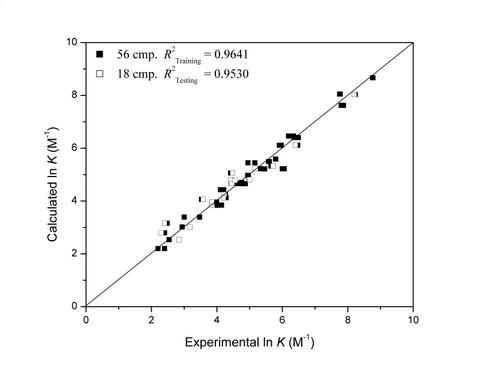
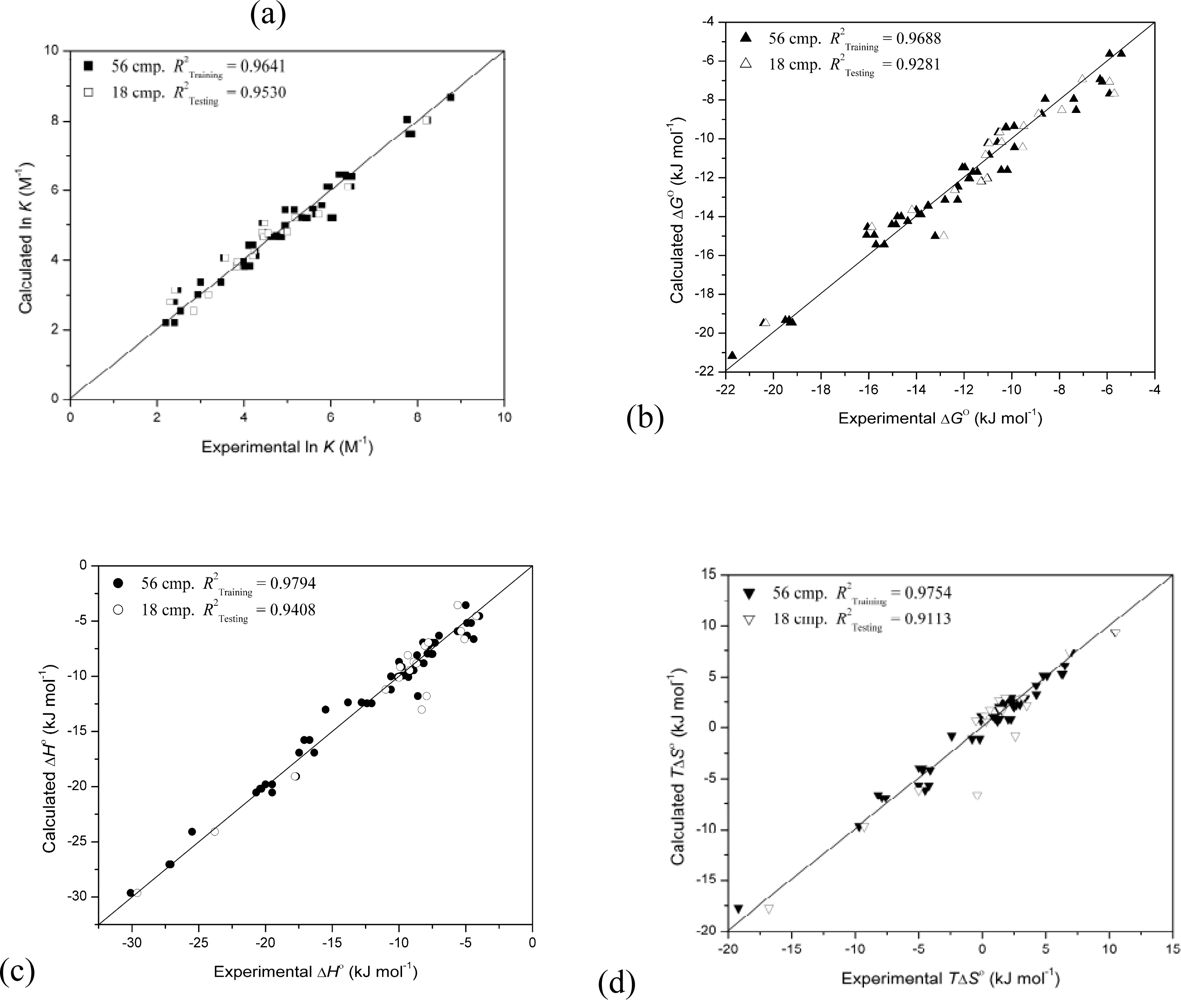
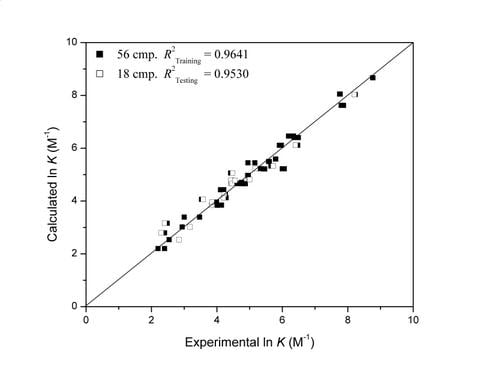
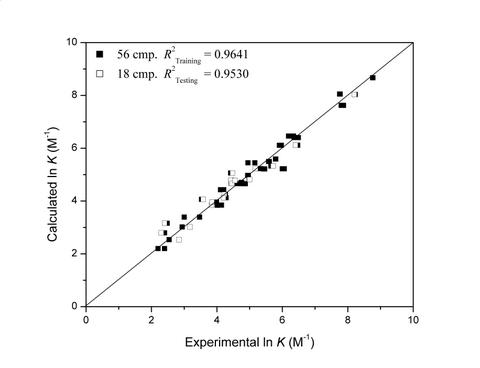
<p><xref ref-type="table" rid="t5-ijms-10-02107">Table 5</xref> presents the selected descriptors in the best prediction QSPR models. All models were developed with four 2D descriptors, which use the atoms and connection information of the molecule for the calculation. This illustrates that the molecular size and shape factors are important for the thermodynamic properties of 74 chiral compounds in 1:1 inclusion complex with β-CD. The plots of the best QSPR models with 4 features for ln <italic>K</italic>, Δ<italic>G</italic>°, Δ<italic>H</italic>° and <italic>T</italic>Δ<italic>S</italic>° by PSO-SVM integration against the experimental values are shown in <xref ref-type="fig" rid="f1-ijms-10-02107">Figure 1</xref>.</p>
<p>Even though PSO-SVM methods are not able to explain the values of descriptors in the models, the maximum outlier from the QSPR models can point out the error of the experimental data. In Δ<italic>H</italic>° and <italic>T</italic>Δ<italic>S</italic>° predictions by four features, PSO-SVM models indicate that cmp. 32 is the maximum outlier. Considering the values in <xref ref-type="table" rid="t1-ijms-10-02107">Table 1</xref>, experimental results show that Δ<italic>H</italic>° of cmp. 31 (1<italic>R</italic>, 3<italic>S</italic>-camphoric acid) and cmp. 32 (1<italic>S</italic>, 3<italic>R</italic>-camphoric acid) are −15.5 and −8.3 kJ mol<sup>−1</sup>, and <italic>T</italic>Δ<italic>S</italic>° are −8.3 and 0.4 kJ mol<sup>−1</sup>, respectively. The experimental results have different values for this enantiomeric pair, whereas the PSO-SVM models have identical results: Δ<italic>H</italic>° = −13.02 kJ mol<sup>−1</sup>and <italic>T</italic>Δ<italic>S</italic>° = −6.63 kJ mol<sup>−1</sup>.</p></sec>
<sec sec-type="conclusions">
<label>4.</label>
<title>Conclusions</title>
<p>This work demonstrated that the combination of PSO and SVMs can be applied to effectively and efficiently select major features in QSPR modeling of the thermodynamic parameters of 1:1 inclusion complexation of enantiomeric pairs of chiral guests with β-CD. This responds to the needs of drug designers for prediction of the thermodynamic parameters of new compounds in complexation with β-CD. The method was based on a discrete binary modification of PSO. The fitness function was the Pearson correlation which was curve fitted by SVMs. The modified PSO appeared to be an effective and efficient algorithm, which robustly finds near-optimal and consistent results with short computer code and simple mathematical operators, while converging rather quickly. The SVMs showed excellent performance in predicting ln <italic>K</italic>, Δ<italic>G</italic>°, Δ<italic>H</italic>° and <italic>T</italic>Δ<italic>S</italic>°, by considering major selected features. The combination of the adopted methods showed satisfactory results with the large dataset.</p></sec></body>
<back>
<ack>
<p>This work is financially supported by Thailand Research Fund (grant number RSA5080001). We are appreciative to Paul V. Neilson for carefully reading through the manuscript.</p></ack>
<ref-list>
<title>References</title>
<ref id="b1-ijms-10-02107"><label>1.</label><citation citation-type="journal"><person-group person-group-type="author"><name><surname>Szejtli</surname><given-names>J</given-names></name></person-group><article-title>Introduction and general overview of cyclodextrin chemistry</article-title><source>Chem. Rev</source><year>1998</year><volume>98</volume><fpage>1743</fpage><lpage>1754</lpage><pub-id pub-id-type="doi">10.1021/cr970022c</pub-id><pub-id pub-id-type="pmid">11848947</pub-id></citation></ref>
<ref id="b2-ijms-10-02107"><label>2.</label><citation citation-type="journal"><person-group person-group-type="author"><name><surname>Lipkowitz</surname><given-names>KB</given-names></name></person-group><article-title>Applications of computational chemistry to the study of cyclodextrins</article-title><source>Chem. Rev</source><year>1998</year><volume>98</volume><fpage>1829</fpage><lpage>1874</lpage><pub-id pub-id-type="doi">10.1021/cr9700179</pub-id><pub-id pub-id-type="pmid">11848951</pub-id></citation></ref>
<ref id="b3-ijms-10-02107"><label>3.</label><citation citation-type="journal"><person-group person-group-type="author"><name><surname>Estrada</surname><given-names>E</given-names></name><name><surname>Perdomo-Lopez</surname><given-names>I</given-names></name><name><surname>Torres-Labandeira</surname><given-names>JJ</given-names></name></person-group><article-title>Combination of 2D-, 3D-connectivity and quantum chemical descriptors in QSPR. Complexation of α- and β-cyclodextrin with benzene derivatives</article-title><source>J. Chem. Inf. Comput. Sci</source><year>2001</year><volume>41</volume><fpage>1561</fpage><lpage>1568</lpage><pub-id pub-id-type="doi">10.1021/ci0100402</pub-id><pub-id pub-id-type="pmid">11749583</pub-id></citation></ref>
<ref id="b4-ijms-10-02107"><label>4.</label><citation citation-type="journal"><person-group person-group-type="author"><name><surname>Klein</surname><given-names>CT</given-names></name><name><surname>Polheim</surname><given-names>D</given-names></name><name><surname>Viernstein</surname><given-names>H</given-names></name><name><surname>Wolschann</surname><given-names>P</given-names></name></person-group><article-title>Predicting the free energies of complexation between cyclodextrins and guest molecules: linear versus nonlinear models</article-title><source>Pharm. Res</source><year>2000</year><volume>17</volume><fpage>358</fpage><lpage>365</lpage><pub-id pub-id-type="doi">10.1023/A:1007565409407</pub-id><pub-id pub-id-type="pmid">10801226</pub-id></citation></ref>
<ref id="b5-ijms-10-02107"><label>5.</label><citation citation-type="journal"><person-group person-group-type="author"><name><surname>Klein</surname><given-names>CT</given-names></name><name><surname>Polheim</surname><given-names>D</given-names></name><name><surname>Viernstein</surname><given-names>H</given-names></name><name><surname>Wolschann</surname><given-names>P</given-names></name></person-group><article-title>A method for predicting the free energies of complexation between β-cyclodextrin and guest molecules</article-title><source>J. Incl. Phenom. Macroc. Chem</source><year>2000</year><volume>36</volume><fpage>409</fpage><lpage>423</lpage><pub-id pub-id-type="doi">10.1023/A:1008063412529</pub-id></citation></ref>
<ref id="b6-ijms-10-02107"><label>6.</label><citation citation-type="journal"><person-group person-group-type="author"><name><surname>Katritzky</surname><given-names>AR</given-names></name><name><surname>Fara</surname><given-names>DC</given-names></name><name><surname>Yang</surname><given-names>H</given-names></name><name><surname>Karelson</surname><given-names>M</given-names></name><name><surname>Suzuki</surname><given-names>T</given-names></name><name><surname>Solovev</surname><given-names>VP</given-names></name><name><surname>Varnek</surname><given-names>A</given-names></name></person-group><article-title>Quantitative structure-property relationship modeling of β-cyclodextrin complexation free energies</article-title><source>J. Chem. Inf. Comput. Sci</source><year>2004</year><volume>44</volume><fpage>529</fpage><lpage>541</lpage><pub-id pub-id-type="doi">10.1021/ci034190j</pub-id><pub-id pub-id-type="pmid">15032533</pub-id></citation></ref>
<ref id="b7-ijms-10-02107"><label>7.</label><citation citation-type="journal"><person-group person-group-type="author"><name><surname>Suzuki</surname><given-names>T</given-names></name></person-group><article-title>A nonlinear group contribution method for predicting the free energies of inclusion complexation of organic molecules with α- and β-cyclodextrins</article-title><source>J Chem Inf Comput Sci</source><year>2001</year><volume>41</volume><fpage>1266</fpage><lpage>1273</lpage><pub-id pub-id-type="doi">10.1021/ci010295f</pub-id><pub-id pub-id-type="pmid">11604026</pub-id></citation></ref>
<ref id="b8-ijms-10-02107"><label>8.</label><citation citation-type="journal"><person-group person-group-type="author"><name><surname>Suzuki</surname><given-names>T</given-names></name><name><surname>Ishida</surname><given-names>M</given-names></name><name><surname>Fabian</surname><given-names>WMF</given-names></name></person-group><article-title>Classical QSAR and comparative molecular field analyses of the host-guest interaction of organic molecules with cyclodextrins</article-title><source>J. Comput. -Aided Mol. Des</source><year>2000</year><volume>14</volume><fpage>669</fpage><lpage>678</lpage><pub-id pub-id-type="doi">10.1023/A:1008103122313</pub-id><pub-id pub-id-type="pmid">11008888</pub-id></citation></ref>
<ref id="b9-ijms-10-02107"><label>9.</label><citation citation-type="journal"><person-group person-group-type="author"><name><surname>Jimenez</surname><given-names>V</given-names></name><name><surname>Alderete</surname><given-names>JB</given-names></name></person-group><article-title>The role of charge transfer interactions in the inclusion complexation of anionic guests with α-cyclodextrins</article-title><source>Tetrahedron</source><year>2005</year><volume>61</volume><fpage>5449</fpage><lpage>5456</lpage><pub-id pub-id-type="doi">10.1016/j.tet.2005.04.001</pub-id></citation></ref>
<ref id="b10-ijms-10-02107"><label>10.</label><citation citation-type="journal"><person-group person-group-type="author"><name><surname>Lei</surname><given-names>L</given-names></name><name><surname>Wen-Guang</surname><given-names>L</given-names></name><name><surname>Qing-Xiang</surname><given-names>G</given-names></name></person-group><article-title>Association constant prediction for the inclusion of α-cyclodextrin with benzene derivatives by an artificial neural network</article-title><source>J. Incl. Phenom. Macroc. Chem</source><year>1999</year><volume>34</volume><fpage>291</fpage><lpage>298</lpage><pub-id pub-id-type="doi">10.1023/A:1008010613907</pub-id></citation></ref>
<ref id="b11-ijms-10-02107"><label>11.</label><citation citation-type="journal"><person-group person-group-type="author"><name><surname>Loukas</surname><given-names>YL</given-names></name></person-group><article-title>Quantitative structure-binding relationships QSBR, and artificial neural networks, improved predictions in drug, cyclodextrin inclusion complexes</article-title><source>J. Pharm. Sci</source><year>2001</year><volume>226</volume><fpage>207</fpage><lpage>211</lpage></citation></ref>
<ref id="b12-ijms-10-02107"><label>12.</label><citation citation-type="journal"><person-group person-group-type="author"><name><surname>Bodor</surname><given-names>N</given-names></name><name><surname>Buchwald</surname><given-names>P</given-names></name></person-group><article-title>Theoretical Insights into the formation; structure; and energetics of some cyclodextrin complexes</article-title><source>J. Incl. Phenom. Macroc. Chem</source><year>2002</year><volume>44</volume><fpage>9</fpage><lpage>14</lpage><pub-id pub-id-type="doi">10.1023/A:1023059016514</pub-id></citation></ref>
<ref id="b13-ijms-10-02107"><label>13.</label><citation citation-type="journal"><person-group person-group-type="author"><name><surname>Buchwald</surname><given-names>P</given-names></name></person-group><article-title>Complexation Thermodynamic of cyclodextrins in the framework of a molecular size-based model for nonassociative organic liquids that includes a modified hydration-shell hydrogen-bond model for water</article-title><source>J. Phys. Chem. B</source><year>2002</year><volume>106</volume><fpage>6864</fpage><lpage>6870</lpage></citation></ref>
<ref id="b14-ijms-10-02107"><label>14.</label><citation citation-type="journal"><person-group person-group-type="author"><name><surname>Faucci</surname><given-names>MT</given-names></name><name><surname>Melani</surname><given-names>F</given-names></name><name><surname>Mura</surname><given-names>P</given-names></name></person-group><article-title>Computer-aided molecular modeling techniques for predicting the stability of drug-cyclodextrin inclusion complexes in aqueous solution</article-title><source>Chem. Phys. Lett</source><year>2002</year><volume>358</volume><fpage>383</fpage><lpage>390</lpage><pub-id pub-id-type="doi">10.1016/S0009-2614(02)00410-4</pub-id></citation></ref>
<ref id="b15-ijms-10-02107"><label>15.</label><citation citation-type="journal"><person-group person-group-type="author"><name><surname>Hyunmyung</surname><given-names>K</given-names></name><name><surname>Karpjoo</surname><given-names>J</given-names></name><name><surname>Hyungwoo</surname><given-names>P</given-names></name><name><surname>Seunho</surname><given-names>J</given-names></name></person-group><article-title>Preference prediction for the stable inclusion complexes between cyclodextrins and monocyclic insoluble chemicals based on Monte Carlo docking simulations</article-title><source>J. Incl. Phenom. Macroc. Chem</source><year>2006</year><volume>54</volume><fpage>165</fpage><lpage>170</lpage><pub-id pub-id-type="doi">10.1007/s10847-005-6288-x</pub-id></citation></ref>
<ref id="b16-ijms-10-02107"><label>16.</label><citation citation-type="journal"><person-group person-group-type="author"><name><surname>Youngjin</surname><given-names>C</given-names></name><name><surname>Kum</surname><given-names>WC</given-names></name><name><surname>Karpjoo</surname><given-names>J</given-names></name><name><surname>Seung</surname><given-names>RP</given-names></name><name><surname>Seunho</surname><given-names>J</given-names></name></person-group><article-title>Computational prediction for the slopes of AL-type phase solubility curves of organic compounds complexed with α-; β-; or γ-cyclodextrins based on Monte Carlo docking simulations</article-title><source>J Incl Phenom Macroc Chem</source><year>2006</year><volume>55</volume><fpage>103</fpage><lpage>108</lpage><pub-id pub-id-type="doi">10.1007/s10847-005-9025-6</pub-id></citation></ref>
<ref id="b17-ijms-10-02107"><label>17.</label><citation citation-type="journal"><person-group person-group-type="author"><name><surname>Zhao</surname><given-names>L</given-names></name><name><surname>Orton</surname><given-names>E</given-names></name><name><surname>Vemuri</surname><given-names>NM</given-names></name></person-group><article-title>Predicting solubility in multiple nonpolar drugs-cyclodextrin system</article-title><source>J. Pharm. Sci</source><year>2002</year><volume>91</volume><fpage>2301</fpage><lpage>2306</lpage><pub-id pub-id-type="doi">10.1002/jps.10210</pub-id><pub-id pub-id-type="pmid">12379915</pub-id></citation></ref>
<ref id="b18-ijms-10-02107"><label>18.</label><citation citation-type="journal"><person-group person-group-type="author"><name><surname>Chari</surname><given-names>R</given-names></name><name><surname>Qureshi</surname><given-names>F</given-names></name><name><surname>Moschera</surname><given-names>J</given-names></name><name><surname>Tarantino</surname><given-names>R</given-names></name><name><surname>Kalonia</surname><given-names>D</given-names></name></person-group><article-title>Development of improved empirical models for estimating the binding constant of a β-cyclodextrin inclusion complex</article-title><source>Pharm. Res</source><year>2009</year><volume>26</volume><fpage>161</fpage><lpage>171</lpage><pub-id pub-id-type="doi">10.1007/s11095-008-9733-x</pub-id><pub-id pub-id-type="pmid">18843449</pub-id></citation></ref>
<ref id="b19-ijms-10-02107"><label>19.</label><citation citation-type="book"><person-group person-group-type="author"><name><surname>Kennedy</surname><given-names>J</given-names></name><name><surname>Eberhart</surname><given-names>R</given-names></name></person-group><article-title>Particle swarm optimization</article-title><source>Proceedings of IEEE International Conference on Neural Networks</source><publisher-loc>Perth, Australia</publisher-loc><year>1995</year><publisher-name>Institute of Electrical and Electronics Engineers</publisher-name><publisher-loc>Piscataway, NJ, USA</publisher-loc><year>1995</year><volume>4</volume><fpage>1942</fpage><lpage>1948</lpage></citation></ref>
<ref id="b20-ijms-10-02107"><label>20.</label><citation citation-type="book"><person-group person-group-type="author"><name><surname>Vapnik</surname><given-names>V</given-names></name></person-group><source>The Nature of Statistical Learning Theory</source><publisher-name>Springer</publisher-name><publisher-loc>New York, NY, USA</publisher-loc><year>1995</year></citation></ref>
<ref id="b21-ijms-10-02107"><label>21.</label><citation citation-type="journal"><person-group person-group-type="author"><name><surname>Lawtrakul</surname><given-names>L</given-names></name><name><surname>Prakasvudhisarn</surname><given-names>C</given-names></name></person-group><article-title>Correlation studies of HEPT derivatives using swarm intelligence and support vector machines</article-title><source>Monatsh. Chem</source><year>2005</year><volume>136</volume><fpage>1681</fpage><lpage>1691</lpage><pub-id pub-id-type="doi">10.1007/s00706-005-0357-0</pub-id></citation></ref>
<ref id="b22-ijms-10-02107"><label>22.</label><citation citation-type="book"><person-group person-group-type="author"><name><surname>Joachims</surname><given-names>T</given-names></name></person-group><article-title>Making large-scale support vector machine learning practical</article-title><source>Advances in Kernel Methods: Support Vector Learning</source><person-group person-group-type="editor"><name><surname>Schölkopf</surname><given-names>B</given-names></name><name><surname>Burges</surname><given-names>CJC</given-names></name><name><surname>Smola</surname><given-names>AJ</given-names></name></person-group><publisher-name>MIT Press</publisher-name><publisher-loc>Cambridge, Massachusetts, USA</publisher-loc><year>1999</year><fpage>169</fpage><lpage>184</lpage></citation></ref>
<ref id="b23-ijms-10-02107"><label>23.</label><citation citation-type="book"><person-group person-group-type="author"><name><surname>Platt</surname><given-names>J</given-names></name></person-group><article-title>Fast training of support vector machines using sequential minimal optimization</article-title><source>Advances in Kernel Methods: Support Vector Learning</source><person-group person-group-type="editor"><name><surname>Schölkopf</surname><given-names>B</given-names></name><name><surname>Burges</surname><given-names>CJC</given-names></name><name><surname>Smola</surname><given-names>AJ</given-names></name></person-group><publisher-name>MIT Press</publisher-name><publisher-loc>Cambridge, Massachusetts, USA</publisher-loc><year>1999</year><fpage>185</fpage><lpage>208</lpage></citation></ref>
<ref id="b24-ijms-10-02107"><label>24.</label><citation citation-type="journal"><person-group person-group-type="author"><name><surname>Sutter</surname><given-names>JM</given-names></name><name><surname>Dixon</surname><given-names>SL</given-names></name><name><surname>Jurs</surname><given-names>PC</given-names></name></person-group><article-title>Automated descriptor selection for quantitative structure-activity relationships using generalized simulated annealing</article-title><source>J. Chem. Inf. Comput. Sci</source><year>1995</year><volume>35</volume><fpage>77</fpage><lpage>84</lpage><pub-id pub-id-type="doi">10.1021/ci00023a011</pub-id></citation></ref>
<ref id="b25-ijms-10-02107"><label>25.</label><citation citation-type="journal"><person-group person-group-type="author"><name><surname>So</surname><given-names>SS</given-names></name><name><surname>Karplus</surname><given-names>M</given-names></name></person-group><article-title>Evolutionary optimization in quantitative structure – activity relationship: an application of genetic neural networks</article-title><source>J. Med. Chem</source><year>1996</year><volume>39</volume><fpage>1521</fpage><lpage>1530</lpage><pub-id pub-id-type="doi">10.1021/jm9507035</pub-id><pub-id pub-id-type="pmid">8691483</pub-id></citation></ref>
<ref id="b26-ijms-10-02107"><label>26.</label><citation citation-type="journal"><person-group person-group-type="author"><name><surname>Yasri</surname><given-names>A</given-names></name><name><surname>Hartsough</surname><given-names>D</given-names></name></person-group><article-title>Toward an optimal procedure for variable selection and QSAR model building</article-title><source>J. Chem. Inf. Comput. Sci</source><year>2001</year><volume>41</volume><fpage>1218</fpage><lpage>1227</lpage><pub-id pub-id-type="doi">10.1021/ci010291a</pub-id><pub-id pub-id-type="pmid">11604021</pub-id></citation></ref>
<ref id="b27-ijms-10-02107"><label>27.</label><citation citation-type="journal"><person-group person-group-type="author"><name><surname>Hasegawa</surname><given-names>K</given-names></name><name><surname>Miyashita</surname><given-names>Y</given-names></name><name><surname>Funatsu</surname><given-names>K</given-names></name></person-group><article-title>GA strategy for variable selection in QSAR studies: GA-based PLS analysis of calcium channel antagonists</article-title><source>J. Chem. Inf. Comput. Sci</source><year>1997</year><volume>37</volume><fpage>306</fpage><lpage>310</lpage><pub-id pub-id-type="doi">10.1021/ci960047x</pub-id><pub-id pub-id-type="pmid">9157101</pub-id></citation></ref>
<ref id="b28-ijms-10-02107"><label>28.</label><citation citation-type="journal"><person-group person-group-type="author"><name><surname>Agrafiotis</surname><given-names>DK</given-names></name><name><surname>Cedeño</surname><given-names>W</given-names></name></person-group><article-title>Feature selection for structure – activity correlation using particle swarms</article-title><source>J. Med. Chem</source><year>2002</year><volume>45</volume><fpage>1098</fpage><lpage>1107</lpage><pub-id pub-id-type="doi">10.1021/jm0104668</pub-id><pub-id pub-id-type="pmid">11855990</pub-id></citation></ref>
<ref id="b29-ijms-10-02107"><label>29.</label><citation citation-type="book"><person-group person-group-type="author"><name><surname>Eberhart</surname><given-names>RC</given-names></name><name><surname>Shi</surname><given-names>Y</given-names></name></person-group><article-title>Particle swarm optimization: developments, applications and resources</article-title><source>Proceedings of the 2001 Congress on Evolutionary Computation</source><publisher-loc>Seoul, South Korea</publisher-loc><year>2001</year><publisher-name>Institute of Electrical and Electronics Engineers</publisher-name><publisher-loc>Piscataway, NJ, USA</publisher-loc><year>2001</year><volume>1</volume><fpage>81</fpage><lpage>86</lpage></citation></ref>
<ref id="b30-ijms-10-02107"><label>30.</label><citation citation-type="journal"><person-group person-group-type="author"><name><surname>Rekharsky</surname><given-names>MV</given-names></name><name><surname>Inoue</surname><given-names>Y</given-names></name></person-group><article-title>Chiral recognition thermodynamic of β-cyclodextrin: The thermodynamic origin of enantioselectivity and the enthalpy entropy compensation effect</article-title><source>J. Am. Chem. Soc</source><year>2000</year><volume>122</volume><fpage>4418</fpage><lpage>4435</lpage><pub-id pub-id-type="doi">10.1021/ja9921118</pub-id></citation></ref>
<ref id="b31-ijms-10-02107"><label>31.</label><citation citation-type="book"><person-group person-group-type="author"><name><surname>Frisch</surname><given-names>MJ</given-names></name><name><surname>Trucks</surname><given-names>GW</given-names></name><name><surname>Schlegel</surname><given-names>HB</given-names></name><name><surname>Scuseria</surname><given-names>GE</given-names></name><name><surname>Robb</surname><given-names>MA</given-names></name><name><surname>Cheeseman</surname><given-names>JR</given-names></name><name><surname>Montgomery</surname><given-names>JA</given-names><suffix>Jr</suffix></name><name><surname>Vreven</surname><given-names>T</given-names></name><name><surname>Kudin</surname><given-names>KN</given-names></name><name><surname>Burant</surname><given-names>JC</given-names></name><name><surname>Millam</surname><given-names>JM</given-names></name><name><surname>Iyengar</surname><given-names>SS</given-names></name><name><surname>Tomasi</surname><given-names>J</given-names></name><name><surname>Barone</surname><given-names>V</given-names></name><name><surname>Mennucci</surname><given-names>B</given-names></name><name><surname>Cossi</surname><given-names>M</given-names></name><name><surname>Scalmani</surname><given-names>G</given-names></name><name><surname>Rega</surname><given-names>N</given-names></name><name><surname>Petersson</surname><given-names>GA</given-names></name><name><surname>Nakatsuji</surname><given-names>H</given-names></name><name><surname>Hada</surname><given-names>M</given-names></name><name><surname>Ehara</surname><given-names>M</given-names></name><name><surname>Toyota</surname><given-names>K</given-names></name><name><surname>Fukuda</surname><given-names>R</given-names></name><name><surname>Hasegawa</surname><given-names>J</given-names></name><name><surname>Ishida</surname><given-names>M</given-names></name><name><surname>Nakajima</surname><given-names>T</given-names></name><name><surname>Honda</surname><given-names>Y</given-names></name><name><surname>Kitao</surname><given-names>O</given-names></name><name><surname>Nakai</surname><given-names>H</given-names></name><name><surname>Klene</surname><given-names>M</given-names></name><name><surname>Li</surname><given-names>X</given-names></name><name><surname>Knox</surname><given-names>JE</given-names></name><name><surname>Hratchian</surname><given-names>HP</given-names></name><name><surname>Cross</surname><given-names>JB</given-names></name><name><surname>Bakken</surname><given-names>V</given-names></name><name><surname>Adamo</surname><given-names>C</given-names></name><name><surname>Jaramillo</surname><given-names>J</given-names></name><name><surname>Gomperts</surname><given-names>R</given-names></name><name><surname>Stratmann</surname><given-names>RE</given-names></name><name><surname>Yazyev</surname><given-names>O</given-names></name><name><surname>Austin</surname><given-names>AJ</given-names></name><name><surname>Cammi</surname><given-names>R</given-names></name><name><surname>Pomelli</surname><given-names>C</given-names></name><name><surname>Ochterski</surname><given-names>JW</given-names></name><name><surname>Ayala</surname><given-names>PY</given-names></name><name><surname>Morokuma</surname><given-names>K</given-names></name><name><surname>Voth</surname><given-names>GA</given-names></name><name><surname>Salvador</surname><given-names>P</given-names></name><name><surname>Dannenberg</surname><given-names>JJ</given-names></name><name><surname>Zakrzewski</surname><given-names>VG</given-names></name><name><surname>Dapprich</surname><given-names>S</given-names></name><name><surname>Daniels</surname><given-names>AD</given-names></name><name><surname>Strain</surname><given-names>MC</given-names></name><name><surname>Farkas</surname><given-names>O</given-names></name><name><surname>Malick</surname><given-names>DK</given-names></name><name><surname>Rabuck</surname><given-names>AD</given-names></name><name><surname>Raghavachari</surname><given-names>K</given-names></name><name><surname>Foresman</surname><given-names>JB</given-names></name><name><surname>Ortiz</surname><given-names>JV</given-names></name><name><surname>Cui</surname><given-names>Q</given-names></name><name><surname>Baboul</surname><given-names>AG</given-names></name><name><surname>Clifford</surname><given-names>S</given-names></name><name><surname>Cioslowski</surname><given-names>J</given-names></name><name><surname>Stefanov</surname><given-names>BB</given-names></name><name><surname>Liu</surname><given-names>G</given-names></name><name><surname>Liashenko</surname><given-names>A</given-names></name><name><surname>Piskorz</surname><given-names>P</given-names></name><name><surname>Komaromi</surname><given-names>I</given-names></name><name><surname>Martin</surname><given-names>RL</given-names></name><name><surname>Fox</surname><given-names>DJ</given-names></name><name><surname>Keith</surname><given-names>T</given-names></name><name><surname>Al-Laham</surname><given-names>MA</given-names></name><name><surname>Peng</surname><given-names>CY</given-names></name><name><surname>Nanayakkara</surname><given-names>A</given-names></name><name><surname>Challacombe</surname><given-names>M</given-names></name><name><surname>Gill</surname><given-names>PMW</given-names></name><name><surname>Johnson</surname><given-names>B</given-names></name><name><surname>Chen</surname><given-names>W</given-names></name><name><surname>Wong</surname><given-names>MW</given-names></name><name><surname>Gonzalez</surname><given-names>C</given-names></name><name><surname>Pople</surname><given-names>JA</given-names></name></person-group><article-title>Gaussian 03</article-title><publisher-name>Gaussian, Inc</publisher-name><publisher-loc>Wallingford, CT, USA</publisher-loc><year>2004</year></citation></ref>
<ref id="b32-ijms-10-02107"><label>32.</label><citation citation-type="book"><person-group person-group-type="author"><collab>Molecular Operating Environment (MOE)</collab></person-group><publisher-name>Chemical Computing Group, Inc.</publisher-name><publisher-loc>Montreal, Quebec, Canada</publisher-loc><year>2005</year>Available online: <ext-link xlink:href="http://www.chemcomp.com" ext-link-type="uri">http://www.chemcomp.com</ext-link> (accessed Jul. 31, 2008).</citation></ref>
<ref id="b33-ijms-10-02107"><label>33.</label><citation citation-type="book"><person-group person-group-type="author"><name><surname>Lawtrakul</surname><given-names>L</given-names></name><name><surname>Wolschann</surname><given-names>P</given-names></name><name><surname>Prakasvudhisarn</surname><given-names>C</given-names></name></person-group><article-title>Predicting complexation thermodynamic of β-cyclodextrin with enantiomeric pairs of chiral guests by using swarm intelligence and support vector machines</article-title><source>Proceedings of the 14th International Cyclodextrins Symposium</source><publisher-loc>Kyoto, Japan</publisher-loc><year>2008</year><publisher-name>The Society of Cyclodextrins, Japan</publisher-name><publisher-loc>Tokyo, Japan</publisher-loc><year>2008</year><fpage>421</fpage><lpage>424</lpage></citation></ref></ref-list>
<sec sec-type="display-objects">
<title>Figure and Tables</title>
<fig id="f1-ijms-10-02107" position="float">
<label>Figure 1.</label>
<caption>
<p>Plots of calculated thermodynamic parameters by PSO-SVM with Gaussian RBF kernel models with 4 features, <italic>versus</italic> the experimental values: (a) complex stability constant (ln <italic>K</italic>), (b) standard free energy (Δ<italic>G</italic>°), (c) enthalpy (Δ<italic>H</italic>°) and (d) entropy change (<italic>T</italic>Δ<italic>S</italic>°).</p></caption>
<graphic xlink:href="ijms-10-02107f1.gif"/></fig>
<table-wrap id="t1-ijms-10-02107" position="float">
<label>Table 1.</label>
<caption>
<p>Experimental Thermodynamic parameters: ln <italic>K</italic> (M<sup>−1</sup>), Δ<italic>G</italic>° (kJ mol<sup>−1</sup>), Δ<italic>H</italic>° (kJ mol<sup>−1</sup>) and <italic>T</italic>Δ<italic>S</italic>° (kJ mol<sup>−1</sup>) of 74 chiral compounds in 1:1 inclusion complexation with β-CD taken from Ref. [<xref ref-type="bibr" rid="b30-ijms-10-02107">30</xref>] and the values from the best prediction QSPR models with four features.</p></caption>
<table frame="hsides" rules="groups">
<thead>
<tr>
<th valign="middle" align="left" rowspan="3"><bold>cmp</bold></th>
<th valign="middle" align="center" rowspan="3"><bold>guest</bold></th>
<th valign="bottom" align="center" colspan="4"><bold>Experimental</bold></th>
<th valign="bottom" align="center" colspan="4"><bold>Calculation</bold> <italic><xref ref-type="table-fn" rid="tfn2-ijms-10-02107"><sup>b</sup></xref></italic></th></tr>
<tr>
<th colspan="8" valign="bottom" align="center">
<hr/></th></tr>
<tr>
<th valign="bottom" align="center"><bold>ln <italic>K</italic></bold></th>
<th valign="bottom" align="center"><bold>Δ<italic>G°</italic></bold></th>
<th valign="bottom" align="center"><bold>Δ<italic>H°</italic></bold></th>
<th valign="bottom" align="center"><bold><italic>T</italic>Δ<italic>S°</italic></bold></th>
<th valign="bottom" align="center"><bold>ln <italic>K</italic></bold></th>
<th valign="bottom" align="center"><bold>Δ<italic>G°</italic></bold></th>
<th valign="bottom" align="center"><bold>Δ<italic>H°</italic></bold></th>
<th valign="bottom" align="center"><bold><italic>T</italic>Δ<italic>S°</italic></bold></th></tr></thead>
<tbody>
<tr>
<td valign="top" align="left">1</td>
<td valign="top" align="left"><italic>N-</italic>acetyl-D-phenylalanine</td>
<td valign="top" align="right">4.11</td>
<td valign="top" align="right">−10.18</td>
<td valign="top" align="right">−8.14</td>
<td valign="top" align="right">2.04</td>
<td valign="top" align="right">4.43</td>
<td valign="top" align="right">−11.61</td>
<td valign="top" align="right">−8.82</td>
<td valign="top" align="right">0.78</td></tr>
<tr>
<td valign="top" align="left">2</td>
<td valign="top" align="left"><italic>N-</italic>acetyl-L-phenylalanine</td>
<td valign="top" align="right">4.21</td>
<td valign="top" align="right">−10.44</td>
<td valign="top" align="right">−8.17</td>
<td valign="top" align="right">2.27</td>
<td valign="top" align="right">4.43</td>
<td valign="top" align="right">−11.61</td>
<td valign="top" align="right">−8.82</td>
<td valign="top" align="right">0.78</td></tr>
<tr>
<td valign="top" align="left">3</td>
<td valign="top" align="left"><italic>N-</italic>acetyl-D-tryptophan</td>
<td valign="top" align="right">2.54</td>
<td valign="top" align="right">−6.30</td>
<td valign="top" align="right">−25.50</td>
<td valign="top" align="right">−19.20</td>
<td valign="top" align="right">2.54</td>
<td valign="top" align="right">−6.94</td>
<td valign="top" align="right">−24.09</td>
<td valign="top" align="right">−17.72</td></tr>
<tr>
<td valign="top" align="left">4<italic><xref ref-type="table-fn" rid="tfn1-ijms-10-02107"><sup>a</sup></xref></italic></td>
<td valign="top" align="left"><italic>N-</italic>acetyl-L-tryptophan</td>
<td valign="top" align="right">2.84</td>
<td valign="top" align="right">−7.04</td>
<td valign="top" align="right">−23.80</td>
<td valign="top" align="right">−16.80</td>
<td valign="top" align="right">2.54</td>
<td valign="top" align="right">−6.94</td>
<td valign="top" align="right">−24.09</td>
<td valign="top" align="right">−17.72</td></tr>
<tr>
<td valign="top" align="left">5</td>
<td valign="top" align="left"><italic>N-</italic>acetyl-D-tyrosine</td>
<td valign="top" align="right">4.83</td>
<td valign="top" align="right">−11.97</td>
<td valign="top" align="right">−16.70</td>
<td valign="top" align="right">−4.70</td>
<td valign="top" align="right">4.65</td>
<td valign="top" align="right">−11.48</td>
<td valign="top" align="right">−15.77</td>
<td valign="top" align="right">−3.92</td></tr>
<tr>
<td valign="top" align="left">6</td>
<td valign="top" align="left"><italic>N-</italic>acetyl-L-tyrosine</td>
<td valign="top" align="right">4.87</td>
<td valign="top" align="right">−12.07</td>
<td valign="top" align="right">−17.10</td>
<td valign="top" align="right">−5.00</td>
<td valign="top" align="right">4.65</td>
<td valign="top" align="right">−11.48</td>
<td valign="top" align="right">−15.77</td>
<td valign="top" align="right">−3.92</td></tr>
<tr>
<td valign="top" align="left">7</td>
<td valign="top" align="left">(1<italic>R</italic>,2<italic>S</italic>)-2-amino-1,2-diphenylethanol</td>
<td valign="top" align="right">4.01</td>
<td valign="top" align="right">−9.90</td>
<td valign="top" align="right">−10.00</td>
<td valign="top" align="right">−0.10</td>
<td valign="top" align="right">3.84</td>
<td valign="top" align="right">−9.35</td>
<td valign="top" align="right">−10.11</td>
<td valign="top" align="right">0.65</td></tr>
<tr>
<td valign="top" align="left">8<italic><xref ref-type="table-fn" rid="tfn1-ijms-10-02107"><sup>a</sup></xref></italic></td>
<td valign="top" align="left">(1<italic>S</italic>,2<italic>R</italic>)-2-amino-1,2-diphenylethanol</td>
<td valign="top" align="right">3.83</td>
<td valign="top" align="right">−9.50</td>
<td valign="top" align="right">−10.00</td>
<td valign="top" align="right">−0.50</td>
<td valign="top" align="right">3.84</td>
<td valign="top" align="right">−9.35</td>
<td valign="top" align="right">−10.11</td>
<td valign="top" align="right">0.65</td></tr>
<tr>
<td valign="top" align="left">9</td>
<td valign="top" align="left">(<italic>R</italic>)-benzyl glycidyl ether</td>
<td valign="top" align="right">5.46</td>
<td valign="top" align="right">−13.52</td>
<td valign="top" align="right">−9.20</td>
<td valign="top" align="right">4.30</td>
<td valign="top" align="right">5.21</td>
<td valign="top" align="right">−13.45</td>
<td valign="top" align="right">−9.58</td>
<td valign="top" align="right">4.22</td></tr>
<tr>
<td valign="top" align="left">10</td>
<td valign="top" align="left">(<italic>S</italic>)-benzyl glycidyl ether</td>
<td valign="top" align="right">5.43</td>
<td valign="top" align="right">−13.50</td>
<td valign="top" align="right">−9.30</td>
<td valign="top" align="right">4.20</td>
<td valign="top" align="right">5.21</td>
<td valign="top" align="right">−13.45</td>
<td valign="top" align="right">−9.58</td>
<td valign="top" align="right">4.22</td></tr>
<tr>
<td valign="top" align="left">11</td>
<td valign="top" align="left">2,3-<italic>O</italic>-benzylidene-D-threitol</td>
<td valign="top" align="right">4.76</td>
<td valign="top" align="right">−11.81</td>
<td valign="top" align="right">−7.56</td>
<td valign="top" align="right">4.25</td>
<td valign="top" align="right">4.70</td>
<td valign="top" align="right">−12.05</td>
<td valign="top" align="right">−7.98</td>
<td valign="top" align="right">3.30</td></tr>
<tr>
<td valign="top" align="left">12</td>
<td valign="top" align="left">2,3-<italic>O</italic>-benzylidene-L-threitol</td>
<td valign="top" align="right">4.74</td>
<td valign="top" align="right">−11.76</td>
<td valign="top" align="right">−7.49</td>
<td valign="top" align="right">4.27</td>
<td valign="top" align="right">4.70</td>
<td valign="top" align="right">−12.05</td>
<td valign="top" align="right">−7.98</td>
<td valign="top" align="right">3.30</td></tr>
<tr>
<td valign="top" align="left">13<italic><xref ref-type="table-fn" rid="tfn1-ijms-10-02107"><sup>a</sup></xref></italic></td>
<td valign="top" align="left">(2<italic>R</italic>,3<italic>R</italic>)-3-benzyloxy-1,2,4-butanetriol</td>
<td valign="top" align="right">4.42</td>
<td valign="top" align="right">−10.95</td>
<td valign="top" align="right">−8.07</td>
<td valign="top" align="right">2.90</td>
<td valign="top" align="right">4.79</td>
<td valign="top" align="right">−10.23</td>
<td valign="top" align="right">−7.23</td>
<td valign="top" align="right">2.90</td></tr>
<tr>
<td valign="top" align="left">14</td>
<td valign="top" align="left">(2<italic>S</italic>,3<italic>S</italic>)-3-benzyloxy-1,2,4-butanetriol</td>
<td valign="top" align="right">4.44</td>
<td valign="top" align="right">−11.01</td>
<td valign="top" align="right">−7.79</td>
<td valign="top" align="right">3.20</td>
<td valign="top" align="right">4.79</td>
<td valign="top" align="right">−10.23</td>
<td valign="top" align="right">−7.23</td>
<td valign="top" align="right">2.90</td></tr>
<tr>
<td valign="top" align="left">15</td>
<td valign="top" align="left"><italic>O</italic>-benzyl-D-serine</td>
<td valign="top" align="right">4.26</td>
<td valign="top" align="right">−10.57</td>
<td valign="top" align="right">−8.90</td>
<td valign="top" align="right">1.70</td>
<td valign="top" align="right">4.25</td>
<td valign="top" align="right">−9.67</td>
<td valign="top" align="right">−9.46</td>
<td valign="top" align="right">2.74</td></tr>
<tr>
<td valign="top" align="left">16<italic><xref ref-type="table-fn" rid="tfn1-ijms-10-02107"><sup>a</sup></xref></italic></td>
<td valign="top" align="left"><italic>O</italic>-benzyl-L-serine</td>
<td valign="top" align="right">4.23</td>
<td valign="top" align="right">−10.50</td>
<td valign="top" align="right">−9.20</td>
<td valign="top" align="right">1.30</td>
<td valign="top" align="right">4.25</td>
<td valign="top" align="right">−9.67</td>
<td valign="top" align="right">−9.46</td>
<td valign="top" align="right">2.74</td></tr>
<tr>
<td valign="top" align="left">17</td>
<td valign="top" align="left"><italic>N-t-</italic>Boc-D-alanine</td>
<td valign="top" align="right">5.97</td>
<td valign="top" align="right">−14.80</td>
<td valign="top" align="right">−9.70</td>
<td valign="top" align="right">5.10</td>
<td valign="top" align="right">6.11</td>
<td valign="top" align="right">−14.00</td>
<td valign="top" align="right">−9.94</td>
<td valign="top" align="right">5.16</td></tr>
<tr>
<td valign="top" align="left">18</td>
<td valign="top" align="left"><italic>N-t-</italic>Boc-L-alanine</td>
<td valign="top" align="right">5.91</td>
<td valign="top" align="right">−14.64</td>
<td valign="top" align="right">−9.80</td>
<td valign="top" align="right">4.80</td>
<td valign="top" align="right">6.11</td>
<td valign="top" align="right">−14.00</td>
<td valign="top" align="right">−9.94</td>
<td valign="top" align="right">5.16</td></tr>
<tr>
<td valign="top" align="left">19</td>
<td valign="top" align="left"><italic>N-t-</italic>Boc-D-alanine methyl ester</td>
<td valign="top" align="right">6.49</td>
<td valign="top" align="right">−16.09</td>
<td valign="top" align="right">−13.82</td>
<td valign="top" align="right">2.30</td>
<td valign="top" align="right">6.40</td>
<td valign="top" align="right">−14.95</td>
<td valign="top" align="right">−12.37</td>
<td valign="top" align="right">2.43</td></tr>
<tr>
<td valign="top" align="left">20</td>
<td valign="top" align="left"><italic>N-t-</italic>Boc-L-alanine methyl ester</td>
<td valign="top" align="right">6.36</td>
<td valign="top" align="right">−15.77</td>
<td valign="top" align="right">−12.80</td>
<td valign="top" align="right">3.00</td>
<td valign="top" align="right">6.40</td>
<td valign="top" align="right">−14.95</td>
<td valign="top" align="right">−12.37</td>
<td valign="top" align="right">2.43</td></tr>
<tr>
<td valign="top" align="left">21<italic><xref ref-type="table-fn" rid="tfn1-ijms-10-02107"><sup>a</sup></xref></italic></td>
<td valign="top" align="left"><italic>N-t-</italic>Boc-D-serine</td>
<td valign="top" align="right">5.72</td>
<td valign="top" align="right">−14.19</td>
<td valign="top" align="right">−11.00</td>
<td valign="top" align="right">3.20</td>
<td valign="top" align="right">5.33</td>
<td valign="top" align="right">−13.67</td>
<td valign="top" align="right">−11.20</td>
<td valign="top" align="right">2.95</td></tr>
<tr>
<td valign="top" align="left">22</td>
<td valign="top" align="left"><italic>N-t-</italic>Boc-L-serine</td>
<td valign="top" align="right">5.65</td>
<td valign="top" align="right">−14.01</td>
<td valign="top" align="right">−10.60</td>
<td valign="top" align="right">3.40</td>
<td valign="top" align="right">5.33</td>
<td valign="top" align="right">−13.67</td>
<td valign="top" align="right">−11.20</td>
<td valign="top" align="right">2.95</td></tr>
<tr>
<td valign="top" align="left">23</td>
<td valign="top" align="left">(<italic>R</italic>)-3-bromo-8-camphorsulfonic acid</td>
<td valign="top" align="right">8.23</td>
<td valign="top" align="right">−20.41</td>
<td valign="top" align="right">−30.10</td>
<td valign="top" align="right">−9.70</td>
<td valign="top" align="right">8.03</td>
<td valign="top" align="right">−19.49</td>
<td valign="top" align="right">−29.63</td>
<td valign="top" align="right">−9.67</td></tr>
<tr>
<td valign="top" align="left">24<italic><xref ref-type="table-fn" rid="tfn1-ijms-10-02107"><sup>a</sup></xref></italic></td>
<td valign="top" align="left"><italic>(S)</italic>-3-bromo-8-camphorsulfonic acid</td>
<td valign="top" align="right">8.20</td>
<td valign="top" align="right">−20.32</td>
<td valign="top" align="right">−29.60</td>
<td valign="top" align="right">−9.30</td>
<td valign="top" align="right">8.03</td>
<td valign="top" align="right">−19.49</td>
<td valign="top" align="right">−29.63</td>
<td valign="top" align="right">−9.67</td></tr>
<tr>
<td valign="top" align="left">25</td>
<td valign="top" align="left">(<italic>R</italic>)-3-bromo-2-methyl-1 propanol</td>
<td valign="top" align="right">4.96</td>
<td valign="top" align="right">−12.29</td>
<td valign="top" align="right">−9.30</td>
<td valign="top" align="right">3.00</td>
<td valign="top" align="right">4.97</td>
<td valign="top" align="right">−12.47</td>
<td valign="top" align="right">−10.07</td>
<td valign="top" align="right">2.65</td></tr>
<tr>
<td valign="top" align="left">26</td>
<td valign="top" align="left">(<italic>S</italic>)-3-bromo-2-methyl-1 propanol</td>
<td valign="top" align="right">4.94</td>
<td valign="top" align="right">−12.25</td>
<td valign="top" align="right">−10.10</td>
<td valign="top" align="right">2.20</td>
<td valign="top" align="right">4.97</td>
<td valign="top" align="right">−12.47</td>
<td valign="top" align="right">−10.07</td>
<td valign="top" align="right">2.65</td></tr>
<tr>
<td valign="top" align="left">27</td>
<td valign="top" align="left">(<italic>R</italic>)-3-bromo-2-methylpropionic acid methyl ester</td>
<td valign="top" align="right">5.58</td>
<td valign="top" align="right">−13.80</td>
<td valign="top" align="right">−12.05</td>
<td valign="top" align="right">1.80</td>
<td valign="top" align="right">5.50</td>
<td valign="top" align="right">−13.90</td>
<td valign="top" align="right">−12.45</td>
<td valign="top" align="right">2.40</td></tr>
<tr>
<td valign="top" align="left">28</td>
<td valign="top" align="left">(<italic>S</italic>)-3-bromo-2-methylpropionic acid methyl ester</td>
<td valign="top" align="right">5.60</td>
<td valign="top" align="right">−13.90</td>
<td valign="top" align="right">−12.40</td>
<td valign="top" align="right">1.50</td>
<td valign="top" align="right">5.50</td>
<td valign="top" align="right">−13.90</td>
<td valign="top" align="right">−12.45</td>
<td valign="top" align="right">2.40</td></tr>
<tr>
<td valign="top" align="left">29<italic><xref ref-type="table-fn" rid="tfn1-ijms-10-02107"><sup>a</sup></xref></italic></td>
<td valign="top" align="left">(<italic>R</italic>)-camphanic acid</td>
<td valign="top" align="right">5.18</td>
<td valign="top" align="right">−12.85</td>
<td valign="top" align="right">−17.80</td>
<td valign="top" align="right">−5.00</td>
<td valign="top" align="right">5.23</td>
<td valign="top" align="right">−15.01</td>
<td valign="top" align="right">−19.07</td>
<td valign="top" align="right">−6.17</td></tr>
<tr>
<td valign="top" align="left">30</td>
<td valign="top" align="left">(<italic>S</italic>)-camphanic acid</td>
<td valign="top" align="right">5.33</td>
<td valign="top" align="right">−13.22</td>
<td valign="top" align="right">−17.70</td>
<td valign="top" align="right">−4.50</td>
<td valign="top" align="right">5.23</td>
<td valign="top" align="right">−15.01</td>
<td valign="top" align="right">−19.07</td>
<td valign="top" align="right">−6.17</td></tr>
<tr>
<td valign="top" align="left">31</td>
<td valign="top" align="left">(1<italic>R</italic>,3<italic>S</italic>)-camphoric acid</td>
<td valign="top" align="right">2.94</td>
<td valign="top" align="right">−7.30</td>
<td valign="top" align="right">−15.50</td>
<td valign="top" align="right">−8.20</td>
<td valign="top" align="right">3.02</td>
<td valign="top" align="right">−8.52</td>
<td valign="top" align="right">−13.02</td>
<td valign="top" align="right">−6.63</td></tr>
<tr>
<td valign="top" align="left">32<italic><xref ref-type="table-fn" rid="tfn1-ijms-10-02107"><sup>a</sup></xref></italic></td>
<td valign="top" align="left">(1<italic>S</italic>,3<italic>R</italic>)-camphoric acid</td>
<td valign="top" align="right">3.18</td>
<td valign="top" align="right">−7.90</td>
<td valign="top" align="right">−8.30</td>
<td valign="top" align="right">−0.40</td>
<td valign="top" align="right">3.02</td>
<td valign="top" align="right">−8.52</td>
<td valign="top" align="right">−13.02</td>
<td valign="top" align="right">−6.63</td></tr>
<tr>
<td valign="top" align="left">33</td>
<td valign="top" align="left">(<italic>R</italic>)-camphorquinone-3-oxime</td>
<td valign="top" align="right">7.87</td>
<td valign="top" align="right">−19.50</td>
<td valign="top" align="right">−27.10</td>
<td valign="top" align="right">−7.60</td>
<td valign="top" align="right">7.62</td>
<td valign="top" align="right">−19.33</td>
<td valign="top" align="right">−27.04</td>
<td valign="top" align="right">−6.91</td></tr>
<tr>
<td valign="top" align="left">34</td>
<td valign="top" align="left">(<italic>S</italic>)-camphorquinone-3-oxime</td>
<td valign="top" align="right">7.80</td>
<td valign="top" align="right">−19.34</td>
<td valign="top" align="right">−27.20</td>
<td valign="top" align="right">−7.90</td>
<td valign="top" align="right">7.62</td>
<td valign="top" align="right">−19.33</td>
<td valign="top" align="right">−27.04</td>
<td valign="top" align="right">−6.91</td></tr>
<tr>
<td valign="top" align="left">35</td>
<td valign="top" align="left">(<italic>R</italic>)-10-camphorsulfonic acid</td>
<td valign="top" align="right">6.34</td>
<td valign="top" align="right">−15.70</td>
<td valign="top" align="right">−20.70</td>
<td valign="top" align="right">−5.00</td>
<td valign="top" align="right">6.46</td>
<td valign="top" align="right">−15.44</td>
<td valign="top" align="right">−20.53</td>
<td valign="top" align="right">−5.74</td></tr>
<tr>
<td valign="top" align="left">36</td>
<td valign="top" align="left">(<italic>S</italic>)-10-camphorsulfonic acid</td>
<td valign="top" align="right">6.19</td>
<td valign="top" align="right">−15.35</td>
<td valign="top" align="right">−19.50</td>
<td valign="top" align="right">−4.20</td>
<td valign="top" align="right">6.46</td>
<td valign="top" align="right">−15.44</td>
<td valign="top" align="right">−20.53</td>
<td valign="top" align="right">−5.74</td></tr>
<tr>
<td valign="top" align="left">37<italic><xref ref-type="table-fn" rid="tfn1-ijms-10-02107"><sup>a</sup></xref></italic></td>
<td valign="top" align="left"><italic>N-</italic>Cbz-D-alanine</td>
<td valign="top" align="right">5.00</td>
<td valign="top" align="right">−12.40</td>
<td valign="top" align="right">−8.90</td>
<td valign="top" align="right">3.50</td>
<td valign="top" align="right">4.81</td>
<td valign="top" align="right">−12.64</td>
<td valign="top" align="right">−8.69</td>
<td valign="top" align="right">2.17</td></tr>
<tr>
<td valign="top" align="left">38</td>
<td valign="top" align="left"><italic>N-</italic>Cbz-L-alanine</td>
<td valign="top" align="right">4.99</td>
<td valign="top" align="right">−12.37</td>
<td valign="top" align="right">−10.00</td>
<td valign="top" align="right">2.40</td>
<td valign="top" align="right">4.81</td>
<td valign="top" align="right">−12.64</td>
<td valign="top" align="right">−8.69</td>
<td valign="top" align="right">2.17</td></tr>
<tr>
<td valign="top" align="left">39</td>
<td valign="top" align="left">(1<italic>R</italic>,2<italic>R</italic>)-<italic>trans</italic>-1,2-cyclohexanediol</td>
<td valign="top" align="right">4.44</td>
<td valign="top" align="right">−11.01</td>
<td valign="top" align="right">−3.98</td>
<td valign="top" align="right">7.03</td>
<td valign="top" align="right">4.66</td>
<td valign="top" align="right">−12.04</td>
<td valign="top" align="right">−4.54</td>
<td valign="top" align="right">7.43</td></tr>
<tr>
<td valign="top" align="left">40<italic><xref ref-type="table-fn" rid="tfn1-ijms-10-02107"><sup>a</sup></xref></italic></td>
<td valign="top" align="left">(1<italic>S</italic>,2<italic>S</italic>)-<italic>trans</italic>-1,2-cyclohexanediol</td>
<td valign="top" align="right">4.45</td>
<td valign="top" align="right">−11.04</td>
<td valign="top" align="right">−4.21</td>
<td valign="top" align="right">6.83</td>
<td valign="top" align="right">4.66</td>
<td valign="top" align="right">−12.04</td>
<td valign="top" align="right">−4.54</td>
<td valign="top" align="right">7.43</td></tr>
<tr>
<td valign="top" align="left">41</td>
<td valign="top" align="left">(<italic>R</italic>)-1-cyclohexylethylamine</td>
<td valign="top" align="right">5.80</td>
<td valign="top" align="right">−14.37</td>
<td valign="top" align="right">−7.85</td>
<td valign="top" align="right">6.50</td>
<td valign="top" align="right">5.59</td>
<td valign="top" align="right">−14.24</td>
<td valign="top" align="right">−7.94</td>
<td valign="top" align="right">6.15</td></tr>
<tr>
<td valign="top" align="left">42</td>
<td valign="top" align="left">(<italic>S</italic>)-1-cyclohexylethylamine</td>
<td valign="top" align="right">5.79</td>
<td valign="top" align="right">−14.36</td>
<td valign="top" align="right">−7.87</td>
<td valign="top" align="right">6.50</td>
<td valign="top" align="right">5.59</td>
<td valign="top" align="right">−14.24</td>
<td valign="top" align="right">−7.94</td>
<td valign="top" align="right">6.15</td></tr>
<tr>
<td valign="top" align="left">43</td>
<td valign="top" align="left"><italic>O</italic>,<italic>O</italic>'-dibenzoyl-D-tartaric acid</td>
<td valign="top" align="right">3.47</td>
<td valign="top" align="right">−8.60</td>
<td valign="top" align="right">−7.00</td>
<td valign="top" align="right">1.60</td>
<td valign="top" align="right">3.39</td>
<td valign="top" align="right">−7.95</td>
<td valign="top" align="right">−6.32</td>
<td valign="top" align="right">2.02</td></tr>
<tr>
<td valign="top" align="left">44</td>
<td valign="top" align="left"><italic>O</italic>,<italic>O</italic>'-dibenzoyl-L-tartaric acid</td>
<td valign="top" align="right">3.00</td>
<td valign="top" align="right">−7.40</td>
<td valign="top" align="right">−4.90</td>
<td valign="top" align="right">2.50</td>
<td valign="top" align="right">3.39</td>
<td valign="top" align="right">−7.95</td>
<td valign="top" align="right">−6.32</td>
<td valign="top" align="right">2.02</td></tr>
<tr>
<td valign="top" align="left">45<italic><xref ref-type="table-fn" rid="tfn1-ijms-10-02107"><sup>a</sup></xref></italic></td>
<td valign="top" align="left">Gly-D-Phe</td>
<td valign="top" align="right">3.85</td>
<td valign="top" align="right">−9.54</td>
<td valign="top" align="right">−7.93</td>
<td valign="top" align="right">1.60</td>
<td valign="top" align="right">3.96</td>
<td valign="top" align="right">−10.44</td>
<td valign="top" align="right">−11.79</td>
<td valign="top" align="right">1.74</td></tr>
<tr>
<td valign="top" align="left">46</td>
<td valign="top" align="left">Gly-L-Phe</td>
<td valign="top" align="right">3.99</td>
<td valign="top" align="right">−9.89</td>
<td valign="top" align="right">−8.59</td>
<td valign="top" align="right">1.30</td>
<td valign="top" align="right">3.96</td>
<td valign="top" align="right">−10.44</td>
<td valign="top" align="right">−11.79</td>
<td valign="top" align="right">1.74</td></tr>
<tr>
<td valign="top" align="left">47</td>
<td valign="top" align="left">(<italic>R</italic>)-hexahydromandelic acid</td>
<td valign="top" align="right">6.47</td>
<td valign="top" align="right">−16.05</td>
<td valign="top" align="right">−5.61</td>
<td valign="top" align="right">10.44</td>
<td valign="top" align="right">6.11</td>
<td valign="top" align="right">−14.54</td>
<td valign="top" align="right">−5.92</td>
<td valign="top" align="right">9.37</td></tr>
<tr>
<td valign="top" align="left">48<italic><xref ref-type="table-fn" rid="tfn1-ijms-10-02107"><sup>a</sup></xref></italic></td>
<td valign="top" align="left">(<italic>S</italic>)-hexahydromandelic acid</td>
<td valign="top" align="right">6.40</td>
<td valign="top" align="right">−15.87</td>
<td valign="top" align="right">−5.36</td>
<td valign="top" align="right">10.51</td>
<td valign="top" align="right">6.11</td>
<td valign="top" align="right">−14.54</td>
<td valign="top" align="right">−5.92</td>
<td valign="top" align="right">9.37</td></tr>
<tr>
<td valign="top" align="left">49</td>
<td valign="top" align="left">(1<italic>R</italic>,2<italic>R</italic>,5<italic>R</italic>)-2-hydroxy-3-pipanone</td>
<td valign="top" align="right">7.77</td>
<td valign="top" align="right">−19.30</td>
<td valign="top" align="right">−19.50</td>
<td valign="top" align="right">−0.20</td>
<td valign="top" align="right">8.05</td>
<td valign="top" align="right">−19.47</td>
<td valign="top" align="right">−19.79</td>
<td valign="top" align="right">−1.12</td></tr>
<tr>
<td valign="top" align="left">50</td>
<td valign="top" align="left">(1<italic>S</italic>,2<italic>S</italic>,5<italic>S</italic>)-2-hydroxy-3-pipanone</td>
<td valign="top" align="right">7.75</td>
<td valign="top" align="right">−19.20</td>
<td valign="top" align="right">−20.00</td>
<td valign="top" align="right">−0.80</td>
<td valign="top" align="right">8.05</td>
<td valign="top" align="right">−19.47</td>
<td valign="top" align="right">−19.79</td>
<td valign="top" align="right">−1.12</td></tr>
<tr>
<td valign="top" align="left">51</td>
<td valign="top" align="left">(<italic>R</italic>)-mandelic acid</td>
<td valign="top" align="right">2.40</td>
<td valign="top" align="right">−5.90</td>
<td valign="top" align="right">−4.90</td>
<td valign="top" align="right">1.00</td>
<td valign="top" align="right">2.20</td>
<td valign="top" align="right">−5.63</td>
<td valign="top" align="right">−5.17</td>
<td valign="top" align="right">1.11</td></tr>
<tr>
<td valign="top" align="left">52</td>
<td valign="top" align="left">(<italic>S</italic>)-mandelic acid</td>
<td valign="top" align="right">2.20</td>
<td valign="top" align="right">−5.40</td>
<td valign="top" align="right">−4.60</td>
<td valign="top" align="right">0.80</td>
<td valign="top" align="right">2.20</td>
<td valign="top" align="right">−5.63</td>
<td valign="top" align="right">−5.17</td>
<td valign="top" align="right">1.11</td></tr>
<tr>
<td valign="top" align="left">53<italic><xref ref-type="table-fn" rid="tfn1-ijms-10-02107"><sup>a</sup></xref></italic></td>
<td valign="top" align="left">(<italic>R</italic>)-mandelic acid methyl ester</td>
<td valign="top" align="right">4.20</td>
<td valign="top" align="right">−10.42</td>
<td valign="top" align="right">−7.80</td>
<td valign="top" align="right">2.60</td>
<td valign="top" align="right">4.13</td>
<td valign="top" align="right">−10.17</td>
<td valign="top" align="right">−6.94</td>
<td valign="top" align="right">−0.86</td></tr>
<tr>
<td valign="top" align="left">54</td>
<td valign="top" align="left">(<italic>S</italic>)-mandelic acid methyl ester</td>
<td valign="top" align="right">4.28</td>
<td valign="top" align="right">−10.60</td>
<td valign="top" align="right">−8.20</td>
<td valign="top" align="right">−2.40</td>
<td valign="top" align="right">4.13</td>
<td valign="top" align="right">−10.17</td>
<td valign="top" align="right">−6.94</td>
<td valign="top" align="right">−0.86</td></tr>
<tr>
<td valign="top" align="left">55</td>
<td valign="top" align="left">(<italic>R</italic>)-α-methoxyphenylacetic acid</td>
<td valign="top" align="right">2.40</td>
<td valign="top" align="right">−5.90</td>
<td valign="top" align="right">−4.40</td>
<td valign="top" align="right">1.50</td>
<td valign="top" align="right">2.79</td>
<td valign="top" align="right">−7.68</td>
<td valign="top" align="right">−6.63</td>
<td valign="top" align="right">1.75</td></tr>
<tr>
<td valign="top" align="left">56<italic><xref ref-type="table-fn" rid="tfn1-ijms-10-02107"><sup>a</sup></xref></italic></td>
<td valign="top" align="left">(<italic>S</italic>)-α-methoxyphenylacetic acid</td>
<td valign="top" align="right">2.30</td>
<td valign="top" align="right">−5.70</td>
<td valign="top" align="right">−5.10</td>
<td valign="top" align="right">0.60</td>
<td valign="top" align="right">2.79</td>
<td valign="top" align="right">−7.68</td>
<td valign="top" align="right">−6.63</td>
<td valign="top" align="right">1.75</td></tr>
<tr>
<td valign="top" align="left">57</td>
<td valign="top" align="left">(<italic>R</italic>)-α-methoxy-α-trifluoromethylphenylacetic acid</td>
<td valign="top" align="right">5.16</td>
<td valign="top" align="right">−12.80</td>
<td valign="top" align="right">−17.48</td>
<td valign="top" align="right">−4.70</td>
<td valign="top" align="right">5.45</td>
<td valign="top" align="right">−13.14</td>
<td valign="top" align="right">−16.92</td>
<td valign="top" align="right">−4.19</td></tr>
<tr>
<td valign="top" align="left">58</td>
<td valign="top" align="left">(<italic>S</italic>)-α-methoxy-α-trifluoromethylphenylacetic acid</td>
<td valign="top" align="right">4.95</td>
<td valign="top" align="right">−12.27</td>
<td valign="top" align="right">−16.35</td>
<td valign="top" align="right">−4.10</td>
<td valign="top" align="right">5.45</td>
<td valign="top" align="right">−13.14</td>
<td valign="top" align="right">−16.92</td>
<td valign="top" align="right">−4.19</td></tr>
<tr>
<td valign="top" align="left">59</td>
<td valign="top" align="left">D-phenylalanine amide</td>
<td valign="top" align="right">4.62</td>
<td valign="top" align="right">−11.44</td>
<td valign="top" align="right">−10.00</td>
<td valign="top" align="right">1.40</td>
<td valign="top" align="right">4.66</td>
<td valign="top" align="right">−11.71</td>
<td valign="top" align="right">−10.01</td>
<td valign="top" align="right">0.87</td></tr>
<tr>
<td valign="top" align="left">60</td>
<td valign="top" align="left">L-phenylalanine amide</td>
<td valign="top" align="right">4.69</td>
<td valign="top" align="right">−11.63</td>
<td valign="top" align="right">−10.60</td>
<td valign="top" align="right">1.00</td>
<td valign="top" align="right">4.66</td>
<td valign="top" align="right">−11.71</td>
<td valign="top" align="right">−10.01</td>
<td valign="top" align="right">0.87</td></tr>
<tr>
<td valign="top" align="left">61<italic><xref ref-type="table-fn" rid="tfn1-ijms-10-02107"><sup>a</sup></xref></italic></td>
<td valign="top" align="left">D-phenylalanine methyl ester</td>
<td valign="top" align="right">2.40</td>
<td valign="top" align="right">−5.90</td>
<td valign="top" align="right">−5.60</td>
<td valign="top" align="right">0.30</td>
<td valign="top" align="right">3.16</td>
<td valign="top" align="right">−7.07</td>
<td valign="top" align="right">−3.56</td>
<td valign="top" align="right">0.58</td></tr>
<tr>
<td valign="top" align="left">62</td>
<td valign="top" align="left">L-phenylalanine methyl ester</td>
<td valign="top" align="right">2.48</td>
<td valign="top" align="right">−6.20</td>
<td valign="top" align="right">−5.00</td>
<td valign="top" align="right">1.20</td>
<td valign="top" align="right">3.16</td>
<td valign="top" align="right">−7.07</td>
<td valign="top" align="right">−3.56</td>
<td valign="top" align="right">0.58</td></tr>
<tr>
<td valign="top" align="left">63</td>
<td valign="top" align="left">(<italic>R</italic>)-2-phenylbutyric acid</td>
<td valign="top" align="right">4.54</td>
<td valign="top" align="right">−11.26</td>
<td valign="top" align="right">−9.79</td>
<td valign="top" align="right">1.50</td>
<td valign="top" align="right">4.77</td>
<td valign="top" align="right">−12.20</td>
<td valign="top" align="right">−9.15</td>
<td valign="top" align="right">1.81</td></tr>
<tr>
<td valign="top" align="left">64<italic><xref ref-type="table-fn" rid="tfn1-ijms-10-02107"><sup>a</sup></xref></italic></td>
<td valign="top" align="left">(<italic>S</italic>)-2-phenylbutyric acid</td>
<td valign="top" align="right">4.55</td>
<td valign="top" align="right">−11.29</td>
<td valign="top" align="right">−9.91</td>
<td valign="top" align="right">1.40</td>
<td valign="top" align="right">4.77</td>
<td valign="top" align="right">−12.20</td>
<td valign="top" align="right">−9.15</td>
<td valign="top" align="right">1.81</td></tr>
<tr>
<td valign="top" align="left">65</td>
<td valign="top" align="left">(<italic>R</italic>)-3-phenylbutyric acid</td>
<td valign="top" align="right">6.00</td>
<td valign="top" align="right">−14.86</td>
<td valign="top" align="right">−8.62</td>
<td valign="top" align="right">6.24</td>
<td valign="top" align="right">5.22</td>
<td valign="top" align="right">−14.41</td>
<td valign="top" align="right">−8.72</td>
<td valign="top" align="right">5.34</td></tr>
<tr>
<td valign="top" align="left">66</td>
<td valign="top" align="left">(<italic>S</italic>)-3-phenylbutyric acid</td>
<td valign="top" align="right">6.06</td>
<td valign="top" align="right">−15.03</td>
<td valign="top" align="right">−8.68</td>
<td valign="top" align="right">6.35</td>
<td valign="top" align="right">5.22</td>
<td valign="top" align="right">−14.41</td>
<td valign="top" align="right">−8.72</td>
<td valign="top" align="right">5.34</td></tr>
<tr>
<td valign="top" align="left">67</td>
<td valign="top" align="left">(<italic>R</italic>)-1-phenyl-1,2-ethanediol</td>
<td valign="top" align="right">4.13</td>
<td valign="top" align="right">−10.23</td>
<td valign="top" align="right">−7.54</td>
<td valign="top" align="right">2.69</td>
<td valign="top" align="right">3.85</td>
<td valign="top" align="right">−9.42</td>
<td valign="top" align="right">−6.96</td>
<td valign="top" align="right">2.24</td></tr>
<tr>
<td valign="top" align="left">68</td>
<td valign="top" align="left">(<italic>S</italic>)-1-phenyl-1,2-ethanediol</td>
<td valign="top" align="right">4.14</td>
<td valign="top" align="right">−10.26</td>
<td valign="top" align="right">−7.30</td>
<td valign="top" align="right">2.96</td>
<td valign="top" align="right">3.85</td>
<td valign="top" align="right">−9.42</td>
<td valign="top" align="right">−6.96</td>
<td valign="top" align="right">2.24</td></tr>
<tr>
<td valign="top" align="left">69<italic><xref ref-type="table-fn" rid="tfn1-ijms-10-02107"><sup>a</sup></xref></italic></td>
<td valign="top" align="left">(<italic>R</italic>)-phenyllactic acid</td>
<td valign="top" align="right">4.48</td>
<td valign="top" align="right">−11.10</td>
<td valign="top" align="right">−9.34</td>
<td valign="top" align="right">1.80</td>
<td valign="top" align="right">5.06</td>
<td valign="top" align="right">−10.83</td>
<td valign="top" align="right">−8.09</td>
<td valign="top" align="right">2.99</td></tr>
<tr>
<td valign="top" align="left">70</td>
<td valign="top" align="left">(<italic>S</italic>)-phenyllactic acid</td>
<td valign="top" align="right">4.42</td>
<td valign="top" align="right">−10.95</td>
<td valign="top" align="right">−8.65</td>
<td valign="top" align="right">2.30</td>
<td valign="top" align="right">5.06</td>
<td valign="top" align="right">−10.83</td>
<td valign="top" align="right">−8.09</td>
<td valign="top" align="right">2.99</td></tr>
<tr>
<td valign="top" align="left">71</td>
<td valign="top" align="left">(<italic>R</italic>)-2-phenylpropionic acid</td>
<td valign="top" align="right">3.53</td>
<td valign="top" align="right">−8.74</td>
<td valign="top" align="right">−8.81</td>
<td valign="top" align="right">−0.10</td>
<td valign="top" align="right">4.06</td>
<td valign="top" align="right">−8.72</td>
<td valign="top" align="right">−8.84</td>
<td valign="top" align="right">1.18</td></tr>
<tr>
<td valign="top" align="left">72<italic><xref ref-type="table-fn" rid="tfn1-ijms-10-02107"><sup>a</sup></xref></italic></td>
<td valign="top" align="left">(<italic>S</italic>)-2-phenylpropionic acid</td>
<td valign="top" align="right">3.58</td>
<td valign="top" align="right">−8.88</td>
<td valign="top" align="right">−8.69</td>
<td valign="top" align="right">0.20</td>
<td valign="top" align="right">4.06</td>
<td valign="top" align="right">−8.72</td>
<td valign="top" align="right">−8.84</td>
<td valign="top" align="right">1.18</td></tr>
<tr>
<td valign="top" align="left">73</td>
<td valign="top" align="left">(1<italic>R</italic>,2<italic>R</italic>,3<italic>S</italic>,5<italic>R</italic>)-pinanediol</td>
<td valign="top" align="right">8.77</td>
<td valign="top" align="right">−21.74</td>
<td valign="top" align="right">−20.40</td>
<td valign="top" align="right">1.30</td>
<td valign="top" align="right">8.67</td>
<td valign="top" align="right">−21.18</td>
<td valign="top" align="right">−20.19</td>
<td valign="top" align="right">2.03</td></tr>
<tr>
<td valign="top" align="left">74</td>
<td valign="top" align="left">(1<italic>S</italic>,2<italic>S</italic>,3<italic>R</italic>,5<italic>S</italic>)-pinanediol</td>
<td valign="top" align="right">8.76</td>
<td valign="top" align="right">−21.71</td>
<td valign="top" align="right">−20.30</td>
<td valign="top" align="right">1.40</td>
<td valign="top" align="right">8.67</td>
<td valign="top" align="right">−21.18</td>
<td valign="top" align="right">−20.19</td>
<td valign="top" align="right">2.03</td></tr></tbody></table>
<table-wrap-foot><fn id="tfn1-ijms-10-02107">
<label><italic><xref ref-type="table-fn" rid="tfn1-ijms-10-02107"><sup>a</sup></xref></italic></label>
<p>Compounds in test set;</p></fn><fn id="tfn2-ijms-10-02107">
<label><sup>b</sup></label>
<p>The descriptors in the QSPR models are provided in <xref ref-type="table" rid="t4-ijms-10-02107">Table 4</xref>.</p></fn></table-wrap-foot></table-wrap>
<table-wrap id="t2-ijms-10-02107" position="float">
<label>Table 2.</label>
<caption>
<p>The average predictive ability of PSO-SVMs QSPR models with 8 descriptors.</p></caption>
<table frame="hsides" rules="groups">
<thead>
<tr>
<th valign="middle" align="center" rowspan="3"><bold><italic>SVMs</italic></bold></th>
<th valign="bottom" align="center" colspan="2"><bold>ln <italic>K</italic></bold></th>
<th valign="bottom" align="center" colspan="2"><bold>Δ<italic>G</italic>°</bold></th>
<th valign="bottom" align="center" colspan="2"><bold>Δ<italic>H</italic>°</bold></th>
<th valign="bottom" align="center" colspan="2"><bold><italic>T</italic>Δ<italic>S</italic>°</bold></th></tr>
<tr>
<th valign="bottom" align="center" colspan="8">
<hr/></th></tr>
<tr>
<th valign="bottom" align="center"><bold><italic>R<sup>2</sup><sub>Training</sub></italic></bold></th>
<th valign="bottom" align="center"><bold><italic>R<sup>2</sup><sub>Testing</sub></italic></bold></th>
<th valign="bottom" align="center"><bold><italic>R<sup>2</sup><sub>Training</sub></italic></bold></th>
<th valign="bottom" align="center"><bold><italic>R<sup>2</sup><sub>Testing</sub></italic></bold></th>
<th valign="bottom" align="center"><bold><italic>R<sup>2</sup><sub>Training</sub></italic></bold></th>
<th valign="bottom" align="center"><bold><italic>R<sup>2</sup><sub>Testing</sub></italic></bold></th>
<th valign="bottom" align="center"><bold><italic>R<sup>2</sup><sub>Training</sub></italic></bold></th>
<th valign="bottom" align="center"><bold><italic>R<sup>2</sup><sub>Testing</sub></italic></bold></th></tr></thead>
<tbody>
<tr>
<td valign="top" align="left"><bold>Linear</bold></td>
<td valign="top" align="center">0.8201</td>
<td valign="top" align="center">0.6666</td>
<td valign="top" align="center">0.8239</td>
<td valign="top" align="center">0.6349</td>
<td valign="top" align="center">0.9048</td>
<td valign="top" align="center">0.8455</td>
<td valign="top" align="center">0.8220</td>
<td valign="top" align="center">0.8257</td></tr>
<tr>
<td valign="top" align="left"><bold>Polynomial</bold></td>
<td valign="top" align="center">0.9993</td>
<td valign="top" align="center">0.7358</td>
<td valign="top" align="center">0.9994</td>
<td valign="top" align="center">0.8213</td>
<td valign="top" align="center">0.9992</td>
<td valign="top" align="center">0.8432</td>
<td valign="top" align="center">0.9991</td>
<td valign="top" align="center">0.8251</td></tr>
<tr>
<td valign="top" align="left"><bold>Gaussian RBF</bold></td>
<td valign="top" align="center">0.9983</td>
<td valign="top" align="center">0.9762</td>
<td valign="top" align="center">0.9987</td>
<td valign="top" align="center">0.9713</td>
<td valign="top" align="center">0.9983</td>
<td valign="top" align="center">0.9350</td>
<td valign="top" align="center">0.9986</td>
<td valign="top" align="center">0.8853</td></tr></tbody></table></table-wrap>
<table-wrap id="t3-ijms-10-02107" position="float">
<label>Table 3.</label>
<caption>
<p>The average predictive ability of PSO-SVM with Gaussian RBF kernel models.</p></caption>
<table frame="hsides" rules="groups">
<thead>
<tr>
<th valign="middle" align="center" rowspan="3"><bold>Number of descriptors</bold></th>
<th valign="bottom" align="center" colspan="2"><bold>ln <italic>K</italic></bold></th>
<th valign="bottom" align="center" colspan="2"><bold>Δ<italic>G</italic>°</bold></th>
<th valign="bottom" align="center" colspan="2"><bold>Δ<italic>H</italic>°</bold></th>
<th valign="bottom" align="center" colspan="2"><bold><italic>T</italic>Δ<italic>S</italic>°</bold></th></tr>
<tr>
<th valign="bottom" align="center" colspan="8">
<hr/></th></tr>
<tr>
<th valign="bottom" align="center"><bold><italic>R<sup>2</sup><sub>Training</sub></italic></bold></th>
<th valign="bottom" align="center"><bold><italic>R<sup>2</sup><sub>Testing</sub></italic></bold></th>
<th valign="bottom" align="center"><bold><italic>R<sup>2</sup><sub>Training</sub></italic></bold></th>
<th valign="bottom" align="center"><bold><italic>R<sup>2</sup><sub>Testing</sub></italic></bold></th>
<th valign="bottom" align="center"><bold><italic>R<sup>2</sup><sub>Training</sub></italic></bold></th>
<th valign="bottom" align="center"><bold><italic>R<sup>2</sup><sub>Testing</sub></italic></bold></th>
<th valign="bottom" align="center"><bold><italic>R<sup>2</sup><sub>Training</sub></italic></bold></th>
<th valign="bottom" align="center"><bold><italic>R<sup>2</sup><sub>Testing</sub></italic></bold></th></tr></thead>
<tbody>
<tr>
<td valign="top" align="center">8</td>
<td valign="top" align="center">0.9983</td>
<td valign="top" align="center">0.9762</td>
<td valign="top" align="center">0.9987</td>
<td valign="top" align="center">0.9713</td>
<td valign="top" align="center">0.9983</td>
<td valign="top" align="center">0.9350</td>
<td valign="top" align="center">0.9986</td>
<td valign="top" align="center">0.8853</td></tr>
<tr>
<td valign="top" align="center">7</td>
<td valign="top" align="center">0.9977</td>
<td valign="top" align="center">0.9534</td>
<td valign="top" align="center">0.9981</td>
<td valign="top" align="center">0.9778</td>
<td valign="top" align="center">0.9978</td>
<td valign="top" align="center">0.9325</td>
<td valign="top" align="center">0.9981</td>
<td valign="top" align="center">0.8936</td></tr>
<tr>
<td valign="top" align="center">6</td>
<td valign="top" align="center">0.9963</td>
<td valign="top" align="center">0.9629</td>
<td valign="top" align="center">0.9967</td>
<td valign="top" align="center">0.9039</td>
<td valign="top" align="center">0.9966</td>
<td valign="top" align="center">0.9271</td>
<td valign="top" align="center">0.9967</td>
<td valign="top" align="center">0.8868</td></tr>
<tr>
<td valign="top" align="center">5</td>
<td valign="top" align="center">0.9869</td>
<td valign="top" align="center">0.9292</td>
<td valign="top" align="center">0.9872</td>
<td valign="top" align="center">0.9507</td>
<td valign="top" align="center">0.9932</td>
<td valign="top" align="center">0.9142</td>
<td valign="top" align="center">0.9919</td>
<td valign="top" align="center">0.8812</td></tr>
<tr>
<td valign="top" align="center">4</td>
<td valign="top" align="center">0.9534</td>
<td valign="top" align="center">0.9020</td>
<td valign="top" align="center">0.9496</td>
<td valign="top" align="center">0.8498</td>
<td valign="top" align="center">0.9820</td>
<td valign="top" align="center">0.8563</td>
<td valign="top" align="center">0.9572</td>
<td valign="top" align="center">0.8707</td></tr></tbody></table></table-wrap>
<table-wrap id="t4-ijms-10-02107" position="float">
<label>Table 4.</label>
<caption>
<p>Descriptors in the best predictive ability of PSO-SVM with Gaussian RBF kernel models.</p></caption>
<table frame="hsides" rules="groups">
<thead>
<tr>
<th valign="middle" align="center" rowspan="3"/>
<th valign="middle" align="center" rowspan="3"><bold>Number of descriptors</bold></th>
<th valign="middle" align="center" rowspan="3"><bold><italic>R<sup>2</sup><sub>Training</sub></italic></bold></th>
<th valign="middle" align="center" rowspan="3"><bold><italic>R<sup>2</sup><sub>Testing</sub></italic></bold></th>
<th valign="bottom" align="center" colspan="8"><bold>Descriptors in the model</bold></th></tr>
<tr>
<th valign="bottom" align="center" colspan="8">
<hr/></th></tr>
<tr>
<th valign="bottom" align="center"><bold>I</bold></th>
<th valign="bottom" align="center"><bold>II</bold></th>
<th valign="bottom" align="center"><bold>III</bold></th>
<th valign="bottom" align="center"><bold>IV</bold></th>
<th valign="bottom" align="center"><bold>V</bold></th>
<th valign="bottom" align="center"><bold>VI</bold></th>
<th valign="bottom" align="center"><bold>VII</bold></th>
<th valign="bottom" align="center"><bold>VIII</bold></th></tr></thead>
<tbody>
<tr>
<td valign="top" align="left" rowspan="5"><bold>ln <italic>K</italic></bold></td>
<td valign="top" align="center">8</td>
<td valign="top" align="center">0.9982</td>
<td valign="top" align="center">0.9903</td>
<td valign="top" align="center">2</td>
<td valign="top" align="center">20</td>
<td valign="top" align="center">31</td>
<td valign="top" align="center">76</td>
<td valign="top" align="center">80</td>
<td valign="top" align="center">143</td>
<td valign="top" align="center">164</td>
<td valign="top" align="center">185</td></tr>
<tr>
<td valign="top" align="center">7</td>
<td valign="top" align="center">0.9982</td>
<td valign="top" align="center">0.9922</td>
<td valign="top" align="center">2</td>
<td valign="top" align="center">12</td>
<td valign="top" align="center">90</td>
<td valign="top" align="center">94</td>
<td valign="top" align="center">122</td>
<td valign="top" align="center">144</td>
<td valign="top" align="center">164</td>
<td valign="top" align="center"/></tr>
<tr>
<td valign="top" align="center">6</td>
<td valign="top" align="center">0.9968</td>
<td valign="top" align="center">0.9879</td>
<td valign="top" align="center">3</td>
<td valign="top" align="center">20</td>
<td valign="top" align="center">30</td>
<td valign="top" align="center">94</td>
<td valign="top" align="center">140</td>
<td valign="top" align="center">167</td>
<td valign="top" align="center"/>
<td valign="top" align="center"/></tr>
<tr>
<td valign="top" align="center">5</td>
<td valign="top" align="center">0.9929</td>
<td valign="top" align="center">0.9829</td>
<td valign="top" align="center">3</td>
<td valign="top" align="center">20</td>
<td valign="top" align="center">27</td>
<td valign="top" align="center">59</td>
<td valign="top" align="center">134</td>
<td valign="top" align="center"/>
<td valign="top" align="center"/></tr>
<tr>
<td valign="top" align="center">4</td>
<td valign="top" align="center">0.9641</td>
<td valign="top" align="center">0.9530</td>
<td valign="top" align="center">12</td>
<td valign="top" align="center">79</td>
<td valign="top" align="center">114</td>
<td valign="top" align="center">134</td>
<td valign="top" align="center"/>
<td valign="top" align="center"/></tr>
<tr>
<td valign="top" align="left" rowspan="5"><bold>Δ<italic>G</italic>°</bold></td>
<td valign="top" align="center">8</td>
<td valign="top" align="center">0.9985</td>
<td valign="top" align="center">0.9924</td>
<td valign="top" align="center">3</td>
<td valign="top" align="center">11</td>
<td valign="top" align="center">28</td>
<td valign="top" align="center">79</td>
<td valign="top" align="center">94</td>
<td valign="top" align="center">112</td>
<td valign="top" align="center">136</td>
<td valign="top" align="center">144</td></tr>
<tr>
<td valign="top" align="center">7</td>
<td valign="top" align="center">0.9978</td>
<td valign="top" align="center">0.9928</td>
<td valign="top" align="center">2</td>
<td valign="top" align="center">9</td>
<td valign="top" align="center">111</td>
<td valign="top" align="center">123</td>
<td valign="top" align="center">129</td>
<td valign="top" align="center">133</td>
<td valign="top" align="center">140</td>
<td valign="top" align="center"/></tr>
<tr>
<td valign="top" align="center">6</td>
<td valign="top" align="center">0.9969</td>
<td valign="top" align="center">0.9894</td>
<td valign="top" align="center">3</td>
<td valign="top" align="center">12</td>
<td valign="top" align="center">94</td>
<td valign="top" align="center">124</td>
<td valign="top" align="center">133</td>
<td valign="top" align="center">140</td>
<td valign="top" align="center"/>
<td valign="top" align="center"/></tr>
<tr>
<td valign="top" align="center">5</td>
<td valign="top" align="center">0.9935</td>
<td valign="top" align="center">0.9849</td>
<td valign="top" align="center">3</td>
<td valign="top" align="center">20</td>
<td valign="top" align="center">27</td>
<td valign="top" align="center">59</td>
<td valign="top" align="center">134</td>
<td valign="top" align="center"/>
<td valign="top" align="center"/></tr>
<tr>
<td valign="top" align="center">4</td>
<td valign="top" align="center">0.9688</td>
<td valign="top" align="center">0.9281</td>
<td valign="top" align="center">20</td>
<td valign="top" align="center">72</td>
<td valign="top" align="center">94</td>
<td valign="top" align="center">122</td>
<td valign="top" align="center"/>
<td valign="top" align="center"/></tr>
<tr>
<td valign="top" align="left" rowspan="5"><bold>Δ<italic>H</italic>°</bold></td>
<td valign="top" align="center">8</td>
<td valign="top" align="center">0.9987</td>
<td valign="top" align="center">0.9510</td>
<td valign="top" align="center">28</td>
<td valign="top" align="center">54</td>
<td valign="top" align="center">76</td>
<td valign="top" align="center">83</td>
<td valign="top" align="center">124</td>
<td valign="top" align="center">173</td>
<td valign="top" align="center">181</td>
<td valign="top" align="center">186</td></tr>
<tr>
<td valign="top" align="center">7</td>
<td valign="top" align="center">0.9977</td>
<td valign="top" align="center">0.9385</td>
<td valign="top" align="center">20</td>
<td valign="top" align="center">79</td>
<td valign="top" align="center">91</td>
<td valign="top" align="center">140</td>
<td valign="top" align="center">143</td>
<td valign="top" align="center">153</td>
<td valign="top" align="center">187</td>
<td valign="top" align="center"/></tr>
<tr>
<td valign="top" align="center">6</td>
<td valign="top" align="center">0.9965</td>
<td valign="top" align="center">0.9417</td>
<td valign="top" align="center">2</td>
<td valign="top" align="center">21</td>
<td valign="top" align="center">27</td>
<td valign="top" align="center">112</td>
<td valign="top" align="center">154</td>
<td valign="top" align="center">176</td>
<td valign="top" align="center"/>
<td valign="top" align="center"/></tr>
<tr>
<td valign="top" align="center">5</td>
<td valign="top" align="center">0.9943</td>
<td valign="top" align="center">0.9374</td>
<td valign="top" align="center">16</td>
<td valign="top" align="center">36</td>
<td valign="top" align="center">79</td>
<td valign="top" align="center">91</td>
<td valign="top" align="center">122</td>
<td valign="top" align="center"/>
<td valign="top" align="center"/></tr>
<tr>
<td valign="top" align="center">4</td>
<td valign="top" align="center">0.9794</td>
<td valign="top" align="center">0.9408</td>
<td valign="top" align="center">20</td>
<td valign="top" align="center">21</td>
<td valign="top" align="center">30</td>
<td valign="top" align="center">36</td>
<td valign="top" align="center"/>
<td valign="top" align="center"/></tr>
<tr>
<td valign="top" align="left" rowspan="5"><bold><italic>T</italic>Δ<italic>S</italic>°</bold></td>
<td valign="top" align="center">8</td>
<td valign="top" align="center">0.9986</td>
<td valign="top" align="center">0.8949</td>
<td valign="top" align="center">3</td>
<td valign="top" align="center">23</td>
<td valign="top" align="center">36</td>
<td valign="top" align="center">44</td>
<td valign="top" align="center">94</td>
<td valign="top" align="center">112</td>
<td valign="top" align="center">114</td>
<td valign="top" align="center">159</td></tr>
<tr>
<td valign="top" align="center">7</td>
<td valign="top" align="center">0.9982</td>
<td valign="top" align="center">0.9371</td>
<td valign="top" align="center">9</td>
<td valign="top" align="center">20</td>
<td valign="top" align="center">33</td>
<td valign="top" align="center">100</td>
<td valign="top" align="center">122</td>
<td valign="top" align="center">158</td>
<td valign="top" align="center">199</td>
<td valign="top" align="center"/></tr>
<tr>
<td valign="top" align="center">6</td>
<td valign="top" align="center">0.9952</td>
<td valign="top" align="center">0.8991</td>
<td valign="top" align="center">9</td>
<td valign="top" align="center">12</td>
<td valign="top" align="center">93</td>
<td valign="top" align="center">94</td>
<td valign="top" align="center">154</td>
<td valign="top" align="center">164</td>
<td valign="top" align="center"/>
<td valign="top" align="center"/></tr>
<tr>
<td valign="top" align="center">5</td>
<td valign="top" align="center">0.9868</td>
<td valign="top" align="center">0.9079</td>
<td valign="top" align="center">6</td>
<td valign="top" align="center">30</td>
<td valign="top" align="center">39</td>
<td valign="top" align="center">76</td>
<td valign="top" align="center">90</td>
<td valign="top" align="center"/>
<td valign="top" align="center"/></tr>
<tr>
<td valign="top" align="center">4</td>
<td valign="top" align="center">0.9754</td>
<td valign="top" align="center">0.9113</td>
<td valign="top" align="center">8</td>
<td valign="top" align="center">76</td>
<td valign="top" align="center">114</td>
<td valign="top" align="center">129</td>
<td valign="top" align="center"/>
<td valign="top" align="center"/></tr></tbody></table></table-wrap>
<table-wrap id="t5-ijms-10-02107" position="float">
<label>Table 5.</label>
<caption>
<p>The selected descriptors in four feature QSPR models.</p></caption>
<table frame="hsides" rules="groups">
<thead>
<tr>
<th valign="bottom" align="left"><bold>No.</bold></th>
<th valign="bottom" align="left"><bold>Class</bold></th>
<th valign="bottom" align="left"><bold>Description</bold></th></tr></thead>
<tbody>
<tr>
<td valign="top" align="left">8</td>
<td valign="top" align="left">2D</td>
<td valign="top" align="left">Weiner polarity number</td></tr>
<tr>
<td valign="top" align="left">12</td>
<td valign="top" align="left">2D</td>
<td valign="top" align="left">PEOE Charge BCUT (3/3)</td></tr>
<tr>
<td valign="top" align="left">20</td>
<td valign="top" align="left">2D</td>
<td valign="top" align="left">Molar Refractivity BCUT (3/3)</td></tr>
<tr>
<td valign="top" align="left">21</td>
<td valign="top" align="left">2D</td>
<td valign="top" align="left">PEOE Charge GCUT (0/3)</td></tr>
<tr>
<td valign="top" align="left">30</td>
<td valign="top" align="left">2D</td>
<td valign="top" align="left">Molar Refractivity GCUT (1/3)</td></tr>
<tr>
<td valign="top" align="left">36</td>
<td valign="top" align="left">2D</td>
<td valign="top" align="left">Atom information content (mean)</td></tr>
<tr>
<td valign="top" align="left">50</td>
<td valign="top" align="left">2D</td>
<td valign="top" align="left">Number of chiral centers</td></tr>
<tr>
<td valign="top" align="left">72</td>
<td valign="top" align="left">2D</td>
<td valign="top" align="left">Total positive partial charge</td></tr>
<tr>
<td valign="top" align="left">76</td>
<td valign="top" align="left">2D</td>
<td valign="top" align="left">Total positive 0 van der Waals surface area</td></tr>
<tr>
<td valign="top" align="left">79</td>
<td valign="top" align="left">2D</td>
<td valign="top" align="left">Total positive 3 van der Waals surface area</td></tr>
<tr>
<td valign="top" align="left">94</td>
<td valign="top" align="left">2D</td>
<td valign="top" align="left">Fractional positive van der Waals surface area</td></tr>
<tr>
<td valign="top" align="left">114</td>
<td valign="top" align="left">2D</td>
<td valign="top" align="left">Third alpha modified shape index</td></tr>
<tr>
<td valign="top" align="left">122</td>
<td valign="top" align="left">2D</td>
<td valign="top" align="left">Number of H-bond donor atoms</td></tr>
<tr>
<td valign="top" align="left">129</td>
<td valign="top" align="left">2D</td>
<td valign="top" align="left">van der Waals polar surface area</td></tr>
<tr>
<td valign="top" align="left">134</td>
<td valign="top" align="left">2D</td>
<td valign="top" align="left">Bin 3 SlogP_(0.00, 0.10]</td></tr></tbody></table></table-wrap></sec></back></article>