<?xml version="1.0" encoding="UTF-8"?>
<!DOCTYPE article PUBLIC "-//NLM//DTD Journal Publishing DTD v2.3 20070202//EN" "journalpublishing.dtd">
<article xmlns:mml="http://www.w3.org/1998/Math/MathML" xmlns:xlink="http://www.w3.org/1999/xlink" xml:lang="en" article-type="research-article">
<front>
<journal-meta>
<journal-id journal-id-type="publisher-id">ijms</journal-id>
<journal-title>International Journal of Molecular Sciences</journal-title>
<abbrev-journal-title>Int. J. Mol. Sci.</abbrev-journal-title>
<issn pub-type="epub">1422-0067</issn>
<publisher>
<publisher-name>Molecular Diversity Preservation International (MDPI)</publisher-name></publisher></journal-meta>
<article-meta>
<article-id pub-id-type="doi">10.3390/ijms10030929</article-id>
<article-id pub-id-type="publisher-id">ijms-10-00929</article-id>
<article-categories>
<subj-group>
<subject>Article</subject></subj-group></article-categories>
<title-group>
<article-title>Corrrelation of the Specific Rates of Solvolysis of Ethyl Fluoroformate Using the Extended Grunwald-Winstein Equation</article-title></title-group>
<contrib-group>
<contrib contrib-type="author">
<name><surname>Seong</surname><given-names>Mi Hye</given-names></name><xref ref-type="aff" rid="af1-ijms-10-00929">1</xref></contrib>
<contrib contrib-type="author">
<name><surname>Kyong</surname><given-names>Jin Burm</given-names></name><xref ref-type="aff" rid="af1-ijms-10-00929">1</xref><xref ref-type="corresp" rid="c1-ijms-10-00929">*</xref></contrib>
<contrib contrib-type="author">
<name><surname>Lee</surname><given-names>Young Hoon</given-names></name><xref ref-type="aff" rid="af2-ijms-10-00929">2</xref></contrib>
<contrib contrib-type="author">
<name><surname>Kevill</surname><given-names>Dennis N.</given-names></name><xref ref-type="aff" rid="af3-ijms-10-00929">3</xref><xref ref-type="corresp" rid="c1-ijms-10-00929">*</xref></contrib></contrib-group>
<aff id="af1-ijms-10-00929">
<label>1</label> Department of Chemistry and Applied Chemistry, Hanyang University, Ansan-si, Gyeonggi-do 426-791, Korea</aff>
<aff id="af2-ijms-10-00929">
<label>2</label> Department of Food and Biotechnology, Hanseo University, Seosan, ChungNam, 356-706, Korea; E-Mail:
<email>chemtec@hanseo.ac.kr</email></aff>
<aff id="af3-ijms-10-00929">
<label>3</label> Department of Chemistry and Biochemistry, Northern Illinois University, DeKalb, Illinois 60115-2862, USA</aff>
<author-notes>
<corresp id="c1-ijms-10-00929">
<label>*</label> Authors to whom correspondence should be addressed; E-Mails:
<email>jbkyong@hanyang.ac.kr</email> (J.B.K.);
<email>dkevill@niu.edu</email> (D.N.K.)</corresp></author-notes>
<pub-date pub-type="collection">
<month>3</month>
<year>2009</year></pub-date>
<pub-date pub-type="epub">
<day>2</day>
<month>3</month>
<year>2009</year></pub-date>
<volume>10</volume>
<issue>3</issue>
<fpage>929</fpage>
<lpage>941</lpage>
<history>
<date date-type="received">
<day>15</day>
<month>2</month>
<year>2009</year></date>
<date date-type="accepted">
<day>27</day>
<month>2</month>
<year>2009</year></date></history>
<permissions>
<copyright-statement>© 2009 by the authors; licensee Molecular Diversity Preservation International, Basel, Switzerland. This article is an open-access article distributed under the terms and conditions of the Creative Commons Attribution license (<ext-link xlink:href="http://creativecommons.org/licenses/by/3.0/" ext-link-type="uri">http://creativecommons.org/licenses/by/3.0/</ext-link>).</copyright-statement>
<copyright-year>2009</copyright-year>
<license license-type="open-access">
<p>This article is an open-access article distributed under the terms and conditions of the Creative Commons Attribution license (<ext-link xlink:href="http://creativecommons.org/licenses/by/3.0/" ext-link-type="uri">http://creativecommons.org/licenses/by/3.0/</ext-link>).</p></license></permissions>
<abstract>
<p>The specific rates of solvolysis of ethyl fluoroformate have been measured at 24.2 °C in 21 pure and binary solvents. These give a satisfactory correlation over the full range of solvents when the extended Grunwald-Winstein equation is applied. The sensitivities to changes in the <italic>N</italic><sub>T</sub> solvent nucleophilicity scale and the <italic>Y</italic><sub>Cl</sub> solvent ionizing power scale, and the k<sub>F</sub>/k<sub>Cl</sub> values are very similar to those for solvolyses of <italic>n</italic>-octyl fluoroformate, consistent with the addition step of an addition-elimination pathway being rate-determining. For methanolysis, a solvent deuterium isotope effect of 3.10 is compatible with the incorporation of general-base catalysis into the substitution process. For five representative solvents, studies were made at several temperatures and activation parameters determined. The results are also compared with those reported earlier for ethyl chloroformate and mechanistic conclusions are drawn.</p></abstract>
<kwd-group>
<kwd>Ethyl fluoroformate</kwd>
<kwd>addition–elimination</kwd>
<kwd>Grunwald–Winstein equation</kwd>
<kwd>solvent isotope effect</kwd></kwd-group></article-meta></front>
<body>
<sec sec-type="intro">
<label>1.</label>
<title>Introduction</title>
<p>The extended Grunwald-Winstein <xref ref-type="disp-formula" rid="FD1">Equation (1)</xref> can give information which is very helpful in assessing the mechanism of solvolysis reactions [<xref ref-type="bibr" rid="b1-ijms-10-00929">1</xref>–<xref ref-type="bibr" rid="b4-ijms-10-00929">4</xref>]. In <xref ref-type="disp-formula" rid="FD1">Equation (1)</xref>, k and k<sub>o</sub> are the specific rates of solvolysis of a substrate in a given solvent and in 80% ethanol, respectively; <italic>l</italic> is the sensitivity towards changes in <italic>N</italic><sub>T</sub>, a scale of solvent nucleophilicity based on the specific rates of solvolysis of the <italic>S</italic>-methyldibenzothiophenium ion; and <italic>m</italic> is the sensitivity towards changes in <italic>Y</italic><sub>Cl</sub>, a scale of solvent ionizing power based on the specific rates of solvolysis of 1-adamantyl chloride.
<disp-formula id="FD1">
<label>(1)</label>
<mml:math display="block">
<mml:mtext>log</mml:mtext>
<mml:mi> </mml:mi>
<mml:mo>(</mml:mo>
<mml:mtext>k</mml:mtext>
<mml:mo>/</mml:mo>
<mml:msub>
<mml:mtext>k</mml:mtext>
<mml:mtext>o</mml:mtext></mml:msub>
<mml:mo stretchy="false">)</mml:mo>
<mml:mo>=</mml:mo>
<mml:mi>l</mml:mi>
<mml:msub>
<mml:mi>N</mml:mi>
<mml:mtext>T</mml:mtext></mml:msub>
<mml:mo>+</mml:mo>
<mml:mi>m</mml:mi>
<mml:msub>
<mml:mi>Y</mml:mi>
<mml:mrow>
<mml:mtext>Cl</mml:mtext></mml:mrow></mml:msub>
<mml:mo>+</mml:mo>
<mml:mi>c</mml:mi></mml:math></disp-formula></p>
<p>Although both the <italic>N</italic><sub>T</sub> and <italic>Y</italic><sub>Cl</sub> scales are based on standard systems involving substitution reaction at an sp<sup>3</sup>-hybridized carbon [<xref ref-type="bibr" rid="b3-ijms-10-00929">3</xref>,<xref ref-type="bibr" rid="b4-ijms-10-00929">4</xref>], the scales have also been used with considerable success in the correlation analyses of solvolysis reactions of substrates which have attack at the sp<sup>2</sup>-hybridized carbon of acyl halides [<xref ref-type="bibr" rid="b5-ijms-10-00929">5</xref>–<xref ref-type="bibr" rid="b7-ijms-10-00929">7</xref>] and chloroformate esters [<xref ref-type="bibr" rid="b8-ijms-10-00929">8</xref>–<xref ref-type="bibr" rid="b15-ijms-10-00929">15</xref>], and at the sulfur atom of sulfonyl halides [<xref ref-type="bibr" rid="b16-ijms-10-00929">16</xref>].</p>
<p>Alkyl halogenoformate esters are important reagents which are widely used in physiological and biological studies [<xref ref-type="bibr" rid="b17-ijms-10-00929">17</xref>,<xref ref-type="bibr" rid="b18-ijms-10-00929">18</xref>]. A recently published study of the solvolysis of ethyl chloroformate (EtOCOCl) [<xref ref-type="bibr" rid="b19-ijms-10-00929">19</xref>] is extended to ethyl fluoroformate (EtOCOF). Although the solvolyses of alkyl and aryl haloformates have been extensively studied kinetically, less is known about the kinetics and mechanism of the solvolyses of fluoroformates. Accordingly, a study of the mechanism of the reactions of fluoroformates under solvolytic conditions is of continuing interest.</p>
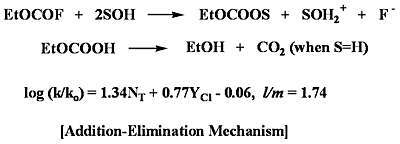
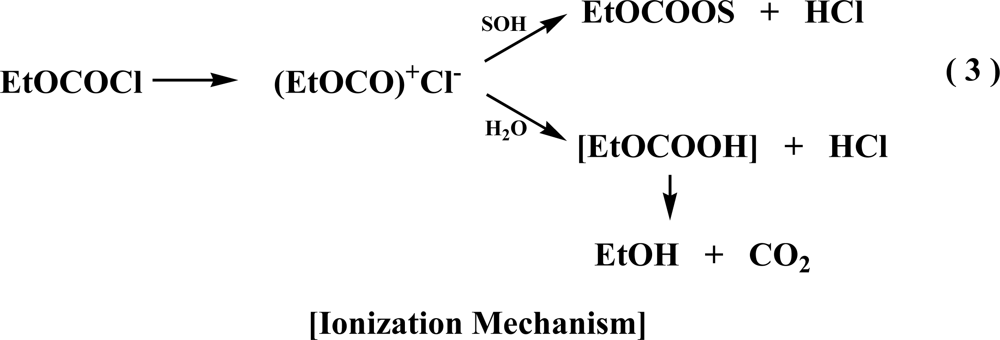
<p>We reported that the specific rates of solvolysis of ethyl chloroformate (EtOCOCl) [<xref ref-type="bibr" rid="b19-ijms-10-00929">19</xref>] can be very well correlated, after division into two solvent groups, using the extended Grunwald-Winstein equation [<xref ref-type="disp-formula" rid="FD1">Equation (1)</xref>], with an <italic>l</italic>-value of 1.56±0.09 and <italic>m</italic>-value of 0.55±0.03 (correlation coefficient of 0.967) in the less ionizing and more nucleophilic solvents, and with an <italic>l</italic>-value of 0.69±0.13 and <italic>m</italic>-value of 0.82±0.16 (correlation coefficient of 0.946) in the more ionizing and least nucleophilic solvents (HCO<sub>2</sub>H, 100% and 97% TFE and 97% ~50%HFIP).
<disp-formula id="FD2">
<label>(2)</label>
<mml:math display="block">
<mml:mtable>
<mml:mtr>
<mml:mtd>
<mml:mrow>
<mml:mtext mathvariant="bold">EtOCOCl</mml:mtext>
<mml:mi> </mml:mi>
<mml:mo>+</mml:mo>
<mml:mi> </mml:mi>
<mml:mn mathvariant="bold">2</mml:mn>
<mml:mtext mathvariant="bold">SOH</mml:mtext>
<mml:mi> </mml:mi>
<mml:mo>→</mml:mo>
<mml:mi> </mml:mi>
<mml:mtext mathvariant="bold">EtOCOOS</mml:mtext>
<mml:mi> </mml:mi>
<mml:mo mathvariant="bold">+</mml:mo>
<mml:mi> </mml:mi>
<mml:mtext mathvariant="bold">SO</mml:mtext>
<mml:msubsup>
<mml:mtext mathvariant="bold">H</mml:mtext>
<mml:mn mathvariant="bold">2</mml:mn>
<mml:mo mathvariant="bold">+</mml:mo></mml:msubsup>
<mml:mi> </mml:mi>
<mml:mo mathvariant="bold">+</mml:mo>
<mml:mi> </mml:mi>
<mml:mtext mathvariant="bold">C</mml:mtext>
<mml:msup>
<mml:mtext mathvariant="bold">l</mml:mtext>
<mml:mo mathvariant="bold">−</mml:mo></mml:msup></mml:mrow></mml:mtd></mml:mtr>
<mml:mtr>
<mml:mtd>
<mml:mrow>
<mml:mtext mathvariant="bold">EtOCOOH</mml:mtext>
<mml:mi> </mml:mi>
<mml:mo mathvariant="bold">→</mml:mo>
<mml:mi> </mml:mi>
<mml:mtext mathvariant="bold">EtOH</mml:mtext>
<mml:mi> </mml:mi>
<mml:mo mathvariant="bold">+</mml:mo>
<mml:mi> </mml:mi>
<mml:mtext mathvariant="bold">C</mml:mtext>
<mml:msub>
<mml:mtext mathvariant="bold">O</mml:mtext>
<mml:mn mathvariant="bold">2</mml:mn></mml:msub>
<mml:mi> </mml:mi>
<mml:mo stretchy="false" mathvariant="bold">(</mml:mo>
<mml:mtext mathvariant="bold">when</mml:mtext>
<mml:mi> </mml:mi>
<mml:mtext mathvariant="bold">S</mml:mtext>
<mml:mo mathvariant="bold">=</mml:mo>
<mml:mtext mathvariant="bold">H</mml:mtext>
<mml:mo stretchy="false" mathvariant="bold">)</mml:mo></mml:mrow></mml:mtd></mml:mtr>
<mml:mtr>
<mml:mtd>
<mml:mrow>
<mml:mo stretchy="false" mathvariant="bold">[</mml:mo>
<mml:mtext mathvariant="bold">Addition-Elimination</mml:mtext>
<mml:mo> </mml:mo>
<mml:mtext mathvariant="bold">Mechanism</mml:mtext>
<mml:mo stretchy="false" mathvariant="bold">]</mml:mo></mml:mrow></mml:mtd></mml:mtr></mml:mtable></mml:math></disp-formula>
<fig id="f3-ijms-10-00929" position="anchor">
<graphic xlink:href="ijms-10-00929f3.gif"/></fig></p>
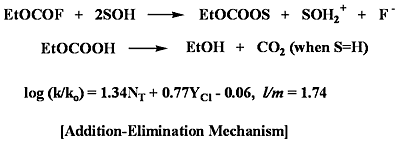
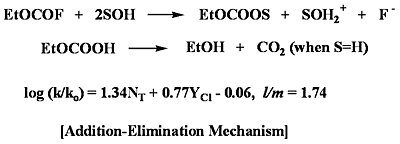
<p>The solvolyses of ethyl chloroformate can be expressed according to <xref ref-type="disp-formula" rid="FD2">Equations (2)</xref> and <xref ref-type="fig" rid="f3-ijms-10-00929">(3)</xref>, with an addition-elimination mechanism [<xref ref-type="disp-formula" rid="FD2">Equation (2)</xref>] involving substitution at the acyl carbon in the less ionizing and more nucleophilic solvents and an ionization mechanism [<xref ref-type="fig" rid="f3-ijms-10-00929">Equation (3)</xref>] in the more ionizing and least nucleophilic solvents.</p>
<p>Previous work concerning the solvolyses of <italic>n</italic>-octyl haloformates [<xref ref-type="bibr" rid="b20-ijms-10-00929">20</xref>] found the k<sub>F</sub>/k<sub>Cl</sub> ratio to be only slightly less than unity in 100% ethanol and 100% methanol and to be somewhat above unity for solvolyses in mixtures of water with ethanol, acetone, dioxane, or 2,2,2-trifluoroethanol (TFE). These ratios were considered to be consistent with the addition step of an addition-elimination mechanism being rate determining. For solvolyses of ethyl haloformates, k<sub>F</sub>/k<sub>Cl</sub> ratios of 5.46 for 70% acetone at 30.1 °C [<xref ref-type="bibr" rid="b21-ijms-10-00929">21</xref>] and of 1.1 for 100% ethanol at 25.1 °C [<xref ref-type="bibr" rid="b22-ijms-10-00929">22</xref>] have been reported.</p>
<p>In the present study, we report on the specific rates for solvolyses of ethyl fluoroformate in a wide range of solvent types. Mechanistic conclusions are then drawn from a consideration of the analyses using the extended Grunwald-Winstein equation, including a comparison with the <italic>l</italic> and <italic>m</italic>-values previously determined from kinetic studies of other haloformate esters. In addition to a detailed extended Grunwald-Winstein equation treatment of the specific rates, the influence of temperature on the specific rate (for three and four solvents) allows enthalpies and entropies of activation to be calculated and a measurement in methanol-<italic>d</italic> allows a determination of the solvent deuterium isotope effect. These analyses are also combined with a consideration of leaving-group effects to arrive at a reasonable mechanism.</p></sec>
<sec sec-type="results">
<label>2.</label>
<title>Results</title>
<p>The specific rates of solvolysis of ethyl fluoroformate at 24.2 °C are reported in <xref ref-type="table" rid="t1-ijms-10-00929">Table 1</xref>. The solvents consisted of ethanol, methanol, binary mixtures of water with ethanol, methanol, 2,2,2-trifluoroethanol (TFE), acetone, and 1,1,1,3,3,3-hexafluoro-2-propanol (HFIP) and four binary mixtures of TFE and ethanol. The required <italic>N</italic><sub>T</sub> and <italic>Y</italic><sub>Cl</sub> values are also reported in <xref ref-type="table" rid="t1-ijms-10-00929">Table 1</xref>, together with the k<sub>F</sub>/k<sub>Cl</sub> ratios. A determination was also made in methanol-<italic>d</italic> (MeOD). In methanol, ethanol, 80% ethanol, 70% TFE, and 70% HFIP, specific rates of solvolysis of ethyl fluoroformate and chloroformate were determined at two and three additional temperatures, and these values, together with calculated enthalpies and entropies of activation, are reported in <xref ref-type="table" rid="t2-ijms-10-00929">Table 2</xref>.</p></sec>
<sec sec-type="discussion">
<label>3.</label>
<title>Discussion</title>
<p>The variance of k<sub>F</sub>/k<sub>Cl</sub> ratios has suggested [<xref ref-type="bibr" rid="b23-ijms-10-00929">23</xref>] differences in mechanism and a useful additional probe will be to apply the extended Grunwald-Winstein equation (<xref ref-type="disp-formula" rid="FD1">Equation 1</xref>) and compare the <italic>l</italic> and <italic>m</italic> values with those previously obtained for alkyl fluoroformates. Although some authors [<xref ref-type="bibr" rid="b24-ijms-10-00929">24</xref>,<xref ref-type="bibr" rid="b25-ijms-10-00929">25</xref>] claim that leaving group effects in solvolytic reactions are not very sensitive to mechanistic changes, the consideration of these effects in nucleophilic substitution reactions has long been recognized as a useful tool in studying the reaction mechanism [<xref ref-type="bibr" rid="b26-ijms-10-00929">26</xref>].</p>
<p>For S<sub>N</sub>1 reaction, a value as low as 10<sup>−7</sup> was observed in 4-(<italic>N,N</italic>-dimethylamino)benzoyl halide solvolyses [<xref ref-type="bibr" rid="b27-ijms-10-00929">27</xref>] and a low value of 1.3×10<sup>−4</sup> was also observed for acetyl halide solvolyses in 75% acetone [<xref ref-type="bibr" rid="b26-ijms-10-00929">26</xref>]. These values reflect an appreciable ground-state stabilization for the fluoride [<xref ref-type="bibr" rid="b28-ijms-10-00929">28</xref>] and the need to break a strong carbon–fluorine bond in the rate determining step. In contrast, if the addition step is rate-determining, values of close to unity (and frequently above it), reflecting a large electron deficiency at the carbonyl carbon of a haloformate incorporating fluorine [<xref ref-type="bibr" rid="b7-ijms-10-00929">7</xref>], are frequently observed. This situation has recently been discussed in a consideration of <italic>n</italic>-octyl haloformate solvolyses [<xref ref-type="bibr" rid="b20-ijms-10-00929">20</xref>], where k<sub>F</sub>/k<sub>Cl</sub> specific rate ratios of 0.6 to 15 were observed. Similar ratios of k<sub>F</sub>/k<sub>Cl</sub> specific rates have been observed previously for the solvolyses of other haloformate esters [<xref ref-type="bibr" rid="b14-ijms-10-00929">14</xref>,<xref ref-type="bibr" rid="b20-ijms-10-00929">20</xref>,<xref ref-type="bibr" rid="b29-ijms-10-00929">29</xref>,<xref ref-type="bibr" rid="b30-ijms-10-00929">30</xref>]. For other haloformate esters, k<sub>F</sub>/k<sub>Cl</sub> ratios of 1.09 to 7.16 for solvolyses in 70% aqueous acetone at 30.1°C have been reported [<xref ref-type="bibr" rid="b21-ijms-10-00929">21</xref>].</p>
<p>The leaving group specific rate ratios (k<sub>F</sub>/k<sub>Cl</sub>) determined in the present study for ethyl haloformate are compared with the specific rate ratios for the same leaving groups observed in the bimolecular pathway of <italic>n</italic>-propyl, <italic>i</italic>-propyl, <italic>n</italic>-octyl, benzyl, and 1- and 2-adamantyl haloformates in various solvents [<xref ref-type="bibr" rid="b20-ijms-10-00929">20</xref>,<xref ref-type="bibr" rid="b31-ijms-10-00929">31</xref>–<xref ref-type="bibr" rid="b33-ijms-10-00929">33</xref>] (<xref ref-type="table" rid="t3-ijms-10-00929">Table 3</xref>). The specific rate ratios (k<sub>F</sub>/k<sub>Cl</sub>) for the solvolyses of ethyl fluoroformate and chloroformate are similar to the values for all the other primary and secondary substrates but significantly larger than the analogous specific rate ratios for the partially solvolysis-decomposition reaction (ionization pathway) of 1-adamantyl fluoroformate relative to the chloroformate in methanol, ethanol, and 80% ethanol. In these solvents, essentially all the reaction of 1-adamantyl chloroformate is by the ionization pathway.</p>
<p>The solvent deuterium isotope effect value (footnote to <xref ref-type="table" rid="t1-ijms-10-00929">Table 1</xref>) for methanolysis of ethyl fluoroformate of k<sub>MeOH</sub>/k<sub>MeOD</sub> = 3.10±0.24 at 24.2 °C is of a magnitude usually taken to indicate that nucleophilic attack by a methanol molecule is assisted by general-base catalysis by a second methanol molecule [<xref ref-type="bibr" rid="b13-ijms-10-00929">13</xref>, <xref ref-type="bibr" rid="b34-ijms-10-00929">34</xref>, <xref ref-type="bibr" rid="b35-ijms-10-00929">35</xref>]. The solvent deuterium isotope effect value of ethyl fluoroformate is higher than for the methanolysis of ethyl chloroformate (k<sub>MeOH</sub>/k<sub>MeOD</sub> = 2.22±0.24 at 45.0 °C) or for the ethanolysis of a series of <italic>para</italic>-substituted phenyl chloroformates, where values in the range of 2.1~2.5 were obtained [<xref ref-type="bibr" rid="b36-ijms-10-00929">36</xref>, <xref ref-type="bibr" rid="b37-ijms-10-00929">37</xref>]. The higher value gives further support for the proposal that bond formation is more advanced at the transition state for addition to fluoroformates than for chloroformates.</p>
<p>For five solvents, the values of the enthalpy and the entropy of activation for the solvolysis of ethyl fluoroformate are 9.4 ~ 14.0 Kcal/mol and −27.9 ~ −41.5 cal/mol·K, and the values for the solvolysis of ethyl chloroformate are 13.6 ~ 18.4 Kcal/mol and −20.4 ~ −31.8 cal/mol·K, respectively (<xref ref-type="table" rid="t2-ijms-10-00929">Table 2</xref>). The very negative entropies of activation are consistent with the bimolecular nature of the proposed rate-determining step. While a bimolecular mechanism for the solvolyses is strongly indicated by the much slower reactions in TFE-rich solvents and by the appreciably negative entropies of activation, it is not established whether the process involves a stepwise addition-elimination (association-dissociation) or a concerted (S<sub>N</sub>2) pathway. A powerful test in considering detailed mechanisms of solvolysis is to carry out a correlation analysis using the extended Grunwald-Winstein equation (<xref ref-type="disp-formula" rid="FD1">Equation 1</xref>).</p>
<p>The specific rates of solvolysis of ethyl fluoroformate were studies in a wide variety of pure and binary solvents, including the TFE- and HFIP-containing systems, which are important components of the extended Grunwald-Winstein correlations.</p>
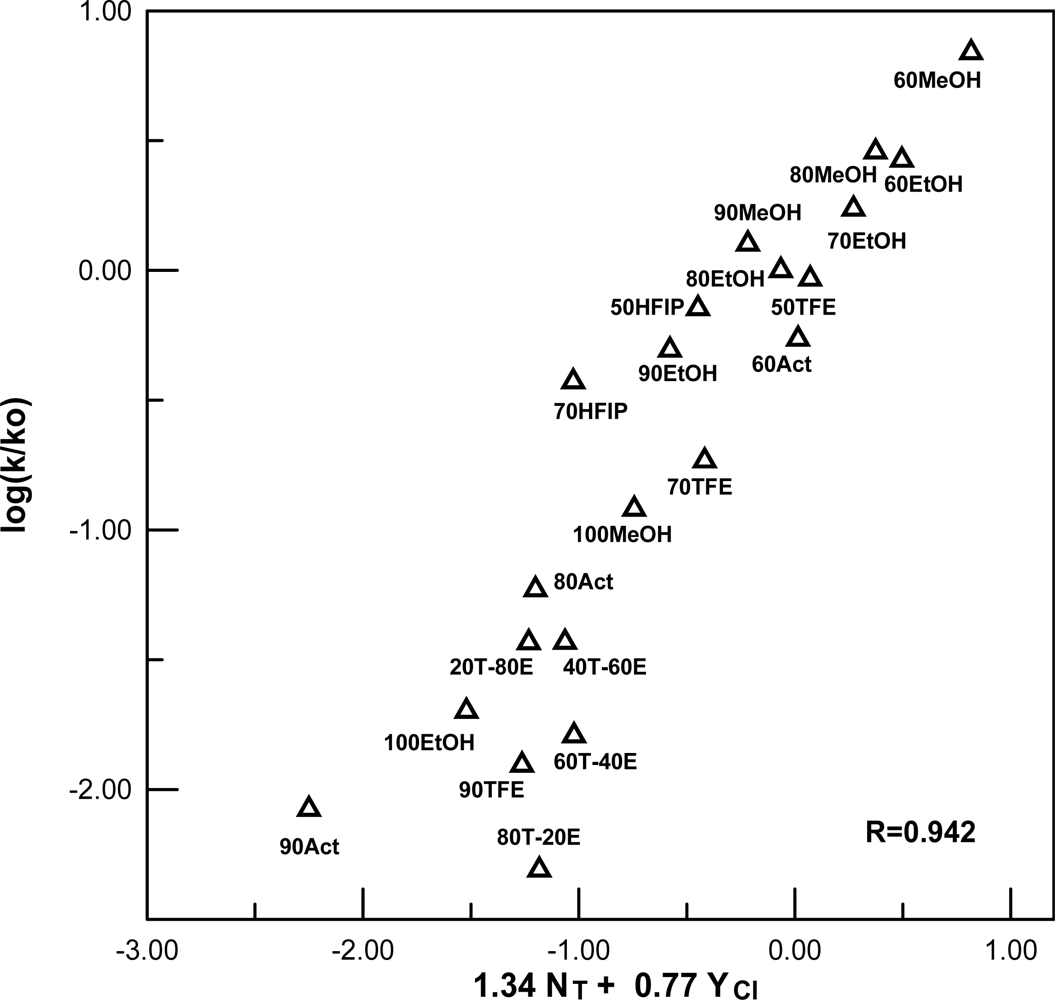
<p>To see the effect of including fluoroalcohol-containing solvents in the correlation of the specific rates of solvolysis of ethyl fluoroformate, we have included 9 solvents with a fluoroalcohol (TFE or HFIP) component. As can be seen in <xref ref-type="fig" rid="f1-ijms-10-00929">Figure 1</xref>, there are appreciable deviations from the plot for the solvolytic data in TFE-ethanol mixtures with the largest deviations for the 80% TFE-20% ethanol and 60%TFE-40% ethanol points. Also in earlier correlations of other haloformate esters, it was found that the data points for these solvent systems usually lay below the correlation line [<xref ref-type="bibr" rid="b10-ijms-10-00929">10</xref>,<xref ref-type="bibr" rid="b14-ijms-10-00929">14</xref>,<xref ref-type="bibr" rid="b30-ijms-10-00929">30</xref>,<xref ref-type="bibr" rid="b38-ijms-10-00929">38</xref>].</p>
<p>Correlations were carried out both with and without the TFE-ethanol data. An analysis of the data using the extended Grunwald-Winstein equation to the specific rates of solvolysis of ethyl fluoro-formate leads to a poor linear correlation with values of 1.51 ± 0.20 for <italic>l</italic>, 0.85 ± 0.11 for <italic>m,</italic> −0.14 ± 0.14 for <italic>c</italic>, and 0.883 for the correlation coefficient. Recalculation with omission of the four data points in TFE-ethanol mixtures led to values of 1.34±0.14 for <italic>l</italic>, 0.77±0.07 for <italic>m</italic>, −0.06±0.10 for c, and 0.942 for the correlation coefficient. When the TFE-ethanol points are omitted from the correlation, the <italic>l</italic> and <italic>m</italic> values are only slightly reduced but a considerably improved value for correlation coefficient (0.942 relative to 0.883) is observed. The results of the correlation are reported in <xref ref-type="table" rid="t4-ijms-10-00929">Table 4</xref>, together with the corresponding parameters obtained in the analyses of earlier studied substrates. The higher <italic>m</italic>-values for the solvolyses of fluoroformates, relative to chloroformates, may reflect the kinetically favorable influence of increased solvation of the developing negative charge on the carbonyl oxygen in the presence of the more electronegative fluorine attached at the carbonyl carbon.</p>
<p>The <italic>l/m</italic> ratio has been suggested as a useful mechanistic criterion and the values of <xref ref-type="table" rid="t4-ijms-10-00929">Table 4</xref> divide nicely into two classes with values of 1.8 to 2.8 for those entries postulated to represent addition-elimination (A-E) and 0.54 to 0.84 for those believed to represent ionization (I).</p>
<p>The <italic>l</italic> and <italic>m</italic> values of ethyl fluoroformate in <xref ref-type="table" rid="t4-ijms-10-00929">Table 4</xref> are very similar to those for the earlier studied substrates (<italic>n</italic>-propyl-, <italic>i</italic>-propyl-, and <italic>n</italic>-octyl fluoroformates), which have been shown to solvolyze with the addition step of an addition-elimination pathway being rate determining.</p>
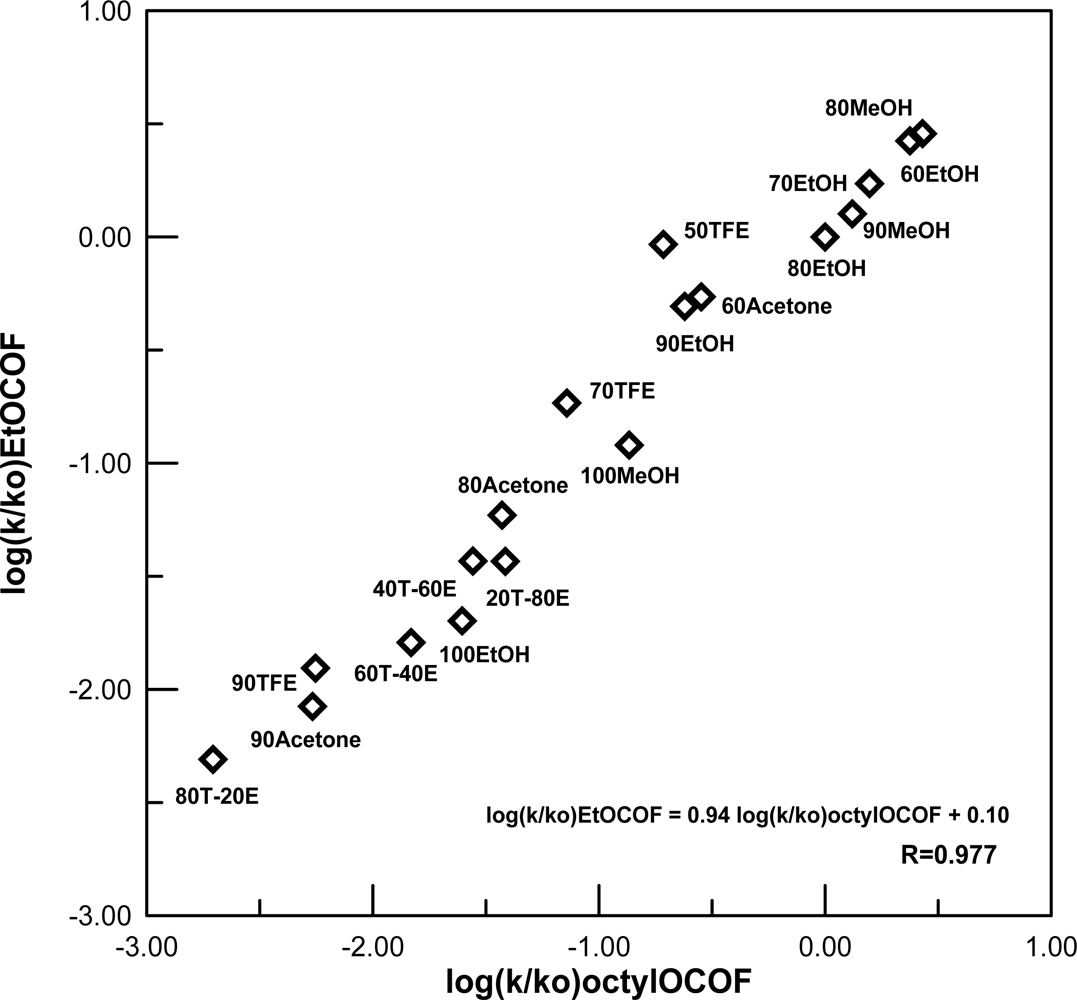
<p>To prove further the similarity between solvent effects upon the specific rates of solvolysis of ethyl-and <italic>n</italic>-octyl fluoroformates, we have carried out a direct comparison of the log (k/k<sub>o</sub>) values for ethyl fluoroformate against those for <italic>n</italic>-octyl fluoroformate for the 18 solvents for which data in available for both substrates. A good linear plot (<xref ref-type="fig" rid="f2-ijms-10-00929">Figure 2</xref>) was obtained, with a slope of 0.94 ± 0.06, intercept of 0.10± 0.09, and correlation coefficient of 0.977.</p></sec>
<sec sec-type="conclusions">
<label>4.</label>
<title>Conclusions</title>
<p>The solvolyses of ethyl fluoroformate give a satisfactory extended Grunwald-Winstein correlation [<xref ref-type="disp-formula" rid="FD1">Equation (1)</xref>] over wide range of <italic>N</italic><sub>T</sub> and <italic>Y</italic><sub>Cl</sub> values. The sensitivities to changes in <italic>N</italic><sub>T</sub> and <italic>Y</italic><sub>Cl</sub> (<italic>l</italic>=1.34 and <italic>m</italic>=0.77) are very similar to those for the several fluoroformate esters (<xref ref-type="table" rid="t4-ijms-10-00929">Table 4</xref>), which are shown to solvolyze with the addition step of an association-dissociation (addition-elimination) pathway being rate determining.</p>
<p>The k<sub>F</sub>/k<sub>Cl</sub> values obtained in a comparison with the corresponding solvolysis of ethyl chloroformate are very similar to those for solvolyses of <italic>n</italic>-octyl fluoroformate, consistent with a bimolecular addition-elimination mechanism, proceeding through a tetrahedral intermediate.</p>
<p>The solvent deuterium isotope effect value for methanolysis (k<sub>MeOH</sub>/k<sub>MeOD</sub>) of 3.10 is of a magnitude usually taken to indicate that nucleophilic attack by a methanol molecule is assisted by general-base catalysis by a second methanol molecule.</p>
<p>The entropies of activation (−27.9 ~ −41.5 cal/mol·K) for ethyl fluoroformate solvolyses believed to involve rate-determining attack at acyl carbon are considerably more negative than the values for solvolyses believed to proceed by the ionization pathway (the entropies of activation are for 1-adamantyl chloroformate +3.3 ~ +6.7 cal/mol·K [<xref ref-type="bibr" rid="b29-ijms-10-00929">29</xref>] and for 1-adamantyl fluoroformate −8.0 ~ −14.7 cal/mol·K [<xref ref-type="bibr" rid="b30-ijms-10-00929">30</xref>]). The more negative entropy of activation values for the ethyl fluoroformate reaction are consistent with the bimolecular nature of the rate-determining step.</p>
<p>In the present study, unlike the solvolyses of ethyl chloroformate [<xref ref-type="disp-formula" rid="FD2">Equations (2)</xref> and <xref ref-type="fig" rid="f3-ijms-10-00929">(3)</xref>], where the two reaction channels (addition-elimination and ionization pathways) were observed, the solvolyses of ethyl fluoroformate have a pathway involving bimolecular attack by solvent at acyl carbon, with what is suggested to be the addition step of an addition-elimination pathway being rate determining [<xref ref-type="disp-formula" rid="FD2">Equation (2)</xref>].</p></sec>
<sec>
<label>5.</label>
<title>Experimental</title>
<p>The ethyl chloroformate (Aldrich) was purified by fractional distillation under reduced pressure. The ethyl chloroformate (22.7g, 0.209 mol) was syringed into a three-neck flask (200 mL) containing dried KF (15.9g, 0.274 mol) and 18-crown-6 (1.95g, 0.00736 mol) and fitted with a Teflon stirring bar, a condenser topped by an Ar gas inlet, a septum cap, and a ground glass stopper, as described earlier [<xref ref-type="bibr" rid="b40-ijms-10-00929">40</xref>]. The mixture then was stirred efficiently at room temperature until FT-IR (Bio-Rad FTS 6000) analysis of an aliquot indicated that no chloroformate remained (C=O stretch at 1777 cm<sup>−1</sup>; fluoroformate C=O stretch at 1837 cm<sup>−1</sup>). After a reaction time of 68 hours, the product fluoroformate was isolated directly from the reaction apparatus by simple distillation at a reaction temperature of 56–57 °C (lit. [<xref ref-type="bibr" rid="b41-ijms-10-00929">41</xref>] 55–57 °C).</p>
<p>Solvents were purified as previously described [<xref ref-type="bibr" rid="b31-ijms-10-00929">31</xref>]. The kinetic procedures were as described earlier [<xref ref-type="bibr" rid="b30-ijms-10-00929">30</xref>, <xref ref-type="bibr" rid="b31-ijms-10-00929">31</xref>], using a substrate concentration of about 5.86 × 10<sup>−3</sup> <italic>M</italic> and with 5 mL aliquots removed for titration. The <italic>l</italic> and <italic>m</italic> values were calculated using multiple regression analysis.</p></sec></body>
<back>
<ack>
<p>This work was supported by the research fund of Hanseo University made in program year 2008.</p></ack>
<ref-list>
<title>References</title>
<ref id="b1-ijms-10-00929"><label>1.</label><citation citation-type="journal"><person-group person-group-type="author"><name><surname>Grunwald</surname><given-names>E</given-names></name><name><surname>Winstein</surname><given-names>S</given-names></name><name><surname>Jones</surname><given-names>HW</given-names></name></person-group><article-title>The Correlation of Solvolyses Rates and the Classification of Solvolysis Reactions into Mechanistic Categories</article-title><source>J. Am. Chem. Soc</source><year>1951</year><volume>73</volume><fpage>2700</fpage><lpage>2707</lpage><pub-id pub-id-type="doi">10.1021/ja01150a078</pub-id></citation></ref>
<ref id="b2-ijms-10-00929"><label>2.</label><citation citation-type="journal"><person-group person-group-type="author"><name><surname>Schadt</surname><given-names>FL</given-names></name><name><surname>Bentley</surname><given-names>TW</given-names></name><name><surname>Schleyer</surname><given-names>PvR</given-names></name></person-group><article-title>The S<sub>N</sub>2-S<sub>N</sub>1 Spectrum 2. Quantitative Treatments of Nucleophilic Solvent Assistance. A Scale of Solvent Nucleophilicities</article-title><source>J. Am. Chem. Soc</source><year>1976</year><volume>98</volume><fpage>7667</fpage><lpage>7674</lpage><pub-id pub-id-type="doi">10.1021/ja00440a037</pub-id></citation></ref>
<ref id="b3-ijms-10-00929"><label>3.</label><citation citation-type="book"><person-group person-group-type="author"><name><surname>Kevill</surname><given-names>DN</given-names></name></person-group><article-title>Development and Uses of Scales of Solvent Nucleophilicity</article-title><source>Advances in Quantitative Structure-Property Relationships</source><person-group person-group-type="editor"><name><surname>Charton</surname><given-names>M</given-names></name></person-group><publisher-name>JAI Press</publisher-name><publisher-loc>Greenwich, CT</publisher-loc><year>1996</year><volume>1</volume><fpage>81</fpage><lpage>115</lpage></citation></ref>
<ref id="b4-ijms-10-00929"><label>4.</label><citation citation-type="journal"><person-group person-group-type="author"><name><surname>Bentley</surname><given-names>TW</given-names></name><name><surname>Llewellyn</surname><given-names>G</given-names></name></person-group><article-title>Y<sub>x</sub> Scales of Solvent Ionizing Power</article-title><source>Prog. Phys. Org. Chem</source><year>1990</year><volume>17</volume><fpage>121</fpage></citation></ref>
<ref id="b5-ijms-10-00929"><label>5.</label><citation citation-type="journal"><person-group person-group-type="author"><name><surname>Kevill</surname><given-names>DN</given-names></name><name><surname>D’Souza</surname><given-names>MJ</given-names></name></person-group><article-title>Correlation of the Rates of Solvolysis of Benzoyl Chloride and Derivatives Using Extended Forms of the Gunwald-Winstein Equation</article-title><source>J. Phys. Org. Chem</source><year>2002</year><volume>15</volume><fpage>881</fpage><lpage>888</lpage><pub-id pub-id-type="doi">10.1002/poc.569</pub-id></citation></ref>
<ref id="b6-ijms-10-00929"><label>6.</label><citation citation-type="journal"><person-group person-group-type="author"><name><surname>D’Souza</surname><given-names>MJ</given-names></name><name><surname>Stant-Boggs</surname><given-names>ME</given-names></name><name><surname>White</surname><given-names>R</given-names></name><name><surname>Kevill</surname><given-names>DN</given-names></name></person-group><article-title>Correlation of the Rates of Solvolysis of 2-Thiophenecarbonyl Chloride</article-title><source>J. Chem. Res., Synop</source><year>2003</year><fpage>775</fpage><lpage>777</lpage></citation></ref>
<ref id="b7-ijms-10-00929"><label>7.</label><citation citation-type="journal"><person-group person-group-type="author"><name><surname>Kevill</surname><given-names>DN</given-names></name><name><surname>D’Souza</surname><given-names>MJ</given-names></name></person-group><article-title>Correlation of the Rates of Solvolysis of Benzoyl Fluoride and a Consideration of Leaving-Group Effects</article-title><source>J. Org. Chem</source><year>2004</year><volume>69</volume><fpage>7044</fpage><lpage>7050</lpage><pub-id pub-id-type="doi">10.1021/jo0492259</pub-id><pub-id pub-id-type="pmid">15471451</pub-id></citation></ref>
<ref id="b8-ijms-10-00929"><label>8.</label><citation citation-type="journal"><person-group person-group-type="author"><name><surname>Kevill</surname><given-names>DN</given-names></name><name><surname>D’Souza</surname><given-names>MJ</given-names></name></person-group><article-title>Correlation of the Rates of Solvolysis of Phenyl Chloroformate</article-title><source>J Chem Soc, Perkin Trans</source><volume>2</volume><year>1997</year><fpage>1721</fpage><lpage>1724</lpage></citation></ref>
<ref id="b9-ijms-10-00929"><label>9.</label><citation citation-type="journal"><person-group person-group-type="author"><name><surname>Kevill</surname><given-names>DN</given-names></name><name><surname>Bond</surname><given-names>MW</given-names></name><name><surname>D’Souza</surname><given-names>MJ</given-names></name></person-group><article-title>Dual Pathways in the Solvolyses of Phenyl Chlorothioformate</article-title><source>J. Org. Chem</source><year>1997</year><volume>62</volume><fpage>7869</fpage><lpage>7871</lpage><pub-id pub-id-type="doi">10.1021/jo970657b</pub-id></citation></ref>
<ref id="b10-ijms-10-00929"><label>10.</label><citation citation-type="journal"><person-group person-group-type="author"><name><surname>Park</surname><given-names>KH</given-names></name><name><surname>Kyong</surname><given-names>JB</given-names></name><name><surname>Kevill</surname><given-names>DN</given-names></name></person-group><article-title>Nucleophilic Substution Reactions of <italic>p</italic>-Nitrobenzyl Chloroformate</article-title><source>Bull. Korean Chem. Soc</source><year>2000</year><volume>21</volume><fpage>1267</fpage><lpage>1270</lpage></citation></ref>
<ref id="b11-ijms-10-00929"><label>11.</label><citation citation-type="journal"><person-group person-group-type="author"><name><surname>Kevill</surname><given-names>DN</given-names></name><name><surname>Kim</surname><given-names>JC</given-names></name><name><surname>Kyong</surname><given-names>JB</given-names></name></person-group><article-title>Correlation of the Rates of Solvolysis of Methyl Chloroformate with Solvent Properties</article-title><source>J Chem Res, Synop</source><year>1999</year><fpage>150</fpage><lpage>151</lpage></citation></ref>
<ref id="b12-ijms-10-00929"><label>12.</label><citation citation-type="journal"><person-group person-group-type="author"><name><surname>Kevill</surname><given-names>DN</given-names></name><name><surname>D’Souza</surname><given-names>MJ</given-names></name></person-group><article-title>Correlation of the Rates of Solvolysis of Phenyl Chlorothioformate and Phenyl Chlorodithioformate</article-title><source>Can. J. Chem</source><year>1999</year><volume>77</volume><fpage>1118</fpage><lpage>3291</lpage></citation></ref>
<ref id="b13-ijms-10-00929"><label>13.</label><citation citation-type="journal"><person-group person-group-type="author"><name><surname>Kyong</surname><given-names>JB</given-names></name><name><surname>Park</surname><given-names>BC</given-names></name><name><surname>Kim</surname><given-names>CB</given-names></name><name><surname>Kevill</surname><given-names>DN</given-names></name></person-group><article-title>Rate and Product Studies with Benzyl and <italic>p</italic>-Nitrobenzyl Chloroformates Under Sovolytic Conditions</article-title><source>J. Org. Chem</source><year>2000</year><volume>65</volume><fpage>8051</fpage><lpage>8058</lpage><pub-id pub-id-type="doi">10.1021/jo005630y</pub-id><pub-id pub-id-type="pmid">11073616</pub-id></citation></ref>
<ref id="b14-ijms-10-00929"><label>14.</label><citation citation-type="journal"><person-group person-group-type="author"><name><surname>Kyong</surname><given-names>JB</given-names></name><name><surname>Kim</surname><given-names>YG</given-names></name><name><surname>Kim</surname><given-names>DK</given-names></name><name><surname>Kevill</surname><given-names>DN</given-names></name></person-group><article-title>Dual Pathways in the Solvolyses of Isopropyl Chloroformate</article-title><source>Bull. Korean Chem. Soc</source><year>2000</year><volume>21</volume><fpage>662</fpage><lpage>664</lpage></citation></ref>
<ref id="b15-ijms-10-00929"><label>15.</label><citation citation-type="journal"><person-group person-group-type="author"><name><surname>Kyong</surname><given-names>JB</given-names></name><name><surname>Yoo</surname><given-names>JS</given-names></name><name><surname>Kevill</surname><given-names>DN</given-names></name></person-group><article-title>Solvolysis-Decomposition of 2-Adamantyl Chloroformate: Evidence for Two Reaction Pathway</article-title><source>J. Org. Chem</source><year>2003</year><volume>68</volume><fpage>3425</fpage><lpage>3432</lpage><pub-id pub-id-type="doi">10.1021/jo0207426</pub-id><pub-id pub-id-type="pmid">12713342</pub-id></citation></ref>
<ref id="b16-ijms-10-00929"><label>16.</label><citation citation-type="journal"><person-group person-group-type="author"><name><surname>Kevill</surname><given-names>DN</given-names></name><name><surname>D’Souza</surname><given-names>MJ</given-names></name></person-group><article-title>Application of the <italic>N</italic><sub>T</sub> Solvent Nucleophilicity Scale to Attack at Sulfur: Solvolyses of Benzenesulfonyl Chlorides</article-title><source>Collect Czech Chem Commun</source><year>1999</year><volume>64</volume><fpage>1790</fpage><lpage>1796</lpage><pub-id pub-id-type="doi">10.1135/cccc19991790</pub-id></citation></ref>
<ref id="b17-ijms-10-00929"><label>17.</label><citation citation-type="journal"><person-group person-group-type="author"><name><surname>Villas-Boas</surname><given-names>SG</given-names></name><name><surname>Delicado</surname><given-names>DG</given-names></name><name><surname>Akesson</surname><given-names>M</given-names></name><name><surname>Nielson</surname><given-names>J</given-names></name></person-group><article-title>Simultaneous Analysis of Amino and Nonamino Organic Acids as Methyl Chloroformate Derivatives Using Gas Chromatography-Mass Spectrometry</article-title><source>Anal. Biochem</source><year>2003</year><volume>322</volume><fpage>134</fpage><lpage>138</lpage><pub-id pub-id-type="doi">10.1016/j.ab.2003.07.018</pub-id><pub-id pub-id-type="pmid">14705791</pub-id></citation></ref>
<ref id="b18-ijms-10-00929"><label>18.</label><citation citation-type="journal"><person-group person-group-type="author"><name><surname>Biermann</surname><given-names>U</given-names></name><name><surname>Metzger</surname><given-names>JO</given-names></name></person-group><article-title>Alkylation of Alkenes: Ethylaluminum Sesquichloride-Mediated Hydro-Alkyl Addition with Alkyl Chloroformates and Di-tert-butylpyrocarbonate</article-title><source>J. Am. Chem. Soc</source><year>2004</year><volume>126</volume><fpage>10319</fpage><lpage>10330</lpage><pub-id pub-id-type="doi">10.1021/ja048904y</pub-id><pub-id pub-id-type="pmid">15315446</pub-id></citation></ref>
<ref id="b19-ijms-10-00929"><label>19.</label><citation citation-type="journal"><person-group person-group-type="author"><name><surname>Kevill</surname><given-names>DN</given-names></name><name><surname>D’Souza</surname><given-names>MJ</given-names></name></person-group><article-title>Concerning the Two Reaction Channels for the Solvolyses of Ethyl Chloroformate and Ethyl Chlorothioformate</article-title><source>J. Org. Chem</source><year>1998</year><volume>63</volume><fpage>2120</fpage><lpage>2124</lpage><pub-id pub-id-type="doi">10.1021/jo9714270</pub-id></citation></ref>
<ref id="b20-ijms-10-00929"><label>20.</label><citation citation-type="journal"><person-group person-group-type="author"><name><surname>Kevill</surname><given-names>DN</given-names></name><name><surname>D’Souza</surname><given-names>MJ</given-names></name></person-group><article-title>Correlation of the Rates of Solvolysis of <italic>n</italic>-Octyl Fluoroformate and a Comparison with <italic>n</italic>-Octyl Chloroformate Solvolysis</article-title><source>J Chem Soc, Perkin Trans</source><volume>2</volume><year>2002</year><fpage>240</fpage><lpage>243</lpage></citation></ref>
<ref id="b21-ijms-10-00929"><label>21.</label><citation citation-type="journal"><person-group person-group-type="author"><name><surname>Queen</surname><given-names>A</given-names></name><name><surname>Nour</surname><given-names>TA</given-names></name></person-group><article-title>Kinetics and Mechanism of the Acetate Catalyzed Hydrolysis of 4-Methoxyphenyl Chloroformate and 4-Methoxyphenyl Fluoroformate in Aqueous Dioxane</article-title><source>J Chem Soc, Perkin Trans</source><volume>2</volume><year>1976</year><fpage>935</fpage><lpage>939</lpage></citation></ref>
<ref id="b22-ijms-10-00929"><label>22.</label><citation citation-type="journal"><person-group person-group-type="author"><name><surname>Orlov</surname><given-names>SI</given-names></name><name><surname>Chimishkyan</surname><given-names>AL</given-names></name><name><surname>Grabarnik</surname><given-names>MS</given-names></name></person-group><article-title>Kinetic Relationships Governing the Ethanolysis of Halogenoformates</article-title><source>J. Org. Chem. USSR (Engl Transl)</source><year>1983</year><volume>19</volume><fpage>1981</fpage><lpage>1987</lpage></citation></ref>
<ref id="b23-ijms-10-00929"><label>23.</label><citation citation-type="book"><person-group person-group-type="author"><name><surname>Kevill</surname><given-names>DN</given-names></name></person-group><source>The Chemistry of the Functional Groups: The Chemistry of Acyl Halides</source><person-group person-group-type="editor"><name><surname>Patai</surname><given-names>S</given-names></name></person-group><publisher-name>Wiley</publisher-name><publisher-loc>New York</publisher-loc><year>1972</year>Chapter 12.</citation></ref>
<ref id="b24-ijms-10-00929"><label>24.</label><citation citation-type="journal"><person-group person-group-type="author"><name><surname>Harris</surname><given-names>JM</given-names></name><name><surname>Shafer</surname><given-names>SG</given-names></name><name><surname>Moffatt</surname><given-names>JR</given-names></name><name><surname>Becker</surname><given-names>AR</given-names></name></person-group><article-title>Prediction of S<sub>N</sub>2 Transition State Variation by the Use of More O’Ferrall Plots</article-title><source>J. Am. Chem. Soc</source><year>1979</year><volume>101</volume><fpage>3295</fpage><lpage>3300</lpage><pub-id pub-id-type="doi">10.1021/ja00506a026</pub-id></citation></ref>
<ref id="b25-ijms-10-00929"><label>25.</label><citation citation-type="journal"><person-group person-group-type="author"><name><surname>Bentley</surname><given-names>TW</given-names></name><name><surname>Bowen</surname><given-names>CT</given-names></name><name><surname>Parker</surname><given-names>W</given-names></name><name><surname>Watt</surname><given-names>CIF</given-names></name></person-group><article-title>Evidence against Appreciable Internal Ion Pair Return in the Solvolyses of Tertiary Aliphatic Halides. Measurement of α-Methyl/Hydrogen Rate ratios in Hexafluoropropan-2-ol-Water</article-title><source>J Chem Soc, Perkin Trans</source><volume>2</volume><year>1980</year><fpage>1244</fpage><lpage>1252</lpage></citation></ref>
<ref id="b26-ijms-10-00929"><label>26.</label><citation citation-type="journal"><person-group person-group-type="author"><name><surname>Swain</surname><given-names>CG</given-names></name><name><surname>Scott</surname><given-names>CB</given-names></name></person-group><article-title>Rates of Solvolysis of Some Alkyl Fluorides and Chlorides</article-title><source>J. Am. Chem. Soc</source><year>1953</year><volume>75</volume><fpage>246</fpage><lpage>248</lpage><pub-id pub-id-type="doi">10.1021/ja01097a520</pub-id></citation></ref>
<ref id="b27-ijms-10-00929"><label>27.</label><citation citation-type="journal"><person-group person-group-type="author"><name><surname>Song</surname><given-names>BD</given-names></name><name><surname>Jencks</surname><given-names>WP</given-names></name></person-group><article-title>Mechaism of Solvolysis of Substituted Benzoyl Halides</article-title><source>J. Am. Chem. Soc</source><year>1989</year><volume>111</volume><fpage>8470</fpage><lpage>8479</lpage><pub-id pub-id-type="doi">10.1021/ja00204a021</pub-id></citation></ref>
<ref id="b28-ijms-10-00929"><label>28.</label><citation citation-type="journal"><person-group person-group-type="author"><name><surname>Wiberg</surname><given-names>KB</given-names></name><name><surname>Rablen</surname><given-names>PR</given-names></name></person-group><article-title>Substituent Effects. 7. Phenyl Derivatives. When is a Fluorine a π-Donor?</article-title><source>J. Org. Chem</source><year>1998</year><volume>63</volume><fpage>3722</fpage><lpage>3730</lpage><pub-id pub-id-type="doi">10.1021/jo980463b</pub-id></citation></ref>
<ref id="b29-ijms-10-00929"><label>29.</label><citation citation-type="journal"><person-group person-group-type="author"><name><surname>Kevill</surname><given-names>DN</given-names></name><name><surname>Kyong</surname><given-names>JB</given-names></name><name><surname>Weitl</surname><given-names>FL</given-names></name></person-group><article-title>Solvolysis-Decomposition of 1-Adamantyl Chloroformate: Evidence for Ion Pair Return in 1-Adamantyl Chloride Solvolysis</article-title><source>J. Org. Chem</source><year>1990</year><volume>55</volume><fpage>4304</fpage><lpage>4311</lpage><pub-id pub-id-type="doi">10.1021/jo00301a019</pub-id></citation></ref>
<ref id="b30-ijms-10-00929"><label>30.</label><citation citation-type="journal"><person-group person-group-type="author"><name><surname>Kevill</surname><given-names>DN</given-names></name><name><surname>Kyong</surname><given-names>JB</given-names></name></person-group><article-title>Multiple Pathways in the Solvolysis of 1-Adamantyl Fluoroformate</article-title><source>J. Org. Chem</source><year>1992</year><volume>57</volume><fpage>258</fpage><lpage>265</lpage><pub-id pub-id-type="doi">10.1021/jo00027a046</pub-id></citation></ref>
<ref id="b31-ijms-10-00929"><label>31.</label><citation citation-type="journal"><person-group person-group-type="author"><name><surname>Seong</surname><given-names>MH</given-names></name><name><surname>Kyong</surname><given-names>JB</given-names></name><name><surname>Kim</surname><given-names>DK</given-names></name><name><surname>Kevill</surname><given-names>DN</given-names></name></person-group><article-title>Application of the Extended Grunwald-Winstein Equation to Solvolyses of n-Propyl Fluoroformate and a Consideration of Leaving Group Effects</article-title><source>Bull. Korean Chem. Soc</source><year>2008</year><volume>29</volume><fpage>1747</fpage><lpage>1751</lpage><pub-id pub-id-type="doi">10.5012/bkcs.2008.29.9.1747</pub-id></citation></ref>

<ref id="b32-ijms-10-00929"><label>32.</label><citation citation-type="journal"><person-group person-group-type="author"><name><surname>Kyong</surname><given-names>JB</given-names></name><name><surname>Ryu</surname><given-names>SH</given-names></name><name><surname>Kevill</surname><given-names>DN</given-names></name></person-group><article-title>Rate and Product Studies of the Solvolyses of Benzyl Fluoroformate</article-title><source>Int. J. Mol. Sci</source><year>2006</year><volume>7</volume><fpage>186</fpage><lpage>196</lpage><pub-id pub-id-type="doi">10.3390/i7070186</pub-id></citation></ref>
<ref id="b33-ijms-10-00929"><label>33.</label><citation citation-type="journal"><person-group person-group-type="author"><name><surname>Kyong</surname><given-names>JB</given-names></name><name><surname>Rhu</surname><given-names>CJ</given-names></name><name><surname>Kim</surname><given-names>YG</given-names></name><name><surname>Kevill</surname><given-names>DN</given-names></name></person-group><article-title>Rate and Product Studies with 2-Adamantyl Fluoroformate under Solvolytic Conditions</article-title><source>J. Phys. Org. Chem</source><year>2007</year><volume>20</volume><fpage>525</fpage><lpage>531</lpage><pub-id pub-id-type="doi">10.1002/poc.1194</pub-id></citation></ref>
<ref id="b34-ijms-10-00929"><label>34.</label><citation citation-type="journal"><person-group person-group-type="author"><name><surname>Ryu</surname><given-names>ZH</given-names></name><name><surname>Shin</surname><given-names>SH</given-names></name><name><surname>Lee</surname><given-names>JP</given-names></name><name><surname>Lim</surname><given-names>GT</given-names></name><name><surname>Bentley</surname><given-names>TW</given-names></name></person-group><article-title>Kinetic Solvent Isotope Effects and Correlations of Rates of Solvolyses for α-Methylthio and Other Substituted Acetyl Chlorides</article-title><source>J. Chem. Soc., Perkin Trans</source><volume>2</volume><year>2002</year><fpage>1283</fpage><lpage>1287</lpage></citation></ref>
<ref id="b35-ijms-10-00929"><label>35.</label><citation citation-type="journal"><person-group person-group-type="author"><name><surname>Oh</surname><given-names>YH</given-names></name><name><surname>Jang</surname><given-names>GG</given-names></name><name><surname>Lim</surname><given-names>GT</given-names></name><name><surname>Ryu</surname><given-names>ZH</given-names></name></person-group><article-title>Marked Difference in Solvation Effects and Mechanism between Solvolyses of Substituted Acetyl Chloride with Alkyl Groups and with Aromatic Rings in Aqueous Fluorinated Alcohol and in 2,2,2-Trifluoroethanol-Ethanol Solvent Systems</article-title><source>Bull. Korean Chem. Soc</source><year>2002</year><volume>23</volume><fpage>1083</fpage><lpage>1096</lpage></citation></ref>
<ref id="b36-ijms-10-00929"><label>36.</label><citation citation-type="journal"><person-group person-group-type="author"><name><surname>Yew</surname><given-names>KH</given-names></name><name><surname>Koh</surname><given-names>HJ</given-names></name><name><surname>Lee</surname><given-names>HW</given-names></name><name><surname>Lee</surname><given-names>I</given-names></name></person-group><article-title>Nucleophilic Substitution Reactions of Phenyl Chloroformates</article-title><source>J. Chem. Soc., Perkin. Trans</source><volume>2</volume><year>1995</year><fpage>2263</fpage><lpage>2268</lpage></citation></ref>
<ref id="b37-ijms-10-00929"><label>37.</label><citation citation-type="journal"><person-group person-group-type="author"><name><surname>Koo</surname><given-names>IS</given-names></name><name><surname>Yang</surname><given-names>K</given-names></name><name><surname>Kang</surname><given-names>K</given-names></name><name><surname>Lee</surname><given-names>I</given-names></name></person-group><article-title>Transition-State Variation in the Solvolyses of <italic>para</italic>-Substituted Phenyl Chloroformates in Alcohol-Water Mixtures</article-title><source>Bull. Korean Chem. Soc</source><year>1998</year><volume>19</volume><fpage>968</fpage><lpage>973</lpage></citation></ref>
<ref id="b38-ijms-10-00929"><label>38.</label><citation citation-type="journal"><person-group person-group-type="author"><name><surname>Kevill</surname><given-names>DN</given-names></name><name><surname>Miller</surname><given-names>B</given-names></name></person-group><article-title>Application of the <italic>N</italic><sub>T</sub> Solvent Nucleophilicity Scale to Attack at Phosphorus: Solvolyses of <italic>N</italic>,<italic>N</italic>,<italic>N’</italic>,<italic>N’</italic>-Tetramethyldiamidophosphorochloridate</article-title><source>J. Org. Chem</source><year>2002</year><volume>67</volume><fpage>7399</fpage><lpage>7406</lpage><pub-id pub-id-type="doi">10.1021/jo020467n</pub-id><pub-id pub-id-type="pmid">12375970</pub-id></citation></ref>
<ref id="b39-ijms-10-00929"><label>39.</label><citation citation-type="journal"><person-group person-group-type="author"><name><surname>Kyong</surname><given-names>JB</given-names></name><name><surname>Won</surname><given-names>H</given-names></name><name><surname>Kevill</surname><given-names>DN</given-names></name></person-group><article-title>Application of the Extended Grunwald-Winstein Equation to Solvolyses of <italic>n</italic>-Propyl Chloroformate</article-title><source>Int. J. Mol. Sci</source><year>2005</year><volume>6</volume><fpage>87</fpage><lpage>96</lpage><pub-id pub-id-type="doi">10.3390/i6010087</pub-id></citation></ref>
<ref id="b40-ijms-10-00929"><label>40.</label><citation citation-type="journal"><person-group person-group-type="author"><name><surname>Lee</surname><given-names>SH</given-names></name><name><surname>Rhu</surname><given-names>CJ</given-names></name><name><surname>Kyong</surname><given-names>JB</given-names></name><name><surname>Kim</surname><given-names>DK</given-names></name><name><surname>Kevill</surname><given-names>DN</given-names></name></person-group><article-title>Correlation of the Rates of Solvolysis of Isopropyl Fluoroformate Using the Extended Grunwald-Winstein Equation</article-title><source>Bull. Korean Chem. Soc</source><year>2007</year><volume>28</volume><fpage>657</fpage><lpage>661</lpage><pub-id pub-id-type="doi">10.5012/bkcs.2007.28.4.657</pub-id></citation></ref>
<ref id="b41-ijms-10-00929"><label>41.</label><citation citation-type="journal"><person-group person-group-type="author"><name><surname>Charles</surname><given-names>SW</given-names></name><name><surname>Jones</surname><given-names>GIL</given-names></name><name><surname>Owen</surname><given-names>NL</given-names></name><name><surname>West</surname><given-names>LA</given-names></name></person-group><article-title>Infrared Spectra and Rotational Isomerism of Ethyl Fluoroformate and Ethyl Propiolate</article-title><source>J. Molecular Structure</source><year>1975</year><volume>26</volume><fpage>249</fpage><lpage>257</lpage><pub-id pub-id-type="doi">10.1016/0022-2860(75)80008-1</pub-id></citation></ref></ref-list>
<sec sec-type="display-objects">
<title>Figures and Tables</title>
<fig id="f1-ijms-10-00929" position="float">
<label>Figure 1.</label>
<caption>
<p>Plot of log (k/k<sub>o</sub>) for solvolyses of ethyl fluoroformate at 24.2°C against (1.34<italic>N</italic><sub>T</sub> + 0.77<italic>Y</italic><sub>Cl</sub>). The data points for TFE-ethanol mixtures are not included in the correlation.</p></caption>
<graphic xlink:href="ijms-10-00929f1.gif"/></fig>
<fig id="f2-ijms-10-00929" position="float">
<label>Figure 2.</label>
<caption>
<p>Plot of log (<italic>k/k<sub>o</sub></italic>) for solvolyses of ethyl fluoroformate against log (<italic>k/k<sub>o</sub></italic>) for solvolyses of <italic>n</italic>-octyl fluoroformate at 24.2 °C.</p></caption>
<graphic xlink:href="ijms-10-00929f2.gif"/></fig>
<table-wrap id="t1-ijms-10-00929" position="float">
<label>Table 1.</label>
<caption>
<p>Specific rates of solvolysis (with standard deviation) of ethyl fluoroformate <italic><xref ref-type="table-fn" rid="tfn1-ijms-10-00929">a</xref></italic> in pure and binary solvents at 24.2 °C together with the appropriate solvent nucleophilicity (<bold><italic>N</italic><sub>T</sub></bold>) and solvent ionizing power (<bold><italic>Y</italic><sub>Cl</sub></bold>) values and the specific rate ratio relative to ethyl chloroformate (<bold>k<sub>F</sub> / k<sub>Cl</sub></bold>).</p></caption>
<table frame="hsides" rules="groups">
<thead>
<tr>
<th align="center">Solvent(%)<italic><xref ref-type="table-fn" rid="tfn2-ijms-10-00929">b</xref></italic></th>
<th align="center">10<sup>4</sup> k, s<sup>−1</sup></th>
<th align="center"><italic>N</italic><sub>T</sub><italic><xref ref-type="table-fn" rid="tfn2-ijms-10-00929">c</xref></italic></th>
<th align="center"><italic>Y</italic><sub>Cl</sub><italic><xref ref-type="table-fn" rid="tfn4-ijms-10-00929">d</xref></italic></th>
<th align="center">k<sub>F</sub> /k<sub>Cl</sub><xref ref-type="table-fn" rid="tfn5-ijms-10-00929">e</xref></th></tr></thead>
<tbody>
<tr>
<td align="center">100 MeOH <italic><xref ref-type="table-fn" rid="tfn6-ijms-10-00929">f</xref></italic></td>
<td align="center">0.769±0.040</td>
<td align="center">0.17</td>
<td align="center">−1.17</td>
<td align="center">0.93</td></tr>
<tr>
<td align="center">90 MeOH</td>
<td align="center">8.09±0.47</td>
<td align="center">−0.01</td>
<td align="center">−0.18</td>
<td align="center">4.82</td></tr>
<tr>
<td align="center">80 MeOH</td>
<td align="center">18.3±0.8</td>
<td align="center">−0.06</td>
<td align="center">0.67</td>
<td align="center">7.43</td></tr>
<tr>
<td align="center">60 MeOH</td>
<td align="center">44.2±3.1</td>
<td align="center">−0.54</td>
<td align="center">2.07</td>
<td align="center">11.1</td></tr>
<tr>
<td align="center">100 EtOH</td>
<td align="center">0.128±0.010</td>
<td align="center">0.37</td>
<td align="center">−2.52</td>
<td align="center">0.57</td></tr>
<tr>
<td align="center">90 EtOH</td>
<td align="center">3.15±0.09</td>
<td align="center">0.16</td>
<td align="center">−0.94</td>
<td align="center">5.77</td></tr>
<tr>
<td align="center">80 EtOH</td>
<td align="center">6.39±0.06</td>
<td align="center">0.00</td>
<td align="center">8.74</td></tr>
<tr>
<td align="center">70 EtOH</td>
<td align="center">11.0±0.7</td>
<td align="center">−0.20</td>
<td align="center">0.78</td>
<td align="center">11.1</td></tr>
<tr>
<td align="center">60 EtOH</td>
<td align="center">17.0±0.4</td>
<td align="center">−0.38</td>
<td align="center">1.38</td>
<td align="center">14.0</td></tr>
<tr>
<td align="center">90Me<sub>2</sub>CO</td>
<td align="center">0.0536±0.0023</td>
<td align="center">−0.35</td>
<td align="center">−2.22</td>
<td align="center">1.80</td></tr>
<tr>
<td align="center">80 Me<sub>2</sub>CO</td>
<td align="center">0.376±0.022</td>
<td align="center">−0.37</td>
<td align="center">−0.83</td>
<td align="center">3.90</td></tr>
<tr>
<td align="center">60 Me<sub>2</sub>CO</td>
<td align="center">3.47±0.22</td>
<td align="center">−0.52</td>
<td align="center">0.95</td>
<td align="center">9.44</td></tr>
<tr>
<td align="center">90TFE<italic><xref ref-type="table-fn" rid="tfn7-ijms-10-00929">g</xref></italic></td>
<td align="center">0.0794±0.0016</td>
<td align="center">−2.55</td>
<td align="center">2.85</td>
<td align="center">13.3</td></tr>
<tr>
<td align="center">70 TFE<italic><xref ref-type="table-fn" rid="tfn7-ijms-10-00929">g</xref></italic></td>
<td align="center">1.18±0.04</td>
<td align="center">−1.98</td>
<td align="center">2.96</td>
<td align="center">19.3</td></tr>
<tr>
<td align="center">50 TFE<italic><xref ref-type="table-fn" rid="tfn7-ijms-10-00929">g</xref></italic></td>
<td align="center">5.92±0.56</td>
<td align="center">−1.73</td>
<td align="center">3.16</td>
<td align="center">28.1</td></tr>
<tr>
<td align="center">80T-20E<italic><xref ref-type="table-fn" rid="tfn8-ijms-10-00929">h</xref></italic></td>
<td align="center">0.0313±0.0010</td>
<td align="center">−1.76</td>
<td align="center">1.89</td>
<td align="center">5.03</td></tr>
<tr>
<td align="center">60T-40E<italic><xref ref-type="table-fn" rid="tfn8-ijms-10-00929">h</xref></italic></td>
<td align="center">0.103±0.008</td>
<td align="center">−0.94</td>
<td align="center">0.63</td>
<td align="center">3.47</td></tr>
<tr>
<td align="center">40T-60E<italic><xref ref-type="table-fn" rid="tfn8-ijms-10-00929">h</xref></italic></td>
<td align="center">0.236±0.023</td>
<td align="center">−0.34</td>
<td align="center">−0.48</td>
<td align="center">2.85</td></tr>
<tr>
<td align="center">20T-80E<italic><xref ref-type="table-fn" rid="tfn8-ijms-10-00929">h</xref></italic></td>
<td align="center">0.235±0.019</td>
<td align="center">0.08</td>
<td align="center">−1.42</td>
<td align="center">1.65</td></tr>
<tr>
<td align="center">70HFIP<italic><xref ref-type="table-fn" rid="tfn7-ijms-10-00929">g</xref></italic></td>
<td align="center">2.38±0.19</td>
<td align="center">−2.94</td>
<td align="center">3.83</td>
<td align="center">53.6</td></tr>
<tr>
<td align="center">50HFIP<italic><xref ref-type="table-fn" rid="tfn7-ijms-10-00929">g</xref></italic></td>
<td align="center">4.55±0.35</td>
<td align="center">−2.49</td>
<td align="center">3.80</td>
<td align="center">33.2</td></tr></tbody></table>
<table-wrap-foot><fn id="tfn1-ijms-10-00929">
<label><sup>a</sup></label>
<p>Substrate concentration of 5.86×10<sup>−3</sup> mol dm<sup>−3</sup> .</p></fn><fn id="tfn2-ijms-10-00929">
<label><sup>b</sup></label>
<p>Unless otherwise indicated, on a volume/volume basis, at 25.0 °C, with the other component water.</p></fn><fn id="tfn3-ijms-10-00929">
<label><sup>c</sup></label>
<p>Values from ref. [<xref ref-type="bibr" rid="b3-ijms-10-00929">3</xref>].</p></fn><fn id="tfn4-ijms-10-00929">
<label><sup>d</sup></label>
<p>Values from ref. [<xref ref-type="bibr" rid="b4-ijms-10-00929">4</xref>].</p></fn><fn id="tfn5-ijms-10-00929">
<label><sup>e</sup></label>
<p>Values relative to those for the corresponding solvolysis of ethyl chloroformate (values from ref. [<xref ref-type="bibr" rid="b19-ijms-10-00929">19</xref>]).</p></fn><fn id="tfn6-ijms-10-00929">
<label><sup>f</sup></label>
<p>Value in 100% MeOD of 0.248(±0.014)×10<sup>−4</sup> s<sup>−1</sup>, leading to a k<sub>MeOH</sub>/k<sub>MeOD</sub> value of 3.10±0.24, and specific rates of solvolysis of ethyl chloroformate in 100% MeOH and MeOD at 45.0 °C is (4.59±0.16)<sub>MeOH</sub>×10<sup>−4</sup> s<sup>−1</sup> and (2.07±0.01)<sub>MeOD</sub>×10<sup>−4</sup> s<sup>−1</sup>, respectively and k<sub>MeOH</sub>/k<sub>MeOD</sub> value of solvolysis of ethyl chloroformate is 2.22±0.09.</p></fn><fn id="tfn7-ijms-10-00929">
<label><sup>g</sup></label>
<p>Solvent prepared on weight/weight basis.</p></fn><fn id="tfn8-ijms-10-00929">
<label><sup>h</sup></label>
<p>T–E represents 2,2,2-trifluoroethanol–ethanol mixtures.</p></fn></table-wrap-foot></table-wrap>
<table-wrap id="t2-ijms-10-00929" position="float">
<label>Table 2.</label>
<caption>
<p>Specific rates for solvolysis of ethyl fluoroformate (EtOCOF)<italic><xref ref-type="table-fn" rid="tfn9-ijms-10-00929">a</xref></italic> and ethyl chloroformate (EtOCOCl)<italic><xref ref-type="table-fn" rid="tfn10-ijms-10-00929">b</xref></italic> at various temperatures, and enthalpies (<bold>Δ</bold>H<sup>≠</sup>, kcal mol<sup>−1</sup>) and entropies (ΔS<sup>≠</sup>, cal mol<sup>−1</sup> K<sup>−1</sup>) of activation.</p></caption>
<table frame="hsides" rules="groups">
<thead>
<tr>
<th align="center" rowspan="2" valign="bottom">Solvent<italic><xref ref-type="table-fn" rid="tfn11-ijms-10-00929">c</xref></italic> (%)</th>
<th align="center" rowspan="2" valign="bottom">Temp.(°C)</th>
<th align="center" rowspan="2" valign="bottom">10<sup>4</sup> k<sub>F</sub> (sec<sup>−1</sup>)</th>
<th align="center" valign="bottom">EtOCOF
<hr/></th>
<th align="center" rowspan="2" valign="bottom">ΔS<sup>≠</sup><sub>297.4°C</sub><italic><xref ref-type="table-fn" rid="tfn12-ijms-10-00929">d</xref></italic></th>
<th align="center" rowspan="2" valign="bottom">10<sup>4</sup> k<sub>Cl</sub> (sec<sup>−1</sup>)</th>
<th align="center" valign="bottom">EtOCOCl
<hr/></th>
<th align="center" rowspan="2" valign="bottom">ΔS<sup>≠</sup><sub>297.4°C</sub><italic><xref ref-type="table-fn" rid="tfn12-ijms-10-00929">d</xref></italic></th></tr>
<tr>
<th align="center" valign="bottom">ΔH<sup>≠</sup><sub>297.4°C</sub><italic><sub>d</sub></italic></th>
<th align="center" valign="bottom">ΔH<sup>≠</sup><sub>297.4°C</sub><italic><sub>d</sub></italic></th></tr></thead>
<tbody>
<tr>
<td align="left" rowspan="4" valign="top">100MeOH</td>
<td align="center">24.2</td>
<td align="center">0.769±0.040</td>
<td align="center" rowspan="4" valign="top">12.0±0.4</td>
<td align="center" rowspan="4" valign="top">−36.9±1.4</td>
<td align="center">0.824±0.009<italic><xref ref-type="table-fn" rid="tfn13-ijms-10-00929">e</xref></italic></td>
<td align="center" rowspan="4" valign="top">14.8±0.2</td>
<td align="center" rowspan="4" valign="top">−27.5±0.8</td></tr>
<tr>
<td align="center">35.0</td>
<td align="center">1.74±0.16</td>
<td align="center">2.16±0.01</td></tr>
<tr>
<td align="center">45.0</td>
<td align="center"/>
<td align="center">4.59±0.17</td></tr>
<tr>
<td align="center">55.0</td>
<td align="center">5.78±0.08</td>
<td align="center">9.59±0.23</td></tr>
<tr>
<td colspan="8">
<hr/></td></tr>
<tr>
<td align="left" rowspan="4" valign="top">100EtOH</td>
<td align="center">24.2</td>
<td align="center">0.128±0.010</td>
<td align="center" rowspan="4" valign="top">12.6±0.1</td>
<td align="center" rowspan="4" valign="top">−38.5±0.5</td>
<td align="center">0.226±0.005<italic><xref ref-type="table-fn" rid="tfn13-ijms-10-00929">e</xref></italic></td>
<td align="center" rowspan="4" valign="top">14.6±0.3</td>
<td align="center" rowspan="4" valign="top">−30.7±1.1</td></tr>
<tr>
<td align="center">35.0</td>
<td align="center"/>
<td align="center">0.528±0.028</td></tr>
<tr>
<td align="center">45.0</td>
<td align="center">0.544±0.020</td>
<td align="center">1.15±0.01</td></tr>
<tr>
<td align="center">55.0</td>
<td align="center">1.05±0.03</td>
<td align="center">2.54±0.08</td></tr>
<tr>
<td colspan="8">
<hr/></td></tr>
<tr>
<td align="left" rowspan="5" valign="top">80EtOH</td>
<td align="center">24.2</td>
<td align="center">6.39±0.4</td>
<td align="center" rowspan="5" valign="top">9.4±0.6</td>
<td align="center" rowspan="5" valign="top">−41.5±2.0</td>
<td align="center">0.731±0.006<italic><xref ref-type="table-fn" rid="tfn13-ijms-10-00929">e</xref></italic></td>
<td align="center" rowspan="5" valign="top">13.6±0.2</td>
<td align="center" rowspan="5" valign="top">−31.8±0.5</td></tr>
<tr>
<td align="center">35.0</td>
<td align="center">10.8±0.3</td>
<td align="center">1.75±0.03</td></tr>
<tr>
<td align="center">40.0</td>
<td align="center">14.3±0.2</td>
<td align="center"/></tr>
<tr>
<td align="center">45.0</td>
<td align="center">19.6±0.3</td>
<td align="center">3.72±0.05</td></tr>
<tr>
<td align="center">55.0</td>
<td align="center"/>
<td align="center">7.21±0.24</td></tr>
<tr>
<td colspan="8">
<hr/></td></tr>
<tr>
<td align="left" rowspan="5" valign="top">70TFE</td>
<td align="center">24.2</td>
<td align="center">1.18±0.04</td>
<td align="center" rowspan="5" valign="top">13.3±0.5</td>
<td align="center" rowspan="5" valign="top">−31.7±1.5</td>
<td align="center">0.0611±0.002<italic><xref ref-type="table-fn" rid="tfn13-ijms-10-00929">e</xref></italic></td>
<td align="center" rowspan="5" valign="top">18.5±0.2</td>
<td align="center" rowspan="5" valign="top">−20.4±0.7</td></tr>
<tr>
<td align="center">45.0</td>
<td align="center">4.47±0.19</td>
<td align="center">0.503±0.005</td></tr>
<tr>
<td align="center">50.0</td>
<td align="center">7.78±0.13</td>
<td align="center"/></tr>
<tr>
<td align="center">55.0</td>
<td align="center"/>
<td align="center">1.30± 0.02</td></tr>
<tr>
<td align="center">60.0</td>
<td align="center"/>
<td align="center">1.90±0.05</td></tr>
<tr>
<td colspan="8">
<hr/></td></tr>
<tr>
<td align="left" rowspan="3" valign="top">70HFIP</td>
<td align="center">24.2</td>
<td align="center">2.38±0.19</td>
<td align="center" rowspan="3" valign="top">14.0±0.4</td>
<td align="center" rowspan="3" valign="top">−27.9±1.5</td>
<td align="center" rowspan="3"/>
<td align="center" rowspan="3"/></tr>
<tr>
<td align="center">35.0</td>
<td align="center">5.52±0.07</td></tr>
<tr>
<td align="center">40.0</td>
<td align="center">8.40±0.07</td></tr></tbody></table>
<table-wrap-foot><fn id="tfn9-ijms-10-00929">
<label><sup>a</sup></label>
<p>Substrate concentration of 5.86×10<sup>−3</sup> mol dm<sup>−3</sup>.</p></fn><fn id="tfn10-ijms-10-00929">
<label><sup>b</sup></label>
<p>Substrate concentration of 5.12×10<sup>−3</sup> mol dm<sup>−3</sup>.</p></fn><fn id="tfn11-ijms-10-00929">
<label><sup>c</sup></label>
<p>80% EtOH prepared on a volume/volume basis, at 25.0 °C and 70% TFE and 70% HFIP prepared on a weight/weight basis.</p></fn><fn id="tfn12-ijms-10-00929">
<label><sup>d</sup></label>
<p> With associated standard error.</p></fn><fn id="tfn13-ijms-10-00929">
<label><sup>e</sup></label>
<p>Values from ref. [<xref ref-type="bibr" rid="b19-ijms-10-00929">19</xref>].</p></fn></table-wrap-foot></table-wrap>
<table-wrap id="t3-ijms-10-00929" position="float">
<label>Table 3.</label>
<caption>
<p>The specific rate ratios (k<sub>F</sub>/k<sub>Cl</sub>) of solvolyses of alkyl haloformates in pure and binary solvents at various temperatures.</p></caption>
<table frame="hsides" rules="groups">
<thead>
<tr>
<th align="left">Solvent(%)<italic><xref ref-type="table-fn" rid="tfn14-ijms-10-00929">a</xref></italic></th>
<th align="center">ethyl<italic><xref ref-type="table-fn" rid="tfn16-ijms-10-00929">c</xref></italic></th>
<th align="center"><italic>n</italic>-propyl<italic><xref ref-type="table-fn" rid="tfn17-ijms-10-00929">d</xref></italic></th>
<th align="center"><italic>i</italic>-propyl<italic><xref ref-type="table-fn" rid="tfn18-ijms-10-00929">e</xref></italic></th>
<th align="center"><italic>n</italic>-octyl<italic><xref ref-type="table-fn" rid="tfn19-ijms-10-00929">f</xref></italic></th>
<th align="center">benzyl<italic><xref ref-type="table-fn" rid="tfn20-ijms-10-00929">g</xref></italic></th>
<th align="center">1-adamantyl<italic><xref ref-type="table-fn" rid="tfn21-ijms-10-00929">h</xref></italic></th>
<th align="center">2-adamantyl<italic><xref ref-type="table-fn" rid="tfn22-ijms-10-00929">i</xref></italic></th></tr></thead>
<tbody>
<tr>
<td align="center">100EtOH</td>
<td align="center">0.57</td>
<td align="center">0.18</td>
<td align="center">0.62</td>
<td align="center">1.19</td>
<td align="center">1.31×10<sup>−17</sup></td>
<td align="center">0.37</td></tr>
<tr>
<td align="center">80EtOH</td>
<td align="center">8.74</td>
<td align="center">5.62</td>
<td align="center">2.11</td>
<td align="center">8.09</td>
<td align="center">11.5</td>
<td align="center">1.25×10 <sup>−3</sup></td>
<td align="center">3.48</td></tr>
<tr>
<td align="center">60EtOH</td>
<td align="center">14.0</td>
<td align="center"/>
<td align="center">1.79</td>
<td align="center">15.1</td>
<td align="center">14.6<italic><xref ref-type="table-fn" rid="tfn25-ijms-10-00929">l</xref></italic></td>
<td align="center"/>
<td align="center">3.01</td></tr>
<tr>
<td align="center">100MeOH</td>
<td align="center">0.93</td>
<td align="center">0.75</td>
<td align="center">0.39</td>
<td align="center">0.95</td>
<td align="center">1.78</td>
<td align="center">5.91×10<sup>−11</sup></td>
<td align="center">0.42</td></tr>
<tr>
<td align="center">90MeOH</td>
<td align="center">4.82</td>
<td align="center">-</td>
<td align="center">1.76</td>
<td align="center">-</td>
<td align="center">7.18</td>
<td align="center">-</td>
<td align="center">2.40</td></tr>
<tr>
<td align="center">80Me<sub>2</sub>CO</td>
<td align="center">3.90</td>
<td align="center">4.24<italic><xref ref-type="table-fn" rid="tfn23-ijms-10-00929">j</xref></italic></td>
<td align="center">0.53</td>
<td align="center">2.86</td>
<td align="center">5.89</td>
<td align="center">-</td>
<td align="center">0.65</td></tr>
<tr>
<td align="center">70TFE<italic><xref ref-type="table-fn" rid="tfn15-ijms-10-00929">b</xref></italic></td>
<td align="center">19.3</td>
<td align="center">7.72</td>
<td align="center">0.067</td>
<td align="center">10.2<italic><xref ref-type="table-fn" rid="tfn24-ijms-10-00929">k</xref></italic></td>
<td align="center">6.36</td>
<td align="center">-</td>
<td align="center">0.011</td></tr></tbody></table>
<table-wrap-foot><fn id="tfn14-ijms-10-00929">
<label><sup>a</sup></label>
<p>Unless otherwise indicated, on a volume/volume basis, at 25.0 °C, with the other component water.</p></fn><fn id="tfn15-ijms-10-00929">
<label><sup>b</sup></label>
<p>Solvent prepared on weight/weight basis.</p></fn><fn id="tfn16-ijms-10-00929">
<label><sup>C</sup></label>
<p>At 24.2 °C (this study).</p></fn><fn id="tfn17-ijms-10-00929">
<label><sup>d</sup></label>
<p>At 40.0 °C [<xref ref-type="bibr" rid="b31-ijms-10-00929">31</xref>].</p></fn><fn id="tfn18-ijms-10-00929">
<label><sup>e</sup></label>
<p>At 40.0 °C [<xref ref-type="bibr" rid="b40-ijms-10-00929">40</xref>].</p></fn><fn id="tfn19-ijms-10-00929">
<label><sup>f</sup></label>
<p>At 24.2 °C [<xref ref-type="bibr" rid="b20-ijms-10-00929">20</xref>].</p></fn><fn id="tfn20-ijms-10-00929">
<label><sup>g</sup></label>
<p>At 25.0 °C [<xref ref-type="bibr" rid="b32-ijms-10-00929">32</xref>].</p></fn><fn id="tfn21-ijms-10-00929">
<label><sup>h</sup></label>
<p>At 50.0 °C [<xref ref-type="bibr" rid="b30-ijms-10-00929">30</xref>].</p></fn><fn id="tfn22-ijms-10-00929">
<label><sup>i</sup></label>
<p>At 25.0 °C [<xref ref-type="bibr" rid="b33-ijms-10-00929">33</xref>].</p></fn><fn id="tfn23-ijms-10-00929">
<label><sup>j</sup></label>
<p>For 70% acetone.</p></fn><fn id="tfn24-ijms-10-00929">
<label><sup>k</sup></label>
<p> For 80% TFE.</p></fn><fn id="tfn25-ijms-10-00929">
<label><sup>l</sup></label>
<p> For 70% ethanol.</p></fn></table-wrap-foot></table-wrap>
<table-wrap id="t4-ijms-10-00929" position="float">
<label>Table 4.</label>
<caption>
<p>Correlation of the specific rates of solvolysis of ethyl fluoroformate and a comparison with the corresponding values for the solvolyses of other halogenoformate esters using the extended Grunwald-Winstein equation.</p></caption>
<table frame="hsides" rules="groups">
<thead>
<tr>
<th align="left">Substrate</th>
<th align="center">Mech.<italic><xref ref-type="table-fn" rid="tfn26-ijms-10-00929">a</xref></italic></th>
<th align="center">n<italic><xref ref-type="table-fn" rid="tfn27-ijms-10-00929">b</xref></italic></th>
<th align="center"><italic>l</italic><italic><xref ref-type="table-fn" rid="tfn28-ijms-10-00929">c</xref></italic></th>
<th align="center"><italic>m</italic><italic><xref ref-type="table-fn" rid="tfn28-ijms-10-00929">c</xref></italic></th>
<th align="center"><italic>c</italic><italic><xref ref-type="table-fn" rid="tfn28-ijms-10-00929">c</xref></italic></th>
<th align="center">R<italic><xref ref-type="table-fn" rid="tfn29-ijms-10-00929">d</xref></italic></th>
<th align="center"><italic>l/m</italic></th></tr></thead>
<tbody>
<tr>
<td align="center">EtOCOF</td>
<td align="center">A-E</td>
<td align="center">21</td>
<td align="center">1.51±0.20</td>
<td align="center">0.85±0.11</td>
<td align="center">−0.14±0.14</td>
<td align="center">0.883</td>
<td align="center">1.78</td></tr>
<tr>
<td align="center">EtOCOF</td>
<td align="center">A-E</td>
<td align="center">17<italic><xref ref-type="table-fn" rid="tfn30-ijms-10-00929">e</xref></italic></td>
<td align="center">1.34±0.14</td>
<td align="center">0.77±0.07</td>
<td align="center">−0.06±0.10</td>
<td align="center">0.942</td>
<td align="center">1.74</td></tr>
<tr>
<td align="center">EtOCOCl<italic><xref ref-type="table-fn" rid="tfn31-ijms-10-00929">f</xref></italic></td>
<td align="center">A-E</td>
<td align="center">28</td>
<td align="center">1.56±0.09</td>
<td align="center">0.55±0.03</td>
<td align="center">0.19±0.24</td>
<td align="center">0.967</td>
<td align="center">2.84</td></tr>
<tr>
<td align="center">EtOCOCl<italic><xref ref-type="table-fn" rid="tfn31-ijms-10-00929">f</xref></italic></td>
<td align="center">I</td>
<td align="center">7</td>
<td align="center">0.69±0.13</td>
<td align="center">0.82±0.16</td>
<td align="center">−2.40±0.27</td>
<td align="center">0.946</td>
<td align="center">0.84</td></tr>
<tr>
<td align="center"><italic>n</italic>-PrOCOF<italic><xref ref-type="table-fn" rid="tfn32-ijms-10-00929">g</xref></italic></td>
<td align="center">A-E</td>
<td align="center">19</td>
<td align="center">1.80±0.17</td>
<td align="center">0.96±0.10</td>
<td align="center">−0.01±0.11</td>
<td align="center">0.940</td>
<td align="center">1.88</td></tr>
<tr>
<td align="center"><italic>n</italic>-PrOCOCl<italic><xref ref-type="table-fn" rid="tfn33-ijms-10-00929">h</xref></italic></td>
<td align="center">A-E</td>
<td align="center">22</td>
<td align="center">1.57±0.12</td>
<td align="center">0.56±0.06</td>
<td align="center">0.15±0.08</td>
<td align="center">0.947</td>
<td align="center">2.79</td></tr>
<tr>
<td align="center"><italic>n</italic>-PrOCOCl<italic><xref ref-type="table-fn" rid="tfn33-ijms-10-00929">h</xref></italic></td>
<td align="center">I</td>
<td align="center">6</td>
<td align="center">0.40±0.12</td>
<td align="center">0.64±0.13</td>
<td align="center">−2.45±0.47</td>
<td align="center">0.942</td>
<td align="center">0.63</td></tr>
<tr>
<td align="center"><italic>i-</italic>PrOCOF<italic><xref ref-type="table-fn" rid="tfn34-ijms-10-00929">i</xref></italic></td>
<td align="center">A-E</td>
<td align="center">20</td>
<td align="center">1.59±0.16</td>
<td align="center">0.80±0.06</td>
<td align="center">−0.12±0.05</td>
<td align="center">0.957</td>
<td align="center">1.99</td></tr>
<tr>
<td align="center"><italic>i-</italic>PrOCOCl<italic><xref ref-type="table-fn" rid="tfn35-ijms-10-00929">j</xref></italic></td>
<td align="center">I</td>
<td align="center">20</td>
<td align="center">0.28±0.05</td>
<td align="center">0.52±0.03</td>
<td align="center">−0.12±0.05</td>
<td align="center">0.979</td>
<td align="center">0.54</td></tr>
<tr>
<td align="center"><italic>n</italic>-OctOCOF<italic><xref ref-type="table-fn" rid="tfn36-ijms-10-00929">k</xref></italic></td>
<td align="center">A-E</td>
<td align="center">23</td>
<td align="center">1.80±0.13</td>
<td align="center">0.79±0.06</td>
<td align="center">0.13±0.34</td>
<td align="center">0.959</td>
<td align="center">2.28</td></tr>
<tr>
<td align="center">BzOCOF<italic><xref ref-type="table-fn" rid="tfn37-ijms-10-00929">l</xref></italic></td>
<td align="center">A-E</td>
<td align="center">16</td>
<td align="center">1.57±0.20</td>
<td align="center">0.76±0.08</td>
<td align="center">−0.13±0.27</td>
<td align="center">0.974</td>
<td align="center">2.04</td></tr>
<tr>
<td align="center">1-AdOCOF<italic><xref ref-type="table-fn" rid="tfn38-ijms-10-00929">m</xref></italic></td>
<td align="center">A-E</td>
<td align="center">10</td>
<td align="center">2.78±0.21</td>
<td align="center">1.01±0.06</td>
<td align="center">0.09±0.16</td>
<td align="center">0.987</td>
<td align="center">2.78</td></tr>
<tr>
<td align="center">1-AdOCOF<italic><xref ref-type="table-fn" rid="tfn38-ijms-10-00929">m</xref></italic></td>
<td align="center">I</td>
<td align="center">16</td>
<td align="center">~0</td>
<td align="center">0.70±0.01</td>
<td align="center">−0.02±0.05</td>
<td align="center">0.999</td>
<td align="center">~0</td></tr>
<tr>
<td align="center">2-AdOCOF<italic><xref ref-type="table-fn" rid="tfn39-ijms-10-00929">n</xref></italic></td>
<td align="center">A-E</td>
<td align="center">17</td>
<td align="center">1.92±0.15</td>
<td align="center">0.84±0.06</td>
<td align="center">−0.02±0.06</td>
<td align="center">0.968</td>
<td align="center">2.28</td></tr></tbody></table>
<table-wrap-foot><fn id="tfn26-ijms-10-00929">
<label><sup>a</sup></label>
<p>Addition-elimination (A-E) and ionization (I).</p></fn><fn id="tfn27-ijms-10-00929">
<label><sup>b</sup></label>
<p>Number of solvent systems included in the correlation.</p></fn><fn id="tfn28-ijms-10-00929">
<label><sup>c</sup></label>
<p>Using <xref ref-type="disp-formula" rid="FD1">equation (1)</xref>, with standard errors for <italic>l</italic> and <italic>m</italic> values and with the standard errors of the estimate accompanying the c values.</p></fn><fn id="tfn29-ijms-10-00929">
<label><sup>d</sup></label>
<p>Correlation coeffient.</p></fn><fn id="tfn30-ijms-10-00929">
<label><sup>e</sup></label>
<p>Omitting the four TFE-ethanol solvents.</p></fn><fn id="tfn31-ijms-10-00929">
<label><sup>f</sup></label>
<p> Values from ref. [<xref ref-type="bibr" rid="b19-ijms-10-00929">19</xref>].</p></fn><fn id="tfn32-ijms-10-00929">
<label><sup>g</sup></label>
<p> Values from ref. [<xref ref-type="bibr" rid="b31-ijms-10-00929">31</xref>].</p></fn><fn id="tfn33-ijms-10-00929">
<label><sup>h</sup></label>
<p> Values from ref. [<xref ref-type="bibr" rid="b39-ijms-10-00929">39</xref>].</p></fn><fn id="tfn34-ijms-10-00929">
<label><sup>i</sup></label>
<p> Values from ref. [<xref ref-type="bibr" rid="b40-ijms-10-00929">40</xref>].</p></fn><fn id="tfn35-ijms-10-00929">
<label><sup>j</sup></label>
<p> Values from ref. [<xref ref-type="bibr" rid="b14-ijms-10-00929">14</xref>].</p></fn><fn id="tfn36-ijms-10-00929">
<label><sup>k</sup></label>
<p> Values from ref. [<xref ref-type="bibr" rid="b20-ijms-10-00929">20</xref>].</p></fn><fn id="tfn37-ijms-10-00929">
<label><sup>l</sup></label>
<p> Values from ref. [<xref ref-type="bibr" rid="b32-ijms-10-00929">32</xref>].</p></fn><fn id="tfn38-ijms-10-00929">
<label><sup>m</sup></label>
<p> Values from ref. [<xref ref-type="bibr" rid="b30-ijms-10-00929">30</xref>].</p></fn><fn id="tfn39-ijms-10-00929">
<label><sup>n</sup></label>
<p> Values from ref. [<xref ref-type="bibr" rid="b33-ijms-10-00929">33</xref>].</p></fn></table-wrap-foot></table-wrap></sec></back></article>