
<?xml version="1.0" encoding="UTF-8"?>
<!DOCTYPE article PUBLIC "-//NLM//DTD Journal Publishing DTD v2.3 20070202//EN" "journalpublishing.dtd">
<article xmlns:mml="http://www.w3.org/1998/Math/MathML" xmlns:xlink="http://www.w3.org/1999/xlink" xml:lang="en" article-type="research-article">
<front>
<journal-meta>
<journal-id journal-id-type="publisher-id">ijms</journal-id>
<journal-title>International Journal of Molecular Sciences</journal-title>
<abbrev-journal-title>Int. J. Mol. Sci.</abbrev-journal-title>
<issn pub-type="epub">1422-0067</issn>
<publisher>
<publisher-name>Molecular Diversity Preservation International (MDPI)</publisher-name></publisher></journal-meta>
<article-meta>
<article-id pub-id-type="doi">10.3390/ijms10031261</article-id>
<article-id pub-id-type="publisher-id">ijms-10-01261</article-id>
<article-categories>
<subj-group>
<subject>Article</subject></subj-group></article-categories>
<title-group>
<article-title>Dielectric Properties of Binary Solvent Mixtures of Dimethyl Sulfoxide with Water</article-title></title-group>
<contrib-group>
<contrib contrib-type="author">
<name><surname>Yang</surname><given-names>Li-Jun</given-names></name><xref ref-type="aff" rid="af1-ijms-10-01261">1</xref></contrib>
<contrib contrib-type="author">
<name><surname>Yang</surname><given-names>Xiao-Qing</given-names></name><xref ref-type="aff" rid="af1-ijms-10-01261">1</xref></contrib>
<contrib contrib-type="author">
<name><surname>Huang</surname><given-names>Ka-Ma</given-names></name><xref ref-type="aff" rid="af1-ijms-10-01261">1</xref><xref ref-type="corresp" rid="c1-ijms-10-01261">*</xref></contrib>
<contrib contrib-type="author">
<name><surname>Jia</surname><given-names>Guo-Zhu</given-names></name><xref ref-type="aff" rid="af1-ijms-10-01261">1</xref></contrib>
<contrib contrib-type="author">
<name><surname>Shang</surname><given-names>Hui</given-names></name><xref ref-type="aff" rid="af2-ijms-10-01261">2</xref></contrib></contrib-group>
<aff id="af1-ijms-10-01261">
<label>1</label> College of Electronics and Information Engineering, Sichuan University, Chengdu, 610064, P.R. China</aff>
<aff id="af2-ijms-10-01261">
<label>2</label> State Key Laboratory of Heavy Oil Processing, China University of Petroleum (Beijing), Changping District, Beijing 102249, P.R. China</aff>
<author-notes><fn>
<p>E-Mails:
<email>ljyang320@163.com</email> (L.-J. Y.);
<email>xqyang@suc.edu.cn</email> (X.-Q. Y.);
<email>yyxxqq_mail@163.com</email> (K.-M. H.);
<email>jia1689500@126.com</email> (G.-Z. J.)</p></fn>
<corresp id="c1-ijms-10-01261">
<label>*</label>Author to whom correspondence should be addressed; Tel. +86-28-85408779; Fax: +86-28-85408779</corresp></author-notes>
<pub-date pub-type="collection">
<month>3</month>
<year>2009</year></pub-date>
<pub-date pub-type="epub">
<day>17</day>
<month>3</month>
<year>2009</year></pub-date>
<volume>10</volume>
<issue>3</issue>
<fpage>1261</fpage>
<lpage>1270</lpage>
<history>
<date date-type="received">
<day>6</day>
<month>2</month>
<year>2009</year></date>
<date date-type="rev-recd">
<day>8</day>
<month>3</month>
<year>2009</year></date>
<date date-type="accepted">
<day>11</day>
<month>3</month>
<year>2009</year></date></history>
<permissions>
<copyright-statement>© 2009 by the authors; licensee Molecular Diversity Preservation International, Basel, Switzerland. This article is an open-access article distributed under the terms and conditions of the Creative Commons Attribution license (<ext-link xlink:href="http://creativecommons.org/licenses/by/3.0/" ext-link-type="uri">http://creativecommons.org/licenses/by/3.0/</ext-link>).</copyright-statement>
<copyright-year>2009</copyright-year>
<license license-type="open-access">
<p>This article is an open-access article distributed under the terms and conditions of the Creative Commons Attribution license (<ext-link xlink:href="http://creativecommons.org/licenses/by/3.0/" ext-link-type="uri">http://creativecommons.org/licenses/by/3.0/</ext-link>).</p></license></permissions>
<abstract>
<p>In this paper, the dielectric properties of water-dimethylsulfoxide (DMSO) mixtures with different mole ratios have been investigated in the range of 1 GHz to 40 GHz at 298 K by using a molecular dynamics (MD) simulation. Only one dielectric loss peak was observed in the frequency range and the relaxation in these mixtures can be described by a single relaxation time of the Davidson-Cole. It was observed that within experimental error the dielectric relaxation can be described by the Debye-like model (<italic>β</italic> ≈ 1, S.M. Puranik, <italic>et al. J. Chem. Soc. Faraday Trans.</italic> <bold>1992</bold>, 88, 433 – 435). In general, the results are very consistent with the experimental measurements.</p></abstract>
<kwd-group>
<kwd>Binary Solvent</kwd>
<kwd>Dielectric properties</kwd>
<kwd>Activation energy</kwd>
<kwd>MD</kwd></kwd-group></article-meta></front>
<body>
<sec sec-type="intro">
<label>1.</label>
<title>Introduction</title>
<p>Over the past few years, the use of microwave heating for promoting organic chemical transformations has been widely accepted by scientists [<xref ref-type="bibr" rid="b1-ijms-10-01261">1</xref>,<xref ref-type="bibr" rid="b2-ijms-10-01261">2</xref>]. The heating characteristics of a particular material via microwave irradiation are dependent on its dielectric properties. Therefore, the study of materials’ dielectric properties seems a crucial need [<xref ref-type="bibr" rid="b3-ijms-10-01261">3</xref>].</p>
<p>Dimethylsulfoxide (DMSO) and its mixtures with other solvents (particularly water) have aroused much interest among scientists in the last decades [<xref ref-type="bibr" rid="b4-ijms-10-01261">4</xref>–<xref ref-type="bibr" rid="b12-ijms-10-01261">12</xref>]. The dielectric behavior of supercooled aqueous solutions of DMSO was investigated by Murthy. It was found that a 2:1 complex that was present (in DMSO solutions) in the liquid state was thermolabile and existed in an undissociated state [<xref ref-type="bibr" rid="b13-ijms-10-01261">13</xref>]. The melting temperatures were measured by using the dielectric technique in combination with a differential scanning calorimeter. The equilibrium phase diagram of DMSO was found to be eutectic, with two compounds formed by water and DMSO at the ratios of 3:1 or 2:1 [<xref ref-type="bibr" rid="b14-ijms-10-01261">14</xref>]. Rasmussen <italic>et al</italic>. studied the phase equilibrium and non-equilibrium behaviour of solutions dissolved in water and indicated that the water–DMSO system can, in all proportions, be crystallized completely, and a stable hydrate (DMSO·3H<sub>2</sub>O) was formed under certain conditions [<xref ref-type="bibr" rid="b15-ijms-10-01261">15</xref>]. The energetic and structural properties of DMSO–water clusters in gas-phase by DFT and the polarizable force field have been developed by Zhang <italic>et al</italic>. The hydrogen bond lengths, binding energies and many-body energies of a series of DMSO–water clusters were calculated using high level <italic>ab initio</italic> methods [<xref ref-type="bibr" rid="b16-ijms-10-01261">16</xref>,<xref ref-type="bibr" rid="b17-ijms-10-01261">17</xref>].</p>
<p>In fact, the long-standing interest in all mixed solvents is largely due to their importance as tunable reaction media. The dielectric constant and the relaxation time, as well as the refractive indexes and other transport properties of mixed solvents, can be conveniently tuned by changing the composition [<xref ref-type="bibr" rid="b18-ijms-10-01261">18</xref>–<xref ref-type="bibr" rid="b20-ijms-10-01261">20</xref>]. From a molecular perspective, solvent mixtures are also interesting because they often exhibit complex structural and dynamical features, especially when the components are capable of specific interactions with one another, which may result in strong interspecies molecular associations.</p>
<p>A dielectric study of DMSO-water using molecular dynamics simulation (MD) is introduced in this paper. The static dielectric constant <italic>ɛ</italic><sub>0</sub>, dielectric constant at high frequency <italic>ɛ</italic><sub>∞</sub>, the relaxation time τ, the Cole-Cole curve and the complex permittivity spectrum have been obtained.</p></sec>
<sec>
<label>2.</label>
<title>Interaction Potentials and Simulation Details</title>
<p>The mixtures with DMSO mole fractions <italic>x</italic><italic><sub>DMSO</sub></italic> (<italic>x</italic><italic><sub>D</sub></italic>) = 0.1, 0.21, 0.35, 0.48 and 0.91, the intermolecular potentials are described by site-site interactions given by a sum of Lennard-Jones plus Coulomb terms:
<disp-formula id="FD1">
<label>(1)</label>
<mml:math display="block">
<mml:mrow>
<mml:msub>
<mml:mi>u</mml:mi>
<mml:mrow>
<mml:mi>i</mml:mi>
<mml:mi>j</mml:mi></mml:mrow></mml:msub>
<mml:mo stretchy="false">(</mml:mo>
<mml:mi>r</mml:mi>
<mml:mo stretchy="false">)</mml:mo>
<mml:mi> </mml:mi>
<mml:mo>=</mml:mo>
<mml:mi> </mml:mi>
<mml:mn>4</mml:mn>
<mml:msub>
<mml:mi>ɛ</mml:mi>
<mml:mrow>
<mml:mi>i</mml:mi>
<mml:mi>j</mml:mi></mml:mrow></mml:msub>
<mml:mrow>
<mml:mo>[</mml:mo>
<mml:mrow>
<mml:msup>
<mml:mrow>
<mml:mrow>
<mml:mo>(</mml:mo>
<mml:mrow>
<mml:msub>
<mml:mi>σ</mml:mi>
<mml:mrow>
<mml:mi>i</mml:mi>
<mml:mi>j</mml:mi></mml:mrow></mml:msub>
<mml:mo>/</mml:mo>
<mml:mi>r</mml:mi></mml:mrow>
<mml:mo>)</mml:mo></mml:mrow></mml:mrow>
<mml:mrow>
<mml:mn>12</mml:mn></mml:mrow></mml:msup>
<mml:mo>−</mml:mo>
<mml:msup>
<mml:mrow>
<mml:mrow>
<mml:mo>(</mml:mo>
<mml:mrow>
<mml:msub>
<mml:mi>σ</mml:mi>
<mml:mrow>
<mml:mi>i</mml:mi>
<mml:mi>j</mml:mi></mml:mrow></mml:msub>
<mml:mo>/</mml:mo>
<mml:mi>r</mml:mi></mml:mrow>
<mml:mo>)</mml:mo></mml:mrow></mml:mrow>
<mml:mn>6</mml:mn></mml:msup></mml:mrow>
<mml:mo>]</mml:mo></mml:mrow>
<mml:mi> </mml:mi>
<mml:mo>+</mml:mo>
<mml:mi> </mml:mi>
<mml:msub>
<mml:mi>q</mml:mi>
<mml:mi>i</mml:mi></mml:msub>
<mml:msub>
<mml:mi>q</mml:mi>
<mml:mi>j</mml:mi></mml:msub>
<mml:mo>/</mml:mo>
<mml:mn>4</mml:mn>
<mml:mi>π</mml:mi>
<mml:msub>
<mml:mi>ɛ</mml:mi>
<mml:mn>0</mml:mn></mml:msub>
<mml:mi>r</mml:mi></mml:mrow></mml:math></disp-formula>where <italic>r</italic> is the distance between sites <italic>i</italic> and <italic>j</italic> in different molecules, <italic>q</italic><italic><sub>i</sub></italic> and <italic>q</italic><italic><sub>j</sub></italic> are the effective charges of sites i and j, <italic>ɛ</italic><italic><sub>ij</sub></italic> and <italic>σ</italic><italic><sub>ij</sub></italic> are the energy and distance parameters in the Lennard-Jones potential. They are determined from the Lennard-Jones parameters of the different sites according to the “mixing” rule:
<disp-formula id="FD2">
<label>(2)</label>
<mml:math display="block">
<mml:msub>
<mml:mi>σ</mml:mi>
<mml:mrow>
<mml:mi>i</mml:mi>
<mml:mi>j</mml:mi></mml:mrow></mml:msub>
<mml:mi> </mml:mi>
<mml:mo>=</mml:mo>
<mml:mi> </mml:mi>
<mml:mrow>
<mml:mo>(</mml:mo>
<mml:mrow>
<mml:msub>
<mml:mi>σ</mml:mi>
<mml:mi>i</mml:mi></mml:msub>
<mml:mi> </mml:mi>
<mml:mo>+</mml:mo>
<mml:mi> </mml:mi>
<mml:msub>
<mml:mi>σ</mml:mi>
<mml:mi>j</mml:mi></mml:msub>
<mml:mi> </mml:mi></mml:mrow>
<mml:mo>)</mml:mo></mml:mrow>
<mml:mo>/</mml:mo>
<mml:mn>2</mml:mn>
<mml:mo>,</mml:mo>
<mml:mi> </mml:mi>
<mml:msub>
<mml:mi>ɛ</mml:mi>
<mml:mrow>
<mml:mi>i</mml:mi>
<mml:mi>j</mml:mi></mml:mrow></mml:msub>
<mml:mi> </mml:mi>
<mml:mo>=</mml:mo>
<mml:mi> </mml:mi>
<mml:msqrt>
<mml:mrow>
<mml:msub>
<mml:mi>ɛ</mml:mi>
<mml:mi>i</mml:mi></mml:msub>
<mml:msub>
<mml:mi>ɛ</mml:mi>
<mml:mi>j</mml:mi></mml:msub></mml:mrow></mml:msqrt></mml:math></disp-formula>where <italic>q</italic><italic><sub>i</sub></italic>, <italic>σ</italic><italic><sub>i</sub></italic> and <italic>ɛ</italic><italic><sub>i</sub></italic> for the oxygen, sulfur, and methyl sites respectively in DMSO molecule and oxygen, hydrogen sites in water are shown in <xref ref-type="table" rid="t1-ijms-10-01261">Table 1</xref> [<xref ref-type="bibr" rid="b21-ijms-10-01261">21</xref>].</p>
<p>Simulations reported in this paper were run in the NVT ensemble on systems consisting of a thousand molecules placed in a cubic box with periodic boundary conditions at an average temperature of 298 K. The box length was chosen to match the experimental density of DMSO-water mixtures solvent at 298 K. The Lennard-Jones forces were cut off at half of the box length and long-range Coulomb interactions were treated using the Ewald sum method [<xref ref-type="bibr" rid="b22-ijms-10-01261">22</xref>]. The equations of motion were solved using combined SHAKE [<xref ref-type="bibr" rid="b23-ijms-10-01261">23</xref>] and leap-frog [<xref ref-type="bibr" rid="b24-ijms-10-01261">24</xref>] algorithms with a time step of 1 fs, during uninterrupted production runs lasted about 50 ps for each mixture. Then simulation were run in the NVE ensemble, all the simulations were extended up to 1.2 ns, where the first 50 ps were considered as equilibration. The starting solvent configurations for the five compositions of the mixtures have been chosen according to the specifications given in <xref ref-type="table" rid="t2-ijms-10-01261">Table 2</xref>.</p></sec>
<sec sec-type="results|discussion">
<label>3.</label>
<title>Results and Discussion</title>
<sec>
<label>3.1.</label>
<title>The static dielectric constant</title>
<p>To calculate the effective dielectric constant of a complex solute from computer simulation, it is necessary to map the properties of the solute observed in the simulation onto a simpler geometry, one amenable to analytical treatment. Specifically, the solute is approximated as a spherical cavity of volume <italic>V</italic> and dielectric constant <italic>ɛ</italic> embedded in a uniform dielectric continuum with dielectric constant <italic>ɛ</italic><italic><sub>RF</sub></italic>. The charge distribution of the solute is represented as a point charge and point dipole placed at the center of the spherical cavity. From the fluctuations of the solute dipole moment, <bold>M</bold>, observed during a computer simulation, the absolute temperature, <italic>T</italic>, the volume, <italic>V</italic>, of the solute cavity, and the external dielectric, <italic>ɛ</italic><italic><sub>RF</sub></italic>, it is then possible to determine the dielectric constant <italic>ɛ</italic> inside the solute cavity:
<disp-formula id="FD3">
<label>(3)</label>
<mml:math display="block">
<mml:mi>ɛ</mml:mi>
<mml:mi> </mml:mi>
<mml:mo>=</mml:mo>
<mml:mi> </mml:mi>
<mml:mfrac>
<mml:mrow>
<mml:mn>1</mml:mn>
<mml:mo>+</mml:mo>
<mml:mo stretchy="false">[</mml:mo>
<mml:mo stretchy="false">(</mml:mo>
<mml:mo>&lt;</mml:mo>
<mml:msup>
<mml:mi>M</mml:mi>
<mml:mn>2</mml:mn></mml:msup>
<mml:mo>&gt;</mml:mo>
<mml:mi> </mml:mi>
<mml:mo>−</mml:mo>
<mml:mi> </mml:mi>
<mml:mo>&lt;</mml:mo>
<mml:mi>M</mml:mi>
<mml:msup>
<mml:mo>&gt;</mml:mo>
<mml:mn>2</mml:mn></mml:msup>
<mml:mo stretchy="false">)</mml:mo>
<mml:mo>/</mml:mo>
<mml:mo stretchy="false">(</mml:mo>
<mml:mn>3</mml:mn>
<mml:msub>
<mml:mi>ɛ</mml:mi>
<mml:mn>0</mml:mn></mml:msub>
<mml:mi>V</mml:mi>
<mml:msub>
<mml:mi>k</mml:mi>
<mml:mi>B</mml:mi></mml:msub>
<mml:mi>T</mml:mi>
<mml:mo stretchy="false">)</mml:mo>
<mml:mo stretchy="false">]</mml:mo>
<mml:mo>•</mml:mo>
<mml:mn>2</mml:mn>
<mml:msub>
<mml:mi>ɛ</mml:mi>
<mml:mrow>
<mml:mi>R</mml:mi>
<mml:mi>F</mml:mi></mml:mrow></mml:msub>
<mml:mo>/</mml:mo>
<mml:mo stretchy="false">(</mml:mo>
<mml:mn>2</mml:mn>
<mml:msub>
<mml:mi>ɛ</mml:mi>
<mml:mrow>
<mml:mi>R</mml:mi>
<mml:mi>F</mml:mi></mml:mrow></mml:msub>
<mml:mo>+</mml:mo>
<mml:mn>1</mml:mn>
<mml:mo stretchy="false">)</mml:mo></mml:mrow>
<mml:mrow>
<mml:mn>1</mml:mn>
<mml:mo>−</mml:mo>
<mml:mo stretchy="false">[</mml:mo>
<mml:mo stretchy="false">(</mml:mo>
<mml:mo>&lt;</mml:mo>
<mml:msup>
<mml:mi>M</mml:mi>
<mml:mn>2</mml:mn></mml:msup>
<mml:mo>&gt;</mml:mo>
<mml:mi> </mml:mi>
<mml:mo>−</mml:mo>
<mml:mi> </mml:mi>
<mml:mo>&lt;</mml:mo>
<mml:mi>M</mml:mi>
<mml:msup>
<mml:mo>&gt;</mml:mo>
<mml:mn>2</mml:mn></mml:msup>
<mml:mo stretchy="false">)</mml:mo>
<mml:mo>/</mml:mo>
<mml:mo stretchy="false">(</mml:mo>
<mml:mn>3</mml:mn>
<mml:msub>
<mml:mi>ɛ</mml:mi>
<mml:mn>0</mml:mn></mml:msub>
<mml:mi>V</mml:mi>
<mml:msub>
<mml:mi>k</mml:mi>
<mml:mi>B</mml:mi></mml:msub>
<mml:mi>T</mml:mi>
<mml:mo stretchy="false">)</mml:mo>
<mml:mo stretchy="false">]</mml:mo>
<mml:mo>/</mml:mo>
<mml:mo stretchy="false">(</mml:mo>
<mml:mn>2</mml:mn>
<mml:msub>
<mml:mi>ɛ</mml:mi>
<mml:mrow>
<mml:mi>R</mml:mi>
<mml:mi>F</mml:mi></mml:mrow></mml:msub>
<mml:mo>+</mml:mo>
<mml:mn>1</mml:mn>
<mml:mo stretchy="false">)</mml:mo></mml:mrow></mml:mfrac></mml:math></disp-formula>where <bold>M</bold> is the dipole moment of the computational box, &lt; &gt; denotes Boltzmann ensemble averaging, <italic>ɛ</italic><sub>0</sub> is the dielectric constant of vacuum, <italic>k</italic><italic><sub>B</sub></italic> is Boltzmann’s constant, and all of the above parameters are used SI units.</p>
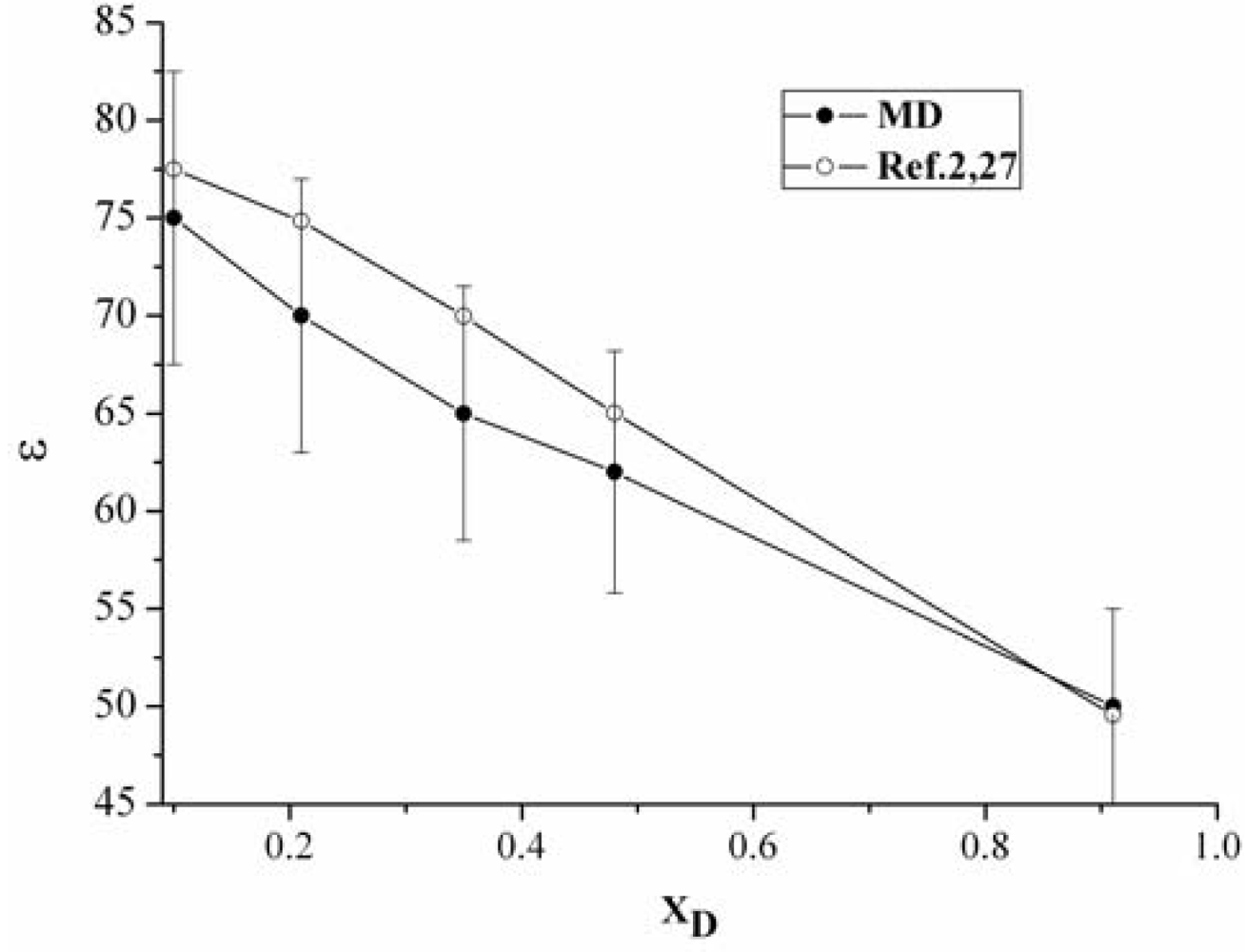
<p><xref ref-type="fig" rid="f1-ijms-10-01261">Figure 1</xref> describes the dielectric constant <italic>ɛ</italic> as a function of the composition. The error bars were estimated using the blocking method, considering that the intermolecular potentials used here lack of any polarizability effects beyond the usual dipole moment enhancement and the fact that the SPC/E underestimates water’s dielectric constant by about 10%, the MD values of <italic>ɛ</italic> for the mixtures are small than those from Ref. [<xref ref-type="bibr" rid="b2-ijms-10-01261">2</xref>] and [<xref ref-type="bibr" rid="b27-ijms-10-01261">27</xref>].</p></sec>
<sec>
<label>3.2.</label>
<title>The relaxation time</title>
<p>Thermodynamic and statistical perturbation theory originally developed by Zwanzig [<xref ref-type="bibr" rid="b28-ijms-10-01261">28</xref>] can be used to calculate relative and absolute free energies for molecularly detailed systems [<xref ref-type="bibr" rid="b29-ijms-10-01261">29</xref>]. The change of the Gibbs free energy of a system with N particles at a given temperature, T, and pressure, P, is given by [<xref ref-type="bibr" rid="b30-ijms-10-01261">30</xref>]:
<disp-formula id="FD4">
<label>(4)</label>
<mml:math display="block">
<mml:mrow>
<mml:mo>Δ</mml:mo>
<mml:mi>G</mml:mi>
<mml:mi> </mml:mi>
<mml:mo>=</mml:mo>
<mml:mi> </mml:mi>
<mml:mo>−</mml:mo>
<mml:mi>k</mml:mi>
<mml:mi>T</mml:mi>
<mml:mtext>ln</mml:mtext>
<mml:mi> </mml:mi>
<mml:mo>&lt;</mml:mo>
<mml:msup>
<mml:mi>e</mml:mi>
<mml:mrow>
<mml:mo>−</mml:mo>
<mml:mo>Δ</mml:mo>
<mml:mi>V</mml:mi>
<mml:mo>/</mml:mo>
<mml:mi>k</mml:mi>
<mml:mi>T</mml:mi></mml:mrow></mml:msup>
<mml:msub>
<mml:mo>&gt;</mml:mo>
<mml:mn>0</mml:mn></mml:msub></mml:mrow></mml:math></disp-formula>Where Δ<italic>V</italic> is a perturbation of the Hamiltonian.</p>
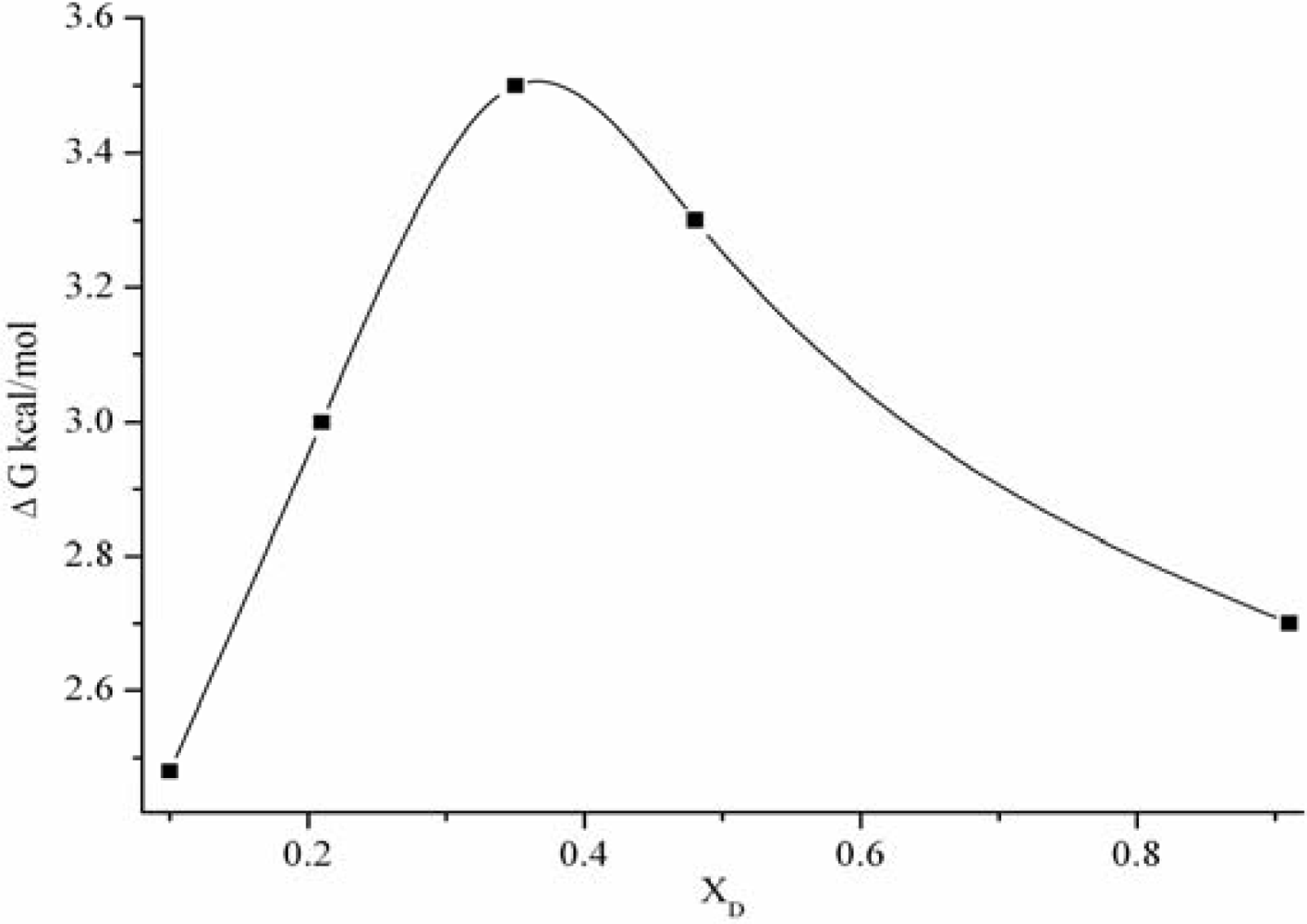
<p>The composition dependence of the calculated values of Δ<italic>G</italic> is given in <xref ref-type="fig" rid="f2-ijms-10-01261">Figure 2</xref>. From this Figure, it can be seen that the free energy of activation increases with the concentration of the nonelectrolyte in water, reaching a maximum value of 3.5 at the concentration fraction of 0.35, whereafter it decreases. This difference can be attributed to the fact that the components are capable of specific interactions with one another.</p>
<p>Eyring <italic>et al.</italic> have applied the theory of rate processes to molecular dipole relaxation with the following equation [<xref ref-type="bibr" rid="b31-ijms-10-01261">31</xref>]:
<disp-formula id="FD5">
<label>(5)</label>
<mml:math display="block">
<mml:mi>τ</mml:mi>
<mml:mo>=</mml:mo>
<mml:mi> </mml:mi>
<mml:mo stretchy="false">(</mml:mo>
<mml:mi>h</mml:mi>
<mml:mo>/</mml:mo>
<mml:msub>
<mml:mi>k</mml:mi>
<mml:mi>B</mml:mi></mml:msub>
<mml:mi>T</mml:mi>
<mml:mo stretchy="false">)</mml:mo>
<mml:mtext>exp</mml:mtext>
<mml:mo stretchy="false">(</mml:mo>
<mml:mo>Δ</mml:mo>
<mml:mi>G</mml:mi>
<mml:mo>/</mml:mo>
<mml:mi>R</mml:mi>
<mml:mi>T</mml:mi>
<mml:mo stretchy="false">)</mml:mo></mml:math></disp-formula>where Δ<italic>G</italic> is the free energy change of activation for the dipole relaxation, <italic>k</italic><italic><sub>B</sub></italic> is Boltzmann’s constant, <italic>h</italic>, <italic>R</italic> are Planck’s constant and the molar gas constant, respectively.</p>
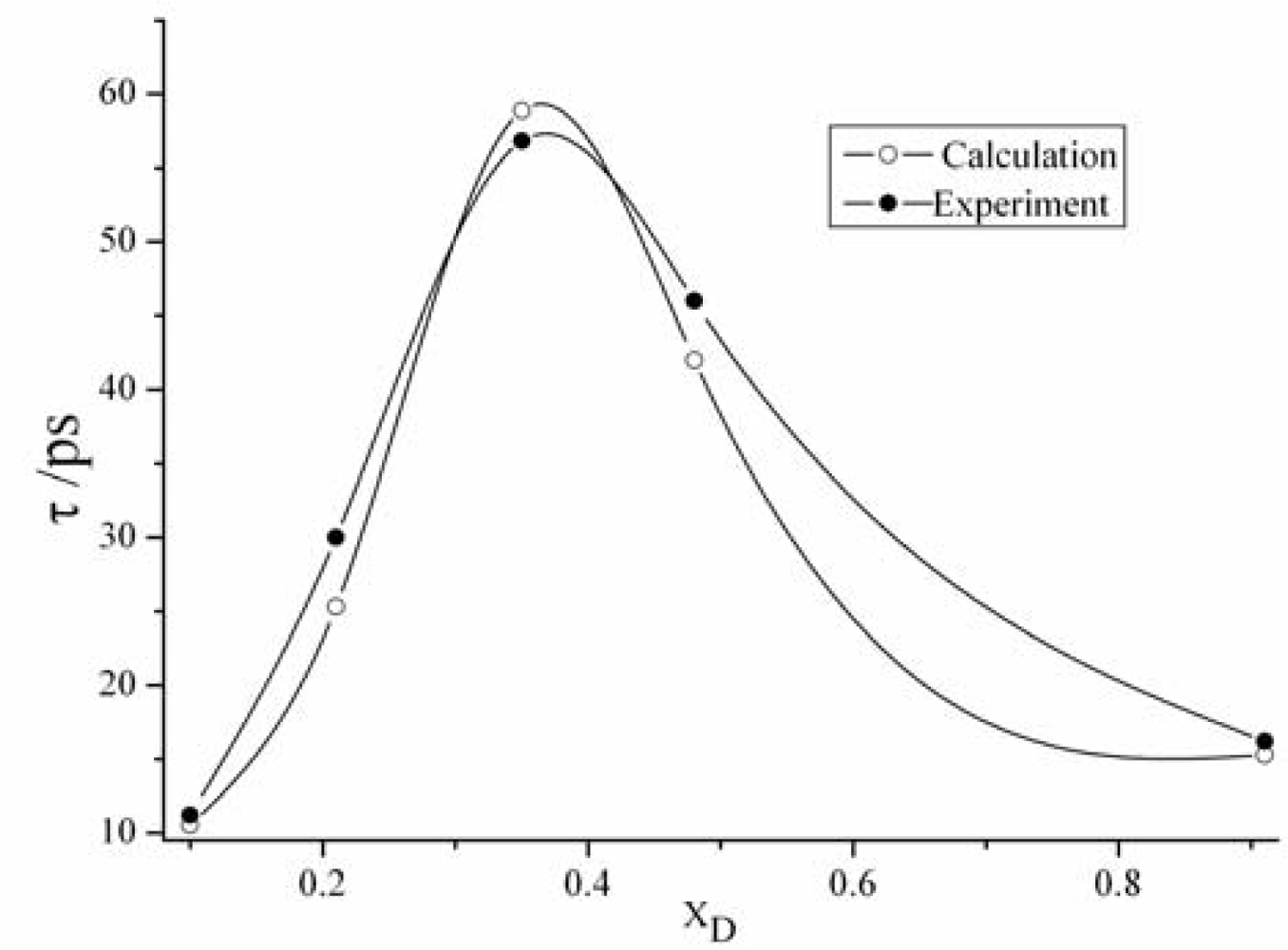
<p>The mixture’s overall dielectric relaxation time <italic>τ</italic> is in good agreement with the experimental, except for compositions between 0.3 and 0.42, where the simulations predict significantly higher relaxation times seen from <xref ref-type="fig" rid="f3-ijms-10-01261">Figure 3</xref>.</p>
<p>In <xref ref-type="fig" rid="f3-ijms-10-01261">Figure 3</xref>, the open symbols show mole fraction dependence of the relaxation time is calculated by <xref ref-type="disp-formula" rid="FD5">Equation 5</xref>.</p></sec>
<sec>
<label>3.3.</label>
<title>The permittivities vs. Frequency</title>
<p>The complex permittivities are fitted by the nonlinear least-squares fit method to the Havriliak-Negami expression to obtain various dielectric parameters:
<disp-formula id="FD6">
<label>(6)</label>
<mml:math display="block">
<mml:msup>
<mml:mi>ɛ</mml:mi>
<mml:mo>*</mml:mo></mml:msup>
<mml:mo stretchy="false">(</mml:mo>
<mml:mi>ω</mml:mi>
<mml:mo stretchy="false">)</mml:mo>
<mml:mi> </mml:mi>
<mml:mo>=</mml:mo>
<mml:mi> </mml:mi>
<mml:msub>
<mml:mi>ɛ</mml:mi>
<mml:mo>∞</mml:mo></mml:msub>
<mml:mi> </mml:mi>
<mml:mo>+</mml:mo>
<mml:mi> </mml:mi>
<mml:mo stretchy="false">(</mml:mo>
<mml:msub>
<mml:mi>ɛ</mml:mi>
<mml:mn>0</mml:mn></mml:msub>
<mml:mi> </mml:mi>
<mml:mo>+</mml:mo>
<mml:mi> </mml:mi>
<mml:msub>
<mml:mi>ɛ</mml:mi>
<mml:mo>∞</mml:mo></mml:msub>
<mml:mo stretchy="false">)</mml:mo>
<mml:mo>/</mml:mo>
<mml:msup>
<mml:mrow>
<mml:mo>[</mml:mo>
<mml:mrow>
<mml:mn>1</mml:mn>
<mml:mo>+</mml:mo>
<mml:msup>
<mml:mrow>
<mml:mo stretchy="false">(</mml:mo>
<mml:mi>j</mml:mi>
<mml:mi>ω</mml:mi>
<mml:mi>τ</mml:mi>
<mml:mo stretchy="false">)</mml:mo></mml:mrow>
<mml:mrow>
<mml:mn>1</mml:mn>
<mml:mo>−</mml:mo>
<mml:mi>α</mml:mi></mml:mrow></mml:msup></mml:mrow>
<mml:mo>]</mml:mo></mml:mrow>
<mml:mi>β</mml:mi></mml:msup></mml:math></disp-formula>Where <italic>ɛ*</italic> (<italic>ω</italic>) is the complex permittivity at an angular frequency <italic>ω, ɛ</italic><sub>∞</sub> is the permittivity at high frequency, <italic>ɛ</italic> <sub>∞</sub> is the static dielectric constant, <italic>α</italic> is the shape parameter representing symmetrical distribution of relaxation time and <italic>β̣</italic> is the shape parameter of an asymmetric relaxation curve. <xref ref-type="disp-formula" rid="FD4">Equation 4</xref> includes Cole-Cole (<italic>β̣</italic> =1,0 &lt; <italic>α</italic> &lt;1) [<xref ref-type="bibr" rid="b32-ijms-10-01261">32</xref>], Davidson-Cole (<italic>α̣ =</italic>0, 0 &lt; <italic>β</italic> &lt; 1) [<xref ref-type="bibr" rid="b33-ijms-10-01261">33</xref>] and Debye (<italic>α=</italic>0<italic>, β̣=1</italic>) [<xref ref-type="bibr" rid="b34-ijms-10-01261">34</xref>] relaxation models. In our system, it is observed that under experimental error the dielectric relaxation can be described by the Debye-like (<italic>β</italic> ≈ 1[<xref ref-type="bibr" rid="b35-ijms-10-01261">35</xref>]). Therefore, <xref ref-type="disp-formula" rid="FD6">Equation 6</xref> can be rewritten to <xref ref-type="disp-formula" rid="FD7">Equation 7</xref>:
<disp-formula id="FD7">
<label>(7)</label>
<mml:math display="block">
<mml:msup>
<mml:mi>ɛ</mml:mi>
<mml:mo>*</mml:mo></mml:msup>
<mml:mo stretchy="false">(</mml:mo>
<mml:mi>ω</mml:mi>
<mml:mo stretchy="false">)</mml:mo>
<mml:mi> </mml:mi>
<mml:mo>=</mml:mo>
<mml:mi> </mml:mi>
<mml:msub>
<mml:mi>ɛ</mml:mi>
<mml:mo>∞</mml:mo></mml:msub>
<mml:mo>+</mml:mo>
<mml:mo stretchy="false">(</mml:mo>
<mml:msub>
<mml:mi>ɛ</mml:mi>
<mml:mn>0</mml:mn></mml:msub>
<mml:mi> </mml:mi>
<mml:mo>+</mml:mo>
<mml:mi> </mml:mi>
<mml:msub>
<mml:mi>ɛ</mml:mi>
<mml:mo>∞</mml:mo></mml:msub>
<mml:mo stretchy="false">)</mml:mo>
<mml:mo>/</mml:mo>
<mml:mo stretchy="false">(</mml:mo>
<mml:mn>1</mml:mn>
<mml:mi> </mml:mi>
<mml:mo>+</mml:mo>
<mml:mi> </mml:mi>
<mml:mi>j</mml:mi>
<mml:mi>ω</mml:mi>
<mml:mi>τ</mml:mi>
<mml:mo stretchy="false">)</mml:mo></mml:math></disp-formula>where the complex permittivity <italic>ɛ*</italic> (<italic>ω</italic>) is
<disp-formula id="FD8">
<label>(8)</label>
<mml:math display="block">
<mml:mrow>
<mml:msup>
<mml:mi>ɛ</mml:mi>
<mml:mo>*</mml:mo></mml:msup>
<mml:mo stretchy="false">(</mml:mo>
<mml:mi>ω</mml:mi>
<mml:mo stretchy="false">)</mml:mo>
<mml:mi> </mml:mi>
<mml:mo>=</mml:mo>
<mml:mi> </mml:mi>
<mml:msup>
<mml:mi>ɛ</mml:mi>
<mml:mo>′</mml:mo></mml:msup>
<mml:mo stretchy="false">(</mml:mo>
<mml:mi>ω</mml:mi>
<mml:mo stretchy="false">)</mml:mo>
<mml:mi> </mml:mi>
<mml:mo>−</mml:mo>
<mml:mi> </mml:mi>
<mml:mi>i</mml:mi>
<mml:msup>
<mml:mi>ɛ</mml:mi>
<mml:mo>″</mml:mo></mml:msup>
<mml:mo stretchy="false">(</mml:mo>
<mml:mi>ω</mml:mi>
<mml:mo stretchy="false">)</mml:mo></mml:mrow></mml:math></disp-formula></p>
<p>For the Debye Equation, the real <italic>ɛ</italic>′ and imaginary <italic>ɛ″</italic> contributions to the dielectric behavior can be expressed by:
<disp-formula id="FD9">
<label>(9)</label>
<mml:math display="block">
<mml:mtable columnalign="left">
<mml:mtr columnalign="left">
<mml:mtd columnalign="left">
<mml:mrow>
<mml:msup>
<mml:mi>ɛ</mml:mi>
<mml:mo>′</mml:mo></mml:msup>
<mml:mo stretchy="false">(</mml:mo>
<mml:mi>ω</mml:mi>
<mml:mo stretchy="false">)</mml:mo>
<mml:mi> </mml:mi>
<mml:mo>=</mml:mo>
<mml:mi> </mml:mi>
<mml:msub>
<mml:mi>ɛ</mml:mi>
<mml:mo>∞</mml:mo></mml:msub>
<mml:mi> </mml:mi>
<mml:mo>+</mml:mo>
<mml:mi> </mml:mi>
<mml:mo stretchy="false">(</mml:mo>
<mml:mi>ɛ</mml:mi>
<mml:mi> </mml:mi>
<mml:mo>−</mml:mo>
<mml:mi> </mml:mi>
<mml:msub>
<mml:mi>ɛ</mml:mi>
<mml:mo>∞</mml:mo></mml:msub>
<mml:mo stretchy="false">)</mml:mo>
<mml:mo>/</mml:mo>
<mml:mo stretchy="false">(</mml:mo>
<mml:mn>1</mml:mn>
<mml:mi> </mml:mi>
<mml:mo>+</mml:mo>
<mml:mi> </mml:mi>
<mml:msup>
<mml:mi>ω</mml:mi>
<mml:mn>2</mml:mn></mml:msup>
<mml:msup>
<mml:mi>τ</mml:mi>
<mml:mn>2</mml:mn></mml:msup>
<mml:mo stretchy="false">)</mml:mo></mml:mrow></mml:mtd></mml:mtr>
<mml:mtr columnalign="left">
<mml:mtd columnalign="left">
<mml:mrow>
<mml:msup>
<mml:mi>ɛ</mml:mi>
<mml:mo>″</mml:mo></mml:msup>
<mml:mo stretchy="false">(</mml:mo>
<mml:mi>ω</mml:mi>
<mml:mo stretchy="false">)</mml:mo>
<mml:mi> </mml:mi>
<mml:mo>=</mml:mo>
<mml:mi> </mml:mi>
<mml:mo stretchy="false">(</mml:mo>
<mml:mi>ɛ</mml:mi>
<mml:mi> </mml:mi>
<mml:mo>−</mml:mo>
<mml:mi> </mml:mi>
<mml:msub>
<mml:mi>ɛ</mml:mi>
<mml:mo>∞</mml:mo></mml:msub>
<mml:mo stretchy="false">)</mml:mo>
<mml:mi>ω</mml:mi>
<mml:mi>τ</mml:mi>
<mml:mo>/</mml:mo>
<mml:mo stretchy="false">(</mml:mo>
<mml:mn>1</mml:mn>
<mml:mi> </mml:mi>
<mml:mo>+</mml:mo>
<mml:mi> </mml:mi>
<mml:msup>
<mml:mi>ω</mml:mi>
<mml:mn>2</mml:mn></mml:msup>
<mml:msup>
<mml:mi>τ</mml:mi>
<mml:mn>2</mml:mn></mml:msup>
<mml:mo stretchy="false">)</mml:mo></mml:mrow></mml:mtd></mml:mtr>
<mml:mtr columnalign="left">
<mml:mtd columnalign="left">
<mml:mrow>
<mml:msub>
<mml:mi>ɛ</mml:mi>
<mml:mo>∞</mml:mo></mml:msub>
<mml:mi> </mml:mi>
<mml:mo>≈</mml:mo>
<mml:mi> </mml:mi>
<mml:mn>1.1</mml:mn>
<mml:msubsup>
<mml:mi>n</mml:mi>
<mml:mi>D</mml:mi>
<mml:mn>2</mml:mn></mml:msubsup></mml:mrow></mml:mtd></mml:mtr></mml:mtable></mml:math></disp-formula></p>
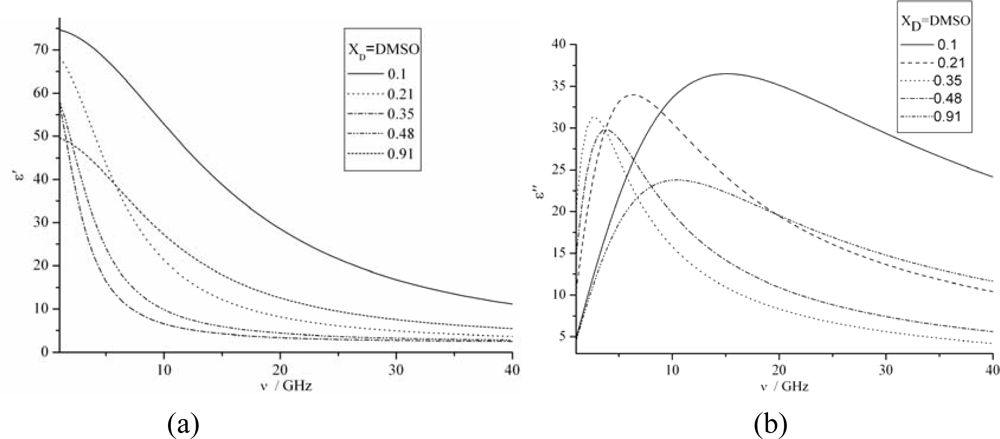
<p>Permittivity and losses for DMSO-water mixtures at 298 K are shown in <xref ref-type="fig" rid="f4-ijms-10-01261">Figure 4</xref>, where a single relaxation peak is observed for the entire concentration range of all the DMSO-water mixtures in the range of 1~40 GHz. <xref ref-type="fig" rid="f4-ijms-10-01261">Figure 4</xref>(a) obviously indicates that the higher the frequency the lower of the real <italic>ɛ’</italic>. Nevertheless, the real <italic>ɛ’</italic> decreases with the concentration of DMSO increasing, however, a completely opposite result were obtained when <italic>x</italic><italic><sub>D</sub></italic> is more than 0.35. It can be addressed that the real <italic>ɛ’</italic> of the mixtures strongly depend on the DMSO concentration. It is expected that this phenomenon is due to the cooperative motion of DMSO-water molecules through hydrogen bonds.</p>
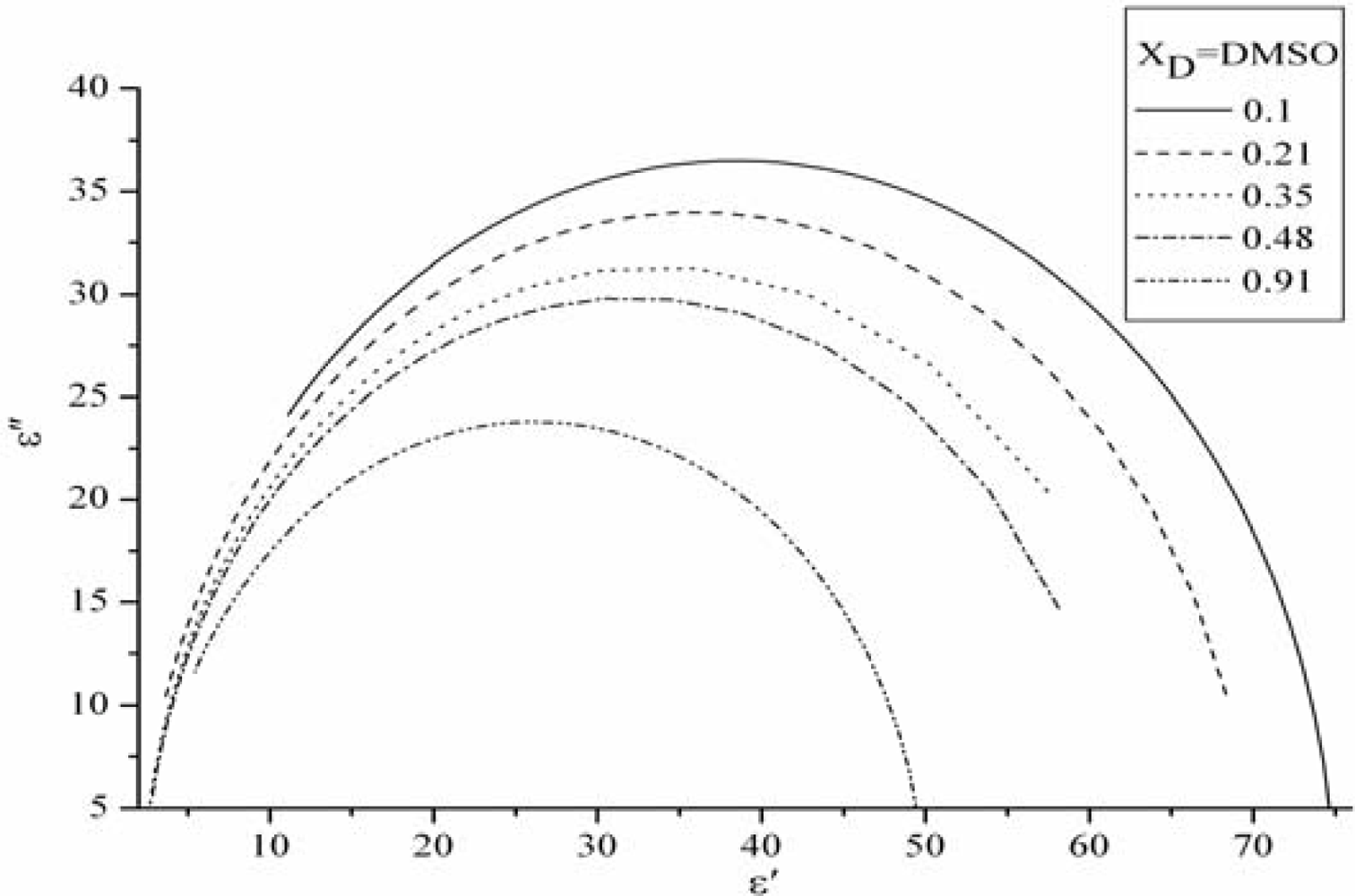
<p>From <xref ref-type="fig" rid="f4-ijms-10-01261">Figure 4</xref>(b), the imaginary <italic>ɛ″</italic> of dielectric constant increases with the frequency till it reaches the summit, after which the imaginary part reduce gradually with the frequency. Generally, the primary process observed for various associated liquids and those water mixtures exhibit an asymmetric loss peak. In a theoretical study, it has been suggested that the motional units in the correlated domains cooperatively move and the heterogeneity of the size distribution of the domain results in the asymmetric shape of the loss peak. The concentration dependence of DMSO-water mixture solution had been calculated by <xref ref-type="disp-formula" rid="FD9">Equation 9</xref>, the Cloe-Cloe diagrams can be drawn as shown in <xref ref-type="fig" rid="f5-ijms-10-01261">Figure 5</xref>. It can be concluded that the relation between <italic>ɛ</italic>″ and <italic>ɛ″</italic> are circle, but those centre aren’t the cross axle <italic>ɛ</italic>″.</p></sec></sec>
<sec sec-type="conclusions">
<label>4.</label>
<title>Conclusions</title>
<p>This paper presents the picosecond dynamical profile of water-DMSO solutions over the entire range of composition. The static dielectric constant, dielectric relaxation in the frequency of microwave, as well as the microwave spectra of DMSO-water mixtures have been investigated through molecular dynamics simulation at room conditions, and this simulation has been proved to be an efficient tool for the study of molecular processes in solutions under the sufficiently wide frequency range.</p></sec></body>
<back>
<ack>
<p>This project is supported by the National Science Foundation of China under Grant NO.60531010 and Research Fund for the Doctoral Program of Higher Education of China under Grant NO. 20070610120.</p></ack>
<ref-list>
<title>References and Notes</title>
<ref id="b1-ijms-10-01261"><label>1.</label><citation citation-type="journal"><person-group person-group-type="author"><name><surname>Leadbeater</surname><given-names>N</given-names></name></person-group><article-title>Making microwaves</article-title><source>Chem. World</source><year>2004</year><volume>1</volume><fpage>38</fpage><lpage>41</lpage></citation></ref>
<ref id="b2-ijms-10-01261"><label>2.</label><citation citation-type="journal"><person-group person-group-type="author"><name><surname>Adam</surname><given-names>D</given-names></name></person-group><article-title>Microwave chemistry: Out of the kitchen</article-title><source>Nature</source><year>2003</year><volume>421</volume><fpage>571</fpage><lpage>572</lpage><pub-id pub-id-type="doi">10.1038/421571a</pub-id><pub-id pub-id-type="pmid">12571563</pub-id></citation></ref>
<ref id="b3-ijms-10-01261"><label>3.</label><citation citation-type="book"><person-group person-group-type="author"><name><surname>Jin</surname><given-names>QH</given-names></name><name><surname>Dai</surname><given-names>SS</given-names></name><name><surname>Huang</surname><given-names>KM</given-names></name></person-group><source>Microwave Chemistry</source><publisher-name>Science Press</publisher-name><publisher-loc>Beijing, China</publisher-loc><year>1999</year></citation></ref>
<ref id="b4-ijms-10-01261"><label>4.</label><citation citation-type="journal"><person-group person-group-type="author"><name><surname>Vechi</surname><given-names>SM</given-names></name><name><surname>Skaf</surname><given-names>MS</given-names></name></person-group><article-title>Molecular-dynamics simulations of dimethylsulfoxide- methanol mixtures</article-title><source>J. Chem. Phys</source><year>2005</year><volume>123</volume><fpage>154507</fpage><lpage>154514</lpage><pub-id pub-id-type="doi">10.1063/1.2085052</pub-id><pub-id pub-id-type="pmid">16252962</pub-id></citation></ref>
<ref id="b5-ijms-10-01261"><label>5.</label><citation citation-type="journal"><person-group person-group-type="author"><name><surname>Cowie</surname><given-names>JMG</given-names></name><name><surname>Toporowski</surname><given-names>PM</given-names></name></person-group><article-title>Association in binary liquid system dimethyl sulphoxide–water</article-title><source>Can. J. Chem</source><year>1961</year><volume>39</volume><fpage>2240</fpage><lpage>2243</lpage><pub-id pub-id-type="doi">10.1139/v61-296</pub-id></citation></ref>
<ref id="b6-ijms-10-01261"><label>6.</label><citation citation-type="journal"><person-group person-group-type="author"><name><surname>Fox</surname><given-names>MF</given-names></name><name><surname>Whittingham</surname><given-names>KP</given-names></name></person-group><article-title>Component interactions in aqueous dimethyl sulphoxide</article-title><source>J Chem Soc, Faraday Trans 1</source><year>1975</year><volume>71</volume><fpage>1407</fpage><lpage>1412</lpage><pub-id pub-id-type="doi">10.1039/f19757101407</pub-id></citation></ref>
<ref id="b7-ijms-10-01261"><label>7.</label><citation citation-type="journal"><person-group person-group-type="author"><name><surname>Clever</surname><given-names>HL</given-names></name><name><surname>Pigott</surname><given-names>SP</given-names></name></person-group><article-title>Enthalpies of mixing of dimethylsulfoxide with water and with several ketones at 298.15 K</article-title><source>J. Chem. Thermodyn</source><year>1971</year><volume>3</volume><fpage>221</fpage><lpage>225</lpage><pub-id pub-id-type="doi">10.1016/S0021-9614(71)80106-4</pub-id></citation></ref>
<ref id="b8-ijms-10-01261"><label>8.</label><citation citation-type="journal"><person-group person-group-type="author"><name><surname>Packer</surname><given-names>KJ</given-names></name><name><surname>Tomlinson</surname><given-names>DJ</given-names></name></person-group><article-title>Nuclear spin relaxation and self-diffusion in the binary system, dimethylsulphoxide (DMSO) + water</article-title><source>Trans. Faraday Soc</source><year>1971</year><volume>67</volume><fpage>1302</fpage><lpage> 1314</lpage><pub-id pub-id-type="doi">10.1039/tf9716701302</pub-id></citation></ref>
<ref id="b9-ijms-10-01261"><label>9.</label><citation citation-type="journal"><person-group person-group-type="author"><name><surname>Gordalla</surname><given-names>BC</given-names></name><name><surname>Zeidler</surname><given-names>MD</given-names></name></person-group><article-title>Molecular dynamics in the system water- dimethylsulphoxide: A N.M.R. relaxation study</article-title><source>Mol. Phys</source><year>1986</year><volume>59</volume><fpage>817</fpage><lpage>828</lpage><pub-id pub-id-type="doi">10.1080/00268978600102411</pub-id></citation></ref>
<ref id="b10-ijms-10-01261"><label>10.</label><citation citation-type="journal"><person-group person-group-type="author"><name><surname>Baker</surname><given-names>ES</given-names></name><name><surname>Jonas</surname><given-names>J</given-names></name></person-group><article-title>Transport and relaxation properties of dimethylsulfoxide-water mixtures at high pressure</article-title><source>J Phys Chem</source><year>1985</year><volume>89</volume><issue>9</issue><fpage>1730</fpage><lpage>1735</lpage><pub-id pub-id-type="doi">10.1021/j100255a038</pub-id></citation></ref>
<ref id="b11-ijms-10-01261"><label>11.</label><citation citation-type="journal"><person-group person-group-type="author"><name><surname>Kaatze</surname><given-names>U</given-names></name><name><surname>Pottel</surname><given-names>R</given-names></name><name><surname>Schäfer</surname><given-names>M</given-names></name></person-group><article-title>Dielectric spectrum of dimethylsulfoxide/water mixtures as a function of composition</article-title><source>J Phys Chem</source><year>1989</year><volume>93</volume><issue>14</issue><fpage>5623</fpage><lpage>5627</lpage><pub-id pub-id-type="doi">10.1021/j100351a057</pub-id></citation></ref>
<ref id="b12-ijms-10-01261"><label>12.</label><citation citation-type="journal"><person-group person-group-type="author"><name><surname>Luzar</surname><given-names>A</given-names></name></person-group><article-title>Dielectric behavior of DMSO-water mixtures: a hydrogenbonding model</article-title><source>J. Mol. Liq</source><year>1990</year><volume>46</volume><fpage>221</fpage><lpage>238</lpage></citation></ref>
<ref id="b13-ijms-10-01261"><label>13.</label><citation citation-type="journal"><person-group person-group-type="author"><name><surname>Murthy</surname><given-names>SSN</given-names></name></person-group><article-title>Phase behavior of the supercooled aqueous solutions of dimethylSulfoxide, ethylene glycol, and methanol as seen by dielectric spectroscopy</article-title><source>J Phys Chem B</source><year>1997</year><volume>101</volume><issue>31</issue><fpage>6043</fpage><lpage>6049</lpage><pub-id pub-id-type="doi">10.1021/jp970451e</pub-id></citation></ref>
<ref id="b14-ijms-10-01261"><label>14.</label><citation citation-type="journal"><person-group person-group-type="author"><name><surname>Murthy</surname><given-names>SSN</given-names></name></person-group><article-title>Some insight into the physical basis of the cryoprotective action of dimethyl sulfoxide and ethylene glycol</article-title><source>Cryobiology</source><year>1998</year><volume>36</volume><fpage>84</fpage><lpage>96</lpage><pub-id pub-id-type="pmid">9527870</pub-id></citation></ref>
<ref id="b15-ijms-10-01261"><label>15.</label><citation citation-type="journal"><person-group person-group-type="author"><name><surname>Rasmussen</surname><given-names>DH</given-names></name><name><surname>Mackenzie</surname><given-names>AP</given-names></name></person-group><article-title>Phase diagram for the system water–dimethyl sulphoxide</article-title><source>Nature</source><year>1968</year><volume>220</volume><fpage>1315</fpage><lpage>1317</lpage><pub-id pub-id-type="pmid">5701346</pub-id></citation></ref>
<ref id="b16-ijms-10-01261"><label>16.</label><citation citation-type="journal"><person-group person-group-type="author"><name><surname>Zhang</surname><given-names>Q</given-names></name><name><surname>Zhang</surname><given-names>X</given-names></name><name><surname>Zhao</surname><given-names>DX</given-names></name></person-group><article-title>Polarizable force field for water–dimethyl sulfoxide systems: I parameterization and gas phase test</article-title><source>J. Mol. Liq</source><year>2009</year><volume>145</volume><fpage>58</fpage><lpage>66</lpage></citation></ref>
<ref id="b17-ijms-10-01261"><label>17.</label><citation citation-type="journal"><person-group person-group-type="author"><name><surname>Zhang</surname><given-names>Q</given-names></name><name><surname>Zhang</surname><given-names>X</given-names></name><name><surname>Zhao</surname><given-names>DX</given-names></name></person-group><article-title>Polarizable force field for water-dimethyl sulfoxide systems: II properties of mixtures by molecular dynamics simulations</article-title><source>J Mol Liq</source><year>2009</year><volume>145</volume><fpage>67</fpage><lpage>81</lpage></citation></ref>
<ref id="b18-ijms-10-01261"><label>18.</label><citation citation-type="journal"><person-group person-group-type="author"><name><surname>Catalan</surname><given-names>J</given-names></name><name><surname>Diaz</surname><given-names>C</given-names></name><name><surname>Garcia-Blanco</surname><given-names>F</given-names></name></person-group><article-title>Characterization of binary solvent mixtures of DMSO with water and other cosolvents</article-title><source>J. Org. Chem</source><year>2001</year><volume>66</volume><fpage>5846</fpage><lpage>5852</lpage><pub-id pub-id-type="pmid">11511261</pub-id></citation></ref>
<ref id="b19-ijms-10-01261"><label>19.</label><citation citation-type="journal"><person-group person-group-type="author"><name><surname>Muller</surname><given-names>MG</given-names></name><name><surname>Hardy</surname><given-names>EH</given-names></name><name><surname>Vogt</surname><given-names>PS</given-names></name><name><surname>Bratschi</surname><given-names>C</given-names></name><name><surname>Kirchner</surname><given-names>B</given-names></name><name><surname>Huber</surname><given-names>H</given-names></name><name><surname>Searles</surname><given-names>DJ</given-names></name></person-group><article-title>Calculation of the deuteron quadrupole relaxation rate in a mixture of water and dimethyl sulfoxide</article-title><source>J. Am. Chem. Soc</source><year>2004</year><volume>126</volume><fpage>4704</fpage><lpage>4710</lpage><pub-id pub-id-type="pmid">15070389</pub-id></citation></ref>
<ref id="b20-ijms-10-01261"><label>20.</label><citation citation-type="journal"><person-group person-group-type="author"><name><surname>Suresh</surname><given-names>SJ</given-names></name></person-group><article-title>Detailed molecular model for dielectric constant of multicomponent, associating liquids</article-title><source>J. Phys. Chem. B</source><year>2004</year><volume>108</volume><fpage>715</fpage><lpage>720</lpage></citation></ref>
<ref id="b21-ijms-10-01261"><label>21.</label><citation citation-type="journal"><person-group person-group-type="author"><name><surname>Benjamin</surname><given-names>I</given-names></name></person-group><article-title>Structure, thermodynamics, and dynamics of the liquid/vapor interface of water/dimethylsulfoxide mixtures</article-title><source>J. Chem. Phys</source><year>1999</year><volume>110</volume><fpage>8070</fpage><lpage>8079</lpage></citation></ref>
<ref id="b22-ijms-10-01261"><label>22.</label><citation citation-type="journal"><person-group person-group-type="author"><name><surname>De Leeuw</surname><given-names>SW</given-names></name><name><surname>Perram</surname><given-names>JM</given-names></name><name><surname>Smith</surname><given-names>ER</given-names></name></person-group><article-title>Computer simulation of the static dielectric constant of systems with permanent electric dipoles</article-title><source>Annu. Rev. Phys. Chem</source><year>1986</year><volume>37</volume><fpage>245</fpage><lpage>270</lpage><pub-id pub-id-type="pmid">21819241</pub-id></citation></ref>
<ref id="b23-ijms-10-01261"><label>23.</label><citation citation-type="journal"><person-group person-group-type="author"><name><surname>Ryckaert</surname><given-names>JP</given-names></name><name><surname>Ciccotti</surname><given-names>G</given-names></name><name><surname>Berendsen</surname><given-names>HJC</given-names></name></person-group><article-title>Numerical integration of the cartesian equations of motion of a system with constraints: Molecular dynamics of n-alkanes</article-title><source>J Comput Phys</source><year>1977</year><volume>23</volume><fpage>327</fpage><lpage>341</lpage></citation></ref>
<ref id="b24-ijms-10-01261"><label>24.</label><citation citation-type="journal"><person-group person-group-type="author"><name><surname>Hockney</surname><given-names>RW</given-names></name></person-group><article-title>The potential calculation and some applications</article-title><source>Meth. Comput. Phys</source><year>1970</year><volume>9</volume><fpage>136</fpage><lpage>210</lpage></citation></ref>
<ref id="b25-ijms-10-01261"><label>25.</label><citation citation-type="journal"><person-group person-group-type="author"><name><surname>Cowie</surname><given-names>JMG</given-names></name><name><surname>Toporowski</surname><given-names>PM</given-names></name></person-group><article-title>Association in the binary liquid system dimethylsulphoxide– water</article-title><source>Can. J. Chem</source><year>1961</year><volume>39</volume><fpage>2240</fpage><lpage>2243</lpage></citation></ref>
<ref id="b26-ijms-10-01261"><label>26.</label><citation citation-type="journal"><person-group person-group-type="author"><name><surname>LeBel</surname><given-names>RG</given-names></name><name><surname>Goring</surname><given-names>DAI</given-names></name></person-group><article-title>Density, viscosity, refractive index, and hygroscopicity of mixtures of water and dimethyl sulfoxide</article-title><source>J. Chem. Eng. Data</source><year>1962</year><volume>7</volume><fpage>100</fpage><lpage>101</lpage></citation></ref>
<ref id="b27-ijms-10-01261"><label>27.</label><citation citation-type="journal"><person-group person-group-type="author"><name><surname>Doucet</surname><given-names>Y</given-names></name><name><surname>Calmes-Perrault</surname><given-names>F</given-names></name><name><surname>Durand</surname><given-names>MT</given-names></name></person-group><article-title>Dielectric constants of pure dimethyl sulfoxide and of its aqueous solutions</article-title><source>Compt. Rend</source><year>1965</year><volume>260</volume><fpage>1878</fpage><lpage>1881</lpage></citation></ref>
<ref id="b28-ijms-10-01261"><label>28.</label><citation citation-type="journal"><person-group person-group-type="author"><name><surname>Zwanzig</surname><given-names>RW</given-names></name></person-group><article-title>High-temperature equation of state by a perturbation method. I. nonpolar gases</article-title><source>J. Chem. Phys</source><year>1954</year><volume>22</volume><fpage>1420</fpage><lpage>1426</lpage></citation></ref>
<ref id="b29-ijms-10-01261"><label>29.</label><citation citation-type="journal"><person-group person-group-type="author"><name><surname>Beveridge</surname><given-names>DL</given-names></name><name><surname>DiCapua</surname><given-names>FM</given-names></name></person-group><article-title>Free Energy via Molecular Simulation: Applications to Chemical and Biomolecular Systems</article-title><source>Ann. Rev. Biophys. Biophys. Chem</source><year>1989</year><volume>18</volume><fpage>431</fpage><lpage>492</lpage></citation></ref>
<ref id="b30-ijms-10-01261"><label>30.</label><citation citation-type="journal"><person-group person-group-type="author"><name><surname>Wallqvist</surname><given-names>A</given-names></name><name><surname>Berne</surname><given-names>BJ</given-names></name></person-group><article-title>Molecular dynamics study of the dependence of water solvation free energy on solute curvature and surface area</article-title><source>J. Phys. Chem</source><year>1995</year><volume>99</volume><fpage>2885</fpage><lpage>2892</lpage></citation></ref>
<ref id="b31-ijms-10-01261"><label>31.</label><citation citation-type="book"><person-group person-group-type="author"><name><surname>Glasstone</surname><given-names>S</given-names></name><name><surname>Laidle</surname><given-names>KJ</given-names></name><name><surname>Eyring</surname><given-names>H</given-names></name></person-group><source>The theory of rate processes</source><publisher-name>McGraw-Hill</publisher-name><publisher-loc>New York, USA</publisher-loc><year>1941</year></citation></ref>
<ref id="b32-ijms-10-01261"><label>32.</label><citation citation-type="journal"><person-group person-group-type="author"><name><surname>Cole</surname><given-names>KS</given-names></name><name><surname>Cole</surname><given-names>RH</given-names></name></person-group><article-title>Dispersion and absorption in dielectrics I. alternating current characteristics</article-title><source>J. Chem. Phys</source><year>1941</year><volume>9</volume><fpage>341</fpage><lpage>351</lpage></citation></ref>
<ref id="b33-ijms-10-01261"><label>33.</label><citation citation-type="journal"><person-group person-group-type="author"><name><surname>Davidson</surname><given-names>DW</given-names></name><name><surname>Cole</surname><given-names>RH</given-names></name></person-group><article-title>Dielectric relaxation in glycerol</article-title><source>J. Chem. Phys</source><year>1950</year><volume>18</volume><fpage>1417</fpage></citation></ref>
<ref id="b34-ijms-10-01261"><label>34.</label><citation citation-type="book"><person-group person-group-type="author"><name><surname>Debye</surname><given-names>P</given-names></name></person-group><source>Polar Molecules</source><publisher-name>Chemical Catalog. Co.</publisher-name><publisher-loc>New York, USA</publisher-loc><year>1929</year></citation></ref>
<ref id="b35-ijms-10-01261"><label>35.</label><citation citation-type="journal"><person-group person-group-type="author"><name><surname>Puranik</surname><given-names>SM</given-names></name><name><surname>Kumbharkhane</surname><given-names>AC</given-names></name><name><surname>Mehrotra</surname><given-names>SC</given-names></name></person-group><article-title>Dielectric study of dimethyl sulfoxide–water mixtures using the time-domain technique</article-title><source>J. Chem. Soc. Faraday Trans</source><year>1992</year><volume>88</volume><fpage>433</fpage><lpage>435</lpage></citation></ref></ref-list>
<sec sec-type="display-objects">
<title>Figures and Tables</title>
<fig id="f1-ijms-10-01261" position="float">
<label>Figure 1.</label>
<caption>
<p>MD (full symbols) and Reference [<xref ref-type="bibr" rid="b2-ijms-10-01261">2</xref>] and [<xref ref-type="bibr" rid="b27-ijms-10-01261">27</xref>] (open symbols) data for the mixture’s dielectric constant vs. DMSO mole fraction.</p></caption>
<graphic xlink:href="ijms-10-01261f1.gif"/></fig>
<fig id="f2-ijms-10-01261" position="float">
<label>Figure 2.</label>
<caption>
<p>Free energy change of activation via water-DMSO solutions vs. mole fractions.</p></caption>
<graphic xlink:href="ijms-10-01261f2.gif"/></fig>
<fig id="f3-ijms-10-01261" position="float">
<label>Figure 3.</label>
<caption>
<p>Mole fraction dependence of the relaxation time <italic>τ</italic> of DMSO-water mixtures at 298 K.</p></caption>
<graphic xlink:href="ijms-10-01261f3.gif"/></fig>
<fig id="f4-ijms-10-01261" position="float">
<label>Figure 4.</label>
<caption>
<p>Permittivities and losses for DMSO-water mixtures at various concentrations at 298 K. (a) The real vs. frequency. (b) The imaginary vs. frequency.</p></caption>
<graphic xlink:href="ijms-10-01261f4.gif"/></fig>
<fig id="f5-ijms-10-01261" position="float">
<label>Figure 5.</label>
<caption>
<p>The Cole-Cole curve of DMSO-water mixture at various concentrations.</p></caption>
<graphic xlink:href="ijms-10-01261f5.gif"/></fig>
<table-wrap id="t1-ijms-10-01261" position="float">
<label>Table 1.</label>
<caption>
<p>L-J parameters and partial charges for water and DMSO.</p></caption>
<table frame="hsides" rules="groups">
<thead>
<tr>
<th align="left"/>
<th align="center"><italic>ɛ/(kJmol<sup>−1</sup>)</italic></th>
<th align="center"><italic>σ/(nm)</italic></th>
<th align="center"><italic>q/(a.u.)</italic></th></tr></thead>
<tbody>
<tr>
<td align="center">O(water)</td>
<td align="center">0.65</td>
<td align="center">0.3165</td>
<td align="center">−0.82</td></tr>
<tr>
<td align="center">H(water)</td>
<td align="center">0.0</td>
<td align="center">0.41</td></tr>
<tr>
<td colspan="4">
<hr/></td></tr>
<tr>
<td align="center">O(DMSO)</td>
<td align="center">0.30</td>
<td align="center">0.28</td>
<td align="center">−0.459</td></tr>
<tr>
<td align="center">S</td>
<td align="center">1.00</td>
<td align="center">0.34</td>
<td align="center">0.139</td></tr>
<tr>
<td align="center">CH<sub>3</sub></td>
<td align="center">1.23</td>
<td align="center">0.38</td>
<td align="center">0.16</td></tr></tbody></table></table-wrap>
<table-wrap id="t2-ijms-10-01261" position="float">
<label>Table 2.</label>
<caption>
<p>Compositions of the DMSO-water mixtures. Solvent 1 is DMSO; solvent 2 is water; <italic>x</italic><italic><sub>i</sub></italic> is mole fraction of solvent, <italic>n</italic><italic><sub>i</sub></italic> is number of molecules of solvent i in the cubic simulation cell of edge length <italic>L ; ρ</italic> is the density at 298K, <italic>n</italic><italic><sub>D</sub></italic> is the refractive index.</p></caption>
<table frame="hsides" rules="groups">
<thead>
<tr>
<th align="center"><bold>Composition</bold></th>
<th align="center"><italic>x</italic><sub>1</sub></th>
<th align="center"><italic>x</italic><sub>2</sub></th>
<th align="center"><italic>n</italic><sub>1</sub></th>
<th align="center"><italic>n</italic><sub>2</sub></th>
<th align="center"><bold><italic>L</italic></bold> <bold>(Å)</bold></th>
<th align="center"><italic>ρ</italic><xref ref-type="table-fn" rid="tfn1-ijms-10-01261">a</xref> <bold>(g/cm<sup>3</sup>)</bold></th>
<th align="center"><bold>Refractive index (</bold> <italic>n<sub>D</sub></italic><bold>)</bold></th></tr></thead>
<tbody>
<tr>
<td align="center">1</td>
<td align="center">0.1</td>
<td align="center">0.9</td>
<td align="center">100</td>
<td align="center">900</td>
<td align="center">34.05</td>
<td align="center">1.0105<xref ref-type="table-fn" rid="tfn2-ijms-10-01261">b</xref></td>
<td align="center">1.3458<xref ref-type="table-fn" rid="tfn2-ijms-10-01261">b</xref></td></tr>
<tr>
<td align="center">2</td>
<td align="center">0.21</td>
<td align="center">0.79</td>
<td align="center">210</td>
<td align="center">790</td>
<td align="center">36.76</td>
<td align="center">1.0242<xref ref-type="table-fn" rid="tfn2-ijms-10-01261">b</xref></td>
<td align="center">1.3600<xref ref-type="table-fn" rid="tfn2-ijms-10-01261">b</xref></td></tr>
<tr>
<td align="center">3</td>
<td align="center">0.35</td>
<td align="center">0.65</td>
<td align="center">350</td>
<td align="center">650</td>
<td align="center">39.0</td>
<td align="center">1.0927</td>
<td align="center">1.4385</td></tr>
<tr>
<td align="center">4</td>
<td align="center">0.48</td>
<td align="center">0.52</td>
<td align="center">480</td>
<td align="center">520</td>
<td align="center">41.38</td>
<td align="center">1.0983</td>
<td align="center">1.4525</td></tr>
<tr>
<td align="center">5</td>
<td align="center">0.91</td>
<td align="center">0.09</td>
<td align="center">910</td>
<td align="center">90</td>
<td align="center">47.93</td>
<td align="center">1.0965</td>
<td align="center">1.4741</td></tr></tbody></table>
<table-wrap-foot><fn id="tfn1-ijms-10-01261">
<label><sup>a</sup></label>
<p>Reference [<xref ref-type="bibr" rid="b25-ijms-10-01261">25</xref>].</p></fn><fn id="tfn2-ijms-10-01261">
<label><sup>b</sup></label>
<p>Reference [<xref ref-type="bibr" rid="b26-ijms-10-01261">26</xref>].</p></fn></table-wrap-foot></table-wrap></sec></back></article>