<?xml version="1.0" encoding="UTF-8"?>
<!DOCTYPE article PUBLIC "-//NLM//DTD Journal Publishing DTD v2.3 20070202//EN" "journalpublishing.dtd">
<article xmlns:xlink="http://www.w3.org/1999/xlink" xml:lang="en" article-type="research-article">
<front>
<journal-meta>
<journal-id journal-id-type="publisher-id">ijms</journal-id>
<journal-title>International Journal of Molecular Sciences</journal-title>
<abbrev-journal-title>Int. J. Mol. Sci.</abbrev-journal-title>
<issn pub-type="epub">1422-0067</issn>
<publisher>
<publisher-name>Molecular Diversity Preservation International (MDPI)</publisher-name></publisher></journal-meta>
<article-meta>
<article-id pub-id-type="publisher-id">ijms-10-00306</article-id>
<article-categories>
<subj-group>
<subject>Review</subject></subj-group></article-categories>
<title-group>
<article-title>Potential Mechanisms of Muscle Mitochondrial Dysfunction in Aging and Obesity and Cellular Consequences</article-title></title-group>
<contrib-group>
<contrib contrib-type="author">
<name><surname>Chanséaume</surname><given-names>Emilie</given-names></name><xref ref-type="aff" rid="af1-ijms-10-00306">1</xref><xref ref-type="aff" rid="af2-ijms-10-00306">2</xref></contrib>
<contrib contrib-type="author">
<name><surname>Morio</surname><given-names>Béatrice</given-names></name><xref ref-type="aff" rid="af1-ijms-10-00306">1</xref><xref ref-type="aff" rid="af2-ijms-10-00306">2</xref><xref ref-type="corresp" rid="C1">*</xref></contrib></contrib-group>
<aff id="af1-ijms-10-00306">
<label>1</label> INRA, UMR1019 Nutrition Humaine, F-63120 Saint Genès Champanelle, France. E-Mail:
<email>emilie@nutrifizz.fr</email></aff>
<aff id="af2-ijms-10-00306">
<label>2</label> Université Clermont 1, UFR Médecine, UMR1019 Nutrition Humaine, F-63000 Clermont-Ferrand, France</aff>
<author-notes>
<corresp id="C1">* Author to whom correspondence should be addressed; E-Mail:
<email>morio@clermont.inra.fr</email>; Tel. +33-473 608 272; Fax: +33-473 608 255</corresp></author-notes>
<pub-date pub-type="collection">
<month>1</month>
<year>2009</year></pub-date>
<pub-date pub-type="epub">
<day>13</day>
<month>1</month>
<year>2009</year></pub-date>
<volume>10</volume>
<issue>1</issue>
<fpage>306</fpage>
<lpage>324</lpage>
<history>
<date date-type="received">
<day>10</day>
<month>10</month>
<year>2008</year></date>
<date date-type="rev-recd">
<day>7</day>
<month>1</month>
<year>2009</year></date>
<date date-type="accepted">
<day>9</day>
<month>1</month>
<year>2009</year></date></history>
<permissions>
<copyright-statement>© 2009 by the authors; licensee Molecular Diversity Preservation International, Basel, Switzerland. This article is an open-access article distributed under the terms and conditions of the Creative Commons Attribution license (<ext-link xlink:href="http://creativecommons.org/licenses/by/3.0/" ext-link-type="uri">http://creativecommons.org/licenses/by/3.0/</ext-link>).</copyright-statement>
<copyright-year>2009</copyright-year>
<license license-type="open-access">
<p>This article is an open-access article distributed under the terms and conditions of the Creative Commons Attribution license (<ext-link xlink:href="http://creativecommons.org/licenses/by/3.0/" ext-link-type="uri">http://creativecommons.org/licenses/by/3.0/</ext-link>).</p></license></permissions>
<abstract>
<p>Mitochondria play a key role in the energy metabolism in skeletal muscle. A new concept has emerged suggesting that impaired mitochondrial oxidative capacity in skeletal muscle may be the underlying defect that causes insulin resistance. According to current knowledge, the causes and the underlying molecular mechanisms at the origin of decreased mitochondrial oxidative capacity in skeletal muscle still remain to be elucidated. The present review focuses on recent data investigating these issues in the area of metabolic disorders and describes the potential causes, mechanisms and consequences of mitochondrial dysfunction in the skeletal muscle.</p></abstract>
<kwd-group>
<kwd>Mitochondrial dysfunction</kwd>
<kwd>skeletal muscle</kwd>
<kwd>metabolic disorders</kwd>
<kwd>obesity</kwd>
<kwd>insulin resistance</kwd>
<kwd>type 2 diabetes</kwd></kwd-group></article-meta></front>
<body>
<sec sec-type="intro">
<title>1. Introduction</title>
<p>Over the past decade, the list of publications suggesting an involvement of mitochondrial oxidative capacity in skeletal muscle in the aetiology of metabolic disorders such as obesity, insulin resistance or type 2 diabetes, has been growing steadily. By considering that lifestyle and physical activity, in addition to age, gender and genetic background, influence mitochondrial oxidative capacity in human muscle, it is clear that the understanding of the causes at the origin of oxidative phosphorylation (OXPHOS) activity impairment is far from being accomplished. In this context, the purpose of this review is to highlight recent knowledge regarding the potential causes, mechanisms and cellular consequences of muscle mitochondrial dysfunction.</p></sec>
<sec>
<title>2. Transcriptional regulation of muscle mitochondrial oxidative capacity</title>
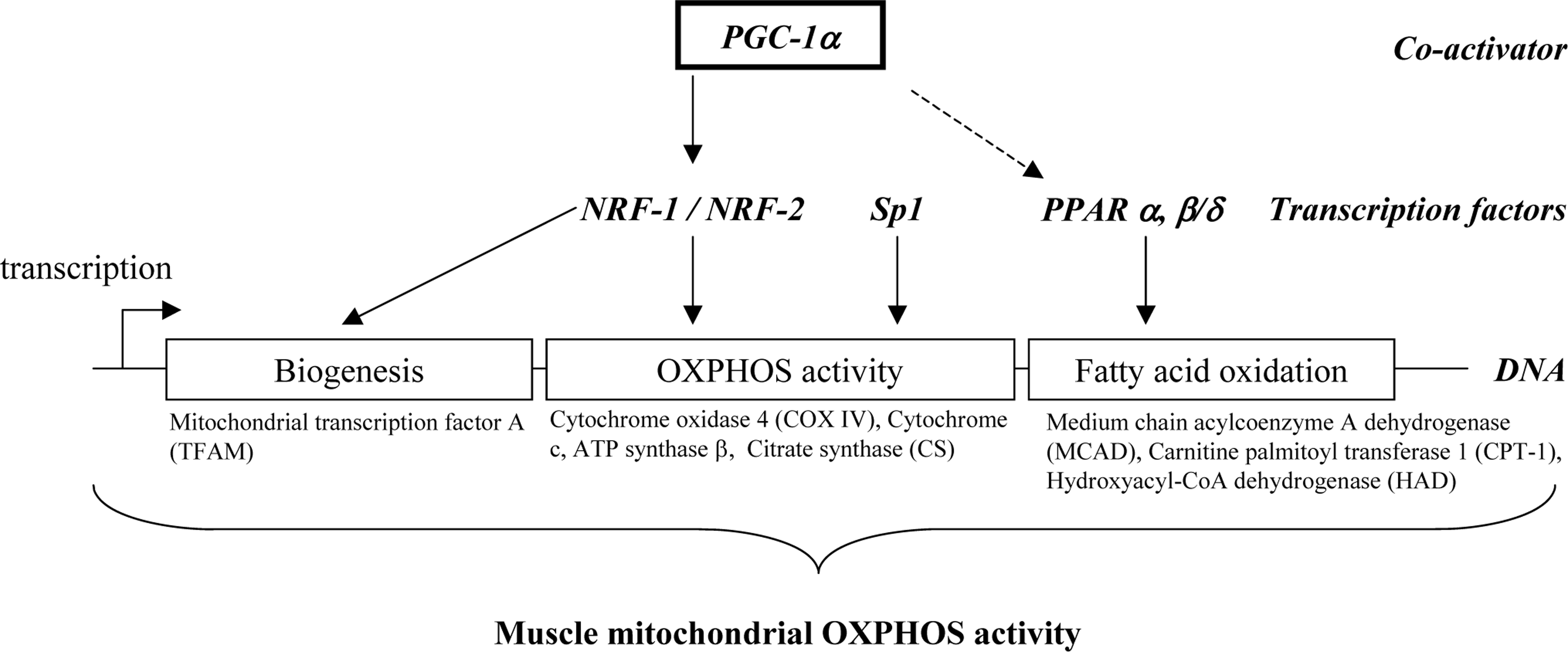
<p>Muscle oxidative capacity is mainly determined by the mitochondrial density that depends on mitochondrial biogenesis (i.e. the cellular processes involved in the synthesis of the organelles), and the mitochondrial oxidative capacity, which relies on the oxidative enzyme content and activity. A number of transcriptional modulators have been implicated in the regulation of muscle mitochondrial biogenesis and OXPHOS activity. They include PPAR gamma coactivator 1 alpha (PGC-1α), in cooperation with several factors such as the peroxisome proliferator-activated receptors (PPAR), the nuclear respiratory factors 1 and 2 (NRF-1 and NRF-2) [<xref ref-type="bibr" rid="b1-ijms-10-00306">1</xref>–<xref ref-type="bibr" rid="b9-ijms-10-00306">9</xref>], or the specificity protein 1 (Sp1), an ubiquitous transcription factor known to regulate the constitutive expression of oxidative OXPHOS genes [<xref ref-type="bibr" rid="b10-ijms-10-00306">10</xref>]. Of note, Sp1 can function as both a positive (e.g. cytochrome c1 and mitochondrial transcription factor A, TFAM) and a negative (e.g. adenine nucleotide translocator 2 and F1-ATPase beta subunit) regulator of transcription [<xref ref-type="bibr" rid="b11-ijms-10-00306">11</xref>]. PGC-1α is a master modulator of gene expression in skeletal muscle [<xref ref-type="bibr" rid="b12-ijms-10-00306">12</xref>]. It was found to drive the formation of oxidative type I fibres and to activate the expression of genes involved in mitochondrial oxidative capacity, through associated changes in the expression of NRF dependent genes [<xref ref-type="bibr" rid="b13-ijms-10-00306">13</xref>]. These combined data have therefore suggested that decreased PGC-1α gene expression could be one of the primary contributors to decreased mitochondrial oxidative capacity. However, PPARs are also good candidates. When bound to their ligand (e.g. fatty acids for PPARα), PPARs form a heterodimeric complex with the retinoid X receptor (RXR) to regulate gene transcription involved in fatty acid metabolism. PGC-1α is also known to enhance the activity of the isoforms PPARα and PPARβ/δ in skeletal muscle, which may result in the enhanced expression of genes involved in mitochondrial fatty acid oxidation [<xref ref-type="bibr" rid="b14-ijms-10-00306">14</xref>]. Major transcriptional modulators involved in the regulation of mitochondrial activity in skeletal muscle are illustrated in <xref ref-type="fig" rid="f1-ijms-10-00306">Figure 1</xref> (see also [<xref ref-type="bibr" rid="b14-ijms-10-00306">14</xref>–<xref ref-type="bibr" rid="b16-ijms-10-00306">16</xref>] for reviews). All factors mentioned above co-regulate the transcriptional activity of a variety of genes involved in mitochondrial biogenesis, OXPHOS activity and fatty acid oxidation. For example, in muscle cells, overexpression of PGC-1α was shown to induce the gene expression of NRF-1, NRF-2, TFAM and mitochondrial-encoded cytochrome c oxidase (COX) subunits [<xref ref-type="bibr" rid="b15-ijms-10-00306">15</xref>]. Likewise, muscle–specific overexpression of PPARβ/δ in mice was shown to increase oxidative enzyme activities such as citrate synthase or b-hydroxyacyl-CoA dehydrogenase, and to enhance expression of genes implicated in fatty acid catabolism [<xref ref-type="bibr" rid="b17-ijms-10-00306">17</xref>].</p></sec>
<sec>
<title>3. Potential causes of impaired mitochondrial oxidative capacity</title>
<p>Emerging data support the hypothesis that in the particular case of young healthy insulin resistant offspring of parents with type 2 diabetes, alteration in mitochondrial activity would be partly inherited [<xref ref-type="bibr" rid="b18-ijms-10-00306">18</xref>–<xref ref-type="bibr" rid="b21-ijms-10-00306">21</xref>]. In this review, we will only focus on the potential causes of acquired impairment in muscle mitochondrial OXPHOS activity.</p>
<sec>
<title>3.1. Aging</title>
<p>Most studies conducted in animals agree and evidence a decrease in mitochondrial oxidative capacity associated with aging [<xref ref-type="bibr" rid="b22-ijms-10-00306">22</xref>, <xref ref-type="bibr" rid="b23-ijms-10-00306">23</xref>]. By contrast, data for humans are still controversial [<xref ref-type="bibr" rid="b24-ijms-10-00306">24</xref>–<xref ref-type="bibr" rid="b29-ijms-10-00306">29</xref>], although several studies have identified some major pathways altered with aging: 1) decreased maximal activity of key mitochondrial oxidative enzymes (e.g. cytochrome c oxidase or citrate synthase) [<xref ref-type="bibr" rid="b30-ijms-10-00306">30</xref>, <xref ref-type="bibr" rid="b31-ijms-10-00306">31</xref>], 2) decreased mitochondrial ATP production rates [<xref ref-type="bibr" rid="b19-ijms-10-00306">19</xref>,<xref ref-type="bibr" rid="b32-ijms-10-00306">32</xref>], 3) decreased protein content in ATP synthase subunits β [<xref ref-type="bibr" rid="b33-ijms-10-00306">33</xref>], and 4) decreased mitochondrial density [<xref ref-type="bibr" rid="b30-ijms-10-00306">30</xref>, <xref ref-type="bibr" rid="b34-ijms-10-00306">34</xref>]. In addition, several studies have suggested the involvement of alterations in mitochondrial protein synthesis rate in the age-related decrease in mitochondrial oxidative capacity of skeletal muscle [<xref ref-type="bibr" rid="b35-ijms-10-00306">35</xref>, <xref ref-type="bibr" rid="b36-ijms-10-00306">36</xref>]. Indeed, a selective decline in the fractional synthesis rate (FSR) of muscle mitochondrial proteins [<xref ref-type="bibr" rid="b37-ijms-10-00306">37</xref>, <xref ref-type="bibr" rid="b39-ijms-10-00306">39</xref>] and a decreased stimulation of mitochondrial protein synthesis in response to insulin [<xref ref-type="bibr" rid="b39-ijms-10-00306">39</xref>] have been described in elderly individuals compared to young adults. It remains, however, controversial whether the reduction in mitochondrial oxidative capacity is due to a consequence of aging <italic>per se</italic> or to environmental or lifestyle variables. Indeed, increased sedentary lifestyle and insulin resistance characterizes aging and both situations may contribute to age-related muscle mitochondrial dysfunction.</p></sec>
<sec>
<title>3.2. Insulin resistance</title>
<p>Several studies conducted in a miniature pig model [<xref ref-type="bibr" rid="b38-ijms-10-00306">38</xref>], but also in humans [<xref ref-type="bibr" rid="b40-ijms-10-00306">40</xref>, <xref ref-type="bibr" rid="b41-ijms-10-00306">41</xref>], have pointed out that insulin infusion acutely and specifically stimulates muscle whole mitochondrial protein synthesis. In addition, muscle mitochondrial ATP production, cytochrome c oxidase (COX) and citrate synthase enzyme activities in association with mRNA levels from both mitochondrial [NADH dehydrogenase subunit IV] and nuclear [cytochrome c oxidase (COX) subunit IV] genes encoding mitochondrial proteins were increased by insulin in skeletal muscle of healthy adults [<xref ref-type="bibr" rid="b41-ijms-10-00306">41</xref>]. The study performed in insulin resistant patients with type 2 diabetes demonstrated a diminished stimulation of muscle mitochondrial ATP production by insulin [<xref ref-type="bibr" rid="b41-ijms-10-00306">41</xref>]. Similarly, Petersen <italic>et al</italic>. reported decreased insulin-stimulated ATP synthesis and phosphate transport in muscle of insulin-resistant offspring of type 2 diabetic parents [<xref ref-type="bibr" rid="b20-ijms-10-00306">20</xref>]. It was therefore suggested that impaired insulin action in skeletal muscle could contribute to the decline in mitochondrial OXPHOS activity [<xref ref-type="bibr" rid="b42-ijms-10-00306">42</xref>]. However, in contrast to these results, Southgate et <italic>al</italic>. found using cultured human skeletal myotubes, that insulin acutely decreases the expression of genes involved in oxidative metabolism in healthy but not in insulin resistant muscle [<xref ref-type="bibr" rid="b43-ijms-10-00306">43</xref>]. The blunted inhibitory effect of insulin was due to a decrease in the phosphorylation and nuclear exclusion of forkhead box class-O1 (FoxO1) that regulates PGC-1α transcription, secondary to reduced Akt activity. Hence, the hypothesis pointing insulin as a cause of alterations in mitochondrial OXPHOS activity deserves further investigation.</p></sec>
<sec>
<title>3.3. Sedentary behavior</title>
<p>Physical activity and sedentary behaviour play an important role in the regulation of muscle mitochondrial oxidative capacity. In this respect, it has been demonstrated that sedentary behaviour has deleterious consequences on muscle mitochondrial oxidative capacity [<xref ref-type="bibr" rid="b29-ijms-10-00306">29</xref>, <xref ref-type="bibr" rid="b44-ijms-10-00306">44</xref>]. Furthermore, the inverse relationship between aging and mitochondrial respiration is no longer valid when the young and the older subjects are matched for a similar level of physical activity [<xref ref-type="bibr" rid="b24-ijms-10-00306">24</xref>,<xref ref-type="bibr" rid="b29-ijms-10-00306">29</xref>]. Indeed, Rimbert <italic>et al</italic>. used a cross-sectional protocol based on a Latin square design in association with a rigorous selection on subjects’ lifestyle to precisely determine the effects of age <italic>per se</italic> on muscle fat oxidative capacity [<xref ref-type="bibr" rid="b29-ijms-10-00306">29</xref>]. The main conclusion arising from the experiment was that muscle mitochondrial OXPHOS activity and the resultant muscle fat oxidative capacity were not primarily impaired by age but by physical inactivity. The importance of physical activity in the prevention of muscle deconditioning and metabolic disorders in young and elderly people should be therefore taken into account.</p></sec>
<sec>
<title>3.4. Nutrition quality and diet-induced obesity</title>
<p>Nutritional state (e.g. obesity) and nutrients may contribute to skeletal muscle dysfunction. It is now recognized that nutrients have the ability to interact with transcription factors and contribute to biological processes. In this context, new disciplines have recently emerged in the field of nutrition i.e. nutrigenomics and nutrigenetics. Nutrigenomics examines the impact of dietary habits (nutrients provided by diet) on the genome. Nutrigenetics investigates the effect of genetic variation on the interaction between diet and disease. Humans considerably vary in their individual responses to diet, and such approaches can help to examine the impact of nutrition on skeletal muscle function.</p>
<p>Limited but significant data support the concept that nutrition, both quantitatively and qualitatively, may be directly responsible for changes in muscle mitochondrial function. Results have evidenced that in rats, high-fat or high-sucrose intake, and more importantly overfeeding (which effects have to be related to those observed with obesity), are major factors associated with decreased muscle mitochondrial OXPHOS activity, but in a muscle-specific fashion [<xref ref-type="bibr" rid="b45-ijms-10-00306">45</xref>]. The mitochondrial OXPHOS activity within the oxidative muscle <italic>soleus</italic>, resistant to fatigue and dependent on mitochondrial activity for ATP production, were more affected than within the glycolytic muscle <italic>tibialis anterior</italic>. The main changes included a reduction in the respiratory chain activity with a concomitant decrease in mitochondrial ATP production [<xref ref-type="bibr" rid="b45-ijms-10-00306">45</xref>]. Decreased mitochondrial respiration rates [<xref ref-type="bibr" rid="b46-ijms-10-00306">46</xref>] and reduced expression of genes involved in mitochondrial oxidative capacity [<xref ref-type="bibr" rid="b47-ijms-10-00306">47</xref>] have been reported in diet-induced obese rats. Judging by the available data, excess energy intake and obesity, can be directly associated with alterations in muscle mitochondrial activity. Yet, the role of obesity and in particular the type of obesity (i.e. android or gynoid) in the induction of muscle mitochondrial disturbances is an important question that needs to be addressed.</p></sec></sec>
<sec>
<title>4. Potential mechanisms: intrinsic factors</title>
<p>As previously described, the transcriptional coactivator PGC-1α is a potent stimulator of mitochondrial biogenesis and OXPHOS activity (c.f. part 1). A decrease in the expression of mitochondrial genes associated with a concomitant reduction in NRF-1 and PGC-1α gene expression has been reported in the skeletal muscle of insulin resistant and diabetic patients [<xref ref-type="bibr" rid="b7-ijms-10-00306">7</xref>, <xref ref-type="bibr" rid="b48-ijms-10-00306">48</xref>]. However the intrinsic factors responsible for depressed NRF-1 and PGC-1α gene expression remain to be fully elucidated. There are multiple processes by which environmental or physiologic factors might play a critical role in the control of mitochondrial biogenesis and function. Among these mechanisms, we selected lipotoxicity, inflammation and glucotoxicity.</p>
<p>First, <italic>lipotoxicity</italic> is the overall damage caused to tissues secondary to prolonged exposure to high levels of plasma non-esterified free fatty acids (NEFA). Excess NEFA and the accumulation of intramyocellular lipid metabolites (e.g., diacylglycerol, fatty acid acylcoA or ceramides) consecutive to increased NEFA availability, have been demonstrated to trigger insulin resistance [<xref ref-type="bibr" rid="b49-ijms-10-00306">49</xref>, <xref ref-type="bibr" rid="b50-ijms-10-00306">50</xref>] but may also disturb mitochondrial activity. Recent findings on cultured skeletal muscle cells have brought evidence that fatty acids play a significant role in the regulation of muscle oxidative metabolism. First, a study on human myotubes reported that PGC-1α gene expression was increased two- to three-fold by unsaturated fatty acids but was unchanged with saturated fatty acids [<xref ref-type="bibr" rid="b51-ijms-10-00306">51</xref>]. Mitochondrial activity was concomitantly enhanced by unsaturated fatty acids, but was impaired with the saturated fatty acid stearate [<xref ref-type="bibr" rid="b51-ijms-10-00306">51</xref>]. Second, data obtained on C2C12 showed that the saturated fatty acid palmitate, by contrast to the monounsaturated fatty acid oleate, reduces PGC-1α gene expression through a mechanism involving mitogen-activated protein kinase (MAPK), extracellular signal-related kinase [<xref ref-type="bibr" rid="b52-ijms-10-00306">52</xref>] and NF-κB activation [<xref ref-type="bibr" rid="b53-ijms-10-00306">53</xref>]. Another study showed that saturated fatty acids decrease PGC-1α and mitochondrial gene expression and function via p38 MAPK-dependent transcriptional pathways [<xref ref-type="bibr" rid="b54-ijms-10-00306">54</xref>]. Interestingly, Benton <italic>et al</italic>. [<xref ref-type="bibr" rid="b55-ijms-10-00306">55</xref>] showed in two animal models in which muscle fatty acid accumulation was either increased (Zucker obese rats) or decreased (FAT/CD36 null mice) that PGC-1α protein expression was inversely correlated to the cellular ability to uptake and store lipids. Similarly, adult rats fed a high-fat diet for two weeks showed lower muscle mitochondrial respiration rates than low-fat fed rats [<xref ref-type="bibr" rid="b46-ijms-10-00306">46</xref>].</p>
<p>An original study recently showed that resveratrol, a phytoalexin found in particular in the skin of red grapes, can reverse the deleterious effects of high-fat diet on muscle mitochondrial function in mice [<xref ref-type="bibr" rid="b56-ijms-10-00306">56</xref>]. Resveratrol treatment greatly enhanced mitochondrial oxidative capacity, by induction of genes involved in oxidative phosphorylation and mitochondrial biogenesis. These adaptations were principally explained by a resveratrol-mediated activation of the protein deacetylase Sirt1, the result being a decrease in PGC-1α acetylation and an increase in PGC-1α activity [<xref ref-type="bibr" rid="b56-ijms-10-00306">56</xref>]. Additional evidence came from research performed in humans. A study conducted in young men has demonstrated that 3-day high-fat diet decreases the expression of genes involved in mitochondrial oxidative capacity in skeletal muscle [<xref ref-type="bibr" rid="b8-ijms-10-00306">8</xref>]. To strengthen the lipotoxic theory, infusion of intralipid for 48 hours in healthy humans decreases the muscle expression of both PGC-1α and several genes involved in oxidative phosphorylation [<xref ref-type="bibr" rid="b57-ijms-10-00306">57</xref>]. Thus, consistent data obtained on various models, from cell to human, show that intramuscular lipid sensing may be involved in regulating the muscle PGC-1α expression and activity, and consequently muscle mitochondrial oxidative capacity, although further investigations are required to determine quality, dose and time-dependent effects of fatty acids on muscle mitochondrial OXPHOS activity. This single mechanism could be suitable to explain most of the muscle mitochondrial adaptations with metabolic disorders such as obesity and type 2 diabetes. However, additional complex interactions and pathways are likely to occur.</p>
<p>In that respect, a number of <italic>adipocyte-derived factors</italic> may be responsible for the reduced mitochondrial oxidative capacity. Adipose tissue makes up ~ 15–25% of body mass in men and women with normal values of body mass index (BMI = 18–25 kg/m<sup>2</sup>) but can vary from 4–10% in athletes to 50% in obese patients (BMI &gt; 30 kg/m<sup>2</sup>). Adipose tissue cells comprise adipocytes and non-adipose cells that constitute the stroma-vascular fraction, mainly endothelial cells, leucocytes, monocytes and macrophages. Recent studies support the hypothesis that obesity is associated with a state of chronic low-grade inflammation [<xref ref-type="bibr" rid="b56-ijms-10-00306">56</xref>–<xref ref-type="bibr" rid="b61-ijms-10-00306">61</xref>]. Tumor necrosis alpha (TNF-α) and interleukin 6 (IL-6), pro-inflammatory cytokines produced mainly by adipocytes and macrophages but also by muscle cells, are up-regulated in obesity [<xref ref-type="bibr" rid="b58-ijms-10-00306">58</xref>–<xref ref-type="bibr" rid="b60-ijms-10-00306">60</xref>]. Recently, it has been shown that TNF-α might positively autoregulate its own synthesis in adipose tissue [<xref ref-type="bibr" rid="b61-ijms-10-00306">61</xref>], which might contribute to the maintenance of the elevated TNF-α observed in obesity [<xref ref-type="bibr" rid="b62-ijms-10-00306">62</xref>, <xref ref-type="bibr" rid="b63-ijms-10-00306">63</xref>]. One should also keep in mind that the saturated fatty acid palmitate enhances TNF-α expression in skeletal muscle [<xref ref-type="bibr" rid="b64-ijms-10-00306">64</xref>]. TNF-α signaling through TNF receptor has been implicated in the pathogenesis of insulin resistance [<xref ref-type="bibr" rid="b58-ijms-10-00306">58</xref>–<xref ref-type="bibr" rid="b60-ijms-10-00306">60</xref>, <xref ref-type="bibr" rid="b62-ijms-10-00306">62</xref>–<xref ref-type="bibr" rid="b63-ijms-10-00306">63</xref>]. In vitro and in vivo data have shown that it suppresses AMPK activity via transcriptional upregulation of protein phosphatase 2C (PP2C). This in turn reduces the phosphorylation of the enzyme acetyl-CoA carboxylase, suppressing fatty-acid oxidation, increasing intramuscular diacylglycerol accumulation, and causing insulin resistance in skeletal muscle [<xref ref-type="bibr" rid="b65-ijms-10-00306">65</xref>]. Importantly, TNF-α has been shown to increase the expression of the inducible isoform of the nitric oxide synthase (iNOS) [<xref ref-type="bibr" rid="b66-ijms-10-00306">66</xref>] and to downregulate that of the endothelial isoform (eNOS) [<xref ref-type="bibr" rid="b67-ijms-10-00306">67</xref>]. Decreased expression of the neuronal isoform (nNOS) has been also reported in skeletal muscle of streptozotocin-induced diabetic rats [<xref ref-type="bibr" rid="b68-ijms-10-00306">68</xref>]. These enzymes catalyze the biosynthesis of NO (a short-lived highly diffusible hydrophobic free radical) from <sc>L</sc>-arginine and molecular oxygen utilizing NADPH as an electron donor and heme, FMN, FAD and tetrahydrobiopterin (H4B) as cofactors [<xref ref-type="bibr" rid="b69-ijms-10-00306">69</xref>]. It is now demonstrated that NO generated by eNOS increases mitochondrial biogenesis, oxidative metabolism and ATP levels in several cell types, including muscle [<xref ref-type="bibr" rid="b70-ijms-10-00306">70</xref>, <xref ref-type="bibr" rid="b71-ijms-10-00306">71</xref>]. Hickner <italic>et al</italic>. [<xref ref-type="bibr" rid="b72-ijms-10-00306">72</xref>] have shown that in young women skeletal muscle eNOS protein content and activity are inversely related to body fat percentage. In addition recent evidences have demonstrated that eNOS expression and mitochondrial biogenesis are downregulated in adipose and muscle tissues of genetically and diet-induced obese mice and rats whereas iNOS is upregulated [<xref ref-type="bibr" rid="b67-ijms-10-00306">67</xref>]. This process has been shown to be partly mediated by cGMP, resulting from NO-dependent activation of “soluble” guanylate cyclase, and involves the increased expression of PGC-1α, NRF-1 and TFAM [<xref ref-type="bibr" rid="b70-ijms-10-00306">70</xref>]. Thus, in vitro and in vivo data support that TNFα may be involved in regulating muscle PGC-1a expression, and consequently muscle mitochondrial oxidative capacity.</p>
<p>Regarding IL-6, Al-Khalili <italic>et al</italic>. have recently established on culture cells from skeletal muscle that IL-6 regulates muscle substrate utilization, enhancing glycogen storage and lipid oxidation [<xref ref-type="bibr" rid="b72-ijms-10-00306">72</xref>]. Yet based on the current data, it can be assumed that IL-6 exerts different effects according to the physiological situation, i.e. in response to exercise [<xref ref-type="bibr" rid="b73-ijms-10-00306">73</xref>] or during low-grade inflammation in obesity [<xref ref-type="bibr" rid="b74-ijms-10-00306">74</xref>, <xref ref-type="bibr" rid="b75-ijms-10-00306">75</xref>]. By contrast to the pro-inflammatory cytokines TNF-α and IL-6, IL-15 is a cytokine highly expressed in skeletal muscle which induces fatty acid oxidation [<xref ref-type="bibr" rid="b73-ijms-10-00306">73</xref>] and facilitates glucose metabolism [<xref ref-type="bibr" rid="b74-ijms-10-00306">74</xref>]. Furthermore, leptin and adiponectin are anti-inflammatory hormones exclusively produced by adipocytes [<xref ref-type="bibr" rid="b76-ijms-10-00306">76</xref>, <xref ref-type="bibr" rid="b77-ijms-10-00306">77</xref>]. Leptin is an adipocytokine produced proportionally to adipose tissue size [<xref ref-type="bibr" rid="b78-ijms-10-00306">78</xref>], initially described for its action in brain regions to reduce food intake. Adiponectin, which is present at a high concentration in the plasma, is downregulated with obesity [<xref ref-type="bibr" rid="b58-ijms-10-00306">58</xref>]. Leptin and adiponectin have been shown to activate muscle fatty acid oxidation and this action appears to be mediated by AMP-activated protein kinase (AMPK) activation that triggers stimulation of mitochondrial function and biogenesis [<xref ref-type="bibr" rid="b79-ijms-10-00306">79</xref>,<xref ref-type="bibr" rid="b80-ijms-10-00306">80</xref>]. Indeed, activation of AMPK enhances PGC-1α gene expression [<xref ref-type="bibr" rid="b75-ijms-10-00306">75</xref>] and stimulates PPARα [<xref ref-type="bibr" rid="b80-ijms-10-00306">80</xref>, <xref ref-type="bibr" rid="b82-ijms-10-00306">82</xref>]. The balance between pro-inflammatory factors and adipocytokines may be therefore a connective link between adipose tissue mass and function, and metabolic disorders in skeletal muscle [<xref ref-type="bibr" rid="b81-ijms-10-00306">81</xref>].</p>
<p>Finally, <italic>glucotoxicity</italic> is commonly defined by the overall damage caused to tissues, secondary to prolonged exposure to elevated plasma glucose concentration. The degree of mitochondrial failure has been correlated with the duration of diabetes. Complexes I, III and IV of the electron transport chain have been shown to be the main mitochondrial targets of hyperglycaemia-induced injury [<xref ref-type="bibr" rid="b76-ijms-10-00306">76</xref>]. The presence of chronic hyperglycaemia can cause structural alterations of proteins through the Maillard reaction, and can lead to oxidative stress, a state of imbalance between the production of reactive oxygen species (ROS) and antioxidant defences, and consequently to cellular oxidative damage [<xref ref-type="bibr" rid="b77-ijms-10-00306">77</xref>, <xref ref-type="bibr" rid="b78-ijms-10-00306">78</xref>]. In that respect, recent evidences have demonstrated that oxidative stress in skeletal muscle is probably one of the major determinants of the mitochondrial alterations in obesity and type 2 diabetes [<xref ref-type="bibr" rid="b79-ijms-10-00306">79</xref>]. This is supported by in vivo and in vitro data showing that 1) an increase in muscle ROS production occurs specifically after hyperglycaemia and hyperlipidemia have appeared in high fat fed mice; 2) in this model, normalization of glycaemia by insulin or phlorizin and treatment with an antioxidant (<italic>N</italic>-acetylcysteine) decreases muscle ROS production and restores mitochondrial integrity; 3) incubation of cultured muscle cells with high glucose or lipid concentrations induces ROS production and alters mitochondrial density and functions; 4) these effects are blocked by an antioxidant treatment. Enhanced mitochondrial ROS production has been also shown to activate the redox-sensitive transcription factor NF-κB [<xref ref-type="bibr" rid="b80-ijms-10-00306">80</xref>], which has been associated with PGC-1α downregulation in C2C12 skeletal muscle cells [<xref ref-type="bibr" rid="b53-ijms-10-00306">53</xref>]. In addition, ROS overproduction is likely to enhance several metabolic pathways such as the hexosamine biosynthesis pathway (HBP) [<xref ref-type="bibr" rid="b81-ijms-10-00306">81</xref>]. HBP is a nutrient-sensing pathway that has been implicated in the development of insulin resistance [<xref ref-type="bibr" rid="b81-ijms-10-00306">81</xref>]. Obici et al. have reported that HBP activation in response to short-term overfeeding is accompanied by an inhibition of the expression of genes (e.g. malate dehydrogenase, acyl-CoA dehydrogenase, propionyl-CoA carboxylase, subunits of complexes I, III, IV and V, adenine nucleotide translocator 2, mitochondrial 2-oxoglutarate/malate carrier protein) involved in mitochondrial oxidative capacity within skeletal muscle [<xref ref-type="bibr" rid="b47-ijms-10-00306">47</xref>]. The molecular mechanisms may in part relate to the control of Sp1 activity via <italic>O</italic>-linked <italic>N</italic>-acetylglucosamine (O-GlcNAc) modification [<xref ref-type="bibr" rid="b11-ijms-10-00306">11</xref>].</p></sec>
<sec>
<title>5. Cellular consequences of impaired mitochondrial oxidative capacity</title>
<p>Skeletal muscle is highly dependent on mitochondrial oxidative phosphorylation for ATP production, the major energy source for prolonged muscle activity. It is obvious that muscle mitochondrial density and oxidative capacity adapt to muscle energy demand, and therefore decrease with physical inactivity. However, one can question why the muscle mitochondrial oxidative capacity should decrease in a situation of excess nutrient availability (excess intakes of energy, lipid or glucose, obesity). Can one consider this adaptation as a cell suicide? Do we reach the limits of the cellular adaptation? Or are they any beneficial consequences of such an adaptation? Interestingly, Obici <italic>et al</italic>. [<xref ref-type="bibr" rid="b47-ijms-10-00306">47</xref>] suggested that, in line with the thrifty genotype hypothesis, decreased mitochondrial oxidative capacity in the presence of enhanced nutrient availability in skeletal muscle may have conferred a selective survival advantage by favouring the storage of excess nutrients as fat during periods of sporadic food availability. Far from willing to propose an answer, we will briefly review the potential cellular consequences of decreased muscle mitochondrial OXPHOS activity.</p>
<sec>
<title>5.1. Aerobic capacity</title>
<p>Aerobic capacity is quantified through VO<sub>2</sub> max, the maximal oxygen uptake capacity. Limiting factors for VO<sub>2</sub> max involved principally the cardiorespiratory system. But endurance performance is also strongly related to mitochondrial oxidative capacity [<xref ref-type="bibr" rid="b82-ijms-10-00306">82</xref>]. The latter, especially in sedentary individuals, has been proposed to play a critical role in limiting the oxidative metabolism of skeletal muscle, to a larger extent than oxygen supply [<xref ref-type="bibr" rid="b83-ijms-10-00306">83</xref>]. Intolerance to prolonged exercise and early fatigability are common features associated with defects in muscle oxidative capacity [<xref ref-type="bibr" rid="b84-ijms-10-00306">84</xref>, <xref ref-type="bibr" rid="b85-ijms-10-00306">85</xref>]. Abnormal response to exercise has notably been associated with a reduced oxidative enzyme activity of complexes III [<xref ref-type="bibr" rid="b86-ijms-10-00306">86</xref>] and IV [<xref ref-type="bibr" rid="b87-ijms-10-00306">87</xref>] of the mitochondrial respiratory chain.</p></sec>
<sec>
<title>5.2. Oxidative stress</title>
<p>Mitochondria are critical organelles involved in the generation of ROS. The normal functioning of the mitochondrial respiratory chain continually produces ROS, principally superoxide anion and nitric oxide. ROS have a very short half-life but can rapidly react with DNA, proteins and lipids causing damages to all cell components, including an increased mutation rate for DNA or an increased formation of oxidized proteins and lipids. The mitochondrial membranes and DNA are particularly vulnerable to oxidative stress but all cellular structures are concerned. Oxidation of proteins may alter their structure and function either by loss of catalytic enzyme activity and structural integrity or by interruption of regulatory pathways. Fatty acids are also particularly prone to oxidative damage, resulting in the formation of lipid peroxides. Russel et al. found that skeletal muscle of obese insulin-resistant subjects contained a higher amount of intramyocellular lipids, and a higher degree of lipid peroxidation [<xref ref-type="bibr" rid="b88-ijms-10-00306">88</xref>]. Alterations of membrane components also lead to cell dysfunction and even to cell death. For instance, the oxidation of mitochondrial cardiolipins is a key factor in the initiation of cell apoptosis [<xref ref-type="bibr" rid="b89-ijms-10-00306">89</xref>]. Although consequences of increased oxidative stress have been clearly identified [<xref ref-type="bibr" rid="b90-ijms-10-00306">90</xref>–<xref ref-type="bibr" rid="b93-ijms-10-00306">93</xref>], the involvement of mitochondrial dysfunction in increased ROS production associated with metabolic disorders is still under debate. In that respect, Chanseaume <italic>et al</italic>. have shown that adaptations in mitochondrial OXPHOS activity in rats receiving high-energy diets were associated with a reduction in muscle mitochondrial superoxide anion production [<xref ref-type="bibr" rid="b45-ijms-10-00306">45</xref>]. Consistent with comments from Obici <italic>et al</italic>. [<xref ref-type="bibr" rid="b47-ijms-10-00306">47</xref>], decreasing respiratory chain activity in skeletal muscle may not only be considered detrimental to ATP synthesis but may also be responsible for reduced ROS production. This could be related to decreased levels of mitochondrial oxidative protein damage observed in the muscle of diabetic Sprague-Dawley rats [<xref ref-type="bibr" rid="b94-ijms-10-00306">94</xref>].</p></sec>
<sec>
<title>5.3. Metabolic flexibility</title>
<p>Metabolic flexibility describes the ability of muscle to switch between glucose and fatty acids as oxidative energy source depending on metabolic conditions and energy demand. In the healthy state, muscle may switch from fatty acid oxidation under fasting conditions to increased glucose oxidation in the postprandial state. Such capacity to switch between fuels is strongly reduced in obese and diabetic individuals as a consequence of impaired oxidative capacity or/and insulin resistance [<xref ref-type="bibr" rid="b95-ijms-10-00306">95</xref>]. This observation supports the hypothesis that alterations in skeletal muscle mitochondrial activity might lead to abnormalities in fuel selection and partitioning, and participate to metabolic inflexibility [<xref ref-type="bibr" rid="b96-ijms-10-00306">96</xref>].</p></sec>
<sec>
<title>5.4. Intracellular lipid content and insulin sensitivity</title>
<p>Although controversial [<xref ref-type="bibr" rid="b97-ijms-10-00306">97</xref>, <xref ref-type="bibr" rid="b98-ijms-10-00306">98</xref>], a recent concept has proposed that any impairment of mitochondrial function might predispose to intramyocellular lipid (IMCL) accumulation (fatty acids and/or lipid metabolites). Some evidence has been brought by Benton <italic>et al</italic>. using animal models characterized by high or low muscle ability to uptake and store fatty acids [<xref ref-type="bibr" rid="b56-ijms-10-00306">56</xref>]. PGC-1α protein expression was inversely correlated to the cellular IMCL synthesis rate in the presence of fatty acids. Furthermore, increased triglyceride storage has been observed in parallel to decreased fatty acid oxidative capacity in skeletal muscle of obese and diabetic subjects [<xref ref-type="bibr" rid="b99-ijms-10-00306">99</xref>–<xref ref-type="bibr" rid="b101-ijms-10-00306">101</xref>].</p>
<p>It is now well established that mitochondrial oxidative capacity is linearly correlated to insulin sensitivity within skeletal muscle [<xref ref-type="bibr" rid="b29-ijms-10-00306">29</xref>]. In addition, a decrease in mitochondrial content and function has been described in the skeletal muscle of obese, insulin resistant and type 2 diabetic patients compared to healthy individuals [<xref ref-type="bibr" rid="b7-ijms-10-00306">7</xref>, <xref ref-type="bibr" rid="b19-ijms-10-00306">19</xref>–<xref ref-type="bibr" rid="b20-ijms-10-00306">20</xref>, <xref ref-type="bibr" rid="b30-ijms-10-00306">30</xref>–<xref ref-type="bibr" rid="b31-ijms-10-00306">31</xref>, <xref ref-type="bibr" rid="b52-ijms-10-00306">52</xref>, <xref ref-type="bibr" rid="b101-ijms-10-00306">101</xref>–<xref ref-type="bibr" rid="b104-ijms-10-00306">104</xref>]. Hence in the past few years, muscle mitochondrial dysfunction has been suggested as the leading cause for impaired insulin sensitivity [<xref ref-type="bibr" rid="b21-ijms-10-00306">21</xref>]. The close association between mitochondrial oxidative capacity and insulin sensitivity possibly involves alterations in intracellular trafficking of fat metabolites [<xref ref-type="bibr" rid="b103-ijms-10-00306">103</xref>, <xref ref-type="bibr" rid="b105-ijms-10-00306">105</xref>]. Recent studies using <italic>in vivo</italic> nuclear magnetic resonance (NMR) spectroscopy have evidenced an inverse relationship between insulin sensitivity and ICML content [<xref ref-type="bibr" rid="b106-ijms-10-00306">106</xref>–<xref ref-type="bibr" rid="b108-ijms-10-00306">108</xref>]. The molecular mechanism underlying defective insulin-stimulated glucose transport activity may be attributed to an accumulation of intramyocellular lipid metabolites such as ceramides, fatty acyl CoAs and diacylglycerol which could potentially disrupt the insulin signalling pathway through Ser/Thr phosphorylation of insulin receptor substrate [<xref ref-type="bibr" rid="b48-ijms-10-00306">48</xref>]. A convincing demonstration has been brought by Petersen <italic>et al</italic>. [<xref ref-type="bibr" rid="b27-ijms-10-00306">27</xref>] who compared IMCL content and mitochondrial function in healthy young and elderly individuals using NMR spectroscopy. Data demonstrated that elderly individuals showed significantly higher ICML, but reduced muscle mitochondrial ATP synthesis and higher plasma insulin concentration during oral glucose tolerance test compared to young adults [<xref ref-type="bibr" rid="b27-ijms-10-00306">27</xref>]. But while several authors support this hypothesis using transversal studies, results from recent work have questioned this concept. In a chronological model of diet-induced obesity in rats, it has been demonstrated that insulin resistance can not be attributed to a decrease in mitochondrial oxidative capacity, which appears later, after changes in lipid metabolism and insulin sensitivity have occurred [<xref ref-type="bibr" rid="b109-ijms-10-00306">109</xref>]. The main result of the latter experiment was that before being a “victim”, muscle mitochondrial oxidative capacity first positively adjusts to excess energy and contributes to limit the diet-induced metabolic disorders i.e. alteration of lipid metabolism, IMCL accumulation and insulin resistance [<xref ref-type="bibr" rid="b109-ijms-10-00306">109</xref>]. Therefore new possibility has emerged that mitochondrial dysfunction is not necessarily the primary cause of IMCL accumulation and insulin resistance within skeletal muscle but that stimulating mitochondrial OXPHOS activity may be of importance in the prevention of these metabolic disorders [<xref ref-type="bibr" rid="b2-ijms-10-00306">2</xref>, 117].</p></sec></sec>
<sec sec-type="conclusions">
<title>6. Conclusions</title>
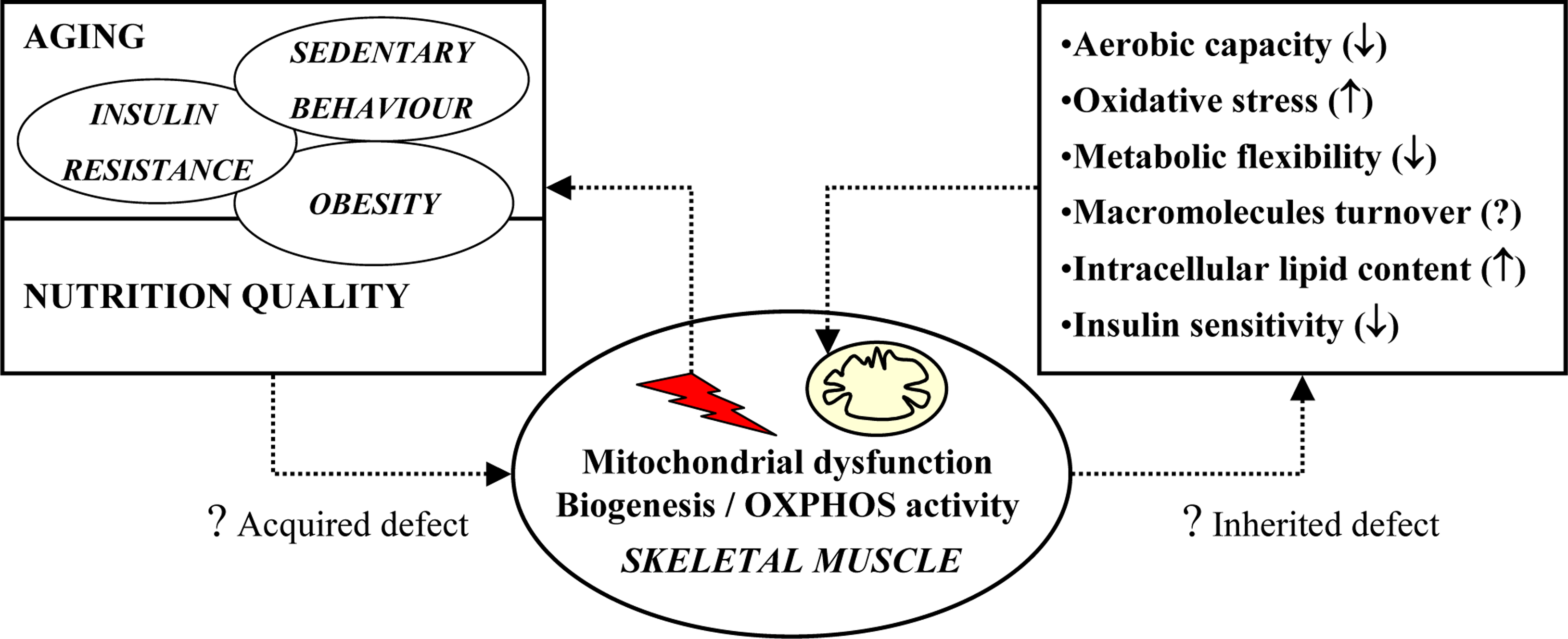
<p>According to current knowledge, the underlying molecular mechanisms of muscle mitochondrial dysfunction in metabolic disorders are far from being elucidated. One or a combination of mechanisms involving genetics, disturbances in glucose and lipid homeostasis, oxidative stress and also a state of chronic low-grade inflammation, might be involved in the process leading to these defects. <xref ref-type="fig" rid="f2-ijms-10-00306">Figure 2</xref> illustrates potential causes and cellular consequences of impaired mitochondrial oxidative capacity in skeletal muscle. Nowadays, understanding the molecular and biochemical defects responsible for muscle mitochondrial dysfunction is of importance to specify the role of mitochondrial dysfunction in the aetiology of metabolic disorders and to define preventive and therapeutic targets for the treatment of these pathologies.</p></sec></body>
<back>
<ack>
<title>Acknowledgments</title>
<p>The authors thank all members of the Human Nutrition Laboratory of Clermont-Ferrand.</p></ack>
<ref-list>
<title>References</title>
<ref id="b1-ijms-10-00306"><label>1.</label><citation citation-type="journal"><person-group person-group-type="author"><name><surname>Fredenrich</surname><given-names>A</given-names></name><name><surname>Grimaldi</surname><given-names>PA</given-names></name></person-group><article-title>Roles of peroxisome proliferator-activated receptor delta in skeletal muscle function and adaptation</article-title><source>Curr. Opin. Clin. Nutr. Metab. Care</source><year>2004</year><volume>7</volume><fpage>377</fpage><lpage>381</lpage><pub-id pub-id-type="doi">10.1097/01.mco.0000134370.93686.0a</pub-id><pub-id pub-id-type="pmid">15192438</pub-id></citation></ref>
<ref id="b2-ijms-10-00306"><label>2.</label><citation citation-type="journal"><person-group person-group-type="author"><name><surname>Grimaldi</surname><given-names>PA</given-names></name></person-group><article-title>Regulatory role of peroxisome proliferator-activated receptor delta (PPAR delta) in muscle metabolism. A new target for metabolic syndrome treatment?</article-title><source>Biochimie</source><year>2005a</year><volume>87</volume><fpage>5</fpage><lpage>8</lpage><pub-id pub-id-type="doi">10.1016/j.biochi.2004.11.009</pub-id></citation></ref>
<ref id="b3-ijms-10-00306"><label>3.</label><citation citation-type="journal"><person-group person-group-type="author"><name><surname>Grimaldi</surname><given-names>PA</given-names></name></person-group><article-title>Roles of PPARdelta in skeletal muscle physiology</article-title><source>Med. Sci. (Paris)</source><year>2005b</year><volume>21</volume><fpage>239</fpage><lpage>240</lpage><pub-id pub-id-type="doi">10.1051/medsci/2005213239</pub-id></citation></ref>
<ref id="b4-ijms-10-00306"><label>4.</label><citation citation-type="journal"><person-group person-group-type="author"><name><surname>Kliewer</surname><given-names>SA</given-names></name><name><surname>Sundseth</surname><given-names>SS</given-names></name><name><surname>Jones</surname><given-names>SA</given-names></name><name><surname>Brown</surname><given-names>PJ</given-names></name><name><surname>Wisely</surname><given-names>GB</given-names></name><name><surname>Koble</surname><given-names>CS</given-names></name><name><surname>Devchand</surname><given-names>P</given-names></name><name><surname>Wahli</surname><given-names>W</given-names></name><name><surname>Willson</surname><given-names>TM</given-names></name><name><surname>Lenhard</surname><given-names>JM</given-names></name><name><surname>Lehmann</surname><given-names>JM</given-names></name></person-group><article-title>Fatty acids and eicosanoids regulate gene expression through direct interactions with peroxisome proliferator-activated receptors alpha and gamma</article-title><source>Proc. Natl. Acad. Sci. USA</source><year>1997</year><volume>94</volume><fpage>4318</fpage><lpage>4323</lpage><pub-id pub-id-type="doi">10.1073/pnas.94.9.4318</pub-id><pub-id pub-id-type="pmid">9113987</pub-id></citation></ref>
<ref id="b5-ijms-10-00306"><label>5.</label><citation citation-type="journal"><person-group person-group-type="author"><name><surname>Lapsys</surname><given-names>NM</given-names></name><name><surname>Kriketos</surname><given-names>AD</given-names></name><name><surname>Lim-Fraser</surname><given-names>M</given-names></name><name><surname>Poynten</surname><given-names>AM</given-names></name><name><surname>Lowy</surname><given-names>A</given-names></name><name><surname>Furler</surname><given-names>SM</given-names></name><name><surname>Chisholm</surname><given-names>DJ</given-names></name><name><surname>Cooney</surname><given-names>GJ</given-names></name></person-group><article-title>Expression of genes involved in lipid metabolism correlate with peroxisome proliferator-activated receptor gamma expression in human skeletal muscle</article-title><source>J. Clin. Endocrinol. Metab</source><year>2000</year><volume>85</volume><fpage>4293</fpage><lpage>4297</lpage><pub-id pub-id-type="doi">10.1210/jc.85.11.4293</pub-id><pub-id pub-id-type="pmid">11095470</pub-id></citation></ref>
<ref id="b6-ijms-10-00306"><label>6.</label><citation citation-type="journal"><person-group person-group-type="author"><name><surname>Lazennec</surname><given-names>G</given-names></name><name><surname>Canaple</surname><given-names>L</given-names></name><name><surname>Saugy</surname><given-names>D</given-names></name><name><surname>Wahli</surname><given-names>W</given-names></name></person-group><article-title>Activation of peroxisome proliferator-activated receptors (PPARs) by their ligands and protein kinase A activators</article-title><source>Mol. Endocrinol</source><year>2000</year><volume>14</volume><fpage>1962</fpage><lpage>1975</lpage><pub-id pub-id-type="doi">10.1210/me.14.12.1962</pub-id><pub-id pub-id-type="pmid">11117527</pub-id></citation></ref>
<ref id="b7-ijms-10-00306"><label>7.</label><citation citation-type="journal"><person-group person-group-type="author"><name><surname>Patti</surname><given-names>ME</given-names></name><name><surname>Butte</surname><given-names>AJ</given-names></name><name><surname>Crunkhorn</surname><given-names>S</given-names></name><name><surname>Cusi</surname><given-names>K</given-names></name><name><surname>Berria</surname><given-names>R</given-names></name><name><surname>Kashyap</surname><given-names>S</given-names></name><name><surname>Miyazaki</surname><given-names>Y</given-names></name><name><surname>Kohane</surname><given-names>I</given-names></name><name><surname>Costello</surname><given-names>M</given-names></name><name><surname>Saccone</surname><given-names>R</given-names></name><name><surname>Landaker</surname><given-names>EJ</given-names></name><name><surname>Goldfine</surname><given-names>AB</given-names></name><name><surname>Mun</surname><given-names>E</given-names></name><name><surname>DeFronzo</surname><given-names>R</given-names></name><name><surname>Finlayson</surname><given-names>J</given-names></name><name><surname>Kahn</surname><given-names>CR</given-names></name><name><surname>Mandarino</surname><given-names>LJ</given-names></name></person-group><article-title>Coordinated reduction of genes of oxidative metabolism in humans with insulin resistance and diabetes: Potential role of PGC1 and NRF1</article-title><source>Proc. Natl. Acad. Sci. USA</source><year>2003</year><volume>100</volume><fpage>8466</fpage><lpage>8471</lpage><pub-id pub-id-type="doi">10.1073/pnas.1032913100</pub-id><pub-id pub-id-type="pmid">12832613</pub-id></citation></ref>
<ref id="b8-ijms-10-00306"><label>8.</label><citation citation-type="journal"><person-group person-group-type="author"><name><surname>Sparks</surname><given-names>LM</given-names></name><name><surname>Xie</surname><given-names>H</given-names></name><name><surname>Koza</surname><given-names>RA</given-names></name><name><surname>Mynatt</surname><given-names>R</given-names></name><name><surname>Hulver</surname><given-names>MW</given-names></name><name><surname>Bray</surname><given-names>GA</given-names></name><name><surname>Smith</surname><given-names>SR</given-names></name></person-group><article-title>A high-fat diet coordinately downregulates genes required for mitochondrial oxidative phosphorylation in skeletal muscle</article-title><source>Diabetes</source><year>2005</year><volume>54</volume><fpage>1926</fpage><lpage>1933</lpage><pub-id pub-id-type="doi">10.2337/diabetes.54.7.1926</pub-id><pub-id pub-id-type="pmid">15983191</pub-id></citation></ref>
<ref id="b9-ijms-10-00306"><label>9.</label><citation citation-type="journal"><person-group person-group-type="author"><name><surname>Tanaka</surname><given-names>T</given-names></name><name><surname>Yamamoto</surname><given-names>J</given-names></name><name><surname>Iwasaki</surname><given-names>S</given-names></name><name><surname>Asaba</surname><given-names>H</given-names></name><name><surname>Hamura</surname><given-names>H</given-names></name><name><surname>Ikeda</surname><given-names>Y</given-names></name><name><surname>Watanabe</surname><given-names>M</given-names></name><name><surname>Magoori</surname><given-names>K</given-names></name><name><surname>Ioka</surname><given-names>RX</given-names></name><name><surname>Tachibana</surname><given-names>K</given-names></name><name><surname>Watanabe</surname><given-names>Y</given-names></name><name><surname>Uchiyama</surname><given-names>Y</given-names></name><name><surname>Sumi</surname><given-names>K</given-names></name><name><surname>Iguchi</surname><given-names>H</given-names></name><name><surname>Ito</surname><given-names>S</given-names></name><name><surname>Doi</surname><given-names>T</given-names></name><name><surname>Hamakubo</surname><given-names>T</given-names></name><name><surname>Naito</surname><given-names>M</given-names></name><name><surname>Auwerx</surname><given-names>J</given-names></name><name><surname>Yanagisawa</surname><given-names>M</given-names></name><name><surname>Kodama</surname><given-names>T</given-names></name><name><surname>Sakai</surname><given-names>J</given-names></name></person-group><article-title>Activation of peroxisome proliferator-activated receptor delta induces fatty acid beta-oxidation in skeletal muscle and attenuates metabolic syndrome</article-title><source>Proc. Natl. Acad. Sci. USA</source><year>2003</year><volume>100</volume><fpage>15924</fpage><lpage>15929</lpage><pub-id pub-id-type="doi">10.1073/pnas.0306981100</pub-id><pub-id pub-id-type="pmid">14676330</pub-id></citation></ref>
<ref id="b10-ijms-10-00306"><label>10.</label><citation citation-type="journal"><person-group person-group-type="author"><name><surname>Zaid</surname><given-names>A</given-names></name><name><surname>Li</surname><given-names>R</given-names></name><name><surname>Luciakova</surname><given-names>K</given-names></name><name><surname>Barath</surname><given-names>P</given-names></name><name><surname>Nery</surname><given-names>S</given-names></name><name><surname>Nelson</surname><given-names>BD</given-names></name></person-group><article-title>On the role of the general transcription factor Sp1 in the activation and repression of diverse mammalian oxidative phosphorylation genes</article-title><source>J. Bioenerg. Biomembr</source><year>1999</year><volume>31</volume><fpage>129</fpage><lpage>135</lpage><pub-id pub-id-type="doi">10.1023/A:1005499727732</pub-id><pub-id pub-id-type="pmid">10449239</pub-id></citation></ref>
<ref id="b11-ijms-10-00306"><label>11.</label><citation citation-type="journal"><person-group person-group-type="author"><name><surname>Yang</surname><given-names>X</given-names></name><name><surname>Su</surname><given-names>K</given-names></name><name><surname>Roos</surname><given-names>MD</given-names></name><name><surname>Chang</surname><given-names>Q</given-names></name><name><surname>Paterson</surname><given-names>AJ</given-names></name><name><surname>Kudlow</surname><given-names>JE</given-names></name></person-group><article-title>O-linkage of N-acetylglucosamine to Sp1 activation domain inhibits its transcriptional capability</article-title><source>Proc. Natl. Acad. Sci. USA</source><year>2001</year><volume>98</volume><fpage>6611</fpage><lpage>661</lpage><pub-id pub-id-type="doi">10.1073/pnas.111099998</pub-id><pub-id pub-id-type="pmid">11371615</pub-id></citation></ref>
<ref id="b12-ijms-10-00306"><label>12.</label><citation citation-type="journal"><person-group person-group-type="author"><name><surname>Moyes</surname><given-names>CD</given-names></name></person-group><article-title>Controlling muscle mitochondrial content</article-title><source>J. Exp. Biol</source><year>2003</year><volume>206</volume><fpage>4385</fpage><lpage>4391</lpage><pub-id pub-id-type="doi">10.1242/jeb.00699</pub-id><pub-id pub-id-type="pmid">14610025</pub-id></citation></ref>
<ref id="b13-ijms-10-00306"><label>13.</label><citation citation-type="journal"><person-group person-group-type="author"><name><surname>Lin</surname><given-names>J</given-names></name><name><surname>Wu</surname><given-names>H</given-names></name><name><surname>Tarr</surname><given-names>PT</given-names></name><name><surname>Zhang</surname><given-names>CY</given-names></name><name><surname>Wu</surname><given-names>Z</given-names></name><name><surname>Boss</surname><given-names>O</given-names></name><name><surname>Michael</surname><given-names>LF</given-names></name><name><surname>Puigserver</surname><given-names>P</given-names></name><name><surname>Isotani</surname><given-names>E</given-names></name><name><surname>Olson</surname><given-names>EN</given-names></name><name><surname>Lowell</surname><given-names>BB</given-names></name><name><surname>Bassel-Duby</surname><given-names>R</given-names></name><name><surname>Spiegelman</surname><given-names>BM</given-names></name></person-group><article-title>Transcriptional co-activator PGC-1 alpha drives the formation of slow-twitch muscle fibres</article-title><source>Nature</source><year>2002a</year><volume>418</volume><fpage>797</fpage><lpage>801</lpage><pub-id pub-id-type="doi">10.1038/nature00904</pub-id></citation></ref>
<ref id="b14-ijms-10-00306"><label>14.</label><citation citation-type="journal"><person-group person-group-type="author"><name><surname>Puigserver</surname><given-names>P</given-names></name><name><surname>Spiegelman</surname><given-names>BM</given-names></name></person-group><article-title>Peroxisome proliferator-activated receptor-gamma coactivator 1 alpha (PGC-1 alpha): Transcriptional coactivator and metabolic regulator</article-title><source>Endocr. Rev</source><year>2003</year><volume>24</volume><fpage>78</fpage><lpage>90</lpage><pub-id pub-id-type="doi">10.1210/er.2002-0012</pub-id><pub-id pub-id-type="pmid">12588810</pub-id></citation></ref>
<ref id="b15-ijms-10-00306"><label>15.</label><citation citation-type="journal"><person-group person-group-type="author"><name><surname>Chabi</surname><given-names>B</given-names></name><name><surname>Adhihetty</surname><given-names>PJ</given-names></name><name><surname>Ljubicic</surname><given-names>V</given-names></name><name><surname>Hood</surname><given-names>DA</given-names></name></person-group><article-title>How is mitochondrial biogenesis affected in mitochondrial disease?</article-title><source>Med. Sci. Sports Exerc</source><year>2005</year><volume>37</volume><fpage>2102</fpage><lpage>2110</lpage><pub-id pub-id-type="doi">10.1249/01.mss.0000177426.68149.83</pub-id><pub-id pub-id-type="pmid">16331136</pub-id></citation></ref>
<ref id="b16-ijms-10-00306"><label>16.</label><citation citation-type="journal"><person-group person-group-type="author"><name><surname>Hood</surname><given-names>DA</given-names></name><name><surname>Irrcher</surname><given-names>I</given-names></name><name><surname>Ljubicic</surname><given-names>V</given-names></name><name><surname>Joseph</surname><given-names>AM</given-names></name></person-group><article-title>Coordination of metabolic plasticity in skeletal muscle</article-title><source>J. Exp. Biol</source><year>2006</year><volume>209</volume><fpage>2265</fpage><lpage>2275</lpage><pub-id pub-id-type="doi">10.1242/jeb.02182</pub-id><pub-id pub-id-type="pmid">16731803</pub-id></citation></ref>
<ref id="b17-ijms-10-00306"><label>17.</label><citation citation-type="journal"><person-group person-group-type="author"><name><surname>Luquet</surname><given-names>S</given-names></name><name><surname>Lopez-Soriano</surname><given-names>J</given-names></name><name><surname>Holst</surname><given-names>D</given-names></name><name><surname>Fredenrich</surname><given-names>A</given-names></name><name><surname>Melki</surname><given-names>J</given-names></name><name><surname>Rassoulzadegan</surname><given-names>M</given-names></name><name><surname>Grimaldi</surname><given-names>PA</given-names></name></person-group><article-title>Peroxisome proliferator-activated receptor delta controls muscle development and oxidative capability</article-title><source>FASEB J</source><year>2003</year><volume>17</volume><fpage>2299</fpage><lpage>22301</lpage><pub-id pub-id-type="pmid">14525942</pub-id></citation></ref>
<ref id="b18-ijms-10-00306"><label>18.</label><citation citation-type="journal"><person-group person-group-type="author"><name><surname>Befroy</surname><given-names>DE</given-names></name><name><surname>Falk Petersen</surname><given-names>K</given-names></name><name><surname>Dufour</surname><given-names>S</given-names></name><name><surname>Mason</surname><given-names>GF</given-names></name><name><surname>de Graaf</surname><given-names>RA</given-names></name><name><surname>Rothman</surname><given-names>DL</given-names></name><name><surname>Shulman</surname><given-names>GI</given-names></name></person-group><article-title>Impaired Mitochondrial Substrate Oxidation in Muscle of Insulin-Resistant Offspring of Type 2 Diabetic Patients</article-title><source>Diabetes</source><year>2007</year><volume>57</volume><fpage>1376</fpage><lpage>1381</lpage></citation></ref>
<ref id="b19-ijms-10-00306"><label>19.</label><citation citation-type="journal"><person-group person-group-type="author"><name><surname>Petersen</surname><given-names>KF</given-names></name><name><surname>Dufour</surname><given-names>S</given-names></name><name><surname>Befroy</surname><given-names>D</given-names></name><name><surname>Garcia</surname><given-names>R</given-names></name><name><surname>Shulman</surname><given-names>GI</given-names></name></person-group><article-title>Impaired mitochondrial activity in the insulin-resistant offspring of patients with type 2 diabetes</article-title><source>N. Engl. J. Med</source><year>2004</year><volume>350</volume><fpage>664</fpage><lpage>671</lpage><pub-id pub-id-type="doi">10.1056/NEJMoa031314</pub-id><pub-id pub-id-type="pmid">14960743</pub-id></citation></ref>
<ref id="b20-ijms-10-00306"><label>20.</label><citation citation-type="journal"><person-group person-group-type="author"><name><surname>Petersen</surname><given-names>KF</given-names></name><name><surname>Dufour</surname><given-names>S</given-names></name><name><surname>Shulman</surname><given-names>GI</given-names></name></person-group><article-title>Decreased Insulin-Stimulated ATP Synthesis and Phosphate Transport in Muscle of Insulin-Resistant Offspring of Type 2 Diabetic Parents</article-title><source>PLoS Med</source><year>2005</year><volume>2</volume><fpage>e233</fpage><pub-id pub-id-type="doi">10.1371/journal.pmed.0020233</pub-id><pub-id pub-id-type="pmid">16089501</pub-id></citation></ref>
<ref id="b21-ijms-10-00306"><label>21.</label><citation citation-type="journal"><person-group person-group-type="author"><name><surname>Petersen</surname><given-names>KF</given-names></name><name><surname>Shulman</surname><given-names>GI</given-names></name></person-group><article-title>Etiology of insulin resistance</article-title><source>Am. J. Med</source><year>2006</year><volume>119</volume><fpage>S10</fpage><lpage>S16</lpage><pub-id pub-id-type="doi">10.1016/j.amjmed.2006.01.009</pub-id><pub-id pub-id-type="pmid">16563942</pub-id></citation></ref>
<ref id="b22-ijms-10-00306"><label>22.</label><citation citation-type="journal"><person-group person-group-type="author"><name><surname>Drew</surname><given-names>B</given-names></name><name><surname>Phaneuf</surname><given-names>S</given-names></name><name><surname>Dirks</surname><given-names>A</given-names></name><name><surname>Selman</surname><given-names>C</given-names></name><name><surname>Gredilla</surname><given-names>R</given-names></name><name><surname>Lezza</surname><given-names>A</given-names></name><name><surname>Barja</surname><given-names>G</given-names></name><name><surname>Leeuwenburgh</surname><given-names>C</given-names></name></person-group><article-title>Effects of aging and caloric restriction on mitochondrial energy production in gastrocnemius muscle and heart</article-title><source>Am. J. Physiol. Regul. Integr. Comp. Physiol</source><year>2003</year><volume>284</volume><fpage>R474</fpage><lpage>R480</lpage><pub-id pub-id-type="pmid">12388443</pub-id></citation></ref>
<ref id="b23-ijms-10-00306"><label>23.</label><citation citation-type="journal"><person-group person-group-type="author"><name><surname>Kwong</surname><given-names>LK</given-names></name><name><surname>Sohal</surname><given-names>RS</given-names></name></person-group><article-title>Age-related changes in activities of mitochondrial electron transport complexes in various tissues of the mouse</article-title><source>Arch. Biochem. Biophys</source><year>2000</year><volume>373</volume><fpage>16</fpage><lpage>22</lpage><pub-id pub-id-type="doi">10.1006/abbi.1999.1495</pub-id><pub-id pub-id-type="pmid">10620319</pub-id></citation></ref>
<ref id="b24-ijms-10-00306"><label>24.</label><citation citation-type="journal"><person-group person-group-type="author"><name><surname>Barrientos</surname><given-names>A</given-names></name><name><surname>Casademont</surname><given-names>J</given-names></name><name><surname>Rotig</surname><given-names>A</given-names></name><name><surname>Miro</surname><given-names>O</given-names></name><name><surname>Urbano-Marquez</surname><given-names>A</given-names></name><name><surname>Rustin</surname><given-names>P</given-names></name><name><surname>Cardellach</surname><given-names>F</given-names></name></person-group><article-title>Absence of relationship between the level of electron transport chain activities and aging in human skeletal muscle</article-title><source>Biochem. Biophys. Res. Commun</source><year>1996</year><volume>229</volume><fpage>536</fpage><lpage>539</lpage><pub-id pub-id-type="doi">10.1006/bbrc.1996.1839</pub-id><pub-id pub-id-type="pmid">8954933</pub-id></citation></ref>
<ref id="b25-ijms-10-00306"><label>25.</label><citation citation-type="journal"><person-group person-group-type="author"><name><surname>Brierley</surname><given-names>EJ</given-names></name><name><surname>Johnson</surname><given-names>MA</given-names></name><name><surname>James</surname><given-names>OF</given-names></name><name><surname>Turnbull</surname><given-names>DM</given-names></name></person-group><article-title>Effects of physical activity and age on mitochondrial function</article-title><source>QJM</source><year>1996</year><volume>89</volume><fpage>251</fpage><lpage>258</lpage><pub-id pub-id-type="doi">10.1093/qjmed/89.4.251</pub-id><pub-id pub-id-type="pmid">8733511</pub-id></citation></ref>
<ref id="b26-ijms-10-00306"><label>26.</label><citation citation-type="journal"><person-group person-group-type="author"><name><surname>Conley</surname><given-names>KE</given-names></name><name><surname>Jubrias</surname><given-names>SA</given-names></name><name><surname>Esselman</surname><given-names>PC</given-names></name></person-group><article-title>Oxidative capacity and ageing in human muscle</article-title><source>J. Physiol</source><year>2000</year><volume>526</volume><fpage>203</fpage><lpage>210</lpage><pub-id pub-id-type="doi">10.1111/j.1469-7793.2000.t01-1-00203.x</pub-id><pub-id pub-id-type="pmid">10878112</pub-id></citation></ref>
<ref id="b27-ijms-10-00306"><label>27.</label><citation citation-type="journal"><person-group person-group-type="author"><name><surname>Petersen</surname><given-names>KF</given-names></name><name><surname>Befroy</surname><given-names>D</given-names></name><name><surname>Dufour</surname><given-names>S</given-names></name><name><surname>Dziura</surname><given-names>J</given-names></name><name><surname>Ariyan</surname><given-names>C</given-names></name><name><surname>Rothman</surname><given-names>DL</given-names></name><name><surname>DiPietro</surname><given-names>L</given-names></name><name><surname>Cline</surname><given-names>GW</given-names></name><name><surname>Shulman</surname><given-names>GI</given-names></name></person-group><article-title>Mitochondrial dysfunction in the elderly: Possible role in insulin resistance</article-title><source>Science</source><year>2003</year><volume>300</volume><fpage>1140</fpage><lpage>1142</lpage><pub-id pub-id-type="doi">10.1126/science.1082889</pub-id><pub-id pub-id-type="pmid">12750520</pub-id></citation></ref>
<ref id="b28-ijms-10-00306"><label>28.</label><citation citation-type="journal"><person-group person-group-type="author"><name><surname>Rasmussen</surname><given-names>UF</given-names></name><name><surname>Krustrup</surname><given-names>P</given-names></name><name><surname>Kjaer</surname><given-names>M</given-names></name><name><surname>Rasmussen</surname><given-names>HN</given-names></name></person-group><article-title>Human skeletal muscle mitochondrial metabolism in youth and senescence: no signs of functional changes in ATP formation and mitochondrial oxidative capacity</article-title><source>Pflugers Arch</source><year>2003</year><volume>446</volume><fpage>270</fpage><lpage>278</lpage><pub-id pub-id-type="pmid">12739165</pub-id></citation></ref>
<ref id="b29-ijms-10-00306"><label>29.</label><citation citation-type="journal"><person-group person-group-type="author"><name><surname>Rimbert</surname><given-names>V</given-names></name><name><surname>Boirie</surname><given-names>Y</given-names></name><name><surname>Bedu</surname><given-names>M</given-names></name><name><surname>Hocquette</surname><given-names>JF</given-names></name><name><surname>Ritz</surname><given-names>P</given-names></name><name><surname>Morio</surname><given-names>B</given-names></name></person-group><article-title>Muscle fat oxidative capacity is not impaired by age but by physical inactivity: association with insulin sensitivity</article-title><source>FASEB J</source><year>2004</year><volume>18</volume><fpage>737</fpage><lpage>739</lpage><pub-id pub-id-type="pmid">14977873</pub-id></citation></ref>
<ref id="b30-ijms-10-00306"><label>30.</label><citation citation-type="journal"><person-group person-group-type="author"><name><surname>Kelley</surname><given-names>D</given-names></name><name><surname>He</surname><given-names>J</given-names></name><name><surname>Menshikova</surname><given-names>E</given-names></name><name><surname>Ritov</surname><given-names>V</given-names></name></person-group><article-title>Dysfunction of mitochondria in human skeletal muscle in type 2 diabetes</article-title><source>Diabetes</source><year>2002</year><volume>51</volume><fpage>2944</fpage><lpage>2950</lpage><pub-id pub-id-type="doi">10.2337/diabetes.51.10.2944</pub-id><pub-id pub-id-type="pmid">12351431</pub-id></citation></ref>
<ref id="b31-ijms-10-00306"><label>31.</label><citation citation-type="journal"><person-group person-group-type="author"><name><surname>Simoneau</surname><given-names>JA</given-names></name><name><surname>Kelley</surname><given-names>DE</given-names></name></person-group><article-title>Altered glycolytic and oxidative capacities of skeletal muscle contribute to insulin resistance in NIDDM</article-title><source>J. Appl. Physiol</source><year>1997</year><volume>83</volume><fpage>166</fpage><lpage>171</lpage><pub-id pub-id-type="pmid">9216960</pub-id></citation></ref>
<ref id="b32-ijms-10-00306"><label>32.</label><citation citation-type="journal"><person-group person-group-type="author"><name><surname>Petersen</surname><given-names>KF</given-names></name><name><surname>Dufour</surname><given-names>S</given-names></name><name><surname>Shulman</surname><given-names>GI</given-names></name></person-group><article-title>Decreased insulin-stimulated ATP synthesis and phosphate transport in muscle of insulin-resistant offspring of Type 2 Diabetic Parents</article-title><source>PLoS Med</source><year>2005a</year><volume>2</volume><fpage>e233</fpage><pub-id pub-id-type="doi">10.1371/journal.pmed.0020233</pub-id></citation></ref>
<ref id="b33-ijms-10-00306"><label>33.</label><citation citation-type="journal"><person-group person-group-type="author"><name><surname>Hojlund</surname><given-names>K</given-names></name><name><surname>Wrzesinski</surname><given-names>K</given-names></name><name><surname>Larsen</surname><given-names>PM</given-names></name><name><surname>Fey</surname><given-names>SJ</given-names></name><name><surname>Roepstorff</surname><given-names>P</given-names></name><name><surname>Handberg</surname><given-names>A</given-names></name><name><surname>Dela</surname><given-names>F</given-names></name><name><surname>Vinten</surname><given-names>J</given-names></name><name><surname>McCormack</surname><given-names>JG</given-names></name><name><surname>Reynet</surname><given-names>C</given-names></name><name><surname>Beck-Nielsen</surname><given-names>H</given-names></name></person-group><article-title>Proteome analysis reveals phosphorylation of ATP synthase beta -subunit in human skeletal muscle and proteins with potential roles in type 2 diabetes</article-title><source>J. Biol. Chem</source><year>2003</year><volume>278</volume><fpage>10436</fpage><lpage>10442</lpage><pub-id pub-id-type="doi">10.1074/jbc.M212881200</pub-id><pub-id pub-id-type="pmid">12531894</pub-id></citation></ref>
<ref id="b34-ijms-10-00306"><label>34.</label><citation citation-type="journal"><person-group person-group-type="author"><name><surname>Liang</surname><given-names>P</given-names></name><name><surname>Hughes</surname><given-names>V</given-names></name><name><surname>Fukagawa</surname><given-names>NK</given-names></name></person-group><article-title>Increased prevalence of mitochondrial DNA deletions in skeletal muscle of older individuals with impaired glucose tolerance: possible marker of glycemic stress</article-title><source>Diabetes</source><year>1997</year><volume>46</volume><fpage>920</fpage><lpage>923</lpage><pub-id pub-id-type="doi">10.2337/diabetes.46.5.920</pub-id><pub-id pub-id-type="pmid">9133566</pub-id></citation></ref>
<ref id="b35-ijms-10-00306"><label>35.</label><citation citation-type="journal"><person-group person-group-type="author"><name><surname>Guillet</surname><given-names>C</given-names></name><name><surname>Prod’homme</surname><given-names>M</given-names></name><name><surname>Balage</surname><given-names>M</given-names></name><name><surname>Gachon</surname><given-names>P</given-names></name><name><surname>Giraudet</surname><given-names>C</given-names></name><name><surname>Morin</surname><given-names>L</given-names></name><name><surname>Grizard</surname><given-names>J</given-names></name><name><surname>Boirie</surname><given-names>Y</given-names></name></person-group><article-title>Impaired anabolic response of muscle protein synthesis is associated with S6K1 dysregulation in elderly humans</article-title><source>Faseb J</source><year>2004</year><volume>18</volume><fpage>1586</fpage><lpage>7</lpage><pub-id pub-id-type="pmid">15319361</pub-id></citation></ref>
<ref id="b36-ijms-10-00306"><label>36.</label><citation citation-type="journal"><person-group person-group-type="author"><name><surname>Rooyackers</surname><given-names>OE</given-names></name><name><surname>Adey</surname><given-names>DB</given-names></name><name><surname>Ades</surname><given-names>PA</given-names></name><name><surname>Nair</surname><given-names>KS</given-names></name></person-group><article-title>Effect of age on <italic>in vivo</italic> rates of mitochondrial protein synthesis in human skeletal muscle</article-title><source>Proc Natl Acad Sci USA</source><year>1996a</year><volume>93</volume><fpage>15364</fpage><lpage>15369</lpage><pub-id pub-id-type="doi">10.1073/pnas.93.26.15364</pub-id></citation></ref>
<ref id="b37-ijms-10-00306"><label>37.</label><citation citation-type="journal"><person-group person-group-type="author"><name><surname>Balagopal</surname><given-names>P</given-names></name><name><surname>Rooyackers</surname><given-names>OE</given-names></name><name><surname>Adey</surname><given-names>DB</given-names></name><name><surname>Ades</surname><given-names>PA</given-names></name><name><surname>Nair</surname><given-names>KS</given-names></name></person-group><article-title>Effects of aging on <italic>in vivo</italic> synthesis of skeletal muscle myosin heavy-chain and sarcoplasmic protein in humans</article-title><source>Am. J. Physiol</source><year>1997</year><volume>273</volume><fpage>E790</fpage><lpage>E800</lpage><pub-id pub-id-type="pmid">9357810</pub-id></citation></ref>
<ref id="b38-ijms-10-00306"><label>38.</label><citation citation-type="journal"><person-group person-group-type="author"><name><surname>Boirie</surname><given-names>Y</given-names></name><name><surname>Short</surname><given-names>KR</given-names></name><name><surname>Ahlman</surname><given-names>B</given-names></name><name><surname>Charlton</surname><given-names>M</given-names></name><name><surname>Nair</surname><given-names>KS</given-names></name></person-group><article-title>Tissue-specific regulation of mitochondrial and cytoplasmic protein synthesis rates by insulin</article-title><source>Diabetes</source><year>2001</year><volume>50</volume><fpage>2652</fpage><lpage>2658</lpage><pub-id pub-id-type="doi">10.2337/diabetes.50.12.2652</pub-id><pub-id pub-id-type="pmid">11723046</pub-id></citation></ref>
<ref id="b39-ijms-10-00306"><label>39.</label><citation citation-type="journal"><person-group person-group-type="author"><name><surname>Rooyackers</surname><given-names>OE</given-names></name><name><surname>Adey</surname><given-names>DB</given-names></name><name><surname>Ades</surname><given-names>PA</given-names></name><name><surname>Nair</surname><given-names>KS</given-names></name></person-group><article-title>Effect of age on <italic>in vivo</italic> rates of mitochondrial protein synthesis in human skeletal muscle</article-title><source>Proc. Natl. Acad. Sci. USA</source><year>1996</year><volume>93</volume><fpage>15364</fpage><lpage>15369</lpage><pub-id pub-id-type="doi">10.1073/pnas.93.26.15364</pub-id><pub-id pub-id-type="pmid">8986817</pub-id></citation></ref>
<ref id="b40-ijms-10-00306"><label>40.</label><citation citation-type="journal"><person-group person-group-type="author"><name><surname>Halvatsiotis</surname><given-names>P</given-names></name><name><surname>Short</surname><given-names>KR</given-names></name><name><surname>Bigelow</surname><given-names>M</given-names></name><name><surname>Nair</surname><given-names>KS</given-names></name></person-group><article-title>Synthesis rate of muscle proteins, muscle functions, and amino acid kinetics in type 2 diabetes</article-title><source>Diabetes</source><year>2002</year><volume>51</volume><fpage>2395</fpage><lpage>2404</lpage><pub-id pub-id-type="doi">10.2337/diabetes.51.8.2395</pub-id><pub-id pub-id-type="pmid">12145150</pub-id></citation></ref>
<ref id="b41-ijms-10-00306"><label>41.</label><citation citation-type="journal"><person-group person-group-type="author"><name><surname>Stump</surname><given-names>CS</given-names></name><name><surname>Short</surname><given-names>KR</given-names></name><name><surname>Bigelow</surname><given-names>ML</given-names></name><name><surname>Schimke</surname><given-names>JM</given-names></name><name><surname>Nair</surname><given-names>KS</given-names></name></person-group><article-title>Effect of insulin on human skeletal muscle mitochondrial ATP production, protein synthesis, and mRNA transcripts</article-title><source>Proc. Natl. Acad. Sci. USA</source><year>2003</year><volume>100</volume><fpage>7996</fpage><lpage>8001</lpage><pub-id pub-id-type="doi">10.1073/pnas.1332551100</pub-id><pub-id pub-id-type="pmid">12808136</pub-id></citation></ref>
<ref id="b42-ijms-10-00306"><label>42.</label><citation citation-type="journal"><person-group person-group-type="author"><name><surname>Boirie</surname><given-names>Y</given-names></name></person-group><article-title>Insulin regulation of mitochondrial proteins and oxidative phosphorylation in human muscle</article-title><source>Trends Endocrinol. Metab</source><year>2003</year><volume>14</volume><fpage>393</fpage><lpage>394</lpage><pub-id pub-id-type="doi">10.1016/j.tem.2003.09.002</pub-id><pub-id pub-id-type="pmid">14580754</pub-id></citation></ref>
<ref id="b43-ijms-10-00306"><label>43.</label><citation citation-type="journal"><person-group person-group-type="author"><name><surname>Southgate</surname><given-names>RJ</given-names></name><name><surname>Bruce</surname><given-names>CR</given-names></name><name><surname>Carey</surname><given-names>AL</given-names></name><name><surname>Steinberg</surname><given-names>GR</given-names></name><name><surname>Walder</surname><given-names>K</given-names></name><name><surname>Monks</surname><given-names>R</given-names></name><name><surname>Watt</surname><given-names>MJ</given-names></name><name><surname>Hawley</surname><given-names>JA</given-names></name><name><surname>Birnbaum</surname><given-names>MJ</given-names></name><name><surname>Febbraio</surname><given-names>MA</given-names></name></person-group><article-title>PGC-1alpha gene expression is down-regulated by Akt- mediated phosphorylation and nuclear exclusion of FoxO1 in insulin-stimulated skeletal muscle</article-title><source>Faseb J</source><year>2005</year><volume>19</volume><fpage>2072</fpage><lpage>2074</lpage><pub-id pub-id-type="pmid">16203862</pub-id></citation></ref>
<ref id="b44-ijms-10-00306"><label>44.</label><citation citation-type="journal"><person-group person-group-type="author"><name><surname>Short</surname><given-names>KR</given-names></name><name><surname>Vittone</surname><given-names>JL</given-names></name><name><surname>Bigelow</surname><given-names>ML</given-names></name><name><surname>Proctor</surname><given-names>DN</given-names></name><name><surname>Rizza</surname><given-names>RA</given-names></name><name><surname>Coenen-Schimke</surname><given-names>JM</given-names></name><name><surname>Nair</surname><given-names>KS</given-names></name></person-group><article-title>Impact of aerobic exercise training on age-related changes in insulin sensitivity and muscle oxidative capacity</article-title><source>Diabetes</source><year>2003</year><volume>52</volume><fpage>1888</fpage><lpage>1896</lpage><pub-id pub-id-type="doi">10.2337/diabetes.52.8.1888</pub-id><pub-id pub-id-type="pmid">12882902</pub-id></citation></ref>
<ref id="b45-ijms-10-00306"><label>45.</label><citation citation-type="journal"><person-group person-group-type="author"><name><surname>Chanseaume</surname><given-names>E</given-names></name><name><surname>Malpuech-Brugere</surname><given-names>C</given-names></name><name><surname>Patrac</surname><given-names>V</given-names></name><name><surname>Bielicki</surname><given-names>G</given-names></name><name><surname>Rousset</surname><given-names>P</given-names></name><name><surname>Couturier</surname><given-names>K</given-names></name><name><surname>Salles</surname><given-names>J</given-names></name><name><surname>Renou</surname><given-names>JP</given-names></name><name><surname>Boirie</surname><given-names>Y</given-names></name><name><surname>Morio</surname><given-names>B</given-names></name></person-group><article-title>Diets high in sugar, fat, and energy induce muscle type-specific adaptations in mitochondrial functions in rats</article-title><source>J. Nutr</source><year>2006</year><volume>136</volume><fpage>2194</fpage><lpage>2200</lpage><pub-id pub-id-type="pmid">16857840</pub-id></citation></ref>
<ref id="b46-ijms-10-00306"><label>46.</label><citation citation-type="journal"><person-group person-group-type="author"><name><surname>Iossa</surname><given-names>S</given-names></name><name><surname>Lionetti</surname><given-names>L</given-names></name><name><surname>Mollica</surname><given-names>MP</given-names></name><name><surname>Crescenzo</surname><given-names>R</given-names></name><name><surname>Botta</surname><given-names>M</given-names></name><name><surname>Barletta</surname><given-names>A</given-names></name><name><surname>Liverini</surname><given-names>G</given-names></name></person-group><article-title>Effect of high-fat feeding on metabolic efficiency and mitochondrial oxidative capacity in adult rats</article-title><source>Br. J. Nutr</source><year>2003</year><volume>90</volume><fpage>953</fpage><lpage>960</lpage><pub-id pub-id-type="doi">10.1079/BJN2003000968</pub-id><pub-id pub-id-type="pmid">14667188</pub-id></citation></ref>
<ref id="b47-ijms-10-00306"><label>47.</label><citation citation-type="journal"><person-group person-group-type="author"><name><surname>Obici</surname><given-names>S</given-names></name><name><surname>Wang</surname><given-names>J</given-names></name><name><surname>Chowdury</surname><given-names>R</given-names></name><name><surname>Feng</surname><given-names>Z</given-names></name><name><surname>Siddhanta</surname><given-names>U</given-names></name><name><surname>Morgan</surname><given-names>K</given-names></name><name><surname>Rossetti</surname><given-names>L</given-names></name></person-group><article-title>Identification of a biochemical link between energy intake and energy expenditure</article-title><source>J. Clin. Invest</source><year>2002</year><volume>109</volume><fpage>1599</fpage><lpage>1605</lpage><pub-id pub-id-type="pmid">12070307</pub-id></citation></ref>
<ref id="b48-ijms-10-00306"><label>48.</label><citation citation-type="journal"><person-group person-group-type="author"><name><surname>Mootha</surname><given-names>VK</given-names></name><name><surname>Lindgren</surname><given-names>CM</given-names></name><name><surname>Eriksson</surname><given-names>KF</given-names></name><name><surname>Subramanian</surname><given-names>A</given-names></name><name><surname>Sihag</surname><given-names>S</given-names></name><name><surname>Lehar</surname><given-names>J</given-names></name><name><surname>Puigserver</surname><given-names>P</given-names></name><name><surname>Carlsson</surname><given-names>E</given-names></name><name><surname>Ridderstrale</surname><given-names>M</given-names></name><name><surname>Laurila</surname><given-names>E</given-names></name><name><surname>Houstis</surname><given-names>N</given-names></name><name><surname>Daly</surname><given-names>MJ</given-names></name><name><surname>Patterson</surname><given-names>N</given-names></name><name><surname>Mesirov</surname><given-names>JP</given-names></name><name><surname>Golub</surname><given-names>TR</given-names></name><name><surname>Tamayo</surname><given-names>P</given-names></name><name><surname>Spiegelman</surname><given-names>B</given-names></name><name><surname>Lander</surname><given-names>ES</given-names></name><name><surname>Hirschhorn</surname><given-names>JN</given-names></name><name><surname>Altshuler</surname><given-names>D</given-names></name><name><surname>Groop</surname><given-names>LC</given-names></name></person-group><article-title>PGC-1alpha-responsive genes involved in oxidative phosphorylation are coordinately downregulated in human diabetes</article-title><source>Nat. Genet</source><year>2003</year><volume>34</volume><fpage>267</fpage><lpage>273</lpage><pub-id pub-id-type="doi">10.1038/ng1180</pub-id><pub-id pub-id-type="pmid">12808457</pub-id></citation></ref>
<ref id="b49-ijms-10-00306"><label>49.</label><citation citation-type="journal"><person-group person-group-type="author"><name><surname>Chavez</surname><given-names>JA</given-names></name><name><surname>Holland</surname><given-names>WL</given-names></name><name><surname>Bar</surname><given-names>J</given-names></name><name><surname>Sandhoff</surname><given-names>K</given-names></name><name><surname>Summers</surname><given-names>SA</given-names></name></person-group><article-title>Acid ceramidase overexpression prevents the inhibitory effects of saturated fatty acids on insulin signaling</article-title><source>J. Biol. Chem</source><year>2005</year><volume>280</volume><fpage>20148</fpage><lpage>20153</lpage><pub-id pub-id-type="doi">10.1074/jbc.M412769200</pub-id><pub-id pub-id-type="pmid">15774472</pub-id></citation></ref>
<ref id="b50-ijms-10-00306"><label>50.</label><citation citation-type="journal"><person-group person-group-type="author"><name><surname>Shulman</surname><given-names>GI</given-names></name></person-group><article-title>Cellular mechanisms of insulin resistance</article-title><source>J. Clin. Invest</source><year>2000</year><volume>106</volume><fpage>171</fpage><lpage>176</lpage><pub-id pub-id-type="doi">10.1172/JCI10583</pub-id><pub-id pub-id-type="pmid">10903330</pub-id></citation></ref>
<ref id="b51-ijms-10-00306"><label>51.</label><citation citation-type="journal"><person-group person-group-type="author"><name><surname>Staiger</surname><given-names>H</given-names></name><name><surname>Staiger</surname><given-names>K</given-names></name><name><surname>Haas</surname><given-names>C</given-names></name><name><surname>Weisser</surname><given-names>M</given-names></name><name><surname>Machicao</surname><given-names>F</given-names></name><name><surname>Haring</surname><given-names>HU</given-names></name></person-group><article-title>Fatty acid-induced differential regulation of the genes encoding peroxisome proliferator-activated receptor-gamma coactivator-1alpha and -1beta in human skeletal muscle cells that have been differentiated <italic>in vitro</italic></article-title><source>Diabetologia</source><year>2005</year><volume>48</volume><fpage>2115</fpage><lpage>2118</lpage><pub-id pub-id-type="doi">10.1007/s00125-005-1895-z</pub-id><pub-id pub-id-type="pmid">16132959</pub-id></citation></ref>
<ref id="b52-ijms-10-00306"><label>52.</label><citation citation-type="journal"><person-group person-group-type="author"><name><surname>Simoneau</surname><given-names>JA</given-names></name><name><surname>Veerkamp</surname><given-names>JH</given-names></name><name><surname>Turcotte</surname><given-names>LP</given-names></name><name><surname>Kelley</surname><given-names>DE</given-names></name></person-group><article-title>Markers of capacity to utilize fatty acids in human skeletal muscle: relation to insulin resistance and obesity and effects of weight loss</article-title><source>Faseb J</source><year>1999</year><volume>13</volume><fpage>2051</fpage><lpage>2060</lpage><pub-id pub-id-type="pmid">10544188</pub-id></citation></ref>
<ref id="b53-ijms-10-00306"><label>53.</label><citation citation-type="journal"><person-group person-group-type="author"><name><surname>Coll</surname><given-names>T</given-names></name><name><surname>Jove</surname><given-names>M</given-names></name><name><surname>Rodriguez-Calvo</surname><given-names>R</given-names></name><name><surname>Eyre</surname><given-names>E</given-names></name><name><surname>Palomer</surname><given-names>X</given-names></name><name><surname>Sanchez</surname><given-names>RM</given-names></name><name><surname>Merlos</surname><given-names>M</given-names></name><name><surname>Laguna</surname><given-names>JC</given-names></name><name><surname>Vazquez-Carrera</surname><given-names>M</given-names></name></person-group><article-title>Palmitate-mediated downregulation of peroxisome proliferator-activated receptor-gamma coactivator 1alpha in skeletal muscle cells involves MEK1/2 and nuclear factor-kappaB activation</article-title><source>Diabetes</source><year>2006</year><volume>55</volume><fpage>2779</fpage><lpage>2787</lpage><pub-id pub-id-type="doi">10.2337/db05-1494</pub-id><pub-id pub-id-type="pmid">17003343</pub-id></citation></ref>
<ref id="b54-ijms-10-00306"><label>54.</label><citation citation-type="journal"><person-group person-group-type="author"><name><surname>Crunkhorn</surname><given-names>S</given-names></name><name><surname>Dearie</surname><given-names>F</given-names></name><name><surname>Mantzoros</surname><given-names>C</given-names></name><name><surname>Gami</surname><given-names>H</given-names></name><name><surname>da Silva</surname><given-names>WS</given-names></name><name><surname>Espinoza</surname><given-names>D</given-names></name><name><surname>Faucette</surname><given-names>R</given-names></name><name><surname>Barry</surname><given-names>K</given-names></name><name><surname>Bianco</surname><given-names>AC</given-names></name><name><surname>Patti</surname><given-names>ME</given-names></name></person-group><article-title>Peroxisome proliferator activator receptor gamma coactivator-1 expression is reduced in obesity: Potential pathogenic role of saturated fatty acids and p38 mitogen-activated protein kinase activation</article-title><source>J. Biol. Chem</source><year>2007</year><volume>282</volume><fpage>15439</fpage><lpage>15450</lpage><pub-id pub-id-type="doi">10.1074/jbc.M611214200</pub-id><pub-id pub-id-type="pmid">17416903</pub-id></citation></ref>
<ref id="b55-ijms-10-00306"><label>55.</label><citation citation-type="journal"><person-group person-group-type="author"><name><surname>Benton</surname><given-names>CR</given-names></name><name><surname>Han</surname><given-names>XX</given-names></name><name><surname>Febbraio</surname><given-names>M</given-names></name><name><surname>Graham</surname><given-names>TE</given-names></name><name><surname>Bonen</surname><given-names>A</given-names></name></person-group><article-title>Inverse relationship between PGC-1alpha protein expression and triacylglycerol accumulation in rodent skeletal muscle</article-title><source>J. Appl. Physiol</source><year>2006</year><volume>100</volume><fpage>377</fpage><lpage>383</lpage><pub-id pub-id-type="doi">10.1152/japplphysiol.00781.2005</pub-id><pub-id pub-id-type="pmid">16223979</pub-id></citation></ref>
<ref id="b56-ijms-10-00306"><label>56.</label><citation citation-type="journal"><person-group person-group-type="author"><name><surname>Lagouge</surname><given-names>M</given-names></name><name><surname>Argmann</surname><given-names>C</given-names></name><name><surname>Gerhart-Hines</surname><given-names>Z</given-names></name><name><surname>Meziane</surname><given-names>H</given-names></name><name><surname>Lerin</surname><given-names>C</given-names></name><name><surname>Daussin</surname><given-names>F</given-names></name><name><surname>Messadeq</surname><given-names>N</given-names></name><name><surname>Milne</surname><given-names>J</given-names></name><name><surname>Lambert</surname><given-names>P</given-names></name><name><surname>Elliott</surname><given-names>P</given-names></name><name><surname>Geny</surname><given-names>B</given-names></name><name><surname>Laakso</surname><given-names>M</given-names></name><name><surname>Puigserver</surname><given-names>P</given-names></name><name><surname>Auwerx</surname><given-names>J</given-names></name></person-group><article-title>Resveratrol improves mitochondrial function and protects against metabolic disease by activating SIRT1 and PGC-1alpha</article-title><source>Cell</source><year>2006</year><volume>127</volume><fpage>1109</fpage><lpage>1122</lpage><pub-id pub-id-type="doi">10.1016/j.cell.2006.11.013</pub-id><pub-id pub-id-type="pmid">17112576</pub-id></citation></ref>
<ref id="b57-ijms-10-00306"><label>57.</label><citation citation-type="journal"><person-group person-group-type="author"><name><surname>Richardson</surname><given-names>DK</given-names></name><name><surname>Kashyap</surname><given-names>S</given-names></name><name><surname>Bajaj</surname><given-names>M</given-names></name><name><surname>Cusi</surname><given-names>K</given-names></name><name><surname>Mandarino</surname><given-names>SJ</given-names></name><name><surname>Finlayson</surname><given-names>J</given-names></name><name><surname>DeFronzo</surname><given-names>RA</given-names></name><name><surname>Jenkinson</surname><given-names>CP</given-names></name><name><surname>Mandarino</surname><given-names>LJ</given-names></name></person-group><article-title>Lipid infusion decreases the expression of nuclear encoded mitochondrial genes and increases the expression of extracellular matrix genes in human skeletal muscle</article-title><source>J. Biol. Chem</source><year>2005</year><volume>280</volume><fpage>10290</fpage><lpage>10297</lpage><pub-id pub-id-type="doi">10.1074/jbc.M408985200</pub-id><pub-id pub-id-type="pmid">15598661</pub-id></citation></ref>
<ref id="b58-ijms-10-00306"><label>58.</label><citation citation-type="journal"><person-group person-group-type="author"><name><surname>Brindley</surname><given-names>DN</given-names></name><name><surname>Wang</surname><given-names>CN</given-names></name><name><surname>Mei</surname><given-names>J</given-names></name><name><surname>Xu</surname><given-names>J</given-names></name><name><surname>Hanna</surname><given-names>AN</given-names></name></person-group><article-title>Tumor necrosis factor-alpha and ceramides in insulin resistance</article-title><source>Lipids</source><year>1999</year><issue>34 Suppl</issue><fpage>S85</fpage><lpage>S88</lpage></citation></ref>
<ref id="b59-ijms-10-00306"><label>59.</label><citation citation-type="journal"><person-group person-group-type="author"><name><surname>Kern</surname><given-names>PA</given-names></name><name><surname>Di Gregorio</surname><given-names>GB</given-names></name><name><surname>Lu</surname><given-names>T</given-names></name><name><surname>Rassouli</surname><given-names>N</given-names></name><name><surname>Ranganathan</surname><given-names>G</given-names></name></person-group><article-title>Adiponectin expression from human adipose tissue: relation to obesity, insulin resistance, and tumor necrosis factor-alpha expression</article-title><source>Diabetes</source><year>2003</year><volume>52</volume><fpage>1779</fpage><lpage>1785</lpage><pub-id pub-id-type="pmid">12829646</pub-id></citation></ref>
<ref id="b60-ijms-10-00306"><label>60.</label><citation citation-type="journal"><person-group person-group-type="author"><name><surname>Saghizadeh</surname><given-names>M</given-names></name><name><surname>Ong</surname><given-names>JM</given-names></name><name><surname>Garvey</surname><given-names>WT</given-names></name><name><surname>Henry</surname><given-names>RR</given-names></name><name><surname>Kern</surname><given-names>PA</given-names></name></person-group><article-title>The expression of TNF alpha by human muscle. Relationship to insulin resistance</article-title><source>J. Clin. Invest</source><year>1996</year><volume>97</volume><fpage>1111</fpage><lpage>1116</lpage><pub-id pub-id-type="pmid">8613535</pub-id></citation></ref>
<ref id="b61-ijms-10-00306"><label>61.</label><citation citation-type="journal"><person-group person-group-type="author"><name><surname>Neels</surname><given-names>JG</given-names></name><name><surname>Pandey</surname><given-names>M</given-names></name><name><surname>Hotamisligil</surname><given-names>GS</given-names></name><name><surname>Samad</surname><given-names>F</given-names></name></person-group><article-title>Autoamplification of tumor necrosis factor-alpha: A potential mechanism for the maintenance of elevated tumor necrosis factor-alpha in male but not female obese mice</article-title><source>Am. J. Pathol</source><year>2006</year><volume>168</volume><fpage>435</fpage><lpage>444</lpage><pub-id pub-id-type="pmid">16436658</pub-id></citation></ref>
<ref id="b62-ijms-10-00306"><label>62.</label><citation citation-type="journal"><person-group person-group-type="author"><name><surname>Halse</surname><given-names>R</given-names></name><name><surname>Pearson</surname><given-names>SL</given-names></name><name><surname>McCormack</surname><given-names>JG</given-names></name><name><surname>Yeaman</surname><given-names>SJ</given-names></name><name><surname>Taylor</surname><given-names>R</given-names></name></person-group><article-title>Effects of tumor necrosis factor-alpha on insulin action in cultured human muscle cells</article-title><source>Diabetes</source><year>2001</year><volume>50</volume><fpage>1102</fpage><lpage>1109</lpage><pub-id pub-id-type="pmid">11334414</pub-id></citation></ref>
<ref id="b63-ijms-10-00306"><label>63.</label><citation citation-type="journal"><person-group person-group-type="author"><name><surname>Rieusset</surname><given-names>J</given-names></name><name><surname>Bouzakri</surname><given-names>K</given-names></name><name><surname>Chevillotte</surname><given-names>E</given-names></name><name><surname>Ricard</surname><given-names>N</given-names></name><name><surname>Jacquet</surname><given-names>D</given-names></name><name><surname>Bastard</surname><given-names>JP</given-names></name><name><surname>Laville</surname><given-names>M</given-names></name><name><surname>Vidal</surname><given-names>H</given-names></name></person-group><article-title>Suppressor of cytokine signaling 3 expression and insulin resistance in skeletal muscle of obese and type 2 diabetic patients</article-title><source>Diabetes</source><year>2004</year><volume>53</volume><fpage>2232</fpage><lpage>2241</lpage><pub-id pub-id-type="pmid">15331532</pub-id></citation></ref>
<ref id="b64-ijms-10-00306"><label>64.</label><citation citation-type="journal"><person-group person-group-type="author"><name><surname>Jove</surname><given-names>M</given-names></name><name><surname>Planavila</surname><given-names>A</given-names></name><name><surname>Sanchez</surname><given-names>RM</given-names></name><name><surname>Merlos</surname><given-names>M</given-names></name><name><surname>Laguna</surname><given-names>JC</given-names></name><name><surname>Vazquez-Carrera</surname><given-names>M</given-names></name></person-group><article-title>Palmitate induces tumor necrosis factor-alpha expression in C2C12 skeletal muscle cells by a mechanism involving protein kinase C and nuclear factor-kappaB activation</article-title><source>Endocrinology</source><year>2006</year><volume>147</volume><fpage>552</fpage><lpage>561</lpage><pub-id pub-id-type="pmid">16223857</pub-id></citation></ref>
<ref id="b65-ijms-10-00306"><label>65.</label><citation citation-type="journal"><person-group person-group-type="author"><name><surname>Steinberg</surname><given-names>GR</given-names></name><name><surname>Michell</surname><given-names>BJ</given-names></name><name><surname>van Denderen</surname><given-names>BJ</given-names></name><name><surname>Watt</surname><given-names>MJ</given-names></name><name><surname>Carey</surname><given-names>AL</given-names></name><name><surname>Fam</surname><given-names>BC</given-names></name><name><surname>Andrikopoulos</surname><given-names>S</given-names></name><name><surname>Proietto</surname><given-names>J</given-names></name><name><surname>Gorgun</surname><given-names>CZ</given-names></name><name><surname>Carling</surname><given-names>D</given-names></name><name><surname>Hotamisligil</surname><given-names>GS</given-names></name><name><surname>Febbraio</surname><given-names>MA</given-names></name><name><surname>Kay</surname><given-names>TW</given-names></name><name><surname>Kemp</surname><given-names>BE</given-names></name></person-group><article-title>Tumor necrosis factor alpha-induced skeletal muscle insulin resistance involves suppression of AMP-kinase signaling</article-title><source>Cell Metab</source><year>2006</year><volume>4</volume><fpage>465</fpage><lpage>474</lpage><pub-id pub-id-type="pmid">17141630</pub-id></citation></ref>
<ref id="b66-ijms-10-00306"><label>66.</label><citation citation-type="journal"><person-group person-group-type="author"><name><surname>Munoz-Fernandez</surname><given-names>MA</given-names></name><name><surname>Fresno</surname><given-names>M</given-names></name></person-group><article-title>The role of tumour necrosis factor, interleukin 6, interferon-gamma and inducible nitric oxide synthase in the development and pathology of the nervous system</article-title><source>Prog. Neurobiol</source><year>1998</year><volume>56</volume><fpage>307</fpage><lpage>340</lpage><pub-id pub-id-type="pmid">9770242</pub-id></citation></ref>
<ref id="b67-ijms-10-00306"><label>67.</label><citation citation-type="journal"><person-group person-group-type="author"><name><surname>Valerio</surname><given-names>A</given-names></name><name><surname>Cardile</surname><given-names>A</given-names></name><name><surname>Cozzi</surname><given-names>V</given-names></name><name><surname>Bracale</surname><given-names>R</given-names></name><name><surname>Tedesco</surname><given-names>L</given-names></name><name><surname>Pisconti</surname><given-names>A</given-names></name><name><surname>Palomba</surname><given-names>L</given-names></name><name><surname>Cantoni</surname><given-names>O</given-names></name><name><surname>Clementi</surname><given-names>E</given-names></name><name><surname>Moncada</surname><given-names>S</given-names></name><name><surname>Carruba</surname><given-names>MO</given-names></name><name><surname>Nisoli</surname><given-names>E</given-names></name></person-group><article-title>TNF-alpha downregulates eNOS expression and mitochondrial biogenesis in fat and muscle of obese rodents</article-title><source>J. Clin. Invest</source><year>2006</year><volume>116</volume><fpage>2791</fpage><lpage>2798</lpage><pub-id pub-id-type="pmid">16981010</pub-id></citation></ref>
<ref id="b68-ijms-10-00306"><label>68.</label><citation citation-type="journal"><person-group person-group-type="author"><name><surname>Perreault</surname><given-names>M</given-names></name><name><surname>Dombrowski</surname><given-names>L</given-names></name><name><surname>Marette</surname><given-names>A</given-names></name></person-group><article-title>Mechanism of impaired nitric oxide synthase activity in skeletal muscle of streptozotocin-induced diabetic rats</article-title><source>Diabetologia</source><year>2000</year><volume>43</volume><fpage>427</fpage><lpage>437</lpage><pub-id pub-id-type="pmid">10819235</pub-id></citation></ref>
<ref id="b69-ijms-10-00306"><label>69.</label><citation citation-type="journal"><person-group person-group-type="author"><name><surname>Alderton</surname><given-names>WK</given-names></name><name><surname>Cooper</surname><given-names>CE</given-names></name><name><surname>Knowles</surname><given-names>RG</given-names></name></person-group><article-title>Nitric oxide synthases: structure, function and inhibition</article-title><source>Biochem. J</source><year>2001</year><volume>357</volume><fpage>593</fpage><lpage>615</lpage><pub-id pub-id-type="pmid">11463332</pub-id></citation></ref>
<ref id="b70-ijms-10-00306"><label>70.</label><citation citation-type="journal"><person-group person-group-type="author"><name><surname>Nisoli</surname><given-names>E</given-names></name><name><surname>Clementi</surname><given-names>E</given-names></name><name><surname>Paolucci</surname><given-names>C</given-names></name><name><surname>Cozzi</surname><given-names>V</given-names></name><name><surname>Tonello</surname><given-names>C</given-names></name><name><surname>Sciorati</surname><given-names>C</given-names></name><name><surname>Bracale</surname><given-names>R</given-names></name><name><surname>Valerio</surname><given-names>A</given-names></name><name><surname>Francolini</surname><given-names>M</given-names></name><name><surname>Moncada</surname><given-names>S</given-names></name><name><surname>Carruba</surname><given-names>MO</given-names></name></person-group><article-title>Mitochondrial biogenesis in mammals: the role of endogenous nitric oxide</article-title><source>Science</source><year>2003</year><volume>299</volume><fpage>896</fpage><lpage>899</lpage><pub-id pub-id-type="pmid">12574632</pub-id></citation></ref>
<ref id="b71-ijms-10-00306"><label>71.</label><citation citation-type="journal"><person-group person-group-type="author"><name><surname>Nisoli</surname><given-names>E</given-names></name><name><surname>Falcone</surname><given-names>S</given-names></name><name><surname>Tonello</surname><given-names>C</given-names></name><name><surname>Cozzi</surname><given-names>V</given-names></name><name><surname>Palomba</surname><given-names>L</given-names></name><name><surname>Fiorani</surname><given-names>M</given-names></name><name><surname>Pisconti</surname><given-names>A</given-names></name><name><surname>Brunelli</surname><given-names>S</given-names></name><name><surname>Cardile</surname><given-names>A</given-names></name><name><surname>Francolini</surname><given-names>M</given-names></name><name><surname>Cantoni</surname><given-names>O</given-names></name><name><surname>Carruba</surname><given-names>MO</given-names></name><name><surname>Moncada</surname><given-names>S</given-names></name><name><surname>Clementi</surname><given-names>E</given-names></name></person-group><article-title>Mitochondrial biogenesis by NO yields functionally active mitochondria in mammals</article-title><source>Proc. Natl. Acad. Sci. USA</source><year>2004</year><volume>101</volume><fpage>16507</fpage><lpage>16512</lpage><pub-id pub-id-type="pmid">15545607</pub-id></citation></ref>
<ref id="b72-ijms-10-00306"><label>72.</label><citation citation-type="journal"><person-group person-group-type="author"><name><surname>Hickner</surname><given-names>RC</given-names></name><name><surname>Kemeny</surname><given-names>G</given-names></name><name><surname>Stallings</surname><given-names>HW</given-names></name><name><surname>Manning</surname><given-names>SM</given-names></name><name><surname>McIver</surname><given-names>KL</given-names></name></person-group><article-title>Relationship between body composition and skeletal muscle eNOS</article-title><source>Int. J. Obes. (Lond)</source><year>2006</year><volume>30</volume><fpage>308</fpage><lpage>312</lpage></citation></ref>
<ref id="b73-ijms-10-00306"><label>73.</label><citation citation-type="journal"><person-group person-group-type="author"><name><surname>Almendro</surname><given-names>V</given-names></name><name><surname>Busquets</surname><given-names>S</given-names></name><name><surname>Ametller</surname><given-names>E</given-names></name><name><surname>Carbo</surname><given-names>N</given-names></name><name><surname>Figueras</surname><given-names>M</given-names></name><name><surname>Fuster</surname><given-names>G</given-names></name><name><surname>Argiles</surname><given-names>JM</given-names></name><name><surname>Lopez-Soriano</surname><given-names>FJ</given-names></name></person-group><article-title>Effects of interleukin-15 on lipid oxidation: disposal of an oral [(14)C]-triolein load</article-title><source>Biochim. Biophys. Acta</source><year>2006</year><volume>1761</volume><fpage>37</fpage><lpage>42</lpage><pub-id pub-id-type="pmid">16458591</pub-id></citation></ref>
<ref id="b74-ijms-10-00306"><label>74.</label><citation citation-type="journal"><person-group person-group-type="author"><name><surname>Busquets</surname><given-names>S</given-names></name><name><surname>Figueras</surname><given-names>M</given-names></name><name><surname>Almendro</surname><given-names>V</given-names></name><name><surname>Lopez-Soriano</surname><given-names>FJ</given-names></name><name><surname>Argiles</surname><given-names>JM</given-names></name></person-group><article-title>Interleukin-15 increases glucose uptake in skeletal muscle. An antidiabetogenic effect of the cytokine</article-title><source>Biochim. Biophys. Acta</source><year>2006</year><volume>1760</volume><fpage>1613</fpage><lpage>1617</lpage><pub-id pub-id-type="pmid">17056184</pub-id></citation></ref>
<ref id="b75-ijms-10-00306"><label>75.</label><citation citation-type="journal"><person-group person-group-type="author"><name><surname>Zong</surname><given-names>H</given-names></name><name><surname>Ren</surname><given-names>JM</given-names></name><name><surname>Young</surname><given-names>LH</given-names></name><name><surname>Pypaert</surname><given-names>M</given-names></name><name><surname>Mu</surname><given-names>J</given-names></name><name><surname>Birnbaum</surname><given-names>MJ</given-names></name><name><surname>Shulman</surname><given-names>GI</given-names></name></person-group><article-title>AMP kinase is required for mitochondrial biogenesis in skeletal muscle in response to chronic energy deprivation</article-title><source>Proc. Natl. Acad. Sci. USA</source><year>2002</year><volume>99</volume><fpage>15983</fpage><lpage>15987</lpage><pub-id pub-id-type="pmid">12444247</pub-id></citation></ref>
<ref id="b76-ijms-10-00306"><label>76.</label><citation citation-type="journal"><person-group person-group-type="author"><name><surname>Turko</surname><given-names>IV</given-names></name><name><surname>Li</surname><given-names>L</given-names></name><name><surname>Aulak</surname><given-names>KS</given-names></name><name><surname>Stuehr</surname><given-names>DJ</given-names></name><name><surname>Chang</surname><given-names>JY</given-names></name><name><surname>Murad</surname><given-names>F</given-names></name></person-group><article-title>Protein tyrosine nitration in the mitochondria from diabetic mouse heart. Implications to dysfunctional mitochondria in diabetes</article-title><source>J. Biol. Chem</source><year>2003</year><volume>278</volume><fpage>33972</fpage><lpage>33977</lpage><pub-id pub-id-type="pmid">12821649</pub-id></citation></ref>
<ref id="b77-ijms-10-00306"><label>77.</label><citation citation-type="journal"><person-group person-group-type="author"><name><surname>Brownlee</surname><given-names>M</given-names></name></person-group><article-title>A radical explanation for glucose-induced beta cell dysfunction</article-title><source>J. Clin. Invest</source><year>2003</year><volume>112</volume><fpage>1788</fpage><lpage>1790</lpage><pub-id pub-id-type="pmid">14679173</pub-id></citation></ref>
<ref id="b78-ijms-10-00306"><label>78.</label><citation citation-type="journal"><person-group person-group-type="author"><name><surname>Lowell</surname><given-names>BB</given-names></name><name><surname>Shulman</surname><given-names>GI</given-names></name></person-group><article-title>Mitochondrial dysfunction and type 2 diabetes</article-title><source>Science</source><year>2005</year><volume>307</volume><fpage>384</fpage><lpage>387</lpage><pub-id pub-id-type="pmid">15662004</pub-id></citation></ref>
<ref id="b79-ijms-10-00306"><label>79.</label><citation citation-type="journal"><person-group person-group-type="author"><name><surname>Bonnard</surname><given-names>C</given-names></name><name><surname>Durand</surname><given-names>A</given-names></name><name><surname>Peyrol</surname><given-names>S</given-names></name><name><surname>Chanseaume</surname><given-names>E</given-names></name><name><surname>Chauvin</surname><given-names>MA</given-names></name><name><surname>Morio</surname><given-names>B</given-names></name><name><surname>Vidal</surname><given-names>H</given-names></name><name><surname>Rieusset</surname><given-names>J</given-names></name></person-group><article-title>Mitochondrial dysfunction results from oxidative stress in the skeletal muscle of diet-induced nsulin-resistant mice</article-title><source>J. Clin. Invest</source><year>2008</year><volume>118</volume><fpage>789</fpage><lpage>800</lpage><pub-id pub-id-type="pmid">18188455</pub-id></citation></ref>
<ref id="b80-ijms-10-00306"><label>80.</label><citation citation-type="journal"><person-group person-group-type="author"><name><surname>Nishikawa</surname><given-names>T</given-names></name><name><surname>Edelstein</surname><given-names>D</given-names></name><name><surname>Du</surname><given-names>XL</given-names></name><name><surname>Yamagishi</surname><given-names>S</given-names></name><name><surname>Matsumura</surname><given-names>T</given-names></name><name><surname>Kaneda</surname><given-names>Y</given-names></name><name><surname>Yorek</surname><given-names>MA</given-names></name><name><surname>Beebe</surname><given-names>D</given-names></name><name><surname>Oates</surname><given-names>PJ</given-names></name><name><surname>Hammes</surname><given-names>HP</given-names></name><name><surname>Giardino</surname><given-names>I</given-names></name><name><surname>Brownlee</surname><given-names>M</given-names></name></person-group><article-title>Normalizing mitochondrial superoxide production blocks three pathways of hyperglycaemic damage</article-title><source>Nature</source><year>2000</year><volume>404</volume><fpage>787</fpage><lpage>790</lpage><pub-id pub-id-type="pmid">10783895</pub-id></citation></ref>
<ref id="b81-ijms-10-00306"><label>81.</label><citation citation-type="journal"><person-group person-group-type="author"><name><surname>Zachara</surname><given-names>NE</given-names></name><name><surname>Hart</surname><given-names>GW</given-names></name></person-group><article-title>O-GlcNAc a sensor of cellular state: the role of nucleocytoplasmic glycosylation in modulating cellular function in response to nutrition and stress</article-title><source>Biochim. Biophys. Acta</source><year>2004</year><volume>1673</volume><fpage>13</fpage><lpage>28</lpage><pub-id pub-id-type="pmid">15238246</pub-id></citation></ref>
<ref id="b82-ijms-10-00306"><label>82.</label><citation citation-type="journal"><person-group person-group-type="author"><name><surname>Bassett</surname><given-names>DR</given-names><suffix>Jr</suffix></name><name><surname>Howley</surname><given-names>ET</given-names></name></person-group><article-title>Limiting factors for maximum oxygen uptake and determinants of endurance performance</article-title><source>Med. Sci. Sports Exerc</source><year>2000</year><volume>32</volume><fpage>70</fpage><lpage>84</lpage><pub-id pub-id-type="pmid">10647532</pub-id></citation></ref>
<ref id="b83-ijms-10-00306"><label>83.</label><citation citation-type="journal"><person-group person-group-type="author"><name><surname>Haseler</surname><given-names>LJ</given-names></name><name><surname>Lin</surname><given-names>AP</given-names></name><name><surname>Richardson</surname><given-names>RS</given-names></name></person-group><article-title>Skeletal muscle oxidative metabolism in sedentary humans: 31P-MRS assessment of O2 supply and demand limitations</article-title><source>J. Appl. Physiol</source><year>2004</year><volume>97</volume><fpage>1077</fpage><lpage>1081</lpage><pub-id pub-id-type="pmid">15133010</pub-id></citation></ref>
<ref id="b84-ijms-10-00306"><label>84.</label><citation citation-type="journal"><person-group person-group-type="author"><name><surname>Arenas</surname><given-names>J</given-names></name><name><surname>Martin</surname><given-names>MA</given-names></name></person-group><article-title>Metabolic intolerance to exercise</article-title><source>Neurologia</source><year>2003</year><volume>18</volume><fpage>291</fpage><lpage>302</lpage><pub-id pub-id-type="pmid">12838448</pub-id></citation></ref>
<ref id="b85-ijms-10-00306"><label>85.</label><citation citation-type="journal"><person-group person-group-type="author"><name><surname>Coggan</surname><given-names>AR</given-names></name><name><surname>Abduljalil</surname><given-names>AM</given-names></name><name><surname>Swanson</surname><given-names>SC</given-names></name><name><surname>Earle</surname><given-names>MS</given-names></name><name><surname>Farris</surname><given-names>JW</given-names></name><name><surname>Mendenhall</surname><given-names>LA</given-names></name><name><surname>Robitaille</surname><given-names>PM</given-names></name></person-group><article-title>Muscle metabolism during exercise in young and older untrained and endurance-trained men</article-title><source>J. Appl. Physiol</source><year>1993</year><volume>75</volume><fpage>2125</fpage><lpage>2133</lpage><pub-id pub-id-type="pmid">8307869</pub-id></citation></ref>
<ref id="b86-ijms-10-00306"><label>86.</label><citation citation-type="journal"><person-group person-group-type="author"><name><surname>Mousson</surname><given-names>B</given-names></name><name><surname>Collombet</surname><given-names>JM</given-names></name><name><surname>Dumoulin</surname><given-names>R</given-names></name><name><surname>Carrier</surname><given-names>H</given-names></name><name><surname>Flocard</surname><given-names>F</given-names></name><name><surname>Bouzidi</surname><given-names>M</given-names></name><name><surname>Godinot</surname><given-names>C</given-names></name><name><surname>Maire</surname><given-names>I</given-names></name><name><surname>Mathieu</surname><given-names>M</given-names></name><name><surname>Quard</surname><given-names>S</given-names></name></person-group><article-title>An abnormal exercise test response revealing a respiratory chain complex III deficiency</article-title><source>Acta Neurol. Scand</source><year>1995</year><volume>91</volume><fpage>488</fpage><lpage>493</lpage><pub-id pub-id-type="pmid">7572045</pub-id></citation></ref>
<ref id="b87-ijms-10-00306"><label>87.</label><citation citation-type="journal"><person-group person-group-type="author"><name><surname>Haller</surname><given-names>RG</given-names></name><name><surname>Lewis</surname><given-names>SF</given-names></name><name><surname>Estabrook</surname><given-names>RW</given-names></name><name><surname>DiMauro</surname><given-names>S</given-names></name><name><surname>Servidei</surname><given-names>S</given-names></name><name><surname>Foster</surname><given-names>DW</given-names></name></person-group><article-title>Exercise intolerance, lactic acidosis, and abnormal cardiopulmonary regulation in exercise associated with adult skeletal muscle cytochrome c oxidase deficiency</article-title><source>J. Clin. Invest</source><year>1989</year><volume>84</volume><fpage>155</fpage><lpage>161</lpage><pub-id pub-id-type="pmid">2544623</pub-id></citation></ref>
<ref id="b88-ijms-10-00306"><label>88.</label><citation citation-type="journal"><person-group person-group-type="author"><name><surname>Russell</surname><given-names>AP</given-names></name><name><surname>Gastaldi</surname><given-names>G</given-names></name><name><surname>Bobbioni-Harsch</surname><given-names>E</given-names></name><name><surname>Arboit</surname><given-names>P</given-names></name><name><surname>Gobelet</surname><given-names>C</given-names></name><name><surname>Deriaz</surname><given-names>O</given-names></name><name><surname>Golay</surname><given-names>A</given-names></name><name><surname>Witztum</surname><given-names>JL</given-names></name><name><surname>Giacobino</surname><given-names>JP</given-names></name></person-group><article-title>Lipid peroxidation in skeletal muscle of obese as compared to endurance-trained humans: a case of good vs. bad lipids?</article-title><source>FEBS Lett</source><year>2003</year><volume>551</volume><fpage>104</fpage><lpage>106</lpage><pub-id pub-id-type="pmid">12965212</pub-id></citation></ref>
<ref id="b89-ijms-10-00306"><label>89.</label><citation citation-type="journal"><person-group person-group-type="author"><name><surname>Nakagawa</surname><given-names>Y</given-names></name></person-group><article-title>Initiation of apoptotic signal by the peroxidation of cardiolipin of mitochondria</article-title><source>Ann. NY Acad. Sci</source><year>2004</year><volume>1011</volume><fpage>177</fpage><lpage>184</lpage><pub-id pub-id-type="pmid">15126295</pub-id></citation></ref>
<ref id="b90-ijms-10-00306"><label>90.</label><citation citation-type="journal"><person-group person-group-type="author"><name><surname>Bulteau</surname><given-names>AL</given-names></name><name><surname>Szweda</surname><given-names>LI</given-names></name><name><surname>Friguet</surname><given-names>B</given-names></name></person-group><article-title>Mitochondrial protein oxidation and degradation in response to oxidative stress and aging</article-title><source>Exp. Gerontol</source><year>2006</year><volume>41</volume><fpage>653</fpage><lpage>657</lpage><pub-id pub-id-type="pmid">16677792</pub-id></citation></ref>
<ref id="b91-ijms-10-00306"><label>91.</label><citation citation-type="journal"><person-group person-group-type="author"><name><surname>Fridlyand</surname><given-names>LE</given-names></name><name><surname>Philipson</surname><given-names>LH</given-names></name></person-group><article-title>Reactive species and early manifestation of insulin resistance in type 2 diabetes</article-title><source>Diabetes Obes. Metab</source><year>2006</year><volume>8</volume><fpage>136</fpage><lpage>145</lpage><pub-id pub-id-type="pmid">16448517</pub-id></citation></ref>
<ref id="b92-ijms-10-00306"><label>92.</label><citation citation-type="journal"><person-group person-group-type="author"><name><surname>Jezek</surname><given-names>P</given-names></name><name><surname>Hlavata</surname><given-names>L</given-names></name></person-group><article-title>Mitochondria in homeostasis of reactive oxygen species in cell, tissues, and organism</article-title><source>Int. J. Biochem. Cell Biol</source><year>2005</year><volume>37</volume><fpage>2478</fpage><lpage>2503</lpage><pub-id pub-id-type="pmid">16103002</pub-id></citation></ref>
<ref id="b93-ijms-10-00306"><label>93.</label><citation citation-type="journal"><person-group person-group-type="author"><name><surname>Lenaz</surname><given-names>G</given-names></name><name><surname>D’Aurelio</surname><given-names>M</given-names></name><name><surname>Merlo Pich</surname><given-names>M</given-names></name><name><surname>Genova</surname><given-names>ML</given-names></name><name><surname>Ventura</surname><given-names>B</given-names></name><name><surname>Bovina</surname><given-names>C</given-names></name><name><surname>Formiggini</surname><given-names>G</given-names></name><name><surname>Parenti Castelli</surname><given-names>G</given-names></name></person-group><article-title>Mitochondrial bioenergetics in aging</article-title><source>Biochim. Biophys. Acta</source><year>2000</year><volume>1459</volume><fpage>397</fpage><lpage>404</lpage><pub-id pub-id-type="pmid">11004456</pub-id></citation></ref>
<ref id="b94-ijms-10-00306"><label>94.</label><citation citation-type="journal"><person-group person-group-type="author"><name><surname>Kayali</surname><given-names>R</given-names></name><name><surname>Cakatay</surname><given-names>U</given-names></name><name><surname>Telci</surname><given-names>A</given-names></name><name><surname>Akcay</surname><given-names>T</given-names></name><name><surname>Sivas</surname><given-names>A</given-names></name><name><surname>Altug</surname><given-names>T</given-names></name></person-group><article-title>Decrease in mitochondrial oxidative protein damage parameters in the streptozotocin-diabetic rat</article-title><source>Diabetes Metab. Res. Rev</source><year>2004</year><volume>20</volume><fpage>315</fpage><lpage>321</lpage><pub-id pub-id-type="pmid">15250034</pub-id></citation></ref>
<ref id="b95-ijms-10-00306"><label>95.</label><citation citation-type="journal"><person-group person-group-type="author"><name><surname>Kelley</surname><given-names>DE</given-names></name><name><surname>Mandarino</surname><given-names>LJ</given-names></name></person-group><article-title>Fuel selection in human skeletal muscle in insulin resistance: A reexamination</article-title><source>Diabetes</source><year>2000</year><volume>49</volume><fpage>677</fpage><lpage>683</lpage><pub-id pub-id-type="pmid">10905472</pub-id></citation></ref>
<ref id="b96-ijms-10-00306"><label>96.</label><citation citation-type="journal"><person-group person-group-type="author"><name><surname>Storlien</surname><given-names>L</given-names></name><name><surname>Oakes</surname><given-names>ND</given-names></name><name><surname>Kelley</surname><given-names>DE</given-names></name></person-group><article-title>Metabolic flexibility</article-title><source>Proc. Nutr. Soc</source><year>2004</year><volume>63</volume><fpage>363</fpage><lpage>368</lpage><pub-id pub-id-type="pmid">15294056</pub-id></citation></ref>
<ref id="b97-ijms-10-00306"><label>97.</label><citation citation-type="journal"><person-group person-group-type="author"><name><surname>Kraegen</surname><given-names>EW</given-names></name><name><surname>Cooney</surname><given-names>GJ</given-names></name><name><surname>Turner</surname><given-names>N</given-names></name></person-group><article-title>Muscle insulin resistance: A case of fat overconsumption, not mitochondrial dysfunction</article-title><source>Proc. Natl Acad. Sci. USA</source><year>2008</year><volume>105</volume><fpage>7627</fpage><lpage>7628</lpage><pub-id pub-id-type="pmid">18509057</pub-id></citation></ref>
<ref id="b98-ijms-10-00306"><label>98.</label><citation citation-type="journal"><person-group person-group-type="author"><name><surname>Holloszy</surname><given-names>JO</given-names></name></person-group><article-title>Skeletal muscle “mitochondrial deficiency” does not mediate insulin resistance</article-title><source>Am. J. Clin. Nutr.</source><year>2008</year><month>December</month><day>3</day></citation></ref>
<ref id="b99-ijms-10-00306"><label>99.</label><citation citation-type="journal"><person-group person-group-type="author"><name><surname>Bonen</surname><given-names>A</given-names></name><name><surname>Parolin</surname><given-names>ML</given-names></name><name><surname>Steinberg</surname><given-names>GR</given-names></name><name><surname>Calles-Escandon</surname><given-names>J</given-names></name><name><surname>Tandon</surname><given-names>NN</given-names></name><name><surname>Glatz</surname><given-names>JF</given-names></name><name><surname>Luiken</surname><given-names>JJ</given-names></name><name><surname>Heigenhauser</surname><given-names>GJ</given-names></name><name><surname>Dyck</surname><given-names>DJ</given-names></name></person-group><article-title>Triacylglycerol accumulation in human obesity and type 2 diabetes is associated with increased rates of skeletal muscle fatty acid transport and increased sarcolemmal FAT/CD36</article-title><source>Faseb J</source><year>2004</year><volume>18</volume><fpage>1144</fpage><lpage>1146</lpage><pub-id pub-id-type="pmid">15132977</pub-id></citation></ref>
<ref id="b100-ijms-10-00306"><label>100.</label><citation citation-type="journal"><person-group person-group-type="author"><name><surname>He</surname><given-names>J</given-names></name><name><surname>Watkins</surname><given-names>S</given-names></name><name><surname>Kelley</surname><given-names>D</given-names></name></person-group><article-title>Skeletal muscle lipid content and oxidative enzyme activity in relation to muscle fiber type in type 2 diabetes and obesity</article-title><source>Diabetes</source><year>2001</year><volume>50</volume><fpage>817</fpage><lpage>823</lpage><pub-id pub-id-type="pmid">11289047</pub-id></citation></ref>
<ref id="b101-ijms-10-00306"><label>101.</label><citation citation-type="journal"><person-group person-group-type="author"><name><surname>Schrauwen</surname><given-names>P</given-names></name><name><surname>Hesselink</surname><given-names>MK</given-names></name></person-group><article-title>Oxidative capacity, lipotoxicity, and mitochondrial damage in type 2 diabetes</article-title><source>Diabetes</source><year>2004</year><volume>53</volume><fpage>1412</fpage><lpage>1417</lpage><pub-id pub-id-type="pmid">15161742</pub-id></citation></ref>
<ref id="b102-ijms-10-00306"><label>102.</label><citation citation-type="journal"><person-group person-group-type="author"><name><surname>Bruce</surname><given-names>CR</given-names></name><name><surname>Anderson</surname><given-names>MJ</given-names></name><name><surname>Carey</surname><given-names>AL</given-names></name><name><surname>Newman</surname><given-names>DG</given-names></name><name><surname>Bonen</surname><given-names>A</given-names></name><name><surname>Kriketos</surname><given-names>AD</given-names></name><name><surname>Cooney</surname><given-names>GJ</given-names></name><name><surname>Hawley</surname><given-names>JA</given-names></name></person-group><article-title>Muscle oxidative capacity is a better predictor of insulin sensitivity than lipid status</article-title><source>J. Clin. Endocrinol. Metab</source><year>2003</year><volume>88</volume><fpage>5444</fpage><lpage>5451</lpage><pub-id pub-id-type="pmid">14602787</pub-id></citation></ref>
<ref id="b103-ijms-10-00306"><label>103.</label><citation citation-type="journal"><person-group person-group-type="author"><name><surname>Morino</surname><given-names>K</given-names></name><name><surname>Petersen</surname><given-names>KF</given-names></name><name><surname>Dufour</surname><given-names>S</given-names></name><name><surname>Befroy</surname><given-names>D</given-names></name><name><surname>Frattini</surname><given-names>J</given-names></name><name><surname>Shatzkes</surname><given-names>N</given-names></name><name><surname>Neschen</surname><given-names>S</given-names></name><name><surname>White</surname><given-names>MF</given-names></name><name><surname>Bilz</surname><given-names>S</given-names></name><name><surname>Sono</surname><given-names>S</given-names></name><name><surname>Pypaert</surname><given-names>M</given-names></name><name><surname>Shulman</surname><given-names>GI</given-names></name></person-group><article-title>Reduced mitochondrial density and increased IRS-1 serine phosphorylation in muscle of insulin-resistant offspring of type 2 diabetic parents</article-title><source>J. Clin. Invest</source><year>2005</year><volume>115</volume><fpage>3587</fpage><lpage>3593</lpage><pub-id pub-id-type="pmid">16284649</pub-id></citation></ref>
<ref id="b104-ijms-10-00306"><label>104.</label><citation citation-type="journal"><person-group person-group-type="author"><name><surname>Ritov</surname><given-names>VB</given-names></name><name><surname>Menshikova</surname><given-names>EV</given-names></name><name><surname>He</surname><given-names>J</given-names></name><name><surname>Ferrell</surname><given-names>RE</given-names></name><name><surname>Goodpaster</surname><given-names>BH</given-names></name><name><surname>Kelley</surname><given-names>DE</given-names></name></person-group><article-title>Deficiency of subsarcolemmal mitochondria in obesity and type 2 diabetes</article-title><source>Diabetes</source><year>2005</year><volume>54</volume><fpage>8</fpage><lpage>14</lpage><pub-id pub-id-type="pmid">15616005</pub-id></citation></ref>
<ref id="b105-ijms-10-00306"><label>105.</label><citation citation-type="journal"><person-group person-group-type="author"><name><surname>Petersen</surname><given-names>KF</given-names></name><name><surname>Shulman</surname><given-names>GI</given-names></name></person-group><article-title>Cellular mechanism of insulin resistance in skeletal muscle</article-title><source>J. R. Soc. Med.</source><year>2002</year><volume>95</volume><issue>Suppl 42</issue><fpage>8</fpage><lpage>13</lpage><pub-id pub-id-type="pmid">12216329</pub-id></citation></ref>
<ref id="b106-ijms-10-00306"><label>106.</label><citation citation-type="journal"><person-group person-group-type="author"><name><surname>Forouhi</surname><given-names>NG</given-names></name><name><surname>Jenkinson</surname><given-names>G</given-names></name><name><surname>Thomas</surname><given-names>EL</given-names></name><name><surname>Mullick</surname><given-names>S</given-names></name><name><surname>Mierisova</surname><given-names>S</given-names></name><name><surname>Bhonsle</surname><given-names>U</given-names></name><name><surname>McKeigue</surname><given-names>PM</given-names></name><name><surname>Bell</surname><given-names>JD</given-names></name></person-group><article-title>Relation of triglyceride stores in skeletal muscle cells to central obesity and insulin sensitivity in European and South Asian men</article-title><source>Diabetologia</source><year>1999</year><volume>42</volume><fpage>932</fpage><lpage>935</lpage><pub-id pub-id-type="pmid">10491752</pub-id></citation></ref>
<ref id="b107-ijms-10-00306"><label>107.</label><citation citation-type="journal"><person-group person-group-type="author"><name><surname>Krssak</surname><given-names>M</given-names></name><name><surname>Falk Petersen</surname><given-names>K</given-names></name><name><surname>Dresner</surname><given-names>A</given-names></name><name><surname>DiPietro</surname><given-names>L</given-names></name><name><surname>Vogel</surname><given-names>SM</given-names></name><name><surname>Rothman</surname><given-names>DL</given-names></name><name><surname>Roden</surname><given-names>M</given-names></name><name><surname>Shulman</surname><given-names>GI</given-names></name></person-group><article-title>Intramyocellular lipid concentrations are correlated with insulin sensitivity in humans: A 1H NMR spectroscopy study</article-title><source>Diabetologia</source><year>1999</year><volume>42</volume><fpage>113</fpage><lpage>116</lpage><pub-id pub-id-type="pmid">10027589</pub-id></citation></ref>
<ref id="b108-ijms-10-00306"><label>108.</label><citation citation-type="journal"><person-group person-group-type="author"><name><surname>Perseghin</surname><given-names>G</given-names></name><name><surname>Scifo</surname><given-names>P</given-names></name><name><surname>De Cobelli</surname><given-names>F</given-names></name><name><surname>Pagliato</surname><given-names>E</given-names></name><name><surname>Battezzati</surname><given-names>A</given-names></name><name><surname>Arcelloni</surname><given-names>C</given-names></name><name><surname>Vanzulli</surname><given-names>A</given-names></name><name><surname>Testolin</surname><given-names>G</given-names></name><name><surname>Pozza</surname><given-names>G</given-names></name><name><surname>Del Maschio</surname><given-names>A</given-names></name><name><surname>Luzi</surname><given-names>L</given-names></name></person-group><article-title>Intramyocellular triglyceride content is a determinant of <italic>in vivo</italic> insulin resistance in humans: A 1H-13C nuclear magnetic resonance spectroscopy assessment in offspring of type 2 diabetic parents</article-title><source>Diabetes</source><year>1999</year><volume>48</volume><fpage>1600</fpage><lpage>1606</lpage><pub-id pub-id-type="pmid">10426379</pub-id></citation></ref>
<ref id="b109-ijms-10-00306"><label>109.</label><citation citation-type="journal"><person-group person-group-type="author"><name><surname>Chanseaume</surname><given-names>E</given-names></name><name><surname>Tardy</surname><given-names>AL</given-names></name><name><surname>Salles</surname><given-names>J</given-names></name><name><surname>Giraudet</surname><given-names>C</given-names></name><name><surname>Rousset</surname><given-names>P</given-names></name><name><surname>Tissandier</surname><given-names>A</given-names></name><name><surname>Boirie</surname><given-names>Y</given-names></name><name><surname>Morio</surname><given-names>B</given-names></name></person-group><article-title>Chronological approach of diet-induced alterations in muscle mitochondrial functions in rats</article-title><source>Obesity (Silver Spring)</source><year>2007</year><volume>15</volume><fpage>50</fpage><lpage>59</lpage></citation></ref></ref-list>
<sec sec-type="display-objects">
<title>Figures</title>
<fig id="f1-ijms-10-00306" position="float">
<label>Figure 1.</label>
<caption>
<p>Major transcription factors involved in the regulation of muscle mitochondrial oxidative and phosphorylation (OXPHOS) activity. Non exhaustive key genes, whose expression is regulated by the transcription factors, are given for example.</p></caption>
<graphic xlink:href="ijms-10-00306f1.gif"/></fig>
<fig id="f2-ijms-10-00306" position="float">
<label>Figure 2.</label>
<caption>
<p>Summary of potential causes and cellular consequences of impaired mitochondrial oxidative and phosphorylation (OXPHOS) activity in skeletal muscle.</p>
<p>Physiological factors associated to aging, hormonal changes, lifestyle behavior and diet, may impair muscle mitochondrial biogenesis and OXPHOS activity during lifespan. These alterations, named “acquired defects”, in association with “inherited defects” due to genetic or epigenetic processes, may favor the apparition of metabolic disorders which then hasten a vicious circle that can ultimately lead to pathological states.</p></caption>
<graphic xlink:href="ijms-10-00306f2.gif"/></fig></sec></back></article>