
<?xml version="1.0" encoding="UTF-8"?>
<!DOCTYPE article PUBLIC "-//NLM//DTD Journal Publishing DTD v2.3 20070202//EN" "journalpublishing.dtd">
<article xmlns:mml="http://www.w3.org/1998/Math/MathML" xmlns:xlink="http://www.w3.org/1999/xlink" xml:lang="en" article-type="research-article">
  <front>
    <journal-meta>
      <journal-id journal-id-type="publisher-id">molecules</journal-id>
      <journal-title>Molecules</journal-title>
      <abbrev-journal-title abbrev-type="publisher">Molecules</abbrev-journal-title>
      <abbrev-journal-title abbrev-type="pubmed">Molecules</abbrev-journal-title>
      <issn pub-type="epub">1420-3049</issn>
      <publisher>
        <publisher-name>MDPI</publisher-name>
      </publisher>
    </journal-meta>
    <article-meta>
      <article-id pub-id-type="doi">10.3390/molecules17089887</article-id>
      <article-id pub-id-type="publisher-id">molecules-17-09887</article-id>
      <article-categories>
        <subj-group>
          <subject>Article</subject>
        </subj-group>
      </article-categories>
      <title-group>
        <article-title>Straightforward Synthesis of Novel 1-(2′-α-<italic>O</italic>-D-Glucopyranosyl ethyl) 2-Arylbenzimidazoles</article-title>
      </title-group>
      <contrib-group>
        <contrib contrib-type="author">
          <name>
            <surname>Arumugam</surname>
            <given-names>Natarajan</given-names>
          </name>
          <xref rid="af1-molecules-17-09887" ref-type="aff">1</xref>
          <xref rid="fn1-molecules-17-09887" ref-type="fn">†</xref>
        </contrib>
        <contrib contrib-type="author">
          <name>
            <surname>Abdul Rahim</surname>
            <given-names>Aisyah Saad</given-names>
          </name>
          <xref rid="af1-molecules-17-09887" ref-type="aff">1</xref>
          <xref rid="c1-molecules-17-09887" ref-type="corresp">*</xref>
        </contrib>
        <contrib contrib-type="author">
          <name>
            <surname>Abd Hamid</surname>
            <given-names>Shafida</given-names>
          </name>
          <xref rid="af2-molecules-17-09887" ref-type="aff">2</xref>
        </contrib>
        <contrib contrib-type="author">
          <name>
            <surname>Osman</surname>
            <given-names>Hasnah</given-names>
          </name>
          <xref rid="af3-molecules-17-09887" ref-type="aff">3</xref>
        </contrib>
      </contrib-group>
      <aff id="af1-molecules-17-09887"><label>1 </label>School of Pharmaceutical Sciences, Universiti Sains Malaysia, 11800 Minden, Penang, Malaysia</aff>
      <aff id="af2-molecules-17-09887"><label>2 </label>Kulliyyah of Science, International Islamic University Malaysia (IIUM), Jalan Istana, Bandar Indera Mahkota, 25200 Kuantan, Pahang, Malaysia</aff>
      <aff id="af3-molecules-17-09887"><label>3 </label>School of Chemical Sciences, Universiti Sains Malaysia, 11800 Minden, Penang, Malaysia</aff>
      <author-notes>
        <fn id="fn1-molecules-17-09887">
          <label>† </label>
          <p>Current address: Department of Chemistry, College of Sciences, King Saud University, Riyadh 11451, Saudi Arabia.</p>
        </fn>
        <corresp id="c1-molecules-17-09887"><label>*</label> Author to whom correspondence should be addressed; Email: <email>aisyah@usm.my</email>; Tel.: +60-4653-4094; Fax: +60-4657-0017.</corresp>
      </author-notes>
      <pub-date pub-type="epub">
        <day>17</day>
        <month>08</month>
        <year>2012</year>
      </pub-date>
      <pub-date pub-type="collection">
        <month>08</month>
        <year>2012</year>
      </pub-date>
      <volume>17</volume>
      <issue>8</issue>
      <fpage>9887</fpage>
      <lpage>9899</lpage>
      <history>
        <date date-type="received">
          <day>27</day>
          <month>06</month>
          <year>2012</year>
        </date>
        <date date-type="rev-recd">
          <day>27</day>
          <month>07</month>
          <year>2012</year>
        </date>
        <date date-type="accepted">
          <day>13</day>
          <month>08</month>
          <year>2012</year>
        </date>
      </history>
      <permissions>
        <copyright-statement>© 2012 by the authors; licensee MDPI, Basel, Switzerland.</copyright-statement>
        <copyright-year>2012</copyright-year>
        <license xmlns:xlink="http://www.w3.org/1999/xlink" license-type="open-access" xlink:href="http://creativecommons.org/licenses/by/3.0/">
          <p>This article is an open-access article distributed under the terms and conditions of the Creative Commons Attribution license (http://creativecommons.org/licenses/by/3.0/).</p>
        </license>
      </permissions>
      <abstract>
        <p>A series of novel 1-(2′-α-<italic>O</italic>-D-glucopyranosyl ethyl) 2-arylbenzimidazoles has been prepared via one-pot glycosylation of ethyl-1-(2'-hydroxyethyl)-2-arylbenzimidazole-5-carboxylate derivatives. Synthesis of the 2-arylbenzimidazole aglycones from 4-fluoro-3-nitrobenzoic acid was accomplished in four high-yielding steps. The reduction and cyclocondensation steps for the aglycone synthesis proceeded efficiently under microwave irradiation to afford the appropriate benzimidazoles in excellent yields within 2–3 min. Glycosylation of the hydroxyethyl aglycones with the perbenzylated 1-hydroxy- glucopyranose, pretreated with the Appel-Lee reagent, followed by catalytic hydrogenolysis delivered the desired 1-(2′-α-<italic>O</italic>-D-glucopyranosyl ethyl) 2-aryl-benzimidazoles in a simple and straightforward manner.</p>
      </abstract>
      <kwd-group>
        <kwd>2-arylbenzimidazole</kwd>
        <kwd>microwave-assisted synthesis</kwd>
        <kwd>α-glycoside</kwd>
        <kwd>glycosylation</kwd>
        <kwd>glycomimetic</kwd>
      </kwd-group>
    </article-meta>
  </front>
  <body>
    <sec sec-type="intro">
      <title>1. Introduction</title>
      <p>Carbohydrate-protein interactions on cell surfaces mediate important biological processes and disease states, including cancer metastasis, inflammation, pathogenicity and Alzheimer’s disease [<xref ref-type="bibr" rid="B1-molecules-17-09887">1</xref>,<xref ref-type="bibr" rid="B2-molecules-17-09887">2</xref>,<xref ref-type="bibr" rid="B3-molecules-17-09887">3</xref>,<xref ref-type="bibr" rid="B4-molecules-17-09887">4</xref>,<xref ref-type="bibr" rid="B5-molecules-17-09887">5</xref>,<xref ref-type="bibr" rid="B6-molecules-17-09887">6</xref>,<xref ref-type="bibr" rid="B7-molecules-17-09887">7</xref>]. Participating in such interactions are α-glycoside epitopes, found on bacteria, e.g., <italic>Mycoplasma</italic>, and on numerous mammalian oligosaccharides, for instance sialyl Lewis X (sLe<sup>x</sup>). The synthesis of oligosaccharide ligands as potential inhibitors, however, remains laboriously demanding [<xref ref-type="bibr" rid="B8-molecules-17-09887">8</xref>,<xref ref-type="bibr" rid="B9-molecules-17-09887">9</xref>,<xref ref-type="bibr" rid="B10-molecules-17-09887">10</xref>].</p>
      <p>Alternatively, these oligosaccharides can be simplified by retaining functional groups essential for key binding interactions and replacing the unwanted parts with heterocyclic scaffolds. This simplification strategy has led to the emergence of pharmaceutically relevant glycomimetics as potent inhibitors against new carbohydrate-based disease targets [<xref ref-type="bibr" rid="B8-molecules-17-09887">8</xref>,<xref ref-type="bibr" rid="B9-molecules-17-09887">9</xref>,<xref ref-type="bibr" rid="B11-molecules-17-09887">11</xref>,<xref ref-type="bibr" rid="B12-molecules-17-09887">12</xref>]. In recent years, considerable synthetic efforts were devoted to the preparation of glycosyl-modified heterocycles as sLe<sup>x</sup> glycomimetics designed to inhibit selectin involvement in cancer metastasis and inflammation [<xref ref-type="bibr" rid="B4-molecules-17-09887">4</xref>,<xref ref-type="bibr" rid="B5-molecules-17-09887">5</xref>,<xref ref-type="bibr" rid="B9-molecules-17-09887">9</xref>,<xref ref-type="bibr" rid="B11-molecules-17-09887">11</xref>]. Additionally, several pyranosyl benzothiazoles and benzimidazoles have been found to inhibit α-glycosidases and glycogen phosphorylases, which are promising targets for treatment of diabetes mellitus [<xref ref-type="bibr" rid="B13-molecules-17-09887">13</xref>,<xref ref-type="bibr" rid="B14-molecules-17-09887">14</xref>,<xref ref-type="bibr" rid="B15-molecules-17-09887">15</xref>,<xref ref-type="bibr" rid="B16-molecules-17-09887">16</xref>].</p>
      <p>Benzimidazoles are important heterocycles in medicinal chemistry with established clinical examples including the proton pump inhibitor omeprazole [<xref ref-type="bibr" rid="B17-molecules-17-09887">17</xref>] and the antihelmintic albendazole [<xref ref-type="bibr" rid="B18-molecules-17-09887">18</xref>,<xref ref-type="bibr" rid="B19-molecules-17-09887">19</xref>]. Additionally, 1,2-difunctionalised benzimidazoles have shown diverse biological activities as antagonists against prostaglandin D2 [<xref ref-type="bibr" rid="B20-molecules-17-09887">20</xref>] and angiotensin II receptors [<xref ref-type="bibr" rid="B21-molecules-17-09887">21</xref>]. They have been prepared as guanine biomimetics that selectively suppress angiogenesis <italic>in vitro</italic> and <italic>in vivo </italic>[<xref ref-type="bibr" rid="B22-molecules-17-09887">22</xref>]. Due to their biological significance, we became interested in the synthesis of substituted 2-arylbenzimidazoles as potential anti-infective and anti-proliferative agents. </p>
      <p>Recently, however, we encountered persistent problems with the solubility of such compounds during routine biological screening. To circumvent this solubility problem, we reasoned that by linking a sugar moiety to the 2-arylbenzimidazoles <italic>via </italic>a hydroxyethyl linker, not only could the sugar moiety modulate the solubility of the 2-arylbenzimidazoles, but it might also elicit novel pharmacological effects as an α-<italic>O</italic>-glycoside [<xref ref-type="bibr" rid="B12-molecules-17-09887">12</xref>,<xref ref-type="bibr" rid="B23-molecules-17-09887">23</xref>,<xref ref-type="bibr" rid="B24-molecules-17-09887">24</xref>,<xref ref-type="bibr" rid="B25-molecules-17-09887">25</xref>]. Furthermore, to the best of our knowledge, these α-<italic>O</italic>-glucosyl arylbenzimidazoles has not yet been reported. Thus, in this paper we describe, for the first time, a straightforward synthesis of novel 1-(2′-α-<italic>O</italic>-D-glucopyranosyl ethyl) 2-arylbenzimidazoles via one-pot glycosylation of hydroxyethyl arylbenzimidazole aglycones and 2,3,4,6-tetra-<italic>O</italic>-benzyl 1-hydroxylglucose employing the Appel-Lee reagent [<xref ref-type="bibr" rid="B26-molecules-17-09887">26</xref>,<xref ref-type="bibr" rid="B27-molecules-17-09887">27</xref>].</p>
    </sec>
    <sec sec-type="results">
      <title>2. Results and Discussion</title>
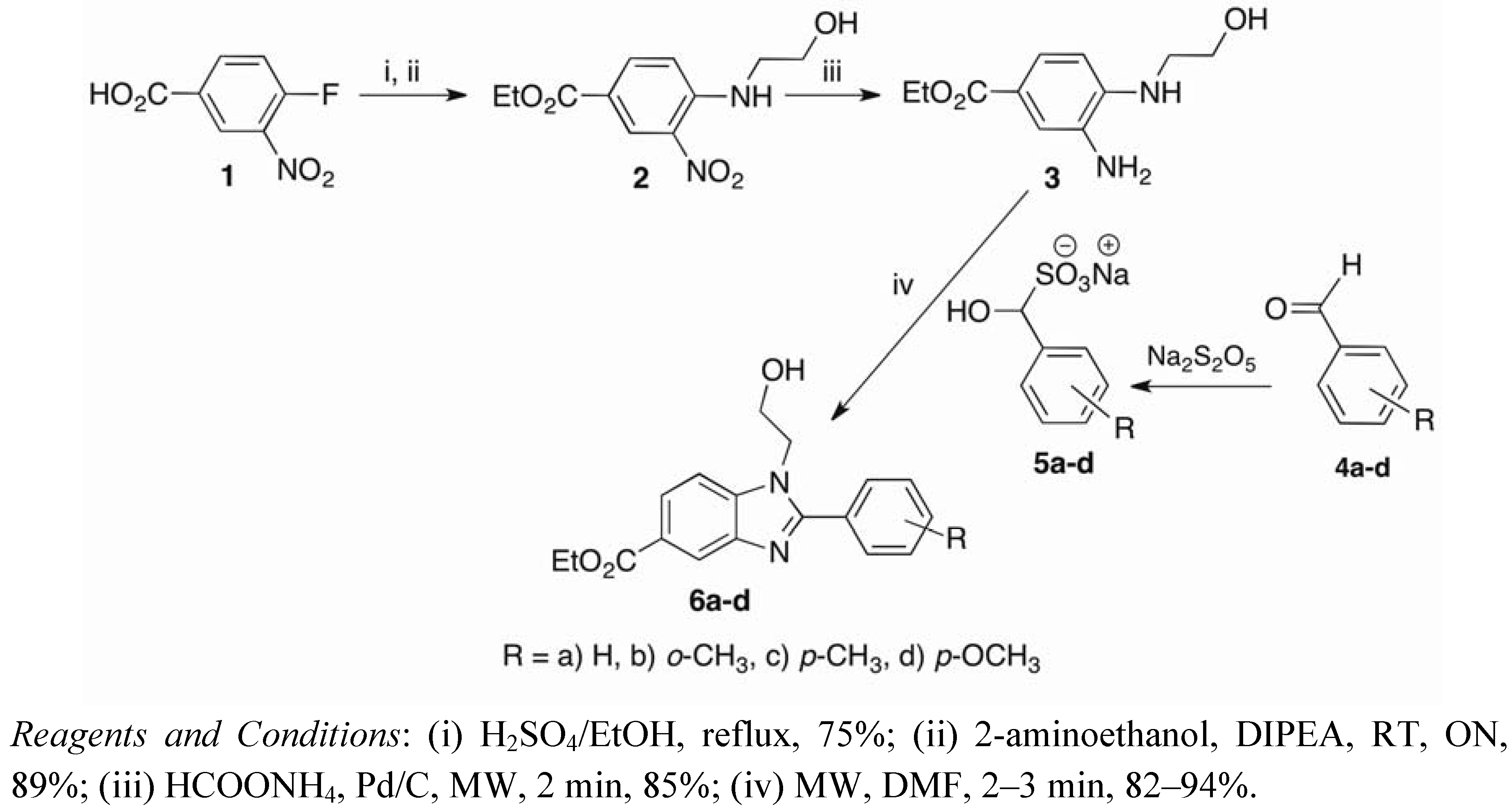
      <p>Our synthetic work started with esterification of the inexpensive precursor, 4-fluoro-3-nitrobenzoic acid (<bold>1</bold>). Treatment of the ester with 2-aminoethanol gave the amino intermediate <bold>2</bold>. Attempted reduction of the aromatic nitro group by refluxing with ammonium formate and 10% Pd/C for 3 h afforded the diamine <bold>3</bold> [<xref ref-type="bibr" rid="B28-molecules-17-09887">28</xref>] in a modest 60% yield. After optimisation, microwave irradiation of the same reaction mixture at 100 °C for 2 min afforded <bold>3</bold> in a much improved 85% yield (<xref ref-type="fig" rid="molecules-17-09887-f003">Scheme 1</xref>).</p>
      <fig id="molecules-17-09887-f003" position="anchor">
        <label>Scheme 1</label>
        <caption>
          <p>Synthesis of benzimidazole aglycones <bold>6a</bold>–<bold>d</bold>.</p>
        </caption>
        <graphic xmlns:xlink="http://www.w3.org/1999/xlink" xlink:href="molecules-17-09887-g003.tif"/>
      </fig>
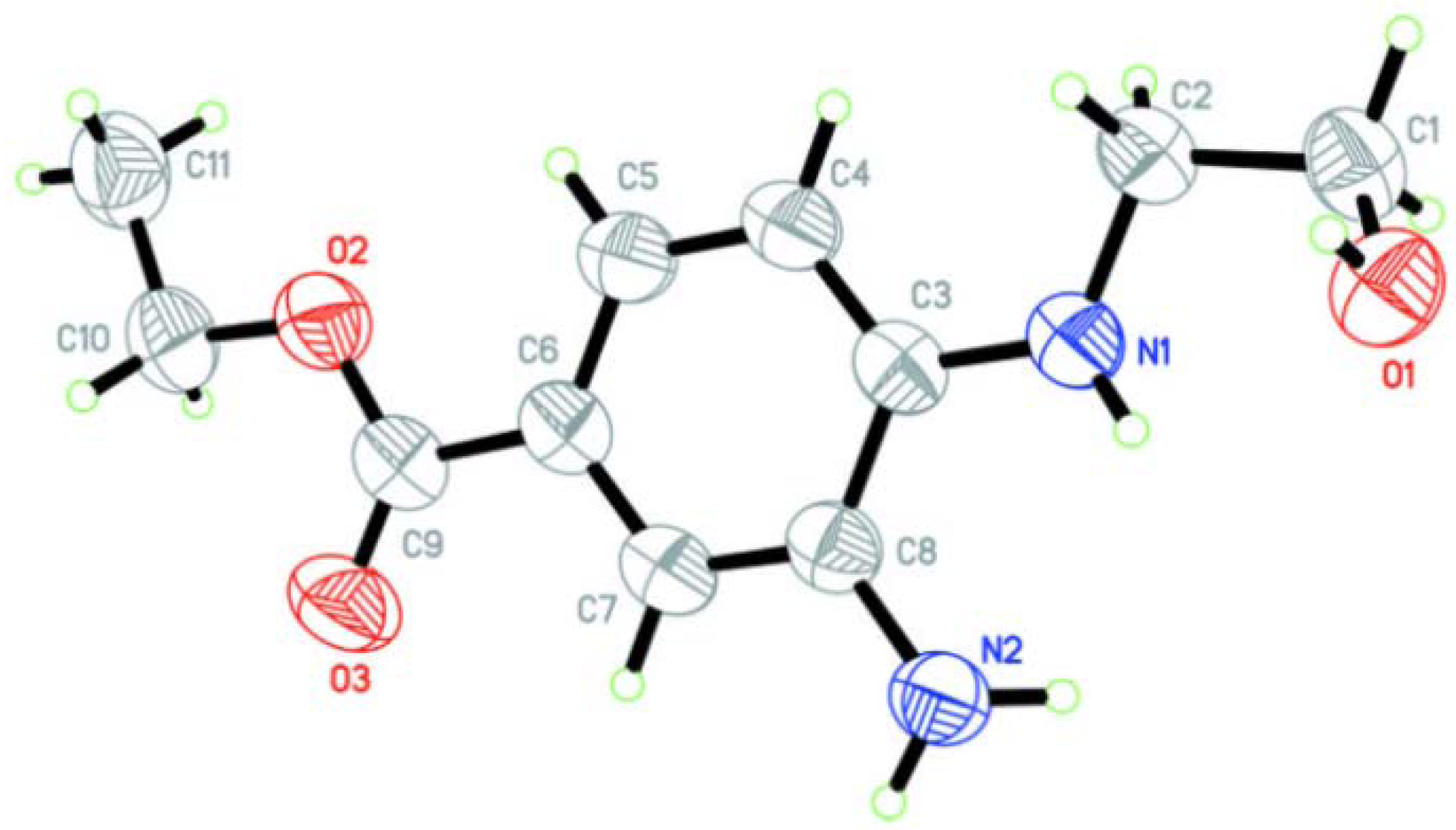
      <p>This diamine was found to be stable at room temperature, unlike other alkylated phenylenediamine derivatives that we had prepared previously; these turned brown and decomposed, even when stored at 5–10 °C. The stability of the amino derivative <bold>3</bold> was possibly due to intramolecular hydrogen bonding between the OH and NH<sub>2</sub> groups, as apparent from single X-ray crystallographic analysis (<xref ref-type="fig" rid="molecules-17-09887-f001">Figure 1</xref>) [<xref ref-type="bibr" rid="B28-molecules-17-09887">28</xref>].</p>
      <fig id="molecules-17-09887-f001" position="anchor">
        <label>Figure 1</label>
        <caption>
          <p>ORTEP digram of <bold>3</bold> (CCDC 788495).</p>
        </caption>
        <graphic xmlns:xlink="http://www.w3.org/1999/xlink" xlink:href="molecules-17-09887-g001.tif"/>
      </fig>
      <p>Next we turned our attention to the synthesis of 2-arylbenzimidazoles <bold>6a</bold>–<bold>d</bold>. These are typically prepared via condensation reactions of phenylenediamines with the corresponding acids or aldehydes [<xref ref-type="bibr" rid="B29-molecules-17-09887">29</xref>,<xref ref-type="bibr" rid="B30-molecules-17-09887">30</xref>]. Harsh, dehydrating conditions are often a requisite in cyclocondensation reactions with aromatic acids. More facile condensations can be achieved via arylaldehydes by employing oxidative reagents, such as Cu(OAc)<sub>2</sub>, air, 1,4-benzoquinone, I<sub>2</sub>/KI and sodium metabisulfite [<xref ref-type="bibr" rid="B29-molecules-17-09887">29</xref>,<xref ref-type="bibr" rid="B31-molecules-17-09887">31</xref>,<xref ref-type="bibr" rid="B32-molecules-17-09887">32</xref>,<xref ref-type="bibr" rid="B33-molecules-17-09887">33</xref>]. After taking into consideration previous reports and the availability of commercial benzaldehydes, we initially attempted the cyclocondensation with the diamine <bold>3</bold>, aromatic aldehydes and sodium metabisulfite in one pot as reported by Navarrete-Vázquez <italic>et al.</italic> [<xref ref-type="bibr" rid="B33-molecules-17-09887">33</xref>] under conventional heating conditions. The one-pot cyclocondensation failed to afford the benzimidazole products. Upon heating under microwave conditions, the same reaction gave multiple spots on TLC, but we were unable to isolate the desired benzimidazoles. Due to the unsuccessful attempts at the one-pot cyclocondensation reaction, we then decided to react the diamine <bold>3</bold> with the metabisulfite adducts of arylaldehydes <bold>5a</bold>–<bold>d</bold> [<xref ref-type="bibr" rid="B33-molecules-17-09887">33</xref>,<xref ref-type="bibr" rid="B34-molecules-17-09887">34</xref>]. The conventional reaction conditions (refluxing in DMF) initially suffered from long reaction times and afforded only moderate yields of the desired benzimidazoles <bold>6a</bold>–<bold>d</bold>. When the same reactions were performed under optimised microwave conditions [<xref ref-type="bibr" rid="B33-molecules-17-09887">33</xref>,<xref ref-type="bibr" rid="B35-molecules-17-09887">35</xref>], the benzimidazole aglycones <bold>6a</bold>–<bold>d</bold> were obtained in excellent 82–94% yields within 2–3 min (<xref ref-type="table" rid="molecules-17-09887-t001">Table 1</xref>) using minimal solvent (0.5–1 mL). Our results show that using microwaves as a heating source not only improves yields of the desired benzimidazoles, but it also brings about tremendous reductions in reaction times and the amount of solvent required.</p>
      <table-wrap id="molecules-17-09887-t001" position="anchor">
        <object-id pub-id-type="pii">molecules-17-09887-t001_Table 1</object-id>
        <label>Table 1</label>
        <caption>
          <p>Influence of microwave irradiation and conventional heating on the synthesis of benzimidazole derivatives <bold>6a</bold>–<bold>d</bold>.</p>
        </caption>
        <table>
          <thead>
            <tr>
              <th rowspan="2" align="center" valign="middle">Entry</th>
              <th rowspan="2" align="center" valign="middle">Products</th>
              <th rowspan="2" align="center" valign="middle">R</th>
              <th colspan="2" align="center" valign="middle">Conventional heating</th>
              <th colspan="2" align="center" valign="middle">Microwave heating</th>
            </tr>
            <tr>
              <th align="center" valign="middle">Time (h)</th>
              <th align="center" valign="middle">Yield (%)</th>
              <th align="center" valign="middle">Time (min)</th>
              <th align="center" valign="middle">Yield (%)</th>
            </tr>
          </thead>
          <tbody>
            <tr>
              <td align="center" valign="middle">1</td>
              <td align="center" valign="middle">
                <bold>6a</bold>
              </td>
              <td align="center" valign="middle">H</td>
              <td align="center" valign="middle">3.5</td>
              <td align="center" valign="middle">62</td>
              <td align="center" valign="middle">3</td>
              <td align="center" valign="middle">88</td>
            </tr>
            <tr>
              <td align="center" valign="middle">2</td>
              <td align="center" valign="middle">
                <bold>6b</bold>
              </td>
              <td align="center" valign="middle">o-CH<sub>3</sub></td>
              <td align="center" valign="middle">3</td>
              <td align="center" valign="middle">65</td>
              <td align="center" valign="middle">2.5</td>
              <td align="center" valign="middle">82</td>
            </tr>
            <tr>
              <td align="center" valign="middle">3</td>
              <td align="center" valign="middle">
                <bold>6c</bold>
              </td>
              <td align="center" valign="middle"><italic>p</italic>-CH<sub>3</sub></td>
              <td align="center" valign="middle">2.5</td>
              <td align="center" valign="middle">67</td>
              <td align="center" valign="middle">2</td>
              <td align="center" valign="middle">94</td>
            </tr>
            <tr>
              <td align="center" valign="middle">4</td>
              <td align="center" valign="middle">
                <bold>6d</bold>
              </td>
              <td align="center" valign="middle"><italic>p</italic>-OCH<sub>3</sub></td>
              <td align="center" valign="middle">3</td>
              <td align="center" valign="middle">60</td>
              <td align="center" valign="middle">2</td>
              <td align="center" valign="middle">89</td>
            </tr>
          </tbody>
        </table>
      </table-wrap>
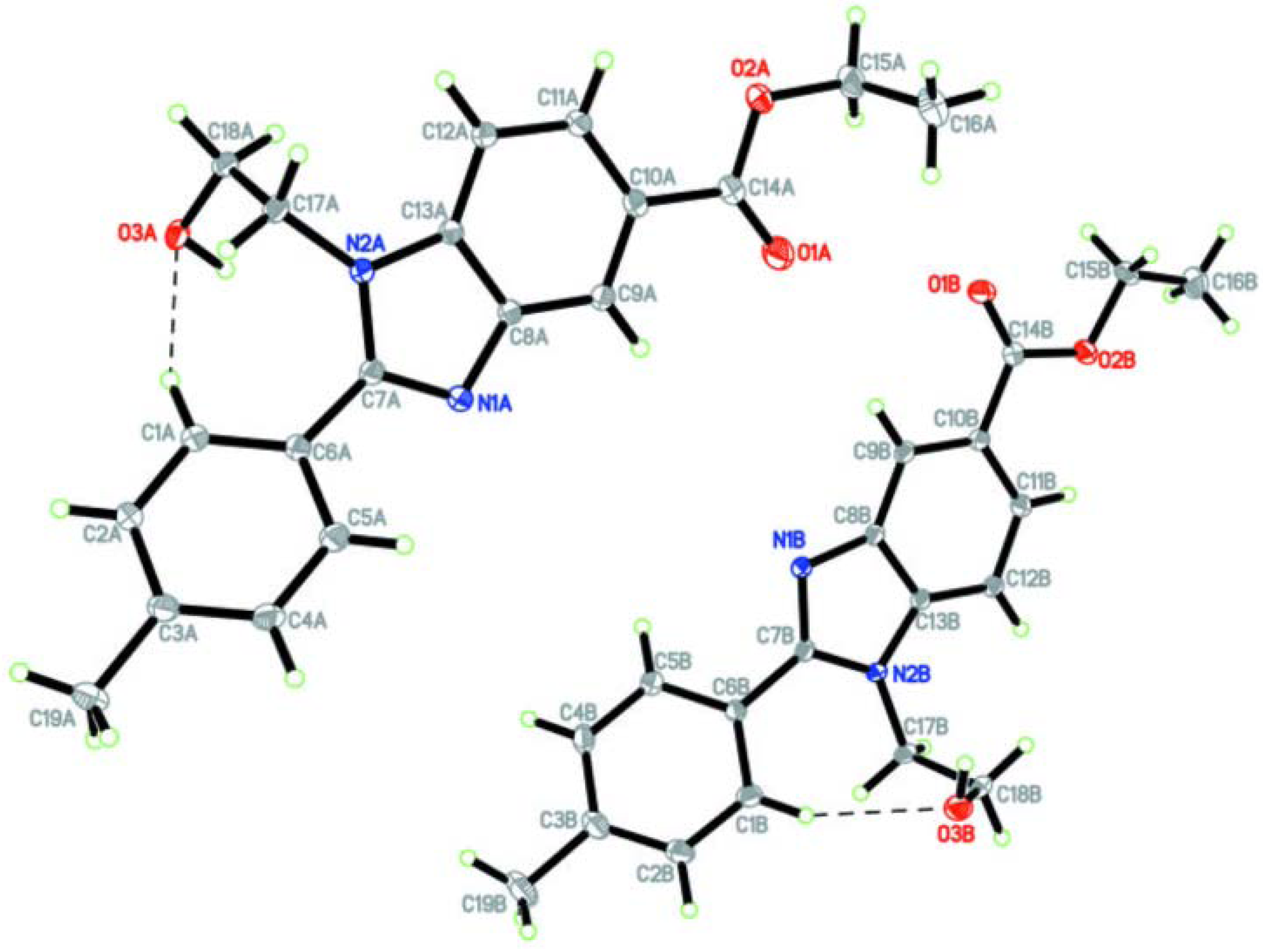
      <p>The <sup>1</sup>H-NMR spectrum of benzimidazole <bold>6c</bold> showed the loss of the broad singlet NH<sub>2</sub> peak at δ 4.60–4.85, which corroborates with the formation of the imine (C=N) that resonated at δ 156.1 in the <sup>13</sup>C-NMR spectrum. High resolution mass spectrometry data revealed a peak at <italic>m/z </italic>= 325.1549 (M+H requires 325.1547), which corresponds to <bold>6c</bold>. Single crystal X-ray analysis [<xref ref-type="bibr" rid="B36-molecules-17-09887">36</xref>] confirmed the structure of <bold>2c</bold> (<xref ref-type="fig" rid="molecules-17-09887-f002">Figure 2</xref>). Arylbenzimidazoles derivatives <bold>6a</bold>, <bold>6b</bold> and <bold>6d</bold> showed similar spectroscopic patterns.</p>
      <fig id="molecules-17-09887-f002" position="anchor">
        <label>Figure 2</label>
        <caption>
          <p>ORTEP digram of <bold>6c</bold> (CCDC 786546).</p>
        </caption>
        <graphic xmlns:xlink="http://www.w3.org/1999/xlink" xlink:href="molecules-17-09887-g002.tif"/>
      </fig>
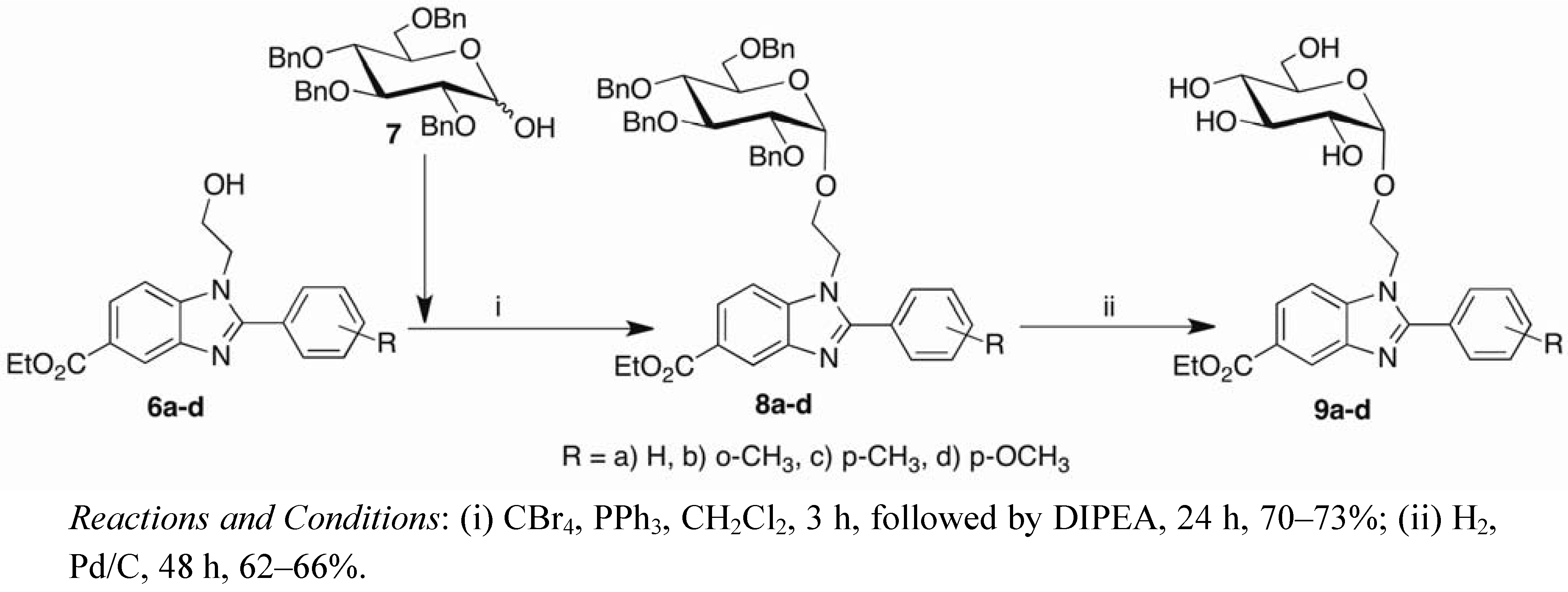
      <p>With the alcohols <bold>6a</bold>–<bold>d</bold> in hand, we next required a suitable glycosylation method to furnish the α-<italic>O</italic>-glycosyl benzimidazoles in a facile manner. Derivatives of α<italic>-O-</italic>glycosides can be accessed in a number of ways [<xref ref-type="bibr" rid="B37-molecules-17-09887">37</xref>,<xref ref-type="bibr" rid="B38-molecules-17-09887">38</xref>], one of the most efficient being the established <italic>in situ </italic>anomerisation procedure which employs a 1-bromo sugar as the glycosyl donor. The tedious and costly preparation of glycosyl bromides coupled with the corrosive nature of HBr gas prompted the search for alternative methods to generate the desired bromides <italic>in situ</italic>. Several one-pot reactions were reported to furnish glucosyl [<xref ref-type="bibr" rid="B39-molecules-17-09887">39</xref>], galactosyl [<xref ref-type="bibr" rid="B40-molecules-17-09887">40</xref>] and fucosyl [<xref ref-type="bibr" rid="B41-molecules-17-09887">41</xref>] intermediates in moderate to good yields. Recently, Shingu <italic>et al</italic>. described a practical one pot α-glycosylation method based on the Appel-Lee reaction utilizing PPh<sub>3</sub> and CBr<sub>4</sub> [<xref ref-type="bibr" rid="B23-molecules-17-09887">23</xref>,<xref ref-type="bibr" rid="B42-molecules-17-09887">42</xref>].</p>
      <p>Motivated by these findings, we attempted the glycosylation of the alcohols <bold>6a</bold>–<bold>d</bold> by pre-treating commercially available 2,3,4,6-tetra-<italic>O</italic>-benzyl-D-glucopyranose (<bold>7</bold>) with the Appel-Lee reagents for 3 h. This resulted in the <italic>in situ </italic>formation of glycosyl bromide, which underwent glycosylation with the alcohols <bold>6a</bold>–<bold>d</bold> after a further 24 h. This one-pot glycosylation step yielded the perbenzylated α-<italic>O-</italic>glucosyl benzimidazoles <bold>8a</bold>–<bold>d</bold> in 70–73% yields. Finally, catalytic hydrogenolysis step afforded the target hydroxyl sugars <bold>9a</bold>–<bold>d</bold> (<xref ref-type="fig" rid="molecules-17-09887-f004">Scheme 2</xref>).</p>
      <fig id="molecules-17-09887-f004" position="anchor">
        <label>Scheme 2</label>
        <caption>
          <p>Synthesis of α-<italic>O-</italic>glucosyl benzimidazoles <bold>9a</bold>–<bold>d</bold>.</p>
        </caption>
        <graphic xmlns:xlink="http://www.w3.org/1999/xlink" xlink:href="molecules-17-09887-g004.tif"/>
      </fig>
      <p>Via the optimised conditions, the glycosylated products were obtained as a mixture of α:β anomers (95:5), which is comparable to the ratios reported by Shingu [<xref ref-type="bibr" rid="B42-molecules-17-09887">42</xref>]. The <sup>1</sup>H-NMR of the isolated anomer <bold>8c</bold> showed the α-proton appearing at δ 4.60 as a doublet (<italic>J</italic> = 3.3 Hz). This small <italic>J</italic> value strongly indicated the successful formation of the desired α-<italic>O-</italic>glycosidic linkage between the glucopyranoside moiety and 2'-hydroxyethyl 2-arylbenzimidazole scaffold. Further confirmation came from the <sup>1</sup>H-NMR spectrum and HRMS of the deprotected sugar <bold>9c</bold>. Absence of benzylic protons in <bold>9c</bold> revealed the characteristic α-proton (δ 4.61–4.68), and the HRMS showed the molecular peak at 487.2077 (M+H requires 487.2075) corresponding to the hydroxyl sugar <bold>9c</bold>. The structures of the remaining α-<italic>O</italic>-glucosylated arylbenzimidazole derivatives were established spectroscopically and corroborated with <bold>8c</bold> and <bold>9c</bold>.</p>
    </sec>
    <sec sec-type="methods">
      <title>3. Experimental</title>
      <sec>
        <title>3.1. General</title>
        <p>All <sup>1</sup>H- and <sup>13</sup>C-NMR spectra were recorded on Bruker 300 and 400 MHz instruments in CDCl<sub>3</sub> and DMSO-d<sub>6</sub>. High resolution mass spectrometry (HRMS) measurements of the benzimidazole derivatives were acquired on an Agilent 6520 Quadrupole Time of Flight Mass Spectrometer (Agilent Technologies, Santa Clara, CA, USA) operating in the MS mode. Microwave-assisted syntheses were performed in CEM Discover™ microwave synthesizer. Melting points were measured on a Stuart SMP10 instrument and are uncorrected. Preparative thin layer chromatography (PLC) was performed using Merck 60 GF<sub>254</sub> silica gel coated (1 mm) on glass plates (20 × 20 cm). TLC experiments were performed on alumina-backed silica gel 40 F254 plates (Merck, Darmstadt, Germany). Visualisation of TLC plates was performed under UV light and aided by KMnO<sub>4</sub>, iodine staining and 2% H<sub>2</sub>SO<sub>4</sub> in EtOH (charcoal staining for sugar). All commercially available starting materials and solvents are from Sigma Aldrich, Acros and Merck; they were used without further purification. </p>
        <p><italic>Synthesis of ethyl 3-amino-4-(2-hydroxyethylamino)benzoate</italic> (<bold>3</bold>). A solution of 4-fluoro-3-nitrobenzoic (<bold>1</bold>, 10 g, 0.054 mol) was refluxed in EtOH (100 mL) and conc. H<sub>2</sub>SO<sub>4</sub> (4 mL) for 8 h. After completion of reaction, evidenced by TLC analysis, the excess solvent was removed under reduced pressure. The aqueous layer was extracted with EtOAc (50 × 2 mL). Upon washing with 10% NaHCO<sub>3 </sub>(100 mL), the combined organic layer was dried over Na<sub>2</sub>SO<sub>4</sub> and concentrated. Crystallisation of the crude product with hot hexane yielded the desired ethyl ester as colourless crystals (8.6 g). A portion of the benzoate (2.0 g, 9.2 mmol) in dichloromethane (25 mL) was added to a solution of ethanolamine (0.687 g, 14.0 mmol) and DIPEA (1.45 g, ~2 mL, 11.2 mmol) in dichloromethane (25 mL). The reaction mixture was stirred overnight at room temperature, then washed with water (20 mL × 2) and 10% Na<sub>2</sub>CO<sub>3</sub> (20 mL × 2). The dichloromethane layer was collected, dried over Na<sub>2</sub>SO<sub>4</sub> and removed under reduced pressure to afford the amino compound <bold>2</bold> (2.07 g, 89%). The amine <bold>2</bold> was used in the next step without purification, thus to a solution of the amine <bold>2</bold> (500 mg, 1.96 mmol) in EtOH (4 mL) was added HCOONH<sub>4</sub> (430 mg, 6.82 mmol) and 10% Pd/C (250 mg, 2.34 mmol). The reaction mixture was irradiated using a CEM DiscoverÔ microwave synthesizer for 2 min at 100 °C. After completion, the mixture was filtered through a bed of Celite and the filtrate evaporated under reduced pressure to afford the title product <bold>3</bold> as white crystals (0.45 g, 85%). Mp 116<italic>–</italic>118 °C; <sup>1</sup>H-NMR (DMSO-d<sub>6</sub>, 300 MHz): δ 1.26 (t, <italic>J =</italic> 6.3 Hz, CH<sub>3</sub>, 3H), 3.16<italic>–</italic>3.21 (m, CH<sub>2</sub>, 2H), 3.61<italic>–</italic>3.69 (m, CH<sub>2</sub>, 2H), 4.18 (q, <italic>J =</italic> 7.2 Hz, OCH<sub>2</sub>, 2H), 4.73 (br s, NH<sub>2</sub>, 2H), 5.17<italic>–</italic>5.21 (m, NH, 1H), 6.46 (d, <italic>J =</italic> 8.1 Hz, 1H), 7.18<italic>–</italic>7.24 (m, 2H) ppm. <sup>13</sup>C-NMR (DMSO-d<sub>6</sub>, 75 MHz): δ 15.3, 46.3, 60.1, 60.3, 108.7, 117.7, 134.9, 141.5, 167.2 ppm. ESI-MS <italic>m/z</italic> 225.2 (M+1). CCDC 788495 contains the supplementary crystallographic data for structure <bold>3</bold>.</p>
      </sec>
      <sec>
        <title>3.2. General Procedure for the Microwave-Assisted Synthesis of Benzimidazoles <italic><bold>6a</bold>–<bold>d</bold></italic></title>
        <p>The metabisulfite adduct <bold>5</bold> (2.0 eq.) was added to a solution of 3-amino-4-(2-hydroxyethylamino) benzoate (<bold>3</bold>, 1.0 eq.) in DMF (0.5–1 mL). The reaction mixture was heated under microwave conditions at 130 °C for 2 min. After completion, the mixture was diluted with EtOAc (10 mL) and washed with H<sub>2</sub>O (10 mL). The organic layer was collected, dried over Na<sub>2</sub>SO<sub>4</sub> and evaporated <italic>in vacuo</italic> to yield a crude residue, which was recrystallised from EtOAc to afford the desired benzimidazole as colourless crystals.</p>
        <p><italic>Ethyl 2-phenyl-1-(2-hydroxyethyl)-1H-benzimidazole-5-carboxylate</italic> (<bold>6a</bold>). Colourless crystals (0.97 g, 88%). Mp 123<italic>–</italic>125 °C; IR (KBr) 3400, 1637, 1265, 740 cm<italic><sup>–</sup></italic><sup>1</sup>; <sup>1</sup>H-NMR (CDCl<sub>3</sub>, 300 MHz): δ 1.46 (t, CH<sub>3</sub>, 3H), 4.15<italic>–</italic>4.29 (m, 2CH<sub>2</sub>, 4H), 4.41 (q, CH<sub>2</sub>, 2H), 6.05<italic>–</italic>6.18 (s, 1H), 7.20<italic>–</italic>7.84 (m, 8H) ppm. <sup>13</sup>C-NMR (CDCl<sub>3</sub>, 75 MHz): δ 14.8, 47.5, 60.7, 61.2, 110.0, 121.4, 124.3, 125.1, 128.8, 129.0, 130.2, 130.4, 138.3, 141.6, 156.1, 167.1 ppm. HRMS (ESI/Q-TOF): <italic>m/z</italic> calcd for C<sub>18</sub>H<sub>18</sub>N<sub>2</sub>O<sub>3</sub> (M+H), 311.1390; found 311.1391.</p>
        <p><italic>Ethyl 1-(2-hydroxyethyl)-2-o-tolyl-1H-benzimidazole-5-carboxylate</italic> (<bold>6b</bold>). White crystals (0.35 g, 82%). Mp 119<italic>–</italic>121 °C; IR (KBr) 3398, 1641, 1273, 752 cm<italic><sup>–</sup></italic><sup>1</sup>; <sup>1</sup>H-NMR (CDCl<sub>3</sub>, 300 MHz): δ 1.41 (t, CH<sub>3</sub>, 3H), 2.12 (s, CH<sub>3</sub>, 3H), 3.69 (t, <italic>J</italic> = 5.7 Hz, CH<sub>2</sub>, 2H), 4.04 (t, <italic>J</italic> = 5.7 Hz, CH<sub>2</sub>, 2H), 4.39 (q, CH<sub>2</sub>, 2H), 7.17<italic>–</italic>7.42 (m, 5H), 7.92<italic>–</italic>7.95 (dd, <italic>J</italic> = 8.5, 1.6 Hz, 1H), 8.38 (d, <italic>J</italic> = 1.2 Hz, 1H) ppm. <sup>13</sup>C-NMR (CDCl<sub>3</sub>, 75 MHz): δ 14.4, 19.6, 46.6, 60.3, 61.0, 110.2, 121.7, 124.2, 124.7, 125.7, 129.2, 130.1, 130.2, 130.5, 137.9, 138.0, 142.0, 155.3, 167.2 ppm. HRMS (ESI/Q-TOF): <italic>m/z</italic> calcd for C<sub>19</sub>H<sub>20</sub>N<sub>2</sub>O<sub>3</sub> (M+H), 325.1547; found 325.1548.</p>
        <p><italic>Ethyl 1-(2-hydroxyethyl)-2-p-tolyl-1H-benzimidazole-5-carboxylate</italic> (<bold>6c</bold>). Colourless crystals (1.0 g, 94%). Mp 138<italic>–</italic>140 °C; IR (KBr) 3377, 1639, 1275, 749 cm<italic><sup>–</sup></italic><sup>1</sup>; <sup>1</sup>H-NMR (CDCl<sub>3</sub>, 300 MHz): δ 1.47 (t, <italic>J</italic> = 7.2 Hz, CH<sub>3</sub>, 3H), 2.38 (s, CH<sub>3</sub>, 3H), 4.18<italic>–</italic>4.30 (m, 2CH<sub>2</sub>, 4H), 4.41 (q, <italic>J</italic> = 7.2 Hz, OCH<sub>2</sub>, 2H), 6.25<italic>–</italic>6.40 (s, 1H), 7.00 (d, <italic>J</italic> = 8.1 Hz, 2H), 7.21 (d, <italic>J</italic> = 8.4 Hz, 1H), 7.59 (d, <italic>J</italic> = 8.1 Hz, 2H), 7.71 (d, <italic>J</italic> = 8.7 Hz, 1H), 7.78 (s, 1H) ppm. <sup>13</sup>C-NMR (CDCl<sub>3</sub>, 75 MHz): δ 14.8, 21.8, 47.5, 60.7, 61.2, 109.9, 121.2, 124.1, 125.0, 126.1, 129.4, 130.3, 138.3, 140.2, 141.5, 156.1, 167.0 ppm. HRMS (ESI/Q-TOF): <italic>m/z</italic> calcd for C<sub>19</sub>H<sub>20</sub>N<sub>2</sub>O<sub>3</sub> (M+H), 325.1547; found 325.1549. CCDC 786546 contains the supplementary crystallographic data for structure <bold>6c</bold>.</p>
        <p><italic>Ethyl 1-(2-hydroxyethyl)-2-(4-methoxyphenyl)-1H-benzimidazole-5-carboxylate</italic> (<bold>6d</bold>). Colourless crystals (0.94 g, 89%). Mp 120<italic>–</italic>122 °C; IR (KBr) 3402, 1642, 1265, 740 cm<italic><sup>–</sup></italic><sup>1</sup>; <sup>1</sup>H-NMR (CDCl<sub>3</sub>, 300 MHz): δ 1.47 (t, CH<sub>3</sub>, 3H), 3.83 (s, OCH<sub>3</sub>, 3H), 4.22<italic>–</italic>4.30 (m, 2CH<sub>2</sub>, 4H), 4.41 (q, CH<sub>2</sub>, 2H), 6.71 (d, <italic>J</italic> = 9.0 Hz, 2H), 7.19 (d, <italic>J</italic> =8.4 Hz, 1H), 7.67<italic>–</italic>7.73 (m, 4H) ppm. <sup>13</sup>C-NMR (CDCl<sub>3</sub>, 75 MHz): δ 14.9, 47.5, 55.6, 60.7, 61.2, 109.7, 114.1, 121.0, 121.2, 124.0, 125.0, 132.0, 138.1, 141.4, 156.0, 161.1, 167.0 ppm. HRMS (ESI/Q-TOF): <italic>m/z</italic> calcd for C<sub>19</sub>H<sub>20</sub>N<sub>2</sub>O<sub>4</sub> (M+H), 341.1496; found 341.1499.</p>
      </sec>
      <sec>
        <title>3.3. General Procedure for the Synthesis of 1-(2′-α-O-D-glucopyranosyl ethyl) 2-arylbenzimidazoles <italic><bold>8a</bold>–<bold>d</bold></italic></title>
        <p>A solution of 2,3,4,6-tetra-<italic>O</italic>-benzyl-D-glucopyranose (<bold>7</bold>, 1.0 eq.), PPh<sub>3</sub> (3.0 eq.) and CBr<sub>4</sub> (3.0 eq.) in CH<sub>2</sub>Cl<sub>2</sub> (3 mL) was stirred for 3 h under N<sub>2</sub> atmosphere at room temperature. Upon completion of reaction as evidenced by TLC analysis, a solution of DIPEA (2.5 eq.) followed by substituted benzimidazole <bold>6</bold> (3.0 eq.) were added to the reaction mixture, which was stirred at room temperature under N<sub>2</sub> atmosphere for a further 24 h. The crude reaction mixture was purified by column chromatography using EtOAc-hexanes (3:7) to afford the product as a semi-solid.</p>
        <p><italic>Ethyl 1-[2′-α-O-D-(2,3,4,6-tetra-O-benzylglucopyranosyl)ethyl]-2-phenyl-1H-benzimidazole-5-carboxylate</italic> (<bold>8a</bold>). Isolated as low melting solid (0.27 g, 70%). IR (film) 3409, 1611, 1265, 740 cm<italic><sup>–</sup></italic><sup>1</sup>; <sup>1</sup>H-NMR (CDCl<sub>3</sub>, 300 MHz): δ 1.44 (t, CH<sub>3</sub>, 3H), 3.23<italic>–</italic>3.30 (m, H-2), 3.32<italic>–</italic>3.36 (m, H-4), 3.46<italic>–</italic>3.51 (m, CH<sub>2</sub>, 2H), 3.54<italic>–</italic>3.60 (m, H-6<sub>a</sub>), 3.68<italic>–</italic>3.73 (m, H-6<sub>b</sub>), 3.76<italic>–</italic>3.82 (m, H-5), 3.98<italic>–</italic>4.06 (m, H-3), 4.37<italic>–</italic>4.41 (m, CH<sub>2</sub>, 2H), 4.42<italic>–</italic>4.45 (m, CH<sub>2</sub>, 2H), 4.59 (d, <italic>J</italic> = 3.3 Hz, H-1), 4.46<italic>–</italic>4.94 (m, PhCH<sub>2</sub>, 8H), 7.11<italic>–</italic>8.59 (m, Ar-H, 28H) ppm. <sup>13</sup>C-NMR (CDCl<sub>3</sub>, 75 MHz): δ 14.3, 44.6, 60.8, 65.9, 68.2, 70.5, 73.3, 73.4, 74.7, 75.7, 76.6, 79.8, 81.7, 97.6, 110.2, 122.2, 124.4, 124.8, 127.6, 127.7, 127.8, 127.9, 128.0, 128.3, 128.4, 128.8, 129.1, 129.2, 129.8, 130.1, 138.2, 138.2, 142.6, 155.8, 167.0 ppm. HRMS (ESI/Q-TOF): <italic>m/z</italic> calcd for C<sub>52</sub>H<sub>52</sub>N<sub>2</sub>O<sub>8</sub> (M+H), 833.3797; found 833.3799.</p>
        <p><italic>Ethyl 1-[2'-α-O-D-(2,3,4,6-tetra-O-benzylglucopyranosyl)ethyl]-2-o-tolyl-1H-benzimidazole-5-carboxylate</italic> (<bold>8b</bold>). Isolated as low melting solid (0.20 g, 73%). IR (film) 3408, 1621, 1266 cm<italic><sup>–</sup></italic><sup>1</sup>; <sup>1</sup>H-NMR (CDCl<sub>3</sub>, 300 MHz): δ 1.41 (t, CH<sub>3</sub>, 3H), 2.23 (s, CH<sub>3</sub>, 3H), 3.23<italic>–</italic>3.30 (m, H-2), 3.35<italic>–</italic>3.39 (m, H-4), 3.45<italic>–</italic>3.49 (m, CH<sub>2</sub>, 2H), 3.51<italic>–</italic>3.61 (m, H-6<sub>a</sub>), 3.76<italic>–</italic>3.80 (m, H-6<sub>b</sub>), 3.81<italic>–</italic>3.87 (m, H-5), 4.18<italic>–</italic>4.25 (m, H-3), 4.27<italic>–</italic>4.37 (m, CH<sub>2</sub>, 2H), 4.38<italic>–</italic>4.44 (m, CH<sub>2</sub>, 2H), 4.53 (d, <italic>J</italic> = 3.3 Hz, H-1), 4.46<italic>–</italic>4.97 (m, PhCH<sub>2</sub>, 8H), 7.10<italic>–</italic>8.58 (m, 27H) ppm. <sup>13</sup>C-NMR (CDCl<sub>3</sub>, 75 MHz): δ 14.8, 20.1, 44.3, 61.2, 66.5, 68.7, 71.0, 73.7, 73.8, 75.2, 76.1, 80.2, 82.1, 98.1, 110.7, 122.7, 124.7, 125.3, 126.3, 128.0, 128.1, 128.2, 128.3, 128.4, 128.7, 128.8, 129.9, 130.6, 130.9, 138.1, 138.3, 138.5, 138.6, 139.1, 143.1, 155.6, 167.4 ppm. HRMS (ESI/Q-TOF): <italic>m/z</italic> calcd for C<sub>53</sub>H<sub>54</sub>N<sub>2</sub>O<sub>8</sub> (M+H), 847.3953; found 847.3953.</p>
        <p><italic>Ethyl 1-[2′-α-O-D-(2,3,4,6-tetra-O-benzylglucopyranosyl)ethyl]-2-p-tolyl-1H-benzimidazole-5-carboxylate</italic> (<bold>8c</bold>). Isolated as low melting solid (0.17 g, 72%). IR (film) 3392, 1645, 1261, 750 cm<italic><sup>–</sup></italic><sup>1</sup>; <sup>1</sup>H-NMR (CDCl<sub>3</sub>, 300 MHz): δ 1.41 (t, <italic>J</italic> = 7.1 Hz, CH<sub>3</sub>, 3H), 2.42 (s, CH<sub>3</sub>, 3H), 3.24<italic>–</italic>3.31 (m, H-2, 1H), 3.32<italic>–</italic>3.38 (m, H-4, 1H), 3.47<italic>–</italic>3.50 (m, CH<sub>2</sub>, 2H), 3.51<italic>–</italic>3.55 (m, H-6<sub>a</sub>, 1H), 3.65<italic>–</italic>3.73 (m, H-6<sub>b</sub>, 1H), 3.75<italic>–</italic>3.82 (m, H-5, 1H), 3.98<italic>–</italic>4.05 (m, H-3, 1H), 4.37<italic>–</italic>4.39 (m, CH<sub>2</sub>, 2H), 4.40<italic>–</italic>4.44 (m, CH<sub>2</sub>, 2H), 4.60 (d, <italic>J</italic> = 3.3 Hz, H-1, 1H), 4.45<italic>–</italic>4.94 (m, PhCH<sub>2</sub>, 8H), 7.10<italic>–</italic>7.35 (m, Ar-H, 22H), 7.54 (d, <italic>J</italic> = 8.7 Hz, 1H), 7.74 (d, <italic>J</italic> = 8.1 Hz, 2H), 8.04<italic>–</italic>8.08 (dd, <italic>J</italic> = 8.1, 1.5 Hz, 1H), 8.57 (d, <italic>J</italic> = 1.5 Hz, 1H) ppm. <sup>13</sup>C-NMR (CDCl<sub>3</sub>, 75 MHz): δ 14.8, 21.9, 45.0, 61.3, 66.4, 68.6, 70.9, 73.6, 73.7, 73.8, 75.2, 76.1, 80.2, 82.1, 98.0, 110.6, 122.6, 124.7, 125.5, 127.2, 128.0, 128.1, 128.2, 128.3, 128.4, 128.7, 128.8, 129.9, 130.0, 138.1, 138.3, 138.6, 139.1, 139.3, 140.7, 143.0, 156.4, 167.5 ppm. HRMS (ESI/Q-TOF): <italic>m/z</italic> calcd for C<sub>53</sub>H<sub>54</sub>N<sub>2</sub>O<sub>8</sub> (M+H), 847.3953; found 847.3953.</p>
        <p><italic>Ethyl 1-[2'-α-O-D-(2,3,4,6-tetra-O-benzylglucopyranosyl)ethyl]-2-p-methoxyphenyl-1H-benzimidazole-5-carboxylate</italic> (<bold>8d</bold>). Isolated as low melting solid (0.28 g, 71%). IR (film) 3421, 1630, 1265, 740 cm<italic><sup>–</sup></italic><sup>1</sup>; <sup>1</sup>H-NMR (CDCl<sub>3</sub>, 300 MHz): δ 1.40 (t, CH<sub>3</sub>, 3H), 3.24<italic>–</italic>3.30 (m, H-2), 3.32<italic>–</italic>3.36 (m, H-4), 3.46<italic>–</italic>3.48 (m, CH<sub>2</sub>, 2H), 3.49<italic>–</italic>3.54 (m, H-6<sub>a</sub>), 3.70<italic>–</italic>3.78 (m, H-6<sub>b</sub>), 3.81 (s, OCH<sub>3</sub>, 3H), 3.82<italic>–</italic>3.84 (m, H-5), 3.98<italic>–</italic>4.04 (m, H-3), 4.35<italic>–</italic>4.39 (m, CH<sub>2</sub>, 2H), 4.40<italic>–</italic>4.43 (m, CH<sub>2</sub>, 2H), 4.60 (d, <italic>J</italic> = 3.6 Hz, H-1), 4.46<italic>–</italic>4.92 (m, PhCH<sub>2</sub>, 8H), 6.98 (d, <italic>J</italic> = 8.7 Hz, 2H), 7.10<italic>–</italic>7.33 (m, 20H), 7.51 (d, <italic>J</italic> = 8.4 Hz, 1H), 7.80 (d, <italic>J</italic> = 9 Hz, 2H), 8.01<italic>–</italic>8.05 (dd, <italic>J</italic> = 1.5, 8.4 Hz, 1H), 8.54 (d, <italic>J</italic> = 1.5 Hz, 1H) ppm. <sup>13</sup>C-NMR (CDCl<sub>3</sub>, 75 MHz): δ 14.8, 45.0, 55.7, 61.2, 66.3, 68.6, 70.9, 73.7, 73.8, 75.2, 76.1, 80.3, 82.2, 98.0, 110.4, 114.7, 122.4, 124.6, 125.5, 127.9, 128.0, 128.1, 128.2, 128.3, 128.4, 128.7, 128.8, 131.7, 138.1, 138.6, 139.1, 139.4, 143.0, 156.2, 161.5, 167.5 ppm. HRMS (ESI/Q-TOF): <italic>m/z</italic> calcd for C<sub>19</sub>H<sub>20</sub>N<sub>2</sub>O<sub>3</sub> (M+H), 863.3902; found 863.3901.</p>
      </sec>
      <sec>
        <title>3.4. General Procedure for the Catalytic Hydrogenolysis</title>
        <p>A solution of perbenzylated glucopyranosyl arylbenzimidazole <bold>8</bold> (200 mg, 0.23 mmol) in MeOH (10 mL) was hydrogenated in the presence of 10% Pd/C (100 mg, 0.93 mmol) at room temperature for 48 h. The reaction mixture was filtered through a bed of Celite and washed with MeOH (10 mL × 3). The solvent was removed <italic>in vacuo</italic> to afford a crude residue which was purified by column chromatography in CHCl<sub>3</sub>–MeOH (9:1) to give the desired product as a light yellow semisolid.</p>
        <p><italic>Ethyl 1-[2'-α</italic><italic>-O-</italic><italic>D</italic><italic>-glucopyranosyl ethyl]-2-phenyl-1H-benzimidazole-5-carboxylate </italic>(<bold>9a</bold>). Isolated as light yellow semisolid (0.14 g, 62%). IR (film) 3411, 1635, 1275, 750 cm<sup>–1</sup>; <sup>1</sup>H-NMR (CDCl<sub>3</sub>, 300 MHz): δ 1.34 (t, CH<sub>3</sub>, 3H), 2.64 (d, <italic>J</italic> = 9.3 Hz, H-4), 3.15 (d, <italic>J</italic> = 8.1 Hz, H-2), 3.24–3.30 (m, CH<sub>2</sub>, 2H), 3.34–3.38 (m, H-3), 3.39–3.42 (m, H-5), 3.69–3.77 (m, H-6<sub>a</sub>), 3.93–4.03 (m, H-6<sub>b</sub>), 4.29 (q, CH<sub>2</sub>, 2H), 4.33–4.49 (m, CH<sub>2</sub>, 2H), 4.57–4.64 (m, H-1), 7.37–7.51 (m, 4H), 7.75–7.76 (m, 2H), 7.92–7.94 (m, 1H), 8.43 (s, 1H) ppm. <sup>13</sup>C-NMR (CDCl<sub>3</sub>, 75 MHz): δ 14.7, 44.8, 60.9, 61.5, 65.6, 69.3, 71.8, 72.2, 74.1, 99.0, 110.7, 122.3, 124.8, 125.4, 129.3, 129.7, 130.1, 130.7, 139.0, 142.5, 156.4, 167.6 ppm. HRMS (ESI/Q-TOF): <italic>m/z </italic>calcd for C<sub>24</sub>H<sub>28</sub>N<sub>2</sub>O<sub>8</sub> (M+H), 473.1919; found 473.1919.</p>
        <p><italic>Ethyl 1-[2′-α-O-</italic><italic>D-glucopyranosyl ethyl]-2-o-tolyl-1H-benzimidazole-5-carboxylate </italic>(<bold>9b</bold>). Isolated as pale yellow semisolid (0.11 g, 66%). IR (film) 3404, 1635, 1265, 744 cm<sup>–1</sup>; <sup>1</sup>H-NMR (CDCl<sub>3</sub>, 300 MHz): δ 1.37 (t, CH<sub>3</sub>, 3H), 2.16 (s, CH<sub>3</sub>, 3H), 2.71 (d, <italic>J</italic> = 9.3 Hz, H-4), 3.22–3.26 (m, H-2), 3.27–3.30 (m, CH<sub>2</sub>, 2H), 3.41–3.43 (m, H-3), 3.44–3.51 (m, H-5), 3.58–3.62 (m, H-6<sub>a</sub>), 3.80–3.91 (m, H-6<sub>b</sub>), 4.18–4.28 (m, CH<sub>2</sub>, 2H) 4.34 (q, CH<sub>2</sub>, 2H), 4.60 (d, <italic>J </italic>= 2.7 Hz, H-1), 7.31–7.39 (m, 3H), 7.50–7.57 (m, 2H), 7.98–8.02 (dd, <italic>J</italic> = 8.4, 1.2 Hz, 1H), 8.47 (d, <italic>J</italic> = 1.2 Hz, 1H) ppm. <sup>13</sup>C-NMR (CDCl<sub>3</sub>, 75 MHz): δ 14.7, 20.0, 44.3, 61.2, 61.4, 66.2, 69.6, 71.9, 72.2, 74.1, 99.1, 110.9, 122.4, 124.8, 125.3, 126.5, 129.4, 130.8, 131.0, 138.1, 138.5, 142.5, 155.8, 167.8 ppm. HRMS (ESI/Q-TOF): <italic>m/z </italic>calcd for C<sub>25</sub>H<sub>30</sub>N<sub>2</sub>O<sub>8</sub> (M+H), 487.2075; found 487.2079.</p>
        <p><italic>Ethyl 1-[2'-α-O-</italic><italic>D-glucopyranosyl ethyl]-2-p-tolyl-1H-benzimidazole-5-carboxylate </italic>(<bold>9c</bold>). Isolated as pale yellow semisolid (0.10 g, 65%). IR (film) 3411, 1608, 1420, 1265, 740 cm<sup>–1</sup>; <sup>1</sup>H-NMR (CDCl<sub>3</sub>, 400 MHz): δ 1.36 (t, <italic>J </italic>= 7.2 Hz, CH<sub>3</sub>, 3H), 2.32 (s, CH<sub>3</sub>, 3H), 2.62 (d, <italic>J </italic>= 9.2 Hz, H-4), 3.17 (d, <italic>J </italic>= 11.2 Hz, H-2), 3.26–3.35 (m, CH<sub>2</sub>, 2H), 3.36–3.40 (m, H-3), 3.41–3.47 (m, H-5), 3.71–3.73 (m, H-6<sub>a</sub>), 3.95–4.03 (m, H-6<sub>b</sub>), 4.31 (q, <italic>J </italic>= 7.2 Hz, CH<sub>2</sub>, 2H), 4.37–4.43 (m, CH<sub>2</sub>, 1H), 4.47–4.57 (m, CH<sub>2</sub>, 1H), 4.61–4.68 (m, H-1), 7.25–7.28 (m, 2H), 7.47 (d, <italic>J </italic>= 8.4 Hz, 1H), 7.64 (d, <italic>J </italic>= 8.0 Hz, 2H), 7.94 (d, <italic>J </italic>= 8.8 Hz, 1H), 8.42 (s, 1H) ppm. <sup>13</sup>C-NMR (CDCl<sub>3</sub>, 75 MHz): δ 14.7, 21.8, 44.8, 60.9, 61.5, 65.6, 69.4, 71.8, 72.2, 74.2, 99.0, 110.7, 122.2, 124.8, 125.4, 126.7, 130.0, 139.1, 141.0, 142.4, 156.6, 167.7 ppm. HRMS (ESI/Q-TOF): <italic>m/z </italic>calcd for C<sub>25</sub>H<sub>30</sub>N<sub>2</sub>O<sub>8</sub> (M+H), 487.2075; found 487.2077.</p>
        <p><italic>Ethyl 1-[2'-α-O-</italic><italic>D-glucopyranosyl ethyl]-2-p-methoxyphenyl-1H-benzimidazole-5-carboxylate </italic>(<bold>9d</bold>)<italic>.</italic> Isolated as light yellow semisolid (0.06 g, 64%). IR (film) 3402, 1616, 1265, 747 cm<sup>–1</sup>; <sup>1</sup>H-NMR (CDCl<sub>3</sub>, 300 MHz): δ 1.35 (t, CH<sub>3</sub>, 3H), 2.61 (d, <italic>J</italic> = 9.0 Hz, H-4), 3.13 (d, <italic>J </italic>= 10.5 Hz, H-2), 3.21–3.30 (m, CH<sub>2</sub>, 2H), 3.33–3.37 (m, H-3), 3.38–3.46 (m, H-5), 3.72 (s, OCH<sub>3</sub>, 3H), 3.73–3.79 (m, H-6<sub>a</sub>), 3.94–4.08 (m, H-6<sub>b</sub>), 4.30 (q, CH<sub>2</sub>, 2H), 4.38–4.57 (m, CH<sub>2</sub>, 2H), 4.59–4.64 (m, H-1), 6.95 (d, <italic>J</italic> = 8.7 Hz, 2H), 7.42 (d, <italic>J </italic>= 8.4 Hz, 1H), 7.70 (d, <italic>J </italic>= 8.4 Hz, 2H), 7.91 (d, <italic>J </italic>= 8.4 Hz, 1H), 8.39 (s, 1H) ppm. <sup>13</sup>C-NMR (CDCl<sub>3</sub>, 75 MHz): δ 14.7, 44.8, 55.7, 60.8, 61.4, 65.5, 69.3, 71.8, 72.2, 74.1, 99.0, 110.5, 114.8, 121.8, 122.0, 124.6, 125.3, 131.6, 139.0, 142.4, 156.4, 161.4, 167.7 ppm. HRMS (ESI/Q-TOF): <italic>m/z </italic>calcd for C<sub>25</sub>H<sub>30</sub>N<sub>2</sub>O<sub>9</sub> (M+H), 503.2024; found 503.2025.</p>
      </sec>
    </sec>
    <sec sec-type="conclusions">
      <title>4. Conclusions</title>
      <p>We have described a simple and straightforward synthesis of a series of novel α-<italic>O</italic>-glucopyranosyl arylbenzimidazoles using the Appel-Lee reagents. The synthesis of the glycosyl acceptors, 2-arylbenzimidazoles <bold>6a</bold>–<bold>d</bold>, was accomplished in four, high-yielding steps from the inexpensive precursor 4-fluoro-3-nitrobenzoic acid. Optimised microwave conditions for the reduction and cyclocondensation steps afforded the 2-arylbenzimidazole aglycones in high yields (82%–94%) and short reaction times (2–3 min) using reduced amount of solvent. This facile approach would allow rapid preparation of similar glycosylated benzimidazoles, which will be further investigated under both conventional and microwave conditions. Bioactivity studies of these glycosyl benzimidazoles will be reported in due course. </p>
    </sec>
    <sec sec-type="supplementary-material">
      <title>Supplementary Materials</title>
      <p>Supplementary materials can be accessed at: <uri>http://www.mdpi.com/1420-3049/17/8/9887/s1</uri>.</p>
    </sec>
  </body>
  <back>
    <ack>
      <title>Acknowledgments</title>
      <p>This work was funded by Universiti Sains Malaysia, RU Grant 1001/PFARMASI/815026, Ministry of Science, Technology and Innovation (MOSTI) under the R&amp;D initiative Grant No: 09-05-lfn-meb-004, and Ministry of Higher Education (MoHE), 203/PFARMASI/671159. We are grateful to Mohd Nazri Ismail and Michael Harvey at Universiti Sains Malaysia (USM) Doping Control Centre for helpful technical discussions and assistance in providing the HRMS analysis. N.A. thanks USM for the award of postdoctoral research fellowship.</p>
    </ack>
    <ref-list>
      <title>References</title>
      <ref id="B1-molecules-17-09887">
        <label>1.</label>
        <citation citation-type="journal">
          <person-group person-group-type="author">
            <name>
              <surname>Varki</surname>
              <given-names>A.</given-names>
            </name>
          </person-group>
          <article-title>Biological roles of oligosaccharides: All of the theories are correct</article-title>
          <source>Glycobiology</source>
          <year>1993</year>
          <volume>3</volume>
          <fpage>97</fpage>
          <lpage>130</lpage>
          <pub-id pub-id-type="doi">10.1093/glycob/3.2.97</pub-id>
        </citation>
      </ref>
      <ref id="B2-molecules-17-09887">
        <label>2.</label>
        <citation citation-type="journal">
          <person-group person-group-type="author">
            <name>
              <surname>Gabius</surname>
              <given-names>H.-J.</given-names>
            </name>
          </person-group>
          <article-title>Glycans: Bioactive signals decoded by lectins</article-title>
          <source>Biochem. Soc. Trans.</source>
          <year>2008</year>
          <volume>36</volume>
          <fpage>1491</fpage>
          <lpage>1496</lpage>
          <pub-id pub-id-type="doi">10.1042/BST0361491</pub-id>
        </citation>
      </ref>
      <ref id="B3-molecules-17-09887">
        <label>3.</label>
        <citation citation-type="journal">
          <person-group person-group-type="author">
            <name>
              <surname>Varki</surname>
              <given-names>A.</given-names>
            </name>
          </person-group>
          <article-title>Nothing in glycobiology makes sense, except in the light of evolution</article-title>
          <source>Cell</source>
          <year>2006</year>
          <volume>126</volume>
          <fpage>841</fpage>
          <lpage>845</lpage>
          <pub-id pub-id-type="doi">10.1016/j.cell.2006.08.022</pub-id>
        </citation>
      </ref>
      <ref id="B4-molecules-17-09887">
        <label>4.</label>
        <citation citation-type="journal">
          <person-group person-group-type="author">
            <name>
              <surname>Unger</surname>
              <given-names>F.M.</given-names>
            </name>
          </person-group>
          <article-title>The chemistry of oligosaccharide ligands of selectins: significance for the development of new immunomodulatory medicines</article-title>
          <source>Adv. Carbohydr. Chem. Biochem.</source>
          <year>2001</year>
          <volume>57</volume>
          <fpage>207</fpage>
          <lpage>435</lpage>
          <pub-id pub-id-type="doi">10.1016/S0065-2318(01)57018-3</pub-id>
        </citation>
      </ref>
      <ref id="B5-molecules-17-09887">
        <label>5.</label>
        <citation citation-type="journal">
          <person-group person-group-type="author">
            <name>
              <surname>Simanek</surname>
              <given-names>E.E.</given-names>
            </name>
            <name>
              <surname>McGarvey</surname>
              <given-names>G.J.</given-names>
            </name>
            <name>
              <surname>Jablonowski</surname>
              <given-names>J.A.</given-names>
            </name>
            <name>
              <surname>Wong</surname>
              <given-names>C.-H.</given-names>
            </name>
          </person-group>
          <article-title>Selectin-carbohydrate interactions: From natural ligands to designed mimics</article-title>
          <source>Chem. Rev.</source>
          <year>1998</year>
          <volume>98</volume>
          <fpage>833</fpage>
          <lpage>862</lpage>
        <pub-id pub-id-type="doi">10.1021/cr940226i</pub-id><pub-id pub-id-type="pmid">11848916</pub-id></citation>
      </ref>
      <ref id="B6-molecules-17-09887">
        <label>6.</label>
        <citation citation-type="journal">
          <person-group person-group-type="author">
            <name>
              <surname>Sato</surname>
              <given-names>N.</given-names>
            </name>
            <name>
              <surname>Oizumi</surname>
              <given-names>T.</given-names>
            </name>
            <name>
              <surname>Kinbara</surname>
              <given-names>M.</given-names>
            </name>
            <name>
              <surname>Sato</surname>
              <given-names>T.</given-names>
            </name>
            <name>
              <surname>Funayama</surname>
              <given-names>H.</given-names>
            </name>
            <name>
              <surname>Sato</surname>
              <given-names>S.</given-names>
            </name>
            <name>
              <surname>Matsuda</surname>
              <given-names>K.</given-names>
            </name>
            <name>
              <surname>Takada</surname>
              <given-names>H.</given-names>
            </name>
            <name>
              <surname>Sugawara</surname>
              <given-names>S.</given-names>
            </name>
            <name>
              <surname>Endo</surname>
              <given-names>Y.</given-names>
            </name>
          </person-group>
          <article-title>Promotion of arthritis and allergy in mice by aminoglycoglycerophospholipid, a membrane antigen specific to <italic>Mycoplasma fermentans</italic></article-title>
          <source>FEMS Immunol. Med. Microbiol.</source>
          <year>2010</year>
          <volume>59</volume>
          <fpage>33</fpage>
          <lpage>41</lpage>
          <pub-id pub-id-type="doi">10.1111/j.1574-695X.2010.00657.x</pub-id>
        </citation>
      </ref>
      <ref id="B7-molecules-17-09887">
        <label>7.</label>
        <citation citation-type="journal">
          <person-group person-group-type="author">
            <name>
              <surname>Kawahito</surname>
              <given-names>Y.</given-names>
            </name>
            <name>
              <surname>Ichinose</surname>
              <given-names>S.</given-names>
            </name>
            <name>
              <surname>Sano</surname>
              <given-names>H.</given-names>
            </name>
            <name>
              <surname>Tsubouchi</surname>
              <given-names>Y.</given-names>
            </name>
            <name>
              <surname>Kohno</surname>
              <given-names>M.</given-names>
            </name>
            <name>
              <surname>Yoshikawa</surname>
              <given-names>T.</given-names>
            </name>
            <name>
              <surname>Tokunaga</surname>
              <given-names>D.</given-names>
            </name>
            <name>
              <surname>Hojo</surname>
              <given-names>T.</given-names>
            </name>
            <name>
              <surname>Harasawa</surname>
              <given-names>R.</given-names>
            </name>
            <name>
              <surname>Nakano</surname>
              <given-names>T.</given-names>
            </name>
          </person-group>
          <article-title>Mycoplasma fermentans glycolipid-antigen as a pathogen of rheumatoid arthritis</article-title>
          <source>Biochem. Biophys. Res. Commun.</source>
          <year>2008</year>
          <volume>369</volume>
          <fpage>561</fpage>
          <lpage>566</lpage>
          <pub-id pub-id-type="doi">10.1016/j.bbrc.2008.02.079</pub-id>
        </citation>
      </ref>
      <ref id="B8-molecules-17-09887">
        <label>8.</label>
        <citation citation-type="journal">
          <person-group person-group-type="author">
            <name>
              <surname>Kaila</surname>
              <given-names>N.</given-names>
            </name>
            <name>
              <surname>Thomas</surname>
              <given-names>B.E.</given-names>
            </name>
          </person-group>
          <article-title>Design and synthesis of sialyl Lewis(x) mimics as E- and P-selectin inhibitors</article-title>
          <source>Med. Res. Rev.</source>
          <year>2002</year>
          <volume>22</volume>
          <fpage>566</fpage>
          <lpage>601</lpage>
          <pub-id pub-id-type="doi">10.1002/med.10018</pub-id>
        </citation>
      </ref>
      <ref id="B9-molecules-17-09887">
        <label>9.</label>
        <citation citation-type="journal">
          <person-group person-group-type="author">
            <name>
              <surname>Chhabra</surname>
              <given-names>S.R.</given-names>
            </name>
            <name>
              <surname>Rahim</surname>
              <given-names>A.S.A.</given-names>
            </name>
            <name>
              <surname>Kellam</surname>
              <given-names>B.</given-names>
            </name>
          </person-group>
          <article-title>Recent progress in the design of selectin inhibitors</article-title>
          <source>Mini-Rev. Med. Chem.</source>
          <year>2003</year>
          <volume>3</volume>
          <fpage>679</fpage>
          <lpage>687</lpage>
          <pub-id pub-id-type="doi">10.2174/1389557033487791</pub-id>
        </citation>
      </ref>
      <ref id="B10-molecules-17-09887">
        <label>10.</label>
        <citation citation-type="book">
          <person-group person-group-type="author">
            <name>
              <surname>Saotome</surname>
              <given-names>C.</given-names>
            </name>
            <name>
              <surname>Kanie</surname>
              <given-names>O.</given-names>
            </name>
          </person-group>
          <article-title>Synthetic methodologies</article-title>
          <source>Carbohydrate-Based Drug Discovery</source>
          <person-group person-group-type="editor">
            <name>
              <surname>Wong</surname>
              <given-names>C.-H.</given-names>
            </name>
          </person-group>
          <publisher-name>Wiley</publisher-name>
          <publisher-loc>Weinheim, Germany</publisher-loc>
          <year>2003</year>
          <volume>1</volume>
          <fpage>1</fpage>
          <lpage>36</lpage>
        </citation>
      </ref>
      <ref id="B11-molecules-17-09887">
        <label>11.</label>
        <citation citation-type="journal">
          <person-group person-group-type="author">
            <name>
              <surname>Ernst</surname>
              <given-names>B.</given-names>
            </name>
            <name>
              <surname>Magnani</surname>
              <given-names>J.L.</given-names>
            </name>
          </person-group>
          <article-title>From carbohydrate leads to glycomimetic drugs</article-title>
          <source>Nat. Rev. Drug Discov.</source>
          <year>2009</year>
          <volume>8</volume>
          <fpage>661</fpage>
          <lpage>677</lpage>
        <pub-id pub-id-type="doi">10.1038/nrd2852</pub-id><pub-id pub-id-type="pmid">19629075</pub-id></citation>
      </ref>
      <ref id="B12-molecules-17-09887">
        <label>12.</label>
        <citation citation-type="journal">
          <person-group person-group-type="author">
            <name>
              <surname>Cipolla</surname>
              <given-names>L.</given-names>
            </name>
            <name>
              <surname>La Ferla</surname>
              <given-names>B.</given-names>
            </name>
            <name>
              <surname>Airoldi</surname>
              <given-names>C.</given-names>
            </name>
            <name>
              <surname>Zona</surname>
              <given-names>C.</given-names>
            </name>
            <name>
              <surname>Orsato</surname>
              <given-names>A.</given-names>
            </name>
            <name>
              <surname>Shaikh</surname>
              <given-names>N.</given-names>
            </name>
            <name>
              <surname>Russo</surname>
              <given-names>L.</given-names>
            </name>
            <name>
              <surname>Nicotra</surname>
              <given-names>F.</given-names>
            </name>
          </person-group>
          <article-title>Carbohydrate mimetics and scaffolds: Sweet spots in medicinal chemistry</article-title>
          <source>Future Med. Chem.</source>
          <year>2010</year>
          <volume>2</volume>
          <fpage>587</fpage>
          <lpage>599</lpage>
          <pub-id pub-id-type="doi">10.4155/fmc.10.8</pub-id>
        </citation>
      </ref>
      <ref id="B13-molecules-17-09887">
        <label>13.</label>
        <citation citation-type="journal">
          <person-group person-group-type="author">
            <name>
              <surname>Chrysina</surname>
              <given-names>E.D.</given-names>
            </name>
            <name>
              <surname>Kosmopoulou</surname>
              <given-names>M.N.</given-names>
            </name>
            <name>
              <surname>Tiraidis</surname>
              <given-names>C.</given-names>
            </name>
            <name>
              <surname>Kardakaris</surname>
              <given-names>R.</given-names>
            </name>
            <name>
              <surname>Bischler</surname>
              <given-names>N.</given-names>
            </name>
            <name>
              <surname>Leonidas</surname>
              <given-names>D.D.</given-names>
            </name>
            <name>
              <surname>Hadady</surname>
              <given-names>Z.</given-names>
            </name>
            <name>
              <surname>Somsák</surname>
              <given-names>L.</given-names>
            </name>
            <name>
              <surname>Docsa</surname>
              <given-names>T.</given-names>
            </name>
            <name>
              <surname>Gergely</surname>
              <given-names>P.</given-names>
            </name>
            <name>
              <surname>Oikonomakos</surname>
              <given-names>N.G.</given-names>
            </name>
          </person-group>
          <article-title>Kinetic and crystallographic studies on 2-(b-D-glucopyranosyl)-5-methyl-1,3,4-oxadiazole, -benzothiazole, and -benzimidazole, inhibitors of muscle glycogen phosphorylase. Evidence for a new binding site</article-title>
          <source>Protein Sci.</source>
          <year>2005</year>
          <volume>14</volume>
          <fpage>873</fpage>
          <lpage>888</lpage>
          <pub-id pub-id-type="doi">10.1110/ps.041216105</pub-id>
        </citation>
      </ref>
      <ref id="B14-molecules-17-09887">
        <label>14.</label>
        <citation citation-type="journal">
          <person-group person-group-type="author">
            <name>
              <surname>Somsak</surname>
              <given-names>L.</given-names>
            </name>
            <name>
              <surname>Nagy</surname>
              <given-names>V.</given-names>
            </name>
            <name>
              <surname>Hadady</surname>
              <given-names>Z.</given-names>
            </name>
            <name>
              <surname>Docsa</surname>
              <given-names>T.</given-names>
            </name>
            <name>
              <surname>Gergely</surname>
              <given-names>P.</given-names>
            </name>
          </person-group>
          <article-title>Glucose analog inhibitors of glycogen phosphorylases as potential antidiabetic agents: Recent developments</article-title>
          <source>Curr. Med. Chem.</source>
          <year>2003</year>
          <volume>9</volume>
          <fpage>1177</fpage>
          <lpage>1189</lpage>
        </citation>
      </ref>
      <ref id="B15-molecules-17-09887">
        <label>15.</label>
        <citation citation-type="journal">
          <person-group person-group-type="author">
            <name>
              <surname>Hadady</surname>
              <given-names>Z.</given-names>
            </name>
            <name>
              <surname>Tóth</surname>
              <given-names>M.</given-names>
            </name>
            <name>
              <surname>Somsak</surname>
              <given-names>L.</given-names>
            </name>
          </person-group>
          <article-title><italic>C</italic>-(b-D-glucopyranosyl) heterocycles as potential glycogen phosphorylase inhibitors</article-title>
          <source>ARKIVOC</source>
          <year>2004</year>
          <fpage>140</fpage>
          <lpage>149</lpage>
        </citation>
      </ref>
      <ref id="B16-molecules-17-09887">
        <label>16.</label>
        <citation citation-type="journal">
          <person-group person-group-type="author">
            <name>
              <surname>Tóth</surname>
              <given-names>M.</given-names>
            </name>
            <name>
              <surname>Kun</surname>
              <given-names>S.</given-names>
            </name>
            <name>
              <surname>Bokor</surname>
              <given-names>É.</given-names>
            </name>
            <name>
              <surname>Benltifa</surname>
              <given-names>M.</given-names>
            </name>
            <name>
              <surname>Tallec</surname>
              <given-names>G.</given-names>
            </name>
            <name>
              <surname>Vidal</surname>
              <given-names>S.</given-names>
            </name>
            <name>
              <surname>Docsa</surname>
              <given-names>T.</given-names>
            </name>
            <name>
              <surname>Gergely</surname>
              <given-names>P.</given-names>
            </name>
            <name>
              <surname>Somsák</surname>
              <given-names>L.</given-names>
            </name>
            <name>
              <surname>Praly</surname>
              <given-names>J.P.</given-names>
            </name>
          </person-group>
          <article-title>Synthesis and structure-activity relationships of <italic>C</italic>-glycosylated oxadiazoles as inhibitors of glycogen phosphorylase</article-title>
          <source>Bioorg. Med. Chem.</source>
          <year>2009</year>
          <volume>17</volume>
          <fpage>4773</fpage>
          <lpage>4785</lpage>
        <pub-id pub-id-type="doi">10.1016/j.bmc.2009.04.036</pub-id><pub-id pub-id-type="pmid">19450985</pub-id></citation>
      </ref>
      <ref id="B17-molecules-17-09887">
        <label>17.</label>
        <citation citation-type="journal">
          <person-group person-group-type="author">
            <name>
              <surname>Sachs</surname>
              <given-names>G.</given-names>
            </name>
            <name>
              <surname>Shin</surname>
              <given-names>J.M.</given-names>
            </name>
            <name>
              <surname>Howden</surname>
              <given-names>C.W.</given-names>
            </name>
          </person-group>
          <article-title>Review article: the clinical pharmacology of proton pump inhibitors</article-title>
          <source>Aliment. Pharmacol. Ther.</source>
          <year>2006</year>
          <volume>23</volume>
          <fpage>2</fpage>
          <lpage>8</lpage>
          <pub-id pub-id-type="doi">10.1111/j.1365-2036.2006.02943.x</pub-id>
        </citation>
      </ref>
      <ref id="B18-molecules-17-09887">
        <label>18.</label>
        <citation citation-type="journal">
          <person-group person-group-type="author">
            <name>
              <surname>McKellar</surname>
              <given-names>Q.A.</given-names>
            </name>
            <name>
              <surname>Scott</surname>
              <given-names>E.W.</given-names>
            </name>
          </person-group>
          <article-title>The benzimidazole anthelmintic agents-a review</article-title>
          <source>J. Vet. Pharmacol. Ther.</source>
          <year>1990</year>
          <volume>13</volume>
          <fpage>223</fpage>
          <lpage>247</lpage>
          <pub-id pub-id-type="doi">10.1111/j.1365-2885.1990.tb00773.x</pub-id>
        </citation>
      </ref>
      <ref id="B19-molecules-17-09887">
        <label>19.</label>
        <citation citation-type="journal">
          <person-group person-group-type="author">
            <name>
              <surname>Spasov</surname>
              <given-names>A.</given-names>
            </name>
            <name>
              <surname>Yozhitsa</surname>
              <given-names>I.</given-names>
            </name>
            <name>
              <surname>Bugaeva</surname>
              <given-names>L.</given-names>
            </name>
            <name>
              <surname>Anisimova</surname>
              <given-names>V.</given-names>
            </name>
          </person-group>
          <article-title>Benzimidazole derivatives: Spectrum of pharmacological activity and toxicological properties (a review)</article-title>
          <source>Pharm. Chem. J.</source>
          <year>1999</year>
          <volume>33</volume>
          <fpage>232</fpage>
          <lpage>243</lpage>
          <pub-id pub-id-type="doi">10.1007/BF02510042</pub-id>
        </citation>
      </ref>
      <ref id="B20-molecules-17-09887">
        <label>20.</label>
        <citation citation-type="journal">
          <person-group person-group-type="author">
            <name>
              <surname>Beaulieu</surname>
              <given-names>C.</given-names>
            </name>
            <name>
              <surname>Wang</surname>
              <given-names>Z.</given-names>
            </name>
            <name>
              <surname>Denis</surname>
              <given-names>D.</given-names>
            </name>
            <name>
              <surname>Greig</surname>
              <given-names>G.</given-names>
            </name>
            <name>
              <surname>Lamontagne</surname>
              <given-names>S.</given-names>
            </name>
            <name>
              <surname>ÓNeill</surname>
              <given-names>G.</given-names>
            </name>
            <name>
              <surname>Slipetz</surname>
              <given-names>D.</given-names>
            </name>
            <name>
              <surname>Wang</surname>
              <given-names>J.</given-names>
            </name>
          </person-group>
          <article-title>Benzimidazoles as new potent and selective DP antagonists for the treatment of allergic rhinitis</article-title>
          <source>Bioorg. Med. Chem. Lett.</source>
          <year>2004</year>
          <volume>14</volume>
          <fpage>3195</fpage>
          <lpage>3199</lpage>
        <pub-id pub-id-type="doi">10.1016/j.bmcl.2004.04.005</pub-id><pub-id pub-id-type="pmid">15149674</pub-id></citation>
      </ref>
      <ref id="B21-molecules-17-09887">
        <label>21.</label>
        <citation citation-type="journal">
          <person-group person-group-type="author">
            <name>
              <surname>Wan</surname>
              <given-names>Y.</given-names>
            </name>
            <name>
              <surname>Wallinder</surname>
              <given-names>C.</given-names>
            </name>
            <name>
              <surname>Plouffe</surname>
              <given-names>B.</given-names>
            </name>
            <name>
              <surname>Beaudry</surname>
              <given-names>H.</given-names>
            </name>
            <name>
              <surname>Mahalingam</surname>
              <given-names>A.K.</given-names>
            </name>
            <name>
              <surname>Wu</surname>
              <given-names>X.</given-names>
            </name>
            <name>
              <surname>Johansson</surname>
              <given-names>B.</given-names>
            </name>
            <name>
              <surname>Holm</surname>
              <given-names>M.</given-names>
            </name>
            <name>
              <surname>Botoros</surname>
              <given-names>M.</given-names>
            </name>
            <name>
              <surname>Karlén</surname>
              <given-names>A.</given-names>
            </name>
            <etal/>
          </person-group>
          <article-title>Design, synthesis, and biological evaluation of the first selective nonpeptide AT2 receptor agonist</article-title>
          <source>J. Med. Chem.</source>
          <year>2004</year>
          <volume>47</volume>
          <fpage>5995</fpage>
          <lpage>6008</lpage>
          <pub-id pub-id-type="doi">10.1021/jm049715t</pub-id>
        </citation>
      </ref>
      <ref id="B22-molecules-17-09887">
        <label>22.</label>
        <citation citation-type="journal">
          <person-group person-group-type="author">
            <name>
              <surname>Boiani</surname>
              <given-names>M.</given-names>
            </name>
            <name>
              <surname>González</surname>
              <given-names>M.</given-names>
            </name>
          </person-group>
          <article-title>Imidazole and benzimidazole derivatives as chemotherapeutic agents</article-title>
          <source>Mini-Rev. Med. Chem.</source>
          <year>2005</year>
          <volume>5</volume>
          <fpage>409</fpage>
          <lpage>424</lpage>
          <pub-id pub-id-type="doi">10.2174/1389557053544047</pub-id>
        </citation>
      </ref>
      <ref id="B23-molecules-17-09887">
        <label>23.</label>
        <citation citation-type="journal">
          <person-group person-group-type="author">
            <name>
              <surname>Nishida</surname>
              <given-names>Y.</given-names>
            </name>
            <name>
              <surname>Shingu</surname>
              <given-names>Y.</given-names>
            </name>
            <name>
              <surname>Mengfei1</surname>
              <given-names>Y.</given-names>
            </name>
            <name>
              <surname>Fukuda</surname>
              <given-names>K.</given-names>
            </name>
            <name>
              <surname>Dohi</surname>
              <given-names>H.</given-names>
            </name>
            <name>
              <surname>Matsuda</surname>
              <given-names>S.</given-names>
            </name>
            <name>
              <surname>Matsuda</surname>
              <given-names>K.</given-names>
            </name>
          </person-group>
          <article-title>An easy a-glycosylation methodology for the synthesis and stereochemistry of mycoplasma α-glycolipid antigens</article-title>
          <source>Beilstein J. Org. Chem.</source>
          <year>2012</year>
          <volume>8</volume>
          <fpage>629</fpage>
          <lpage>639</lpage>
          <pub-id pub-id-type="doi">10.3762/bjoc.8.70</pub-id>
        </citation>
      </ref>
      <ref id="B24-molecules-17-09887">
        <label>24.</label>
        <citation citation-type="journal">
          <person-group person-group-type="author">
            <name>
              <surname>Murase</surname>
              <given-names>H.</given-names>
            </name>
            <name>
              <surname>Moon</surname>
              <given-names>J.H.</given-names>
            </name>
            <name>
              <surname>Yamauchi</surname>
              <given-names>R.</given-names>
            </name>
            <name>
              <surname>Kato</surname>
              <given-names>K.</given-names>
            </name>
            <name>
              <surname>Kunieda</surname>
              <given-names>T.</given-names>
            </name>
            <name>
              <surname>Yoshikawa</surname>
              <given-names>T.</given-names>
            </name>
            <name>
              <surname>Terao</surname>
              <given-names>J.</given-names>
            </name>
          </person-group>
          <article-title>Antioxidant activity of a novel vitamin E derivative, 2-(a-D-glucopyranosyl)methyl-2,5,7,8-tetramethylchroman-6-ol</article-title>
          <source>Free Radic. Biol. Med.</source>
          <year>1998</year>
          <volume>24</volume>
          <fpage>217</fpage>
          <lpage>225</lpage>
          <pub-id pub-id-type="doi">10.1016/S0891-5849(97)00221-9</pub-id>
        </citation>
      </ref>
      <ref id="B25-molecules-17-09887">
        <label>25.</label>
        <citation citation-type="journal">
          <person-group person-group-type="author">
            <name>
              <surname>El-Nezhawy</surname>
              <given-names>A.O.H.</given-names>
            </name>
            <name>
              <surname>Gaballah</surname>
              <given-names>S.T.</given-names>
            </name>
            <name>
              <surname>Radwan</surname>
              <given-names>M.A.A.</given-names>
            </name>
            <name>
              <surname>Baiuomy</surname>
              <given-names>A.R.</given-names>
            </name>
            <name>
              <surname>Abdel-Salam</surname>
              <given-names>O.M.E.</given-names>
            </name>
          </person-group>
          <article-title>Structure-based design of benzimidazole sugar conjugates: Synthesis, SAR and <italic>in vivo</italic> anti-inflammatory and analgesic activities</article-title>
          <source>Med. Chem.</source>
          <year>2009</year>
          <volume>5</volume>
          <fpage>558</fpage>
          <lpage>569</lpage>
          <pub-id pub-id-type="doi">10.2174/157340609790170461</pub-id>
        </citation>
      </ref>
      <ref id="B26-molecules-17-09887">
        <label>26.</label>
        <citation citation-type="journal">
          <person-group person-group-type="author">
            <name>
              <surname>Appel</surname>
              <given-names>R.</given-names>
            </name>
          </person-group>
          <article-title>Tertiary Phosphane-Tetrachloromethane, a Versatile Reagent for Chlorination, Dehydration, and P-N Linkage</article-title>
          <source>Angew. Chem. Int. Ed.</source>
          <year>1975</year>
          <volume>14</volume>
          <fpage>801</fpage>
          <lpage>811</lpage>
          <pub-id pub-id-type="doi">10.1002/anie.197508011</pub-id>
        </citation>
      </ref>
      <ref id="B27-molecules-17-09887">
        <label>27.</label>
        <citation citation-type="journal">
          <person-group person-group-type="author">
            <name>
              <surname>Lee</surname>
              <given-names>J.</given-names>
            </name>
            <name>
              <surname>Nolan</surname>
              <given-names>T.</given-names>
            </name>
          </person-group>
          <article-title>Sugar Esters: III. New reagent for deoxyhalo sugar preparation</article-title>
          <source>Can. J. Chem.</source>
          <year>1966</year>
          <volume>44</volume>
          <fpage>1331</fpage>
          <lpage>1334</lpage>
          <pub-id pub-id-type="doi">10.1139/v66-199</pub-id>
        </citation>
      </ref>
      <ref id="B28-molecules-17-09887">
        <label>28.</label>
        <citation citation-type="journal">
          <person-group person-group-type="author">
            <name>
              <surname>Arumugam</surname>
              <given-names>N.</given-names>
            </name>
            <name>
              <surname>Abdul Rahim</surname>
              <given-names>A.S.</given-names>
            </name>
            <name>
              <surname>Abd Hamid</surname>
              <given-names>S.</given-names>
            </name>
            <name>
              <surname>Rosli</surname>
              <given-names>M.M.</given-names>
            </name>
            <name>
              <surname>Fun</surname>
              <given-names>H.K.</given-names>
            </name>
          </person-group>
          <article-title>Ethyl 3-amino-4-[(2-hydroxyethyl)amino]benzoate</article-title>
          <source>Acta Crystallogr. Sect. E: Struct. Rep. Online</source>
          <year>2010</year>
          <volume>66</volume>
          <pub-id pub-id-type="doi">10.1107/S1600536810029077</pub-id>
        </citation>
      </ref>
      <ref id="B29-molecules-17-09887">
        <label>29.</label>
        <citation citation-type="book">
          <person-group person-group-type="author">
            <name>
              <surname>Yet</surname>
              <given-names>L.</given-names>
            </name>
          </person-group>
          <article-title>Five-membered ring systems: With more than one N atom</article-title>
          <source>Progress in Heterocyclic Chemistry</source>
          <person-group person-group-type="editor">
            <name>
              <surname>Gribble</surname>
              <given-names>G.W.</given-names>
            </name>
            <name>
              <surname>Joule</surname>
              <given-names>J.A.</given-names>
            </name>
          </person-group>
          <publisher-name>Elsevier</publisher-name>
          <publisher-loc>Oxford, UK</publisher-loc>
          <year>2011</year>
          <volume>23</volume>
          <fpage>231</fpage>
          <lpage>266</lpage>
        </citation>
      </ref>
      <ref id="B30-molecules-17-09887">
        <label>30.</label>
        <citation citation-type="journal">
          <person-group person-group-type="author">
            <name>
              <surname>Wright</surname>
              <given-names>J.B.</given-names>
            </name>
          </person-group>
          <article-title>The Chemistry of the Benzimidazoles</article-title>
          <source>Chem. Rev.</source>
          <year>1951</year>
          <volume>48</volume>
          <fpage>397</fpage>
          <lpage>541</lpage>
          <pub-id pub-id-type="doi">10.1021/cr60151a002</pub-id>
        </citation>
      </ref>
      <ref id="B31-molecules-17-09887">
        <label>31.</label>
        <citation citation-type="journal">
          <person-group person-group-type="author">
            <name>
              <surname>Gogoi</surname>
              <given-names>P.</given-names>
            </name>
            <name>
              <surname>Konwar</surname>
              <given-names>D.</given-names>
            </name>
          </person-group>
          <article-title>An efficient and one-pot synthesis of imidazolines and benzimidazoles via anaerobic oxidation of carbon-nitrogen bonds in water</article-title>
          <source>Tetrahedron Lett.</source>
          <year>2006</year>
          <volume>47</volume>
          <fpage>79</fpage>
          <lpage>82</lpage>
          <pub-id pub-id-type="doi">10.1016/j.tetlet.2005.10.134</pub-id>
        </citation>
      </ref>
      <ref id="B32-molecules-17-09887">
        <label>32.</label>
        <citation citation-type="journal">
          <person-group person-group-type="author">
            <name>
              <surname>Lin</surname>
              <given-names>S.</given-names>
            </name>
            <name>
              <surname>Yang</surname>
              <given-names>L.</given-names>
            </name>
          </person-group>
          <article-title>A simple and efficient procedure for the synthesis of benzimidazoles using air as the oxidant</article-title>
          <source>Tetrahedron Lett.</source>
          <year>2005</year>
          <volume>46</volume>
          <fpage>4315</fpage>
          <lpage>4319</lpage>
          <pub-id pub-id-type="doi">10.1016/j.tetlet.2005.04.101</pub-id>
        </citation>
      </ref>
      <ref id="B33-molecules-17-09887">
        <label>33.</label>
        <citation citation-type="journal">
          <person-group person-group-type="author">
            <name>
              <surname>Navarrete-Vázquez</surname>
              <given-names>G.</given-names>
            </name>
            <name>
              <surname>Moreno-Diaz</surname>
              <given-names>H.</given-names>
            </name>
            <name>
              <surname>Aguirre-Crespo</surname>
              <given-names>F.</given-names>
            </name>
            <name>
              <surname>León-Rivera</surname>
              <given-names>I.</given-names>
            </name>
            <name>
              <surname>Villalobos-Molina</surname>
              <given-names>R.</given-names>
            </name>
            <name>
              <surname>Muñoz-Muñiz</surname>
              <given-names>O.</given-names>
            </name>
            <name>
              <surname>Estrada-Soto</surname>
              <given-names>S.</given-names>
            </name>
          </person-group>
          <article-title>Design, microwave-assisted synthesis, and spasmolytic activity of 2-(alkyloxyaryl)-1<italic>H</italic>-benzimidazole derivatives as constrained stilbene bioisosteres</article-title>
          <source>Bioorg. Med. Chem. Lett.</source>
          <year>2006</year>
          <volume>16</volume>
          <fpage>4169</fpage>
          <lpage>4173</lpage>
        <pub-id pub-id-type="doi">10.1016/j.bmcl.2006.05.082</pub-id><pub-id pub-id-type="pmid">16784847</pub-id></citation>
      </ref>
      <ref id="B34-molecules-17-09887">
        <label>34.</label>
        <citation citation-type="journal">
          <person-group person-group-type="author">
            <name>
              <surname>Torres-Gómez</surname>
              <given-names>H.</given-names>
            </name>
            <name>
              <surname>Hernández-Núñez</surname>
              <given-names>E.</given-names>
            </name>
            <name>
              <surname>León-Rivera</surname>
              <given-names>I.</given-names>
            </name>
            <name>
              <surname>Guerrero-Alvarez</surname>
              <given-names>J.</given-names>
            </name>
            <name>
              <surname>Cedillo-Rivera</surname>
              <given-names>R.</given-names>
            </name>
            <name>
              <surname>Moo-Puc</surname>
              <given-names>R.</given-names>
            </name>
            <name>
              <surname>Argotte-Ramos</surname>
              <given-names>R.</given-names>
            </name>
            <name>
              <surname>Carmen Rodríguez-Gutiérrez</surname>
              <given-names>M.D.</given-names>
            </name>
            <name>
              <surname>Chan-Bacab</surname>
              <given-names>M.J.</given-names>
            </name>
            <name>
              <surname>Navarrete-Vázquez</surname>
              <given-names>G.</given-names>
            </name>
          </person-group>
          <article-title>Design, synthesis and <italic>in vitro</italic> antiprotozoal activity of benzimidazole-pentamidine hybrids</article-title>
          <source>Bioorg. Med. Chem. Lett.</source>
          <year>2008</year>
          <volume>18</volume>
          <fpage>3147</fpage>
          <lpage>3151</lpage>
        <pub-id pub-id-type="doi">10.1016/j.bmcl.2008.05.009</pub-id><pub-id pub-id-type="pmid">18486471</pub-id></citation>
      </ref>
      <ref id="B35-molecules-17-09887">
        <label>35.</label>
        <citation citation-type="journal">
          <person-group person-group-type="author">
            <name>
              <surname>Kappe</surname>
              <given-names>C.O.</given-names>
            </name>
            <name>
              <surname>Dallinger</surname>
              <given-names>D.</given-names>
            </name>
          </person-group>
          <article-title>The impact of microwave synthesis on drug discovery</article-title>
          <source>Nat. Rev. Drug Discov.</source>
          <year>2005</year>
          <volume>5</volume>
          <fpage>51</fpage>
          <lpage>63</lpage>
          <pub-id pub-id-type="doi">10.1038/nrc1524</pub-id>
        </citation>
      </ref>
      <ref id="B36-molecules-17-09887">
        <label>36.</label>
        <citation citation-type="journal">
          <person-group person-group-type="author">
            <name>
              <surname>Arumugam</surname>
              <given-names>N.</given-names>
            </name>
            <name>
              <surname>Abdul Rahim</surname>
              <given-names>A.S.</given-names>
            </name>
            <name>
              <surname>Wahab</surname>
              <given-names>H.A.</given-names>
            </name>
            <name>
              <surname>Goh</surname>
              <given-names>J.H.</given-names>
            </name>
            <name>
              <surname>Fun</surname>
              <given-names>H.K.</given-names>
            </name>
          </person-group>
          <article-title>Ethyl 1-(2-hydroxyethyl)-2-<italic>p</italic>-tolyl-1<italic>H</italic>-benzimidazole-5-carboxylate</article-title>
          <source>Acta Crystallogr. Sect. E: Struct. Rep. Online</source>
          <year>2010</year>
          <volume>66</volume>
          <fpage>o1590</fpage>
          <lpage>o1591</lpage>
        <pub-id pub-id-type="doi">10.1107/S1600536810020799</pub-id></citation>
      </ref>
      <ref id="B37-molecules-17-09887">
        <label>37.</label>
        <citation citation-type="book">
          <person-group person-group-type="author">
            <name>
              <surname>Lindhorst</surname>
              <given-names>T.</given-names>
            </name>
          </person-group>
          <source>Essentials of Carbohydrate Chemistry and Biochemistry</source>
          <publisher-name>Wiley-VCH</publisher-name>
          <publisher-loc>Weinheim, Germany</publisher-loc>
          <year>2007</year>
        </citation>
      </ref>
      <ref id="B38-molecules-17-09887">
        <label>38.</label>
        <citation citation-type="journal">
          <person-group person-group-type="author">
            <name>
              <surname>Demchenko</surname>
              <given-names>A.V.</given-names>
            </name>
          </person-group>
          <article-title>1,2-<italic>cis O</italic>-Glycosylation: Methods, Strategies, Principles</article-title>
          <source>Curr. Org. Chem.</source>
          <year>2003</year>
          <volume>7</volume>
          <fpage>35</fpage>
          <lpage>79</lpage>
          <pub-id pub-id-type="doi">10.2174/1385272033373175</pub-id>
        </citation>
      </ref>
      <ref id="B39-molecules-17-09887">
        <label>39.</label>
        <citation citation-type="journal">
          <person-group person-group-type="author">
            <name>
              <surname>Shingu</surname>
              <given-names>Y.</given-names>
            </name>
            <name>
              <surname>Nishida</surname>
              <given-names>Y.</given-names>
            </name>
            <name>
              <surname>Dohi</surname>
              <given-names>H.</given-names>
            </name>
            <name>
              <surname>Kobayashi</surname>
              <given-names>K.</given-names>
            </name>
          </person-group>
          <article-title>An easy access to halide ion-catalytic α-glycosylation using carbon tetrabromide and triphenylphosphine as multifunctional reagents</article-title>
          <source>Org. Biomol. Chem.</source>
          <year>2003</year>
          <volume>1</volume>
          <fpage>2518</fpage>
          <lpage>2521</lpage>
          <pub-id pub-id-type="doi">10.1039/b303984f</pub-id>
        </citation>
      </ref>
      <ref id="B40-molecules-17-09887">
        <label>40.</label>
        <citation citation-type="journal">
          <person-group person-group-type="author">
            <name>
              <surname>Nashed</surname>
              <given-names>M.A.</given-names>
            </name>
            <name>
              <surname>Anderson</surname>
              <given-names>L.</given-names>
            </name>
          </person-group>
          <article-title>Oligosaccharides from “standardized intermediates.” Synthesis of a branched tetrasaccharide glycoside related to the blood group B determinant</article-title>
          <source>J. Am. Chem. Soc.</source>
          <year>1982</year>
          <volume>104</volume>
          <fpage>7282</fpage>
          <lpage>7286</lpage>
          <pub-id pub-id-type="doi">10.1021/ja00389a061</pub-id>
        </citation>
      </ref>
      <ref id="B41-molecules-17-09887">
        <label>41.</label>
        <citation citation-type="journal">
          <person-group person-group-type="author">
            <name>
              <surname>Cromer</surname>
              <given-names>R.</given-names>
            </name>
            <name>
              <surname>Spohr</surname>
              <given-names>U.</given-names>
            </name>
            <name>
              <surname>Khare</surname>
              <given-names>D.P.</given-names>
            </name>
            <name>
              <surname>LePendu</surname>
              <given-names>J.</given-names>
            </name>
            <name>
              <surname>Lemieux</surname>
              <given-names>R.U.</given-names>
            </name>
          </person-group>
          <article-title>Molecular recognition XII. The binding of the H human blood group determinants and congeners by a lectin of <italic>Galactia tenuiflora</italic></article-title>
          <source>Can. J. Chem.</source>
          <year>1992</year>
          <volume>70</volume>
          <fpage>1511</fpage>
          <lpage>1530</lpage>
          <pub-id pub-id-type="doi">10.1139/v92-187</pub-id>
        </citation>
      </ref>
      <ref id="B42-molecules-17-09887">
        <label>42.</label>
        <citation citation-type="journal">
          <person-group person-group-type="author">
            <name>
              <surname>Shingu</surname>
              <given-names>Y.</given-names>
            </name>
            <name>
              <surname>Miyachi</surname>
              <given-names>A.</given-names>
            </name>
            <name>
              <surname>Miura</surname>
              <given-names>Y.</given-names>
            </name>
            <name>
              <surname>Kobayashi</surname>
              <given-names>K.</given-names>
            </name>
            <name>
              <surname>Nishida</surname>
              <given-names>Y.</given-names>
            </name>
          </person-group>
          <article-title>One-pot α-glycosylation pathway via the generation <italic>in situ</italic> of alpha-glycopyranosyl imidates in <italic>N,N</italic>-dimethylformamide</article-title>
          <source>Carbohydr. Res.</source>
          <year>2005</year>
          <volume>340</volume>
          <fpage>2236</fpage>
          <lpage>2244</lpage>
          <pub-id pub-id-type="doi">10.1016/j.carres.2005.07.020</pub-id>
        </citation>
      </ref>
    </ref-list>
	<fn-group>
	<fn>
      <p><italic>Sample Availability</italic>: Samples of the compounds <bold>8a</bold>–<bold>d</bold> and <bold>9a</bold>–<bold>d</bold> are available from the authors.</p>
	</fn>
	</fn-group>
  </back>
</article>