

Chemical Composition and in Vitro Evaluation of the Antioxidant and Antimicrobial Activities of Eucalyptus gillii Essential Oil and Extracts

Abstract
:1. Introduction
2. Results and Discussion
2.1. Chemical Composition
2.1.1. Essential Oil

| N° | RI | Compounds | %Area |
|---|---|---|---|
| 1 | 936 | α-pinene | 10.0 |
| 2 | 951 | α-fenchene | 0.2 |
| 3 | 1025 | p-cymene | 14.2 |
| 4 | 1028 | limonene | 1.4 |
| 5 | 1030 | 1,8-cineole | 43.8 |
| 6 | 1033 | β-phellandrene | 0.1 |
| 7 | 1057 | γ-terpinene | 0.2 |
| 8 | 1086 | α-terpinolene | 0.2 |
| 9 | 1105 | fenchol | 0.1 |
| 10 | 1138 | trans-2-caren-4-ol * | 0.1 |
| 11 | 1140 | cis-sabinol | 5.2 |
| 12 | 1145 | trans-verbenol | 0.1 |
| 13 | 1166 | borneol | 0.3 |
| 14 | 1168 | pinocarvone | 2.6 |
| 15 | 1195 | myrtenal | 0.2 |
| 16 | 1202 | myrtenol | 0.2 |
| 17 | 1208 | verbenone | 0.5 |
| 18 | 1237 | pulegone | 0.1 |
| 19 | 1237 | cuminaldehyde | 0.2 |
| 20 | 1280 | piperitone | 0.3 |
| 21 | 1288 | p-cymen-7-ol | 0.1 |
| 22 | 1388 | β-bourbonene | 0.5 |
| 23 | 1516 | α-selinene | 3.1 |
| 24 | 1527 | calamenene | 0.1 |
| 25 | 1560 | germacrene B | 1.1 |
| 26 | 1576 | spathulenol | 4.1 |
| 27 | 1578 | globulol | 0.4 |
| 28 | 1590 | viridiflorol | 0.5 |
| 29 | 1596 | guaiol | 1.0 |
| 30 | 1648 | γ-eudesmol | 3.6 |
| 31 | 1650 | α-cadinol | 1.2 |
| 32 | 1651 | β-eudesmol | 3.2 |
| 33 | 1805 | nootkatone * | 0.2 |
| 34 | nd | dihydroumbellulone | 0.1 |
| Total | 99.5 | ||
| Monoterpene hydrocarbons | 12.2 | ||
| Oxygenated monoterpenes | 53.6 | ||
| Sesquiterpenes hydrocarbons | 4.9 | ||
| Oxygenated sesquiterpenes | 14.2 | ||
| Others | 14.7 |
2.1.2. Various Extracts
| Samples | Yield (%) |
|---|---|
| Essential oil | 2.3 ± 0.1 a |
| Hexane | 30.7 ± 0.3 b |
| Petroleum ether | 0.3 ± 0.0 c |
| Acetone | 5.2 ± 0.0 d |
| Ethanol | 9.0 ± 0.2 e |
| Methanol | 6.4 ± 0.0 d |
| Water | 5.3 ± 0.0 d |
| Extracts | Phenolics (GAE) a | Tannins (CE) a | Flavonoids (QE) a | Anthocyanins (C3GE) b |
|---|---|---|---|---|
| Hexane | nd a | 152.2 ± 1.4 a | 4.0 ± 0.1 a | 45.3 ± 0.1 a |
| Petroleum ether | 4.5 ± 0.0 b | 133.5 ± 0.8 b | 3.3 ± 0.1 b | 43.4 ± 0.2 a |
| Acetone | 53.7 ± 0.1 c | 104.9 ± 1.4 c | 27.6 ± 0.4 c | 4.7 ± 0.2 b |
| Ethanol | 143.4 ± 0.1 d | 148.6 ± 1.6 a | 34.3 ± 0.1 d | nd c |
| Methanol | 143.2 ± 0.7 d | 251.3 ± 0.7 d | 23.9 ± 0.3 e | 1.3 ± 0.0 d |
| Water | 216.6 ± 0.4 e | 231.7 ± 0.8 e | 14.4 ± 0.2 f | 1.2 ± 0.0 d |
2.2. Antioxidant Activity
2.2.1. Essential Oil
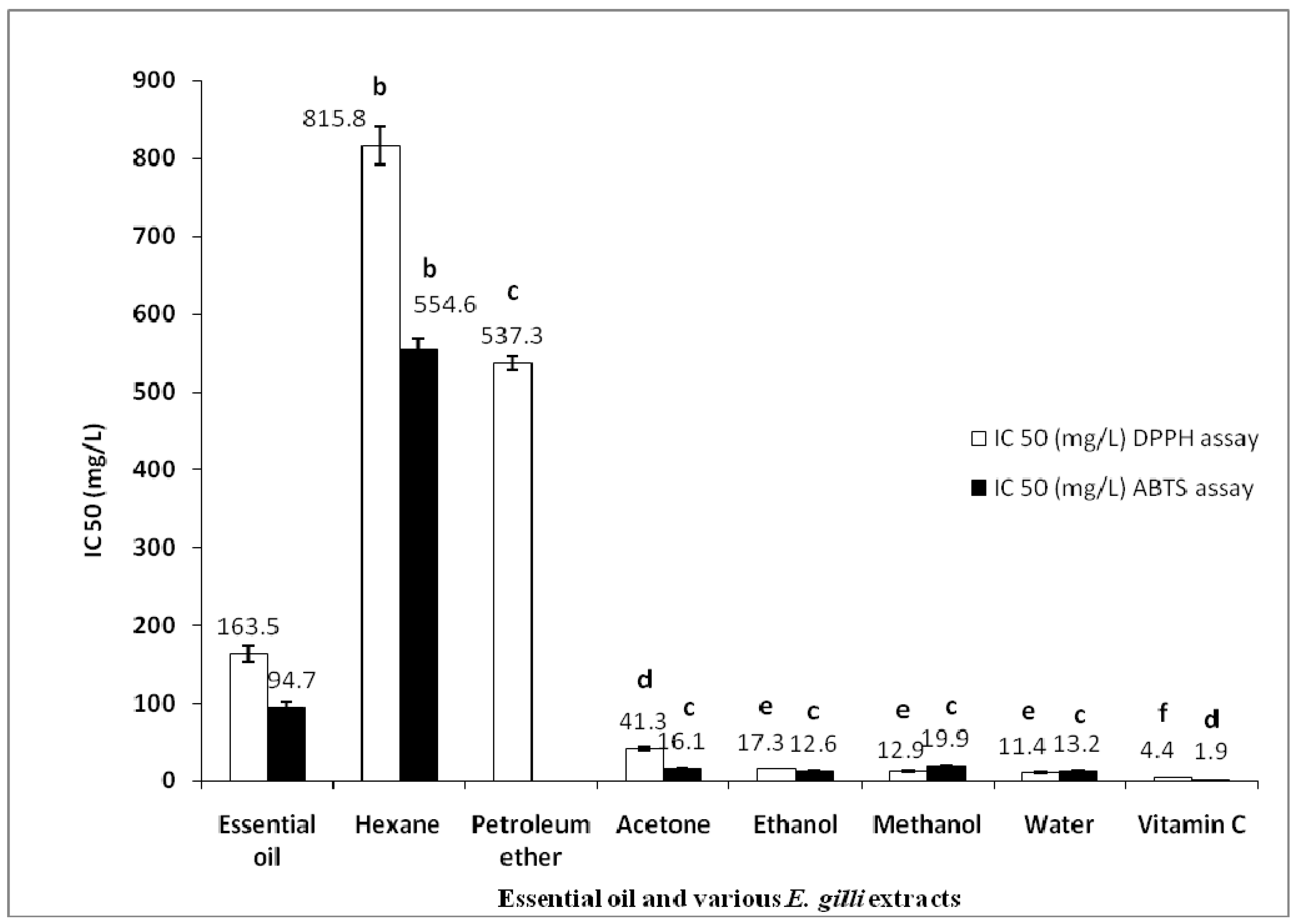
2.2.2. Various Extracts
2.3. Antimicrobial Activity
2.3.1. Minimum Inhibitory Concentration (MIC) of Essential Oil
2.3.2. Various Extracts
| Minimum Inhibitory Concentration (mg/mL) | |||||||||||||
|---|---|---|---|---|---|---|---|---|---|---|---|---|---|
| Gram positive bacteria | Gram negative bacteria | Yeast | Fungi | ||||||||||
| Samples | B. subtilis | S. aureus | L. monocytogenes | P. aeruginosa | S. enterica | E. coli | K. pneumoniae | S. cerevisiae | C. albicans | A. parasiticus | M. ramamnianus | F. culmorum | |
| Essential oil | 3.90 ± 0.11 a | 3.12 ± 0.08 b | 0.78 ± 0.02 c | 3.90 ± 0.09 a | 3.12 ± 0.06 b | 3.90 ± 0.14 a | 2.34 ± 0.07 d | 3.90 ± 0.10 a | 3.12 ± 0.08 b | 3.90 ± 0.12 a | 3.12 ± 0.10 b | 3.12 ± 0.08 b | |
| Ampicillin | 0.02 ± 0.00 | 0.02 ± 0.00 | 0.02 ± 0.00 | 0.01 ± 0.00 | 0.02 ± 0.00 | 0.02 ± 0.00 | 0.01 ± 0.00 | 0.02 ± 0.00 | 0.02 ± 0.00 | 0.02 ± 0.00 | 0.02 ± 0.00 | 0.02 ± 0.00 | |
| Nalidixic acid | 0.02 ± 0.00 | 0.02 ± 0.00 | 0.02 ± 0.00 | 0.01 ± 0.00 | 0.02 ± 0.00 | 0.02 ± 0.00 | 0.01 ± 0.00 | 0.08 ± 0.00 | 0.02 ± 0.00 | 0.02 ± 0.00 | 0.02 ± 0.00 | 0.02 ± 0.00 | |
| Nystatin | 0.02 ± 0.00 | 0.08 ± 0.00 | 0.08 ± 0.00 | 0.02 ± 0.00 | 0.02 ± 0.00 | 0.02 ± 0.00 | 0.02 ± 0.00 | 0.02 ± 0.00 | 0.02 ± 0.00 | 0.01 ± 0.00 | 0.02 ± 0.00 | 0.02 ± 0.00 | |
| Zones of inhibition (mm) | ||||||||||||
|---|---|---|---|---|---|---|---|---|---|---|---|---|
| Gram positive bacteria | Gram negative bacteria | Yeast | Fungi | |||||||||
| Samples | B. subtilis | S. aureus | L. monocytogenes | P. aeruginosa | S. enterica | E. coli | K. pneumoniae | S. cerevisiae | C. albicans | A. parasiticus | M. ramamnianus | F. culmorum |
| Hexane | 14 ± 0 a | 11 ± 0 a | - a | 12 ± 0 a | 13 ± 0 a | 14 ± 0 a | 12 ± 0 a | 12 ± 0 a | 11 ± 0 a | 12 ± 0 a | 12 ± 0 a | 14 ± 0 a |
| Petroleum ether | 13 ± 0a | 12 ± 0 a | 20 ± 0 b | 13 ± 0 a | 18 ± 0 b | - b | 13 ± 0 a | 11 ± 0 a | 11 ± 0 a | 12 ± 0 a | - b | 12 ± 0 a |
| Acetone | 16 ± 0a | 13 ± 0 a | 13 ± 0 c | 13 ± 0 a | 14 ± 0 a | 12 ± 0 a | 12 ± 0 a | 14 ± 0 a | 15 ± 0 b | 11 ± 0 a | - b | - b |
| Ethanol | 16 ± 0 a | 18 ± 0 b | 11 ± 0 c | 15 ± 0 b | 15 ± 0 a | 15 ± 0 a | 17 ± 0 b | 15 ± 0 b | 16 ± 0 b | 15 ± 0 b | 14 ± 0 a | 15 ± 0 c |
| Methanol | 20 ± 1 b | 15 ± 0 c | 16 ± 0 d | - c | 13 ± 0 a | 17 ± 0 c | 13 ± 0 a | 17 ± 0 b | 13 ± 0 a | 13 ± 0 a | 13 ± 0 a | 16 ± 0 c |
| Water | - c | - d | - a | - c | - c | - b | - c | - c | - c | - c | - b | - b |
| Ampicillin | 54 ± 2 c | 20 ± 0 b | 31 ± 1 e | |||||||||
| Nalidixic acid | 19 ± 0 d | 27 ± 1 d | 30 ± 1 d | 28 ± 0 d | ||||||||
| Nystatin | 29 ± 1 d | 30 ± 1 d | 24 ± 0 d | 31 ± 1 c | 30 ± 1 d | |||||||
3. Experimental
3.1. Chemicals
3.2. Collection of Plant Material
3.3. Extraction
3.3.1. Isolation of Essential oil
3.3.2. Preparation of Extracts
3.4. Gas Chromatography and Gas Chromatography-Mass Spectrometry
3.5. Free Radical Scavenging Activity: DPPH Test
3.6. ABTS Radical-Scavenging Assay
3.7. Total Amount of Phenolic Compounds
3.8. Condensed Tannin Content
3.9. Total Flavonoids Determination
3.10. Determination of Total Anthocyanin Content
3.11. Antimicrobial Activity
3.11.1. Microbial Strains
3.11.2. MIC Agar Dilution Assay
3.11.3. Disc-Diffusion Assay
3.12. Statistical Analysis
4. Conclusions
Supplementary Materials
Supplementary File 1Acknowledgments
References
- Lambert, R.J.W.; Skandamis, P.N.; Coote, P.; Nychas, G.J.E. A study of the minimum inhibitory concentration and mode of action of oregano essential oil, thymol and carvacrol. J. Appl. Microbiol. 2001, 91, 453–462. [Google Scholar] [CrossRef]
- Guidance for Industry: Frequently Asked Questions about GRAS. Available online: http://www.fda.gov/Food/GuidanceComplianceRegulatoryInformation/GuidanceDocuments/FoodIngredientsandPackaging/ucm061846.htm/ (accessed on 13 October 2010).
- Pittman, C.I.; Pendleton, S.; Bisha, B.; O’Bryan, C.A.; Belk, K.E.; Goodridge, L.; Crandall, P.G.; Ricke, S.C. Activity of citrus essential oils against Escherichia coli O157:H7 and Salmonella spp. and effects on beef subprimal cuts under refrigeration. J. Food Sci. 2011, 76, M433–M438. [Google Scholar]
- Karabagias, I.; Badeka, A.; Kontominas, M.G. Shelf life extension of lamb meat using thyme or oregano essential oils and modified atmosphere packaging. Meat Sci. 2011, 88, 109–116. [Google Scholar] [CrossRef]
- Djenane, D.; Aïder, M.; Yangüela, J.; Idir, L.; Gómez, D.; Roncalés, P. Antioxidant and antibacterial effects of Lavandula and Mentha essential oils in minced beef inoculated with E. coli O157:H7 and S. aureus during storage at abuse refrigeration temperature. Meat Sci. 2012. [Google Scholar] [CrossRef]
- Oussalah, M.; Caillet, S.; Saucier, L.; Lacroix, M. Antimicrobial effects of selected plant essential oils on the growth of a Pseudomonas putida strain isolated from meat. Meat Sci. 2006, 73, 236–244. [Google Scholar] [CrossRef]
- Brooke, M.I.H.; Kleinig, D.A. Field Guide to Eucalypts, 2nd ed; Bloomings Books Pty Ltd.: Burnley, VIC, Australia, 2004. [Google Scholar]
- Guimarães, R.; João Sousa, M.; Ferreira, I.C.F.R. Contribution of essential oils and phenolics to the antioxidant properties of aromatic plants. Ind. Crops Prod. 2010, 32, 152–156. [Google Scholar] [CrossRef]
- Jaimand, K.; Assareh, M.H.; Rezaee, M.B. Volatile oil constituents of leaves of the Eucalyptus gillii maiden and E. microcarpa subsp. macrocarpa Hook from Iran. Iran. J. Pharm. Res. 2006, 1, 73–75. [Google Scholar]
- Giamakis, A.; Kretsi, O.; Chinou, I.; Spyropoulos, C.G. Eucalyptus camaldulensis: Volatiles from immature flowers and high production of 1,8-cineole and â-pinene by in vitro cultures. Phytochemistry 2001, 58, 351–355. [Google Scholar]
- Naceur, H.; Romdhane, M.; Lebrihi, A.; Mathieu, F.; Couderc, F.; Abderraba, M.; Khouja, M.L.; Bouajila, J. Eucalyptus (gracilis, oleosa, salubris, and salmonophloia) essential oils: Their chemical composition and antioxidant and antimicrobial activities. J. Med. Food 2010, 13, 1005–1012. [Google Scholar] [CrossRef]
- Amakuraa, Y.; Uminoa, Y.; Tsujia, S.; Itob, H.; Hatanob, T.; Yoshidab, T.; Tonogaia, Y. Constituents and their antioxidative effects in Eucalyptus leaf extract used as a natural food additive. Food Chem. 2002, 77, 47–56. [Google Scholar] [CrossRef]
- Li, H.; Madden, J.L.; Pottis, B.M. Variation in leaf waxes of the Tasmanian Eucalyptus Species-I Subgenus Symphomyrtus. Biochem. Syst. Ecol. 1997, 25, 631–657. [Google Scholar] [CrossRef]
- Rahman, A.; Talukder, F.A. Bioefficacy of some plant derivatives that protect grain against the pulse beetle, Callosobruchus maculatus. J. Insect Sci. 2006, 6, 1–10. [Google Scholar]
- Hasegawa, T.; Takano, F.; Takata, T.; Niiyama, M.; Oyha, T. Bioactive monopterpene glycosides conjugated with gallic acid from the leaves of Eucalyptus globules. Phytochemistry 2008, 69, 747–753. [Google Scholar] [CrossRef]
- Ennajar, M.; Bouajila, J.; Lebrihi, A.; Mathieu, F.; Abderraba, M.; Raies, A.; Romdhane, M. Chemical composition and antimicrobial and antioxidant activities of essential oils and various extracts of Juniperus phoenicea L. (Cupressacees). J. Food Sci. 2009, 74, 364–371. [Google Scholar] [CrossRef]
- Chapuis-Lardy, L.; Contour-Ansel, D.; Bernhard-Reversat, F. High performance liquid chromatography of water, soluble phenolics in leaf litter of three Eucalyptus Hybrids (Congo). Plant Sci. 2002, 163, 217–222. [Google Scholar] [CrossRef]
- Bendaoud, H.; Bouajila, J.; Rhouma, A.; Savagna, A.; Romdhane, M. GC/MS analysis and antimicrobial and antioxidant activities of essential oil of Eucalyptus radiate. J. Sci. Food Agric. 2009, 89, 1292–1297. [Google Scholar] [CrossRef]
- Naceur Ben Marzoug, H.; Romdhane, M.; Lebrihi, A.; Mathieu, F.; Couderc, F.; Abderraba, M.; Khouja, M.L.; Bouajila, J. Eucalyptus oleosa essential oils: Chemical composition and antimicrobial and antioxidant activities of the oils from different plant parts (stems, leaves, flowers and fruits. Molecules 2011, 16, 1695–1709. [Google Scholar] [CrossRef] [Green Version]
- Singab, A.N.; Ayoub, N.; Al Sayed, E.; Martiskainen, O.; Sinkkonen, J.; Pihlaja, K. Phenolic constituents of Eucalyptus camaldulensis Dehnh, with potential antioxidant and cytotoxic activities. Rec. Nat. Prod. 2011, 5, 271–280. [Google Scholar]
- Mulyaningsih, S.; Sporer, F.; Zimmermann, S.; Reichling, J.; Wink, M. Synergistic properties of the terpenoids aromadendrene and 1-8cineole from the essential oil of Eucalyptus globules against antibiotic susceptible and antibiotic resistant pathogens. Phytomedecine 2010, 17, 1061–1066. [Google Scholar] [CrossRef]
- Damjanovic-Vratnica, B.; Dakov, T.; Sukovic, D.; Damjanovic, J. Antimicrobial effect of essential oil isolated from Eucalyptus globules Labill from Montenegro. Czech J. Food Sci. 2011, 29, 277–284. [Google Scholar]
- Rosato, A.; Vitali, C.; de Laurentis, N.; Armenise, D.; Milillo, M. Antibacterial effect of some essential oils administered alone or in combination with Norfloxacin. Phytomedicine 2007, 14, 727–732. [Google Scholar] [CrossRef]
- Sonboli, A.; Babakhani, B.; Mehrabian, A.R. Antimicrobial activity of six constituents of essential oil from Salvia. Z. Naturforsch. C 2006, 61, 160–164. [Google Scholar]
- Bakkali, F.; Averbeck, S.; Averbeck, D.; Idaomar, M. Biological effects of essential oils—A review. Food Chem. Toxicol. 2008, 46, 446–475. [Google Scholar] [CrossRef]
- Juven, B.J.; Kanner, J.; Schved, F.; Weisslowicz, H. Factors that interact with the antibacterial action of thyme essential oil and its active constituents. J. Appl. Bacteriol. 1994, 76, 626–631. [Google Scholar] [CrossRef]
- Ultee, A.; Slump, R.A.; Steging, G.; Smid, E.J. Antimicrobial activity of carvacrol toward Bacillus cereus on rice. J. Food Protec. 2000, 63, 620–624. [Google Scholar]
- Sikkema, J.; de Bont, J.A.M.; Poolman, B. Interactions of cyclic hydrocarbons with biological membranes. J. Biolog. Chem. 1994, 269, 8022–8028. [Google Scholar]
- Burt, S. Essential oils: Their antibacterial properties and potential applications in foods—A review. Int. J. Food Microbiol. 2004, 94, 223–253. [Google Scholar] [CrossRef]
- Blois, M.S. Antioxidant determinations by the use of a stable free radical. Nature 1958, 181, 1199–1200. [Google Scholar] [CrossRef]
- Folin, O.; Ciocalteu, V. On tyrosine and tryptophane determination in proteins. J. Biol. Chem. 1927, 27, 627–650. [Google Scholar]
- Broadhurst, R.B.; Jones, W.T. Analysis of condensed tannins using acidified vanillin. J. Sci. Food Agric. 1978, 28, 788–794. [Google Scholar] [CrossRef]
- Naczk, M.; Zadernowski, R.; Shahidi, F. Protein precipitating capacity of condensed tanins of beach pea, canola hulls, evening primrose and faba bean. J. Agric. Food Chem. 2001, 73, 467–471. [Google Scholar]
- Arvouet-Grand, A.; Vennat, B.; Pourrat, A.; Legret, P. Standardisation d’un extrait de propolis et identification des principaux constituants. J. Pharm. Belg. 1994, 49, 462–468. [Google Scholar]
- Cheng, G.W.; Breen, P. Activity of phenylalanine ammonialyase (PAL) and concentrations of anthocyanins and phenolics in developing strawberry fruit. J. Am. Soc. Hort. Sci. 1991, 117, 946–950. [Google Scholar]
- Methods for Determining Bactericidal Activity of antimIcrobial Agents: Approved Guideline; NCCLS: Wayne, PA, USA, 1999.
- Moreira, M.R.; Ponce, A.G.; Del Valle, C.E.; Roura, S.I. Inhibitory parameters of essential oils to reduce a food borne pathogen. LWT Food Sci. Technol. 2005, 38, 565–570. [Google Scholar] [CrossRef]
- Djenane, D.; Yangüela, J.; Amrouche, T.; Boubrit, S.; Boussad, N.; Roncalés, P. Chemical composition and antimicrobial effects of essential oils of Eucalyptus globulus, Myrtus communis and Satureja hortensis against Escherichia coli O157:H7 and Staphylococcus aureus in minced beef. Food Sci. Technol. Int. 2011, 17, 505–515. [Google Scholar] [CrossRef]
- Sample Availability: Samples of the compounds are available from the authors.
© 2012 by the authors; licensee MDPI, Basel, Switzerland. This article is an open-access article distributed under the terms and conditions of the Creative Commons Attribution license (http://creativecommons.org/licenses/by/3.0/).
Share and Cite
Ben Hassine, D.; Abderrabba, M.; Yvon, Y.; Lebrihi, A.; Mathieu, F.; Couderc, F.; Bouajila, J. Chemical Composition and in Vitro Evaluation of the Antioxidant and Antimicrobial Activities of Eucalyptus gillii Essential Oil and Extracts. Molecules 2012, 17, 9540-9558. https://doi.org/10.3390/molecules17089540
Ben Hassine D, Abderrabba M, Yvon Y, Lebrihi A, Mathieu F, Couderc F, Bouajila J. Chemical Composition and in Vitro Evaluation of the Antioxidant and Antimicrobial Activities of Eucalyptus gillii Essential Oil and Extracts. Molecules. 2012; 17(8):9540-9558. https://doi.org/10.3390/molecules17089540
Chicago/Turabian StyleBen Hassine, Dorsaf, Manef Abderrabba, Yan Yvon, Ahmed Lebrihi, Florence Mathieu, François Couderc, and Jalloul Bouajila. 2012. "Chemical Composition and in Vitro Evaluation of the Antioxidant and Antimicrobial Activities of Eucalyptus gillii Essential Oil and Extracts" Molecules 17, no. 8: 9540-9558. https://doi.org/10.3390/molecules17089540

