
<?xml version="1.0" encoding="UTF-8"?>
<!DOCTYPE article PUBLIC "-//NLM//DTD Journal Publishing DTD v2.3 20070202//EN" "journalpublishing.dtd">
<article xmlns:mml="http://www.w3.org/1998/Math/MathML" xmlns:xlink="http://www.w3.org/1999/xlink" xml:lang="en" article-type="research-article">
  <front>
    <journal-meta>
      <journal-id journal-id-type="publisher-id">molecules</journal-id>
      <journal-title>Molecules</journal-title>
      <abbrev-journal-title abbrev-type="publisher">Molecules</abbrev-journal-title>
      <abbrev-journal-title abbrev-type="pubmed">Molecules</abbrev-journal-title>
      <issn pub-type="epub">1420-3049</issn>
      <publisher>
        <publisher-name>MDPI</publisher-name>
      </publisher>
    </journal-meta>
    <article-meta>
      <article-id pub-id-type="doi">10.3390/molecules171213787</article-id>
      <article-id pub-id-type="publisher-id">molecules-17-13787</article-id>
      <article-categories>
        <subj-group>
          <subject>Article</subject>
        </subj-group>
      </article-categories>
      <title-group>
        <article-title>Spiroheterocyclization of Methyl 1-Aryl-3-cinnamoyl-4,5-dioxo-4,5-dihydro-1<italic>H</italic>-pyrrole-2-carboxylates by the Action of 3-(Arylamino)-1<italic>H</italic>-inden-1-ones</article-title>
      </title-group>
      
      <contrib-group>
        <contrib contrib-type="author">
          <name>
            <surname>Silaichev</surname>
            <given-names>Pavel S.</given-names>
          </name>
          <xref rid="af1-molecules-17-13787" ref-type="aff">1</xref>
        </contrib>
        <contrib contrib-type="author">
          <name>
            <surname>Filimonov</surname>
            <given-names>Valeriy O.</given-names>
          </name>
          <xref rid="af1-molecules-17-13787" ref-type="aff">1</xref>
        </contrib>
        <contrib contrib-type="author">
          <name>
            <surname>Slepukhin</surname>
            <given-names>Pavel A.</given-names>
          </name>
          <xref rid="af2-molecules-17-13787" ref-type="aff">2</xref>
        </contrib>
        <contrib contrib-type="author">
          <name>
            <surname>Maslivets</surname>
            <given-names>Andrey N.</given-names>
          </name>
          <xref rid="af1-molecules-17-13787" ref-type="aff">1</xref>
          <xref rid="c1-molecules-17-13787" ref-type="corresp">*</xref>
        </contrib>
      </contrib-group>
      <aff id="af1-molecules-17-13787"><label>1 </label>Department of Organic Chemistry, Perm State National Research University, Perm 614066, Russia; Email: <email>silaychev@yahoo.com</email> (P.S.S.); <email>filimondobryi@mail.ru</email> (V.O.F.)</aff>
      <aff id="af2-molecules-17-13787"><label>2 </label>I. Ya. Postovskiy Institute of Organic Synthesis, Russian Academy of Science, Ural Branch, Yekaterinburg 620219, Russia; Email: <email>slepukhin@ios.uran.ru</email></aff>
	  <author-notes>
        <corresp id="c1-molecules-17-13787"><label>*</label> Author to whom correspondence should be addressed; Email: <email>koh2@psu.ru</email>; Tel.: +7-342-239-6612; Fax: +7-342-239-6367.</corresp>
      </author-notes>
      <pub-date pub-type="epub">
        <day>22</day>
        <month>11</month>
        <year>2012</year>
      </pub-date>
      <pub-date pub-type="collection">  <month>12</month>
        <year>2012</year>
      </pub-date>
      <volume>17</volume>
      <issue>12</issue>
      <fpage>13787</fpage>
      <lpage>13794</lpage>
      <history>
        <date date-type="received">
          <day>19</day>
          <month>10</month>
          <year>2012</year>
        </date>
        <date date-type="rev-recd">
          <day>02</day>
          <month>11</month>
          <year>2012</year>
        </date>
        <date date-type="accepted">
          <day>05</day>
          <month>11</month>
          <year>2012</year>
        </date>
      </history>
      <permissions>
        <copyright-statement>© 2012 by the authors; licensee MDPI, Basel, Switzerland.</copyright-statement>
        <copyright-year>2012</copyright-year>
        <license xmlns:xlink="http://www.w3.org/1999/xlink" license-type="open-access" xlink:href="http://creativecommons.org/licenses/by/3.0/">
          <p>This article is an open-access article distributed under the terms and conditions of the Creative Commons Attribution license (http://creativecommons.org/licenses/by/3.0/).</p>
        </license>
      </permissions>
      <abstract>
        <p>Methyl 1-aryl-3-cinnamoyl-4,5-dioxo-4,5-dihydro-1<italic>H</italic>-pyrrole-2-carboxylates interact with 3-(arylamino)-1<italic>H</italic>-inden-1-ones to give the corresponding 1,1'-diaryl-3'-cinnamoyl-4'-hydroxy-1<italic>H</italic>-spiro[indeno[1,2-b]pyrrole-3,2'-pyrrole]-2,4,5'(1'<italic>H</italic>)-triones in good yields.</p>
      </abstract>
      <kwd-group>
        <kwd>pyrrole-2,3-diones</kwd>
        <kwd>enamines</kwd>
        <kwd>spiro[indeno[1,2-b]pyrrole-3,2'-pyrroles]</kwd>
      </kwd-group>
    </article-meta>
  </front>
  <body>
    <sec sec-type="intro">
      <title>1. Introduction</title>
      <p>Spiro compounds represent an important class of naturally occurring substances characterised by their highly pronounced biological properties [<xref ref-type="bibr" rid="B1-molecules-17-13787">1</xref>,<xref ref-type="bibr" rid="B2-molecules-17-13787">2</xref>,<xref ref-type="bibr" rid="B3-molecules-17-13787">3</xref>]. On the other hand, over the past three decades spiro compounds have received considerable attention owing to their diverse chemotherapeutic potential, including antineoplastic activities [<xref ref-type="bibr" rid="B4-molecules-17-13787">4</xref>]. Some spiro compounds have been implemented as antimicrobial, antitumour and antibiotic agents [<xref ref-type="bibr" rid="B5-molecules-17-13787">5</xref>,<xref ref-type="bibr" rid="B6-molecules-17-13787">6</xref>]. In the arena of photochromism, spiro compounds, due to their steric constraints, equilibrate with the corresponding non-spiro analogue and exhibit various photochemical phenomena. Some related applications based on this equilibrium are self-development photography, actinometry, displays, filters and lenses of variable optical density, <italic>etc</italic>. [<xref ref-type="bibr" rid="B7-molecules-17-13787">7</xref>,<xref ref-type="bibr" rid="B8-molecules-17-13787">8</xref>,<xref ref-type="bibr" rid="B9-molecules-17-13787">9</xref>].</p>
      <p>A convenient approach to the synthesis of spirobisheterocycles is the interaction of 4-acyl-5-methoxycarbonyl-1<italic>H</italic>-pyrrole-2,3-diones with enamines. It was previously shown that methyl 3-acyl-1-aryl-4,5-dioxo-4,5-dihydro-1<italic>H</italic>-pyrrole-2-carboxylates react with acyclic [<xref ref-type="bibr" rid="B10-molecules-17-13787">10</xref>], carbocyclic [<xref ref-type="bibr" rid="B11-molecules-17-13787">11</xref>,<xref ref-type="bibr" rid="B12-molecules-17-13787">12</xref>,<xref ref-type="bibr" rid="B13-molecules-17-13787">13</xref>], and heterocyclic [<xref ref-type="bibr" rid="B14-molecules-17-13787">14</xref>,<xref ref-type="bibr" rid="B15-molecules-17-13787">15</xref>,<xref ref-type="bibr" rid="B16-molecules-17-13787">16</xref>] enamines as 1,3-C,N-binucleophiles according to the scheme involving initial attack by the <italic>β</italic>-CH group in the enamino fragment on the C<sup>5</sup> atom in the pyrrole ring and subsequent closure of new pyrrole ring via intramolecular attack by the NH group of enamines on the ester carbonyl carbon atom of dioxopyrroles and elimination of methanol. These reactions lead to the formation of spiro heterocyclic systems, such as 1,7-diazaspiro[4.4]nonane [<xref ref-type="bibr" rid="B10-molecules-17-13787">10</xref>], spiro[indole-3,2'-pyrrole] [<xref ref-type="bibr" rid="B11-molecules-17-13787">11</xref>,<xref ref-type="bibr" rid="B12-molecules-17-13787">12</xref>,<xref ref-type="bibr" rid="B13-molecules-17-13787">13</xref>], spiro[pyrrole-2,5'-pyrrolo[2,3-d]pyrimidine [<xref ref-type="bibr" rid="B14-molecules-17-13787">14</xref>], and spiro[pyrrolo[2,1-a]iso-quinoline-2,2'-pyrrole] derivatives [<xref ref-type="bibr" rid="B15-molecules-17-13787">15</xref>,<xref ref-type="bibr" rid="B16-molecules-17-13787">16</xref>].</p>
      <p>On the other hand, we found that 3-(arylamino)-1<italic>H</italic>-inden-1-ones react with ethyl 1-aryl-4,5-dioxo-2-phenyl-4,5-dihydro-1<italic>H</italic>-pyrrole-3-carboxylates as 1,5-CH,СH-binucleophiles according to the scheme which consists of an initial nucleophilic addition of an activated CH group <italic>ortho</italic> disposed toward an arylamino group of cyclic enamino ketones to the C<sup>4</sup> carbon atom of pyrrolediones and the subsequent closure of the 1,4-dihydropyridine ring via intramolecular attack by the <italic>β</italic>-CH group of the enamino fragment onto the C<sup>4</sup> atom in the pyrroledione ring. The last step of the transformation is accompanied by the elimination of a water molecule and is completed by the substituted spiro[indeno[1,2-b]quinoline-10,3'-pyrrole] derivative formation [<xref ref-type="bibr" rid="B17-molecules-17-13787">17</xref>]. Reactions of five-membered carbocyclic enamino ketones with methyl 1-aryl-3-cinnamoyl-4,5-dioxo-4,5-dihydro-1<italic>H</italic>-pyrrole-2-carboxylates have not been described previously. We report herein another type of spirohetero-cyclization of substituted 1<italic>H</italic>-pyrrole-2,3-dione derivatives under the action of these enamino ketones, which act here as 1,3-CH,NH-binucleophiles.</p>
    </sec>
    <sec sec-type="results">
      <title>2. Results and Discussion</title>
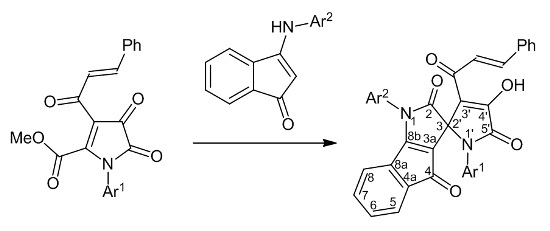
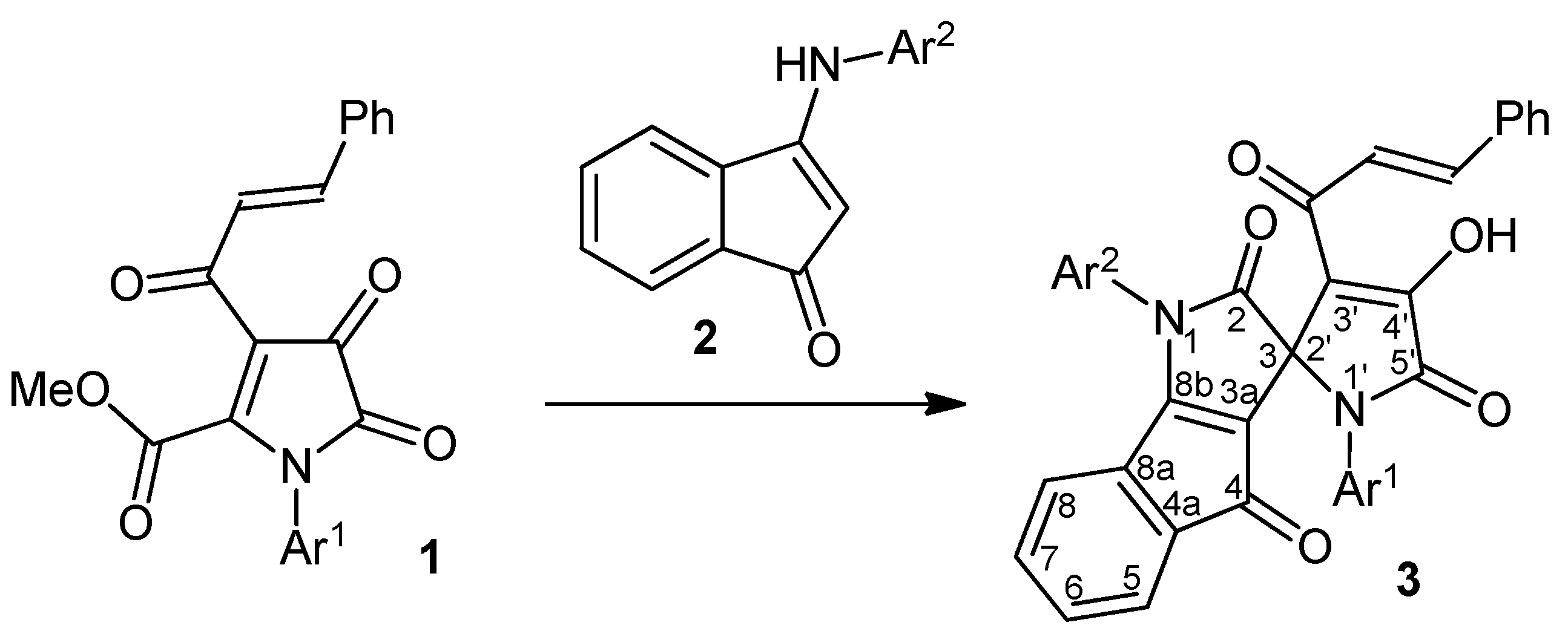
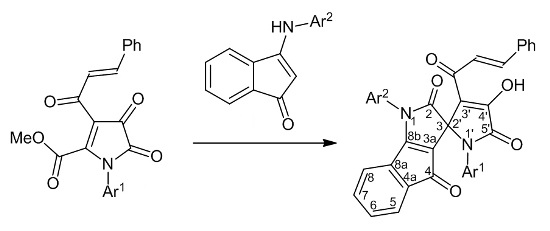
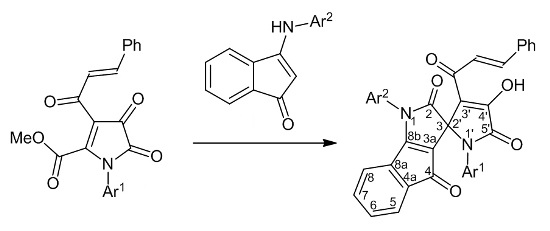
      <p>During the course of our studies on nucleophilic transformations of monocyclic 1<italic>H</italic>-pyrrole-2,3-diones under the action of bifunctional nucleophiles, we have examined an interaction between methyl 1-aryl-3-cinnamoyl-4,5-dioxo-4,5-dihydro-1<italic>H</italic>-pyrrole-2-carboxylates <bold>1</bold> and 3-(arylamino)-1<italic>H</italic>-inden-1-ones <bold>2</bold>. As a result we have found that refluxing of <bold>1</bold> and <bold>2</bold> taken in a 1:1 molar ratio in dry toluene for 5–6 h under TLC monitoring provides the corresponding 1,1'-diaryl-3'-cinnamoyl-4'-hydroxy-1<italic>H</italic>-spiro[indeno[1,2-b]pyrrole-3,2'-pyrrole]-2,4,5'(1'<italic>H</italic>)-triones <bold>3</bold> in good yields (<xref ref-type="scheme" rid="molecules-17-13787-scheme1">Scheme 1</xref>, <xref ref-type="table" rid="molecules-17-13787-t001">Table 1</xref>).</p>
      <fig id="molecules-17-13787-scheme1" position="float">
        <object-id pub-id-type="pii">molecules-17-13787-scheme1_Scheme 1</object-id>
        <label>Scheme 1</label>
        <caption>
          <p>Synthesis of spiro[indeno[1,2-b]pyrrole-3,2'-pyrroles] <bold>3</bold>.</p>
        </caption>
        <graphic xmlns:xlink="http://www.w3.org/1999/xlink" xlink:href="molecules-17-13787-g003.tif"/>
      </fig>
      
	  <table-wrap id="molecules-17-13787-t001" position="float">
        <object-id pub-id-type="pii">molecules-17-13787-t001_Table 1</object-id>
        <label>Table 1</label>
        <caption>
          <p>Synthesis of spiro[indeno[1,2-b]pyrrole-3,2'-pyrroles] <bold>3</bold>.</p>
        </caption>
        <table>
          <thead>
            <tr>
              <th align="center" valign="middle">Entry</th>
              <th align="center" valign="middle">Ar<sup>1</sup></th>
              <th align="center" valign="middle">Ar<sup>2</sup></th>
              <th align="center" valign="middle">Product 3</th>
              <th align="center" valign="middle">Yield (%)</th>
            </tr>
          </thead>
          <tbody>
            <tr>
              <td align="center" valign="middle">1</td>
              <td align="center" valign="middle">Ph</td>
              <td align="center" valign="middle">4-BrC<sub>6</sub>H<sub>4</sub></td>
              <td align="center" valign="middle">3a</td>
              <td align="center" valign="middle">80</td>
            </tr>
            <tr>
              <td align="center" valign="middle">2</td>
              <td align="center" valign="middle">4-MeC<sub>6</sub>H<sub>4</sub></td>
              <td align="center" valign="middle">Ph</td>
              <td align="center" valign="middle">3b</td>
              <td align="center" valign="middle">82</td>
            </tr>
            <tr>
              <td align="center" valign="middle">3</td>
              <td align="center" valign="middle">4-MeC<sub>6</sub>H<sub>4</sub></td>
              <td align="center" valign="middle">4-MeC<sub>6</sub>H<sub>4</sub></td>
              <td align="center" valign="middle">3c</td>
              <td align="center" valign="middle">79</td>
            </tr>
            <tr>
              <td align="center" valign="middle">4</td>
              <td align="center" valign="middle">4-MeC<sub>6</sub>H<sub>4</sub></td>
              <td align="center" valign="middle">4-MeOC<sub>6</sub>H<sub>4</sub></td>
              <td align="center" valign="middle">3d</td>
              <td align="center" valign="middle">84</td>
            </tr>
            <tr>
              <td align="center" valign="middle">5</td>
              <td align="center" valign="middle">4-MeOC<sub>6</sub>H<sub>4</sub></td>
              <td align="center" valign="middle">Ph</td>
              <td align="center" valign="middle">3e</td>
              <td align="center" valign="middle">81</td>
            </tr>
            <tr>
              <td align="center" valign="middle">6</td>
              <td align="center" valign="middle">4-MeOC<sub>6</sub>H<sub>4</sub></td>
              <td align="center" valign="middle">4-MeC<sub>6</sub>H<sub>4</sub></td>
              <td align="center" valign="middle">3f</td>
              <td align="center" valign="middle">80</td>
            </tr>
            <tr>
              <td align="center" valign="middle">7</td>
              <td align="center" valign="middle">4-MeOC<sub>6</sub>H<sub>4</sub></td>
              <td align="center" valign="middle">4-MeOC<sub>6</sub>H<sub>4</sub></td>
              <td align="center" valign="middle">3g</td>
              <td align="center" valign="middle">79</td>
            </tr>
            <tr>
              <td align="center" valign="middle">8</td>
              <td align="center" valign="middle">4-MeOC<sub>6</sub>H<sub>4</sub></td>
              <td align="center" valign="middle">4-BrC<sub>6</sub>H<sub>4</sub></td>
              <td align="center" valign="middle">3h</td>
              <td align="center" valign="middle">83</td>
            </tr>
          </tbody>
        </table>
		</table-wrap>
      
	  
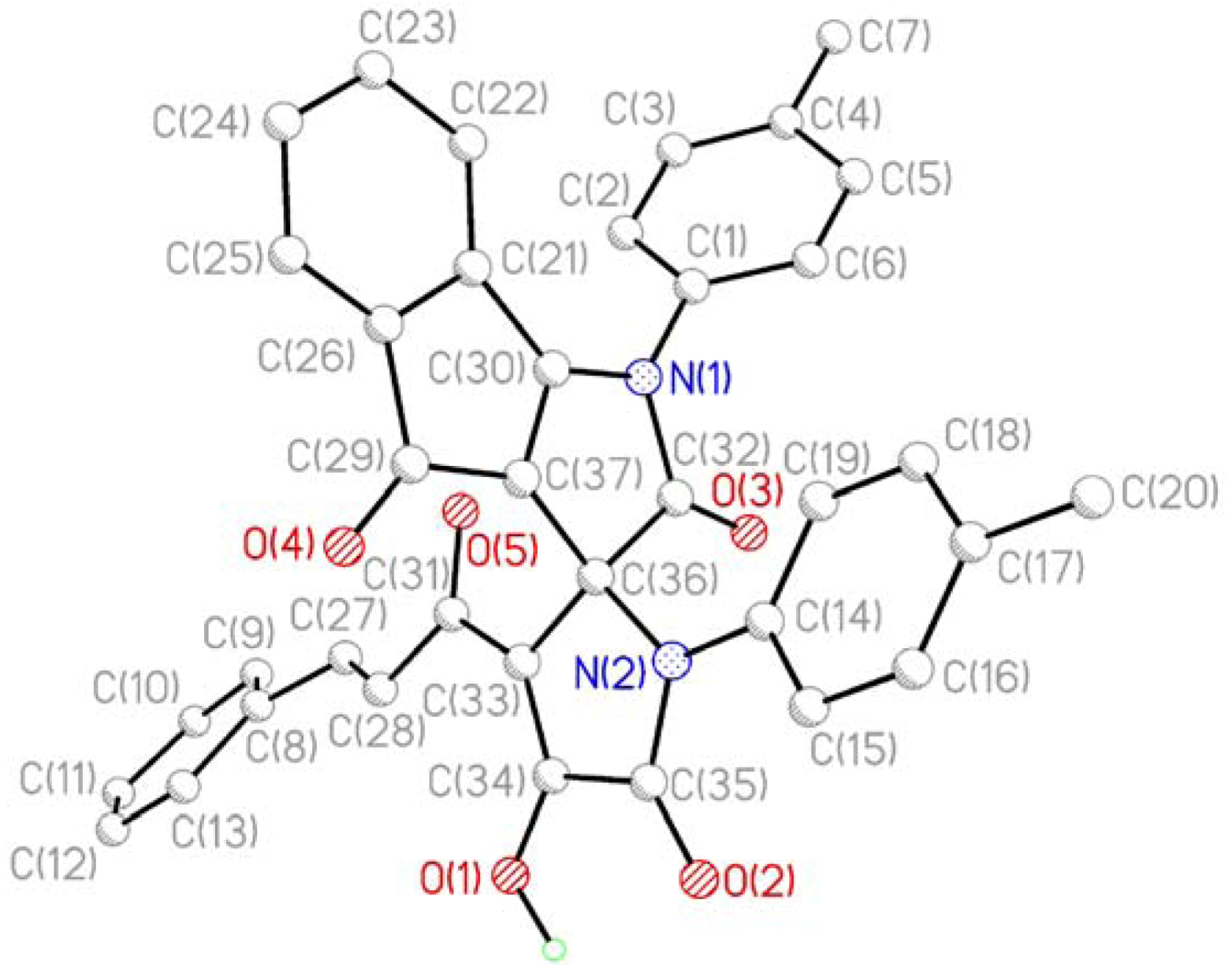
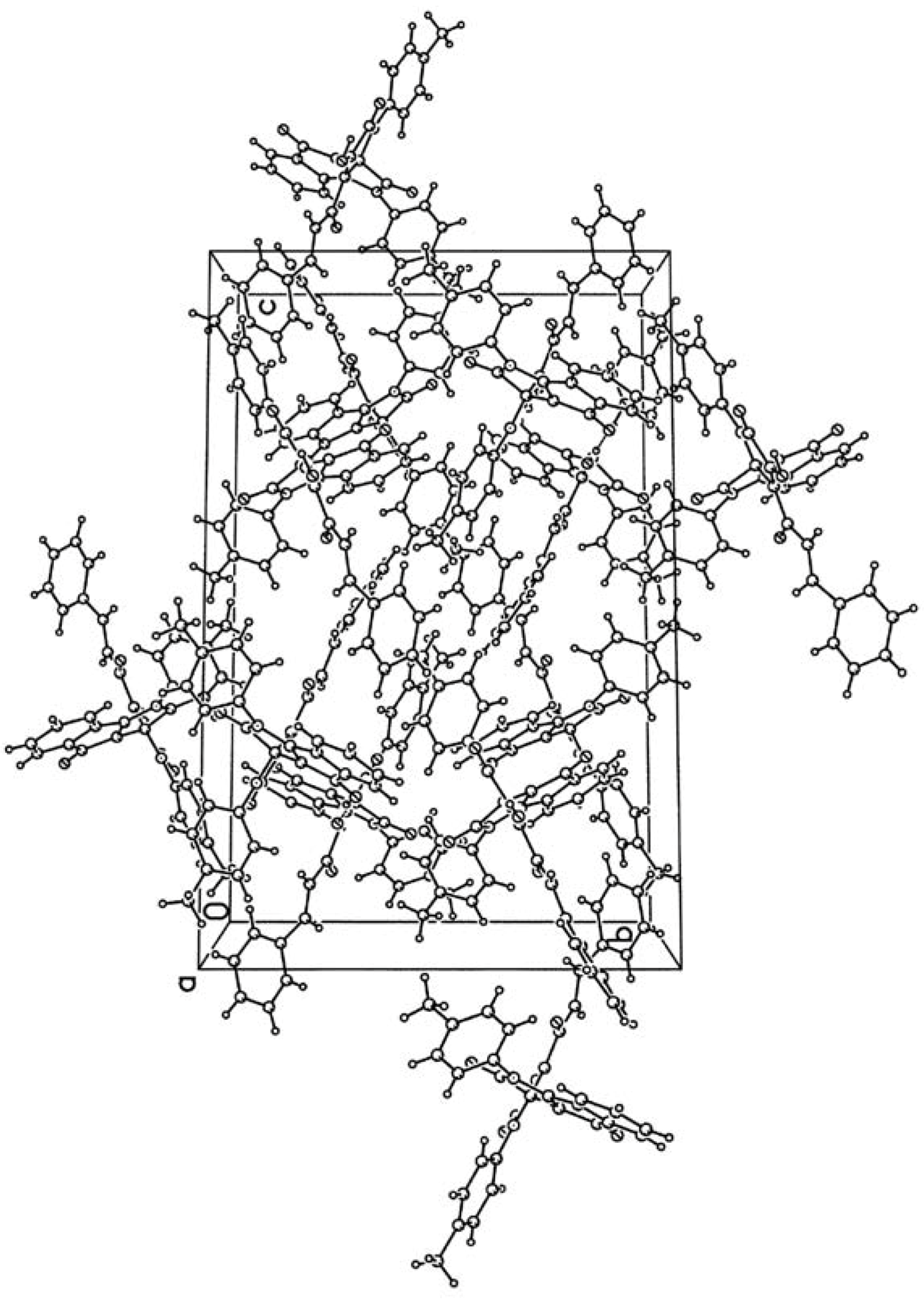
	  <p>Compounds <bold>3</bold> are red crystal substances readily soluble in DMSO and DMF, poorly soluble in other common organic solvents, and insoluble in saturated hydrocarbons and water. The products give a positive test (cherry-red coloration) with iron(III) chloride for the presence of enol hydroxyl groups. The IR spectra of <bold>3</bold> have absorption bands inherent to stretching vibrations of the enolic hydroxy group (3161–3188 cm<sup>−1</sup>, broadened band), two lactam carbonyl groups C<sup>5'</sup>=O (1763–1781 cm<sup>−1</sup>) and C<sup>2</sup>=O (1715–1732 cm<sup>−1</sup>), and two ketone carbonyl moieties C<sup>4</sup>=O (1667–1680 cm<sup>−1</sup>) and C<sup>3'</sup>-C=O (1640–1647 cm<sup>−1</sup>). <sup>1</sup>H-NMR spectra of <bold>3</bold> display signals of protons in the aromatic rings and substituents attached thereto, two doublets from the protons of the ethylene fragment of the cinnamoyl substituent (δ 7.64–7.66 and 7.72–7.75 ppm) with coupling constant (<sup>3</sup><italic>J</italic>) values of about 16 Hz, and a broadened singlet from the enolic hydroxy proton (δ 13.31–13.45 ppm). In the <sup>13</sup>C-NMR spectra of <bold>3d</bold> we have observed carbon atom signals of the aromatic and aliphatic fragments, the carbonyl carbon atom of the cinnamoyl moiety (δ 182.46 ppm), ketone carbonyl carbon atom C<sup>4</sup> (δ 183.74 ppm), lactam carbonyl carbon atoms C<sup>2</sup> (δ 171.89 ppm) and C<sup>5'</sup> (δ 165.38 ppm), and spiro carbon atom (δ 68.34 ppm). The structure of <bold>3c</bold> was unambiguously confirmed by single-crystal X-ray crystallography (<xref ref-type="fig" rid="molecules-17-13787-f001">Figure 1</xref> and <xref ref-type="fig" rid="molecules-17-13787-f002">Figure 2</xref>).</p>
      <fig id="molecules-17-13787-f001" position="float">
        <label>Figure 1</label>
        <caption>
          <p>X-ray structure of the compound <bold>3c</bold>.</p>
        </caption>
        <graphic xmlns:xlink="http://www.w3.org/1999/xlink" xlink:href="molecules-17-13787-g001.tif"/>
      </fig>
      <fig id="molecules-17-13787-f002" position="float">
        <label>Figure 2</label>
        <caption>
          <p>The figure of crystal packing of the compound <bold>3c</bold>.</p>
        </caption>
        <graphic xmlns:xlink="http://www.w3.org/1999/xlink" xlink:href="molecules-17-13787-g002.tif"/>
      </fig>
      <p>According to the XRD study two independent molecules of compound <bold>3c</bold> are crystallized in the centrosymmetric space group P2<sub>1</sub>/n of monoclinic crystal system in the solvated form. Due to thermal disordering solvate atoms are not positioned with good precision and the SQUEEZE procedure in the PLATON program [<xref ref-type="bibr" rid="B18-molecules-17-13787">18</xref>] was applied for its treatment. A general view of one independent molecule is presented on <xref ref-type="fig" rid="molecules-17-13787-f001">Figure 1</xref>; the second molecule has similar geometry and numeration of its atoms has an additional index “A”.</p>
      <p>Bond lengths and bond angles in compound <bold>3c</bold> are close to standard values. The measured angle between the planes of the heterocycles at the spiro-node amounts to 89.5 deg. The most significant feature of the crystal packing is the formation of dimers at the expense of intermolecular HB O1-H1-O4A [O1-H1 1.05(3), H1-O4A 1.71(2), O1-O4A 2.644(3) Å, angle O1H1O4A 144(1)°] and O1A-H1A-O4 [O1A-H1A 0.71(3), H1A-O4 1.98(3), O1A-O4 2.622(3) Å, angle O1AH1AO4 151(1)°].</p>
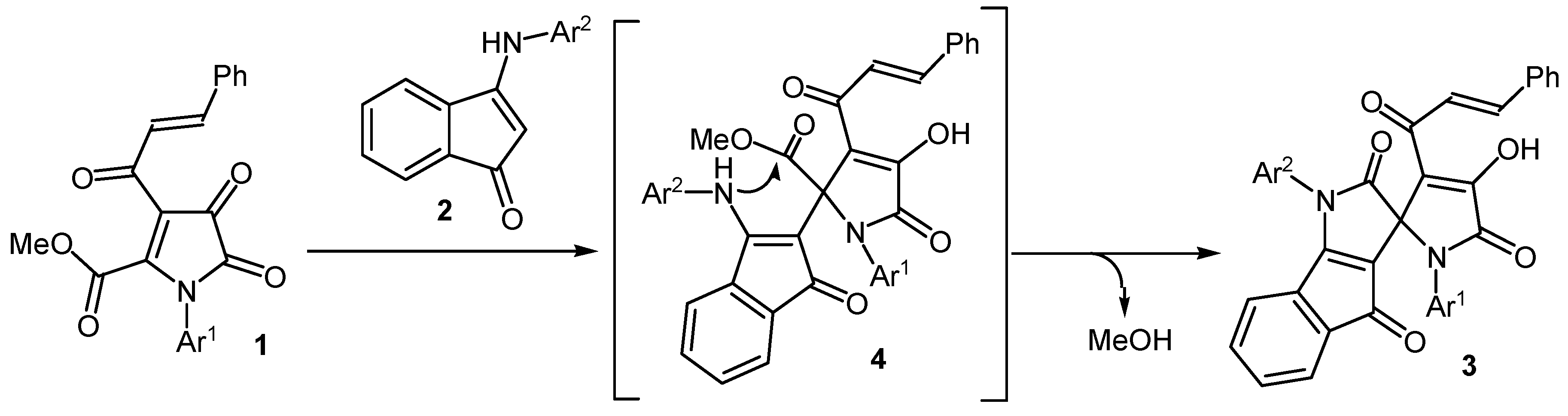
      <p>The formation of compounds <bold>3</bold> occurs due to the addition of the <italic>β</italic>-CH group of the enamino fragment of indenones <bold>2</bold> to the atom C<sup>5</sup> of pyrrolediones <bold>1</bold>, followed by the closure of the pyrrole ring through the intramolecular attack of the amino group of indenones <bold>2</bold> on the ester carbonyl group in the position <italic>5</italic> of the pyrroledione with simultaneous elimination of methanol (<xref ref-type="scheme" rid="molecules-17-13787-scheme2">Scheme 2</xref>). Our attempts to isolate intermediates <bold>4</bold> of this transformation failed. Presumably, the rate of intramolecular cyclization compounds <bold>4</bold> higher than the rate of their formation.</p>
      <fig id="molecules-17-13787-scheme2" position="float">
        <object-id pub-id-type="pii">molecules-17-13787-scheme2_Scheme 2</object-id>
        <label>Scheme 2</label>
        <caption>
          <p>The proposed mechanism for the synthesis of spiro[indeno[1,2-b]pyrrole-3,2'-pyrroles] <bold>3</bold>.</p>
        </caption>
        <graphic xmlns:xlink="http://www.w3.org/1999/xlink" xlink:href="molecules-17-13787-g004.tif"/>
      </fig>
    </sec>
    <sec sec-type="methods">
      <title>3. Experimental</title>
      <sec>
        <title>3.1. General</title>
        <p>Melting points were recorded on a Gallenkamp apparatus. IR spectra (mineral oil) were recorded on an FMS-1201 spectrophotometer. The <sup>1</sup>H- and <sup>13</sup>C-NMR spectra were recorded on a Bruker AM 400 spectrometer (at 400 MHz for <sup>1</sup>H-NMR and 100 MHz for <sup>13</sup>C-NMR) with DMSO-<italic>d<sub>6</sub></italic> as solvent and TMS as internal reference, chemical shifts are expressed as δ ppm. All reactions were followed by TLC (silica gel, aluminum sheets, Silufol, 5:1, benzene-ethyl acetate). X-Ray analyses were performed using an “Xcalibur 3” diffractometer.</p>
        <p>CCDC 909 605 contains the supplementary crystallographic data for compound <bold>3c</bold>. These data can be obtained free of charge via <uri>www.ccdc.cam.ac.uk/conts/retrieving.html</uri> (or from the CCDC, 12 Union Road, Cambridge CB2 1EZ, UK; fax: +44-1223-336033; e-mail: <email>deposit@ccdc.cam.ac.uk</email>).</p>
      </sec>
      <sec>
        <title>3.2. General Procedure for Preparation of Spiro[indeno[1,2-b]pyrrole-3,2'-pyrroles] <italic><bold>3a–h</bold></italic></title>
        <p>A solution of 1.0 mmol of pyrroledione <bold>1</bold> and enamine <bold>2</bold> in dry toluene (20 mL) was heated under reflux for 5–6 h (progress of the reactions was monitored using TLC with 5:1 benzene-ethyl acetate as eluent). The mixture was then cooled, the resulted precipitate was filtered off and recrystallized from toluene.</p>
        <p><italic>1-Bromo-3'-cinnamoyl-4'-hydroxy-1'-phenyl-1H-spiro[indeno[1,2-b]pyrrole-3,2'-pyrrole]-2,4,5'(1'H)-trione</italic> (<bold>3a</bold>): Red solid, yield 80%, mp 272–274 °C. IR ν<sub>max</sub>: 3173 (OH), 1768 (C2=O), 1726 (C5'=O), 1671 (C4=O), 1642 (C3'-C=O) cm<sup>−1</sup>. <sup>1</sup>H-NMR δ: 6.51 (d, 1H, H-8, <italic>J</italic> = 7.3 Hz), 7.13–7.89 (m, 18H, H-arom), 7.66 (d, 1H, COCH=CHPh, <italic>J</italic> = 15.8 Hz), 7.75 (d, 1H, COCH=CHPh, <italic>J</italic> = 15.8 Hz), 13.35 (s, 1H, OH).</p>
        <p><italic>3'-Cinnamoyl-4'-hydroxy-1'-(4-methylphenyl)-1-phenyl-1H-spiro[indeno[1,2-b]pyrrole-3,2'-pyrrole]-2,4,5'(1'H)-trione</italic> (<bold>3b</bold>): Red solid, yield 82%, mp 274–275 °C. IR ν<sub>max</sub>: 3174 (OH), 1781 (C2=O), 1725 (C5'=O), 1674 (C4=O), 1642 (C3'-C=O) cm<sup>−1</sup>. <sup>1</sup>H-NMR δ: 2.29 (s, 3H, Me), 6.38 (d, 1H, H-8, <italic>J</italic> = 7.2 Hz), 7.02–7.69 (m, 17H, H-arom), 7.65 (d, 1H, COCH=CHPh, <italic>J</italic> = 16.1 Hz), 7.74 (d, 1H, COCH=CHPh, <italic>J</italic> = 16.1 Hz), 13.40 (s, 1H, OH).</p>
        <p><italic>3'-Cinnamoyl-4'-hydroxy-1,1'-di(4-methylphenyl)-1H-spiro[indeno[1,2-b]pyrrole-3,2'-pyrrole]-2,4,5'(1'H)-trione</italic> (<bold>3c</bold>): Red solid, yield 79%, mp 282–283 °C. IR ν<sub>max</sub>: 3174 (OH), 1763 (C2=O), 1727 (C5'=O), 1678 (C4=O), 1647 (C3'-C=O) cm<sup>−1</sup>. <sup>1</sup>H-NMR δ: 2.28 (s, 3H, Me), 2.43 (s, 3H, Me), 6.39 (d, 1H, H-8, <italic>J</italic> = 7.3 Hz), 7.01–7.69 (m, 16H, H-arom), 7.64 (d, 1H, COCH=CHPh, <italic>J</italic> = 15.8 Hz), 7.74 (d, 1H, COCH=CHPh, <italic>J</italic> = 15.8 Hz), 13.31 (s, 1H, OH). The structure of compound <bold>3c</bold> was determined on a single-crystal X-ray diffractometer “Xcalibur 3” equipped with a CCD detector using the standard procedure (graphite-monochromated Mo<italic>К<sub>α</sub></italic> radiation, Т = 295(2) К, ω-scanning, scanning step 1°). The red crystals had dimensions 0.25 × 0.20 × 0.15 mm, crystal system monoclinic, the space group P2<sub>1</sub>/n, unit cell parameters: <italic>a</italic> = 15.2533(6), <italic>b</italic> = 16.6750(12), <italic>c</italic> = 26.0000(19) Å, β = 101.496(4)°, <italic>V</italic> = 6480.4(7) Å<sup>3</sup>, Z = 8, <italic>d<sub>calc</sub></italic> = 1.186 g/cm<sup>3</sup>. 23,715 reflections were collected in the range of angles of 2.57° &lt; θ &lt; 26.40°, from which 13,082 independent reflections (R<sub>int</sub> = 0.0361) and 5076 with I &gt; 2σ(I). The completeness of the experiment at the corners of θ ≤ 26.0° is 98.8%. The structure was solved by direct methods and refined by full-matrix least-squares procedure on F<sup>2</sup> with the SHELXTL-97 [<xref ref-type="bibr" rid="B19-molecules-17-13787">19</xref>] program in the anisotropic approximation for non-hydrogen atoms. Correction for absorption was not introduced (μ = 0.079 mm<sup>−1</sup>). The final refinement parameters: R<sub>1</sub> = 0.0456, wR<sub>2</sub> = 0.1037 for reflections with I &gt; 2σ (I); R<sub>1</sub> = 0.1174, wR<sub>2</sub> = 0.1085 for all reflections, GooF = 1.019. Largest diff. peak and hole 0.186 and −0.240 ēÅ<sup>−3</sup>. Protons of NH-and OH-groups were located on the peaks of the spatial electron density and refined independently. The positions of the remaining H atoms were calculated geometrically and included in the refinement with the “riding model”. Disordered solvate was treated by the SQUEEZE procedure in the PLATON program [<xref ref-type="bibr" rid="B18-molecules-17-13787">18</xref>].</p>
        <p><italic>3'-Cinnamoyl-4'-hydroxy-1-(4-methoxyphenyl)-1'-(4-methylphenyl)-1H-spiro[indeno[1,2-b]pyrrole-3,2'-pyrrole]-2,4,5'(1'H)-trione</italic> (<bold>3d</bold>): Red solid, yield 84%, mp 275–276 °C. IR ν<sub>max</sub>: 3180 (OH), 1777 (C2=O), 1732 (C5'=O), 1680 (C4=O), 1640 (C3'-C=O) cm<sup>−1</sup>; <sup>1</sup>H-NMR δ: 2.29 (s, 3H, Me), 3.87 (s, 3H, OMe), 6.40 (d, 1H, H-8, <italic>J</italic> = 7.5 Hz), 7.02–7.69 (m, 16H, H-arom), 7.65 (d, 1H, COCH=CHPh, <italic>J</italic> = 15.7 Hz), 7.74 (d, 1H, COCH=CHPh, <italic>J</italic> = 15.7 Hz), 13.35 (s, 1H, OH). <sup>13</sup>C-NMR δ ppm: 20.54 (Me), 55.47 (OMe), 68.34 (C-3), 108.08 (C-3a), 115.03 (C<sub>m</sub>Ar<sup>2</sup>), 117.72 (C-3'), 120.52–138.40, 142.74 (CO-CH=CH-Ph), 155.63 (C-8b), 159.89 (C<sub>ip</sub>Ar<sup>2</sup>), 165.38 (C-5'), 171.89 (C-2), 177.22 (C-4'), 182.46 (C3'-C=O), 183.74 (C-4).</p>
        <p><italic>3'-Cinnamoyl-4'-hydroxy-1'-(4-methoxyphenyl)-1-phenyl-1H-spiro[indeno[1,2-b]pyrrole-3,2'-pyrrole]-2,4,5'(1'H)-trione</italic> (<bold>3e</bold>): Red solid, yield 81%, mp 269–270 °C. IR ν<sub>max</sub>: 3180 (OH), 1773 (C2=O), 1715 (C5'=O), 1669 (C4=O), 1640 (C3'-C=O) cm<sup>−1</sup>. <sup>1</sup>H-NMR δ: 3.74 (s, 3H, OMe), 6.38 (d, 1H, H-8, <italic>J</italic> = 7.5 Hz), 7.36–7.69 (m, 17H, H-arom), 7.65 (d, 1H, COCH=CHPh, <italic>J</italic> = 16.0 Hz), 7.73 (d, 1H, COCH=CHPh, <italic>J</italic> = 16.0 Hz), 13.40 (s, 1H, OH).</p>
        <p><italic>3'-Cinnamoyl-4'-hydroxy-1'-(4-methoxyphenyl)-1-(4-methylphenyl)-1H-spiro[indeno[1,2-b]pyrrole-3,2'-pyrrole]-2,4,5'(1'H)-trione</italic> (<bold>3f</bold>): Red solid, yield 80%, mp 252–253 °C. IR ν<sub>max</sub>: 3161 (OH), 1773 (C2=O), 1725 (C5'=O), 1671 (C4=O), 1644 (C3'-C=O) cm<sup>−1</sup>. <sup>1</sup>H-NMR δ: 2.43 (s, 3H, Me), 3.74 (s, 3H, OMe), 6.39 (d, 1H, H-8, <italic>J</italic> = 7.3 Hz), 7.03–7.69 (m, 16H, H-arom), 7.65 (d, 1H, COCH=CHPh, <italic>J</italic> = 16.2 Hz), 7.73 (d, 1H, COCH=CHPh, <italic>J </italic>= 16.2 Hz), 13.35 (s, 1H, OH).</p>
        <p><italic>3'-Cinnamoyl-4'-hydroxy-1,1'-di(4-methoxyphenyl)-1H-spiro[indeno[1,2-b]pyrrole-3,2'-pyrrole]-2,4,5'(1'H)-trione</italic> (<bold>3g</bold>): Red solid, yield 79%, mp 259–260 °C. IR ν<sub>max</sub> 3161 (OH), 1773 (C2=O), 1717 (C5'=O), 1667 (C4=O), 1642 (C3'-C=O) cm<sup>−1</sup>. <sup>1</sup>H-NMR δ: 3.74 (s, 3H, OMe), 3.86 (s, 3H, OMe), 6.40 (d, 1H, H-8, <italic>J</italic> = 7.6 Hz), 7.03–7.73 (m, 16H, H-arom), 7.65 (d, 1H, COCH=CHPh, <italic>J</italic> = 15.7 Hz), 7.73 (d, 1H, COCH=CHPh, <italic>J</italic> = 15.7 Hz), 13.30 (s, 1H, OH).</p>
        <p><italic>1-Bromo-3'-cinnamoyl-4'-hydroxy-1'-(4-methoxyphenyl)-1H-spiro[indeno[1,2-b]pyrrole-3,2'-pyrrole]-2,4,5'(1'H)-trione</italic> (<bold>3h</bold>): Red solid, yield 83%, mp 256–257 °C. IR ν<sub>max</sub> 3188 (OH), 1777 (C2=O), 1732 (C5'=O), 1673 (C4=O), 1644 (C3'-C=O) cm<sup>−1</sup>. <sup>1</sup>H-NMR δ: 3.74 (s, 3H, OMe), 6.51 (d, 1H, H-8, <italic>J</italic> = 7.1 Hz), 7.02–7.87 (m, 16H, H-arom), 7.64 (d, 1H, COCH=CHPh, <italic>J</italic> = 16.0 Hz), 7.72 (d, 1H, COCH=CHPh, <italic>J</italic> = 16.0 Hz), 13.45 (s, 1H, OH).</p>
      </sec>
    </sec>
    <sec sec-type="conclusions">
      <title>4. Conclusions</title>
      <p>The described reaction presents a rare example of a regioselective synthesis of a hardly accessible spiroheterocyclic system—spiro[indeno[1,2-b]pyrrole-3,2'-pyrrole] including various functional substituents in both heterocyclic fragments. Overall, we have succeeded in developing a method for synthesis of new functionalized spiro[indeno[1,2-b]pyrrole-3,2'-pyrroles derivatives of potential synthetic and pharmacological interest from the reaction of 1<italic>H</italic>-pyrrole-2,3-diones with 3-(arylamino)-1<italic>H</italic>-inden-1-ones. Our work presents a very simple reaction performed under neutral conditions and in the absence of any catalyst. From a structural viewpoint, the products are polycarbonyl compounds suitable for further elaboration. High yields and simple reaction and purification procedures are the key advantages of this approach.</p>
      
    </sec>
    
  </body>
  <back>
  <ack>
      <title>Acknowledgments</title>
      <p>The study was financially supported by the Russian Foundation for Basic Research (Grants Nos. 12-03-00696, 12-03-31157).</p>
    </ack>
    <ref-list>
      <title>References</title>
      <ref id="B1-molecules-17-13787">
        <label>1.</label>
        <citation citation-type="journal">
          <person-group person-group-type="author">
            <name>
              <surname>Longeon</surname>
              <given-names>A.</given-names>
            </name>
            <name>
              <surname>Guyot</surname>
              <given-names>M.</given-names>
            </name>
            <name>
              <surname>Vacelet</surname>
              <given-names>J.</given-names>
            </name>
          </person-group>
          <article-title>Araplysillins-I and-II: Biologically active dibromotyrosine derivatives from the sponge <italic>Psammaplysilla arabica</italic></article-title>
          <source>Experentia</source>
          <year>1990</year>
          <volume>46</volume>
          <fpage>548</fpage>
          <lpage>550</lpage>
          <pub-id pub-id-type="doi">10.1007/BF01954262</pub-id>
        </citation>
      </ref>
      <ref id="B2-molecules-17-13787">
        <label>2.</label>
        <citation citation-type="journal">
          <person-group person-group-type="author">
            <name>
              <surname>Kobayashi</surname>
              <given-names>J.</given-names>
            </name>
            <name>
              <surname>Tsuda</surname>
              <given-names>M.</given-names>
            </name>
            <name>
              <surname>Agemi</surname>
              <given-names>K.</given-names>
            </name>
            <name>
              <surname>Shigemiri</surname>
              <given-names>H.</given-names>
            </name>
            <name>
              <surname>Ishibashi</surname>
              <given-names>M.</given-names>
            </name>
            <name>
              <surname>Sasaki</surname>
              <given-names>T.</given-names>
            </name>
            <name>
              <surname>Mikami</surname>
              <given-names>Y.</given-names>
            </name>
          </person-group>
          <article-title>Purealidins B and C, new bromotyrosine alkaloids from the okinawan marine sponge <italic>psammaplysilla purea</italic></article-title>
          <source>Tetrahedron</source>
          <year>1991</year>
          <volume>47</volume>
          <fpage>6617</fpage>
          <lpage>6622</lpage>
          <pub-id pub-id-type="doi">10.1016/S0040-4020(01)82314-0</pub-id>
        </citation>
      </ref>
      <ref id="B3-molecules-17-13787">
        <label>3.</label>
        <citation citation-type="journal">
          <person-group person-group-type="author">
            <name>
              <surname>James</surname>
              <given-names>D.M.</given-names>
            </name>
            <name>
              <surname>Kunze</surname>
              <given-names>H.B.</given-names>
            </name>
            <name>
              <surname>Faulkner</surname>
              <given-names>D.J.</given-names>
            </name>
          </person-group>
          <article-title>Two new brominated tyrosine derivatives from the sponge <italic>Druinella (=Psammaplysilla) purpurea</italic></article-title>
          <source>J. Nat. Prod.</source>
          <year>1991</year>
          <volume>54</volume>
          <fpage>1137</fpage>
          <lpage>1140</lpage>
          <pub-id pub-id-type="doi">10.1021/np50076a040</pub-id>
        </citation>
      </ref>
      <ref id="B4-molecules-17-13787">
        <label>4.</label>
        <citation citation-type="book">
          <source>The Alkaloids: Chemistry and Biology</source>
          <person-group person-group-type="editor">
            <name>
              <surname>Cordell</surname>
              <given-names>G.A.</given-names>
            </name>
          </person-group>
          <publisher-name>Academic</publisher-name>
          <publisher-loc>San Diego, CA, USA</publisher-loc>
          <year>1998</year>
          <volume>Volume 5</volume>
        </citation>
      </ref>
      <ref id="B5-molecules-17-13787">
        <label>5.</label>
        <citation citation-type="journal">
          <person-group person-group-type="author">
            <name>
              <surname>Okita</surname>
              <given-names>T.</given-names>
            </name>
            <name>
              <surname>Isobe</surname>
              <given-names>M.</given-names>
            </name>
          </person-group>
          <article-title>Synthesis of the pentacyclic intermediate for dynemicin a and unusual formation of spiro-oxindole ring</article-title>
          <source>Tetrahedron</source>
          <year>1994</year>
          <volume>50</volume>
          <fpage>11143</fpage>
          <lpage>11152</lpage>
          <pub-id pub-id-type="doi">10.1016/S0040-4020(01)89417-5</pub-id>
        </citation>
      </ref>
      <ref id="B6-molecules-17-13787">
        <label>6.</label>
        <citation citation-type="journal">
          <person-group person-group-type="author">
            <name>
              <surname>Kornet</surname>
              <given-names>M.J.</given-names>
            </name>
            <name>
              <surname>Tnio</surname>
              <given-names>A.P.</given-names>
            </name>
          </person-group>
          <article-title>Oxindole-3-spiropyrrolidines and -piperidines. Synthesis and local anesthetic activity</article-title>
          <source>J. Med. Chem.</source>
          <year>1976</year>
          <volume>19</volume>
          <fpage>892</fpage>
          <lpage>898</lpage>
          <pub-id pub-id-type="doi">10.1021/jm00229a007</pub-id>
        </citation>
      </ref>
      <ref id="B7-molecules-17-13787">
        <label>7.</label>
        <citation citation-type="journal">
          <person-group person-group-type="author">
            <name>
              <surname>Fisher</surname>
              <given-names>E.</given-names>
            </name>
            <name>
              <surname>Hirshberg</surname>
              <given-names>Y.</given-names>
            </name>
          </person-group>
          <article-title>Formation colored forms of spirans by low-temperature irradiation</article-title>
          <source>J. Chem. Soc.</source>
          <year>1952</year>
          <volume>11</volume>
          <fpage>4522</fpage>
          <lpage>4530</lpage>
        </citation>
      </ref>
      <ref id="B8-molecules-17-13787">
        <label>8.</label>
        <citation citation-type="journal">
          <person-group person-group-type="author">
            <name>
              <surname>Hinshberg</surname>
              <given-names>Y.</given-names>
            </name>
          </person-group>
          <article-title>Reversible Formation and Eradication of Colors by Irradiation at Low Temperatures. A Photochemical Memory Model</article-title>
          <source>J. Am. Chem. Soc.</source>
          <year>1956</year>
          <volume>78</volume>
          <fpage>2304</fpage>
          <lpage>2312</lpage>
          <pub-id pub-id-type="doi">10.1021/ja01591a075</pub-id>
        </citation>
      </ref>
      <ref id="B9-molecules-17-13787">
        <label>9.</label>
        <citation citation-type="journal">
          <person-group person-group-type="author">
            <name>
              <surname>Berkovic</surname>
              <given-names>G.</given-names>
            </name>
            <name>
              <surname>Krongauz</surname>
              <given-names>V.</given-names>
            </name>
            <name>
              <surname>Weiss</surname>
              <given-names>V.</given-names>
            </name>
          </person-group>
          <article-title>Spiropyrans and Spirooxazines for Memories and Switches</article-title>
          <source>Chem. Rev.</source>
          <year>2000</year>
          <volume>100</volume>
          <fpage>1741</fpage>
          <lpage>1754</lpage>
          <pub-id pub-id-type="doi">10.1021/cr9800715</pub-id>
        </citation>
      </ref>
      <ref id="B10-molecules-17-13787">
        <label>10.</label>
        <citation citation-type="journal">
          <person-group person-group-type="author">
            <name>
              <surname>Bannikova</surname>
              <given-names>Y.N.</given-names>
            </name>
            <name>
              <surname>Sedegova</surname>
              <given-names>E.A.</given-names>
            </name>
            <name>
              <surname>Khalturina</surname>
              <given-names>V.V.</given-names>
            </name>
            <name>
              <surname>Maslivets</surname>
              <given-names>A.N.</given-names>
            </name>
          </person-group>
          <article-title>Five-membered 2,3-dioxo heterocycles: LV. Reaction of methyl 1-aryl-3-aroyl-4,5-dioxo-4,5-dihydro-1<italic>H</italic>-pyrrole-2-carboxylates with ethyl 3-arylaminobut-2-enoates</article-title>
          <source>Russ. J. Org. Chem.</source>
          <year>2007</year>
          <volume>43</volume>
          <fpage>1338</fpage>
          <lpage>1341</lpage>
        <pub-id pub-id-type="doi">10.1134/S1070428007090138</pub-id></citation>
      </ref>
      <ref id="B11-molecules-17-13787">
        <label>11.</label>
        <citation citation-type="journal">
          <person-group person-group-type="author">
            <name>
              <surname>Bannikova</surname>
              <given-names>Y.N.</given-names>
            </name>
            <name>
              <surname>Maslivets</surname>
              <given-names>A.N.</given-names>
            </name>
            <name>
              <surname>Aliev</surname>
              <given-names>Z.G.</given-names>
            </name>
          </person-group>
          <article-title>Five-membered 2,3-dioxo heterocycles: XLIX. Reaction of methyl 1-aryl-3-aroyl-4,5-dioxo-4,5-dihydro-1<italic>H</italic>-pyrrole-2-carboxylates with  <italic>N</italic>-substituted 3-amino-5,5-dimethyl-2-cyclohexenones</article-title>
          <source>Russ. J. Org. Chem.</source>
          <year>2004</year>
          <volume>40</volume>
          <fpage>1791</fpage>
          <lpage>1797</lpage>
        <pub-id pub-id-type="doi">10.1007/s11178-005-0101-6</pub-id></citation>
      </ref>
      <ref id="B12-molecules-17-13787">
        <label>12.</label>
        <citation citation-type="journal">
          <person-group person-group-type="author">
            <name>
              <surname>Silaichev</surname>
              <given-names>P.S.</given-names>
            </name>
            <name>
              <surname>Chudinova</surname>
              <given-names>M.A.</given-names>
            </name>
            <name>
              <surname>Slepukhin</surname>
              <given-names>P.A.</given-names>
            </name>
            <name>
              <surname>Maslivets</surname>
              <given-names>A.</given-names>
            </name>
          </person-group>
          <article-title>Five-membred 2,3-dioxoheterocycles: LXXXI. Reactions of 4,5-bis(methoxycarbonyl)-1<italic>H</italic>-pyrrole-2,3-diones with <italic>N</italic>-substituted 3-amino-5,5-dimethyl-2-cyclohex-2-en-1-ones. Crystal and molecular structure of methyl 4'-hydroxy-6,6-dimethyl-1,1'-bis(4-methylphenyl)-2,4,5'-trioxo-1,1',2,4,5,5',6,7-octahydrospiro [indole-3,2'-pyrrole]-3'-carboxylate</article-title>
          <source>Russ. J. Org. Chem.</source>
          <year>2011</year>
          <volume>47</volume>
          <fpage>1718</fpage>
          <lpage>1722</lpage>
        <pub-id pub-id-type="doi">10.1134/S107042801111011X</pub-id></citation>
      </ref>
      <ref id="B13-molecules-17-13787">
        <label>13.</label>
        <citation citation-type="journal">
          <person-group person-group-type="author">
            <name>
              <surname>Silaichev</surname>
              <given-names>P.S.</given-names>
            </name>
            <name>
              <surname>Filimonov</surname>
              <given-names>V.O.</given-names>
            </name>
            <name>
              <surname>Slepukhin</surname>
              <given-names>P.A.</given-names>
            </name>
            <name>
              <surname>Maslivets</surname>
              <given-names>A.N.</given-names>
            </name>
          </person-group>
          <article-title>Five-membered 2,3-dioxo heterocycles: LXXXV. Synthesis of methyl 1-aryl-4,5-dioxo-3-(1-oxo-3-phenylprop-2-en-1-yl)-4,5-dihydro-1<italic>H</italic>-pyrrole-2-carboxylates and their reaction with 3-amino-5,5-dimethylcyclohex-2-en-1-ones. Molecular and crystalline structure of 4'-hydroxy-1'-(4-methoxyphenyl)-6,6-dimethyl-3'-(1-oxo-3-phenylprop-2-en-1-yl)-1-phenyl-6,7-dihydrospiro[indole-3,2′-pyrrole]-2,4,5'(1<italic>H</italic>,1'<italic>H</italic>,5<italic>H</italic>)- trione</article-title>
          <source>Russ. J. Org. Chem.</source>
          <year>2012</year>
          <volume>48</volume>
          <fpage>561</fpage>
          <lpage>565</lpage>
        <pub-id pub-id-type="doi">10.1134/S1070428012040173</pub-id></citation>
      </ref>
      <ref id="B14-molecules-17-13787">
        <label>14.</label>
        <citation citation-type="journal">
          <person-group person-group-type="author">
            <name>
              <surname>Denislamova</surname>
              <given-names>E.S.</given-names>
            </name>
            <name>
              <surname>Bubnov</surname>
              <given-names>N.V.</given-names>
            </name>
            <name>
              <surname>Maslivets</surname>
              <given-names>A.N.</given-names>
            </name>
          </person-group>
          <article-title>Five-membered 2,3-dioxo heterocycles: LXXVI. Reaction of methyl 1-aryl-3-benzoyl-4,5-dioxo-4,5-dihydro-1<italic>H</italic>-pyrrole-2-carboxylates with 6-amino-1,3-dimethylpyrimidine-2,4(1<italic>H</italic>,3<italic>H</italic>)-dione</article-title>
          <source>Russ. J. Org. Chem.</source>
          <year>2011</year>
          <volume>47</volume>
          <fpage>933</fpage>
          <lpage>936</lpage>
        <pub-id pub-id-type="doi">10.1134/S1070428011060170</pub-id></citation>
      </ref>
      <ref id="B15-molecules-17-13787">
        <label>15.</label>
        <citation citation-type="journal">
          <person-group person-group-type="author">
            <name>
              <surname>Bannikova</surname>
              <given-names>Y.N.</given-names>
            </name>
            <name>
              <surname>Maslivets</surname>
              <given-names>A.N.</given-names>
            </name>
            <name>
              <surname>Rozhkova</surname>
              <given-names>Y.S.</given-names>
            </name>
            <name>
              <surname>Shklyaev</surname>
              <given-names>Y.V.</given-names>
            </name>
            <name>
              <surname>Aliev</surname>
              <given-names>Z.G.</given-names>
            </name>
          </person-group>
          <article-title>Spiro heterocyclization of 5-methoxycarbonyl-2,3-dihydro-2,3-pyrrolediones by reaction with 1-methyl-3,4-dihydroisoquinoline</article-title>
          <source>Mendeleev Commun.</source>
          <year>2005</year>
          <volume>15</volume>
          <fpage>158</fpage>
          <lpage>159</lpage>
          <pub-id pub-id-type="doi">10.1070/MC2005v015n04ABEH002095</pub-id>
        </citation>
      </ref>
      <ref id="B16-molecules-17-13787">
        <label>16.</label>
        <citation citation-type="journal">
          <person-group person-group-type="author">
            <name>
              <surname>Bannikova</surname>
              <given-names>Y.N.</given-names>
            </name>
            <name>
              <surname>Rozhkova</surname>
              <given-names>Y.S.</given-names>
            </name>
            <name>
              <surname>Shklyaev</surname>
              <given-names>Y.V.</given-names>
            </name>
            <name>
              <surname>Maslivets</surname>
              <given-names>A.N.</given-names>
            </name>
          </person-group>
          <article-title>Five-membered 2,3-dioxoheterocycles: LVIII. Reaction of methyl 1-aryl-3-aroyl-4,5-dioxo-4,5-dihydro-1<italic>H</italic>-pyrrol-2-carboxylates with substituted 1-methyl-3,4-dihydroisoquinolines. New approach to the synthesis of steroid 13-azaanalogs</article-title>
          <source>Russ. J. Org. Chem.</source>
          <year>2008</year>
          <volume>44</volume>
          <fpage>697</fpage>
          <lpage>700</lpage>
        <pub-id pub-id-type="doi">10.1134/S1070428008050102</pub-id></citation>
      </ref>
      <ref id="B17-molecules-17-13787">
        <label>17.</label>
        <citation citation-type="journal">
          <person-group person-group-type="author">
            <name>
              <surname>Dmitriev</surname>
              <given-names>M.V.</given-names>
            </name>
            <name>
              <surname>Silaichev</surname>
              <given-names>P.S.</given-names>
            </name>
            <name>
              <surname>Aliev</surname>
              <given-names>Z.G.</given-names>
            </name>
            <name>
              <surname>Maslivets</surname>
              <given-names>A.N.</given-names>
            </name>
          </person-group>
          <article-title>Spiro-heterocyclization of 1<italic>H</italic>-pyrrole-2,3-dione at the treatment with 3-arylamino-1H-inden-1-ones</article-title>
          <source>Russ. J. Org. Chem.</source>
          <year>2011</year>
          <volume>47</volume>
          <fpage>304</fpage>
          <lpage>305</lpage>
          <pub-id pub-id-type="doi">10.1134/S1070428011020266</pub-id>
        </citation>
      </ref>
      <ref id="B18-molecules-17-13787">
        <label>18.</label>
        <citation citation-type="journal">
          <person-group person-group-type="author">
            <name>
              <surname>Spek</surname>
              <given-names>A.L.</given-names>
            </name>
          </person-group>
          <article-title>PLATON—A Multipurpose Crystallographic Tool, Utrecht University, Utrecht,  The Netherlands</article-title>
          <source>J. Appl. Cryst.</source>
          <year>2003</year>
          <volume>36</volume>
          <fpage>7</fpage>
          <lpage>13</lpage>
          <pub-id pub-id-type="doi">10.1107/S0021889802022112</pub-id>
        </citation>
      </ref>
      <ref id="B19-molecules-17-13787">
        <label>19.</label>
        <citation citation-type="journal">
          <person-group person-group-type="author">
            <name>
              <surname>Sheldrick</surname>
              <given-names>G.M.</given-names>
            </name>
          </person-group>
          <article-title>A short history of SHELX</article-title>
          <source>Acta Cryst.</source>
          <year>2008</year>
          <volume>64</volume>
          <fpage>112</fpage>
          <lpage>122</lpage>
          <pub-id pub-id-type="doi">10.1107/S0108767307043930</pub-id>
        </citation>
      </ref>
    </ref-list>
	<fn-group>
 <fn>
 <p><italic>Sample Availability</italic>: Samples of the compounds <bold>1</bold>–<bold>3h</bold> are available from the authors.</p>
 </fn>
 </fn-group>
  </back>
</article>