<?xml version="1.0" encoding="UTF-8"?>
<!DOCTYPE article PUBLIC "-//NLM//DTD Journal Publishing DTD v2.3 20070202//EN" "journalpublishing.dtd">
<article xmlns:mml="http://www.w3.org/1998/Math/MathML" xmlns:xlink="http://www.w3.org/1999/xlink" xml:lang="en" article-type="review-article">
  <front>
    <journal-meta>
      <journal-id journal-id-type="publisher-id">molecules</journal-id>
      <journal-title>Molecules</journal-title>
      <abbrev-journal-title abbrev-type="publisher">Molecules</abbrev-journal-title>
      <abbrev-journal-title abbrev-type="pubmed">Molecules</abbrev-journal-title>
      <issn pub-type="epub">1420-3049</issn>
      <publisher>
        <publisher-name>MDPI</publisher-name>
      </publisher>
    </journal-meta>
    <article-meta>
      <article-id pub-id-type="doi">10.3390/molecules171112821</article-id>
      <article-id pub-id-type="publisher-id">molecules-17-12821</article-id>
      <article-categories>
        <subj-group>
          <subject>Review</subject>
        </subj-group>
      </article-categories>
      <title-group>
        <article-title>The Kabachnik–Fields Reaction: Mechanism and Synthetic Use</article-title>
      </title-group>      
      <contrib-group>
        <contrib contrib-type="author">
          <name>
            <surname>Keglevich</surname>
            <given-names>György</given-names>
          </name>
          <xref rid="af1-molecules-17-12821" ref-type="aff">1</xref>
          <xref rid="c1-molecules-17-12821" ref-type="corresp">*</xref>
        </contrib>
        <contrib contrib-type="author">
          <name>
            <surname>Bálint</surname>
            <given-names>Erika</given-names>
          </name>
          <xref rid="af2-molecules-17-12821" ref-type="aff">2</xref>
        </contrib>
      </contrib-group>
      <aff id="af1-molecules-17-12821"><label>1 </label>Department of Organic Chemistry and Technology, Budapest University of Technology and Economics, 1521 Budapest, Hungary</aff>
      <aff id="af2-molecules-17-12821"><label>2 </label>Research Group of the Hungarian Academy of Sciences, Department of Organic Chemistry and Technology, Budapest University of Technology and Economics, 1521 Budapest, Hungary</aff>
	  <author-notes>
        <corresp id="c1-molecules-17-12821"><label>*</label> Author  to whom correspondence should be addressed; Email: <email>gkeglevich@mail.bme.hu</email>; Tel.: +36-1-463-1111 (ext. 5883); Fax: +36-1-463-3648.</corresp>
      </author-notes>
      <pub-date pub-type="epub">
        <day>01</day>
        <month>11</month>
        <year>2012</year>
      </pub-date>
      <pub-date pub-type="collection">
        <month>11</month>
		<year>2012</year>
      </pub-date>
      <volume>17</volume>
      <issue>11</issue>
      <fpage>12821</fpage>
      <lpage>12835</lpage>
      <history>
        <date date-type="received">
          <day>18</day>
          <month>10</month>
          <year>2012</year>
        </date>
        <date date-type="rev-recd">
          <day>25</day>
          <month>10</month>
          <year>2012</year>
        </date>
        <date date-type="accepted">
          <day>26</day>
          <month>10</month>
          <year>2012</year>
        </date>
      </history>
      <permissions>
        <copyright-statement>©  2012 by the authors; licensee MDPI, Basel, Switzerland.</copyright-statement>
        <copyright-year>2012</copyright-year>
        <license xmlns:xlink="http://www.w3.org/1999/xlink" license-type="open-access" xlink:href="http://creativecommons.org/licenses/by/3.0/">
          <p>This article is an open-access article distributed under the terms and conditions of the Creative Commons Attribution license (http://creativecommons.org/licenses/by/3.0/).</p>
        </license>
      </permissions>
      <abstract>
        <p>The Kabachnik–Fields (phospha-Mannich) reaction involving the condensation of primary or secondary amines, oxo compounds (aldehydes and ketones) and &gt;P(O)H species, especially dialkyl phosphites, represents a good choice for the synthesis of α-aminophosphonates that are of significant importance due to their biological activity. In general, these three-component reactions may take place via an imine or an α-hydroxy-phosphonate intermediate. The monitoring of a few Kabachnik–Fields reactions by <italic>in situ</italic> Fourier transform IR spectroscopy has indicated the involvement of the imine intermediate that was also justified by theoretical calculations. The Kabachnik–Fields reaction was extended to &gt;P(O)H species, comprising cyclic phosphites, acyclic and cyclic <italic>H</italic>-phosphinates, as well as secondary phosphine oxides. On the other hand, heterocyclic amines were also used to prepare new α-amino phosphonic, phosphinic and phosphine oxide derivatives. In most cases, the synthesis under solvent-free microwave (MW) conditions is the method of choice. It was proved that, in the cases studied by us, there was no need for the use of any catalyst. Moreover, it can be said that sophisticated and environmentally unfriendly catalysts suggested are completely unnecessary under MW conditions. Finally, the double Kabachnik–Fields reaction has made available bis(phosphonomethyl)amines, bis(phosphinoxidomethyl)amines and related species. The bis(phosphinoxidomethyl)amines serve as precursors for bisphosphines that furnish ring platinum complexes on reaction with dichlorodibenzonitriloplatinum.</p>
      </abstract>
      <kwd-group>
        <kwd>Kabachnik–Fields reaction</kwd>
        <kwd>α-aminophosphonates</kwd>
        <kwd>reaction pathway</kwd>
        <kwd>environmentally friendly</kwd>
        <kwd>microwave</kwd>
        <kwd>solventless</kwd>
      </kwd-group>
    </article-meta>
  </front>
  <body>
    <sec sec-type="intro">
      <title>1. Introduction</title>
      <p>The basic method for the preparation of α-aminophosphonates, valuable synthetic equivalents and biologically active substrates, involves the condensation of a primary or secondary amine, a carbonyl compound (aldehyde or ketone) and dialkyl phosphite (<xref ref-type="scheme" rid="molecules-17-12821-f003">Scheme 1</xref>) [<xref ref-type="bibr" rid="B1-molecules-17-12821">1</xref>,<xref ref-type="bibr" rid="B2-molecules-17-12821">2</xref>]. </p>
      <fig id="molecules-17-12821-f003" position="float">
        <object-id pub-id-type="pii">molecules-17-12821-scheme1_Scheme 1</object-id>
        <label>Scheme 1</label>
        <caption>
          <p>General scheme for the Kabachnik–Fields reaction.</p>
        </caption>
        <graphic xmlns:xlink="http://www.w3.org/1999/xlink" xlink:href="molecules-17-12821-g003.tif"/>
      </fig>
      <p>α-Aminophosphonic acids, considered as phosphorus analogues of α-amino acids, have attracted much attention in drug research due to their low mammalian toxicity. They are important targets in the development of antibiotics, antiviral species, antihypertensives, and antitumour agents based on their effect as inhibitors of GABA-receptors, enzyme inhibitors and anti-metabolites [<xref ref-type="bibr" rid="B3-molecules-17-12821">3</xref>,<xref ref-type="bibr" rid="B4-molecules-17-12821">4</xref>,<xref ref-type="bibr" rid="B5-molecules-17-12821">5</xref>,<xref ref-type="bibr" rid="B6-molecules-17-12821">6</xref>,<xref ref-type="bibr" rid="B7-molecules-17-12821">7</xref>,<xref ref-type="bibr" rid="B8-molecules-17-12821">8</xref>,<xref ref-type="bibr" rid="B9-molecules-17-12821">9</xref>]. Diaryl α-amino-phosphonate derivatives are selective and highly potent inhibitors of serine proteases, and thus can mediate the patho-physical processes of cancer growth, metastasis, osteoarthritis or heart failure [<xref ref-type="bibr" rid="B10-molecules-17-12821">10</xref>]. Dialkylglycine decarboxylase [<xref ref-type="bibr" rid="B9-molecules-17-12821">9</xref>] and leucine aminopeptidase [<xref ref-type="bibr" rid="B11-molecules-17-12821">11</xref>] are also inhibited by α-amino-phosphonates. Cyanoacrylate [<xref ref-type="bibr" rid="B12-molecules-17-12821">12</xref>] and amide derivatives [<xref ref-type="bibr" rid="B13-molecules-17-12821">13</xref>] of α-aminophosphonates are active antiviral compounds and inactivators of the tobacco mosaic virus. Certain α-aminophosphonates were proved to be suitable for the design of continuous drug release devices due to their ability to increase the membrane permeability of a hydrophilic probe molecule [<xref ref-type="bibr" rid="B14-molecules-17-12821">14</xref>].</p>
    </sec>
    <sec>
      <title>2. Possible Pathways for the Kabachnik–Fields Reaction</title>
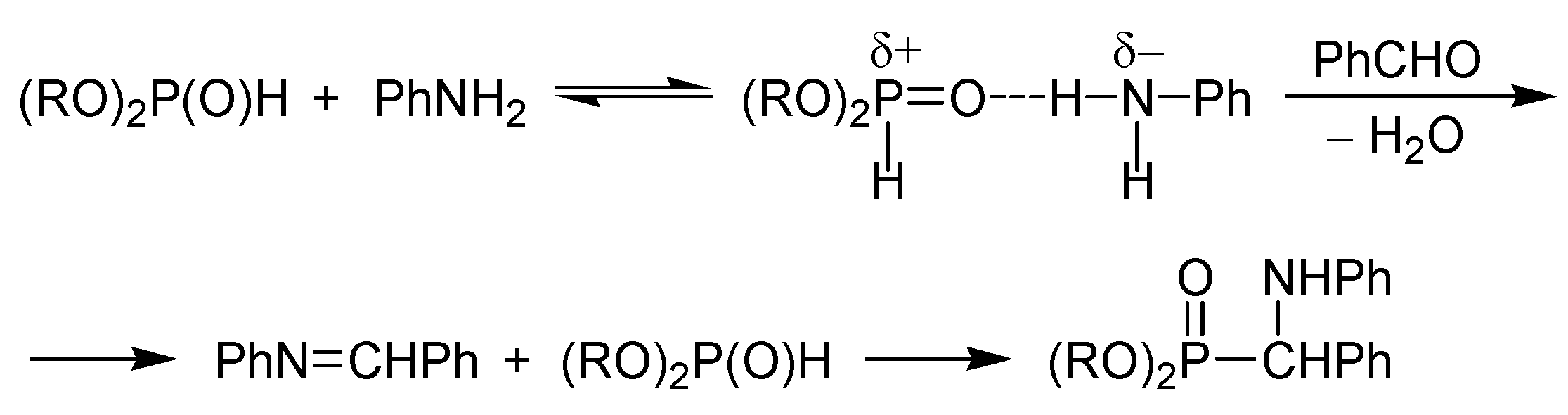
      <p>Cherkasov <italic>et al</italic>. studied the mechanism of the Kabachnik–Fields reaction in detail. One possibility is that an imine (a Schiff base) is formed from the carbonyl compound and the (primary) amine, and then the dialkyl phosphite is added on the C=N unit of the intermediate. The other route assumes the formation of an α-hydroxyphosphonate by the addition of the dialkylphosphite to the carbonyl group of the oxo component, then the hydroxyphosphonate undergoes substitution by the amine to furnish the α-aminophosphonate. On the basis of kinetic studies, it was concluded that the mechanism is dependent on the nature of the reactants. For example, the condensation of aniline, benzaldehyde and a dialkyl phosphite was assumed to follow the “imine” mechanism. Interestingly it was found that before the condensation of the aniline and the benzaldehyde, an H-bond is formed between the P=<italic>O</italic> function of the phosphite and the <italic>H</italic>N unit of the amine (<xref ref-type="scheme" rid="molecules-17-12821-f004">Scheme 2</xref>) [<xref ref-type="bibr" rid="B15-molecules-17-12821">15</xref>,<xref ref-type="bibr" rid="B16-molecules-17-12821">16</xref>].</p>
      <fig id="molecules-17-12821-f004" position="float">
        <object-id pub-id-type="pii">molecules-17-12821-scheme2_Scheme 2</object-id>
        <label>Scheme 2</label>
        <caption>
          <p>The “imine” mechanism proposed for a Kabachnik–Fields reaction [<xref ref-type="bibr" rid="B15-molecules-17-12821">15</xref>,<xref ref-type="bibr" rid="B16-molecules-17-12821">16</xref>].</p>
        </caption>
        <graphic xmlns:xlink="http://www.w3.org/1999/xlink" xlink:href="molecules-17-12821-g004.tif"/>
      </fig>
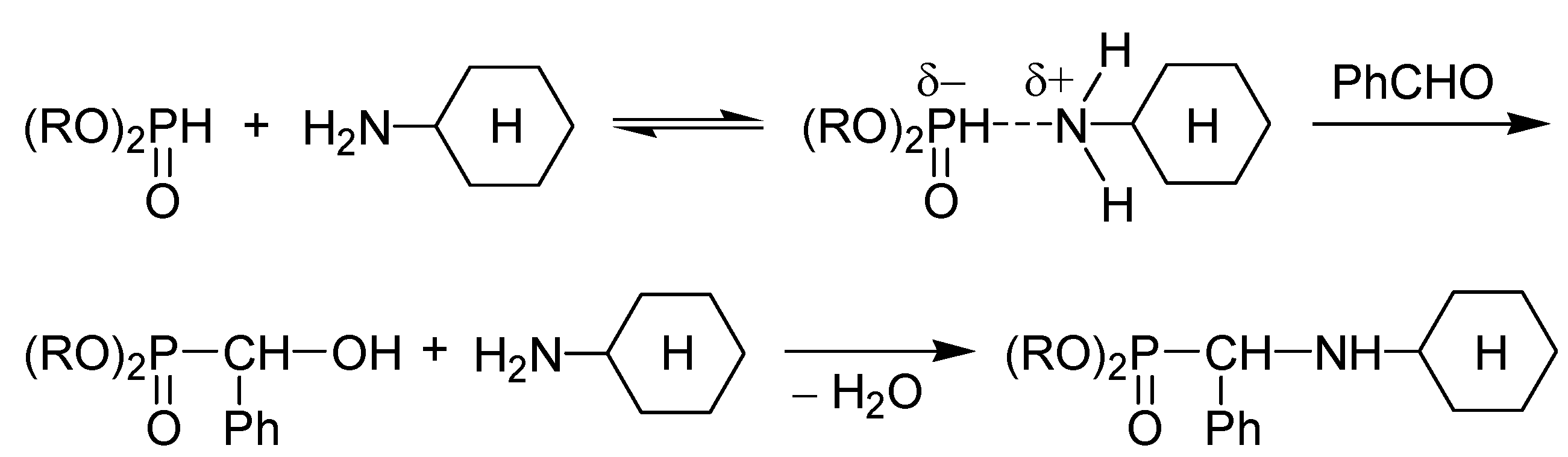
      <p>In another case, Cherkasov <italic>et al</italic>. suggested that the reaction of the more nucleophilic cyclohexyl-amine, benzaldehyde and a dialkyl phosphite takes place via the “hydroxyphosphonate” route. Here again an interaction was substantiated to precede the addition of the dialkylphosphite on the C=O unit of the oxo-compound. According to this, an H-bond is formed between the P(O)<italic>H</italic> moiety of the phosphite and the nitrogen atom of the amine (<xref ref-type="scheme" rid="molecules-17-12821-f005">Scheme 3</xref>) [<xref ref-type="bibr" rid="B15-molecules-17-12821">15</xref>,<xref ref-type="bibr" rid="B17-molecules-17-12821">17</xref>].</p>
      <fig id="molecules-17-12821-f005" position="float">
        <object-id pub-id-type="pii">molecules-17-12821-scheme3_Scheme 3</object-id>
        <label>Scheme 3</label>
        <caption>
          <p>The “α-hydroxyphosphonate” mechanism proposed for a Kabachnik–Fields reaction [<xref ref-type="bibr" rid="B15-molecules-17-12821">15</xref>,<xref ref-type="bibr" rid="B17-molecules-17-12821">17</xref>].</p>
        </caption>
        <graphic xmlns:xlink="http://www.w3.org/1999/xlink" xlink:href="molecules-17-12821-g005.tif"/>
      </fig>
      <p>Later, however, Zefirov and Matveeva proved that the condensation of cyclohexylamine, benzaldehyde and dialkyl phosphite follows the “imine route”, and concluded that there is no real experimental evidence for the hydroxyphosphonate route [<xref ref-type="bibr" rid="B18-molecules-17-12821">18</xref>]. It is also worth mentioning that the reaction of cyclohexylamine, benzaldehyde and dibutylphosphine oxide, that may be regarded as an extended Kabachnik–Fields condensation, was shown to proceed according to the “imine” mechanism [<xref ref-type="bibr" rid="B15-molecules-17-12821">15</xref>,<xref ref-type="bibr" rid="B19-molecules-17-12821">19</xref>]. It seems probable that the actual mechanism is dependent on the components of the reaction, although the “imine” route seems to be more general than the route involving an “α-hydroxy-phosphonate” intermediate [<xref ref-type="bibr" rid="B3-molecules-17-12821">3</xref>]. R. Gancarz and I. Gancarz substantiated that a reversible formation of the α-hydroxyphosphonate may also occur, and if it is rearranged to the corresponding phosphate, this becomes a “dead-end” route [<xref ref-type="bibr" rid="B20-molecules-17-12821">20</xref>]. It can be said that in the Kabachnik–Fields reaction, a soft nucleophile (the dialkyl phosphite) and a hard nucleophile (the amine) compete for the electrophilic carbonyl compound. The softer the carbonyl compound is, the faster it reacts with the softer P-nucleophile and the slower it reacts with the harder amine nucleophile [<xref ref-type="bibr" rid="B21-molecules-17-12821">21</xref>].</p>
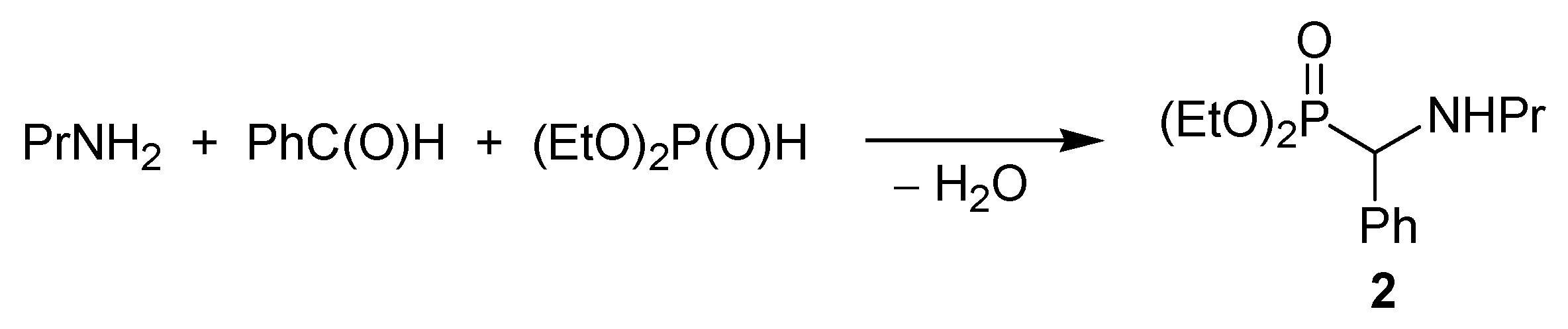
      <p>We wished to investigate the phospha-Mannich condensation of <italic>n</italic>-propylamine, benzaldehyde and diethyl phosphite (<xref ref-type="scheme" rid="molecules-17-12821-f006">Scheme 4</xref>) by following the reaction utilizing <italic>in situ</italic> Fourier transform (FT) Infra Red (IR) spectroscopy [<xref ref-type="bibr" rid="B22-molecules-17-12821">22</xref>].</p>
      <fig id="molecules-17-12821-f006" position="float">
        <object-id pub-id-type="pii">molecules-17-12821-scheme4_Scheme 4</object-id>
        <label>Scheme 4</label>
        <caption>
          <p>The Kabachnik–Fields reaction studied by us.</p>
        </caption>
        <graphic xmlns:xlink="http://www.w3.org/1999/xlink" xlink:href="molecules-17-12821-g006.tif"/>
      </fig>
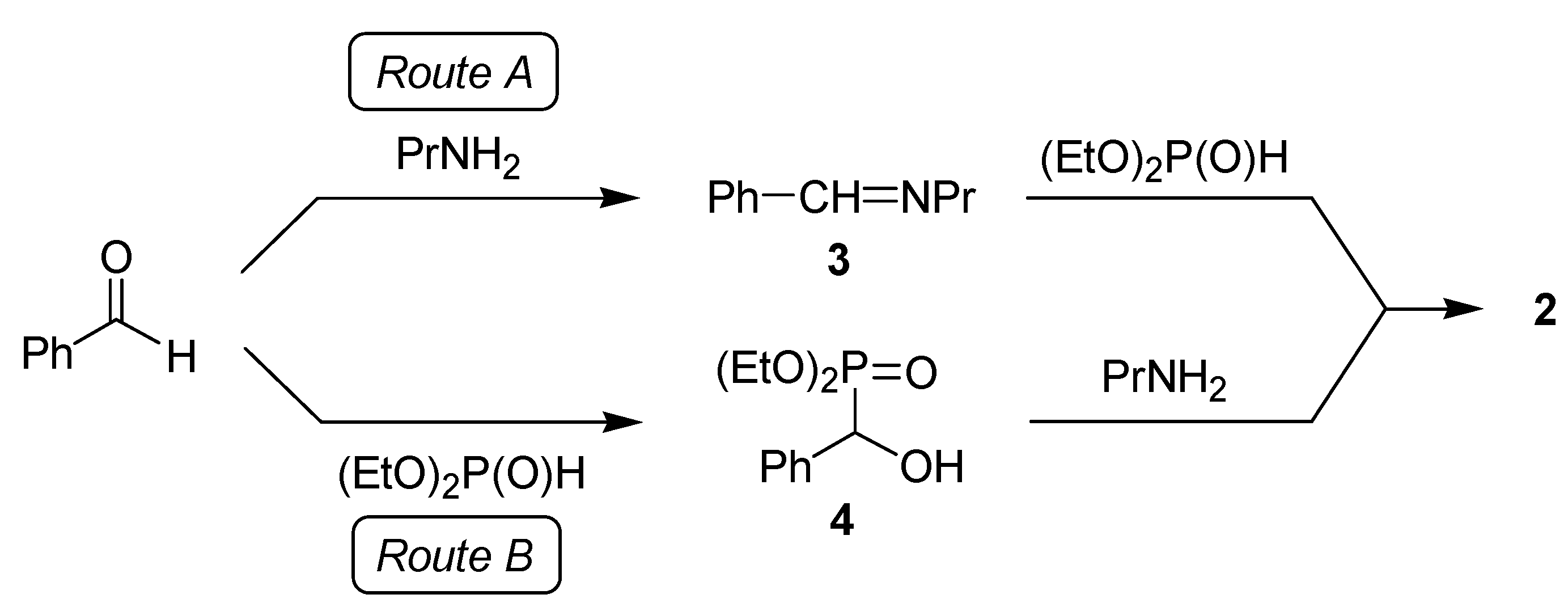
      <p>The possible reaction paths are shown in <xref ref-type="scheme" rid="molecules-17-12821-f007">Scheme 5</xref>. The question was whether the imine <bold>3</bold> or the α-hydroxyphosphonate <bold>4</bold> is the intermediate during the formation of the corresponding α-aminophosphonate <bold>2</bold>.</p>
      <fig id="molecules-17-12821-f007" position="float">
        <object-id pub-id-type="pii">molecules-17-12821-scheme5_Scheme 5</object-id>
        <label>Scheme 5</label>
        <caption>
          <p>Possible routes for the Kabachnik–Fields reaction studied by us.</p>
        </caption>
        <graphic xmlns:xlink="http://www.w3.org/1999/xlink" xlink:href="molecules-17-12821-g007.tif"/>
      </fig>
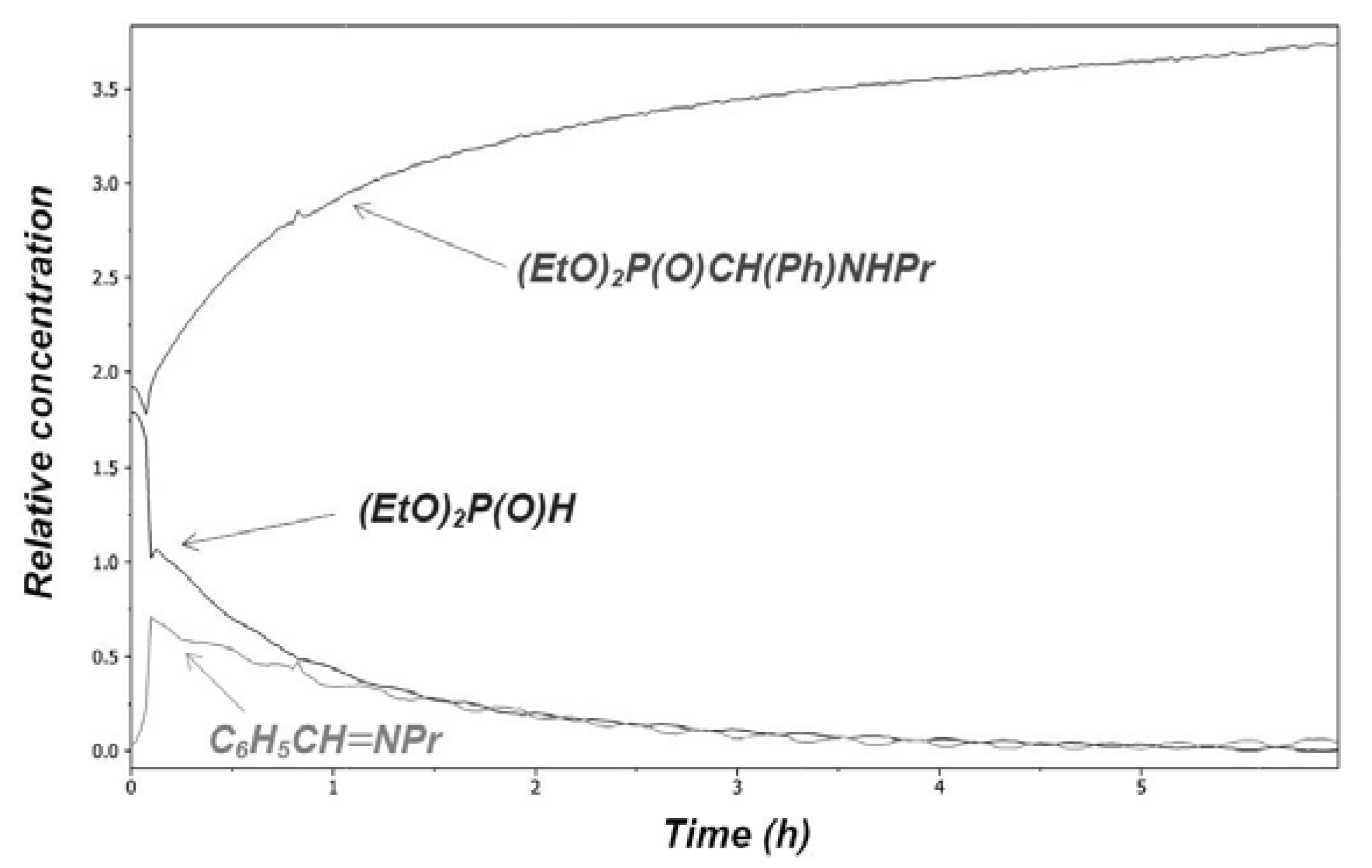
      <p>The reaction carried out at 80 °C in acetonitrile was monitored by registering a 3D IR diagram. On the basis of the characteristic ν<sub>C=N</sub> stretching vibration at 1,648 cm<sup>–1</sup>, the imine <bold>3</bold> could be observed as a transient species. It was possible to obtain a relative concentration—time diagram for the components (<xref ref-type="fig" rid="molecules-17-12821-f001">Figure 1</xref>) by deconvolution of the 3D IR diagram. It can be seen that the imine intermediate <bold>3</bold> reaches its maximum concentration after a 10 min reaction time [<xref ref-type="bibr" rid="B22-molecules-17-12821">22</xref>].</p>
      <fig id="molecules-17-12821-f001" position="float">
        <label>Figure 1</label>
        <caption>
          <p>Concentration profile for the Kabachnik–Fields reaction studied at 80 °C in acetonitrile.</p>
        </caption>
        <graphic xmlns:xlink="http://www.w3.org/1999/xlink" xlink:href="molecules-17-12821-g001.tif"/>
      </fig>
      <p>It was shown above that there was also controversy over the mechanism of the Kabachnik–Fields condensation of cyclohexylamine, benzaldehyde and dialkyl phosphites (<xref ref-type="scheme" rid="molecules-17-12821-f008">Scheme 6</xref>) [<xref ref-type="bibr" rid="B15-molecules-17-12821">15</xref>,<xref ref-type="bibr" rid="B17-molecules-17-12821">17</xref>,<xref ref-type="bibr" rid="B18-molecules-17-12821">18</xref>]. We sought to clarify the situation by <italic>in situ</italic> FT IR spectroscopy [<xref ref-type="bibr" rid="B23-molecules-17-12821">23</xref>].</p>
      <fig id="molecules-17-12821-f008" position="float">
        <object-id pub-id-type="pii">molecules-17-12821-scheme6_Scheme 6</object-id>
        <label>Scheme 6</label>
        <caption>
          <p>Another Kabachnik–Fields reaction investigated by us.</p>
        </caption>
        <graphic xmlns:xlink="http://www.w3.org/1999/xlink" xlink:href="molecules-17-12821-g008.tif"/>
      </fig>
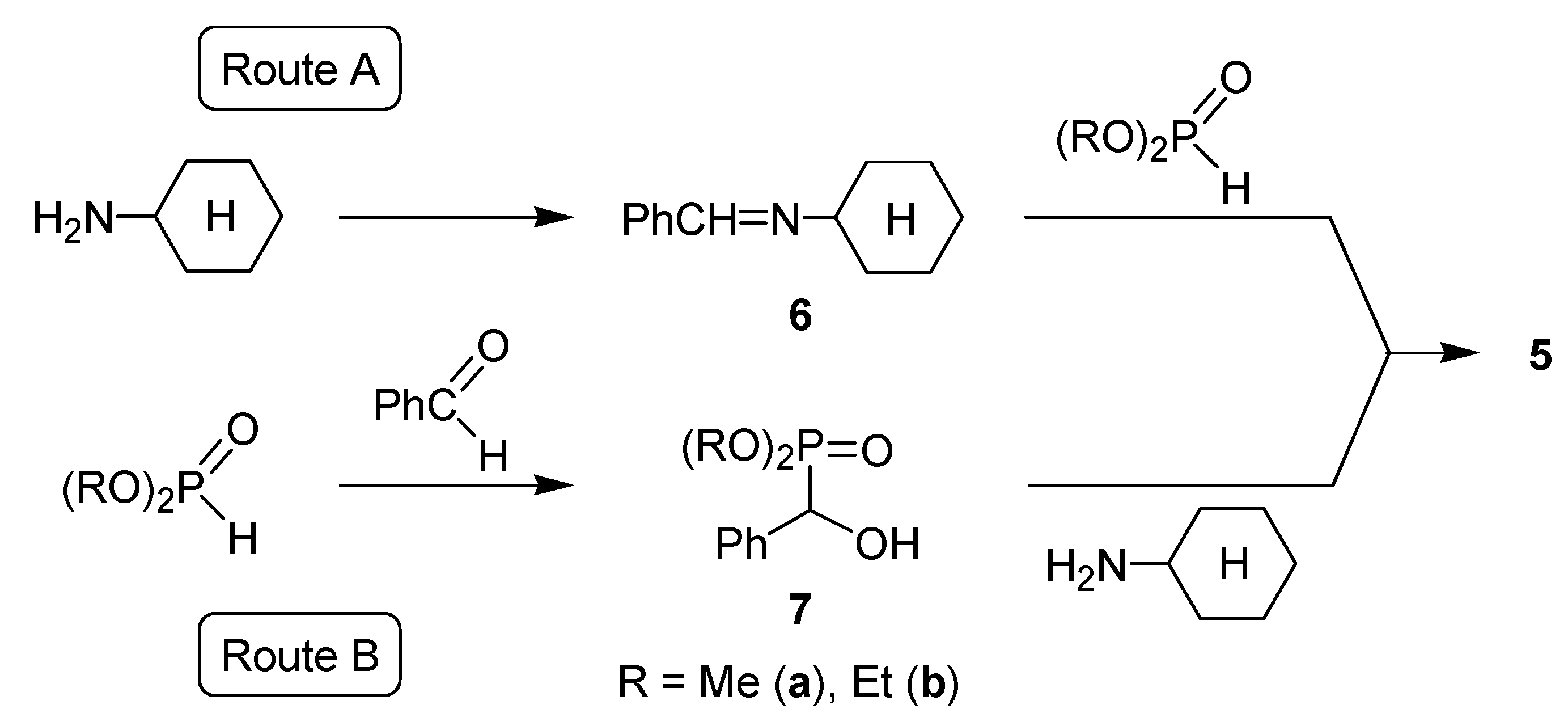
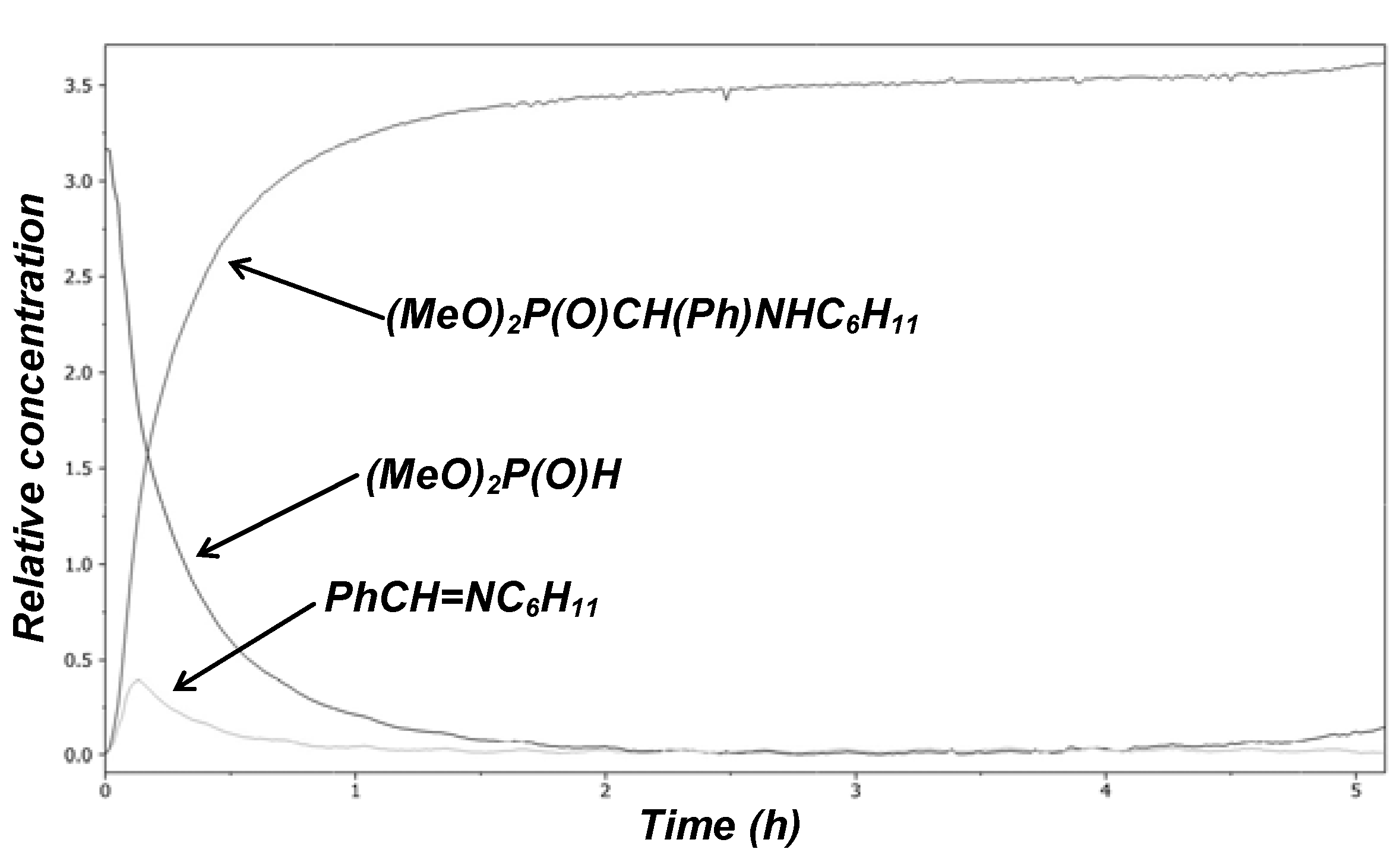
      <p>From among the two possible intermediates <bold>6</bold> and <bold>7</bold>, again the imine <bold>6a</bold> could be detected on the basis of the ν<sub>C=N</sub> = 1,644 cm<sup>–1</sup> absorption as the transient species for α-aminophosphonate <bold>5a</bold> (<xref ref-type="scheme" rid="molecules-17-12821-f009">Scheme 7</xref>). The intermediacy of imine <bold>6</bold> can be seen in <xref ref-type="fig" rid="molecules-17-12821-f002">Figure 2</xref>.</p>
      <fig id="molecules-17-12821-f009" position="float">
        <object-id pub-id-type="pii">molecules-17-12821-scheme7_Scheme 7</object-id>
        <label>Scheme 7</label>
        <caption>
          <p>Possible pathways for the second model investigated. </p>
        </caption>
        <graphic xmlns:xlink="http://www.w3.org/1999/xlink" xlink:href="molecules-17-12821-g009.tif"/>
      </fig>
      <fig id="molecules-17-12821-f002" position="float">
        <label>Figure 2</label>
        <caption>
          <p>Concentration profile for the Kabachnik–Fields reaction studied at 80 °C in acetonitrile.</p>
        </caption>
        <graphic xmlns:xlink="http://www.w3.org/1999/xlink" xlink:href="molecules-17-12821-g002.tif"/>
      </fig>
      <p>Relative energies for the possible intermediates <bold>6</bold> and <bold>7</bold> and for α-aminophosphonate <bold>5</bold> were calculated by the B3LYP/6-31G** method and then refined by the the B3LYP/6-311G**<sup>++</sup>method provided that dimethyl phosphite is the reactant. It can be seen from <xref ref-type="table" rid="molecules-17-12821-t001">Table 1</xref> that the formation of the imine <bold>6</bold> goes with significantly lower energy gain than that of the α-hydroxyphosphonate <bold>7</bold>. On the one hand, the imine <bold>6</bold> would like to be stabilized further by reaction with the dimethyl phosphite on way to the α-aminophosphonate <bold>5</bold>. On the other hand, the hydroxyphosphonate <bold>7</bold> is too stable to react further to the aminophosphonate <bold>5</bold>. The conversion of <bold>7</bold> to <bold>5</bold> represents only a slight energy gain of 2.4 kJ/mol. In other words, there is no significant driving force for the substitution [<xref ref-type="bibr" rid="B23-molecules-17-12821">23</xref>].</p>
      <table-wrap id="molecules-17-12821-t001" position="float">
        <object-id pub-id-type="pii">molecules-17-12821-t001_Table 1</object-id>
        <label>Table 1</label>
        <caption>
          <p>Relative energies for the four states calculated.</p>
        </caption>
        <table>
          <thead>
            <tr>
              <th align="left" valign="middle">Species</th>
              <th align="center" valign="middle">Relative energy (kJ/mol)</th>
            </tr>
          </thead>
          <tbody>
            <tr>
              <td align="left" valign="middle">Reactants (benzaldehyde, cyclohexylamine and dimethyl phosphite)</td>
              <td align="center" valign="middle">0.0</td>
            </tr>
            <tr>
              <td align="left" valign="middle">Imine intermediate <bold>6</bold></td>
              <td align="center" valign="middle">–18.6</td>
            </tr>
            <tr>
              <td align="left" valign="middle">α-Hydroxyphosphonate intermediate <bold>7</bold></td>
              <td align="center" valign="middle">–40.5</td>
            </tr>
            <tr>
              <td align="left" valign="middle">Product <bold>5</bold></td>
              <td align="center" valign="middle">–42.9</td>
            </tr>
          </tbody>
        </table>
      </table-wrap>
    </sec>
    <sec>
      <title>3. Microwave-Assisted Solvent- and Catalyst-Free Approach for the Synthesis of α-Amino-phosphonates and Related Derivatives</title>
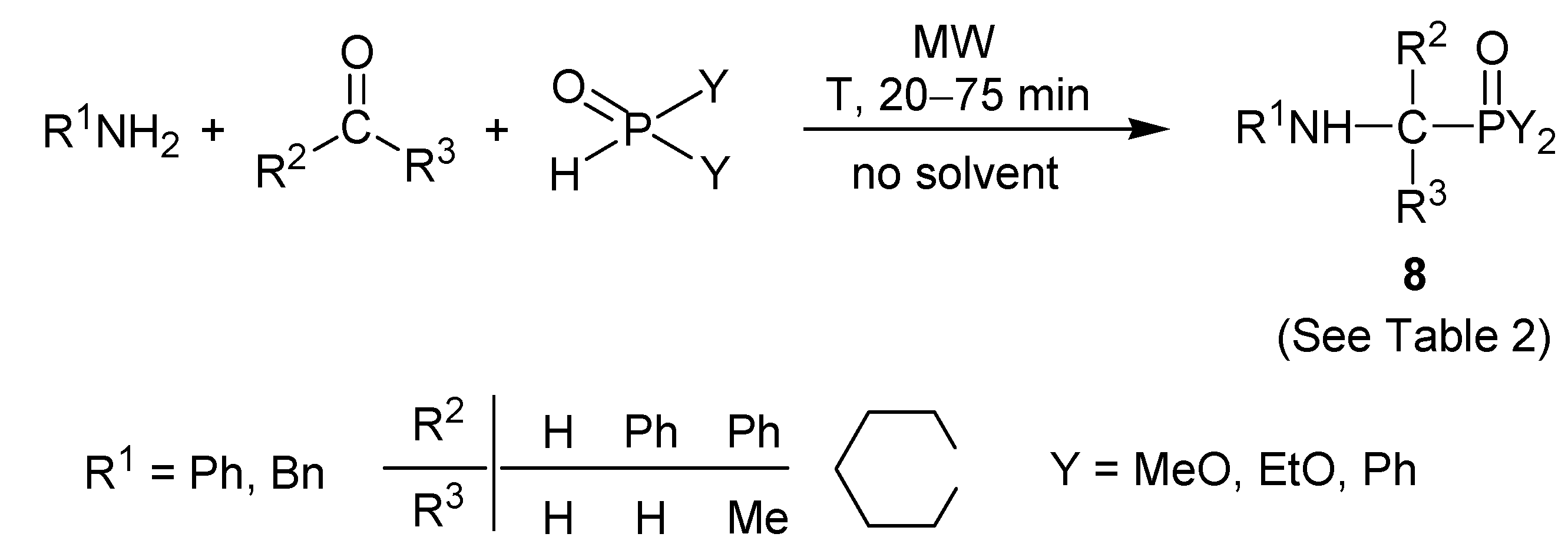
      <p>Although a lot of catalytic variations to carry out three-component Kabachnik–Fields condensations have been described, we found that the most straightforward synthesis is when the reactants are irradiated with microwave (MW) in the absence of any catalyst or solvent. The solventless and MW-assisted approach was useful in the synthesis of a few α-aminomethylphosphonates [<xref ref-type="bibr" rid="B24-molecules-17-12821">24</xref>]. We used aniline or benzylamine as the amine, formaldehyde, benzaldehyde, acetophenone and cyclohexanone as the oxo-component and dialkyl phosphites and diphenylphosphine oxide as the &gt;P(O)H reactant. The α-aminophosphonates and α-aminophosphine oxide products are represented by structure <bold>8</bold> in general <xref ref-type="scheme" rid="molecules-17-12821-f010">Scheme 8</xref> [<xref ref-type="bibr" rid="B25-molecules-17-12821">25</xref>]. The detailed results are listed in <xref ref-type="table" rid="molecules-17-12821-t002">Table 2</xref>. The comparative results of the catalytic versions were also included. A detailed account on the conditions of the catalytic reactions is provided in <xref ref-type="table" rid="molecules-17-12821-t003">Table 3</xref>. In a part of the cases, such as in the example covered by reference [<xref ref-type="bibr" rid="B26-molecules-17-12821">26</xref>], the catalytic versions could already be carried out at room temperature.</p>
      <fig id="molecules-17-12821-f010" position="float">
        <object-id pub-id-type="pii">molecules-17-12821-scheme8_Scheme 8</object-id>
        <label>Scheme 8</label>
        <caption>
          <p>General scheme for the solventless, catalyst-free MW-assisted Kabachnik–Fields reactions studied.</p>
        </caption>
        <graphic xmlns:xlink="http://www.w3.org/1999/xlink" xlink:href="molecules-17-12821-g010.tif"/>
      </fig>
	  <table-wrap id="molecules-17-12821-t002" position="float">
        <object-id pub-id-type="pii">molecules-17-12821-t002_Table 2</object-id>
        <label>Table 2</label>
        <caption>
          <p>Kabachnik–Fields reactions carried out without the use of a solvent and a catalyst under MW irradiation [<xref ref-type="bibr" rid="B25-molecules-17-12821">25</xref>].</p>
        </caption>
        <table>
          <thead>
            <tr>
              <th align="center" valign="top">Entry</th>
              <th align="center" valign="top">R<sup>1</sup></th>
              <th align="center" valign="top">R<sup>2</sup></th>
              <th align="center" valign="top">R<sup>3</sup></th>
              <th align="center" valign="top">Y</th>
              <th align="center" valign="top">Product</th>
              <th align="center" valign="top">T (°C)</th>
              <th align="center" valign="top">Yield (%)</th>
              <th align="center" valign="top">Yield (%) of catalytic methods [ref.] <sup>†</sup></th>
            </tr>
          </thead>
          <tbody>
            <tr>
              <td align="center" valign="top">1</td>
              <td align="center" valign="top">Ph</td>
              <td align="center" valign="top">H</td>
              <td align="center" valign="top">H</td>
              <td align="center" valign="top">EtO</td>
              <td align="center" valign="top">
                <bold>8a</bold>
              </td>
              <td align="center" valign="top">80 <sup>a</sup></td>
              <td align="center" valign="top">91</td>
              <td align="center" valign="top"> </td>
            </tr>
            <tr>
              <td align="center" valign="top"> </td>
              <td align="center" valign="top"> </td>
              <td align="center" valign="top"> </td>
              <td align="center" valign="top"> </td>
              <td align="center" valign="top"> </td>
              <td align="center" valign="top">
                <bold> </bold>
              </td>
              <td align="center" valign="top">100 <sup>b</sup></td>
              <td align="center" valign="top"> </td>
              <td align="center" valign="top"> </td>
            </tr>
            <tr>
              <td align="center" valign="top">2</td>
              <td align="center" valign="top">Ph</td>
              <td align="center" valign="top">H</td>
              <td align="center" valign="top">H</td>
              <td align="center" valign="top">MeO</td>
              <td align="center" valign="top">
                <bold>8b</bold>
              </td>
              <td align="center" valign="top">80 <sup>a</sup></td>
              <td align="center" valign="top">80</td>
              <td align="center" valign="top"> </td>
            </tr>
             <tr>
              <td align="center" valign="top"> </td>
              <td align="center" valign="top"> </td>
              <td align="center" valign="top"> </td>
              <td align="center" valign="top"> </td>
              <td align="center" valign="top"> </td>
              <td align="center" valign="top"> </td>
              <td align="center" valign="top">80 <sup>b</sup></td>
              <td align="center" valign="top"> </td>
              <td align="center" valign="top"> </td>
            </tr>
            <tr>
              <td align="center" valign="top">3</td>
              <td align="center" valign="top">Ph</td>
              <td align="center" valign="top">H</td>
              <td align="center" valign="top">H</td>
              <td align="center" valign="top">Ph</td>
              <td align="center" valign="top">
                <bold>8c</bold>
              </td>
              <td align="center" valign="top">80</td>
              <td align="center" valign="top">94</td>
              <td align="center" valign="top"> </td>
            </tr>
            <tr>
              <td align="center" valign="top">4</td>
              <td align="center" valign="top">Bn</td>
              <td align="center" valign="top">H</td>
              <td align="center" valign="top">H</td>
              <td align="center" valign="top">EtO</td>
              <td align="center" valign="top">
                <bold>8d</bold>
              </td>
              <td align="center" valign="top">100</td>
              <td align="center" valign="top">81</td>
              <td align="center" valign="top"> </td>
            </tr>
            <tr>
              <td align="center" valign="top">5</td>
              <td align="center" valign="top">Bn</td>
              <td align="center" valign="top">H</td>
              <td align="center" valign="top">H</td>
              <td align="center" valign="top">Ph</td>
              <td align="center" valign="top">
                <bold>8e</bold>
              </td>
              <td align="center" valign="top">80</td>
              <td align="center" valign="top">88</td>
              <td align="center" valign="top"> </td>
            </tr>
            <tr>
              <td align="center" valign="top">6</td>
              <td align="center" valign="top">Ph</td>
              <td align="center" valign="top">H</td>
              <td align="center" valign="top">Ph</td>
              <td align="center" valign="top">EtO</td>
              <td align="center" valign="top">
                <bold>8f</bold>
              </td>
              <td align="center" valign="top">100</td>
              <td align="center" valign="top">93</td>
              <td align="center" valign="top">98 [<xref ref-type="bibr" rid="B27-molecules-17-12821">27</xref>], 85 [<xref ref-type="bibr" rid="B28-molecules-17-12821">28</xref>], ~95 [<xref ref-type="bibr" rid="B29-molecules-17-12821">29</xref>], 88 [<xref ref-type="bibr" rid="B30-molecules-17-12821">30</xref>], 79 [<xref ref-type="bibr" rid="B31-molecules-17-12821">31</xref>], 93 [<xref ref-type="bibr" rid="B32-molecules-17-12821">32</xref>], 92 [<xref ref-type="bibr" rid="B33-molecules-17-12821">33</xref>], ~90 [<xref ref-type="bibr" rid="B34-molecules-17-12821">34</xref>], 96 [<xref ref-type="bibr" rid="B35-molecules-17-12821">35</xref>], 60 [<xref ref-type="bibr" rid="B36-molecules-17-12821">36</xref>], 86 [<xref ref-type="bibr" rid="B37-molecules-17-12821">37</xref>], 92 [<xref ref-type="bibr" rid="B38-molecules-17-12821">38</xref>]</td>
            </tr>
            <tr>
              <td align="center" valign="top">7</td>
              <td align="center" valign="top">Ph</td>
              <td align="center" valign="top">H</td>
              <td align="center" valign="top">Ph</td>
              <td align="center" valign="top">MeO</td>
              <td align="center" valign="top">
                <bold>8g</bold>
              </td>
              <td align="center" valign="top">100</td>
              <td align="center" valign="top">86</td>
              <td align="center" valign="top">98 [<xref ref-type="bibr" rid="B24-molecules-17-12821">24</xref>], 98 [<xref ref-type="bibr" rid="B27-molecules-17-12821">27</xref>], 92 [<xref ref-type="bibr" rid="B33-molecules-17-12821">33</xref>]</td>
            </tr>
            <tr>
              <td align="center" valign="top">8</td>
              <td align="center" valign="top">Ph</td>
              <td align="center" valign="top">H</td>
              <td align="center" valign="top">Ph</td>
              <td align="center" valign="top">Ph</td>
              <td align="center" valign="top">
                <bold>8h</bold>
              </td>
              <td align="center" valign="top">80</td>
              <td align="center" valign="top">87</td>
              <td align="center" valign="top"> </td>
            </tr>
            <tr>
              <td align="center" valign="top">9</td>
              <td align="center" valign="top">Bn</td>
              <td align="center" valign="top">H</td>
              <td align="center" valign="top">Ph</td>
              <td align="center" valign="top">EtO</td>
              <td align="center" valign="top">
                <bold>8i</bold>
              </td>
              <td align="center" valign="top">100</td>
              <td align="center" valign="top">83</td>
              <td align="center" valign="top">99 [<xref ref-type="bibr" rid="B28-molecules-17-12821">28</xref>], 84 [<xref ref-type="bibr" rid="B29-molecules-17-12821">29</xref>], 92 [<xref ref-type="bibr" rid="B30-molecules-17-12821">30</xref>], 85 [<xref ref-type="bibr" rid="B31-molecules-17-12821">31</xref>], 91 [<xref ref-type="bibr" rid="B32-molecules-17-12821">32</xref>], 91 [<xref ref-type="bibr" rid="B33-molecules-17-12821">33</xref>], 92 [<xref ref-type="bibr" rid="B35-molecules-17-12821">35</xref>], 92 [<xref ref-type="bibr" rid="B36-molecules-17-12821">36</xref>], 93 [<xref ref-type="bibr" rid="B38-molecules-17-12821">38</xref>]</td>
            </tr>
            <tr>
              <td align="center" valign="top">10</td>
              <td align="center" valign="top">Bn</td>
              <td align="center" valign="top">H</td>
              <td align="center" valign="top">Ph</td>
              <td align="center" valign="top">MeO</td>
              <td align="center" valign="top">
                <bold>8j</bold>
              </td>
              <td align="center" valign="top">100</td>
              <td align="center" valign="top">87</td>
              <td align="center" valign="top">95 [<xref ref-type="bibr" rid="B27-molecules-17-12821">27</xref>], 82 [<xref ref-type="bibr" rid="B33-molecules-17-12821">33</xref>]</td>
            </tr>
            <tr>
              <td align="center" valign="top">11</td>
              <td align="center" valign="top">Ph</td>
              <td align="center" valign="top">Me</td>
              <td align="center" valign="top">Ph</td>
              <td align="center" valign="top">EtO</td>
              <td align="center" valign="top">
                <bold>8k</bold>
              </td>
              <td align="center" valign="top">120</td>
              <td align="center" valign="top">80</td>
              <td align="center" valign="top">75 [<xref ref-type="bibr" rid="B27-molecules-17-12821">27</xref>], 74 [<xref ref-type="bibr" rid="B30-molecules-17-12821">30</xref>], 63 [<xref ref-type="bibr" rid="B35-molecules-17-12821">35</xref>], 18 [<xref ref-type="bibr" rid="B36-molecules-17-12821">36</xref>]</td>
            </tr>
            <tr>
              <td align="center" valign="top">12</td>
              <td align="center" valign="top">Bn</td>
              <td align="center" valign="top">Me</td>
              <td align="center" valign="top">Ph</td>
              <td align="center" valign="top">EtO</td>
              <td align="center" valign="top">
                <bold>8l</bold>
              </td>
              <td align="center" valign="top">120</td>
              <td align="center" valign="top">84</td>
              <td align="center" valign="top">92 [<xref ref-type="bibr" rid="B26-molecules-17-12821">26</xref>], 80 [<xref ref-type="bibr" rid="B27-molecules-17-12821">27</xref>], 81 [<xref ref-type="bibr" rid="B38-molecules-17-12821">38</xref>]</td>
            </tr>
            <tr>
              <td align="center" valign="top">13</td>
              <td align="center" valign="top">Bn</td>
              <td align="center" valign="top">Me</td>
              <td align="center" valign="top">Ph</td>
              <td align="center" valign="top">Ph</td>
              <td align="center" valign="top">
                <bold>8m</bold>
              </td>
              <td align="center" valign="top">100 <sup>a</sup></td>
              <td align="center" valign="top">80</td>
              <td align="center" valign="top"> </td>
            </tr>
            <tr>
              <td align="center" valign="top"> </td>
              <td align="center" valign="top"> </td>
              <td align="center" valign="top"> </td>
              <td align="center" valign="top"> </td>
              <td align="center" valign="top"> </td>
              <td align="center" valign="top"> </td>
              <td align="center" valign="top">120 <sup>b</sup></td>
              <td align="center" valign="top">80</td>
              <td align="center" valign="top"> </td>
            </tr>
            <tr>
              <td align="center" valign="top">14</td>
              <td align="center" valign="top">Ph</td>
              <td align="center" valign="top"><inline-graphic xmlns:xlink="http://www.w3.org/1999/xlink" xlink:href="molecules-17-12821-i001.tif"/></td>
              <td align="center" valign="top"> </td>
              <td align="center" valign="top">EtO</td>
              <td align="center" valign="top">
                <bold>8n</bold>
              </td>
              <td align="center" valign="top">120</td>
              <td align="center" valign="top">81</td>
              <td align="center" valign="top">92 [<xref ref-type="bibr" rid="B27-molecules-17-12821">27</xref>], ~72 [<xref ref-type="bibr" rid="B29-molecules-17-12821">29</xref>], 86 [<xref ref-type="bibr" rid="B30-molecules-17-12821">30</xref>], 47 [<xref ref-type="bibr" rid="B31-molecules-17-12821">31</xref>], 87 [<xref ref-type="bibr" rid="B37-molecules-17-12821">37</xref>]</td>
            </tr>
            <tr>
              <td align="center" valign="top">15</td>
              <td align="center" valign="top">Bn</td>
              <td align="center" valign="top"><inline-graphic xmlns:xlink="http://www.w3.org/1999/xlink" xlink:href="molecules-17-12821-i001.tif"/></td>
              <td align="center" valign="top"> </td>
              <td align="center" valign="top">EtO</td>
              <td align="center" valign="top">
                <bold>8o</bold>
              </td>
              <td align="center" valign="top">120</td>
              <td align="center" valign="top">91</td>
              <td align="center" valign="top">85 [<xref ref-type="bibr" rid="B26-molecules-17-12821">26</xref>], 90 [<xref ref-type="bibr" rid="B27-molecules-17-12821">27</xref>], 83 [<xref ref-type="bibr" rid="B31-molecules-17-12821">31</xref>], 80 [<xref ref-type="bibr" rid="B33-molecules-17-12821">33</xref>], 85 [<xref ref-type="bibr" rid="B38-molecules-17-12821">38</xref>]</td>
            </tr>
            <tr>
              <td align="center" valign="top">16</td>
              <td align="center" valign="top">Bn</td>
              <td align="center" valign="top"><inline-graphic xmlns:xlink="http://www.w3.org/1999/xlink" xlink:href="molecules-17-12821-i001.tif"/></td>
              <td align="center" valign="top"> </td>
              <td align="center" valign="top">MeO</td>
              <td align="center" valign="top">
                <bold>8p</bold>
              </td>
              <td align="center" valign="top">120</td>
              <td align="center" valign="top">85</td>
              <td align="center" valign="top">92 [<xref ref-type="bibr" rid="B27-molecules-17-12821">27</xref>]</td>
            </tr>
            <tr>
              <td align="center" valign="top">17</td>
              <td align="center" valign="top">Bn</td>
              <td align="center" valign="top"><inline-graphic xmlns:xlink="http://www.w3.org/1999/xlink" xlink:href="molecules-17-12821-i001.tif"/></td>
              <td align="center" valign="top"> </td>
              <td align="center" valign="top">Ph</td>
              <td align="center" valign="top">
                <bold>8q</bold>
              </td>
              <td align="center" valign="top">100 <sup>a</sup></td>
              <td align="center" valign="top">80</td>
              <td align="center" valign="top"> </td>
            </tr>
          <tr>
              <td align="center" valign="top"> </td>
              <td align="center" valign="top"> </td>
              <td align="center" valign="top"> </td>
              <td align="center" valign="top"> </td>
              <td align="center" valign="top"> </td>
              <td align="center" valign="top"> </td>
              <td align="center" valign="top">120 <sup>b</sup></td>
              <td align="center" valign="top"> </td>
              <td align="center" valign="top"> </td>
            </tr>
          </tbody>
        </table>

		<table-wrap-foot><fn><p><sup>†</sup> for details see <xref ref-type="table" rid="molecules-17-12821-t003">Table 3</xref>; <sup>a</sup> condensation of the oxo-component and the amine; <sup>b</sup> addition of the &gt;P(O)H species to the Schiff-base.</p></fn></table-wrap-foot>
      </table-wrap>
      <table-wrap id="molecules-17-12821-t003" position="float">
        <object-id pub-id-type="pii">molecules-17-12821-t003_Table 3</object-id>
        <label>Table 3</label>
        <caption>
          <p>Kabachnik–Fields reactions carried out in the presence of catalysts.</p>
        </caption>
        <table>
          <thead>
            <tr>
              <th align="center" valign="middle">Catalyst</th>
              <th align="center" valign="middle">Solvent</th>
              <th align="center" valign="middle">MW/Δ</th>
              <th align="center" valign="middle">T [°C]</th>
              <th align="center" valign="middle">t</th>
              <th align="center" valign="middle">Yield (Product) [%]</th>
              <th align="center" valign="middle">Ref.</th>
            </tr>
          </thead>
          <tbody>
            <tr>
              <td align="center" valign="middle">Phthalocyanine-AlCl</td>
              <td align="center" valign="middle">CH<sub>2</sub>Cl<sub>2</sub></td>
              <td align="center" valign="middle">–</td>
              <td align="center" valign="middle">26 <sup>a</sup></td>
              <td align="center" valign="middle">12 h</td>
              <td align="center" valign="middle">92 (<bold>8b</bold>), 85 (<bold>8p</bold>)</td>
              <td align="center" valign="middle">[<xref ref-type="bibr" rid="B26-molecules-17-12821">26</xref>]</td>
            </tr>
            <tr>
              <td align="center" valign="middle">Mg(ClO<sub>4</sub>)<sub>2</sub></td>
              <td align="center" valign="middle">–</td>
              <td align="center" valign="middle">–</td>
              <td align="center" valign="middle">26</td>
              <td align="center" valign="middle">2 min/8 h</td>
              <td align="center" valign="middle">90–98 ( <bold>8f</bold>, <bold>8g</bold>, <bold>8j</bold>, <bold>8n-p</bold>)</td>
              <td align="center" valign="middle">[<xref ref-type="bibr" rid="B27-molecules-17-12821">27</xref>]</td>
            </tr>
            <tr>
              <td align="center" valign="middle">Mg(ClO<sub>4</sub>)<sub>2</sub></td>
              <td align="center" valign="middle">–</td>
              <td align="center" valign="middle">Δ</td>
              <td align="center" valign="middle">50-80</td>
              <td align="center" valign="middle">45 min–12 h</td>
              <td align="center" valign="middle">80–99 (<bold>8f</bold>, <bold>8i</bold>, <bold>8l</bold>,<bold>8n-p</bold>)</td>
              <td align="center" valign="middle">[<xref ref-type="bibr" rid="B27-molecules-17-12821">27</xref>,<xref ref-type="bibr" rid="B28-molecules-17-12821">28</xref>]</td>
            </tr>
            <tr>
              <td align="center" valign="middle">Mg(ClO<sub>4</sub>)<sub>2</sub></td>
              <td align="center" valign="middle">EtOH</td>
              <td align="center" valign="middle">Δ</td>
              <td align="center" valign="middle">50</td>
              <td align="center" valign="middle">5 h/12 h</td>
              <td align="center" valign="middle">85 (<bold>8f</bold>), 99 (<bold>8i</bold>)</td>
              <td align="center" valign="middle">[<xref ref-type="bibr" rid="B28-molecules-17-12821">28</xref>]</td>
            </tr>
            <tr>
              <td align="center" valign="middle">M(OTf)<sub>n</sub> M = Li, Mg, Al, Cu, Ce</td>
              <td align="center" valign="middle">–</td>
              <td align="center" valign="middle">Δ</td>
              <td align="center" valign="middle">80</td>
              <td align="center" valign="middle">20 min–3.5 h</td>
              <td align="center" valign="middle">72–95 (<bold>8f</bold>, <bold>8i</bold>, <bold>8n</bold>)</td>
              <td align="center" valign="middle">[<xref ref-type="bibr" rid="B29-molecules-17-12821">29</xref>]</td>
            </tr>
            <tr>
              <td align="center" valign="middle">GaI<sub>3</sub></td>
              <td align="center" valign="middle">CH<sub>2</sub>Cl<sub>2</sub></td>
              <td align="center" valign="middle">–</td>
              <td align="center" valign="middle">26</td>
              <td align="center" valign="middle">3–6 h</td>
              <td align="center" valign="middle">74–92 (<bold>8f</bold>, <bold>8i</bold>, <bold>8k</bold>, <bold>8n</bold>)</td>
              <td align="center" valign="middle">[<xref ref-type="bibr" rid="B30-molecules-17-12821">30</xref>]</td>
            </tr>
            <tr>
              <td align="center" valign="middle">In(OTf)<sub>3</sub></td>
              <td align="center" valign="middle">THF</td>
              <td align="center" valign="middle">Δ</td>
              <td align="center" valign="middle">66</td>
              <td align="center" valign="middle">21–35 h</td>
              <td align="center" valign="middle">47–85 (<bold>8f</bold>, <bold>8i</bold>, <bold>8n</bold>, <bold>8o</bold>)</td>
              <td align="center" valign="middle">[<xref ref-type="bibr" rid="B31-molecules-17-12821">31</xref>]</td>
            </tr>
            <tr>
              <td align="center" valign="middle">BiNO<sub>3</sub></td>
              <td align="center" valign="middle">–</td>
              <td align="center" valign="middle">– <sup>b</sup></td>
              <td align="center" valign="middle">26</td>
              <td align="center" valign="middle">10 h</td>
              <td align="center" valign="middle">93 (<bold>8f</bold>), 91 (<bold>8i</bold>)</td>
              <td align="center" valign="middle">[<xref ref-type="bibr" rid="B32-molecules-17-12821">32</xref>]</td>
            </tr>
            <tr>
              <td align="center" valign="middle">BiCl<sub>3</sub></td>
              <td align="center" valign="middle">MeCN</td>
              <td align="center" valign="middle">Δ</td>
              <td align="center" valign="middle">80</td>
              <td align="center" valign="middle">6–15 h</td>
              <td align="center" valign="middle">80–92 (<bold>8f</bold>, <bold>8g</bold>, <bold>8i</bold>, <bold>8j</bold>, <bold>8o</bold>)</td>
              <td align="center" valign="middle">[<xref ref-type="bibr" rid="B33-molecules-17-12821">33</xref>]</td>
            </tr>
            <tr>
              <td align="center" valign="middle">FeCl<sub>3</sub></td>
              <td align="center" valign="middle">EtOH (or solvent free)</td>
              <td align="center" valign="middle">–</td>
              <td align="center" valign="middle">26</td>
              <td align="center" valign="middle"> </td>
              <td align="center" valign="middle">~90 (<bold>8f</bold>)</td>
              <td align="center" valign="middle">[<xref ref-type="bibr" rid="B34-molecules-17-12821">34</xref>]</td>
            </tr>
            <tr>
              <td align="center" valign="middle">YbCl<sub>3</sub></td>
              <td align="center" valign="middle">MeCN</td>
              <td align="center" valign="middle">–</td>
              <td align="center" valign="middle">26</td>
              <td align="center" valign="middle">24 h</td>
              <td align="center" valign="middle">63–96 (<bold>8f</bold>, <bold>8i</bold>, <bold>8k</bold>)</td>
              <td align="center" valign="middle">[<xref ref-type="bibr" rid="B35-molecules-17-12821">35</xref>]</td>
            </tr>
            <tr>
              <td align="center" valign="middle">SmI<sub>2</sub> (+ 4 Å mol sieves)</td>
              <td align="center" valign="middle">MeCN</td>
              <td align="center" valign="middle">Δ</td>
              <td align="center" valign="middle">80</td>
              <td align="center" valign="middle">24 h</td>
              <td align="center" valign="middle">18–92 (<bold>8f</bold>, <bold>8i</bold>, <bold>8k</bold>)</td>
              <td align="center" valign="middle">[<xref ref-type="bibr" rid="B36-molecules-17-12821">36</xref>]</td>
            </tr>
            <tr>
              <td align="center" valign="middle">ceric ammonium nitrate</td>
              <td align="center" valign="middle">MeCN</td>
              <td align="center" valign="middle">–</td>
              <td align="center" valign="middle">26</td>
              <td align="center" valign="middle">3 h</td>
              <td align="center" valign="middle">86 (<bold>8f</bold>), 87 (<bold>8n</bold>)</td>
              <td align="center" valign="middle">[<xref ref-type="bibr" rid="B37-molecules-17-12821">37</xref>]</td>
            </tr>
            <tr>
              <td align="center" valign="middle">InCl<sub>3</sub></td>
              <td align="center" valign="middle">THF</td>
              <td align="center" valign="middle">Δ</td>
              <td align="center" valign="middle">66</td>
              <td align="center" valign="middle">9–12 h</td>
              <td align="center" valign="middle">81–93 (<bold>8f</bold>, <bold>8i</bold>, <bold>8l</bold>, <bold>8o</bold>)</td>
              <td align="center" valign="middle">[<xref ref-type="bibr" rid="B38-molecules-17-12821">38</xref>]</td>
            </tr>
            <tr>
              <td align="center" valign="middle">InCl<sub>3</sub></td>
              <td align="center" valign="middle">DMF</td>
              <td align="center" valign="middle">MW</td>
              <td align="center" valign="middle">no data</td>
              <td align="center" valign="middle">2 min</td>
              <td align="center" valign="middle">82 (<bold>8f</bold>) <sup>c</sup></td>
              <td align="center" valign="middle">[<xref ref-type="bibr" rid="B39-molecules-17-12821">39</xref>]</td>
            </tr>
            <tr>
              <td align="center" valign="middle">InCl<sub>3</sub></td>
              <td align="center" valign="middle">[bmim][PF<sub>6</sub>]</td>
              <td align="center" valign="middle">MW</td>
              <td align="center" valign="middle">no data</td>
              <td align="center" valign="middle">2 min</td>
              <td align="center" valign="middle">91 (<bold>8f</bold>) <sup>c</sup></td>
              <td align="center" valign="middle">[<xref ref-type="bibr" rid="B39-molecules-17-12821">39</xref>]</td>
            </tr>
            <tr>
              <td align="center" valign="middle">Ln(OTf)<sub>3</sub> Ln = Yb, Sc, Dy, Sm</td>
              <td align="center" valign="middle">DMF</td>
              <td align="center" valign="middle">MW</td>
              <td align="center" valign="middle">no data</td>
              <td align="center" valign="middle">2 min</td>
              <td align="center" valign="middle">72 (
              <bold>8f</bold>) <sup>c</sup></td>
              <td align="center" valign="middle">[<xref ref-type="bibr" rid="B39-molecules-17-12821">39</xref>]</td>
            </tr>
            <tr>
              <td align="center" valign="middle">Ln(OTf)<sub>3</sub> Ln = Yb, Sc, Dy, Sm</td>
              <td align="center" valign="middle">[bmim][PF<sub>6</sub>]</td>
              <td align="center" valign="middle">–</td>
              <td align="center" valign="middle">26</td>
              <td align="center" valign="middle">27 h</td>
              <td align="center" valign="middle">92 (<bold>8f</bold>) <sup>c</sup></td>
              <td align="center" valign="middle">[<xref ref-type="bibr" rid="B40-molecules-17-12821">40</xref>]</td>
            </tr>
            <tr>
              <td align="center" valign="middle">Ln(OTf)<sub>3</sub> Ln = Yb, Sc, Dy, Gd</td>
              <td align="center" valign="middle">[bmim][PF<sub>6</sub>]</td>
              <td align="center" valign="middle">MW</td>
              <td align="center" valign="middle">no data</td>
              <td align="center" valign="middle">2 min</td>
              <td align="center" valign="middle">89 (<bold>8f</bold>) <sup>c</sup></td>
              <td align="center" valign="middle">[<xref ref-type="bibr" rid="B39-molecules-17-12821">39</xref>]</td>
            </tr>
            <tr>
              <td align="center" valign="middle">the solvent acts as catalyst</td>
              <td align="center" valign="middle">[bmim][BF<sub>4</sub>]</td>
              <td align="center" valign="middle">–</td>
              <td align="center" valign="middle">26</td>
              <td align="center" valign="middle">5 h/8 h</td>
              <td align="center" valign="middle">90 (<bold>8f</bold>), 84 (<bold>8f</bold>)</td>
              <td align="center" valign="middle">[<xref ref-type="bibr" rid="B41-molecules-17-12821">41</xref>]</td>
            </tr>
          </tbody>
   </table>
		<table-wrap-foot><fn><p><sup>a</sup> Diethyl phosphite was added to preformed imines; <sup>b</sup> Was also performed under MW; <sup>c</sup> The product was extracted with benzene.</p></fn></table-wrap-foot>
      </table-wrap>    
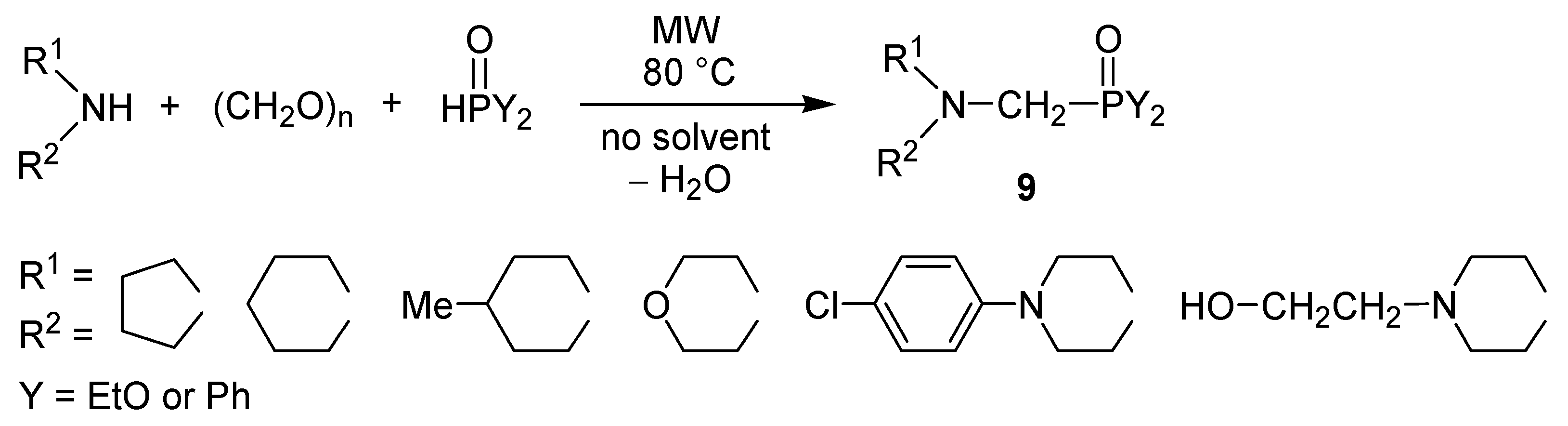
      <p>On the basis of our experimental data, there is no need to use exotic (expensive and environmentally unfriendly) catalysts. In most cases, the solvent- and catalyst-free MW-assisted reactions give excellent results. Further exploration of catalysts does not seem to be justified in this field. Next, our method was extended to phospha-Mannich condensations involving heterocyclic amines (<xref ref-type="scheme" rid="molecules-17-12821-f011">Scheme 9</xref>) [<xref ref-type="bibr" rid="B42-molecules-17-12821">42</xref>]. Diphenylphosphine oxide was also used as the P-component.</p>
      <fig id="molecules-17-12821-f011" position="float">
        <object-id pub-id-type="pii">molecules-17-12821-scheme9_Scheme 9</object-id>
        <label>Scheme 9</label>
        <caption>
          <p>Kabachnik–Fields reactions applying <italic>N</italic>-heterocycles as the amine component.</p>
        </caption>
        <graphic xmlns:xlink="http://www.w3.org/1999/xlink" xlink:href="molecules-17-12821-g011.tif"/>
      </fig>
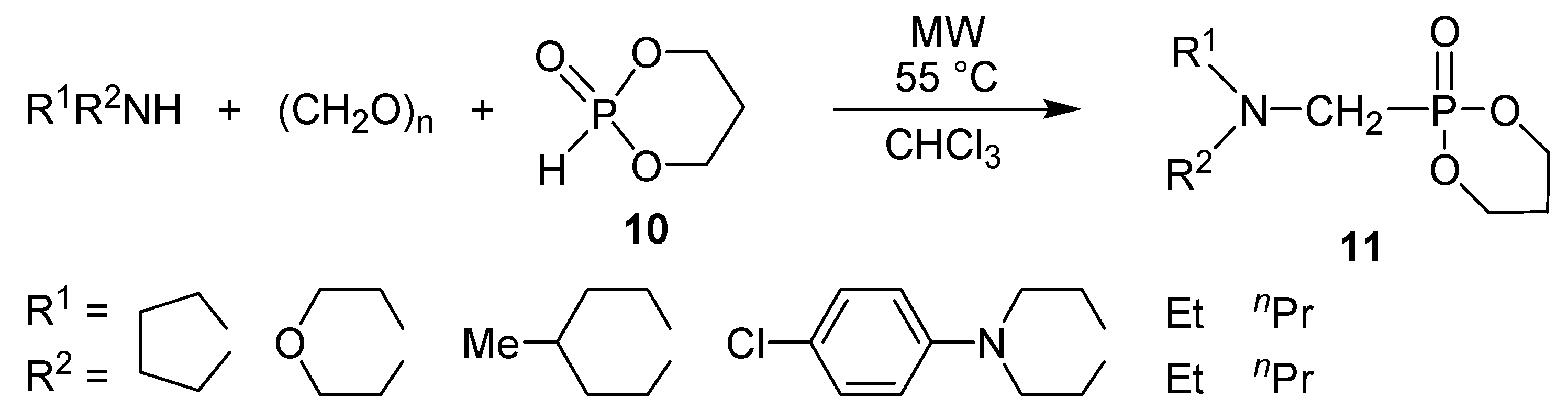
      <p>In another series of reactions, 1,3,2-dioxaphosphorine oxide (<bold>10</bold>) was used as the phosphite (<xref ref-type="scheme" rid="molecules-17-12821-f012">Scheme 10</xref>) [<xref ref-type="bibr" rid="B43-molecules-17-12821">43</xref>]. In this way “double” heterocyclic derivatives were prepared. These reactions were more efficient in the presence of a solvent.</p>
      <fig id="molecules-17-12821-f012" position="float">
        <object-id pub-id-type="pii">molecules-17-12821-scheme10_Scheme 10</object-id>
        <label>Scheme 10</label>
        <caption>
          <p>Kabachnik-Fields reactions applying 1,3,2-dioxaphosphorine oxide as the P-reactant.</p>
        </caption>
        <graphic xmlns:xlink="http://www.w3.org/1999/xlink" xlink:href="molecules-17-12821-g012.tif"/>
      </fig>
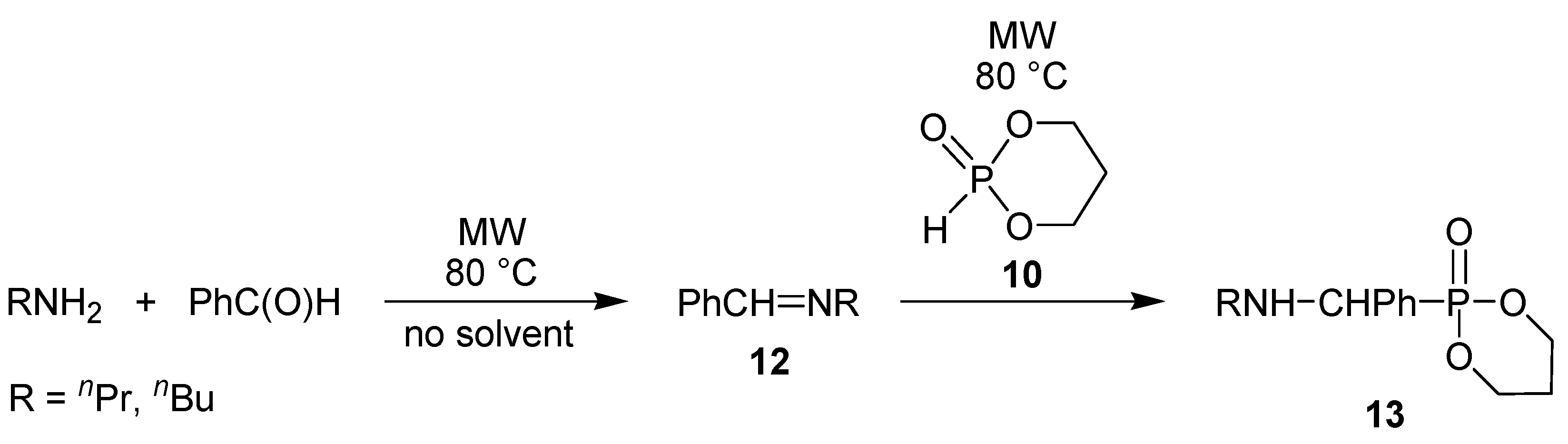
      <p>Applying 1,3,2-dioxaphosphorine oxide (<bold>10</bold>) together with benzaldehyde, the steric hindrance prevented the efficient condensation. It was better to prepare the imine <bold>12</bold> first and to react it separately with the cyclic phosphite <bold>10</bold> (<xref ref-type="scheme" rid="molecules-17-12821-f013">Scheme 11</xref>) [<xref ref-type="bibr" rid="B43-molecules-17-12821">43</xref>].</p>
      <fig id="molecules-17-12821-f013" position="float">
        <object-id pub-id-type="pii">molecules-17-12821-scheme11_Scheme 11</object-id>
        <label>Scheme 11</label>
        <caption>
          <p>Synthesis of α-aminophosphonates via the imine intermediate.</p>
        </caption>
        <graphic xmlns:xlink="http://www.w3.org/1999/xlink" xlink:href="molecules-17-12821-g013.tif"/>
      </fig>
      <p>Dibenzo[<italic>c.e</italic>][<xref ref-type="bibr" rid="B1-molecules-17-12821">1</xref>,<xref ref-type="bibr" rid="B2-molecules-17-12821">2</xref>]oxaphosphorine (<bold>14</bold>) was also utilized in the synthesis of P-heterocyclic derivatives. In this case, the primarily formed product <bold>15</bold> underwent opening of the hetero ring by reaction with the water formed (<xref ref-type="scheme" rid="molecules-17-12821-f014">Scheme 12</xref>) [<xref ref-type="bibr" rid="B43-molecules-17-12821">43</xref>].</p>
      <fig id="molecules-17-12821-f014" position="float">
        <object-id pub-id-type="pii">molecules-17-12821-scheme12_Scheme 12</object-id>
        <label>Scheme 12</label>
        <caption>
          <p>Kabachnik–Fields reaction applying a dibenzooxaphosphorine oxide as the P-reactant.</p>
        </caption>
        <graphic xmlns:xlink="http://www.w3.org/1999/xlink" xlink:href="molecules-17-12821-g014.tif"/>
      </fig>
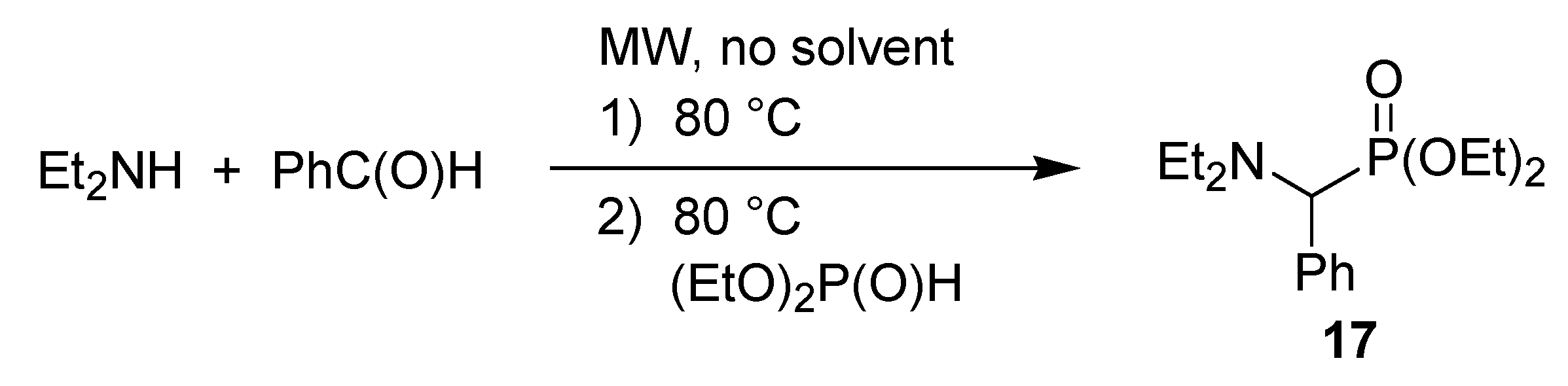
      <p>For the preparation of diethyl α-diethylaminophenylmethylphosphonate (<bold>17</bold>), the two-step approach led to better results. The aldehyde–amine adduct formed primarily was reacted with diethyl phosphite to afford product <bold>17</bold> (<xref ref-type="scheme" rid="molecules-17-12821-f015">Scheme 13</xref>) [<xref ref-type="bibr" rid="B43-molecules-17-12821">43</xref>].</p>
      <fig id="molecules-17-12821-f015" position="float">
        <object-id pub-id-type="pii">molecules-17-12821-scheme13_Scheme 13</object-id>
        <label>Scheme 13</label>
        <caption>
          <p>Synthesis of an α-aminophosphonates in two steps.</p>
        </caption>
        <graphic xmlns:xlink="http://www.w3.org/1999/xlink" xlink:href="molecules-17-12821-g015.tif"/>
      </fig>
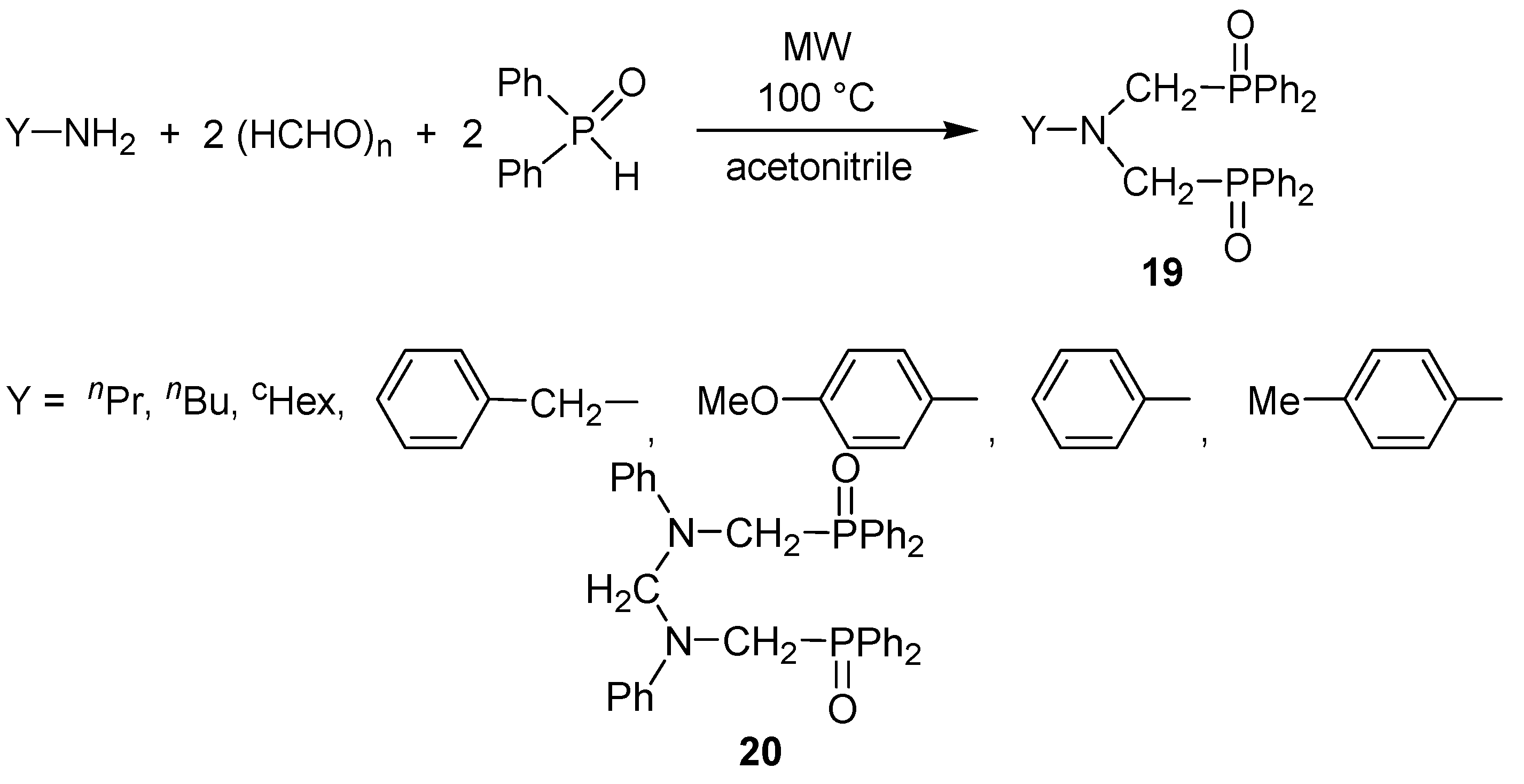
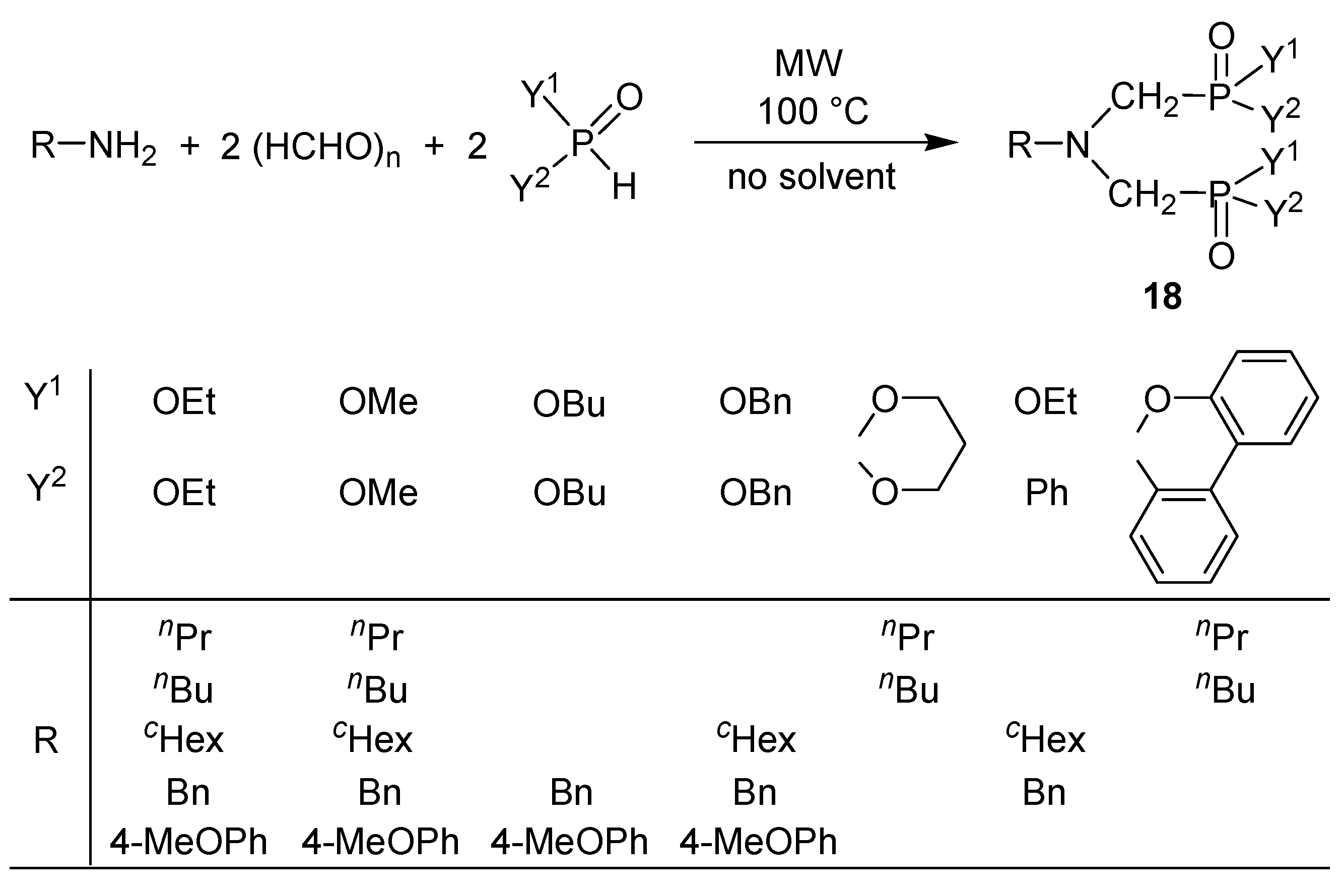
      <p>The MW-assisted solventless procedure was useful in the synthesis of a series of bis(phosphonomethyl)amines and related derivatives marked as <bold>18</bold> (<xref ref-type="scheme" rid="molecules-17-12821-f016">Scheme 14</xref>) [<xref ref-type="bibr" rid="B44-molecules-17-12821">44</xref>,<xref ref-type="bibr" rid="B45-molecules-17-12821">45</xref>,<xref ref-type="bibr" rid="B46-molecules-17-12821">46</xref>]. Product <bold>18</bold> could be obtained in yields, mostly above 80%. The double Kabachnik-Fields reaction was then extended to the synthesis of bis(phosphinoxidomethyl)amines <bold>19</bold>. In these cases, heterogenity of the reaction mixture requested the use of a solvent that was acetonitrile (<xref ref-type="scheme" rid="molecules-17-12821-f017">Scheme 15</xref>) [<xref ref-type="bibr" rid="B44-molecules-17-12821">44</xref>,<xref ref-type="bibr" rid="B45-molecules-17-12821">45</xref>,<xref ref-type="bibr" rid="B46-molecules-17-12821">46</xref>]. The use of aniline as the amine component led to by-product <bold>20</bold> besides the expected product <bold>19</bold> (Y = Ph) [<xref ref-type="bibr" rid="B46-molecules-17-12821">46</xref>].</p>
      <fig id="molecules-17-12821-f016" position="float">
        <object-id pub-id-type="pii">molecules-17-12821-scheme14_Scheme 14</object-id>
        <label>Scheme 14</label>
        <caption>
          <p>Synthesis of bis(phosphonomethyl)amines and related derivatives by the double Kabachnik–Fields reaction.</p>
        </caption>
        <graphic xmlns:xlink="http://www.w3.org/1999/xlink" xlink:href="molecules-17-12821-g016.tif"/>
      </fig>
      <fig id="molecules-17-12821-f017" position="float">
        <object-id pub-id-type="pii">molecules-17-12821-scheme15_Scheme 15</object-id>
        <label>Scheme 15</label>
        <caption>
          <p>Bis(phosphinoxidomethyl)amines by the double phospha-Mannich reaction.</p>
        </caption>
        <graphic xmlns:xlink="http://www.w3.org/1999/xlink" xlink:href="molecules-17-12821-g017.tif"/>
      </fig>
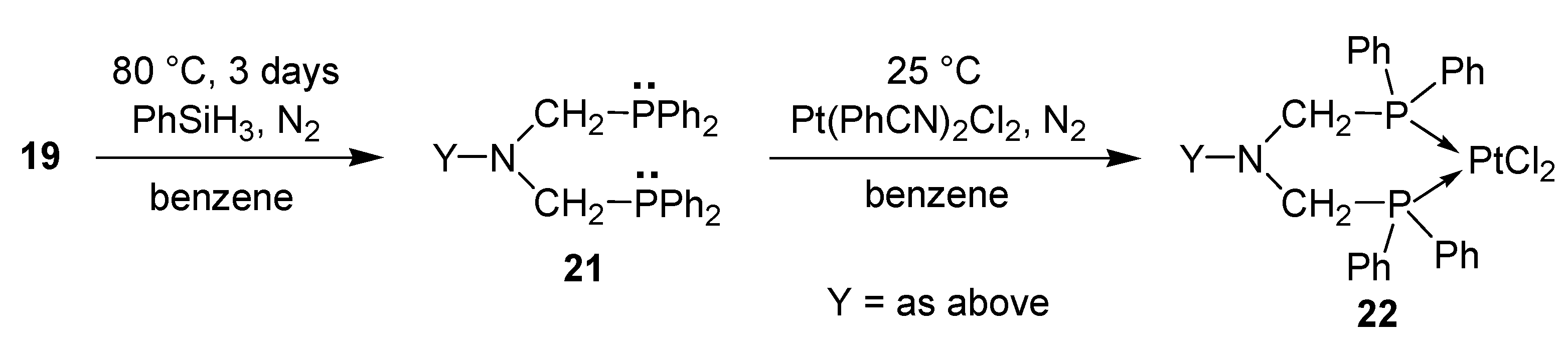
      <p>The bis(phosphinoxidomethyl)amines <bold>19</bold> served as precursors for bis(phosphinomethyl)amine bidentate P-ligands <bold>21</bold> by double deoxygenation. The bisphosphines <bold>21</bold> so formed were reacted with half an equivalent of dichlorodibenzonitriloplatinum to furnish ring platinum complexes <bold>22</bold> (<xref ref-type="scheme" rid="molecules-17-12821-f018">Scheme 16</xref>) [<xref ref-type="bibr" rid="B45-molecules-17-12821">45</xref>,<xref ref-type="bibr" rid="B46-molecules-17-12821">46</xref>].</p>
      <fig id="molecules-17-12821-f018" position="float">
        <object-id pub-id-type="pii">molecules-17-12821-scheme16_Scheme 16</object-id>
        <label>Scheme 16</label>
        <caption>
          <p>Synthesis of ring platinum complexes from bis(phosphinoxidomethyl)amines.</p>
        </caption>
        <graphic xmlns:xlink="http://www.w3.org/1999/xlink" xlink:href="molecules-17-12821-g018.tif"/>
      </fig>
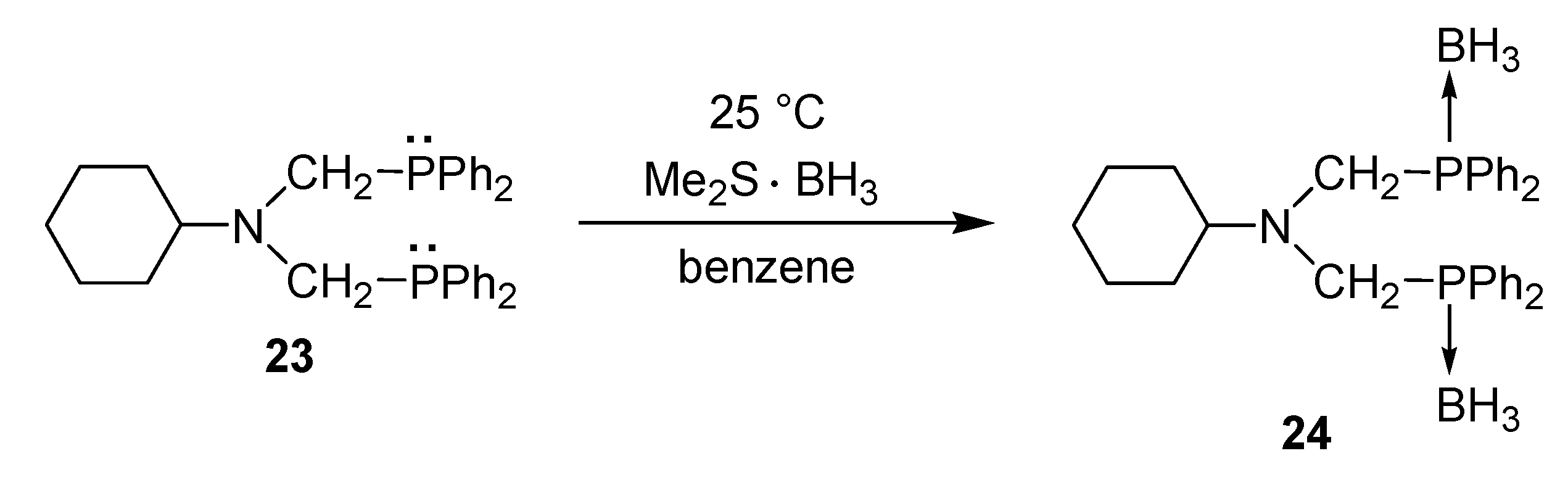
      <p>The bidentate P-ligands may be stored as their phosphine-borane complexes. This is shown in the example of the <bold>23</bold> → <bold>24</bold> conversion (<xref ref-type="scheme" rid="molecules-17-12821-f019">Scheme 17</xref>). In general, the phosphine can be regenerated from the phosphine-borane by heating with a secondary amine, such as diethylamine, in an aromatic solvent [<xref ref-type="bibr" rid="B47-molecules-17-12821">47</xref>].</p>
      <fig id="molecules-17-12821-f019" position="float">
        <object-id pub-id-type="pii">molecules-17-12821-scheme17_Scheme 17</object-id>
        <label>Scheme 17</label>
        <caption>
          <p>Stabilization of a bis(phosphinomethyl)amine as a bis(borane complex).</p>
        </caption>
        <graphic xmlns:xlink="http://www.w3.org/1999/xlink" xlink:href="molecules-17-12821-g019.tif"/>
      </fig>
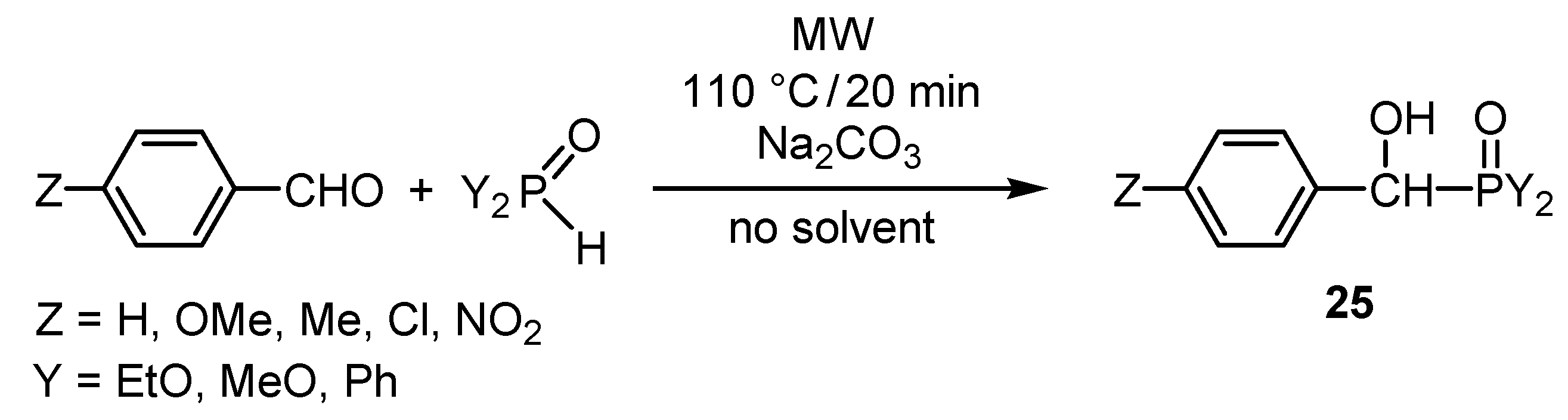
      <p>The MW-assisted catalytic addition of dialkyl phosphites on the carbonyl group of a series of benzaldehyde derivatives was also elaborated (<xref ref-type="scheme" rid="molecules-17-12821-f020">Scheme 18</xref>) [<xref ref-type="bibr" rid="B48-molecules-17-12821">48</xref>]. The α-hydroxyphosphonates (<bold>25</bold>, Y = RO) are potential intermediates of the Kabachnik–Fields reaction. The use of diphenylphosphine oxide in the addition led to the formation of α-hydroxyphosphine oxides (<bold>25</bold>, Y = Ph).</p>
      <fig id="molecules-17-12821-f020" position="float">
        <object-id pub-id-type="pii">molecules-17-12821-scheme18_Scheme 18</object-id>
        <label>Scheme 18</label>
        <caption>
          <p>MW-assisted synthesis of α-hydroxyphosphonates and α-hydroxyphosphine oxides.</p>
        </caption>
        <graphic xmlns:xlink="http://www.w3.org/1999/xlink" xlink:href="molecules-17-12821-g020.tif"/>
      </fig>
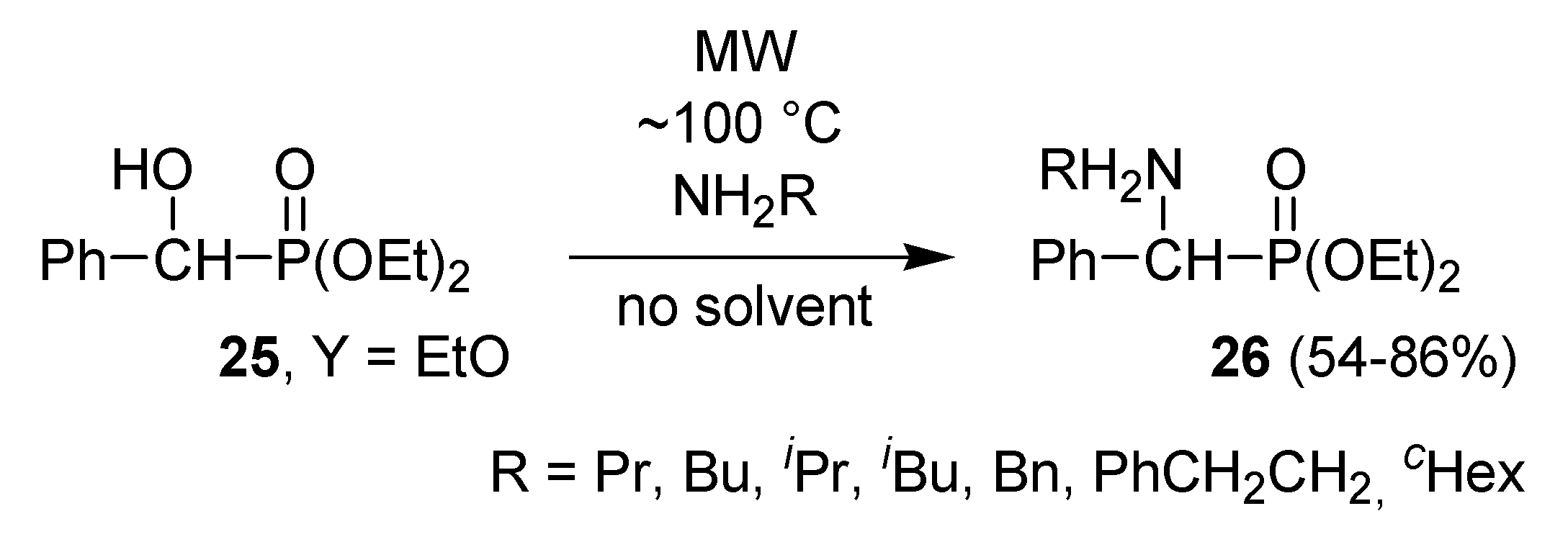
      <p>The addition of dialkyl phosphites to α-ketophosphonates led to 1-hydroxymethylene-bisphosphonates [<xref ref-type="bibr" rid="B49-molecules-17-12821">49</xref>,<xref ref-type="bibr" rid="B50-molecules-17-12821">50</xref>]. It was interesting to find that, as a consequence of the neighboring group effect of the P=O moiety, α-hydroxyphosphonate <bold>25</bold> (Y = EtO) could be readily converted to the corresponding α-aminophosphonates (<bold>26</bold>) (<xref ref-type="scheme" rid="molecules-17-12821-f021">Scheme 19</xref>) [<xref ref-type="bibr" rid="B51-molecules-17-12821">51</xref>]. Quantum chemical calculations justified the beneficial neighboring group effect of the P=O moiety [<xref ref-type="bibr" rid="B51-molecules-17-12821">51</xref>].</p>
      <fig id="molecules-17-12821-f021" position="float">
        <object-id pub-id-type="pii">molecules-17-12821-scheme19_Scheme 19</object-id>
        <label>Scheme 19</label>
        <caption>
          <p>Preparation of α-aminophosphonates by substitution of α-hydroxyphosphonates.</p>
        </caption>
        <graphic xmlns:xlink="http://www.w3.org/1999/xlink" xlink:href="molecules-17-12821-g021.tif"/>
      </fig>
    </sec>
    <sec sec-type="conclusions">
      <title>4. Conclusions</title>
      <p>In conclusion, recent results obtained in the study of the Kabachnik–Fields reaction have been summarized. This mini-review sheds light on the new developments regarding mechanistic and synthetic aspects showing that the phospha-Mannich reaction remains an evergreen topic for organic chemists. On the one hand, the mechanism of the Kabachnik–Fields reaction still reserves some surprises, on the other hand, the 3-component condensation is an ideal subject for green chemical reactions. In addition, the α-aminophosphonate and α-aminophosphine oxide products are biologically active substrates.</p>
    </sec>    
  </body>
  <back>
    <ack><title>Acknowledgments</title>
      <p>The authors are grateful for Hungarian Scientific Research Fund (No: OTKA K 83118).</p></ack>
	<ref-list>
      <title>References</title>
      <ref id="B1-molecules-17-12821">
        <label>1.</label>
        <citation citation-type="journal">
          <person-group person-group-type="author">
            <name>
              <surname>Kabachnik</surname>
              <given-names>M.I.</given-names>
            </name>
            <name>
              <surname>Medved</surname>
              <given-names>T.Y.</given-names>
            </name>
          </person-group>
          <article-title>New synthesis of aminophosphonic acids</article-title>
          <source>Dokl. Akad. Nauk SSSR</source>
          <year>1952</year>
          <volume>83</volume>
          <fpage>689</fpage>
          <lpage>692</lpage>
        </citation>
      </ref>
      <ref id="B2-molecules-17-12821">
        <label>2.</label>
        <citation citation-type="journal">
          <person-group person-group-type="author">
            <name>
              <surname>Fields</surname>
              <given-names>E.K.</given-names>
            </name>
          </person-group>
          <article-title>The synthesis of esters of substituted amino phosphonic acids</article-title>
          <source>J. Am. Chem. Soc.</source>
          <year>1952</year>
          <volume>74</volume>
          <fpage>1528</fpage>
          <lpage>1531</lpage>
          <pub-id pub-id-type="doi">10.1021/ja01126a054</pub-id>
        </citation>
      </ref>
      <ref id="B3-molecules-17-12821">
        <label>3.</label>
        <citation citation-type="journal">
          <person-group person-group-type="author">
            <name>
              <surname>Zefirov</surname>
              <given-names>N.S.</given-names>
            </name>
            <name>
              <surname>Matveeva</surname>
              <given-names>E.D.</given-names>
            </name>
          </person-group>
          <article-title>Catalytic Kabachnik-Fields reaction: New horizons for old reaction</article-title>
          <source>ARKIVOC</source>
          <year>2008</year>
          <fpage>1</fpage>
          <lpage>17</lpage>
        </citation>
      </ref>
      <ref id="B4-molecules-17-12821">
        <label>4.</label>
        <citation citation-type="book">
          <source>Aminophosphonic and Aminophosphinic Acids: Chemistry and Biological Activity</source>
          <person-group person-group-type="editor">
            <name>
              <surname>Kukhar</surname>
              <given-names>V.P.</given-names>
            </name>
            <name>
              <surname>Hudson</surname>
              <given-names>H.R.</given-names>
            </name>
          </person-group>
          <publisher-name>Wiley</publisher-name>
          <publisher-loc>Chichester, UK</publisher-loc>
          <year>2000</year>
        </citation>
      </ref>
      <ref id="B5-molecules-17-12821">
        <label>5.</label>
        <citation citation-type="journal">
          <person-group person-group-type="author">
            <name>
              <surname>Fields</surname>
              <given-names>S.C.</given-names>
            </name>
          </person-group>
          <article-title>Synthesis of natural products containing a C-P bond</article-title>
          <source>Tetrahedron</source>
          <year>1999</year>
          <volume>55</volume>
          <fpage>12237</fpage>
          <lpage>12272</lpage>
          <pub-id pub-id-type="doi">10.1016/S0040-4020(99)00701-2</pub-id>
        </citation>
      </ref>
      <ref id="B6-molecules-17-12821">
        <label>6.</label>
        <citation citation-type="journal">
          <person-group person-group-type="author">
            <name>
              <surname>Kafarski</surname>
              <given-names>P.</given-names>
            </name>
            <name>
              <surname>Lejczak</surname>
              <given-names>B.</given-names>
            </name>
          </person-group>
          <article-title>Aminophosphonic acids of potential medical importance</article-title>
          <source>Curr. Med. Chem. Anticancer Agents</source>
          <year>2001</year>
          <volume>1</volume>
          <fpage>301</fpage>
          <lpage>312</lpage>
          <pub-id pub-id-type="doi">10.2174/1568011013354543</pub-id>
        </citation>
      </ref>
      <ref id="B7-molecules-17-12821">
        <label>7.</label>
        <citation citation-type="journal">
          <person-group person-group-type="author">
            <name>
              <surname>Bird</surname>
              <given-names>J.</given-names>
            </name>
            <name>
              <surname>De Mello</surname>
              <given-names>R.C.</given-names>
            </name>
            <name>
              <surname>Harper</surname>
              <given-names>G.P.</given-names>
            </name>
            <name>
              <surname>Hunter</surname>
              <given-names>D.J.</given-names>
            </name>
            <name>
              <surname>Karran</surname>
              <given-names>E.H.</given-names>
            </name>
            <name>
              <surname>Markwell</surname>
              <given-names>R.E.</given-names>
            </name>
            <name>
              <surname>Miles-Williams</surname>
              <given-names>A.J.</given-names>
            </name>
            <name>
              <surname>Rahman</surname>
              <given-names>S.S.</given-names>
            </name>
            <name>
              <surname>Ward</surname>
              <given-names>R.W.</given-names>
            </name>
          </person-group>
          <article-title>Synthesis of novel <italic>N</italic>-phosphonoalkyl dipeptide inhibitors of human collagenase</article-title>
          <source>J. Med. Chem.</source>
          <year>1994</year>
          <volume>37</volume>
          <fpage>158</fpage>
          <lpage>169</lpage>
          <pub-id pub-id-type="doi">10.1021/jm00027a020</pub-id>
        </citation>
      </ref>
      <ref id="B8-molecules-17-12821">
        <label>8.</label>
        <citation citation-type="journal">
          <person-group person-group-type="author">
            <name>
              <surname>Liu</surname>
              <given-names>W.S.</given-names>
            </name>
            <name>
              <surname>Rogers</surname>
              <given-names>C.J.</given-names>
            </name>
            <name>
              <surname>Fisher</surname>
              <given-names>A.J.</given-names>
            </name>
            <name>
              <surname>Toney</surname>
              <given-names>M.D.</given-names>
            </name>
          </person-group>
          <article-title>Aminophosphonate inhibitors of dialkylglycine decarboxylase: Structural basis for slow binding inhibition</article-title>
          <source>Biochemistry</source>
          <year>2002</year>
          <volume>41</volume>
          <fpage>12320</fpage>
          <lpage>12328</lpage>
          <pub-id pub-id-type="doi">10.1021/bi026318g</pub-id>
        </citation>
      </ref>
      <ref id="B9-molecules-17-12821">
        <label>9.</label>
        <citation citation-type="journal">
          <person-group person-group-type="author">
            <name>
              <surname>Mucha</surname>
              <given-names>A.</given-names>
            </name>
            <name>
              <surname>Kafarski</surname>
              <given-names>P.</given-names>
            </name>
            <name>
              <surname>Berlicki</surname>
              <given-names>L.</given-names>
            </name>
          </person-group>
          <article-title>Remarkable potential of the α-aminophosphonate/phosphinate structural motif in medicinal chemistry</article-title>
          <source>J. Med. Chem.</source>
          <year>2011</year>
          <volume>54</volume>
          <fpage>5955</fpage>
          <lpage>5980</lpage>
          <pub-id pub-id-type="doi">10.1021/jm200587f</pub-id>
        </citation>
      </ref>
      <ref id="B10-molecules-17-12821">
        <label>10.</label>
        <citation citation-type="journal">
          <person-group person-group-type="author">
            <name>
              <surname>Sienczyk</surname>
              <given-names>M.</given-names>
            </name>
            <name>
              <surname>Oleksyszyn</surname>
              <given-names>J.</given-names>
            </name>
          </person-group>
          <article-title>Irreversible inhibition of serine proteases-Design and <italic>in vivo</italic> activity of diaryl alpha-aminophosphonate derivatives</article-title>
          <source>Curr. Med. Chem.</source>
          <year>2009</year>
          <volume>16</volume>
          <fpage>1673</fpage>
          <lpage>1687</lpage>
          <pub-id pub-id-type="doi">10.2174/092986709788186246</pub-id>
        </citation>
      </ref>
      <ref id="B11-molecules-17-12821">
        <label>11.</label>
        <citation citation-type="journal">
          <person-group person-group-type="author">
            <name>
              <surname>Grembecka</surname>
              <given-names>J.</given-names>
            </name>
            <name>
              <surname>Mucha</surname>
              <given-names>A.</given-names>
            </name>
            <name>
              <surname>Cierpicki</surname>
              <given-names>T.</given-names>
            </name>
            <name>
              <surname>Kafarski</surname>
              <given-names>P.</given-names>
            </name>
          </person-group>
          <article-title>The most potent organophosphorus inhibitors of leucine aminopeptidase. Structure-based design, chemistry, and activity</article-title>
          <source>J. Med. Chem.</source>
          <year>2003</year>
          <volume>46</volume>
          <fpage>2641</fpage>
          <lpage>2655</lpage>
        <pub-id pub-id-type="doi">10.1021/jm030795v</pub-id><pub-id pub-id-type="pmid">12801228</pub-id></citation>
      </ref>
      <ref id="B12-molecules-17-12821">
        <label>12.</label>
        <citation citation-type="journal">
          <person-group person-group-type="author">
            <name>
              <surname>Long</surname>
              <given-names>N.</given-names>
            </name>
            <name>
              <surname>Cai</surname>
              <given-names>X.J.</given-names>
            </name>
            <name>
              <surname>Song</surname>
              <given-names>B.A.</given-names>
            </name>
            <name>
              <surname>Yang</surname>
              <given-names>S.</given-names>
            </name>
            <name>
              <surname>Chen</surname>
              <given-names>Z.</given-names>
            </name>
            <name>
              <surname>Bhadury</surname>
              <given-names>P.S.</given-names>
            </name>
            <name>
              <surname>Hu</surname>
              <given-names>D.Y.</given-names>
            </name>
            <name>
              <surname>Jin</surname>
              <given-names>L.H.</given-names>
            </name>
            <name>
              <surname>Xue</surname>
              <given-names>W.</given-names>
            </name>
          </person-group>
          <article-title>Synthesis and antiviral activities of cyanoacrylate derivatives containing an alpha-aminophosphonate moiety</article-title>
          <source>J. Agric. Food Chem.</source>
          <year>2008</year>
          <volume>56</volume>
          <fpage>5242</fpage>
          <lpage>5246</lpage>
        <pub-id pub-id-type="doi">10.1021/jf800405m</pub-id><pub-id pub-id-type="pmid">18547045</pub-id></citation>
      </ref>
      <ref id="B13-molecules-17-12821">
        <label>13.</label>
        <citation citation-type="journal">
          <person-group person-group-type="author">
            <name>
              <surname>Hu</surname>
              <given-names>D.Y.</given-names>
            </name>
            <name>
              <surname>Wan</surname>
              <given-names>Q.Q.</given-names>
            </name>
            <name>
              <surname>Yang</surname>
              <given-names>S.</given-names>
            </name>
            <name>
              <surname>Song</surname>
              <given-names>B.A.</given-names>
            </name>
            <name>
              <surname>Bhadury</surname>
              <given-names>P.S.</given-names>
            </name>
            <name>
              <surname>Jin</surname>
              <given-names>L.H.</given-names>
            </name>
            <name>
              <surname>Yan</surname>
              <given-names>K.</given-names>
            </name>
            <name>
              <surname>Liu</surname>
              <given-names>F.</given-names>
            </name>
            <name>
              <surname>Chen</surname>
              <given-names>Z.</given-names>
            </name>
            <name>
              <surname>Xue</surname>
              <given-names>W.</given-names>
            </name>
          </person-group>
          <article-title>Synthesis and antiviral activities of amide derivatives containing the alpha-aminophosphonate moiety</article-title>
          <source>J. Agric. Food Chem.</source>
          <year>2008</year>
          <volume>56</volume>
          <fpage>998</fpage>
          <lpage>1001</lpage>
        <pub-id pub-id-type="doi">10.1021/jf072394k</pub-id><pub-id pub-id-type="pmid">18183949</pub-id></citation>
      </ref>
      <ref id="B14-molecules-17-12821">
        <label>14.</label>
        <citation citation-type="journal">
          <person-group person-group-type="author">
            <name>
              <surname>Danila</surname>
              <given-names>D.C.</given-names>
            </name>
            <name>
              <surname>Wang</surname>
              <given-names>X.Y.</given-names>
            </name>
            <name>
              <surname>Hubble</surname>
              <given-names>H.</given-names>
            </name>
            <name>
              <surname>Antipin</surname>
              <given-names>I.S.</given-names>
            </name>
            <name>
              <surname>Pinkhassik</surname>
              <given-names>E.</given-names>
            </name>
          </person-group>
          <article-title>Increasing permeability of phospholipid bilayer membranes to alanine with synthetic alpha-aminophosphonate carriers</article-title>
          <source>Bioorg. Med. Chem. Lett.</source>
          <year>2008</year>
          <volume>18</volume>
          <fpage>2320</fpage>
          <lpage>2323</lpage>
          <pub-id pub-id-type="doi">10.1016/j.bmcl.2008.02.081</pub-id>
        </citation>
      </ref>
      <ref id="B15-molecules-17-12821">
        <label>15.</label>
        <citation citation-type="journal">
          <person-group person-group-type="author">
            <name>
              <surname>Cherkasov</surname>
              <given-names>R.A.</given-names>
            </name>
            <name>
              <surname>Galkin</surname>
              <given-names>V.I.</given-names>
            </name>
          </person-group>
          <article-title>The Kabachnik-Fields reaction: synthetic potential and the problem of the mechanism</article-title>
          <source>Russ. Chem. Rev.</source>
          <year>1998</year>
          <volume>67</volume>
          <fpage>857</fpage>
          <lpage>882</lpage>
          <pub-id pub-id-type="doi">10.1070/RC1998v067n10ABEH000421</pub-id>
        </citation>
      </ref>
      <ref id="B16-molecules-17-12821">
        <label>16.</label>
        <citation citation-type="journal">
          <person-group person-group-type="author">
            <name>
              <surname>Galkin</surname>
              <given-names>V.I.</given-names>
            </name>
            <name>
              <surname>Zvereva</surname>
              <given-names>E.R.</given-names>
            </name>
            <name>
              <surname>Sobanov</surname>
              <given-names>A.A.</given-names>
            </name>
            <name>
              <surname>Galkina</surname>
              <given-names>I.V.</given-names>
            </name>
            <name>
              <surname>Cherkasov</surname>
              <given-names>R.A.</given-names>
            </name>
          </person-group>
          <article-title>Kinetics and mechanism of Kabachnik-Fields reaction in dialkylphosphite-benzaldehyde-aniline system</article-title>
          <source>Zhur. Obsch. Khim.</source>
          <year>1993</year>
          <volume>63</volume>
          <fpage>2224</fpage>
          <lpage>2227</lpage>
        </citation>
      </ref>
      <ref id="B17-molecules-17-12821">
        <label>17.</label>
        <citation citation-type="journal">
          <person-group person-group-type="author">
            <name>
              <surname>Galkina</surname>
              <given-names>I.V.</given-names>
            </name>
            <name>
              <surname>Sobanov</surname>
              <given-names>A.A.</given-names>
            </name>
            <name>
              <surname>Galkin</surname>
              <given-names>V.I.</given-names>
            </name>
            <name>
              <surname>Cherkasov</surname>
              <given-names>R.A.</given-names>
            </name>
          </person-group>
          <article-title>Kinetics and mechanism of the Kabachnik-Fields reaction: IV. Salicyaldehyde in the Kabachnik-Fields reaction</article-title>
          <source>Russ. J. Gen. Chem.</source>
          <year>1998</year>
          <volume>68</volume>
          <fpage>1398</fpage>
          <lpage>1401</lpage>
        </citation>
      </ref>
      <ref id="B18-molecules-17-12821">
        <label>18.</label>
        <citation citation-type="journal">
          <person-group person-group-type="author">
            <name>
              <surname>Matveeva</surname>
              <given-names>E.D.</given-names>
            </name>
            <name>
              <surname>Zefirov</surname>
              <given-names>N.S.</given-names>
            </name>
          </person-group>
          <article-title>On the mechanism of the Kabachnik-Fields reaction: Does a mechanism of nucleophilic amination of alpha-hydroxyphosphonates exist?</article-title>
          <source>Doklady Chem.</source>
          <year>2008</year>
          <volume>420</volume>
          <fpage>137</fpage>
          <lpage>140</lpage>
          <pub-id pub-id-type="doi">10.1134/S0012500808060037</pub-id>
        </citation>
      </ref>
      <ref id="B19-molecules-17-12821">
        <label>19.</label>
        <citation citation-type="journal">
          <person-group person-group-type="author">
            <name>
              <surname>Galkina</surname>
              <given-names>I.V.</given-names>
            </name>
            <name>
              <surname>Galkin</surname>
              <given-names>V.I.</given-names>
            </name>
            <name>
              <surname>Cherkasov</surname>
              <given-names>R.A.</given-names>
            </name>
          </person-group>
          <article-title>Kinetics and the mechanism of Kabachnik-Fields reaction-V. Effect of the nature of hydrophosphoryl compound on the mechanism of Kabachnik-Fields reaction</article-title>
          <source>Zhur. Obsch. Khim.</source>
          <year>1998</year>
          <volume>68</volume>
          <fpage>1469</fpage>
          <lpage>1475</lpage>
        </citation>
      </ref>
      <ref id="B20-molecules-17-12821">
        <label>20.</label>
        <citation citation-type="journal">
          <person-group person-group-type="author">
            <name>
              <surname>Gancarz</surname>
              <given-names>R.</given-names>
            </name>
            <name>
              <surname>Gancarz</surname>
              <given-names>I.</given-names>
            </name>
          </person-group>
          <article-title>Failure of aminophosphonate synthesis due to facile hydroxyphosphonate-phosphate rearrangement</article-title>
          <source>Tetrahedron Lett.</source>
          <year>1993</year>
          <volume>34</volume>
          <fpage>145</fpage>
          <lpage>148</lpage>
          <pub-id pub-id-type="doi">10.1016/S0040-4039(00)60079-5</pub-id>
        </citation>
      </ref>
      <ref id="B21-molecules-17-12821">
        <label>21.</label>
        <citation citation-type="journal">
          <person-group person-group-type="author">
            <name>
              <surname>Gancarz</surname>
              <given-names>R.</given-names>
            </name>
          </person-group>
          <article-title>Nucleophilic addition to carbonyl compounds. competition between hard (amine)  and soft (phosphite) nucleophile</article-title>
          <source>Tetrahedron</source>
          <year>1995</year>
          <volume>51</volume>
          <fpage>10627</fpage>
          <lpage>10632</lpage>
        <pub-id pub-id-type="doi">10.1016/0040-4020(95)00634-K</pub-id></citation>
      </ref>
      <ref id="B22-molecules-17-12821">
        <label>22.</label>
        <citation citation-type="journal">
          <person-group person-group-type="author">
            <name>
              <surname>Keglevich</surname>
              <given-names>G.</given-names>
            </name>
            <name>
              <surname>Fehérvári</surname>
              <given-names>A.</given-names>
            </name>
            <name>
              <surname>Csontos</surname>
              <given-names>I.</given-names>
            </name>
          </person-group>
          <article-title>A study on the Kabachnik-Fields reaction of benzaldehyde, propylamine and diethyl phosphite by <italic>in situ</italic> Fourier transform (FT) IR spectroscopy</article-title>
          <source>Heteroatom Chem.</source>
          <year>2011</year>
          <volume>22</volume>
          <fpage>599</fpage>
          <lpage>604</lpage>
          <pub-id pub-id-type="doi">10.1002/hc.20676</pub-id>
        </citation>
      </ref>
      <ref id="B23-molecules-17-12821">
        <label>23.</label>
        <citation citation-type="journal">
          <person-group person-group-type="author">
            <name>
              <surname>Keglevich</surname>
              <given-names>G.</given-names>
            </name>
            <name>
              <surname>Kiss</surname>
              <given-names>N.Z.</given-names>
            </name>
            <name>
              <surname>Menyhárd</surname>
              <given-names>D.</given-names>
            </name>
            <name>
              <surname>Fehérvári</surname>
              <given-names>A.</given-names>
            </name>
            <name>
              <surname>Csontos</surname>
              <given-names>I.</given-names>
            </name>
          </person-group>
          <article-title>A study on the Kabachnik-Fields reaction of benzaldehyde, cyclohexylamine and dialkyl phosphites</article-title>
          <source>Heteroatom Chem.</source>
          <year>2012</year>
          <volume>23</volume>
          <fpage>171</fpage>
          <lpage>178</lpage>
          <pub-id pub-id-type="doi">10.1002/hc.20767</pub-id>
        </citation>
      </ref>
      <ref id="B24-molecules-17-12821">
        <label>24.</label>
        <citation citation-type="journal">
          <person-group person-group-type="author">
            <name>
              <surname>Mu</surname>
              <given-names>X.-J.</given-names>
            </name>
            <name>
              <surname>Lei</surname>
              <given-names>M.-Y.</given-names>
            </name>
            <name>
              <surname>Zou</surname>
              <given-names>J.-P.</given-names>
            </name>
            <name>
              <surname>Zhang</surname>
              <given-names>W.</given-names>
            </name>
          </person-group>
          <article-title>Microwave-assisted solvent-free and catalyst-free Kabachnik-Fields reactions for α-amino phosphonates</article-title>
          <source>Tetrahedron Lett.</source>
          <year>2006</year>
          <volume>47</volume>
          <fpage>1125</fpage>
          <lpage>1127</lpage>
          <pub-id pub-id-type="doi">10.1016/j.tetlet.2005.12.027</pub-id>
        </citation>
      </ref>
      <ref id="B25-molecules-17-12821">
        <label>25.</label>
        <citation citation-type="journal">
          <person-group person-group-type="author">
            <name>
              <surname>Keglevich</surname>
              <given-names>G.</given-names>
            </name>
            <name>
              <surname>Szekrényi</surname>
              <given-names>A.</given-names>
            </name>
          </person-group>
          <article-title>Eco-friendly accomplishment of the extended Kabachnik-Fields reaction; a solvent- and catalyst-free microwave-assisted synthesis of a-aminophosphonates and a-aminophosphine oxides</article-title>
          <source>Lett. Org. Chem.</source>
          <year>2008</year>
          <volume>5</volume>
          <fpage>616</fpage>
          <lpage>622</lpage>
          <pub-id pub-id-type="doi">10.2174/157017808786857598</pub-id>
        </citation>
      </ref>
      <ref id="B26-molecules-17-12821">
        <label>26.</label>
        <citation citation-type="journal">
          <person-group person-group-type="author">
            <name>
              <surname>Matveeva</surname>
              <given-names>E.D.</given-names>
            </name>
            <name>
              <surname>Podrugina</surname>
              <given-names>T.A.</given-names>
            </name>
            <name>
              <surname>Tishkovskaya</surname>
              <given-names>E.V.</given-names>
            </name>
            <name>
              <surname>Tomilova</surname>
              <given-names>L.G.</given-names>
            </name>
            <name>
              <surname>Zefirov</surname>
              <given-names>N.S.</given-names>
            </name>
          </person-group>
          <article-title>A novel catalytic three-component synthesis (Kabachnick-Fields reaction) of α-aminophosphonates from ketones</article-title>
          <source>Synlett</source>
          <year>2003</year>
          <fpage>2321</fpage>
          <lpage>2324</lpage>
        </citation>
      </ref>
      <ref id="B27-molecules-17-12821">
        <label>27.</label>
        <citation citation-type="journal">
          <person-group person-group-type="author">
            <name>
              <surname>Bhagat</surname>
              <given-names>S.</given-names>
            </name>
            <name>
              <surname>Chakraborti</surname>
              <given-names>A.K.</given-names>
            </name>
          </person-group>
          <article-title>An extremely efficient three-component reaction of aldehydes/ketones, amines, and phosphites (Kabachnik-Fields reaction) for the synthesis of a-aminophosphonates catalyzed by magnesium perchlorate</article-title>
          <source>J. Org. Chem.</source>
          <year>2007</year>
          <volume>72</volume>
          <fpage>1263</fpage>
          <lpage>1270</lpage>
          <pub-id pub-id-type="doi">10.1021/jo062140i</pub-id>
        </citation>
      </ref>
      <ref id="B28-molecules-17-12821">
        <label>28.</label>
        <citation citation-type="journal">
          <person-group person-group-type="author">
            <name>
              <surname>Wu</surname>
              <given-names>J.</given-names>
            </name>
            <name>
              <surname>Sun</surname>
              <given-names>W.</given-names>
            </name>
            <name>
              <surname>Xia</surname>
              <given-names>H.-G.</given-names>
            </name>
            <name>
              <surname>Sun</surname>
              <given-names>X.</given-names>
            </name>
          </person-group>
          <article-title>A facile and highly efficient route to α-amino phosphonates via three-component reactions catalyzed by Mg(ClO<sub>4</sub>)<sub>2</sub> or molecular iodine</article-title>
          <source>Org. Biomol. Chem.</source>
          <year>2006</year>
          <volume>4</volume>
          <fpage>1663</fpage>
          <lpage>1666</lpage>
          <pub-id pub-id-type="doi">10.1039/b602536f</pub-id>
        </citation>
      </ref>
      <ref id="B29-molecules-17-12821">
        <label>29.</label>
        <citation citation-type="journal">
          <person-group person-group-type="author">
            <name>
              <surname>Firouzabadi</surname>
              <given-names>H.</given-names>
            </name>
            <name>
              <surname>Iranpoor</surname>
              <given-names>N.</given-names>
            </name>
            <name>
              <surname>Sobhani</surname>
              <given-names>S.</given-names>
            </name>
          </person-group>
          <article-title>Metal triflate-catalyzed one-pot synthesis of α-aminophosphonates from carbonyl compounds in the absence of solvent</article-title>
          <source>Synthesis</source>
          <year>2004</year>
          <fpage>2692</fpage>
          <lpage>2696</lpage>
        </citation>
      </ref>
      <ref id="B30-molecules-17-12821">
        <label>30.</label>
        <citation citation-type="journal">
          <person-group person-group-type="author">
            <name>
              <surname>Sun</surname>
              <given-names>P.</given-names>
            </name>
            <name>
              <surname>Hu</surname>
              <given-names>Z.</given-names>
            </name>
            <name>
              <surname>Huang</surname>
              <given-names>Z.</given-names>
            </name>
          </person-group>
          <article-title>Gallium triiodide catalyzed organic reaction: a convenient synthesis of α-amino phosphonates</article-title>
          <source>Synth. Commun.</source>
          <year>2004</year>
          <volume>34</volume>
          <fpage>4293</fpage>
          <lpage>4299</lpage>
          <pub-id pub-id-type="doi">10.1081/SCC-200039361</pub-id>
        </citation>
      </ref>
      <ref id="B31-molecules-17-12821">
        <label>31.</label>
        <citation citation-type="journal">
          <person-group person-group-type="author">
            <name>
              <surname>Ghosh</surname>
              <given-names>R.</given-names>
            </name>
            <name>
              <surname>Maiti</surname>
              <given-names>S.</given-names>
            </name>
            <name>
              <surname>Chakraborty</surname>
              <given-names>A.</given-names>
            </name>
            <name>
              <surname>Maiti</surname>
              <given-names>D.K.</given-names>
            </name>
          </person-group>
          <article-title>In(OTf)(3) catalysed simple one-pot synthesis of α-amino phosphonates</article-title>
          <source>J. Mol. Catal. A</source>
          <year>2004</year>
          <volume>210</volume>
          <fpage>53</fpage>
          <lpage>57</lpage>
          <pub-id pub-id-type="doi">10.1016/j.molcata.2003.09.020</pub-id>
        </citation>
      </ref>
      <ref id="B32-molecules-17-12821">
        <label>32.</label>
        <citation citation-type="journal">
          <person-group person-group-type="author">
            <name>
              <surname>Bhattacharya</surname>
              <given-names>A.K.</given-names>
            </name>
            <name>
              <surname>Kaur</surname>
              <given-names>T.</given-names>
            </name>
          </person-group>
          <article-title>An efficient one-pot synthesis of alpha-amino phosphonates catalyzed by bismuth nitrate pentahydrate</article-title>
          <source>Synlett</source>
          <year>2007</year>
          <fpage>745</fpage>
          <lpage>748</lpage>
          <pub-id pub-id-type="doi">10.1055/s-2007-970762</pub-id>
        </citation>
      </ref>
      <ref id="B33-molecules-17-12821">
        <label>33.</label>
        <citation citation-type="journal">
          <person-group person-group-type="author">
            <name>
              <surname>Zhan</surname>
              <given-names>Z.-P.</given-names>
            </name>
            <name>
              <surname>Li</surname>
              <given-names>J.-P.</given-names>
            </name>
          </person-group>
          <article-title>Bismuth(III) chloride-catalyzed three-component coupling: Synthesis of alpha-amino phosphonates</article-title>
          <source>Synth. Commun.</source>
          <year>2005</year>
          <volume>35</volume>
          <fpage>2501</fpage>
          <lpage>2508</lpage>
          <pub-id pub-id-type="doi">10.1080/00397910500212692</pub-id>
        </citation>
      </ref>
      <ref id="B34-molecules-17-12821">
        <label>34.</label>
        <citation citation-type="journal">
          <person-group person-group-type="author">
            <name>
              <surname>Wu</surname>
              <given-names>J.</given-names>
            </name>
            <name>
              <surname>Sun</surname>
              <given-names>W.</given-names>
            </name>
            <name>
              <surname>Wang</surname>
              <given-names>W.-Z.</given-names>
            </name>
            <name>
              <surname>Xiu</surname>
              <given-names>H.-G.</given-names>
            </name>
          </person-group>
          <article-title>A highly efficient catalyst FeCl<sub>3</sub> in the synthesis of α-amino phosphonates via three-component reactions</article-title>
          <source>Chin. J. Chem.</source>
          <year>2006</year>
          <volume>24</volume>
          <fpage>1054</fpage>
          <lpage>1057</lpage>
          <pub-id pub-id-type="doi">10.1002/cjoc.200690196</pub-id>
        </citation>
      </ref>
      <ref id="B35-molecules-17-12821">
        <label>35.</label>
        <citation citation-type="journal">
          <person-group person-group-type="author">
            <name>
              <surname>Xu</surname>
              <given-names>F.</given-names>
            </name>
            <name>
              <surname>Luo</surname>
              <given-names>Y.</given-names>
            </name>
            <name>
              <surname>Wu</surname>
              <given-names>J.</given-names>
            </name>
            <name>
              <surname>Shen</surname>
              <given-names>Q.</given-names>
            </name>
            <name>
              <surname>Chen</surname>
              <given-names>H.</given-names>
            </name>
          </person-group>
          <article-title>Facile one-pot synthesis of α-amino phosphonates using lanthanide chloride as catalyst</article-title>
          <source>Heteroatom Chem.</source>
          <year>2006</year>
          <volume>17</volume>
          <fpage>389</fpage>
          <lpage>392</lpage>
          <pub-id pub-id-type="doi">10.1002/hc.20219</pub-id>
        </citation>
      </ref>
      <ref id="B36-molecules-17-12821">
        <label>36.</label>
        <citation citation-type="journal">
          <person-group person-group-type="author">
            <name>
              <surname>Xu</surname>
              <given-names>F.</given-names>
            </name>
            <name>
              <surname>Luo</surname>
              <given-names>Y.</given-names>
            </name>
            <name>
              <surname>Deng</surname>
              <given-names>M.</given-names>
            </name>
            <name>
              <surname>Shen</surname>
              <given-names>Q.</given-names>
            </name>
          </person-group>
          <article-title>One-pot synthesis of α-amino phosphonates using samarium diiodide as a catalyst precursor</article-title>
          <source>Eur. J. Org. Chem.</source>
          <year>2003</year>
          <fpage>4728</fpage>
          <lpage>4730</lpage>
        </citation>
      </ref>
      <ref id="B37-molecules-17-12821">
        <label>37.</label>
        <citation citation-type="journal">
          <person-group person-group-type="author">
            <name>
              <surname>Ravinder</surname>
              <given-names>K.</given-names>
            </name>
            <name>
              <surname>Vijender Reddy</surname>
              <given-names>A.</given-names>
            </name>
            <name>
              <surname>Krishnaiah</surname>
              <given-names>P.</given-names>
            </name>
            <name>
              <surname>Venkataramana</surname>
              <given-names>G.</given-names>
            </name>
            <name>
              <surname>Niranjan Reddy</surname>
              <given-names>V.L.</given-names>
            </name>
            <name>
              <surname>Venkateswarlu</surname>
              <given-names>Y.</given-names>
            </name>
          </person-group>
          <article-title>CAN catalyzed one-pot synthesis of α-amino phosphonates from carbonyl compounds</article-title>
          <source>Synth. Commun.</source>
          <year>2004</year>
          <volume>34</volume>
          <fpage>1677</fpage>
          <lpage>1683</lpage>
          <pub-id pub-id-type="doi">10.1081/SCC-120030755</pub-id>
        </citation>
      </ref>
      <ref id="B38-molecules-17-12821">
        <label>38.</label>
        <citation citation-type="journal">
          <person-group person-group-type="author">
            <name>
              <surname>Ranu</surname>
              <given-names>B.C.</given-names>
            </name>
            <name>
              <surname>Hajra</surname>
              <given-names>A.</given-names>
            </name>
            <name>
              <surname>Jana</surname>
              <given-names>U.</given-names>
            </name>
          </person-group>
          <article-title>General procedure for the synthesis of α-amino phosphonates from aldehydes and ketones using indium(III) chloride as a catalyst</article-title>
          <source>Org. Lett.</source>
          <year>1999</year>
          <volume>1</volume>
          <fpage>1141</fpage>
          <lpage>1143</lpage>
          <pub-id pub-id-type="doi">10.1021/ol990079g</pub-id>
        </citation>
      </ref>
      <ref id="B39-molecules-17-12821">
        <label>39.</label>
        <citation citation-type="journal">
          <person-group person-group-type="author">
            <name>
              <surname>Lee</surname>
              <given-names>S.</given-names>
            </name>
            <name>
              <surname>Lee</surname>
              <given-names>J.K.</given-names>
            </name>
            <name>
              <surname>Song</surname>
              <given-names>C.E.</given-names>
            </name>
            <name>
              <surname>Kim</surname>
              <given-names>D.-C.</given-names>
            </name>
          </person-group>
          <article-title>Microwave-assisted Kabachnik–Fields reaction in ionic liquid</article-title>
          <source>Bull. Korean Chem. Soc.</source>
          <year>2002</year>
          <volume>23</volume>
          <fpage>667</fpage>
          <lpage>668</lpage>
          <pub-id pub-id-type="doi">10.5012/bkcs.2002.23.5.667</pub-id>
        </citation>
      </ref>
      <ref id="B40-molecules-17-12821">
        <label>40.</label>
        <citation citation-type="journal">
          <person-group person-group-type="author">
            <name>
              <surname>Lee</surname>
              <given-names>S.</given-names>
            </name>
            <name>
              <surname>Park</surname>
              <given-names>J.H.</given-names>
            </name>
            <name>
              <surname>Kang</surname>
              <given-names>J.</given-names>
            </name>
            <name>
              <surname>Lee</surname>
              <given-names>J.K.</given-names>
            </name>
          </person-group>
          <article-title>Lanthanide triflate-catalyzed three component synthesis of a-amino phosphonates in ionic liquids. A catalyst reactivity and reusability study</article-title>
          <source>Chem. Commun.</source>
          <year>2001</year>
          <fpage>1698</fpage>
          <lpage>1699</lpage>
        </citation>
      </ref>
      <ref id="B41-molecules-17-12821">
        <label>41.</label>
        <citation citation-type="journal">
          <person-group person-group-type="author">
            <name>
              <surname>Yadav</surname>
              <given-names>J.S.</given-names>
            </name>
            <name>
              <surname>Reddy</surname>
              <given-names>B.V.S.</given-names>
            </name>
            <name>
              <surname>Sreedhar</surname>
              <given-names>P.</given-names>
            </name>
          </person-group>
          <article-title>An eco-friendly approach for the synthesis of α-aminophosphonates using ionic liquids</article-title>
          <source>Green Chem.</source>
          <year>2002</year>
          <volume>4</volume>
          <fpage>436</fpage>
          <lpage>438</lpage>
          <pub-id pub-id-type="doi">10.1039/b203934f</pub-id>
        </citation>
      </ref>
      <ref id="B42-molecules-17-12821">
        <label>42.</label>
        <citation citation-type="journal">
          <person-group person-group-type="author">
            <name>
              <surname>Prauda</surname>
              <given-names>I.</given-names>
            </name>
            <name>
              <surname>Greiner</surname>
              <given-names>I.</given-names>
            </name>
            <name>
              <surname>Ludányi</surname>
              <given-names>K.</given-names>
            </name>
            <name>
              <surname>Keglevich</surname>
              <given-names>G.</given-names>
            </name>
          </person-group>
          <article-title>Efficient synthesis of phosphono- and phosphinoxidomethylated N-heterocycles under solvent-free microwave conditions</article-title>
          <source>Synth. Commun.</source>
          <year>2007</year>
          <volume>37</volume>
          <fpage>317</fpage>
          <lpage>322</lpage>
          <pub-id pub-id-type="doi">10.1080/00397910601033856</pub-id>
        </citation>
      </ref>
      <ref id="B43-molecules-17-12821">
        <label>43.</label>
        <citation citation-type="journal">
          <person-group person-group-type="author">
            <name>
              <surname>Keglevich</surname>
              <given-names>G.</given-names>
            </name>
            <name>
              <surname>Szekrényi</surname>
              <given-names>A.</given-names>
            </name>
            <name>
              <surname>Sipos</surname>
              <given-names>M.</given-names>
            </name>
            <name>
              <surname>Ludányi</surname>
              <given-names>K.</given-names>
            </name>
            <name>
              <surname>Greiner</surname>
              <given-names>I.</given-names>
            </name>
          </person-group>
          <article-title>Synthesis of cyclic aminomethylphosphonates and aminomethyl-arylphosphinic acids by an efficient microwave-mediated phospha-Mannich approach</article-title>
          <source>Heteroatom Chem.</source>
          <year>2008</year>
          <volume>19</volume>
          <fpage>207</fpage>
          <lpage>210</lpage>
          <pub-id pub-id-type="doi">10.1002/hc.20387</pub-id>
        </citation>
      </ref>
      <ref id="B44-molecules-17-12821">
        <label>44.</label>
        <citation citation-type="journal">
          <person-group person-group-type="author">
            <name>
              <surname>Keglevich</surname>
              <given-names>G.</given-names>
            </name>
            <name>
              <surname>Szekrényi</surname>
              <given-names>A.</given-names>
            </name>
            <name>
              <surname>Szöllősy</surname>
              <given-names>Á.</given-names>
            </name>
            <name>
              <surname>Drahos</surname>
              <given-names>L.</given-names>
            </name>
          </person-group>
          <article-title>Synthesis of bisp(hosphonatomethyl)-, bis(phosphinatomethyl)-, and bis(phosphinoxidomethyl)amines, as well as related ring bis(phosphine) platinum complexes</article-title>
          <source>Synth. Commun.</source>
          <year>2011</year>
          <volume>41</volume>
          <fpage>2265</fpage>
          <lpage>2272</lpage>
        <pub-id pub-id-type="doi">10.1080/00397911.2010.501478</pub-id></citation>
      </ref>
      <ref id="B45-molecules-17-12821">
        <label>45.</label>
        <citation citation-type="journal">
          <person-group person-group-type="author">
            <name>
              <surname>Bálint</surname>
              <given-names>E.</given-names>
            </name>
            <name>
              <surname>Fazekas</surname>
              <given-names>E.</given-names>
            </name>
            <name>
              <surname>Pintér</surname>
              <given-names>G.</given-names>
            </name>
            <name>
              <surname>Szöllősy</surname>
              <given-names>Á.</given-names>
            </name>
            <name>
              <surname>Holczbauer</surname>
              <given-names>T.</given-names>
            </name>
            <name>
              <surname>Czugler</surname>
              <given-names>M.</given-names>
            </name>
            <name>
              <surname>Drahos</surname>
              <given-names>L.</given-names>
            </name>
            <name>
              <surname>Körtvélyesi</surname>
              <given-names>T.</given-names>
            </name>
            <name>
              <surname>Keglevich</surname>
              <given-names>G.</given-names>
            </name>
          </person-group>
          <article-title>Synthesis and utilization of the bis(&gt;P(O)CH<sub>2</sub>)amine derivatives obtained by the double Kabachnik–Fields reaction with cyclohexylamine; Quantum chemical  and X-ray study of the related bidentate chelate platinum complexes</article-title>
          <source>Curr. Org. Chem.</source>
          <year>2012</year>
          <volume>16</volume>
          <fpage>547</fpage>
          <lpage>554</lpage>
        <pub-id pub-id-type="doi">10.2174/138527212799499822</pub-id></citation>
      </ref>
      <ref id="B46-molecules-17-12821">
        <label>46.</label>
        <citation citation-type="journal">
          <person-group person-group-type="author">
            <name>
              <surname>Bálint</surname>
              <given-names>E.</given-names>
            </name>
            <name>
              <surname>Fazekas</surname>
              <given-names>E.</given-names>
            </name>
            <name>
              <surname>Pongrácz</surname>
              <given-names>P.</given-names>
            </name>
            <name>
              <surname>Kollár</surname>
              <given-names>L.</given-names>
            </name>
            <name>
              <surname>Drahos</surname>
              <given-names>L.</given-names>
            </name>
            <name>
              <surname>Holczbauer</surname>
              <given-names>T.</given-names>
            </name>
            <name>
              <surname>Czugler</surname>
              <given-names>M.</given-names>
            </name>
            <name>
              <surname>Keglevich</surname>
              <given-names>G.</given-names>
            </name>
          </person-group>
          <article-title><italic>N</italic>-benzyl and <italic>N</italic>-aryl bis(phospha-Mannich adducts): Synthesis and catalytic activity of the related bidentate chelate platinum complexes in hydroformylation</article-title>
          <source>J. Organomet. Chem.</source>
          <year>2012</year>
          <volume>717</volume>
          <fpage>75</fpage>
          <lpage>82</lpage>
        <pub-id pub-id-type="doi">10.1016/j.jorganchem.2012.07.031</pub-id></citation>
      </ref>
      <ref id="B47-molecules-17-12821">
        <label>47.</label>
        <citation citation-type="journal">
          <person-group person-group-type="author">
            <name>
              <surname>Gourdel</surname>
              <given-names>Y.</given-names>
            </name>
            <name>
              <surname>Pelon</surname>
              <given-names>P.</given-names>
            </name>
            <name>
              <surname>Toupet</surname>
              <given-names>L.</given-names>
            </name>
            <name>
              <surname>Le Corre</surname>
              <given-names>M.</given-names>
            </name>
          </person-group>
          <article-title>Stereoselective synthesis of new functionalized bisphosphines</article-title>
          <source>Tetrahedron Lett.</source>
          <year>1994</year>
          <volume>35</volume>
          <fpage>1197</fpage>
          <lpage>1200</lpage>
          <pub-id pub-id-type="doi">10.1016/0040-4039(94)88022-0</pub-id>
        </citation>
      </ref>
      <ref id="B48-molecules-17-12821">
        <label>48.</label>
        <citation citation-type="journal">
          <person-group person-group-type="author">
            <name>
              <surname>Keglevich</surname>
              <given-names>G.</given-names>
            </name>
            <name>
              <surname>Tóth</surname>
              <given-names>V. R.</given-names>
            </name>
            <name>
              <surname>Drahos</surname>
              <given-names>L.</given-names>
            </name>
          </person-group>
          <article-title>Microwave-assisted synthesis of α-hydroxy-benzylphosphonates and -benzylphosphine oxides</article-title>
          <source>Heteroatom Chem.</source>
          <year>2011</year>
          <volume>22</volume>
          <fpage>15</fpage>
          <lpage>17</lpage>
          <pub-id pub-id-type="doi">10.1002/hc.20649</pub-id>
        </citation>
      </ref>
      <ref id="B49-molecules-17-12821">
        <label>49.</label>
        <citation citation-type="journal">
          <person-group person-group-type="author">
            <name>
              <surname>Grün</surname>
              <given-names>A.</given-names>
            </name>
            <name>
              <surname>Molnár</surname>
              <given-names>I.G.</given-names>
            </name>
            <name>
              <surname>Bertók</surname>
              <given-names>B.</given-names>
            </name>
            <name>
              <surname>Greiner</surname>
              <given-names>I.</given-names>
            </name>
            <name>
              <surname>Keglevich</surname>
              <given-names>G.</given-names>
            </name>
          </person-group>
          <article-title>Synthesis of α-hydroxy-methylenebisphosphonates by the microwave-assisted reaction of α-oxophosphonates and dialkyl phosphites under solventless conditions</article-title>
          <source>Heteroatom Chem.</source>
          <year>2009</year>
          <volume>20</volume>
          <fpage>350</fpage>
          <lpage>354</lpage>
          <pub-id pub-id-type="doi">10.1002/hc.20558</pub-id>
        </citation>
      </ref>
      <ref id="B50-molecules-17-12821">
        <label>50.</label>
        <citation citation-type="journal">
          <person-group person-group-type="author">
            <name>
              <surname>Keglevich</surname>
              <given-names>G.</given-names>
            </name>
            <name>
              <surname>Grün</surname>
              <given-names>A.</given-names>
            </name>
            <name>
              <surname>Molnár</surname>
              <given-names>I.G.</given-names>
            </name>
            <name>
              <surname>Greiner</surname>
              <given-names>I.</given-names>
            </name>
          </person-group>
          <article-title>Phenyl-, benzyl- and unsymmetrical hydroxy-methylenebisphosphonates as dronic acid ester analogues from α-oxophosphonates by microwave-assisted synthesis</article-title>
          <source>Heteroatom Chem.</source>
          <year>2011</year>
          <volume>22</volume>
          <fpage>640</fpage>
          <lpage>648</lpage>
          <pub-id pub-id-type="doi">10.1002/hc.20727</pub-id>
        </citation>
      </ref>
      <ref id="B51-molecules-17-12821">
        <label>51.</label>
        <citation citation-type="journal">
          <person-group person-group-type="author">
            <name>
              <surname>Kiss</surname>
              <given-names>N.Z.</given-names>
            </name>
            <name>
              <surname>Kaszás</surname>
              <given-names>A.</given-names>
            </name>
            <name>
              <surname>Drahos</surname>
              <given-names>L.</given-names>
            </name>
            <name>
              <surname>Mucsi</surname>
              <given-names>Z.</given-names>
            </name>
            <name>
              <surname>Keglevich</surname>
              <given-names>G.</given-names>
            </name>
          </person-group>
          <article-title>A neighbouring group effect leading to enhanced nucleophilic substitution of amines at the hindered α-carbon atom of an α-hydroxyphosphonate</article-title>
          <source>Tetrahedron Lett.</source>
          <year>2012</year>
          <volume>53</volume>
          <fpage>207</fpage>
          <lpage>209</lpage>
        <pub-id pub-id-type="doi">10.1016/j.tetlet.2011.11.026</pub-id></citation>
      </ref>
    </ref-list>
  </back>
</article>