<?xml version="1.0" encoding="UTF-8"?>
<!DOCTYPE article PUBLIC "-//NLM//DTD Journal Publishing DTD v2.3 20070202//EN" "journalpublishing.dtd">
<article xmlns:mml="http://www.w3.org/1998/Math/MathML" xmlns:xlink="http://www.w3.org/1999/xlink" xml:lang="en" article-type="research-article">
  <front>
    <journal-meta>
      <journal-id journal-id-type="publisher-id">molecules</journal-id>
      <journal-title>Molecules</journal-title>
      <abbrev-journal-title abbrev-type="publisher">Molecules</abbrev-journal-title>
      <abbrev-journal-title abbrev-type="pubmed">Molecules</abbrev-journal-title>
      <issn pub-type="epub">1420-3049</issn>
      <publisher>
        <publisher-name>MDPI</publisher-name>
      </publisher>
    </journal-meta>
    <article-meta>
      <article-id pub-id-type="doi">10.3390/molecules171012225</article-id>
      <article-id pub-id-type="publisher-id">molecules-17-12225</article-id>
      <article-categories>
        <subj-group>
          <subject>Article</subject>
        </subj-group>
      </article-categories>
      <title-group>
        <article-title>Studies on 2-Arylhydrazononitriles: Synthesis of 3-Aryl-2-arylhydrazopropanenitriles and Their Utility as Precursors to 2-Substituted Indoles, 2-Substituted-1,2,3-Triazoles, and 1-Substituted Pyrazolo[4,3-<italic>d</italic>]pyrimidines</article-title>
      </title-group>
      <contrib-group>
        <contrib contrib-type="author">
          <name>
            <surname>Khalil</surname>
            <given-names>Khaled D.</given-names>
          </name>
          <xref rid="af1-molecules-17-12225" ref-type="aff">1</xref>
          <xref rid="af2-molecules-17-12225" ref-type="aff">2</xref>
          <xref rid="c1-molecules-17-12225" ref-type="corresp">*</xref>
        </contrib>
        <contrib contrib-type="author">
          <name>
            <surname>Al-Matar</surname>
            <given-names>Hamad M.</given-names>
          </name>
          <xref rid="af1-molecules-17-12225" ref-type="aff">1</xref>
        </contrib>
      </contrib-group>
      <aff id="af1-molecules-17-12225"><label>1 </label>Chemistry Department, Faculty of Science, University of Kuwait, P.O. Box 5969, Safat 13060, Kuwait; Email: <email>h.almatar@ku.edu.kw</email></aff>
      <aff id="af2-molecules-17-12225"><label>2 </label>Chemistry Department, Faculty of Science, Cairo University, Giza, 12613, Egypt</aff>
      <author-notes>
        <corresp id="c1-molecules-17-12225"><label>*</label> Author  to whom correspondence should be addressed; Email: <email>khd.khalil@yahoo.com</email>; Tel.: +965-2498-7559; Fax: +965-2481-6482.   </corresp>
      </author-notes>
      <pub-date pub-type="epub">
        <day>18</day>
        <month>10</month>
        <year>2012</year>
      </pub-date>
      <pub-date pub-type="collection"><month>10</month>
        <year>2012</year>
      </pub-date>
      <volume>17</volume>
      <issue>10</issue>
      <fpage>12225</fpage>
      <lpage>12233</lpage>
      <history>
        <date date-type="received">
          <day>27</day>
          <month>08</month>
          <year>2012</year>
        </date>
        <date date-type="rev-recd">
          <day>23</day>
          <month>09</month>
          <year>2012</year>
        </date>
        <date date-type="accepted">
          <day>26</day>
          <month>09</month>
          <year>2012</year>
        </date>
      </history>
      <permissions>
        <copyright-statement>© 2012 by the authors; licensee MDPI, Basel, Switzerland.</copyright-statement>
        <copyright-year>2012</copyright-year>
        <license xmlns:xlink="http://www.w3.org/1999/xlink" license-type="open-access" xlink:href="http://creativecommons.org/licenses/by/3.0/">
          <p>This article is an open-access article distributed under the terms and conditions of the Creative Commons Attribution license (http://creativecommons.org/licenses/by/3.0/).</p>
        </license>
      </permissions>
      <abstract>
        <p> Coupling of 2-benzylmalononitrile with aromatic diazonium salts afforded 3-phenyl-2-arylhydrazonopropanenitriles <bold>4a</bold>,<bold>b</bold>, which were rearranged into 2-cyanoindoles <bold>5a</bold>,<bold>b</bold> upon heating with ZnCl<sub>2</sub> in the presence of glacial acetic acid. The produced indole derivatives <bold>5a</bold>,<bold>b</bold> can be successfully used as valuable precursors to synthesize 1,2,4-oxadiazolylindoles <bold>8a</bold>,<bold>b</bold>. The reaction of arylhydrazononitriles <bold>4a</bold>,<bold>b</bold> with hydroxylamine afforded an amidoximes <bold>9a</bold>,<bold>b</bold> that could be cyclized into 1,2,3-triazole-4-amines <bold>10a</bold>,<bold>b</bold>. In addition, <bold>4a</bold>,<bold>b</bold> could be converted into 4-aminopyrazoles <bold>12a</bold>,<bold>b</bold> via condensation with chloroacetonitrile in the presence of triethylamine as a basic catalyst. Finally, compounds <bold>12a</bold>,<bold>b</bold> were refluxed with dimethylformamide dimethylacetal (DMFDMA) to afford amidines <bold>13a</bold>,<bold>b</bold> that were readily cyclized to the corresponding pyrazolo[4,3-<italic>d</italic>]pyrimidines <bold>14a</bold>,<bold>b</bold> when refluxed with ammonium acetate.</p>
      </abstract>
      <kwd-group>
        <kwd>benzylidenemalononitrile</kwd>
        <kwd>2-arylhydrazononitrile</kwd>
        <kwd>amidoxime</kwd>
        <kwd>cyanoindole</kwd>
        <kwd>dimethylformamide dimethylacetal</kwd>
        <kwd>1,2,3-triazole</kwd>
      </kwd-group>
    </article-meta>
  </front>
  <body>
    <sec sec-type="intro">
      <title>1. Introduction</title>
      <p>2-Arylhydrazononitriles <bold>4a</bold>,<bold>b</bold> are versatile reagents and their chemistry has recently attracted considerable interest [<xref ref-type="bibr" rid="B1-molecules-17-12225">1</xref>,<xref ref-type="bibr" rid="B2-molecules-17-12225">2</xref>,<xref ref-type="bibr" rid="B3-molecules-17-12225">3</xref>,<xref ref-type="bibr" rid="B4-molecules-17-12225">4</xref>,<xref ref-type="bibr" rid="B5-molecules-17-12225">5</xref>,<xref ref-type="bibr" rid="B6-molecules-17-12225">6</xref>,<xref ref-type="bibr" rid="B7-molecules-17-12225">7</xref>,<xref ref-type="bibr" rid="B8-molecules-17-12225">8</xref>]. In previous recent work we have established the utility of these compounds as precursors for 1,2,4-triazoles [<xref ref-type="bibr" rid="B5-molecules-17-12225">5</xref>], 1,2,3-triazoles [<xref ref-type="bibr" rid="B6-molecules-17-12225">6</xref>], and pyrazolo[1,5-<italic>a</italic>]pyrimidines [<xref ref-type="bibr" rid="B7-molecules-17-12225">7</xref>,<xref ref-type="bibr" rid="B8-molecules-17-12225">8</xref>]. In conjunction to that work we report herein an easy route to the title compounds and their utility as precursors for synthesis of various heterocycles. 1,2,3-Triazine derivatives are an important class of heterocyclic compounds that are considered useful precursors in organic synthesis and as pharmaceuticals (e.g., as antimalarials) [<xref ref-type="bibr" rid="B9-molecules-17-12225">9</xref>,<xref ref-type="bibr" rid="B10-molecules-17-12225">10</xref>,<xref ref-type="bibr" rid="B11-molecules-17-12225">11</xref>]. In this article, we enabled development of an easy approach to 1,2,4-oxadiazolylindole [<xref ref-type="bibr" rid="B12-molecules-17-12225">12</xref>,<xref ref-type="bibr" rid="B13-molecules-17-12225">13</xref>], and pyrazolo[4,3-<italic>d</italic>]pyrimidine derivatives of notable biological and pharmaceutical importance [<xref ref-type="bibr" rid="B14-molecules-17-12225">14</xref>,<xref ref-type="bibr" rid="B15-molecules-17-12225">15</xref>,<xref ref-type="bibr" rid="B16-molecules-17-12225">16</xref>].</p>
    </sec>
    <sec sec-type="results">
      <title>2. Results and Discussion</title>
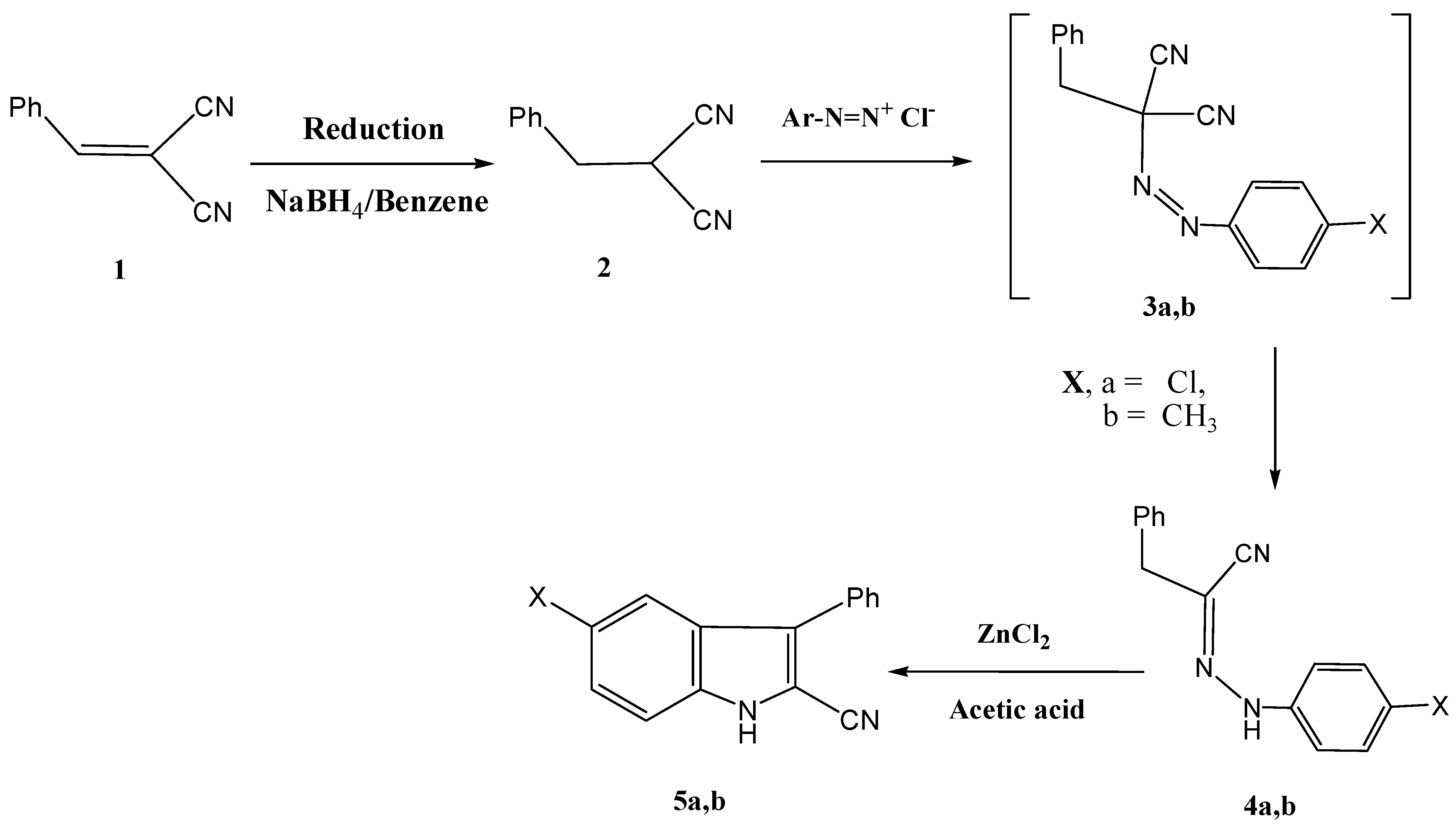
      <p>The hydrazononitriles <bold>4a</bold>,<bold>b</bold> were synthesized by reducing benzylidenemalononitrile (<bold>1</bold>) with sodium borohydride as recently described, to yield <bold>2</bold> [<xref ref-type="bibr" rid="B17-molecules-17-12225">17</xref>]. Coupling of compound <bold>2</bold> with aromatic diazonium salts afforded intermediates <bold>3</bold>. It is believed that the initially formed <bold>3a</bold>,<bold>b</bold> readily undergo Japp-Klingmann cleavage [<xref ref-type="bibr" rid="B18-molecules-17-12225">18</xref>] yielding the final isolable products <bold>4a</bold>,<bold>b</bold> in 75%, and 70% yield respectively. Compounds <bold>4a</bold>,<bold>b</bold> afforded the 2-cyanoindoles <bold>5a</bold>,<bold>b</bold> upon treatment with zinc chloride and glacial acetic acid. This is an example of the utility of the Fisher indole synthesis in the synthesis of 2-cyanoindoles (<xref ref-type="scheme" rid="molecules-17-12225-scheme1">Scheme 1</xref>).</p>
      <fig id="molecules-17-12225-scheme1" position="float">
        <object-id pub-id-type="pii">molecules-17-12225-scheme1_Scheme 1</object-id>
        <label>Scheme 1</label>
        <caption>
          <p>Synthesis of indole-2-carbonitriles <bold>5a</bold>,<bold>b</bold>.</p>
        </caption>
        <graphic xmlns:xlink="http://www.w3.org/1999/xlink" xlink:href="molecules-17-12225-g001.tif"/>
      </fig>
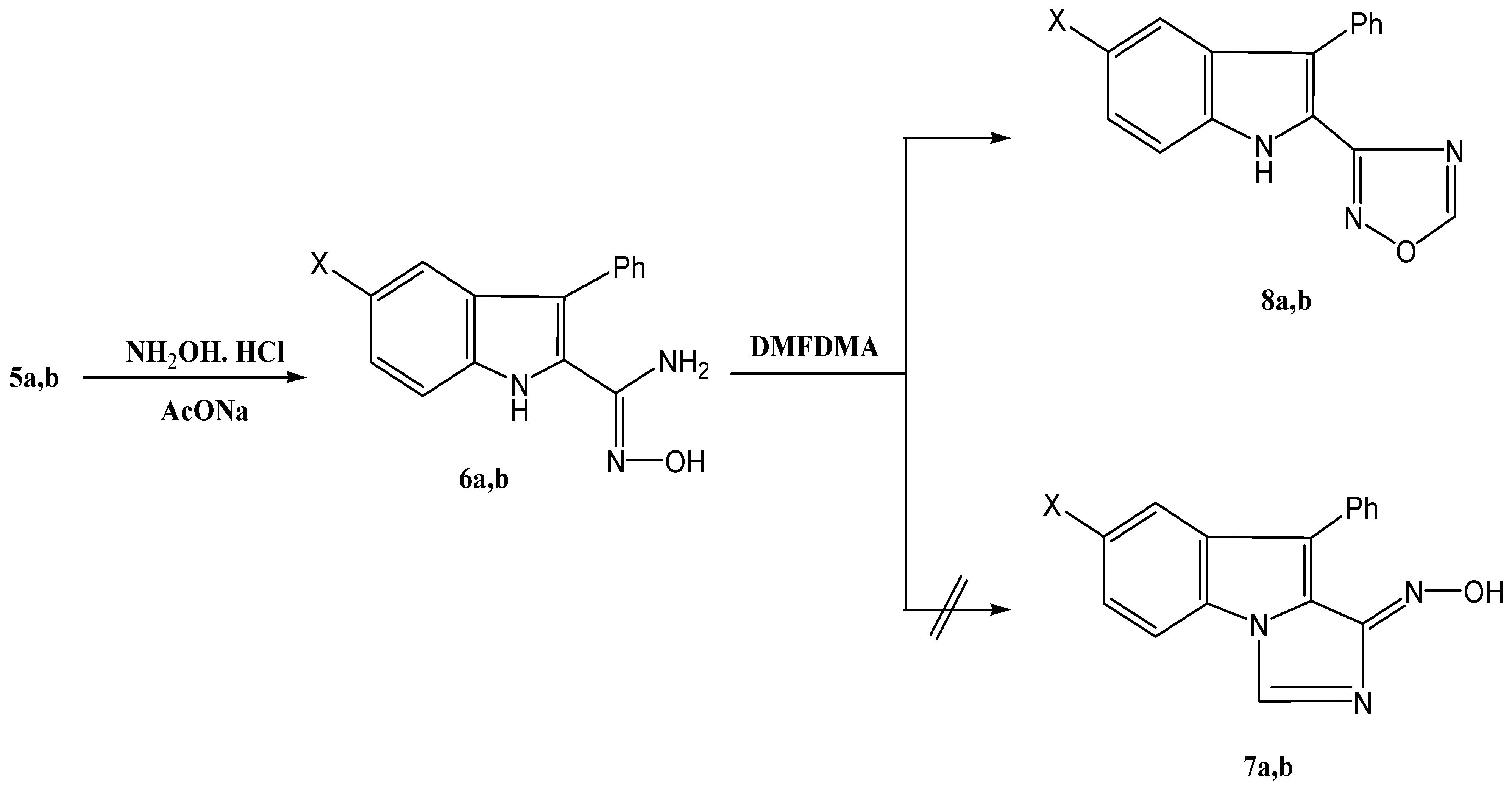
      <p>The 3-phenylindole-2-carbonitriles <bold>5a</bold>,<bold>b</bold> reacted with hydroxylamine hydrochloride to yield amidoximes <bold>6a</bold>,<bold>b</bold>. Reacting these products with dimethylformamide dimethylacetal (DMFDMA) afforded products <bold>8a</bold>,<bold>b</bold> in 68%, and 65% yield respectively, rather than <bold>7</bold>, as indicated by a NOE experiment that showed an interaction between the indole-H-1, at 10.4 ppm and indole-H-7, at 6.8–7.3 ppm (<xref ref-type="scheme" rid="molecules-17-12225-scheme2">Scheme 2</xref>).</p>
      <fig id="molecules-17-12225-scheme2" position="float">
        <object-id pub-id-type="pii">molecules-17-12225-scheme2_Scheme 2</object-id>
        <label>Scheme 2</label>
        <caption>
          <p>Synthesis of 1,2,4-oxadiazolylindole derivatives <bold>8a</bold>,<bold>b</bold>.</p>
        </caption>
        <graphic xmlns:xlink="http://www.w3.org/1999/xlink" xlink:href="molecules-17-12225-g002.tif"/>
      </fig>
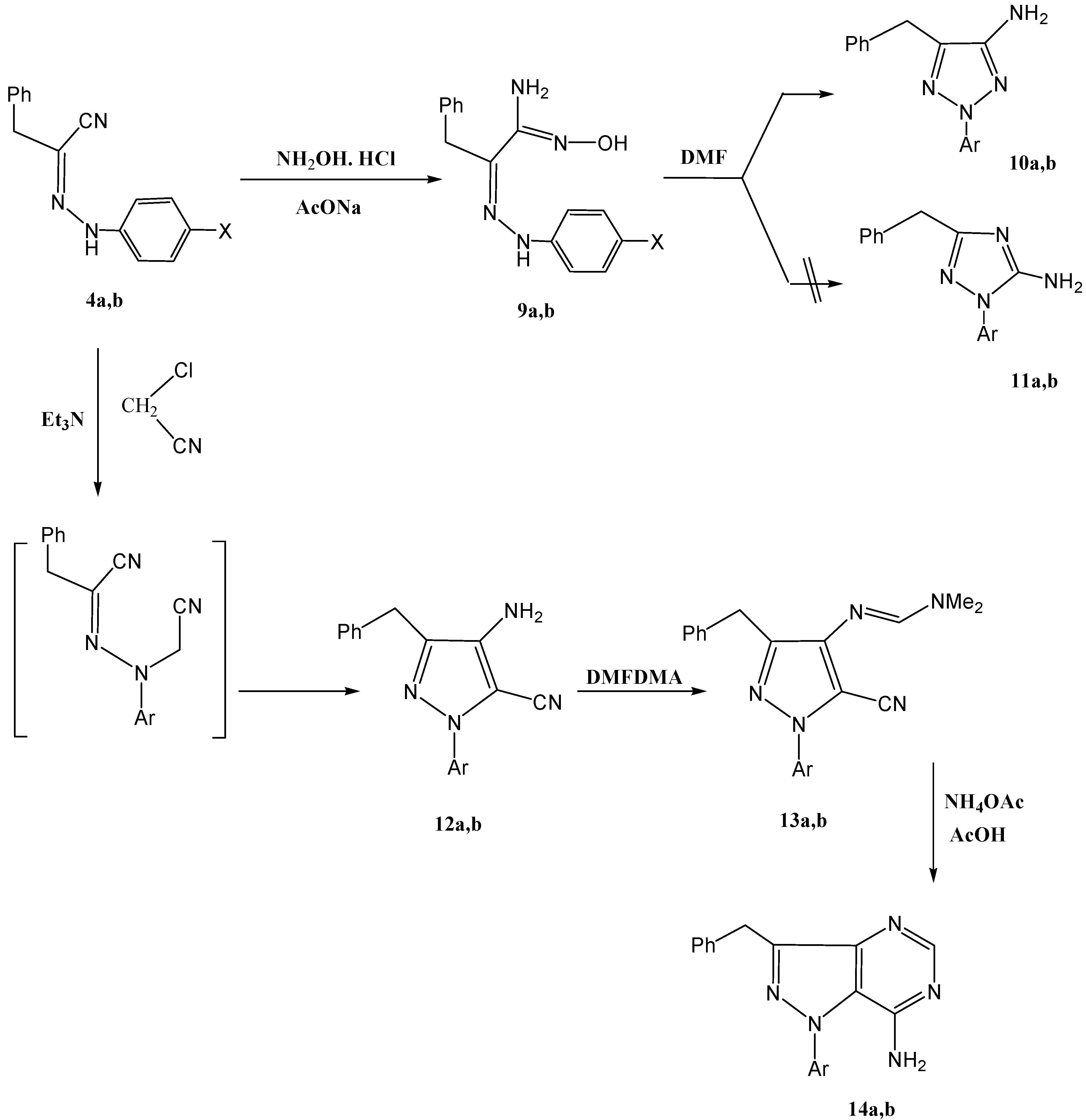
       <p>Our attention then shifted to explore the utility of 2-arylhydrazonals as efficient precursors to 1,2,3-triazoles. Compounds <bold>4a</bold>,<bold>b</bold> reacted with hydroxylamine hydrochloride to yield amidoximes <bold>9a</bold>,<bold>b</bold> that could be cyclized into <bold>10a</bold>,<bold>b</bold> or the isomeric <bold>11a</bold>,<bold>b</bold> upon reflux in DMF. From the previously reported findings concerning this reaction, the structure of the product is not clear, where the 1,2,3-triazole <bold>10a</bold>,<bold>b</bold> found a parallel in results reported for similar reactions under similar conditions [<xref ref-type="bibr" rid="B1-molecules-17-12225">1</xref>,<xref ref-type="bibr" rid="B2-molecules-17-12225">2</xref>,<xref ref-type="bibr" rid="B3-molecules-17-12225">3</xref>]. Although cyclization into isoxazoles has been reported by either refluxing of amidoximes in acidic medium [<xref ref-type="bibr" rid="B4-molecules-17-12225">4</xref>] or refluxing an ester derivative of an amidoxime in dimethylformamide [<xref ref-type="bibr" rid="B19-molecules-17-12225">19</xref>], cyclization to a 1,2,4-triazole via a Tiemann-like rearrangement has been reported by us in one case [<xref ref-type="bibr" rid="B5-molecules-17-12225">5</xref>]. Structures <bold>11a</bold>,<bold>b</bold> could be excluded due to the absence of any interaction between the NH<sub>2</sub> protons and the aryl protons in a NOE experiment (<xref ref-type="scheme" rid="molecules-17-12225-scheme3">Scheme 3</xref>). Moreover, we successfully confirmed that the correct structures are the 1,2,3-triazoles <bold>10a</bold>,<bold>b</bold> based on the obtained single crystal X-ray crystallography results recently reported by our group [<xref ref-type="bibr" rid="B6-molecules-17-12225">6</xref>].</p>
      <p>Compounds <bold>4a</bold>,<bold>b</bold> was refluxed with chloroacetonitrile to yield <bold>12a</bold>,<bold>b</bold> that were then refluxed with DMFDMA to give the expected amidines <bold>13a</bold>,<bold>b</bold>. The amidines, so formed, were then cyclized in the presence of NH<sub>4</sub>OAc and glacial acetic acid to give pyrazolo[4,3-<italic>d</italic>]pyrimidines <bold>14a</bold>,<bold>b</bold> (<italic>cf</italic>. <xref ref-type="scheme" rid="molecules-17-12225-scheme3">Scheme 3</xref>). The structure of the products <bold>14a</bold>,<bold>b</bold> was confirmed by the spatial interaction between the NH<sub>2</sub> protons, at 5.87 ppm, and aryl protons, at 7.08–7.17 ppm, in the NOE experiment.</p>
      <fig id="molecules-17-12225-scheme3" position="float">
        <object-id pub-id-type="pii">molecules-17-12225-scheme3_Scheme 3</object-id>
        <label>Scheme 3</label>
        <caption>
          <p>Synthesis of 1,2,3-triazoles and pyrazolo[4,3-<italic>d</italic>]pyrimidines.</p>
        </caption>
        <graphic xmlns:xlink="http://www.w3.org/1999/xlink" xlink:href="molecules-17-12225-g003.tif"/>
      </fig>
      </sec>
    <sec sec-type="methods">
      <title>3. Experimental</title>
      <sec sec-type="methods">
        <title>3.1. General Procedures</title>
        <p>Melting points were recorded on a Gallenkamp apparatus and are uncorrected. Infrared spectra (KBr) were determined on a Jasco FT/IR-6300 FT-IR instrument. NMR measurements were determined on a Bruker DPX spectrometer at 600 MHz for <sup>1</sup>H-NMR and 125 MHz for <sup>13</sup>C-NMR, in DMSO-<italic>d</italic><sub>6</sub> as solvent and using TMS as internal standard. Mass spectra were measured on GC MS DFS-hermo spectrometers. Elemental analyses were measured by means of an Elementar Vario Micro Cube. Microwave heating was carried out with a single mode cavity Explorer Microwave Synthesizer (CEM Corporation, NC, USA), producing continuous irradiation and equipped with simultaneous external air−cooling system.</p>
      </sec>
      <sec>
        <title>3.2. Synthesis of 2-Benzylidenemalononitrile <italic>(<bold>2</bold>)</italic></title>
        <p>This was prepared by the literature procedure [<xref ref-type="bibr" rid="B17-molecules-17-12225">17</xref>]. A mixture of benzaldehyde (10 mmol) and malononitrile (0.66 g, 10 mmol) was dissolved in aqueous ethanol (1:4, 25 mL) and stirred overnight. The reaction was followed to completion by TLC. To the pre-cooled reaction mixture, an equivalent amount of NaBH<sub>4</sub> was added portionwise with stirring at 0 °C for 15 min. The mixture was acidified with aqueous HCl and the product was extracted with CH<sub>2</sub>Cl<sub>2</sub>. The clear filtrate was evaporated under reduced pressure, and the remaining solid was collected by filtration. The solid product was then recrystallized from ethanol to give a colorless powder (82%); mp 85–86 °C (lit. mp 86–88 °C [<xref ref-type="bibr" rid="B20-molecules-17-12225">20</xref>]); IR (KBr): <italic>υ</italic> = 2188.4 (CN), 2198 (CN) cm<sup>–1</sup>; <sup>1</sup>H-NMR: <italic>δ</italic> = 3.28 (d, <italic>J</italic> = 7.0 Hz, 2H), 3.88 (t, <italic>J</italic> = 7.0 Hz, 1H), 7.32–7.44 (m, 5H, phenyl); <sup>13</sup>C-NMR: <italic>δ</italic> = 25.2 (CH), 37.1 (CH<sub>2</sub>), 112.0 (2 CN), 128.6, 129.0, 129.2, 132.8 (aromatic carbons); MS, <italic>m/z</italic> (%): 156.07 (M<sup>+</sup>, 100), 77 (53); Anal. Calcd. for C<sub>10</sub>H<sub>8</sub>N<sub>2</sub>: C, 76.90; H, 5.16; N, 17.94. Found: C, 76.77; H, 5.09; N, 17.72.</p>
        <p><italic>Coupling of</italic> <bold>2</bold> <italic>with aryldiazonium chlorides.</italic> A cold solution of the appropriate aryldiazonium salt was prepared by adding sodium nitrite solution (1.4 g dissolved in 10 mL water) to a pre-cooled solution of the corresponding arylamine hydrochloride (<italic>p</italic>-chloroaniline or <italic>p</italic>-toluidine, 10 mmol of arylamine in 6 mL 6 M HCl) with continuous stirring. The resulting aryldiazonium salt solutions were then added carefully to a cold ethanolic solution (50 mL) of benzylidenemalononitrile (<bold>2</bold>, 10 mmol) and sodium acetate trihydrate (2.8 g, 20 mmol). The mixture was stirred at room temperature for 1 h and the solid product formed was collected by filtration, washed with water and recrystallized from ethanol.</p>
        <p><italic>2-[(4-Chlorophenyl)hydrazono]-3-phenylpropionitrile</italic> (<bold>4a</bold>). This compound was obtained as pale yellow solid (75%); mp ~148 °C; IR (KBr): <italic>υ</italic> = 3300 (br. NH), 2185 (CN) cm<sup>–1</sup>; <sup>1</sup>H-NMR: <italic>δ</italic> = 2.61 (s, 2H, CH<sub>2</sub>), 7.02 (d, 2H, <italic>J</italic> = 8 <italic>Hz</italic>, aryl), 7.34 (d, 2H, <italic>J</italic> = 8 <italic>Hz</italic>, aryl), 7.44 (m, 5H, phenyl), 8.9 (s, 1H, NH); <sup>13</sup>C-NMR: <italic>δ</italic> = 30.2 (CH<sub>2</sub>), 113.6, 117.6 (CN), 119.5, 125.3, 126.8, 128.0, 129.8, 133.0, 135.9 (aromatic carbons), 159.1 (C=N); MS, <italic>m/z</italic> (%): 269.1 (M<sup>+</sup>, 100), 77 (66); Anal. Calcd. for C<sub>15</sub>H<sub>12</sub>ClN<sub>3</sub>: C, 66.79; H, 4.48; Cl, 13.14; N, 15.58. Found: C, 66.68; H, 4.40; Cl, 13.05; N, 15.46.</p>
        <p><italic>3-Phenyl-2-(p-tolylhydrazono)propionitrile</italic> (<bold>4b</bold>). This compound was obtained as a yellow solid (70%); mp ~126 °C; IR (KBr): <italic>υ</italic> = 3320 (br. NH), 2189 (CN) cm<sup>–1</sup>; <sup>1</sup>H-NMR: <italic>δ</italic> = 1.71 (s, 3H, CH<sub>3</sub>), 2.66 (s, 2H, CH<sub>2</sub>), 7.13 (d, 2H, <italic>J</italic> = 8 <italic>Hz</italic>, aryl), 7.18 (d, 2H, <italic>J</italic> = 8 <italic>Hz</italic>, aryl), 7.22 (m, 5H, phenyl), 11.5 (s, 1H, NH); <sup>13</sup>C-NMR: <italic>δ</italic> = 36.2 (CH<sub>3</sub>), 38.6 (CH<sub>2</sub>), 117.4 (CN), 118.9, 123.5, 127.3, 129.2, 132.4, 134.6 (aromatic carbons), 157.5 (C=N); MS, <italic>m/z</italic> (%): 249.31 (M<sup>+</sup>, 100), 77 (54). Anal. Calcd. for C<sub>16</sub>H<sub>15</sub>N<sub>3</sub>: C, 77.08; H, 6.06; N, 16.85. Found: C, 76.97; H, 5.98; N, 16.77.</p>
        <p><italic>Cyclization of</italic> <bold>4a</bold>,<bold>b</bold> <italic>in the presence of ZnCl<sub>2</sub> and glacial acetic acid.</italic> A mixture of <bold>4a</bold>,<bold>b</bold> (10 mmol), zinc chloride (1.34 g, 10 mmol), and glacial acetic acid (50 mL) was refluxed and followed by TLC till completion after 24 h. The reaction mixture was poured into an ice/water mixture and the solid product, thus formed, was then collected by filtration and recrystallized from ethanol. </p>
        <p><italic>5-Chloro-3-phenyl-1H-indole-2-carbonitrile</italic> (<bold>5a</bold>). This compound was obtained as a yellow solid (60%); mp ~212 °C; IR (KBr): <italic>υ</italic> = 3300 (br. NH), 2206 (CN) cm<sup>–1</sup>; <sup>1</sup>H-NMR: <italic>δ</italic> = 7.03–7.26 (m, 8H, aryl &amp; phenyl), 11.1 (s, 1H, NH); <sup>13</sup>C-NMR: <italic>δ</italic> = 117.6 (CN), 119.8, 121.4, 122.9, 124.7, 128.4, 129.6, 130.5, 133.0, 137.9 139.1, 142.2 (aromatic carbons); MS, <italic>m/z</italic> (%): 252.05 (M<sup>+</sup>, 100), 77 (51); Anal. Calcd. for C<sub>15</sub>H<sub>9</sub>ClN<sub>2</sub>: C, 71.29; H, 3.59; Cl, 14.03; N, 11.09. Found: C, 71.15; H, 3.52; Cl, 13.84; N, 10.97.</p>
        <p><italic>5-Methyl-3-phenyl-1H-indole-2-carbonitrile</italic> (<bold>5b</bold>). This compound was obtained as a colorless solid (70%); mp ~168 °C; IR (KBr): <italic>υ</italic> = 3320 (br. NH), 2189 (CN) cm<sup>–1</sup>; <sup>1</sup>H-NMR: <italic>δ</italic> = 1.81 (s, 3H, CH<sub>3</sub>), 6.87–7.33 (m, 8H, phenyl), 10.8 (s, 1H, NH); <sup>13</sup>C-NMR: <italic>δ</italic> = 35.2 (CH<sub>3</sub>), 117.6 (CN), 120.6, 122.3, 122.6, 123.4, 127.0, 128.7, 129.4, 132.7, 132.8, 134.6, 139.8 (aromatic carbons); MS, <italic>m/z</italic> (%): 232.1 (M<sup>+</sup>, 100), 77 (48); Anal. Calcd. for C<sub>16</sub>H<sub>12</sub>N<sub>2</sub>: C, 82.73; H, 5.21; N, 12.06. Found: C, 82.68; H, 5.14; N, 11.95.</p>
      </sec>
      <sec>
        <title>3.3. Synthesis of 1,2,4-Oxadiazolyl-indoles <italic><bold>8a</bold>,<bold>b</bold></italic></title>
        <p>A mixture of <bold>5a</bold>,<bold>b</bold> (10 mmol), hydroxylamine hydrochloride (0.69 g, 10 mmol), and sodium acetate (3 g, 25 mmol) in ethanol (25 mL) was refluxed for 5 h. The reaction mixture was poured into ice/water with stirring while a yellow solid separated and was then collected by filtration. The crude product was refluxed with DMFDMA for 6 h. The pure products <bold>8a</bold>,<bold>b</bold> were purified by recrystallization from ethanol.</p>
        <p><italic>3-(5-Chloro-3-phenyl-1H-indol-2-yl)-1,2,4-oxadiazole</italic> (<bold>8a</bold>). Obtained as a pale yellow powder (68%); mp ~142 °C; IR (KBr): <italic>υ</italic> = 1586 (aromatic C=C) cm<sup>–1</sup>; <sup>1</sup>H-NMR: <italic>δ</italic> = 6.84–7.31 (m, 9H, aromatic), 10.4 (s, 1H, NH, imidazole); <sup>13</sup>C-NMR: <italic>δ</italic> = 112.3, 115.2, 121.2, 122.8, 123.4, 124.0, 127.9, 128.5, 129.1, 131.4, 133.8, 134.7, 137.9, 148.6 (aromatic carbons); MS, <italic>m/z</italic> (%): 295.1 (M<sup>+</sup>, 56), 77 (100); Anal. Calcd. for C<sub>16</sub>H<sub>10</sub>ClN<sub>3</sub>O: C, 64.98; H, 3.41; Cl, 11.99; N, 14.21. Found: C, 64.91; H, 3.36; Cl, 11.91; N, 14.13.</p>
        <p><italic>3-(5-Methyl-3-phenyl-1H-indol-2-yl)-1,2,4-oxadiazole</italic> (<bold>8b</bold>). Obtained as a yellow solid (65%); mp ~124 °C; IR (KBr): <italic>υ</italic> = 3100 (aromatic CH) cm<sup>–1</sup>; <sup>1</sup>H-NMR: <italic>δ</italic> = 2.69 (s, 3H, CH<sub>3</sub>), 6.72–7.28 (m, 9H, aromatic), 10.1 (s, 1H, NH, imidazole); <sup>13</sup>C-NMR: <italic>δ</italic> = 36.3 (CH<sub>3</sub>), 110.6, 112.7, 119.3, 121.7. 122.6, 122.9, 123.9, 127.4, 128.9, 129.6, 131.2, 132.6, 134.8 142.6 (aromatic carbons); MS, <italic>m/z</italic> (%): 275.1 (M<sup>+</sup>, 83), 77 (100); Anal. Calcd. for C<sub>17</sub>H<sub>13</sub>N<sub>3</sub>O: C, 74.17; H, 4.76; N, 15.26. Found: C, 74.09; H, 4.66; N, 15.13.</p>
      </sec>
      <sec>
        <title>3.4. Synthesis of 1,2,3-Triazole Derivatives <italic><bold>10a</bold>,<bold>b</bold></italic></title>
        <p>A mixture of <bold>4a</bold>,<bold>b</bold> (10 mmol), hydroxylamine hydrochloride (0.69 g, 10 mmol), and sodium acetate (3 g, 25 mmol) was dissolved in ethanol (25 mL). The mixture was refluxed for 4 h. The reaction mixture was poured into ice/water with stirring while a yellow solid separated and was then collected by filtration. The crude product, so formed, was then refluxed in DMF for 5 h and the reaction mixture was poured into cold water. The products <bold>10a</bold>,<bold>b</bold> were purified by crystallization from ethanol.</p>
        <p><italic>5-Benzyl-2-(4-chlorophenyl)-2H-1,2,3-triazol-4-amine</italic> (<bold>10a</bold>). It was obtained as a yellow solid (75%); mp &gt;250 °C; IR (KBr): <italic>υ</italic> = 3330 (br. NH<sub>2</sub>) cm<sup>–1</sup>; <sup>1</sup>H-NMR: <italic>δ</italic> = 3.65 (s, 2H, CH<sub>2</sub>), 6.87 (s, 2H, NH<sub>2</sub>), 7.01–7.23 (m, 9H, aromatic); <sup>13</sup>C-NMR: <italic>δ</italic> = 33.1 (CH<sub>2</sub>), 104.8, 121.3, 122.7, 122.9, 125.7, 128.3, 129.1, 132.0, 134.6, 141.0 (aromatic carbon); MS, <italic>m/z</italic> (%): 284.08 (M<sup>+</sup>, 65), 77 (84); Anal. Calcd. for C<sub>15</sub>H<sub>13</sub>ClN<sub>4</sub>: C, 63.27; H, 4.60; Cl, 12.45; N, 19.68. Found: C, 63.18; H, 4.53; Cl, 12.34; N, 19.62.</p>
        <p><italic>5-Benzyl-2-(4-tolyl)-2H-1,2,3-triazol-4-amine</italic> (<bold>10b</bold>). It was obtained as a yellow solid (70%); mp ~197 °C; IR (KBr): <italic>υ</italic> = 3340 (br. NH<sub>2</sub>) cm<sup>–1</sup>; <sup>1</sup>H-NMR: <italic>δ</italic> = 2.44 (s, 3H, CH<sub>3</sub>), 3.61 (s, 2H, CH<sub>2</sub>), 5.82 (s, 2H, NH<sub>2</sub>), 7.01–7.24 (m, 9H, aromatic); <sup>13</sup>C-NMR: <italic>δ</italic> = 30.8 (CH<sub>3</sub>), 32.6 (CH<sub>2</sub>), 106.4, 119.6, 121.2, 122.7, 124.3, 128.1, 128.4, 131.8, 133.2, 139.1 (aromatic carbons); MS, <italic>m/z</italic> (%): 264.14 (M<sup>+</sup>, 46), 77 (100); Anal. Calcd. for C<sub>16</sub>H<sub>16</sub>N<sub>4</sub>: C, 72.70; H, 6.10; N, 21.20. Found: C, 72.57; H, 6.02; N, 21.13.</p>
      </sec>
      <sec>
        <title>3.5. Cyclization of <italic><bold>4a</bold>,<bold>b</bold></italic> with Chloroacetonitrile in the Presence of Et<sub>3</sub>N</title>
        <p>A mixture of <bold>4a</bold>,<bold>b</bold> (10 mmol), chloroacetonitrile (0.75 g, 10 mmol), and triethylamine (0.5 mL) was irradiated at 80 W for 5 min (final temperature 140 °C). The reaction mixture was poured into a HCl/water mixture and the solid product, so formed, was then collected by filtration and recrystallized from ethanol.</p>
        <p><italic>4-Amino-3-benzyl-1-(4-chlorophenyl)-1H-pyrazole-5-carbonitrile</italic> (<bold>12a</bold>). This compound was obtained as a yellow solid (67%); mp ~227 °C; IR (KBr): <italic>υ</italic> = 3350 (br. NH<sub>2</sub>), 2210 (CN) cm<sup>–1</sup>; <sup>1</sup>H-NMR: <italic>δ</italic> = 3.86 (s, 2H, CH<sub>2</sub>), 6.87 (s, 2H, NH<sub>2</sub>), 7.01–7.26 (m, 9H, aromatic); <sup>13</sup>C-NMR: <italic>δ</italic> = 31.6 (CH<sub>2</sub>), 117.8 (CN), 119.9, 121.5, 122.3, 125.1, 125.4, 127.2, 129.8, 132.6, 133.8, 135.1, 138.7 (aromatic carbons); MS, <italic>m/z</italic> (%): 308.08 (M<sup>+</sup>, 27), 77 (100); Anal. Calcd. for C<sub>17</sub>H<sub>13</sub>ClN<sub>4</sub>: C, 66.13; H, 4.24; Cl, 11.48; N, 18.15. Found: C, 66.04; H, 4.07; Cl, 11.33; N, 18.05.</p>
        <p><italic>4-Amino-3-benzyl-1-p-tolyl-1H-pyrazole-5-carbonitrile</italic> (<bold>12b</bold>). This compound was obtained as a yellow solid (70%); mp ~204 °C; IR (KBr): <italic>υ</italic> = 3330 (br. NH<sub>2</sub>), 2190 (CN) cm<sup>–1</sup>; <sup>1</sup>H-NMR: <italic>δ</italic> = 2.27 (s, 3H, CH<sub>3</sub>), 3.62 (s, 2H, CH<sub>2</sub>), 6.41 (s, 2H, NH<sub>2</sub>), 6.94–7.21 (m, 9H, aromatic); <sup>13</sup>C-NMR: <italic>δ</italic> = 35.9 (CH<sub>3</sub>), 38.1 (CH<sub>2</sub>), 117.7 (CN), 119.2, 121.1, 121.7, 124.2, 127.9, 128.6, 129.7, 131.2, 132.4, 134.0, 136.4 (aromatic carbons); MS, <italic>m/z</italic> (%): 288.14 (M<sup>+</sup>, 62), 77 (100); Anal. Calcd. for C<sub>18</sub>H<sub>16</sub>N<sub>4</sub>: C, 74.98; H, 5.59; N, 19.43. Found: C, 74.88; H, 5.47; N, 19.27.</p>
      </sec>
      <sec>
        <title>3.6. Synthesis of Pyrazolopyrimidine Derivatives</title>
        <p>A mixture of <bold>12a</bold>,<bold>b</bold> (10 mmol) and dimethylformamide dimethylacetal (1.8 g, 15 mmol) in dry xylene (50 mL) was refluxed for 6 h. The reaction mixture was cooled and then the product, so formed, was refluxed with ammonium acetate (1.54 g, 20 mmol) and glacial acetic acid (25 mL) for 4 h. The reaction mixture was cooled and treated with petroleum ether whereby a yellowish solid precipitated and was collected by filtration. The pure product was obtained by crystallized from ethanol.</p>
        <p><italic>3-Benzyl-1-(4-chlorophenyl)-1H-pyrazolo[4,3-d]pyrimidin-7-amine</italic> (<bold>14a</bold>). This compound was obtained as a yellow solid (72%); mp &gt;250 °C; IR (KBr): <italic>υ</italic> = 3350 (br. NH<sub>2</sub>) cm<sup>–1</sup>; <sup>1</sup>H-NMR: <italic>δ</italic> = 3.36 (s, 2H, CH<sub>2</sub>), 5.87 (s, 2H, NH<sub>2</sub>), 7.08–7.17 (m, 9H, aromatic), 8.98 (s, 1H, CH pyrimidine); <sup>13</sup>C-NMR: <italic>δ</italic> = 34.6 (CH<sub>2</sub>), 104.7, 110.4, 114.0, 119.1, 121.4, 123.9, 124.2, 127.3, 128.7, 130.2, 131.7, 134.3, 139.7 (aromatic carbons); MS, <italic>m/z</italic> (%): 335.09 (M<sup>+</sup>, 48), 77 (100); Anal. Calcd. for C<sub>18</sub>H<sub>14</sub>ClN<sub>5</sub>: C, 64.38; H, 4.20; Cl, 10.56; N, 20.86. Found: C, 64.26; H, 4.06; Cl, 10.39; N, 20.67.</p>
        <p><italic>3-Benzyl-1-p-tolyl-1H-pyrazolo[4,3-d]pyrimidin-7-amine</italic> (<bold>14b</bold>). This compound was obtained as a yellow solid (65%); mp &gt;250 °C; IR (KBr): <italic>υ</italic> = 3330 (br. NH<sub>2</sub>) cm<sup>–1</sup>; <sup>1</sup>H-NMR: <italic>δ</italic> = 2.84 (s, 3H, CH<sub>3</sub>), 3.17 (s, 2H, CH<sub>2</sub>), 5.61 (s, 2H, NH<sub>2</sub>), 6.86–7.19 (m, 9H, aromatic), 8.62 (s, 1H, CH pyrimidine); <sup>13</sup>C-NMR: <italic>δ</italic> = 36.4 (CH<sub>3</sub>), 38.6 (CH<sub>2</sub>), 105.2, 112.4, 119.1, 119.7, 122.1, 124.9, 128.2, 128.6, 130.9, 132.3, 134.6, 135.0, 137.8 (aromatic carbons); MS, <italic>m/z</italic> (%): 315.1 (M<sup>+</sup>, 53), 77 (100); Anal. Calcd. for C<sub>19</sub>H<sub>17</sub>N<sub>5</sub>: C, 72.36; H, 5.43; N, 22.21. Found: C, 72.25; H, 5.31; N, 22.08.</p>
      </sec>
    </sec>
    <sec sec-type="conclusions">
      <title>4. Conclusions</title>
      <p>2-Arylhydrazono-3-propanenitriles are readily obtainable versatile intermediates in the syntheses of a diversity of heterocycles, especially indoles, pyrazoles, 1,2,3-triazole, and pyrazolo[4,3-<italic>d</italic>]-pyrimidines, thus proving the general scope of our newly reported findings on the reactions of 2-aryl-hydrazononitriles.</p>
      </sec>
    </body>
  <back>
    <ack>
      <title>Acknowledgments</title>
      <p>Support for this work received from the University of Kuwait through a research grant (SC09/07) and the facilities of Analab/SAF by research grants (GC01/01, GC01/05, GC01/03 and GS03/01) are gratefully acknowledged. The authors would like to thank M. Elnagdi for his valuable contributions.</p>
    </ack>
  <ref-list>
      <title>References</title>
      <ref id="B1-molecules-17-12225">
        <label>1.</label>
        <citation citation-type="journal">
          <person-group person-group-type="author">
            <name>
              <surname>El-Dusouqui</surname>
              <given-names>O.M.E.</given-names>
            </name>
            <name>
              <surname>Abdelkhalik</surname>
              <given-names>M.M.</given-names>
            </name>
            <name>
              <surname>Al-Awadi</surname>
              <given-names>N.A.</given-names>
            </name>
            <name>
              <surname>Dib</surname>
              <given-names>H.H.</given-names>
            </name>
            <name>
              <surname>George</surname>
              <given-names>B.J.</given-names>
            </name>
            <name>
              <surname>Elnagdi</surname>
              <given-names>M.H.</given-names>
            </name>
          </person-group>
          <article-title>Chemistry of 2-arylhydrazonals: Utility of substituted 2-arylhydrazono-3-oxoalkanals as precursors for 3-oxoalkanonitriles, 3-aminoisoxazole and 1,2,3- and 1,2,4-triazoles</article-title>
          <source>J. Chem. Res.</source>
          <year>2006</year>
          <volume>5</volume>
          <fpage>295</fpage>
          <lpage>302</lpage>
        </citation>
      </ref>
      <ref id="B2-molecules-17-12225">
        <label>2.</label>
        <citation citation-type="journal">
          <person-group person-group-type="author">
            <name>
              <surname>Ghozlan</surname>
              <given-names>S.A.S.</given-names>
            </name>
            <name>
              <surname>Abdelhamid</surname>
              <given-names>I.A.</given-names>
            </name>
            <name>
              <surname>Ibrahem</surname>
              <given-names>H.M.</given-names>
            </name>
            <name>
              <surname>Elnagdi</surname>
              <given-names>M.H.</given-names>
            </name>
          </person-group>
          <article-title>Studies with 2-arylhydrazononitriles: A new convenient synthesis of 2,4-disubstituted-1,2,3-triazole-5-amines</article-title>
          <source>ARKIVOC</source>
          <year>2006</year>
          <volume>15</volume>
          <fpage>53</fpage>
          <lpage>60</lpage>
        </citation>
      </ref>
      <ref id="B3-molecules-17-12225">
        <label>3.</label>
        <citation citation-type="journal">
          <person-group person-group-type="author">
            <name>
              <surname>Behbehani</surname>
              <given-names>H.</given-names>
            </name>
            <name>
              <surname>Ibrahim</surname>
              <given-names>H.M.</given-names>
            </name>
            <name>
              <surname>Makhseed</surname>
              <given-names>S.</given-names>
            </name>
          </person-group>
          <article-title>Studies with 3-oxoalkanonitriles: Synthesis and reactivity of 3-oxo-3-(1-methylindolyl)propanenitrile</article-title>
          <source>Heterocycles</source>
          <year>2009</year>
          <volume>78</volume>
          <fpage>3081</fpage>
          <lpage>3090</lpage>
          <pub-id pub-id-type="doi">10.3987/COM-09-11818</pub-id>
        </citation>
      </ref>
      <ref id="B4-molecules-17-12225">
        <label>4.</label>
        <citation citation-type="journal">
          <person-group person-group-type="author">
            <name>
              <surname>Elnagdi</surname>
              <given-names>M.H.</given-names>
            </name>
            <name>
              <surname>Elmoghayar</surname>
              <given-names>M.R.H.</given-names>
            </name>
            <name>
              <surname>Hafez</surname>
              <given-names>E.A.A.</given-names>
            </name>
            <name>
              <surname>Alnima</surname>
              <given-names>H.H.</given-names>
            </name>
          </person-group>
          <article-title>Reaction of 2-arylhydrazono-3-oxonitriles with hydroxylamine. Synthesis of 3-amino-4-arylazoisoxazoles</article-title>
          <source>J. Org. Chem.</source>
          <year>1975</year>
          <volume>40</volume>
          <fpage>2604</fpage>
          <lpage>2607</lpage>
        <pub-id pub-id-type="doi">10.1021/jo00906a007</pub-id></citation>
      </ref>
      <ref id="B5-molecules-17-12225">
        <label>5.</label>
        <citation citation-type="journal">
          <person-group person-group-type="author">
            <name>
              <surname>Al-Matar</surname>
              <given-names>H.M.</given-names>
            </name>
            <name>
              <surname>Riyadh</surname>
              <given-names>S.M.</given-names>
            </name>
            <name>
              <surname>Elnagdi</surname>
              <given-names>M.H.</given-names>
            </name>
          </person-group>
          <article-title>2-Arylhydrazononitriles in heterocyclic synthesis: A novel route to 1,3-diaryl-1,2,4-triazol-5-amines via a Tiemann rearrangement ofArylhydrazonoamidoximes</article-title>
          <source>ARKIVOC</source>
          <year>2007</year>
          <volume>13</volume>
          <fpage>53</fpage>
          <lpage>62</lpage>
        </citation>
      </ref>
      <ref id="B6-molecules-17-12225">
        <label>6.</label>
        <citation citation-type="journal">
          <person-group person-group-type="author">
            <name>
              <surname>Al-Matar</surname>
              <given-names>H.M.</given-names>
            </name>
            <name>
              <surname>Adam</surname>
              <given-names>A.Y.</given-names>
            </name>
            <name>
              <surname>Khalil</surname>
              <given-names>K.D.</given-names>
            </name>
            <name>
              <surname>Elnagdi</surname>
              <given-names>M.H.</given-names>
            </name>
          </person-group>
          <article-title>Studies with 3-oxoalkanenitriles: Novel rearrangements observed while exploring the utility of 2-cyanoacetyl-1-methylpyrrole as a precursor to pyrrole substituted heterocyclic compounds</article-title>
          <source>ARKIVOC</source>
          <year>2012</year>
          <volume>6</volume>
          <fpage>1</fpage>
          <lpage>15</lpage>
        </citation>
      </ref>
      <ref id="B7-molecules-17-12225">
        <label>7.</label>
        <citation citation-type="journal">
          <person-group person-group-type="author">
            <name>
              <surname>Al-Matar</surname>
              <given-names>H.M.</given-names>
            </name>
            <name>
              <surname>Khalil</surname>
              <given-names>K.D.</given-names>
            </name>
            <name>
              <surname>Al-Dorri</surname>
              <given-names>D.M.</given-names>
            </name>
            <name>
              <surname>Elnagdi</surname>
              <given-names>M.H.</given-names>
            </name>
          </person-group>
          <article-title>Efficient routes to pyrazolo[3,4-e][1,2,4]triazines and a new ring system: [1,2,4]triazino[5,6-d][1,2,3]triazines</article-title>
          <source>Molecules</source>
          <year>2010</year>
          <volume>15</volume>
          <fpage>3302</fpage>
          <lpage>3310</lpage>
          <pub-id pub-id-type="doi">10.3390/molecules15053302</pub-id>
        </citation>
      </ref>
      <ref id="B8-molecules-17-12225">
        <label>8.</label>
        <citation citation-type="journal">
          <person-group person-group-type="author">
            <name>
              <surname>Riyadh</surname>
              <given-names>S.M.</given-names>
            </name>
            <name>
              <surname>Al-Matar</surname>
              <given-names>H.M.</given-names>
            </name>
            <name>
              <surname>Elnagdi</surname>
              <given-names>M.H.</given-names>
            </name>
          </person-group>
          <article-title>Studies with 2-arylhydrazono-nitriles: Further investigations on reactivity of 2-arylhydrazononitriles towards hydroxylamine</article-title>
          <source>J. Heterocycl. Chem.</source>
          <year>2008</year>
          <volume>45</volume>
          <fpage>975</fpage>
          <lpage>979</lpage>
          <pub-id pub-id-type="doi">10.1002/jhet.5570450405</pub-id>
        </citation>
      </ref>
      <ref id="B9-molecules-17-12225">
        <label>9.</label>
        <citation citation-type="journal">
          <person-group person-group-type="author">
            <name>
              <surname>Stevens</surname>
              <given-names>M.F.G.</given-names>
            </name>
          </person-group>
          <article-title>The medicinal chemistry of 1,2,3-triazines</article-title>
          <source>Prog. Med. Chem.</source>
          <year>1976</year>
          <volume>13</volume>
          <fpage>205</fpage>
          <lpage>269</lpage>
          <pub-id pub-id-type="doi">10.1016/S0079-6468(08)70139-5</pub-id>
        </citation>
      </ref>
      <ref id="B10-molecules-17-12225">
        <label>10.</label>
        <citation citation-type="journal">
          <person-group person-group-type="author">
            <name>
              <surname>Curd</surname>
              <given-names>F.H.S.</given-names>
            </name>
            <name>
              <surname>Landquist</surname>
              <given-names>J.K.</given-names>
            </name>
            <name>
              <surname>Rose</surname>
              <given-names>F.L.</given-names>
            </name>
          </person-group>
          <article-title>Synthetic antimalarials. Part XII. Some 1:3:5-triazine derivatives</article-title>
          <source>J. Chem. Soc.</source>
          <year>1947</year>
          <fpage>154</fpage>
          <lpage>160</lpage>
        </citation>
      </ref>
      <ref id="B11-molecules-17-12225">
        <label>11.</label>
        <citation citation-type="journal">
          <person-group person-group-type="author">
            <name>
              <surname>Migawa</surname>
              <given-names>M.T.</given-names>
            </name>
            <name>
              <surname>Drach</surname>
              <given-names>J.C.</given-names>
            </name>
            <name>
              <surname>Townsend</surname>
              <given-names>L.B.</given-names>
            </name>
          </person-group>
          <article-title>Design, synthesis and antiviral activity of novel 4,5-disubstituted 7-(β-D-ribofuranosyl)pyrrolo[2,3-d][1,2,3]triazines and the novel 3-amino-5-methyl-1-(β-D-ribofuranosyl)- and 3-amino-5-methyl-1-(2-deoxy-β-D-ribofuranosyl)-1,5-dihydro-1,4,5,6,7,8-hexaazaacenaphthylene as analogues of triciribine</article-title>
          <source>J. Med. Chem.</source>
          <year>2005</year>
          <volume>48</volume>
          <fpage>3840</fpage>
          <lpage>3851</lpage>
          <pub-id pub-id-type="doi">10.1021/jm0402014</pub-id>
        </citation>
      </ref>
      <ref id="B12-molecules-17-12225">
        <label>12.</label>
        <citation citation-type="journal">
          <person-group person-group-type="author">
            <name>
              <surname>Alyab'ev</surname>
              <given-names>S.B.</given-names>
            </name>
            <name>
              <surname>Kravchenko</surname>
              <given-names>D.V.</given-names>
            </name>
            <name>
              <surname>Ivashchenko</surname>
              <given-names>A.V.</given-names>
            </name>
          </person-group>
          <article-title>Functionalization of oxadiazolylindole systems</article-title>
          <source>Russ. J. Org. Chem.</source>
          <year>2009</year>
          <volume>45</volume>
          <fpage>719</fpage>
          <lpage>724</lpage>
          <pub-id pub-id-type="doi">10.1134/S1070428009050121</pub-id>
        </citation>
      </ref>
      <ref id="B13-molecules-17-12225">
        <label>13.</label>
        <citation citation-type="journal">
          <person-group person-group-type="author">
            <name>
              <surname>Pal</surname>
              <given-names>M.</given-names>
            </name>
            <name>
              <surname>Sharma</surname>
              <given-names>N.K.</given-names>
            </name>
            <name>
              <surname>Priyanka</surname>
              <given-names>J.K.K.</given-names>
            </name>
          </person-group>
          <article-title>Synthetic and biological multiplicity of isatin: A review</article-title>
          <source>J. Adv. Sci. Res.</source>
          <year>2011</year>
          <volume>2</volume>
          <fpage>35</fpage>
          <lpage>44</lpage>
          <pub-id pub-id-type="doi">10.1016/j.jare.2010.08.005</pub-id>
        </citation>
      </ref>
      <ref id="B14-molecules-17-12225">
        <label>14.</label>
        <citation citation-type="journal">
          <person-group person-group-type="author">
            <name>
              <surname>Masevicius</surname>
              <given-names>V.</given-names>
            </name>
            <name>
              <surname>Juskenas</surname>
              <given-names>R.</given-names>
            </name>
            <name>
              <surname>Tumkevicius</surname>
              <given-names>S.</given-names>
            </name>
          </person-group>
          <article-title>Synthesis of a novel heterocyclic system-pyrazolo[5,4,3-de]pyrimido-[4,5-e][1,4]diazepine</article-title>
          <source>Chem. Heterocycl. Compd.</source>
          <year>2007</year>
          <volume>43</volume>
          <fpage>1593</fpage>
          <lpage>1594</lpage>
        <pub-id pub-id-type="doi">10.1007/s10593-007-0247-y</pub-id></citation>
      </ref>
      <ref id="B15-molecules-17-12225">
        <label>15.</label>
        <citation citation-type="journal">
          <person-group person-group-type="author">
            <name>
              <surname>Sroka</surname>
              <given-names>I.M.</given-names>
            </name>
            <name>
              <surname>Heiss</surname>
              <given-names>E.H.</given-names>
            </name>
            <name>
              <surname>Havlicek</surname>
              <given-names>L.</given-names>
            </name>
            <name>
              <surname>Totzke</surname>
              <given-names>F.</given-names>
            </name>
            <name>
              <surname>Aristei</surname>
              <given-names>Y.</given-names>
            </name>
            <name>
              <surname>Pechan</surname>
              <given-names>P.</given-names>
            </name>
            <name>
              <surname>Kubbutat</surname>
              <given-names>M.H.G.</given-names>
            </name>
            <name>
              <surname>Strnad</surname>
              <given-names>M.</given-names>
            </name>
            <name>
              <surname>Dirsch</surname>
              <given-names>V.M.</given-names>
            </name>
          </person-group>
          <article-title>A novel roscovitine derivative potently induces G1-phase arrest in platelet-derived growth factor-BB-activated vascular smooth muscle cells</article-title>
          <source>Mol. Pharmacol.</source>
          <year>2010</year>
          <volume>77</volume>
          <fpage>255</fpage>
          <lpage>261</lpage>
          <pub-id pub-id-type="doi">10.1124/mol.109.060327</pub-id>
        </citation>
      </ref>
      <ref id="B16-molecules-17-12225">
        <label>16.</label>
        <citation citation-type="journal">
          <person-group person-group-type="author">
            <name>
              <surname>Fevig</surname>
              <given-names>J.M.</given-names>
            </name>
            <name>
              <surname>Cacciola</surname>
              <given-names>J.</given-names>
            </name>
            <name>
              <surname>Buriak</surname>
              <given-names>J.</given-names>
            </name>
            <name>
              <surname>Rossi</surname>
              <given-names>K.A.</given-names>
            </name>
            <name>
              <surname>Knabb</surname>
              <given-names>R.M.</given-names>
            </name>
            <name>
              <surname>Luettgen</surname>
              <given-names>J.M.</given-names>
            </name>
            <name>
              <surname>Wong</surname>
              <given-names>P.C.</given-names>
            </name>
            <name>
              <surname>Bai</surname>
              <given-names>S.A.</given-names>
            </name>
            <name>
              <surname>Wexler</surname>
              <given-names>R.R.</given-names>
            </name>
            <name>
              <surname>Lam</surname>
              <given-names>P.Y.S.</given-names>
            </name>
          </person-group>
          <article-title>Preparation of 1-(4-methoxyphenyl)-1H-pyrazolo[4,3-d]pyrimidin-7(6H)-ones as potent, selective and bioavailable inhibitors of coagulation factor Xa</article-title>
          <source>Bioorg. Med. Chem. Lett.</source>
          <year>2006</year>
          <volume>16</volume>
          <fpage>3755</fpage>
          <lpage>3760</lpage>
        <pub-id pub-id-type="doi">10.1016/j.bmcl.2006.04.044</pub-id><pub-id pub-id-type="pmid">16682200</pub-id></citation>
      </ref>
      <ref id="B17-molecules-17-12225">
        <label>17.</label>
        <citation citation-type="journal">
          <person-group person-group-type="author">
            <name>
              <surname>Tayyari</surname>
              <given-names>F.</given-names>
            </name>
            <name>
              <surname>Wood</surname>
              <given-names>D.E.</given-names>
            </name>
            <name>
              <surname>Fanwick</surname>
              <given-names>P.E.</given-names>
            </name>
            <name>
              <surname>Sammelson</surname>
              <given-names>R.E.</given-names>
            </name>
          </person-group>
          <article-title>Monosubstituted Malononitriles: Efficient one-pot reductive alkylation of malononitrile with aromatic aldehydes</article-title>
          <source>Synthesis</source>
          <year>2008</year>
          <fpage>279</fpage>
          <lpage>285</lpage>
        </citation>
      </ref>
      <ref id="B18-molecules-17-12225">
        <label>18.</label>
        <citation citation-type="journal">
          <person-group person-group-type="author">
            <name>
              <surname>Severin</surname>
              <given-names>T.</given-names>
            </name>
            <name>
              <surname>Poehlmann</surname>
              <given-names>H.</given-names>
            </name>
          </person-group>
          <article-title>Umsetzungen mit Monohydrazonen von Dicarbonylverbindungen, VI: Synthesen von 4-Oxocarbonsäuren und deren Estern mit Hilfe von α-Hydrazonoaldehyden</article-title>
          <source>Chem. Ber.</source>
          <year>1978</year>
          <volume>111</volume>
          <fpage>1564</fpage>
          <lpage>1577</lpage>
          <pub-id pub-id-type="doi">10.1002/cber.19781110438</pub-id>
        </citation>
      </ref>
      <ref id="B19-molecules-17-12225">
        <label>19.</label>
        <citation citation-type="journal">
          <person-group person-group-type="author">
            <name>
              <surname>Ghozlan</surname>
              <given-names>S.A.S.</given-names>
            </name>
            <name>
              <surname>Badahdah</surname>
              <given-names>K.O.</given-names>
            </name>
            <name>
              <surname>Abdelhamid</surname>
              <given-names>I.A.</given-names>
            </name>
          </person-group>
          <article-title>An easy synthesis of 5-functionally substituted ethyl 4-amino-1-aryl- pyrazolo-3-carboxylates: Interesting precursors to sildenafil analogues</article-title>
          <source>Beilstein J. Org. Chem.</source>
          <year>2007</year>
          <volume>3</volume>
          <fpage>1</fpage>
          <lpage>3</lpage>
          <pub-id pub-id-type="doi">10.1186/1860-5397-3-1</pub-id>
        </citation>
      </ref>
      <ref id="B20-molecules-17-12225">
        <label>20.</label>
        <citation citation-type="journal">
          <person-group person-group-type="author">
            <name>
              <surname>Katritzky</surname>
              <given-names>A.R.</given-names>
            </name>
            <name>
              <surname>Akue-Gedu</surname>
              <given-names>R.</given-names>
            </name>
            <name>
              <surname>Vakulenko</surname>
              <given-names>A.V.</given-names>
            </name>
          </person-group>
          <article-title>C-cyanation with 1-cyanobenzotriazole</article-title>
          <source>ARKIVOC</source>
          <year>2007</year>
          <volume>3</volume>
          <fpage>5</fpage>
          <lpage>12</lpage>
        </citation>
      </ref>
    </ref-list>
    <fn-group><fn><p><italic>Sample Availability</italic>: Samples of the compounds <bold>5</bold>, <bold>8</bold>, <bold>10</bold>, and <bold>14</bold> are available from the authors.</p></fn></fn-group>
    </back>
</article>