
<?xml version="1.0" encoding="UTF-8"?>
<!DOCTYPE article PUBLIC "-//NLM//DTD Journal Publishing DTD v2.3 20070202//EN" "journalpublishing.dtd">
<article xmlns:mml="http://www.w3.org/1998/Math/MathML" xmlns:xlink="http://www.w3.org/1999/xlink" xml:lang="en" article-type="research-article">
  <front>
    <journal-meta>
      <journal-id journal-id-type="publisher-id">molecules</journal-id>
      <journal-title>Molecules</journal-title>
      <abbrev-journal-title abbrev-type="publisher">Molecules</abbrev-journal-title>
      <abbrev-journal-title abbrev-type="pubmed">Molecules</abbrev-journal-title>
      <issn pub-type="epub">1420-3049</issn>
      <publisher>
        <publisher-name>MDPI</publisher-name>
      </publisher>
    </journal-meta>
    <article-meta>
      <article-id pub-id-type="doi">10.3390/molecules171012121</article-id>
      <article-id pub-id-type="publisher-id">molecules-17-12121</article-id>
      <article-categories>
        <subj-group>
          <subject>Article</subject>
        </subj-group>
      </article-categories>
      <title-group>
        <article-title>Suzuki-Miyaura Reactions Catalyzed by <italic>C<sub>2</sub></italic>-Symmetric Pd-Multi-Dentate <italic>N</italic>-Heterocyclic Carbene Complexes</article-title>
      </title-group>
      <contrib-group>
        <contrib contrib-type="author">
          <name>
            <surname>Jiang</surname>
            <given-names>Lan</given-names>
          </name>
          <xref rid="af1-molecules-17-12121" ref-type="aff">1</xref>
          <xref rid="af2-molecules-17-12121" ref-type="aff">2</xref>
        </contrib>
        <contrib contrib-type="author">
          <name>
            <surname>Shan</surname>
            <given-names>Fengjun</given-names>
          </name>
          <xref rid="af2-molecules-17-12121" ref-type="aff">2</xref>
        </contrib>
        <contrib contrib-type="author">
          <name>
            <surname>Li</surname>
            <given-names>Zhengning</given-names>
          </name>
          <xref rid="af2-molecules-17-12121" ref-type="aff">2</xref>
          <xref rid="c1-molecules-17-12121" ref-type="corresp">*</xref>
        </contrib>
        <contrib contrib-type="author">
          <name>
            <surname>Zhao</surname>
            <given-names>Defeng</given-names>
          </name>
          <xref rid="af1-molecules-17-12121" ref-type="aff">1</xref>
          <xref rid="c1-molecules-17-12121" ref-type="corresp">*</xref>
        </contrib>
      </contrib-group>	  
      <aff id="af1-molecules-17-12121"><label>1 </label>State Key Laboratory of Fine Chemicals, Dalian University of Technology, Dalian 116024, China; Email: <email>jianglan@dlu.edu.cn</email></aff>
      <aff id="af2-molecules-17-12121"><label>2 </label>College of Environmental and Chemical Engineering, Dalian University, Dalian 116622, China; Email: <email>sfj225@126.com</email></aff>
      <author-notes>
        <corresp id="c1-molecules-17-12121"><label>*</label> Authors  to whom correspondence should be addressed; Email: <email>znli@dl.cn</email> (Z.L.); <email>zhaodfg@sina.com</email> (D.Z.); Tel.: +86-411-8740-3576 (Z.L.); Fax: +86-411-8740-2449 (Z.L.).</corresp>
      </author-notes>
      <pub-date pub-type="epub">
        <day>16</day>
        <month>10</month>
        <year>2012</year>
      </pub-date>
      <pub-date pub-type="collection"><month>10</month>
        <year>2012</year>
      </pub-date>
      <volume>17</volume>
      <issue>10</issue>
      <fpage>12121</fpage>
      <lpage>12139</lpage>
      <history>
        <date date-type="received">
          <day>20</day>
          <month>09</month>
          <year>2012</year>
        </date>
        <date date-type="rev-recd">
          <day>06</day>
          <month>10</month>
          <year>2012</year>
        </date>
        <date date-type="accepted">
          <day>09</day>
          <month>10</month>
          <year>2012</year>
        </date>
      </history>
      <permissions>
        <copyright-statement>© 2012 by the authors; licensee MDPI, Basel, Switzerland.</copyright-statement>
        <copyright-year>2012</copyright-year>
        <license xmlns:xlink="http://www.w3.org/1999/xlink" license-type="open-access" xlink:href="http://creativecommons.org/licenses/by/3.0/">
          <p>This article is an open-access article distributed under the terms and conditions of the Creative Commons Attribution license (http://creativecommons.org/licenses/by/3.0/).</p>
        </license>
      </permissions>
      <abstract>
        <p> Suzuki-Miyaura coupling reactions are promoted by Pd complexes ligated with <italic>C<sub>2</sub></italic>-symmetric multi-dentate <italic>N</italic>-heterocyclic carbenes derived <italic>in situ</italic> from Pd(OAc)<sub>2</sub> and imidazolium salts. Good to excellent yields were obtained for aryl bromides as substrates. Turnover numbers of up to 10<sup>5</sup> could be achieved with 5 × 10<sup>−4</sup> mol% of Pd(OAc)<sub>2</sub>/1 × 10<sup>−3</sup> mol% NHC precatalyst in 24 h.</p>
      </abstract>
      <kwd-group>
        <kwd>imidazolium salt</kwd>
        <kwd><italic>N</italic>-heterocyclic carbene</kwd>
        <kwd>palladium</kwd>
        <kwd>Suzuki-Miyaura coupling</kwd>
        <kwd>catalysis</kwd>
      </kwd-group>
    </article-meta>
  </front>
  <body>
    <sec sec-type="intro">
      <title>1. Introduction</title>
      <p>The formation of C-C bonds catalyzed by transition metal complexes represents one of the most powerful tools in organic synthesis [<xref ref-type="bibr" rid="B1-molecules-17-12121">1</xref>,<xref ref-type="bibr" rid="B2-molecules-17-12121">2</xref>,<xref ref-type="bibr" rid="B3-molecules-17-12121">3</xref>] and has found important applications in the synthesis of organic molecules such as pharmaceuticals [<xref ref-type="bibr" rid="B4-molecules-17-12121">4</xref>], natural products [<xref ref-type="bibr" rid="B5-molecules-17-12121">5</xref>], and polymers [<xref ref-type="bibr" rid="B6-molecules-17-12121">6</xref>]. The Suzuki-Miyaura reaction, the C-C cross-coupling reaction between aryl halides and arylboronic acids, is an example of this kind of reaction [<xref ref-type="bibr" rid="B7-molecules-17-12121">7</xref>,<xref ref-type="bibr" rid="B8-molecules-17-12121">8</xref>,<xref ref-type="bibr" rid="B9-molecules-17-12121">9</xref>]. As is well known, many Pd-phosphine complexes have been employed as the catalysts for this transformation [<xref ref-type="bibr" rid="B10-molecules-17-12121">10</xref>,<xref ref-type="bibr" rid="B11-molecules-17-12121">11</xref>], but most phosphine ligands, especially those displaying good catalytic properties, are expensive, toxic and air-sensitive. Accordingly, Pd-complexes overcoming these limitations are highly desirable. <italic>N</italic>-Heterocyclic carbenes (NHCs) have received increasing attention after the isolation of free NHC by Arduengo and co-workers in 1991 [<xref ref-type="bibr" rid="B12-molecules-17-12121">12</xref>], and Herrmann’s seminal work demonstrating the catalysis of coupling reactions using Pd-NHC complexes [<xref ref-type="bibr" rid="B13-molecules-17-12121">13</xref>]. The excellent σ-donor and lower π-acceptor characteristics of NHC, in combination with their good stability towards air and moisture, make them attractive as ligands in catalytic reactions [<xref ref-type="bibr" rid="B14-molecules-17-12121">14</xref>,<xref ref-type="bibr" rid="B15-molecules-17-12121">15</xref>,<xref ref-type="bibr" rid="B16-molecules-17-12121">16</xref>]. Furthermore, substituents attached to the NHC framework could be easily modulated to tune their electronic as well as the steric properties. These results have shown NHCs to be an alternative for conventional phosphine ligands in homogeneous catalysis including olefin metathesis [<xref ref-type="bibr" rid="B17-molecules-17-12121">17</xref>], hydrosilylation [<xref ref-type="bibr" rid="B18-molecules-17-12121">18</xref>,<xref ref-type="bibr" rid="B19-molecules-17-12121">19</xref>], hydrogenation [<xref ref-type="bibr" rid="B20-molecules-17-12121">20</xref>,<xref ref-type="bibr" rid="B21-molecules-17-12121">21</xref>], C-C coupling reactions, <italic>etc</italic>. [<xref ref-type="bibr" rid="B22-molecules-17-12121">22</xref>].</p>
      <p>Suzuki-Miyaura coupling reactions promoted by Pd-NHC complexes were initiated by Herrmann’s report in 1998 [<xref ref-type="bibr" rid="B23-molecules-17-12121">23</xref>]. Since then, Pd-NHC complexes have been found as efficient catalysts for this kind of coupling reaction [<xref ref-type="bibr" rid="B24-molecules-17-12121">24</xref>,<xref ref-type="bibr" rid="B25-molecules-17-12121">25</xref>,<xref ref-type="bibr" rid="B26-molecules-17-12121">26</xref>,<xref ref-type="bibr" rid="B27-molecules-17-12121">27</xref>,<xref ref-type="bibr" rid="B28-molecules-17-12121">28</xref>,<xref ref-type="bibr" rid="B29-molecules-17-12121">29</xref>,<xref ref-type="bibr" rid="B30-molecules-17-12121">30</xref>], and new NHCs or their precursors have been synthesized to confer more efficient catalytic properties or ease of operation [<xref ref-type="bibr" rid="B31-molecules-17-12121">31</xref>,<xref ref-type="bibr" rid="B32-molecules-17-12121">32</xref>,<xref ref-type="bibr" rid="B33-molecules-17-12121">33</xref>,<xref ref-type="bibr" rid="B34-molecules-17-12121">34</xref>]. Among these catalysts, most of them are derived from monodentated NHCs, and some are bidentate anionic ligands [<xref ref-type="bibr" rid="B26-molecules-17-12121">26</xref>,<xref ref-type="bibr" rid="B27-molecules-17-12121">27</xref>]. The chelating NHC ligands predominantly consist of two NHC moieties linked by a chain or a ring, e.g., Shi’s <italic>cis</italic>-chelating, bidentate NHC derived from binaphthyl-2,2′-diamine [<xref ref-type="bibr" rid="B35-molecules-17-12121">35</xref>], and more importantly, hybrid NHC ligands. Typical examples of the hybrid NHC ligands used in palladium-catalyzed reactions include <italic>NHC</italic>,<italic>P</italic> chelating ligands derived from <bold>1</bold> and <bold>2</bold>, and <italic>NHC</italic>,<italic>N</italic> chelating ligands in complexes <bold>3</bold>, <bold>4</bold> and <bold>5</bold> (<xref ref-type="fig" rid="molecules-17-12121-f001">Figure 1</xref>) [<xref ref-type="bibr" rid="B36-molecules-17-12121">36</xref>,<xref ref-type="bibr" rid="B37-molecules-17-12121">37</xref>,<xref ref-type="bibr" rid="B38-molecules-17-12121">38</xref>,<xref ref-type="bibr" rid="B39-molecules-17-12121">39</xref>]. Nonetheless, little attention has been paid to hybrid NHC chelating ligands bearing weakly-coordinating <italic>O</italic>-atom as a potential coordination atom until now [<xref ref-type="bibr" rid="B40-molecules-17-12121">40</xref>,<xref ref-type="bibr" rid="B41-molecules-17-12121">41</xref>,<xref ref-type="bibr" rid="B42-molecules-17-12121">42</xref>].</p>
      <fig id="molecules-17-12121-f001" position="float">
        <label>Figure 1</label>
        <caption>
          <p>Typical Pd-NHC complexes and NHC precursors with a (potentially) coordinative heteroatom.</p>
        </caption>
        <graphic xmlns:xlink="http://www.w3.org/1999/xlink" xlink:href="molecules-17-12121-g001.tif"/>
      </fig>
      <p>The fact that Pd complexes containing both NHC and phosphine ligands, show higher activity than those with phosphine as the only ligand or Pd(NHC)<sub>2</sub>X<sub>2</sub>, was reasoned to be due to the strong Pd-NHC bond and relatively weak Pd-P bond, which results in the stabilization of Pd, easy dissociation of phosphine ligand and favorable oxidative addition of aryl halides to Pd. In metal-NHC complexes promoted reactions, metal complexes with both NHC and phosphine structural motif generally exhibit better activity and selectivity than those only with monodentate NHC ligands. Therefore, a second, relatively weak coordination atom in the chelating metal-NHC complex might be beneficial for improving the catalytic performance.</p>
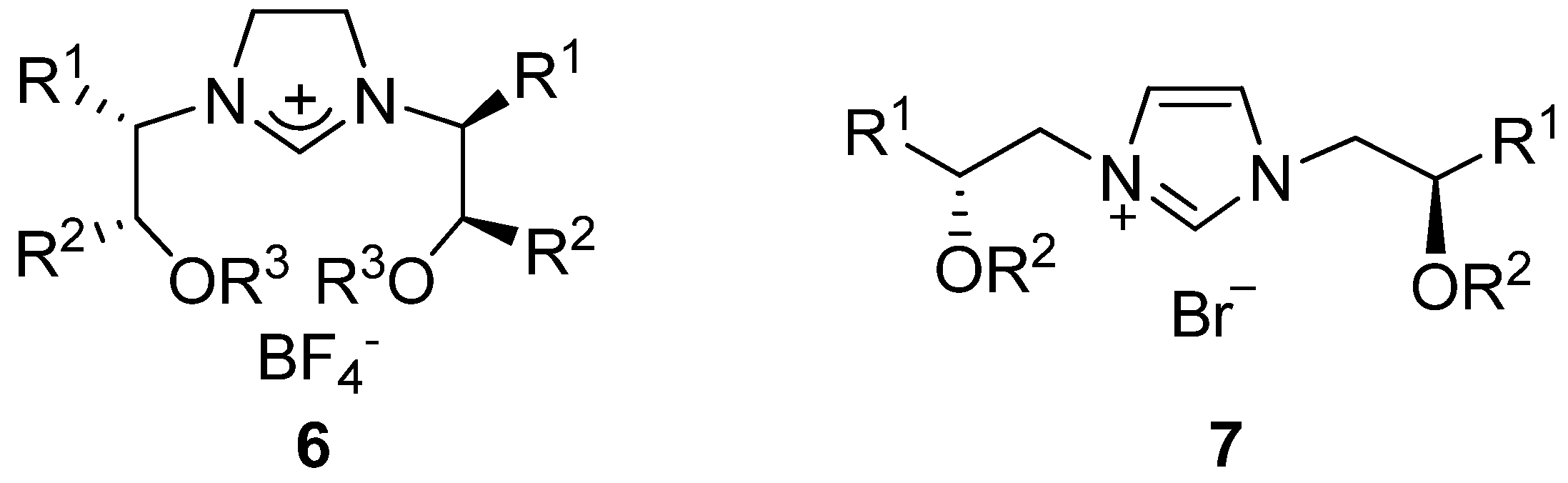
      <p>We have an interest in the applications of multidentate, <italic>C<sub>2</sub></italic>-symmetric NHCs with one chelating carbene and two <italic>O</italic>- atoms as ligands in catalytic reactions, for which there have been few precedents. We envisioned that the coordinative ability of the heteroatom can be adjusted by changing its bonding. Previously, we have synthesized tridentate <italic>C<sub>2</sub></italic>-symmetric imidazolinium salts <bold>6</bold> (<xref ref-type="fig" rid="molecules-17-12121-f002">Figure 2</xref>) and their NHC precursors, which have two oxygen atoms in the arms, and found that their copper complexes could catalyze the asymmetric conjugate addition of Et<sub>2</sub>Zn to cycloalkenones efficiently [<xref ref-type="bibr" rid="B43-molecules-17-12121">43</xref>]. To continue this work, we designed <bold>7</bold>, the unsaturated counterpart of <bold>6</bold>, to explore their applications in Suzuki-Miyaura coupling reactions, as it has been reported that Pd coordinated with unsaturated NHCs show higher reactivity than those with saturated NHCs [<xref ref-type="bibr" rid="B44-molecules-17-12121">44</xref>]. Herein, we wish to report the preparation and catalytic properties of the novel <italic>C<sub>2</sub></italic>-symmetric tridentate imidazolium salts <bold>7</bold> in the Suzuki-Miyaura coupling reaction.</p>
      <fig id="molecules-17-12121-f002" position="float">
        <label>Figure 2</label>
        <caption>
          <p>The structure of tridentate <italic>C<sub>2</sub></italic>-symmetric imidazol(in)ium salts <bold>6</bold> and <bold>7</bold>.</p>
        </caption>
        <graphic xmlns:xlink="http://www.w3.org/1999/xlink" xlink:href="molecules-17-12121-g002.tif"/>
      </fig>
    </sec>
    <sec sec-type="results">
      <title>2. Results and Discussion</title>
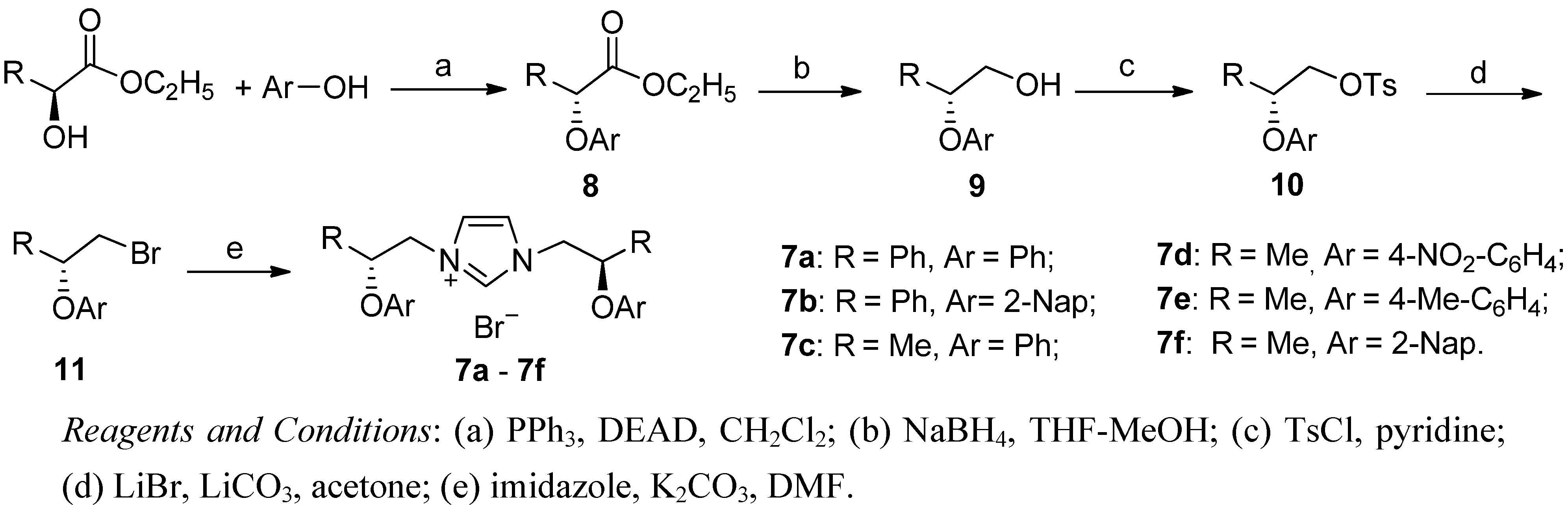
      <p>The synthesis of the NHC precursor imidazolium salts <bold>7a–f</bold> in 22-30% overall yield is shown in <xref ref-type="scheme" rid="molecules-17-12121-scheme1">Scheme 1</xref>. The synthetic route to the NHC precursor imidazolium salts <bold>7a–f</bold> started from (<italic>S</italic>)-ethyl lactate or (<italic>S</italic>)-ethyl mandelate by etherification with phenol or substituted phenols. The <italic>α</italic>-aryloxycarboxylates <bold>8a–f</bold> were next reduced, yielding <italic>β</italic>-aryloxyalcohols <bold>9a–f</bold>. Then the alcohol were converted into halides <bold>11a–f</bold>, and reacted with imidazole giving imidazolium salts <bold>7a–f</bold>, which contain <italic>β</italic>-aryloxyl groups in the side chains. They are quite stable towards air and moisture.</p>
      <fig id="molecules-17-12121-scheme1" position="float">
        <object-id pub-id-type="pii">molecules-17-12121-scheme1_Scheme 1</object-id>
        <label>Scheme 1</label>
        <caption>
          <p>Synthesis of the NHC precursor imidazolium salts <bold>7a–f</bold>.</p>
        </caption>
        <graphic xmlns:xlink="http://www.w3.org/1999/xlink" xlink:href="molecules-17-12121-g005.tif"/>
      </fig>
      <p>The imidazolium salts <bold>7c–f</bold> synthesized from (<italic>S</italic>)-ethyl lactate were optically pure. This can be deduced from the fact that only one set of NMR signals was observed in both <sup>1</sup>H-NMR and <sup>13</sup>C-NMR spectra of these compounds. Reaction of racemic bromides <bold>11c–f</bold> with imidazole would yield racemic <italic>C<sub>2</sub></italic>-symmetric (<italic>R,R</italic>), (<italic>S,S</italic>)-isomers of <bold>7c–f</bold>, and <italic>Cs</italic>-symmetric meso-(<italic>R</italic>,<italic>S</italic>)-isomer of <bold>7c–f</bold>. Even though the (<italic>R,R</italic>), (<italic>S,S</italic>)-isomers could not be distinguished by NMR, the signals of the racemic isomers and <italic>meso</italic>-isomer should be different. Therefore, the sets of NMR signals of <bold>7</bold> could be used to judge whether the products are optically pure.</p>
      <p>On the other hand, use of (<italic>S</italic>)-ethyl mandelate yielded <bold>7a</bold> and <bold>7b</bold> as a mixture of diastereomers, since <sup>1</sup>H-NMR and <sup>13</sup>C-NMR signals for two sets or more than one set were observed. This indicates that racemization occurs using (<italic>S</italic>)-ethyl mandelate as the starting material, whose α-H is more acidic than that in ethyl lactate.</p>
      <p>The catalytic activities of the Pd-complexes of the NHCs derived from imidazolium salts <bold>7</bold> in Suzuki-Miyaura coupling reactions were screened, using catalysts generated <italic>in situ</italic> from a mixture in a solvent of <bold>7</bold>, Pd(OAc)<sub>2</sub>, and a base.</p>
      <p>The reaction conditions were optimized on a model reaction between phenyl bromide and phenylboronic acid. First, the effect of solvents was examined using the catalyst generated from imidazolium salt <bold>7a</bold> and Pd(OAc)<sub>2</sub>. The product biphenyl <bold>12a</bold> was obtained in 95% yield in either toluene or DMF. Addition of H<sub>2</sub>O to DMF (V/V = 1:2) accelerated the reaction but no increase in the yield was observed. The reaction was completed in 1.5 h using toluene as the solvent. Moderate to low yields were obtained when polar solvents, including 1,4-dioxane, THF and EtOH, were used, even though 1,4-dioxane and EtOH have been reported in the literature as good solvents for this kind of reaction. </p>
      <p>Using toluene as the solvent, bases were then optimized, and the results are shown in <xref ref-type="table" rid="molecules-17-12121-t001">Table 1</xref>. Although Cs<sub>2</sub>CO<sub>3</sub> is generally efficient for the Suzuki-Miyaura coupling reactions catalyzed by Pd-NHC or palladium-phosphine complexes, in our case, only a 32% yield of <bold>12a</bold> was observed, whereas the use of K<sub>2</sub>CO<sub>3</sub> resulted in an excellent yield (entry 2). With other bases like NaOH, KF and K<sub>3</sub>PO<sub>4</sub>, the reaction also proceeded well, but somewhat more slowly. Then the temperature was optimized. Phenyl bromide was quantitatively converted to <bold>12a</bold> in 0.5 h at 110 °C, much faster than at 90 °C. At lower temperature, the reaction is very slow. Only a 53% yield of <bold>12a</bold> was obtained after 21 h at 70 °C. Therefore, subsequent reactions were carried out using K<sub>2</sub>CO<sub>3</sub> as the base and toluene as the solvent at 110 °C.</p>
      <table-wrap id="molecules-17-12121-t001" position="float">
        <object-id pub-id-type="pii">molecules-17-12121-t001_Table 1</object-id>
        <label>Table 1</label>
        <caption>
          <p>Influence of the base onthe Suzuki-Miyaura reaction catalyzed by Pd(OAc)<sub>2</sub>/<bold>7a</bold> <sup>a</sup>.</p>
        </caption>
        <table>
          <thead>
		  <tr>
			<th colspan="4" align="center"><inline-graphic xmlns:xlink="http://www.w3.org/1999/xlink" xlink:href="molecules-17-12121-i001.tif"/></th>
		  </tr>	
            <tr style="border-top:solid thin">
              <th align="center" valign="middle">Entry</th>
              <th align="center" valign="middle">Base</th>
              <th align="center" valign="middle">Time (h)</th>
              <th align="center" valign="middle">Yield <sup>b</sup>(%)</th>
            </tr>
          </thead>
          <tbody>
            <tr style="border-top:solid thin">
              <td align="center" valign="middle">1</td>
              <td align="center" valign="middle">Na<sub>2</sub>CO<sub>3</sub></td>
              <td align="center" valign="middle">24</td>
              <td align="center" valign="middle">12</td>
            </tr>
            <tr>
              <td align="center" valign="middle">2</td>
              <td align="center" valign="middle">K<sub>2</sub>CO<sub>3</sub></td>
              <td align="center" valign="middle">1.5</td>
              <td align="center" valign="middle">95</td>
            </tr>
            <tr>
              <td align="center" valign="middle">3</td>
              <td align="center" valign="middle">Cs<sub>2</sub>CO<sub>3</sub></td>
              <td align="center" valign="middle">24</td>
              <td align="center" valign="middle">32</td>
            </tr>
            <tr>
              <td align="center" valign="middle">4</td>
              <td align="center" valign="middle">NaOH</td>
              <td align="center" valign="middle">24</td>
              <td align="center" valign="middle">86</td>
            </tr>
            <tr>
              <td align="center" valign="middle">5</td>
              <td align="center" valign="middle">KF</td>
              <td align="center" valign="middle">24</td>
              <td align="center" valign="middle">75</td>
            </tr>
            <tr>
              <td align="center" valign="middle">6</td>
              <td align="center" valign="middle">K<sub>3</sub>PO<sub>4</sub></td>
              <td align="center" valign="middle">24</td>
              <td align="center" valign="middle">82</td>
            </tr>
            <tr>
              <td align="center" valign="middle">7</td>
              <td align="center" valign="middle">CH<sub>3</sub>COONa</td>
              <td align="center" valign="middle">24</td>
              <td align="center" valign="middle">4</td>
            </tr>
          </tbody>
        </table>
		<table-wrap-foot><fn><p><sup>a</sup> <italic>Reaction conditions</italic>: 0.5 mmol phenyl bromide, 0.75 mmol phenylboronic acid, 1.5 mmol base, 0.5 mol% Pd(OAc)<sub>2</sub>, 1 mol% <bold>7a</bold>, 3.0 mL toluene, 90 °C. <sup>b</sup> GC yield.</p></fn></table-wrap-foot>
      </table-wrap>            
      <p>Next, the catalytic abilities of <bold>7a</bold> analogues were evaluated and the results are shown in <xref ref-type="table" rid="molecules-17-12121-t002">Table 2</xref>. The most efficient catalyst was derived from <bold>7a</bold> (entry 1). A comparable yield was obtained with the methyl substituted analogue <bold>7</bold><bold>c</bold> (entry 3). Introduction of a nitro group to the aryloxy substituent results in a ligand-Pd complex generating a lower yield of the coupling product (entry 4), which shows that reduction of the electron density of the phenyl ring and the resultant decrease in the coordination ability of the <italic>O-</italic>atom reduced the catalytic ability of <bold>7</bold>. The presence of a 4-methyl group in the aryloxy substituent also led to a lower yield (entry 5), but higher than that using <bold>7</bold><bold>d</bold>. Yields of 86–87% were generated when the (substituted)-phenoxy substituent was changed to a 2-naphthoxy group (entries 2 and 6), which is more steric demanding and resulted in the <italic>O-</italic>atom being less coordinative. Two typical imidazolium salts IMes·HCl (IMes = 1,3-bis(2,4,6-trimethylphenyl)-imidazol-2-ylidene) and IPr·HCl (IPr = 1,3-bis(2,6-diisopropylphenyl)-imidazol-2-ylidene) catalyze the coupling reaction giving inferior results (entries 7, 8). In the absence of imidazolium salt or other ligand, a 72% yield of <bold>12a</bold> was obtained in 1h using Pd(OAc)<sub>2</sub> as the catalyst (entry 9). These results demonstrate that the ligand derived from imidazolium salts <bold>7</bold> which contains two potentially chelated oxygen atoms is more efficient than simple NHC ligands, e.g., IPr and IMes in the coupling reactions. This might be due to the presence of a NHC moiety and oxygen atoms in the hybrid NHC ligands. The strong coordinating of NHC can prevent the dissociate of ligand from palladium complex, and therefore, stablize the catalytically active palladium species. In the meanwhile, the weak coordinative oxygen atom(s) can easily dissociate from palladium complex and generate a coordination-unsaturated palladium species. This favors the oxidation of aryl halides or arylboronic acids toward the coordination-unsaturated palladium species and catalytic cycle. Indeed, formation of palladium balck, which is catalytic inert to the Suzuki reaction and an indication of ligands dissociate from palladium completely, is rarely observed in the coupling reaction using <bold>7</bold>. The coupling reaction of phenylboric acid with phenyl bromide could be performed in air with a slightly reduced yield (78%).</p>
      <table-wrap id="molecules-17-12121-t002" position="float">
        <object-id pub-id-type="pii">molecules-17-12121-t002_Table 2</object-id>
        <label>Table 2</label>
        <caption>
          <p>Evaluation of the NHCsfrom <bold>7a–f</bold> in the Suzuki-Miyaura reaction <sup>a</sup>.</p>
        </caption>
        <table>
          <thead>
		  <tr>
			<th colspan="4" align="center"><inline-graphic xmlns:xlink="http://www.w3.org/1999/xlink" xlink:href="molecules-17-12121-i002.tif"/></th>
		  </tr>	
            <tr style="border-top:solid thin">
              <th align="center" valign="middle">Entry</th>
              <th align="center" valign="middle">Imidazolium salt</th>
              <th align="center" valign="middle">Time (h)</th>
              <th align="center" valign="middle">Yield 
              <italic><sup>b</sup></italic>(%)</th>
            </tr>
          </thead>
          <tbody>
            <tr style="border-top:solid thin">
              <td align="center" valign="middle">1</td>
              <td align="center" valign="middle">
                <bold>7a</bold>
              </td>
              <td align="center" valign="middle">0.5</td>
              <td align="center" valign="middle">99</td>
            </tr>
            <tr>
              <td align="center" valign="middle">2</td>
              <td align="center" valign="middle">
                <bold>7b</bold>
              </td>
              <td align="center" valign="middle">1</td>
              <td align="center" valign="middle">87</td>
            </tr>
            <tr>
              <td align="center" valign="middle">3</td>
              <td align="center" valign="middle">
                <bold>7c</bold>
              </td>
              <td align="center" valign="middle">1</td>
              <td align="center" valign="middle">96</td>
            </tr>
            <tr>
              <td align="center" valign="middle">4</td>
              <td align="center" valign="middle">
                <bold>7d</bold>
              </td>
              <td align="center" valign="middle">1</td>
              <td align="center" valign="middle">85</td>
            </tr>
            <tr>
              <td align="center" valign="middle">5</td>
              <td align="center" valign="middle">
                <bold>7e</bold>
              </td>
              <td align="center" valign="middle">1</td>
              <td align="center" valign="middle">90</td>
            </tr>
            <tr>
              <td align="center" valign="middle">6</td>
              <td align="center" valign="middle">
                <bold>7f</bold>
              </td>
              <td align="center" valign="middle">1</td>
              <td align="center" valign="middle">86</td>
            </tr>
            <tr>
              <td align="center" valign="middle">7</td>
              <td align="center" valign="middle">IPr·HCl</td>
              <td align="center" valign="middle">1</td>
              <td align="center" valign="middle">75</td>
            </tr>
            <tr>
              <td align="center" valign="middle">8</td>
              <td align="center" valign="middle">IMes·HCl</td>
              <td align="center" valign="middle">1</td>
              <td align="center" valign="middle">70</td>
            </tr>
            <tr>
              <td align="center" valign="middle">9</td>
              <td align="center" valign="middle">-</td>
              <td align="center" valign="middle">1</td>
              <td align="center" valign="middle">72</td>
            </tr>
          </tbody>
        </table>
		 <table-wrap-foot><fn><p><sup>a</sup> <italic>Reaction conditions</italic>: 0.5 mmol phenyl bromide, 0.75 mmol phenylboronic acid, 1.5 mmol K<sub>2</sub>CO<sub>3</sub>, 0.5 mol% Pd(OAc)<sub>2</sub>, 1 mol% <bold>7</bold>, 3.0 mL toluene, 110 °C. <sup>b</sup> GC yield.</p></fn></table-wrap-foot>
      </table-wrap>            
      <p>The reactions of various aryl halides with phenylboronic acids were then investigated under the optimized conditions, and the results are summarized in <xref ref-type="table" rid="molecules-17-12121-t003">Table 3</xref>. Only 5 minutes were needed for the complete reactions of 4-nitrophenyl bromide and 4-acetophenyl bromide, which are electron-deficient and more reactive in this kind of reaction.</p>
      <table-wrap id="molecules-17-12121-t003" position="float">
        <object-id pub-id-type="pii">molecules-17-12121-t003_Table 3</object-id>
        <label>Table 3</label>
        <caption>
          <p>Suzuki-Miyaura reaction of aryl halides (benzyl halides) with phenylboronic acid catalyzed by Pd(OAc)<sub>2</sub>/<bold>7a</bold>.</p>
        </caption>
        <table>
          <thead>
		  <tr align="center">
			<th colspan="6"><inline-graphic xmlns:xlink="http://www.w3.org/1999/xlink" xlink:href="molecules-17-12121-i003.tif"/></th>
		  </tr>	
            <tr style="border-top:solid thin" align="center">
              <th valign="middle">Entry</th>
              <th valign="middle">ArX or BnX</th>
              <th valign="middle">R</th>
              <th valign="middle">Time</th>
              <th valign="middle">Product</th>
              <th valign="middle">Yield <sup>a</sup> (%)</th>
            </tr>
          </thead>
          <tbody>
            <tr style="border-top:solid thin" align="center">
              <td valign="middle">1</td>
              <td valign="middle"><inline-graphic xmlns:xlink="http://www.w3.org/1999/xlink" xlink:href="molecules-17-12121-i004.tif"/></td>
              <td valign="middle">H</td>
              <td valign="middle">5 min</td>
              <td valign="middle">
                <bold>12b</bold>
              </td>
              <td valign="middle">95</td>
            </tr>
            <tr align="center">
              <td valign="middle">2</td>
              <td valign="middle"><inline-graphic xmlns:xlink="http://www.w3.org/1999/xlink" xlink:href="molecules-17-12121-i005.tif"/></td>
              <td valign="middle">H</td>
              <td valign="middle">5 min</td>
              <td valign="middle">
                <bold>12c</bold>
              </td>
              <td valign="middle">98</td>
            </tr>
            <tr align="center">
              <td valign="middle">3</td>
              <td valign="middle"><inline-graphic xmlns:xlink="http://www.w3.org/1999/xlink" xlink:href="molecules-17-12121-i006.tif"/></td>
              <td valign="middle">H</td>
              <td valign="middle">1 h</td>
              <td valign="middle">
                <bold>12d</bold>
              </td>
              <td valign="middle">98</td>
            </tr>
            <tr align="center">
              <td valign="middle">4</td>
              <td valign="middle"><inline-graphic xmlns:xlink="http://www.w3.org/1999/xlink" xlink:href="molecules-17-12121-i007.tif"/></td>
              <td valign="middle">H</td>
              <td valign="middle">0.5 h</td>
              <td valign="middle">
                <bold>12e</bold>
              </td>
              <td valign="middle">99</td>
            </tr>
            <tr align="center">
              <td valign="middle">5</td>
              <td valign="middle"><inline-graphic xmlns:xlink="http://www.w3.org/1999/xlink" xlink:href="molecules-17-12121-i008.tif"/></td>
              <td valign="middle">H</td>
              <td valign="middle">0.5 h</td>
              <td valign="middle">
                <bold>12f</bold>
              </td>
              <td valign="middle">96</td>
            </tr>
            <tr align="center">
              <td valign="middle">6</td>
              <td valign="middle"><inline-graphic xmlns:xlink="http://www.w3.org/1999/xlink" xlink:href="molecules-17-12121-i009.tif"/></td>
              <td valign="middle">H</td>
              <td valign="middle">1 h</td>
              <td valign="middle">
                <bold>12g</bold>
              </td>
              <td valign="middle">93</td>
            </tr>
            <tr align="center">
              <td valign="middle">7</td>
              <td valign="middle"><inline-graphic xmlns:xlink="http://www.w3.org/1999/xlink" xlink:href="molecules-17-12121-i010.tif"/></td>
              <td valign="middle">H</td>
              <td valign="middle">0.5 h</td>
              <td valign="middle">
                <bold>12h</bold>
              </td>
              <td valign="middle">95</td>
            </tr>
            <tr align="center">
              <td valign="middle">8</td>
              <td valign="middle"><inline-graphic xmlns:xlink="http://www.w3.org/1999/xlink" xlink:href="molecules-17-12121-i011.tif"/></td>
              <td valign="middle">H</td>
              <td valign="middle">1 h</td>
              <td valign="middle">
                <bold>12i</bold>
              </td>
              <td valign="middle">92</td>
            </tr>
            <tr align="center">
              <td valign="middle">9</td>
              <td valign="middle"><inline-graphic xmlns:xlink="http://www.w3.org/1999/xlink" xlink:href="molecules-17-12121-i012.tif"/></td>
              <td valign="middle">H</td>
              <td valign="middle">0.5 h</td>
              <td valign="middle">
                <bold>12j</bold>
              </td>
              <td valign="middle">91</td>
            </tr>
            <tr align="center">
              <td valign="middle">10</td>
              <td valign="middle"><inline-graphic xmlns:xlink="http://www.w3.org/1999/xlink" xlink:href="molecules-17-12121-i013.tif"/></td>
              <td valign="middle">H</td>
              <td valign="middle">1 h</td>
              <td valign="middle">
                <bold>12k</bold>
              </td>
              <td valign="middle">85</td>
            </tr>
            <tr align="center">
              <td valign="middle">11</td>
              <td valign="middle"><inline-graphic xmlns:xlink="http://www.w3.org/1999/xlink" xlink:href="molecules-17-12121-i014.tif"/></td>
              <td valign="middle">H</td>
              <td valign="middle">1 h</td>
              <td valign="middle">
                <bold>12l</bold>
              </td>
              <td valign="middle">90</td>
            </tr>
            <tr align="center">
              <td valign="middle">12</td>
              <td valign="middle"><inline-graphic xmlns:xlink="http://www.w3.org/1999/xlink" xlink:href="molecules-17-12121-i015.tif"/></td>
              <td valign="middle">H</td>
              <td valign="middle">1 h</td>
              <td valign="middle">
                <bold>12m</bold>
              </td>
              <td valign="middle">96</td>
            </tr>
            <tr align="center">
              <td valign="middle">13</td>
              <td valign="middle"><inline-graphic xmlns:xlink="http://www.w3.org/1999/xlink" xlink:href="molecules-17-12121-i016.tif"/></td>
              <td valign="middle">H</td>
              <td valign="middle">1 h</td>
              <td valign="middle">
                <bold>12n</bold>
              </td>
              <td valign="middle">97</td>
            </tr>
            <tr align="center">
              <td valign="middle">14</td>
              <td valign="middle"><inline-graphic xmlns:xlink="http://www.w3.org/1999/xlink" xlink:href="molecules-17-12121-i017.tif"/></td>
              <td valign="middle">H</td>
              <td valign="middle">3 h</td>
              <td valign="middle">
                <bold>12o</bold>
              </td>
              <td valign="middle">90</td>
            </tr>
            <tr align="center">
              <td valign="middle">15</td>
              <td valign="middle"><inline-graphic xmlns:xlink="http://www.w3.org/1999/xlink" xlink:href="molecules-17-12121-i018.tif"/></td>
              <td valign="middle">H</td>
              <td valign="middle">24 h</td>
              <td valign="middle">
                <bold>12a</bold>
              </td>
              <td valign="middle">35</td>
            </tr>
            <tr align="center">
              <td valign="middle">16</td>
              <td valign="middle"><inline-graphic xmlns:xlink="http://www.w3.org/1999/xlink" xlink:href="molecules-17-12121-i019.tif"/></td>
              <td valign="middle">H</td>
              <td valign="middle">24 h</td>
              <td valign="middle">
                <bold>12b</bold>
              </td>
              <td valign="middle">70</td>
            </tr>
            <tr align="center">
              <td valign="middle">17</td>
              <td valign="middle"><inline-graphic xmlns:xlink="http://www.w3.org/1999/xlink" xlink:href="molecules-17-12121-i020.tif"/></td>
              <td valign="middle">H</td>
              <td valign="middle">10 h</td>
              <td valign="middle">
                <bold>12o</bold>
              </td>
              <td valign="middle">71</td>
            </tr>
            <tr align="center">
              <td valign="middle">18</td>
              <td valign="middle"><inline-graphic xmlns:xlink="http://www.w3.org/1999/xlink" xlink:href="molecules-17-12121-i021.tif"/></td>
              <td valign="middle">3-Me</td>
              <td valign="middle">0.5 h</td>
              <td valign="middle">
                <bold>12p</bold>
              </td>
              <td valign="middle">93</td>
            </tr>
            <tr align="center">
              <td valign="middle">19</td>
              <td valign="middle"><inline-graphic xmlns:xlink="http://www.w3.org/1999/xlink" xlink:href="molecules-17-12121-i022.tif"/></td>
              <td valign="middle">4-Me</td>
              <td valign="middle">0.5 h</td>
              <td valign="middle">
                <bold>12j</bold>
              </td>
              <td valign="middle">85</td>
            </tr>
            <tr align="center">
              <td valign="middle">20</td>
              <td valign="middle"><inline-graphic xmlns:xlink="http://www.w3.org/1999/xlink" xlink:href="molecules-17-12121-i023.tif"/></td>
              <td valign="middle">2-Me</td>
              <td valign="middle">2.5 h</td>
              <td valign="middle">
                <bold>12k</bold>
              </td>
              <td valign="middle">93</td>
            </tr>
            <tr align="center">
              <td valign="middle">21</td>
              <td valign="middle"><inline-graphic xmlns:xlink="http://www.w3.org/1999/xlink" xlink:href="molecules-17-12121-i024.tif"/></td>
              <td valign="middle">4-MeO<sub>2</sub>C</td>
              <td valign="middle">24 h</td>
              <td valign="middle">
                <bold>12q</bold>
              </td>
              <td valign="middle">86</td>
            </tr>
            <tr align="center">
              <td valign="middle">22</td>
              <td valign="middle"><inline-graphic xmlns:xlink="http://www.w3.org/1999/xlink" xlink:href="molecules-17-12121-i025.tif"/></td>
              <td valign="middle">2-Me</td>
              <td valign="middle">1 h</td>
              <td valign="middle">
                <bold>12r</bold>
              </td>
              <td valign="middle">21 
              <italic><sup>b</sup></italic></td>
            </tr>
            <tr align="center">
              <td valign="middle">23</td>
              <td valign="middle"><inline-graphic xmlns:xlink="http://www.w3.org/1999/xlink" xlink:href="molecules-17-12121-i026.tif"/></td>
              <td valign="middle">2-Me</td>
              <td valign="middle">11.5 h</td>
              <td valign="middle">
                <bold>12r</bold>
              </td>
              <td valign="middle">56 
              <italic><sup>b,c</sup></italic></td>
            </tr>
          </tbody>
        </table>
		 <table-wrap-foot><fn><p><italic><sup>a</sup></italic> Isolated yield except noted. <italic><sup>b</sup></italic> GC yield. <italic><sup>c</sup></italic> Using 0.05 mol% Pd(OAc)<sub>2</sub>, 0.1 mol% imidazolium salt <bold>7a</bold>.</p></fn></table-wrap-foot>
      </table-wrap>    
      <p>For those aryl halides with electron-donating groups (entries 7, 10, 13) or sterically hindered aryl bromides (entry 11), longer reaction times were needed. Generally, almost quantitative yields of coupling products could be obtained in 1 h. It is worth to note that 4-hydroxylphenyl bromide, which is very electron-rich in the phenyl ring and the C-Br bond, is highly reactive to coupling. As expected, a wide range of functional groups including keto, nitro, cyano, ester, amide, hydroxy and ether, were tolerated. The coupling reactions could be extended to benzyl bromide which contains a sp<sup>3</sup>-C atom bearing the halide, and therefore, a C-C coupling product between a sp<sup>3</sup>-C and a sp<sup>2</sup>-C was achieved (entry 14). The reaction of 4-chlorophenyl bromide gave 4-chlorobiphenyl as the only coupling product in high yield, and demonstrated the inertness of C-Cl in the presence of C-Br (entry 6). When phenyl chloride was used, only a 35% yield of biphenyl was obtained (entry 15). Introduction of an acetyl group to phenyl chloride led to an increase in the activity, and a 70% yield of the coupling product was achieved (entry 16). Gratifyingly, benzyl chloride also gave a reasonable yield of coupling product (entry 17), although in lower yield than that obtained with benzyl bromide. Palladium black was only observed unremarkably in reactions performed at 110 °C and after long reaction times.</p>
      <p>In addition, reactions of various arylboronic acids with substituted phenyl bromides were performed. The reactions proceed smoothly in high yield using 2-tolylboronic acid. In contrast to aryl halides, the presence of an electron-withdrawing group results in a low coupling yield which may be attributed to the tendency of hydrolysis of the electron deficient arylboronic acids (<xref ref-type="table" rid="molecules-17-12121-t003">Table 3</xref>, entry 21) [<xref ref-type="bibr" rid="B45-molecules-17-12121">45</xref>]. Even though the presence of an <italic>ortho-</italic>Me group in either the aryl halide or the arylboronic acid did not affect the coupling yield, it was still difficult to obtain tri<italic>-ortho</italic> substituted biphenyl in high yields, a challenging reaction in literature, due to the large hindrance for our catalyst system. In the case of a very sterically hindered reaction (entry 22), the less bulky 2,2′-dimethylbiphenyl (the homocoupling product of two arylboronic acid molecules), was formed in preference to the more bulky 2,6,2′-trimethylbiphenyl product derived from the expected Suzuki-Miyaura coupling when 0.5 mol% of Pd catalyst was employed. This indicated the relative inertness of the 2,6-dimethylphenyl bromide. Therefore, the amount of the Pd salt was decreased to 0.05 mol% to depress the relative faster coupling reaction between the aryl groups in the boronic acid. In this case, the yield of the trimethylbiphenyl increased to 56% as judged by gas chromatography over a prolonged reaction time (entry 23). Similar results were observed for the reaction of 4-bromoacetophenone with phenylboronic acid (entries 1, 2 in <xref ref-type="table" rid="molecules-17-12121-t004">Table 4</xref> <italic>vs</italic>. entry 1 in <xref ref-type="table" rid="molecules-17-12121-t003">Table 3</xref>).</p>
      <table-wrap id="molecules-17-12121-t004" position="float">
        <object-id pub-id-type="pii">molecules-17-12121-t004_Table 4</object-id>
        <label>Table 4</label>
        <caption>
          <p>The activities of Pd(OAc)<sub>2</sub>/<bold>7a</bold> with variation of loading.</p>
        </caption>
        <table>
          <thead>
		  <tr align="center">
			<th colspan="7" align="center"><inline-graphic xmlns:xlink="http://www.w3.org/1999/xlink" xlink:href="molecules-17-12121-i027.tif"/></th>
		  </tr>	
            <tr style="border-top:solid thin">
              <th align="center" valign="middle">Entry</th>
              <th align="center" valign="middle">R</th>
              <th align="center" valign="middle">Pd (mol%)</th>
              <th align="center" valign="middle">Time(h)</th>
              <th align="center" valign="middle">Product</th>
              <th align="center" valign="middle">Yield <sup>a</sup> (%)</th>
              <th align="center" valign="middle">TON</th>
            </tr>
          </thead>
          <tbody>
            <tr style="border-top:solid thin">
              <td align="center" valign="middle">1</td>
              <td align="center" valign="middle">COMe</td>
              <td align="center" valign="middle">0.05</td>
              <td align="center" valign="middle">1</td>
              <td align="center" valign="middle">
                <bold>12b</bold>
              </td>
              <td align="center" valign="middle">100</td>
              <td align="center" valign="middle">2000</td>
            </tr>
            <tr>
              <td align="center" valign="middle">2</td>
              <td align="center" valign="middle">COMe</td>
              <td align="center" valign="middle">0.005</td>
              <td align="center" valign="middle">4</td>
              <td align="center" valign="middle">
                <bold>12b</bold>
              </td>
              <td align="center" valign="middle">100</td>
              <td align="center" valign="middle">20000</td>
            </tr>
            <tr>
              <td align="center" valign="middle">3</td>
              <td align="center" valign="middle">COMe</td>
              <td align="center" valign="middle">0.0005</td>
              <td align="center" valign="middle">24</td>
              <td align="center" valign="middle">
                <bold>12b</bold>
              </td>
              <td align="center" valign="middle">50</td>
              <td align="center" valign="middle">100000</td>
            </tr>
            <tr>
              <td align="center" valign="middle">4</td>
              <td align="center" valign="middle">H</td>
              <td align="center" valign="middle">0.05</td>
              <td align="center" valign="middle">2</td>
              <td align="center" valign="middle">
                <bold>12a</bold>
              </td>
              <td align="center" valign="middle">95</td>
              <td align="center" valign="middle">1900</td>
            </tr>
            <tr>
              <td align="center" valign="middle">5</td>
              <td align="center" valign="middle">H</td>
              <td align="center" valign="middle">0.005</td>
              <td align="center" valign="middle">2</td>
              <td align="center" valign="middle">
                <bold>12a</bold>
              </td>
              <td align="center" valign="middle">38</td>
              <td align="center" valign="middle">7600</td>
            </tr>
            <tr>
              <td align="center" valign="middle">6</td>
              <td align="center" valign="middle">Me</td>
              <td align="center" valign="middle">0.05</td>
              <td align="center" valign="middle">1.5</td>
              <td align="center" valign="middle">
                <bold>12j</bold>
              </td>
              <td align="center" valign="middle">100</td>
              <td align="center" valign="middle">2000</td>
            </tr>
            <tr>
              <td align="center" valign="middle">7</td>
              <td align="center" valign="middle">Me</td>
              <td align="center" valign="middle">0.005</td>
              <td align="center" valign="middle">4</td>
              <td align="center" valign="middle">
                <bold>12j</bold>
              </td>
              <td align="center" valign="middle">95</td>
              <td align="center" valign="middle">19000</td>
            </tr>
          </tbody>
        </table>
		 <table-wrap-foot><fn><p><sup>a</sup> GC yield using diethylene glycol di-<italic>n</italic>-butyl ether as an internal standard.</p></fn></table-wrap-foot>
      </table-wrap>            
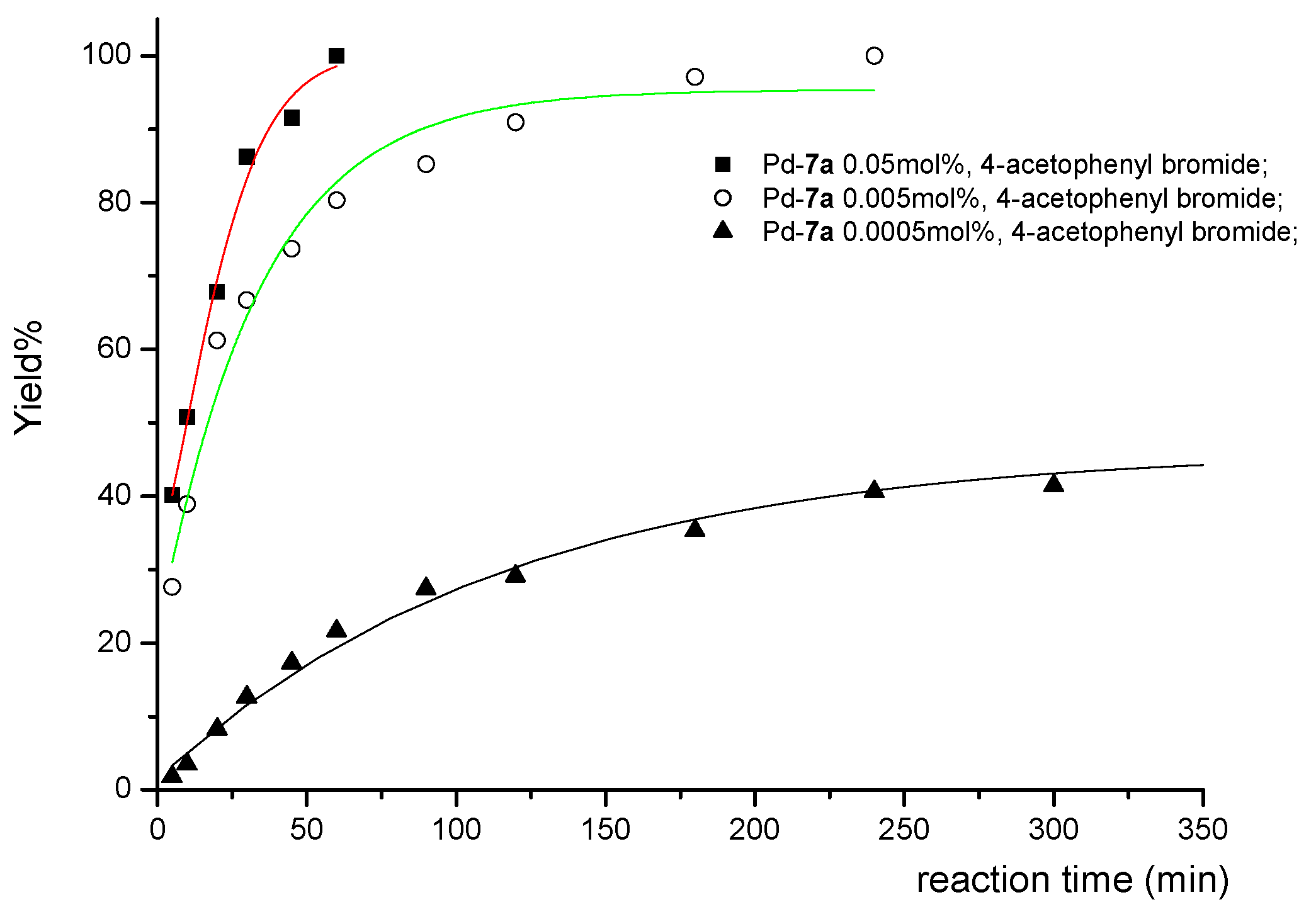
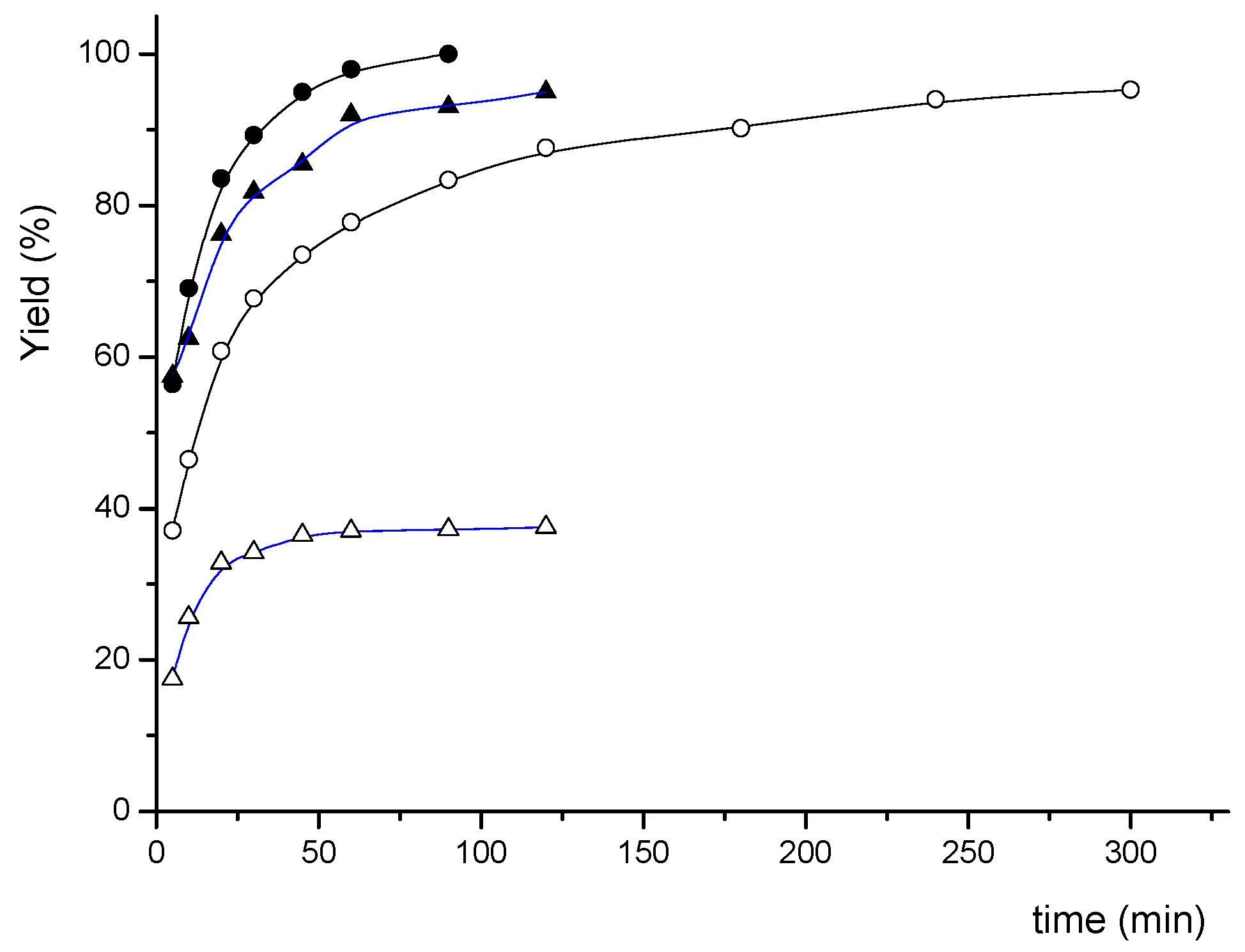
      <p>The efficiencies of Pd(OAc)<sub>2</sub>/<bold>7a</bold> were further tested with different catalyst loadings, and the results are summarized in <xref ref-type="table" rid="molecules-17-12121-t004">Table 4</xref>. 4-Acetylphenyl bromide could be completely converted to the coupling product using 5 × 10<sup>−2</sup> mol% in 1 h and 5 × 10<sup>−3</sup> mol% of Pd catalyst in 4 h, respectively (entries 1 and 2). The turnover numbers (TON) reached 2 × 10<sup>4</sup>. Furthermore, a maximum TON of 10<sup>5</sup> was obtained at 5 × 10<sup>−4</sup> mol% of catalyst loading in 24 h (entry 3), and the turnover frequency (TOF ) is <italic>ca.</italic> 4.17 × 10<sup>3</sup> h<sup>−1</sup>. A TON of up to 7,600 was recorded for the reaction of phenyl bromide (entry 5). Interestingly, for the less active 4-bromotoluene, TON and TOF values up to 1.9 × 10<sup>4</sup> and 4.75 × 10<sup>3</sup> h<sup>−1</sup>, respectively, could be achieved with 5 × 10<sup>−3</sup> mol% Pd catalyst in 4 h (entry 7), which was better than the case of phenyl bromide. Details of the progress of reactions with different amount of catalyst and substrates are given in <xref ref-type="fig" rid="molecules-17-12121-f003">Figure 3</xref> and <xref ref-type="fig" rid="molecules-17-12121-f004">Figure 4</xref>.</p>
      <fig id="molecules-17-12121-f003" position="float">
        <label>Figure 3</label>
        <caption>
          <p>Reaction profiles for Suzuki-Miyaura reaction between 4-acetylphenyl bromide and phenylboronic acid catalyzed by different Pd/<bold>7a</bold> loading: 0.05 mol% (■), 0.005 mol% (○), 0.0005 mol% (▲).</p>
        </caption>
        <graphic xmlns:xlink="http://www.w3.org/1999/xlink" xlink:href="molecules-17-12121-g003.tif"/>
      </fig>
	  <fig id="molecules-17-12121-f004" position="float">
        <label>Figure 4</label>
        <caption>
          <p>Reaction profiles for Suzuki-Miyaura reaction of 4-methylphenyl bromide catalyzed by Pd/<bold>7a</bold> 0.05 mol% (●), 0.005 mol% (○), and phenyl bromide catalyzed by Pd/<bold>7a</bold> 0.05 mol% (▲), 0.0005 mol% (△).</p>
        </caption>
        <graphic xmlns:xlink="http://www.w3.org/1999/xlink" xlink:href="molecules-17-12121-g004.tif"/>
      </fig>
    </sec>
    <sec sec-type="methods">
      <title>3. Experimental</title>
      <sec>
        <title>3.1. General</title>
        <p>All chemicals were purchased from Alfa Aesar Co., Ltd. (Tianjin, China) and Accela ChemBio Co., Ltd. (Shanghai, China), except arylboronic acids which were products of Ally Chemical Ltd. (Dalian, China). The solvents were freshly distilled prior to use. NMR spectra were recorded on a Varian 400 MHz spectrometer or on a Bruker DRX500 spectrometer, using TMS as an internal standard. IR spectra were recorded on a Nicolet 550 spectrometer. MS spectra were measured on a Hewlett-Packard HP-6890/5973 gas chromatography-mass spectrometer. HRMS were recorded on a Micromass UPLC/Q-Tof Micro spectrometer. The reaction mixtures were analyzed by gas chromatography (Shimadzu GC-2010, capillary column SE-54, 30 m × 0.32 mm × 4 μm; FID detector; N<sub>2</sub> gas). Column chromatography was performed with silica gel (200–300 mesh).</p>
      </sec>
      <sec>
        <title>3.2. Synthesis of Imidazolium Salts <italic><bold>7a–f</bold></italic> (Exemplified by the Synthesis of <italic><bold>7f</bold></italic>)</title>
        <sec>
          <title>3.2.1. Ethyl 2-(2-Naphthoxyl)propanoate (<bold>8f</bold>)</title>
          <p><italic>β</italic>-Naphthol (1.586 g, 11.00 mmol), PPh<sub>3</sub> (3.148 g, 12.00 mmol) and dichloromethane (10 mL) were added to a round-bottom flask, and the mixture was stirred for 5 min. (<italic>S</italic>)-Ethyl lactate (1.182 g, 10.00 mmol) was added to the flask, then the flask was cooled with an ice-water bath. DEAD (1.742 g, 10.00 mmol) was added slowly. The mixture was stirred for 30 min at 0 °C, and then 6 h at room temperature. After removal of the colorless precipitate by filtration, the filtrate was concentrated <italic>in vacuo</italic>. <bold>8f</bold> (2.230 g, 91.2% yield) was isolated by column chromatography as colorless oil. R<sub>f</sub> = 0.57 (EA: PE = 10: 90), <inline-graphic xmlns:xlink="http://www.w3.org/1999/xlink" xlink:href="molecules-17-12121-i028.tif"/> = +12.1 (<italic>c</italic> 1.46, EtOH). <sup>1</sup>H-NMR (400 MHz, CDCl<sub>3</sub>) δ 7.72 (d, <italic>J</italic> = 9.0 Hz, 2H, Ar-<italic>H</italic>), 7.67 (d, <italic>J</italic> = 8.2 Hz, 1H, Ar-<italic>H</italic>), 7.40 (ddd, <italic>J</italic> = 8.2, 6.9, 1.2 Hz, 1H, Ar-<italic>H</italic>), 7.31 (ddd, <italic>J</italic> = 8.1, 6.9, 1.2 Hz, 1H, Ar-<italic>H</italic>), 7.19 (dd, <italic>J</italic> = 8.9, 2.6 Hz, 1H, Ar-<italic>H</italic>), 7.04 (d, <italic>J</italic> = 2.5 Hz, 1H, Ar-<italic>H</italic>), 4.87 (q, <italic>J</italic> = 6.8 Hz, 1H, C<italic>H</italic>), 4.27–4.13 (m, 2H, C<italic>H</italic><sub>2</sub>), 1.66 (d, <italic>J</italic> = 6.8 Hz, 3H, C<italic>H</italic><sub>3</sub>CH), 1.21 (t, <italic>J</italic> = 7.1 Hz, 3H, C<italic>H</italic><sub>3</sub>CH<sub>2</sub>). <sup>13</sup>C-NMR (101 MHz, CDCl<sub>3</sub>) δ 171.99 (<italic>C</italic>=O), 155.44, 134.21, 129.55, 129.22, 127.52, 126.74, 126.31, 123.85, 118.78, 107.60 (Ar-<italic>C</italic>), 72.51 (<italic>C</italic>H), 61.10 (<italic>C</italic>H<sub>2</sub>), 18.40 (<italic>C</italic>H<sub>3</sub>CH), 13.99 (<italic>C</italic>H<sub>3</sub>CH<sub>2</sub>).</p>
        </sec>
        <sec>
          <title>3.2.2. 2-(2-Naphthoxyl)propan-1-ol (<bold>9f</bold>)</title>
          <p>To an ice-water cooled round-bottom flask containing a solution of <bold>8f</bold> (1.243 g, 5.09 mmol) in THF (10.0 mL) was added NaBH<sub>4</sub> (0.380 g, 10 mmol) in portions, and the mixture was stirred for 30 min at 0 °C. Then the temperature was recovered to room temperature slowly, and the mixture was stirred at room temperature for 6 h. The volatiles were removed by evaporation <italic>in vacuo</italic>. Water was added to the residue, and the aqueous phase was extracted with dichloromethane. The combined organic phase was dried with Na<sub>2</sub>SO<sub>4</sub> and purified by column chromatography, yielding <bold>9f</bold> (0.85 g, 84.2% yield) as colorless oily liquid. R<sub>f</sub> = 0.14 (EA:PE = 10:90), <inline-graphic xmlns:xlink="http://www.w3.org/1999/xlink" xlink:href="molecules-17-12121-i029.tif"/> = −14.5 (<italic>c</italic> 1.11, EtOH). <sup>1</sup>H-NMR (400 MHz, CDCl<sub>3</sub>) δ 7.75–7.61 (m, 3H, Ar-<italic>H</italic>), 7.39 (dd, <italic>J</italic> = 8.1, 7.0 Hz, 1H, Ar-<italic>H</italic>), 7.30 (dd, <italic>J</italic> = 8.0, 7.0 Hz, 1H, Ar-<italic>H</italic>), 7.15 (d, <italic>J</italic> = 2.1 Hz, 1H, Ar-<italic>H</italic>), 7.11 (dd, <italic>J</italic> = 8.9, 2.4 Hz, 1H, Ar-<italic>H</italic>), 4.61–4.51 (m, 1H, C<italic>H</italic>), 3.77–3.69 (m, 2H, C<italic>H</italic><sub>2</sub>), 2.88 (s, 1H, O<italic>H</italic>), 1.25 (d, <italic>J</italic> = 6.2 Hz, 3H, C<italic>H</italic><sub>3</sub>). <sup>13</sup>C-NMR (101 MHz, CDCl<sub>3</sub>) δ 155.50, 134.51, 129.61, 129.13, 127.64, 126.78, 126.42, 123.83, 119.51, 108.98 (Ar-<italic>C</italic>), 74.75 (<italic>C</italic>H), 66.11 (<italic>C</italic>H<sub>2</sub>), 15.73 (<italic>C</italic>H<sub>3</sub>).</p>
        </sec>
        <sec>
          <title>3.2.3. 2-(2-Naphthoxyl)propyl 4-methylbenzenesulfonate (<bold>10f</bold>)</title>
          <p>To a round-bottom flask, <bold>9f</bold> (0.850g, 3.93 mmol) and dichloromethane (15 mL) was added, followed by tolylsulfonyl chloride (0.964 g, 5.06 mmol) and pyridine (0.396 g, 5.01 mmol). The mixture was stirred at room temperature for 24 h, and quenched by the addition of water. After phases separation and general workup, oily <bold>10f</bold> (1.104g, 73.8% yield) was isolated. R<sub>f</sub> = 0.28 (EA:PE = 20:80), <inline-graphic xmlns:xlink="http://www.w3.org/1999/xlink" xlink:href="molecules-17-12121-i030.tif"/> = +70.27 (<italic>c</italic> 1.04, CHCl<sub>3</sub>). <sup>1</sup>H-NMR (400 MHz, CDCl<sub>3</sub>) δ 7.73 (t, <italic>J</italic> = 7.1 Hz, 3H, Ar-<italic>H</italic>), 7.65 (dd, <italic>J</italic> = 13.7, 8.6 Hz, 2H, Ar-<italic>H</italic>), 7.41 (t, <italic>J</italic> = 7.5 Hz, 1H, Ar-<italic>H</italic>), 7.31 (t, <italic>J</italic> = 7.5 Hz, 1H, Ar-<italic>H</italic>), 7.19 (d, <italic>J</italic> = 8.0 Hz, 2H, Ar-<italic>H</italic>), 7.01 (s, 1H, Ar-<italic>H</italic>), 6.98 (dd, <italic>J</italic> = 8.9, 2.4 Hz, 1H, Ar-<italic>H</italic>), 4.72–4.63 (m, 1H, C<italic>H</italic>), 4.20 (dd, <italic>J</italic> = 10.6, 5,8 Hz, 1H, CH-<italic>H</italic>), 4.14 (dd, <italic>J</italic> = 10.6, 4.4 Hz, 1H, CH-<italic>H</italic>), 2.31 (s, 3H, Ph-C<italic>H</italic><sub>3</sub>), 1.33 (d, <italic>J</italic> = 6.3 Hz, 3H, C<italic>H</italic><sub>3</sub>CH). <sup>13</sup>C-NMR (101 MHz, CDCl<sub>3</sub>) δ 154.95, 144.93, 134.36, 132.82, 129.84, 129.58, 129.21, 127.90, 127.63, 126.81, 126.47, 123.98, 119.34, 108.76 (Ar-<italic>C</italic>), 71.74 (<italic>C</italic>H), 71.23 (<italic>C</italic>H<sub>2</sub>), 21.55 (Ph-<italic>C</italic>H<sub>3</sub>), 16.44 (<italic>C</italic>H<sub>3</sub>CH).</p>
        </sec>
        <sec>
          <title>3.2.4. 1-Bromo-2-(2-naphthoxyl)propane (<bold>11f</bold>)</title>
          <p>Compound <bold>10f</bold> (1.10 g, 2.97 mmol), acetone (15 mL), LiBr (0.348 g, 4.01 mmol) and Li<sub>2</sub>CO<sub>3</sub> (0.030 g, 0.45 mmol) were added to a flask in sequence. The mixture was refluxed for 48 h. After cooled to room temperature, the solvent was removed by evaporation <italic>in vacuo</italic>. The residue was separated by column chromatography, affording oily <bold>11f</bold> (0.654 g, 82.6% yield). R<sub>f</sub> = 0.69 (EA:PE = 20:80), <inline-graphic xmlns:xlink="http://www.w3.org/1999/xlink" xlink:href="molecules-17-12121-i031.tif"/> = −41.86 (<italic>c</italic> 1.01, CHCl<sub>3</sub>). <sup>1</sup>H-NMR (400 MHz, CDCl<sub>3</sub>) δ 7.76 (dd, <italic>J</italic> = 8.3, 2.9 Hz, 2H, Ar-<italic>H</italic>), 7.72 (d, <italic>J</italic> = 8.3 Hz, 1H, Ar-<italic>H</italic>), 7.44 (ddd, <italic>J</italic> = 8.2, 6.9, 1.3 Hz, 1H, Ar-<italic>H</italic>), 7.35 (ddd, <italic>J</italic> = 8.1, 6.9, 1.2 Hz, 1H, Ar-<italic>H</italic>), 7.20–7.12 (m, 2H, Ar-<italic>H</italic>), 4.77–4.66 (m, 1H, C<italic>H</italic>), 3.62 (dd, <italic>J</italic> = 10.4, 4.8 Hz, 1H, CH-<italic>H</italic>), 3.48 (dd, <italic>J</italic> = 10.4, 6.2 Hz, 1H, CH-<italic>H</italic>), 1.52 (d, <italic>J</italic> = 6.1 Hz, 3H, C<italic>H</italic><sub>3</sub>). <sup>13</sup>C-NMR (101 MHz, CDCl<sub>3</sub>) δ 155.16, 134.50, 129.83, 129.38, 127.74, 126.89, 126.56, 124.08, 119.60, 109.17 (Ar-<italic>C</italic>), 73.50 (<italic>C</italic>H), 35.43 (<italic>C</italic>H<sub>2</sub>), 18.84 (<italic>C</italic>H<sub>3</sub>).</p>
        </sec>
        <sec>
          <title>3.2.5. 1,3-Bis-[2-(2-naphthoxy)propyl]imidazolium Bromide (<bold>7f</bold>)</title>
          <p>To a flask, <bold>11f</bold> (0.653 g, 2.46 mmol), DMF (10 mL), imidazole (0.0816 g, 1.20 mmol) and K<sub>2</sub>CO<sub>3</sub> (0.0552 g, 0.40 mmol) were added. The mixture was refluxed for 48 h, and quenched by the addition of water after cooled to room temperature. The separated aqueous phase was extracted with dichloromethane (3 × 10 mL). The combined organic phase was dried and concentrated. Oily <italic>1,3-bis-[2-(2-naphthoxy)propyl]imidazolium bromide</italic> (<bold>7f</bold>) (0.400 g, 64.4%) was isolated by column chromatography. Overall yield 30.1%. Yellow oil. <inline-graphic xmlns:xlink="http://www.w3.org/1999/xlink" xlink:href="molecules-17-12121-i032.tif"/> = +41.2 (<italic>c</italic> 0.566, CHCl<sub>3</sub>). IR: υ<sub>C=N</sub> 1602 cm<sup>−1</sup>, υ<sub>C-O</sub> 1179 cm<sup>−1</sup>. <sup>1</sup>H-NMR (400 MHz, CDCl<sub>3</sub>) δ 10.57 (s, 1H, N-C<italic>H</italic>=N), 7.71–7.61 (m, 6H, Ar-<italic>H</italic>), 7.50 (s, 2H, N-C<italic>H</italic>), 7.46–7.38 (m, 2H, Ar-<italic>H</italic>), 7.34 (dd, <italic>J</italic> = 11.0, 4.0 Hz, 2H, Ar-<italic>H</italic>), 7.13 (d, <italic>J</italic> = 2.2 Hz, 2H, Ar-<italic>H</italic>), 7.00 (dd, <italic>J</italic> = 8.9, 2.5 Hz, 2H, Ar-<italic>H</italic>), 5.01–4.96 (m, 2H, O-C<italic>H</italic>), 4.95 (dd, <italic>J</italic> = 15.0, 2.3 Hz, 2H, NCH-<italic>H</italic>), 4.44 (dd, <italic>J</italic> = 14.3, 8.1 Hz, 2H, NCH-<italic>H</italic>), 1.41 (d, <italic>J</italic> = 6.2 Hz, 6H, C<italic>H</italic><sub>3</sub>). <sup>13</sup>C-NMR (101 MHz, CDCl<sub>3</sub>) δ 153.80 (N-<italic>C</italic>H=N), 137.18 (N-<italic>C</italic>H=CH), 133.86, 129.50, 128.90, 127.23, 126.50, 126.24, 123.85, 122.79, 118.53, 108.88 (Ar-<italic>C</italic>), 72.07 (O-<italic>C</italic>H), 53.70 (<italic>C</italic>H<sub>2</sub>), 16.25 (C<italic>H</italic><sub>3</sub>). HRMS: <italic>m/z</italic> 437.2233 (calculated 437.2229 for C<sub>29</sub>H<sub>29</sub>N<sub>2</sub>O<sub>2</sub>).</p>
        </sec>
        <sec>
          <title>3.2.6. Compounds <italic><bold>7a–e</bold></italic> were Similarly Prepared and Characterized</title>
          <p><italic>1,3-Bis-(2-phenoxy-2-phenylethyl)imidazolium Bromide</italic> (<bold>7a</bold>). Total yield 23.6%. Yellow solid. IR: υ<sub>C=N</sub> 1602 cm<sup>−1</sup>, υ<sub>C-O</sub> 1172 cm<sup>−1</sup>. <sup>1</sup>H-NMR (500 MHz, CDCl<sub>3</sub>) δ 10.78 (s, 1H, N-C<italic>H</italic>=N), 10.77 (s, 1H, N-C<italic>H</italic>′=N), 7.51–7.45 (m, 8H, Ar-<italic>H</italic>), 7. 38 (d, <italic>J</italic> = 1.5 Hz, 2H, N-C<italic>H</italic>), 7.34 (d, <italic>J</italic> = 1.5 Hz, 2H, N-C<italic>H</italic>’), 7.33–7.27 (m, 12H, Ar-<italic>H</italic>), 7.18–7.10 (m, 8H, Ar-<italic>H</italic>), 6.92–6.86 (m, 4H, Ar-<italic>H</italic>), 6.78–6.77 (m, 8H, Ar-<italic>H</italic>), 5.72 (dd, <italic>J</italic> = 8.6, 2.8 Hz, 1H, O-C<italic>H</italic>), 5.64 (dd, <italic>J</italic> = 8.4, 2.8 Hz, 1H, O-C<italic>H</italic><italic>′</italic>), 4.93 (dd, <italic>J</italic> = 14.3, 2.9 Hz, 1H, NCH-<italic>H</italic>), 4.92 (dd, <italic>J</italic> = 14.2, 2.9 Hz, 1H, NCH-<italic>H</italic>′), 4.51 (dd, <italic>J</italic> = 14.3, 8.2 Hz, 2H, NCH-<italic>H</italic>), 4.49 (dd, <italic>J</italic> = 14.2, 8.4 Hz, 2H, NCH-<italic>H</italic>′). <sup>13</sup>C-NMR (101 MHz, CDCl<sub>3</sub>) δ 156.53 (N-<italic>C</italic>H=N), 156.49 (N-<italic>C</italic>′H=N), 138.98 (N-<italic>C</italic>H=CH), 138.78 (N-<italic>C</italic>′H=CH), 135.85, 135.72, 129.65, 129.64, 129.21, 129.05, 129.02, 126.29, 126.17, 122.55, 122.50, 122.02, 122.00, 115.82, 115.72 (Ar-<italic>C</italic>), 78.03 (O-<italic>C</italic>H), 77.91 (O-<italic>C</italic>′H), 55.51 (<italic>C</italic>H<sub>2</sub>). HRMS: <italic>m/z</italic> 461.2222 (calcd. 461.2229 for C<sub>31</sub>H<sub>29</sub>N<sub>2</sub>O<sub>2</sub>). Two sets of NMR signals indicated the racemization of <bold>7a</bold>.</p>
          <p><italic>1,3-Bis-[2-(2-naphthoxy)-2-phenylethyl]imidazolium Bromide</italic>(<bold>7</bold><bold>b</bold>). Total yield 28.4%. Yellow oil. <inline-graphic xmlns:xlink="http://www.w3.org/1999/xlink" xlink:href="molecules-17-12121-i033.tif"/> = −9.80 (<italic>c</italic> 0.21, CHCl<sub>3</sub>). IR: υ<sub>C=N</sub> 1602 cm<sup>−1</sup>, υ<sub>C-O</sub> 1179 cm<sup>−1</sup>. <sup>1</sup>H-NMR (400 MHz, CDCl<sub>3</sub>) δ 10.29 (s, 1H, N-C<italic>H</italic>=N), 7.61–7.50 (m, 5H, Ar-<italic>H</italic>), 7.50–7.38 (m, 7H, Ar-<italic>H</italic>, N-C<italic>H</italic>), 7.30–7.11 (m, 10H, Ar-<italic>H</italic>), 7.06 (ddd, <italic>J</italic> = 16.6, 9.0, 2.1 Hz, 2H, Ar-<italic>H</italic>), 6.95 (s, 2H, Ar-<italic>H</italic>), 5.87 (d, <italic>J</italic> = 7.9 Hz, 1H, NCH-<italic>H</italic>), 5.80 (d, <italic>J</italic> = 7.5 Hz, 1H, NCH-<italic>H</italic>), 4.97–4.77 (m, 2H, O-C<italic>H</italic>), 4.52 (d, <italic>J</italic> = 13.7, 8.2 Hz, 1H, NCH-<italic>H</italic>), 4.50 (d, <italic>J</italic> = 13.0, 8.4 Hz, 1H, NCH-<italic>H</italic>). <sup>13</sup>C-NMR (101 MHz, CDCl<sub>3</sub>) δ 154.16 (N-<italic>C</italic>H=N), 137.81 (N-<italic>C</italic>H=CH), 135.72, 135.61, 133.85, 129.48, 129.03, 128.90, 128.73, 127.37, 126.77, 126.28, 126.16, 124.01, 122.72, 118.44, 118.36, 109.45 (Ar-<italic>C</italic>), 77.47 (O-<italic>C</italic>H), 55.04 (<italic>C</italic>H<sub>2</sub>). HRMS: <italic>m/z</italic> 561.2527 (calcd. 561.2542 for C<sub>39</sub>H<sub>33</sub>N<sub>2</sub>O<sub>2</sub>). More than one set of NMR signals indicated the racemization of <bold>7b</bold>.</p>
          <p><italic>1,3-Bis-(2-phenoxypropyl)imidazolium Bromide</italic> (<bold>7</bold><bold>c</bold>). Total yield 21.8%. Yellow oil.  <inline-graphic xmlns:xlink="http://www.w3.org/1999/xlink" xlink:href="molecules-17-12121-i034.tif"/> = −20.55 (<italic>c</italic> 0.69, CHCl<sub>3</sub>). IR: υ<sub>C=N</sub> 1602 cm<sup>−1</sup>, υ<sub>C-O</sub> 1172 cm<sup>−1</sup>. <sup>1</sup>H-NMR (400 MHz, CDCl<sub>3</sub>) δ 10.26 (s, 1H, N-C<italic>H</italic>=N), 7.63 (s, 2H, N-C<italic>H</italic>), 7.21 (t, <italic>J</italic> = 7.7 Hz, 4H, Ph-<italic>H</italic>), 6.94 (t, <italic>J</italic> = 7.2 Hz, 2H, Ph-<italic>H</italic>), 6.82 (d, <italic>J</italic> = 8.1 Hz, 4H, Ph-<italic>H</italic>), 4.89 (d, <italic>J</italic> = 14.0 Hz, 2H, NCH-<italic>H</italic>), 4.85–4.79 (m, 2H, O-C<italic>H</italic>), 4.44 (dd, <italic>J</italic> = 14.0, 7.8 Hz, 2H, NCH-<italic>H</italic>), 1.35 (d, <italic>J</italic> = 6.1 Hz, 6H, C<italic>H</italic><sub>3</sub>). <sup>13</sup>C-NMR (101 MHz, CDCl<sub>3</sub>) δ 156.07 (N-<italic>C</italic>H=N), 137.16 (N-<italic>C</italic>H=CH), 129.43, 122.86, 121.57, 115.68 (Ph-<italic>C</italic>), 72.17 (O-<italic>C</italic>H), 53.83 (<italic>C</italic>H<sub>2</sub>), 16.42 (<italic>C</italic>H<sub>3</sub>). HRMS: <italic>m/z</italic> 337.1920 (calcd. 337.1916 for C<sub>21</sub>H<sub>25</sub>N<sub>2</sub>O<sub>2</sub>).</p>
          <p><italic>1,3-Bis[2-(4-nitrophenoxy)propyl]imidazolium Bromide</italic> (<bold>7</bold><bold>d</bold>). Total yield 23.2%. Yellow oil. <inline-graphic xmlns:xlink="http://www.w3.org/1999/xlink" xlink:href="molecules-17-12121-i035.tif"/> = −10.99 (<italic>c</italic> 0.56, CHCl<sub>3</sub>). IR: υ<sub>C=N</sub> 1602 cm<sup>−1</sup>, υ<sub>NO2</sub> 1508 cm<sup>−1</sup>, υ<sub>C-O</sub> 1260 cm<sup>−1</sup>. <sup>1</sup>H-NMR (400 MHz, CD<sub>3</sub>OD) δ 9.58 (s, 1H, N-C<italic>H</italic>=N), 8.07 (d, <italic>J</italic> = 2.1 Hz, 2H, N-C<italic>H</italic>), 8.05 (d, <italic>J</italic> = 2.0 Hz, 2H, Ph-<italic>H</italic>), 7.98 (d, <italic>J</italic> = 1.5 Hz, 2H, Ph-<italic>H</italic>), 7.16 (d, <italic>J</italic> = 2.1 Hz, 2H, Ph-<italic>H</italic>), 7.14 (d, <italic>J</italic> = 2.0 Hz, 2H, Ph-<italic>H</italic>), 5.23–5.15 (m, 2H, O-C<italic>H</italic>), 4.91 (dd, <italic>J</italic> = 14.3, 2.6 Hz, 2H, NCH-<italic>H</italic>), 4.74 (dd, <italic>J</italic> = 14.4, 8.4 Hz, 2H, NCH-<italic>H</italic>), 1.55 (d, <italic>J</italic> = 6.1 Hz, 6H, C<italic>H</italic><sub>3</sub>). <sup>13</sup>C-NMR (101 MHz, CD<sub>3</sub>OD) δ 163.13 (N-<italic>C</italic>H=N), 142.48 (Ph-<italic>C</italic>), 138.54 (N-<italic>C</italic>H=CH), 126.69, 124.49, 116.50 (Ph-<italic>C</italic>), 74.37 (O-<italic>C</italic>H), 54.80 (<italic>C</italic>H<sub>2</sub>), 16.76 (C<italic>H</italic><sub>3</sub>). HRMS: <italic>m/z</italic> 427.1630 (calcd. 427.1618 for C<sub>21</sub>H<sub>23</sub>N<sub>4</sub>O<sub>6</sub>).</p>
          <p><italic>1,3-Bis[2-(4-methylphenoxy)propyl]imidazolium</italic><italic> Bromide</italic> (<bold>7</bold><bold>e</bold>). Total yield 22.7%. Yellow oil. <inline-graphic xmlns:xlink="http://www.w3.org/1999/xlink" xlink:href="molecules-17-12121-i036.tif"/> = −15.12 (<italic>c</italic> 1.025, CHCl<sub>3</sub>). IR: υ<sub>C=N</sub> 1616 cm<sup>−1</sup>, υ<sub>C-O</sub> 1092 cm<sup>−1</sup>. <sup>1</sup>H-NMR (400 MHz, CDCl<sub>3</sub>) δ 10.04 (s, 1H, N-C<italic>H</italic>=N), 7.83 (d, <italic>J</italic> = 0.9 Hz, 2H, N-C<italic>H</italic>), 6.96 (d, <italic>J</italic> = 8.4 Hz, 4H, Ph-<italic>H</italic>), 6.71 (t, <italic>J</italic> = 5.9 Hz, 4H, Ph-<italic>H</italic>), 4.91 (dd, <italic>J</italic> = 13.8, 2.0 Hz, 2H, NCH-<italic>H</italic>), 4.77–4.70 (m, 2H, O-C<italic>H</italic>), 4.47 (dd, <italic>J</italic> = 13.9, 7.9 Hz, 2H, NCH-<italic>H</italic>), 2.22 (s, 6H, Ph-C<italic>H</italic><sub>3</sub>), 1.33 (d, <italic>J</italic> = 6.2 Hz, 6H, CH-C<italic>H</italic><sub>3</sub>). <sup>13</sup>C-NMR (101 MHz, CDCl<sub>3</sub>) δ 153.54 (N-<italic>C</italic>H=N), 136.59 (N-<italic>C</italic>H=CH), 130.31, 129.33, 122.40, 115.28 (Ph-<italic>C</italic>), 72.02 (O-<italic>C</italic>H), 53.31 (<italic>C</italic>H<sub>2</sub>), 19.68 (CH-C<italic>H</italic><sub>3</sub>), 15.95 (Ph-C<italic>H</italic><sub>3</sub>). HRMS: <italic>m/z</italic> 365.2228 (calcd. 365.2229 for C<sub>23</sub>H<sub>29</sub>N<sub>2</sub>O<sub>2</sub>).</p>
        </sec>
      </sec>
      <sec>
        <title>3.3. General Procedure for the Suzuki-Miyaura Coupling Reactions</title>
        <p>Under an Ar atmosphere, Pd(OAc)<sub>2</sub> (0.6 mg, 0.0025 mmol, 0.5 mol%), imidazolium salt (0.005 mmol, 1 mol%), arylboronic acid (0.75 mmol), aryl halide (0.5 mmol), K<sub>2</sub>CO<sub>3</sub> (207.30 mg, 1.5 mmol), and toluene (3.0 mL) were added to a dried Schlenk tube in sequence. The mixture was stirred at 110 °C and the progress of the reaction was monitored by TLC and gas chromatography. Upon the consumption of aryl halide, the mixture was cooled to room temperature, and H<sub>2</sub>O (3.0 mL) was added to quench the reaction. The organic layer was separated, and the aqueous layer was back-extracted with CH<sub>2</sub>Cl<sub>2</sub> (3.0 mL × 3). The organic phases were combined, dried over Na<sub>2</sub>SO<sub>4</sub> and concentrated. The product was isolated by column chromatography with petroleum ether-ethyl acetate as the eluents or analyzed by gas chromatography using diethylene glycol di-<italic>n</italic>-butyl ether as an internal standard. The structures of the coupling products were confirmed by comparison of <sup>1</sup>H-NMR, <sup>13</sup>C-NMR with those reported in literature. All products, <bold>12a</bold>–<bold>q</bold>, showed molecular ionic peak in MS specta.</p>
        <p><italic>Biphenyl</italic> (<bold>12a</bold>): colorless solid, m.p. 69–70 °C (lit. [<xref ref-type="bibr" rid="B46-molecules-17-12121">46</xref>], m.p. 69–70 °C).<sup>1</sup>H-NMR (400 MHz, CDCl<sub>3</sub>) δ 7.62–7.56 (m, 2H), 7.48–7.40 (m, 2H), 7.40–7.29 (m, 1H) ppm. <sup>13</sup>C-NMR (101 MHz, CDCl<sub>3</sub>) δ 141.37, 128.89, 127.38, 127.30 ppm. The NMR data were in agreement with those reported in literature [<xref ref-type="bibr" rid="B46-molecules-17-12121">46</xref>].</p>
        <p><italic>4-Acetylbiphenyl</italic> (<bold>12b</bold>): colorless solid, m.p. 122–124 °C (lit. [<xref ref-type="bibr" rid="B46-molecules-17-12121">46</xref>], m.p. 120–121 °C). <sup>1</sup>H-NMR (400 MHz, CDCl<sub>3</sub>) δ 8.04 (d, <italic>J</italic> = 8.3 Hz, 2H), 7.69 (d, <italic>J</italic> = 8.3 Hz, 2H), 7.65–7.60 (m, 2H), 7.48 (t, <italic>J</italic> = 7.4 Hz, 2H), 7.41 (d, <italic>J</italic> = 7.2 Hz, 1H), 2.64 (s, 3H) ppm. <sup>13</sup>C-NMR (101 MHz, CDCl<sub>3</sub>) δ 197.62, 145.69, 139.82, 135.87, 128.96, 128.91, 128.24, 127.24, 127.17, 26.60 ppm. The NMR spectral data matched literature data [<xref ref-type="bibr" rid="B46-molecules-17-12121">46</xref>,<xref ref-type="bibr" rid="B47-molecules-17-12121">47</xref>].</p>
        <p><italic>4-Nitrobiphenyl</italic> (<bold>12c</bold>): yellow solid, m.p. 112–113 °C (lit. [<xref ref-type="bibr" rid="B46-molecules-17-12121">46</xref>], m.p. 112–114 °C). <sup>1</sup>H-NMR (400 MHz, CDCl<sub>3</sub>) δ 8.29 (d, <italic>J</italic> = 8.7 Hz, 2H), 7.73 (d, <italic>J</italic> = 8.7 Hz, 2H), 7.63 (d, <italic>J</italic> = 7.3 Hz, 2H), 7.49 (dt, <italic>J</italic> = 13.6, 7.0 Hz, 3H) ppm. <sup>13</sup>C-NMR (101 MHz, CDCl<sub>3</sub>) δ 147.62, 147.06, 138.74, 129.21, 128.99, 127.82, 127.42, 124.14 ppm. The NMR spectral data matched literature data [<xref ref-type="bibr" rid="B46-molecules-17-12121">46</xref>,<xref ref-type="bibr" rid="B47-molecules-17-12121">47</xref>].</p>
        <p><italic>4-Cyanobiphenyl</italic> (<bold>12d</bold>): colorless solid, m.p. 86–87 °C (lit. [<xref ref-type="bibr" rid="B46-molecules-17-12121">46</xref>], m.p. 85–86 °C). <sup>1</sup>H-NMR (400 MHz, CDCl<sub>3</sub>) δ 7.73–7.60 (m, 4H), 7.59–7.52 (m, 2H), 7.50–7.33 (m, 3H) ppm. <sup>13</sup>C-NMR (101 MHz, CDCl<sub>3</sub>) δ 145.55, 139.05, 132.55, 129.10, 128.66, 127.67, 127.18, 118.95, 110.81 ppm. The NMR spectral data matched literature data [<xref ref-type="bibr" rid="B46-molecules-17-12121">46</xref>,<xref ref-type="bibr" rid="B47-molecules-17-12121">47</xref>].</p>
        <p><italic>Methyl biphenyl-4-carboxylate</italic> (<bold>12e</bold>): colorless solid, m.p. 119–120 °C (lit. [<xref ref-type="bibr" rid="B46-molecules-17-12121">46</xref>], m.p. 115–116 °C). <sup>1</sup>H-NMR (400 MHz, CDCl<sub>3</sub>) δ 8.13 (d, <italic>J</italic> = 8.3 Hz, 2H), 7.65 (dd, <italic>J</italic> = 14.4, 7.8 Hz, 4H), 7.44 (dt, <italic>J</italic> = 26.9, 7.2 Hz, 3H), 3.95 (s, 3H) ppm. <sup>13</sup>C-NMR (101 MHz, CDCl<sub>3</sub>) δ 166.96, 145.58, 139.94, 130.12, 128.94, 128.87, 128.16, 127.27, 127.03, 52.13 ppm. The NMR data are in agreement to those in literature [<xref ref-type="bibr" rid="B46-molecules-17-12121">46</xref>,<xref ref-type="bibr" rid="B47-molecules-17-12121">47</xref>].</p>
        <p><italic>N-Acetyl-4-aminobiphenyl</italic> (<bold>12f</bold>): colorless solid, m.p. 172–174 °C (lit. [<xref ref-type="bibr" rid="B46-molecules-17-12121">46</xref>], m.p. 171–172 °C). <sup>1</sup>H-NMR (400 MHz, CD<sub>3</sub>OD) δ 7.65–7.50 (m, 6H), 7.39 (t, <italic>J</italic> = 7.6 Hz, 2H), 7.28 (t, <italic>J</italic> = 7.3 Hz, 1H), 2.13 (s, 3H) ppm. <sup>13</sup>C-NMR (101 MHz, CD<sub>3</sub>OD) δ 171.60, 141.81, 139.21, 138.13, 129.80, 128.20, 128.04, 127.64, 121.41, 23.84 ppm. The NMR spectral data matched literature data [<xref ref-type="bibr" rid="B46-molecules-17-12121">46</xref>,<xref ref-type="bibr" rid="B48-molecules-17-12121">48</xref>].</p>
        <p><italic>4-chlorobiphenyl</italic> (<bold>12g</bold>): colorless solid, m.p. 77–78 °C (lit. [<xref ref-type="bibr" rid="B46-molecules-17-12121">46</xref>], m.p. 78–79 °C, lit. [<xref ref-type="bibr" rid="B49-molecules-17-12121">49</xref>], m.p. 75–78 °C). <sup>1</sup>H-NMR (400 MHz, CDCl<sub>3</sub>) δ 7.56 (dd, <italic>J</italic> = 14.8, 7.9 Hz, 4H), 7.50–7.35 (m, 5H) ppm. <sup>13</sup>C-NMR (101 MHz, CDCl<sub>3</sub>) δ 140.09, 139.76, 133.48, 129.03, 129.01, 128.51, 127.71, 127.11 ppm. The NMR spectral data matched literature data [<xref ref-type="bibr" rid="B46-molecules-17-12121">46</xref>,<xref ref-type="bibr" rid="B49-molecules-17-12121">49</xref>].</p>
        <p><italic>4-Phenylphenol</italic> (<bold>12h</bold>): colorless solid, m.p. 164–166 °C (lit. [<xref ref-type="bibr" rid="B50-molecules-17-12121">50</xref>], m.p. 162–164 °C, lit. [<xref ref-type="bibr" rid="B51-molecules-17-12121">51</xref>], m.p. 167.2–168.0 °C). <sup>1</sup>H-NMR (400 MHz, CD<sub>3</sub>OD) δ 7.48 (dd, <italic>J</italic> = 8.2, 1.0 Hz, 2H), 7.45–7.37 (m, 2H), 7.32 (t, <italic>J</italic> = 7.7 Hz, 2H), 7.24–7.16 (m, 1H), 6.92–6.83 (m, 2H) ppm. <sup>13</sup>C-NMR (101 MHz, CD<sub>3</sub>OD) δ 157.93, 142.18, 133.74, 129.60, 128.96, 127.30, 127.28, 116.53, 49.43, 49.21, 49.00, 48.79, 48.57 ppm. The NMR spectral data matched literature data [<xref ref-type="bibr" rid="B50-molecules-17-12121">50</xref>,<xref ref-type="bibr" rid="B51-molecules-17-12121">51</xref>]. MS (EI): <italic>m/z</italic> = 170 [M<sup>+</sup>].</p>
        <p><italic>2-</italic><italic>Butyoxyl-5-tert-butylbiphenyl</italic> (<bold>12i</bold>): colorless oil. <sup>1</sup>H-NMR (400 MHz, CDCl<sub>3</sub>) δ 7.70–7.65 (m, 2H), 7.53–7.46 (m, 3H), 7.44–7.38 (m, 2H), 7.02 (d, <italic>J</italic> = 8.6 Hz, 1H), 4.04 (t, <italic>J</italic> = 6.4 Hz, 2H), 1.79 (dt, <italic>J</italic> = 14.3, 6.5 Hz, 2H), 1.52 (dd, <italic>J</italic> = 14.9, 7.5 Hz, 2H), 1.45 (s, 9H), 1.01 (t, <italic>J</italic> = 7.4 Hz, 3H) ppm. <sup>13</sup>C-NMR (101 MHz, CDCl<sub>3</sub>) δ 154.00, 143.45, 139.37, 130.46, 129.80, 128.24, 127.90, 126.74, 125.24, 112.30, 77.48, 77.16, 76.84, 68.35, 34.28, 31.71, 31.50, 19.45, 13.91 ppm. </p>
        <p><italic>4-Methylbiphenyl</italic> (<bold>12j</bold>): colorless solid, m.p. 42–44 °C (lit. [<xref ref-type="bibr" rid="B52-molecules-17-12121">52</xref>], m.p. 41–42 °C). <sup>1</sup>H-NMR (400 MHz, CDCl<sub>3</sub>) δ 7.70–7.65 (m, 2H), 7.59 (d, <italic>J</italic> = 8.1 Hz, 2H), 7.51 (t, <italic>J</italic> = 7.6 Hz, 2H), 7.41 (dd, <italic>J</italic> = 11.6, 4.3 Hz, 1H), 7.33 (d, <italic>J</italic> = 7.9 Hz, 2H), 2.48 (s, 3H) ppm. <sup>13</sup>C-NMR (101 MHz, CDCl<sub>3</sub>) δ 141.30, 138.50, 137.11, 129.60, 128.83, 127.12, 127.09, 21.22 ppm. The NMR spectral data matched literature data [<xref ref-type="bibr" rid="B52-molecules-17-12121">52</xref>,<xref ref-type="bibr" rid="B53-molecules-17-12121">53</xref>].</p>
        <p><italic>2-Methylbiphenyl</italic> (<bold>12k</bold>): colorless oil. <sup>1</sup>H-NMR (400 MHz, CDCl<sub>3</sub>) δ 7.53–7.47 (m, 2H), 7.42 (d, <italic>J</italic> = 7.2 Hz, 3H), 7.39–7.30 (m, 4H), 2.37 (s, 3H) ppm. <sup>13</sup>C-NMR (101 MHz, CDCl<sub>3</sub>) δ 142.06, 142.04, 135.44, 130.42, 129.91, 129.30, 128.18, 127.36, 126.87, 125.88, 20.61 ppm. The NMR spectral data matched literature data [<xref ref-type="bibr" rid="B52-molecules-17-12121">52</xref>,<xref ref-type="bibr" rid="B54-molecules-17-12121">54</xref>]. </p>
        <p><italic>2,5-Dimethylbiphenyl</italic> (<bold>12l</bold>): colorless solid, m.p. 68–70 °C. <sup>1</sup>H-NMR (400 MHz, CDCl<sub>3</sub>) δ 7.40–7.35 (m, 2H), 7.30 (d, <italic>J</italic> = 7.1 Hz, 3H), 7.15 (d, <italic>J</italic> = 7.9 Hz, 1H), 7.06 (d, <italic>J</italic> = 6.7 Hz, 2H), 2.33 (s, 3H), 2.22 (s, 3H) ppm. <sup>13</sup>C-NMR (101 MHz, CDCl<sub>3</sub>) δ 142.21, 141.87, 135.28, 132.27, 130.66, 130.37, 129.29, 128.14, 128.06, 126.80, 21.06, 20.10 ppm. The NMR spectral data matched literature data [<xref ref-type="bibr" rid="B55-molecules-17-12121">55</xref>,<xref ref-type="bibr" rid="B56-molecules-17-12121">56</xref>].</p>
        <p><italic>2,6-Dimethylbiphenyl</italic> (<bold>12m</bold>): colorless oil. <sup>1</sup>H-NMR (400 MHz, CDCl<sub>3</sub>) δ 7.37 (t, <italic>J</italic> = 7.5 Hz, 2H), 7.28 (t, <italic>J</italic> = 7.3 Hz, 1H), 7.15–7.03 (m, 5H), 1.99 (s, 6H) ppm. <sup>13</sup>C-NMR (101 MHz, CDCl<sub>3</sub>) δ 142.01, 141.25, 136.17, 129.16, 128.54, 127.41, 127.15, 126.73, 20.97 ppm. The NMR spectral data matched literature data [<xref ref-type="bibr" rid="B52-molecules-17-12121">52</xref>,<xref ref-type="bibr" rid="B57-molecules-17-12121">57</xref>]. </p>
        <p><italic>3,5-Di-tert-butylbiphenyl</italic> (<bold>12n</bold>): colorless solid, m.p. 63–64 °C (lit. [<xref ref-type="bibr" rid="B58-molecules-17-12121">58</xref>], m.p. 62–63 °C). <sup>1</sup>H-NMR (400 MHz, CDCl<sub>3</sub>) δ 7.69–7.64 (m, 2H), 7.55–7.45 (m, 5H), 7.40 (dd, <italic>J</italic> = 6.9, 1.1 Hz, 1H), 1.45 (d, <italic>J</italic> = 2.3 Hz, 18H) ppm. <sup>13</sup>C-NMR (101 MHz, CDCl<sub>3</sub>) δ 151.25, 142.70, 140.87, 128.77, 127.62, 127.09, 121.87, 121.53, 35.14, 31.71 ppm. The NMR spectral data matched literature data [<xref ref-type="bibr" rid="B58-molecules-17-12121">58</xref>]. </p>
        <p><italic>Diphenylmethane</italic> (<bold>12o</bold>): colorless solid, m.p. 20–22 °C (lit. [<xref ref-type="bibr" rid="B59-molecules-17-12121">59</xref>], m.p. 21–24 °C). <sup>1</sup>H-NMR (400 MHz, CDCl<sub>3</sub>) δ 7.27 (d, <italic>J</italic> = 7.2 Hz, 4H), 7.18 (d, <italic>J</italic> = 6.5 Hz, 6H), 3.98 (s, 2H) ppm. <sup>13</sup>C-NMR (101 MHz, CDCl<sub>3</sub>) δ 141.24, 129.06, 128.58, 126.19, 42.07 ppm. The NMR spectral data matched literature data [<xref ref-type="bibr" rid="B59-molecules-17-12121">59</xref>,<xref ref-type="bibr" rid="B60-molecules-17-12121">60</xref>].</p>
        <p><italic>3-Methylbiphenyl</italic> (<bold>12p</bold>): colorless oil. <sup>1</sup>H-NMR (400 MHz, CDCl<sub>3</sub>) δ 7.48 (d, <italic>J</italic> = 7.2 Hz, 2H), 7.31 (t, <italic>J</italic> = 10.4 Hz, 4H), 7.22 (t, <italic>J</italic> = 7.1 Hz, 2H), 7.06 (d, <italic>J</italic> = 7.1 Hz, 1H), 2.31 (s, 3H) ppm. <sup>13</sup>C-NMR (101 MHz, CDCl<sub>3</sub>) δ 141.46, 141.34, 138.42, 128.81, 128.79, 128.12, 128.09, 127.29, 124.39, 21.68 ppm. The NMR spectral data matched literature data [<xref ref-type="bibr" rid="B61-molecules-17-12121">61</xref>].</p>
        <p><italic>Methyl 1-(4′-acetyl-biphenyl-4-yl)-carboxylate</italic> (<bold>12q</bold>): colorless solid, m.p. 165–168 °C (lit. [<xref ref-type="bibr" rid="B62-molecules-17-12121">62</xref>], m.p. 164.5–166 °C). <sup>1</sup>H-NMR (400 MHz, CDCl<sub>3</sub>) δ 8.14 (d, <italic>J</italic> = 8.4 Hz, 2H), 8.05 (d, <italic>J</italic> = 8.4 Hz, 2H), 7.71 (t, <italic>J</italic> = 8.8 Hz, 4H), 3.95 (s, 3H), 2.65 (s, 3H) ppm. <sup>13</sup>C-NMR (101 MHz, CDCl<sub>3</sub>) δ 197.68, 166.87, 144.57, 144.32, 136.65, 130.34, 129.91, 129.10, 127.56, 127.35, 52.34, 26.80 ppm. The NMR spectral data matched literature data [<xref ref-type="bibr" rid="B62-molecules-17-12121">62</xref>,<xref ref-type="bibr" rid="B63-molecules-17-12121">63</xref>].</p>
      </sec>
    </sec>
    <sec sec-type="conclusions">
      <title>4. Conclusions</title>
      <p>In conclusion, we have synthesized a range of novel <italic>C<sub>2</sub></italic>-symmetric NHC precursor imidazolium salts containing side arms substituted with aryloxyl groups. The Suzuki-Miyaura coupling reaction could be catalyzed remarkably by the Pd/NHC catalysts formed <italic>in situ</italic>. Various functionalized and sterically hindered aryl halides and arylboronic acids could be used. TON of up to 10<sup>5</sup> was achieved with 5 × 10<sup>−4</sup> mol% Pd catalyst.</p>
    </sec>
    <sec sec-type="supplementary-material">
      <title>Supplementary Materials</title>
      <p>Supplementary materials can be accessed at: <uri>http://www.mdpi.com/1420-3049/17/10/12121/s1</uri>.</p>
    </sec>    
  </body>
  <back>
  <ack>
  <title>Acknowledgments</title>
      <p>We are grateful to the NSFC for financial support (Grant No. 20672016, 20972020), to Huiying Chen for recording NMR spectra, and to Ally Chem. Ltd., for a generous gift of arylboronic acids.</p>
  </ack>
  <notes>
  <title>Conflict of Interest</title>
      <p>The authors declare no conflict of interest.</p>
  </notes>
  <fn-group><fn><p><italic>Sample Availability</italic>: Samples of the compounds <bold>12a</bold>–<bold>q</bold> are available from the authors.</p></fn></fn-group>
    <ref-list>
      <title>References</title>
      <ref id="B1-molecules-17-12121">
        <label>1.</label>
        <citation citation-type="journal">
          <person-group person-group-type="author">
            <name>
              <surname>Suzuki</surname>
              <given-names>A.</given-names>
            </name>
          </person-group>
          <article-title>Recent advances in the cross-coupling reactions of organoboron derivatives with organic electrophiles, 1995–1998</article-title>
          <source>J. Organomet. Chem.</source>
          <year>1999</year>
          <volume>576</volume>
          <fpage>147</fpage>
          <lpage>168</lpage>
          <pub-id pub-id-type="doi">10.1016/S0022-328X(98)01055-9</pub-id>
        </citation>
      </ref>
      <ref id="B2-molecules-17-12121">
        <label>2.</label>
        <citation citation-type="journal">
          <person-group person-group-type="author">
            <name>
              <surname>Nicolaou</surname>
              <given-names>K.C.</given-names>
            </name>
            <name>
              <surname>Bulger</surname>
              <given-names>P.G.</given-names>
            </name>
            <name>
              <surname>Sarlah</surname>
              <given-names>D.</given-names>
            </name>
          </person-group>
          <article-title>Palladium-catalyzed cross-coupling reactions in total synthesis</article-title>
          <source>Angew. Chem. Int. Ed.</source>
          <year>2005</year>
          <volume>44</volume>
          <fpage>4442</fpage>
          <lpage>4489</lpage>
          <pub-id pub-id-type="doi">10.1002/anie.200500368</pub-id>
        </citation>
      </ref>
      <ref id="B3-molecules-17-12121">
        <label>3.</label>
        <citation citation-type="journal">
          <person-group person-group-type="author">
            <name>
              <surname>Phan</surname>
              <given-names>N.T.S.</given-names>
            </name>
            <name>
              <surname>Sluys</surname>
              <given-names>M.V.D.</given-names>
            </name>
            <name>
              <surname>Jones</surname>
              <given-names>C.W.</given-names>
            </name>
          </person-group>
          <article-title>On the nature of the active species in palladium catalyzed Mizoroki-Heck and Suzuki-Miyaura couplings-homogeneous or heterogeneous catalysis, a critical review</article-title>
          <source>Adv. Synth. Catal.</source>
          <year>2006</year>
          <volume>348</volume>
          <fpage>609</fpage>
          <lpage>679</lpage>
          <pub-id pub-id-type="doi">10.1002/adsc.200505473</pub-id>
        </citation>
      </ref>
      <ref id="B4-molecules-17-12121">
        <label>4.</label>
        <citation citation-type="journal">
          <person-group person-group-type="author">
            <name>
              <surname>Nicolaou</surname>
              <given-names>K.C.</given-names>
            </name>
            <name>
              <surname>Ramanjulu</surname>
              <given-names>J.M.</given-names>
            </name>
            <name>
              <surname>Natarajan</surname>
              <given-names>S.</given-names>
            </name>
            <name>
              <surname>Bräse</surname>
              <given-names>S.</given-names>
            </name>
            <name>
              <surname>Rübsam</surname>
              <given-names>F.</given-names>
            </name>
          </person-group>
          <article-title>A Suzuki coupling-macrolactamization approach to the AB-COD bicyclic system of vancomycin</article-title>
          <source>Chem. Commun.</source>
          <year>1997</year>
          <fpage>1899</fpage>
          <lpage>1900</lpage>
        </citation>
      </ref>
      <ref id="B5-molecules-17-12121">
        <label>5.</label>
        <citation citation-type="journal">
          <person-group person-group-type="author">
            <name>
              <surname>Baudoin</surname>
              <given-names>O.</given-names>
            </name>
            <name>
              <surname>Cesario</surname>
              <given-names>M.</given-names>
            </name>
            <name>
              <surname>Guénard</surname>
              <given-names>D.</given-names>
            </name>
            <name>
              <surname>Guéritte</surname>
              <given-names>F.</given-names>
            </name>
          </person-group>
          <article-title>Application of the palladium-catalyzed borylation/Suzuki coupling (BSC) reaction to the synthesis of biologically active biaryl lactams</article-title>
          <source>J. Org. Chem.</source>
          <year>2002</year>
          <volume>67</volume>
          <fpage>1199</fpage>
          <lpage>1207</lpage>
          <pub-id pub-id-type="doi">10.1021/jo0160726</pub-id>
        </citation>
      </ref>
      <ref id="B6-molecules-17-12121">
        <label>6.</label>
        <citation citation-type="journal">
          <person-group person-group-type="author">
            <name>
              <surname>Sandee</surname>
              <given-names>A.J.</given-names>
            </name>
            <name>
              <surname>Williams</surname>
              <given-names>C.K.</given-names>
            </name>
            <name>
              <surname>Evans</surname>
              <given-names>N.R.</given-names>
            </name>
            <name>
              <surname>Davies</surname>
              <given-names>J.E.</given-names>
            </name>
            <name>
              <surname>Boothby</surname>
              <given-names>C.E.</given-names>
            </name>
            <name>
              <surname>Köhler</surname>
              <given-names>A.</given-names>
            </name>
            <name>
              <surname>Friend</surname>
              <given-names>R.H.</given-names>
            </name>
            <name>
              <surname>Holmes</surname>
              <given-names>A.B.</given-names>
            </name>
          </person-group>
          <article-title>Solution-processible conjugated electrophosphorescent polymers</article-title>
          <source>J. Am. Chem. Soc.</source>
          <year>2004</year>
          <volume>126</volume>
          <fpage>7041</fpage>
          <lpage>7048</lpage>
        <pub-id pub-id-type="doi">10.1021/ja039445o</pub-id><pub-id pub-id-type="pmid">15174875</pub-id></citation>
      </ref>
      <ref id="B7-molecules-17-12121">
        <label>7.</label>
        <citation citation-type="journal">
          <person-group person-group-type="author">
            <name>
              <surname>Miyaura</surname>
              <given-names>N.</given-names>
            </name>
            <name>
              <surname>Suzuki</surname>
              <given-names>A.</given-names>
            </name>
          </person-group>
          <article-title>Stereoselective synthesis of arylated (E)-alkenes by the reaction of alk-1-enylboranes with aryl halides in the presence of palladium catalyst</article-title>
          <source>J. Chem. Soc. Chem. Commun.</source>
          <year>1979</year>
          <fpage>866</fpage>
          <lpage>867</lpage>
          <pub-id pub-id-type="doi">10.1039/c39790000866</pub-id>
        </citation>
      </ref>
      <ref id="B8-molecules-17-12121">
        <label>8.</label>
        <citation citation-type="journal">
          <person-group person-group-type="author">
            <name>
              <surname>Miyaura</surname>
              <given-names>N.</given-names>
            </name>
            <name>
              <surname>Yanagi</surname>
              <given-names>T.</given-names>
            </name>
            <name>
              <surname>Suzuki</surname>
              <given-names>A.</given-names>
            </name>
          </person-group>
          <article-title>The palladium-catalyzed cross-coupling reaction of phenylboronic acid with haloarenes in the presence of bases</article-title>
          <source>Synth. Commun.</source>
          <year>1981</year>
          <volume>11</volume>
          <fpage>513</fpage>
          <lpage>519</lpage>
          <pub-id pub-id-type="doi">10.1080/00397918108063618</pub-id>
        </citation>
      </ref>
      <ref id="B9-molecules-17-12121">
        <label>9.</label>
        <citation citation-type="journal">
          <person-group person-group-type="author">
            <name>
              <surname>Miyaura</surname>
              <given-names>N.</given-names>
            </name>
            <name>
              <surname>Suzuki</surname>
              <given-names>A.</given-names>
            </name>
          </person-group>
          <article-title>Palladium-catalyzed cross-coupling reactions of organoboron compounds</article-title>
          <source>Chem. Rev.</source>
          <year>1995</year>
          <volume>95</volume>
          <fpage>2457</fpage>
          <lpage>2483</lpage>
          <pub-id pub-id-type="doi">10.1021/cr00039a007</pub-id>
        </citation>
      </ref>
      <ref id="B10-molecules-17-12121">
        <label>10.</label>
        <citation citation-type="journal">
          <person-group person-group-type="author">
            <name>
              <surname>Netherton</surname>
              <given-names>M.R.</given-names>
            </name>
            <name>
              <surname>Dai</surname>
              <given-names>C.</given-names>
            </name>
            <name>
              <surname>Neuschütz</surname>
              <given-names>K.</given-names>
            </name>
            <name>
              <surname>Fu</surname>
              <given-names>G.C. </given-names>
            </name>
          </person-group>
          <article-title>Room-temperature alkyl–alkyl Suzuki cross-coupling of alkyl bromides that possess β-hydrogens</article-title>
          <source>J. Am. Chem. Soc.</source>
          <year>2002</year>
          <pub-id pub-id-type="doi">10.1002/chin.200205050</pub-id>
        </citation>
      </ref>
      <ref id="B11-molecules-17-12121">
        <label>11.</label>
        <citation citation-type="journal">
          <person-group person-group-type="author">
            <name>
              <surname>Stambuli</surname>
              <given-names>J.P.</given-names>
            </name>
            <name>
              <surname>Kuwano</surname>
              <given-names>R.</given-names>
            </name>
            <name>
              <surname>Hartwig</surname>
              <given-names>J.F.</given-names>
            </name>
          </person-group>
          <article-title>Unparalleled rates for the activation of aryl chlorides and bromides: Coupling with amines and boronic acids in minutes at room temperature</article-title>
          <source>Angew. Chem. Int. Ed.</source>
          <year>2002</year>
          <volume>41</volume>
          <fpage>4746</fpage>
          <lpage>4748</lpage>
          <pub-id pub-id-type="doi">10.1002/anie.200290036</pub-id>
        </citation>
      </ref>
      <ref id="B12-molecules-17-12121">
        <label>12.</label>
        <citation citation-type="journal">
          <person-group person-group-type="author">
            <name>
              <surname>Arduengo</surname>
              <given-names>A.J., III</given-names>              
            </name>
            <name>
              <surname>Harlow</surname>
              <given-names>R.L.</given-names>
            </name>
            <name>
              <surname>Kline</surname>
              <given-names>M</given-names>
            </name>
          </person-group>
          <article-title>A stable crystalline carbene</article-title>
          <source>J. Am. Chem. Soc.</source>
          <year>1991</year>
          <volume>113</volume>
          <fpage>361</fpage>
          <lpage>363</lpage>
        <pub-id pub-id-type="doi">10.1021/ja00001a054</pub-id></citation>
      </ref>
      <ref id="B13-molecules-17-12121">
        <label>13.</label>
        <citation citation-type="journal">
          <person-group person-group-type="author">
            <name>
              <surname>Herrmann</surname>
              <given-names>W.A.</given-names>
            </name>
            <name>
              <surname>Elison</surname>
              <given-names>M.</given-names>
            </name>
            <name>
              <surname>Fischer</surname>
              <given-names>J.</given-names>
            </name>
            <name>
              <surname>Köcher</surname>
              <given-names>C.</given-names>
            </name>
            <name>
              <surname>Artus</surname>
              <given-names>G.R.J.</given-names>
            </name>
          </person-group>
          <article-title>Metal complexes of <italic>N</italic>-heterocyclic carbenes—a new structural principle for catalysts in homogeneous catalysis</article-title>
          <source>Angew. Chem. Int. Ed. Engl.</source>
          <year>1995</year>
          <volume>34</volume>
          <fpage>2371</fpage>
          <lpage>2374</lpage>
          <pub-id pub-id-type="doi">10.1002/anie.199523711</pub-id>
        </citation>
      </ref>
      <ref id="B14-molecules-17-12121">
        <label>14.</label>
        <citation citation-type="journal">
          <person-group person-group-type="author">
            <name>
              <surname>Herrmann</surname>
              <given-names>W.A.</given-names>
            </name>
          </person-group>
          <article-title><italic>N</italic>-heterocyclic carbenes: A new concept in organometallic catalysis</article-title>
          <source>Angew. Chem. Int. Ed.</source>
          <year>2002</year>
          <volume>41</volume>
          <fpage>1290</fpage>
          <lpage>1309</lpage>
          <pub-id pub-id-type="doi">10.1002/1521-3773(20020415)41:8&lt;1290::AID-ANIE1290&gt;3.0.CO;2-Y</pub-id>
        </citation>
      </ref>
      <ref id="B15-molecules-17-12121">
        <label>15.</label>
        <citation citation-type="journal">
          <person-group person-group-type="author">
            <name>
              <surname>Scott</surname>
              <given-names>N.M.</given-names>
            </name>
            <name>
              <surname>Clavier</surname>
              <given-names>H.</given-names>
            </name>
            <name>
              <surname>Mahjoor</surname>
              <given-names>P.</given-names>
            </name>
            <name>
              <surname>Stevens</surname>
              <given-names>E.D.</given-names>
            </name>
            <name>
              <surname>Nolan</surname>
              <given-names>S.P.</given-names>
            </name>
          </person-group>
          <article-title>Synthetic, structural, and thermochemical studies of <italic>N</italic>-heterocyclic carbene (NHC) and tertiary phosphine ligands in the [(L)<sub>2</sub>Ni(CO)<sub>2</sub>] (L = PR<sub>3</sub>, NHC) system</article-title>
          <source>Organometallics</source>
          <year>2008</year>
          <volume>27</volume>
          <fpage>3181</fpage>
          <lpage>3186</lpage>
        <pub-id pub-id-type="doi">10.1021/om8001125</pub-id></citation>
      </ref>
      <ref id="B16-molecules-17-12121">
        <label>16.</label>
        <citation citation-type="journal">
          <person-group person-group-type="author">
            <name>
              <surname>Lee</surname>
              <given-names>M.-T.</given-names>
            </name>
            <name>
              <surname>Hu</surname>
              <given-names>C.-H.</given-names>
            </name>
          </person-group>
          <article-title>Density functional study of <italic>N</italic>-heterocyclic and diamino carbene complexes: Comparison with phosphines</article-title>
          <source>Organometallics</source>
          <year>2004</year>
          <volume>23</volume>
          <fpage>976</fpage>
          <lpage>983</lpage>
        <pub-id pub-id-type="doi">10.1021/om0341451</pub-id></citation>
      </ref>
      <ref id="B17-molecules-17-12121">
        <label>17.</label>
        <citation citation-type="journal">
          <person-group person-group-type="author">
            <name>
              <surname>Colacino</surname>
              <given-names>E.</given-names>
            </name>
            <name>
              <surname>Martinez</surname>
              <given-names>J.</given-names>
            </name>
            <name>
              <surname>Lamaty</surname>
              <given-names>F.</given-names>
            </name>
          </person-group>
          <article-title>Preparation of NHC-ruthenium complexes and their catalytic activity in metathesis reaction</article-title>
          <source>Coord. Chem. Rev.</source>
          <year>2007</year>
          <volume>251</volume>
          <fpage>726</fpage>
          <lpage>764</lpage>
        <pub-id pub-id-type="doi">10.1016/j.ccr.2006.07.017</pub-id></citation>
      </ref>
      <ref id="B18-molecules-17-12121">
        <label>18.</label>
        <citation citation-type="journal">
          <person-group person-group-type="author">
            <name>
              <surname>Gade</surname>
              <given-names>L.H.</given-names>
            </name>
            <name>
              <surname>César</surname>
              <given-names>V.</given-names>
            </name>
            <name>
              <surname>Bellemin-Laponnaz</surname>
              <given-names>S.</given-names>
            </name>
          </person-group>
          <article-title>A modular assembly of chiral oxazolinylcarbene-rhodium complexes: Efficient phosphane-free catalysts for the asymmetric hydrosilylation of dialkyl ketones</article-title>
          <source>Angew. Chem. Int. Ed.</source>
          <year>2004</year>
          <volume>43</volume>
          <fpage>1014</fpage>
          <lpage>1017</lpage>
          <pub-id pub-id-type="doi">10.1002/anie.200353133</pub-id>
        </citation>
      </ref>
      <ref id="B19-molecules-17-12121">
        <label>19.</label>
        <citation citation-type="journal">
          <person-group person-group-type="author">
            <name>
              <surname>Song</surname>
              <given-names>C.</given-names>
            </name>
            <name>
              <surname>Ma</surname>
              <given-names>C.</given-names>
            </name>
            <name>
              <surname>Ma</surname>
              <given-names>Y.</given-names>
            </name>
            <name>
              <surname>Feng</surname>
              <given-names>W.</given-names>
            </name>
            <name>
              <surname>Ma</surname>
              <given-names>S.</given-names>
            </name>
            <name>
              <surname>Chai</surname>
              <given-names>Q.</given-names>
            </name>
            <name>
              <surname>Andrus</surname>
              <given-names>M.B.</given-names>
            </name>
          </person-group>
          <article-title>Bis-paracyclophane <italic>N</italic>-heterocyclic carbene-ruthenium catalyzed asymmetric ketone hydrosilylation</article-title>
          <source>Tetrahedron Lett.</source>
          <year>2005</year>
          <volume>46</volume>
          <fpage>3241</fpage>
          <lpage>3244</lpage>
        <pub-id pub-id-type="doi">10.1016/j.tetlet.2005.03.026</pub-id></citation>
      </ref>
      <ref id="B20-molecules-17-12121">
        <label>20.</label>
        <citation citation-type="journal">
          <person-group person-group-type="author">
            <name>
              <surname>Powell</surname>
              <given-names>M.T.</given-names>
            </name>
            <name>
              <surname>Hou</surname>
              <given-names>D.-R.</given-names>
            </name>
            <name>
              <surname>Perry</surname>
              <given-names>M.C.</given-names>
            </name>
            <name>
              <surname>Cui</surname>
              <given-names>X.</given-names>
            </name>
            <name>
              <surname>Burgess</surname>
              <given-names>K.</given-names>
            </name>
          </person-group>
          <article-title>Chiral imidazolylidine ligands for asymmetric hydrogenation of aryl alkenes</article-title>
          <source>J. Am. Chem. Soc.</source>
          <year>2001</year>
          <volume>123</volume>
          <fpage>8878</fpage>
          <lpage>8879</lpage>
        <pub-id pub-id-type="doi">10.1021/ja016011p</pub-id><pub-id pub-id-type="pmid">11535106</pub-id></citation>
      </ref>
      <ref id="B21-molecules-17-12121">
        <label>21.</label>
        <citation citation-type="journal">
          <person-group person-group-type="author">
            <name>
              <surname>César</surname>
              <given-names>V.</given-names>
            </name>
            <name>
              <surname>Bellemin-Laponnaz</surname>
              <given-names>S.</given-names>
            </name>
            <name>
              <surname>Gade</surname>
              <given-names>L.H.</given-names>
            </name>
          </person-group>
          <article-title>Chiral <italic>N</italic>-heterocyclic carbenes as stereodirecting ligands in asymmetric catalysis</article-title>
          <source>Chem. Soc. Rev.</source>
          <year>2004</year>
          <volume>33</volume>
          <fpage>619</fpage>
          <lpage>636</lpage>
        <pub-id pub-id-type="pmid">15592627</pub-id><pub-id pub-id-type="doi">10.1039/b406802p</pub-id></citation>
      </ref>
      <ref id="B22-molecules-17-12121">
        <label>22.</label>
        <citation citation-type="journal">
          <person-group person-group-type="author">
            <name>
              <surname>Alonso</surname>
              <given-names>F.</given-names>
            </name>
            <name>
              <surname>Beletskaya</surname>
              <given-names>I.P.</given-names>
            </name>
            <name>
              <surname>Yus</surname>
              <given-names>M.</given-names>
            </name>
          </person-group>
          <article-title>Non-conventional methodologies for transition-metal catalysed carbonecarbon coupling: A critical overview. Part 2: The Suzuki reaction</article-title>
          <source>Tetrahedron</source>
          <year>2008</year>
          <volume>64</volume>
          <fpage>3047</fpage>
          <lpage>3101</lpage>
          <pub-id pub-id-type="doi">10.1016/j.tet.2007.12.036</pub-id>
        </citation>
      </ref>
      <ref id="B23-molecules-17-12121">
        <label>23.</label>
        <citation citation-type="journal">
          <person-group person-group-type="author">
            <name>
              <surname>Herrmann</surname>
              <given-names>W.A.</given-names>
            </name>
            <name>
              <surname>Reisinger</surname>
              <given-names>C.P.</given-names>
            </name>
            <name>
              <surname>Spiegler</surname>
              <given-names>M.</given-names>
            </name>
          </person-group>
          <article-title>Chelating <italic>N</italic>-heterocyclic carbene ligands in palladium-catalyzed Heck-type reactions</article-title>
          <source>J. Organomet. Chem.</source>
          <year>1998</year>
          <volume>557</volume>
          <fpage>93</fpage>
          <lpage>96</lpage>
        <pub-id pub-id-type="doi">10.1016/S0022-328X(97)00736-5</pub-id></citation>
      </ref>
      <ref id="B24-molecules-17-12121">
        <label>24.</label>
        <citation citation-type="journal">
          <person-group person-group-type="author">
            <name>
              <surname>Kim</surname>
              <given-names>J.-H.</given-names>
            </name>
            <name>
              <surname>Kim</surname>
              <given-names>J.-W.</given-names>
            </name>
            <name>
              <surname>Shokouhimehr</surname>
              <given-names>M.</given-names>
            </name>
            <name>
              <surname>Lee</surname>
              <given-names>Y.-S.</given-names>
            </name>
          </person-group>
          <article-title>Polymer-supported <italic>N</italic>-heterocyclic carbene-palladium complex for heterogeneous Suzuki cross-coupling reaction</article-title>
          <source>J. Org. Chem.</source>
          <year>2005</year>
          <volume>70</volume>
          <fpage>6714</fpage>
          <lpage>6720</lpage>
        <pub-id pub-id-type="doi">10.1021/jo050721m</pub-id><pub-id pub-id-type="pmid">16095291</pub-id></citation>
      </ref>
      <ref id="B25-molecules-17-12121">
        <label>25.</label>
        <citation citation-type="journal">
          <person-group person-group-type="author">
            <name>
              <surname>Schneider</surname>
              <given-names>S.K.</given-names>
            </name>
            <name>
              <surname>Herrmann</surname>
              <given-names>W.A.</given-names>
            </name>
            <name>
              <surname>Herdtweck</surname>
              <given-names>E.</given-names>
            </name>
          </person-group>
          <article-title>Active catalysts for the Suzuki coupling: Palladium complexes of tetrahydropyrimid-2-ylidenes</article-title>
          <source>J. Mol. Catal. A Chem.</source>
          <year>2006</year>
          <volume>245</volume>
          <fpage>248</fpage>
          <lpage>254</lpage>
          <pub-id pub-id-type="doi">10.1016/j.molcata.2005.08.046</pub-id>
        </citation>
      </ref>
      <ref id="B26-molecules-17-12121">
        <label>26.</label>
        <citation citation-type="journal">
          <person-group person-group-type="author">
            <name>
              <surname>Navarro</surname>
              <given-names>O.</given-names>
            </name>
            <name>
              <surname>Kelly</surname>
              <given-names>R.A.</given-names>
            </name>
            <name>
              <surname>Nolan</surname>
              <given-names>S.P.</given-names>
            </name>
          </person-group>
          <article-title>A general method for the Suzuki-Miyaura cross-coupling of sterically hindered aryl chlorides: Synthesis of di- and tri-ortho-substituted biaryls in 2-propanol at room temperature</article-title>
          <source>J. Am. Chem. Soc.</source>
          <year>2003</year>
          <volume>125</volume>
          <fpage>16194</fpage>
          <lpage>16195</lpage>
          <pub-id pub-id-type="doi">10.1021/ja038631r</pub-id>
        </citation>
      </ref>
      <ref id="B27-molecules-17-12121">
        <label>27.</label>
        <citation citation-type="journal">
          <person-group person-group-type="author">
            <name>
              <surname>Marion</surname>
              <given-names>N.</given-names>
            </name>
            <name>
              <surname>Navarro</surname>
              <given-names>O.</given-names>
            </name>
            <name>
              <surname>Mei</surname>
              <given-names>J.</given-names>
            </name>
            <name>
              <surname>Stevens</surname>
              <given-names>E.D.</given-names>
            </name>
            <name>
              <surname>Scott</surname>
              <given-names>N.M.</given-names>
            </name>
            <name>
              <surname>Nolan</surname>
              <given-names>S.P.</given-names>
            </name>
          </person-group>
          <article-title>Modified (NHC)Pd(allyl)Cl (NHC=<italic>N</italic>-heterocyclic carbene) complexes for room-temperature Suzuki-Miyaura and Buchwald-Hartwig reactions</article-title>
          <source>J. Am. Chem. Soc.</source>
          <year>2006</year>
          <volume>128</volume>
          <fpage>4101</fpage>
          <lpage>4111</lpage>
        <pub-id pub-id-type="doi">10.1021/ja057704z</pub-id><pub-id pub-id-type="pmid">16551119</pub-id></citation>
      </ref>
      <ref id="B28-molecules-17-12121">
        <label>28.</label>
        <citation citation-type="journal">
          <person-group person-group-type="author">
            <name>
              <surname>Kantchev</surname>
              <given-names>E.A.B.</given-names>
            </name>
            <name>
              <surname>ÓBrien</surname>
              <given-names>C.J.</given-names>
            </name>
            <name>
              <surname>Organ</surname>
              <given-names>M.G. </given-names>
            </name>
          </person-group>
          <article-title>Palladium complexes of <italic>N</italic>-heterocyclic carbenes as catalysts for cross-coupling reactions—a synthetic chemist’s perspective</article-title>
          <source>Angew. Chem. Int. Ed.</source>
          <year>2007</year>
          <volume>46</volume>
          <fpage>2768</fpage>
          <lpage>2813</lpage>
          <pub-id pub-id-type="doi">10.1002/anie.200601663</pub-id>
        </citation>
      </ref>
      <ref id="B29-molecules-17-12121">
        <label>29.</label>
        <citation citation-type="journal">
          <person-group person-group-type="author">
            <name>
              <surname>Marion</surname>
              <given-names>N.</given-names>
            </name>
            <name>
              <surname>Nolan</surname>
              <given-names>S.P.</given-names>
            </name>
          </person-group>
          <article-title>Well-defined <italic>N</italic>-heterocyclic carbenes-palladium(II) precatalysts for cross-coupling reactions</article-title>
          <source>Acc. Chem. Res.</source>
          <year>2008</year>
          <volume>41</volume>
          <fpage>1440</fpage>
          <lpage>1449</lpage>
          <pub-id pub-id-type="doi">10.1021/ar800020y</pub-id>
        </citation>
      </ref>
      <ref id="B30-molecules-17-12121">
        <label>30.</label>
        <citation citation-type="journal">
          <person-group person-group-type="author">
            <name>
              <surname>Jiang</surname>
              <given-names>L.</given-names>
            </name>
            <name>
              <surname>Li</surname>
              <given-names>Z.N.</given-names>
            </name>
            <name>
              <surname>Zhao</surname>
              <given-names>D.F.</given-names>
            </name>
          </person-group>
          <article-title>Progress in the Heck reaction and Suzuki reaction catalyzed by Pd-<italic>N</italic>-heterocyclic carbene complexes</article-title>
          <source>Chin. J. Org. Chem.</source>
          <year>2010</year>
          <volume>30</volume>
          <fpage>200</fpage>
          <lpage>210</lpage>
        </citation>
      </ref>
      <ref id="B31-molecules-17-12121">
        <label>31.</label>
        <citation citation-type="journal">
          <person-group person-group-type="author">
            <name>
              <surname>Türkmen</surname>
              <given-names>H.</given-names>
            </name>
            <name>
              <surname>Pelit</surname>
              <given-names>L.</given-names>
            </name>
            <name>
              <surname>Çetinkaya</surname>
              <given-names>B.</given-names>
            </name>
          </person-group>
          <article-title>Water-soluble cis-[(NHC)PdBr<sub>2</sub>(TPPTS)] catalysts and their applications in Suzuki-Miyaura coupling of aryl chlorides</article-title>
          <source>J. Mol. Catal. A Chem.</source>
          <year>2011</year>
          <volume>348</volume>
          <fpage>88</fpage>
          <lpage>93</lpage>
          <pub-id pub-id-type="doi">10.1016/j.molcata.2011.08.008</pub-id>
        </citation>
      </ref>
      <ref id="B32-molecules-17-12121">
        <label>32.</label>
        <citation citation-type="journal">
          <person-group person-group-type="author">
            <name>
              <surname>Godoy</surname>
              <given-names>F.</given-names>
            </name>
            <name>
              <surname>Segarra</surname>
              <given-names>C.</given-names>
            </name>
            <name>
              <surname>Poyatos</surname>
              <given-names>M.</given-names>
            </name>
            <name>
              <surname>Peris</surname>
              <given-names>E.</given-names>
            </name>
          </person-group>
          <article-title>Palladium catalysts with sulfonate-functionalized-NHC ligands for Suzuki-Miyaura cross-coupling reactions in water</article-title>
          <source>Organometallics</source>
          <year>2011</year>
          <volume>30</volume>
          <fpage>684</fpage>
          <lpage>688</lpage>
        <pub-id pub-id-type="doi">10.1021/om100960t</pub-id></citation>
      </ref>
      <ref id="B33-molecules-17-12121">
        <label>33.</label>
        <citation citation-type="journal">
          <person-group person-group-type="author">
            <name>
              <surname>Dible</surname>
              <given-names>B.R.</given-names>
            </name>
            <name>
              <surname>Cowley</surname>
              <given-names>R.E.</given-names>
            </name>
            <name>
              <surname>Holland</surname>
              <given-names>P.L.</given-names>
            </name>
          </person-group>
          <article-title>Remote substitution on <italic>N</italic>-heterocyclic carbenes heightens the catalytic reactivity of their palladium complexes</article-title>
          <source>Organometallics</source>
          <year>2011</year>
          <volume>30</volume>
          <fpage>5123</fpage>
          <lpage>5132</lpage>
        <pub-id pub-id-type="doi">10.1021/om200349y</pub-id></citation>
      </ref>
      <ref id="B34-molecules-17-12121">
        <label>34.</label>
        <citation citation-type="journal">
          <person-group person-group-type="author">
            <name>
              <surname>Xu</surname>
              <given-names>X.</given-names>
            </name>
            <name>
              <surname>Xu</surname>
              <given-names>B.</given-names>
            </name>
            <name>
              <surname>Li</surname>
              <given-names>Y.</given-names>
            </name>
            <name>
              <surname>Hong</surname>
              <given-names>S.H.</given-names>
            </name>
          </person-group>
          <article-title>Abnormal <italic>N</italic>-heterocyclic carbene promoted Suzuki-Miyaura coupling reaction: A comparative study</article-title>
          <source>Organometallics</source>
          <year>2010</year>
          <volume>29</volume>
          <fpage>6343</fpage>
          <lpage>6349</lpage>
          <pub-id pub-id-type="doi">10.1021/om100746r</pub-id>
        </citation>
      </ref>
      <ref id="B35-molecules-17-12121">
        <label>35.</label>
        <citation citation-type="journal">
          <person-group person-group-type="author">
            <name>
              <surname>Xu</surname>
              <given-names>Q.</given-names>
            </name>
            <name>
              <surname>Duan</surname>
              <given-names>W.-L.</given-names>
            </name>
            <name>
              <surname>Lei</surname>
              <given-names>Z.-Y.</given-names>
            </name>
            <name>
              <surname>Zhu</surname>
              <given-names>Z.B.</given-names>
            </name>
            <name>
              <surname>Shi</surname>
              <given-names>M.</given-names>
            </name>
          </person-group>
          <article-title>A novel cis-chelated Pd(II)-NHC complex for catalyzing Suzuki and Heck-type cross-coupling reactions</article-title>
          <source>Tetrahedron</source>
          <year>2005</year>
          <volume>61</volume>
          <fpage>11225</fpage>
          <lpage>11229</lpage>
          <pub-id pub-id-type="doi">10.1016/j.tet.2005.09.010</pub-id>
        </citation>
      </ref>
      <ref id="B36-molecules-17-12121">
        <label>36.</label>
        <citation citation-type="journal">
          <person-group person-group-type="author">
            <name>
              <surname>Shi</surname>
              <given-names>J.-C.</given-names>
            </name>
            <name>
              <surname>Yang</surname>
              <given-names>P.-Y.</given-names>
            </name>
            <name>
              <surname>Tong</surname>
              <given-names>Q.</given-names>
            </name>
            <name>
              <surname>Wu</surname>
              <given-names>Y.</given-names>
            </name>
            <name>
              <surname>Peng</surname>
              <given-names>Y.</given-names>
            </name>
          </person-group>
          <article-title>Highly efficient and stable palladium/imidazolium salt-phosphine catalysts for Suzuki-Miyaura cross-coupling of aryl bromides</article-title>
          <source>J. Mol. Catal. A Chem.</source>
          <year>2006</year>
          <volume>259</volume>
          <fpage>7</fpage>
          <lpage>10</lpage>
          <pub-id pub-id-type="doi">10.1016/j.molcata.2006.04.025</pub-id>
        </citation>
      </ref>
      <ref id="B37-molecules-17-12121">
        <label>37.</label>
        <citation citation-type="journal">
          <person-group person-group-type="author">
            <name>
              <surname>Tulloch</surname>
              <given-names>A.A.D.</given-names>
            </name>
            <name>
              <surname>Danopoulos</surname>
              <given-names>A.A.</given-names>
            </name>
            <name>
              <surname>Tooze</surname>
              <given-names>R.P.</given-names>
            </name>
            <name>
              <surname>Cafferkey</surname>
              <given-names>S.M.</given-names>
            </name>
            <name>
              <surname>Kleinhenz</surname>
              <given-names>S.</given-names>
            </name>
            <name>
              <surname>Hursthouse</surname>
              <given-names>M.B.</given-names>
            </name>
          </person-group>
          <article-title>Pyridine functionalised <italic>N</italic>-heterocyclic carbene complexes of palladium</article-title>
          <source>Chem. Commun.</source>
          <year>2000</year>
          <fpage>1247</fpage>
          <lpage>1248</lpage>
        </citation>
      </ref>
      <ref id="B38-molecules-17-12121">
        <label>38.</label>
        <citation citation-type="journal">
          <person-group person-group-type="author">
            <name>
              <surname>Netland</surname>
              <given-names>K.A.</given-names>
            </name>
            <name>
              <surname>Krivokapic</surname>
              <given-names>A.</given-names>
            </name>
            <name>
              <surname>Schröder</surname>
              <given-names>M.</given-names>
            </name>
            <name>
              <surname>Boldt</surname>
              <given-names>K.</given-names>
            </name>
            <name>
              <surname>Lundvall</surname>
              <given-names>F.</given-names>
            </name>
            <name>
              <surname>Tilset</surname>
              <given-names>M.</given-names>
            </name>
          </person-group>
          <article-title>Synthesis, X-ray structures, and catalytic applications of palladium(II) complexes bearing <italic>N</italic>-heterocyclic iminocarbene ligands</article-title>
          <source>J. Organomet. Chem.</source>
          <year>2008</year>
          <volume>693</volume>
          <fpage>3703</fpage>
          <lpage>3710</lpage>
          <pub-id pub-id-type="doi">10.1016/j.jorganchem.2008.09.006</pub-id>
        </citation>
      </ref>
      <ref id="B39-molecules-17-12121">
        <label>39.</label>
        <citation citation-type="journal">
          <person-group person-group-type="author">
            <name>
              <surname>Yang</surname>
              <given-names>C.</given-names>
            </name>
            <name>
              <surname>Lee</surname>
              <given-names>H.M.</given-names>
            </name>
            <name>
              <surname>Nolan</surname>
              <given-names>S.P.</given-names>
            </name>
          </person-group>
          <article-title>Highly efficient Heck reactions of aryl bromides with n-butyl acrylate mediated by a palladium/phosphine-imidazolium salt system</article-title>
          <source>Org. Lett.</source>
          <year>2001</year>
          <volume>3</volume>
          <fpage>1511</fpage>
          <lpage>1514</lpage>
          <pub-id pub-id-type="doi">10.1021/ol015827s</pub-id>
        </citation>
      </ref>
      <ref id="B40-molecules-17-12121">
        <label>40.</label>
        <citation citation-type="journal">
          <person-group person-group-type="author">
            <name>
              <surname>Wang</surname>
              <given-names>J.-W.</given-names>
            </name>
            <name>
              <surname>Meng</surname>
              <given-names>F.-H.</given-names>
            </name>
            <name>
              <surname>Zhang</surname>
              <given-names>L.-F.</given-names>
            </name>
          </person-group>
          <article-title>Suzuki coupling reaction of aryl halides catalyzed by an <italic>N</italic>-heterocyclic carbene-PdCl<sub>2</sub> species based on a porphyrin at room temperature</article-title>
          <source>Organometallics</source>
          <year>2009</year>
          <volume>28</volume>
          <fpage>2334</fpage>
          <lpage>2337</lpage>
          <pub-id pub-id-type="doi">10.1021/om800870b</pub-id>
        </citation>
      </ref>
      <ref id="B41-molecules-17-12121">
        <label>41.</label>
        <citation citation-type="journal">
          <person-group person-group-type="author">
            <name>
              <surname>Zhang</surname>
              <given-names>X.</given-names>
            </name>
            <name>
              <surname>Qiu</surname>
              <given-names>Y.</given-names>
            </name>
            <name>
              <surname>Rao</surname>
              <given-names>B.</given-names>
            </name>
            <name>
              <surname>Luo</surname>
              <given-names>M.</given-names>
            </name>
          </person-group>
          <article-title>Palladium(II)−<italic>N</italic>-heterocyclic carbene metallacrown ether complexes: Synthesis, structure, and catalytic activity in the Suzuki-Miyaura reaction</article-title>
          <source>Organometallics</source>
          <year>2009</year>
          <volume>28</volume>
          <fpage>3093</fpage>
          <lpage>3099</lpage>
        <pub-id pub-id-type="doi">10.1021/om8011695</pub-id></citation>
      </ref>
      <ref id="B42-molecules-17-12121">
        <label>42.</label>
        <citation citation-type="journal">
          <person-group person-group-type="author">
            <name>
              <surname>Yuan</surname>
              <given-names>D.</given-names>
            </name>
            <name>
              <surname>Huynh</surname>
              <given-names>H.V.</given-names>
            </name>
          </person-group>
          <article-title>Dinuclear and tetranuclear palladium(II) complexes of a thiolato-functionalized, benzannulated <italic>N</italic>-heterocyclic carbene ligand and their activities toward Suzuki-Miyaura coupling</article-title>
          <source>Organometallics</source>
          <year>2010</year>
          <volume>29</volume>
          <fpage>6020</fpage>
          <lpage>6027</lpage>
          <pub-id pub-id-type="doi">10.1021/om1008023</pub-id>
        </citation>
      </ref>
      <ref id="B43-molecules-17-12121">
        <label>43.</label>
        <citation citation-type="journal">
          <person-group person-group-type="author">
            <name>
              <surname>Shan</surname>
              <given-names>F.J.</given-names>
            </name>
            <name>
              <surname>Jiang</surname>
              <given-names>L.</given-names>
            </name>
            <name>
              <surname>Li</surname>
              <given-names>Z.N.</given-names>
            </name>
            <name>
              <surname>Zhao</surname>
              <given-names>D.F.</given-names>
            </name>
          </person-group>
          <article-title>Asymmetric conjugate addition to cyclic enone catalyzed by Cu-NHC complexes with <italic>C<sub>2</sub></italic> symmetry</article-title>
          <source>Chin. J. Chem.</source>
          <year>2011</year>
          <volume>29</volume>
          <fpage>973</fpage>
          <lpage>977</lpage>
          <pub-id pub-id-type="doi">10.1002/cjoc.201190198</pub-id>
        </citation>
      </ref>
      <ref id="B44-molecules-17-12121">
        <label>44.</label>
        <citation citation-type="journal">
          <person-group person-group-type="author">
            <name>
              <surname>Navarro</surname>
              <given-names>O.</given-names>
            </name>
            <name>
              <surname>Kaur</surname>
              <given-names>H.</given-names>
            </name>
            <name>
              <surname>Mahjoor</surname>
              <given-names>P.</given-names>
            </name>
            <name>
              <surname>Nolan</surname>
              <given-names>S.P.</given-names>
            </name>
          </person-group>
          <article-title>Cross-coupling and dehalogenation reactions catalyzed by (N-heterocyclic carbene)Pd(allyl)Cl complexes</article-title>
          <source>J. Org. Chem.</source>
          <year>2004</year>
          <volume>69</volume>
          <fpage>3173</fpage>
          <lpage>3180</lpage>
          <pub-id pub-id-type="doi">10.1021/jo035834p</pub-id>
        </citation>
      </ref>
      <ref id="B45-molecules-17-12121">
        <label>45.</label>
        <citation citation-type="journal">
          <person-group person-group-type="author">
            <name>
              <surname>Watanabe</surname>
              <given-names>T.</given-names>
            </name>
            <name>
              <surname>Miyaura</surname>
              <given-names>N.</given-names>
            </name>
            <name>
              <surname>Suzuki</surname>
              <given-names>A.</given-names>
            </name>
          </person-group>
          <article-title>Synthesis of sterically hindered biaryls via the palladium-catalyzed cross-coupling reaction of arylboronic acids or their esters with haloarenes</article-title>
          <source>Synlett</source>
          <year>1992</year>
          <volume>3</volume>
          <fpage>207</fpage>
          <lpage>210</lpage>
        </citation>
      </ref>
      <ref id="B46-molecules-17-12121">
        <label>46.</label>
        <citation citation-type="journal">
          <person-group person-group-type="author">
            <name>
              <surname>Zhou</surname>
              <given-names>W.-J.</given-names>
            </name>
            <name>
              <surname>Wang</surname>
              <given-names>K.-H.</given-names>
            </name>
            <name>
              <surname>Wang</surname>
              <given-names>J.-X.</given-names>
            </name>
          </person-group>
          <article-title>Atom-efficient, palladium-catalyzed Stille coupling reactions of tetraphenylstannane with aryl iodides or aryl bromides in polyethylene glycol 400 (PEG-400)</article-title>
          <source>Adv. Synth. Catal.</source>
          <year>2009</year>
          <volume>351</volume>
          <fpage>1378</fpage>
          <lpage>1382</lpage>
          <pub-id pub-id-type="doi">10.1002/adsc.200800754</pub-id>
        </citation>
      </ref>
      <ref id="B47-molecules-17-12121">
        <label>47.</label>
        <citation citation-type="journal">
          <person-group person-group-type="author">
            <name>
              <surname>Zhou</surname>
              <given-names>W.-J.</given-names>
            </name>
            <name>
              <surname>Wang</surname>
              <given-names>K.-H.</given-names>
            </name>
            <name>
              <surname>Wang</surname>
              <given-names>J.-X.</given-names>
            </name>
          </person-group>
          <article-title>Pd(PPh<sub>3</sub>)<sub>4</sub>-PEG 400 catalyzed protocol for the atom-efficient Stille cross-coupling reaction of organotin with aryl bromides</article-title>
          <source>J. Org. Chem.</source>
          <year>2009</year>
          <volume>74</volume>
          <fpage>5599</fpage>
          <lpage>5602</lpage>
        <pub-id pub-id-type="doi">10.1021/jo9005206</pub-id><pub-id pub-id-type="pmid">19552378</pub-id></citation>
      </ref>
      <ref id="B48-molecules-17-12121">
        <label>48.</label>
        <citation citation-type="journal">
          <person-group person-group-type="author">
            <name>
              <surname>Percec</surname>
              <given-names>V.</given-names>
            </name>
            <name>
              <surname>Golding</surname>
              <given-names>G.M.</given-names>
            </name>
            <name>
              <surname>Smidrkal</surname>
              <given-names>J.</given-names>
            </name>
            <name>
              <surname>Weichold</surname>
              <given-names>O.</given-names>
            </name>
          </person-group>
          <article-title>NiCl<sub>2</sub>(dppe)-catalyzed cross-coupling of aryl mesylates, arenesulfonates, and halides with arylboronic acids</article-title>
          <source>J. Org. Chem.</source>
          <year>2004</year>
          <volume>69</volume>
          <fpage>3447</fpage>
          <lpage>3452</lpage>
          <pub-id pub-id-type="doi">10.1021/jo049940i</pub-id>
        </citation>
      </ref>
      <ref id="B49-molecules-17-12121">
        <label>49.</label>
        <citation citation-type="journal">
          <person-group person-group-type="author">
            <name>
              <surname>Kylmälä</surname>
              <given-names>T.</given-names>
            </name>
            <name>
              <surname>Kuuloja</surname>
              <given-names>N.</given-names>
            </name>
            <name>
              <surname>Xu</surname>
              <given-names>Y.</given-names>
            </name>
            <name>
              <surname>Rissanen</surname>
              <given-names>K.</given-names>
            </name>
            <name>
              <surname>Franzén</surname>
              <given-names>R.</given-names>
            </name>
          </person-group>
          <article-title>Synthesis of chlorinated biphenyls by Suzuki cross-coupling using diamine or diimine-palladium complexes</article-title>
          <source>Eur. J. Org. Chem.</source>
          <year>2008</year>
          <fpage>4019</fpage>
          <lpage>4024</lpage>
        </citation>
      </ref>
      <ref id="B50-molecules-17-12121">
        <label>50.</label>
        <citation citation-type="journal">
          <person-group person-group-type="author">
            <name>
              <surname>Schmidt</surname>
              <given-names>B.</given-names>
            </name>
            <name>
              <surname>Hölter</surname>
              <given-names>F.</given-names>
            </name>
          </person-group>
          <article-title>Suzuki-Miyaura cross coupling reactions with phenoldiazonium salts</article-title>
          <source>Org. Biomol. Chem.</source>
          <year>2011</year>
          <volume>9</volume>
          <fpage>4914</fpage>
          <lpage>4920</lpage>
          <pub-id pub-id-type="doi">10.1039/c1ob05256j</pub-id>
        </citation>
      </ref>
      <ref id="B51-molecules-17-12121">
        <label>51.</label>
        <citation citation-type="journal">
          <person-group person-group-type="author">
            <name>
              <surname>Hanada</surname>
              <given-names>S.</given-names>
            </name>
            <name>
              <surname>Yuasa</surname>
              <given-names>A.</given-names>
            </name>
            <name>
              <surname>Kuroiwa</surname>
              <given-names>H.</given-names>
            </name>
            <name>
              <surname>Motoyama</surname>
              <given-names>Y.</given-names>
            </name>
            <name>
              <surname>Nagashima</surname>
              <given-names>H.</given-names>
            </name>
          </person-group>
          <article-title>Hydrosilanes are not always reducing agents for carbonyl compounds, II: ruthenium-catalyzed deprotection of tert-butyl groups in carbamates, carbonates, esters, and ethers</article-title>
          <source>Eur. J. Org. Chem.</source>
          <year>2010</year>
          <volume>6</volume>
          <fpage>1021</fpage>
          <lpage>1025</lpage>
        </citation>
      </ref>
      <ref id="B52-molecules-17-12121">
        <label>52.</label>
        <citation citation-type="journal">
          <person-group person-group-type="author">
            <name>
              <surname>Fan</surname>
              <given-names>X.-H.</given-names>
            </name>
            <name>
              <surname>Yang</surname>
              <given-names>L.-M.</given-names>
            </name>
          </person-group>
          <article-title>Ni<sup>II</sup>–(σ-Aryl) complex catalyzed Suzuki reaction of aryl tosylates with arylboronic acids</article-title>
          <source>Eur. J. Org. Chem.</source>
          <year>2010</year>
          <volume>13</volume>
          <fpage>2457</fpage>
          <lpage>2460</lpage>
        </citation>
      </ref>
      <ref id="B53-molecules-17-12121">
        <label>53.</label>
        <citation citation-type="journal">
          <person-group person-group-type="author">
            <name>
              <surname>Diebolt</surname>
              <given-names>O.</given-names>
            </name>
            <name>
              <surname>Braunstein</surname>
              <given-names>P.</given-names>
            </name>
            <name>
              <surname>Nolan</surname>
              <given-names>S.P.</given-names>
            </name>
            <name>
              <surname>Cazin</surname>
              <given-names>C.S.J.</given-names>
            </name>
          </person-group>
          <article-title>Room-temperature activation of aryl chlorides in Suzuki–Miyaura coupling using a [Pd(l-Cl)Cl(NHC)]<sub>2</sub> complex (NHC = N-heterocyclic carbene)</article-title>
          <source>Chem. Commun.</source>
          <year>2008</year>
          <fpage>3190</fpage>
          <lpage>3192</lpage>
        </citation>
      </ref>
      <ref id="B54-molecules-17-12121">
        <label>54.</label>
        <citation citation-type="journal">
          <person-group person-group-type="author">
            <name>
              <surname>Firouzabadi</surname>
              <given-names>H.</given-names>
            </name>
            <name>
              <surname>Iranpoor</surname>
              <given-names>N.</given-names>
            </name>
            <name>
              <surname>Gholinejad</surname>
              <given-names>M.</given-names>
            </name>
          </person-group>
          <article-title>2-Aminophenyl diphenylphosphinite as an easily accessible ligand for heterogeneous palladium-catalyzed SuzukieMiyaura reaction in water in the absence of any organic co-solvent</article-title>
          <source>J. Organomet. Chem.</source>
          <year>2010</year>
          <volume>695</volume>
          <fpage>2093</fpage>
          <lpage>2097</lpage>
        <pub-id pub-id-type="doi">10.1016/j.jorganchem.2010.05.016</pub-id></citation>
      </ref>
      <ref id="B55-molecules-17-12121">
        <label>55.</label>
        <citation citation-type="journal">
          <person-group person-group-type="author">
            <name>
              <surname>Kawai</surname>
              <given-names>H.</given-names>
            </name>
            <name>
              <surname>Kobayashi</surname>
              <given-names>Y.</given-names>
            </name>
            <name>
              <surname>Oi</surname>
              <given-names>S.</given-names>
            </name>
            <name>
              <surname>Inoue</surname>
              <given-names>Y.</given-names>
            </name>
          </person-group>
          <article-title>Direct C–H bond arylation of arenes with aryltin reagents catalysed by palladium complexes</article-title>
          <source>Chem. Commun.</source>
          <year>2008</year>
          <fpage>1464</fpage>
          <lpage>1466</lpage>
        </citation>
      </ref>
      <ref id="B56-molecules-17-12121">
        <label>56.</label>
        <citation citation-type="journal">
          <person-group person-group-type="author">
            <name>
              <surname>Liu</surname>
              <given-names>D.</given-names>
            </name>
            <name>
              <surname>Gao</surname>
              <given-names>W.</given-names>
            </name>
            <name>
              <surname>Dai</surname>
              <given-names>Q.</given-names>
            </name>
            <name>
              <surname>Zhang</surname>
              <given-names>X.</given-names>
            </name>
          </person-group>
          <article-title>Triazole-based monophosphines for Suzuki-Miyaura coupling and amination reactions of aryl chlorides</article-title>
          <source>Org. Lett.</source>
          <year>2005</year>
          <volume>7</volume>
          <fpage>4907</fpage>
          <lpage>4910</lpage>
          <pub-id pub-id-type="doi">10.1021/ol051844w</pub-id>
        </citation>
      </ref>
      <ref id="B57-molecules-17-12121">
        <label>57.</label>
        <citation citation-type="journal">
          <person-group person-group-type="author">
            <name>
              <surname>Wolfe</surname>
              <given-names>J.P.</given-names>
            </name>
            <name>
              <surname>Singer</surname>
              <given-names>R.A.</given-names>
            </name>
            <name>
              <surname>Yang</surname>
              <given-names>B.H.</given-names>
            </name>
            <name>
              <surname>Buchwald</surname>
              <given-names>S.L.</given-names>
            </name>
          </person-group>
          <article-title>Highly active palladium catalysts for Suzuki coupling reactions</article-title>
          <source>J. Am. Chem. Soc.</source>
          <year>1999</year>
          <volume>121</volume>
          <fpage>9550</fpage>
          <lpage>9561</lpage>
          <pub-id pub-id-type="doi">10.1021/ja992130h</pub-id>
        </citation>
      </ref>
      <ref id="B58-molecules-17-12121">
        <label>58.</label>
        <citation citation-type="journal">
          <person-group person-group-type="author">
            <name>
              <surname>Thomas</surname>
              <given-names>A.</given-names>
            </name>
            <name>
              <surname>Anilkumar</surname>
              <given-names>G.</given-names>
            </name>
            <name>
              <surname>Nair</surname>
              <given-names>V.</given-names>
            </name>
          </person-group>
          <article-title>Photolytic double decarbonylation route to highly substituted indenes and benzene derivatives</article-title>
          <source>Tetrahedron</source>
          <year>1996</year>
          <volume>52</volume>
          <fpage>2481</fpage>
          <lpage>2488</lpage>
          <pub-id pub-id-type="doi">10.1016/0040-4020(95)01069-6</pub-id>
        </citation>
      </ref>
      <ref id="B59-molecules-17-12121">
        <label>59.</label>
        <citation citation-type="journal">
          <person-group person-group-type="author">
            <name>
              <surname>Karami</surname>
              <given-names>K.</given-names>
            </name>
            <name>
              <surname>Rizzoli</surname>
              <given-names>C.</given-names>
            </name>
            <name>
              <surname>Salah</surname>
              <given-names>M.M.</given-names>
            </name>
          </person-group>
          <article-title>Synthesis and application of ortho-palladated complex of (4-phenylbenzoylmethylene)triphenylphosphorane as a highly active catalyst in the Suzuki cross-coupling reaction</article-title>
          <source>J. Organomet. Chem.</source>
          <year>2011</year>
          <volume>696</volume>
          <fpage>940</fpage>
          <lpage>945</lpage>
        <pub-id pub-id-type="doi">10.1016/j.jorganchem.2010.10.025</pub-id></citation>
      </ref>
      <ref id="B60-molecules-17-12121">
        <label>60.</label>
        <citation citation-type="journal">
          <person-group person-group-type="author">
            <name>
              <surname>Peña-López</surname>
              <given-names>M.</given-names>
            </name>
            <name>
              <surname>Ayán-Varela</surname>
              <given-names>M.</given-names>
            </name>
            <name>
              <surname>Sarandeses</surname>
              <given-names>L.A.</given-names>
            </name>
            <name>
              <surname>Sestelo</surname>
              <given-names>J.P.</given-names>
            </name>
          </person-group>
          <article-title>Palladium-catalyzed cross-coupling reactions of organogold(I) reagents with organic electrophiles</article-title>
          <source>Chem. Eur. J.</source>
          <year>2010</year>
          <volume>16</volume>
          <fpage>9905</fpage>
          <lpage>9909</lpage>
          <pub-id pub-id-type="doi">10.1002/chem.201000726</pub-id>
        </citation>
      </ref>
      <ref id="B61-molecules-17-12121">
        <label>61.</label>
        <citation citation-type="journal">
          <person-group person-group-type="author">
            <name>
              <surname>Pal</surname>
              <given-names>A.</given-names>
            </name>
            <name>
              <surname>Ghosh</surname>
              <given-names>R.</given-names>
            </name>
            <name>
              <surname>Adarsh</surname>
              <given-names>N.N.</given-names>
            </name>
            <name>
              <surname>Sarkar</surname>
              <given-names>A.</given-names>
            </name>
          </person-group>
          <article-title>Pyrazole-tethered phosphine ligands for Pd(0): useful catalysts for Stille, Kumada and Hiyama cross-coupling reactions</article-title>
          <source>Tetrahedron</source>
          <year>2010</year>
          <volume>66</volume>
          <fpage>5451</fpage>
          <lpage>5458</lpage>
          <pub-id pub-id-type="doi">10.1016/j.tet.2010.05.026</pub-id>
        </citation>
      </ref>
      <ref id="B62-molecules-17-12121">
        <label>62.</label>
        <citation citation-type="journal">
          <person-group person-group-type="author">
            <name>
              <surname>Zhu</surname>
              <given-names>L.</given-names>
            </name>
            <name>
              <surname>Duquette</surname>
              <given-names>J.</given-names>
            </name>
            <name>
              <surname>Zhang</surname>
              <given-names>M.</given-names>
            </name>
          </person-group>
          <article-title>An improved preparation of arylboronates: Application in one-pot Suzuki biaryl synthesis</article-title>
          <source>J. Org. Chem.</source>
          <year>2003</year>
          <volume>68</volume>
          <fpage>3729</fpage>
          <lpage>3732</lpage>
          <pub-id pub-id-type="doi">10.1021/jo0269114</pub-id>
        </citation>
      </ref>
      <ref id="B63-molecules-17-12121">
        <label>63.</label>
        <citation citation-type="journal">
          <person-group person-group-type="author">
            <name>
              <surname>Wu</surname>
              <given-names>L.</given-names>
            </name>
            <name>
              <surname>Li</surname>
              <given-names>Z.-W.</given-names>
            </name>
            <name>
              <surname>Zhang</surname>
              <given-names>F.</given-names>
            </name>
            <name>
              <surname>He</surname>
              <given-names>Y.-M.</given-names>
            </name>
            <name>
              <surname>Fan</surname>
              <given-names>Q.-H.</given-names>
            </name>
          </person-group>
          <article-title>Air-stable and highly active dendritic phosphine oxide-stabilized palladium nanoparticles: preparation, characterization and applications in the carbon-carbon bond formation and hydrogenation reactions</article-title>
          <source>Adv. Synth. Catal.</source>
          <year>2008</year>
          <volume>350</volume>
          <fpage>846</fpage>
          <lpage>862</lpage>
          <pub-id pub-id-type="doi">10.1002/adsc.200700441</pub-id>
        </citation>
      </ref>
    </ref-list>
  </back>
</article>