


Abstract
A novel and efficient method has been developed for the synthesis of N,N-dialkylamino-O-alkyl-2-(1-methyl-2-oxopropylidene)phosphorohydrazido oximes 5. The reactions involve the condensation of diacetylmonoxime and N,N-dialkylamino-O-alkylphosphorohydrazides in the presence of activated silica and give the corresponding target oximes in excellent yields under mild conditions.
Introduction
Two unusual naturally occurring phosphorus-containing fish toxins were isolated for the first time from Gymnodinium breve and their structures established as O,O-dipropyl-(E)-2-(1-methyl-2-oxo-propylidene)phosphorohydrazidothiolate-(E)-oxime [1] and O,O-diphenylcyclooctylphosphoramidate (PB-1) on the basis of X-ray crystallography [2]. Due to the unique structure of these compounds and their potent activities, much research has focused on their biological aspects [3, 4]. These naturally occurring fish toxins are the only OP compounds that contains a P=O(S) moiety like that found in insecticides [5] and they do not have any good leaving groups. Another interesting feature of these compounds is the presence of free oximino functions, which were not found in the earlier reported toxic OP compounds. The non availability of a P=O(S) analogue of these naturally occurring fish toxins [1] from the natural sources prompted us to develop a general synthetic method for the preparation of these compounds and their analogues for complete toxicological and pharmacological studies. In continuation of our ongoing research on the synthesis of new biologically active compounds, the possibility of synthesizing new analogues of phosphorohydrazido oximes was explored and recently, we have reported a method for the synthesis of various such derivatives [6,7,8]. Herein, we report a facile, cheap, extremely rapid and high-yielding procedure for the synthesis of N,N-dialkylamino-O-alkyl-2-(1-methyl-2-oxopropylidene)phosphorohydrazido oximes 5 from diacetyl-monoxime and N,N-dialkylamino-O-alkylphosphorohydrazides. To the best of our knowledge there are no reports in the literature describing the synthesis of these compounds.
Result and Discussion
Retrosynthetic analysis of the target compounds suggested that they could be synthesized from the corresponding phosphorohydrazides and butane-2,3-dione monoxime. We have thus followed the sequence shown in Scheme 1 to obtain the N,N-dialkylamino-O-alkyl-2-(1-methyl-2-oxopropylidene) phosphorohydrazidooximes 5a-j.
Scheme 1.
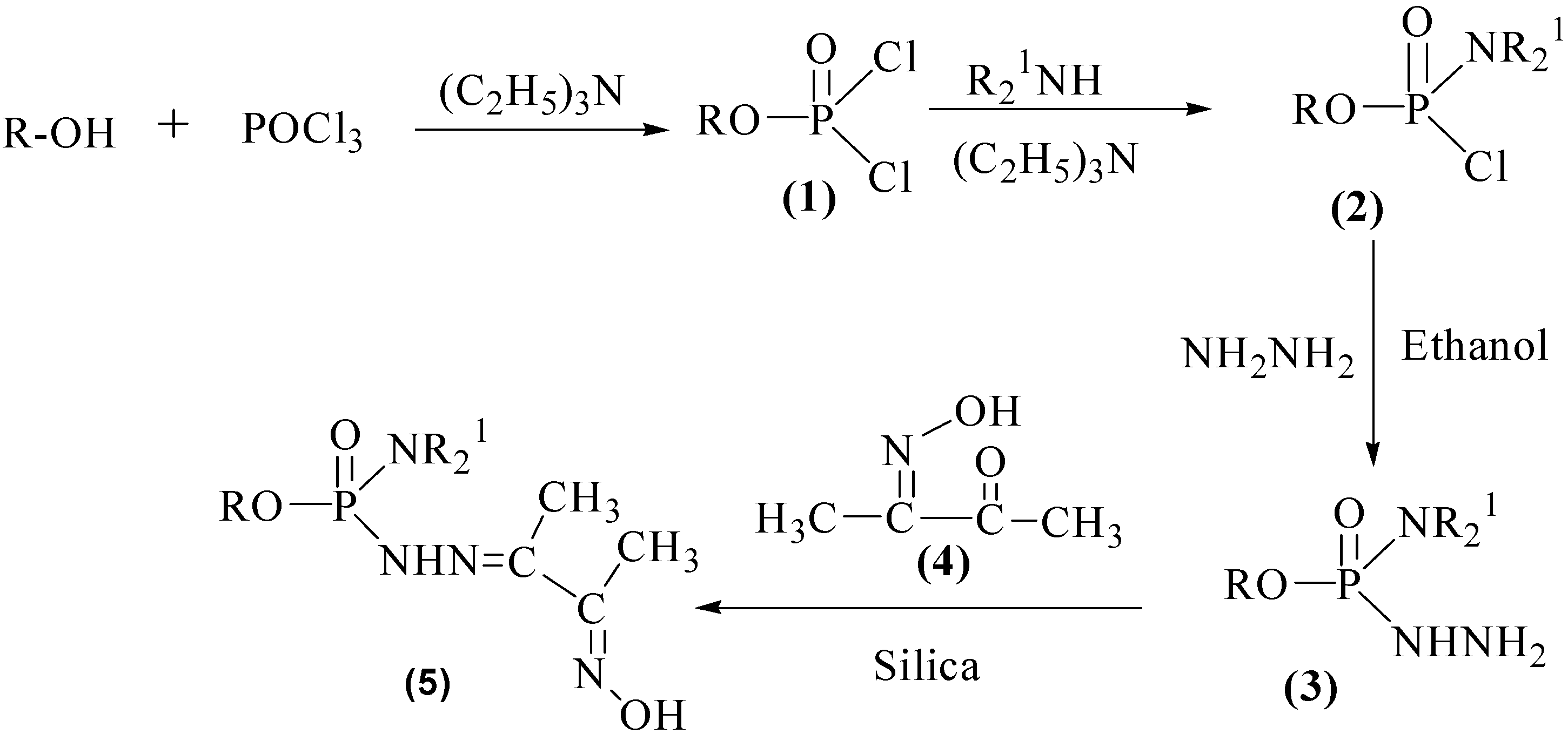
In order to follow the proposed synthetic plan for the synthesis of target compounds, the intermediates 1-3 were prepared following literature procedures [9, 10]. After the synthesis of the various N,N-dialkylamino-O-alkyl-phosphorohydrazides 3 we optimized the reaction conditions for the synthesis of the target compounds 5. In this regard, we initially performed as a model the reaction of diethylamino-O-butyl phosphorohydrazide with butane-2,3-dione monoxime in the presence of various dehydrating reagents, while varying reaction times and temperatures. The efficiency of various condensing agents such as Al2O3 (neutral, acidic, basic), SiO2, ZnCl2, H3PO3, KF-SiO2, POCl3, PTSA, BiCl3, DCC, V2O5-SiO2 were studied using different molar ratios. The results of these experiments are summarized in Table 1.
The results shown in Table 1 reveal that in comparison to other condensation reagents, the use of silica gave the best results. Next, to study the effect of solvent in the model reaction, various solvents like THF, dioxane, hexane, diethyl ether, benzene, DCM, chloroform and CCl4 were used and it was observed that benzene afforded the best results. During this study we observed that that yield of 5 was affected by changing the nature of solvent. It was also revealed that the use of DCM, chloroform and CCl4 gave more or less similar yields of 5 (35-40%). However, when the reaction time was increased the isolation of products became difficult due to formation of some unidentified side products and unreacted starting materials. Diethyl ether and hexane were found to be poor solvents due to the limited solubility of the reactants in both the solvents, even under reflux conditions.
Table 1.
Condensation agent optimization for the synthesis of compounds 5a.
After optimization of reaction conditions, various N,N-dialkylamino-O-alkyl phosphorohydrazides were condensed with diacetylmonoxime in presence of activated silica in benzene, to give N,N-dialkylamino-O-alkyl-2-(1-methyl-2-oxopropylidene) phosphorohydrazido oximes 5a-j in excellent yield (Table 2).
Conclusions
In summary, we have described a general and efficient method for the synthesis of structurally complex and diverse N,N-dialkylamino-O-alkyl-2-(1-methyl-2-oxopropylidene)phosphorohydrazido oximes. It was found that procedure offers several advantages, including the possibility of obtaining pure products in high yields without the use of column chromatography, operational simplicity and cleaner reactions, which makes it a useful and attractive process for the synthesis of these compounds. The assignment of the configuration and the detailed biological activity is under progress and will be reported in due course.
Table 2.
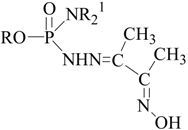
Physical data of the newly synthesized compounds 5a.
Experimental
General
1H-, 31P- and 13C-NMR spectra were recorded in CDCl3 or DMSO-d6 solutions on a Bruker AVANCE 400 NMR spectrometer operating at 400, 162 and 100 MHz, respectively. LCMS analysis (EI, 70V) were performed on a Hewlett-Packard HP 5971 instrument. IR spectra were recorded on a Bruker model Tensor 27 FT-IR spectrometer as KBr pellets.
General procedure for the preparation of N,N-dialkylamino-O-alkyl-2-(1-methyl-2-oxopropylidene)-phosphorohydrazido oximes: N,N-diethylamino-O-butyl-2-(1-methyl-2-oxopropylidene) phosphoro-hydrazido oxime (5a):
A mixture of butane-2,3-dione monoxime (1 g, 0.01 mol) and activated silica gel (2 g) was placed in a two necked round bottom flask containing benzene (20 mL). N,N-diethylamino-O-butyl phosphorohydrazide (2.23 g, 0.01 mol) diluted in benzene (20 mL) was slowly added at room temperature with efficient stirring and the resulting mixture was then refluxed for 3h. The reaction was monitored by 31P-NMR until the N,N-diethylamino-O-alkyl phosphorohydrazide signal disappeared. The reaction mixture was filtered through Buchner funnel and washed with benzene (2x10 mL). Filtrate and washes were combined and the solvent was removed by distillation. Finally, the desired crude product was triturated with dry ether gave a white crystalline powder which was recrystallized from ethanol-ether (7:3); m.p. = 103 °C; yield 78%; IR: 1024 (P-O-C), 1105 (P-N-N), 1197 (P=O), 1434 (C-N), 1609 (C=N), 2966 (C-H), 3220 (NH), 3450 (OH) cm-1; 1H-NMR δ: 0.75 (t, J =7.89 Hz, 3H, CH3), 0.90 (t, J =7.96 Hz, 6H, CH3), 1.30 (m, J =7.53 Hz, 2H, CH2), 1.55 (m, J =7.53 Hz, 2H, CH2), 1.85 (s, 3H, CH3), 2.05 (s, 3H, CH3), 3.10 (m, J = 6.09 Hz, 4H, CH2), 3.98 (m, J = 7.29 Hz, 2H, CH2), 6.45 (d, JP-H = 27.45 Hz, 1H, NH) 9.01 (s, 1H, OH); 13C-NMR δ: 9.05 (CH3), 13.59 (CH3), 18.81 (CH2), 26.16 (CH3), 26.34 (CH3), 32.31 (CH2), 39.89 (CH2), 65.44 (CH2), 145.39 (C=N-NH), 156.16 (C=N-OH); MS (m/z): 307 (M+H)+, 330 (M+Na)+; Calcd. for C12H27N4O3P (%): C 47.05, H 8.88, N 18.29; Found (%): C 47.08, H 8.90, N 18.28.
N,N-dipropylamino-O-butyl-2-(1-methyl-2-oxopropylidene)phosphorohydrazido oxime (5b): IR: 1013 (P-O-C), 1115 (P-N-N), 1204 (P=O), 1458 (C-N), 1607 (C=N), 2873 (C-H), 3217 (NH), 3352 (OH) cm-1 ; 1H-NMR δ: 0.80 (t, J=7.69 Hz, 3H, CH3), 1.05 (t, J =7. 89 Hz, 6H, CH3), 1.30 (m, J =7.53 Hz, 2H, CH2), 1.45 (m, J=8.73Hz, 4H, CH2), 1.55 (m, J =7.53 Hz, 2H, CH2), 1.90 (s, 3H, CH3), 2.07 (s, 3H, CH3), 2.85 (m, J=8.56 Hz, 4H, CH2), 3.98 (m, J = 7.30 Hz, 2H, CH2), 6.47 (d, JP-H =27.28 Hz, 1H, NH), 9.10 (s, 1H, OH); 13C-NMR δ: 9.39 (CH3), 13.59 (CH3), 19.01 (CH2), 22.05 (CH2), 26.10 (CH3), 26.28 (CH3), 32.31 (CH2), 47.94 (CH2), 65.72 (CH2), 145.40 (C=N-NH), 156.95 (C=N-OH); MS (m/z): 335 (M+ H)+, 357(M+Na)+; Calcd. for C14H31N4O3P (%): C 50.28, H 9.34, N 16.75; Found (%): C 50.26, H 9.38, N 16.75.
N,N-diisopropylamino-O-butyl-2-(1-methyl-2-oxopropylidene)phosphorohydrazido oxime (5c): IR: 1110 (P-O-C), 1132 (P-N-N), 1193 (P=O), 1450 (C-N), 1647 (C=N), 2852 (C-H), 3147 (NH), 3390 (OH) cm-1; 1H-NMR δ: 0.75 (t, J=7.83 Hz, 3H, CH3), 1.10 (d, J=8.45 Hz, 6H, CH3), 1.30 (m, J =7.53 Hz, 2H, CH2), 1.50 (m, J=8.25 Hz, 2H, CH), 1.55 (m, J =7.53 Hz, 2H, CH2), 1.90 (s, 3H, CH3), 2.07 (s, 3H, CH3), 3.98 (m, J = 7.30 Hz, 2H, CH2), 6.70 (d, JP-H =30.77 Hz, 1H, NH), 8.30 (s, 1H, OH); 13C-NMR δ: 9.38 (CH3), 13.49 (CH3), 15.45 (CH), 19.05 (CH2), 26.09 (CH3), 26.18 (CH3), 32.31 (CH2), 65.42 (CH2), 148.66 (C=N-NH), 157.16 (C=N-OH); MS (m/z): 335 (M+ H)+, 357(M+Na)+; Calcd. for C14H31N4O3P (%): C 50.28, H 9.34, N 16.75; Found (%): C 50.26, H 9.38, N 16.75.
N,N-dibutylaminoO-butyl-2-(1-methyl-2-oxopropylidene)phosphorohydrazido oxime (5d): IR: 1080 (P-O-C), 1173 (P-N-N), 1204 (P=O), 1437 (C-N), 1609 (C=N), 2858 (C-H), 3307 (NH), 3355(OH) cm-1; 1H-NMR δ: 0.85 (t, J=7.54 Hz, 6H, CH3), 0.90 (t, J=7.25 Hz, 3H, CH3), 1.15 (m, J = 8.05 Hz, 4H, CH2), 1.35 (m, J=8.15 Hz, 2H, CH2), 1.48 (m, J=7.28 Hz, 4H, CH2), 1.78 (s, 3H, CH3), 1.95 (s, 3H, CH3), 3.05 (m, J=8.95 Hz, 4H, CH2), 3.95 (m, J=8.15 Hz, 2H, CH2), 6.85 (d, JP-H =27.73 Hz, 1H, NH), 8.25 (s, 1H, OH); 13C-NMR δ: 9.39 (CH3), 13.59 (CH3), 14.27 (CH2), 18.81(CH2), 22.05 (CH2), 26.18 (CH3), 26.38 (CH3), 32.31(CH2), 39.85 (CH2), 65.72 (CH2), 145.40 (C=N-NH), 156.95 (C=N-OH); MS (m/z): 363 (M+H)+, 385 (M+Na)+; Calcd. for C16H35N4O3P (%): C 53.02, H 9.73, N 15.46; Found(%):C 53.04, H 9.75, N 15.47.
N,N-diisobutylamino-O-butyl-2-(1-methyl-2-oxopropylidene)phosphorohydrazido oxime (5e): IR: 1076 (P-O-C), 1148 (P-N-N), 1204 (P=O), 1452 (C-N), 1609 (C=N), 2856 (C-H), 3206 (NH), 3370 (OH) cm-1; 1H-NMR δ: 0.85 (d, J=7.83 Hz, 12H, CH3), 0.90 (t, J=8.54 Hz, 3H, CH3), 1.15 (m, J = 8.05 Hz, 2H, CH2), 1.35 (m, J=8.05 Hz, 2H, CH2), 1.45 (m, J=8.25 Hz, 2H, CH), 1.85 (s, 3H,CH3), 1.95 (s, 3H, CH3), 2.75 (m, J=8.25 Hz, 4H, CH2), 3.85 (m, J=8.25 Hz, 2H, CH2), 6.50 (d, JP-H =29.05 Hz, 1H, NH), 8.25 (s,1H, OH); 13C-NMR δ: 9.45 (CH3), 13.75 (CH3), 18.83 (CH2), 20.05 (CH), 26.18 (CH3), 26.38 (CH3), 32.46 (CH2), 53.42 (CH2), 65.72 (CH2), 146.49 (C=N-NH), 156.05 (C=N-OH); MS (m/z): 363 (M+H)+, 385 (M+Na)+; Calcd. for C16H35N4O3P (%): C 53.02, H 9.73, N 15.46; Found (%):C 53.04, H 9.75, N 15.47.
N,N-diethylamino-O-propyl-2-(1-methyl-2-oxopropylidene)phosphorohydrazido oxime (5f): IR: 1024 (P-O-C), 1105 (P-N-N), 1197 (P=O), 1434 (C-N), 1609 (C=N), 2966 (C-H), 3214 (NH), 3379 (OH) cm-1; 1H-NMR δ: 0.80 (t, J =7. 89 Hz , 3H, CH3), 1.05 (t, J =7. 96 Hz , 6H, CH3), 1.55 (m, J =7.53 Hz, 2H, CH2), 1.85 (s, 3H, CH3), 2.05 (s, 3H, CH3), 3.10 (m, J = 7.80 Hz, 4H, CH2), 3.98 (m, J = 7.78 Hz, 2H, CH2), 6.45 (d, JP-H = 25.37 Hz, 1H, NH), 8.25 (s, 1H, OH); 13C-NMR δ: 9.05 (CH3), 13.59 (CH3), 18.81 (CH2), 26.16 (CH3), 26.34 (CH3), 32.31 (CH2), 39.89 (CH2), 65.44 (CH2), 145.39 (C=N-NH), 156.16 (C=N-OH); MS (m/z): 293(M+H)+, 316(M+Na)+; Calcd. for C11H25N4O3P (%): C 45.20, H 8.62, N19.17; Found (%): C 45.22, H 8.65, N 19.20.
N,N-dipropylamino-O-propyl-2-(1-methyl-2-oxopropylidene)phosphorohydrazido oxime (5g): IR: 1013 (P-O-C), 1115 (P-N-N), 1204 (P=O), 1458 (C-N), 1607 (C=N), 2873 (C-H), 3217 (NH), 3352 (OH) cm-1; 1H-NMR δ: 0.75 (t, J=8.39 Hz, 3H, CH3), 1.12 (t, J =7.50 Hz, 6H, CH3), 1.45 (m, J=8.25Hz, 4H, CH2), 1.55 (m, J =7.39 Hz, 2H, CH2), 1.90 (s, 3H, CH3), 2.07 (s, 3H, CH3), 2.85 (m, J=8.25 Hz, 4H, CH2), 3.98 (m, J = 7.30 Hz, 2H, CH2), 6.35 (d, JP-H =27.28 Hz, 1H, NH), 9.10 (s, 1H, OH); 13C-NMR δ: 9.39 (CH3), 11.41 (CH3), 22.05 (CH2), 26.09 (CH3), 26.18 (CH3), 32.31 (CH2), 47.94 (CH2), 67.52 (CH2), 145.40 (C=N-NH), 156.95 (C=N-OH); MS (m/z): 321 (M+H)+, 343 (M+Na)+; Calcd. for C13H29N4O3P (%): C 48.74, H 9.12, N 17.49; Found (%): C 48.72, H 9.15, N 17.50.
N,N-diisopropylamino-O-propyl-2-(1-methyl-2-oxopropylidene)phosphorohydrazido oxime (5h): IR: 1074 (P-O-C), 1135 (P-N-N), 1205 (P=O), 1455 (C-N), 1653 (C=N), 2951 (C-H), 3247 (NH), 3360 (OH) cm-1; 1H-NMR δ: 0.85 (t, J=7.26 Hz, 3H, CH3), 1.05 (d, J=8.45 Hz, 12H, CH3), 1.65 (m, J =7.53 Hz, 2H, CH2), 1.90 (s, 3H, CH3), 2.05 (s, 3H, CH3), 2.79 (m, J=7.45 Hz, 2H, CH), 3.98 (m, J = 7.30 Hz, 2H, CH2), 6.55 (d, JP-H =30.77, 1H, NH), 8.30 (s, 1H, OH); 13C-NMR δ: 9.38 (CH3), 13.49 (CH3), 15.45 (CH), 19.01 (CH2), 26.16 (CH3), 26.34 (CH3), 46.91 (CH2), 148.66 (C=N-NH), 157.16 (C=N-OH); MS (m/z): 321 (M+ H)+, 343 (M+Na)+; Calcd. for C13H29N4O3P (%): C 48.74, H 9.12, N 17.49; Found (%): C 48.72, H 9.15, N 17.50.
N,N-dibutylamino-O-propyl-2-(1-methyl-2-oxopropylidene)phosphorohydrazido oxime (5i): IR: 1080 (P-O-C), 1173 (P-N-N), 1204 (P=O), 1437 (C-N), 1619 (C=N), 2951 (C-H), 3246 (NH), 3375 (OH) cm-1 ; 1H-NMR δ: 0.85 (t, J=7.39 Hz, 6H, CH3), 0.90 (t, J=8.35 Hz, 3H, CH3), 1.15 (m, J = 7.52 Hz, 4H, CH2), 1.35 (m, J=8.75 Hz, 4H, CH2), 1.65 (m, J=8.05 Hz, 2H, CH2), 1.85(s, 3H, CH3), 1.95 (s, 3H, CH3), 3.05 (m, J=7.11 Hz, 4H, CH2), 3.90 (m, J=8.27 Hz, 2H, CH2), 6.50 (d, JP-H=24.26 Hz, 1H, NH), 8.00 (s, 1H, OH); 13C-NMR δ: 9.73 (CH3), 10.39 (CH3), 14.09 (CH2), 20.21 (CH2), 26.10 (CH3), 26.18 (CH3), 31.06 (CH2), 38.75 (CH2), 66.03 (CH2) , 145.75 (C=N-NH), 156.67 (C=N-OH); MS (m/z): 363 (M+H)+, 385 (M+Na)+; Calcd. for C15H33N4O3P (%): C 51.71, H 9.55, N 16.08; Found (%):C 51.71, H 9.55, N 16.08.
N,N-diisobutylamino-O-propyl-2-(1-methyl-2-oxopropylidene)phosphorohydrazido oxime (5j): IR: 1053 (P-O-C), 1106 (P-N-N), 1202 (P=O), 1467 (C-N), 1615 (C=N), 2962 (C-H), 3206 (NH), 3370 (OH) cm-1; 1H-NMR δ: 0.85 (d, J=8.27 Hz, 12H, CH3), 0.90 (t, J=8.54 Hz, 3H, CH3), 1.65 (m, J=8.25 Hz, 2H, CH), 1.68 (m, J=8.01 Hz, 2H, CH2), 1.95 (s, 3H, CH3), 2.05 (s, 3H, CH3), 2.95 (m, J=8.17 Hz, 4H, CH2), 3.95 (m, J=7.28 Hz, 2H, CH2), 6.50 (d, JP-H =29.05 Hz, 1H, NH), 8.40 (s, 1H, OH); 13C-NMR δ: 9.45 (CH3), 13.75 (CH3), 18.83 (CH2), 20.05 (CH), 26.18 (CH3), 26.38 (CH3), 32.46 (CH2), 53.42 (CH2), 65.72 (CH2), 146.49 (C=N-NH), 156.05 (C=N-OH); MS (m/z): 349 (M+H)+, 371 (M+Na)+; Calcd. for C15H33N4O3P (%): C 51.71, H 9.55, N 16.08; Found (%):C 51.71, H 9.55, N 16.08.
Acknowledgments
The authors thank Ms. Mamta Sharma and Avik Mazumder for NMR analysis.
References
- Alam, M.; Sanduja, R.; Hossain, M. B.; Helm, D. V. Gymnodinium breve toxin. 1. Isolation and X-ray structure of O,O-dipropyl(E)-2-(1-methyl-2-oxoprolidene) phosphorohydrazidothiolate (E) Oxime from the red ride dinoflagellate Gymnodinium breve. J. Am. Chem. Soc. 1982, 104, 5232–5234. [Google Scholar] [CrossRef]
- Dinovi, M.; Trainor, D. A.; Nakanishi, K. The structure of PB-1, an unusual toxin isolated from the red tide dinoflagellate ptychodiscus brevis. Tetrahedron Lett. 1983, 24, 855–858. [Google Scholar]
- Husain, K.; Kaushik, M. P.; Gupta, A. K. Acute toxicity of synthetic Gymnodinium breve Toxin metabolite and its analogues in mice. Ecotox. Environ. Safety 1996, 35, 77–80. [Google Scholar]
- Koley, J.; Basak, A. K.; Das, M.; Sinha, S.; Dubey, S. N.; Majumder, P. K.; Gupta, A. K.; Das Gupta, S.; Koley, B. N. Effect of synthetic toxin of Ptychodiscus brevis on cardio-vascular and renal function. Ind. J. Physiol. Allied Sci. 1997, 51, 119–125. [Google Scholar] Majumder, P. K.; Gupta, A. K.; Kaushik, M. P.; Deo Kumar; Dubey, S. N. Cardio-vascular effects of organophosphates toxin isolated from Ptychodiscus brevis. Biomed. Enviorn. Sci. 1997, 10, 85–92. [Google Scholar] Majumder, P. K.; Gupta, A. K.; Deo Kumar; Kaushik, M. P.; Dubey, S.N. Mechanism of cardiotoxicity induced by a marine toxin isolated from Ptychodiscus brevis. Ind. J. Expt. Bio. 1997, 35, 650–654. [Google Scholar] Majumder, P. K.; Gupta, A. K.; Kumar, Deo; Dubey, S.N. Calcium modulatory properties of o,o-diphenylcyclooctylphosphoramidates from Ptychodiscus brevis in rat atria and smooth muscle. Ind. J. Physiol. Pharmacol. 1997, 41, 257–262. [Google Scholar]
- Eto, M. Organophosphorus Pesticides: Organic and Biological chemistry; CRC Press: Cleveland, Ohio, USA, 1974; Chapter 5. [Google Scholar]
- Kaushik, M. P.; Parashar, B. D.; Swamy, R.V. Synthesis of Gymnodinium breve toxin. Ind. J. Chem. 1988, 27B, 1150–1151. [Google Scholar]
- Kumar, R.; Gupta, A. K.; Kaushik, M. P. A Novel and Efficient Synthesis of N,N-Dialkylaminoisopropyl- and O-alkylisopropyl-2-(1-alkyl-2-oxopropylidene)phosphonohydrazido Oximes - Potential Marine Fish Toxin Analogues. Part 1. Molecules 2007, 12, 1334–1340. [Google Scholar] [CrossRef]
- Kumar, R.; Gupta, A. K.; Kaushik, M. P. Novel and Efficient Synthesis of N,N-Dialkylaminoand O-alkylphenyl-2-(1-alkyl/phenyl-2-oxopropylidene) Phosphonohydrazido Oximes - Potential Marine Fish Toxin Analogues. Part 2. Molecules 2007, 12, 1632–1640. [Google Scholar]
- Kosolapoff, G.M.; Maier, L. Organic phosphorus compounds; Wiley-Interscience: New York, 1976; Volume 7. [Google Scholar]
- Audrieth, L. F.; Gher, R.; Smith, W.C. Nitrogen compounds of the phosphoric and phosphonic acids. 1. Hydrazides of phenylphosphoric and diphenylphosphoric acids. J. Org. Chem. 1955, 20, 1288–1290. [Google Scholar]
- Sample Availability: Contact the authors.
© 2007 by MDPI (http://www.mdpi.org). Reproduction is permitted for noncommercial purposes.