

Asynchronous Control of P300-Based Brain–Computer Interfaces Using Sample Entropy




Abstract
1. Introduction
2. Materials and Methods
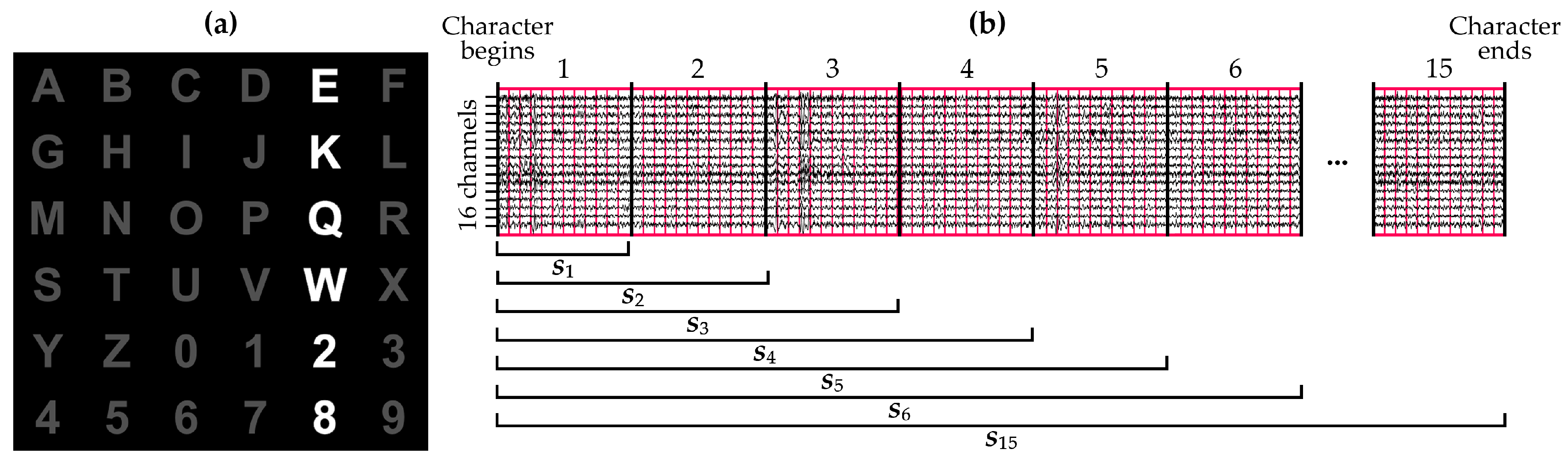
2.1. Dataset and Experimental Protocol
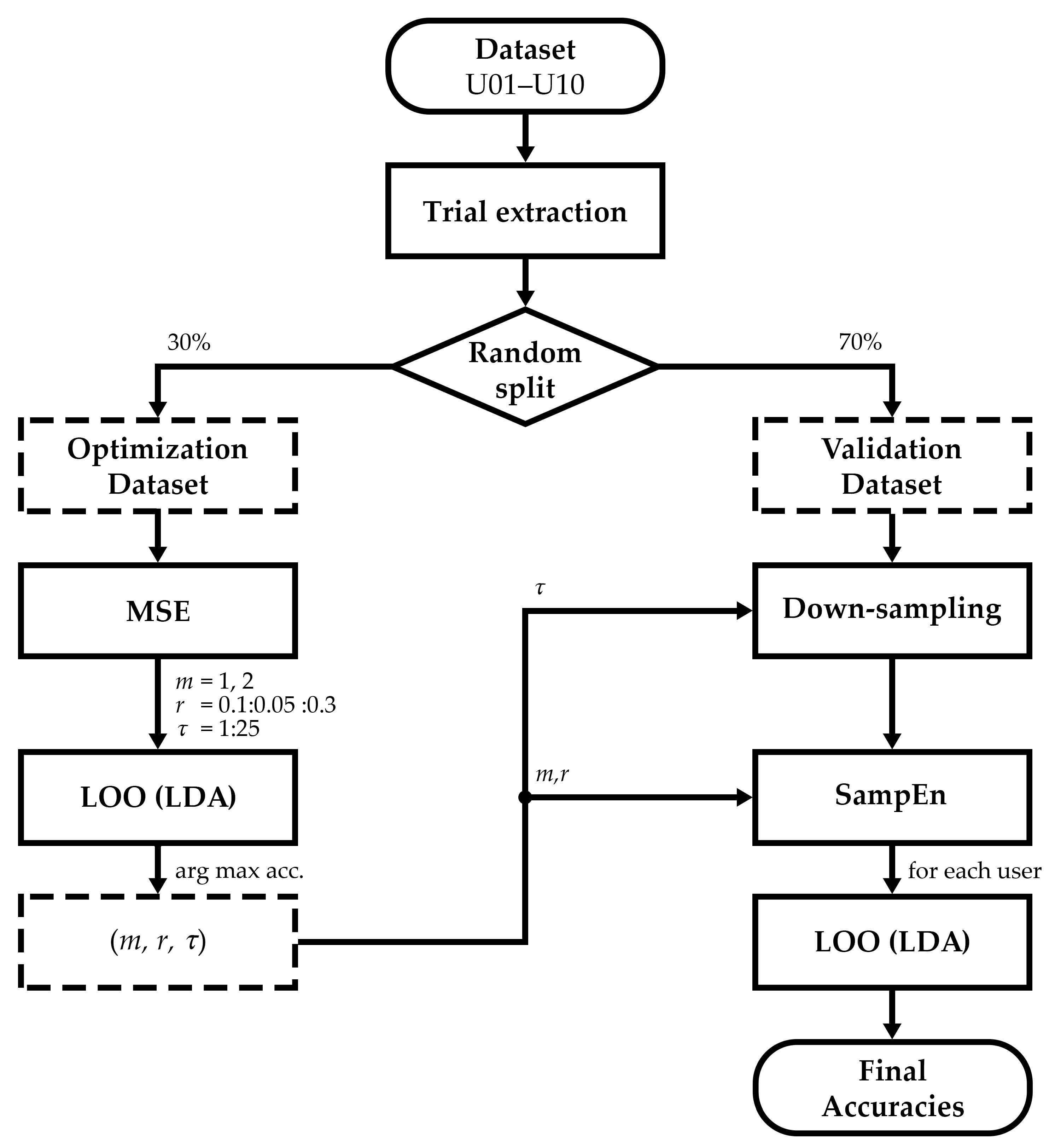
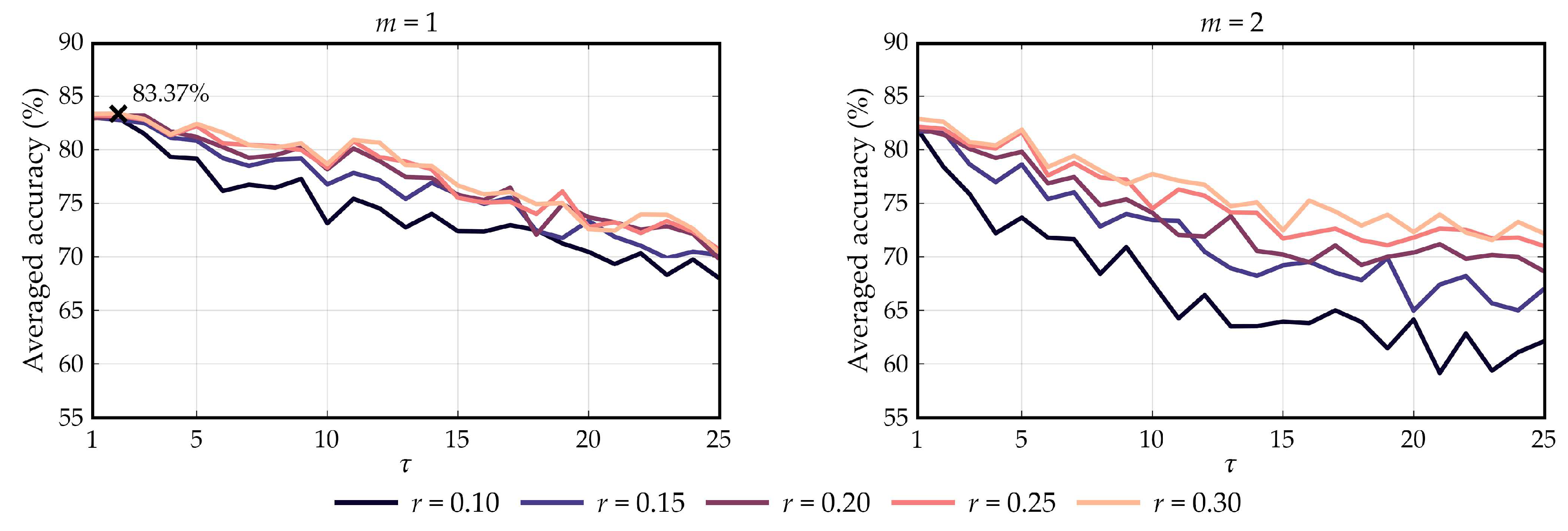
2.2. Optimization Stage
2.3. Validation Stage
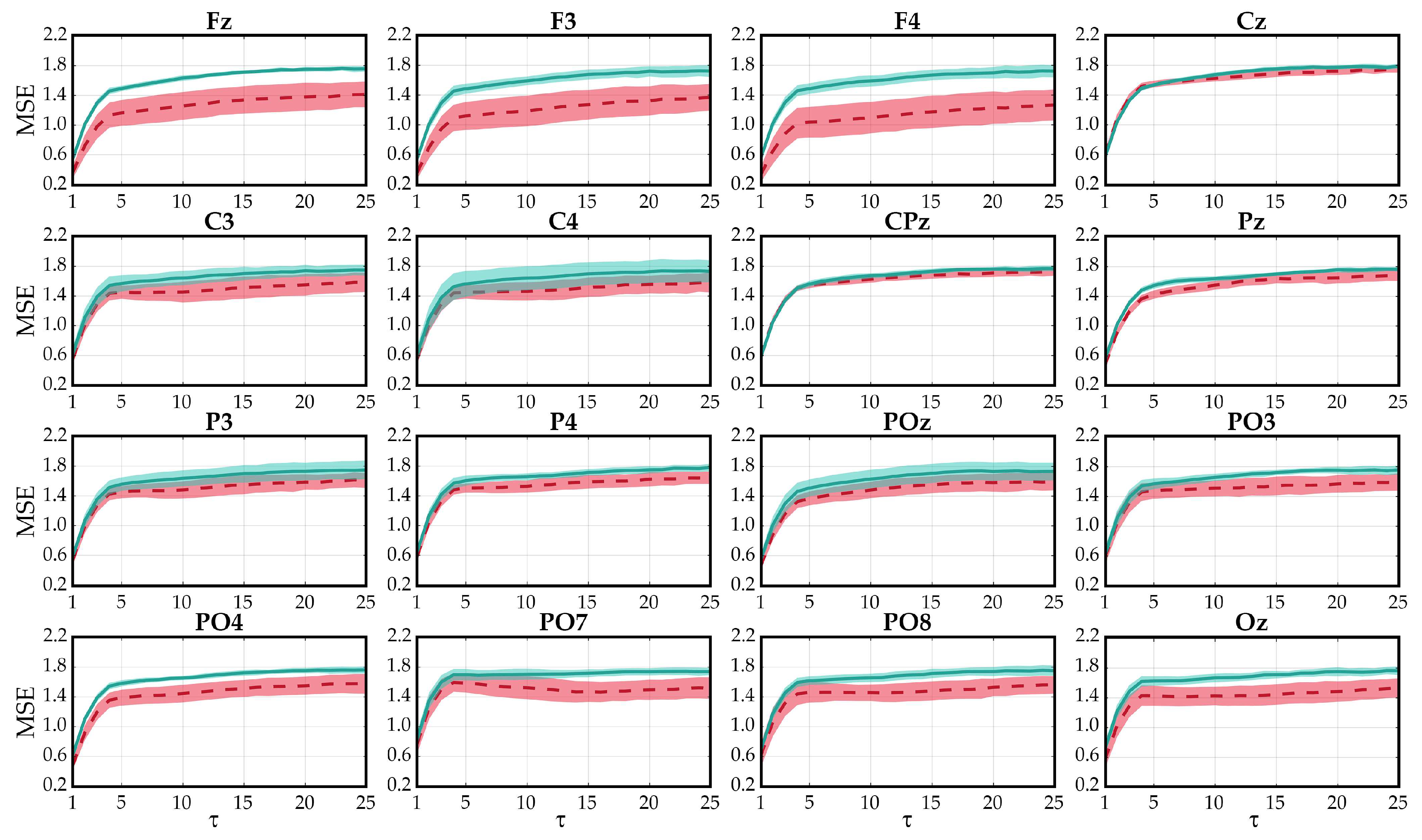
3. Results
4. Discussion
5. Conclusions
Author Contributions
Funding
Conflicts of Interest
References
- Wolpaw, J.R.; Wolpaw, E.W. Brain–computer Interfaces: Principles and Practice; OUP USA: Oxford, UK, 2012. [Google Scholar]
- Wolpaw, J.R.; Birbaumer, N.; McFarland, D.J.; Pfurtscheller, G.; Vaughan, T.M. Brain–computer interfaces for communication and control. Clin. Neurophysiol. 2002, 113, 767–791. [Google Scholar] [CrossRef] [Scilit]
- Nicolas-Alonso, L.F.; Gomez-Gil, J. Brain computer interfaces, a review. Sensors 2012, 12, 1211–1279. [Google Scholar] [CrossRef] [Scilit] [PubMed]
- Farwell, L.A.; Donchin, E. Talking off the top of your head: Toward a mental prosthesis utilizing event-related brain potentials. Electroencephalogr. Clin. Neurophysiol. 1988, 70, 510–523. [Google Scholar] [CrossRef] [Scilit]
- Pinegger, A.; Faller, J.; Halder, S.; Wriessnegger, S.C.; Müller-Putz, G.R. Control or non-control state: That is the question! An asynchronous visual P300-based BCI approach. J. Neural Eng. 2015, 12, 014001. [Google Scholar] [CrossRef] [Scilit] [PubMed]
- Martínez-Cagigal, V.; Gomez-Pilar, J.; Álvarez, D.; Hornero, R. An asynchronous P300-based Brain— Computer Interface web browser for severely disabled people. IEEE Trans. Neural Syst. Rehabil. Eng. 2017, 25, 1332–1342. [Google Scholar] [CrossRef] [Scilit] [PubMed]
- Pfurtscheller, G. The hybrid BCI. Front. Neurosci. 2010, 4, 30. [Google Scholar] [CrossRef] [Scilit] [PubMed]
- Zhang, H.; Guan, C.; Wang, C. Asynchronous P300-based brain–computer interfaces: A computational approach with statistical models. IEEE Trans. Biomed. Eng. 2008, 55, 1754–1763. [Google Scholar] [CrossRef] [Scilit] [PubMed]
- Li, Y.; Pan, J.; Wang, F.; Yu, Z. A hybrid BCI system combining P300 and SSVEP and its application to wheelchair control. IEEE Trans. Biomed. Eng. 2013, 60, 3156–3166. [Google Scholar] [CrossRef] [Scilit] [PubMed]
- He, S.; Zhang, R.; Wang, Q.; Chen, Y.; Yang, T.; Feng, Z.; Zhang, Y.; Shao, M.; Li, Y. A P300-Based Threshold-Free Brain Switch and Its Application in Wheelchair Control. IEEE Trans. Neural Syst. Rehabil. Eng. 2017, 25, 715–725. [Google Scholar] [CrossRef] [Scilit] [PubMed]
- Aloise, F.; Schettini, F.; Aricò, P.; Leotta, F.; Salinari, S.; Mattia, D.; Babiloni, F.; Cincotti, F. P300-based brain–computer interface for environmental control: An asynchronous approach. J. Neural Eng. 2011, 8, 025025. [Google Scholar] [CrossRef] [Scilit] [PubMed]
- Aref, A.; Huggins, J. The P300-certainty algorithm: Improving accuracy by withholding erroneous selections. In Proceedings of the EEG and Clinical Neuroscience Society Conference, Bristol, TN, USA, 12–15 September 2012. [Google Scholar]
- Breitwieser, C.; Pokorny, C.; Müller-Putz, G.R. A hybrid three-class brain–computer interface system utilizing SSSEPs and transient ERPs. J. Neural Eng. 2016, 13, 066015. [Google Scholar] [CrossRef] [Scilit] [PubMed]
- Alcaide-Aguirre, R.E.; Warschausky, S.A.; Brown, D.; Aref, A.; Huggins, J.E. Asynchronous brain–computer interface for cognitive assessment in people with cerebral palsy. J. Neural Eng. 2017, 14, 066001. [Google Scholar] [CrossRef] [Scilit] [PubMed]
- Tang, J.; Liu, Y.; Jiang, J.; Yu, Y.; Hu, D.; Zhou, Z. Toward Brain-Actuated Mobile Platform. Int. J. Hum. Comput. Interact. 2018. [Google Scholar] [CrossRef] [Scilit]
- Martínez-Cagigal, V.; Santamaría-Vázquez, E.; Gomez-Pilar, J.; Hornero, R. Towards an accessible use of smartphone-based social networks through brain–computer interfaces. Expert Syst. Appl. 2019, 120, 155–166. [Google Scholar] [CrossRef] [Scilit]
- Panicker, R.C.; Puthusserypady, S.; Pryana, A.P.; Sun, Y. Asynchronous P300 BCI: SSVEP-based control state detection. Eur. Signal Process. Conf. 2010, 58, 934–938. [Google Scholar] [CrossRef] [Scilit] [PubMed]
- Yu, Y.; Zhou, Z.; Liu, Y.; Jiang, J.; Yin, E.; Zhang, N.; Wang, Z.; Liu, Y.; Wu, X.; Hu, D. Self-paced operation of a wheelchair based on a hybrid brain–computer interface combining motor imagery and P300 potential. IEEE Trans. Neural Syst. Rehabil. Eng. 2017, 25, 2516–2526. [Google Scholar] [CrossRef] [Scilit] [PubMed]
- Martínez-Cagigal, V.; Santamaría Vázquez, E.; Hornero, R. A Novel Hybrid Swarm Algorithm for P300-Based BCI Channel Selection. In Proceedings of the World Congress on Medical Physics & Biomedical Engineering (IUPESM 2018), Prague, Czech Republic, 3–8 June 2018; pp. 41–45. [Google Scholar]
- Aydin, E.A.; Bay, O.F.; Guler, I. P300-Based Asynchronous Brain Computer Interface for Environmental Control System. IEEE J. Biomed. Health Inform. 2018, 22, 653–663. [Google Scholar] [CrossRef] [Scilit] [PubMed]
- Ma, Z.; Qiu, T. Quasi-periodic fluctuation in Donchin’s speller signals and its potential use for asynchronous control. Biomed. Tech. 2018, 63, 105–112. [Google Scholar] [CrossRef] [Scilit] [PubMed]
- Yu, Y.; Zhou, Z.; Jiang, J.; Yin, E.; Liu, K.; Wang, J.; Liu, Y.; Hu, D. Toward a Hybrid BCI: Self-Paced Operation of a P300-based Speller by Merging a Motor Imagery-Based “Brain Switch” into a P300 Spelling Approach. Int. J. Hum. Comput. Interact. 2017, 33, 623–632. [Google Scholar] [CrossRef] [Scilit]
- Richman, J.S.; Moorman, J.R. Physiological time-series analysis using approximate entropy and sample entropy. Am. J. Physiol. Heart Circ. Physiol. 2000, 278, H2039–H2049. [Google Scholar] [CrossRef] [Scilit] [PubMed]
- Costa, M.; Goldberder, A.L.; Peng, C.K. Multiscale Entropy Analysis of Complex Physiologic Time Series. Phys. Rev. Lett. 2002, 89, 068102. [Google Scholar] [CrossRef] [Scilit] [PubMed]
- Costa, M.; Goldberger, A.L.; Peng, C.K. Multiscale entropy analysis of biological signals. Phys. Rev. E Stat. Nonlinear Soft Matter Phys. 2005, 71, 1–18. [Google Scholar] [CrossRef] [Scilit] [PubMed]
- Humeau-Heurtier, A. The multiscale entropy algorithm and its variants: A review. Entropy 2015, 17, 3110–3123. [Google Scholar] [CrossRef] [Scilit]
- Picton, T.W. The P300 wave of the human event-related potential. J. Clin. Neurophysiol. 1992, 9, 456–479. [Google Scholar] [CrossRef] [Scilit] [PubMed]
- Jasper, H.H. The ten-twenty electrode system of the international federation. Electroencephalogr. Clin. Neurophysiol. 1958, 10, 371–375. [Google Scholar]
- Valencia, F.; Porta, A.; Clari, F. Refined Multiscale Entropy: Application to 24-h Holter Recordings of Heart Period Variability in Healthy and Aortic Stenosis Subjects. IEEE Trans. Biomed. Eng. 2009, 56, 2202–2213. [Google Scholar] [CrossRef] [Scilit] [PubMed]
- Witten, I.H.; Frank, E. Data Mining: Practical Machine Learning Tools and Techniques, 3rd ed.; Morgan Kaufmann: Burlington, MA, USA, 2011. [Google Scholar]
- Benjamini, Y.; Hochberg, Y. Controlling the False Discovery Rate: A Practical and Powerful Approach to Multiple Testing. J. R. Stat. Soc. 1995, 57, 289–300. [Google Scholar] [CrossRef] [Scilit]
- Lebedev, M.A.; Messinger, A.; Kralik, J.D.; Wise, S.P. Representation of attended versus remembered locations in prefrontal cortex. PLoS Biol. 2004, 2, e365. [Google Scholar] [CrossRef] [Scilit] [PubMed]
- Huettel, S.A.; McCarthy, G. What is odd in the oddball task? Prefrontal cortex is activated by dynamic changes in response strategy. Neuropsychologia 2004, 42, 379–386. [Google Scholar] [CrossRef] [Scilit] [PubMed]
- Bojorges-Valdez, E.; Yanez-Suarez, O. Association between EEG spectral power dynamics and event related potential amplitude on a P300 speller. Biomed. Phys. Eng. Express 2018, 4. [Google Scholar] [CrossRef] [Scilit]
- Goodale, M.A.; Ingle, D.J.; Mansfield, R.J.W. Analysis of Visual Behavior; Mit Press: Cambridge, MA, USA, 1982. [Google Scholar]
- Srinivasan, R.; Bibi, F.A.; Nunez, P.L. Steady-state visual evoked potentials: Distributed local sources and wave-like dynamics are sensitive to flicker frequency. Brain Topogr. 2006, 18, 167–187. [Google Scholar] [CrossRef] [Scilit] [PubMed]
- Schalk, G.; McFarland, D.J.; Hinterberger, T.; Birbaumer, N.; Wolpaw, J.R. BCI2000: A general-purpose brain–computer interface (BCI) system. IEEE Trans. Biomed. Eng. 2004, 51, 1034–1043. [Google Scholar] [CrossRef] [Scilit] [PubMed]
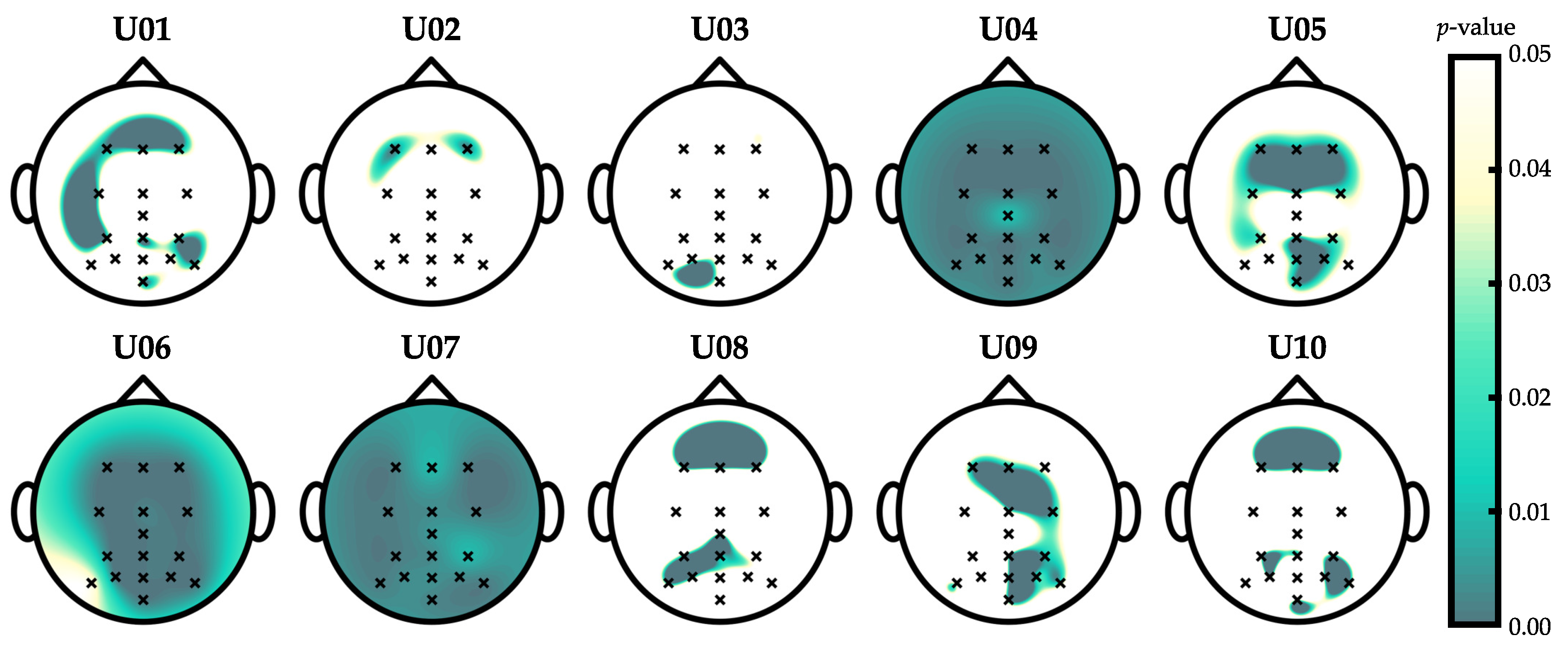
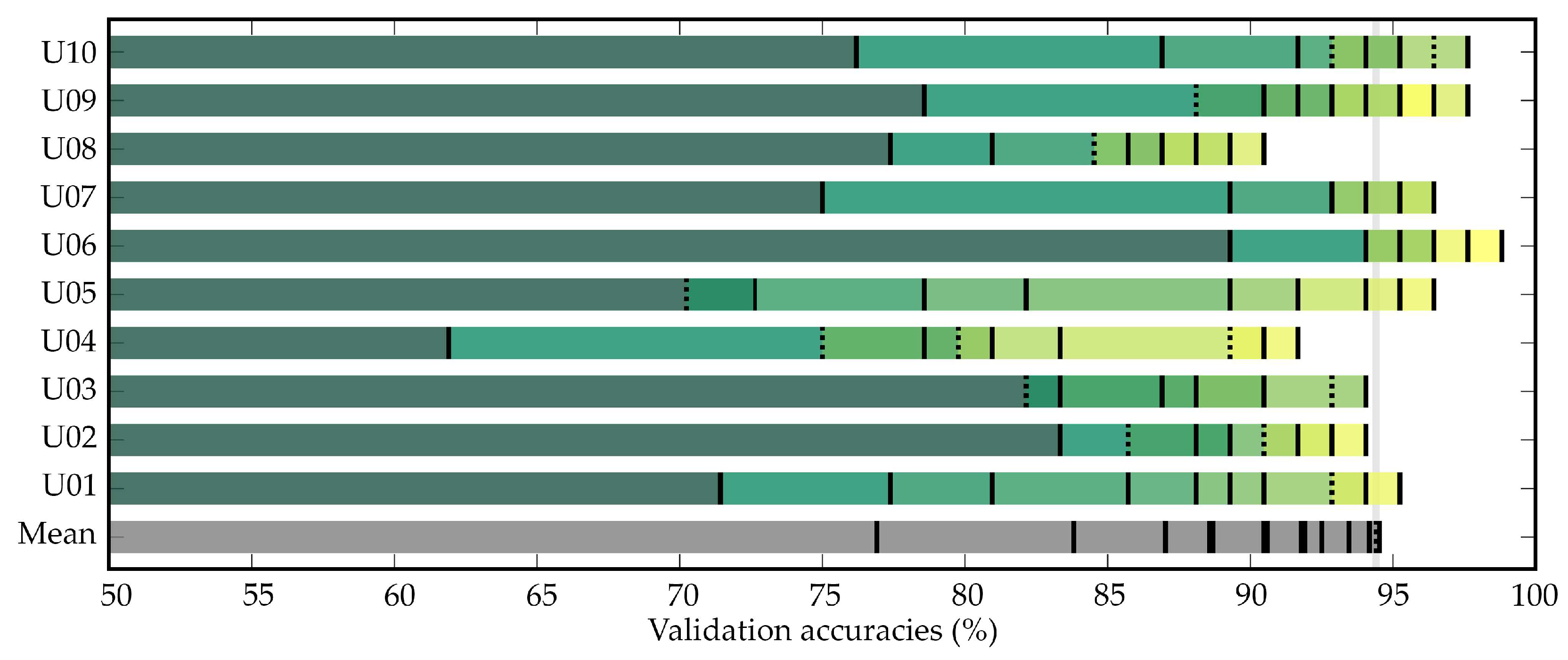

| 1 | 2 | 3 | 4 | 5 | 6 | 7 | 8 | 9 | 10 | 11 | 12 | 13 | 14 | 15 | |
|---|---|---|---|---|---|---|---|---|---|---|---|---|---|---|---|
| U01 | 71.43% | 77.38% | 80.95% | 85.71% | 88.10% | 88.10% | 89.29% | 90.48% | 94.05% | 94.05% | 92.86% | 92.86% | 94.05% | 95.24% | 94.05% |
| U02 | 83.33% | 88.10% | 89.29% | 85.71% | 89.29% | 89.29% | 91.67% | 91.67% | 91.67% | 90.48% | 92.86% | 91.67% | 92.86% | 94.05% | 92.86% |
| U03 | 83.33% | 82.14% | 88.10% | 83.33% | 86.90% | 90.48% | 88.10% | 90.48% | 94.05% | 92.86% | 92.86% | 92.86% | 92.86% | 92.86% | 92.86% |
| U04 | 61.90% | 78.57% | 80.95% | 75.00% | 75.00% | 75.00% | 80.95% | 80.95% | 79.76% | 80.95% | 83.33% | 90.48% | 89.29% | 91.67% | 91.67% |
| U05 | 72.62% | 70.24% | 72.62% | 78.57% | 78.57% | 82.14% | 89.29% | 89.29% | 91.67% | 91.67% | 91.67% | 94.05% | 95.24% | 96.43% | 96.43% |
| U06 | 89.29% | 94.05% | 96.43% | 96.43% | 95.24% | 94.05% | 96.43% | 95.24% | 94.05% | 95.24% | 96.43% | 96.43% | 96.43% | 97.62% | 98.81% |
| U07 | 75.00% | 89.29% | 92.86% | 95.24% | 96.43% | 96.43% | 95.24% | 95.24% | 92.86% | 94.05% | 95.24% | 95.24% | 96.43% | 96.43% | 95.24% |
| U08 | 77.38% | 80.95% | 85.71% | 86.90% | 86.90% | 88.10% | 86.90% | 84.52% | 89.29% | 89.29% | 86.90% | 89.29% | 90.48% | 89.29% | 89.29% |
| U09 | 78.57% | 90.48% | 91.67% | 88.10% | 94.05% | 90.48% | 92.86% | 95.24% | 95.24% | 92.86% | 95.24% | 95.24% | 97.62% | 95.24% | 96.43% |
| U10 | 76.19% | 86.90% | 91.67% | 95.24% | 95.24% | 92.86% | 94.05% | 92.86% | 95.24% | 97.62% | 97.62% | 96.43% | 96.43% | 96.43% | 96.43% |
| Mean | 76.90% | 83.81% | 87.02% | 87.02% | 88.57% | 88.69% | 90.48% | 90.60% | 91.79% | 91.90% | 92.50% | 93.45% | 94.17% | 94.52% | 94.40% |
| SD | 7.58% | 7.23% | 7.11% | 7.13% | 7.23% | 6.18% | 4.59% | 4.74% | 4.61% | 4.52% | 4.38% | 2.46% | 2.77% | 2.58% | 2.81% |
| 1 | 2 | 3 | 4 | 5 | 6 | 7 | 8 | 9 | 10 | 11 | 12 | 13 | 14 | 15 | |
|---|---|---|---|---|---|---|---|---|---|---|---|---|---|---|---|
| Mean | 0.82 | 3.46 | 8.24 | 14.64 | 22.57 | 32.51 | 43.66 | 54.92 | 69.70 | 86.33 | 104.87 | 125.24 | 146.41 | 170.58 | 196.78 |
| SD | 0.99 | 0.28 | 0.82 | 1.03 | 1.40 | 2.00 | 3.10 | 3.30 | 3.84 | 4.69 | 5.56 | 5.96 | 6.50 | 7.20 | 8.64 |
| Study | Control Signal | Experimental Paradigm | Asynchrony Technique | No. Subjects |
|---|---|---|---|---|
| Zhang et al., 2008 [8] | P300 | Single cell | ROC thresholding using SVM scores | 4 CS |
| Panicker et al., 2010 [17] | P300 and SSVEP | Hybrid: RCP-based | Detection of SSVEPs using relative peak amplitude in PSD | 10 CS |
| Aloise et al., 2011 [11] | P300 | RCP | ROC thresholding using LDA scores | 11 CS |
| Li et al., 2013 [9] | P300 & SSVEP | Hybrid: oddball & SSVEP | ROC thresholding using SVM scores (P300) and relative powers (SSVEP) | 8 CS |
| Pinegger et al., 2015 [5] | P300 | RCP | Thresholding using LDA scores and sum of spectral components | 10 CS |
| Breitwieser et al., 2016 [13] | P300 and SSSEP | Hybrid: tactile & oddball | Thresholding using multi-class LDA | 14 CS |
| Martínez-Cagigal et al., 2017 [6] | P300 | RCP | ROC thresholding using LDA scores | 5 CS, 16 MS |
| He [10] | P300 | RCP | Combination of two different SVM | 8 CS |
| Yu et al., 2017 [18,22] | P300 and MI | MI monitoring & RCP | MI signal activates the RCP | 11 CS, 8 CS |
| Alcaide-Aguirre et al., 2017 [12,14] | P300 | RCP | Certainty algorithm: t-test over LDA scores | 11 CS, 19 CP |
| Ma & Qiu, 2018 [21] | P300 | RCP | ROC thresholding using relative powers | 4 CS |
| Aydin et al., 2018 [20] | P300 | Hex-o-Spell | ROC thresholding using classifier labels | 10 CS |
| Tang et al., 2018 [15] | P300 | RCP | ROC thresholding using LDA scores | 4 CS |
| Martínez-Cagigal et al., 2019 [16] | P300 | RCP | ROC thresholding using LDA scores | 18 CS, 10 MD |
| Present study | P300 | RCP | LDA classification using SampEn features | 10 CS |
© 2019 by the authors. Licensee MDPI, Basel, Switzerland. This article is an open access article distributed under the terms and conditions of the Creative Commons Attribution (CC BY) license (http://creativecommons.org/licenses/by/4.0/).
Share and Cite
Martínez-Cagigal, V.; Santamaría-Vázquez, E.; Hornero, R. Asynchronous Control of P300-Based Brain–Computer Interfaces Using Sample Entropy. Entropy 2019, 21, 230. https://doi.org/10.3390/e21030230
Martínez-Cagigal V, Santamaría-Vázquez E, Hornero R. Asynchronous Control of P300-Based Brain–Computer Interfaces Using Sample Entropy. Entropy. 2019; 21(3):230. https://doi.org/10.3390/e21030230
Chicago/Turabian StyleMartínez-Cagigal, Víctor, Eduardo Santamaría-Vázquez, and Roberto Hornero. 2019. "Asynchronous Control of P300-Based Brain–Computer Interfaces Using Sample Entropy" Entropy 21, no. 3: 230. https://doi.org/10.3390/e21030230
APA StyleMartínez-Cagigal, V., Santamaría-Vázquez, E., & Hornero, R. (2019). Asynchronous Control of P300-Based Brain–Computer Interfaces Using Sample Entropy. Entropy, 21(3), 230. https://doi.org/10.3390/e21030230

