by
Daniele Danella Figo 1,2,3, Priscilla Rios Cordeiro Macedo 3,4, Gabriele Gadermaier 5 , Cesar Remuzgo 2, Fábio Fernandes Morato Castro 3,4,6, Jorge Kalil 1,2,3,6, Clovis Eduardo Santos Galvão 3,4 and Keity Souza Santos 1,2,3,6,*
, Cesar Remuzgo 2, Fábio Fernandes Morato Castro 3,4,6, Jorge Kalil 1,2,3,6, Clovis Eduardo Santos Galvão 3,4 and Keity Souza Santos 1,2,3,6,*
1
LIM-19, Hospital das Clinicas HCFMUSP, Faculdade de Medicina, Universidade de Sao Paulo, Sao Paulo 05403-900, Brazil
2
Laboratorio de Imunologia, INCOR, Hospital das Clinicas HCFMUSP, Faculdade de Medicina, Universidade de Sao Paulo, Sao Paulo 05403-900, Brazil
3
Departamento de Clinica Medica, Disciplina de Imunologia Clinica e Alergia, Faculdade de Medicina da Universidade de Sao Paulo, Sao Paulo 01246-903, Brazil
4
Servico de Imunologia Clinica e Alergia, Hospital das Clinicas HCFMUSP, Faculdade de Medicina, Universidade de Sao Paulo, Sao Paulo 05403-000, Brazil
5
Department of Biosciences and Medical Biology, Paris Lodron University Salzburg, 5020 Salzburg, Austria
6
Instituto Nacional de Ciencia e Tecnologia de Investigação em Imunologia (iii-INCT), Sao Paulo 05403-900, Brazil
Int. J. Mol. Sci. 2023, 24(4), 4173; https://doi.org/10.3390/ijms24044173 - 20 Feb 2023
Cited by 10 | Viewed by 4257
Abstract
Sublingual immunotherapy (SLIT) is used worldwide to treat house dust mites (HDM) allergy. Epitope specific immunotherapy with peptide vaccines is used far less, but it is of great interest in the treatment of allergic reactions, as it precludes the drawbacks of allergen extracts.
[...] Read more.
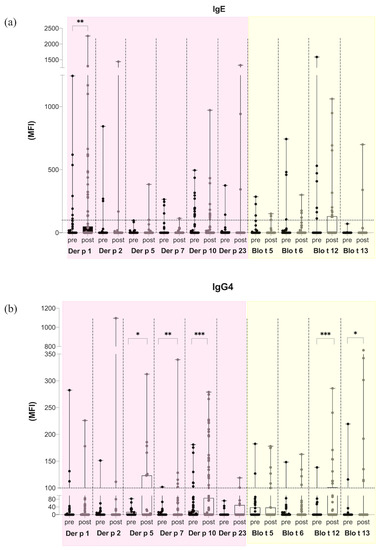
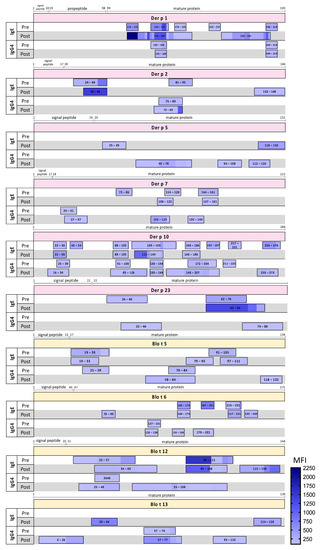
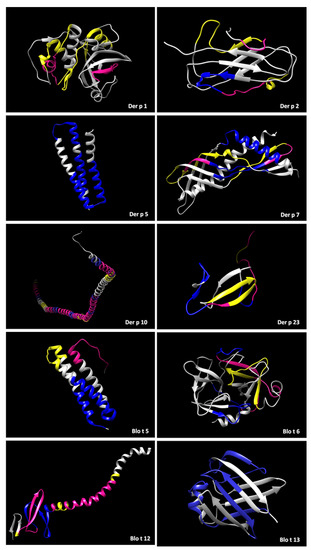
Sublingual immunotherapy (SLIT) is used worldwide to treat house dust mites (HDM) allergy. Epitope specific immunotherapy with peptide vaccines is used far less, but it is of great interest in the treatment of allergic reactions, as it precludes the drawbacks of allergen extracts. The ideal peptide candidates would bind to IgG, blocking IgE-binding. To better elucidate IgE and IgG4 epitope profiles during SLIT, sequences of main allergens, Der p 1, 2, 5, 7, 10, 23 and Blo t 5, 6, 12, 13, were included in a 15-mer peptide microarray and tested against pooled sera from 10 patients pre- and post-1-year SLIT. All allergens were recognized to some extent by at least one antibody isotype and peptide diversity was higher post-1-year SLIT for both antibodies. IgE recognition diversity varied among allergens and timepoints without a clear tendency. Der p 10, a minor allergen in temperate regions, was the molecule with more IgE-peptides and might be a major allergen in populations highly exposed to helminths and cockroaches, such as Brazil. SLIT-induced IgG4 epitopes were directed against several, but not all, IgE-binding regions. We selected a set of peptides that recognized only IgG4 or were able to induce increased ratios of IgG4:IgE after one year of treatment and might be potential targets for vaccines.
Full article
(This article belongs to the Special Issue The Pathway of Antigen Processing and Presentation)
▼
Show Figures
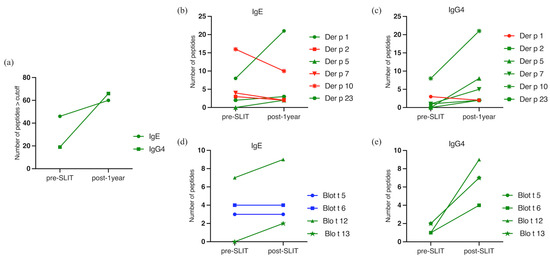
Figure 1