
<?xml version="1.0" encoding="UTF-8"?>
<!DOCTYPE article PUBLIC "-//NLM//DTD Journal Publishing DTD v2.3 20070202//EN" "journalpublishing.dtd">
<article xmlns:mml="http://www.w3.org/1998/Math/MathML" xmlns:xlink="http://www.w3.org/1999/xlink" xml:lang="en" article-type="review-article">
  <front>
    <journal-meta>
      <journal-id journal-id-type="publisher-id">biology</journal-id>
      <journal-title>Biology</journal-title>
      <abbrev-journal-title abbrev-type="publisher">Biology</abbrev-journal-title>
      <abbrev-journal-title abbrev-type="pubmed">Biology</abbrev-journal-title>
      <issn pub-type="epub">2079-7737</issn>
      <publisher>
        <publisher-name>MDPI</publisher-name>
      </publisher>
    </journal-meta>
    <article-meta>
      <article-id pub-id-type="doi">10.3390/biology1010058</article-id>
      <article-id pub-id-type="publisher-id">biology-01-00058</article-id>
      <article-categories>
        <subj-group>
          <subject>Review</subject>
        </subj-group>
      </article-categories>
      <title-group>
        <article-title>The Surprising Role of Amyloid Fibrils in HIV Infection</article-title>
      </title-group>
      
      <contrib-group>
        <contrib contrib-type="author">
          <name>
            <surname>Castellano</surname>
            <given-names>Laura M.</given-names>
          </name>
          <xref rid="af1-biology-01-00058" ref-type="aff">1</xref>
          <xref rid="af2-biology-01-00058" ref-type="aff">2</xref>
        </contrib>
        <contrib contrib-type="author">
          <name>
            <surname>Shorter</surname>
            <given-names>James</given-names>
          </name>
          <xref rid="af1-biology-01-00058" ref-type="aff">1</xref>
          <xref rid="af2-biology-01-00058" ref-type="aff">2</xref>
          <xref rid="c1-biology-01-00058" ref-type="corresp">*</xref>
        </contrib>
      </contrib-group>
      <aff id="af1-biology-01-00058"><label>1 </label>Pharmacology Graduate Group, Perelman School of Medicine at the University of Pennsylvania, Philadelphia, PA 19104, USA; Email: <email>lcast@mail.med.upenn.edu</email></aff>
      <aff id="af2-biology-01-00058"><label>2 </label>Department of Biochemistry and Biophysics, Perelman School of Medicine at the University of Pennsylvania, 804 Stellar-Chance Laboratories, 422 Curie Boulevard, Philadelphia, PA 19104, USA</aff>
      <author-notes>
        <corresp id="c1-biology-01-00058"><label>*</label> Author  to whom correspondence should be addressed; Email: <email>jshorter@mail.med.upenn.edu</email>; Tel.: 215-573-4257; Fax: +1-215-898-4217.</corresp>
      </author-notes>
      <pub-date pub-type="epub">
        <day>29</day>
        <month>05</month>
        <year>2012</year>
      </pub-date>
      <pub-date pub-type="collection"><month>12</month>
        <year>2012</year>
      </pub-date>
      <volume>1</volume>
      <issue>1</issue>
      <fpage>58</fpage>
      <lpage>80</lpage>
      <history>
        <date date-type="received">
          <day>29</day>
          <month>04</month>
          <year>2012</year>
        </date>
        <date date-type="rev-recd">
          <day>19</day>
          <month>05</month>
          <year>2012</year>
        </date>
        <date date-type="accepted">
          <day>23</day>
          <month>05</month>
          <year>2012</year>
        </date>
      </history>
      <permissions>
        <copyright-statement>©  2012 by the authors; licensee MDPI, Basel, Switzerland.</copyright-statement>
        <copyright-year>2012</copyright-year>
        <license xmlns:xlink="http://www.w3.org/1999/xlink" license-type="open-access" xlink:href="http://creativecommons.org/licenses/by/3.0/">
          <p>This article is an open-access article distributed under the terms and conditions of the Creative Commons Attribution license (http://creativecommons.org/licenses/by/3.0/).</p>
        </license>
      </permissions>
      <abstract>
        <p>Despite its discovery over 30 years ago, human immunodeficiency virus (HIV) continues to threaten public health worldwide. Semen is the principal vehicle for the transmission of this retrovirus and several endogenous peptides in semen, including fragments of prostatic acid phosphatase (PAP248-286 and PAP85-120) and semenogelins (SEM1 and SEM2), assemble into amyloid fibrils that promote HIV infection. For example, PAP248-286 fibrils, termed SEVI (Semen derived Enhancer of Viral Infection), potentiate HIV infection by up to 10<sup>5</sup>-fold. Fibrils enhance infectivity by facilitating virion attachment and fusion to target cells, whereas soluble peptides have no effect. Importantly, the stimulatory effect is greatest at low viral titers, which mimics mucosal transmission of HIV, where relatively few virions traverse the mucosal barrier. Devising a method to rapidly reverse fibril formation (rather than simply inhibit it) would provide an innovative and urgently needed preventative strategy for reducing HIV infection via the sexual route. Targeting a host-encoded protein conformer represents a departure from traditional microbicidal approaches that target the viral machinery, and could synergize with direct antiviral approaches. Here, we review the identification of these amyloidogenic peptides, their mechanism of action, and various strategies for inhibiting their HIV-enhancing effects.</p>
      </abstract>
      <kwd-group>
        <kwd>SEVI</kwd>
        <kwd>amyloid</kwd>
        <kwd>HIV infectivity</kwd>
        <kwd>PAP85-120</kwd>
        <kwd>SEM1</kwd>
        <kwd>SEM2</kwd>
        <kwd>microbicide</kwd>
      </kwd-group>
    </article-meta>
  </front>
  <body>
    <sec sec-type="intro">
      <title>1. Introduction</title>
      <p>Human immunodeficiency virus (HIV) causes acquired immune deficiency syndrome (AIDS) and has killed more than 25 million people [<xref ref-type="bibr" rid="B1-biology-01-00058">1</xref>,<xref ref-type="bibr" rid="B2-biology-01-00058">2</xref>,<xref ref-type="bibr" rid="B3-biology-01-00058">3</xref>,<xref ref-type="bibr" rid="B4-biology-01-00058">4</xref>,<xref ref-type="bibr" rid="B5-biology-01-00058">5</xref>]. Three decades after its initial identification, HIV endures as a global epidemic and aggressive public health threat: 33 million adults and children are living with HIV worldwide [<xref ref-type="bibr" rid="B5-biology-01-00058">5</xref>]. This problem is most acute in the developing world: ~68% of all adults and 90% of all children with HIV are in sub-Saharan Africa, and ~76% of all AIDS deaths occur in this locale [<xref ref-type="bibr" rid="B5-biology-01-00058">5</xref>]. The vast majority of these infections are acquired by heterosexual transmission [<xref ref-type="bibr" rid="B6-biology-01-00058">6</xref>,<xref ref-type="bibr" rid="B7-biology-01-00058">7</xref>,<xref ref-type="bibr" rid="B8-biology-01-00058">8</xref>]. Several factors dictate the efficiency of HIV transmission via the sexual route including the viral load, type of sexual practice, and susceptibility of the host [<xref ref-type="bibr" rid="B7-biology-01-00058">7</xref>,<xref ref-type="bibr" rid="B8-biology-01-00058">8</xref>]. Despite the growth and prevalence of the AIDS pandemic, HIV is an unexpectedly weak pathogen with low infectivity [<xref ref-type="bibr" rid="B9-biology-01-00058">9</xref>,<xref ref-type="bibr" rid="B10-biology-01-00058">10</xref>]. In fact, it is estimated that less than 0.1% of viral particles are infectious <italic>in vitro, </italic>since infectivity is limited by low viral attachment rates to host cells [<xref ref-type="bibr" rid="B11-biology-01-00058">11</xref>,<xref ref-type="bibr" rid="B12-biology-01-00058">12</xref>,<xref ref-type="bibr" rid="B13-biology-01-00058">13</xref>]. <italic>In vivo</italic> HIV transmission is also inefficient, occurring as infrequently as 1 in every 200 to 2000 acts of sexual intercourse [<xref ref-type="bibr" rid="B7-biology-01-00058">7</xref>,<xref ref-type="bibr" rid="B14-biology-01-00058">14</xref>]. However, high viral titers that occur during acute infection can enhance this rate ~10-fold [<xref ref-type="bibr" rid="B8-biology-01-00058">8</xref>], and further enhancements accrue with sexual practices connected with bleeding and lesions of the mucosal barrier as well as in the presence of other sexually transmitted diseases [<xref ref-type="bibr" rid="B14-biology-01-00058">14</xref>]. Semen is the principal vehicle for the sexual transmission of HIV, and <italic>in vitro</italic> semen can enhance the infection of physiologically relevant cell types, including primary macrophages and CD4+ T cells [<xref ref-type="bibr" rid="B15-biology-01-00058">15</xref>,<xref ref-type="bibr" rid="B16-biology-01-00058">16</xref>,<xref ref-type="bibr" rid="B17-biology-01-00058">17</xref>,<xref ref-type="bibr" rid="B18-biology-01-00058">18</xref>,<xref ref-type="bibr" rid="B19-biology-01-00058">19</xref>]. Thus, it was hypothesized that natural cofactors in seminal fluid could play a key role in HIV transmission by enhancing the efficiency of viral infectivity [<xref ref-type="bibr" rid="B16-biology-01-00058">16</xref>].</p>
      <fig id="biology-01-00058-f001" position="anchor">
        <label>Figure 1</label>
        <caption>
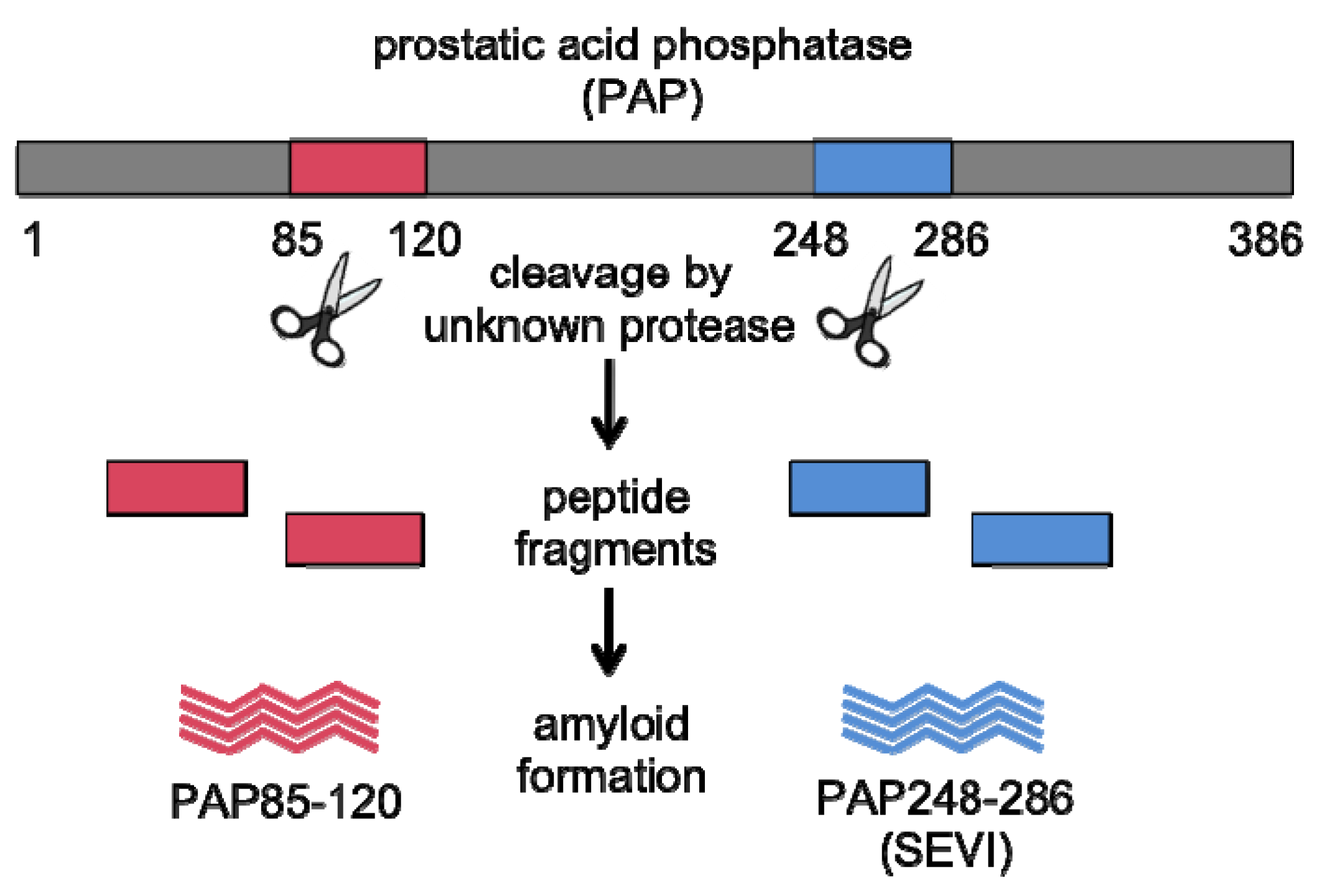
          <p>Proteolytic cleavage of prostatic acid phosphatase (PAP). Full-length PAP, a protein present at high concentrations in semen, undergoes proteolysis to form peptide fragments PAP85-120 and PAP248-286. These peptide products readily aggregate and assemble into amyloid fibrils in seminal fluid. Amyloid fibrils formed from PAP248-286 are termed SEVI (Semen-derived Enhancer of Viral Infection).</p>
        </caption>
        <graphic xmlns:xlink="http://www.w3.org/1999/xlink" xlink:href="biology-01-00058-g001.tif"/>
      </fig>
      <p>To isolate natural agents involved in the sexual transmission of HIV, Münch and colleagues created a library comprising all peptides and small proteins derived from human seminal fluid and screened this library for enhancers and inhibitors of HIV infection [<xref ref-type="bibr" rid="B16-biology-01-00058">16</xref>,<xref ref-type="bibr" rid="B18-biology-01-00058">18</xref>]. One fraction significantly enhanced HIV infection, and further analysis by mass spectrometry and sequencing revealed that the active fraction contained several peptides, each of which was a proteolytic fragment of prostatic acid phosphatase (PAP) [<xref ref-type="bibr" rid="B16-biology-01-00058">16</xref>], a protein highly abundant (1–2 mg/mL) in seminal fluid [<xref ref-type="bibr" rid="B20-biology-01-00058">20</xref>]. While these peptides differed in length, each mapped to the same region of PAP. The predominant peptide in the enhancing fraction corresponded to residues 248–286 of PAP and was isolated at a concentration of ~35 µg/mL (<xref ref-type="fig" rid="biology-01-00058-f001">Figure 1</xref>) [<xref ref-type="bibr" rid="B16-biology-01-00058">16</xref>].</p>
      
      <p>Unexpectedly, Münch <italic>et al.</italic> discovered that freshly dissolved solutions of chemically synthesized PAP248-286 were unable to augment HIV infection [<xref ref-type="bibr" rid="B16-biology-01-00058">16</xref>]. However, once the solutions became turbid after short-term storage or agitation, activity was restored, and in fact, the insoluble precipitate contained the active form [<xref ref-type="bibr" rid="B16-biology-01-00058">16</xref>]. Further biophysical analysis revealed that PAP248-286 fragments formed amyloid fibrils as indicated by increases in Thioflavin-T fluorescence, Congo red binding, and β-sheet content (<xref ref-type="fig" rid="biology-01-00058-f001">Figure 1</xref>) [<xref ref-type="bibr" rid="B16-biology-01-00058">16</xref>]. These amyloid fibrils were termed SEVI (<bold>S</bold>emen-derived <bold>E</bold>nhancer of <bold>V</bold>iral <bold>I</bold>nfection) and were found to augment HIV infection by ~10<sup>5</sup> fold under conditions of limiting virus, whereas soluble PAP248-286 had no effect [<xref ref-type="bibr" rid="B16-biology-01-00058">16</xref>]. The presence of SEVI reduced the number of virions required for productive infection from between 1000–100,000 to between 1–3 [<xref ref-type="bibr" rid="B16-biology-01-00058">16</xref>]. Indeed, the stimulatory effect of SEVI fibrils is greatest at low virus concentration, similar to the conditions observed in mucosal transmission of HIV, where relatively few virions traverse the mucosal barrier [<xref ref-type="bibr" rid="B16-biology-01-00058">16</xref>,<xref ref-type="bibr" rid="B19-biology-01-00058">19</xref>]. This remarkable effect is independent of viral coreceptor tropism [<xref ref-type="bibr" rid="B16-biology-01-00058">16</xref>], and the potency of individual human semen samples to boost infection correlates with levels of SEVI [<xref ref-type="bibr" rid="B15-biology-01-00058">15</xref>]. Moreover, SEVI also boosts the efficiency of retroviral transduction for viruses with diverse envelope proteins [<xref ref-type="bibr" rid="B21-biology-01-00058">21</xref>]. Intriguingly, previous studies have also implicated amyloids in the enhancement of viral infection. For example, Aβ40 and Aβ42 amyloid fibrils, which are involved in the pathogenesis of Alzheimer’s disease [<xref ref-type="bibr" rid="B22-biology-01-00058">22</xref>], stimulate HIV infection of microglia (by ~5–20-fold) and could contribute to HIV infection in the central nervous system of patients with HIV-associated dementia [<xref ref-type="bibr" rid="B23-biology-01-00058">23</xref>].</p>
    </sec>
    <sec>
      <title>2. How Does SEVI Augment HIV Infection?</title>
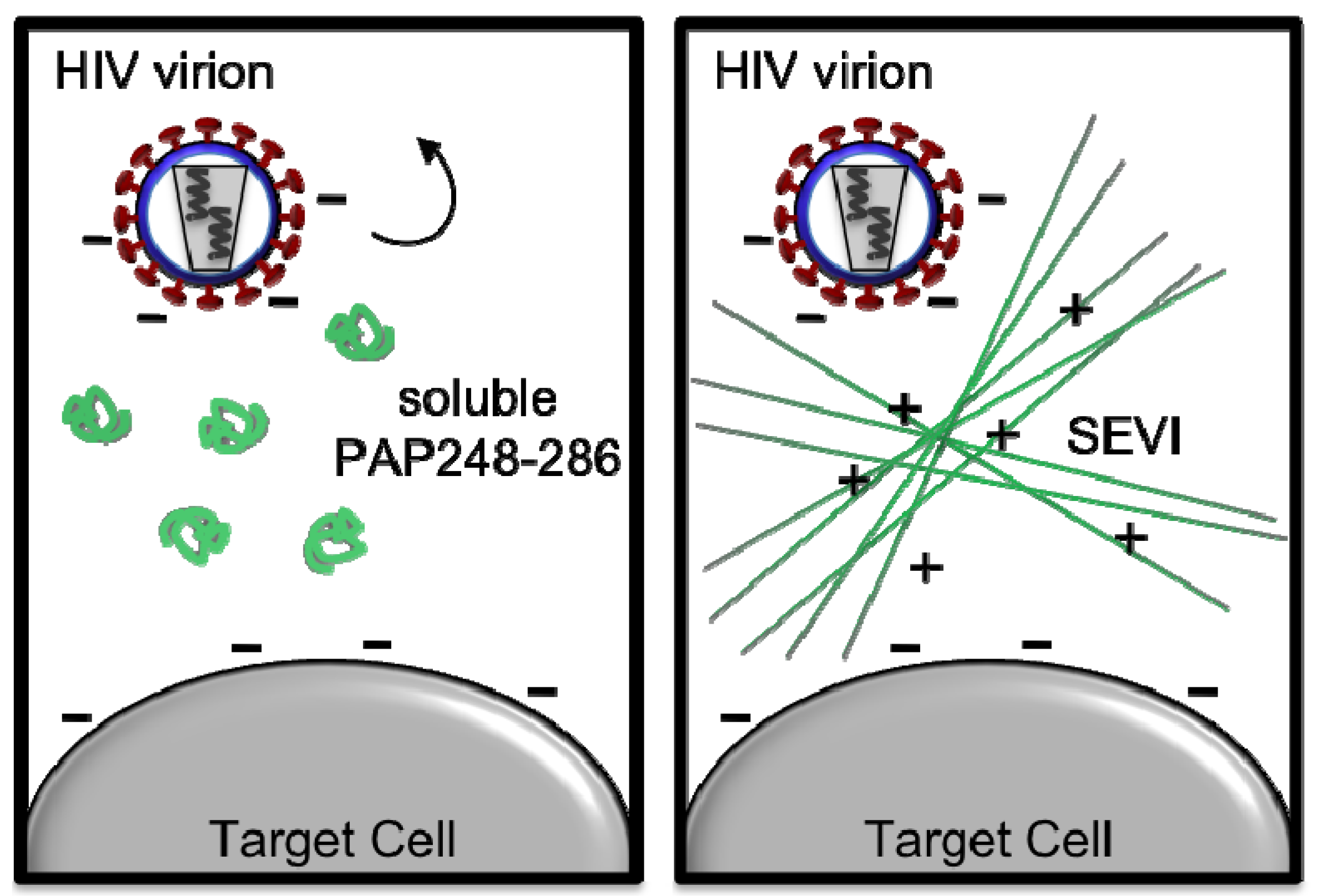
      <p>The misfolding of proteins into a generic amyloid structure is a recurring facet of diverse neurodegenerative diseases [<xref ref-type="bibr" rid="B22-biology-01-00058">22</xref>,<xref ref-type="bibr" rid="B24-biology-01-00058">24</xref>,<xref ref-type="bibr" rid="B25-biology-01-00058">25</xref>,<xref ref-type="bibr" rid="B26-biology-01-00058">26</xref>]. Yet, in isolation many proteins can form amyloid fibrils, suggesting that amyloidogenesis is an integral part of polypeptide chemistry [<xref ref-type="bibr" rid="B22-biology-01-00058">22</xref>,<xref ref-type="bibr" rid="B27-biology-01-00058">27</xref>,<xref ref-type="bibr" rid="B28-biology-01-00058">28</xref>]. Indeed, amyloid fibrils have been exploited during evolution for various adaptive modalities including prion-based transmission of advantageous phenotypes, long-term memory formation, melanosome biogenesis, drug resistance and biofilm formation [<xref ref-type="bibr" rid="B29-biology-01-00058">29</xref>,<xref ref-type="bibr" rid="B30-biology-01-00058">30</xref>,<xref ref-type="bibr" rid="B31-biology-01-00058">31</xref>,<xref ref-type="bibr" rid="B32-biology-01-00058">32</xref>,<xref ref-type="bibr" rid="B33-biology-01-00058">33</xref>,<xref ref-type="bibr" rid="B34-biology-01-00058">34</xref>,<xref ref-type="bibr" rid="B35-biology-01-00058">35</xref>,<xref ref-type="bibr" rid="B36-biology-01-00058">36</xref>,<xref ref-type="bibr" rid="B37-biology-01-00058">37</xref>]. SEVI adopts a classic “cross-β” amyloid structure [<xref ref-type="bibr" rid="B16-biology-01-00058">16</xref>] in which β-sheets run orthogonal to the fibril axis [<xref ref-type="bibr" rid="B38-biology-01-00058">38</xref>,<xref ref-type="bibr" rid="B39-biology-01-00058">39</xref>,<xref ref-type="bibr" rid="B40-biology-01-00058">40</xref>]. The viral enhancing function of SEVI is dependent on its unique structural characteristics, as other generic “cross-β” amyloids enhance HIV infection with lower efficiency [<xref ref-type="bibr" rid="B16-biology-01-00058">16</xref>]. PAP248-286 contains a wealth of positively charged basic residues (8 of its 39 residues are either lysine or arginine; theoretical pI = 10.21). Thus, SEVI fibrils likely serve as a cationic bridge that simultaneously precipitates the virus onto the cell surface and decreases the electrostatic repulsion between the negatively charged surfaces of the virus and host cell (<xref ref-type="fig" rid="biology-01-00058-f002">Figure 2</xref>) [<xref ref-type="bibr" rid="B19-biology-01-00058">19</xref>,<xref ref-type="bibr" rid="B41-biology-01-00058">41</xref>]. SEVI binds directly to both HIV virions and target cells [<xref ref-type="bibr" rid="B19-biology-01-00058">19</xref>], and this facilitates virion fusion much in the same way that synthetic cationic polymers promote retrovirus-mediated gene transfer [<xref ref-type="bibr" rid="B42-biology-01-00058">42</xref>,<xref ref-type="bibr" rid="B43-biology-01-00058">43</xref>]. Importantly, a mutant PAP248-286, in which all basic residues were replaced with alanine, was still capable of assembling into amyloid fibrils that could augment HIV infection, but activity was greatly reduced compared to SEVI [<xref ref-type="bibr" rid="B19-biology-01-00058">19</xref>]. NMR spectroscopy revealed that PAP248-286 is highly disordered when bound to membrane-mimicking micelles [<xref ref-type="bibr" rid="B44-biology-01-00058">44</xref>,<xref ref-type="bibr" rid="B45-biology-01-00058">45</xref>], whereas the majority of amyloidogenic peptides adopt an alpha-helical conformation upon micelle binding. It is predicted that some disordered regions present in monomeric PAP248-286 will be retained in mature SEVI amyloid fibrils [<xref ref-type="bibr" rid="B44-biology-01-00058">44</xref>,<xref ref-type="bibr" rid="B45-biology-01-00058">45</xref>,<xref ref-type="bibr" rid="B46-biology-01-00058">46</xref>]. Indeed, disordered segments that emanate from the surface of SEVI fibrils may increase fibril “capture radius” and could explain the enhanced ability of SEVI to promote HIV infection [<xref ref-type="bibr" rid="B44-biology-01-00058">44</xref>,<xref ref-type="bibr" rid="B45-biology-01-00058">45</xref>,<xref ref-type="bibr" rid="B47-biology-01-00058">47</xref>].</p>
      <fig id="biology-01-00058-f002" position="anchor">
        <label>Figure 2</label>
        <caption>
          <p>Semen derived Enhancer of Viral Infection (SEVI) amyloid fibrils augment HIV infectivity. In the non-amyloid form, soluble PAP248-286 has no effect on HIV infectivity, and electrostatic repulsion between the membranes of HIV virions and target cells limits the ability of virions to interact with target cells (left). Once assembled into amyloid fibrils, SEVI’s network of positive charges neutralizes this electrostatic repulsion, and SEVI fibrils capture HIV virions to promote cell attachment and fusion, thereby enhancing HIV infectivity (right).</p>
        </caption>
        <graphic xmlns:xlink="http://www.w3.org/1999/xlink" xlink:href="biology-01-00058-g002.tif"/>
      </fig>
    </sec>
    <sec>
      <title>3. Current Strategies to Counteract SEVI-Mediated Enhancement of HIV Infection</title>
      <p>The highly unanticipated role of SEVI in viral infection has opened a new window of opportunity. If we can inhibit the formation of SEVI amyloid fibrils, block their infection promoting properties, or even rapidly dissolve these fibrils, then we can drastically reduce HIV infection via the sexual route. Thus far, several agents have been identified that fall into each of these classes of anti-SEVI compounds. While this section focuses on agents that counteract SEVI’s effects, it should be noted that additional amyloid fibrils, which also augment HIV infection, have recently been identified [<xref ref-type="bibr" rid="B48-biology-01-00058">48</xref>,<xref ref-type="bibr" rid="B49-biology-01-00058">49</xref>]. Therefore, a truly effective agent should antagonize the stimulatory effects of all semen-derived amyloid fibrils.</p>
      <p>Ultimately, agents that effectively block the ability of semen-derived amyloid to promote HIV infection might be developed into a microbicide, thus offering a preventative means to combat HIV transmission. A microbicide is an agent that reduces the infectivity of a pathogen. In this case, an anti-amyloid topical formulation might be developed for application either vaginally or rectally to prevent the very earliest stage of sexual HIV transmission [<xref ref-type="bibr" rid="B50-biology-01-00058">50</xref>,<xref ref-type="bibr" rid="B51-biology-01-00058">51</xref>]. Alternatively, methods to reduce initial amyloid formation in the seminal fluid of the male might also be explored. Ideally, the microbicide would be effective, safe, user-friendly and affordable to promote use in the developing world. The development of topical microbicides has proven challenging, and the vast majority of microbicidal compounds explored to date target the virus itself. However, mutations can rapidly arise that alter viral proteins and confer resistance to antiretroviral drugs [<xref ref-type="bibr" rid="B52-biology-01-00058">52</xref>]. Combinations of antiretroviral drugs tend to exhibit improved efficacy by functioning through multiple mechanisms of action [<xref ref-type="bibr" rid="B53-biology-01-00058">53</xref>]. By targeting host-encoded amyloid fibrils instead of the viral machinery, this issue of drug-resistant HIV variants could be circumvented, making amyloid fibrils a valuable and novel target for future microbicide development.</p>
      <fig id="biology-01-00058-f003" position="anchor">
        <label>Figure 3</label>
        <caption>
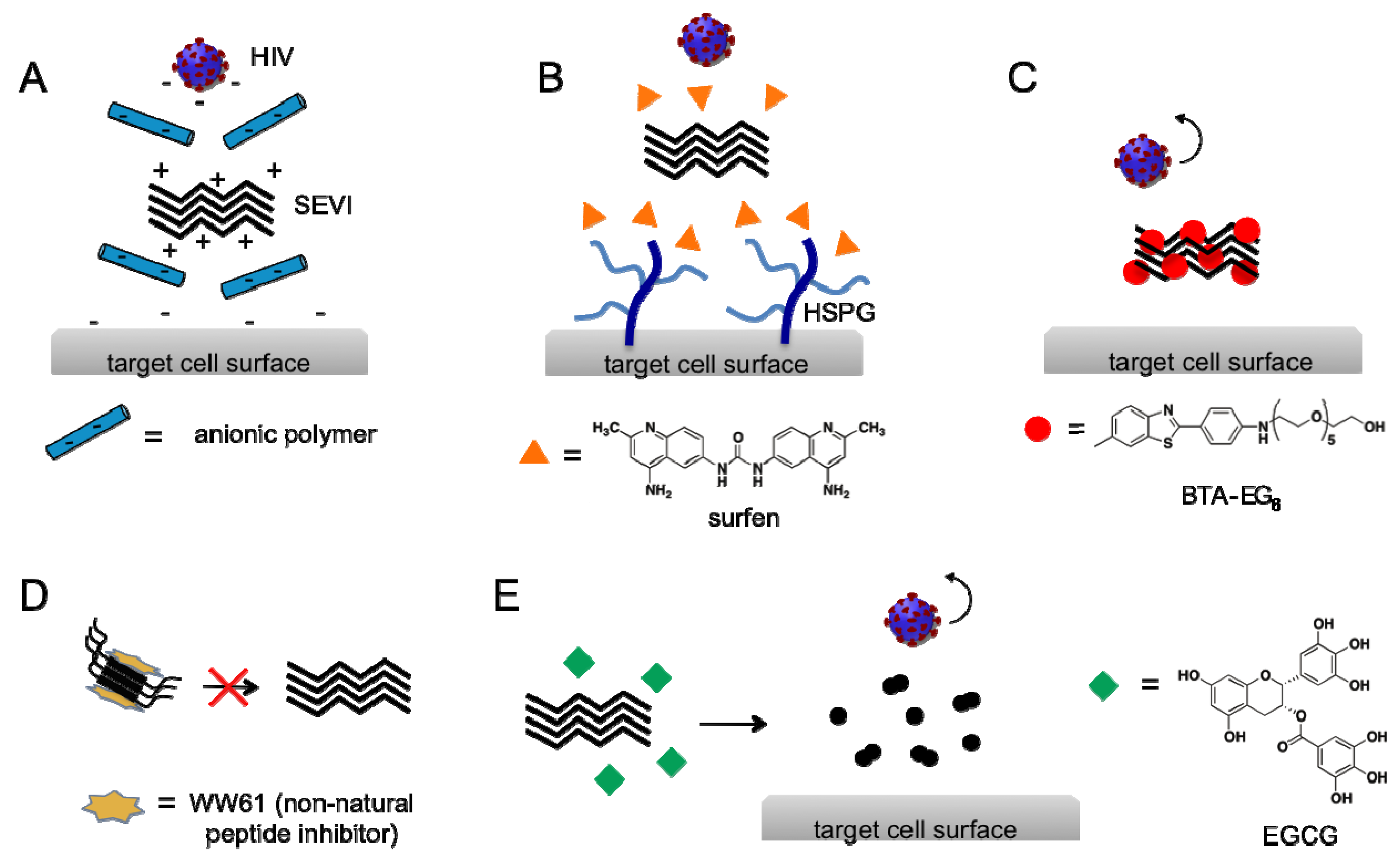
          <p>Mechanisms of action of anti-SEVI agents. (<bold>A</bold>) Anionic polymers shield the intrinsic positive charges of SEVI and inhibit the binding of SEVI to HIV virions; (<bold>B</bold>) Surfen, a heparin sulfate proteoglycan (HSPG) antagonist, inhibits interactions between SEVI and both HIV virions and target cells; (<bold>C</bold>) BTA-EG<sub>6</sub> is a small molecule that engages SEVI’s cross-β structure by intercalating between β-strands; (<bold>D</bold>) WW61, a non-natural peptide inhibitor (Trp-His-Lys-chAla-Trp-hydroxyTic), inhibits SEVI fibrillization by binding to and obstructing growing fibril ends; (<bold>E</bold>) Epigallocatechin-3-gallate (EGCG) inhibits SEVI fibrillization and disaggregates pre-formed SEVI fibrils.</p>
        </caption>
        <graphic xmlns:xlink="http://www.w3.org/1999/xlink" xlink:href="biology-01-00058-g003.tif"/>
      </fig>
      <p>The most common class of anti-SEVI agents identified to date, shield the charged surface of the fibrils to block their infection boosting properties. Anionic polymers, which interfere with the binding of SEVI to HIV virions by shielding the intrinsic positive charges of SEVI, diminish SEVI-mediated enhancement of infection (<xref ref-type="fig" rid="biology-01-00058-f003">Figure 3</xref>A) [<xref ref-type="bibr" rid="B19-biology-01-00058">19</xref>]. These polyanions, including heparin and various other glycosaminoglycans, have been investigated as HIV microbicides for decades, as they are also thought to exert direct anti-HIV activity by inhibiting the binding of the viral envelope glycoprotein, gp120, to its major cell surface receptor CD4 [<xref ref-type="bibr" rid="B54-biology-01-00058">54</xref>,<xref ref-type="bibr" rid="B55-biology-01-00058">55</xref>,<xref ref-type="bibr" rid="B56-biology-01-00058">56</xref>]. Unfortunately, such anionic polymers have proven unsuccessful in past clinical trials due to their poor bioavailability and induction of inflammatory responses in the genital tract, which instead augment HIV transmission by recruiting HIV-susceptible target cells to the genital mucosa [<xref ref-type="bibr" rid="B57-biology-01-00058">57</xref>,<xref ref-type="bibr" rid="B58-biology-01-00058">58</xref>]. Thus, more favorable options, which act through related mechanisms, are needed.</p>
      
      <p>Aminoquinoline surfen, a small molecule heparan sulfate proteoglycan (HSPG) antagonist, exerts anti-SEVI effects through a slightly different mechanism (<xref ref-type="fig" rid="biology-01-00058-f003">Figure 3</xref>B) [<xref ref-type="bibr" rid="B41-biology-01-00058">41</xref>]. It was initially hypothesized that SEVI bound to target cells through interactions with cell surface HSPGs [<xref ref-type="bibr" rid="B41-biology-01-00058">41</xref>]. Surfen antagonizes this interaction, and additional studies indicated that surfen also antagonized the interaction between SEVI and HIV virions [<xref ref-type="bibr" rid="B41-biology-01-00058">41</xref>]. Further, surfen possesses anti-inflammatory properties as an anaphylatoxin C5a receptor antagonist [<xref ref-type="bibr" rid="B59-biology-01-00058">59</xref>,<xref ref-type="bibr" rid="B60-biology-01-00058">60</xref>], making it a promising microbicide candidate.</p>
      <p>BTA-EG<sub>6</sub> (a hexa(ethylene glycol) derivative of benzothiazole aniline) is a small molecule capable of abrogating SEVI’s effects by binding to its “cross-β” structure (<xref ref-type="fig" rid="biology-01-00058-f003">Figure 3</xref>C) [<xref ref-type="bibr" rid="B17-biology-01-00058">17</xref>]. BTA-EG<sub>6</sub> is an amyloid-binding small molecule akin to the amyloid-diagnostic dye, Thioflavin-T, that intercalates between β-strands, and by doing so, inhibits the interactions of SEVI with both target cells and HIV virions and thus prevents SEVI-mediated enhancement of HIV infection [<xref ref-type="bibr" rid="B17-biology-01-00058">17</xref>]. Importantly, oligovalent derivatives of BTA exhibited an improved capability to attenuate SEVI-enhanced infection of HIV as compared to the corresponding monomer [<xref ref-type="bibr" rid="B61-biology-01-00058">61</xref>]. It is likely that these amyloid-binding agents form a bio-resistive coating on SEVI to hinder interactions with virions and target cells [<xref ref-type="bibr" rid="B17-biology-01-00058">17</xref>,<xref ref-type="bibr" rid="B61-biology-01-00058">61</xref>]. Indeed, similar amyloid-binding small molecules hold promise as potential therapeutics for various amyloid disorders. The ability of these small molecules to engage cross-β architecture and thereby prevent depletion of essential cellular factors by amyloid [<xref ref-type="bibr" rid="B62-biology-01-00058">62</xref>] has yielded promising outcomes in model systems. For example, Thioflavin-T suppresses pathological events caused by mutant metastable proteins and human β-amyloid in <italic>C. elegans </italic>[<xref ref-type="bibr" rid="B63-biology-01-00058">63</xref>].</p>
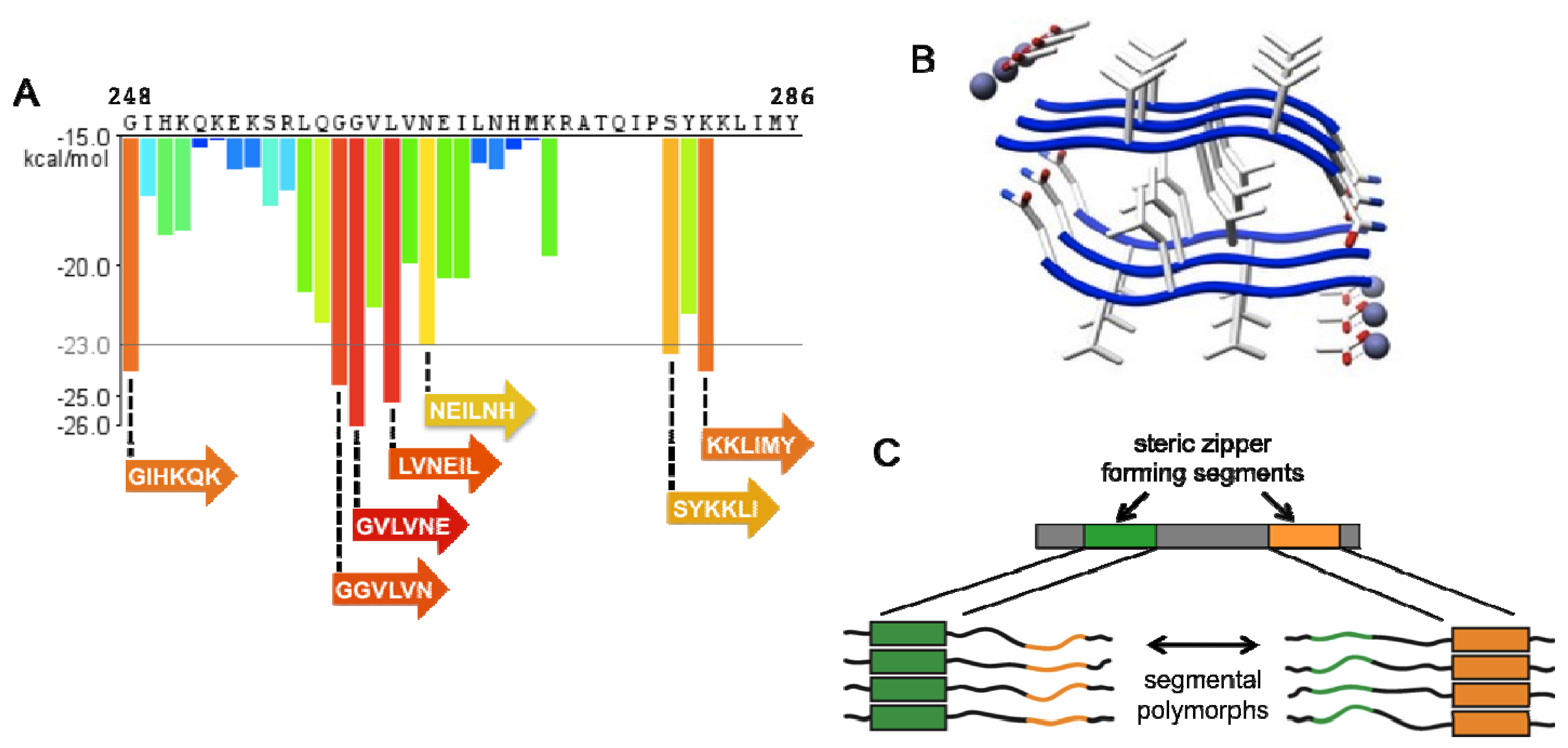
      <p>Another approach to target SEVI’s deleterious effects is through inhibition of amyloid fibril formation. Structure-based design of peptides comprised of non-natural amino acids has yielded a highly specific peptide inhibitor of PAP248-286 fibrillization [<xref ref-type="bibr" rid="B46-biology-01-00058">46</xref>]. This approach focused on the characteristic steric-zipper motif, common to amyloid-forming proteins, in which β-sheets pack together through interdigitation of their peptide side chains to form a highly self-complementary interface [<xref ref-type="bibr" rid="B39-biology-01-00058">39</xref>,<xref ref-type="bibr" rid="B64-biology-01-00058">64</xref>]. The G260 to N265 hexapeptide segment of PAP248-286, GGVLVN, is one of seven hexapeptides in PAP248-286 that is predicted by Zipper DB [<xref ref-type="bibr" rid="B65-biology-01-00058">65</xref>] to have high amyloid propensity (<xref ref-type="fig" rid="biology-01-00058-f004">Figure 4</xref>A) [<xref ref-type="bibr" rid="B46-biology-01-00058">46</xref>]. The steric-zipper structure of GGVLVN was solved (<xref ref-type="fig" rid="biology-01-00058-f004">Figure 4</xref>B) and used as a template to computationally design a peptide-based inhibitor, termed WW61, that would cap the growing ends of fibrils to inhibit amyloid assembly [<xref ref-type="bibr" rid="B46-biology-01-00058">46</xref>]. WW61 is a hexapeptide, Trp-His-Lys-chAla-Trp-hydroxyTic, which contains an Ala derivative, β-cyclohexyl-l-alanine (chAla) and a Tyr/Pro derivative, 7-hydroxy-(S)-1,2,3,4-tetrahydroisoquinoline-3-carboxylic acid (hydroxyTic), both of which are designed to increase contact area with the growing ends of SEVI fibrils. Remarkably, WW61 prevented full-length PAP248-286 from assembling into functional SEVI fibrils capable of promoting HIV infection (<xref ref-type="fig" rid="biology-01-00058-f003">Figure 3</xref>D) [<xref ref-type="bibr" rid="B46-biology-01-00058">46</xref>]. While this breakthrough represents the first compelling example of a structure-based design of an amyloid inhibitor, there is no evidence that the WW61 peptide is active in blocking semen-mediated enhancement of HIV infection [<xref ref-type="bibr" rid="B46-biology-01-00058">46</xref>]. Indeed, WW61 is unlikely to inhibit the amyloidogenesis of PAP85-120, SEM1 and SEM2.</p>
      <fig id="biology-01-00058-f004" position="anchor">
        <label>Figure 4</label>
        <caption>
          <p>PAP248-286 has several regions of high amyloidogenic propensity. (<bold>A</bold>) Zipper DB [<xref ref-type="bibr" rid="B65-biology-01-00058">65</xref>] prediction of fibril-forming segments of PAP248-286. The propensity profile graph predicts hexapeptide segments (beginning at the indicated residue) that are highly likely to assemble into amyloid fibrils. Orange-red segments with energy values below the indicated threshold of −23 kcal/mol (gray line) are expected to form steric-zipper spines of fibrils. PAP248-286 contains seven hexapeptide segments of high amyloidogenic propensity; (<bold>B</bold>) The hexapeptide segment <sup>260</sup>GGVLVN<sup>265</sup> (energy = −24.5 kcal/mol) is one of the seven segments predicted to form fibrils. The steric-zipper structure of this hexapeptide has been solved (PDB ID: 3PPD). Acetic acid and zinc ions are shown associated with the structure and might indicate how SEVI engages phospholipids and tethers membranes [<xref ref-type="bibr" rid="B66-biology-01-00058">66</xref>]; (<bold>C</bold>) An amyloid-forming protein with two segments (green and orange) capable of forming steric zippers can exist as segmental polymorphs, in which each segment can form the amyloid core.</p>
        </caption>
        <graphic xmlns:xlink="http://www.w3.org/1999/xlink" xlink:href="biology-01-00058-g004.tif"/>
      </fig>
      <p>While this is a novel strategy to prevent SEVI assembly, SEVI fibrils are already formed and abundant in seminal fluid. Thus, inhibiting their initial formation would seem impractical in the male and futile in the female. Similarly, SEVI fibrils will persist in strategies that aim to coat the amyloid surface and prevent interactions with the virus or the cell surface or both. Thus, fibrils might still gain opportunities to promote viral infection. We suggest that a more desirable strategy would be to isolate agents that rapidly deconstruct SEVI fibrils and thereby eradicate structures that promote HIV infection. However, great difficulty lies in the unusual stability of the amyloid form, which resists proteases, protein denaturants, temperatures up to 98 °C, and 2% SDS [<xref ref-type="bibr" rid="B39-biology-01-00058">39</xref>,<xref ref-type="bibr" rid="B67-biology-01-00058">67</xref>,<xref ref-type="bibr" rid="B68-biology-01-00058">68</xref>]. Indeed, because of their exceptional stability, amyloid fibrils are difficult to degrade and are widely perceived to be intractable [<xref ref-type="bibr" rid="B69-biology-01-00058">69</xref>].</p>
      <p>Despite their exceptional stability, a few, very select agents can reverse amyloid formation. EGCG (epigallocatechin-3-gallate), a potent antioxidant found in green tea, has shown widespread antifibrillogenic effects [<xref ref-type="bibr" rid="B70-biology-01-00058">70</xref>,<xref ref-type="bibr" rid="B71-biology-01-00058">71</xref>,<xref ref-type="bibr" rid="B72-biology-01-00058">72</xref>,<xref ref-type="bibr" rid="B73-biology-01-00058">73</xref>] and can even disassemble amyloid forms of islet amyloid polypeptide [<xref ref-type="bibr" rid="B74-biology-01-00058">74</xref>], α-synuclein [<xref ref-type="bibr" rid="B75-biology-01-00058">75</xref>], Aβ [<xref ref-type="bibr" rid="B75-biology-01-00058">75</xref>], and the yeast prion protein Sup35 [<xref ref-type="bibr" rid="B76-biology-01-00058">76</xref>]. By binding to exposed backbone sites in the unfolded regions of monomeric proteins, EGCG is proposed to divert aggregation pathways to instead favor the formation of off-pathway aggregates [<xref ref-type="bibr" rid="B71-biology-01-00058">71</xref>]. EGCG can inhibit formation of SEVI amyloid fibrils, and more importantly, it slowly remodels pre-formed SEVI fibrils over 1–2 days at non-toxic concentrations [<xref ref-type="bibr" rid="B77-biology-01-00058">77</xref>]. By targeting and remodeling these fibrils, EGCG strongly antagonizes the activity of SEVI (<xref ref-type="fig" rid="biology-01-00058-f003">Figure 3</xref>E). In contrast to the initially proposed mechanism of action [<xref ref-type="bibr" rid="B71-biology-01-00058">71</xref>], EGCG was found to interact with the side chains of monomeric PAP248-286 (particularly lysine residues), leading to the formation of a covalently bound complex (Schiff base links with lysine residues) [<xref ref-type="bibr" rid="B78-biology-01-00058">78</xref>]. Notably, EGCG is extremely stable in acidic solutions, a condition resembling the vaginal environment [<xref ref-type="bibr" rid="B79-biology-01-00058">79</xref>]. These data, taken together, suggest that EGCG may be a favorable option for use as a topical microbicide component. Further studies were conducted to test the effects of EGCG on a cohort of 47 individual semen samples. Overall, EGCG reduced HIV infection by a median of 70.6% at a concentration of 0.4 mM [<xref ref-type="bibr" rid="B80-biology-01-00058">80</xref>]. Intriguingly, there was substantial heterogeneity in this result, as EGCG failed to have an inhibitory effect on 6 of the 47 semen samples. Thus, while EGCG holds promise as a potential microbicide supplement, these heterogeneities must be addressed.</p>
      <p>In addition to its antifibrillogenic effects, EGCG also has direct antiviral activity in the absence of both SEVI and semen. By binding to cell-surface CD4 molecules on target cells, EGCG prevents attachment of the HIV glycoprotein gp120 to CD4 [<xref ref-type="bibr" rid="B81-biology-01-00058">81</xref>,<xref ref-type="bibr" rid="B82-biology-01-00058">82</xref>,<xref ref-type="bibr" rid="B83-biology-01-00058">83</xref>]. Interestingly, EGCG also exerts antiviral effects on both herpes simplex virus (HSV) [<xref ref-type="bibr" rid="B84-biology-01-00058">84</xref>] and Hepatitis C virus (HCV) [<xref ref-type="bibr" rid="B85-biology-01-00058">85</xref>]. In each of these cases, EGCG is believed to interact with either HSV or HCV glycoproteins, thus inhibiting cell entry by the virus. This direct antiviral activity provides further support for the use of EGCG as a component of future anti-HIV microbicides.</p>
    </sec>
    <sec>
      <title>4. Amyloid Strains</title>
      <p>A phenomenon that further adds to the complexity of searching for anti-SEVI and anti-amyloid agents is that amyloid fibrils can exist as polymorphs and form diverse conformational strains. Conformational variation among amyloid fibrils of a given protein can give rise to fibrils with distinct properties [<xref ref-type="bibr" rid="B86-biology-01-00058">86</xref>,<xref ref-type="bibr" rid="B87-biology-01-00058">87</xref>,<xref ref-type="bibr" rid="B88-biology-01-00058">88</xref>]. The biochemical basis for amyloid polymorphism likely stems, at least in part, from the diversity of steric-zipper amyloid spines that a single protein can adopt [<xref ref-type="bibr" rid="B89-biology-01-00058">89</xref>]. For example, PAP248-286 is predicted to contain seven different hexapeptide segments that are capable of forming steric zippers (<xref ref-type="fig" rid="biology-01-00058-f004">Figure 4</xref>A). Thus, each of these segments could drive the assembly of amyloid structures that are distinct at the atomic level, resulting in a segmental polymorphism (<xref ref-type="fig" rid="biology-01-00058-f004">Figure 4</xref>C) [<xref ref-type="bibr" rid="B89-biology-01-00058">89</xref>].</p>
      <p>It is unclear whether each of the predicted hexapeptides present within PAP248-286 does indeed form a steric zipper. However, it is probable that SEVI fibrils can exist as multiple strains within seminal fluid. The presence of several SEVI strains could complicate the development of anti-SEVI inhibitors. For instance, WW61, the non-natural peptide inhibitor of SEVI assembly, was rationally designed to bind to the <sup>260</sup>GGVLVN<sup>265</sup> steric-zipper interface [<xref ref-type="bibr" rid="B46-biology-01-00058">46</xref>]. WW61 effectively inhibited PAP248-286 fibril formation, indicating that the <sup>260</sup>GGVLVN<sup>265</sup> plays a key role in driving SEVI formation under the specific assembly conditions employed [<xref ref-type="bibr" rid="B46-biology-01-00058">46</xref>]. However, this inhibitor might be ineffective against alternative segmental polymorphs (<xref ref-type="fig" rid="biology-01-00058-f004">Figure 4</xref>A), which could assemble under different assembly conditions. Indeed, different assembly conditions can shift the relative populations of amyloid strains and generate distinct strain ensembles [<xref ref-type="bibr" rid="B76-biology-01-00058">76</xref>,<xref ref-type="bibr" rid="B88-biology-01-00058">88</xref>,<xref ref-type="bibr" rid="B89-biology-01-00058">89</xref>,<xref ref-type="bibr" rid="B90-biology-01-00058">90</xref>]. At present, the nature of the SEVI strain ensemble in seminal fluid is uncertain, and is likely to vary from individual to individual.</p>
      <p>This concern also extends to EGCG, which is a strain-selective inhibitor of Sup35 fibrillization [<xref ref-type="bibr" rid="B76-biology-01-00058">76</xref>]. Such strain-selectivity could impact the ability of EGCG to exert antifibrillogenic effects against SEVI. In a study examining the efficacy of EGCG at reducing SEVI-mediated enhancement of HIV infection in a cohort of 47 individual semen samples, EGCG was only efficacious in 41 out of 47 samples, and substantial heterogeneity was observed within the results [<xref ref-type="bibr" rid="B80-biology-01-00058">80</xref>]. This heterogeneity might indicate that EGCG is a strain-selective antagonist of SEVI as well. Perhaps the most effective way to combat strain phenomena is to utilize combinations of inhibitors designed to target the entire spectrum of polymorphic strains [<xref ref-type="bibr" rid="B76-biology-01-00058">76</xref>,<xref ref-type="bibr" rid="B90-biology-01-00058">90</xref>,<xref ref-type="bibr" rid="B91-biology-01-00058">91</xref>,<xref ref-type="bibr" rid="B92-biology-01-00058">92</xref>,<xref ref-type="bibr" rid="B93-biology-01-00058">93</xref>].</p>
    </sec>
    <sec>
      <title>5. PAP85-120 and SEM Amyloid Fibrils</title>
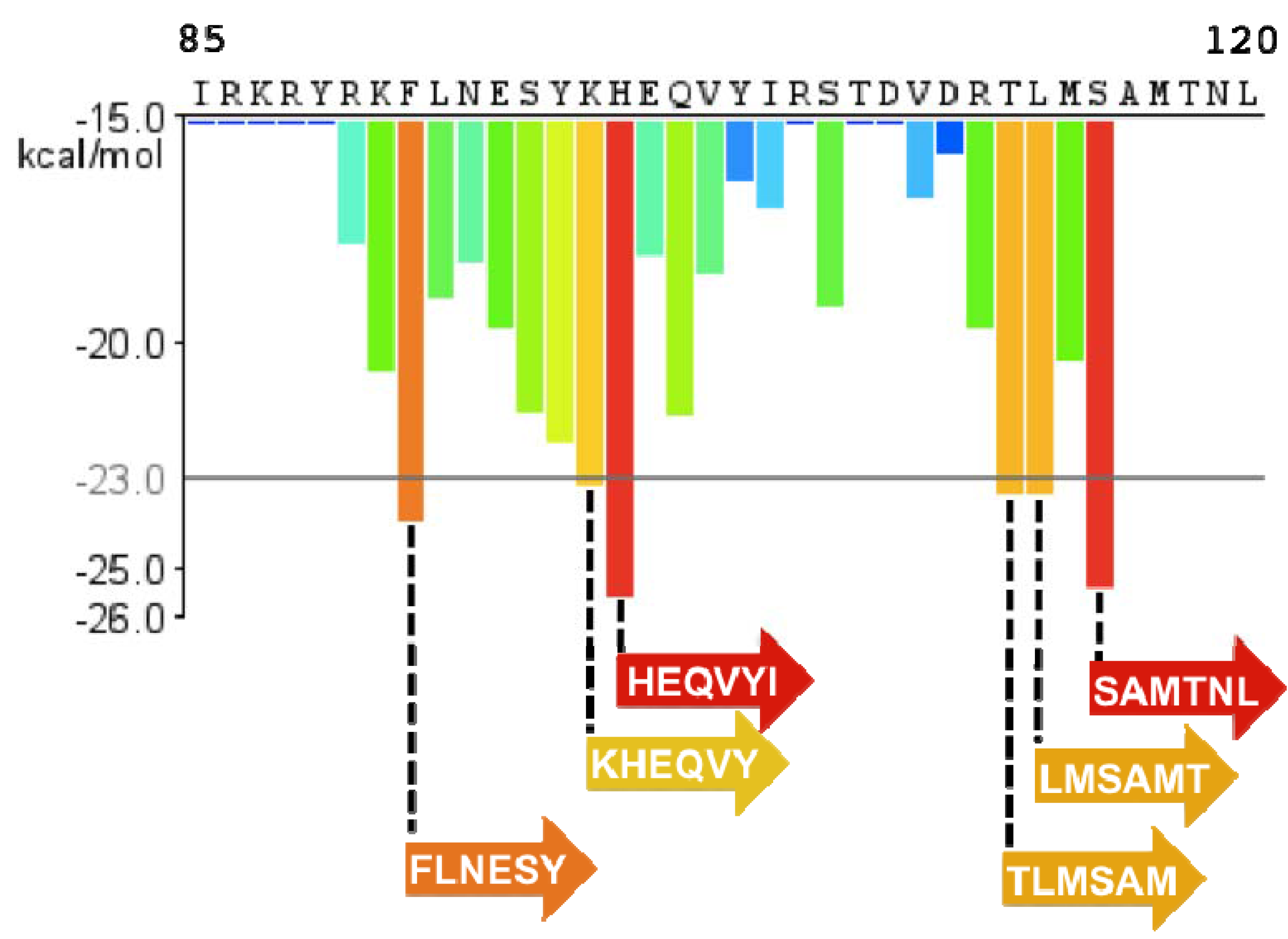
      <p>After identifying SEVI, Münch and colleagues continued analysis of their semen-derived peptide library [<xref ref-type="bibr" rid="B48-biology-01-00058">48</xref>]. In particular, they noted an additional fraction that promoted HIV infection. Remarkably, this fraction was identified to be an N-proximal fragment of PAP that comprised residues 85-120 (PAP85-120), and this peptide was isolated at a concentration of ~39 µg/mL (<xref ref-type="fig" rid="biology-01-00058-f001">Figure 1</xref>) [<xref ref-type="bibr" rid="B48-biology-01-00058">48</xref>]. The discovery of a second peptide fragment that corresponded to the same precursor protein was unanticipated, especially since the library contained several thousand species. Like SEVI, PAP85-120 exists as amyloid fibrils in seminal fluid, and these fibrils promote HIV infection but are slightly less efficient [<xref ref-type="bibr" rid="B48-biology-01-00058">48</xref>]. Also like PAP248-286, PAP85-120 is highly cationic (8 of its 36 residues are either lysine or arginine; theoretical pI = 9.99) implying that PAP85-120 and SEVI act through a similar mechanism to boost HIV transmission. Six hexapeptides within PAP85-120 are predicted by Zipper DB [<xref ref-type="bibr" rid="B65-biology-01-00058">65</xref>] to be amyloidogenic, which suggests that PAP85-120 might also form different amyloid strains (<xref ref-type="fig" rid="biology-01-00058-f005">Figure 5</xref>). Notably, SEVI and PAP85-120 fibrils cooperate to exert additive HIV enhancing effects in cell culture [<xref ref-type="bibr" rid="B48-biology-01-00058">48</xref>].</p>
      <fig id="biology-01-00058-f005" position="anchor">
        <label>Figure 5</label>
        <caption>
          <p>PAP85-120 has six regions of high amyloidogenic propensity. The Zipper DB histogram of PAP85-120 predicts six hexapeptide segments that are highly likely to form steric-zipper spines.</p>
        </caption>
        <graphic xmlns:xlink="http://www.w3.org/1999/xlink" xlink:href="biology-01-00058-g005.tif"/>
      </fig>
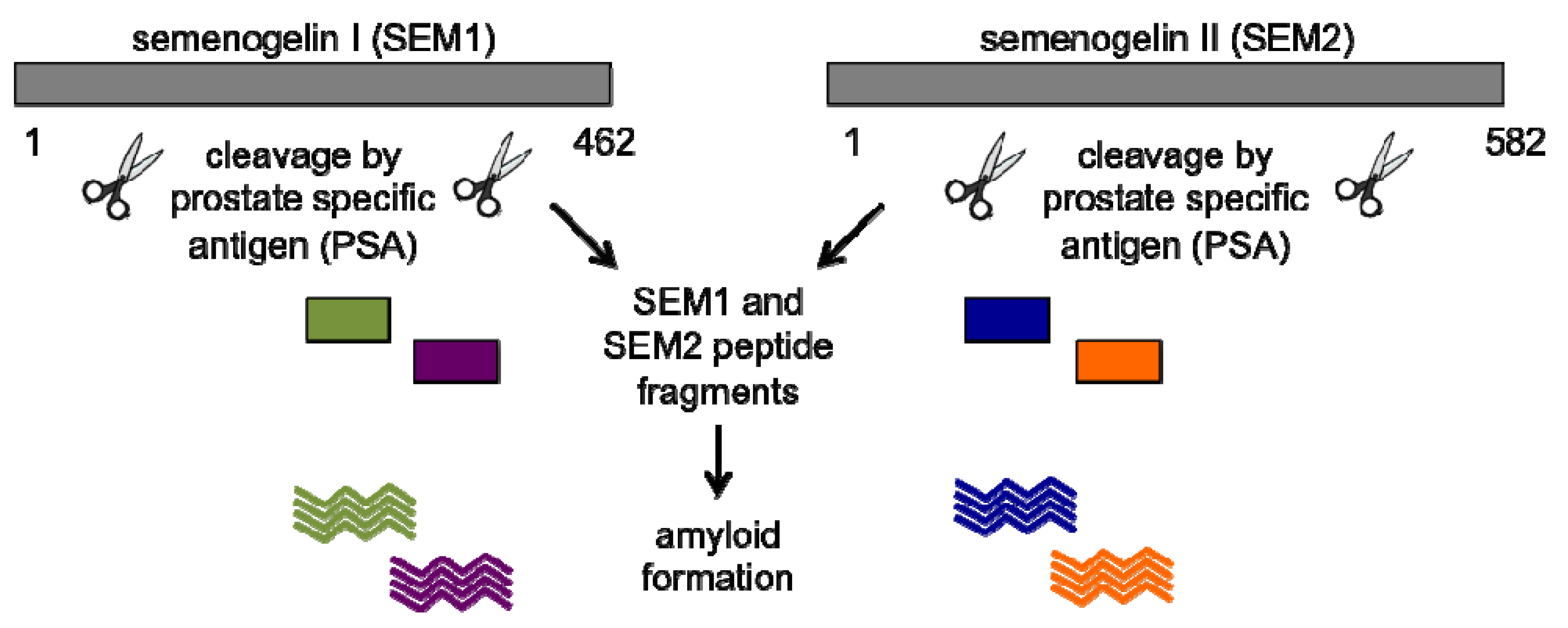
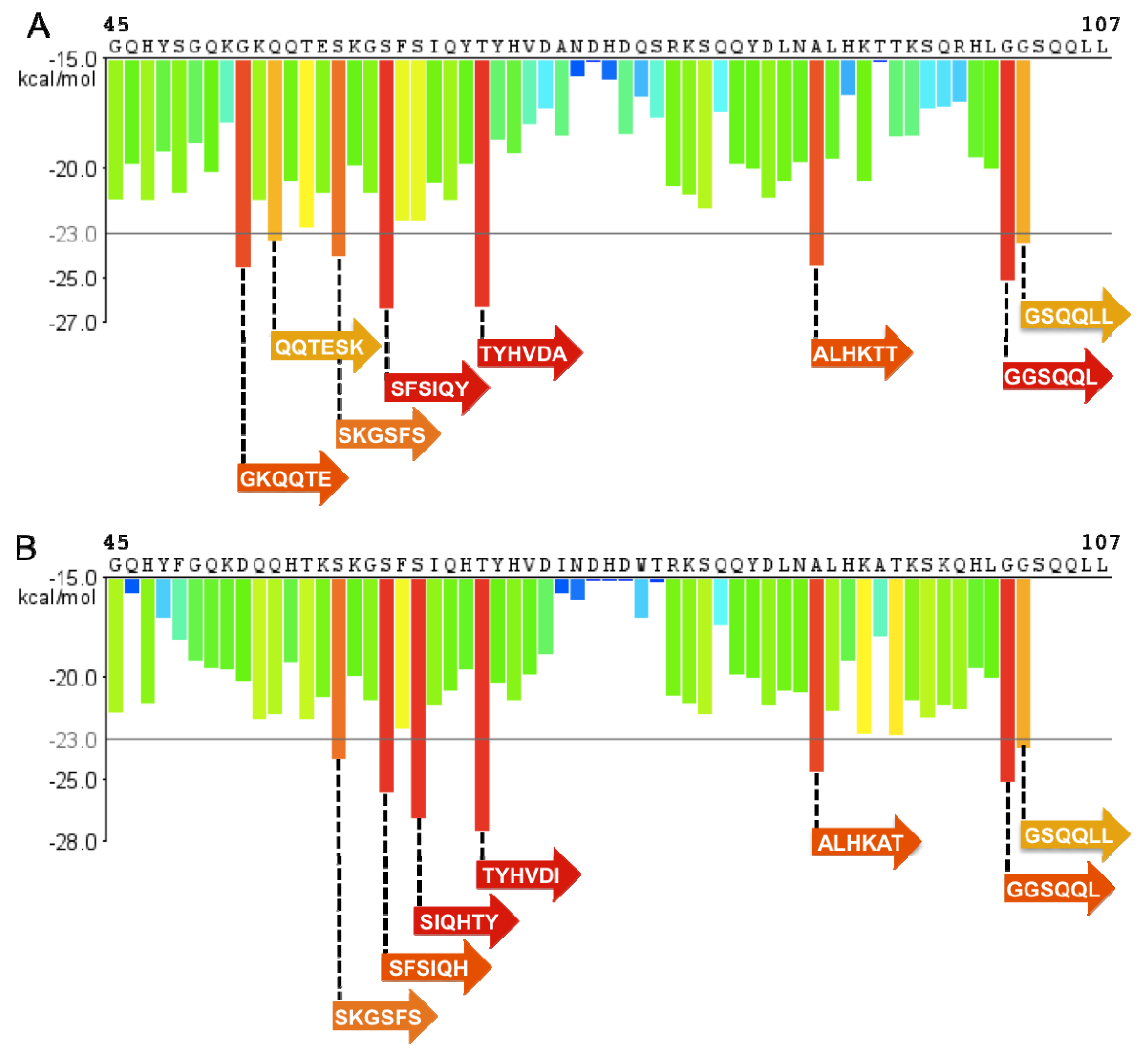
      <p>The discovery of two positively charged fibrillar structures that augment virion fusion and infection led to the hypothesis that other positively charged factors might exist in semen that could also enhance HIV transmission. To test this hypothesis, pooled seminal fluid was depleted of positively charged factors and this resulted in a complete loss of its ability to augment HIV infection [<xref ref-type="bibr" rid="B49-biology-01-00058">49</xref>]. When the identity of these depleted cationic factors was subsequently determined, SEVI was surprisingly not detected. Rather, proteolytic fragments from two homologous semenogelin proteins, SEM1 and SEM2, were identified (<xref ref-type="fig" rid="biology-01-00058-f006">Figure 6</xref>) [<xref ref-type="bibr" rid="B49-biology-01-00058">49</xref>]. Semenogelins (SEMs) are proteins originating from the seminal vesicles that together with fibronectin comprise the major components of the semen coagulum [<xref ref-type="bibr" rid="B94-biology-01-00058">94</xref>,<xref ref-type="bibr" rid="B95-biology-01-00058">95</xref>]. SEM proteins are rapidly cleaved after ejaculation by the chymotrypsin-like serine protease, prostate specific antigen (PSA), at highly specific sites [<xref ref-type="bibr" rid="B96-biology-01-00058">96</xref>,<xref ref-type="bibr" rid="B97-biology-01-00058">97</xref>]. This cleavage event is associated with liquefaction of the semen coagulum, which is important for the release of motile spermatozoa and thus male fertility [<xref ref-type="bibr" rid="B94-biology-01-00058">94</xref>,<xref ref-type="bibr" rid="B95-biology-01-00058">95</xref>]. The SEM1 and SEM2 peptides detected from this experiment corresponded to PSA-generated proteolytic fragments, and remarkably, these peptide fragments all formed amyloid fibrils capable of promoting HIV infection to varying extents [<xref ref-type="bibr" rid="B49-biology-01-00058">49</xref>]. Like SEVI and PAP85-120, the SEM peptides are rich in lysine and arginine residues and carry a net positive charge at neutral pH (pIs of SEM peptides studied range from 8.16 to 10.12). The SEM1(45-107) and SEM2(45-107) peptides each contain multiple predicted regions of high fibrillization propensity (<xref ref-type="fig" rid="biology-01-00058-f007">Figure 7</xref>), implying that different amyloid strains may exist for these peptides as well.</p>
      <fig id="biology-01-00058-f006" position="anchor">
        <label>Figure 6</label>
        <caption>
          <p>Proteolytic cleavage of semenogelin 1 (SEM1) and semenogelin 2 (SEM2). Full-length SEM1 and SEM2, the major components of the semen coagulum, are proteolytically cleaved by prostate specific antigen (PSA) to yield several peptide fragments. These peptide products readily aggregate and assemble into amyloid fibrils in seminal fluid.</p>
        </caption>
        <graphic xmlns:xlink="http://www.w3.org/1999/xlink" xlink:href="biology-01-00058-g006.tif"/>
      </fig>
      
      <p>Interestingly, semen samples from patients with ejaculatory duct obstruction (EDO) were also analyzed. EDO patients are naturally deficient in SEMs, since duct obstruction prevents contents of the seminal vesicles from reaching the ejaculate. As expected, these semen samples lacked viral infection-enhancing activity [<xref ref-type="bibr" rid="B49-biology-01-00058">49</xref>]. Unexpectedly, however, levels of full-length PAP were elevated in EDO samples, while levels of the SEVI precursor peptide PAP248-286 were diminished [<xref ref-type="bibr" rid="B49-biology-01-00058">49</xref>]. Because semen from EDO patients lacks secretions from the seminal vesicles, these data suggest that the proteolytic activity responsible for generating the SEVI peptide from full-length PAP is diminished in semen from EDO patients. The identity of the protease that releases PAP248-286 from its full-length precursor is undetermined, but these data indicate that the protease may reside in the seminal vesicles. The identification of this protease will be valuable, since a protease inhibitor could be a useful tool to prevent the release of PAP248-286 and PAP85-120 peptides from their full-length precursor. Such a strategy could also be employed to inhibit PSA, thus blocking the cleavage of amyloidogenic SEM peptides from full-length SEM1 and SEM2.</p>
      <fig id="biology-01-00058-f007" position="anchor">
        <label>Figure 7</label>
        <caption>
          <p>SEM1 and SEM2 have several regions of high fibrillization propensity. (<bold>A</bold>) The Zipper DB histogram of SEM1(45-107) indicates eight hexapeptide segments with energies below -23 kcal/mol that are predicted to form fibrils; (<bold>B</bold>) The Zipper DB histogram of SEM2(45-107) indicates seven hexapeptides segments that fall below the energy threshold and are thus predicted to form fibrils.</p>
        </caption>
        <graphic xmlns:xlink="http://www.w3.org/1999/xlink" xlink:href="biology-01-00058-g007.tif"/>
      </fig>
      <p>The identification of numerous amyloidogenic peptides in seminal fluid is somewhat surprising. The presence of multiple peptides assembled into amyloid fibrils in semen suggests that they are potentially functional rather than disease-associated. Indeed, in humans, amyloid conformers have been captured for various beneficial purposes, including melanosome biogenesis and the natural storage of peptide hormones in pituitary secretory granules [<xref ref-type="bibr" rid="B29-biology-01-00058">29</xref>,<xref ref-type="bibr" rid="B30-biology-01-00058">30</xref>,<xref ref-type="bibr" rid="B32-biology-01-00058">32</xref>,<xref ref-type="bibr" rid="B98-biology-01-00058">98</xref>,<xref ref-type="bibr" rid="B99-biology-01-00058">99</xref>]. Does the make-up of seminal fluid favor the formation of amyloid fibrils? Studies of SEVI, PAP85-120, and SEM amyloid fibrils have indicated that high peptide concentrations and extensive, non-physiological levels of agitation are required to induce amyloid formation <italic>in vitro</italic>. However, when the SEVI precursor peptide PAP248-286 was assembled into amyloid fibrils in the presence of seminal plasma, fibrillization was significantly enhanced and accelerated [<xref ref-type="bibr" rid="B100-biology-01-00058">100</xref>]. Seminal plasma drastically reduced the lag time for SEVI fibrillization and eradicated the requirement for agitation. This finding indicates that the diversity of molecules in seminal plasma, especially anionic buffer components, have a drastic impact on fibrillization and can potentially explain the strong presence of amyloid fibrils in seminal fluid. Furthermore, semen contains high concentrations of Zn<sup>2+</sup> cations (low mM concentrations), which can inactivate seminal proteases and protect amyloid fibrils from proteolytic degradation [<xref ref-type="bibr" rid="B100-biology-01-00058">100</xref>]. In fact, a positive correlation exists between HIV-infection enhancement and zinc concentration in semen, indicating that Zn<sup>2+</sup> cations likely stabilize semen-derived amyloid fibrils, thus increasing their capacity to augment infection [<xref ref-type="bibr" rid="B101-biology-01-00058">101</xref>].</p>
    </sec>
    <sec>
      <title>6. A Physiological Role for Semen-Derived Amyloid Fibrils?</title>
      <p>While the role of these naturally occurring semen-derived amyloidogenic peptides in HIV infection has been well defined, one crucial question is still unanswered: what is the adaptive role of these amyloid species? It has been postulated that these amyloid fibrils may play a physiological role in promoting fertilization, especially since numerous commonalities exist between virion-target cell fusion and sperm-egg fusion [<xref ref-type="bibr" rid="B102-biology-01-00058">102</xref>]. Thus, semen-derived amyloid fibrils may facilitate the attachment and fusion of sperm with an oocyte much in the same way that SEVI and other semen-derived amyloid fibrils promote HIV virion binding and fusion with target cells. The most obvious commonality between the two processes is that they occur in the same anatomical context, and semen is utilized as a vehicle to transport both sperm and HIV. Another striking parallel between the two processes is that the HIV viral envelope and sperm share the same basic plasma membrane structure consisting of a phospholipid bilayer embedded with vital glycoproteins and lipids [<xref ref-type="bibr" rid="B102-biology-01-00058">102</xref>]. Furthermore, both processes proceed by an identical series of steps involving cell binding, fusion, and penetration. First, sperm and HIV must attach and bind to their target cells, and both carbohydrates and electrochemical interactions are crucially involved in this step [<xref ref-type="bibr" rid="B102-biology-01-00058">102</xref>]. Just as polyanions have been shown to block SEVI-mediated enhancement of HIV infection by inhibiting HIV cell entry [<xref ref-type="bibr" rid="B19-biology-01-00058">19</xref>,<xref ref-type="bibr" rid="B103-biology-01-00058">103</xref>], several polyanions have also been shown to obstruct sperm-oocyte interactions [<xref ref-type="bibr" rid="B104-biology-01-00058">104</xref>,<xref ref-type="bibr" rid="B105-biology-01-00058">105</xref>], further illustrating the similarities between these processes. Following cell attachment, membrane fusion must occur in both fertilization and HIV infection. The fusion of sperm and oocyte membranes, as well as HIV and target cell membranes, is an energetically unfavorable process that requires cooperative protein-protein interactions [<xref ref-type="bibr" rid="B104-biology-01-00058">104</xref>,<xref ref-type="bibr" rid="B106-biology-01-00058">106</xref>,<xref ref-type="bibr" rid="B107-biology-01-00058">107</xref>]. Finally, overlapping signal transduction pathways are essential for both sperm capacitation (a process through which sperm acquire fertilization capacity) and the post-entry stages of HIV replication and maturation [<xref ref-type="bibr" rid="B102-biology-01-00058">102</xref>,<xref ref-type="bibr" rid="B108-biology-01-00058">108</xref>,<xref ref-type="bibr" rid="B109-biology-01-00058">109</xref>].</p>
      <p>Because of the apparent parallels between mammalian fertilization and HIV infection, it is certainly plausible that SEVI and other amyloids may play a role in the fertilization process. Further evidence stems from the fact that spermatozoa can be stained with the amyloid-binding dye Congo Red, indicating that amyloid fibrils may be bound to these motile sperm cells [<xref ref-type="bibr" rid="B110-biology-01-00058">110</xref>]. Additionally, immunostaining for SEM1 and SEM2 has revealed that SEM fragments bind to the posterior head, midpiece, and tail of ejaculated spermatozoa [<xref ref-type="bibr" rid="B94-biology-01-00058">94</xref>,<xref ref-type="bibr" rid="B111-biology-01-00058">111</xref>,<xref ref-type="bibr" rid="B112-biology-01-00058">112</xref>]. However, it is unclear whether or not this result involves SEM amyloid fibrils or non-amyloid SEM fragments. If semen-derived amyloid fibrils are indeed bound to spermatozoa, this will further suggest a mechanism by which amyloid fibrils are involved in fertilization.</p>
    </sec>
    <sec>
      <title>7. Looking to the Future</title>
      <p>SEVI represents a novel microbicide target. Thus, additional means of counteracting SEVI-mediated enhancement of HIV infection are being explored, and similar approaches should also be investigated to counteract the effects of PAP85-120, SEM1, and SEM2 amyloid fibrils. One strategy is to use conformation-specific antibodies that specifically recognize aggregated forms of proteins. For amyloid fibrils to form, a small peptide segment within the aggregated protein must form a tight, self-complementary interface with an identical segment [<xref ref-type="bibr" rid="B64-biology-01-00058">64</xref>,<xref ref-type="bibr" rid="B65-biology-01-00058">65</xref>,<xref ref-type="bibr" rid="B113-biology-01-00058">113</xref>], and this natural process can be exploited to create amyloid-specific antibodies. Gammabodies, or grafted amyloid-motif antibodies, have been constructed by taking these amyloidogenic peptide segments and grafting them into complementarity determining regions (CDRs) of antibodies [<xref ref-type="bibr" rid="B114-biology-01-00058">114</xref>]. Amyloidogenic segments of the Aβ42 peptide, which is associated with Alzheimer’s Disease, have been used to generate gammabodies that recognize Aβ42 amyloid fibrils and soluble oligomers with nanomolar affinity [<xref ref-type="bibr" rid="B114-biology-01-00058">114</xref>]. These grafted motifs engage in homotypic interactions with the corresponding peptide segments within aggregated Aβ conformers, and this binding has been shown to neutralize the toxicity of Aβ oligomers and fibrils [<xref ref-type="bibr" rid="B114-biology-01-00058">114</xref>]. This approach could also be utilized to construct gammabodies that specifically recognize SEVI amyloid fibrils. By binding to SEVI with high affinity, gammabodies could inhibit the infection enhancing property of these amyloid fibrils and therefore serve as a highly selective and effective anti-SEVI agent.</p>
      <p>A second future approach involves developing a novel transmission-blocking HIV vaccine to protect against HIV infection via the sexual route. SEVI binds HIV virions directly through electrostatic contacts [<xref ref-type="bibr" rid="B18-biology-01-00058">18</xref>], and virus-SEVI complexes could present a novel antigenic target for such a vaccine. Whether or not these virus-SEVI complexes can elicit virus-neutralizing antibodies is being explored [<xref ref-type="bibr" rid="B115-biology-01-00058">115</xref>]. The advantage of this approach is that an elicited immune response would recognize the authentic form of HIV, as it is found in semen, thereby inhibiting sexual transmission of the virus.</p>
    </sec>
    <sec>
      <title>8. Concluding Remarks</title>
      <p>Despite the wealth of evidence illustrating the role of semen-derived amyloid fibrils in HIV transmission, the actual presence and proviral activity of these fibrils has been questioned. One study reported that the infection enhancing activity of SEVI fibrils formed <italic>in vitro</italic> was neutralized in the presence of 1% seminal plasma [<xref ref-type="bibr" rid="B116-biology-01-00058">116</xref>]. This effect was attributed to the natural degradation of the PAP248-286 peptide by seminal proteases [<xref ref-type="bibr" rid="B116-biology-01-00058">116</xref>], thus calling into question whether such fibrils could actually form naturally in seminal fluid. However, amyloid fibrils are readily identified in fresh human seminal fluid using transmission electron microscopy [<xref ref-type="bibr" rid="B101-biology-01-00058">101</xref>]. A related study found that seminal plasma protects CD<sup>+</sup> T cells from infection with both X4 and R5 tropic HIV due to semen mediated reduction in CD4 receptor expression [<xref ref-type="bibr" rid="B117-biology-01-00058">117</xref>], and seminal plasma also inhibits the capture and transmission of HIV to CD<sup>+</sup> T cells mediated by DC-SIGN [<xref ref-type="bibr" rid="B118-biology-01-00058">118</xref>]. It is clear that both proviral and antiviral factors in semen modulate HIV infectivity, and it will be important to determine how the interplay between these opposing factors can be manipulated to prevent HIV infection.</p>
      <p>The relative contributions of SEVI, PAP85-120, and SEM amyloid fibrils, as well as amyloid strain phenomena, in semen-mediated enhancement of HIV infection have yet to be determined. However, defining these contributions will be important in the design and search for agents that can abrogate the deleterious effects of these amyloid fibrils. Perhaps the most useful agents to be discovered are those that target amyloid fibrils in general, rather than specific inhibitors of SEVI, PAP85-120, or SEM amyloid fibrils. Ultimately, agents that can efficiently disaggregate or degrade these amyloid fibrils could be developed into a vaginal microbicide, thus reducing amyloid-mediated enhancement of HIV infectivity and offering a preventative strategy to combat HIV infection via sexual transmission. In this context, it will be interesting to explore amyloid disaggregases that can rapidly dissociate amyloid forms within a few minutes [<xref ref-type="bibr" rid="B69-biology-01-00058">69</xref>,<xref ref-type="bibr" rid="B119-biology-01-00058">119</xref>,<xref ref-type="bibr" rid="B120-biology-01-00058">120</xref>,<xref ref-type="bibr" rid="B121-biology-01-00058">121</xref>]. Here, it will be important to isolate conditions where disaggregases completely eliminate amyloid forms rather than yielding fragmented fibrils, which might enhance HIV infection [<xref ref-type="bibr" rid="B122-biology-01-00058">122</xref>].</p>
      <p>Until recently, HIV prevention methods have lacked credibility. Data from various trials showed limited decreases in HIV incidence [<xref ref-type="bibr" rid="B123-biology-01-00058">123</xref>]. Moreover, the explanation for some publicized successes is not entirely clear [<xref ref-type="bibr" rid="B124-biology-01-00058">124</xref>,<xref ref-type="bibr" rid="B125-biology-01-00058">125</xref>,<xref ref-type="bibr" rid="B126-biology-01-00058">126</xref>]. However, prevention based on antiretroviral drugs incorporated into microbicides has recently been more successful [<xref ref-type="bibr" rid="B127-biology-01-00058">127</xref>,<xref ref-type="bibr" rid="B128-biology-01-00058">128</xref>,<xref ref-type="bibr" rid="B129-biology-01-00058">129</xref>]. For example, application of a microbicide gel containing 1% tenofovir (a nucleotide analogue reverse transcriptase inhibitor) into the vaginal vault within 12 hours of intercourse reduced overall acquisition of HIV by 39–54% [<xref ref-type="bibr" rid="B127-biology-01-00058">127</xref>,<xref ref-type="bibr" rid="B129-biology-01-00058">129</xref>]. The idea of targeting host protein conformers (semen-derived amyloid fibrils) is fundamentally different from traditional microbicidal approaches that target HIV itself. This strategy might be less susceptible to HIV escape variants, which can rapidly evolve and evade therapies that directly target components of the viral machinery [<xref ref-type="bibr" rid="B130-biology-01-00058">130</xref>,<xref ref-type="bibr" rid="B131-biology-01-00058">131</xref>,<xref ref-type="bibr" rid="B132-biology-01-00058">132</xref>]. We anticipate that anti-amyloid strategies will synergize with direct antiviral strategies, such that microbicides containing anti-viral agents and anti-amyloid agents (especially amyloid disaggregases) could display enhanced efficacy. Combination therapies have been extremely successful in treating HIV [<xref ref-type="bibr" rid="B133-biology-01-00058">133</xref>,<xref ref-type="bibr" rid="B134-biology-01-00058">134</xref>], and combinations should also be considered for HIV prevention [<xref ref-type="bibr" rid="B123-biology-01-00058">123</xref>,<xref ref-type="bibr" rid="B135-biology-01-00058">135</xref>]. Indeed, combination strategies might be potentiated by simultaneously targeting components of the host and viral machinery. Thus, addition of an effective anti-amyloid system could even enhance the efficacy of the already promising tenofovir microbicide gel [<xref ref-type="bibr" rid="B127-biology-01-00058">127</xref>]. Finally, the numerous commonalities between fertilization and viral infection (involving sperm and HIV membrane structure, cell binding, fusion, and signaling pathways) could provide a framework for developing dual-action contraceptive microbicides that possess both antimicrobial and contraceptive properties.</p>
    </sec>
  </body>
  <back>
    <ack>
      <title>Acknowledgements</title>
      <p>We thank Mark Lemmon, Elizabeth Sweeny, Meredith Jackrel, and Michael Soo for helpful comments on the manuscript. L.M.C. is supported by an NSF Graduate Research Fellowship (DGE-0822). J.S. is supported by an NIH Director’s New Innovator Award (1DP2OD002177-01), an Ellison Medical Foundation New Scholar in Aging Award, and a Bill and Melinda Gates Foundation Grand Challenges Explorations Award.</p>
    </ack>
    <ref-list>
      <title>References</title>
      <ref id="B1-biology-01-00058">
        <label>1.</label>
        <citation citation-type="journal">
          <person-group person-group-type="author">
            <name>
              <surname>Ascher</surname>
              <given-names>M.S.</given-names>
            </name>
            <name>
              <surname>Sheppard</surname>
              <given-names>H.W.</given-names>
            </name>
            <name>
              <surname>Winkelstein</surname>
              <given-names>W.</given-names>
              <suffix>Jr.</suffix>
            </name>
            <name>
              <surname>Vittinghoff</surname>
              <given-names>E.</given-names>
            </name>
          </person-group>
          <article-title>Aetiology of AIDS</article-title>
          <source>Lancet</source>
          <year>1993</year>
          <volume>341</volume>
          <fpage>1223</fpage>
        <pub-id pub-id-type="pmid">8098121</pub-id></citation>
      </ref>
      <ref id="B2-biology-01-00058">
        <label>2.</label>
        <citation citation-type="journal">
          <person-group person-group-type="author">
            <name>
              <surname>Schechter</surname>
              <given-names>M.T.</given-names>
            </name>
            <name>
              <surname>Craib</surname>
              <given-names>K.J.</given-names>
            </name>
            <name>
              <surname>Montaner</surname>
              <given-names>J.S.</given-names>
            </name>
            <name>
              <surname>Lee</surname>
              <given-names>T.N.</given-names>
            </name>
            <name>
              <surname>O’Shaughnessy</surname>
              <given-names>M.V.</given-names>
            </name>
            <name>
              <surname>Gelmon</surname>
              <given-names>K.A.</given-names>
            </name>
          </person-group>
          <article-title>Aetiology of AIDS</article-title>
          <source>Lancet</source>
          <year>1993</year>
          <volume>341</volume>
          <fpage>1222</fpage>
          <lpage>1223</lpage>
        <pub-id pub-id-type="pmid">8098118</pub-id></citation>
      </ref>
      <ref id="B3-biology-01-00058">
        <label>3.</label>
        <citation citation-type="journal">
          <person-group person-group-type="author">
            <name>
              <surname>Weiss</surname>
              <given-names>R.A.</given-names>
            </name>
          </person-group>
          <article-title>How does HIV cause AIDS?</article-title>
          <source>Science</source>
          <year>1993</year>
          <volume>260</volume>
          <fpage>1273</fpage>
          <lpage>1279</lpage>
        <pub-id pub-id-type="doi">10.1126/science.8493571</pub-id><pub-id pub-id-type="pmid">8493571</pub-id></citation>
      </ref>
      <ref id="B4-biology-01-00058">
        <label>4.</label>
        <citation citation-type="journal">
          <person-group person-group-type="author">
            <name>
              <surname>Weiss</surname>
              <given-names>R.A.</given-names>
            </name>
            <name>
              <surname>Jaffe</surname>
              <given-names>H.W.</given-names>
            </name>
          </person-group>
          <article-title>Duesberg, HIV and AIDS</article-title>
          <source>Nature</source>
          <year>1990</year>
          <volume>345</volume>
          <fpage>659</fpage>
          <lpage>660</lpage>
          <pub-id pub-id-type="doi">10.1038/345659a0</pub-id>
        </citation>
      </ref>
      <ref id="B5-biology-01-00058">
        <label>5.</label>
        <citation citation-type="book">
		  <collab>UNAIDS</collab>
           <source>Global Report: UNAIDS Report on the Global AIDS Epidemic 2010</source>
          <publisher-name>UNAIDS</publisher-name>
          <publisher-loc>Geneva, Switzerland</publisher-loc>
          <year>2010</year>
          <fpage>1</fpage>
          <lpage>359</lpage>
        </citation>
      </ref>
      <ref id="B6-biology-01-00058">
        <label>6.</label>
        <citation citation-type="journal">
          <person-group person-group-type="author">
            <name>
              <surname>Royce</surname>
              <given-names>R.A.</given-names>
            </name>
            <name>
              <surname>Sena</surname>
              <given-names>A.</given-names>
            </name>
            <name>
              <surname>Cates</surname>
              <given-names>W.</given-names>
              <suffix>Jr.</suffix>
            </name>
            <name>
              <surname>Cohen</surname>
              <given-names>M.S.</given-names>
            </name>
          </person-group>
          <article-title>Sexual transmission of HIV</article-title>
          <source>N. Engl. J. Med.</source>
          <year>1997</year>
          <volume>336</volume>
          <fpage>1072</fpage>
          <lpage>1078</lpage>
          <pub-id pub-id-type="doi">10.1056/NEJM199704103361507</pub-id>
        </citation>
      </ref>
      <ref id="B7-biology-01-00058">
        <label>7.</label>
        <citation citation-type="journal">
          <person-group person-group-type="author">
            <name>
              <surname>Gray</surname>
              <given-names>R.H.</given-names>
            </name>
            <name>
              <surname>Wawer</surname>
              <given-names>M.J.</given-names>
            </name>
            <name>
              <surname>Brookmeyer</surname>
              <given-names>R.</given-names>
            </name>
            <name>
              <surname>Sewankambo</surname>
              <given-names>N.K.</given-names>
            </name>
            <name>
              <surname>Serwadda</surname>
              <given-names>D.</given-names>
            </name>
            <name>
              <surname>Wabwire-Mangen</surname>
              <given-names>F.</given-names>
            </name>
            <name>
              <surname>Lutalo</surname>
              <given-names>T.</given-names>
            </name>
            <name>
              <surname>Li</surname>
              <given-names>X.</given-names>
            </name>
            <name>
              <surname>van Cott</surname>
              <given-names>T.</given-names>
            </name>
            <name>
              <surname>Quinn</surname>
              <given-names>T.C.</given-names>
            </name>
          </person-group>
          <article-title>Probability of HIV-1 transmission per coital act in monogamous, heterosexual, HIV-1-discordant couples in Rakai, Uganda</article-title>
          <source>Lancet</source>
          <year>2001</year>
          <volume>357</volume>
          <fpage>1149</fpage>
          <lpage>1153</lpage>
        <pub-id pub-id-type="doi">10.1016/S0140-6736(00)04331-2</pub-id><pub-id pub-id-type="pmid">11323041</pub-id></citation>
      </ref>
      <ref id="B8-biology-01-00058">
        <label>8.</label>
        <citation citation-type="journal">
          <person-group person-group-type="author">
            <name>
              <surname>Pilcher</surname>
              <given-names>C.D.</given-names>
            </name>
            <name>
              <surname>Tien</surname>
              <given-names>H.C.</given-names>
            </name>
            <name>
              <surname>Eron</surname>
              <given-names>J.J.</given-names>
              <suffix>Jr.</suffix>
            </name>
            <name>
              <surname>Vernazza</surname>
              <given-names>P.L.</given-names>
            </name>
            <name>
              <surname>Leu</surname>
              <given-names>S.Y.</given-names>
            </name>
            <name>
              <surname>Stewart</surname>
              <given-names>P.W.</given-names>
            </name>
            <name>
              <surname>Goh</surname>
              <given-names>L.E.</given-names>
            </name>
            <name>
              <surname>Cohen</surname>
              <given-names>M.S.</given-names>
            </name>
          </person-group>
          <article-title>Brief but efficient: Acute HIV infection and the sexual transmission of HIV</article-title>
          <source>J. Infect. Dis.</source>
          <year>2004</year>
          <volume>189</volume>
          <fpage>1785</fpage>
          <lpage>1792</lpage>
          <pub-id pub-id-type="doi">10.1086/386333</pub-id>
        </citation>
      </ref>
      <ref id="B9-biology-01-00058">
        <label>9.</label>
        <citation citation-type="journal">
          <person-group person-group-type="author">
            <name>
              <surname>Dimitrov</surname>
              <given-names>D.S.</given-names>
            </name>
            <name>
              <surname>Willey</surname>
              <given-names>R.L.</given-names>
            </name>
            <name>
              <surname>Sato</surname>
              <given-names>H.</given-names>
            </name>
            <name>
              <surname>Chang</surname>
              <given-names>L.J.</given-names>
            </name>
            <name>
              <surname>Blumenthal</surname>
              <given-names>R.</given-names>
            </name>
            <name>
              <surname>Martin</surname>
              <given-names>M.A.</given-names>
            </name>
          </person-group>
          <article-title>Quantitation of human immunodeficiency virus type 1 infection kinetics</article-title>
          <source>J. Virol.</source>
          <year>1993</year>
          <volume>67</volume>
          <fpage>2182</fpage>
          <lpage>2190</lpage>
        <pub-id pub-id-type="pmid">8445728</pub-id></citation>
      </ref>
      <ref id="B10-biology-01-00058">
        <label>10.</label>
        <citation citation-type="journal">
          <person-group person-group-type="author">
            <name>
              <surname>Rusert</surname>
              <given-names>P.</given-names>
            </name>
            <name>
              <surname>Fischer</surname>
              <given-names>M.</given-names>
            </name>
            <name>
              <surname>Joos</surname>
              <given-names>B.</given-names>
            </name>
            <name>
              <surname>Leemann</surname>
              <given-names>C.</given-names>
            </name>
            <name>
              <surname>Kuster</surname>
              <given-names>H.</given-names>
            </name>
            <name>
              <surname>Flepp</surname>
              <given-names>M.</given-names>
            </name>
            <name>
              <surname>Bonhoeffer</surname>
              <given-names>S.</given-names>
            </name>
            <name>
              <surname>Gunthard</surname>
              <given-names>H.F.</given-names>
            </name>
            <name>
              <surname>Trkola</surname>
              <given-names>A.</given-names>
            </name>
          </person-group>
          <article-title>Quantification of infectious HIV-1 plasma viral load using a boosted <italic>in vitro</italic> infection protocol</article-title>
          <source>Virology</source>
          <year>2004</year>
          <volume>326</volume>
          <fpage>113</fpage>
          <lpage>129</lpage>
          <pub-id pub-id-type="doi">10.1016/j.virol.2004.05.022</pub-id>
        </citation>
      </ref>
      <ref id="B11-biology-01-00058">
        <label>11.</label>
        <citation citation-type="journal">
          <person-group person-group-type="author">
            <name>
              <surname>Chuck</surname>
              <given-names>A.S.</given-names>
            </name>
            <name>
              <surname>Clarke</surname>
              <given-names>M.F.</given-names>
            </name>
            <name>
              <surname>Palsson</surname>
              <given-names>B.O.</given-names>
            </name>
          </person-group>
          <article-title>Retroviral infection is limited by Brownian motion</article-title>
          <source>Hum. Gen. Ther.</source>
          <year>1996</year>
          <volume>7</volume>
          <fpage>1527</fpage>
          <lpage>1534</lpage>
          <pub-id pub-id-type="doi">10.1089/hum.1996.7.13-1527</pub-id>
        </citation>
      </ref>
      <ref id="B12-biology-01-00058">
        <label>12.</label>
        <citation citation-type="journal">
          <person-group person-group-type="author">
            <name>
              <surname>Eckert</surname>
              <given-names>D.M.</given-names>
            </name>
            <name>
              <surname>Kim</surname>
              <given-names>P.S.</given-names>
            </name>
          </person-group>
          <article-title>Mechanisms of viral membrane fusion and its inhibition</article-title>
          <source>Annu. Rev. Biochem.</source>
          <year>2001</year>
          <volume>70</volume>
          <fpage>777</fpage>
          <lpage>810</lpage>
          <pub-id pub-id-type="doi">10.1146/annurev.biochem.70.1.777</pub-id>
        </citation>
      </ref>
      <ref id="B13-biology-01-00058">
        <label>13.</label>
        <citation citation-type="journal">
          <person-group person-group-type="author">
            <name>
              <surname>Orloff</surname>
              <given-names>G.M.</given-names>
            </name>
            <name>
              <surname>Orloff</surname>
              <given-names>S.L.</given-names>
            </name>
            <name>
              <surname>Kennedy</surname>
              <given-names>M.S.</given-names>
            </name>
            <name>
              <surname>Maddon</surname>
              <given-names>P.J.</given-names>
            </name>
            <name>
              <surname>McDougal</surname>
              <given-names>J.S.</given-names>
            </name>
          </person-group>
          <article-title>Penetration of CD4 T cells by HIV-1. The CD4 receptor does not internalize with HIV, and CD4-related signal transduction events are not required for entry</article-title>
          <source>J. Immunol.</source>
          <year>1991</year>
          <volume>146</volume>
          <fpage>2578</fpage>
          <lpage>2587</lpage>
        <pub-id pub-id-type="pmid">1673142</pub-id></citation>
      </ref>
      <ref id="B14-biology-01-00058">
        <label>14.</label>
        <citation citation-type="journal">
          <person-group person-group-type="author">
            <name>
              <surname>Galvin</surname>
              <given-names>S.R.</given-names>
            </name>
            <name>
              <surname>Cohen</surname>
              <given-names>M.S.</given-names>
            </name>
          </person-group>
          <article-title>The role of sexually transmitted diseases in HIV transmission</article-title>
          <source>Nat. Rev. Microbiol.</source>
          <year>2004</year>
          <volume>2</volume>
          <fpage>33</fpage>
          <lpage>42</lpage>
          <pub-id pub-id-type="doi">10.1038/nrmicro794</pub-id>
        </citation>
      </ref>
      <ref id="B15-biology-01-00058">
        <label>15.</label>
        <citation citation-type="journal">
          <person-group person-group-type="author">
            <name>
              <surname>Kim</surname>
              <given-names>K.A.</given-names>
            </name>
            <name>
              <surname>Yolamanova</surname>
              <given-names>M.</given-names>
            </name>
            <name>
              <surname>Zirafi</surname>
              <given-names>O.</given-names>
            </name>
            <name>
              <surname>Roan</surname>
              <given-names>N.R.</given-names>
            </name>
            <name>
              <surname>Staendker</surname>
              <given-names>L.</given-names>
            </name>
            <name>
              <surname>Forssmann</surname>
              <given-names>W.G.</given-names>
            </name>
            <name>
              <surname>Burgener</surname>
              <given-names>A.</given-names>
            </name>
            <name>
              <surname>Dejucq-rainsford</surname>
              <given-names>N.</given-names>
            </name>
            <name>
              <surname>Hahn</surname>
              <given-names>B.H.</given-names>
            </name>
            <name>
              <surname>Shaw</surname>
              <given-names>G.M.</given-names>
            </name>
            <name>
              <surname>Greene</surname>
              <given-names>W.C.</given-names>
            </name>
            <name>
              <surname>Kirchhoff</surname>
              <given-names>F.</given-names>
            </name>
            <name>
              <surname>Münch</surname>
              <given-names>J.</given-names>
            </name>
          </person-group>
          <article-title>Semen-mediated enhancement of HIV infection is donor-dependent and correlates with the levels of SEVI</article-title>
          <source>Retrovirology</source>
          <year>2010</year>
          <volume>7</volume>
          <fpage>55</fpage>
        <pub-id pub-id-type="doi">10.1186/1742-4690-7-55</pub-id><pub-id pub-id-type="pmid">20573198</pub-id></citation>
      </ref>
      <ref id="B16-biology-01-00058">
        <label>16.</label>
        <citation citation-type="journal">
          <person-group person-group-type="author">
            <name>
              <surname>Munch</surname>
              <given-names>J.</given-names>
            </name>
            <name>
              <surname>Rucker</surname>
              <given-names>E.</given-names>
            </name>
            <name>
              <surname>Standker</surname>
              <given-names>L.</given-names>
            </name>
            <name>
              <surname>Adermann</surname>
              <given-names>K.</given-names>
            </name>
            <name>
              <surname>Goffinet</surname>
              <given-names>C.</given-names>
            </name>
            <name>
              <surname>Schindler</surname>
              <given-names>M.</given-names>
            </name>
            <name>
              <surname>Wildum</surname>
              <given-names>S.</given-names>
            </name>
            <name>
              <surname>Chinnadurai</surname>
              <given-names>R.</given-names>
            </name>
            <name>
              <surname>Rajan</surname>
              <given-names>D.</given-names>
            </name>
            <name>
              <surname>Specht</surname>
              <given-names>A.</given-names>
            </name>
            <name>
              <surname>Gimenez-Gallego</surname>
              <given-names>G.</given-names>
            </name>
            <name>
              <surname>Sanchez</surname>
              <given-names>P.C.</given-names>
            </name>
            <name>
              <surname>Fowler</surname>
              <given-names>D.M.</given-names>
            </name>
            <name>
              <surname>Koulov</surname>
              <given-names>A.</given-names>
            </name>
            <name>
              <surname>Kelly</surname>
              <given-names>J.W.</given-names>
            </name>
            <name>
              <surname>Mothes</surname>
              <given-names>W.</given-names>
            </name>
            <name>
              <surname>Grivel</surname>
              <given-names>J.C.</given-names>
            </name>
            <name>
              <surname>Margolis</surname>
              <given-names>L.</given-names>
            </name>
            <name>
              <surname>Keppler</surname>
              <given-names>O.T.</given-names>
            </name>
            <name>
              <surname>Forssmann</surname>
              <given-names>W.G.</given-names>
            </name>
            <name>
              <surname>Kirchhoff</surname>
              <given-names>F.</given-names>
            </name>
          </person-group>
          <article-title>Semen-derived amyloid fibrils drastically enhance HIV infection</article-title>
          <source>Cell</source>
          <year>2007</year>
          <volume>131</volume>
          <fpage>1059</fpage>
          <lpage>1071</lpage>
          <pub-id pub-id-type="doi">10.1016/j.cell.2007.10.014</pub-id>
        </citation>
      </ref>
      <ref id="B17-biology-01-00058">
        <label>17.</label>
        <citation citation-type="journal">
          <person-group person-group-type="author">
            <name>
              <surname>Olsen</surname>
              <given-names>J.S.</given-names>
            </name>
            <name>
              <surname>Brown</surname>
              <given-names>C.</given-names>
            </name>
            <name>
              <surname>Capule</surname>
              <given-names>C.C.</given-names>
            </name>
            <name>
              <surname>Rubinshtein</surname>
              <given-names>M.</given-names>
            </name>
            <name>
              <surname>Doran</surname>
              <given-names>T.M.</given-names>
            </name>
            <name>
              <surname>Srivastava</surname>
              <given-names>R.K.</given-names>
            </name>
            <name>
              <surname>Feng</surname>
              <given-names>C.</given-names>
            </name>
            <name>
              <surname>Nilsson</surname>
              <given-names>B.L.</given-names>
            </name>
            <name>
              <surname>Yang</surname>
              <given-names>J.</given-names>
            </name>
            <name>
              <surname>Dewhurst</surname>
              <given-names>S.</given-names>
            </name>
          </person-group>
          <article-title>Amyloid binding small molecules efficiently block SEVI and semen mediated enhancement of HIV-1 infection</article-title>
          <source>J. Biol. Chem.</source>
          <year>2010</year>
          <volume>285</volume>
          <fpage>35488</fpage>
          <lpage>35496</lpage>
        <pub-id pub-id-type="doi">10.1074/jbc.M110.163659</pub-id><pub-id pub-id-type="pmid">20833717</pub-id></citation>
      </ref>
      <ref id="B18-biology-01-00058">
        <label>18.</label>
        <citation citation-type="journal">
          <person-group person-group-type="author">
            <name>
              <surname>Roan</surname>
              <given-names>N.R.</given-names>
            </name>
            <name>
              <surname>Greene</surname>
              <given-names>W.C.</given-names>
            </name>
          </person-group>
          <article-title>A seminal finding for understanding HIV transmission</article-title>
          <source>Cell</source>
          <year>2007</year>
          <volume>131</volume>
          <fpage>1044</fpage>
          <lpage>1046</lpage>
          <pub-id pub-id-type="doi">10.1016/j.cell.2007.11.030</pub-id>
        </citation>
      </ref>
      <ref id="B19-biology-01-00058">
        <label>19.</label>
        <citation citation-type="journal">
          <person-group person-group-type="author">
            <name>
              <surname>Roan</surname>
              <given-names>N.R.</given-names>
            </name>
            <name>
              <surname>Munch</surname>
              <given-names>J.</given-names>
            </name>
            <name>
              <surname>Arhel</surname>
              <given-names>N.</given-names>
            </name>
            <name>
              <surname>Mothes</surname>
              <given-names>W.</given-names>
            </name>
            <name>
              <surname>Neidleman</surname>
              <given-names>J.</given-names>
            </name>
            <name>
              <surname>Kobayashi</surname>
              <given-names>A.</given-names>
            </name>
            <name>
              <surname>Smith-McCune</surname>
              <given-names>K.</given-names>
            </name>
            <name>
              <surname>Kirchhoff</surname>
              <given-names>F.</given-names>
            </name>
            <name>
              <surname>Greene</surname>
              <given-names>W.C.</given-names>
            </name>
          </person-group>
          <article-title>The cationic properties of SEVI underlie its ability to enhance human immunodeficiency virus infection</article-title>
          <source>J. Virol.</source>
          <year>2009</year>
          <volume>83</volume>
          <fpage>73</fpage>
          <lpage>80</lpage>
        <pub-id pub-id-type="doi">10.1128/JVI.01366-08</pub-id><pub-id pub-id-type="pmid">18945786</pub-id></citation>
      </ref>
      <ref id="B20-biology-01-00058">
        <label>20.</label>
        <citation citation-type="journal">
          <person-group person-group-type="author">
            <name>
              <surname>Ronnberg</surname>
              <given-names>L.</given-names>
            </name>
            <name>
              <surname>Vihko</surname>
              <given-names>P.</given-names>
            </name>
            <name>
              <surname>Sajanti</surname>
              <given-names>E.</given-names>
            </name>
            <name>
              <surname>Vihko</surname>
              <given-names>R.</given-names>
            </name>
          </person-group>
          <article-title>Clomiphene citrate administration to normogonadotropic subfertile men: Blood hormone changes and activation of acid phosphatase in seminal fluid</article-title>
          <source>Int. J. Androl.</source>
          <year>1981</year>
          <volume>4</volume>
          <fpage>372</fpage>
          <lpage>378</lpage>
          <pub-id pub-id-type="doi">10.1111/j.1365-2605.1981.tb00721.x</pub-id>
        </citation>
      </ref>
      <ref id="B21-biology-01-00058">
        <label>21.</label>
        <citation citation-type="journal">
          <person-group person-group-type="author">
            <name>
              <surname>Wurm</surname>
              <given-names>M.</given-names>
            </name>
            <name>
              <surname>Schambach</surname>
              <given-names>A.</given-names>
            </name>
            <name>
              <surname>Lindemann</surname>
              <given-names>D.</given-names>
            </name>
            <name>
              <surname>Hanenberg</surname>
              <given-names>H.</given-names>
            </name>
            <name>
              <surname>Standker</surname>
              <given-names>L.</given-names>
            </name>
            <name>
              <surname>Forssmann</surname>
              <given-names>W.G.</given-names>
            </name>
            <name>
              <surname>Blasczyk</surname>
              <given-names>R.</given-names>
            </name>
            <name>
              <surname>Horn</surname>
              <given-names>P.A.</given-names>
            </name>
          </person-group>
          <article-title>The influence of semen-derived enhancer of virus infection on the efficiency of retroviral gene transfer</article-title>
          <source>J. Gene Med.</source>
          <year>2010</year>
          <volume>12</volume>
          <fpage>137</fpage>
          <lpage>146</lpage>
        <pub-id pub-id-type="pmid">20052742</pub-id></citation>
      </ref>
      <ref id="B22-biology-01-00058">
        <label>22.</label>
        <citation citation-type="journal">
          <person-group person-group-type="author">
            <name>
              <surname>Cushman</surname>
              <given-names>M.</given-names>
            </name>
            <name>
              <surname>Johnson</surname>
              <given-names>B.S.</given-names>
            </name>
            <name>
              <surname>King</surname>
              <given-names>O.D.</given-names>
            </name>
            <name>
              <surname>Gitler</surname>
              <given-names>A.D.</given-names>
            </name>
            <name>
              <surname>Shorter</surname>
              <given-names>J.</given-names>
            </name>
          </person-group>
          <article-title>Prion-like disorders: Blurring the divide between transmissibility and infectivity</article-title>
          <source>J. Cell Sci.</source>
          <year>2010</year>
          <volume>123</volume>
          <fpage>1191</fpage>
          <lpage>1201</lpage>
          <pub-id pub-id-type="doi">10.1242/jcs.051672</pub-id>
        </citation>
      </ref>
      <ref id="B23-biology-01-00058">
        <label>23.</label>
        <citation citation-type="journal">
          <person-group person-group-type="author">
            <name>
              <surname>Wojtowicz</surname>
              <given-names>W.M.</given-names>
            </name>
            <name>
              <surname>Farzan</surname>
              <given-names>M.</given-names>
            </name>
            <name>
              <surname>Joyal</surname>
              <given-names>J.L.</given-names>
            </name>
            <name>
              <surname>Carter</surname>
              <given-names>K.</given-names>
            </name>
            <name>
              <surname>Babcock</surname>
              <given-names>G.J.</given-names>
            </name>
            <name>
              <surname>Israel</surname>
              <given-names>D.I.</given-names>
            </name>
            <name>
              <surname>Sodroski</surname>
              <given-names>J.</given-names>
            </name>
            <name>
              <surname>Mirzabekov</surname>
              <given-names>T.</given-names>
            </name>
          </person-group>
          <article-title>Stimulation of enveloped virus infection by beta-amyloid fibrils</article-title>
          <source>J. Biol. Chem.</source>
          <year>2002</year>
          <volume>277</volume>
          <fpage>35019</fpage>
          <lpage>35024</lpage>
        <pub-id pub-id-type="doi">10.1074/jbc.M203518200</pub-id><pub-id pub-id-type="pmid">12119288</pub-id></citation>
      </ref>
      <ref id="B24-biology-01-00058">
        <label>24.</label>
        <citation citation-type="journal">
          <person-group person-group-type="author">
            <name>
              <surname>Caughey</surname>
              <given-names>B.</given-names>
            </name>
            <name>
              <surname>Lansbury</surname>
              <given-names>P.T.</given-names>
            </name>
          </person-group>
          <article-title>Protofibrils, pores, fibrils, and neurodegeneration: Separating the responsible protein aggregates from the innocent bystanders</article-title>
          <source>Annu. Rev. Neurosci.</source>
          <year>2003</year>
          <volume>26</volume>
          <fpage>267</fpage>
          <lpage>298</lpage>
          <pub-id pub-id-type="doi">10.1146/annurev.neuro.26.010302.081142</pub-id>
        </citation>
      </ref>
      <ref id="B25-biology-01-00058">
        <label>25.</label>
        <citation citation-type="journal">
          <person-group person-group-type="author">
            <name>
              <surname>Morimoto</surname>
              <given-names>R.I.</given-names>
            </name>
          </person-group>
          <article-title>Stress, aging, and neurodegenerative disease</article-title>
          <source>N. Engl. J. Med.</source>
          <year>2006</year>
          <volume>355</volume>
          <fpage>2254</fpage>
          <lpage>2255</lpage>
          <pub-id pub-id-type="doi">10.1056/NEJMcibr065573</pub-id>
        </citation>
      </ref>
      <ref id="B26-biology-01-00058">
        <label>26.</label>
        <citation citation-type="journal">
          <person-group person-group-type="author">
            <name>
              <surname>Skovronsky</surname>
              <given-names>D.M.</given-names>
            </name>
            <name>
              <surname>Lee</surname>
              <given-names>V.M.</given-names>
            </name>
            <name>
              <surname>Trojanowski</surname>
              <given-names>J.Q.</given-names>
            </name>
          </person-group>
          <article-title>Neurodegenerative diseases: New concepts of pathogenesis and their therapeutic implications</article-title>
          <source>Annu. Rev. Pathol.</source>
          <year>2006</year>
          <volume>1</volume>
          <fpage>151</fpage>
          <lpage>170</lpage>
          <pub-id pub-id-type="doi">10.1146/annurev.pathol.1.110304.100113</pub-id>
        </citation>
      </ref>
      <ref id="B27-biology-01-00058">
        <label>27.</label>
        <citation citation-type="journal">
          <person-group person-group-type="author">
            <name>
              <surname>Dobson</surname>
              <given-names>C.M.</given-names>
            </name>
          </person-group>
          <article-title>Protein folding and misfolding</article-title>
          <source>Nature</source>
          <year>2003</year>
          <volume>426</volume>
          <fpage>884</fpage>
          <lpage>890</lpage>
          <pub-id pub-id-type="doi">10.1038/nature02261</pub-id>
        </citation>
      </ref>
      <ref id="B28-biology-01-00058">
        <label>28.</label>
        <citation citation-type="journal">
          <person-group person-group-type="author">
            <name>
              <surname>Fandrich</surname>
              <given-names>M.</given-names>
            </name>
            <name>
              <surname>Fletcher</surname>
              <given-names>M.A.</given-names>
            </name>
            <name>
              <surname>Dobson</surname>
              <given-names>C.M.</given-names>
            </name>
          </person-group>
          <article-title>Amyloid fibrils from muscle myoglobin</article-title>
          <source>Nature</source>
          <year>2001</year>
          <volume>410</volume>
          <fpage>165</fpage>
          <lpage>166</lpage>
        <pub-id pub-id-type="doi">10.1038/35065514</pub-id><pub-id pub-id-type="pmid">11242064</pub-id></citation>
      </ref>
      <ref id="B29-biology-01-00058">
        <label>29.</label>
        <citation citation-type="journal">
          <person-group person-group-type="author">
            <name>
              <surname>Fowler</surname>
              <given-names>D.M.</given-names>
            </name>
            <name>
              <surname>Koulov</surname>
              <given-names>A.V.</given-names>
            </name>
            <name>
              <surname>Alory-Jost</surname>
              <given-names>C.</given-names>
            </name>
            <name>
              <surname>Marks</surname>
              <given-names>M.S.</given-names>
            </name>
            <name>
              <surname>Balch</surname>
              <given-names>W.E.</given-names>
            </name>
            <name>
              <surname>Kelly</surname>
              <given-names>J.W.</given-names>
            </name>
          </person-group>
          <article-title>Functional amyloid formation within mammalian tissue</article-title>
          <source>PLoS Biol.</source>
          <year>2006</year>
          <volume>4</volume>
          <fpage>e6</fpage>
          <pub-id pub-id-type="doi">10.1371/journal.pbio.0040006</pub-id>
        </citation>
      </ref>
      <ref id="B30-biology-01-00058">
        <label>30.</label>
        <citation citation-type="journal">
          <person-group person-group-type="author">
            <name>
              <surname>Fowler</surname>
              <given-names>D.M.</given-names>
            </name>
            <name>
              <surname>Koulov</surname>
              <given-names>A.V.</given-names>
            </name>
            <name>
              <surname>Balch</surname>
              <given-names>W.E.</given-names>
            </name>
            <name>
              <surname>Kelly</surname>
              <given-names>J.W.</given-names>
            </name>
          </person-group>
          <article-title>Functional amyloid—From bacteria to humans</article-title>
          <source>Trends Biochem. Sci.</source>
          <year>2007</year>
          <volume>32</volume>
          <fpage>217</fpage>
          <lpage>224</lpage>
          <pub-id pub-id-type="doi">10.1016/j.tibs.2007.03.003</pub-id>
        </citation>
      </ref>
      <ref id="B31-biology-01-00058">
        <label>31.</label>
        <citation citation-type="journal">
          <person-group person-group-type="author">
            <name>
              <surname>Si</surname>
              <given-names>K.</given-names>
            </name>
            <name>
              <surname>Choi</surname>
              <given-names>Y.B.</given-names>
            </name>
            <name>
              <surname>White-Grindley</surname>
              <given-names>E.</given-names>
            </name>
            <name>
              <surname>Majumdar</surname>
              <given-names>A.</given-names>
            </name>
            <name>
              <surname>Kandel</surname>
              <given-names>E.R.</given-names>
            </name>
          </person-group>
          <article-title><italic>Aplysia</italic> CPEB can form prion-like multimers in sensory neurons that contribute to long-term facilitation</article-title>
          <source>Cell</source>
          <year>2010</year>
          <volume>140</volume>
          <fpage>421</fpage>
          <lpage>435</lpage>
          <pub-id pub-id-type="doi">10.1016/j.cell.2010.01.008</pub-id>
        </citation>
      </ref>
      <ref id="B32-biology-01-00058">
        <label>32.</label>
        <citation citation-type="journal">
          <person-group person-group-type="author">
            <name>
              <surname>Watt</surname>
              <given-names>B.</given-names>
            </name>
            <name>
              <surname>van Niel</surname>
              <given-names>G.</given-names>
            </name>
            <name>
              <surname>Fowler</surname>
              <given-names>D.M.</given-names>
            </name>
            <name>
              <surname>Hurbain</surname>
              <given-names>I.</given-names>
            </name>
            <name>
              <surname>Luk</surname>
              <given-names>K.C.</given-names>
            </name>
            <name>
              <surname>Stayrook</surname>
              <given-names>S.E.</given-names>
            </name>
            <name>
              <surname>Lemmon</surname>
              <given-names>M.A.</given-names>
            </name>
            <name>
              <surname>Raposo</surname>
              <given-names>G.</given-names>
            </name>
            <name>
              <surname>Shorter</surname>
              <given-names>J.</given-names>
            </name>
            <name>
              <surname>Kelly</surname>
              <given-names>J.W.</given-names>
            </name>
            <name>
              <surname>Marks</surname>
              <given-names>M.S.</given-names>
            </name>
          </person-group>
          <article-title>N-terminal domains elicit formation of functional Pmel17 amyloid fibrils</article-title>
          <source>J. Biol. Chem.</source>
          <year>2009</year>
          <volume>284</volume>
          <fpage>35543</fpage>
          <lpage>35555</lpage>
        <pub-id pub-id-type="doi">10.1074/jbc.M109.047449</pub-id><pub-id pub-id-type="pmid">19840945</pub-id></citation>
      </ref>
      <ref id="B33-biology-01-00058">
        <label>33.</label>
        <citation citation-type="journal">
          <person-group person-group-type="author">
            <name>
              <surname>Shorter</surname>
              <given-names>J.</given-names>
            </name>
            <name>
              <surname>Lindquist</surname>
              <given-names>S.</given-names>
            </name>
          </person-group>
          <article-title>Prions as adaptive conduits of memory and inheritance</article-title>
          <source>Nat. Rev. Genet.</source>
          <year>2005</year>
          <volume>6</volume>
          <fpage>435</fpage>
          <lpage>450</lpage>
          <pub-id pub-id-type="doi">10.1038/nrg1616</pub-id>
        </citation>
      </ref>
      <ref id="B34-biology-01-00058">
        <label>34.</label>
        <citation citation-type="journal">
          <person-group person-group-type="author">
            <name>
              <surname>True</surname>
              <given-names>H.L.</given-names>
            </name>
            <name>
              <surname>Lindquist</surname>
              <given-names>S.L.</given-names>
            </name>
          </person-group>
          <article-title>A yeast prion provides a mechanism for genetic variation and phenotypic diversity</article-title>
          <source>Nature</source>
          <year>2000</year>
          <volume>407</volume>
          <fpage>477</fpage>
          <lpage>483</lpage>
        <pub-id pub-id-type="doi">10.1038/35035005</pub-id><pub-id pub-id-type="pmid">11028992</pub-id></citation>
      </ref>
      <ref id="B35-biology-01-00058">
        <label>35.</label>
        <citation citation-type="journal">
          <person-group person-group-type="author">
            <name>
              <surname>Halfmann</surname>
              <given-names>R.</given-names>
            </name>
            <name>
              <surname>Jarosz</surname>
              <given-names>D.F.</given-names>
            </name>
            <name>
              <surname>Jones</surname>
              <given-names>S.K.</given-names>
            </name>
            <name>
              <surname>Chang</surname>
              <given-names>A.</given-names>
            </name>
            <name>
              <surname>Lancaster</surname>
              <given-names>A.K.</given-names>
            </name>
            <name>
              <surname>Lindquist</surname>
              <given-names>S.</given-names>
            </name>
          </person-group>
          <article-title>Prions are a common mechanism for phenotypic inheritance in wild yeasts</article-title>
          <source>Nature</source>
          <year>2012</year>
          <volume>482</volume>
          <fpage>363</fpage>
          <lpage>368</lpage>
        <pub-id pub-id-type="doi">10.1038/nature10875</pub-id><pub-id pub-id-type="pmid">22337056</pub-id></citation>
      </ref>
      <ref id="B36-biology-01-00058">
        <label>36.</label>
        <citation citation-type="journal">
          <person-group person-group-type="author">
            <name>
              <surname>Suzuki</surname>
              <given-names>G.</given-names>
            </name>
            <name>
              <surname>Shimazu</surname>
              <given-names>N.</given-names>
            </name>
            <name>
              <surname>Tanaka</surname>
              <given-names>M.</given-names>
            </name>
          </person-group>
          <article-title>A yeast prion, Mod5, promotes acquired drug resistance and cell survival under environmental stress</article-title>
          <source>Science</source>
          <year>2012</year>
          <volume>336</volume>
          <fpage>355</fpage>
          <lpage>359</lpage>
          <pub-id pub-id-type="doi">10.1126/science.1219491</pub-id>
        </citation>
      </ref>
      <ref id="B37-biology-01-00058">
        <label>37.</label>
        <citation citation-type="journal">
          <person-group person-group-type="author">
            <name>
              <surname>Barnhart</surname>
              <given-names>M.M.</given-names>
            </name>
            <name>
              <surname>Chapman</surname>
              <given-names>M.R.</given-names>
            </name>
          </person-group>
          <article-title>Curli biogenesis and function</article-title>
          <source>Annu. Rev. Microbiol.</source>
          <year>2006</year>
          <volume>60</volume>
          <fpage>131</fpage>
          <lpage>147</lpage>
          <pub-id pub-id-type="doi">10.1146/annurev.micro.60.080805.142106</pub-id>
        </citation>
      </ref>
      <ref id="B38-biology-01-00058">
        <label>38.</label>
        <citation citation-type="journal">
          <person-group person-group-type="author">
            <name>
              <surname>Eanes</surname>
              <given-names>E.D.</given-names>
            </name>
            <name>
              <surname>Glenner</surname>
              <given-names>G.G.</given-names>
            </name>
          </person-group>
          <article-title>X-ray diffraction studies on amyloid filaments</article-title>
          <source>J. Histochem. Cytochem.</source>
          <year>1968</year>
          <volume>16</volume>
          <fpage>673</fpage>
          <lpage>677</lpage>
          <pub-id pub-id-type="doi">10.1177/16.11.673</pub-id>
        </citation>
      </ref>
      <ref id="B39-biology-01-00058">
        <label>39.</label>
        <citation citation-type="journal">
          <person-group person-group-type="author">
            <name>
              <surname>Nelson</surname>
              <given-names>R.</given-names>
            </name>
            <name>
              <surname>Eisenberg</surname>
              <given-names>D.</given-names>
            </name>
          </person-group>
          <article-title>Structural models of Amyloid–Like fibrils</article-title>
          <source>Adv. Protein Chem.</source>
          <year>2006</year>
          <volume>73</volume>
          <fpage>235</fpage>
          <lpage>282</lpage>
          <pub-id pub-id-type="doi">10.1016/S0065-3233(06)73008-X</pub-id>
        </citation>
      </ref>
      <ref id="B40-biology-01-00058">
        <label>40.</label>
        <citation citation-type="journal">
          <person-group person-group-type="author">
            <name>
              <surname>Sunde</surname>
              <given-names>M.</given-names>
            </name>
            <name>
              <surname>Blake</surname>
              <given-names>C.</given-names>
            </name>
          </person-group>
          <article-title>The structure of amyloid fibrils by electron microscopy and X-ray diffraction</article-title>
          <source>Adv. Protein Chem.</source>
          <year>1997</year>
          <volume>50</volume>
          <fpage>123</fpage>
          <lpage>159</lpage>
          <pub-id pub-id-type="doi">10.1016/S0065-3233(08)60320-4</pub-id>
        </citation>
      </ref>
      <ref id="B41-biology-01-00058">
        <label>41.</label>
        <citation citation-type="journal">
          <person-group person-group-type="author">
            <name>
              <surname>Roan</surname>
              <given-names>N.R.</given-names>
            </name>
            <name>
              <surname>Sowinski</surname>
              <given-names>S.</given-names>
            </name>
            <name>
              <surname>Munch</surname>
              <given-names>J.</given-names>
            </name>
            <name>
              <surname>Kirchhoff</surname>
              <given-names>F.</given-names>
            </name>
            <name>
              <surname>Greene</surname>
              <given-names>W.C.</given-names>
            </name>
          </person-group>
          <article-title>Aminoquinoline surfen inhibits the action of SEVI (semen-derived enhancer of viral infection)</article-title>
          <source>J. Biol. Chem.</source>
          <year>2010</year>
          <volume>285</volume>
          <fpage>1861</fpage>
          <lpage>1869</lpage>
        <pub-id pub-id-type="doi">10.1074/jbc.M109.066167</pub-id><pub-id pub-id-type="pmid">19897482</pub-id></citation>
      </ref>
      <ref id="B42-biology-01-00058">
        <label>42.</label>
        <citation citation-type="journal">
          <person-group person-group-type="author">
            <name>
              <surname>Arcasoy</surname>
              <given-names>S.M.</given-names>
            </name>
            <name>
              <surname>Latoche</surname>
              <given-names>J.D.</given-names>
            </name>
            <name>
              <surname>Gondor</surname>
              <given-names>M.</given-names>
            </name>
            <name>
              <surname>Pitt</surname>
              <given-names>B.R.</given-names>
            </name>
            <name>
              <surname>Pilewski</surname>
              <given-names>J.M.</given-names>
            </name>
          </person-group>
          <article-title>Polycations increase the efficiency of adenovirus-mediated gene transfer to epithelial and endothelial cells <italic>in vitro</italic></article-title>
          <source>Gene Ther.</source>
          <year>1997</year>
          <volume>4</volume>
          <fpage>32</fpage>
          <lpage>38</lpage>
        <pub-id pub-id-type="doi">10.1038/sj.gt.3300349</pub-id><pub-id pub-id-type="pmid">9068793</pub-id></citation>
      </ref>
      <ref id="B43-biology-01-00058">
        <label>43.</label>
        <citation citation-type="journal">
          <person-group person-group-type="author">
            <name>
              <surname>Davis</surname>
              <given-names>H.E.</given-names>
            </name>
            <name>
              <surname>Morgan</surname>
              <given-names>J.R.</given-names>
            </name>
            <name>
              <surname>Yarmush</surname>
              <given-names>M.L.</given-names>
            </name>
          </person-group>
          <article-title>Polybrene increases retrovirus gene transfer efficiency by enhancing receptor-independent virus adsorption on target cell membranes</article-title>
          <source>Biophys. Chem.</source>
          <year>2002</year>
          <volume>97</volume>
          <fpage>159</fpage>
          <lpage>172</lpage>
          <pub-id pub-id-type="doi">10.1016/S0301-4622(02)00057-1</pub-id>
        </citation>
      </ref>
      <ref id="B44-biology-01-00058">
        <label>44.</label>
        <citation citation-type="journal">
          <person-group person-group-type="author">
            <name>
              <surname>Brender</surname>
              <given-names>J.R.</given-names>
            </name>
            <name>
              <surname>Nanga</surname>
              <given-names>R.P.</given-names>
            </name>
            <name>
              <surname>Popovych</surname>
              <given-names>N.</given-names>
            </name>
            <name>
              <surname>Soong</surname>
              <given-names>R.</given-names>
            </name>
            <name>
              <surname>Macdonald</surname>
              <given-names>P.M.</given-names>
            </name>
            <name>
              <surname>Ramamoorthy</surname>
              <given-names>A.</given-names>
            </name>
          </person-group>
          <article-title>The amyloidogenic SEVI precursor, PAP248–286, is highly unfolded in solution despite an underlying helical tendency</article-title>
          <source>Biochim. Biophys. Acta</source>
          <year>2011</year>
          <volume>1808</volume>
          <fpage>1161</fpage>
          <lpage>1169</lpage>
          <pub-id pub-id-type="doi">10.1016/j.bbamem.2011.01.010</pub-id>
        </citation>
      </ref>
      <ref id="B45-biology-01-00058">
        <label>45.</label>
        <citation citation-type="journal">
          <person-group person-group-type="author">
            <name>
              <surname>Nanga</surname>
              <given-names>R.P.R.</given-names>
            </name>
            <name>
              <surname>Brender</surname>
              <given-names>J.R.</given-names>
            </name>
            <name>
              <surname>Vivekanandan</surname>
              <given-names>S.</given-names>
            </name>
            <name>
              <surname>Popovych</surname>
              <given-names>N.</given-names>
            </name>
            <name>
              <surname>Ramamoorthy</surname>
              <given-names>A.</given-names>
            </name>
          </person-group>
          <article-title>NMR structure in a membrane environment reveals putative amyloidogenic regions of the SEVI precursor peptide PAP248-286</article-title>
          <source>J. Am. Chem. Soc.</source>
          <year>2009</year>
          <volume>131</volume>
          <fpage>17972</fpage>
          <lpage>17979</lpage>
        <pub-id pub-id-type="doi">10.1021/ja908170s</pub-id><pub-id pub-id-type="pmid">19995078</pub-id></citation>
      </ref>
      <ref id="B46-biology-01-00058">
        <label>46.</label>
        <citation citation-type="journal">
          <person-group person-group-type="author">
            <name>
              <surname>Sievers</surname>
              <given-names>S.A.</given-names>
            </name>
            <name>
              <surname>Karanicolas</surname>
              <given-names>J.</given-names>
            </name>
            <name>
              <surname>Chang</surname>
              <given-names>H.W.</given-names>
            </name>
            <name>
              <surname>Zhao</surname>
              <given-names>A.</given-names>
            </name>
            <name>
              <surname>Jiang</surname>
              <given-names>L.</given-names>
            </name>
            <name>
              <surname>Zirafi</surname>
              <given-names>O.</given-names>
            </name>
            <name>
              <surname>Stevens</surname>
              <given-names>J.T.</given-names>
            </name>
            <name>
              <surname>Munch</surname>
              <given-names>J.</given-names>
            </name>
            <name>
              <surname>Baker</surname>
              <given-names>D.</given-names>
            </name>
            <name>
              <surname>Eisenberg</surname>
              <given-names>D.</given-names>
            </name>
          </person-group>
          <article-title>Structure-based design of non-natural amino-acid inhibitors of amyloid fibril formation</article-title>
          <source>Nature</source>
          <year>2011</year>
          <volume>475</volume>
          <fpage>96</fpage>
          <lpage>100</lpage>
        <pub-id pub-id-type="doi">10.1038/nature10154</pub-id><pub-id pub-id-type="pmid">21677644</pub-id></citation>
      </ref>
      <ref id="B47-biology-01-00058">
        <label>47.</label>
        <citation citation-type="journal">
          <person-group person-group-type="author">
            <name>
              <surname>Tompa</surname>
              <given-names>P.</given-names>
            </name>
          </person-group>
          <article-title>Structural disorder in amyloid fibrils: Its implication in dynamic interactions of proteins</article-title>
          <source>FEBS J.</source>
          <year>2009</year>
          <volume>276</volume>
          <fpage>5406</fpage>
          <lpage>5415</lpage>
          <pub-id pub-id-type="doi">10.1111/j.1742-4658.2009.07250.x</pub-id>
        </citation>
      </ref>
      <ref id="B48-biology-01-00058">
        <label>48.</label>
        <citation citation-type="journal">
          <person-group person-group-type="author">
            <name>
              <surname>Arnold</surname>
              <given-names>F.</given-names>
            </name>
            <name>
              <surname>Schnell</surname>
              <given-names>J.</given-names>
            </name>
            <name>
              <surname>Zirafi</surname>
              <given-names>O.</given-names>
            </name>
            <name>
              <surname>Sturzel</surname>
              <given-names>C.</given-names>
            </name>
            <name>
              <surname>Meier</surname>
              <given-names>C.</given-names>
            </name>
            <name>
              <surname>Weil</surname>
              <given-names>T.</given-names>
            </name>
            <name>
              <surname>Standker</surname>
              <given-names>L.</given-names>
            </name>
            <name>
              <surname>Forssmann</surname>
              <given-names>W.G.</given-names>
            </name>
            <name>
              <surname>Roan</surname>
              <given-names>N.R.</given-names>
            </name>
            <name>
              <surname>Greene</surname>
              <given-names>W.C.</given-names>
            </name>
            <name>
              <surname>Kirchhoff</surname>
              <given-names>F.</given-names>
            </name>
            <name>
              <surname>Munch</surname>
              <given-names>J.</given-names>
            </name>
          </person-group>
          <article-title>Naturally occurring fragments from two distinct regions of the prostatic acid phosphatase form amyloidogenic enhancers of HIV infection</article-title>
          <source>J. Virol.</source>
          <year>2012</year>
          <volume>86</volume>
          <fpage>1244</fpage>
          <lpage>1249</lpage>
        <pub-id pub-id-type="doi">10.1128/JVI.06121-11</pub-id><pub-id pub-id-type="pmid">22090109</pub-id></citation>
      </ref>
      <ref id="B49-biology-01-00058">
        <label>49.</label>
        <citation citation-type="journal">
          <person-group person-group-type="author">
            <name>
              <surname>Roan</surname>
              <given-names>N.R.</given-names>
            </name>
            <name>
              <surname>Muller</surname>
              <given-names>J.A.</given-names>
            </name>
            <name>
              <surname>Liu</surname>
              <given-names>H.</given-names>
            </name>
            <name>
              <surname>Chu</surname>
              <given-names>S.</given-names>
            </name>
            <name>
              <surname>Arnold</surname>
              <given-names>F.</given-names>
            </name>
            <name>
              <surname>Sturzel</surname>
              <given-names>C.M.</given-names>
            </name>
            <name>
              <surname>Walther</surname>
              <given-names>P.</given-names>
            </name>
            <name>
              <surname>Dong</surname>
              <given-names>M.</given-names>
            </name>
            <name>
              <surname>Witkowska</surname>
              <given-names>H.E.</given-names>
            </name>
            <name>
              <surname>Kirchhoff</surname>
              <given-names>F.</given-names>
            </name>
            <name>
              <surname>Munch</surname>
              <given-names>J.</given-names>
            </name>
            <name>
              <surname>Greene</surname>
              <given-names>W.C.</given-names>
            </name>
          </person-group>
          <article-title>Peptides released by physiological cleavage of semen coagulum proteins form amyloids that enhance HIV infection</article-title>
          <source>Cell Host Microbe</source>
          <year>2011</year>
          <volume>10</volume>
          <fpage>541</fpage>
          <lpage>550</lpage>
          <pub-id pub-id-type="doi">10.1016/j.chom.2011.10.010</pub-id>
        </citation>
      </ref>
      <ref id="B50-biology-01-00058">
        <label>50.</label>
        <citation citation-type="journal">
          <person-group person-group-type="author">
            <name>
              <surname>Cutler</surname>
              <given-names>B.</given-names>
            </name>
            <name>
              <surname>Justman</surname>
              <given-names>J.</given-names>
            </name>
          </person-group>
          <article-title>Vaginal microbicides and the prevention of HIV transmission</article-title>
          <source>Lancet Infect. Dis.</source>
          <year>2008</year>
          <volume>8</volume>
          <fpage>685</fpage>
          <lpage>697</lpage>
          <pub-id pub-id-type="doi">10.1016/S1473-3099(08)70254-8</pub-id>
        </citation>
      </ref>
      <ref id="B51-biology-01-00058">
        <label>51.</label>
        <citation citation-type="journal">
          <person-group person-group-type="author">
            <name>
              <surname>Klasse</surname>
              <given-names>P.J.</given-names>
            </name>
            <name>
              <surname>Shattock</surname>
              <given-names>R.</given-names>
            </name>
            <name>
              <surname>Moore</surname>
              <given-names>J.P.</given-names>
            </name>
          </person-group>
          <article-title>Antiretroviral drug-based microbicides to prevent HIV-1 sexual transmission</article-title>
          <source>Annu. Rev. Med.</source>
          <year>2008</year>
          <volume>59</volume>
          <fpage>455</fpage>
          <lpage>471</lpage>
          <pub-id pub-id-type="doi">10.1146/annurev.med.59.061206.112737</pub-id>
        </citation>
      </ref>
      <ref id="B52-biology-01-00058">
        <label>52.</label>
        <citation citation-type="journal">
          <person-group person-group-type="author">
            <name>
              <surname>Garg</surname>
              <given-names>A.B.</given-names>
            </name>
            <name>
              <surname>Nuttall</surname>
              <given-names>J.</given-names>
            </name>
            <name>
              <surname>Romano</surname>
              <given-names>J.</given-names>
            </name>
          </person-group>
          <article-title>The future of HIV microbicides: Challenges and opportunities</article-title>
          <source>Antivir. Chem. Chemother.</source>
          <year>2009</year>
          <volume>19</volume>
          <fpage>143</fpage>
          <lpage>150</lpage>
        <pub-id pub-id-type="pmid">19374141</pub-id></citation>
      </ref>
      <ref id="B53-biology-01-00058">
        <label>53.</label>
        <citation citation-type="journal">
          <person-group person-group-type="author">
            <name>
              <surname>Clavel</surname>
              <given-names>F.</given-names>
            </name>
            <name>
              <surname>Hance</surname>
              <given-names>A.J.</given-names>
            </name>
          </person-group>
          <article-title>HIV drug resistance</article-title>
          <source>N. Engl. J. Med.</source>
          <year>2004</year>
          <volume>350</volume>
          <fpage>1023</fpage>
          <lpage>1035</lpage>
        <pub-id pub-id-type="pmid">14999114</pub-id></citation>
      </ref>
      <ref id="B54-biology-01-00058">
        <label>54.</label>
        <citation citation-type="journal">
          <person-group person-group-type="author">
            <name>
              <surname>Callahan</surname>
              <given-names>L.N.</given-names>
            </name>
            <name>
              <surname>Phelan</surname>
              <given-names>M.</given-names>
            </name>
            <name>
              <surname>Mallinson</surname>
              <given-names>M.</given-names>
            </name>
            <name>
              <surname>Norcross</surname>
              <given-names>M.A.</given-names>
            </name>
          </person-group>
          <article-title>Dextran sulfate blocks antibody binding to the principal neutralizing domain of human immunodeficiency virus type 1 without Interfering with gpl20-CD4 interactions</article-title>
          <source>J. Virol.</source>
          <year>1991</year>
          <volume>65</volume>
          <fpage>1543</fpage>
          <lpage>1550</lpage>
        <pub-id pub-id-type="pmid">1995952</pub-id></citation>
      </ref>
      <ref id="B55-biology-01-00058">
        <label>55.</label>
        <citation citation-type="journal">
          <person-group person-group-type="author">
            <name>
              <surname>Rider</surname>
              <given-names>C.C.</given-names>
            </name>
          </person-group>
          <article-title>The potential for heparin and its derivatives in the therapy and prevention of HIV-1 infection</article-title>
          <source>Glycoconj. J.</source>
          <year>1997</year>
          <volume>14</volume>
          <fpage>639</fpage>
          <lpage>642</lpage>
          <pub-id pub-id-type="doi">10.1023/A:1018596728605</pub-id>
        </citation>
      </ref>
      <ref id="B56-biology-01-00058">
        <label>56.</label>
        <citation citation-type="journal">
          <person-group person-group-type="author">
            <name>
              <surname>Witvrouw</surname>
              <given-names>M.</given-names>
            </name>
            <name>
              <surname>de Clercq</surname>
              <given-names>E.</given-names>
            </name>
          </person-group>
          <article-title>Sulfated polysaccharides extracted from sea algae as potential antiviral drugs</article-title>
          <source>Gen. Pharmacol.</source>
          <year>1997</year>
          <volume>29</volume>
          <fpage>497</fpage>
          <lpage>511</lpage>
          <pub-id pub-id-type="doi">10.1016/S0306-3623(96)00563-0</pub-id>
        </citation>
      </ref>
      <ref id="B57-biology-01-00058">
        <label>57.</label>
        <citation citation-type="journal">
          <person-group person-group-type="author">
            <name>
              <surname>Luscher-Mattli</surname>
              <given-names>M.</given-names>
            </name>
          </person-group>
          <article-title>Polyanions—A lost chance in the fight against HIV and other virus diseases?</article-title>
          <source>Antivir. Chem. Chemother.</source>
          <year>2000</year>
          <volume>11</volume>
          <fpage>249</fpage>
          <lpage>259</lpage>
        <pub-id pub-id-type="pmid">10950387</pub-id></citation>
      </ref>
      <ref id="B58-biology-01-00058">
        <label>58.</label>
        <citation citation-type="journal">
          <person-group person-group-type="author">
            <name>
              <surname>van de Wijgert</surname>
              <given-names>J.H.</given-names>
            </name>
            <name>
              <surname>Shattock</surname>
              <given-names>R.J.</given-names>
            </name>
          </person-group>
          <article-title>Vaginal microbicides: Moving ahead after an unexpected setback</article-title>
          <source>Aids</source>
          <year>2007</year>
          <volume>21</volume>
          <fpage>2369</fpage>
          <lpage>2376</lpage>
          <pub-id pub-id-type="doi">10.1097/QAD.0b013e3282ef83fd</pub-id>
        </citation>
      </ref>
      <ref id="B59-biology-01-00058">
        <label>59.</label>
        <citation citation-type="journal">
          <person-group person-group-type="author">
            <name>
              <surname>Lanza</surname>
              <given-names>T.J.</given-names>
            </name>
            <name>
              <surname>Durette</surname>
              <given-names>P.L.</given-names>
            </name>
            <name>
              <surname>Rollins</surname>
              <given-names>T.</given-names>
            </name>
            <name>
              <surname>Siciliano</surname>
              <given-names>S.</given-names>
            </name>
            <name>
              <surname>Cianciarulo</surname>
              <given-names>D.N.</given-names>
            </name>
            <name>
              <surname>Kobayashi</surname>
              <given-names>S.V.</given-names>
            </name>
            <name>
              <surname>Caldwell</surname>
              <given-names>C.G.</given-names>
            </name>
            <name>
              <surname>Springer</surname>
              <given-names>M.S.</given-names>
            </name>
            <name>
              <surname>Hagmann</surname>
              <given-names>W.K.</given-names>
            </name>
          </person-group>
          <article-title>Substituted 4,6-diaminoquinolines as inhibitors of C5a receptor binding</article-title>
          <source>J. Med. Chem.</source>
          <year>1992</year>
          <volume>35</volume>
          <fpage>252</fpage>
          <lpage>258</lpage>
        <pub-id pub-id-type="doi">10.1021/jm00080a008</pub-id><pub-id pub-id-type="pmid">1310118</pub-id></citation>
      </ref>
      <ref id="B60-biology-01-00058">
        <label>60.</label>
        <citation citation-type="journal">
          <person-group person-group-type="author">
            <name>
              <surname>Schuksz</surname>
              <given-names>M.</given-names>
            </name>
            <name>
              <surname>Fuster</surname>
              <given-names>M.M.</given-names>
            </name>
            <name>
              <surname>Brown</surname>
              <given-names>J.R.</given-names>
            </name>
            <name>
              <surname>Crawford</surname>
              <given-names>B.E.</given-names>
            </name>
            <name>
              <surname>Ditto</surname>
              <given-names>D.P.</given-names>
            </name>
            <name>
              <surname>Lawrence</surname>
              <given-names>R.</given-names>
            </name>
            <name>
              <surname>Glass</surname>
              <given-names>C.A.</given-names>
            </name>
            <name>
              <surname>Wang</surname>
              <given-names>L.</given-names>
            </name>
            <name>
              <surname>Tor</surname>
              <given-names>Y.</given-names>
            </name>
            <name>
              <surname>Esko</surname>
              <given-names>J.D.</given-names>
            </name>
          </person-group>
          <article-title>Surfen, a small molecule antagonist of heparan sulfate</article-title>
          <source>Proc. Natl. Acad. Sci. USA</source>
          <year>2008</year>
          <volume>105</volume>
          <fpage>13075</fpage>
          <lpage>13080</lpage>
        <pub-id pub-id-type="doi">10.1073/pnas.0805862105</pub-id><pub-id pub-id-type="pmid">18725627</pub-id></citation>
      </ref>
      <ref id="B61-biology-01-00058">
        <label>61.</label>
        <citation citation-type="journal">
          <person-group person-group-type="author">
            <name>
              <surname>Capule</surname>
              <given-names>C.C.</given-names>
            </name>
            <name>
              <surname>Brown</surname>
              <given-names>C.</given-names>
            </name>
            <name>
              <surname>Olsen</surname>
              <given-names>J.S.</given-names>
            </name>
            <name>
              <surname>Dewhurst</surname>
              <given-names>S.</given-names>
            </name>
            <name>
              <surname>Yang</surname>
              <given-names>J.</given-names>
            </name>
          </person-group>
          <article-title>Oligovalent amyloid-binding agents reduce SEVI-mediated enhancement of HIV-1 infection</article-title>
          <source>J. Am. Chem. Soc.</source>
          <year>2012</year>
          <volume>134</volume>
          <fpage>905</fpage>
          <lpage>908</lpage>
        <pub-id pub-id-type="doi">10.1021/ja210931b</pub-id><pub-id pub-id-type="pmid">22239120</pub-id></citation>
      </ref>
      <ref id="B62-biology-01-00058">
        <label>62.</label>
        <citation citation-type="journal">
          <person-group person-group-type="author">
            <name>
              <surname>Olzscha</surname>
              <given-names>H.</given-names>
            </name>
            <name>
              <surname>Schermann</surname>
              <given-names>S.M.</given-names>
            </name>
            <name>
              <surname>Woerner</surname>
              <given-names>A.C.</given-names>
            </name>
            <name>
              <surname>Pinkert</surname>
              <given-names>S.</given-names>
            </name>
            <name>
              <surname>Hecht</surname>
              <given-names>M.H.</given-names>
            </name>
            <name>
              <surname>Tartaglia</surname>
              <given-names>G.G.</given-names>
            </name>
            <name>
              <surname>Vendruscolo</surname>
              <given-names>M.</given-names>
            </name>
            <name>
              <surname>Hayer-Hartl</surname>
              <given-names>M.</given-names>
            </name>
            <name>
              <surname>Hartl</surname>
              <given-names>F.U.</given-names>
            </name>
            <name>
              <surname>Vabulas</surname>
              <given-names>R.M.</given-names>
            </name>
          </person-group>
          <article-title>Amyloid-like aggregates sequester numerous metastable proteins with essential cellular functions</article-title>
          <source>Cell</source>
          <year>2011</year>
          <volume>144</volume>
          <fpage>67</fpage>
          <lpage>78</lpage>
          <pub-id pub-id-type="doi">10.1016/j.cell.2010.11.050</pub-id>
        </citation>
      </ref>
      <ref id="B63-biology-01-00058">
        <label>63.</label>
        <citation citation-type="journal">
          <person-group person-group-type="author">
            <name>
              <surname>Alavez</surname>
              <given-names>S.</given-names>
            </name>
            <name>
              <surname>Vantipalli</surname>
              <given-names>M.C.</given-names>
            </name>
            <name>
              <surname>Zucker</surname>
              <given-names>D.J.</given-names>
            </name>
            <name>
              <surname>Klang</surname>
              <given-names>I.M.</given-names>
            </name>
            <name>
              <surname>Lithgow</surname>
              <given-names>G.J.</given-names>
            </name>
          </person-group>
          <article-title>Amyloid-binding compounds maintain protein homeostasis during ageing and extend lifespan</article-title>
          <source>Nature</source>
          <year>2011</year>
          <volume>472</volume>
          <fpage>226</fpage>
          <lpage>229</lpage>
        <pub-id pub-id-type="doi">10.1038/nature09873</pub-id><pub-id pub-id-type="pmid">21451522</pub-id></citation>
      </ref>
      <ref id="B64-biology-01-00058">
        <label>64.</label>
        <citation citation-type="journal">
          <person-group person-group-type="author">
            <name>
              <surname>Sawaya</surname>
              <given-names>M.R.</given-names>
            </name>
            <name>
              <surname>Sambashivan</surname>
              <given-names>S.</given-names>
            </name>
            <name>
              <surname>Nelson</surname>
              <given-names>R.</given-names>
            </name>
            <name>
              <surname>Ivanova</surname>
              <given-names>M.I.</given-names>
            </name>
            <name>
              <surname>Sievers</surname>
              <given-names>S.A.</given-names>
            </name>
            <name>
              <surname>Apostol</surname>
              <given-names>M.I.</given-names>
            </name>
            <name>
              <surname>Thompson</surname>
              <given-names>M.J.</given-names>
            </name>
            <name>
              <surname>Balbirnie</surname>
              <given-names>M.</given-names>
            </name>
            <name>
              <surname>Wiltzius</surname>
              <given-names>J.J.</given-names>
            </name>
            <name>
              <surname>McFarlane</surname>
              <given-names>H.T.</given-names>
            </name>
            <name>
              <surname>Madsen</surname>
              <given-names>A.O.</given-names>
            </name>
            <name>
              <surname>Riekel</surname>
              <given-names>C.</given-names>
            </name>
            <name>
              <surname>Eisenberg</surname>
              <given-names>D.</given-names>
            </name>
          </person-group>
          <article-title>Atomic structures of amyloid cross-beta spines reveal varied steric zippers</article-title>
          <source>Nature</source>
          <year>2007</year>
          <volume>447</volume>
          <fpage>453</fpage>
          <lpage>457</lpage>
        <pub-id pub-id-type="doi">10.1038/nature05695</pub-id><pub-id pub-id-type="pmid">17468747</pub-id></citation>
      </ref>
      <ref id="B65-biology-01-00058">
        <label>65.</label>
        <citation citation-type="journal">
          <person-group person-group-type="author">
            <name>
              <surname>Goldschmidt</surname>
              <given-names>L.</given-names>
            </name>
            <name>
              <surname>Teng</surname>
              <given-names>P.K.</given-names>
            </name>
            <name>
              <surname>Riek</surname>
              <given-names>R.</given-names>
            </name>
            <name>
              <surname>Eisenberg</surname>
              <given-names>D.</given-names>
            </name>
          </person-group>
          <article-title>Identifying the amylome, proteins capable of forming amyloid-like fibrils</article-title>
          <source>Proc. Natl. Acad. Sci. USA</source>
          <year>2010</year>
          <volume>107</volume>
          <fpage>3487</fpage>
          <lpage>3492</lpage>
        <pub-id pub-id-type="doi">10.1073/pnas.0915166107</pub-id><pub-id pub-id-type="pmid">20133726</pub-id></citation>
      </ref>
      <ref id="B66-biology-01-00058">
        <label>66.</label>
        <citation citation-type="journal">
          <person-group person-group-type="author">
            <name>
              <surname>Moravcevic</surname>
              <given-names>K.</given-names>
            </name>
            <name>
              <surname>Mendrola</surname>
              <given-names>J.M.</given-names>
            </name>
            <name>
              <surname>Schmitz</surname>
              <given-names>K.R.</given-names>
            </name>
            <name>
              <surname>Wang</surname>
              <given-names>Y.H.</given-names>
            </name>
            <name>
              <surname>Slochower</surname>
              <given-names>D.</given-names>
            </name>
            <name>
              <surname>Janmey</surname>
              <given-names>P.A.</given-names>
            </name>
            <name>
              <surname>Lemmon</surname>
              <given-names>M.A.</given-names>
            </name>
          </person-group>
          <article-title>Kinase associated-1 domains drive MARK/PAR1 kinases to membrane targets by binding acidic phospholipids</article-title>
          <source>Cell</source>
          <year>2010</year>
          <volume>143</volume>
          <fpage>966</fpage>
          <lpage>977</lpage>
          <pub-id pub-id-type="doi">10.1016/j.cell.2010.11.028</pub-id>
        </citation>
      </ref>
      <ref id="B67-biology-01-00058">
        <label>67.</label>
        <citation citation-type="journal">
          <person-group person-group-type="author">
            <name>
              <surname>Scheibel</surname>
              <given-names>T.</given-names>
            </name>
            <name>
              <surname>Parthasarathy</surname>
              <given-names>R.</given-names>
            </name>
            <name>
              <surname>Sawicki</surname>
              <given-names>G.</given-names>
            </name>
            <name>
              <surname>Lin</surname>
              <given-names>X.M.</given-names>
            </name>
            <name>
              <surname>Jaeger</surname>
              <given-names>H.</given-names>
            </name>
            <name>
              <surname>Lindquist</surname>
              <given-names>S.L.</given-names>
            </name>
          </person-group>
          <article-title>Conducting nanowires built by controlled self-assembly of amyloid fibers and selective metal deposition</article-title>
          <source>Proc. Natl. Acad. Sci. USA</source>
          <year>2003</year>
          <volume>100</volume>
          <fpage>4527</fpage>
          <lpage>4532</lpage>
        <pub-id pub-id-type="doi">10.1073/pnas.0431081100</pub-id><pub-id pub-id-type="pmid">12672964</pub-id></citation>
      </ref>
      <ref id="B68-biology-01-00058">
        <label>68.</label>
        <citation citation-type="journal">
          <person-group person-group-type="author">
            <name>
              <surname>Smith</surname>
              <given-names>J.F.</given-names>
            </name>
            <name>
              <surname>Knowles</surname>
              <given-names>T.P.</given-names>
            </name>
            <name>
              <surname>Dobson</surname>
              <given-names>C.M.</given-names>
            </name>
            <name>
              <surname>Macphee</surname>
              <given-names>C.E.</given-names>
            </name>
            <name>
              <surname>Welland</surname>
              <given-names>M.E.</given-names>
            </name>
          </person-group>
          <article-title>Characterization of the nanoscale properties of individual amyloid fibrils</article-title>
          <source>Proc. Natl. Acad. Sci. USA</source>
          <year>2006</year>
          <volume>103</volume>
          <fpage>15806</fpage>
          <lpage>15811</lpage>
        <pub-id pub-id-type="doi">10.1073/pnas.0604035103</pub-id><pub-id pub-id-type="pmid">17038504</pub-id></citation>
      </ref>
      <ref id="B69-biology-01-00058">
        <label>69.</label>
        <citation citation-type="journal">
          <person-group person-group-type="author">
            <name>
              <surname>Shorter</surname>
              <given-names>J.</given-names>
            </name>
          </person-group>
          <article-title>Hsp104: A weapon to combat diverse neurodegenerative disorders</article-title>
          <source>Neurosignals</source>
          <year>2008</year>
          <volume>16</volume>
          <fpage>63</fpage>
          <lpage>74</lpage>
          <pub-id pub-id-type="doi">10.1159/000109760</pub-id>
        </citation>
      </ref>
      <ref id="B70-biology-01-00058">
        <label>70.</label>
        <citation citation-type="journal">
          <person-group person-group-type="author">
            <name>
              <surname>Roberts</surname>
              <given-names>B.E.</given-names>
            </name>
            <name>
              <surname>Shorter</surname>
              <given-names>J.</given-names>
            </name>
          </person-group>
          <article-title>Escaping amyloid fate</article-title>
          <source>Nat. Struct. Mol. Biol.</source>
          <year>2008</year>
          <volume>15</volume>
          <fpage>544</fpage>
          <lpage>546</lpage>
          <pub-id pub-id-type="doi">10.1038/nsmb0608-544</pub-id>
        </citation>
      </ref>
      <ref id="B71-biology-01-00058">
        <label>71.</label>
        <citation citation-type="journal">
          <person-group person-group-type="author">
            <name>
              <surname>Ehrnhoefer</surname>
              <given-names>D.E.</given-names>
            </name>
            <name>
              <surname>Bieschke</surname>
              <given-names>J.</given-names>
            </name>
            <name>
              <surname>Boeddrich</surname>
              <given-names>A.</given-names>
            </name>
            <name>
              <surname>Herbst</surname>
              <given-names>M.</given-names>
            </name>
            <name>
              <surname>Masino</surname>
              <given-names>L.</given-names>
            </name>
            <name>
              <surname>Lurz</surname>
              <given-names>R.</given-names>
            </name>
            <name>
              <surname>Engemann</surname>
              <given-names>S.</given-names>
            </name>
            <name>
              <surname>Pastore</surname>
              <given-names>A.</given-names>
            </name>
            <name>
              <surname>Wanker</surname>
              <given-names>E.E.</given-names>
            </name>
          </person-group>
          <article-title>EGCG redirects amyloidogenic polypeptides into unstructured, off-pathway oligomers</article-title>
          <source>Nat. Struct. Mol. Biol.</source>
          <year>2008</year>
          <volume>15</volume>
          <fpage>558</fpage>
          <lpage>566</lpage>
        <pub-id pub-id-type="doi">10.1038/nsmb.1437</pub-id><pub-id pub-id-type="pmid">18511942</pub-id></citation>
      </ref>
      <ref id="B72-biology-01-00058">
        <label>72.</label>
        <citation citation-type="journal">
          <person-group person-group-type="author">
            <name>
              <surname>Ehrnhoefer</surname>
              <given-names>D.E.</given-names>
            </name>
            <name>
              <surname>Duennwald</surname>
              <given-names>M.</given-names>
            </name>
            <name>
              <surname>Markovic</surname>
              <given-names>P.</given-names>
            </name>
            <name>
              <surname>Wacker</surname>
              <given-names>J.L.</given-names>
            </name>
            <name>
              <surname>Engemann</surname>
              <given-names>S.</given-names>
            </name>
            <name>
              <surname>Roark</surname>
              <given-names>M.</given-names>
            </name>
            <name>
              <surname>Legleiter</surname>
              <given-names>J.</given-names>
            </name>
            <name>
              <surname>Marsh</surname>
              <given-names>J.L.</given-names>
            </name>
            <name>
              <surname>Thompson</surname>
              <given-names>L.M.</given-names>
            </name>
            <name>
              <surname>Lindquist</surname>
              <given-names>S.</given-names>
            </name>
            <name>
              <surname>Muchowski</surname>
              <given-names>P.J.</given-names>
            </name>
            <name>
              <surname>Wanker</surname>
              <given-names>E.E.</given-names>
            </name>
          </person-group>
          <article-title>Green tea (−)-epigallocatechin-gallate modulates early events in huntingtin misfolding and reduces toxicity in Huntington’s disease models</article-title>
          <source>Hum. Mol. Genet.</source>
          <year>2006</year>
          <volume>15</volume>
          <fpage>2743</fpage>
          <lpage>2751</lpage>
          <pub-id pub-id-type="doi">10.1093/hmg/ddl210</pub-id>
        </citation>
      </ref>
      <ref id="B73-biology-01-00058">
        <label>73.</label>
        <citation citation-type="journal">
          <person-group person-group-type="author">
            <name>
              <surname>Masuda</surname>
              <given-names>M.</given-names>
            </name>
            <name>
              <surname>Suzuki</surname>
              <given-names>N.</given-names>
            </name>
            <name>
              <surname>Taniguchi</surname>
              <given-names>S.</given-names>
            </name>
            <name>
              <surname>Oikawa</surname>
              <given-names>T.</given-names>
            </name>
            <name>
              <surname>Nonaka</surname>
              <given-names>T.</given-names>
            </name>
            <name>
              <surname>Iwatsubo</surname>
              <given-names>T.</given-names>
            </name>
            <name>
              <surname>Hisanaga</surname>
              <given-names>S.</given-names>
            </name>
            <name>
              <surname>Goedert</surname>
              <given-names>M.</given-names>
            </name>
            <name>
              <surname>Hasegawa</surname>
              <given-names>M.</given-names>
            </name>
          </person-group>
          <article-title>Small molecule inhibitors of alpha-synuclein filament assembly</article-title>
          <source>Biochemistry</source>
          <year>2006</year>
          <volume>45</volume>
          <fpage>6085</fpage>
          <lpage>6094</lpage>
        <pub-id pub-id-type="doi">10.1021/bi0600749</pub-id><pub-id pub-id-type="pmid">16681381</pub-id></citation>
      </ref>
      <ref id="B74-biology-01-00058">
        <label>74.</label>
        <citation citation-type="journal">
          <person-group person-group-type="author">
            <name>
              <surname>Meng</surname>
              <given-names>F.</given-names>
            </name>
            <name>
              <surname>Abedini</surname>
              <given-names>A.</given-names>
            </name>
            <name>
              <surname>Plesner</surname>
              <given-names>A.</given-names>
            </name>
            <name>
              <surname>Verchere</surname>
              <given-names>C.B.</given-names>
            </name>
            <name>
              <surname>Raleigh</surname>
              <given-names>D.P.</given-names>
            </name>
          </person-group>
          <article-title>The flavanol (−)-epigallocatechin 3-gallate inhibits amyloid formation by islet amyloid polypeptide, disaggregates amyloid fibrils, and protects cultured cells against IAPP-induced toxicity</article-title>
          <source>Biochemistry</source>
          <year>2010</year>
          <volume>49</volume>
          <fpage>8127</fpage>
          <lpage>8133</lpage>
        <pub-id pub-id-type="doi">10.1021/bi100939a</pub-id><pub-id pub-id-type="pmid">20707388</pub-id></citation>
      </ref>
      <ref id="B75-biology-01-00058">
        <label>75.</label>
        <citation citation-type="journal">
          <person-group person-group-type="author">
            <name>
              <surname>Bieschke</surname>
              <given-names>J.</given-names>
            </name>
            <name>
              <surname>Russ</surname>
              <given-names>J.</given-names>
            </name>
            <name>
              <surname>Friedrich</surname>
              <given-names>R.P.</given-names>
            </name>
            <name>
              <surname>Ehrnhoefer</surname>
              <given-names>D.E.</given-names>
            </name>
            <name>
              <surname>Wobst</surname>
              <given-names>H.</given-names>
            </name>
            <name>
              <surname>Neugebauer</surname>
              <given-names>K.</given-names>
            </name>
            <name>
              <surname>Wanker</surname>
              <given-names>E.E.</given-names>
            </name>
          </person-group>
          <article-title>EGCG remodels mature alpha-synuclein and amyloid-beta fibrils and reduces cellular toxicity</article-title>
          <source>Proc. Natl. Acad. Sci. USA</source>
          <year>2010</year>
          <volume>107</volume>
          <fpage>7710</fpage>
          <lpage>7715</lpage>
        <pub-id pub-id-type="doi">10.1073/pnas.0910723107</pub-id><pub-id pub-id-type="pmid">20385841</pub-id></citation>
      </ref>
      <ref id="B76-biology-01-00058">
        <label>76.</label>
        <citation citation-type="journal">
          <person-group person-group-type="author">
            <name>
              <surname>Roberts</surname>
              <given-names>B.E.</given-names>
            </name>
            <name>
              <surname>Duennwald</surname>
              <given-names>M.L.</given-names>
            </name>
            <name>
              <surname>Wang</surname>
              <given-names>H.</given-names>
            </name>
            <name>
              <surname>Chung</surname>
              <given-names>C.</given-names>
            </name>
            <name>
              <surname>Lopreiato</surname>
              <given-names>N.P.</given-names>
            </name>
            <name>
              <surname>Sweeny</surname>
              <given-names>E.A.</given-names>
            </name>
            <name>
              <surname>Knight</surname>
              <given-names>M.N.</given-names>
            </name>
            <name>
              <surname>Shorter</surname>
              <given-names>J.</given-names>
            </name>
          </person-group>
          <article-title>A synergistic small-molecule combination directly eradicates diverse prion strain structures</article-title>
          <source>Nat. Chem. Biol.</source>
          <year>2009</year>
          <volume>5</volume>
          <fpage>936</fpage>
          <lpage>946</lpage>
          <pub-id pub-id-type="doi">10.1038/nchembio.246</pub-id>
        </citation>
      </ref>
      <ref id="B77-biology-01-00058">
        <label>77.</label>
        <citation citation-type="journal">
          <person-group person-group-type="author">
            <name>
              <surname>Hauber</surname>
              <given-names>I.</given-names>
            </name>
            <name>
              <surname>Hohenberg</surname>
              <given-names>H.</given-names>
            </name>
            <name>
              <surname>Holstermann</surname>
              <given-names>B.</given-names>
            </name>
            <name>
              <surname>Hunstein</surname>
              <given-names>W.</given-names>
            </name>
            <name>
              <surname>Hauber</surname>
              <given-names>J.</given-names>
            </name>
          </person-group>
          <article-title>The main green tea polyphenol epigallocatechin-3-gallate counteracts semen-mediated enhancement of HIV infection</article-title>
          <source>Proc. Natl. Acad. Sci. USA</source>
          <year>2009</year>
          <volume>106</volume>
          <fpage>9033</fpage>
          <lpage>9038</lpage>
        <pub-id pub-id-type="doi">10.1073/pnas.0811827106</pub-id><pub-id pub-id-type="pmid">19451623</pub-id></citation>
      </ref>
      <ref id="B78-biology-01-00058">
        <label>78.</label>
        <citation citation-type="journal">
          <person-group person-group-type="author">
            <name>
              <surname>Popovych</surname>
              <given-names>N.</given-names>
            </name>
            <name>
              <surname>Brender</surname>
              <given-names>J.R.</given-names>
            </name>
            <name>
              <surname>Soong</surname>
              <given-names>R.</given-names>
            </name>
            <name>
              <surname>Vivekanandan</surname>
              <given-names>S.</given-names>
            </name>
            <name>
              <surname>Hartman</surname>
              <given-names>K.</given-names>
            </name>
            <name>
              <surname>Basrur</surname>
              <given-names>V.</given-names>
            </name>
            <name>
              <surname>Macdonald</surname>
              <given-names>P.M.</given-names>
            </name>
            <name>
              <surname>Ramamoorthy</surname>
              <given-names>A.</given-names>
            </name>
          </person-group>
          <article-title>Site specific interaction of the polyphenol EGCG with the SEVI amyloid precursor peptide PAP(248–286)</article-title>
          <source>J. Phys. Chem. B</source>
          <year>2012</year>
          <volume>116</volume>
          <fpage>3650</fpage>
          <lpage>3658</lpage>
        <pub-id pub-id-type="doi">10.1021/jp2121577</pub-id><pub-id pub-id-type="pmid">22360607</pub-id></citation>
      </ref>
      <ref id="B79-biology-01-00058">
        <label>79.</label>
        <citation citation-type="journal">
          <person-group person-group-type="author">
            <name>
              <surname>Zhu</surname>
              <given-names>Q.Y.</given-names>
            </name>
            <name>
              <surname>Zhang</surname>
              <given-names>A.</given-names>
            </name>
            <name>
              <surname>Tsang</surname>
              <given-names>D.</given-names>
            </name>
            <name>
              <surname>Huang</surname>
              <given-names>Y.</given-names>
            </name>
            <name>
              <surname>Chen</surname>
              <given-names>Z.Y.</given-names>
            </name>
          </person-group>
          <article-title>Stability of green tea catechins</article-title>
          <source>J. Agric. Food Chem.</source>
          <year>1997</year>
          <volume>45</volume>
          <fpage>4624</fpage>
          <lpage>4628</lpage>
          <pub-id pub-id-type="doi">10.1021/jf9706080</pub-id>
        </citation>
      </ref>
      <ref id="B80-biology-01-00058">
        <label>80.</label>
        <citation citation-type="journal">
          <person-group person-group-type="author">
            <name>
              <surname>Hartjen</surname>
              <given-names>P.</given-names>
            </name>
            <name>
              <surname>Frerk</surname>
              <given-names>S.</given-names>
            </name>
            <name>
              <surname>Hauber</surname>
              <given-names>I.</given-names>
            </name>
            <name>
              <surname>Matzat</surname>
              <given-names>V.</given-names>
            </name>
            <name>
              <surname>Thomssen</surname>
              <given-names>A.</given-names>
            </name>
            <name>
              <surname>Holstermann</surname>
              <given-names>B.</given-names>
            </name>
            <name>
              <surname>Hohenberg</surname>
              <given-names>H.</given-names>
            </name>
            <name>
              <surname>Schulze</surname>
              <given-names>W.</given-names>
            </name>
            <name>
              <surname>Schulze Zur Wiesch</surname>
              <given-names>J.</given-names>
            </name>
            <name>
              <surname>van Lunzen</surname>
              <given-names>J.</given-names>
            </name>
          </person-group>
          <article-title>Assessment of the range of the HIV-1 infectivity enhancing effect of individual human semen specimen and the range of inhibition by EGCG</article-title>
          <source>AIDS Res. Ther.</source>
          <year>2012</year>
          <volume>9</volume>
          <fpage>2</fpage>
          <pub-id pub-id-type="doi">10.1186/1742-6405-9-2</pub-id>
        </citation>
      </ref>
      <ref id="B81-biology-01-00058">
        <label>81.</label>
        <citation citation-type="journal">
          <person-group person-group-type="author">
            <name>
              <surname>Kawai</surname>
              <given-names>K.</given-names>
            </name>
            <name>
              <surname>Tsuno</surname>
              <given-names>N.H.</given-names>
            </name>
            <name>
              <surname>Kitayama</surname>
              <given-names>J.</given-names>
            </name>
            <name>
              <surname>Okaji</surname>
              <given-names>Y.</given-names>
            </name>
            <name>
              <surname>Yazawa</surname>
              <given-names>K.</given-names>
            </name>
            <name>
              <surname>Asakage</surname>
              <given-names>M.</given-names>
            </name>
            <name>
              <surname>Hori</surname>
              <given-names>N.</given-names>
            </name>
            <name>
              <surname>Watanabe</surname>
              <given-names>T.</given-names>
            </name>
            <name>
              <surname>Takahashi</surname>
              <given-names>K.</given-names>
            </name>
            <name>
              <surname>Nagawa</surname>
              <given-names>H.</given-names>
            </name>
          </person-group>
          <article-title>Epigallocatechin gallate, the main component of tea polyphenol, binds to CD4 and interferes with gp120 binding</article-title>
          <source>J. Allergy Clin. Immunol.</source>
          <year>2003</year>
          <volume>112</volume>
          <fpage>951</fpage>
          <lpage>957</lpage>
          <pub-id pub-id-type="doi">10.1016/S0091-6749(03)02007-4</pub-id>
        </citation>
      </ref>
      <ref id="B82-biology-01-00058">
        <label>82.</label>
        <citation citation-type="journal">
          <person-group person-group-type="author">
            <name>
              <surname>Nance</surname>
              <given-names>C.L.</given-names>
            </name>
            <name>
              <surname>Siwak</surname>
              <given-names>E.B.</given-names>
            </name>
            <name>
              <surname>Shearer</surname>
              <given-names>W.T.</given-names>
            </name>
          </person-group>
          <article-title>Preclinical development of the green tea catechin, epigallocatechin gallate, as an HIV-1 therapy</article-title>
          <source>J. Allergy Clin. Immunol.</source>
          <year>2009</year>
          <volume>123</volume>
          <fpage>459</fpage>
          <lpage>465</lpage>
          <pub-id pub-id-type="doi">10.1016/j.jaci.2008.12.024</pub-id>
        </citation>
      </ref>
      <ref id="B83-biology-01-00058">
        <label>83.</label>
        <citation citation-type="journal">
          <person-group person-group-type="author">
            <name>
              <surname>Williamson</surname>
              <given-names>M.P.</given-names>
            </name>
            <name>
              <surname>McCormick</surname>
              <given-names>T.G.</given-names>
            </name>
            <name>
              <surname>Nance</surname>
              <given-names>C.L.</given-names>
            </name>
            <name>
              <surname>Shearer</surname>
              <given-names>W.T.</given-names>
            </name>
          </person-group>
          <article-title>Epigallocatechin gallate, the main polyphenol in green tea, binds to the T-cell receptor, CD4: Potential for HIV-1 therapy</article-title>
          <source>J. Allergy Clin. Immunol.</source>
          <year>2006</year>
          <volume>118</volume>
          <fpage>1369</fpage>
          <lpage>1374</lpage>
          <pub-id pub-id-type="doi">10.1016/j.jaci.2006.08.016</pub-id>
        </citation>
      </ref>
      <ref id="B84-biology-01-00058">
        <label>84.</label>
        <citation citation-type="journal">
          <person-group person-group-type="author">
            <name>
              <surname>Isaacs</surname>
              <given-names>C.E.</given-names>
            </name>
            <name>
              <surname>Wen</surname>
              <given-names>G.Y.</given-names>
            </name>
            <name>
              <surname>Xu</surname>
              <given-names>W.</given-names>
            </name>
            <name>
              <surname>Jia</surname>
              <given-names>J.H.</given-names>
            </name>
            <name>
              <surname>Rohan</surname>
              <given-names>L.</given-names>
            </name>
            <name>
              <surname>Corbo</surname>
              <given-names>C.</given-names>
            </name>
            <name>
              <surname>di Maggio</surname>
              <given-names>V.</given-names>
            </name>
            <name>
              <surname>Jenkins</surname>
              <given-names>E.C.</given-names>
              <suffix>Jr.</suffix>
            </name>
            <name>
              <surname>Hillier</surname>
              <given-names>S.</given-names>
            </name>
          </person-group>
          <article-title>Epigallocatechin gallate inactivates clinical isolates of herpes simplex virus</article-title>
          <source>Antimicrob. Agents Chemother.</source>
          <year>2008</year>
          <volume>52</volume>
          <fpage>962</fpage>
          <lpage>970</lpage>
        <pub-id pub-id-type="doi">10.1128/AAC.00825-07</pub-id><pub-id pub-id-type="pmid">18195068</pub-id></citation>
      </ref>
      <ref id="B85-biology-01-00058">
        <label>85.</label>
        <citation citation-type="journal">
          <person-group person-group-type="author">
            <name>
              <surname>Ciesek</surname>
              <given-names>S.</given-names>
            </name>
            <name>
              <surname>von Hahn</surname>
              <given-names>T.</given-names>
            </name>
            <name>
              <surname>Colpitts</surname>
              <given-names>C.C.</given-names>
            </name>
            <name>
              <surname>Schang</surname>
              <given-names>L.M.</given-names>
            </name>
            <name>
              <surname>Friesland</surname>
              <given-names>M.</given-names>
            </name>
            <name>
              <surname>Steinmann</surname>
              <given-names>J.</given-names>
            </name>
            <name>
              <surname>Manns</surname>
              <given-names>M.P.</given-names>
            </name>
            <name>
              <surname>Ott</surname>
              <given-names>M.</given-names>
            </name>
            <name>
              <surname>Wedemeyer</surname>
              <given-names>H.</given-names>
            </name>
            <name>
              <surname>Meuleman</surname>
              <given-names>P.</given-names>
            </name>
            <name>
              <surname>Pietschmann</surname>
              <given-names>T.</given-names>
            </name>
            <name>
              <surname>Steinmann</surname>
              <given-names>E.</given-names>
            </name>
          </person-group>
          <article-title>The green tea polyphenol, epigallocatechin-3-gallate, inhibits hepatitis C virus entry</article-title>
          <source>Hepatology</source>
          <year>2011</year>
          <volume>54</volume>
          <fpage>1947</fpage>
          <lpage>1955</lpage>
        <pub-id pub-id-type="doi">10.1002/hep.24610</pub-id><pub-id pub-id-type="pmid">21837753</pub-id></citation>
      </ref>
      <ref id="B86-biology-01-00058">
        <label>86.</label>
        <citation citation-type="journal">
          <person-group person-group-type="author">
            <name>
              <surname>Goldsbury</surname>
              <given-names>C.S.</given-names>
            </name>
            <name>
              <surname>Cooper</surname>
              <given-names>G.J.</given-names>
            </name>
            <name>
              <surname>Goldie</surname>
              <given-names>K.N.</given-names>
            </name>
            <name>
              <surname>Muller</surname>
              <given-names>S.A.</given-names>
            </name>
            <name>
              <surname>Saafi</surname>
              <given-names>E.L.</given-names>
            </name>
            <name>
              <surname>Gruijters</surname>
              <given-names>W.T.</given-names>
            </name>
            <name>
              <surname>Misur</surname>
              <given-names>M.P.</given-names>
            </name>
            <name>
              <surname>Engel</surname>
              <given-names>A.</given-names>
            </name>
            <name>
              <surname>Aebi</surname>
              <given-names>U.</given-names>
            </name>
            <name>
              <surname>Kistler</surname>
              <given-names>J.</given-names>
            </name>
          </person-group>
          <article-title>Polymorphic fibrillar assembly of human amylin</article-title>
          <source>J. Struct. Biol.</source>
          <year>1997</year>
          <volume>119</volume>
          <fpage>17</fpage>
          <lpage>27</lpage>
          <pub-id pub-id-type="doi">10.1006/jsbi.1997.3858</pub-id>
        </citation>
      </ref>
      <ref id="B87-biology-01-00058">
        <label>87.</label>
        <citation citation-type="journal">
          <person-group person-group-type="author">
            <name>
              <surname>Petkova</surname>
              <given-names>A.T.</given-names>
            </name>
            <name>
              <surname>Leapman</surname>
              <given-names>R.D.</given-names>
            </name>
            <name>
              <surname>Guo</surname>
              <given-names>Z.</given-names>
            </name>
            <name>
              <surname>Yau</surname>
              <given-names>W.M.</given-names>
            </name>
            <name>
              <surname>Mattson</surname>
              <given-names>M.P.</given-names>
            </name>
            <name>
              <surname>Tycko</surname>
              <given-names>R.</given-names>
            </name>
          </person-group>
          <article-title>Self-propagating, molecular-level polymorphism in Alzheimer’s beta-amyloid fibrils</article-title>
          <source>Science</source>
          <year>2005</year>
          <volume>307</volume>
          <fpage>262</fpage>
          <lpage>265</lpage>
          <pub-id pub-id-type="doi">10.1126/science.1105850</pub-id>
        </citation>
      </ref>
      <ref id="B88-biology-01-00058">
        <label>88.</label>
        <citation citation-type="journal">
          <person-group person-group-type="author">
            <name>
              <surname>Tanaka</surname>
              <given-names>M.</given-names>
            </name>
            <name>
              <surname>Chien</surname>
              <given-names>P.</given-names>
            </name>
            <name>
              <surname>Naber</surname>
              <given-names>N.</given-names>
            </name>
            <name>
              <surname>Cooke</surname>
              <given-names>R.</given-names>
            </name>
            <name>
              <surname>Weissman</surname>
              <given-names>J.S.</given-names>
            </name>
          </person-group>
          <article-title>Conformational variations in an infectious protein determine prion strain differences</article-title>
          <source>Nature</source>
          <year>2004</year>
          <volume>428</volume>
          <fpage>323</fpage>
          <lpage>328</lpage>
        <pub-id pub-id-type="doi">10.1038/nature02392</pub-id><pub-id pub-id-type="pmid">15029196</pub-id></citation>
      </ref>
      <ref id="B89-biology-01-00058">
        <label>89.</label>
        <citation citation-type="journal">
          <person-group person-group-type="author">
            <name>
              <surname>Wiltzius</surname>
              <given-names>J.J.</given-names>
            </name>
            <name>
              <surname>Landau</surname>
              <given-names>M.</given-names>
            </name>
            <name>
              <surname>Nelson</surname>
              <given-names>R.</given-names>
            </name>
            <name>
              <surname>Sawaya</surname>
              <given-names>M.R.</given-names>
            </name>
            <name>
              <surname>Apostol</surname>
              <given-names>M.I.</given-names>
            </name>
            <name>
              <surname>Goldschmidt</surname>
              <given-names>L.</given-names>
            </name>
            <name>
              <surname>Soriaga</surname>
              <given-names>A.B.</given-names>
            </name>
            <name>
              <surname>Cascio</surname>
              <given-names>D.</given-names>
            </name>
            <name>
              <surname>Rajashankar</surname>
              <given-names>K.</given-names>
            </name>
            <name>
              <surname>Eisenberg</surname>
              <given-names>D.</given-names>
            </name>
          </person-group>
          <article-title>Molecular mechanisms for protein-encoded inheritance</article-title>
          <source>Nat. Struct. Mol. Biol.</source>
          <year>2009</year>
          <volume>16</volume>
          <fpage>973</fpage>
          <lpage>978</lpage>
        <pub-id pub-id-type="doi">10.1038/nsmb.1643</pub-id><pub-id pub-id-type="pmid">19684598</pub-id></citation>
      </ref>
      <ref id="B90-biology-01-00058">
        <label>90.</label>
        <citation citation-type="journal">
          <person-group person-group-type="author">
            <name>
              <surname>Shorter</surname>
              <given-names>J.</given-names>
            </name>
          </person-group>
          <article-title>Emergence and natural selection of drug-resistant prions</article-title>
          <source>Mol. Biosyst.</source>
          <year>2010</year>
          <volume>6</volume>
          <fpage>1115</fpage>
          <lpage>1130</lpage>
          <pub-id pub-id-type="doi">10.1039/c004550k</pub-id>
        </citation>
      </ref>
      <ref id="B91-biology-01-00058">
        <label>91.</label>
        <citation citation-type="journal">
          <person-group person-group-type="author">
            <name>
              <surname>Duennwald</surname>
              <given-names>M.L.</given-names>
            </name>
            <name>
              <surname>Shorter</surname>
              <given-names>J.</given-names>
            </name>
          </person-group>
          <article-title>Countering amyloid polymorphism and drug resistance with minimal drug cocktails</article-title>
          <source>Prion</source>
          <year>2010</year>
          <volume>4</volume>
          <fpage>244</fpage>
          <lpage>251</lpage>
          <pub-id pub-id-type="doi">10.4161/pri.4.4.13597</pub-id>
        </citation>
      </ref>
      <ref id="B92-biology-01-00058">
        <label>92.</label>
        <citation citation-type="journal">
          <person-group person-group-type="author">
            <name>
              <surname>Wang</surname>
              <given-names>H.</given-names>
            </name>
            <name>
              <surname>Duennwald</surname>
              <given-names>M.L.</given-names>
            </name>
            <name>
              <surname>Roberts</surname>
              <given-names>B.E.</given-names>
            </name>
            <name>
              <surname>Rozeboom</surname>
              <given-names>L.M.</given-names>
            </name>
            <name>
              <surname>Zhang</surname>
              <given-names>Y.L.</given-names>
            </name>
            <name>
              <surname>Steele</surname>
              <given-names>A.D.</given-names>
            </name>
            <name>
              <surname>Krishnan</surname>
              <given-names>R.</given-names>
            </name>
            <name>
              <surname>Su</surname>
              <given-names>L.J.</given-names>
            </name>
            <name>
              <surname>Griffin</surname>
              <given-names>D.</given-names>
            </name>
            <name>
              <surname>Mukhopadhyay</surname>
              <given-names>S.</given-names>
            </name>
            <name>
              <surname>Hennessy</surname>
              <given-names>E.J.</given-names>
            </name>
            <name>
              <surname>Weigele</surname>
              <given-names>P.</given-names>
            </name>
            <name>
              <surname>Blanchard</surname>
              <given-names>B.J.</given-names>
            </name>
            <name>
              <surname>King</surname>
              <given-names>J.</given-names>
            </name>
            <name>
              <surname>Deniz</surname>
              <given-names>A.A.</given-names>
            </name>
            <name>
              <surname>Buchwald</surname>
              <given-names>S.L.</given-names>
            </name>
            <name>
              <surname>Ingram</surname>
              <given-names>V.M.</given-names>
            </name>
            <name>
              <surname>Lindquist</surname>
              <given-names>S.</given-names>
            </name>
            <name>
              <surname>Shorter</surname>
              <given-names>J.</given-names>
            </name>
          </person-group>
          <article-title>Direct and selective elimination of specific prions and amyloids by 4,5-dianilinophthalimide and analogs</article-title>
          <source>Proc. Natl. Acad. Sci. USA</source>
          <year>2008</year>
          <volume>105</volume>
          <fpage>7159</fpage>
          <lpage>7164</lpage>
        <pub-id pub-id-type="doi">10.1073/pnas.0801934105</pub-id><pub-id pub-id-type="pmid">18480256</pub-id></citation>
      </ref>
      <ref id="B93-biology-01-00058">
        <label>93.</label>
        <citation citation-type="journal">
          <person-group person-group-type="author">
            <name>
              <surname>Weissmann</surname>
              <given-names>C.</given-names>
            </name>
          </person-group>
          <article-title>Mutation and selection of prions</article-title>
          <source>PLoS Pathogens.</source>
          <year>2012</year>
          <volume>8</volume>
          <fpage>e1002582</fpage>
          <pub-id pub-id-type="doi">10.1371/journal.ppat.1002582</pub-id>
        </citation>
      </ref>
      <ref id="B94-biology-01-00058">
        <label>94.</label>
        <citation citation-type="journal">
          <person-group person-group-type="author">
            <name>
              <surname>de Lamirande</surname>
              <given-names>E.</given-names>
            </name>
          </person-group>
          <article-title>Semenogelin, the main protein of the human semen coagulum, regulates sperm function</article-title>
          <source>Semin. Thromb. Hemost.</source>
          <year>2007</year>
          <volume>33</volume>
          <fpage>60</fpage>
          <lpage>68</lpage>
          <pub-id pub-id-type="doi">10.1055/s-2006-958463</pub-id>
        </citation>
      </ref>
      <ref id="B95-biology-01-00058">
        <label>95.</label>
        <citation citation-type="journal">
          <person-group person-group-type="author">
            <name>
              <surname>Robert</surname>
              <given-names>M.</given-names>
            </name>
            <name>
              <surname>Gagnon</surname>
              <given-names>C.</given-names>
            </name>
          </person-group>
          <article-title>Semenogelin I: A coagulum forming, multifunctional seminal vesicle protein</article-title>
          <source>Cell. Mol. Life Sci.</source>
          <year>1999</year>
          <volume>55</volume>
          <fpage>944</fpage>
          <lpage>960</lpage>
          <pub-id pub-id-type="doi">10.1007/s000180050346</pub-id>
        </citation>
      </ref>
      <ref id="B96-biology-01-00058">
        <label>96.</label>
        <citation citation-type="journal">
          <person-group person-group-type="author">
            <name>
              <surname>Robert</surname>
              <given-names>M.</given-names>
            </name>
            <name>
              <surname>Gagnon</surname>
              <given-names>C.</given-names>
            </name>
          </person-group>
          <article-title>Purification and characterization of the active precursor of a human sperm motility inhibitor secreted by the seminal vesicles: Identity with semenogelin</article-title>
          <source>Biol. Reprod.</source>
          <year>1996</year>
          <volume>55</volume>
          <fpage>813</fpage>
          <lpage>821</lpage>
          <pub-id pub-id-type="doi">10.1095/biolreprod55.4.813</pub-id>
        </citation>
      </ref>
      <ref id="B97-biology-01-00058">
        <label>97.</label>
        <citation citation-type="journal">
          <person-group person-group-type="author">
            <name>
              <surname>Robert</surname>
              <given-names>M.</given-names>
            </name>
            <name>
              <surname>Gibbs</surname>
              <given-names>B.F.</given-names>
            </name>
            <name>
              <surname>Jacobson</surname>
              <given-names>E.</given-names>
            </name>
            <name>
              <surname>Gagnon</surname>
              <given-names>C.</given-names>
            </name>
          </person-group>
          <article-title>Characterization of prostate-specific antigen proteolytic activity on its major physiological substrate, the sperm motility inhibitor precursor/semenogelin I</article-title>
          <source>Biochemistry</source>
          <year>1997</year>
          <volume>36</volume>
          <fpage>3811</fpage>
          <lpage>3819</lpage>
        <pub-id pub-id-type="doi">10.1021/bi9626158</pub-id><pub-id pub-id-type="pmid">9092810</pub-id></citation>
      </ref>
      <ref id="B98-biology-01-00058">
        <label>98.</label>
        <citation citation-type="journal">
          <person-group person-group-type="author">
            <name>
              <surname>Maji</surname>
              <given-names>S.K.</given-names>
            </name>
            <name>
              <surname>Perrin</surname>
              <given-names>M.H.</given-names>
            </name>
            <name>
              <surname>Sawaya</surname>
              <given-names>M.R.</given-names>
            </name>
            <name>
              <surname>Jessberger</surname>
              <given-names>S.</given-names>
            </name>
            <name>
              <surname>Vadodaria</surname>
              <given-names>K.</given-names>
            </name>
            <name>
              <surname>Rissman</surname>
              <given-names>R.A.</given-names>
            </name>
            <name>
              <surname>Singru</surname>
              <given-names>P.S.</given-names>
            </name>
            <name>
              <surname>Nilsson</surname>
              <given-names>K.P.</given-names>
            </name>
            <name>
              <surname>Simon</surname>
              <given-names>R.</given-names>
            </name>
            <name>
              <surname>Schubert</surname>
              <given-names>D.</given-names>
            </name>
            <name>
              <surname>Eisenberg</surname>
              <given-names>D.</given-names>
            </name>
            <name>
              <surname>Rivier</surname>
              <given-names>J.</given-names>
            </name>
            <name>
              <surname>Sawchenko</surname>
              <given-names>P.</given-names>
            </name>
            <name>
              <surname>Vale</surname>
              <given-names>W.</given-names>
            </name>
            <name>
              <surname>Riek</surname>
              <given-names>R.</given-names>
            </name>
          </person-group>
          <article-title>Functional amyloids as natural storage of peptide hormones in pituitary secretory granules</article-title>
          <source>Science</source>
          <year>2009</year>
          <volume>325</volume>
          <fpage>328</fpage>
          <lpage>332</lpage>
        <pub-id pub-id-type="doi">10.1126/science.1173155</pub-id><pub-id pub-id-type="pmid">19541956</pub-id></citation>
      </ref>
      <ref id="B99-biology-01-00058">
        <label>99.</label>
        <citation citation-type="journal">
          <person-group person-group-type="author">
            <name>
              <surname>Berson</surname>
              <given-names>J.F.</given-names>
            </name>
            <name>
              <surname>Theos</surname>
              <given-names>A.C.</given-names>
            </name>
            <name>
              <surname>Harper</surname>
              <given-names>D.C.</given-names>
            </name>
            <name>
              <surname>Tenza</surname>
              <given-names>D.</given-names>
            </name>
            <name>
              <surname>Raposo</surname>
              <given-names>G.</given-names>
            </name>
            <name>
              <surname>Marks</surname>
              <given-names>M.S.</given-names>
            </name>
          </person-group>
          <article-title>Proprotein convertase cleavage liberates a fibrillogenic fragment of a resident glycoprotein to initiate melanosome biogenesis</article-title>
          <source>J. Cell Biol.</source>
          <year>2003</year>
          <volume>161</volume>
          <fpage>521</fpage>
          <lpage>533</lpage>
          <pub-id pub-id-type="doi">10.1083/jcb.200302072</pub-id>
        </citation>
      </ref>
      <ref id="B100-biology-01-00058">
        <label>100.</label>
        <citation citation-type="journal">
          <person-group person-group-type="author">
            <name>
              <surname>Olsen</surname>
              <given-names>J.S.</given-names>
            </name>
            <name>
              <surname>Dimaio</surname>
              <given-names>J.T.M.</given-names>
            </name>
            <name>
              <surname>Doran</surname>
              <given-names>T.M.</given-names>
            </name>
            <name>
              <surname>Brown</surname>
              <given-names>C.</given-names>
            </name>
            <name>
              <surname>Nilsson</surname>
              <given-names>B.L.</given-names>
            </name>
            <name>
              <surname>Dewhurst</surname>
              <given-names>S.</given-names>
            </name>
          </person-group>
          <article-title>Seminal plasma accelerates SEVI fibril formation by the PAP[248–286] peptide</article-title>
          <source>J. Biol. Chem.</source>
          <year>2012</year>
        </citation>
      </ref>
      <ref id="B101-biology-01-00058">
        <label>101.</label>
        <citation citation-type="journal">
          <person-group person-group-type="author">
            <name>
              <surname>Hartjen</surname>
              <given-names>P.</given-names>
            </name>
            <name>
              <surname>Frerk</surname>
              <given-names>S.</given-names>
            </name>
            <name>
              <surname>Hauber</surname>
              <given-names>I.</given-names>
            </name>
            <name>
              <surname>Matzat</surname>
              <given-names>V.</given-names>
            </name>
            <name>
              <surname>Thomssen</surname>
              <given-names>A.</given-names>
            </name>
            <name>
              <surname>Holstermann</surname>
              <given-names>B.</given-names>
            </name>
            <name>
              <surname>Hohenberg</surname>
              <given-names>H.</given-names>
            </name>
            <name>
              <surname>Schulze</surname>
              <given-names>W.</given-names>
            </name>
            <name>
              <surname>Schulze Zur Wiesch</surname>
              <given-names>J.</given-names>
            </name>
            <name>
              <surname>van Lunzen</surname>
              <given-names>J.</given-names>
            </name>
          </person-group>
          <article-title>Assessment of the range of the HIV-1 infectivity enhancing effect of individual human semen specimen and the range of inhibition by EGCG</article-title>
          <source>AIDS Res. Ther.</source>
          <year>2012</year>
          <volume>9</volume>
          <fpage>2</fpage>
          <pub-id pub-id-type="doi">10.1186/1742-6405-9-2</pub-id>
        </citation>
      </ref>
      <ref id="B102-biology-01-00058">
        <label>102.</label>
        <citation citation-type="journal">
          <person-group person-group-type="author">
            <name>
              <surname>Doncel</surname>
              <given-names>G.F.</given-names>
            </name>
          </person-group>
          <article-title>Exploiting common targets in human fertilization and HIV infection: Development of novel contraceptive microbicides</article-title>
          <source>Hum. Reprod. Update</source>
          <year>2006</year>
          <volume>12</volume>
          <fpage>103</fpage>
          <lpage>117</lpage>
          <pub-id pub-id-type="doi">10.1093/humupd/dmi040</pub-id>
        </citation>
      </ref>
      <ref id="B103-biology-01-00058">
        <label>103.</label>
        <citation citation-type="journal">
          <person-group person-group-type="author">
            <name>
              <surname>Doncel</surname>
              <given-names>G.</given-names>
            </name>
            <name>
              <surname>Mauck</surname>
              <given-names>C.</given-names>
            </name>
          </person-group>
          <article-title>Vaginal microbicides: A novel approach to preventing sexual transmission of HIV</article-title>
          <source>Curr. HIV/AIDS Rep.</source>
          <year>2004</year>
          <volume>1</volume>
          <fpage>25</fpage>
          <lpage>32</lpage>
          <pub-id pub-id-type="doi">10.1007/s11904-004-0004-0</pub-id>
        </citation>
      </ref>
      <ref id="B104-biology-01-00058">
        <label>104.</label>
        <citation citation-type="journal">
          <person-group person-group-type="author">
            <name>
              <surname>Jones</surname>
              <given-names>R.</given-names>
            </name>
          </person-group>
          <article-title>Interaction of zona pellucida glycoproteins, sulphated carbohydrates and synthetic polymers with proacrosin, the putative egg-binding protein from mammalian spermatozoa</article-title>
          <source>Development</source>
          <year>1991</year>
          <volume>111</volume>
          <fpage>1155</fpage>
          <lpage>1163</lpage>
        <pub-id pub-id-type="pmid">1652426</pub-id></citation>
      </ref>
      <ref id="B105-biology-01-00058">
        <label>105.</label>
        <citation citation-type="journal">
          <person-group person-group-type="author">
            <name>
              <surname>Oehninger</surname>
              <given-names>S.</given-names>
            </name>
            <name>
              <surname>Clark</surname>
              <given-names>G.F.</given-names>
            </name>
            <name>
              <surname>Acosta</surname>
              <given-names>A.A.</given-names>
            </name>
            <name>
              <surname>Hodgen</surname>
              <given-names>G.D.</given-names>
            </name>
          </person-group>
          <article-title>Nature of the inhibitory effect of complex saccharide moieties on the tight binding of human spermatozoa to the human zona pellucida</article-title>
          <source>Fertil.Steril.</source>
          <year>1991</year>
          <volume>55</volume>
          <fpage>165</fpage>
          <lpage>169</lpage>
        <pub-id pub-id-type="pmid">1702739</pub-id></citation>
      </ref>
      <ref id="B106-biology-01-00058">
        <label>106.</label>
        <citation citation-type="journal">
          <person-group person-group-type="author">
            <name>
              <surname>Cohen</surname>
              <given-names>F.S.</given-names>
            </name>
            <name>
              <surname>Melikyan</surname>
              <given-names>G.B.</given-names>
            </name>
          </person-group>
          <article-title>The Energetics of Membrane Fusion from Binding, through Hemifusion, Pore Formation, and Pore Enlargement</article-title>
          <source>J. Membr. Biol.</source>
          <year>2004</year>
          <volume>199</volume>
          <fpage>1</fpage>
          <lpage>14</lpage>
          <pub-id pub-id-type="doi">10.1007/s00232-004-0669-8</pub-id>
        </citation>
      </ref>
      <ref id="B107-biology-01-00058">
        <label>107.</label>
        <citation citation-type="journal">
          <person-group person-group-type="author">
            <name>
              <surname>Evans</surname>
              <given-names>J.P.</given-names>
            </name>
            <name>
              <surname>Florman</surname>
              <given-names>H.M.</given-names>
            </name>
          </person-group>
          <article-title>The state of the union: The cell biology of fertilization</article-title>
          <source>Nat. Cell Biol.</source>
          <year>2002</year>
          <volume>4</volume>
          <fpage>s57</fpage>
          <lpage>s63</lpage>
          <pub-id pub-id-type="doi">10.1038/ncb-nm-fertilityS57</pub-id>
        </citation>
      </ref>
      <ref id="B108-biology-01-00058">
        <label>108.</label>
        <citation citation-type="journal">
          <person-group person-group-type="author">
            <name>
              <surname>Herbein</surname>
              <given-names>G.</given-names>
            </name>
            <name>
              <surname>Gras</surname>
              <given-names>G.</given-names>
            </name>
            <name>
              <surname>Khan</surname>
              <given-names>K.A.</given-names>
            </name>
            <name>
              <surname>Abbas</surname>
              <given-names>W.</given-names>
            </name>
          </person-group>
          <article-title>Macrophage signaling in HIV-1 infection</article-title>
          <source>Retrovirology</source>
          <year>2010</year>
          <volume>7</volume>
          <fpage>34</fpage>
          <pub-id pub-id-type="doi">10.1186/1742-4690-7-34</pub-id>
        </citation>
      </ref>
      <ref id="B109-biology-01-00058">
        <label>109.</label>
        <citation citation-type="journal">
          <person-group person-group-type="author">
            <name>
              <surname>Salicioni</surname>
              <given-names>A.M.</given-names>
            </name>
            <name>
              <surname>Platt</surname>
              <given-names>M.D.</given-names>
            </name>
            <name>
              <surname>Wertheimer</surname>
              <given-names>E.V.</given-names>
            </name>
            <name>
              <surname>Arcelay</surname>
              <given-names>E.</given-names>
            </name>
            <name>
              <surname>Allaire</surname>
              <given-names>A.</given-names>
            </name>
            <name>
              <surname>Sosnik</surname>
              <given-names>J.</given-names>
            </name>
            <name>
              <surname>Visconti</surname>
              <given-names>P.E.</given-names>
            </name>
          </person-group>
          <article-title>Signalling pathways involved in sperm capacitation</article-title>
          <source>Soc. Reprod. Fertil. Suppl.</source>
          <year>2007</year>
          <volume>65</volume>
          <fpage>245</fpage>
          <lpage>259</lpage>
        <pub-id pub-id-type="pmid">17644966</pub-id></citation>
      </ref>
      <ref id="B110-biology-01-00058">
        <label>110.</label>
        <citation citation-type="journal">
          <person-group person-group-type="author">
            <name>
              <surname>Liu</surname>
              <given-names>Z.</given-names>
            </name>
            <name>
              <surname>Foote</surname>
              <given-names>R.H.</given-names>
            </name>
          </person-group>
          <article-title>Bull sperm motility and membrane integrity in media varying in osmolality</article-title>
          <source>J. Dairy Sci.</source>
          <year>1998</year>
          <volume>81</volume>
          <fpage>1868</fpage>
          <lpage>1873</lpage>
          <pub-id pub-id-type="doi">10.3168/jds.S0022-0302(98)75757-1</pub-id>
        </citation>
      </ref>
      <ref id="B111-biology-01-00058">
        <label>111.</label>
        <citation citation-type="journal">
          <person-group person-group-type="author">
            <name>
              <surname>Bjartell</surname>
              <given-names>A.</given-names>
            </name>
            <name>
              <surname>Malm</surname>
              <given-names>J.</given-names>
            </name>
            <name>
              <surname>Möller</surname>
              <given-names>C.</given-names>
            </name>
            <name>
              <surname>Gunnarsson</surname>
              <given-names>M.</given-names>
            </name>
            <name>
              <surname>Lundwall</surname>
              <given-names>A.</given-names>
            </name>
            <name>
              <surname>Lilja</surname>
              <given-names>H.</given-names>
            </name>
          </person-group>
          <article-title>Distribution and Tissue Expression of Semenogelin I and II in Man as Demonstrated by In Situ Hybridization and Immunocytochemistry</article-title>
          <source>J. Androl.</source>
          <year>1996</year>
          <volume>17</volume>
          <fpage>17</fpage>
          <lpage>26</lpage>
        <pub-id pub-id-type="pmid">8833737</pub-id></citation>
      </ref>
      <ref id="B112-biology-01-00058">
        <label>112.</label>
        <citation citation-type="journal">
          <person-group person-group-type="author">
            <name>
              <surname>Herr</surname>
              <given-names>J.C.</given-names>
            </name>
            <name>
              <surname>Summers</surname>
              <given-names>T.A.</given-names>
            </name>
            <name>
              <surname>McGee</surname>
              <given-names>R.S.</given-names>
            </name>
            <name>
              <surname>Sutherland</surname>
              <given-names>W.M.</given-names>
            </name>
            <name>
              <surname>Sigman</surname>
              <given-names>M.</given-names>
            </name>
            <name>
              <surname>Evans</surname>
              <given-names>R.J.</given-names>
            </name>
          </person-group>
          <article-title>Characterization of a monoclonal antibody to a conserved epitope on human seminal vesicle-specific peptides: A novel probe/marker system for semen identification</article-title>
          <source>Biol. Reprod.</source>
          <year>1986</year>
          <volume>35</volume>
          <fpage>773</fpage>
          <lpage>784</lpage>
          <pub-id pub-id-type="doi">10.1095/biolreprod35.3.773</pub-id>
        </citation>
      </ref>
      <ref id="B113-biology-01-00058">
        <label>113.</label>
        <citation citation-type="journal">
          <person-group person-group-type="author">
            <name>
              <surname>Tessier</surname>
              <given-names>P.M.</given-names>
            </name>
            <name>
              <surname>Lindquist</surname>
              <given-names>S.</given-names>
            </name>
          </person-group>
          <article-title>Prion recognition elements govern nucleation, strain specificity and species barriers</article-title>
          <source>Nature</source>
          <year>2007</year>
          <volume>447</volume>
          <fpage>556</fpage>
          <lpage>561</lpage>
        <pub-id pub-id-type="doi">10.1038/nature05848</pub-id><pub-id pub-id-type="pmid">17495929</pub-id></citation>
      </ref>
      <ref id="B114-biology-01-00058">
        <label>114.</label>
        <citation citation-type="journal">
          <person-group person-group-type="author">
            <name>
              <surname>Perchiacca</surname>
              <given-names>J.M.</given-names>
            </name>
            <name>
              <surname>Ladiwala</surname>
              <given-names>A.R.</given-names>
            </name>
            <name>
              <surname>Bhattacharya</surname>
              <given-names>M.</given-names>
            </name>
            <name>
              <surname>Tessier</surname>
              <given-names>P.M.</given-names>
            </name>
          </person-group>
          <article-title>Structure-based design of conformation- and sequence-specific antibodies against amyloid beta</article-title>
          <source>Proc. Natl. Acad. Sci. USA</source>
          <year>2012</year>
          <volume>109</volume>
          <fpage>84</fpage>
          <lpage>89</lpage>
        <pub-id pub-id-type="doi">10.1073/pnas.1111232108</pub-id><pub-id pub-id-type="pmid">22171009</pub-id></citation>
      </ref>
      <ref id="B115-biology-01-00058">
        <label>115.</label>
        <citation citation-type="web">
          <person-group person-group-type="author">
            <name>
              <surname>Dewhurst</surname>
              <given-names>S.</given-names>
            </name>
          </person-group>
          <article-title>Transmission-blocking vaccine for HIV-1</article-title>
          <access-date>(access on 18 May 2012)</access-date>
          <comment>Available online:<ext-link xmlns:xlink="http://www.w3.org/1999/xlink" xlink:href="http://projectreporter.nih.gov/project_info_description.cfm?aid=7914361&amp;icde=0" ext-link-type="uri">http://projectreporter.nih.gov/project_info_description.cfm?aid=7914361&amp;icde=0</ext-link></comment>
        </citation>
      </ref>
      <ref id="B116-biology-01-00058">
        <label>116.</label>
        <citation citation-type="journal">
          <person-group person-group-type="author">
            <name>
              <surname>Martellini</surname>
              <given-names>J.A.</given-names>
            </name>
            <name>
              <surname>Cole</surname>
              <given-names>A.L.</given-names>
            </name>
            <name>
              <surname>Svoboda</surname>
              <given-names>P.</given-names>
            </name>
            <name>
              <surname>Stuchlik</surname>
              <given-names>O.</given-names>
            </name>
            <name>
              <surname>Chen</surname>
              <given-names>L.M.</given-names>
            </name>
            <name>
              <surname>Chai</surname>
              <given-names>K.X.</given-names>
            </name>
            <name>
              <surname>Gangrade</surname>
              <given-names>B.K.</given-names>
            </name>
            <name>
              <surname>Sorensen</surname>
              <given-names>O.E.</given-names>
            </name>
            <name>
              <surname>Pohl</surname>
              <given-names>J.</given-names>
            </name>
            <name>
              <surname>Cole</surname>
              <given-names>A.M.</given-names>
            </name>
          </person-group>
          <article-title>HIV-1 enhancing effect of prostatic acid phosphatase peptides is reduced in human seminal plasma</article-title>
          <source>PloS One</source>
          <year>2011</year>
          <volume>6</volume>
          <fpage>e16285</fpage>
        <pub-id pub-id-type="doi">10.1371/journal.pone.0016285</pub-id><pub-id pub-id-type="pmid">21283773</pub-id></citation>
      </ref>
      <ref id="B117-biology-01-00058">
        <label>117.</label>
        <citation citation-type="journal">
          <person-group person-group-type="author">
            <name>
              <surname>Balandya</surname>
              <given-names>E.</given-names>
            </name>
            <name>
              <surname>Sheth</surname>
              <given-names>S.</given-names>
            </name>
            <name>
              <surname>Sanders</surname>
              <given-names>K.</given-names>
            </name>
            <name>
              <surname>Wieland-Alter</surname>
              <given-names>W.</given-names>
            </name>
            <name>
              <surname>Lahey</surname>
              <given-names>T.</given-names>
            </name>
          </person-group>
          <article-title>Semen protects CD4+ target cells from HIV infection but promotes the preferential transmission of R5 tropic HIV</article-title>
          <source>J. Immunol.</source>
          <year>2010</year>
          <volume>185</volume>
          <fpage>7596</fpage>
          <lpage>7604</lpage>
          <pub-id pub-id-type="doi">10.4049/jimmunol.1002846</pub-id>
        </citation>
      </ref>
      <ref id="B118-biology-01-00058">
        <label>118.</label>
        <citation citation-type="journal">
          <person-group person-group-type="author">
            <name>
              <surname>Sabatte</surname>
              <given-names>J.</given-names>
            </name>
            <name>
              <surname>Ceballos</surname>
              <given-names>A.</given-names>
            </name>
            <name>
              <surname>Raiden</surname>
              <given-names>S.</given-names>
            </name>
            <name>
              <surname>Vermeulen</surname>
              <given-names>M.</given-names>
            </name>
            <name>
              <surname>Nahmod</surname>
              <given-names>K.</given-names>
            </name>
            <name>
              <surname>Maggini</surname>
              <given-names>J.</given-names>
            </name>
            <name>
              <surname>Salamone</surname>
              <given-names>G.</given-names>
            </name>
            <name>
              <surname>Salomon</surname>
              <given-names>H.</given-names>
            </name>
            <name>
              <surname>Amigorena</surname>
              <given-names>S.</given-names>
            </name>
            <name>
              <surname>Geffner</surname>
              <given-names>J.</given-names>
            </name>
          </person-group>
          <article-title>Human seminal plasma abrogates the capture and transmission of human immunodeficiency virus type 1 to CD4+ T cells mediated by DC-SIGN</article-title>
          <source>J. Virol.</source>
          <year>2007</year>
          <volume>81</volume>
          <fpage>13723</fpage>
          <lpage>13734</lpage>
        <pub-id pub-id-type="doi">10.1128/JVI.01079-07</pub-id><pub-id pub-id-type="pmid">17913809</pub-id></citation>
      </ref>
      <ref id="B119-biology-01-00058">
        <label>119.</label>
        <citation citation-type="journal">
          <person-group person-group-type="author">
            <name>
              <surname>Vashist</surname>
              <given-names>S.</given-names>
            </name>
            <name>
              <surname>Cushman</surname>
              <given-names>M.</given-names>
            </name>
            <name>
              <surname>Shorter</surname>
              <given-names>J.</given-names>
            </name>
          </person-group>
          <article-title>Applying Hsp104 to protein-misfolding disorders</article-title>
          <source>Biochem. Cell. Biol.</source>
          <year>2010</year>
          <volume>88</volume>
          <fpage>1</fpage>
          <lpage>13</lpage>
        <pub-id pub-id-type="doi">10.1139/O09-121</pub-id><pub-id pub-id-type="pmid">20130674</pub-id></citation>
      </ref>
      <ref id="B120-biology-01-00058">
        <label>120.</label>
        <citation citation-type="journal">
          <person-group person-group-type="author">
            <name>
              <surname>Lo Bianco</surname>
              <given-names>C.</given-names>
            </name>
            <name>
              <surname>Shorter</surname>
              <given-names>J.</given-names>
            </name>
            <name>
              <surname>Regulier</surname>
              <given-names>E.</given-names>
            </name>
            <name>
              <surname>Lashuel</surname>
              <given-names>H.</given-names>
            </name>
            <name>
              <surname>Iwatsubo</surname>
              <given-names>T.</given-names>
            </name>
            <name>
              <surname>Lindquist</surname>
              <given-names>S.</given-names>
            </name>
            <name>
              <surname>Aebischer</surname>
              <given-names>P.</given-names>
            </name>
          </person-group>
          <article-title>Hsp104 antagonizes alpha-synuclein aggregation and reduces dopaminergic degeneration in a rat model of Parkinson disease</article-title>
          <source>J. Clin. Invest.</source>
          <year>2008</year>
          <volume>118</volume>
          <fpage>3087</fpage>
          <lpage>3097</lpage>
          <pub-id pub-id-type="doi">10.1172/JCI35781</pub-id>
        </citation>
      </ref>
      <ref id="B121-biology-01-00058">
        <label>121.</label>
        <citation citation-type="journal">
          <person-group person-group-type="author">
            <name>
              <surname>Shorter</surname>
              <given-names>J.</given-names>
            </name>
            <name>
              <surname>Lindquist</surname>
              <given-names>S.</given-names>
            </name>
          </person-group>
          <article-title>Hsp104 catalyzes formation and elimination of self-replicating Sup35 prion conformers</article-title>
          <source>Science</source>
          <year>2004</year>
          <volume>304</volume>
          <fpage>1793</fpage>
          <lpage>1797</lpage>
          <pub-id pub-id-type="doi">10.1126/science.1098007</pub-id>
        </citation>
      </ref>
      <ref id="B122-biology-01-00058">
        <label>122.</label>
        <citation citation-type="journal">
          <person-group person-group-type="author">
            <name>
              <surname>Wojtowicz</surname>
              <given-names>W.M.</given-names>
            </name>
            <name>
              <surname>Farzan</surname>
              <given-names>M.</given-names>
            </name>
            <name>
              <surname>Joyal</surname>
              <given-names>J.L.</given-names>
            </name>
            <name>
              <surname>Carter</surname>
              <given-names>K.</given-names>
            </name>
            <name>
              <surname>Babcock</surname>
              <given-names>G.J.</given-names>
            </name>
            <name>
              <surname>Israel</surname>
              <given-names>D.I.</given-names>
            </name>
            <name>
              <surname>Sodroski</surname>
              <given-names>J.</given-names>
            </name>
            <name>
              <surname>Mirzabekov</surname>
              <given-names>T.</given-names>
            </name>
          </person-group>
          <article-title>Stimulation of enveloped virus infection by beta-amyloid fibrils</article-title>
          <source>J. Biol. Chem.</source>
          <year>2002</year>
          <volume>277</volume>
          <fpage>35019</fpage>
          <lpage>35024</lpage>
        <pub-id pub-id-type="doi">10.1074/jbc.M203518200</pub-id><pub-id pub-id-type="pmid">12119288</pub-id></citation>
      </ref>
      <ref id="B123-biology-01-00058">
        <label>123.</label>
        <citation citation-type="journal">
          <person-group person-group-type="author">
            <name>
              <surname>Padian</surname>
              <given-names>N.S.</given-names>
            </name>
            <name>
              <surname>McCoy</surname>
              <given-names>S.I.</given-names>
            </name>
            <name>
              <surname>Manian</surname>
              <given-names>S.</given-names>
            </name>
            <name>
              <surname>Wilson</surname>
              <given-names>D.</given-names>
            </name>
            <name>
              <surname>Schwartlander</surname>
              <given-names>B.</given-names>
            </name>
            <name>
              <surname>Bertozzi</surname>
              <given-names>S.M.</given-names>
            </name>
          </person-group>
          <article-title>Evaluation of large-scale combination HIV prevention programs: Essential issues</article-title>
          <source>J. Acquir. Immune Defic. Syndr.</source>
          <year>2011</year>
          <volume>58</volume>
          <fpage>e23</fpage>
          <lpage>e28</lpage>
          <pub-id pub-id-type="doi">10.1097/QAI.0b013e318227af37</pub-id>
        </citation>
      </ref>
      <ref id="B124-biology-01-00058">
        <label>124.</label>
        <citation citation-type="journal">
          <person-group person-group-type="author">
            <name>
              <surname>Green</surname>
              <given-names>E.C.</given-names>
            </name>
            <name>
              <surname>Halperin</surname>
              <given-names>D.T.</given-names>
            </name>
            <name>
              <surname>Nantulya</surname>
              <given-names>V.</given-names>
            </name>
            <name>
              <surname>Hogle</surname>
              <given-names>J.A.</given-names>
            </name>
          </person-group>
          <article-title>Uganda’s HIV prevention success: The role of sexual behavior change and the national response</article-title>
          <source>AIDS Behav.</source>
          <year>2006</year>
          <volume>10</volume>
          <fpage>335</fpage>
          <lpage>346</lpage>
          <comment>discussion 347–350.</comment>
          <pub-id pub-id-type="doi">10.1007/s10461-006-9073-y</pub-id>
        </citation>
      </ref>
      <ref id="B125-biology-01-00058">
        <label>125.</label>
        <citation citation-type="journal">
          <person-group person-group-type="author">
            <name>
              <surname>Gregson</surname>
              <given-names>S.</given-names>
            </name>
            <name>
              <surname>Gonese</surname>
              <given-names>E.</given-names>
            </name>
            <name>
              <surname>Hallett</surname>
              <given-names>T.B.</given-names>
            </name>
            <name>
              <surname>Taruberekera</surname>
              <given-names>N.</given-names>
            </name>
            <name>
              <surname>Hargrove</surname>
              <given-names>J.W.</given-names>
            </name>
            <name>
              <surname>Lopman</surname>
              <given-names>B.</given-names>
            </name>
            <name>
              <surname>Corbett</surname>
              <given-names>E.L.</given-names>
            </name>
            <name>
              <surname>Dorrington</surname>
              <given-names>R.</given-names>
            </name>
            <name>
              <surname>Dube</surname>
              <given-names>S.</given-names>
            </name>
            <name>
              <surname>Dehne</surname>
              <given-names>K.</given-names>
            </name>
            <name>
              <surname>Mugurungi</surname>
              <given-names>O.</given-names>
            </name>
          </person-group>
          <article-title>HIV decline in Zimbabwe due to reductions in risky sex? Evidence from a comprehensive epidemiological review</article-title>
          <source>Int. J. Epidemiol.</source>
          <year>2010</year>
          <volume>39</volume>
          <fpage>1311</fpage>
          <lpage>1323</lpage>
          <pub-id pub-id-type="doi">10.1093/ije/dyq055</pub-id>
        </citation>
      </ref>
      <ref id="B126-biology-01-00058">
        <label>126.</label>
        <citation citation-type="journal">
          <person-group person-group-type="author">
            <name>
              <surname>Halperin</surname>
              <given-names>D.T.</given-names>
            </name>
            <name>
              <surname>Mugurungi</surname>
              <given-names>O.</given-names>
            </name>
            <name>
              <surname>Hallett</surname>
              <given-names>T.B.</given-names>
            </name>
            <name>
              <surname>Muchini</surname>
              <given-names>B.</given-names>
            </name>
            <name>
              <surname>Campbell</surname>
              <given-names>B.</given-names>
            </name>
            <name>
              <surname>Magure</surname>
              <given-names>T.</given-names>
            </name>
            <name>
              <surname>Benedikt</surname>
              <given-names>C.</given-names>
            </name>
            <name>
              <surname>Gregson</surname>
              <given-names>S.</given-names>
            </name>
          </person-group>
          <article-title>A surprising prevention success: Why did the HIV epidemic decline in Zimbabwe?</article-title>
          <source>PLoS Med.</source>
          <year>2011</year>
          <volume>8</volume>
          <fpage>e1000414</fpage>
        <pub-id pub-id-type="doi">10.1371/journal.pmed.1000414</pub-id><pub-id pub-id-type="pmid">21346807</pub-id></citation>
      </ref>
      <ref id="B127-biology-01-00058">
        <label>127.</label>
        <citation citation-type="journal">
          <person-group person-group-type="author">
            <name>
              <surname>Abdool Karim</surname>
              <given-names>Q.</given-names>
            </name>
            <name>
              <surname>Abdool Karim</surname>
              <given-names>S.S.</given-names>
            </name>
            <name>
              <surname>Frohlich</surname>
              <given-names>J.A.</given-names>
            </name>
            <name>
              <surname>Grobler</surname>
              <given-names>A.C.</given-names>
            </name>
            <name>
              <surname>Baxter</surname>
              <given-names>C.</given-names>
            </name>
            <name>
              <surname>Mansoor</surname>
              <given-names>L.E.</given-names>
            </name>
            <name>
              <surname>Kharsany</surname>
              <given-names>A.B.</given-names>
            </name>
            <name>
              <surname>Sibeko</surname>
              <given-names>S.</given-names>
            </name>
            <name>
              <surname>Mlisana</surname>
              <given-names>K.P.</given-names>
            </name>
            <name>
              <surname>Omar</surname>
              <given-names>Z.</given-names>
            </name>
            <name>
              <surname>Gengiah</surname>
              <given-names>T.N.</given-names>
            </name>
            <name>
              <surname>Maarschalk</surname>
              <given-names>S.</given-names>
            </name>
            <name>
              <surname>Arulappan</surname>
              <given-names>N.</given-names>
            </name>
            <name>
              <surname>Mlotshwa</surname>
              <given-names>M.</given-names>
            </name>
            <name>
              <surname>Morris</surname>
              <given-names>L.</given-names>
            </name>
            <name>
              <surname>Taylor</surname>
              <given-names>D.</given-names>
            </name>
          </person-group>
          <article-title>Effectiveness and safety of tenofovir gel, an antiretroviral microbicide, for the prevention of HIV infection in women</article-title>
          <source>Science</source>
          <year>2010</year>
          <volume>329</volume>
          <fpage>1168</fpage>
          <lpage>1174</lpage>
        <pub-id pub-id-type="doi">10.1126/science.1193748</pub-id><pub-id pub-id-type="pmid">20643915</pub-id></citation>
      </ref>
      <ref id="B128-biology-01-00058">
        <label>128.</label>
        <citation citation-type="journal">
          <person-group person-group-type="author">
            <name>
              <surname>Grant</surname>
              <given-names>R.M.</given-names>
            </name>
            <name>
              <surname>Lama</surname>
              <given-names>J.R.</given-names>
            </name>
            <name>
              <surname>Anderson</surname>
              <given-names>P.L.</given-names>
            </name>
            <name>
              <surname>McMahan</surname>
              <given-names>V.</given-names>
            </name>
            <name>
              <surname>Liu</surname>
              <given-names>A.Y.</given-names>
            </name>
            <name>
              <surname>Vargas</surname>
              <given-names>L.</given-names>
            </name>
            <name>
              <surname>Goicochea</surname>
              <given-names>P.</given-names>
            </name>
            <name>
              <surname>Casapia</surname>
              <given-names>M.</given-names>
            </name>
            <name>
              <surname>Guanira-Carranza</surname>
              <given-names>J.V.</given-names>
            </name>
            <name>
              <surname>Ramirez-Cardich</surname>
              <given-names>M.E.</given-names>
            </name>
            <name>
              <surname>Montoya-Herrera</surname>
              <given-names>O.</given-names>
            </name>
            <name>
              <surname>Fernandez</surname>
              <given-names>T.</given-names>
            </name>
            <name>
              <surname>Veloso</surname>
              <given-names>V.G.</given-names>
            </name>
            <name>
              <surname>Buchbinder</surname>
              <given-names>S.P.</given-names>
            </name>
            <name>
              <surname>Chariyalertsak</surname>
              <given-names>S.</given-names>
            </name>
            <name>
              <surname>Schechter</surname>
              <given-names>M.</given-names>
            </name>
            <name>
              <surname>Bekker</surname>
              <given-names>L.G.</given-names>
            </name>
            <name>
              <surname>Mayer</surname>
              <given-names>K.H.</given-names>
            </name>
            <name>
              <surname>Kallas</surname>
              <given-names>E.G.</given-names>
            </name>
            <name>
              <surname>Amico</surname>
              <given-names>K.R.</given-names>
            </name>
            <name>
              <surname>Mulligan</surname>
              <given-names>K.</given-names>
            </name>
            <name>
              <surname>Bushman</surname>
              <given-names>L.R.</given-names>
            </name>
            <name>
              <surname>Hance</surname>
              <given-names>R.J.</given-names>
            </name>
            <name>
              <surname>Ganoza</surname>
              <given-names>C.</given-names>
            </name>
            <name>
              <surname>Defechereux</surname>
              <given-names>P.</given-names>
            </name>
            <name>
              <surname>Postle</surname>
              <given-names>B.</given-names>
            </name>
            <name>
              <surname>Wang</surname>
              <given-names>F.</given-names>
            </name>
            <name>
              <surname>McConnell</surname>
              <given-names>J.J.</given-names>
            </name>
            <name>
              <surname>Zheng</surname>
              <given-names>J.H.</given-names>
            </name>
            <name>
              <surname>Lee</surname>
              <given-names>J.</given-names>
            </name>
            <name>
              <surname>Rooney</surname>
              <given-names>J.F.</given-names>
            </name>
            <name>
              <surname>Jaffe</surname>
              <given-names>H.S.</given-names>
            </name>
            <name>
              <surname>Martinez</surname>
              <given-names>A.I.</given-names>
            </name>
            <name>
              <surname>Burns</surname>
              <given-names>D.N.</given-names>
            </name>
            <name>
              <surname>Glidden</surname>
              <given-names>D.V.</given-names>
            </name>
          </person-group>
          <article-title>Preexposure chemoprophylaxis for HIV prevention in men who have sex with men</article-title>
          <source>N. Engl. J. Med.</source>
          <year>2010</year>
          <volume>363</volume>
          <fpage>2587</fpage>
          <lpage>2599</lpage>
        <pub-id pub-id-type="doi">10.1056/NEJMoa1011205</pub-id><pub-id pub-id-type="pmid">21091279</pub-id></citation>
      </ref>
      <ref id="B129-biology-01-00058">
        <label>129.</label>
        <citation citation-type="journal">
          <person-group person-group-type="author">
            <name>
              <surname>Celum</surname>
              <given-names>C.</given-names>
            </name>
            <name>
              <surname>Baeten</surname>
              <given-names>J.M.</given-names>
            </name>
          </person-group>
          <article-title>Tenofovir-based pre-exposure prophylaxis for HIV prevention: Evolving evidence</article-title>
          <source>Curr. Opin. Infect. Dis.</source>
          <year>2012</year>
          <volume>25</volume>
          <fpage>51</fpage>
          <lpage>57</lpage>
          <pub-id pub-id-type="doi">10.1097/QCO.0b013e32834ef5ef</pub-id>
        </citation>
      </ref>
      <ref id="B130-biology-01-00058">
        <label>130.</label>
        <citation citation-type="journal">
          <person-group person-group-type="author">
            <name>
              <surname>Das</surname>
              <given-names>A.T.</given-names>
            </name>
            <name>
              <surname>Berkhout</surname>
              <given-names>B.</given-names>
            </name>
          </person-group>
          <article-title>HIV-1 evolution: Frustrating therapies, but disclosing molecular mechanisms</article-title>
          <source>Philos. Trans. R. Soc. Lond. B Biol. Sci.</source>
          <year>2010</year>
          <volume>365</volume>
          <fpage>1965</fpage>
          <lpage>1973</lpage>
          <pub-id pub-id-type="doi">10.1098/rstb.2010.0072</pub-id>
        </citation>
      </ref>
      <ref id="B131-biology-01-00058">
        <label>131.</label>
        <citation citation-type="journal">
          <person-group person-group-type="author">
            <name>
              <surname>Iwasa</surname>
              <given-names>Y.</given-names>
            </name>
            <name>
              <surname>Michor</surname>
              <given-names>F.</given-names>
            </name>
            <name>
              <surname>Nowak</surname>
              <given-names>M.A.</given-names>
            </name>
          </person-group>
          <article-title>Evolutionary dynamics of escape from biomedical intervention</article-title>
          <source>Proc. Biol. Sci.</source>
          <year>2003</year>
          <volume>270</volume>
          <fpage>2573</fpage>
          <lpage>2578</lpage>
          <pub-id pub-id-type="doi">10.1098/rspb.2003.2539</pub-id>
        </citation>
      </ref>
      <ref id="B132-biology-01-00058">
        <label>132.</label>
        <citation citation-type="journal">
          <person-group person-group-type="author">
            <name>
              <surname>Iwasa</surname>
              <given-names>Y.</given-names>
            </name>
            <name>
              <surname>Michor</surname>
              <given-names>F.</given-names>
            </name>
            <name>
              <surname>Nowak</surname>
              <given-names>M.A.</given-names>
            </name>
          </person-group>
          <article-title>Evolutionary dynamics of invasion and escape</article-title>
          <source>J. Theor. Biol.</source>
          <year>2004</year>
          <volume>226</volume>
          <fpage>205</fpage>
          <lpage>214</lpage>
          <pub-id pub-id-type="doi">10.1016/j.jtbi.2003.08.014</pub-id>
        </citation>
      </ref>
      <ref id="B133-biology-01-00058">
        <label>133.</label>
        <citation citation-type="journal">
          <person-group person-group-type="author">
            <name>
              <surname>Hogg</surname>
              <given-names>R.</given-names>
            </name>
            <name>
              <surname>Lima</surname>
              <given-names>V.</given-names>
            </name>
            <name>
              <surname>Sterne</surname>
              <given-names>J.A.</given-names>
            </name>
            <name>
              <surname>Grabar</surname>
              <given-names>S.</given-names>
            </name>
            <name>
              <surname>Battegay</surname>
              <given-names>M.</given-names>
            </name>
            <name>
              <surname>Bonarek</surname>
              <given-names>M.</given-names>
            </name>
            <name>
              <surname>D’Arminio Montforte</surname>
              <given-names>A.</given-names>
            </name>
            <name>
              <surname>Esteve</surname>
              <given-names>A.</given-names>
            </name>
            <name>
              <surname>Gill</surname>
              <given-names>M.J.</given-names>
            </name>
            <name>
              <surname>Harris</surname>
              <given-names>R.</given-names>
            </name>
            <name>
              <surname>Justice</surname>
              <given-names>A.</given-names>
            </name>
            <name>
              <surname>Hayden</surname>
              <given-names>A.</given-names>
            </name>
            <name>
              <surname>Lampe</surname>
              <given-names>F.</given-names>
            </name>
            <name>
              <surname>Mocroft</surname>
              <given-names>A.</given-names>
            </name>
            <name>
              <surname>Mugavero</surname>
              <given-names>M.J.</given-names>
            </name>
            <name>
              <surname>Staszewski</surname>
              <given-names>S.</given-names>
            </name>
            <name>
              <surname>Wasmuth</surname>
              <given-names>J.C.</given-names>
            </name>
            <name>
              <surname>van Sighem</surname>
              <given-names>A.</given-names>
            </name>
            <name>
              <surname>Kitahata</surname>
              <given-names>M.</given-names>
            </name>
            <name>
              <surname>Guest</surname>
              <given-names>J.</given-names>
            </name>
            <name>
              <surname>Egger</surname>
              <given-names>M.</given-names>
            </name>
            <name>
              <surname>May</surname>
              <given-names>M.</given-names>
            </name>
          </person-group>
          <article-title>Life expectancy of individuals on combination antiretroviral therapy in high-income countries: A collaborative analysis of 14 cohort studies</article-title>
          <source>Lancet</source>
          <year>2008</year>
          <volume>372</volume>
          <fpage>293</fpage>
          <lpage>299</lpage>
        <pub-id pub-id-type="doi">10.1016/S0140-6736(08)61113-7</pub-id><pub-id pub-id-type="pmid">18657708</pub-id></citation>
      </ref>
      <ref id="B134-biology-01-00058">
        <label>134.</label>
        <citation citation-type="journal">
          <person-group person-group-type="author">
            <name>
              <surname>Staszewski</surname>
              <given-names>S.</given-names>
            </name>
            <name>
              <surname>Morales-Ramirez</surname>
              <given-names>J.</given-names>
            </name>
            <name>
              <surname>Tashima</surname>
              <given-names>K.T.</given-names>
            </name>
            <name>
              <surname>Rachlis</surname>
              <given-names>A.</given-names>
            </name>
            <name>
              <surname>Skiest</surname>
              <given-names>D.</given-names>
            </name>
            <name>
              <surname>Stanford</surname>
              <given-names>J.</given-names>
            </name>
            <name>
              <surname>Stryker</surname>
              <given-names>R.</given-names>
            </name>
            <name>
              <surname>Johnson</surname>
              <given-names>P.</given-names>
            </name>
            <name>
              <surname>Labriola</surname>
              <given-names>D.F.</given-names>
            </name>
            <name>
              <surname>Farina</surname>
              <given-names>D.</given-names>
            </name>
            <name>
              <surname>Manion</surname>
              <given-names>D.J.</given-names>
            </name>
            <name>
              <surname>Ruiz</surname>
              <given-names>N.M.</given-names>
            </name>
          </person-group>
          <article-title>Efavirenz plus zidovudine and lamivudine, efavirenz plus indinavir, and indinavir plus zidovudine and lamivudine in the treatment of HIV-1 infection in adults. Study 006 Team</article-title>
          <source>N. Engl. J. Med.</source>
          <year>1999</year>
          <volume>341</volume>
          <fpage>1865</fpage>
          <lpage>1873</lpage>
        <pub-id pub-id-type="doi">10.1056/NEJM199912163412501</pub-id><pub-id pub-id-type="pmid">10601505</pub-id></citation>
      </ref>
      <ref id="B135-biology-01-00058">
        <label>135.</label>
        <citation citation-type="journal">
          <person-group person-group-type="author">
            <name>
              <surname>Kurth</surname>
              <given-names>A.E.</given-names>
            </name>
            <name>
              <surname>Celum</surname>
              <given-names>C.</given-names>
            </name>
            <name>
              <surname>Baeten</surname>
              <given-names>J.M.</given-names>
            </name>
            <name>
              <surname>Vermund</surname>
              <given-names>S.H.</given-names>
            </name>
            <name>
              <surname>Wasserheit</surname>
              <given-names>J.N.</given-names>
            </name>
          </person-group>
          <article-title>Combination HIV prevention: Significance, challenges, and opportunities</article-title>
          <source>Curr. HIV/AIDS Rep.</source>
          <year>2011</year>
          <volume>8</volume>
          <fpage>62</fpage>
          <lpage>72</lpage>
          <pub-id pub-id-type="doi">10.1007/s11904-010-0063-3</pub-id>
        </citation>
      </ref>
    </ref-list>
  </back>
</article>