<?xml version="1.0" encoding="UTF-8"?>
<!DOCTYPE article PUBLIC "-//NLM//DTD Journal Publishing DTD v2.3 20070202//EN" "journalpublishing.dtd">
<article xmlns:mml="http://www.w3.org/1998/Math/MathML" xmlns:xlink="http://www.w3.org/1999/xlink" xml:lang="en" article-type="research-article">
  <front>
    <journal-meta>
      <journal-id journal-id-type="publisher-id">biosensors</journal-id>
      <journal-title>Biosensors</journal-title>
      <abbrev-journal-title abbrev-type="publisher">Biosensors</abbrev-journal-title>
      <abbrev-journal-title abbrev-type="pubmed">Biosensors</abbrev-journal-title>
      <issn pub-type="epub">2079-6374</issn>
      <publisher>
        <publisher-name>MDPI</publisher-name>
      </publisher>
    </journal-meta>
    <article-meta>
      <article-id pub-id-type="doi">10.3390/bios2030245</article-id>
      <article-id pub-id-type="publisher-id">biosensors-02-00245</article-id>
      <article-categories>
        <subj-group>
          <subject>Article</subject>
        </subj-group>
      </article-categories>
      <title-group>
        <article-title>Thiol- and Biotin-Labeled Probes for Oligonucleotide Quartz Crystal Microbalance Biosensors of Microalga <italic>Alexandrium Minutum</italic></article-title>
      </title-group>
      <contrib-group>
				<contrib contrib-type="author">
				<name>
				<surname>Lazerges</surname>
				<given-names>Mathieu</given-names>
				</name>
						  <xref rid="af1-biosensors-02-00245" ref-type="aff">1</xref>
						  <xref rid="af2-biosensors-02-00245" ref-type="aff">2</xref>
						  <xref rid="c1-biosensors-02-00245" ref-type="corresp">*</xref>
				</contrib>
				<contrib contrib-type="author">
				<name>
				<surname>Perrot</surname>
				<given-names>Hubert</given-names>
				</name>
						  <xref rid="af1-biosensors-02-00245" ref-type="aff">1</xref>
						  <xref rid="af2-biosensors-02-00245" ref-type="aff">2</xref>
				</contrib>
				<contrib contrib-type="author">
				<name>
				<surname>Rabehagasoa</surname>
				<given-names>Niriniony</given-names>
				</name>
						  <xref rid="af1-biosensors-02-00245" ref-type="aff">1</xref>
						  <xref rid="af2-biosensors-02-00245" ref-type="aff">2</xref>
				</contrib>
				<contrib contrib-type="author">
				<name>
				<surname>Compère</surname>
				<given-names>Chantal</given-names>
				</name>
						  <xref rid="af3-biosensors-02-00245" ref-type="aff">3</xref>
				</contrib>	  
      </contrib-group>
	  <aff id="af1-biosensors-02-00245"><label>1 </label>Centre National de la Recherche Scientifique (CNRS), Unité Propre de Recherche (UPR) 15, Laboratoire Interfaces et Systèmes Electrochimiques, 4 place Jussieu, Paris 75252, France; Emails: <email>hubert.perrot@upmc.fr</email> (H.P.); <email>niriniony.rabehagasoa@ird.fr</email> (N.R.)</aff>
      <aff id="af2-biosensors-02-00245"><label>2 </label>Université Pierre et Marie Curie, LISE, 4 place Jussieu, Paris 75252, France </aff>
      <aff id="af3-biosensors-02-00245"><label>3 </label>Institut Français de Recherche pour l’Exploitation de la Mer (IFREMER), Centre de Brest Service Interfaces et Capteurs, Z.I. pointe du diable, Plouzané 29280, France; Email: <email>chantal.compere@ifremer.fr</email></aff>
      <author-notes>
        <corresp id="c1-biosensors-02-00245"><label>*</label> Author  to whom correspondence should be addressed; Email: <email>mathieu.lazerges@parisdescartes.fr</email>; Tel.: +33-1-44-27-64-96; Fax: +33-1-44-27-64-97.</corresp>
      </author-notes>
      <pub-date pub-type="epub">
        <day>04</day>
        <month>07</month>
        <year>2012</year>
      </pub-date>
      <pub-date pub-type="collection"><month>09</month>
        <year>2012</year>
      </pub-date>
      <volume>2</volume>
      <issue>3</issue>
      <fpage>245</fpage>
      <lpage>254</lpage>
      <history>
        <date date-type="received">
          <day>22</day>
          <month>05</month>
          <year>2012</year>
        </date>
        <date date-type="rev-recd">
          <day>18</day>
          <month>06</month>
          <year>2012</year>
        </date>
        <date date-type="accepted">
          <day>27</day>
          <month>06</month>
          <year>2012</year>
        </date>
      </history>
      <permissions>
        <copyright-statement>© 2012 by MDPI, Basel, Switzerland</copyright-statement>
        <copyright-year>2012</copyright-year>
        <license xmlns:xlink="http://www.w3.org/1999/xlink" license-type="open-access" xlink:href="http://creativecommons.org/licenses/by/3.0/">
          <p>This article is an open-access article distributed under the terms and conditions of the Creative Commons Attribution license (http://creativecommons.org/licenses/by/3.0/).</p>
        </license>
      </permissions>
      <abstract>
        <p> Two quartz crystal microbalance oligonucleotide biosensors of a toxic microalga gene sequence (<italic>Alexandrium Minutum</italic>) have been designed. Grafting on a gold surface of 20-base thiol- or biotin-labeled probe, and selective hybridization with the complementary 20-base target, have been monitored <italic>in situ</italic> with a 27 MHz quartz crystal microbalance under controlled hydrodynamic conditions. The frequency of the set up is stable to within a few hertz, corresponding to the nanogram scale, for three hour experiments. DNA recognition by the two biosensors is efficient and selective. Hybridization kinetic curves indicate that the biosensor designed with the thiol-labeled probe is more sensitive, and that the biosensor designed with the biotin-labeled probe has a shorter time response and a higher hybridization efficiency.</p>
      </abstract>
      <kwd-group>
        <kwd>
          <italic>Alexandrium Minutum</italic>
        </kwd>
        <kwd>avidin</kwd>
        <kwd>biosensor</kwd>
        <kwd>biotin</kwd>
        <kwd>DNA</kwd>
        <kwd>quartz crystal miocrobalance</kwd>
        <kwd>self-assembled monolayer</kwd>
        <kwd>thiol</kwd>
      </kwd-group>
    </article-meta>
  </front>
  <body>
    <sec sec-type="intro">
      <title>1. Introduction</title>
      <p>Quartz crystal microbalance (QCM), usually based on a thickness shear mode resonator [<xref ref-type="bibr" rid="B1-biosensors-02-00245">1</xref>], is useful to design sensitive and selective <italic>in situ</italic> time resolved DNA-biosensors [<xref ref-type="bibr" rid="B2-biosensors-02-00245">2</xref>,<xref ref-type="bibr" rid="B3-biosensors-02-00245">3</xref>,<xref ref-type="bibr" rid="B4-biosensors-02-00245">4</xref>]. QCM DNA-biosensors are used in various fields of human health: genetic diagnosis [<xref ref-type="bibr" rid="B5-biosensors-02-00245">5</xref>,<xref ref-type="bibr" rid="B6-biosensors-02-00245">6</xref>,<xref ref-type="bibr" rid="B7-biosensors-02-00245">7</xref>], detection of genetically modified organisms [<xref ref-type="bibr" rid="B8-biosensors-02-00245">8</xref>], bacteria detection [<xref ref-type="bibr" rid="B9-biosensors-02-00245">9</xref>] and toxicology [<xref ref-type="bibr" rid="B10-biosensors-02-00245">10</xref>]. A QCM DNA-biosensor for a specific gene sequence of a harmful microalga (<italic>Alexandrium minutum</italic>) [<xref ref-type="bibr" rid="B11-biosensors-02-00245">11</xref>,<xref ref-type="bibr" rid="B12-biosensors-02-00245">12</xref>,<xref ref-type="bibr" rid="B13-biosensors-02-00245">13</xref>] which produces paralytic shellfish poisoning (PSP) [<xref ref-type="bibr" rid="B14-biosensors-02-00245">14</xref>] is designed herein. Harmful algal blooms of this toxic algae are responsible for marine production (<italic>i.e.</italic>, shellfish farming) health damage [<xref ref-type="bibr" rid="B15-biosensors-02-00245">15</xref>,<xref ref-type="bibr" rid="B16-biosensors-02-00245">16</xref>,<xref ref-type="bibr" rid="B17-biosensors-02-00245">17</xref>]. Biosensor design is interesting in this case as current analytical methods used for coastal monitoring of toxic algae are time consuming and require animal experiments and taxonomists. An easy and direct method to design a DNA-biosensor consists of chemical adsorption of a thiol or disulfide labeled DNA probe onto a gold covered quartz surface [<xref ref-type="bibr" rid="B5-biosensors-02-00245">5</xref>,<xref ref-type="bibr" rid="B8-biosensors-02-00245">8</xref>,<xref ref-type="bibr" rid="B18-biosensors-02-00245">18</xref>]. Amine-labeled DNA probes can be grafted via EDC/NHS activation onto a gold surface covered with a mercaptopropanoic acid SAM [<xref ref-type="bibr" rid="B18-biosensors-02-00245">18</xref>]. Another grafting pathway is the complex formation of a biotin-labeled DNA probe with an avidin self-assembled monolayer deposited on a gold covered quartz surface [<xref ref-type="bibr" rid="B18-biosensors-02-00245">18</xref>]. These biosensor schemes are based on a self-assembled monolayer on a gold substrate, which is very stable to chemical oxidation and permits the coupling of acoustic detection with electrochemical measurements [<xref ref-type="bibr" rid="B19-biosensors-02-00245">19</xref>,<xref ref-type="bibr" rid="B20-biosensors-02-00245">20</xref>,<xref ref-type="bibr" rid="B21-biosensors-02-00245">21</xref>]. Comparative hybridization behavior of two QCM DNA-biosensors, based on both thiol- and biotin-labeled probes on a gold surface, are presented in this work. The 20-base DNA target of the biosensor is a partial sequence of the gene encoding for the large ribosomal RNA sub-unit of the <italic>Alexandrium minutum</italic>.</p>
    </sec>
    <sec>
      <title>2. Experimental Section</title>
      <sec>
        <title>2.1. Chemical and Biochemical Reagents</title>
        <p>H<sub>2</sub>SO<sub>4</sub> (95%), H<sub>2</sub>O<sub>2</sub> (30%), MgCl<sub>2</sub>, NaOH, HCl, NaCl, 1 M hydroxyethylpiperazine-ethanesulfonic acid (HEPES), white egg avidin, dithiopropionic acid, 1 M tris-buffered saline (TRIS), sodium dodecyl sulfate (SDS), sodium citrate, casein, sarkosyl, ethylcarbodiimide (EDC) and N-hydroxysuccinimide (NHS) were purchased from Sigma Aldrich (biochemical grade). The blocking reagent for hybridization on nylon membranes was supplied by Roche. Water used was deionized and double distilled. DNA strands were obtained from Eurogentec [<xref ref-type="bibr" rid="B22-biosensors-02-00245">22</xref>] (<xref ref-type="table" rid="biosensors-02-00245-t001">Table 1</xref>).</p>
        <table-wrap id="biosensors-02-00245-t001" position="anchor">
          <object-id pub-id-type="pii">biosensors-02-00245-t001_Table 1</object-id>
          <label>Table 1</label>
          <caption>
            <p>DNA probes (P), complementary targets (<underline>T</underline>) and random strand (R) structures.</p>
          </caption>
          <table>
            <thead>
              <tr>
                <th align="center" valign="middle">Name</th>
                <th align="center" valign="middle">Sequence</th>
              </tr>
            </thead>
            <tbody>
              <tr style="border-top:solid thin">
                <td align="center" valign="middle">P1</td>
                <td align="center" valign="middle">5’ AGCAC TGATG TGTAA GGGCT 3’</td>
              </tr>
              <tr>
                <td align="center" valign="middle">P2</td>
                <td align="center" valign="middle">thiol C6 5’ AGCAC TGATG TGTAA GGGCT 3’ </td>
              </tr>
              <tr>
                <td align="center" valign="middle">P3</td>
                <td align="center" valign="middle">biotin C6 5’ AGCAC TGATG TGTAA GGGCT 3’ </td>
              </tr>
              <tr>
                <td align="center" valign="middle"><underline>T1</underline></td>
                <td align="center" valign="middle">3’ TCGTG ACTAC ACATT CCCGA 5’ phosphatase</td>
              </tr>
              <tr>
                <td align="center" valign="middle"><underline>T2</underline></td>
                <td align="center" valign="middle">3’ TCGTG ACTAC ACATT CCCGA 5’</td>
              </tr>
              <tr>
                <td align="center" valign="middle">R</td>
                <td align="center" valign="middle">3’ CCTTG GTCTG TGTTT CAAGA 5’</td>
              </tr>
            </tbody>
  </table>
        </table-wrap>
        <p>Purity of DNA was checked by chromatography and MALDI-TOF analysis. DNA was quantified by UV optical density measurements.</p>
      </sec>
      <sec>
        <title>2.2. Buffer and Solutions</title>
        <p>The buffer for hybridization on nylon membranes used was 0.6 M NaCl, 60 mM sodium citrate, 1% blocking reagent, 0.1% sarkosyl, 0.02% SDS, pH 7.0. Post-hybridization saline-sodium citrate (SSC) washing solutions were prepared from 3 M NaCl, 300 mM sodium citrate, pH 7.2 and 10% SDS (20× SSC). Tris buffer for the color test used was 0.1 M Tris, 0.5 mM MgCl<sub>2</sub>, pH 9.5. The solution for chemical adsorption on gold covered quartz surface of dithioproionic acid and thiol-labeled probe was NaCl 0.5 M solution. The biosensor hybridization solution was 0.05 M HEPES buffer, 0.5 M NaCl, pH 7.2 [<xref ref-type="bibr" rid="B5-biosensors-02-00245">5</xref>] and biosensor dehybridization solution was 0.5 M NaOH, 3 M NaCl.</p>
      </sec>
      <sec>
        <title>2.3. Hybridization Protocol on Nylon Membrane</title>
        <p>50 µL of 100 µM solution in sterile distilled water of <italic>Alexandrium Minutum</italic> complementary probes P1 (non-labeled), P2 (thiol-labeled) and P3 (biotin-labeled), and random probe (R), were spotted on a positively charged nylon membrane [<xref ref-type="bibr" rid="B23-biosensors-02-00245">23</xref>] using a Schleicher&amp;Schuell filtration manifold. The membrane was let to dry and cross-linked by UV exposition for 3 min. Prior to hybridization, 2 µL of 50 µM complementary target were labeled with deoxyuridine triphosphate (dUTP) according to the digoxigenin (DIG) oligonucleotide tailing kit, and diluted with 10 mL hybridization buffer, to give a 10 nM final concentration. The hybridization steps were 30 min at 37 °C for prehybridization, 2 h at 37 °C for hybridization and followed by four stringency washing steps: 2 times over 5 min at room temperature with 2× SSC, 0.1% SDS and 2 times over 15 min at 37 °C with 0.1× SSC, 0.1% SDS. DIG-labeled hybrids were detected with a 150 µU/mL anti-DIG-alkaline phosphatase conjugate, together with the substrates nitro blue tetrazolium (NBT) and bromo-chloro-indolyl phosphate (BCIP), which give a light-blue precipitate. Just prior to use, 1 mL of 30 mg/mL NBT and 1 mL of 15 mg/mL BCIP were mixed in 100 mL of TRIS buffer. The nylon membrane was immersed in the color development solution. BCIP and NBT are two colorless substrates, which form a redox system. BCIP is oxidized by alkaline phosphatase to indigo by release of a phosphate group. NBT is reduced to diformazan. The reaction products formed a water insoluble dark blue precipitate on the membrane.</p>
      </sec>
      <sec>
        <title>2.4. Quartz Crystal and Probes Grafting</title>
        <p>AT-cut planar quartz crystals 14 mm diameter with a 9 MHz nominal resonance frequency (Matel Fordhal France) were used. Two identical gold electrodes, 200 nm thick and 5 mm in diameter, were deposited by evaporation techniques on both crystals sides, with a 25 nm chromium underlayer. The gold side used in the experiments was cleaned with a 10 µL drop of 50% H<sub>2</sub>SO<sub>4</sub>, 50% H<sub>2</sub>O<sub>2</sub> for 30 min and rinsed with deionized double distilled water. Quartz for thiol-labeled probe grafting was used directly. Quartz used to graft the biotin-labeled probe was first covered with an avidin monolayer. A dithioproionic acid self-assembled monolayer was first deposited on the gold surface by circulation over one hour with a 1 mM dithiopropionic acid aqueous solution. The dithiopropionic carbonyl group was then activated by formation of an ester by circulation over 30 min. with a 1/1 100 mg/mL EDC ethanolic solution/100 mg/mL NHS aqueous solution. Avidin was grafted with a peptide bond onto the activated carbonyl groups in a third and last step by circulation over 1 h with a 0.1 mg/mL avidin HEPES solution (pH 7.2).</p>
      </sec>
      <sec>
        <title>2.5. Microbalance Apparatus</title>
        <p>The quartz crystals were connected with a silver conducting paste, through wires, to a BNC adaptator. A lab-made oscillator was designed to drive the crystal at 27 MHz, which corresponds to the third overtone of a 9 MHz quartz resonator. To improve the stability, all the electronic oscillator components were temperature-controlled by a Watlow heater current monitor with stability better than 0.1 °C. A lab-made cell was developed: the crystal was mounted between two O-ring seals inserted in a plexiglass cell. One face of the quartz was in contact with the solutions. The cell volume was 50 µL. The apparatus included a P1 micropump (Pharmacia) to assure a 50 µL/min constant flow of the solutions. The experiments were performed at 23 ± 1 °C, room temperature. The experimental QCM setup, constituted of the 27 MHz QCM and a frequency counter PM 6685, was computer controlled with a home-made C language software.</p>
      </sec>
    </sec>
    <sec sec-type="results">
      <title>3. Results and Discussion</title>
      <sec>
        <title>3.1. Hybridization on Nylon Membranes</title>
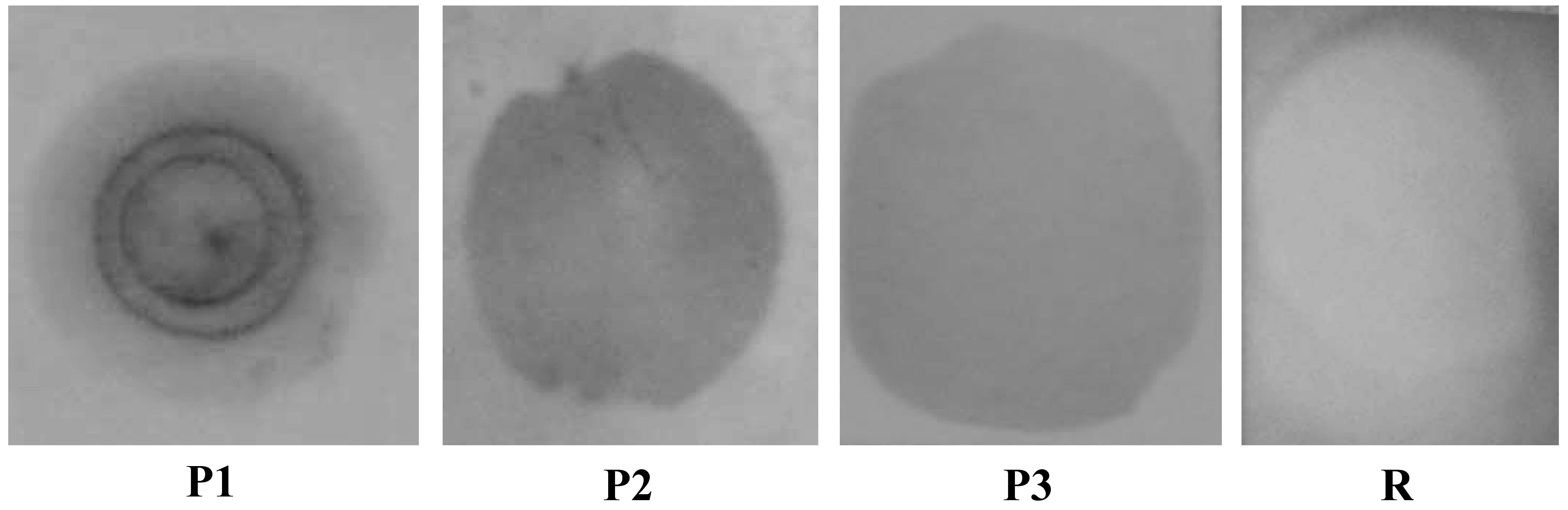
        <p>Hybridization experiments are first performed on nylon membranes in order to check hybridization of thiol- and biotin-labeled probes. These tests are performed with random probe (R), and <italic>Alexandrium Minutum</italic> probes P1, P2 (thiol-labeled) and P3 (biotin-labeled). Hybridization nylon membrane colorimetric tests with phosphatase-labeled complementary target (<underline>T1</underline>) are presented in <xref ref-type="fig" rid="biosensors-02-00245-f001">Figure 1</xref>.</p>
        <fig id="biosensors-02-00245-f001" position="anchor">
          <label>Figure 1</label>
          <caption>
            <p>Hybridization colorimetric test on nylon membranes of <italic>Alexandrium Minutum</italic> complementary probes P1 (non labeled), P2 (thiol-labeled), P3 (biotin-labeled) and non complementary DNA R (random) with <underline>T1</underline> complementary target (phosphatase-labeled).</p>
          </caption>
          <graphic xmlns:xlink="http://www.w3.org/1999/xlink" xlink:href="biosensors-02-00245-g001.tif"/>
        </fig>
        <p>The colorimetric test is positive for <italic>Alexandrium Minutum</italic> probes P1 (non labeled), P2 (thiol-labeled) and P3 (biotin-labeled) and negative for non complementary DNA R (random). These results indicate successful hybridization of thiol- and biotin-labeled probes.</p>
      </sec>
      <sec>
        <title>3.2. Biosensor Designed with Thiol-Labeled Probe</title>
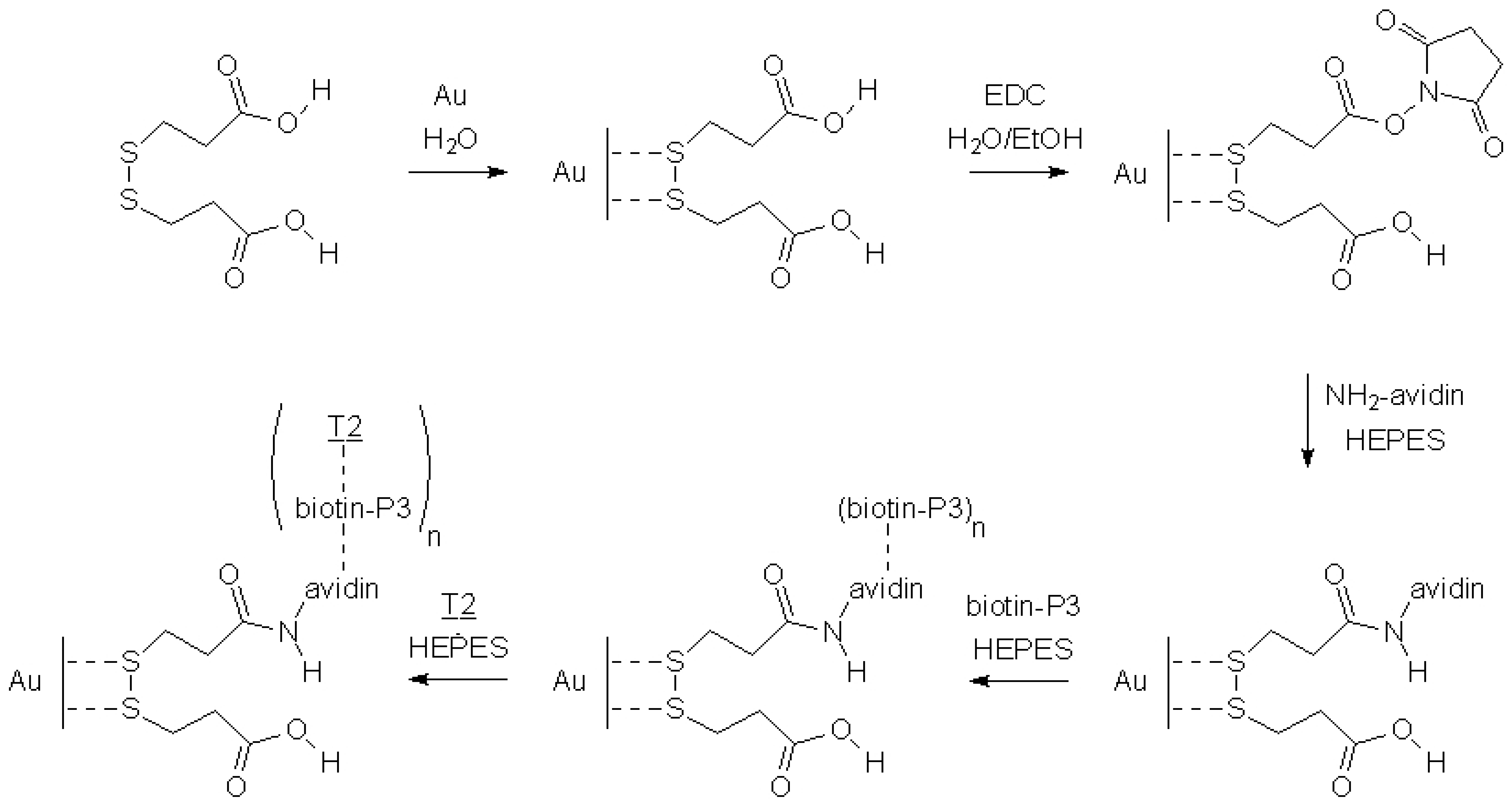
        <p>Formation of a self-assembled monolayer of thiol-labeled probe (P2) and hybridization recognition of the complementary target (<underline>T2</underline>) were performed on the gold covered face of a quartz resonator (<xref ref-type="fig" rid="biosensors-02-00245-f002">Figure 2</xref>).</p>
        <fig id="biosensors-02-00245-f002" position="anchor">
          <label>Figure 2</label>
          <caption>
            <p>Thiol-labeled probe (P2) grafting and complementary target (<underline>T2</underline>) hybridization.</p>
          </caption>
          <graphic xmlns:xlink="http://www.w3.org/1999/xlink" xlink:href="biosensors-02-00245-g002.tif"/>
        </fig>
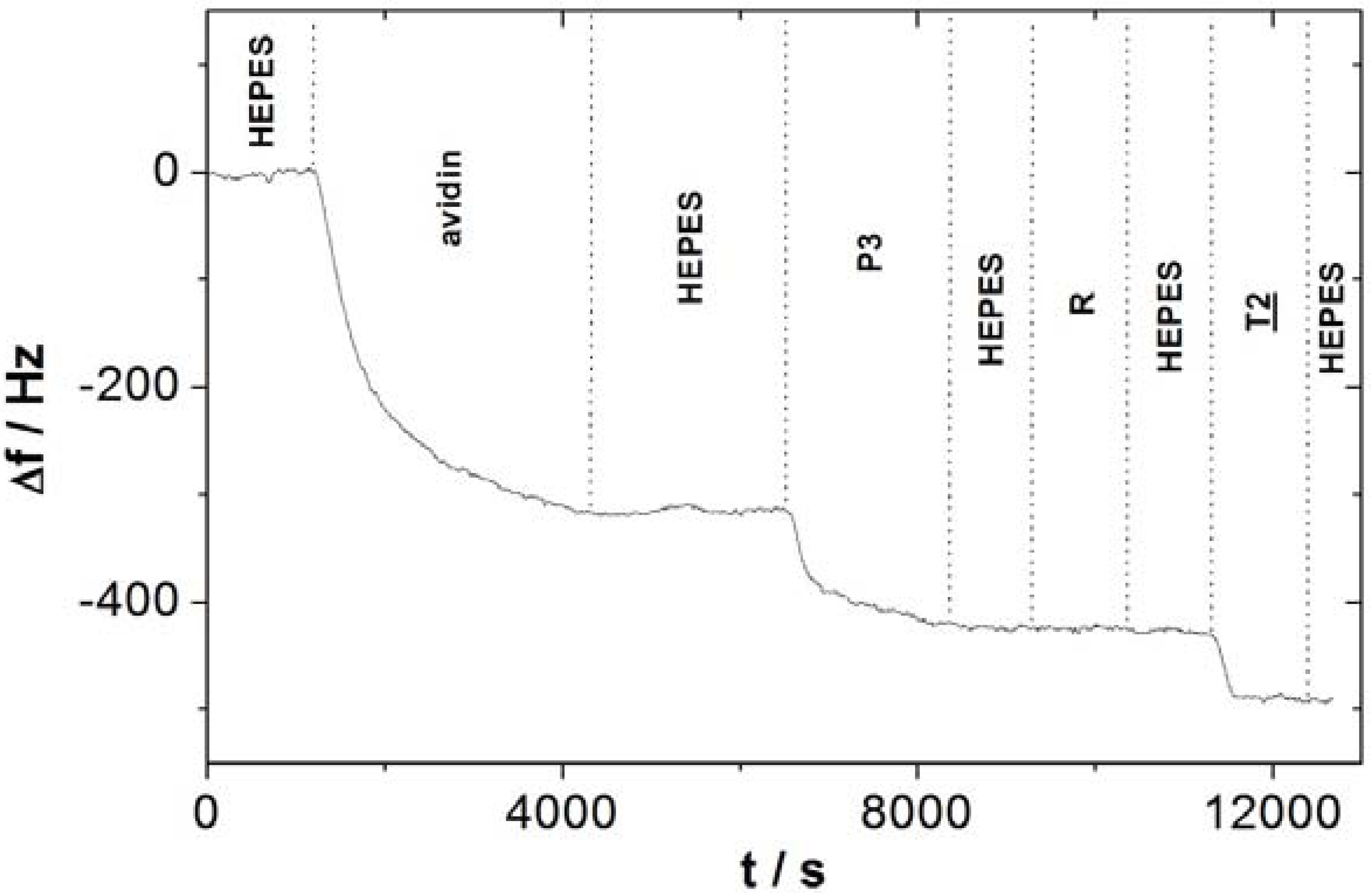
        <p>Frequency was monitored during the grafting and hybridization steps (<xref ref-type="fig" rid="biosensors-02-00245-f003">Figure 3</xref>).</p>
        <fig id="biosensors-02-00245-f003" position="anchor">
          <label>Figure 3</label>
          <caption>
            <p>Microbalance frequency kinetics curves of probe (P2) grafting and selective complementary target (<underline>T2</underline>) recognition.</p>
          </caption>
          <graphic xmlns:xlink="http://www.w3.org/1999/xlink" xlink:href="biosensors-02-00245-g003.tif"/>
        </fig>
        <p>The first step, probe grafting, was performed by flowing of a 20 µg/mL probe (P2) NaCl solution. The frequency change measured during probe grafting was −225 Hz. The probe P2 surface density Γ<sub>P1</sub> (probe/cm<sup>2</sup>) is:</p>
        <p>Γ<sub>P2</sub> = |Δf|∙s∙N<sub>A</sub>/S∙M<sub>P2</sub>       (1)</p>
        <p>Γ<sub>P2</sub> calculated is equal to 3.7 × 10<sup>13</sup> probe/cm<sup>2</sup>, taking into account experimental frequency change measured Δf (−180 Hz), QCM sensitivity s (350 pg/Hz), Avogadro constant N<sub>A</sub> (6.023 × 10<sup>23</sup> mol<sup>−1</sup>), QCM adsorption surface S (0.2 cm<sup>2</sup>) and probe molecular weight M<sub>P2</sub> (6,370 g/mol). Probe adsorption surface 1/Γ<sub>P2</sub> is equal to 2.7 nm<sup>2</sup> per probe. This value, higher than 2.2 nm<sup>2</sup> per probe reported for a similar sensor design [<xref ref-type="bibr" rid="B6-biosensors-02-00245">6</xref>], depends on adsorption surface roughness, as it was shown elsewhere [<xref ref-type="bibr" rid="B24-biosensors-02-00245">24</xref>]. The second step allows the selectivity to be checked: no frequency changes are measured during flowing of a 20 µg/mL random strand (R) HEPES solution, meaning that the there is no hybridization or non-specific adsorption of a non complementary strand. The last step, hybridization, was performed by flowing of a 20 µg/mL complementary target (<underline>T2</underline>) HEPES solution. The frequency change measured was −86 Hz. The hybridization efficiency η<sub><underline>T2</underline></sub> (%) of hybridized targets <underline>T2</underline> <italic>versus</italic> grafted probes P2 is:</p>
        <p>η<sub><underline>T2</underline></sub> = 100∙Δf<sub>T2</sub>∙M<sub>P2</sub>/Δf<sub>P2</sub>∙M<sub><underline>T2</underline></sub>        (2)</p>
        <p>η<sub><underline>T2</underline></sub> is equal to 40%, taking into account the molecular weights M of probe (P2) (6,370 g/mol) and target (<underline>T2</underline>) (6,055 g/mol), and frequency changes Δf during circulation of probe (P2) (−225 Hz) and target (<underline>T2</underline>) (−86 Hz) solutions. Four biosensors were designed on different quartz samples to check the reproducibility: probe surface density Γ<sub>P1</sub> is (3.7 ± 0.5) × 10<sup>13</sup> probe/cm<sup>2</sup>, hybridization ratio η<sub><underline>Τ2</underline></sub> 42 ± 2%, frequency change during complementary target hybridization Δf<sub><underline>T2</underline></sub> is 89 ± 13 Hz and half-time hybridization reaction 149 ± 6 s. The 42% hybridization ratio efficiency measured is close to 44% reported for a QCM DNA-biosensor designed by grafting a disulfide-labeled probe on a gold surface [<xref ref-type="bibr" rid="B25-biosensors-02-00245">25</xref>].</p>
      </sec>
      <sec>
        <title>3.3. Biosensor Designed with Biotin-Labeled Probe</title>
        <p>Grafting of biotin-labeled probe (P3) on the gold quartz surface and complementary target (<underline>T2</underline>) recognition is achieved in five steps (<xref ref-type="fig" rid="biosensors-02-00245-f004">Figure 4</xref>).</p>
        <fig id="biosensors-02-00245-f004" position="anchor">
          <label>Figure 4</label>
          <caption>
            <p>Avidin grafting, biotin-labeled probe (P3) grafting and target (<underline>T2</underline>) hybridization. n is the mean number of biotin per avidin (0 &lt; n &lt; 4).</p>
          </caption>
          <graphic xmlns:xlink="http://www.w3.org/1999/xlink" xlink:href="biosensors-02-00245-g004.tif"/>
        </fig>
        <fig id="biosensors-02-00245-f005" position="anchor">
          <label>Figure 5</label>
          <caption>
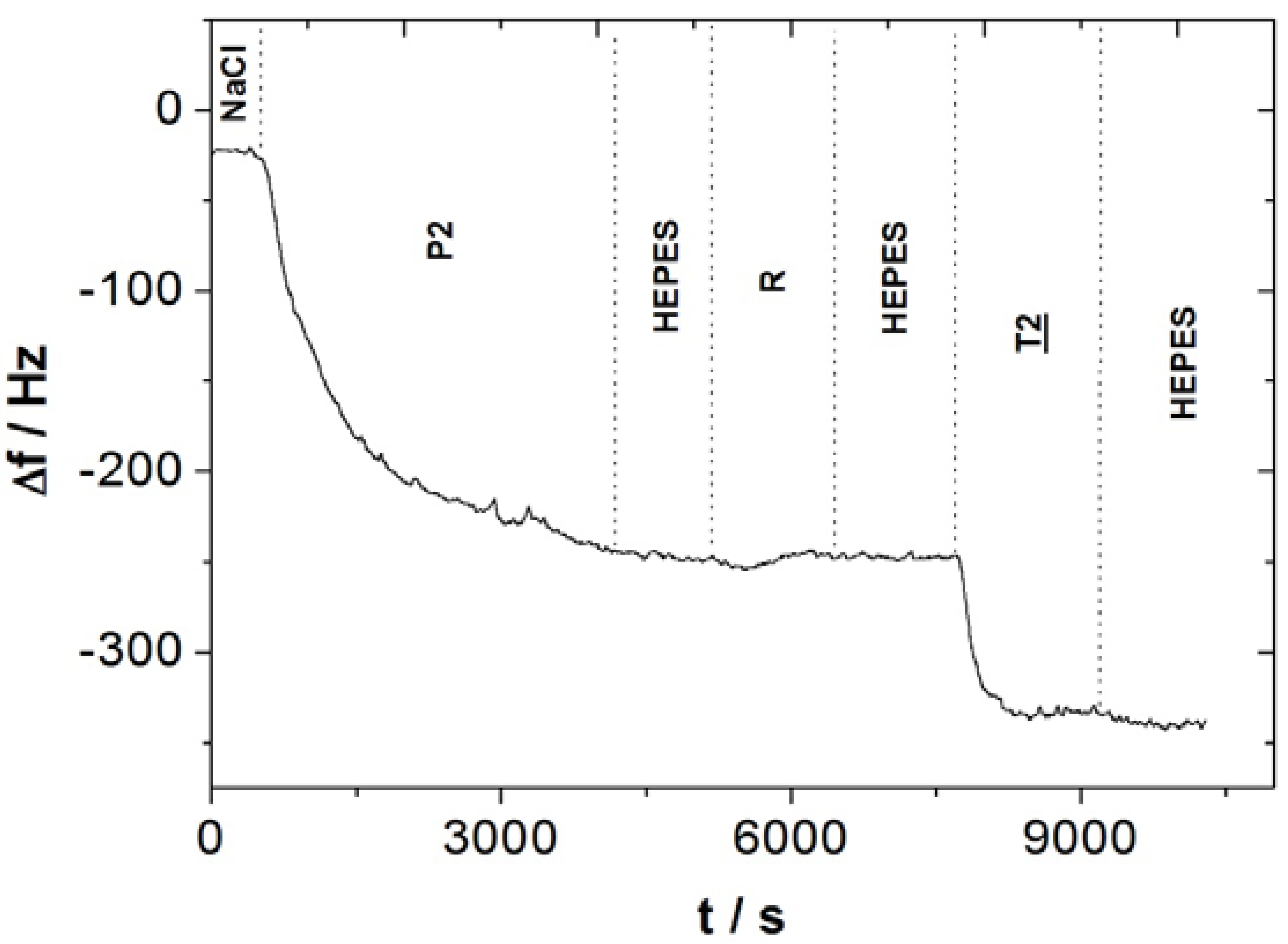
            <p>Microbalance frequency changes during avidin grafting, biotin-labeled probe (P3) grafting and selective complementary target (<underline>T2</underline>) recognition.</p>
          </caption>
          <graphic xmlns:xlink="http://www.w3.org/1999/xlink" xlink:href="biosensors-02-00245-g005.tif"/>
        </fig>
        <p>The frequency was not recorded during formation of the self-assembled dithiopropionic acid and EDC ester activation, due to the low molecular weight of these compounds, being too feeble for detection with a 27 MHz quartz crystal microbalance sensitivity. Frequency changes during avidin grafting, biotin-labeled probe (P3) grafting and complementary target (<underline>T2</underline>) recognition, are presented in <xref ref-type="fig" rid="biosensors-02-00245-f005">Figure 5</xref>.</p>
        <p>The first step, avidin grafting, was performed by circulating a 10 mg/mL avidin solution. The frequency change measured Δf<sub>avidin</sub> is −316 Hz. The avidin surface density Γ<sub>avidin</sub> (avidin/cm<sup>2</sup>) is equal to:</p>
        <p>Γ<sub>avidin</sub> = |Δf<sub>avidin</sub>|∙s∙N<sub>A</sub>/S∙M<sub>avidin</sub>       (3)</p>
        <p>Γ<sub>avidin</sub> calculated is equal to 4.9 × 10<sup>12</sup> avidin/cm<sup>2</sup>, taking into account frequency change Δf<sub>avidin</sub> measured (−316 Hz), QCM sensitivity s (350 pg/Hz), Avogadro constant N<sub>A</sub> (6.023 × 10<sup>23</sup> mol<sup>−1</sup>), QCM active surface S (0.2 cm<sup>2</sup>) and avidin molecular weight M<sub>avidin</sub> (68,000 g/mol). The grafting of the probe was performed by circulating a 20 µg/mL biotine-labeled probe (P1') NaCl solution. The frequency change measured during this step was −105 Hz. The mean value n of biotin-labeled probe (P3) complexes per grafted avidin on the surface is:</p>
        <p>n = Δf<sub>P3</sub>∙M<sub>avidin</sub>/Δf<sub>avidin</sub>∙M<sub>P3</sub>       (4)</p>
        <p>n is equal to 3.5 taking into account the molecular weight M of probe (P3) (6,472 g/mol), of avidin (68,000 g/mol), frequency changes Δf during circulation of probe (P3) (−105 Hz) and avidin (−316 Hz) solutions. This 3.5 mean value is close to the maximum number of biotin per avidin molecule in the bulk solution complex, which is equal to four. The difference could be explained by steric hindrance in the biolayer. The probe P3 surface density Γ<sub>P3</sub> (probe/cm<sup>2</sup>) is equal to:</p>
        <p>Γ<sub>P3</sub> = n∙Δ<sub>avidin</sub>       (5)</p>
        <p>Γ<sub>P3</sub> calculated is equal to 1.7 × 10<sup>13</sup> probe/cm<sup>2</sup>. The third step allows the selectivity to be checked. No frequency change was measured during flowing of a 20 µg/mL random strand (R) HEPES solution, meaning that the there is no hybridization or non-specific adsorption of a non complementary strand. The last step, hybridization, was performed by flowing of a 20 µg/mL complementary target (<underline>T2</underline>) HEPES solution. The frequency change   measured was −62 Hz. The hybridization ratio efficiency η    <sub><underline>T2</underline></sub> of hybridized targets <italic>versus</italic> grafted probes is:</p>
        <p>η<sub><underline>T2</underline></sub> = 100∙Δf<sub><underline>T2</underline></sub>∙M<sub>P3</sub>/Δf<sub>P3</sub>∙M<sub><underline>T2</underline></sub>       (6)</p>
        <p>η<sub><underline>T2</underline></sub> measured is equal to 63%, taking into account the molecular weight M of probe (P3) (6,472 g/mol) and target (<underline>T2</underline>) (6,055 g/mol), and frequency changes Δf during circulation of probe (P3) (−105 Hz) and target (<underline>T2</underline>) (−62 Hz) solutions. Three biosensors were designed on different quartz to check the reproducibility: number of biotin per avidin is 3.0 ± 0.6, hybridization ratio efficiency is 79 ± 15%, frequency change during hybridization step is −61 ± 8 Hz and half-time of biosensor hybridization reaction is 101 ± 16 s.</p>
      </sec>
      <sec>
        <title>3.4. Comparison of Biosensor Characteristics and Behaviors</title>
        <p>Characteristics and behaviors of biosensors designed with thiol and biotin labeled probes are presented in <xref ref-type="table" rid="biosensors-02-00245-t002">Table 2</xref>. Half-time t<sub>1/2</sub> hybridization was calculated by subtracting 25% hybridization time from 75% hybridization time:</p>
		<p>t<sub>1/2</sub> = t<sub>3/4</sub> − t<sub>1/4</sub>       (7)</p>
        <table-wrap id="biosensors-02-00245-t002" position="anchor">
          <object-id pub-id-type="pii">biosensors-02-00245-t002_Table 2</object-id>
          <label>Table 2</label>
          <caption>
            <p>Biosensor grafting and hybridization characteristics and behaviors: oligonucleotide label (5'); number n of biosensors designed; probe density Γ(probe∙cm<sup>−2</sup>) on the gold covered quartz surface; hybridization efficiency η(%); quartz frequency change Δf (Hz) during DNA target hybridization and half-time t<sub>1/2</sub>(s) of biosensor hybridization reaction.</p>
          </caption>
          <table>
            <thead>
              <tr>
                <th colspan="2" align="center" valign="middle">biosensor</th>
                <th align="center" valign="middle">grafting</th>
                <th colspan="3" align="center" valign="middle">hybridization</th>
              </tr>
              <tr>
                <th align="center" valign="middle">DNA label</th>
                <th align="center" valign="middle">n</th>
                <th align="center" valign="middle">Г/probe.cm<sup>−2</sup></th>
                <th align="center" valign="middle">η/%</th>
                <th align="center" valign="middle">|∆f|/Hz</th>
                <th align="center" valign="middle">t<sub>1/2</sub>/s</th>
              </tr>
            </thead>
            <tbody>
              <tr style="border-top:solid thin">
                <td align="center" valign="middle">thiol</td>
                <td align="center" valign="middle">4</td>
                <td align="center" valign="middle">(3.7 ± 0.5) × 10<sup>13</sup></td>
                <td align="center" valign="middle">42 ± 2</td>
                <td align="center" valign="middle">89 ± 13</td>
                <td align="center" valign="middle">149 ± 26</td>
              </tr>
              <tr>
                <td align="center" valign="middle">biotin</td>
                <td align="center" valign="middle">3</td>
                <td align="center" valign="middle">(1.4 ± 0.3) × 10<sup>13</sup></td>
                <td align="center" valign="middle">79 ± 15</td>
                <td align="center" valign="middle">61 ± 8</td>
                <td align="center" valign="middle">101 ± 16</td>
              </tr>
            </tbody>
         </table>
        </table-wrap>
		<p>Biotin-labeled probes more diluted on the surface are better accessible, in comparison with thiol-labeled ones, resulting in a faster and more efficient hybridization. DNA target concentrations of this study are equal to 20 µg/mL. It was recently shown that hybridization efficiency at room temperature is poorly dependent on DNA target concentration in the range from 100 pg/mL to 20 µg/mL [<xref ref-type="bibr" rid="B26-biosensors-02-00245">26</xref>]. The frequency change during hybridization, related to mass sensitivity, is higher in the case of the biosensor designed with a thiol probe, due to the higher probe surface density. These results are consistent with a recent study, on the design of QCM DNA biosensor with thiol- and biotin-labeled probes, for the diagnosis of a fish pathogenic virus: RNA recognition is more efficient with the biosensor designed with a biotin probe [<xref ref-type="bibr" rid="B18-biosensors-02-00245">18</xref>]. Regeneration of biosensors with an alkaline saline solution (NaOH 0.5 M, NaCl 3 M) was achieved <italic>in fine</italic>. There is a loss of 16% of hybridization efficiency for a second hybridization run in the case of the biosensors designed with the thiol-labeled probe and of 26% with the biotin-labeled ones. A biosensor designed with biotin-labeled probes is less resilient due do avidin denaturation in alkaline saline medium.</p>
      </sec>
    </sec>
    <sec sec-type="conclusions">
      <title>4. Conclusions</title>
      <p>Both thiol- and biotin-labeled probes can be used to design reproducible biosensors of the oligonucleotide target encoding for the large ribosomal RNA sub-unit of the microalga <italic>Alexandrium minutum</italic>, which is responsible for paralytic shellfish poisoning (PSP) on the European and Asian coasts. Kinetic quartz crystal microbalance frequency curves indicate that the thiol-based biosensor is more sensitive and resilient to denaturation and that the biotin-based one has a shorter time response and a higher hybridization efficiency.</p>
    </sec>
  </body>
  <back>
    <ack>
      <title>Acknowledgments</title>
      <p>We wish to thank Elisabeth Antoine and Audrey Defontaine for hybridization test on nylon membranes, and the French Ministry of Research for its financial support (ANR PRECODD HABSEACHEAP).</p>
    </ack>
    <ref-list>
      <title>References</title>
      <ref id="B1-biosensors-02-00245">
        <label>1.</label>
        <citation citation-type="book">
          <person-group person-group-type="author">
            <name>
              <surname>Ballantine</surname>
              <given-names>D.S.</given-names>
            </name>
            <name>
              <surname>White</surname>
              <given-names>R.M.</given-names>
            </name>
            <name>
              <surname>Martin</surname>
              <given-names>S.I.</given-names>
            </name>
            <name>
              <surname>Ricco</surname>
              <given-names>A.J.</given-names>
            </name>
            <name>
              <surname>Zellers</surname>
              <given-names>E.T.</given-names>
            </name>
            <name>
              <surname>Frye</surname>
              <given-names>G.C.</given-names>
            </name>
            <name>
              <surname>Wohltjen</surname>
              <given-names>H.</given-names>
            </name>
          </person-group>
          <article-title>Thickness-Shear Mode (TSM) resonator</article-title>
          <source>Acoustic Wave Sensors</source>
          <publisher-name>Academic Press</publisher-name>
          <publisher-loc>San Diego, CA, USA</publisher-loc>
          <year>1997</year>
          <volume>36</volume>
        </citation>
      </ref>
      <ref id="B2-biosensors-02-00245">
        <label>2.</label>
        <citation citation-type="journal">
          <person-group person-group-type="author">
            <name>
              <surname>Okahata</surname>
              <given-names>Y.</given-names>
            </name>
            <name>
              <surname>Matsunobu</surname>
              <given-names>Y.</given-names>
            </name>
            <name>
              <surname>Ijiro</surname>
              <given-names>K.</given-names>
            </name>
            <name>
              <surname>Mukae</surname>
              <given-names>M.</given-names>
            </name>
            <name>
              <surname>Murakami</surname>
              <given-names>A.</given-names>
            </name>
            <name>
              <surname>Makino</surname>
              <given-names>K.</given-names>
            </name>
          </person-group>
          <article-title>Hybridization of nucleic acids immobilized on a quartz-crystal microbalance</article-title>
          <source>J. Am. Chem. Soc.</source>
          <year>1992</year>
          <volume>114</volume>
          <fpage>8299</fpage>
          <lpage>8300</lpage>
        <pub-id pub-id-type="doi">10.1021/ja00047a056</pub-id></citation>
      </ref>
      <ref id="B3-biosensors-02-00245">
        <label>3.</label>
        <citation citation-type="journal">
          <person-group person-group-type="author">
            <name>
              <surname>Su</surname>
              <given-names>H.</given-names>
            </name>
            <name>
              <surname>Yang</surname>
              <given-names>M.</given-names>
            </name>
            <name>
              <surname>Kallury</surname>
              <given-names>K.M.R.</given-names>
            </name>
            <name>
              <surname>Thompson</surname>
              <given-names>M.</given-names>
            </name>
          </person-group>
          <article-title>Network analysis: acoustic energy transmission detection of polynucleotide hybridization at the sensor-liquid interface</article-title>
          <source>Analyst</source>
          <year>1993</year>
          <volume>118</volume>
          <fpage>309</fpage>
          <lpage>312</lpage>
          <pub-id pub-id-type="doi">10.1039/an9931800309</pub-id>
        </citation>
      </ref>
      <ref id="B4-biosensors-02-00245">
        <label>4.</label>
        <citation citation-type="journal">
          <person-group person-group-type="author">
            <name>
              <surname>Su</surname>
              <given-names>H.</given-names>
            </name>
            <name>
              <surname>Kallury</surname>
              <given-names>K.M.R.</given-names>
            </name>
            <name>
              <surname>Thompson</surname>
              <given-names>M.</given-names>
            </name>
          </person-group>
          <article-title>Interfacial nucleic acid hybridization studied by random primer 32P labeling and liquid-phase acoustic network analysis</article-title>
          <source>Anal. Chem.</source>
          <year>1994</year>
          <volume>66</volume>
          <fpage>769</fpage>
          <lpage>777</lpage>
        <pub-id pub-id-type="doi">10.1021/ac00078a002</pub-id></citation>
      </ref>
      <ref id="B5-biosensors-02-00245">
        <label>5.</label>
        <citation citation-type="journal">
          <person-group person-group-type="author">
            <name>
              <surname>Zhou</surname>
              <given-names>C.X.</given-names>
            </name>
            <name>
              <surname>Huang</surname>
              <given-names>L.Q.</given-names>
            </name>
            <name>
              <surname>Li</surname>
              <given-names>S.F.Y.</given-names>
            </name>
          </person-group>
          <article-title>Microgravimetric DNA sensor based on quartz crystal microbalance: Comparison of oligonucleotide immobilization methods and the application in genetic diagnosis</article-title>
          <source>Biosens. Bioelectron.</source>
          <year>2001</year>
          <volume>16</volume>
          <fpage>85</fpage>
          <lpage>95</lpage>
          <pub-id pub-id-type="doi">10.1016/S0956-5663(00)00136-6</pub-id>
        </citation>
      </ref>
      <ref id="B6-biosensors-02-00245">
        <label>6.</label>
        <citation citation-type="journal">
          <person-group person-group-type="author">
            <name>
              <surname>Willner</surname>
              <given-names>I.</given-names>
            </name>
            <name>
              <surname>Patolsky</surname>
              <given-names>F.</given-names>
            </name>
            <name>
              <surname>Weizmann</surname>
              <given-names>Y.</given-names>
            </name>
            <name>
              <surname>Willner</surname>
              <given-names>B.</given-names>
            </name>
          </person-group>
          <article-title>Amplified detection of single-base mismatches in DNA using microgravimetric quartz-crystal-microbalance transduction</article-title>
          <source>Talanta</source>
          <year>2002</year>
          <volume>56</volume>
          <fpage>847</fpage>
          <lpage>856</lpage>
          <pub-id pub-id-type="doi">10.1016/S0039-9140(01)00658-0</pub-id>
        </citation>
      </ref>
      <ref id="B7-biosensors-02-00245">
        <label>7.</label>
        <citation citation-type="journal">
          <person-group person-group-type="author">
            <name>
              <surname>Minunni</surname>
              <given-names>M.</given-names>
            </name>
            <name>
              <surname>Tombelli</surname>
              <given-names>S.</given-names>
            </name>
            <name>
              <surname>Scielzi</surname>
              <given-names>R.</given-names>
            </name>
            <name>
              <surname>Mannelli</surname>
              <given-names>I.</given-names>
            </name>
            <name>
              <surname>Mascini</surname>
              <given-names>M.</given-names>
            </name>
            <name>
              <surname>Gaudiano</surname>
              <given-names>C.</given-names>
            </name>
          </person-group>
          <article-title>Detection of β-thalassemia by a DNA piezoelectric biosensor coupled with polymerase chain reaction</article-title>
          <source>Anal. Chim. Acta</source>
          <year>2003</year>
          <volume>481</volume>
          <fpage>55</fpage>
          <lpage>64</lpage>
          <pub-id pub-id-type="doi">10.1016/S0003-2670(03)00065-5</pub-id>
        </citation>
      </ref>
      <ref id="B8-biosensors-02-00245">
        <label>8.</label>
        <citation citation-type="journal">
          <person-group person-group-type="author">
            <name>
              <surname>Mannelli</surname>
              <given-names>I.</given-names>
            </name>
            <name>
              <surname>Minunni</surname>
              <given-names>M.</given-names>
            </name>
            <name>
              <surname>Tombelli</surname>
              <given-names>S.</given-names>
            </name>
            <name>
              <surname>Mascini</surname>
              <given-names>M.</given-names>
            </name>
          </person-group>
          <article-title>(QCM) affinity biosensor for genetically modified organisms (GOMs) detection</article-title>
          <source>Biosens. Bioelectron.</source>
          <year>2003</year>
          <volume>18</volume>
          <fpage>129</fpage>
          <lpage>140</lpage>
          <pub-id pub-id-type="doi">10.1016/S0956-5663(02)00166-5</pub-id>
        </citation>
      </ref>
      <ref id="B9-biosensors-02-00245">
        <label>9.</label>
        <citation citation-type="journal">
          <person-group person-group-type="author">
            <name>
              <surname>Mo</surname>
              <given-names>X.T.</given-names>
            </name>
            <name>
              <surname>Zhou</surname>
              <given-names>Y.P.</given-names>
            </name>
            <name>
              <surname>Lei</surname>
              <given-names>H.</given-names>
            </name>
            <name>
              <surname>Deng</surname>
              <given-names>L.</given-names>
            </name>
          </person-group>
          <article-title>Microbalance-DNA probe method for the detection of specific bacteria in water</article-title>
          <source>Enzyme Microb. Tech.</source>
          <year>2002</year>
          <volume>30</volume>
          <fpage>583</fpage>
          <lpage>589</lpage>
          <pub-id pub-id-type="doi">10.1016/S0141-0229(01)00484-7</pub-id>
        </citation>
      </ref>
      <ref id="B10-biosensors-02-00245">
        <label>10.</label>
        <citation citation-type="journal">
          <person-group person-group-type="author">
            <name>
              <surname>Pope</surname>
              <given-names>L.H.</given-names>
            </name>
            <name>
              <surname>Allen</surname>
              <given-names>S.</given-names>
            </name>
            <name>
              <surname>Davies</surname>
              <given-names>M.C.</given-names>
            </name>
            <name>
              <surname>Roberts</surname>
              <given-names>C.J.</given-names>
            </name>
            <name>
              <surname>Tendler</surname>
              <given-names>S.J.B.</given-names>
            </name>
            <name>
              <surname>Williams</surname>
              <given-names>P.M.</given-names>
            </name>
          </person-group>
          <article-title>Probing DNA duplex formation and DNA-drug interactions by the quartz crystal microbalance technique</article-title>
          <source>Langmuir</source>
          <year>2001</year>
          <volume>17</volume>
          <fpage>8300</fpage>
          <lpage>8304</lpage>
        <pub-id pub-id-type="doi">10.1021/la0109821</pub-id></citation>
      </ref>
      <ref id="B11-biosensors-02-00245">
        <label>11.</label>
        <citation citation-type="journal">
          <person-group person-group-type="author">
            <name>
              <surname>Halim</surname>
              <given-names>Y.</given-names>
            </name>
          </person-group>
          <article-title><italic>Alexandrium minutum</italic>, n. gen. n. sp. Dinoflagellé provocant des “eaux rouges”</article-title>
          <source>Vie et Milieu</source>
          <year>1960</year>
          <volume>11</volume>
          <fpage>102</fpage>
          <lpage>105</lpage>
        </citation>
      </ref>
      <ref id="B12-biosensors-02-00245">
        <label>12.</label>
        <citation citation-type="journal">
          <person-group person-group-type="author">
            <name>
              <surname>Balech</surname>
              <given-names>E.</given-names>
            </name>
          </person-group>
          <article-title>Redescription of <italic>Alexandrium minutum</italic> Halim (Dinophyceae) type species of the genus <italic>Alexandrium</italic></article-title>
          <source>Phycologia</source>
          <year>1989</year>
          <volume>28</volume>
          <fpage>206</fpage>
          <lpage>211</lpage>
          <pub-id pub-id-type="doi">10.2216/i0031-8884-28-2-206.1</pub-id>
        </citation>
      </ref>
      <ref id="B13-biosensors-02-00245">
        <label>13.</label>
        <citation citation-type="journal">
          <person-group person-group-type="author">
            <name>
              <surname>Guillou</surname>
              <given-names>L.</given-names>
            </name>
            <name>
              <surname>Nezan</surname>
              <given-names>E.</given-names>
            </name>
            <name>
              <surname>Cueff</surname>
              <given-names>V.</given-names>
            </name>
            <name>
              <surname>Erard-Le Denn</surname>
              <given-names>E.</given-names>
            </name>
            <name>
              <surname>Cambon-Bonavita</surname>
              <given-names>M.A.</given-names>
            </name>
            <name>
              <surname>Gentien</surname>
              <given-names>P.</given-names>
            </name>
            <name>
              <surname>Barbier</surname>
              <given-names>G.</given-names>
            </name>
          </person-group>
          <article-title>Genetic diversity and molecular detection of three toxic dinoflagellate genera (Alexandrium, Dinophysis, and Karenia) from French coasts</article-title>
          <source>Protist</source>
          <year>2002</year>
          <volume>153</volume>
        </citation>
      </ref>
      <ref id="B14-biosensors-02-00245">
        <label>14.</label>
        <citation citation-type="journal">
          <person-group person-group-type="author">
            <name>
              <surname>Campàs</surname>
              <given-names>M.</given-names>
            </name>
            <name>
              <surname>Prieto-Simón</surname>
              <given-names>B.</given-names>
            </name>
            <name>
              <surname>Marty</surname>
              <given-names>J.-L.</given-names>
            </name>
          </person-group>
          <article-title>Biosensors to detect marine toxins: Assessing seafood safety</article-title>
          <source>Talanta</source>
          <year>2007</year>
          <volume>72</volume>
          <fpage>884</fpage>
          <lpage>895</lpage>
          <pub-id pub-id-type="doi">10.1016/j.talanta.2006.12.036</pub-id>
        </citation>
      </ref>
      <ref id="B15-biosensors-02-00245">
        <label>15.</label>
        <citation citation-type="confproc">
          <person-group person-group-type="author">
            <name>
              <surname>Nezan</surname>
              <given-names>E.</given-names>
            </name>
            <name>
              <surname>Belin</surname>
              <given-names>C.</given-names>
            </name>
            <name>
              <surname>Lassus</surname>
              <given-names>P.</given-names>
            </name>
            <name>
              <surname>Piclet</surname>
              <given-names>G.</given-names>
            </name>
            <name>
              <surname>Berthome</surname>
              <given-names>J.P.</given-names>
            </name>
          </person-group>
          <article-title><italic>Alexandrium minutum</italic>: First PSP species occurrence in France</article-title>
          <source>Proceedings of the Fourth International Conference on Toxic Marine Phytoplankton</source>
          <conf-loc>Lund, Sweden</conf-loc>
          <conf-date>26–30 June 1989</conf-date>
          <volume>111</volume>
        </citation>
      </ref>
      <ref id="B16-biosensors-02-00245">
        <label>16.</label>
        <citation citation-type="journal">
          <person-group person-group-type="author">
            <name>
              <surname>Chang</surname>
              <given-names>F.H.</given-names>
            </name>
            <name>
              <surname>Anderson</surname>
              <given-names>D.M.</given-names>
            </name>
            <name>
              <surname>Kulis</surname>
              <given-names>D.M.</given-names>
            </name>
            <name>
              <surname>Till</surname>
              <given-names>D.G.</given-names>
            </name>
          </person-group>
          <article-title>Toxin production of <italic>Alexandrium minutum</italic> (Dinophyceae) from the Bay of Plenty, New Zealand</article-title>
          <source>Toxicon</source>
          <year>1997</year>
          <volume>35</volume>
          <fpage>393</fpage>
          <lpage>409</lpage>
          <pub-id pub-id-type="doi">10.1016/S0041-0101(96)00168-7</pub-id>
        </citation>
      </ref>
      <ref id="B17-biosensors-02-00245">
        <label>17.</label>
        <citation citation-type="book">
          <person-group person-group-type="author">
            <name>
              <surname>Honsell</surname>
              <given-names>G.</given-names>
            </name>
          </person-group>
          <source>Toxic Phytoplankton Blooms in the Sea</source>
          <publisher-name>Elsevier</publisher-name>
          <publisher-loc>New York, NY, USA</publisher-loc>
          <year>1993</year>
          <fpage>127</fpage>
          <lpage>132</lpage>
        </citation>
      </ref>
      <ref id="B18-biosensors-02-00245">
        <label>18.</label>
        <citation citation-type="journal">
          <person-group person-group-type="author">
            <name>
              <surname>Hong</surname>
              <given-names>S.R.</given-names>
            </name>
            <name>
              <surname>Jeong</surname>
              <given-names>H.D.</given-names>
            </name>
            <name>
              <surname>Hong</surname>
              <given-names>S.</given-names>
            </name>
          </person-group>
          <article-title>QCM DNA biosensor for the diagnosis of a fish pathogenic virus VHSV</article-title>
          <source>Talanta</source>
          <year>2010</year>
          <volume>82</volume>
          <fpage>899</fpage>
          <lpage>903</lpage>
          <pub-id pub-id-type="doi">10.1016/j.talanta.2010.04.065</pub-id>
        </citation>
      </ref>
      <ref id="B19-biosensors-02-00245">
        <label>19.</label>
        <citation citation-type="journal">
          <person-group person-group-type="author">
            <name>
              <surname>Paleček</surname>
              <given-names>E. </given-names>
            </name>
          </person-group>
          <article-title>present and future of nucleic acids electrochemistry</article-title>
          <source>Talanta </source>
          <year>2002</year>
          <volume>56</volume>
          <fpage>809</fpage>
          <lpage>819</lpage>
          <pub-id pub-id-type="doi">10.1016/S0039-9140(01)00649-X</pub-id>
        </citation>
      </ref>
      <ref id="B20-biosensors-02-00245">
        <label>20.</label>
        <citation citation-type="journal">
          <person-group person-group-type="author">
            <name>
              <surname>Lucarelli</surname>
              <given-names>F.</given-names>
            </name>
            <name>
              <surname>Marrazza</surname>
              <given-names>G.</given-names>
            </name>
            <name>
              <surname>Turner</surname>
              <given-names>A.P.</given-names>
            </name>
            <name>
              <surname>Mascini</surname>
              <given-names>M.</given-names>
            </name>
          </person-group>
          <article-title>Carbon and gold electrodes as electrochemical transducers for DNA hybridisation sensors</article-title>
          <source>Biosens. Bioelectron.</source>
          <year>2004</year>
          <volume>19</volume>
          <fpage>515</fpage>
          <lpage>530</lpage>
          <pub-id pub-id-type="doi">10.1016/S0956-5663(03)00256-2</pub-id>
        </citation>
      </ref>
      <ref id="B21-biosensors-02-00245">
        <label>21.</label>
        <citation citation-type="journal">
          <person-group person-group-type="author">
            <name>
              <surname>Metfies</surname>
              <given-names>K.</given-names>
            </name>
            <name>
              <surname>Huljic</surname>
              <given-names>S.</given-names>
            </name>
            <name>
              <surname>Lange</surname>
              <given-names>M.</given-names>
            </name>
            <name>
              <surname>Medlin</surname>
              <given-names>L.K.</given-names>
            </name>
          </person-group>
          <article-title>Electrochemical detection of the toxic dinoflagellate Alexandrium ostenfeldii with a DNA-biosensor</article-title>
          <source>Biosens. Bioelectron.</source>
          <year>2005</year>
          <volume>20</volume>
          <fpage>1349</fpage>
          <lpage>1357</lpage>
          <pub-id pub-id-type="doi">10.1016/j.bios.2004.05.011</pub-id>
        </citation>
      </ref>
      <ref id="B22-biosensors-02-00245">
        <label>22.</label>
        <citation citation-type="patent">
          <person-group person-group-type="author">
            <name>
              <surname>Atsushi</surname>
              <given-names>A.</given-names>
            </name>
            <name>
              <surname>Akira</surname>
              <given-names>M.</given-names>
            </name>
          </person-group>
          <article-title>Production of Oligonucleotide Probe</article-title>
          <source>Japanese Patent </source>
          <patent>JP02040397</patent>
          <year>1990</year>
        </citation>
      </ref>
      <ref id="B23-biosensors-02-00245">
        <label>23.</label>
        <citation citation-type="book">
          <person-group person-group-type="author">
            <name>
              <surname>Sambrook</surname>
              <given-names>J.</given-names>
            </name>
            <name>
              <surname>Fritsch</surname>
              <given-names>E.F.</given-names>
            </name>
            <name>
              <surname>Maniatis</surname>
              <given-names>T.</given-names>
            </name>
          </person-group>
          <source>Molecular Cloning</source>
          <publisher-name>Cold Spring Harbor Laboratory Press</publisher-name>
          <publisher-loc>Cold Spring Harbor, NY, USA</publisher-loc>
          <year>1989</year>
        </citation>
      </ref>
      <ref id="B24-biosensors-02-00245">
        <label>24.</label>
        <citation citation-type="journal">
          <person-group person-group-type="author">
            <name>
              <surname>Hieda</surname>
              <given-names>M.</given-names>
            </name>
            <name>
              <surname>Garcia</surname>
              <given-names>R.</given-names>
            </name>
            <name>
              <surname>Dixon</surname>
              <given-names>M.</given-names>
            </name>
            <name>
              <surname>Daniel</surname>
              <given-names>T.</given-names>
            </name>
            <name>
              <surname>Allara</surname>
              <given-names>D.</given-names>
            </name>
            <name>
              <surname>Chan</surname>
              <given-names>M.H.W.</given-names>
            </name>
          </person-group>
          <article-title>Ultrasensitive quartz crystal microbalance with porous gold electrodes</article-title>
          <source>Appl. Phys. Lett.</source>
          <year>2004</year>
          <volume>84</volume>
          <fpage>628</fpage>
          <lpage>630</lpage>
        <pub-id pub-id-type="doi">10.1063/1.1643531</pub-id></citation>
      </ref>
      <ref id="B25-biosensors-02-00245">
        <label>25.</label>
        <citation citation-type="journal">
          <person-group person-group-type="author">
            <name>
              <surname>Lazerges</surname>
              <given-names>M.</given-names>
            </name>
            <name>
              <surname>Perrot</surname>
              <given-names>H.</given-names>
            </name>
            <name>
              <surname>Antoine</surname>
              <given-names>E.</given-names>
            </name>
            <name>
              <surname>Defontaine</surname>
              <given-names>A.</given-names>
            </name>
            <name>
              <surname>Compere</surname>
              <given-names>C.</given-names>
            </name>
          </person-group>
          <article-title>Oligonucleotide quartz crystal microbalance sensor for the microalgae <italic>Alexandrium minutum</italic> (Dinophyceae)</article-title>
          <source>Biosens. Bioelectron.</source>
          <year>2006</year>
          <volume>21</volume>
          <fpage>1355</fpage>
          <lpage>1358</lpage>
          <pub-id pub-id-type="doi">10.1016/j.bios.2005.05.013</pub-id>
        </citation>
      </ref>
      <ref id="B26-biosensors-02-00245">
        <label>26.</label>
        <citation citation-type="journal">
          <person-group person-group-type="author">
            <name>
              <surname>Lazerges</surname>
              <given-names>M.</given-names>
            </name>
            <name>
              <surname>Perrot</surname>
              <given-names>A</given-names>
            </name>
            <name>
              <surname>Rabehagasoa</surname>
              <given-names>N</given-names>
            </name>
            <name>
              <surname>Compère</surname>
              <given-names>C.</given-names>
            </name>
            <name>
              <surname>Dreanno</surname>
              <given-names>C.</given-names>
            </name>
            <name>
              <surname>Mucio</surname>
              <given-names>Pedroso</given-names>
              <suffix>M.</suffix>
            </name>
            <name>
              <surname> Faria</surname>
              <given-names>R.C.</given-names>
            </name>
            <name>
              <surname>Bueno</surname>
              <given-names>P.R.</given-names>
            </name>
          </person-group>
          <article-title>DNA hybridization mechanism in an interfacial environment: What hides beneath first order k(s−1) kinetic constant?</article-title>
          <source>Sens. Actuat. B</source>
          <year>2012</year>
          <pub-id pub-id-type="doi">10.1016/j.snb.2012.05.023.</pub-id>
        </citation>
      </ref>
    </ref-list>
  </back>
</article>