
<?xml version="1.0" encoding="UTF-8"?>
<!DOCTYPE article PUBLIC "-//NLM//DTD Journal Publishing DTD v2.3 20070202//EN" "journalpublishing.dtd">
<article xmlns:mml="http://www.w3.org/1998/Math/MathML" xmlns:xlink="http://www.w3.org/1999/xlink" xml:lang="en" article-type="review-article" dtd-version="2.3">
  <front>
    <journal-meta>
      <journal-id journal-id-type="publisher-id">microarrays</journal-id>
      <journal-title>Microarrays</journal-title>
      <abbrev-journal-title abbrev-type="publisher">Microarrays</abbrev-journal-title>
      <abbrev-journal-title abbrev-type="pubmed">Microarrays</abbrev-journal-title>
      <issn pub-type="epub">2076-3905</issn>
      <publisher>
        <publisher-name>MDPI</publisher-name>
      </publisher>
    </journal-meta>
    <article-meta>
      <article-id pub-id-type="doi">10.3390/microarrays5020009</article-id>
      <article-id pub-id-type="publisher-id">microarrays-05-00009</article-id>
      <article-categories>
        <subj-group>
          <subject>Review</subject>
        </subj-group>
      </article-categories>
      <title-group>
        <article-title>Microarray-Based Comparative Genomic and Transcriptome Analysis of <italic>Borrelia burgdorferi</italic></article-title>
      </title-group>
      <contrib-group>
        <contrib contrib-type="author">
          <name>
            <surname>Iyer</surname>
            <given-names>Radha</given-names>
          </name>
        </contrib>
        <contrib contrib-type="author">
          <name>
            <surname>Schwartz</surname>
            <given-names>Ira</given-names>
          </name>
          <xref rid="c1-microarrays-05-00009" ref-type="corresp">*</xref>
        </contrib>
        <contrib contrib-type="editor">
          <name>
            <surname>Loewy</surname>
            <given-names>Zvi</given-names>
          </name>
          <role>Academic Editor</role>
        </contrib>
      </contrib-group>
      <aff id="af1-microarrays-05-00009">Department of Microbiology and Immunology, New York Medical College, School of Medicine, Valhalla, NY 10595, USA; <email>radha_iyer@nymc.edu</email></aff>
      <author-notes>
        <corresp id="c1-microarrays-05-00009"><label>*</label>Correspondence: <email>schwartz@nymc.edu</email>; Tel.: +1-914-594-4658; Fax: +1-914-594-4176</corresp>
      </author-notes>
      <pub-date pub-type="epub">
        <day>16</day>
        <month>04</month>
        <year>2016</year>
      </pub-date>
      <pub-date pub-type="collection">        <month>06</month>
        <year>2016</year>
      </pub-date>
      <volume>5</volume>
      <issue>2</issue>
      <elocation-id>9</elocation-id>
      <history>
        <date date-type="received">
          <day>07</day>
          <month>03</month>
          <year>2016</year>
        </date>
        <date date-type="accepted">
          <day>11</day>
          <month>04</month>
          <year>2016</year>
        </date>
      </history>
      <permissions>
        <copyright-statement>&#xA9; 2016 by the authors; licensee MDPI, Basel, Switzerland.</copyright-statement>
        <copyright-year>2016</copyright-year>
        <license>
          <p>This article is an open access article distributed under the terms and conditions of the Creative Commons Attribution (CC-BY) license (http://creativecommons.org/licenses/by/4.0/).</p>
        </license>
      </permissions>
      <abstract>
        <p><italic>Borrelia burgdorferi</italic>, the spirochetal agent of Lyme disease, is maintained in nature in a cycle involving a tick vector and a mammalian host. Adaptation to the diverse conditions of temperature, pH, oxygen tension and nutrient availability in these two environments requires the precise orchestration of gene expression. Over 25 microarray analyses relating to <italic>B. burgdorferi</italic> genomics and transcriptomics have been published. The majority of these studies has explored the global transcriptome under a variety of conditions and has contributed substantially to the current understanding of <italic>B. burgdorferi</italic> transcriptional regulation. In this review, we present a summary of these studies with particular focus on those that helped define the roles of transcriptional regulators in modulating gene expression in the tick and mammalian milieus. By performing comparative analysis of results derived from the published microarray expression profiling studies, we identified composite gene lists comprising differentially expressed genes in these two environments. Further, we explored the overlap between the regulatory circuits that function during the tick and mammalian phases of the enzootic cycle. Taken together, the data indicate that there is interplay among the distinct signaling pathways that function in feeding ticks and during adaptation to growth in the mammal.</p>
      </abstract>
      <kwd-group>
        <kwd>microarray</kwd>
        <kwd><italic>Borrelia burgdorferi</italic></kwd>
        <kwd>transcriptome</kwd>
        <kwd>Lyme disease</kwd>
        <kwd>transcriptional regulators</kwd>
      </kwd-group>
    </article-meta>
  </front>
  <body>
    <sec id="sec1-microarrays-05-00009" sec-type="intro">
      <title>1. Introduction</title>
      <p>The spirochete <italic>Borrelia burgdorferi</italic> is the causative agent of Lyme disease, the most commonly reported arthropod-borne disease in the United States [<xref ref-type="bibr" rid="B1-microarrays-05-00009">1</xref>,<xref ref-type="bibr" rid="B2-microarrays-05-00009">2</xref>,<xref ref-type="bibr" rid="B3-microarrays-05-00009">3</xref>]. <italic>B. burgdorferi</italic> is maintained in a natural enzootic cycle involving small mammals and a tick vector of the <italic>Ixodes</italic> species [<xref ref-type="bibr" rid="B3-microarrays-05-00009">3</xref>,<xref ref-type="bibr" rid="B4-microarrays-05-00009">4</xref>]. These two diverse host environments vary with respect to temperature, pH, oxygen tension and nutrients [<xref ref-type="bibr" rid="B5-microarrays-05-00009">5</xref>]. In order to adapt to growth in its mammalian and tick hosts, the spirochete must profoundly alter its gene expression in response to these environmental cues. <italic>B. burgdorferi</italic> has a unique genome organization; the genome of strain B31 (the type strain) is comprised of a linear chromosome of 910,724 bp and 21 linear and circular plasmids totaling an additional 610,694 bp [<xref ref-type="bibr" rid="B6-microarrays-05-00009">6</xref>,<xref ref-type="bibr" rid="B7-microarrays-05-00009">7</xref>]. Elucidation of the complete genome sequence enabled production of whole genome arrays. Since 2002, more than 25 microarray-based studies on the comparative genomic structure and transcriptome of <italic>B. burgdorferi</italic> have been published. Here, we review the contribution of microarray technology to our understanding of <italic>B. burgdorferi</italic> biology with particular emphasis on the variation in gene expression under different environmental conditions.</p>
      <sec id="sec-microarrays-05-00009" sec-type="methods">
        <title>B. burgdorferi Microarray Methodology</title>
        <p>To date, all <italic>B. burgdorferi</italic> genome arrays have been designed based on the genome sequence of strain B31. Initially, whole genome arrays were constructed with PCR products of &gt;1600 putative <italic>B. burgdorferi</italic> open reading frames (ORFs) and were spotted on either glass slides or nylon membranes [<xref ref-type="bibr" rid="B8-microarrays-05-00009">8</xref>,<xref ref-type="bibr" rid="B9-microarrays-05-00009">9</xref>,<xref ref-type="bibr" rid="B10-microarrays-05-00009">10</xref>]. Subsequently, 70-mer oligonucleotides spotted on glass slides were employed in order to improve the reliability of hybridization signal intensity [<xref ref-type="bibr" rid="B11-microarrays-05-00009">11</xref>,<xref ref-type="bibr" rid="B12-microarrays-05-00009">12</xref>]. In addition, several groups have employed other custom glass slide or chip designs representing the complete genome or smaller sub-arrays of selected ORFs [<xref ref-type="bibr" rid="B13-microarrays-05-00009">13</xref>,<xref ref-type="bibr" rid="B14-microarrays-05-00009">14</xref>,<xref ref-type="bibr" rid="B15-microarrays-05-00009">15</xref>]. <xref ref-type="table" rid="microarrays-05-00009-t001">Table 1</xref> contains a listing of all published <italic>B. burgdorferi</italic> microarray studies and provides the array types employed.</p>
        <p>In general, the steps for studying global gene expression changes in the <italic>B. burgdorferi</italic> transcriptome are as follows: RNA isolation, generation of labeled cDNA, array hybridization and scanning, data acquisition and analysis. In initial studies with nylon membrane arrays, cDNA was radioactively labeled with <sup>33</sup>P; a detailed protocol is described in Ojaimi <italic>et al.</italic> [<xref ref-type="bibr" rid="B9-microarrays-05-00009">9</xref>]. Subsequently, a variety of high density microarray designs were developed and used fluorescently labeled DNA or cDNA for hybridization. Data acquisition, normalization and statistical analysis were particular to each type of microarray employed and details can be found in the respective references in <xref ref-type="table" rid="microarrays-05-00009-t001">Table 1</xref>. All published microarray data were deposited either in Array Express or NCBI&#x2019;s Gene Expression Omnibus (GEO) databases. In addition, the results of virtually all published microarray studies reported to date have been validated by quantitative reverse transcription polymerase chain reaction (qRT-PCR).</p>
      </sec>
    </sec>
    <sec id="sec2-microarrays-05-00009">
      <title>2. Comparative Genomic Studies</title>
      <p>Liang <italic>et al.</italic> [<xref ref-type="bibr" rid="B13-microarrays-05-00009">13</xref>], constructed a sub-array comprised of PCR products for 137 putative lipoproteins in order to study lipoprotein gene content across three <italic>B. burgdorferi</italic> sensu lato genospecies that cause Lyme disease in humans. There was extensive conservation of chromosomally-encoded lipoprotein gene content among all strains tested. By contrast, lipoproteins encoded on the plasmid portion of the genome were substantially less conserved [<xref ref-type="bibr" rid="B13-microarrays-05-00009">13</xref>]. This pattern was confirmed by Terekhova <italic>et al.</italic> [<xref ref-type="bibr" rid="B11-microarrays-05-00009">11</xref>], who employed whole genome microarrays to perform comparative genome hybridization of seventeen <italic>B. burgdorferi</italic> isolates, including clinical isolates with varying capacity for hematogenous dissemination in mice or humans. This revealed that chromosomal genes are more highly conserved among the isolates than are plasmid genes. The linear chromosome and plasmids lp54 and cp26 are the most conserved genomic elements among all isolates studied, which implies that they may encode functions required for bacterial viability. The most substantial variation was found among the linear plasmid portion of the genome; this variability was the result of presence/absence of entire plasmids, deletions or nucleotide sequence divergence.</p>
      <p>Zhong and Barbour [<xref ref-type="bibr" rid="B16-microarrays-05-00009">16</xref>] used <italic>B. burgdorferi</italic> whole genome membrane arrays to study the similarity in gene content between <italic>B. burgdorferi</italic> and <italic>B. hermsii</italic>, a relapsing fever spirochete. They demonstrated that <italic>B. hermsii</italic> genomic DNA cross-hybridized with 81% of <italic>B. burgdorferi</italic> chromosomal genes and 46% of plasmid ORFs. They were also able to demonstrate the expression of 642 genes with similarity to <italic>B. burgdorferi</italic> ORFs in the blood of <italic>B. hermsii</italic>-infected mice [<xref ref-type="bibr" rid="B16-microarrays-05-00009">16</xref>].</p>
      <p>Taken together, these microarray studies demonstrated that there is relatively little variation in the chromosomal portion of the <italic>B. burgdorferi</italic> genome, but much greater variation in plasmid content and sequence. Genomic sequencing of multiple <italic>B. burgdorferi</italic> isolates subsequently validated these findings [<xref ref-type="bibr" rid="B34-microarrays-05-00009">34</xref>,<xref ref-type="bibr" rid="B35-microarrays-05-00009">35</xref>,<xref ref-type="bibr" rid="B36-microarrays-05-00009">36</xref>].</p>
    </sec>
    <sec id="sec3-microarrays-05-00009">
      <title>3. Global Transcriptome Studies</title>
      <p>The principal application of microarray technology to <italic>B. burgdorferi</italic> has been for global transcriptome analysis. These studies have informed our understanding of regulation of <italic>B. burgdorferi</italic> gene expression under different environmental conditions and, most importantly, elucidation of the roles for several transcriptional regulators in this process. As noted, in nature <italic>B. burgdorferi</italic> cycle through two distinct environments&#x2014;tick vector and mammalian host. The limited number of organisms present in infected ticks or mammals constrains robust global transcriptome analysis from <italic>in vivo</italic> material. Initial transcriptome studies employed <italic>in vitro</italic> cultivation of <italic>B. burgdorferi</italic> in BSK medium under conditions thought to mimic either the tick or mammalian environments as surrogates for the <italic>in vivo</italic> state. Although subsequent studies demonstrated that global transcriptome analyses of <italic>in vitro</italic>-cultivated organisms do not fully reflect the <italic>in vivo</italic> state [<xref ref-type="bibr" rid="B12-microarrays-05-00009">12</xref>], these initial studies provided valuable insights into <italic>B. burgdorferi</italic> gene regulation.</p>
      <sec id="sec3dot1-microarrays-05-00009">
        <title>3.1. Response to Temperature</title>
        <p>To identify temperature-responsive genes, Ojaimi <italic>et al.</italic> [<xref ref-type="bibr" rid="B10-microarrays-05-00009">10</xref>] compared gene expression of <italic>B. burgdorferi</italic> cells grown at 23 or 35 &#xB0;C (to mimic the tick or mammalian environment, respectively). 215 genes were differentially expressed at the two temperatures; with 133 showing greater expression at 35 &#xB0;C relative to 23 &#xB0;C. Interestingly, 136/215 (63%) temperature-responsive genes were encoded on plasmids. Of particular note, are linear plasmid lp54 and the circular cp32 plasmids; 45% of the putative ORFs encoded on lp54 exhibited temperature-regulated expression and &gt;20% of cp32-encoded ORFs responded to temperature shift. Transcripts known to have elevated levels during mammalian infection (e.g., those for outer surface protein C (OspC), decorin binding proteins A/B (DbpAB) and the alternative sigma factor RpoS) displayed elevated expression at 35 &#xB0;C. Similarly, genes subsequently shown to be more highly expressed during the tick phase (glycerol uptake and utilization operon (<italic>glp</italic>FKD) and <italic>chb</italic>C, encoding a component of the chitobiose transporter) had significantly elevated transcript levels at 23 &#xB0;C [<xref ref-type="bibr" rid="B10-microarrays-05-00009">10</xref>].</p>
        <p>Revel <italic>et al.</italic> [<xref ref-type="bibr" rid="B8-microarrays-05-00009">8</xref>] carried out a similar analysis, but also varied the pH of the growth medium so as to mimic the environment in the unfed tick (23 &#xB0;C/pH 7.5) and fed tick states (37 &#xB0;C/pH 6.8). A total of 94 genes were differentially expressed between the two temperatures; 79 had higher expression at 37 &#xB0;C. Among transcripts elevated at the higher temperature were those for OspC and DbpA/B, as expected. In addition, transcripts for chemotaxis and motility functions and the OppA components of the oligopeptide ABC transporter were also elevated under the &#x201C;fed tick&#x201D; condition. Fifteen transcripts encoded on lp54 were differentially expressed, consistent with the findings of Ojaimi <italic>et al.</italic> [<xref ref-type="bibr" rid="B10-microarrays-05-00009">10</xref>]. Interestingly, there was only limited concordance between the Ojaimi and Revel data sets. This is likely the result of methodological differences between the two studies, including different array types (membrane array <italic>vs.</italic> glass slide microarray), pH of the BSK growth medium, slightly different temperatures (35 &#xB0;C <italic>vs.</italic> 37 &#xB0;C) and differences in the data analysis approaches.</p>
      </sec>
      <sec id="sec3dot2-microarrays-05-00009">
        <title>3.2. Transcriptome of B. burgdorferi in the Host-Adapted State</title>
        <p>The paucibacillary nature of <italic>B. burgdorferi</italic> infection in mammals led Akins <italic>et al.</italic> [<xref ref-type="bibr" rid="B37-microarrays-05-00009">37</xref>] to develop an alternative approach for isolating spirochetes in the host-adapted state. The method involves cultivating <italic>B. burgdorferi</italic> in BSK medium contained within dialysis membrane chambers (DMCs) implanted in a rat peritoneal cavity [<xref ref-type="bibr" rid="B37-microarrays-05-00009">37</xref>]. Numerous studies have demonstrated that gene expression of <italic>B. burgdorferi</italic> cultivated in DMCs is markedly different from that observed for spirochetes cultivated <italic>in vitro</italic> in the same medium at 37 &#xB0;C [<xref ref-type="bibr" rid="B38-microarrays-05-00009">38</xref>,<xref ref-type="bibr" rid="B39-microarrays-05-00009">39</xref>,<xref ref-type="bibr" rid="B40-microarrays-05-00009">40</xref>]. Three microarray studies have been published in which transcriptome comparisons between <italic>B. burgdorferi</italic> cultivated <italic>in vitro</italic> at 37 &#xB0;C and in DMCs were reported. In Revel <italic>et al.</italic> [<xref ref-type="bibr" rid="B8-microarrays-05-00009">8</xref>], 66 genes showed altered expression between these two conditions; only 6/66 exhibited higher expression in DMCs. Surprisingly, expression of some recognized mammalian phase genes such as <italic>ospC</italic> and <italic>dbpA/B</italic> was not induced. In a subsequent study by Brooks <italic>et al.</italic> [<xref ref-type="bibr" rid="B18-microarrays-05-00009">18</xref>], a total of 125 transcripts were differentially expressed between <italic>B. burgdorferi</italic> cultivated at 37 &#xB0;C <italic>in vitro</italic> and DMCs&#x2014;58 transcripts were induced (including <italic>ospC</italic>) and 67 were repressed. Among the latter, only three were chromosomally-encoded and the vast majority encode putative proteins of unknown function [<xref ref-type="bibr" rid="B18-microarrays-05-00009">18</xref>]. Interestingly, there was less than 10% overlap between the Revel and Brooks&#x2019; datasets, likely the result of methodological differences between the two studies. Caimano <italic>et al.</italic> [<xref ref-type="bibr" rid="B12-microarrays-05-00009">12</xref>], also performed whole transcriptome analysis of <italic>B. burgdorferi</italic> grown at 37 &#xB0;C and in DMCs. Their study was designed to identify the regulon controlled by RpoS and a direct comparison of wild-type <italic>B. burgdorferi</italic> at the two conditions was not provided. However, the results clearly demonstrate that gene expression differs substantially between <italic>in vitro</italic>- and DMC-cultivated organisms. Taken together, these findings demonstrate that temperature alone does not elicit the distinctive mammalian host modulation of <italic>B. burgdorferi</italic> gene expression, but in addition requires mammalian host-specific signals.</p>
        <p>As an alternative to DMC cultivation, Tokarz <italic>et al.</italic> [<xref ref-type="bibr" rid="B19-microarrays-05-00009">19</xref>], examined the combined effect of temperature and blood so as to simulate the environmental changes <italic>B. burgdorferi</italic> encounter as they transit from tick vector to a mammalian host. Spirochetes were incubated in the presence or absence of 6% human blood for 48 h and transcriptomes were compared. A total of 154 transcripts were differentially expressed in the presence of blood (75 induced and 79 repressed relative to no addition of blood); greater than two-thirds of the regulated transcripts are plasmid-encoded. Among the induced transcripts were those for OspC and DbpA, as expected, transcripts encoding for chemotaxis and motility functions and for two transcriptional regulators, RpoS and BosR.</p>
        <p>Given the induction of RpoS by incubation with human blood, it was of interest to compare the list of differentially expressed genes during blood co-incubation to that of RpoS-regulated genes [<xref ref-type="bibr" rid="B12-microarrays-05-00009">12</xref>]. Thirty-nine genes were found in common; 36/39 are activated by RpoS during <italic>in vitro</italic> cultivation at 37 &#xB0;C and during co-incubation with blood. Further, 40 genes that were differentially expressed in the presence of human blood were also RpoS-regulated during growth in DMCs (28 induced, 12 repressed). This analysis indicates that RpoS is induced during the nymphal blood meal and controls a regulon required for tick-to-mammal transmission and during mammalian infection and is supported by additional microarray studies discussed below.</p>
        <p>Livengood <italic>et al.</italic> [<xref ref-type="bibr" rid="B14-microarrays-05-00009">14</xref>], performed global transcriptome analysis of <italic>B. burgdorferi</italic> following a 20-h incubation with human neuroglial cells. A total of 72 <italic>B. burgdorferi</italic> transcripts were differentially expressed in the neuroglial cells relative to <italic>in vitro</italic>-cultivated spirochetes; the levels of 58 were induced and 14 were repressed. 63/72 differentially expressed genes are located on either the chromosome or plasmid lp54. Numerous genes involved in motility/chemotaxis were induced in neuroglial cells, as was <italic>ospC</italic>. Among the transcripts with decreased expression was <italic>glpK</italic>, which has been shown in other studies to be repressed in the mammalian environment [<xref ref-type="bibr" rid="B41-microarrays-05-00009">41</xref>,<xref ref-type="bibr" rid="B33-microarrays-05-00009">33</xref>].</p>
      </sec>
      <sec id="sec3dot3-microarrays-05-00009">
        <title>3.3. Transcriptome of B. burgdorferi in the Tick Vector</title>
        <p>Iyer <italic>et al.</italic> [<xref ref-type="bibr" rid="B33-microarrays-05-00009">33</xref>], characterized and compared the transcriptional profiles of <italic>B. burgdorferi</italic> during acquisition (fed larvae), transmission (fed nymphs) and in a mammalian host-like environment (DMCs). This analysis required the introduction of a pre-amplification step prior to array hybridization in order to enrich for <italic>B. burgdorferi</italic> RNA [<xref ref-type="bibr" rid="B33-microarrays-05-00009">33</xref>]. A core transcriptome consisting of 397 genes was expressed under all experimental conditions and is likely required for spirochetal survival in nature. The three <italic>in vivo</italic> transcriptomes differ substantially among each other, as well as to that obtained from organisms cultivated <italic>in vitro</italic> at 37 &#xB0;C indicating that spirochetes respond to a variety of host-specific signals. Among the key findings were the differential expression of genes encoding lipoproteins, transporters and enzymes in several metabolic pathways including the oxidative branch of the pentose phosphate pathway, glycerophospholipid biosynthesis and isoprenoid biosynthesis. Alterations in gene expression for chemotaxis/motility proteins were also noted suggesting that the chemotaxis/motility apparatus may vary in the tick and mammalian environments. This was the first report describing <italic>B. burgdorferi</italic> global gene expression profiles from <italic>in vivo</italic> samples containing limited copies of pathogen. The findings provide the necessary transcriptional framework for delineating <italic>B. burgdorferi</italic> regulatory pathways that operate throughout the enzootic cycle.</p>
      </sec>
    </sec>
    <sec id="sec4-microarrays-05-00009">
      <title>4. Transcriptional Regulation</title>
      <p>As already noted, <italic>B. burgdorferi</italic> must alter its gene expression program in order to adapt to growth in either the tick or mammalian environments. This adaptation is mediated by several transcriptional regulators including RpoS, Rrp1, BosR and Rel<sub>Bbu</sub> [<xref ref-type="bibr" rid="B4-microarrays-05-00009">4</xref>,<xref ref-type="bibr" rid="B5-microarrays-05-00009">5</xref>]. RpoS, an alternative sigma factor, controls a regulon whose members are important for transmission of <italic>B. burgdorferi</italic> from tick vector to mammalian host and/or during mammalian infection. Expression of RpoS is controlled by a signaling cascade involving Rrp2, a response regulator, and RpoN, a second alternative sigma factor [<xref ref-type="bibr" rid="B4-microarrays-05-00009">4</xref>,<xref ref-type="bibr" rid="B5-microarrays-05-00009">5</xref>]. Another signaling pathway comprised of Hk1 and Rrp1 promotes the synthesis of cyclic di-GMP and expression of c-di-GMP-dependent genes; evidence indicates that genes comprising this regulon are required for spirochetal survival in ticks [<xref ref-type="bibr" rid="B27-microarrays-05-00009">27</xref>,<xref ref-type="bibr" rid="B42-microarrays-05-00009">42</xref>]. In addition, BosR and Rel<sub>Bbu</sub> have been shown to control expression of substantial numbers of genes [<xref ref-type="bibr" rid="B22-microarrays-05-00009">22</xref>,<xref ref-type="bibr" rid="B28-microarrays-05-00009">28</xref>,<xref ref-type="bibr" rid="B43-microarrays-05-00009">43</xref>].</p>
      <p>Microarray analyses have informed much of our current understanding of transcriptional regulation in <italic>B. burgdorferi</italic>. Comparative transcriptome studies employing regulatory mutants have been particularly helpful in defining the regulons controlled by various transcriptional regulators. In this section, we review these studies and also provide a secondary analysis by merging the statistically significant gene lists from the processed data reported in comparisons of wild type and mutant transcriptomes for components of the Rrp2-RpoN-RpoS and Hk1-Rrp1 regulatory cascades. In addition, we also included transcriptome data for BosR in these analyses.</p>
      <sec id="sec4dot1-microarrays-05-00009">
        <title>4.1. Rrp2-RpoN-RpoS Regulatory Cascade</title>
        <p>Caimano <italic>et al.</italic> [<xref ref-type="bibr" rid="B12-microarrays-05-00009">12</xref>], performed a comparative microarray analysis of <italic>B. burgdorferi</italic> strain 297 wild-type and an <italic>rpoS</italic> mutant cultivated either <italic>in vitro</italic> following temperature-shift to 37 &#xB0;C or within DMCs. The expression of 110 genes was affected by the absence of RpoS during <italic>in vitro</italic> growth; all had higher expression in the wild type strain implying that their transcription is at least partially dependent on RpoS. No transcripts were found to be significantly repressed. 137 genes had altered expression in spirochetes cultivated under mammalian host-like conditions (<italic>i.e.</italic>, in DMCs); 103 transcripts had significantly elevated levels in wild type relative to the RpoS mutant and 44 of these were also higher <italic>in vitro</italic>. Importantly, in contrast to <italic>in vitro</italic>-grown spirochetes, 34 genes had higher expression in mutant <italic>B. burgdorferi</italic> cultivated in DMCs demonstrating that host-specific signals are required for RpoS-dependent repression. Significantly, a number of genes in this group (<italic>ospA</italic>, <italic>bba62</italic>, <italic>glp</italic> operon) have been shown to have higher transcript levels in ticks [<xref ref-type="bibr" rid="B40-microarrays-05-00009">40</xref>,<xref ref-type="bibr" rid="B33-microarrays-05-00009">33</xref>].</p>
        <p>Norgard and co-workers generated individual mutants in <italic>rrp2</italic>, <italic>rpoN</italic> and <italic>rpoS</italic> in a strain 297 background and compared gene expression between wild-type and mutant strains <italic>in vitro</italic> [<xref ref-type="bibr" rid="B24-microarrays-05-00009">24</xref>]. They identified 98 genes that were regulated in common by either Rrp2, RpoN or RpoS; 97 exhibited higher expression in wild type and only one (<italic>bba62</italic>) had lower expression. The substantial overlap between genes regulated by RpoS and RpoN provides evidence that the two alternative sigma factors form a congruous pathway and that RpoN regulates <italic>B. burgdorferi</italic> gene expression through RpoS [<xref ref-type="bibr" rid="B44-microarrays-05-00009">44</xref>,<xref ref-type="bibr" rid="B45-microarrays-05-00009">45</xref>]. Importantly, two-thirds (68/98) of the genes were similarly regulated by RpoS in the study by Caimano <italic>et al.</italic> [<xref ref-type="bibr" rid="B12-microarrays-05-00009">12</xref>]. It is noteworthy that transcription of an additional 106 genes was affected in the <italic>rrp2</italic> mutant. This implies that Rrp2 controls expression of a regulon unrelated to the RpoS response.</p>
        <p>Two additional publications reported on the RpoS, RpoN and Rrp2 regulons. Boardman <italic>et al.</italic> [<xref ref-type="bibr" rid="B23-microarrays-05-00009">23</xref>] generated an <italic>rrp2</italic> mutant in an infectious strain B31 background. They observed 144 genes with altered expression in the mutant. Due to strain variation, the overlap among the two Rrp2 gene sets was only 42%. Fisher <italic>et al.</italic> [<xref ref-type="bibr" rid="B25-microarrays-05-00009">25</xref>], studied the RpoS and RpoN regulons using mutants in each of these alternative sigma factors. Curiously, there is &lt;20% concordance between these datasets and those of Caimano <italic>et al.</italic> [<xref ref-type="bibr" rid="B12-microarrays-05-00009">12</xref>], Ouyang <italic>et al.</italic> [<xref ref-type="bibr" rid="B24-microarrays-05-00009">24</xref>] and Boardman <italic>et al.</italic> [<xref ref-type="bibr" rid="B23-microarrays-05-00009">23</xref>] probably the result of methodological differences.</p>
        <p>To generate a composite picture of the Rrp2-RpoN-RpoS regulatory circuit, we merged the datasets from Caimano <italic>et al.</italic> [<xref ref-type="bibr" rid="B12-microarrays-05-00009">12</xref>], Ouyang <italic>et al.</italic> [<xref ref-type="bibr" rid="B24-microarrays-05-00009">24</xref>], and Boardman <italic>et al.</italic> [<xref ref-type="bibr" rid="B23-microarrays-05-00009">23</xref>]. The composite gene list contained 395 genes. This gene set (referred as rrp2-RpoN-RpoS) is provided in <xref ref-type="app" rid="app1-microarrays-05-00009">Table S1</xref> and was used for further analysis as described below.</p>
      </sec>
      <sec id="sec4dot2-microarrays-05-00009">
        <title>4.2. Borrelia Oxidative Stress Regulator (BosR)</title>
        <p>Borrelia oxidative stress regulator (BosR; BB0647) was initially thought to mediate the oxidative stress response in <italic>B. burgdorferi</italic> [<xref ref-type="bibr" rid="B46-microarrays-05-00009">46</xref>,<xref ref-type="bibr" rid="B47-microarrays-05-00009">47</xref>]. Subsequently, it was shown to be required for transcription of RpoS [<xref ref-type="bibr" rid="B22-microarrays-05-00009">22</xref>,<xref ref-type="bibr" rid="B48-microarrays-05-00009">48</xref>,<xref ref-type="bibr" rid="B49-microarrays-05-00009">49</xref>]. Two groups have generated <italic>bosR</italic> mutants and performed microarray-based comparative transcriptome analyses. Hyde <italic>et al.</italic> [<xref ref-type="bibr" rid="B21-microarrays-05-00009">21</xref>], employed a BosR point mutant that was sensitive to oxidative stress and an insertional disruption of this point mutant that restored resistance to oxidative stress. Due to the unusual nature of the strains used (both comparison strains were mutants and no wild-type strain was included), this study is not considered further. Ouyang <italic>et al.</italic> [<xref ref-type="bibr" rid="B22-microarrays-05-00009">22</xref>], inactivated <italic>bosR</italic> in an infectious B31 strain background. They found the BosR regulon to encompass 199 genes, 137 of which were induced. These induced genes included <italic>rpoS</italic> and <italic>ospC</italic>, as was expected, and nearly two-thirds (87/137) were also part of the RpoS regulon described by these investigators [<xref ref-type="bibr" rid="B24-microarrays-05-00009">24</xref>].</p>
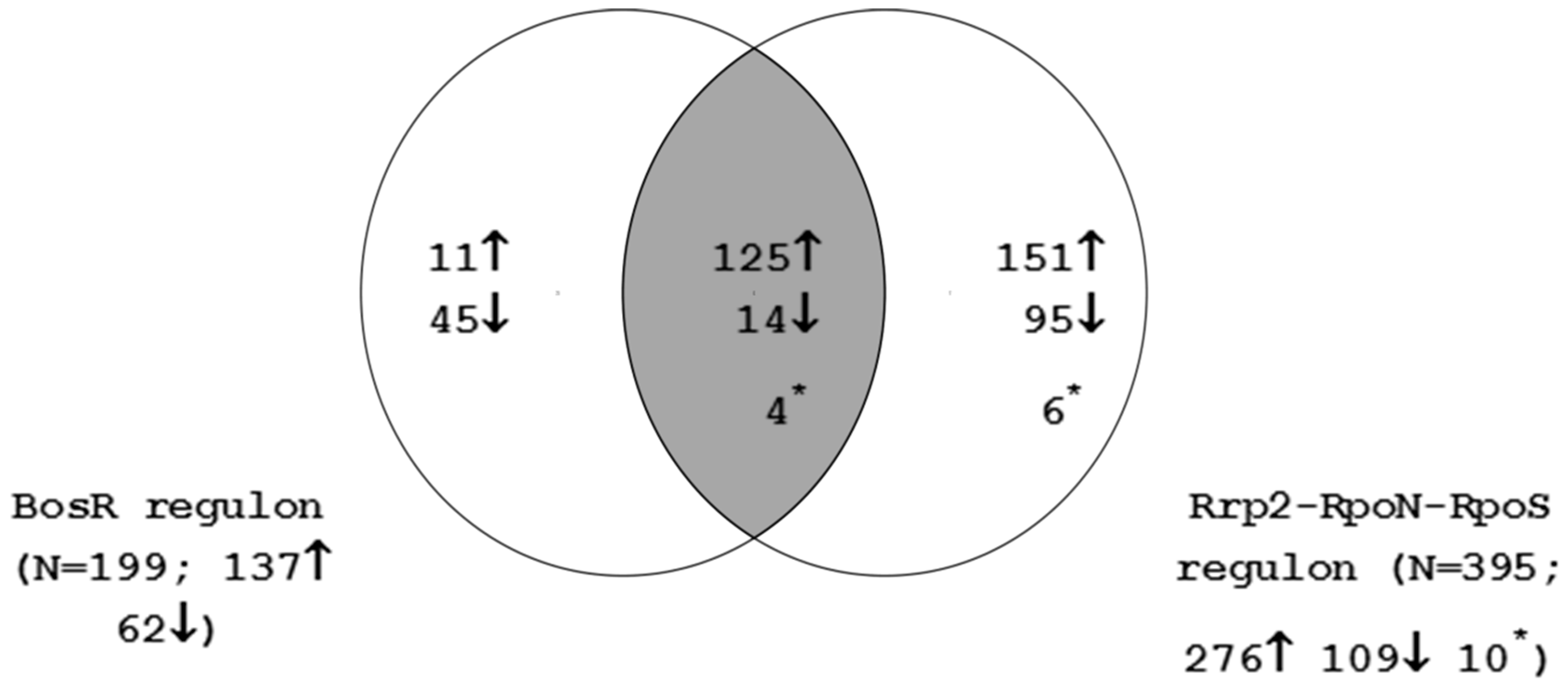
        <p>The genes regulated by the Rrp2-RpoN-RpoS cascade were compared to those in the BosR regulon as shown in <xref ref-type="fig" rid="microarrays-05-00009-f001">Figure 1</xref>. The Venn diagram reveals a substantial overlap of Rrp2-RpoN-RpoS activated genes to those activated by BosR (125/137; 91%). This finding supports the accumulating evidence that both RpoS and BosR are required for modulation of gene expression during mammalian infection [<xref ref-type="bibr" rid="B22-microarrays-05-00009">22</xref>,<xref ref-type="bibr" rid="B49-microarrays-05-00009">49</xref>,<xref ref-type="bibr" rid="B50-microarrays-05-00009">50</xref>,<xref ref-type="bibr" rid="B51-microarrays-05-00009">51</xref>]. For further analysis (see below), the Rrp2-RpoN-RpoS and BosR regulated genes were merged to generate an Rrp2-RpoN-RpoS-BosR regulon consisting of 451 genes. The additional 56 genes that are regulated by BosR only are given in <xref ref-type="app" rid="app1-microarrays-05-00009">Table S2</xref>. This gene set should represent <italic>B. burgdorferi</italic> genes that are differentially regulated during late nymphal tick feeding, tick-to-mammal transmission and during mammalian infection.</p>
      </sec>
      <sec id="sec4dot3-microarrays-05-00009">
        <title>4.3. Hk1-Rrp1 Regulatory Circuit</title>
        <p>Three groups have reported the construction of <italic>rrp1</italic> mutants and studied their gene expression profiles compared to those of the parent strain. Rogers <italic>et al.</italic> [<xref ref-type="bibr" rid="B26-microarrays-05-00009">26</xref>], generated an <italic>rrp1</italic> mutant in a non-infectious strain background that also lacked many plasmids. They identified 140 transcripts with altered abundance, 131 of which had higher expression in the wild-type than the mutant. These included products of the <italic>glp</italic> operon, <italic>bba74</italic> and <italic>spoVG</italic> which have been shown to be repressed by RpoS in DMCs and expressed at higher levels in ticks [<xref ref-type="bibr" rid="B12-microarrays-05-00009">12</xref>,<xref ref-type="bibr" rid="B33-microarrays-05-00009">33</xref>,<xref ref-type="bibr" rid="B40-microarrays-05-00009">40</xref>]. Subsequently, He <italic>et al.</italic> [<xref ref-type="bibr" rid="B27-microarrays-05-00009">27</xref>] and Caimano <italic>et al.</italic> [<xref ref-type="bibr" rid="B42-microarrays-05-00009">42</xref>] employed mutants that were generated in an infectious strain B31 background; both mutants can infect mice but cannot survive in ticks. He <italic>et al.</italic> [<xref ref-type="bibr" rid="B27-microarrays-05-00009">27</xref>] found that 120 genes had altered expression; 99 had higher transcript levels in the wild type strain. Although Caimano <italic>et al.</italic> [<xref ref-type="bibr" rid="B42-microarrays-05-00009">42</xref>], used RNA-seq, these two datasets were merged to generate a composite <italic>rrp1</italic> regulon. The regulon contained a total of 297 genes (222 induced and 75 repressed) (<xref ref-type="app" rid="app1-microarrays-05-00009">Table S3</xref>).</p>
      </sec>
      <sec id="sec4dot4-microarrays-05-00009">
        <title>4.4. Interaction between the Rrp2-RpoN-RpoS-BosR and Hk1-Rrp1 Regulatory Circuits</title>
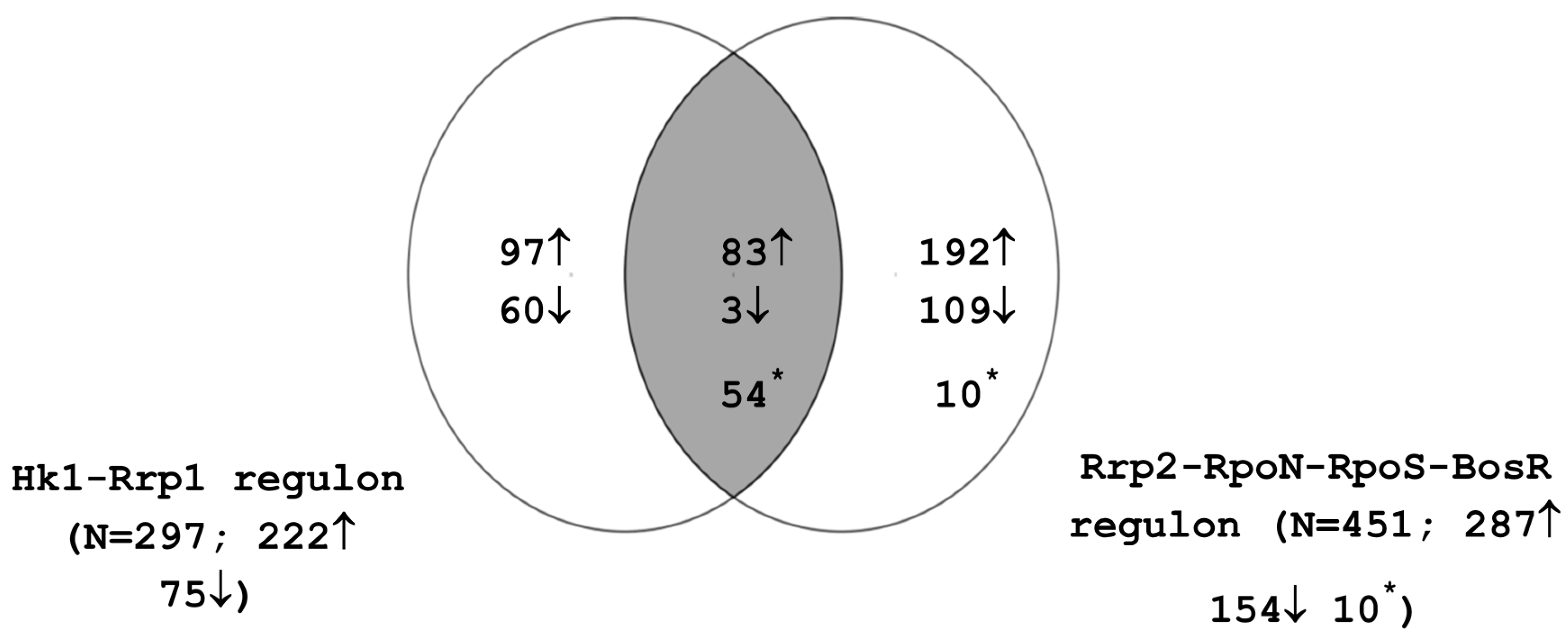
        <p>Regulation of differential gene expression during the enzootic cycle is mediated primarily by RpoS and Rrp1. RpoS is responsible for modulating gene expression during spirochetal transmission from the tick vector to the mammalian host and during mammalian infection; BosR also plays a role in these processes. Rrp1 mediates changes in tick phase gene expression and regulates protective responses during the tick blood meal [<xref ref-type="bibr" rid="B4-microarrays-05-00009">4</xref>,<xref ref-type="bibr" rid="B27-microarrays-05-00009">27</xref>,<xref ref-type="bibr" rid="B42-microarrays-05-00009">42</xref>]. The interplay of the two regulatory circuits controlling RpoS and Rrp1 activity is thus critical to the adaptation and survival of <italic>B. burgdorferi</italic> in the vector and host milieus. The overlap between these two regulatory cascades has not been well characterized. In order to gain further insight into the linkage between these pathways, we compared the genes comprising the Rrp2-RpoN-RpoS-BosR regulon (<xref ref-type="app" rid="app1-microarrays-05-00009">Tables S1 and S2</xref>) with those comprising the Hk1-Rrp1 regulon (<xref ref-type="app" rid="app1-microarrays-05-00009">Table S3</xref>). The resulting Venn diagram is presented in <xref ref-type="fig" rid="microarrays-05-00009-f002">Figure 2</xref>. 140 genes were regulated by both pathways; 83 genes were activated by both Hk1-Rrp1 and Rrp2-RpoN-RpoS-BosR and three genes were commonly repressed by both pathways. In addition, 42 genes were activated by Hk1-Rrp1 but repressed by Rrp2-RpoN-RpoS-BosR and 12 genes were induced by the RpoS pathway but repressed by Rrp1. Interestingly, the 42 genes induced by Rrp1 and repressed by RpoS include the <italic>glp</italic> operon, <italic>spoVG</italic>, <italic>bba62</italic> and <italic>bba74</italic>. These genes are known to have significantly higher expression in ticks than in the mammalian host [<xref ref-type="bibr" rid="B33-microarrays-05-00009">33</xref>,<xref ref-type="bibr" rid="B40-microarrays-05-00009">40</xref>,<xref ref-type="bibr" rid="B41-microarrays-05-00009">41</xref>,<xref ref-type="bibr" rid="B42-microarrays-05-00009">42</xref>]. These findings are consistent with the model that Rrp1 controls a regulon whose members are required during the tick phase of the <italic>B. burgdorferi</italic> life cycle [<xref ref-type="bibr" rid="B4-microarrays-05-00009">4</xref>,<xref ref-type="bibr" rid="B42-microarrays-05-00009">42</xref>].</p>
      </sec>
    </sec>
    <sec id="sec5-microarrays-05-00009" sec-type="conclusions">
      <title>5. Conclusions and Prospects for the Future</title>
      <p>Microarray studies have contributed significantly to the current understanding of <italic>B. burgdorferi</italic> genome content and transcriptional regulation. Delineation of differential gene expression patterns throughout the enzootic cycle and characterization of the regulons controlled by various transcriptional regulators mediating these processes have provided roadmaps for more detailed mechanistic investigations. The limitations of microarray analyses include the inability to detect low copy transcripts and small RNAs, restriction of gene/transcript detection to only those genes represented on the microarray and failure to recognize post-transcriptional processing events. NextGen sequencing methodologies are not subject to these limitations and will ultimately replace microarray approaches for comparative genomic and transcriptomic investigations.</p>
    </sec>
  </body>
  <back>
    <app-group>     
      <app id="app1-microarrays-05-00009">
        <title>Supplementary Materials</title>
         <p>The following are available online at <uri>http://www.mdpi.com/2076-3905/5/2/9/s1</uri>, Table S1: <italic>B. burgdorferi</italic> genes regulated by Rrp2-RpoN-RpoS as identified by whole genome microarray analysis; Table S2: <italic>B. burgdorferi</italic> genes regulated by BosR only as identified by whole genome microarray analysis; Table S3: <italic>B. burgdorferi</italic> genes regulated by Hk1-Rrp1 as identified by global transcriptome analysis.</p>
        <supplementary-material id="microarrays-05-00009-s001" xmlns:xlink="http://www.w3.org/1999/xlink" xlink:href="microarrays-05-00009-s001.xlsx">
</supplementary-material>
      </app>
	</app-group>
    <ack>
      <title>Acknowledgments</title>
      <p>The studies conducted in the authors&#x2019; laboratory were supported by NIH grant AI45801.</p>
    </ack>
    <notes>
      <title>Author Contributions</title>
      <p>Radha Iyer and Ira Schwartz contributed equally to the literature review, data analysis and writing of this review.</p>
    </notes>
    <notes>
      <title>Conflicts of Interest</title>
      <p>The authors declare no conflict of interest.</p>
    </notes>
    <ref-list>
      <title>References</title>
      <ref id="B1-microarrays-05-00009">
        <label>1.</label>
        <citation citation-type="journal">
          <person-group person-group-type="author">
            <name>
              <surname>Steere</surname>
              <given-names>A.C.</given-names>
            </name>
            <name>
              <surname>Grodzicki</surname>
              <given-names>R.L.</given-names>
            </name>
            <name>
              <surname>Kornblatt</surname>
              <given-names>A.N.</given-names>
            </name>
            <name>
              <surname>Craft</surname>
              <given-names>J.E.</given-names>
            </name>
            <name>
              <surname>Barbour</surname>
              <given-names>A.G.</given-names>
            </name>
            <name>
              <surname>Burgdorfer</surname>
              <given-names>W.</given-names>
            </name>
            <name>
              <surname>Schmid</surname>
              <given-names>G.P.</given-names>
            </name>
            <name>
              <surname>Johnson</surname>
              <given-names>E.</given-names>
            </name>
            <name>
              <surname>Malawista</surname>
              <given-names>S.E.</given-names>
            </name>
          </person-group>
          <article-title>The spirochetal etiology of Lyme disease</article-title>
          <source>N. Engl. J. Med.</source>
          <year>1983</year>
          <volume>308</volume>
          <fpage>733</fpage>
          <lpage>740</lpage>
          <pub-id pub-id-type="doi">10.1056/NEJM198303313081301</pub-id>
          <pub-id pub-id-type="pmid">6828118</pub-id>
        </citation>
      </ref>
      <ref id="B2-microarrays-05-00009">
        <label>2.</label>
        <citation citation-type="journal">
          <person-group person-group-type="author">
            <name>
              <surname>Benach</surname>
              <given-names>J.L.</given-names>
            </name>
            <name>
              <surname>Bosler</surname>
              <given-names>E.M.</given-names>
            </name>
            <name>
              <surname>Hanrahan</surname>
              <given-names>J.P.</given-names>
            </name>
            <name>
              <surname>Coleman</surname>
              <given-names>J.L.</given-names>
            </name>
            <name>
              <surname>Habicht</surname>
              <given-names>G.S.</given-names>
            </name>
            <name>
              <surname>Bast</surname>
              <given-names>T.F.</given-names>
            </name>
            <name>
              <surname>Cameron</surname>
              <given-names>D.J.</given-names>
            </name>
            <name>
              <surname>Ziegler</surname>
              <given-names>J.L.</given-names>
            </name>
            <name>
              <surname>Barbour</surname>
              <given-names>A.G.</given-names>
            </name>
            <name>
              <surname>Burgdorfer</surname>
              <given-names>W.</given-names>
            </name>
            <etal/>
          </person-group>
          <article-title>Spirochetes isolated from the blood of two patients with Lyme disease</article-title>
          <source>N. Engl. J. Med.</source>
          <year>1983</year>
          <volume>308</volume>
          <fpage>740</fpage>
          <lpage>742</lpage>
          <pub-id pub-id-type="doi">10.1056/NEJM198303313081302</pub-id>
          <pub-id pub-id-type="pmid">6828119</pub-id>
        </citation>
      </ref>
      <ref id="B3-microarrays-05-00009">
        <label>3.</label>
        <citation citation-type="journal">
          <person-group person-group-type="author">
            <name>
              <surname>Mead</surname>
              <given-names>P.S.</given-names>
            </name>
          </person-group>
          <article-title>Epidemiology of Lyme disease</article-title>
          <source>Infect. Dis. Clin. N. Am.</source>
          <year>2015</year>
          <volume>29</volume>
          <fpage>187</fpage>
          <lpage>210</lpage>
          <pub-id pub-id-type="doi">10.1016/j.idc.2015.02.010</pub-id>
          <pub-id pub-id-type="pmid">25999219</pub-id>
        </citation>
      </ref>
      <ref id="B4-microarrays-05-00009">
        <label>4.</label>
        <citation citation-type="journal">
          <person-group person-group-type="author">
            <name>
              <surname>Radolf</surname>
              <given-names>J.D.</given-names>
            </name>
            <name>
              <surname>Caimano</surname>
              <given-names>M.J.</given-names>
            </name>
            <name>
              <surname>Stevenson</surname>
              <given-names>B.</given-names>
            </name>
            <name>
              <surname>Hu</surname>
              <given-names>L.T.</given-names>
            </name>
          </person-group>
          <article-title>Of ticks, mice and men: Understanding the dual-host lifestyle of Lyme disease spirochaetes</article-title>
          <source>Nat. Rev. Microbiol.</source>
          <year>2012</year>
          <volume>10</volume>
          <fpage>87</fpage>
          <lpage>99</lpage>
          <pub-id pub-id-type="doi">10.1038/nrmicro2714</pub-id>
          <pub-id pub-id-type="pmid">22230951</pub-id>
        </citation>
      </ref>
      <ref id="B5-microarrays-05-00009">
        <label>5.</label>
        <citation citation-type="journal">
          <person-group person-group-type="author">
            <name>
              <surname>Samuels</surname>
              <given-names>D.S.</given-names>
            </name>
          </person-group>
          <article-title>Gene regulation in <italic>Borrelia burgdorferi</italic></article-title>
          <source>Annu. Rev. Microbiol.</source>
          <year>2011</year>
          <volume>65</volume>
          <fpage>479</fpage>
          <lpage>499</lpage>
          <pub-id pub-id-type="doi">10.1146/annurev.micro.112408.134040</pub-id>
          <pub-id pub-id-type="pmid">21801026</pub-id>
        </citation>
      </ref>
      <ref id="B6-microarrays-05-00009">
        <label>6.</label>
        <citation citation-type="journal">
          <person-group person-group-type="author">
            <name>
              <surname>Fraser</surname>
              <given-names>C.M.</given-names>
            </name>
            <name>
              <surname>Casjens</surname>
              <given-names>S.</given-names>
            </name>
            <name>
              <surname>Huang</surname>
              <given-names>W.M.</given-names>
            </name>
            <name>
              <surname>Sutton</surname>
              <given-names>G.G.</given-names>
            </name>
            <name>
              <surname>Clayton</surname>
              <given-names>R.</given-names>
            </name>
            <name>
              <surname>Lathigra</surname>
              <given-names>R.</given-names>
            </name>
            <name>
              <surname>White</surname>
              <given-names>O.</given-names>
            </name>
            <name>
              <surname>Ketchum</surname>
              <given-names>K.A.</given-names>
            </name>
            <name>
              <surname>Dodson</surname>
              <given-names>R.</given-names>
            </name>
            <name>
              <surname>Hickey</surname>
              <given-names>E.K.</given-names>
            </name>
            <etal/>
          </person-group>
          <article-title>Genomic sequence of a Lyme disease spirochaete, <italic>Borrelia burgdorferi</italic></article-title>
          <source>Nature</source>
          <year>1997</year>
          <volume>390</volume>
          <fpage>580</fpage>
          <lpage>586</lpage>
          <pub-id pub-id-type="doi">10.1038/37551</pub-id>
          <pub-id pub-id-type="pmid">9403685</pub-id>
        </citation>
      </ref>
      <ref id="B7-microarrays-05-00009">
        <label>7.</label>
        <citation citation-type="journal">
          <person-group person-group-type="author">
            <name>
              <surname>Casjens</surname>
              <given-names>S.</given-names>
            </name>
            <name>
              <surname>Palmer</surname>
              <given-names>N.</given-names>
            </name>
            <name>
              <surname>van Vugt</surname>
              <given-names>R.</given-names>
            </name>
            <name>
              <surname>Huang</surname>
              <given-names>W.M.</given-names>
            </name>
            <name>
              <surname>Stevenson</surname>
              <given-names>B.</given-names>
            </name>
            <name>
              <surname>Rosa</surname>
              <given-names>P.</given-names>
            </name>
            <name>
              <surname>Lathigra</surname>
              <given-names>R.</given-names>
            </name>
            <name>
              <surname>Sutton</surname>
              <given-names>G.</given-names>
            </name>
            <name>
              <surname>Peterson</surname>
              <given-names>J.</given-names>
            </name>
            <name>
              <surname>Dodson</surname>
              <given-names>R.J.</given-names>
            </name>
            <etal/>
          </person-group>
          <article-title>A bacterial genome in flux: The twelve linear and nine circular extrachromosomal DNAs in an infectious isolate of the Lyme disease spirochete <italic>Borrelia burgdorferi</italic></article-title>
          <source>Mol. Microbiol.</source>
          <year>2000</year>
          <volume>35</volume>
          <fpage>490</fpage>
          <lpage>516</lpage>
          <pub-id pub-id-type="doi">10.1046/j.1365-2958.2000.01698.x</pub-id>
          <pub-id pub-id-type="pmid">10672174</pub-id>
        </citation>
      </ref>
      <ref id="B8-microarrays-05-00009">
        <label>8.</label>
        <citation citation-type="journal">
          <person-group person-group-type="author">
            <name>
              <surname>Revel</surname>
              <given-names>A.T.</given-names>
            </name>
            <name>
              <surname>Talaat</surname>
              <given-names>A.M.</given-names>
            </name>
            <name>
              <surname>Norgard</surname>
              <given-names>M.V.</given-names>
            </name>
          </person-group>
          <article-title>DNA microarray analysis of differential gene expression in <italic>Borrelia burgdorferi</italic>, the Lyme disease spirochete</article-title>
          <source>Proc. Natl. Acad. Sci. USA</source>
          <year>2002</year>
          <volume>99</volume>
          <fpage>1562</fpage>
          <lpage>1567</lpage>
          <pub-id pub-id-type="doi">10.1073/pnas.032667699</pub-id>
          <pub-id pub-id-type="pmid">11830671</pub-id>
        </citation>
      </ref>
      <ref id="B9-microarrays-05-00009">
        <label>9.</label>
        <citation citation-type="journal">
          <person-group person-group-type="author">
            <name>
              <surname>Ojaimi</surname>
              <given-names>C.</given-names>
            </name>
            <name>
              <surname>Brooks</surname>
              <given-names>C.</given-names>
            </name>
            <name>
              <surname>Akins</surname>
              <given-names>D.</given-names>
            </name>
            <name>
              <surname>Casjens</surname>
              <given-names>S.</given-names>
            </name>
            <name>
              <surname>Rosa</surname>
              <given-names>P.</given-names>
            </name>
            <name>
              <surname>Elias</surname>
              <given-names>A.</given-names>
            </name>
            <name>
              <surname>Barbour</surname>
              <given-names>A.</given-names>
            </name>
            <name>
              <surname>Jasinskas</surname>
              <given-names>A.</given-names>
            </name>
            <name>
              <surname>Benach</surname>
              <given-names>J.</given-names>
            </name>
            <name>
              <surname>Katonah</surname>
              <given-names>L.</given-names>
            </name>
            <etal/>
          </person-group>
          <article-title><italic>Borrelia burgdorferi</italic> gene expression profiling with membrane-based arrays</article-title>
          <source>Methods Enzymol.</source>
          <year>2002</year>
          <volume>358</volume>
          <fpage>165</fpage>
          <lpage>177</lpage>
          <pub-id pub-id-type="pmid">12474386</pub-id>
        </citation>
      </ref>
      <ref id="B10-microarrays-05-00009">
        <label>10.</label>
        <citation citation-type="journal">
          <person-group person-group-type="author">
            <name>
              <surname>Ojaimi</surname>
              <given-names>C.</given-names>
            </name>
            <name>
              <surname>Brooks</surname>
              <given-names>C.</given-names>
            </name>
            <name>
              <surname>Casjens</surname>
              <given-names>S.</given-names>
            </name>
            <name>
              <surname>Rosa</surname>
              <given-names>P.</given-names>
            </name>
            <name>
              <surname>Elias</surname>
              <given-names>A.</given-names>
            </name>
            <name>
              <surname>Barbour</surname>
              <given-names>A.</given-names>
            </name>
            <name>
              <surname>Jasinskas</surname>
              <given-names>A.</given-names>
            </name>
            <name>
              <surname>Benach</surname>
              <given-names>J.</given-names>
            </name>
            <name>
              <surname>Katona</surname>
              <given-names>L.</given-names>
            </name>
            <name>
              <surname>Radolf</surname>
              <given-names>J.</given-names>
            </name>
            <etal/>
          </person-group>
          <article-title>Profiling of temperature-induced changes in <italic>Borrelia burgdorferi</italic> gene expression by using whole genome arrays</article-title>
          <source>Infect. Immun.</source>
          <year>2003</year>
          <volume>71</volume>
          <fpage>1689</fpage>
          <lpage>1705</lpage>
          <pub-id pub-id-type="doi">10.1128/IAI.71.4.1689-1705.2003</pub-id>
          <pub-id pub-id-type="pmid">12654782</pub-id>
        </citation>
      </ref>
      <ref id="B11-microarrays-05-00009">
        <label>11.</label>
        <citation citation-type="journal">
          <person-group person-group-type="author">
            <name>
              <surname>Terekhova</surname>
              <given-names>D.</given-names>
            </name>
            <name>
              <surname>Iyer</surname>
              <given-names>R.</given-names>
            </name>
            <name>
              <surname>Wormser</surname>
              <given-names>G.P.</given-names>
            </name>
            <name>
              <surname>Schwartz</surname>
              <given-names>I.</given-names>
            </name>
          </person-group>
          <article-title>Comparative genome hybridization reveals substantial variation among clinical isolates of <italic>Borrelia burgdorferi</italic> sensu stricto with different pathogenic properties</article-title>
          <source>J. Bacteriol.</source>
          <year>2006</year>
          <volume>188</volume>
          <fpage>6124</fpage>
          <lpage>6134</lpage>
          <pub-id pub-id-type="doi">10.1128/JB.00459-06</pub-id>
          <pub-id pub-id-type="pmid">16923879</pub-id>
        </citation>
      </ref>
      <ref id="B12-microarrays-05-00009">
        <label>12.</label>
        <citation citation-type="journal">
          <person-group person-group-type="author">
            <name>
              <surname>Caimano</surname>
              <given-names>M.J.</given-names>
            </name>
            <name>
              <surname>Iyer</surname>
              <given-names>R.</given-names>
            </name>
            <name>
              <surname>Eggers</surname>
              <given-names>C.H.</given-names>
            </name>
            <name>
              <surname>Gonzalez</surname>
              <given-names>C.</given-names>
            </name>
            <name>
              <surname>Morton</surname>
              <given-names>E.A.</given-names>
            </name>
            <name>
              <surname>Gilbert</surname>
              <given-names>M.A.</given-names>
            </name>
            <name>
              <surname>Schwartz</surname>
              <given-names>I.</given-names>
            </name>
            <name>
              <surname>Radolf</surname>
              <given-names>J.D.</given-names>
            </name>
          </person-group>
          <article-title>Analysis of the RpoS regulon in <italic>Borrelia burgdorferi</italic> in response to mammalian host signals provides insight into RpoS function during the enzootic cycle</article-title>
          <source>Mol. Microbiol.</source>
          <year>2007</year>
          <volume>65</volume>
          <fpage>1193</fpage>
          <lpage>1217</lpage>
          <pub-id pub-id-type="doi">10.1111/j.1365-2958.2007.05860.x</pub-id>
          <pub-id pub-id-type="pmid">17645733</pub-id>
        </citation>
      </ref>
      <ref id="B13-microarrays-05-00009">
        <label>13.</label>
        <citation citation-type="journal">
          <person-group person-group-type="author">
            <name>
              <surname>Liang</surname>
              <given-names>F.T.</given-names>
            </name>
            <name>
              <surname>Nelson</surname>
              <given-names>F.K.</given-names>
            </name>
            <name>
              <surname>Fikrig</surname>
              <given-names>E.</given-names>
            </name>
          </person-group>
          <article-title>DNA microarray assessment of putative <italic>Borrelia burgdorferi</italic> lipoprotein genes</article-title>
          <source>Infect. Immun.</source>
          <year>2002</year>
          <volume>70</volume>
          <fpage>3300</fpage>
          <lpage>3303</lpage>
          <pub-id pub-id-type="doi">10.1128/IAI.70.6.3300-3303.2002</pub-id>
          <pub-id pub-id-type="pmid">12011030</pub-id>
        </citation>
      </ref>
      <ref id="B14-microarrays-05-00009">
        <label>14.</label>
        <citation citation-type="journal">
          <person-group person-group-type="author">
            <name>
              <surname>Livengood</surname>
              <given-names>J.A.</given-names>
            </name>
            <name>
              <surname>Schmit</surname>
              <given-names>V.L.</given-names>
            </name>
            <name>
              <surname>Gilmore</surname>
              <given-names>R.D.</given-names>
              <suffix>Jr.</suffix>
            </name>
          </person-group>
          <article-title>Global transcriptome analysis of <italic>Borrelia burgdorferi</italic> during association with human neuroglial cells</article-title>
          <source>Infect. Immun.</source>
          <year>2008</year>
          <volume>76</volume>
          <fpage>298</fpage>
          <lpage>307</lpage>
          <pub-id pub-id-type="doi">10.1128/IAI.00866-07</pub-id>
          <pub-id pub-id-type="pmid">17984208</pub-id>
        </citation>
      </ref>
      <ref id="B15-microarrays-05-00009">
        <label>15.</label>
        <citation citation-type="journal">
          <person-group person-group-type="author">
            <name>
              <surname>Miller</surname>
              <given-names>C.L.</given-names>
            </name>
            <name>
              <surname>Karna</surname>
              <given-names>S.L.</given-names>
            </name>
            <name>
              <surname>Seshu</surname>
              <given-names>J.</given-names>
            </name>
          </person-group>
          <article-title><italic>Borrelia</italic> host adaptation regulator (BadR) regulates <italic>rpoS</italic> to modulate host adaptation and virulence factors in <italic>Borrelia burgdorferi</italic></article-title>
          <source>Mol. Microbiol.</source>
          <year>2013</year>
          <volume>88</volume>
          <fpage>105</fpage>
          <lpage>124</lpage>
          <pub-id pub-id-type="doi">10.1111/mmi.12171</pub-id>
          <pub-id pub-id-type="pmid">23387366</pub-id>
        </citation>
      </ref>
      <ref id="B16-microarrays-05-00009">
        <label>16.</label>
        <citation citation-type="journal">
          <person-group person-group-type="author">
            <name>
              <surname>Zhong</surname>
              <given-names>J.</given-names>
            </name>
            <name>
              <surname>Barbour</surname>
              <given-names>A.G.</given-names>
            </name>
          </person-group>
          <article-title>Cross-species hybridization of a <italic>Borrelia burgdorferi</italic> DNA array reveals infection- and culture-associated genes of the unsequenced genome of the relapsing fever agent <italic>Borrelia hermsii</italic></article-title>
          <source>Mol. Microbiol.</source>
          <year>2004</year>
          <volume>51</volume>
          <fpage>729</fpage>
          <lpage>748</lpage>
          <pub-id pub-id-type="doi">10.1046/j.1365-2958.2003.03849.x</pub-id>
          <pub-id pub-id-type="pmid">14731275</pub-id>
        </citation>
      </ref>
      <ref id="B17-microarrays-05-00009">
        <label>17.</label>
        <citation citation-type="journal">
          <person-group person-group-type="author">
            <name>
              <surname>Ojaimi</surname>
              <given-names>C.</given-names>
            </name>
            <name>
              <surname>Mulay</surname>
              <given-names>V.</given-names>
            </name>
            <name>
              <surname>Liveris</surname>
              <given-names>D.</given-names>
            </name>
            <name>
              <surname>Iyer</surname>
              <given-names>R.</given-names>
            </name>
            <name>
              <surname>Schwartz</surname>
              <given-names>I.</given-names>
            </name>
          </person-group>
          <article-title>Comparative transcriptional profiling of <italic>Borrelia burgdorferi</italic> clinical isolates differing in capacities for hematogenous dissemination</article-title>
          <source>Infect. Immun.</source>
          <year>2005</year>
          <volume>73</volume>
          <fpage>6791</fpage>
          <lpage>6802</lpage>
          <pub-id pub-id-type="doi">10.1128/IAI.73.10.6791-6802.2005</pub-id>
          <pub-id pub-id-type="pmid">16177357</pub-id>
        </citation>
      </ref>
      <ref id="B18-microarrays-05-00009">
        <label>18.</label>
        <citation citation-type="journal">
          <person-group person-group-type="author">
            <name>
              <surname>Brooks</surname>
              <given-names>C.S.</given-names>
            </name>
            <name>
              <surname>Hefty</surname>
              <given-names>P.S.</given-names>
            </name>
            <name>
              <surname>Jolliff</surname>
              <given-names>S.E.</given-names>
            </name>
            <name>
              <surname>Akins</surname>
              <given-names>D.R.</given-names>
            </name>
          </person-group>
          <article-title>Global analysis of <italic>Borrelia burgdorferi</italic> genes regulated by mammalian host-specific signals</article-title>
          <source>Infect. Immun.</source>
          <year>2003</year>
          <volume>71</volume>
          <fpage>3371</fpage>
          <lpage>3383</lpage>
          <pub-id pub-id-type="doi">10.1128/IAI.71.6.3371-3383.2003</pub-id>
          <pub-id pub-id-type="pmid">12761121</pub-id>
        </citation>
      </ref>
      <ref id="B19-microarrays-05-00009">
        <label>19.</label>
        <citation citation-type="journal">
          <person-group person-group-type="author">
            <name>
              <surname>Tokarz</surname>
              <given-names>R.</given-names>
            </name>
            <name>
              <surname>Anderton</surname>
              <given-names>J.M.</given-names>
            </name>
            <name>
              <surname>Katona</surname>
              <given-names>L.I.</given-names>
            </name>
            <name>
              <surname>Benach</surname>
              <given-names>J.L.</given-names>
            </name>
          </person-group>
          <article-title>Combined effects of blood and temperature shift on <italic>Borrelia burgdorferi</italic> gene expression as determined by whole genome DNA array</article-title>
          <source>Infect. Immun.</source>
          <year>2004</year>
          <volume>72</volume>
          <fpage>5419</fpage>
          <lpage>5432</lpage>
          <pub-id pub-id-type="doi">10.1128/IAI.72.9.5419-5432.2004</pub-id>
          <pub-id pub-id-type="pmid">15322040</pub-id>
        </citation>
      </ref>
      <ref id="B20-microarrays-05-00009">
        <label>20.</label>
        <citation citation-type="journal">
          <person-group person-group-type="author">
            <name>
              <surname>Anderton</surname>
              <given-names>J.M.</given-names>
            </name>
            <name>
              <surname>Tokarz</surname>
              <given-names>R.</given-names>
            </name>
            <name>
              <surname>Thill</surname>
              <given-names>C.D.</given-names>
            </name>
            <name>
              <surname>Kuhlow</surname>
              <given-names>C.J.</given-names>
            </name>
            <name>
              <surname>Brooks</surname>
              <given-names>C.S.</given-names>
            </name>
            <name>
              <surname>Akins</surname>
              <given-names>D.R.</given-names>
            </name>
            <name>
              <surname>Katona</surname>
              <given-names>L.I.</given-names>
            </name>
            <name>
              <surname>Benach</surname>
              <given-names>J.L.</given-names>
            </name>
          </person-group>
          <article-title>Whole-genome DNA array analysis of the response of <italic>Borrelia burgdorferi</italic> to a bactericidal monoclonal antibody</article-title>
          <source>Infect. Immun.</source>
          <year>2004</year>
          <volume>72</volume>
          <fpage>2035</fpage>
          <lpage>2044</lpage>
          <pub-id pub-id-type="doi">10.1128/IAI.72.4.2035-2044.2004</pub-id>
          <pub-id pub-id-type="pmid">15039324</pub-id>
        </citation>
      </ref>
      <ref id="B21-microarrays-05-00009">
        <label>21.</label>
        <citation citation-type="journal">
          <person-group person-group-type="author">
            <name>
              <surname>Hyde</surname>
              <given-names>J.A.</given-names>
            </name>
            <name>
              <surname>Seshu</surname>
              <given-names>J.</given-names>
            </name>
            <name>
              <surname>Skare</surname>
              <given-names>J.T.</given-names>
            </name>
          </person-group>
          <article-title>Transcriptional profiling of <italic>Borrelia burgdorferi</italic> containing a unique <italic>bos</italic>R allele identifies a putative oxidative stress regulon</article-title>
          <source>Microbiology</source>
          <year>2006</year>
          <volume>152</volume>
          <fpage>2599</fpage>
          <lpage>2609</lpage>
          <pub-id pub-id-type="doi">10.1099/mic.0.28996-0</pub-id>
          <pub-id pub-id-type="pmid">16946255</pub-id>
        </citation>
      </ref>
      <ref id="B22-microarrays-05-00009">
        <label>22.</label>
        <citation citation-type="journal">
          <person-group person-group-type="author">
            <name>
              <surname>Ouyang</surname>
              <given-names>Z.</given-names>
            </name>
            <name>
              <surname>Kumar</surname>
              <given-names>M.</given-names>
            </name>
            <name>
              <surname>Kariu</surname>
              <given-names>T.</given-names>
            </name>
            <name>
              <surname>Haq</surname>
              <given-names>S.</given-names>
            </name>
            <name>
              <surname>Goldberg</surname>
              <given-names>M.</given-names>
            </name>
            <name>
              <surname>Pal</surname>
              <given-names>U.</given-names>
            </name>
            <name>
              <surname>Norgard</surname>
              <given-names>M.V.</given-names>
            </name>
          </person-group>
          <article-title>BosR (BB0647) governs virulence expression in <italic>Borrelia burgdorferi</italic></article-title>
          <source>Mol. Microbiol.</source>
          <year>2009</year>
          <volume>74</volume>
          <fpage>1331</fpage>
          <lpage>1343</lpage>
          <pub-id pub-id-type="doi">10.1111/j.1365-2958.2009.06945.x</pub-id>
          <pub-id pub-id-type="pmid">19889086</pub-id>
        </citation>
      </ref>
      <ref id="B23-microarrays-05-00009">
        <label>23.</label>
        <citation citation-type="journal">
          <person-group person-group-type="author">
            <name>
              <surname>Boardman</surname>
              <given-names>B.K.</given-names>
            </name>
            <name>
              <surname>He</surname>
              <given-names>M.</given-names>
            </name>
            <name>
              <surname>Ouyang</surname>
              <given-names>Z.</given-names>
            </name>
            <name>
              <surname>Xu</surname>
              <given-names>H.</given-names>
            </name>
            <name>
              <surname>Pang</surname>
              <given-names>X.</given-names>
            </name>
            <name>
              <surname>Yang</surname>
              <given-names>X.F.</given-names>
            </name>
          </person-group>
          <article-title>Essential role of the response regulator Rrp2 in the infectious cycle of <italic>Borrelia burgdorferi</italic></article-title>
          <source>Infect. Immun.</source>
          <year>2008</year>
          <volume>76</volume>
          <fpage>3844</fpage>
          <lpage>3853</lpage>
          <pub-id pub-id-type="doi">10.1128/IAI.00467-08</pub-id>
          <pub-id pub-id-type="pmid">18573895</pub-id>
        </citation>
      </ref>
      <ref id="B24-microarrays-05-00009">
        <label>24.</label>
        <citation citation-type="journal">
          <person-group person-group-type="author">
            <name>
              <surname>Ouyang</surname>
              <given-names>Z.</given-names>
            </name>
            <name>
              <surname>Blevins</surname>
              <given-names>J.S.</given-names>
            </name>
            <name>
              <surname>Norgard</surname>
              <given-names>M.V.</given-names>
            </name>
          </person-group>
          <article-title>Transcriptional interplay among the regulators Rrp2, RpoN and RpoS in <italic>Borrelia burgdorferi</italic></article-title>
          <source>Microbiology</source>
          <year>2008</year>
          <volume>154</volume>
          <fpage>2641</fpage>
          <lpage>2658</lpage>
          <pub-id pub-id-type="doi">10.1099/mic.0.2008/019992-0</pub-id>
          <pub-id pub-id-type="pmid">18757798</pub-id>
        </citation>
      </ref>
      <ref id="B25-microarrays-05-00009">
        <label>25.</label>
        <citation citation-type="journal">
          <person-group person-group-type="author">
            <name>
              <surname>Fisher</surname>
              <given-names>M.A.</given-names>
            </name>
            <name>
              <surname>Grimm</surname>
              <given-names>D.</given-names>
            </name>
            <name>
              <surname>Henion</surname>
              <given-names>A.K.</given-names>
            </name>
            <name>
              <surname>Elias</surname>
              <given-names>A.F.</given-names>
            </name>
            <name>
              <surname>Stewart</surname>
              <given-names>P.E.</given-names>
            </name>
            <name>
              <surname>Rosa</surname>
              <given-names>P.A.</given-names>
            </name>
            <name>
              <surname>Gherardini</surname>
              <given-names>F.C.</given-names>
            </name>
          </person-group>
          <article-title><italic>Borrelia burgdorferi</italic> &#x3C3;<sup>54</sup> is required for mammalian infection and vector transmission but not for tick colonization</article-title>
          <source>Proc. Natl. Acad. Sci. USA</source>
          <year>2005</year>
          <volume>102</volume>
          <fpage>5162</fpage>
          <lpage>5167</lpage>
          <pub-id pub-id-type="doi">10.1073/pnas.0408536102</pub-id>
          <pub-id pub-id-type="pmid">15743918</pub-id>
        </citation>
      </ref>
      <ref id="B26-microarrays-05-00009">
        <label>26.</label>
        <citation citation-type="journal">
          <person-group person-group-type="author">
            <name>
              <surname>Rogers</surname>
              <given-names>E.A.</given-names>
            </name>
            <name>
              <surname>Terekhova</surname>
              <given-names>D.</given-names>
            </name>
            <name>
              <surname>Zhang</surname>
              <given-names>H.M.</given-names>
            </name>
            <name>
              <surname>Hovis</surname>
              <given-names>K.M.</given-names>
            </name>
            <name>
              <surname>Schwartz</surname>
              <given-names>I.</given-names>
            </name>
            <name>
              <surname>Marconi</surname>
              <given-names>R.T.</given-names>
            </name>
          </person-group>
          <article-title>Rrp1, a cyclic-di-GMP-producing response regulator, is an important regulator of <italic>Borrelia burgdorferi</italic> core cellular functions</article-title>
          <source>Mol. Microbiol.</source>
          <year>2009</year>
          <volume>71</volume>
          <fpage>1551</fpage>
          <lpage>1573</lpage>
          <pub-id pub-id-type="doi">10.1111/j.1365-2958.2009.06621.x</pub-id>
          <pub-id pub-id-type="pmid">19210621</pub-id>
        </citation>
      </ref>
      <ref id="B27-microarrays-05-00009">
        <label>27.</label>
        <citation citation-type="journal">
          <person-group person-group-type="author">
            <name>
              <surname>He</surname>
              <given-names>M.</given-names>
            </name>
            <name>
              <surname>Ouyang</surname>
              <given-names>Z.</given-names>
            </name>
            <name>
              <surname>Troxell</surname>
              <given-names>B.</given-names>
            </name>
            <name>
              <surname>Xu</surname>
              <given-names>H.</given-names>
            </name>
            <name>
              <surname>Moh</surname>
              <given-names>A.</given-names>
            </name>
            <name>
              <surname>Fu</surname>
              <given-names>X.-Y.</given-names>
            </name>
            <name>
              <surname>Piesman</surname>
              <given-names>J.</given-names>
            </name>
            <name>
              <surname>Norgard</surname>
              <given-names>M.V.</given-names>
            </name>
            <name>
              <surname>Gomelsky</surname>
              <given-names>M.</given-names>
            </name>
            <name>
              <surname>Yang</surname>
              <given-names>X.F.</given-names>
            </name>
          </person-group>
          <article-title>Cyclic di-GMP is essential for the survival of <italic>Borrelia burgdorferi</italic> in ticks</article-title>
          <source>PLoS Pathog.</source>
          <year>2011</year>
          <volume>7</volume>
          <elocation-id>e1002133</elocation-id>
          <pub-id pub-id-type="doi">10.1371/journal.ppat.1002133</pub-id>
          <pub-id pub-id-type="pmid">21738477</pub-id>
        </citation>
      </ref>
      <ref id="B28-microarrays-05-00009">
        <label>28.</label>
        <citation citation-type="journal">
          <person-group person-group-type="author">
            <name>
              <surname>Bugrysheva</surname>
              <given-names>J.V.</given-names>
            </name>
            <name>
              <surname>Pappas</surname>
              <given-names>C.J.</given-names>
            </name>
            <name>
              <surname>Terekhova</surname>
              <given-names>D.A.</given-names>
            </name>
            <name>
              <surname>Iyer</surname>
              <given-names>R.</given-names>
            </name>
            <name>
              <surname>Godfrey</surname>
              <given-names>H.P.</given-names>
            </name>
            <name>
              <surname>Schwartz</surname>
              <given-names>I.</given-names>
            </name>
            <name>
              <surname>Cabello</surname>
              <given-names>F.C.</given-names>
            </name>
          </person-group>
          <article-title>Characterization of the Rel<sub>Bbu</sub> regulon in <italic>Borrelia burgdorferi</italic> reveals modulation of glycerol metabolism by (p)ppGpp</article-title>
          <source>PLoS ONE</source>
          <year>2015</year>
          <volume>10</volume>
          <elocation-id>e0118063</elocation-id>
          <pub-id pub-id-type="doi">10.1371/journal.pone.0118063</pub-id>
          <pub-id pub-id-type="pmid">25688856</pub-id>
        </citation>
      </ref>
      <ref id="B29-microarrays-05-00009">
        <label>29.</label>
        <citation citation-type="journal">
          <person-group person-group-type="author">
            <name>
              <surname>Salman-Dilgimen</surname>
              <given-names>A.</given-names>
            </name>
            <name>
              <surname>Hardy</surname>
              <given-names>P.O.</given-names>
            </name>
            <name>
              <surname>Radolf</surname>
              <given-names>J.D.</given-names>
            </name>
            <name>
              <surname>Caimano</surname>
              <given-names>M.J.</given-names>
            </name>
            <name>
              <surname>Chaconas</surname>
              <given-names>G.</given-names>
            </name>
          </person-group>
          <article-title>HrpA, an RNA helicase involved in RNA processing, is required for mouse infectivity and tick transmission of the Lyme disease spirochete</article-title>
          <source>PLoS Pathog.</source>
          <year>2013</year>
          <volume>9</volume>
          <elocation-id>e1003841</elocation-id>
          <pub-id pub-id-type="doi">10.1371/journal.ppat.1003841</pub-id>
          <pub-id pub-id-type="pmid">24367266</pub-id>
        </citation>
      </ref>
      <ref id="B30-microarrays-05-00009">
        <label>30.</label>
        <citation citation-type="journal">
          <person-group person-group-type="author">
            <name>
              <surname>Narasimhan</surname>
              <given-names>S.</given-names>
            </name>
            <name>
              <surname>Caimano</surname>
              <given-names>M.J.</given-names>
            </name>
            <name>
              <surname>Liang</surname>
              <given-names>F.T.</given-names>
            </name>
            <name>
              <surname>Santiago</surname>
              <given-names>F.</given-names>
            </name>
            <name>
              <surname>Laskowski</surname>
              <given-names>M.</given-names>
            </name>
            <name>
              <surname>Philipp</surname>
              <given-names>M.T.</given-names>
            </name>
            <name>
              <surname>Pachner</surname>
              <given-names>A.R.</given-names>
            </name>
            <name>
              <surname>Radolf</surname>
              <given-names>J.D.</given-names>
            </name>
            <name>
              <surname>Fikrig</surname>
              <given-names>E.</given-names>
            </name>
          </person-group>
          <article-title><italic>Borrelia burgdorferi</italic> transcriptome in the central nervous system of non-human primates</article-title>
          <source>Proc. Natl. Acad. Sci. USA</source>
          <year>2003</year>
          <volume>100</volume>
          <fpage>15953</fpage>
          <lpage>15958</lpage>
          <pub-id pub-id-type="doi">10.1073/pnas.2432412100</pub-id>
          <pub-id pub-id-type="pmid">14671329</pub-id>
        </citation>
      </ref>
      <ref id="B31-microarrays-05-00009">
        <label>31.</label>
        <citation citation-type="journal">
          <person-group person-group-type="author">
            <name>
              <surname>Narasimhan</surname>
              <given-names>S.</given-names>
            </name>
            <name>
              <surname>Santiago</surname>
              <given-names>F.</given-names>
            </name>
            <name>
              <surname>Koski</surname>
              <given-names>R.A.</given-names>
            </name>
            <name>
              <surname>Brei</surname>
              <given-names>B.</given-names>
            </name>
            <name>
              <surname>Anderson</surname>
              <given-names>J.F.</given-names>
            </name>
            <name>
              <surname>Fish</surname>
              <given-names>D.</given-names>
            </name>
            <name>
              <surname>Fikrig</surname>
              <given-names>E.</given-names>
            </name>
          </person-group>
          <article-title>Examination of the <italic>Borrelia burgdorferi</italic> transcriptome in <italic>Ixodes scapularis</italic> during feeding</article-title>
          <source>J. Bacteriol.</source>
          <year>2002</year>
          <volume>184</volume>
          <fpage>3122</fpage>
          <lpage>3125</lpage>
          <pub-id pub-id-type="doi">10.1128/JB.184.11.3122-3125.2002</pub-id>
          <pub-id pub-id-type="pmid">12003955</pub-id>
        </citation>
      </ref>
      <ref id="B32-microarrays-05-00009">
        <label>32.</label>
        <citation citation-type="journal">
          <person-group person-group-type="author">
            <name>
              <surname>Pal</surname>
              <given-names>U.</given-names>
            </name>
            <name>
              <surname>Dai</surname>
              <given-names>J.</given-names>
            </name>
            <name>
              <surname>Li</surname>
              <given-names>X.</given-names>
            </name>
            <name>
              <surname>Neelakanta</surname>
              <given-names>G.</given-names>
            </name>
            <name>
              <surname>Luo</surname>
              <given-names>P.</given-names>
            </name>
            <name>
              <surname>Kumar</surname>
              <given-names>M.</given-names>
            </name>
            <name>
              <surname>Wang</surname>
              <given-names>P.</given-names>
            </name>
            <name>
              <surname>Yang</surname>
              <given-names>X.</given-names>
            </name>
            <name>
              <surname>Anderson</surname>
              <given-names>J.F.</given-names>
            </name>
            <name>
              <surname>Fikrig</surname>
              <given-names>E.</given-names>
            </name>
          </person-group>
          <article-title>A differential role for BB0365 in the persistence of <italic>Borrelia burgdorferi</italic> in mice and ticks</article-title>
          <source>J. Infect. Dis.</source>
          <year>2008</year>
          <volume>197</volume>
          <fpage>148</fpage>
          <lpage>155</lpage>
          <pub-id pub-id-type="doi">10.1086/523764</pub-id>
          <pub-id pub-id-type="pmid">18171298</pub-id>
        </citation>
      </ref>
      <ref id="B33-microarrays-05-00009">
        <label>33.</label>
        <citation citation-type="journal">
          <person-group person-group-type="author">
            <name>
              <surname>Iyer</surname>
              <given-names>R.</given-names>
            </name>
            <name>
              <surname>Caimano</surname>
              <given-names>M.J.</given-names>
            </name>
            <name>
              <surname>Luthra</surname>
              <given-names>A.</given-names>
            </name>
            <name>
              <surname>Axline</surname>
              <given-names>D.</given-names>
              <suffix>Jr.</suffix>
            </name>
            <name>
              <surname>Corona</surname>
              <given-names>A.</given-names>
            </name>
            <name>
              <surname>Iacobas</surname>
              <given-names>D.A.</given-names>
            </name>
            <name>
              <surname>Radolf</surname>
              <given-names>J.D.</given-names>
            </name>
            <name>
              <surname>Schwartz</surname>
              <given-names>I.</given-names>
            </name>
          </person-group>
          <article-title>Stage-specific global alterations in the transcriptomes of Lyme disease spirochetes during tick feeding and following mammalian host adaptation</article-title>
          <source>Mol. Microbiol.</source>
          <year>2015</year>
          <volume>95</volume>
          <fpage>509</fpage>
          <lpage>538</lpage>
          <pub-id pub-id-type="doi">10.1111/mmi.12882</pub-id>
          <pub-id pub-id-type="pmid">25425211</pub-id>
        </citation>
      </ref>
      <ref id="B34-microarrays-05-00009">
        <label>34.</label>
        <citation citation-type="journal">
          <person-group person-group-type="author">
            <name>
              <surname>Schutzer</surname>
              <given-names>S.E.</given-names>
            </name>
            <name>
              <surname>Fraser-Liggett</surname>
              <given-names>C.M.</given-names>
            </name>
            <name>
              <surname>Casjens</surname>
              <given-names>S.R.</given-names>
            </name>
            <name>
              <surname>Qiu</surname>
              <given-names>W.G.</given-names>
            </name>
            <name>
              <surname>Dunn</surname>
              <given-names>J.J.</given-names>
            </name>
            <name>
              <surname>Mongodin</surname>
              <given-names>E.F.</given-names>
            </name>
            <name>
              <surname>Luft</surname>
              <given-names>B.J.</given-names>
            </name>
          </person-group>
          <article-title>Whole-genome sequences of thirteen isolates of <italic>Borrelia burgdorferi</italic></article-title>
          <source>J. Bacteriol.</source>
          <year>2011</year>
          <volume>193</volume>
          <fpage>1018</fpage>
          <lpage>1020</lpage>
          <pub-id pub-id-type="doi">10.1128/JB.01158-10</pub-id>
          <pub-id pub-id-type="pmid">20935092</pub-id>
        </citation>
      </ref>
      <ref id="B35-microarrays-05-00009">
        <label>35.</label>
        <citation citation-type="journal">
          <person-group person-group-type="author">
            <name>
              <surname>Casjens</surname>
              <given-names>S.R.</given-names>
            </name>
            <name>
              <surname>Mongodin</surname>
              <given-names>E.F.</given-names>
            </name>
            <name>
              <surname>Qiu</surname>
              <given-names>W.G.</given-names>
            </name>
            <name>
              <surname>Luft</surname>
              <given-names>B.J.</given-names>
            </name>
            <name>
              <surname>Schutzer</surname>
              <given-names>S.E.</given-names>
            </name>
            <name>
              <surname>Gilcrease</surname>
              <given-names>E.B.</given-names>
            </name>
            <name>
              <surname>Huang</surname>
              <given-names>W.M.</given-names>
            </name>
            <name>
              <surname>Vujadinovic</surname>
              <given-names>M.</given-names>
            </name>
            <name>
              <surname>Aron</surname>
              <given-names>J.K.</given-names>
            </name>
            <name>
              <surname>Vargas</surname>
              <given-names>L.C.</given-names>
            </name>
            <etal/>
          </person-group>
          <article-title>Genome stability of Lyme disease spirochetes: Comparative genomics of <italic>Borrelia burgdorferi</italic> plasmids</article-title>
          <source>PLoS ONE</source>
          <year>2012</year>
          <volume>7</volume>
          <elocation-id>e33280</elocation-id>
          <pub-id pub-id-type="doi">10.1371/journal.pone.0033280</pub-id>
          <pub-id pub-id-type="pmid">22432010</pub-id>
        </citation>
      </ref>
      <ref id="B36-microarrays-05-00009">
        <label>36.</label>
        <citation citation-type="journal">
          <person-group person-group-type="author">
            <name>
              <surname>Mongodin</surname>
              <given-names>E.F.</given-names>
            </name>
            <name>
              <surname>Casjens</surname>
              <given-names>S.R.</given-names>
            </name>
            <name>
              <surname>Bruno</surname>
              <given-names>J.F.</given-names>
            </name>
            <name>
              <surname>Xu</surname>
              <given-names>Y.</given-names>
            </name>
            <name>
              <surname>Drabek</surname>
              <given-names>E.F.</given-names>
            </name>
            <name>
              <surname>Riley</surname>
              <given-names>D.R.</given-names>
            </name>
            <name>
              <surname>Cantarel</surname>
              <given-names>B.L.</given-names>
            </name>
            <name>
              <surname>Pagan</surname>
              <given-names>P.E.</given-names>
            </name>
            <name>
              <surname>Hernandez</surname>
              <given-names>Y.A.</given-names>
            </name>
            <name>
              <surname>Vargas</surname>
              <given-names>L.C.</given-names>
            </name>
            <etal/>
          </person-group>
          <article-title>Inter- and intra-specific pan-genomes of <italic>Borrelia burgdorferi</italic> sensu lato: Genome stability and adaptive radiation</article-title>
          <source>BMC Genom.</source>
          <year>2013</year>
          <volume>14</volume>
          <pub-id pub-id-type="doi">10.1186/1471-2164-14-693</pub-id>
          <pub-id pub-id-type="pmid">24112474</pub-id>
        </citation>
      </ref>
      <ref id="B37-microarrays-05-00009">
        <label>37.</label>
        <citation citation-type="journal">
          <person-group person-group-type="author">
            <name>
              <surname>Akins</surname>
              <given-names>D.R.</given-names>
            </name>
            <name>
              <surname>Bourell</surname>
              <given-names>K.W.</given-names>
            </name>
            <name>
              <surname>Caimano</surname>
              <given-names>M.J.</given-names>
            </name>
            <name>
              <surname>Norgard</surname>
              <given-names>M.V.</given-names>
            </name>
            <name>
              <surname>Radolf</surname>
              <given-names>J.D.</given-names>
            </name>
          </person-group>
          <article-title>A new animal model for studying Lyme disease spirochetes in a mammalian host-adapted state</article-title>
          <source>J. Clin. Investig.</source>
          <year>1998</year>
          <volume>101</volume>
          <fpage>2240</fpage>
          <lpage>2250</lpage>
          <pub-id pub-id-type="doi">10.1172/JCI2325</pub-id>
          <pub-id pub-id-type="pmid">9593780</pub-id>
        </citation>
      </ref>
      <ref id="B38-microarrays-05-00009">
        <label>38.</label>
        <citation citation-type="journal">
          <person-group person-group-type="author">
            <name>
              <surname>Yang</surname>
              <given-names>X.</given-names>
            </name>
            <name>
              <surname>Popova</surname>
              <given-names>T.G.</given-names>
            </name>
            <name>
              <surname>Hagman</surname>
              <given-names>K.E.</given-names>
            </name>
            <name>
              <surname>Wikel</surname>
              <given-names>S.K.</given-names>
            </name>
            <name>
              <surname>Schoeler</surname>
              <given-names>G.B.</given-names>
            </name>
            <name>
              <surname>Caimano</surname>
              <given-names>M.J.</given-names>
            </name>
            <name>
              <surname>Radolf</surname>
              <given-names>J.D.</given-names>
            </name>
            <name>
              <surname>Norgard</surname>
              <given-names>M.V.</given-names>
            </name>
          </person-group>
          <article-title>Identification, characterization, and expression of three new members of the <italic>Borrelia burgdorferi</italic> <italic>mlp</italic> (2.9) lipoprotein gene family</article-title>
          <source>Infect. Immun.</source>
          <year>1999</year>
          <volume>67</volume>
          <fpage>6008</fpage>
          <lpage>6018</lpage>
          <pub-id pub-id-type="pmid">10531261</pub-id>
        </citation>
      </ref>
      <ref id="B39-microarrays-05-00009">
        <label>39.</label>
        <citation citation-type="journal">
          <person-group person-group-type="author">
            <name>
              <surname>Caimano</surname>
              <given-names>M.J.</given-names>
            </name>
            <name>
              <surname>Eggers</surname>
              <given-names>C.H.</given-names>
            </name>
            <name>
              <surname>Gonzalez</surname>
              <given-names>C.A.</given-names>
            </name>
            <name>
              <surname>Radolf</surname>
              <given-names>J.D.</given-names>
            </name>
          </person-group>
          <article-title>Alternate sigma factor RpoS is required for the <italic>in vivo</italic>-specific repression of <italic>Borrelia burgdorferi</italic> plasmid lp54-borne <italic>osp</italic>A and lp6.6 genes</article-title>
          <source>J. Bacteriol.</source>
          <year>2005</year>
          <volume>187</volume>
          <fpage>7845</fpage>
          <lpage>7852</lpage>
          <pub-id pub-id-type="doi">10.1128/JB.187.22.7845-7852.2005</pub-id>
          <pub-id pub-id-type="pmid">16267308</pub-id>
        </citation>
      </ref>
      <ref id="B40-microarrays-05-00009">
        <label>40.</label>
        <citation citation-type="journal">
          <person-group person-group-type="author">
            <name>
              <surname>Mulay</surname>
              <given-names>V.B.</given-names>
            </name>
            <name>
              <surname>Caimano</surname>
              <given-names>M.J.</given-names>
            </name>
            <name>
              <surname>Iyer</surname>
              <given-names>R.</given-names>
            </name>
            <name>
              <surname>Dunham-Ems</surname>
              <given-names>S.</given-names>
            </name>
            <name>
              <surname>Liveris</surname>
              <given-names>D.</given-names>
            </name>
            <name>
              <surname>Petzke</surname>
              <given-names>M.M.</given-names>
            </name>
            <name>
              <surname>Schwartz</surname>
              <given-names>I.</given-names>
            </name>
            <name>
              <surname>Radolf</surname>
              <given-names>J.D.</given-names>
            </name>
          </person-group>
          <article-title><italic>Borrelia burgdorferi</italic> <italic>bba74</italic> is expressed exclusively during tick feeding and is regulated by both arthropod- and mammalian host-specific signals</article-title>
          <source>J. Bacteriol.</source>
          <year>2009</year>
          <volume>191</volume>
          <fpage>2783</fpage>
          <lpage>2794</lpage>
          <pub-id pub-id-type="doi">10.1128/JB.01802-08</pub-id>
          <pub-id pub-id-type="pmid">19218390</pub-id>
        </citation>
      </ref>
      <ref id="B41-microarrays-05-00009">
        <label>41.</label>
        <citation citation-type="journal">
          <person-group person-group-type="author">
            <name>
              <surname>Pappas</surname>
              <given-names>C.J.</given-names>
            </name>
            <name>
              <surname>Iyer</surname>
              <given-names>R.</given-names>
            </name>
            <name>
              <surname>Petze</surname>
              <given-names>M.M.</given-names>
            </name>
            <name>
              <surname>Caimano</surname>
              <given-names>M.J.</given-names>
            </name>
            <name>
              <surname>Radolf</surname>
              <given-names>J.D.</given-names>
            </name>
            <name>
              <surname>Schwartz</surname>
              <given-names>I.</given-names>
            </name>
          </person-group>
          <article-title><italic>Borrelia burgdorferi</italic> requires glycerol for maximum fitness during the tick phase of the enzootic cycle</article-title>
          <source>PLoS Pathog.</source>
          <year>2011</year>
          <volume>7</volume>
          <elocation-id>e1002102</elocation-id>
          <pub-id pub-id-type="doi">10.1371/journal.ppat.1002102</pub-id>
          <pub-id pub-id-type="pmid">21750672</pub-id>
        </citation>
      </ref>
      <ref id="B42-microarrays-05-00009">
        <label>42.</label>
        <citation citation-type="journal">
          <person-group person-group-type="author">
            <name>
              <surname>Caimano</surname>
              <given-names>M.J.</given-names>
            </name>
            <name>
              <surname>Dunham-Ems</surname>
              <given-names>S.</given-names>
            </name>
            <name>
              <surname>Allard</surname>
              <given-names>A.M.</given-names>
            </name>
            <name>
              <surname>Cassera</surname>
              <given-names>M.B.</given-names>
            </name>
            <name>
              <surname>Kenedy</surname>
              <given-names>M.</given-names>
            </name>
            <name>
              <surname>Radolf</surname>
              <given-names>J.D.</given-names>
            </name>
          </person-group>
          <article-title>Cyclic di-GMP modulates gene expression in Lyme disease spirochetes at the tick-mammal interface to promote spirochete survival during the blood meal and tick-to-mammal transmission</article-title>
          <source>Infect. Immun.</source>
          <year>2015</year>
          <volume>83</volume>
          <fpage>3043</fpage>
          <lpage>3060</lpage>
          <pub-id pub-id-type="doi">10.1128/IAI.00315-15</pub-id>
          <pub-id pub-id-type="pmid">25987708</pub-id>
        </citation>
      </ref>
      <ref id="B43-microarrays-05-00009">
        <label>43.</label>
        <citation citation-type="journal">
          <person-group person-group-type="author">
            <name>
              <surname>Drecktrah</surname>
              <given-names>D.</given-names>
            </name>
            <name>
              <surname>Lybecker</surname>
              <given-names>M.</given-names>
            </name>
            <name>
              <surname>Popitsch</surname>
              <given-names>N.</given-names>
            </name>
            <name>
              <surname>Rescheneder</surname>
              <given-names>P.</given-names>
            </name>
            <name>
              <surname>Hall</surname>
              <given-names>L.S.</given-names>
            </name>
            <name>
              <surname>Samuels</surname>
              <given-names>D.S.</given-names>
            </name>
          </person-group>
          <article-title>The <italic>Borrelia burgdorferi</italic> RelA/SpoT homolog and stringent response regulate survival in the tick vector and global gene expression during starvation</article-title>
          <source>PLoS Pathog.</source>
          <year>2015</year>
          <volume>11</volume>
          <elocation-id>e1005160</elocation-id>
          <pub-id pub-id-type="doi">10.1371/journal.ppat.1005160</pub-id>
          <pub-id pub-id-type="pmid">26371761</pub-id>
        </citation>
      </ref>
      <ref id="B44-microarrays-05-00009">
        <label>44.</label>
        <citation citation-type="journal">
          <person-group person-group-type="author">
            <name>
              <surname>Hubner</surname>
              <given-names>A.</given-names>
            </name>
            <name>
              <surname>Yang</surname>
              <given-names>X.</given-names>
            </name>
            <name>
              <surname>Nolen</surname>
              <given-names>D.M.</given-names>
            </name>
            <name>
              <surname>Popova</surname>
              <given-names>T.G.</given-names>
            </name>
            <name>
              <surname>Cabello</surname>
              <given-names>F.C.</given-names>
            </name>
            <name>
              <surname>Norgard</surname>
              <given-names>M.V.</given-names>
            </name>
          </person-group>
          <article-title>Expression of <italic>Borrelia burgdorferi</italic> OspC and DbpA is controlled by a RpoN-RpoS regulatory pathway</article-title>
          <source>Proc. Natl. Acad. Sci. USA</source>
          <year>2001</year>
          <volume>98</volume>
          <fpage>12724</fpage>
          <lpage>12729</lpage>
          <pub-id pub-id-type="doi">10.1073/pnas.231442498</pub-id>
          <pub-id pub-id-type="pmid">11675503</pub-id>
        </citation>
      </ref>
      <ref id="B45-microarrays-05-00009">
        <label>45.</label>
        <citation citation-type="journal">
          <person-group person-group-type="author">
            <name>
              <surname>Smith</surname>
              <given-names>A.H.</given-names>
            </name>
            <name>
              <surname>Blevins</surname>
              <given-names>J.S.</given-names>
            </name>
            <name>
              <surname>Bachlani</surname>
              <given-names>G.N.</given-names>
            </name>
            <name>
              <surname>Yang</surname>
              <given-names>X.F.</given-names>
            </name>
            <name>
              <surname>Norgard</surname>
              <given-names>M.V.</given-names>
            </name>
          </person-group>
          <article-title>Evidence that RpoS (<bold>&#x3C3;</bold><sup>s</sup>) in <italic>Borrelia burgdorferi</italic> is controlled directly by RpoN (<bold>&#x3C3;</bold><sup>54</sup>/<bold> &#x3C3;</bold><sup>n</sup>)</article-title>
          <source>J. Bacteriol.</source>
          <year>2007</year>
          <volume>189</volume>
          <fpage>2139</fpage>
          <lpage>2144</lpage>
          <pub-id pub-id-type="doi">10.1128/JB.01653-06</pub-id>
          <pub-id pub-id-type="pmid">17158681</pub-id>
        </citation>
      </ref>
      <ref id="B46-microarrays-05-00009">
        <label>46.</label>
        <citation citation-type="journal">
          <person-group person-group-type="author">
            <name>
              <surname>Boylan</surname>
              <given-names>J.A.</given-names>
            </name>
            <name>
              <surname>Posey</surname>
              <given-names>J.E.</given-names>
            </name>
            <name>
              <surname>Gherardini</surname>
              <given-names>F.C.</given-names>
            </name>
          </person-group>
          <article-title><italic>Borrelia</italic> oxidative stress response regulator, BosR, a distinctive Zn-dependent transcriptional activator</article-title>
          <source>Proc. Natl. Acad. Sci. USA</source>
          <year>2003</year>
          <volume>100</volume>
          <fpage>11684</fpage>
          <lpage>11689</lpage>
          <pub-id pub-id-type="doi">10.1073/pnas.2032956100</pub-id>
          <pub-id pub-id-type="pmid">12975527</pub-id>
        </citation>
      </ref>
      <ref id="B47-microarrays-05-00009">
        <label>47.</label>
        <citation citation-type="journal">
          <person-group person-group-type="author">
            <name>
              <surname>Katona</surname>
              <given-names>L.I.</given-names>
            </name>
            <name>
              <surname>Tokarz</surname>
              <given-names>R.</given-names>
            </name>
            <name>
              <surname>Kuhlow</surname>
              <given-names>C.J.</given-names>
            </name>
            <name>
              <surname>Benach</surname>
              <given-names>J.</given-names>
            </name>
            <name>
              <surname>Benach</surname>
              <given-names>J.L.</given-names>
            </name>
          </person-group>
          <article-title>The <italic>fur</italic> homologue in <italic>Borrelia burgdorferi</italic></article-title>
          <source>J. Bacteriol.</source>
          <year>2004</year>
          <volume>186</volume>
          <fpage>6443</fpage>
          <lpage>6456</lpage>
          <pub-id pub-id-type="doi">10.1128/JB.186.19.6443-6456.2004</pub-id>
          <pub-id pub-id-type="pmid">15375125</pub-id>
        </citation>
      </ref>
      <ref id="B48-microarrays-05-00009">
        <label>48.</label>
        <citation citation-type="journal">
          <person-group person-group-type="author">
            <name>
              <surname>Hyde</surname>
              <given-names>J.A.</given-names>
            </name>
            <name>
              <surname>Shaw</surname>
              <given-names>D.K.</given-names>
            </name>
            <name>
              <surname>Smith III</surname>
              <given-names>R.</given-names>
            </name>
            <name>
              <surname>Trzeciakowski</surname>
              <given-names>J.P.</given-names>
            </name>
            <name>
              <surname>Skare</surname>
              <given-names>J.T.</given-names>
            </name>
          </person-group>
          <article-title>The BosR regulatory protein of <italic>Borrelia burgdorferi</italic> interfaces with the RpoS regulatory pathway and modulates both the oxidative stress response and pathogenic properties of the Lyme disease spirochete</article-title>
          <source>Mol. Microbiol.</source>
          <year>2009</year>
          <volume>74</volume>
          <fpage>1344</fpage>
          <lpage>1355</lpage>
          <pub-id pub-id-type="doi">10.1111/j.1365-2958.2009.06951.x</pub-id>
          <pub-id pub-id-type="pmid">19906179</pub-id>
        </citation>
      </ref>
      <ref id="B49-microarrays-05-00009">
        <label>49.</label>
        <citation citation-type="journal">
          <person-group person-group-type="author">
            <name>
              <surname>Samuels</surname>
              <given-names>D.S.</given-names>
            </name>
            <name>
              <surname>Radolf</surname>
              <given-names>J.D.</given-names>
            </name>
          </person-group>
          <article-title>Who is the BosR around here anyway?</article-title>
          <source>Mol. Microbiol.</source>
          <year>2009</year>
          <volume>74</volume>
          <fpage>1295</fpage>
          <lpage>1299</lpage>
          <pub-id pub-id-type="doi">10.1111/j.1365-2958.2009.06971.x</pub-id>
          <pub-id pub-id-type="pmid">19943896</pub-id>
        </citation>
      </ref>
      <ref id="B50-microarrays-05-00009">
        <label>50.</label>
        <citation citation-type="journal">
          <person-group person-group-type="author">
            <name>
              <surname>Ouyang</surname>
              <given-names>Z.</given-names>
            </name>
            <name>
              <surname>Deka</surname>
              <given-names>R.K.</given-names>
            </name>
            <name>
              <surname>Norgard</surname>
              <given-names>M.V.</given-names>
            </name>
          </person-group>
          <article-title>BosR (BB0647) controls the RpoN-RpoS regulatory pathway and virulence expression in <italic>Borrelia burgdorferi</italic> by a novel DNA-binding mechanism</article-title>
          <source>PLoS Pathog.</source>
          <year>2011</year>
          <volume>7</volume>
          <elocation-id>e1001272</elocation-id>
          <pub-id pub-id-type="doi">10.1371/journal.ppat.1001272</pub-id>
          <pub-id pub-id-type="pmid">21347346</pub-id>
        </citation>
      </ref>
      <ref id="B51-microarrays-05-00009">
        <label>51.</label>
        <citation citation-type="journal">
          <person-group person-group-type="author">
            <name>
              <surname>Wang</surname>
              <given-names>P.</given-names>
            </name>
            <name>
              <surname>Dadhwal</surname>
              <given-names>P.</given-names>
            </name>
            <name>
              <surname>Cheng</surname>
              <given-names>Z.</given-names>
            </name>
            <name>
              <surname>Zianni</surname>
              <given-names>M.R.</given-names>
            </name>
            <name>
              <surname>Rikihisa</surname>
              <given-names>Y.</given-names>
            </name>
            <name>
              <surname>Liang</surname>
              <given-names>F.T.</given-names>
            </name>
            <name>
              <surname>Li</surname>
              <given-names>X.</given-names>
            </name>
          </person-group>
          <article-title><italic>Borrelia burgdorferi</italic> oxidative stress regulator BosR directly represses lipoproteins primarily expressed in the tick during mammalian infection</article-title>
          <source>Mol. Microbiol.</source>
          <year>2013</year>
          <volume>89</volume>
          <fpage>1140</fpage>
          <lpage>1153</lpage>
          <pub-id pub-id-type="doi">10.1111/mmi.12337</pub-id>
          <pub-id pub-id-type="pmid">23869590</pub-id>
        </citation>
      </ref>
    </ref-list>
    <sec sec-type="display-objects">
      <title>Figures and Table</title>
      <fig id="microarrays-05-00009-f001" position="float">
        <label>Figure 1</label>
        <caption>
          <p>Overlap between the Rrp2-RpoN-RpoS and BosR regulons. Numbers indicate the count of genes that show statistically significant induction (up arrow) or repression (down arrow). Asterisk indicates genes that are induced in one regulon and repressed in the other.</p>
        </caption>
        <graphic xmlns:xlink="http://www.w3.org/1999/xlink" xlink:href="microarrays-05-00009-g001.tif"/>
      </fig>
      <fig id="microarrays-05-00009-f002" position="float">
        <label>Figure 2</label>
        <caption>
          <p>Interplay between the Rrp2-RpoN-RpoS-BosR and Hk1-Rrp1 regulons. Numbers indicate the count of genes that show statistically significant induction (up arrow) or repression (down arrow). Asterisk indicates genes that are induced in one regulon and repressed in the other.</p>
        </caption>
        <graphic xmlns:xlink="http://www.w3.org/1999/xlink" xlink:href="microarrays-05-00009-g002.tif"/>
      </fig>
      <table-wrap id="microarrays-05-00009-t001" position="float">
        <object-id pub-id-type="pii">microarrays-05-00009-t001_Table 1</object-id>
        <label>Table 1</label>
        <caption>
          <p>Published studies utilizing <italic>B. burgdorferi</italic> microarrays.</p>
        </caption>
        <table>
          <thead>
            <tr>
              <th align="center" valign="middle" style="border-top:solid thin;border-bottom:solid thin">Experimental Condition</th>
              <th align="center" valign="middle" style="border-top:solid thin;border-bottom:solid thin">Strain</th>
              <th align="center" valign="middle" style="border-top:solid thin;border-bottom:solid thin">Microarray Type</th>
              <th align="center" valign="middle" style="border-top:solid thin;border-bottom:solid thin">Reference</th>
            </tr>
          </thead>
          <tbody>
            <tr>
              <td align="center" valign="middle">Comparative genomics</td>
              <td align="center" valign="middle">B31</td>
              <td align="center" valign="middle">Glass slide</td>
              <td align="center" valign="middle">Liang <italic>et al.</italic>, <italic>Infect. Immun.</italic>, 2002 [<xref ref-type="bibr" rid="B13-microarrays-05-00009">13</xref>]</td>
            </tr>
            <tr>
              <td align="center" valign="middle">Comparative genomics</td>
              <td align="center" valign="middle">B31</td>
              <td align="center" valign="middle">membrane </td>
              <td align="center" valign="middle">Zhong &amp; Barbour, <italic>Mol. Microbiol.</italic>, 2004 [<xref ref-type="bibr" rid="B16-microarrays-05-00009">16</xref>]</td>
            </tr>
            <tr>
              <td align="center" valign="middle">Comparative genomics</td>
              <td align="center" valign="middle">B31</td>
              <td align="center" valign="middle">70 m oligo glass slide</td>
              <td align="center" valign="middle">Terekhova <italic>et al.</italic>, <italic>J. Bacteriol.</italic>, 2006 [<xref ref-type="bibr" rid="B11-microarrays-05-00009">11</xref>]</td>
            </tr>
            <tr>
              <td align="center" valign="middle">Temperature response</td>
              <td align="center" valign="middle">B31</td>
              <td align="center" valign="middle">Membrane</td>
              <td align="center" valign="middle">Ojaimi <italic>et al.</italic>, <italic>Infect. Immun.</italic>, 2003 [<xref ref-type="bibr" rid="B10-microarrays-05-00009">10</xref>]</td>
            </tr>
            <tr>
              <td align="center" valign="middle">Strain transcriptome comparison</td>
              <td align="center" valign="middle">B31</td>
              <td align="center" valign="middle">Membrane</td>
              <td align="center" valign="middle">Ojaimi <italic>et al.</italic>, <italic>Infect. Immun.</italic>, 2005 [<xref ref-type="bibr" rid="B17-microarrays-05-00009">17</xref>]</td>
            </tr>
            <tr>
              <td align="center" valign="middle"><italic>In vitro</italic> and host-adapted (DMC)</td>
              <td align="center" valign="middle">B31</td>
              <td align="center" valign="middle">Glass slide</td>
              <td align="center" valign="middle">Revel <italic>et al.</italic>, <italic>PNAS</italic>, 2002 [<xref ref-type="bibr" rid="B8-microarrays-05-00009">8</xref>]</td>
            </tr>
            <tr>
              <td align="center" valign="middle"><italic>In vitro</italic> and host-adapted (DMC)</td>
              <td align="center" valign="middle">B31</td>
              <td align="center" valign="middle">Membrane</td>
              <td align="center" valign="middle">Brooks <italic>et al.</italic>, <italic>Infect. Immun.</italic>, 2003 [<xref ref-type="bibr" rid="B18-microarrays-05-00009">18</xref>]</td>
            </tr>
            <tr>
              <td align="center" valign="middle">Blood co-incubation</td>
              <td align="center" valign="middle">B31</td>
              <td align="center" valign="middle">Membrane</td>
              <td align="center" valign="middle">Tokarz <italic>et al.</italic>, <italic>Infect. Immun.</italic>, 2004 [<xref ref-type="bibr" rid="B19-microarrays-05-00009">19</xref>]</td>
            </tr>
            <tr>
              <td align="center" valign="middle">Monoclonal OspB antibody co-cultivation</td>
              <td align="center" valign="middle">B31</td>
              <td align="center" valign="middle">Membrane</td>
              <td align="center" valign="middle">Anderton <italic>et al.</italic>, <italic>Infect. Immun.</italic>, 2004 [<xref ref-type="bibr" rid="B20-microarrays-05-00009">20</xref>]</td>
            </tr>
            <tr>
              <td align="center" valign="middle">Neuroglial cell co-incubation</td>
              <td align="center" valign="middle">B31</td>
              <td align="center" valign="middle">Affymetrix slide</td>
              <td align="center" valign="middle">Livengood <italic>et al.</italic>, <italic>Infect. Immun.</italic>, 2008 [<xref ref-type="bibr" rid="B14-microarrays-05-00009">14</xref>]</td>
            </tr>
            <tr>
              <td align="center" valign="middle">RpoS regulon</td>
              <td align="center" valign="middle">297</td>
              <td align="center" valign="middle">70 m oligo glass slide</td>
              <td align="center" valign="middle">Caimano <italic>et al.</italic>, <italic>Mol. Microbiol.</italic>, 2007 [<xref ref-type="bibr" rid="B12-microarrays-05-00009">12</xref>]</td>
            </tr>
            <tr>
              <td align="center" valign="middle">BosR regulon</td>
              <td align="center" valign="middle">B31</td>
              <td align="center" valign="middle">Membrane array</td>
              <td align="center" valign="middle">Hyde <italic>et al.</italic>, <italic>Microbiology</italic>, 2006 [<xref ref-type="bibr" rid="B21-microarrays-05-00009">21</xref>]</td>
            </tr>
            <tr>
              <td align="center" valign="middle">BosR regulon</td>
              <td align="center" valign="middle">B31</td>
              <td align="center" valign="middle">70 m oligo glass slide</td>
              <td align="center" valign="middle">Ouyang <italic>et al.</italic>, <italic>Mol. Microbiol.</italic>, 2009 [<xref ref-type="bibr" rid="B22-microarrays-05-00009">22</xref>]</td>
            </tr>
            <tr>
              <td align="center" valign="middle">Rrp2 regulon</td>
              <td align="center" valign="middle">B31</td>
              <td align="center" valign="middle">70 m oligo glass slide</td>
              <td align="center" valign="middle">Boardman <italic>et al.</italic>, <italic>Infect. Immun.</italic>, 2008 [<xref ref-type="bibr" rid="B23-microarrays-05-00009">23</xref>]</td>
            </tr>
            <tr>
              <td align="center" valign="middle">Rrp2/RpoN/RpoS regulon</td>
              <td align="center" valign="middle">297</td>
              <td align="center" valign="middle">70 m oligo glass slide</td>
              <td align="center" valign="middle">Ouyang <italic>et al.</italic>, <italic>Microbiology</italic>, 2008 [<xref ref-type="bibr" rid="B24-microarrays-05-00009">24</xref>]</td>
            </tr>
            <tr>
              <td align="center" valign="middle">RpoN/RpoS regulon</td>
              <td align="center" valign="middle">B31</td>
              <td align="center" valign="middle">70 m oligo glass slide</td>
              <td align="center" valign="middle">Fisher <italic>et al.</italic>, <italic>PNAS</italic>, 2005 [<xref ref-type="bibr" rid="B25-microarrays-05-00009">25</xref>]</td>
            </tr>
            <tr>
              <td align="center" valign="middle">Rrp1 regulon</td>
              <td align="center" valign="middle">B31</td>
              <td align="center" valign="middle">70 m oligo glass slide</td>
              <td align="center" valign="middle">Rogers <italic>et al.</italic>, <italic>Mol. Microbiol.</italic>, 2009 [<xref ref-type="bibr" rid="B26-microarrays-05-00009">26</xref>]</td>
            </tr>
            <tr>
              <td align="center" valign="middle">Rrp1 regulon</td>
              <td align="center" valign="middle">B31</td>
              <td align="center" valign="middle">70 m oligo glass slide</td>
              <td align="center" valign="middle">He <italic>et al.</italic>, <italic>PLoS Pathog.</italic>, 2011 [<xref ref-type="bibr" rid="B27-microarrays-05-00009">27</xref>]</td>
            </tr>
            <tr>
              <td align="center" valign="middle">Rel<sub>Bbu</sub> regulon</td>
              <td align="center" valign="middle">297</td>
              <td align="center" valign="middle">70 m oligo glass slide</td>
              <td align="center" valign="middle">Bugrysheva <italic>et al.</italic>, <italic>PLoS ONE</italic>, 2015 [<xref ref-type="bibr" rid="B28-microarrays-05-00009">28</xref>]</td>
            </tr>
            <tr>
              <td align="center" valign="middle">BadR regulon</td>
              <td align="center" valign="middle">B31</td>
              <td align="center" valign="middle">Nimblegen</td>
              <td align="center" valign="middle">Miller <italic>et al.</italic>, <italic>Mol. Microbiol.</italic>, 2013 [<xref ref-type="bibr" rid="B15-microarrays-05-00009">15</xref>]</td>
            </tr>
            <tr>
              <td align="center" valign="middle">HrpA regulon</td>
              <td align="center" valign="middle">B31</td>
              <td align="center" valign="middle">Nimblegen</td>
              <td align="center" valign="middle">Salman-Dilgimen <italic>et al.</italic>, <italic>PLoS Pathog.</italic>, 2013 [<xref ref-type="bibr" rid="B29-microarrays-05-00009">29</xref>]</td>
            </tr>
            <tr>
              <td align="center" valign="middle">Non-human primate tissues</td>
              <td align="center" valign="middle">N40, JD1</td>
              <td align="center" valign="middle">Glass slide</td>
              <td align="center" valign="middle">Narasimhan <italic>et al.</italic>, <italic>PNAS</italic>, 2003 [<xref ref-type="bibr" rid="B30-microarrays-05-00009">30</xref>]</td>
            </tr>
            <tr>
              <td align="center" valign="middle">Fed Ticks</td>
              <td align="center" valign="middle">N40 </td>
              <td align="center" valign="middle">Glass slide</td>
              <td align="center" valign="middle">Narasimhan <italic>et al.</italic>, <italic>J. Bacteriol.</italic>, 2002 [<xref ref-type="bibr" rid="B31-microarrays-05-00009">31</xref>]</td>
            </tr>
            <tr>
              <td align="center" valign="middle">Mouse tissues</td>
              <td align="center" valign="middle">B31 </td>
              <td align="center" valign="middle">70 m oligo glass slide</td>
              <td align="center" valign="middle">Pal <italic>et al.</italic>, <italic>J. Infect. Dis.</italic>, 2008 [<xref ref-type="bibr" rid="B32-microarrays-05-00009">32</xref>]</td>
            </tr>
            <tr>
              <td align="center" valign="middle" style="border-bottom:solid thin">Tick feeding stages and host-adapted (DMC)</td>
              <td align="center" valign="middle" style="border-bottom:solid thin">B31 </td>
              <td align="center" valign="middle" style="border-bottom:solid thin">70 m oligo glass slide</td>
              <td align="center" valign="middle" style="border-bottom:solid thin">Iyer <italic>et al.</italic>, <italic>Mol. Microbiol.</italic>, 2015 [<xref ref-type="bibr" rid="B33-microarrays-05-00009">33</xref>]</td>
            </tr>
          </tbody>
        </table>
      </table-wrap>
    </sec>
  </back>
</article>