


An Advanced Fitness Function Optimization Algorithm for Anomaly Intrusion Detection Using Feature Selection


Abstract
1. Introduction
- Defining an advanced fitness function for an optimal intrusion-detection model using feature selection.
- Technology to build an efficient detection model based on a method that can reduce the dimensions of a high-dimensional intrusion-detection dataset.
- Proposal of a function method for intrusion detection usable in optimization algorithms and reinforcement learning.
- Proposal of an improved method for dimensionality reduction.
2. Related Work
2.1. Intelligent Data Analysis for Information Security
2.2. Anomaly Intrusion Detection Using Intelligent Security Data Analysis
2.3. Feature Selection for Intelligent Data Analysis in Intrusion Detection Systems
2.3.1. Wrapper-Based Feature Selection
2.3.2. Filter-Based Feature Selection
3. Proposed Solution
3.1. Proposed Feature-Selection Method Based on Improved Fitness Function
3.2. Chromosome Decoding
3.2.1. Permutation Decoding
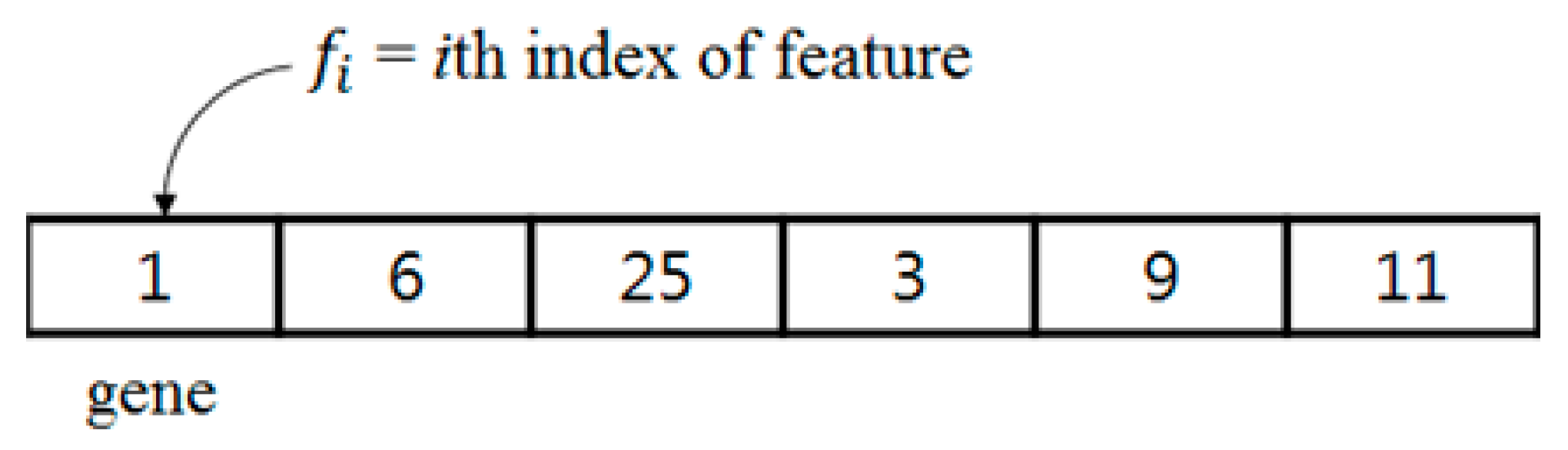
- In permutation decoding, each gene is a number indicating an index in a complete feature set, which is expressed by numbers along with expressions with permutations.
- Each chromosome represents a selected feature subset.
- The order of genes in a chromosome is not considered, and duplicate values are not permitted.
- The length of the chromosome is set to the same length as that of the partial feature set.
3.2.2. Binary Decoding
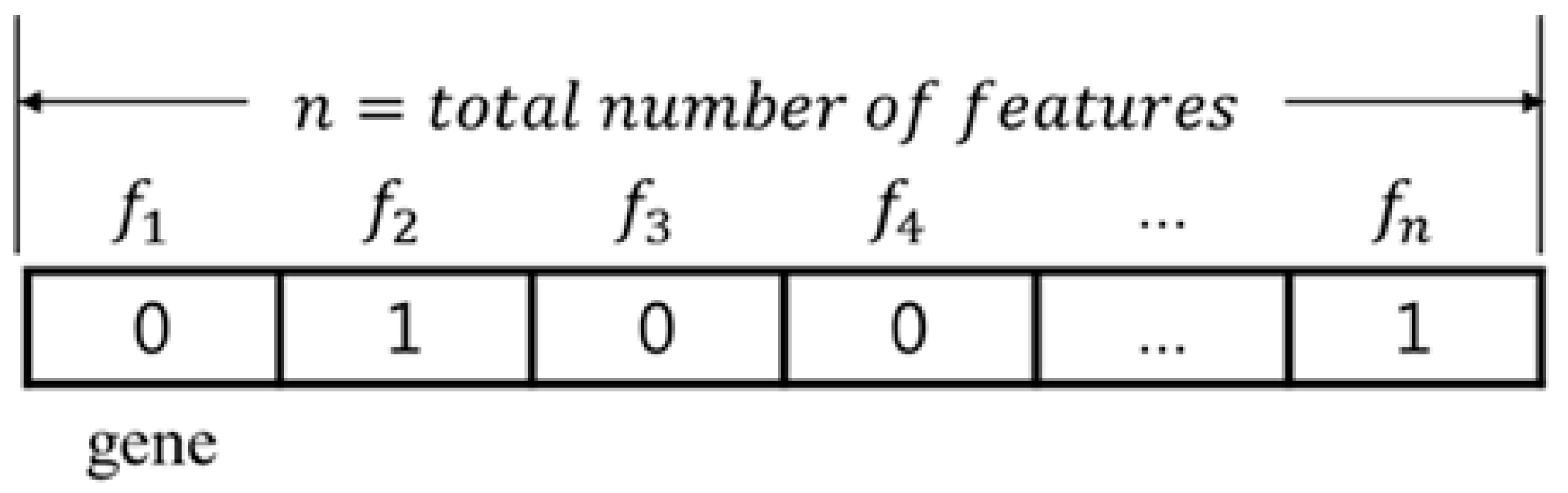
- In binary decoding, each gene represents one feature: true indicates that the feature at that gene is selected and false marks it as unselected.
- Each chromosome represents the selected feature subset.
- The order of genes in a chromosome is set to the same order as the features in the dataset.
- The length of the chromosome n is the same as the number of features.
3.3. Proposed Advanced Fitness Function for Feature Selection
- NR = normal detection, AN = abnormal detection, FP = false positive, MD = miss detection
- ≜ ith chromosome = selected sub-feature set,
- ≜ the number of 𝒌 data instance, 𝒌∈(𝑵𝑹, 𝑨𝑵, 𝑭𝑷, 𝑴𝑫)
- ≜ the number of predicted k data instance using the selected feature set , 𝒌∈(𝑵𝑹, 𝑨𝑵, 𝑭𝑷, 𝑴𝑫)
- ≜ probability of k, 𝒌∈(𝑵𝑹, 𝑨𝑵, 𝑭𝑷, 𝑴𝑫)
- ≜ detection rate using the selected feature set
- ≜ error rate using the selected feature set
- ≜ balancing weight parameter of class imbalance =
3.4. Feature-Selection Algorithm
| Algorithm 1: Feature Selection Procedure (binary decoding) |
| featureLength: The number of features in dataset finalFeatureSet: The number of final feature set maxGeneration: Maximum generation popsize: Population Size |
| Crossover probability = 0.8 Mutation probability = 0.2 p <-initialPopulation(fatureLength, popsize) #value of gene = 0 or 1 computeFitness(p) #fitness function calculation-> generation = 1 while(maxGeneration >= generation { newPop <- linearRankSelection(p) pbxCrossover(newPop) mutate(newPop) p <- newPop computeFitness(p) generation = generation + 1 } subFeature <- TopFeatureSet(p) finalFeautreSet <- addFeature(subFeature) return finalFeatureSet |
4. Evaluation Methodology
4.1. Environment
- CPU: Intel Core i5 650 3.20 GHz
- RAM: 8 GB
4.2. Dataset
4.3. Evaluation Method
4.3.1. Detection Rate
4.3.2. F1-Measure
- TP: Normal data correctly classified as normal.
- TN: Anomalous data correctly classified as anomalous.
- FP: Normal data classified as anomalous.
- FN: Anomalous data classified as normal.
4.3.3. ETS/CSI/PAG/ACC
4.4. Experiment Result of Feature Selection with Permutation Decoding
4.4.1. Result of Detection Rate
4.4.2. Result of F1-Measure
4.4.3. Result of ROC Curve
4.4.4. Result of ETS, CSI, PAG, ACC
4.5. Experiment Results of Feature Selection with Binary Decoding
4.5.1. Analysis of Fitness Curve
4.5.2. Result of Detection Rate and F1-Measure, ETS/CSI/PAG/ACC
4.5.3. Result of ROC Curve
4.6. Result of Selected Sub-Feature Set
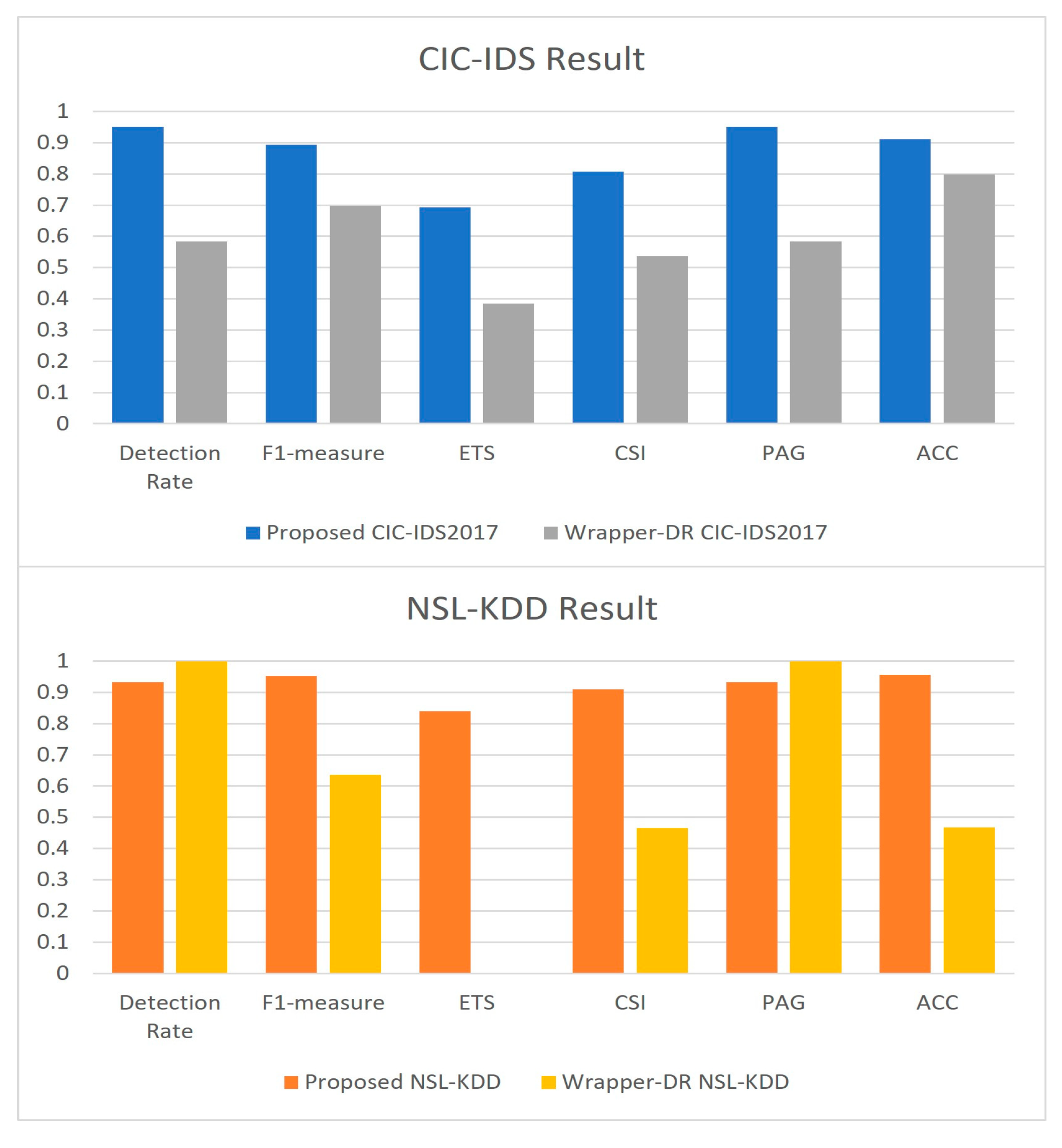
4.7. Result of Binary Decoding with Other Intrusion Detection Dataset: NSL-KDD, CIC-IDS2017
4.8. Time Complexity of Proposed Algorithm
5. Conclusions
Author Contributions
Funding
Data Availability Statement
Conflicts of Interest
References
- Qin, X.; Lee, W. Attack plan recognition and prediction using causal networks. In Proceedings of the 20th Annual Computer Security Applications Conference, Tucson, AZ, USA, 6–10 December 2004; pp. 370–379. [Google Scholar] [CrossRef] [Scilit]
- Salem, M.B.; Hershkop, S.; Stolfo, S.J. A Survey of Insider Attack Detection Research, Insider Attack and Cyber Security: Beyond the Hacker; Springer: Boston, MA, USA, 2008; pp. 69–90. [Google Scholar] [CrossRef] [Scilit]
- Kou, Y.; Lu, C.T.; Sirwongwattana, S.; Huang, Y.P. Survey of Fraud Detection Techniques. In Proceedings of the IEEE International Conference on Networking, Sensing and Control, Teipei, Tiwan, 21–23 March 2004; pp. 749–754. [Google Scholar] [CrossRef] [Scilit]
- Iglesias, F.; Zseby, T. Analysis of network traffic features for anomaly detection. Mach. Learn. 2015, 101, 59–84. [Google Scholar] [CrossRef] [Scilit]
- Jolliffe, I.T.; Cadima, J. Principal component analysis: A review and recent developments. Philos. Trans. R. Soc. A Math. Phys. Eng. Sci. 2016, 374, 20150202. [Google Scholar] [CrossRef] [Scilit] [PubMed]
- Hashem, S.H. Efficiency of Svm and Pca to enhance intrusion detection system. J. Asian Sci. Res. 2013, 3, 381–395. [Google Scholar]
- Ganapathy, S.; Kulothungan, K.; Muthurajkumar, S.; Vijayalakshmi, M.; Yogesh, P.; Kannan, A. Intelligent feature selection and classification techniques for intrusion detection in networks: A survey. EURASIP J. Wirel. Commun. Netw. 2013, 2013, 1–16. [Google Scholar] [CrossRef] [Scilit]
- Eesa, A.S.; Orman, Z.; Brifcani, A.M.A. A novel feature-selection approach based on the cuttlefish optimization algorithm for intrusion detection systems. Expert Syst. Appl. 2015, 42, 2670–2679. [Google Scholar] [CrossRef] [Scilit]
- Lin, W.C.; Ke, S.W.; Tsai, C.F. CANN: An intrusion detection system based on combining cluster centers and nearest neighbors. Knowl. Based Syst. 2015, 78, 13–21. [Google Scholar] [CrossRef] [Scilit]
- Hong, S.-S.; Kim, D.-W.; Han, M.-M. Feature-selection algorithm based on genetic algorithms using unstructured data for attack mail identification. J. Internet Comput. Serv. 2019, 20, 1–10. [Google Scholar] [CrossRef]
- Beltramo, T.; Klocke, M.; Hitzmann, B. Prediction of the biogas production using GA and ACO input features selection method for ANN model. Inf. Process. Agric. 2019, 6, 349–356. [Google Scholar] [CrossRef] [Scilit]
- Song, J.; Takakura, H.; Okabe, Y.; Nakao, K. Toward a more practical unsupervised anomaly detection system. Inf. Sci. 2013, 231, 4–14. [Google Scholar] [CrossRef] [Scilit]
- Du, B.; Zhang, L. A discriminative metric learning based anomaly detection method. IEEE Trans. Geosci. Remote Sens. 2014, 52, 6844–6857. [Google Scholar] [CrossRef] [Scilit]
- Görnitz, N.; Kloft, M.; Rieck, K.; Brefeld, U. Toward Supervised Anomaly Detection. J. Artif. Intell. Res. 2013, 46, 235–362. [Google Scholar] [CrossRef] [Scilit]
- Hoque, M.S.; Mukit, M.; Bikas, M.; Naser, A. Abu Naser Bikas, An Implementation of Intrusion Detection System Using Genetic Algorithm. Int. J. Netw. Secur. Its Appl. 2012, 4, 109–120. [Google Scholar] [CrossRef] [Scilit]
- Hooshmand, M.K.; Hosahalli, D. Network anomaly detection using deep learning techniques. CAAI Trans. Intell. Technol. 2022, 7, 228–243. [Google Scholar] [CrossRef] [Scilit]
- Bourkache, G.; Mezghiche, M.; Tamine, K. A Distributed Intrusion Detection Model Based on a Society of Intelligent Mobile Agents for Ad Hoc Network. In Proceedings of the IEEE International Conference on Availability, Vienna, Austria, 22–26 August 2011; pp. 569–572. [Google Scholar] [CrossRef] [Scilit]
- Ganapathy, S.; Yogesh, P.; Kannan, A. Intelligent Agent Based Intrusion Detection System Using Fuzzy Rough Set Based Outlier Detection. Comput. Intell. Neurosci. 2012, 2012, 9. [Google Scholar] [CrossRef] [Scilit] [PubMed]
- Mukherjee, S.; Sharma, N. Intrusion Detection using Naive Bayes Classifier with Feature Reduction. Procedia Technol. 2012, 4, 119–128. [Google Scholar] [CrossRef] [Scilit]
- Alsoufi, M.A.; Razak, S.; Siraj, M.M.; Nafea, I.; Ghaleb, F.A.; Saeed, F.; Nasser, M. Anomaly-based intrusion detection systems in iot using deep learning: A systematic literature review. Appl. Sci. 2021, 11, 8383. [Google Scholar] [CrossRef] [Scilit]
- Yerriswamy, T.; Murtugudde, G. An efficient algorithm for anomaly intrusion detection in a network. Glob. Transit. Proc. 2021, 2, 255–260. [Google Scholar] [CrossRef] [Scilit]
- Pranto, M.B.; Ratul, M.H.A.; Rahman, M.M.; Diya, I.J.; Zahir, Z.B. Performance of machine learning techniques in anomaly detection with basic feature selection strategy-a network intrusion detection system. J. Adv. Inf. Technol. 2022, 13, 1–9. [Google Scholar] [CrossRef] [Scilit]
- Bhuyan, M.H.; Bhattacharyya, D.K.; Kalita, J.K. Network anomaly detection: Methods, systems and tools. Ieee Commun. Surv. Tutor. 2014, 16, 303–336. [Google Scholar] [CrossRef] [Scilit]
- Abiodun, E.O.; Alabdulatif, A.; Abiodun, O.I.; Alawida, M.; Alabdulatif, A.; Alkhawaldeh, R.S. A systematic review of emerging feature selection optimization methods for optimal text classification: The present state and prospective opportunities. Neural Comput. Appl. 2021, 33, 15091–15118. [Google Scholar] [CrossRef] [Scilit]
- Li, Y.; Wang, J.L.; Tian, Z.H.; Lu, T.B.; Young, C. Building lightweight intrusion detection system using wrapper-based feature selection mechanisms. Comput. Secur. 2009, 28, 466–475. [Google Scholar] [CrossRef] [Scilit]
- El Aboudi, N.; Benhlima, L. Review on wrapper feature selection approaches. In Proceedings of the 2016 International Conference on Engineering & MIS (ICEMIS), Agadir, Morocco, 22–24 September 2016; IEEE: New York, NY, USA, 2016. [Google Scholar]
- Almasoudy, F.H.; Al-Yaseen, W.L.; Idrees, A.K. Differential evolution wrapper feature selection for intrusion detection system. Procedia Comput. Sci. 2020, 167, 1230–1239. [Google Scholar] [CrossRef] [Scilit]
- Vinutha, H.P.; Poornima, B. An ensemble classifier approach on different feature selection methods for intrusion detection. In Proceedings of the Information Systems Design and Intelligent Applications; Springer: Singapore, 2018; pp. 443–451. [Google Scholar]
- Skalak, D.B. Prototype and feature selection by sampling and random mutation hill climbing algorithms. In Proceedings of the Eleventh International Conference on Machine Learning, New Brunswick, NJ, USA, 10–13 July 1994; pp. 293–301. [Google Scholar] [CrossRef] [Scilit]
- Bhosale, D.; Ade, R. Feature selection based classification using naive Bayes, J48 and support vector machine. Int. J. Comput. Appl. 2014, 99, 975–8887. [Google Scholar] [CrossRef] [Scilit]
- Bouzida, Y.; Cuppens, F.; Cuppens-Boulahia, N.; Gombault, S. Efficient Intrusion Detection Using Principal Component Analysis. In Proceedings of the 3éme Conférence sur la Sécurité et Architectures Réseaux (SAR), La Londe, France, June 2004; pp. 381–395. [Google Scholar]
- Nguyen, H.T.; Franke, K.; Petrovic, S. Towards a Generic Feature-Selection Measure for Intrusion Detection. In Proceedings of the 2010 20th International Conference on Pattern Recognition, Istanbul, Turkey, 23–26 August 2010; pp. 1529–1532. [Google Scholar] [CrossRef] [Scilit]
- Azhagusundari, B.; Thanamani, A.S. Feature Selection based on Information Gain. Int. J. Innov. Technol. Explor. Eng. 2013, 2, 18–21. [Google Scholar]
- Amiri, F.; Yousefi, M.R.; Lucas, C.; Shakery, A.; Yazdani, N. Mutual information-based feature selection for intrusion detection systems. J. Netw. Comput. Appl. 2011, 34, 1184–1199. [Google Scholar] [CrossRef] [Scilit]
- Hartmanis, J. Computers and Intractability: A Guide to the Theory of NP-Completeness Computers and intractability: A guide to the theory of np-completeness (michael r. garey and david s. johnson). Siam Rev. 1982, 24, 90. [Google Scholar] [CrossRef] [Scilit]
- KDD Cup 1999 Data. Available online: https://www.kaggle.com/datasets/galaxyh/kdd-cup-1999-data (accessed on 1 November 2021).
- The R Project for Statistical Computing. Available online: https://www.r-project.org/ (accessed on 4 February 2022).
- CRAN—Package, GA. Available online: https://cran.r-project.org/web/packages/GA/index.html (accessed on 10 February 2022).
- Domingos, P.; Pazzani, M. On the optimality of the simple Bayesian classifier under zero-one loss. Mach. Learn. 1997, 29, 103–130. [Google Scholar] [CrossRef] [Scilit]
- CRAN-Pacage e1071. Available online: https://cran.r-project.org/web/packages/e1071/index.html (accessed on 10 February 2022).
- Swets, J.A. Signal Detection Theory and ROC Analysis in Psychology and Diagnostics: Collected Papers; Lawrence Erlbaum Associates, Inc.: Mahwah, NJ, USA, 1996. [Google Scholar] [CrossRef] [Scilit]
- CRAN-Package ROCR. Available online: https://cran.r-project.org/web/packages/ROCR/index.html (accessed on 3 June 2022).
- Hamill, T.M.; Juras, J. Measuring forecast skill: Is it real skill or is it the varying climatology? Q. J. R. Meteorol. Soc. A J. Atmos. Sci. Appl. Meteorol. Phys. Oceanogr. 2006, 132, 2905–2923. [Google Scholar] [CrossRef] [Scilit]
- Roberts, N.M.; Lean, H.W. Scale-selective verification of rainfall accumulations from high-resolution forecasts of convective events. Mon. Weather Rev. 2008, 136, 78–97. [Google Scholar] [CrossRef] [Scilit]
- WWRP/WGNE Joint Working Group on Forecast Verification Research. Available online: https://www.cawcr.gov.au/projects/verification/ (accessed on 30 June 2022).
- Nigro, M.A.; Cassano, J.J.; Seefeldt, M.W. A weather-pattern-based approach to evaluate the Antarctic Mesoscale Prediction System (AMPS) forecasts: Comparison to automatic weather station observations. Weather Forecast. 2011, 26, 184–198. [Google Scholar] [CrossRef] [Scilit]
- Wilks, D.S. Statistical Methods in the Atmospheric Sciences, 3rd ed.; Academic Press: Cambridge, MA, USA; Elsevier: Amsterdam, The Netherlands, 2019. [Google Scholar] [CrossRef] [Scilit]
- Almomani, O. A Feature Selection Model for Network Intrusion Detection System Based on PSO, GWO, FFA and GA Algorithms. Symmetry 2020, 12, 1046. [Google Scholar] [CrossRef] [Scilit]
- Intrusion Detection Evaluation Dataset (CIC-IDS2017). Available online: https://www.unb.ca/cic/datasets/ids-2017.html (accessed on 2 January 2023).
- Burke, E.K.; Burke, E.K.; Kendall, G.; Kendall, G. Search Methodologies: Introductory Tutorials in Optimization and Decision Support Techniques; Springer: Berlin/Heidelberg, Germany, 2014. [Google Scholar] [CrossRef] [Scilit]
- Fleizach, C.; Fukushima, S. A naive Bayes Classifier on 1998 KDD Cup. California University. 2006. Available online: http://sysnet.ucsd.edu/~cfleizac (accessed on 1 January 2022).
- Apache Hadoop. Available online: http://hadoop.apache.org/ (accessed on 1 September 2021).
- Dean, J.; Ghemawat, S. MapReduce: Simplified data processing on large clusters. Commun. ACM 2008, 51, 107–113. [Google Scholar] [CrossRef] [Scilit]








| Attack Type | Description |
|---|---|
| DOS | Denial-of-service, e.g., SYN flood |
| R2L | Unauthorized access from a remote machine, e.g., password guessing |
| U2R | Unauthorized access to local superuser (root) privileges, e.g., various buffer overflow attacks |
| Probing | Surveillance and other probing, e.g., port scanning |
| Label | Normal | Abnormal | |
|---|---|---|---|
| Forecast | |||
| Normal | Hit (like TP) | False alarms (like FP) | |
| Abnormal | Misses (like FN) | Correct negatives (like TN) | |
| Algorithm | Proposed | Wrapper-DR | PCA | |
|---|---|---|---|---|
| Feature Subset | ||||
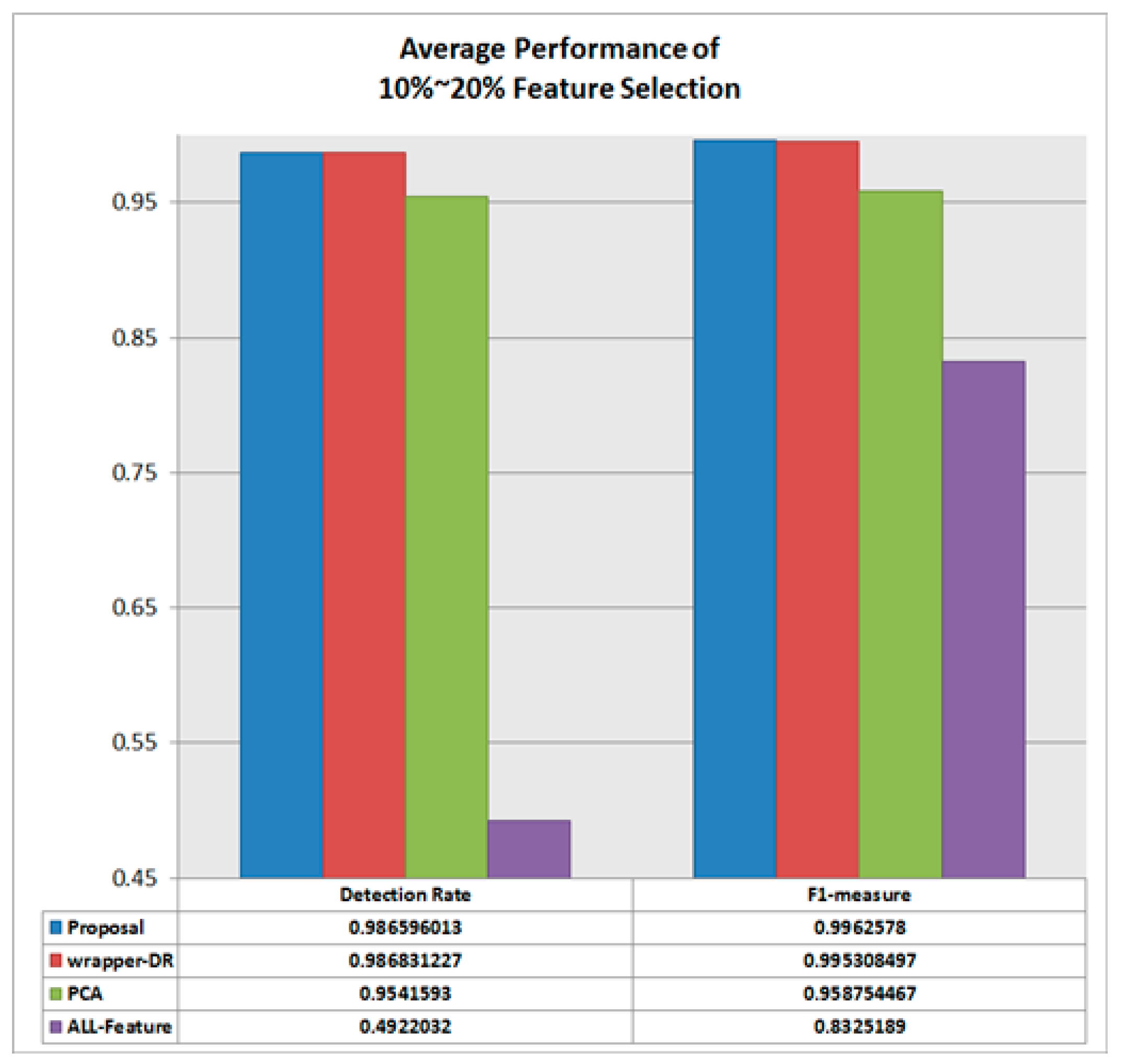
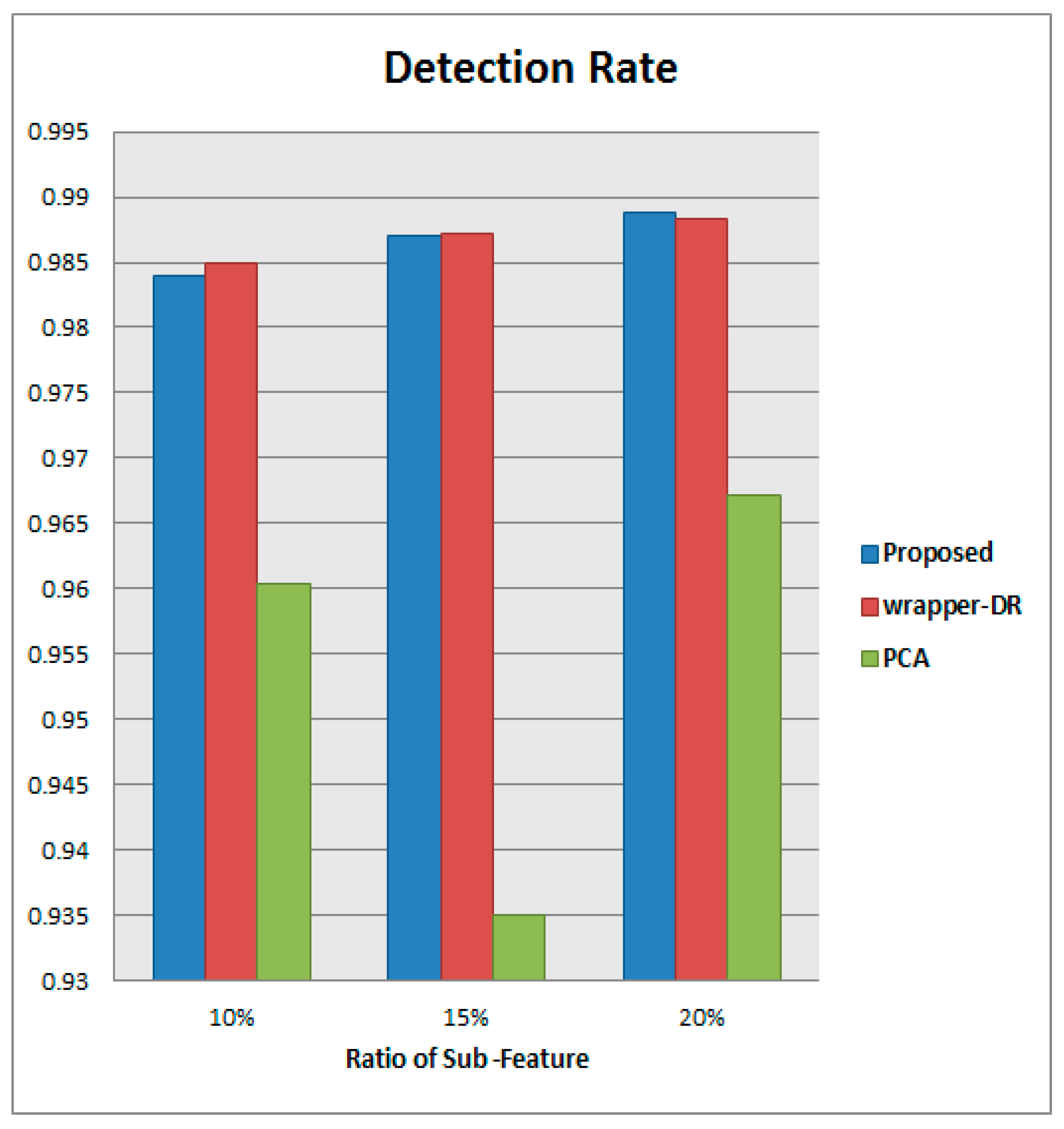
| 10% | 0.983925 | 0.985000 | 0.960384 | |
| 15% | 0.987082 | 0.987214 | 0.934998 | |
| 20% | 0.988781 | 0.988280 | 0.967096 | |
| Algorithm | Proposed | Wrapper-DR | PCA | |
|---|---|---|---|---|
| Feature Subset | ||||
| 10% | 0.995640 | 0.994921 | 0.966367 | |
| 15% | 0.996455 | 0.995148 | 0.936418 | |
| 20% | 0.996679 | 0.995856 | 0.973478 | |
| Sub Feature Set | 10% | 15% | 20% |
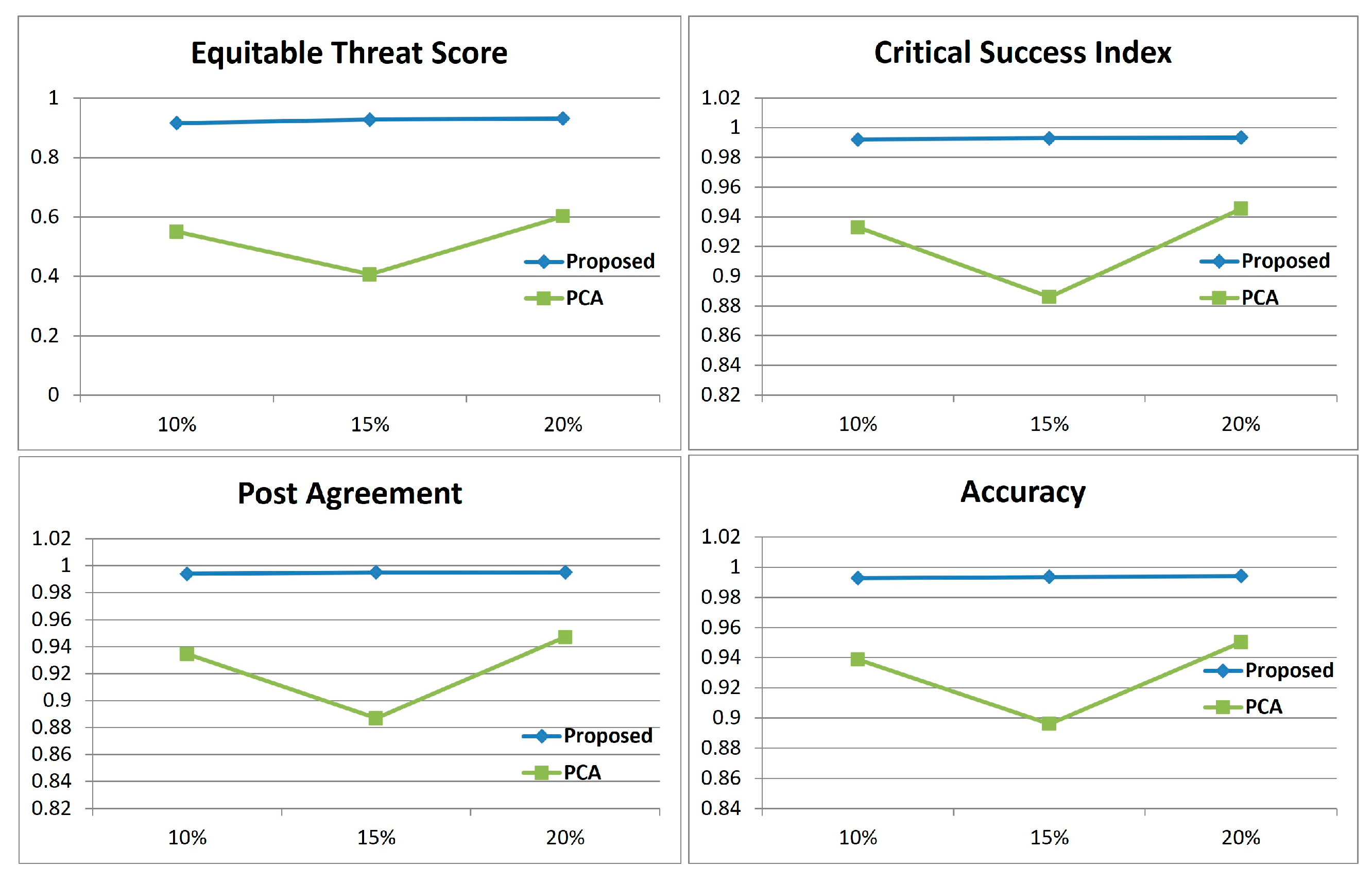
| ETS (Equitable Threat Score) | |||
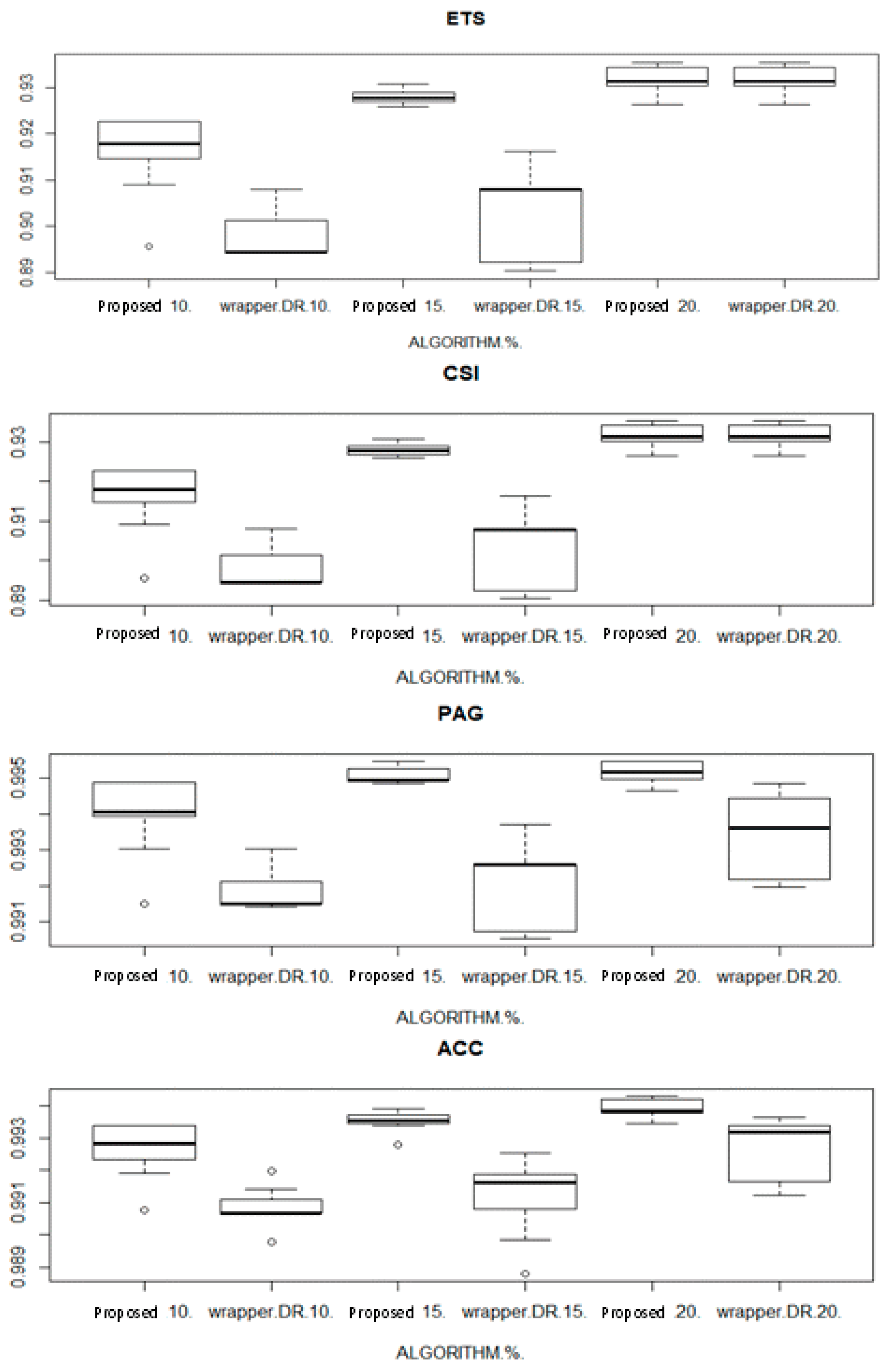
| Proposed | 0.9160 | 0.9279 | 0.9318 |
| Wrapper-DR | 0.8973 | 0.9042 | 0.9318 |
| PCA | 0.5498 | 0.4068 | 0.6024 |
| CSI (Critical Success Index) | |||
| Proposed | 0.9920 | 0.9929 | 0.9933 |
| Wrapper-DR | 0.9900 | 0.9903 | 0.9933 |
| PCA | 0.9330 | 0.8860 | 0.9454 |
| PAG (Post Agreement) | |||
| Proposed | 0.9940 | 0.9950 | 0.9951 |
| Wrapper-DR | 0.9917 | 0.9921 | 0.9934 |
| PCA | 0.9344 | 0.8868 | 0.9470 |
| ACC (Accuracy) | |||
| Proposed | 0.9927 | 0.9935 | 0.9942 |
| Wrapper-DR | 0.9909 | 0.9913 | 0.9933 |
| PCA | 0.9389 | 0.8960 | 0.9501 |
| Proposed | Wrapper-DR | |
|---|---|---|
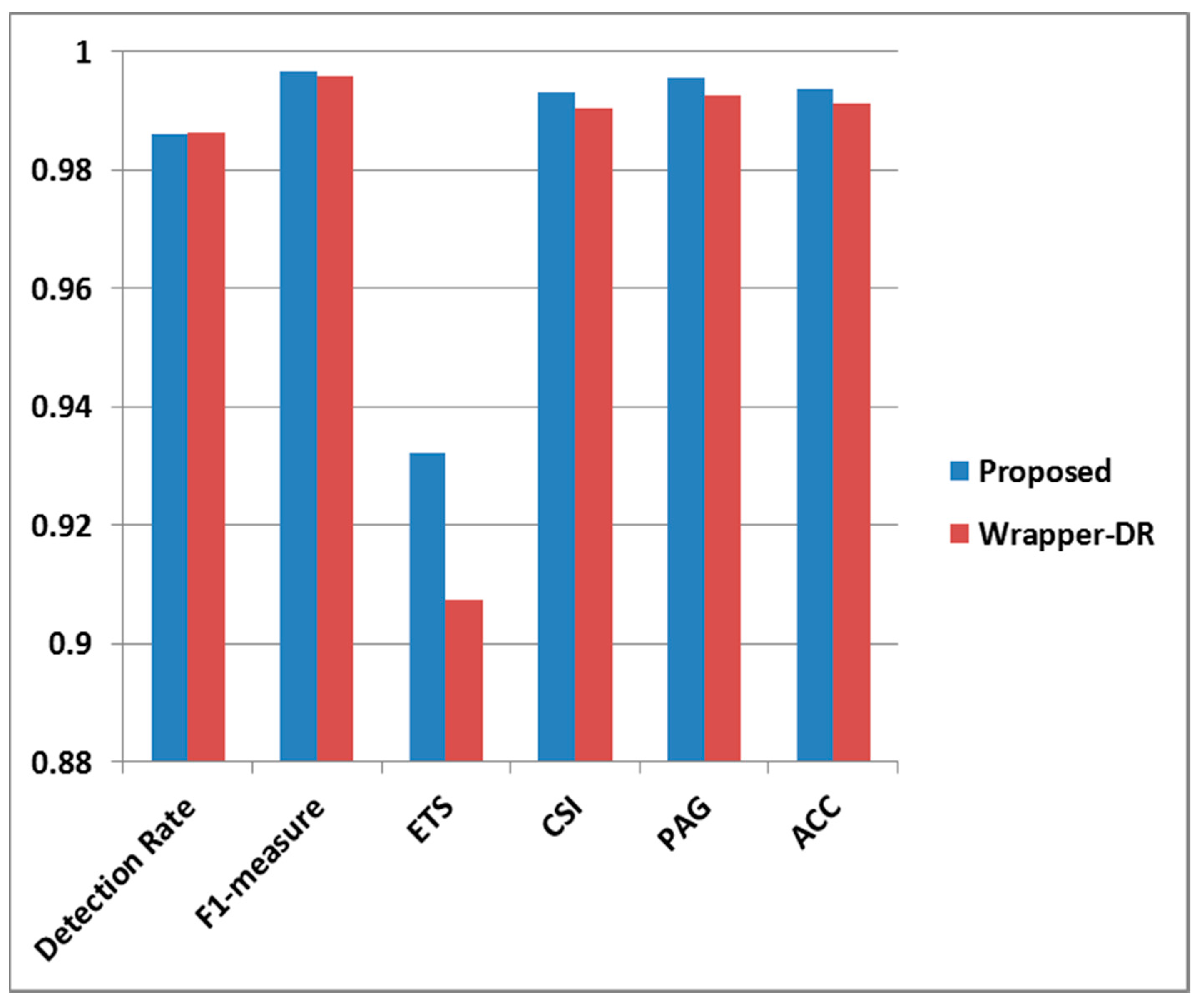
| Detection Rate | 0.986052 | 0.986454 |
| F1-measure | 0.996792 | 0.995916 |
| ETS | 0.9322 | 0.9073 |
| CSI | 0.9930 | 0.9903 |
| PAG | 0.9956 | 0.9925 |
| ACC | 0.9937 | 0.9912 |
| Algorithm | Selected Feature | Length | |
|---|---|---|---|
| Proposed | protocol_type flag wrong_fragment logged_in root_shell num_outbound _cmds srv_serror_rate rerror_rate | srv_rerror_rate srv_diff_host_rate dst_host_count dst_host_same_srv_rate dst_host_diff_srv_rate dst_host_same_src_port _rate dst_host_srv_diff _host_rate dst_host_srv_serror_rate dst_host_srv_error_rate | 18 |
| wrapper-DR | protocol_type flag wrong_fragment urgent hot num_failed_logins num_compromised root_shell is_guest_login count | rerror_rate srv_diff_host_rate dst_host_count dst_host_srv_count dst_host_same_srv _rate dst_host_same_src _port_rate dst_host_serror_rate dst_host_rerror_rate dst_host_srv_error _rate | 21 |
| Proposed | Wrapper-DR | |||
|---|---|---|---|---|
| CIC-IDS2017 | NSL-KDD | CIC-IDS2017 | NSL-KDD | |
| Detection Rate | 0.9511 | 0.9325 | 0.5840 | 1.0000 |
| F1-measure | 0.8936 | 0.9523 | 0.6984 | 0.6358 |
| ETS | 0.6934 | 0.8398 | 0.3847 | 0.0021 |
| CSI | 0.8077 | 0.9090 | 0.5366 | 0.4661 |
| PAG | 0.9511 | 0.9325 | 0.5840 | 1.0000 |
| ACC | 0.9119 | 0.9568 | 0.7984 | 0.4674 |
| Algorithm | Selected Feature | Length | |
|---|---|---|---|
| Proposed | Destination.Port Flow.Duration Total.Length.of.Fwd.Packets Fwd.Packet.Length.Max Fwd.Packet.Length.Min Fwd.Packet.Length.Mean Bwd.Packet.Length.Min Bwd.Packet.Length.Mean Bwd.Packet.Length.Std Flow.Bytes.s Flow.Packets.s Flow.IAT.Mean Flow.IAT.Std Flow.IAT.Max Flow.IAT.Min Fwd.IAT.Std Fwd.IAT.Max min_seg_size_forward Active.Mean Active.Std | Active.Max Idle.Mean Idle.Std Idle.Max Idle.Min Bwd.IAT.Total Fwd.PSH.Flags Fwd.URG.Flags Fwd.Header.Length Bwd.Packets.s Max.Packet.Length Packet.Length.Mean Packet.Length.Std Packet.Length.Variance FIN.Flag.Count PSH.Flag.Count URG.Flag.Count CWE.Flag.Count Down.Up.Ratio Avg.Bwd.Segment.Size Fwd.Avg.Bytes.Bulk Fwd.Avg.Packets.Bulk Bwd.Avg.Bytes.Bulk Bwd.Avg.Bulk.Rate Subflow.Bwd.Packets Init_Win_bytes_forward Init_Win_bytes_backward | 47 |
| wrapper-DR | Packet.Length.Std | 24 | |
| Flow.Duration | Packet.Length.Variance | ||
| Fwd.Packet.Length.Mean | Average.Packet.Size | ||
| Flow.Bytes.s | Avg.Fwd.Segment.Size | ||
| Fwd.IAT.Std | Fwd.Avg.Bytes.Bulk | ||
| Fwd.IAT.Min | Fwd.Avg.Packets.Bulk | ||
| Bwd.IAT.Mean | Bwd.Avg.Packets.Bulk | ||
| Bwd.IAT.Std | Bwd.Avg.Bulk.Rate | ||
| Bwd.IAT.Max | Init_Win_bytes_forward | ||
| Bwd.IAT.Min | Active.Std | ||
| Fwd.URG.Flags | Active.Max | ||
| Bwd.Packets.s | Idle.Std | ||
| Idle.Max | |||
Disclaimer/Publisher’s Note: The statements, opinions and data contained in all publications are solely those of the individual author(s) and contributor(s) and not of MDPI and/or the editor(s). MDPI and/or the editor(s) disclaim responsibility for any injury to people or property resulting from any ideas, methods, instructions or products referred to in the content. |
© 2023 by the authors. Licensee MDPI, Basel, Switzerland. This article is an open access article distributed under the terms and conditions of the Creative Commons Attribution (CC BY) license (https://creativecommons.org/licenses/by/4.0/).
Share and Cite
Hong, S.-S.; Lee, E.-j.; Kim, H. An Advanced Fitness Function Optimization Algorithm for Anomaly Intrusion Detection Using Feature Selection. Appl. Sci. 2023, 13, 4958. https://doi.org/10.3390/app13084958
Hong S-S, Lee E-j, Kim H. An Advanced Fitness Function Optimization Algorithm for Anomaly Intrusion Detection Using Feature Selection. Applied Sciences. 2023; 13(8):4958. https://doi.org/10.3390/app13084958
Chicago/Turabian StyleHong, Sung-Sam, Eun-joo Lee, and Hwayoung Kim. 2023. "An Advanced Fitness Function Optimization Algorithm for Anomaly Intrusion Detection Using Feature Selection" Applied Sciences 13, no. 8: 4958. https://doi.org/10.3390/app13084958
APA StyleHong, S.-S., Lee, E.-j., & Kim, H. (2023). An Advanced Fitness Function Optimization Algorithm for Anomaly Intrusion Detection Using Feature Selection. Applied Sciences, 13(8), 4958. https://doi.org/10.3390/app13084958