

Associations between Thermal and Physiological Responses of Human Body during Exercise


Abstract
1. Introduction
2. Materials and Methods
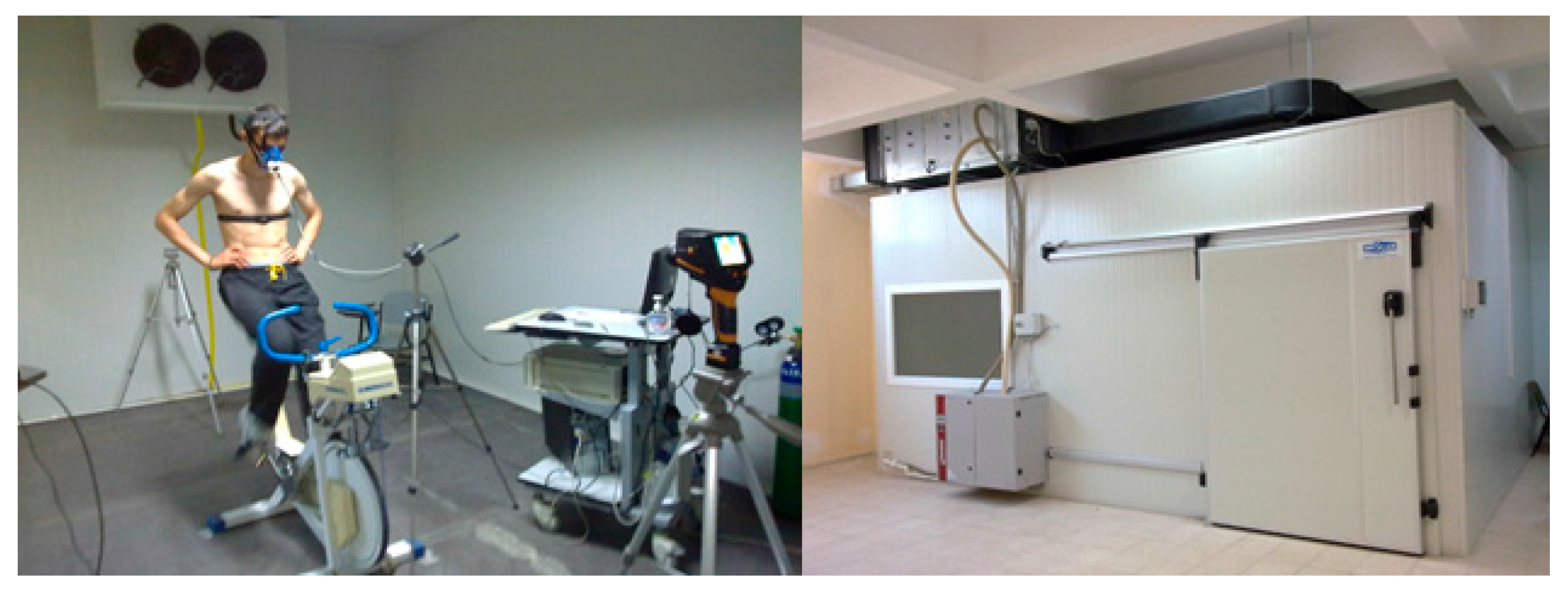
2.1. Climatic Test Chamber
2.2. Participants
2.3. Protocols
2.4. Thermal Data Measurements
2.5. Statistical Analysis
3. Results
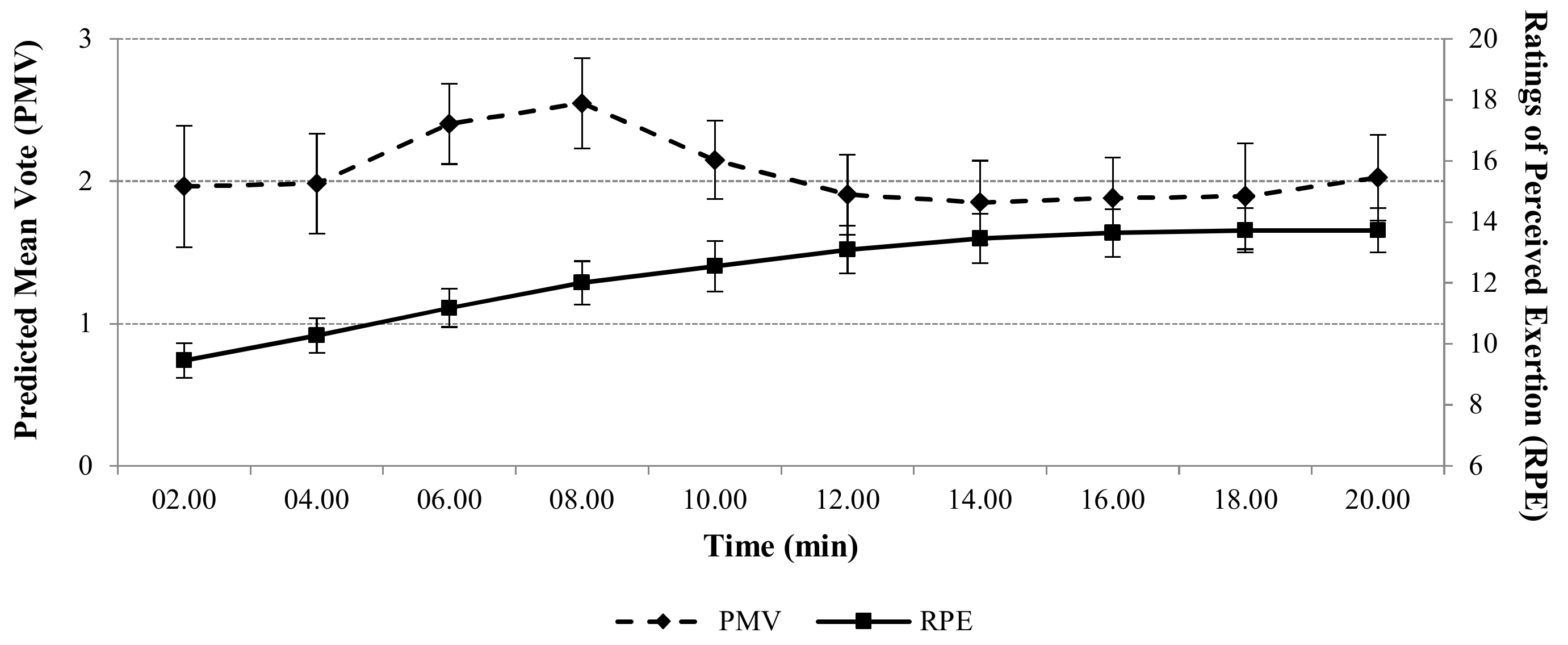
3.1. First Step: PMV-RPE Correlations
3.2. Second Step: PMV-RPE Correlations at Different Oxygen Consumption Rates
4. Discussion
5. Conclusions
Acknowledgments
Author Contributions
Conflicts of Interest
References
- Parsons, K. Human Thermal Environments; Taylor and Francis: London, UK, 2003; ISBN 0203302621. [Google Scholar]
- Kaynaklı, Ö.; Kılıç, M. The effect of vasodilation on human physiology and comparison with sweating. Uludag Univ. J. Fac. Eng. Archit. 2004, 9. [Google Scholar] [CrossRef]
- Resources, R.C. F09 SI: Thermal Comfort. In ASHRAE Handbook Fundamentals; ASHRAE: Atlanta, GA, USA, 2009. [Google Scholar]
- Stamou, A.I.; Katsiris, I.; Schaelin, A. Evaluation of thermal comfort in Galatsi Arena of the Olympics “Athens 2004” using a CFD model. Appl. Therm. Eng. 2008, 28, 1206–1215. [Google Scholar] [CrossRef] [Scilit]
- Butera, F.M. Chapter 3—Principles of thermal comfort. Renew. Sustain. Energy Rev. 1998, 2, 39–66. [Google Scholar] [CrossRef] [Scilit]
- Yang, Y.; Li, B.; Liu, H.; Tan, M.; Yao, R. A study of adaptive thermal comfort in a well-controlled climate chamber. Appl. Therm. Eng. 2015, 76, 283–291. [Google Scholar] [CrossRef] [Scilit]
- Ye, G.; Yang, C.; Chen, Y.; Li, Y. A new approach for measuring predicted mean vote (PMV) and standard effective temperature (SET). Build. Environ. 2003, 38, 33–44. [Google Scholar] [CrossRef] [Scilit]
- Kilic, M.; Kaynakli, O.; Yamankaradeniz, R. Determination of required core temperature for thermal comfort with steady-state energy balance method. Int. Commun. Heat Mass Transf. 2006, 33, 199–210. [Google Scholar] [CrossRef] [Scilit]
- Borg, G. Perceived exertion as an indicator of somatic stress. Scand. J. Rehabil. Med. 1970, 2, 92–98. [Google Scholar] [PubMed]
- Dishman, R.K.; Patton, R.W.; Smith, J.; Weinberg, R.; Jackson, A. Using perceived exertion to prescribe and monitor exercise training heart rate. Int. J. Sports Med. 1987, 8, 208–213. [Google Scholar] [CrossRef] [Scilit] [PubMed]
- Garcin, M.; Fleury, A.; Mille-Hamard, L.; Billat, V. Sex-Related Differences in Ratings of Perceived Exertion and Estimated Time Limit. Int. J. Sports Med. 2005, 26, 675–681. [Google Scholar] [CrossRef] [Scilit] [PubMed]
- Buchheit, M.; Laursen, P.B. High-intensity interval training, solutions to the programming puzzle. Sports Med. 2013, 43, 313–338. [Google Scholar] [CrossRef] [Scilit] [PubMed]
- Crewe, H.; Tucker, R.; Noakes, T.D. The rate of increase in rating of perceived exertion predicts the duration of exercise to fatigue at a fixed power output in different environmental conditions. Eur. J. Appl. Physiol. 2008, 103, 569–577. [Google Scholar] [CrossRef] [Scilit] [PubMed]
- Tucker, R.; Marle, T.; Lambert, E.V.; Noakes, T.D. The rate of heat storage mediates an anticipatory reduction in exercise intensity during cycling at a fixed rating of perceived exertion. J. Physiol. 2006, 574, 905–915. [Google Scholar] [CrossRef] [Scilit] [PubMed]
- Green, J.M.; Yang, Z.; Laurent, C.M.; Davis, J.K.; Kerr, K.; Pritchett, R.C.; Bishop, P.A. Session RPE following interval and constant-resistance cycling in hot and cool environments. Med. Sci. Sports Exerc. 2007, 39, 2051–2057. [Google Scholar] [CrossRef] [Scilit] [PubMed]
- Céline, C.G.-F.; Monnier-Benoit, P.; Groslambert, A.; Tordi, N.; Perrey, S.; Rouillon, J.-D. The Perceived Exertion to Regulate a Training Program in Young Women. J. Strength Cond. Res. 2011, 25, 220–224. [Google Scholar] [CrossRef] [Scilit] [PubMed]
- Kenny, G.P.; Webb, P.; Ducharme, M.B.; Reardon, F.D.; Jay, O. Calorimetric measurement of postexercise net heat loss and residual body heat storage. Med. Sci. Sports Exerc. 2008, 40, 1629–1636. [Google Scholar] [CrossRef] [Scilit] [PubMed]
- Schlader, Z.J.; Stannard, S.R.; Mündel, T. Human thermoregulatory behavior during rest and exercise—A prospective review. Physiol. Behav. 2010, 99, 269–275. [Google Scholar] [CrossRef] [Scilit] [PubMed]
- Balci, G.A.; Basaran, T.; Colakoglu, M. Analysing visual pattern of skin temperature during submaximal and maximal exercises. Infrared Phys. Technol. 2016, 74, 57–62. [Google Scholar] [CrossRef] [Scilit]
- Revel, G.M.; Arnesano, M. Measuring overall thermal comfort to balance energy use in sports facilities. Meas. J. Int. Meas. Confed. 2014, 55, 382–393. [Google Scholar] [CrossRef] [Scilit]
- Villaseñor-Mora, C.; Sanchez-Marin, F.J.; Calixto-Carrera, S. An indirect skin emissivity measurement in the infrared thermal range through reflection of a CO2 laser beam. Rev. Mex. Fis. 2009, 55, 387–392. [Google Scholar]
- McClave, J.T.; Sincich, T. Statistics; Pearson: London, UK, 2013; ISBN 0321755936. [Google Scholar]
- Kirk, R.E. Statistics: An Introduction, 5th ed.; Thompson/Wadsworth: Belmont, CA, USA, 2008; ISBN 053456478X. [Google Scholar]
- Weaver, B.; Koopman, R. An SPSS Macro to Compute Confidence Intervals for Pearson’s Correlation. Tutor. Quant. Methods Psychol. 2014, 10, 29–39. [Google Scholar] [CrossRef] [Scilit]
- Vanos, J.K.; Warland, J.S.; Gillespie, T.J.; Kenny, N.A. Thermal comfort modelling of body temperature and psychological variations of a human exercising in an outdoor environment. Int. J. Biometeorol. 2012, 56, 21–32. [Google Scholar] [CrossRef] [Scilit] [PubMed]
- Casa, D.J.; DeMartini, J.K.; Bergeron, M.F.; Csillan, D.; Eichner, E.R.; Lopez, R.M.; Ferrara, M.S.; Miller, K.C.; O’Connor, F.; Sawka, M.N.; et al. National athletic trainers’ association position statement: Exertional heat illnesses. J. Athl. Train. 2015, 50, 986–1000. [Google Scholar] [CrossRef] [Scilit] [PubMed]
- Wendt, D.; Van Loon, L.J.C.; Van Marken Lichtenbelt, W.D. Thermoregulation during exercise in the heat: Strategies for maintaining health and performance. Sports Med. 2007, 37, 669–682. [Google Scholar] [CrossRef] [Scilit] [PubMed]

| Time Interval | Corr. Coefficients | Level of Corr. Coefficients | p Values |
|---|---|---|---|
| 04.00–06.00 | −0.27 | Weak | 0.42 |
| 06.00–08.00 | −0.26 | Weak | 0.44 |
| 08.00–10.00 | −0.50 | Moderate | 0.12 |
| 10.00–12.00 | −0.59 | Moderate | 0.06 |
| 12.00–14.00 | −0.66 | moderately strong | 0.03 |
| 14.00–16.00 | −0.65 | moderately strong | 0.03 |
| 16.00–18.00 | −0.57 | Moderate | 0.07 |
| 18.00–20.00 | −0.62 | moderately strong | 0.04 |
| Average | −0.51 | Moderate |
| Time Interval | High VO2max Group Corr. Coefficients | Low VO2max Group Corr. Coefficients |
|---|---|---|
| 04.00–06.00 | 0.00 | −0.49 |
| 06.00–08.00 | 0.40 | −0.70 |
| 08.00–10.00 | 0.11 | −0.84 |
| 10.00–12.00 | −0.20 | −0.75 |
| 12.00–14.00 | −0.63 | −0.95 |
| 14.00–16.00 | −0.63 | −0.81 |
| 16.00–18.00 | −0.11 | −0.82 |
| 18.00–20.00 | −0.63 | −0.77 |
| Average | −0.21 | −0.77 |
© 2017 by the authors. Licensee MDPI, Basel, Switzerland. This article is an open access article distributed under the terms and conditions of the Creative Commons Attribution (CC BY) license (http://creativecommons.org/licenses/by/4.0/).
Share and Cite
Zora, S.; Balci, G.A.; Colakoglu, M.; Basaran, T. Associations between Thermal and Physiological Responses of Human Body during Exercise. Sports 2017, 5, 97. https://doi.org/10.3390/sports5040097
Zora S, Balci GA, Colakoglu M, Basaran T. Associations between Thermal and Physiological Responses of Human Body during Exercise. Sports. 2017; 5(4):97. https://doi.org/10.3390/sports5040097
Chicago/Turabian StyleZora, Suleyman, Gorkem Aybars Balci, Muzaffer Colakoglu, and Tahsin Basaran. 2017. "Associations between Thermal and Physiological Responses of Human Body during Exercise" Sports 5, no. 4: 97. https://doi.org/10.3390/sports5040097
APA StyleZora, S., Balci, G. A., Colakoglu, M., & Basaran, T. (2017). Associations between Thermal and Physiological Responses of Human Body during Exercise. Sports, 5(4), 97. https://doi.org/10.3390/sports5040097

